The dining room is the room that most people redesign last and feel the absence of most. Not in the way that a missing bedroom or a missing bathroom is felt — as a functional deficit — but as the absence of a specific quality of domestic experience that no other room in the house generates. The dining room is where the household slows down to eat together. It is where the table is set with more care than a Tuesday night technically requires, where the candles get lit not for any special occasion but because it feels right, and where the conversation that moves from the kitchen counter to the table changes in quality simply by the act of everyone sitting down together. The dining room is the most social room in the house, and it is the one most frequently sacrificed to open-plan living, turned into a home office, or given over to general household activity that the designers of its furniture never envisioned.
What makes dining room design genuinely interesting — and genuinely difficult — is that it is a room with one primary purpose but with a range of secondary ones that are often in direct tension with each other. The dining room must be appropriate for a Tuesday night family dinner where the priority is comfort and ease. It must also be appropriate for the dinner party where the priority is atmosphere and impression. It must handle a Sunday brunch that spills across the morning and a formal dinner that requires a completely different light quality and table setting. The furniture that serves all of these occasions, the lighting that works across every one of them, and the room’s design direction that communicates the household’s personality without committing too firmly to any single register — these are the design challenges that the dining room presents and that most dining room design guides address only at the surface level.
The dining table is the room’s anchor, but the room is far more than the table and the chairs. It is the quality of the light that falls on the faces of the people sitting around the table — which is why dining room lighting is the design decision with more impact per fixture than almost any other room in the house. It is the material of the floor beneath the table, which determines the acoustic quality of the room, the ease of maintenance after meals, and the visual warmth of the space more than any wall treatment does. It is the storage the room provides for the tableware, linens, and serving pieces that the dining function requires — the sideboard, the buffet, the built-in display cabinet — which are both functional storage and the room’s secondary focal point when the table is not set. And it is the relationship between the dining room and the spaces adjacent to it: the kitchen that it opens to or separates from, the living room that it transitions into, the garden that it faces.
The fifty dining room design ideas collected here address all of these dimensions from fifty distinct angles. Some are material decisions — the table specification, the floor surface, the wall treatment — that establish the room’s physical character. Others are atmospheric decisions — the lighting approach, the color palette, the textile selection — that determine the quality of experience the room provides rather than just its appearance in a photograph. Others are spatial and furniture decisions — the seating configuration, the storage approach, the relationship between the dining table and the room’s other elements — that determine how well the room actually functions across the full range of dining occasions it is asked to serve.
The dining room you have right now, whatever its current condition and whatever its size, has more potential than the sum of its current furniture suggests. A room with a table, eight chairs, and an overhead light can be any of fifty different things, and the decisions that distinguish those fifty versions from each other are within reach of any household willing to think carefully about what the room needs to be rather than simply accepting what it currently is. These fifty ideas are the starting point for that thinking.
1. A Dining Room With a Statement Pendant Light
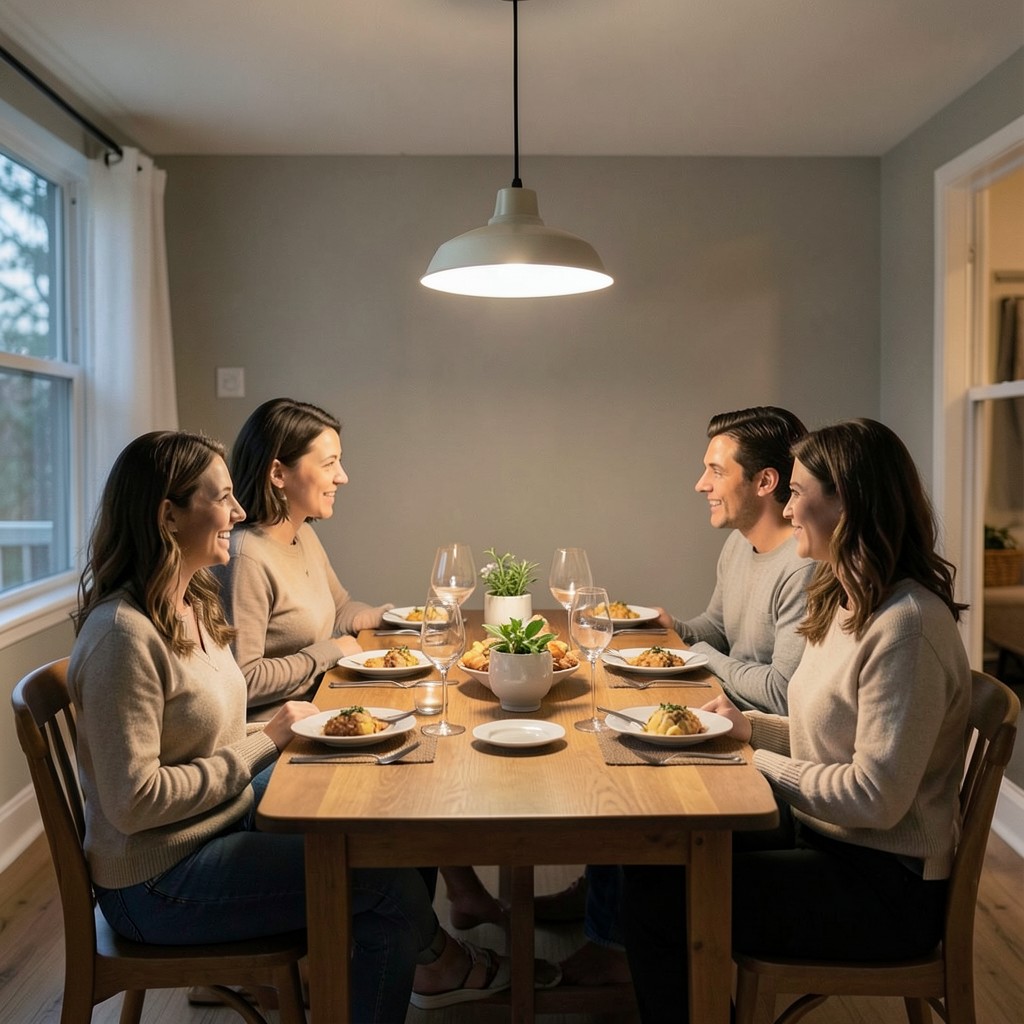
The dining table’s relationship with the light above it is not a design choice — it is a physical law. The pendant light positioned over the dining table creates the optical and atmospheric center of the room, and everything about the dining experience — the visibility of the food, the quality of the faces around the table, the mood of the occasion — is governed by the quality of that light. A poorly chosen or poorly positioned pendant over the dining table is the design problem that no amount of furniture quality or wall treatment corrects, because the light is the environmental condition within which everything else is experienced.
The pendant’s hanging height above the table surface is the positioning variable most frequently misjudged in dining room installations. Too high, and the light spreads too broadly, losing the intimate pool of light that makes a dining table feel separated from the room around it. Too low, and the fixture interrupts sightlines across the table and feels physically present in a way that competes with the conversation and the food. The correct hanging height positions the bottom of the fixture between seventy and eighty centimeters above the table surface — close enough to create an intimate light pool, high enough to remain invisible in the peripheral vision of a seated diner.
The size of the pendant relative to the table is the second critical variable. A pendant too small for the table reads as tentative — a decorative gesture that does not carry the visual authority the room’s center demands. A pendant too large overwhelms the table and dominates the room at the expense of every other element. A fixture whose diameter is approximately one-half to two-thirds of the table’s width reads in correct proportion with the surface it illuminates and provides the visual authority that a dining room’s central light fixture must project.
2. A Dining Room With a Farmhouse Table
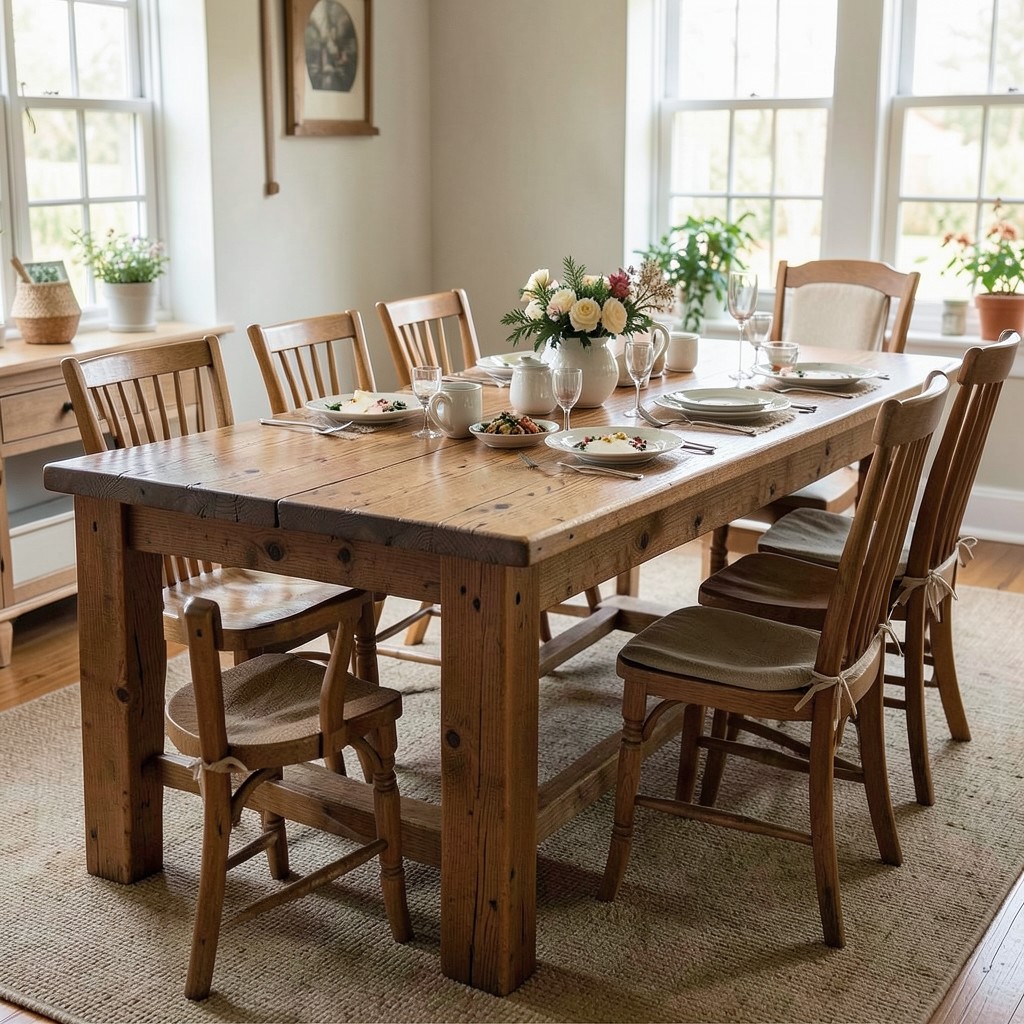
The farmhouse table — a long, rectangular table in solid timber with substantial legs, a surface that shows the grain and the age of the wood honestly, and the specific quality of mass and materiality that only real timber possesses — is the dining room furniture piece that most directly communicates that meals in this household are taken seriously. Not in a formal way. In the way that a table capable of seating ten for Sunday lunch, of handling the full range from casual breakfast to holiday dinner, and of accumulating the physical history of years of family meals without losing its quality communicates that the room it occupies is made for real life.
The timber species of a farmhouse table determines both its visual character and its durability under the daily demands of dining use. Oak — particularly the warm, open-grained quality of European white oak — is the most suitable farmhouse table timber for its combination of hardness, attractive grain character, and the ability to accept food preparation, spills, and daily cleaning without the surface degradation that softer species exhibit. Pine produces a warmer, more rustic appearance with a distinctive knot pattern, but its relative softness means the surface accumulates dents and marks from daily use at a rate that oak resists more effectively. Both are honest, beautiful materials — the choice is between the harder, quieter beauty of oak and the more characterful, warmer informality of pine.
The finish on a farmhouse table surface affects both its appearance and its maintenance requirement more than any other specification decision after the timber choice. A natural oil finish — penetrating into the wood rather than sitting on the surface — produces the most honest reading of the timber’s material character, allows the surface to be spot-repaired rather than requiring full refinishing when damage occurs, and deepens in color over time in a way that builds the table’s material history rather than degrading its finish. A lacquer finish produces a more even, more resilient surface that resists stains and moisture more effectively but sits on top of the wood rather than in it, and when damaged requires more involved repair than a simple reapplication of oil.
3. A Dining Room With a Round Table

A round dining table — at any diameter and in any material — changes the social dynamic of dining in a way that rectangular tables fundamentally cannot. At a round table, every seat is equivalent. There is no head of the table, no hierarchy of position, no corner seat that is physically further from the center of the conversation than any other. The conversation circulates rather than running along a linear axis, and the face of every person at the table is visible to every other person simultaneously, which produces a quality of collective engagement that rectangular tables, where the people at the far ends are physically separated by the full length of the table, rarely generate.
The diameter specification for a round dining table must balance seating capacity against the spatial quality of the dining experience. A round table at one hundred centimeters diameter seats four comfortably with adequate elbow room for each diner — the minimum comfortable allocation per diner at a round table is sixty centimeters of table circumference. At one hundred and twenty centimeters diameter, the table seats four with generous space and can accommodate five in informal settings. At one hundred and fifty centimeters, six seats become comfortable, and the table begins to require a dining room of adequate dimensions to prevent the chairs from pressing against walls when pulled out for seating.
The pedestal base is the correct structural solution for a round dining table used for dining rather than display — the single central base rather than four legs positioned at the table’s corners allows chairs to be placed at any point around the table’s circumference without leg interference. A four-leg round table creates specific seating positions aligned with the spaces between the corner legs and produces the awkward leg-interference problem when a chair is placed at a position that intersects with a table leg. The pedestal base eliminates this constraint entirely and allows seating to be positioned with the flexibility that round table dining demands.
4. A Dining Room With Bold Wallpaper
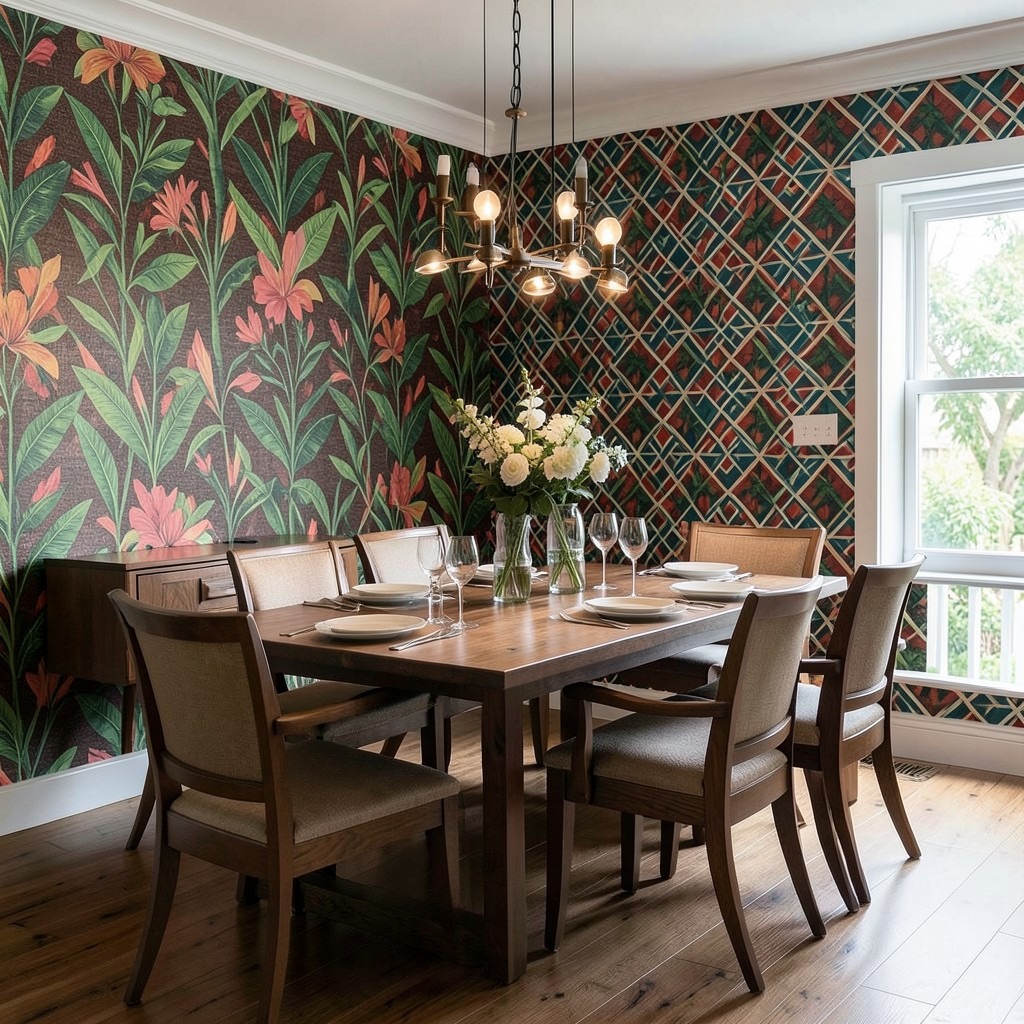
Bold wallpaper in a dining room — a large-scale botanical, a geometric pattern in saturated color, a mural-effect panoramic, or a deeply toned textured weave — is the wall treatment decision that most dramatically changes the character of a dining room in a single installation. The dining room is the interior space most suited to bold wallpaper because of the specific way the room is experienced: you sit in it, relatively stationary, for extended periods, and the wall at eye level from a seated position is the visual environment you inhabit for the full duration of the meal. A wall worth looking at rewards that sustained attention in a way that a painted wall rarely does.
The scale of the wallpaper pattern must be calibrated to the dimensions of the room. A large-scale repeat pattern — botanical leaves at eighty percent of natural size, or a geometric with a repeat of sixty centimeters or more — reads correctly in a dining room of adequate dimensions. In a small dining room, the same pattern scale overwhelms the space and produces the sensation of being inside the pattern rather than dining in a room that has one. A smaller scale repeat or a more distributed pattern — a fine trellis, a scattered small-scale print — maintains the visual interest without the dominance that large-scale patterns impose on small rooms.
The application of bold wallpaper to a single feature wall — the wall at the end of the table, or the wall behind the sideboard — rather than all four walls is the approach that introduces bold pattern without the full commitment of a four-wall installation. This is the honest position: a feature wall application tests the bold wallpaper’s effect in the room before the full installation is committed to, and it produces a composed backdrop effect that positions the table and its diners against a statement wall rather than enveloping the entire room in the pattern.
5. A Dining Room With a Chandelier
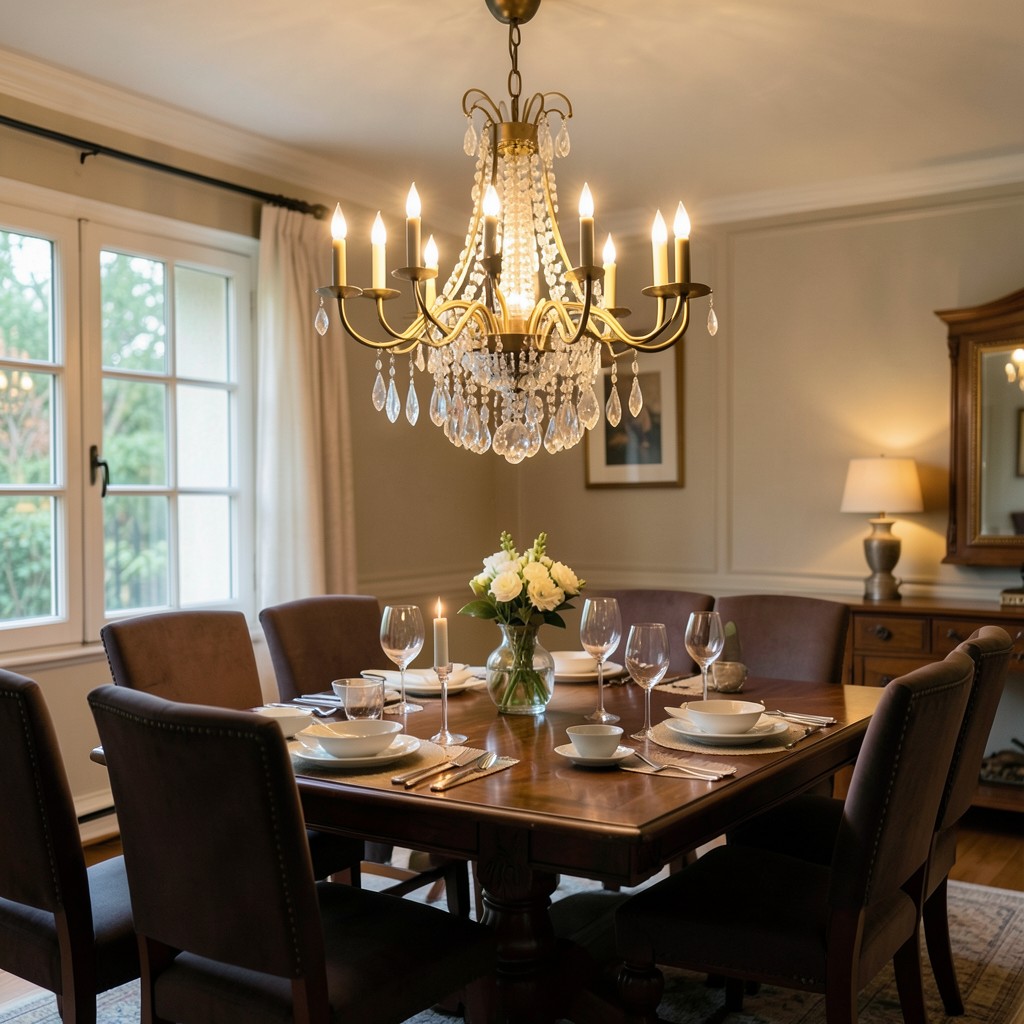
A chandelier in a dining room is the light fixture that has the most immediate atmospheric impact of any fixture available, not because of its light output — which is often less functional than a well-positioned pendant — but because of its presence as an object in the room. A chandelier is not primarily a light source. It is a room’s focal point that also happens to produce light, and its visual contribution to the dining room’s character operates through its form, its material, and its scale rather than through the quality of illumination it provides at table level.
The chandelier’s material selection communicates the dining room’s design direction more efficiently than any other single element. A traditional cut crystal chandelier references a formal European aesthetic with centuries of historical weight behind it. A contemporary brushed brass chandelier with clean geometric arms references the current design moment’s interest in the material warmth of aged metals. A black iron chandelier with candle-form fittings references a medieval or Spanish colonial aesthetic that produces a different quality of gravitas. A clear glass globe chandelier references mid-century Scandinavian design. Each material language carries a specific cultural and historical reference, and the selection should be made with an understanding of which reference the dining room’s overall design direction is building toward.
The dimmer control for a chandelier in a dining room is non-negotiable. A chandelier at full intensity produces the flat, overly bright illumination that is appropriate for a restaurant’s service light and entirely wrong for the atmosphere of a private dining room. The same chandelier at forty percent of its maximum intensity produces the warm, jeweled quality that the fixture was designed to project, and the transition between those two states — available at a finger’s touch on a rotary dimmer — is the single most impactful control available over the dining room’s atmosphere through the course of an evening.
6. A Dining Room With Dark Moody Walls
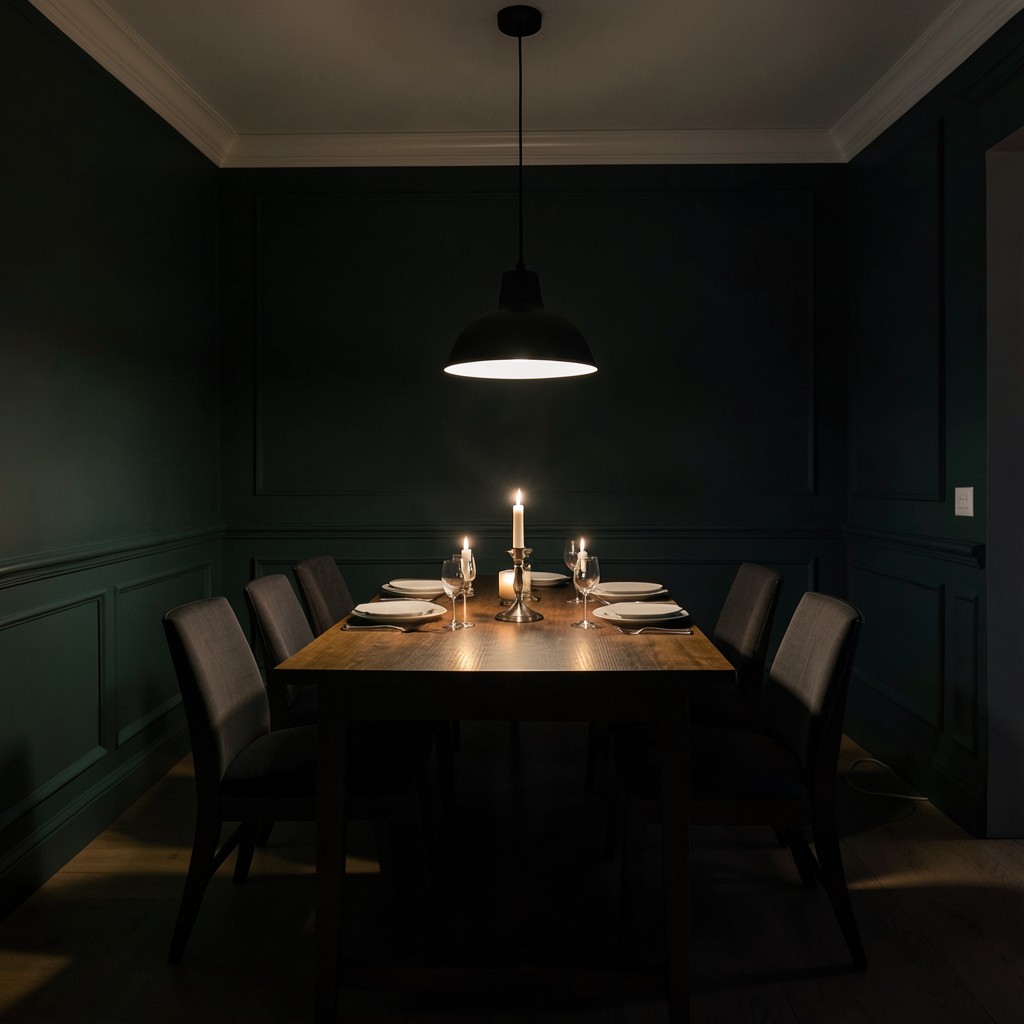
A dining room with dark walls — deep emerald green, near-black navy, charcoal, or a saturated burgundy — is the design choice that produces the most dramatic shift in atmospheric quality from the standard neutral-walled dining room, and it is the choice that most confident dining room designers make when the brief is to create a room that feels specifically designed for the evening meal rather than generically pleasant at all hours. The dark dining room works at night in a way that no pale room achieves — the walls absorb and deepen the candlelight, the low pendant illumination bounces off the table surface without reflecting harshly off pale walls, and the room closes in around the table in a quality of intimate enclosure that makes dinner feel like an event.
The counterintuitive quality of dark dining room walls is that they do not make the room feel smaller in any unpleasant sense. A dining room used primarily for evening meals, lit by pendant light and candles on the table, barely registers the wall color’s relationship to the room’s dimensions — the boundaries of the space are already defined by the edges of the light rather than by the visible extent of the walls. Dark walls in a room lit primarily by the light at the table center actually increase the sense of intimate enclosure that makes the dining experience more enveloping, not less.
The trim specification in a dark dining room — the skirting boards, architraves, and ceiling cornice painted in the same dark tone as the walls rather than in the contrasting white that most rooms use — produces the most resolved, most atmospheric reading of the dark dining room concept. White trim against a dark wall reads as a contrast that draws the eye to the room’s edges and boundaries, which fragments the sense of enveloping darkness that the dark wall direction is working toward. Dark trim against a dark wall allows the room’s architecture to recede behind the overall atmospheric quality, placing the dining table — and the people seated around it — as the only prominent element in the field of dark.
7. A Dining Room With a Bench Seat
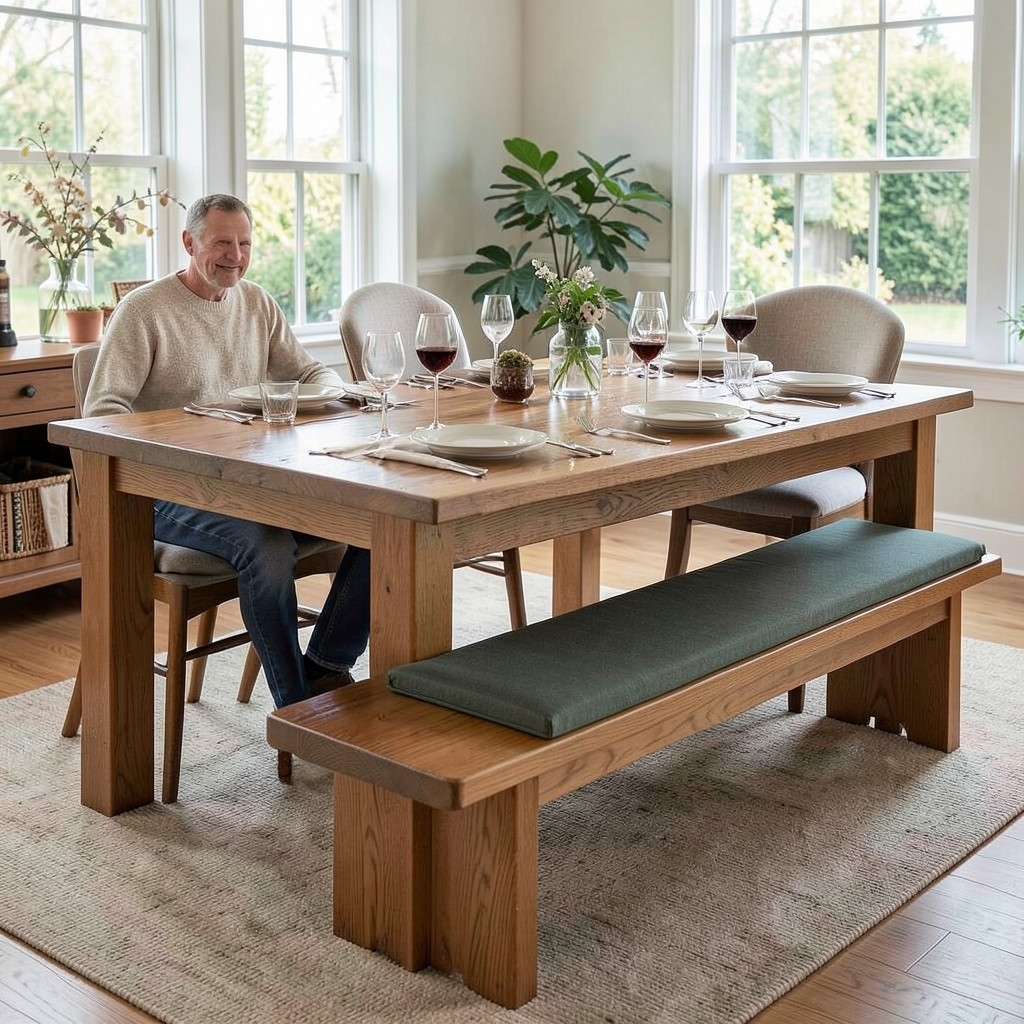
A dining bench — a backless or low-back seating form replacing the chairs on one or both long sides of a rectangular dining table — changes the seating capacity, the social dynamic, and the visual character of the dining room simultaneously. A bench accommodates more diners per linear meter of table length than individual chairs, because the per-person allocation on a bench is not constrained by the shoulder width of a chair back. Two additional diners per long side — four additional seats per table — is a realistic capacity increase that a bench configuration provides over an equivalent length of individual chairs, and on an occasion where the dining table is at full capacity, those four additional seats are the difference between a table that accommodates everyone and one that does not.
The bench material for a dining room context must handle the combination of seated weight, the moisture from spilled drinks, the abrasion of clothing fabric against the seat surface, and the general daily load that a primary household dining seat receives. A solid timber bench — in oak, ash, or an equivalent hardwood — is the most durable and most easily maintained seating surface for dining room use. The hardwood seat accepts spills without absorbing them at the rate that upholstered seating does, can be cleaned with a damp cloth without the concern for fabric saturation that upholstered alternatives require, and develops a surface character with use that adds to its material quality rather than diminishing it.
The bench cushion — a removable, fitted pad in an outdoor-quality or easily washable fabric — is the accessory that converts a timber bench from a comfortable short-duration seat to one suitable for a long dinner. Without the cushion, a flat timber bench produces the progressive discomfort from ischial pressure that makes two hours of dining increasingly difficult to enjoy. With a well-specified cushion of sufficient depth — at minimum five centimeters of good-quality foam in a cover that can be unzipped and machine washed — the bench becomes as comfortable as any upholstered chair for the duration of an extended dinner.
8. A Dining Room With a Buffet or Sideboard
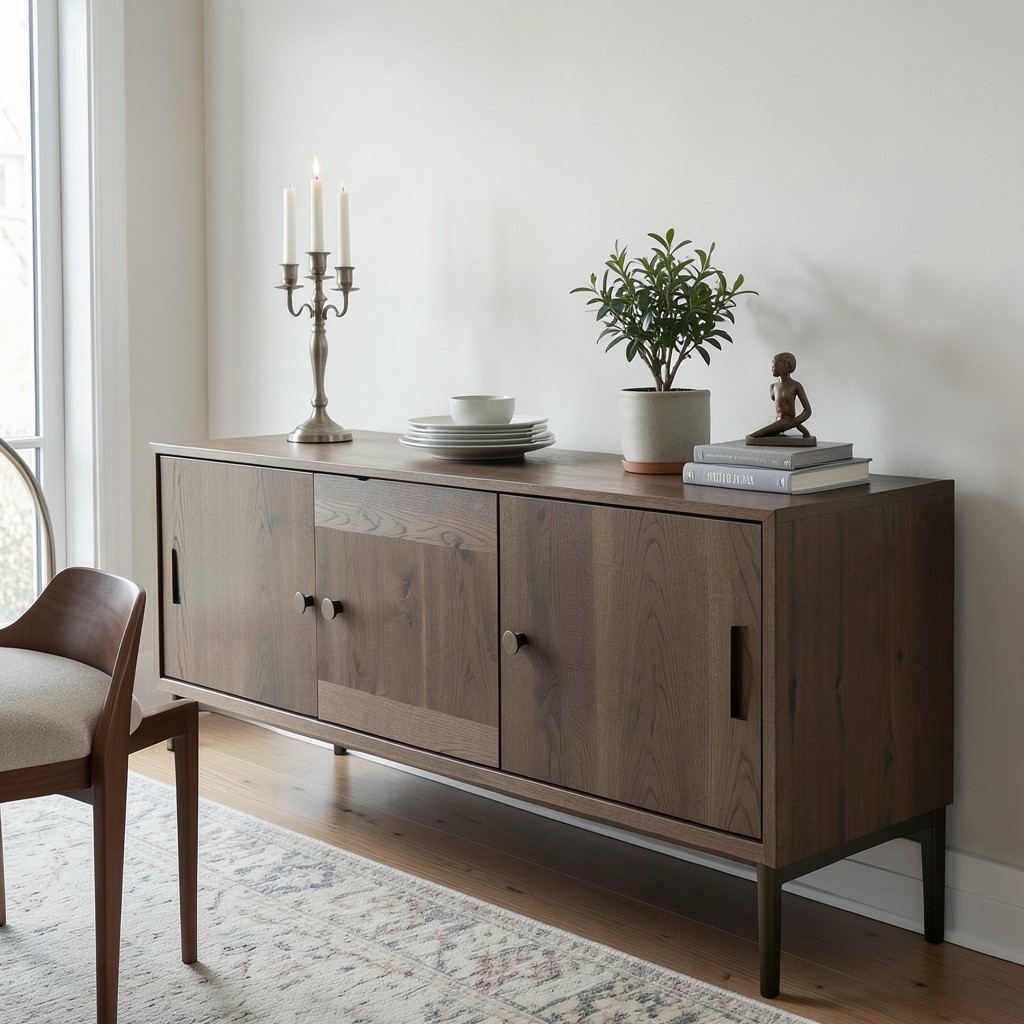
A sideboard in a dining room — a low storage cabinet positioned against the wall, providing surface area for serving dishes, storage for tableware and linens, and a secondary display surface for decorative objects — is the dining room furniture piece whose absence is most felt in functional terms and whose presence is most noticed in design terms. The dining room without a sideboard has nowhere to stage serving dishes between the kitchen and the table, nowhere to store the things the dining room requires that do not belong on the table, and no secondary focal point that gives the room visual interest beyond the table itself.
The sideboard proportions — its length relative to the wall it occupies, its height relative to the dining table, and its depth relative to the floor space in front of it — determine whether it reads as a furniture piece in correct relationship with its context or as a piece that was placed in the available space without sufficient consideration of its scale. A sideboard whose length spans at least two-thirds of the wall it occupies reads as a deliberate placement. One that spans less than half the wall reads as an undersized piece in an undersized position. The height of seventy-eight to eighty-five centimeters — the standard sideboard height range — positions the serving surface at a comfortable working height and keeps the surface visually in the lower zone of the room where horizontal furniture belongs.
The sideboard’s top surface is the most visible horizontal surface in the dining room after the dining table itself, and its styling — the objects displayed on it, their arrangement, and the relationship between the decorative display and the practical serving function — communicates the household’s aesthetic sensibility in the same direct way that the dining table setting does. A pair of candlesticks, a ceramic bowl, a plant in a low container, and three books stacked horizontally as a base for a small sculptural object — this is the sideboard surface composition that most consistently reads as considered without appearing arranged. The balance between the practical serving function and the decorative display function is the ongoing exercise that the sideboard top demands.
9. A Dining Room With Exposed Brick
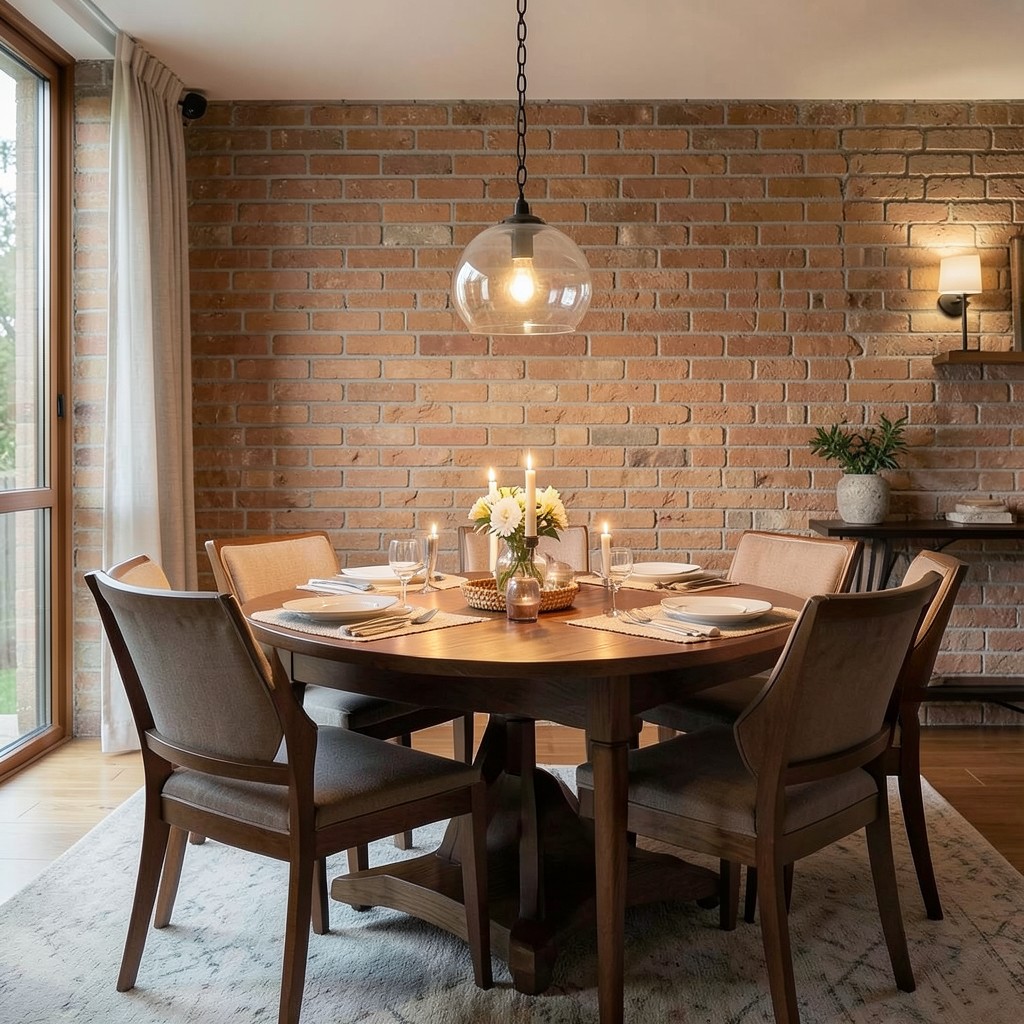
An exposed brick wall in a dining room — whether genuine structural brick cleaned and sealed to reveal its material character or a brick-effect tile applied to the wall surface — introduces a texture and a material warmth that no other wall treatment generates at the same price point. Brick has the specific quality of absorbing and reflecting warm light simultaneously: the mortar joints create shadows that deepen with lower light angles, the brick face reflects candlelight in the amber tones that fire-baked clay naturally possesses, and the surface’s irregularity produces the visual complexity that a smooth plastered wall in the same color simply does not match.
The exposed brick in a dining room requires two preparation decisions before its final appearance is established: the cleaning and pointing of the mortar joints, and the decision about whether to leave the brick in its natural color or to paint it. Natural brick — in the warm orange-red tones of standard clay fired brick, or the cooler grey-buff tones of London stock or similar regional brick types — reads as industrial or rustic depending on the brick’s specific tone and the surrounding design context. A painted brick — in white, cream, or a soft grey — provides the texture of the brick surface while unifying its color variation into a single, consistent tone that suits a broader range of dining room design directions.
The food and moisture environment of a dining room requires that exposed brick in the room’s walls be sealed with a breathable masonry sealer before the room is occupied for dining. Unsealed brick in a dining room absorbs the airborne moisture, cooking vapors, and food particle residue that a room used daily for eating generates over months into a surface contamination that is difficult to remove and that produces an odor in warm conditions that no unsealed masonry material avoids in a food proximity context. A breathable masonry sealer preserves the brick’s visual character, maintains its breathability, and prevents the surface contamination that unsealed brick accumulates inevitably.
10. A Dining Room With Upholstered Chairs
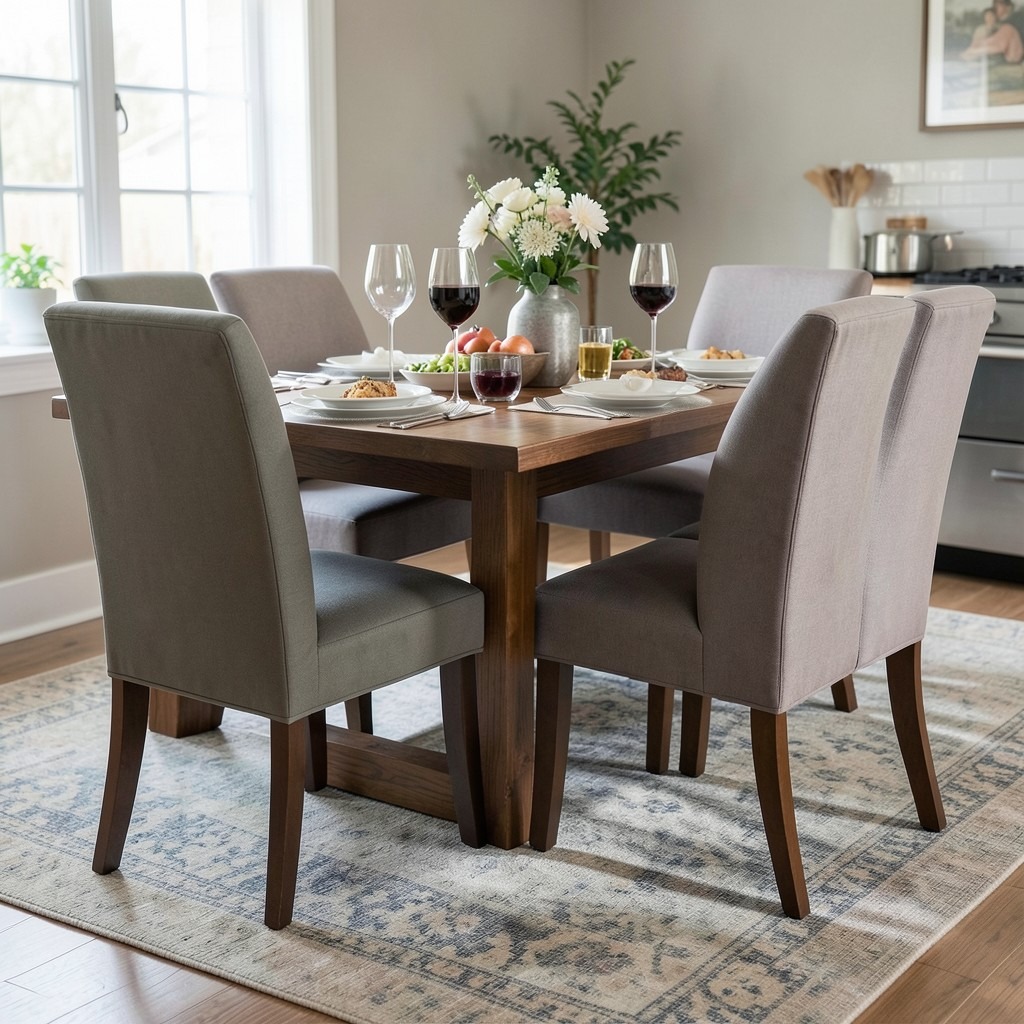
Upholstered dining chairs — chairs with padded seats and padded backs, covered in a fabric or leather appropriate for the dining context — produce the seated comfort quality that allows meals to extend from adequate nutrition to genuine leisure. The unupholstered dining chair — the timber seat, the metal frame, the woven rattan — provides a practical seating surface that tolerates daily use with minimal maintenance but that produces the progressive discomfort from unpadded sitting that most adults begin to notice after forty-five minutes and find distracting after ninety. For a household where dinner consistently extends to conversation after the meal, the upholstered chair is the investment that makes the dining room the room people linger in rather than leave.
The fabric selection for dining chair upholstery must prioritize cleanability alongside aesthetics, because the dining context generates the full range of food and drink spillage events that any upholstered surface experiences at maximum frequency. A performance fabric — specifically a solution-dyed acrylic or a coated woven textile with a stain-resistant treatment — provides the visual richness of a domestic upholstery fabric with the practical resistance to food and moisture contact that dining use demands. A standard interior upholstery fabric in the same color and texture will look identical on the chair at the point of purchase and require professional cleaning after the first dinner party where red wine is served.
The chair leg material and finish affects both the chair’s durability in a dining context and its visual contribution to the room. Solid timber legs — in a stained or painted finish — suit the broadest range of dining room design directions and handle the daily load of moving, pulling, and pushing that dining chairs receive without the scratching of floor surfaces that unprotected metal chair feet produce. Metal legs in a powder-coated finish provide the specific visual quality of contemporary dining chairs with an industrial aesthetic reference, and their durability in a dining context is excellent provided the chair feet carry floor protectors that prevent the metal from scratching the floor surface with each use.
11. A Dining Room With a Built-In Banquette
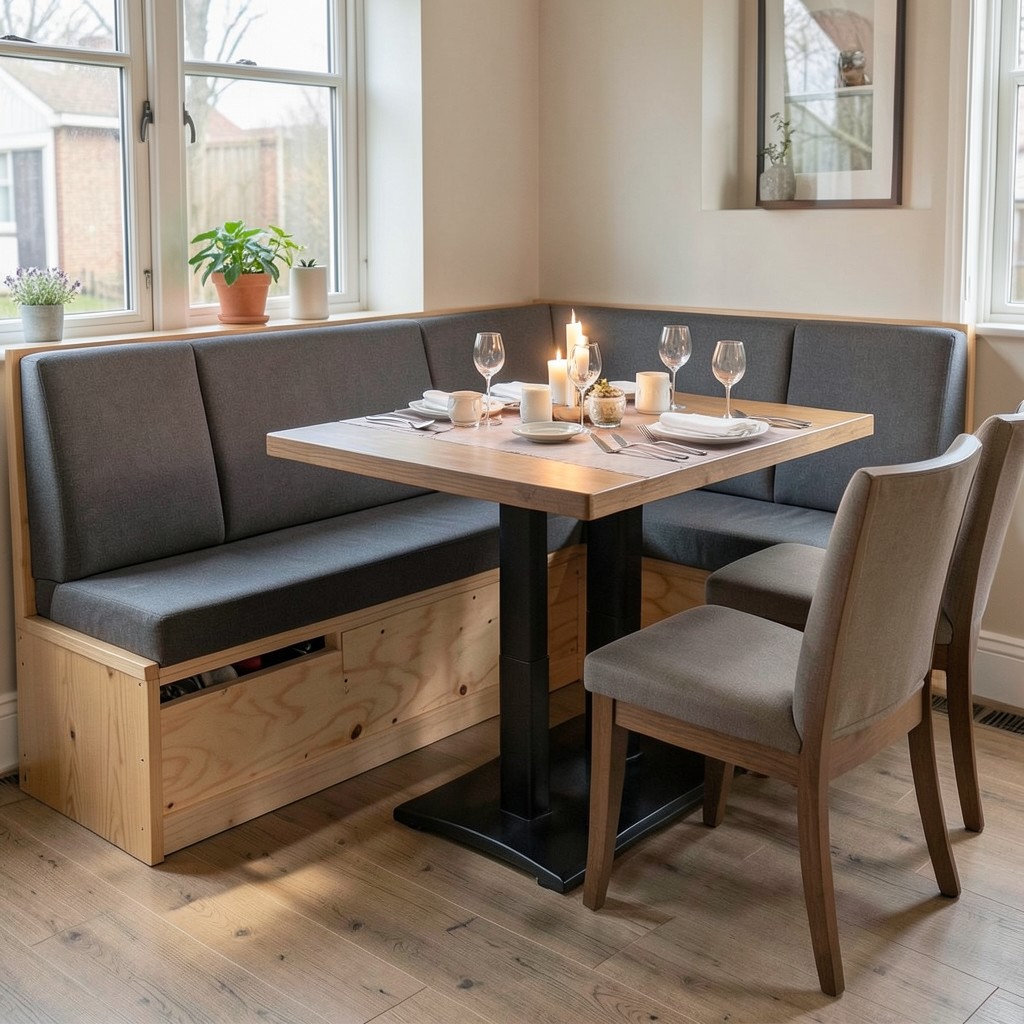
A built-in banquette — a fixed, upholstered bench built into a corner or along a wall of the dining room, typically combined with a freestanding table and chairs on the opposite side — is the dining room seating configuration that provides the highest seating density per square meter of floor area, the most comfortable extended dining experience of any seating type, and the most architecturally integrated relationship between the seating and the room’s structure. The banquette seat is the dining room configuration that restaurants use when they want their tables to feel both intimate and efficiently occupied, and the reasons it works in a restaurant context apply with equal force in a private dining room.
The structural requirement for a built-in banquette is the one that most households underestimate at the planning stage. The banquette base — a timber frame structure attached to the wall, topped with a plywood deck and a foam and fabric upholstered seat cushion — must be built to the correct dimensions for comfortable dining rather than for comfortable lounging. A dining banquette seat height of forty-five to forty-eight centimeters, combined with a seat depth of fifty to fifty-five centimeters, produces the correct geometry for a seated dining posture where the diner’s feet reach the floor comfortably and the table surface is at the correct height relative to the seated position. A banquette built at the dimensions of a sofa — lower and deeper — produces a seating position that places the diner too far from the table and too low for comfortable dining, which is the most common banquette installation error.
The storage potential within a built-in banquette base — the enclosed volume beneath the seat deck that can be accessed through a hinged lid or through drawers in the banquette face — is a bonus capacity that the dining room frequently requires and rarely has elsewhere. A banquette at two meters in length with a seat depth of fifty-five centimeters contains a storage volume of approximately two hundred and twenty liters, accessible through the seat lid, that handles tablecloths, napkins, candle stock, serving equipment, and the range of seasonal dining accessories that the dining room generates and that a standard sideboard cannot contain.
12. A Dining Room With a Gallery Wall
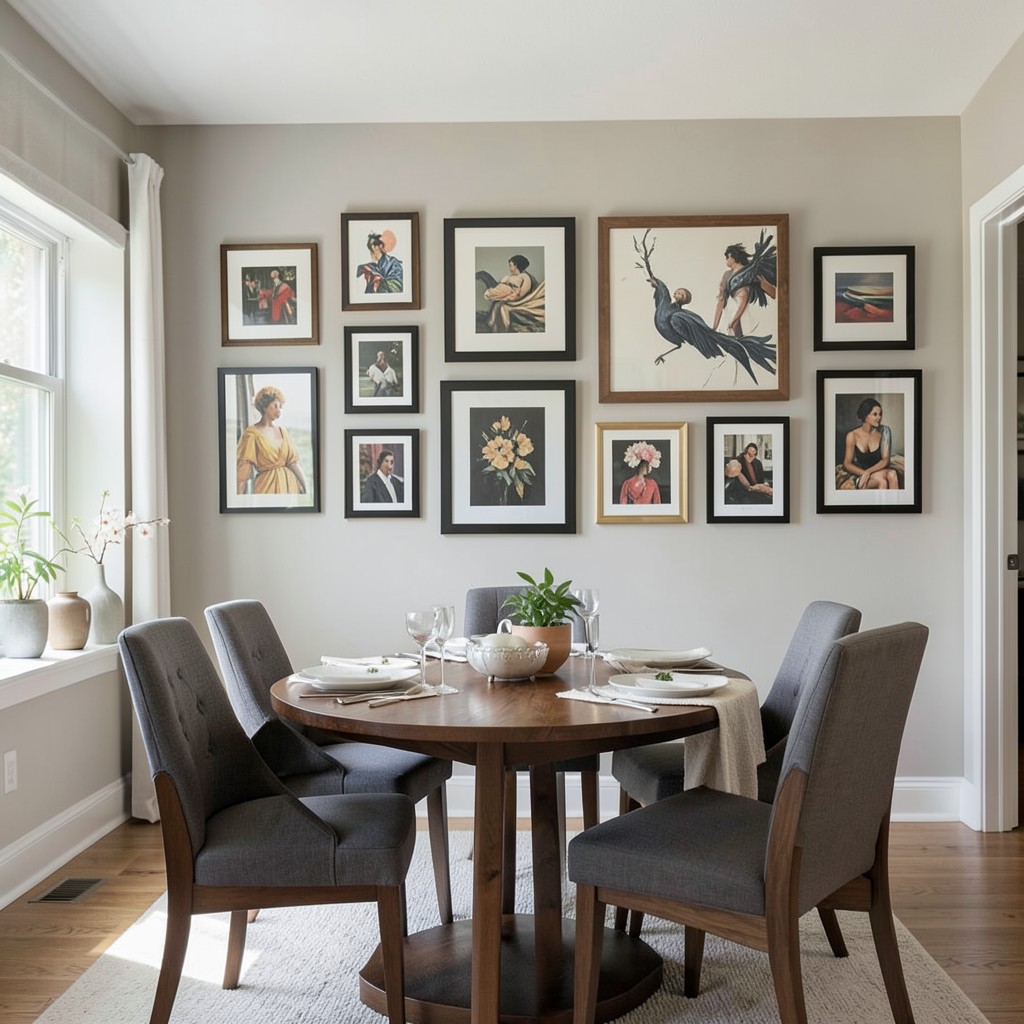
A gallery wall in a dining room — a curated arrangement of art, prints, mirrors, and objects on the wall adjacent to or opposite the dining table — provides the visual backdrop that transforms the dining experience from a meal taken in a room into a meal taken in an environment. The wall at eye level from a seated dining position is the most consistently viewed interior surface in the household, and its treatment determines the visual quality of every meal, every conversation, and every occasion the dining room hosts. A gallery wall that rewards extended looking — through the quality and variety of its content, through the considered arrangement of its elements — makes every meal a richer visual experience.
The arrangement of a dining room gallery wall must account for the specific viewing conditions of the space — the slightly lower eye level of a seated diner compared to a standing viewer, the light conditions at the wall during the dining hours the room is primarily used in, and the distance from the dining table to the wall that determines how much detail in individual pieces is visible from the seated position. Pieces with larger-scale composition and clear visual impact from across the room perform better in dining room gallery walls than small-format works with fine detail that is only apparent at close range.
The cohesion of the gallery wall arrangement should come from a unifying design choice — a consistent frame material, a shared color palette in the art pieces, a consistent matting style, or a deliberate restriction of the frame profile to one or two widths — rather than from a rigid grid or a formula arrangement. The most engaging gallery walls read as composed rather than calculated, and the distinction between those two qualities is the degree to which the arrangement appears to have been made by a person with genuine aesthetic opinions rather than by someone following a layout formula.
13. A Dining Room With a Concrete Dining Table
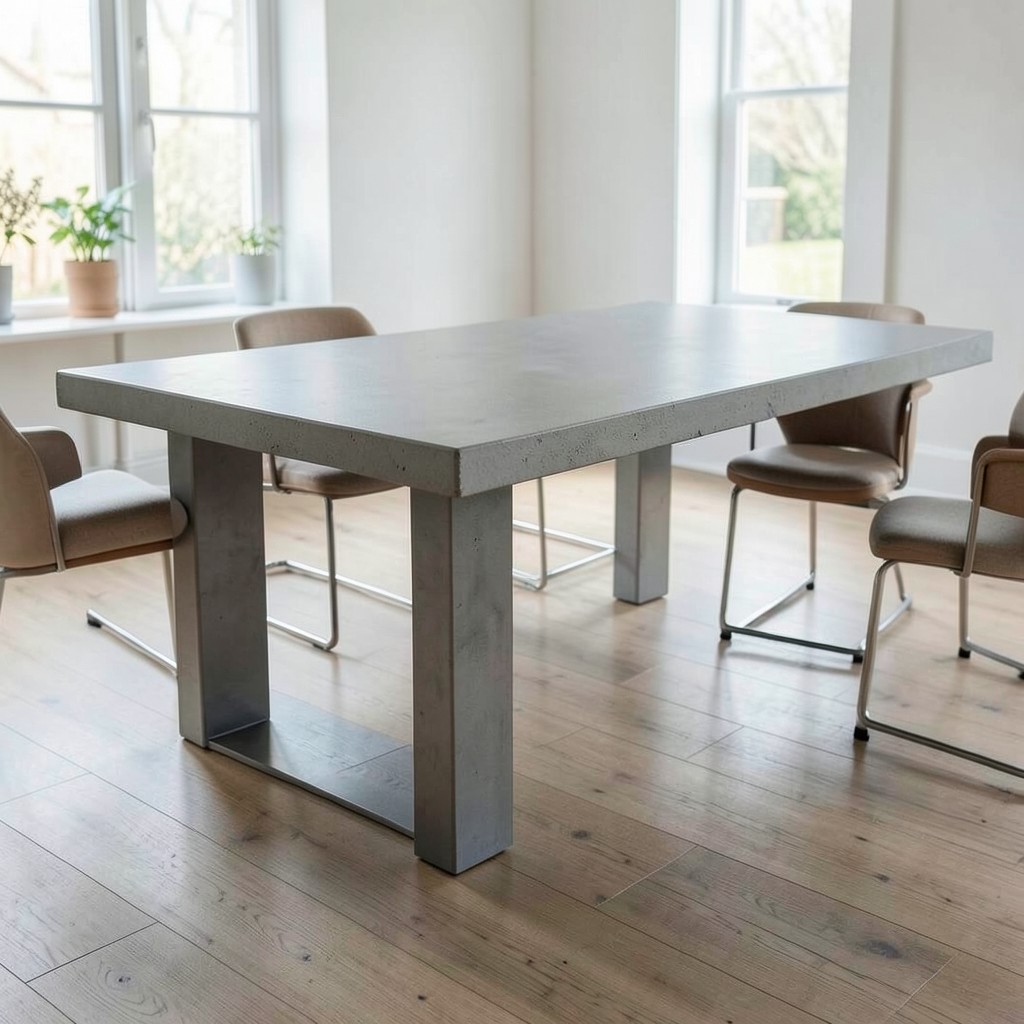
A concrete dining table — cast from fine-aggregate concrete in a formwork that produces a smooth, dense surface, mounted on a steel or solid timber base, and sealed against moisture penetration — is the dining furniture piece that communicates the most specific and most unambiguous design statement of any table material available. Concrete does not pretend to be anything other than what it is. Its weight, its surface texture, its specific cool-grey color — all are material properties that cannot be imitated by any other material and that change in quality slowly and honestly with time and use.
The concrete table top’s weight is the practical reality that determines the installation and positioning logistics. A concrete slab at two meters in length, seventy-five centimeters wide, and forty millimeters thick weighs in the range of two hundred and forty kilograms — a weight that requires four people to handle during installation and that sets the table’s position in the room as a permanent decision rather than a seasonal one. The base structure for a concrete top must be designed for this weight — steel legs or a solid masonry base — rather than the timber structures that serve lighter table materials adequately.
The sealing specification for a concrete dining table determines its resistance to the staining, etching, and moisture penetration that a food-contact surface receives in daily dining use. An unsealed concrete surface absorbs red wine, citrus juice, and oil on contact, producing permanent staining from the first meal served on it. A food-safe penetrating sealer applied after the concrete has cured fully — at minimum twenty-eight days after casting — provides a protective layer that does not alter the surface’s visual character but prevents the immediate absorption of food and beverage contact. A topcoat wax layer applied over the sealer provides additional stain resistance and a slight surface sheen that distinguishes a well-maintained concrete table from a raw one.
14. A Dining Room With Velvet Dining Chairs
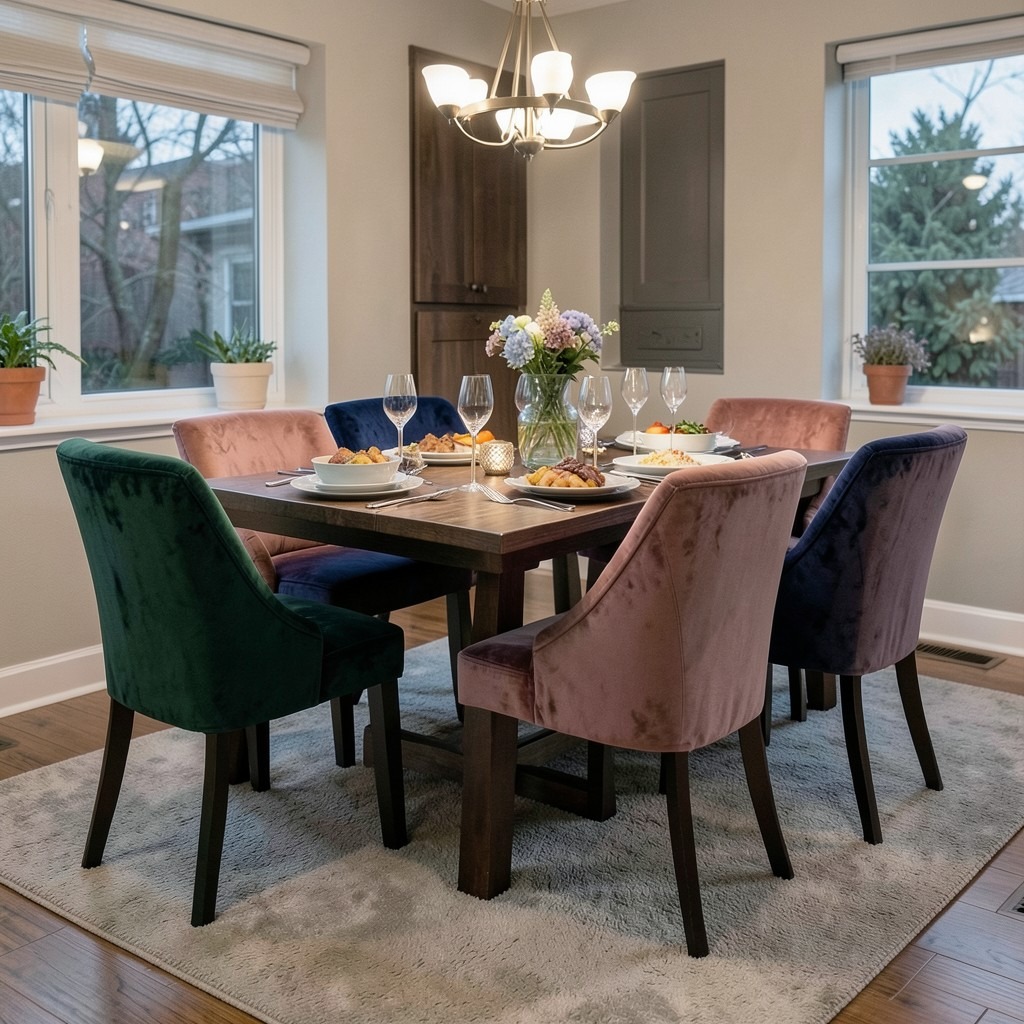
Velvet dining chairs — chairs upholstered in cut pile velvet in a jewel tone, a deep neutral, or a saturated jewel color — provide the specific material luxury and visual depth that no other dining chair fabric delivers at the same immediate impact. Velvet catches light in a directional way that woven and flat fabrics do not — the pile reflects light from one direction and absorbs it from another, producing a surface that shifts in apparent color and depth as the viewer’s angle changes and as the room’s light moves through the evening hours. This material behavior is the specific quality that makes velvet the dining room fabric of choice when the design brief includes evening atmosphere as a primary requirement.
The color selection for velvet dining chairs in a dining room context should lean toward saturation rather than restraint, because velvet’s pile structure softens the apparent intensity of any color applied to it relative to the same color in a flat fabric. A forest green velvet reads as a medium-depth green rather than a saturated one. A deep sapphire blue reads as rich but not aggressive. A dusty rose reads as pink without the sweetness that the same tone in a flat cotton would produce. The pile structure’s light-absorbing quality desaturates every color by a perceptible degree, which means the color selection for velvet can be bolder than the same selection in any other fabric would allow.
The practical maintenance consideration for velvet dining chairs — a fabric that shows food particles, pet hair, and reverse-brushed pile marks more visibly than most other upholstery materials — requires a realistic assessment of the household’s actual cleaning practices and the dining room’s daily use intensity. Velvet dining chairs in a household with children who eat dinner at the dining table six nights a week will require more regular maintenance than the same chairs in a dining room used primarily for weekend and occasion dining. A velvet with a treatment against light moisture — a performance velvet in a synthetic blend — handles the dining context better than an untreated natural velvet fiber without significantly compromising the fabric’s visual quality.
15. A Dining Room With Pendant Lights Over the Table
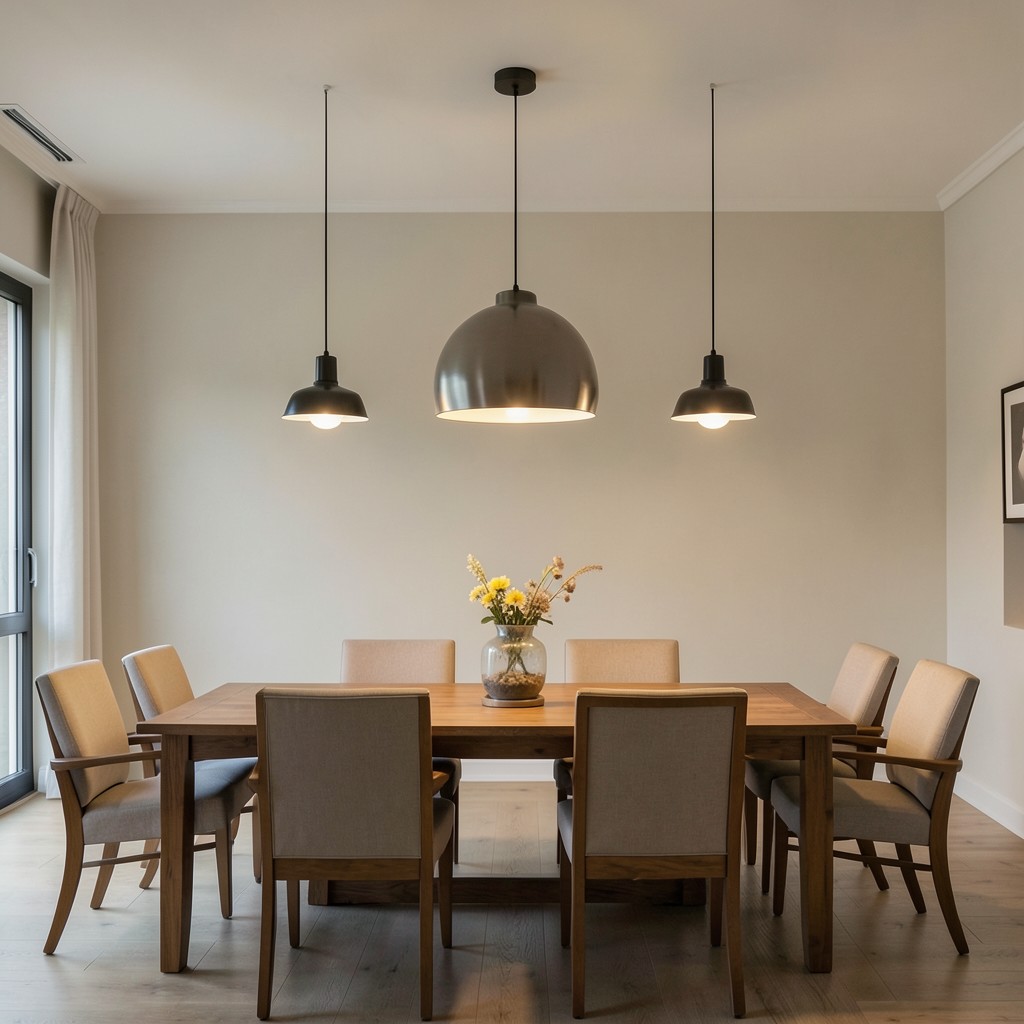
Multiple pendant lights in a row over a dining table — two, three, or four individual pendants hung at equal intervals across the table’s length — is the lighting configuration that most effectively combines the functional illumination of the table surface with the visual composition of a thoughtfully considered ceiling arrangement. The single large pendant over the center of the table provides a focal point but illuminates the ends of a long table less effectively than the ends’ proximity to the central fixture allows. Multiple pendants address the table’s full length, distribute the light more evenly across its surface, and create a ceiling composition with a rhythm and a scale that a single fixture cannot provide.
The pendant spacing in a multi-pendant dining room installation must distribute the fixtures across the table’s length in a way that provides even illumination across its full extent while maintaining the visual balance of the ceiling composition. Three pendants over a two-meter table, spaced at fifty centimeters from each end and at the center, provide the even distribution and the compositional balance that three-fixture pendant arrangements deliver most consistently. Two pendants over the same table, placed at the table’s quarter-length positions, produce a different rhythm — a more open center with concentrated light at both ends — that suits a table whose primary seating positions are at the ends rather than the center.
The matching versus mismatching decision for multiple pendant fixtures in a dining room installation is a question of visual consistency versus composed variation. Matching pendants — identical fixtures from the same range, hung at identical heights — produce the clean, architectural reading of a considered installation where the repetition of the form is the visual statement. Mismatched pendants — related but not identical, perhaps from the same material family in different sizes or shapes — produce the more relaxed, collected quality of fixtures chosen individually rather than as a set. Both work. The choice should be made with an honest assessment of whether the dining room’s design direction is more architectural or more personal.
16. A Dining Room With a Herringbone Timber Floor
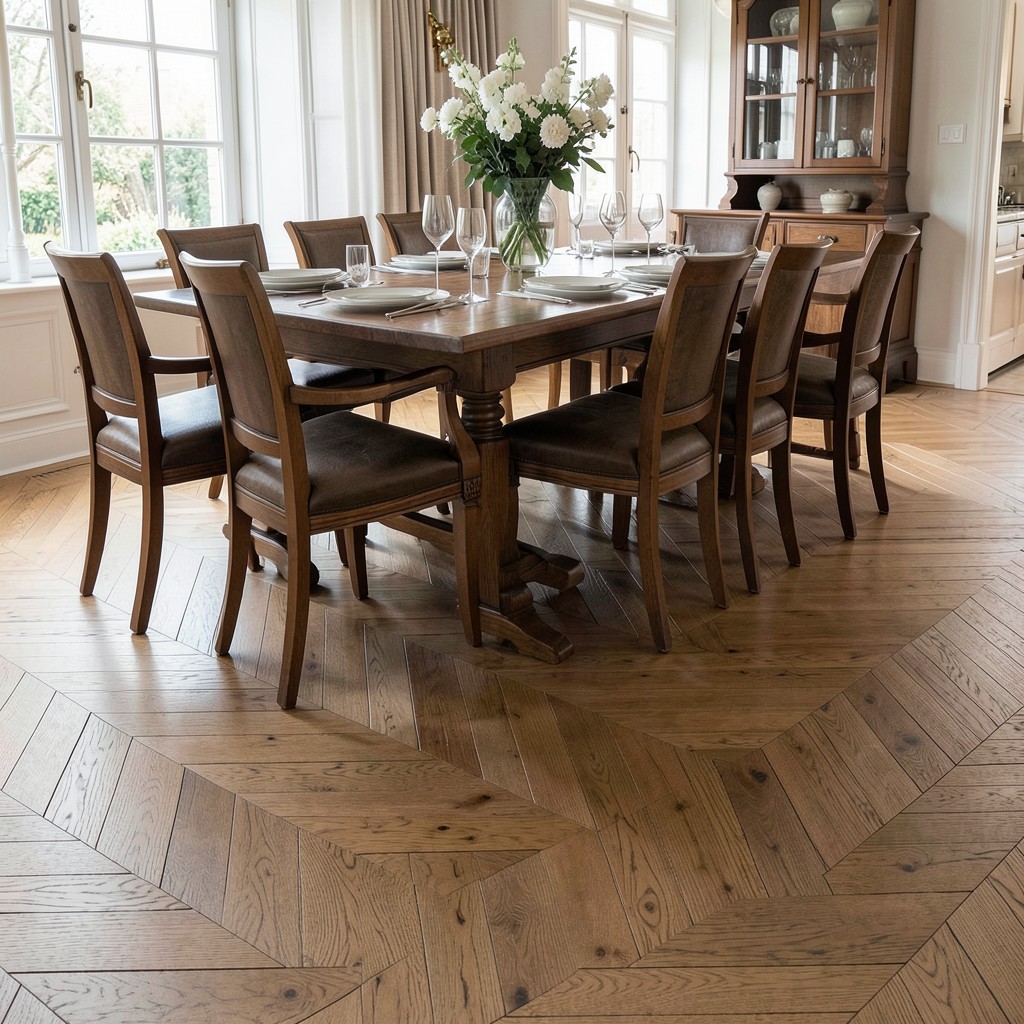
A herringbone timber floor in a dining room — individual timber blocks or engineered wood boards laid in the angled, interlocking zigzag pattern that herringbone requires — produces a floor surface with the visual complexity and the crafted quality that straight-laid boards do not match in the same floor area. The herringbone pattern is the historic premium floor specification for dining rooms and reception spaces in fine European domestic architecture precisely because its complexity communicates intention and investment — the herringbone floor was always more expensive to lay than a straight run, and that cost differential is still visible in the result.
The timber species for a herringbone dining room floor should prioritize hardness alongside visual character, because the dining room floor receives the specific abrasion of chair legs being dragged across it multiple times daily — a load that softwood floors accumulate as visible scratching faster than the equivalent use of a kitchen floor where feet in shoes rather than chair legs produce the primary abrasion. A Janka hardness rating of at least eight hundred — satisfied by oak, ash, maple, and walnut among the common floor timber choices — provides adequate resistance to chair leg abrasion in a dining room context over the years of use that a quality floor installation should serve.
The block width of the herringbone tiles determines the scale of the pattern relative to the room’s dimensions. A narrow block — seventy to ninety millimeters wide — produces a fine, detailed herringbone that reads as intricate from close range and as a refined texture from across the room. A wider block — one hundred and twenty millimeters or more — produces a bolder, more graphic herringbone that reads clearly from distance and suits a larger dining room where the finer pattern’s detail would be lost. The border treatment — a single line of straight-laid boards surrounding the herringbone field — is the traditional finishing detail that defines the herringbone field and separates it from the adjacent floor areas with the architectural precision that a herringbone floor deserves.
17. A Dining Room With a Natural Materials Palette
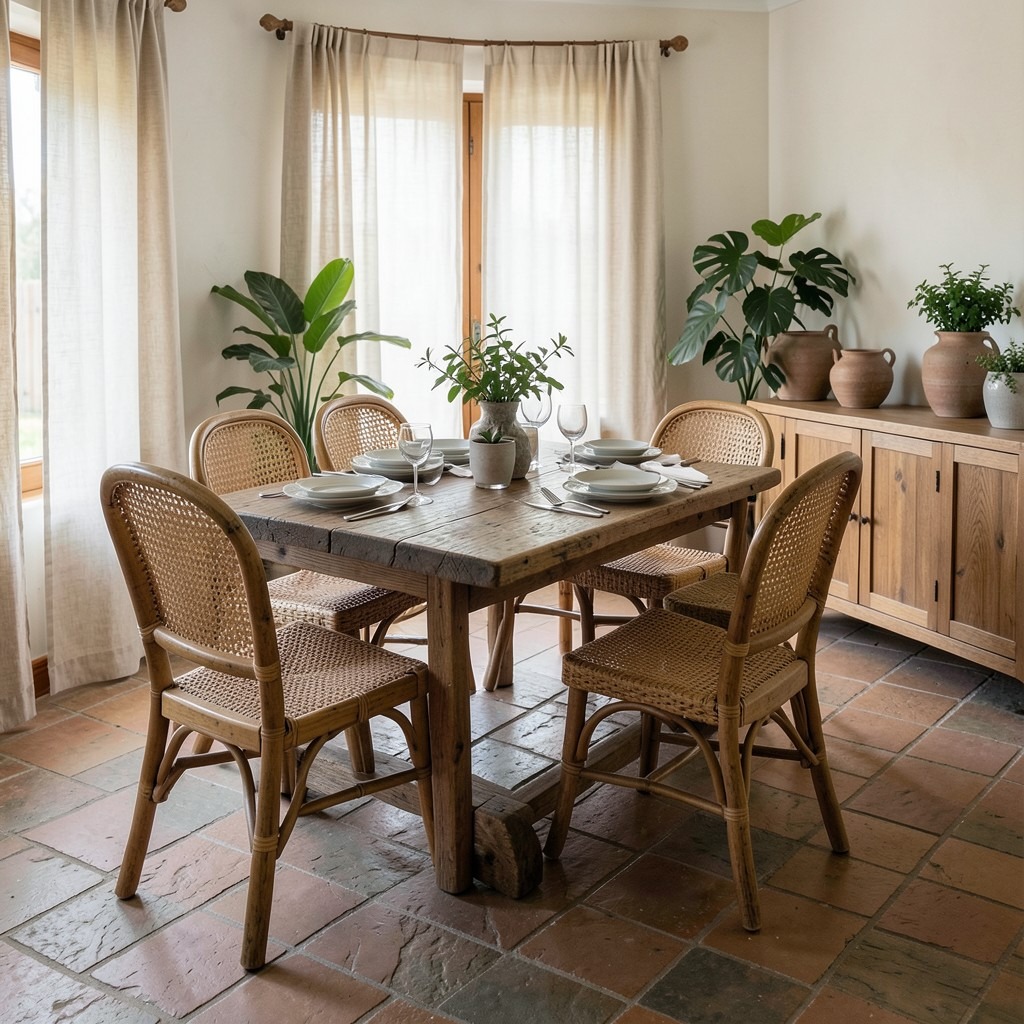
A dining room designed entirely in natural materials — a timber table, timber or woven rattan chairs, a stone or terracotta tile floor, linen curtains, ceramic tableware on a timber sideboard, and plants as the primary decorative element — produces an eating environment with the specific sensory quality of being surrounded by materials that came from the earth rather than from a manufacturing process. The natural materials dining room is not an aesthetic direction. It is a decision about the quality of the physical experience the room provides, and that decision has consequences that extend from the visual to the tactile to the acoustic.
The acoustic quality of a dining room entirely furnished in natural materials is one of its most immediately noticed properties. Hard natural materials — timber, stone, ceramic — produce reflective surfaces that allow conversation to carry across the table without the sound deadening that soft furnishings and padded walls impose. The sound of conversation in a natural materials dining room has a liveness and a clarity that heavily padded rooms do not provide, and that liveness is part of the quality of the gathering that the room hosts. The natural materials dining room sounds the way a good meal conversation feels — present, clear, and genuinely alive.
The maintenance philosophy for a natural materials dining room requires accepting the marks and patina of use as part of the room’s material quality rather than as defects to be corrected. A timber table develops the ring marks of glasses and the fine scratches of cutlery as evidence of meals shared, not as failures of its surface treatment. A stone tile floor develops the micro-etching of dropped cutlery and the slight wear paths of high-traffic routes as evidence of a room that is actively used. These are not defects. They are the material record of domestic life, and the natural materials dining room that is maintained with oiling, sealing, and light repair rather than with the ambition of returning it to its original condition is the room that becomes more beautiful with use.
18. A Dining Room With Leather Dining Chairs
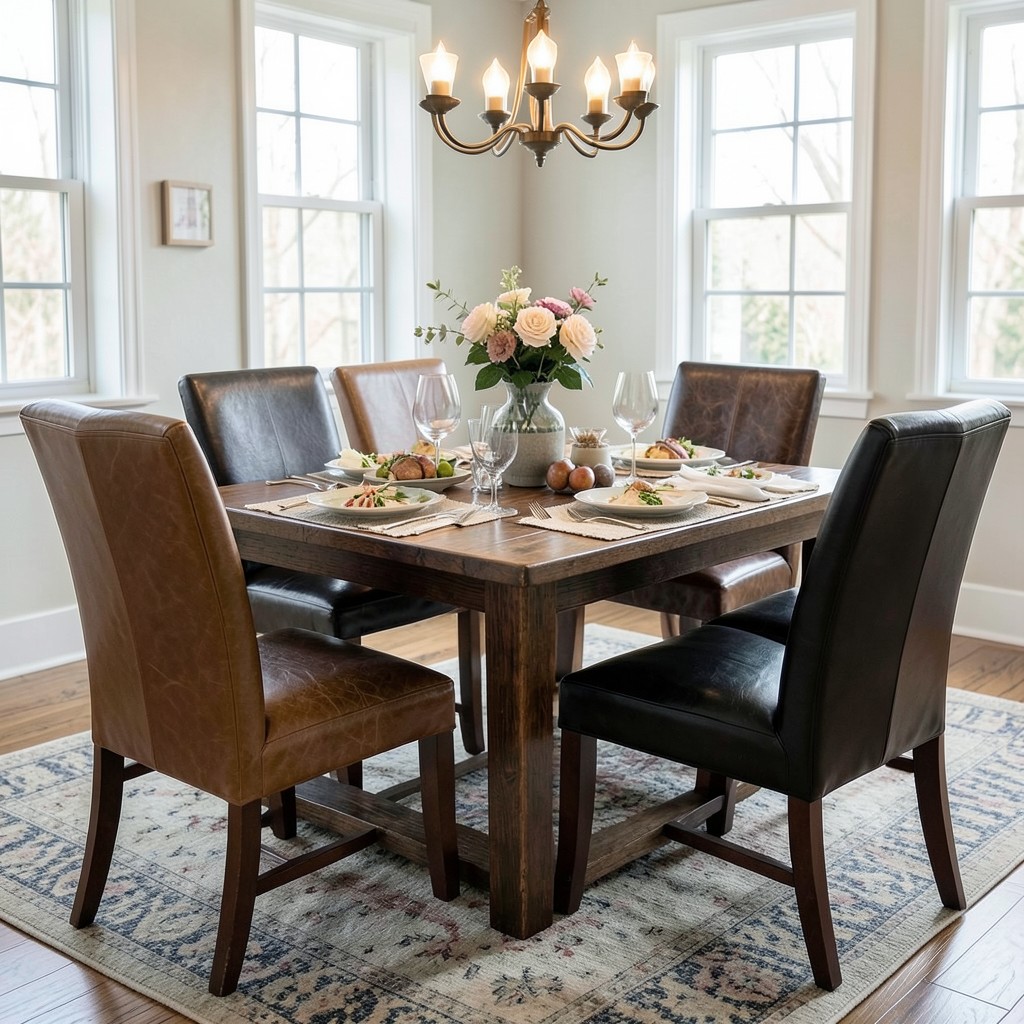
Leather dining chairs — either in a genuine hide in a natural or dyed finish, or in a high-quality synthetic leather that matches the material’s performance characteristics without the ethical or cost implications of genuine hide — provide the dining room with the specific material authority and the distinctive aging quality that no fabric upholstery alternative replicates. Leather at the dining table communicates a certain seriousness about the act of eating — not stuffiness, but intention. The leather dining chair says that the household invested in furniture meant to last decades and improve with age, and that the dining room is a place where that investment is on daily display.
The leather specification for dining chairs — full-grain, top-grain, corrected-grain, or bonded — determines the material’s quality, its aging behavior, and its resistance to the daily stresses of dining use. Full-grain leather — the highest quality, made from the outermost layer of the hide with the natural grain intact — develops a patina with use that each other grade either imitates or cannot produce. The natural surface markings of full-grain leather — the fine grain variation, the occasional small scar or wrinkle — are evidence of its material authenticity, and their presence is the quality indicator that distinguishes full-grain from corrected-grain leather, which has its surface sanded smooth and an artificial grain pattern embossed onto it.
The color selection for leather dining chairs should be made with the specific aging behavior of the leather in mind rather than with reference only to its appearance at the point of purchase. A mid-tan leather darkens and deepens with use as the oils from handling and the general exposure of daily dining use are absorbed into the surface, enriching the color rather than degrading it. A black leather maintains its color more consistently through use and suits a dining room where a stable, formal aesthetic is the priority. A white or pale grey leather shows the marking of use most prominently and requires the most active maintenance to remain at the quality of its purchase condition.
19. A Dining Room With a Kitchen Island Dining Configuration
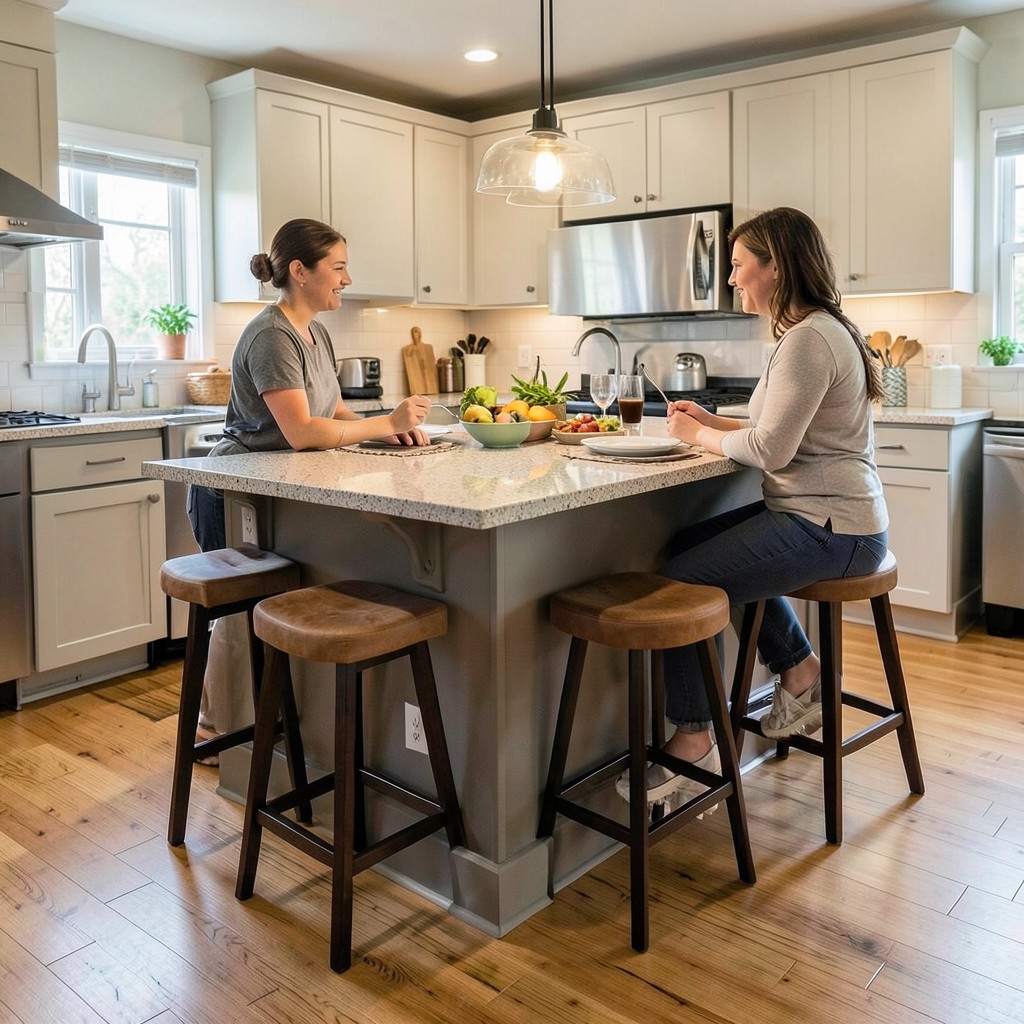
A kitchen island that doubles as the household’s primary dining surface — a generous island counter with bar stools on the dining side and kitchen function on the preparation side — is the dining configuration that most honestly reflects the way many households actually live and eat. The formal dining table in a separate room requires a deliberate act of physical separation from the kitchen — the cook leaves the preparation area, the food is carried to the dining room, and the meal happens at physical distance from the space where it was made. The island dining configuration collapses that separation and produces a dining experience where the cooking is part of the meal rather than a precursor to it.
The bar stool specification for an island dining configuration must address the height relationship between the stool seat and the island counter with the same ergonomic precision that dining chair height relative to table height requires. A standard kitchen island at ninety centimeters height requires a bar stool with a seat height of sixty to sixty-five centimeters — the range that positions the diner at the correct height relative to the counter surface for comfortable eating. A counter-height island at one hundred and five centimeters requires a bar stool with a seat height of seventy to seventy-five centimeters. The wrong stool height at the right island produces the awkward seated position — hips too high, arms at shoulder level — that makes island dining uncomfortable within twenty minutes.
The social quality of island dining — where the cook faces the diners during preparation, where conversation flows between the preparation and the eating without the physical separation of a conventional dining room arrangement — is the specific benefit that the island dining configuration provides and that no other dining arrangement matches. The island counter is the point where the kitchen’s productive activity and the household’s social life overlap, and designing the island’s dimensions, its seating capacity, and its lighting specifically for that overlap produces the most genuinely social eating environment available in a compact domestic plan.
20. A Dining Room With Wabi-Sabi Design Elements
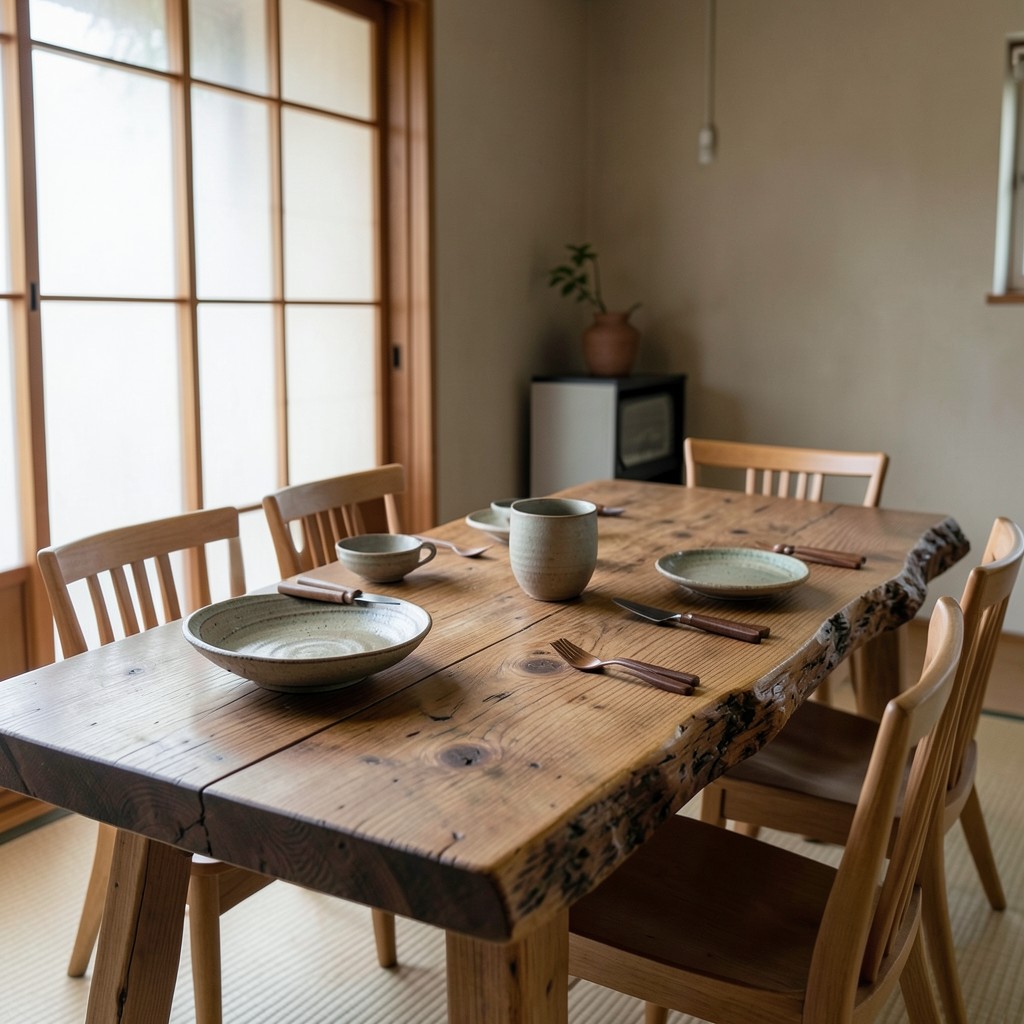
A wabi-sabi dining room — one that deliberately incorporates the Japanese aesthetic philosophy of accepting imperfection, impermanence, and incompleteness as the source of beauty rather than as defects to be corrected — produces an eating environment whose material honesty and whose resistance to the perfectionism of polished interior design communicates a specific and increasingly rare quality of comfort with the authentic. The wabi-sabi dining room does not look unfinished. It looks considered in a way that the perfectly smooth, perfectly matched, perfectly curated dining room cannot achieve because that perfection excludes the marks of time and use that wabi-sabi treats as the room’s most valuable qualities.
The wabi-sabi dining table is one that shows the evidence of its material history — the end grain of solid timber that has dried unevenly, the slight bow in a plank that the woodworker decided to celebrate rather than correct, the live edge where the tree’s natural contour determines the table’s boundary rather than a straight-cut saw. These are not flaws in the wabi-sabi reading — they are the table’s specific character, the evidence of the material’s origin in a living organism rather than a factory production line. A table with these qualities becomes more itself with time as the use marks accumulate rather than less valuable as its surface condition changes.
The ceramic tableware in a wabi-sabi dining room follows the same principle: handmade ceramics in earthy, irregular forms — bowls that are not perfectly circular, plates whose rim is not perfectly even, cups whose glaze has run slightly and been allowed to stay — provide the tactile quality of objects made by human hands rather than machines and the visual quality of forms that responded to the making process rather than being imposed upon it. A table set with handmade ceramics and wooden handled cutlery communicates that the people eating from them understand the difference between an object that was designed and an object that was made, and that distinction is the most refined form of material appreciation available.
21. A Dining Room With Pendant Globe Lights
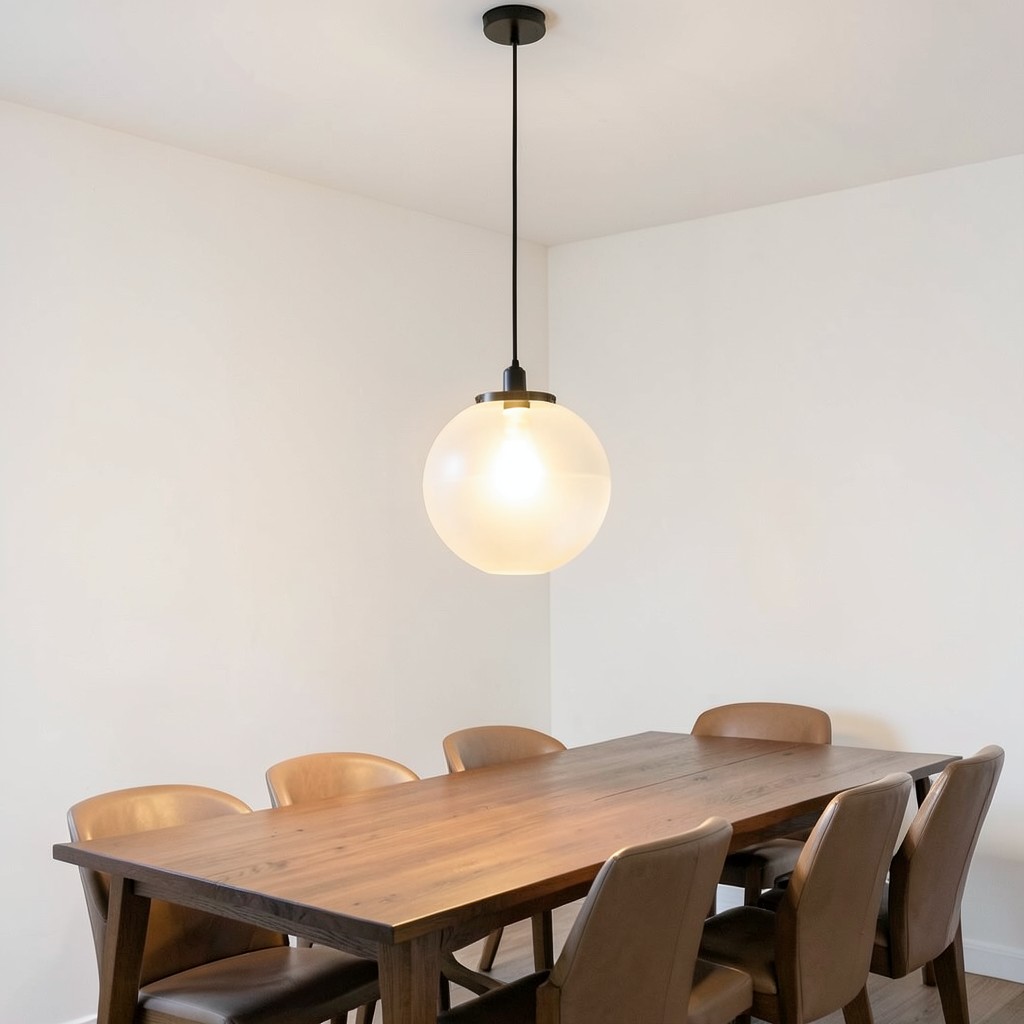
Globe pendant lights — round, sphere-form fixtures in clear glass, frosted glass, or colored glass, suspended over the dining table on a visible cord or a more refined suspension — provide the specific visual quality of a light fixture that contains the light source within its own geometric form rather than directing it downward or outward through a shade. The globe pendant’s light quality is omnidirectional: it illuminates the table surface, the ceiling above, and the air around the fixture simultaneously, which produces a quality of even ambient illumination combined with the warm, visible glow of the bulb within the sphere.
The glass specification of a globe pendant determines both its visual quality and the quality of the light it produces. A clear glass globe reveals the filament or LED source within the sphere, producing the warm visual quality of a visible light source that the eye reads as intimate and inviting. A frosted glass globe conceals the source within a diffuse glowing sphere that distributes the light more evenly and eliminates the hot-spot visibility of the bare source. A smoked or tinted glass globe reduces both the light transmission and the warm visual character of the fixture — the tinted sphere reads as darker and more graphic than the clear or frosted alternatives.
The cord length of globe pendant fixtures hung over a dining table requires the same attention to hanging height that all dining room pendant installations demand, with the additional consideration that the visible cord — where the suspension cable is exposed rather than concealed within a housing — is itself a design element whose length and color contribute to the fixture’s visual composition. A black fabric cord against a white ceiling reads as a deliberate graphic line that grounds the pendant to its suspension point with visual clarity. A transparent cord against the same ceiling reads as the fixture floating without obvious support, which produces a different quality of visual lightness.
22. A Dining Room With a Linen-and-Natural-Fiber Aesthetic
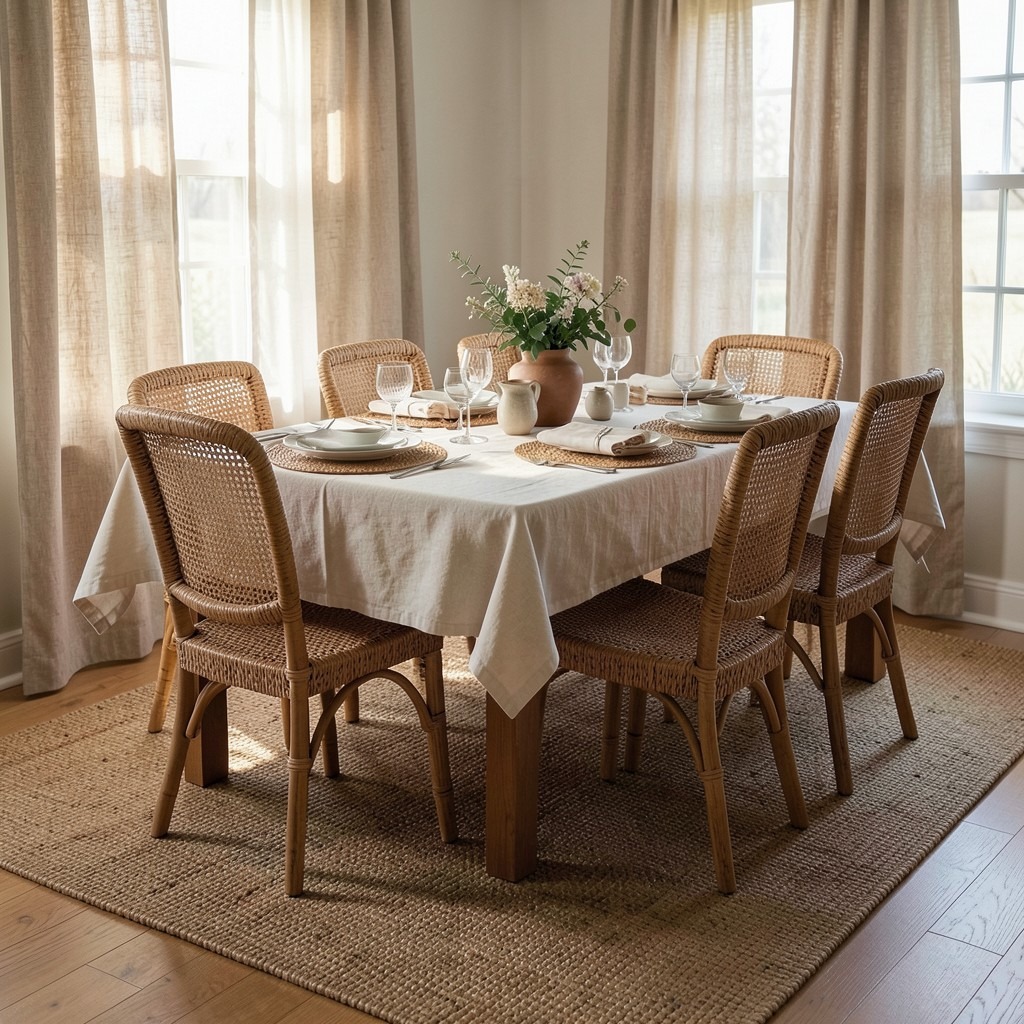
A dining room designed around linen and natural fiber textiles — linen curtains, a jute or sisal rug beneath the table, linen napkins, woven rattan placemats, a raw cotton tablecloth, and the general material palette of undyed or naturally dyed plant and animal fibers — produces an eating environment with the specific tactile softness and the organic color range that manufactured textiles cannot approach. Natural fibers in a dining room are not merely a design choice. They are a sensory one: the specific roughness of linen against the fingers, the slight texture of a jute rug underfoot, the weight of a cotton tablecloth as it falls across the table edge — these tactile qualities are the ambient physical environment within which every meal is eaten.
The curtain specification for a linen dining room aesthetic requires a linen weight appropriate for the window’s size and light management requirements. A lightweight linen — below one hundred and fifty grams per square meter — provides the filtering quality of a sheer while maintaining the material character of linen, but provides minimal privacy or blackout where those are required. A medium-weight linen at two hundred to two hundred and fifty grams per square meter provides both the visual presence of a substantial curtain and sufficient density for privacy without total blackout. The unlined linen curtain allows the warm color of natural linen to transmit light in the early morning and late afternoon hours when the sun is low and direct, producing a warmth in the light quality of the dining room at those hours that no other curtain material generates.
The rug beneath the dining table in a linen-and-natural-fiber dining room must be large enough to contain all four chair legs on its surface when the chairs are in their dining position — not just two front legs resting on the rug while the back legs sit on the bare floor, which produces the uneven chair stability that tilts forward under the diner’s weight. The rug extends at least sixty centimeters beyond each side of the table in its length and width dimensions to accommodate the full chair footprint at each position. The natural fiber rug’s texture under the chair legs also prevents the chair-sliding abrasion that hard floor surfaces accumulate at the dining table position, which is the practical bonus of the rug specification that most dining room rug discussions overlook.
23. A Dining Room With a Scandinavian Design Approach
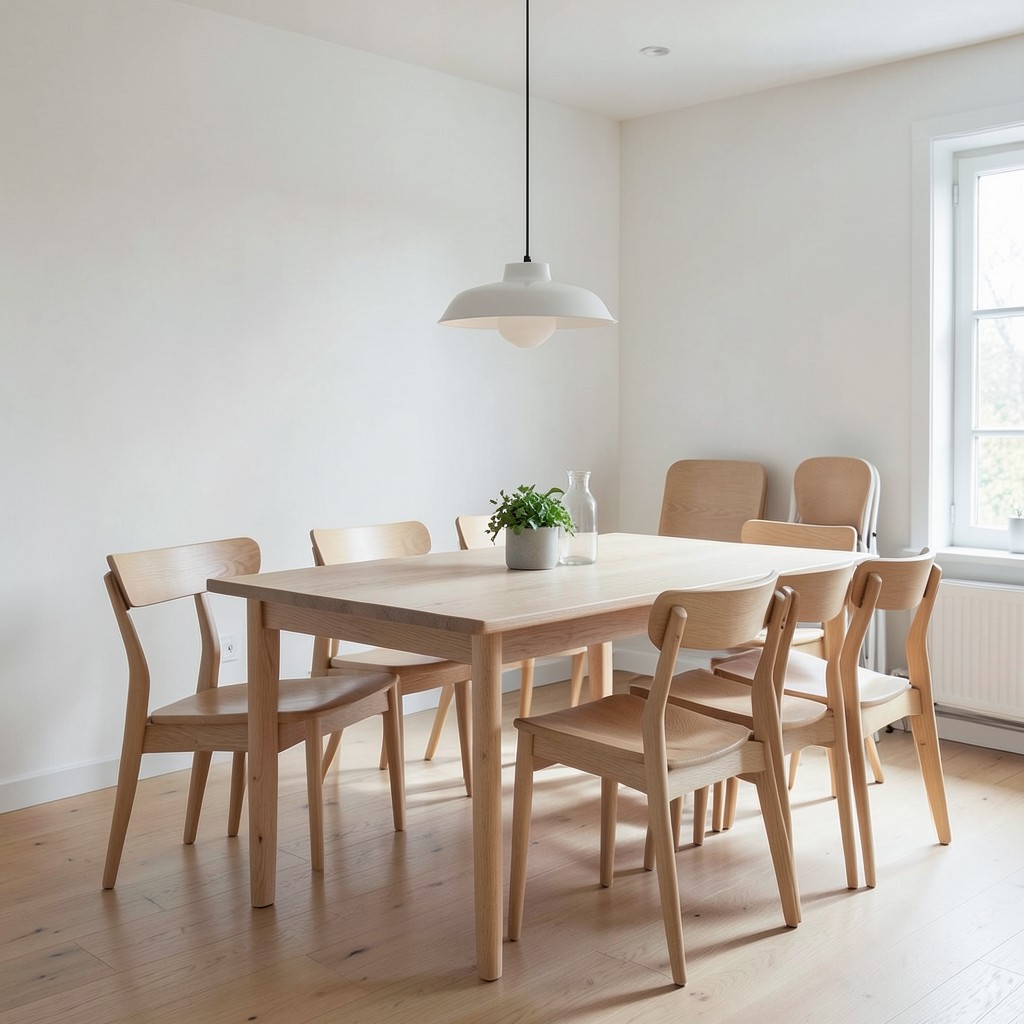
A Scandinavian-influenced dining room — pale timber furniture, white walls, functional forms without ornamental decoration, a focused pendant light over the table, and the specific quality of pared-back material honesty that Nordic domestic design has produced across decades of thoughtful residential culture — provides a dining environment where the quality of the food and the quality of the conversation are the room’s primary content, rather than competing with the decorative complexity of a richer design direction. The Scandinavian dining room is not sparse. It is edited, and the editing is the design work.
The dining table in a Scandinavian dining room is typically in a pale, natural timber — ash, birch, or light oak — with clean, tapered legs and a surface finished in a matte natural oil that allows the wood’s grain to be both seen and felt. The table form is simple — no carved detail, no curved apron, no decorative leg turning — because the Scandinavian aesthetic finds its quality in the material itself and the precision of the form rather than in applied ornament. A table of this type reads correctly only when the timber quality is high enough to carry the design on its own: the grain must be interesting, the surface must be consistent, and the joinery must be precise.
The dining chairs in a Scandinavian dining room should vary from the table’s seating capacity by at least two — providing the additional chair positions that a Scandinavian dining culture that extends to neighbors, friends, and extended family gatherings requires. The extra chairs fold or stack against the wall when not in use, which the Scandinavian aesthetic accommodates by specifying chairs whose stacking or folding function is part of their designed form rather than a compromise of it. The Wishbone chair, the Shaker chair, and the many contemporary chairs designed in this tradition all provide the combination of compact storage, light weight, and material honesty that Scandinavian dining room seating demands.
24. A Dining Room With a Botanical Mural
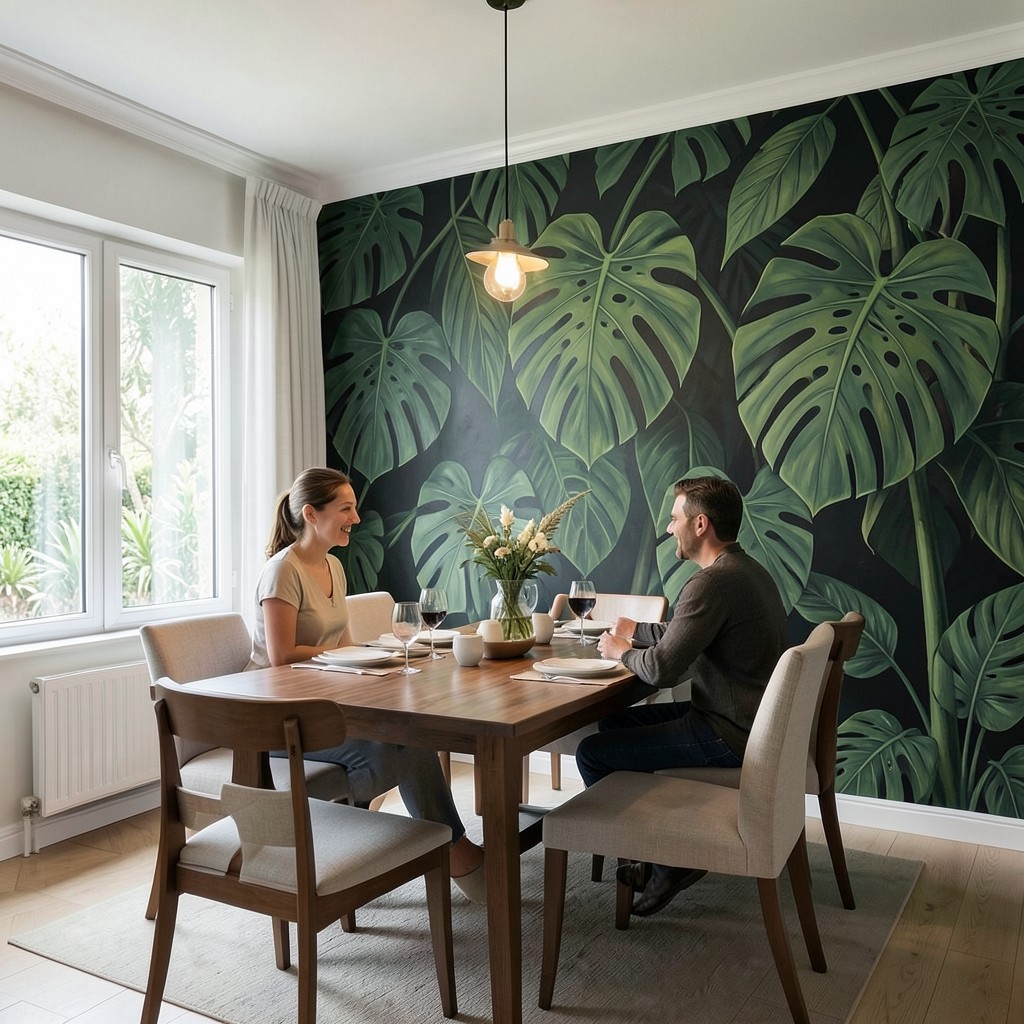
A botanical mural in a dining room — a hand-painted or high-quality printed wall covering of oversized plant forms covering one full wall from floor to ceiling — is the design element that most completely transforms the character of a dining room in a single application. The botanical mural does not simply add pattern to the wall surface. At the scale of a full dining room wall, it produces an environmental effect — the sense of dining within or beside a garden — that changes the dining experience from a meal taken in a room to a meal taken in a specific, atmospherically charged location.
The scale of botanical illustration in a dining room mural must be large enough to read as environmental rather than decorative. At natural-plant scale — where the depicted leaves and flowers are rendered at their actual biological dimensions — the mural reads as a detailed illustration rather than an immersive environment. At double or triple scale — where a monstera leaf spans the height of the wall from the skirting to the ceiling — the botanical elements become architectural in their proportion, and the diner sitting beside them experiences the specific quality of being in physical relationship with forms that exceed the human scale. That disproportionate relationship with the plant world is the environmental experience the mural is producing.
The color palette of the botanical mural determines its atmospheric quality from the most immediate reading distance. A mural in deep, dark greens against a near-black background produces a night-garden quality that suits a dining room used primarily in the evening hours — the darkness of the background makes the mural recede during the day and emerge under artificial light in the evenings, which changes the room’s character across the day in a way that light-background murals do not. A mural in mid-range greens against a white or cream background produces an always-present, botanically sunlit quality that suits a dining room used through all daylight hours.
25. A Dining Room With Mixed Chair Seating
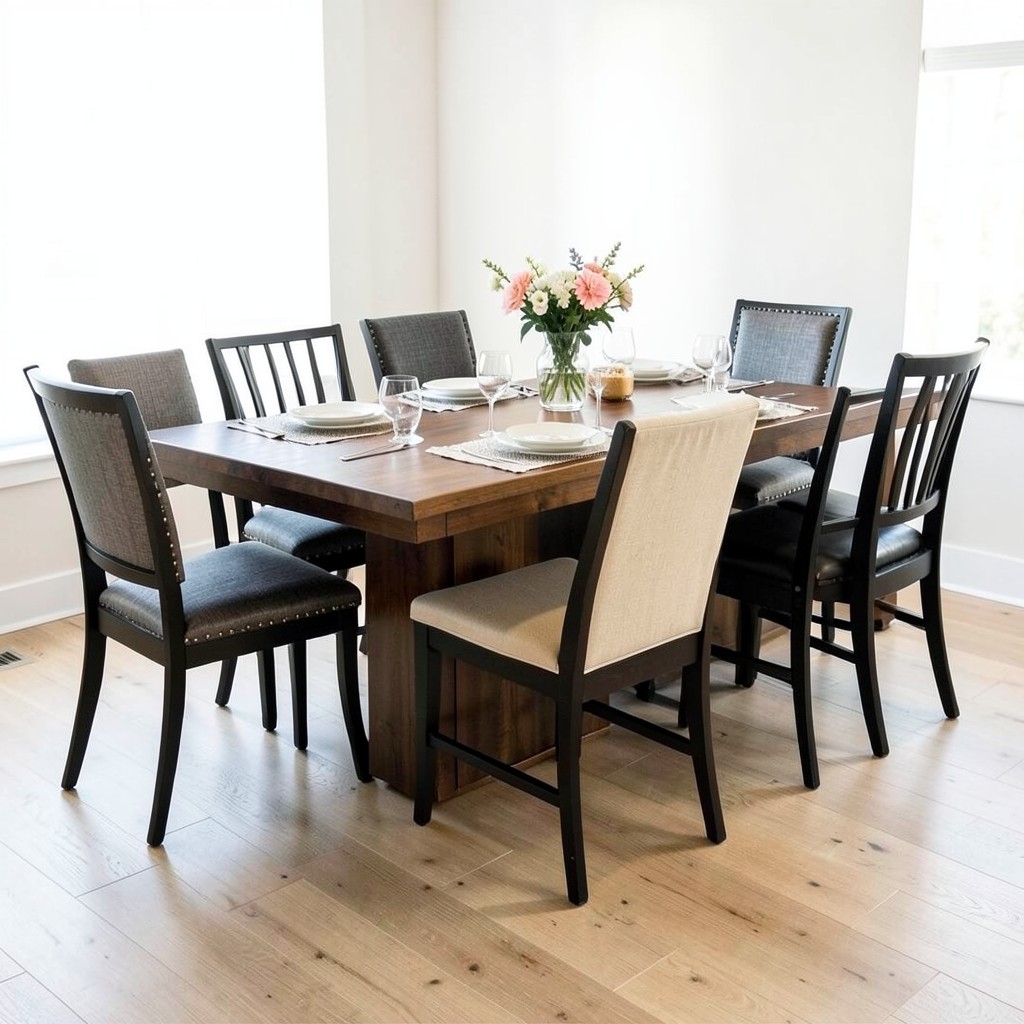
A dining table with mixed chairs — different chair designs grouped around the same table surface, rather than the standard matching set where every chair is identical to every other — produces the specific quality of collected, accumulated character that a matched set cannot approach. Mixed seating does not mean random seating. It means a curated selection of different chair designs that share a common attribute — a consistent leg material, a consistent seat height, a shared color family — while varying in their form, their back design, or their upholstery in ways that produce a table setting with individual personality at each position.
The unifying principle for mixed dining chairs must be strong enough to hold the variety together without imposing the uniformity that defeats the entire purpose of mixing. The most effective unifying approaches are material consistency — all chairs with black metal frames in different back designs — and height consistency combined with palette restriction — chairs of different forms painted in the same color or covered in the same fabric. Without a unifying principle, mixed seating reads as mismatched rather than curated, and the distinction between those two readings is determined by whether the shared attribute is genuine or whether the variety was assembled without a governing aesthetic intention.
The end-of-table chairs — the seats at the shorter ends of a rectangular table — are the positions that most naturally accommodate chairs that differ from the long-side seats in a mixed seating arrangement. A carver chair at each end of the table, with a different but related design at the long sides, is the configuration that most frequently produces a resolved mixed seating arrangement because the carver’s traditional role as the ‘host’s chair’ at the table head gives the design difference at the end positions a logic that extends beyond aesthetic variety into the social grammar of the dining room itself.
26. A Dining Room With a Terrazzo Floor
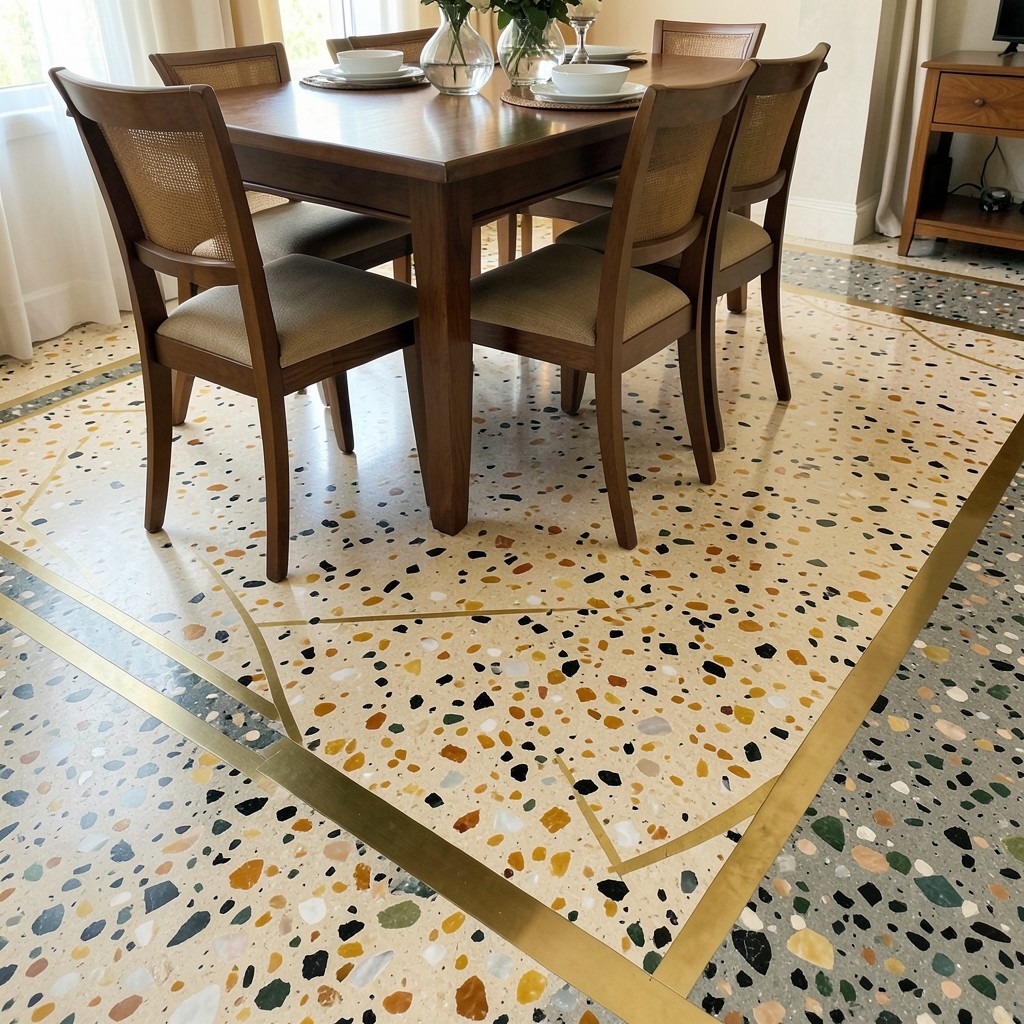
A terrazzo floor in a dining room — the composite surface of marble or stone chips set in a cement or resin matrix and ground smooth to reveal the chip pattern in a continuous, seamless surface — provides the dining room floor with the specific material richness and the historical resonance of a flooring technique that has served public and domestic dining environments across centuries of Mediterranean and European architecture. Terrazzo is the floor that improves with maintenance rather than wearing away from it: each polishing session that removes the surface accumulation of wax and soil reveals a slightly fresher reading of the chip pattern beneath, and the terrazzo floor that has been maintained for fifty years looks more distinguished than the one installed yesterday.
The chip and matrix color combination for a dining room terrazzo must be resolved as a complete composition before installation begins, because terrazzo — unlike a floor tile that can be replaced if the color proves incorrect — is a cast-in-place material that is permanent from the moment it is ground. A warm cream matrix with chips of pale gold, honey amber, and white marble produces a terrazzo floor with a warmth that suits most dining room color palettes and that reads as generous and luminous under both natural and artificial light. A dark grey matrix with chips of black, white, and green marble produces a more graphic, more contemporary reading that suits dining rooms with a stronger architectural design direction.
The dividing strips between terrazzo sections — typically in brass, aluminium, or steel — are the traditional method of controlling the shrinkage cracking that large terrazzo pours produce as the material cures, and they also provide the opportunity to design a secondary pattern layer within the floor surface. Brass dividing strips that form geometric shapes within the terrazzo field — a border enclosing the dining area, or a pattern of lines that reference the table’s position — produce a floor composition with a designed intentionality that the terrazzo surface alone does not provide.
27. A Dining Room With a Japandi Aesthetic
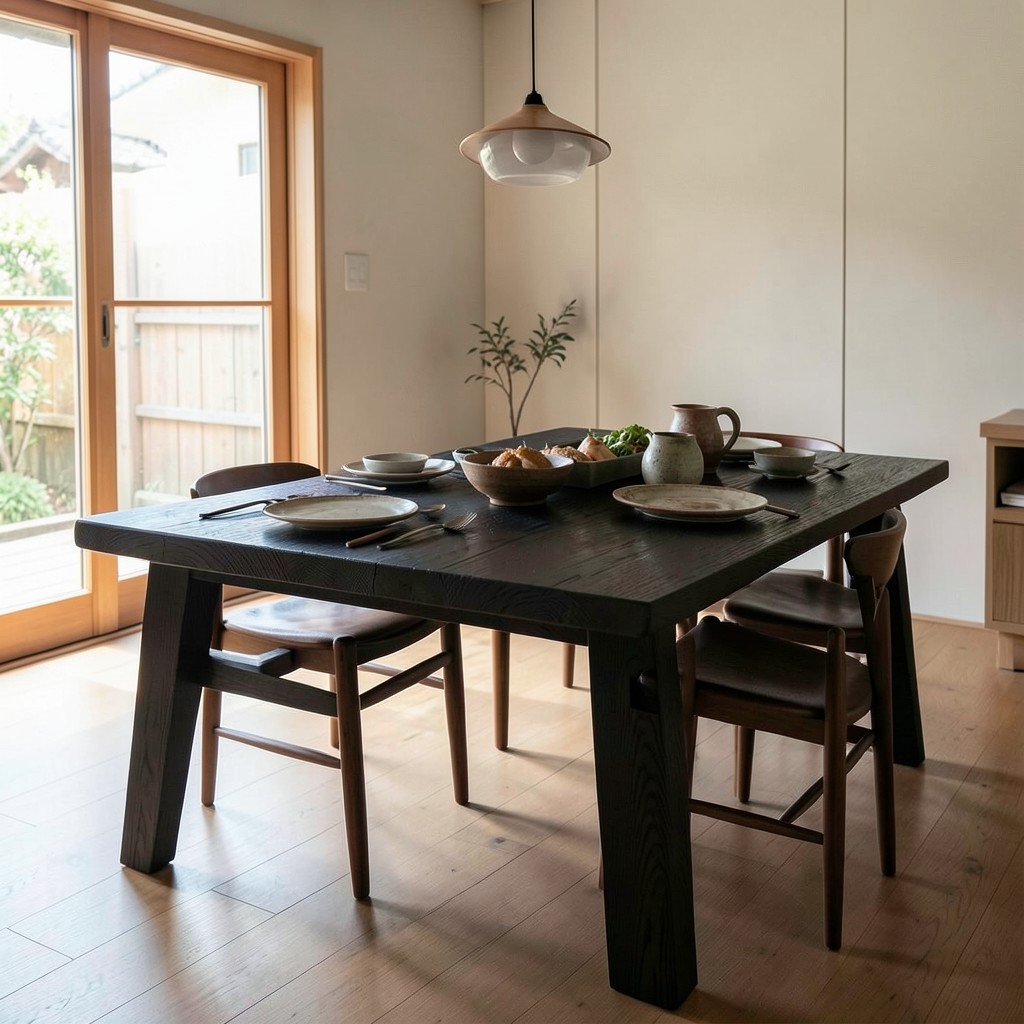
A Japandi dining room — borrowing the material restraint of Japanese interior culture and the functional clarity of Scandinavian design in a combination that produces something neither tradition achieves entirely on its own — provides a dining environment where the act of eating is given the full quality of environmental support that both traditions, from their different cultural positions, agree it deserves. The Japandi dining room is not designed to impress. It is designed to be inhabited, and the distinction between those two design intentions is visible in every material and every proportion decision the room contains.
The Japandi dining table — in a dark-stained oak or a blackened timber, with the material’s grain visible through the surface treatment, on legs with a slight taper that communicates weight without bulk — provides the physical center of the Japandi dining experience with the combination of material warmth and formal simplicity that the aesthetic requires. The table surface should be wide enough to hold a generous table setting with space for serving dishes at the center — a minimum of ninety centimeters wide — because Japandi hospitality is generous rather than minimal, and the restraint of the design direction applies to the decoration rather than to the quantity of food and the warmth of the gathering.
The ceramics on a Japandi dining table — handmade, earthy-toned, slightly irregular in their form — are the material element that most immediately communicates the aesthetic’s roots in Japanese craft culture. The specific quality of a Japandi table setting is in the pairing of the dark timber surface with the warm, textured ceramic — the heavy clay bowl against the wood grain, the ceramic jug against the table’s oiled surface — and the way those material conversations between adjacent objects produce the sensory richness that the Japandi aesthetic achieves without any conventional decorative flourish.
28. A Dining Room With a Vintage-Modern Mix
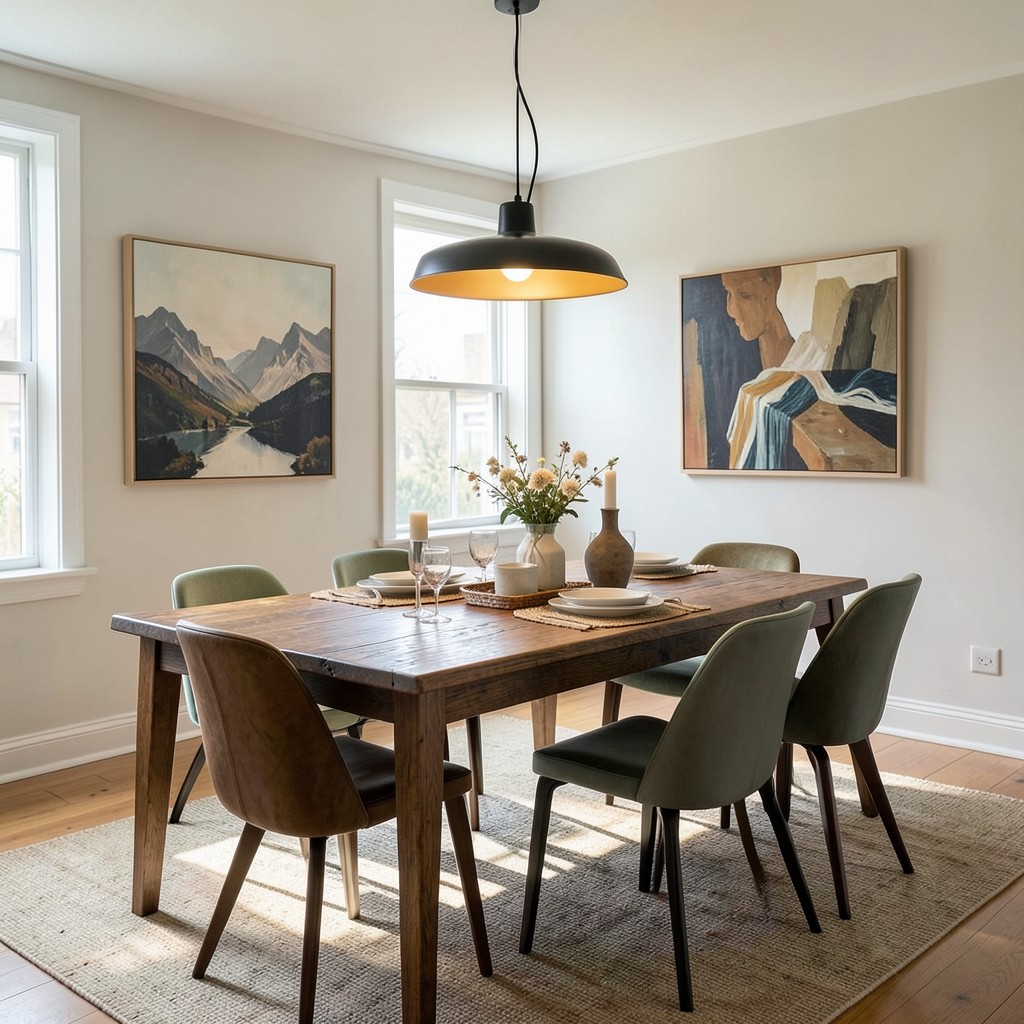
A vintage-modern dining room — where a genuinely old dining table or a set of vintage chairs is paired with contemporary pendant lighting, modern art, and current design-direction accessories — produces the specific material depth that neither a fully vintage room nor a fully contemporary one achieves. The vintage element carries the material quality and the cultural weight of an object that has survived decades of use and remains both functional and beautiful. The contemporary element provides the clarity and the freshness of current design thinking. Together, they produce a dining room that reads as lived-in and considered simultaneously.
The vintage dining table — a genuine period piece in walnut, mahogany, or oak, sourced from an auction house, a specialist antique dealer, or a well-curated second-hand market — provides the foundation for a vintage-modern dining room with an authenticity that reproduction furniture cannot approach. The patina of a genuine vintage table — the slight variation in surface color where sun and use have affected different areas differently, the micro-scratches and polishing marks of decades of maintenance — is the material quality that tells the room’s visual story without any decorative assistance.
The contemporary element paired with the vintage table — a modern pendant light in a current material direction, dining chairs in a contemporary form, a piece of recent art on the wall — provides the acknowledgment that the room is inhabited now rather than preserved as a period piece. This is the design intention that separates the vintage-modern aesthetic from the period reproduction room: the house is not a museum of a past era, but a living environment that respects and incorporates the past while belonging completely to the present.
29. A Dining Room With a Statement Ceiling
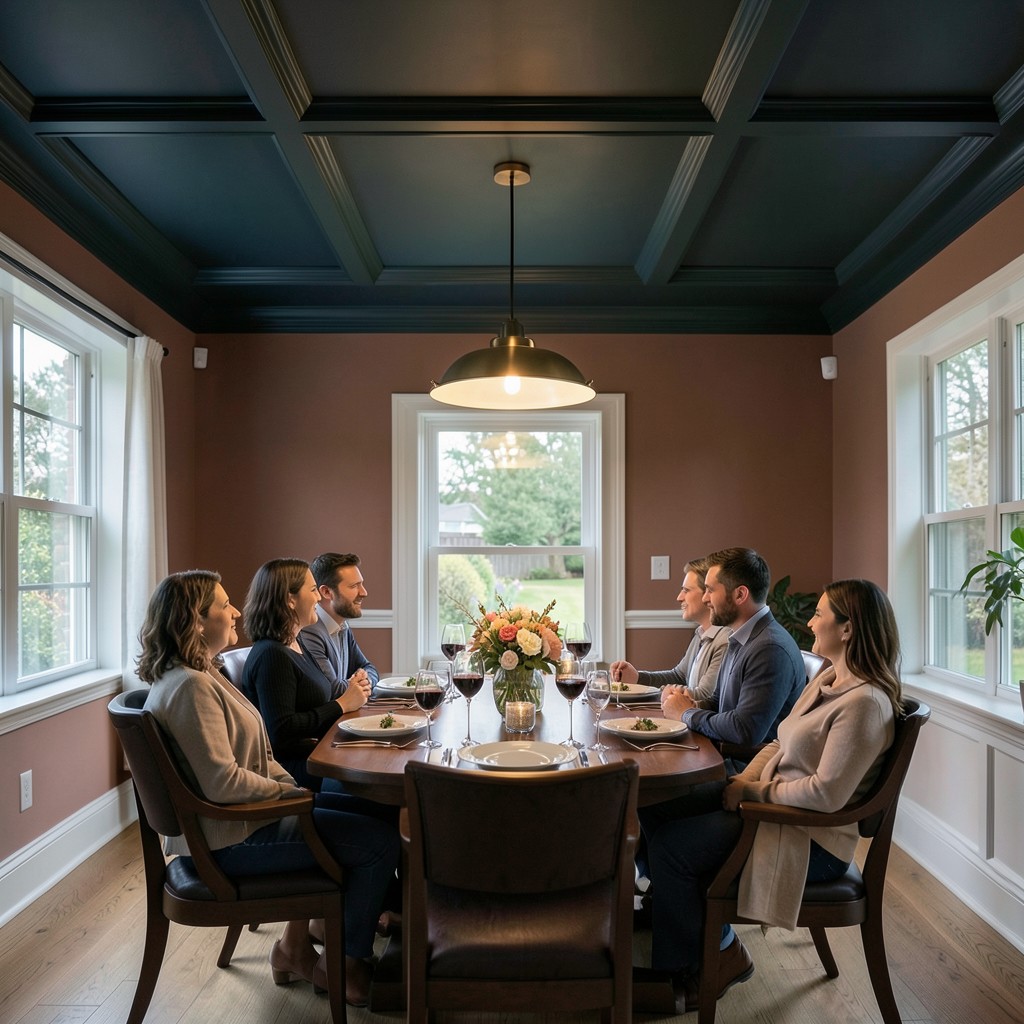
A statement ceiling in a dining room — one that has been given a treatment as considered and as deliberate as any wall surface in the room — is the design decision most overlooked in residential dining room design and most consistently rewarded when executed with genuine commitment. The ceiling of the dining room is the surface that every person at the table looks at between courses, during toasts, and when leaning back in their chairs after a long meal. It is not a forgotten plane. It is the room’s most underused design opportunity, and the dining room that treats it seriously earns a quality of architectural completeness that ceiling-as-afterthought rooms never approach.
The ceiling color is the entry-level statement ceiling intervention and the one with the highest impact-to-investment ratio of any ceiling treatment available. A ceiling painted in a deep, saturated color — navy, forest green, terracotta, or charcoal — lowers the perceived ceiling height and produces the canopy quality of envelopment that makes a tall-ceilinged dining room feel more intimate and a standard-height room feel architecturally intentional. The rule most designers apply is to choose a color one to two shades darker than the dominant wall tone, which connects the ceiling to the room’s color story without making it feel arbitrarily colored.
The coffered ceiling — a grid of recessed panels formed by beams crossing at right angles — is the architectural ceiling treatment that most completely transforms the dining room from a room with four walls and a ceiling into a room with a designed spatial envelope. A coffered ceiling does not require structural timber beams: applied timber mouldings built up from MDF components, painted in the ceiling color, produce the coffers’ shadow geometry and their visual depth without structural modification. The pendant light positioned at the center of the central coffer completes the relationship between the ceiling’s architectural organization and the room’s primary light source.
30. A Dining Room With a Curved Dining Table
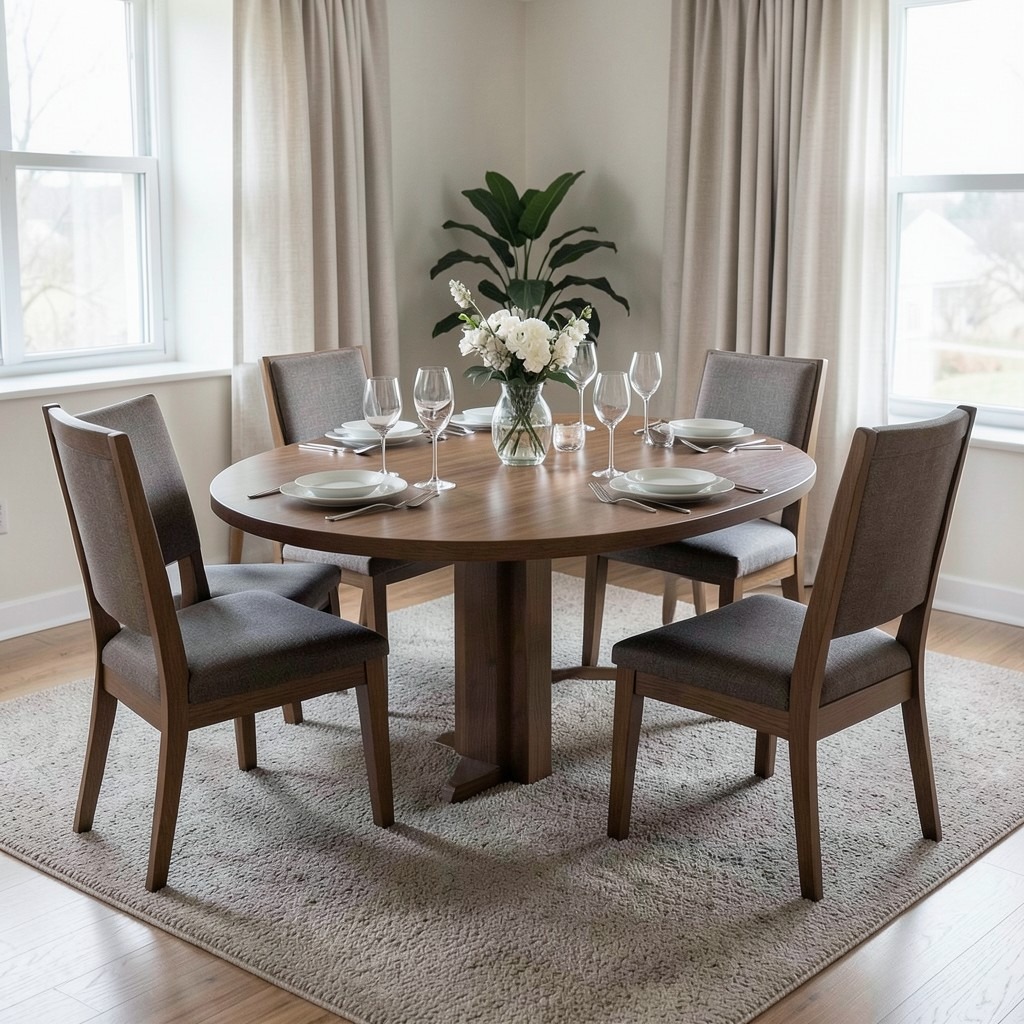
A curved dining table — an oval, an ellipse, or a kidney-form surface rather than the standard rectangle — changes the social geometry of the dining room in a way that most households have not considered because the rectangular table is such a default assumption that its alternatives rarely appear in the mental space where dining room planning happens. The oval table specifically combines the round table’s ability to seat diners at equal visual distance from each other with the rectangular table’s capacity to seat more people per linear dimension of floor space. The oval is the best of both forms, and it is an underused dining room furniture choice.
The oval table’s dimensions follow a different logic from the rectangular table’s because its seating positions are distributed along a continuous curved perimeter rather than assigned to specific sides. An oval of one hundred and eighty centimeters in length by ninety centimeters in width comfortably seats six, with the two end positions and two per long side. At two hundred and ten centimeters, the same oval seats eight without the tight elbow-room that a rectangular table at equivalent length produces for the four side-facing seats. The curved perimeter allows the diner at each position slightly more lateral elbow freedom than the straight edge of a rectangle provides at equivalent per-person table length allocation.
The base design for an oval dining table must handle the center of gravity distribution of an asymmetric surface without the single-end weight concentration that a pedestal base positioned off-center relative to the oval’s length produces. A double-pedestal base — two support columns positioned at the oval’s quarter-length points on its long axis — handles the weight distribution correctly, provides leg clearance for the seating on both long sides, and allows chairs to be placed at the oval’s ends without leg interference. The single pedestal centered beneath an oval’s geometric center provides the same clearance but concentrates all the structural load at one point, which at large oval dimensions produces a cantilevered overhang at both ends that the base’s single column resists only through its own mass.
31. A Dining Room With a Console Table as a Sideboard
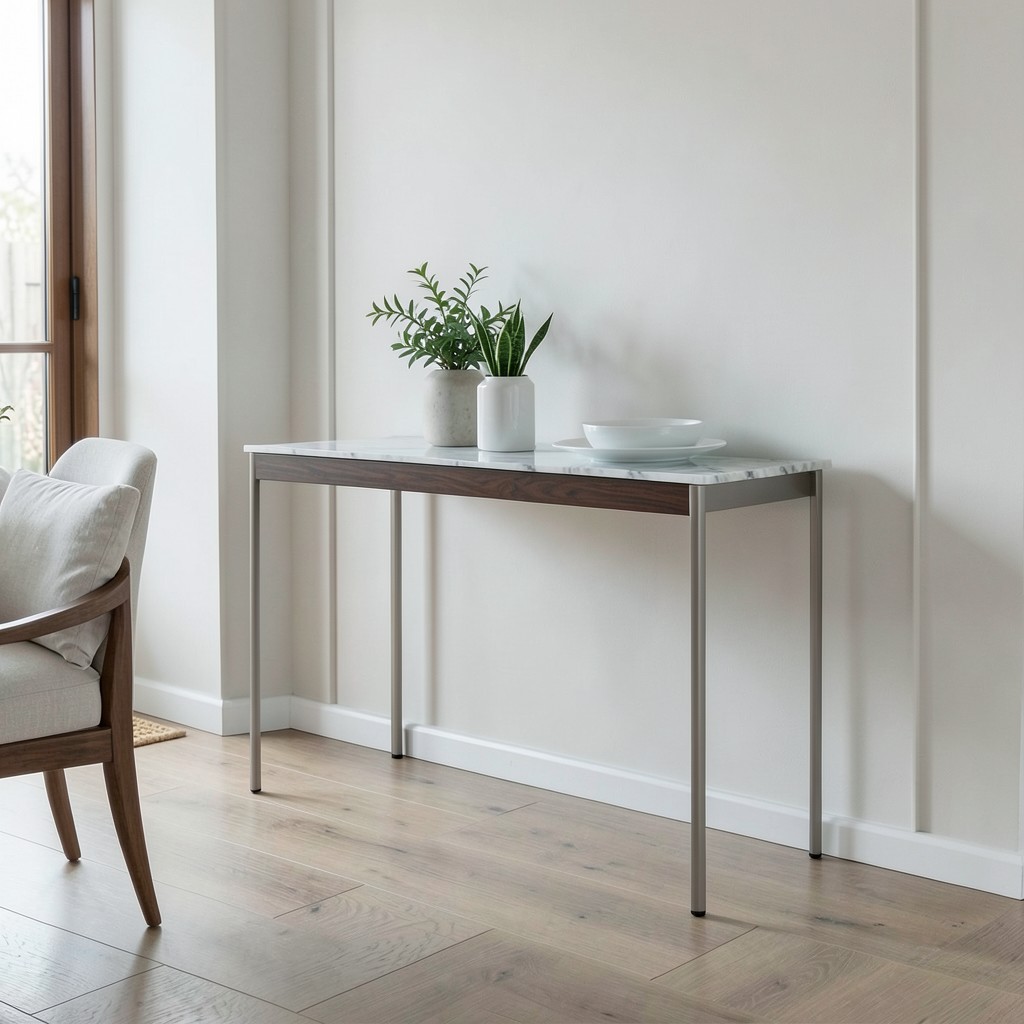
A console table used in place of a conventional sideboard — a slim, wall-hugging surface on slender legs, positioned against the dining room wall as a serving surface and display area — provides the secondary horizontal surface that the dining room needs without the visual weight and the floor footprint of a full-depth sideboard cabinet. The console table is the dining room furniture choice for rooms where floor space is the primary constraint and the closed storage of a conventional sideboard is less important than maintaining the open quality of the room’s floor plane.
The console table in a dining room context performs two functions that the sideboard performs at greater material mass: the serving surface for dishes being staged between kitchen and table, and the display surface for the decorative objects, plants, and lighting that give the room visual interest between meals. A console at a height of eighty to eighty-five centimeters — slightly higher than a conventional dining table, which positions it above the backs of the seated diners and in the standing serving zone — provides the correct working height for transferring dishes from serving to table without the awkward stoop that a lower surface requires.
The console table’s visual lightness — its slender legs, its minimal material footprint — makes it the correct choice for a dining room where the design direction emphasizes open space and material restraint. A console in a dark, slim-profile timber or in a powder-coated metal with a marble or glass top provides the material quality of a designed furniture piece within the visual weight of a piece that barely registers in the room’s floor plan. The wall behind the console — where the sideboard’s back panel would otherwise terminate the view — remains visible, which allows the wall treatment at that position to contribute fully to the room’s design rather than being partially hidden behind a furniture back.
32. A Dining Room With a Maximalist Design
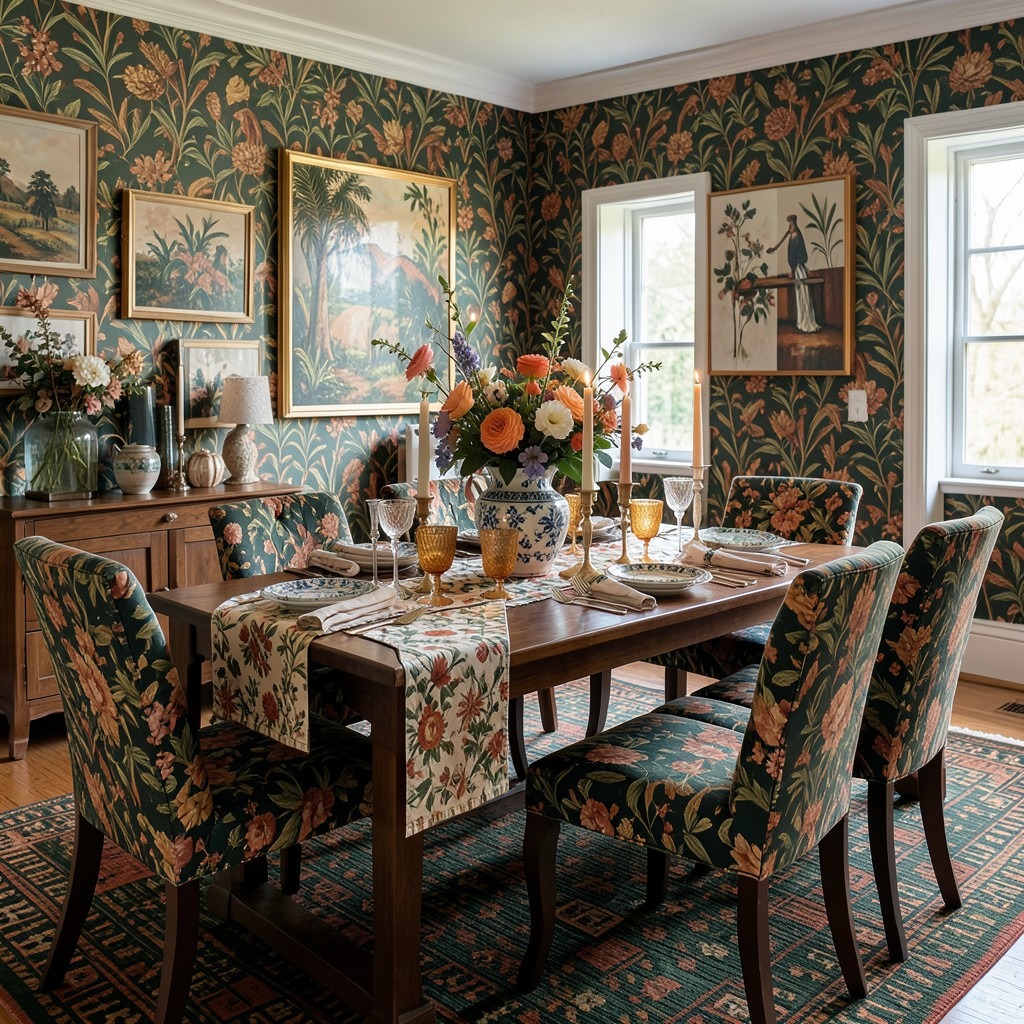
A maximalist dining room — where every surface is treated, every wall carries pattern or color or art, the table is dressed with more than function demands, and the overall effect is one of deliberate, curated abundance — is the dining room direction that most directly commits to the idea that eating together deserves an extraordinary environment. Maximalism is not excess for its own sake. It is the design philosophy that refuses the idea of enough and pushes every element toward its most expressive state, and in a dining room — where the gathering itself is an event — that philosophy finds its most natural domestic application.
The maximalist dining room requires a color strategy that manages the complexity of multiple competing visual elements without producing the visual fatigue that unresolved maximalism generates. The strategy that works consistently is to identify a dominant palette — three or four colors that appear across the room in varying proportions and surfaces — and then allow every individual element’s pattern, material, and form to operate freely within that palette. The wallpaper’s botanical pattern, the rug’s geometric weave, the chair upholstery’s floral print, and the ceramic tableware’s decorative glaze are all different in pattern and form, but they read as belonging to the same room because they all draw from the same family of terracotta, forest green, and deep gold.
The dining table setting in a maximalist dining room is the moment when the design direction’s intentions are most fully realized. A table set with patterned plates, textured glasses, embroidered napkins, a centerpiece of flowers in a decorative ceramic vase, candles in mixed candlestick heights, and a table runner in a print that references the wallpaper’s pattern — this is the maximalist table setting where every element was chosen to contribute to the overall effect rather than to stay out of each other’s way. The opposite instinct — the minimalist’s one plate, one glass, one napkin — is not wrong. It is simply a different commitment, and the maximalist dining room is the committed other direction.
33. A Dining Room With Arch Doorway Details
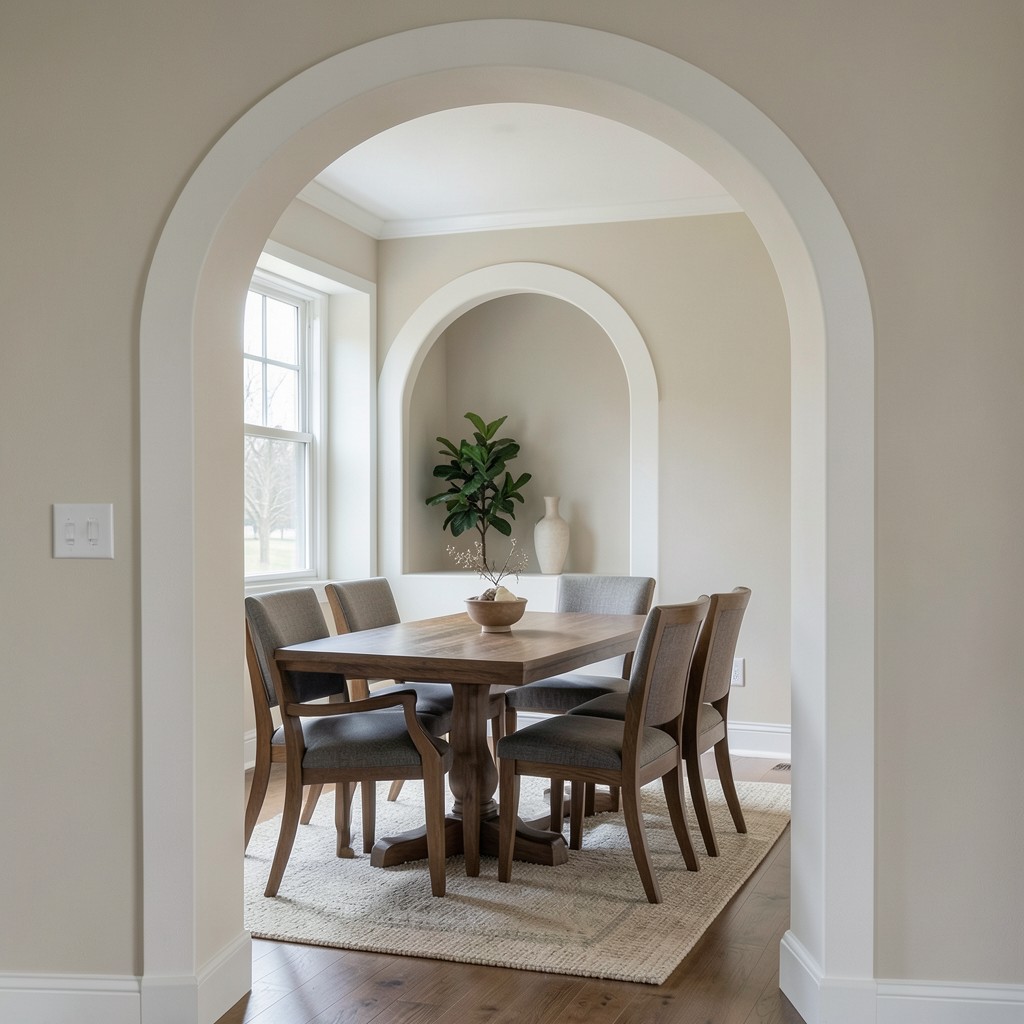
An arched doorway leading into the dining room — or an arch detail within the dining room itself, framing a window, a niche, or a passthrough — provides the architectural softness that the square-cornered geometry of standard residential construction lacks and that the dining room, as the household’s most social room, benefits from more than any other space. The arch is the oldest architectural gesture for marking a threshold between spaces, and its specific quality of welcome — the curved opening that beckons rather than blocks — suits the dining room’s social function better than the hard-cornered doorway opening that most modern construction provides.
The arch applied to an existing square doorway opening — a drywall curve formed over the existing rectangular frame, skim-plastered and painted to match the surrounding wall — converts a standard domestic door opening into an architectural detail with more visual and social character than the original frame possessed, at a construction cost well within the range of typical decorative renovation investments. The arch form must be a true semicircle or a graceful segmental arc — not a shallow, tentative curve that reads as an unresolved approximation of an arch. The boldness of the arc is what makes the detail read as intentional rather than as a correction of something that went wrong in the original construction.
The arch detail applied to a dining room niche — a recessed section of wall formed between the studs and finished with the arch head, used to display a piece of art, a plant, or a decorative object — provides a designed focal point at the wall surface that frames its content with architectural intention. A niche of thirty centimeters deep by sixty centimeters wide, with an arched head at eye level from a seated dining position, frames a single object — a ceramic sculpture, a pendant vase, a small piece of art — in a way that a flat wall display cannot. The niche contains its content; the flat wall merely supports it, and that distinction is the architectural quality the arch detail produces.
34. A Dining Room With a Marble Dining Table
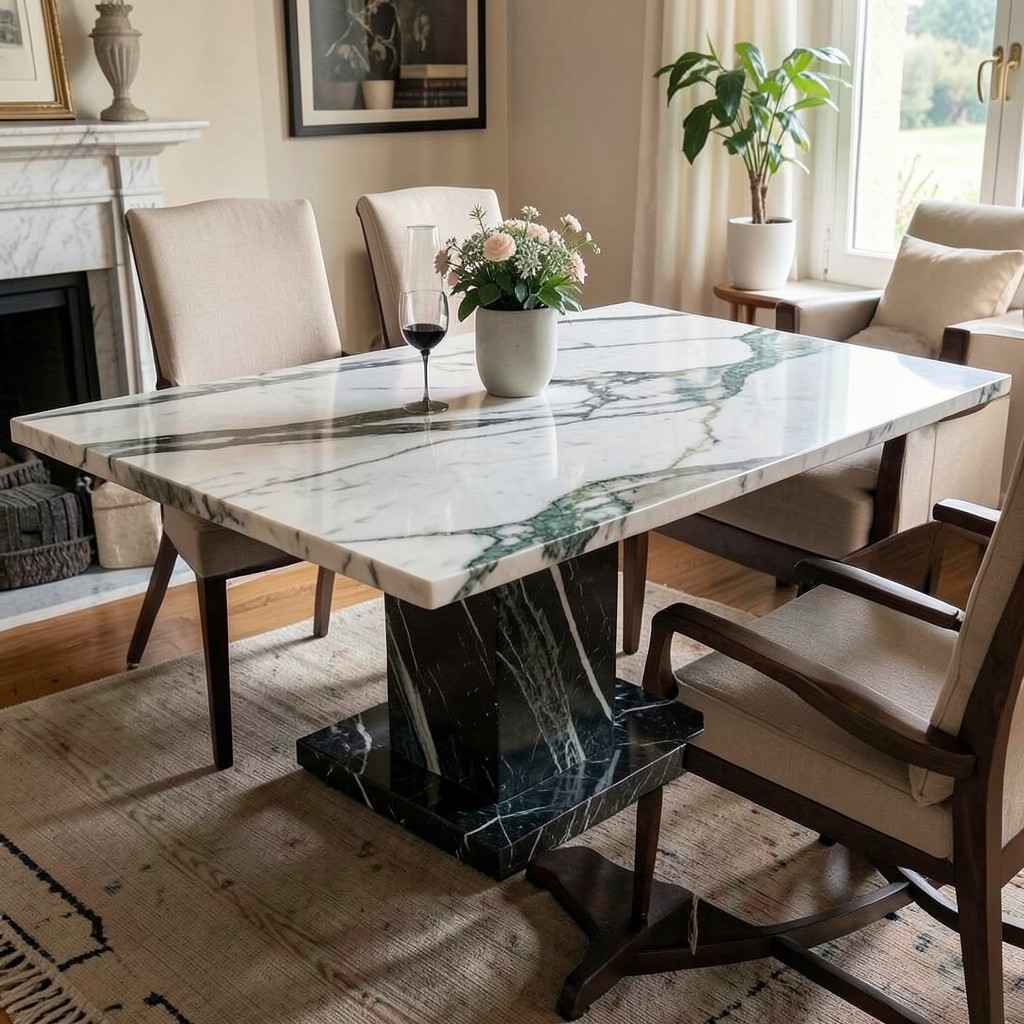
A marble dining table — a genuine stone slab top in a natural marble in white, grey, green, or black, mounted on a base of stone, timber, or metal — is the dining room furniture piece with the highest immediate visual authority of any table material available, and the one whose presence changes the room’s character from a dining space into a specific kind of sophisticated environment where the surface beneath the meal is as remarkable as the meal itself. Marble does not defer to the room around it. The room organizes itself around the marble.
The porosity of marble is the practical reality that most marble dining table discussions either gloss over or exaggerate into a warning severe enough to discourage the purchase. Natural marble is porous and will absorb acidic liquids — red wine, citrus juice, vinegar, coffee — on contact if those liquids are not wiped up quickly and the surface is not properly sealed. A marble table maintained with a penetrating stone sealer, applied on the schedule the stone supplier specifies, develops a protective layer that significantly slows the absorption rate and allows practical dining use without the anxiety of constant surface monitoring. The sealer does not make marble impervious — it makes it manageable, and manageable is sufficient for a household that treats its dining table with the reasonable care a quality material deserves.
The marble species selection for a dining table top determines both the visual character of the table and the maintenance level the stone requires. Carrara marble — the white-and-grey veined marble from northern Tuscany — is the most widely available and most recognizable marble for dining table use, with a relatively consistent background and vein pattern that suits a broad range of dining room design directions. Calacatta marble — rarer, with bolder, more graphic veining on a whiter background — provides a more dramatic visual character. Nero Marquina — a black marble with white veining — provides the dining room with a dark, graphic surface that produces an entirely different atmospheric quality from any white or grey stone.
35. A Dining Room With a Greenhouse Extension
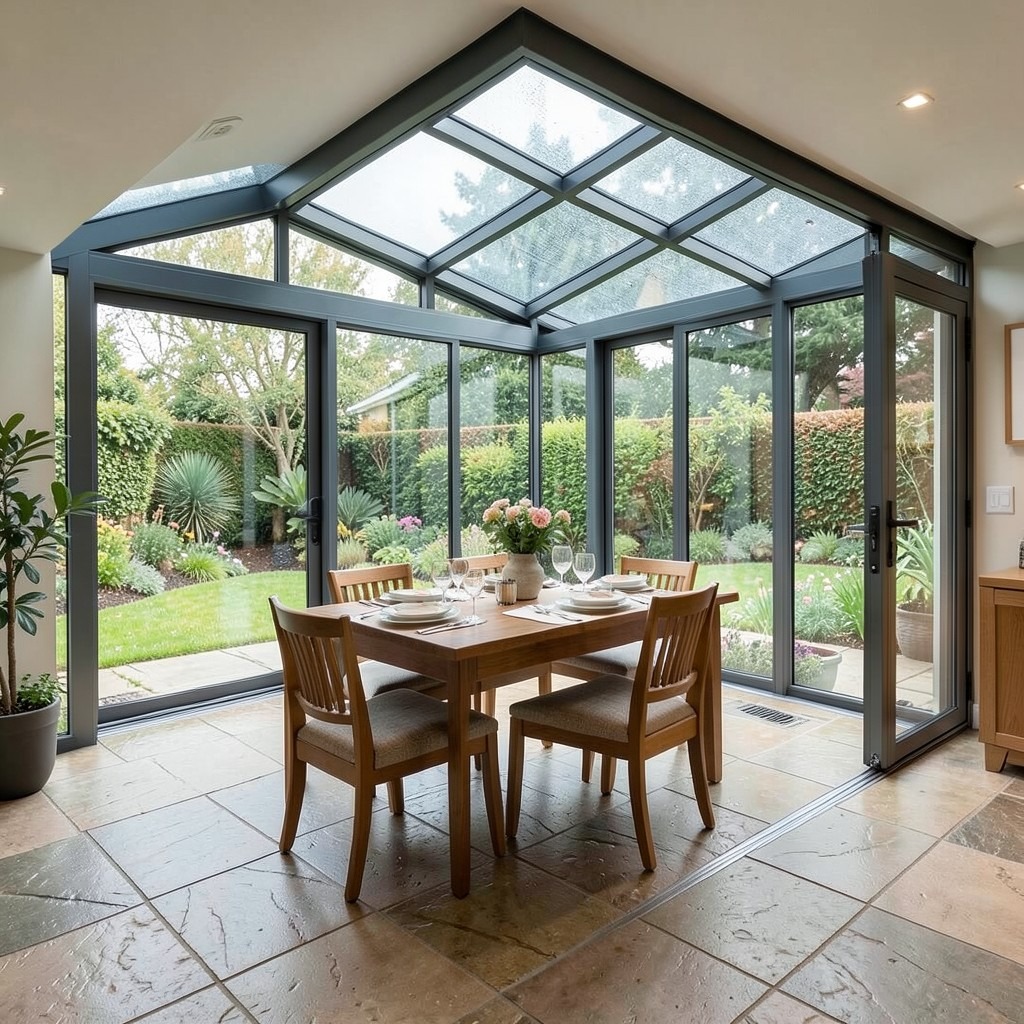
A dining room that extends into a greenhouse structure — a glass-walled and glass-roofed extension of the main dining space, bringing the outdoor environment inside the boundaries of the room — is the dining configuration that most completely dissolves the boundary between eating inside and eating outside. The greenhouse dining room sits within a glass envelope that allows the garden view, the natural light, and the changing quality of the outdoor atmosphere to participate in every meal while maintaining the thermal comfort of an interior space. It is not an outdoor dining area. It is an indoor room that contains the outdoor environment rather than looking at it through a window.
The structure of a greenhouse dining extension requires a material specification appropriate for the specific demands of a glass-roofed, glass-walled structure in a residential context: aluminium framing — powder-coated in a color that relates to the main house’s material palette — handles the thermal movement of a structure that experiences the full range of outdoor temperature variation, resists the corrosion that untreated steel develops under the condensation that glass structures generate on their interior surfaces, and provides the slim framing profiles that maximize the glazed area relative to the structural material visible in each frame.
The flooring of a greenhouse dining extension must handle the full range of conditions that the glass structure creates: wet ingress from opening windows and doors, the condensation that forms on cold mornings on every glass and metal surface and drips to the floor, and the thermal cycling between warm summer temperatures and cool winter nights. A natural stone or large-format porcelain tile floor — laid over a heated screed where the climate requires it — handles these conditions without the expansion, contraction, and moisture damage that timber floor materials experience in the extremes of a glass-enclosed space.
36. A Dining Room With Rattan Pendant Lights
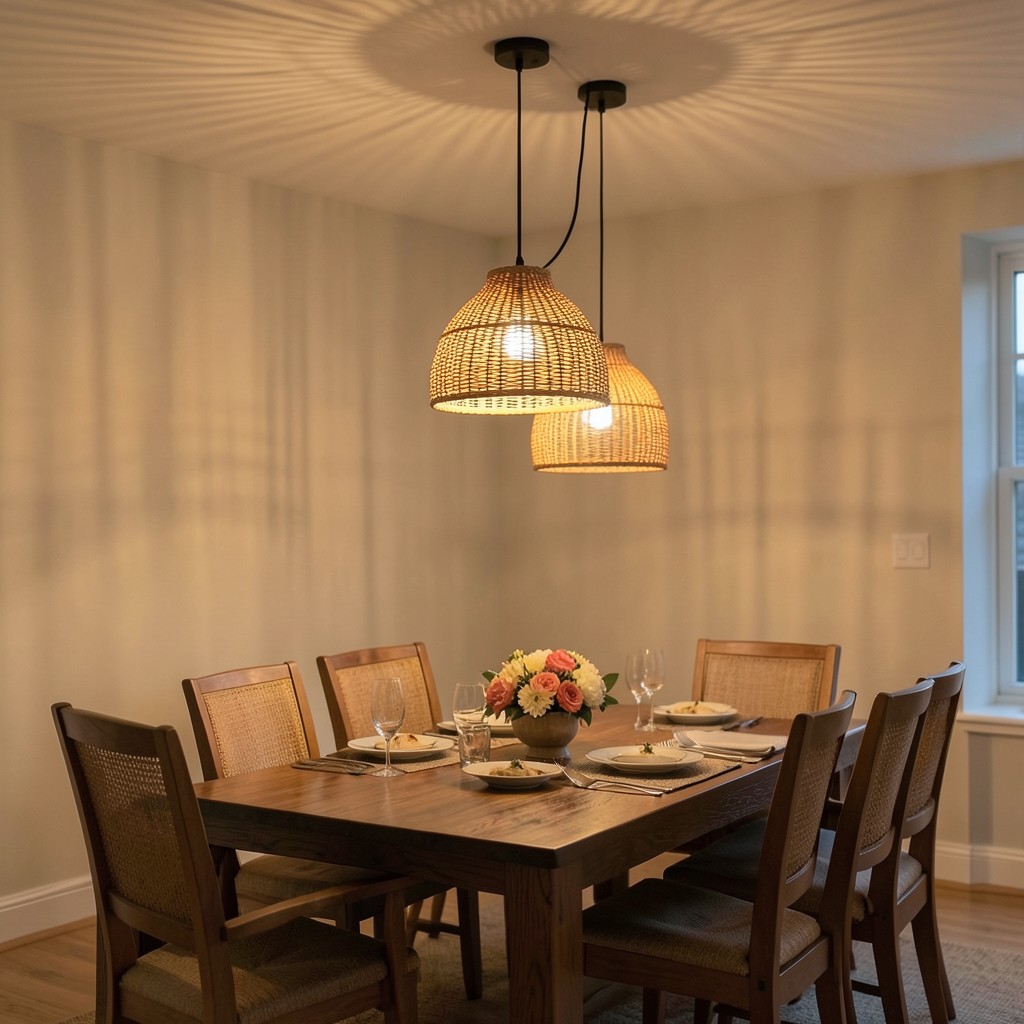
Rattan pendant lights — woven fiber fixtures in a natural or stained finish, hanging over the dining table as the room’s primary light source — provide the specific warm, dappled light quality that woven material produces when a light source is contained within it. The light passes through the weave of the rattan in irregular patterns, casting warm shadows on the ceiling and walls around the fixture that no solid-shade pendant produces, and the specific organic quality of that light — not engineered, not perfectly even, produced by the irregularity of a handmade woven form — communicates a warmth and a humanity that manufactured fixtures rarely achieve.
The rattan pendant’s warm color temperature is a physical property of the material rather than a choice made in the lighting specification. The natural rattan fiber transmits light in a warm, amber-tinted quality that deepens any light source contained within it toward the warmer end of the visible spectrum. This makes the rattan pendant specifically effective over a dining table where warm, amber-toned light is the atmospheric objective — the rattan amplifies the warmth of the bulb within it, and the result at the table surface below is light that makes food look generous and faces look well. That is exactly the light quality the dining room requires.
The scale of a rattan pendant must be appropriate to the table dimensions below it and the ceiling height above it. A rattan pendant whose diameter is less than one-third of the table’s width reads as too small for the table and the room — a gesture rather than a statement. A pendant at forty-five to sixty percent of the table’s width reads in correct proportion, provides sufficient light area to illuminate the full table surface, and carries the visual authority that a dining room’s central pendant requires. Multiple smaller rattan pendants in a cluster — three different sizes grouped as a hanging composition — provide an alternative to the single large fixture that produces an artisanal, collected quality the single pendant cannot.
37. A Dining Room With a Pantry Connection
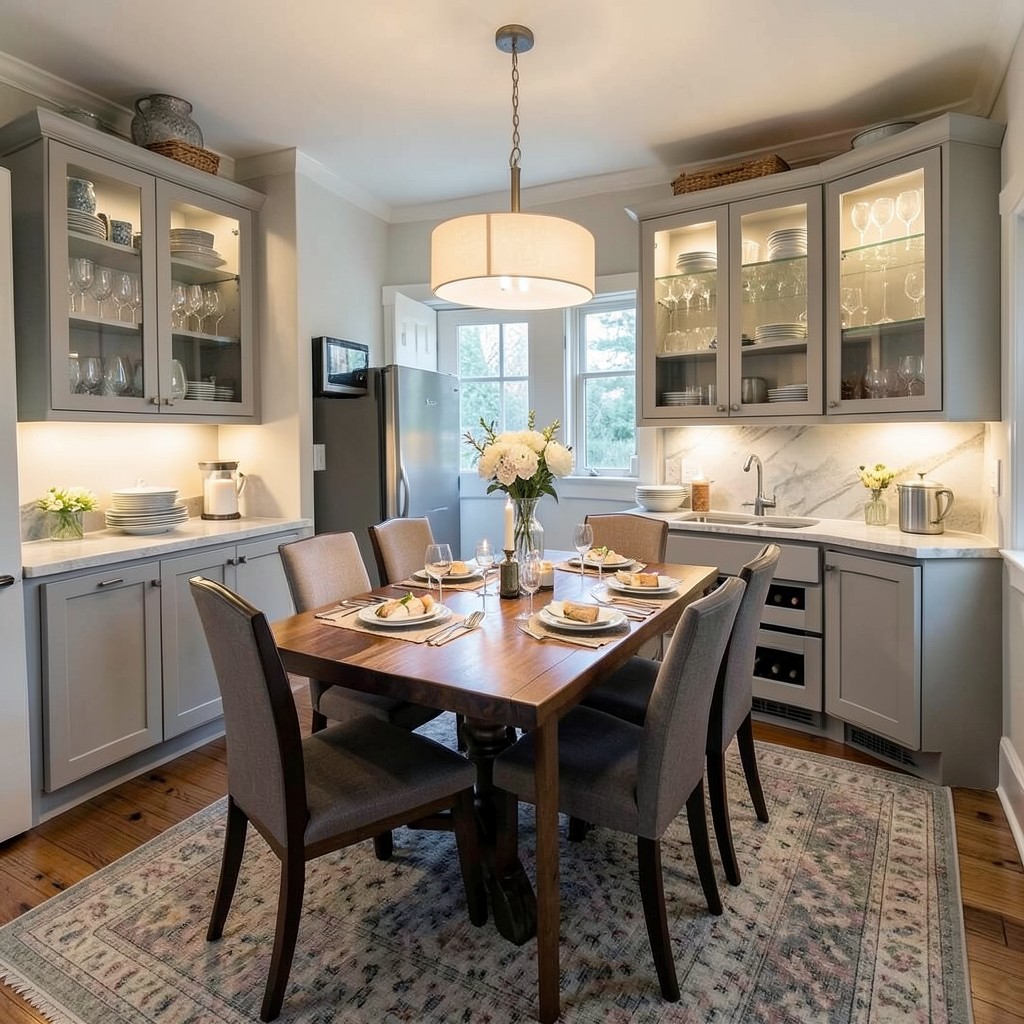
A dining room with direct access to a butler’s pantry or a servery — a small, purpose-fitted room between the kitchen and the dining room that provides staging space for dishes, storage for tableware, and the work surface for pre-table preparation — elevates the dining function of the room beyond the standard open-plan kitchen-to-table arrangement in a specific and significant way. The butler’s pantry is the dining room infrastructure that makes hosting for ten as fluid as hosting for four, because the practical work of meal service — the staging, the plating, the orchestration of multiple dishes — happens in the servery rather than on the dining table or in the kitchen where cooking is still underway.
The servery or butler’s pantry is typically fitted with a continuous stone or timber worktop surface for staging, a sink for final rinse and glass polishing, a wine refrigerator, and deep drawer storage for the tableware, serving equipment, and the candle stock, napkin collection, and table dressing materials that the dining room requires but that have no home in the main kitchen. The base cabinetry runs the full length of the available wall on both sides if the space permits, and the overhead cabinetry with glass fronts displays the glassware and the decorative serving pieces that would otherwise occupy the dining room sideboard.
The acoustic benefit of the butler’s pantry arrangement — where the clatter and conversation of meal preparation is contained in the servery rather than carrying into the dining room from an open kitchen — is the quality of the dining experience that guests notice without identifying its cause. The dining room with a servery connection is simply quieter and more focused during the meal than the open-plan kitchen-dining arrangement, and the host moves between dining room and kitchen without the full sequence of meal preparation being performed in the room where the meal is eaten.
38. A Dining Room With Pendant Lights on a Dimmer
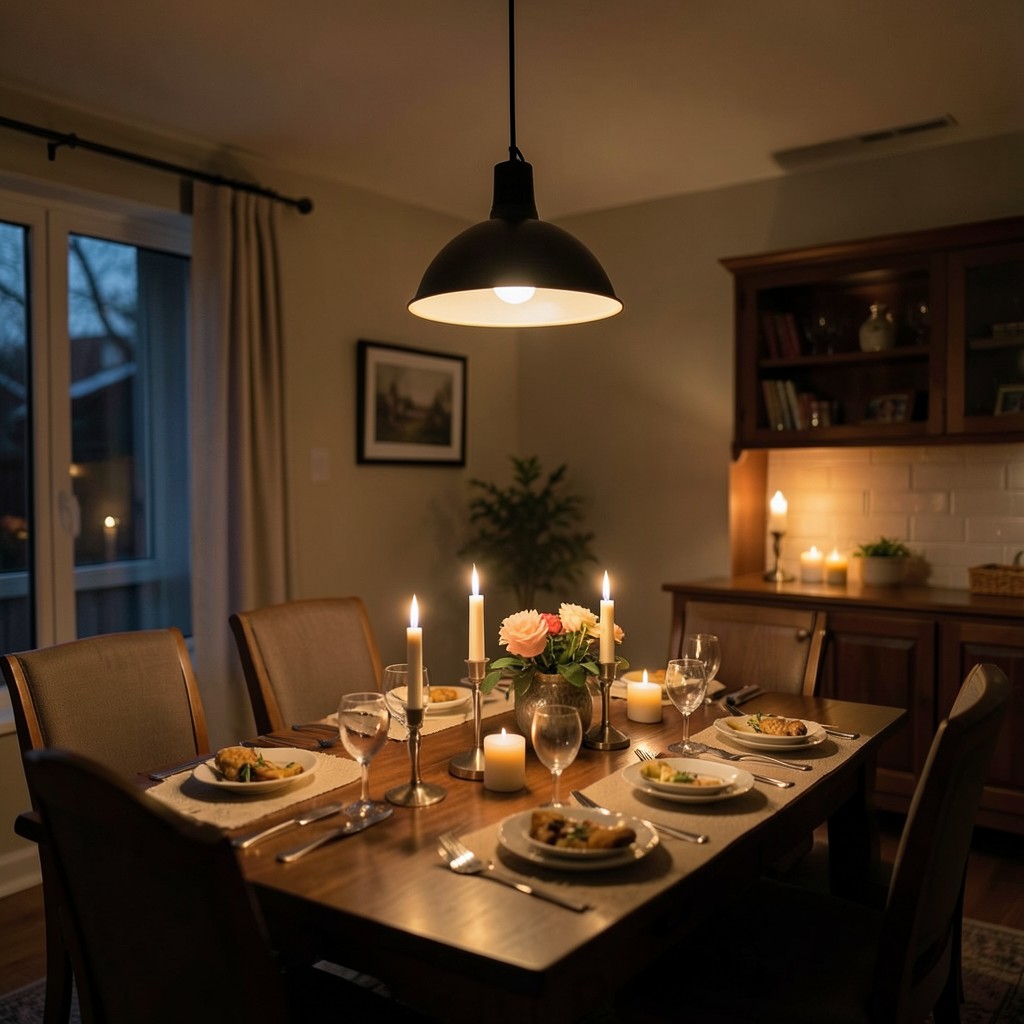
A dimmer-controlled pendant light over the dining table is the single most impactful technology intervention available in a dining room, and it is one of the least expensive. The ability to reduce the pendant’s intensity from its full task-lighting level to the lower, warmer setting appropriate for evening dining changes the room’s atmosphere at the turn of a dial in a way that no other single adjustment achieves. A dining room lit at full pendant intensity during a dinner party communicates the same visual quality as a restaurant’s service mode — functional, flat, and entirely at odds with the social intimacy that the occasion requires. The same room at sixty percent intensity, with candles on the table supplementing the pendant’s reduced output, becomes somewhere altogether different.
The dimmer switch specification must be compatible with the LED light source technology used in the pendant’s bulbs — not all LED products are dimmable, and not all dimmable LEDs work correctly with all dimmer switch types. A trailing-edge LED dimmer — the type designed specifically for LED and electronic loads rather than the older leading-edge dimmers designed for incandescent — produces smooth, flicker-free dimming across the full intensity range from maximum to near-off. An incompatible pairing between an LED bulb and a dimmer switch produces the flickering, stepping, or minimum-level buzzing that many households with poorly specified dimming systems experience and attribute to the quality of their light fittings when the fault is actually in the dimmer-bulb compatibility.
The scene-setting capability of a smart dimmer — one that stores pre-programmed light levels and activates them at a single button press or a voice command — is the upgrade from a standard rotary dimmer that households with regular hosting occasions find most worthwhile. A stored “dinner” scene that sets the pendant to the correct evening-dining level, activates the sideboard accent light at a low setting, and turns off the overhead ambient light simultaneously creates the full dining room atmosphere in one action rather than three separate adjustments. The technology investment is modest; the behavioral change — from never quite getting the lighting right to activating a precisely correct setting every time — is significant.
39. A Dining Room With a Black Dining Table
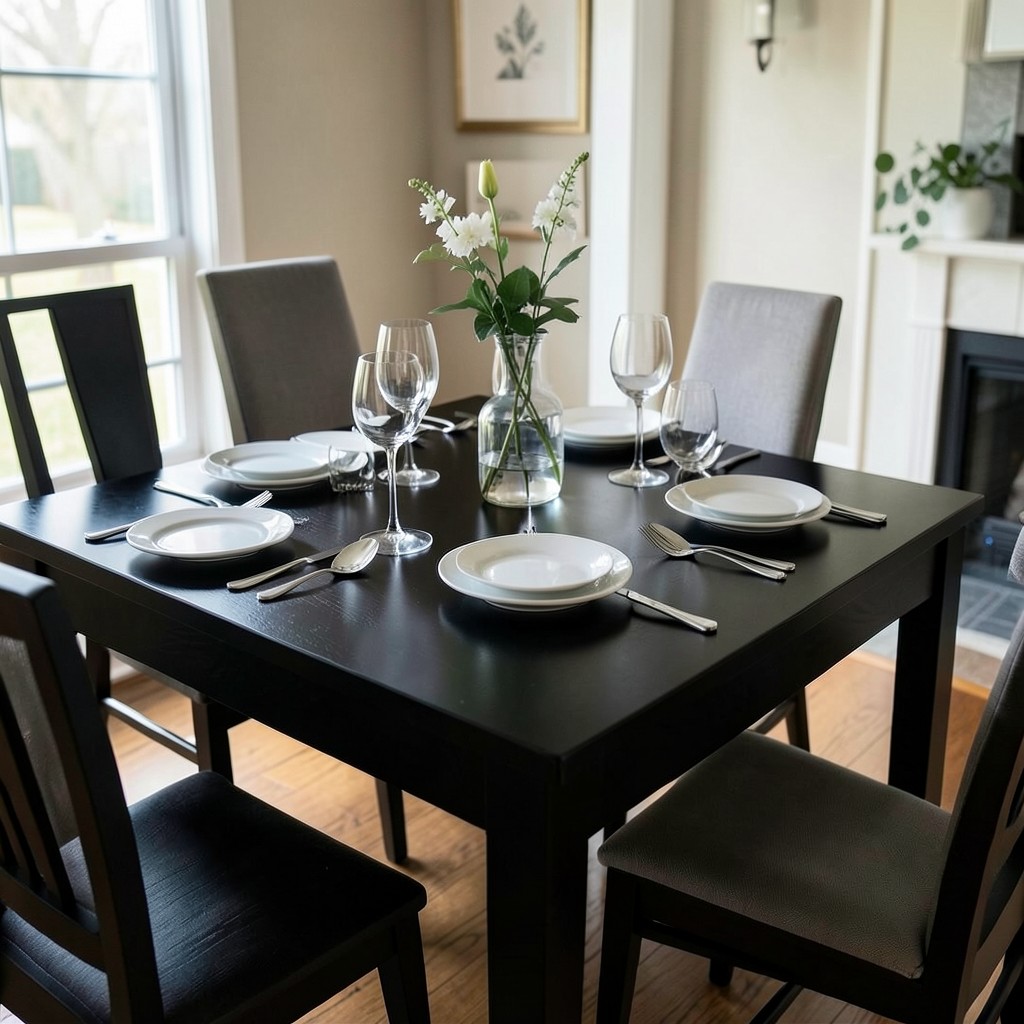
A black dining table — in a lacquered timber finish, a blackened steel surface, a black-stained wood, or a black stone such as basalt or absolute black granite — is the dining room furniture choice that produces the most graphic and most architecturally assertive table presence of any surface color available. The black table does not recede into the room. It holds the center with a weight and a visual authority that pale tables cannot match, and it organizes the room’s other elements around it in a way that communicates clearly where the room’s center is and what purpose it serves.
The table setting on a black surface produces a different visual quality from the same setting on a pale table. White ceramics, clear glassware, and silver cutlery against a black table surface read with the graphic clarity of objects against a photographic background — each element is isolated by the dark ground in a way that groups of objects on a pale surface are not. This is the table setting effect that professional food photographers achieve with dark surface styling, and it is available to every household with a black dining table as a daily experience rather than a styled photograph.
The practical maintenance of a black table surface requires attention to the specific marking behavior of the surface material. A lacquered black timber surface shows dust, fingerprint marks, and dried water drops more prominently than any other surface finish because the high-contrast dark background makes low-contrast surface marks visible that the same marks on a textured or mid-toned surface would absorb. A matte or satin lacquer finish reduces the visibility of these marks relative to a high-gloss black, which shows every mark with maximum contrast. A matte finish black table requires regular dusting and occasional wiping with a lightly damp cloth rather than the glass-surface maintenance of a gloss finish, and the trade-off between surface richness and mark visibility is the decision the black table owner makes at the specification stage rather than discovering afterward.
40. A Dining Room With a Mid-Century Modern Aesthetic
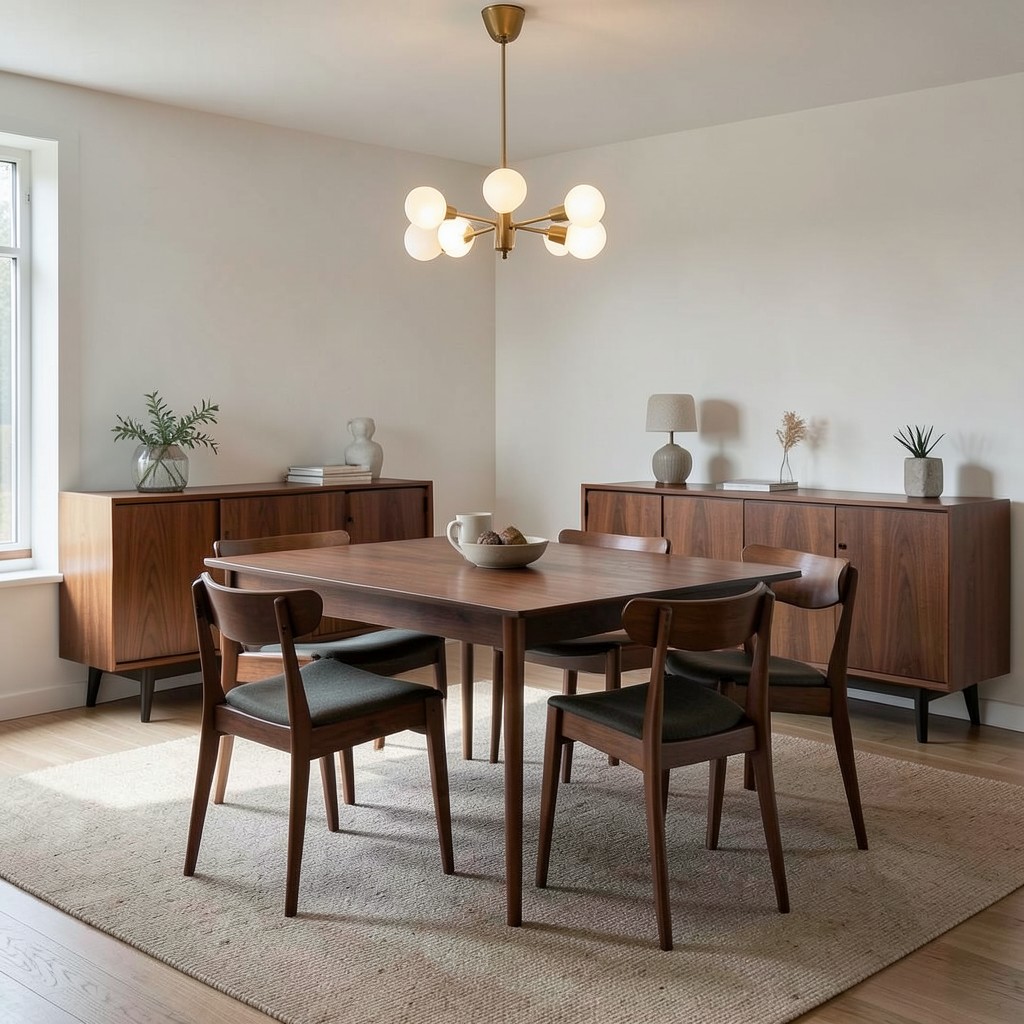
A mid-century modern dining room — walnut timber, clean-lined furniture with tapered legs, a sputnik chandelier or a simple pendant in a material-honest shade, a sideboard with sliding doors in a teak veneer, and the general aesthetic language of the post-war American and European design period that produced some of the most humanely proportioned domestic furniture ever made — provides a dining environment with a design history deep enough to confer authority and a formal language clear enough to make every furnishing decision easier than it is in a less defined direction.
The dining table in a mid-century modern dining room is almost invariably in walnut — the timber that the period’s designers chose above all others for its specific combination of warm, chocolate-brown tone and a grain character with enough visual interest to carry a surface without additional treatment or decoration. A genuine vintage mid-century dining table — sourced from a specialist dealer or a design-focused auction — provides the material quality of the original period production alongside the patina that decades of careful use has contributed to its surface. A well-made contemporary reproduction in genuine walnut veneer or solid walnut provides the same aesthetic direction without the provenance premium that vintage pieces command.
The dining chair for a mid-century modern dining room should be chosen from the canon of genuinely significant chair designs that the period produced: the Eames DSR, the Arne Jacobsen Series 7, the Hans Wegner Wishbone, the George Nelson Swag Leg chair, or any of the dozens of high-quality designs that the period’s commitment to furniture as a genuine design discipline generated. Each of these chairs is available in production reproductions as well as originals, and the reproduction quality varies enormously. The correct specification for a mid-century dining chair is one manufactured in the original dimensions, in the original or equivalent materials, with the original construction methods — not a scaled approximation in inferior materials that carries the silhouette without the quality.
41. A Dining Room With Floor-to-Ceiling Curtains
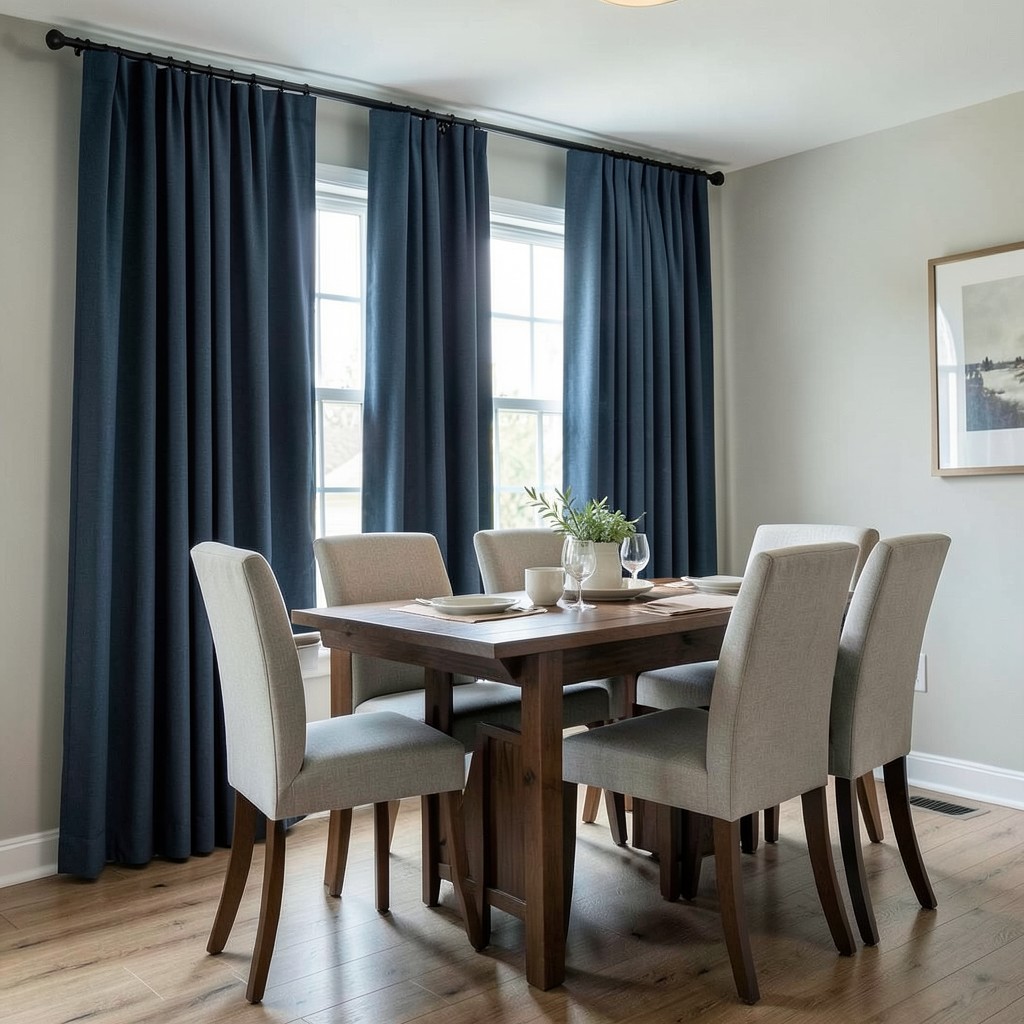
Floor-to-ceiling curtains in a dining room — curtain panels that run from a ceiling-fixed rail to the floor, covering the full window wall from the highest available point to the floor surface — produce the most architecturally transformative window treatment available in a standard residential space. The curtain that begins at ceiling height and falls to the floor makes the window appear to extend from ceiling to floor regardless of where the actual window head sits, which visually heightens the room and produces the quality of generous, proportioned space that ceiling-height curtain installations consistently generate at the cost of only the additional fabric between the actual window head and the ceiling rail.
The fabric weight for floor-to-ceiling dining room curtains must be sufficient to fall cleanly from the ceiling rail to the floor without the billowing or the irregular fall that lightweight curtain fabrics produce when suspended from a height. A medium to heavyweight curtain fabric — at minimum two hundred grams per square meter — falls with the linear, architectural quality that makes floor-length curtains read as considered rather than domestic. The width of the curtain panels — typically two to two-and-a-half times the rail width to allow generous folding when drawn — provides the volume of fabric at the window that full-length curtains require to read as abundant rather than merely adequate.
The color of floor-to-ceiling dining room curtains carries more visual weight than any other textile decision in the room because the curtain’s vertical scale — the full height of the room from ceiling to floor — makes it the room’s largest single surface treatment. A curtain in a tone that matches the wall color reads as an extension of the wall plane, which makes the room feel wider at the window wall. A curtain in a contrasting tone — a deep color against a pale wall — reads as a defining architectural element that frames the window and anchors the room’s design at its most prominent surface.
42. A Dining Room With a Custom Lighting Rig
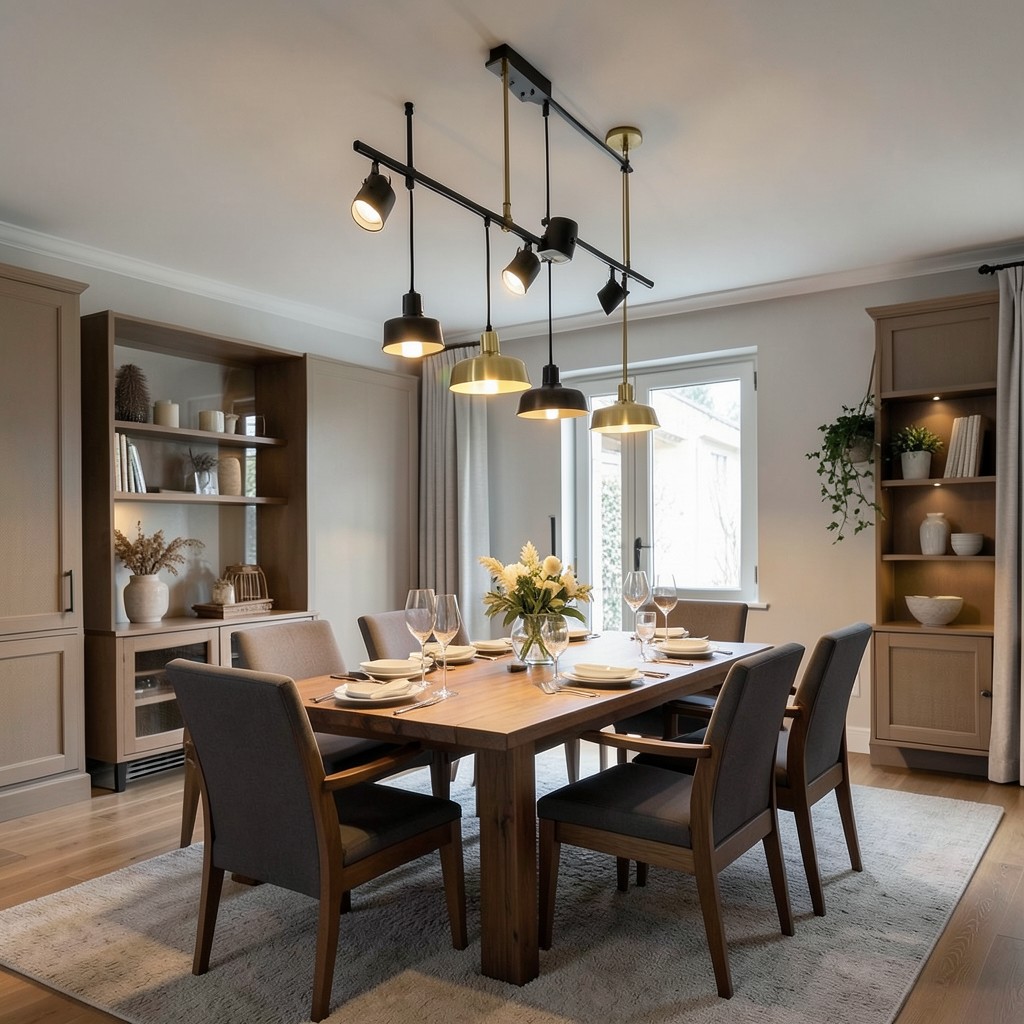
A custom lighting rig above the dining table — a bespoke arrangement of multiple fixture types on a single ceiling-mounted frame or on an adjustable track system, combining pendant lights, directional spots, and accent sources in a single designed overhead installation — provides the dining room with a lighting composition that addresses the full range of the table’s illumination requirements simultaneously rather than through separate fixtures installed at different ceiling positions. The custom rig is the lighting solution for the dining room where the table is long, the ceiling is high, and the standard single pendant over the table center provides neither the distribution nor the atmospheric range the space demands.
The rig structure — a powder-coated steel or brass frame sized to the dining table’s footprint, suspended from the ceiling at the pendant’s correct hanging height — provides the mounting platform for all fixtures within a single composed installation. The pendants provide the primary atmospheric light over the table. The directional spots, pointing down and slightly angled toward the table’s surface, supplement the pendant’s ambient output with task-level illumination at the table edges and ends that the pendants alone cannot reach. An optional accent fixture on the rig’s outer edge, pointing toward the wall or the centerpiece, provides the decorative light layer that completes the installation’s atmospheric range.
The aesthetic design of the custom rig — its material, its profile, its visual relationship with the room’s other elements — must resolve the paradox of a functional structure that is also a decorative object. A rig in a raw or blackened steel reads as industrial and deliberate. One in a polished brass or a warm gold finish reads as formal and curated. A custom rig in a painted timber reads as architectural and warm. The material choice determines which of these readings the installation produces, and it should be made in relationship with the dining room’s complete material palette rather than as an independent decision.
43. A Dining Room With a Fireplace
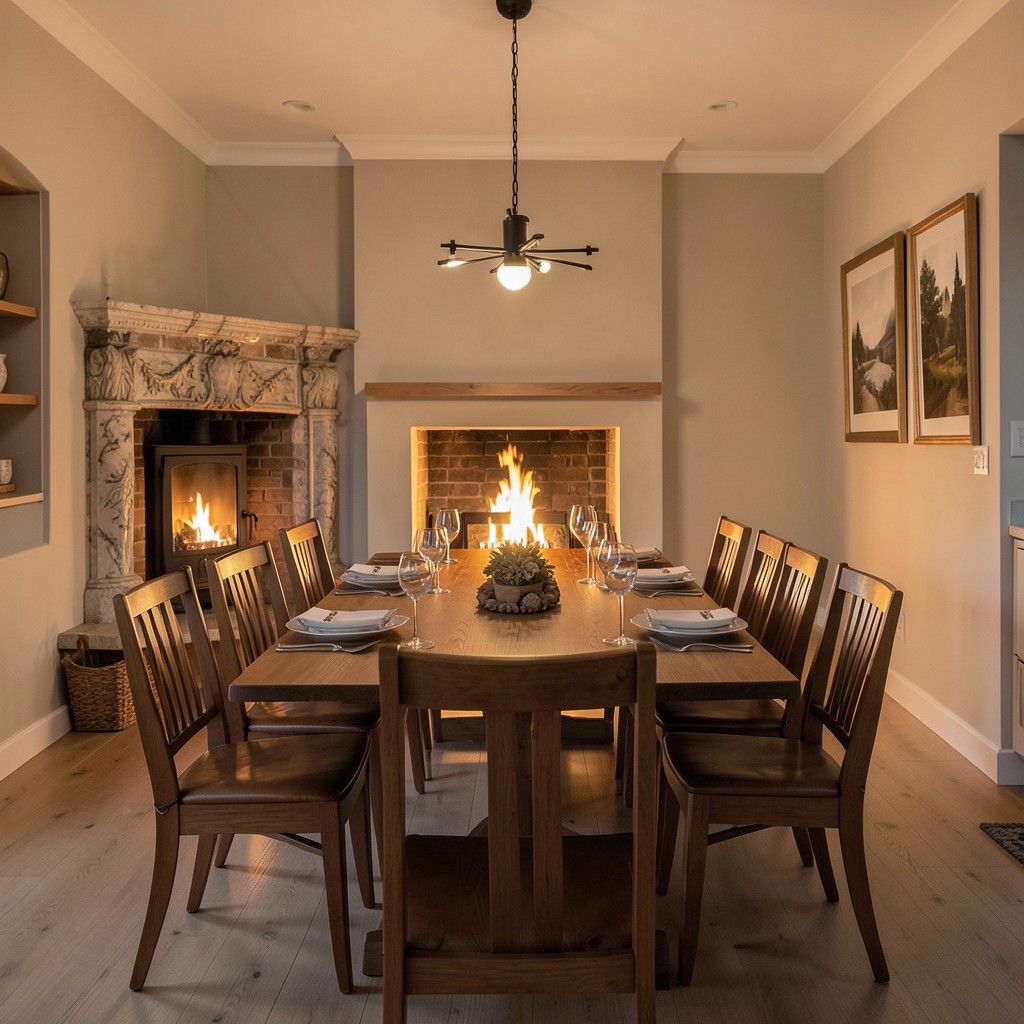
A fireplace in a dining room — whether a traditional masonry chimney breast with an open fire, a wood-burning stove on a hearth, or a contemporary gas or bioethanol fire in a designed surround — is the dining room element that most directly and most powerfully affects the atmosphere of the room in a way that no other element approaches. Fire at the dining table is the oldest human association between warmth, nourishment, and gathering, and the dining room that contains a working fire activates that association at a depth that design theory does not adequately account for.
The positioning of the fireplace relative to the dining table determines the quality of the fire’s atmospheric contribution to the dining experience. A fireplace on the wall at the end of the dining table — visible from every seat at the table as the visual focal point beyond the table’s end — produces the most powerful atmospheric effect. The fire is the backdrop to the meal, the warm visual anchor that the eye returns to between courses and conversations. A fireplace on a side wall — perpendicular to the table’s length — provides warmth to the nearer half of the table and a visual presence visible from the side seats but not from the end seats, which reduces the fire’s atmospheric universality across all table positions.
The fireplace surround and hearth design communicates the dining room’s design direction as efficiently as any other single architectural element. A traditional carved marble surround with a classical profile references the formal European dining room tradition with complete clarity. A simple plaster surround with a thin timber shelf references the minimal contemporary aesthetic with equal directness. A raw brick or stone surround references the rustic or farmhouse direction. The surround is the fireplace’s architectural clothing, and its design should be as considered as the dining room’s other architectural details rather than selected from a catalogue as a functional component.
44. A Dining Room With an Eclectic Art Collection
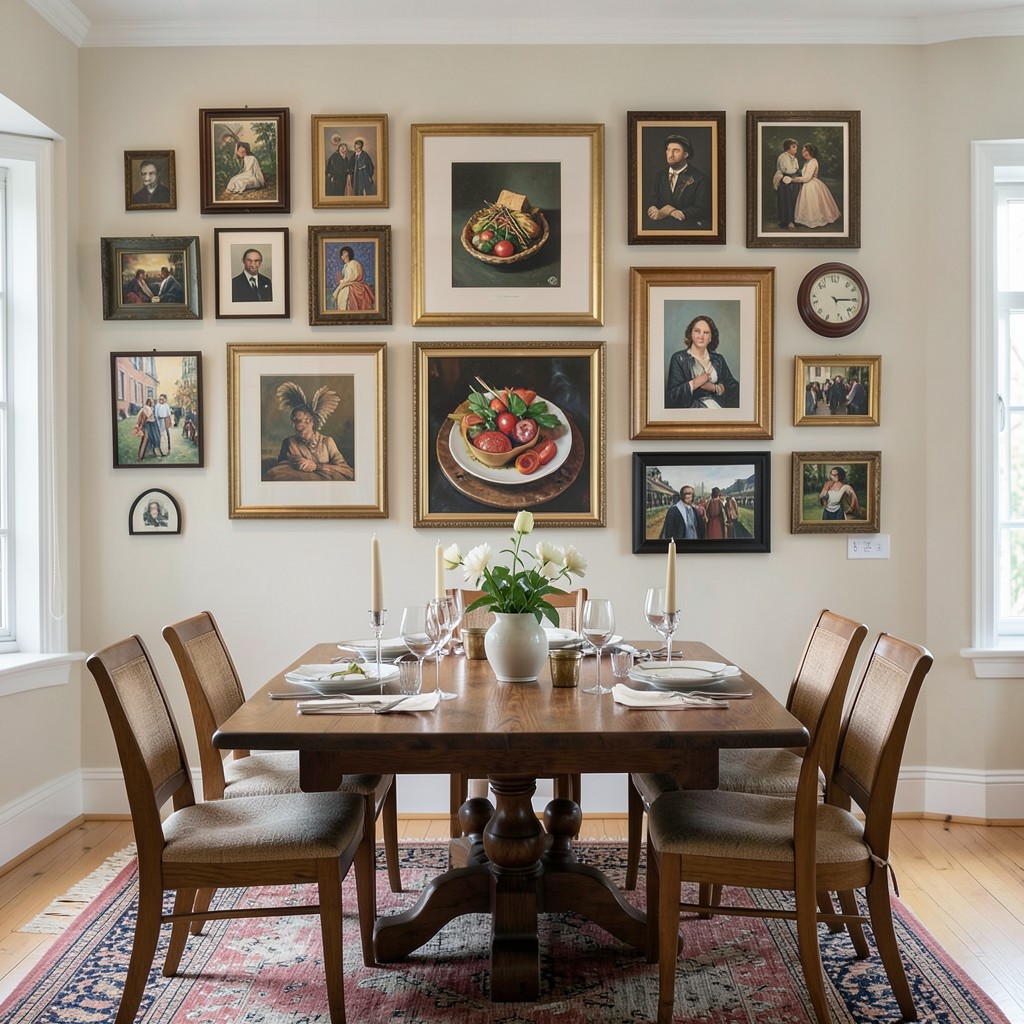
An eclectic art collection in a dining room — pieces in different media, from different periods, in different scales, and on different subjects, collected over time from different sources and assembled on the wall without the constraint of a unifying formal program — is the dining room wall treatment that most clearly communicates the household’s specific culture and the breadth of its aesthetic interests. The eclectic art collection is the visual record of the people who live in the house — their travels, their taste, their relationships with artists and makers, and the accumulated visual decisions of years of living with aesthetic intention.
The installation of an eclectic art collection requires the coherence that the collection’s variety makes challenging to achieve: there must be a principle that holds the diversity together visually without imposing the uniformity that defeats the eclectic intention. The most reliable principle is wall height consistency — hanging all pieces in the collection with their center at one-hundred-and-fifty-seven centimeters from the floor, which is the standard museum hanging height and the eye level of most standing adults. The variety of sizes, frames, and subjects distributes freely above and below this center line while the consistent center point gives the installation its visual discipline.
The dining room art collection benefits from the inclusion of at least one piece that is specifically related to food, dining, cooking, or the pleasures of the table — not because the art must match the room’s function in a literal sense, but because a single well-chosen reference to the room’s subject matter among a broader collection produces the specific quality of wit and appropriateness that confirms the art was chosen for this room rather than being the overflow from the rooms where it did not fit.
45. A Dining Room With a Tropical Design Direction
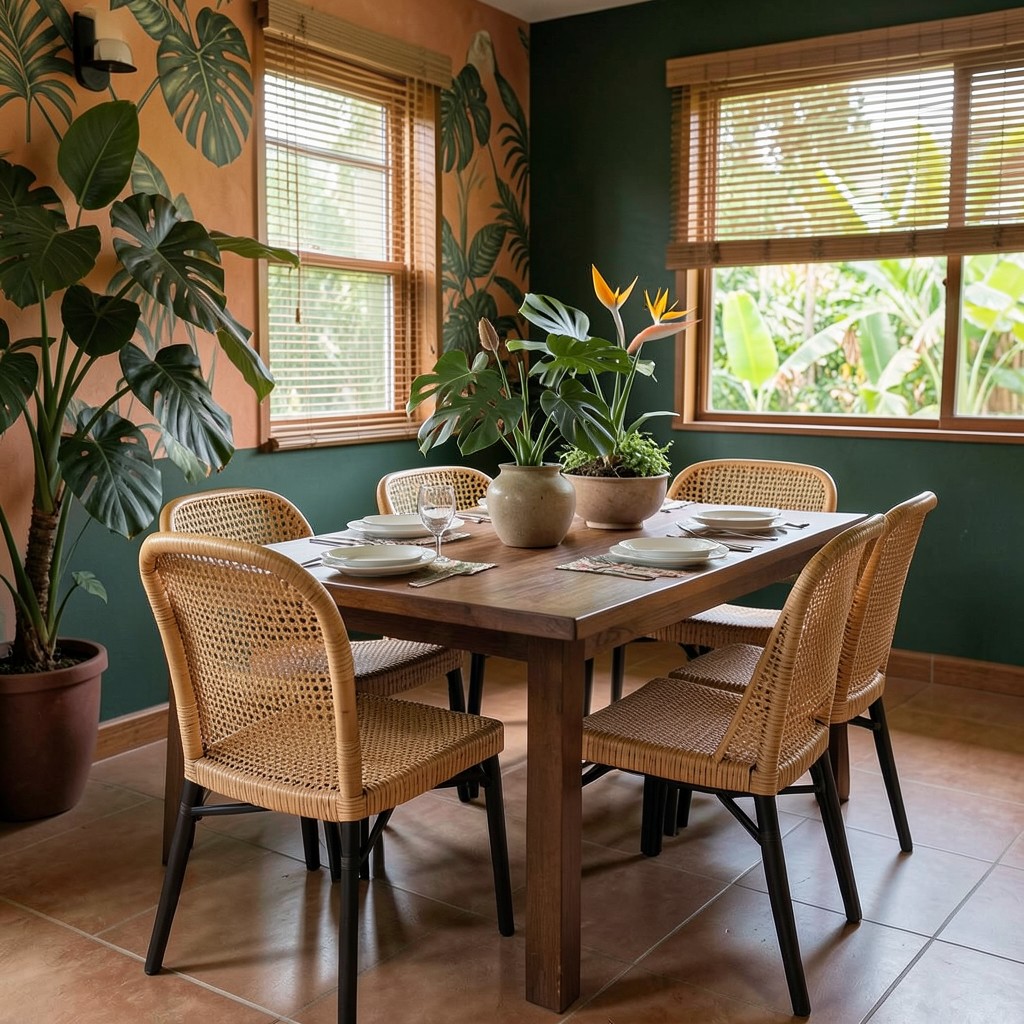
A tropical dining room — large-leafed botanical prints or actual plants, rattan furniture, warm terracotta or deep green walls, bamboo or timber blinds at the windows, and the general material and color language of hot-climate domestic architecture — produces a dining environment with a sensory warmth and an organic abundance that colder climate domestic aesthetics rarely provide. The tropical direction does not require geographical authenticity. It requires material commitment — the genuine rattan chair, the real timber, the actual large-leafed plant — rather than surface pattern applied to conventional domestic furniture.
The rattan dining chair — a genuine woven rattan shell on a metal or timber frame, not a chair with a woven rush seat pad and a timber frame — provides the specific material quality of the tropical direction that no substitute material delivers at the same visual and tactile authenticity. Rattan’s specific quality of being both strong and light — a chair that is light enough to move single-handed but structurally adequate for daily dining use — is the material combination that makes it irreplaceable in the tropical aesthetic vocabulary. The visual depth of the woven pattern, visible from across the room, provides the textural richness that the tropical direction uses as its primary decorative register.
The centerpiece plant on a tropical dining table — a cut stem of monstera, a bird of paradise flower in a ceramic vase, or a bowl planted with a compact tropical species — is the design element that most immediately and most cheaply introduces the tropical direction to a room that has not yet committed to a full redecoration. A single genuine tropical plant or cut flower on the table changes the visual register of the entire table setting in a way that a printed tropical placemat, however well designed, does not. The real thing carries a quality of organic presence that the printed pattern references but cannot replace.
46. A Dining Room With Aged Brass Accents
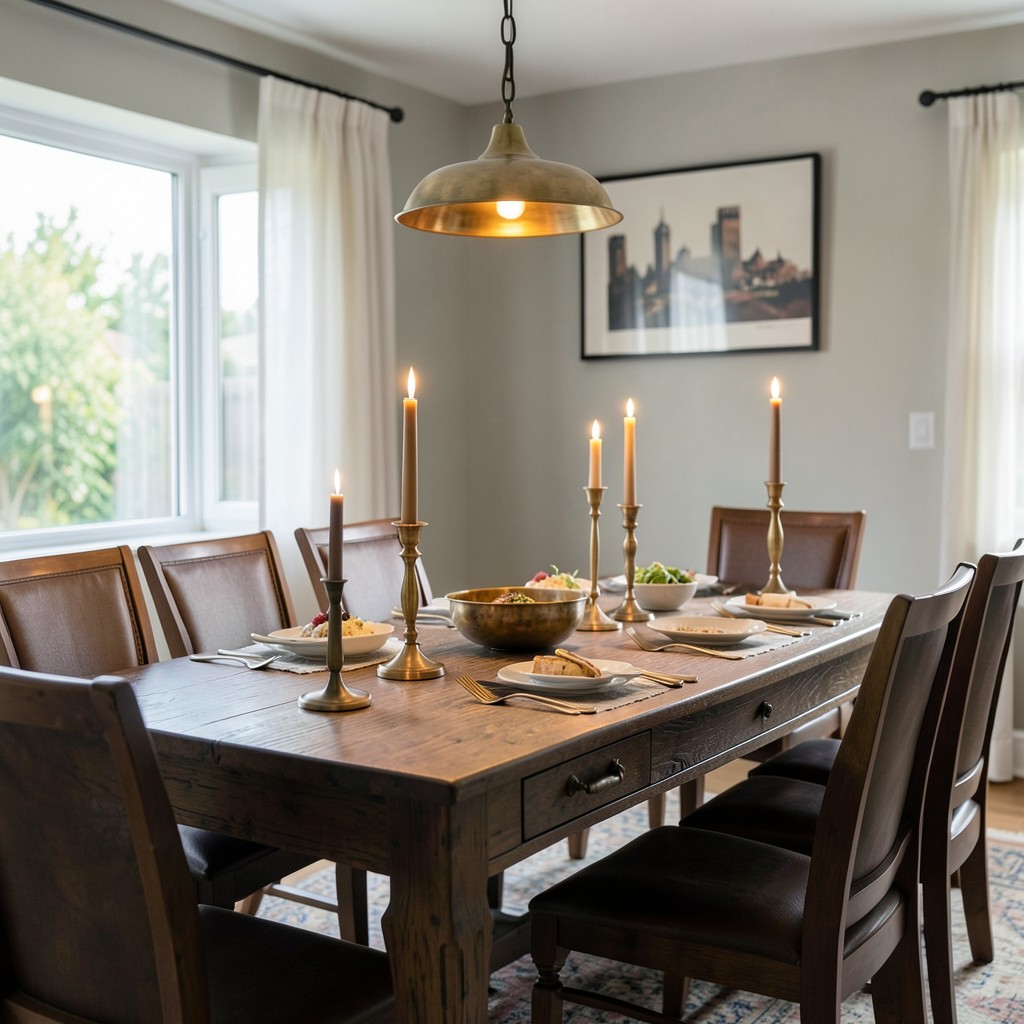
Aged brass accents in a dining room — the candlesticks, the pendant fixture’s suspension rod, the drawer handles on the sideboard, the cutlery handles, and the serving bowl’s rim in the warm, patinated gold of brass that has been allowed to age rather than polished to a mirror finish — provide the specific material warmth and the quality of accumulated use that new, shining metal cannot. Aged brass is the metal that communicates time — not in a neglected way, but in the specific way of a material that has been present through many meals, many gatherings, and many evenings, and that carries that history in the mottled, warm darkening of its surface.
The distinction between living brass — a patinated finish that continues to develop and deepen with handling and atmospheric exposure — and lacquered brass — a fixed finish that maintains its appearance rather than evolving — is the specification decision that determines whether the brass accents in a dining room age gracefully toward greater richness or remain static. Living brass requires the acceptance of gradual change and the occasional light polishing to prevent the patina from advancing past the warm, medium-dark tone where aged brass is most beautiful. Lacquered brass requires no maintenance but never develops the character that unlacquered brass acquires with time.
The distribution of aged brass across the dining room’s elements must be sufficient to read as a material language rather than a material accident. A single brass candlestick reads as a decorative object. Two brass candlesticks plus a brass pendant suspension read as a considered material presence. Add the sideboard’s brass drawer handles and the brass-handled cutlery on the table, and the brass has become one of the room’s defining material notes — present throughout the space at every scale from the architectural to the tabletop, which is the distribution that makes a material accent read as a designed choice rather than a decorative add-on.
47. A Dining Room With a Pendant Woven Light Shade
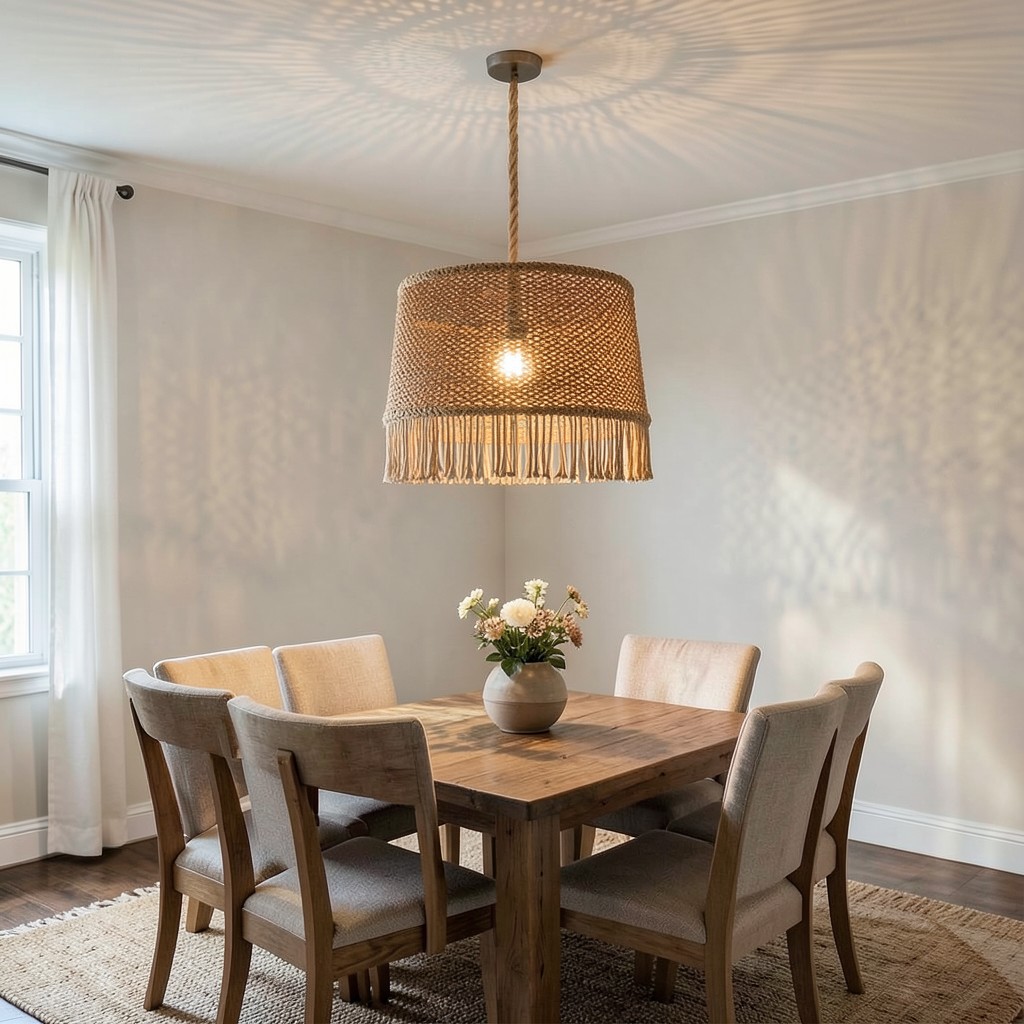
A woven pendant shade in a dining room — a handcrafted fiber shade in macramé, wicker, seagrass, or a woven cotton cord over a metal frame — provides the specific organic quality of a light fitting made from the same material language as the textile and natural fiber elements that a considered dining room incorporates in its rugs, cushions, and curtains. The woven shade is not a replacement for the architectural pendant or the glass globe — it is the light fitting for the dining room whose design direction is built on natural materials and organic warmth rather than on precise geometry or material refinement.
The light diffusion quality of a woven shade depends entirely on the density of the weave — a tightly packed weave transmits a smaller proportion of the bulb’s output through the shade walls and produces a more directional, downward light quality similar to a closed shade. An open, airy weave transmits the majority of the light through the fiber gaps and produces the omnidirectional, dappled light pattern on the walls and ceiling that makes the woven pendant so atmospherically distinctive in a dining room context. The choice between a tight and an open weave is a choice between two different light experiences rather than between a better and a worse option, and the selection should be made with an understanding of which experience the dining room requires.
The pendant cord on a woven shade — the visible suspension element between the shade and the ceiling canopy — is a design element in the woven pendant aesthetic rather than an infrastructure component to be concealed. A natural fiber twisted rope in a color drawn from the shade’s own fiber palette, suspended visibly from the ceiling to the shade, adds to the natural, artisanal quality of the fixture rather than interrupting it. The cord length determines the shade’s hanging height with the same consequence for dining room illumination quality that pendant height specification always carries.
48. A Dining Room With a Raw Edge Timber Table
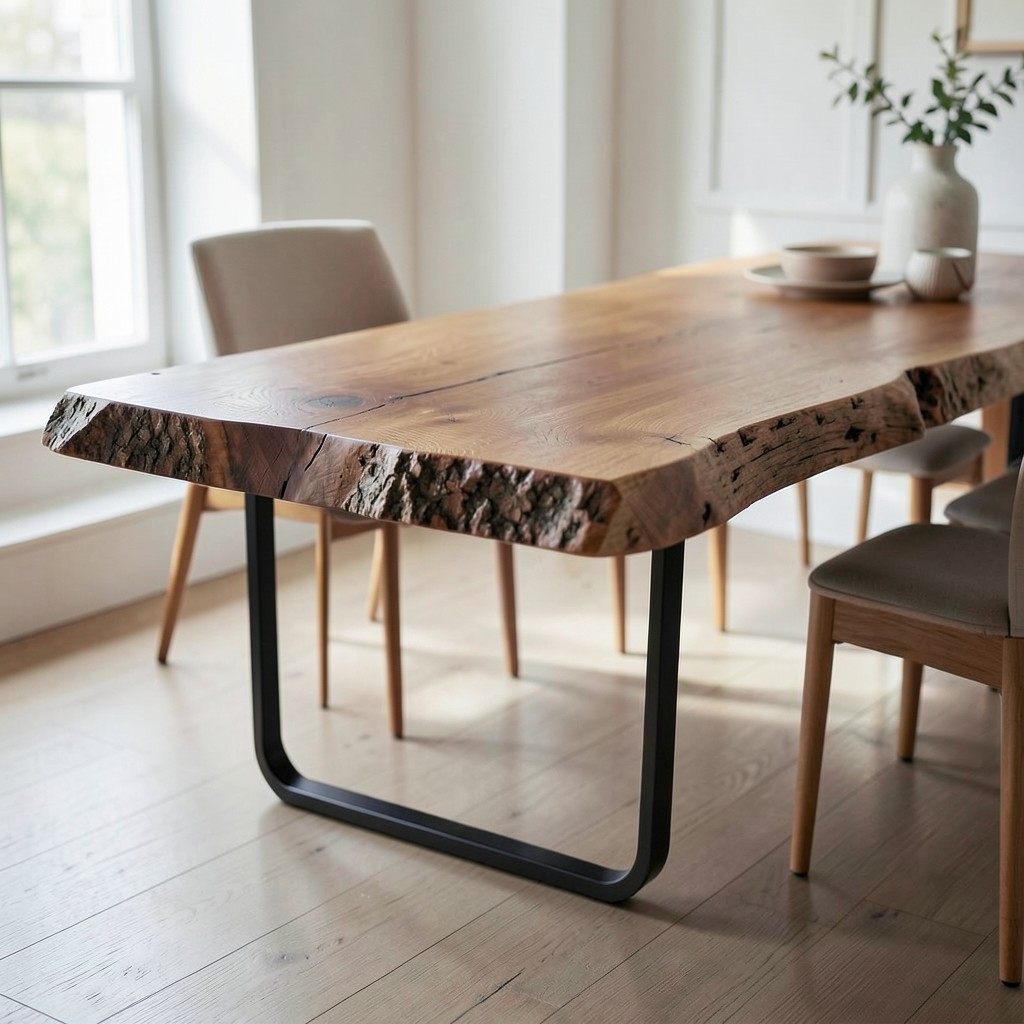
A raw edge timber table — a dining surface whose outer boundary follows the natural contour of the tree trunk from which the slab was cut, with the bark removed but the irregular, organic edge preserved rather than cut straight — is the dining room furniture piece that carries the most direct and most unmediated relationship with the living organism that produced it. The raw edge table is not a shaped piece of timber. It is, as specifically as any furniture piece can be, a preserved cross-section of a tree — its width, its surface character, and its edge profile all determined by the biology of the original growth rather than by the dimensions of the furniture designer’s specification.
The timber selection for a raw edge dining table is the decision with the most consequence for the table’s visual character, because the natural edge profile — the irregular outline that defines the table’s sides — varies dramatically between species and between individual trees. An English walnut slab produces the live edge that most closely approximates the classic raw edge aesthetic: wide, with deeply curved and recessed edge profiles, a rich chocolate-brown surface with natural cracks and figure, and the specific material presence that makes walnut the most sought-after timber for this application. An oak slab in the raw edge format produces a more restrained edge profile with a lighter surface tone that suits dining rooms with a Scandinavian or contemporary natural direction.
The base for a raw edge timber table must acknowledge the visual weight and the organic character of the slab it supports rather than working against them. A hairpin leg base in blackened steel — the slim, minimal base that places the table’s visual weight entirely in the slab — is the most common and most consistently successful combination because it allows the slab’s organic form to read without any base structure competing for attention. A solid timber base in a contrasting species provides a warmer, more material-rich alternative that suits dining rooms where the natural timber palette is the dominant design language.
49. A Dining Room With a Dedicated Drinks Trolley
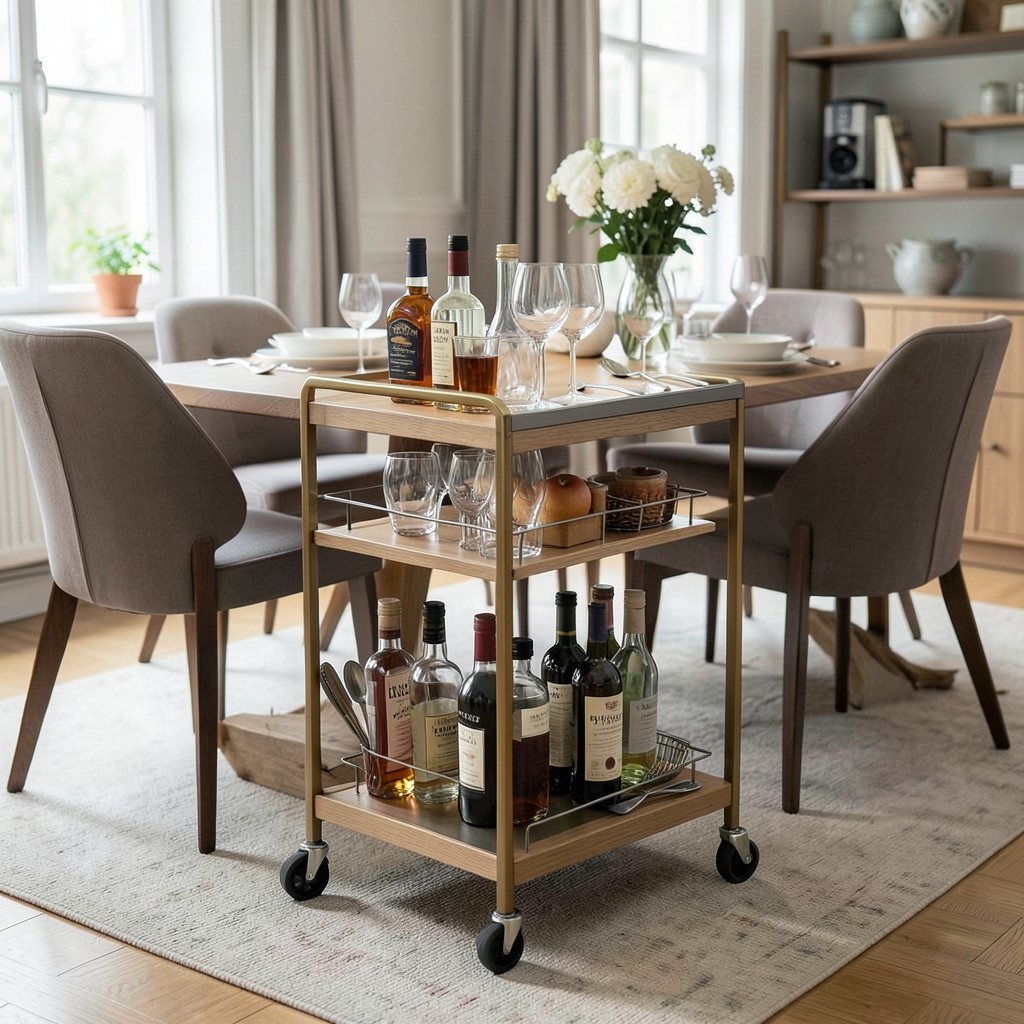
A drinks trolley in a dining room — a wheeled, tiered service cart in a material appropriate to the room’s design direction, carrying the spirits, mixers, glassware, and equipment for pre-dinner drinks and after-dinner service — is the dining room furniture piece with the highest ratio of social function to floor footprint of any supplementary item the room can contain. The drinks trolley brings the service of drinks into the dining room from the kitchen bar or the living room cocktail cabinet, which keeps the before-dinner and after-dinner gathering in the same space as the meal rather than migrating it to adjacent rooms.
The trolley’s material and design must be chosen in relationship with the dining room’s other furniture rather than as a standalone accessory purchase. A brass and smoked glass trolley in an art-deco-influenced form suits a dining room with a formal, traditional, or maximalist direction. A powder-coated steel trolley with open wire shelves suits an industrial or contemporary dining room. A natural timber trolley with simple shelf construction suits the natural materials, Scandinavian, or Japandi dining room where a metal trolley would read as a material intrusion. The trolley is a piece of furniture in a room where the furniture decisions matter — it deserves the same design attention as the chairs and the sideboard.
The contents of the dining room drinks trolley should be curated rather than accumulated — the bottles, the glasses, and the equipment that the household actually uses for entertaining rather than the full inventory of every spirit and mixer the home contains. A well-curated trolley with four bottles, two types of glass, and the necessary tools for the drinks the household serves reads as a designed element with intentional content. An overstocked trolley that holds every bottle in the household reads as storage rather than service, and the distinction between those two readings determines whether the drinks trolley contributes to the dining room’s design quality or detracts from it.
50. A Dining Room Designed for the Meal That Matters Most
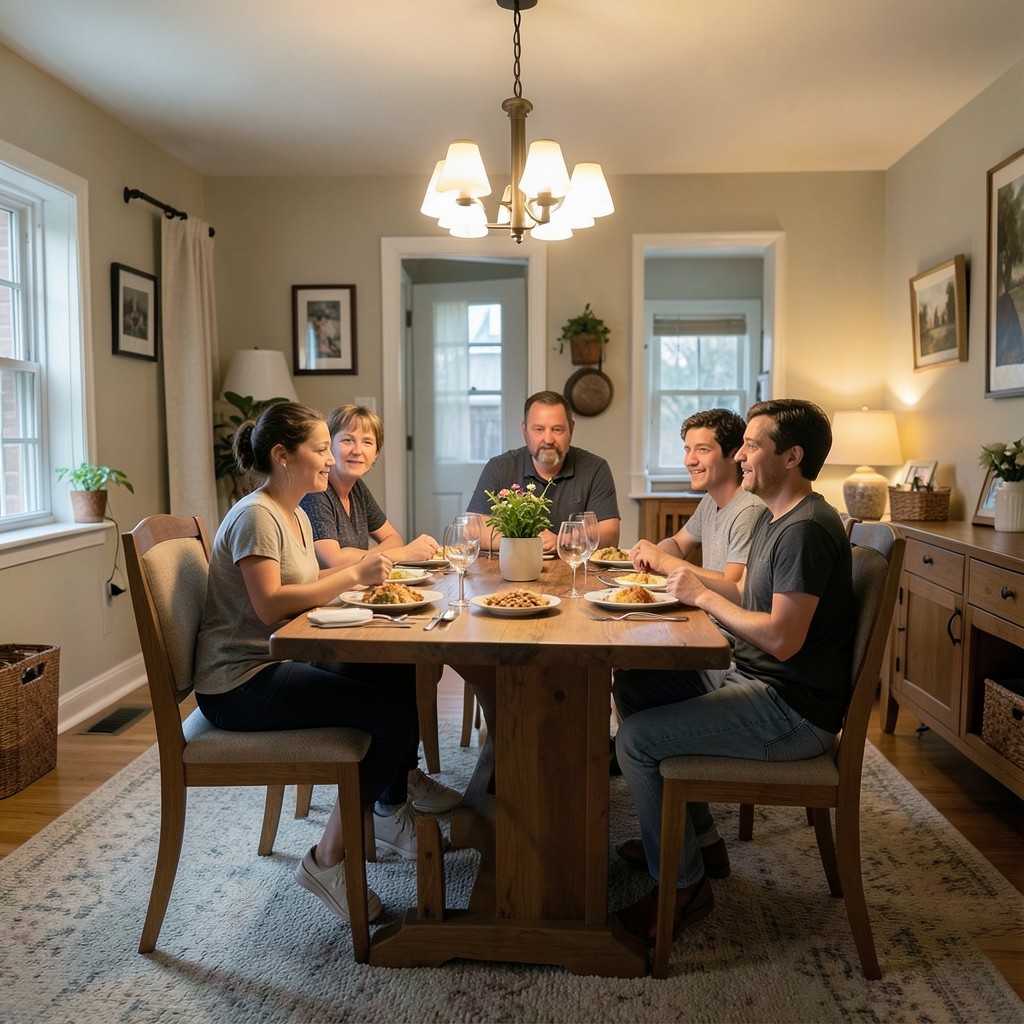
The dining room that fulfills its potential is not the one photographed at its best with a fully set table and soft afternoon light — it is the one that works on an ordinary Tuesday night when the family is tired, the food is simple, and the quality of the room still makes sitting down together feel like the right decision. That is the standard by which every dining room design decision should ultimately be evaluated: not whether it looks extraordinary in the right conditions, but whether it makes the everyday meal worth sitting down for.
Start with the light, because the light governs everything in a dining room and requires the least money to transform if the fixture and the dimmer are correctly specified. Then address the chair comfort, because an uncomfortable chair ends every meal twenty minutes before the conversation does. Then consider the table’s material quality, because you touch the dining table every time you eat at it and the quality of what your hands rest on is not a trivial sensory detail. Then work through the room’s color, its wall treatment, its storage, and its decorative elements in the sequence that serves the meal first and the photograph second.
The fifty ideas in this collection are not prescriptions — they are entry points into the design thinking that produces a dining room with genuine character. Take the idea that most directly addresses the gap between what your dining room currently is and what it could be, apply it with the commitment that a room used this frequently deserves, and build from there. The best dining room you will ever have is not the one in a magazine. It is the one where the people you feed feel at home before they sit down, and where the room itself says: this meal matters. Come to the table.
Leave a Reply