
The front porch is the most public room in your home — and most people treat it like a forgotten hallway. It sits between the street and the front door, receiving every visitor, facing every neighbor, and communicating something about the household inside before a single word has been exchanged. Yet the vast majority of front porches across residential neighborhoods are left in exactly the condition the builder delivered them: a concrete slab, a builder-grade light fixture, a door mat that has seen better seasons, and perhaps a bench that was placed there optimistically and never quite used. The porch has been acknowledged but not designed, and the difference between those two things is everything.
What makes a front porch worth thinking hard about is that it occupies a unique spatial position that no other part of the home shares. It is simultaneously private and public, indoors and outdoors, yours and visible to everyone who passes. That dual identity is not a problem to manage — it is the design opportunity that makes porches one of the most expressive and most personally revealing spaces on any property. A well-designed front porch communicates taste, personality, and welcome simultaneously. A neglected one communicates absence of thought, which is its own kind of message.
The front porch also has a social function that has been eroded by decades of household life moving to the back of the property — to the backyard, the rear deck, the kitchen that opens to the garden. But the front porch is where spontaneous community interaction happens. It is where a neighbor stops for a conversation they would not have had otherwise, where children returning from school drop their bags for five minutes before going inside, where the household is visible and available to its street in a way that a backyard never provides. Porches that get used rebuild a quality of neighborhood connection that purely private outdoor spaces cannot.
None of this requires a large porch to execute. Some of the most compelling front porch designs operate within a depth of six feet and a width that matches the front façade of a modest home. The design intelligence is not in the square footage — it is in the decisions made within whatever dimensions the porch presents. A narrow porch with considered furniture, correct lighting, the right planting, a painted floor, and an intentional color on the front door is a more compelling front porch than a generous wraparound left empty and undressed.
This collection of fifty front porch design ideas covers the full range of what a porch can do — from the structural decisions that establish the porch’s architectural character to the small, specific details that make a porch feel inhabited and welcoming rather than transitional and forgettable. Some ideas are appropriate for a major renovation. Others require an afternoon and a moderate budget. All of them address the same underlying question: what does your front porch communicate, and is it communicating what you actually intend? These fifty ideas exist to help you answer that question with intention and confidence.
1. A Front Porch With Rocking Chairs
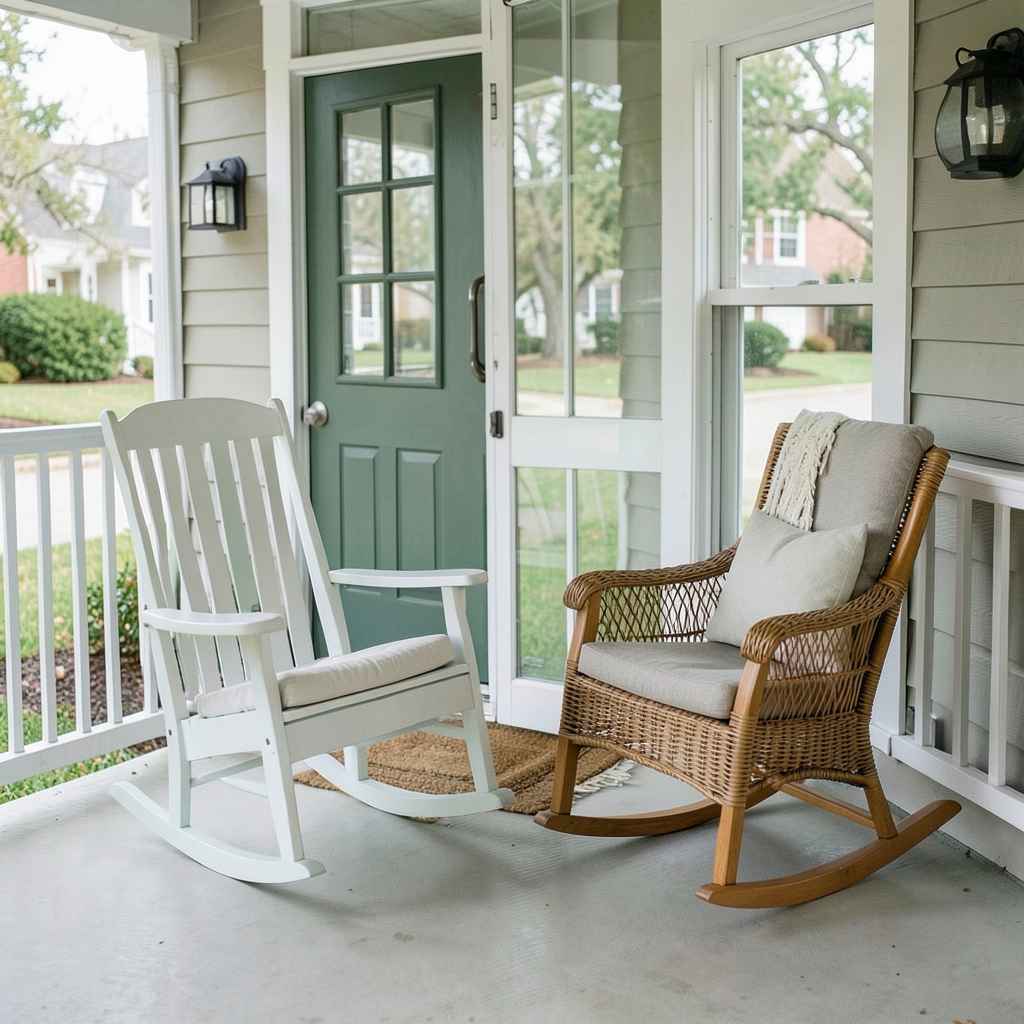
There is a reason the rocking chair became the symbol of porch culture — it works. The gentle motion of a rocking chair does something to a person’s nervous system that a static seat does not, slowing the rhythm of thought and producing a quality of ease that makes a twenty-minute sit on the porch feel longer and better than the same time spent on a standard chair. The rocking chair is the furniture piece that most communicates to a passerby that the porch is inhabited and comfortable, that the household uses its outdoor space, and that slowing down is permitted here.
The material and finish of the rocking chair communicates the porch’s design direction before any other element. A pair of painted wooden rockers — in white, sage green, or black, depending on the façade color — reads as traditional and intentional. Teak or hardwood rockers with a natural finish read as considered and contemporary. Wicker rockers with cushions in a weather-resistant fabric suit porches with a relaxed, coastal-influenced character. The mistake most people make is buying a single rocker that looks appropriate on its own but does not create the social dynamic that a pair provides — two rockers on a porch read as invitation, one reads as occupation.
The placement of the rockers relative to the porch’s traffic and sightlines determines whether they get used. Two rockers positioned side by side facing the street, within easy conversation distance of each other, create a social configuration that invites simultaneous occupation. Rockers placed too close to the front door obstruct the primary circulation route and get moved, which defeats the purpose of positioning them at all. Place them where there is clear space to rock forward and backward without hitting a rail, a post, or a wall — at least two feet of clearance in both directions from the chair’s arc.
2. A Front Porch With a Bold Front Door Color
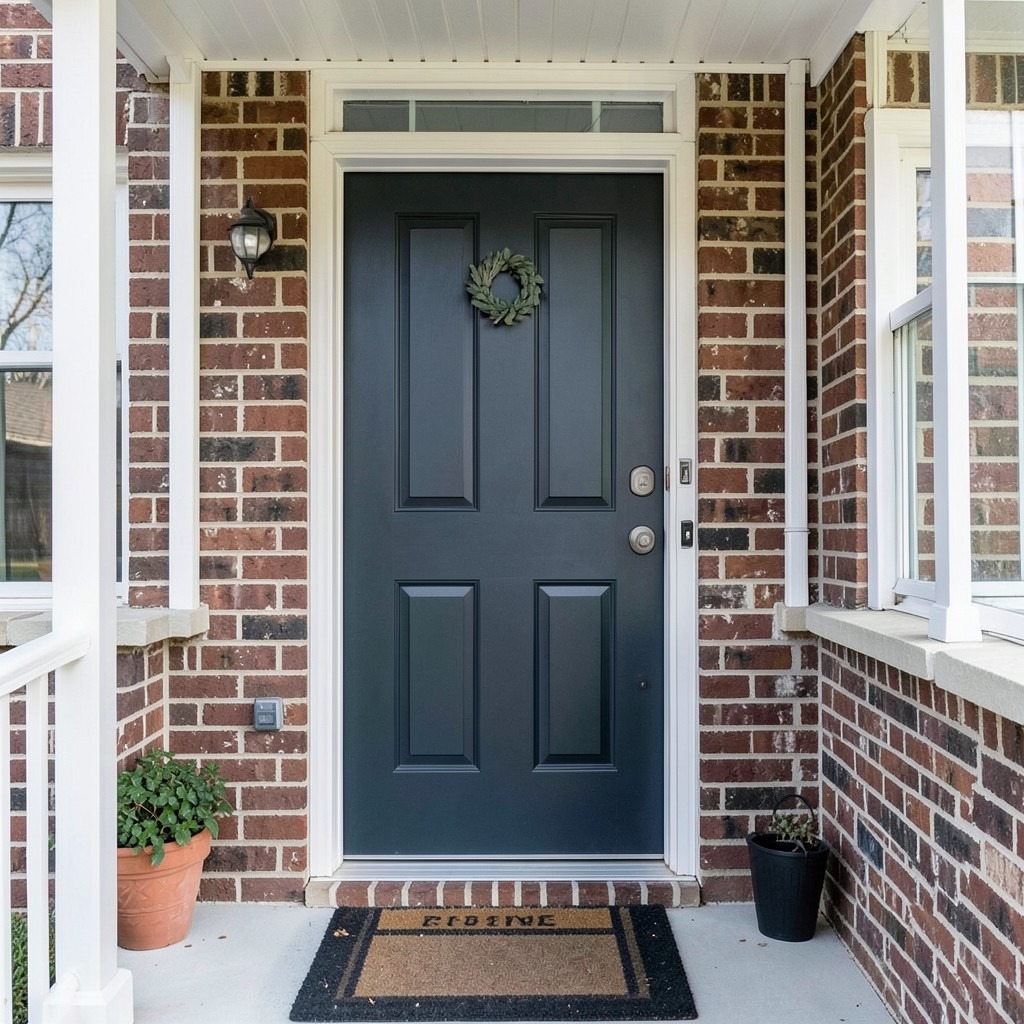
The front door is the porch’s focal point whether you design it that way or not — it is the largest vertical element at the back of the porch and the one every visitor approaches directly. A door in the builder-standard stained wood or white finish acknowledges this centrality and does nothing with it. A front door painted in a strong, considered color turns the porch’s focal point into the porch’s design statement, and the right color choice elevates the entire exterior of the house in a way that no other single decision at this scale achieves.
The color selection for a front door requires understanding how the door color reads in relation to the porch structure, the façade material, and the surrounding landscape. A deep navy door on a white-painted timber-framed porch reads as confident and nautical. A forest green door on a red brick façade creates the contrast that makes both the door and the brick read more richly than either would on its own. A matte black door on a contemporary façade with clean lines reads as architecturally resolved. The wrong choice — a color that creates a jarring contrast with the façade material rather than a composed one — reads as unresolved regardless of how attractive the color would be in another context.
The paint finish of the front door matters as much as the color. A high-gloss finish on a painted door reflects light and reads as formal, traditional, and well-maintained — the gloss is a signal of care and attention that semi-gloss and satin finishes do not project at the same intensity. A satin finish reads as more contemporary and suits doors in homes with a cleaner architectural direction. Matte finishes on exterior doors absorb dirt more readily than glossier ones and show weathering faster — they can look extraordinary when freshly done and require more frequent maintenance to sustain that quality.
3. A Front Porch With Hanging Planters
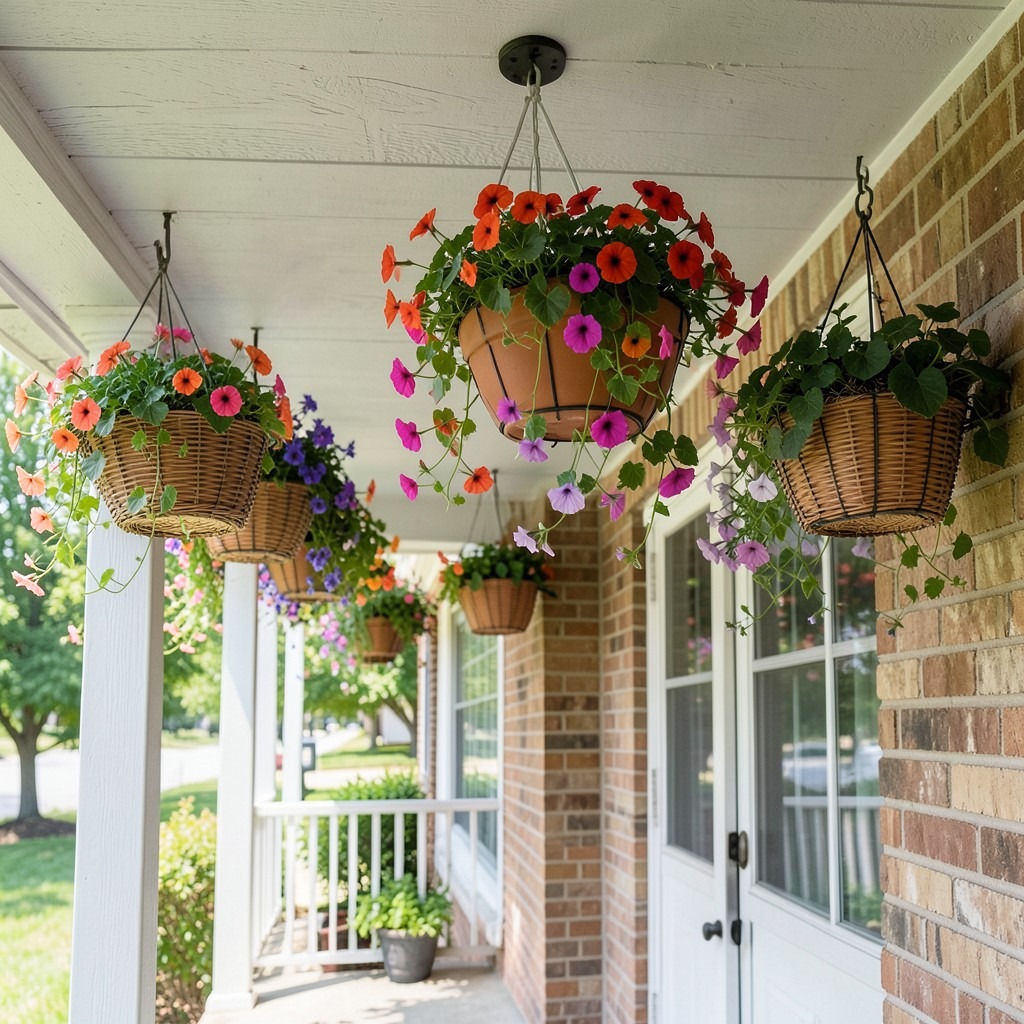
A front porch without vertical planting is missing half its design potential. The porch ceiling, the posts, and the overhead structure represent planting locations that require no ground space and produce a visual impact at eye level and above — exactly the height range where the porch is experienced most intensely. Hanging planters — suspended from the ceiling with weatherproof hardware, planted with trailing and flowering varieties that cascade downward — fill the porch’s overhead visual field with living color and movement in a way that ground-level container planting cannot approach.
The planter selection must prioritize weather resistance and weight management simultaneously. A terracotta pot that looks beautiful in a garden center weighs significantly more when planted and fully watered than its empty weight suggests, and a ceiling that was not designed for the load of multiple heavy planters requires either structural reinforcement or a shift to lighter planter materials. Woven wire planters with coconut fiber liners, or lightweight fiberglass planters with a terracotta or aged zinc appearance, deliver the visual quality of heavier materials at a fraction of the structural loading.
The planting inside hanging porch planters requires varieties that handle the specific conditions of a sheltered but still-exposed overhead location: partial shade beneath the porch roof, potential wind exposure on open sides, and the faster drying that elevated containers experience relative to ground-level pots. Fuchsia, impatiens, trailing petunias, and Bacopa handle these conditions well and provide the cascading habit that makes a hanging planter read as lushly planted rather than sparsely filled. A single strong variety per planter — rather than a mixed combination — produces a cleaner, more confident visual impact from street level.
4. A Front Porch With String Lights
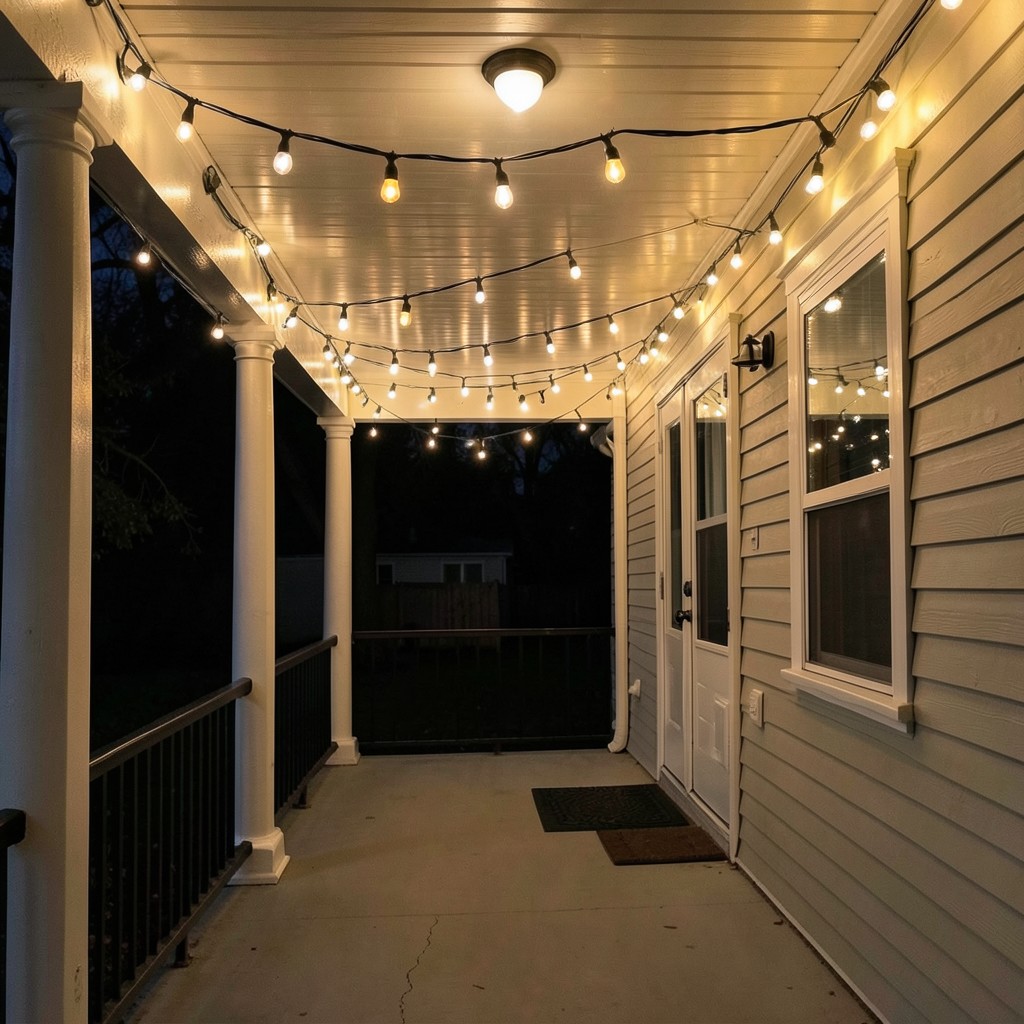
The porch that reads most warmly and most welcomingly from the street after dark is almost always one with string lights — the warm incandescent glow of filament bulbs against the porch’s ceiling or framing creates an overhead light plane that is hospitality made visible. No other lighting treatment at this scale produces the same quality of warmth. A standard overhead fixture illuminates the porch adequately. String lights make the porch look inhabited, celebratory, and worth approaching.
The installation geometry of string lights on a front porch determines whether the result reads as permanent and designed or temporary and accidental. Lights strung in parallel runs at consistent heights across the full porch ceiling — fixed at the fascia board on the house side and the outer beam on the street side — produce a composed overhead light plane that reads as architectural. Lights draped loosely from a single hook in an irregular swag pattern read as a seasonal decoration rather than a design element. The difference is entirely in the installation discipline, and the installation that reads as designed earns the same aesthetic respect as any other considered lighting decision.
The bulb specification determines the warmth and the character of the light produced. Vintage Edison-style filament bulbs in a warm white color temperature — 2200K to 2700K — produce the amber glow that reads as genuinely warm rather than merely adequate. Cool white or daylight-temperature bulbs in a string light installation produce a flat, clinical light that eliminates the warmth that makes string lighting appealing in the first place. The filament bulb’s energy consumption is higher than LED alternatives, but the visual quality it produces outdoors at close range is superior enough to justify the choice for a feature application like a porch ceiling.
5. A Front Porch With a Porch Swing
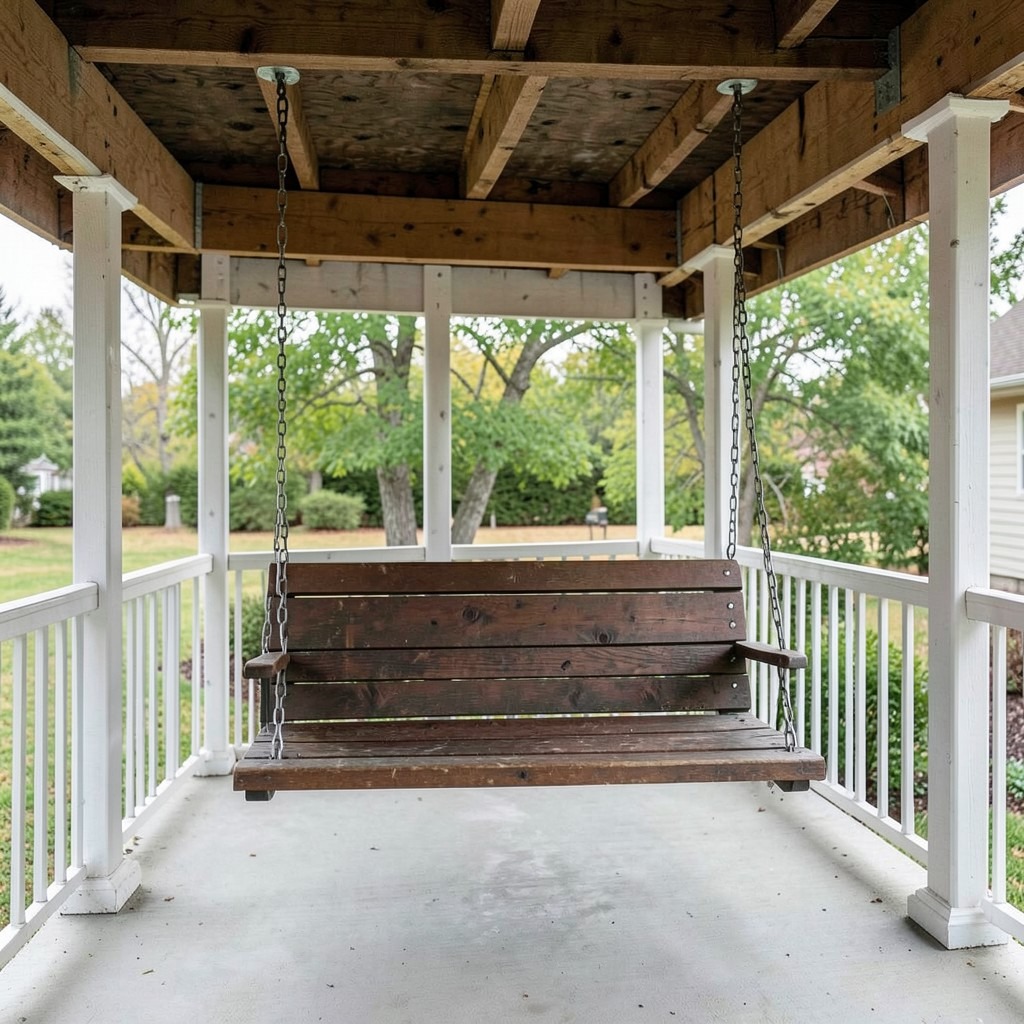
A porch swing — a bench suspended from the ceiling on chains, with enough clearance to swing gently forward and backward — is the front porch feature that most directly communicates that the space is used for leisure and conversation rather than merely as a threshold. The swing’s movement quality is social in a way that static seating is not — it produces a gentle, shared motion that is physically relaxing and that creates a specific quality of ease in conversation that neither rocking chairs nor a standard bench replicates exactly.
The swing must be sized appropriately for the porch. A swing that takes up more than half the porch width leaves insufficient room for passage around it and produces a porch that feels obstructed rather than furnished. A standard porch swing at fifty to sixty inches wide suits most residential porches comfortably, providing seating for two adults with enough clearance on each side for movement. The swing’s depth — front to back — determines its comfort for longer occupancy: a shallow seat feels perched rather than settled, and a seat depth of eighteen to twenty inches produces the comfortable position needed for a thirty-minute sit rather than a five-minute wait.
The ceiling structure above the porch swing requires verification before installation — the chains or ropes that suspend the swing transmit its occupants’ combined weight plus the dynamic loads of swinging into the ceiling mounting points, which must be anchored into solid structural members rather than into ceiling finish material alone. A swing installed into plywood ceiling sheathing without attachment to the rafter above it is an installation waiting to fail at the worst possible moment. Locate the rafters, anchor into them, and the swing hangs safely for years. Skip that step and the ceiling repair is more expensive than the swing itself.
6. A Front Porch With Symmetrical Planting
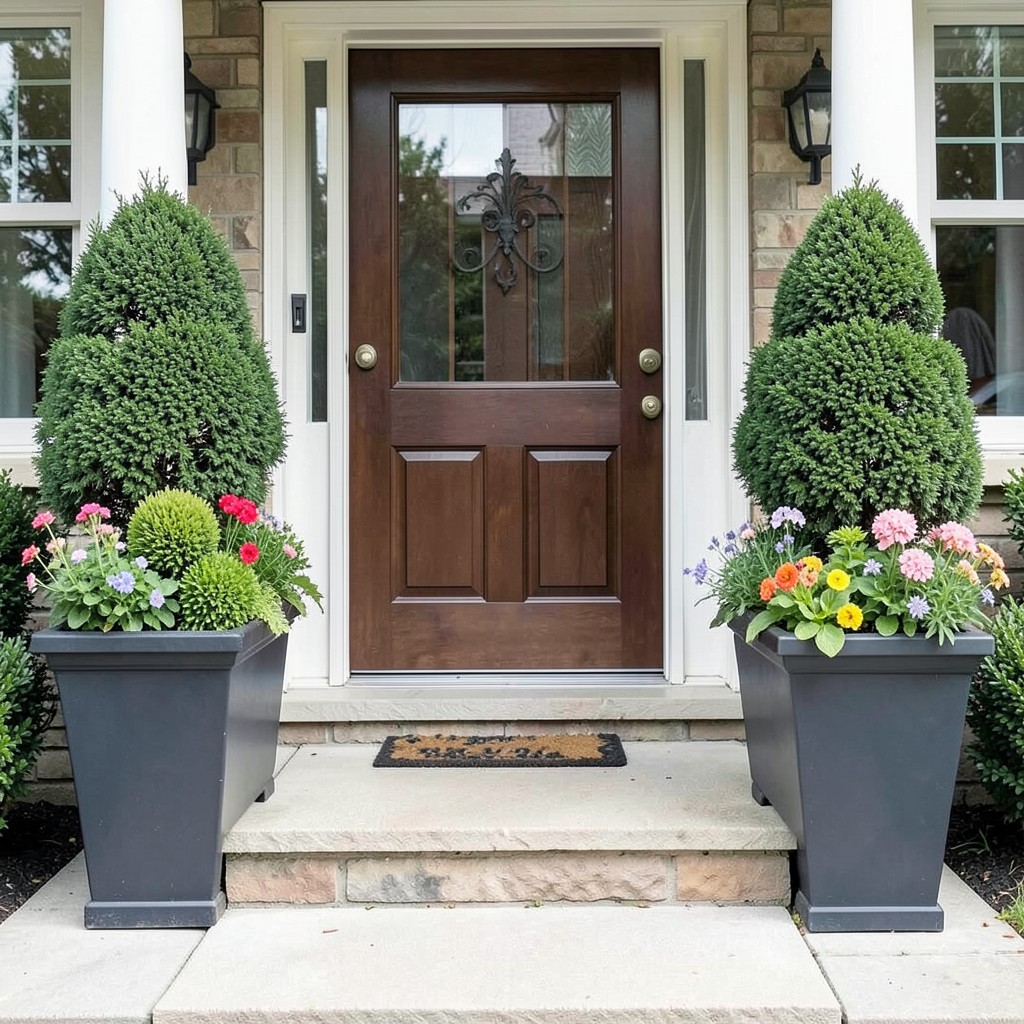
Symmetrical planting flanking the front steps — two matching planters of equal scale, planted with the same species in the same volume on each side of the entry — produces a quality of arrival formality that asymmetric planting cannot. The symmetry communicates that the approach to the door was considered as an experience rather than as a utility corridor, and that the household values the quality of its welcome to visitors as much as the quality of the space beyond the door. This is the planting equivalent of dressing well for an occasion — it signals that the occasion matters.
The container selection for symmetrical porch planters must prioritize scale over subtlety. Planters that are too small for the space between them and the door read as timid — they acknowledge the planting impulse without fulfilling it. The correct container size for flanking the front steps is one that, when planted, reaches a height of at least thirty to thirty-six inches from the base of the container, and has a diameter substantial enough to hold planting at a volume that fills the vertical and lateral space it occupies. A planter that looks right when it arrives becomes the correct size after a full growing season of establishment.
The plant selection for symmetrical entry planters must hold its form and its visual impact across seasons if the planters are meant to be permanent rather than seasonally changed. Clipped box or bay topiary — a sphere or a cone form — provides year-round structural presence that maintains the symmetry through every season without requiring replanting. For households willing to change the planting seasonally, a standard clipped evergreen base planting — one central structural shrub per container — with seasonal flowers added around it provides the permanence of structure with the freshness of seasonal color.
7. A Front Porch With a Painted Floor
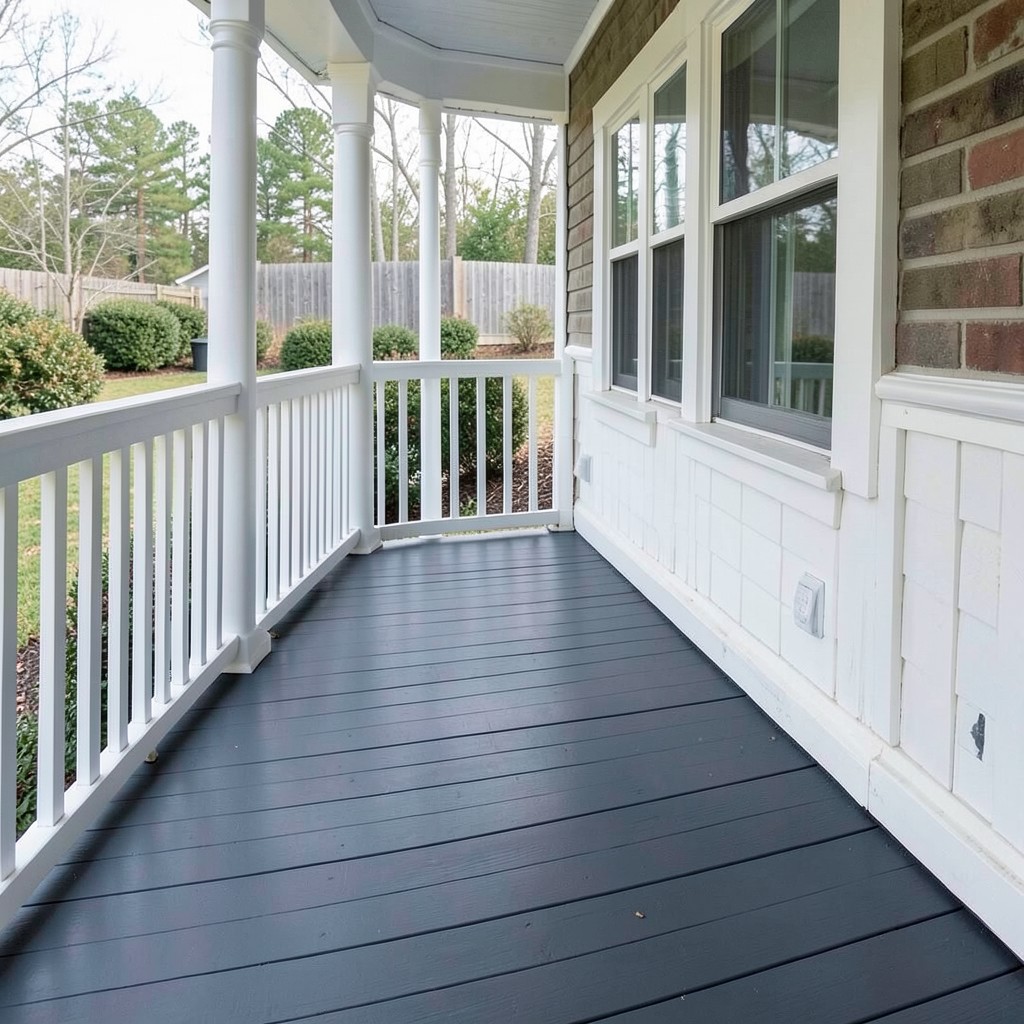
A painted porch floor changes the entire reading of the outdoor space from a utilitarian surface to a designed one, and it does so at a fraction of the cost of any surface replacement. The paint color, finish, and any decorative treatment applied to the floor become the first surface the visitor steps onto after the approach — it is the floor of the room that is the porch, and treating it as a designed floor rather than an unpainted substrate produces a quality shift in the porch’s overall character that no other single surface decision achieves for the same investment.
The color selection for a painted porch floor requires understanding the floor’s relationship to the porch’s other colors. A classic approach — grey-blue porch floor with white balustrade and trim — produces the clean, preppy quality associated with traditional American porch design. A deep charcoal floor with white trim reads as contemporary and confident. A terracotta or barn red floor on a farmhouse-style porch grounds the space with a warm earthen quality that suits a rural or rustic design direction. The floor color and the trim color work as a pair, and the contrast between them determines the porch’s tonal character from a distance.
The paint must be formulated specifically for exterior porch floors — a product with anti-slip additives and sufficient hardness to handle foot traffic, furniture movement, and the freeze-thaw cycling that porch surfaces experience through seasonal temperature changes. Interior paint applied to a porch floor fails quickly, lifting and peeling in response to the moisture and temperature fluctuations that it was not formulated to handle. Exterior porch and floor enamel, applied to a properly prepared, primed surface, provides a finish that holds through multiple seasons before requiring touch-up or recoating.
8. A Front Porch With Potted Trees
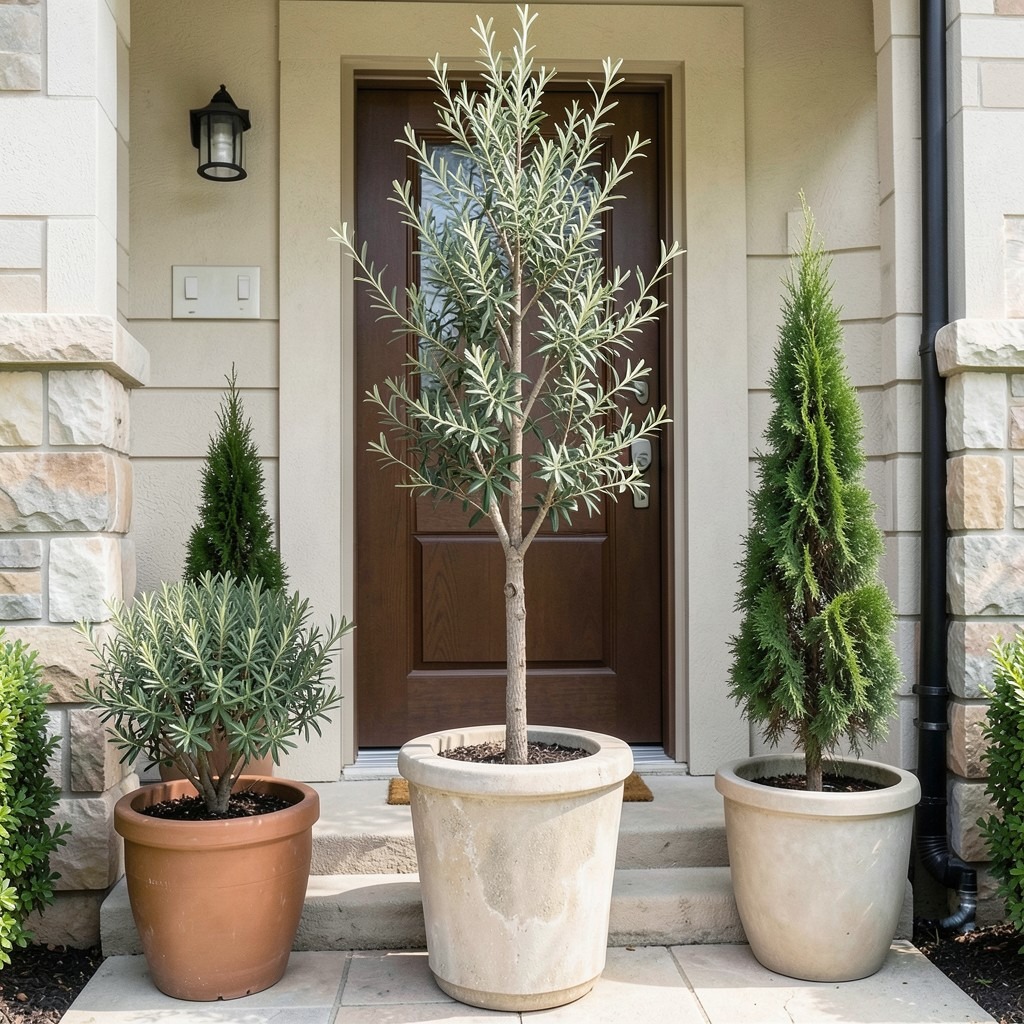
A potted tree on each side of the front steps — a olive, a bay standard, a slender Italian cypress, or a small ornamental tree pruned to a clear single trunk with a canopy top — gives the porch an architectural formality and a vertical scale that ground-level planters and hanging baskets do not provide. The tree form reads as a structural element rather than a decorative one, and that structural quality is what makes potted trees at the entry the provision that most effectively bridges the gap between the garden’s planting and the house’s architecture.
The container for a potted entry tree must be proportionate to the tree’s eventual root ball and sufficiently heavy or sufficiently well-anchored that wind does not topple the arrangement — a concern that increases as the tree’s canopy grows and presents more surface area to wind loading. Cast stone, heavy ceramic, or composite containers with a stone finish provide the visual weight that suits a tree standard, and their mass provides some natural stability against wind movement. Lightweight plastic containers for any tree at this scale look wrong and tip easily — the visual and functional argument for a heavier container is the same argument.
The irrigation requirement of containerized trees in a porch environment is higher than the same trees in ground conditions, because the container limits the root system’s access to the soil moisture that ground-planted trees draw on between watering events. A porch tree in a container requires watering more frequently than intuition suggests, particularly in summer when porch conditions can be hot and drying. A drip irrigation line fed from a nearby external tap, delivering a slow trickle directly to the container’s root zone on a timer, removes the daily watering commitment and ensures the tree never reaches the stress that container drought inflicts before symptoms are visible.
9. A Front Porch With Weather-Resistant Outdoor Rugs
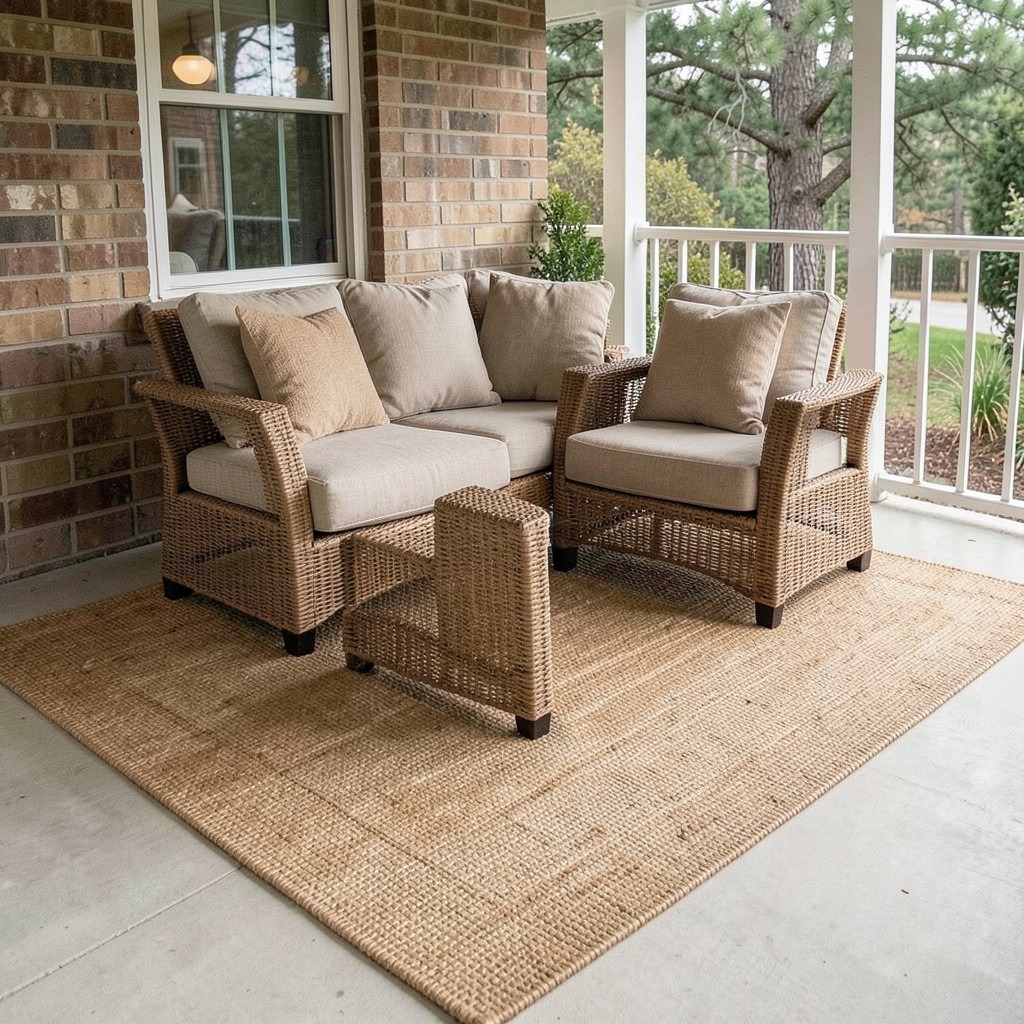
A rug on a front porch floor does exactly what a rug does in any other room: it defines the seating zone within the larger space, adds a layer of material warmth beneath the furniture, and signals that the space is designed for occupation rather than passage. The outdoor rug is the difference between furniture placed on a floor and furniture arranged in a room, and that distinction — between porch as threshold and porch as destination — is the design decision that most determines how the front porch gets used.
The rug material must handle direct weather exposure without deteriorating or becoming a hazard. Polypropylene outdoor rugs handle rain, UV exposure, and foot traffic with minimal maintenance — they dry quickly, resist mold, and hold their color for multiple seasons. Natural fiber rugs — jute, sisal, seagrass — have a warmer, more organic quality than polypropylene but deteriorate significantly in wet conditions, which limits their use to covered porches with minimal exposure to rain. For an open or semi-exposed porch, polypropylene in a natural-looking weave pattern provides the visual warmth of a natural fiber with the practical performance that an outdoor location requires.
The rug size should extend beyond the footprint of the furniture sitting on it — at minimum two feet in front of the seating and two feet on each side — to create the spatial definition that makes the seating arrangement read as a room within the porch rather than furniture placed on a surface. A rug that only covers the area directly beneath the furniture legs produces a floating, disconnected quality that defeats the purpose of the rug. Size up from whatever dimension your first instinct suggests, because the most common outdoor rug mistake is choosing one that is too small.
10. A Front Porch With Shutters and Architectural Detail
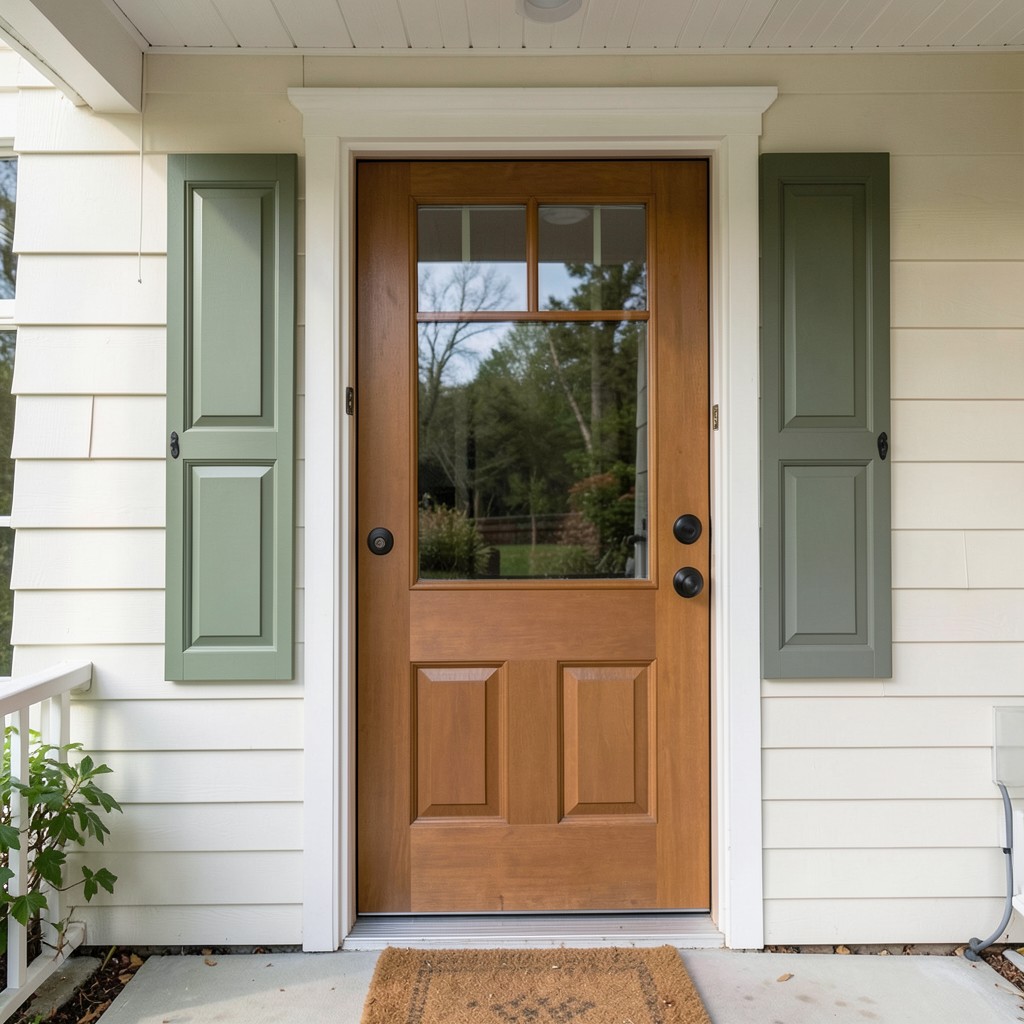
A front porch with working or decorative shutters on the windows flanking the door — shutters that are correctly proportioned to the window opening they accompany, in a finish that complements the door and trim colors — adds an architectural layer to the porch façade that most houses built in the last four decades entirely lack. The shutter is the detail that moves a house façade from flat to dimensional, and on a porch where the visitor is close enough to read the architectural quality of the details, the presence or absence of shutters communicates a great deal about the design intelligence applied to the exterior.
Working shutters — those that actually close across the window and latch — require a width that, when closed, exactly covers the window opening. A shutter installed at half the window’s width and held flat against the wall reads immediately as decorative rather than functional, which is a design dishonesty that architectural purists find uncomfortable. Decorative shutters are acceptable — they are common and widely used — but they read as authentic only when their proportions suggest they could function if needed. A shutter whose width is obviously insufficient to cover its window reads as a gesture rather than a detail.
The material of the shutters determines the maintenance they require through seasons of weather exposure. Painted timber shutters in an exterior grade paint require repainting every four to six years to maintain their quality — they look magnificent when freshly done and age visibly in the years before the next repainting. Composite or PVC shutters hold their finish indefinitely without painting and resist moisture damage that eventually compromises timber shutters in high-rainfall climates. The choice is between the superior authentic material quality of timber and the superior long-term maintenance profile of composite.
11. A Front Porch With a Ceiling Fan
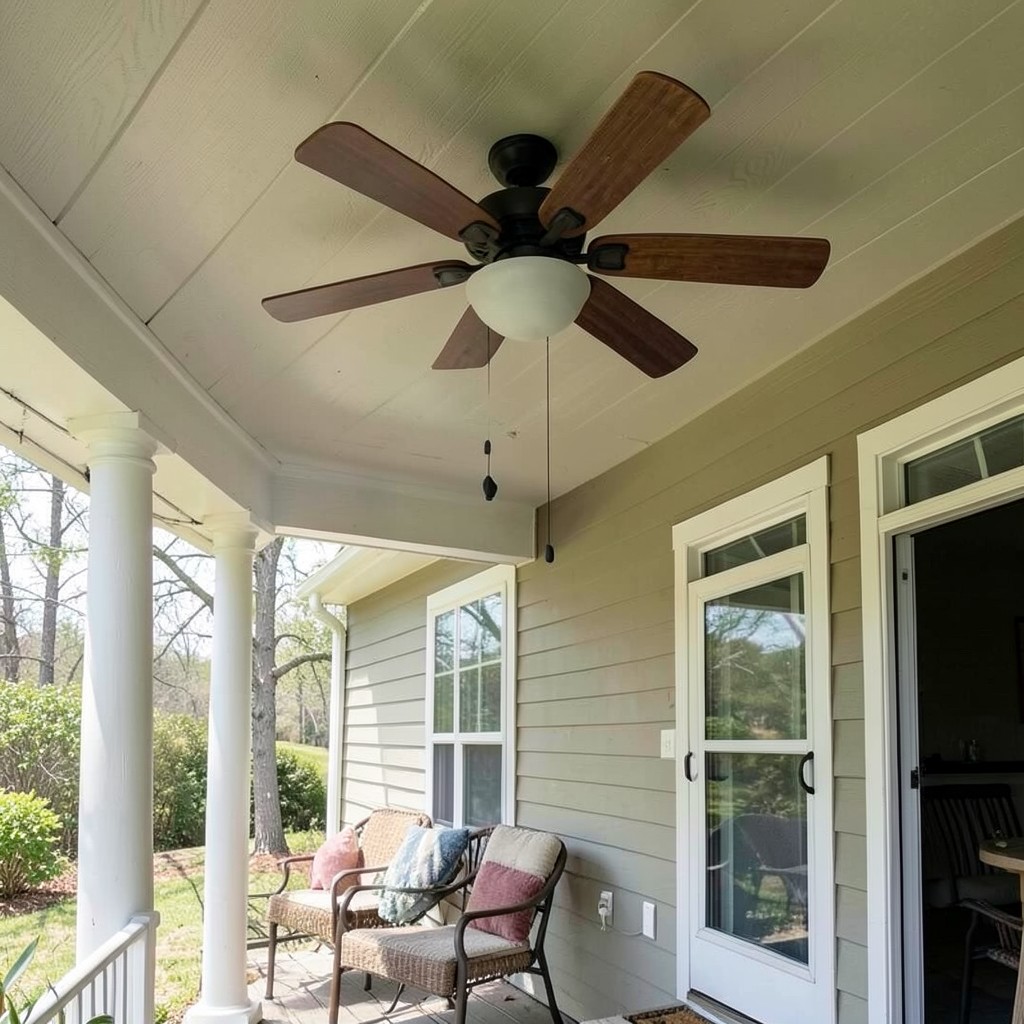
A porch ceiling fan is the provision that separates a porch used actively through hot weather from one abandoned to the heat from May through September. The still, heated air that accumulates beneath a porch roof on a hot afternoon is the primary reason most front porches in warm climates go unused during the hours when being outside would otherwise be pleasant. A ceiling fan moves that air, reduces the perceived temperature by several degrees through the wind chill effect, and extends the porch’s daily usability into the afternoon heat that would otherwise drive the household indoors.
The ceiling fan must be rated for outdoor use — specifically a wet-rated or damp-rated outdoor fan, depending on the porch’s exposure to direct rain. An indoor ceiling fan installed on a porch fails within a single season as motor moisture intrusion, blade warping, and housing deterioration respond to outdoor humidity and temperature cycling. The outdoor rating is not a premium specification — it is the minimum functional requirement for any fan installation in an exterior location, and the price difference between a standard indoor fan and an equivalent outdoor-rated model is modest relative to the cost of replacing a failed installation.
The fan diameter must suit the porch ceiling height and the porch area. A fan installed on a porch with a ceiling height below nine feet requires a low-profile, hugger-mount configuration without a down rod — the blade clearance from the ceiling in this configuration is sufficient for safe operation without creating an obstruction hazard. A fan on a higher ceiling can accommodate a standard or extended down rod that positions the fan blades at the optimal seven to nine feet above the floor for maximum air movement efficiency.
12. A Front Porch With Flower Window Boxes
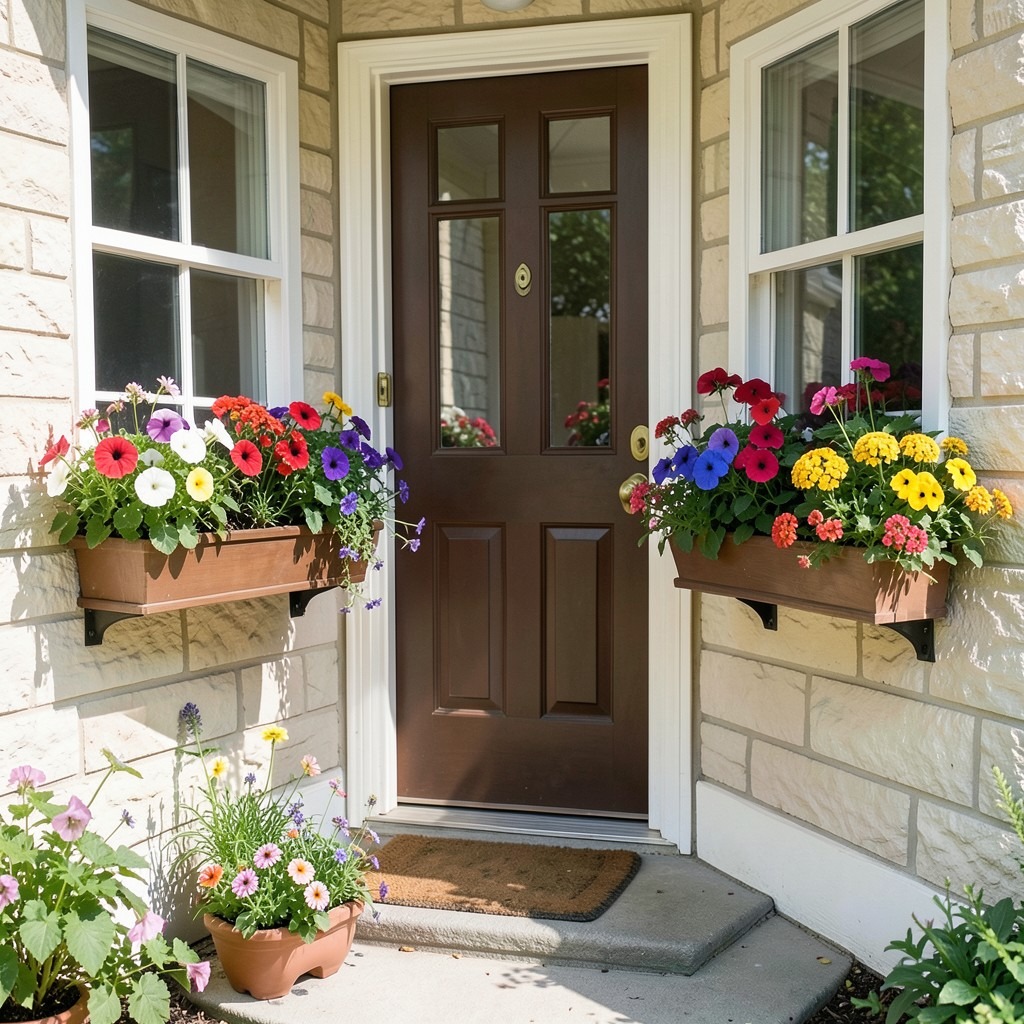
Window boxes on the front porch — mounted beneath the windows flanking the front door, planted with seasonal flowers that overflow the box edges and produce a cascade of color against the façade — are the provision that most directly connects the porch to the tradition of European residential window box planting that communicates domestic pride and the pleasure of flowers in a highly public, highly visible way. A house with well-maintained window boxes reads as cared for at the detail level that reveals genuine household investment in its appearance.
The mounting system for porch window boxes must handle the weight of a fully planted and watered box without any movement or stress on the mounting points. A box of standard dimensions — twenty-four to thirty-six inches long by eight inches wide — filled with potting mix and planted material can weigh twenty to thirty pounds when fully watered. Brackets sized for the box dimensions and anchored into the structural window framing — not into the window trim alone — provide the load capacity this weight requires. A box that sags, tilts, or shifts on its brackets reads as poorly installed and eventually deposits its contents on the porch floor.
The plant combination within a window box must address the box’s aspect — whether it faces morning sun, afternoon sun, or is in consistent shade — before addressing any aesthetic preference. A sun-facing box planted with shade-preferring impatiens produces a stressed, underperforming planting within two weeks of installation that no watering frequency or fertilizer application fully compensates for. A correct sun-aspect selection — petunias, lantana, or calibrachoa for full sun; impatiens, begonias, or fuchsia for shade — produces a box that performs throughout the season and requires maintenance only to sustain its natural momentum.
13. A Front Porch With a Statement Light Fixture
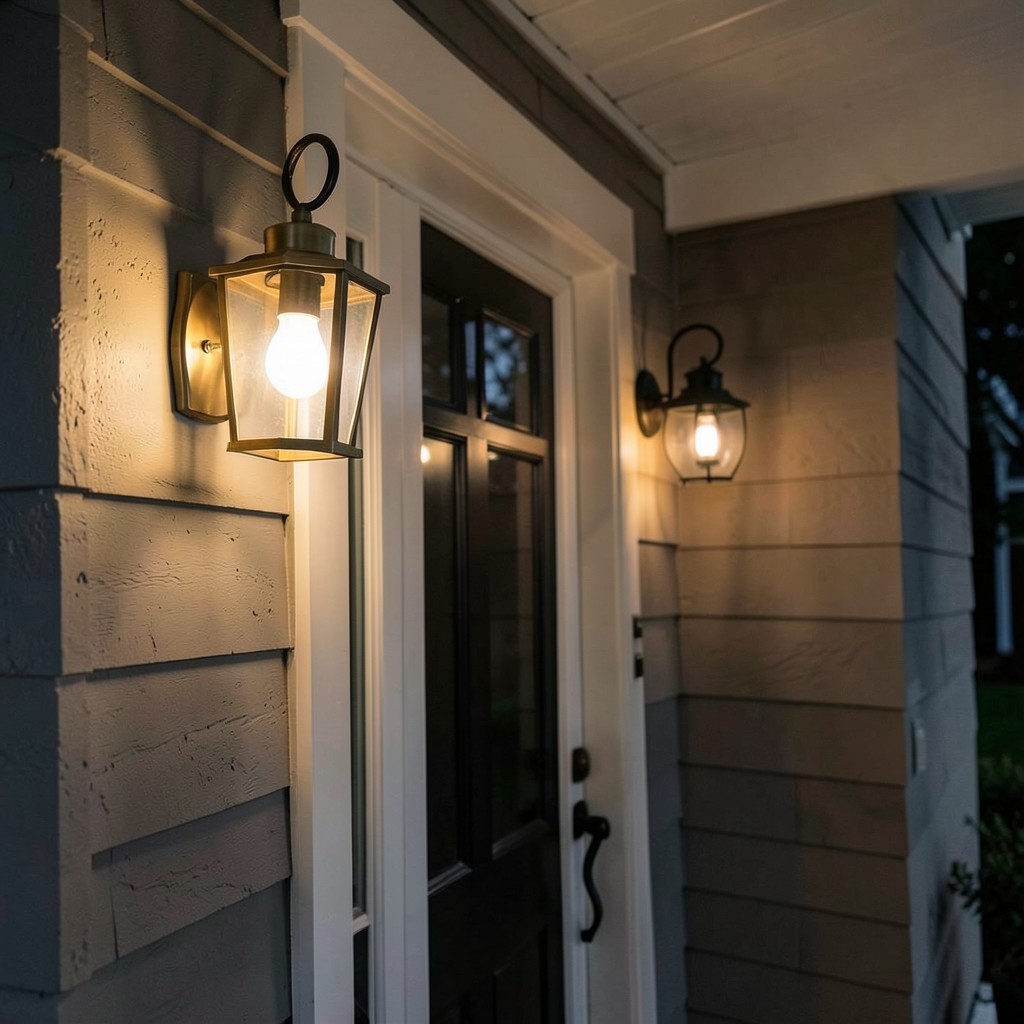
The porch light fixture is the detail that most people select from the builder’s standard range and then live with for a decade while everything around it gets upgraded. It is also the fixture most visible from the street, most frequently photographed in real estate listings, and most directly communicating the design standard of the porch after dark. A builder-grade brushed nickel or oil-rubbed bronze lantern fixture in a style that belongs to no particular design era and makes no particular statement communicates nothing and contributes nothing beyond adequate illumination.
A statement porch fixture — a large-scale lantern in aged brass, a cluster of pendant globes in black metal, an oversized barn light in matte black with a clear glass shade, or a designer-grade wall sconce in a form that references the house’s architectural style — changes the porch’s evening reading entirely. The fixture becomes the detail that visitors comment on and that anchors the porch’s design direction after dark. Scale is the most important variable: a fixture that is smaller than the door opening it sits beside reads as timid; a fixture that commands its position reads as confident.
The light temperature and spread of the fixture determines whether the porch feels welcoming or institutional at night. A warm white bulb at 2700K in a lantern with clear or lightly tinted glass produces the amber warmth of incandescent light that reads as domestic and welcoming. A cool white bulb in the same fixture produces a flat, utility-grade light that makes the porch look like a parking facility rather than a home entrance. Warm temperature bulbs are non-negotiable in porch fixtures — this is the one application where color temperature has more impact on the result than almost any other lighting variable.
14. A Front Porch With a Bench and Cushions
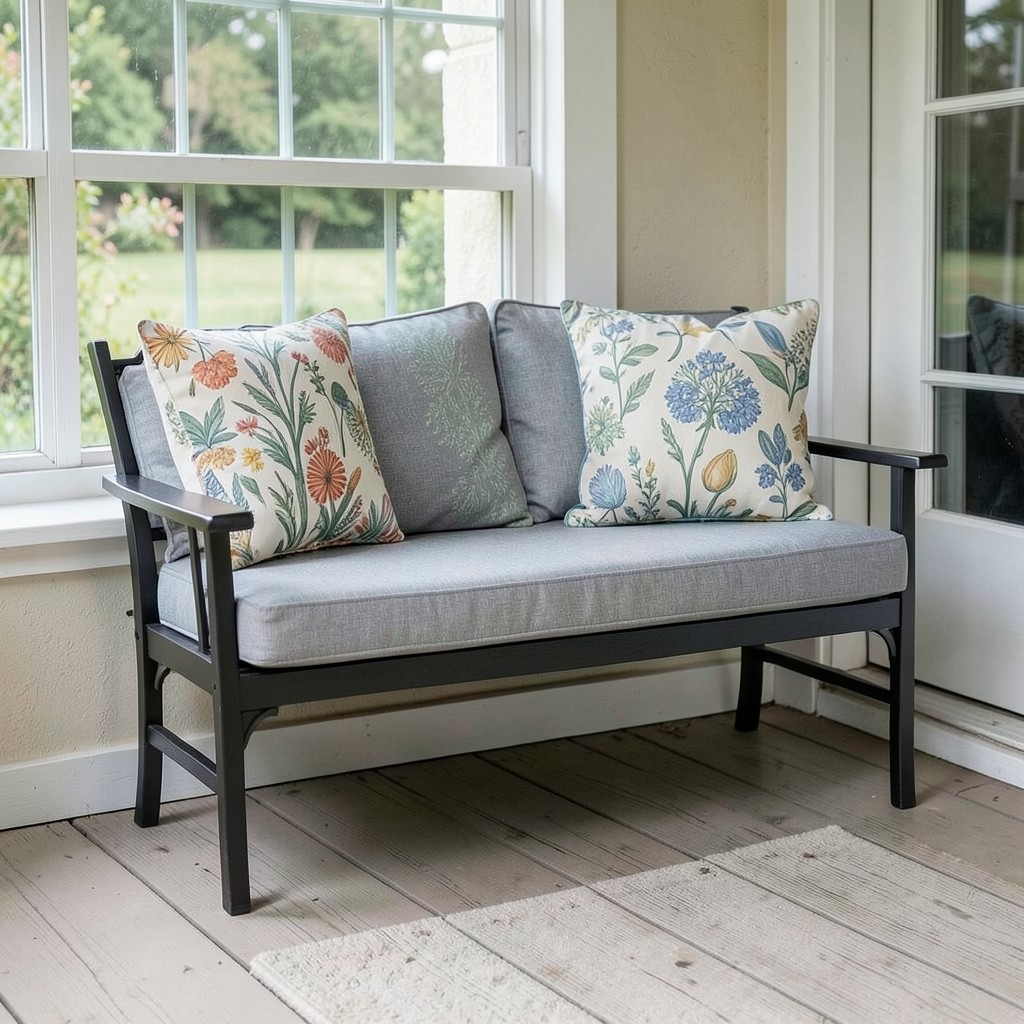
A bench on the front porch — a single piece of furniture that can seat two or three people comfortably with cushions in a weather-resistant fabric — is the lowest-cost furniture option that communicates the highest degree of porch inhabitation. A bench says: people sit here, stay here, choose to spend time on this porch rather than merely passing through it. That communication is made by the presence of the furniture alone, before anyone has sat in it, and it is the communication that turns a threshold into a destination in the reading of any visitor who approaches.
The bench material must handle the outdoor conditions of the porch — seasonal temperature change, UV exposure, and the humidity that moves through the porch space particularly on morning and evening — without deteriorating in a way that undermines the porch’s visual quality. Teak and hardwood benches handle these conditions with annual oiling and develop a silver-grey patina without maintenance that many homeowners find more attractive than the fresh oiled color. Painted timber benches require more frequent maintenance but allow color choices that coordinate with the porch’s overall palette. Cast iron or cast aluminum benches with a powder-coat finish resist weather without any maintenance and suit porches with a traditional or formal design direction.
The cushions on a porch bench are the detail that invites rather than suggests occupation. A bare bench invites sitting for a few minutes. A bench with cushions invites a half-hour. The cushion fabric must be specified for outdoor use — solution-dyed acrylic or polyester fabric with a UV-resistant finish — because standard indoor upholstery fabric on a porch cushion fades, moulds, and deteriorates within a single season of exposure. Sunbrella is the category-leading outdoor fabric brand and its color range covers every porch palette direction with performance that standard outdoor fabrics do not approach.
15. A Front Porch With Climbing Roses
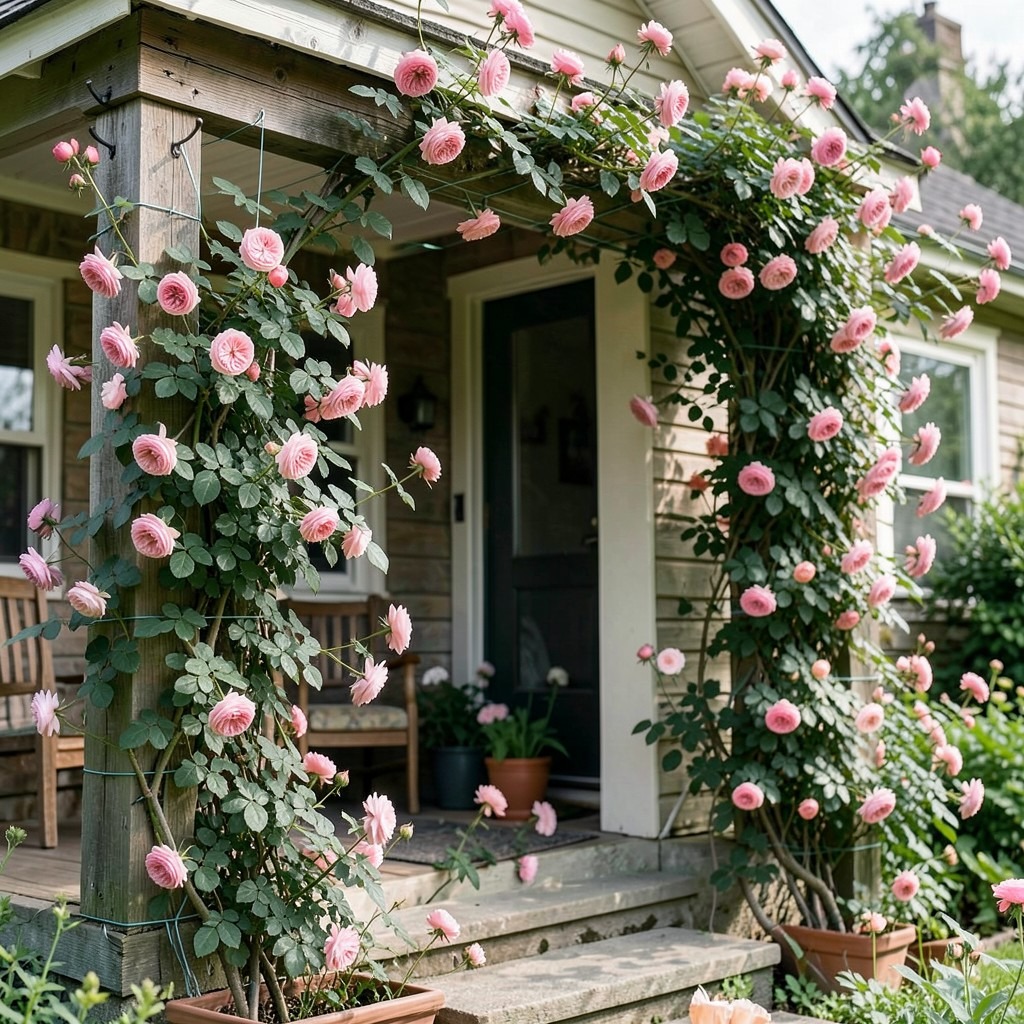
A climbing rose trained up the porch posts and across the overhead structure — its canes fixed to a trellis, wire support, or directly to the post face with eye hooks — produces the most romantically compelling porch planting available in the domestic garden vocabulary. A well-established climbing rose in full bloom, with flowers at eye level as you climb the porch steps and fragrance reaching you before you have reached the first step, creates an arrival experience of the kind that makes people stop mid-approach to absorb it. No other plant achieves this at the scale and in the position that porch architecture provides.
The rose selection for a porch structure must prioritize disease resistance alongside flowering quality, because a climbing rose on a porch post is viewed at close range from all sides and disease-affected foliage is impossible to overlook at that proximity. Modern disease-resistant climbers — varieties bred with natural resistance to blackspot and mildew — maintain their foliage quality through the entire growing season and require no fungicide applications to stay attractive. An older, disease-susceptible variety chosen for the quality of its flowers produces a porch planting that looks magnificent for three weeks in June and thin and diseased for the remaining five months of the growing season.
The training of the rose canes — the annual winter pruning that directs horizontal canes along the support structure and reduces vertical growth to maintain the porch overhead clearance — is the one management task that determines whether the climbing rose remains a designed planting or becomes an uncontrolled sprawl. Horizontal canes produce more flowering shoots than vertical ones, which is the single most useful rose training fact most gardeners learn too late. Training the main canes as horizontally as the structure allows, and tying in new growth to extend the horizontal coverage, produces a flowering display that covers the porch structure rather than escaping it.
16. A Front Porch With a Defined Color Palette
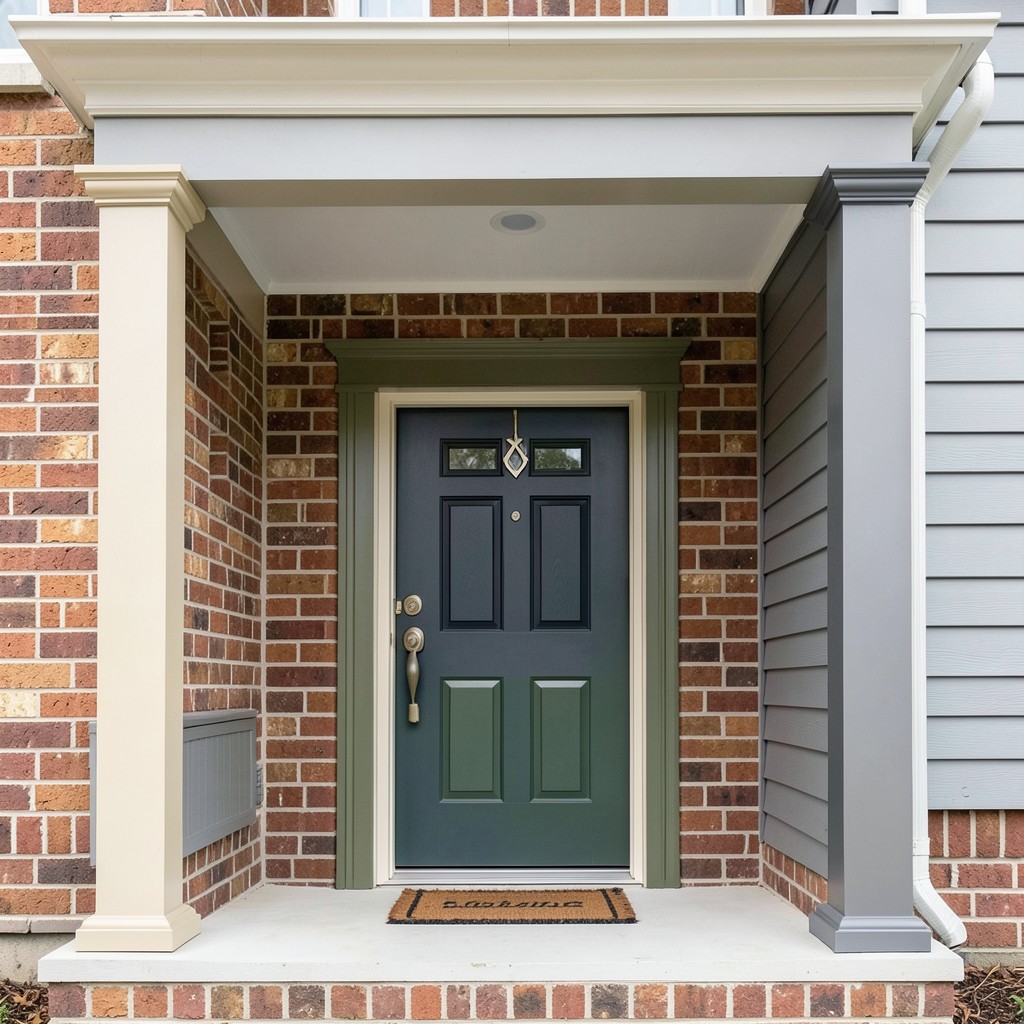
A front porch designed around a deliberate three-color palette — a primary body color, a contrasting trim color, and an accent color for the door and decorative elements — reads as architecturally resolved and carefully composed in a way that a porch whose colors accumulated over time through unrelated decisions never achieves. The palette is the framework that makes every subsequent design decision easier, because each new element is evaluated against whether it belongs within the established colors rather than whether it works in isolation.
The starting point for a porch color palette is the house’s primary exterior material — the brick color, the render tone, the timber cladding shade — which cannot be changed without significant investment and therefore sets the context within which everything else must work. A warm red brick house sets a warm context: the trim color should lean toward cream, warm grey, or olive rather than cool white or blue-grey, which fight the warmth of the brick rather than harmonizing with it. A cool grey render house opens toward a wider range of contrasts — navy, forest green, charcoal, and terracotta all work against grey in ways that one of them would not work against brick.
The accent color — applied to the front door and potentially to the porch ceiling if a painted ceiling is part of the design — is the palette element where personal expression most fully appears. The body and trim colors are largely determined by the house’s architecture and material. The door color is where a choice can be made freely, and the choice should be made with confidence rather than caution. A door color that is bold enough to be the point of the palette — the color that everything else is organized around rather than one that merely fits — produces a porch with more design energy than a door color chosen to avoid conflict.
17. A Front Porch With a Lantern Collection
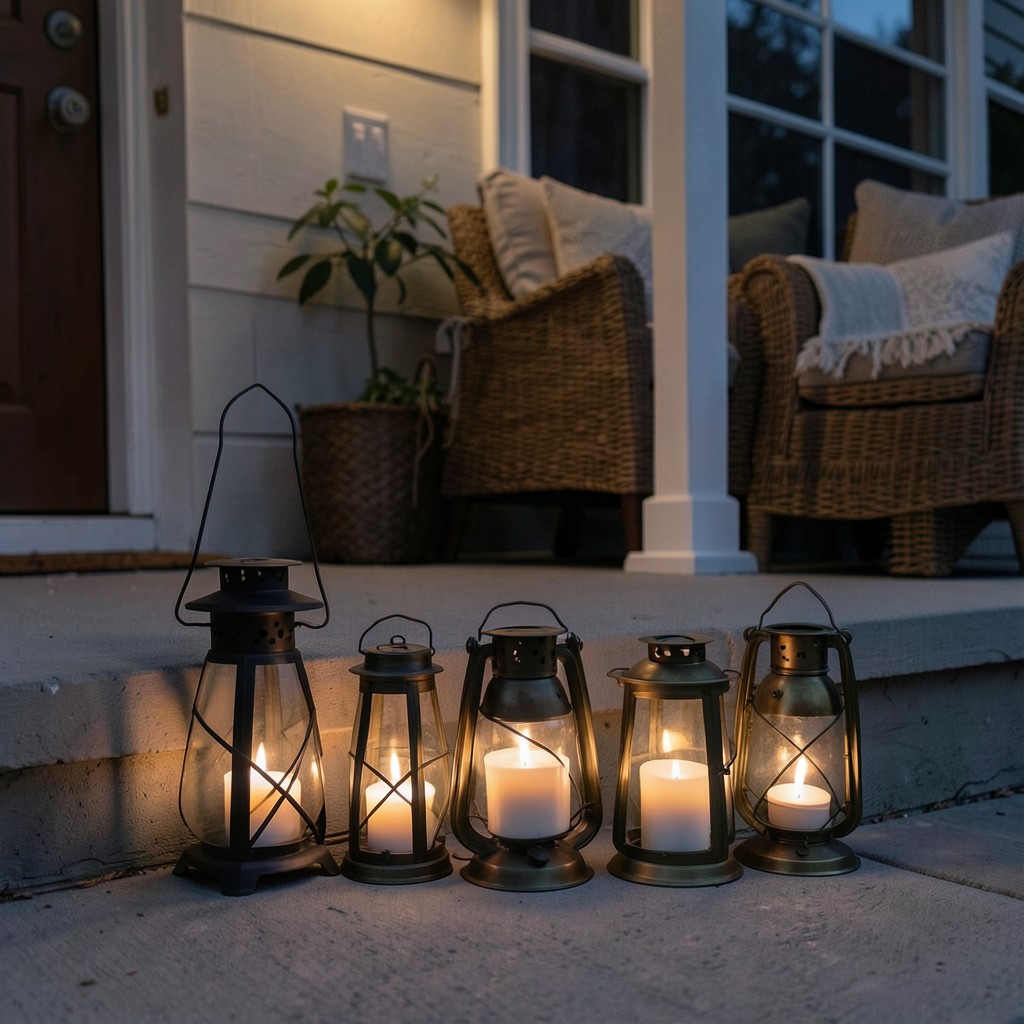
A collection of lanterns arranged on the porch floor, on the steps, or on a surface beside the seating — hurricane lanterns, pillar candle lanterns, or battery-operated lanterns with a realistic flame effect — creates a layered, ambient light source at ground level that complements the overhead fixture and produces an evening atmosphere on the porch that a single overhead light cannot generate alone. The lantern at ground level provides lighting that illuminates the porch from below rather than above, which produces shadows and depth that overhead-only lighting flattens.
The collection of lanterns reads as designed rather than accumulated when the pieces share a material language — all in black metal, all in aged brass, all in natural rattan — while varying in height and scale across the group. A collection of three lanterns in the same material finish but at three different heights produces a composed arrangement that the eye reads as intentional. The same three lanterns if identical in both material and size reads as a stock purchase rather than a curated selection. Variation in scale within material consistency is the rule for any lantern collection that aspires to read as styled.
Battery-operated flameless candle lanterns — with realistic flickering LED flames — are the practical solution for a porch where open flame is prohibited by home insurance or local regulations, where small children or pets make open flame inappropriate, or where the maintenance of real candles across multiple lanterns is genuinely inconvenient. Modern flameless candles have reached a quality level where the flame simulation is convincing at the distance from which a porch arrangement is viewed, and their timer function allows them to activate at dusk and extinguish at a pre-set hour without any manual interaction.
18. A Front Porch With Wicker Furniture
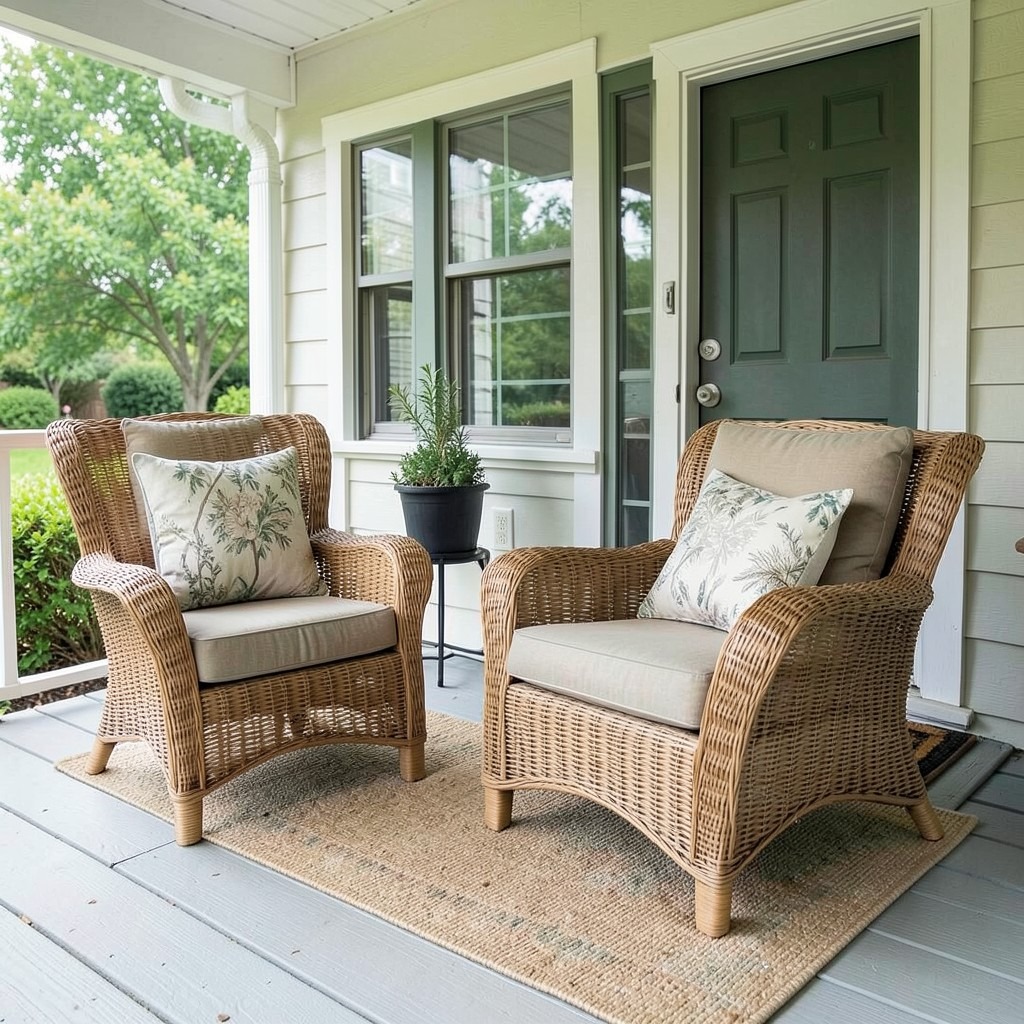
Wicker furniture on a front porch — a pair of high-back wicker chairs or a wicker sofa and chair combination with cushions — produces a relaxed, lived-in quality that metal and timber porch furniture rarely matches. The woven texture of wicker reads as warm and organic in a way that the flat surfaces of aluminum or timber do not, and a well-chosen wicker arrangement on a porch gives the space a character that is simultaneously casual and considered. It is the material choice that most naturally suits the transitional, both-indoors-and-outdoors quality of a covered porch.
Natural rattan wicker requires a fully covered porch to remain in acceptable condition through the seasons — exposure to rain wicks moisture into the woven fibers and eventually causes the material to soften, crack, and deteriorate. Synthetic resin wicker — a woven plastic strand product that replicates the appearance of natural rattan — handles rain exposure, UV, and temperature cycling without deteriorating and is now available in a range of weave patterns and colors sophisticated enough that the distinction from natural material is not apparent at ordinary viewing distances. For any porch with weather exposure, synthetic resin wicker is the practical choice.
The cushion color on wicker porch furniture is the most visible color decision in the porch’s soft furnishing palette and should be made in direct reference to the door color, the trim color, and any other fabric present on the porch — the rug, the hanging planter liners, the decorative pillows. A cushion color that harmonizes with at least two other porch colors without exactly matching either one produces a composed palette rather than an accidental one. A cushion color chosen in isolation from the rest of the porch reads as exactly that — chosen in isolation — regardless of how appealing it is on its own.
19. A Front Porch With Layered Planters
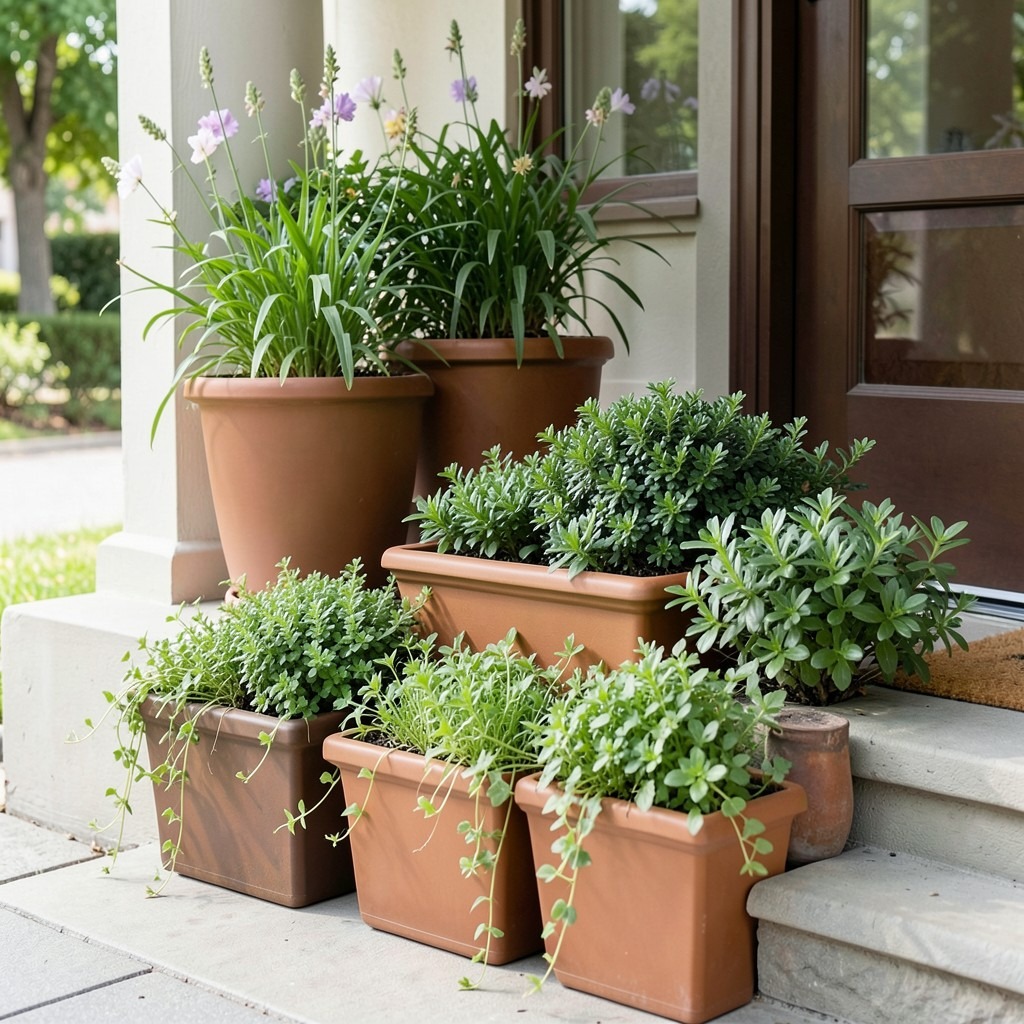
A tiered planting arrangement on the porch — tall planters at the back, medium planters in the middle, low ground-level planters at the front — creates a depth and layering in the planting that a single level of containers never achieves. The tiered arrangement mimics the structure of a planted border and gives the porch a visual richness at multiple heights simultaneously, drawing the eye from the street-level approach through the planting layers to the porch surface and door beyond.
The container sizes in a tiered arrangement work together as a group rather than individually, which means each container should be selected in relation to the others rather than as a standalone purchase. A tall statement planter at the back — sixty centimeters or more in height — sets the scale for the group, and the middle and front tiers step down proportionally. Using matching or complementary materials across the tiers — all terracotta, all glazed ceramic in the same color family, all corten steel — creates visual coherence across the different sizes. Mismatched materials in a tiered arrangement read as accumulated rather than arranged.
The planting at each tier level should relate vertically as well as horizontally — tall flowering stems rising from the large back container, medium-height bushy plants in the middle tier, trailing plants cascading from the front low containers. This vertical planting relationship creates a continuous flow of plant material from the ground level up through the full height of the arrangement, and when done correctly, the tiered planting reads as a single, composed planting scene rather than three separate pots placed at different heights.
20. A Front Porch With a Herringbone Brick Pattern
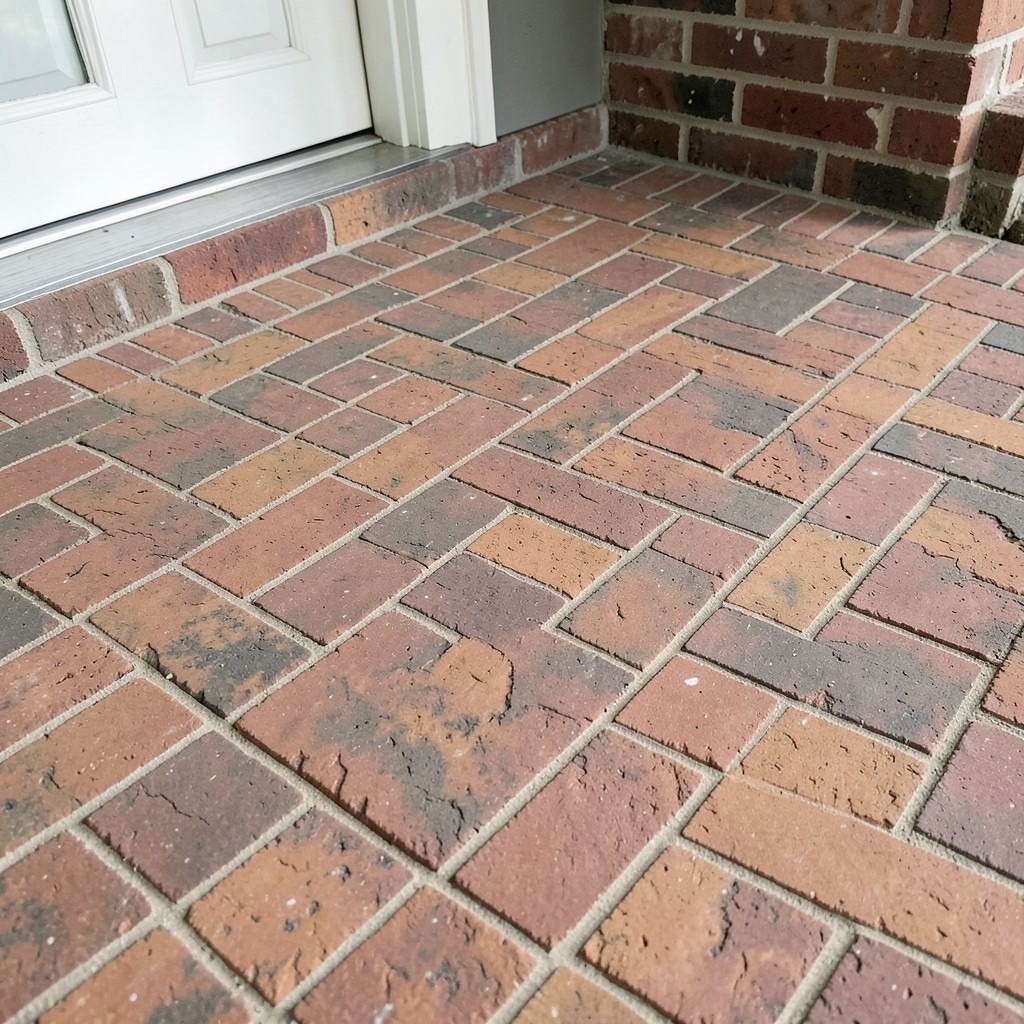
A herringbone brick pattern on the porch floor — bricks laid at forty-five degrees to the porch’s edges in the interlocking pattern that has defined quality paving since the medieval period — is the surface treatment that immediately elevates the porch’s architectural status from functional to formal. The herringbone pattern requires more labor than a running bond or a grid, which is precisely why its presence communicates investment and care. A porch that received this treatment received it because someone decided it was worth doing correctly.
The brick specification for a herringbone porch floor requires a unit that handles freeze-thaw cycling without spalling — splitting and popping from the surface under the pressure of water expanding within the brick as it freezes. Standard facing bricks designed for wall construction are not appropriate for paved surfaces — they have a water absorption rate that makes them vulnerable to frost damage in a ground-level paving application. Engineering bricks — a denser, lower-absorption unit designed for the most demanding damp and ground conditions — or purpose-made clay pavers designed for floor use are the correct specification for a herringbone porch floor in any climate with frost exposure.
The joint between herringbone bricks determines both the floor’s visual character and its long-term performance. A tight joint — two to four millimeters of fine sand or mortar between each brick — produces the most refined appearance and suits a formal porch design direction. A wider, more rustic joint with a slightly recessed surface reads as more informal and suits a farmhouse or cottage-style porch. Either joint specification requires pointing with a mortar compatible with the brick’s thermal movement characteristics — a rigid, cement-rich mortar in a low-absorption brick combination resists the micro-cracking that eventually allows moisture ingress.
21. A Front Porch With Reclaimed Wood Accents
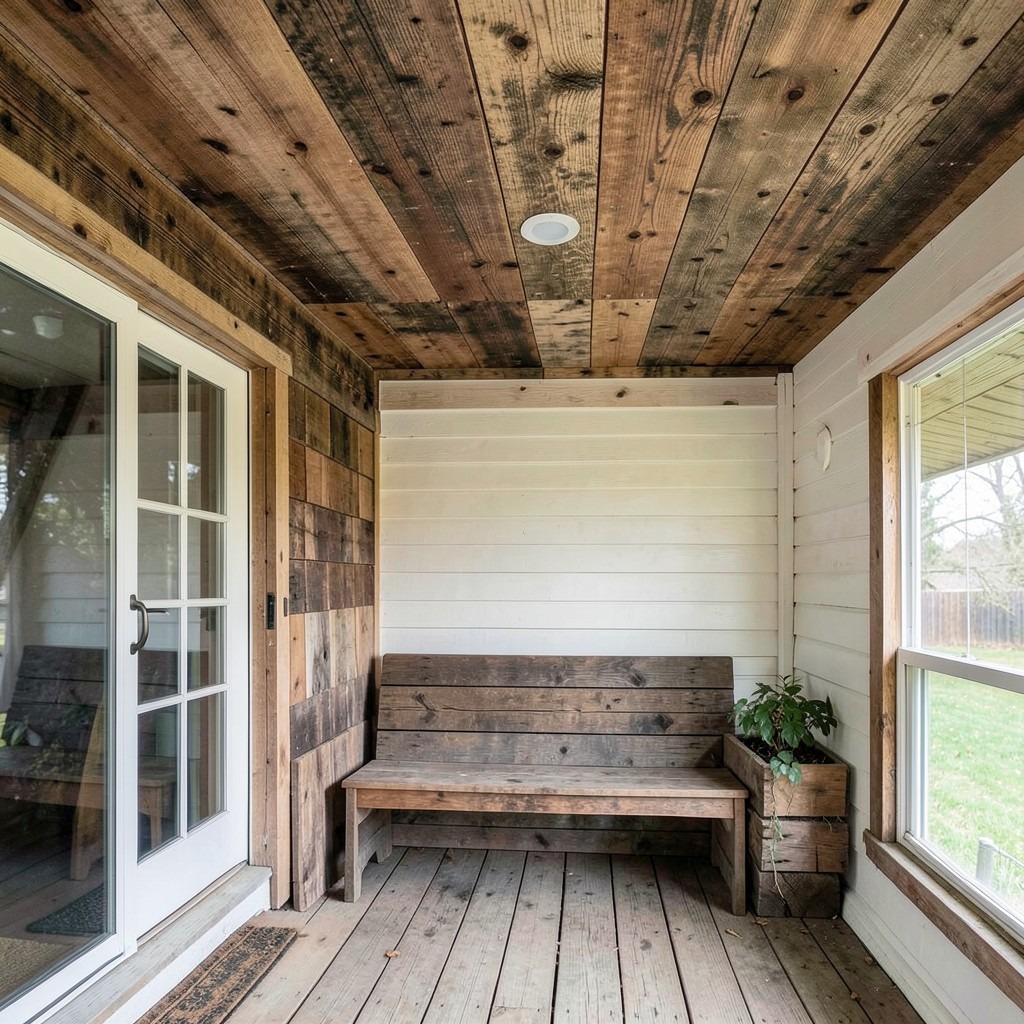
Reclaimed timber on a front porch — a ceiling clad in salvaged shiplap boards, a bench built from old barn wood, a planter constructed from reclaimed railway sleepers — introduces a material character and a sense of accumulated history that new timber cannot replicate regardless of its quality. The grain of old wood, darkened by decades of exposure and use, tells a story in its surface that a fresh-sawn board does not. On a front porch — which is about communicating welcome, character, and personality — that story has a value that purely aesthetic material qualities do not.
The porch ceiling is the reclaimed wood application with the highest visual impact per board foot of material used. A ceiling in natural or painted reclaimed shiplap — the horizontal tongue-and-groove boards salvaged from old interior walls and barns — produces an overhead surface with the texture, tonal variation, and warmth that a flat-painted drywall ceiling completely lacks. The boards do not need to be in pristine condition — minor surface weathering, nail holes, and color variation are the visual qualities that make reclaimed material worth using, and a ceiling that shows these qualities reads as intentional rather than as a budget compromise.
The structural integrity of reclaimed timber must be verified before use in any load-bearing porch application. Salvaged beams with visible checking, splits running along the grain, or signs of fungal damage — darkened, soft sections that compress under pressure — should not be used structurally without an assessment of whether the cross-section remaining after defect exclusion is adequate for the intended loads. Decorative reclaimed timber — wall cladding, ceiling boards, non-structural accents — does not carry the same structural requirement, and surface defects are assets rather than concerns in these applications.
22. A Front Porch With a Farmhouse Aesthetic
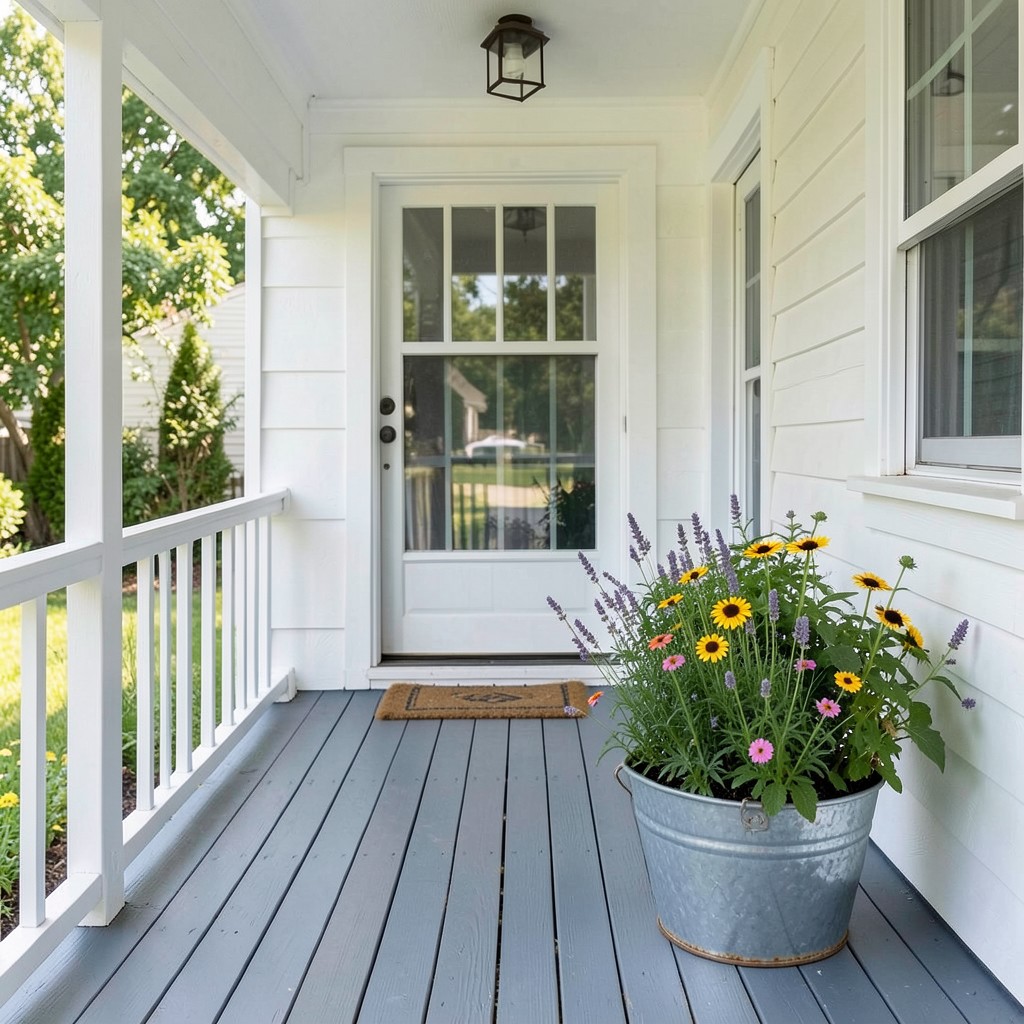
A farmhouse-style front porch — characterized by painted white timber framing, a painted wood floor in grey-blue, simple metal light fixtures, and planting in galvanized metal containers — produces a specific visual character that reads as warm, unpretentious, and deeply domestic. The farmhouse aesthetic is not a recent trend: it is the American vernacular porch design language that predates the current interest in it by a century, and its persistence comes from the fact that it works — materially, spatially, and socially — better than most of the styles that have tried to replace it.
The white painted trim is the foundation of a farmhouse porch aesthetic, and its quality depends entirely on the consistency and precision of the paint application. White trim with sharp, clean lines between the painted and unpainted surfaces reads as crisp and intentional. White trim with paint that has drifted onto the adjacent surface, or that has yellowed at the edges where sun exposure is highest, reads as maintenance-deferred. The farmhouse look is deceptively demanding in this respect — its apparent simplicity is maintained by consistent upkeep rather than complexity of detail, and the difference between a well-maintained white trim porch and a neglected one is immediately apparent from the street.
The galvanized metal planter is the detail that most efficiently establishes the farmhouse character on a porch where the framing and trim are already white painted timber. A galvanized bucket, wash tub, or purpose-made galvanized planter filled with a simple, prolific planting — lavender, zinnias, sunflowers, or herbs — introduces the agricultural material language of the farmhouse aesthetic at minimal cost. The patina of galvanized metal as it ages — moving from bright silver to a duller, matte grey with rust blooming at the edges — improves its character on a farmhouse porch in a way that aging affects few other materials.
23. A Front Porch With a Screen Enclosure
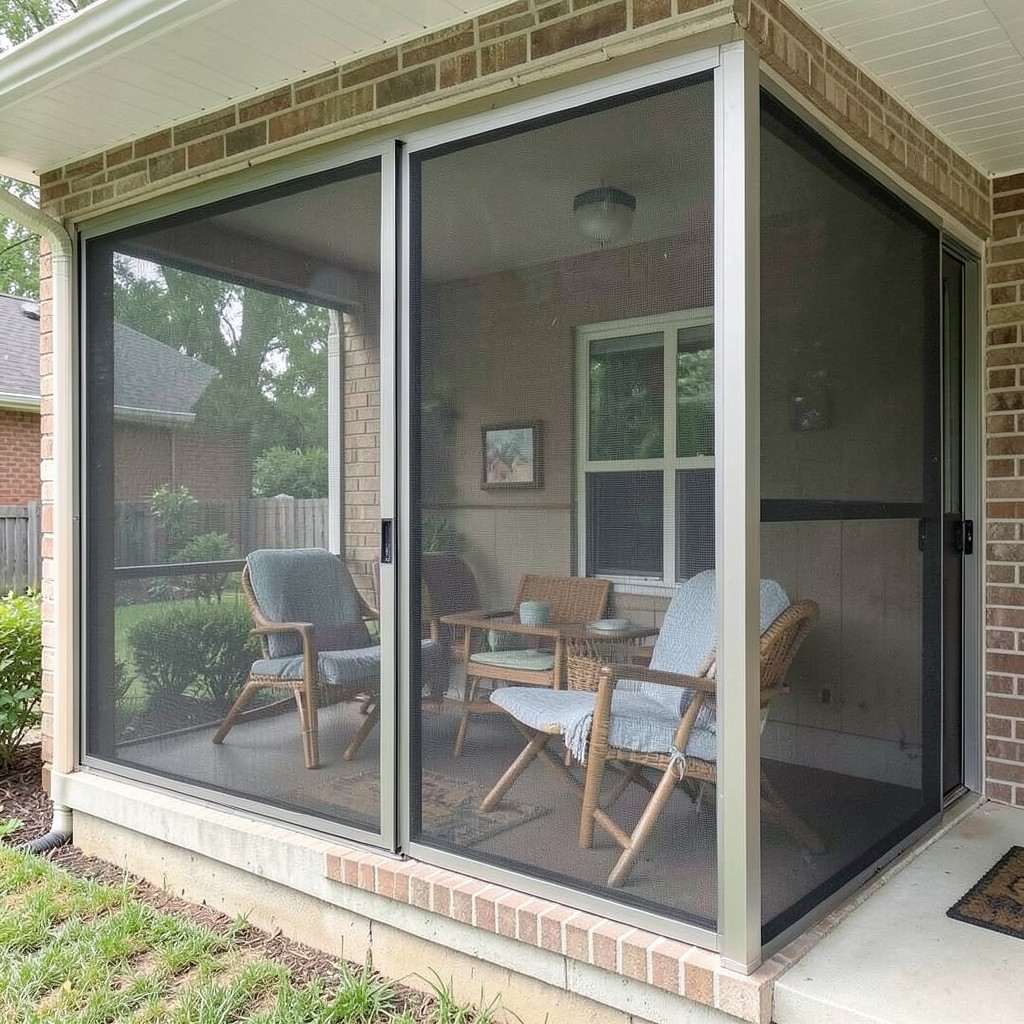
A screened front porch — a porch enclosed with fine wire mesh screens on the open sides, keeping insects out while allowing air to move through freely — is the provision that converts a front porch in a warm climate from a seasonal feature to a year-round room. The screen keeps mosquitoes, flies, and the full range of biting insects that make uncovered porch occupation miserable in humid, warm climates from reaching the porch occupants. Without the screen, the warm months that should represent the porch’s peak season are precisely the months when insect pressure makes sitting outside without protection genuinely unpleasant.
The screen frame construction — the structural system into which the mesh is stretched and held — determines the enclosure’s visual quality from both inside and outside the porch. A frame of slim aluminum or timber members at consistent spacing, with the screen mesh stretched tightly between them, reads as architectural and considered. A screen installation with visible patches, sagging mesh, or frame members in mismatched materials reads as maintenance-deferred and undermines the porch’s overall visual quality regardless of what else has been done to it. The screens are the porch’s walls for much of the year — their quality is the quality of the room.
The mesh specification for a porch screen requires balancing insect exclusion against visibility and air flow. A fine mesh — eighteen by sixteen strands per inch, the standard fly screen specification — excludes all mosquitoes and most smaller insects while maintaining good visibility through the screen from inside the porch. A finer mesh — twenty by twenty or finer, sometimes called “no-see-um” mesh — excludes the smallest biting insects at the cost of reduced air flow and slightly reduced visibility. In areas where no-see-um insects are genuinely present, the finer mesh is worth the trade-off. In standard conditions, the eighteen by sixteen specification performs correctly.
24. A Front Porch With Topiaries in Matching Urns
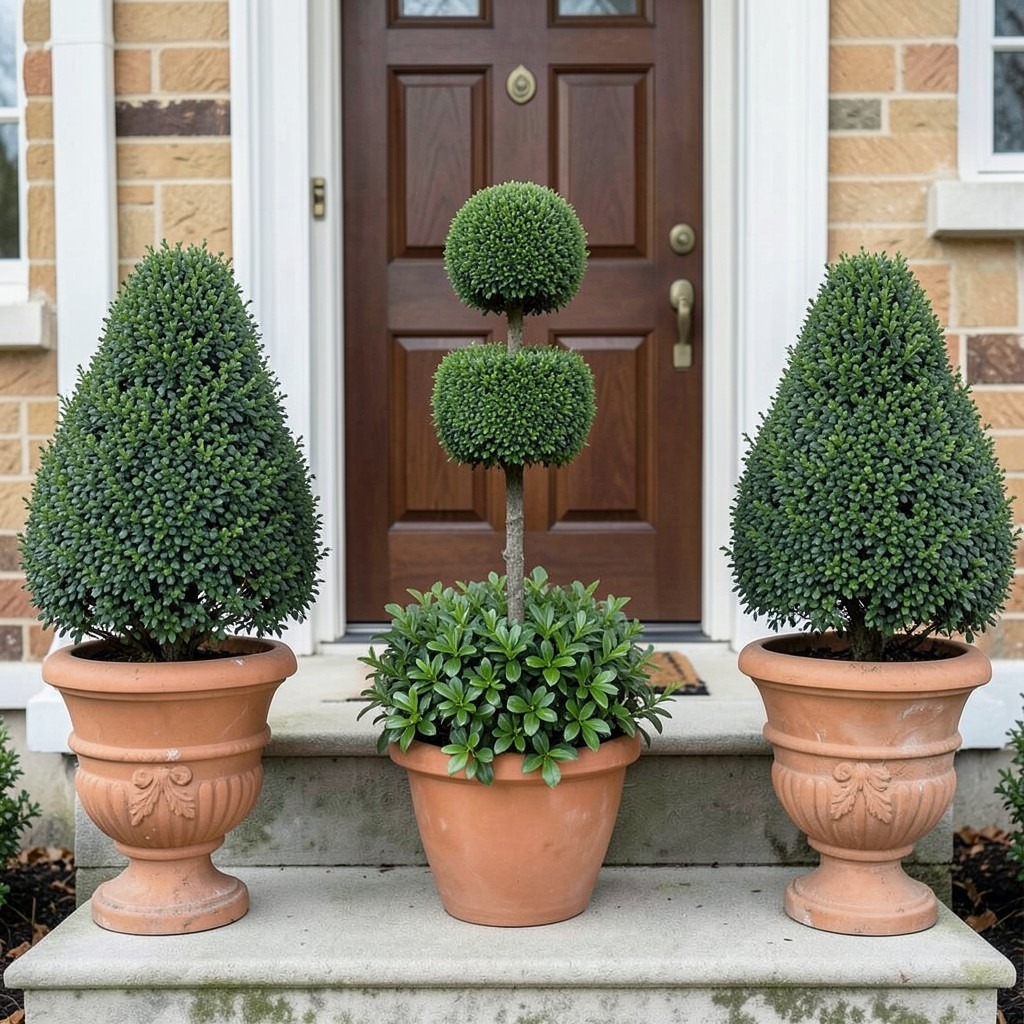
Topiary plants in matching urns — a pair of clipped bay or box standards, or cone-form boxwood in classical terracotta or lead-effect urns positioned symmetrically at the top of the front steps — produce a quality of formal entry that communicates horticultural seriousness and design confidence simultaneously. The well-maintained topiary is a signal that the household tends its plants actively rather than passively, and that care communicates throughout the porch as a broader statement about how the home is kept.
The urn selection for a formal topiary planting must match the scale of the topiary it contains. A standard topiary — a lollipop form with a clear stem and a spherical head — in an urn that is too small for the stem’s base reads as unbalanced from any viewing angle. The urn should be proportioned so that the stem of the standard emerges from the container’s center at a height that gives the complete arrangement — urn, stem, and head — a visually resolved vertical rhythm. A head-to-stem-to-urn ratio of approximately one to two to one produces the classical proportion that topiary standards have always used.
The winter care of containerized box or bay topiary in climates with hard frost requires either moving the containers to a protected location or wrapping them with horticultural fleece for the frost period. Bay is less frost-hardy than box — it can be killed to the root by temperatures below minus ten Celsius, while box tolerates significantly lower temperatures in a container context. In frost-prone locations, the winter management of formal entry topiary is a real commitment, and choosing a more frost-hardy species — Ilex crenata, the Japanese holly, is the best alternative to box — reduces but does not eliminate the seasonal care requirement.
25. A Front Porch With a Wooden Ceiling
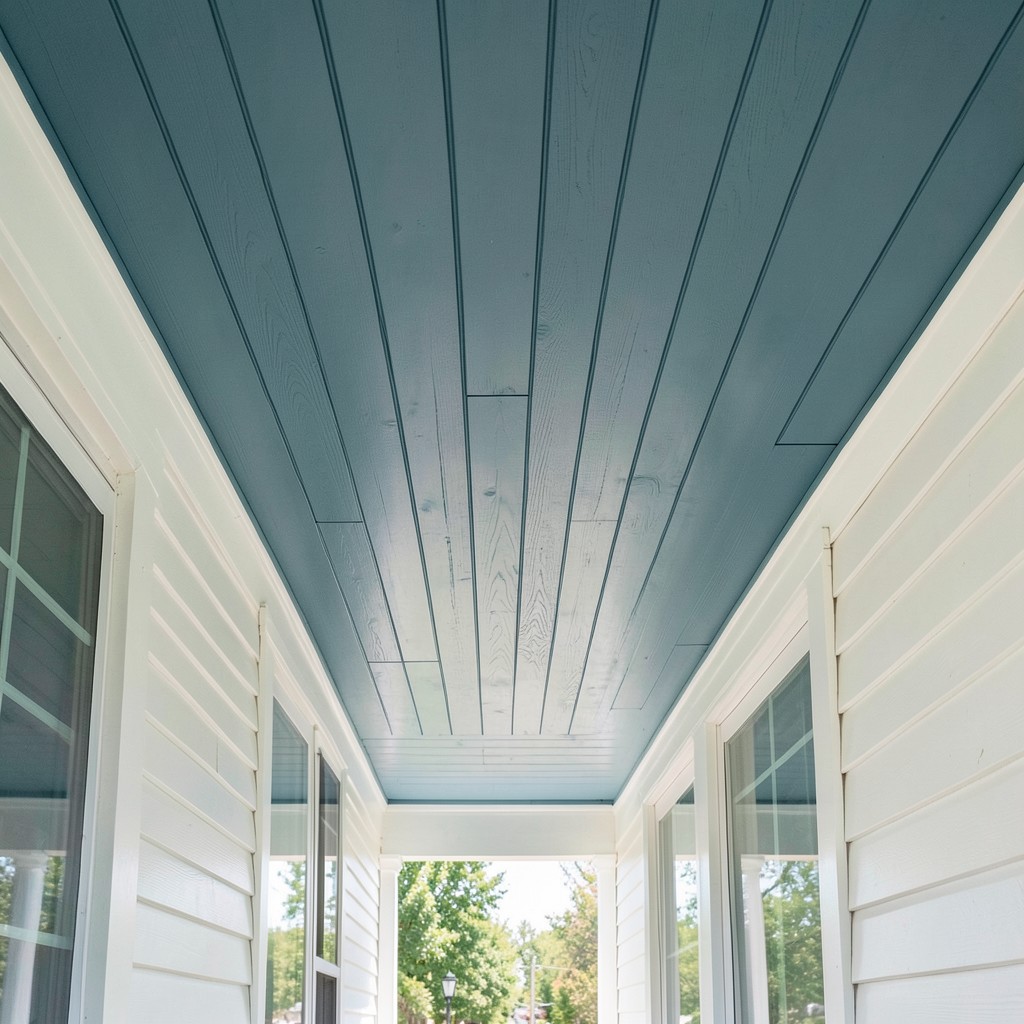
A wood-clad porch ceiling — typically in tongue-and-groove boards painted in the traditional American porch blue-green known as haint blue, or in a natural clear finish that reveals the timber’s grain — is the overhead detail that most distinguishes a designed porch from an unconsidered one when the visitor looks up. Most porch ceilings are white painted drywall or, worse, the unpainted underside of the porch deck above. Neither communicates any design intention. A wood ceiling — in any finish — communicates that the porch was designed as a room rather than built as a structural necessity.
The haint blue ceiling has a specific cultural and regional history in American porch design — it was traditionally applied to porch ceilings in the American South based on the folk belief that the color discouraged spirits from entering the home, and it persisted because the color has a quality of softness and depth when viewed overhead that no other porch ceiling color replicates. Whether or not its supernatural credentials hold up, its visual credentials are beyond question: haint blue against white-painted timber framing reads as authentically American, historically rooted, and architecturally composed. It is also a color that photographs exceptionally well, which is why it appears in so many design publications.
The board direction on a wooden porch ceiling can run perpendicular to the house façade — parallel to the house wall — or parallel to the façade, depending on which direction makes the ceiling appear longer or wider in ways that improve the porch’s proportions. A narrow porch feels wider with boards running perpendicular to its depth. A shallow porch feels deeper with boards running toward the street. This is the same visual direction principle used in flooring — and it applies with equal force overhead.
26. A Front Porch With Built-In Seating
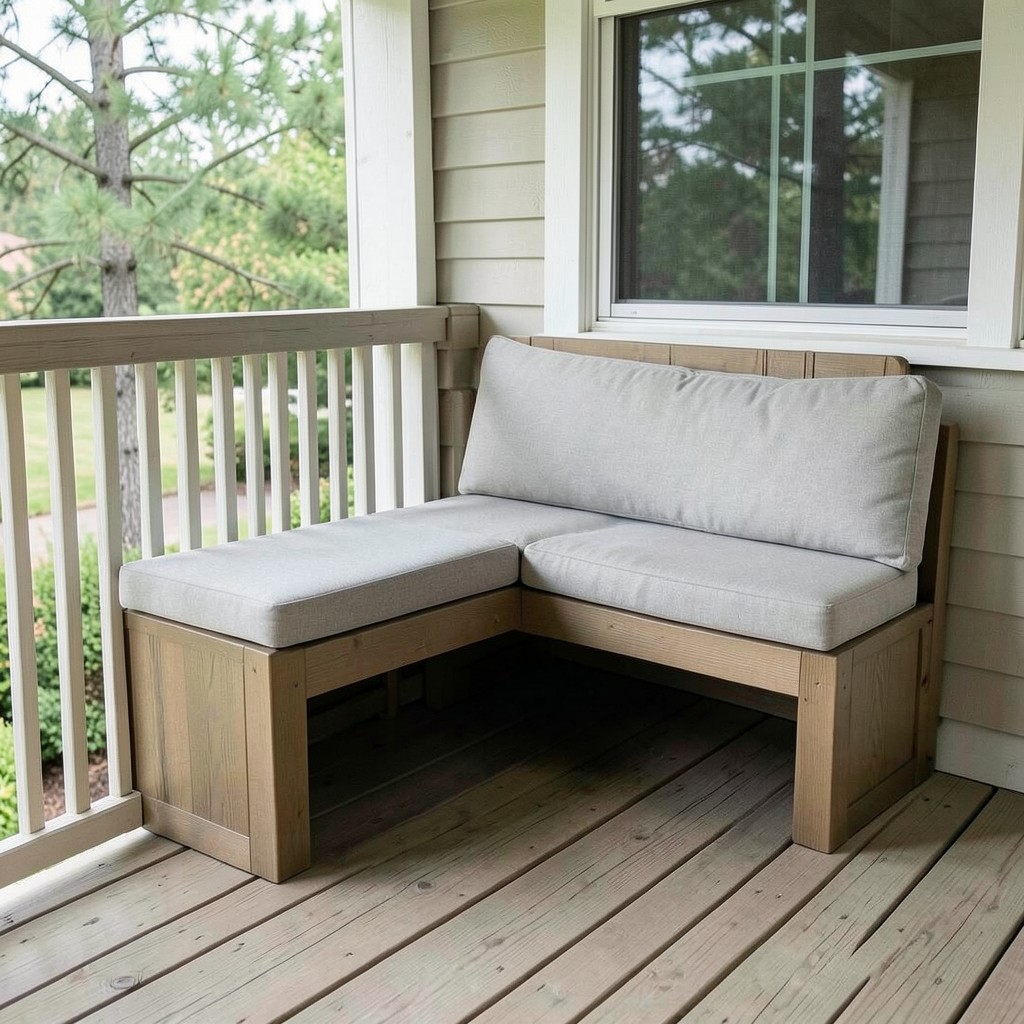
Built-in seating along the side walls or railing of a front porch — a continuous bench constructed from the porch’s own material language, with a seat depth comfortable for extended occupation and a backrest angle that genuinely supports a seated position — gives the porch a furnished quality that no amount of movable furniture achieves in the same way. Built-in seating reads as architectural rather than decorative; it says the porch was designed to be occupied rather than furnished after the fact, and that distinction changes how visitors experience the space.
The seat height for built-in porch seating should match the same range as interior bench seating — seventeen to eighteen inches from floor to seat surface — to provide the comfortable foot-flat-on-floor seating position that lower or higher seats compromise. The backrest angle — a slight rearward rake of ten to fifteen degrees from vertical — provides the lower back support that a fully vertical backrest does not, and the difference between a backrest at the right angle and one built perfectly vertical is the difference between a bench that invites a thirty-minute sit and one that sends the occupant looking for another seat after ten minutes.
Storage beneath the built-in bench seat — accessed through a hinged seat board — is the spatial bonus that the porch’s structural depth between floor and seat height makes possible. On a porch where outdoor furniture cushions, seasonal decorations, gardening tools, or the household’s outdoor equipment need accessible storage, the built-in bench provides a storage volume that no other porch element offers without occupying additional floor area. The hinged seat storage makes the built-in bench a dual-function element rather than purely a seating provision.
27. A Front Porch With a Layered Lighting Plan
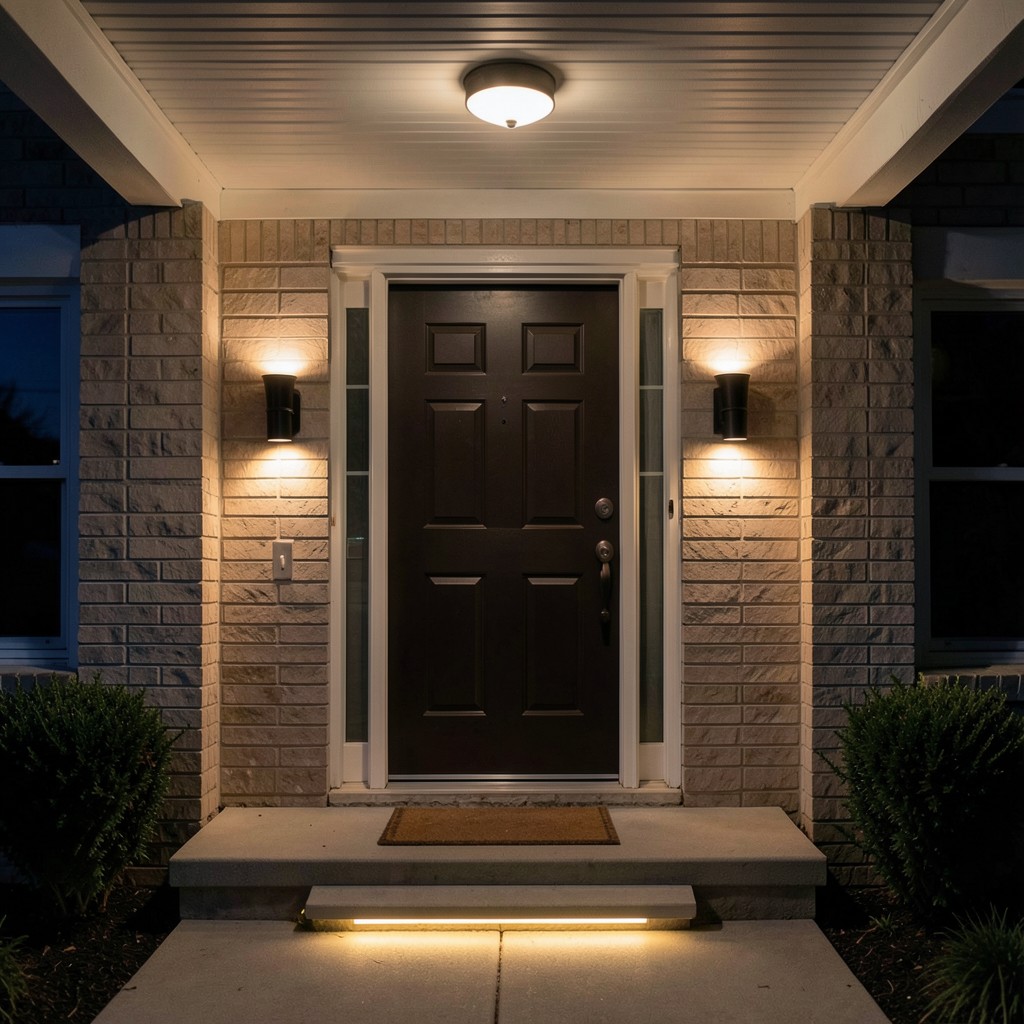
A front porch with only a single overhead light fixture is a porch with one lighting mode: on or off. A porch with a layered lighting plan — an overhead fixture for general illumination, wall sconces for facial light at standing height, step lights for safe navigation, and ambient accent lights for atmosphere — is a porch that can be adjusted to suit the hour and the occasion, and one that reads at night as a composed space rather than a lit threshold.
The wall sconces flanking the door are the layer of a porch lighting plan that most directly enhances the quality of human interaction on the porch. Overhead light illuminates the top of a person’s head and produces shadows below the brow line that flatten facial expression and make identification difficult at night. Wall sconces at approximately six feet height on each side of the door produce a cross-lit facial illumination that reads as welcoming and clear — it is the lighting equivalent of what a photographer calls fill light, and it changes the quality of a nighttime arrival conversation from shadowed and slightly awkward to warmly lit and comfortable.
The step lights — recessed into the porch steps or mounted on the step risers — provide the safety illumination that keeps the entry steps clearly visible at night while contributing an architectural quality of their own. Recessed LED step lights in a bronze or black finish become invisible in daylight and glow with a warm amber light at night that marks the step edge precisely. Their contribution to the porch’s nighttime appearance is significant — the illuminated steps invite approach and communicate that the entry was designed for night use as much as day use.
28. A Front Porch With a Welcome Mat Collection
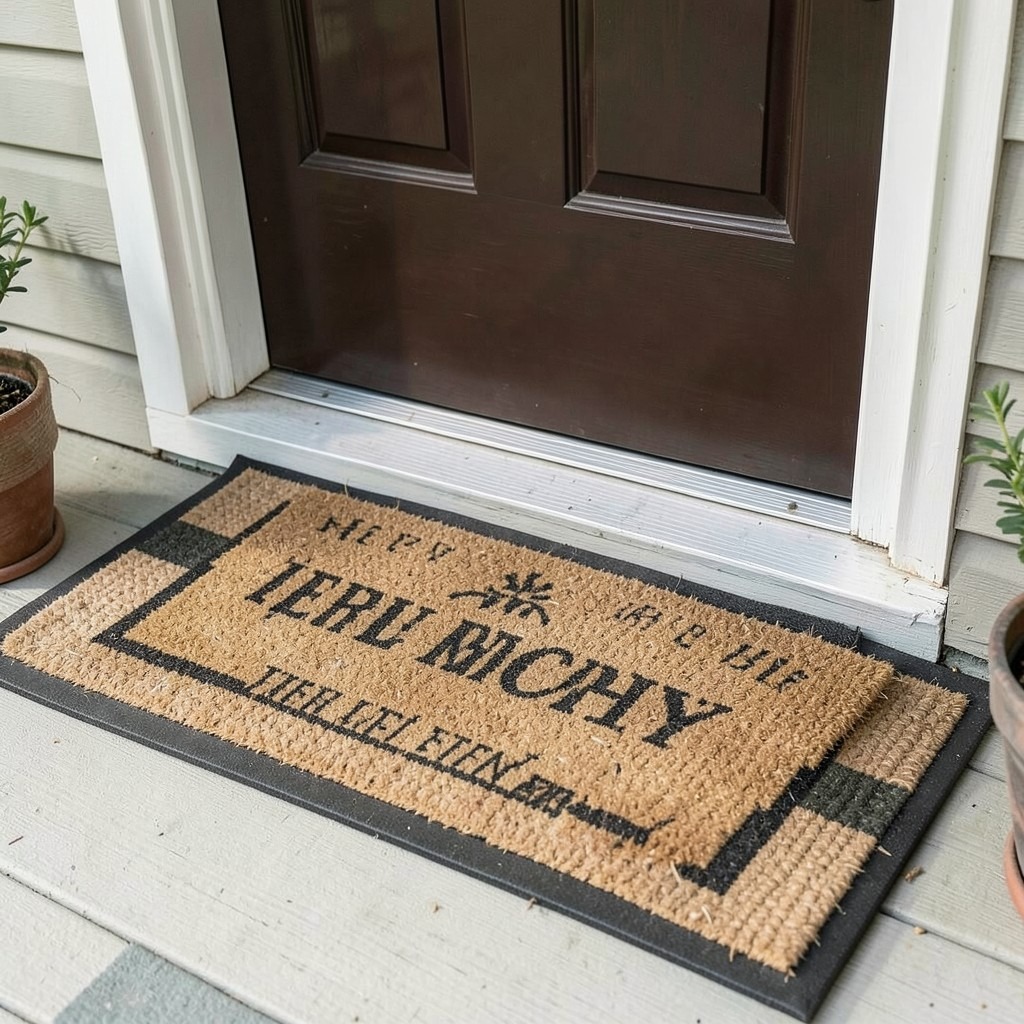
A front porch mat — not the single doormat that most porches have in the builder-standard coir rectangle, but a considered layering of a larger outdoor rug beneath a smaller, more decorative doormat — creates a two-layer landing zone at the entry that reads as dressed rather than functional. The outer rug anchors the seating zone if the porch has one, and the inner mat at the threshold provides the primary foot-wiping function. The combination produces a layered entry that communicates attention to detail at the first point of physical contact with the porch.
The doormat message or pattern is the one element of front porch design where direct expression of household personality is most concentrated and most immediately readable. A mat with a specific saying, a graphic pattern, or a seasonal reference tells the visitor something about the household’s sense of humor, its aesthetic sensibility, or its relationship to the time of year before the door has opened. This is the front porch’s most explicit communication medium, and choosing a mat with genuine personality rather than the generic “WELCOME” of every third house on the street is the smallest and most accessible statement of design and personality available.
The material of the doormat must address the primary functional requirement — removing moisture and debris from footwear before it enters the house — before addressing any aesthetic preference. A mat that looks excellent but fails to hold dirt or dry quickly becomes a muddy hazard rather than a protective device. Coir fiber mats in a dense weave handle heavy-traffic foot wiping effectively and suit any porch aesthetic. Rubber-backed mats with a deep pile surface handle muddy conditions better than coir. Whichever material is chosen, it must be sized generously enough for both feet to land simultaneously — a mat that requires a one-footed approach misses half its functional purpose.
29. A Front Porch With an Arbor Entrance
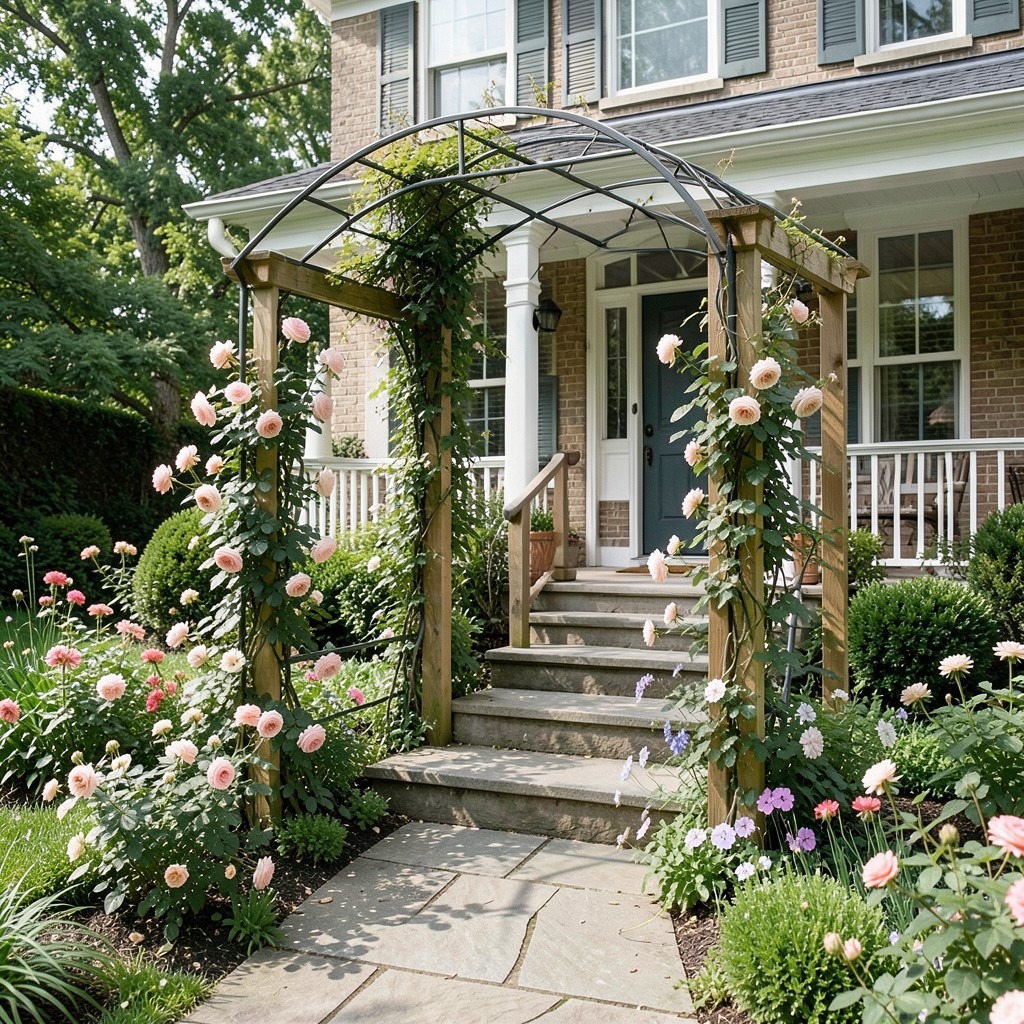
An arbor at the base of the front steps — a freestanding arch structure through which visitors pass to access the porch — creates a formal sense of entry that the porch alone, however well-designed, cannot produce. The arbor marks the transition from the public space of the front path to the semi-private space of the porch approach as a physical threshold, and the experience of passing through it — even if the arch is no more than four feet deep — produces a quality of arrival that an unmediated approach to the porch steps never generates.
The arbor structure must be proportionate to the path width and the visual weight of the house beyond it. A slender wire arch on a wide front path reads as insufficient — overwhelmed by the path dimensions on each side and the house behind it. A timber arbor with a square post section — at minimum three inches by three inches — and a span that matches the path width with twelve to eighteen inches of clearance on each side produces the structural presence that makes the arbor read as architectural rather than decorative. The height of the arch — at minimum seven feet at the center of the curve — ensures comfortable passage without the ducking instinct that lower arches trigger.
The planting on an entry arbor requires careful selection for the specific conditions of the location. Climbing roses, wisteria, clematis, or honeysuckle all suit arbor training and produce flowering displays that make the arbor the most commented-on element of the front garden during their peak seasons. The training discipline for an arbor is similar to that of a pergola — horizontal canes produce more flowers than vertical ones — and the difference between an arbor that flowers abundantly and one that mostly grows upward and away is usually the decision about whether to train horizontally or simply allow the plant to climb.
30. A Front Porch With a Monochromatic Exterior Palette
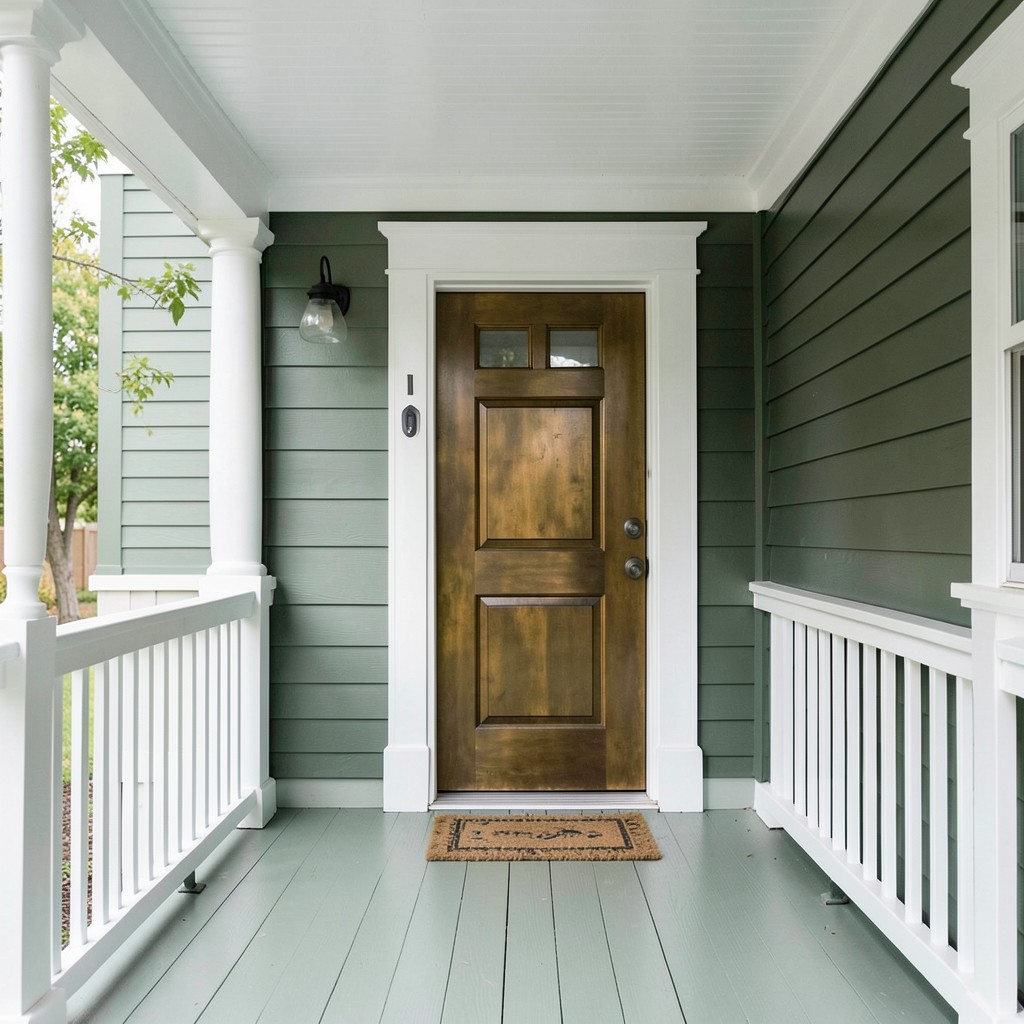
A front porch designed in a single-color family — all the surfaces, from the floor to the ceiling, the columns, the railing, and the trim, in variations of the same hue from near-white to a deeper saturated shade — produces a porch with a graphic boldness and a cohesion that contrasting palette approaches rarely match. The monochromatic approach removes the tension that contrasting exterior colors create and replaces it with a composed unity that reads as architecturally self-aware rather than decoratively busy.
The most successfully executed monochromatic porch palettes tend to be in the warm neutral and earthy color families — tones of sage green, warm taupe, dusty terracotta, or charcoal — because these colors carry sufficient depth at their darker end to produce a compelling contrast with their own lighter variations without the palette reading as cold or stark. A monochromatic white porch in all surfaces is technically monochromatic but reads as unpainted rather than designed, because white is the default rather than a color choice. The value of a monochromatic approach comes from the color commitment, and a commitment to white reads as an absence of commitment.
The single contrasting element within a monochromatic porch palette is the front door, which is the one surface where the design logic supports a break in the scheme. A forest green porch with all surfaces in the sage-to-deep-green range and a door in aged brass — not a color but a material finish that reads as a warm accent — is as effective as a door in a clearly contrasting color. The accent at the door is the point of visual resolution that prevents the monochromatic scheme from reading as uniform to the point of monotony.
31. A Front Porch With Stained Concrete Floors

A stained concrete porch floor — the slab treated with acid or water-based stain that penetrates the surface and produces a permanently colored, mottled finish unlike any paint or coating — gives the porch a floor surface with the character of natural stone at a fraction of the cost of stone installation. Concrete stain does not sit on the surface the way paint does — it reacts with or absorbs into the slab material itself, which means it cannot peel, chip, or delaminate in the way that surface-applied finishes eventually do.
The color range of concrete stain is broader than most homeowners expect before they investigate the option. Acid stains — which create a chemical reaction with the concrete’s mineral content — produce the characteristic mottled, translucent tones that range from warm amber to deep brown, with a variation in color across the slab that no paint application replicates. Water-based stains produce more predictable, more uniform color in a wider range of available tones — blues, greens, greys, reds — with less of the natural variation that makes acid staining distinctive. Both produce a floor that reads as having been considered rather than left as poured.
The sealer applied over stained concrete is the decision that determines the floor’s sheen level and its long-term durability under foot traffic and weather exposure. A high-gloss sealer produces a surface that reflects light and reads as polished and formal — appropriate for a covered porch where the reflective surface enhances the perceived light level. A satin or matte sealer produces a more subdued finish that reads as less formal and shows foot traffic and surface marks less visibly over time. The sealer must be reapplied every two to three years to maintain its protective function, which is the primary ongoing maintenance commitment of a stained concrete porch floor.
32. A Front Porch With a Nautical Theme
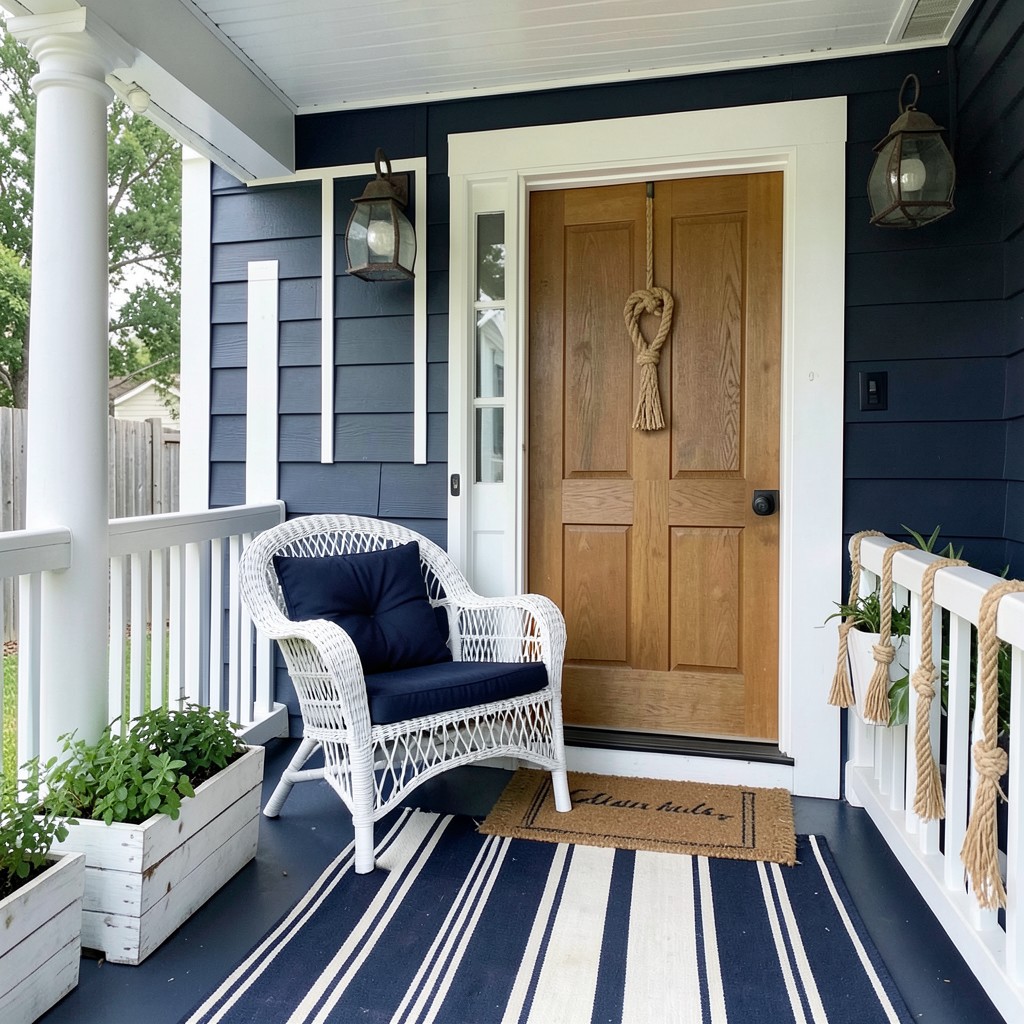
A nautically themed front porch — navy blue and white as the primary color combination, natural rope accents, lantern-style light fixtures in weathered metal, and planting in whitewashed wooden containers — communicates a connection to the coastal environment that suits any house within driving distance of water. This is not a theme that requires proximity to the ocean to work, though. The nautical aesthetic succeeds because it is built around a consistent material and color logic that reads as coherent from any distance, and coherence is the quality that any design theme requires to avoid reading as costume.
The navy and white combination is the anchor of the nautical porch palette, and it must be executed with sufficient contrast to read as deliberate rather than accidental. A navy porch floor with white-painted balusters and trim against a natural wood-tone door produces the primary color statement. Navy cushions on a white wicker chair reinforces the theme at the furniture layer. A striped outdoor rug — navy, white, and natural — repeats the color relationship at the floor level. This repetition of the same color pair at different surfaces and scales is the compositional discipline that makes a themed porch read as designed throughout rather than in isolated elements.
The rope accent — natural manila or sisal rope used as a railing wrap, a hanging planter suspension, a doormat trim, or a decorative knot on the door — is the material detail that introduces texture and authenticity into the nautical porch without crossing into cartoonish literal-mindedness. A rope-wrapped column reads as an organic, tactile material choice. A rope tied in a displayed sailor’s knot as a wall decoration reads as a prop rather than a design element. The distinction between material-led and symbol-led nautical decoration is the line between a theme that feels lived in and one that feels purchased as a set.
33. A Front Porch With Native Plant Landscaping
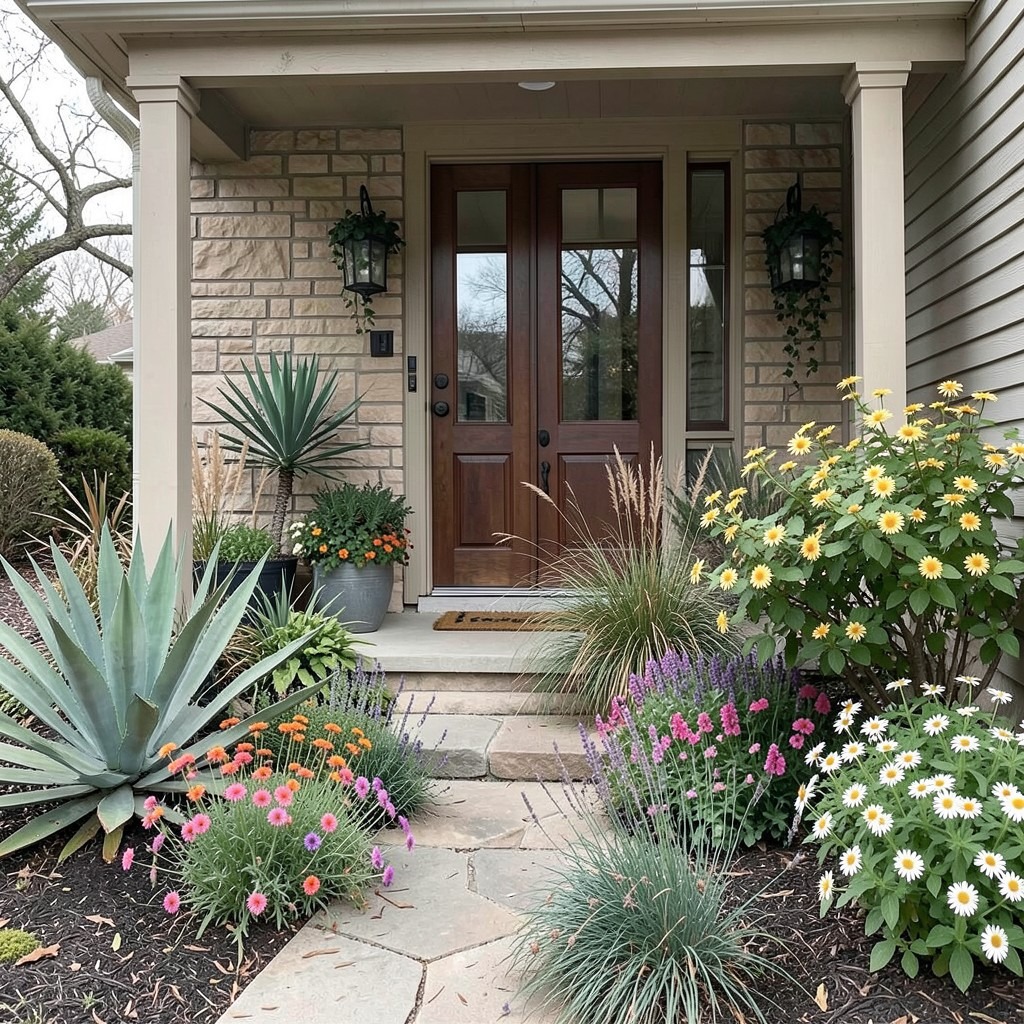
A front porch framed by native plant landscaping — the beds and containers filled with species indigenous to the local region rather than the imported ornamental varieties that most residential landscapes default to — produces a porch environment that looks placed rather than transplanted, that requires a fraction of the maintenance that exotic species demand, and that supports the local ecology in ways that ornamental planting does not. Native plants on a front porch are not a compromise — they are a design choice that communicates ecological awareness alongside aesthetic intelligence.
The visual character of native plant landscaping depends entirely on which region’s plant palette is being applied. The native plants of the American Southwest — agave, yucca, native grasses, desert willow — produce an architectural, sculptural planting character entirely unlike the soft, cottage-garden quality of Eastern Woodland natives like wild geranium, ferns, and native viburnum. Both are native plant approaches, and both are appropriate to their respective regions. The mistake is applying a native plant approach using species from a different region — Southwestern cactus on a New England porch reads as a set design choice rather than a genuine ecological choice.
The front porch native planting should include at minimum one species that flowers at each season — early spring, high summer, and late autumn — to maintain visual interest across the full year. Native asters extend the porch planting’s visual contribution well into autumn when most exotic ornamentals have finished. Native witch hazel flowers through winter in enough regions to be the one planting that gives the front porch a living floral presence in the months when every other plant is dormant. That year-round sequencing is the planning discipline that separates a considered native planting from a single-season display.
34. A Front Porch With a French Country Aesthetic
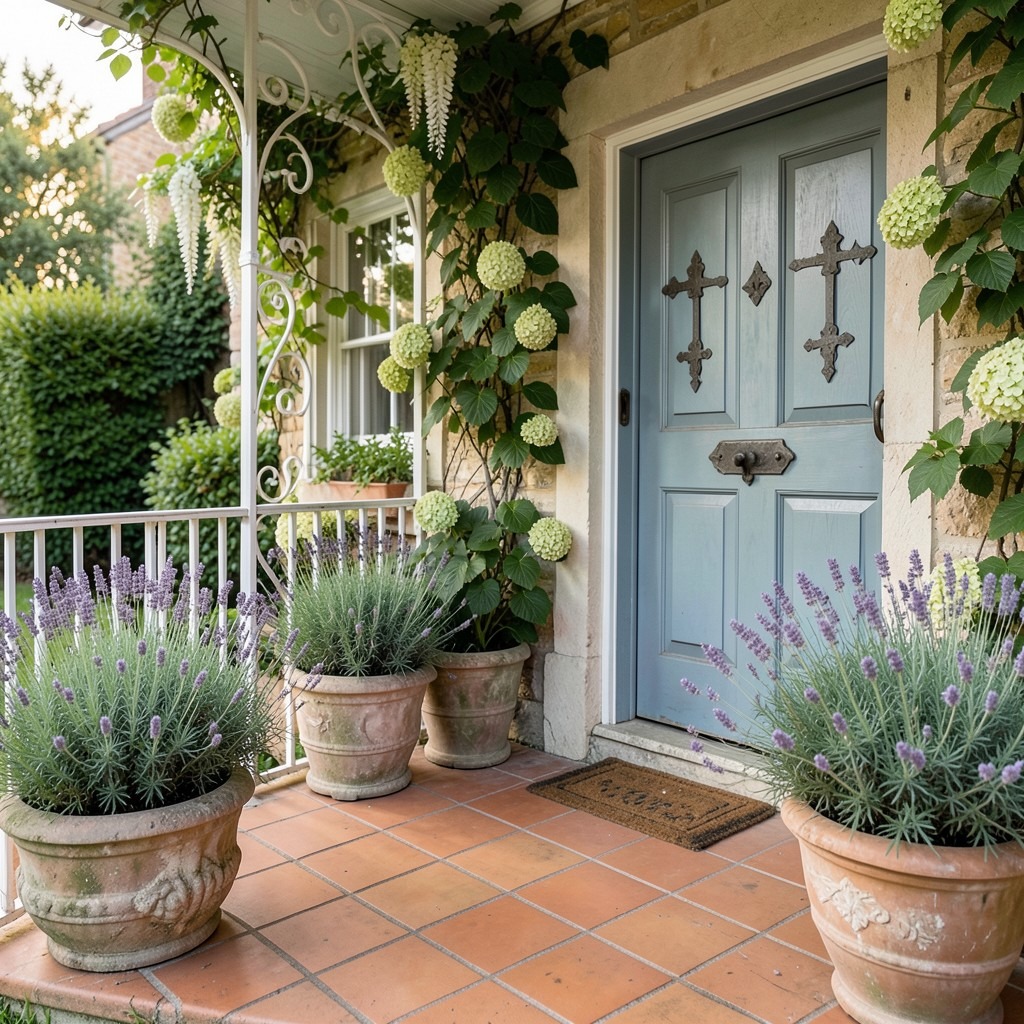
A French country front porch — terracotta tile floor, lavender in aged stone planters, white-painted ironwork railing, climbing hydrangea or wisteria on the façade, and a door in faded blue-grey with oversized ironwork hardware — occupies a design space between formal and relaxed that few other aesthetic directions achieve with the same consistency. The French country porch feels lived in and accumulated rather than styled, which is the quality that makes it so persistently attractive to anyone who has actually spent time in the French countryside and experienced the specific quality of domestic architecture that develops over centuries of incremental inhabitation.
The terracotta tile floor is the material foundation of the French country porch and the element that must be specified correctly to avoid the common failure mode of terracotta: freeze-thaw damage. Not all terracotta tiles are suitable for exterior use in frost-prone climates — the higher-fired, lower-porosity options specifically designated for exterior use handle freeze-thaw cycling without the surface spalling that unrated terracotta eventually displays. The color variation between tiles in a natural terracotta — each piece slightly different in tone from its neighbors — is the visual quality that makes the floor read as aged and authentic rather than uniform and manufactured.
The lavender planting in stone or aged ceramic planters is the scent element of the French country porch that no other plant delivers with the same authority. In full flower, lavender in planters on a warm afternoon produces a fragrance that reaches arriving visitors before they have stepped onto the porch, and that olfactory welcome is one of the most powerful arrival experiences any porch planting generates. The lavender also performs visually as a structural, silver-leaved plant when not in flower, which gives the containers a year-round presence rather than a seasonal one.
35. A Front Porch With Custom House Numbers
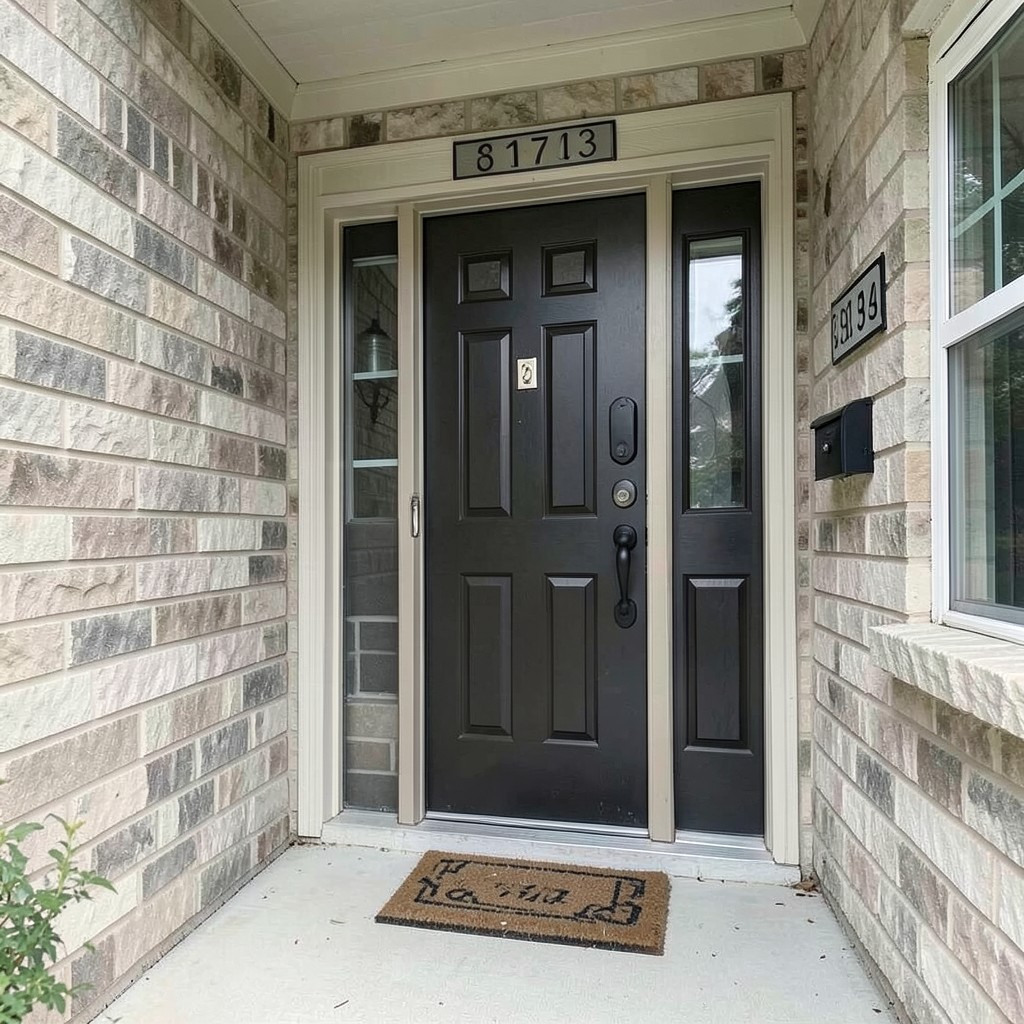
House numbers on a front porch are almost universally treated as a functional afterthought — whatever the hardware store had in stock, in whatever material required the least thought, applied to the house wall at whatever height seemed approximately correct. The result, on most houses, is house numbers that are barely visible from the street, that do not coordinate with any other hardware on the porch, and that communicate the same absence of design thought as every other detail that was selected without reference to the whole. Custom house numbers are the correction that costs almost nothing relative to its visual impact.
The scale of house numbers visible from the street requires more consideration than most homeowners apply. A set of numbers that looks appropriate viewed from two feet in a hardware store looks undersized from twenty feet at the street, where the numbers must be readable in variable light conditions by a visitor or delivery driver who may be moving rather than stationary. Numbers at a minimum height of four to five inches — and preferably six inches for a house set back more than thirty feet from the street — read clearly from the road and make an adequate visual statement against the façade at a scale that smaller numbers never achieve.
The material and finish of the house numbers should coordinate directly with the porch’s other metal hardware — the door handle, the light fixture, the mailbox, the door knocker if one is present. A porch with all other hardware in a matte black finish and house numbers in brushed nickel has an unresolved hardware palette that reads as assembled rather than designed. Consistent hardware finish across all metal elements on the front porch — numbers, fixtures, handles, mailbox — is the coordination discipline that produces the quality of a porch where everything was selected in relation to everything else.
36. A Front Porch With a Wraparound Design
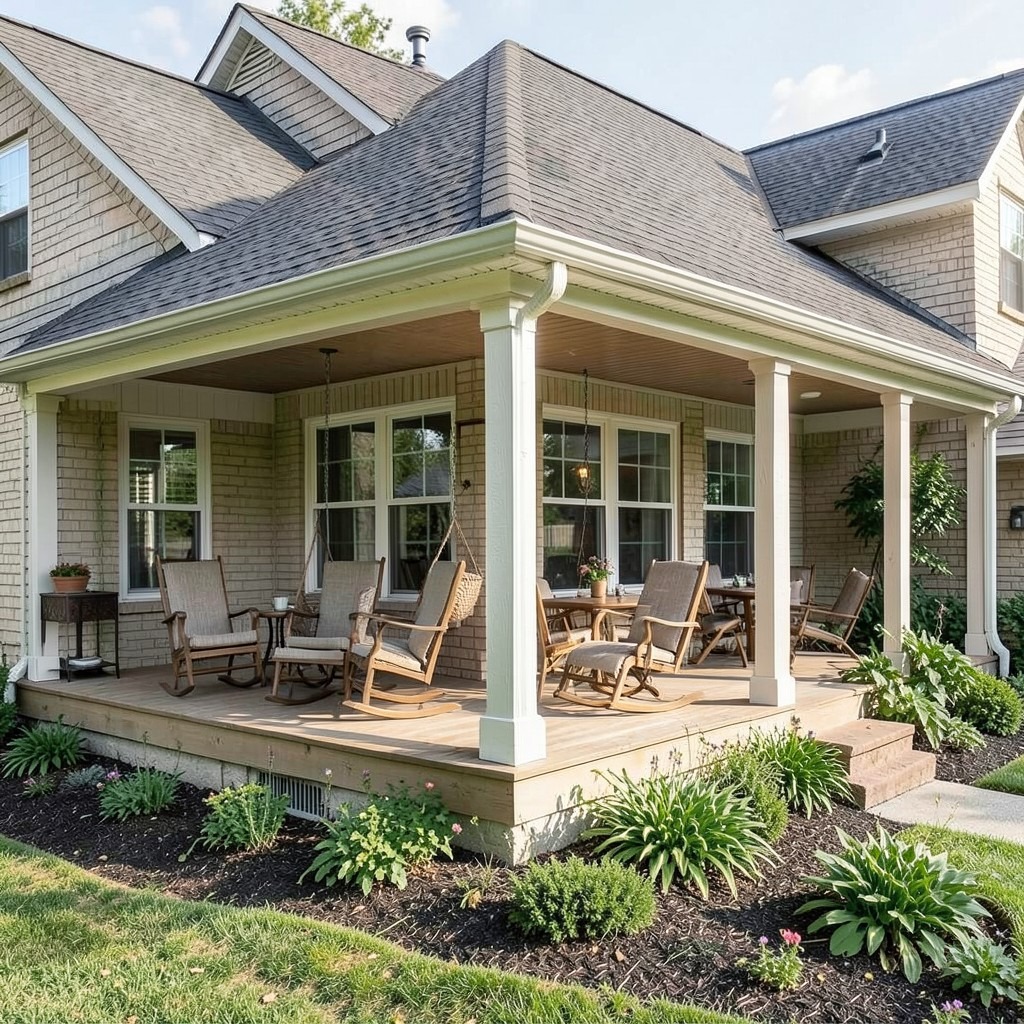
A wraparound porch — one that extends beyond the front façade and continues along one or both side elevations of the house — is the architectural feature that most fundamentally changes the relationship between the house and its outdoor space. A wraparound porch creates multiple outdoor rooms within a single continuous covered structure: the front-facing section for street visibility and arrival, the side-facing sections for more private seating, gardening, or morning sun depending on orientation. The different sections of a wraparound porch receive different light at different times of day, which means the porch offers a genuinely different outdoor experience at the same location across morning, midday, and afternoon.
The structural engineering of a wraparound porch addition — if one is being added rather than restored — requires the corner columns where the front and side sections meet to handle the load from both roof planes simultaneously. These corner columns carry more load than any intermediate column and require larger cross-sections or additional footings to handle the combined structural demand. This is the detail that underfunded wraparound porch additions get wrong, and the long-term consequence is a corner column that settles, cracks, or shows stress in its connection to the roof structure years after the construction is complete.
The furniture arrangement on a wraparound porch benefits from treating the front and side sections as distinct rooms with complementary functions rather than as a single continuous space with furniture scattered throughout. The front section — visible from the street — is the social, greeting space with the rocking chairs or swing that communicates porch inhabitation to anyone passing. The side section — more private, typically receiving the morning or afternoon sun depending on its orientation — is the reading, breakfasting, coffee-drinking space where the household sits for personal rather than social use. That functional differentiation gives the wraparound porch the variety of a proper outdoor living suite.
37. A Front Porch With a Minimalist Design
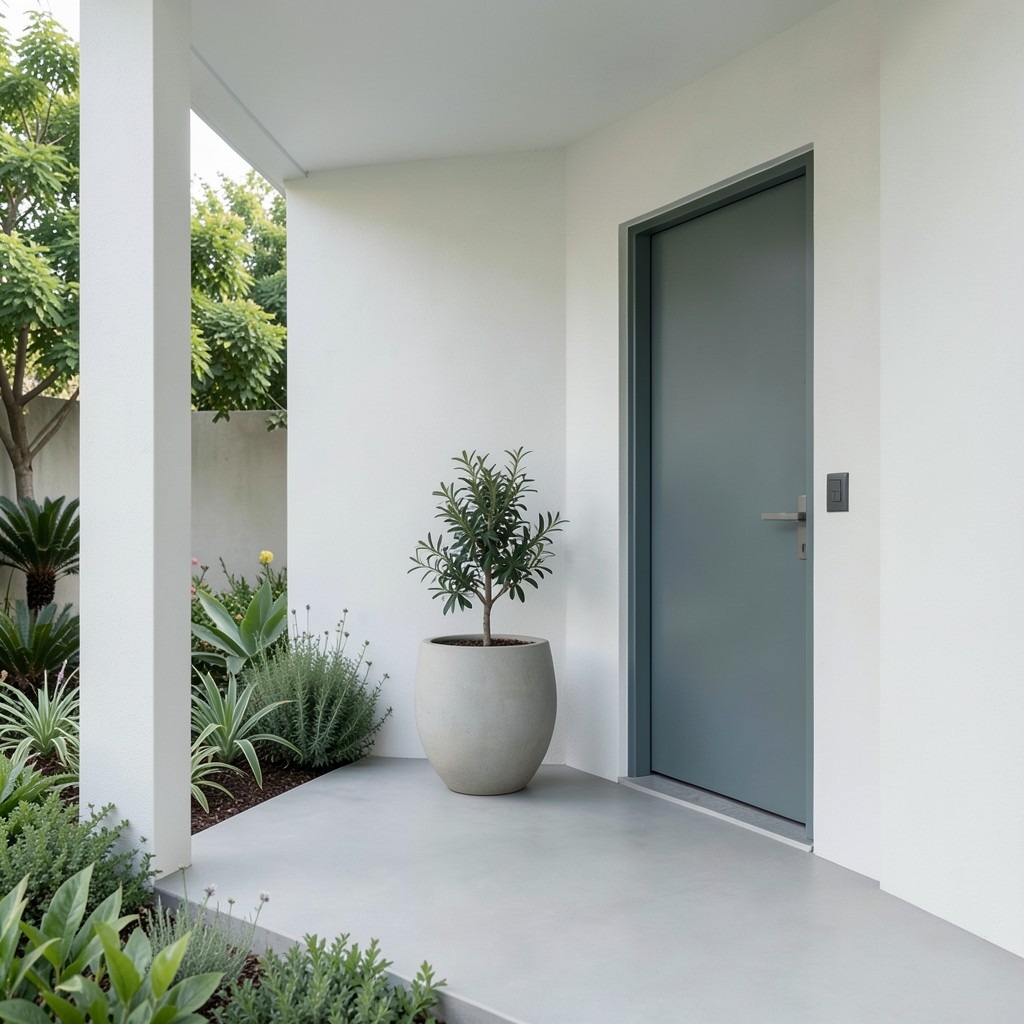
A minimalist front porch — one whose design achieves its quality through what it omits rather than what it includes — is the most demanding design approach available for a front porch because it removes the ability to add more when the result does not feel complete. The minimalist porch requires that every element present earns its place through genuine functional or aesthetic contribution and that the relationships between those elements — the proportions, the material quality, the spatial intervals — carry the design without the support of additional objects. Nothing to hide behind. The quality of the decisions is everything.
The material quality on a minimalist porch must be higher than on a maximalist one because there is nothing else to look at. A rough or uneven concrete floor is acceptable when it is surrounded by layered planting and busy decorative elements that draw the eye away from it. On a minimalist porch with nothing else competing for attention, the floor is the room, and its quality reads at the highest resolution. This principle applies to every surface and every material — the door’s paint quality, the column’s finish, the floor’s surface texture must all be the best version of themselves because the minimalist design does not provide cover for anything less.
Two elements on a minimalist porch, selected and positioned with the care that two elements deserve when they are the only ones present, produce a porch with more design intelligence than one with twenty elements selected without that care. A single large ceramic planter in a distinctive form, planted with one architectural plant, beside a door in one well-chosen color, on a floor in one immaculate material — this is a minimalist porch that reads as extraordinary rather than empty. The discipline is not in removing everything. It is in keeping exactly the right things.
38. A Front Porch With a Window Garden Display
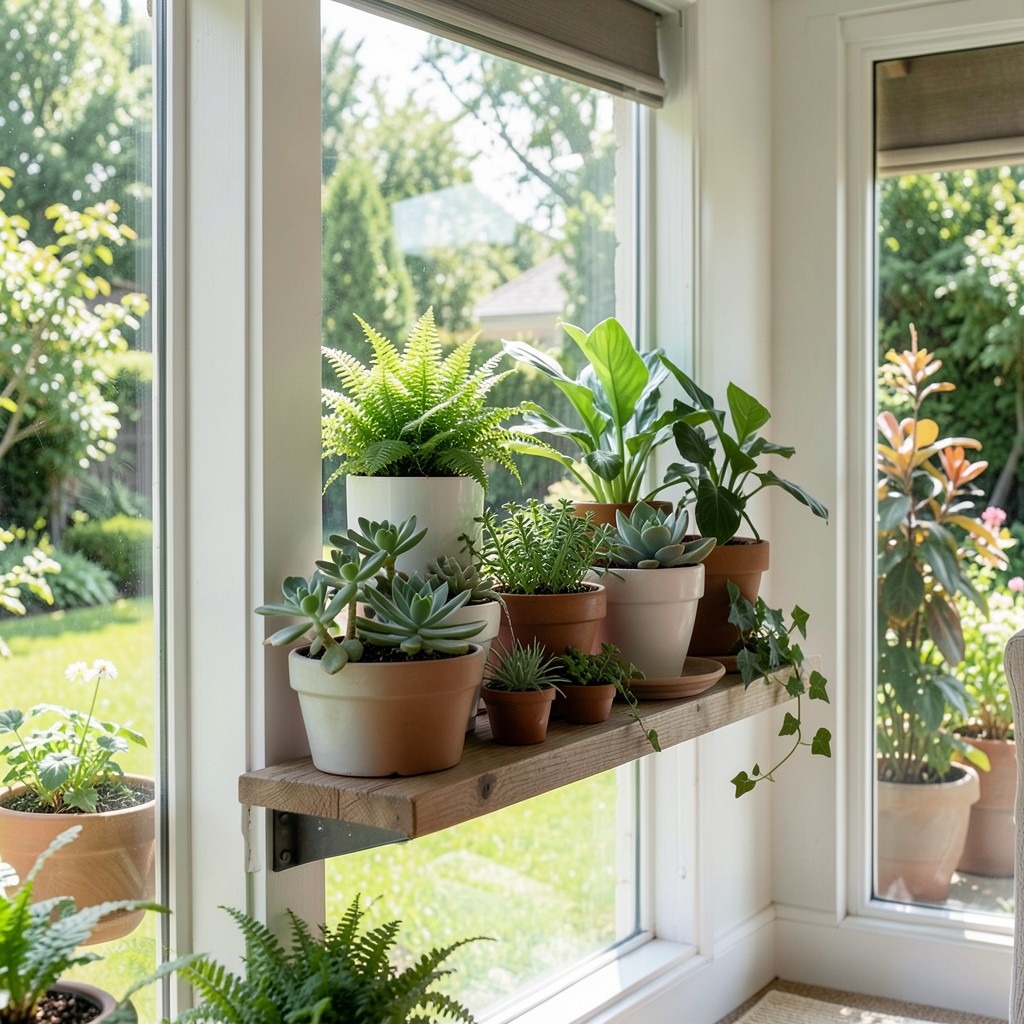
A window garden display on the front porch — a collection of potted plants arranged in the window or on a window shelf to be visible from both inside and outside — turns the porch windows into a living display that serves both the street view and the interior view simultaneously. The plants are experienced from the outside as part of the porch’s visual character, and from the inside as a green foreground that frames the outdoor view while bringing life to the interior room the window serves. No other design element in the porch’s vocabulary serves both inside and outside perspectives at the same time.
The window shelf or bracket that supports a window plant display must carry the combined weight of pots, growing medium, and water without flex or movement — a shelf that moves when plants are watered or rearranged undermines the stability that plants require and creates a safety concern if any pot is near the edge. A fixed timber or metal shelf anchored into the window frame’s structural surround handles the load requirements and provides the visual base that makes the plant collection read as a composed display rather than a collection of pots looking for a surface.
The plant selection for a window garden display must address the specific light conditions from the window’s aspect and the interior air conditions that the plants experience on the inside-facing portion of the display. A south-facing window shelf in full sun suits succulents, herbs, and flowering annuals that require high light. A north-facing window display must rely on shade-tolerant plants — ferns, ivy, and shade-adapted tropical foliage — that perform in the lower light conditions without the leggy, pale growth that sun-requiring plants produce when they do not receive sufficient direct light.
39. A Front Porch With a Black and White Color Scheme
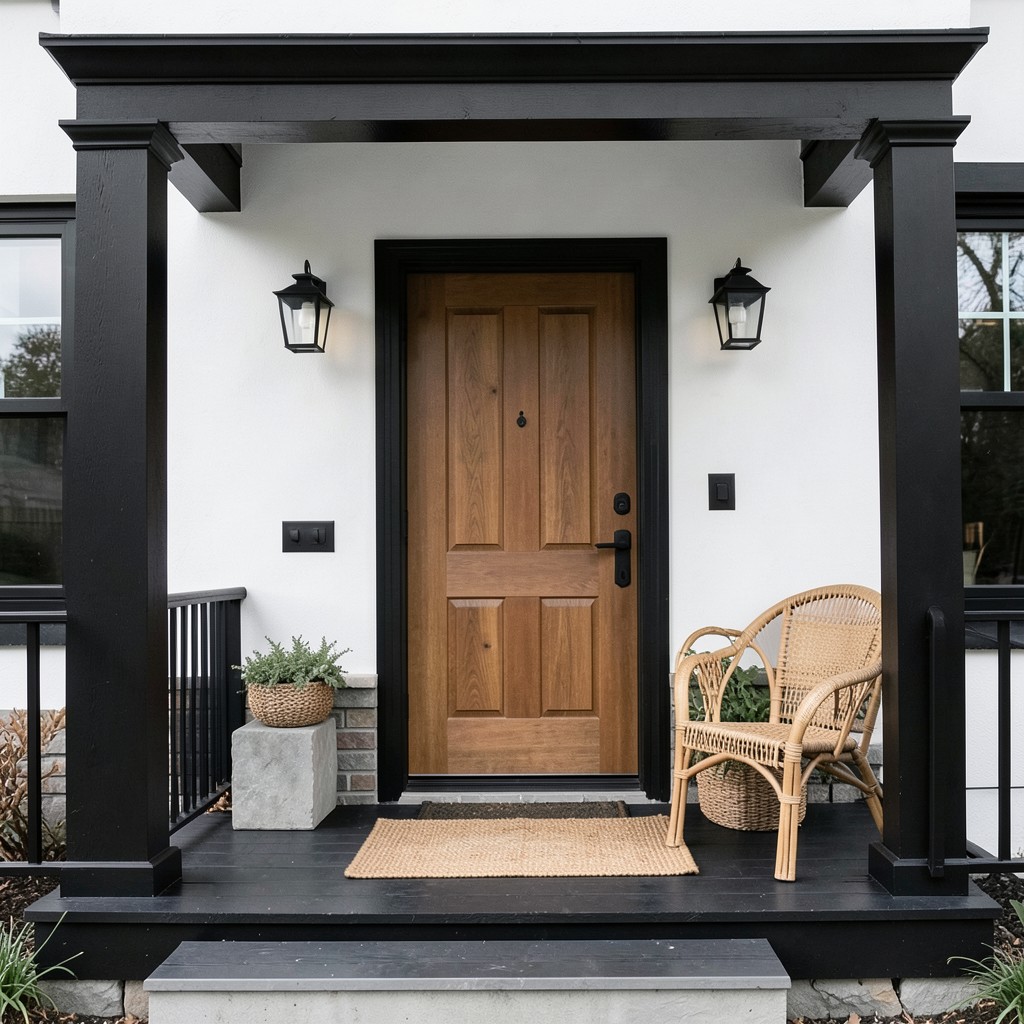
A front porch in black and white — matte black painted trim and columns against a white-painted board or render façade, with black hardware, black fixtures, and accents in natural materials that sit between the two tones — produces a porch with the graphic confidence of a composition that has been stripped back to its essential contrast. Black and white is not a neutral non-choice on a porch; it is the most high-contrast palette available and the one that photographs most powerfully, which explains why it appears so consistently in architectural photography of residential exteriors.
The balance between black and white — how much of each appears on the porch — determines whether the porch reads as clean and contemporary or dramatic and heavy. A porch that is predominantly white with black accents reads as bright, airy, and open. A porch that is predominantly black with white accents reads as bold, grounded, and sophisticated — appropriate for a house with a strong architectural statement but potentially overwhelming for a modest house scale where the darkness reduces the perceived size of the façade. The entry door in the opposite tone from the dominant surface color is the most efficient way to create the contrast that makes the black and white scheme read as a composition rather than a default.
The natural material accents within a black and white porch palette — timber, rattan, woven textiles in natural tones, stone in warm grey or sand — provide the organic warmth that prevents the porch from reading as cold or clinical. A strictly black and white porch with no natural material presence reads as a graphic exercise rather than a domestic space. One timber element — a wood-stained door, a rattan chair, a natural fiber rug — introduces the warmth that makes the high-contrast palette feel like a home rather than a design demonstration.
40. A Front Porch With Seasonal Decorating
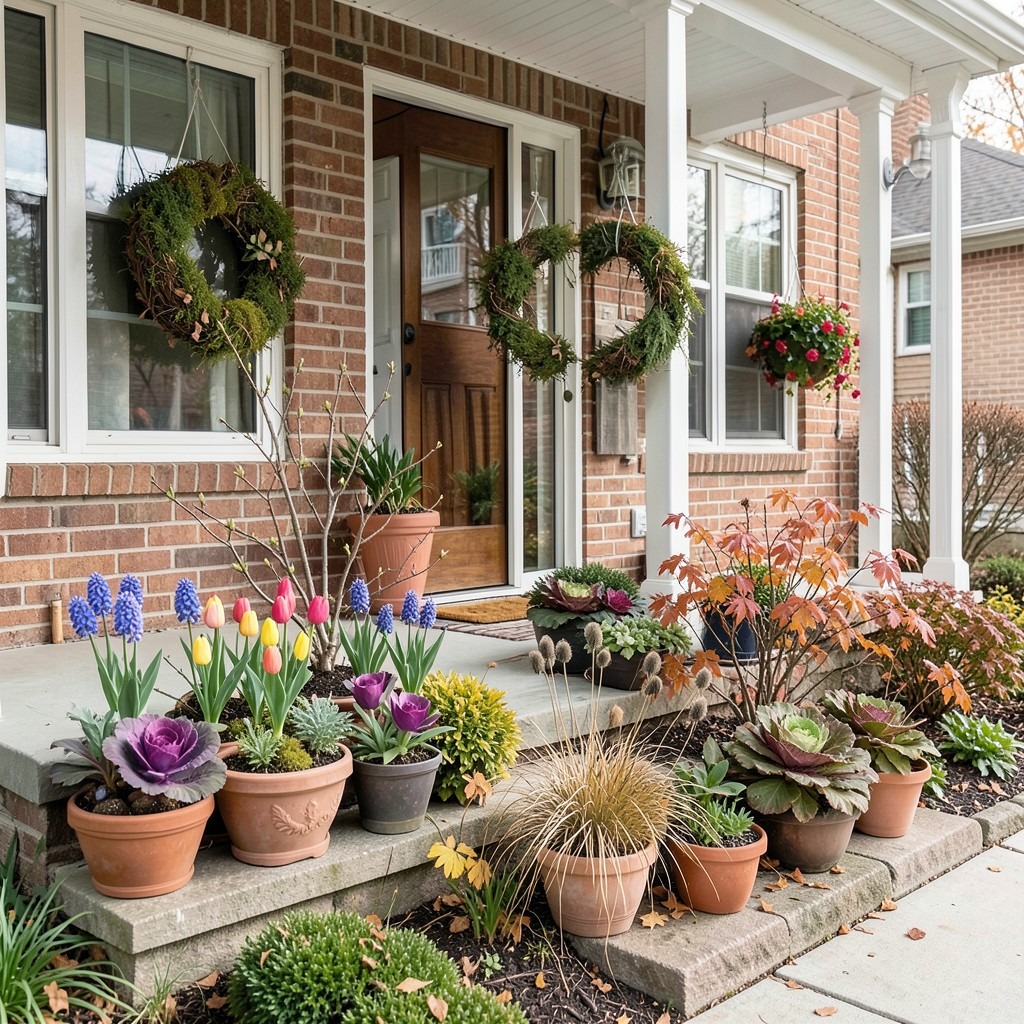
A front porch that changes with the seasons — its decorative elements shifted to reflect spring, summer, autumn, and winter in turn — communicates that the household is actively engaged with its outdoor space through the full year rather than maintaining a static arrangement set once and left indefinitely. Seasonal porch decorating is the most visible and most direct expression of a household’s relationship to its outdoor space, and it is noticed by neighbors and visitors in a way that most other porch design decisions are not.
The seasonal shift should be anchored in planting changes rather than purely decorative accessory changes, because plants communicate seasonality with the authenticity of biology rather than the intention of decoration. Spring planting — tulip and hyacinth bulbs in containers, fresh moss wreaths, budding branches — communicates the season through growth and fragrance that no artificial element replicates. Autumn planting — ornamental cabbages, seed heads left on dried grasses, branches with color-turning leaves — communicates the season through the specific visual character of its plant material. The seasonal decoration that sits on top of a seasonal planting reads as considered; the seasonal decoration without any corresponding planting change reads as accessory-level rather than design-level.
The transition points between seasons are the moments when the porch most clearly communicates whether a household maintains its outdoor space with attention or inertia. A porch where the summer planting remains wilted and past its peak through the first weeks of autumn, waiting to be replaced, reads as a porch that gets attention in bursts rather than continuously. A porch where the transition is made promptly — the summer containers replanted at the first sign of seasonal change, the decorative elements shifted to reflect the incoming season — communicates year-round engagement that is as visible and as communicative as any permanent design decision.
41. A Front Porch With a Victorian Aesthetic
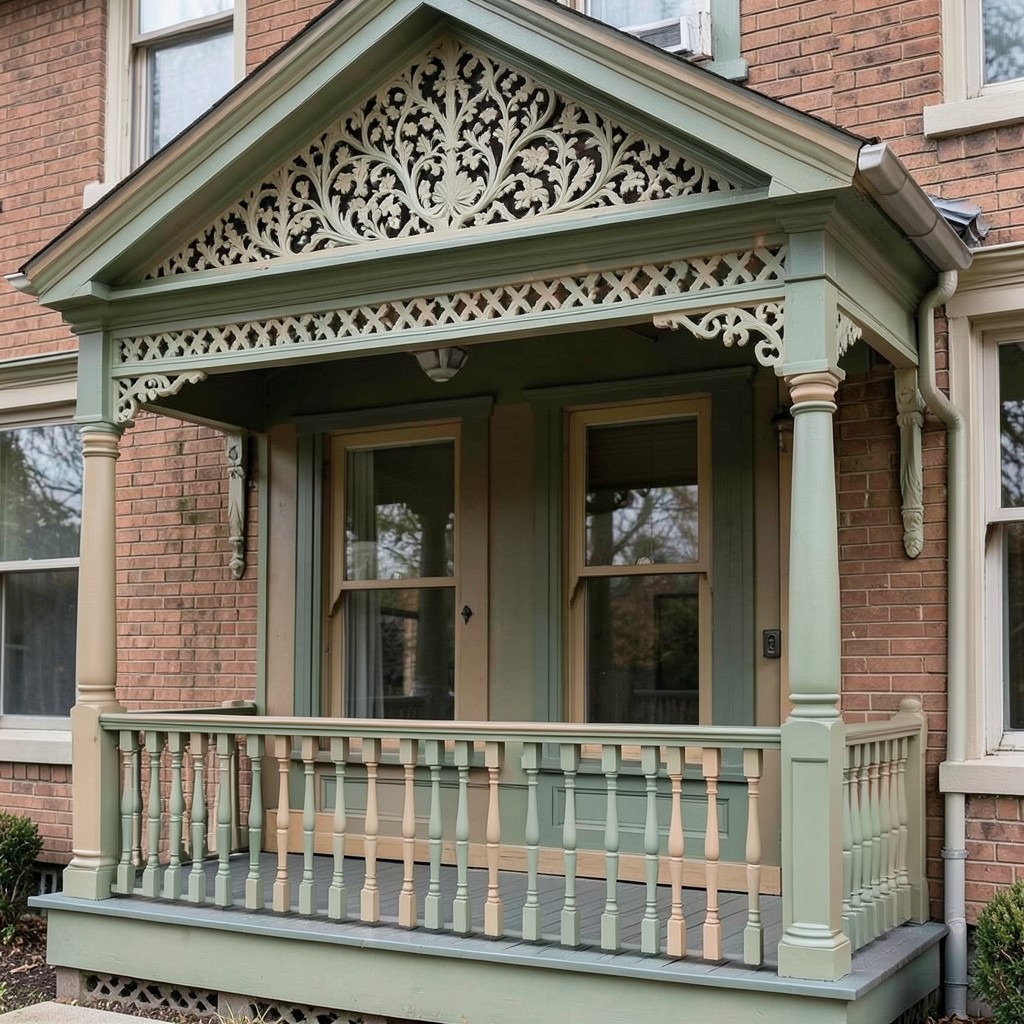
A Victorian-inspired front porch — decorative timber fretwork in the gable, turned spindles on the balustrade, a porch column with a capital detail, deep moldings at the beam and fascia level — uses the ornamental language of nineteenth-century residential architecture to produce a porch with a richness of surface detail that contemporary design directions rarely achieve. Victorian porch ornament was produced in quantity because water-powered sawmills could cut complex decorative profiles efficiently, and the result was a period of residential architecture where exterior decoration was genuinely affordable and therefore genuinely widespread.
The gingerbread fretwork in the gable or along the fascia edge — the carved or pierced decorative timber panel that is the most recognizable signature of Victorian porch design — is the single element that most immediately establishes the Victorian aesthetic. Available from specialist millwork suppliers in a range of patterns from simple geometric cutouts to complex botanical tracery, the fretwork panel installs as a decorative infill between existing structural elements rather than as a structural component itself. The pattern selected should reference the period and regional character of the house’s architecture — a simple geometric fretwork suits a vernacular Victorian cottage while a more elaborate botanical pattern suits a more formally designed Victorian house.
The paint treatment on a Victorian porch can follow the historically accurate two or three-color approach — body color, trim color, and accent color applied to the decorative fretwork and column details — or the modern single-color or two-color simplification that reads as Victorian in form while avoiding the painting complexity of a full period restoration. The multi-color approach, done well, produces the highest-fidelity Victorian result. Done inconsistently — colors applied without reference to period precedent or to each other — it produces a porch that looks confused rather than historically informed.
42. A Front Porch With a Japanese Aesthetic
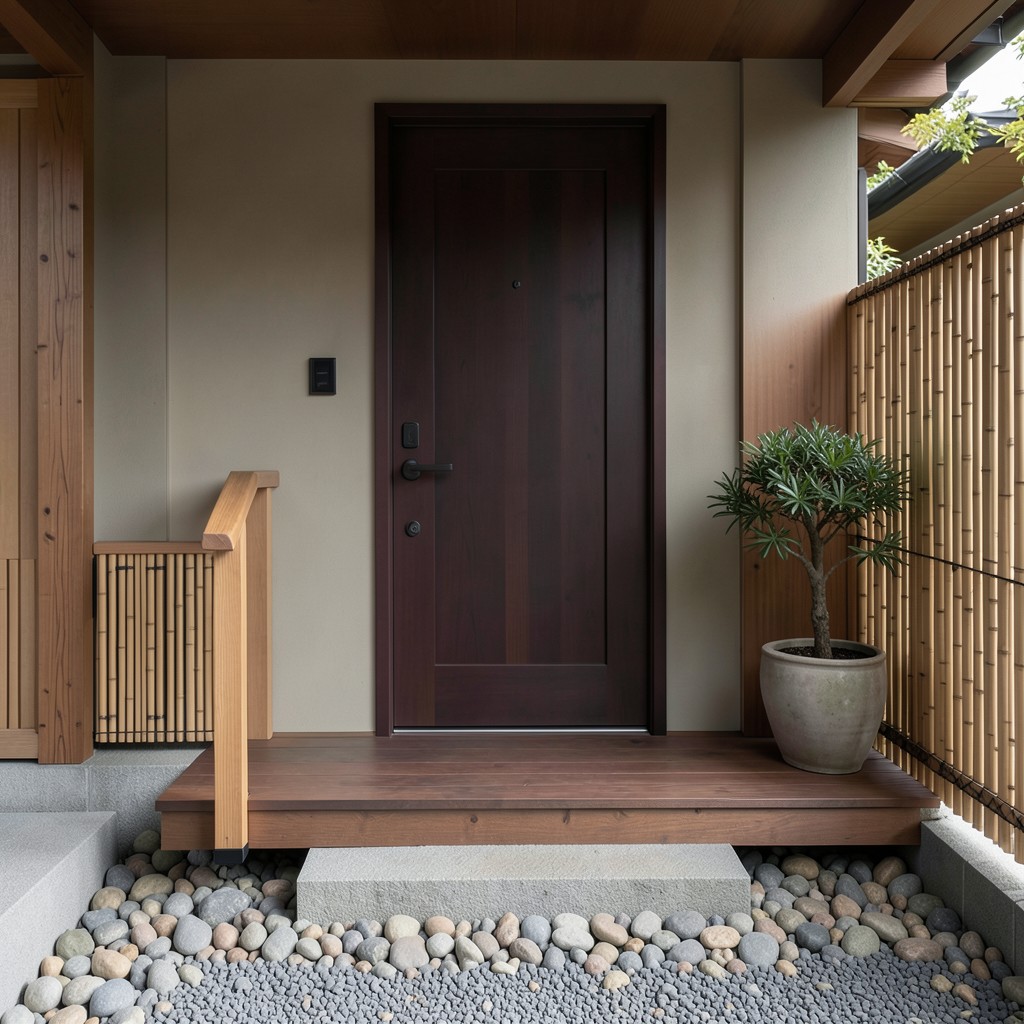
A Japanese-influenced front porch — characterized by restraint, natural materials, asymmetric composition, and the use of empty space as an active design element — produces an entry experience of remarkable calm that no other design direction approaches. The Japanese aesthetic is not about absence but about selectivity: every element present was chosen for its specific contribution, and every element absent was deliberately left out. That selectivity is visible in the result, and the quality of calm it produces is immediately felt by anyone who approaches the porch.
The material palette of a Japanese-influenced porch centers on natural materials handled with precision: smooth river stones in a gravel bed at the base of the steps, a timber handrail with a clean single profile and a natural oil finish, a bamboo fence panel as a partial privacy screen, a single specimen plant in a ceramic container selected for the quality of its form rather than its floral impact. None of these materials are unusual or expensive. Their quality comes from the precision of their selection and placement — the stones are smooth and consistent in size, the gravel is raked to a clean surface, the timber is free of imperfections, the plant form is architectural.
The front door on a Japanese-influenced porch should be solid, simple in profile, and in a deep natural tone — a dark stained cedar, a lacquered charcoal black, a deep persimmon red that references the traditional torii gate color. The hardware is minimal: one handle in a simple forged metal form, no visible hinges, no letter slot or additional attachments that break the door’s clean surface. The door reads as a statement of precision and intention, and the approach through the restrained, carefully considered porch makes the arrival at this door the culminating experience of a composed entry sequence.
43. A Front Porch With Layered Greenery
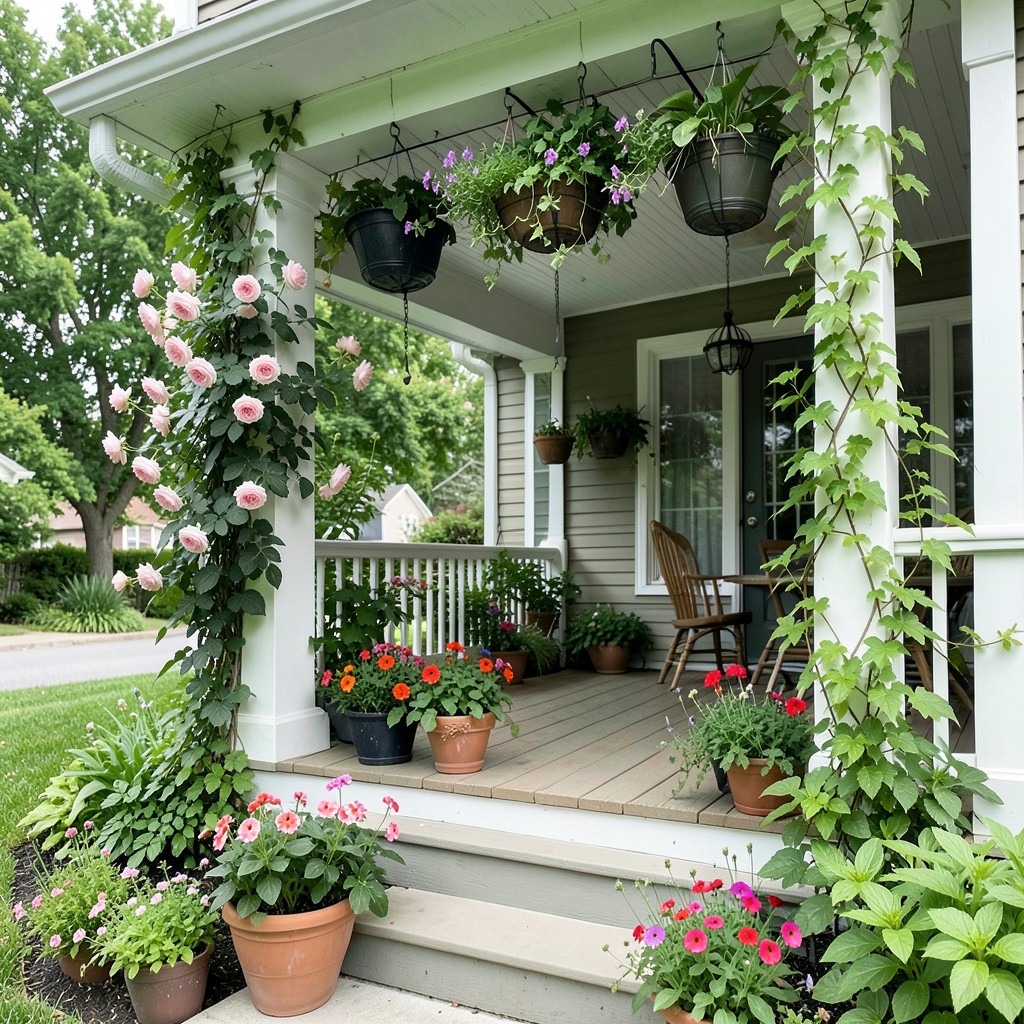
A front porch where the greenery is layered from ground level through mid-height to overhead — ground-level planting at the base of the steps, container planting on the porch floor, climbing plants on the columns and railing, and hanging planters or planted trellises at the ceiling level — produces a porch that reads as immersed in planting rather than decorated with it. The layered effect wraps the porch in green from every angle, which produces the quality of a covered outdoor space where the structure and the planting have merged into a single experience.
The visual coherence of layered greenery requires a consistent plant palette rather than a collection of unrelated species at different heights. When the climbing rose on the column shares its pink and white color palette with the impatiens in the floor-level containers and the trailing fuchsia in the hanging planters above, the three layers read as one composed planting scheme rather than three separate planting decisions happening at the same porch. Choosing the height and structural layers first and then selecting plants that relate to each other across the full height of the arrangement is the sequencing that produces the layered effect rather than the accumulated one.
The maintenance requirement of a layered planting increases proportionally with its height — the overhead planters are the most demanding to water and deadhead because their access requires a step stool or a ladder for every maintenance visit. Drip irrigation lines run to the upper-level containers, combined with a slow-release fertilizer incorporated at planting, reduce the maintenance frequency enough that the overhead layer remains viable for a household that does not want to tend the porch daily. Without an irrigation solution, the overhead planting is the first layer to suffer during a busy week and the one whose decline is most visible from the street.
44. A Front Porch With a Concrete and Steel Aesthetic
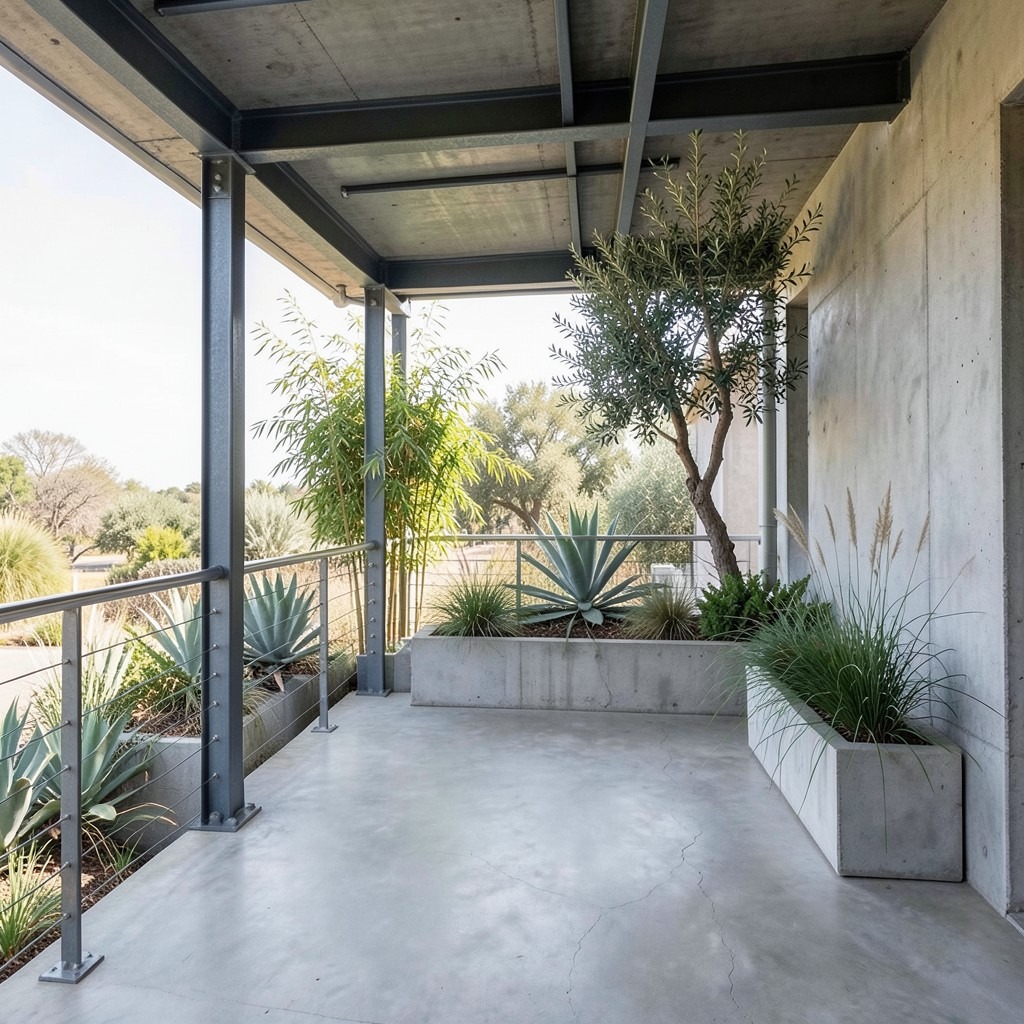
A contemporary porch in exposed concrete and steel — painted or stained concrete floor, steel column sections, steel cable or flat bar balustrade, and a steel-framed overhead structure with the structural detail left visible — produces a porch with an industrial material honesty that reads as architecturally serious rather than domestically comfortable. This is not a warm aesthetic and it is not trying to be — it suits houses with a strong contemporary or industrial design direction where the porch’s character should be an extension of the house’s architectural statement rather than a softening counterpoint to it.
The steel cable balustrade — horizontal stainless steel cables tensioned between steel posts — is the railing detail that most effectively bridges the gap between the industrial material language of steel and the desire for an unobstructed view through the railing to the landscape beyond. The cables are nearly invisible from a forty-five degree angle and produce a railing that reads as architectural structure without the solid visual barrier of timber balusters. The tension of the cables must be maintained — a sagging cable balustrade reads as failed rather than merely casual — and the end post anchorage must handle the cumulative tension of all cables without bending over the course of years.
The planting on a concrete and steel porch requires species with the architectural presence to hold their own against the material weight of the structure. Agave, bamboo in a contained planter, ornamental grasses at a large scale, or a single specimen olive tree — plants with strong formal qualities and a material presence that reads as structural alongside concrete and steel — suit this aesthetic. Soft, cottage-style planting against a concrete and steel porch creates a discord between the structure’s character and the planting’s character that reads as an unresolved design decision rather than a deliberate tension.
45. A Front Porch With a Tropical Aesthetic
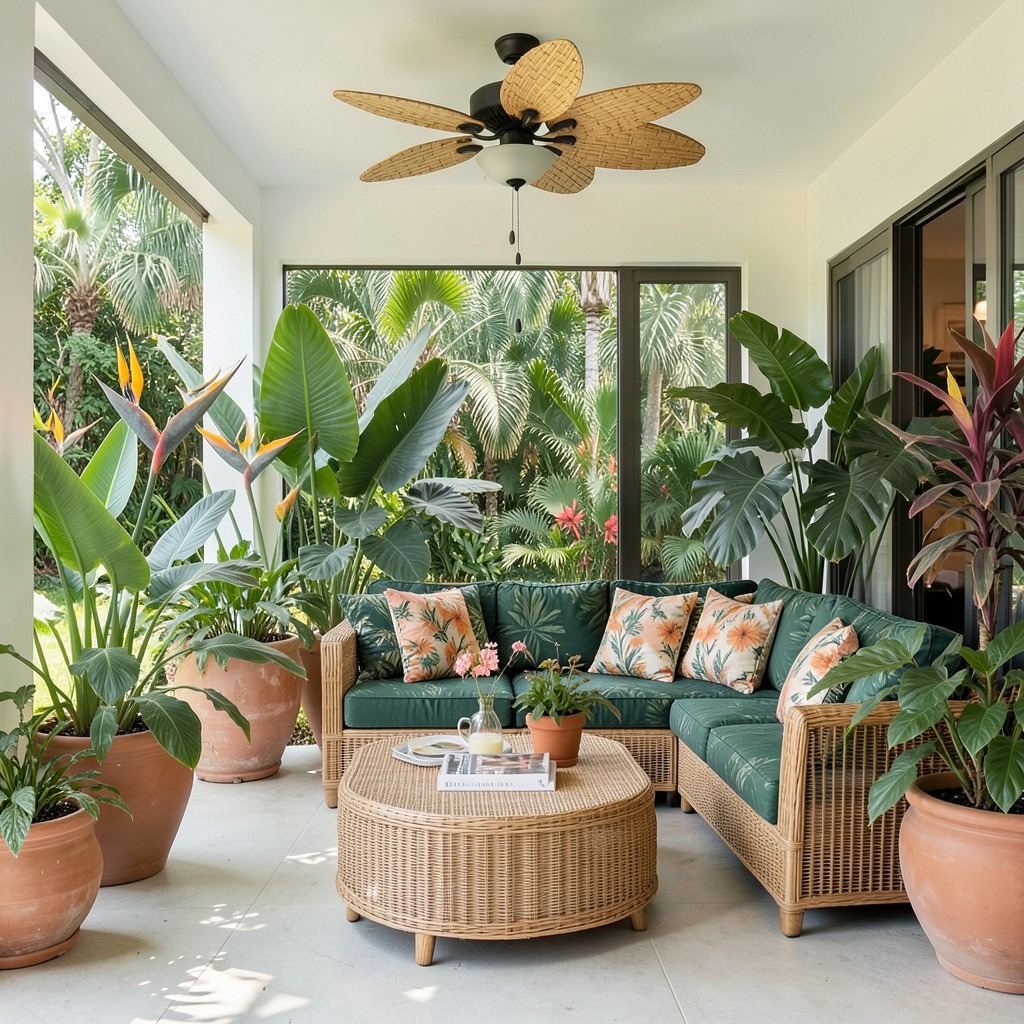
A tropical front porch — large-leafed plants in generous containers, woven rattan furniture, a ceiling fan with natural bamboo blades, and a color palette drawn from the tropics: warm white, deep green, and accents of mango orange or hibiscus pink — produces a porch with an exuberant, generous quality that suits warm climate residential architecture and delivers the specific pleasure of feeling that the outdoor space is lush and alive with biological abundance rather than carefully managed and controlled.
The plant selection for a tropical porch must prioritize foliage scale and density over flower quantity, because tropical plant character is built on leaf architecture rather than flower production. Bird of paradise, elephant ear, split-leaf philodendron, and large-form ornamental gingers produce the oversized, architecturally compelling foliage that reads as tropical at first glance. These are not subtle plants — they fill their containers quickly, grow to a scale that commands the porch rather than merely occupying it, and require a genuine commitment of container volume and watering frequency to maintain the lush quality that makes the tropical aesthetic work.
The rattan furniture on a tropical porch should be deep-seated and generously proportioned — the low, wide seating that suits the relaxed, horizontal quality of tropical porch occupation. A low rattan sofa with thick cushions in an outdoor fabric in a deep botanical green or a warm cream reads as genuinely relaxed rather than merely casual. The coffee table at the center should be low — twelve to sixteen inches — to suit the low seating height and to carry drinks and books at a reachable level rather than at a height that requires sitting upright to access.
46. A Front Porch With a Cottage Garden Approach
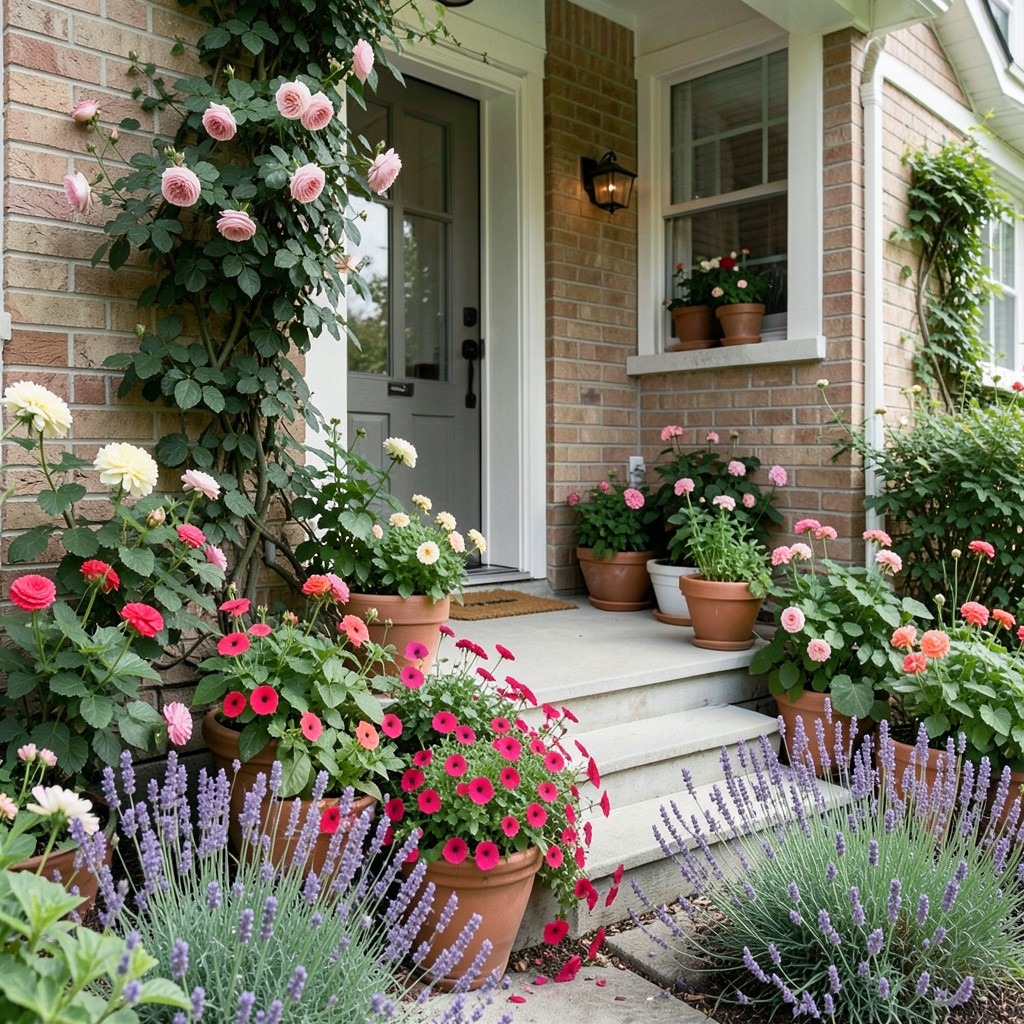
A cottage garden front porch — overflowing with flowering plants in containers and beds, with a fragrant climbing rose on the wall, a lavender border at the steps, and a general productive abundance that prioritizes floral generosity over compositional restraint — produces the warmest, most welcoming arrival experience of any porch design direction. The cottage garden aesthetic communicates that flowers are grown and loved in this household, that the outdoor space is actively tended with pleasure rather than managed as an obligation, and that visitors are arriving somewhere genuinely alive.
The apparent chaos of a cottage garden porch is not accidental — it is achieved through a specific planting discipline that selects plants at the right scale for their positions and allows them to grow to their natural fullness without the intervention that a more formal planting scheme requires. A petunia allowed to trail thirty inches over a container edge without deadheading — producing a cascade of flower rather than a tidy ball — reads as cottage garden abundance. The same plant cut back to a neat dome reads as formal planting. The cottage garden principle is one of maximum expression within the container’s limits rather than control of the plant’s natural form.
The cottage garden porch requires the most consistent ongoing maintenance of any porch planting approach, because its quality depends on flowers that must be deadheaded regularly to continue blooming, plants that must be watered through dry periods to maintain the lush fullness that makes the approach work, and a seasonal replanting schedule that keeps the containers filled through every month of the growing season. This is not a porch planting for households that want a planted porch without ongoing involvement. It is a porch planting for households that find genuine pleasure in the daily interaction with their plants, and for those households it delivers a daily reward that no lower-maintenance approach matches.
47. A Front Porch With Smart Home Integration
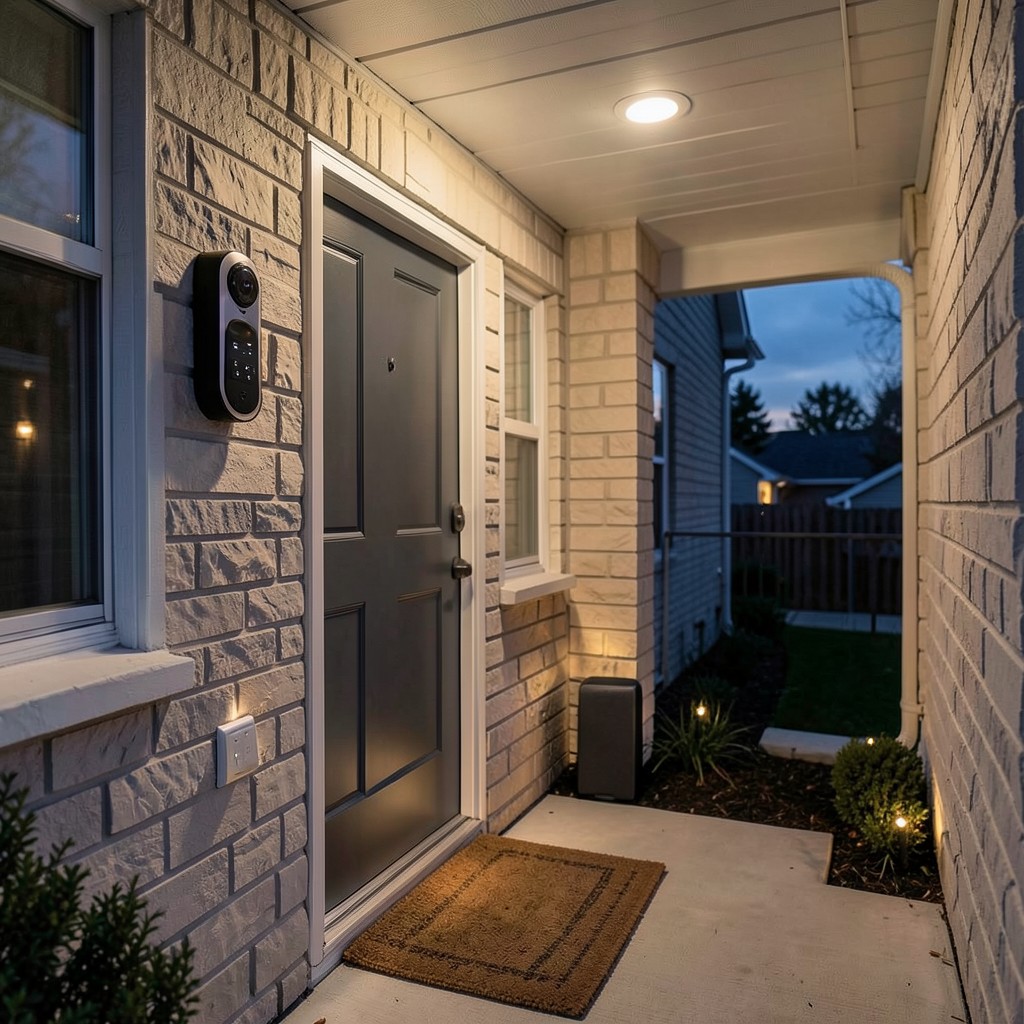
A front porch integrated with smart home technology — a video doorbell with two-way audio and a wide-angle camera, smart deadbolt with keypad or app entry, motion-activated lighting that responds to approaching visitors, and a smart speaker for ambient music or visitor audio communication — is the front porch designed for the way contemporary households actually interact with their entry rather than the way entries were designed in the era before connectivity was a design consideration.
The video doorbell is the smart porch technology with the highest daily utility and the strongest impact on household security and convenience simultaneously. A doorbell camera that provides clear footage of the porch and the approach path from both inside the home on a phone screen and through a cloud recording system gives the household a visible deterrent to package theft and an always-on record of porch activity that provides genuine peace of mind. The installation position of the camera — typically replacing the existing doorbell and mounting in the same location — should be checked for sight angle before final installation, because a camera aimed too high captures sky and porch roof while missing the activity at knee and waist height where packages are deposited and faces are at their least recognizable angle.
The smart lighting integration on a front porch — motion-activated overhead lights that switch on at a set sensitivity threshold, timed pathway lights that activate at dusk and deactivate at dawn, and app-controlled ambiance lighting for the evenings — provides both security and atmosphere without requiring the household to manually manage the porch lights through the variable conditions of different seasons. A porch that lights up automatically as a visitor approaches communicates active occupation and attentiveness — the lighting equivalent of noticing someone coming before they have knocked.
48. A Front Porch With Reclaimed Brick Details
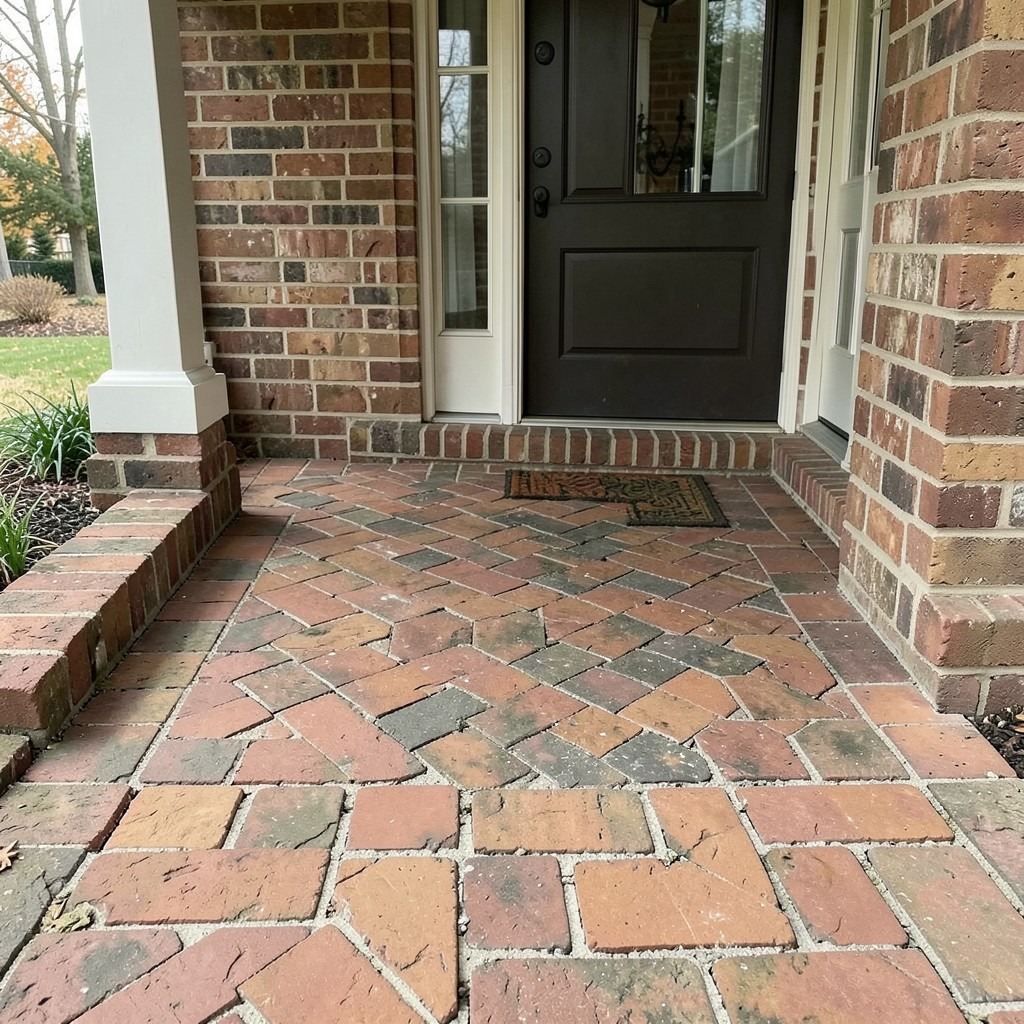
Reclaimed brick used as a surface material on a front porch — as a floor, as a column facing, as a planter surround, or as a low boundary wall at the porch perimeter — introduces the specific warmth and the tonal variation of aged material that new brick, however high its quality, does not possess. Reclaimed bricks carry the marks of their previous use: the lime mortar residue on their faces, the slight variation in color from kiln batch to kiln batch, the chips and edges worn by handling and exposure across decades. These marks are not defects — they are the material evidence of history, and they read on a porch as authenticity.
The floor application of reclaimed brick requires the same specification care as any brick paving — the brick must be rated for ground-level exterior use and frost resistant in climates with freeze-thaw cycles. Not all reclaimed brick was manufactured for paving conditions: wall bricks salvaged from demolition are manufactured for a load and moisture profile different from paving bricks and will spall in a ground-level paving application in frosty conditions. Reclaimed engineering bricks or purpose-made clay pavers salvaged from historic paving projects provide the authentic material quality of old brick with the technical specification for exterior paving use.
The color range within reclaimed brick — the variation between individual bricks in a single batch of salvaged material — is the visual quality that makes a reclaimed brick porch floor read as completely different from a new brick floor laid in the same pattern. New bricks are consistent in color within a manufacturing batch; reclaimed bricks from multiple sources and multiple eras produce a floor surface with a tonal complexity that reads as accumulated over time rather than installed at a single moment. That tonal richness is the quality that makes reclaimed brick floors worth the premium in both material cost and laying complexity.
49. A Front Porch With Architectural Columns
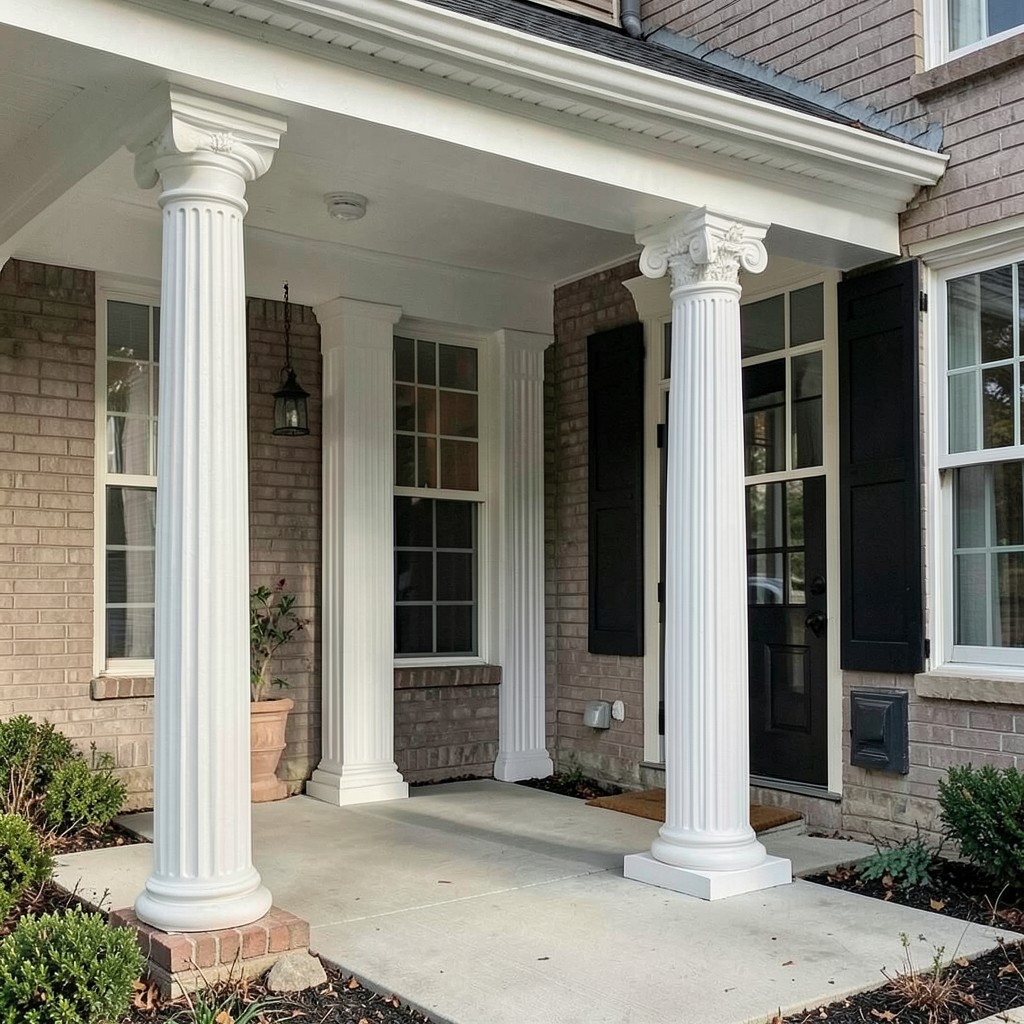
The columns on a front porch are doing more structural and aesthetic work than any other single element of the porch’s architecture, and their proportions, material, and detailing determine whether the porch reads as architecturally composed or structurally approximate. A column that is too slender for the load it appears to carry reads as inadequate. A column that is too heavy for the scale of the porch reads as oppressive. A column that is sized correctly for the roof it carries and the porch proportions it inhabits reads as resolved — the detail that makes the porch look right without the viewer knowing precisely why.
The classical column orders — Doric, Ionic, Corinthian — provide a proportioning system developed over two thousand years of refinement that produces columns scaled correctly in relation to their height, their spacing, and the entablature they support. A Doric column — the simplest of the three orders, with no base molding and a plain square capital — is the appropriate choice for a simple, traditional American porch where the column’s primary role is structural clarity rather than decorative elaboration. An Ionic column with its scrolled capital suits a more formally detailed porch. A Corinthian column with its leaf-form capital suits the grandest traditional residential applications where decorative elaboration is the explicit design intention.
The material of porch columns has shifted substantially in contemporary residential construction from solid timber to composite and fiber cement systems that resist moisture infiltration and the wood rot that eventually affects timber columns at their base, where ground moisture and standing water from rain accumulate. Composite column wraps applied over an existing timber structural post — a decorative casing that provides the column’s aesthetic profile while the structural post carries the load — offer the most cost-effective upgrade for an existing porch and allow any classical column profile to be applied regardless of the structural post’s original dimensions.
50. A Front Porch Designed to Become the Home’s Best Feature
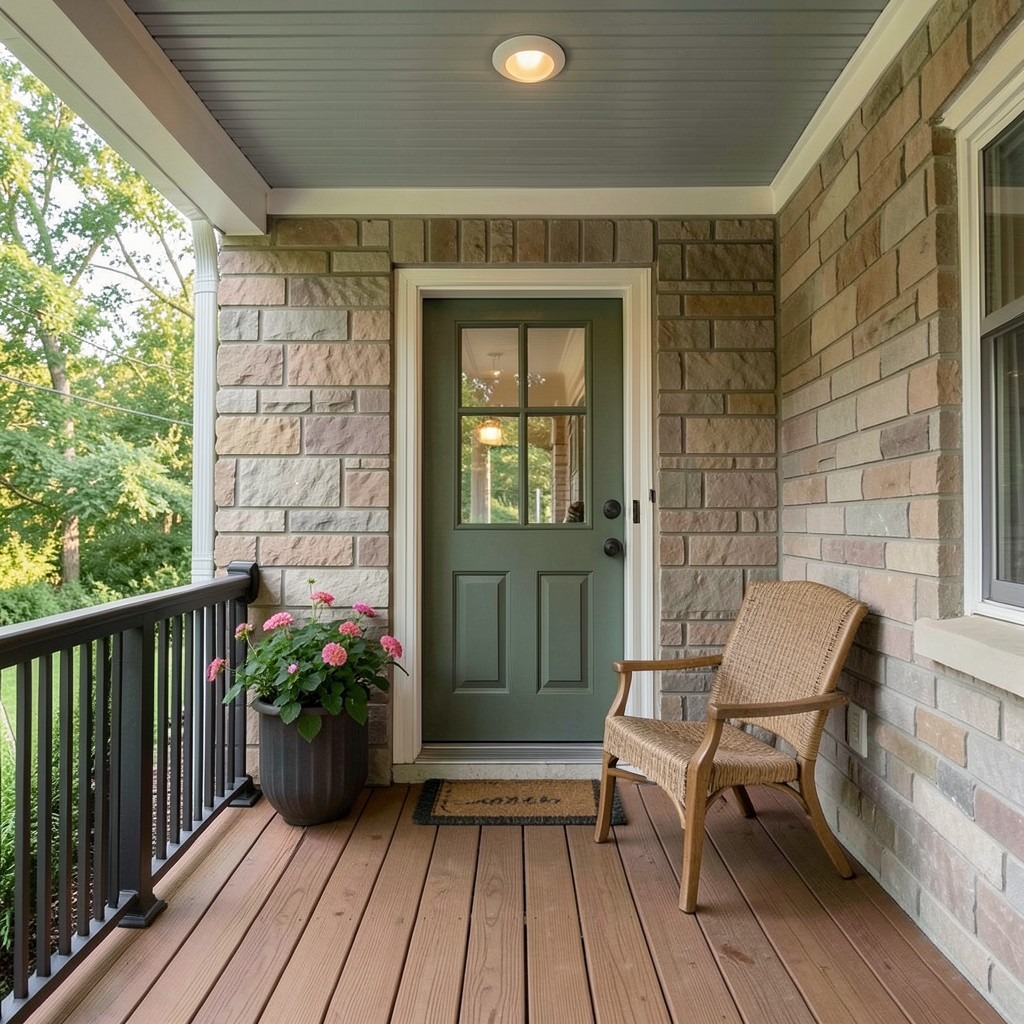
The front porch that becomes the most-used, most-commented-on, most-loved space in the household is never the most expensive one — it is the one where someone thought clearly about what the porch was for, who would use it, how it would feel at different hours and in different conditions, and what specific details would make the experience of arriving at and sitting on the porch something worth looking forward to. That quality of thinking cannot be purchased. It can only be applied.
Start with the structure before the decoration. A porch floor that is level, sound, and finished in a material you genuinely like to look at is the foundation on which everything else is built. A porch railing that is at the correct height and in a material and profile that belongs to the house’s design direction provides the spatial definition that makes the porch feel like a room rather than a ledge. A porch ceiling that is considered — painted in a color, clad in a material, or at minimum in a finish that was chosen rather than defaulted to — gives the space an overhead surface that rewards looking up. These are the structural decisions that require the least money and the most thought, and they are the decisions that determine the quality of every subsequent choice made within them.
The front porch that people talk about years after they visited — the one they describe when they explain what made a house feel welcoming, what made an arrival feel like an event rather than a transition — earns that description through the accumulation of small, specific decisions. The right chair in the right position. The light that is warm enough to flatter everyone who passes beneath it. The plant that blooms at exactly the height where you notice it on the approach. The door color that makes you feel, without knowing why, that the household on the other side of it is worth knowing. These are the details that a designed front porch delivers. Start with one idea from this list and build from there — the porch you want is already waiting in the decisions you have not yet made.
Leave a Reply