
The balcony is the smallest outdoor space most people will ever own, and it is often the one they think about the most. There is something specific about a balcony — its elevation above the street, its defined edges, its contained relationship with the sky — that makes it feel more intimate and more personal than a backyard or a garden that simply extends away from the house. A balcony has clear limits. You know exactly where it ends. And within those limits, the design decisions you make carry more weight per square foot than almost any other space in the home.
What makes balcony design genuinely interesting is the tension it presents. The space is small but the potential is not. A balcony that receives good light and looks out over something worth looking at can become the most used room in the apartment — the place where coffee happens every morning, where dinner is eaten on warm evenings, where the end of a long day gets processed in ten minutes of stillness above the noise. But that transformation from a concrete slab with a railing to a room you actively choose does not happen by accident. It requires thought, and it requires the kind of thought that addresses the specific constraints of elevated, exposed, and compact outdoor living rather than adapting garden or backyard ideas that were never designed for this context.
Most balconies fail for one of three reasons. The first is scale blindness — furniture chosen at a scale appropriate for a terrace or a garden that overwhelms the balcony the moment it is placed on it, leaving no room for movement, occupation, or the feeling of being in a space rather than a storage facility. The second is treating the balcony as a secondary space — somewhere to put the plants that do not quite work inside, the chair that has been replaced in the living room, the objects that have nowhere else to go. The third is failing to solve the environmental problems that make the balcony uncomfortable in practice: the wind that makes sitting there unpleasant, the sun that makes the afternoon impossible, the rain exposure that makes the furniture unusable for days after any significant downpour.
The balcony design ideas in this collection address all of these challenges across fifty distinct approaches that cover every dimension of what a balcony can become. Some ideas are material decisions — the floor surface, the railing treatment, the overhead covering that changes the balcony’s weather relationship. Others are furniture decisions — the specific pieces that serve a compact outdoor space without dominating it. Others still are planting strategies, lighting approaches, privacy solutions, and atmospheric choices that determine the quality of the experience the balcony provides rather than just its visual appearance.
The balcony you have right now, whatever its size and whatever its current condition, has more potential than you are probably giving it credit for. A balcony is not a consolation prize for not having a garden. At its best, it is something a garden cannot be: private, elevated, contained, and immediately accessible — the room that requires the fewest steps from your front door to the open sky. These fifty ideas are designed to help you find the version of that room that belongs specifically to your space, your life, and the way you want to feel when you step outside.
1. A Balcony With a Foldable Bistro Table
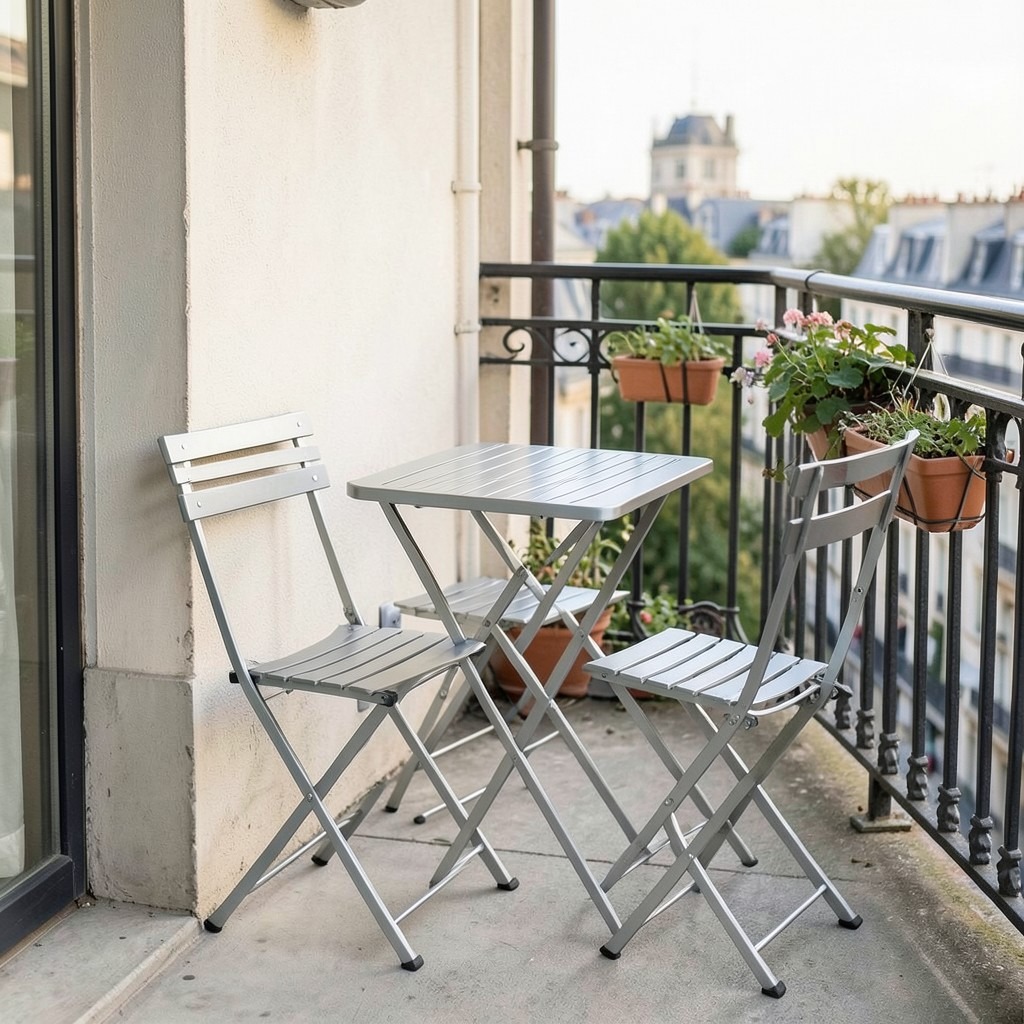
The bistro table and chair set — specifically the folding French café version in powder-coated steel with a slatted top and matching folding chairs — is the furniture solution that small balcony design has been using correctly for decades, and it works because it was designed from the beginning for exactly this spatial context. A café in Paris does not have more floor space than your balcony. It has a smarter furniture choice.
The fold-flat storage capability of a bistro set is what makes it appropriate where a fixed table would not be. When you are not sitting at it, the table folds against the wall and the chairs stack or hang on the railing, which recovers the full floor area of the balcony for any other purpose — plant access, exercising, the simple pleasure of standing at the edge with a drink and looking out without furniture blocking your feet. The transition between the table being present and absent takes thirty seconds, which means the balcony adapts its function in real time rather than committing permanently to a single configuration.
The scale of the bistro table matters on a balcony where every centimeter of diameter changes the clearance between the table edge and the railing or the wall. A sixty-centimeter diameter top is the correct specification for a balcony where the available area is under five square meters — it provides enough surface for two cups and two plates without extending into the path between the door and the railing. A seventy-centimeter top adds surface area but significantly reduces circulation space in small balcony conditions, which is the trade-off that most people regret once the furniture is in position.
2. A Balcony With a Vertical Garden Wall
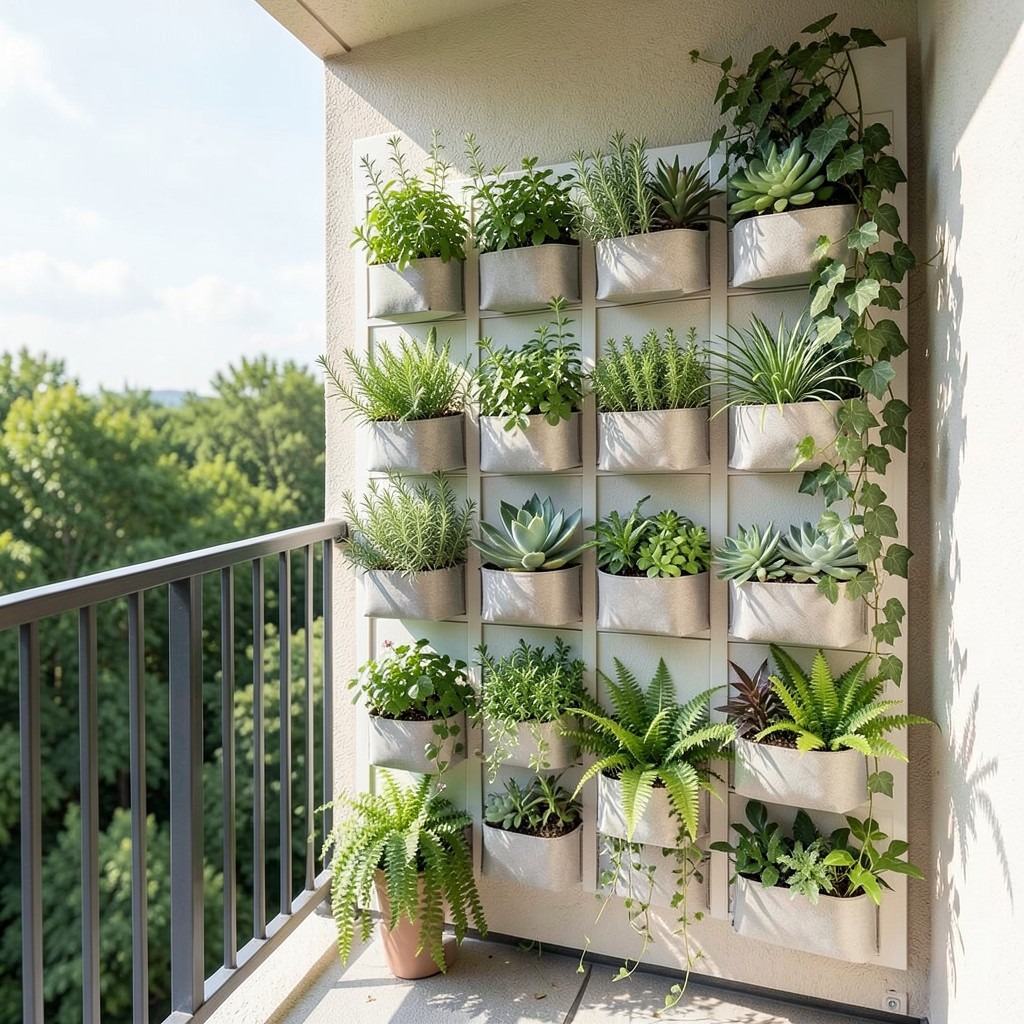
The vertical garden wall on a balcony is the design idea that solves the most persistent problem of compact outdoor planting: there is no ground. A balcony has walls and a railing — vertical surfaces that represent planting area measured in square feet rather than the linear feet of floor-level planting that a balcony’s dimensions would otherwise allow. A planted wall multiplies the available growing surface several times over in a footprint that costs the balcony nothing in floor space.
The modular pocket panel system — individual fabric or plastic pockets mounted on a lightweight panel attached to the wall or railing — provides the most accessible installation for a rental or semi-permanent balcony vertical garden. The panels are self-contained, attach with minimal fixings, and can be removed and reinstalled without permanent damage to the wall surface. Each pocket holds one plant in its own growing medium, which means the irrigation and root health of each plant is independent — one struggling plant does not affect its neighbors, and replacing a failing plant requires nothing more than removing and inserting a single pocket.
The plant selection for a balcony vertical garden must account for the specific exposure conditions of the wall surface it occupies. A sun-facing wall receives high heat and direct sun that dries each pocket rapidly — drought-tolerant herbs like thyme, oregano, and rosemary, or succulent varieties, suit this exposure. A shaded wall on the railing-facing side requires shade-tolerant species — ferns, mind-your-own-business, trailing ivy — that perform without the direct sun that most flowering plants require. Matching the plant palette to the actual wall conditions rather than to a design concept produces a vertical garden that thrives from the first season rather than one that looks spectacular for two weeks and then declines.
3. A Balcony With Outdoor String Lights
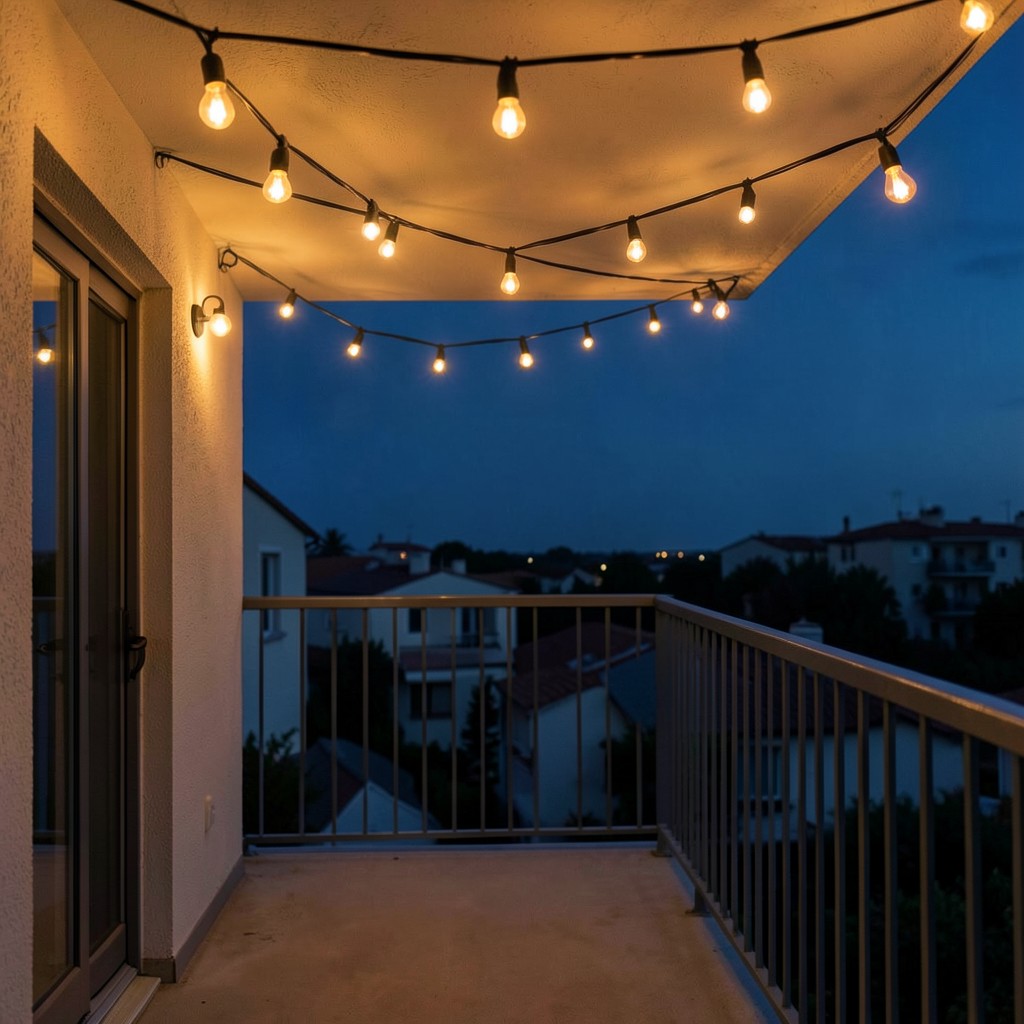
String lights on a balcony are the single upgrade with the highest ratio of atmospheric impact to cost and installation effort. Hung from two fixing points — one at the building wall and one at the outer railing post — across the overhead space of the balcony, they produce a ceiling of warm amber light that converts the balcony from a structural extension of the apartment to a room with its own identity after dark. The balcony that is a concrete platform at noon becomes somewhere entirely different at nine in the evening beneath a canopy of filament light.
The installation geometry for balcony string lights must address the absence of the permanent overhead structures that make garden string light installations simpler. Most balconies have a wall on one side and a railing on the other three, with no intermediate fixing points between them. Running a single wire between a wall hook at maximum height on the building side and a hook at the outer railing post creates a single diagonal span that provides light without the multiple attachment points that a more architectural installation requires. Adding a second line parallel to the first, from a wall hook slightly closer to the door, produces two parallel light lines that read as more composed than a single diagonal.
The bulb type and color temperature selection determines the quality of the atmosphere the string lights produce. Filament Edison bulbs at 2200K — the warmest available temperature in a commercially available LED — produce the amber glow that reads as genuinely warm rather than merely artificial at close range on a balcony, where the viewer is within arm’s reach of the bulbs rather than viewing them from across a garden. The G40 globe bulb format — a round forty-millimeter diameter globe rather than a tubular Edison shape — produces a softer, more diffuse light and suits balcony installations where the bulbs are at face height rather than well overhead.
4. A Balcony With a Built-In Bench and Storage
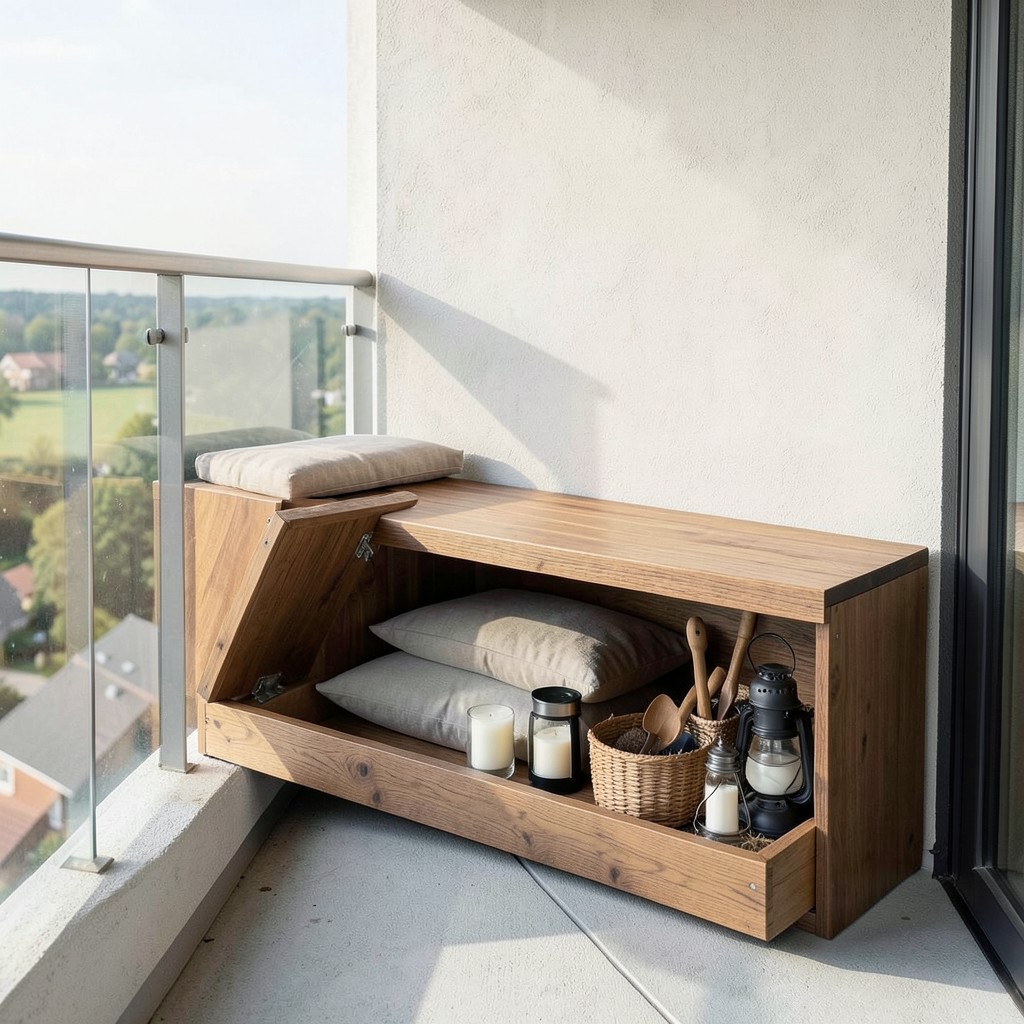
A built-in bench along one wall of a balcony — a timber platform seat with storage below accessed through a hinged lid — converts the most common waste zone in any balcony into the most useful surface it contains. The wall-adjacent floor area of a balcony is typically unused for occupation because furniture placement almost always orients toward the view, which leaves the wall side of the space as passage. A built-in bench occupies this zone purposefully, provides comfortable seating, and recovers the volume beneath the seat for storage that balconies desperately need and rarely have.
The bench depth for comfortable outdoor seating is forty-five to fifty centimeters — enough to sit with back support against the wall and feet flat on the floor without the feeling of perching on a shelf. The seat height of forty-two to forty-five centimeters produces a comfortable seated position for most adults, though higher seats suit balconies where the occupant wants to see over a solid railing from a seated position. The storage below the seat handles outdoor cushions, gardening tools, candles, lanterns, and the equipment that balcony living accumulates and that has nowhere else to go without occupying floor area or returning to the interior.
The timber specification for a built-in balcony bench must handle continuous outdoor exposure without deteriorating in the ways that affect unprotected timber in an exposed elevated location. Hardwood — iroko, cumaru, or teak — at a thickness of twenty-five millimeters handles the weather exposure and the physical loads of seating without warping, checking, or requiring more than annual oiling. Modified softwood — thermally modified pine or spruce — provides similar durability at lower cost with good dimensional stability under the moisture cycling that an exposed balcony produces through seasonal weather changes.
5. A Balcony With a Privacy Screen
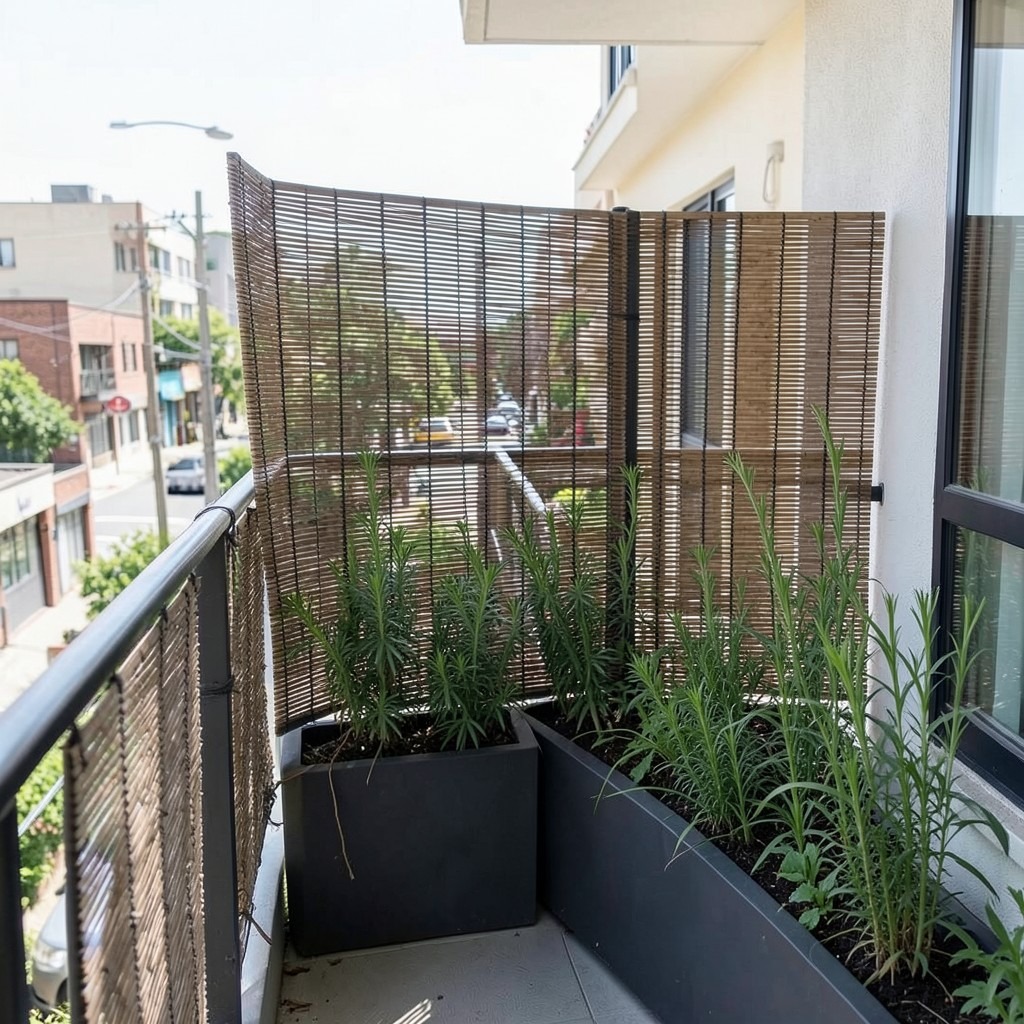
A balcony without privacy is a balcony used tentatively rather than freely. When you know a neighbor can see you from their window, or a building across the street has a clear sightline onto your outdoor space, you sit differently — not quite settled, not quite present, always slightly aware of being visible. The privacy screen removes that awareness and replaces it with the freedom to be entirely at ease in your own outdoor space without performing for anyone who happens to be looking.
The bamboo roll screen fixed to the railing — a woven bamboo or reed panel tied to the railing’s vertical posts — is the most accessible privacy solution for a rented or semi-permanent balcony. It requires no structural fixings into the building fabric, installs in under an hour, and provides good visual privacy while allowing air movement through its weave — which is the material quality that prevents the privacy screen from creating the wind trap that a solid panel produces. The bamboo screen ages to a warm grey-brown over seasons of sun exposure, which adds to its natural material quality rather than diminishing it.
A planted privacy screen — a row of tall, narrow-growing plants in a trough planter along the outer railing — provides privacy that improves with time rather than deteriorating like a fabric or timber screen. Bamboo in a railing trough planter, contained in a root-control liner, reaches screening height within two seasons and produces a living green wall that performs as privacy screen and planting display simultaneously. The specific advantage of a planted screen over any fixed material is that it moves gently in any breeze, which produces a quality of living enclosure that no static screen matches — the sense of being sheltered by something alive rather than screened by something installed.
6. A Balcony With a Small Water Feature
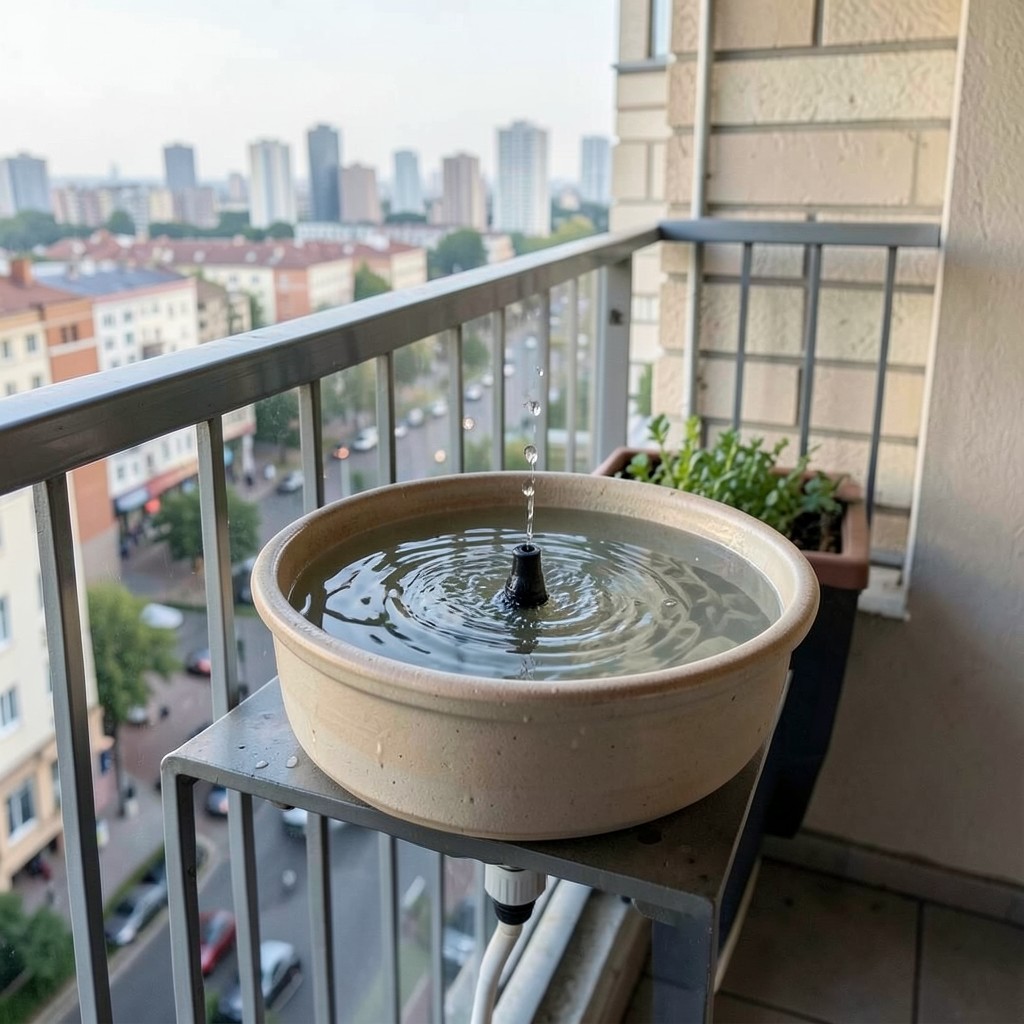
Running water on a balcony changes the acoustic environment of the outdoor space in a way that addresses the specific urban condition most balconies exist within: traffic, neighboring conversations, street noise, and the general ambient sound pressure of city living. A small recirculating fountain — compact enough to sit on a railing shelf or a floor-level planter, powered by a small submersible pump from a standard outdoor outlet — produces enough water sound to mask the lower frequencies of traffic noise and provide the acoustic foreground that makes the balcony feel separated from the urban soundscape below it.
The scale of a balcony water feature must be calibrated to the balcony’s dimensions and the output of the pump relative to the ambient noise level it needs to address. A feature producing a gentle trickle — water flowing from one ceramic vessel into another — provides enough acoustic presence for a quiet residential street but is insufficient against the background noise of a busy urban road. A feature with a slightly more energetic flow — a small fountain head producing a spreading water pattern — provides a more substantial sound layer that competes more effectively with higher ambient noise levels. The pump’s flow rate is adjustable on most models, which allows the water sound to be tuned to the specific acoustic conditions of the balcony.
The container for a balcony water feature must be waterproof, heavy enough to remain stable in the wind exposure of an elevated location, and sized to hold enough water that evaporation and splash loss do not require daily topping up. A ceramic bowl of thirty to forty centimeters diameter, filled to within five centimeters of the rim and fitted with a small submersible pump and a fountain head, provides the water volume for a recirculating feature that runs for days between any top-up requirement. The weight of the filled ceramic bowl also provides the stability against wind that lightweight plastic alternatives cannot offer at this scale.
7. A Balcony With a Hammock Chair
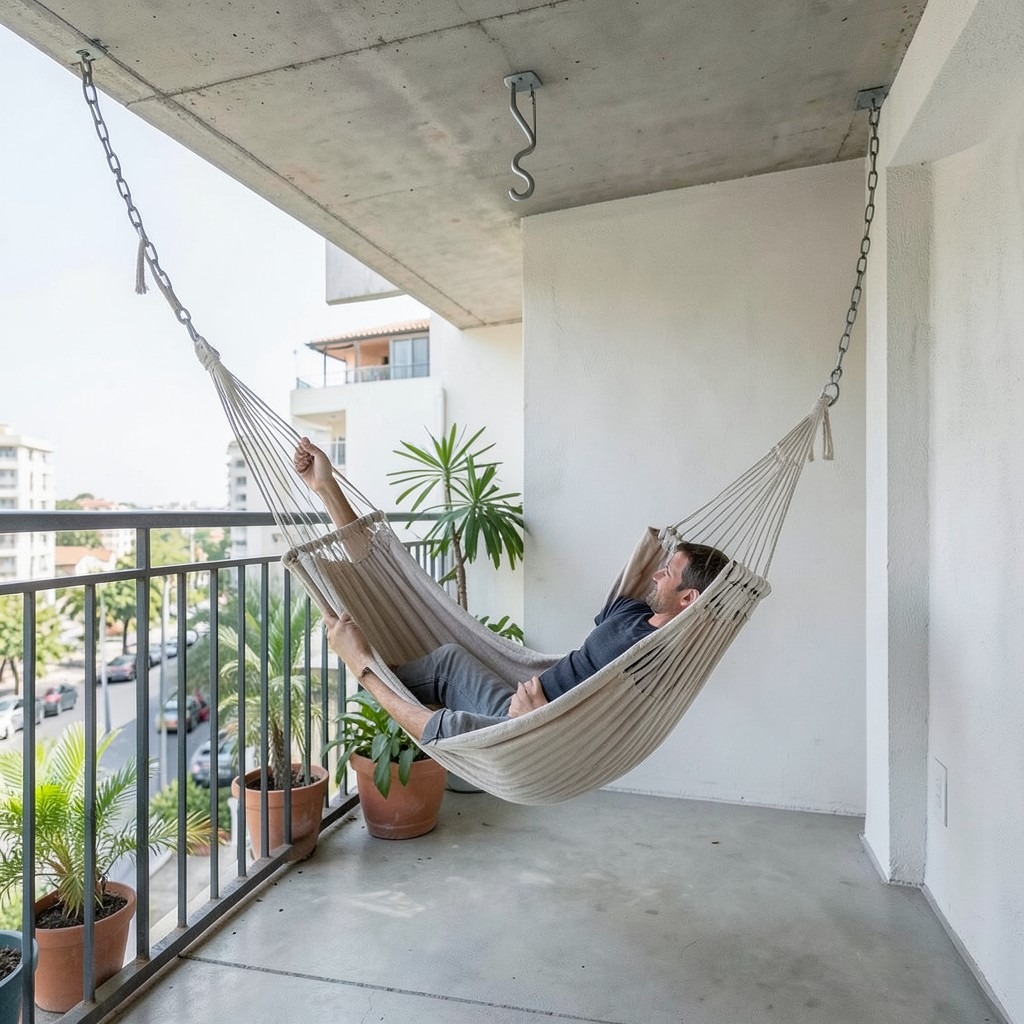
A hammock chair — a single-point hanging seat suspended from a ceiling hook, swaying freely below its mounting point — is the balcony furniture piece that delivers the highest quality of leisure experience per unit of floor space it occupies. Where a floor-standing chair requires four feet of clearance in all directions, a hammock chair requires only the swing arc of its occupant — approximately two feet in any direction from the hanging point. On a balcony where floor space is the primary constraint, this spatial efficiency is the practical argument that makes the hammock chair worth considering before any conventional seating option.
The ceiling mounting point must be into solid structural material — a concrete ceiling joist, a solid timber header, or a steel beam — capable of handling the dynamic load of an occupied swinging chair without the fixing working loose over time. A hook rated at a minimum of one hundred and fifty kilograms installed into a concrete ceiling with the correct anchor bolt and a depth of at minimum six centimeters handles the load safely for any occupant weight within the standard adult range. A hook screwed into plasterboard or a lightweight ceiling panel without solid backing behind it is a mounting that will fail, and it will fail while the chair is occupied.
The hang height of the hammock chair determines both its comfort in use and its visual relationship to the balcony’s other elements. A chair hung so that the seat base is at standard chair height — approximately forty-five centimeters from the floor — allows the occupant to push off the floor gently to maintain the swinging motion and to step in and out of the chair without an awkward drop. A chair hung significantly higher requires the occupant to climb in from below, which produces a different seating experience — more enclosed and more physically committed — that some users find preferable and others find inconvenient.
8. A Balcony With Raised Planting Beds
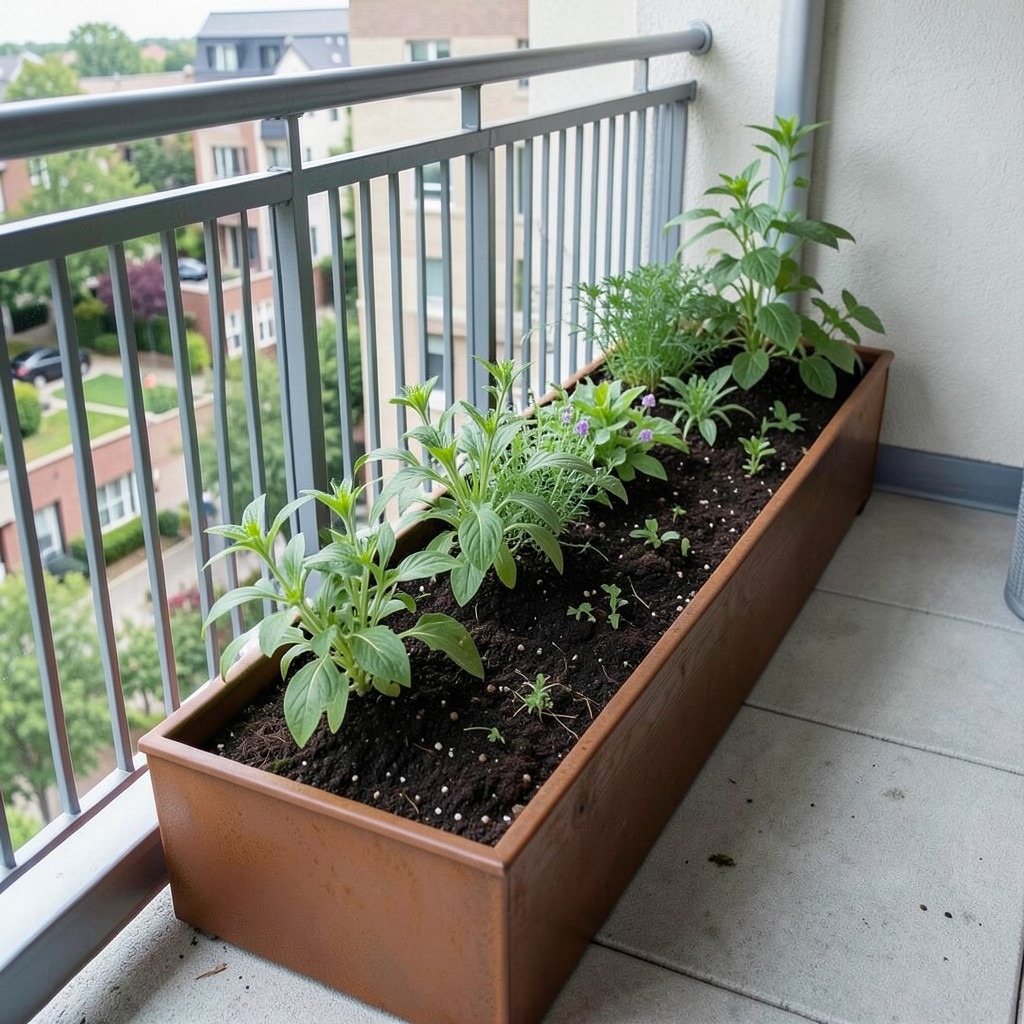
Raised planting beds on a balcony — timber or steel-sided troughs positioned along the railing, the wall, or as freestanding elements in the floor space — give the balcony a planted character that individual containers at ground level never achieve in the same way. The raised bed brings the planting to a higher viewing level, which means the plants are experienced from a more immediate, more detailed perspective than those in pots at the floor level. The balcony gardener looks into the bed rather than down at the pot, and that shift in relationship with the planting changes how the plants are perceived and how often they are tended.
The weight of a raised planting bed is the engineering consideration that most balcony gardeners either address inadequately or discover too late. A timber trough at one meter by forty centimeters, filled with standard garden soil at standard fill depth, carries a weight that most residential balcony structures were not designed for if multiple troughs are installed simultaneously. The solution is lightweight growing medium — a mix of perlite, coir, and lightweight compost designed specifically for container and balcony use — which reduces the soil weight by forty to sixty percent relative to standard garden soil while maintaining the drainage and nutrient-holding capacity that plants require.
The material of the raised bed determines its relationship to the balcony’s design direction. A corten steel trough develops the warm rust patina that reads as contemporary and architectural — it ages into its setting rather than against it, and its material character is entirely self-maintaining after the initial patination period. A hardwood timber trough with a clean, simple profile suits any balcony design direction from traditional to contemporary and develops a silver-grey weathered quality with time that complements both planting and paving equally well.
9. A Balcony With Outdoor Tiles Over the Concrete Floor
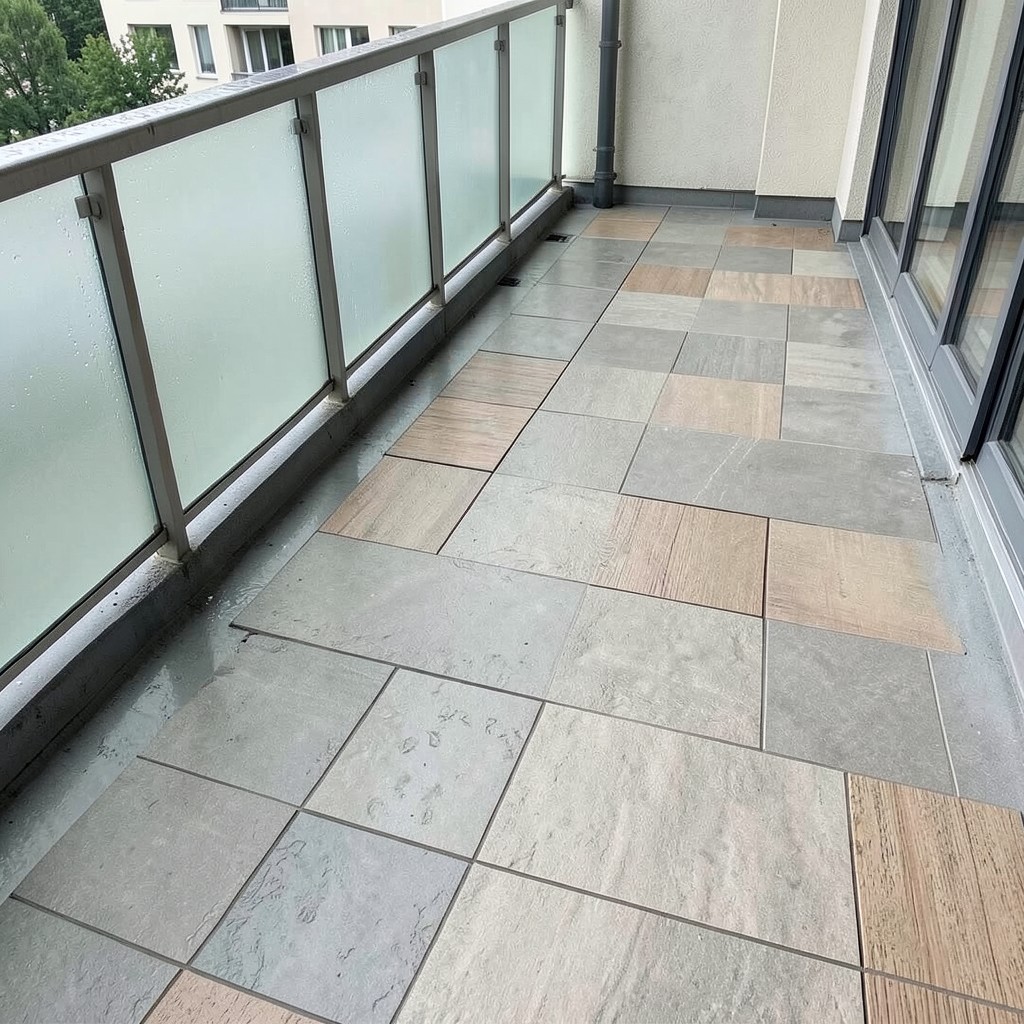
The concrete floor that most balconies present at handover — raw, grey, slightly uneven, with drain positions visible and no visual relationship to anything the design concept requires — is the surface that most balcony owners live with by default because changing it seems complex. It is not complex. Outdoor porcelain tiles or wood-effect composite decking tiles, laid directly over the existing concrete on a pedestal or adhesive system, produce a complete floor transformation in a single weekend and without any permanent modification to the building structure.
Porcelain balcony tiles in a large format — sixty by sixty centimeters — with a stone or concrete appearance produce a floor surface that reads as significantly more resolved and more designed than the original grey slab beneath them. The joint between tiles is minimal at this format, which produces a near-continuous surface that makes the balcony appear larger than a tile with more visible jointing. The tile’s surface texture must be slip-rated for outdoor wet conditions — a specification designated as R11 or higher on the European slip resistance scale — because balcony tiles are walked on in wet feet after rain and after outdoor showers.
Composite decking tiles — individual interlocking squares of wood-effect composite material that click together directly on the concrete without any adhesive or mechanical fixing — provide the warmest floor option for a balcony in climates where bare feet are common in the warmer months. The composite surface is warm to the touch and provides the visual and tactile character of timber without the maintenance requirements of real wood decking, which requires annual sealing and periodic sanding to maintain its quality in exposed outdoor conditions.
10. A Balcony With a Defined Color Palette
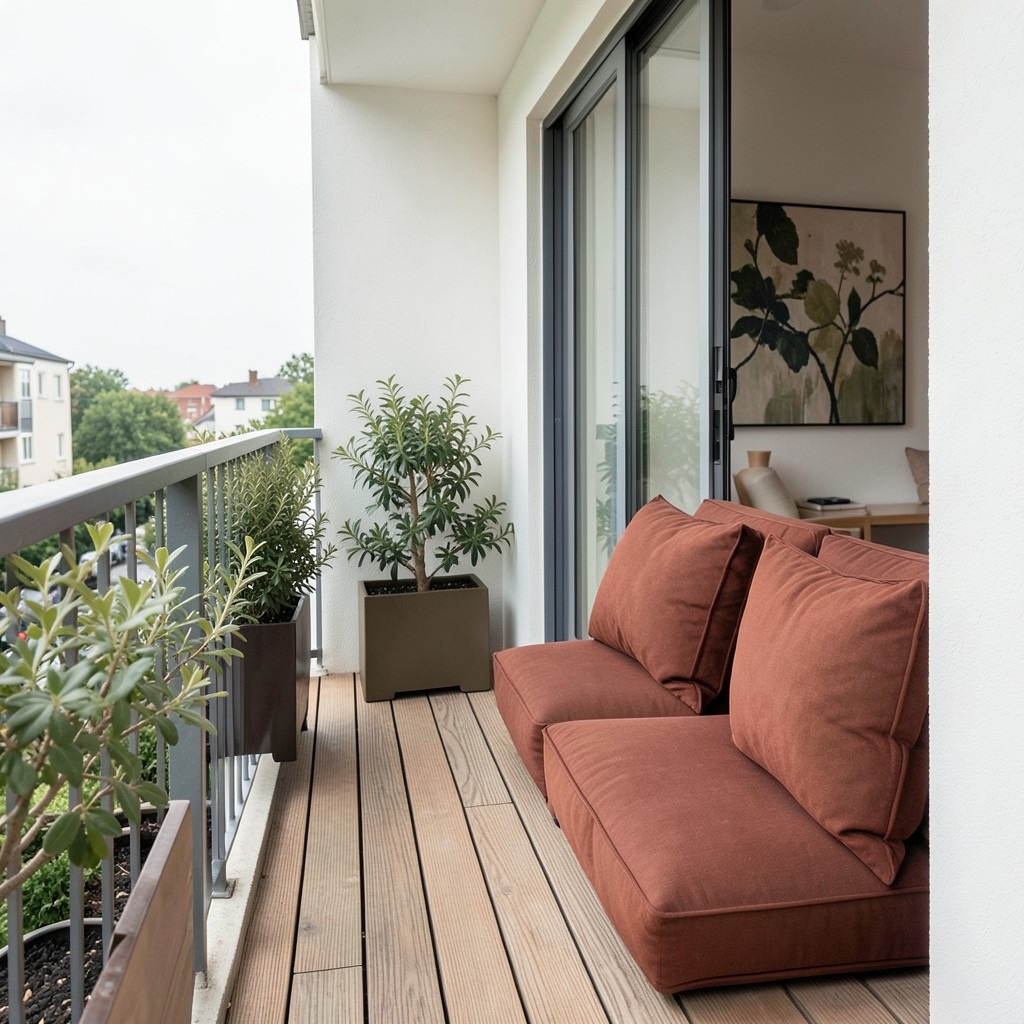
A balcony with a deliberate color palette — two or three colors chosen in relationship to each other and applied consistently across every element from the floor cushions to the planter colors to the railing treatment — reads as a designed outdoor space rather than an assembled one. The color palette is the organizing principle that makes all subsequent decisions easier: every new element is evaluated against the established colors rather than chosen in isolation, and the coherence that results is visible from the first glance.
The most effective balcony palettes tend to be built from a neutral base and one or two accent colors rather than from multiple equally weighted tones competing for visual attention in a small space. A neutral base — warm white walls, natural timber decking, grey concrete railing — provides the visual ground that accent colors read against without fighting. Adding two carefully selected accents — a deep terracotta in cushion fabric and planter glaze, against a dusty olive in the planting foliage and the cushion piping — produces a composed palette that covers the balcony’s visual range without overloading the small space with competing color.
The relationship between the balcony’s exterior palette and the interior visible through the glass door or window is a dimension of balcony color planning that most design approaches skip. A balcony palette that clashes with the interior color scheme visible through the opening creates a visual discontinuity that undermines both spaces simultaneously. Extending the interior’s dominant tone into at least one balcony element — the cushion color reflecting the sofa fabric, the planting palette picking up a green from the interior artwork — connects the outdoor and indoor spaces through a shared color reference that makes the two read as a designed sequence rather than adjacent spaces that happen to be connected by a door.
11. A Balcony With a Japanese-Inspired Minimalist Design
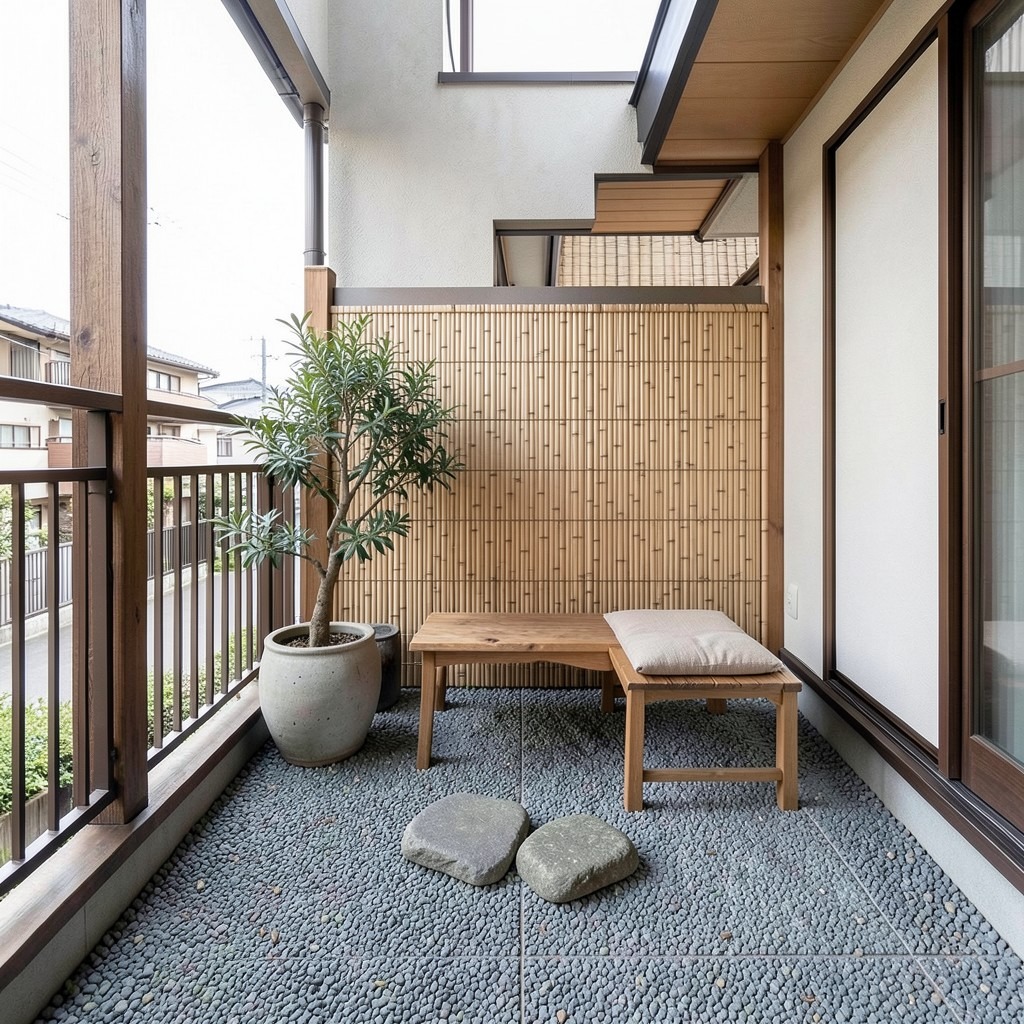
A Japanese-influenced balcony design operates on a set of principles entirely opposite to the maximalist instinct that most people apply to small spaces — the urge to fill every surface, add every plant, use every inch. The Japanese principle of ma — the deliberate use of empty space as an active design element — produces small spaces that feel larger, calmer, and more inhabitable precisely because they are not filled to capacity. The empty area of the balcony floor is not wasted space. It is the breathing room that makes everything present in the space read with greater clarity and greater impact.
The material palette of a Japanese-inspired balcony restricts itself to natural materials handled with precision: fine-grade gravel or a smooth stone tile for the floor, a single specimen plant in a ceramic container chosen for its form rather than its flowering quality, a slim bamboo privacy screen, and a single low table in natural timber with floor cushions rather than raised chairs. The reduction of the furniture to floor level lowers the visual weight of the balcony’s contents, which makes the space feel taller and more open, and floor-level seating produces a physical relationship with the balcony’s contained space that raised seating cannot generate.
The care with which each element is positioned within the Japanese-inspired balcony is the design work that the final photograph does not show but that every visitor to the space immediately feels. Two stones placed on the gravel surface — not symmetrically centered but at positions that create an asymmetric tension between them — is a composition that required consideration. A plant positioned off-center against the wall at a specific distance from the railing that creates equal negative space on both sides is a placement that reveals thought. These invisible decisions are the practice that produces spaces that feel extraordinary rather than merely empty.
12. A Balcony With Herb Planting
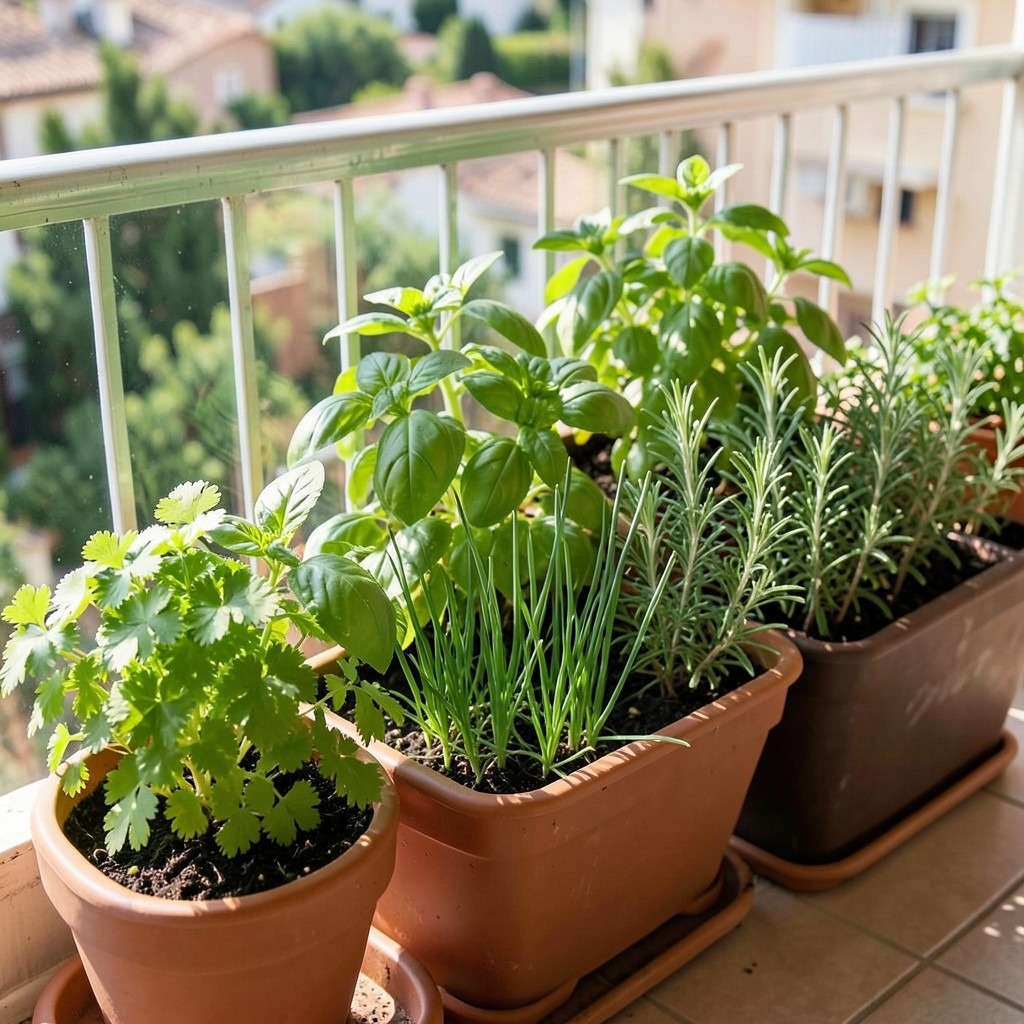
An herb garden on a balcony — a row of containers planted with the herbs most used in the household’s kitchen, positioned where they receive adequate sunlight and where they are accessible from the interior without requiring a special trip outside — is the balcony planting investment with the highest daily practical return of any plant selection available. The herbs growing on your balcony are not decorative. They are an active ingredient in the household’s food supply, and the quality difference between a fresh-cut herb and a dried, packaged alternative is large enough that any household that cooks regularly will notice it within the first week.
The selection of herbs for a balcony container planting should prioritize the ones used most frequently in the household’s actual cooking rather than those that look most attractive in a container. Basil, flat-leaf parsley, coriander, chives, thyme, and rosemary cover the herbs used in most Mediterranean and Asian cooking styles, and each of these performs adequately in a container of appropriate size with correct sunlight and watering. Basil is the most demanding — it requires a warm, sun-facing position, consistent moisture, and regular pinching to prevent premature flowering — and the most rewarding when it performs correctly.
The container depth for herb planting determines the root volume available to each plant and directly correlates with the herb’s productive life and performance. A container with less than fifteen centimeters of growing depth restricts the root development of most herbs to the point where growth is limited and flavor concentration suffers — the plant produces leaves but lacks the root volume to support the aromatic oil production that makes the herb worth growing. A twenty to twenty-five centimeter depth provides sufficient root volume for vigorous growth in all standard culinary herbs and justifies the small additional volume on a balcony where space management is ongoing.
13. A Balcony With a Shade Sail
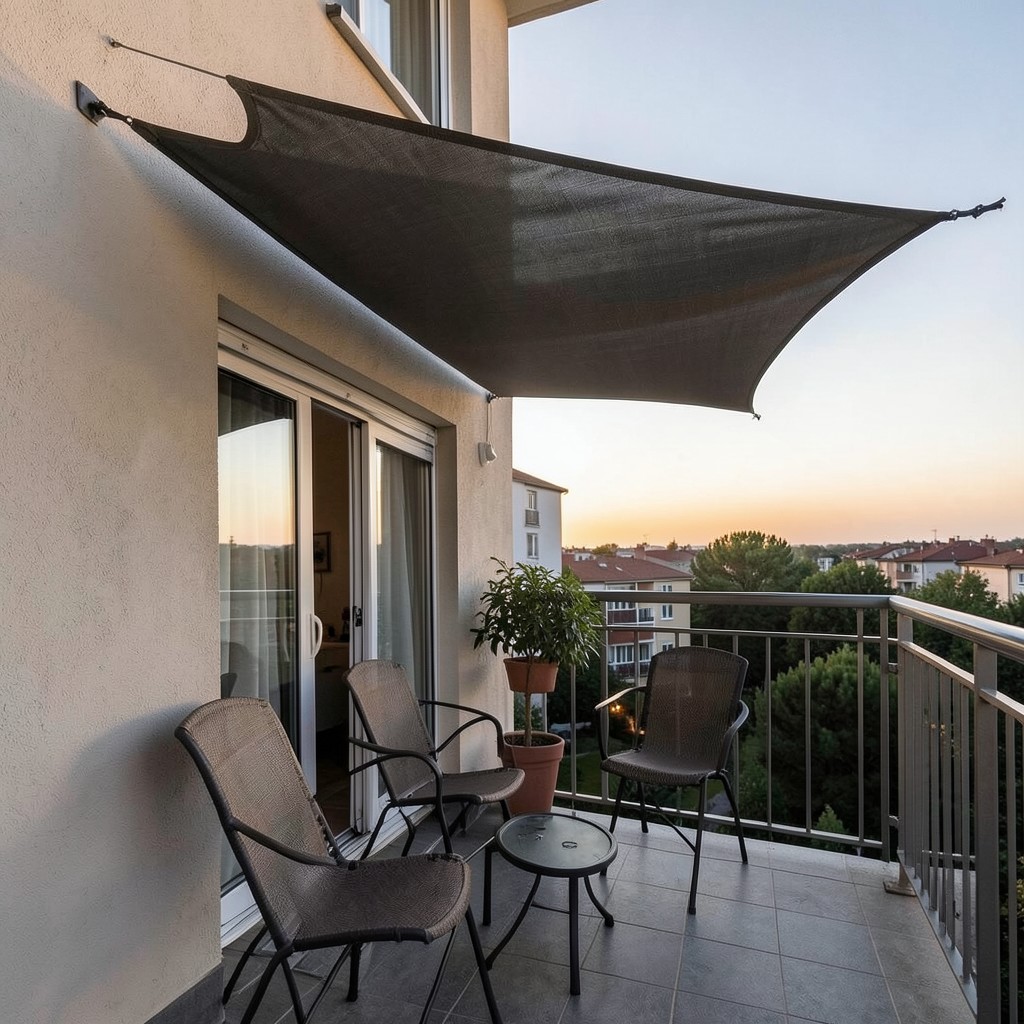
A shade sail installed above a west or south-facing balcony solves the problem that most residents of sun-facing apartments experience but rarely think to address directly: the afternoon heat that makes the balcony unusable from midday to evening, which are precisely the hours when outdoor occupation would otherwise be most desirable. A balcony that faces good sun but has no overhead shade protection is a balcony used for morning coffee and abandoned for the rest of the day. The shade sail recovers those afternoon hours and the evening hours when residual heat makes an uncovered surface uncomfortable after dark.
The installation of a shade sail on a balcony requires three fixing points with sufficient load capacity to handle the sail’s tension in wind. The typical configuration uses two points on the building wall and one at the outer railing post — a triangular sail that provides shade across the primary sitting area without covering the full balcony width. The fixing points must be into solid structural material — the concrete or masonry of the building structure — because the tensile loads in a shade sail during wind are substantially higher than the sail’s own weight suggests, and the wall fixing that handles the static weight easily may not handle the dynamic wind load without drawing out of the substrate.
The fabric specification for a shade sail determines both the UV protection it provides and the visual quality it contributes to the balcony design. High-density polyethylene mesh in a ninety-five percent UV block rating provides the most effective solar protection and a consistent appearance throughout its life. Waterproof shade sail fabrics — coated to shed rain rather than allow it through the weave — provide additional weather protection but retain water in any low point of the sail’s drape, which can collapse the sail’s geometry under load.
14. A Balcony With a Reading Corner
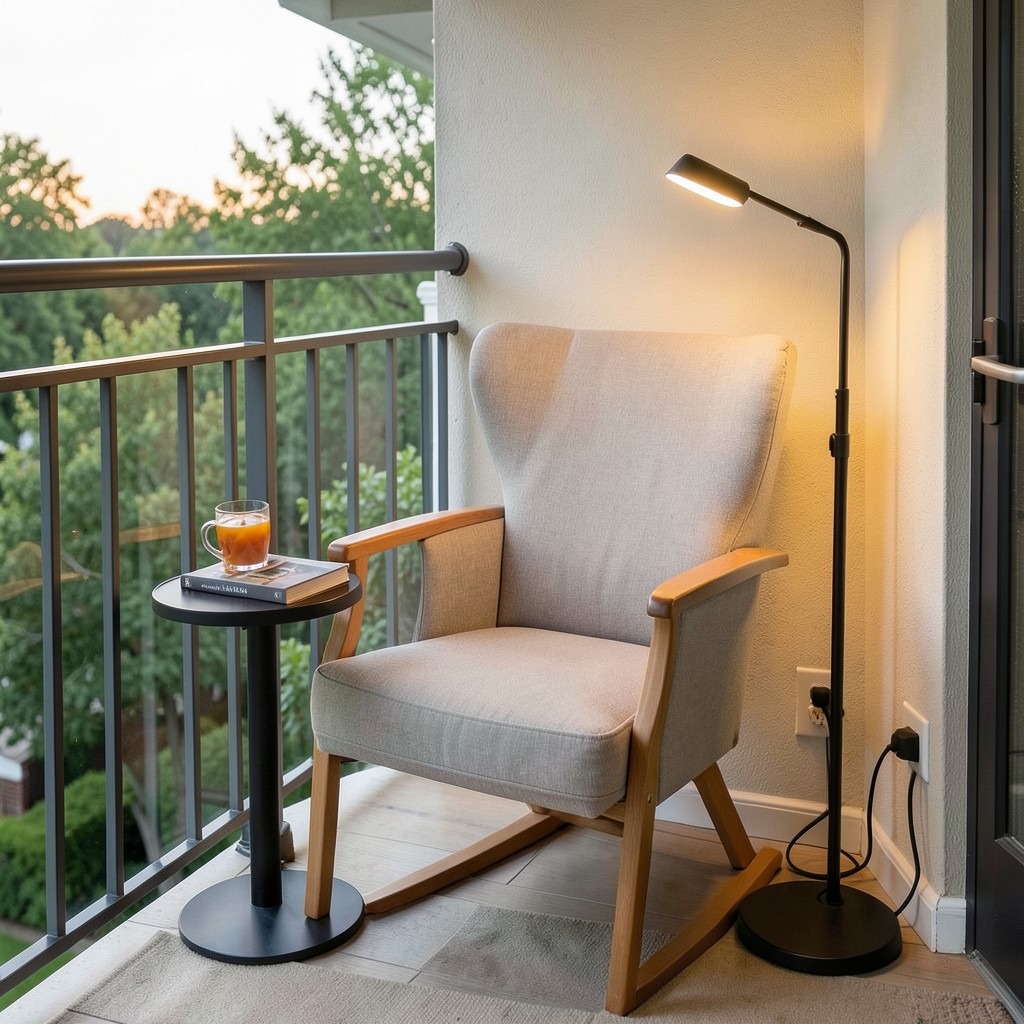
A balcony reading corner — one comfortable chair positioned to receive the best natural light, with a small side table for a drink and a book, and a floor lamp for evenings — is the balcony configuration that turns a small outdoor space into the most productive quiet time location in the household. The chair does not need to be large or expensive. It needs to be comfortable for ninety minutes of reading in an upright position, which is a more demanding brief than it sounds because most chairs are designed for visual attractiveness rather than extended seated comfort.
The chair selection for a balcony reading corner requires prioritizing back support over aesthetics. A chair with an upright back that supports the lumbar region, a seat depth that allows the knees to bend without the chair edge cutting into the thigh, and armrests at a height that allows the reading material to be held without the shoulders rising — this is the brief for a genuinely usable reading chair. An egg chair, a hammock chair, or a deeply reclined sun lounger produces a reading position that becomes uncomfortable within forty-five minutes. A well-proportioned armchair or a compact rocking chair meets the brief better than either of those alternatives.
The floor lamp beside a balcony reading chair — a slim, directional reading light on a pedestal base — provides the evening illumination that converts the reading corner from a daytime-only resource to one used from morning through the evening hours. The lamp must be rated for outdoor use and the power supply must come from a weatherproof outdoor socket rather than from a cable run through the door from the interior, which creates a tripping hazard and a thermal bridge that the door seal cannot close over. An outdoor-rated floor lamp powered from a properly installed balcony socket serves the reading corner without any of these compromises.
15. A Balcony With a Trellis and Climbing Plants
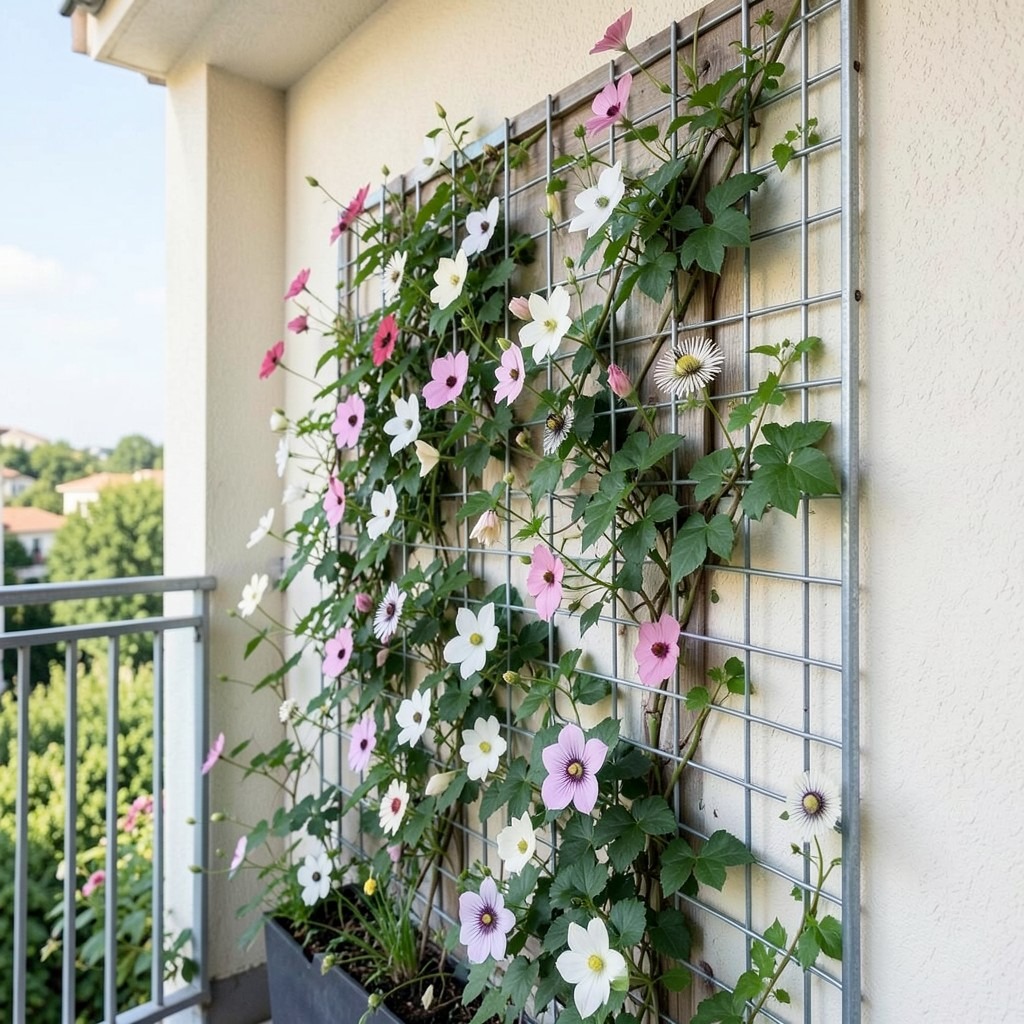
A trellis fixed to the wall or railing of a balcony — a timber or galvanized steel grid surface that provides a support structure for climbing plants — converts a flat, lifeless vertical surface into a planted wall that provides privacy, seasonal interest, and the specific quality of being surrounded by growing things that changes the emotional register of any outdoor space. The trellis by itself is a structure. The trained climber growing across it is the transformation.
The climbing plant selection for a balcony trellis must account for the exposure conditions specific to an elevated location: wind that is stronger and more consistent than at ground level, drying conditions that are more severe, and the absence of ground soil that all climbing plants in a ground-planted situation draw on through the full depth of their root systems. Clematis viticella varieties — compact-growing, drought-tolerant relative to other clematis groups, and producing flowers through midsummer to early autumn — handle balcony conditions better than larger-growing clematis. Passiflora — the passionflower — handles the exposure of elevated locations with resilience and produces extraordinary flowers that reward the close viewing distance that a balcony trellis provides.
The spacing between trellis battens determines how quickly the climbing plant achieves coverage and how the covered trellis reads visually. A close spacing of fifteen centimeters produces a grid that the plant fills quickly and that reads as a dense planted surface from the outset. A wider spacing of twenty-five to thirty centimeters produces a more open grid that reads as a composition of plant and structure in equal measure during the years before the plant reaches full coverage, which many balcony gardeners find more interesting than a fully covered surface where the structure is no longer visible.
16. A Balcony With Solar Lighting
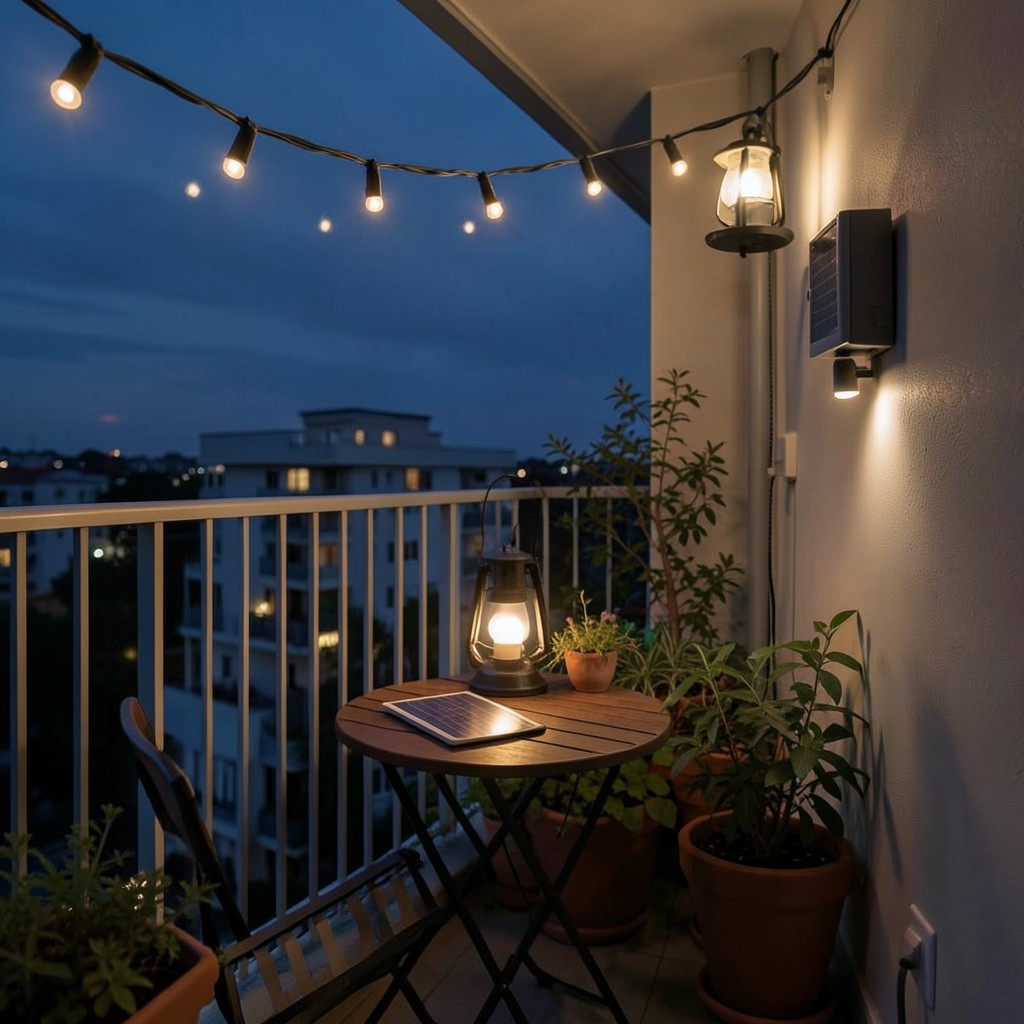
Solar lighting on a balcony — fixtures that charge from daylight and activate at dusk without any wiring or external power connection — provides the ambient lighting that makes the balcony usable after dark without the infrastructure cost or installation complexity of wired outdoor lighting. A balcony without a conveniently located external socket — which describes the majority of residential balconies — benefits most from solar lighting because the alternative is either no lighting at all or the cable management problem of running power from the interior.
The performance of solar balcony lights depends on the quality of the photovoltaic panel and the battery storage capacity relative to the charging hours available at the panel’s installed position. A solar light positioned where it receives six to eight hours of direct sun charges sufficiently to provide four to six hours of evening illumination. The same light positioned in shade or indirect light produces a fraction of the charge and a correspondingly shorter illumination period. This is the solar lighting variable that most purchasing decisions underweight — the light’s performance is entirely a function of its charging position, and a product with a superior specification performs poorly if positioned incorrectly.
Solar stake lights, string lights with an integrated solar panel, lanterns with a solar charging panel on the lid, and wall sconces with a separate panel mounted where the sun reaches it — the format variety of solar lighting available for outdoor use now covers every balcony lighting need without any of them requiring a wired power supply. Mixing formats — string lights overhead for general ambient effect, a lantern on the table for intimate surface-level light, and a stake light in the planting for low-level accent — produces the layered lighting effect on a balcony that a single format of solar light cannot achieve regardless of how many fixtures of the same type are installed.
17. A Balcony With a Compact Outdoor Sofa
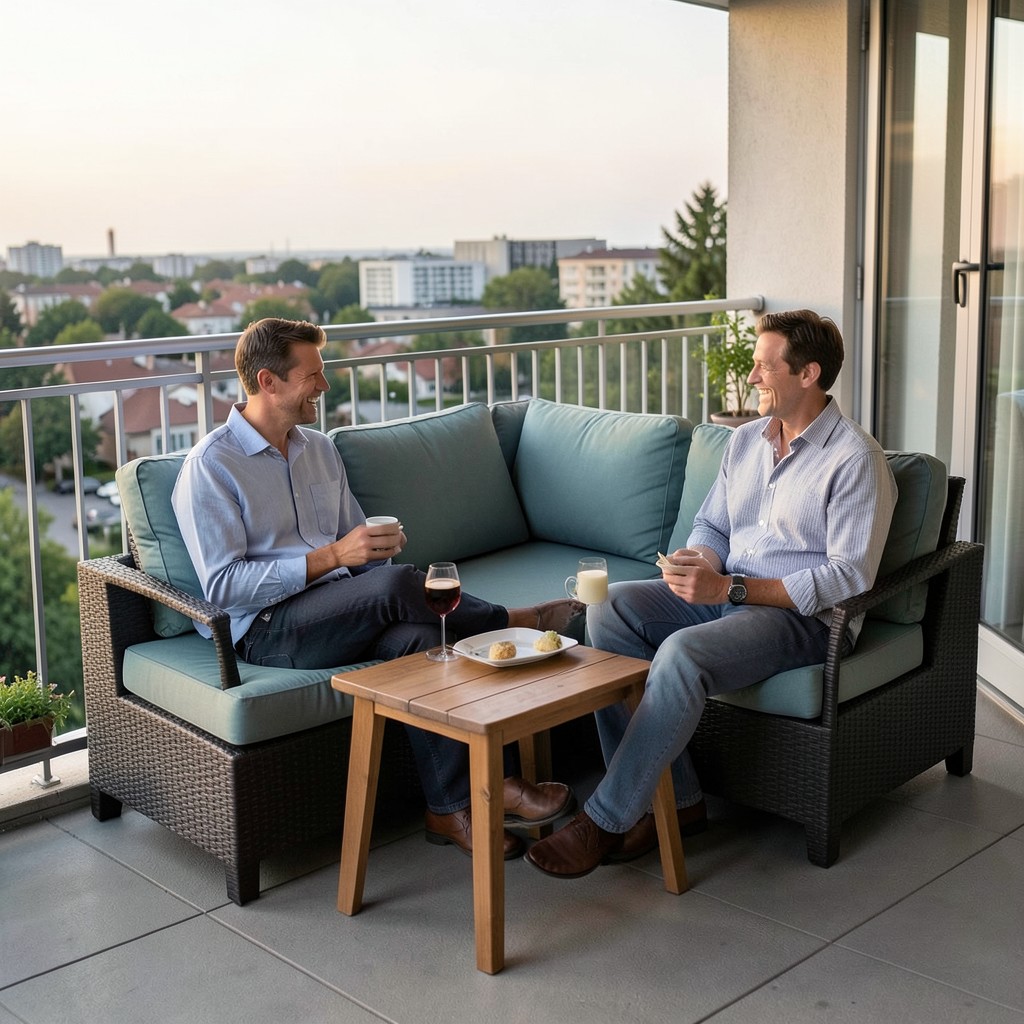
A compact outdoor sofa — a two-seat loveseat configuration scaled specifically for balcony dimensions rather than a standard outdoor sofa reduced from garden scale — changes the balcony’s social capacity from one-at-a-time to two-simultaneously without occupying the floor area that a standard outdoor sofa demands. This is not a minor quality of life improvement. A balcony that seats two people comfortably and simultaneously is a balcony used for shared morning coffee, shared evening drinks, and the specific pleasure of being outside with someone else rather than in sequence.
The dimension standard for a balcony loveseat is approximately one hundred and twenty centimeters in width by seventy centimeters in depth, which fits within most residential balconies with clearance for a small table in front and sufficient floor access to move between the sofa and the railing comfortably. A sofa exceeding one hundred and forty centimeters in width begins to compromise circulation on balconies of standard dimensions, and the additional seating area it provides relative to a one-hundred-and-twenty-centimeter unit is modest. The discipline of specifying for the space rather than for maximum seating capacity is the decision that determines whether the balcony feels furnished or crowded.
The cushion depth on a balcony sofa determines its genuine comfort for extended outdoor occupation. A shallow cushion — ten centimeters or less — produces a firm, uncomfortable seat that is tolerable for twenty minutes and painful beyond that. A cushion of fifteen to eighteen centimeters in a good-quality foam or fiber fill — covered in a solution-dyed outdoor fabric — provides the comfort for a two-hour evening sit that makes the sofa worth having on the balcony rather than simply present on it.
18. A Balcony With a Meditation and Yoga Space
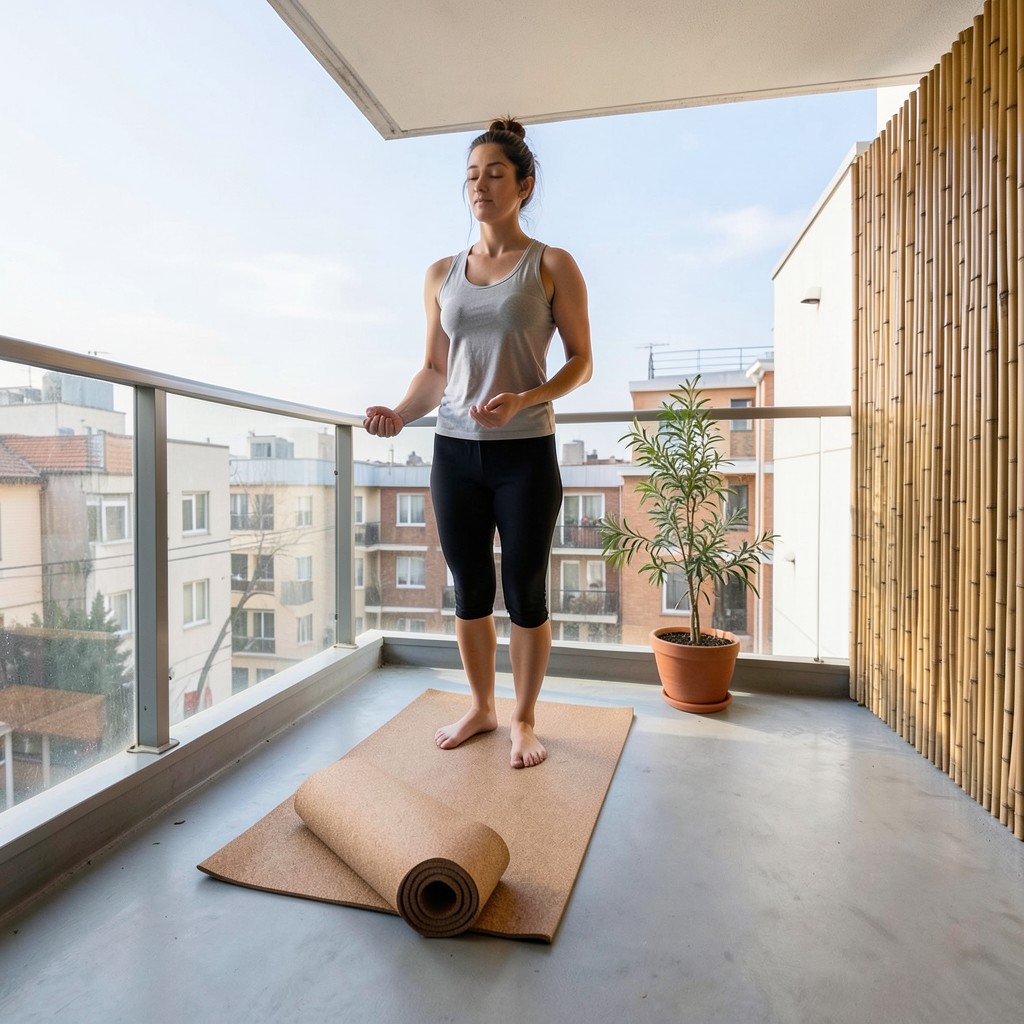
A balcony cleared of all furniture except a single rolled yoga mat or meditation cushion — with the floor swept clean, a single plant in the corner, and nothing between the occupant and the open sky — is the most specific and most intentional use of a small outdoor space available to someone who practices yoga or meditation. The outdoor element adds something that an interior practice space cannot provide: natural light that changes through the session, air movement that is unpredictable and therefore genuinely alive, and the perceptual distance from the built interior that supports the mental shift that practice requires.
The floor surface for an outdoor yoga practice must provide adequate grip for barefoot standing poses and sufficient cushioning for seated and floor-level work. Most balcony floor surfaces — concrete, tile, or composite decking — are too hard and too slippery for comfortable barefoot yoga without an additional layer. A high-quality outdoor yoga mat in a natural rubber or cork material provides the grip and the minimal cushioning that a standing and floor practice requires. Cork outdoor yoga mats are specifically worth noting — they are antimicrobial, naturally grippy when wet, and biodegradable, which suits the values of most practitioners who choose outdoor practice over indoor.
The privacy condition of the balcony for meditation or yoga practice is a dimension of the space’s suitability that is worth addressing directly before investing in the practice setup. A balcony visible to multiple neighboring units in all three exposed directions produces a practice environment where the awareness of being observed competes with the quality of attention the practice requires. A bamboo or planted privacy screen on the most overlooked side — typically the side facing the nearest neighboring balcony — provides sufficient privacy without enclosing the space entirely.
19. A Balcony With a Dining Setup
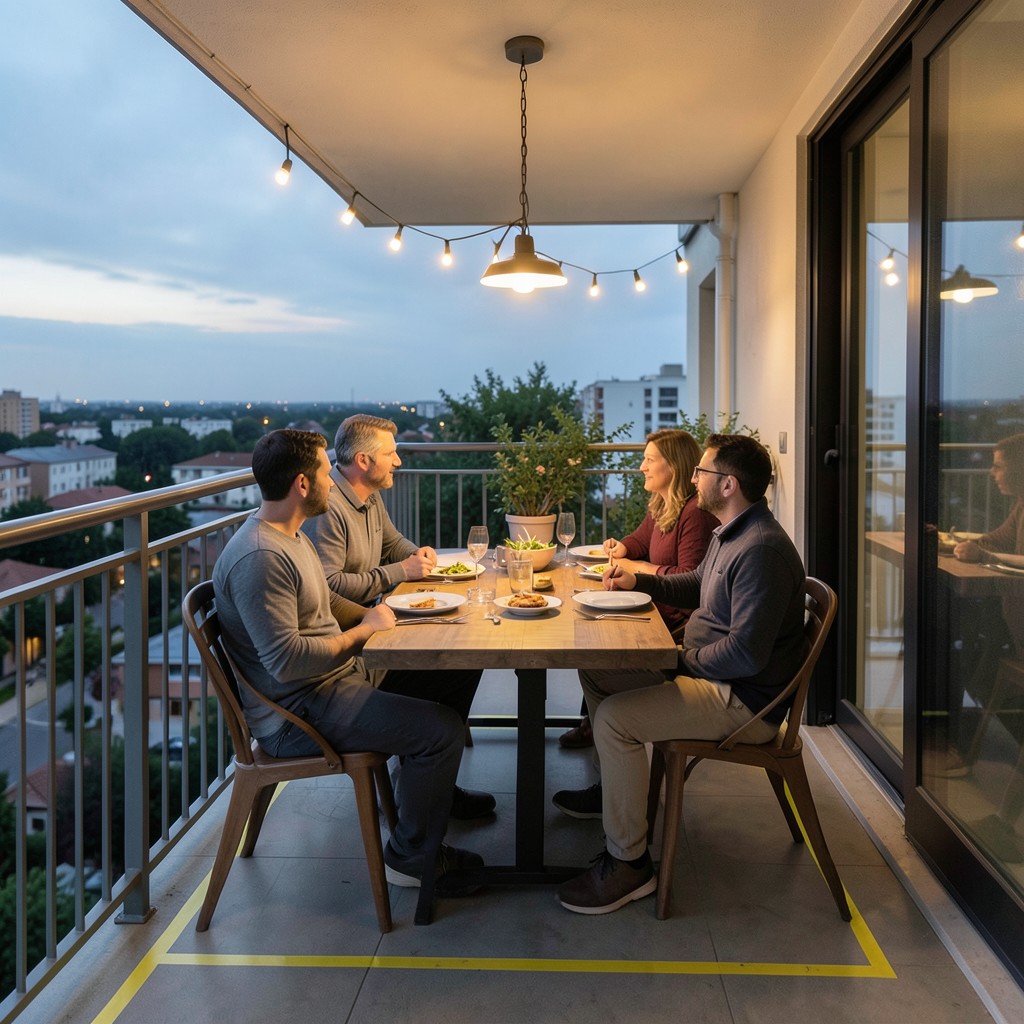
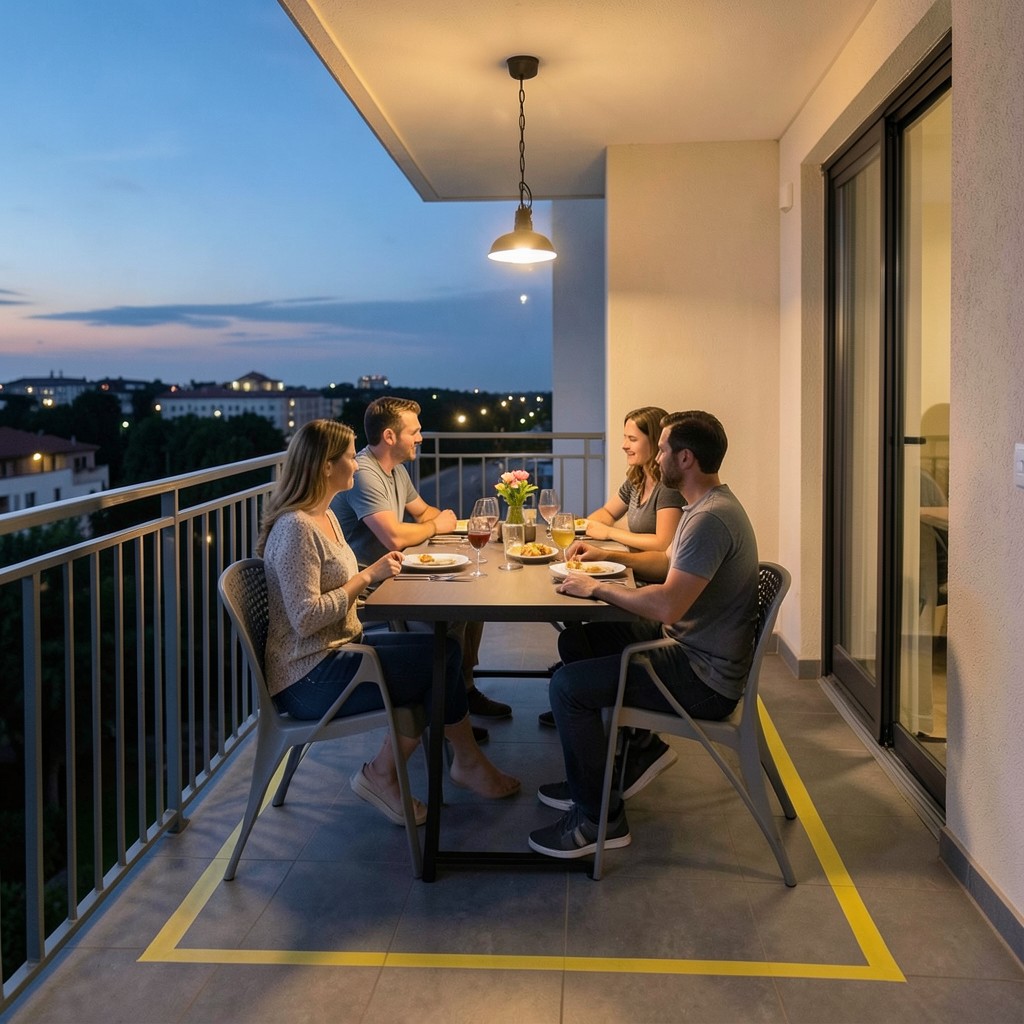
A balcony configured for dining — a table sized for the number of people who regularly share meals there, chairs scaled to the table and the balcony simultaneously, and lighting positioned above the table for the evening hours — is a balcony that earns its place in the household’s daily life at mealtimes rather than only in the residual hours between meals. A balcony that is used for dinner three evenings a week through the warm months of the year is a balcony that justifies every design investment made in it many times over.
The table dimension for balcony dining requires measuring the available floor area with chairs positioned and occupants seated before purchasing, not after. A table that looks correctly proportioned in a showroom or a product photograph is frequently too large once placed on the actual balcony with chairs pulled out on all sides and people occupying them. The correct test is to mark the table’s footprint on the balcony floor with tape, add the chair depth on each side, and walk around the resulting configuration — the clearance between the outermost chair position and the railing or wall must be at minimum sixty centimeters to allow movement without disrupting seated occupants.
The overhead light above a balcony dining table provides the functional illumination for evening meals and the atmospheric element that makes dining outside feel like an occasion rather than a practicality. A pendant hung from a chain attached to a balcony ceiling hook, or a string light arrangement configured to focus its density above the table position, produces a dining light at the correct scale for outdoor eating. The light must be positioned at a height where it illuminates the table and the faces above it without glaring directly into the sightlines of seated diners — a minimum height of one hundred and eighty centimeters above the table surface produces the correct balance.
20. A Balcony With Potted Citrus Trees
Potted citrus trees on a balcony — a lemon, a kumquat, or a dwarf orange in a generously proportioned container in a sun-facing position — produce a combination of fragrant white blossom in spring, glossy evergreen foliage through the year, and edible fruit in late summer and autumn that no other potted tree delivers in the same compact, productive, sensory sequence. The citrus on a balcony is not a decorative plant that happens to produce fruit. It is a productive plant with ornamental qualities of the highest order.
The container for a citrus tree must provide sufficient root volume for productive growth — at minimum forty centimeters in diameter and equivalent depth — without becoming so heavy when filled with growing medium that it exceeds the balcony’s structural load capacity. Lightweight citrus-specific growing media — typically a blend of bark, perlite, and coir — reduces the container weight by approximately half relative to standard potting compost while maintaining the drainage and aeration that citrus roots require to avoid the root rot that is the primary cause of potted citrus failure.
The winter care requirement of potted citrus in climates outside the Mediterranean zone is the commitment that most balcony citrus owners underestimate. Lemon and orange trees are frost-tender and must be moved to a frost-free interior location when night temperatures drop below five degrees Celsius. A dwarf kumquat is marginally hardier and handles light frost without damage, which extends its outdoor season compared to more frost-sensitive citrus. The size of the container must remain moveable by one or two people for the winter transfer to be practically achievable — a two-hundred liter pot that cannot be moved without mechanical assistance fails the practical test regardless of how well it performs in the growing season.
21. A Balcony With a Hammock
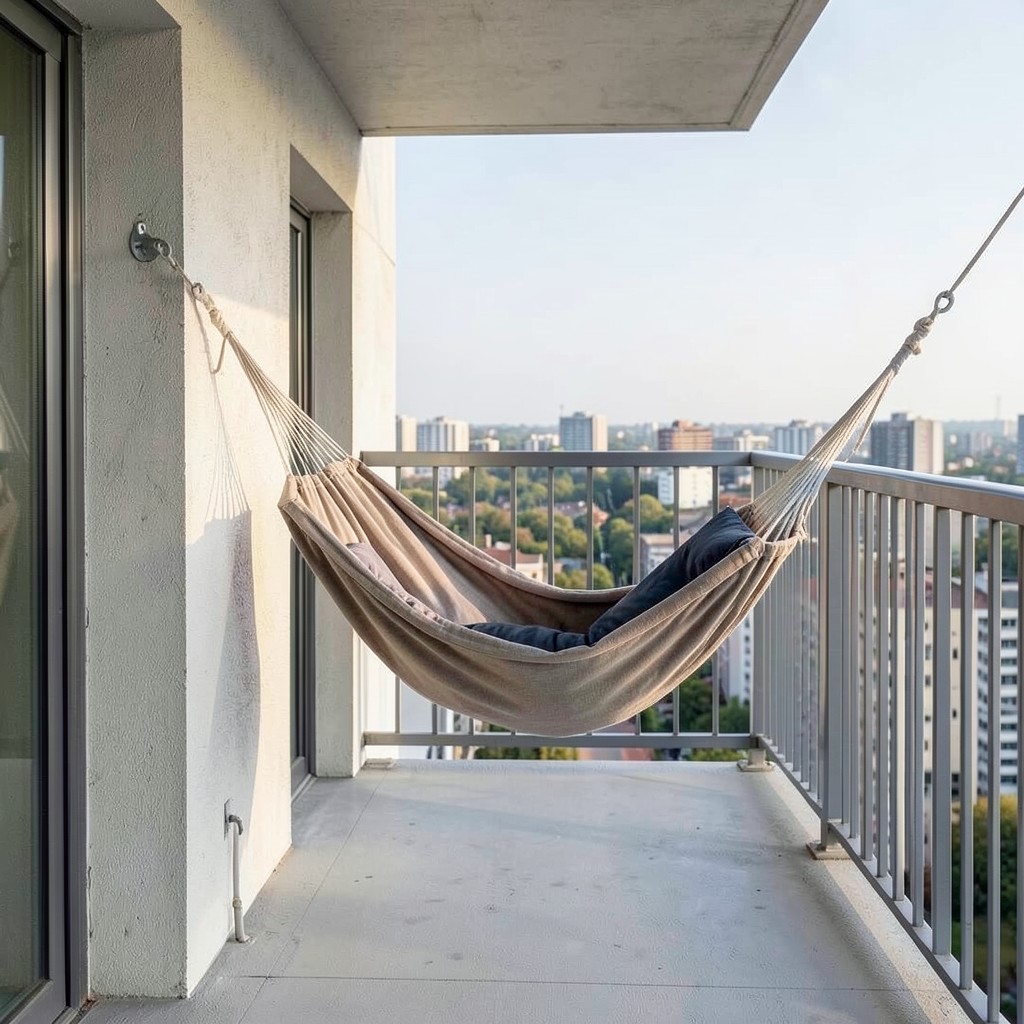
A full-length hammock — suspended between two fixed points at the building wall and the outer structural railing post — occupies the balcony’s overhead volume rather than its floor area and produces a sleeping and resting surface with qualities that no floor-level furniture on the balcony achieves. The hammock is the balcony furniture piece for the household that values the elevated, suspended, sky-facing rest position above the standard chair-and-table configuration that most balcony designs default to.
The engineering requirement for a hammock installation on a balcony is more demanding than for a hammock chair, because the two fixing points must handle not just the occupant’s weight but the substantial horizontal pull that the hammock’s suspension angle produces at each end. A hammock at a standard suspension angle of thirty degrees from horizontal applies a horizontal force at each mounting point that is approximately twice the occupant’s weight. The fixing at the building wall must anchor into the structural concrete or masonry — not into a rendered surface, a tile, or a decorative finish layer — at sufficient depth and with the correct anchor type for the substrate.
The hammock’s swing length must be calibrated to the balcony’s depth — the distance between the wall fixing and the railing fixing — to produce the correct hanging geometry. A hammock that is too long for the available span hangs with insufficient tension and pools the occupant in an uncomfortable curved position. A hammock that is too short for the span hangs too tightly and lies flat, eliminating the curved sleeping surface that makes the hammock comfortable. Measure the balcony depth precisely before selecting the hammock length, and choose a model whose specified optimal hang distance matches the measured distance between fixing points.
22. A Balcony With a Succulent Garden
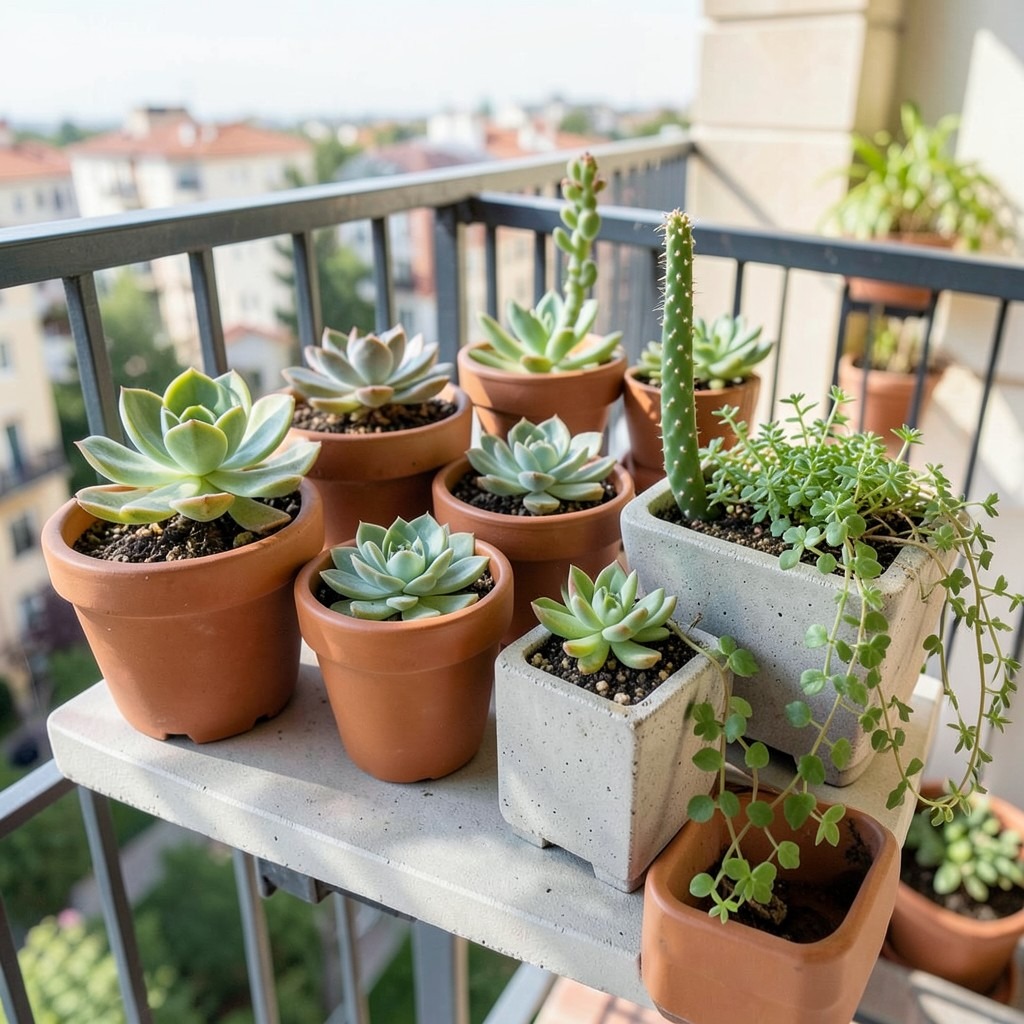
A succulent garden on a balcony — a collection of drought-tolerant, low-maintenance succulents in complementary containers arranged on a shelf, along the railing, or in a shallow trough planting — is the balcony planting choice for households that want the visual quality and the pleasure of a planted outdoor space without the daily watering commitment that most balcony planting requires. Succulents survive extended periods without water, thrive in the hot, dry conditions that south-facing balconies produce in summer, and provide a visual character that improves with age rather than requiring continuous replacement.
The design of a succulent balcony collection goes beyond simply placing succulents in pots. A collection reads as designed when the containers share a material language — all terracotta, all glazed ceramic in the same color family, all concrete — while varying in scale and shape across the group. The plants within the collection should be selected for complementary form and color rather than for identical appearance: a rosette-form echeveria beside a columnar euphorbia beside a trailing sedum produces a group with visual diversity within the consistent material language of the succulent family.
The one condition that succulents on a balcony cannot tolerate is poor drainage. A pot without drainage holes, or a growing medium that retains moisture around the roots, produces root rot in succulents faster than any other failure mode. Every container in a succulent balcony collection must have at minimum one drainage hole of fifteen millimeters diameter, must sit on pot feet that prevent the drainage hole from resting directly on the floor surface, and must be filled with a gritty, free-draining growing medium — one part compost to two parts horticultural grit produces the drainage profile that succulents require in a container context.
23. A Balcony With a Moroccan-Inspired Design

A Moroccan-inspired balcony — terracotta-tiled floor, intricately patterned lanterns in brass and colored glass, deep jewel-toned cushions in a woven fabric with geometric patterns, and planting in hand-painted ceramic pots — produces an outdoor space with a cultural richness and a warmth of material character that Western design directions rarely deliver at the same sensory intensity. The Moroccan aesthetic builds its visual quality from pattern, color, and craft quality in combination rather than from the restraint and material precision of Scandinavian or Japanese approaches, and that difference in method produces a fundamentally different kind of space.
The pattern element of a Moroccan-inspired balcony requires consistency of source rather than variety of pattern. Moroccan geometric patterns — the zellige tile geometric, the carved plaster arabesque, the woven kilim chevron — all belong to the same cultural visual tradition and work together coherently when combined on a balcony. Mixing Moroccan geometric patterns with patterns from other cultural traditions — Scandinavian folk patterns, Japanese sashiko embroidery — produces a visual confusion that reads as global prop collection rather than designed space. Commit to the Moroccan visual vocabulary and apply it at multiple scales — floor, cushion, lantern — for the approach to read as coherent.
The lantern is the detail that carries the Moroccan aesthetic most efficiently and most memorably on a balcony. A brass lantern with pierced metalwork — the star-pattern or geometric arabesque perforations that cast patterned light shadows across the balcony floor and walls when the candle within is lit — transforms the balcony at night into a patterned light environment that is one of the most atmospheric balcony experiences available at any scale. Three lanterns of different heights and dimensions — all in the same brass finish, all in the same geometric pattern family — produce the lantern collection effect without requiring an elaborate installation.
24. A Balcony With a Pergola Frame
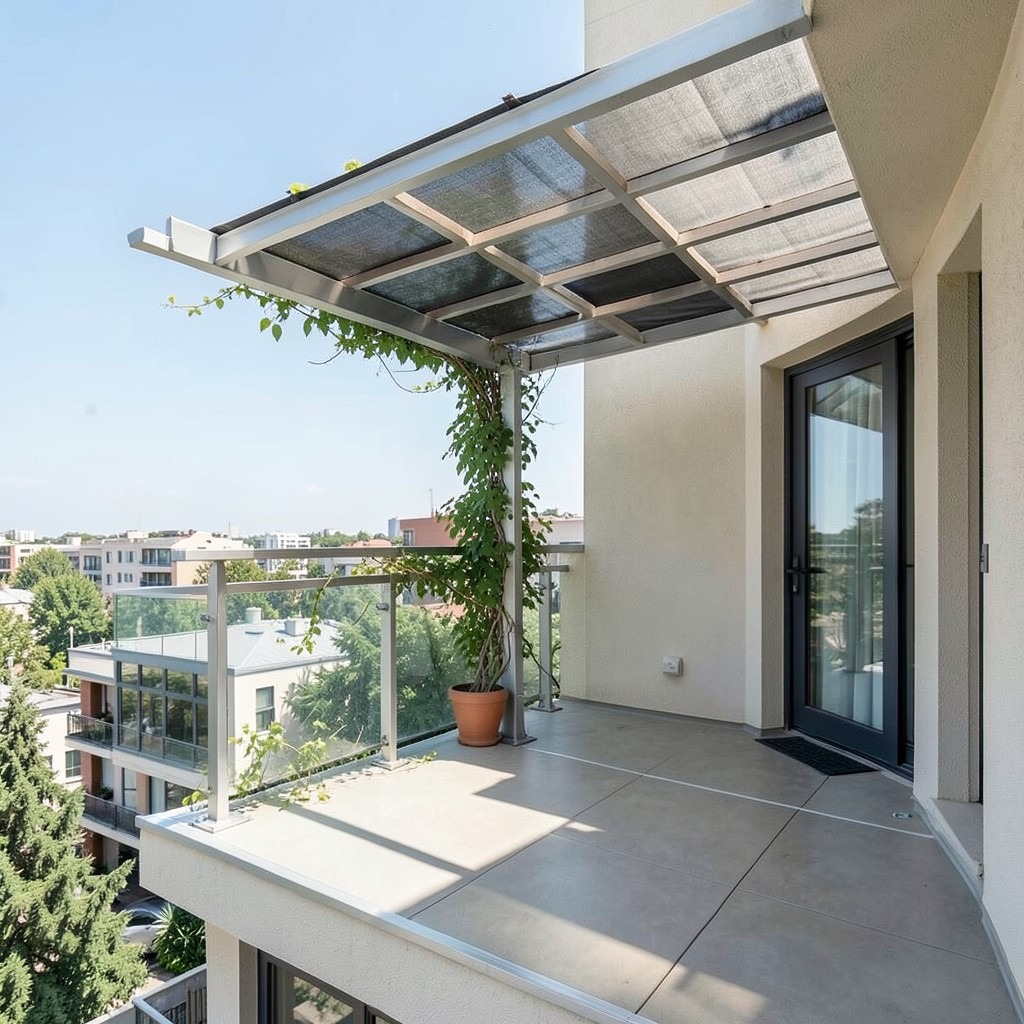
A pergola frame installed on a balcony — a lightweight timber or aluminum overhead structure that provides a defined ceiling to the outdoor space and a support frame for climbing plants, shade cloth, or decorative lighting — converts a balcony from an exposed platform to an outdoor room with structure overhead. The pergola’s primary contribution is the ceiling reference it creates: even when open to the sky through the beam grid, the overhead structure defines the space below it as a room in a way that open sky does not.
The structural connection of a balcony pergola to the building requires careful attention to the load path from the pergola posts to the balcony slab below them, and to the wind uplift forces that a pergola overhead structure generates in exposed elevated conditions. Post bases bolted to the balcony slab at anchor points over the slab’s structural support lines — the lines directly above the balcony’s load-bearing structural elements — distribute the pergola’s load correctly into the building’s structural system. Post bases bolted to the slab at locations between structural support lines concentrate load into the slab mid-span, which the slab was not designed to accept at point loads.
The visual lightness of the pergola structure is the design variable that most affects whether the frame makes the balcony feel sheltered or confined. Slim aluminum pergola members — forty by forty millimeters in cross-section — produce a frame that reads as lightweight and architectural. Heavy timber members — one hundred by one hundred millimeters — produce a frame with material warmth but significantly more visual weight that can make a small balcony feel heavy rather than sheltered. On a balcony of standard residential dimensions, the lighter structural option typically serves the spatial quality better than the material warmth of a heavier alternative.
25. A Balcony With a Coastal Aesthetic
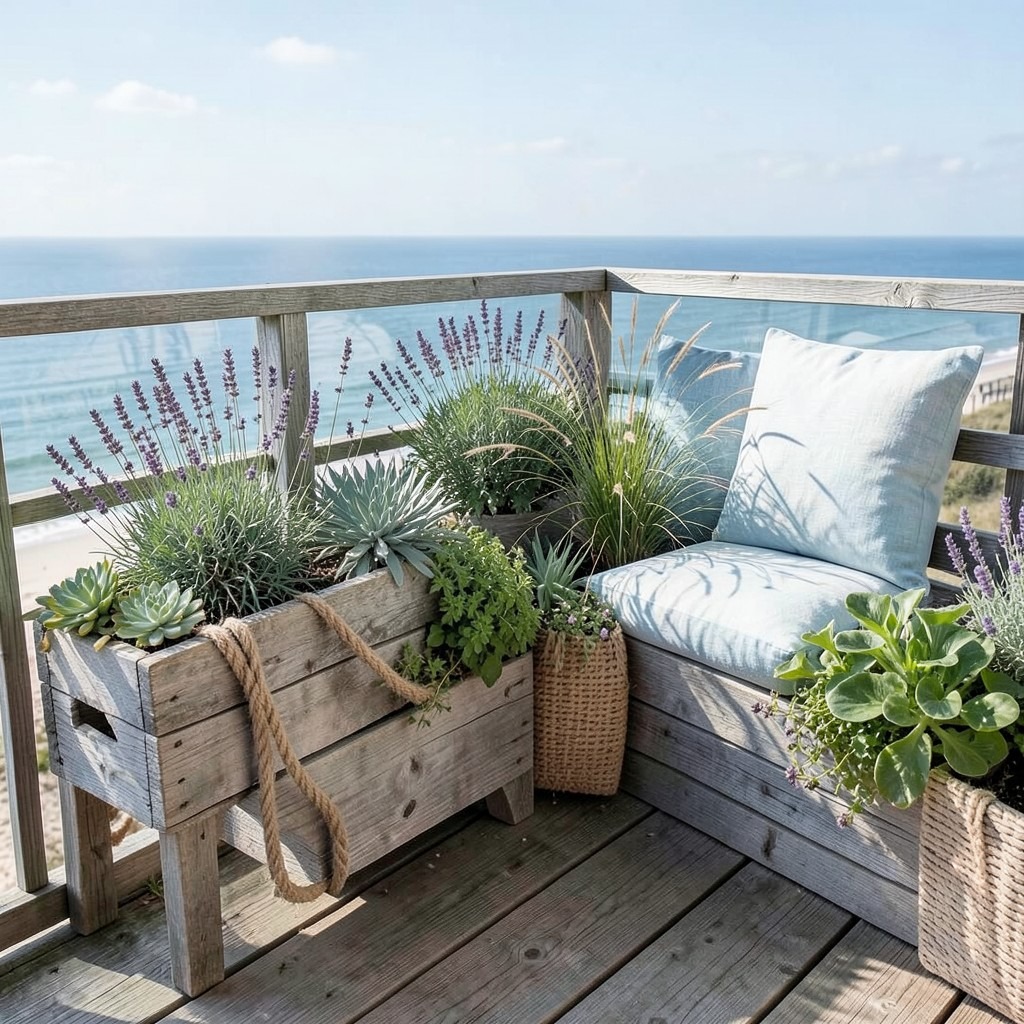
A coastal-themed balcony — in the color palette of bleached sand, ocean blue, and weathered timber, with natural rope accents, driftwood-finished surfaces, and planting in salt-tolerant species that reference the maritime plant communities of a coastal environment — produces an outdoor space that communicates the specific quality of being somewhere near the sea without requiring the actual proximity. This is not a trend-dependent aesthetic. It is a design direction with a material logic — the colors and materials are those of actual coastal environments, which are inherently beautiful, and translating that palette to a balcony context produces a space that reads as genuinely connected to those environments.
The bleached linen or heavy cotton canvas cushion covers — in the washed, sun-faded whites and pale blues that characterize coastal fabric — are the softest and most approachable element of the coastal balcony palette. They require outdoor-rated fabric for weather performance, but the coastal color palette translates well into solution-dyed acrylic outdoor fabrics that maintain the washed, slightly faded quality of the coastal aesthetic through years of outdoor exposure. The slightly imprecise, slightly uneven tonal quality of a linen-effect outdoor fabric suits the coastal aesthetic far better than a crisp, perfectly uniform fabric that reads as interior material rather than outdoor character.
The planting palette of a coastal balcony prioritizes the species that grow naturally in maritime environments: sea thrift, lavender, ornamental grasses that move in any breeze, salt-tolerant sedums, and coastal herbs. These plants suit balcony conditions — wind exposure, sun intensity, and the generally drier growing conditions of an elevated, exposed location — more naturally than woodland or meadow species that require the shelter and moisture that a coastal plant community manages without. The material fit between coastal plant species and balcony growing conditions is the practical argument that makes the coastal planting palette the most reliably successful for balcony use.
26. A Balcony With a Living Railing Garden
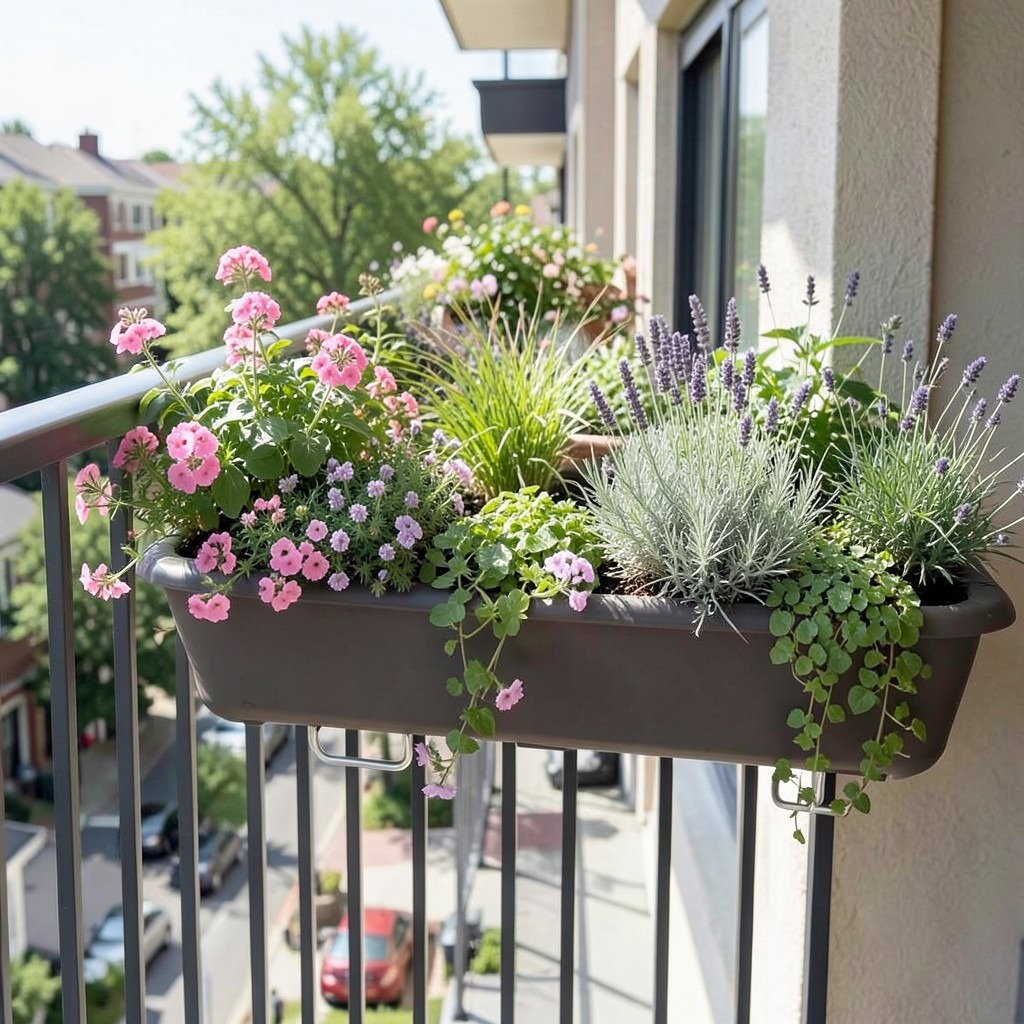
A living railing garden — planting installed in trough planters that attach to the top rail or the outer face of the balcony railing, filling the rail line with continuous plant material — converts the railing from a structural safety element into the primary garden feature of the balcony. The railing runs the full perimeter of the outdoor space, which represents a linear planting length that exceeds what most floor-level container arrangements achieve on a small balcony. Using that length for continuous planting produces a density of plant material that transforms the balcony’s character from a planted platform to an elevated garden.
The railing planter must attach securely to the railing without any modification to the building’s balustrade system. Hook-over planter brackets — metal hooks that loop over the railing cap and bear the planter weight from below — attach without tools and without any permanent fixing, which suits rental properties where structural modifications are prohibited. The planter weight when filled with growing medium and fully watered must be within the load capacity of the railing system, and the building manager or structural engineer should be consulted before installing heavy planters along the full railing length of a balcony.
The plant species in a railing trough must tolerate the specific exposure conditions of a railing position: the most wind-exposed location on the balcony, the highest UV exposure, and the fastest-drying growing conditions because the container is on the building’s outer face with minimal protection from any direction. Trailing calibrachoa, compact lavender, drought-tolerant grasses, and creeping sedum handle these conditions and produce a railing garden with genuine visual impact from both the balcony interior and from street level below.
27. A Balcony With a Canopy
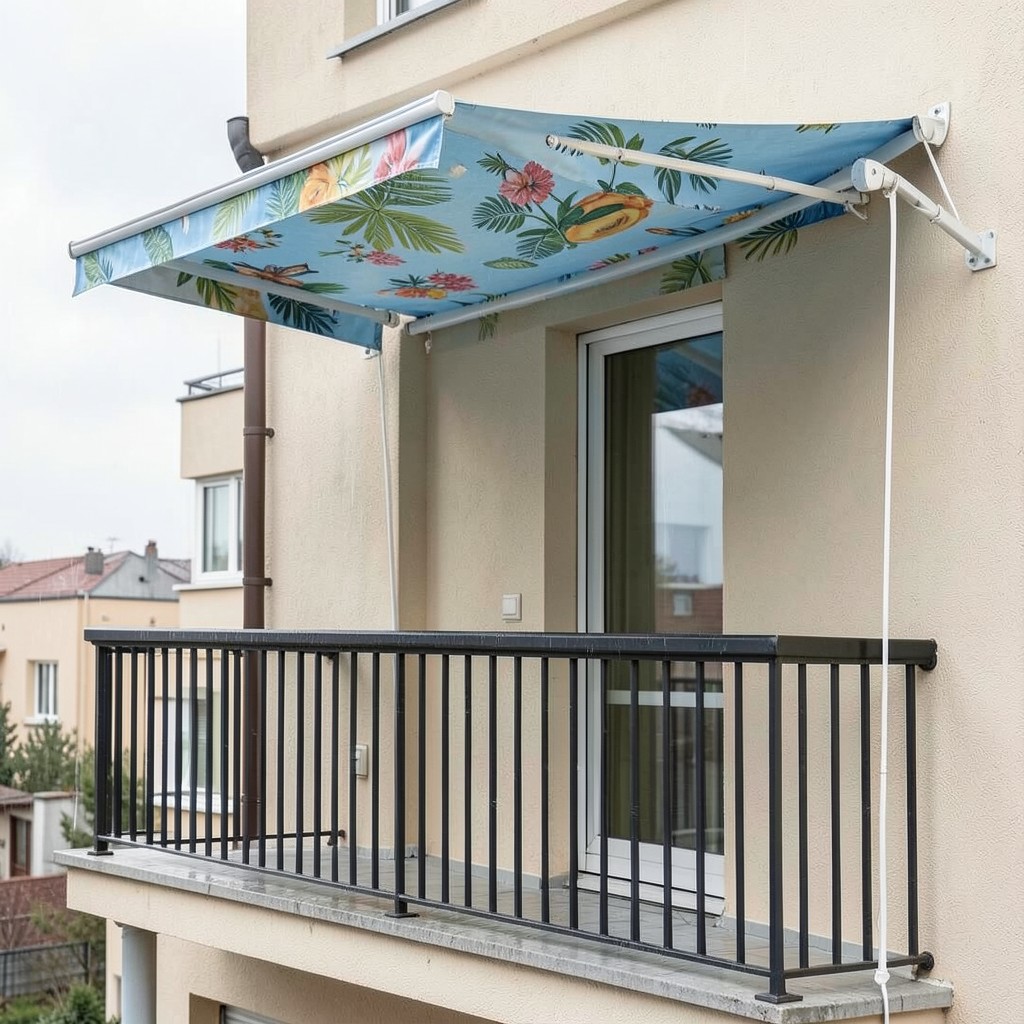
A fabric canopy — fixed along the building wall at the top and supported at two outer corners by poles or by a tensioned line to railing posts — provides the weather protection that makes a balcony usable through light rain and strong sun simultaneously. A balcony without a canopy is abandoned at the first drop of rain regardless of how well it is otherwise designed and furnished. A balcony with a canopy remains usable through conditions that would otherwise send every occupant inside, and that extension of usability across weather conditions is the single most practical improvement available to a balcony that has no existing overhead shelter.
The canopy fabric must handle the specific challenges of outdoor exposure: UV degradation that bleaches and weakens undated standard fabrics, rain loading that requires the fabric to be waterproof or at least water-repellent, and wind loading that requires the fabric to be strong enough to remain tensioned without tearing at its fixing points under gusting conditions. Acrylic canvas — the fabric used in professional awning installations — handles all three challenges with proven performance and is available in a wide range of colors and patterns that allow the canopy to contribute to the balcony’s design direction rather than merely providing functional shade.
The retractable canopy — on a cassette mechanism fixed to the wall that allows the canopy to be extended on a roller arm and retracted when not in use — is the premium version that suits balconies where the canopy would not be deployed in all conditions. A fixed canopy blocks light on overcast days and in winter when sun is welcome rather than excluded. A retractable canopy deploys when needed and retracts when the full overhead opening is preferred, which gives the balcony the full range of weather relationships rather than a single fixed condition.
28. A Balcony With a Breakfast Nook Setup
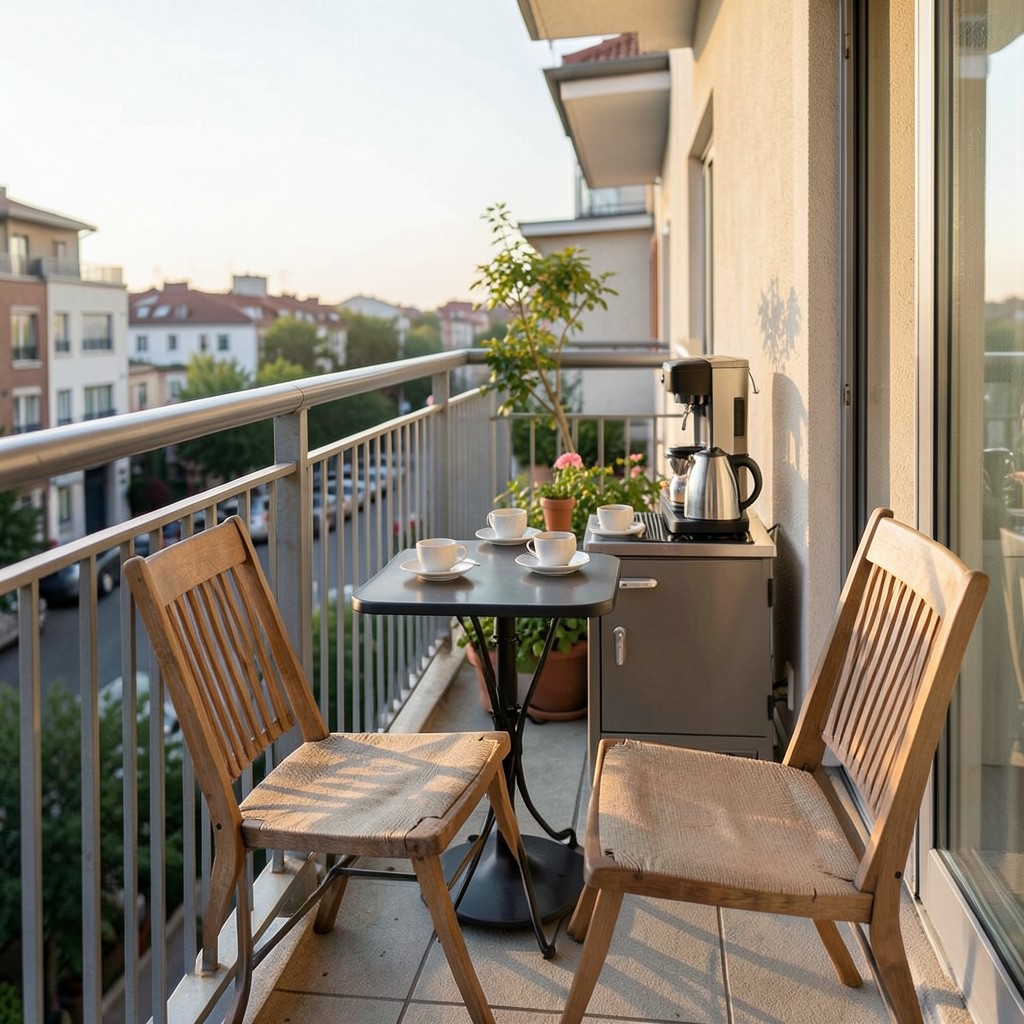
A balcony configured specifically for morning use — a compact table beside the railing positioned to face the morning light, two chairs, and the provision of a surface for a coffee maker or at minimum the items required for the morning coffee ritual — is the balcony design for households that use their outdoor space daily rather than occasionally. The morning is the hour when most urban residents have consistent access to their balcony: before work begins, before the day makes demands, in the specific quality of early light that no other hour replicates.
The orientation of the breakfast nook toward the morning light requires understanding the balcony’s aspect — the compass direction it faces — and positioning the seating to receive the light from whatever angle provides the longest exposure. An east-facing balcony receives direct morning sun from the moment of sunrise, which makes the east aspect the optimal morning balcony direction. A south-facing balcony receives morning sun from the east side of its sightline and transitions to full midday and afternoon sun, which is manageable in cooler climates and requiring a shade solution in warmer ones. North-facing balconies receive no direct sun at any time and rely entirely on reflected light for their morning character.
The compact coffee station for a breakfast balcony — a small weatherproof storage unit with a kettle or a stovetop espresso maker, cups, and the morning provisions needed without a return trip to the kitchen — extends the morning balcony ritual from a single cup brought outside from the interior to a full morning routine that happens on the balcony from start to finish. The independence from the kitchen that a balcony coffee station provides is minor in practical terms and significant in experiential ones — the difference between stepping outside with a cup made inside and making the cup outside is the difference between visiting the balcony and inhabiting it.
29. A Balcony With a Fire Bowl
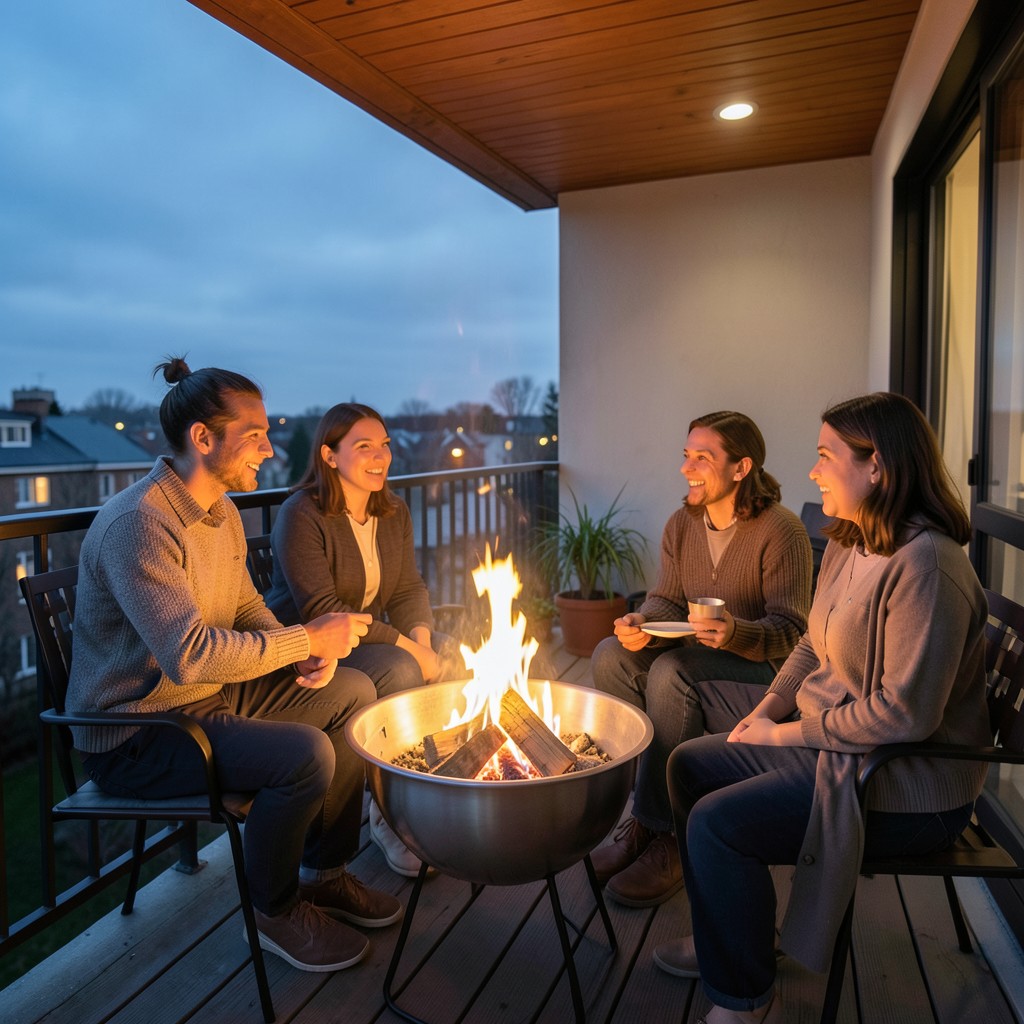
A fire bowl on a balcony — a shallow metal basin designed to burn wood or bioethanol fuel safely at table or floor height — is the balcony feature that extends outdoor occupation into the cool evenings of spring and autumn when the temperature drop after sunset would otherwise drive the household inside. The fire provides warmth, light, and the specific social magnetism of an open flame that draws people toward it and holds them in conversation long past the hour when they would otherwise have retreated indoors.
The fuel choice for a balcony fire bowl is the decision that most affects the safety, convenience, and feasibility of the feature in an apartment balcony context. Wood-burning fire bowls produce smoke, flying embers, and significant heat that may be prohibited on residential balconies by building management or fire safety regulations. Bioethanol fire bowls burn without smoke or flying embers, producing only heat and a clean, odorless flame, which makes them appropriate for balcony use in most residential buildings and acceptable under most building management agreements. The bioethanol fuel burns in a contained stainless steel burner insert, and the flame height is controlled by the burner’s adjustable opening.
The placement of any fire bowl on a balcony requires at minimum one meter of clear space between the flame and any combustible surface — the wall, the balcony railing if timber or composite, any potted plant, or any fabric. The overhead clearance requirement is particularly important: the heat rising from an open flame on a balcony is concentrated by the balcony ceiling above it, and ceiling surfaces that seem distant can reach temperatures that char or ignite at shorter distances than ground-level fire would require.
30. A Balcony With a Maximalist Plant Collection
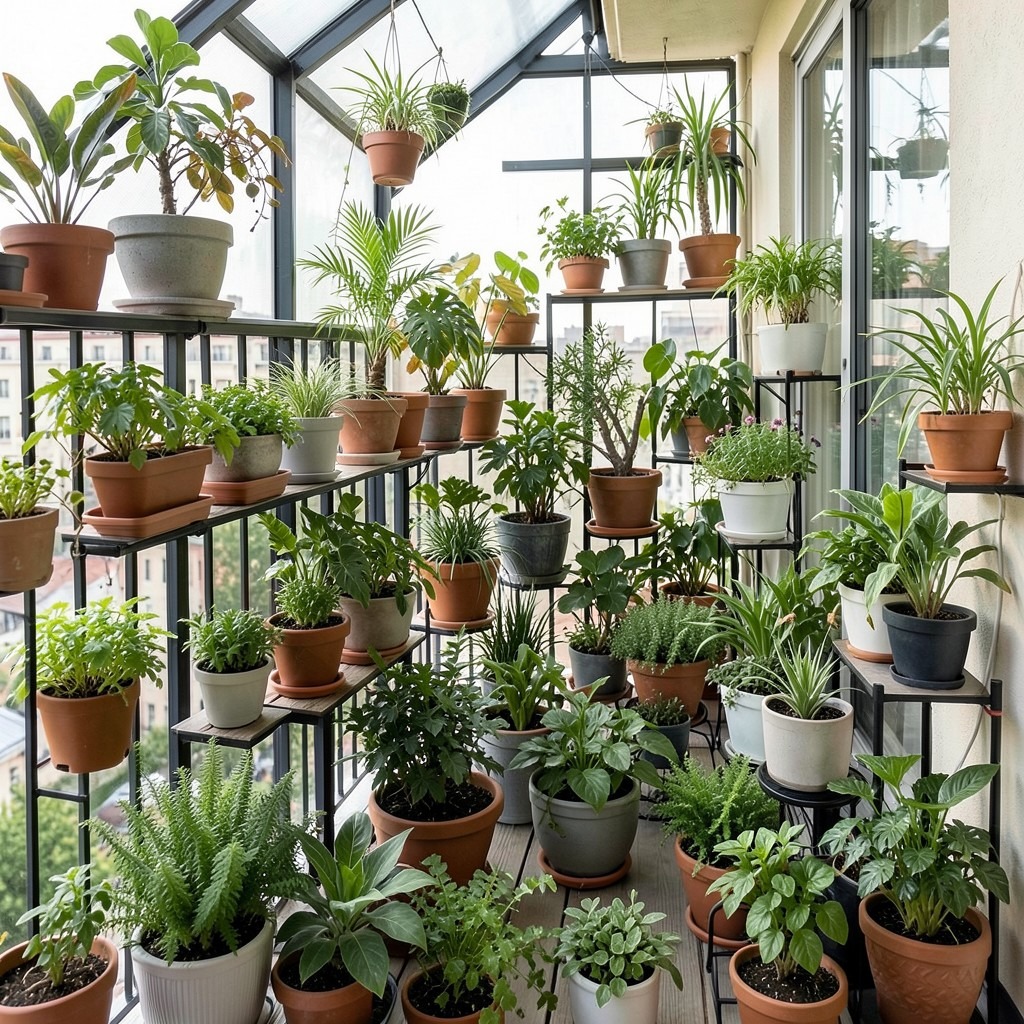
A maximalist plant collection on a balcony — every available surface, shelf, railing, and floor position occupied by a plant of some kind, in a deliberate abundance that makes the balcony feel like a personal greenhouse rather than a managed outdoor space — is the balcony design approach for the household that finds genuine pleasure in plants and wants the outdoor space to reflect that relationship without apology. Maximalism on a balcony is not a failure of restraint. It is a fully committed design direction with its own rules and its own rewards.
The visual coherence of a maximalist plant balcony depends on whether the collection reads as curated or accumulated. A curated maximalist collection — where the plant species, pot materials, and arrangement heights were chosen in relation to each other — produces the lush, abundant quality that makes maximalist planting extraordinary. An accumulated collection — plants added one at a time over years without reference to what was already there — produces visual chaos rather than abundance, and the difference between the two is immediately felt even when the viewer cannot identify exactly what makes one work and the other not. Curate actively, even when the philosophy is abundance.
The watering infrastructure for a maximalist balcony plant collection is the practical foundation that determines whether the collection remains in the condition that makes it beautiful or declines toward the neglected end of the abundance spectrum. A balcony with thirty plants in containers requires a watering system — drip lines, self-watering reservoirs built into the larger containers, or a disciplined watering rotation — that ensures every plant receives adequate water through the warm months when container-grown plants dry out rapidly in the elevated, exposed conditions of a balcony. The collection that is ten plants too large for the household’s actual maintenance capacity is always ten plants too large, regardless of how good it looks when fully watered.
31. A Balcony With a Greenhouse Setup
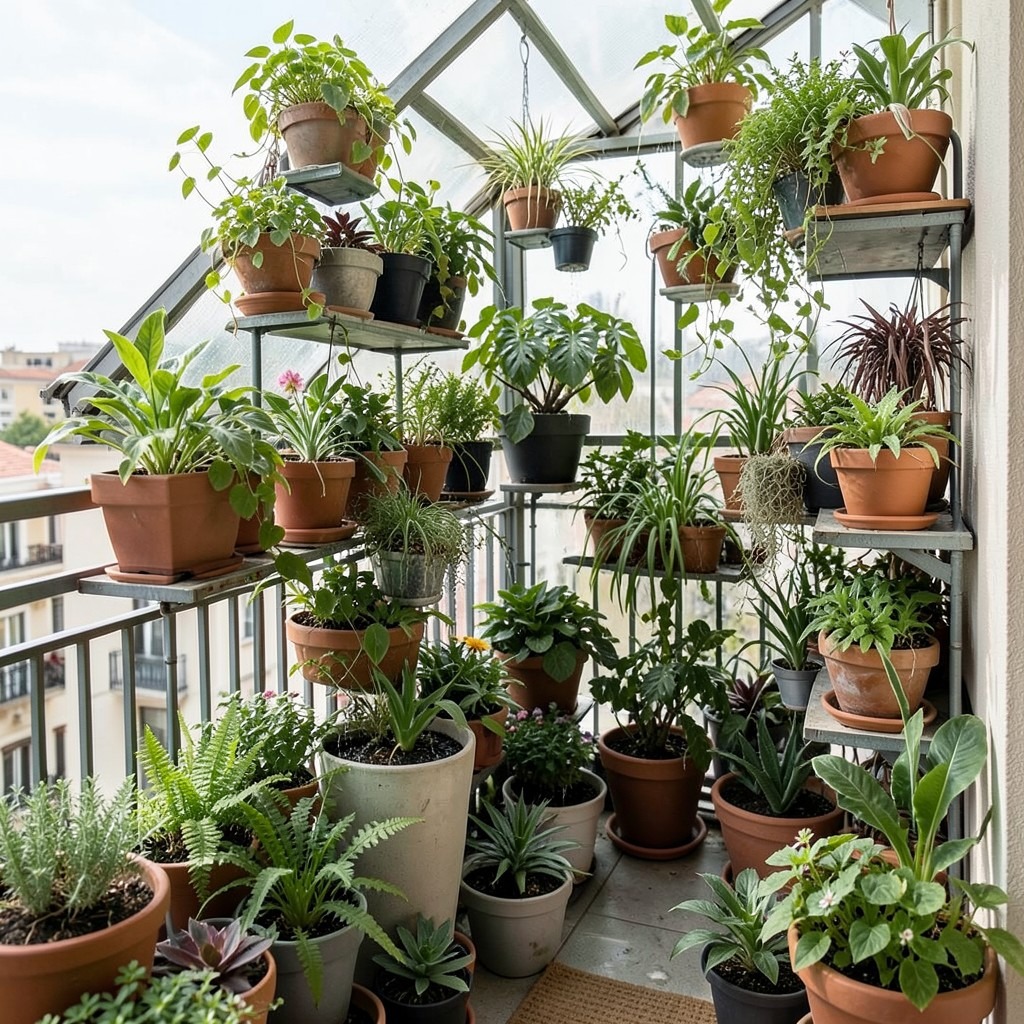
A compact greenhouse setup on a balcony — a freestanding cold frame or a slim lean-to structure against the building wall, glazed with twin-wall polycarbonate panels — extends the growing season for balcony plants beyond what open outdoor conditions allow in any climate with spring or autumn frosts. The balcony greenhouse is not a tropical plant sanctuary requiring heating — it is a temperature buffer that keeps plants above frost damage threshold through the months when outdoor temperatures drop below what the plants tolerate, which in most temperate climates adds six to eight usable growing weeks at each end of the season.
The scale of a balcony greenhouse must be modest enough to leave sufficient floor area for the balcony’s other functions — seating, movement, access to the railing. A cold frame at sixty centimeters wide by ninety centimeters long, positioned against the building wall, provides adequate protected growing space for seedlings, overwinter storage of tender plants, and early-season propagation without dominating the balcony floor plan. A lean-to structure taller than one hundred and twenty centimeters provides standing height for larger plants but requires more structural consideration relative to the building wall and the balcony slab loading.
The polycarbonate glazing material is the correct specification for a balcony greenhouse on two grounds: its weight is a fraction of glass at equivalent area, which reduces the structural load the greenhouse frame places on the balcony slab, and its impact resistance is orders of magnitude higher than glass, which matters in an elevated location where wind-driven debris is a real hazard during storm conditions. Twin-wall polycarbonate at six millimeter thickness provides adequate thermal insulation for a frost-free cold frame performance while maintaining the light transmission that plants require for healthy growth in the reduced light conditions of a partially sheltered balcony position.
32. A Balcony With a Swing Bench
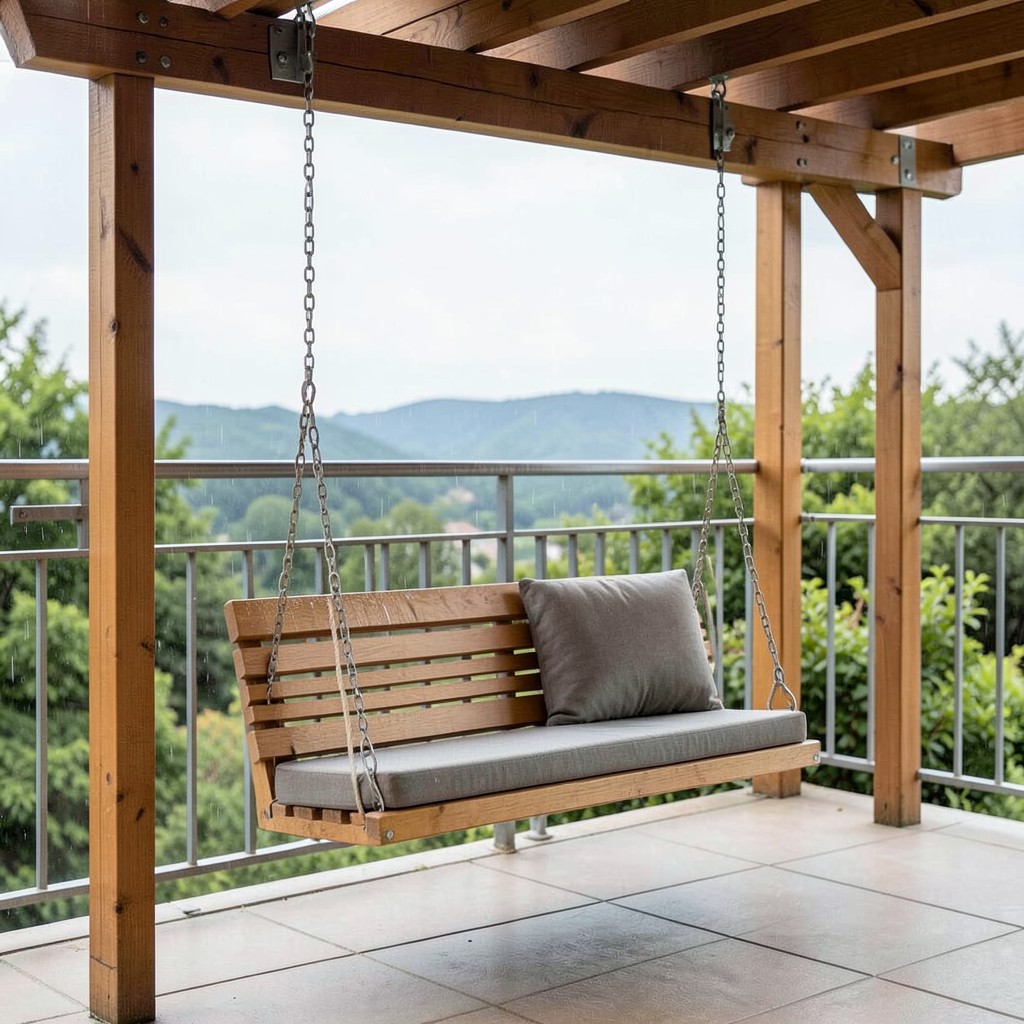
A swing bench — a two-person seat suspended from a pergola frame or from a dedicated overhead beam, swinging gently on chains or rope — is the balcony furniture piece that most directly transforms the outdoor space from functional to playful, and that quality of playfulness is not a trivial quality on a balcony. The physical pleasure of being gently in motion while outside — the pendulum movement that engages the vestibular system in a way that static seating does not — is something adults experience as relaxation and children experience as delight, and both responses are worth designing for.
The overhead structure from which the swing bench hangs must be engineered for the specific dynamic loads of a swinging two-person seat. A beam carrying the static weight of two people is considerably more lightly loaded than one handling the same two people mid-swing, where the chain tension at the peak of the swing arc exceeds the combined body weight by the centripetal force component. The beam section, the connection between the beam and its supports, and the chain attachment hardware must all be specified for the dynamic rather than the static load case, and the conservative approach is to use hardware rated at three times the anticipated maximum occupant weight.
The seating surface of the swing bench can be a slatted timber bench in the same timber as the pergola frame — which produces an architecturally integrated appearance — or a deep-cushioned seat in an outdoor fabric that prioritizes comfort over visual integration with the structure. The slatted bench reads as architecturally considered and requires no cushion management. The cushioned seat reads as more comfortable for longer occupation and requires cushion storage access when rain is anticipated, which adds a small operational complexity to an otherwise simple furniture piece.
33. A Balcony With a Smart Irrigation System
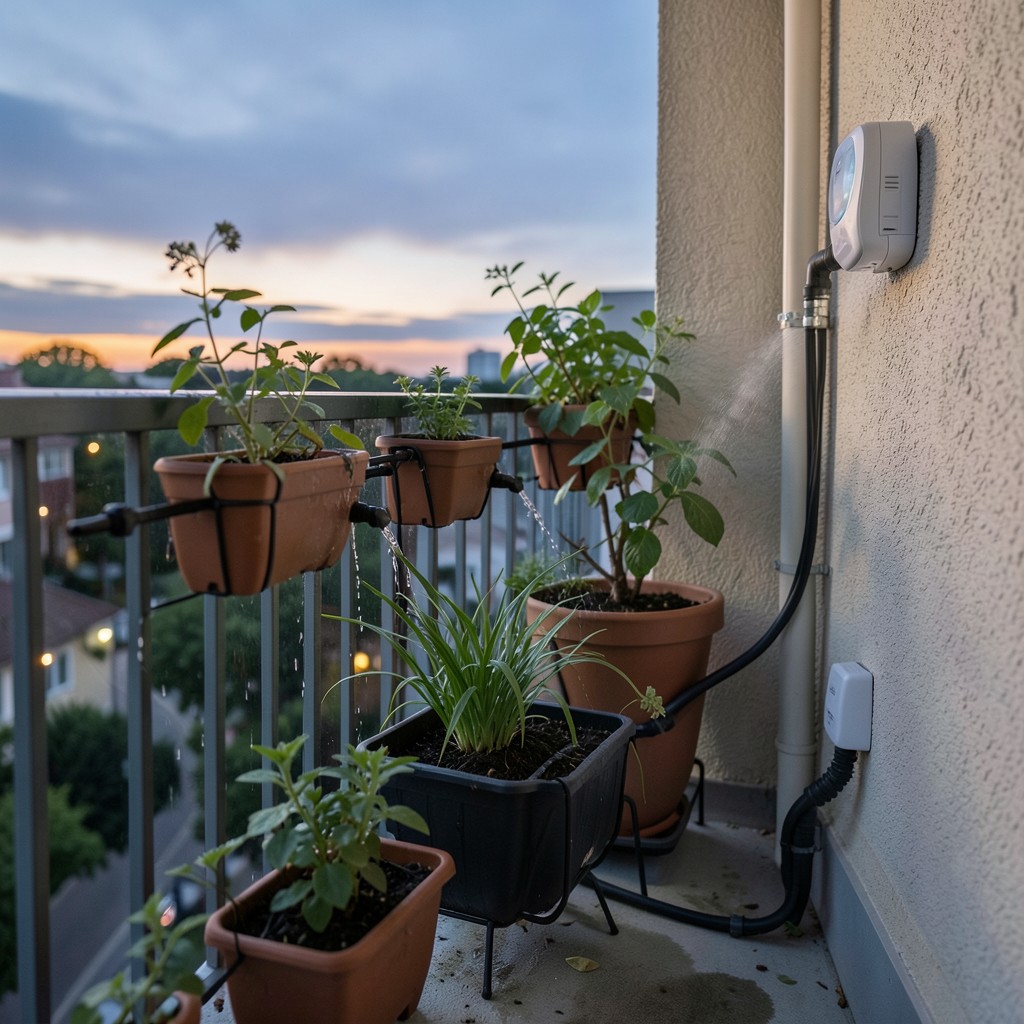
A smart irrigation system on a balcony — a timer-controlled drip line or misting system connected to the building’s exterior tap and delivering water to every container on a programmable schedule — is the infrastructure investment that makes serious balcony gardening viable for households whose work schedules, travel patterns, and daily routines do not allow the daily watering commitment that a planted balcony requires in summer. Without irrigation, the balcony plant collection is only as healthy as the household’s most consistent week — and most households have weeks that are not consistent at all.
The drip irrigation system for a balcony does not require professional installation. A timer unit connecting to the outdoor tap, a main supply line running along the railing or the wall, and individual drip emitters serving each container through branch lines — all assembled from standard push-fit components available from garden supply outlets — provides automated irrigation that can be installed in a half-day without any specialist tools or plumbing knowledge. The timer is programmed to deliver water at dusk, when evaporation loss is lowest and plant uptake overnight is highest, for a duration calibrated to the container sizes and the current weather conditions.
The smart upgrade to a basic timer irrigation system — a weather-responsive controller that reads the outdoor temperature and skips programmed watering cycles when recent rainfall has made them unnecessary — is the component that prevents the over-watering that basic timer systems produce during wet periods. Over-watering kills container plants as effectively as drought, and a timer system that waters on schedule regardless of recent rainfall is the cause of root rot in many balcony containers whose owners attribute the decline to other factors. The weather-responsive controller that interrupts the schedule when the sensor detects recent rain protects the plants from the excess water that a non-responsive timer delivers automatically.
34. A Balcony With a Rustic Wood and Metal Aesthetic
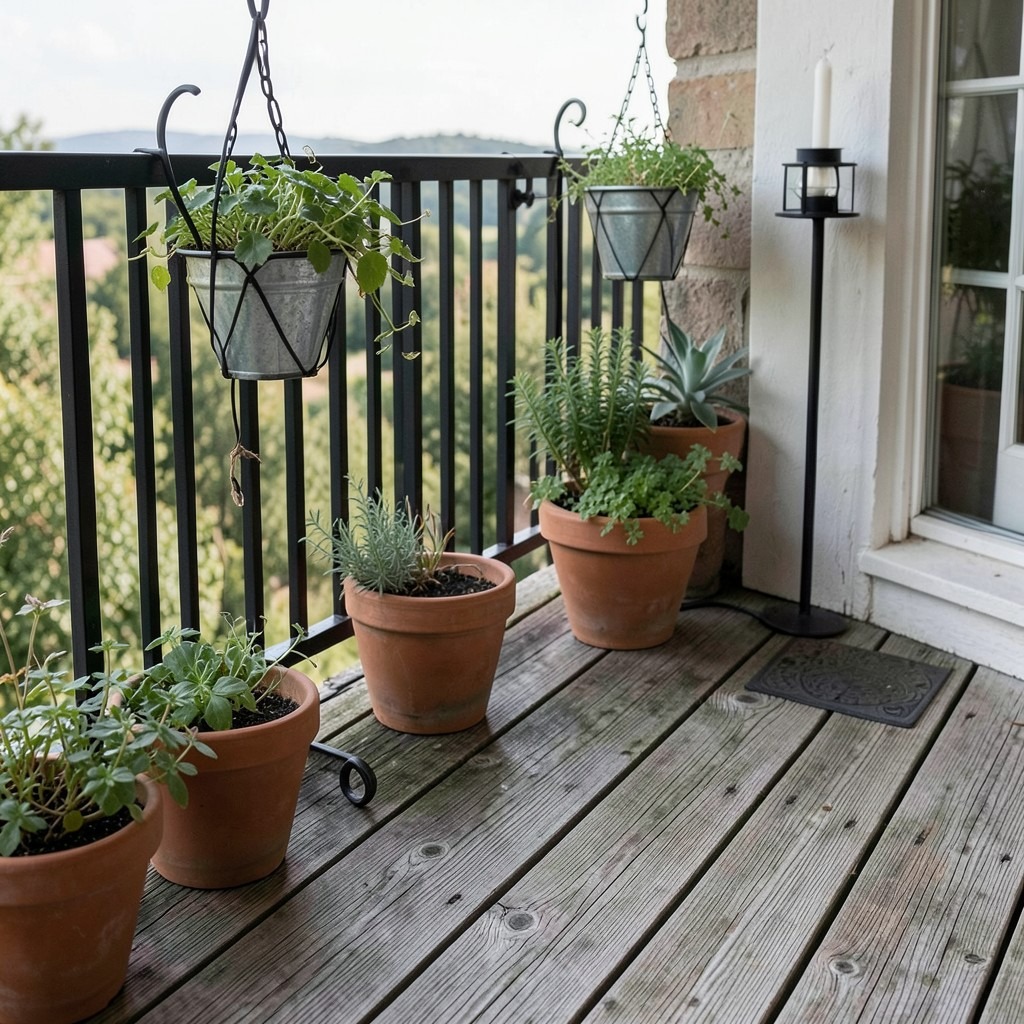
A rustic balcony design — weathered timber decking with visible grain, black powder-coated metal accents, wrought iron plant hangers, and planting in raw terracotta or aged zinc containers — produces an outdoor space with a material warmth and a grounded character that polished contemporary surfaces rarely communicate. The rustic aesthetic is not a failure to achieve refinement. It is a deliberate selection of materials that wear well, age gracefully, and look as though the space has been lived in rather than installed.
The weathered timber floor is the material foundation of a rustic balcony aesthetic, and its quality comes from the specific character of naturally aged wood — the silver-grey patina, the surface checking that follows the grain direction, the slight variations in planking height that result from differential weathering across a timber deck that has seen a full range of seasons. New timber at the beginning of the weathering process looks raw rather than weathered, and the two to three years required for natural silver-grey patina development require either patience or the application of a grey deck oil that accelerates the silvering without the texture of natural aging.
The black metal accents — railing posts, plant hanger brackets, candle holders, the frame of a compact outdoor lantern — provide the contrast element that prevents the rustic timber and terracotta palette from reading as uniform warmth without any cooler counterpoint. Black metal on a warm timber background reads as sharp, present, and architectural. It is the precise quality that stops a rustic space from feeling comfortable to the point of formlessness, and even two or three black metal elements on an otherwise warm-toned balcony are sufficient to provide the visual tension that keeps the space reading as designed.
35. A Balcony With a Monochrome Black and White Design
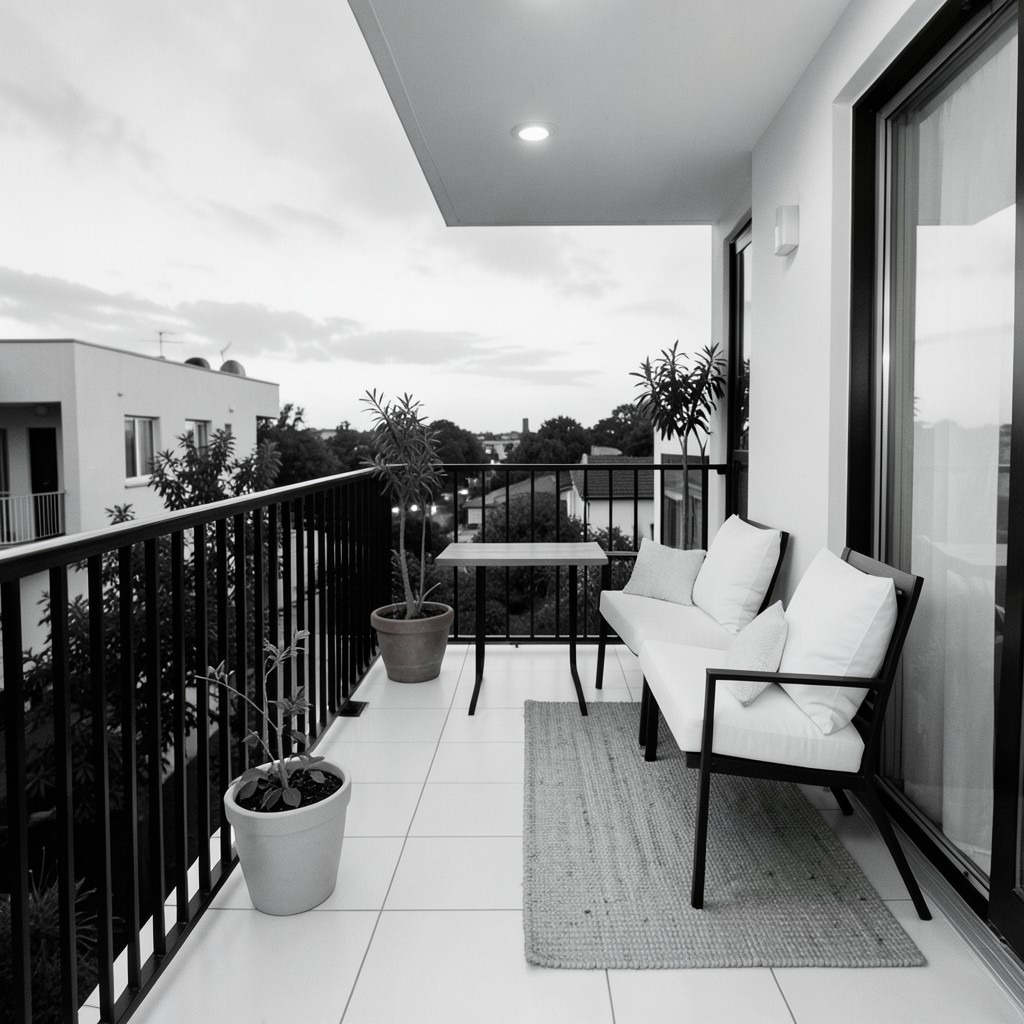
A black and white balcony — where every element from the floor tiles to the cushion covers to the planter colors to the railing finish operates within the tight constraint of these two tones — produces an outdoor space with the graphic power of a considered composition rather than the visual complexity of a multi-color palette. The constraints of a monochrome approach are its advantage in a small space: with the color variable removed from every design decision, the quality of form, proportion, and material texture carries all the visual interest, which produces a balcony that rewards close inspection rather than making its full impression on first glance.
The balance of black and white across the balcony’s surfaces determines whether the space reads as light or heavy, open or intimate. A predominantly white balcony — white tiles, white walls, white cushions — with black accents in the railing, the furniture frames, and the planting containers reads as open, airy, and spatially generous for its actual dimensions. A predominantly black balcony with white accents reads as dramatic and enclosing — more suited to a balcony used primarily in the evening hours, where the dark surfaces absorb the low ambient light and the white accents catch whatever light is present. Both are valid. The choice should be made with an understanding of how the balcony is primarily used.
The natural material accent within a black and white balcony — a single timber surface, a woven natural fiber rug, a terracotta pot left in its natural color — provides the warmth that prevents the scheme from reading as architectural exercise rather than domestic space. This is the same principle that applies to interior monochrome design: the strictly two-tone room needs one organic material element to breathe. On a balcony, where the sky and any visible planting already introduce natural color, the organic material accent can be minimal — one timber table top, one natural fiber mat — and still provide the warmth the scheme requires.
36. A Balcony With a Multi-Level Plant Shelf
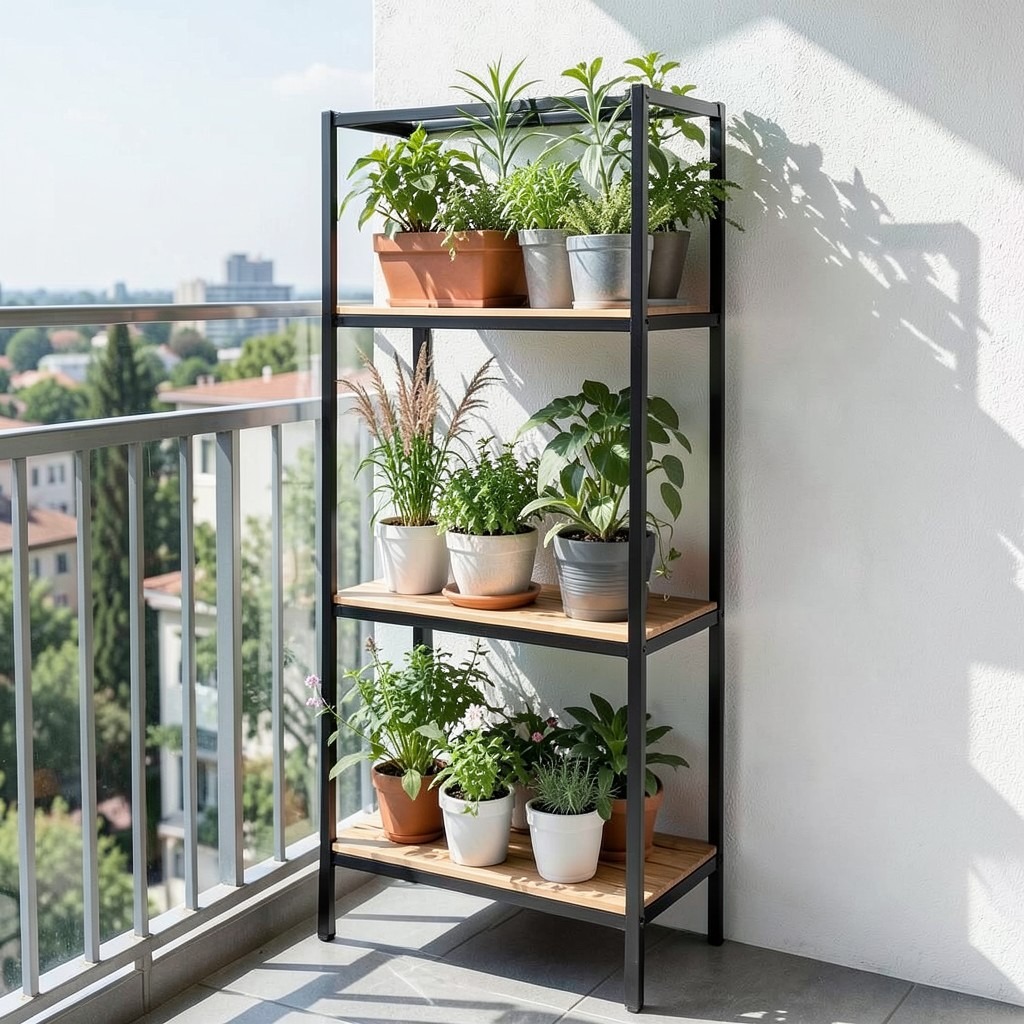
A multi-level plant shelf on a balcony — a freestanding or wall-mounted tiered structure that displays plants at three or four different heights simultaneously — maximizes the vertical planting dimension of the balcony in a footprint that a single floor-level container occupies. A shelf unit of sixty centimeters wide by thirty centimeters deep, standing at one hundred and fifty centimeters tall with four shelves, provides twelve planting positions in the floor space of one medium container at a cost in floor area that no arrangement of individual pots at the same height range matches for spatial efficiency.
The material and construction of the plant shelf must handle continuous outdoor exposure without warping, rusting, or deteriorating in ways that compromise either its structural integrity or its visual contribution to the balcony. Powder-coated steel shelving — black or white, depending on the balcony’s palette — handles weather exposure indefinitely without maintenance and provides the visual lightness that a solid timber shelf does not. Timber shelving requires an exterior grade finish and an annual retreatment schedule to maintain its quality, but produces a warmth that steel shelving does not provide in equal measure.
The planting arrangement on a multi-level shelf must address the light differential between the top shelf — receiving full sun and drying most rapidly — and the lower shelves, which receive progressively less direct sunlight as the upper shelves shade those below. Sun-demanding, drought-tolerant plants on the upper shelves and more shade-tolerant, moisture-retaining species on the lower shelves mirrors the natural light gradient of the structure and produces a shelf where every plant performs at its natural best rather than one where some thrive and others struggle in conditions they were not selected for.
37. A Balcony With an Outdoor Kitchen Bar
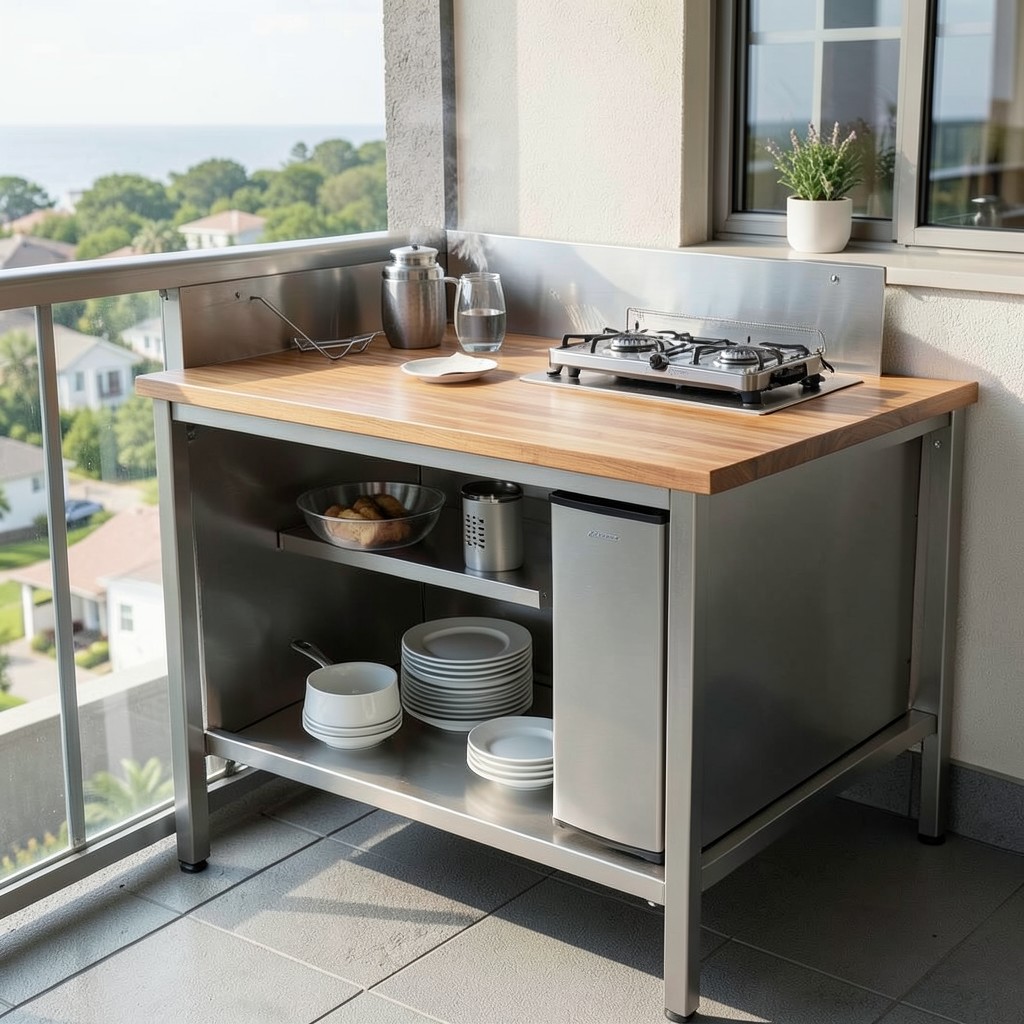
A compact outdoor kitchen bar on a balcony — a wall-mounted or freestanding stainless steel unit with a surface for preparation, storage below for outdoor tableware, and provision for a small portable grill or a bar fridge — turns the balcony into an outdoor entertaining space with the functional independence of a kitchen rather than a space that requires constant trips to the interior for every drink, snack, or preparation task. The outdoor kitchen bar extends the event horizon of balcony entertaining from a drinks-in-hand standing arrangement to a full outdoor hosting experience.
The grill specification for a balcony outdoor kitchen must address the building’s combustion policies and the balcony’s ventilation conditions simultaneously. Gas grills produce a controllable heat with less smoke and less flying ember risk than charcoal, which makes them more appropriate for residential balcony use in most buildings. Electric grills produce no combustion gases at all, which makes them appropriate for the most restrictive residential building contexts, though their cooking performance at high heat differs from gas or charcoal. The cooking surface of the grill should be scaled to the number of people typically entertained — a compact two-burner portable gas grill serves up to four covers adequately without the spatial footprint of a larger unit.
The bar unit’s material must handle the combination of food preparation, drink spillage, UV exposure, and the regular wet-dry cycling of an outdoor surface through seasonal weather. Marine-grade stainless steel — grade 316 rather than the standard 304 — handles the moisture and the chloride exposure of coastal and humid environments without the surface rusting that 304 stainless develops in those conditions. A teak or hardwood worktop surface alongside the stainless structure provides the visual warmth and the cutting-board function that an all-stainless surface does not, and the combination of the two materials produces a kitchen bar with the material sophistication of a professionally designed outdoor kitchen at a fraction of the production cost.
38. A Balcony With a Meditation Corner
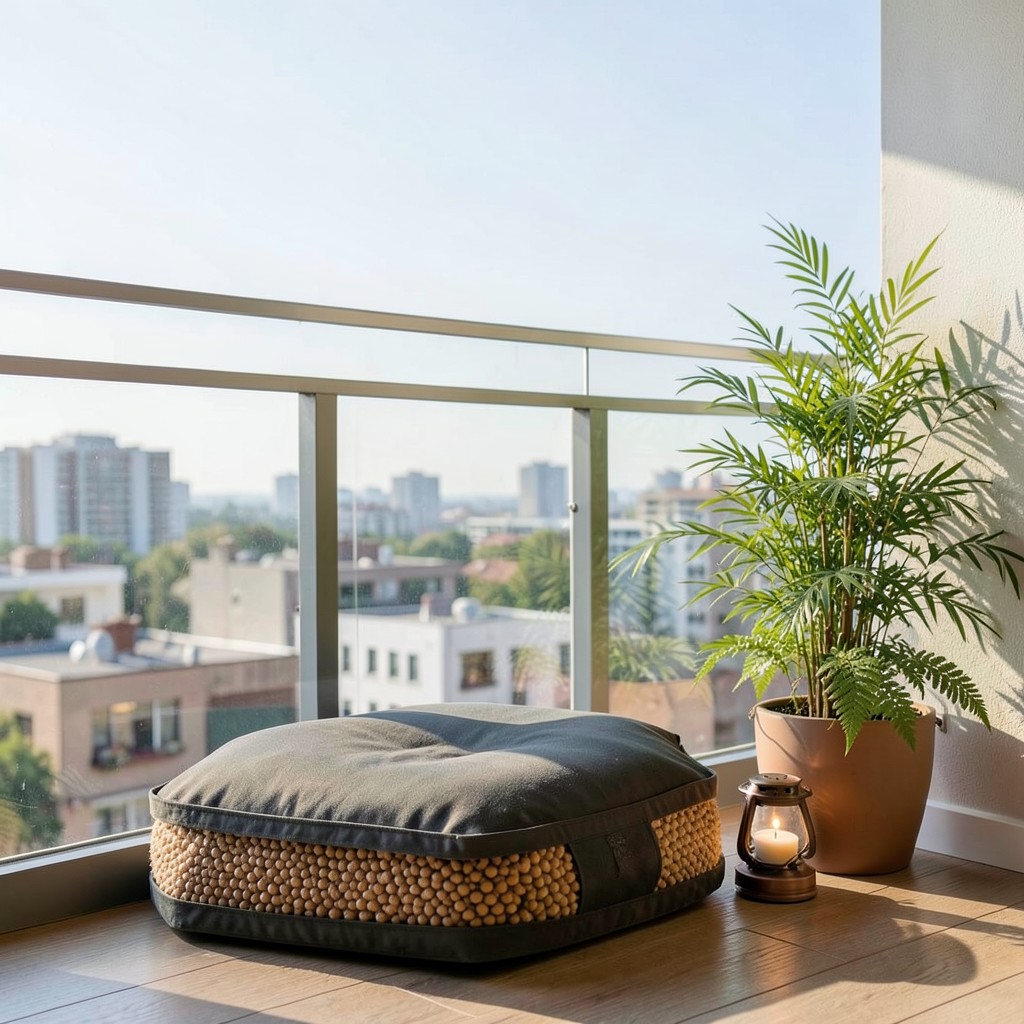
A meditation corner on a balcony — a floor cushion positioned to face the view, a small incense holder or a candle lantern, a trailing plant in a container beside the seat, and nothing else in the immediate sightline — is the most specifically atmospheric use of balcony space available. The meditation corner asks nothing of the balcony except that it provides open sky and a degree of quiet, both of which most balconies deliver without any modification. The design work is entirely in the reduction — removing everything from the corner that competes with the quality of stillness the space is meant to support.
The floor cushion for outdoor meditation must be weatherproof at the cover level — the fabric must handle occasional dampness without moulding or staining — and adequately filled at the cushion level to support a sustained seated meditation posture without the hard floor beneath eventually becoming the dominant sensation. A zafu meditation cushion in a weather-resistant outer cover, filled with buckwheat hull at sufficient volume to elevate the hips above the knees in cross-legged position, provides the postural support that makes a thirty-minute seated practice possible without the distraction of physical discomfort.
The plant beside the meditation seat should be chosen for its ambient qualities rather than its visual impact — a fragrant plant that releases its scent in the warmth of the day, a grass or bamboo that produces gentle sound in any breeze, or a plant with a specifically calming visual quality such as a slowly unfurling fern or a succulent rosette. These are not arbitrary plant choices — they are selections made in direct service of the space’s specific function, and that intentionality in the plant selection is the detail that distinguishes a meditation corner from a floor cushion placed near a plant.
39. A Balcony With a Bohemian Aesthetic
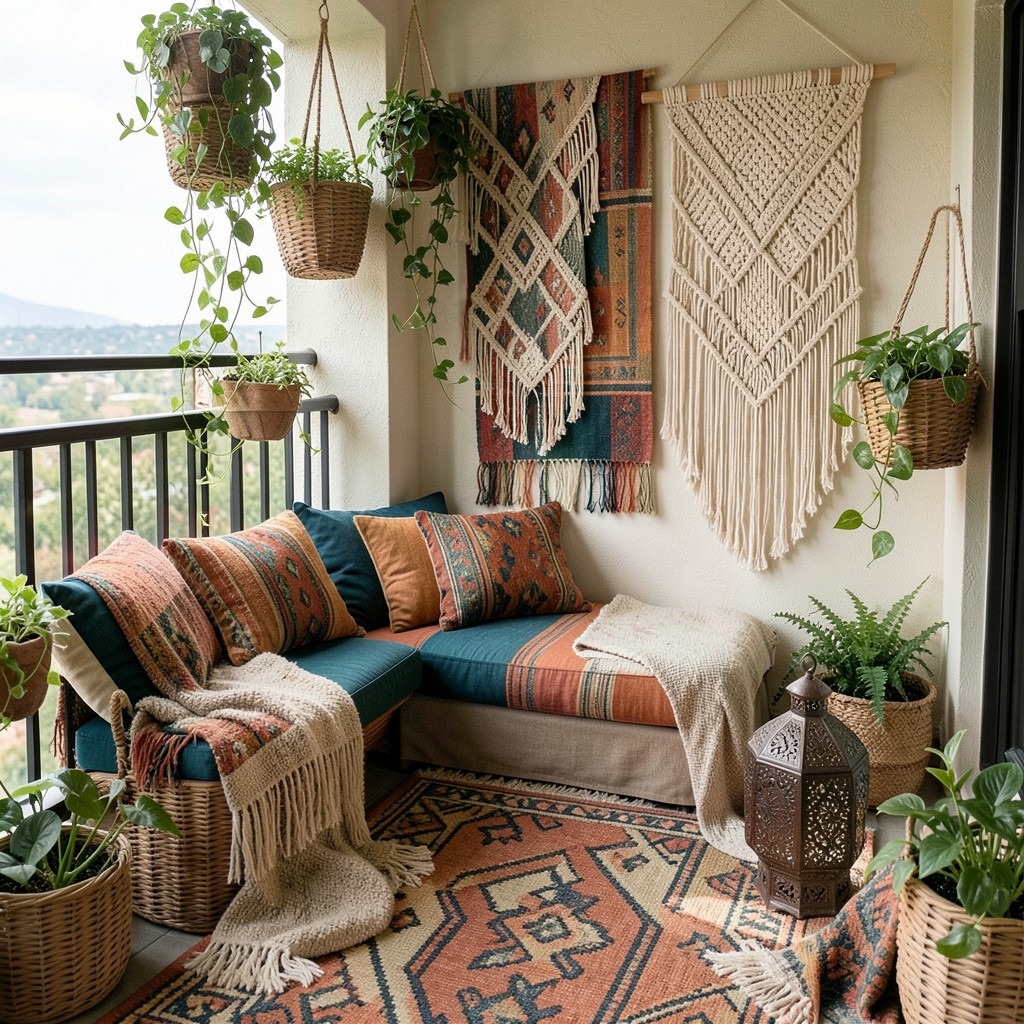
A bohemian balcony — layered textiles in warm jewel tones, macramé wall hangings, trailing plants in woven baskets, a Moroccan lantern beside a low pouffe, and a general abundance of decorative objects that rewards extended looking — produces an outdoor space with the specific quality of accumulated personal culture that no single-aesthetic, perfectly coordinated design direction generates. The bohemian space feels inhabited by a person with a history of collected objects and genuine aesthetic opinions, and that sense of inhabited personality is one of the most welcoming qualities any room, indoors or out, can communicate.
The textile layer is the foundation of a bohemian balcony aesthetic, and it must be executed with more weather consideration than indoor bohemian interiors require. Floor cushions in outdoor-rated fabric with removable washable covers, a woven outdoor rug in a rich geometric pattern, and a throw in a heavier outdoor weave for cool evenings provide the textile depth that the bohemian aesthetic requires while maintaining the practical performance that outdoor conditions demand. The color family across the textiles — warm terracotta, deep teal, burnt orange, and natural linen — produces the jewel-and-neutral combination that reads as bohemian rather than simply colorful.
The macramé wall hanging — hand-knotted cotton cord in a large-scale pattern fixed to the wall or railing — is the decorative element most specifically associated with the bohemian aesthetic and the one that most efficiently establishes the visual character of the space from a distance. An outdoor-rated macramé, made from cotton cord treated for UV resistance or from synthetic cord in a natural appearance, handles balcony weather conditions without the cotton degradation that untreated natural fiber experiences in prolonged wet-dry cycling. The scale of the hanging should be generous — a piece that is too small for the wall surface it occupies reads as tentative rather than intentional.
40. A Balcony With Built-In Lighting in the Floor
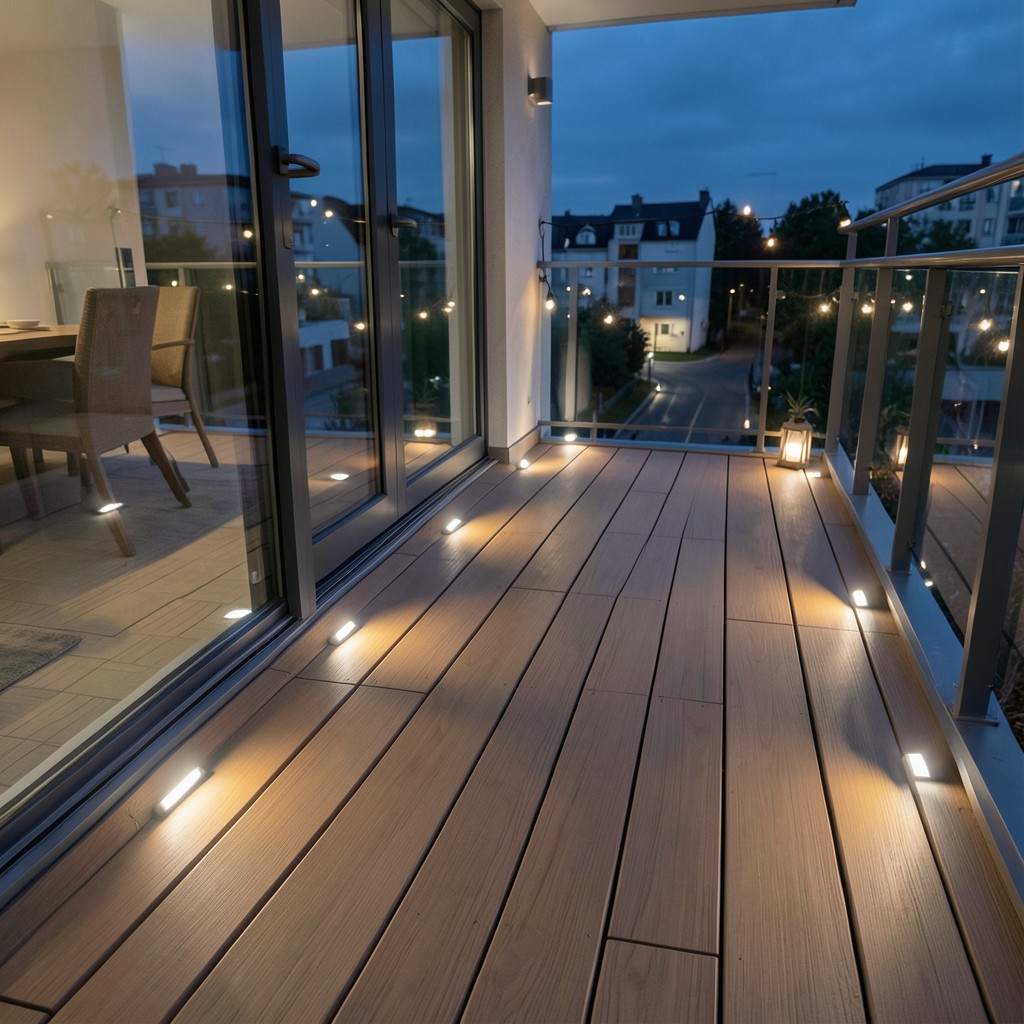
Built-in floor lighting on a balcony — LED recessed fixtures set flush into the decking or tiling, illuminating the surface from below and creating a lit floor plane after dark — is the balcony lighting approach that most changes the outdoor space’s evening character from adequately lit to architecturally composed. Floor lighting seen from the interior through the balcony door creates a glowing outdoor stage that communicates occupation and atmosphere from inside the apartment, which is how most residents experience the balcony on evenings when they are not actually sitting on it.
The LED recessed deck light in an IP67-rated weatherproof housing — fully sealed against water ingress in any weather condition — provides a reliable floor lighting installation that requires no maintenance beyond an occasional wipe of the lens surface and produces no significant heat that could damage the surrounding deck material. The color temperature of the LED must match the other lighting on the balcony: a warm white at 2700K complements string lights and lanterns in a harmonious light scheme, while a cooler temperature at 4000K creates a daylight-quality accent that suits contemporary architectural balcony designs where clinical precision is the aesthetic intention.
The spacing of floor lights across a balcony deck must balance the desire for an even light surface against the drilling and wiring requirements that each additional fixture adds to the installation. A light at every third plank of a standard deck installation — approximately thirty centimeter spacing — produces a well-lit floor with generous spacing between fixtures. A light at every alternate plank produces a denser light distribution with a higher fixture count. For most residential balcony applications, the thirty-centimeter spacing provides adequate illumination and an even light distribution without the fixture density that closer spacing demands.
41. A Balcony With Artificial Grass
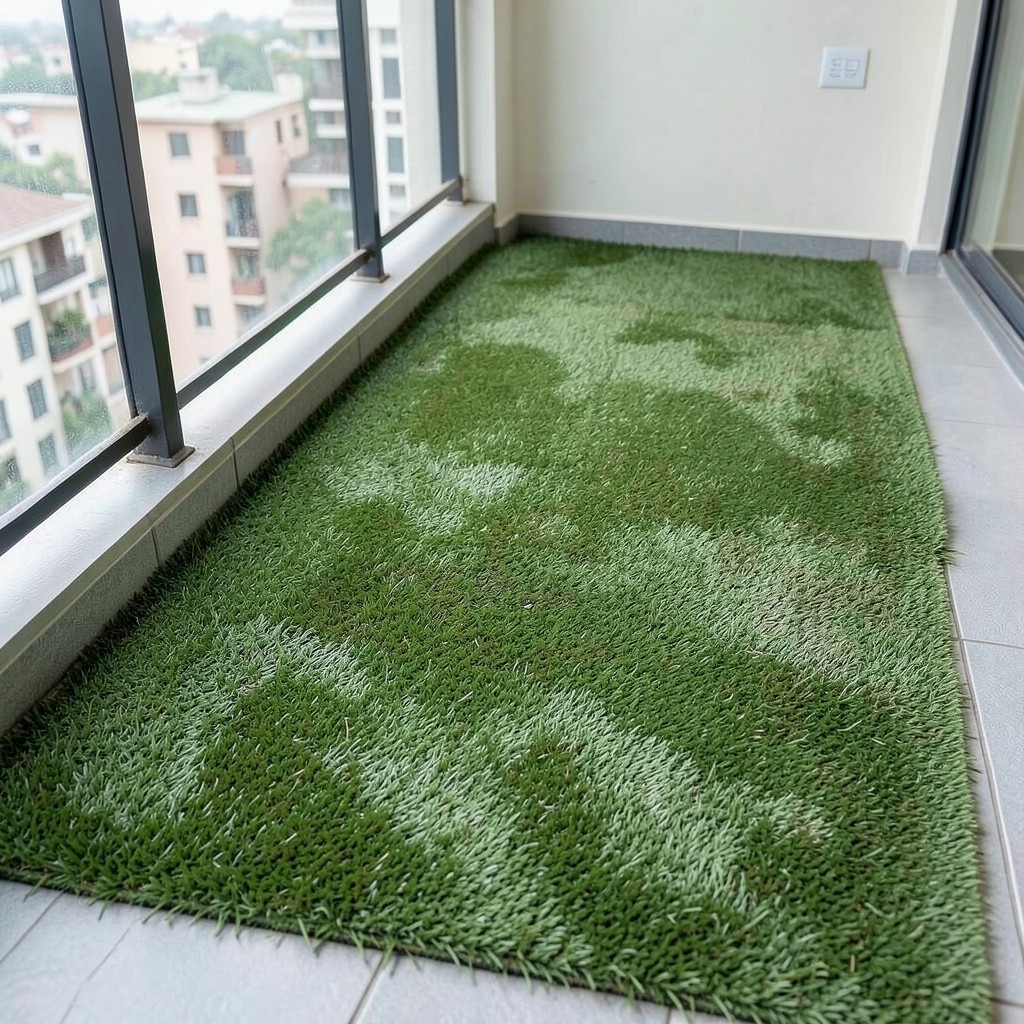
Artificial grass on a balcony floor — a dense, high-quality synthetic turf laid over the existing concrete or tile surface — provides the one quality that no other balcony floor material delivers: the underfoot sensation of walking and sitting on grass. For households in apartments, the absence of a garden lawn is one of the most physically felt losses of the urban living trade-off, and artificial grass on the balcony provides a textural reconnection with that sensation in a maintenance-free format that real lawn grass in a contained balcony setting could not sustain.
The quality differential in artificial grass products is more significant than the price differential suggests at the point of purchase. A low-quality synthetic turf — with a short, uniform pile in a single flat green that does not move or behave like real grass — reads as obviously artificial from close range and deteriorates to a flattened, matted surface within two seasons of foot traffic. A high-quality turf with a mixed pile height, a variation in blade color between the green and the lighter natural tone of the base, and a weight that allows the blades to move slightly underfoot reads as plausibly natural from a standing position and maintains its pile height through years of use because the blade memory in the higher-quality product resists the permanent flattening that cheaper turf exhibits.
The base preparation for artificial grass on a balcony requires attention to the drainage provision that the existing floor surface offers. A balcony tile floor with adequate drainage slopes and functional drainage outlets provides the base on which artificial grass can be laid with its own drainage perforations aligning with the floor’s drainage path. A poorly draining base beneath artificial grass retains water between the grass backing and the floor surface, creating the conditions for mould and odor that are the primary performance complaints about artificial grass in poorly installed applications.
42. A Balcony With a Scented Plant Collection
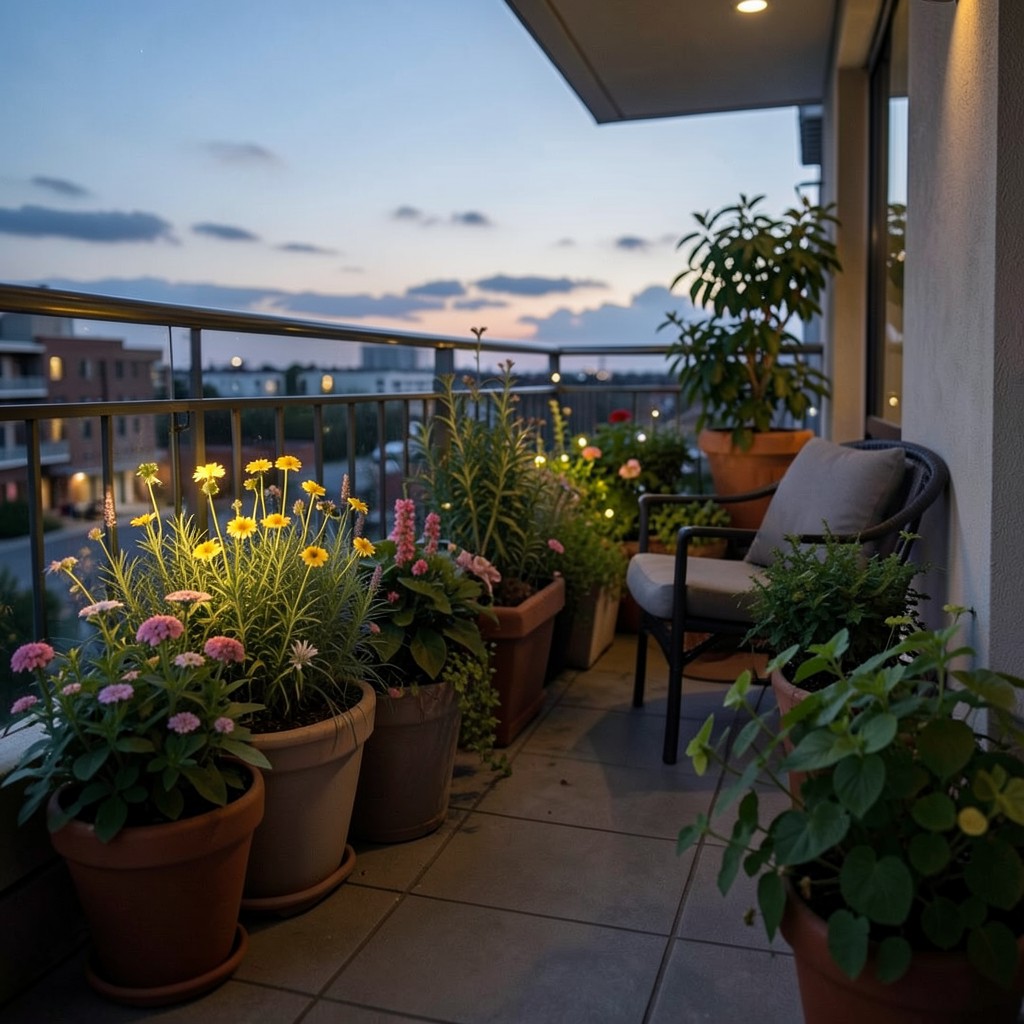
A scented plant collection on a balcony — a curated selection of fragrant species that flower or release their scent at different hours and different seasons, creating a year-round olfactory experience from the outdoor space — is the most undervalued dimension of balcony garden design because fragrance is invisible in photographs and therefore absent from the design references that most people use when planning their outdoor space. A balcony that smells extraordinary on a summer evening is a better sensory experience than one that looks extraordinary in a photograph, and designing for scent rather than exclusively for visual quality produces a space that rewards physical presence in a way that no image can convey.
The evening-scented balcony — planted with species that release fragrance specifically as dusk approaches — is the most specifically rewarding scent strategy for the balcony used primarily in the evening hours. Night-scented stock, evening primrose, and poet’s jasmine release their fragrance at dusk or after dark, coordinating the onset of the most atmospheric lighting hour on the balcony with the arrival of the plant collection’s most intense scent production. This is not a coincidence in the plants’ biology — the evening scent release targets night-flying pollinators, but the human beneficiary of that evolutionary strategy is anyone sitting on the balcony as the sun goes down.
The container placement for a scented balcony planting must position the fragrant species where the balcony’s air movement carries the scent toward the seating area rather than away from it. A plant positioned downwind of the prevailing breeze from the seating delivers its fragrance to the occupant. A plant positioned upwind has its fragrance carried away before it reaches the sitting position. Understanding the direction of the prevailing breeze on the specific balcony, and positioning fragrant plants accordingly, is the detail that determines whether the scented balcony experience delivers on its potential or disappoints in practice.
43. A Balcony With a Tropical Plant Paradise
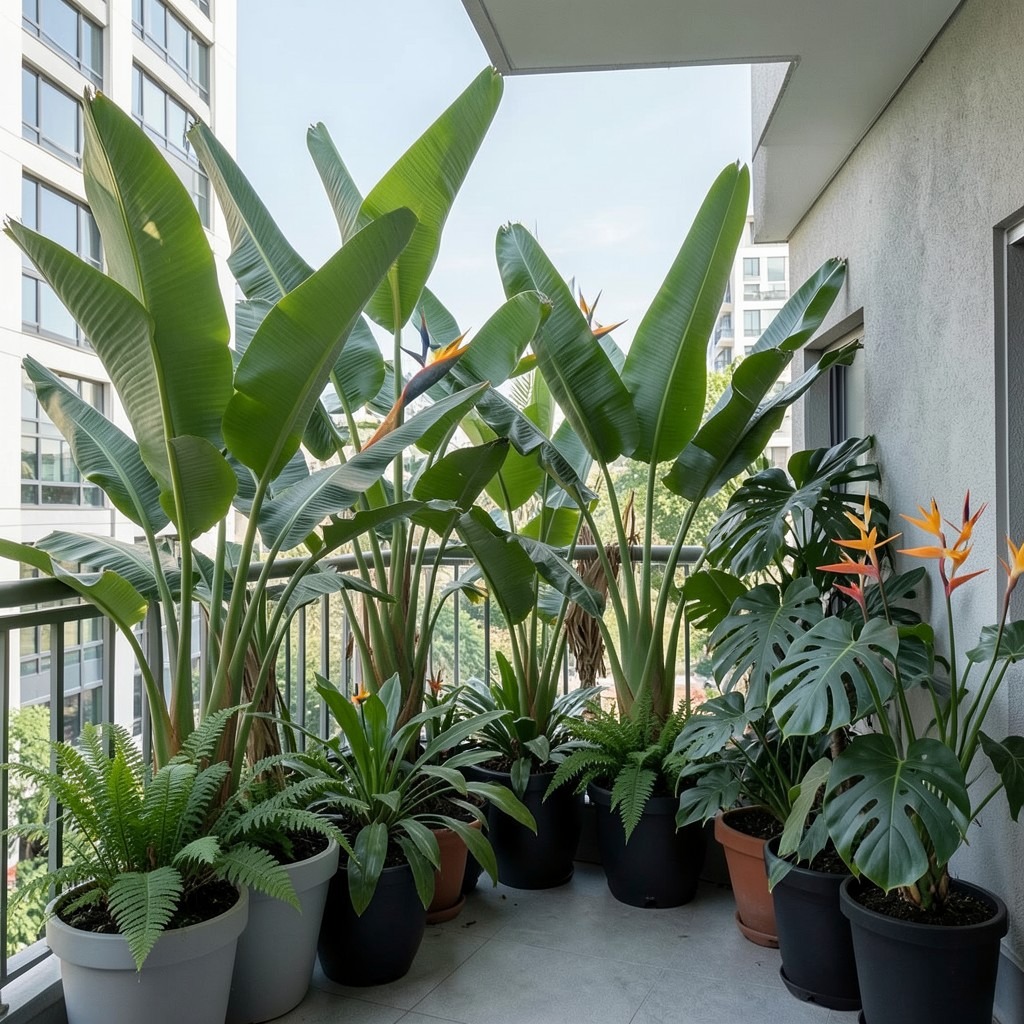
A tropical plant paradise on a balcony — large-leafed banana plants, architectural bird of paradise, glossy monstera, and vivid flowering heliconias in generous containers arranged to produce a canopy of tropical foliage that transforms the elevated outdoor space into an immersive green environment — produces a balcony experience that no other planting approach matches for sheer biological exuberance. The tropical balcony works because urban environments tend toward the grey and the hard, and the excess of tropical plant material is the most effective antidote to that aesthetic.
The climate suitability of tropical plants for a balcony setting depends entirely on the location and the degree to which the balcony provides thermal protection relative to the open ground conditions of the same climate. A south-facing balcony in a temperate city receives reflected heat from the building fabric and from the building opposite that raises the local temperature above the ambient outdoor temperature by a margin that makes some tropical species viable that would not survive in an open garden at the same latitude. The building mass around an urban balcony is the microclimate factor that most tropical balcony gardens rely on without explicitly acknowledging.
The largest tropical plants — banana, bird of paradise, and large-form canna — require containers of forty liters or more to sustain the root volume their leaf canopy demands, and those containers at full soil weight represent a structural loading point that requires checking against the balcony slab capacity. The balcony structural engineer’s load specification is the starting point for any balcony tropical garden that involves multiple large containers — not a precautionary formality but a genuine constraint that determines how many and how large the containers can be without exceeding the balcony’s designed load capacity.
44. A Balcony With a Reading and Work From Home Corner
A balcony configured as a secondary work-from-home space — with a compact fold-down wall desk, a comfortable work chair rated for outdoor use, a portable power supply or an outdoor-rated socket, and weatherproof storage for a laptop, stationery, and work materials — extends the working day into the outdoor space during the periods when working outside is possible. Natural light, fresh air, and the visual range of an outdoor view each improve the cognitive conditions for focused work in ways that indoor working environments rarely match, and the balcony that is configured for work rather than merely permitting it makes the quality difference between working outside and working indoors a daily rather than occasional experience.
The fold-down wall desk — a hinged timber surface fixed to the building wall, folding flat when not in use — provides the working surface without occupying permanent floor area, which is the critical practical requirement on a balcony where every square meter needs to serve multiple functions through the day. The working surface depth — the front-to-back dimension of the desk — needs to accommodate a laptop at standard working distance with space for a notebook alongside, which requires a minimum of fifty centimeters depth and preferably sixty. At fifty centimeters, the desk is usable for serious focused work. Below that depth, the working distance between eyes and screen becomes uncomfortable for sessions longer than forty-five minutes.
The power provision for outdoor work — a properly installed outdoor-rated socket at desk height on the wall — is the infrastructure element that determines whether the balcony work corner is genuinely functional or limited by battery life and the constraints of cable management from an interior socket through the door. A single outdoor socket at the desk position allows charging, a second small monitor if needed, and the eventual addition of a balcony light at the desk position for the evening working hours that extend into the dimmer hours of autumn and spring.
45. A Balcony With a Zen Rock Garden Element

A miniature Zen rock garden element on a balcony — a shallow tray of fine-grade white sand or grey gravel with three or four smooth stones arranged in an asymmetric group and a small rake for the periodic re-patterning of the sand surface — introduces the meditative practice of Japanese dry garden design into the balcony space at a scale appropriate to the apartment context. The Zen garden tray does not represent a garden. It is a contemplative object — a surface for mindful attention during the act of raking, and a visual focal point of deliberate calm at all other times.
The proportions of a balcony Zen garden tray are the primary design consideration — too small and it reads as a decorative accessory, too large and it claims floor space without adding any functional value. A tray of sixty by forty centimeters, positioned on a low platform or table at a height accessible from the seated position, provides the surface area for a composed stone arrangement and adequate raking surface without dominating the balcony space. The tray depth — at minimum five centimeters — holds sufficient gravel depth for raking patterns that hold their form between sessions without requiring constant replenishment.
The stone selection for the dry garden tray follows the Japanese tradition of odd-numbered groups — one stone, or three, or five — arranged in compositions that create tension and balance between the elements without symmetry. A single large smooth stone and two smaller ones, positioned at asymmetric intervals with the large stone slightly off-center in the tray, produces the basic three-stone composition that Japanese dry garden design has used for centuries because it works — the asymmetry creates interest and the composition resolves it without explanation.
46. A Balcony With a Painted Feature Wall
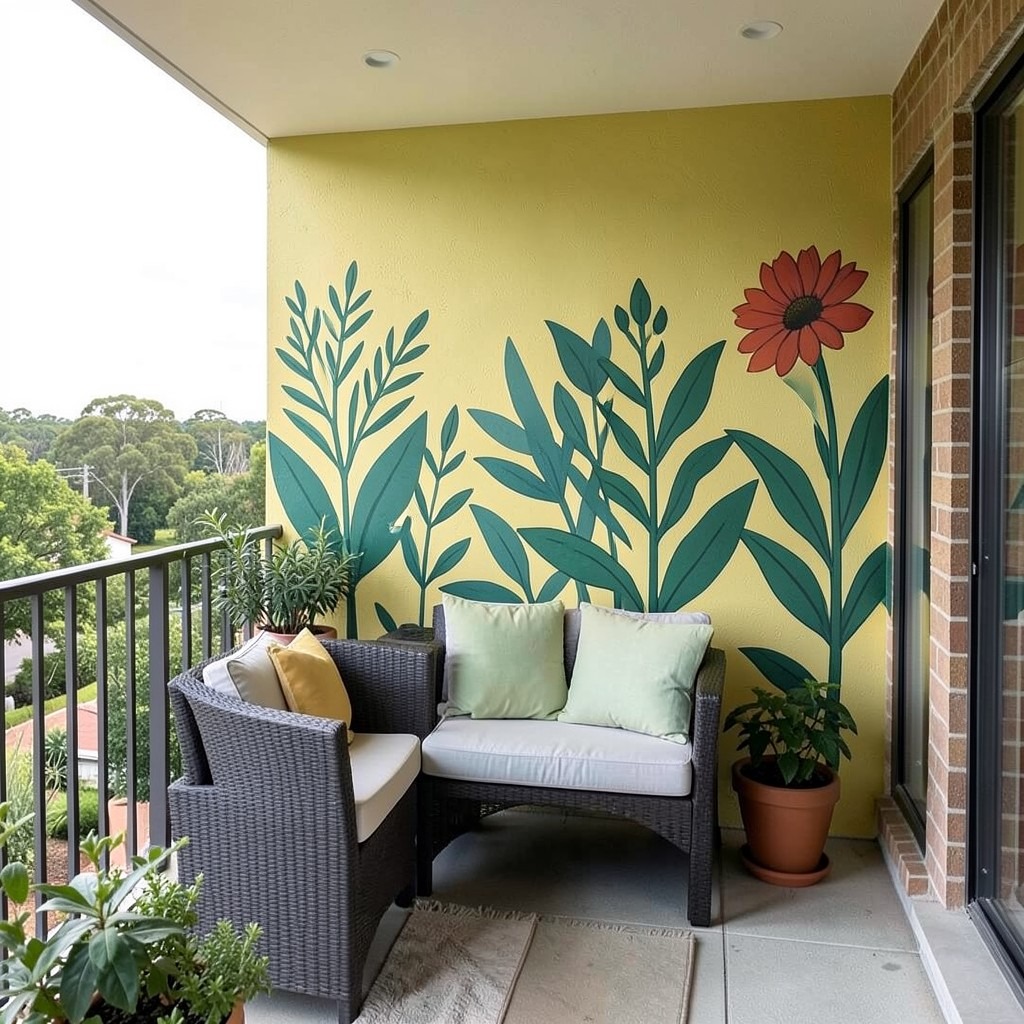
A painted feature wall on a balcony — the building wall treated with a bold color, a pattern, a mural, or a decorative paint technique that makes the rear wall of the balcony a designed surface rather than an unpainted render or brick face — creates a visual backdrop that transforms every element placed in front of it. The wall behind the balcony furniture and planting is the largest unbroken surface in the outdoor space, and its treatment determines the quality of the backdrop that everything else reads against.
The color selection for a painted balcony feature wall requires a paint product specified for exterior masonry use — a masonry paint with UV-stable pigment and a microporous finish that allows the wall surface to breathe through its moisture cycling without the paint film lifting, cracking, or peeling. Standard interior emulsion applied to an exterior masonry surface fails within one season. Exterior masonry paint in the same color provides the same visual result with the performance to maintain it through multiple years of weather exposure without attention beyond an eventual recoat.
A hand-painted botanical mural on the balcony wall — oversized plant motifs in a palette drawn from the planting collection on the balcony itself — is the feature wall treatment that most directly connects the wall surface to the outdoor space’s identity as a garden. A mural does not need to be executed by a professional muralist to work — bold, simple botanical forms in two or three colors from the balcony palette, painted by a confident amateur with large-format masking tape to keep the edges clean, produces a feature wall with personality and originality that no pre-designed wallpaper or tiled surface approaches for the expression of specific household character.
47. A Balcony With an Edible Garden
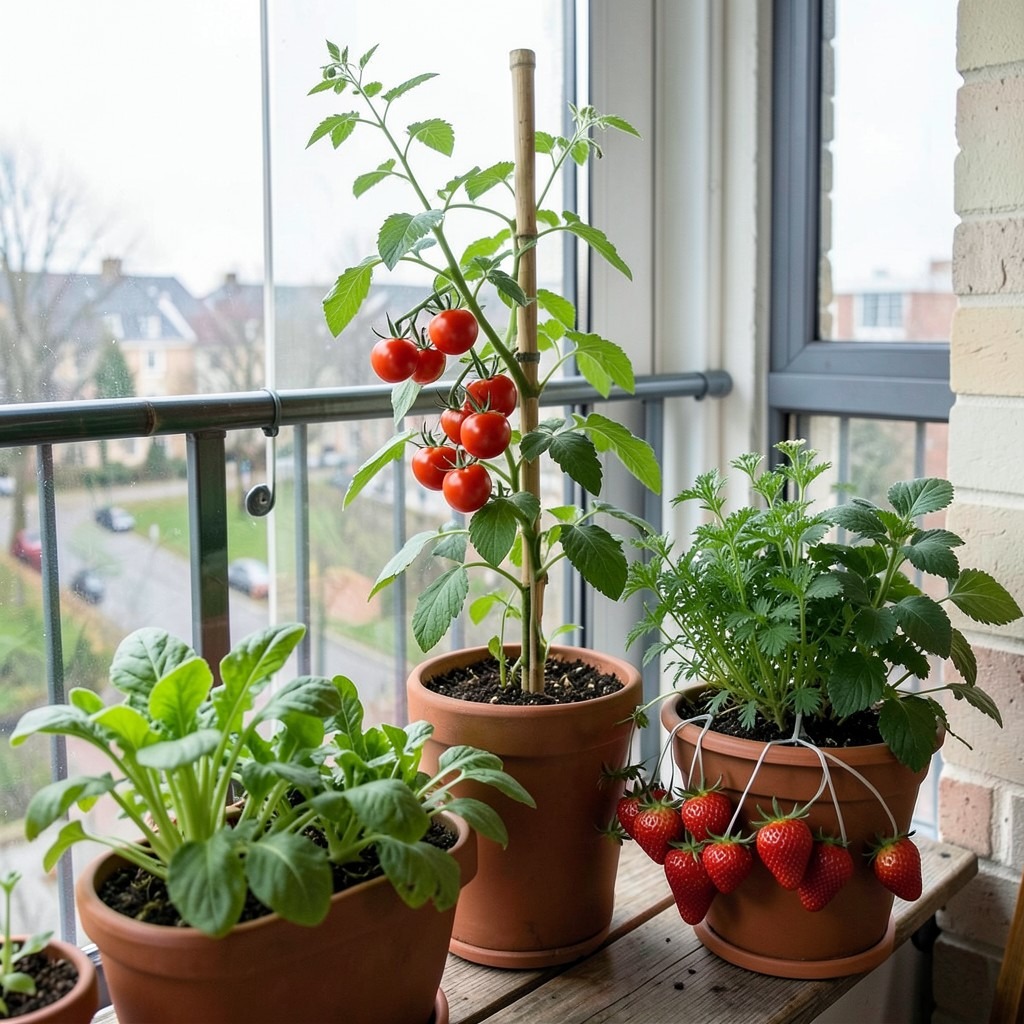
An edible garden on a balcony — containers of salad leaves, cherry tomatoes, dwarf beans, strawberries, and herbs producing a continuous supply of fresh food for the household from the outdoor space — turns the balcony from a leisure amenity into a productive part of the household’s food system. The psychological shift that comes from growing and eating food from a balcony is more significant than the quantity of food produced justifies economically. Something changes when the salad on the plate comes from the container visible through the window — the relationship between the outdoor space and daily life becomes active rather than passive.
Cherry tomatoes are the edible balcony plant with the highest productive return per container and the most immediate visual impact through the growing season — a single plant trained up a bamboo support in a ten-liter container produces enough fruit through the summer months to provide fresh tomatoes multiple times weekly, and the visual character of a fruiting tomato plant in flower and fruit is more compelling on a balcony than most ornamental planting. The determinate compact varieties — bred for container culture rather than open ground — reach a manageable height without requiring the staking and management that indeterminate varieties demand.
Strawberries in hanging containers — the fruit tumbling over the container edge rather than resting on soil where it would be subject to slug damage — provide a balcony fruit production method that is practical, prolific in the right conditions, and visually attractive through both the flower and the fruiting phases. Alpine strawberries, smaller-fruited than standard garden strawberries but more tolerant of the container and weather conditions of an exposed balcony, produce fruit continuously from early summer through the first frosts rather than in the single concentrated crop of standard varieties, which better suits the ongoing harvest rhythm of a balcony kitchen garden.
48. A Balcony With a Skyline View Design
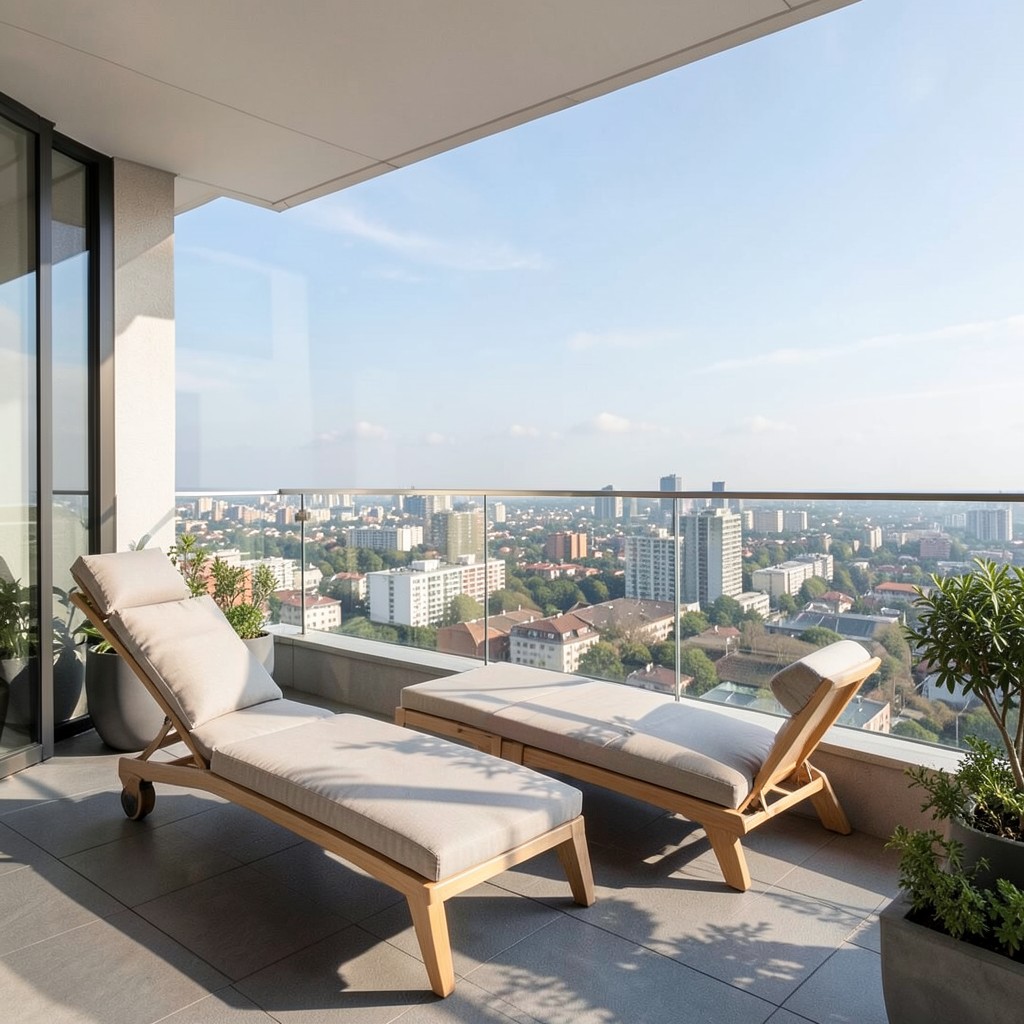
A balcony designed specifically to maximize its view of the city skyline or the landscape beyond — with furniture oriented precisely toward the best sightline, railings that prioritize view transparency over decorative contribution, and a cleared, unobstructed floor plan that does not interrupt the visual connection between the seated position and the view — is the balcony design that acknowledges the most significant spatial asset many urban apartments possess and builds the outdoor space entirely in service of experiencing that asset at its best.
The glass or cable railing — a balustrade system that provides the required safety height with minimum visual interruption of the view — is the structural provision that most directly improves the view quality from a seated position on a balcony with an urban or landscape panorama. A solid masonry parapet, a solid timber railing, or a closely spaced baluster system blocks the lower half of the view from a seated position and limits the panoramic quality to the upper portion of the sightline above the railing top. A glass panel railing maintains the full height of the view from both seated and standing positions, and the transparency of the glass panel in direct view is sufficient that the glass is perceived as present without being experienced as a barrier.
The furniture height on a view-focused balcony should be the lowest practical option in every category — low tables, low chairs, low planters — to keep the maximum view proportion above the furniture line from every seated position. A standard height dining table and chairs on a balcony with a glass railing partially blocks the lower view band from the seated dining position. A low Japanese-height table with floor cushions, a low lounge chair with an elevated footrest, or a compact bench at standard chair height positioned well inside the railing line all provide the view quality from a seated position that higher furniture configurations compromise.
49. A Balcony With Fairy Garden Elements
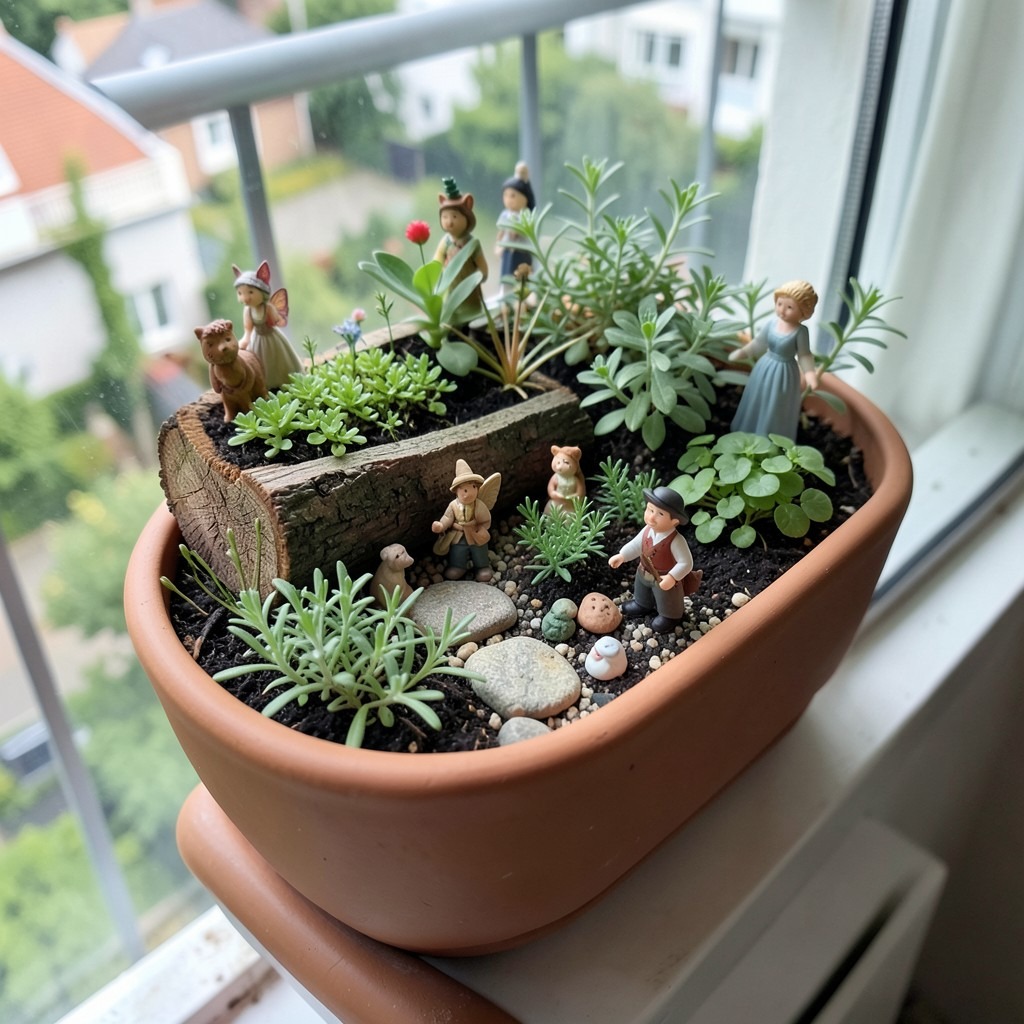
A fairy garden on a balcony — a container or a series of containers planted with miniature-scale plants, tiny figurines, small stone pathways, and the specific vocabulary of miniature garden design that creates a scene scaled for imagined inhabitants — is the balcony design element that most directly invites the playful, imaginative engagement with outdoor space that adult garden design tends to suppress in favor of utility and aesthetic sobriety. The fairy garden does not take itself seriously. That is precisely what makes it work.
The container selection for a fairy garden provides the stage on which the miniature scene is composed — a shallow terracotta bowl, a hollowed log, an old stone trough, or a wide, low ceramic planter that provides adequate surface area for the scene’s elements without the excessive depth that a deep planting container wastes in a miniature-scale application. The growing medium should be a well-draining mix suited to the miniature plant species chosen — most fairy garden plants are compact alpines, creeping thyme, baby’s tears, or miniature sedums that prefer the sharper drainage of a gritty growing medium over the moisture-retaining capacity of standard potting compost.
The figurines and accessories within a fairy garden container must be weatherproof — resin or ceramic rather than painted plaster or air-dry clay — to maintain their quality through the weather exposure of an outdoor balcony setting. The selection of figurines should maintain internal scale consistency: a set of figurines scaled at 1:12 — standard dollhouse scale — reads as a composed scene when all elements share the same scale. A scene mixing figurines at different scales reads as a random assembly of decorative objects rather than a miniature world, and the specific pleasure of the fairy garden comes from the suspension of disbelief that a consistently scaled scene allows.
50. A Balcony That Becomes an Extension of the Interior
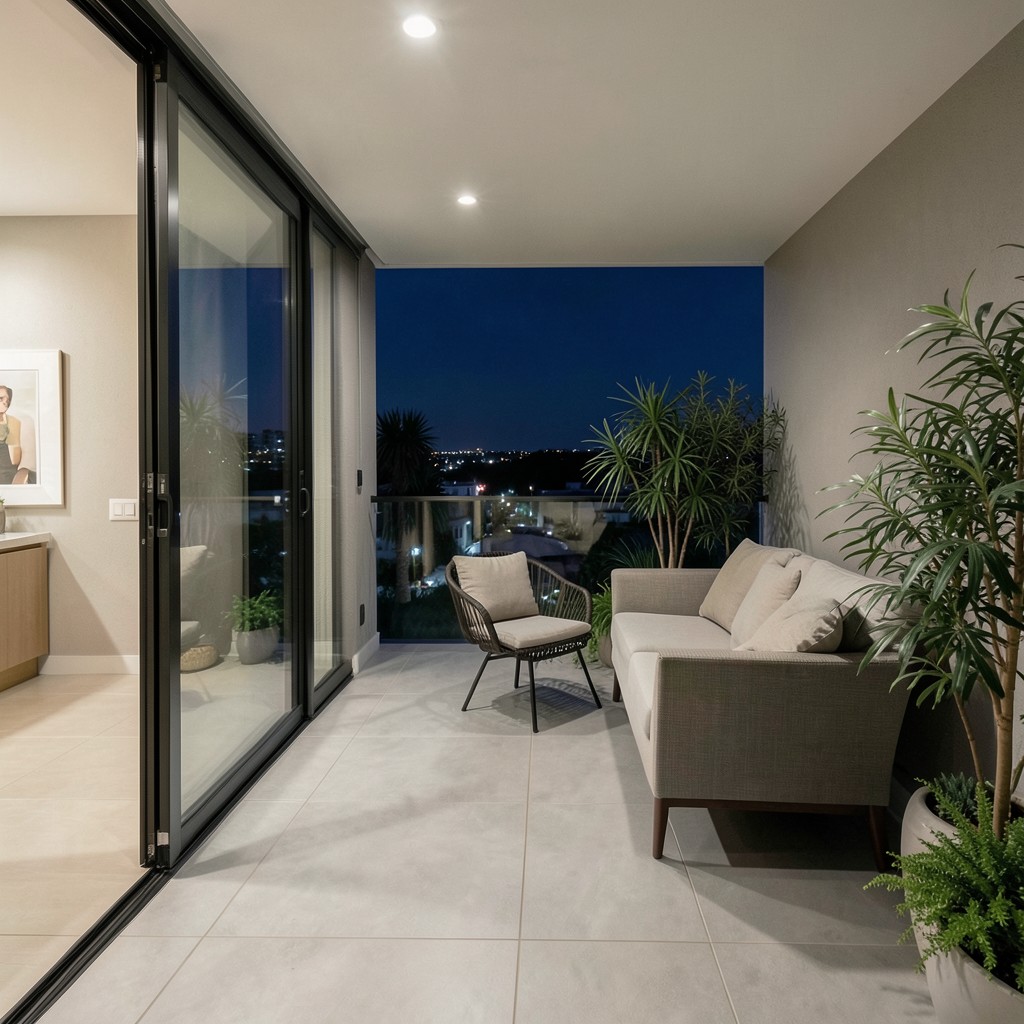
The balcony that reaches its full potential is the one that stops being thought of as a separate outdoor space and starts being designed as the room beyond the last interior wall. This mental shift — from balcony as appendage to balcony as room — is the design decision that produces every other good decision about the outdoor space automatically. A room needs a floor treatment that connects to the interior floor. It needs furniture chosen at the right scale and in a material that relates to the indoor palette. It needs light that activates the space at night. It needs planting that gives it a living quality.
The floor connection between interior and balcony — where the flooring material of the room transitions to the flooring of the outdoor space — is the physical hinge on which the sense of spatial extension depends. An interior with large-format light grey tile meeting a balcony with an identical or closely matched outdoor tile, at the same level with no threshold step, reads as a continuous floor that extends beyond the glass door. The door becomes a transparent partition in a continuous room rather than a boundary between separate spaces, and the visual depth the balcony adds to the interior through the glass is the spatial bonus that no interior renovation achieves at an equivalent cost.
The balcony that functions as an interior room extension requires the same quality of design attention at every scale — the floor, the furniture, the planting, the light, the acoustic quality, the weather management — that any interior room receives. No element is incidental. No surface is left to chance. When all of those decisions are made with the intention of producing an outdoor space that earns daily use rather than occasional appreciation, what you have is not a balcony anymore. What you have is another room — the one with the best ceiling of all.
Leave a Reply