
The backyard is the room most people forget they have. It sits behind the house, often used as a storage area for things that did not find a home inside, or left as a flat expanse of lawn that gets mowed on weekends but never truly inhabited. And yet the backyard has something no interior room possesses: sky above it, ground beneath it, and the possibility of being genuinely outside while still being home. That combination — the freedom of the outdoors with the comfort of the familiar — is the promise that a well-designed backyard delivers on and a neglected one leaves entirely unfulfilled.
Most backyards fail not because of size constraints or budget limitations but because of the absence of a single organizing thought. The patio furniture was bought without reference to the paving material. The lawn extends to every boundary because no one decided it should stop somewhere. The planting accumulated over years of impulse purchases rather than a considered design. The result is a backyard that has everything it needs to function and nothing it needs to feel like somewhere worth spending time in. A backyard without a design intention is a backyard that gets used for ten minutes twice a week and left for the rest.
The backyards that people actually live in — that pull them outside after dinner, that host Sunday mornings with coffee and a book, that become the household’s primary social space through the warmer months — are built around a clear understanding of how the space is meant to be used. They have defined zones: somewhere to sit, somewhere to cook, somewhere to play if children are part of the picture, and somewhere that exists simply to be beautiful and to reward looking at it. Those zones do not need to be elaborate or expensive to fulfill their purpose. They need to be deliberate.
This collection of fifty backyard design ideas covers every scale and every context — from compact urban backyards where every square foot must serve multiple purposes to larger residential plots where the challenge is coherence rather than conservation of space. Some ideas address the hard landscaping: the paving materials, the structural elements, the built features that give a backyard its bones. Others address the living landscape — the planting strategies, the lawn alternatives, the vertical garden approaches that turn a flat outdoor space into a layered environment with depth and seasonal change. Others still address the specific features that transform a serviceable outdoor space into a genuinely memorable one.
Every idea here has been chosen because it addresses a specific quality that backyards need and most lack. Read through with your specific outdoor space in mind. Some ideas will apply directly to your situation. Others will offer a principle that adapts to your conditions even if the specific application is different. The backyard design decisions that produce the most lasting satisfaction are rarely the biggest or the most expensive — they are the most considered. These fifty ideas are designed to produce exactly that quality of consideration, applied to the outdoor space you already have.
1. A Defined Outdoor Living Room
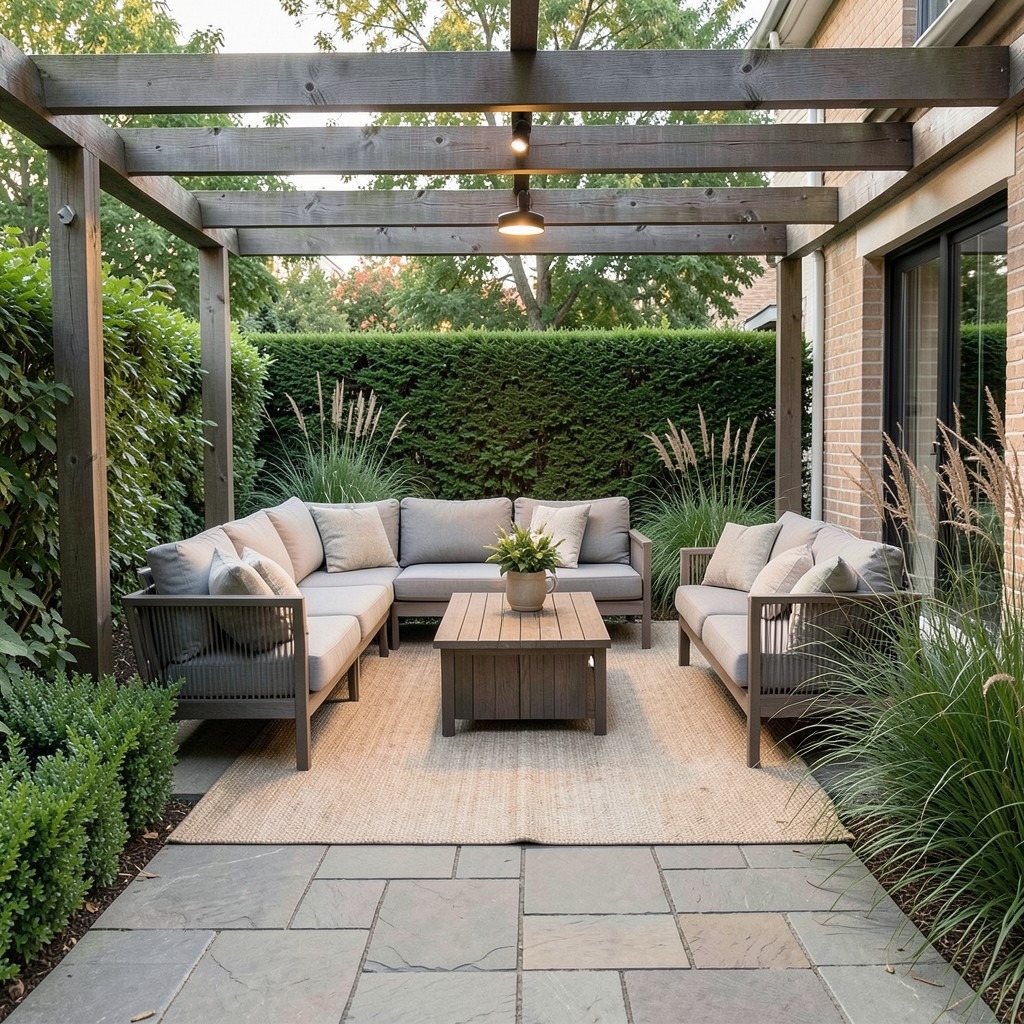
The backyard that functions as an extension of the home’s interior rather than a separate service area begins with one decision: treating a section of the outdoor space as a room with furniture, defined edges, and a clear purpose rather than as open ground with some chairs placed on it. The distinction is not semantic. A collection of chairs on a patio is outdoor furniture. A seating arrangement within a defined outdoor area — with a rug underfoot, a low table at the center, plants creating a sense of enclosure on the open sides, and lighting overhead — is an outdoor room. The first is used occasionally. The second is lived in.
The defining edges of an outdoor living room do not need to be walls or fences. The edge can be a change in paving material — the living area in a different stone or timber deck from the surrounding hard landscaping. It can be planting: a low hedge on two sides, a row of tall grasses on the third, an overhead structure on the fourth. It can be a pergola that frames the space from above without enclosing it laterally. Any combination of these that signals to anyone entering the area that they are moving from the general outdoor space into a specific zone creates the spatial definition that makes the outdoor room function as a room rather than a patch of ground.
The furniture selection for an outdoor living room requires the same spatial logic as interior furniture. A sofa and two chairs around a central table — the same arrangement used in a living room — translated into weather-resistant materials produces a seating configuration that works socially the way interior seating works: everyone can make eye contact, conversations form naturally, no one is stranded on the edges. An outdoor rug beneath the furniture group defines the floor of the outdoor room and separates the seating zone from the surrounding paving, which is the detail that makes the arrangement read as designed rather than assembled.
2. A Backyard Fire Pit Area

A fire pit changes what a backyard is used for at night and in the cooler months of the year more effectively than any other single addition. Without a fire, a backyard after dark in autumn is a space people look at through the kitchen window. With a fire, it becomes somewhere people pull their chair toward, bring drinks outside, and stay far later than they intended. That is not a small quality-of-life improvement — it is a fundamental shift in how many hours per year the outdoor space is actually occupied.
The position of a fire pit within the backyard requires more thought than most installations receive. It must be far enough from the house structure, overhanging branches, and adjacent fencing that ember drift in wind does not create a hazard — a minimum of ten feet from any combustible structure is the standard guidance, and further is always better. It should be positioned so that the seating around it faces inward toward the fire rather than outward toward the fence or the house wall, which means the fire pit sits at the center of its own social zone rather than at the periphery of the backyard. The social logic and the safety logic point in the same direction: central, clear, surrounded.
The fire pit surround — the material that defines the circular or square fire area — determines the feature’s visual quality year-round, including the many hours when no fire is burning. A dry-stack natural stone ring has a permanence and a texture that reads as landscape architecture rather than a purchased product. A poured concrete ring with a smooth, polished top surface reads as more contemporary and suits backyards with a cleaner, more architectural design direction. Both require a non-combustible base beneath the fire pit itself — compacted gravel, crushed stone, or a sand bed — that prevents heat transfer to the ground below.
3. An Outdoor Kitchen and Cooking Zone
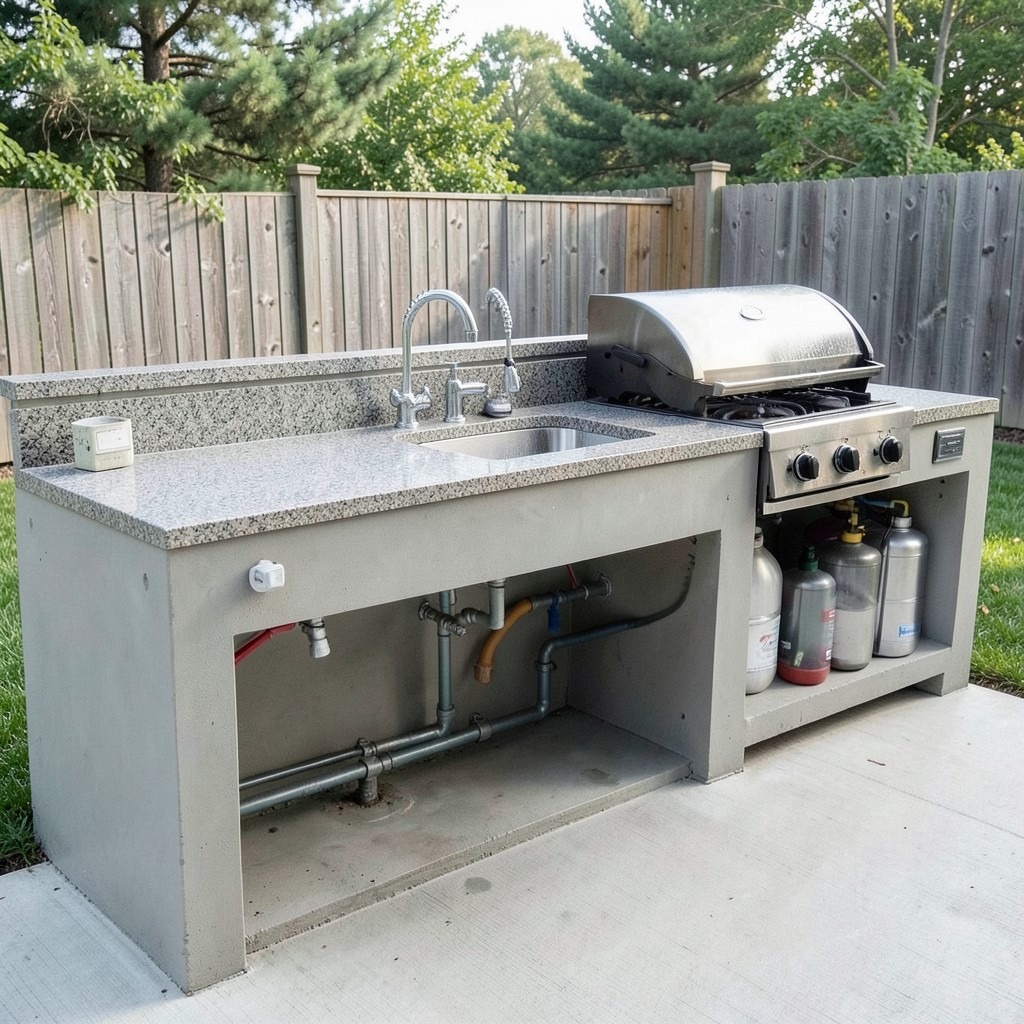
An outdoor kitchen built with the same intention as an indoor one — with a defined work surface, a sink with running water, a grill integrated into the counter rather than freestanding on wheels, and storage for tools and equipment below the counter — changes the outdoor cooking experience from a compromise to a genuine pleasure. The difference between grilling on a freestanding barbecue with no surface beside it and cooking at an outdoor counter with a proper preparation area, a sink for washing hands and produce, and storage for everything needed is the difference between making do and functioning properly.
The counter material for an outdoor kitchen must handle temperature extremes, UV exposure, rain, and freeze-thaw cycling without cracking, discoloring, or deteriorating. Porcelain tile on a concrete base handles all of these conditions without maintenance and suits backyards with a contemporary design direction. Natural stone — granite or quartzite — provides an outdoor counter with genuine material quality and handles weather conditions better than marble or limestone, which are too porous and too vulnerable to frost damage for outdoor use in most climates. A poured concrete counter with an integral sink and an exposed aggregate finish is the custom option that produces the most architecturally integrated result.
The infrastructure beneath an outdoor kitchen is more significant than the visible counter above it. A gas line run underground to the cooking area, connected to the main gas supply by a licensed plumber, eliminates the ongoing inconvenience of propane cylinder replacement and the uneven gas supply that cylinder-fed grills produce when the cylinder is running low. Running cold water to the outdoor kitchen while the supply line is being installed adds minimal cost at that stage and transforms the functional quality of the space beyond what any surface material or appliance upgrade achieves.
4. A Backyard Swimming Pool Design
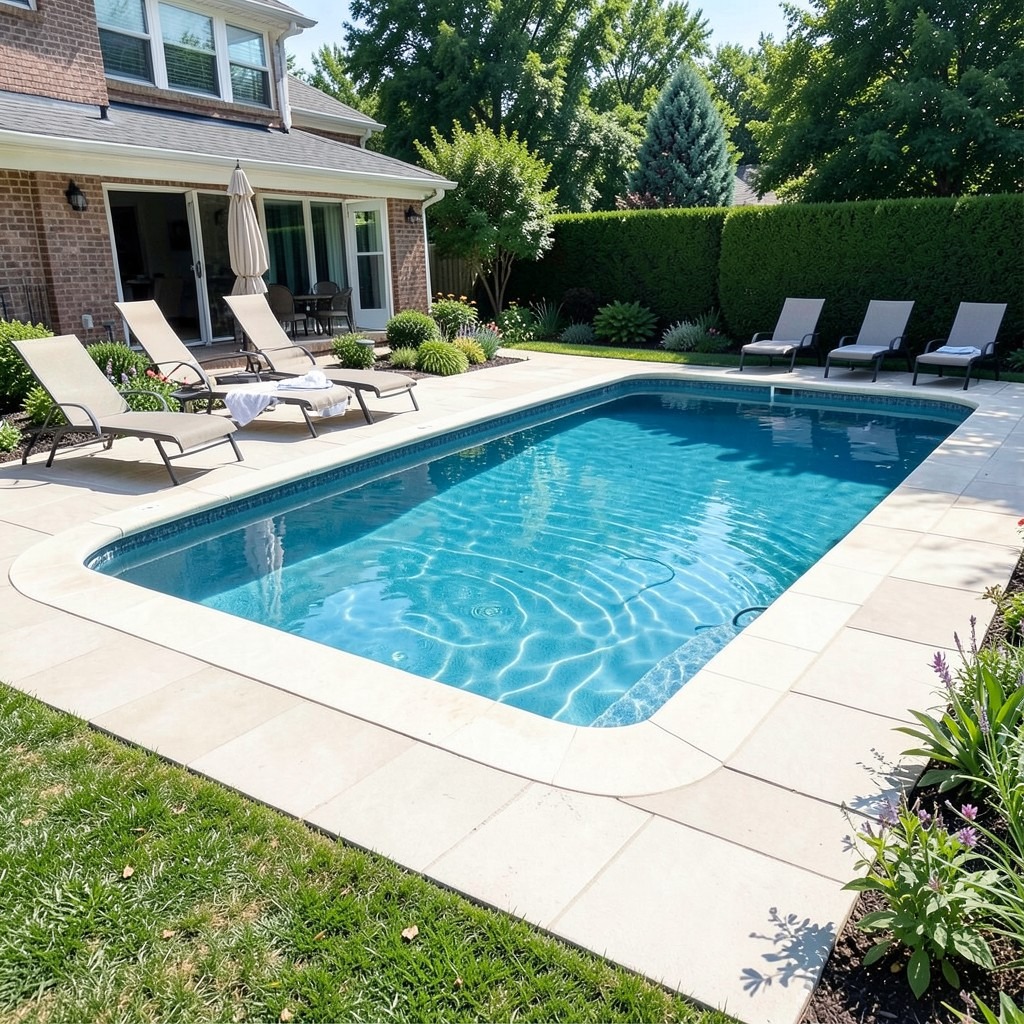
A swimming pool in a backyard changes the property’s entire relationship with summer in a way that nothing else installed outdoors comes close to replicating. But a poorly positioned, poorly proportioned pool surrounded by minimal paving and no considered planting is not a luxury — it is a maintenance liability that dominates the backyard visually while leaving it functionally limited for the nine months per year when the water is too cold for comfortable swimming. The pool that earns its place does so because it was designed as part of the backyard rather than dropped into it.
Pool shape is the most important design decision and the one most heavily influenced by the backyard’s existing proportions. A rectangular pool reads as architectural and disciplined — it suits backyards with strong geometric organizing lines and works well when positioned as an axis from the house. A free-form pool with curved edges reads as more organic and landscape-integrated — it suits backyards where the design direction is toward a natural, planted aesthetic where the pool is meant to feel like a natural water feature rather than an architectural one. The worst option is a freeform pool in a formally designed backyard, or a rectangular pool in a backyard that has no geometric organizing structure to support its angular precision.
The paving around the pool — the pool surround or coping — is the surface that determines the pool area’s daily usability and long-term aesthetic quality more than the pool itself. Smooth limestone or travertine in a honed finish reads as luxurious, stays relatively cool underfoot in direct sun, and ages beautifully. Brushed concrete provides the most cost-effective option with reasonable thermal performance and a contemporary appearance. The paving must extend generously beyond the pool edge — at minimum six feet on the primary access sides — to provide genuine space for sun loungers, towel drying, and the movement of wet feet between the water and the seating area without the cramped feeling that insufficient coping produces.
5. A Backyard Vegetable and Herb Garden
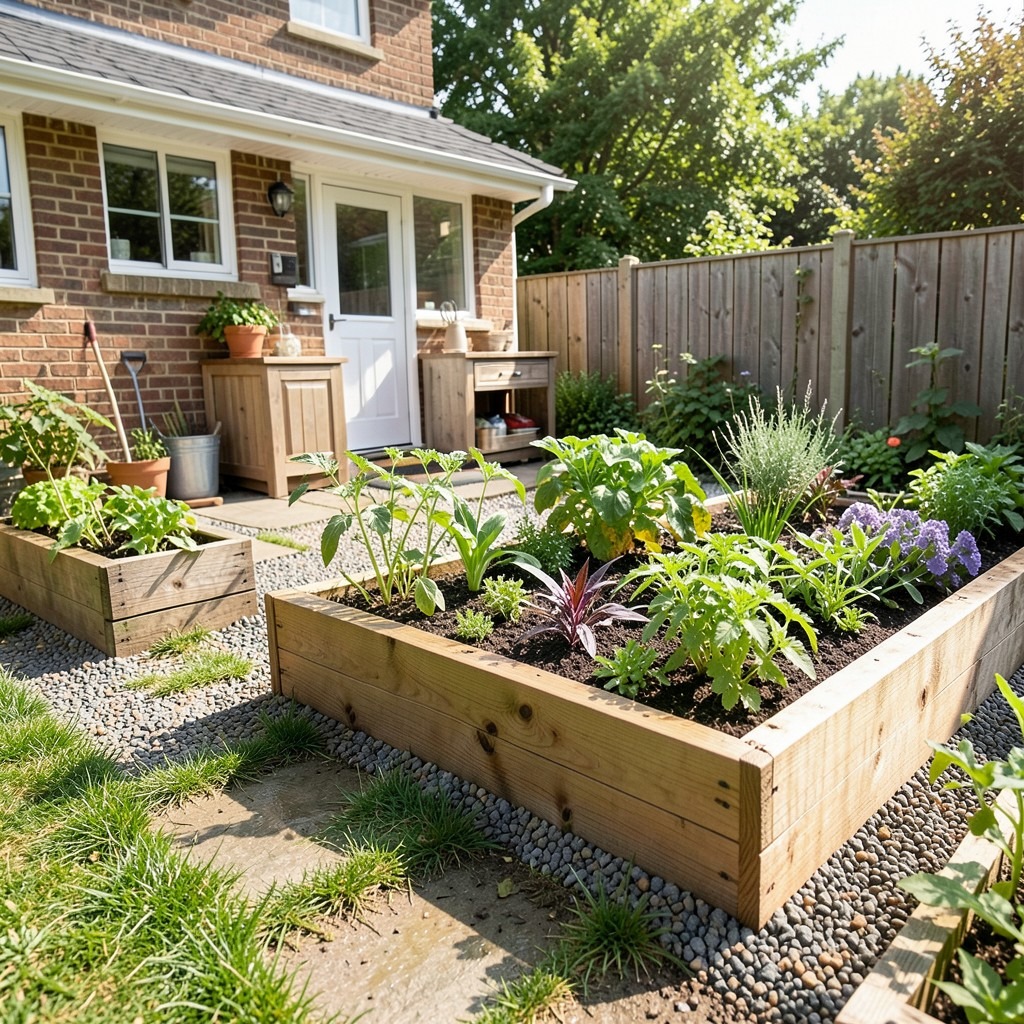
A productive kitchen garden in the backyard — raised beds of vegetables and herbs positioned to receive maximum sunlight and convenient to the kitchen door — connects the household to its food supply in a way that has real practical value and genuine daily pleasure. The tomato grown three meters from the kitchen and eaten the same day it is picked tastes nothing like the one bought a week ago from a distribution warehouse. That difference is not romantic exaggeration — it is a measurable quality gap that any kitchen gardener quickly becomes unwilling to give up.
Raised beds are the design format that makes the vegetable garden work in a residential backyard context rather than just in a rural allotment. A raised bed in hardwood timber — cedar or oak, both naturally resistant to ground moisture — at a height of thirty to forty centimeters off the ground provides the drainage that most vegetable crops require, the warm soil temperature that extends the growing season at both ends, and the clearly defined visual boundary between the productive garden zone and the rest of the backyard. The raised bed reads as a design element rather than a patch of cultivated ground, and that visual quality is what allows the kitchen garden to be positioned prominently in the backyard without reading as agricultural intrusion into a designed landscape.
The path between raised beds — compacted gravel, a mown grass strip, or stepping stones set at a walking pace — determines whether the garden zone is pleasant to work in during wet weather. A path that becomes muddy in rain makes the kitchen garden inaccessible precisely when the productive gardening season demands most attention — after rain is when weeding is easiest and when soil is most workable. Gravel paths between raised beds solve this problem permanently at modest cost and give the kitchen garden a structured, ordered quality that suits both formal and informal backyard design directions.
6. A Backyard With a Water Feature

Running water in a backyard changes the sensory quality of the outdoor space in a way that is immediate and physical rather than visual. The sound of moving water — a low, continuous, variable sound — masks the urban acoustic background of traffic, neighbors, and distant machinery that most backyards are saturated with. That masking does not require loud water or a large feature. A small recirculating fountain or a narrow rill feeding a basin produces enough acoustic presence to change the backyard’s ambience from urban to somewhere more removed, and that perceptual shift makes the outdoor space feel more like a refuge and less like a continuation of the street.
The scale of the water feature must be calibrated to the backyard’s overall proportions. A large formal fountain in a small urban backyard overwhelms the space and reads as a display of presence rather than a considered design choice. A small recirculating wall spout — water falling from a wall-mounted spout into a stone basin at ground level — provides all the acoustic benefit of moving water in a footprint that barely registers against the backyard’s overall area. At the other end of the scale, a rill — a narrow channel of moving water set into the paving, running from one end of the outdoor space to the other — produces a water feature with genuine spatial presence that reads as architectural rather than decorative.
The recirculating pump system beneath any water feature requires access for occasional maintenance that must be planned into the installation before the feature is built. A pump housing buried beneath paving with no access panel is a pump that, when it inevitably requires service, requires removing paving to reach. A dedicated access cover flush with the surrounding paving — indistinguishable from the rest of the surface when not in use — provides the maintenance access without any visual disruption to the finished feature.
7. A Pergola With Climbing Plants
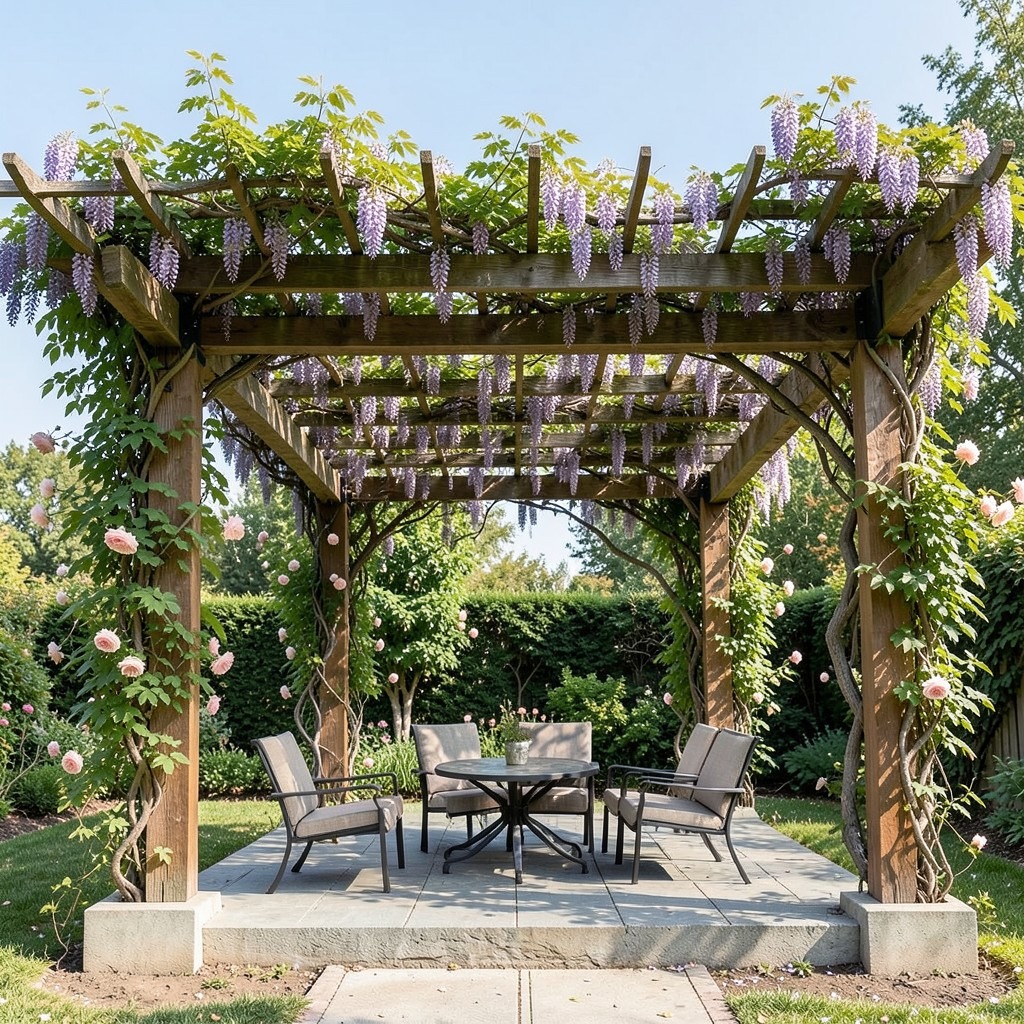
A pergola — a timber or metal overhead structure with an open grid of beams that creates a defined outdoor space beneath — provides the one thing most backyards completely lack: vertical scale. A flat backyard with paving and furniture at ground level and open sky above has no ceiling reference, which makes the outdoor space feel exposed rather than sheltered even in dry, calm conditions. A pergola gives the outdoor space a ceiling, and that ceiling — even when it is open to the sky through the beam grid — creates a psychological sense of enclosure and shelter that fundamentally changes how the space beneath it feels to occupy.
The pergola structure itself is a backdrop for climbing plants, and the plants are what transform the structure from a timber frame into an outdoor room with living walls overhead. A pergola without climbing plants reads as an incomplete structure. The same pergola covered with wisteria, climbing roses, or a grape vine reads as a destination. Wisteria is the classic choice — its spring flowering is spectacular, its summer leaf cover is dense, and its structural winter silhouette of twisted stems has its own architectural quality. Climbing roses extend the flowering season from early summer into autumn and can be selected for fragrance that perfumes the entire area beneath on still evenings.
The foundation and structural sizing of a pergola must be proportionate to the climbing plants it will eventually support. A mature wisteria produces a significant weight of woody stem and wet leaf that an undersized structure cannot support safely. Timber posts at a minimum of one hundred by one hundred millimeters, with concrete footings below ground level, handle the long-term structural requirement. The initial overspecification of the structure is the investment that prevents costly replacement when the planting has matured to full weight a decade later.
8. A Backyard Lawn Alternative
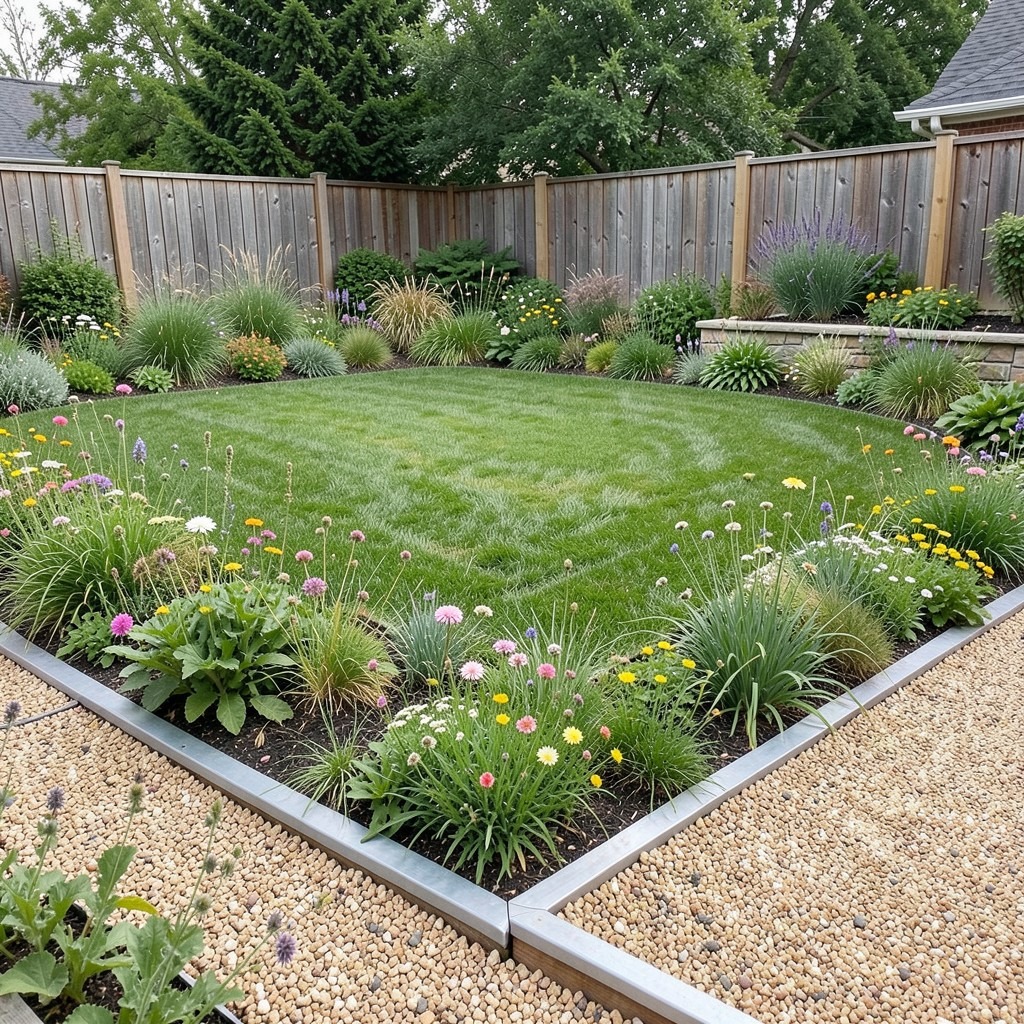
The suburban lawn is the outdoor design default that most people inherit rather than choose, and it is the garden element with the worst ratio of maintenance requirement to design quality. A grass lawn requires mowing every seven to ten days through the growing season, edging along every boundary, seasonal feeding, aeration, overseeding on bare patches, and irrigation through dry spells — and in return it provides a flat green surface that reads well in photographs and functions reasonably for recreation but contributes nothing to the backyard’s ecological value or its visual interest through most of the year. There are better options. Several of them are also lower maintenance.
A mixed meadow planting — native wildflowers and grasses sown or planted in the area previously occupied by lawn — produces a backyard surface that changes through the seasons, supports native insect populations, requires no mowing for most of the year, and provides a visual richness that a uniform lawn cannot approach. A meadow planting requires management — a single annual cut in late autumn to prevent woody growth establishing — but removes the weekly mowing commitment entirely and replaces it with a surface that looks genuinely alive rather than maintained. The transition period of two to three years while the meadow establishes requires patience and the willingness to accept an intermediate stage that looks less orderly than the lawn it replaced.
Decomposed granite as a ground surface in a backyard zone that receives limited foot traffic provides a stable, permeable, low-maintenance alternative to lawn that reads well in contemporary backyard designs. Laid over a weed-suppressing membrane at a depth of two to three inches, compacted to a firm surface, and edged with a metal or timber border to prevent it migrating into adjacent planting beds, decomposed granite produces a surface that requires no maintenance beyond occasional raking and periodic topping up where foot traffic has displaced the material. Its warm, sandy tone complements stone, timber, and planting equally well and suits backyards in any climate with a dry season.
9. A Backyard With Landscape Lighting

Backyard lighting after dark extends the outdoor space’s hours of use beyond the daylight period and, when it is done well, produces an environment at night that is more beautiful than the same space in daylight. This sounds like an overstatement. It is not. Daylight illuminates everything equally — every surface, every plant, every feature receives the same flat illumination that makes the backyard readable but not particularly atmospheric. Landscape lighting, positioned to highlight specific elements and leave others in shadow, produces a composed scene with depth, contrast, and visual hierarchy that natural light, which shows everything simultaneously, cannot produce.
The positioning of landscape lighting is the decision that determines the result, and most installations position lights in the wrong place. Ground-level uplighting beneath a tree — a spike-mounted spotlight aimed upward into the canopy from directly beneath — produces a dramatic and unnatural effect that reads as theatrical rather than atmospheric. The more convincing approach is to light the tree from a greater distance at a lower angle, producing a side-lit effect that reveals the form and texture of the trunk and the underside of the canopy in a way that reads as natural rather than staged. That distance and angle calibration is the skill that separates landscape lighting that looks designed from landscape lighting that looks installed.
Path lighting in a backyard is the functional layer that makes outdoor movement safe after dark and the aesthetic layer that defines the backyard’s floor plan at night. Low bollard lights along a path, or recessed step lights on any level changes, mark the route without illuminating the surrounding areas at the brightness of task lighting. The path itself glows gently, visible without being bright, and the surrounding garden remains in comparative shadow that makes the lit path read as significant rather than merely present.
10. A Backyard With a Children’s Play Zone
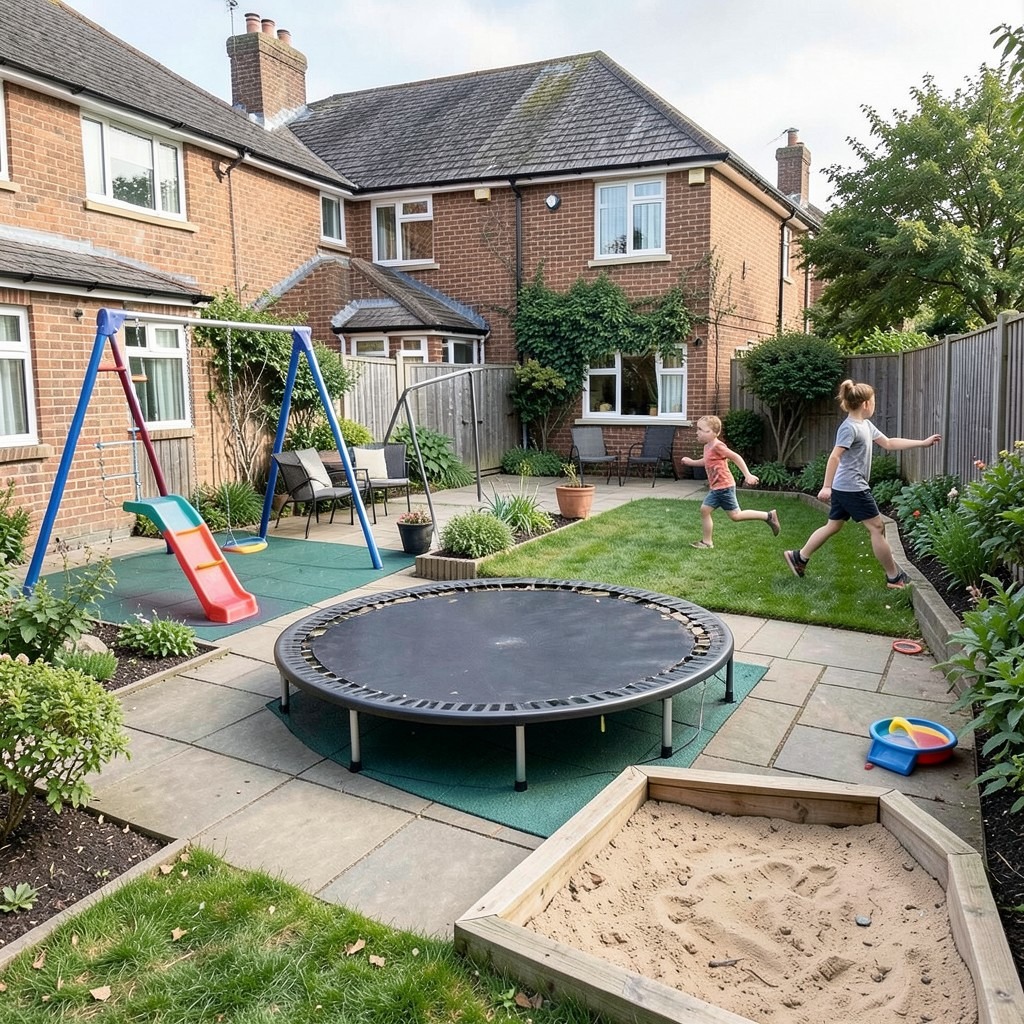
A dedicated play zone within the backyard — separated from the adult seating and cooking areas but visible from them — gives children a territory that belongs to them while preserving the quality of the spaces the household uses for other purposes. A backyard where the trampoline sits in the middle of the paving, the swing set is positioned between the seating area and the kitchen garden, and the sandpit occupies the prime paving zone adjacent to the house is a backyard where the adult spaces have been surrendered to children’s equipment without any spatial planning. The result suits nobody particularly well.
The play zone positioned at the far end of the backyard — beyond the main adult seating area, separated by a low planting bed or a simple change in surface material — creates a clear spatial division between the children’s territory and the household’s shared outdoor spaces. Children understand territory intuitively, and a play zone with its own defined edges and its own surface character — a rubber safety surface beneath climbing equipment, a sandpit in a timber-framed enclosure, a grass area for running games — reads to them as their space in a way that equipment placed on the adult paving does not. The division also means the adult seating area retains its character as a calm space for adult occupation while children are active in their own zone.
The equipment selection in a children’s play zone should be chosen for its longevity through the age range of the children who will use it. A toddler-specific play structure that becomes irrelevant by age seven is replaced by a more demanding structure at significant cost and disruption to the backyard surface. A climbing structure with a range of challenge levels — lower elements accessible to younger children, higher elements that remain engaging as physical capability develops — retains its relevance across a wider age range and justifies the initial investment through years of use rather than months.
11. A Backyard With Raised Planting Beds
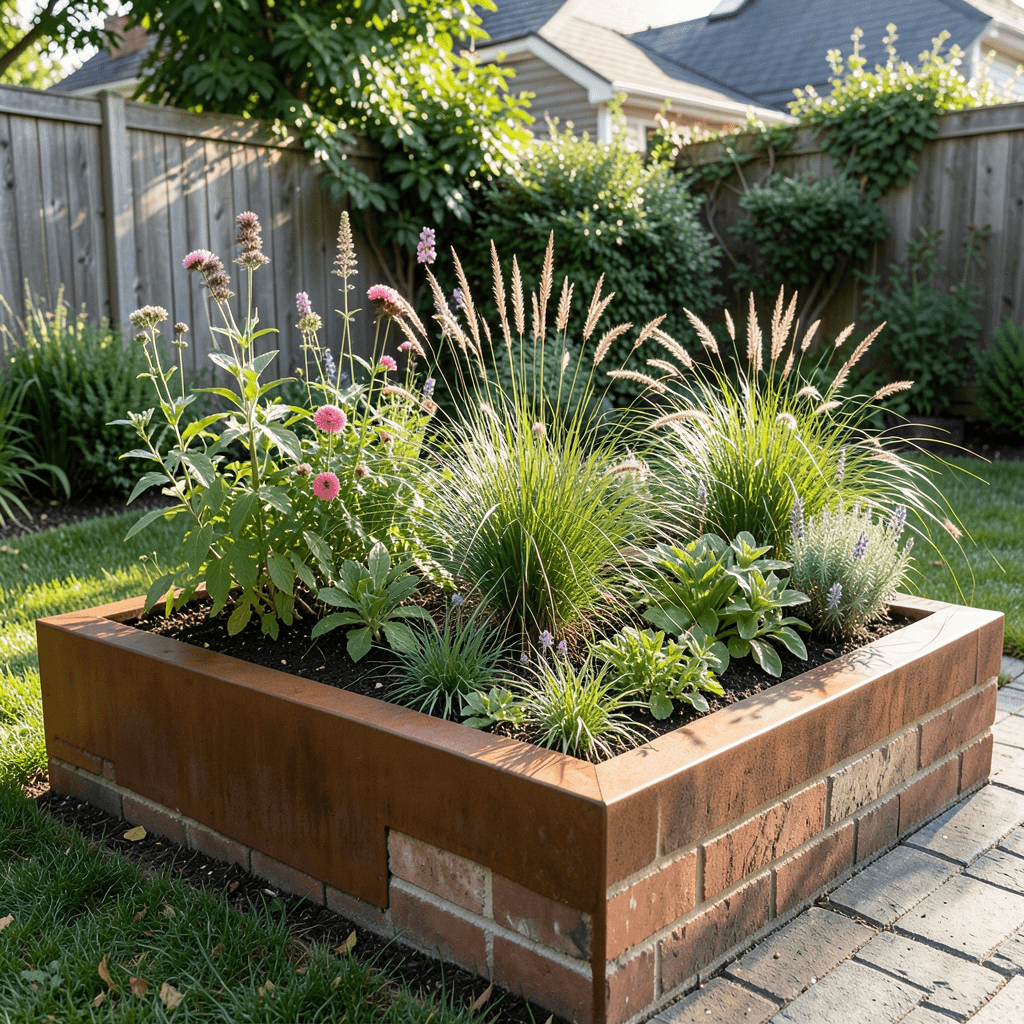
Raised planting beds in a backyard — above-ground structures filled with quality growing medium, planted with perennials, annuals, or structural shrubs — produce planting with a visual presence and a design authority that in-ground planting takes years to develop. Because the bed walls sit above the surrounding surface, the planting within them starts at a higher elevation, which gives even young plants a prominence and visibility that the same plants at ground level would not achieve for several growing seasons. The raised bed is the shortcut to a planted backyard that looks established from the first summer.
The material of the raised bed wall determines the visual language of the planting zone within the broader backyard design. Weathered corten steel — the self-finishing rust-toned metal that develops its characteristic orange-brown patina as its protective layer forms — produces a contemporary, architectural raised bed with a warm material quality that suits backyards with a bold, contemporary direction. Reclaimed brick raised beds suit backyards with a traditional or period character and provide the additional benefit of thermal mass that keeps the soil warmer overnight and through cool periods. Hardwood timber suits the widest range of backyard styles and weathers naturally to a silver-grey tone that complements both contemporary and traditional design directions.
The planting strategy within a raised backyard bed should acknowledge the bed’s elevated visibility. Plants selected for ground-level beds often have their best quality — flowering stem, textured foliage, winter seed heads — at a height above a standard viewing line. In a raised bed, those same qualities occur at or slightly above eye level, which produces a more immediate and more detailed encounter with the plants and their seasonal character. Grasses in a raised bed — their seed heads moving in any breeze, backlit by afternoon sun — produce a display in the raised context that the same grasses at ground level, seen past paving and other plants, never match.
12. A Backyard With a Deck and Natural Timber
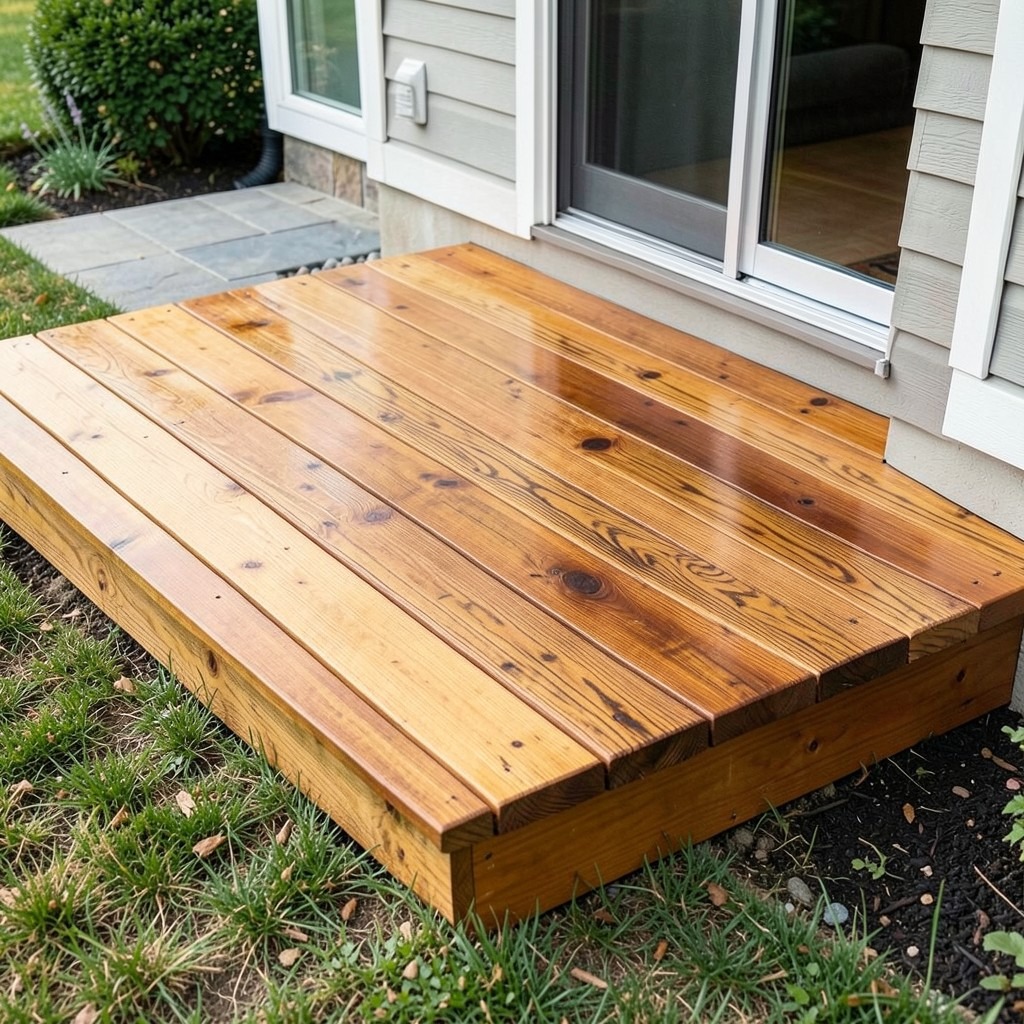
A timber deck — a horizontal platform of hardwood or modified softwood boards installed above the ground level, typically adjacent to the house — creates an outdoor surface with the warmth and the material quality that no paving material replicates. The surface of a well-chosen deck timber is warm to the touch in ways that stone and concrete never are, which makes the deck comfortable for bare feet from the first warm morning of the year. The grain pattern of the timber, visible in every board and unique to each one, provides a surface that has the visual complexity of a natural material rather than the uniformity of a manufactured one.
The timber species selection for a residential deck requires balancing appearance, durability, and maintenance requirements against the specific exposure conditions of the site. Hardwoods — teak, ipe, cumaru — are the most durable options, resistant to splitting, checking, and surface degradation for twenty to thirty years with annual oiling. They are also among the most expensive options and require responsible sourcing verification. Modified softwoods — timber treated through thermal modification or acetylation processes that change the wood’s cellular structure — provide hardwood-level durability at significantly lower cost, in an appearance that suits a wider range of backyard design directions. The modified option is the one most worth investigating for a residential deck where the budget matters and the twenty-year durability of a top-specification hardwood is not required.
The deck’s connection to the house — the threshold between the interior floor and the deck surface — is the detail that determines whether the outdoor space reads as an extension of the home or as a separate structure attached to it. A deck surface at the same level as the interior floor, with a low-profile threshold that creates a minimal interruption between inside and outside, produces a continuity between the two spaces that makes the house feel larger and the deck feel more integral. A deck significantly lower than the interior floor, accessed by steps, produces a transition that clearly separates the indoor and outdoor territories — which is sometimes the right choice but should be a considered decision rather than a structural default.
13. A Backyard With Vertical Garden Walls
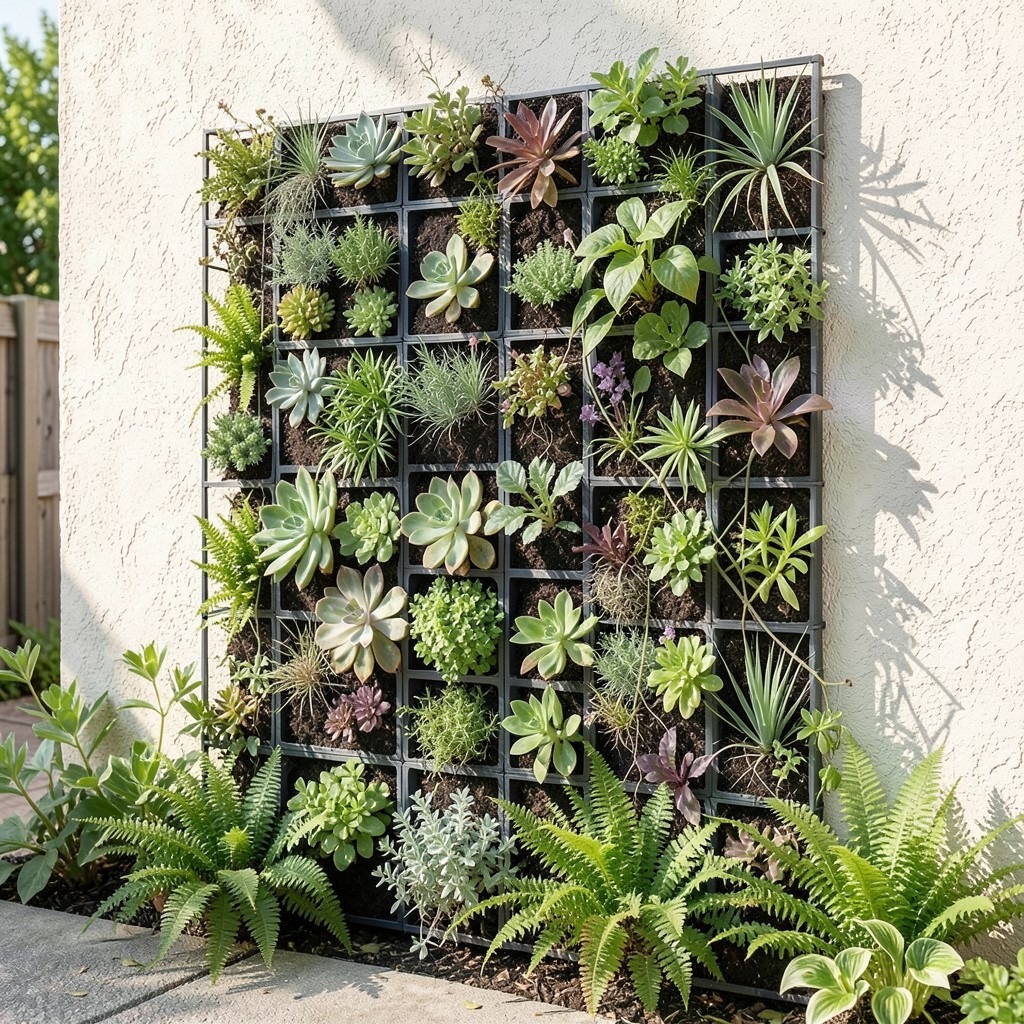
A vertical garden — plants grown on a wall surface rather than at ground level, through a wall-mounted support system — addresses the backyard condition that most urban outdoor spaces suffer from: insufficient area at ground level to plant meaningfully while retaining enough open surface for furniture and movement. A vertical garden moves the planting to the one plane that most backyards have in abundance: the wall. Fences, house walls, boundary structures — these surfaces represent significant potential planting area that standard backyard design leaves entirely unused.
The support system for a vertical garden determines both the ease of planting and the long-term health of the plants within it. A modular panel system with individual planting pockets — felt or plastic modules attached to a frame fixed to the wall — provides the most flexible installation and the best drainage per pocket, which is the condition plant roots require in a non-ground planting system. A wire or trellis support for climbing plants produces a different kind of vertical planting — less immediate in impact, building over seasons as the plants establish and extend — but requires minimal infrastructure and suits fence panels and wall surfaces that cannot support the weight of a filled modular system.
The plant selection for a vertical garden requires understanding that wall conditions differ significantly from ground conditions in terms of water availability, wind exposure, and temperature. A south-facing wall receives intense direct sun that dries the growing medium rapidly and creates temperature fluctuations between day and night that ground soil buffers. North-facing wall panels stay significantly cooler and retain moisture longer. Matching the plant palette to the specific wall conditions — drought-tolerant succulents and herbs on sunny walls, shade-tolerant ferns and hostas on north-facing ones — is the selection discipline that determines whether a vertical garden thrives or becomes a maintenance problem.
14. A Backyard With a Greenhouse or Potting Shed
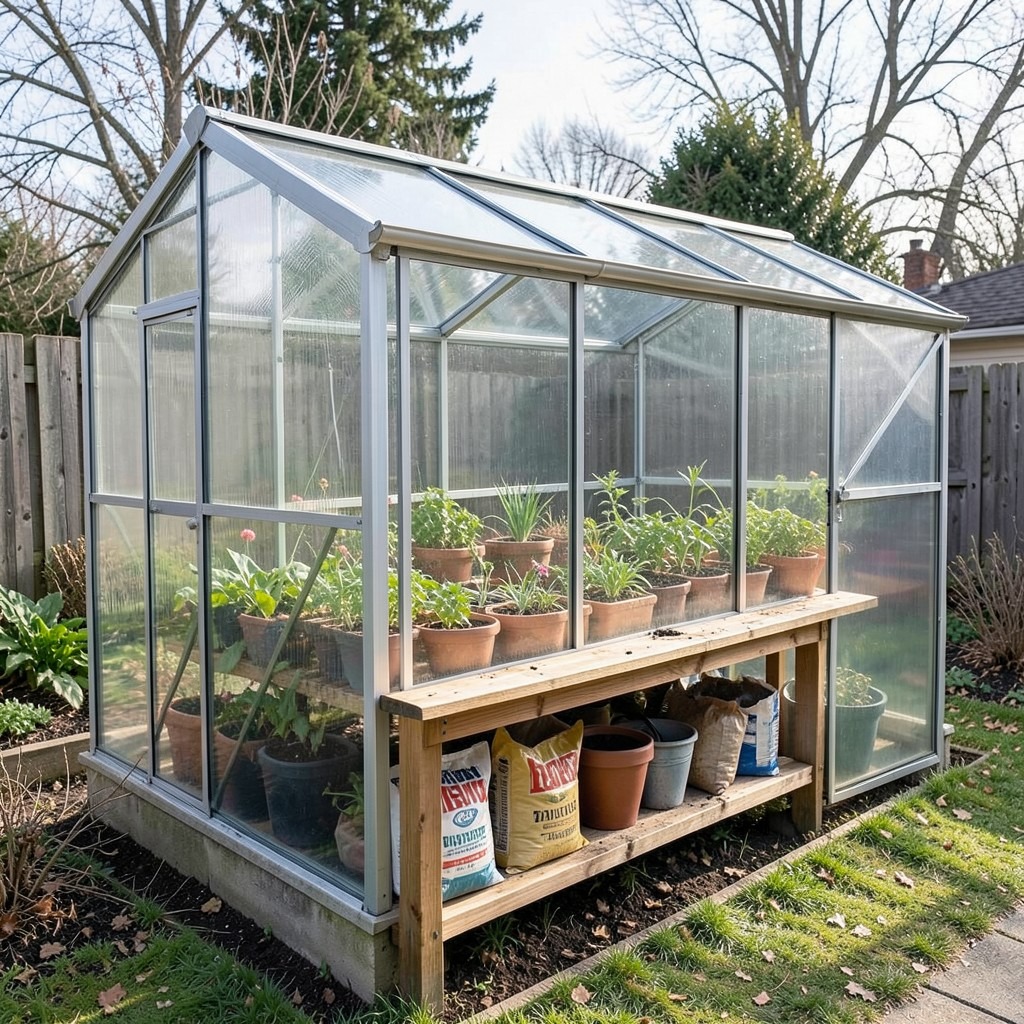
A greenhouse or a potting shed positioned in the backyard — a dedicated structure for growing, propagating, and storing the tools and materials that productive gardening requires — changes the character of the outdoor space from a place you manage to a place you inhabit with purpose. The greenhouse gives the garden a working heart. It is where you go in February to start seeds while the ground outside is still too cold, where you bring tender plants before the first frost, where the smell of soil and warmth in a cold season produces the specific pleasure of being a gardener rather than simply having a garden.
The glass or polycarbonate glazing of the greenhouse determines its growing performance across different seasons. Standard horticultural glass transmits the most light of any glazing option, which maximizes the growing conditions for sun-requiring crops and seedlings. Twin-wall polycarbonate provides better thermal insulation than glass — the trapped air between the two walls reduces heat loss significantly — which extends the growing season at both ends more effectively than single-skin glass but at the cost of slightly reduced light transmission. For a temperate climate backyard where the greenhouse is used through winter for overwintering plants and early spring for seed starting, the polycarbonate’s thermal performance justifies its lower light transmission.
The potting bench inside the greenhouse is the functional element that most purchased greenhouse packages omit and most gardeners retrofit within the first year. A bench at the correct height for comfortable standing work — approximately thirty-four to thirty-six inches — with a solid timber surface for potting and a shelf below for compost bags and larger pots, converts the greenhouse from a growing structure into a working room. The bench should run along one full length of the greenhouse interior to maximize the working surface available during the busiest potting periods in spring.
15. A Backyard With a Sunken Seating Area
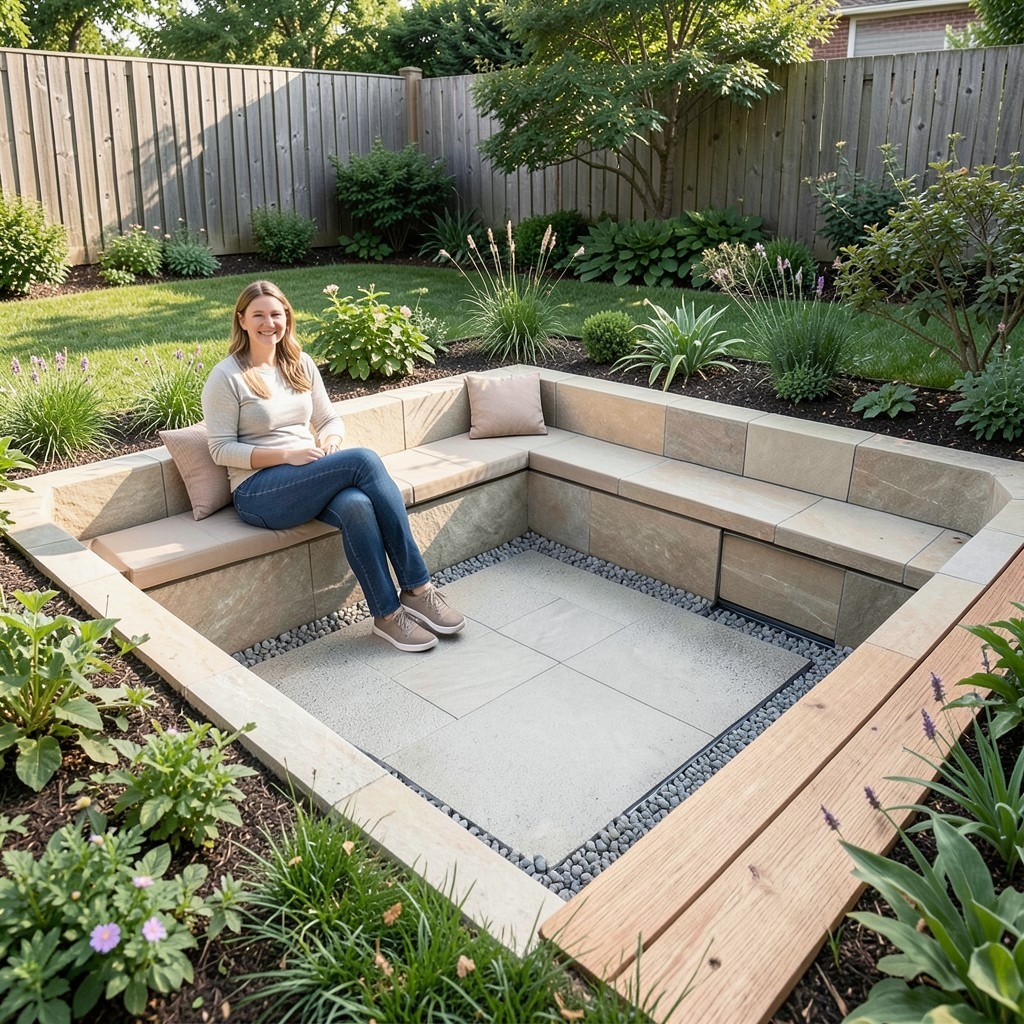
A sunken seating area — a section of the backyard excavated below grade and fitted with built-in seating on the perimeter walls — creates an outdoor social space with a quality of enclosure and intimacy that no above-ground furniture arrangement replicates. The walls of the sunken area provide wind shelter on all sides simultaneously, which extends the usability of the outdoor seating space into cooler and windier conditions that surface-level seating cannot withstand comfortably. The psychological effect of being slightly below ground level is also significant — the field of view from a sunken seat looks out across the garden at a lower angle, and the garden reads differently from that position.
The excavation depth for a sunken seating area requires balancing the shelter benefit against the drainage engineering required to manage groundwater. A depth of forty to sixty centimeters provides meaningful wind shelter and a clear sense of enclosure while remaining shallow enough that standard drainage provisions — a gravel base beneath the floor surface connected to a perimeter drainage channel — manage any water accumulation without complex engineering. A deeper excavation provides more shelter and more enclosure but requires professional drainage design and, in many jurisdictions, planning permission that a shallow sunken area avoids.
The floor of a sunken seating area is the most intimate surface in any backyard — it is the one surface where the occupants sit at close range, where feet rest, where the texture and temperature of the material are felt directly. Smooth stone tiles — limestone or sandstone — retain warmth from sun exposure and feel pleasant underfoot and underhand. A poured concrete floor with a brushed aggregate finish provides a more contemporary option with excellent durability and similar thermal retention. Timber decking in the sunken format requires careful detailing of the drainage beneath the boards to prevent water pooling under the deck surface, which accelerates timber deterioration in a low-drainage environment.
16. A Backyard With Outdoor Dining
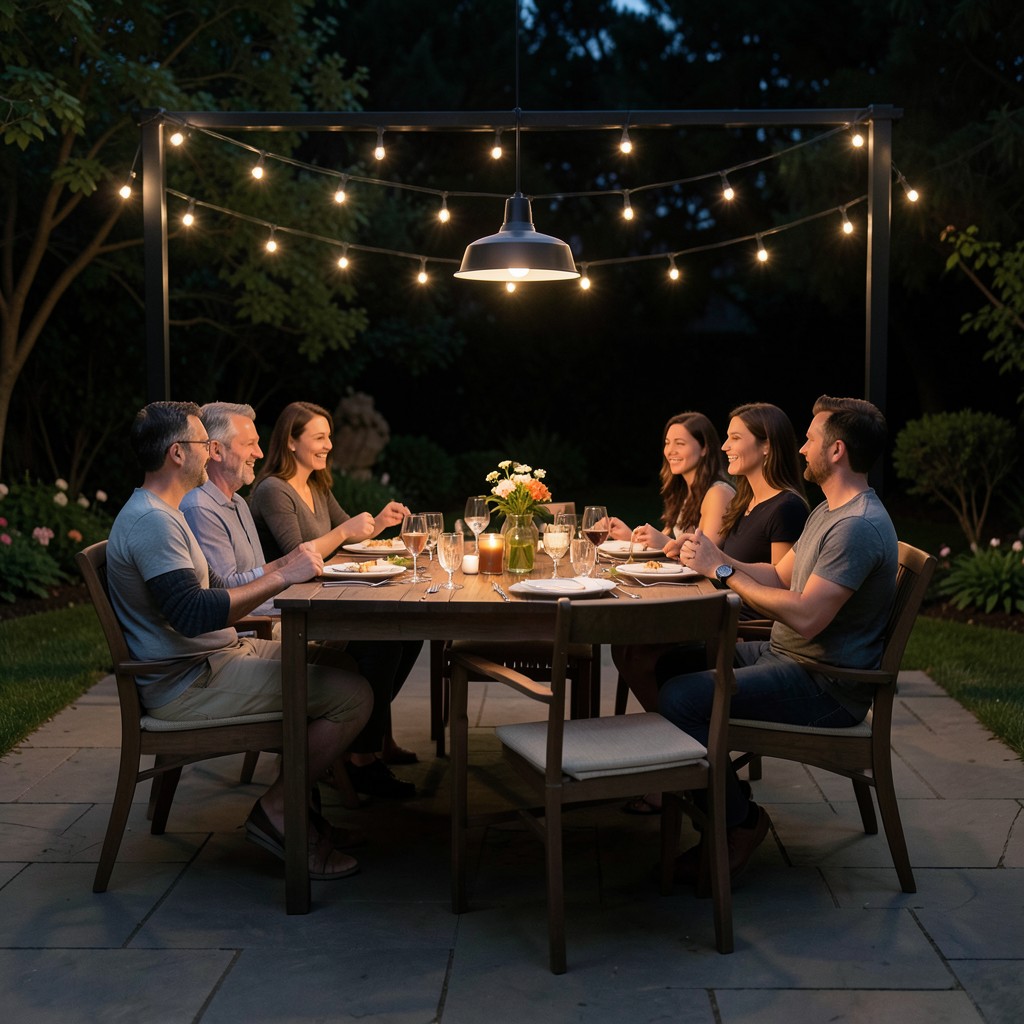
An outdoor dining setup — a table large enough for the household plus regular guests, chairs that are comfortable for a two-hour meal rather than a thirty-minute drink, and lighting positioned for the actual task of eating together rather than ambient illumination — produces an outdoor space that gets used for meals through every warm month of the year and earns the investment in its furniture and infrastructure many times over in dining quality and household enjoyment.
The table specification for an outdoor dining area must prioritize surface area, weather resistance, and the specific seating capacity the household regularly needs. A table that seats six when the household regularly entertains eight requires extension leaves or a second table alongside — both awkward solutions that reflect a furniture choice made for the space rather than for the use. Measure the space available for the table with chairs pulled out and people seated before selecting any outdoor dining furniture, and add at least thirty inches on each side of the table for chair movement. The table that fits the available space correctly is more valuable than the more beautiful table that is too large.
Overhead lighting above the outdoor dining table — a pendant or string lights suspended from a pergola frame or a purpose-built overhead structure — changes the evening dining experience from adequate to genuinely enjoyable. String lights strung between two overhead fixing points at the height of a pendant — approximately eight feet above the table — produce a warm, diffuse light at the scale of the dining surface without the overhead brightness that a single central fixture produces. The light level they provide for outdoor dining is sufficient for comfortable seeing and low enough that the garden beyond the dining area remains in comparative darkness, which creates the sense of a lit stage within a larger dark space.
17. A Backyard With a Naturalistic Pond

A garden pond — even a modest one, a few square meters in area — is the single addition that most dramatically increases the ecological richness of a backyard. Within months of a pond being established, it becomes a habitat for insects, amphibians, birds, and small mammals that the same backyard, without water, never attracted. Dragonflies appear. Frogs take up residence. Birds come to drink and bathe. The pond earns its place in the backyard not just through its visual quality but through its function as a genuinely alive ecosystem that brings wildlife to the garden without any action beyond providing the water conditions that wildlife requires.
The design of a naturalistic garden pond prioritizes sloping sides — a gradual shelf from the shallow margin to the deeper central zone — over the vertical-sided, formal rectangular pool that many garden center pond kits produce. A gradual slope allows amphibians to exit the water without difficulty, allows birds to wade safely to drink, and allows aquatic margin plants to establish at the correct water depth for their root systems. The deep central zone — at least sixty centimeters in temperate climates — provides the temperature stability that aquatic wildlife requires through both summer heat and winter cold.
The planted margin is the visual component that makes a naturalistic pond read as a designed garden feature rather than a hole in the ground filled with water. Native marginal plants — yellow iris, marsh marigold, water mint, and sedges — installed at the pond’s shallow shelves grow to establish a planted boundary between the water surface and the surrounding ground. Their reflections in still water, their movement in any breeze, and their seasonal progression from spring flowering through summer leaf to autumn seed head make the pond margin a garden feature with genuine ongoing interest through every season.
18. A Backyard With an Outdoor Bar
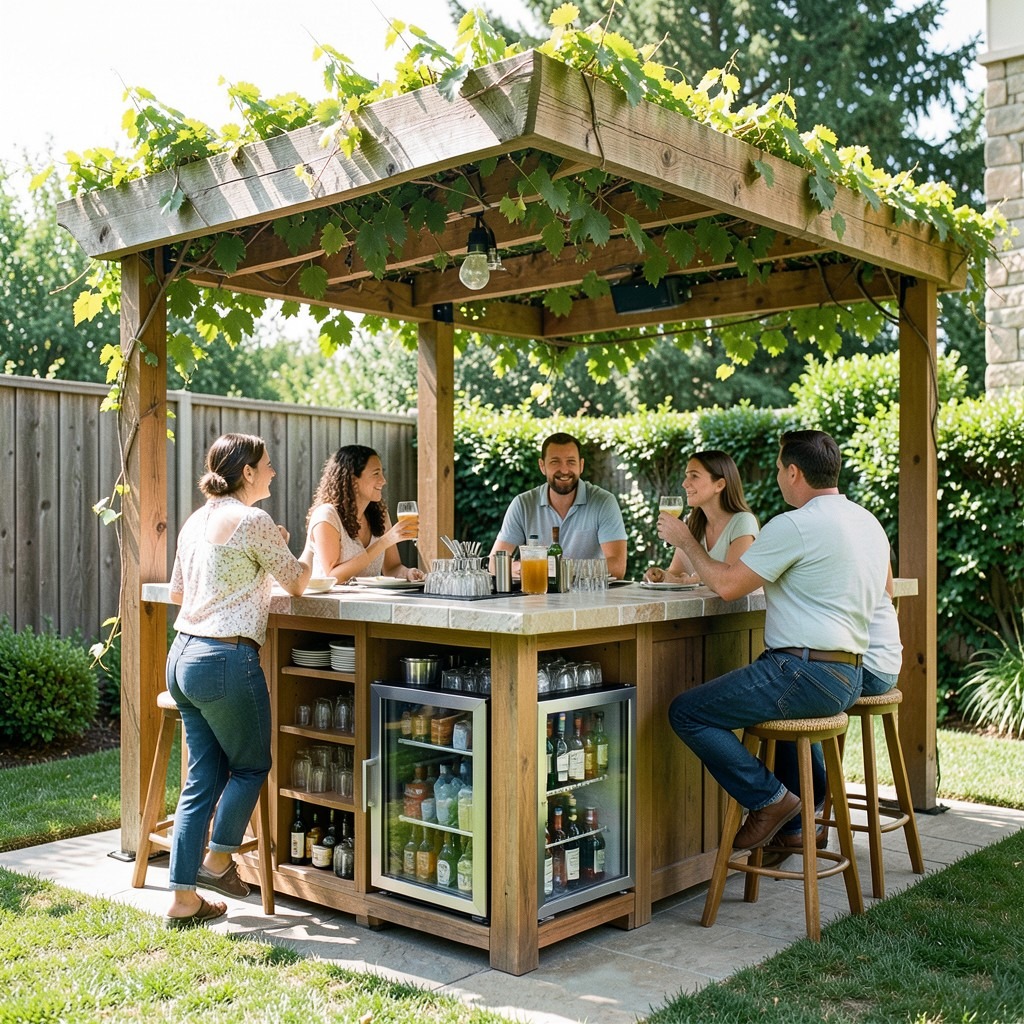
An outdoor bar — a built or freestanding counter with storage for glasses and bottles, integrated ice storage, and a surface positioned at bar height for standing or stool seating — converts the backyard from a place where drinks happen to be consumed into a place where hospitality is actively practiced. The outdoor bar draws people toward it, provides a natural social center during gatherings, and creates the specific pleasure of drinking a cold drink from a glass that was stored outdoors and served without the host having to disappear into the house repeatedly to replenish supplies.
The built outdoor bar — masonry or timber construction with a stone or tile counter surface — is the most functional and most architecturally resolved option. A counter at forty-two inches height for bar-stool seating, with a knee space on the guest side that allows perching on a stool rather than standing, creates a genuine bar experience in the outdoor context. The storage below the counter — enclosed with weather-resistant doors — holds glasses, bottles, a small under-counter refrigerator for cold drinks, and the cocktail tools that a properly functioning bar requires. The infrastructure investment in a cold water supply for ice bucket refilling and glass rinsing, run to the outdoor bar from the house’s cold water supply, is the addition that converts an outdoor drinks surface into an outdoor bar that functions as well as an indoor one.
The overhead shade provision above an outdoor bar is the practical consideration that most bar installations overlook until the first hot afternoon when the counter is in direct sun and every cold drink warms within minutes. A timber canopy over the bar counter — constructed as an extension of a pergola or as a freestanding shade structure — keeps the counter surface and the occupants beneath it in shade during the afternoon hours when the bar is most used. The planting above the canopy — a grape vine trained across the timber frame — provides seasonal shade that deepens as the summer progresses and provides the benefit of the grapes themselves in late summer.
19. A Backyard With a Hammock Setup
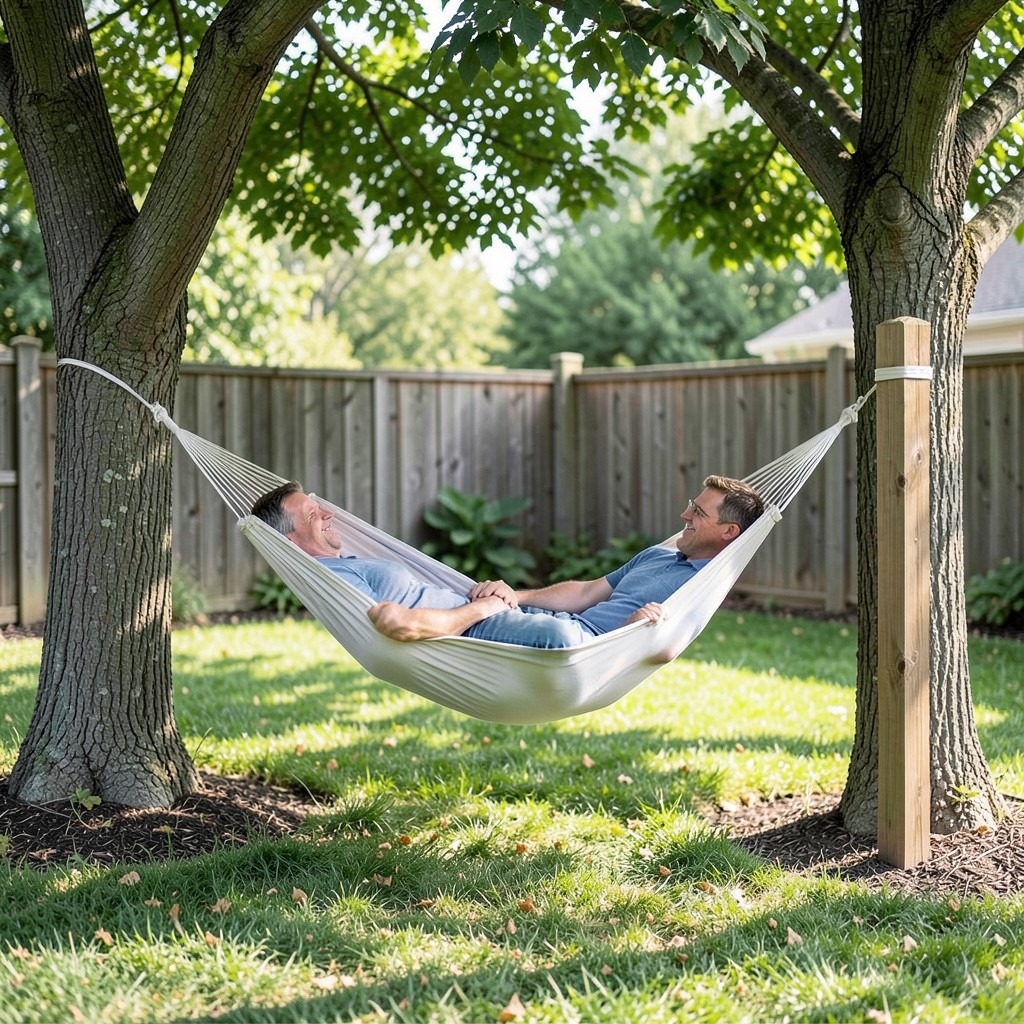
A hammock suspended between two mature trees — or between purpose-built timber or metal posts where trees are not positioned correctly — provides the outdoor space with a specific kind of leisure position that neither a chair nor a sun lounger replicates. The suspended position, gently yielding to body weight and moving slightly with any breeze, produces the particular physical calm that is associated specifically with hammock occupancy. The rocking motion triggers a biological relaxation response that outdoor chairs and recliners do not, and a backyard with a well-positioned hammock is a backyard that gets used differently — more restfully, more leisurely, more slowly — than one without.
The suspension height and the hanging angle of the hammock determine its comfort in use. A hammock hung too tight — the suspension points too far apart or too high — lies flat when occupied and produces a narrow, uncomfortable tube rather than a comfortable sling. A hammock hung at the correct angle — the suspension points at around five feet from the ground with an angle between the suspension cord and the horizontal of thirty degrees — produces a comfortable curve that supports the body without pinching the edges. The practical test is to lie in the hammock with the correct hanging configuration: the body should be supported at the thighs, the lower back, and the shoulders simultaneously, with no pressure points at any single location.
The hammock post installation in a backyard without suitably spaced trees requires posts that are both aesthetically acceptable in the backyard context and structurally adequate for the dynamic loads that hammock occupancy places on them. A standard timber fence post is inadequate — the rocking and swinging motion of hammock use places lateral loads on the post that fence post dimensions do not handle. A four-by-four timber post set in concrete to a depth of one meter, with a total height of seven to eight feet above grade, handles the loads comfortably and can be finished in a way that suits the backyard’s design direction.
20. A Backyard With a Privacy Screen

Privacy in a backyard is the condition that most strongly determines how freely the space is used. A backyard visible to neighbors from multiple directions is a backyard where people feel observed, which changes their behavior — they stay closer to the house, they spend less time in the space, they feel less relaxed. A backyard with adequate privacy — where the seating area is not visible from adjacent properties and where the sense of being in a private outdoor territory is consistent rather than conditional on the neighbors not happening to be in their garden at the same time — is a backyard that gets used with genuine ease.
The most functional privacy screen for a residential backyard is not necessarily the highest fence permitted by local regulations. Solid high fences create wind turbulence rather than wind shelter, producing the counterintuitive condition where a taller fence produces more turbulent air movement within the garden than a lower one. A fence or screen that filters wind — a slatted timber screen with gaps between the boards, a hedge planted at the fence line — reduces wind speed across the garden more effectively than a solid barrier by dissipating the wind’s energy through the gaps. The privacy is maintained through the visual opacity of the screen, while the wind shelter is better than a solid equivalent.
Tall planting as a privacy solution — columnar trees, clipped hornbeam hedges, bamboo screens — provides privacy that improves with time rather than deteriorating as a fence does. A bamboo planting in a root control barrier, installed at the boundary of a backyard, reaches screen height within three years and produces a dense, living privacy screen that absorbs sound from beyond the boundary as well as blocking sightlines. The root control barrier — a physical barrier buried at the perimeter of the bamboo planting — is the non-optional companion to any bamboo installation in a residential context, preventing the underground rhizome spread that makes uncontrolled bamboo one of the most persistent garden problems to resolve.
21. A Backyard With a Wildflower Meadow Border
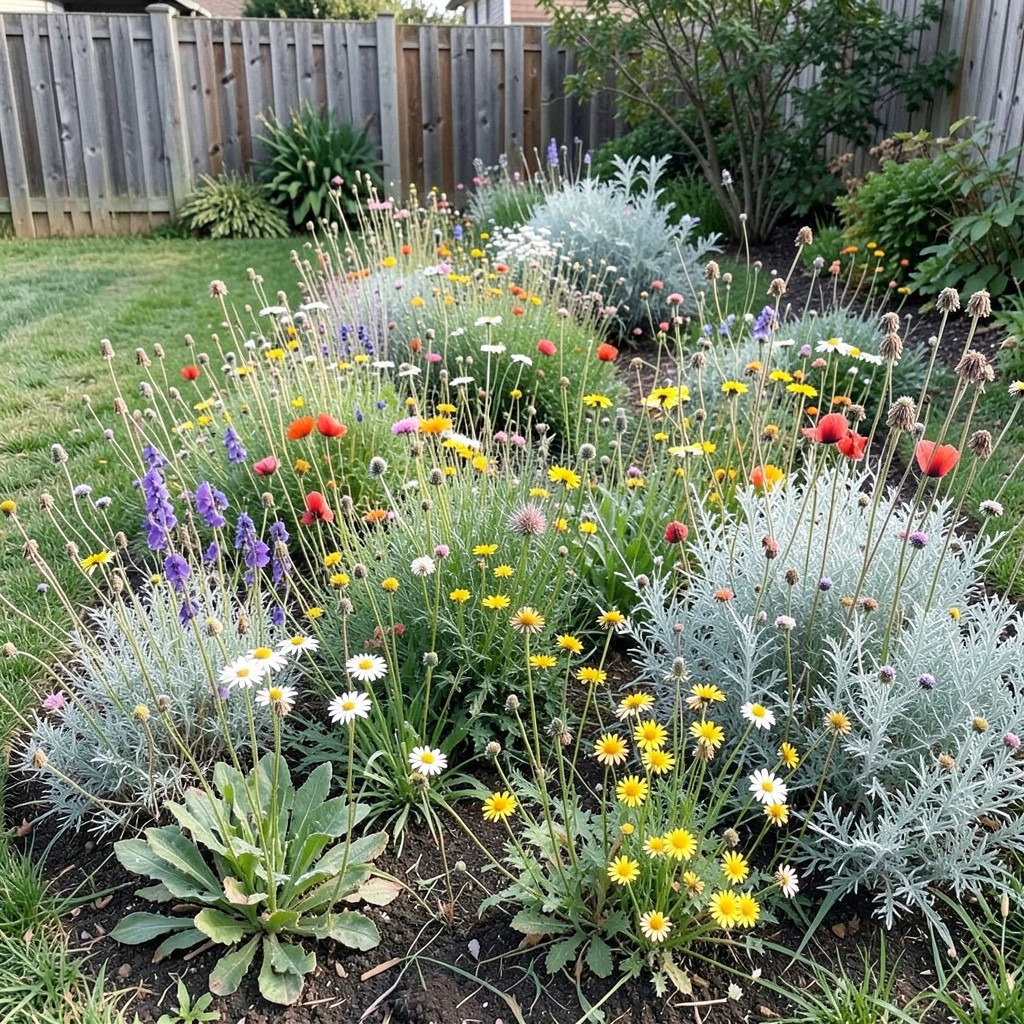
A wildflower border along one or more backyard boundaries — sown from a native wildflower seed mix or planted with established plug plants — produces a planting zone that requires no deadheading, no feeding, no staking, and no watering once established, while providing the visual richness and the ecological function of a diverse native plant community. The wildflower border is, in terms of design impact per unit of ongoing maintenance, the highest-performing planting choice available for a residential backyard.
The seed mix selection determines the border’s performance across different soil and light conditions. A chalk grassland mix — rich in knapweeds, scabiosas, and field poppies — requires the free-draining, low-fertility conditions of an alkaline soil to perform correctly. A clay soil mix of native meadow species — ragged robin, meadow cranesbill, oxeye daisy — is formulated for the heavier, wetter conditions of clay-based soils. Using the wrong seed mix for the prevailing soil conditions is the most common wildflower planting failure, and it produces a border that is dominated by the most aggressive species in the mix rather than the intended diversity.
The annual management cut — one cut in late autumn or early winter, removing the previous season’s growth to ground level — is the single maintenance event that keeps the wildflower border in productive condition year after year. The cut must be timed correctly: too early in the season removes the seed heads before they have shed, which depletes the border’s seed bank and reduces the following season’s diversity. Cutting after the first hard frost, when all seed heads have dried and shed naturally, maintains the seed bank and the border’s self-sustaining character across years.
22. A Backyard With Outdoor String Lights
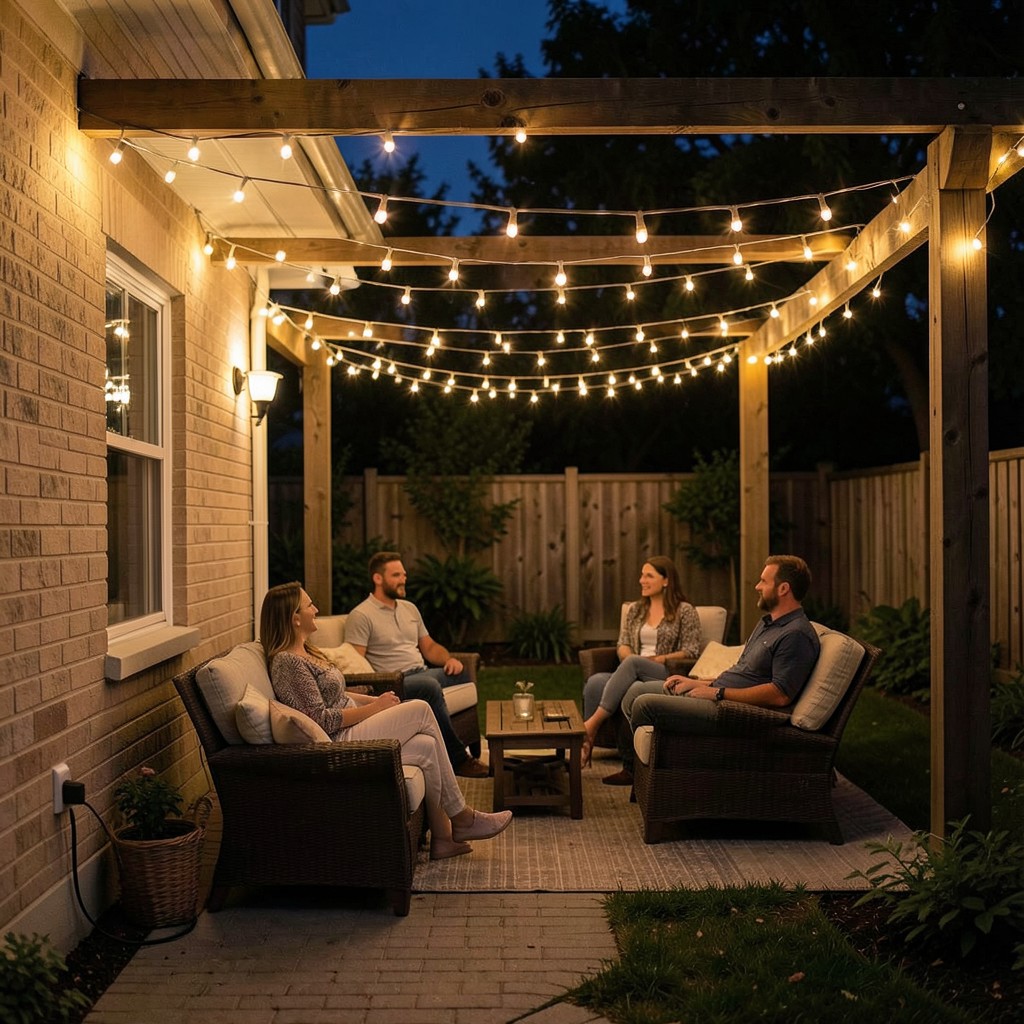
String lights hung across a backyard — from house wall to garden structure, from pergola beam to timber post, or across a seating area in a single overhead plane — produce the most immediately atmospheric backyard lighting effect available at the lowest infrastructure cost. The warm incandescent or filament LED quality of good string lights creates an overhead light plane that reads at night as a canopy of light: intimate, warm, and explicitly social in its effect on the people gathered beneath it.
The installation architecture of string lights determines whether they read as designed or makeshift. A single run of lights strung loosely between two points at unequal heights, sagging asymmetrically under their own weight, reads as temporary and accidental. Multiple runs of lights strung at the same height across a defined seating area, fixed at consistent points on each side, producing a parallel grid of light above the social zone — this reads as designed and intentional. The difference is not in the lights themselves but in the geometry of the installation, and the geometry costs nothing but attention.
The power supply for outdoor string lights requires a weatherproof external socket positioned at the house wall or on a garden post within reach of the lights’ supply cable. Running an extension lead from an interior socket through a window or door is the solution most people default to and the one that creates the most ongoing inconvenience — the gap in the window sealing admits cold and rain, the lead is a trip hazard, and the visible supply cable undermines the visual quality of the installation. A correctly installed external socket, wired by a qualified electrician and rated for outdoor use, is a one-time investment that serves the string lights and every other electrical garden accessory that the backyard requires.
23. A Backyard With a Bocce or Lawn Game Area
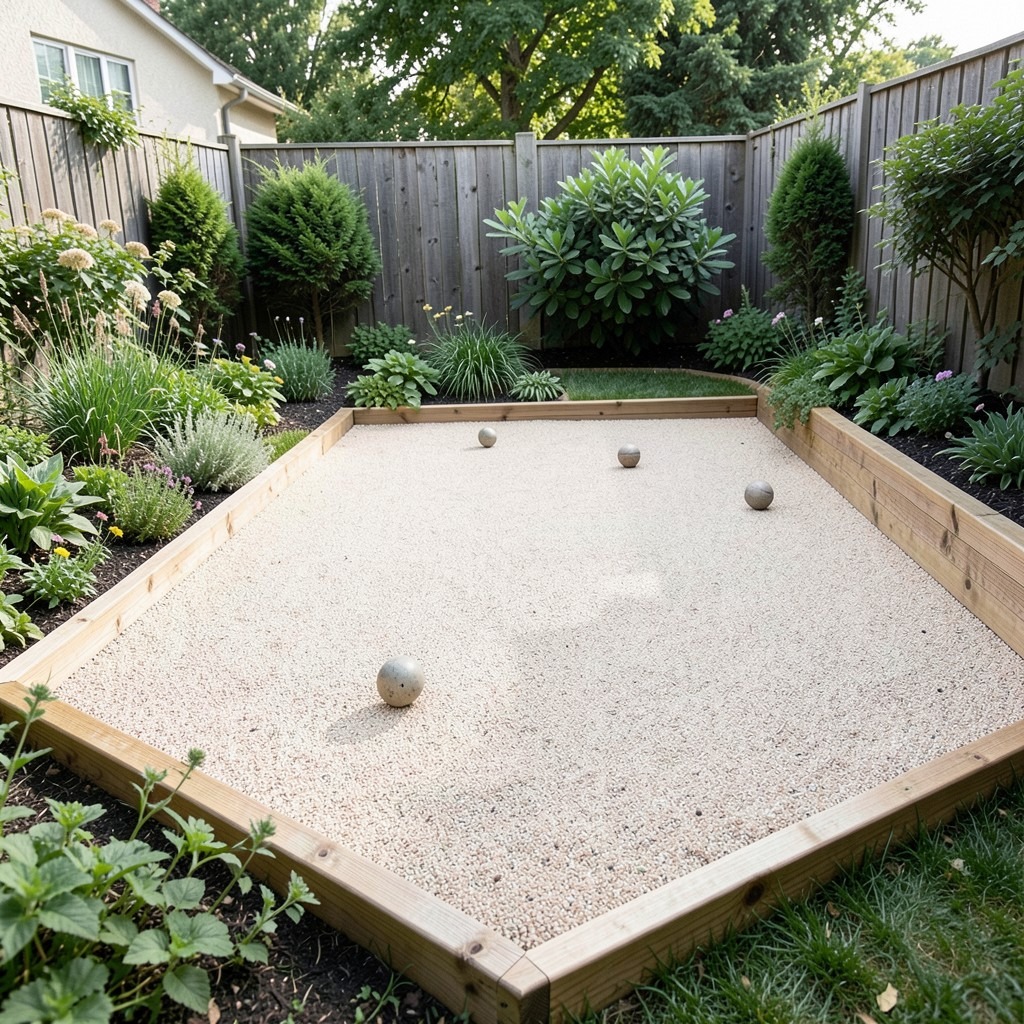
A dedicated outdoor games area — a level, firm surface sized for bocce, petanque, or croquet — gives the backyard a social function beyond eating and drinking and extends the range of people for whom the outdoor space is actively engaging. Children who are too old for play equipment and too young to sit contentedly through an adult dinner party are served by a games area. Adults who want to do something with their hands and their company other than stand around or sit are served by a games area. Guests who find static outdoor socializing slightly awkward are served by a games area. It broadens the backyard’s social reach without requiring any structural complexity.
The surface material for a bocce or petanque court requires a firm, level base with a fine material layer that allows the balls to roll without obstruction and absorbs the impact of a throw without excessive bounce. Crushed oyster shell is the traditional French petanque surface — it provides excellent ball behavior and a warm, pale aesthetic. Decomposed granite packed to a firm surface is the most accessible alternative in markets where oyster shell is not readily available. The court must be level to within a few centimeters across its full length — a slope of more than one or two degrees produces consistent ball bias that renders the game frustrating rather than enjoyable.
The surrounding border of the games area — a low timber rail, a change in surface material, or a planted edge — defines the playing zone clearly and prevents errant balls from reaching the surrounding garden. A low timber edge at fifty millimeters height — enough to stop a rolling ball without being a trip hazard — is the most practical option and suits the informal character of a residential games area. The timber edging doubles as a visual boundary that makes the games area read as a defined feature of the backyard rather than an unmarked patch of surface.
24. A Backyard With a Hot Tub
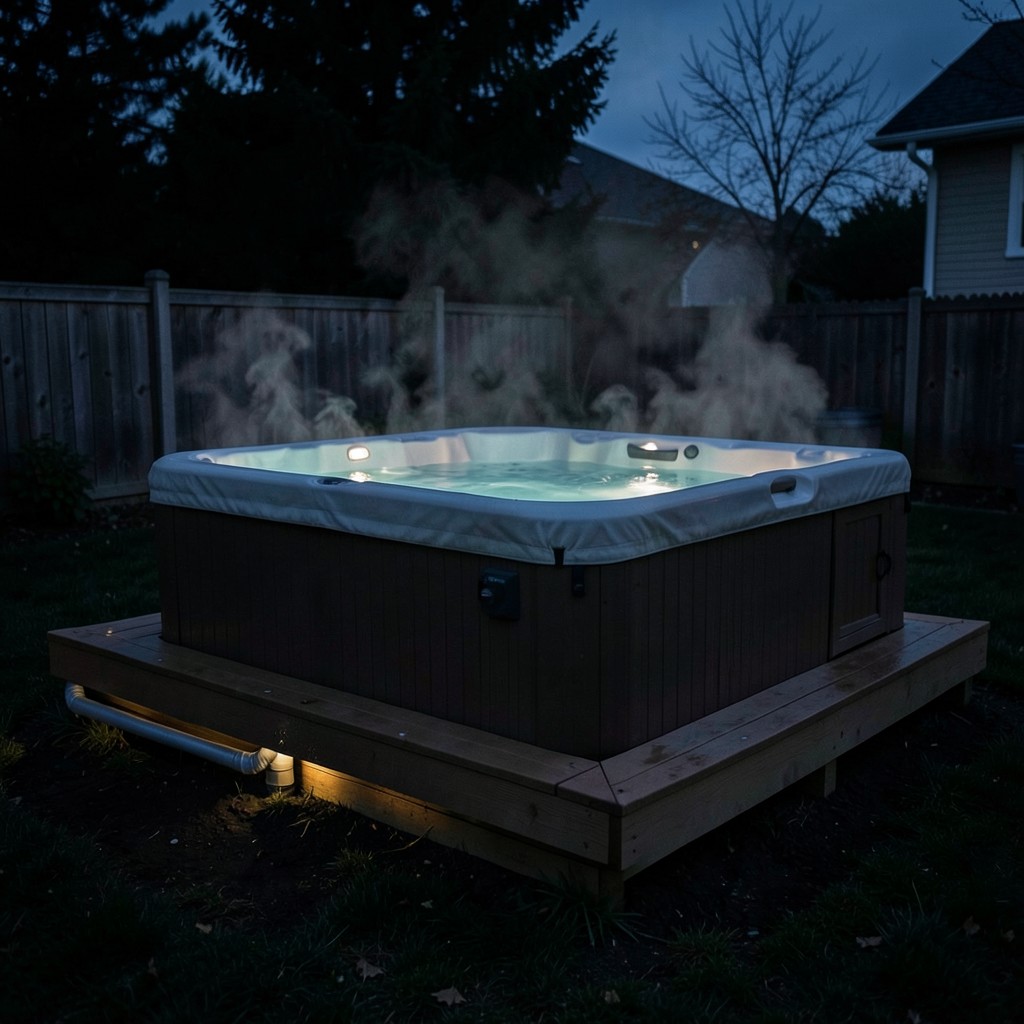
A hot tub in a backyard extends the outdoor space’s useful hours into the evening and its usable season into the colder months more effectively than any other outdoor feature. The specific pleasure of sitting in hot water while the air temperature is cold — the contrast between the warmth of the water and the chill of the air above it, the steam rising, the outdoor darkness surrounding the lit water — is not available in a warm climate in the same way that it is in a cool one, and a backyard with a hot tub is a backyard that earns its place in the cooler seasons rather than sitting idle from October to April.
The position of the hot tub in the backyard requires solving three problems simultaneously: access to the electrical supply required to run the heater and pump, privacy from adjacent properties at a height of approximately three feet above the deck level, and a surface around the tub that can handle repeated wet foot traffic without becoming slippery or deteriorating from constant moisture. All three of these can be solved through the same design response: a dedicated raised deck platform for the hot tub, with privacy screening built into the deck perimeter at the required height, and the electrical supply run beneath the deck to a weatherproof connection point.
The ongoing operating cost of a hot tub is the specification variable that most buyers underestimate at the point of purchase. An energy-efficient hot tub — with good cover insulation, a well-insulated cabinet, and a modern variable-speed pump — costs significantly less per month to run than an older or lower-specification model. The cover quality is the most impactful single variable: a hot tub with a poorly insulating cover loses heat continuously between uses and requires its heater to run nearly constantly to maintain temperature. A well-insulated cover retains heat effectively between uses, which is the operating characteristic that reduces the electricity consumption to acceptable levels over the life of the installation.
25. A Backyard With a Rustic Stone Path
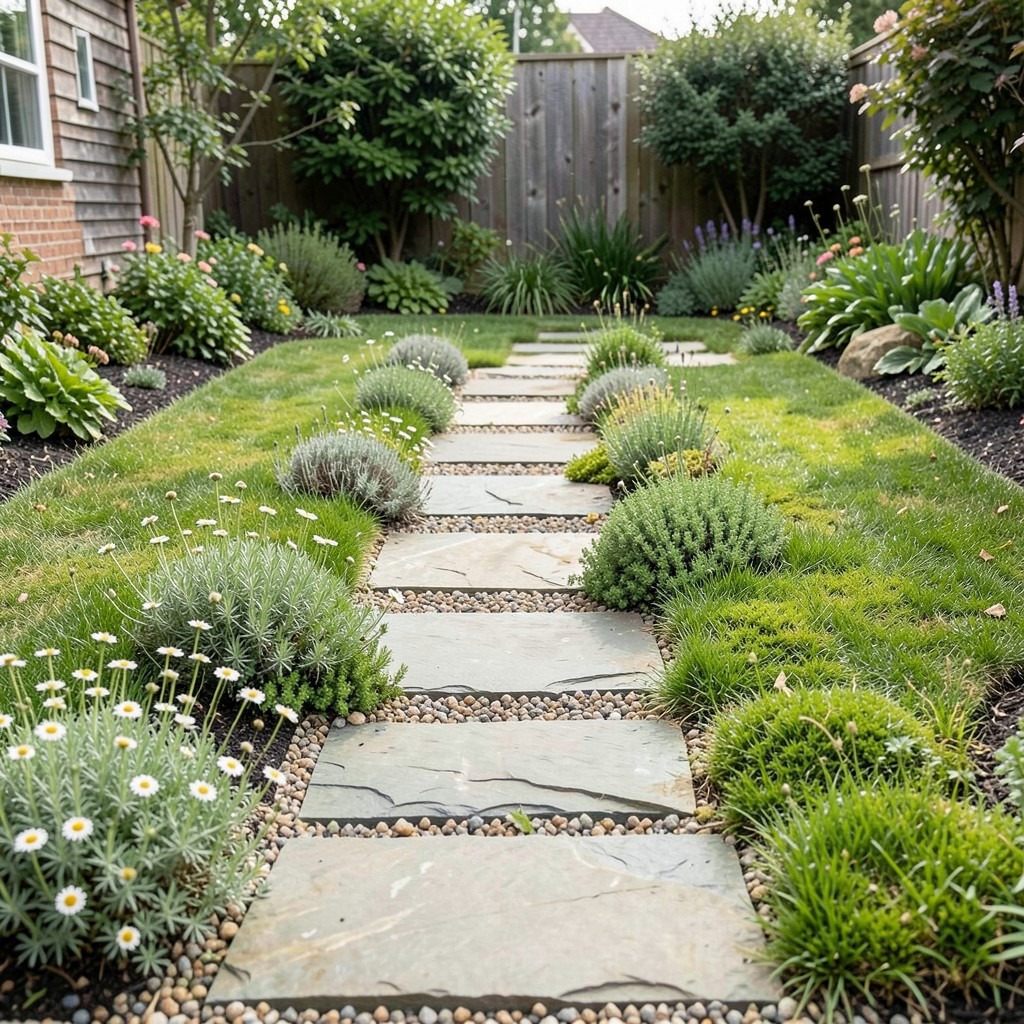
A stone path through a backyard — stepping stones set into a lawn or gravel bed, or a continuous paved path of natural stone laid in a running bond or random pattern — gives the outdoor space a circulation route that also reads as a landscape feature. The path is not merely a surface to walk on; it is the organizing line that connects the different areas of the backyard, draws the eye through the space, and creates a sense of journey within a domestic garden that might be covered in ten steps but feels, when a well-made path is present, like a deliberate progression from one place to another.
Natural stone for a garden path — sandstone, slate, limestone, or local stone varieties — has a surface quality and a tonal warmth that concrete pavers and manufactured stepping stones do not match. Each natural stone slab is unique in its surface texture, its color variation, and the way its edges weather over time. A path of natural stone bedded into a lawn develops a settled, established quality within a year or two that reads as permanent and considered rather than installed. The slight variations in level between adjacent stones — which a perfectly laid engineered surface would not produce — become part of the path’s character over time rather than a quality defect.
The planting between stepping stones — thyme, chamomile, or moss varieties suited to the light and moisture conditions of the path — softens the stone’s edges and creates a ground-level planting that connects the path to the surrounding garden. Creeping thyme releases fragrance when walked upon, which adds an olfactory dimension to the physical experience of walking the path. This detail is specific enough that most people never think to specify it and then spend years in others’ gardens wondering what produces that particular pleasure of a path that smells of herbs underfoot.
26. A Backyard With an Outdoor Shower
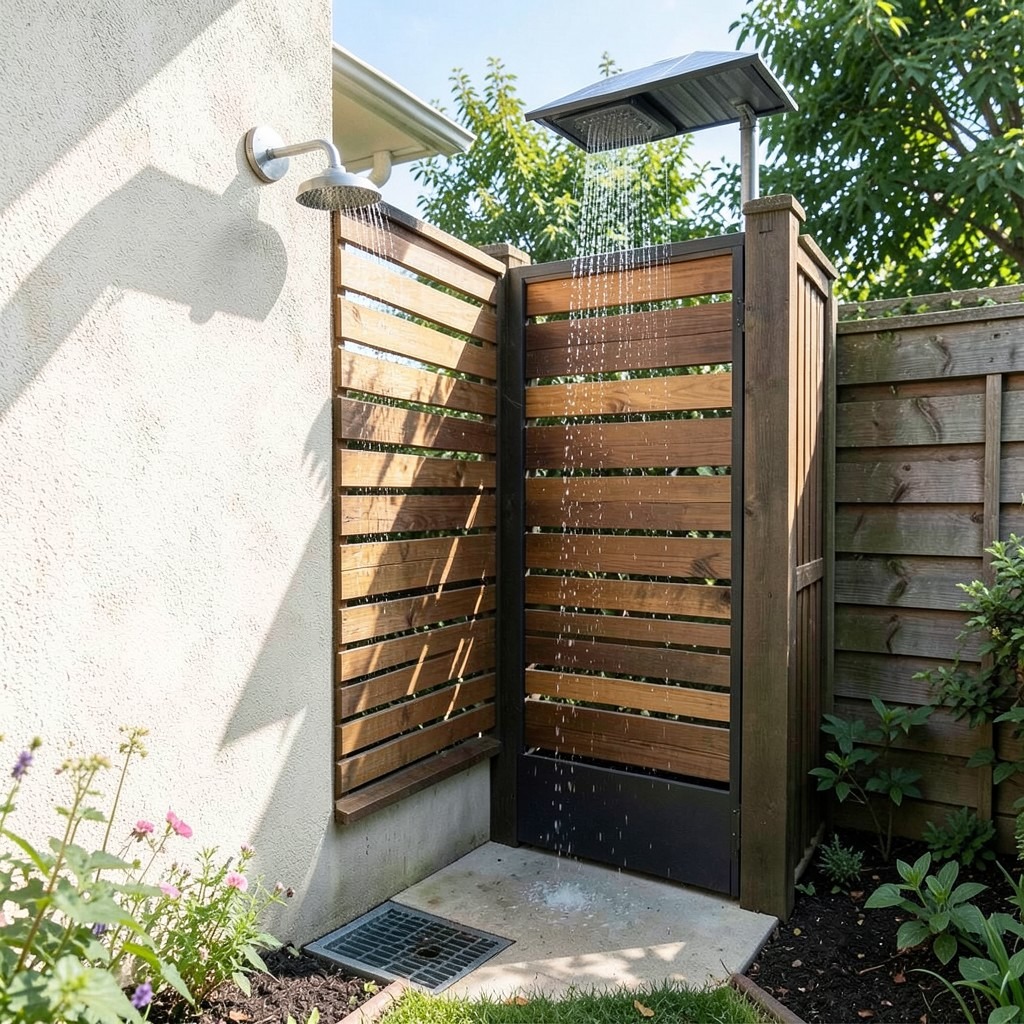
An outdoor shower — a shower head fixed to a wall or a purpose-built post, with a drain at ground level, positioned in a semi-private area of the backyard — is practical, pleasurable, and rarely considered until someone experiences one and wonders how they managed without it. It is used for rinsing off after swimming, after gardening, after sports, after the children have been in the sandpit. It extends the practical utility of a backyard with a pool or a garden that is actively worked, and in warm weather it is — there is no other way to say this — one of the most enjoyable ways to spend five minutes outdoors.
The privacy screen around an outdoor shower must achieve two conditions: sufficient opacity from adjacent properties and sufficient openness to the sky to maintain the outdoor character that makes the shower worth having. A solid enclosure is a small, dark shower room with outdoor walls. The correct approach is a screen height that provides privacy from seated and standing positions in adjacent gardens — typically five to six feet — while leaving the upper portion of the shower area open to the sky. Slatted timber screens at this height provide good visual privacy while allowing air movement through the gaps, which prevents the enclosed, humid feeling that solid walls create.
The hot water supply to an outdoor shower separates a feature used freely from one used reluctantly on all but the warmest days. A solar-heated water supply — a small roof-mounted panel feeding a storage cylinder — provides warm water for the outdoor shower without any ongoing energy cost and suits the outdoor installation better than a mains hot water connection that requires a long run of insulated supply pipe through the garden. In climates where summer sun is reliable, a solar supply maintains usable shower temperatures through the swimming and gardening season without any operational input.
27. A Backyard With a Formal Hedge Structure
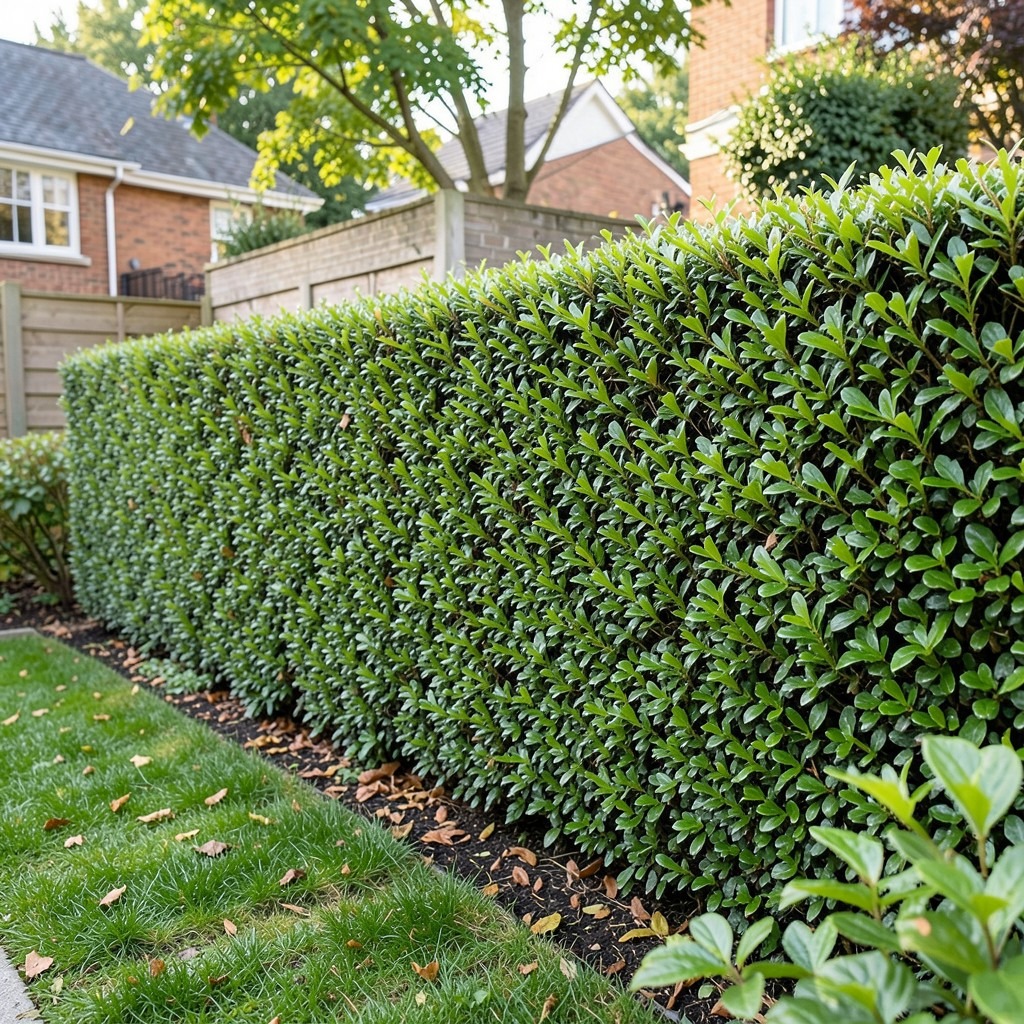
A clipped hedge in a backyard — whether a simple boundary hedge or an internal structure that divides the garden into zones — brings a formal, architectural quality to the outdoor space that planting in any other form does not provide. A well-maintained hedge is a living wall: it has the solidity and the spatial definition of a built structure, with the seasonal character and the biological life of a plant. The combination of these two qualities — architectural presence and organic life — is what makes formal hedge structure the most powerful design element available in a residential backyard.
The species selection for a formal backyard hedge determines both the rate at which the structure develops and the character it carries at maturity. Yew — Taxus baccata — is the definitive formal hedge species, capable of being clipped to precise geometric profiles and developing a density and a dark green solidity that no other species matches. It grows slowly — around fifteen to thirty centimeters per year — which is patience-testing in the early years but produces the finest long-term result. Hornbeam — Carpinus betulus — grows more quickly, develops a distinctive textured surface of overlapping leaves, and retains its brown dead leaves through winter, providing structure and visual interest in the months when other deciduous plants are bare.
The maintenance discipline of formal hedge structure is the commitment that most gardeners underestimate when they plant it and feel acutely when the hedge reaches full size. A hedge clipped twice annually — once in late spring after the first flush of growth and once in late summer before autumn growth — maintains its profile through both cuts with two growing periods between them. A hedge clipped only once annually grows out of shape during the long period between cuts and requires more aggressive correction at the next cut, which thins the surface foliage and produces an uneven profile. Two cuts per year is the minimum discipline for a hedge that reads as formal rather than simply trimmed.
28. A Backyard With Outdoor Art and Sculpture

Sculpture and art objects in a backyard — a ceramic piece on a plinth, a bronze figure at the end of a path, a large abstract form in a planting bed, a mosaic panel on a boundary wall — give the outdoor space the same quality of designed intention that artwork gives an interior room. A garden without an art object is a garden that stops at the level of plants and surfaces. A garden with one well-chosen piece has a focal point that the eye returns to, a point of visual resolution that completes the composition in a way that planting alone, however beautiful, cannot provide.
The scale of garden sculpture must be calibrated to the scale of the surrounding landscape rather than to the scale of interior objects. A piece that reads as large in a gallery or a house reads as small in a garden context, where open sky, mature planting, and the distances of outdoor space change the perceptual scale of everything within them. A sculpture that commands the garden from its position requires mass — physical size, material weight, visual density — sufficient to hold its own against mature planting on three sides and open sky above. The undersized garden sculpture is the most common failure mode in outdoor art placement, and avoiding it requires erring toward larger rather than smaller at every stage of the selection process.
The material of an outdoor sculpture must handle the specific conditions of the outdoor environment over years rather than months. Bronze develops a patina that deepens and enriches over time, reading as more valuable with age rather than less. Weathered corten steel produces the same improving quality — the rust patina that develops over the first two years is the material’s protective layer as well as its aesthetic character, and a corten sculpture placed in a garden requires no maintenance once established. Stone — carved limestone, granite, or sandstone — handles outdoor conditions with minimal deterioration in most climates and develops the light biological coating of moss and lichen that connects it to the garden’s living character over years.
29. A Backyard With a Lawn and Specimen Tree
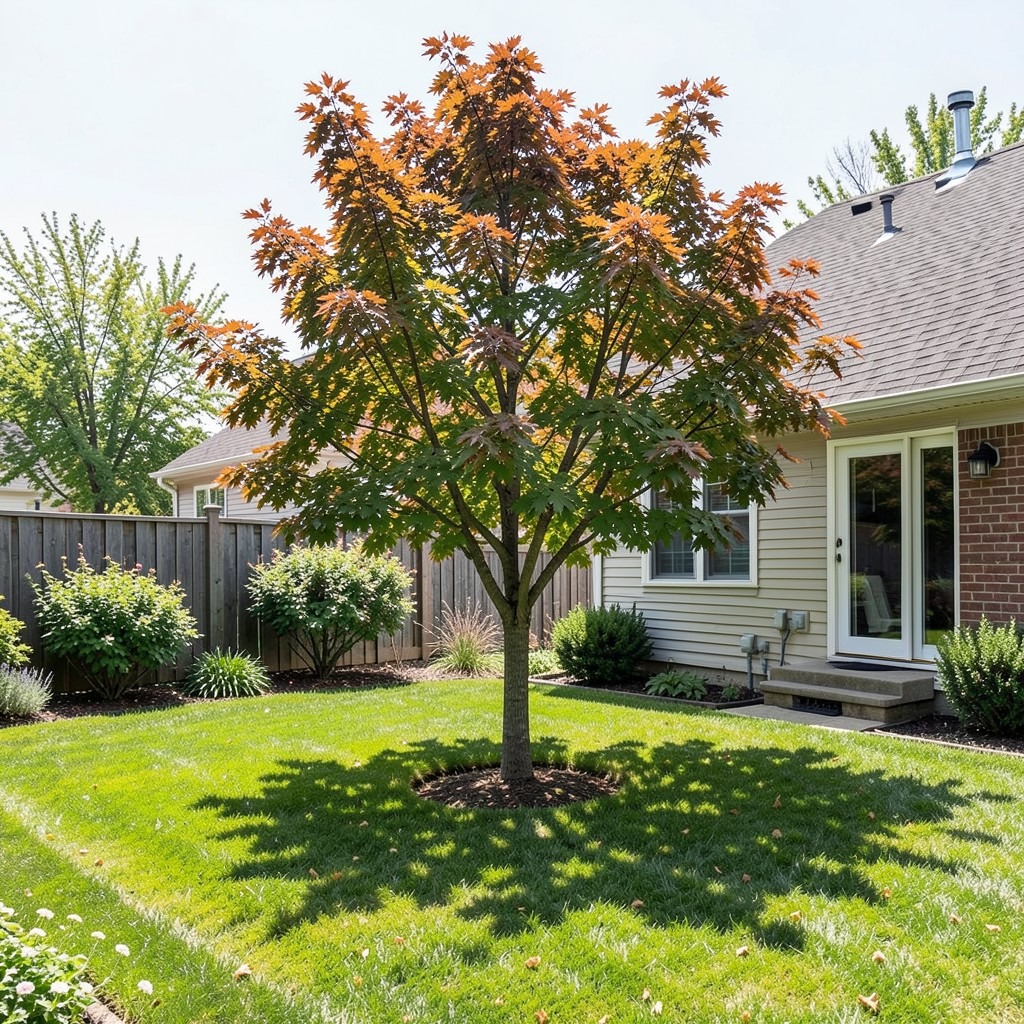
A single, well-chosen specimen tree positioned in an open lawn changes the backyard’s entire spatial experience in a way that no plant selection at ground level achieves. The tree adds a vertical dimension to a garden that paving and planting beds keep horizontal, creates shade that makes the outdoor space usable through the hottest part of summer afternoons, and gives the backyard a sense of scale and permanence that furniture and features cannot manufacture regardless of their quality. A mature specimen tree is the one element in a backyard that cannot be replicated by any amount of spending — it is the product of time, and time is the one resource that cannot be purchased.
The selection of a specimen tree requires thinking about its mature size in relation to the specific backyard’s dimensions, its relationship to the house structure and underground services, and its seasonal character across the full year rather than just at its peak moment. A tree that flowers spectacularly in spring but is entirely undistinguished for the remaining eleven months is a less considered choice than one with layered seasonal interest: spring flowers, summer leaf canopy, autumn color change, and winter architectural structure from its bare branching. Amelanchier lamarckii delivers all four of these seasonal qualities in a compact, multi-stem form that suits smaller backyards where a large canopy tree would overwhelm the space.
The positioning of the specimen tree relative to the lawn determines the quality of the shadow pattern it casts and the reading it creates from the house. A tree positioned off-center in the lawn — not at the geometric middle of the space but at a point that creates an asymmetric composition between the tree and the surrounding open lawn — reads as more naturalistic and more designed simultaneously. The asymmetry communicates that the position was chosen rather than defaulted to, and the open lawn to one side of the tree creates the clear sightline from the house that makes the tree visible and appreciated from the interior rooms.
30. A Backyard With a Raised Timber Deck and Built-In Seating
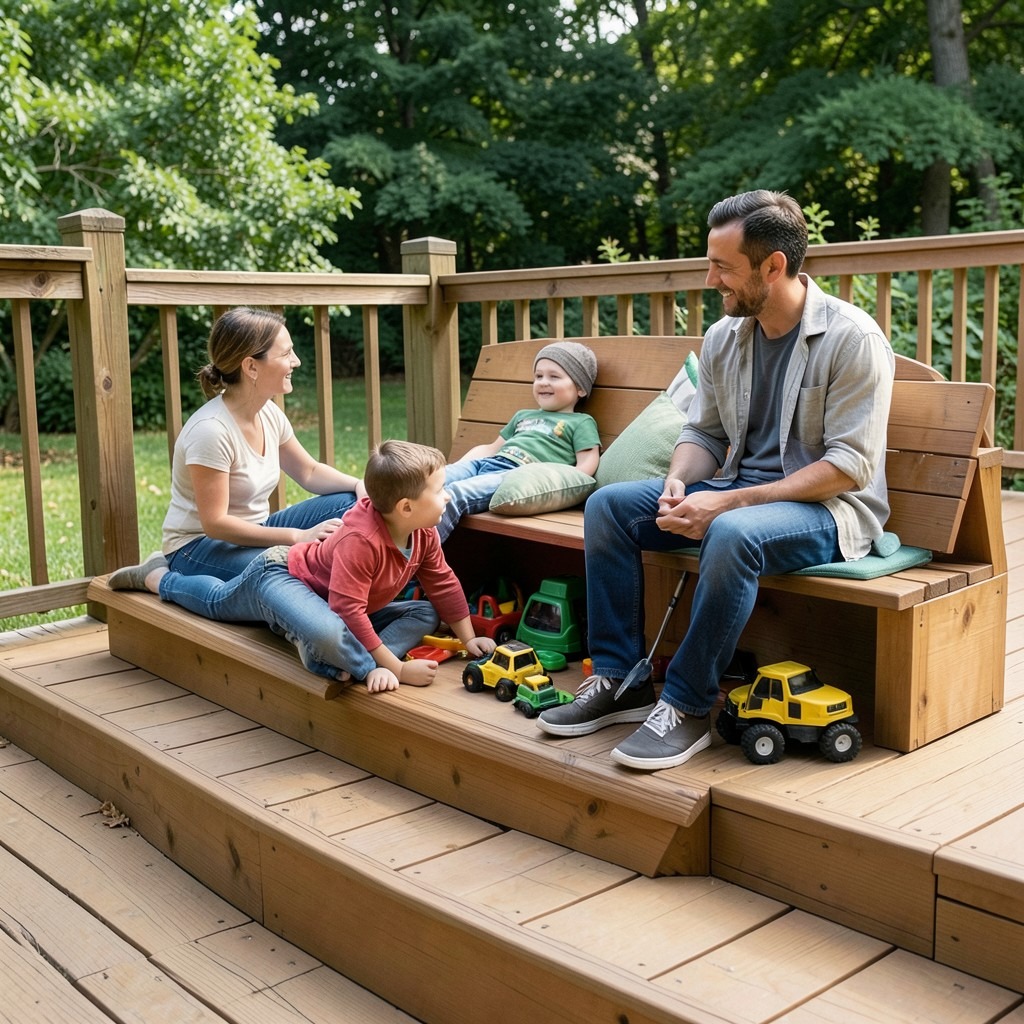
Built-in seating on a raised deck — benches constructed from the same timber as the deck boards, with a seat height calibrated for comfortable adult seating and a backrest angled for genuine relaxation rather than upright propriety — solves the outdoor furniture problem permanently. Freestanding outdoor furniture migrates. It gets stacked, stored, moved for mowing, repositioned for different events, and gradually loses the spatial arrangement that made the deck function socially. Built-in seating has none of these problems — it is always in the right place, always at the right height, and always available without any effort from the household.
The bench depth is the practical variable that determines whether built-in deck seating is comfortable for extended outdoor occupation. A bench seat at seventeen to eighteen inches depth — the standard seat depth for indoor seating — feels narrow outdoors where people sit in a wider range of positions than they do at an indoor dining table. A built-in deck bench at twenty-two to twenty-four inches depth allows sitting cross-legged, turning to face a conversation partner, lying along the bench length, and the many informal positions that outdoor social seating requires. The additional depth uses more deck area but delivers a fundamentally more usable and more comfortable seating arrangement.
The storage void beneath a built-in deck bench — accessible through a hinged or lift-off seat lid — is the spatial resource that most deck installations overlook. The structural depth between the seat height and the deck surface produces a storage volume adequate for outdoor cushions, garden tools, children’s outdoor toys, and the accumulated equipment of an actively used backyard. Integrating storage into the built-in bench structure from the beginning costs almost nothing relative to the cost of the bench construction and recovers what would otherwise be dead space beneath the seating.
31. A Backyard With Espalier Fruit Trees
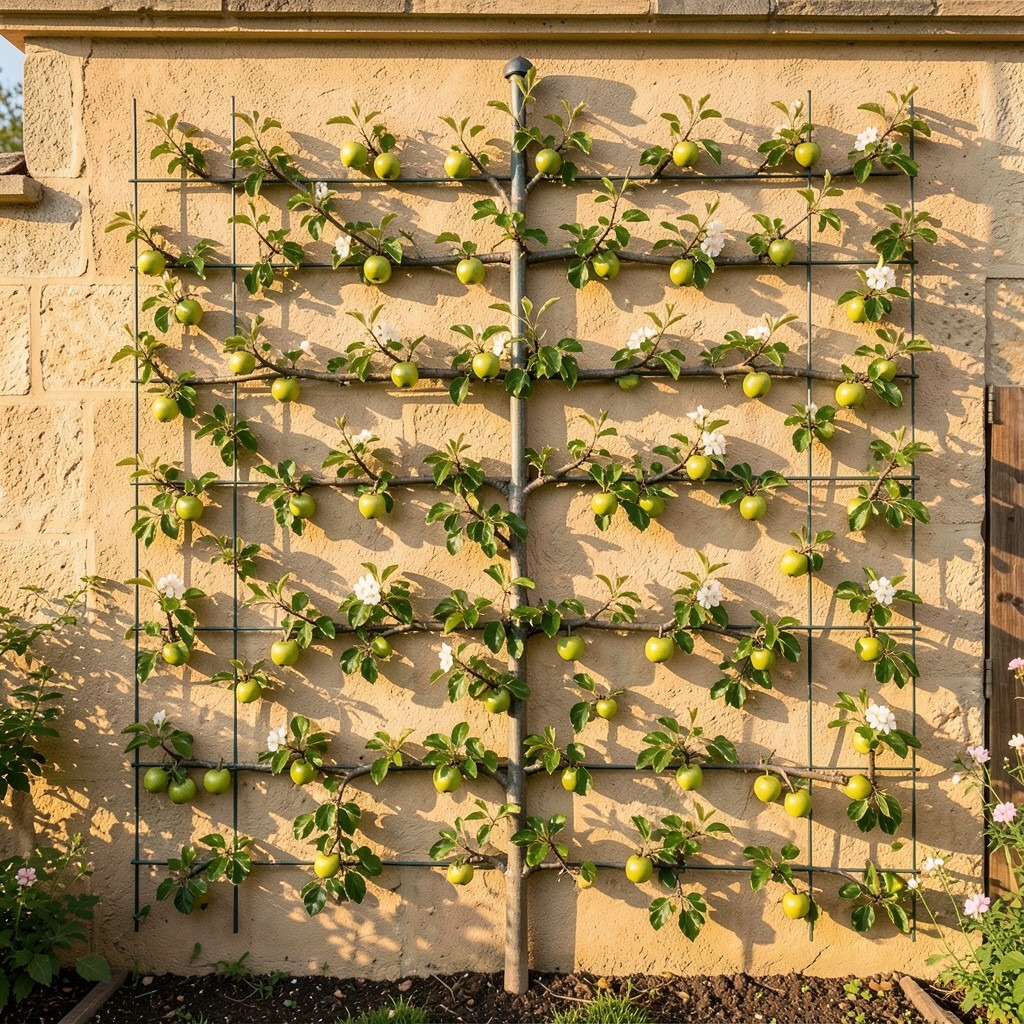
Espalier — the practice of training fruit trees flat against a wall or a wire framework in a two-dimensional form — produces a backyard element that is simultaneously productive, beautiful, and extraordinarily space-efficient. An espalier apple or pear trained against a south-facing fence occupies almost no lateral space while covering a significant vertical surface with flowering blossom in spring, leafy green coverage through summer, and ripening fruit in autumn. The trained form — horizontal tiers of fruiting branches extending symmetrically from a central leader — reads as a piece of living architecture rather than a garden plant.
The wall or fence behind an espalier tree must face toward maximum sun exposure — south or west in the northern hemisphere — to provide the warmth that ripens fruit to its full sweetness and color. A north-facing wall espalier produces attractive form and spring blossom but will not ripen fruit satisfactorily in most temperate climates. The reflected heat from a warm wall also extends the growing season for the tree, allowing varieties that would be marginal in the open garden to ripen reliably when wall-trained. This is the counterintuitive advantage of espalier training that most gardeners do not discover until they experience the quality difference between wall-ripened and open-grown fruit.
The training process for espalier requires five to seven years of annual winter pruning and summer shoot management before the full form is established. The pruning work is not complex, but it must be consistent — a year of neglect produces shoots growing in the wrong plane that, if left, destroy the two-dimensional discipline that makes espalier distinct from ordinary training. The ongoing investment is one or two hours per year once the framework is established, which is a maintenance commitment far lower than the visual and productive return justifies.
32. A Backyard With a Seating Nook Under a Tree

A seating nook positioned beneath an existing mature tree — using the tree’s canopy as the ceiling and the ground beneath it as the floor — creates an outdoor room that no built structure replicates. The dappled light through the leaf canopy above, the root surface of the ground beneath, the sound of leaves in a breeze, and the slight separation from the rest of the garden that the canopy’s perimeter creates — these are the qualities that make a tree seat the most specifically natural outdoor seating position available in a domestic garden.
The ground surface within the tree canopy zone requires different treatment from the surrounding lawn or paving. Tree roots compete with lawn grass for water and nutrients, and the canopy shade prevents most lawn varieties from thriving in this zone — which is why the grass beneath established trees typically becomes sparse and patchy. Replacing the grass within the drip line of the canopy with a planted ground cover suited to root competition and shade — ivy, pachysandra, or a shade-tolerant native moss — gives the tree nook a floor that is both appropriate and intentional rather than a zone of struggling lawn.
The seating form under a tree ranges from a simple timber bench encircling the trunk — a tree seat that wraps around the base — to a pair of garden chairs on a flat stone or timber platform that levels the often uneven ground within the root zone. The circular tree bench is the most resolved form architecturally — it completes itself around the tree trunk and reads as a designed response to the specific tree rather than furniture placed near it. The practical advantage of a tree bench is that it provides seating from all directions simultaneously, which suits a tree positioned where sightlines extend across the garden in multiple directions.
33. A Backyard With a Corten Steel Planter
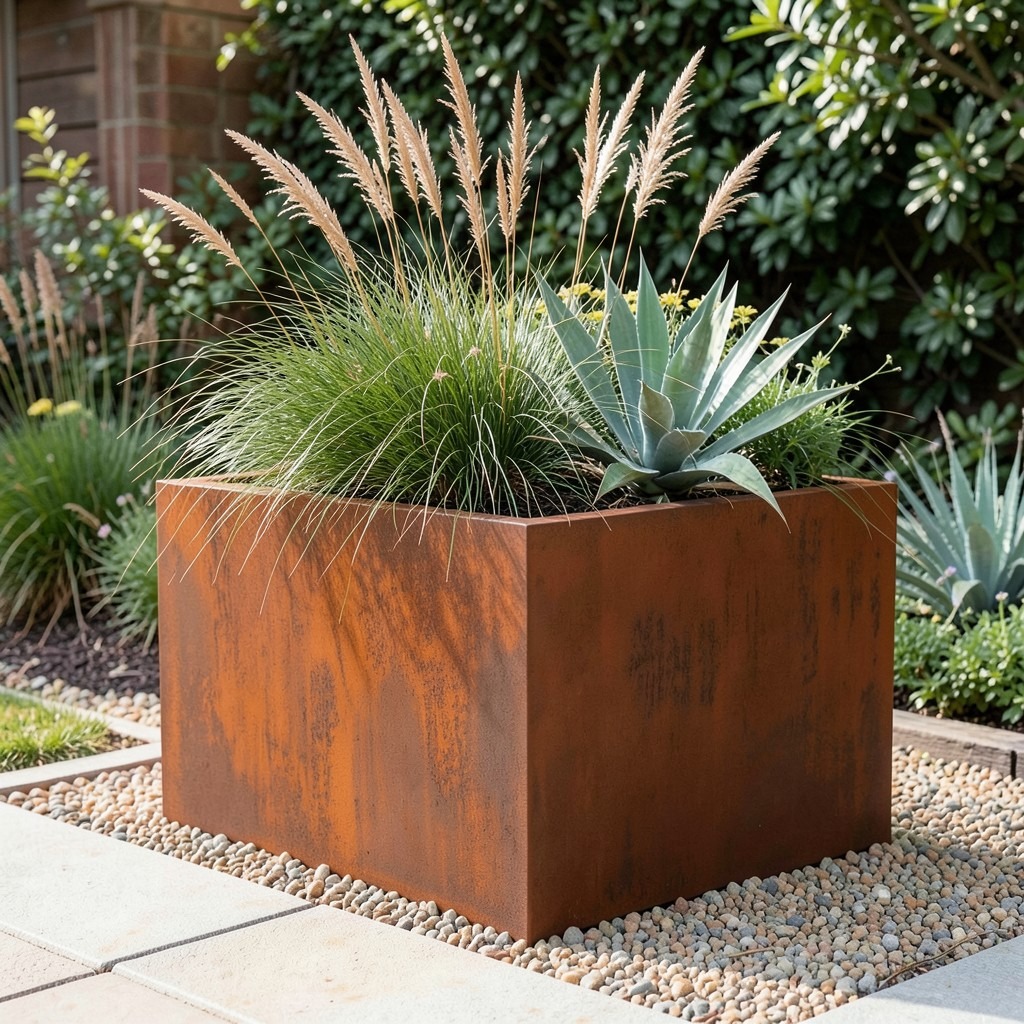
Corten steel planters — fabricated from weathering steel that develops a rich, layered rust patina as its protective surface forms — are the backyard planting containers that read as landscape architecture rather than garden accessories. The material has a weight and a presence that ceramic, timber, and plastic alternatives do not approach. A large corten planter planted with ornamental grasses or structural perennials carries its own visual authority at the material level before a single plant has grown to size, and as the planting matures, the warm rust tone of the corten becomes the material backdrop that every plant color and texture reads against.
The patina development of corten steel is its most misunderstood quality. New corten looks raw and orange-bright, which some garden owners find alarming during the installation phase. The patina deepens and stabilizes over twelve to twenty-four months of exposure to weather, cycling through orange, brown, and eventually settling at the characteristic deep rust tone that reads as settled and permanent. The run-off from new corten during this patination period is orange-tinted, which stains adjacent light-colored paving — a practical consideration that requires either positioning the planter on a surface that can accept staining or placing it on a gravel bed that allows the run-off to disperse into the ground rather than pooling on the surface.
The planting within a corten planter must be considered in relation to the container’s material character. Plants with strong architectural form — Stipa gigantea with its tall, airy seed heads, Agave americana with its geometric rosette, or Phormium with its upright strap leaves — complement the industrial precision of the corten form and create a composed contrast between the geometric container and the organic plant growth within it. Soft, cottage-style planting in a corten planter creates a different kind of tension — unexpected and slightly subversive — that suits backyards where the design direction values contrast over harmony.
34. A Backyard With a Productive Orchard Corner
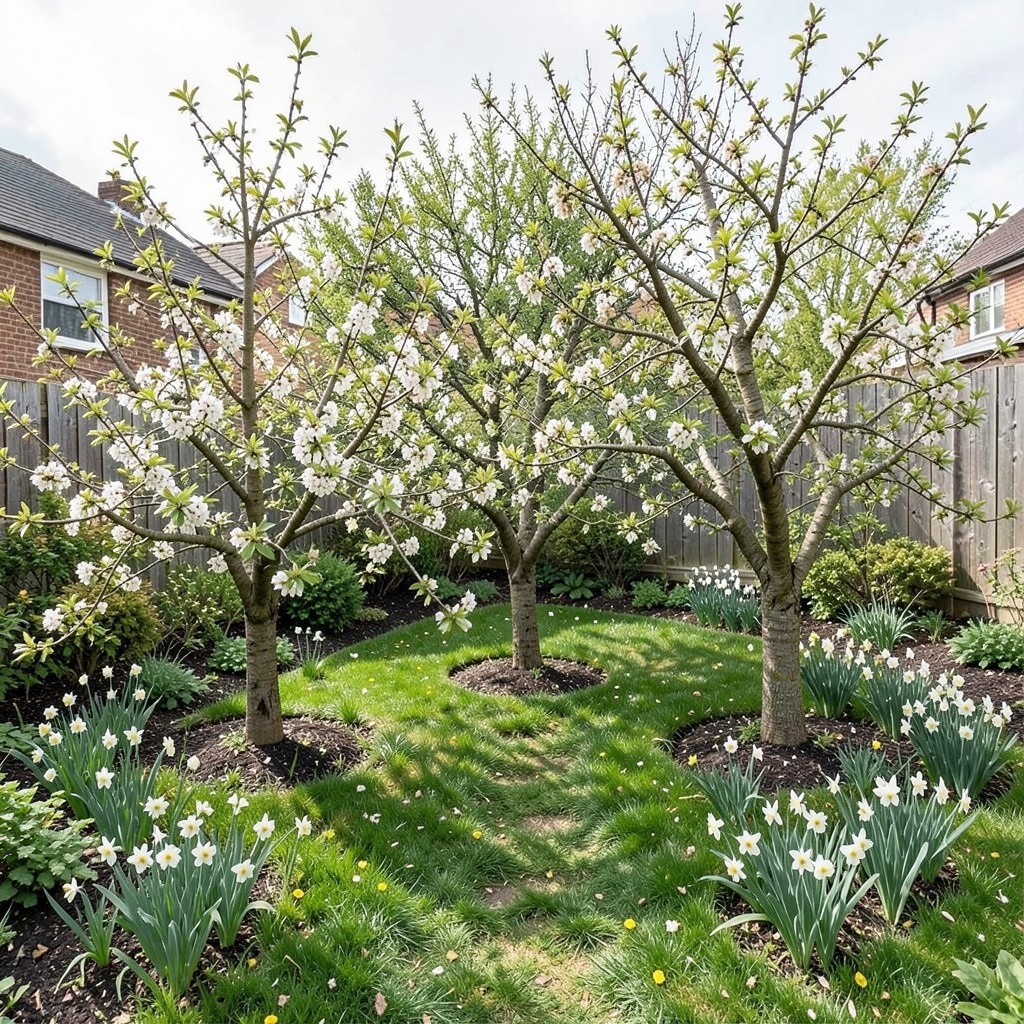
An orchard corner in a backyard — three to five fruit trees planted at a wider spacing than espalier training requires, allowed to develop a more natural but managed form — brings the character of an orchard into a domestic garden at a scale appropriate to a residential plot. The orchard corner is not a production facility. It is a backyard zone with a specific seasonal rhythm — spring blossom, summer shade, autumn harvest — that gives the outdoor space a relationship with the agricultural calendar that purely ornamental planting does not provide.
The tree selection for a small backyard orchard requires understanding pollination requirements for the chosen species. Most apple and pear varieties require cross-pollination from a compatible variety flowering at the same time to set fruit reliably. A backyard orchard of two or three apple trees, selected from compatible pollination groups, produces more fruit than a single tree of any variety regardless of its self-fertile claim. The pollination group information is available from any specialist fruit tree nursery and should be the first selection criterion after the variety’s suitability to the local climate.
A mown grass path between the orchard trees — cutting a simple route through the planted area rather than maintaining the full orchard floor as lawn — creates a visual structure within the corner that makes it read as a designed element rather than a group of planted trees. The grass beneath and between the trees, left unmown except for the path, develops a wildflower character through the growing season that suits the orchard’s productive and naturalistic identity. Narcissus bulbs planted in the orchard grass produce spring flowering that coincides with blossom on the trees, which creates a visual composition that justifies the orchard corner’s place in the backyard at the most beautiful moment of the growing year.
35. A Backyard With a Shade Structure
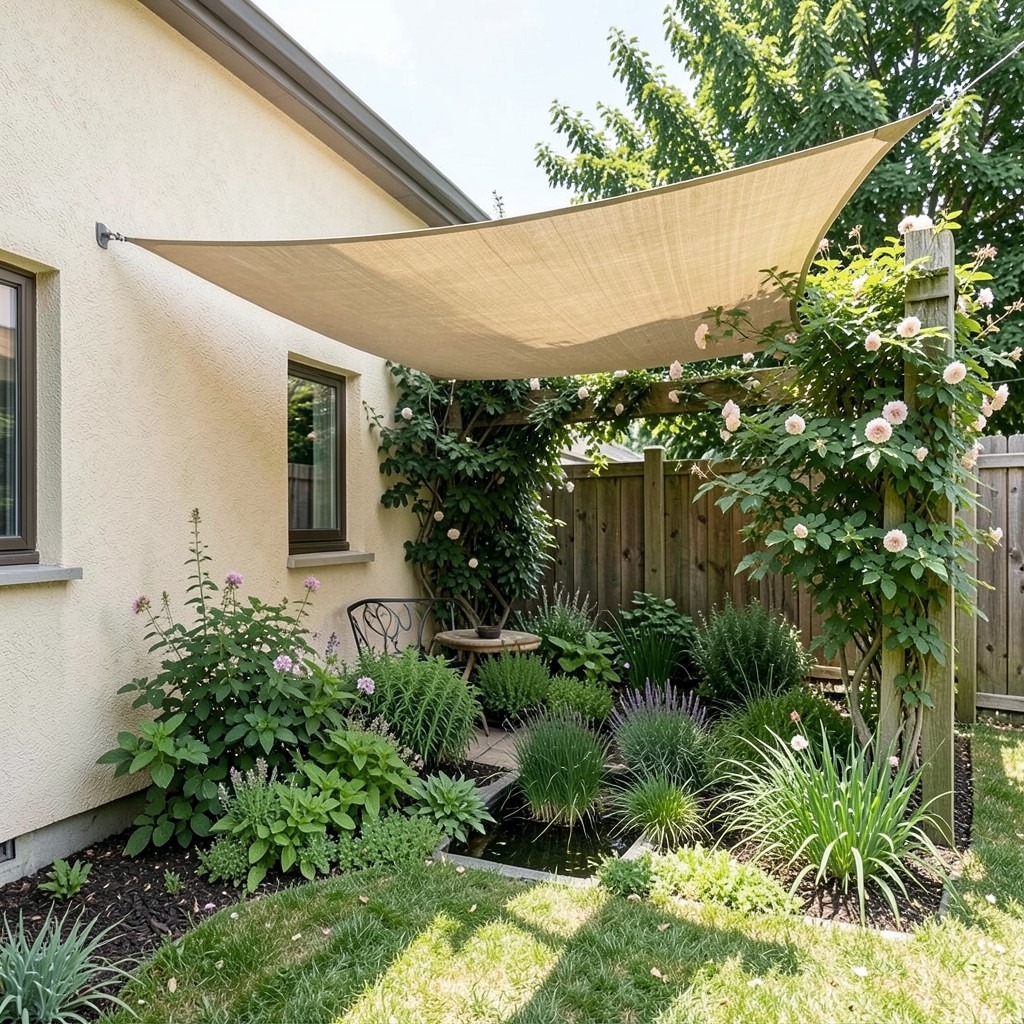
A shade structure — a sail shade, a pergola with a solid or retractable roof, or a timber arbour with a dense planting cover — makes the backyard usable through the hottest part of summer days when direct sun makes uncovered outdoor spaces uncomfortable to sit in for longer than twenty minutes. Without shade, a south or west-facing backyard retreats from use during the very hours when conditions would otherwise be most pleasant. The provision of shade does not reduce the sense of being outdoors — it converts the outdoor space from one that can be visited briefly to one that can be inhabited for hours.
A shade sail — a tensioned fabric panel fixed between two or three anchor points — is the most accessible shade provision for an established backyard where structural posts or an existing pergola are not already in place. The sail spans the seating area at a height that allows movement beneath it without stooping — a minimum clearance of eight feet from the lowest point of the sail to the ground — and is fixed at anchor points bolted to the house wall and one or two freestanding posts. The tension in the fabric, which gives the sail its taut geometric form, requires anchor points capable of handling a significant pull — underspecified wall fixings on a sail installation are the failure mode that appears during the first strong wind.
A timber arbour with a dense canopy of flowering climbers provides shade that no manufactured sail or textile structure produces at the same aesthetic quality. The shade beneath an established wisteria or climbing rose arbour — filtered, green-toned, fragrant, and variable as the light through the leaves shifts with any breeze — is a different physical experience from the sharp, high-contrast shade of a sail. The arbour shade feels natural because it is, and the body responds to natural shade differently from manufactured shade in a way that is difficult to articulate but immediately felt.
36. A Backyard With a Kitchen Herb Spiral
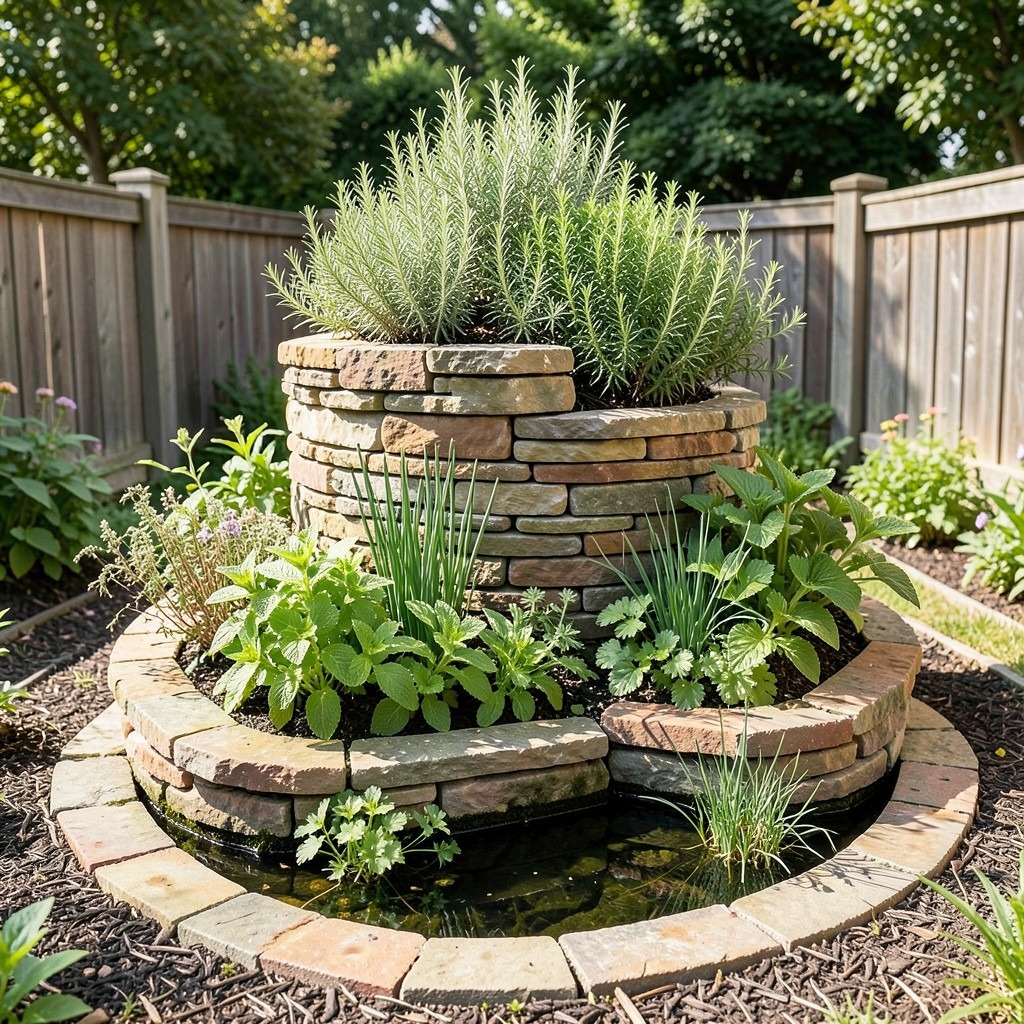
A herb spiral — a three-dimensional planting structure that rises from a wide base at ground level to a narrow, elevated peak, with a small pond or wet area at the base — creates multiple microhabitats within a single compact footprint that allows a wide range of herb species to be grown in a backyard where space is limited. The upper levels of the spiral, closer to the top and fully exposed to sun, suit Mediterranean herbs — thyme, rosemary, oregano — that require hot, dry, free-draining conditions. The lower levels, with more shade and moisture retention, suit mint, chives, and parsley.
The construction material of the herb spiral determines both its structural durability and its visual integration with the backyard. Dry-stacked stone — limestone, sandstone, or local fieldstone — builds a spiral with the warmth and the texture of natural material that also provides the thermal mass to moderate temperature fluctuations in the growing medium. The stone retains heat from sun exposure during the day and releases it slowly through the night, which extends the growing season for heat-loving herbs beyond the period that an uninsulated planting bed provides. Reclaimed brick builds a spiral with a warmer, more domestic character that suits backyards with a traditional or kitchen garden aesthetic.
The pond element at the base of the herb spiral — a small water body created where the spiral’s lowest level meets the surrounding ground — provides the habitat for moisture-loving herbs at the base and serves as a habitat for beneficial garden insects that control pests in the herb garden above. This ecological function of the base pond is the aspect of the herb spiral that most gardeners discover as an unexpected benefit rather than a planned one — the insects that arrive at the water stay in the surrounding planting, and the result is a herb garden that requires no chemical pest management because the natural pest control system is already present.
37. A Backyard With a Japanese-Inspired Garden Zone
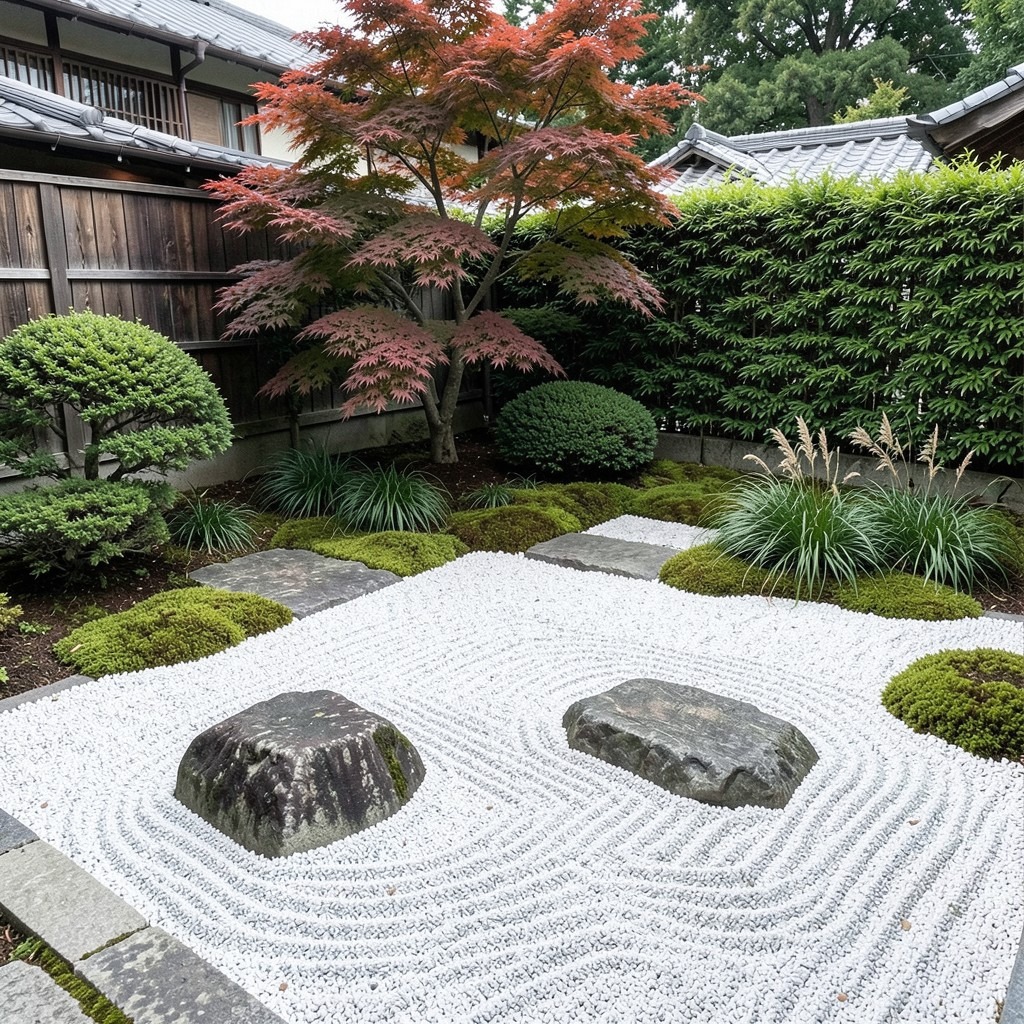
A Japanese-inspired garden zone within a backyard — not an imitation of traditional Japanese garden design but a space informed by its principles of restraint, considered material selection, and the use of empty space as a positive design element — produces a zone of calm within the outdoor space that contrasts with and enriches the areas around it. The Japanese garden principle that space itself is a design element — that the raked gravel between stones, the clipped moss between stepping stones, the open area between a tree and a hedge is as important as the planted or built elements — is the most useful single design idea that Western garden design consistently fails to apply.
The gravel garden — a raked mineral surface with carefully positioned stone elements — is the most accessible expression of Japanese-inspired backyard design in a domestic setting. A section of the backyard surfaced in fine-grade Japanese white or grey gravel, raked in a simple pattern that changes slightly with each raking, with two or three large stones positioned according to the traditional Japanese principle of odd-number stone groups, creates a garden zone of extraordinary stillness. Nothing in the backyard design vocabulary produces the same quality of visual quiet as a well-maintained gravel garden, and the maintenance requirement — raking takes ten minutes per week — is modest relative to the effect.
The planting palette within a Japanese-inspired backyard zone requires restraint rather than restriction. A limited selection of carefully chosen species — a single specimen Japanese maple for seasonal color, a clipped evergreen shrub or two for structural anchoring, a ground-level planting of moss or low-growing native grasses — produces more visual coherence than a wider palette of Japanese-associated species assembled without compositional discipline. The coherence is the point: a Japanese-inspired garden zone that reads as coherent and resolved is one where every element was chosen for its relationship to the whole, not for its individual interest.
38. A Backyard With a Sensory Garden Element
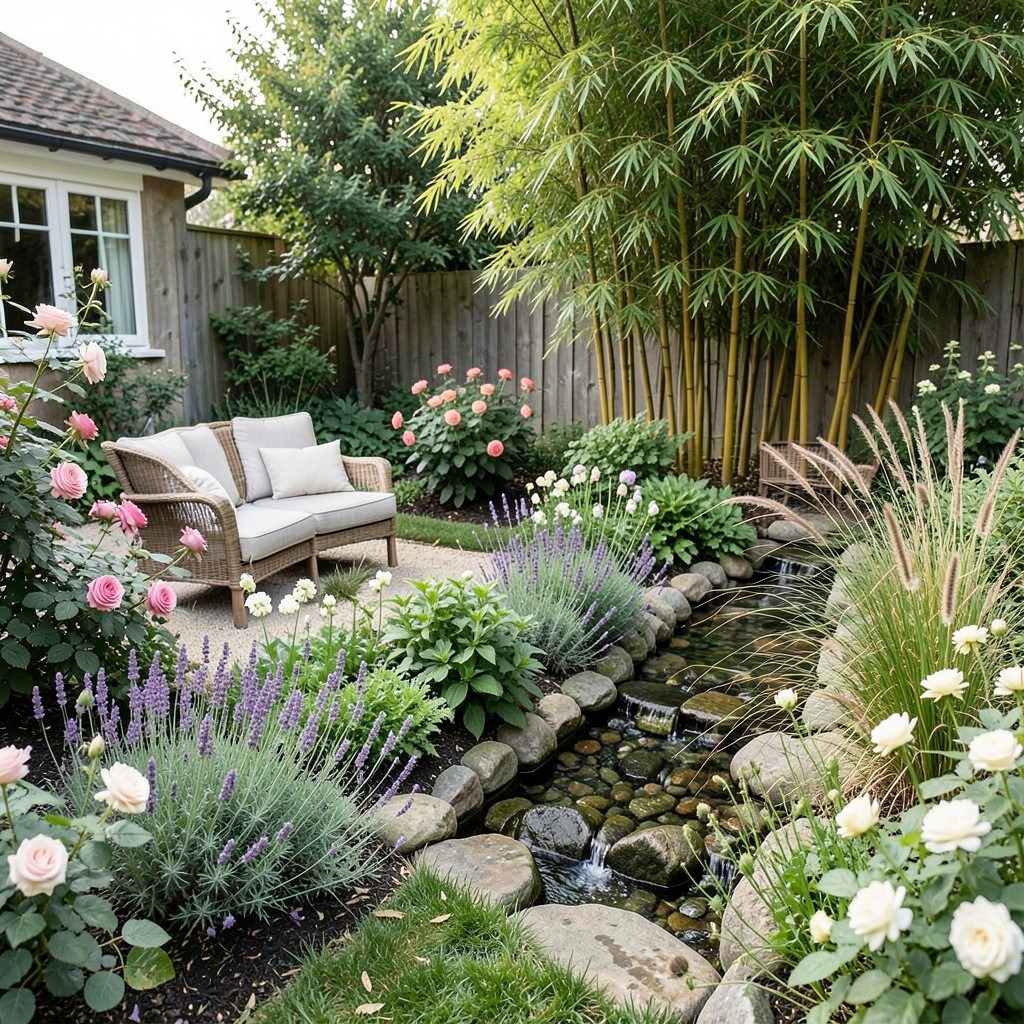
A sensory garden element — a planting zone or a feature specifically designed to engage the senses of touch, smell, and sound rather than only vision — gives the backyard a depth of experience that purely visual design never provides. Most backyards are designed entirely for appearance: they are evaluated through photographs and from windows. A backyard with sensory elements beyond the visual rewards physical presence in a way that no image captures, and that unreproducible quality is exactly what makes outdoor spaces worth inhabiting rather than simply worth owning.
The fragrant planting zone is the most immediately impactful sensory addition to a backyard. Roses, lavender, sweet peas, stocks, night-scented phlox, and jasmine each produce fragrance at different hours and different seasons, and a planting design that sequences these across the outdoor space creates a scented journey through the garden that changes across the year. The positioning of fragrant planting matters: beside seating areas where the fragrance is encountered at close range and from a still position, along paths where contact with the plant releases fragrance through movement, and near windows or outdoor dining areas where the scent enters the household’s daily experience without requiring a dedicated garden visit.
A sound element in the backyard — bamboo rustling in any breeze, a water rill with a gentle sound over stones, ornamental grasses whose seed heads produce a dry rustling at the slightest air movement — layers an acoustic dimension over the visual one that garden design rarely acknowledges deliberately. The sound of a garden should be the sound of something alive: wind through leaves, water over stone, birdsong in planting dense enough to provide cover. A backyard that is visually accomplished but acoustically inert — where no plant moves in the breeze and no water feature provides any sound layer — misses the opportunity that the outdoor environment offers to engage the full sensory range of human perception.
39. A Backyard With a Gravel Garden

A gravel garden — a surface of loose stone aggregate planted with drought-tolerant perennials and ornamental grasses that grow through the gravel mulch rather than in formal beds — produces a backyard planting style that is self-maintaining, ecologically valuable, and visually extraordinary in a way that standard border planting rarely achieves. The gravel surface acts as a mulch that suppresses weeds, retains moisture in the soil beneath, and provides the sharp drainage and warm conditions that Mediterranean and prairie-origin plants require to perform at their best.
The gravel specification determines the aesthetic character of the planted surface. A warm-toned, locally sourced gravel — the same stone that appears in the regional geology — reads as naturalistic and site-specific rather than imported and designed. A white or pale grey washed gravel reads as contemporary and architectural, suits backyards with a clean, modern design direction, and makes the planting colors read more vividly against the pale ground. The depth of the gravel layer — a minimum of fifty millimeters over a well-prepared weed-suppressed base — determines how effectively it performs as a mulch and how cleanly the planted grasses and perennials read against the surface.
The planting palette within a gravel garden should be selected for seasonal longevity rather than single-peak impact. Plants that provide interest across multiple seasons — Echinacea with its midsummer flowers and winter seed heads, Stipa tenuissima with its year-round movement quality, Verbena bonariensis with its extended purple flowering from midsummer through autumn — produce a gravel garden that holds interest from the first warm days of spring through the first frosts of winter without any replanting, deadheading, or seasonal management. The gravel garden’s low maintenance is not a limitation — it is the design standard toward which more demanding planting styles should aspire.
40. A Backyard With a Composting and Sustainability Zone
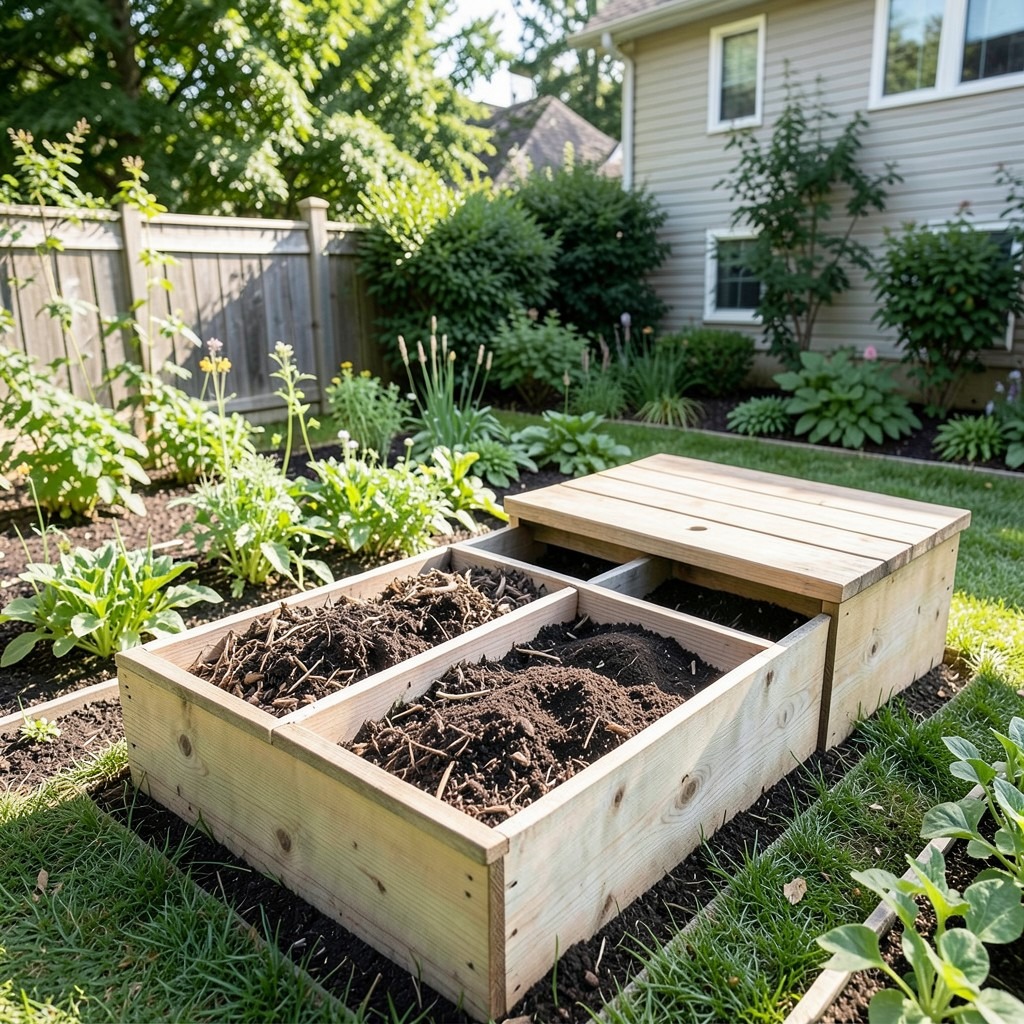
A dedicated composting and sustainability zone in the backyard — positioned where it is accessible from both the kitchen garden and the household’s organic waste stream but not dominant in the backyard’s primary views — makes productive gardening possible without chemical fertilizer inputs and gives the household a direct connection between the kitchen and the garden’s fertility cycle. The compost heap is not a glamorous backyard feature, but a garden that takes composting seriously produces a soil quality that no purchased product matches, and the food grown in that soil is the tangible return on the modest investment of setting the system up correctly.
A three-bin composting system — three adjacent bays, each approximately one meter square, through which compost material cycles over a twelve to eighteen month period — provides continuous compost production in a managed system that a single heap cannot. Fresh material goes into the first bay. Partially decomposed material transfers to the second for active breakdown. Finished compost waits in the third bay for use. The three-bay rotation ensures a continuous supply of finished compost rather than the feast-or-famine cycle of a single-bin system where all material is ready at once, then none is available until the next batch completes.
The integration of composting into the backyard’s visible design — rather than its concealment behind a fence panel or a dense shrub screen — is the backyard design decision that requires the most confidence but produces the most coherent result. A well-constructed timber compost bin with a fitted lid and tidy proportions reads as a designed garden element rather than a hidden necessity. Its position near the kitchen garden, visible from the productive zone, communicates that the garden is organized around a philosophy of closed-loop productivity rather than one that borrows fertility from elsewhere and sends its organic waste to landfill.
41. A Backyard With a Wildlife Hedgerow
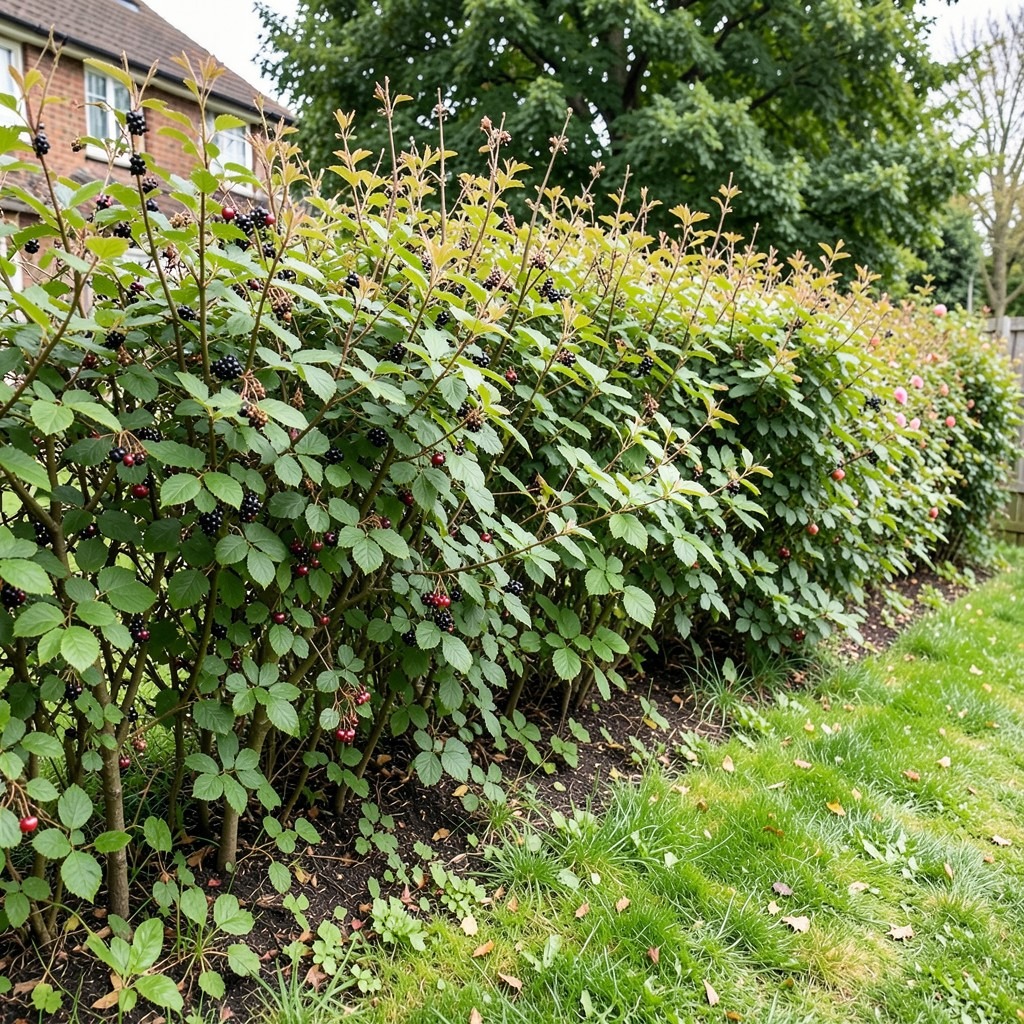
A mixed native hedgerow along one or more backyard boundaries — planted from a mix of hawthorn, blackthorn, dog rose, field maple, and hazel — provides the densest and most ecologically diverse habitat that a residential backyard can produce within a standard boundary width. A native hedgerow supports more insect species, provides more bird nesting sites, and offers more seasonal food sources — blossom for pollinators, berries for frugivorous birds, dense cover for small mammals — than any other planting format at comparable width.
The planting density of a hedgerow — typically three plants per linear meter in a staggered double row — produces the dense, impenetrable thicket that provides the most valuable habitat within five to seven years of planting. The initial appearance of a newly planted hedgerow is unimpressive: small bare-root transplants at knee height that require three years of establishment before they begin to look like a hedge. The patience required in those early years is the only significant challenge of native hedgerow establishment, and the result after a decade — a dense, multi-species, productive habitat boundary that improves year after year — rewards that patience at every scale.
The management of a native hedgerow differs from a formal clipped hedge in both the timing and the approach. A native hedgerow is cut on a two or three year rotation rather than annually, which allows the flowering and fruiting cycle of the constituent species to complete before cutting removes the following season’s potential. Hawthorn cut every year produces no berries — the flowering spurs that carry the fruit are cut off before they can set. Cut every two or three years, the same hawthorn produces heavy berry crops that feed birds through the winter months. The ecological value of the hedgerow is entirely contained within this single management choice.
42. A Backyard With a Contemporary Paving Design

The paving in a backyard is the surface that the outdoor space is built on, and the quality of that surface — its material, its pattern, its color, its relationship to the house and the planting around it — determines the quality of the entire outdoor space more than any other single element. A well-chosen paving material laid in a considered pattern makes the backyard look designed from its foundation. A poorly chosen or poorly laid paving surface undermines every other design decision made above it regardless of the quality of the furniture, planting, or features placed on it.
Large-format porcelain tile in a single color laid in a grid pattern — tiles at six hundred by twelve hundred millimeters with a four-millimeter joint — produces a contemporary paving surface that reads as architecturally refined and is technically superior to natural stone in every practical dimension: it does not stain, does not require sealing, does not crack in frost, and does not slip when wet if the correct anti-slip surface specification is chosen. The limitation of large-format porcelain is that it reads as unequivocally contemporary and does not suit backyards with a traditional or naturalistic design direction where the uniform surface of a manufactured product conflicts with the design intention.
The bond pattern of the paving — the arrangement of the individual units relative to each other — changes the reading of the surface significantly. A brick-bond pattern, where alternate courses offset by half a unit length, introduces a directional element that draws the eye along the axis of the offset. A stack-bond grid, where all joints align in both directions, produces a more formal, architectural reading. A random or ashlar pattern, where different sized units are arranged without a repeating pattern, suits natural stone and produces a surface that reads as traditional and handmade rather than manufactured and precise.
43. A Backyard With an Outdoor Cinema
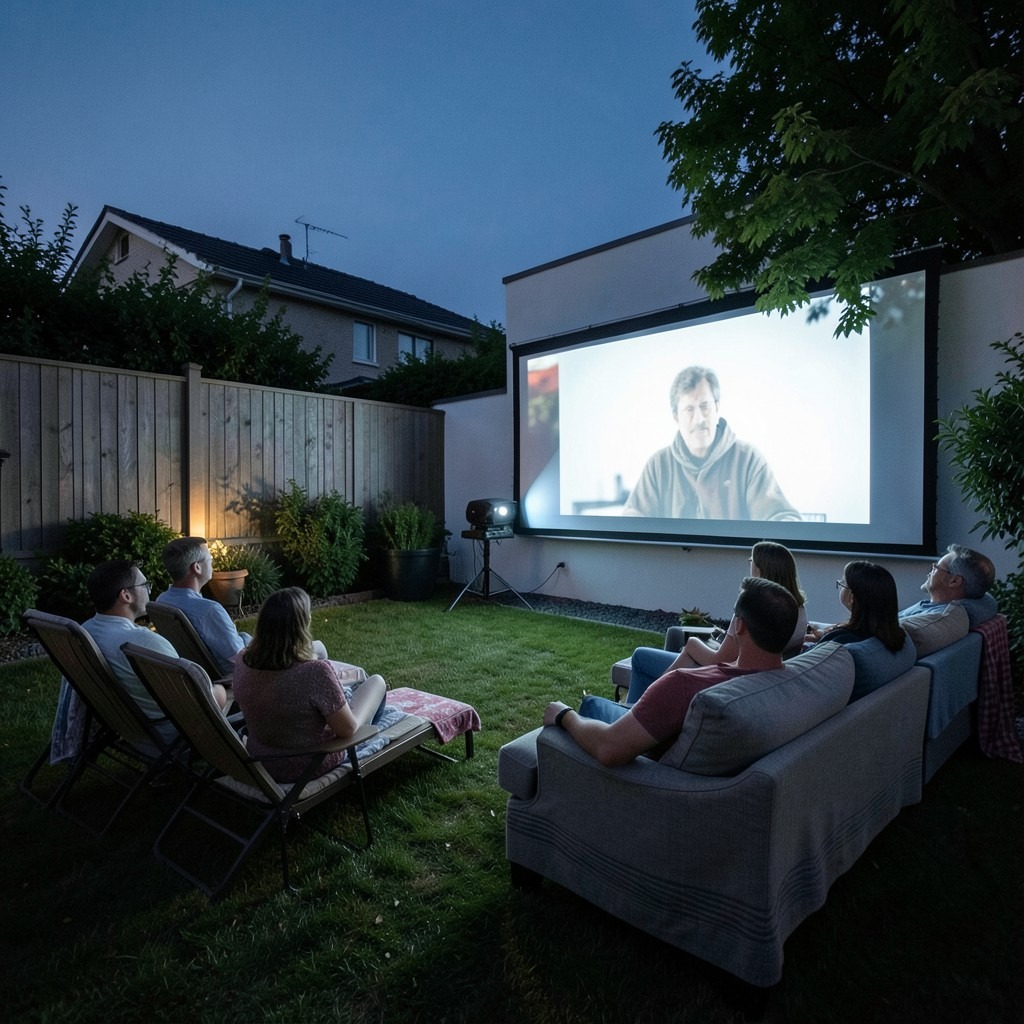
An outdoor cinema — a projector, a screen or a white wall, and comfortable seating positioned in the backyard for warm-weather evening film screenings — turns the backyard into a social space that functions on a completely different register from any other outdoor use. The outdoor cinema is not a casual activity. It is an event, and the backyard that hosts it becomes the destination rather than the venue. A household that watches films outdoors in summer creates a ritual that becomes one of the most anticipated domestic events of the year for everyone involved.
The projection setup for an outdoor cinema requires attention to two variables that determine whether the result is worth the effort: screen gain and ambient light management. A projector aimed at a white painted garden wall produces a watchable image in full darkness but a washed-out, low-contrast image if any ambient light reaches the screen surface. A dedicated projection screen with a high-gain surface produces a significantly brighter and more contrast-rich image than a wall at the same projector output. The difference is most apparent in the partial darkness of a summer evening when the sky does not fully darken until late — a high-gain screen extends the usable screening window considerably.
The seating arrangement for an outdoor cinema screening determines how long the audience stays comfortable. Standard outdoor chairs without back support fail for ninety-minute screenings. Reclining sun loungers, a collection of outdoor cushions and blankets on the lawn, or a deep outdoor sofa with proper back support — any of these maintains the audience’s physical comfort through the full screening length. Adding a heated blanket option for the cooler evenings of spring and autumn extends the outdoor cinema season beyond the genuinely warm nights and into the shoulder months where the sky darkens earlier and the conditions for outdoor screening are actually better.
44. A Backyard With a Pollinator Garden
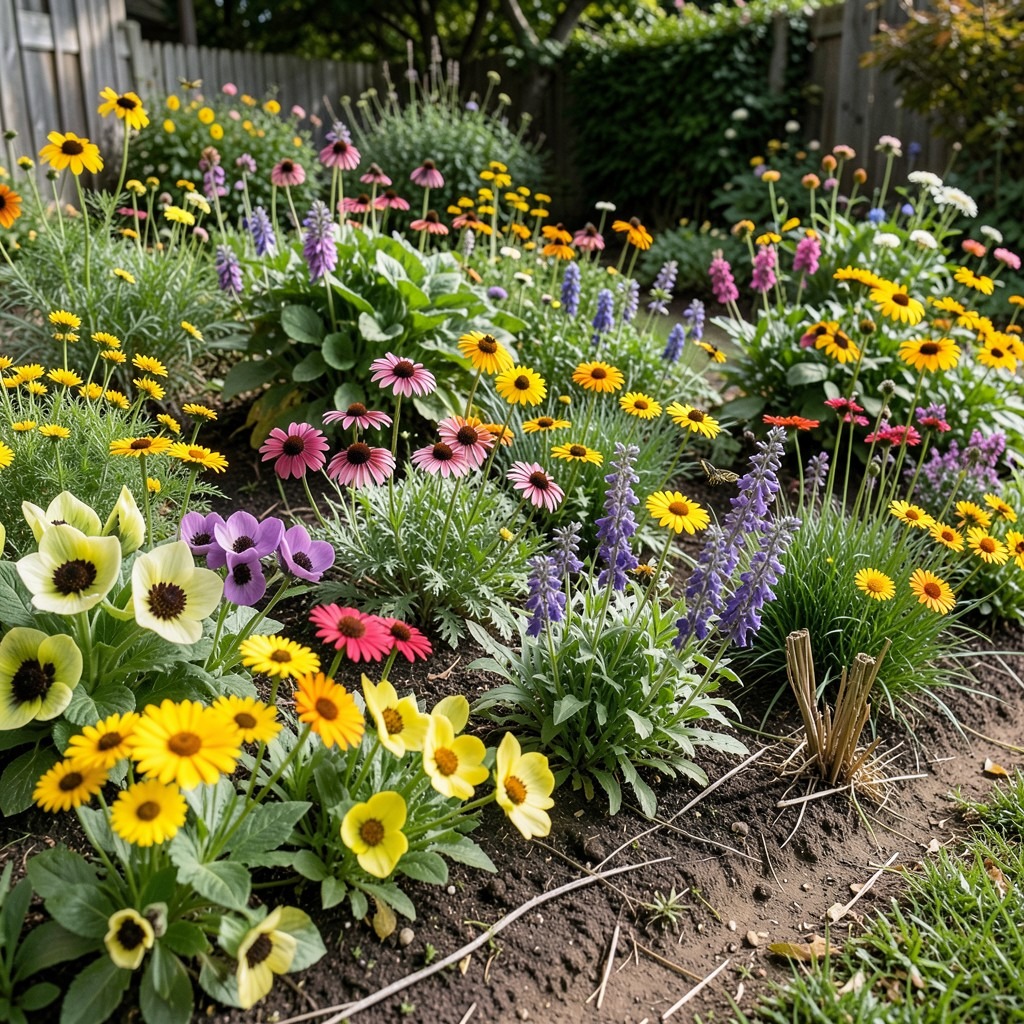
A pollinator garden — a planting zone designed specifically to support the full range of native bee and butterfly species through the provision of nectar, pollen, and nesting habitat across the entire growing season — is the backyard planting investment with the highest ecological return and, as a secondary benefit, one of the most visually dynamic and seasonally interesting garden areas that a residential outdoor space can contain. Pollinator plants are not the uniform, overselected cultivars of commercial horticulture — they are often the species varieties with the most complex, richly colored, and structurally interesting flowers, because those flowers evolved specifically to be noticed and visited.
The planting sequence of a pollinator garden must provide a continuous food source from the earliest spring flowers through the latest autumn ones, with no gap in the season where the garden offers nothing for the insects that have established a territory around it. Early-season plants — hellebores, pulmonarias, and single-flowered hellebores — provide pollen and nectar before most commercial garden plants are in bloom. Mid-season plants — echinaceas, agastache, salvias, and verbascums — carry the garden through the summer peak. Late-season plants — sedums, asters, and Rudbeckia — extend the nectar supply into the period when insects are building the food reserves needed for overwintering.
The nesting provision for solitary bees — which are responsible for a disproportionate share of pollination relative to their visibility — requires bare ground patches, hollow-stemmed plant material left standing rather than cut back in autumn, and exposed, south-facing soil banks where ground-nesting bees can excavate. These are not aesthetically demanding provisions: the hollow stems of previous season’s perennials left standing through winter read as attractive garden structure while simultaneously serving as overwintering habitat. The pollinator garden managed for ecological function is also the pollinator garden managed for visual character, and that coincidence of function and form is what makes the idea worth committing to fully.
45. A Backyard With a Raised Seating Platform
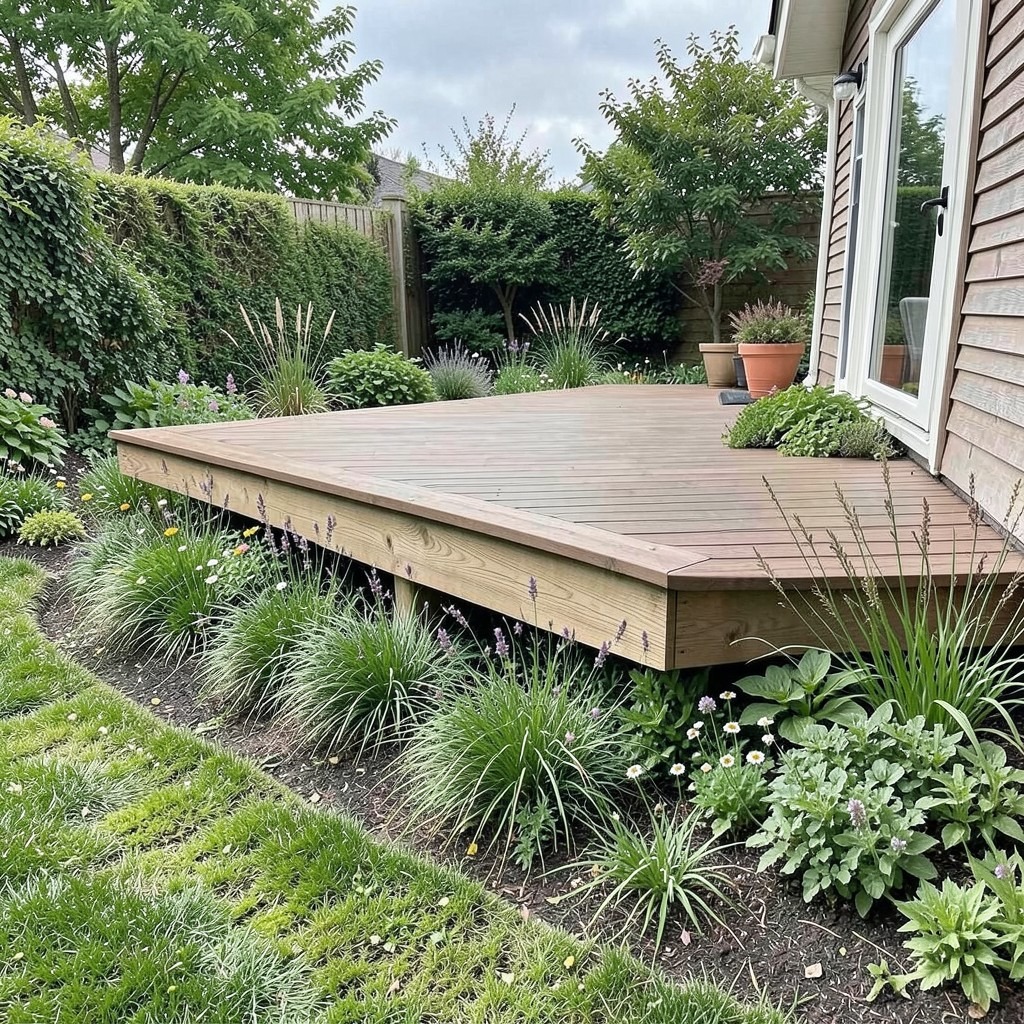
A raised timber platform — a deck elevated one to two steps above the main backyard level, positioned to create a specific viewpoint across the garden or back toward the house — changes the spatial experience of the outdoor space by creating a vertical hierarchy within it. The platform reads as elevated territory, a place distinct from the surrounding garden that has its own defined character by virtue of its higher position. From the platform, the garden looks different — the sightlines are slightly elevated, the horizon is extended, the relationship between the planted areas and the open surfaces below reads as a composition rather than a flat plan.
The edge detail of a raised platform — the transition between the elevated deck surface and the surrounding ground or lower-level surface — is the design element that most determines whether the platform reads as architecture or construction. A clean edge with a projecting fascia board that conceals the structural deck joinery, and a consistent gap between the fascia and the ground that produces a shadow line all around the platform perimeter, reads as designed. The same structure without the fascia detail — structural joists visible at the edge, bolts and joist hangers on show — reads as built.
The planting around a raised platform changes its relationship to the wider garden. Ground-level planting at the base of the platform edge — grasses, low shrubs, or flowering perennials — connects the raised structure to the surrounding landscape and prevents the platform from reading as an isolated object dropped into the garden. As the planting matures and begins to grow to the level of the platform surface, the edges between the built structure and the living landscape soften, and the platform reads as something that emerged from the garden rather than something that was placed in it.
46. A Backyard With a Secret Garden Corner
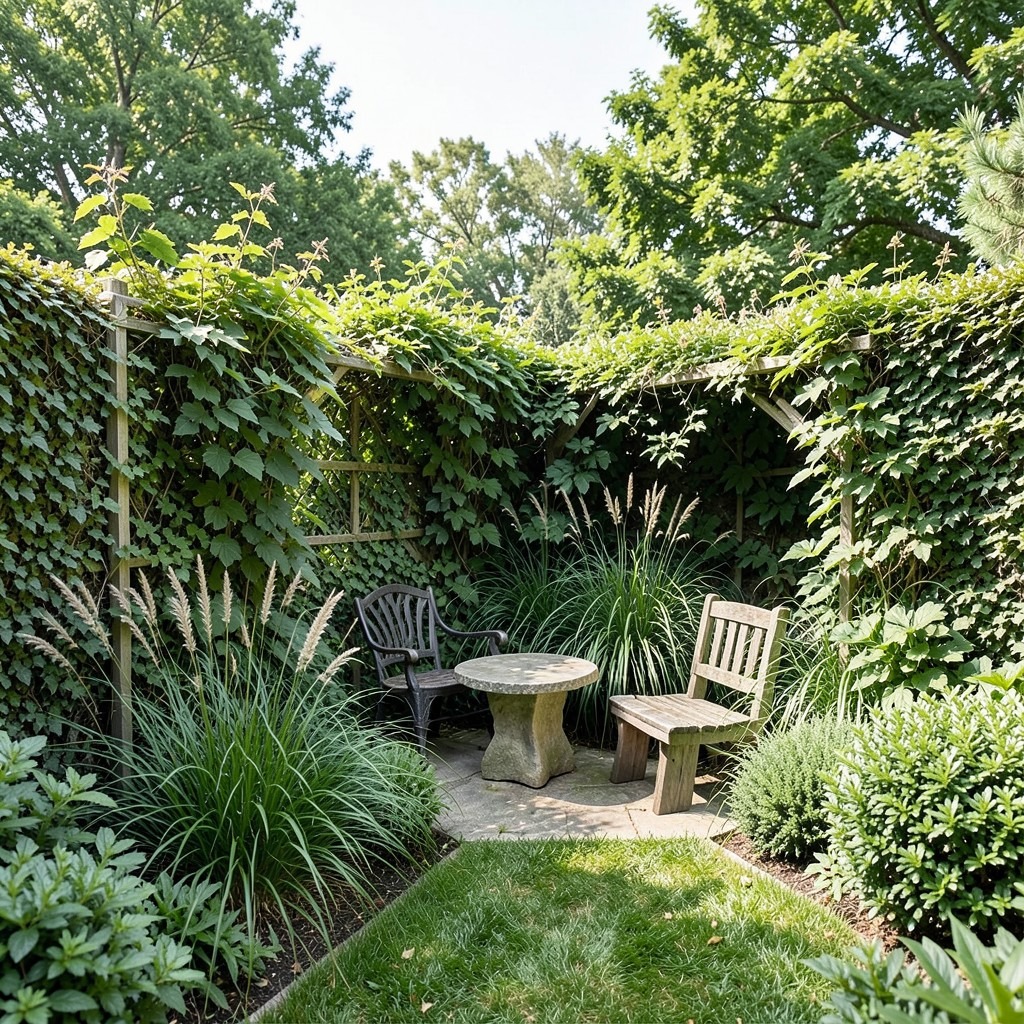
A garden corner that is partially hidden — accessible only through a gap in a hedge, a narrow path between dense planting, or an archway in a boundary structure — creates a destination within the backyard that is distinct in character from the main outdoor space. The secret garden corner does not need to be large to be effective. Its power comes from the transition between visibility and concealment: the journey from the open backyard through a narrowing path into a smaller, more enclosed space is a spatial experience that children find magical and adults find surprisingly restorative.
The planting that creates the enclosure of the secret corner should be tall enough and dense enough to produce genuine visual separation from the main garden — which typically means a minimum height of five to six feet on the enclosing sides. A combination of climbing plants on a trellis, tall ornamental grasses, and dense shrubs at the perimeter produces the required density without the formality of a clipped hedge. The enclosure does not need to be complete on all sides — a three-sided enclosed corner opening toward the sky and toward one view of the wider garden produces the sense of a sheltered alcove rather than a fully enclosed room.
The seating within the secret corner should be chosen for its fit within the intimate scale of the space rather than for consistency with the main backyard furniture. A small cast iron bench, a pair of wooden chairs with a low stone table between them, or even a simple timber seat built into the corner angle — these suit the enclosed, discovered character of the space better than the larger-scale furniture appropriate to the main outdoor living area. The secret corner works because its scale is different from the rest of the garden, and the furniture must honor that difference.
47. A Backyard With an Evening Garden
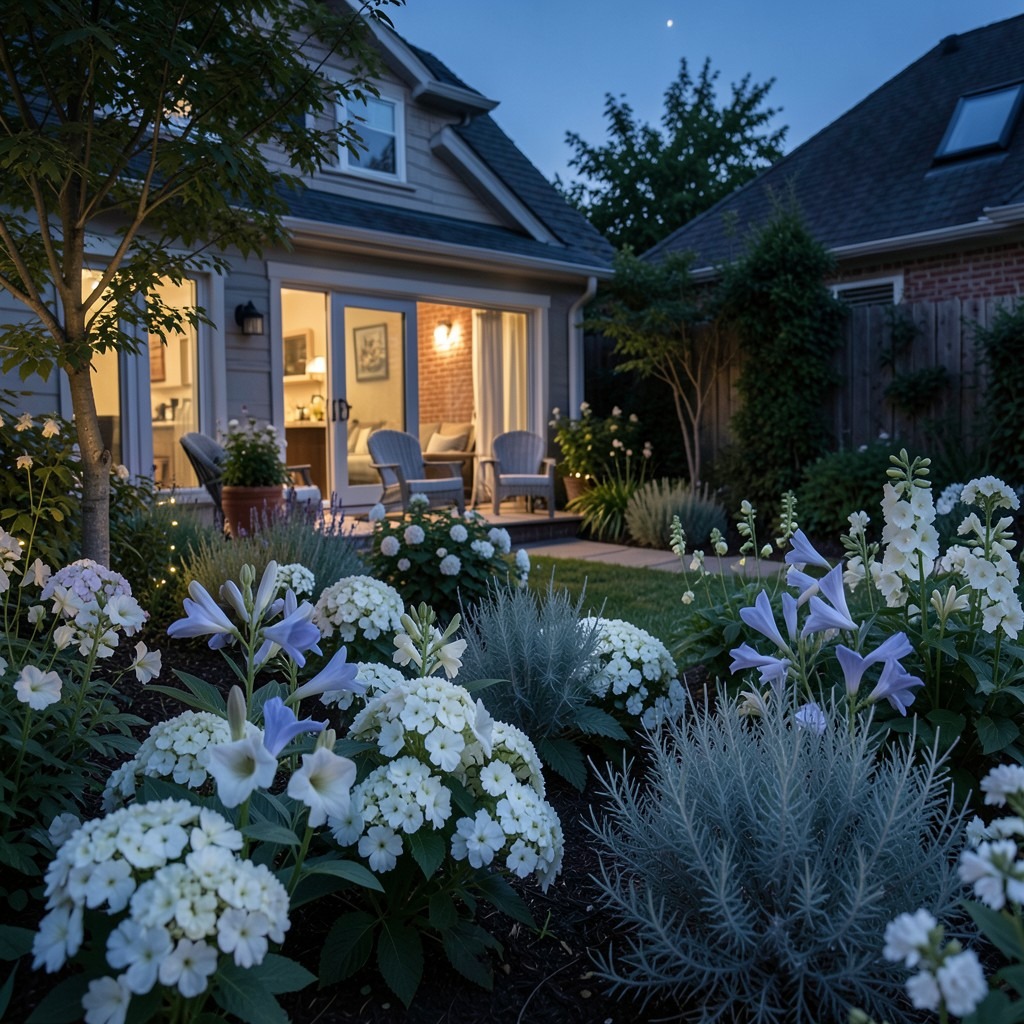
An evening garden — a planting zone designed specifically for the hours after five in the afternoon, when fragrance intensifies, white-flowered plants glow in low light, and the garden is most actively used by a working household — addresses the specific condition that most residential backyards face but almost none design for: the garden is used most when the light is lowest. An evening garden plants for that condition deliberately rather than accepting a garden designed for midday photography and hoping it works at the hour when it is actually inhabited.
White and pale-colored flowers are the visual foundation of an evening garden because they reflect the available light at dusk and in moonlight in a way that darker colors do not. A planting combination of white nicotiana, white phlox, pale-blue agapanthus, and silver-leaved artemisia produces a garden that reads as luminous in the low light of a summer evening when the same plants in full sun seem unremarkable. The luminosity is a quality of the low-light condition, and designing for it requires planting specifically with the evening hour’s light quality in mind rather than the midday conditions in which garden plants are typically assessed at a nursery.
Fragrance in an evening garden intensifies for biological reasons — the plants that release their strongest fragrance in the evening do so to attract the moth pollinators that are most active after dusk. Night-scented stocks, nicotiana sylvestris, white jasmine, and honeysuckle all belong to this evening-fragrance category, and a planting design that positions these species near the household’s evening seating area brings their fragrance directly into the experience of outdoor occupation at the hour when the garden is most actively used.
48. A Backyard With a Children’s Garden Patch
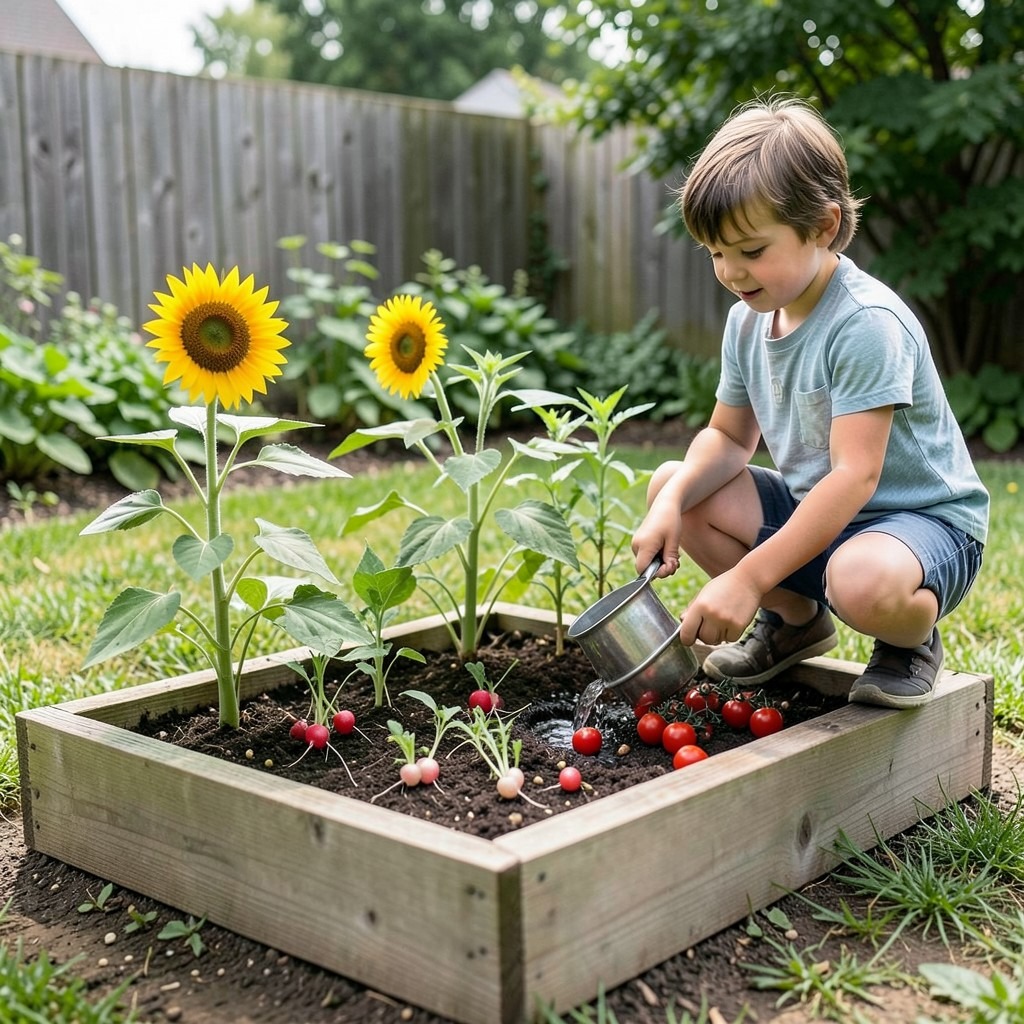
A small garden patch dedicated to children — a raised bed or a defined ground-level area where children are encouraged to grow their own plants, make their own planting decisions, and manage their own small territory within the larger backyard — gives young people a genuine relationship with growing things that an interest in the adult garden never provides in the same way. Ownership changes behavior. A child who has their own patch plants differently, waters more consistently, and pays closer attention to the progress of their seedlings than one who helps in someone else’s garden.
The crop selection for a children’s garden patch should prioritize fast-germinating, quick-maturing, high-impact plants that provide a tangible return within the attention span of a young gardener. Sunflowers — planted from large, easy-to-handle seeds that germinate within a week — grow at a visible daily rate and reach a height that matches the child’s own growth experience in a dramatically compressed timeframe. Radishes mature from seed to harvest within four weeks, which provides the fastest possible feedback loop between planting and eating. Cherry tomatoes produce continuously from midsummer, which is the harvest frequency that keeps a child engaged rather than producing a single annual moment of yield.
The physical scale of the children’s garden patch should be manageable by the child rather than aspirational on behalf of the adult planning it. A raised bed at one meter by one meter — reachable from all sides without stepping on the growing surface — gives a child complete access to their patch without adult assistance and is small enough that weeding, watering, and tending can be completed in ten minutes. A larger patch quickly becomes a maintenance burden that requires adult intervention and gradually stops feeling like the child’s own territory.
49. A Backyard With a Multi-Season Interest Design

A backyard designed for multi-season interest — where the planting, the structural elements, and the hard landscaping provide visual and experiential quality across all twelve months rather than peaking in summer and offering nothing from November to March — is a backyard that earns its place in the household’s daily life continuously rather than seasonally. Most residential backyard designs are summer designs. The planting is herbaceous and flowers from May to September. The furniture is seasonal. The garden is essentially inaccessible and uninteresting for five months of the year.
The structural planting layer is what carries the backyard through the winter months when herbaceous perennials are dormant and deciduous trees are bare. Evergreen structure — clipped box or yew spheres, a formal hedge, an architectural shrub with year-round leaf coverage — provides the backbone of the winter garden that prevents the outdoor space from reading as empty. Against this evergreen structure, the winter silhouettes of deciduous trees, the dried seed heads of perennials left standing through the cold months, and the early bulb planting that begins showing growth in January create a layered winter garden with genuine interest at every scale.
The hard landscaping and the furniture provide the final multi-season quality layer. A backyard with a fire pit, a weather-resistant seating group, and lighting that creates atmosphere in the short days of autumn and winter extends outdoor use into the cold months rather than surrendering the space entirely. A household that uses its backyard on a dry December evening — gathered around a fire, illuminated by string lights and garden lanterns, in the space they designed to be beautiful in the dark as well as in the light — is a household that has understood what the outdoor space is actually capable of when it is designed for the full year.
50. A Backyard Designed for the Long Term
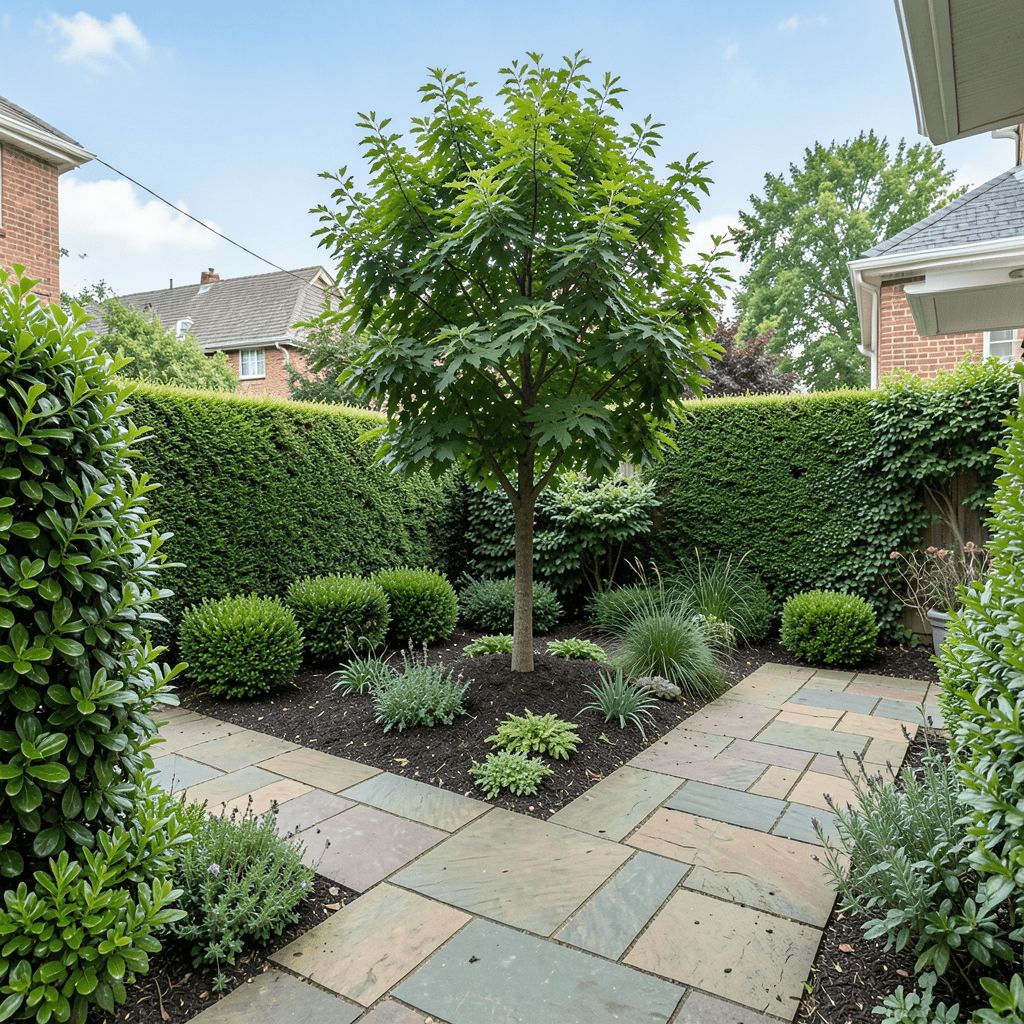
The backyard that looks best five years after its completion rather than five days after it is the one that was designed around long-term thinking at every decision point. Slow-growing hedges that will be magnificent in a decade. Stone paving that develops patina rather than deteriorating. A specimen tree planted at a size that establishes quickly but whose full visual contribution is ten years away. These are the decisions that separate a backyard designed for the long term from one designed for immediate impact that ages poorly and requires replacement rather than appreciation.
Soil quality is the long-term investment that most backyards never make and perpetually pay for through disappointing plant performance. A backyard whose soil has been prepared — organic matter incorporated, drainage improved where necessary, pH adjusted to suit the intended planting — produces plant growth in the first season that a poorly prepared soil does not achieve in the third. Every pound spent on soil preparation before planting produces returns in plant performance that compound through every growing season that follows. This is the backyard investment that disappears underground and never appears in a photograph, and it is the one that determines the quality of everything visible above it.
The backyard that is designed to be lived in rather than looked at — that answers the questions of how the household actually uses outdoor space, at what hours, in what weather, for what purposes — is the backyard that gets used, loved, and maintained with genuine pleasure rather than obligation. Every idea in this collection serves that fundamental purpose: creating an outdoor space that the household inhabits as a natural extension of its life rather than a project that required money and care to produce and now requires maintenance to preserve. Design it for the life you actually live and the backyard will return that investment every day it is open to the sky.
Leave a Reply