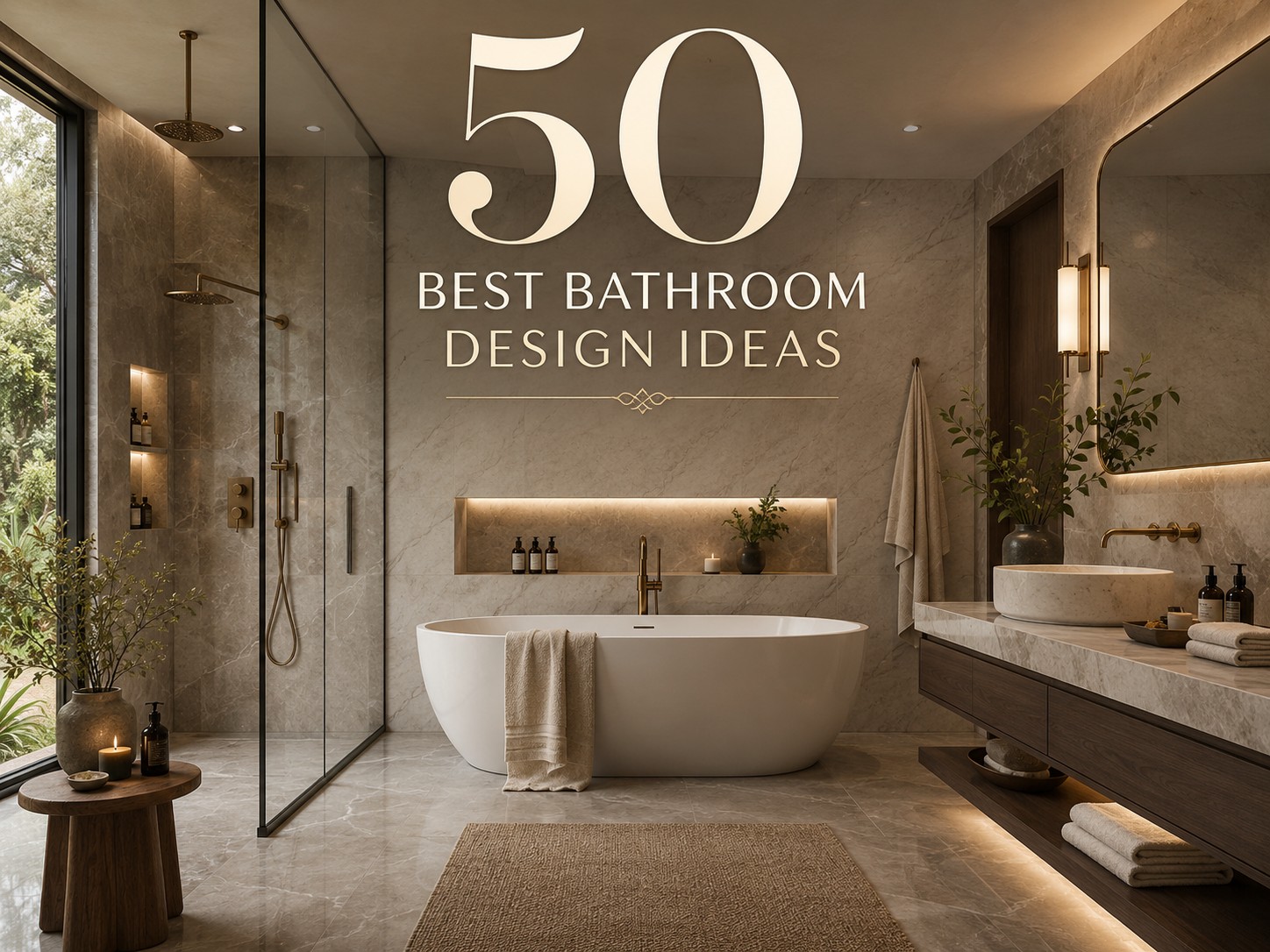
The bathroom is the room that sets the tone for your entire day before the day has properly begun. You walk into it half-asleep, and what you encounter in those first minutes — the quality of the light, the temperature of the floor underfoot, the feel of the water, the visual calm or chaos of the surfaces around you — shapes your state of mind before any decision, any conversation, or any obligation has had a chance to reach you. No other room in the house carries that particular kind of influence, and yet the bathroom is consistently the room that receives the least considered design attention.
Most bathroom renovations are approached as repair projects. The tile is outdated, the grout has darkened, the fixtures feel old — and the renovation replaces all of those things with something that looks better in the showroom. The result is a bathroom that looks current and feels exactly like the previous one in every way that actually matters: the lighting is still flat, the storage is still inadequate, the shower still feels functional rather than restorative, and the room still communicates that it was designed to be cleaned rather than to be experienced.
The bathroom designs that genuinely change how you feel about starting and ending your day are built from a different set of priorities. They start with understanding how the room is actually used — at what hours, by how many people, with what sequence of actions — and they build the light, the material, the storage, and the spatial arrangement around that understanding. Beauty follows from that foundation rather than substituting for it.
These fifty bathroom design ideas cover every dimension of what makes a bathroom succeed. Some are architectural — decisions about the room’s bones that determine every other choice downstream. Some are material — the surface selections that determine whether the bathroom feels warm, cold, clinical, or deeply personal. Others address the specific design elements that most bathrooms get wrong: lighting that is either too bright or too dim depending on the time of day, storage that looks adequate until the morning rush when it clearly is not, shower designs that prioritize appearance over the genuine sensory experience of standing inside them.
Every idea here has been chosen because it addresses something specific that bathrooms need and most do not have. Some will apply to a compact apartment bathroom where every inch must do double work. Others are built for larger spaces where the challenge is not shortage but coherence — making a generous bathroom feel designed rather than simply large. The range covers them all, because the problems a bathroom must solve are not determined by square footage alone.
Read through with your specific bathroom in mind, but stay open to ideas that seem to belong to a different scale or style than your current room. The best bathroom decisions often come from applying a principle from one context to a completely different one — and understanding why an idea works is what gives you the confidence to adapt it correctly. These fifty ideas are designed to produce exactly that understanding. Use them well.
1. A Wet Room With No Shower Enclosure
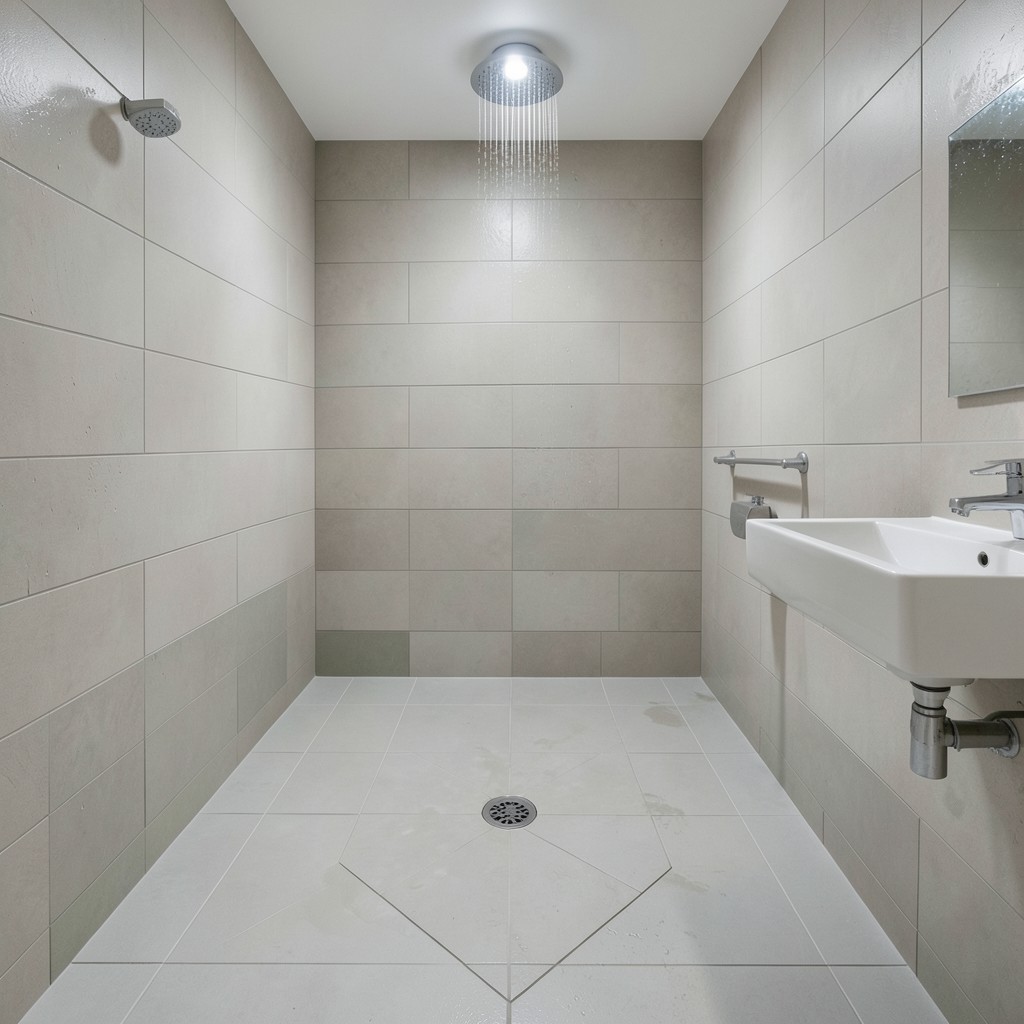
A wet room — a bathroom where the shower area is integrated into the wider space without a tray, a door, or a glass enclosure — produces a bathroom that feels more like a room and less like a utility. The absence of a shower enclosure removes the visual division that standard shower configurations create, which makes even a small bathroom feel significantly larger. The entire floor and wall surface reads as continuous from one end of the room to the other, and that continuity is the quality that makes wet rooms feel spatially generous regardless of their actual dimensions.
The technical requirement that makes a wet room function correctly is a fully tanked and waterproofed floor and lower wall structure, with the floor graded toward one or more drainage points across its entire area. The waterproofing layer goes beneath the tile rather than on top of it, which means the system is invisible once the room is finished. The drain position is the most critical planning decision — a central drain in a wet room requires the floor to slope from all four walls toward the center, which means every tile on every floor run is cut on an angle. A linear drain running along one wall simplifies the floor geometry considerably and allows the main floor tiles to be laid without complex cutting.
The shower head position in a wet room becomes a design decision rather than a plumbing constraint. Without an enclosure defining the shower zone, the position of the water source determines where the wet area begins and where the dry zone starts. An overhead rain shower head set into the ceiling at one end of the room, positioned far enough from the toilet and basin that splash does not reach them, defines the shower area through use rather than through enclosure. That informal boundary between wet and dry — maintained by user habit rather than glass panels — is the conceptual shift that makes wet rooms both more functional and more beautiful than their enclosed alternatives.
2. Freestanding Bathtub as Room Centerpiece

A freestanding bath placed at the center of a bathroom — or in a position where all four sides are visible and accessible — makes a statement that built-in baths never can. It reads as furniture rather than installation, as something chosen rather than fitted, and that quality of deliberate selection is what gives a freestanding bath its design authority. The bath becomes the room’s primary object, and everything around it — the floor, the lighting, the wall treatment — serves as the setting for a piece that deserves attention.
The shape of a freestanding bath changes the room’s atmosphere in ways that most people underestimate when choosing from catalog photographs. A deep, straight-sided slipper bath has a formal quality and suits bathrooms with high ceilings and a more traditional direction. An oval or egg-shaped bath in a matte stone composite has a sculptural presence that suits contemporary bathrooms where the bath is meant to read as pure form. A roll-top claw-foot bath in a painted exterior finish carries a period reference that works in traditional bathrooms and produces an unexpectedly good result in contemporary ones when the rest of the room is sufficiently stripped back to let the bath’s character lead.
The practical consideration that most freestanding bath buyers overlook until installation day is the floor waste and tap supply positioning. Because a freestanding bath is not against a wall, the tap fitting must either come from the floor — a floor-mounted tap riser positioned beside the bath, plumbing run beneath the floor slab — or from the bath itself, in which case the tap deck is part of the bath’s rim. Floor-mounted taps require planning before the floor is tiled; retrofitting them into a finished floor is significantly more involved. Know this before you fall in love with a bath position, and coordinate the tap supply location during the early planning stage rather than treating it as a detail to resolve later.
3. Natural Stone Tile Throughout
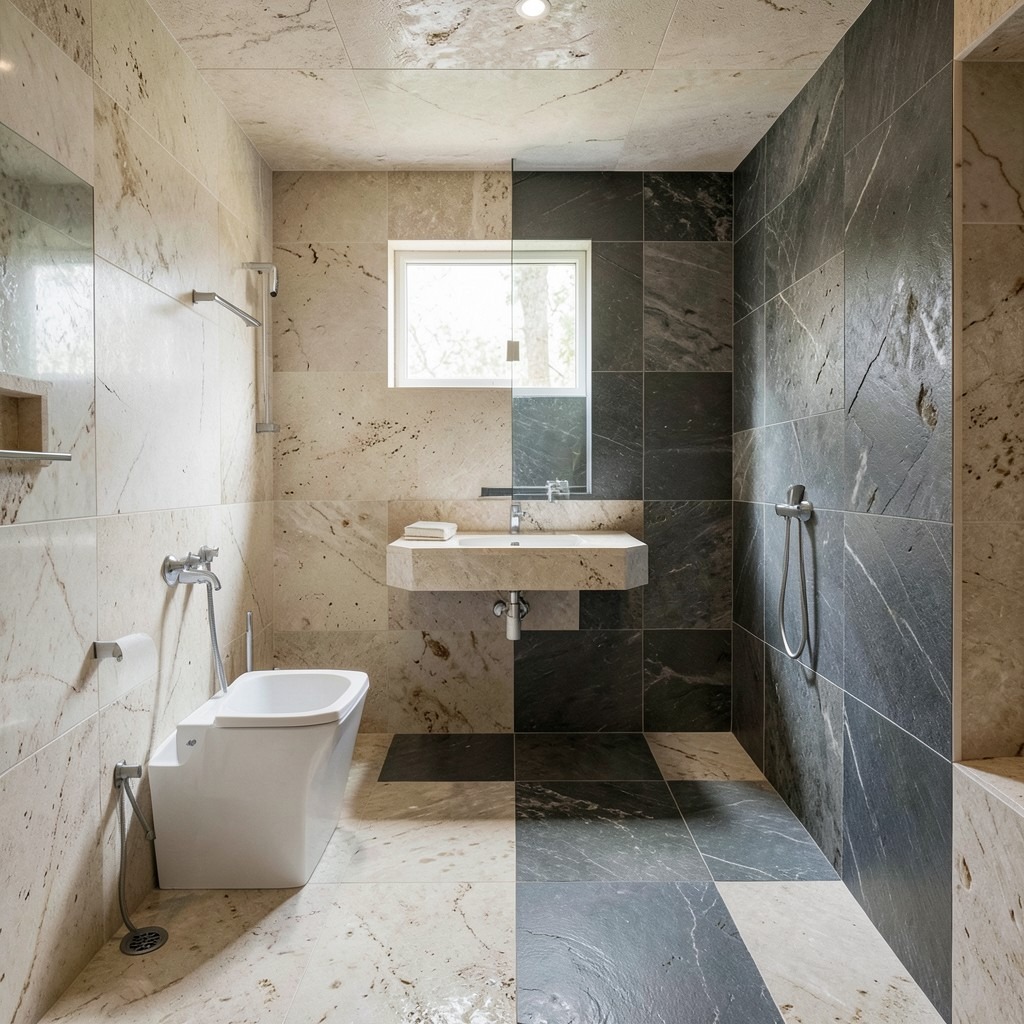
A bathroom tiled entirely in natural stone — floor, walls, and ceiling if the room has the proportions to carry it — achieves a material coherence that mixed-material bathrooms rarely match. The stone connects every surface in the room into a single material conversation, which prevents the visual fragmentation that occurs when tile, painted plaster, and grout lines compete across different walls. The bathroom reads as carved from a single substance, and that quality of monolithic unity produces a sense of calm that is difficult to achieve through any other single design decision.
The choice of stone species determines everything about the room’s character and its maintenance requirements. Marble is the most recognizable natural stone in bathrooms — its veining is organic and unrepeatable, its surface polishes to a reflective depth that other stones do not achieve, and its presence reads as considered regardless of the room’s overall style direction. It is also the most maintenance-intensive option, requiring sealing twice a year and prompt attention to any spills of acidic substances. Limestone is quieter than marble, with a more uniform surface and a warm, sandy quality that reads as organic and unhurried. Slate produces a dark, layered surface with strong texture that suits bathrooms with a more raw, natural direction. Each stone has a different personality, and the right choice depends on which personality belongs in your bathroom.
Porosity and slip resistance are the two practical stone properties that bathroom installations must address. All natural stone requires sealing before use in a bathroom, and floor stone specifically requires a finish that provides grip when wet. Honed or brushed stone finishes are safer underfoot than polished finishes, which become dangerously slippery when wet regardless of their beauty. A stone specified for a bathroom floor must be confirmed as slip-rated for wet conditions before installation — the aesthetic decision and the safety decision must be made simultaneously, and the safety decision must win if they conflict.
4. A Heated Stone or Tile Floor
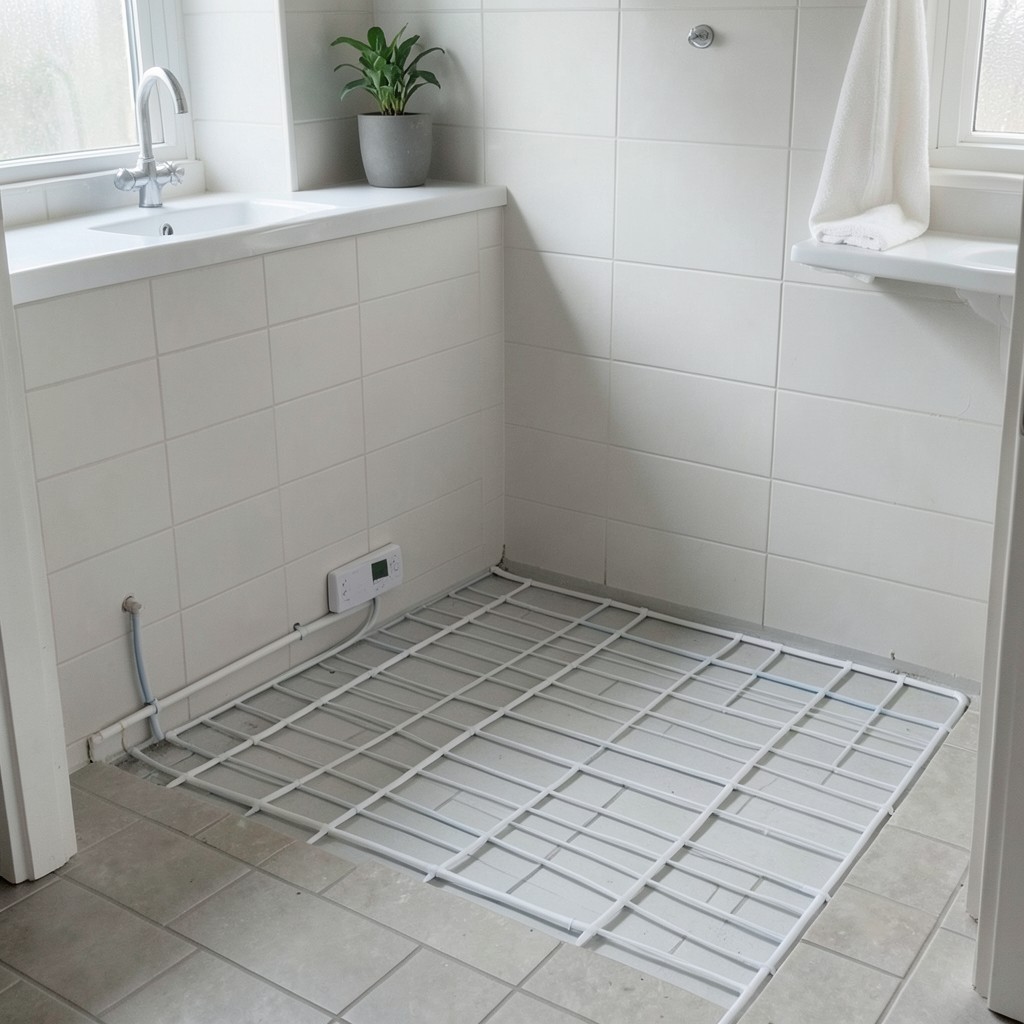
Cold bathroom floors are one of those small daily unpleasantnesses that most people accept as inevitable and almost nobody needs to. Underfloor heating beneath tile or stone changes the morning bathroom experience at a fundamental level — the sensation of stepping onto a warm floor is not a luxury in any frivolous sense; it is a comfort that the body responds to with something close to gratitude. That response, repeated every morning, accumulates into a genuinely different relationship with the room.
Electric underfloor heating — a mat of resistance heating cables installed directly beneath the tile adhesion layer — is the most accessible option for bathroom retrofits because it requires no major structural work. The mat sits on the existing subfloor, the tile is laid over it, and the system is controlled by a programmable thermostat typically set to pre-warm the floor before the household wakes. The installation adds roughly ten to fifteen millimeters to the floor height, which requires accounting for in the transition between the bathroom floor and the adjacent hallway or bedroom floor. The operating cost is lower than most people expect because bathroom floor areas are small and the system typically runs for only one to two hours per day.
Hydronic underfloor heating — water circulated through pipes beneath the floor, connected to the home’s central heating system — is the higher-performance option and the more appropriate choice in new construction or whole-house renovations where the infrastructure is already being laid. It heats the floor more evenly across a larger surface, responds more slowly to thermostat changes, and costs less to operate over time because water retains heat more efficiently than electric resistance. The installation requires a heated screed over the pipe system, which adds more floor height than electric mats and requires longer drying time before tiling can begin. Both systems deliver the same morning experience — only the installation context and operating economics differ.
5. A Double Vanity for Shared Bathrooms
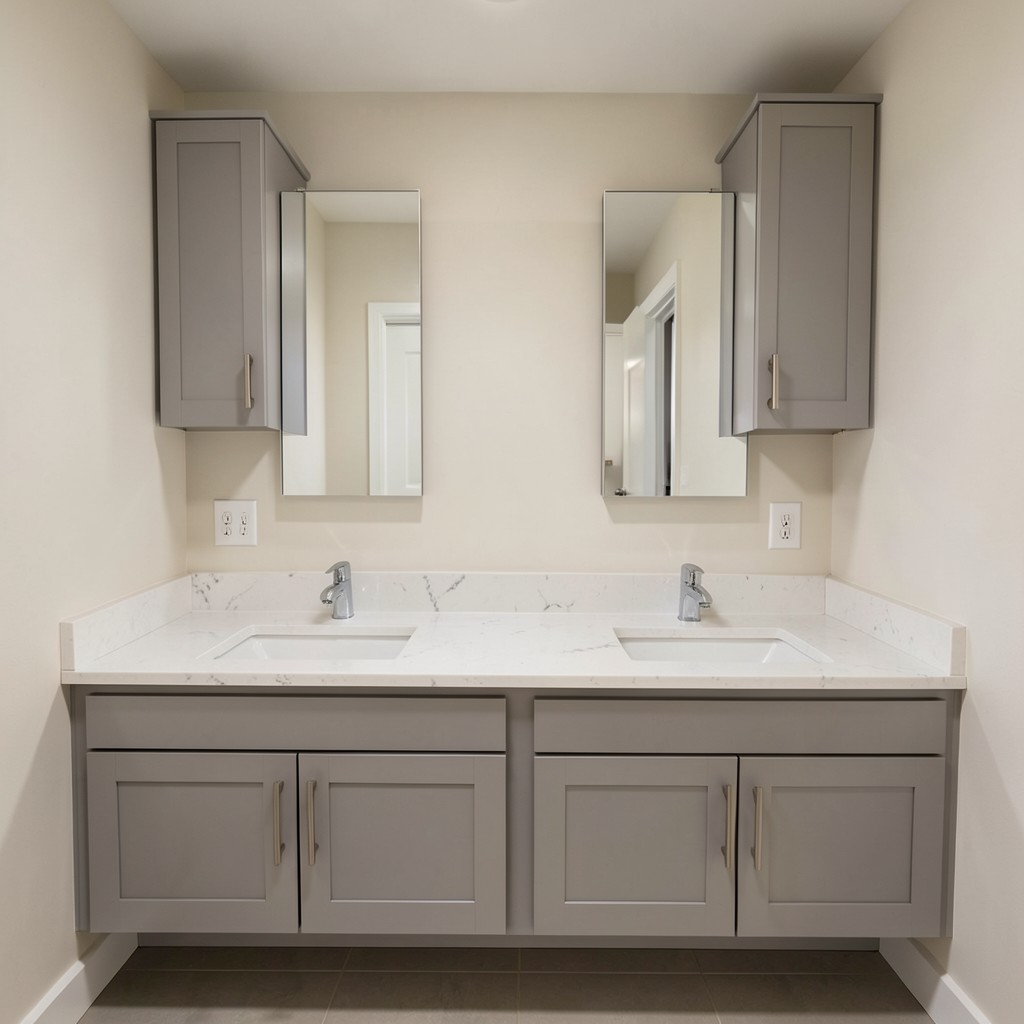
A shared bathroom with a single basin is a room with a bottleneck built into its design. Two people trying to use the same sink simultaneously produces a negotiation that happens every single morning before either person has fully woken up. A double vanity — two basins on a shared countertop or on individual furniture units — resolves that bottleneck permanently and produces a bathroom that is spatially more generous, organizationally more functional, and visually more satisfying than any single-sink arrangement in the same footprint.
The configuration of a double vanity requires more counter length than most bathroom layouts initially account for. Each sink needs a minimum of twenty-four inches of counter width to be usable — which means a double vanity requires at least fifty-four to sixty inches of total counter run to avoid a situation where two sinks are squeezed so close together that the mirrors above them overlap and the tap handles on adjacent sinks compete for elbow space. In a bathroom where sixty inches of wall length is not available, two separate single vanity units on opposite walls — one against each wall, facing each other — often works better than forcing both basins onto a single run of counter.
Mirror configuration above a double vanity is a decision most people make too quickly. Two individual mirrors — one centered above each basin — is the functionally correct choice because each mirror serves one user and the gap between them acknowledges the two separate points of use. A single wide mirror spanning both basins produces a cleaner visual but is slightly more awkward in use because neither user has a mirror centered on their own position. The individual mirror approach also allows for a separate medicine cabinet or storage unit above each basin, which distributes the bathroom storage to the point of use rather than requiring both people to access the same cabinet.
6. Bold Black and White Bathroom

A bathroom built entirely on a black and white palette has a graphic confidence that color-forward bathrooms rarely possess. The contrast between the two tones is so high that even the simplest tile pattern reads as architectural, and the simplest fixture choice reads as deliberate. Nothing in a black and white bathroom can hide behind a busy pattern or a forgiving mid-tone — every material and every proportion is visible in full clarity, which means the design either works completely or announces its failures with equal clarity.
The tile pattern carries the primary design weight in a monochromatic bathroom. Classic black and white checkerboard floor tile is the most recognized version of this palette and the one that most people associate with period bathrooms, but the format is not exclusively traditional. A large-format black and white checkerboard — tiles at twelve or sixteen inches rather than the standard four — reads as contemporary and architectural rather than vintage. Hexagonal mosaic in a black and white mix produces a pattern with more visual complexity and suits bathrooms where the floor is meant to be the most interesting surface. Vertical white subway tile with a black grout joint on the walls produces a grid pattern that reads as sharp and intentional, and the black grout resists the discoloration that white grout develops over time in a steamy bathroom environment.
Fixture finish is the third element in a black and white bathroom’s palette, and it functions as the punctuation that holds the composition together. Matte black fixtures — taps, shower fittings, towel rails, toilet roll holders — read as part of the dark side of the palette and create visual continuity between the black tile and the black hardware. Polished chrome fixtures sit between the two tones, reflecting both without committing to either, which can feel indecisive in a palette where commitment is the point. The bathroom that commits fully — black tile on the floor, white tile on the walls, matte black on every fixture — has a coherence and confidence that a softer interpretation of the same palette cannot match.
7. An Indoor Plant Wall in the Bathroom

A living plant wall in a bathroom — a vertical garden of ferns, trailing pothos, moss panels, and moisture-tolerant tropical plants installed on a dedicated wall structure — introduces the natural world into a room that most people design as though nature has no place in it. The bathroom is the most humid room in the house, and that humidity, which building convention treats as a problem to be exhausted away, is an asset for plants that originate in tropical forest environments. The conditions that feel challenging for the room’s finishes are exactly the conditions that certain plants thrive in.
The design impact of a plant wall in a bathroom is difficult to overstate. A wall of living green against white tile or pale stone tile produces a visual contrast that no applied surface treatment — no wallpaper pattern, no painted mural, no tile design — achieves. The plants move slightly in air currents from the ventilation or window opening. The textures of the leaves vary across the wall from fine fern fronds to the broad, glossy surfaces of larger-leaved tropical species. The green deepens and changes across the growing season. The wall is alive, and the bathroom reads as a space connected to the natural world rather than sealed off from it.
The system supporting a plant wall must manage water and drainage without damaging the room’s structure. A modular felt pocket system — individual felt pockets attached to a waterproofed backing board, each holding a small plant root ball — is the most accessible option for residential installations. The backing board is fixed to the wall with a small gap behind it for drainage and air circulation, and the entire system sits within the room’s general waterproofing envelope. Plants are watered by hand at the pockets using a long-spouted watering can, or through a simple drip irrigation system run from a small reservoir. Neither approach is complicated, and both maintain a plant wall that remains healthy for years with weekly attention.
8. Moroccan Tile Accents
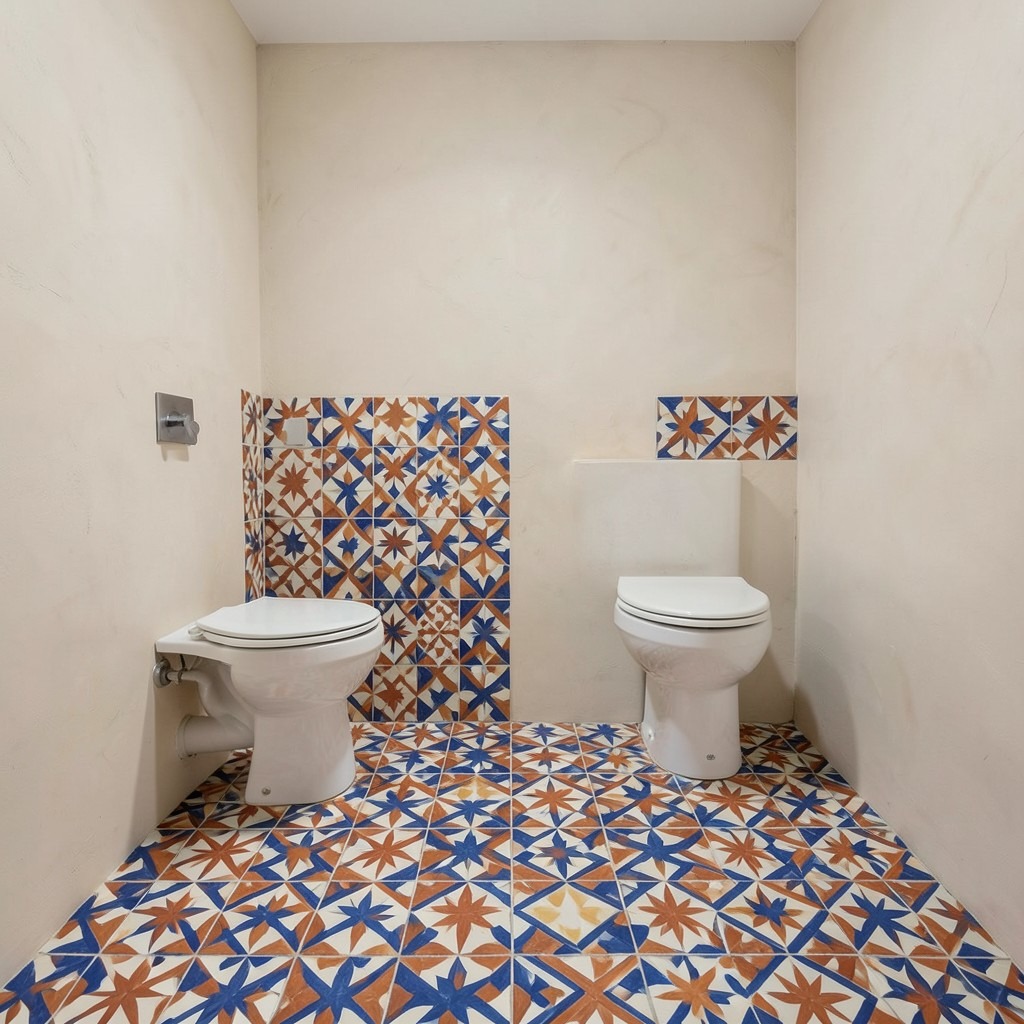
Moroccan encaustic tiles — the hand-painted cement tiles with geometric patterns in warm, layered colors — bring a surface richness to bathroom floors and feature walls that no manufactured tile achieves. Each tile is hand-made, which means slight variations in color saturation and tile dimension are inherent to the material. Those variations, visible once the tiles are installed and grouted, produce a surface that reads as ancient and crafted rather than contemporary and manufactured. In a room defined by precision and smoothness, that quality of human imperfection stands out with unusual force.
The pattern palette of Moroccan tiles is wide enough to suit almost any bathroom design direction when the right pattern is selected. Simple two-tone geometric patterns — a star-and-cross arrangement in white and terracotta, or a simple diamond repeat in two complementary blues — read as clean and contemporary when paired with plain plaster walls and minimal fixtures. More complex multi-colored patterns with five or six tones work in bathrooms where the tile is the unambiguous design centerpiece and every other surface is deliberately restrained to let the floor do its work. Both approaches are legitimate — the failure mode is using a complex pattern in a bathroom that also has other competing design elements, where the result reads as busy rather than bold.
The maintenance requirement of encaustic cement tiles is worth understanding before committing. The material is porous and requires sealing before grouting and again after grouting, then re-sealing once a year in a bathroom environment where moisture is constant. Unsealed encaustic tile in a bathroom stains readily, particularly near the toilet area and the bath edge where water pools. A properly sealed installation is as practical as any other tile and requires nothing beyond normal cleaning. The sealing step is not optional, and skipping it is the source of most of the horror stories about encaustic tile in bathrooms.
9. Frameless Glass Shower Screen
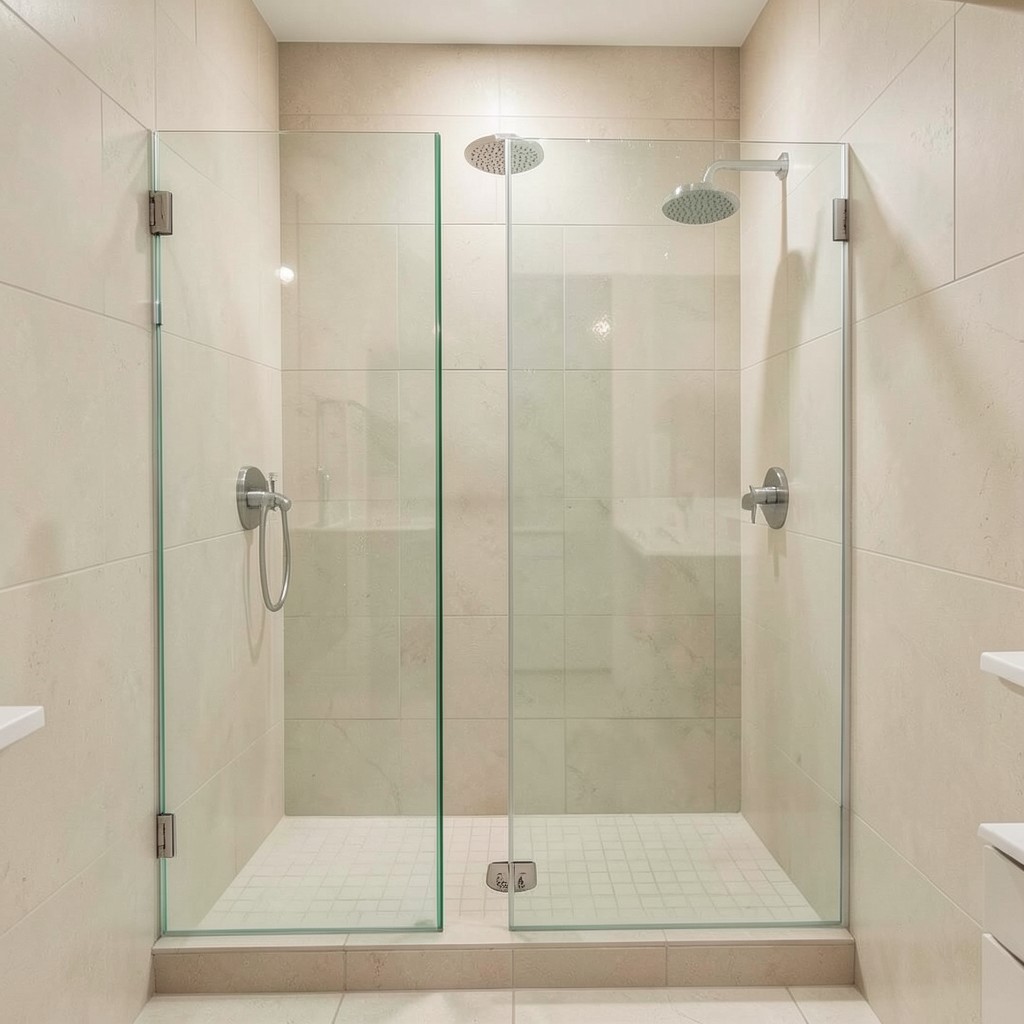
A frameless glass shower screen — a single panel or pair of panels of thick, toughened glass with minimal hardware and no metal frame around the perimeter — opens up a shower enclosure in a way that framed alternatives do not. The glass is effectively invisible from a distance; what you see through it is the tile, the shower fitting, and the water — not a frame of metal interrupting the view. In a small bathroom where every visual division creates the impression of reduced space, a frameless screen removes one of the most space-reducing elements in the room without sacrificing any functional containment.
The glass thickness for a frameless screen is typically ten millimeters, compared to the six millimeters standard in framed enclosures. The additional thickness is what gives the panel structural rigidity without a frame to support its edges. That thickness is also visible at the cut edge of the glass — a panel of ten-millimeter toughened glass has a luminous green edge that reads as architectural rather than utilitarian, particularly when the panel terminates in a fixed point without any edge framing. That edge detail is one of those small visual qualities that contributes to the feeling of a well-made bathroom without most people being able to identify specifically what they are responding to.
Walk-in configurations — where the screen is a single fixed panel positioned to prevent splash from reaching the rest of the room, with the shower entry left entirely open — take the frameless principle to its logical conclusion. There is no door, no pivot, no hinge, no handle, and no threshold to step over. You walk around the fixed panel into the shower from one end, and the combination of the panel’s position and the shower head’s direction keeps the water contained without any enclosure. That open arrangement suits walk-in shower formats, larger bathroom spaces, and wet room designs where the absence of any door or threshold is the experience the room is built around.
10. A Bathroom With Warm Timber Accents
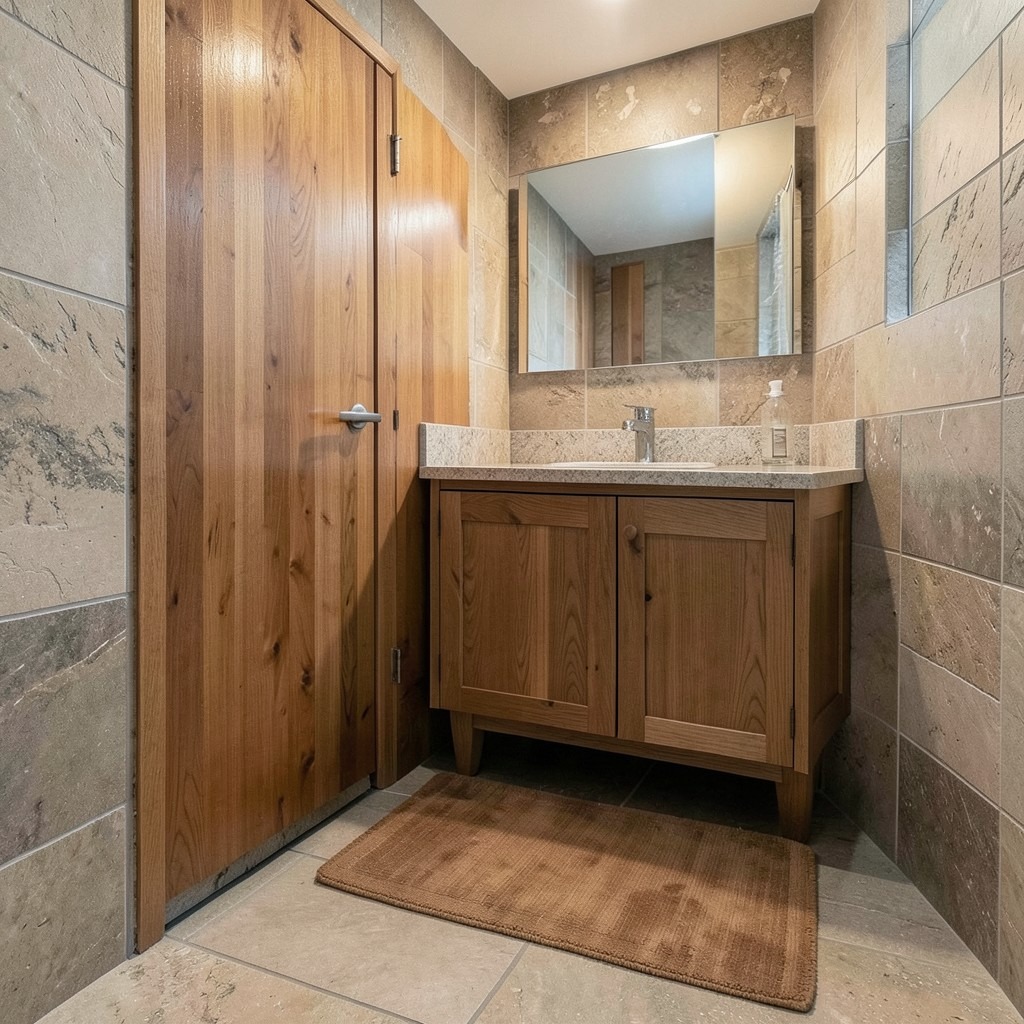
Wood in a bathroom is the material decision that most people avoid because they assume it cannot survive the moisture conditions. That assumption is decades out of date. Properly selected and correctly finished timber — teak, iroko, accoya, or a thermally modified wood — handles bathroom moisture conditions without degrading when the room is adequately ventilated and the wood finish is maintained. The design reward for taking on that maintenance is a bathroom where the organic warmth of real timber sits against stone, tile, and water — a material combination that produces a quality of natural contrast found nowhere else in residential design.
The applications for timber in a bathroom do not require using it as a primary surface — the warmth it provides is disproportionate to the surface area it occupies. A teak bath mat that sits on a stone tile floor, a timber vanity unit with a stone counter on top, a section of timber wall paneling behind the basin — any of these introduces the warmth of natural wood without exposing large surface areas to the conditions that test the material most. The timber accent approach produces the design benefit of the material without requiring the level of maintenance commitment that a full timber floor or large timber wall section demands.
The finish applied to bathroom timber determines both its appearance and its longevity. An oil finish penetrates the wood fiber and provides moisture resistance from within the material — it requires reapplication every year or two but maintains the natural appearance of the grain better than any surface coating. A hard lacquer sits on top of the wood, provides a stronger moisture barrier, and requires less frequent maintenance but produces a slightly more artificial appearance that does not age as well as an oiled surface. For a bath mat or a vanity unit, oil is the superior choice for most bathrooms where the timber is used regularly and the appearance of natural aging is valued over the convenience of a sealed surface.
11. Maximalist Wallpaper in a Powder Room
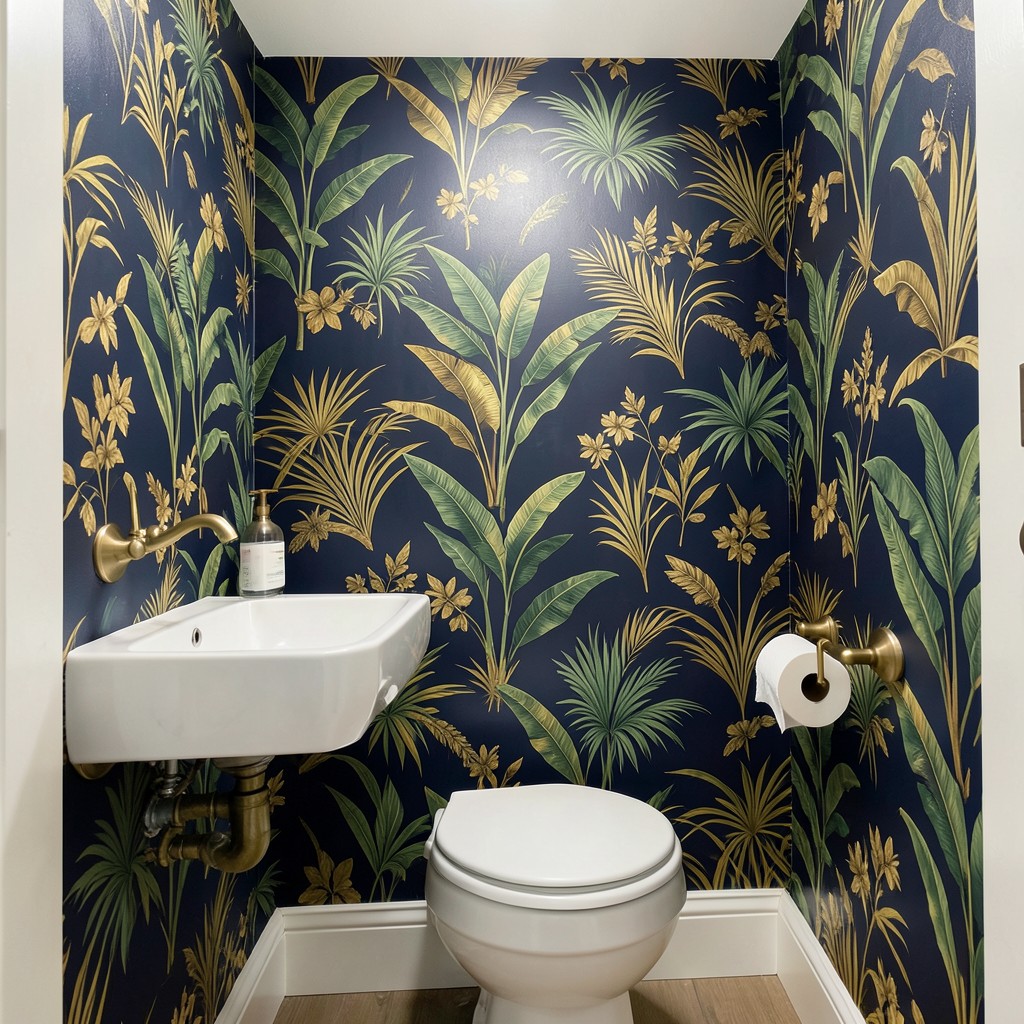
A powder room — a half bathroom used by guests, separate from the household’s primary bathrooms — is the one space in a home where maximalist wallpaper is not a risk but an opportunity. Because the room is small and used briefly rather than inhabited for extended periods, a pattern that would feel overwhelming in a bedroom or bathroom used daily reads as bold and confident rather than exhausting. The powder room is the room you get to decorate entirely for the impression it makes, without any obligation to live comfortably with the result.
The pattern scale and color intensity that works in a powder room can be significantly more aggressive than anything appropriate in a larger room. A hand-painted chinoiserie wallpaper with gold accents on a deep navy ground. A large-scale tropical botanical with oversized leaves in deep green and gold. A geometric repeat in a saturated two-tone combination that would read as visually tiring across a full-scale bathroom. All of these work in a powder room because the visitor’s engagement with the pattern is measured in minutes rather than hours, and the impression left by something genuinely bold is more memorable than anything restrained and careful.
Fixture selection in a maximalist powder room follows a specific logic: match the pattern’s palette rather than its energy. A wallpaper with gold accents calls for brass fixtures — tap, toilet roll holder, towel ring — in a finish that picks up the gold without adding additional busyness. A deep navy background calls for a white ceramic basin and white toilet that contrast against the dark paper rather than merging with it. The fixtures should be beautifully chosen but visually quiet, because the wallpaper is doing all the talking in this room, and the fixtures’ job is to listen.
12. Concrete Walls and Floors
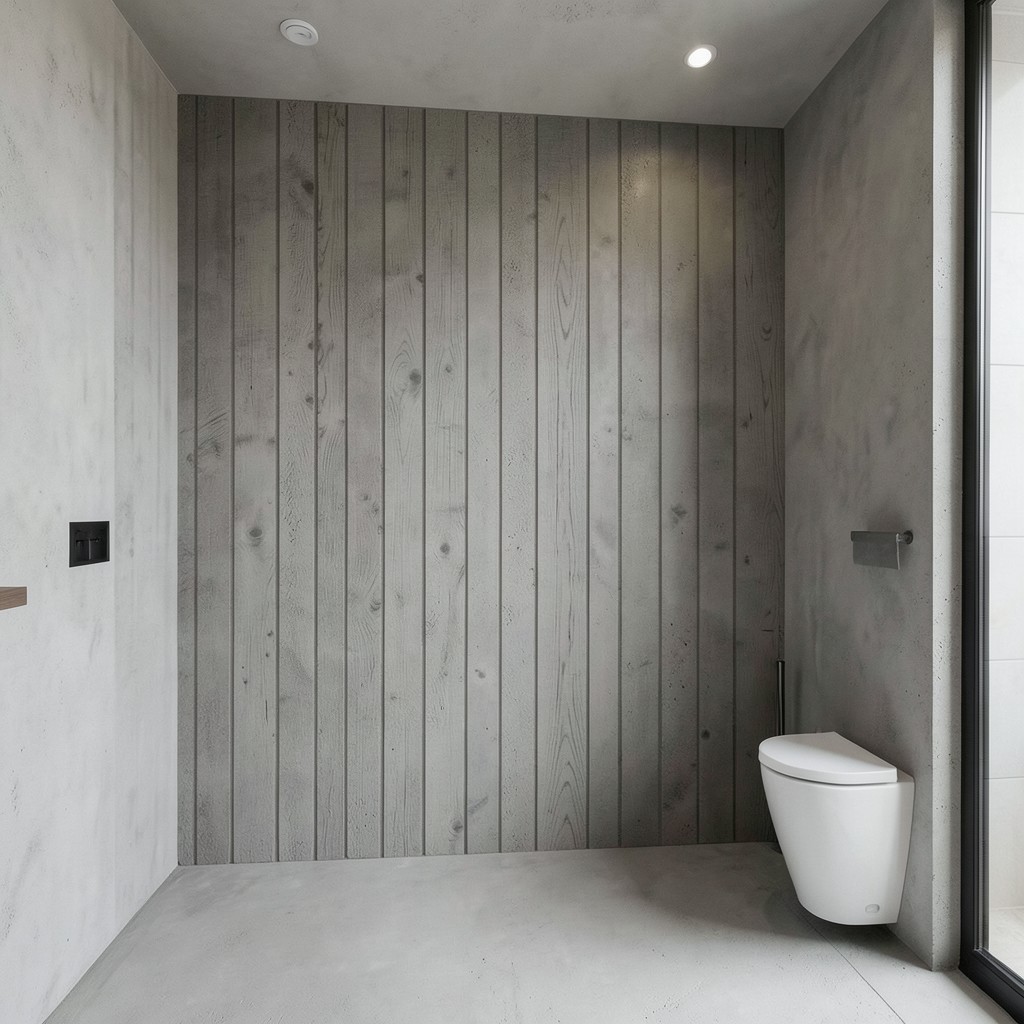
A bathroom built from concrete — poured, board-formed, or micro-cement applied over standard construction — has a material austerity that no tile or stone achieves. The surface is continuous and uninterrupted by grout lines, which produces a visual calm that tiled surfaces, regardless of their beauty, cannot replicate. The color range of concrete — from a near-white pale grey through warm mid-tones to a deep charcoal — is narrow but subtly varied in a way that reads as natural rather than designed, and that quality of apparent effortlessness is precisely what the material produces.
Board-formed concrete — concrete poured against timber formwork whose grain transfers to the finished surface — is the most architecturally expressive version of the material in a bathroom context. The vertical lines of the timber grain running across the concrete wall produce a texture that is simultaneously raw and precise. The surface reads as both industrial and natural, which is a rare material quality. It suits bathrooms in homes where the architecture already uses exposed materials — steel, timber, glass — and where the concrete bathroom is a continuation of a material language spoken throughout the building rather than an isolated design gesture.
Micro-cement — a thin-coat material applied over existing surfaces — delivers the visual character of poured concrete without the structural requirements of the real thing. It can be applied over existing tiles, plasterboard, or render, which makes it accessible in renovations where the bathroom cannot be stripped to its structure. The application requires a skilled tradesperson and a properly prepared substrate, and the sealing process after application is the step that determines whether the surface performs correctly in a wet environment. A micro-cement bathroom finished and sealed correctly is as practical as any tiled surface — clean it the same way, respect the same basic maintenance, and it holds its quality for years without drama.
13. A Bathroom With a View
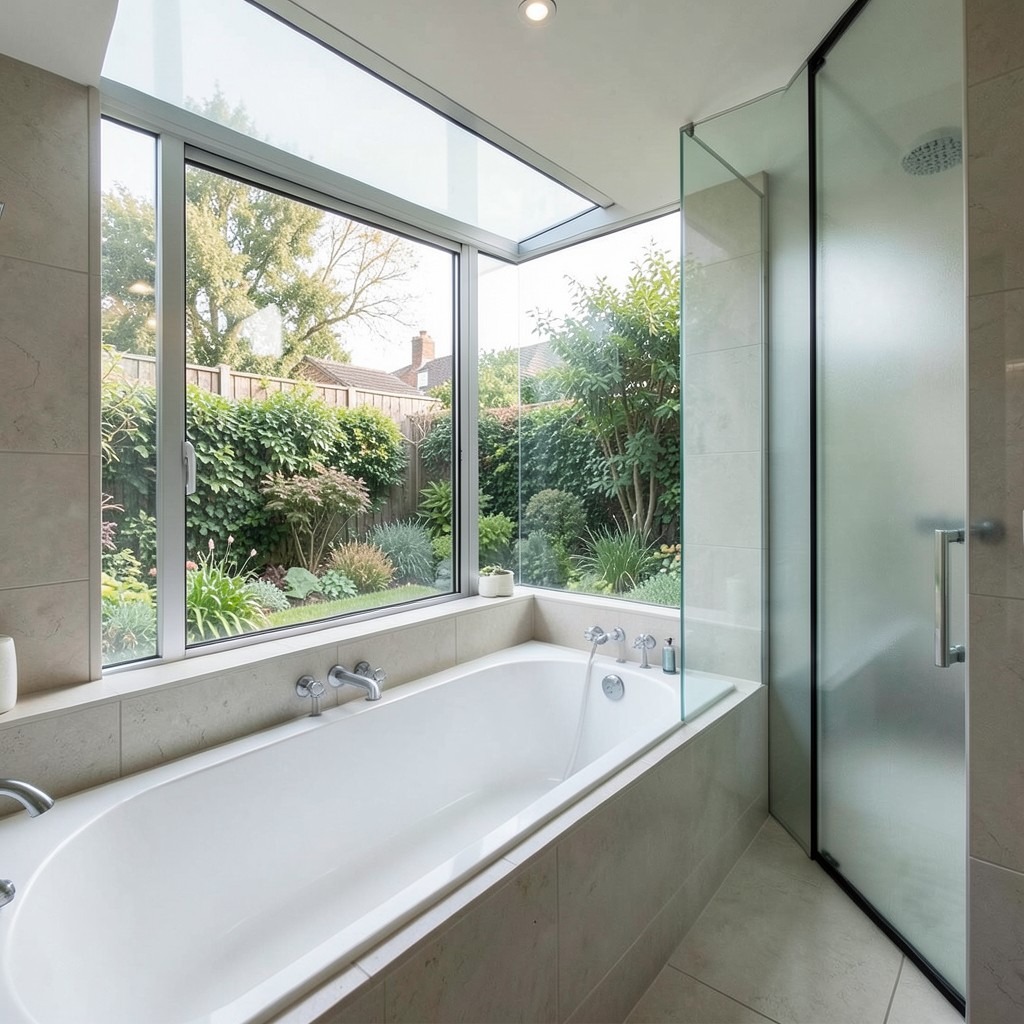
A bathroom with a window positioned to offer a meaningful view — of a garden, a landscape, a courtyard, a skyline — produces a room that transcends its functional purpose. Bathing and showering while looking out at something genuinely beautiful is an experience that changes the quality of those activities in a way that no interior design decision alone achieves. The exterior becomes part of the room. The inside and outside enter a conversation that the bathroom’s four walls alone never produce. And that conversation makes the most private room in the house feel connected rather than enclosed.
The privacy challenge is the tension that makes view-oriented bathroom windows difficult in most residential contexts. A window positioned to offer a good view typically means someone outside can also see in, and most bathrooms require privacy solutions at the window to manage that exposure. Frosted glass is the standard approach and the most limiting one — it blocks the view as effectively as it blocks the sightline. A better approach is a window positioned high enough that the view is visible from a standing or reclining bathtub position while the sightline from outside is directed at the ceiling rather than the occupant. The geometry of this solution requires understanding the specific external conditions and the height of the window relative to the heights of the surrounding site.
Glazing extending from countertop to ceiling on a wall that faces a private garden or courtyard is the option that delivers the full version of this idea without any privacy compromise. When the view faces a space that is genuinely private — enclosed by walls, fencing, or dense planting — the entire bathroom can open to the exterior through floor-to-ceiling glass without any privacy treatment needed. The bathroom then reads as a room that extends into the garden, and the effect of bathing in a room surrounded by planting and natural light is one of the more extraordinary sensory experiences residential design can produce.
14. Matte Black Fixtures in a White Bathroom

White bathroom tiles against matte black fixtures — taps, shower fittings, towel rails, toilet roll holders, mirror frames — produce a contrast that reads as sharp and considered without requiring any color, any pattern, or any architectural intervention. The black fixtures sit against the white surfaces with a clarity that polished chrome or brushed nickel does not achieve — those finishes reflect the white around them and partially disappear, while matte black holds its definition against any background, regardless of the light conditions.
The consistency of the matte black finish across every fixture in the bathroom is the discipline that makes this approach work. A bathroom with matte black taps and chrome towel rails reads as accidental rather than designed — the two finishes fight each other and the mixed result looks like the fixtures were chosen at different times without coordination. When every metal element in the room — taps, shower head, shower arm, door hinges if visible, toilet flusher, towel ring, robe hook, mirror frame — is matte black, the room achieves the tonal consistency that makes it feel designed as a whole rather than assembled in parts.
The scale of the black fixtures relative to the white surfaces matters for the balance of the palette. In a large, fully white bathroom with generous wall and floor tile area, the matte black fixtures read as precise dark accents that punctuate the white without overwhelming it. In a smaller bathroom where the fixtures occupy a larger proportion of the visible surfaces, the black begins to carry more visual weight. In those tighter spaces, combining matte black hardware with white ceramic basins and toilets — where the black is restricted to metal elements only — prevents the palette from tipping toward dark when the room cannot sustain that weight comfortably.
15. A Bathroom With Integrated Shelving Niches
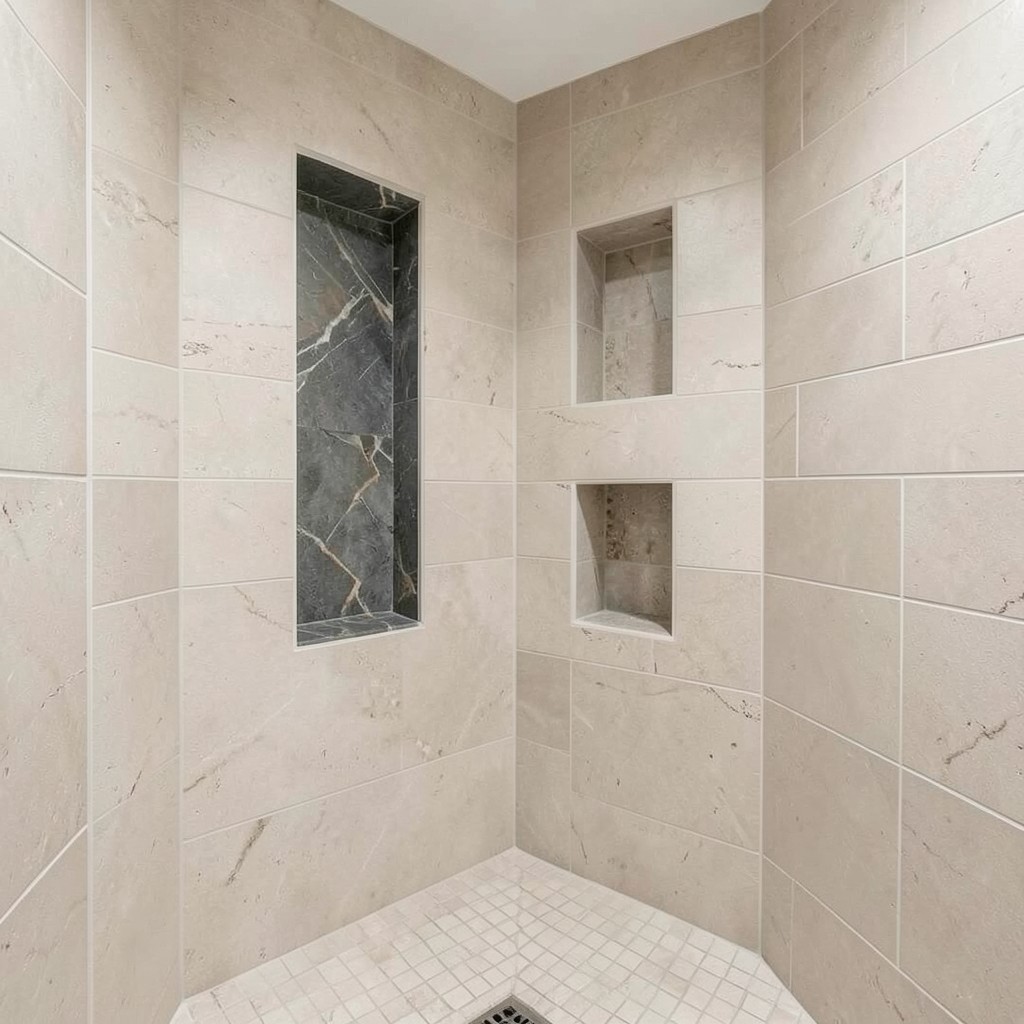
Shelving niches — recesses cut into the wall cavity and tiled to match the surrounding surfaces — solve the storage problem in shower zones and bathroom walls without adding anything to the room. They are negative space: carved from the wall rather than attached to it, which means they contribute to storage without taking up any floor area or projecting from any surface. A bathroom with well-positioned niches reads as more organized and more spatially generous than an identical bathroom with the same storage delivered through surface-mounted shelves or hanging organizers.
The position of a shower niche is determined by the plumbing and structure behind the wall, and getting this right requires coordination during the construction or renovation phase before the tiles go on. A niche cannot be cut into a wall that contains a load-bearing stud or a plumbing pipe — so the position is partially constrained by what exists behind the surface. The most ergonomically correct height for a shower niche is between chest and eye level — low enough to reach without stretching, high enough that water from the shower head does not pool inside it. At that height range, the niche is visible and accessible without any contortion, and the tiles inside it stay dry enough that soap residue does not accumulate as rapidly as it does in lower niches that pool water.
Tiling the interior of a niche in a contrasting material from the surrounding wall is the detail that elevates the element from functional to architectural. A niche tiled with a small-format mosaic in a color drawn from the bathroom’s palette, set against a field of larger plain tile on the surrounding walls, reads as a designed feature rather than a storage hole. The same niche tiled in a contrasting stone — marble inside a limestone field, or a dark slate inside a light subway tile field — produces a framed composition that gives the bathroom a detail worth looking at from across the room.
16. Backlit Mirror Above the Vanity
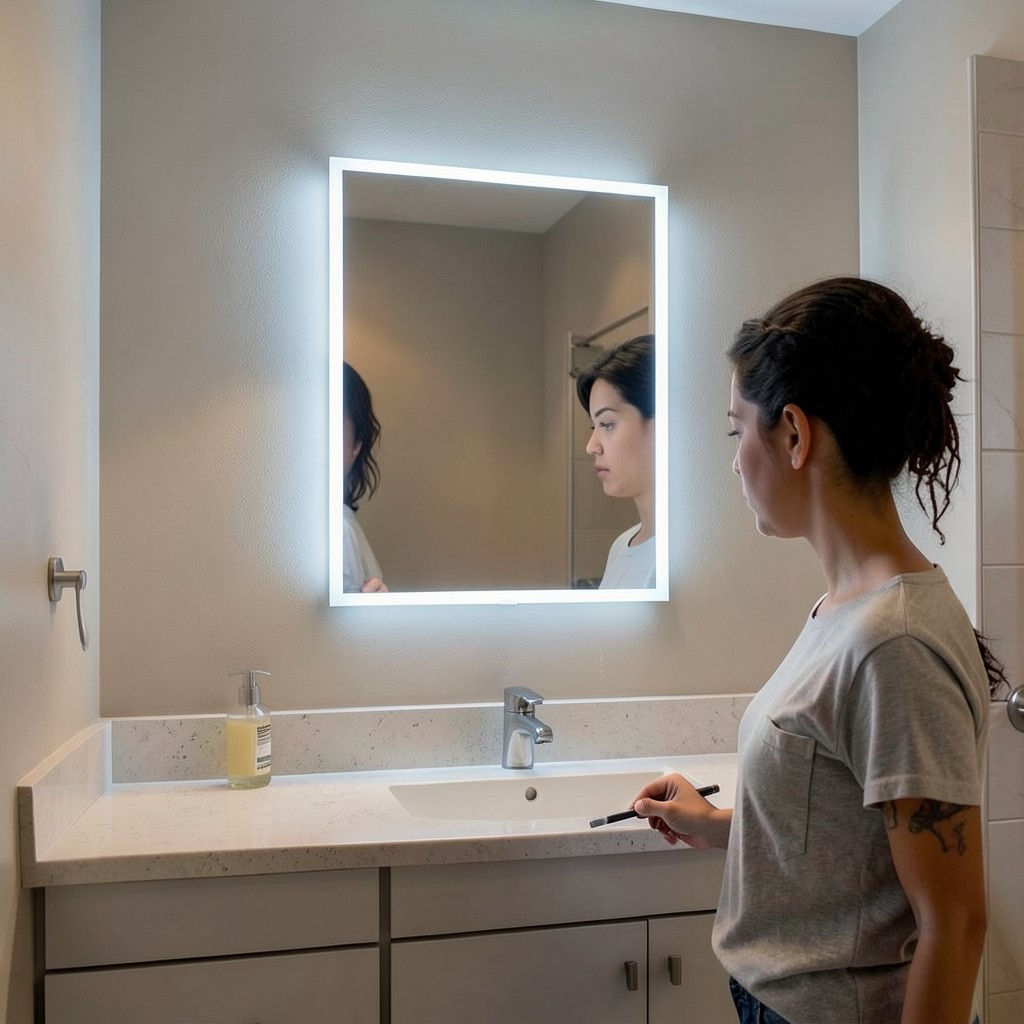
A backlit mirror — a mirror with LED lighting integrated behind the perimeter of the glass, producing a glow that extends around the mirror’s edge and onto the wall behind — provides a quality of light at the vanity that wall-mounted side sconces and ceiling downlights do not match. The light source is positioned precisely at the face level of the person standing at the basin, which means the illumination is even, shadow-free, and directionally correct for the practical tasks of a vanity mirror: applying makeup, shaving, checking skin condition. The functional and aesthetic arguments for this fixture coincide completely.
The color temperature of a backlit mirror is the specification that most buyers overlook and most regret afterward. A mirror with an LED temperature of 4000K to 5000K produces a cool, blue-white light that renders skin tones accurately for makeup application but reads as clinical in a bathroom used for relaxing evening routines. A mirror at 2700K to 3000K produces a warmer light that flatters the face more flatteringly but may misrepresent color accuracy for makeup purposes. The resolution is a mirror with adjustable color temperature — switchable between a warm ambient setting and a cooler task setting — which is available from most mid-to-upper-tier mirror manufacturers and eliminates the need to choose between the two functions.
The size of the backlit mirror relative to the vanity and wall width determines whether the fixture reads as a design statement or a utility. A mirror that fills the wall above the vanity from one side to the other — stopping just short of the side walls with a small margin — reads as architectural and makes the vanity zone feel considered and complete. A small mirror centered above a wide vanity reads as undersized and draws attention to the proportion mismatch rather than the mirror itself. Match the mirror’s width to the vanity’s width as a starting point, then extend it further if the wall width and the room’s proportions allow.
17. Terrazzo Tile in the Bathroom
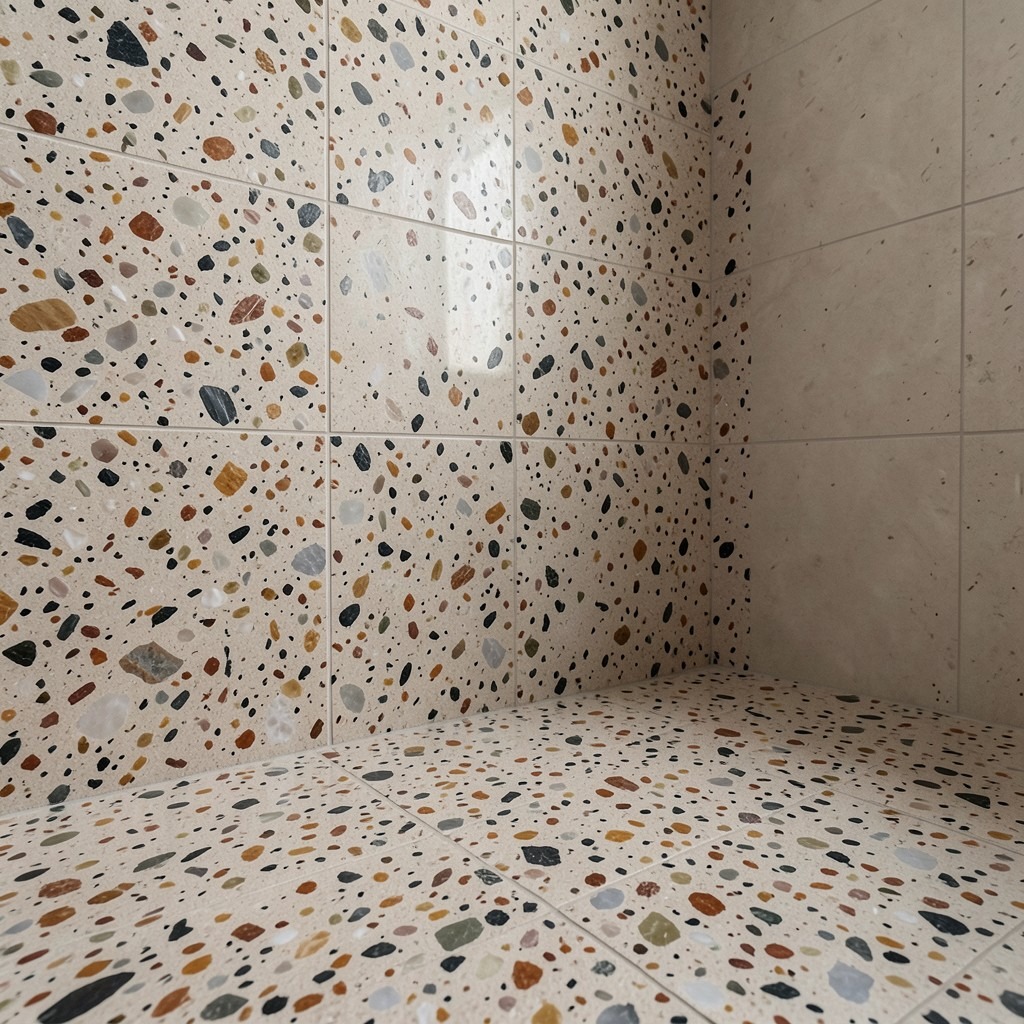
Terrazzo — a surface composed of chips of marble, granite, glass, or other aggregates set in a cement or resin binder and polished to a smooth finish — brings a material history and a visual complexity to a bathroom that contemporary manufacturing cannot replicate. The original terrazzo technique has been used for centuries, and the aesthetic it produces — speckled, warm, unpredictably patterned — is impossible to fake with printed tile or digitally replicated pattern. A terrazzo bathroom floor or feature wall has the quality of material that was made rather than fabricated, and that quality is what justifies the cost premium over standard tile.
The aggregate selection in terrazzo determines the color palette and the visual scale of the pattern. Small aggregate chips — three to five millimeters — produce a fine-grained terrazzo that reads almost as a solid color from a distance and reveals its composition only when viewed closely. Large aggregate chips — fifteen to twenty-five millimeters — produce a more graphic, bold pattern that reads clearly from across the room. The color of the aggregate, the color of the binder, and the ratio between them together produce a surface that exists nowhere else — each terrazzo mix is a unique composition, and that uniqueness is part of what makes the material valuable as a design investment.
Terrazzo tile — pre-cast terrazzo manufactured in tile format — makes the material accessible without the cost and complexity of poured-in-place terrazzo, which requires a specialist contractor and a minimum substrate area to be economically viable. Terrazzo tiles are installed like standard tiles, with standard adhesive and grout, and produce a very close approximation of the poured-in-place appearance. The grout joint is the one visible difference — poured terrazzo has no joint, while tiled terrazzo has the same grout line as any tiled surface. Using a grout color that matches the terrazzo’s binder tone minimizes the joint’s visibility and produces a surface that reads as close to continuous as tiling allows.
18. A Skylight Above the Shower or Bath
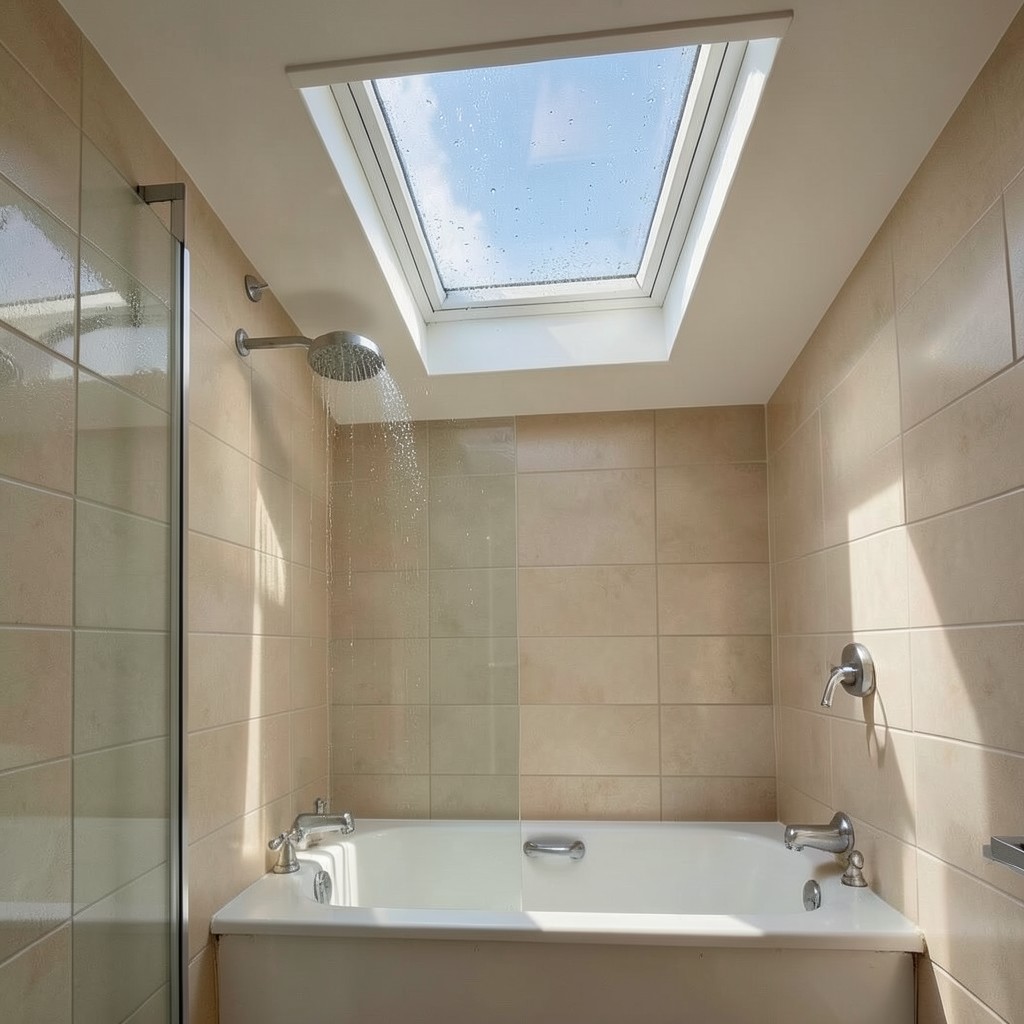
A skylight positioned above the shower or bathtub brings natural light directly into the one bathroom zone where it is most appreciated and most rarely provided. The light falls vertically — differently from any window — and changes quality across the day in ways that horizontal light sources do not. Morning light through a bathroom skylight is soft and diffuse. Midday light is direct and bright. Afternoon light carries a warmth that shifts the bathroom’s character. Standing in a shower under natural daylight is a different physical and psychological experience from showering under artificial light, and a bathroom that makes that experience available daily is a bathroom that earns its place in the house.
The condensation management of a bathroom skylight is the practical challenge that most installations handle incorrectly. Bathroom air is saturated with moisture, and a skylight that is not adequately thermally broken — where the inner frame reaches the same low temperature as the outer glass in cold weather — will produce condensation on the glass and the frame, which runs into the room and creates the damp conditions that lead to mold in the surrounding ceiling structure. A thermally broken skylight unit with adequate drainage channels and a frame designed for wet-room conditions manages the condensation without any maintenance input from the homeowner. Specifying the wrong unit is an expensive mistake that reveals itself slowly through water damage rather than immediately through visible failure.
A roof light over a bathtub creates the most direct experiential connection between bathing and the sky. Lying in a bath while looking directly upward through a skylight — at blue sky in summer, at rain on the glass in autumn, at the grey ceiling of a winter morning — changes the experience of bathing from a private enclosed activity into something with a relationship to the external world that no interior lighting ever provides. That connection is worth planning for specifically, and in any bathroom where a skylight is architecturally possible, positioning it above the bath rather than above the shower is the choice that delivers the most per square meter of glazing area.
19. A Floating Vanity Unit
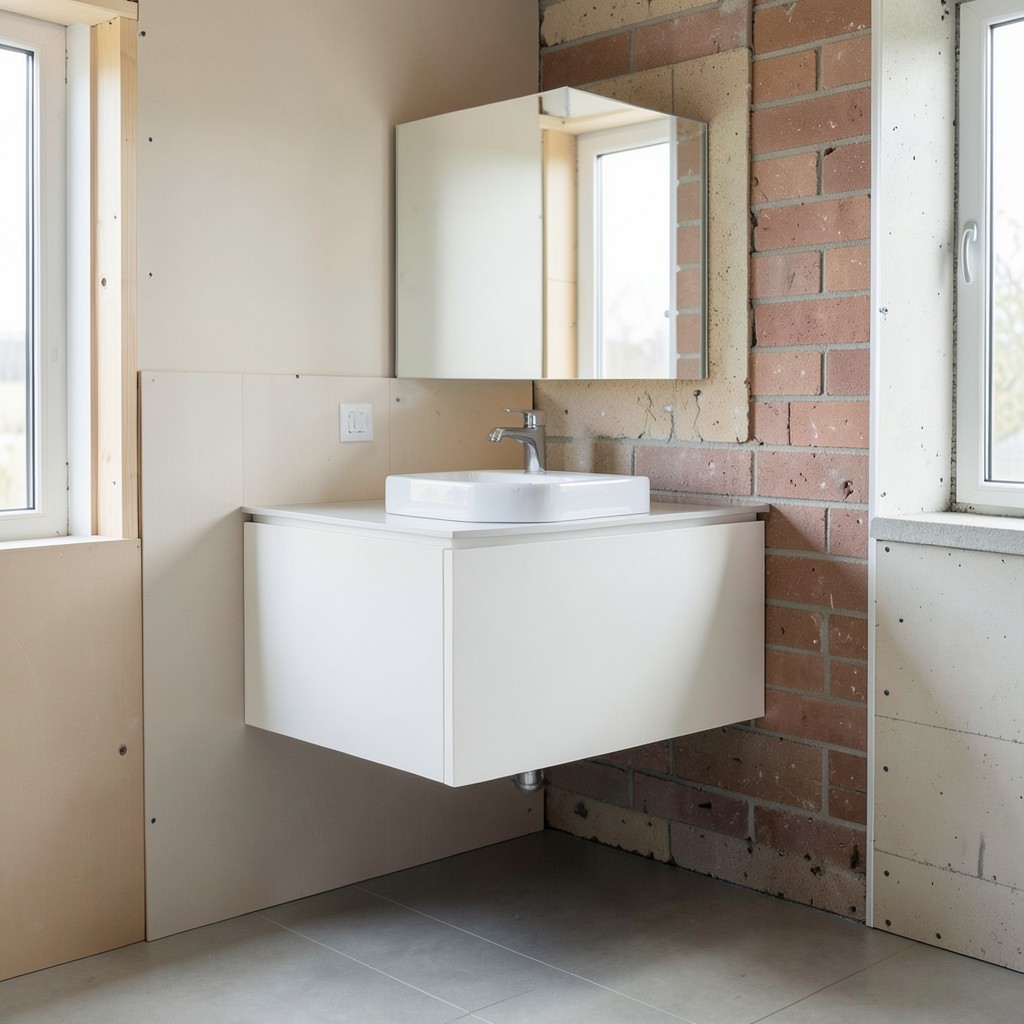
A vanity unit that is wall-mounted rather than floor-standing — the base cabinet suspended off the floor with clear space beneath it — produces a bathroom that reads as larger and more contemporary than the same room with a floor-standing unit. The continuous floor surface visible beneath the floating unit extends the room’s floor area perceptually and makes cleaning under the vanity possible without moving anything, which solves one of the most consistent maintenance frustrations of floor-standing bathroom furniture.
The wall structure behind a floating vanity must be capable of carrying the combined weight of the cabinet, the countertop, the basin, and the stored contents — typically forty to sixty kilograms in a well-specified vanity. A standard plasterboard partition wall requires a structural backing board — plywood or cement board — installed before the plasterboard goes on, with the vanity bracket bolts anchored into this backing. A masonry wall carries the load without any preparation beyond correct anchor bolt selection. The structural requirement is not complex, but it must be addressed during construction or renovation before the wall is finished — adding the required backing to a completed plasterboard wall after the fact requires cutting into the surface and making good afterward.
The height at which the floating vanity is installed is a design decision that most installations default to standard without considering the household’s actual users. Standard vanity height at around eighty-five centimeters from finished floor to top of counter suits a person of average height. A household where both occupants are significantly taller benefits from a counter raised to ninety or ninety-five centimeters, which eliminates the lower-back discomfort that standard-height basins produce for taller people over years of daily use. Because the vanity is floating and the height is set during installation, adjusting it afterward requires removing and reinstalling the entire unit — knowing the correct height before the first installation is worth a thoughtful conversation before the brackets go on the wall.
20. Warm Amber Bathroom Lighting at Night
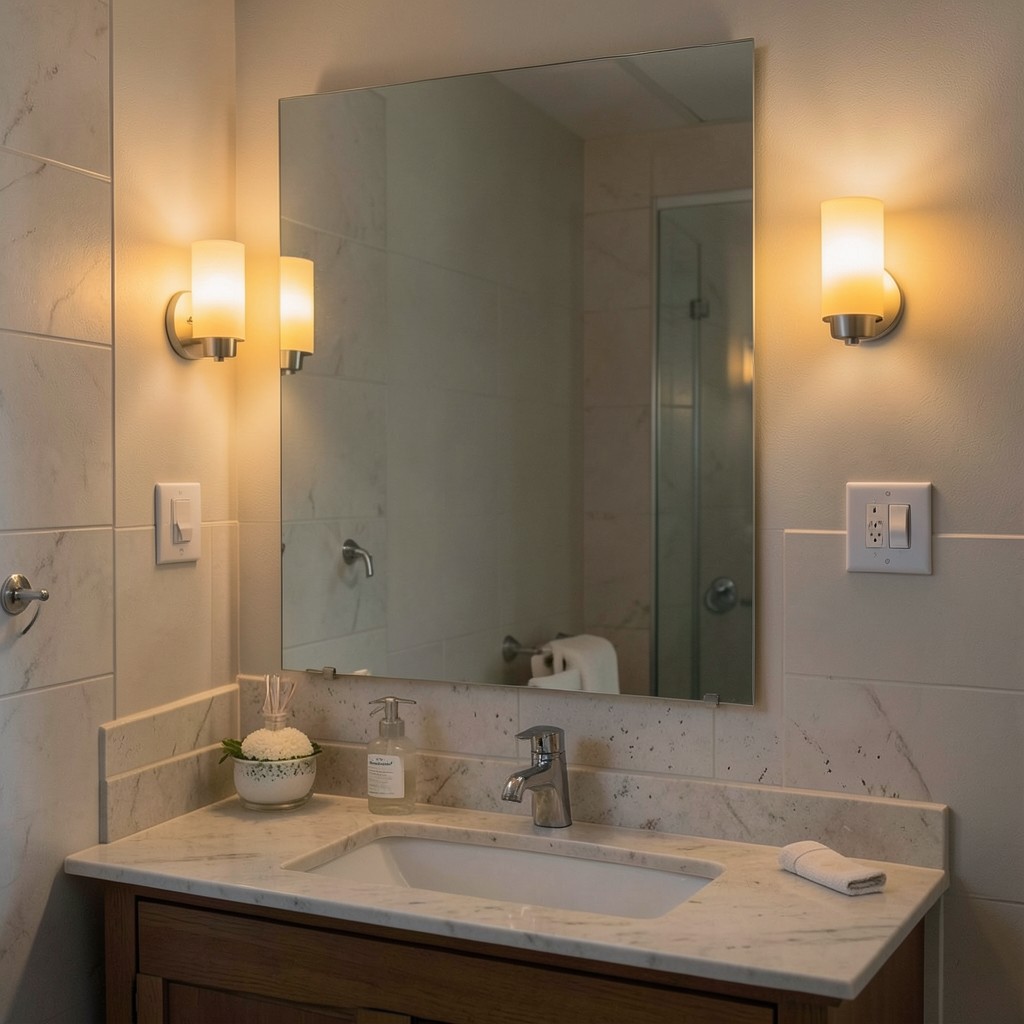
The bathroom used at the end of the day — for the evening routine before sleep — should produce light that supports the transition toward rest rather than interrupting it. Standard bathroom lighting, designed for maximum brightness and color accuracy, actively works against sleep onset because its cool, bright output tells the body that the day is not over. A bathroom with a secondary evening lighting circuit — warm amber wall sconces on a separate switch or dimmer, positioned to provide sufficient light for the evening routine without the full activation of overhead task lighting — removes one of the most consistent obstacles to good sleep that modern households experience.
The evening lighting layer in a bathroom does not need to be complex. Two wall sconces positioned at either side of the mirror, fitted with amber-toned bulbs at 2200K and connected to a dimmer, provide flattering face light at the vanity and warm ambient light across the bathroom simultaneously. The dimmer allows the light level to be lowered toward the end of the routine as the body approaches sleep, and the warm tone prevents the blue light stimulus that delays melatonin production. A simple single-circuit system with one switch and one dimmer does everything required.
The positioning of evening light sconces relative to the mirror is the practical detail that determines their usefulness for the actual tasks performed at the vanity. Sconces mounted at face height on either side of the mirror — roughly sixty-five to seventy centimeters from the floor to the center of the fitting — cast light horizontally across the face without the shadow cast by overhead light striking the brow. That shadow elimination is the quality that makes side-mounted sconces superior to overhead lighting for any task requiring clear face visibility, and in a bathroom where the evening routine involves skincare, the improvement in the quality of the light at that stage is immediately noticeable.
21. A Spa-Inspired Shower Experience
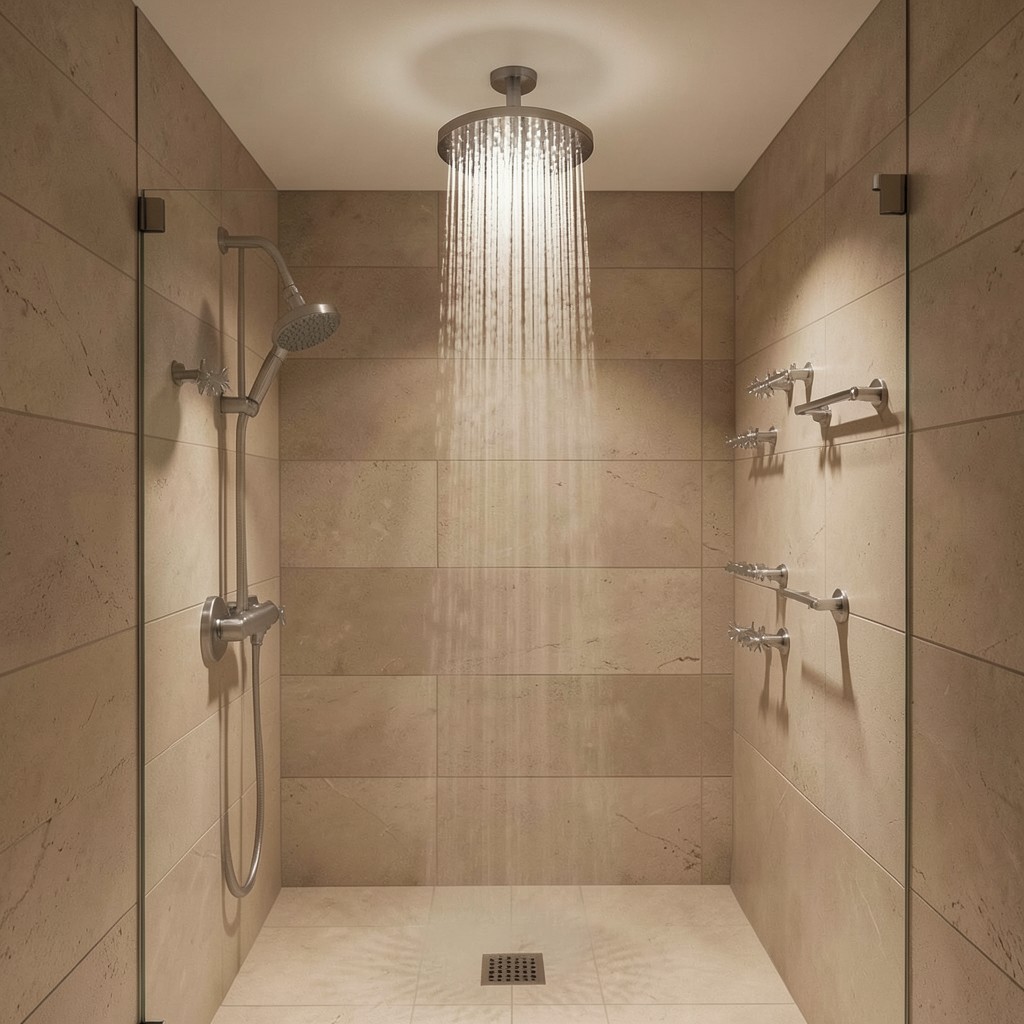
A shower designed around the sensory experience of the water — rather than the minimum requirement of getting clean — produces a bathroom fixture that changes how the room is used and how much time people want to spend in it. The difference between a functional shower and a spa-inspired one is not necessarily expensive or architecturally complex. It is a specific combination of water delivery, enclosure quality, material warmth, and light that together produce an experience the body responds to as genuinely restorative rather than merely cleansing.
The shower head is the primary variable. A rain shower head mounted overhead — positioned directly above the standing position rather than angled from the side — delivers water vertically downward across the full body surface simultaneously, which produces a physical sensation entirely different from a conventional wall-mounted shower head’s directed stream. The sensation of overhead rainfall creates a biological calm that is difficult to engineer through any other bathroom element at comparable cost. Overhead rain shower heads range from simple ceiling-mounted plates to large architectural panels recessed flush with the shower ceiling — the latter requires planning during construction, the former can be added to most existing shower spaces with a ceiling-mounted arm and a standard connection to the existing supply.
Body jets on the side walls — a secondary water system that delivers horizontal jets at multiple heights simultaneously — add a different layer of sensory input alongside the overhead rain. The combination of overhead and lateral water, at separately controlled temperatures, produces a shower experience that requires no further justification beyond the fact that it is one of the most physically pleasurable things you can do in your own home. The plumbing requirement is a dedicated second supply branch with sufficient flow rate to run both systems simultaneously without pressure drop — this is worth specifying with the plumber before the shower is enclosed, because retrofitting body jets into a completed shower requires removing the tiles from the side walls and starting again.
22. A Bathroom With Natural Ventilation
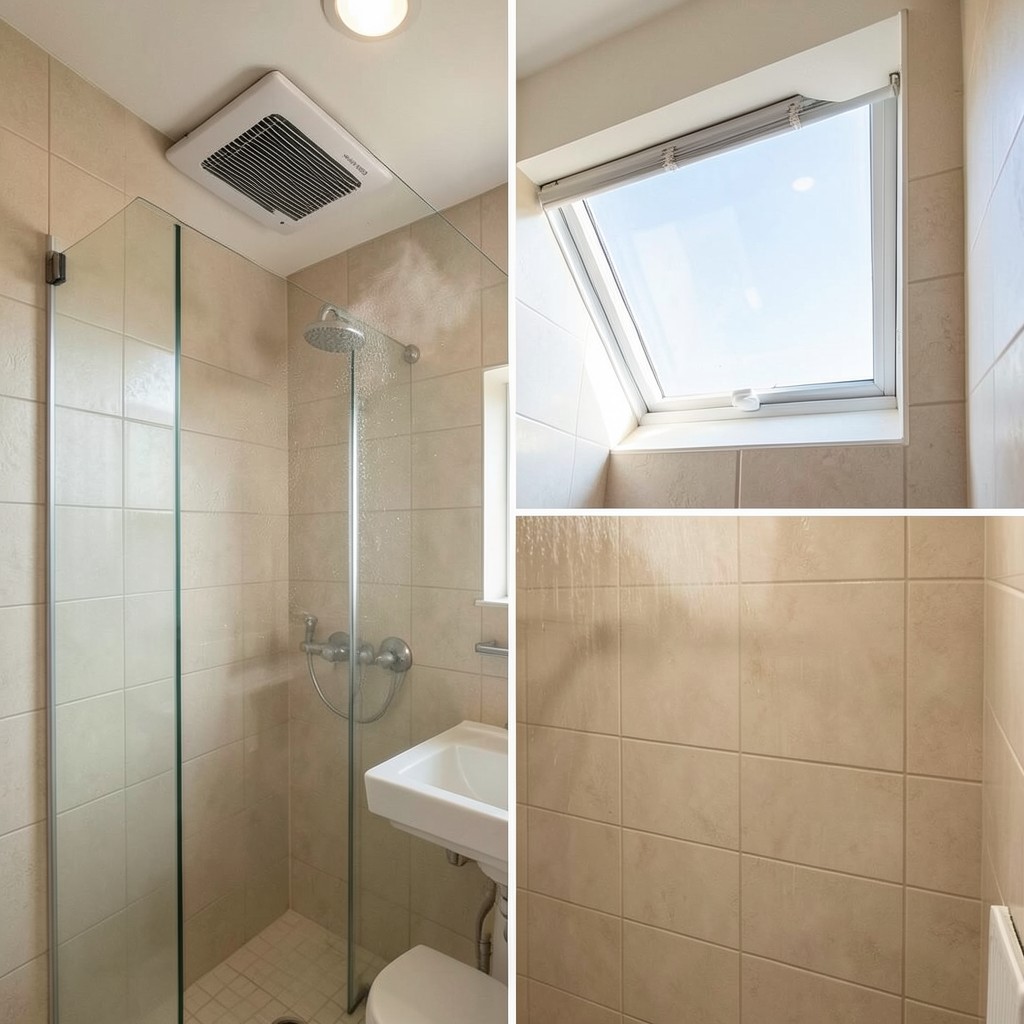
Most bathroom ventilation is mechanical — an extractor fan that removes humid air and is legally required in bathrooms without an openable window. It does its job adequately and unpleasantly: the noise of the fan running throughout a shower or bath is an acoustic intrusion that no one finds enjoyable, and the ventilation it provides, while sufficient, does nothing beyond the minimum required. A bathroom with natural ventilation — a window or openable skylight that allows air movement without mechanical assistance — is a quieter, more pleasant space, particularly in warm weather when the ability to open the bathroom to fresh outside air transforms the post-shower experience entirely.
The openable window requirement for natural bathroom ventilation must balance the light and view benefits of the window position against the privacy demands of the space. A top-hung window that opens inward along its upper edge provides ventilation at ceiling level — where the warmest, most humid air collects — while keeping the opening above the sightline from outside. An obscured glass window that opens wide provides generous air exchange with complete privacy. A clear glass window positioned high on the wall provides both a view of the sky and ventilation, with the wall height providing natural privacy without any glazing treatment.
A bathroom that has both mechanical extraction and natural ventilation is the most functional arrangement. The mechanical system handles the minimum requirement and operates automatically when humidity levels rise. The natural ventilation adds the quality layer — the option to open the room to outside air, to hear the sounds from outside while bathing, to feel a breeze move through the steam after a hot shower. Neither system eliminates the need for the other; they address different aspects of the same requirement, and a bathroom that has both is more comfortable, more practical, and more pleasant to be in than one that relies on either alone.
23. A Bathroom Wall of Mirrors

A wall of mirrors in a bathroom — not a single mirror above the vanity but an entire wall surface covered in mirrored glass from floor to ceiling — doubles the apparent size of the room, doubles every light source, and doubles the visual weight of every surface and object within it. The effect is immediate and dramatic. A bathroom that reads as small and enclosed with flat painted walls reads as spacious and luminous with a mirrored wall, even when nothing else in the room has changed. That spatial gain from a single surface treatment is available in no other finish.
The most effective wall for a mirror installation is the one directly opposite the primary light source — whether that source is a window, a skylight, or the principal artificial lighting position. Positioned there, the mirror captures every photon of light the source produces and reflects it back into the room, which doubles the effective brightness of the space without any additional electrical input. In a bathroom that is naturally dark — with limited window area or a problematic orientation — a floor-to-ceiling mirror on the wall opposite the window delivers more additional light than doubling the window size would, at a fraction of the cost.
The one risk of a full mirror wall in a bathroom is that it multiplies everything in the room, including anything that is not part of the designed environment — clutter, open storage, an untidy vanity surface. A mirror wall requires the bathroom to be maintained at a higher standard of tidiness than a painted wall because everything the mirror reflects is visible in double. That is not an argument against the idea; it is an argument for ensuring the bathroom has adequate concealed storage before the mirror wall goes in. The mirror is ruthlessly honest about the room it occupies, and the room needs to be honest enough in return to stand up to that reflection.
24. A Bathroom With Decorative Ceiling
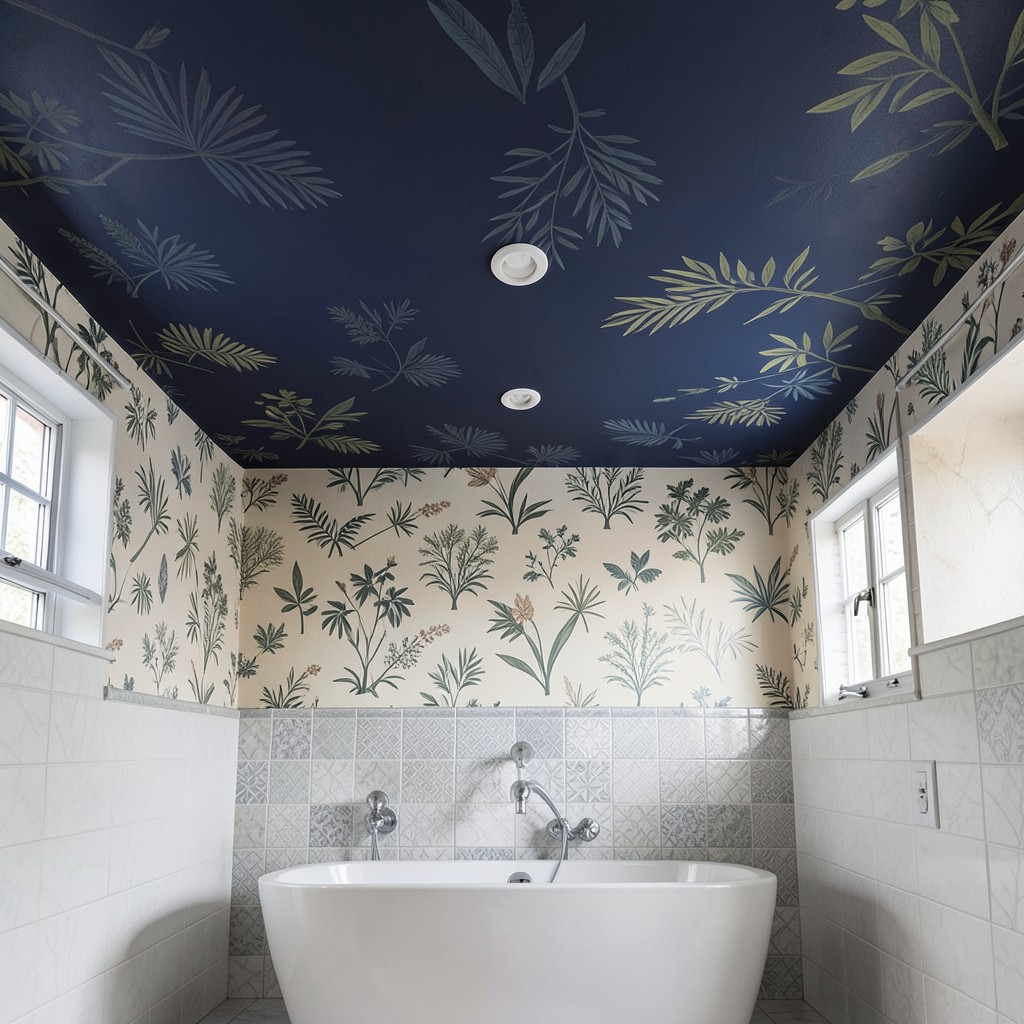
The bathroom ceiling receives less design attention than any other surface, and the reason is simple: people assume nobody looks up in a bathroom. Anyone who has ever soaked in a bathtub for twenty minutes knows this is exactly wrong. The ceiling is the primary view from the bath, and a ceiling that does something — a pattern, a material, a color, a texture, an architectural detail — transforms the bathing experience in a way that the most beautifully tiled floor and wall combination cannot, because the bathing position faces upward rather than outward.
A painted ceiling in a deep, saturated tone — the bathroom’s wall color extended upward but intensified — produces an enveloping quality that makes the bath feel like a room within a room. The effect is similar to the experience of lying under a richly colored canopy: the color overhead creates a sense of containment and intimacy that a white ceiling maintains the functional expectation of a bathroom rather than the experiential quality of a retreat. Even a single tone of the wall color deepened by fifty percent on the ceiling delivers this effect without any additional complexity.
Wallpaper on a bathroom ceiling — in a damp-resistant paper appropriate for higher humidity environments — introduces pattern and visual interest directly into the bather’s field of view. A botanical print above a freestanding bath, or a geometric pattern in a palette that draws from the bathroom’s tile colors, creates a ceiling that rewards extended looking without demanding constant attention. The moisture-resistant specification is non-negotiable in a bathroom with a bath or shower — standard papers will bubble and peel within months in the moisture conditions that even a well-ventilated bathroom produces at ceiling level.
25. A Japanese-Inspired Soaking Tub

A Japanese soaking tub — a deep, upright vessel designed for immersion to the shoulders rather than the reclining position of a Western bath — produces a bathing experience that is fundamentally different from conventional bathing. The depth of immersion in a soaking tub — typically forty to forty-five inches of interior depth — means the body is submerged in hot water to the shoulders when seated on the tub’s interior step or seat. The temperature and the full-body contact of the water at that depth produces a physical relaxation that a shallow reclining bath cannot match. It is a different activity, not a different version of the same one.
The traditional material for a Japanese soaking tub is hinoki cypress wood — a naturally moisture-resistant Japanese wood with a distinctive warm fragrance that releases when the wood is wetted. Hinoki tubs are the most authentic and most fragrant version of the form, and their scent — a clean, resinous woody note — becomes part of the bathing experience in a way that ceramic and acrylic tubs cannot replicate through any finish or additive. The maintenance requirement is real: hinoki must be kept wet or dry consistently, never allowed to cycle between wet and dry repeatedly within short periods, as this cycling causes the wood to crack. For those willing to manage the material correctly, the experience it provides is unmatched.
Contemporary versions of the soaking tub format in stone composite, cast iron, and acrylic deliver the same depth of immersion and the same physical benefits without the material maintenance demands of traditional wood. A deep stone composite soaking tub in an organic shape sits well in bathrooms where the tub must serve as both functional bathing vessel and design centerpiece. The warmth retention of stone composite is significantly better than acrylic — the walls of the tub hold heat longer, which means a bath stays at bathing temperature for an extended period without continuous hot water addition. For a soaking tub intended for long-duration immersion, thermal mass is a practical specification worth prioritizing.
26. A Bathroom With Exposed Copper Plumbing
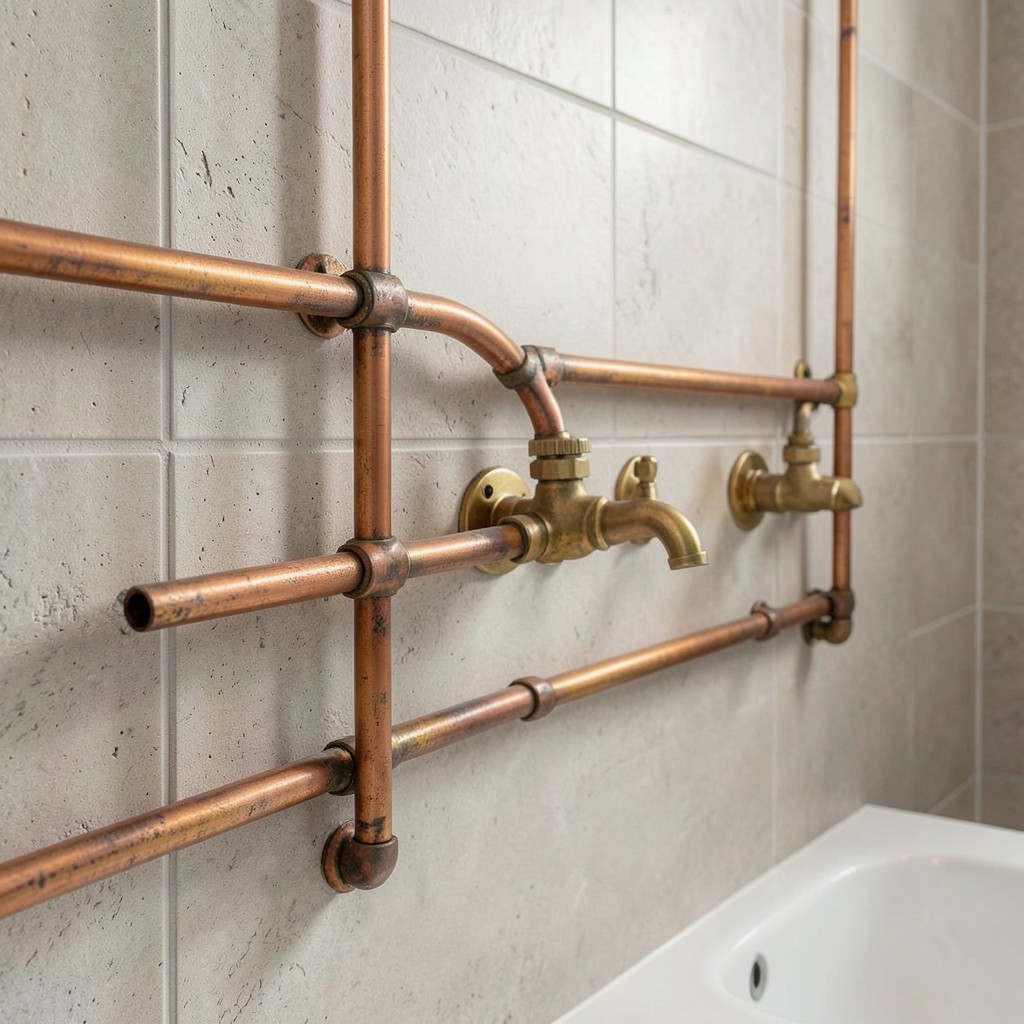
Exposing the supply and waste plumbing in a bathroom — running the copper pipes on the surface of the wall rather than concealing them inside it — introduces an industrial warmth that most contemporary bathrooms cannot produce through any decorative means. Copper ages. It develops a patina over time that shifts from bright orange-gold to a deeper, more complex tone as the surface oxidizes naturally in the air and the moisture of the bathroom environment. That aging is a feature, not a maintenance failure, and a bathroom with exposed copper plumbing becomes more beautiful over time rather than staying the same.
The visual composition of exposed plumbing requires thinking about the pipe runs as design elements rather than purely functional conduits. Pipe runs that travel in clean horizontal and vertical lines — never diagonal, never irregular — read as intentional rather than improvised. Chrome or brass fittings at the connections — stop valves, elbow joints, unions — add moments of reflective detail along the run. Where the pipe terminates at the tap fitting, the connection between the copper supply pipe and the brass tap body produces a warm material transition that polished chrome tap tails against chrome supply pipes never achieve. The whole plumbing assembly, when arranged carefully, reads as a piece of engineering that deserves to be seen.
The practical requirement of exposed plumbing is that it is accessible for maintenance without requiring wall surgery. Any joint or fitting that might need attention in the life of the building is visible and reachable, which is actually a maintenance advantage over concealed plumbing where a leaking joint behind a tiled wall requires cutting into the surface before any repair can begin. That accessibility is the counterintuitive practical argument for exposed plumbing — what looks like a style choice is also the most maintainable plumbing arrangement in a bathroom.
27. A Bathroom With a Built-In Bench
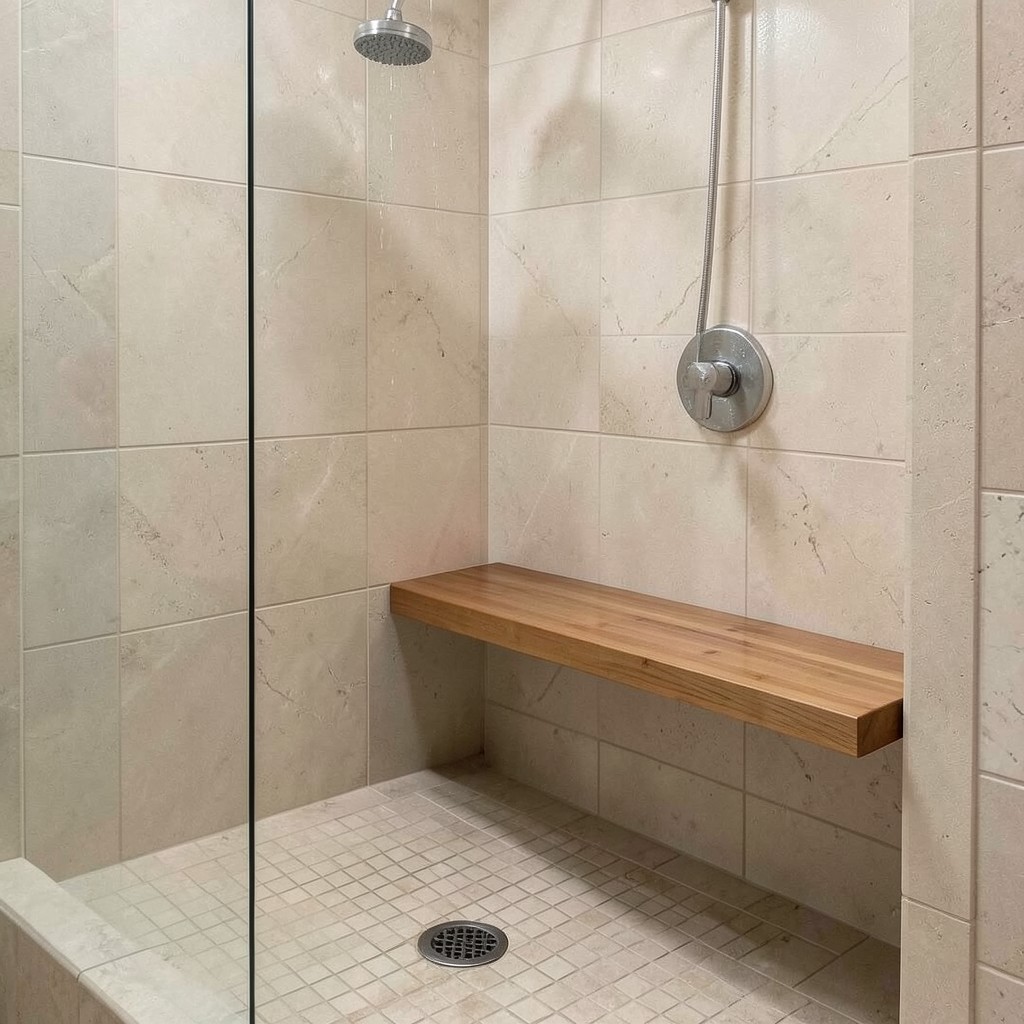
A bench built into the shower zone — or positioned beside the bath in a larger bathroom — is a detail that most standard bathroom layouts do not include and most people who have experienced it cannot imagine doing without afterward. The shower bench provides a seating option during the shower, a surface for shaving legs, a place to set products without bending to a floor shelf, and — for older household members or anyone recovering from illness or injury — a safety feature that makes the bathroom considerably more usable. No other single addition to a shower provides comparable functional range.
The material of a built-in shower bench must handle the same wet, humid conditions as the surrounding shower structure. Tiled bench tops that continue the shower’s floor or wall tile across the horizontal surface are the most integrated option — the bench reads as part of the shower’s architecture rather than an addition to it. Teak or other moisture-resistant timber on the bench top introduces a warm material contrast against the surrounding tile and provides a surface that is warm to the touch rather than the cold contact of tile. Solid stone slabs — a single piece of marble or granite forming the bench top — produce the most refined version and suits bathrooms where stone is the primary surface material throughout.
The bench height and depth determine its usability. A bench height of eighteen to twenty inches from the shower floor places the seating at a comfortable position for an adult without making the bench awkward to step over when moving past it. A depth of sixteen to eighteen inches provides enough seating surface to be comfortable without projecting so far into the shower that it reduces the standing space meaningfully. Positioning the bench along the back wall of the shower — the wall opposite the shower head — keeps it within the wet zone while out of the primary standing position, which is the arrangement that makes both the bench and the standing shower area simultaneously functional.
28. An All-White Bathroom Done With Texture
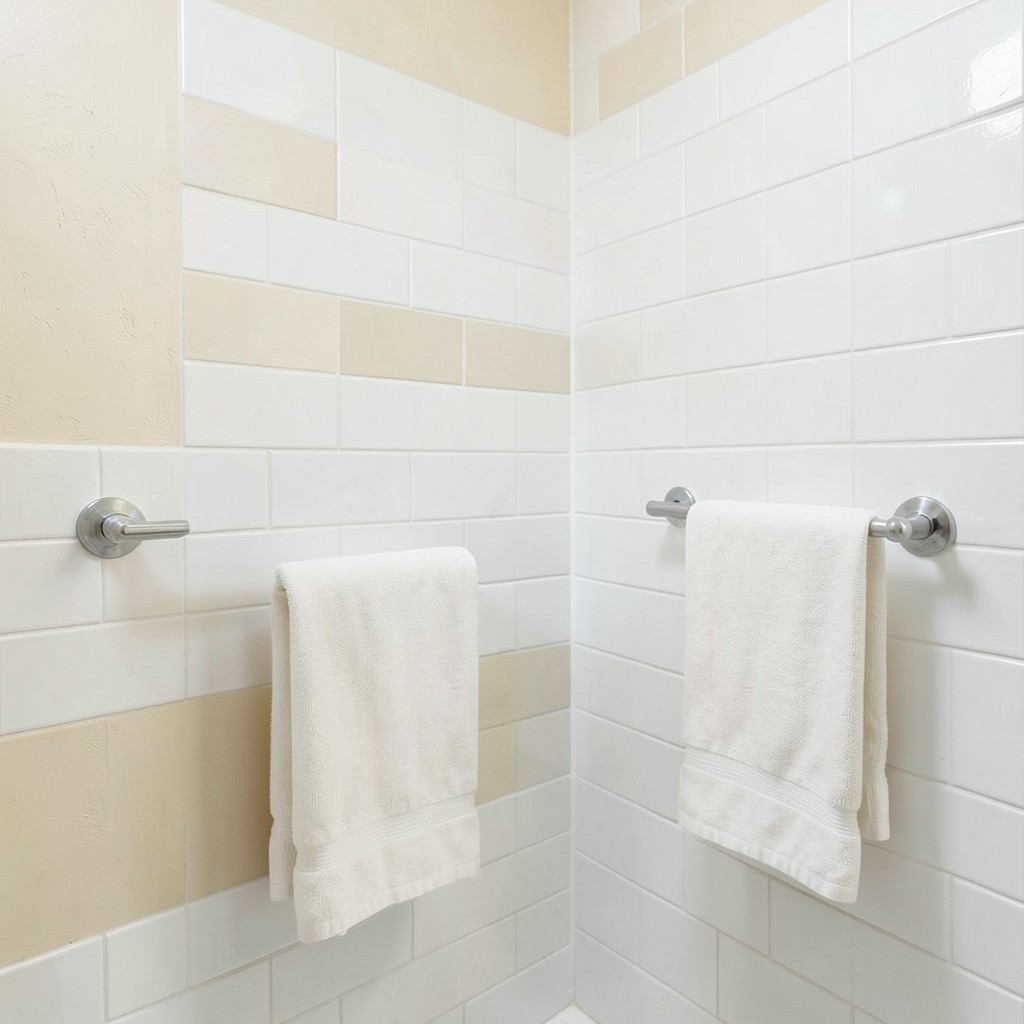
The all-white bathroom done well is one of the most difficult design achievements in a residential space. The failure mode is universal and almost predictable: a single flat tone of white across every surface produces a room that reads as blank rather than serene, institutional rather than considered. The version that actually works does not have one white — it has eight, and each of them earns its position in the room through a different surface quality that creates depth, warmth, and visual interest without introducing a single contrasting color.
Texture is the entire game in an all-white bathroom. A handmade ceramic tile with a slightly irregular surface and a warm ivory glaze reads as a completely different white from the smooth bright porcelain beside it. Limewash plaster on a wall section carries a tonal variation across its surface that makes it read as three-dimensional rather than flat. A linen bath towel hanging on a polished rail catches the light across its woven texture and produces shadows in its folds that break the white into something alive. None of these are the same white, and the differences between them are what makes the room feel designed rather than simply unpainted.
Grout color is the detail that most white bathroom renovations get wrong. White tile with white grout produces a surface where the tile joints disappear — which sounds correct but often produces a result that reads as seamless in photographs and oddly blank in person, because the eye has no point of reference for the scale of the tile or the rhythm of the pattern. A warm putty or pale grey grout in a white tile bathroom introduces enough contrast to reveal the tile’s geometry without breaking the palette. That small distinction between the tile and the joint is the detail that prevents an all-white bathroom from reading as a single unbroken, featureless surface.
29. A Bathroom With a Vintage Vanity
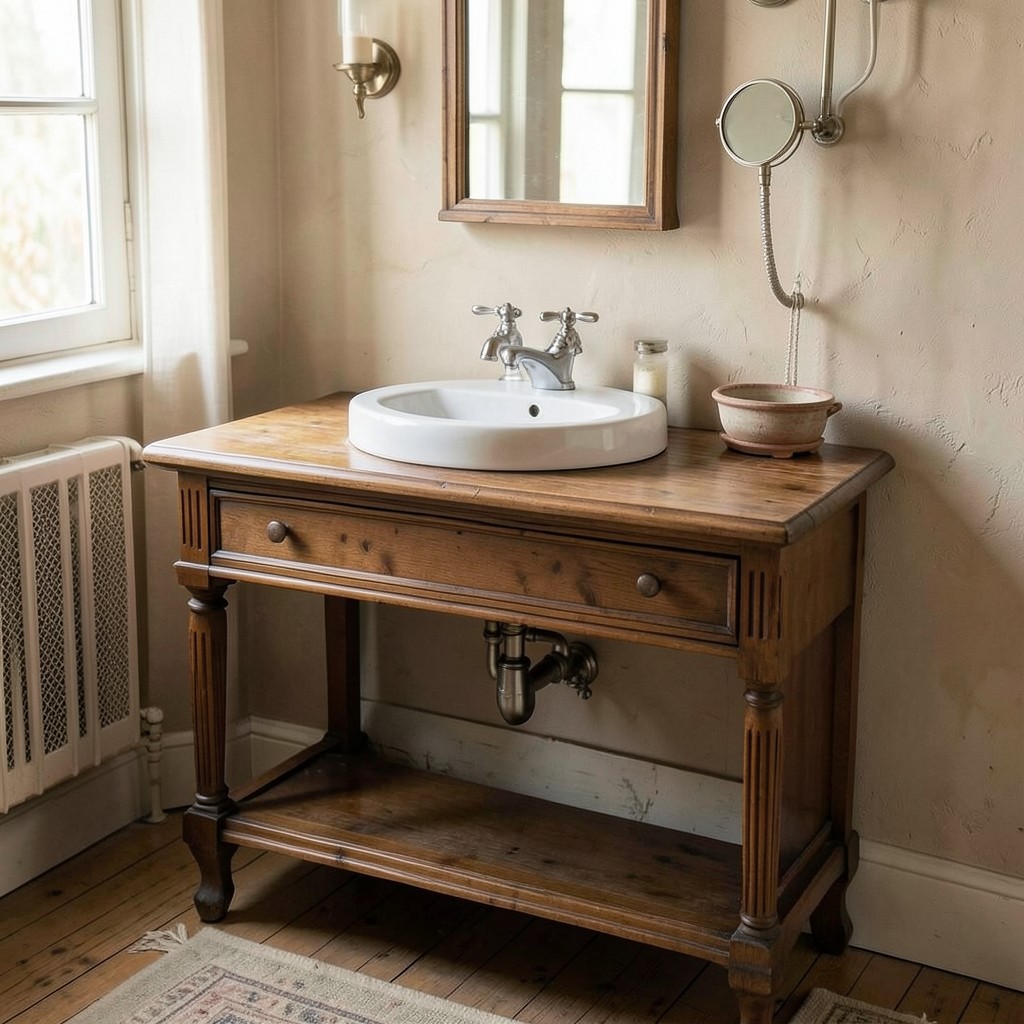
A vintage piece of furniture repurposed as a bathroom vanity — an antique dresser with the top replaced by a basin, an old pharmacy cabinet retrofitted with plumbing, a painted wooden console with a vessel sink placed on top — introduces a material warmth and individual character that purpose-built bathroom vanity units cannot replicate regardless of their quality. The furniture piece carries its own history. Its proportions were not designed for bathroom conventions, which means they often produce a vanity at an unexpected scale or height that reads as genuinely distinctive rather than compliant with the format.
The conversion of a furniture piece to a bathroom vanity requires specific modifications that must be planned before the piece is installed. The top surface needs waterproofing — either replaced with a stone slab, a solid surface material, or sealed thoroughly if the original timber top is being retained. The plumbing supply and waste lines must route through the furniture body, which requires drilling or cutting that respects the structural elements of the original piece without compromising its integrity. A plumber experienced in furniture vanity conversions handles this routinely — the most important step is measuring the existing furniture and the proposed sink before any hole is cut, because a mistake at that stage is irreversible.
The basin selection for a vintage vanity conversion determines the result’s visual quality more than any other single decision. A vessel basin — one that sits on top of the vanity surface rather than dropping into it — requires no counter cutting and produces the clearest visual separation between the antique furniture and the modern sanitary ware. The contrast between a period dresser and a contemporary ceramic vessel basin reads as considered and composed rather than inconsistent, because the gap between the two things is large enough to read as intentional. A semi-recessed or inset basin requires cutting into the surface and suits vintage pieces with thick timber tops that can accept the cut without structural compromise.
30. A Bathroom With Smart Storage Solutions
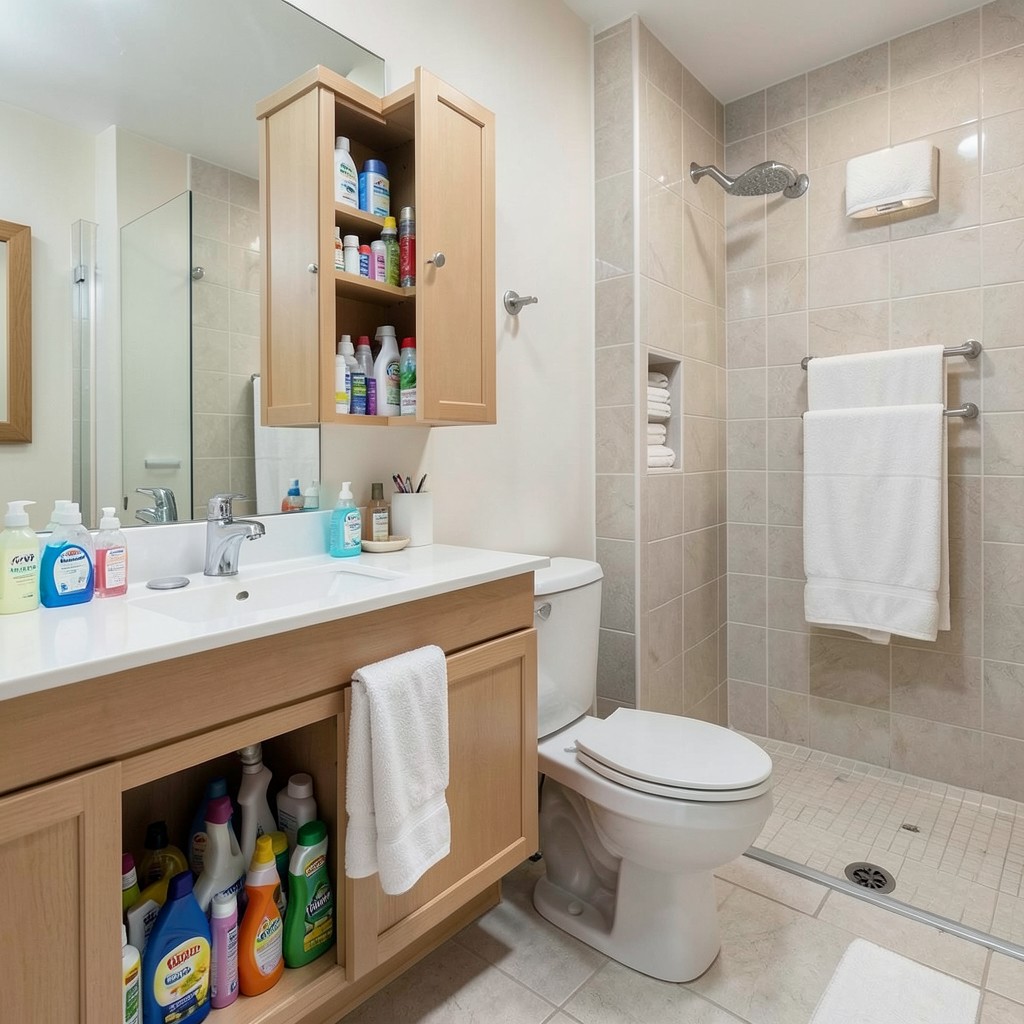
The bathroom is the room where storage failure is most immediately visible and most consistently designed around rather than designed for. Cabinet under the basin stuffed with cleaning products. A medicine cabinet that cannot close properly because too much has been pushed inside it. Towels folded over the toilet cistern because the towel rail only holds two and the household produces six. These are not housekeeping failures — they are design failures, and solving them requires thinking about storage before specifying fixtures, not after.
The most effective bathroom storage works at the point of use. Medicine and daily toiletries belong at the mirror — in a cabinet concealed behind a mirrored door, which serves both the mirror and the storage function simultaneously and takes up no additional space. A mirror cabinet that spans the full width of the vanity, from wall to wall or from tile line to tile line, provides significantly more storage than a single standard-sized medicine cabinet while producing a clean, uninterrupted mirror surface for the vanity area. That combination — maximum storage at the vanity, delivered behind a seamless mirror surface — is the storage solution that most bathrooms need and few have.
Towel storage is the category most bathrooms handle worst. A single towel rail holds the towels that are currently in use, but has no capacity for fresh towels waiting to replace them. A built-in niche beside the shower — sized for folded towel stacks — keeps fresh towels at arm’s reach from the shower without requiring a trip to the linen closet. A ladder rail with five or six rungs provides significantly more hanging capacity than a standard double rail in the same wall footprint. Neither solution is expensive or complex to install. Both solve a problem that the standard bathroom layout creates through years of ignoring how many towels a functioning household actually uses each day.
31. A Freestanding Shower Column
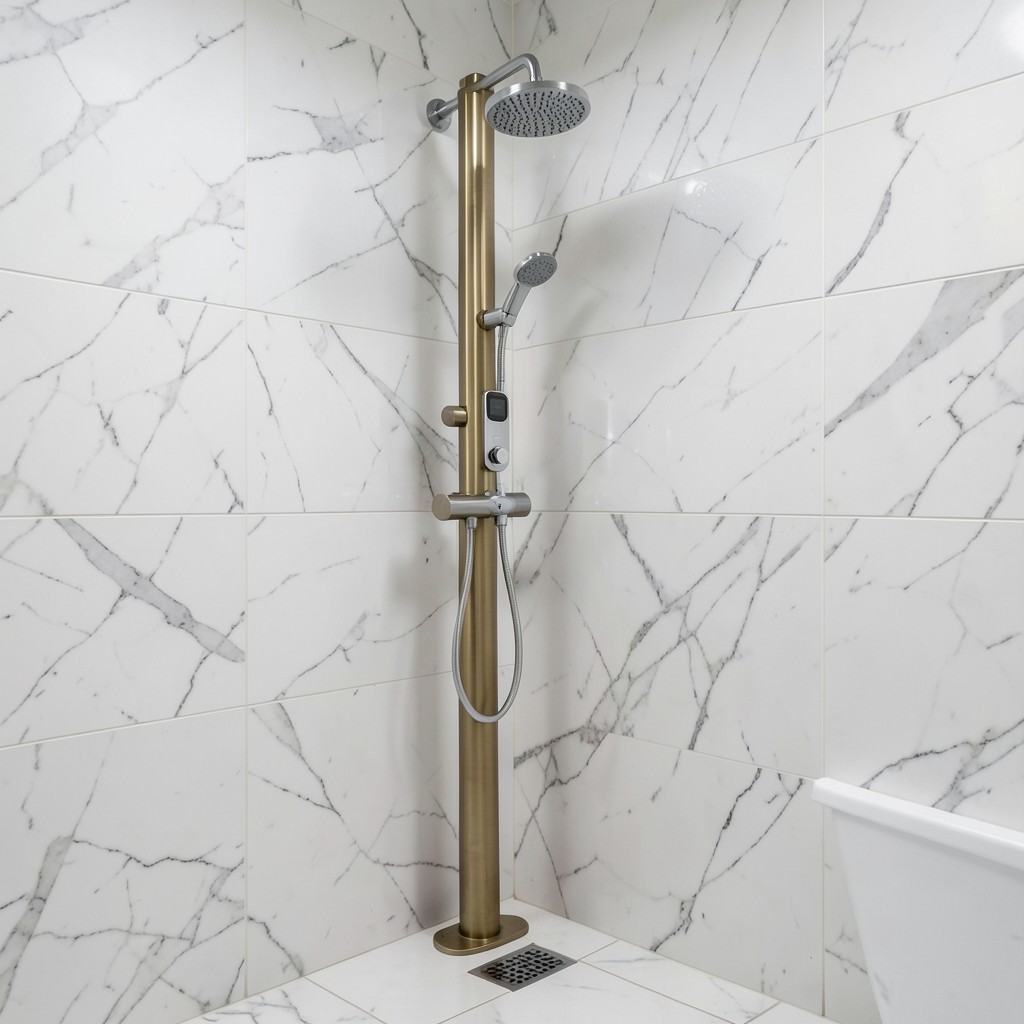
A freestanding shower column — a floor-and-ceiling mounted column that delivers water from multiple points simultaneously and requires no wall penetration for its plumbing — is the shower solution for bathrooms where the walls cannot be opened. The column connects to the water supply and waste at floor level, which means the existing floor requires access at the connection point but the walls remain untouched. For renovations where the tile is staying, where the wall structure is not openable, or where the bathroom is in a listed building with restrictions on structural modification, a shower column provides a full shower experience within those constraints.
The design of a modern shower column extends beyond plumbing functionality. Columns in polished chrome, brushed brass, or matte black finish with integrated digital controls, overhead rain heads, and body jets read as pieces of bathroom furniture — objects with genuine visual presence that contribute to the room’s design rather than merely serving its plumbing needs. A brushed brass column against white marble tile produces a material contrast that reads as refined and intentional. The column sits between the fittings of a conventional shower and a freestanding bath in its design authority — a piece you notice and assess rather than one that disappears into the background.
The water pressure requirement for a multi-outlet shower column is higher than for a standard shower head, because the column is typically running an overhead rain function and body jets simultaneously. Low-pressure water systems — common in older residential buildings without pressurized hot water — may not deliver sufficient flow to run all functions at once without a pressure drop that reduces the experience to something disappointing. A shower pump installed on the supply line resolves this, but adds to the installation scope and cost. Confirm the system pressure before specifying a multi-function column, because a shower designed around high flow and then limited by inadequate pressure is one of the more frustrating bathroom equipment mismatches to live with.
32. A Bathroom With a Painted Ceiling Color
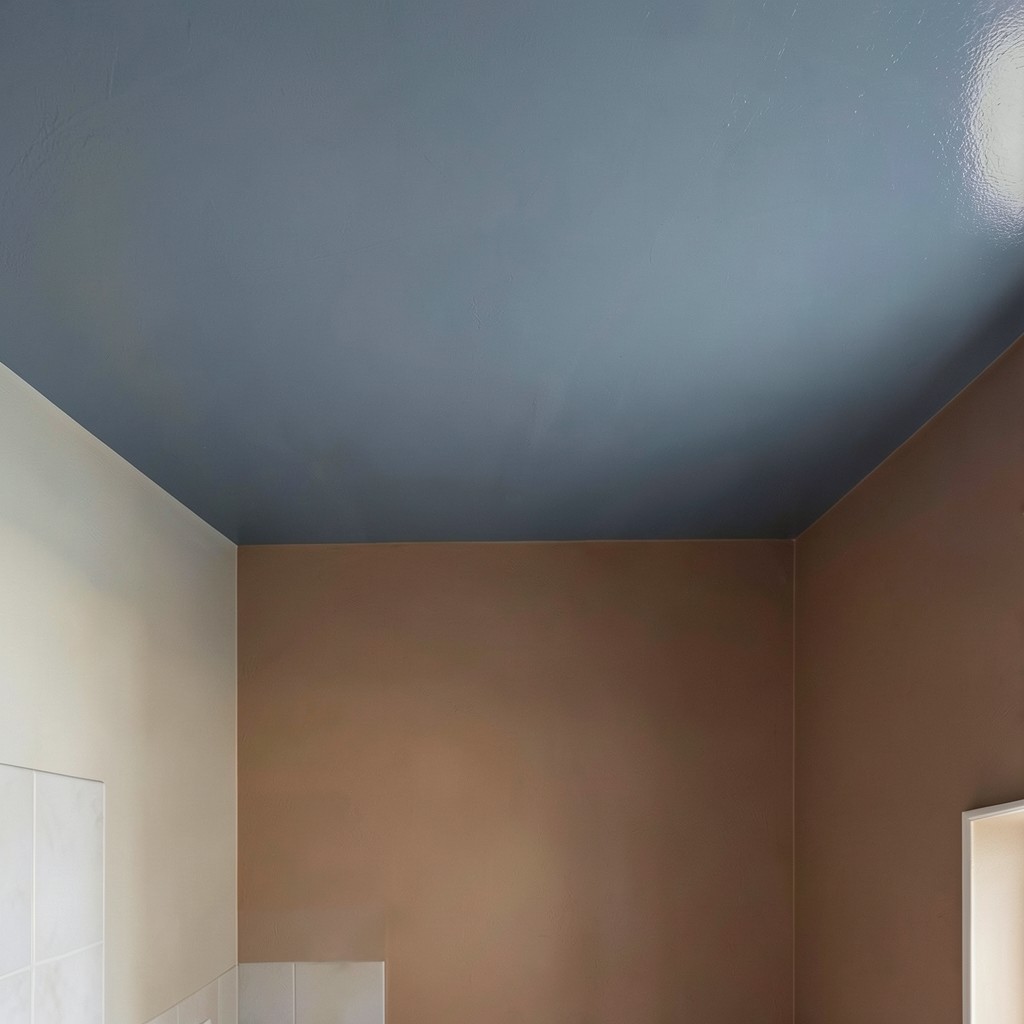
A colored ceiling in a bathroom is the design decision that costs almost nothing and changes the room’s character more dramatically than most renovations that cost significantly more. The ceiling is the surface the body faces when lying in the bath — the view that occupies the mind during the twenty minutes of genuine rest that a bath provides — and a ceiling painted in a considered, intentional color turns that overhead surface from a blank overhead into something that holds the room together from the top down.
The color choice follows a specific logic in a bathroom. Colors that work on a bathroom ceiling are almost always darker than the wall color below them — not dramatically, but enough to create a visual weight overhead that makes the room feel contained and intentional rather than open and undirected. A bathroom with pale grey walls benefits from a ceiling in a deeper grey-blue that creates the sense of a sky above the room, compressed enough to feel present rather than infinite. Warm putty walls support a ceiling in a warm terracotta or a mushroom brown that deepens the palette without introducing a contrasting tone. The ceiling and wall colors should be from the same color family — simply different in depth — and the ceiling should always read as heavier than the walls below it.
Sheen level on a ceiling paint matters more in a bathroom than in any other room because the surface is visible in such close-range, oblique lighting conditions. A high-sheen paint on a ceiling reveals every irregularity in the plaster surface — roller marks, skim-coat variations, the rings of any previous paint layers showing through — because the reflective surface catches light at angles that expose those variations. A flat or very low-sheen ceiling paint forgives surface imperfections and reads as a more even, considered surface. In a bathroom where the ceiling may not be in perfect condition, a flat paint in the right color will always outperform a gloss in a technically better color.
33. A Bathroom With Arched Details
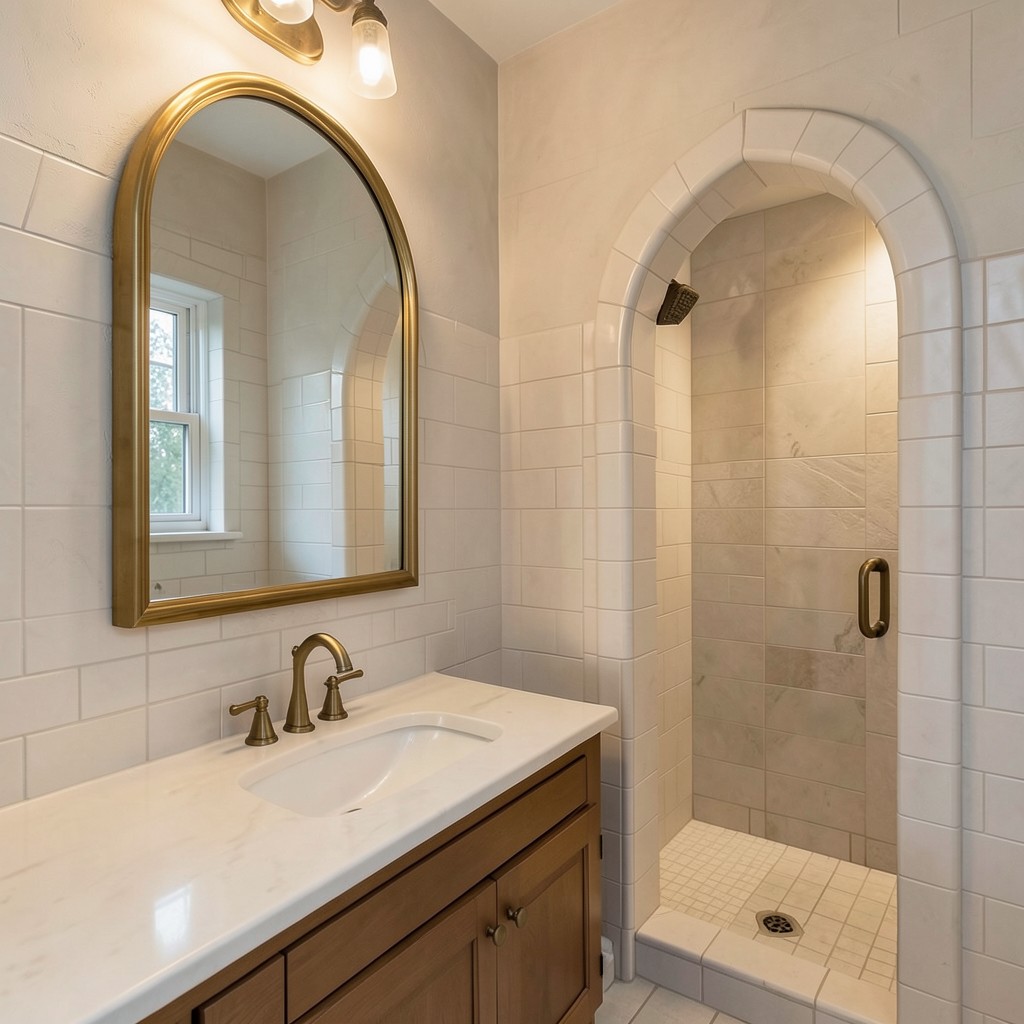
An arch introduced into a bathroom — in the mirror shape, the shower opening, the window form, the niche profile, or the cabinet doorway — changes the room’s geometric register from entirely rectilinear to something softer and more considered. The arch does not fight the horizontal and vertical lines of the tile grid and the fixture layout; it provides relief from them, a moment where the room’s geometry curves rather than cuts, and that moment of softness reads as warmth in a space that standard bathroom materials and proportions tend toward coolness.
The arched mirror is the most accessible entry point for this idea in a bathroom renovation where no structural changes are possible. A large arched mirror above the vanity — wide enough to span the basin and the adjacent counter area, tall enough to require the arch’s height to justify its proportion — reads as the room’s primary architectural gesture. The arch of the mirror references the arch forms of traditional architecture, and in a bathroom with plain subway tile and standard fixtures, it elevates the whole room’s character without requiring any other change. The mirror’s frame material determines the direction — a plaster frame with the arch built into the surround reads as more organic and artisanal, a brass metal frame reads as more refined and tailored.
A full arched shower opening — where the entrance to the shower enclosure is framed by an arched tile border rather than a straight header — is the most architecturally committed version of the idea and the one that produces the most dramatic effect. The arch frames the shower as an alcove rather than a mechanical enclosure, and the resulting impression is of a room within a room — a shower designed like a bathing grotto rather than a functional box. The tile installation around an arched opening requires careful planning because the arch cuts across the tile grid at an angle, and managing the tile cuts at the arch’s curve to produce a clean, consistent reveal requires a skilled tiler who has executed the detail before.
34. A Bathroom With Woven Baskets and Natural Accessories

Woven baskets, natural fibre accessories, unglazed ceramics, wooden bath accessories, and rattan storage pieces in a bathroom introduce the kind of organic, warm material quality that hard surfaces alone cannot produce. A bathroom furnished entirely with tile, stone, glass, and ceramic fixtures is a room without warmth at the accessory level — the hard, reflective, precision surfaces that make it functional simultaneously make it cold. Woven and natural accessories are the material layer that addresses that coldness without changing any of the functional surfaces beneath them.
The specific function of woven baskets in a bathroom is storage that reads as intentional rather than functional. A basket under the vanity — positioned where an open shelf or a cabinet gap exists — holds spare toilet paper, extra towels, or bathroom products without the contents being fully visible. The woven surface reads as a designed element rather than a container, and the organic form breaks the rectilinear geometry of the cabinet and floor tile with a shape that has no corners and no uniform surface. A tall woven basket in a corner for towels or laundry does the same job as a plastic hamper or a chrome pedal bin while reading as an object the room chose rather than an object the room merely tolerates.
Material quality in bathroom natural accessories matters more than it does in most other rooms because the environment tests them constantly. Cheap rattan deteriorates in humidity. Thin-walled wooden accessories warp with regular wet-dry cycling. Natural fibre baskets that are not properly finished will develop mold in the damp corners of a regularly used bathroom. Choosing accessories in materials rated for the conditions — sealed wood, quality rattan, tightly woven sea grass — is what separates a bathroom that maintains its character over years from one that starts looking tired within months of being styled.
35. A Bathroom With Vertical Garden Wall Panels

A modular garden panel system installed on a bathroom wall — pre-planted panels of tropical and humidity-tolerant species that attach to a waterproofed wall backing — delivers the visual impact of a full plant wall with significantly less installation complexity than a custom-built system. The panels arrive pre-planted, with the plant root systems already established in their felt or foam substrate. Installation is a matter of mounting the backing system to the wall and attaching the panels to it — a process that most competent DIYers can complete in a day once the wall waterproofing is confirmed.
The species selection within the panels determines the maintenance requirement and the visual character of the installation. Shade-tolerant tropical foliage plants — pothos, philodendron, ferns, and peace lilies — handle the low natural light and high humidity of most bathrooms without the stress response that would affect the same plants in a drier, brighter environment. These species grow slowly in bathroom conditions, which means the panels maintain their initial appearance for longer without requiring frequent trimming or replanting. Faster-growing species add lushness more quickly but require more active management to prevent them from overgrowing the panel boundaries and encroaching on adjacent surfaces.
The backing system must be completely isolated from the wall structure by a moisture barrier that prevents any water from the plant irrigation or natural moisture uptake from reaching the wall substrate behind it. Even in a bathroom with solid masonry walls, prolonged moisture contact with the backing material can lead to the kind of slow, invisible damage that only reveals itself when renovation uncovers the wall surface years later. A properly installed garden panel system with a fully waterproofed backing board and a drainage channel at the base of the installation prevents this completely — the waterproofing step is not optional and should be treated as the most important part of the installation regardless of the wall substrate behind it.
36. A Bathroom With a Built-In Bathtub Surround
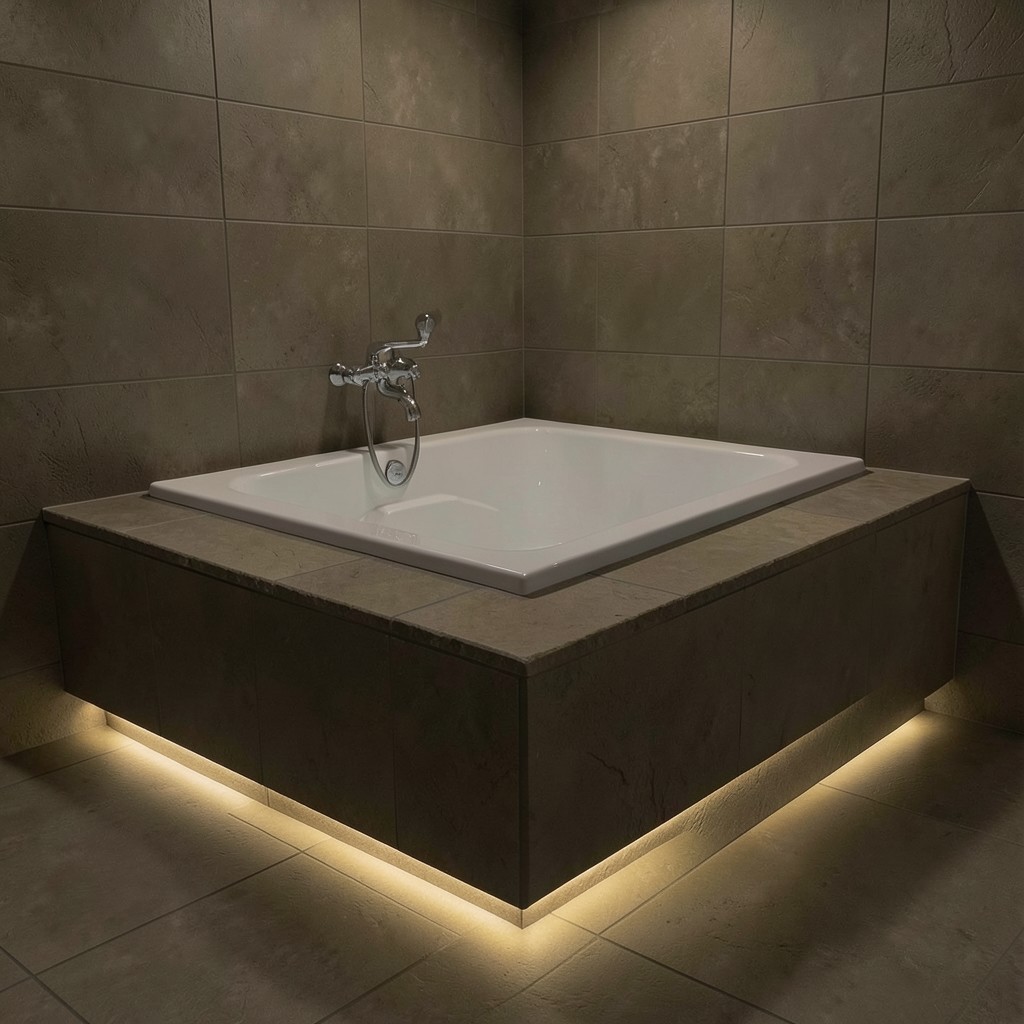
A built-in bathtub — one that is enclosed on three sides by a tiled surround, a plinth, or a structural deck — produces a bathing installation that reads as architecture rather than plumbing. The tub becomes part of the room’s bones, connected to the floor and walls by continuous material surfaces that make it feel as though it was always there. That quality of permanence and integration is the defining characteristic of a built-in surround, and it is the quality that distinguishes a bathroom that was designed from one that was merely fitted.
The tiled deck of a built-in bath — the horizontal surface that extends around the bath rim — is the detail that offers the most design flexibility within the format. A deck tiled in the same material as the surrounding walls produces the most continuous, monolithic result — the bath appears to emerge from the tiled room rather than sitting within it. A deck in a contrasting material — a stone slab in a tile-walled bathroom, or a timber surface in a stone bathroom — produces a material accent at exactly the point where the body makes contact with the bath surround. That material decision at the deck level carries more sensory significance than most design decisions because it is the surface the hand rests on when lowering into or rising from the bath.
The plinth beneath the bath tub — the section of tiled structure that elevates the bath above the floor level — is a design element most built-in bath installations treat as a purely structural necessity. Treated differently, it is an opportunity. A plinth that steps out from the bath perimeter at an angle rather than straight-sided produces a wider footprint at the base that reads as more grounded and substantial. A recessed LED strip at the base of the plinth — producing a floating light effect beneath the bath — turns the bathing structure into a nighttime feature that changes the bathroom’s evening character without requiring any additional design work.
37. A Bathroom With Herringbone Floor Tile
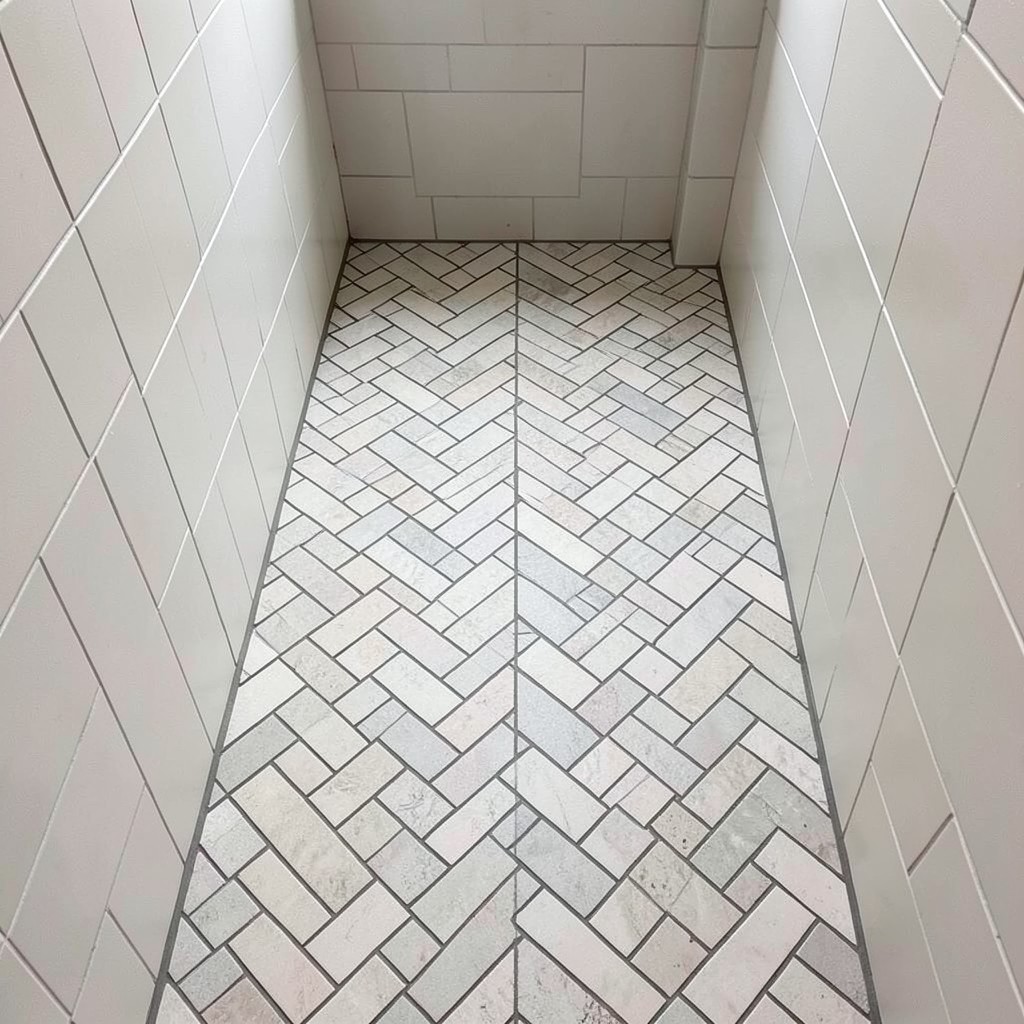
A herringbone tile pattern on a bathroom floor takes the same tile that would read as standard in a running bond or grid arrangement and produces a surface with movement, direction, and visual interest that the rectilinear alternatives do not generate. The diagonal orientation of the tiles creates implied lines running across the floor at forty-five degrees to the room’s walls — and those diagonal lines make the room appear wider in the direction the herringbone pattern runs. In a narrow bathroom where the long axis is significantly longer than the short, running the herringbone pattern across the short axis produces a floor that corrects the room’s proportion perceptually without any structural change.
Small format tiles — two-by-four inch brick-format tiles or three-by-six subway tiles — produce a fine-grained herringbone that reads almost as texture from standing height and reveals its pattern clearly when viewed from above. The scale of the pattern at this size reads as precise and detailed, which suits bathrooms with a traditional or artisanal design direction. Larger format herringbone — tiles at four by eight inches or six by twelve inches — produces a bolder, more graphic pattern where the individual tiles and their diagonal orientation are clearly visible from any position in the room. The larger format reads as more contemporary and suits bathrooms with clean, minimal fixture selections.
The grout joint in a herringbone bathroom floor has a visual consequence that flat tile patterns do not share. Because the herringbone’s diagonal lines run in two opposing directions across the floor simultaneously, the grout joints create a dense, crossed network of lines that reads as more complex than the grout pattern of a standard running bond. A grout color that is close to the tile tone — not matching exactly, but within the same tonal family — reads as a textured surface rather than a grid. A strongly contrasting grout produces a floor that is graphic and bold. Both are legitimate, but the bold version requires confidence in the room’s overall design direction and a tile choice that can carry that level of visual energy without the floor reading as the only thing happening in the room.
38. A Bathroom With a Hammam-Inspired Design
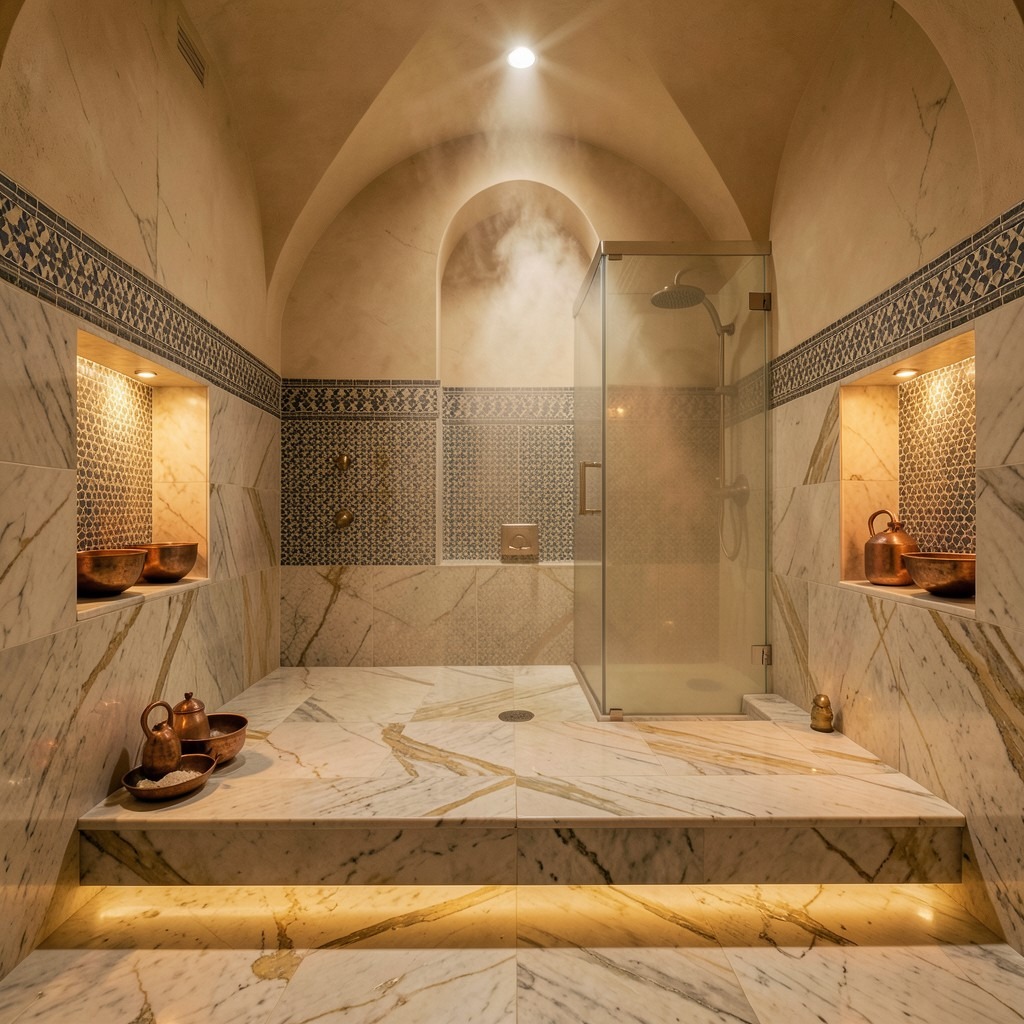
A hammam — the traditional Turkish bath — offers a design language for the bathroom that is entirely different from the Western spa tradition. Where the spa bathroom is about softness, whiteness, and organic minimalism, the hammam bathroom is about warmth, weight, and material richness. Marble throughout — on the floor, the walls, the central raised bathing platform if the space allows — hot steam, arched ceilings, recessed niches filled with copper bowls and brass accessories, warm amber lighting that turns the room golden. The hammam bathroom is the design direction for people who find the minimal white spa bathroom aesthetically appealing but temperamentally cold.
The material palette is the defining element. Marble is the primary surface — preferably a warm-toned variety with pronounced veining in gold, grey, and cream tones rather than the cool, blue-white varieties. The floor marble should be honed rather than polished for grip and for the warmer reading that a matte surface produces under the low, warm lighting typical of hammam environments. Zellige tile — hand-cut Moroccan ceramic with an irregular glazed surface — appears on accent surfaces, niches, and decorative bands, introducing the handmade imperfection that raw marble alone does not provide. Copper accessories — water jugs, soap dishes, bowls for steam water — sit on the niches and the bathing deck and age naturally in the humid environment into a deep, complex patina.
Underfloor heating is not optional in a hammam-inspired bathroom — the experience of walking on heated stone in a warm, steamy room is central to the hammam’s physical effect, and a cold marble floor undermines that effect immediately. The steam component, which requires a sealed steam shower enclosure with a generator or a steam head connected to the shower system, is the other non-negotiable element. A bathroom that looks like a hammam but does not produce heat and steam reads as a set rather than an experience. The architecture supports the environment, and the environment is the point.
39. A Bathroom With Sculptural Fixtures
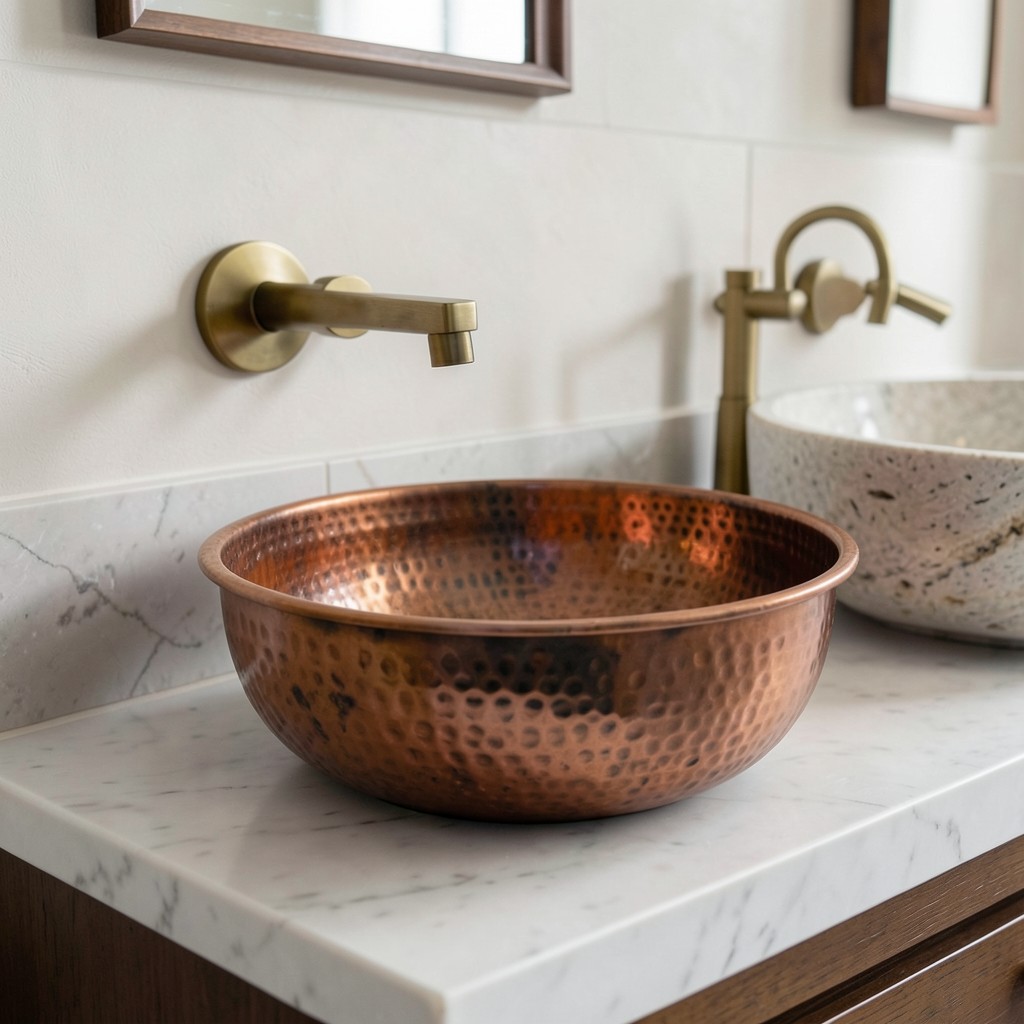
When the fixtures in a bathroom — the bath, the basin, the taps — are treated as sculptural objects rather than functional equipment, the bathroom stops being a room with plumbing and starts being a room with art that also happens to function. Sculptural fixtures occupy the same design territory as furniture: they have form that exists independently of their function, and that form is worth evaluating, appreciating, and choosing with the same care given to any major design purchase.
A hand-beaten copper basin — hammered individually by a craftsperson, with the marks of each hammer blow visible in the metal surface — is a bathroom fixture with a presence that ceramic and resin alternatives cannot match. The surface is alive with detail visible at close range, and the copper material ages into a patina whose colors shift from orange-gold through brown to a complex dark tone over years of use. Paired with a simple wall-mounted tap in a complementary brass finish, the basin becomes the room’s most compelling object — the thing every visitor reaches out to touch before they have consciously decided to do so.
Stone basins carved from a single piece of marble, travertine, or granite produce a similar quality of object presence. The weight and solidity of a stone basin on a vanity surface communicates permanence in a way that lightweight ceramic does not. The veining that runs through the stone is unique to that specific piece — cut from that specific location in that specific quarry from a formation millions of years in the making. That is the quality that no manufactured basin, however well designed, can acquire. A room with a sculptural stone basin has a centerpiece that is genuinely one of a kind, and that singularity is the quality that separates a bathroom from a beautiful bathroom.
40. A Bathroom With Warm Terracotta Tones
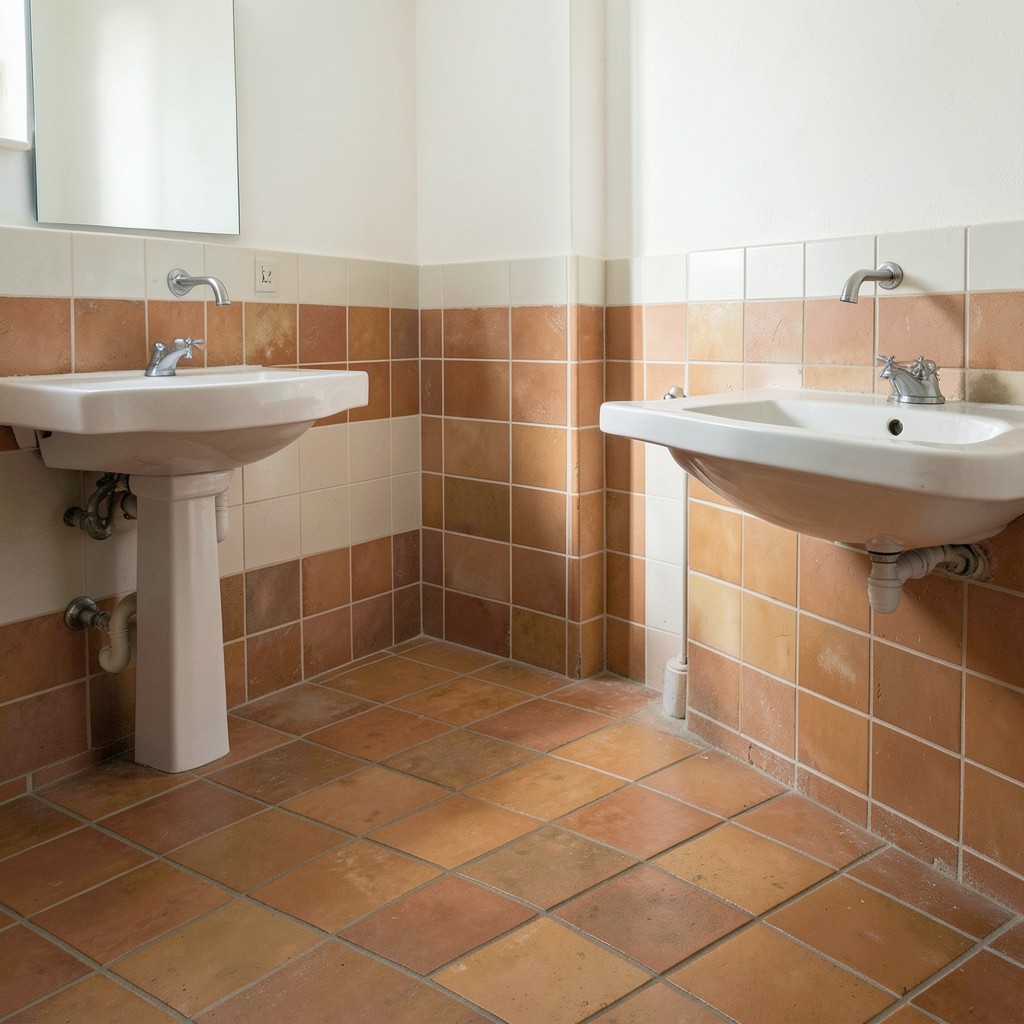
Terracotta in a bathroom — in the tile, the paint, the accessories, or the plaster — introduces a warmth that most bathroom palettes are designed specifically to avoid, and that avoidance is the reason most bathrooms feel colder than they need to. The standard bathroom palette of white, grey, and pale stone was built around the idea of cleanliness, and while those tones do read as clean, they also read as cool in the specific way that hospital environments are cool: perfectly sanitary, utterly without comfort. Terracotta is the antidote.
Terracotta floor tiles — unglazed, in the traditional square or hexagonal format — are the most direct expression of this palette in a bathroom. The material is warm to the eye and warm underfoot when the floor is heated, which is the combination that makes a bathroom genuinely comfortable rather than merely functional. The tiles require sealing before use and regular reapplication of sealant in bathroom conditions, but a properly maintained terracotta floor ages beautifully — deepening in tone, developing the kind of surface variation that new tile does not possess and cannot be manufactured. The aged terracotta floor is one of the most beautiful bathroom finishes available, and it becomes more so every year it is used and cared for.
Pairing terracotta with white plaster walls — not painted plasterboard but genuine lime plaster in a warm white — produces a material combination that reads as timeless in the best sense: not period-specific, not trend-dependent, not requiring stylistic justification. The warmth of the terracotta and the aged quality of the plaster together produce a bathroom that feels as though it belongs to the building rather than having been applied to it, and that sense of belonging is what design rarely achieves and always aims for.
41. A Bathroom With Industrial Pipe Shelving
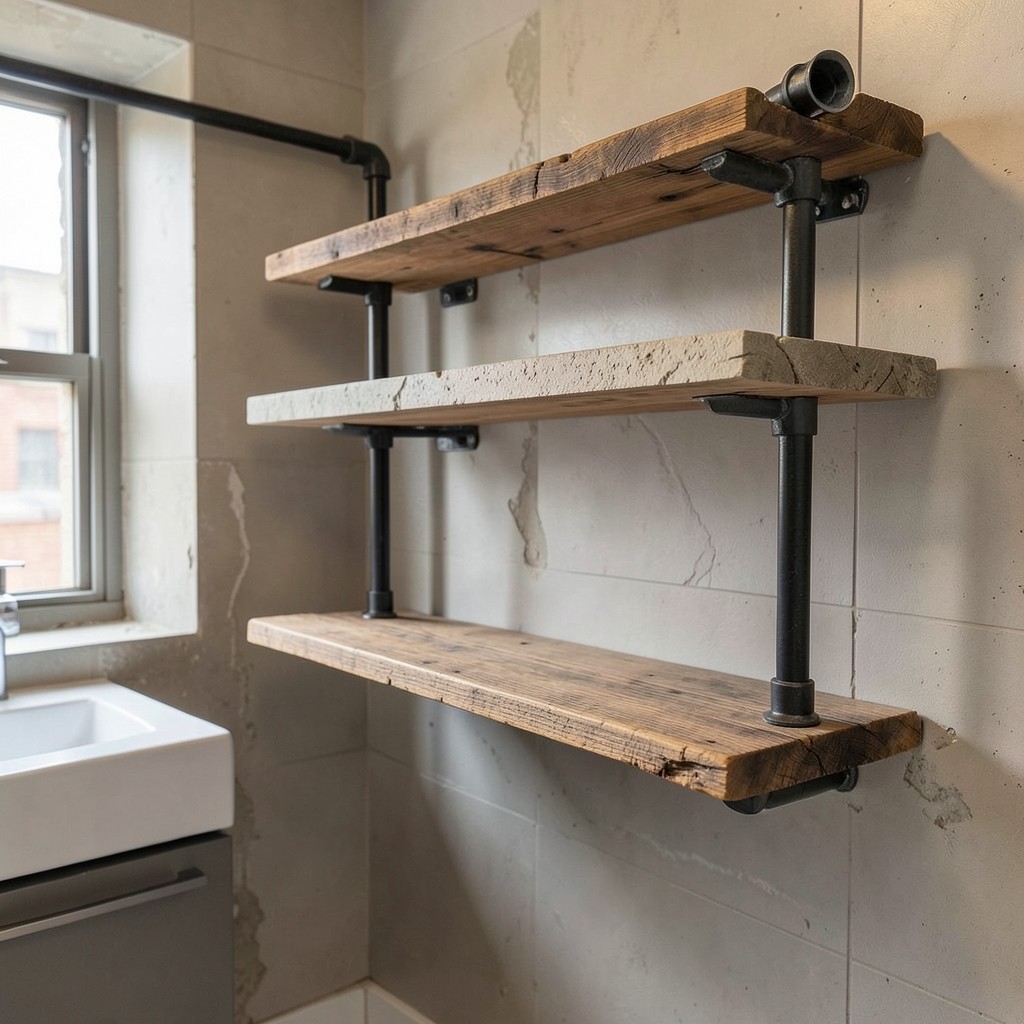
Industrial pipe shelving in a bathroom — shelves supported by galvanized or black iron pipe brackets screwed into the wall, with timber or stone shelves resting on the pipes — brings a raw, functional aesthetic that suits bathrooms in urban apartments, warehouse conversions, and contemporary homes where the design direction embraces material honesty over decorative convention. The pipes are the structure. They are visible. They do not pretend to be anything other than what they are, and that honesty is precisely the quality that makes industrial pipe shelving feel at home in the right bathroom.
The hardware quality determines whether the pipe shelving reads as a considered design choice or a DIY shortcut. Standard galvanized plumbing pipe fittings — floor flanges, nipples, elbow joints, coupling pieces — assembled into shelf supports produce a bracket system with the genuine texture and proportion of industrial hardware. Decorative “pipe shelf kits” sold at home improvement stores often use thinner pipe sections that read as theatrical rather than functional — the eye reads the difference between real pipe hardware and its ornamental imitation instantly. Specifying actual plumbing pipe components, even if no plumbing passes through them, produces a shelf support that carries the visual credibility of the real thing.
Shelf material on industrial pipe supports determines the palette balance between the hard industrial hardware and the bathroom’s other surfaces. A reclaimed timber shelf — genuinely old wood with honest wear and patina — introduces warmth that new timber and stone do not possess. The aged wood against the raw metal produces the same material tension as a weathered industrial building: two materials that were not designed to be beautiful together, producing a combination that is more interesting for that reason. A honed stone shelf on industrial pipe supports is a different kind of contrast — refined material on raw infrastructure — that suits bathrooms where the design direction is more considered without being precious.
42. A Bathroom With a Stained Glass Window
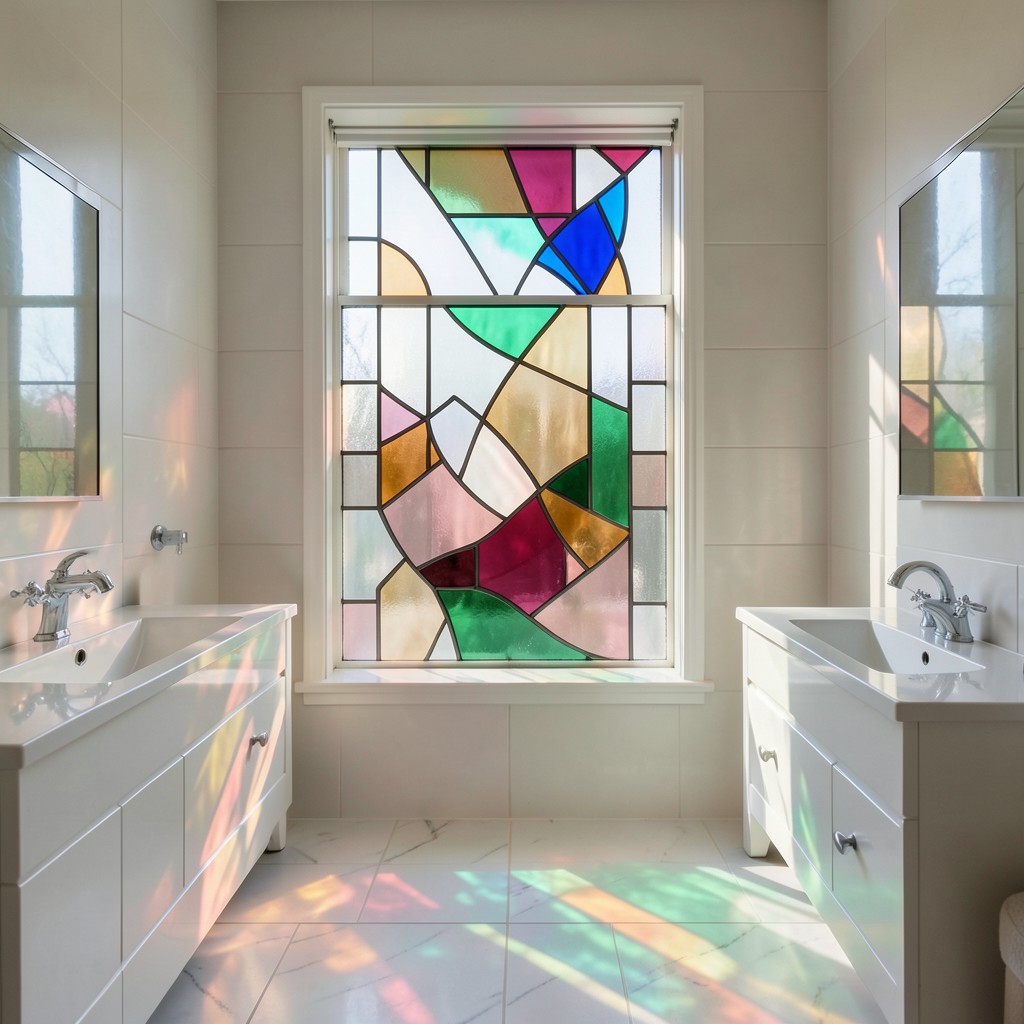
A stained glass window in a bathroom — positioned to receive direct or strong ambient light from outside — transforms the quality of natural light in the room fundamentally. Where clear glass produces a direct view and plain white light, stained glass produces colored light that moves across the bathroom surfaces as the sun moves through the sky. In the morning, when light strikes the window at a low angle, the colors project across the floor and walls in pools and bands that shift and change over the course of an hour. That quality of light is not static — it is alive, and a room with alive light is a room of a completely different order.
The color palette of the stained glass should inform rather than dominate the bathroom’s design. A window with deep jewel tones — ruby, cobalt, emerald — casts strong, saturated light that transforms a white bathroom into something theatrical and almost mysterious. A window in pale, muted tones — soft amber, faded rose, light sage — casts a gentler tinted light that warms the bathroom without the dramatic contrast of fully saturated glass. The design decision should be based on the light conditions of the specific window orientation and the character the bathroom is designed to project at the hours when it is most used.
Custom stained glass commissions are more accessible than most homeowners expect, particularly for small bathroom windows where the glass area is modest. An artisan glass maker working from a color palette and a loose pattern direction can produce a window that suits the bathroom’s specific design without requiring the complexity or cost of figurative or representational work. Abstract pattern in the right colors — a loose geometric, an organic mosaic of warm tones — produces stained glass that reads as contemporary and personal rather than ecclesiastical or Victorian, which is the reference most people default to when the option of stained glass is first suggested.
43. A Bathroom With Textured Plaster Feature Wall
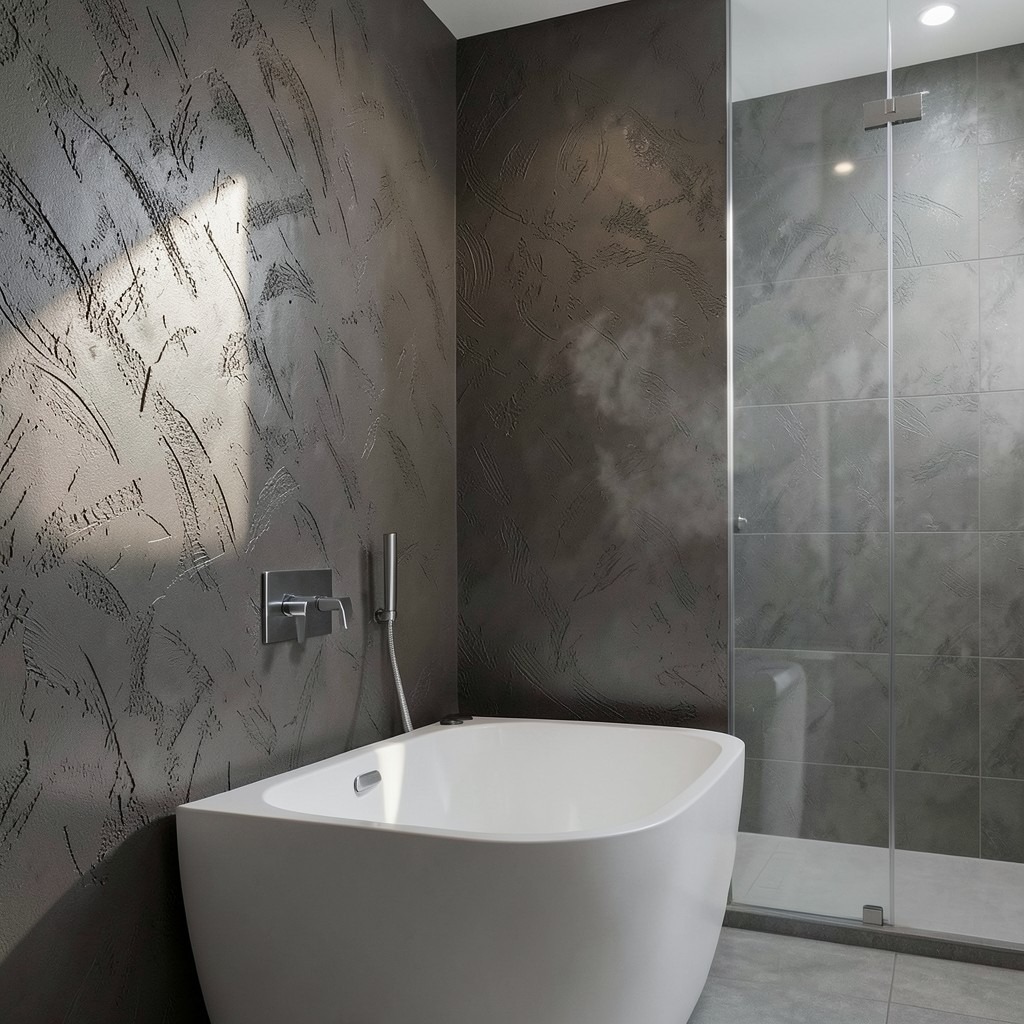
A single bathroom wall finished in deep, textured plaster — troweled in a deliberate pattern, left with visible tool marks, or built up in layers that create a surface with genuine physical depth — produces a textural contrast against the smooth tile and fixture surfaces that transforms the room’s material register. The bathroom becomes a room with multiple surface personalities rather than a room defined by the single quality of polished or glazed surfaces, and that material diversity produces the visual richness that makes some bathrooms feel designed at a level that tile choices alone cannot reach.
The troweled plaster technique produces a surface that reacts to light differently across the day and across the room’s different lighting conditions. Raking light from a window that strikes the plaster surface at a low angle in the morning throws the texture into sharp relief — every trowel mark, every surface variation, every slight elevation and depression in the plaster becomes a shadow and a highlight. Overhead light flattens the same texture considerably. That variable quality is what makes textured plaster walls interesting to live with over time — the wall is not the same surface at nine in the morning that it was at four in the afternoon, and that changeability is one of the qualities that makes natural and hand-applied materials compelling in spaces designed for daily use.
The position of the textured wall within the bathroom determines its design role. A textured plaster wall behind a freestanding bath — the wall the bather faces from within the tub — creates a textural backdrop that the smooth ceramic and metal of the bath fixtures sit against with an appealing contrast. A textured wall at the back of a shower enclosure, visible through frameless glass, produces a surface that is partially obscured by the glass and the steam, which creates a quality of depth and mystery in the shower zone that a tiled wall does not generate. Both positions work. Neither is wrong. The choice depends entirely on where in the bathroom the design needs the most material interest.
44. A Bathroom With a Dedicated Dressing Area
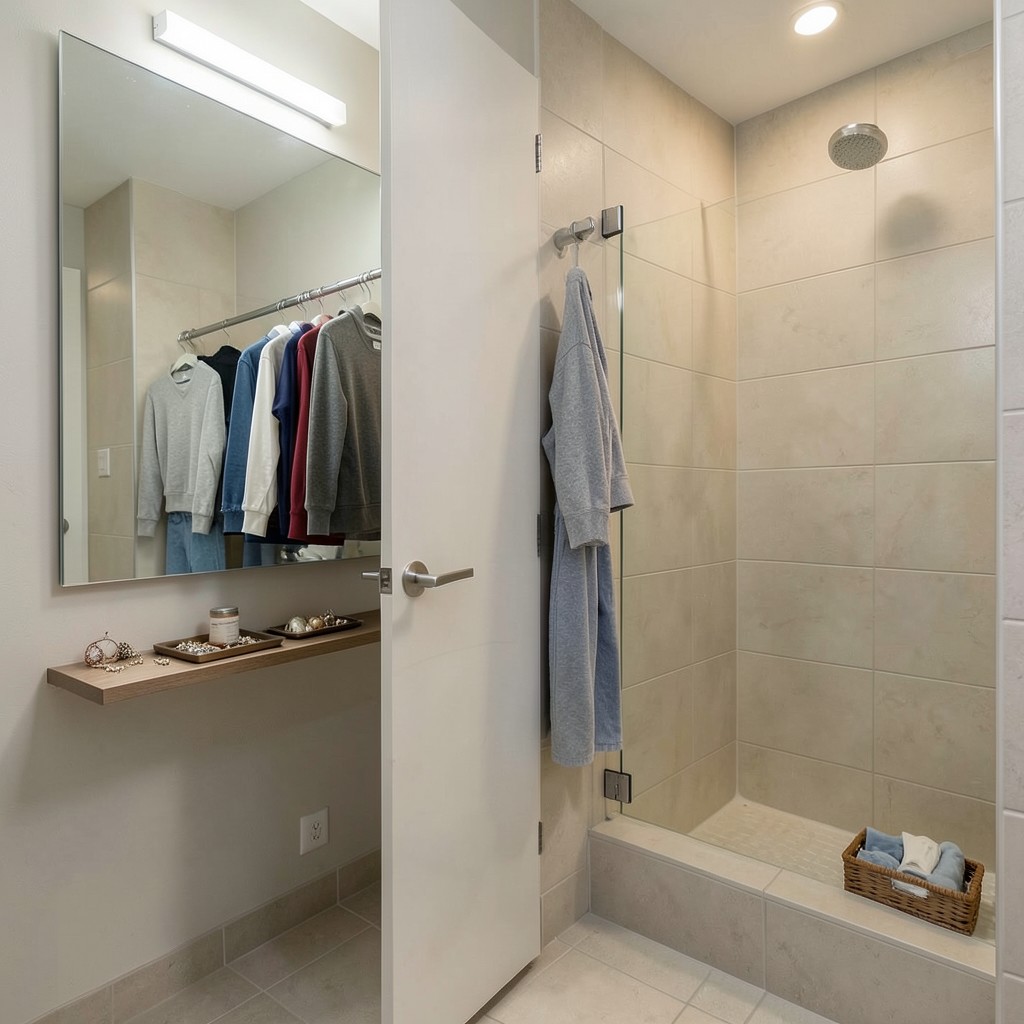
A bathroom that incorporates a dedicated dressing area — a section of the room with a full-length mirror, proper lighting positioned for dressing rather than grooming, hanging space for the current day’s clothing, and a surface at a convenient height for accessories — changes how the morning routine flows in ways that compound over daily use. The dressing function is pulled out of the bedroom and given its own considered space adjacent to the shower and bath, which means the sequence from bathing to dressing to leaving becomes a single uninterrupted physical journey rather than a movement between three separate rooms.
The lighting within the dressing area of a bathroom requires a different specification from the vanity lighting in the same room. Vanity lighting — positioned at face level, designed for close-range skin assessment — is too intense and too directional for the full-body assessment that dressing requires. Dressing lighting ideally comes from two or more sources positioned to eliminate body shadow: one source on each side of the standing position at roughly the height of a shoulder, producing even bilateral light that removes the shadows that a single overhead or front-facing source creates on the body. That lighting quality is what professional dressing rooms in retail environments use, and applying it to a residential dressing area produces the same visual clarity that makes choosing clothing and assessing fit significantly more reliable.
The hanging space within a bathroom dressing area does not need to be extensive to be useful — a short rail for the current day’s outfit, positioned near enough to the shower that a freshly laundered garment can be selected and retrieved in the same movement as dressing, delivers the daily benefit without requiring the footprint of a full wardrobe. Combined with a surface for jewelry and accessories — even a simple tray on a small shelf serves this purpose — and a drawer or basket for undergarments, the dressing area provides the organizational layer that makes the morning bathroom routine efficient rather than fragmented.
45. A Bathroom With a Wet Room and Dry Zone Division
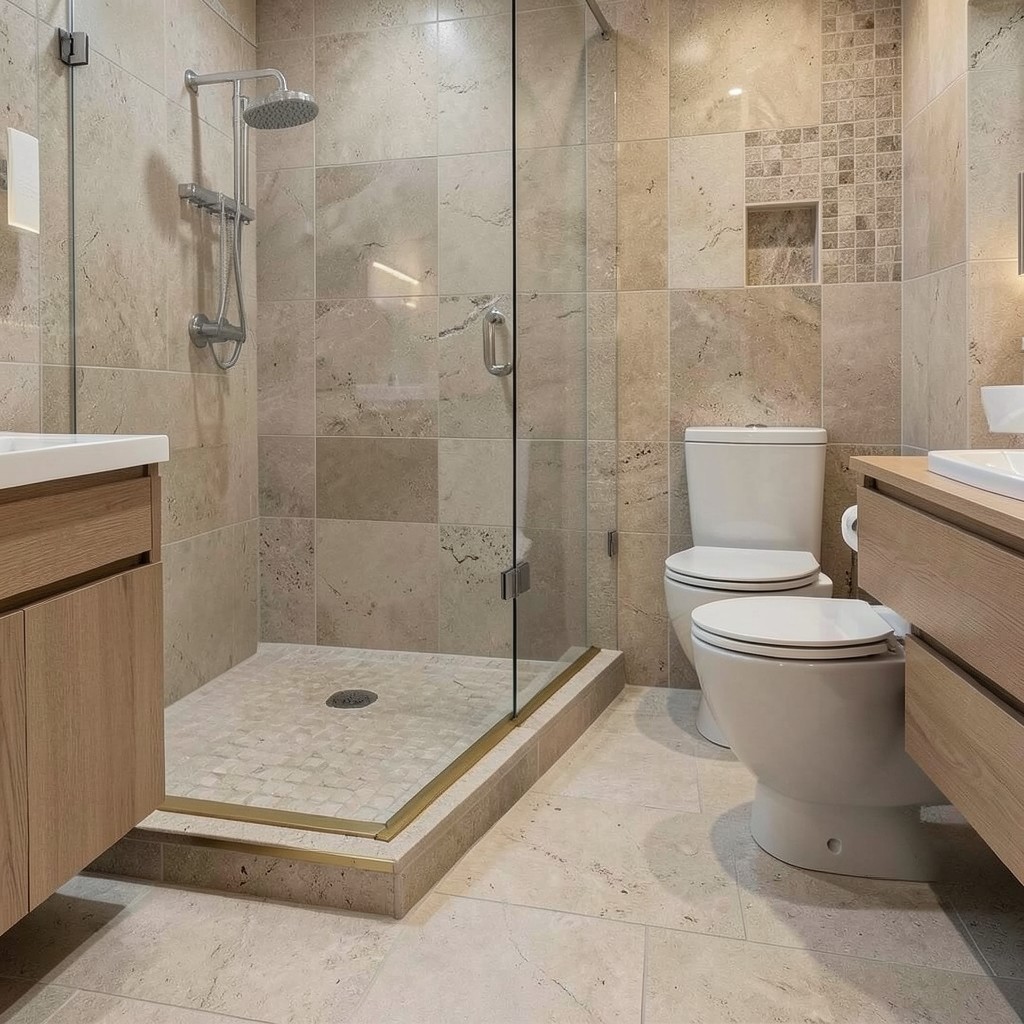
Dividing a single bathroom into a clearly defined wet zone and dry zone — not through enclosure and glass, but through floor level, material change, and spatial planning — produces a bathroom that functions with the efficiency of a wet room while maintaining the material comfort and dryness of a conventional bathroom. The wet zone, typically the shower area and any immediately adjacent floor, sits at or slightly below the main bathroom floor level and is waterproofed and graded to drainage. The dry zone sits at standard floor level, uses materials chosen for comfort rather than water resistance, and contains the vanity, the toilet, and any seating or storage.
The transition between the wet and dry zones is the design moment where most split-zone bathrooms either succeed or fail architecturally. A step of twenty to thirty millimeters between the wet zone floor level and the dry zone floor produces a physical boundary that prevents water migration while reading as a deliberate architectural transition rather than a practical compromise. The step edge — finished in a contrasting material, a brass threshold strip, or a continuous stone border — frames the boundary and gives it a designed quality. Without that edge treatment, the step looks like a construction variation rather than a planned spatial division.
Material change at the zone boundary reinforces the spatial division beyond the level change alone. The wet zone in stone or large-format porcelain tile — materials chosen for water management. The dry zone in smaller format tile with a warmer tone, timber, or a heated stone variety chosen for comfort and thermal quality. The two zones are connected by the material family they share — similar tones, complementary surface qualities — while being clearly distinguished by the specific material selected for each zone’s function. The bathroom reads as one designed room with two distinct spatial characters rather than two separate rooms that happen to connect, and that reading is precisely what the division is designed to produce.
46. A Bathroom With Heated Towel Rails as Design Feature
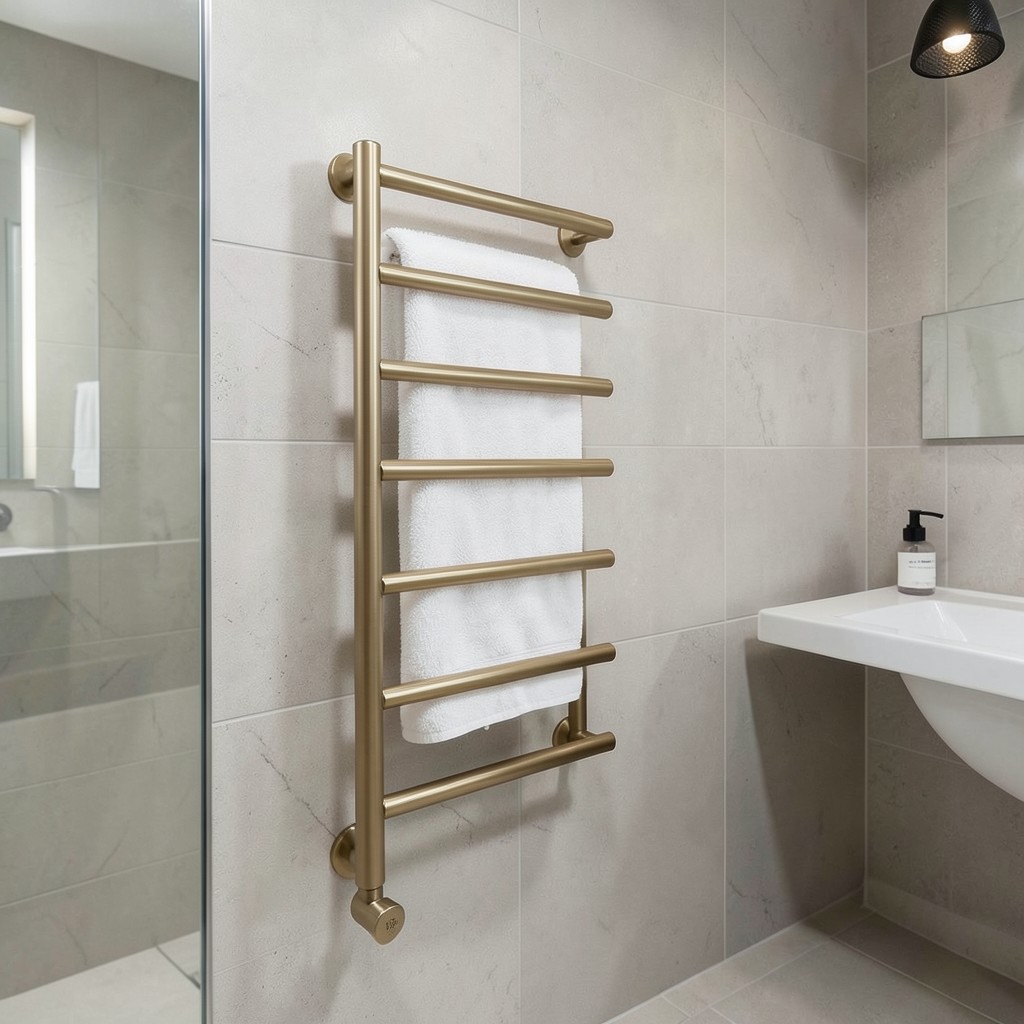
A heated towel rail is one of the few bathroom elements that is both functional and decorative simultaneously, and most bathrooms treat it as exclusively the former. A rail selected entirely for its BTU output and its price point is a bathroom fixture that holds towels warm. A rail selected for its design quality — its proportion, its material finish, its relationship to the wall space it occupies — is a bathroom fixture that holds towels warm and contributes to the room’s visual composition. The difference in cost between a standard rail and a well-designed one is not large. The difference in the room’s quality is.
The proportion of the rail relative to the wall it occupies is the design variable most people do not consider when selecting from catalog pages where all images are photographed at the same scale. A rail that appears elegant and correctly proportioned in a showroom photograph can read as undersized in a full-height bathroom wall where it occupies only a third of the available surface. A rail scaled to fill two-thirds of its wall height — with multiple horizontal bars spanning the majority of the wall width — reads as a considered architectural element rather than a utilitarian fixture. Scale the rail to the wall, not to the towel count you need.
Finish selection matters for the rail’s relationship to other bathroom metals. A heated towel rail in brushed brass in a bathroom where all other fixtures are matte black creates a finish conflict that pulls the room’s material language in two directions simultaneously. The rail should be specified in the same finish family as the taps, shower fittings, and door hardware — the same principle of finish consistency that applies to every other metal element in the bathroom. When every metal in the room shares a finish, the heated rail reads as part of a designed whole. When it fights the finish family, it reads as an afterthought.
47. A Bathroom With an Outdoor Connection
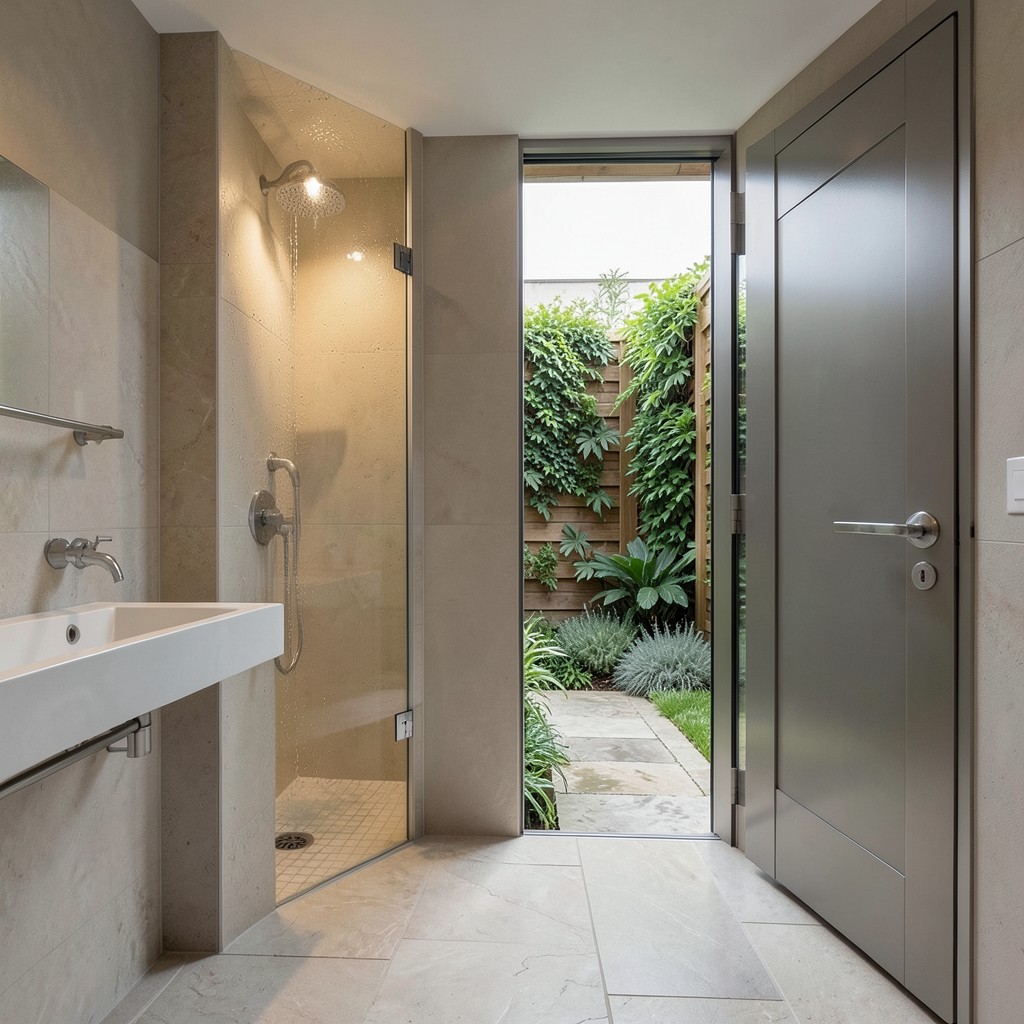
A bathroom that connects directly to an outdoor space — through a door that opens to a private courtyard, a garden, or a rooftop terrace — has a relationship with the exterior world that transforms bathing and showering from private indoor activities into something more expansive and more physically pleasurable. An outdoor shower adjacent to the bathroom, accessible through a door in the shower wall or a door beside the bath, extends the bathing sequence to the outside air. The contrast between the warm interior shower and the cooler outdoor air, particularly in warm weather, produces a sensory experience that no interior-only bathroom arrangement replicates.
The design of the exterior bathing space requires the same level of material consideration as the interior bathroom it connects to. A stone or tile floor that continues from the interior threshold to the exterior space — the same material running through the doorway without interruption — produces a connection between inside and outside that makes the two spaces read as one extended room rather than two separate areas. The planting around the exterior bathing space determines the privacy and the aesthetic character of the outdoor zone. Dense vertical planting on a timber framework creates privacy and a green wall that makes the exterior space feel both private and connected to nature simultaneously.
The door between the interior bathroom and the exterior bathing area must handle the specific conditions of the transition: waterproofing on the interior face, weather resistance on the exterior face, and adequate sealing at the threshold to prevent water and cold air from entering the bathroom when the door is closed. A pivot door in a stainless steel or anodized aluminum frame handles these requirements across years of exposure to bathroom humidity and exterior weather. The hardware — handle, hinge, lock — should be specified in the same finish as the bathroom’s interior fixtures to maintain the material consistency across the inside-outside boundary.
48. A Bathroom With Recessed Ceiling Detail
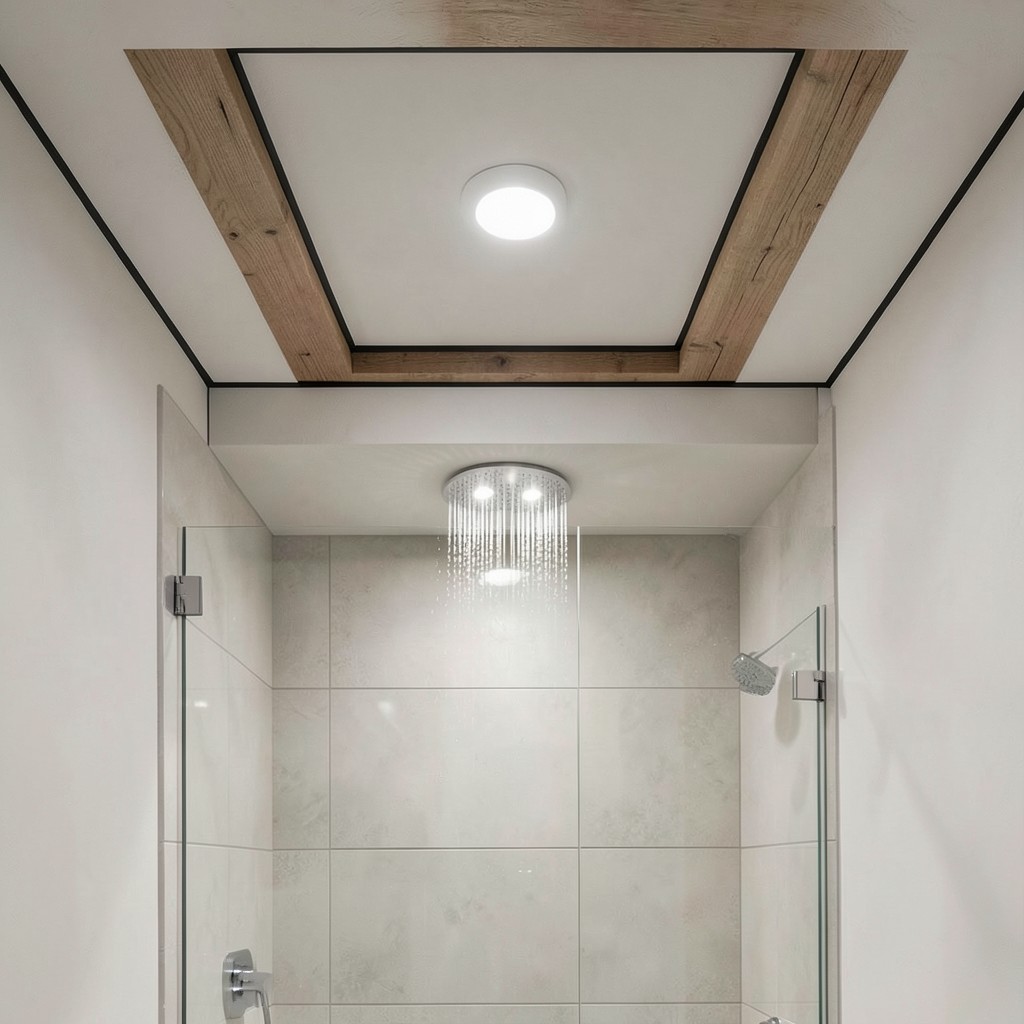
A ceiling with recessed architectural detail in a bathroom — a central coffer, a perimeter shadow gap, a section of exposed timber beam, or a dropped section above the bath or shower that creates a canopy effect — elevates the room’s architectural ambition without requiring any change to the floor plan or the fixture layout. The ceiling is the one surface in a bathroom that the design budget consistently overlooks and that delivers a disproportionate quality return for the investment it receives. Adding one deliberate architectural detail to a bathroom ceiling changes the room’s register from fitted to designed.
A shadow gap — a recessed channel running around the perimeter of the ceiling where it meets the wall — is the most architecturally minimal version of a ceiling detail and the one that produces the most immediate quality signal. The channel, typically twenty to thirty millimeters wide and deep, creates a dark line that visually separates the ceiling plane from the wall plane. The ceiling reads as floating rather than resting on the walls, which makes the room feel taller and more spatially considered. The shadow gap requires precise plastering at the channel corners — the quality of the detail is entirely in the precision of its execution, and a shadow gap with uneven depth or irregular corners reads as a construction defect rather than a design decision.
A dropped ceiling section above the shower — positioned at a height of two hundred and fifty to two hundred and eighty centimeters, with the main bathroom ceiling height above — creates a canopy over the shower zone that defines it spatially without any enclosure. The lower ceiling plane makes the shower area feel more intimate and more sheltered than the open-plan wet room format where the shower sits under the same ceiling as the rest of the room. Recessing the shower head flush into this lower section, so the rain head sits level with the dropped ceiling surface, produces a shower installation of genuine architectural refinement — the water appears to come from the ceiling itself rather than from a visible fitting.
49. A Bathroom With a Curated Art Collection
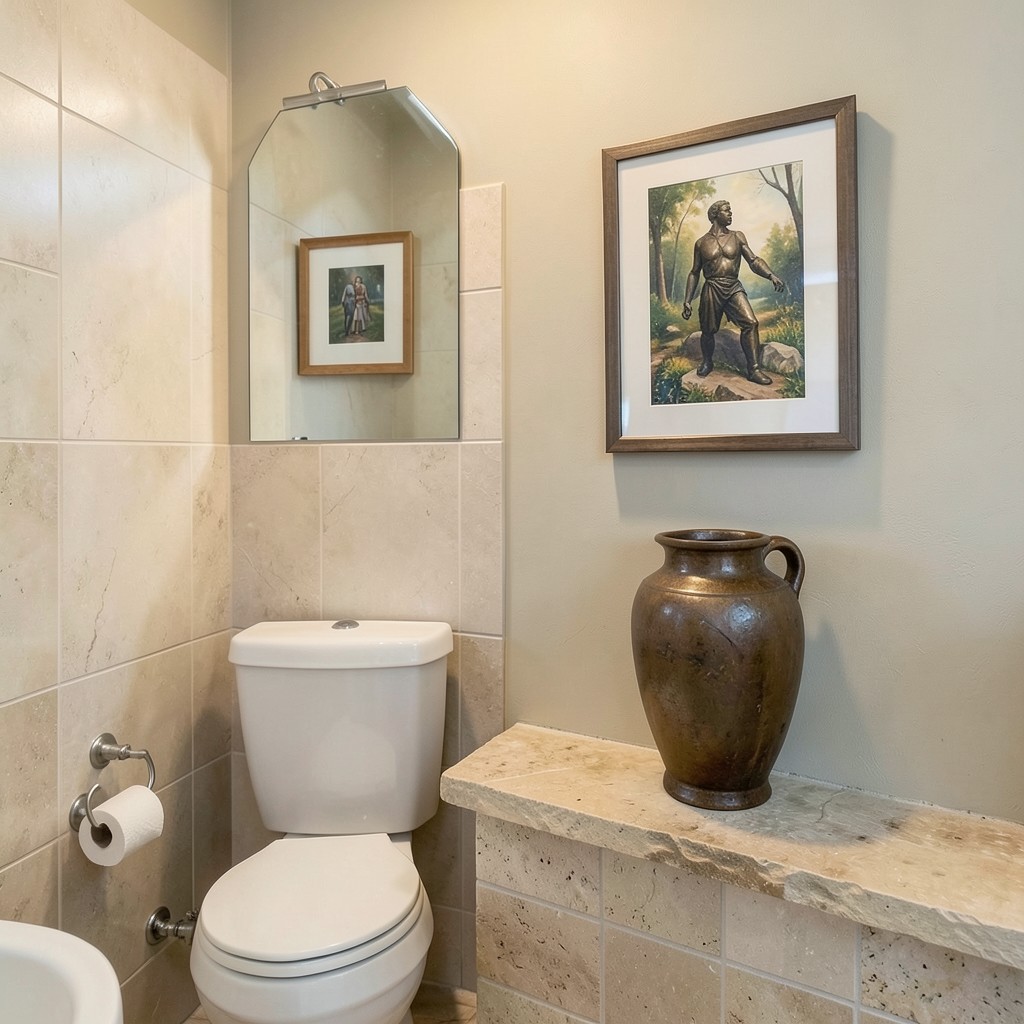
Artwork in a bathroom is treated as a risk by most homeowners — the humidity, the steam, the proximity to water are cited as reasons to keep the walls bare or limited to a single functional mirror. That caution is reasonable for paper-based works and oil paintings, and completely unnecessary for a wide range of materials that handle bathroom conditions without any deterioration. Ceramics, bronze and metal sculptures, photography behind glass, giclee prints mounted on aluminum, and mosaic artwork are all materials that are either unaffected by bathroom humidity or improved by appropriate framing and mounting that manages the moisture exposure. The bathroom that dismisses artwork based on material concern without thinking through the range of materials available is a bathroom that opts out of a design opportunity unnecessarily.
The scale of bathroom artwork should match the room’s proportions with the same logic applied in any other room. A small framed print above the toilet is a gesture that reads as tentative. A large ceramic sculpture on a stone ledge beside the bath reads as deliberate. The difference is not the cost of the piece — it is the confidence of the placement and the scale of the choice relative to the space it occupies. In a bathroom where the walls are predominantly tile, a single piece of significant scale on a plaster or painted wall section produces more visual impact than multiple small pieces distributed across the available surfaces.
The humidity management of bathroom artwork begins with the mounting and framing rather than the artwork itself. A photograph printed on aluminum, with no paper substrate to absorb moisture and no glass face to produce condensation, handles bathroom conditions indefinitely. A watercolor mounted under glass in a standard wooden frame will eventually show moisture damage at the corners where the frame meets the glass — replaced with a sealed aluminum frame and UV-protective glass, the same watercolor handles the same environment without deterioration. The art itself is rarely the limiting factor in a bathroom — it is the frame and mounting system that determines whether the piece survives the conditions, and choosing the right system is a practical decision that makes the design decision possible.
50. A Bathroom Designed for the Long Term
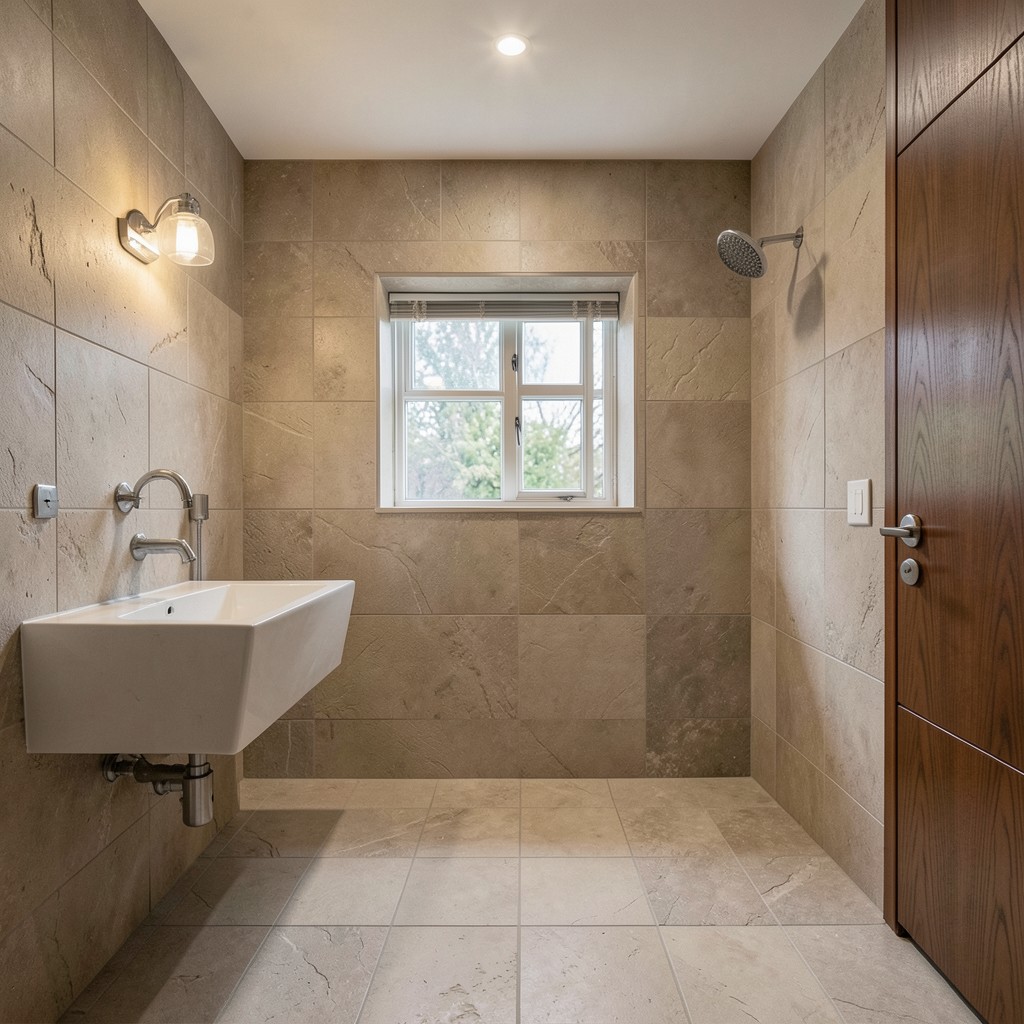
The bathroom that looks extraordinary on the day it is photographed and feels increasingly wrong five years later was designed for the camera rather than for the life lived inside it. The bathroom designed for the long term makes different choices — choices that prioritize material quality over material novelty, functional precision over stylistic gesture, and the sensory experience of daily use over the visual impact of a first impression. Those are not conservative choices. They are the choices that produce bathrooms people still love after a decade of use.
Natural materials age better in a bathroom than manufactured ones in almost every comparison. Stone develops patina rather than showing wear. Solid timber deepens in tone with oil maintenance rather than scratching and chipping. Copper and brass fixtures evolve rather than peel or tarnish uniformly. Against these, printed tile surfaces that simulate stone fade or chip to reveal the substrate beneath. Chrome fixtures that are chrome-plated rather than solid begin to show the base metal through the plating after years of cleaning. The investment in genuine materials is not a premium paid for aesthetics alone — it is a premium paid for a bathroom that continues to improve rather than beginning to deteriorate from the moment it is completed.
The functional decisions that make a bathroom work over time are simpler than the design decisions: adequate storage so nothing lives on the counter that should live in a cabinet, lighting with enough zones and control to serve the room at every hour it is used, ventilation sufficient to prevent the moisture conditions that lead to mold and deterioration, and floor materials chosen for comfort and safety rather than for appearance alone. A bathroom that has these functional conditions correct will reward any design investment made on top of them. A bathroom that gets the design right but the function wrong will frustrate its users every single day — and no amount of beautiful tile or a perfectly chosen freestanding bath changes that daily reality.
Leave a Reply