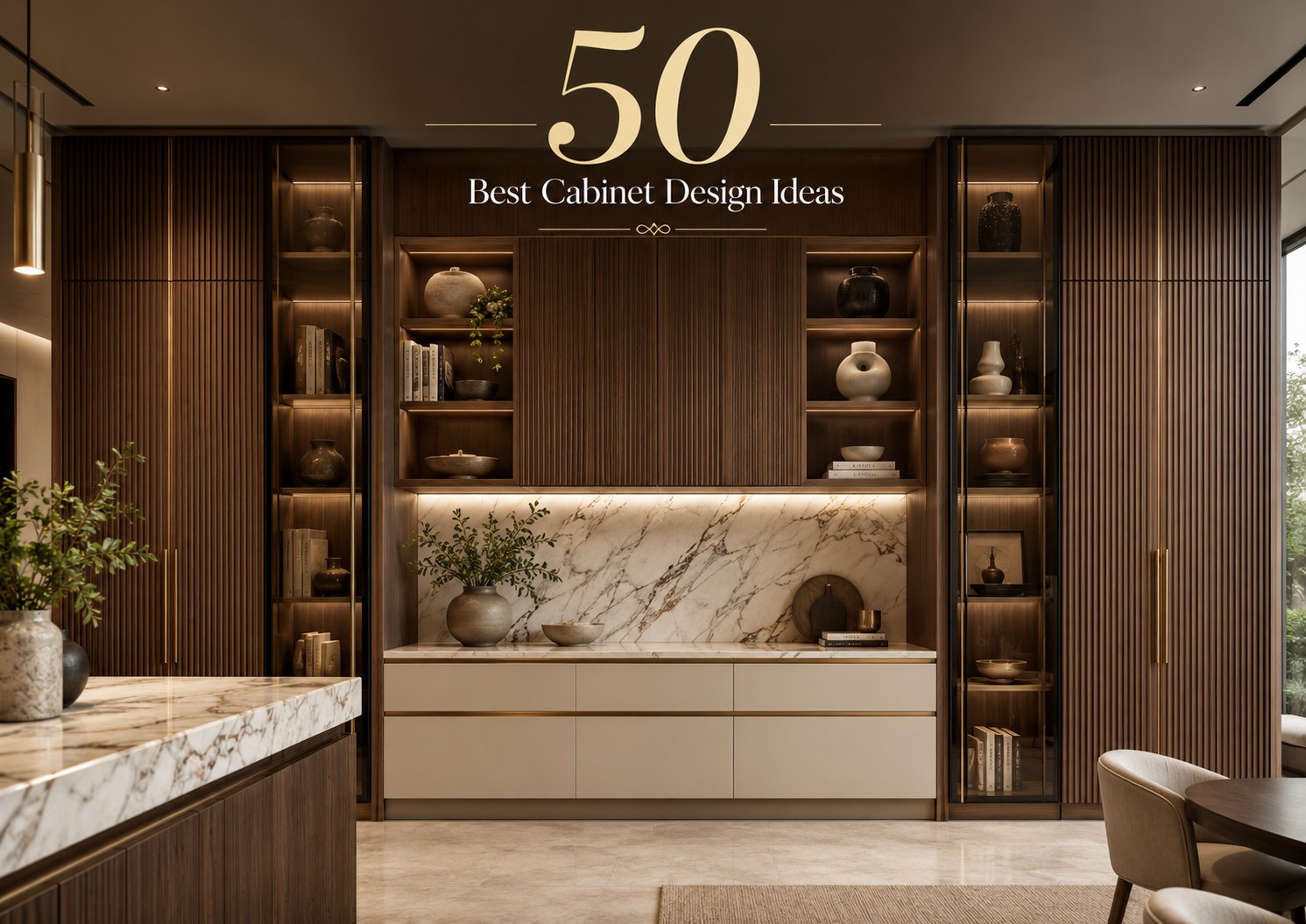
Cabinets are the furniture category that the design conversation consistently underestimates, and the rooms that suffer most from poor design thinking are almost always the rooms whose cabinets received the least attention. The kitchen whose layout was planned around the appliance positions and the countertop material while the cabinet door profile was selected from the standard catalog option. The bathroom whose vanity was chosen for its price point rather than its design intelligence. The living room whose built-in shelving was installed by the contractor without a designer’s involvement and whose proportions, detail, and material communicate that origin every day thereafter. Cabinets are the room’s most permanent and most spatially dominant design elements, and the gap between the quality of design thinking they deserve and the quality they typically receive is one of residential design’s most consistent and most correctable failures.
The cabinet’s design complexity is underappreciated because the object’s function seems simple — it stores things and conceals them behind a door. But the design decisions that the cabinet requires are among the most technically demanding in residential interior design: the door profile’s relationship to the room’s architectural style, the hardware’s material and scale in relationship to the door’s surface, the interior’s organization system calibrated for the specific items stored, the material’s finish behavior in the room’s humidity and light conditions, the frame’s construction quality that determines the door’s long-term alignment and the drawer’s long-term operation, and the cabinet’s dimensional relationship to the room’s ceiling height, floor material, and adjacent architectural elements. Getting one of these wrong undermines the others. Getting all of them right creates the room’s most resolved and most permanent design element.
Cabinet design also carries the specific burden of permanence. The sofa can be replaced. The rug can be changed. The cushions are seasonal. The cabinet — the built-in kitchen cabinetry, the bathroom vanity, the built-in wardrobe, the study’s floor-to-ceiling shelving — is the room’s fixed element whose design decision is permanent for the duration of the household’s occupancy. The cost, the disruption, and the waste of replacing a built-in cabinet is sufficiently prohibitive that most households live with their cabinet choices indefinitely, which makes the original decision’s quality the most consequential design investment the room receives.
The fifty cabinet design ideas in this collection span every room, every aesthetic direction, and every functional requirement across the full range of residential design. From the handleless slab-front kitchen cabinet of the modern home design kitchen to the glass-fronted antique cabinet of the traditional home interiors dining room, from the raw steel industrial cabinet of the loft study to the hand-painted botanical cabinet of the garden-inspired bedroom, every idea is a complete design direction with a material logic, an aesthetic position, and a practical intelligence behind it. The ideas address kitchens, bathrooms, living rooms, bedrooms, studies, and outdoor spaces with the specific design knowledge that each room’s functional requirements and aesthetic possibilities demand. These are not generic cabinet ideas applied to every context — they are specific design directions whose intelligence is in the specificity.
Your cabinets are the room’s skeleton. Design the skeleton well, and the room has structure that no amount of accessory-level decoration can provide. Design it poorly, and no amount of accessory-level decoration covers the structural inadequacy that lives beneath every room experience thereafter.
1. Handleless Slab-Front Kitchen Cabinets in a Modern Kitchen

The handleless kitchen cabinet is the modern home design kitchen’s most definitive design choice — the complete elimination of the hardware element that most kitchens apply as the door’s operating mechanism creates a surface of uninterrupted material whose clean face communicates the design’s commitment to the planar, surface-forward aesthetic that contemporary kitchen design values as its purest expression. The handleless cabinet does not compromise. It removes the element and asks whether the kitchen is better without it. The answer, in the right room with the right material, is consistently yes.
The handleless door operates through one of three mechanisms: the push-to-open system whose spring-loaded latch releases the door with a gentle pressure, the integrated grip channel routed into the door’s top or bottom edge creating the fingertip recess that the hand finds naturally, or the J-pull profile whose door’s upper or lower edge is shaped into the opening gesture itself. Each mechanism creates a slightly different operating experience and a slightly different door profile, and the selection should be made in relation to the kitchen’s use patterns — the push-to-open system’s hands-free operation suits the cook whose hands are frequently occupied, while the grip channel’s recessed pull suits the household whose opening gesture preference is a firm, secure grip rather than the pressure-release of the spring mechanism.
A handleless kitchen in a deep forest green or a matte navy — the saturated color applied across the cabinet faces in a high-build lacquer or a matte polyurethane finish — creates the modern kitchen cabinet design statement whose color authority is most clearly expressed when the hardware detail that typically fragments the door’s face is absent. The uninterrupted color plane reads as a single surface of designed intensity, and the fall kitchen decor season is when this kitchen’s deep color reaches its peak atmospheric quality — the hunter green or midnight navy creating the warm, enclosed domestic atmosphere that the season’s design direction values as its most genuinely seasonal expression.
2. Shaker Cabinet Doors in a Farmhouse Kitchen

Shaker cabinetry is the cabinet design whose longevity in residential interiors is not fashion — it is the direct product of the Shaker movement’s design philosophy, which held that functional objects should be made with the precision and the care that their daily use demands, and that decoration applied beyond the object’s functional requirements is a form of dishonesty. The Shaker cabinet door’s recessed flat panel within a simple frame is not a design choice among several; it is the expression of a design conviction whose sincerity is felt every time the door is opened. The Shaker cabinet is honest furniture, and honest furniture ages better than any other kind.
A painted Shaker kitchen in a warm white, a soft sage green, or a classic navy creates the farmhouse home decor kitchen’s most design-specific cabinet treatment — the clean recessed panel reading against the wall color behind it, the simple profile casting the subtle shadow that the panel recess creates, and the hardware’s straightforward round or cup pull finishing the door without ornamentation. The Shaker door’s compatibility with the farmhouse aesthetic’s preference for honest materials and honest function makes the two design directions natural partners, and the Shaker kitchen in a farmhouse setting is the residential design combination whose cultural alignment is so complete that the result always appears to have existed in the space rather than to have been designed for it.
The hardware selection for the Shaker cabinet is the design decision that most significantly differentiates the contemporary Shaker kitchen from its period original — the brushed brass bin pull creates the warm-metal farmhouse version; the polished nickel cup pull creates the classic, period-adjacent version; and the matte black bar pull creates the contemporary-Shaker interpretation whose graphic hardware contrast communicates the design’s current sensibility while the door’s timeless profile maintains the connection to its origin. The hardware finish should be consistent across the kitchen’s every fitting — the tap, the light fixture, and the cabinet hardware in matching metals create the coordinated material palette that the Shaker aesthetic’s commitment to considered functional quality requires at every detail.
3. Glass-Fronted Display Cabinets in a Traditional Dining Room

The glass-fronted cabinet is the traditional home interiors piece that serves two functions so completely and so simultaneously that separating them feels reductive — it stores the household’s best china and crystal, and it displays them. The storage function protects the pieces from dust and breakage; the display function communicates the household’s taste, its history, and its material culture in the most public room of the house. Neither function works without the other, and the glass front is the element that makes both functions coexist.
A floor-to-ceiling glass-fronted cabinet in a painted timber frame — the glass panels in a divided-light format with thin muntins creating the grid of individual panes — creates the traditional dining room’s display and storage cabinet in the period vocabulary that the Georgian and Federal residential traditions applied to their finest case furniture. The interior of the glass-fronted cabinet should be treated with the same design care as a display case in a museum — the shelf material, the shelf height, and the interior lighting all calibrated for the objects displayed within rather than for the structural requirements of the cabinet’s frame. A warm white or a tinted interior — the cabinet’s back panel in a tone slightly different from the exterior’s painted surface, creating the depth illusion that makes the displayed objects appear to float forward — creates the display quality whose visual intelligence is rarely applied in residential cabinet installations but whose effect on the objects’ visual presentation is immediate and significant.
LED strip lighting inside the glass-fronted cabinet — concealed above the top shelf and at the front edge of selected mid-cabinet shelves — creates the illumination that brings the displayed objects to life in the evening when the ambient room light is insufficient to penetrate the cabinet’s interior and reveal the china’s translucency and the crystal’s facets. The elegant home styling direction requires this lighting detail as a non-negotiable element of the glass-fronted display cabinet, because a beautiful collection of objects in an unlit cabinet communicates the design’s visual ambition without delivering its visual quality, and the gap between ambition and delivery is precisely what the lighting resolves.
4. A Dark-Painted Built-In Cabinet in a Cozy Study

The dark-painted built-in cabinet is the study’s design decision that most directly creates the library atmosphere — the floor-to-ceiling shelving and storage in a deep forest green, a midnight navy, or a charcoal black creates the enclosing quality of a room whose walls are furniture, whose furniture is the room, and whose color depth makes the books and objects on the shelves read as the focal content of a composed interior rather than as the accumulated possessions of a household that needed somewhere to put them.
The dark cabinet’s interior — painted in the same deep tone as the face and the sides, continuing the color into the shelves’ depth — creates the visual continuity that makes the cabinet read as architectural element rather than as furniture applied to the wall. The books’ spines against the dark interior create the specific color combination of the library aesthetic: the warm, varied colors of the book collection reading as richly against the dark cabinet surface as paintings against a gallery wall. Rustic home office ideas rooms with dark-painted built-in cabinets — the bookshelves flanking the desk, the window above the desk providing the working light, and the amber desk lamp creating the reading quality that the dark room requires at the close work surface — create the study atmosphere whose design quality is inseparable from the cabinet’s color and its relationship to the room’s other dark surfaces.
The hardware on the dark-painted built-in should be selected for its contrast quality — the antique brass or the burnished bronze reading warmly against the dark surface and creating the material accent whose warmth prevents the dark cabinet from reading as cold or oppressive. The pull’s size should be proportional to the door’s scale — a larger bin pull or a substantial bar handle on a floor-to-ceiling door, scaled down appropriately for the smaller cabinet and drawer fronts — and the consistency of the hardware finish across every fitting in the cabinet creates the composed, unified appearance that the built-in’s permanence demands as the minimum design standard.
5. Fluted Cabinet Doors in a Contemporary Kitchen

Fluted cabinet doors are the textural detail that contemporary kitchen design has adopted from architectural millwork and furniture design as the most elegant alternative to the flat slab door’s austere planarity — the vertical channels routed or formed into the door’s face create the surface interest and the light-and-shadow quality that the slab door’s flat surface cannot generate, without introducing the ornamental complexity of a traditional profile door’s stepped moldings and raised panels. The fluted door is the contemporary kitchen’s compromise between the minimalist slab and the traditional profile, and it is a very good compromise.
A fluted door in a natural oak veneer — the vertical channels interrupting the wood grain with the rhythmic shadow lines that the routed profile creates — creates the contemporary kitchen cabinet design in a material combination whose organic quality the kitchen’s warmth and food-preparation associations favor over the cool precision of the painted or lacquered surface. The grain’s horizontal movement visible between the vertical channels creates the material layering that makes the fluted oak door visually richer than either a plain-faced oak slab or a fluted painted panel. Modern kitchen ideas that incorporate the fluted oak door — the natural timber above a white or pale grey countertop, the brass hardware providing the warm metallic accent, and the stone-look tile splashback creating the material depth behind the cooking area — create the contemporary kitchen whose warmth and organic quality suit the current design culture’s preference for the natural over the synthetic.
The fluted door’s channel depth and spacing determines the door’s visual character from the kitchen’s normal viewing distances — a shallow channel of three to four millimeters creates the subtle texture that reads from close range but recedes to a textured surface from the standing distance across the kitchen; a deeper channel of six to eight millimeters creates the shadow quality that reads clearly from the standing distance and creates the door’s visual interest as the kitchen’s primary surface material. The choice between shallow and deep should be made in relation to the kitchen’s scale — a large kitchen whose cabinet surfaces are viewed from across the room benefits from the deeper channel’s larger-scale texture; a small kitchen where the cabinet faces are always within arm’s reach suits the shallower channel whose close-range detail quality is fully appreciated at the proximity that the small kitchen’s dimensions create.
6. A Two-Tone Kitchen Cabinet Design in Warm and Cool Tones
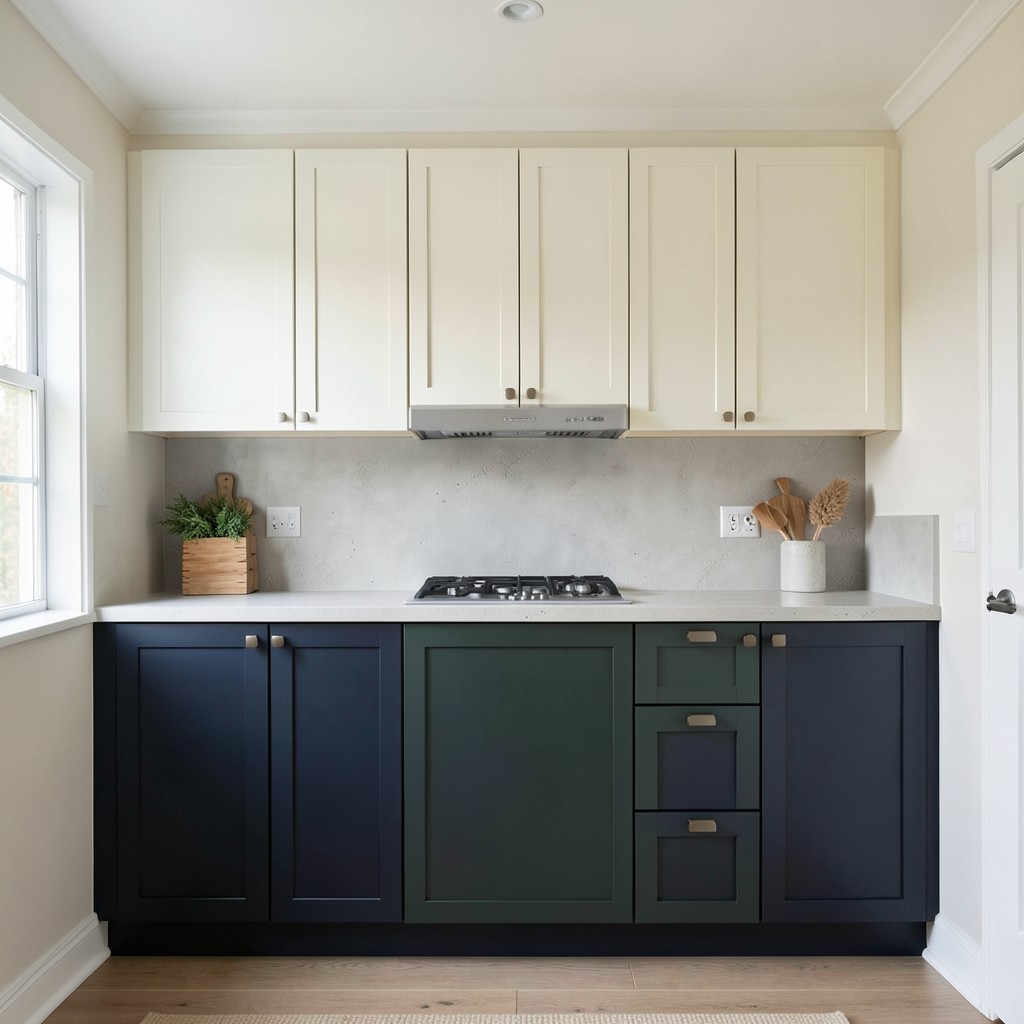
The two-tone kitchen is the cabinet design strategy that resolves the design tension between the kitchen’s desire for visual interest and its functional requirement for visual order — the upper cabinets in one color and the lower cabinets in another creates the color differentiation that prevents the monotony of a single-color kitchen without the chaos of a multi-color palette whose colors have no organizational logic. The two-tone kitchen is not two different cabinet colors randomly applied. It is one color for the high zone and one for the low zone, and the logic of that distinction — which earns its own design intelligence — is what makes the two-tone kitchen look considered rather than arbitrary.
Upper cabinets in a warm white or a pale cream against lower cabinets in a deep navy, a forest green, or a charcoal grey creates the two-tone kitchen’s most design-confident color relationship — the pale upper zone amplifying the kitchen’s natural light and creating the airy home interiors quality that the bright, functional kitchen requires, while the deep lower zone grounds the kitchen’s color in the base cabinetry whose mass at floor level benefits from the visual anchoring that a darker color provides. Contemporary home ideas kitchens apply this distribution as the most natural expression of the kitchen’s spatial logic — lighter above, where the ceiling meets the wall and the natural light enters, and deeper below, where the floor’s gravity pull creates the base zone that darker tones reinforce.
The transition between the two tones — at the countertop’s horizontal band, which creates the natural color break between the lower cabinet’s face and the upper cabinet’s base — should be considered as a composed detail rather than an incidental junction. The countertop material’s color, the splashback tile’s tone, and the open wall section between the lower cabinet’s top and the upper cabinet’s bottom all create the middle zone whose color and material management determines whether the two-tone kitchen reads as a designed palette relationship or as two separate kitchens that happen to share the same room.
7. Open Shelving Cabinet System in a Minimalist Kitchen

Open shelving in a kitchen is the design decision that separates the household with absolute confidence in its organizational discipline from every other household — the open shelf conceals nothing, excuses no disorder, and requires the daily maintenance of an arranged rather than a stored kitchen. The household that commits to open kitchen shelving and maintains it properly has the kitchen whose design quality no closed-cabinet kitchen achieves from the same viewing angle, because the open shelf’s display of the kitchen’s daily-use objects creates the composed, lived-in quality that the closed cabinet’s concealment permanently prevents.
Floating timber shelves — in a natural oak or a dark walnut, their wall-mounted brackets concealed within the shelf’s thickness or reduced to the minimal profile of a thin steel support — create the open kitchen shelving in a material whose warmth suits the kitchen’s food-preparation associations and whose grain quality creates the display surface that the kitchen’s ceramic, glass, and metal objects read against with the organic warmth of the natural material behind them. Minimalist home design kitchens whose open shelving contains only the objects in daily use — the ceramic plates in two or three tones, the clear glass tumblers and wine glasses, the stainless steel mixing bowls and the cast iron pan on its hook — create the composed kitchen display whose editing precision communicates the design’s intelligence as clearly as its material quality. The minimalist kitchen shelf is not about showing less — it is about showing only what is worth seeing, and the household that understands that distinction has the most beautifully edited kitchen in the room type.
The open shelf’s practical reality — the grease and steam of kitchen cooking settling on exposed surfaces and requiring more frequent cleaning than enclosed cabinet interiors — should be factored into the decision before the commitment is made. The open shelving in a kitchen that cooks daily requires weekly wiping of the shelf surfaces and the objects upon them; the open shelving in a kitchen whose cooking is light and its use occasional requires less maintenance but also creates a less animated display. The decision is a lifestyle choice as much as a design choice, and the household whose lifestyle supports the maintenance commitment is the household whose open kitchen shelving delivers its full design reward.
8. A Navy Blue Bathroom Vanity Cabinet With Brass Hardware

The navy blue bathroom vanity is the single cabinet change that most dramatically transforms the bathroom’s design character from the neutral, builder-grade installation that most bathrooms contain into the specific, designed room that the bathroom deserves to be. The navy vanity’s deep color brings the bathroom into the considered palette of a designed interior rather than the default white-and-beige territory of the untouched renovation standard, and its brass hardware creates the warm metallic accent that the navy’s cool depth requires to prevent the cabinet from reading as cold.
A floor-standing navy vanity in a painted MDF or solid timber frame — the doors in a shaker profile or a flat slab depending on the bathroom’s design direction — with a countertop in a warm white marble or a honed white stone creates the bathroom’s primary design element in a color relationship whose warm stone and cool navy tension creates the composed cabinet design that a monochromatic palette cannot produce from the same materials. The marble countertop’s veining, moving across the pale stone surface in grey and warm gold tones, creates the material complexity that the navy cabinet’s solid color both grounds and frames. Farmhouse bathroom decor applies the navy vanity in a shaker door format with an oil-rubbed bronze hardware finish and a warm timber mirror frame above, creating the specific farmhouse bathroom cabinet combination whose material warmth suits the aesthetic’s honest, domestic character.
The hardware finish on the navy vanity should be consistent with the bathroom’s other metallic elements — the tap, the towel bar, the mirror frame, and the light fixture all in the same metal family creates the composed material palette that communicates the design’s intention. A brushed brass in a warm, slightly aged tone creates the most natural companion for the navy’s cool depth, and the brass’s organic warmth against the navy’s cool authority creates the bathroom cabinet’s most atmospherically specific and most photographed metallic-on-dark color relationship.
9. A White Built-In Wardrobe With Integrated Lighting

The built-in wardrobe is the bedroom cabinet that most directly determines the room’s spatial quality and its daily functional quality simultaneously — a well-designed built-in wardrobe uses the bedroom’s wall area with a precision that freestanding furniture cannot match, conceals the household’s clothing storage within the room’s architecture rather than within furniture that the room’s design must accommodate, and provides the bedroom’s most permanent and most space-determining furniture element in a format whose quality affects the room’s daily experience every morning and every evening. The built-in wardrobe deserves careful design.
A full-height white painted built-in wardrobe — its doors in a flat or shaker profile at the ceiling’s full height, creating the floor-to-ceiling surface that makes the bedroom’s storage invisible within the room’s architecture — creates the cozy bedroom design’s storage element in the format that maximizes storage volume while minimizing the visual weight of the storage presence. The full-height door eliminates the gap between the cabinet top and the ceiling that shorter wardrobes create — a gap that accumulates dust, creates the visual interruption of the storage zone’s boundary, and prevents the ceiling-height reading that the full-height wardrobe achieves. Integrated LED lighting inside the wardrobe — the strip light above the hanging rail illuminating the clothing’s colors accurately for morning dressing decisions — creates the functional quality that the unlit wardrobe’s interior darkness prevents, and the lighting’s warm tone creates the additional benefit of the wardrobe’s interior reading as an inviting, considered space rather than as a dark cavity entered twice daily.
The interior organization system — the hanging rail section, the shelf section for folded items, and the drawer unit for smaller items — should be calibrated for the specific household member’s wardrobe composition rather than from a standard layout specification. The household member whose wardrobe contains mostly hanging garments requires a different rail-to-shelf ratio than the household member whose wardrobe contains mostly folded items and accessories, and the built-in wardrobe whose interior layout was designed for the specific wardrobe it houses provides a daily functional experience that the standard layout never achieves.
10. A Sage Green Kitchen Cabinet With Unlacquered Brass Hardware

Sage green and unlacquered brass is the cabinet design color-and-hardware combination that the current residential design culture has applied most consistently as its signature kitchen palette, and its sustained popularity reflects the combination’s genuine design intelligence rather than a passing trend — the muted, grey-toned green and the warm, aging brass create a material dialogue whose components improve each other’s visual quality through their proximity. The sage makes the brass look warmer; the brass makes the sage look more organic. Neither material achieves the same quality in different company.
A sage green kitchen cabinet in a matte polyurethane or a chalk finish — the surface’s matte quality reinforcing the sage’s natural, mineral tone and preventing the color from reading as glossy-bright — creates the kitchen’s primary surface in the material that the farmhouse home decor and the contemporary home ideas directions both apply as their preferred expression of the green kitchen cabinet. The sage tone’s compatibility with the natural material palette — the stone countertop, the timber floating shelf, and the linen Roman blind at the kitchen window — creates the complete organic kitchen whose cabinet is the color’s primary residential expression at the kitchen’s dominant surface scale.
Unlacquered brass hardware — the bar pull or the cup pull in the raw brass alloy whose surface oxidizes over time from the warm gold of new brass to the richer, darker patina of aged brass — creates the cabinet’s operating detail in a material whose aging behavior adds rather than subtracts from the kitchen’s design quality over time. The unlacquered surface’s progressive darkening at the touch points — the areas of most frequent contact where the skin’s natural oils accelerate the oxidation — creates the living hardware whose most-used points develop the most character, and this organic aging narrative is precisely what distinguishes the unlacquered brass from the lacquered version whose protective coating prevents the patina and locks the hardware at its installation quality permanently.
11. A Floating Bathroom Vanity Cabinet in a Spa-Style Room

The wall-mounted floating vanity is the bathroom cabinet decision that creates three separate design improvements simultaneously — the floor area below the cabinet reads as continuous, making the bathroom feel spatially larger; the cleaning of the floor surface becomes the simple pass of a mop rather than the contortion that a floor-standing vanity’s plinth or legs require; and the cabinet’s visual weight is reduced to its profile alone rather than to its profile plus its ground connection, creating the light, suspended quality that the spa-style bathroom applies as its primary atmospheric quality. Three improvements from one design decision. That is efficient design thinking.
A floating vanity in a natural oak veneer or a white painted MDF — mounted at a height calibrated for the household members’ specific standing heights rather than the standard installation height that suit no one precisely — creates the bathroom cabinet whose functional quality is immediately felt by the people who use it daily. The height specification should reflect the primary user’s elbow height in the standing position, because the vanity whose counter is at elbow height for the standing user creates the comfortable posture for face washing, tooth brushing, and mirror grooming that the standard installation height, calibrated for a generic average, frequently fails to provide for the specific household member who uses the room most consistently. Luxury master bedroom design en-suite bathrooms apply the custom-height floating vanity as the detail that most directly communicates the room’s bespoke quality — the cabinet whose dimensions were specified for the people who use it rather than for the catalog’s standard dimensions.
The under-vanity LED lighting — a warm-tone strip light concealed at the cabinet’s base, its light directed downward onto the floor surface — creates the floating vanity’s most atmospheric design quality at night. The glow beneath the floating cabinet creates the illusion of a cabinet suspended above a pool of warm light, and the bathroom’s nighttime visual quality — the warm under-cabinet glow against the pale floor tile — creates the spa-style bathroom atmosphere that the floating vanity’s daytime spatial quality begins and the lighting continues into the evening.
12. A Wood-Grain Cabinet in a Warm Contemporary Kitchen

Wood-grain cabinetry in a contemporary kitchen creates the material warmth that painted cabinet finishes provide in color but not in texture, and the distinction between the two is felt as much as seen — the wood-grain cabinet’s surface has the organic depth of a natural material whose growth history is visible in the grain’s movement across the door face, while the painted cabinet’s surface has the designed quality of a color applied to a substrate without the material’s own contribution to the surface’s character. Both have their place. The wood-grain kitchen is the place where material warmth matters most.
A natural oak or walnut cabinet in a wire-brushed or hand-scraped finish — the mechanical texture enhancement of the wood surface creating the accentuated grain depth that the brushing or scraping process exposes — creates the contemporary kitchen in a material whose surface quality is both visual and tactile. The wire-brushed surface catches the kitchen’s overhead and natural light with the multi-directional reflectance that a smooth-planed wood face prevents, and the grain’s depth variation creates the surface complexity that the painted cabinet’s flat face lacks at the scale of the kitchen’s primary surface. Stone and wood home design kitchens — the stone countertop and the wood cabinet creating the material relationship whose geological and organic qualities create the most specifically natural kitchen palette available — apply the wire-brushed oak cabinet as the most design-specific wood-grain kitchen expression.
The wood-grain cabinet’s finish specification determines its practical durability as much as its visual quality — the wire-brushed surface should be sealed with a penetrating hardwax oil or a UV-cured oil finish that protects the wood from the kitchen’s moisture, grease, and food-contact demands without creating the plastic film quality that an acrylic topcoat applies over the wood’s surface. The hardwax oil finish allows the wood to be spot-repaired if scratched or chipped — the damaged area sanded and re-oiled creates the repaired surface that reads as part of the wood’s natural character rather than as a visible repair — and this repairability is the wood cabinet finish’s most practically valuable quality over the painted or lacquered alternative whose damage is more difficult to repair invisibly.
13. A High-Gloss Lacquered Cabinet in a Contemporary Kitchen

High-gloss lacquer on kitchen cabinet doors creates the surface that most completely transforms the kitchen into a space of architectural ambition rather than domestic function — the mirror-quality reflection of the lacquered surface turns the kitchen’s primary material into a light-distributing element rather than a static backdrop, and the kitchen whose lacquered cabinets reflect the overhead light, the adjacent windows, and the movement of the household becomes a room that is alive in a way that matte-surfaced kitchens are not. Bright home design finds its most technically specific kitchen expression in the high-gloss lacquered cabinet.
A high-gloss kitchen in a pure white or a soft warm cream — the lacquer’s reflective surface creating the maximum light amplification that the pale color provides with the mirror-quality finish — creates the small kitchen’s most powerful spatial tool, the reflective surface expanding the perceived volume of the room beyond its physical dimensions. The gloss white kitchen in a narrow or low-ceilinged kitchen creates the light and space quality that the architect would have specified if the budget and the footprint had allowed the physical expansion that the reflective surface provides optically. Contemporary home ideas small kitchen solutions consistently apply the high-gloss white cabinet as the primary spatial strategy for the kitchen whose footprint is fixed but whose design aspiration exceeds its dimensions.
The high-gloss lacquered surface’s maintenance reality requires a candid acknowledgment in any honest design conversation — the mirror-quality surface shows every fingerprint, every water mark, and every surface scratch with the same relentless clarity that it shows the kitchen’s light and the cook’s reflection. The kitchen that is used daily and whose occupants have children, pets, or the ordinary domestic carelessness of busy household life will require the high-gloss surface to be wiped multiple times daily to maintain the quality that the finish was specified to create. The household that accepts this maintenance reality willingly — and that treats the daily wipe as the care of a fine material object — has the kitchen of maximum luminous quality.
14. An Antique-Style Cabinet in a Traditional Living Room
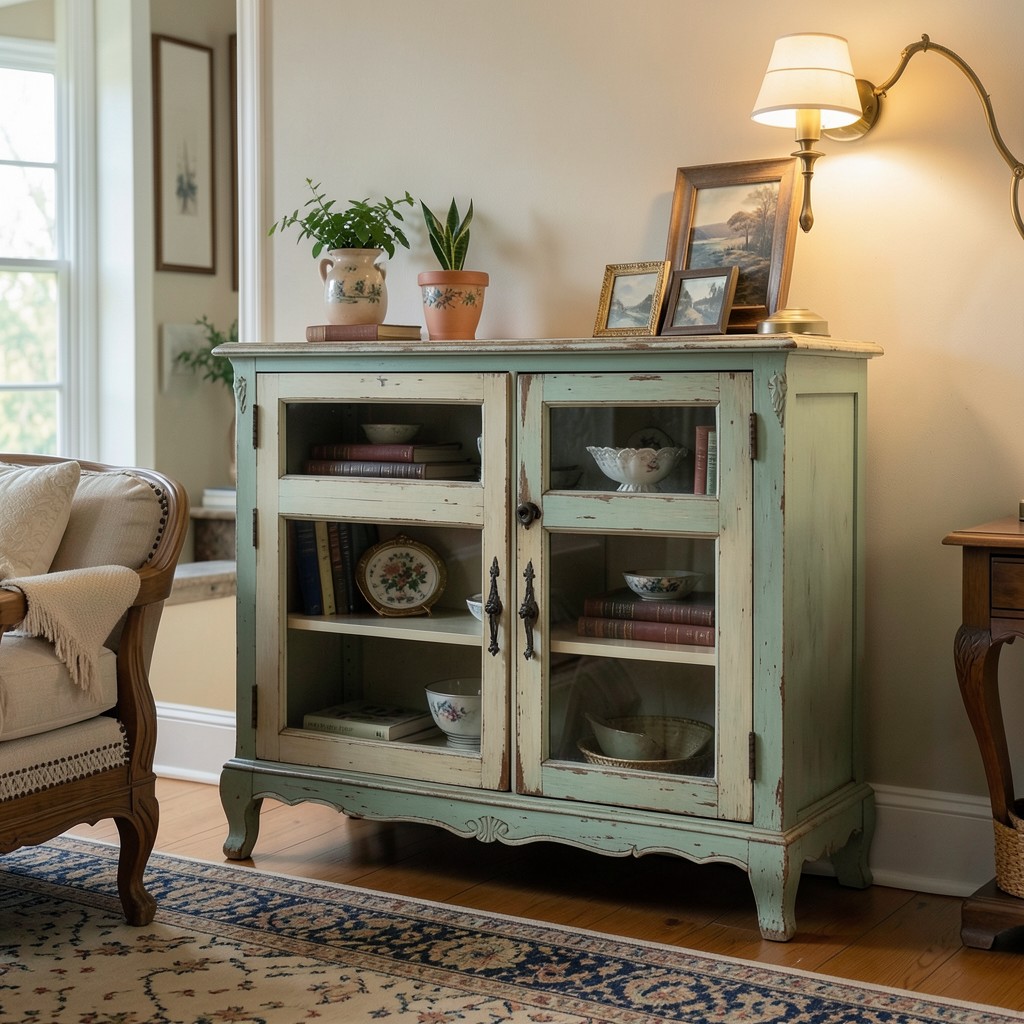
The antique cabinet in a traditional living room is the furniture piece whose design intelligence is entirely in the quality of the original from which it derives its character — whether a genuine period piece acquired through a specialist dealer or a quality reproduction whose proportions, hardware, and finish honor the original’s design intelligence, the cabinet’s value to the room is its communication of the design tradition whose residential furniture vocabulary the room’s other elements speak. The antique cabinet is not a design choice. It is a design statement about what the room values and what it belongs to.
A painted antique cabinet in a period color — the aged cream, the dusty green, or the faded slate blue of the European farmhouse furniture tradition — with original or period-appropriate hardware creates the traditional living room’s display and storage cabinet in a piece whose apparent age communicates the room’s relationship to the design tradition it inhabits. The surface’s aging quality — the paint worn at the corners and the door edges, the hardware’s metal developing the patina of decades of handling, and the interior’s original painted surface showing the accumulation of the household’s object storage through the piece’s history — creates the material biography that genuine antiques carry and that quality reproductions simulate with varying degrees of convincingness. Traditional home interiors organized around authentic or well-reproduced antique cabinetry communicate the design intelligence of a household that values the made-to-last and the designed-with-purpose over the disposable and the trend-responsive.
The antique cabinet’s placement in the traditional living room should treat it as the room’s most important individual object rather than as one furniture piece among several — the placement against the room’s focal wall, the positioning of the objects on its surface as a considered composition rather than an accumulated collection, and the light quality created by the adjacent lamp or the overhead fixture that reveals the cabinet’s surface quality all communicate the design’s respect for the piece’s quality and its intention to honor that quality within the room’s complete arrangement.
15. A Black-Painted Cabinet in an Industrial Kitchen

The black kitchen cabinet is the industrial home design kitchen’s most direct and most architecturally honest color choice — the flat, non-reflective black of the matte or satin finish creates the kitchen surface that absorbs the light rather than reflecting it, creating the depth and the material weight that the industrial aesthetic values as its primary surface quality. The black kitchen does not attempt to amplify the light or expand the space. It commits to the material’s weight and asks the room’s other elements — the metallic hardware, the industrial pendant lights, the raw concrete countertop — to provide the contrast.
A black-painted slab door kitchen cabinet in a flat or satin lacquer — the surface’s low reflectance creating the matte depth that distinguishes the industrial black kitchen from the high-gloss black whose reflective surface creates an entirely different aesthetic register — creates the industrial home design kitchen’s primary cabinet material in a finish whose quality is in the surface’s specific flatness. The black cabinet’s relationship to the countertop material determines the kitchen’s complete color composition — a concrete-look porcelain countertop against the black cabinet creates the monochromatic industrial palette; a warm butcher block timber countertop creates the warm-cold material contrast that the industrial aesthetic applies most naturally as its material dialogue; and a white marble countertop creates the dramatic light-dark contrast whose visual impact is maximum and whose maintenance demands are equally maximum.
The hardware on the black industrial kitchen cabinet should be in a metal that creates a specific and committed contrast — the raw steel bar pull, the antique bronze bin pull, or the brushed gunmetal bar handle all create the metallic surface against the black painted face with a material authority that the same hardware on a pale cabinet does not achieve. The hardware’s material and the black cabinet’s surface create the kitchen’s design character’s most direct expression, and the selection of that material detail is the cabinet design decision that most immediately communicates the kitchen’s aesthetic intention to every person who enters the room.
16. A White Shaker Bathroom Cabinet With Marble Countertop
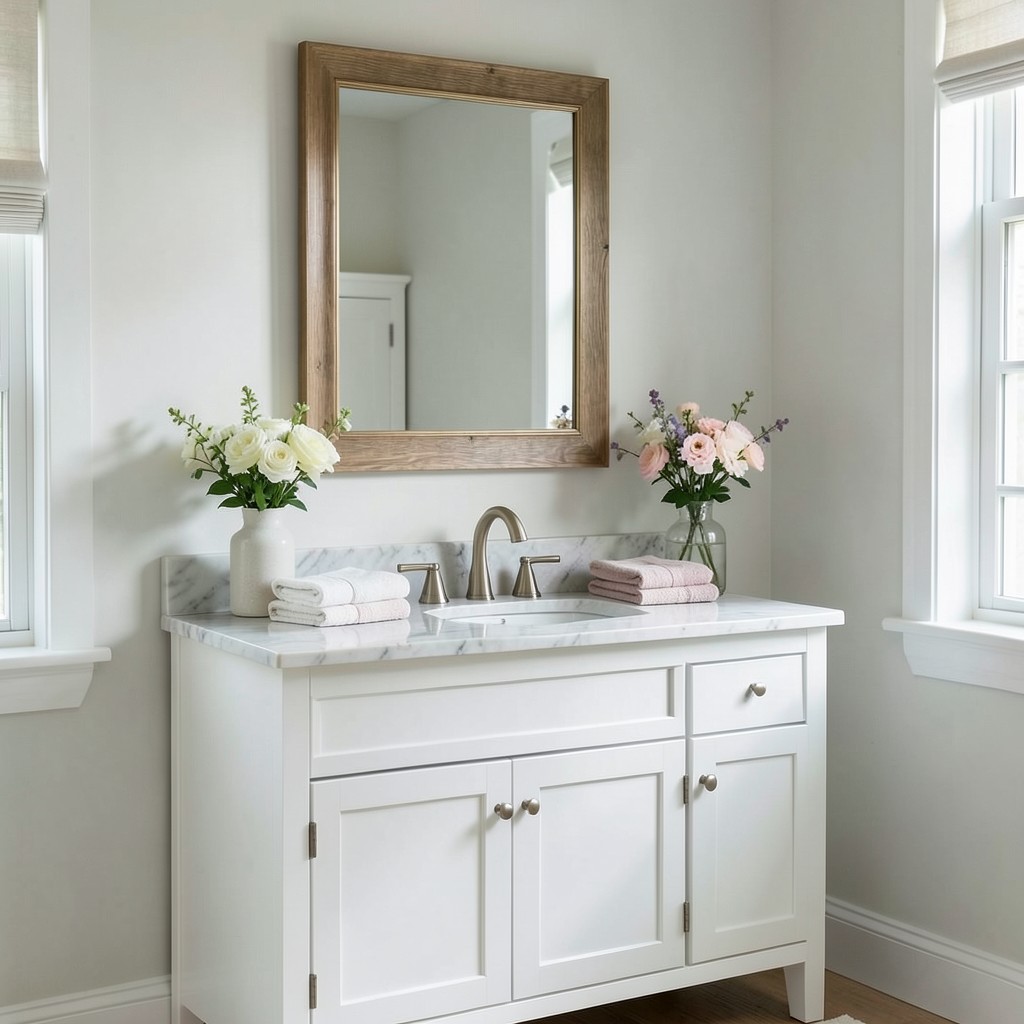
The white shaker bathroom vanity cabinet is the bathroom design combination whose longevity in residential interiors reflects the same quality as the kitchen Shaker cabinet’s longevity — the design is honest, the proportions are correct, and the material combination of painted timber and natural stone creates the bathroom’s primary surface in the material relationship whose warm stone and painted timber tension generates the composed visual quality that neither material achieves in isolation. The white shaker bathroom vanity is not the exciting cabinet design choice. It is the correct one for the household that values timeless quality over designed novelty.
The marble countertop on the white shaker vanity should be in a format that suits the bathroom’s scale and the household’s practical requirements — a honed finish for the bathroom whose daily moisture and cleaning routine creates the surface degradation that a polished marble finish exhibits over time in wet conditions, and the honed surface’s matte quality creating the organic, natural stone appearance that the bathroom’s material palette most authentically expresses. Spring bedroom decor season is when the white and marble bathroom cabinet reaches its design peak — the fresh, clean surface of the white shaker doors, the marble’s cool mineral quality in the spring light, and the seasonal flowers or the new towels on the vanity’s surface creating the spring bathroom refresh whose material quality communicates renewal through the honest combination of the cabinet’s clean simplicity and the stone’s natural beauty.
The mirror above the white shaker vanity should be treated as a designed element rather than a functional necessity — the framed mirror in a timber or brass frame creates the cabinet composition’s completing element, and its proportion to the vanity below determines whether the bathroom wall reads as a considered furniture arrangement or as a vanity with a mirror placed above it. A mirror whose width matches the vanity’s width creates the aligned composition; a slightly larger framed mirror creates the generous proportion that communicates the bathroom’s design ambition beyond the functional minimum.
17. A Rattan-Fronted Cabinet in a Bohemian Bedroom
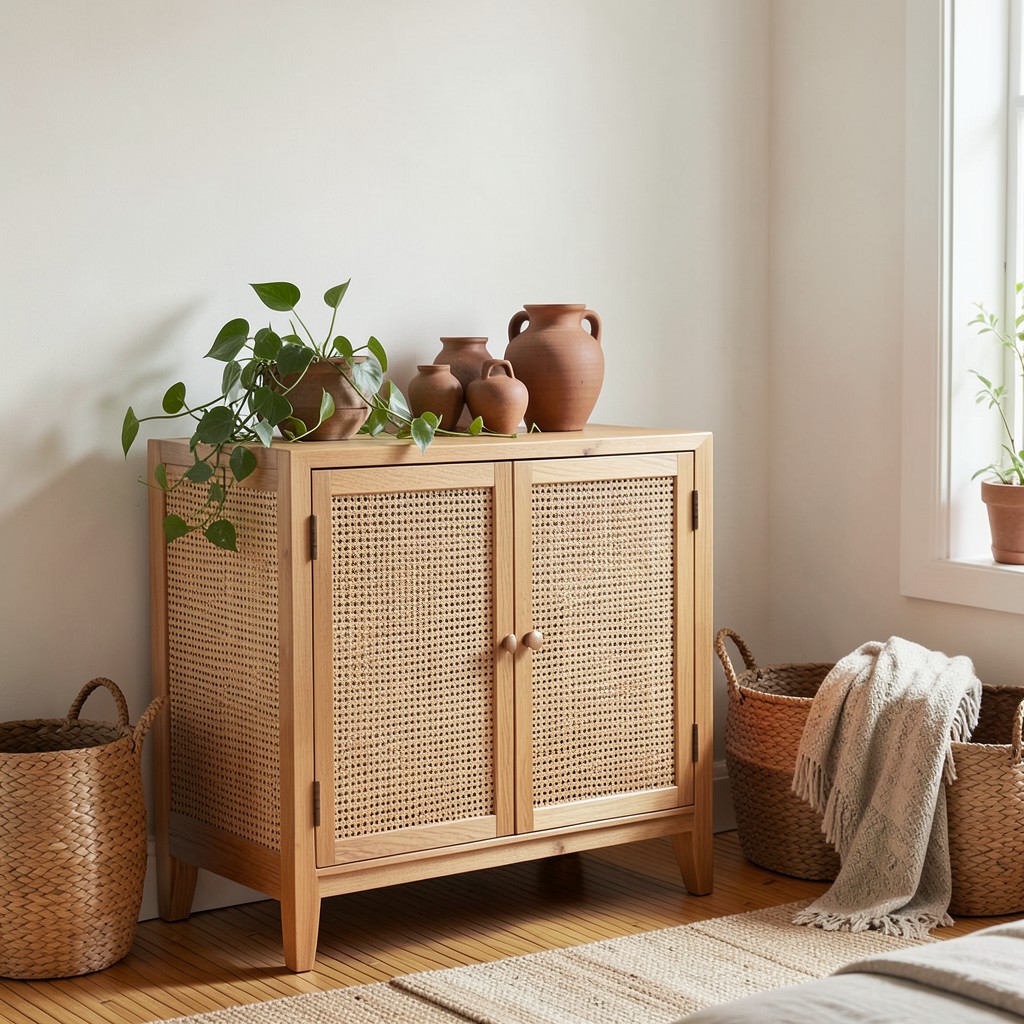
The rattan-fronted cabinet — the timber frame cabinet whose door panels are filled with woven rattan cane webbing rather than solid timber or glass — is the bohemian home styling and coastal home design cabinet whose material expression belongs to the organic, handcraft tradition that both aesthetics apply as their primary material vocabulary. The rattan panel allows air circulation through the closed door, creates the visual texture of the woven fiber against the room’s light, and communicates the design direction’s preference for the natural, the handmade, and the organically beautiful over the manufactured and the synthetic.
A rattan-fronted wardrobe or dresser in a natural timber frame — the woven cane panel in the warm honey tone of the natural rattan fiber against the timber frame’s warm oak or pine — creates the bohemian bedroom cabinet in a material combination whose organic warmth suits the bedroom’s most intimate design direction. Bohemian home styling around the rattan-fronted dresser — the trailing plant on its surface, the collection of ceramic vessels in warm earth tones, and the layered textiles in the woven baskets beside it — creates the complete bohemian bedroom whose cabinet communicates the design’s material philosophy at the room’s primary storage furniture scale. Bamboo home interiors that incorporate the rattan-fronted cabinet alongside bamboo flooring and natural fiber textiles create the complete organic bedroom whose material consistency is felt as physical warmth rather than only seen as design coherence.
The rattan panel’s care requirement is simpler than most cabinet materials — the woven fiber is cleaned with a slightly damp cloth and dried immediately to prevent the moisture that causes the natural fiber to swell and distort, and the periodic application of a natural oil such as linseed or tung oil to the rattan’s fiber creates the surface treatment that maintains the fiber’s flexibility and prevents the brittleness that dry conditions and UV exposure create over time in natural plant-derived materials.
18. A Steel and Glass Industrial Cabinet for a Loft

The steel and glass cabinet is the industrial home design piece that the loft apartment and the warehouse conversion have always needed and never quite had in residential production — a storage and display cabinet whose materials are the loft’s own, whose construction logic is visible in the welded joints and the bolted connections, and whose glass panels display the contents with the transparency that the industrial aesthetic’s commitment to material honesty extends to the objects stored within. The steel and glass cabinet is the industrial interior’s furniture as architecture.
A welded steel frame cabinet — the structural steel in a square or rectangular tube profile, the frame left in a raw mill finish or treated with a clear rust-protective coating that allows the steel’s natural color to remain — with clear glass panels in a tempered safety specification creates the industrial display cabinet in a material combination whose construction quality is entirely visible and entirely honest. The glass panel’s clear transparency allows the cabinet’s contents to be seen fully rather than through the diffusion that frosted or patterned glass creates, and the industrial aesthetic’s preference for the direct and the unmediated makes the clear glass the correct specification for this cabinet in its design context.
The steel and glass cabinet suits the industrial home design living room, study, and kitchen bar area with equal facility — in the living room as a display cabinet for books and objects, in the study as a modular shelving system whose adjustable shelves accommodate changing content requirements, and in the kitchen bar area as the display storage for the glassware and the bottle collection that the well-equipped bar counter requires. Stone and wood home design elements in dialogue with the steel and glass cabinet — the reclaimed oak shelf insert within the steel frame, the natural stone base beneath the cabinet’s ground connection — create the material layering that prevents the industrial cabinet from reading as a purely hard, cold element within the warmer organic material environment that the residential interior requires for genuine domestic comfort.
19. A Forest Green Built-In Cabinet in a Reading Room

Forest green paint on a floor-to-ceiling built-in bookcase creates the reading room’s most complete and most atmospherically specific design outcome — the deep color encloses the reader within the library’s green field, the books’ varied spines creating the warm, colorful content against the dark green ground, and the amber light of the reading lamp creating the warm pool of illumination that the green surround makes more intimate and more specific in its domestic quality. The forest green reading room bookcase is one of interior design’s most successful and most consistently repeated design ideas, and it works every time because the color’s organic quality and the book collection’s visual richness create a combination of inexhaustible atmospheric depth.
A floor-to-ceiling forest green built-in bookcase — the shelves and the back panel painted in the same deep tone as the frame and the doors, creating the continuous green field from which the books’ spines emerge as the room’s living color — creates the reading room’s cabinet design in the format that the cozy home design direction applies as its most completely atmospheric built-in specification. The book arrangement on the forest green shelves should not be over-organized — the alphabetical or color-blocked arrangement that the Instagram styling aesthetic favors creates the reading room as a display rather than as a functional library, and the reading room whose books are arranged for access rather than for appearance communicates the design’s genuine relationship to the activity the room was designed for. Rustic home office ideas rooms with forest green built-in bookcases, a leather armchair beside the window, and the mid-afternoon light falling across the shelves’ book collection create the domestic reading room atmosphere whose design quality is felt most specifically by the household member who uses it most consistently.
The forest green bookcase’s interior lighting — a recessed LED downlight above each bay, directed at the shelf contents below — creates the functional illumination for book selection and the atmospheric quality of the highlighted book collection against the dark green surround. The light’s color temperature should be warm — 2700 to 3000 Kelvin — to complement the green’s organic tone and to create the amber-tinted illumination that the reading room’s atmospheric quality requires rather than the cool, blue-white light of a higher color temperature that creates the task-lighting quality of a workplace rather than the warmth of a domestic library.
20. A Limewashed Cabinet in a Coastal Bedroom

Limewash paint on a cabinet surface creates the material quality that the coastal home design bedroom requires as its most authentic expression — the chalky, translucent, slightly uneven surface that limewash creates on timber or MDF communicates the bleached, sun-weathered quality of a material that has been in the coastal light for decades, and this communicative quality is the limewash finish’s most specific design contribution to the coastal room whose material palette is organized around the honest expression of natural aging.
A limewashed timber dresser or built-in wardrobe in a pale grey-white or a soft sandy tone — the limewash applied in two or three thin coats, each partially removed before drying to create the layered, uneven coverage that the finish requires to read as naturally aged rather than as painted — creates the coastal bedroom’s primary storage cabinet in a material surface of genuine organic warmth. Beach house interiors organized around the limewashed cabinet alongside the natural linen bedding, the driftwood-toned timber floor, and the shell and stone collection on the bedside table create the complete coastal bedroom whose cabinet’s material quality belongs to the same authentic material world as every other surface in the room. The summer home design season is when the limewashed cabinet’s pale, bleached quality reaches its atmospheric peak — the room’s natural light at its fullest, the coastal palette’s bleached tones reading in the summer sun with the genuine warmth of a seaside material at home in its seasonal and atmospheric context.
The limewash finish’s practical quality for a bedroom cabinet is better than its organic appearance suggests — the finish is durable on sealed timber substrate, its matte surface resists the fingerprint and the smear that glossier finishes display prominently, and its limewash chemistry creates a slightly alkaline surface whose antibacterial quality the traditional use of lime in interior finishes was appreciated for centuries before the modern paint industry replaced it with materials of less material intelligence.
21. A Handleless Bathroom Vanity in a Minimalist Spa
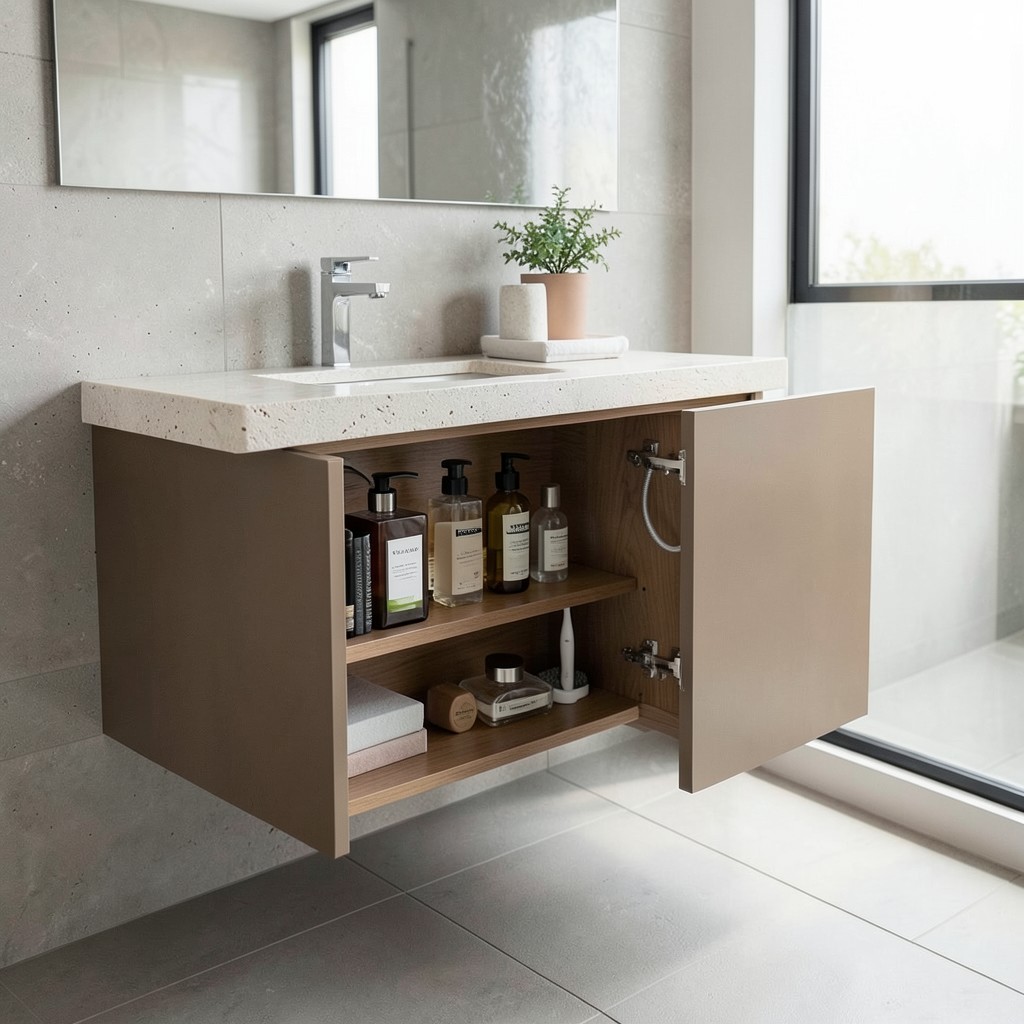
The handleless bathroom vanity creates the spa-style bathroom’s most complete expression of the minimalist aesthetic’s core design conviction — the removal of the hardware element from the bathroom’s primary storage cabinet creates a surface of uninterrupted material whose clean face reads as the room’s architectural element rather than as a piece of furniture within the room. The spa bathroom whose every surface is resolved at the highest level of material precision and compositional simplicity receives the handleless vanity as the design’s natural completing element. Peaceful home decor finds its most architecturally resolved bathroom expression in this format.
A handleless bathroom vanity in a honed stone, a matte lacquer, or a natural timber veneer — the surface material selected for both its visual quality and its resistance to the bathroom’s high-moisture environment — creates the spa bathroom’s storage cabinet in a material calibrated for the specific conditions the bathroom creates. The moisture management of the cabinet’s substrate and its surface finish requires specific material specification: the MDF substrate must be moisture-resistant grade rather than standard grade; the timber veneer must be specified with a marine-grade or moisture-resistant adhesive; and the lacquer or paint finish must be a moisture-tolerant formulation rather than a standard interior paint whose film fails under the repeated condensation and water exposure that the bathroom environment creates without adequate ventilation.
The interior of the handleless spa bathroom vanity should be organized with the same precision that the exterior communicates — the drawer inserts for small accessories, the adjustable shelf positions for bottles of varying heights, and the concealed power socket for the electric toothbrush charger whose installation requires the electrician’s involvement but whose absence creates the daily frustration of the cord trailing from the cabinet door every morning. The inside quality is as important as the outside quality in the cabinet that is opened multiple times daily, and the spa bathroom whose cabinet interior is as considered as its exterior communicates the design’s thoroughness at every level of the household’s daily engagement with the room.
22. A Deep Blue Cabinet With Cane Insert Doors
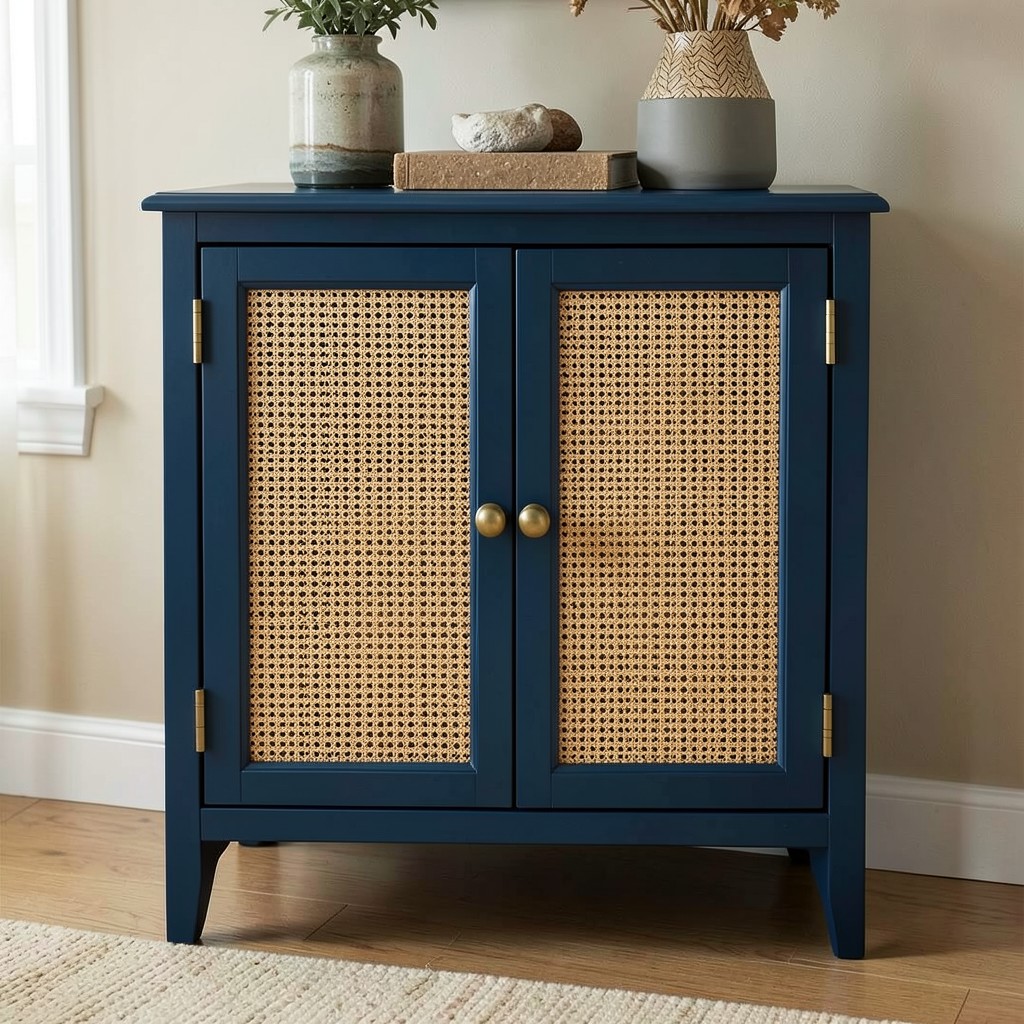
The deep blue cabinet with cane inserts is the furniture design idea that brings together the two most design-specific materials of the current residential aesthetic moment — the deep, saturated blue and the woven natural cane — in a single cabinet piece whose combination creates something greater than either material achieves in isolation. The blue grounds the organic warmth of the cane with the cool authority of the saturated color; the cane prevents the blue from reading as cold or austere by introducing the natural fiber’s organic warmth and the woven pattern’s visual animation.
A blue cabinet in a midnight or peacock tone — the color’s depth creating the visual anchor that the cane panel’s organic lightness requires to be held within the composition — with natural woven cane door inserts creates the living room or bedroom cabinet design in a material combination whose visual quality is both organic and architectural simultaneously. The cane panel’s warm honey tone reads warmly against the cool, deep blue of the frame, creating the color contrast that is not the high-contrast opposition of complementary colors but the temperature contrast of warm natural and cool saturated — a more complex and more interesting color relationship than the conventional contrast palette creates. Bohemian home styling and coastal home design both apply this specific cabinet combination as one of their most design-confident furniture expressions, and the crossover between the two aesthetics at this material combination reflects the genuine overlap in their material philosophies.
The cabinet’s hardware should be in a warm tone — the brushed gold or the unlacquered brass that creates the warm metallic accent against the blue — and its scale should be proportional to the door’s dimensions without overpowering the cane insert’s delicate woven pattern. A small, sculptural knob in a warm brass creates the most composed hardware detail for the cane-insert cabinet door — the knob’s small footprint maintains the cane panel’s visual dominance while providing the operating mechanism with the material quality that the cabinet’s design ambition requires at every detail level.
23. A Kitchen Cabinet Island With Seating in an Open-Plan Space
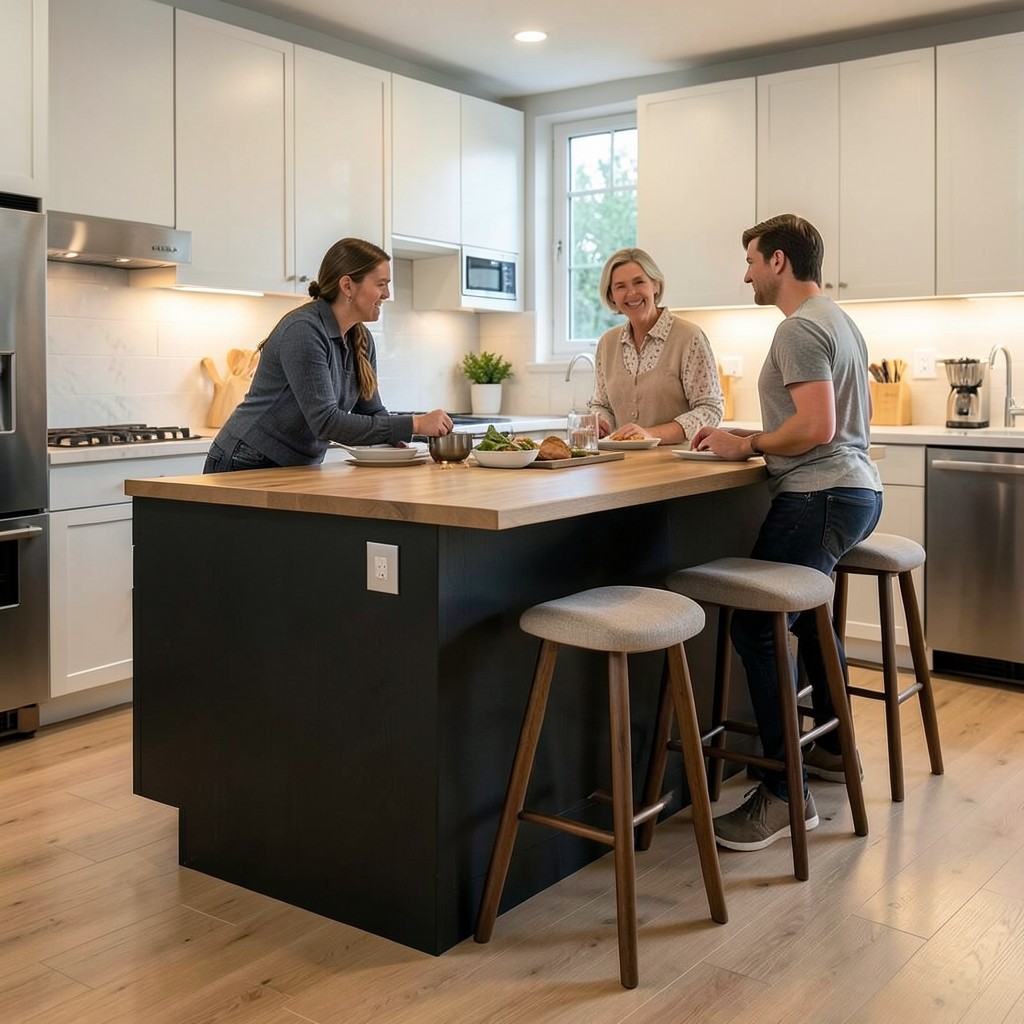
The kitchen island cabinet with integrated seating is the open-plan home’s most socially successful furniture element — the storage and preparation surface of the kitchen island combined with the seating overhang that creates the casual dining and socializing position at the kitchen’s edge creates the household’s primary social gathering point in the room where the household’s most consistent daily social activity occurs. People gather in kitchens. The island with seating creates the physical structure that formalizes and honors that gathering impulse.
An island cabinet in a contrasting color to the perimeter cabinetry — the island in a natural oak or a dark painted finish against the perimeter in white or pale grey — creates the open-plan kitchen’s compositional center in a material that reads as distinct from the surrounding cabinetry and communicates the island’s different functional role within the kitchen’s spatial organization. The seating overhang’s depth — the countertop extending beyond the island’s base cabinet edge by twelve to fifteen inches on the seating side — creates the knee clearance that bar stool seating requires, and the overhang’s material should be the countertop’s natural extension rather than a separate secondary surface whose junction with the main countertop creates the joint that collects food debris and communicates the design’s compromised resolution. Modern kitchen ideas open-plan spaces organize the household’s daily social life around the island seating with the consistency that the sofa organizes the living room’s evening social life, and the island whose seating quality — the stool height, the overhang depth, and the back support of the stool specified — creates the genuinely comfortable casual seating position is the island whose social function is fully delivered.
The island cabinet’s storage specification on the non-seating side — the deep drawers for pots and pans whose accessibility from the standing position beside the cooking zone creates the operational convenience that the island’s central kitchen position uniquely provides — should be organized for the cooking workflow’s specific demands rather than for the standard drawer-and-door layout that the catalog specification provides as the default option.
24. A Painted Cabinet in a Jewel Tone for a Maximalist Room

The maximalist cabinet is the design choice that most directly contradicts the dominant contemporary design culture’s preference for restraint — the cabinet in a deep, saturated jewel tone, positioned in a room of already-rich material and color character, adds the color intensity whose accumulation creates the maximalist interior’s designed excess. The maximalist interior is not the room where too much happened. It is the room where enough was added, and the designer had the conviction to stop there rather than editing back to the comfortable middle ground where most rooms end up.
A cabinet in a deep teal, a rich emerald, or a saturated peacock blue — the color in a high-gloss or a deep satin finish that maximizes the jewel tone’s color depth — creates the maximalist living room or dining room’s storage cabinet as the room’s color statement at the furniture’s largest scale. The color’s saturation at the cabinet’s scale creates the visual presence that the maximalist interior requires from its primary furniture pieces — the piece should hold its own against the room’s wallpaper, its textile pattern, and its art collection rather than receding into the visual background that a neutral cabinet creates in the same room. Chic home decor applied to the jewel-tone cabinet — the interior lined in a complementary pattern wallpaper visible through the glass doors, the contents arranged as a curated display rather than a stored collection — creates the cabinet as a composed object of genuine design intelligence rather than as a colored storage unit.
The maximalist cabinet’s success depends on the commitment to its color intensity being maintained throughout the room’s styling — the jewel tone cabinet in a room of pale, neutral furniture and minimal accessory content reads as the anomaly rather than as the anchor, and the design’s effectiveness requires the room’s other elements to match the cabinet’s color ambition with their own design confidence.
25. A Bamboo Cabinet in a Tropical or Zen Bedroom
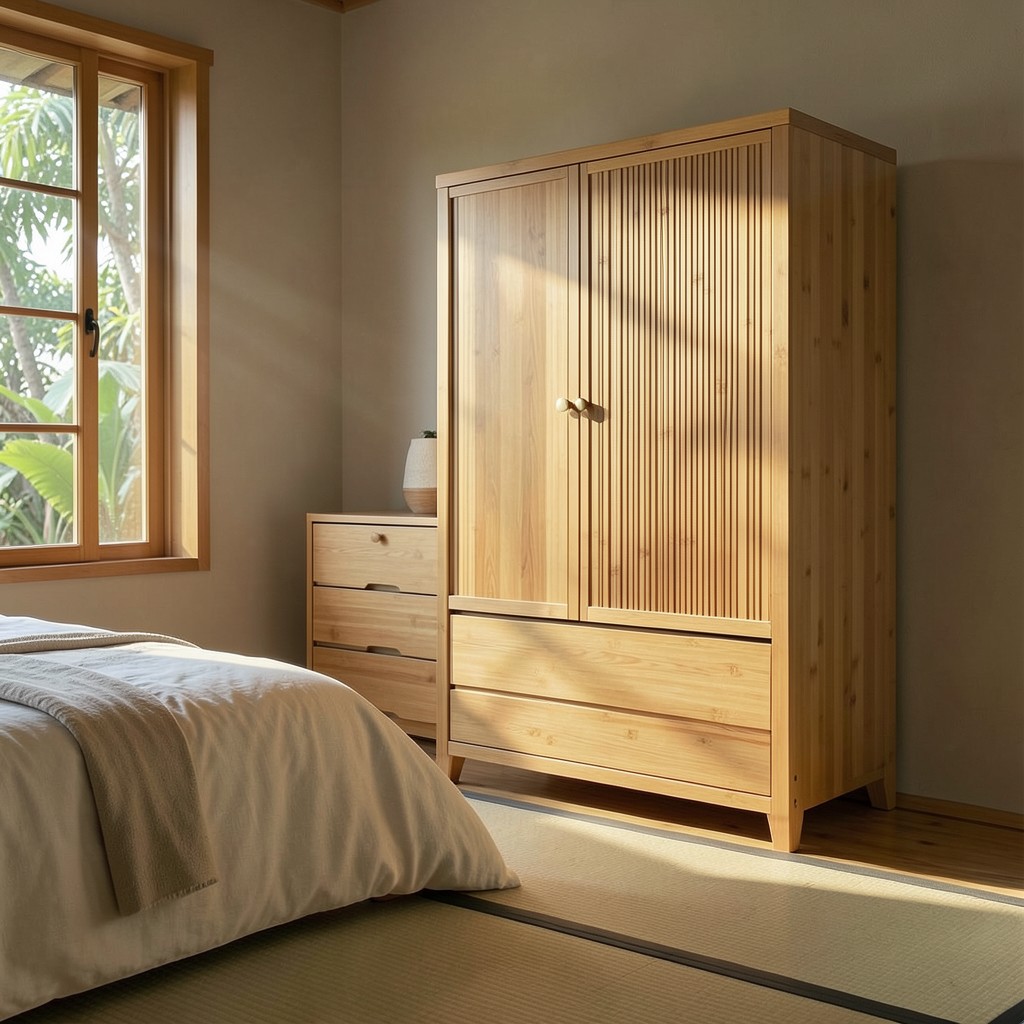
The bamboo cabinet brings the material’s specific combination of qualities — its strength-to-weight ratio, its rapid renewable growth cycle, its warm amber tone, and its distinctive grain pattern — to the bedroom storage function in a material that no other plant-based material replicates. Bamboo is not wood, and the bamboo cabinet communicates its material specificity through the grain’s tight, horizontal growth pattern that distinguishes it from timber’s radial grain, creating the surface that the tropical home design and the zen-inspired interior both apply as their most material-specific furniture expression.
A bamboo dresser or wardrobe — the case construction in solid bamboo board, the drawer faces in a bookmatched bamboo veneer panel, and the hardware in a simple wooden or matte brass knob — creates the zen bedroom’s primary storage cabinet in a material whose connection to the natural world is both visual and tactile. Bamboo home interiors organized around the bamboo cabinet alongside a tatami or bamboo floor, natural fiber bedding, and the minimal, organized bedroom display that zen design requires create the complete organic bedroom whose material consistency is felt as genuine simplicity rather than as designed minimalism. The bamboo cabinet’s warm amber tone creates the room’s primary warm material element, and the light that the bedroom’s window sends across the bamboo’s surface in the morning creates the specific warm glow quality of the material that the zen interior values as its most daily and most ordinary atmospheric gift.
The bamboo cabinet’s practical qualities suit the bedroom’s climate requirements — the material’s natural moisture regulation creates the furniture piece whose interior humidity remains relatively stable across the bedroom’s seasonal humidity variation, and this stability benefits the stored clothing and textiles by preventing the condensation inside the cabinet that seasonal humidity shifts create in poorly ventilated, thermally dense storage furniture. The bamboo cabinet breathes, and the stored contents breathe with it.
26. A Mirrored Cabinet Front in a Small Bedroom

The mirrored cabinet front is the small bedroom’s most powerful spatial tool — the full-height wardrobe whose doors are mirrored floor-to-ceiling creates the bedroom whose storage wall reflects the opposite wall, doubling the perceived room width and creating the visual depth that the narrow or compact bedroom’s physical dimensions cannot provide without the mirror’s reflective contribution. The mirrored wardrobe does not make the room look bigger in a superficial decorative sense. It physically doubles the apparent space by reflecting the room’s opposite half across the mirror’s surface, and the result is a bedroom that the occupant experiences as twice its measured width for the full-height section of the wall that the mirrored door covers.
A full-height mirrored wardrobe in a frameless or slim-framed specification — the mirror panels extending from floor to ceiling without the interruption of a substantial timber or aluminium frame — creates the maximum spatial expansion of the small bedroom’s mirrored wardrobe format. The frameless or slim-framed mirror creates the uninterrupted reflective surface whose continuity maximizes the doubling effect; the heavily framed mirror creates the wardrobe as a furniture piece whose visual weight and frame presence reduce the mirror’s spatial contribution. Cozy bedroom design in a small room applies the mirrored wardrobe as the spatial tool that creates the room’s most significant perceived size improvement from a single design decision, and the small bedroom whose mirrored wardrobe has been replaced with a painted wardrobe during a renovation — the occupants discovering the spatial reduction that the mirror’s absence creates — is the most convincing endorsement of the format’s spatial effectiveness.
The mirror’s care in a bedroom wardrobe requires the periodic cleaning that any large mirror surface demands — a streak-free glass cleaner applied with a soft cloth, wiped in horizontal strokes from top to bottom, creates the clean, undistorted reflection whose quality the spatial strategy depends upon. A streaked or spotted mirror creates the degraded spatial quality of a reflection whose imperfection draws the eye to the mirror’s surface rather than allowing the eye to penetrate into the reflected space, and the small bedroom’s spatial strategy is only as effective as the mirror’s reflective surface quality.
27. A Limewood Carved Cabinet as a Statement Piece
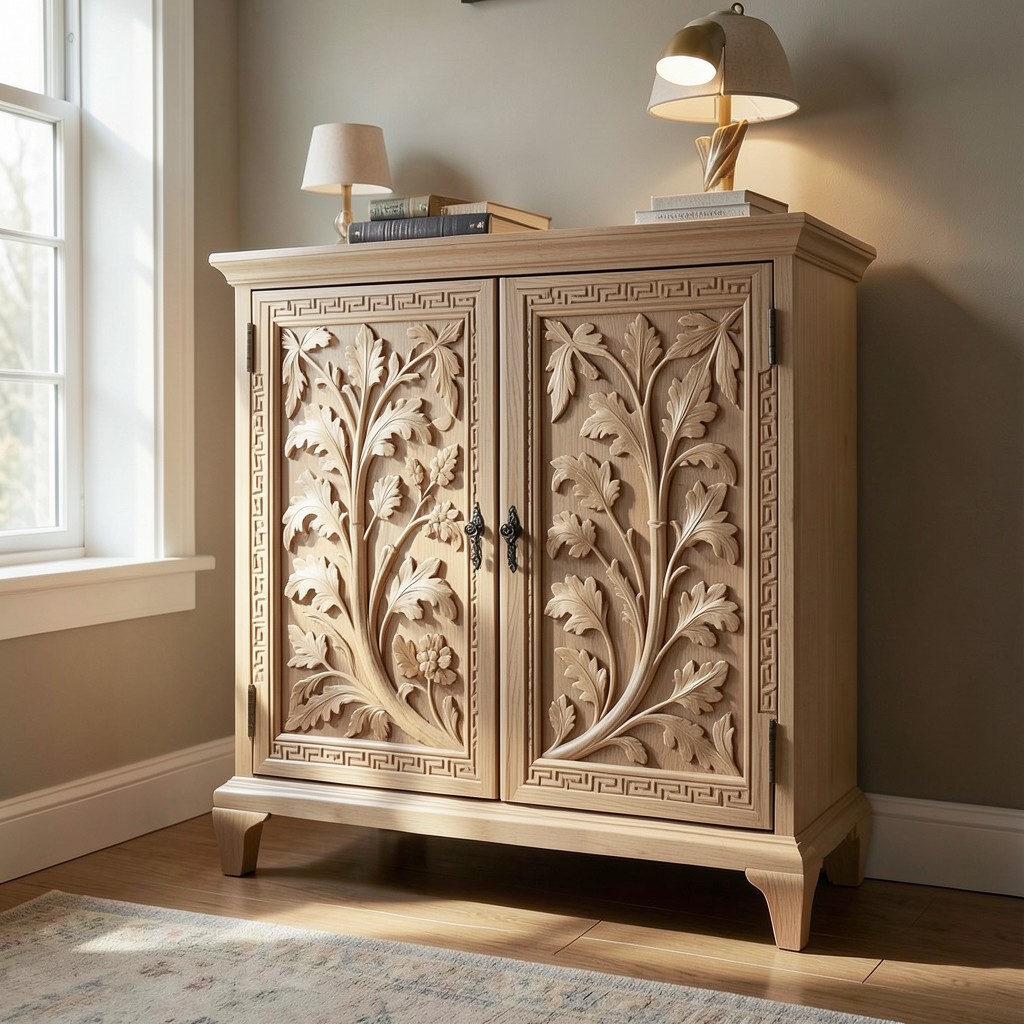
The carved limewood cabinet is the furniture piece that the household committed to genuine craft quality selects when the question is which single object communicates the design’s values most completely — the hand-carved cabinet in the pale, fine-grained limewood that European furniture carvers have used for centuries creates the room’s primary designed object in a material whose specific properties for detailed carving make it the carver’s preferred substrate. Limewood carves with a precision and a surface quality that harder woods prevent, and the carved detail’s sharpness — the clean edges of the acanthus leaf, the precise relief of the floral panel, the crisp definition of the geometric border — communicates the carver’s skill with the directness of a material that holds every chisel mark with complete fidelity.
A limewood cabinet whose door panels carry hand-carved botanical or geometric relief — the carving executed at a depth sufficient to create genuine three-dimensional shadow quality in the room’s ambient light — creates the room’s most personal and most craft-specific furniture piece in a medium whose visual quality no machine-produced alternative approaches. The carving’s surface, left in a natural pale finish or tinted lightly with a tinted wax that allows the wood’s grain to remain visible through the color, creates the cabinet whose finish communicates the same honest material quality as the carving itself. Traditional home interiors and luxury home interior rooms both receive the limewood carved cabinet as the statement piece whose craft quality communicates the design’s values at the level of genuine material investment.
The placement of a carved limewood cabinet in the room should honor its quality by positioning it where the light quality reveals the carving’s depth most effectively — the raking light from a side window, or a narrow-beam picture light mounted above the cabinet face, creates the directional light that the carved relief’s shadow depth requires to read at its fullest visual quality. The carved cabinet in flat frontal light loses the three-dimensional quality of its relief; the same cabinet in directional light becomes the room’s most animated surface.
28. A Kitchen Cabinet With Open Shelving and Closed Storage Mix

The mixed kitchen cabinet — open shelving in the upper zone combined with closed doors in the lower zone — is the practical design intelligence that the household whose kitchen discipline falls between the perfectly curated open-shelf kitchen and the fully concealed closed-cabinet kitchen actually needs. The open upper shelves display the ceramic pieces, the glassware, and the small objects whose daily-use frequency and visual quality justify the exposed position; the closed lower cabinets conceal the pots, the pantry supplies, and the equipment whose visual quality and organizational neatness do not meet the display threshold. The mix is honest about the kitchen’s actual contents rather than forcing them all into either the display or the concealment category.
A kitchen where the upper section is entirely open — floating timber shelves in a natural oak or a painted finish, mounted at the wall between the lower cabinet countertop and the ceiling — with closed-door lower cabinets below the countertop creates the kitchen’s design in a format that most residential kitchens can achieve without structural modification. The open upper zone’s shelf depth — twelve to fourteen inches — matches the standard upper cabinet depth and creates the display surface calibrated for the ceramic plates, the glassware, and the small appliances that the upper kitchen zone stores. Modern kitchen ideas that apply the open-upper and closed-lower format create the kitchen whose design is both honest about its contents and intelligent about which contents deserve the room’s visual attention.
The transition between the open and closed zones — the countertop’s horizontal band that marks the boundary between the display above and the storage below — should be treated as a composed design element rather than as an incidental junction. The countertop material’s extension to the full cabinet run, the tile or panel material behind the open shelving creating the background that the displayed objects read against, and the hardware on the closed lower cabinets all contribute to the transition zone’s visual quality and the kitchen’s complete design coherence.
29. A Lacquered Cabinet in a Deep Coral for a Maximalist Dining Room
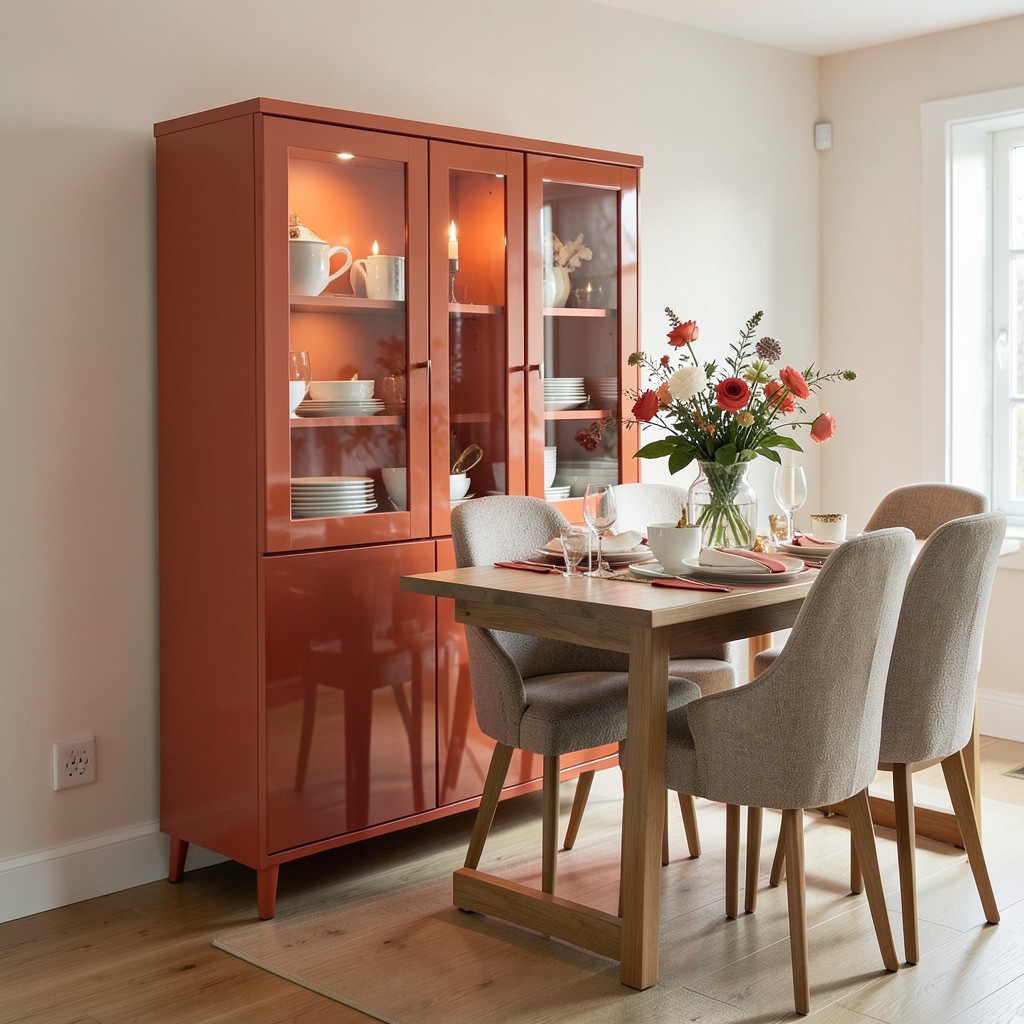
Deep coral is the cabinet color that the maximalist dining room applies when the more conventional jewel tones feel expected — the warm, slightly red-toned orange of coral creates the dining room cabinet color whose visual energy and warmth combine to create the room’s most sociable and most appetite-stimulating design environment, and the dining room is precisely the room where those qualities are most specifically useful. The maximalist dining room cabinet in deep coral is not a subtle design choice. It is the room’s declaration of its intention to make every meal feel like an occasion.
A lacquered dining room display cabinet in a deep coral or a warm terracotta-coral — the lacquer’s glossy surface creating the color’s maximum saturation and reflective quality — creates the dining room’s primary storage and display piece in a color whose energy and warmth suit the communal, convivial function of the room it inhabits. The glass doors of the coral cabinet reveal the white ceramic tableware within, and the color contrast between the deep coral frame and the white ceramic contents creates the composed display whose visual richness communicates the design’s deliberate appetite for color without the chaos that unplanned color accumulation creates. Holiday home styling in the maximalist coral dining room — the festive tableware visible through the cabinet’s glass doors, the amber candlelight reflected in the lacquered coral surface, and the seasonal floral arrangement on the dining table creating the complete festive atmosphere — reaches its annual atmospheric peak during the winter festive season whose warmth and color the coral cabinet’s design was built to amplify.
The coral cabinet’s room context requires the restraint that all dramatically colored large furniture demands — pale walls that allow the coral’s warmth to read as designed emphasis rather than absorbed heat, a natural timber floor that creates the organic warm neutral beneath the coral’s more assertive warm tone, and the table and chairs in materials and tones that support the cabinet’s color leadership without competing with it.
30. A Painted Kitchen Cabinet in Soft Black With a Matte Finish

Soft black — the matte-finish dark charcoal that reads as black in most light conditions but reveals its warm undertone in the morning’s oblique natural light — is the kitchen cabinet color for the household that wants the authority and the depth of the dark kitchen without the industrial edge that the true flat black creates in a domestic setting. The soft black matte kitchen is the dark kitchen for people who cook and gather rather than for people who photograph and publish, and the distinction matters because the two kitchens look similar in photography but feel completely different in daily occupancy.
A soft black matte kitchen — the lower cabinets and the island in the dark charcoal tone, the upper cabinets in a complementary warm white or a pale greige — creates the two-tone kitchen at its most sophisticated color resolution. The matte finish’s absence of reflectance creates the cabinet surface that absorbs the kitchen’s ambient light rather than reflecting it, and the kitchen whose primary surfaces absorb rather than reflect the light creates the warm, enclosed atmospheric quality that the cozy home design direction values as its kitchen expression. The matte finish’s practical advantage over the high-gloss black is its forgiveness of fingerprints — the matte surface’s diffuse light response prevents the fingerprint’s reflective quality from creating the visible smear that the gloss surface displays prominently, and the dark matte kitchen cabinet whose surface is handled dozens of times daily maintains its visual quality between cleanings with significantly less effort than its gloss counterpart.
The hardware on the soft black matte kitchen cabinet should be in a warm metal — the brushed brass or the unlacquered brass bar pull creating the warm gold against the dark matte surface in the material contrast that the dark kitchen’s composition requires to prevent the palette from reading as oppressively dark. The hardware’s warm metal introduces the kitchen’s only bright, reflective element at the cabinet face, and its precise, deliberate placement creates the visual accent points whose rhythm across the kitchen’s cabinet run creates the cabinet design’s most humanizing detail.
31. A Reclaimed Wood Cabinet in a Rustic Kitchen
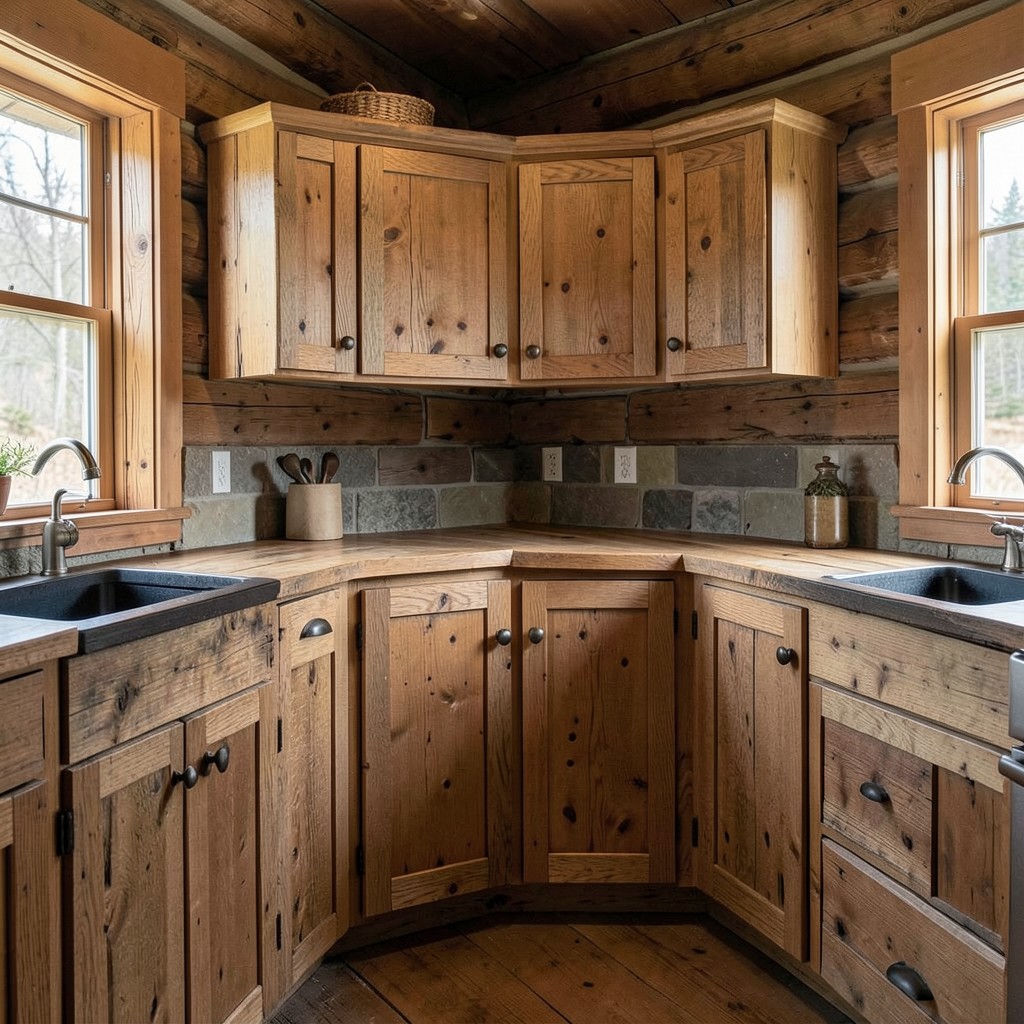
The reclaimed timber kitchen cabinet is the design choice that most directly communicates the rustic home decor kitchen’s authentic material philosophy — the cabinet built from timber salvaged from a demolished barn, a deconstructed mill floor, or an aged warehouse structure carries the material biography of its previous structure in every nail hole, every saw mark, and every surface imperfection that the original use created. The reclaimed wood kitchen cabinet is not distressed for aesthetic effect. Its distress is genuine, and that genuineness is the design’s most specific and most irreplaceable quality.
A reclaimed oak or elm kitchen cabinet — the case and door construction in the salvaged timber, its surface in a natural oil finish that preserves and reveals the wood’s existing character without the obscuring opacity of a paint or lacquer topcoat — creates the rustic kitchen’s primary storage element in a material whose visual depth and tactile character no newly milled timber matches. The aged wood’s surface — the grey patina of the oxidized exterior, the warm amber of the freshly exposed interior wood grain, and the hardware-hole evidence of the previous fixings — creates the cabinet face of organic complexity that the rustic aesthetic values as its most authentic material expression. Mountain cabin decor kitchens with reclaimed timber cabinets, stone countertops, and the cast iron sink create the complete rustic kitchen whose material palette belongs to the same honest, labor-intensive tradition as the log structure that surrounds it.
The reclaimed timber cabinet’s construction requires the specific skills of a cabinetmaker experienced in working with salvaged material whose dimensional inconsistencies — the slight warping, the varying thickness, and the occasional structural imperfection of aged timber — require adaptive construction techniques that the standard cabinet shop’s dimensional processing of new lumber does not equip. The household that sources both the salvaged timber and the skilled cabinetmaker experienced in working with it has the cabinet whose authenticity rewards the additional investment and effort with a material quality that no new-lumber cabinet, regardless of its finish, achieves on the same terms.
32. A Japandi-Style Cabinet in Natural Oak and White
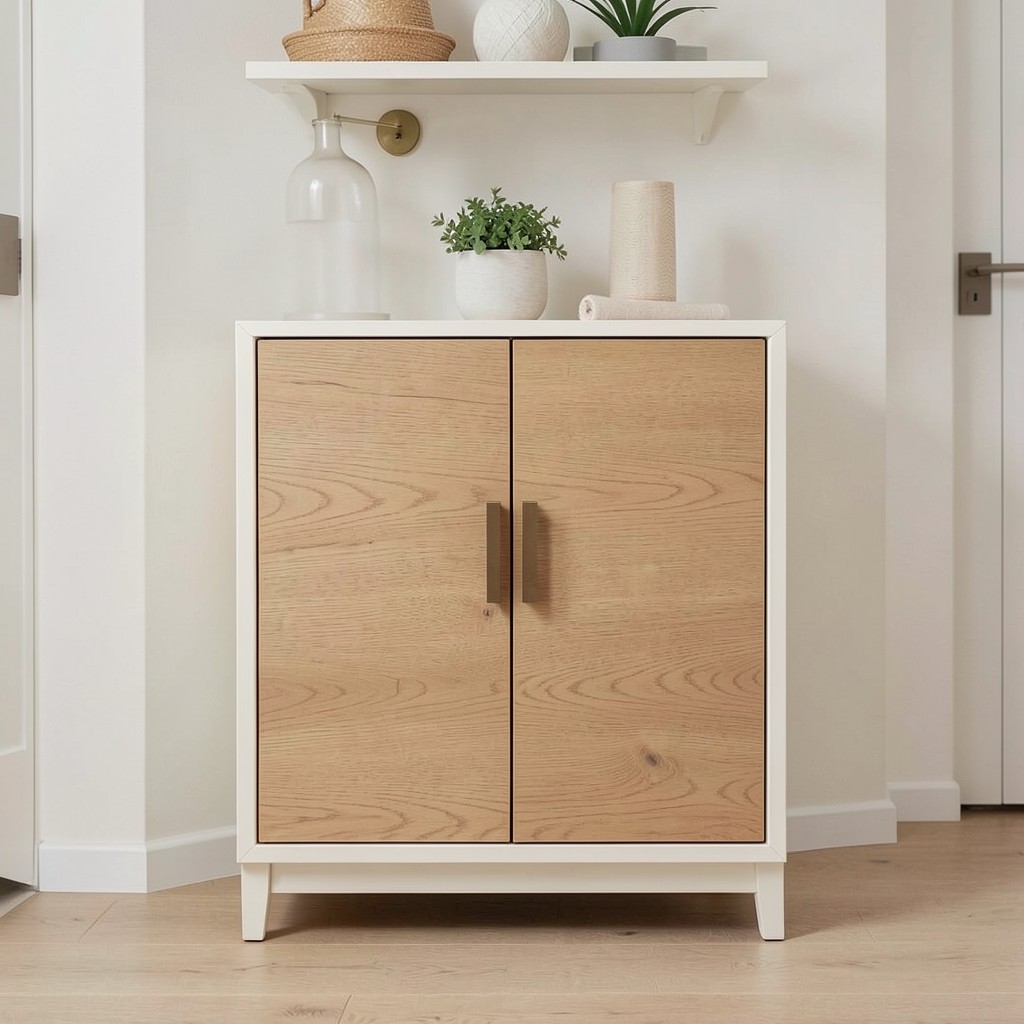
The Japandi cabinet is the furniture piece that the Japandi aesthetic’s combination of Japanese material philosophy and Scandinavian home interior design values creates as its most specifically resolved storage expression — the natural oak timber, the clean proportions, and the absence of any decorative detail beyond what the material’s own grain and the construction’s own joinery create, combined in a cabinet whose design is the expression of the conviction that the most beautiful furniture is the furniture that does exactly what it needs to do and nothing else.
A Japandi cabinet in a natural or lightly oiled oak — the grain’s horizontal pattern across the door panels creating the cabinet’s only surface decoration — with a pale white or cream painted frame creates the material combination that the Japandi aesthetic applies as its most characteristic furniture expression. The oak door panel reads warmly against the cooler white frame, creating the temperature contrast that the Japandi palette values as the material relationship between organic warmth and architectural coolness. Scandinavian home interior hallway cabinets in the Japandi format — the shoe storage and coat hanging solutions in the natural oak and white combination that the Scandinavian home interior applies to its entrance space — create the first design impression that the home’s arrival experience establishes, and the Japandi quality at the entrance communicates the entire home’s design intention from the first moment of entry.
The Japandi cabinet’s hardware should be minimal in profile and warm in material — the small recessed pull in a brushed brass or a matte aged bronze creates the operating mechanism whose scale and material presence suit the cabinet’s design restraint. A hardware choice whose profile, finish, or decorative complexity exceeds the cabinet’s own design ambition creates the contradiction between the detail and the whole that the Japandi philosophy considers a form of material dishonesty, and the design’s integrity depends on every detail maintaining the same level of restraint that the cabinet’s overall form establishes.
33. A Floral-Motif Painted Cabinet in a Garden Room

The hand-painted floral cabinet is the garden room’s primary decorative furniture piece — the storage cabinet whose painted surface carries the botanical imagery that the garden-inspired interiors direction values as its most intimate and most personal material expression. The floral motif painted directly onto the cabinet’s surface creates the furniture as artwork, and the quality of the painting — the botanical accuracy of the flower forms, the color harmony of the painted palette, and the composition’s relationship to the cabinet’s panel structure — determines the piece’s quality as designed furniture rather than as a painted decoration applied to a functional object.
A botanical cabinet in a pale sage or a warm cream ground — the painted flowers in the loose, organic style of the English botanical illustration tradition or the more formal, symmetrical style of the Dutch painted cabinet tradition — creates the garden room’s primary decorative storage piece in a style whose specific painterly tradition communicates the design’s cultural reference. Floral home decor ideas reach their most specific and most materially committed expression in the hand-painted floral cabinet — the decoration applied directly to the furniture surface creates the permanent design whose quality is the painter’s skill expressed through the cabinet’s daily residential presence. Garden-inspired interiors organized around the floral cabinet — the botanical print textiles, the fresh and dried flower arrangements, and the collection of ceramic vessels in flower and leaf forms — create the complete garden room whose cabinet is the botanical environment’s primary design anchor.
The floral cabinet’s repainting — when the surface’s wear or the household’s design direction change requires the updating of the painted decoration — is the maintenance commitment that distinguishes the painted furniture from the lacquered or stained alternative. The repainting is not a repair; it is the renewal of the cabinet’s artistic surface, and the household that commissions an artist to refresh the botanical painting maintains the piece at the quality level that its design ambition requires.
34. A Floating Cabinet System in a Contemporary Bedroom
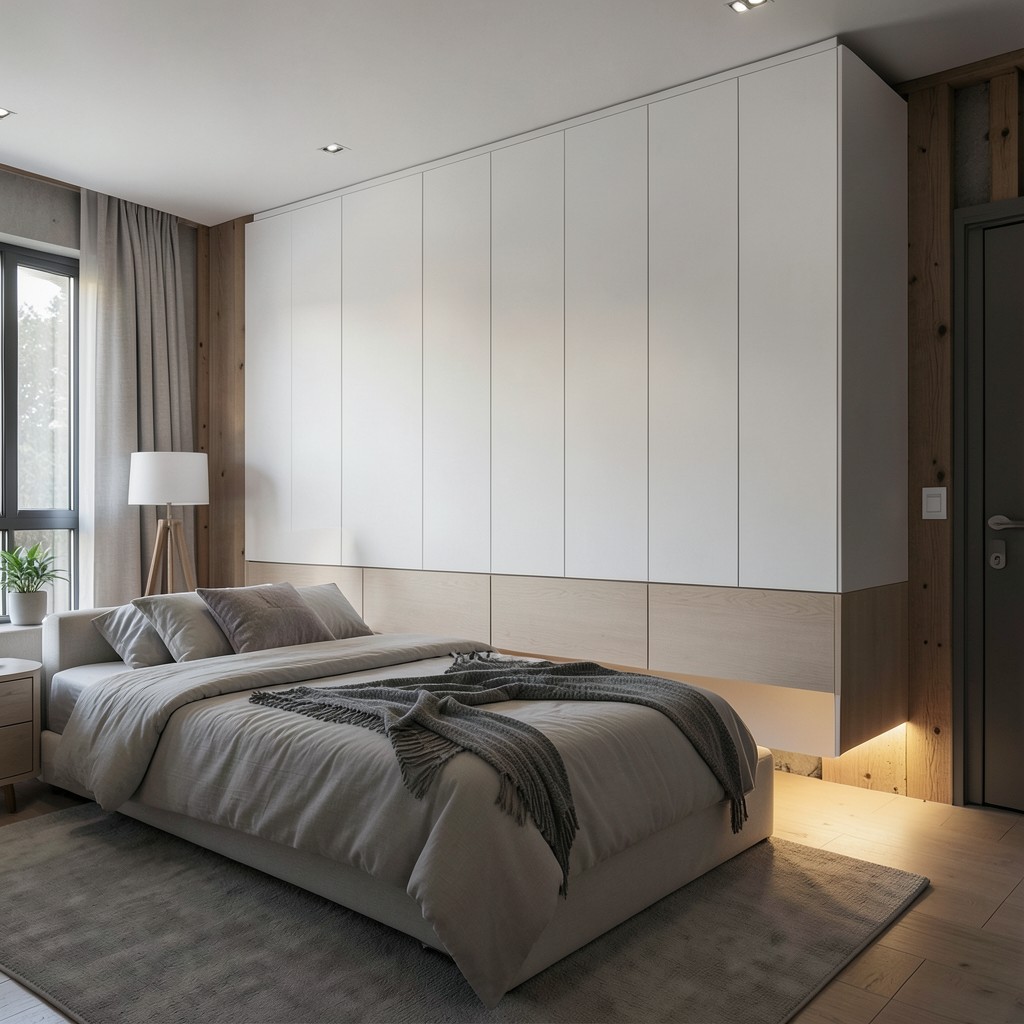
The floating cabinet system in the bedroom — wall-mounted cabinet units whose bases are elevated from the floor surface on concealed steel brackets, creating the floor-to-ceiling storage wall in a format whose components appear to float above the floor — creates the bedroom storage architecture at the most spatially expansive scale without the floor-area commitment that floor-standing wardrobe units require. The floating cabinet system’s visual lightness creates the bedroom whose storage is present but whose spatial quality is not compromised by the storage’s floor contact.
A wall-mounted bedroom cabinet system in a pale wood veneer or a white painted MDF — the cabinet units spanning the full wall width from floor level to ceiling height, their flush faces creating the uninterrupted material plane that reads as a designed wall rather than as a collection of assembled furniture — creates the luxury master bedroom design’s storage wall in the format whose spatial quality communicates the design’s ambition. The units’ floor clearance — the gap between the lowest cabinet’s base and the floor surface — creates the visual lift that prevents the storage from creating the heavy, floor-anchored quality of a traditional fitted wardrobe, and the concealed LED strip at the base of the lowest units creates the warm floor-level illumination that the floating cabinet’s nighttime atmospheric quality requires.
The floating cabinet system’s wall-mounting specification requires structural engineering consideration in its planning stage — the wall must provide the fixing capacity for the cabinet system’s loaded weight, which includes the cabinet structure, its contents, and the dynamic loads of the door opening and closing. A timber stud wall with appropriately sized fixings into the studs creates the structural capacity for most residential cabinet loads; a masonry wall with chemical anchor fixings provides the equivalent capacity in a different substrate. The cabinet installer who specifies the fixing system without reference to the wall’s structural capacity creates the installation risk that the household discovers when the over-loaded cabinet system fails.
35. A Walnut Cabinet in a Mid-Century Modern Living Room

Walnut is the timber that mid-century modern design applied as its primary furniture wood — the dark, warm brown with its occasional wavy grain, its natural luster, and its combination of hardness and workability that suited the period’s joinery precision and its material ambition. The walnut cabinet in a mid-century modern living room is not a reproduction or a reference — it is the direct continuation of the design tradition whose furniture vocabulary the walnut timber created, and the household that invests in genuine solid walnut cabinetry for the mid-century room is investing in the original material language of the design direction it inhabits.
A solid walnut media cabinet or sideboard in the low, horizontal profile that the mid-century modern aesthetic applies to its case furniture — the legs in a splayed format, the drawer fronts in a bookmatched walnut veneer panel, and the hardware in a simple solid brass or a stainless bar pull — creates the living room’s primary storage cabinet in a piece whose design intelligence is entirely in the proportion, the material quality, and the joinery detail. The warm home decor ideas direction that mid-century modern living rooms apply — the amber lamp light across the walnut’s surface, the warm ochre and rust textiles of the period palette beside the cabinet, and the abstract art above the sideboard — creates the living room’s most complete and most tonally specific atmospheric composition. Modern home design rooms that incorporate the walnut mid-century sideboard alongside contemporary furniture create the designed tension between periods that the best contemporary-historical mixing achieves.
The walnut cabinet’s finish specification deserves specific attention — the period-appropriate finish for genuine mid-century walnut furniture was a tung oil or a Danish oil penetrating finish, and the contemporary reproduction in the same period finish creates the most authentic material quality for the mid-century room. A polyurethane topcoat finish on the walnut creates the plastic film quality that covers the wood’s natural surface depth and prevents the tactile warmth of the oiled walnut surface that the mid-century material quality depends upon for its most specifically atmospheric residential contribution.
36. A Kitchen Cabinet With Integrated Appliances for a Clean Look

The integrated appliance kitchen is the modern home design kitchen whose design ambition is the complete elimination of the visual differentiation between the cabinetry and the appliances — the refrigerator behind a panel door that matches the kitchen cabinet faces, the dishwasher behind the same panel door as the adjacent base cabinet, and the oven recessed into the tall unit column behind a door that reads as a cabinet rather than as an appliance housing. The integrated kitchen creates the complete material plane of the cabinet design without the visual interruption of the appliance’s own material and finish.
The panel door on an integrated refrigerator or dishwasher requires a specific hardware specification — the panel door’s opening mechanism must overcome the appliance’s own door seal resistance, which is significantly greater than the standard cabinet door’s resistance, and the hinge specification must accommodate both the panel door’s weight and the appliance door’s weight as a combined load. The soft-close hinge appropriate for a standard cabinet door frequently fails on the panel door specification if the hinge’s force specification was not adjusted for the combined load, and the panel door whose hinge fails becomes the kitchen’s most operationally frustrating design element — the door that does not close reliably or completely. Contemporary home ideas kitchens that apply integrated appliances consistently invest in the hardware engineering that the integration requires rather than applying the standard cabinet hardware to the panel door specification and discovering the failure after installation.
The fully integrated kitchen’s visual quality — the continuous cabinet plane from floor to ceiling, interrupted only by the hardware and the open shelving sections whose design intention includes the visual break — creates the modern kitchen’s most architecturally resolved and most formally ambitious spatial expression. The kitchen whose every appliance is integrated behind a matching panel face communicates the design’s commitment to the planar, surface-forward aesthetic at the level of the room’s complete material resolution rather than at the level of the cabinet design alone.
37. A Stone-Fronted Cabinet for a Luxury Kitchen
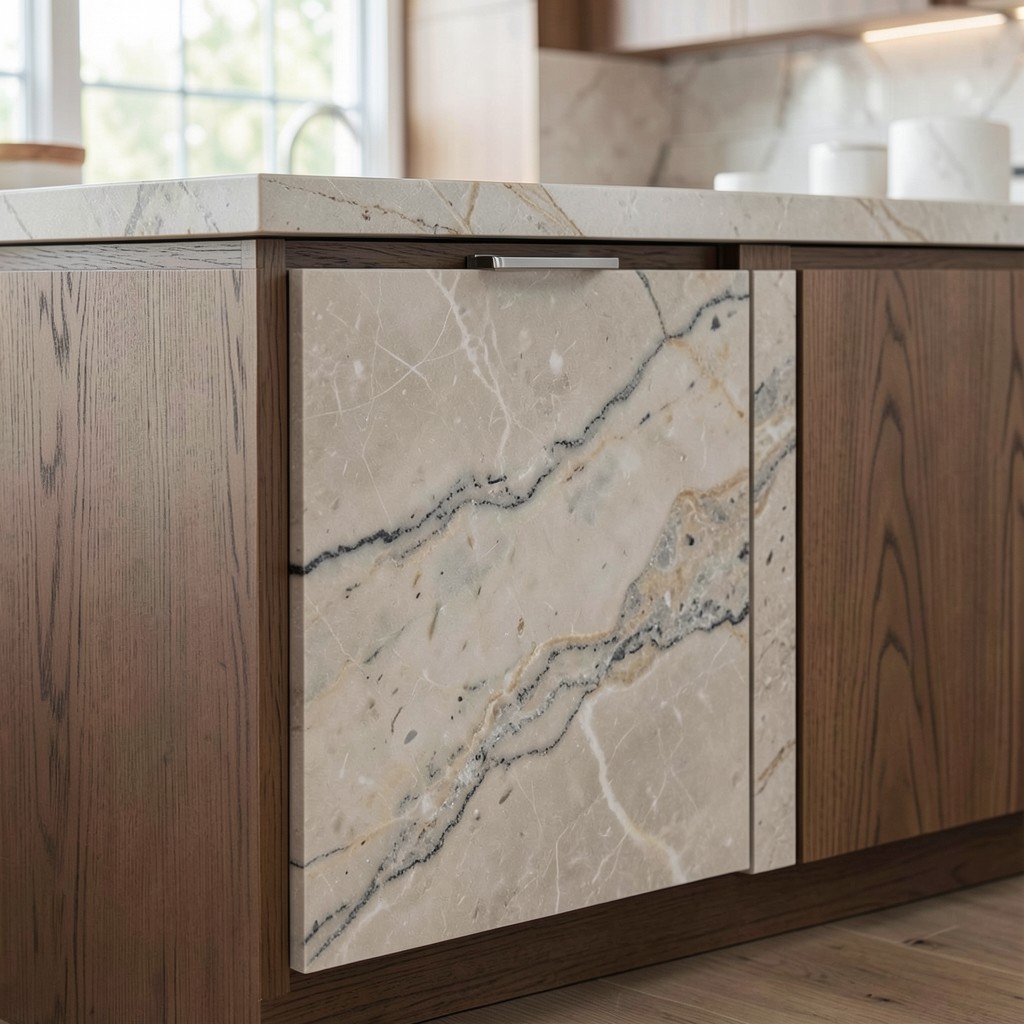
The stone cabinet front — the kitchen cabinet door whose face material is a thin panel of natural stone rather than timber, lacquer, or veneer — is the luxury home interior kitchen’s most specifically material and most architecturally direct cabinet design choice. The stone door’s face creates the kitchen cabinet in the geological material whose weight, its surface depth, and its natural pattern variation communicate the material investment and the design ambition of a kitchen whose standard was set at the level of permanent material quality rather than fashionable surface treatment.
A kitchen cabinet door in a honed Calacatta marble, a bookmatched quartzite panel, or a natural slate in a thin-slab format creates the stone kitchen cabinet in a material specification whose per-door cost exceeds the standard cabinet door significantly and whose design quality exceeds it by a proportional margin. The stone door’s hinge and pivot specification requires the engineering consideration of the stone’s weight — a standard cabinet hinge rated for a timber door whose weight is two to four kilograms does not provide the structural capacity for a stone door whose weight is eight to twelve kilograms, and the hinge failure of a stone door creates the irreparable damage to the stone panel and the cabinet frame that the appropriate heavy-duty hinge specification prevents. Stone and wood home design kitchens — the stone cabinet fronts against a solid timber counter, the kitchen’s design expressed entirely through the combination of the geological and the organic — create the material dialogue that the luxury kitchen’s design direction applies as its most architecturally resolved and most materially permanent expression.
The stone cabinet front’s maintenance is the commitment that the luxury material demands — the sealed natural stone’s surface requires the periodic reapplication of the stone sealer that prevents the kitchen’s oils, acids, and moisture from penetrating the stone’s porous structure and creating the staining that unsealed stone exhibits in the kitchen environment. The sealing interval depends on the stone’s porosity and the kitchen’s use intensity, and the maintenance-conscious household whose sealant program is consistent retains the stone cabinet front’s original surface quality through the kitchen’s full lifespan.
38. A Cabinet With Leaded Glass Doors in a Traditional Kitchen

The leaded glass cabinet door is the traditional kitchen’s most period-specific and most craft-committed display storage element — the small panes of glass set within the lead came’s H-profile structure create the divided-light cabinet door whose visual texture and whose historical association with the English and Irish country house kitchen communicate the traditional home interiors kitchen’s design culture with the most specific architectural vocabulary available in the residential cabinet design range.
A kitchen cabinet with leaded glass doors — the glass panes in a clear or a subtly tinted antique-effect glass that creates the slightly distorted, warm-toned transparency of old glass — creates the kitchen’s upper display cabinet in a material combination whose craft quality suits the traditional kitchen aesthetic’s commitment to the made-by-hand. The lead came’s width and the pane’s size should be proportional to the door’s scale — a small rectangular pane in a three-over-three grid creates the cottage-scale leaded glass door; a larger pane in a diamond-lattice pattern creates the more formal, larger-scale traditional kitchen version. Farmhouse home decor kitchens with leaded glass cabinet doors — the china collection visible through the glass panes, the interior lit softly from behind by the kitchen’s ambient light — create the traditional kitchen display cabinet whose period vocabulary is as specific and as authentic as any other traditional design element in the room.
The leaded glass door’s care requires the cleaning technique that the lead came’s exposed surface and the glass panes’ junction demands — the lead came’s surface should be cleaned with a dry or very slightly dampened cloth rather than with liquid cleaners that penetrate the lead-to-glass junction and create the tarnishing that the lead’s chemical reaction to moisture accelerates. The glass panes clean in the standard manner, and the overall leaded door’s maintenance is not substantially more demanding than a plain glass door once the lead came’s specific cleaning requirement is understood and applied.
39. A Colorblocked Two-Tone Cabinet in a Kids’ Room

The colorblocked cabinet in a children’s room is the design decision that the bohemian kids room decor direction makes most confidently — the cabinet whose two tones are applied in a deliberate color-block format rather than in the considered upper-lower distinction of the adult kitchen’s two-tone palette creates the room’s storage furniture as a piece of designed playfulness whose color commitment communicates the room’s understanding that the child’s environment should be genuinely, unapologetically joyful rather than a muted, adult-appropriate version of a designed interior.
A cabinet with its upper section in a sky blue and its lower section in a warm yellow — or in any two colors whose combination creates the visual energy and the warmth that the children’s room’s design direction requires — creates the room’s primary storage element in a color composition whose deliberate brightness suits the room’s function and the room’s primary occupant’s relationship to color, which is the unfiltered appreciation of the fully saturated rather than the acquired taste for the restrained. The bohemian kids room decor direction applies the colorblocked cabinet alongside the layered textile collection, the global pattern cushions, and the plant life of the children’s room whose design philosophy prioritizes the sensory richness of genuine material and color diversity over the aesthetic discipline of the coordinated adult interior.
The children’s room cabinet’s practical specification should match the colorful design’s practical context — the hardware in a robust specification that handles the daily force of a child’s door opening, the hinges in a soft-close format that prevents the slamming that a child’s closing force creates in the standard spring-hinge cabinet, and the paint finish in a washable, wipeable formulation that handles the inevitable contact with hands, crayons, and the unidentified surfaces that children’s storage furniture accumulates in daily use.
40. A Floating Media Cabinet in a Minimalist Living Room

The floating media cabinet is the minimalist living room’s television and entertainment storage solution that creates the most spatially composed and most design-resolved resolution of the television-in-living-room problem — the low, horizontal cabinet mounted to the wall at the height calibrated for the seated television viewing position creates the media storage, the television support, and the living room’s horizontal anchor in a single wall-mounted element whose floating quality communicates the minimalist aesthetic’s preference for the light, the elevated, and the architecturally composed over the floor-standing and the bulky.
A floating media cabinet in a natural oak veneer or a white lacquer — the cabinet spanning the full wall width or a designed portion of it, its depth calibrated for the equipment it houses and its height calibrated for the television mounting position — creates the minimalist living room decor’s primary media element in a format that manages the visual complexity of the media equipment behind a composed, single-material facade. The cable management within the floating media cabinet — the concealed conduit or the grommeted opening that allows the television’s cables to descend from the screen’s mounting position into the cabinet’s interior — is the installation detail whose presence or absence determines whether the minimalist cabinet’s clean face is maintained in operation or undermined by the cable chaos that the unmanaged television and equipment connection creates. Summer living room decor organized around the minimal floating media cabinet — the pale natural oak surface in the summer light, the room’s natural palette creating the airy, unencumbered quality that the floating cabinet’s lightness contributes to — creates the summer living room whose design quality is inseparable from the storage element’s spatial intelligence.
The floating media cabinet’s interior organization — the shelf positions calibrated for the specific equipment heights, the ventilation management for heat-producing equipment like amplifiers and cable boxes, and the accessible cable management at the rear — creates the functional quality that the cabinet’s external design communicates as its intention but whose interior specification delivers as its daily reality.
41. A Bathroom Cabinet With Integrated Mirror and Lighting

The mirror cabinet — the bathroom storage cabinet whose door face is the mirror itself, creating the vanity mirror and the medicine cabinet in a single flush-wall element — is the small bathroom’s most space-efficient design solution and the bathroom cabinet category’s most practically intelligent design format. The mirror cabinet provides the mirror function, the storage function, and the wall-surface function in a single element whose total wall-space requirement is the mirror’s face dimensions, and the bathroom whose wall area is limited by the room’s small dimensions receives the mirror cabinet as the design that creates the most functional quality within the most compressed spatial envelope.
An integrated mirror cabinet with LED lighting — the light strip concealed within the cabinet’s perimeter frame, its warm-toned light directed forward to illuminate the face in the mirror from the side rather than from above — creates the bathroom vanity lighting whose quality for face grooming specifically suits the side-lit position that professional makeup and grooming lighting has always applied. The overhead downlight that most bathrooms use for vanity lighting creates the face shadow that the side-lit mirror cabinet’s integrated lighting eliminates, and the quality improvement in face visibility for grooming tasks that the correctly positioned mirror cabinet lighting provides is the bathroom detail that the household whose bathroom contains it appreciates daily and whose bathroom does not contain it compensates for with portable mirrors and inadequate overhead approximations.
The mirror cabinet’s depth — typically four to five inches for the standard medicine cabinet — creates the storage capacity for the bathroom’s daily-use items: the medications, the skin care products, the dental hygiene items, and the small accessories that the vanity countertop accumulates and the mirror cabinet conceals. The mirror cabinet whose depth is specified below four inches provides insufficient storage for the standard household bathroom’s contents and creates the over-packed cabinet whose door closure is impeded by the items that exceed the shelf depth.
42. A Garden-Green Outdoor Cabinet for a Coastal Terrace

The outdoor storage cabinet for the coastal terrace — the weatherproof cabinet that stores the cushions, the garden tools, the outdoor accessories, and the entertainment items that the outdoor room requires to function as a genuine room rather than as a furniture-filled exterior space — is the design element that the coastal outdoor living space applies as its organisational anchor. The outdoor cabinet in a deep garden green or a weathered sage — painted in an exterior-specification paint or a powder-coated metal finish — creates the terrace’s storage element in a color that belongs to the garden’s material palette rather than to the imported interior color vocabulary.
An exterior-specification timber or aluminium cabinet in the garden green or sage tone — the material selected for its resistance to the moisture, the UV exposure, and the salt air that the coastal terrace environment creates — creates the outdoor room’s primary storage element in a format whose durability matches the coastal setting’s demanding conditions. Beach house interiors applied to the coastal terrace cabinet — the weathered sage green beside the white-painted terrace wall, the rattan outdoor furniture creating the natural material palette’s warm companion to the cabinet’s cool green, and the coastal planting in terracotta pots flanking the storage — creates the terrace design whose outdoor cabinet is as considered a design element as any indoor furniture piece.
The coastal outdoor cabinet’s seal specification requires the attention that the salt air environment demands — the timber cabinet’s joints and the door’s threshold must be sealed against moisture ingress that the coastal air’s humidity and the sea spray’s salt content accelerate into the material degradation that unsealed outdoor timber exhibits within a single season. The powder-coated aluminium cabinet provides the more durable alternative to the timber in the coastal environment, and its painted surface’s salt-spray resistance is significantly greater than the timber’s painted or sealed surface in the same conditions.
43. A Japandi Bathroom Cabinet in Dark Walnut

The dark walnut bathroom cabinet is the Japandi aesthetic’s most materially specific bathroom expression — the warm, dark timber in the bathroom’s humid environment creates the tension that the Japanese bathroom tradition has always navigated between the organic material’s warmth and the functional space’s moisture demands, and the contemporary resolution of that tension creates the Japandi bathroom cabinet whose material quality communicates the design philosophy’s commitment to genuine natural materials in genuine functional contexts rather than the synthetic approximations that the maintenance-averse specification applies.
A solid walnut vanity cabinet in the Japandi bathroom — the timber’s dark warmth against the pale stone countertop and the white or near-white wall tile creates the material contrast that the Japandi aesthetic applies as its primary composition between the dark organic and the pale mineral — requires a moisture-resistant finish that protects the timber from the bathroom’s humidity without creating the plastic film quality that standard polyurethane topcoats apply to the walnut’s surface. A marine-grade hardwax oil or a tung oil formulation with moisture inhibitors creates the finish that protects the walnut’s surface from the bathroom’s humidity while maintaining the oil-finished tactile quality that the natural timber’s surface should communicate when touched. Peaceful home decor applied to the Japandi walnut bathroom — the single ceramic vessel on the countertop, the neatly folded linen towels on the timber shelf, and the absence of every non-essential surface object — creates the bathroom’s spa-quality calm whose material foundation is the dark walnut’s organic warmth.
The dark walnut bathroom cabinet’s hardware should maintain the Japandi aesthetic’s characteristic restraint — the matte black or the dark aged bronze pull in a minimal profile creates the cabinet’s operating mechanism without the warm metal contrast that the sage green kitchen’s brass hardware provides in its different aesthetic context. The Japandi bathroom’s material philosophy values the consistent temperature within the dark organic palette rather than the warm-cool contrast that the kitchen direction applies.
44. A Built-In Cabinet Bench for a Hallway

The hallway cabinet bench is the entrance space’s most practically and spatially intelligent furniture element — the storage cabinet below a cushioned bench seat creates the shoe storage, the seasonal accessory storage, and the sitting position for the pulling-on of shoes in a single built-in element whose footprint is the bench’s seat dimensions and whose storage volume is the bench’s full interior. The hallway that contains a well-designed cabinet bench is operationally better than the hallway without one in every measurable daily dimension, from the time taken to locate the shoes to the visual quality of the entrance experience.
A painted cabinet bench in the hallway’s primary color — the white, the sage, or the navy that the entrance’s design direction establishes — with a cushioned seat in a durable textile and hooks above for coats and bags creates the Scandinavian hallway design’s most functionally complete entrance element. The Scandinavian home interior applies the hallway cabinet bench as its primary entrance furniture piece — the bench low enough for children to sit and reach their shoes, the hooks at adult shoulder height for the coat’s daily hanging, and the cabinet interior’s organization system calibrated for the household’s specific footwear and seasonal accessory storage requirements. The entrance whose cabinet bench is properly sized for the family’s actual shoe collection — a shoe count per family member multiplied by a comfortable additional storage margin — is the entrance that functions without the overflow problem that the under-sized bench cabinet creates within the first month of occupation.
The bench cushion’s fabric specification should match the entrance’s specific wear conditions — the hallway’s traffic intensity, its exposure to outdoor moisture, and the dirt that outdoor footwear brings to the entrance create the most demanding fabric wear conditions in the house, and the cushion material should be a durable, washable cover in a performance fabric that handles the entrance’s daily traffic without the surface degradation that the formal living room’s upholstery standard would exhibit in the same conditions.
45. A White Lacquered Cabinet With Brass Inlay Detail

The white lacquered cabinet with brass inlay is the chic home decor furniture piece that applies the material luxury of the inlaid metalwork tradition to the contemporary cabinet’s clean, high-gloss surface — the brass strip inlaid into the cabinet door’s face creates the geometric or organic line detail whose warm metal tone against the glossy white surface communicates the design’s luxury register at the door’s primary visual surface. The inlay is the detail that separates the refined white cabinet from the standard white cabinet, and the precision of the inlay’s execution determines whether that separation reads as genuine luxury or as decorative approximation.
A white lacquered cabinet with brass strip inlay in a geometric frame — the inlay running at the door panel’s perimeter, creating the thin gold border against the white face — creates the cabinet’s design detail in the metalwork tradition that the French art deco furniture of the twentieth century applied to its most expensive case pieces. The brass inlay’s machined precision — the routed channel in the lacquered face receiving the brass strip in a tolerance whose tightness creates the flush, seamless joint — communicates the manufacturing quality that the luxury furniture specification requires at the detail level. Elegant home styling applied to the brass-inlaid white cabinet — the cabinet positioned in the dining room or the living room, its white and gold surface reflecting the room’s chandelier or pendant light, and the cabinet’s displayed contents creating the composed interior through the glass panel sections — creates the room’s most formally luxurious storage element.
The brass inlay’s maintenance in a lacquered white cabinet requires the protection of both materials simultaneously — the lacquered surface cleaned without the abrasive cleaners that scratch its gloss, and the brass inlay treated with a brass-specific metal polish that removes the tarnish that the atmospheric conditions create at the inlay’s exposed surface without allowing the polish’s chemistry to contact the adjacent lacquer surface and damage its finish.
46. A Terracotta-Toned Cabinet in a Desert-Inspired Kitchen

The desert kitchen is the residential design direction that the Southwestern, Mexican, and Moroccan domestic traditions share as their common design ancestor — the warm, earth-toned palette, the natural material surfaces, and the architecture of the enclosed, light-managing interior create the kitchen design whose color and material philosophy is drawn from the desert landscape’s own color and material vocabulary. The terracotta cabinet in the desert kitchen is not a color borrowed from a design trend. It is the color of the fired earth from which the desert building tradition made its walls, its floors, and its vessels.
A terracotta-toned kitchen cabinet in a warm clay paint or a matte terracotta lacquer — the color in the slightly dusty, slightly grayed orange-brown that distinguishes the earthy terracotta from the brighter orange of the adjacent color territory — creates the desert kitchen’s primary cabinet surface in a color whose thermal warmth and material reference belong to the desert aesthetic’s most honest design expression. Desert home styling applied to the terracotta kitchen — the zellige tile splashback in a complementary warm tone, the concrete or stone countertop in a sandy natural aggregate, and the wrought iron hardware creating the warm metallic detail at the cabinet face — creates the complete desert kitchen whose design is drawn entirely from the material and color world of the landscape it references.
The terracotta cabinet’s color management across the kitchen’s seasonal styling is the design challenge that the warm, specific color creates — the terracotta kitchen in its fall kitchen decor configuration, with the warm amber accessories and the dried botanical arrangements of the autumn season, creates the kitchen’s most tonally consistent and most atmospheric seasonal expression; the same kitchen in the spring home refresh configuration requires the deliberate introduction of the fresh, cool tone accents that prevent the terracotta from creating the enclosed warmth that the spring season’s design direction should be moving away from rather than deepening.
47. A Chalk-Painted Antique Cabinet in a Cottage Bedroom
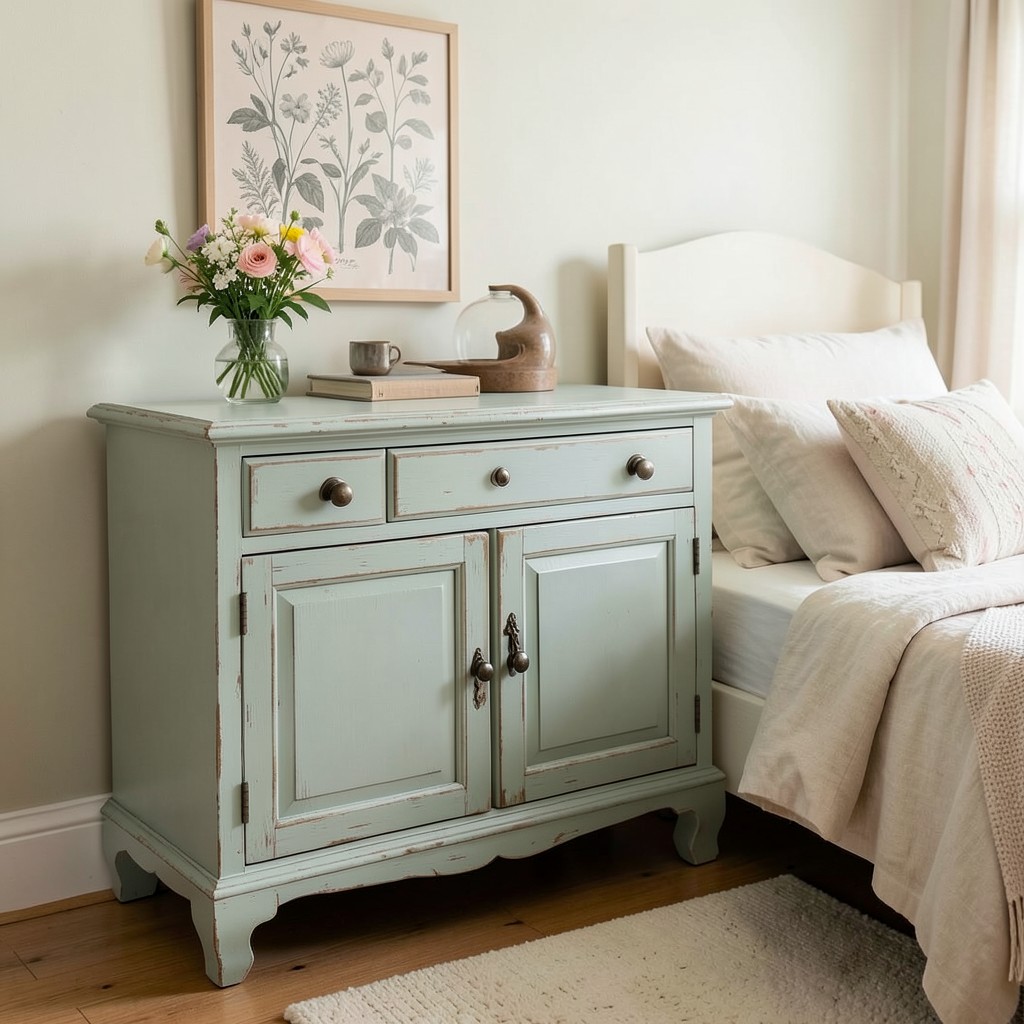
The chalk-painted antique cabinet is the cottage bedroom’s most personal and most creatively available design transformation — the chalk paint’s ability to adhere to almost any surface without the primer preparation and sanding that standard paint requires makes it the cabinet treatment that the household member with design ambition and limited technical experience can apply with genuine success. The chalk paint’s matte, slightly chalky surface creates the aged, soft quality that the cottage bedroom’s design direction values as the material expression of the relaxed home design philosophy.
A chalk-painted chest of drawers or a freestanding wardrobe in a soft duck egg blue, a faded sage, or a worn antique white — the chalk paint applied in two thin coats and waxed with a clear furniture wax that seals the porous surface and creates the slight sheen that the chalk paint’s matte finish benefits from in the bedroom’s ambient light — creates the cottage bedroom’s primary storage cabinet in a material surface of genuine organic warmth. Spring bedroom decor organized around the chalk-painted antique cabinet — the fresh garden flowers in a small vase on the cabinet’s top surface, the botanical print above, and the natural linen bedding in the adjacent bedroom palette creating the spring bedroom’s complete seasonal refresh — creates the cottage bedroom’s most specifically seasonal and most personally domestic design composition.
The chalk paint’s distressing — the strategic sanding of the paint’s surface at the corners, the edges, and the highest-touch points of the cabinet — creates the aged quality that the chalk paint technique applies most specifically and most convincingly of any paint system. The distressing should be applied where the paint would naturally wear first in the furniture’s actual use — the drawer pull’s surrounding area, the cabinet’s outer corners, and the door edge’s contact zone — creating the organic wear pattern that reads as genuine use rather than as applied decoration.
48. A Vertical Shiplap Cabinet in a Farmhouse Bathroom

The shiplap cabinet front — the vertical boards in the shiplap profile, their shadow-gap joints creating the linear texture across the cabinet face — is the farmhouse bathroom decor’s most specifically architectural cabinet surface treatment. The shiplap profile references the wall cladding material that the farmhouse bathroom applies to its own walls, and the extension of that wall material to the vanity cabinet’s face creates the material continuity between the room’s fixed architecture and its primary storage furniture — the boundary between the wall and the cabinet dissolving in the shared material surface.
A vanity cabinet with shiplap-fronted drawer and door faces — the vertical boards in a painted white or a natural timber finish, their shadow gaps creating the linear rhythm across the cabinet’s front — creates the farmhouse bathroom’s vanity in a material that belongs to the room’s own architectural vocabulary rather than to the imported vocabulary of the standard cabinet door. The shiplap profile’s shadow gaps must be sealed against moisture ingress in the bathroom environment — the gap between the boards, if left open at the back of the profile, creates the moisture trap that the bathroom’s condensation and water splash fill over time, creating the mold growth and the substrate damage that the sealed board profile prevents. Farmhouse bathroom decor applied to the shiplap vanity — the oil-rubbed bronze tap and hardware, the natural stone countertop, and the open timber shelf above the vanity creating the material palette that the shiplap cabinet anchors — creates the farmhouse bathroom whose design consistency from cabinet face to ceiling material communicates the design’s material commitment at every surface.
The shiplap cabinet front’s paint specification should be a moisture-tolerant interior paint whose formulation provides the surface resistance that the bathroom’s humidity and water splash demands — the standard wall paint applied to the shiplap cabinet front in a bathroom creates the surface that the bathroom’s conditions degrade more rapidly than the specifically moisture-tolerant formulation whose film integrity the bathroom environment tests daily.
49. A Tall Larder Cabinet in a Kitchen With Open Pantry Display

The tall larder cabinet is the kitchen storage element that the well-planned kitchen includes and the poorly planned kitchen consistently regrets omitting — the full-height pantry unit, typically sixty centimeters deep and sixty to ninety centimeters wide, that houses the kitchen’s dry goods, canned goods, and everyday food storage in a single organized column creates the kitchen’s food storage infrastructure in the format whose accessibility and organization exceeds the standard base cabinet’s deep, inaccessible rear storage by every operational measure.
A larder cabinet with a combination of fixed shelves, pull-out drawer shelves, and internal door-mounted shelves creates the tall pantry storage in the most accessible organization format — the pull-out shelf’s full-extension access allows the cabinet’s deepest stored items to be reached without the shoulder-deep reach into the dark rear of a standard base cabinet, and the internal door-mounted shelf’s storage of the frequently accessed smaller items creates the additional pantry storage that the standard shelf’s full-depth storage cannot efficiently accommodate. Modern kitchen ideas applied to the tall larder — the handleless integration with the surrounding kitchen cabinet run, the interior LED strip light that illuminates the shelves when the door opens, and the pull-out drawer shelves whose organization inserts keep the stored goods visible and accessible — creates the kitchen pantry storage element whose operational quality is felt in the daily kitchen use more immediately and more consistently than any other single kitchen cabinet element.
The larder cabinet’s positioning in the kitchen’s spatial layout should place it within the kitchen’s primary food preparation workflow — adjacent to the food preparation countertop rather than at the kitchen’s remote end, where its distance from the preparation zone creates the daily inconvenience of the pantry walk that the workflow-conscious kitchen design avoids. The kitchen whose larder cabinet is positioned for genuine operational convenience rather than for the floor plan’s geometric convenience is the kitchen whose design intelligence is felt every day rather than admired from the doorway.
50. A Cabinet Designed as the Room’s Complete Identity

The cabinet that is designed to be the room’s complete identity — not the primary storage element around which the room is organized, but the architectural element from which the room’s entire design character radiates — is the cabinet design decision that most rooms never receive and that the room with the design ambition to commit fully to a single cabinet as its architectural statement creates the domestic space of most singular and most memorable character.
A floor-to-ceiling built-in cabinet system spanning the room’s full wall width — in a material of genuine quality, a color of genuine commitment, and a detail of genuine precision — creates the room’s complete design identity in the furniture piece that every other element serves. The dining room whose full wall of deep green glass-fronted cabinets houses the china collection, the crystal, and the personal objects of three generations of the household’s material culture creates the room of complete design identity — the design is the collection, the cabinet is the room, and the room exists to honor both. The bedroom whose full wall of built-in wardrobes in a pale natural timber creates the sleeping room of maximum spatial quality and maximum storage efficiency creates the design whose intelligence is entirely in the service of the room’s two primary functions — the sleeping and the dressing — without the distraction of any additional design gesture.
Your cabinets are the most permanent design decisions your room will ever receive. Design them as though they will be there for the rest of your time in the space — because they will. Choose the material for how it will look in twenty years, not how it looks in the showroom today. Choose the detail for how it will feel to open the door on a Tuesday morning in winter, not for how it photographs on a Sunday afternoon in good light. The cabinet that serves you well, every day, for the full duration of your life in the room it inhabits — that is the cabinet design idea worth pursuing. Start there, and build the room from its most permanent element outward.
Leave a Reply