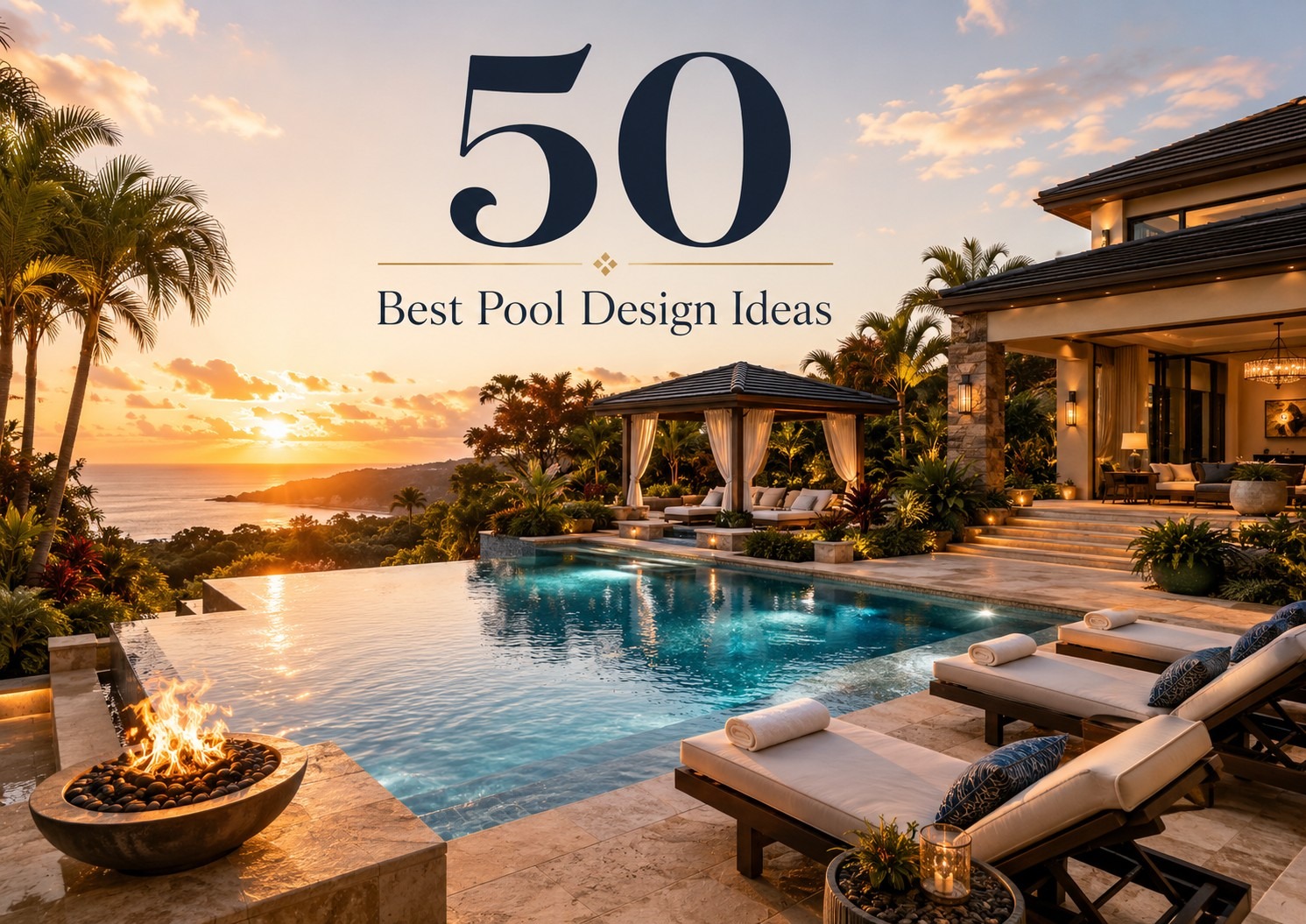
The pool is the only residential design element that changes the fundamental character of every space around it. Not just the outdoor area it occupies, but the view from the kitchen window, the morning’s first moment stepping onto the terrace, the quality of the afternoon’s light reflected onto the house’s exterior wall, and the specific domestic rhythm that a household with water at its center develops over the years of living with it. The garden without a pool is a garden. The garden with one is a destination, and the household that made the decision to install it — with the design intelligence it required — lives in the outdoor space rather than passing through it.
Most pool design conversations start in the wrong place. They begin with the shape — rectangular or freeform — or the surface material — tiles or pebble — and skip past the more fundamental questions about what the pool should feel like to be near, how it should relate to the house’s architecture, what the surrounding landscape should communicate about the space’s design philosophy, and what the pool’s specific design qualities should do to the outdoor room’s atmosphere across the full seasonal cycle. Get those foundational questions answered first, and the shape and the surface material resolve themselves naturally from the design direction you have already established.
The pool’s relationship to the house is the design decision that most pool projects resolve inadequately. The pool placed without explicit consideration of the house’s architectural character, the rooms whose views it occupies, and the material palette that connects the interior’s design to the exterior’s design creates the outdoor installation that reads as the purchased amenity rather than the designed landscape element. The pool that was planned as part of the property’s complete design — whose coping material relates to the terrace’s paving, whose water level aligns with the horizontal datum that the house’s window sills or terrace edge establishes, and whose surrounding planting communicates the same design direction as the interior’s material palette — reads as the designed landscape whose quality is visible in the composition’s complete coherence rather than in any single element’s specification.
The fifty pool design ideas in this article span the complete range of pool forms, materials, surrounding landscape approaches, and functional configurations that the residential pool design range contains. The ideas address the luxury infinity pool whose vanishing edge creates the horizon merger of the luxury coastal property and the natural rock pool whose organic form belongs to the tropical garden’s botanical landscape. They include the contemporary lap pool of the minimalist urban garden, the plunge pool of the compact courtyard, the natural swimming pond of the earthy ecological property, and the historic tiled pool of the Mediterranean villa’s traditional terraced garden. Every idea is a complete design direction with a specific spatial logic, a material rationale, and a practical understanding of how the pool’s design creates the outdoor room’s atmospheric quality across the seasons.
The pool you build will define your outdoor space for as long as you live in the house. Design it with the same seriousness you brought to the architecture of the building it accompanies, and the outdoor room it creates will be the space you value most on every property you ever own.
1. A Rectangular Infinity Pool on a Hillside Property

The infinity pool is the hillside property’s most specifically resolved architectural water element — the pool whose far edge’s water level meets the horizon in the visual merger that creates the apparent continuity between the water body and the landscape or seascape beyond. The illusion requires the engineering precision of the overflow channel whose level is maintained within millimeters of the design’s horizon alignment, and the pool that achieves this alignment creates the view that the hillside property’s most photographed residential water feature has made the global symbol of the luxury outdoor living space.
A rectangular infinity pool in a dark pebble or charcoal plaster finish — the dark bottom creating the water’s deep, reflective teal whose color quality the pale plaster finish’s bright turquoise does not approach in the same atmospheric sophistication — positioned at the hillside property’s natural view point creates the coastal home design or mountain property’s most architecturally commanding outdoor element. Luxury home interior properties whose pool design philosophy treats the water element as the architectural counterpart to the building’s own quality apply the dark-finish infinity pool as the outdoor room’s primary design statement — the pool’s edge at the level whose relationship to the horizon creates the design’s most theatrically resolved visual composition. The vanishing edge’s catchment tank — the below-grade tank that collects the overflow water and returns it to the pool through the circulation pump’s cycle — is the engineering element that the infinity pool’s design requires as its operational infrastructure, and the tank’s volume specification must be calibrated for the wind-driven wave action that the exposed hilltop or coastal position creates at the overflow edge during the conditions that push the most water over the vanishing edge in the shortest time.
The dark-finish infinity pool’s thermal management creates the practical consideration that the aesthetic’s sophistication requires in practical exchange — the dark surface absorbs the solar radiation that the pale finish reflects, heating the water more rapidly and more completely than the light-toned pool whose reflective surface transfers less solar energy into the water’s thermal mass. The hillside property whose pool receives full solar exposure benefits from this thermal absorption quality in the cooler spring and autumn periods; the pool in the hot desert or tropical climate whose summer temperatures create the uncomfortably warm water in the dark-finish pool requires the shade management and the chiller specification that the dark thermal absorption makes more specifically necessary than the light-finish alternative creates.
2. A Natural Swimming Pond in an Organic Garden

The natural swimming pond is the pool design idea that the household whose design philosophy is organized around the earthy home design and ecological values selects when the question is how to have the swimming water experience without the chemical management, the engineered surface, and the mechanical filtration infrastructure that the conventional pool creates as its standard operational requirement. The natural swimming pond filters its water through the planted regeneration zone whose aquatic and marginal planting performs the biological filtration that the conventional pool’s chemical and mechanical system achieves by entirely different means. Nature does the work. The result is the water whose quality the ecologically minded household values as both the swimming medium and the outdoor room’s living centerpiece.
A natural swimming pond whose plan allocates the swimming zone and the planting regeneration zone in a ratio that the pond’s total surface area and the local climate’s biological filtration requirements determine — the swimming zone in the clear water maintained by the planting zone’s biological filtration activity — creates the garden-inspired interiors outdoor space’s most ecologically honest water feature. The planting zone’s aquatic species — the water iris, the reed, the water mint, and the submerged oxygenating plants whose biological activity creates the filtration function — create the pond’s living perimeter whose visual quality communicates the garden’s ecological design direction at the water feature’s most prominent and most seasonally animated surface. The natural swimming pond’s water quality varies with the season — the spring home refresh season’s warming water temperature accelerating the biological filtration activity and clearing the winter’s accumulated suspended matter, and the summer season’s peak biological activity creating the clearest water quality of the annual cycle.
The natural swimming pond’s design challenge for the household accustomed to the conventional pool’s chemical clarity is the acceptance of the biological water quality whose slight tint, whose occasional algae bloom in the nutrient-rich early season, and whose transparency variation across the seasonal cycle communicates the ecological system’s living activity rather than the sterile perfection of the chemically managed pool. The household that makes this philosophical shift — from the pool as the engineered water environment to the pond as the living water ecosystem — discovers the outdoor water experience whose sensory richness, whose seasonal animation, and whose ecological contribution to the garden’s biodiversity creates the swimming experience that the conventional pool’s clarity cannot provide at the same level of living, dynamic, specifically natural water quality.
3. A Lap Pool in a Narrow Urban Garden

The lap pool is the urban garden’s most functionally purposeful and most spatially intelligent pool design — the long, narrow pool whose width accommodates the swimming stroke and whose length provides the training distance creates the maximum functional value from the minimum garden width. The lap pool does not waste the urban garden on decorative water surface. It puts the water to work, and the household whose daily fitness routine includes the dawn swim has the domestic infrastructure for that routine at the most convenient possible address — ten steps from the back door.
A lap pool of twenty-five meters in a narrow garden width of two and a half to three meters — the pool’s length running the garden’s full available dimension, the coping in a natural stone or a rendered concrete whose material relates to the garden’s surrounding surfaces — creates the urban garden’s fitness pool in the format calibrated for the serious swimmer’s training requirement. Contemporary home ideas urban properties apply the lap pool as the outdoor fitness amenity that the gym membership’s daily commute time requirement eliminates at the residential garden scale — the pool in the garden creating the training facility whose convenience the commercial gym cannot match regardless of its equipment quality. The lap pool’s narrow garden setting creates the garden design challenge of the pool’s dominant floor area coverage — the pool occupying the majority of the garden’s available planting space, the surrounding planting confined to the coping’s edge and the garden’s end walls — and the vertical planting of the wall-trained climbers, the espaliered tree, and the container planting at the pool’s head and foot creates the garden’s greenery within the spatial constraint that the pool’s dominant footprint creates.
The lap pool’s heating specification determines its year-round usability — the unheated lap pool in a temperate climate creates the short seasonal window of comfortable swimming that limits the fitness routine’s outdoor pool component to the summer months; the heated lap pool with a pool cover creates the year-round swimming facility whose consistent water temperature extends the outdoor fitness routine through the autumn and the spring seasons and into the winter period for the cold-water swimmer whose thermal tolerance the heated pool’s temperature threshold exceeds.
4. A Plunge Pool for a Small Courtyard
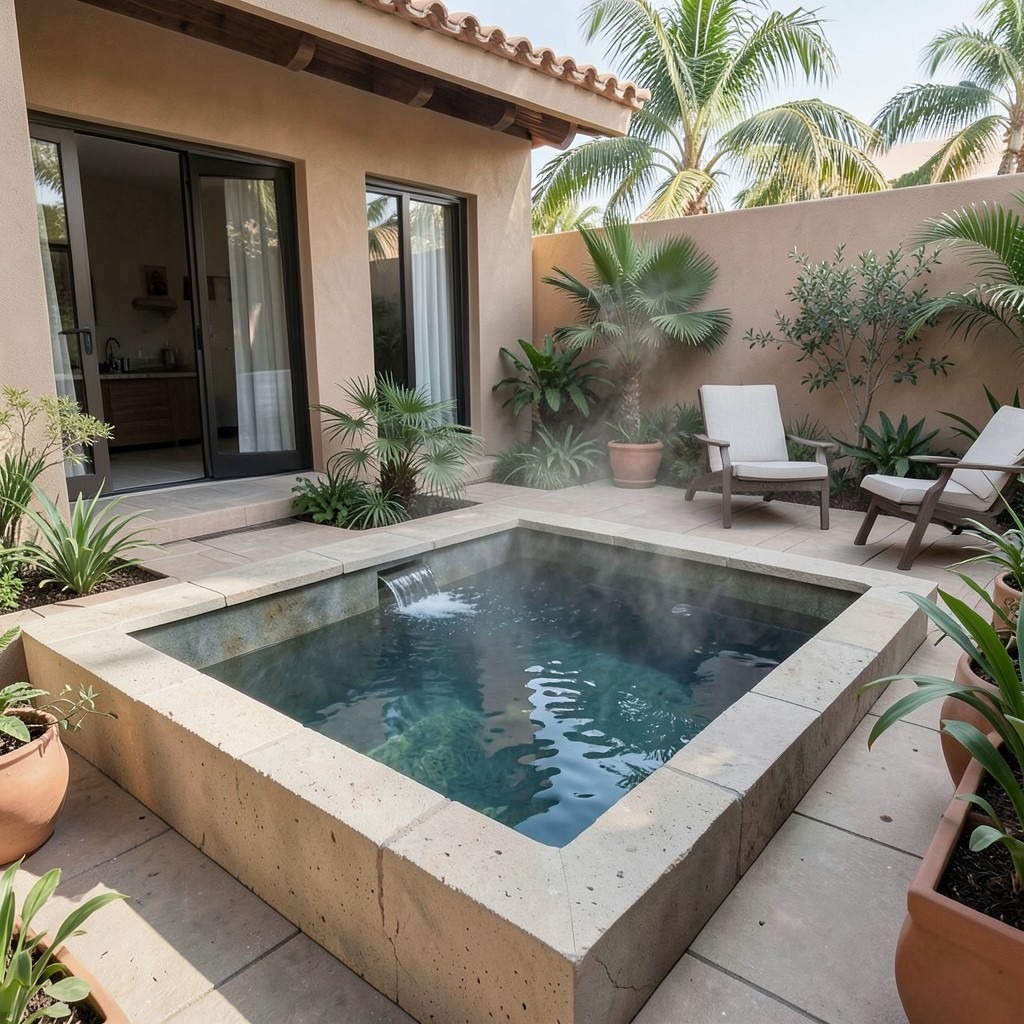
The plunge pool is the small property’s most honest and most functionally specific water feature — not the swimming pool reduced to fit the available space, but the deliberately compact water body designed for the immersion experience rather than the swimming function. The plunge pool’s purpose is the cooling plunge of the hot summer day, the contrast bathing whose therapeutic quality the lap pool’s exercise function does not provide, and the visual and acoustic presence of the water body in the courtyard whose cooling effect on the ambient air temperature the evaporative surface creates throughout the outdoor season. Small but complete. Not a compromise.
A plunge pool in a rendered concrete or a natural stone finish — the pool’s dimensions of approximately three meters by two meters and one and a half meters depth creating the immersion volume whose functional quality the plunge bathing experience requires — creates the compact courtyard’s water feature in the format calibrated for the outdoor space’s available floor area. The courtyard surrounding the plunge pool — the paved terrace in a material that relates to the pool’s coping and the house’s exterior material palette, the container planting creating the green framework around the pool’s perimeter, and the outdoor furniture positioned in the terrace area beside the pool — creates the complete courtyard outdoor room whose design quality is as composed and as spatially considered as any interior room. Tropical home design and desert home styling courtyard properties receive the plunge pool as the outdoor cooling amenity whose presence transforms the courtyard’s summer ambient temperature through the evaporative cooling that the water surface creates, and the courtyard that is genuinely cooler near the water on the summer afternoon provides the outdoor comfort quality that the design’s atmospheric aspiration requires.
The plunge pool’s heating option — the heat pump or the solar collector whose energy cost is modest for the small water volume — creates the year-round usability that the unheated plunge pool’s cold water winter temperature prevents. The heated plunge pool in the winter courtyard — the steam rising from the water surface in the cold air, the pool’s warmth creating the outdoor bathing experience that the summer association with the plunge pool might not suggest — creates the outdoor room’s most atmospherically specific and most seasonally surprising domestic pleasure.
5. An Infinity Pool Merging With the Ocean View

The ocean-view infinity pool is the coastal property’s most architecturally ambitious water element — the pool whose vanishing edge is aligned with the sea horizon’s level creates the visual merger of the fresh water and the salt water whose apparent continuity communicates the design’s command of the property’s most powerful natural feature at the pool’s most specifically theatrical design gesture. The horizon is the pool’s far wall. Everything between the edge and the sea belongs to the design’s most specifically composed view.
A coastal infinity pool in a deep grey or midnight blue plaster finish — the water’s color in the dark finish creating the closest visual match to the deep ocean color beyond the edge, making the horizon merger the most complete of any finish specification — creates the beach house interiors or the coastal luxury property’s most dramatically resolved outdoor water element. Coastal home design properties whose pool alignment places the vanishing edge at the precise optical horizon level — the level calibrated for the seated position on the pool’s far side terrace rather than the standing position whose elevated eye level changes the horizon’s apparent position — create the pool view experience of maximum visual continuity between the pool water and the ocean beyond. The pool’s orientation on the coastal property should maximize the ocean view’s duration across the day’s light cycle — the late afternoon and evening’s westerly sun creating the ocean’s golden surface quality that the pool’s dark interior reflects in the warm tone that the summer home design season’s most atmospheric and most photogenic outdoor moment generates.
The ocean-view pool’s salt management requires the specification that the coastal location’s salt-laden air creates as the pool’s primary material maintenance condition — the pool’s coping in a salt-resistant natural stone or a salt-resistant porcelain whose material specification is calibrated for the coastal environment’s salt air exposure, and the pool equipment’s marine-grade specification preventing the corrosion that the standard residential pool equipment develops in the salt atmosphere that the ocean-front property’s location creates as its permanent environmental condition.
6. A Pool With a Sun Shelf and Wading Area

The sun shelf — the shallow, submerged shelf at the pool’s entry end whose water depth of twenty to thirty centimeters creates the lounging position for the sun chair whose legs stand in the shallow water — is the pool feature that transforms the pool from the swimming-only water body into the full-day outdoor living space whose social and leisure function extends far beyond the lap or the plunge. The sun shelf is where the adults sit in the water for three hours on a Saturday afternoon. The pool without one is the pool you swim in. The pool with one is the pool you live in.
A pool with an integrated sun shelf at the shallow end — the shelf’s dimensions accommodating two to four sun loungers in the water, the shelf’s edge creating the step-down to the pool’s main swimming depth — creates the family outdoor living space’s most functionally complete and most socially generous pool configuration. Summer home design properties with sun shelf pools create the outdoor room of maximum social occupancy at the water’s edge — the adults lounging on the submerged shelf chairs, the children in the shallow shelf water, and the surrounding terrace providing the dry seating for the non-swimmers whose poolside participation the social gathering requires. The sun shelf’s water depth should be calibrated for the summer afternoon’s ambient temperature — the shelf’s shallower water heats more rapidly in the sun than the pool’s main body, and the ten to twenty centimeter depth whose rapid thermal absorption creates the warm, bath-like quality of the lounging position creates the specific sensory quality that distinguishes the sun shelf experience from the pool’s main water temperature.
The sun shelf’s non-slip surface specification is the safety consideration that the wet surface’s frequent foot traffic — the children running onto the shelf, the adults stepping from the shelf to the main pool — creates as the pool’s primary safety requirement at the shallowest and most frequently accessed area. The textured stone, the non-slip porcelain, or the brushed concrete finish creates the traction that the smooth, wet surface in the sun’s foot contact zone requires.
7. A Pool With a Waterfall Feature and Rock Edge
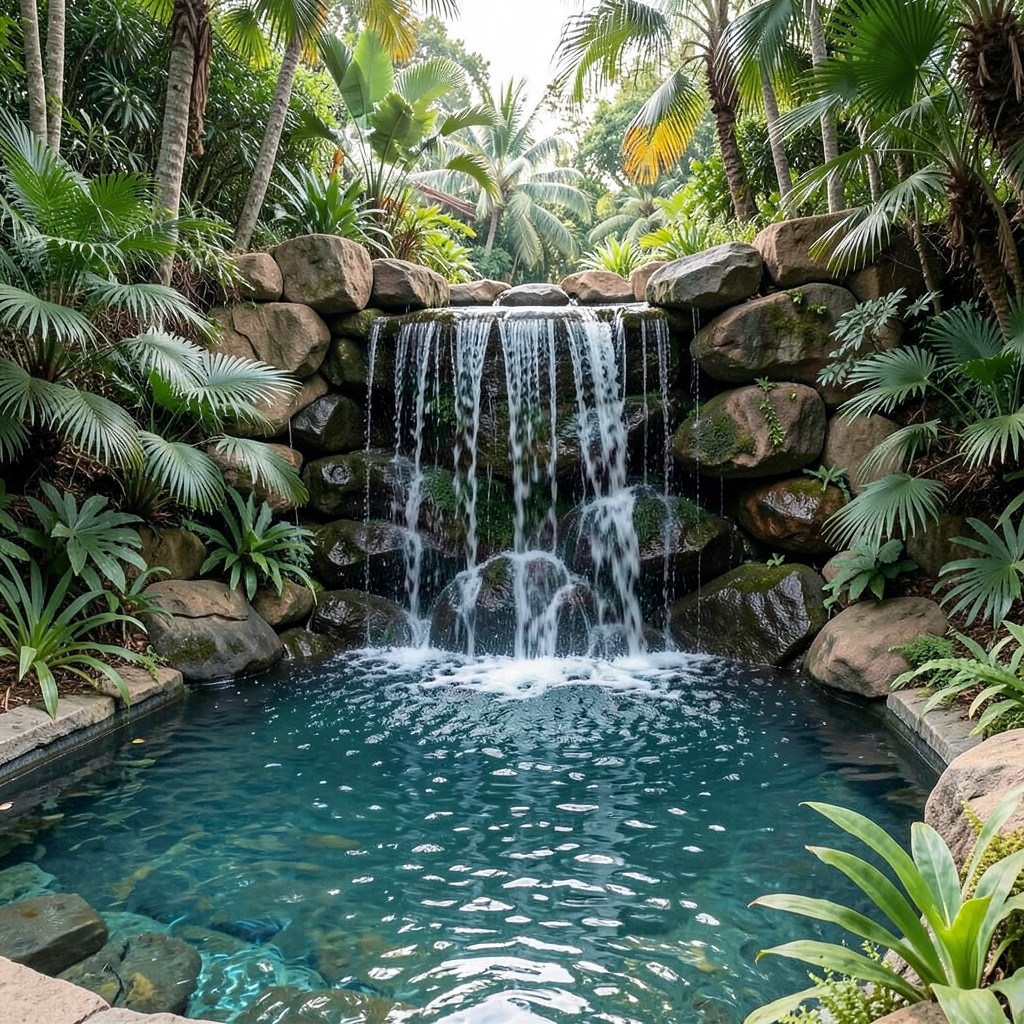
The waterfall pool is the tropical and botanical garden’s water feature whose combined movement, sound, and visual dynamism transforms the static water body into the living, acoustic presence that the outdoor room experiences as a landscape feature rather than as an architectural installation. The water’s sound is not incidental. It is the outdoor room’s ambient audio whose quality determines the space’s atmospheric character from every position within the garden’s acoustic reach of the falling water.
A pool with a natural rock waterfall feature — the stone selected in the local geology’s characteristic material, the water flowing from the upper rock formation to the pool’s surface in the natural cascade whose width and height calibrate the acoustic intensity of the falling water — creates the tropical home design or jungle-inspired home decor outdoor space’s most immersive and most naturally animated water feature. The rock selection for the waterfall should acknowledge the geology whose character the landscape design is applying as its primary natural material reference — the volcanic basalt of the tropical landscape, the sandstone of the desert garden, and the granite of the mountain cabin property each creates the waterfall whose material character communicates the geographic specificity of the place rather than the generic landscape architecture’s imported stone vocabulary. Mountain cabin decor properties with waterfall pools whose granite rock formations and clear, cool cascade communicate the highland spring’s own water quality create the outdoor water experience of most specific and most genuinely natural atmospheric character.
The waterfall feature’s pump specification determines the cascade’s visual and acoustic quality — the pump whose flow rate creates the full, curtain-like sheet of the wide cascade differs fundamentally from the pump whose lower flow rate creates the trickle that the natural spring’s low-pressure emergence produces, and the waterfall design should specify the pump’s flow rate in relation to the specific cascade form whose visual and acoustic quality the design intends before the pump specification is finalized.
8. A Mosaic Tiled Pool in a Mediterranean Garden

The mosaic tiled pool is the Mediterranean residential landscape’s most historically continuous and most materially specific water feature — the hand-set glass or ceramic mosaic tile whose color, pattern, and light-reflective quality create the pool’s underwater visual character as the water’s most specifically decorative element. The mosaic pool is the one whose bottom is as beautiful as its surface, and whose designed pattern is visible from the terrace above, through the water, as the composed underwater artwork that the tiled pool’s surface creates as its most specifically Mediterranean design contribution.
A pool with a hand-set mosaic tile interior in the cobalt, turquoise, and white palette of the Mediterranean coastal tradition — the tiles creating the geometric or figurative pattern at the pool’s floor and the flowing border at the water line — creates the traditional home interiors garden’s water feature in the material that the North African, Spanish, and Italian residential traditions apply as the pool’s most historically resonant and most materially specific surface specification. The mosaic pattern’s scale relative to the pool’s plan dimensions determines the design’s visual coherence from the terrace’s overhead viewing position — the large-scale geometric pattern reading clearly from the pool deck height, the small-scale repeating tile creating the texture rather than the pattern at the same viewing distance, and the design’s choice between the two communicates the pool’s intended visual experience from the primary surrounding viewing positions. Traditional home interiors Mediterranean gardens with mosaic tiled pools create the outdoor room whose cultural material vocabulary belongs to the oldest residential design tradition for the pooled water in the enclosed garden.
The mosaic tile’s grout specification is the practical detail that the pool’s water chemistry and the long-term maintenance both depend upon — the epoxy grout whose non-porous composition resists the water absorption and the chemical attack that the pool water’s chlorine or salt content creates in the cement grout’s composition, providing the joint’s long-term integrity and the clean, unbroken tile pattern whose visual quality the cement grout’s periodic staining and erosion would compromise. The hand-set mosaic tile’s installation requires the specialist mosaic tile setter whose skill in the tile placement, the joint consistency, and the pattern accuracy creates the installed pattern whose quality the design’s visual intention requires.
9. A Pool With a Swim-Up Bar and Entertainment Zone

The swim-up bar is the entertainment-focused outdoor space’s pool feature that most completely collapses the boundary between the swimming and the socializing — the bar counter whose base is submerged at the pool’s shallow end, the bar stools seated in the water at the depth whose standing or seated position creates the comfortable bar height, creates the pool entertainment zone where the drink is served to the occupant in the water. This is not the pool as exercise equipment. This is the pool as the party’s best furniture.
A pool with an integrated swim-up bar — the counter in a rendered waterproof concrete or a natural stone coping whose material matches the pool surround, the bar stools in a pool-specific resin or stainless steel whose material specification withstands the chlorinated water’s chemical environment — creates the luxury outdoor entertaining space’s most specifically social and most atmospherically specific pool feature. Luxury home interior outdoor entertainment properties apply the swim-up bar as the outdoor room’s social centerpiece whose design communicates the property’s hospitality philosophy at the pool’s most architecturally specific and most frequently photographed feature. The bar counter’s height above the water — the counter sitting at the standard bar height of approximately one hundred and ten centimeters from the pool floor, with the stool seats at the pool floor’s level creating the seating position whose counter height suits the seated-in-water bar posture — requires the pool section at the bar position to be specifically designed at the shallow depth that the bar stool’s seated position demands.
The swim-up bar’s service infrastructure — the outdoor-rated refrigeration, the ice maker, the blender, and the outdoor bar sink that the bar’s operational equipment requires — should be planned at the design stage rather than added as a retrofit, because the electrical, plumbing, and drainage connections that the bar’s equipment requires are most efficiently created within the pool’s construction phase before the surrounding terrace and coping are installed.
10. A Black-Bottom Pool for Maximum Drama

The black-bottom pool — the pool whose interior is finished in a charcoal, black, or near-black plaster, pebble, or tile — is the outdoor design decision that the design-confident household makes when the conventional pool’s bright turquoise creates the color that the property’s design direction did not ask for. The dark pool does not create the resort-blue water that the holiday pool photograph communicates. It creates something more specific — a deep, reflective, almost mirror-quality water surface that reflects the sky, the surrounding trees, and the movement of the people within it at a color depth and atmospheric quality that the pale-finish pool’s bright blue cannot approach.
A black pebble or dark charcoal plaster pool — the water’s color shifting from the deep teal at the shallow end’s reflected sky to the almost opaque dark green of the shaded depth — creates the luxury outdoor space’s most dramatically resolved and most architecturally sophisticated pool surface. Elegant home styling properties and chic home decor outdoor rooms apply the black-bottom pool as the water feature whose design authority communicates the outdoor room’s design conviction at its most materially specific and most visually committed surface. The dark pool’s visual quality is most completely expressed in the still-water condition — the undisturbed surface’s sky reflection creating the mirror quality whose photograph is the pool’s most widely reproduced and most dramatically effective image — and the pool whose surrounding planting, whose position within the garden, and whose wind exposure management creates the maximum still-water frequency has the dark pool’s atmospheric quality at its fullest expression most regularly.
The black-bottom pool’s safety consideration is the visibility reduction that the dark surface creates for the occupant’s observation of the pool’s floor — the pale pool’s bright floor is visible from the pool deck at all depths in clear water, creating the visual confirmation of the depth and the occupant’s position that the dark pool’s floor reflection prevents. The household with children should install the depth markers and the floor reference tiles at consistent intervals that the dark surface requires for the safety awareness that the pale pool’s visual floor provides automatically without any additional specification.
11. A Pool With Glass Walls in a Contemporary Home

The glass-walled pool is the contemporary residential design idea that most specifically addresses the architectural question of what happens when the pool’s water body is positioned adjacent to or within the building’s structure rather than at the garden’s exterior distance — the pool whose walls are in structural glass creates the water body whose interior is visible from the adjacent interior space, the blue-lit water visible from the living room or the basement corridor as the architectural element that integrates the water body into the building’s interior experience rather than confining it to the exterior garden.
A pool with a glass wall panel visible from the interior — the pool positioned at the house’s lower level, its glass side panel creating the view into the blue-lit water from the adjacent corridor, the basement gym, or the living level’s floor-to-ceiling window — creates the contemporary home’s most dramatically specific architectural water feature in the format that the standard exterior garden pool cannot approach in its integration quality. Modern home design properties with glass-walled pool panels create the interior room of the most specifically contemporary spatial experience — the blue water visible through the glass from the dry interior, the swimmers visible from the house’s interior as the silhouettes moving within the illuminated water — whose quality communicates the design’s architectural ambition at the water feature’s most unconventional and most spatially surprising configuration. The glass panel’s structural specification — the laminated tempered glass whose structural integrity under the hydrostatic pressure of the water column’s full height must be calculated by the structural engineer for the specific panel dimensions and the water depth — is the non-negotiable engineering requirement that the glass pool wall creates as its primary safety and structural consideration.
The glass wall’s maintenance — the algae growth on the glass surface’s interior face that the pool water’s organic content and the light transmission through the glass panel create as the primary visual maintenance challenge — requires the periodic mechanical cleaning of the interior glass face from within the pool, and the design’s access provision for this cleaning should be considered at the planning stage rather than discovered as the maintenance access problem after the pool is completed.
12. A Pool With an Attached Hot Tub or Spa

The pool-integrated spa is the outdoor water facility whose combination of the swimming pool’s exercise and cooling function and the hot tub’s therapeutic heat and hydrotherapy jet function creates the complete aquatic outdoor room for the household whose use of the outdoor water space spans the exercise session, the social gathering, and the solo therapeutic soak whose specific requirements the single pool temperature cannot serve simultaneously. The hot tub runs hot. The pool runs cool. The two together serve every outdoor water use the household has.
A pool with an attached elevated spa — the spa’s water level above the pool’s surface creating the overflow cascade from the spa to the pool whose movement and sound creates the water feature element alongside the two water bodies’ functional separation — creates the outdoor entertaining space’s complete aquatic facility in the configuration that the luxury outdoor room most frequently applies as the standard specification for the property whose outdoor design intention is the maximum functional and atmospheric quality from the water element. Luxury master bedroom design exterior rooms whose pool and spa combination creates the year-round outdoor water facility — the pool for the summer’s exercise and social bathing, the spa for the autumn and winter’s therapeutic heat whose outdoor use on the cold evening creates the specific outdoor thermal experience that the seasonal home makeover direction values as the most specifically domestic and most seasonally atmospheric outdoor activity. The spa’s position elevated above the pool should be designed in relation to the prevailing view — the spa occupant’s seated position looking across the pool’s surface to the garden or the landscape beyond creating the view experience that the therapy position’s reclined posture and the hot water’s sensory absorption create as the outdoor room’s most contemplative and most specifically pleasurable daily use.
The combined pool and spa’s heating system design creates the energy management challenge that the two water bodies’ different temperature requirements create simultaneously — the heat pump sized for the spa’s higher temperature target and the pool’s larger volume creates the system specification whose efficiency the individual temperature management of each water body optimizes, and the separate equipment serving the spa and the pool independently creates the most operationally flexible and most energy-efficient combined aquatic facility specification.
13. A Saltwater Pool for a Natural Swim Experience

The saltwater pool is the household’s choice when the chlorine pool’s chemical management — the regular testing, the chemical dosing, the skin and eye irritation that the chlorine concentration creates at the swimmer’s daily exposure level — has created the outdoor water facility that the household uses less than it should because the chemical environment has made the swimming experience less pleasurable than the pool’s presence promised. The saltwater system does not eliminate sanitation chemistry. It generates its own chlorine electrolytically from the salt in the water. The difference is the concentration and the management.
A saltwater pool in a standard concrete or fibreglass construction — the saltwater chlorination system replacing the manual chlorine dosing with the electrolytic cell whose salt-to-chlorine conversion creates the pool’s sanitation chemistry at a lower free chlorine concentration than the manually dosed pool’s standard level — creates the swimming experience of reduced chemical sensation at the swimmer’s daily exposure. Relaxed home design outdoor properties apply the saltwater pool as the residential water facility whose swimming quality and whose reduced chemical management burden create the outdoor water experience that the household uses more frequently than the chlorine alternative, because the experience of getting into the water is more consistently inviting when the chemistry’s sensory presence is reduced to the background level rather than the foreground irritant. The saltwater pool’s water quality in the skin and hair contact of the regular swimmer creates the specific physical difference that motivates the saltwater specification — the skin’s post-swim quality, the hair’s post-swim condition, and the eye’s during-swim comfort creating the body’s daily water quality feedback that the household whose members swim regularly values as the specification’s most immediately felt justification.
The saltwater pool’s material compatibility requires the inspection of all pool equipment, fittings, and surrounds for the salt tolerance that the higher salt content water creates as the material corrosion condition — the standard mild steel fittings, the zinc-coated hardware, and the limestone coping whose calcium carbonate the salt water’s chemistry affects all require the saltwater-compatible specification that the fresh pool water’s chemistry does not demand with the same severity.
14. A Pool With Underwater Lighting for Nighttime Drama

The pool whose underwater lighting transforms it from the daytime water body to the evening’s primary outdoor room feature is the design detail whose cost-to-impact ratio is the best in the entire pool design specification range. The pool in the dark is invisible. The pool lit from within is the outdoor room’s focal point, its light source, its reflection source, and its most dramatically atmospheric element simultaneously. Same pool. Different investment. Completely different outdoor evening experience.
A pool with LED underwater lights in the warm white or the soft blue spectrum — the light fittings installed in the pool wall at the waterline depth and at the deep end’s floor level, the multiple fitting positions creating the even illumination of the pool’s interior without the single-source shadow that the single fitting creates — creates the evening outdoor room’s primary visual element in the format whose atmospheric contribution transforms the garden’s nighttime quality. The underwater LED’s color-changing capability — the RGB LED system whose remote-controlled color selection creates the pool water’s color in the warm amber of the evening entertainment, the deep blue of the swimming session’s atmospheric setting, or the dynamic color sequence of the party’s light show — creates the outdoor room’s most flexible and most atmospherically adjustable evening feature. Holiday home styling applies the pool’s colored lighting as the festive exterior’s most dramatically animated element — the pool in the winter garden, lit in the warm amber and the deep red of the festive season, creating the outdoor light feature whose reflection on the surrounding terrace and the house’s exterior wall communicates the holiday atmosphere at the garden scale.
The underwater lighting’s safety specification — the low-voltage LED system whose electrical isolation from the pool water creates the safety standard that the high-voltage alternative violates — is the non-negotiable electrical design requirement that the pool’s any underwater electrical installation must meet as the absolute minimum safety standard, and the pool electrical system should be designed and installed by a qualified electrician whose pool-specific electrical installation competence the qualification certifies.
15. A Pool With a Surrounding Deck in Hardwood Timber

The timber deck pool surround is the outdoor water space’s material decision that most specifically communicates the relaxed, natural, and warmly domestic quality of the residential pool as the household’s personal outdoor room rather than the hotel facility. The timber’s warmth underfoot, its organic color in the afternoon’s sun, and its material continuity with the garden’s planted landscape creates the pool surround whose design language belongs to the organic, naturally materialed outdoor design direction whose visual character the stone or concrete surround cannot approach with the same warmth.
A pool surround in a hardwood decking — the Ipe, the Bangkirai, or the thermally modified timber whose natural durability and dimensional stability in the wet pool environment provides the service life that the softwood’s susceptibility to the water exposure prevents — creates the pool’s enclosing surface in the material whose warm, honey-to-dark-brown color and whose fibrous natural texture create the outdoor room’s primary horizontal surface in the organic palette. Coastal home design pools with hardwood timber decking create the beach house interiors outdoor space of most natural material warmth — the timber deck’s warm color complementing the coastal home’s white or pale exterior, the bare foot’s direct contact with the timber’s smooth, warm surface creating the sensory quality that the stone or concrete pool surround’s harder material does not provide at the same tactile comfort level. The timber deck’s gap specification between the boards — the three to five millimeter gap whose drainage function prevents the surface water pooling that the solid deck surface creates — requires the structural substrate’s drainage provision to collect the water that drains through the board gaps and direct it away from the pool equipment and the terrace’s structural elements.
The hardwood deck’s maintenance cycle — the annual oiling with a penetrating timber oil whose application restores the weathered grey surface to the warm honey tone of the freshly treated timber — creates the pool surround’s primary annual maintenance activity whose quality determines the deck’s ongoing visual character and whose consistent execution prevents the deep weathering that the un-oiled timber surface develops into the structural deterioration that the surface oil’s protection prevents.
16. A Geometric Pool With Clean Lines for a Modern Garden
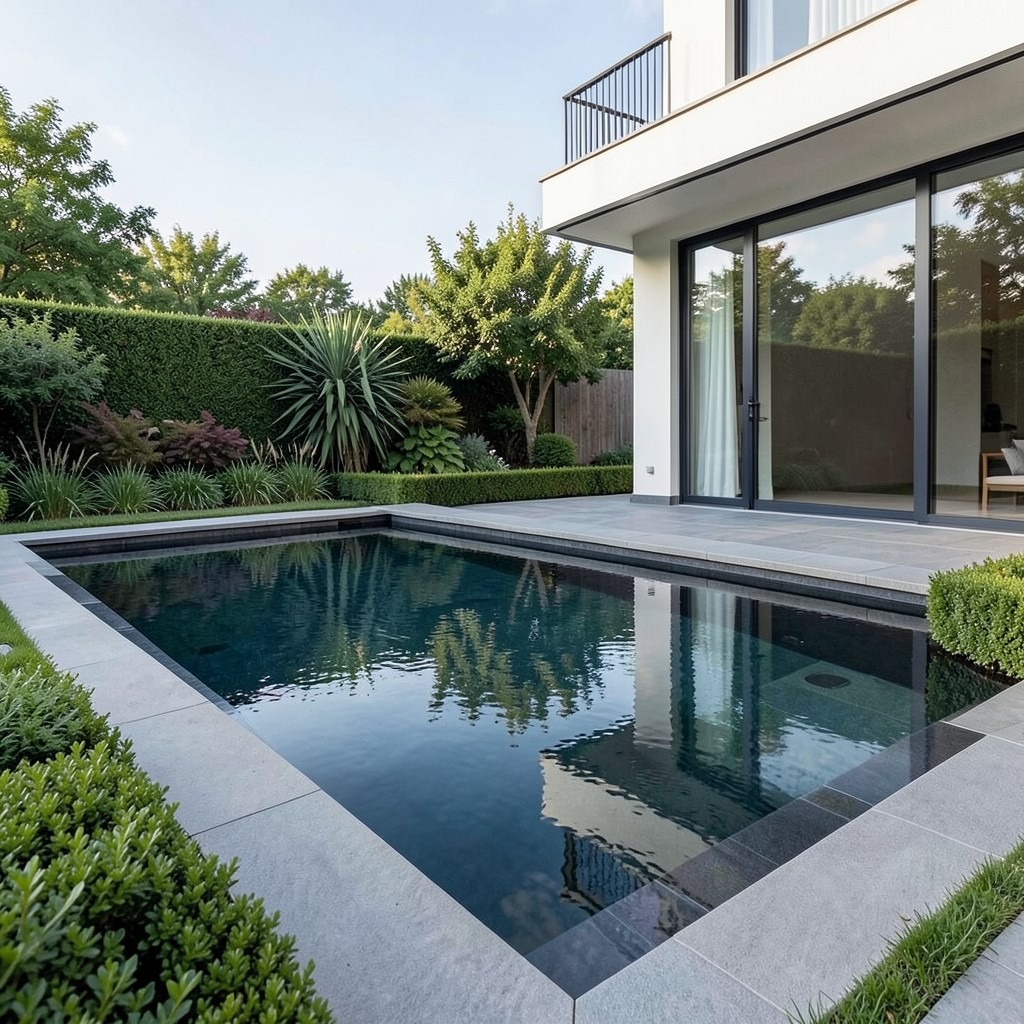
The geometric pool whose plan form is resolved in the right angle, the precise circle, or the composed combination of rectangular elements creates the modern garden’s water feature in the architectural language of the designed landscape rather than the naturalistic language of the organic form. The geometric pool belongs to the designed garden. Its precision communicates the same design conviction as the clipped hedge, the paved terrace’s level surface, and the architecture whose orthogonal geometry the pool’s form extends into the outdoor space.
A rectangular pool whose proportions relate to the house’s facade geometry — the pool’s width in the ratio to the house’s glazing module, the pool’s length creating the primary spatial axis of the garden’s composition — creates the modern garden’s water element in the format that most specifically integrates the water body into the garden’s spatial design as an architectural rather than a landscape element. Minimalist home design gardens whose design language is defined by the few, resolved, precisely proportioned elements receive the geometric pool as the outdoor space’s primary horizontal design element whose water surface, in still-water conditions, creates the reflective quality that doubles the garden’s sky volume and the surrounding planting’s presence through the mirror quality of the undisturbed surface. The geometric pool’s coping detail — the material, the profile, and the relationship between the coping’s edge and the pool’s water level — is the detail whose precision communicates the design’s quality at the pool’s most visible and most daily-contacted horizontal element.
The geometric pool’s water level management is the operational detail whose quality determines the design’s visual success in the still-water reflection condition — the pool whose water level is maintained at the highest possible position, with the water surface at or within millimeters of the coping’s top edge, creates the flooded quality that the minimal gap between the water and the coping creates at the most visually resoled level; the pool whose water level is allowed to drop below the coping by ten or more centimeters creates the dark band between the water and the sky that disrupts the reflection quality the geometric pool’s design intends.
17. A Pool With a Cave or Grotto Feature
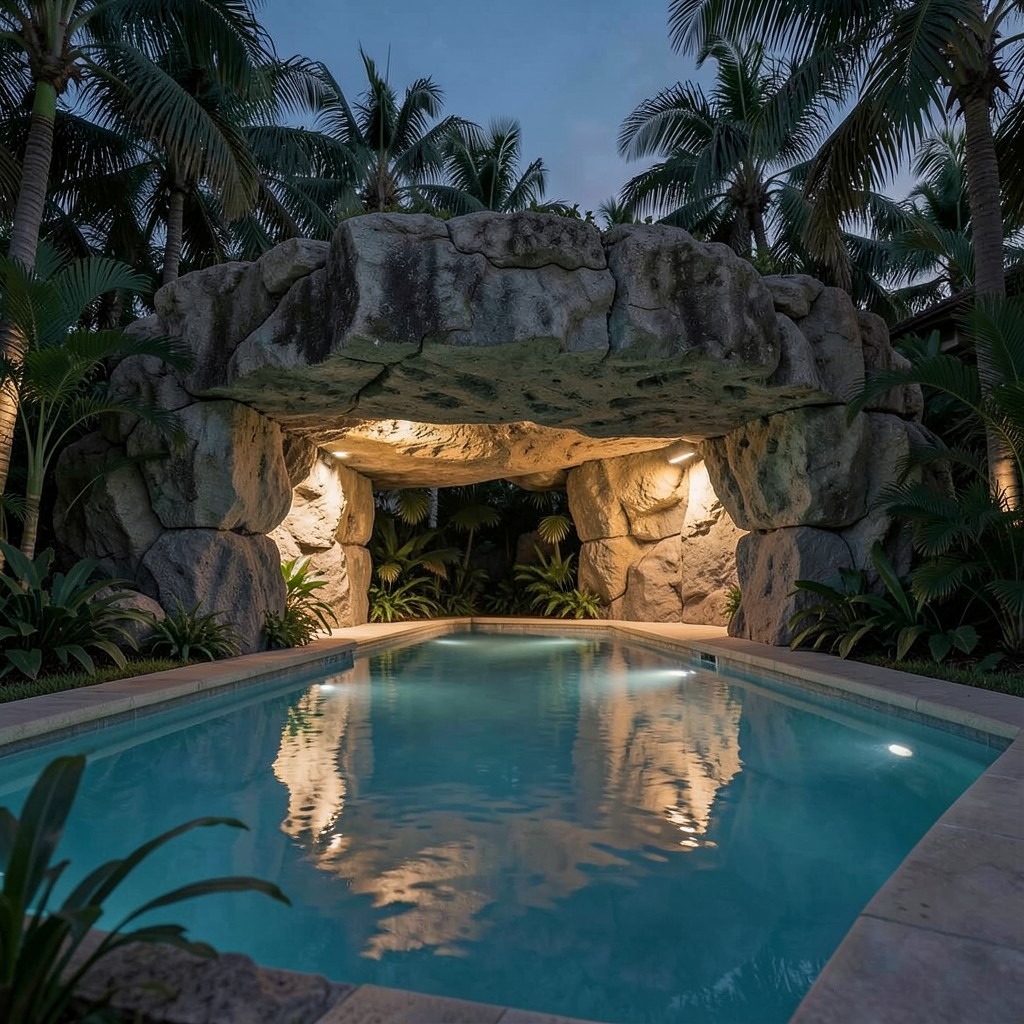
The pool grotto is the outdoor water feature’s most theatrical and most dramatically atmospheric design element — the cave-like structure, formed from natural or constructed rock, whose overhang creates the partially enclosed water space within the pool’s main body. The grotto turns the pool into the landscape, and the landscape into the experience. It is the design feature that the children who grew up with it remember for the rest of their lives and that the adults who first encounter it immediately want to swim into.
A pool with a grotto feature — the constructed rock formation at the pool’s deep end creating the overhead cover of the cave-like space, the water of the pool extending beneath the rock’s overhang to the enclosed pool area whose water temperature, sound, and light quality create the specific sensory environment that the open pool’s conditions do not provide — creates the tropical garden pool’s most immersive and most specifically atmospheric outdoor water feature. Tropical home design and jungle-inspired home decor outdoor spaces apply the pool grotto as the water feature element that most completely creates the tropical landscape’s specific quality of the enclosed, plant-sheltered water body whose enclosed quality contrasts with the open pool’s exposure as the specific sensory environment of the tropical waterhole whose natural equivalent the grotto references. The grotto’s interior lighting — the waterproof LED fitted within the rock formation’s concealed positions, the warm, diffused light creating the cave’s atmospheric quality from below and within the rock structure — creates the nighttime grotto whose dramatically lit interior communicates the theatrical design quality at its most specifically atmospheric evening condition.
The grotto’s structural engineering — the reinforced concrete structure concealed within the rock formation’s natural-appearing exterior, providing the structural load capacity that the pool water’s buoyancy and the rock formation’s gravity load create as the combined structural requirement — is the engineering element whose quality determines the grotto’s long-term safety and the rock formation’s structural permanence over the pool’s full operational lifespan.
18. A Heated Pool for Year-Round Swimming

The heated pool is the residential water facility’s investment that the household makes when the climate’s seasonal temperature range creates the unheated pool’s swimming season limitation that the pool’s construction cost and the outdoor space’s potential fail to justify. A pool used four months of the year is an expensive ornament for eight. The heated pool changes that arithmetic, and the household whose outdoor space contains a heated pool discovers the outdoor water routine that becomes the year-round daily practice rather than the summer-only seasonal activity.
A pool with a heat pump heating system — the heat pump’s air-source thermal energy transfer creating the water temperature increase of fifteen to twenty degrees above the ambient air temperature at the system’s efficiency peak — creates the year-round pool whose water temperature is maintained at the comfortable swimming threshold regardless of the seasonal air temperature’s variation. The heat pump’s operating cost relative to the gas heater’s fuel cost creates the economic argument for the heat pump specification that the pool’s year-round heating requirement makes most compelling at the operational cost comparison’s scale — the heat pump’s coefficient of performance creating the thermal energy output per unit of electrical input that the direct gas combustion cannot approach at the same cost efficiency. Winter home decor properties whose heated pool creates the outdoor water facility for the winter season — the heated water at the comfortable swimming temperature, the pool’s surface steam visible in the cold morning air, and the pool cover’s overnight thermal retention reducing the heating cycle’s daily energy requirement — create the outdoor water experience of most specifically seasonal atmospheric quality.
The heated pool’s cover specification determines the system’s energy efficiency more than any other single operational factor — the automated pool cover that deploys over the surface during the unoccupied periods reduces the heated water’s evaporative heat loss and the overnight temperature drop that the uncovered pool surface creates, and the pool cover’s R-value and its fit quality at the pool’s perimeter determine the thermal retention whose quality the heating system’s operating cost reflects directly.
19. A Pool With Lush Tropical Planting Around It
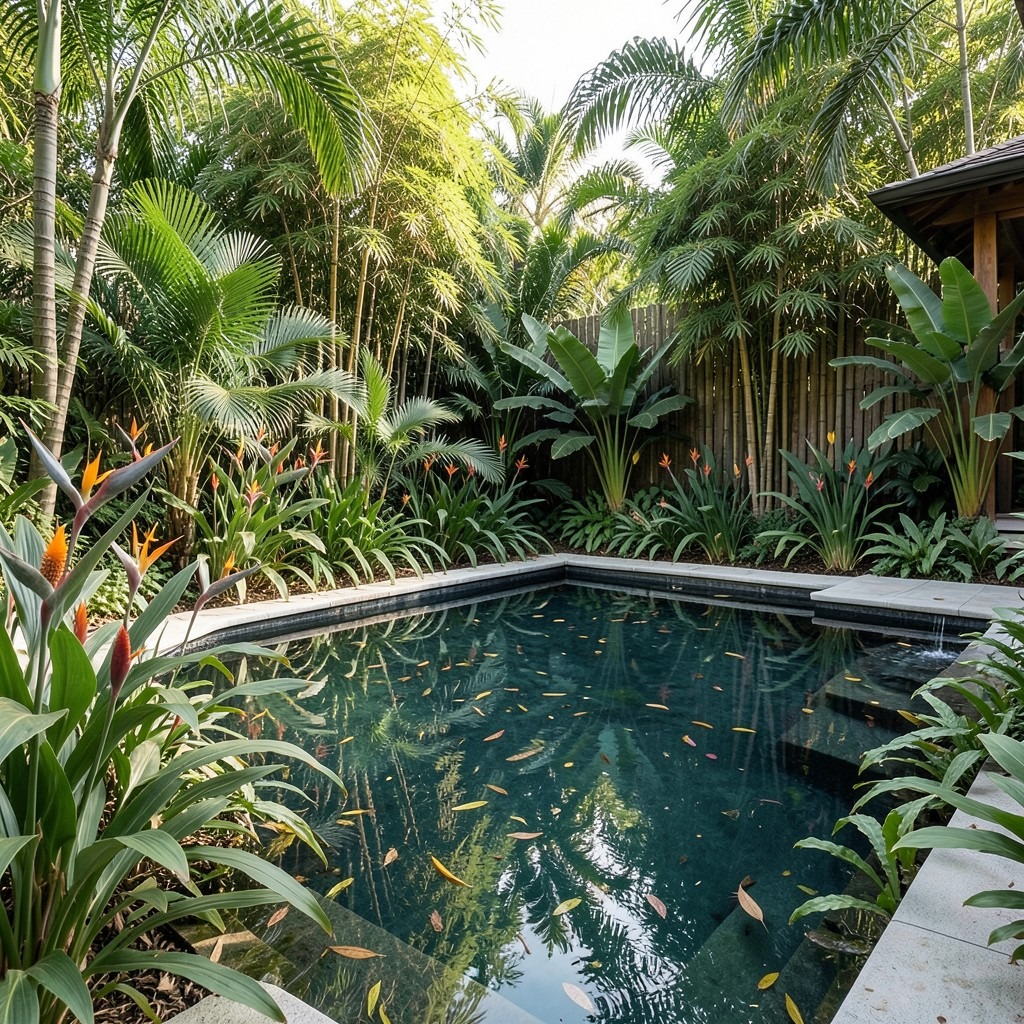
The tropically planted pool surround is the outdoor water space whose design philosophy treats the pool as the water body within the landscape rather than the garden’s primary designed element around which the landscape is organized. This is the pool whose palm fronds brush the water surface in the wind, whose heliconia and bird of paradise create the color border at the coping’s edge, and whose planted density creates the enclosed, private quality of the tropical garden’s most lush and most immersive water setting. The planting makes the pool. Without it, the same concrete and water is the construction site.
A pool surrounded by a dense tropical planting scheme — the Strelitzia, the Phoenix palm, the Canna, and the Agapanthus creating the planted border at the pool’s perimeter, the bamboo and the large-leafed Musa providing the background height and the enclosure that the tropical garden’s lush density requires — creates the tropical home design outdoor space’s most complete and most atmospherically immersive pool setting. Bamboo home interiors properties whose indoor tropical design direction extends to the outdoor pool setting create the continuous tropical design philosophy from the interior’s organic material palette to the pool’s planting environment, the bamboo’s presence both indoors and in the pool’s planted surround creating the material continuity between the home’s interior and exterior design languages. The tropical pool planting’s selection should balance the visual density and the atmospheric quality that the lush planting creates against the leaf litter management that the plants’ seasonal shedding deposits in the pool water — the deciduous planting, the seed-shedding plants, and the fine-leafed plants whose debris the pool’s skimmer handles less effectively than the large-leafed, minimal-shedding tropical species should be positioned with the leaf fall direction and the prevailing wind’s relationship to the pool’s surface in consideration.
The tropical planting’s irrigation in the pool surround position creates the design opportunity that the pool’s backwash and filter cleaning water provides as the irrigation source — the irrigation system whose supply is partially the pool’s maintenance waste water creates the garden’s water management efficiency that the separately metered irrigation supply cannot achieve at the same water resource economy.
20. A Pool With a Fire Pit Nearby for Evenings

The pool and fire pit combination is the outdoor room design that most completely serves the full daily and seasonal range of the outdoor living space’s atmospheric requirements — the pool for the day’s heat and the social water activity, and the fire pit for the evening’s gathering whose warmth, light, and focal quality the pool’s cooling water cannot provide after the sun has set and the air temperature has dropped to the level that the fire’s radiant heat becomes the outdoor room’s primary comfort element. Water and fire. The two most elemental outdoor gathering forces.
A pool terrace with a nearby fire pit — the pit positioned at the terrace’s far end, the seating arranged in the circular configuration around the fire that creates the social gathering zone whose spatial relationship to the pool’s edge maintains the visual connection between the two water and fire elements — creates the outdoor room’s complete day-to-evening design in the spatial arrangement that most naturally creates the social gathering’s complete daily sequence. The fire pit’s material — the natural stone surround, the Corten steel bowl, or the poured concrete form — should relate to the pool’s coping material and the terrace’s paving in the material composition that creates the outdoor room’s complete design coherence rather than the disparate element accumulation that the fire pit purchased separately from the pool design creates. Cozy home design outdoor spaces apply the pool and fire pit combination as the year-round outdoor room’s complete atmospheric infrastructure — the pool for the warm season’s cooling, the fire pit for the cool season’s warming, and the spring and autumn transition periods whose moderate temperatures create the overlap condition where the pool’s warmth and the fire’s warmth can both be experienced in the same evening gathering.
The fire pit’s position relative to the pool’s edge requires the safety clearance that the regulatory requirements and the common-sense hazard assessment both mandate — the fire and its flying ember risk should be positioned with the prevailing wind’s direction in relation to the pool and the surrounding planted material in full consideration, and the three-to-four-meter minimum clearance between the fire pit and the pool’s edge creates the separation that both safety and the social spatial arrangement require.
21. A Natural Stone Pool With Boulder Edges
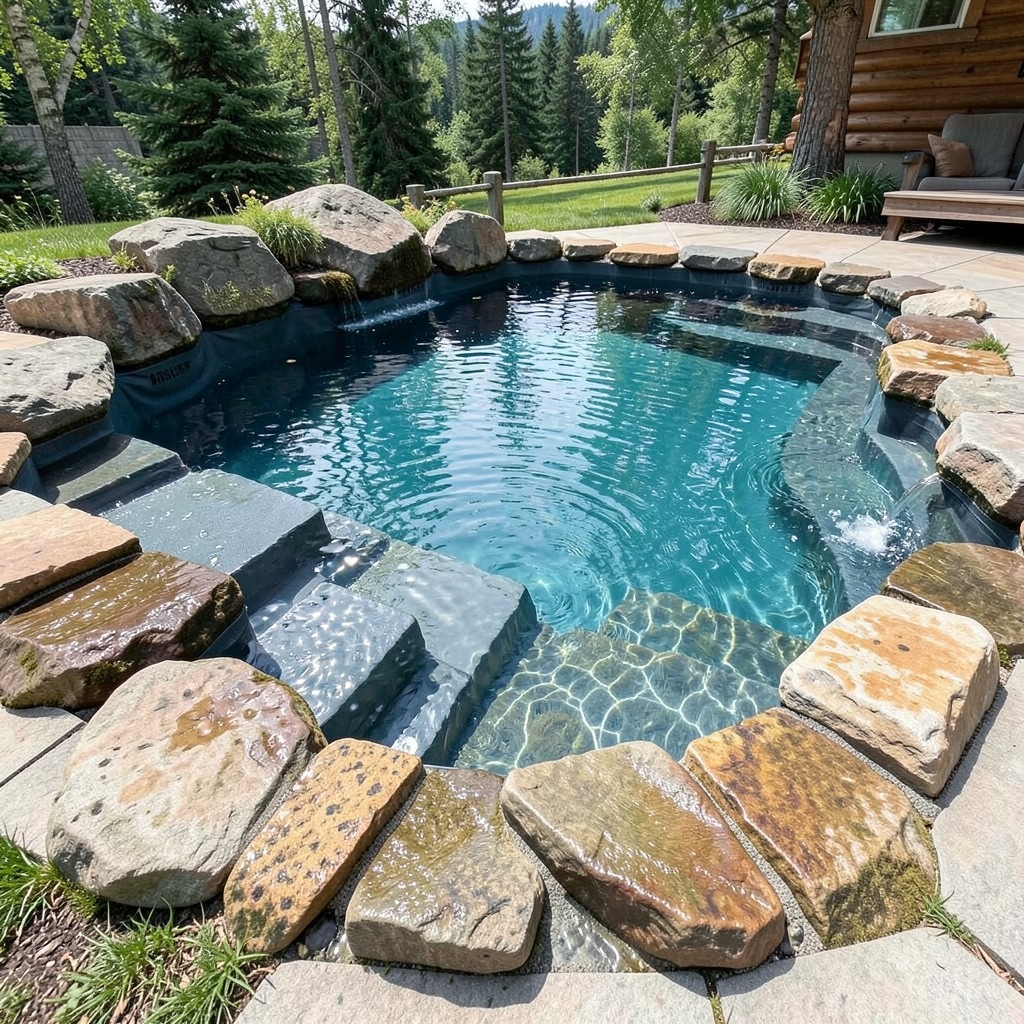
The natural stone pool with boulder edges is the design idea that the organic, landscape-integrated outdoor space applies when the question is how to create the swimming water body whose form, material, and surrounding elements communicate the natural water feature rather than the engineered pool installation. The boulders at the pool’s edge are not decoration. They are the landscape’s own material, selected and positioned to create the natural water’s edge that the concrete coping’s precision eliminates from the pool’s character.
A pool with natural boulder edges — the large-format local stone selected for the color and texture of the site’s geological character, positioned at the pool’s perimeter to create the irregular, naturalistic edge whose form belongs to the natural rockpool rather than the residential pool installation — creates the earthy home design or mountain cabin decor outdoor space’s most geologically specific and most naturalistically resolved swimming water feature. Stone and wood home design properties whose material palette is organized around the honest, structural material of the geological landscape receive the natural stone boulder pool as the outdoor water element whose material character communicates the design’s philosophy at the landscape’s most prominent and most materially specific installation. The boulder’s positioning at the pool’s edge creates the design challenge of the integration between the naturalistic edge and the pool’s waterproofing membrane whose engineering requirement the aesthetically positioned natural rock must accommodate without compromising — the membrane’s integrity at the boulder’s contact point with the pool’s structural shell requiring the specific waterproofing detail that the boulder-edge pool’s construction demands from the specialist pool builder experienced in this specific construction type.
The natural stone boulder pool’s safety consideration at the edge is the slip and fall risk that the irregular, naturally surfaced boulder creates as the pool’s entry and exit surface — the smooth, wet boulder at the pool’s edge creates the slip hazard that the purpose-designed non-slip coping eliminates, and the boulder edge pool should design the water entry and exit at the designated stepped access point whose non-slip specification is explicit and clearly communicated to the pool’s users rather than distributed around the full perimeter of the boulder edge whose irregular surface creates the unpredictable traction.
22. A Courtyard Pool in a Walled Garden

The walled garden pool is the enclosed outdoor room’s water feature whose design quality is determined as much by the walls that surround it as by the pool’s own specification — the enclosing walls create the pool’s acoustic environment, its wind protection, its privacy, and its specific light quality at different times of the day whose quality the open garden’s exposure cannot create at the same concentrated atmospheric intensity. The walls are as much a part of the pool design as the pool itself.
A pool in a walled garden — the pool’s plan centered within the enclosed space, the surrounding walls creating the private outdoor room whose enclosure provides the year-round wind protection and the privacy that the open garden’s exposed position prevents — creates the Mediterranean or traditional garden’s most specifically private and most atmospherically enclosed outdoor water space. Traditional home interiors properties whose garden design draws from the Persian, the Moorish, and the classical European enclosed garden tradition receive the walled garden pool as the outdoor space’s historical design type whose cultural resonance and architectural resolution communicates the design’s awareness of the residential garden’s most deeply rooted and most geographically widespread enclosed water garden tradition. The walled garden’s reflected sound quality — the pool’s water movement, the fountain’s splash, and the surrounding garden’s wind-moved foliage creating the acoustic environment whose reflection from the enclosing walls creates the specific sound-rich quality of the enclosed outdoor space — is the atmospheric quality that the open garden’s sound dispersion prevents from achieving the same concentrated sensory presence.
The walled garden pool’s solar management requires the wall orientation’s consideration at the design stage — the walls that create the enclosure whose shadow pattern falls across the pool during the peak solar hours reduce the pool’s heating and the pool terrace’s sun exposure in the enclosed space where the shadow’s accumulation creates the cooler, shadier microclimate that the wall’s orientation and height determine more completely than any other single design decision.
23. A Pool With a Negative Edge on One Side and a Wall on the Other

The asymmetric pool — the infinity edge on one side and the retained wall on the other — is the sloped site’s most spatially intelligent pool design, whose form responds to the site’s natural topography by expressing the slope’s direction in the pool’s design rather than engineering the site to a flat condition that the topography did not offer. The infinity edge descends toward the slope’s lower side, and the retaining wall rises on the upper side, creating the pool whose design is the direct expression of the site’s own geometry.
A pool with the infinity edge oriented toward the site’s natural view and the retaining wall at the site’s higher side — the retaining wall’s material relating to the garden’s stone or concrete palette, the wall’s height creating the pool deck’s level surface above the slope’s natural fall — creates the sloped site’s pool design in the format that most specifically and most honestly responds to the site’s topography rather than working against it. Contemporary home ideas sloped site properties apply the asymmetric pool as the outdoor water element whose design communicates the landscape architecture’s intelligence — the form that the site’s conditions inspired rather than the form that the residential pool catalog specified. The retaining wall’s material in the infinity-edge pool creates the opportunity for the wall-integrated water feature — the sheet of water descending the wall’s face from the pool deck level to the lower terrace creating the water wall element that the slope’s natural height difference between the pool deck and the lower garden creates as the design opportunity.
The asymmetric pool’s structural engineering — the retaining wall’s design for the combined hydrostatic pressure of the pool water and the lateral soil pressure of the uphill slope — creates the structural requirement whose complexity exceeds the standard pool shell’s straightforward hydrostatic load condition, and the structural engineer’s involvement at the design stage is the non-negotiable professional requirement for the asymmetric pool whose retaining wall carries the combined loading that the structural calculation must verify.
24. A Pool Surrounded by Desert Landscaping

The desert garden pool is the water feature whose placement in the arid landscape creates the most dramatic material and atmospheric contrast available in the residential outdoor design range — the deep blue water in the sand, stone, and succulents of the desert garden creates the oasis quality that every desert garden pool communicates by the physics of the contrast between the water and the dry landscape it occupies. The desert pool is the most dramatic pool. The landscape does all the work.
A pool surrounded by desert landscaping — the agave, the ocotillo, the ornamental grasses, and the low-water ground cover plants creating the planted perimeter whose drought-tolerant species communicate the arid landscape’s botanical character — creates the desert home styling outdoor space’s water feature in the cultural context of the desert oasis whose water body in the dry landscape communicates the most specific and most historically resonant outdoor water quality of any garden type. The desert landscape’s mineral material palette — the decomposed granite, the natural flagstone, and the clay or terracotta pavers surrounding the pool — creates the pool surround in the earthy, warm, low-water material that the desert garden’s plant palette occupies as its ground plane. Earthy home design desert properties whose interior material palette of terracotta, natural stone, and warm plaster extends to the outdoor pool terrace’s material selection create the continuous design language between the interior and the exterior whose material consistency communicates the design’s philosophical coherence from the indoor room to the outdoor pool.
The desert pool’s evaporative water loss is the water management consideration that the arid climate creates as the outdoor pool’s most significant ongoing resource challenge — the combination of the pool cover for the non-swimming periods, the reduced surface area of the plunge or compact pool format, and the shade management of the surrounding trees whose canopy reduces the direct solar radiation on the water surface creates the water conservation strategy that the desert pool requires as the responsible specification for the water-scarce climate the design inhabits.
25. A Pool With a Glass-Fronted Retaining Wall

The glass retaining wall pool is the contemporary hillside property’s most architecturally sophisticated structural water feature — the pool’s structural retaining wall on the downhill side constructed in clear structural glass creates the view through the pool’s retaining structure to the landscape beyond, creating the water body whose engineering serves as the landscape’s most dramatically transparent structural element. The glass wall holds the hill back. The water is visible through the glass. The view is framed behind both.
A pool with a structural glass retaining wall panel — the laminated tempered glass engineering calculated for the combined hydrostatic and soil lateral pressure load, the frameless or slim-framed glass panel creating the transparent retaining structure — creates the contemporary garden’s most architecturally specific and most structurally daring water feature element. Modern home design sloped properties with glass retaining wall pools create the outdoor space of most dramatic structural transparency — the pool water visible above the glass wall from the lower terrace, the structural glass’s transparency creating the depth illusion between the pool’s interior and the landscape beyond the glass panel. The glass retaining wall’s maintenance — the algae growth on the glass face at the pool waterline’s level, the mineral deposit accumulation from the pool water’s chemical contact with the glass surface, and the exterior face’s soil and weather deposit — requires the access provision for both faces of the glass panel at the design stage, and the lower terrace’s proximity to the glass face creates the maintenance access that the glass’s cleaning requires.
The structural glass retaining wall’s design and installation requires the pool structural engineer’s specific calculation for the glass specification, the frameless mounting system’s load capacity, and the sealant detail at the glass’s contact with the pool shell — these engineering elements are the safety-critical design components whose quality and specification accuracy the pool’s long-term structural integrity and the occupant safety both depend on absolutely.
26. A Pool With Outdoor Shower and Changing Area

The pool changing area and outdoor shower is the complete pool facility’s most practically generous and most operationally considered design addition — the household that swims daily and then enters the house through the kitchen or the living room without the outdoor shower’s chlorine and sunscreen rinse creates the domestic management challenge that the outdoor shower eliminates at the pool’s most operationally logical position. The shower is between the pool and the house. The sequence is right. The house stays clean.
A pool terrace with an integrated outdoor shower — the shower head wall-mounted at the pool terrace’s boundary position between the pool zone and the house’s exterior entry, the drain recessed in the terrace’s paving, and the adjacent changing area’s privacy screen creating the outdoor dressing space that eliminates the wet swimwear track through the interior — creates the pool facility’s most operationally complete and most practically intelligent design. The outdoor shower’s material — the natural timber privacy screen, the stone or concrete wall shower fitting position, and the pebble or teak drain surround — should relate to the pool surround’s material palette in the composed design that communicates the outdoor room’s complete material coherence rather than the shower facility added as the functional afterthought. Coastal outdoor living space properties with outdoor showers adjacent to the pool create the coastal domestic ritual whose salt-water rinse, outdoor air dry, and poolside change sequence communicates the household’s relationship to the outdoor water life as a complete, designed daily practice rather than the improvised wet-floor management that the pool-without-shower creates as the standard domestic response.
The outdoor shower’s plumbing connection — the hot and cold water supply whose outdoor pipe routing is insulated against the seasonal temperature variation that the exterior position creates as the frost risk in colder climates — requires the shutoff valve accessible from within the building that allows the outdoor water supply to be drained and isolated during the winter months whose freezing temperatures create the pipe burst risk that the unprotected outdoor plumbing’s water content creates. The changing area’s privacy screen in a natural bamboo, a painted timber, or a planted hedge creates the outdoor dressing space whose privacy quality communicates the household’s investment in the pool facility’s complete operational design at the level that the practical daily use most directly encounters.
27. A Pool With a Tanning Ledge and Mosaic Detail

The tanning ledge is the shallow, submerged shelf that the sun-seeking household applies as the pool’s most luxuriously indulgent spatial element — the water-covered platform whose depth of fifteen to twenty centimeters creates the ideal condition for the face-down sunbathing position whose body is simultaneously cooled by the shallow water contact and warmed by the direct sun overhead. The tanning ledge is one of those pool features that sounds like a minor addition on paper and becomes the most-used part of the entire outdoor space within the first week.
A tanning ledge with a hand-set mosaic detail — the mosaic pattern in the cobalt, turquoise, and gold of the Mediterranean palette applied at the ledge’s submerged surface and visible through the shallow water’s lens — creates the pool’s most decoratively specific and most design-committed shallow water element. The mosaic’s pattern on the tanning ledge creates a unique design opportunity that the deeper pool sections’ mosaic cannot provide — the shallow water’s transparency places the mosaic surface at the closest visible distance of any pool interior element, and the pattern’s detail reads with the clarity that the depth’s visual distortion reduces in the deeper zones. Chic home decor outdoor spaces apply the tanning ledge mosaic as the pool’s most intimate decorative surface — the household member lying on the ledge with the mosaic pattern visible inches below the water’s surface creates the specific visual experience whose quality no other pool design element provides at the same close-range design intimacy.
The tanning ledge’s drainage management when the pool’s water circulation is turned off creates the stagnant water risk that the shallow depth and the warm surface temperature accelerates — the ledge whose drainage design includes the slight gradient toward the main pool ensures that the water remains in circulation with the pool’s main body rather than pooling in the static condition that the algae growth and the bacterial accumulation develop in the undrained shallow water.
28. A Pool With Perimeter Overflow and Flush Coping

The perimeter overflow pool — whose water surface is maintained at the precise level of the surrounding coping, the overflow water sheeting over all four edges into the concealed perimeter channel — is the pool design idea that the purist’s outdoor design philosophy applies when the standard water-below-coping condition creates the visual interruption between the water surface and the surrounding terrace that the flush condition eliminates. The water and the terrace are at the same level. The pool is the terrace. The terrace is the pool. The boundary disappears.
A perimeter overflow pool with a natural stone coping flush with the terrace — the water overflowing continuously around all four edges into the concealed channel whose return pump maintains the water level at the design’s flush condition — creates the minimalist outdoor space’s most architecturally resolved and most spatially continuous water element. Minimalist home design gardens with the perimeter overflow pool create the outdoor room whose horizontal plane is the water’s surface extended to the terrace level, and the seated position at the terrace beside the pool whose water is at the same level as the seat creates the spatial relationship of immense horizontal continuity that the standard below-coping pool cannot create from the same terrace position. The perimeter overflow pool’s maintenance demands are greater than the standard pool’s operational requirements — the continuous water movement over all four edges creates the increased chemical and thermal loss that the standard pool’s contained water surface prevents, and the perimeter channel’s regular cleaning removes the leaf, debris, and biofilm accumulation that the water’s continuous surface flow deposits in the channel whose collection function the overflow system requires.
The perimeter overflow pool’s wind management is the operational consideration that the aesthetic’s continuous surface condition creates as the most technically specific challenge — the wind-driven wave that breaks over the coping’s edge creates the water loss from the main pool body into the surrounding paving that the perimeter channel cannot capture at the wave’s height and energy, and the pool’s position in the landscape should consider the prevailing wind’s effect on the overflow rate whose excess the channel’s capacity and the return pump’s flow rate must manage within the system’s design parameters.
29. A Roman Pool With Classical Columns in a Traditional Garden

The Roman-style pool — the rectangular basin with the classical colonnade at its perimeter, the carved stone or rendered column creating the architectural frame for the water garden’s formal composition — is the traditional garden’s most historically specific and most culturally resonant pool design, drawing from the atrium pool, the peristyle garden, and the formal bath tradition of the classical Mediterranean residential landscape whose influence on the European residential garden tradition spans two millennia of continuous design reference.
A rectangular pool flanked by classical columns — the columns in the painted render, the carved limestone, or the cast stone whose profile and proportion communicate the design’s specific classical order, the Doric, Ionic, or Corinthian capital creating the architectural vocabulary of the formal garden’s water feature — creates the traditional home interiors garden’s most architecturally composed and most historically grounded outdoor water space. Traditional home interiors estate gardens with the Roman pool and colonnade apply the water feature as the garden’s primary formal axis — the pool’s long dimension creating the compositional spine from which the surrounding parterre, the clipped hedge, and the formal planting radiate in the bilateral symmetry that the classical garden’s design convention requires of its primary architectural element. The colonnade’s material specification — the carved stone for the most architecturally invested specification, the cast stone for the more accessible cost alternative, and the rendered masonry for the most economical formal column — creates the column’s visual quality at the garden’s primary ornamental architectural element whose material communicates the design’s investment in the classical reference’s authenticity.
The Roman pool’s water planting — the water lily, the lotus, and the submerged oxygenating plant whose presence in the formal pool creates the biological balance that reduces the chemical management requirement — should be specified in the formal variety whose contained, non-spreading growth habit suits the pool’s precise geometry rather than the vigorous naturalizing species whose spread the formal pool’s designed margins cannot accommodate without the regular management that the invasive growth habit creates.
30. A Pool Surrounded by Olive Trees and Mediterranean Planting

The olive-bordered pool is the Mediterranean garden’s most specifically evocative and most regionally authentic outdoor water setting — the gnarled, silver-leafed olive tree whose presence beside the pool communicates the agricultural heritage of the Mediterranean landscape in the single plant species most associated with the region’s human history, its economy, and its residential garden tradition. The olive tree beside the pool is not the decoration. It is the place.
A pool surrounded by a Mediterranean planting scheme — the olive trees, the lavender, the rosemary, the cistus, and the agapanthus creating the planted composition whose combined species communicate the dry, sun-drenched, fragrant character of the Mediterranean coastal landscape — creates the outdoor pool space of most specifically geographic and most sensory-rich planting character. The Mediterranean planting’s fragrance quality at the pool surround is the atmospheric detail that the purely visual design discussion consistently fails to acknowledge — the lavender and the rosemary warmed by the afternoon sun beside the pool creates the scent quality whose contribution to the pool experience is as specifically atmospheric as the water’s sound or the olive’s silver light quality, and the household that designed the pool planting for the nose as deliberately as for the eye has the outdoor pool experience of maximum sensory completeness. Fall home decorating seasons in the Mediterranean garden pool — the olive harvest, the lavender’s silver-grey late-season character, and the agapanthus’s faded seed heads creating the autumn garden’s specific beauty beside the season’s last warm pool days — communicate the seasonal design quality that the Mediterranean garden delivers at its most specifically resolved in the autumn’s specific plant palette.
The olive tree’s root management beside the pool requires the root barrier installation that the established olive’s spreading root system makes the specific structural protection requirement at the pool shell’s perimeter — the olive root’s structural force and its water-seeking behavior creates the pool shell penetration risk that the physical root barrier and the minimum two-meter clearance between the olive’s trunk and the pool shell creates as the long-term structural protection.
31. A Pool With a Waterfall Wall Feature

The waterfall wall — the vertical face of water descending from the pool deck level or an elevated water feature to the pool’s surface below — is the pool’s most architecturally specific and most elegantly resolved water movement element, the water’s descent along the wall’s face creating the visual curtain and the acoustic presence of the moving water in the format whose architectural quality is more resolved and more specifically designed than the naturalistic rock waterfall’s organic form.
A pool with a blade waterfall — the water flowing over the pool’s end wall’s precisely leveled blade edge in the thin, unbroken sheet that the hydraulic engineering creates when the flow rate and the blade’s precision work in the required combination — creates the outdoor water feature of most visually specific and most acoustically refined water movement quality. The blade waterfall’s acoustic character is its most specifically valuable contribution to the outdoor pool room — the white noise quality of the water’s descent creating the outdoor room’s sound masking effect that reduces the ambient street noise, the neighbor’s garden, and the general suburban acoustic environment to the background level that the pool’s primary sound displaces. Peaceful home decor outdoor spaces apply the waterfall wall feature as the pool’s primary acoustic environment element whose sound quality creates the specific meditative atmosphere that the still pool’s silence and the absent water movement cannot generate at the same sensory immersion level.
The blade waterfall’s water quality requirement is the hydraulic condition whose precision the blade edge demands — the blade waterfall whose water supply contains the suspended particles, the biological growth, or the chemical scale that the untreated water creates deposits the particulate on the blade edge, creating the irregular flow that the blade’s precision profile can no longer produce at the design’s clean, unbroken sheet quality. The blade edge’s regular cleaning and the water treatment’s consistent management creates the operational standard that the blade waterfall’s visual quality depends upon throughout the pool’s operational season.
32. A Concrete Pool With Exposed Aggregate Finish

The exposed aggregate pool is the industrial home design and contemporary outdoor space’s material-specific pool surface treatment — the concrete pool shell whose surface finish is the exposed aggregate of the structural concrete’s coarse aggregate, revealed at the surface by the acid wash or the abrasive finish that removes the cement paste to the depth that exposes the stone aggregate’s color, texture, and natural variation. The aggregate is the pool’s floor and walls. The finish communicates the structural material’s own beauty rather than the coating applied over it.
A concrete pool with an exposed aggregate finish — the aggregate selected in the local stone’s color and texture, the dark charcoal granite aggregate creating the pool’s deep, moody water quality, or the pale limestone aggregate creating the warm, sand-toned pool interior whose water reads in the turquoise-green of the shallow tropical reef — creates the outdoor pool surface in the material whose honesty and durability communicate the design’s industrial and material-specific design conviction. Industrial home design outdoor spaces apply the exposed aggregate pool as the water feature whose raw material character extends the industrial aesthetic’s philosophy from the interior’s concrete floor and exposed steel to the exterior pool’s equally unfinished, equally honest structural surface specification. The aggregate finish’s texture at the pool’s interior surface creates the tactile quality that the smooth plaster pool’s surface does not provide — the slight roughness of the exposed aggregate creates the traction at the pool wall and floor that the swimmer’s foot feels as the grip quality whose safety benefit at the pool’s entry steps and shallow end is the aggregate finish’s practical advantage alongside its aesthetic character.
The exposed aggregate pool’s maintenance differs from the plaster pool’s in the specific cleaning approach that the textured surface’s debris retention creates — the aggregate’s surface texture accumulates the biofilm and the mineral deposit in the texture’s depth that the brush cleaning reaches more effectively than the acid wash that the smooth plaster’s periodic descaling requires, and the pool brush specification for the textured aggregate surface should be the medium-stiff bristle whose reach into the texture’s depth the soft brush’s flexible bristle does not achieve.
33. A Pool Designed Around an Existing Tree

The tree-incorporated pool is the design idea that the property whose garden contains the established tree the household cannot bear to remove applies when the pool’s footprint would otherwise require the tree’s felling — the pool designed around the tree’s trunk, with the coping creating the organic profile that accommodates the tree’s structural presence at the pool’s edge, creates the outdoor water feature of most unique plan form and most specifically place-responsive design. The tree stays. The pool fits around it. Both are better for the arrangement.
A pool with an organically shaped plan that accommodates the existing tree — the pool’s coping creating the curved enclosure around the tree’s trunk whose root protection zone determines the minimum clearance between the pool shell and the root system that the arborist’s assessment specifies — creates the garden’s most specifically site-responsive and most design-confident pool configuration. The tree’s presence beside and within the pool’s perimeter creates the outdoor water space’s most atmospheric and most characterful design element — the mature tree’s canopy providing the dappled shade that the pool’s midday hours benefit from, the tree’s trunk creating the pool’s most personal and most irreplaceable visual element, and the seasonal change of the tree’s canopy communicating the pool space’s most naturally animated design quality across the year’s complete cycle. Garden-inspired interiors outdoor properties whose design philosophy places the existing landscape’s character above the new installation’s geometric requirements receive the tree-incorporated pool as the outdoor design’s most specifically site-honest and most practically generous design response.
The tree-incorporated pool’s structural requirement — the pool shell’s waterproofing membrane’s integrity at the proximity to the tree’s root zone, whose root growth and moisture seeking behavior creates the ongoing structural interface between the root system and the pool shell — requires the root barrier specification and the minimum clearance that the arborist and the pool structural engineer determine collaboratively as the design’s most critical spatial parameter.
34. A Pool With a Zero-Entry Beach Effect

The zero-entry pool — the pool whose entry is the gradual slope from the surrounding terrace’s level to the pool’s swimming depth, replicating the beach’s gradual entry into the sea — is the family outdoor space’s most naturally approachable and most operationally inclusive pool design, whose sloped entry eliminates the step-down of the standard pool entry and creates the wading entry whose gradual depth progression suits every member of the household from the youngest toddler to the oldest grandparent.
A zero-entry pool with a beach-effect entry slope — the pebble or sand-colored aggregate finish at the sloped entry creating the beach material reference, the gradual slope from the terrace’s paved surface to the pool’s swimming depth creating the continuous entry whose absence of step or ledge communicates the inclusive design philosophy — creates the family outdoor space’s most welcoming and most operationally inclusive pool format. The zero-entry’s shallow entry zone creates the toddler paddling area whose depth progression the child’s confidence manages at the pace that the gradual slope’s depth increase provides — the thirty-centimeter depth at the base of the slope creating the safe wading zone whose extent the child’s increasing confidence and increasing height gradually extends into the deeper water. Farmhouse home decor and relaxed home design family properties with zero-entry pools create the outdoor summer gathering space of maximum generational inclusivity — the grandparents wading in the shallow entry, the children at the paddling depth, and the adults swimming in the main pool body, all sharing the same water space whose zero-entry design serves every age’s comfort threshold simultaneously.
The zero-entry slope’s non-slip surface specification is the safety-critical design requirement whose importance the sloped, wet surface creates as the primary fall risk — the sloped entry’s downward angle and the smooth, wet pool finish creates the highest slip risk of any pool surface area, and the non-slip aggregate or the textured tile specification at the slope’s full extent creates the traction that the sloped, wet entry surface demands as its minimum safety standard.
35. A Luxury Indoor Pool in a Spa-Style Space

The indoor pool is the residential luxury that transcends the outdoor pool’s seasonal limitation by creating the swimming facility within the building’s conditioned envelope, whose temperature, humidity, and atmosphere management creates the year-round swimming space whose quality is independent of the weather conditions that the outdoor pool’s usability depends upon entirely. The indoor pool is the serious swimmer’s pool. And it is the household’s most extravagant architectural statement.
A luxury indoor pool in a spa-style space — the pool’s surrounding material in the natural stone, the timber-slatted wall paneling, and the overhead glazing whose sky view creates the connection to the exterior light that the indoor pool’s enclosed position would otherwise prevent — creates the luxury home interior’s most specifically architectural and most operationally complete private aquatic facility. The indoor pool’s atmospheric quality is determined as much by the humidity management and the acoustic specification as by the pool’s surface material — the indoor pool whose ventilation system maintains the relative humidity at the comfortable range prevents the condensation damage and the corrosive atmosphere that the unventilated indoor pool creates as the building fabric’s primary environmental hazard. Luxury master bedroom design suites in the high-specification residential property apply the indoor pool as the private spa facility whose presence in the home communicates the design’s most comprehensive and most spatially generous interpretation of the luxury residential interior’s complete amenity specification.
The indoor pool’s structural requirement — the load-bearing floor or basement structure whose design carries the pool water’s weight at the indoor location where the standard outdoor pool’s grade-level position distributes the load directly to the ground — is the most engineering-intensive structural challenge that the indoor pool’s location creates, and the structural engineer’s early involvement in the design process is the non-negotiable requirement that the indoor pool’s structural complexity demands before the architectural design proceeds.
36. A Biophilic Pool Surrounded by Living Walls

The biophilic pool whose surrounding vertical surfaces are planted living walls — the planted panels of the irrigated, planted vertical garden whose green surface creates the pool’s surround in the living material rather than the paved or planted ground-level material — creates the outdoor water space of maximum plant density and maximum atmospheric botanical quality in the format that the vertical growing plane makes possible within the spatial constraints of the enclosed courtyard or the compact urban garden whose horizontal planting area is insufficient for the botanical abundance that the design’s biophilic intention requires.
A pool with planted living walls on two or three of the surrounding vertical surfaces — the irrigation system maintaining the planted panels’ moisture, the plant selection calibrated for the wall’s aspect and the humid pool environment’s growing conditions — creates the urban garden’s outdoor water space of maximum enclosed botanical character. The living wall’s plant selection for the humid pool environment should acknowledge the splash zone’s moisture and the atmospheric humidity that the pool’s evaporating surface creates at the wall’s lower section — the fern, the mind-your-own-business, and the moisture-tolerant succulents creating the lower planted panels whose species can handle the pool’s atmospheric humidity that the upper wall’s more exposed position allows the wider species range to occupy. Jungle-inspired home decor outdoor spaces apply the living wall and pool combination as the most immersive and most completely botanical outdoor water environment available in the residential design range — the surrounding green walls creating the enclosed tropical quality that the open garden’s horizontal planting plane cannot achieve at the same concentrated immersive botanical density.
The living wall’s irrigation system’s water management relative to the pool’s water chemistry creates the practical consideration that the irrigated wall’s drainage into the pool should avoid — the irrigation water’s fertilizer content, whose nitrogen and phosphate the plant’s growth requires, creates the pool algae bloom when the drainage enters the pool water’s nutrient balance, and the irrigation system’s drain design should direct the surplus water away from the pool rather than into it.
37. A Floating Deck Over a Shallow Pool Section

The floating deck over the pool’s shallow section creates the outdoor room’s most spatially specific and most architecturally unexpected furniture element — the deck platform whose surface is at the water level, whose structural supports stand in the shallow pool section below, and whose relationship to the surrounding water creates the deck experience of being on the water rather than beside it. The deck floats. The water is everywhere around it and below it. The sensory quality of the position is the outdoor room’s most specifically immersive design experience.
A timber floating deck over the pool’s shallow end — the deck surface in a hardwood or composite decking whose gap between boards reveals the water below, the structural supports standing in the shallow pool section whose depth accommodates the support’s height without the deck’s elevated position creating the uncomfortable height above the water’s surface — creates the outdoor pool space’s most surprising and most spatially specific furniture zone. The floating deck creates the pool platform for the outdoor dining, the yoga practice, or the contemplative sitting whose specific quality — the water visible through the deck’s gaps, audible in the pool’s movement, and accessible by the single step-down to the pool’s main body — distinguishes the floating deck experience from any other outdoor furniture position the property provides. Elegant home styling outdoor spaces apply the floating deck as the outdoor room’s most architecturally specific and most design-committed spatial element — the table and chairs on the deck positioned over the pool water, the dining position surrounded by water on all accessible sides, creating the outdoor dining experience of most specifically theatrical spatial quality.
The floating deck’s structural connection to the pool’s shell — the support posts standing in the pool’s structural shell floor, their base fixings waterproofed and their material specification in the pool-safe stainless steel or the non-corroding aluminium — creates the structural interface that the pool’s water chemistry and the deck’s gravity load both act upon simultaneously, requiring the structural detail that accounts for both conditions at the connection point.
38. A Pool With Seasonal Floral Planting Borders

The seasonally planted pool border is the outdoor water space’s most temporally responsive design element — the planting beds at the pool’s coping edge whose seasonal rotation creates the pool’s surrounding color and fragrance in the specific palette of each calendar season, communicating the outdoor room’s engagement with the seasonal cycle in the most directly botanical and most visually animated design element of the pool’s surroundings. The pool itself does not change with the season. The planting around it changes everything.
A pool with formal planting borders at the coping edge — the beds in the structured width of forty to sixty centimeters, the seasonal planting rotation creating the spring bulbs, the summer annuals and perennials, the autumn’s ornamental grass and late-flowering aster, and the winter’s evergreen structure and berry — creates the outdoor pool space’s seasonal design character in the planting element whose annual rotation communicates the household’s active engagement with the garden’s seasonal cycle. Spring home refresh applied to the pool border planting — the tulip, the allium, and the aquilegia creating the spring pool border’s color beside the still-cool spring water, the seasonal planting communicating the outdoor room’s renewal quality that the spring season’s first warm days inspire — creates the pool space’s most seasonally specific and most emotionally resonant early-season design moment. Floral home decor ideas extended to the outdoor pool border create the outdoor room of maximum floral abundance — the peony, the rose, and the dahlia in the summer border, the pool’s water reflecting the planted color from the bed’s adjacent position, creating the composed visual relationship between the water’s blue surface and the border’s floral color palette that the pool garden at its summer peak delivers.
The pool border planting’s irrigation management requires the drip irrigation specification that prevents the pool water’s contamination by the surface water runoff from the irrigated beds — the drip system’s targeted water delivery at the plant’s root zone rather than the overhead spray’s surface wetting creates both the irrigation efficiency and the pool water quality protection that the border planting’s proximity to the pool’s water surface demands.
39. A Natural Pebble Pool With Organic Shape

The natural pebble pool is the pool surface specification that the organic garden applies when the standard plaster or tile finish creates the manufactured quality whose material character contradicts the naturalistic design direction the surrounding landscape establishes as its design philosophy. The pebble finish is the natural river stone applied to the pool’s interior surface in the organic colors and the specific aggregate size that creates the pool water’s natural, river-pool quality — the water whose color the dark pebble creates as the deep, forest-pool green is the color of the swimming hole, not the resort.
A freeform-shaped pool with a natural dark pebble finish — the organic plan form responding to the landscape’s natural topography and the existing planting’s positions, the dark pebble aggregate creating the water’s deep, natural color — creates the organic garden’s most naturally resolved and most specifically landscape-integrated water feature. Bohemian home styling outdoor spaces and garden-inspired interiors properties apply the natural pebble pool as the outdoor water feature whose form and surface communicate the design’s conviction that the built element should respond to the landscape’s own geometry rather than imposing the architectural geometry on the landscape that the rectangular pool’s orthogonal form requires. The pebble finish’s surface texture at the pool’s floor and walls creates the closest material approximation to the natural river or lake bed of any pool surface specification, and the swimmer in the natural pebble pool has the tactile quality underfoot that most directly references the natural swimming water body whose experience the organic pool’s design intention is most specifically evoking.
The pebble finish’s installation technique — the hand-applied aggregate set into the fresh render whose moisture allows the pebble’s embedding and the surface float that the installer creates at the fresh render’s working time — requires the skilled installer whose application technique creates the consistent aggregate exposure and the smooth surface quality that the pebble finish’s visual and tactile character requires. The poorly installed pebble finish whose inconsistent exposure creates the sharp edges and the uneven surface is the pool’s most tactilely uncomfortable and most visually unsuccessful surface specification outcome.
40. A Rooftop Pool in an Urban Setting

The rooftop pool is the urban property’s most dramatically positioned and most architecturally ambitious water feature — the pool on the building’s uppermost level creates the outdoor water experience at the height whose views, sky quality, and atmospheric separation from the city below creates the pool experience that no garden-level pool in the same location approaches at the same sensory elevation above the urban landscape. The rooftop pool is the city pool. The city is the pool’s garden.
A rooftop pool on an urban residential or mixed-use building — the pool’s position at the roof level creating the 360-degree urban panorama from the water, the sky’s unobstructed presence above the pool’s surface creating the open-air quality that the ground-level urban courtyard’s surrounding buildings prevent at the same sky proportion — creates the city property’s most specifically dramatic and most sky-connected outdoor water space. Contemporary home ideas urban properties apply the rooftop pool as the residential amenity whose elevation above the city creates the outdoor water experience of most dramatically atmospheric urban quality — the pool’s surface at the level where the city’s ambient sound reduces to the background quality, the view across the rooftops creating the urban landscape’s most complete aerial perspective, and the evening’s city lights visible from the water’s surface creating the pool experience of most theatrically urban atmospheric quality. The rooftop pool’s structural requirement — the roof structure designed for the water’s full weight load at the pool’s plan area, the waterproofing membrane protecting the building’s structure from the pool water’s contact, and the drainage system managing the pool maintenance water’s disposal — creates the structural and waterproofing engineering complexity that the rooftop pool’s position creates as its primary technical challenge.
The rooftop pool’s wind exposure — the elevation above the surrounding buildings creating the increased wind speeds at the roof level whose effect on the pool water’s wave action, the evaporative water loss, and the pool’s thermal management are all more pronounced than the sheltered garden pool’s equivalent conditions — requires the wind management through the parapet height, the planted screen, or the glazed wind barrier whose specification is the outdoor comfort and operational management consideration specific to the elevated position.
41. A Pool With a Sun Canopy or Pergola Structure

The pool with an overhead canopy or pergola structure is the outdoor water space whose design intelligence acknowledges the full-sun pool’s primary summer limitation — the direct overhead sun at the pool terrace’s primary relaxation hours creates the heat and the UV exposure that the unshaded pool terrace creates for the occupant whose outdoor pool time is determined as much by the sun’s intensity as by the water’s temperature. The canopy provides the shade that transforms the unusable midday terrace into the outdoor room’s most comfortable summer hour.
A pool terrace with a timber or steel pergola structure — the overhead beams creating the dappled shade at the terrace’s primary seating and lounging area, the climbing plant or the shade sail across the beams creating the degree of shade whose density the specific summer climate’s intensity requires — creates the outdoor pool space’s summer comfort infrastructure in the format that the architectural canopy delivers as the permanent, designed shade element. The pergola’s structural material should relate to the pool’s coping and the surrounding garden’s material palette — the natural timber pergola for the coastal, farmhouse, and organic garden direction; the powder-coated steel pergola for the contemporary and industrial outdoor design direction; and the painted or rendered masonry pergola for the Mediterranean and traditional garden whose architectural permanence requires the masonry’s structural solidity. Breezy home interiors outdoor spaces with pool pergolas apply the canopy structure as the outdoor room’s weather management element whose dappled shade, natural ventilation, and seasonal climbing plant’s changing canopy creates the poolside experience of maximum year-round comfort and most specifically seasonal atmospheric quality.
The pergola’s design relative to the pool’s solar management requires the orientation and the beam spacing calculation that the summer sun’s altitude and azimuth at the specific latitude determines — the beam spacing and depth whose shadow coverage at the primary lounging area’s position during the peak comfort hours creates the shade design that the generic pergola’s standard specification achieves only by coincidence rather than by the solar geometry calculation that the designed shade structure requires.
42. A Lap Pool in a Glass-Enclosed Indoor Extension

The glass-enclosed indoor lap pool extension is the serious swimmer’s most complete residential aquatic facility — the pool within the glass structure whose transparent walls create the visual connection to the garden while the enclosed space provides the thermal and weather protection that the outdoor pool cannot offer. The indoor extension pool creates the year-round swimming facility in the format that feels outdoor in its connection to the natural world and performs indoor in its climate independence.
A lap pool within a glass-roofed timber or steel-framed extension — the pool’s length in the extension’s full available dimension, the glass wall creating the garden view from the swimming position, and the ventilation management preventing the condensation damage that the enclosed pool’s atmospheric humidity creates on the glass structure’s internal surfaces — creates the residential property’s most complete and most architecturally specific private swimming facility. The glass extension’s orientation should place the pool’s swimming direction in the alignment that the morning’s natural light creates the most beneficial swimming illumination — the east-west orientation whose morning sun enters the glass end wall at the swimmer’s far end creates the light quality that illuminates the pool’s interior ahead of the swimmer’s travel direction rather than the sun-in-the-eyes condition that the opposite orientation creates. Scandinavian home interior properties apply the glass extension lap pool as the winter swimming facility whose year-round operation in the northern climate’s cold, dark winter season creates the outdoor visual connection and the natural light quality that the indoor pool’s contribution to the winter household’s wellbeing makes the architectural investment of the glass extension specifically justify.
The glass extension pool’s heating system design requires the specific consideration of the glass structure’s thermal performance in the winter season — the single-skin glass’s heat loss is significant, and the pool water’s temperature maintenance and the poolside air temperature’s comfort level in the winter require the heating system specification that accounts for the glass structure’s greater heat loss compared to the insulated building envelope that the standard indoor pool’s solid wall construction provides.
43. A Pool With a Mosaic Portrait or Art Installation

The mosaic art installation pool is the outdoor design idea that treats the pool’s interior surface as the canvas for the commissioned artwork rather than as the standard surface specification — the mosaic portrait, the abstract composition, or the figurative scene applied to the pool’s floor creates the permanent underwater artwork whose visibility through the water creates the pool’s most specifically personal and most artistic design contribution. The pool becomes the gallery. The water is the glass.
A pool with a commissioned mosaic artwork — the artist’s composition applied to the pool floor and the end wall in the glass or ceramic mosaic whose color, form, and scale are designed for the specific viewing conditions that the pool’s depth, the water’s light refraction, and the overhead viewing position from the pool deck create — creates the outdoor pool space’s most uniquely personal and most artistically specific design element. The mosaic artwork’s design should account for the specific optical distortion that the water’s depth and its light refraction creates at the viewing position — the image that reads correctly through the water at the pool’s specific depth differs from the image that reads correctly on the dry surface, and the artist experienced in the underwater mosaic’s optical conditions designs the artwork for the water-viewed condition rather than the dry-surface condition that most mural and mosaic artists work in as their standard design context. Luxury home interior outdoor spaces with commissioned mosaic pool artworks create the residential pool facility of most singular and most personally expressive design quality — the artwork communicating the household’s specific artistic patronage at the outdoor space’s most permanent and most daily-visible design surface.
The mosaic artwork’s grout and tile specification must meet the pool’s chemical and structural requirements in addition to the artistic quality — the epoxy grout that the pool’s water chemistry demands, the fully vitrified tile whose water absorption rating meets the pool’s immersed surface specification, and the installation whose structural adhesion creates the bond that the water’s hydrostatic pressure and the thermal cycle of the seasonal pool operation tests repeatedly throughout the pool’s operational lifespan.
44. A Pool in a Formal Walled Courtyard With Fountain

The fountain pool in the formal walled courtyard is the residential outdoor design that draws from the Moorish riad, the Persian chahar-bagh, and the Italian palazzo’s central water garden — the formal water basin at the courtyard’s center, the fountain jet whose vertical water creates the pool’s movement and the acoustic presence, and the surrounding paved or planted courtyard whose geometry organizes the space around the water feature as the outdoor room’s primary and dominant design element.
A formal fountain pool in a walled courtyard — the pool’s rectangular or octagonal plan at the courtyard’s center, the central fountain jet creating the vertical water movement whose sound fills the enclosed space with the specific acoustic quality of the fountain’s white noise, and the surrounding terrace in the patterned natural stone or the glazed ceramic tile whose pattern communicates the specific cultural tradition the design references — creates the traditional garden’s most historically resonant and most culturally specific outdoor water space. The fountain’s acoustic quality in the walled courtyard is its most immediately experienced and most specifically atmospheric contribution — the enclosed walls’ reflection of the fountain’s sound creating the concentrated water sound environment whose quality communicates the enclosed garden’s most traditional and most specifically sensory design intention. The fountain jet’s height relative to the pool’s plan dimension creates the water movement’s aesthetic character — the tall, thin jet above a small basin creating the vertical drama of the height contrast; the multiple shorter jets across a wider basin creating the even, horizontal water movement quality of the formal pool garden’s most classical format.
The fountain pump’s specification for the formal courtyard pool requires the flow rate calculation that creates the jet height and the water volume whose combined visual and acoustic qualities match the design’s intention — the pump undersized for the jet height creates the inadequate flow whose weak arc communicates the engineering’s insufficiency rather than the design’s formal authority, and the pump oversized for the basin’s volume creates the excessive water movement whose turbulence disrupts the formal basin’s still-water quality between the fountain’s operating periods.
45. A Pool With an Adjacent Outdoor Kitchen

The pool and outdoor kitchen combination is the outdoor entertaining space’s most functionally complete design configuration — the pool whose social water activity and the kitchen whose food and beverage preparation function create the complete outdoor hospitality infrastructure, the two elements positioned in the spatial relationship that creates the seamless flow between the cooking activity and the pool’s social gathering without the distance that forces the cook’s isolation from the outdoor gathering’s social momentum. The cook stays in the conversation. The swimmers eat well.
A pool terrace with an integrated outdoor kitchen — the kitchen counter in the natural stone or the concrete material that relates to the pool’s coping, the built-in BBQ and the outdoor refrigeration creating the food preparation facility, and the counter’s bar seating creating the social interface between the kitchen activity and the pool terrace’s gathering — creates the outdoor entertaining space’s most operationally generous and most socially considered design. Summer living room decor outdoor spaces with the pool and outdoor kitchen combination create the most complete summer outdoor living facility in the residential design range — the cooking activity, the eating, the swimming, and the social gathering all occurring within the same outdoor room whose spatial arrangement creates the organic flow between each activity without the indoor-outdoor transition that the house-based kitchen creates as the social interruption. The outdoor kitchen’s material specification for the pool environment — the marine-grade stainless steel appliances, the sealed natural stone or the porcelain countertop, and the weather-resistant cabinetry in the aluminium or the powder-coated steel whose material tolerance for the pool’s splash zone and the outdoor climate’s moisture exposure creates the long-term quality the pool environment demands — is the practical consideration whose specification at the design stage prevents the material failure that the indoor kitchen specification’s moisture sensitivity creates in the outdoor pool environment.
The outdoor kitchen’s electrical and gas service connections require the weatherproof specification whose installation standard meets the outdoor pool environment’s safety requirements — the RCD protection for the electrical connections, the flexible gas connection’s certified outdoor installation, and the drainage connection whose slope ensures the surface water’s management away from the electrical infrastructure creates the safety standard that the pool’s wet environment makes specifically critical.
46. A Pool Designed for Lap Swimming and Yoga Platform

The multi-function pool — the lap lane combined with the integrated yoga platform or the meditation deck — is the wellness-focused household’s pool design that acknowledges the full range of the outdoor water space’s physical and contemplative use rather than optimizing for the single swimming function alone. The pool for the body and the mind. Both served from the same water.
A pool combining a dedicated lap lane — the lane marked by the submerged tile line, the lane’s width of two and a half meters providing the swimming stroke’s clearance — with an adjacent yoga or meditation platform at the pool’s edge creates the outdoor wellness space of most complete and most holistically considered physical practice facility. The yoga platform’s material at the pool’s edge — the hardwood timber whose warm, organic surface suits the barefoot practice’s tactile requirement, the platform’s level surface at or slightly above the pool’s coping creating the stable practice surface whose proximity to the water creates the specific meditative quality of practicing beside the moving surface — creates the outdoor wellness space’s most specifically designed and most atmospherically intentional functional element. Peaceful home decor outdoor spaces apply the combined lap pool and yoga platform as the private wellness facility whose design communicates the household’s commitment to the complete physical and contemplative practice at the outdoor space’s primary design investment level.
The yoga platform’s structural stability is the safety specification that the practice’s weight-shifting movement creates as the primary loading condition — the platform whose structural connection to the pool’s coping or the adjacent terrace creates the rigid, non-flexing surface that the balancing practice requires rather than the spring or flex that the poorly supported platform edge creates at the pool’s water contact point.
47. A Pool With Glass Mosaic Tiles in a Jewel Tone

The jewel-toned glass mosaic pool is the outdoor design statement that the household makes when the conventional pool’s standard palette — the white, the grey, the standard blue — has created the water feature that photographs well on the specification sheet and reads as exactly that in the outdoor space. The jewel tone glass mosaic commits to the color. Sapphire, emerald, amethyst, or deep amber — the pool whose surface carries the color’s full intensity through the water’s lens creates the outdoor water body of most design-committed and most atmospherically specific color character.
A pool with a deep cobalt or emerald green glass mosaic tile interior — the light-refracting quality of the glass mosaic creating the color’s shift from the deep, saturated tile tone in the shaded areas to the brilliant, illuminated jewel quality at the surface where the sunlight enters the water — creates the outdoor pool’s most specifically luminous and most visually dynamic surface specification. The glass mosaic’s light behavior in pool water is the surface specification’s most unique and most specifically beautiful quality — the glass tile’s internal reflection of the light creates the animated, slightly shifting color whose quality the opaque ceramic tile’s matte surface cannot approach, and the glass mosaic pool in the direct sunlight creates the water’s color as the light source whose quality the most specifically designed tile specification uniquely delivers. Luxury home interior outdoor spaces apply the jewel-tone glass mosaic pool as the water feature of most materially luxurious and most visually specific surface quality whose design commitment communicates the outdoor space’s investment in the design detail at the level of the pool’s most permanently visible and most daily-experienced surface.
The glass mosaic tile’s installation in the pool requires the full-immersion rated adhesive and grout specification whose chemical compatibility with the glass tile’s specific thermal expansion coefficient prevents the tile debonding that the temperature cycle of the heated pool’s surface creates when the adhesive and tile expansion rates are mismatched. The specialist pool tile installer whose experience with the glass mosaic specification creates the installation quality that the material’s specific requirements demand is the non-negotiable professional qualification for the jewel-tone glass mosaic pool’s surface installation.
48. A Pool Inspired by Ancient Roman Baths

The Roman bath-inspired pool is the design idea that the historically informed household applies when the question is how to create the outdoor water space whose design draws from the most sophisticated and most culturally rich residential bathing tradition in the Western architectural heritage — the hypocaust-heated bath, the cold plunge, the warm soaking pool, and the formal architectural setting of the Roman bathing facility whose design intelligence the residential pool interpretation applies at the domestic scale.
A pool with the Roman bath’s characteristic design elements — the rectangular plan with the curved apse at one end, the classical column or pilaster detail at the pool’s perimeter, the natural stone coping in the travertine or the limestone, and the mosaic floor pattern visible through the water — creates the outdoor pool space of most specifically classical and most culturally resonant design character. The Roman bath’s multi-temperature water experience — the cold plunge, the tepid swimming pool, and the hot soaking pool whose sequence the authentic Roman bathing circuit created as the therapeutic bathing practice — translates to the contemporary residential pool as the main pool, the adjacent spa, and the cold plunge pool combination whose three-temperature sequence creates the contrast bathing experience that the single-temperature pool cannot provide. Stone and wood home design properties whose material palette is organized around the natural stone and the mature timber create the Roman bath-inspired outdoor space of most materially honest classical character — the travertine coping, the limestone column, and the natural timber shade structure creating the complete material composition whose classical references are expressed in the genuine historical materials rather than the synthetic replica.
The Roman bath-inspired pool’s surrounding planting should communicate the classical garden’s botanical tradition — the clipped box hedging, the formal lavender border, the standard bay tree, and the climbing rose on the pergola creating the planted framework whose species and training communicate the classical garden’s designed and controlled plant palette rather than the naturalistic planting that the organic garden direction applies as its own authentically specific botanical vocabulary.
49. A Pool With Smart Automation for Temperature and Lighting
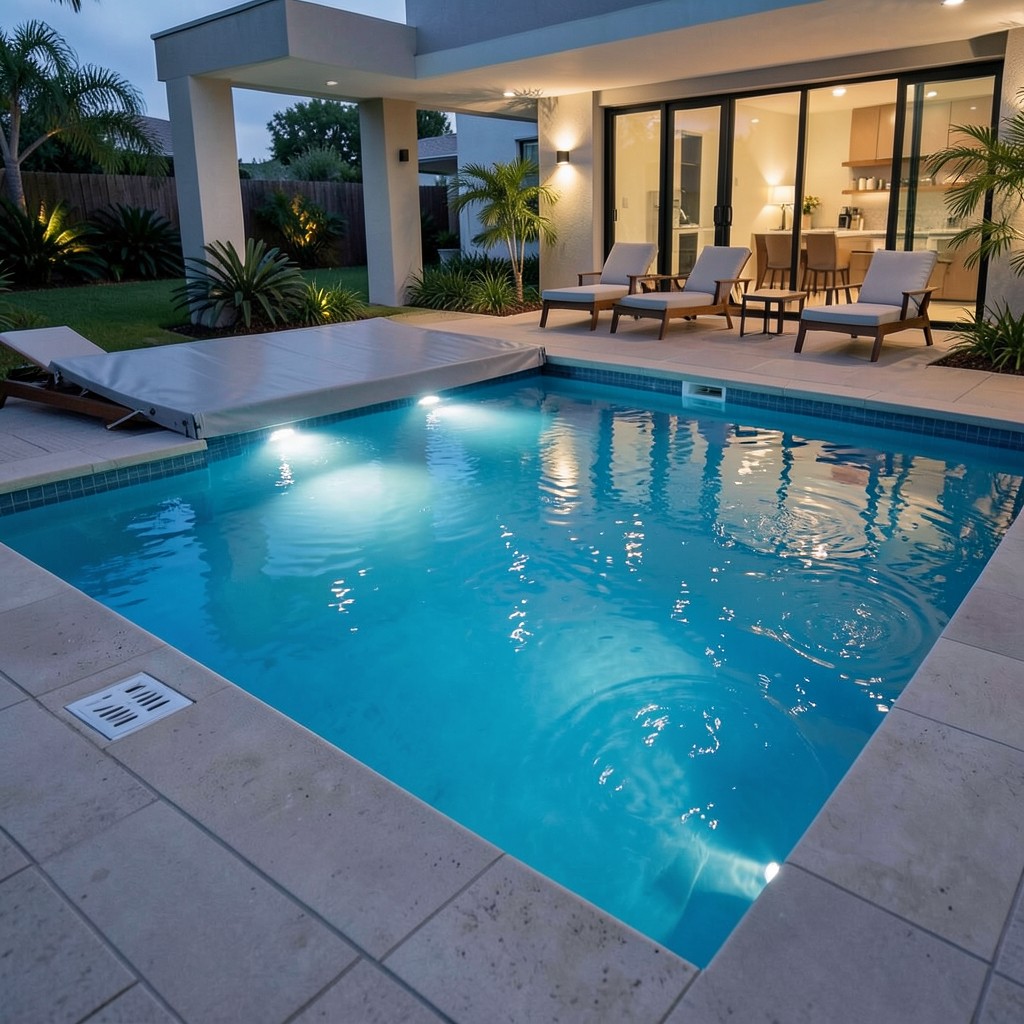
The smart pool is the contemporary residential water facility whose operational management — the temperature, the chemical balance, the filtration cycle, the cover operation, and the lighting — is managed through the automated system whose sensors, controllers, and remote operation create the pool maintenance infrastructure of minimum manual intervention and maximum operational consistency. The smart pool is not the pool of the future. It is the pool of the present, and the household that installs it without the automation is creating the operational management burden that the available technology eliminates at the pool’s commissioning stage.
A pool with integrated smart automation — the temperature controller maintaining the water at the set point through the heat pump’s automated operation, the chemical controller monitoring and dosing the sanitation chemistry at the required levels, the filtration cycle’s automated scheduling creating the water quality maintenance without the manual daily testing — creates the pool facility of minimum daily operational management demand. The smart pool’s remote operation through the smartphone application — the pool cover retracted from the bed before rising, the temperature raised before the weekend’s swim session, and the lighting programmed for the evening’s entertainment — creates the pool’s most operationally convenient management format whose distance control eliminates the need for the poolside control operation that the standard manual system requires. Contemporary home ideas smart home properties apply the pool automation as the outdoor space’s operational infrastructure whose integration with the home’s broader automation system creates the complete property management environment — the pool’s status visible on the same dashboard as the house’s lighting, heating, and security — communicating the design’s intelligence at the complete property management scale.
The smart pool system’s reliability is the operational quality that the household’s confidence in the automated management most directly depends upon — the system whose sensors create the false reading, the controller whose programming creates the unintended chemistry dose, or the connectivity whose failure leaves the pool without the management that the automation replaced requires the backup manual management procedure whose simplicity the household must maintain as the operational fallback for the automated system’s failure condition.
50. The Pool That Defines Your Home’s Complete Outdoor Identity

The pool that defines an outdoor space’s complete identity is not the most expensive pool, the largest pool, or the pool whose specification checklist contains the most features. It is the pool whose design was made in complete awareness of the specific house it serves, the specific landscape it inhabits, the specific household members who will swim in it every summer morning for as long as the property is their home, and the specific outdoor room it creates around its water whose quality, atmosphere, and relationship to the architecture communicates the household’s design conviction at the outdoor space’s most permanently dominant and most daily-experienced design element.
Every decision made in the pool’s design — the form, the finish, the coping, the surrounding landscape, the planting, the lighting, the equipment, and the social infrastructure of the terrace and the outdoor furniture — is a decision about how the outdoor room will feel to be in, not just how it will look in the photographs. The pool that was designed for the photograph is the pool that satisfies the Instagram post and disappoints the daily experience. The pool designed for the daily life — the morning swim, the afternoon gathering, the evening’s pool-lit outdoor dinner, and the specific quality of the summer Saturday that the outdoor room was built to create — is the pool whose design value compounds daily over the years of living with it.
Start with the outdoor room you want to inhabit, not the pool you want to own. Ask what the landscape should feel like on the pool’s best day, and design the water body, the surrounding terrace, and the planted landscape together as the single, composed outdoor room whose complete quality is the design’s ambition. Build it to that standard, and the outdoor space it creates will be the place your household returns to every day the weather allows and misses on every day it does not.
Leave a Reply