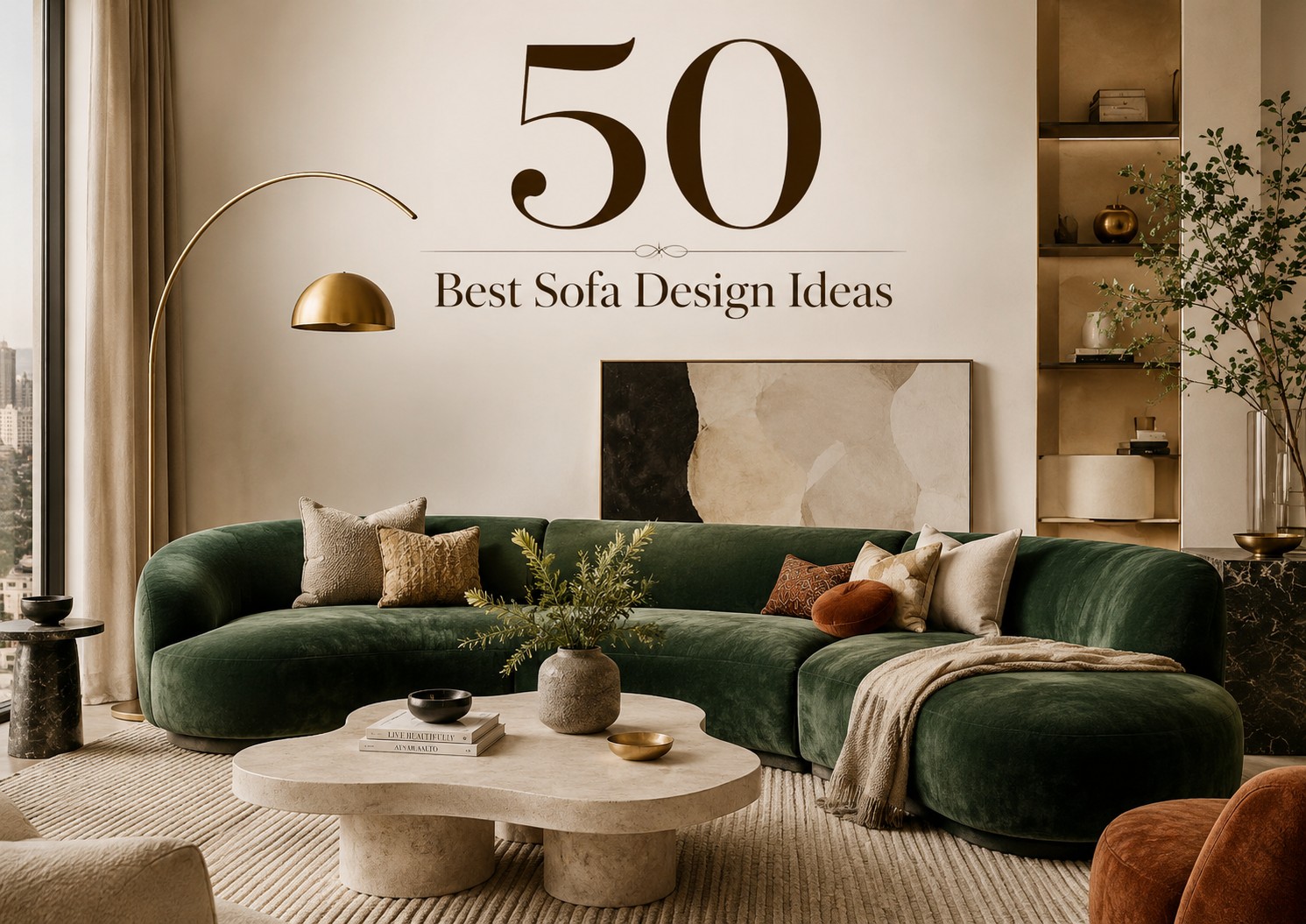
The sofa is the most consequential furniture purchase in any home, and most people treat it like a commodity decision — they go to the showroom, they sit on a few options, they check the price, and they choose the one that fits the budget and seems comfortable enough in the four minutes of showroom testing that bear no relationship whatsoever to the thousand hours they will spend on it in the years ahead. The result is a living room organized around a sofa that was selected without genuine design thinking, and a household that spends a decade working around a furniture decision that deserved better from the start.
The sofa earns its importance through the specific role it plays in every room it enters. It is the largest single object in the living room, the piece that anchors the seating arrangement’s geometry, establishes the room’s color palette’s dominant tone, and communicates the household’s design intention before anything else in the room is noticed. A well-chosen sofa makes a room feel designed even when the surrounding furniture is modest. A poorly chosen sofa undermines a room regardless of the quality of everything else in it. The sofa does not participate in the room’s design — it leads it. Every other design decision in the living room exists in relationship to the sofa, and that relationship determines whether the room coheres or merely coexists.
The design dimensions of the sofa decision are more numerous than most buyers consider. The form is the most obvious — the three-seater, the sectional, the loveseat, the chaise — but form is only the beginning. The profile, meaning the height of the arm, the depth of the seat, the pitch of the back, and the height of the leg, creates the sofa’s complete physical character and determines both the way the sofa looks in the room and the way the person sitting in it feels after an hour of actual use. The material — the fabric, the leather, the performance textile, the natural fiber weave — creates the sofa’s tactile quality, its maintenance demands, its durability, and its seasonal behavior: the linen that is breathable and cool in summer home design but feels thin and cool to the touch in winter, the leather that is gorgeous on an autumn afternoon but unpleasantly cold on a January morning before the room warms. The color creates the room’s dominant palette note and its flexibility for seasonal home makeover styling changes. The leg — turned wood, tapered brass, hairpin steel, or recessed plinth — creates the sofa’s relationship to the floor and its visual weight within the room.
The fifty sofa design ideas in this collection address all of these dimensions across the full range of aesthetic directions, room types, and practical household needs. The ideas span the deep-seated velvet sectional of a luxury home interior to the slim-armed linen sofa of a Scandinavian home interior living room, from the oversized distressed leather sofa of a mountain cabin decor study to the rattan-framed sofa of a tropical home design terrace. Every idea is a complete design direction. The sofa you choose deserves this level of thinking. So does the room that will be organized around it.
1. A Deep-Seated Velvet Sectional in a Jewel Tone

Velvet and sectional sofas are both commitment pieces individually — together, they create the living room’s most singular design statement. The deep-seated velvet sectional is the sofa that the room’s entire design organizes itself around, and the design that commits to it fully — the wall color, the rug, the lighting, and the secondary furniture all selected in explicit dialogue with the sectional’s color and material — creates the living room of genuine atmospheric power that half-committed sofa choices never achieve.
Emerald green velvet, sapphire blue, or deep plum are the jewel tones that the sectional’s large upholstered surface carries with the most visual authority — the velvet’s pile depth catches the light and creates the shifting, directional color quality that flat fabric cannot generate, and the jewel tone’s saturation at the scale of a large sectional creates the room’s dominant color presence without any supporting decoration being required. The cozy home design atmosphere that a deep velvet sectional creates on a winter evening — the pile’s tactile warmth, the jewel tone’s visual richness, and the sectional’s generous seating capacity creating the enclosing social quality of a room designed for gathering — is among the most specifically atmospheric interior design experiences available without architectural intervention.
The sectional’s configuration should be selected for the room’s specific geometry — an L-shape for a square room, a U-shape for a larger rectangular room where two conversation groups are needed, and a chaise extension for the household where one person consistently occupies the lounging position that the chaise provides better than any arrangement of loose cushions. The deep seat depth — at least thirty-six inches from front to back — creates the sectional’s signature lounging quality, the seated position that allows the knees to come up and the body to recline partially without a dedicated chaise section. During fall home decorating season, the jewel-toned velvet sectional with its layered throw pillows and a cashmere blanket draped across its arm becomes the room’s most complete expression of the seasonal warmth the design was built to deliver.
2. A Slim-Armed Linen Sofa for a Scandinavian Interior
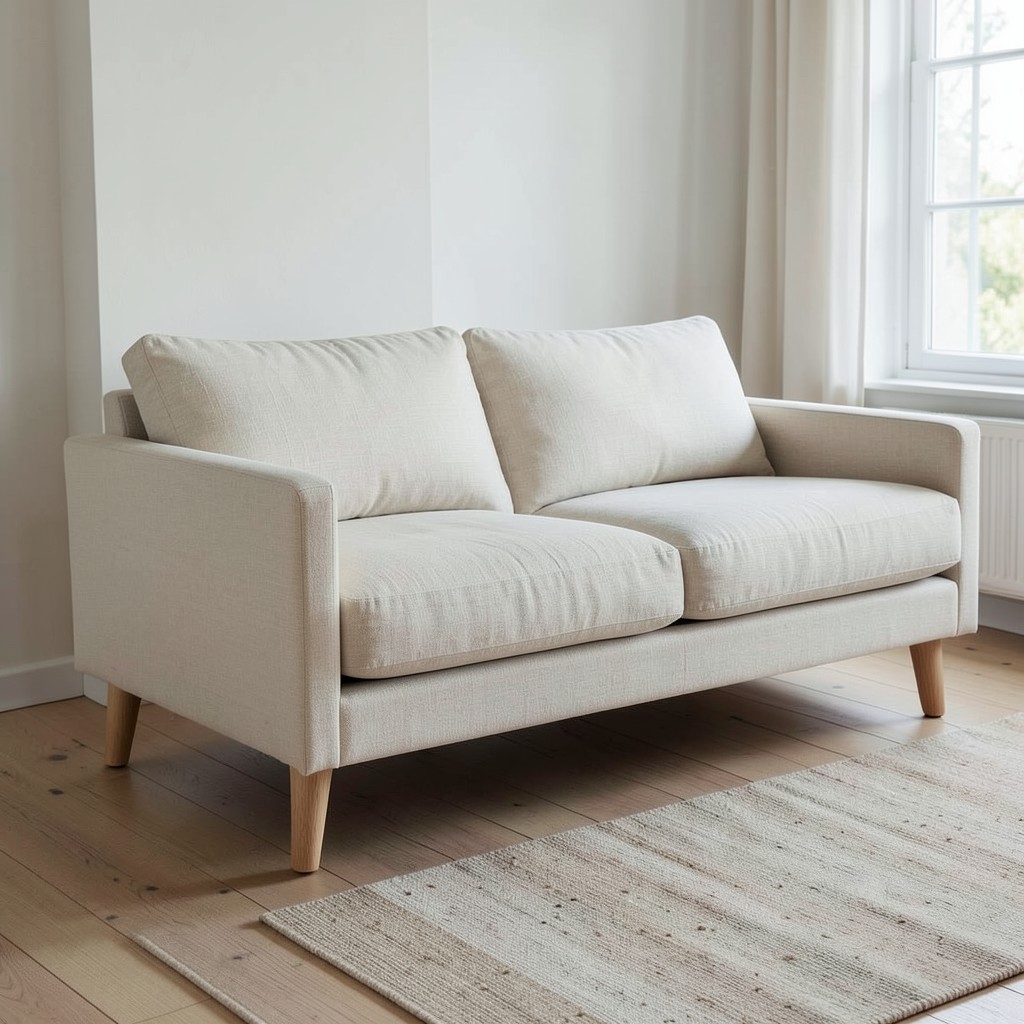
The linen sofa with slim arms and a simple rectangular profile is the Scandinavian home interior’s definitive seating choice — a piece whose design restraint communicates the aesthetic’s core conviction that form should follow function precisely and decoration should be earned rather than assumed. The slim arm reduces the visual bulk that traditional rolled or cushioned arms add to a sofa’s silhouette, and the linen’s natural, slightly textured surface creates the material warmth that the pale, structured Scandinavian palette requires without the weight or the maintenance complexity of heavier upholstery fabrics.
Natural linen in an unbleached ecru or a soft oatmeal tone creates the Scandinavian sofa’s most authentic material expression — the fiber’s origin in the flax plant is visible in the slight irregularity of the weave and the natural variation of the undyed tone, creating the organic surface quality that the Scandinavian aesthetic values as the honest expression of a material’s natural character. The slim arm’s profile in this sofa type should be proportional to the frame’s scale — a two-inch arm on a small loveseat reads as excessively narrow; a four-to-five-inch arm on a standard three-seater creates the designed proportion that distinguishes the Scandinavian profile from the merely thin. Tapered solid wood legs in a natural oak or a pale ash complete the linen sofa’s material palette with the warm, organic wood tone that the Scandinavian home interior applies as its signature material contrast against pale upholstery.
The linen sofa’s seasonal versatility is its most practical design asset alongside its visual lightness — the slip-covered linen versions whose covers can be removed, washed, and replaced in a different tone or weight for the seasonal home makeover translate directly into a functional design tool. The same sofa frame in a lightweight bleached linen for the summer living room decor configuration and in a heavier natural or stone-toned linen weave for the winter interior design season provides the seasonal change that most households attempt through cushion swaps and throw additions, but which the slip-cover achieves more completely and more convincingly.
3. A Chesterfield Sofa in Aged Leather

The Chesterfield is the sofa that requires no introduction and no explanation — every household member, every guest, and every person who has spent time in rooms furnished with taste knows what a Chesterfield is before they sit in one. Its deep button-tufting, its equal-height back and arm forming the continuous rolled profile, and its nail-head trim along the arm and base are the most specific and most recognizable design details of any sofa form in residential design history. The Chesterfield works because the design is complete. Nothing needs to be added, and nothing should be removed.
Aged leather is the material that the Chesterfield was developed for and that it inhabits most naturally — specifically, the full-grain leather in a warm cognac, a deep tobacco, or a rich burgundy that ages with use into the pulled-apart, crinkled, deeply patinated surface that the Chesterfield is associated with at its most atmospheric. The aging process is the leather’s design contribution over time: the seat cushions’ surface crease at the sitting positions, the arm’s top edge softens and shows the wear of thousands of hands, and the button-tufting’s depressions deepen as the leather relaxes around the buttons. After ten or fifteen years of genuine use, a full-grain leather Chesterfield has the quality of a piece that was designed specifically for the room it inhabits, and its aging beauty is precisely the opposite of wear — it is the accumulation of use into character.
Traditional home interiors and rustic home decor rooms receive the leather Chesterfield with the natural ease of a furniture form in its native aesthetic context. Industrial home design rooms apply it as the soft material counterpoint to the room’s hard metal and concrete surfaces, and the contrast between the Chesterfield’s curvaceous, richly aged leather and the industrial setting’s raw, planar materials creates one of interior design’s most successful and most frequently imitated furniture-in-context combinations. A rustic home office ideas reading room with a leather Chesterfield facing the fireplace, the bookshelves rising on both sides, and the afternoon light coming through the window is a room that has been described in literature and film so many times that its atmosphere has become archetypal. That is the power of a design that does everything right.
4. A Low-Profile Platform Sofa for a Minimalist Room

The low-profile platform sofa is the minimalist home design choice that most directly contradicts the conventional sofa’s vertical emphasis — the platform sofa’s seat height of twelve to fourteen inches, its low-slung back, and its absence of traditional arm forms create a piece of furniture that reads as a horizontal plane rather than as a seat with a back attached, and its visual weight in the room is almost entirely downward rather than upward. This profile creates a room that feels taller, more open, and more spatially generous than the same room with a conventional sofa, because the furniture is not competing with the ceiling for vertical presence.
The platform sofa’s seat depth should be generous to compensate for the seat’s low height — a deep, thirty-eight-to-forty-inch seat allows the knees to come up naturally in the reclined sitting position that the low platform height creates as the natural posture, and the deeply reclined position is the platform sofa’s signature comfort mode. The sofa’s cushion density should be specifically calibrated for this posture — a medium-firm seat cushion that supports the hips in the reclined position without the sinking-too-deep quality that soft cushions create at low seat heights, and a back cushion whose thickness is sufficient for the back support that the low back’s reduced height provides only partially. Modern home design living rooms whose architectural character is defined by clean, horizontal planes — the low coffee table, the low-built-in cabinetry, and the room-height glazing whose horizontal line emphasizes the floor-to-ceiling relationship — receive the platform sofa as the furniture piece that continues their horizontal language at the room’s primary social element.
A platform sofa in a warm neutral — a natural linen, a stone-toned bouclé, or a pale grey wool blend — suits the minimalist palette that the profile most naturally inhabits. A platform sofa in a bold, saturated color creates the contemporary home ideas room’s primary color statement at a low visual weight that allows the color to be present without the room feeling heavy, because the sofa’s horizontal, grounded form distributes the color across the floor plane rather than projecting it upward into the room’s visual field.
5. A Camelback Sofa in a Traditional Living Room

The camelback sofa is the piece that signals traditional home interiors with the most specific and most historically grounded design vocabulary — the undulating back whose higher central section descends to lower sections above the arms creates the silhouette that Queen Anne and Chippendale furniture design developed in the eighteenth century, and that residential design has maintained in continuous production because no other sofa back profile creates the same formal elegance. The camelback is not trying to be modern. That is the point of it.
Silk damask, cotton brocade, or a high-quality wool needlepoint creates the camelback sofa’s upholstery in the traditional textile that suits the form’s period origin — the pattern woven or embroidered into the fabric creating the decorative surface that the camelback’s formal profile was developed to present in the formal parlor or drawing room. A camelback in a current-season solid performance fabric — a tightly woven wool blend in a warm taupe or a deep navy — creates the traditional form in a material that suits the contemporary household’s maintenance requirements while maintaining the silhouette’s design intelligence. The legs should be cabriole or turned in a period style, finished in a dark walnut or cherry stain that connects the sofa to the room’s other traditional wood tones.
The camelback sofa in a room of mixed traditional and contemporary furnishing creates the design tension that the best period-referencing interior achieves — the form’s historical specificity creates the anchor from which the room’s more contemporary elements read as deliberate contrast rather than design uncertainty. A single camelback sofa in a contemporary room creates more design interest than a room full of matching contemporary pieces, because the historical form’s presence creates the dialogue between periods that a homogenous aesthetic cannot generate. Elegant home styling finds its most resolved expression in the room where the camelback sits with the same confidence that it occupied the English drawing room from which it originally came.
6. A Curved Sofa for a Modern Circular Seating Area

The curved sofa is the contemporary home ideas furniture form that residential design re-discovers periodically and whose appeal, when it appears, reflects the same instinct every time — the human social circle, the gathering around the fire, the arrangement of people facing each other in a continuous arc creates a quality of social enclosure and mutual attention that the straight sofa’s parallel arrangement does not provide. The curved sofa creates the social geometry of inclusion. That is why it keeps returning.
A fully curved sofa — its back and seat following a continuous arc rather than being assembled from straight sections joined at angles — creates the sofa whose form is a genuine single curved object rather than a linear sofa bent at the joints. The fully curved back’s even arc creates a consistent sightline from every seat position toward the room’s center, and the arm positions at the arc’s two ends create the social enclosure that makes the circular seating arrangement feel like a room within a room. Modern home design living rooms whose central feature is a round or oval coffee table receive the curved sofa as the seating form that most logically responds to the table’s geometry — the arc of the sofa following the curve of the table’s outer edge creates the composed circular arrangement whose visual logic is immediately apparent and immediately satisfying.
Bouclé fabric in a warm cream or a pale sandy tone suits the curved sofa’s organic form with the tactile warmth that the contemporary aesthetic’s organic direction applies to its softer surface elements. The bouclé’s looped texture creates a surface whose visual interest matches the sofa’s formal interest, and the texture’s warmth prevents the pale color from reading as sterile in the room’s natural light. A curved sofa in a summer living room decor configuration — the breezy home interiors palette of pale neutrals, the natural light amplified by the curved sofa’s reflective pale fabric — creates the summer room’s signature piece in the furniture form that maximizes the natural social quality of the warm-season gathering.
7. A Tuxedo Sofa in a Chic Contemporary Interior

The tuxedo sofa is the one sofa form that makes no attempt to be comfortable at a glance — its equal-height back and arms, its square-cut lines, and its absence of the rounded or rolled softness that other sofa profiles apply create a piece that reads as formal and architectural before the first cushion is placed on it. The tuxedo’s directness is its design quality. It knows what it is, and it has no interest in pretending to be anything else.
The tuxedo form’s strict geometry creates the perfect canvas for premium fabric — the even back and arm heights create continuous flat planes that display a bold pattern, a rich texture, or a saturated solid color without the interruption of profile changes. A tuxedo sofa in a deep charcoal wool flannel creates the chic home decor statement in a material whose tailored quality suits the sofa’s architectural profile with the same sensibility that a well-cut suit applies fabric to a clean geometric form. The contrast welt — a thin piping in a contrasting tone along the sofa’s seams and cushion edges — creates the tuxedo sofa’s design detail at the point where the form’s crisp geometry is most clearly visible, and the welt’s color should be selected to create the precise contrast that the room’s palette supports.
Brass legs — four low-profile brass feet in a brushed or polished finish positioned at the sofa’s corners — create the tuxedo sofa’s ground connection in the material whose warm metal tone creates the designed contrast against the sofa’s textile surface. The brass foot is the tuxedo sofa’s detail of most enduring design intelligence — it elevates the piece visually, creates the metallic connection to the room’s lighting fixtures and hardware, and communicates the furniture’s quality through the precision of the material detail at the sofa’s most visible structural point. Luxury home interior rooms receive the tuxedo sofa as the seating piece whose formal restraint creates the room’s design anchor with the most composed and most architecturally resolved furniture profile available.
8. A Rattan-Framed Sofa for a Tropical Veranda

The rattan sofa belongs outdoors — or at the boundary between indoors and out, which is precisely where the tropical home design and beach house interiors aesthetic positions it most effectively. A rattan frame with deep seat and back cushions in a weather-resistant outdoor fabric creates the veranda or garden room’s primary seating in a material that belongs to the tropical material vocabulary as completely as teak belongs to the Scandinavian outdoor furniture tradition.
The rattan frame’s natural honey tone — the cane’s warm amber color in its untreated state — creates the material warmth that the outdoor-indoor transition space requires to feel domestic rather than merely functional. The frame’s construction should be inspected for quality at the joint points — the lashed rattan joints of a handmade frame create the most structurally stable and the most visually authentic construction, while the injection-molded synthetic rattan of mass-market alternatives creates a joint of inferior visual quality and questionable structural longevity under the UV and moisture exposure that a veranda setting provides. The cushion fabric in an Sunbrella or equivalent solution-dyed acrylic outdoor performance weave creates the cushion color and surface quality that the tropical setting requires without the mold susceptibility and UV fading that standard interior upholstery fabric exhibits in outdoor conditions.
Bamboo home interiors elements alongside the rattan sofa — a bamboo coffee table, bamboo pendant lights overhead, and tropical planting in terracotta pots flanking the seating — create the complete tropical design environment whose sofa is the central comfort element. During summer home design season, the rattan-framed veranda sofa with its deep cushions, the ceiling fan turning slowly above, and the tropical garden visible beyond the veranda’s edge creates the specific relaxed home design atmosphere of a room that is neither inside nor outside and is better for being neither.
9. A Leather Sofa With Hairpin Legs in an Industrial Interior

The leather sofa with hairpin legs is the industrial home design seating piece that achieves the balance between the material warmth of leather and the structural precision of mid-century metal furniture — the hairpin leg’s slender steel rod construction creates a visual lightness beneath the leather’s substantial upholstery volume, and the material contrast between the dark, tactile leather above and the bare steel below creates the dialogue that industrial home design values as its material signature. Weight above, precision below. The tension is the design.
A two-seat or three-seat leather sofa whose cushioned body sits on four hairpin legs in a satin black or a natural raw steel finish creates the industrial sofa at its most specific and most visually resolved. The seat’s leather should be in a medium-dark tone — a dark tan, a warm saddle brown, or a near-black ebony — because the hairpin leg’s lightness requires the leather’s visual weight to anchor the piece physically and visually. A pale leather on hairpin legs creates a sofa that appears to float without purpose; a dark leather on hairpin legs creates a sofa that appears to hover with intention. The distinction is in the weight of the visual relationship between the upholstery’s color and the leg’s slender structure.
A brick-and-concrete industrial loft receives the hairpin-legged leather sofa with the natural ease of materials in their intended context. The loft’s exposed brick wall behind the sofa, the polished concrete floor reflecting beneath the sofa’s hairpin legs, and the factory-window light across the leather’s surface create the industrial interior whose sofa is the room’s primary comfort element against the hard material environment surrounding it. Stone and wood home design elements alongside the industrial leather sofa — a reclaimed oak coffee table on hairpin legs of its own, a rough-edged stone bowl on the coffee table — create the material consistency that makes the industrial room feel considered rather than themed.
10. A Bouclé Sofa in a Warm Neutral Tone

The bouclé sofa has earned its sustained presence in residential design by doing something that most upholstery fabrics cannot — creating a surface that is simultaneously visually interesting and spatially neutral. The looped texture of the bouclé weave creates a surface of organic visual complexity that reads across the room as a warm, textured neutral rather than as a pattern, and this quality makes the bouclé sofa the most versatile fabric choice for households whose design direction requires a sofa that holds its place through seasonal changes and future redecorations without becoming the room’s most dated element.
A warm cream, natural white, or pale oatmeal bouclé on a low-profile contemporary frame creates the sofa that suits the widest range of room aesthetics in the current design culture — from the minimalist home design room to the bohemian home styling living room, from the coastal home design interior to the Scandinavian home interior, the bouclé neutral sits naturally without requiring the room’s design to serve it. The counterintuitive insight about bouclé is that its textural richness actually reduces the visual demand it places on the room — the texture provides the sofa’s visual interest entirely within its own surface, requiring no pattern, no contrasting cushions, and no decorative addition to justify its presence in the room’s design.
The bouclé sofa’s maintenance reality deserves honest acknowledgment: the looped fiber construction catches pet hair, lint, and loose fibers with a tenacity that smooth fabrics avoid, and the cleaning method must be specifically appropriate to the bouclé weave rather than the standard fabric care approach. Dry cleaning is the standard recommendation for bouclé in natural fiber compositions; a gentle low-suction vacuum with a brush attachment addresses surface debris without pulling the loops from their woven base. The household whose lifestyle produces significant fabric soiling should consider the bouclé’s maintenance requirements against its visual appeal before committing — the sofa that you love and cannot maintain becomes a source of daily frustration rather than daily pleasure.
11. A Modular Sofa System for a Flexible Living Room
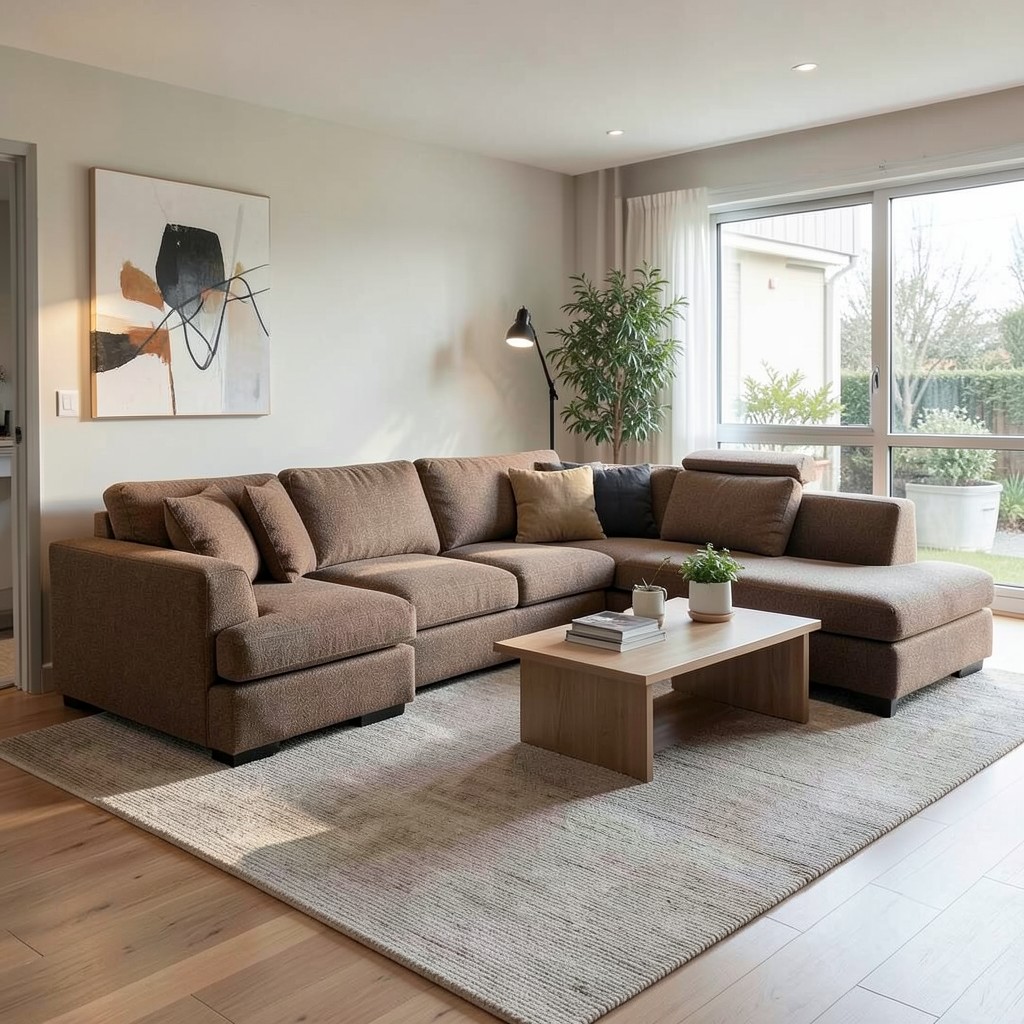
The modular sofa is the furniture system that the contemporary household whose living arrangement changes frequently — through moves, through growing families, through the repurposing of rooms — has discovered as the only sofa format that adapts to the new room rather than requiring the new room to adapt to it. The modular system’s individual components — armless chairs, corner units, chaise sections, and arm pieces — combine in configurations that suit the current room and reconfigure for the next one without the purchase of a new sofa.
A modular system in a performance fabric — a solution-dyed acrylic or a tight-weave polyester blend in a warm mid-tone that handles the wear of reconfiguration and heavy use — creates the flexible sofa at a practical quality level that suits the format’s utilitarian appeal. The system’s frame construction is the quality indicator that most modular sofa purchases under-research — the components should connect through a rigid mechanical system rather than through hook-and-loop or foam-compression contact, because the mechanical connection maintains the configuration’s structural integrity under the daily use that reclines into the sofa’s joints from multiple directions simultaneously. Contemporary home ideas living rooms organize around the modular sofa’s current configuration with the understanding that the configuration will change when the room’s function changes, and the design intelligence of the modular choice is the refusal to make a permanent seating commitment in a room whose use is permanently provisional.
The modular sofa’s individual components should be styled as a considered arrangement rather than as a furniture collection waiting to be configured — the current arrangement should be treated with the same design intention as a fixed sofa, with the area rug placed in relation to the current configuration, the coffee table sized for the current footprint, and the lighting positioned for the current seating arrangement. The household that treats the modular sofa as perpetually provisional never quite settles its living room into the quality of design that a considered, stable arrangement creates.
12. A Rolled-Arm Sofa in a Farmhouse Living Room
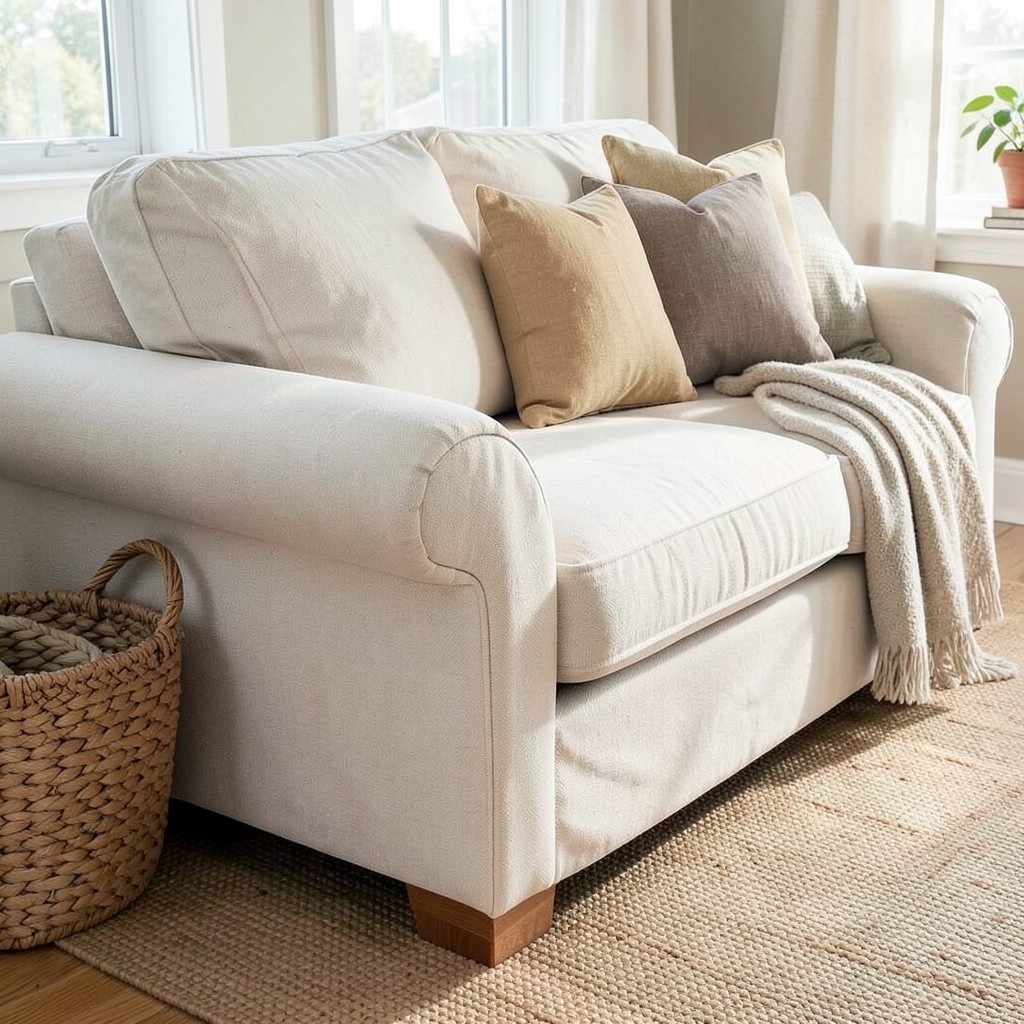
The rolled arm is the sofa detail that farmhouse home decor applies as its primary upholstered furniture signature — the continuous curve of the arm from its junction with the seat rail up and over to the arm’s top surface creates the soft, domestic quality that the farmhouse aesthetic celebrates as its central material value. The rolled arm is comfort made visible. It says, without ambiguity, that the sofa was designed for sitting in rather than looking at, and that distinction is the farmhouse aesthetic’s most honest design position.
A rolled-arm sofa in a natural cotton twill, a washed linen, or a brushed canvas creates the farmhouse sofa in a material whose domestic warmth and casual surface quality suit the form’s relaxed design profile. The fabric’s slightly rumpled, lived-in quality — the linen’s wrinkle behavior, the cotton twill’s gentle fade with washing, and the canvas’s progressive softening with age and use — creates the sofa that looks better after a year of use than it did in the showroom, and that quality of aging gracefully is the farmhouse material philosophy’s most specific and most genuinely practical design principle. Warm home decor ideas applied to the farmhouse sofa — a collection of cotton and linen throw pillows in varying natural tones, a basket of folded wool blankets beside the sofa’s arm, and a simple sisal rug beneath the seating — creates the room’s domestic warmth at the seating area’s most consistent and most used element.
The rolled-arm sofa’s frame quality determines its longevity — the kiln-dried hardwood frame with corner blocks and a double-doweled joint creates the structural foundation that the rolled arm’s outward profile requires to maintain its shape through the cumulative weight of the seat cushions and the casual use that the farmhouse aesthetic’s comfortable sitting style applies. A rolled arm that loses its shape — sagging inward or flattening at the top — is the evidence of a frame whose construction did not match the material’s promise, and the farmhouse sofa that ages authentically does so in its fabric and its cushion, not in its frame.
13. A Jewel-Toned Velvet Loveseat for a Small Space

The loveseat is the sofa format that small-space living consistently underestimates — the household whose living room cannot accommodate a three-seater sofa without spatial compression defaults to the loveseat as the compromise option rather than as the considered choice, and this default attitude produces loveseats that are designed as reduced versions of larger sofas rather than as furniture forms optimized for their own scale and function. The loveseat designed as a loveseat — with the proportions, the profile, and the aesthetic intention calibrated for its specific two-seat scale — is an entirely different piece from the loveseat that is a three-seater with one seat removed.
A jewel-toned velvet loveseat — its scale intimate, its color saturated, and its form tight and precise — creates the small living room’s focal piece in a format whose compact dimensions allow the color’s full saturation to register without the visual weight that the same color on a large sectional would create. The jewel tone works at the loveseat scale because the piece’s small footprint creates the color as an accent whose intensity reads as designed emphasis rather than overwhelming dominance. Chic home decor applied to the velvet loveseat — two carefully chosen throw pillows in a complementary tone and a small brass side table beside the arm — creates the complete small-space seating vignette whose design quality exceeds many full-room furniture arrangements by the virtue of its editing precision.
A loveseat in a bay window — turned perpendicular to the window to create the reading and sitting position that faces the room’s interior across the coffee table — creates the specific spatial arrangement that makes the small living room feel both more furnished and more spatially generous than a standard parallel-to-wall placement achieves. The loveseat’s short width suits the bay window’s typically limited depth, and the window behind the seated occupant creates the natural light quality for reading that the loveseat’s intimate scale supports without the overhead lighting that a full sofa’s depth from the window requires.
14. A Slipcovered Sofa for Seasonal Style Changes

The slipcovered sofa is the furniture form that the seasonally minded household has always understood and that the design-forward household has sometimes dismissed as the casual, slightly imprecise alternative to tailored upholstery. That dismissal is a design error. A well-made slipcover — properly fitted, in a quality fabric, and precisely installed — creates a sofa surface whose quality approaches tailored upholstery while providing the one quality that fixed upholstery categorically cannot offer: the ability to change the sofa’s appearance completely for a different season, a different room, or a different design direction.
A white or natural linen slipcover for the summer living room decor season creates the summer sofa in the light, cool, easily laundered material that the warm months’ relaxed aesthetic and the household’s outdoor-to-indoor traffic require. The same sofa frame covered in a heavyweight brushed cotton or a warm wool flannel slipcover for the winter home decor season creates the winter sofa in a material whose tactile warmth and deeper tonal warmth suit the season’s design direction. This seasonal home makeover applied through the slipcover — not through purchasing a new sofa, not through reupholstering, but through a slipcover change that takes twenty minutes — creates the room’s seasonal responsiveness at a cost and an effort that every other seasonal design change significantly exceeds.
The slipcover’s fit quality is the design detail that separates the well-designed slipcovered sofa from the loose, rumpled approximation that gives slipcovered furniture its casual reputation. A custom-fitted slipcover whose panels are cut and sewn specifically for the sofa’s dimensions creates a surface quality close to tailored upholstery; a standard-size slipcover whose dimensions approximate the sofa’s form creates the rumpled, imprecise fit that most people picture when they imagine a slipcovered sofa. The investment in a properly fitted custom slipcover — in a quality linen, cotton canvas, or denim — is the design investment that makes the slipcovered sofa a design-forward choice rather than a practical compromise.
15. A Sofa With a Channel Back Upholstery Detail

The channel back sofa applies the same vertical tufting principle as the Chesterfield’s diamond tufting but in a fundamentally different aesthetic register — the parallel vertical channels running from the back’s top to its seat rail create a linear, graphic surface whose design language is mid-century modern rather than Victorian, and whose tailored precision suits the contemporary interior’s affinity for geometric surface treatment applied through the fabric’s own structure rather than through applied decoration.
A channel back sofa in a warm caramel leather — the channels’ vertical seams creating the shadow lines that make the back’s surface read as a series of parallel vertical columns of leather — creates the mid-century sofa at its most materially resolved. The leather’s surface reads differently in the channel’s recessed seam than on its rounded face, creating the shadow and highlight pattern that the vertical channels generate across the back’s full width. In a fabric application, the channel’s tufted construction creates a surface whose shadow depth depends on the fabric’s depth of pile — a deep-pile velvet creates dramatic shadow channels; a smooth wool creates subtle ones. The fabric selection and the channel specification should be made together, with the intended shadow quality in the finished piece as the target rather than either specification in isolation.
A channel back sofa in a minimalist dining room that doubles as occasional seating — positioned against the dining room wall as a banquette-style seat for the dining table — creates the furniture’s second function without compromising its primary living room role. The channel back’s upright posture, achieved by the back’s relatively firm channel construction, makes it a comfortable dining seat as well as a comfortable living room back, and its design quality at both functions is more complete than either a dedicated dining bench or a standard sofa back achieves in the same position.
16. A Conversational Pit Sofa for a Large Family Room
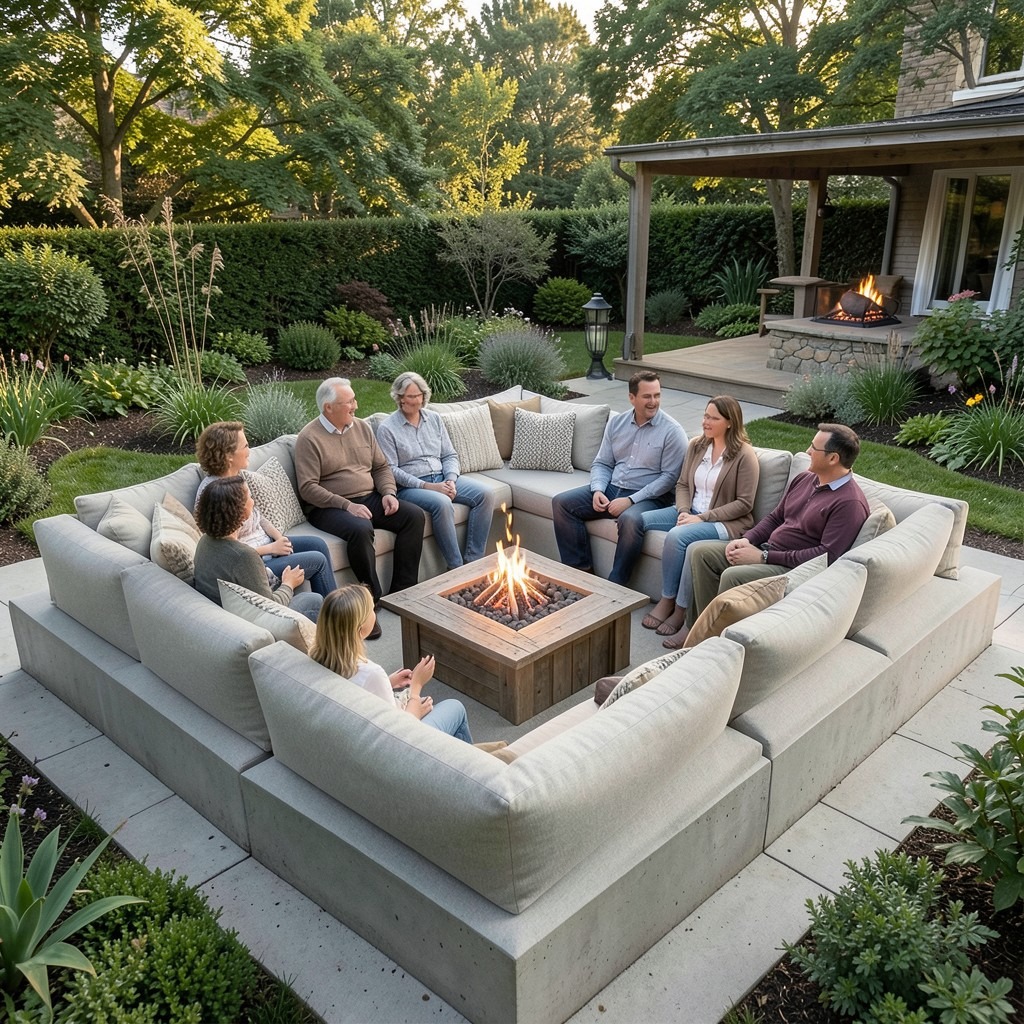
The pit sofa — the deep-in-the-floor or floor-level seating arrangement whose sections surround a central coffee table or fire pit in a continuous enclosure — is the social seating format that the large family room has in reserve for the household that prioritizes the quality of the gathering over the formality of the furniture arrangement. The pit sofa does not accommodate the visitor who wants to sit upright and maintain a formal posture. It accommodates the household that wants to sit together, reclined and relaxed, in the most socially connected seating arrangement that residential furniture design has ever produced.
A sunken pit sofa — where the floor is recessed by twelve to eighteen inches within the seating area’s perimeter, creating the below-grade seating position — requires the structural planning that this format demands before the room’s floor is constructed or modified. The concrete structural floor requires breaking and relowering within the pit’s perimeter, the pit’s edges require a waterproof membrane and a structural retaining detail, and the pit’s depth must be calibrated for the seat height and the back height that the floor-seated position requires for genuine comfort rather than postural discomfort. The household that creates a sunken pit creates a room element of extraordinary permanence and social specificity — the pit sofa is not reconfigurable, not removable, and not adaptable to a different function. It is, unambiguously and permanently, the place where the household gathers.
Cozy home design achieves its most complete physical expression in the pit sofa — the low seating position, the continuous enclosure of the surrounding seat backs, the central table within reach of every seated position, and the gathered household filling the seats create the social environment of maximum domestic warmth. A pit sofa beside an outdoor fireplace in a sunken garden terrace applies the same principle to the outdoor context, creating the coastal outdoor living space’s most socially compelling seating arrangement for the household whose outdoor gathering is a genuine daily activity rather than an occasional event.
17. A Daybed Sofa for a Dual-Purpose Room

The daybed sofa is the furniture format that the dual-purpose room — the home office that needs occasional guest sleeping capacity, the reading room that occasionally accommodates a napping teenager, the small apartment’s only living space that also serves as a sleeping space when needed — requires to address its multiple functions without compromising either. The daybed’s full-length sleeping surface, combined with its sofa-appropriate proportions when the back cushions are in place, creates the furniture form that the dedicated sofa and the dedicated bed separately address at the cost of two furniture pieces’ footprint.
A daybed sofa in a tight-weave performance fabric — the durability and the easy-clean surface quality that a surface used for both sitting and sleeping requires — creates the dual-purpose piece in a material calibrated for the specific demands of its combined functions. The daybed’s sleeping surface requires a mattress of sufficient density for genuine nighttime sleep quality rather than the occasional-nap comfort that sofa cushioning provides — a three-to-four-inch foam topper over the daybed’s seat deck creates the sleeping surface’s comfort without the full mattress depth that would prevent the daybed from reading as a sofa when the sleeping function is not required. Contemporary home ideas apartments whose limited floor area requires every furniture piece to perform multiple functions receive the daybed sofa as the primary living room seating with the overnight guest accommodation embedded in its design.
A daybed sofa along a wall — particularly along a window wall where the window above provides the natural light and the view that make the reclining position enjoyable — creates the reading and lounging position that the full-length format provides and that a standard sofa’s shorter format prevents. Airy home interiors quality in the small apartment is created by the daybed’s full-length horizontal element along the wall, whose linear format emphasizes the room’s width and creates the impression of more floor area than the compact room’s actual dimensions produce.
18. A Sofa in a Deep Forest Green for a Biophilic Room

Forest green is the sofa color that the biophilic interior has been waiting for and that the contemporary design culture has applied with increasing conviction as the connection between the organic color palette and the psychological quality of domestic spaces has become more widely understood. The deep green sofa does not reference nature decoratively — it brings nature’s most dominant color into the room’s primary furniture piece in a tone whose organic depth creates the same visual calm and restorative quality that actual green vegetation provides in the outdoor environment.
A deep hunter green or a forest green sofa in a velvet or a tightly woven bouclé creates the biophilic room’s primary color element in a material whose surface texture reinforces the organic quality of the color. The velvet’s pile catches the light in the green tone with the directional shift that real foliage shows when light moves across it — darker when the pile faces away from the light source, lighter when the pile faces toward it — and this organic variability in a botanical color creates the living color quality that flat, woven green fabric cannot generate. Garden-inspired interiors principles applied around the forest green sofa — the trailing plants on the side table beside the arm, the botanical wallpaper on the wall behind the sofa, and the natural fiber rug beneath — create the complete biophilic living room whose sofa is the room’s color foundation rather than its green accent.
The forest green sofa’s seasonal versatility is its most surprising design quality. During spring home refresh, the green sofa with white and cream cushions and fresh-cut flowers on the adjacent side table creates the room’s most seasonal and most specifically springlike composition. During fall home decorating, the same sofa with warm rust and amber cushions, a tartan throw, and a cluster of dried autumn botanicals creates the cozy autumn living room in a color palette whose deep green makes the warm accent tones glow with the specific richness that autumn’s color combination achieves in the natural landscape.
19. A Sofa With Turned Wood Legs in a Traditional Setting
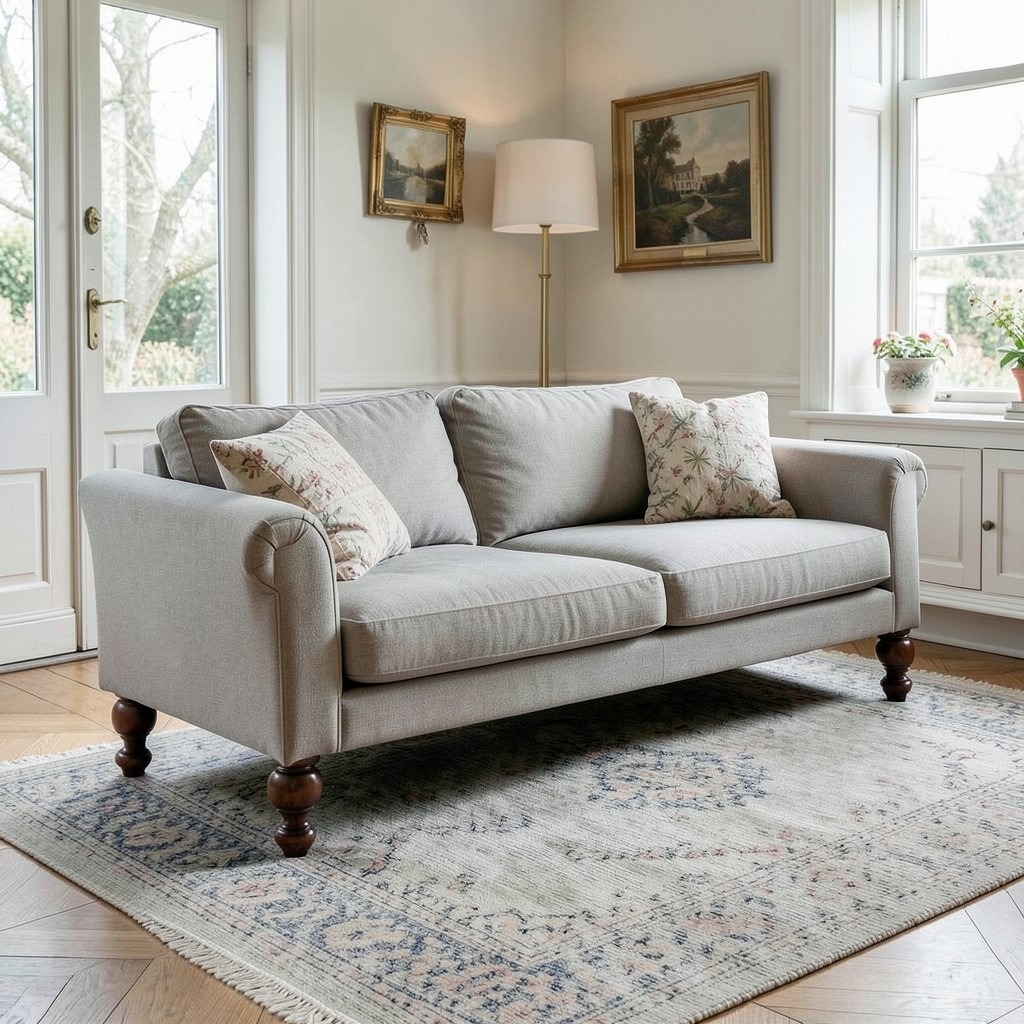
The turned wood leg is the furniture detail whose presence identifies the sofa’s period reference as clearly as the rolled arm — the lathe-turned spindle form, with its varying diameter creating the rings, coves, and balusters of the turned profile, belongs to the English and American furniture traditions of the seventeenth through nineteenth centuries and communicates that heritage directly to anyone who has seen enough furniture to recognize the language. A sofa on turned legs is making a specific historical claim, and the design should honor that claim with the material and textile choices that surround it.
Mahogany-stained or cherry-finished turned legs on a traditional three-seat sofa create the period furniture reference in the warm, dark wood tone that the Georgian and Victorian residential traditions applied to their primary furniture wood. The turned profile’s complexity should be suited to the sofa’s overall design — a simple double-taper turning for a Shaker-influenced interpretation, a more complex baluster form for the fully committed period interior, and the straight tapered leg with a slight reeding or fluting for the Regency-influenced room whose design direction falls between the early Georgian’s curves and the later Victorian’s heaviness. Traditional home interiors rooms receive the turned-leg sofa as the seating whose furniture vocabulary speaks the room’s architectural language with fluency.
An unexpected application of the turned leg is in the contemporary room where its period reference creates the deliberate anachronism that the best contemporary-traditional mixing achieves — a low-profile sofa in a clean contemporary form on turned walnut legs creates the furniture piece that belongs to both the traditional and the contemporary moment simultaneously, its profile clearly modern and its legs clearly period. This furniture mixing intelligence — the form from one tradition, the detail from another — is the design sophistication that separates a designed room from an assembled one.
20. A Sectional With Built-In Chaise and Storage

The sectional with built-in storage is the furniture form that the household with limited additional storage space in the living room has discovered as the most spatially intelligent furniture purchase available — the ottoman with lift-out lid, the chaise section with the under-seat drawer, and the corner module with the concealed cabinet combine to create the sofa that provides the room’s seating and a portion of its storage in a single furniture piece whose footprint is no larger than a standard sectional without the storage features.
The storage sectional’s quality hinges on the mechanism quality of its storage components — the lift-out ottoman lid’s hinge should be a soft-close mechanism that prevents the lid from falling on the occupant’s hands when opening; the under-chaise drawer should ride on full-extension ball-bearing slides that allow the drawer’s full depth to be accessed without the partial access that friction-slide drawers provide; and the corner cabinet’s door hinge should be a full overlay concealed hinge whose close tolerance creates the composed exterior surface that the sectional’s upholstered panels maintain on the cabinet face. Mechanism quality is where storage furniture most consistently fails at the budget end of the market, and the mechanism’s failure frequency in daily use is the quality indicator that the showroom’s static display cannot reveal and that the household discovers six months after purchase.
A storage sectional in the living room creates the secondary function that the minimalist dining room adjacent to the living room frequently requires — the overflow storage for the table linens, the serving pieces, and the seasonal table decor that the dining room’s limited built-in storage cannot accommodate. The sectional’s large storage chaise, positioned beside the dining room doorway, provides the living room’s adjacent dining room support function without requiring an additional piece of storage furniture whose footprint and visual presence would reduce the living room’s spatial quality.
21. A Sofa With Piping Detail for a Tailored Look

The piped sofa is the upholstery’s equivalent of a well-cut suit — the piping’s thin cord, encased in a matching or contrasting fabric strip, runs along every seam and every cushion edge to create the decorative definition that separates the tailored sofa from the soft-form one. The piping is not a design addition. It is the evidence of a decision about the sofa’s character — the decision to prioritize definition, precision, and the visible quality of the seam over the soft, continuous form of the unpiped sofa.
Contrast piping — a dark navy piping on a pale cream sofa, a natural linen piping on a deep charcoal sofa, or a warm brass-toned piping on a rich cognac leather — creates the sofa’s design detail at the point where the upholstery’s construction is most visible and most cleanly expressed. The contrast color should be drawn from the room’s secondary palette rather than introduced as a new tone — the piping that references the throw pillows’ accent color, the rug’s border tone, or the side table’s material creates the detail that connects the sofa to the room’s complete design rather than creating a self-contained decorative gesture. Elegant home styling finds the contrast-piped sofa to be the furniture piece most consistent with its aesthetic values — the tailored precision, the considered detail, and the controlled color palette that the piping requires create the sofa in the register that elegant styling inhabits most naturally.
A self-piped sofa — the piping in the same fabric as the sofa’s upholstery — creates the subtle, composed definition of a tailored sofa without the visual contrast of the differently colored piping. The self-piped sofa reads as more formally precise than an unpiped sofa and less overtly decorative than a contrast-piped one, and its appropriateness in the room that requires definition without decoration makes it the most versatile piped sofa format across the broadest range of interior design directions.
22. A Sofa With Exposed Wood Frame in a Natural Interior

The exposed wood frame sofa — where the back, arms, and legs are the same continuous wood frame rather than separate structural components concealed beneath upholstery — creates the furniture form that communicates its construction directly rather than hiding it beneath fabric. The wood frame is the design. The upholstery is the material applied to the frame’s structure, and the frame’s visibility creates the honest, material-forward quality that earthy home design and Scandinavian home interior aesthetics value as the furniture’s most authentic expression.
A solid oak or walnut frame with loose cushioned seat and back pads — the cushions sitting within the frame’s structure rather than being fitted tightly against a hidden frame — creates the exposed frame sofa at its most architecturally direct. The frame’s joinery quality is fully visible: the mortise-and-tenon connections at the arm-to-leg joints, the stretcher’s connection to the leg, and the precise fit of the cushion within the frame’s recessed seat area create the furniture’s structural logic as its primary aesthetic content. Earthy home design applied to the exposed frame sofa — the solid wood in a warm oiled finish, the cushions in a natural linen or a undyed cotton canvas, and the loose weave of a natural jute blanket folded across the arm — creates the organic living room seating whose material quality is felt as well as seen.
The exposed wood frame sofa ages differently from the fully upholstered sofa — the frame’s wood surface develops the patina of daily handling at the arm contact points and the leg’s floor contact, while the cushion covers, being removable and replaceable, maintain the sofa’s textile quality independently of the frame’s aging. This separation of the aging trajectories creates a sofa that is consistently maintainable — the frame cleaned and oiled as needed, the covers replaced when worn — at a lower whole-life cost than the fully upholstered sofa whose reupholstery requires the entire piece to be refurbished simultaneously.
23. A Sofa in a Coastal White and Sand Palette

The coastal white sofa is the beach house interiors piece that most directly communicates the design direction’s material and atmospheric values — the pale, salt-bleached, sun-washed white of the coastal palette applied to the living room’s primary seating creates the room’s luminous quality and its visual connection to the outdoor light that coastal homes are specifically positioned to receive. The white sofa is not a practical choice for every household. For the coastal household that commits to it, it is the correct one.
A slip-covered white sofa in a heavy cotton canvas or a linen-cotton blend creates the coastal sofa in a material that handles the household’s practical demands through its washability rather than through its stain resistance — the canvas or linen cover comes off, goes into the washing machine, and comes back clean and crisp rather than maintaining the stain-resistance that performance fabrics provide through chemistry. The coastal household’s acceptance of this maintenance approach — the weekly or bi-weekly cover wash that keeps the white sofa genuinely white — is the domestic discipline that the coastal aesthetic requires, and the reward is the consistently luminous, fresh quality of a sofa whose surface is actually clean rather than merely stain-tolerant.
A sand-toned sofa in a natural linen or a woven cotton — the warm beige that the coastal palette applies as its warm neutral complement to the white — creates the coastal living room’s seating in a tone that references the beach’s sand at the most specific and most natural color relationship available. Breezy home interiors quality created by the white or sand sofa, the natural fiber rug, the sheer linen curtains filtering the coastal light, and the collected driftwood and shell accessories on the coffee table creates the summer living room ideas atmosphere whose design is inseparable from the specific quality of the light and the landscape it was developed to inhabit.
24. A Sofa in a Mustard Yellow for a Bohemian Room

Mustard yellow is the bohemian home styling color that most precisely captures the aesthetic’s specific combination of warmth, eclecticism, and the organic pigment quality of a color that feels as though it was mixed from natural earth and sunlight rather than formulated in a laboratory. The mustard sofa is the bohemian living room’s most direct color statement, and the design’s success depends on the mustard’s specific tone — the warm, muted yellow-gold that leans toward ochre rather than the bright canary that leans toward primary yellow, because the ochre quality is what creates the color’s organic warmth and its compatibility with the bohemian palette’s other tones.
A mustard yellow sofa in a velvet or a linen-look fabric creates the bohemian sofa in a material whose surface quality suits the color’s warmth — the velvet’s pile creates the color’s directional richness, deepening toward copper-gold and lightening toward cream-yellow as the pile direction changes; the linen-look creates the casual, organic surface that the bohemian aesthetic values as its textile signature. Bohemian home styling around the mustard sofa — the layered Persian or kilim rug beneath, the collection of throw pillows in terracotta, indigo, and forest green, and the macramé wall hanging visible above the sofa’s back — creates the complete bohemian living room in a color composition whose warmth and organic quality are entirely consistent from the sofa outward through the room’s every accessory element.
The mustard sofa requires the room’s surrounding palette to provide the tonal contrast that allows the color to read as a designed choice rather than a dominant accident — a deep terracotta wall behind the sofa creates the warm contrast that intensifies the mustard without cooling it; a pale cream or a natural white wall creates the neutral backdrop that allows the mustard to command the room’s color without competition; and a dark charcoal or a deep teal creates the cool contrast that makes the mustard’s warmth most vibrant.
25. A Sofa With Tapered Brass Legs for a Glam Interior

The tapered brass leg is the sofa hardware detail that communicates luxury at the specific point where the furniture meets the floor — the most visible structural detail of the sofa’s undercarriage, the leg’s material and form create the furniture’s ground connection and its material dialogue with the room’s other metallic elements. Brass legs on an upholstered sofa create the glamorous living room furniture in a material whose warm gold tone suits the luxury home interior’s preference for the warm metallic palette that emphasizes richness rather than the cool, clinical quality of chrome and stainless.
A sofa on four tapered brass legs — the taper beginning at the leg’s full-diameter base and reducing to the narrower top section that connects to the sofa’s seat rail, creating the elegant reduction from wide to narrow that the tapered form achieves — creates the luxury sofa’s ground detail in the most resolved form that the leg design takes. The brass should be in a brushed or satin finish rather than polished for the contemporary application — the polished brass creates the association of period Hollywood Regency style, while the brushed brass creates the contemporary luxury material that suits the current design culture’s preference for the warm metal in a less reflective, more materially honest surface quality. Luxury master bedroom design applies the brass-legged sofa as the bedroom seating piece at the foot of the bed or in the window bay — the warm brass against the pale upholstery, the afternoon light creating the warm glow on the brushed metal surface, and the bedroom’s composed luxury quality completing the piece’s design intention.
A velvet sofa in a dusty rose, a pale sage, or a deep navy on brushed brass legs creates the luxury living room’s primary seating in the combination of material opulence and metallic precision that defines the contemporary glamour interior’s furniture palette. The chic home decor direction applies this combination as its most composed and most frequently photographed furniture arrangement.
26. A Sofa With a High Wingback Design for a Reading Room

The wingback sofa — or the high-back sofa with projecting side panels at the head height — creates the reading room’s seating piece of most complete individual enclosure, the furniture form that the eighteenth century developed specifically to shield the sitter from cold drafts in poorly insulated rooms and that residential design retained because the enclosure it creates, regardless of its original thermal function, provides the psychological quality of a sheltered private space within the social room. The wings create the reading room’s most intimate seating position.
A high wingback sofa in a warm wool or a rich velvet — the tall back creating the enclosed reading position’s primary surface and the projecting wings creating the lateral shelter that the form’s original design intended — creates the traditional reading room’s signature seating in a piece whose formal height creates the room’s most architecturally commanding furniture element. The wingback’s height requires the room’s ceiling to be proportional — a nine-foot or taller ceiling receives the wingback’s vertical emphasis as a composed interior gesture; an eight-foot ceiling receives it as a slightly overpowering piece whose height reduces the room’s perceived openness. Rustic home office ideas rooms and traditional library settings receive the wingback sofa with the naturalness of a furniture form at home in the room type it was developed for, and the combination of the wingback’s enclosure, the lamp at the shoulder height, and the book in hand creates the reading environment whose specific qualities the furniture form was designed to create.
The wingback sofa’s upholstery should be selected for the qualities that the reading position most specifically requires — a surface whose tactile quality is comfortable against the back and shoulders during extended contact, in a color whose tone responds well to the task lighting that the reading lamp provides. A warm honey, a mid-toned cognac, or a forest green velvet creates the reading room sofa whose color absorbs the task light with the warm glow quality that the reading position’s atmosphere requires.
27. A Convertible Sofa Bed for a Guest Room

The sofa bed’s reputation has long been the furniture industry’s most persistent quality problem — the mechanism that operates stiffly, the mattress that creates the feeling of sleeping on a horizontal ladder, and the uncomfortable compromise between the sofa’s seated comfort and the bed’s sleeping comfort that most sofa bed designs achieve is the quality gap that the category has worked to close but has not consistently bridged. The honest advice about sofa beds is this: the quality difference between a good sofa bed and a poor one is larger than in almost any other furniture category, and the investment in the quality tier is worth every penny if the guest sleeping experience matters to the household.
A high-quality sofa bed — specifically the pull-out format with a proper inner spring or memory foam mattress rather than the fold-in futon format whose sleeping surface quality is inherently limited by its folding mechanics — creates the guest sleeping accommodation whose quality approaches a dedicated bed without the permanent floor area commitment. The mattress thickness in a quality pull-out sofa bed should be a minimum of five inches to prevent the fold mechanism’s metal bar from being felt through the sleeping surface, and the inner spring or memory foam specification should be treated with the same seriousness that a dedicated bed purchase receives, because the guest who sleeps poorly on the sofa bed remembers the experience long after the visit ends. A cozy bedroom design applied to the sofa bed’s pull-out configuration — proper pillow-top bedding, full-size pillows rather than the sofa’s decorative cushions, and a bedside lamp or charged phone within reach — creates the overnight experience whose quality communicates the household’s genuine hospitality.
The sofa in its closed, daytime configuration should be styled as a considered piece of the room’s design rather than treated as a functional object waiting for deployment — throw pillows in the room’s accent colors, a quality throw folded across the arm, and the furniture’s position in the room calibrated for both its daytime visual role and its nighttime operational requirements. The conversion path — the clearance in front of the sofa that the pull-out mechanism requires, the bedding storage accessible without moving furniture — should be planned into the room’s layout before the sofa bed is purchased, because the pull-out sofa whose conversion is operationally inconvenient becomes the pull-out sofa whose sleeping function is avoided rather than embraced.
28. A Sofa in a Sage Green for a Calming Sanctuary

Sage green is the sofa color whose current design moment reflects a genuine understanding that the living room’s emotional function is as important as its social one — the muted, grey-toned green that sage creates is the color of the indoor space that wants to provide what the outdoors provides naturally, the visual calm of living green filtered through the domestic palette’s softening influence. The sage sofa is not a trend. It is the application of a color whose psychological quality earns its place in the room independently of the design culture’s current preference.
A sage green sofa in a linen-cotton blend or a matte performance weave creates the calming living room’s primary seating in a material whose surface quality reinforces the color’s organic, low-key calm. The matte surface prevents the sage from reading as anything other than what it is — the quiet, grounded, mineral green of the color at its most honest — and the linen’s slight surface irregularity creates the organic texture that lifts the sage from flat to living. Peaceful home decor principles applied around the sage sofa — white walls, natural wood furniture, ceramic vessels in earthy tones, and the ambient light of linen-shaded table lamps — create the sanctuary living room whose design intention is the provision of genuine rest rather than the performance of stylistic ambition.
The sage sofa’s compatibility with the seasonal home makeover approach is one of its most useful design qualities — the color’s neutral green tone accepts warm autumn cushions in rust and amber as readily as it accepts the fresh spring palette of white and pale blush, and the summer home design season’s natural linen and bleached cotton accessories suit it with the same ease as the winter home decor season’s wool and cashmere layering in deeper warm neutrals. The sage sofa that serves the room’s design across twelve months and multiple seasonal styling changes is the sofa that proves its worth as a considered long-term investment rather than as a seasonal design choice.
29. A Modular Corner Sofa in a Performance Fabric

The corner sofa’s geometry creates a specific spatial relationship to the room that no other sofa format achieves — the L-shape fills the corner, defines the seating zone’s perimeter, and creates the enclosed social space that the two-sided seating arrangement provides without the pit sofa’s structural complexity. The corner configuration is the most space-efficient seating arrangement for the living room whose primary seating zone borders a corner, and the performance fabric’s practical qualities make the corner sofa the household’s most consistently used and most rigorously tested furniture piece.
A performance fabric corner sofa — the solution-dyed acrylic or the polyester-nylon blend whose fiber is colored through the manufacturing process rather than dyed as a woven surface — creates the sofa that handles the household’s daily demands without the surface degradation that standard interior upholstery fabrics exhibit under high-frequency use. The performance fabric’s stain resistance — the fiber’s tight weave that prevents liquids from penetrating to the foam beneath — creates the sofa that the household with children and pets can actually use without the constant maintenance anxiety that delicate upholstery requires. Contemporary home ideas living rooms that prioritize practical function alongside design quality receive the performance fabric corner sofa as the most honest and the most liveable furniture choice for the room that houses the household’s primary social activity.
The corner sofa’s cushion configuration should match the household’s sitting habits — a sofa occupied primarily by adults who prefer a firmer, more supported seat benefits from high-density foam cushions whose resilience maintains the sofa’s profile between uses; a sofa occupied by children and teenagers whose use includes horizontal lounging and informal pile-on seating benefits from a softer, more resilient foam blend whose recovery from distorted positions is complete rather than partial. The cushion specification is the interior decision that most directly determines the sofa’s daily comfort quality, and it deserves the same consideration as the fabric and the form.
30. A Caramel Leather Sofa in a Mid-Century Modern Room

The caramel leather sofa is the mid-century modern living room’s most tonally specific furniture piece — the warm, amber-tinted tan of caramel leather creates the precise color temperature that the MCM aesthetic’s combination of warm wood tones, organic materials, and the sunny optimism of its design culture’s original residential expression requires. The caramel leather is not brown. It is not tan. It is the specific warm amber that reads differently in morning light, afternoon light, and the warm artificial light of a well-lit evening, and this tonal variability is the leather’s atmospheric quality.
A three-seat caramel leather sofa on splayed walnut legs — the leg’s outward splay creating the MCM furniture detail that distinguishes the period style’s ground connection from the straight-legged traditional or the tapered contemporary leg — creates the mid-century modern sofa at its most period-specific and its most design-confident. The leather’s smooth surface and the walnut legs’ warm grain create the material combination that the mid-century design culture developed as its primary furniture palette — the organic warmth of the natural wood against the processed warmth of the leather, both materials in the amber-brown family but differentiated by their surface quality and their origin. Modern home design living rooms that draw from the mid-century vocabulary as their primary design reference receive the caramel leather sofa as the seating whose material palette most directly connects the contemporary room to the design period it references.
The caramel leather sofa’s tonal compatibility with the warm neutrals that characterize the mid-century palette — the warm white walls, the walnut furniture, the olive or mustard textile accents, and the abstract art in the ochre-and-black color combination of the period’s graphic culture — creates the complete MCM living room in a furniture piece that requires no supplementary styling to communicate its design intention. Place the caramel leather sofa in the room, add the walnut side table and the arc floor lamp, and the room’s design period is established without ambiguity.
31. A Sofa With Shearling Upholstery for a Cozy Winter Room

Shearling on a sofa is the material choice that sacrifices everything for one specific quality — the tactile warmth of the wool fleece against skin, the physical comfort of the softness beneath and beside the body, and the visual warmth of the cream and tan tones that natural shearling creates in a room whose winter design is organized around the provision of genuine physical comfort rather than aesthetic display. The shearling sofa does not apologize for prioritizing warmth over durability. That is the design’s honest position, and the household that chooses it has made the correct decision for the room whose winter function it serves.
A shearling-upholstered sofa in a natural cream and tan — the fleece’s warm, slightly irregular surface creating the most tactile and most organically textured sofa surface in this collection — creates the winter living room’s seating in a material that activates the senses most directly of any fabric in residential upholstery. The shearling’s tactile quality changes with the room’s temperature — slightly firm and cool to the touch when the room is cold, softening and warming quickly under the body’s heat — and this responsive quality creates the furniture’s most direct connection to the household’s physical experience of the season. Winter home decor organized around the shearling sofa — the deep wool throw in a herringbone pattern across the arm, the amber light of the table lamps creating the warm glow on the fleece’s cream surface, and the fire burning in the adjacent fireplace — creates the winter interior design atmosphere of maximum domestic warmth.
The shearling sofa requires a household whose lifestyle accommodates its care requirements — the fleece surface requires brushing rather than vacuum cleaning to maintain its loft, spot cleaning with a specifically appropriate leather and suede cleaner rather than water-based fabric cleaners, and professional cleaning for significant soiling rather than the machine-washing that most modern performance fabrics permit. The household that accepts these requirements willingly — and that treats the shearling sofa’s maintenance as the care of a fine material object rather than as the burden of a high-maintenance purchase — has the living room’s most atmospherically specific seating piece for the winter months when its material qualities are most fully appreciated.
32. A Sofa in Terracotta for a Desert-Inspired Interior

Terracotta is the desert home styling color whose residential design application has expanded significantly as the design culture has moved toward the earthy, clay-toned palette that the Southwestern, Mexican, and Mediterranean residential traditions have applied as their primary decorative color since the materials those traditions worked with — the fired earth of the clay pot, the adobe brick, and the terracotta tile — were first used. The terracotta sofa is the interior’s most direct material reference to the color of fired earth, and its application in the living room creates the warmth and the organic depth that the desert-inspired aesthetic requires as its color foundation.
A terracotta sofa in a velvet or a woven cotton in the warm, slightly muted orange-brown that distinguishes the genuine terracotta tone from the brighter burnt orange of the adjacent color territory creates the desert interior’s seating in a color whose temperature is warm without being aggressive. The terracotta tone’s slightly dusty, slightly grayed quality prevents it from reading as the primary orange that would dominate the room’s palette, and instead creates the grounded, mineral warmth of a color borrowed from the earth rather than mixed from a pigment chart. Earthy home design principles applied around the terracotta sofa — the adobe-plaster chimney breast behind, the Navajo-pattern rug beneath, and the collection of natural ceramics on the adjacent side table — create the complete desert interior whose sofa is the color’s primary residential expression at the living room’s dominant furniture scale.
The terracotta sofa’s compatibility with the natural material palette that earthy home design applies — the rattan, the jute, the raw linen, and the natural wood — creates the complete organic room without the need for a designed color accent, because the terracotta itself provides the warmth that the natural palette’s undyed tones require as their organizing color principle. Every neutral natural material in the room’s palette reads warmer in the terracotta sofa’s company, and the sofa’s color contribution to the room’s atmosphere is that of a warming influence — felt rather than seen.
33. A Sofa With a Scalloped Back for a Feminine Interior

The scalloped back sofa is the furniture form that the interior design culture applies most specifically within the feminine, romantic, and decoratively confident design directions — the repeating curved form of the scallop along the sofa’s back creates the ornamental profile whose visual movement communicates the design’s willingness to be overtly decorative in a furniture culture that often privileges the restrained. The scallop is not a subtle detail. It is an announcement, and the room whose design can absorb that announcement with grace is the room that the scalloped sofa belongs in.
A scalloped back sofa in a pale blush velvet or a soft marigold cotton creates the feminine interior’s seating piece in a material whose color reinforces the form’s decorative character — the pale blush creates the romantic, soft quality that the scallop’s curves suggest; the marigold creates the more confident, design-forward version that the eclectic interior’s appetite for color and form combination requires. Floral home decor ideas applied around the scalloped sofa — the botanical print cushions, the fresh garden flowers in a vintage ceramic vase on the coffee table, and the floral wallpaper on the wall behind — create the decorative interior whose sofa is the primary ornamental furniture piece rather than the neutral background against which the decoration is applied.
The scalloped sofa requires a room of sufficient architectural generosity to receive its decorative ambition without the room’s competing elements undermining the sofa’s sculptural quality. A room whose architecture is simple — white walls, natural floor, minimal trim detail — receives the scalloped sofa as a sculptural object whose form reads against the neutral background with clarity and confidence. A room whose architecture is already heavily decorated creates the competition between the sofa’s ornamental profile and the room’s existing decorative content that reduces both to visual noise.
34. A Sofa in Navy Blue for a Sophisticated Living Room
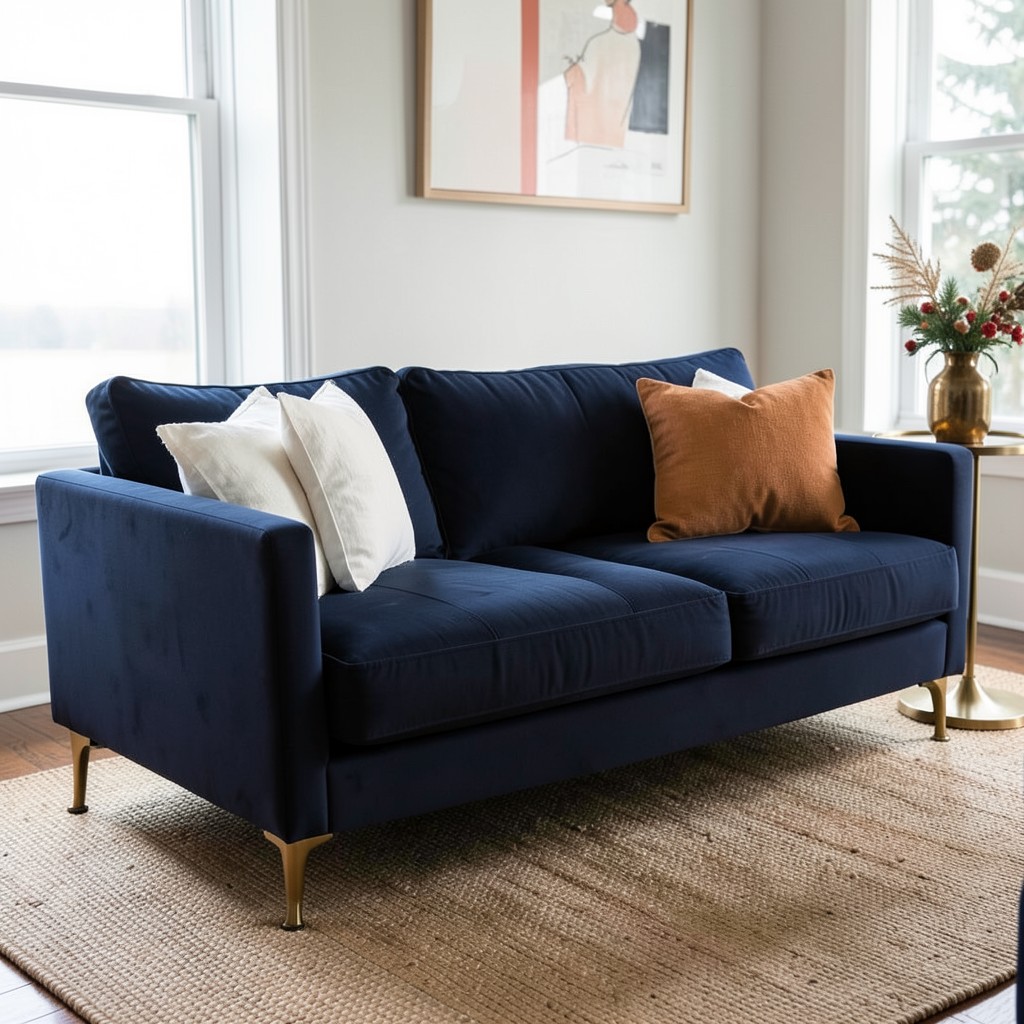
Navy blue is the sofa color that the design community consistently returns to when the question is which color provides the most reliable combination of visual depth, tonal sophistication, and long-term relevance in a residential living room. The honest answer is that navy is the sofa color whose design intelligence has been validated by more rooms, more designers, and more years of production than any other non-neutral sofa color in residential design history. The navy sofa works. Consistently, across aesthetic directions, through seasonal changes, and over the full lifespan of a furniture piece whose decade-long presence in the room tests every design decision it represents.
A three-seat navy velvet sofa on polished brass legs creates the sophisticated living room’s primary seating in the material and metallic combination that the contemporary luxury home interior applies as its most confident furniture expression. The navy velvet’s depth of color — the pile’s directional variation creating the near-black shadow and the bright mid-blue highlight that the velvet generates at its color’s extremes — creates the sofa’s surface complexity at the scale of the room’s primary visual element. Elegant home styling applied around the navy sofa — the white linen throw pillows, the amber brass side table, and the textural contrast of a natural jute rug beneath — creates the living room composition whose color restraint and material quality communicate the design’s confidence in the navy’s own sufficient authority.
The navy sofa’s seasonal styling flexibility matches the color’s design reputation — during summer living room decor season, the navy with white and coral accent cushions creates the nautical-adjacent palette that the warm months’ design culture applies to the coastal and beach house directions; during fall home decorating, the navy with warm ochre, burnt sienna, and forest green creates the autumn palette whose deep cool anchor in the navy allows the warm accent tones to read at their fullest saturation; and during holiday home styling, the navy and gold combination creates the festive palette whose sophisticated restraint makes it the luxury alternative to the conventional red-and-green seasonal decoration.
35. A Sofa With Fringe Trim for a Boho-Luxe Interior
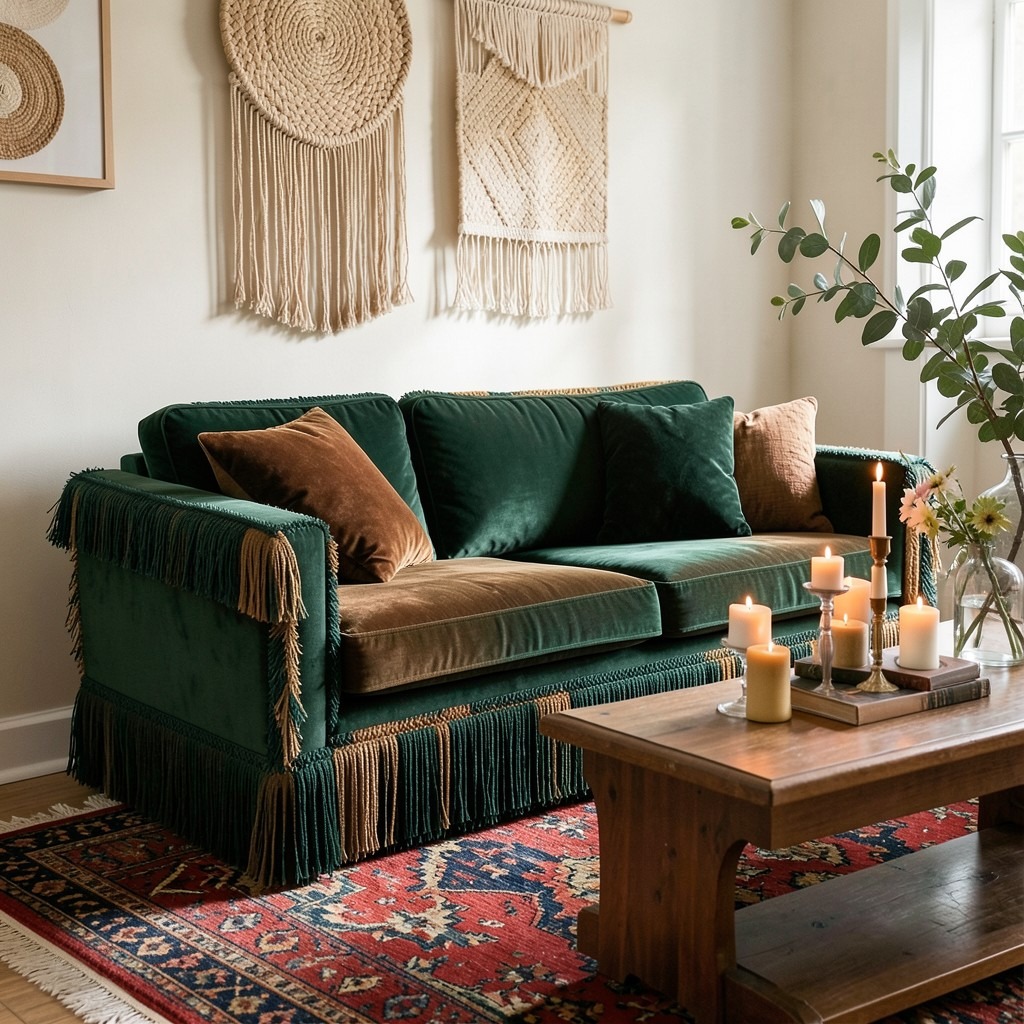
The fringed sofa is the furniture piece that marks the precise territory between the bohemian aesthetic’s tactile, layered material approach and the luxury interior’s commitment to material quality and decorative refinement — the fringe trim at the sofa’s base and arm edges creates the bohemian decoration in a material that, when executed in a quality silk or a well-spun wool, communicates luxury as clearly as the fringe’s bohemian association communicates freedom. The boho-luxe sofa is the design idea that refuses to choose between its two aesthetic parents, and the fringe is the detail that marks that refusal most directly.
A deep emerald or a rich cognac velvet sofa with a silk fringe trim in a complementary or contrasting tone creates the boho-luxe seating piece in the material combination whose individual components — the velvet’s luxury material quality and the fringe’s bohemian decorative vocabulary — create the furniture’s complete aesthetic identity together. The fringe length should be calibrated to the sofa’s scale and the room’s other textural elements — a three-to-four-inch fringe on a standard three-seat sofa creates the visible but not overwhelming trim proportion; a longer fringe creates the more dramatic, more overtly bohemian expression that the room of maximum bohemian commitment accommodates. Bohemian home styling around the fringed sofa — the layered Moroccan rugs beneath, the macramé and woven textile wall art above, and the cluster of candles and botanical specimens on the coffee table — creates the boho-luxe living room whose material richness is consistent from the sofa’s velvet and fringe through every accessory in the room.
The fringe trim’s maintenance is the practical detail that the boho-luxe sofa’s household must attend to — the fringe tangles, collects dust at the fiber’s individual strands, and requires periodic straightening by hand to maintain the even, hanging quality that the decorative element requires to read as intentional rather than neglected. The household that performs this maintenance regularly has a sofa of genuine decorative richness; the household that allows the fringe to tangle and mat has a sofa that reads as worn rather than as bohemian.
36. A Sofa With a Waterfall Arm for a Contemporary Room

The waterfall arm sofa — where the arm’s top and outer face form a continuous, uninterrupted curved surface without the step or the profile change that traditional arm forms create — is the contemporary furniture form that achieves the visual continuity between the sofa’s back and its arm that most sofa designs interrupt with a structural or decorative joint. The waterfall arm’s continuous surface reads as a single sculpted form rather than as a back joined to an arm, and this unity of form is the contemporary sofa design’s most architecturally resolved profile.
A waterfall arm sofa in a tight-weave performance or natural fabric — the continuous arm surface requiring a fabric with sufficient recovery to follow the curve without the wrinkling that lower-thread-count fabrics create at the curve’s tightest radius — creates the contemporary sofa in a form whose material execution quality determines the design’s success as completely as the form itself. The fabric must conform to the arm’s continuous curve without visible seaming at the transition from top to face, which requires either a stretch component in the fabric or a fabric patterned sufficiently densely that seams can be placed at the curve’s midpoint without creating an obvious break in the surface. Contemporary home ideas living rooms whose design language is defined by continuous, uninterrupted surfaces receive the waterfall arm sofa as the seating whose furniture language matches the architectural language of the room.
The waterfall arm creates a specific sitting posture — the continuous curved arm provides a comfortable surface for resting the arm at a height that is neither the lower cushioned arm of the deep-seated sofa nor the higher firm arm of the traditional three-seater, and this intermediate arm height creates the seated position that suits the conversational upright posture equally well as the reclined lounging position. The sofa that accommodates both postures with equal comfort is the sofa that the genuinely lived-in room requires, and the waterfall arm achieves that accommodation through its form’s specific geometry.
37. A Sofa in a Warm White for a Minimalist Sanctuary

White sofas polarize households along the exact divide between the design purist and the practical realist — the purist sees the white sofa as the room’s most architecturally resolved and most spatially generous furniture choice, and the realist sees the maintenance schedule and the anxiety of every red wine glass that enters the room. Both perspectives are correct, and the household’s decision about which consideration takes priority defines not just the sofa choice but the design philosophy of the room it occupies.
A warm white sofa — the off-white with a slight ivory or cream undertone that avoids the clinical quality of pure cool white — in a heavy performance linen or a tight-weave cotton creates the minimalist sanctuary’s seating in a material that handles the maintenance reality of the white sofa’s life in use. The performance linen’s tight weave prevents liquid absorption to the extent that spot cleaning with a damp cloth addresses most surface soiling before it sets, and the removable slip-covered version creates the additional maintenance tool of the machine-washable cover that keeps the white sofa genuinely white between professional cleaning intervals. Bright home design principles find their most complete residential expression in the white sofa — the pale furniture surface amplifies the room’s natural light, creates the spatial openness that the minimalist palette values as its primary atmospheric quality, and provides the neutral ground against which any accent color, any seasonal cushion addition, and any decorative object reads with the maximum visual clarity.
The warm white sofa’s relationship to the room’s other surfaces should be managed with the same care that monochromatic palette management always requires — the floor material’s tone in direct relationship to the sofa’s warm white, the wall color’s relationship to the sofa’s undertone, and the accent materials’ selection in dialogue with the white’s specific temperature. A warm white sofa on a warm wood floor against a cool grey-white wall creates the tonal tension that the monochromatic palette’s temperature variation generates, and resolving that tension — either by warming the wall tone or by cooling the floor material — is the design detail that separates the finished minimalist room from the merely white one.
38. A Sofa in a Plum Tone for a Dramatic Interior

Plum is the color that the dramatic interior reaches for when the conventional jewel tones — the emerald, the sapphire, the teal — feel familiar, because plum’s combination of red’s warmth and blue’s depth creates a color of unique atmospheric character whose residential application feels genuinely specific rather than generically rich. The plum sofa is the room’s design statement in a color that most rooms haven’t seen before, and its atmospheric quality — the way the deep purple-red absorbs and reflects the evening’s artificial light — creates the dramatic interior’s most distinctive and most memorable sofa color.
A plum velvet sofa in a deep, muted tone — the plum that leans toward aubergine rather than toward the brighter purple, its grey component creating the color’s maturity — creates the dramatic living room’s seating in a material whose pile depth and tonal complexity suit the color’s atmospheric richness. The plum sofa’s color reads differently across the day’s light cycle with more dramatic variation than most sofa colors — it appears almost black in the low light of an overcast winter afternoon, warms toward a rich burgundy in the amber of an evening lamp, and reveals its blue-purple depth in the full brightness of midday natural light. This tonal variability is the plum sofa’s most distinctly atmospheric quality, and the dramatic interior that experiences this variation through the day’s changing light has a living room whose color environment is genuinely alive rather than statically decorative.
The plum sofa’s styling requires the restraint that all dramatically colored furniture demands — the room’s other elements should support the color without amplifying it to the point of heaviness. Pale silver-grey walls, a natural oak floor, and the warm amber of brass lighting fixtures create the plum sofa’s most resolved design context, the pale surroundings providing the contrast that allows the plum’s depth to read as designed intensity rather than accumulated darkness.
39. A Sofa With a Low Back for a Room With a View

The low-back sofa is the furniture form that the room designed around its view should always consider before any other sofa profile — the sofa whose back height is calibrated to fall below the window sill level, or whose back height from the floor is low enough that the view through the window behind it remains unobstructed from the standing and moving positions within the room, creates the furniture arrangement that serves the view rather than competing with it. Every inch of sofa back that rises in front of a window is an inch of view blocked, and in a room whose primary design asset is the landscape or the cityscape beyond the glass, that competition is a design error.
A low-back sofa in an airy home interiors palette — pale linen, natural cotton, bleached canvas — creates the window-respecting furniture piece in a material whose pale tone reflects the outdoor light rather than absorbing it, and whose surface quality creates the visual continuity between the indoor seating and the outdoor view that the low back’s profile supports. The seat depth should be generous to compensate for the reduced back height — a deep seat that allows the occupant to recline with the knees raised creates the comfortable reclining position that a full back height creates through back support, and the reclined position in a deep low-back sofa facing a generous window creates the room’s most specifically atmospheric seating moment. Beach house interiors apply the low-back sofa most consistently as the ocean-facing window seat, and the design’s elegance in this application is the complete subordination of the furniture to the view it was positioned to serve.
The low-back sofa’s practical consideration is the back cushion quality — the reduced back height means the back cushion’s support function is more critical than in a standard sofa, and the cushion’s filling density and its height above the seat must create sufficient lumbar support to make extended sitting comfortable. A low-back sofa with inadequate back cushion support creates the uncomfortable seating that drives the room’s occupants to sit elsewhere, and the furniture piece that should be the room’s most enviable seat becomes the sofa that nobody uses. Cushion quality is the low-back sofa’s design success or failure.
40. A Sofa With a Contrast Color Base Panel

The contrast base panel sofa — where the sofa’s base, the fabric-covered section between the seat and the floor, is upholstered in a different color from the seat and back — creates the furniture piece that references the two-tone color blocking that fashion applies to garments and that interior design applies to painted architectural elements. The contrast base panel divides the sofa’s mass visually, creating a lighter upper section and a grounding lower section, and the color relationship between the two sections determines whether the division reads as composed or as arbitrary.
A sofa with a deep charcoal or a warm navy base panel against a pale cream or a natural linen seat and back creates the contrast that the contemporary interior applies most confidently — the dark base grounds the sofa visually, creating the furniture’s connection to the floor plane without the heavy, undivided mass that a uniformly dark sofa creates, and the pale upper section provides the visual lightness that the room’s natural light quality requires at the dominant furniture piece’s most visible surfaces. Modern home design rooms whose architectural language applies color blocking at the wall and architectural element level receive the contrast panel sofa as the furniture piece that continues the architectural language at the domestic furniture scale. The contrast base panel is the design detail that the viewer notices on second look — not the room’s primary design statement but the detail whose intelligence reveals itself on closer engagement with the furniture.
The color selection for the contrast panel should be drawn from the room’s established palette rather than introduced as a new color — the panel in the room’s wall color, the rug’s dominant tone, or the room’s accent fabric creates the connection between the sofa’s detail and the room’s complete design that makes the contrast feel considered rather than decorative. A contrast panel that introduces a color not present elsewhere in the room creates the furniture detail that competes with the room’s palette rather than extending it.
41. A Sofa in an Organic Irregular Shape

The irregular organic sofa is the design idea that the contemporary art and design crossover has produced most recently and most interestingly — the sofa whose plan form is not the rectangle or the L but the kidney, the amoeba, or the free-form curve that references organic natural forms rather than architectural geometry. This sofa does not fit against a wall. It does not organize itself according to the room’s rectangular grid. It sits in the room as a sculptural object, and the room organizes itself around it.
An organic curved sofa in a bouclé or a mohair fabric — the soft, textural surface reinforcing the form’s organic character with the material quality that shaped, irregular forms carry most naturally — creates the contemporary home ideas living room’s furniture centerpiece in a piece that references sculpture as directly as furniture design. The form’s free curve creates a different spatial relationship depending on the viewing angle — from one direction, the sofa’s concave face creates the enclosed, inward-facing seating; from another, the convex back creates the sculptural object’s most dramatic profile, and the two views coexist in the same piece without contradiction. The organic sofa’s position in the room should be calibrated for the balance between its functional seating orientation — the concave face toward the primary activity or conversation zone — and its sculptural reading from the room’s entry point.
The organic sofa’s room context should be spatially generous enough to allow the form to be read from a distance — a room whose spatial dimensions allow the organic sofa to occupy the center of the floor plan without physical proximity to the walls creates the museum-quality presentation that the form’s sculptural character requires. The organic sofa in a cramped room is a sculpture in a storage unit; the organic sofa in a generously proportioned room is the room’s complete design statement.
42. A Sofa in a Rust Orange for an Autumnal Room

43. A Sofa in a Striped Ticking Fabric for a Cottage Interior
Ticking stripe is the fabric whose residential design application has been so thoroughly associated with the European country cottage aesthetic that its appearance on a sofa communicates the design direction’s intentions before any other element in the room is considered. The ticking stripe’s origin — the dense, closely woven cotton fabric developed for mattress and pillow casings whose tight weave prevented the filling from escaping — has been entirely separated from its functional roots in the domestic interior design tradition, and the fabric’s current application is purely decorative, though the quality of the weave that the ticking tradition developed for functional reasons is precisely what makes it a durable and visually distinct upholstery choice.
A navy and white or a charcoal and cream ticking stripe sofa — the stripe’s narrow repeat creating the textile’s graphic pattern at the furniture scale — creates the coastal home design or farmhouse home decor sofa in the fabric whose pattern suits both aesthetics’ preference for the clean, simple, graphic surface quality of the natural fiber textile. The ticking stripe’s scale on the sofa — the stripe’s width and repeat relative to the sofa’s upholstered surface area — should be considered in relation to the room’s other patterns; the ticking works most cleanly as a single pattern in the room’s primary textile, with the secondary cushions and throws in solids or in complementary natural textures rather than competing patterns. A spring home refresh applied through the ticking stripe sofa — the fabric’s clean graphic quality and its association with the freshened, laundered quality of spring domestic energy — creates the seasonal design moment that the ticking fabric communicates most specifically.
The ticking stripe sofa’s practical appeal matches its aesthetic appeal — the tightly woven cotton is durable, machine-washable in the slip-covered version, and resistant to the pilling and surface degradation that looser woven fabrics exhibit under the daily physical demands of living room seating. The fabric’s quality in use is the direct inheritance of its functional origins, and the household that chooses ticking for its appearance receives the performance as an unrequested but welcome bonus.
44. A Sofa in an Indigo Blue for a Global Eclectic Interior

Indigo is the textile color with the deepest and most geographically distributed cultural history of any dye color in residential fabric production — the Japanese shibori, the Indian block print, the West African resist-dye, and the European denim tradition all share the indigo dye as their common color ancestor, and the indigo sofa in the global eclectic interior carries all of those cultural textile traditions as the color’s implicit design context. The indigo sofa is the room’s most culturally resonant furniture choice, and the design that builds a global eclectic interior around it is drawing from a genuinely global material heritage.
An indigo blue sofa in a woven cotton or a dense linen — the color in its slightly uneven, organic-dyed quality that the natural indigo pigment creates rather than the perfectly uniform synthetic version — creates the global eclectic seating piece in a fabric whose material quality references the handcraft of the textile traditions the color inhabits. The color’s variation across the fabric’s surface — slightly darker at the warp, slightly lighter at the weft, with the occasional warp-dominant area creating the directional shift that natural and semi-natural dyeing processes produce — creates the living surface quality that the global eclectic interior values as the evidence of the material’s human origin. Bohemian home styling around the indigo sofa — the collection of global textiles in the throw pillows, the block-printed cotton cushion covers, and the woven jute rug whose natural color provides the warm contrast beneath the deep blue — creates the complete global eclectic living room whose seating communicates the design’s cultural breadth at the room’s primary furniture scale.
The indigo sofa’s tonal depth makes it one of the easiest sofa colors to style through the seasons — its deep blue accepts warm autumn tones, cool summer whites, festive winter golds, and fresh spring greens with equal facility, requiring only the cushion and accessory change that the seasonal home makeover approach applies to transform the room’s atmosphere while the sofa’s color remains the constant anchor.
45. A Sofa With a Curved Back for a 70s-Inspired Interior

The curved back sofa is the furniture form that the design culture periodically rediscovers as the antidote to the rectangular rigidity that extended periods of minimalist design dominance create as their eventual aesthetic fatigue. The curved back’s arc creates the sofa whose form communicates warmth and organic movement at a furniture scale, and the household that has spent a decade living with flat-backed, right-angled furniture discovers the curved sofa with the specific relief of a form that provides what the straight line categorically cannot.
A curved back sofa in a warm caramel, a sandy earth tone, or a warm cream — the colors of the earthen palette that the seventies design revival applies as its material signature — creates the 70s-inspired interior’s primary seating in a form whose silhouette communicates the decade’s preference for the organic and the sensuous over the geometric and the austere. The sofa’s leg in a flared, foot-less format — the base platform of brushed metal or natural timber creating the wide, stable ground connection that the curved body’s visual movement requires to be grounded rather than floating — creates the complete period-referencing furniture piece in a form whose every design detail speaks the same aesthetic language. Contemporary home ideas rooms that draw from the seventies revival as their current design reference apply the curved back sofa as the seating whose form most directly and most specifically communicates the period’s design culture.
The curved back sofa’s room context requires the same generosity of space that the organic irregular sofa requires — the curve needs to be seen from a distance to be appreciated as a curve rather than as a slight distortion of a straight back. A room whose floor plan provides the standing distance from which the sofa’s profile reads clearly is the room whose curved sofa communicates its design intention with the full effect that the form creates at the appropriate viewing distance.
46. A Sofa With an Ottoman Suite for a Complete Look

The sofa-and-ottoman suite — the matching pair of upholstered pieces whose scale, material, and design language are coordinated as a single furniture composition — creates the living room’s seating zone as a considered furniture arrangement whose components are designed for each other rather than assembled from compatible-seeming separate purchases. The ottoman extends the sofa’s seating function in multiple directions simultaneously: it provides the foot support that the sofa’s depth creates as the natural complement of the reclined sitting position, it serves as the coffee table surface when topped with a tray, and it provides the additional seating that the small gathering requires without adding a chair whose presence when unused reduces the room’s spatial quality.
A sofa-and-ottoman suite in a warm performance fabric — the practical quality that a surface used as both footrest and occasional table requires — creates the complete living room seating zone in a material calibrated for the combined functional demands of the two pieces. The ottoman’s fabric should be specified in the same material and color as the sofa to create the visual continuity that the suite arrangement requires, or in a deliberately contrasting material or color that creates the designed differentiation between the two pieces as a compositional device rather than as a practical concession. Cozy home design living rooms organized around the sofa-and-ottoman suite — the sofa facing the fireplace, the ottoman between the sofa and the hearth, the blanket across the sofa’s arm within reach of the reclining occupant — create the winter interior design’s most complete and most consistently used domestic seating arrangement.
The ottoman’s size should be calibrated to the sofa’s proportions — a standard square ottoman of thirty-six to forty inches suits a two-to-three-seat sofa and provides the surface area for the tray, the book, and the drink that the coffee table function requires. A rectangular ottoman whose length matches the sofa’s width creates the formal symmetry of the fully matched suite, while a slightly undersized square creates the designed asymmetry that the contemporary composition applies as the alternative to the suite’s formal precision.
47. A Sofa in a Warm Terracotta Linen for a Mediterranean Interior

Mediterranean interior design is the aesthetic that understands warmth most completely — not the fussed, symmetrical warmth of the traditional English interior but the casual, sun-bleached, material-honest warmth of a room that was designed in the knowledge that the outdoor and indoor environments share the same sunlight, the same stone, and the same earthy color palette. The Mediterranean sofa should communicate the same qualities — the organic texture, the warm earth tone, and the casual comfort that the indoor-outdoor lifestyle requires as its domestic expression.
A terracotta linen sofa — the warm, slightly dusty orange-brown of the fired clay tile applied to the sofa’s primary upholstery surface in the natural, slightly irregular texture of the linen weave — creates the Mediterranean interior’s seating in a material combination whose color and texture belong to the same material world as the tile floor, the plastered wall, and the olive grove outside the window. The linen’s natural weight and its gentle wrinkling quality create the casual surface that the Mediterranean aesthetic values as the honest expression of a material used in the climate it was grown in — loose, breathable, and slightly imprecise in the way that heat and natural fiber always create together. Relaxed home design principles find their most regionally specific and most climatically honest expression in the Mediterranean linen sofa — the ease of the fabric, the warmth of the color, and the casual arrangement of the loose cushions create the seating whose comfort is the relaxed, unselfconscious comfort of a room that was never trying to impress anyone.
A Mediterranean sofa room during summer home design season — the terracotta linen in the warm morning light, the terracotta tile floor, the potted olive tree in the corner, and the white-plastered walls creating the warm, sun-drenched interior — creates the summer living room’s most geographically specific and most completely atmospheric domestic environment. The season and the material and the color align in the Mediterranean interior with the natural coherence that the most authentic regional design always achieves when it is honest about where it came from.
48. A Sofa With a Button-Tufted Back in a Traditional Room

The button-tufted back creates the sofa surface whose decorative complexity is generated entirely by the upholstery’s construction — the fabric pulled through and fixed at each button point creates the diamond-shaped fabric panels between the buttons, and the fabric’s depth of pile or weight of weave determines the drama of the tufting’s three-dimensional relief. The tufted sofa communicates decorative ambition at the furniture form’s most fundamental construction level, and the design’s quality is measured by the precision of the button placement and the consistency of the fabric tension across the tufted surface.
A diamond-tufted sofa in a deep jewel-tone velvet — the buttons positioned in a precise diamond grid, the velvet’s pile creating the maximum shadow depth in the fabric panels between the buttons — creates the traditional sofa’s most luxurious and most visually complex upholstered surface. The tufting’s precision quality — the diamond grid’s geometric exactness, the button’s covered consistency, and the fabric tension’s evenness across the entire tufted surface — communicates the upholstery’s craft quality more directly than any other fabric treatment, and the sofa’s tufted surface quality is the design’s most honest and most specific quality indicator. Luxury home interior rooms receive the diamond-tufted sofa as the seating whose decoration is earned through craft rather than applied through surface decoration, and the distinction between the two design approaches is precisely what the luxury interior’s quality standard requires its furniture to demonstrate.
The button-tufted sofa’s care requirement — the periodic inspection and re-securing of any buttons that the tufting’s daily distortion under body weight loosens from their backing, and the careful vacuum cleaning of the fabric within the diamond panels’ recessed centers — creates the maintenance commitment proportional to the decorative complexity. The tufted sofa that is maintained properly retains the precise, sharp diamond grid quality of its original upholstery; the tufted sofa whose buttons are allowed to loosen and whose fabric panels are allowed to lose their tension progressively loses the geometric precision that is the tufting’s primary design quality and is left with the sagging, distorted surface of a construction that has not been maintained.
49. A Sofa in a Dusty Pink for a Soft Feminine Interior

Dusty pink is the sofa color that the softer, more subdued version of the feminine interior requires as its primary seating tone — the color whose grey component mutes the pink’s sweetness into the sophisticated, slightly melancholy tone that the dusty quality creates. This is not the bright pink of unambiguous femininity. It is the faded, slightly worn pink of a color that has been in the light long enough to lose its initial brightness and acquire the depth that the fading process creates.
A dusty pink sofa in a velvet or a woven mohair blend creates the soft feminine interior’s seating in a material whose surface quality reinforces the color’s subdued romance — the velvet’s directional pile creates the color’s lightest and darkest variation across the sofa’s surface, and in the dusty pink tone, these variations create the range from the almost-white highlight to the dusty rose depth that gives the color its atmospheric character. Spring bedroom decor and spring home refresh design directions apply the dusty pink sofa most naturally — the color’s association with the blossoming season’s soft botanical palette creates the seasonal design alignment whose timing is specific and whose atmosphere is genuinely springlike in a way that no designed color scheme achieves as honestly as the one whose color was borrowed from the season’s own natural palette.
The dusty pink sofa’s room context should be composed with the same restraint that the color’s subdued quality demands — pale walls in a warm white or a barely-there blush, natural wood furniture in a light-toned oak or ash, and the textile accents in white, cream, and the soft natural tones of undyed cotton and linen. The dusty pink sofa in a room of competing colors loses its atmospheric quality in the visual competition; the dusty pink sofa in a room of deliberate restraint becomes the room’s quietly confident focal piece.
50. A Sofa Designed as the Room’s Complete Identity

The sofa that is the room’s entire design statement — not the primary furniture piece around which the room is organized, but the object from which the room’s complete design identity radiates — is the furniture choice that most households never make and that the household with the design confidence to commit fully to a single piece’s dominance creates the room of most singular and most memorable character. The room organized around one extraordinary sofa says something that no collection of considered furniture pieces says with the same clarity: this sofa is the room, and the room exists to house the sofa.
A generously scaled bespoke sofa — its form, its material, and its scale designed specifically for the room’s dimensions and the household’s daily life — creates the living room’s complete design identity in the furniture piece that every other element serves. The sofa’s bespoke quality communicates through the precision of its fit within the room’s specific geometry, the fabric selected for the specific light quality the room receives, and the cushion density calibrated for the specific household members whose body weight and sitting habits the design must accommodate. A luxury home interior organized around a bespoke sofa — the rug sized to the sofa’s footprint, the lighting designed to illuminate the sofa’s material quality, and the remaining furniture selected in explicit dialogue with the sofa’s form and color — creates the living room of complete furniture-led design whose quality is apparent to every person who enters it, whether or not they can identify the design’s specific intention.
The sofa you choose will be the first thing every guest sees when they enter your living room, the last thing you see before you leave it, and the piece you return to every evening for the years the room remains as you designed it. Choose it as though the room depends on it. It does.
Leave a Reply