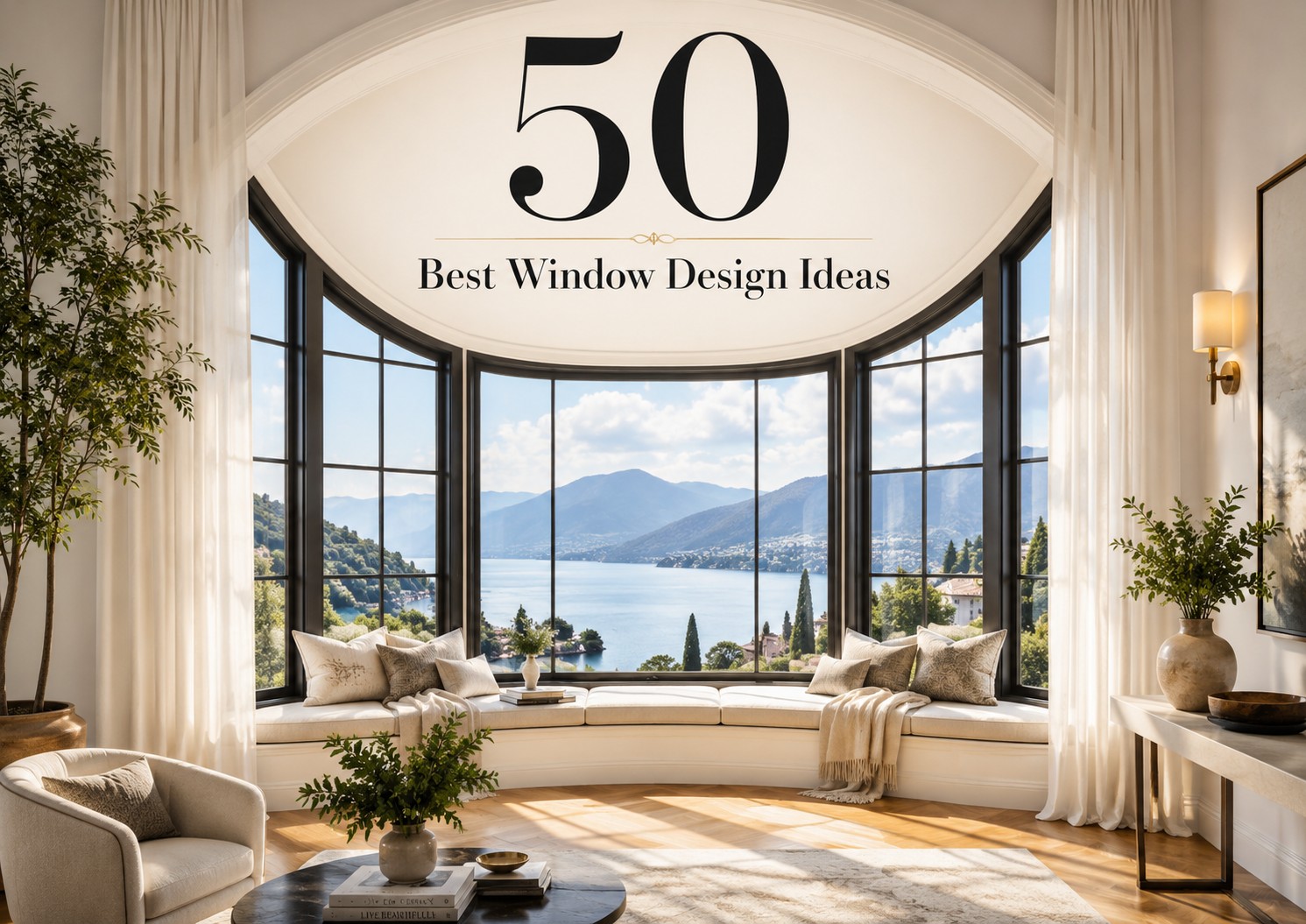
Every room’s personality begins at its windows, and most rooms never reach their potential because the window decision received the least design thought of any element in the space. The wall color was agonized over. The furniture was chosen carefully. The rug was measured twice and purchased with intention. But the window — the architectural element that determines how much light enters the room, from which direction, at what quality, filtered through what material, framed by what profile, and dressed in what textile — was left to the builder’s standard specification or the previous owner’s dated choice, and the room pays for that neglect every day in the quality of its light, its spatial character, and its relationship to the world outside its walls.
The window is not a hole in the wall with glass in it. That is the building code’s minimum requirement, not the design’s ambition. The window is the room’s primary relationship to the natural world — the mechanism through which the morning’s first light enters the bedroom, through which the winter rain’s grey sky communicates the season’s specific atmospheric quality, through which the summer garden’s green creates the living backdrop for the living room’s daily domestic activity. The window manages the room’s thermal experience, its acoustic relationship to the exterior, and its privacy balance between the domestic interior and the neighborhood beyond. These are not secondary considerations. They are the room’s most fundamental experiential qualities, and the window is the element that determines all of them simultaneously.
The design dimensions of the window decision are more numerous than most homeowners consider when they think about windows as simply a choice between curtain and blind. The window’s form — the casement, the sash, the picture, the bay, the clerestory, the skylight — determines the aperture’s relationship to the wall plane, its operational mechanism, and the light quality it creates within the room. The frame material — the painted timber, the powder-coated aluminium, the uPVC, the steel — creates the window’s profile quality and its maintenance demands over time. The glazing specification — the clear double-glazed unit, the frosted privacy glass, the solar-control film, the heritage single-glazed pane — determines the window’s thermal performance, its privacy quality, and its contribution to the room’s energy balance across the seasonal cycle. And the window treatment — the curtain, the blind, the shutter, the bare window — creates the most visible and the most seasonally flexible element of the window’s complete design.
The fifty window design ideas collected here span the full range of window forms, frame materials, glazing specifications, and treatment approaches across every room type and every aesthetic direction. The ideas address the floor-to-ceiling picture window of the modern home design living room and the small, deep-set casement of the farmhouse home decor kitchen, the arched window of the traditional home interiors bedroom and the industrial steel-framed window of the converted warehouse study. Every idea is a complete design direction with a specific architectural logic, a material rationale, and a practical intelligence about how light, privacy, and the relationship between inside and outside are managed in the specific context the idea addresses.
Windows are the room’s eyes. Design them to see exactly what the room was built to see, and the room will never look at the world — or itself — the same way again.
1. A Floor-to-Ceiling Picture Window in a Modern Living Room
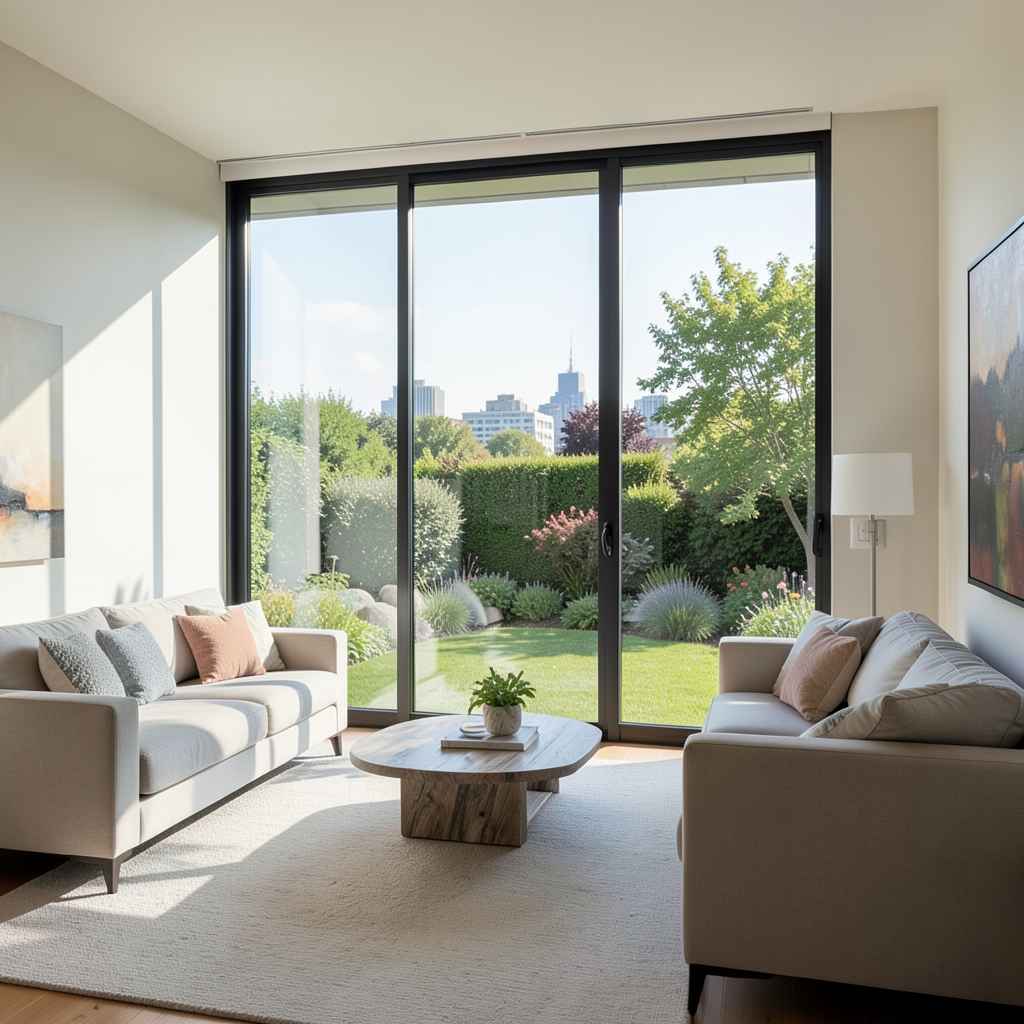
The picture window is the architectural statement that the modern home design living room makes when the landscape or the cityscape beyond the glass is sufficiently compelling to be framed as the room’s primary design element. The wall of glass from floor to ceiling transforms the exterior view into the room’s dominant visual experience — not a painting on the wall but the actual, living, changing landscape whose weather, light, and seasonal transformation create the room’s most dynamic decorative element without any designed intervention beyond the decision to remove the wall and replace it with glass. That decision takes courage. The rooms that make it are invariably better for it.
A fixed picture window in a powder-coated black or dark bronze aluminium frame creates the aperture’s clean, modern profile — the slim frame maximizing the glass area and minimizing the visual interruption between the interior space and the exterior view. The frame’s dark tone creates the window’s graphic quality as a designed edge rather than the disappearing act of a bright or white-framed window whose profile tries to be invisible. Summer living room decor benefits from the floor-to-ceiling picture window at its most specific atmospheric quality — the exterior garden’s green visible from every seated position in the room, the natural light falling across the room’s material surfaces at the oblique angle that the large glass plane creates as the sun moves through its arc. The interior’s furniture arrangement should treat the window as the room’s focal wall — the seating oriented toward the glass rather than away from it, and the view becoming the room’s primary visual activity at the scale that the picture window’s generous aperture allows.
The thermal management of the floor-to-ceiling picture window is the practical consideration that the design’s atmospheric generosity creates as its most significant counterpoint — the large glass area creates the solar heat gain in summer that the room’s cooling system must manage, and the radiant cold loss in winter that the heating system compensates for. The solar-control glazing specification — the low-emissivity coating that reduces the solar heat gain without significantly reducing the visible light transmission — creates the picture window’s thermal management within the glass unit itself rather than requiring the external solar shading whose structure the window’s clean profile loses when it is added.
2. A Steel-Framed Window in an Industrial Interior

The steel-framed window is the industrial home design aesthetic’s most architecturally specific and most materially honest architectural element — the raw or powder-coated steel frame’s slim profile and the black tone’s graphic quality create the window that belongs to the factory, the warehouse, and the converted industrial building with the material authority of an element whose design was determined by structural and manufacturing logic rather than by residential design convention. The steel window does not pretend to be domestic. It brings the industrial building’s material vocabulary into the residential interior, and the interior that can absorb that vocabulary — the concrete floor, the exposed beam, the brick wall — receives it as the completing element of the aesthetic’s most complete expression.
A Crittal-style steel window in a black powder-coated frame — the divided lights creating the grid of individual panes that the slim steel profile holds with the structural precision that only the metal’s strength-to-section-ratio makes possible at that profile dimension — creates the industrial interior’s window in the form that the aesthetic’s design reference requires at its most materially specific. The divided light grid’s shadow pattern on the interior floor and wall in the morning’s oblique light creates the room’s most atmospheric daily occurrence — the geometric grid of the window’s shadow moving across the concrete or timber floor surface as the sun tracks its arc, the room’s static material palette animated by the window’s structural shadow at the scale of the room’s full floor area. Stone and wood home design industrial rooms apply the steel window as the hard material counterpoint to the organic timber and stone surfaces, and the tension between the steel’s precision and the natural materials’ irregularity creates the room’s most interesting material dialogue.
The steel frame’s thermal performance is the practical reality that the aesthetic’s commitment must accommodate — the metal’s thermal conductivity creates the cold bridging at the frame section that the thermally broken aluminium frame prevents by design, and the steel-framed window’s interior surface in a cold climate creates the condensation risk that the thermally broken specification eliminates. The slim steel frame’s thermal performance can be improved through secondary glazing, through the room’s specific ventilation management, and through the carefully positioned furniture that prevents the occupant’s habitual proximity to the cold frame, but the fundamental thermal characteristic of the conductive steel section remains the design’s practical caveat.
3. A Bay Window With a Window Seat in a Traditional Bedroom

The bay window creates the bedroom’s most specific and most architecturally generous spatial moment — the wall that steps forward into the exterior space and returns, creating the projection whose interior forms the alcove, the window seat, and the concentrated natural light source that the bedroom’s principal window position generates at the focal point of the room’s most architecturally significant wall. The bay does more work than any flat wall window. It changes the room’s plan, its section, its light quality, and its furniture possibilities simultaneously, and the traditional bedroom that contains a bay window has received a spatial gift from its architecture that the flat-walled bedroom never quite compensates for regardless of the design intelligence applied to it.
A painted timber bay window with a built-in window seat — the seat’s cushioned surface in a durable fabric, the storage drawers in the seat’s body below, and the surround shelves at each flank of the bay creating the complete reading alcove — creates the traditional home interiors bedroom’s most specific and most beloved domestic spatial feature. Traditional home interiors bedrooms with bay window seats create the reading, the morning coffee, and the contemplative domestic moment in the room’s most light-rich and most architecturally specific position — the seat at the window’s focal point receiving the most natural light in the room throughout the morning, and the seat’s enclosed position within the bay’s three walls creating the domestic enclosure that the open bedroom floor cannot provide. Cozy bedroom design in a traditional bedroom reaches its most complete atmospheric expression at the bay window seat — the layered cushions, the throw blanket, and the afternoon light creating the cozy nook that every person who has ever sat in one associates with the specific domestic warmth that the bay window seat creates nowhere else.
The window seat’s cushion specification should prioritize the sitting comfort of extended occupancy rather than the decorative quality of its surface — the foam density calibrated for the hours-long reading session rather than for the occasional perch, and the fabric specification in a durable performance material that handles the daily use of the bedroom’s most consistently occupied non-bed seating position.
4. A Skylight Window in a Minimalist Bathroom

The skylight in a bathroom is the window solution that the interior bathroom — the room without an external wall whose standard window position requires either a borrowed light from an adjacent space or the mechanical ventilation that replaces the natural air movement the operable window creates — receives as the direct connection to the sky whose natural light quality and psychological openness creates the bathroom’s most specifically atmospheric spatial quality. The skylight turns the bathroom ceiling into the light source rather than the opaque surface, and the room whose ceiling provides the light is a different spatial experience from the room whose walls provide it.
A fixed or operable flat skylight in a minimal aluminium frame — the glass flush with or slightly above the ceiling plane, the frame’s slim profile minimizing the structural interruption of the ceiling surface — creates the minimalist home design bathroom’s overhead light source in the clean, architecturally resolved format that the minimalist aesthetic requires of every element in the space. The morning’s skylight in a bathroom creates the most specifically atmospheric light quality of any bathroom window position — the direct sky view above the bathing body creates the open-air quality that no wall window achieves from any direction, and the bathroom whose skylight frames the blue sky in summer or the grey winter overcast creates the bathing experience whose quality shifts with the season and the weather in the specifically immersive way that the connection to the sky above rather than the street beside creates. Peaceful home decor bathrooms with skylight windows — the natural light falling vertically onto the stone or tile floor, the steam rising into the sky view above, and the minimal material palette amplifying the light’s quality — create the spa-like bathroom atmosphere whose primary luxury is not the material specification but the quality of the natural light.
The operable skylight’s ventilation contribution to the bathroom is the practical benefit that the aesthetic qualities overshadow in the design conversation — the stack effect that the warm, moist bathroom air creates when the skylight is opened draws the humidity upward and out through the roof aperture with a natural effectiveness that mechanical extraction cannot match in its completeness or its silence, and the ventilated bathroom whose skylight is routinely opened after bathing has a dramatically lower mold risk than the mechanically ventilated room without a natural air path to the exterior.
5. An Arched Window in a Romantic Living Room

The arched window is the architectural element that transforms the living room wall from a flat, rectilinear surface into a composition with the curved profile of the arch’s crown — and that transformation communicates the room’s design ambition at the level of the building’s permanent structure rather than at the level of the furniture and decoration applied to it. An arched window cannot be rented, borrowed, or replicated by soft furnishing. Either the arch is in the wall or it is not, and the living room that contains one has received from its architecture the single most romantic and most historically resonant window form in the residential design tradition.
A painted timber arched window with multi-pane divided lights — the arch’s radiating muntin pattern within the curved head creating the fanlight detail that the Georgian and Federal residential traditions applied to their most architecturally considered window openings — creates the traditional or romantic living room’s primary architectural feature in the wall’s most visible focal position. Elegant home styling applied to the arched window — the full-length curtain in a heavy silk or linen that pools generously on the floor, the curtain rod mounted above the arch to emphasize the full height of the opening, and the room’s furniture arranged in the conversation group that faces the arched window as its backdrop — creates the living room composition whose architectural quality communicates the design’s investment in the permanent structure rather than the temporary decoration. The arch’s profile should be treated by the curtain treatment as the element it is — the curtain mounted above the arch’s crown preserves the arch’s visibility within the window treatment, while the curtain mounted within the arch’s opening conceals the architectural detail that the window’s design and its room’s decoration should be working together to celebrate.
The arched window’s light quality within the room is specific to the arch’s orientation and height — the south-facing high arch in the living room creates the deep, oblique light beam of the winter afternoon sun that enters the room at the low angle the winter sun’s trajectory creates and that the arch’s height allows to penetrate far into the room’s interior, creating the theatrical light effect that the flat-headed window’s lower crown height prevents from entering the room at the same reach.
6. A Casement Window With External Shutters in a Farmhouse

The casement window with external painted shutters is the farmhouse exterior’s most specifically architectural and most functionally intelligent window composition — the hinged shutters that close against the window’s frame in the storm position, fold flat against the wall in the open position, and create the window’s most atmospheric decorative detail in the painted color relationship between the shutter tone and the house’s wall color, create the farmhouse window in the form that the French, Italian, and American farmhouse traditions all recognize as the most honest expression of the rural residential window.
A painted timber casement with external shutters in a contrasting color — the pale stone or white house with shutters in a deep forest green, a faded slate blue, or a classic black — creates the farmhouse home decor window in the material combination that the rural European and American vernacular applies as the most specifically regional and most authentically agricultural window expression. The shutter’s functional heritage — the closing against the storm, the partial opening that creates the ventilation without the full exposure of the open window, and the privacy management of the partially closed shutter — makes the farmhouse shutter the window treatment whose form was determined by genuine functional requirements rather than by decorative convention, and the functional logic visible in the shutter’s design is the detail that the farmhouse aesthetic values as the honest expression of the agricultural building tradition. Fall home decorating seasons bring the farmhouse casement and shutter window to its most atmospheric composition — the deep green shutters against the pale stone wall, the autumn leaves in the garden beyond the window, and the warm light visible through the window’s glass panes creating the farmhouse exterior’s most specifically seasonal and most atmospherically complete architectural moment.
The painted timber shutter’s maintenance commitment — the periodic repainting of the exterior-exposed surface whose paint film the weather deteriorates more rapidly than any interior finish — should be factored into the design decision before the shutters are installed. The household that accepts this maintenance as the care of the farmhouse’s most architecturally specific detail — and that treats the annual paint inspection as the preservation of the window’s most visible and most character-creating element — has the farmhouse window whose painted shutter quality communicates the household’s genuine relationship to the agricultural building tradition it inhabits.
7. A Clerestory Window Band in a Contemporary Living Room

The clerestory window — the glazed band positioned high in the wall above the standard head height, admitting light from above the furniture and the occupant’s eye level — is the contemporary living room’s most architecturally specific and least commonly applied window design, and its rarity in residential design is the precise inverse of its value as a light source and a privacy solution. The clerestory admits the sky’s light without admitting the neighbor’s view, ventilates the room’s upper air zone where the heat accumulates, and creates the high-mounted light beam that the artwork, the material surfaces, and the ceiling receive as the room’s most specifically architectural illumination.
A continuous clerestory band in a slim aluminium or steel frame — the glazing running the full length of the living room wall at the ceiling’s upper zone, its head at or just below the ceiling plane and its sill at the standard door head height — creates the contemporary home ideas living room’s light source in the format whose architectural specificity communicates the design’s understanding of how light enters and behaves in a room at different heights. The clerestory’s light quality is the most even distribution available from a lateral window position — the high entry angle of the light spreading across the ceiling before descending into the room creates the diffused, non-directional illumination that the low-positioned window’s more directional beam cannot provide, and the room lit by a clerestory band has the even, ambient quality that the residential lighting designer typically achieves through multiple artificial sources but which the clerestory provides in natural daylight without any electrical infrastructure. Bright home design living rooms that apply the clerestory band as the primary upper-zone light source alongside the standard-height windows create the layered, multi-height natural light quality that the most specifically designed rooms achieve.
The clerestory’s privacy advantage is the practical benefit that the aesthetic qualities often overshadow in the design discussion — the window that the seated occupant cannot see through is also the window through which the standing pedestrian cannot see in, and the living room in a dense urban or suburban neighborhood that would otherwise require the net curtain or the privacy film to manage the overlooking risk receives the clerestory as the window that creates the maximum natural light quality without any privacy compromise whatsoever.
8. A Dormer Window in a Bedroom Under the Roof

The dormer window is the roof bedroom’s architectural rescue — the structural element that projects through the roof plane to create the full-height window opening in the sloped space where the ceiling’s pitch would otherwise reduce the natural light to the inadequate trickle of a small roof-light or the distant glow of a gable window at the room’s end wall. The dormer brings the window to the occupant’s eye level, creates the sitting position at the window that the roof window’s overhead position cannot provide, and transforms the attic bedroom from the atmospheric but dark loft room into the full-residence bedroom whose window quality equals the standard floors below.
A painted timber dormer with a window seat at the sill level — the sill’s height creating the natural seat position that the dormer’s projecting structure places within the roof bedroom’s most architecturally specific spatial moment — creates the cozy bedroom design’s most intimate and most personally treasured sleeping-room feature. Cozy bedroom design in the dormer bedroom reaches the atmospheric quality that no flat-ceilinged room with a standard window achieves — the sloped ceiling above the bed, the dormer’s concentrated natural light source at the room’s focal point, and the view framed by the dormer’s projecting cheeks creates the bedroom of specifically intimate proportions and specifically personal light quality that the bedroom occupied in childhood and remembered in adulthood as the most atmospherically perfect sleeping room ever inhabited. The dormer window’s curtain treatment should address the structural reality of the opening’s position within the cheeks — the curtain mounted on the dormer’s internal frame rather than on the room’s main wall creates the most effective light management and the most composed textile treatment for the specific geometry that the dormer’s projecting structure creates.
The dormer’s structural contribution to the roof bedroom extends beyond the window quality it provides — the dormer’s projecting body creates the additional floor area at the bedroom’s standing height that the unmodified roof slope’s pitch reduction would have claimed, and the floor area that the dormer’s structure creates at the room’s primary occupancy zone is the spatial gift that the architectural intervention delivers alongside the improved light quality.
9. A Pivot Window in a Minimal Contemporary Home

The pivot window is the contemporary window type whose operational mechanism — the pane rotating around a central horizontal or vertical axis rather than swinging from a side-mounted hinge — creates the window opening experience of maximum architectural drama and minimum mechanical complexity. The pivot’s single-axis rotation opens the glass panel to the oblique position whose two faces are simultaneously indoors and outdoors, creating the window type of most specific and most theatrical opening quality. The pivot window opening is an architectural event rather than a domestic gesture.
A large-format pivot window in a slim aluminium frame — the pane’s dimensions calibrated to the wall opening’s full width, the pivot axis positioned at the panel’s center creating the balanced rotation that the large pane’s weight requires for manual operation — creates the modern home design living room or hallway’s architectural window statement in the contemporary form whose operational drama communicates the design’s ambition at the moment of the window’s use. The pivot window’s opening position — the panel at forty-five degrees from the wall plane creating the diagonal glass element in the room’s doorway or opening — creates the most specifically contemporary spatial experience of any window type, the glass panel dividing the interior and exterior space at the oblique angle that the hinge-operated window never creates. Airy home interiors whose design language values the spatial drama of the architectural element alongside the functional quality of the natural ventilation receive the pivot window as the window type whose opening gesture most completely delivers both qualities simultaneously.
The pivot window’s practical limitation is the opening’s rain vulnerability — the pivot’s rotation creates the open position that admits rain from any direction rather than the side-hinged casement’s sheltered opening beneath the opened panel, and the pivot window in a position exposed to the prevailing weather requires the occupant’s rain awareness in managing the opening position. The large-format pivot window whose weight is balanced at the center axis operates with the smooth, near-effortless rotation whose physical quality communicates the mechanical precision of the well-engineered product, and this quality of operation is the pivot window’s most directly experienced luxury.
10. A Window With Deep Internal Reveals in a Stone Cottage

The deep window reveal is the stone cottage’s window condition that no modern construction creates with the same material authenticity — the thickness of the masonry wall through which the window opening is cut creates the reveal’s depth, and in the traditional stone cottage whose walls are sixty to ninety centimeters thick, the reveal creates the window seat, the display shelf, and the concentrated natural light beam that the wall’s depth and the window’s smaller opening combine to produce. The deep reveal is not a design choice in the stone cottage. It is the direct physical consequence of the building method, and its presence is the cottage window’s most architecturally honest and most atmospherically specific quality.
A painted timber casement set within the deep stone reveal — the reveal’s splayed internal sides creating the maximum light admission by angling the reveal’s walls toward the window’s center and the room’s interior — creates the traditional stone cottage’s window in the material combination that the vernacular masonry building tradition created as the standard residential window detail. Mountain cabin decor and rustic home decor rooms with deep reveal windows apply the reveal’s window seat — the timber board across the sill at the reveal’s depth, cushioned for the sitting position that the reveal’s depth and height create as the most specific architectural seating opportunity in the room — as the cottage’s most atmospheric and most personally valued spatial detail. The deep reveal’s light quality is the window’s most atmospheric contribution — the narrow opening in the thick wall creating the concentrated shaft of light that enters the room at the angle determined by the sun’s position, and the light shaft’s movement across the room’s stone or timber floor through the day creates the most specifically natural and most historically resonant domestic light experience that the residential window type can provide.
The reveal’s display function — the window sill’s depth creating the shelf for the potted herb, the candle, the small ceramic, or the collection of stones and shells that the cottage interior places in its most light-rich horizontal surface — is the domestic detail that the deep reveal makes possible at the scale that no shallow modern window sill accommodates, and the cottage window’s sill display is the interior detail that communicates the household’s relationship to the window’s light quality more directly than any treatment applied to the window’s face.
11. A Window With Stained Glass Panels in a Victorian Home

The stained glass window is the Victorian home’s most specifically architectural and most permanently decorative residential window element — the colored glass set within the lead came’s framework creates the window whose decorative program transforms the natural light entering the room into the colored light of the glass’s palette, and the room that receives the stained glass window’s colored light has a daily illumination experience that no paint, no textile, and no artificial lighting system duplicates at the same material specificity and the same physical directness. The stained glass colors the light itself, not the surfaces it falls upon, and that distinction is the stained glass window’s most fundamentally unique design quality.
A Victorian terraced house entrance hall with stained glass panels in the front door sidelights and the fanlight above — the colored glass in the period’s characteristic geometric and floral patterns, the colors in the deep amber, ruby red, and cobalt blue of the Victorian palette — creates the hallway’s daily light experience as the afternoon’s westerly sun passes through the glass and casts the colored pattern onto the hallway floor and wall. The stained glass panels’ pattern should be appropriate to the building’s period — the Victorian geometric pattern for the terraced house of the mid-to-late Victorian period, the simpler leaded light for the Arts and Crafts period house, and the naturalistic floral for the Edwardian transition — and the inappropriate pattern creates the historic incongruity that the period house’s architectural character most sensitively communicates as a design error. Traditional home interiors in period houses treat the stained glass window as the room’s primary decorative architectural element whose pattern, color, and material quality communicate the building’s cultural heritage at the level of the permanent structure rather than the applied decoration.
The stained glass’s maintenance — the periodic inspection of the lead came’s structural integrity, the re-leading of any sections whose oxidation has created the structural weakness that allows the panel to bow or crack, and the careful external cleaning that preserves the glass’s surface patina without the abrasive cleaning that damages the historical surface — is the preservation commitment that the period house’s most materially specific architectural element deserves as the minimum quality standard for the household that values the building’s heritage.
12. A Corner Window in a Modern Living Room

The corner window is the residential architecture’s most spatially generous window configuration — the glazing that wraps the building’s corner, eliminating the structural column at the junction of two walls and replacing it with the continuous glass plane, creates the interior space of maximum visual connection to the exterior by opening the room’s corner — the spatial position that the square plan’s geometry creates as the room’s most enclosed and most distant-from-window location — to the outside view from two directions simultaneously. The corner window is the room whose corner became a view.
A floor-to-ceiling corner window in a minimal aluminium frame — the two glass planes meeting at the corner’s structural connection without the intermediate post that would interrupt the view — creates the modern home design living room’s most architecturally ambitious window statement in the format whose spatial quality communicates the design’s conviction that the view is more important than the structural convention that the corner post represents. Summer living room ideas organized around the corner window — the furniture arranged to face the corner, the view from the seating position spanning the full exterior landscape from two directions, and the morning’s first light entering the room from the east-facing plane while the south-facing plane admits the full midday sky — create the living room of maximum natural light engagement and maximum exterior visual connection. The corner window’s furniture arrangement challenge is the one that the window’s generous aperture creates as its design counterpoint — the room’s corner, normally the position where furniture is placed against walls, becomes the window’s view zone whose furniture must face inward and whose arrangement cannot use the corner wall’s standard furniture-placement convention.
The corner window’s structural engineering requirement — the transfer structure above the two glass planes’ opening that redirects the building loads around the corner glazing — creates the additional structural cost whose investment the household should calibrate against the spatial value that the corner window’s quality delivers. The corner window is the residential window that most specifically communicates the architectural investment’s spatial return.
13. A Window With Linen Curtains in a Scandinavian Bedroom

The linen curtain at the Scandinavian bedroom window is the textile treatment that the Nordic design tradition applies as the most authentic expression of its relationship to the natural fiber and to the quality of light management that the sheer, woven linen creates — the light filtered through the linen’s semi-transparent weave enters the bedroom as the diffused, warm-toned glow that the fabric’s natural color and its fiber’s slight imperfection of the weave creates, and the bedroom’s morning light quality in the linen-curtained Scandinavian room is the most specifically domestic and the most specifically Nordic light experience available within the residential window treatment range.
A full-height linen curtain — the panel hanging from a simple timber or black metal rod at the ceiling’s height, its length reaching to the floor with the slight pool that communicates the curtain’s generous proportion — creates the Scandinavian home interior bedroom’s window treatment in the textile whose natural quality and whose light-filtering behavior communicate the design’s values at the window’s most visible and most daily-experienced treatment surface. Spring bedroom decor in the Scandinavian bedroom with linen curtains — the pale linen in the spring morning’s oblique light, the curtain’s slight movement in the ventilated bedroom’s air current, and the filtered light on the natural timber floor — creates the specific seasonal atmosphere of the spring bedroom’s most characteristically Nordic expression. The linen’s natural variations — the slight irregularity of the weave, the occasional texture accent of the flax fiber’s natural character — create the curtain’s surface quality at the window’s primary textile layer in a material whose organic imperfection communicates the warmth that the precisely manufactured synthetic curtain fabric cannot approach.
The linen curtain’s care requirement — the machine washing at a low temperature whose gentle cycle prevents the shrinkage and the weave distortion that the high-temperature wash creates in the natural fiber — creates the maintenance routine that the bedroom window treatment requires to maintain the fresh, clean quality that the Scandinavian aesthetic values as the honest expression of the natural textile at its best.
14. A Window With Roman Blinds in a Minimalist Dining Room

The Roman blind is the minimalist dining room’s most resolved window treatment — the fabric panel that folds into the horizontal stacks as it rises creates the window treatment of clean, geometric organization whose folded-up and lowered positions both communicate the same design discipline: the fabric in controlled, precise horizontal bands rather than the informal drape of the curtain or the mechanical precision of the roller blind’s flat roll. The Roman blind is the window treatment for the room that values the composed over the casual.
A linen Roman blind in a warm neutral tone — the fabric’s natural color creating the warm quality that the minimalist dining room’s pale palette requires at the window’s primary textile layer — creates the minimalist dining room’s window treatment in the material calibrated for both its visual quality and its practical light management. Minimalist dining room design applied to the Roman blind window — the blind in the lowered position creating the soft, filtered light that the dining room’s table atmosphere requires for the meal’s ambient quality, and the blind in the raised position creating the full window aperture whose unobstructed view and maximum light admission creates the daytime dining room’s most open and most light-generous atmosphere — delivers the window treatment’s complete functional range within the single textile piece. The Roman blind’s fabric selection determines its light management quality — the blackout-lined Roman blind in the west-facing dining room manages the afternoon sun’s low-angle glare that the unlined blind allows to create the discomfort of the direct sun in the diners’ eyes; the unlined linen blind in the north-facing room provides the gentle diffusion that the indirect northern light requires only the lightest filtering to optimize for the dining experience.
The Roman blind’s heading fabric and the cord mechanism’s quality are the construction details that determine the blind’s long-term performance — the heading’s precise stitching creating the fold positions whose accuracy the folded-up position’s geometric quality requires, and the cord mechanism’s smooth, consistent operation maintaining the blind’s height adjustment precision through the years of daily use that the dining room window’s most consistently operated window treatment creates.
15. A Window Seat Built Into a Bay in a Coastal Bedroom

The coastal bedroom’s window seat is the domestic design element that the beach house interiors direction values above almost every other single feature — the cushioned seat at the bay window, positioned at the height that creates the comfortable seated view across the ocean or the dunes or the coastal garden, creates the bedroom’s primary contemplative position in the room’s most light-generous spatial moment. The coastal window seat is where the household member who woke early goes before the rest of the house stirs. It earns that role through its specific combination of light, view, and comfortable enclosure.
A built-in window seat in a coastal bedroom — the seat’s cushion in a durable, sun-resistant performance fabric in the pale blue, the sandy natural linen, or the washed white of the coastal palette, and the under-seat storage drawers containing the beach accessories and the seasonal textile storage — creates the beach house interior’s most atmospheric and most practically generous furniture element. Coastal home design bedrooms apply the bay window seat as the design element that most completely delivers the coastal interior’s primary atmospheric promise — the visual connection to the water or the coastal landscape from the most intimate position in the room’s most personal space, and the light quality of the morning’s coastal sky entering through the bay’s three window panes creating the specific directional and reflected light combination that the ocean’s proximity and the sky’s openness generate together. Summer home design bedrooms in coastal houses reach the design’s fullest seasonal expression at the window seat — the pale linen cushion in the full summer light, the ocean visible in the window’s frame, and the morning’s breeze entering the opened casement creating the summer coastal bedroom experience whose design quality is the specific geography and the specific season combining at the room’s most specific furniture position.
The window seat’s cushion specification for the coastal bedroom should acknowledge the increased UV exposure that the bay’s south or east-facing orientation and the coastal light’s atmospheric clarity create at the seat’s surface — the outdoor-rated performance fabric whose color fastness and UV resistance is specified for the exposed position prevents the rapid fading that standard interior upholstery fabric exhibits in the coastal light’s intensity.
16. A Frosted Glass Window in a Bathroom

The frosted glass window in a bathroom is the privacy solution that most bathrooms require and that most bathrooms implement with the least design thought — the standard acid-etched or sand-blasted frosted glass in the standard rectangular pane, specified because the bathroom needs a window and the window needs privacy, and no further design consideration applied beyond those two functional requirements. The bathroom deserves better than that, and the frosted glass window whose specification includes the pattern, the degree of opacity, and the relationship between the frosted surface and the bathroom’s material palette creates the window whose privacy function and design quality are both delivered at the level the bathroom’s daily intimacy demands.
A patterned frosted glass window — the sand-blasted or acid-etched pattern creating the decorative surface whose botanical, geometric, or abstract design communicates the bathroom’s aesthetic direction through the window’s privacy treatment — creates the farmhouse bathroom decor or the traditional bathroom’s window in the privacy specification that adds decorative quality to the functional requirement. Farmhouse bathroom decor applies the etched botanical pattern — the fern, the leaf, or the branch — in the frosted window panel as the organic decoration that suits the farmhouse aesthetic’s preference for the nature-derived and the hand-crafted reference at the room’s most functional design element. The frosted glass window’s degree of opacity should match the bathroom’s specific privacy requirement — the fully opaque frosted glass for the bathroom whose exterior position is closely overlooked, and the partially frosted or semi-transparent frosted glass for the bathroom whose exterior position creates the privacy at a distance that allows some visible light transmission through the frosted surface without compromising the privacy at close range.
The frosted glass window’s self-cleaning coating — the photocatalytic coating applied to the exterior glass surface whose UV-activated chemistry breaks down the organic deposits that the glass surface collects in the exterior’s outdoor conditions — creates the practical maintenance benefit that the bathroom window’s typically inaccessible external cleaning position makes specifically valuable, because the bathroom window whose exterior face cannot be reached for cleaning without specialist access benefits more than most from the coating’s automated surface maintenance.
17. A Window With Blackout Roller Blinds in a Nursery

The blackout window in the nursery is the sleep management tool whose importance the new parent discovers within the first week of the infant’s life — the sleep training approach that teaches the infant to associate the dark environment with the sleeping period is undermined immediately and completely by the window that admits the morning’s early summer light at four in the morning or the afternoon’s full sun at the naptime hour when the nursery’s blackout blind is inadequate to the task. The blackout blind in the nursery is not a nice-to-have. It is the infrastructure of the household’s sleep schedule.
A perfectly fitted blackout roller blind — the blind’s width matching the window’s reveal precisely, the fabric extending to the sill without the side gaps that the undersize blind creates and that the morning’s light uses to enter the room regardless of the blind’s position — creates the nursery’s complete light exclusion in the format whose specification requires the same precision as any other designed element in the room. Bohemian kids room decor nurseries with blackout roller blinds layer the decorative curtain — in the botanical, the celestial, or the whimsical pattern that the nursery’s design direction requires — in front of the blackout roller blind, creating the complete window treatment of both functional blackout quality and decorative character. The double-layer approach — the blackout roller for the functional light management and the decorative curtain for the aesthetic quality — creates the nursery window whose design quality and whose sleep-management performance are both delivered at their maximum without the compromise that the single treatment attempting to serve both functions simultaneously creates.
The blackout blind’s side channel specification — the channel-guided roller blind system whose fabric fits within the channel at both sides of the window opening, preventing the light gap that the standard unchanelled roller blind creates at the fabric’s edge — provides the complete light exclusion whose performance the simple unchanelled blind cannot match and whose specification the sleep-quality-focused nursery window demands as the minimum functional standard.
18. A Window With Plantation Shutters in a Coastal Room
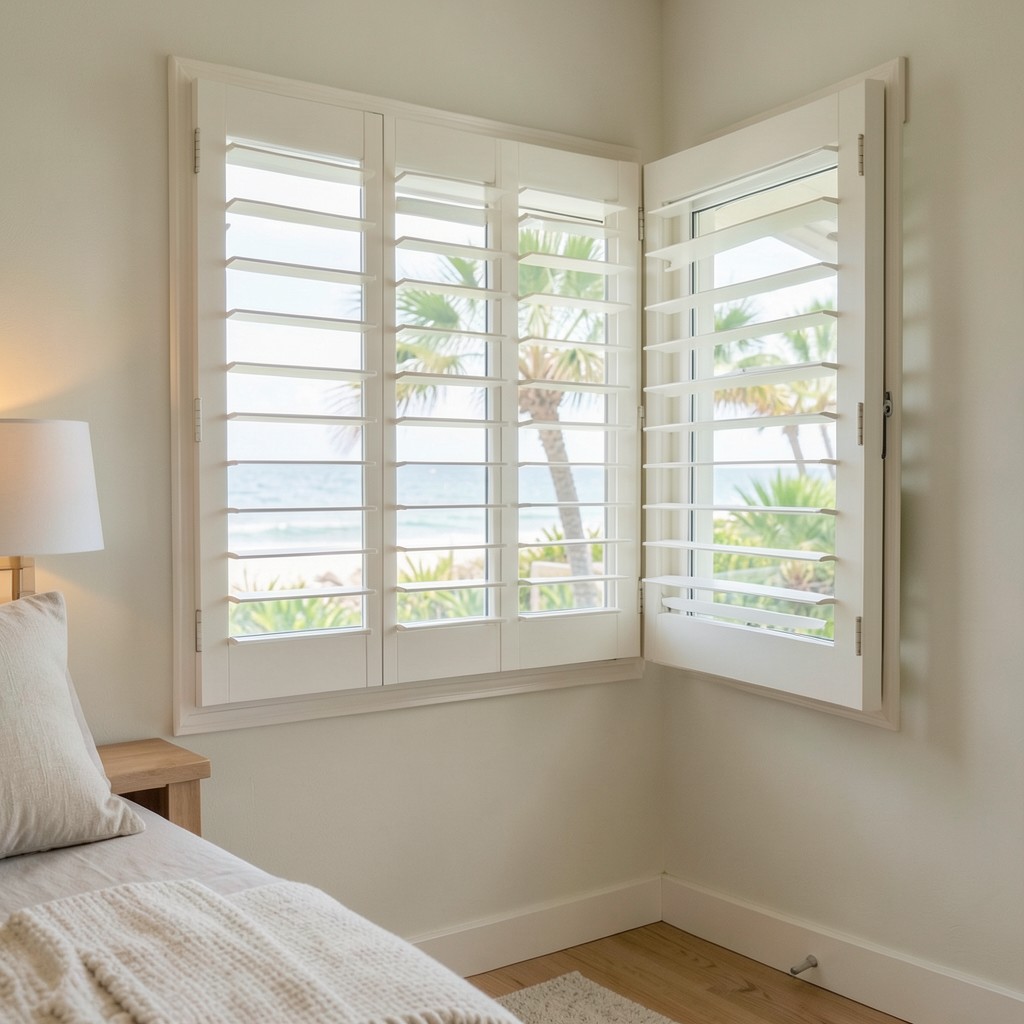
The plantation shutter is the coastal home design window treatment that the Caribbean, the Australian beach house, and the American Gulf Coast residential traditions all apply as the most regionally appropriate and the most functionally intelligent window management system for the hot, bright, sea-facing domestic environment. The wide horizontal louver of the plantation shutter creates the privacy, the light management, and the ventilation control in the single adjustable element whose louver angle manages the trade-off between the breeze, the view, the light, and the privacy with the precision that no curtain or roller blind provides.
A plantation shutter in a painted white or a warm cream — the louver width between sixty-three and eighty-nine millimeters creating the coastal room’s window treatment in the wide-blade format whose scale suits the generous window openings of the beach house’s wall-to-wall glazing — creates the coastal bedroom or living room’s window management system in the material combination whose painted surface, adjustable louver, and fold-back panel operation suit the coastal interior’s daily cycle of morning opening, afternoon privacy, and evening ventilation management. Breezy home interiors whose design language is defined by the natural material, the pale palette, and the indoor-outdoor flow of the coastal lifestyle receive the plantation shutter as the window treatment whose adjustable louver creates the precise indoor-outdoor control that the lifestyle’s specific daily rhythm requires. The plantation shutter’s fold-back panel operation — the shutters folding fully back against the window’s side reveals to create the completely open aperture when the full breeze and the full view are the priority — creates the window treatment whose open and closed positions are both designed rather than the curtain’s partially-drawn compromise that neither fully opens nor fully closes the window’s complete aperture.
The plantation shutter’s timber or MDF specification determines its maintenance requirement in the coastal environment — the genuine hardwood timber shutter in a marine-grade paint provides the durability that the salt air and the coastal humidity demand from the window treatment’s material in this specific environmental condition, and the MDF shutter whose material absorbs moisture in the high-humidity coastal setting creates the swelling and the paint failure that the timber or the aluminium shutter prevents.
19. A Window With a Velvet Curtain in a Cozy Winter Bedroom

The velvet curtain at the winter bedroom window is the textile whose material quality most specifically communicates the winter interior design direction’s most intimate domestic intention — the pile’s depth and the color’s saturation create the curtain surface of maximum tactile warmth and maximum visual richness at the window’s primary textile layer, and the winter bedroom whose velvet curtains are drawn at dusk creates the enclosed, warm, specifically seasonal atmosphere that no other curtain material generates from the same gesture. The velvet curtain is winter domesticity expressed through fiber.
A full-height velvet curtain in a deep jewel tone — the emerald, the sapphire, the deep plum, or the midnight navy that the velvet’s pile depth carries with the color richness that flat-woven fabrics cannot approach — creates the winter bedroom’s window treatment in a material whose thermal quality as a draught excluder at the window aperture supplements its atmospheric contribution to the room’s winter character. Winter home decor bedrooms with velvet curtains create the most complete and the most specifically seasonal window treatment of any bedroom style — the heavy fabric’s weight creating the sweep of the drawn curtain across the window’s full width, the pile’s directional color variation creating the shifting tone of the velvet surface as the curtain moves from the parted to the drawn position, and the amber bedside lamp creating the warm light on the velvet’s rich color that the winter bedroom’s most atmospherically specific evening moment requires. The velvet curtain’s weight requires the curtain rod’s structural specification to be appropriate for the textile’s mass — the wall-mounted bracket spacing and the rod’s diameter calibrated for the velvet’s gram-per-meter weight rather than the lightweight voile or the linen panel whose lighter weight the standard bracket specification accommodates without the sagging that the heavy velvet creates in the under-specified rod and bracket system.
The velvet curtain’s care requires the dry cleaning that the pile’s sensitivity to water-based cleaning creates as the maintenance standard — the velvet pile that is wetted and compressed in the machine-wash process creates the permanent pile distortion that the dry-clean process prevents, and the winter bedroom’s primary atmospheric textile deserves the care that its quality demands.
20. A Window With Woven Bamboo Blinds in a Tropical Room

The woven bamboo blind is the tropical home design window’s most material-specific and most regionally honest treatment — the natural bamboo strip woven into the blind’s surface creates the window treatment whose material origin in the tropical plant species communicates the room’s geographic design reference at the most direct material level. The bamboo blind filters the tropical light through the natural fiber’s open weave, creating the dappled, warm-toned quality of the light filtered through tropical foliage — the specific light experience of the equatorial interior at its most authentic and its most specifically atmospheric.
A woven bamboo roller blind or panel blind — the natural bamboo strip’s warm honey color creating the window treatment’s primary material tone — creates the tropical bedroom or living room’s window management system in the material that belongs to the bamboo home interiors design direction’s most specifically plant-derived material world. Jungle-inspired home decor rooms with woven bamboo blinds — the plant collection visible through the slightly open weave of the drawn blind, the tropical light filtered through the fiber’s natural texture creating the indoor garden light quality of the greenhouse or the tropical pavilion — create the indoor environment of most immersive botanical atmosphere whose window treatment is the specific link between the botanical room’s interior material palette and the tropical light quality outside. The bamboo blind’s woven structure creates the light-filtering quality that varies with the blind’s deployment — the fully lowered blind creating the diffused, warm-toned light of the filtered weave; the partially raised blind creating the combination of the filtered zone below and the direct light zone above — and the bamboo blind’s management of the tropical room’s light requires the same active daily attention to the louver angle that the plantation shutter applies in its own material vocabulary.
The bamboo blind’s maintenance in a humid tropical environment — the mold risk that the natural fiber creates in the consistently high humidity of the tropical or subtropical interior — requires the periodic drying of the blind in direct sunlight to prevent the mold growth that the stored-in-rolled-up-position bamboo blind develops in the humid conditions that the natural fiber traps within the rolled layers. The household that rolls the bamboo blind loosely rather than tightly compressing it, and that allows air circulation around the stored blind, creates the mold-prevention practice that the material’s tropical environment maintenance requires.
21. A Greenhouse Window Extension in a Kitchen

The greenhouse window — the small glazed box that projects from the kitchen’s external wall at the window opening, its interior floor and shelves creating the miniature indoor garden space for the kitchen herb collection, the seedling propagation, and the small potted plants whose growing conditions the south or east-facing greenhouse window’s concentrated sunlight and its temperature-elevated interior provide — is the kitchen window design idea that most directly bridges the cooking activity’s relationship to fresh herbs and growing food and the kitchen’s limited interior space for their cultivation. The greenhouse window is the kitchen garden in a box.
A painted timber or aluminium greenhouse window extension — the projecting box with its sloped glass roof admitting the maximum sky light, its three glass sides creating the panoramic growing environment, and its interior shelving providing the tiered growing positions for the herb pots, the seedling trays, and the small decorative plants — creates the kitchen’s living garden window in the format whose combination of the growing function and the visual display creates the kitchen’s most animated and most seasonally changing design feature. Garden-inspired interiors kitchens apply the greenhouse window as the design element that most directly and most materially honestly expresses the kitchen’s connection to the growing food and the living plant world that the cooking activity draws from as its fundamental resource. Modern kitchen ideas that incorporate the greenhouse window alongside the herb garden’s fragrant plants — the basil, the rosemary, the thyme, the chives — create the kitchen whose most functional design feature is also its most sensory, most aromatic, and most visually alive.
The greenhouse window’s thermal management requires the attention that the glazed box’s solar gain and its potential heat loss both create in the kitchen’s thermal balance — the operable vents in the roof glass or the side panels create the summer ventilation that prevents the greenhouse window’s interior from overheating and cooking the plants whose growth it was designed to support, and the thermal break between the greenhouse box and the kitchen wall prevents the cold bridging that the glazed extension’s outdoor exposure would otherwise conduct into the kitchen’s interior.
22. A Window With Exposed Brick Reveals in an Industrial Loft

The exposed brick reveal is the window’s surrounding material treatment that the industrial loft applies as the most specifically authentic and the most architecturally honest frame for the window opening — the brick’s structural presence around the window opening, its color and texture visible at the reveal’s internal face rather than plastered or tiled over, creates the window surround in the building’s original material and communicates the architectural honesty that the industrial interior’s design philosophy values as its most direct expression. The brick reveal makes the window look like it belongs to the building it is in. That is exactly what it does.
An industrial loft window with exposed brick reveals — the brick cleaned and sealed but left in its original color and texture, the window frame in a black steel or dark aluminium that creates the industrial material’s frame against the warm, reddish brick surround — creates the loft bedroom or living room’s window composition in the material relationship of the industrial aesthetic’s most characteristic and most spatially defining detail. Industrial home design interiors apply the exposed brick reveal as the window surround that most specifically anchors the contemporary residential use within the industrial building’s original architectural character, preventing the loft interior from reading as the standard apartment whose industrial aesthetic is applied as surface decoration rather than as the honest expression of the building’s actual material and construction heritage. Stone and wood home design loft interiors with exposed brick window reveals alongside timber flooring and raw steel windows create the complete industrial material palette at the window’s most architecturally specific element — the reveal’s brick communicating the building’s structure, the steel frame communicating the industrial window tradition, and the view beyond communicating the urban or post-industrial landscape that the loft’s location within it creates as the room’s most naturally industrial exterior.
The exposed brick reveal’s maintenance requires the periodic inspection of the brick’s condition and the mortar’s integrity at the reveal’s face — the interior brick surface, while protected from the worst of the weather, is still exposed to the moisture condensation that the window’s cold surface creates at the reveal’s internal face in winter conditions, and the joint that shows evidence of moisture penetration should be re-pointed before the moisture ingress creates the structural deterioration that the face-exposed mortar is most vulnerable to developing.
23. A Window With Roman Blinds and Sheer Curtains Layered
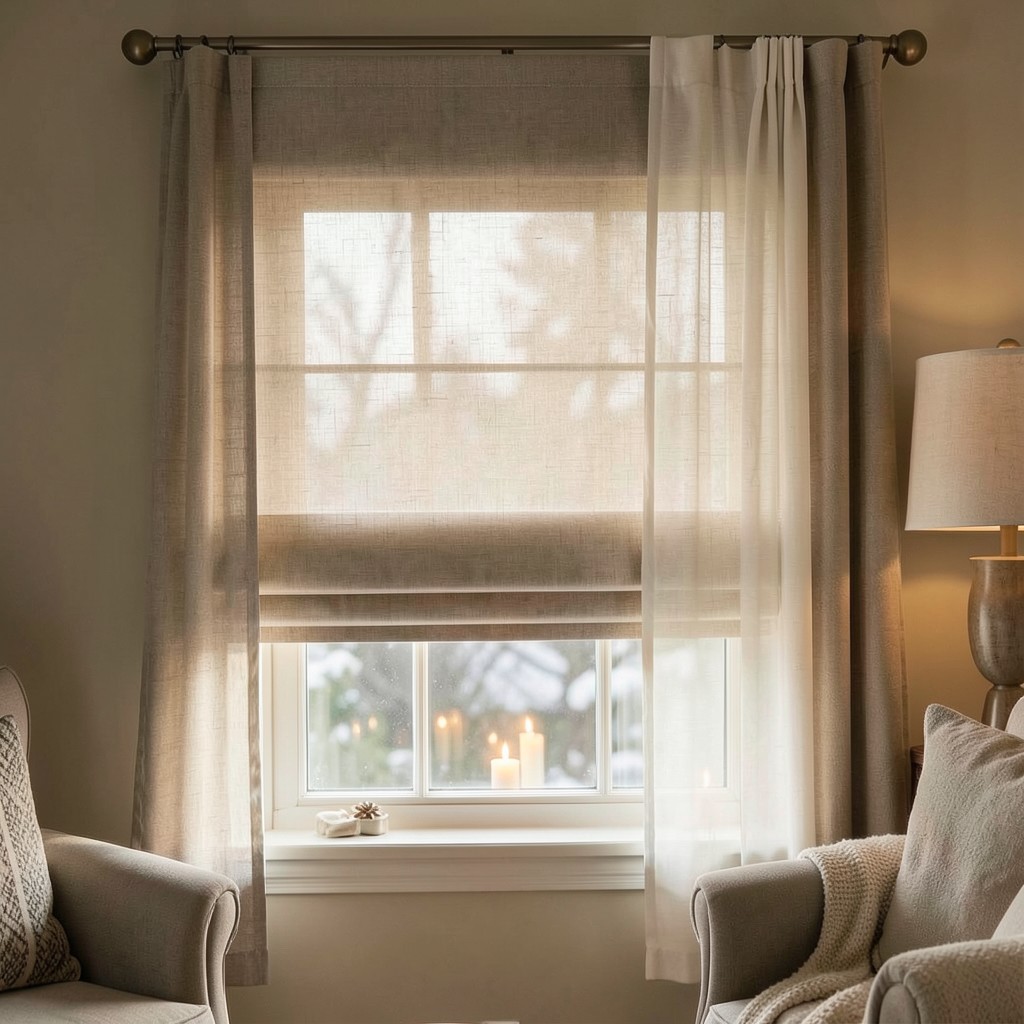
The layered window treatment — the Roman blind combined with a sheer curtain panel on the same window — creates the window’s light management system of maximum flexibility and maximum atmospheric range at the same aperture. The sheer alone creates the diffused light of the softened transparency; the Roman blind alone creates the private, textile-filtered enclosure; and the two together create the combination whose layering produces the intermediate light qualities that the single treatment cannot generate — the drawn blind behind the sheer creating the specific warm, multi-layered textile atmosphere that the living room or bedroom whose design values the layered, textile-rich window treatment applies as its most specifically atmospheric window expression.
A linen Roman blind in a warm neutral paired with a sheer voile or linen panel in a pale complementary tone — the sheer hanging in front of the blind on a separate track — creates the living room’s window treatment layer in the fabric combination whose individual components create the clean, composed textile quality that the layered arrangement requires rather than the pattern complexity that would create the visual competition between the two fabric surfaces. Warm home decor ideas living rooms apply the layered Roman blind and sheer combination as the window treatment that creates the most generous textile presence and the most controllable light management of any non-motorized treatment system — the sheer alone for the summer morning’s diffused light, the Roman blind lowered over the sheer for the afternoon’s privacy, and the combination’s warm textile atmosphere for the evening’s drawn-blind domestic enclosure. Holiday home styling transforms the layered window treatment into the festive season’s most atmospheric domestic decorative element — the candlelight visible through the sheer’s translucent surface, the Roman blind in the season’s warm amber or deep winter green tone creating the layered warmth that the festive interior’s window treatment should communicate.
The layered window treatment’s track system requires the planning that the two separate operating mechanisms demand — the Roman blind’s track at the window’s outermost position and the sheer’s track at the innermost position, with sufficient clearance between the two to prevent the blind’s descent from catching the sheer’s fabric and creating the operational interference that the planning anticipates and prevents.
24. A Picture Window With a Window Ledge Garden

The window ledge garden — the external planting at the window sill’s depth, its container-grown plants creating the living frame for the window’s interior view — is the urban apartment’s most generous contribution to the city’s visual landscape and the apartment’s most personally expressive exterior decoration. The window ledge garden is the exterior room that the apartment without a garden creates at the building’s most visible and most accessible exterior surface, and its seasonal planting cycle creates the apartment’s most naturally changing and most atmospherically specific visual element from both the interior and the exterior perspectives.
A deep external window ledge with planted boxes in a terracotta or powder-coated steel container — the planting selected for the window’s aspect, its seasonal rotation creating the spring bulbs, the summer herbs and annuals, the autumn’s ornamental kale and late-season flowers, and the winter’s evergreen structure and berry — creates the apartment window’s living frame in the format that contributes to the street’s visual character as generously as it contributes to the apartment interior’s daily domestic visual quality. Spring home refresh applied to the window ledge garden — the bulbs planted in the autumn beginning their emergence in the late winter, the tulips and the narcissus creating the window’s first seasonal color against the building’s external face, and the interior view of the garden window framing the spring planting against the street or the garden beyond — creates the apartment’s most specifically seasonal and most externally communicative domestic gesture. Summer home design window ledge gardens with the basil, the trailing geranium, and the tumbling petunia create the building’s most animated exterior at the height of the growing season, the window’s external planting communicating the household’s engagement with the living plant world to the neighborhood as clearly as the internal design communicates it to the household itself.
The window ledge garden’s watering management is the practical commitment that the external planting requires daily in the summer’s heat — the container’s limited soil volume dries rapidly in the sun and wind, and the planted boxes whose watering was neglected for even two or three hot days in the summer can lose the annual plants whose root system the small container volume supports with insufficient moisture reserve. The self-watering planter whose reservoir provides the passive moisture supply for the plant’s daily requirement creates the window ledge garden’s most practical irrigation solution for the household whose summer schedule creates the daily watering consistency challenge.
25. A Window With a Motorized Blind for a Smart Home

The motorized blind is the contemporary home’s window treatment whose operational convenience the standard pull-cord, wand-operated, or chain-operated blind creates as the comparison point — the motorized mechanism whose operation is the press of a button, the voice command, or the smartphone app creates the window treatment’s operation as the domestic gesture rather than the manual task, and the large window or the high window whose standard operating mechanism requires the physical reach or the awkward angle that the motorized alternative eliminates becomes the window treatment experience of genuine quality improvement.
A motorized roller blind or motorized Roman blind — the tubular electric motor within the roller tube’s body, its remote control operation or its smart home integration creating the blind’s deployment and retraction from any position in the room — creates the contemporary home’s window treatment in the operational format whose convenience the large, high, or awkwardly positioned window most specifically requires. The motorized blind’s smart home integration — the sunrise program that gradually raises the bedroom blind to wake the occupant with natural light rather than an alarm’s sound, and the sunset program that lowers the living room blind as the evening’s privacy requirement begins — creates the window treatment whose operation intelligence serves the household’s daily rhythm without requiring the conscious daily management that the manual blind’s operation demands. Contemporary home ideas smart homes apply the motorized blind as the window treatment whose automation completes the home’s broader environmental control system, creating the window’s light, privacy, and thermal management as the automatically managed domestic infrastructure rather than the twice-daily manual gesture.
The motorized blind’s power source requires the planning that the installation position and the building’s electrical infrastructure create as the practical constraint — the hardwired motor creates the most reliable power connection but requires the electrician’s installation at the window’s position before the wall finishes are applied; the battery-powered motor creates the retrofittable installation whose battery replacement cycle is the ongoing maintenance requirement in exchange for the installation flexibility that the hardwired motor cannot provide.
26. A Window With a Window Film for Privacy in an Urban Home
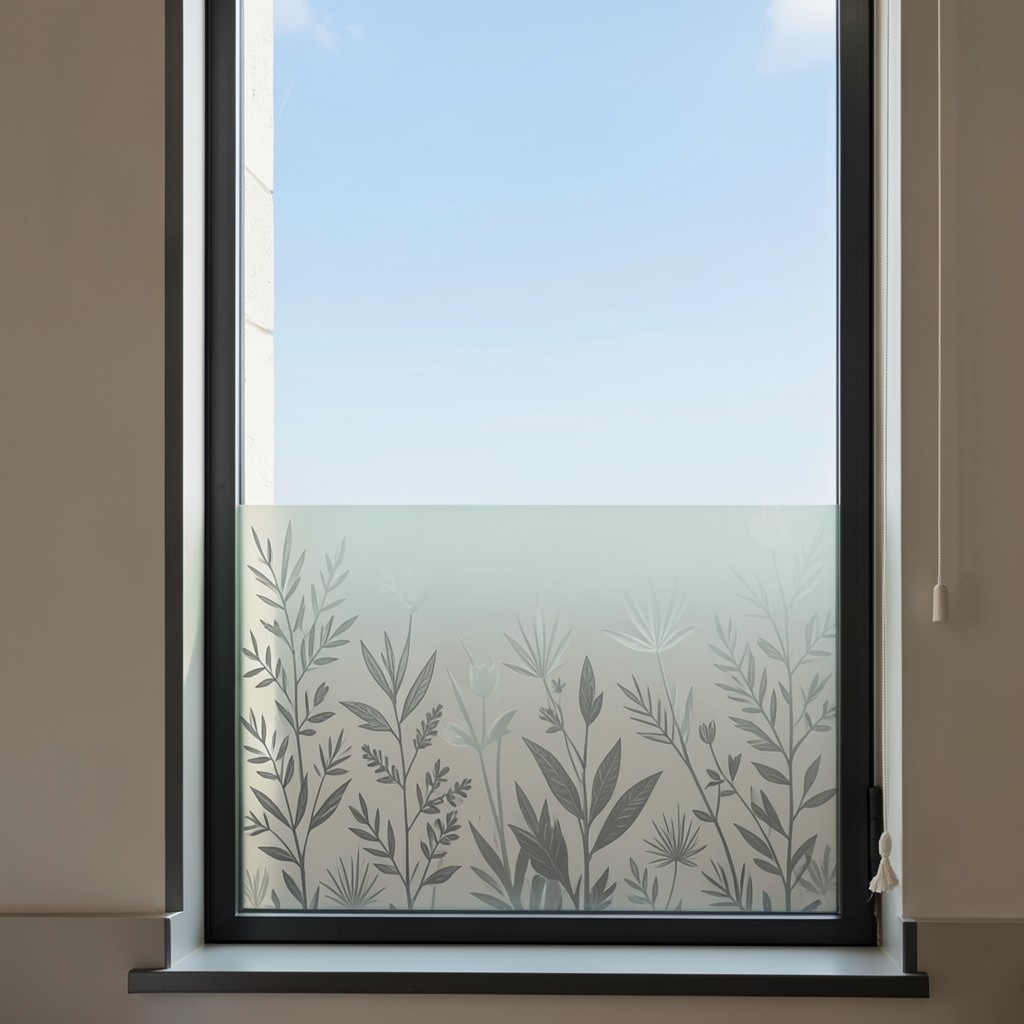
Window film is the urban apartment’s most practical and least glamorous window design solution, and its lack of glamour should not obscure its genuine design intelligence. The privacy film applied to the lower zone of the street-facing window — the film’s coverage calibrated to the height at which the standing pedestrian’s eye level creates the overlooking risk, leaving the upper portion of the glass clear for the sky view — creates the privacy management that the net curtain provided in the previous generation’s domestic privacy vocabulary but without the net curtain’s dated aesthetic and its light-diffusing obstruction of the entire glass area.
A frosted or etched-pattern window film in a botanical, geometric, or gradient design — the film applied to the lower zone of the urban living room or bedroom window — creates the privacy solution in the format that simultaneously adds decorative quality to the glass surface. The etched botanical pattern creates the garden-inspired interiors direction’s window treatment in the privacy specification that adds organic visual interest to the glass surface rather than simply obscuring it. Earthy home design urban apartments apply the gradient window film — the film transitioning from the fully opaque lower edge to the completely clear upper zone — as the privacy treatment whose gradual opacity transition is the most visually resolved of all the film specifications, creating the composed, designed quality of the privacy management at the window’s lower zone without the hard visual boundary that the standard film’s uniform-opacity application creates.
The window film’s self-installation quality is the practical consideration that determines the film’s visual success — the air bubble-free application that the film’s installation requires is the step that most self-installations fail at, creating the trapped air distortion that the film was applied to prevent from being the most visually distracting element of the window rather than the resolved privacy solution. The professional film installation whose expertise creates the smooth, bubble-free application is the investment whose modest additional cost is repaid immediately in the quality of the window surface it creates.
27. A Sash Window With Original Timber Frames in a Period Home

The sash window is the period house’s most architecturally specific and most technically specific window element — the sliding lower sash’s vertical movement within the outer frame, the counterbalance weights concealed within the frame’s box section creating the frictionless operation whose balanced mechanism has been standard in the British and American residential building tradition since the late seventeenth century. The sash window works because of the physics of the counterbalance. It is one of the most elegantly engineered domestic architectural elements in the residential building vocabulary.
A restored original timber sash window — the box frame repaired, the sash cords replaced, the glazing bars in the original profile, and the painted finish in the period’s appropriate color — creates the period house’s window in the form that the building’s original architecture specifies as the most historically authentic and the most architecturally coherent window type for the opening. Traditional home interiors period houses whose original sash windows have been preserved and restored rather than replaced with the modern equivalent have the window quality whose specific material character — the slight imperfection of the original handmade glass, the paint layer’s depth, the timber’s dimensional stability over generations — communicates the building’s age and its material continuity with a specificity that the replacement window cannot replicate regardless of its profile accuracy. Winter interior design in the period sash window house requires the specific draught management that the sash’s operational clearances create — the draught-proofing brush seal applied to the sash’s meeting rail and the frame’s parting bead creates the thermal improvement that the original unstripped sash’s air infiltration consistently creates as the period house’s primary heat loss pathway.
The sash window’s acoustic performance — the original single-glazed sash’s sound insulation quality being the weakest of any window specification in the residential range — creates the urban period house’s most consistently frustrating environmental quality problem, and the secondary glazing applied to the room’s internal sash face creates the thermal and acoustic improvement that the listed building’s planning constraints prevent the double-glazed replacement sash from delivering through the permanent alteration route.
28. A Window With External Venetian Blinds for Solar Control

The external Venetian blind — the metal louvre blind mounted on the building’s exterior face rather than within the room — is the solar control solution that the south-facing room’s summer overheating problem requires at its most effective intervention point. The fundamental physics of solar control makes this clear: the solar energy intercepted before it enters the glass is infinitely more effective at preventing the room’s overheating than the solar energy absorbed after it has passed through the glass and converted to heat within the room. The external blind works with this physics. The internal blind fights against it.
An external aluminium Venetian blind in a powder-coated finish — the louvres in the fifty or eighty millimeter blade width, the motorized operation creating the precise louvre angle adjustment from within the room — creates the south or west-facing room’s solar control system at the building’s exterior face where the intervention is most thermally effective. The external blind’s louvre angle management creates the solar control precision that the fixed external overhang or the planted pergola cannot provide — the adjustable louvre admits the low winter sun’s warmth at the flat louvre angle while excluding the high summer sun at the steep louvre angle, creating the seasonal solar management that the fixed shading’s geometry cannot achieve. Desert home styling and summer home design rooms with large south-facing glazing apply the external Venetian blind as the primary thermal management tool whose effectiveness at the solar control function determines the room’s summer comfort quality more directly than any internal cooling system operating against the already-admitted solar gain.
The external blind’s structural specification must account for the wind loads that the exterior mounting position creates — the blind mounted on an exposed elevation in a location with significant wind exposure requires the motorized retraction program that automatically raises the blind when the wind sensor detects the speed that exceeds the blind’s structural design load, preventing the blade damage that the high wind creates in the extended external blind whose louvres the wind’s force bends beyond their designed rotation limit.
29. A Window With Colored Glass Frames in a Bohemian Home

The colored window frame is the bohemian home styling direction’s most architecturally assertive and most specifically personal window expression — the frame painted in a color whose saturation and specificity communicate the household’s design conviction at the building’s most permanent and most publicly visible surface. The colored frame is the house’s announcement. It declares the design’s priorities before the door is opened and the interior’s full palette is revealed.
A casement or sash window with an exterior frame painted in a deep terracotta, a vivid cobalt, or a warm mustard — the color selected for its relationship to the building’s masonry or render tone and to the garden planting that the window overlooks — creates the bohemian home exterior in the window treatment that communicates the design’s color confidence at the building’s most architecturally visible element. Bohemian home styling interiors whose window frames are in the colored paint that the exterior establishes bring the color’s character into the room’s interior face — the internal window frame in the same colored paint creates the window surround as a designed color element within the room’s palette rather than the standard white or off-white that treats the frame as the background for the glass and the view beyond. Fall home decorating seasons bring the colored window frame to its most atmospheric seasonal quality — the deep terracotta frame against the autumn garden’s palette of golds and rusts, or the cobalt frame against the fall sky’s intensified blue, creating the exterior composition whose seasonal color relationship communicates the design’s awareness of the window’s role in the building’s engagement with its seasonal landscape.
The colored frame’s paint specification for the exterior surface requires the exterior-grade alkyd or acrylic formulation whose UV resistance and weather tolerance maintains the color’s saturation through the seasons’ weathering cycle — the cheap exterior paint whose pigment fades within one season creates the dull, degraded version of the chosen color that communicates the opposite of the design’s original conviction, and the quality paint specification is the color decision’s most important practical component.
30. A Window With a Reclaimed Timber Frame in a Rustic Room

The reclaimed timber window frame is the rustic home decor direction’s most materially specific and most authentically aged window element — the frame built from the salvaged oak, elm, or pine whose previous life as a barn’s structural timber, a mill’s floor board, or a farmhouse’s beam has created the specific nail holes, the saw marks, the surface weathering, and the color depth that the new timber’s manufactured consistency cannot approach. The reclaimed timber frame is the window surround that carries its material biography in its surface, and the surface’s biography is the design’s most honest and most irreplaceable detail.
A window with a reclaimed oak or elm frame — the timber’s grey patina and the warm amber of the freshly worked interior revealing the wood’s previous life in the contrast of the weathered exterior and the worked interior surface — creates the rustic bedroom or living room’s window in the material whose age and character communicate the design’s conviction that the honest, used material is more beautiful than the pristine and new. Mountain cabin decor windows with reclaimed timber frames alongside the stone reveals of the thick cabin wall create the most materially complete and most regionally specific rustic window composition — the reclaimed timber’s age matching the stone wall’s age in the material honesty of the historic building that was constructed from what the local landscape and the local craftsman’s tradition provided. Rustic home office ideas rooms with reclaimed timber window frames alongside the hand-hewn beam and the wide-board timber floor create the complete rustic material palette whose window frame communicates the design’s material philosophy at the building’s most architecturally visible interior detail.
The reclaimed timber frame’s dimensional stability is the practical consideration that the salvaged material’s previous moisture history creates — the timber that has been exposed to the weather cycle of its previous use carries the dimensional movement memory of that exposure, and the joiner experienced in working with reclaimed material creates the frame whose joint tolerances accommodate the timber’s residual movement rather than the tight tolerances appropriate for the kiln-dried new timber whose moisture content is controlled and whose dimensional stability the seasoned reclaimed timber may not match precisely.
31. A Window With Curtains Hung From the Ceiling in a Tall Room

The ceiling-mounted curtain track is the tall-room window treatment decision that transforms the standard-height window into the floor-to-ceiling textile statement whose generous proportion communicates the room’s architectural confidence at the window wall’s full height. The curtain hung from the ceiling to the floor creates the window treatment that reads as architectural rather than domestic — the fabric plane from the ceiling’s maximum height to the floor’s level creates the wall of textile whose proportion belongs to the room’s full vertical dimension rather than the window’s opening-limited height.
A linen or velvet curtain hung from a ceiling-mounted track — the fabric in the full-height panel that spans from the ceiling to the floor with the generous pool or the precisely leveled hem that the specific design direction requires — creates the living room or bedroom’s window wall in the textile treatment whose proportion is the most spatially generous and the most architecturally considered of any curtain mounting position. Elegant home styling tall-ceilinged reception rooms apply the ceiling-mounted curtain as the window treatment that most specifically honors the room’s architectural generosity — the curtain’s height matching the ceiling height creates the textile scale whose relationship to the room’s volume communicates the design’s understanding of proportion as the primary quality of the elegantly styled interior. The ceiling-mounted track’s installation requires the structural consideration that the track’s weight — the combined load of the track hardware and the full-height fabric — places on the ceiling’s mounting surface, and the fixing specification should be calibrated for the fabric weight and the track length rather than the standard ceiling hook whose load rating the heavy velvet or lined curtain panel’s mass frequently exceeds.
The visual effect of the ceiling-hung curtain on the window’s perceived height is the spatial bonus that the treatment’s generous proportion creates alongside its atmospheric quality — the fabric panel rising from the floor to the ceiling above the window’s actual head creates the apparent window height of the full room height, and the room whose window is standard height but whose curtain is full ceiling height appears to have the tall window that the ceiling-mounted treatment implies.
32. A Window With a Built-In Desk Beneath It in a Home Office

The window desk is the home office design idea whose spatial intelligence is its most underutilized quality — the desk built beneath the window’s sill creates the workspace in the room’s most naturally lit position, delivers the desk’s work surface the constant replenishment of the natural light that the task requires, and provides the desk occupant the view and the visual rest that the focus-recovery function of the distant gaze through the window creates in the cognitive cycle of concentrated work. The window is the home office’s most productive workspace asset. The desk placed beneath it makes that asset functional.
A built-in desk at the window’s sill height — the desk surface in a timber or lacquered finish matching the room’s material palette, the width spanning the full window opening with overhanging depth extensions into the room on each side — creates the home office’s primary workspace in the room’s most light-generous position. Rustic home office ideas with a built-in timber desk beneath the casement window — the view of the garden or the landscape beyond the glass providing the visual rest that the desk’s intensive work periods require, and the natural light falling across the desk surface from the window overhead — creates the home office of most specific and most genuinely productive spatial quality. The window desk’s monitor position requires the planning that the natural light’s direction creates as the primary ergonomic consideration — the monitor positioned between the desk occupant and the window creates the silhouette condition whose screen contrast the backlit position destroys; the monitor positioned to the window’s side creates the even ambient light whose diffused quality the screen viewing requires without the direct glare the window-facing position generates.
The built-in desk’s cable management — the conduit within the desk structure routing the power and data cables from the wall socket to the desk surface’s cable access point — creates the workspace’s organizational infrastructure whose planning at the build stage prevents the cable accumulation that the retrofitted desk surface’s exposed cabling creates as the home office’s most consistently untidy visual element.
33. A Window With an Opaque Lower Panel and Clear Upper Glass

The split-glazed window — the lower pane in a frosted or opaque specification and the upper pane in the clear glass — is the privacy management solution that the street-level or overlooked room requires in the format that creates the maximum natural light admission alongside the complete privacy at the eye level of the room’s seated and standing occupants. The opaque lower zone prevents the view in from the street’s standing pedestrian position while the clear upper zone admits the sky’s full light quality and the upper landscape’s view without obstruction. Both functions served. Neither compromised.
A timber or aluminium window with the lower third in an acid-etched or sand-blasted opaque glass and the upper two-thirds in the clear double-glazed unit — the horizontal division between the two glazing types at the approximate height of the standing pedestrian’s eye level from the exterior — creates the privacy window in the format whose design intelligence is most specifically calibrated for the overlooking condition it addresses. Scandinavian home interior ground-floor rooms apply the split-glazed window as the privacy solution that maintains the interior’s characteristic connection to natural light and the exterior landscape while managing the street-level privacy that the Nordic residential tradition values as the domestic interior’s primary boundary condition. The split glazing’s horizontal division can be accentuated as a designed element through the frame’s profile — the horizontal glazing bar at the division point creating the architectural line that reads as a designed composition rather than the invisible junction between the two glazing types that the frameless joint creates.
The split-glazed window’s pattern or etching design on the opaque lower zone is the design decision that transforms the privacy specification into the window’s decorative quality — the plain acid-etched surface creates the functional privacy in the minimal, undecorated format; the etched botanical or geometric pattern creates the privacy in the decorative format whose surface quality adds the design interest that the clear upper glass’s simplicity and the plain opaque lower zone cannot provide from their surfaces alone.
34. A Window With a Reading Nook Created Beside It

The reading nook beside the window is the residential design idea that the household whose floor plan does not contain a bay window creates as the functional equivalent of the bay seat — the built-in bench or the upholstered day-bed positioned at right angles to the window’s plane, creating the seating position that receives the window’s side light at the angle that illuminates the book’s page from the side without the direct glare that the window-facing position creates. The side light is the reader’s light. The reading nook positions the body to receive it.
A built-in bench seat or day-bed at the window’s side — the seat’s length running parallel to the wall, the window’s glazing creating the lateral light source at the seat’s side, and the shelving above and beside the seat creating the book storage that the reading nook’s function requires within the arm’s reach of its primary activity — creates the bedroom or the study’s reading position in the room’s most specifically functional and most atmospherically personal spatial arrangement. Cozy home design reading nooks beside windows — the layered cushions, the wool throw, the small lamp positioned at the shelf above the seat for the evening’s light supplement, and the window’s natural light creating the daytime reading quality — create the domestic spatial moment of most concentrated personal pleasure in the home’s complete room inventory. Peaceful home decor bedrooms with a window reading nook apply the nook’s soft textile layering — the cushion colors, the throw’s material, and the small accessories on the adjacent shelf — as the room’s most personally expressive decorative composition, created for the single occupant’s daily pleasure rather than for the general room’s social presentation.
The reading nook’s bench height should be calibrated for the reading posture’s specific ergonomic requirements — the seat at the standard forty-five centimeter height with the cushion creating the sitting position whose back angle the wall or the cushioned backrest behind the bench supports at the comfortable reclined angle that the hours-long reading session requires from its furniture without the discomfort that the unsupported, upright sitting position creates for the same duration.
35. A Skylight Tunnel in a Dark Interior Room

The skylight tunnel — the tubular or rectangular light shaft that connects the roof-mounted glazing to the ceiling of the room below, channeling the sky’s natural light down through the building’s structure to the interior room whose position within the floor plan prevents a conventional window position — is the dark room’s most specific and most architecturally committed natural light solution. The tunnel brings the sky to the room that the sky cannot otherwise reach, and the room that was permanently dark before the tunnel’s installation becomes the room with the daylight quality that changes every hour as the sky above the roof changes.
A reflective-lined light tunnel — the tubular shaft’s interior surface in the highly reflective aluminium whose mirror quality transmits the incoming sky light through the tunnel’s length to the ceiling diffuser below with the minimum light loss that the reflective surface’s efficiency creates — creates the below-roof interior room’s natural light source in the format that the skylight’s direct roof position makes available to the rooms above but that the tunnel’s light-channeling technology extends to the rooms that the building structure places beyond the direct access to the sky. Minimalist home design interiors in single-story houses with dark central rooms — the bathroom, the kitchen, the hallway — apply the skylight tunnel as the natural light solution whose architectural integration requires no external visible addition beyond the small roof dome that the tunnel’s top lens creates at the building’s upper surface. The ceiling diffuser’s design — the flat white disc or the lens whose profile creates the diffused light quality at the room’s ceiling level — determines the tunnel’s light quality in the receiving room, and the high-transmission lens creates the maximum light output at the ceiling’s diffuser that the tunnel’s channeled light quality allows.
The skylight tunnel’s practical limitation is the direction of its light quality — the tunnel’s captured sky light is always the diffused ambient quality rather than the direct sunbeam, because the tunnel’s reflective walls diffuse the directional beam that the roof lens admits into the scattered, omnidirectional quality that the room below receives as the even, ambient natural light rather than the dramatic directional beam that the direct skylight creates in the room immediately below its glazed opening.
36. A Window With External Timber Louvers for Tropical Climate

The external timber louvre is the tropical residential window’s most materially honest and most climatically intelligent external shading solution — the horizontal timber blade mounted on the building’s exterior face at the window opening’s head, its fixed or adjustable angle intercepting the high-angle tropical sun before it reaches the glass while admitting the cross-ventilation that the tropical climate’s daily heat management requires. The timber louvre is the architecture of the tropical climate’s solar geometry made visible and functional at the building face.
A fixed timber louvre in a hardwood — the blade’s depth and spacing calculated for the sun’s altitude at the summer solstice to create the complete solar exclusion at the hottest season while admitting the lower winter sun’s warmth when the tropical climate’s dry season makes the solar gain desirable — creates the tropical home design window’s shading system in the material calibrated for the outdoor tropical environment’s humidity and UV exposure. Tropical home design and beach house interiors apply the external timber louvre as the window’s architectural shading element that communicates the building’s climate response at the facade’s most visible design layer — the louvre’s blade spacing, its depth, and its material creating the window’s architectural character as the designed response to the specific sun geometry of the tropical latitude. The louvre’s orientation relative to the sun’s path — the south-facing louvre in the southern hemisphere calculated for the sun’s northern arc, and the north-facing louvre in the northern hemisphere calculated for the sun’s southern arc — requires the precise shading geometry whose calculation is specific to the building’s latitude rather than the generic louvre depth specification that ignores the sun angle’s latitude variation.
The external timber louvre’s hardwood specification — the Kwila, the Teak, the Bangkirai, or the thermally modified timber whose dimensional stability and natural durability in the outdoor tropical exposure provides the service life that the external shading application demands — creates the louvre’s long-term material performance in the most demanding outdoor climate conditions that the residential window application encounters anywhere in the world’s climate range.
37. A Window With a Stained Concrete Sill in a Modern Interior
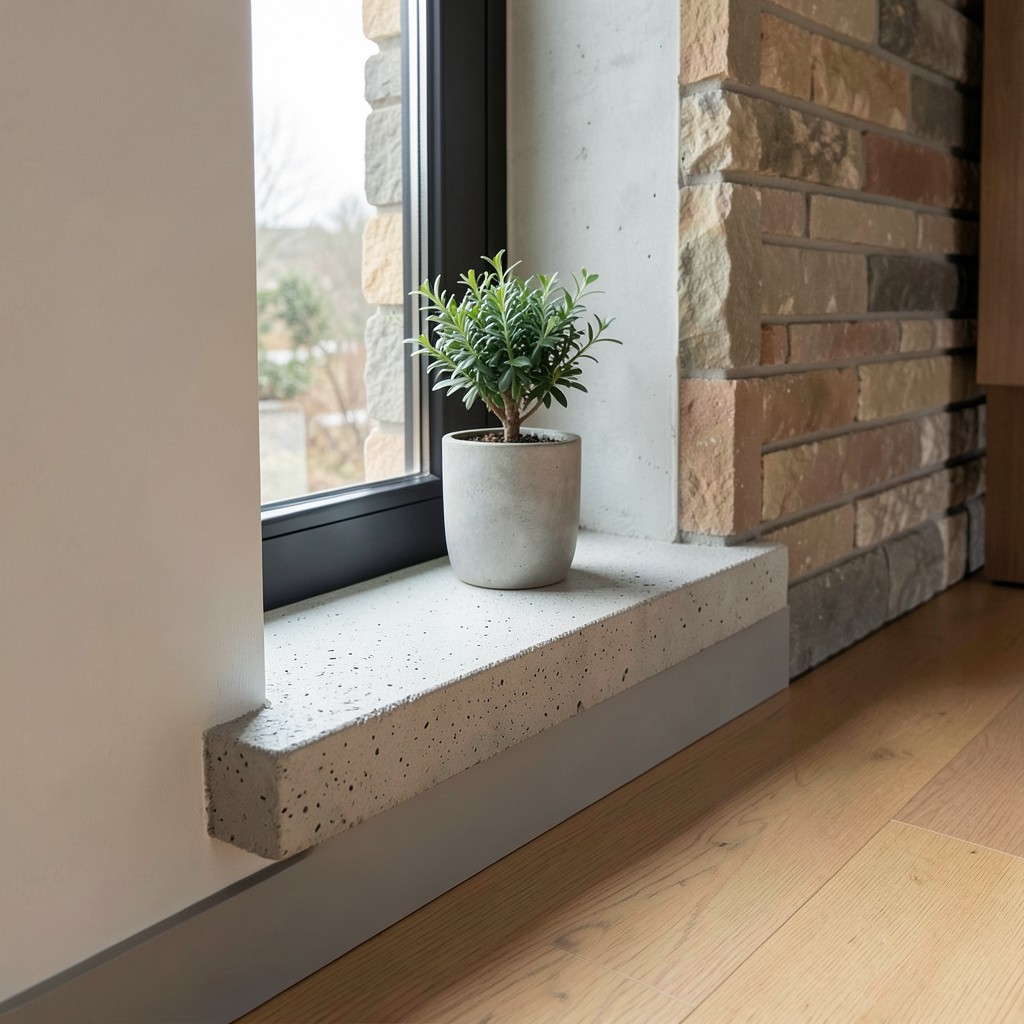
The concrete window sill is the detail that the modern interior applies at the window’s horizontal edge as the material counterpoint to the crisp, smooth wall surface — the raw or polished concrete sill’s aggregate texture and tonal variation creates the window’s base edge in the material whose honesty and specificity communicate the design’s engagement with the structural material at the architectural detail level. The concrete sill is not decoration. It is the structural material allowed to be itself at the window’s most tactile surface.
A poured or precast concrete window sill in a raw or lightly polished finish — the aggregate visible at the surface, the tonal variation of the concrete mix creating the sill’s material character — creates the modern or industrial home design window’s base edge in the material whose weight and permanence communicate the design’s conviction at the scale of the detail. The concrete sill’s depth — the sill’s front-to-back dimension creating the display shelf for the small plant pot, the candle, or the domestic object whose weight and material quality suits the concrete’s own material character — creates the window’s functional horizontal surface in the format calibrated for the objects whose placement on it communicates the household’s design sensibility most specifically. Stone and wood home design interiors apply the concrete sill alongside the natural timber floor and the raw brick or stone wall to create the complete material palette of the honest, structural material at every surface — the sill’s concrete contributing the third material in the stone, timber, and concrete combination that the industrial-organic design direction applies as its most specifically material-honest interior vocabulary.
The concrete sill’s polish level determines its practical maintenance quality — the polished concrete sill’s sealed surface resists the water marking and the staining that the raw concrete’s porous surface absorbs from the window condensation and the plant pot’s drainage water, and the penetrating sealer applied to the polished sill creates the moisture resistance that the raw concrete requires before the first winter season’s condensation cycle begins.
38. A Window With Curtains in a Bold Graphic Print

The bold graphic print curtain is the window treatment that the household with the design conviction to commit the room’s primary textile area to a specific pattern, color, and graphic scale applies when the room’s design direction values the textile’s decorative authority over the window treatment’s standard role as the background for the room’s other design elements. The graphic print curtain does not support the room’s other design elements. It leads them, and the room’s furniture, rugs, and accessories must find their position in relation to the curtain’s pattern rather than the other way around.
A full-height curtain in a large-scale geometric or botanical print — the pattern’s repeat scale calibrated for the curtain panel’s full height so that the complete pattern reads at the hanging length without the partial repeat that the undersized pattern creates at the curtain’s cut edge — creates the living room or bedroom’s window treatment in the format whose decorative authority is the room’s primary design statement. Bohemian home styling rooms apply the bold graphic print curtain as the window treatment whose pattern complexity and color richness contribute to the layered, maximally decorative domestic environment that the bohemian direction values as its most specifically personal expression. The graphic print curtain’s room context requires the restraint that the dominant textile’s presence demands — the plain sofa, the neutral rug, and the undecorated wall allowing the curtain’s pattern the visual space its graphic scale requires to be read and appreciated from the room’s seating positions rather than the visual competition of additional pattern that the maximally decorated room creates around the curtain.
The curtain’s pattern placement at the panel’s heading — the pattern centered on the panel or the pattern’s primary motif positioned at the eye level of the room’s standing position — requires the fabric’s cut calculation to align the pattern appropriately within the panel’s hung position, and the additional fabric quantity that the pattern matching and the placement optimization require should be included in the curtain’s fabric specification rather than discovered as the shortfall at the cutting stage.
39. A Window With a Pull-Down Privacy Screen in a Living Room

The pull-down privacy screen — the tensioned fabric panel that descends from the window’s head-mounted cassette to the sill position, creating the privacy barrier between the interior living space and the exterior view — is the urban living room’s functional response to the overlooked condition whose proximity to the street, the adjacent building, or the shared courtyard makes the evening’s unscreened interior visible from the exterior. The pull-down screen is the living room’s privacy curtain that does its job without announcing itself. It disappears into the cassette at the window’s head in the daytime, and it descends when privacy is needed. Quietly useful.
A day-and-night roller blind — the alternating sheer and blackout fabric bands whose position creates the combination of the sheer band’s diffused light quality and the blackout band’s complete opacity, the blind’s intermediate positions creating the balance of light and privacy whose specific ratio the band position manages — creates the living room’s privacy and light management in the single window treatment whose operation range spans the complete spectrum from the fully sheer to the fully opaque without the hardware complexity of the double-track curtain system. Contemporary home ideas urban living rooms apply the day-and-night blind as the privacy and light management system whose single operational mechanism creates the complete range of light and privacy conditions that the urban living room requires across the full cycle of the daily light management. The day-and-night blind’s operation requires the household member’s engagement with the precise band positioning — the correct alignment of the sheer and blackout bands at the specific height that creates the desired light and privacy ratio — and the blind whose mechanism creates the smooth, precise band control at every intermediate position delivers the light management quality that the imprecisely operating mechanism prevents.
The privacy screen’s fabric color in the daytime position — the blind fully raised to the cassette, the fabric visible at the window’s head — should be considered as the room’s visible textile element at the position where the eye naturally falls when looking at the window’s upper zone, and the fabric tone selected in relation to the room’s palette rather than ignored as the stored position’s invisible detail creates the composed window treatment whose quality is maintained at every position of its operational range.
40. A Circular Window in an Attic Bedroom

The circular window is the attic bedroom’s architectural accent element — the oculus cut through the gable wall, the dormer cheek, or the steeply pitched roof face creates the window whose form belongs to the historic building tradition of the porthole, the rose window, and the oculus that the circular form has occupied across the building tradition from the Pantheon’s open eye to the Victorian terrace’s attic ventilation disc. The circle in the rectangular wall is the architectural event. It announces itself with the confidence that only the form’s perfect geometry creates in the context of the straight line.
A painted timber or aluminium circular window — the fixed or opening glazed circle set within the gable or the dormer cheek, its diameter calibrated for the wall opening’s scale and the room’s natural light requirement — creates the attic bedroom’s architectural accent window in the form whose historic resonance and geometric perfection communicate the design’s awareness of the window form’s full architectural heritage. Cozy bedroom design attic rooms with circular gable windows create the bedroom of most specific and most atmospherically personal light quality — the circle’s frame creating the precise disc of sky visible from the bed position, the circular pool of light on the bedroom floor moving across the surface as the sun tracks the sky outside the gable, and the frame’s profile shadow on the wall creating the room’s most specifically architectural daily light event. The circular window’s curtain treatment — the Roman blind cut to the circle’s diameter and mounted within the frame, or the simple gathered curtain on the circular track — creates the privacy and light management solution for the form that the standard rectangular blind cannot address, and the circular blind’s bespoke specification is the practical investment that the architecturally specific form’s treatment demands.
The circular window’s structural requirement — the lintel or the structural ring beam that carries the wall’s load around the circular opening’s curved head — creates the additional structural cost that the circular form’s non-standard opening geometry incurs compared to the rectangular opening’s simpler head lintel, and the structural investment’s additional cost is the practical consideration that the architectural gain of the circular form should be weighed against in the design specification process.
41. A Window With an Integrated Herb Shelf Inside

The herb shelf window is the kitchen design idea that the gardening household whose outdoor garden is insufficient for the year-round fresh herb cultivation requires — the glass shelf mounted at the window’s interior face, between the glass and the kitchen space, creating the growing position that maximizes the natural light the kitchen window provides while keeping the herb collection within the arm’s reach of the cooking activity that uses it. The herb shelf is the kitchen garden at the window, and the window is the kitchen’s most light-generous position for the growing plant’s daily light requirement.
A glass shelf mounted on the kitchen window’s interior face — the shelf bracket fixed to the window’s side reveals, the glass shelf’s transparency preserving the full light quality for the plants arranged on it without the shadow that the opaque shelf creates for the plant positioned below — creates the kitchen window’s functional herb garden in the format whose minimal structural intrusion into the window’s aperture maintains the glass’s full light admission quality for the kitchen’s general illumination while maximizing the light available to the shelf’s plant collection. Garden-inspired interiors kitchens with herb shelf windows — the basil, the mint, the chive, and the thyme growing in small terracotta pots on the glass shelf, the window’s morning light creating the growing conditions whose daily light quality the herbs require for their genuine flavor development — create the kitchen of most directly connected and most specifically functional garden-to-plate relationship. The herb shelf’s glass thickness should be sufficient for the combined weight of the pots and the growing medium — the six millimeter tempered glass creates the structural security that the five-kilogram combined load of four or five herb pots requires from the shelf that the bracket system supports at the window’s reveal mounting points.
The herb shelf’s care — the watering of the herb pots on the shelf above the kitchen sink whose drain access the sink’s proximity creates, and the periodic wiping of the glass shelf’s surface whose condensation and soil deposit accumulation the glass’s horizontal position collects — creates the maintenance routine that the kitchen window’s most functional and most daily-used design feature requires.
42. A Window With a Japanese Shoji Blind

The shoji blind — the rice paper or washi-textured roller panel whose translucent surface creates the soft, diffused light quality of the Japanese paper screen at the window’s interior face — is the window treatment that the Japandi, Japanese, and minimalist bedroom applies as the most specific expression of the Eastern residential aesthetic’s relationship to the quality of natural light as the interior’s primary atmospheric material. The shoji blind does not manage the light. It transforms it, converting the direct beam of the natural exterior light into the soft, even, warm-toned glow of the paper’s translucent surface.
A washi-textured roller blind in a natural rice paper or a paper-effect polyester fabric — the panel’s deployment from the window’s head to the sill creating the soft, glowing light plane that replaces the window’s clear glass view with the paper screen’s luminous surface — creates the Japanese-influenced bedroom’s window treatment in the material whose atmospheric quality communicates the Eastern residential aesthetic’s most specifically philosophical relationship to the light-within-the-space rather than the light-entering-the-space that the clear window’s transparency provides. Peaceful home decor bedrooms with shoji blinds create the sleeping environment of the most specifically serene light quality — the morning’s diffused glow through the paper surface creating the gradual, gentle brightening that the clear window’s direct light beam cannot provide at the same atmospheric softness. The shoji blind’s privacy quality depends on the exterior light conditions — the daytime exterior whose brightness is greater than the interior creates the blind’s complete privacy from the outside; the nighttime interior whose artificial lighting is greater than the dark exterior reverses this condition, and the illuminated interior room behind the shoji blind is as visible from the dark exterior as the transparent glass would make it, requiring the additional privacy management that the shoji blind’s specific optical condition creates after dark.
The shoji blind’s material specification determines its light quality and its longevity — the genuine washi paper creates the most authentic atmospheric quality but requires the protective cassette and the careful operation that prevents the paper’s tearing; the polyester washi-effect fabric creates the same visual quality in a material whose durability in the daily roller operation provides the long-term performance that the paper’s fragility cannot match in the residential window treatment application.
43. A Window With Curtains That Pool on the Floor

The pooling curtain is the window treatment detail that most directly communicates the design’s intentional generosity — the curtain fabric that extends beyond the floor level and settles in the soft fold of the pool creates the window treatment of theatrical, deliberately abundant textile quality whose excess of length is the design’s most specific statement about the value of the luxurious over the precisely functional. The curtain that exactly reaches the floor is the workmanlike solution. The curtain that pools is the generous one.
A full-height linen, velvet, or heavy silk curtain with a floor pool of ten to twenty centimeters — the fabric settling in the soft, organic fold at the floor whose accumulation communicates the curtain’s weight and its material quality at the point where the textile meets the room’s floor surface — creates the bedroom or living room’s window treatment in the format whose textile abundance is the design statement. Luxury master bedroom design applies the pooling curtain as the window treatment of maximum textile generosity — the heavy silk or the velvet floor pool communicating the bedroom’s investment in the atmospheric quality of the textile environment that the luxury bedroom’s specification is built to create. The pooling curtain’s domestic practicality is the consideration that the design’s theatrical quality creates as its counterpoint — the floor pool collects the dust, the pet hair, and the floor debris that the housekeeping routine must address at the curtain’s base, and the household whose domestic discipline maintains the floor beneath the pool at the cleanliness standard that the light-toned fabric’s accumulated display requires is the household that the pooling curtain’s design suits in practical reality as well as in atmospheric aspiration.
The pooling curtain’s floor material relationship creates a design opportunity that the precisely hemmed curtain prevents — the heavy linen pool on the natural timber floor, the velvet pool on the stone-flagged floor, or the silk pool on the marble floor creates the specific material relationship between the hanging textile and the floor surface that the pooling detail places in contact, and that material dialogue between the curtain’s fiber and the floor’s material is the design detail that the attentive room notices and the photographs capture.
44. A Window With a Color-Blocked Frame in a Children’s Room

The color-blocked window frame in the children’s room is the design idea that applies the adult room’s design intelligence — the use of the architectural element’s painted surface to create the room’s color accent — at the child’s scale and with the child’s color preference at the center of the design decision. The window frame in the children’s room is the design element that the child interacts with at their own height, and the color applied to it belongs to the child’s visual world rather than to the adult’s design sensibility.
A children’s bedroom window with the frame painted in a bold, saturated color — the deep yellow, the coral, the sky blue, or the leaf green whose vibrancy communicates the child’s relationship to color at its most direct and most enthusiastic — creates the room’s color accent at the architectural element whose permanent presence on the wall creates the color statement without the flexibility of the cushion or the textile whose color can be changed with the child’s evolving preference. Bohemian kids room decor and bright home design children’s rooms apply the color-blocked window frame alongside the playful textile, the gallery wall, and the creative storage system to create the complete child’s bedroom of maximum color personality and maximum expressive generosity. The children’s room’s window frame color should be selected in dialogue with the child rather than for the child — the color whose selection the child participates in creates the room’s most personal design detail, and the child’s ownership of the color choice creates the relationship to the room’s design that the purely adult-specified space never achieves at the same level of personal investment and pride.
The frame’s paint specification for the children’s room must be a washable formulation — the child’s daily proximity to the window frame creates the fingerprint accumulation and the occasional crayon or marker mark that the standard paint’s surface cannot be cleaned without the paint surface’s degradation, and the washable paint’s hard, cleanable surface is the non-negotiable specification for any painted surface within the child’s reach in the residential interior.
45. A Window With a Hammered Glass Panel for Texture

The hammered glass window is the texture detail that the bathroom, the staircase landing, and the small decorative window apply when the clear glass’s transparency is neither required nor desired and the frosted glass’s plain opacity is insufficient in its visual interest. The hammered glass’s irregular surface creates the window whose texture catches and scatters the light across its surface in the specific, unpredictable pattern that the manufacturing process’s mechanical hammering creates at the glass’s surface — each panel unique, each light response specific to the texture’s depth and its relationship to the light’s current angle.
A hammered glass panel in a bathroom or staircase window — the glass’s textured surface creating the privacy of the obscure glass specification alongside the decorative quality of the light-scattering texture — creates the window in the material whose combined privacy and aesthetic functions serve the specific room’s requirements more completely than either the clear or the plain frosted glass. Farmhouse home decor bathrooms apply the hammered glass window as the period-appropriate obscured glass specification whose texture communicates the historic building tradition’s relationship to the decorative glass detail at a level that the modern acid-etched frosted glass cannot approach. The hammered glass’s light quality in the bathroom creates the most specifically atmospheric privacy glass effect of any obscure glass type — the scattered, dancing light pattern on the bathroom’s wall and floor surfaces when the exterior sunlight strikes the textured panel creating the effect whose quality no artificial lighting achieves at the same naturalistic specificity.
The hammered glass’s cleaning requirement — the textured surface’s depth creating the crevices that the standard glass cleaner’s surface application cannot reach with the same completeness as the flat glass surface — requires the periodic deep cleaning of the texture’s valleys whose accumulated soap deposit and water mineral deposit the surface cleaning routine does not address, and the diluted vinegar application with the soft brush creates the texture cleaning method whose action reaches the surface depth that the surface wipe cannot.
46. A Window With a Metal Window Box Planter

The window box planter is the residential exterior’s most universally loved detail and the most consistently under-designed — the plastic window box from the garden center, filled with the default petunia and geranium mix, planted without consideration for the window’s architectural character or the building’s material palette, creates the window box that most urban and suburban houses display as the habitual gesture toward the exterior’s seasonal color rather than as the designed element whose planter material, color, plant selection, and seasonal program are calibrated for the specific building and the specific window it serves.
A powder-coated steel or Corten steel window box — the metal’s material character communicating the window’s architectural register, the Corten’s warm rust patina developing over time in the same oxidation process that the natural material uses to protect itself — creates the window’s exterior planting vessel in the material that suits the building’s architectural character with the specific material honesty that the plastic box’s material language prevents. Industrial home design and contemporary home ideas buildings apply the Corten or the powder-coated steel window box as the exterior planting vessel whose material quality communicates the building’s material philosophy at the facade’s most intimate and most domestic detail scale. The window box’s planting should respond to the window’s aspect — the south-facing box with the sun-tolerant lavender, the trailing verbena, and the herbs; the north-facing box with the fern, the trailing ivy, and the shade-tolerant begonia whose growing conditions the low-light aspect creates rather than the sun-requiring plants whose failure in the shaded position communicates the planting decision’s insufficient attention to the growing conditions the specific window creates.
The window box planter’s fixing to the building should be engineered for the combined weight of the box, the growing medium, the plants, and the saturated water content that the medium holds after watering — the fixing that was adequate for the empty box’s weight frequently proves inadequate for the planted, watered box’s significantly greater mass, and the structural fixing whose load calculation includes the saturated-medium weight creates the mounting security that the planted window box’s long-term safety requires.
47. A Window With a Lantern Roof Extension in a Kitchen

The lantern roof window — the glazed structure that rises above the flat or low-pitch roof extension’s surface, its vertical sides creating the lateral window apertures through which the sky’s light enters the room from above and from the sides simultaneously — is the kitchen extension’s overhead light source of maximum atmospheric generosity and maximum architectural drama. The lantern transforms the roof plane from the light-blocking surface into the light-admitting structure, and the kitchen below the lantern roof receives the quality and the quantity of natural light that no standard wall window can provide in the same room.
A kitchen with a lantern roof extension — the flat-roof single-story extension’s roof plane punctuated by the lantern’s glazed structure, the light entering the kitchen from the lantern’s four sides creating the even, top-lit illumination that the south-facing glazing alone cannot provide — creates the kitchen extension in the architectural format that modern kitchen ideas and the contemporary home ideas kitchen renovation applies as the most effective single design intervention for the kitchen whose pre-extension plan created the dark, interior-facing room that the extension’s additional floor area only partially resolves without the overhead light quality that the lantern roof uniquely provides. The lantern roof’s glazed structure should be in the slim aluminium or steel frame whose profile minimizes the structural shadow that the frame casts on the kitchen’s surfaces below — the narrow frame creating the maximum glass area and the minimum shadow at the roof’s most light-critical position. Summer home design kitchens with lantern roof extensions reach the most atmospheric quality of the extended kitchen’s year — the full summer sky visible through the lantern’s glass, the afternoon’s warm light falling through the overhead glazing onto the kitchen’s material surfaces, and the ventilated summer heat rising through the lantern’s opening sections creating the natural stack ventilation that the summer kitchen most requires.
The lantern roof’s solar shading is the thermal management requirement that the summer sun’s high angle creates as the lantern’s primary practical challenge — the motorized internal blind or the external mesh applied to the lantern’s sloped glass panels creates the solar control that prevents the lantern from becoming the solar heat trap that the unshaded roof glazing’s summer performance creates in the kitchen below.
48. A Window With a Recessed Blind Housing

The recessed blind housing is the design detail that the window treatment’s architectural integration requires when the design’s ambition is the window whose blind disappears completely when not in use rather than the blind whose cassette is visible above the glass or whose roller is exposed at the window’s head. The recessed housing — the cavity created in the window reveal’s head, into which the blind’s cassette and roller retire when the blind is fully raised — creates the window treatment of most complete architectural integration, the glass aperture reading as the clean, unobstructed window opening when the blind is stored and only the material of the blind itself visible when the blind is deployed.
A plastered recess at the window’s head — the cavity whose dimensions accommodate the specific blind system’s cassette housing, the blind deploying from within the recess to the sill position and retiring to the recess in the fully raised position — creates the most architecturally resolved window treatment integration in the format that the minimalist home design direction requires at the window whose design philosophy values the uninterrupted architectural surface over the window treatment’s visible hardware. The recessed housing’s construction requires the planning at the building or renovation stage whose timing precedes the wall finishes — the recess is the structural and finishing detail that cannot be created as a retrofit without the significant disruption of the finished wall surface, and the window whose recessed housing was planned at the specification stage before the wall was plastered has the design quality that the retrospectively added cassette housing can never achieve at the same level of architectural resolution. Scandinavian hallway design and minimalist interiors whose window treatment philosophy values the hidden mechanism and the visible textile over the reverse specification receive the recessed housing as the window treatment’s architectural completion.
The blind’s service access within the recessed housing — the maintenance of the motor, the replacement of the spring mechanism, and the re-threading of the cord whose operational failure the recessed position makes inaccessible without the deliberate access provision — requires the planning at the design stage of the recess’s dimension whose additional depth beyond the cassette’s minimum housing dimension creates the access clearance that the maintenance operation requires.
49. A Window With a Timber Pergola Frame for Outdoor Connection

The pergola-framed window is the residential design idea that the indoor-outdoor connection-focused home applies to create the transition element between the interior window and the exterior garden structure — the timber pergola positioned immediately outside the window’s exterior face, its post-and-beam structure creating the framed outdoor room that the window looks into and that the opened window or the adjacent door accesses, creating the visual and physical connection between the interior and the exterior that the standard window-to-garden relationship provides at a distance but that the pergola-framed window creates at an immediate, intimate, and architecturally resolved proximity.
A timber pergola frame positioned at the window’s exterior — the structure’s posts flanking the window at the building’s face, the beams overhead creating the canopy that the climbing plant or the shade sail covers to create the sheltered outdoor position immediately accessible from the window — creates the coastal outdoor living space, the garden-inspired interiors connection, or the tropical home design outdoor room in the format whose architectural relationship to the window creates the most direct indoor-outdoor dialogue available in the residential design range. Coastal outdoor living space pergola-framed windows — the white-painted timber structure with the climbing rose or the wisteria creating the floral canopy above the outdoor room that the window overlooks — creates the beach house interior’s most specifically romantic and most atmospherically generous view from the interior to the exterior. The pergola frame’s relationship to the window’s proportions should be designed rather than incidental — the pergola’s post spacing creating the outdoor room’s width in the relationship to the window’s width that frames the outdoor space as a composition from the interior viewing position.
The pergola’s climbing plant selection should acknowledge the plant’s mature scale relative to the window’s light requirement — the vigorous climbing rose or wisteria whose mature growth creates the dense canopy above the pergola reduces the interior window’s natural light admission significantly compared to the unplanted pergola’s open structure, and the balance between the atmospheric quality of the climbing plant’s flower and canopy and the window’s light admission requirement determines the plant selection that the pergola-framed window’s design can support without the light sacrifice that the dense canopy creates.
50. The Window That Defines Your Home’s Complete Identity

The window that defines a home’s complete identity is not the largest window, the most expensive glazing specification, or the architecturally most dramatic form. It is the window whose design was made in complete awareness of the specific room it serves, the specific light it admits, the specific view it frames, and the specific household member who stands before it daily and receives, through its glass, the specific quality of sky, garden, street, or landscape that the window’s position in the building creates as its permanent, daily, light-filled gift. That window — designed with that completeness of understanding — is the most important window in the house.
Every design decision made at the window is a decision about how your home relates to the world outside it — not just the light management or the privacy balance or the thermal performance, but the daily quality of the experience of being in the room, at the window, receiving what the world outside is offering that morning or that evening. The window that was designed to serve that daily experience is the window that makes the room genuinely better to inhabit rather than merely more photographically presentable. The distinction matters, because photography visits once and you inhabit the room every day for as long as the house is yours.
Start with the view that the window’s position creates, and ask what the window’s form, material, and treatment can do to make the daily encounter with that view — the morning light across the garden, the winter sky above the rooftops, the summer garden framed in the kitchen’s casement — as generous, as resolved, and as specifically atmospheric as the room’s design intelligence, the building’s structural possibilities, and the household’s actual daily life all together allow. Design the window to that standard, and the room will reward every morning’s opening of the curtain with the specific quality of light and view and air and connection to the living world outside that the window was designed to provide.
Leave a Reply