Most people spend more time choosing the bed than they spend thinking about the wardrobe, and that is the bedroom planning error that costs the most to live with. The bed is slept in unconsciously. The wardrobe is engaged with twice daily, under time pressure, in the specific mood of the morning’s first waking moments and the evening’s final winding down — and the wardrobe that was not designed with the specific care those moments deserve creates the bedroom’s most consistently frustrating daily experience, regardless of how well every other element in the room was chosen. A poorly planned wardrobe makes a beautiful bedroom feel disorganized. A well-designed wardrobe makes even a modest bedroom feel genuinely considered.
The wardrobe is the bedroom’s largest and most permanent architectural element. It determines the room’s spatial balance, defines the wall’s visual character, and establishes the bedroom’s first impression from the doorway. The full-height built-in wardrobe spanning a wall’s complete width creates an entirely different bedroom than the freestanding double wardrobe positioned awkwardly between two windows because no one measured properly before purchasing. The difference between those two wardrobes is not just aesthetic — it is the difference between a bedroom that feels designed and a bedroom that feels assembled. One communicates intention. The other communicates compromise.
The wardrobe design conversation requires engagement with several dimensions simultaneously. There is the exterior form — the door style, the material, the color, the hardware, and the relationship of the wardrobe’s profile to the ceiling height and the room’s floor plan. There is the interior organization — the hanging rail configuration, the shelf layout, the drawer specification, the lighting quality, and the spatial allocation between the different clothing categories that the specific household member stores. There is the material logic — the painted MDF, the solid timber, the veneer panel, the mirrored door, or the rattan-faced frame that creates the wardrobe’s surface in relation to the bedroom’s complete material palette. And there is the fit — the built-in wardrobe that is made for the specific room’s dimensions versus the freestanding piece that occupies the room as a guest rather than as a resident.
The fifty wardrobe design ideas collected here address every one of these dimensions across the full range of bedroom styles, room sizes, aesthetic directions, and practical household requirements. The collection spans the luxury master bedroom design wardrobe with its island drawer unit and its chandelier overhead to the space-saving sliding door wardrobe of the compact apartment bedroom whose floor area cannot accommodate a swing door’s arc. The ideas include the open wardrobe system of the minimalist home design bedroom, the hand-painted wardrobe of the farmhouse home decor guest room, the bamboo-framed wardrobe of the tropical home design sanctuary, and the mirrored floor-to-ceiling wardrobe of the small room whose spatial strategy depends on the reflected wall. Every idea is a complete design direction with a material rationale, an aesthetic position, and a practical intelligence that serves the bedroom and the household it belongs to.
The wardrobe that works is not the most expensive wardrobe. It is the wardrobe that was designed for the specific room, the specific person, and the specific daily life that opens its doors twice a day, every day, for as long as the household remains in the bedroom it occupies. Design it that way, and every morning starts better than it did before.
1. A Full-Height Built-In Wardrobe in a White Painted Finish

The built-in wardrobe is the bedroom design decision that delivers the greatest single improvement to the room’s spatial quality and functional organization simultaneously, and the full-height version — doors extending from floor to ceiling without the gap above that standard height wardrobes create — provides both qualities at their maximum. The ceiling-height wardrobe eliminates the awkward space above a standard wardrobe that gathers dust, looks unresolved, and communicates a design that stopped short of the room’s architectural potential. Floor to ceiling is the complete version. Everything shorter is a compromise.
A white painted full-height built-in wardrobe creates the bedroom’s storage wall in the pale, recessive tone that allows the wall to read as architecture rather than as furniture — the continuous white surface from floor to ceiling creates the designed quality of a wall that has been considered, rather than a wall that has had furniture placed against it. The spring bedroom decor direction applies this wardrobe format as its most complete expression of the fresh, clean, architecturally resolved bedroom — the white doors creating the unencumbered wall surface whose simplicity allows the room’s other design elements to breathe against its pale backdrop. The door profile choice — the flush slab, the shaker recessed panel, or the grooved flat panel — creates the wardrobe’s design character within the white painted palette, and each profile communicates a different aesthetic register: the flush slab for the minimalist home design direction, the shaker for the farmhouse and transitional directions, and the grooved panel for the contemporary design sensibility that wants more surface interest than the plain slab provides without the period reference of the shaker profile.
The interior of the white built-in wardrobe should be organized in the layout calibrated for the specific bedroom occupant’s clothing composition — the ratio of hanging garments to folded items to shoes to accessories determines the shelf, rail, and drawer configuration that the interior should contain, and the wardrobe installer who builds a standard interior layout without consulting the household member’s actual wardrobe creates the built-in that is technically complete but functionally generic. Every day the occupant navigates around the interior’s inadequacies is a day the wardrobe’s potential goes unrealized, and the interior planning investment is the detail that separates the functional built-in from the merely installed one.
2. A Sliding Door Wardrobe for a Space-Conscious Bedroom
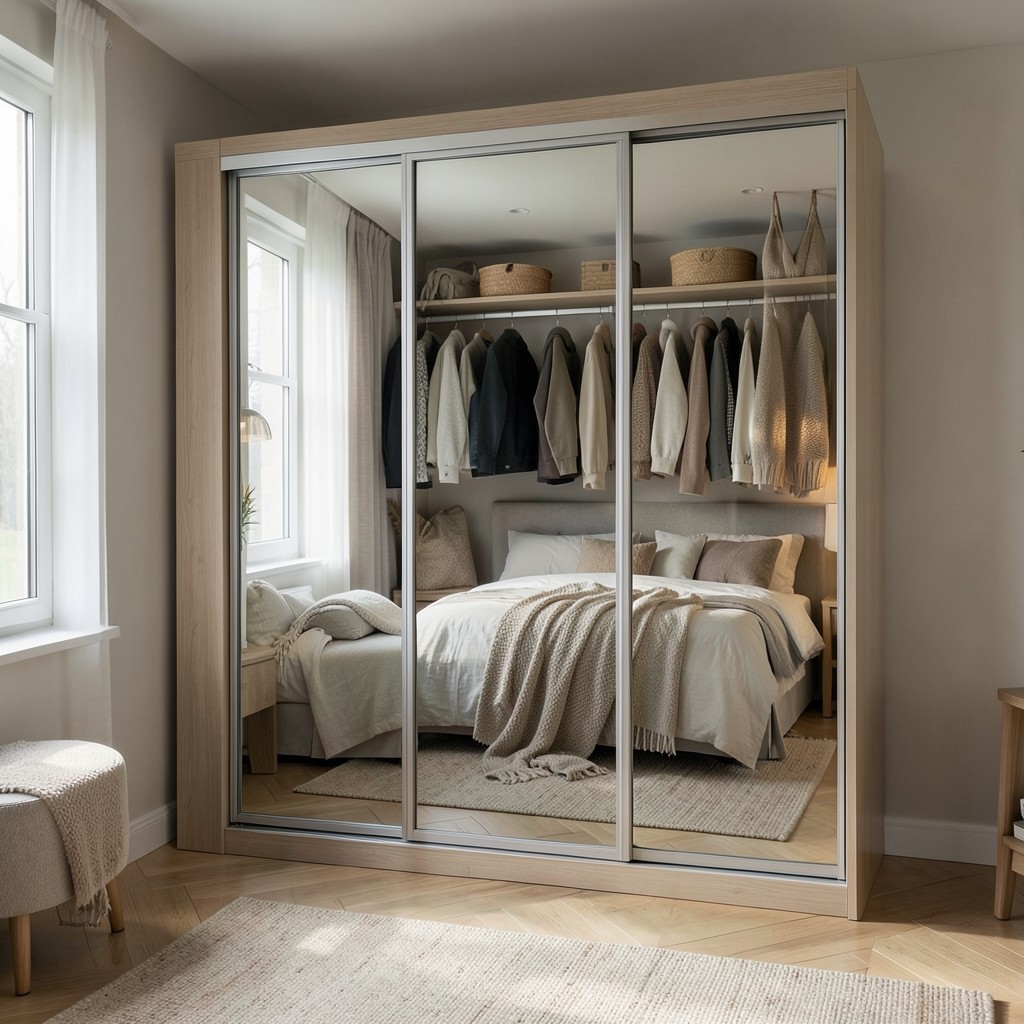
The sliding door wardrobe is the space-conscious bedroom’s non-negotiable solution to the swing door’s demand on floor area — a standard double swing door wardrobe requires the floor area in front of the wardrobe to remain clear of furniture, rugs, and foot traffic to accommodate the door’s arc as it opens, and in a bedroom whose floor plan is modest, that clearance requirement creates the spatial constraint that the sliding door’s zero-clearance operation entirely eliminates. The sliding door moves along its track parallel to the wardrobe face. The floor in front of it belongs to the room, not to the door’s trajectory.
A sliding door wardrobe in a mirrored panel specification creates two spatial strategies simultaneously — the sliding mechanism’s floor-area efficiency and the mirror’s spatial amplification, both working in the same direction to make the compact bedroom feel more generous than its measured dimensions suggest. Cozy bedroom design in a smaller bedroom applies the mirrored sliding wardrobe as the primary spatial tool whose daily functional quality and spatial contribution justify the format’s selection over any other wardrobe type for the room whose footprint is genuinely limited. The mirror panel’s reflection of the room’s window creates the natural light distribution that doubles the window’s apparent size from specific viewing angles, and in the bedroom whose natural light is limited by the window’s position or size, this reflected light quality is the wardrobe’s most atmospherically generous contribution to the room’s daily experience.
The sliding door wardrobe’s interior access is the practical consideration that the format’s spatial advantages should not overshadow — the sliding door that covers the full wardrobe width in two panels creates the interior access limitation where only half the wardrobe’s width is accessible at any time, requiring the occupant to slide one panel to reach the section behind. A three-panel sliding configuration on a wider wardrobe creates better interior access by allowing more of the wardrobe’s width to be open simultaneously, and the household whose daily wardrobe use involves accessing both left and right sections in the same dressing session should specify the three-panel format rather than accepting the two-panel configuration’s operational constraint.
3. A Dark Painted Wardrobe in a Moody Bedroom

Dark wardrobes are the bedroom design decision that the design-confident household makes when the room’s aesthetic direction prioritizes atmosphere over the pale, expansive quality that the white or light-toned wardrobe creates. The dark wardrobe does not make the bedroom feel smaller in the way that the conventional design advice warns — it makes the bedroom feel more intentional, more specific, and more dramatically atmospheric when the surrounding design elements are selected in genuine dialogue with the wardrobe’s dark tone rather than in spite of it. The room that makes the dark wardrobe work is the room that commits to the dark’s direction fully.
A forest green, midnight navy, or deep charcoal wardrobe — the paint finish in a matte or eggshell that prevents the surface from reading as glossy against the bedroom’s ambient light — creates the moody bedroom’s primary design statement in the piece whose scale at the bedroom wall dominates the room’s color composition. Winter home decor bedrooms whose design intention is the provision of maximum atmospheric warmth and enclosure apply the dark wardrobe as the design element that most efficiently creates the seasonal atmosphere — the dark surface absorbing the room’s warm lamp light rather than reflecting it, creating the enveloping quality that the winter interior design direction values as its most specifically domestic expression. The dark wardrobe’s hardware should be in a warm, contrasting metal — the antique brass or the unlacquered bronze whose warm tone prevents the dark surface from reading as cold — and its selection should be consistent with the bedroom’s other metallic elements to create the composed material palette that the dramatic wardrobe direction requires.
The dark wardrobe’s room context requires the light management that any dark-dominant design demands — adequate natural light entering the room during the day to prevent the dark wardrobe from creating the oppressive quality that dark furniture creates in light-deficient rooms, and warm artificial light in the evening from well-positioned bedside lamps and overhead fixtures that create the amber glow within which the dark wardrobe’s atmospheric quality is most fully and most beautifully expressed.
4. An Open Wardrobe System in a Minimalist Bedroom

The open wardrobe system — the exposed hanging rail, shelf, and drawer configuration that stores the bedroom’s clothing without the enclosure of a door — is the minimalist home design bedroom’s most honest storage expression and its most demanding lifestyle requirement simultaneously. The open wardrobe conceals nothing. The clothing visible from every position in the bedroom must be organized with the discipline of a boutique display rather than the pragmatic storage of a household closet, and the household that commits to the open wardrobe system is committing to a standard of daily organizational maintenance that most wardrobes’ closed doors conveniently exempt their occupants from.
An open wardrobe system in a natural oak or a powder-coated steel frame — the hanging rails, shelves, and drawer units organized in a considered composition against the bedroom wall — creates the minimalist bedroom’s storage element in a format whose honest visibility communicates the design’s core conviction. The clothing color editing that the open wardrobe system inspires — the household member who curates their wardrobe toward the tonal palette that reads well as a displayed collection rather than as an assembled accumulation of individual purchases — is the open wardrobe’s most unexpected design benefit, and the bedroom whose occupant has made those editorial choices has both a better-designed wardrobe and a better-considered personal wardrobe. Airy home interiors whose design language is defined by natural material, honest function, and the absence of unnecessary enclosure receive the open wardrobe system as the bedroom storage element whose design philosophy matches the room’s own.
The open wardrobe’s practical challenge in most bedrooms is the dust accumulation on the exposed clothing surfaces — the garments stored on open rails collect airborne dust at a rate that the enclosed wardrobe’s interior prevents, and the household member who wears formal clothing, delicate fabrics, or infrequently used garments should cover those specific items with garment bags within the open system rather than exposing them to the bedroom’s ambient dust environment. The open system works best for the daily-use wardrobe whose items are in regular rotation and whose wear frequency prevents the dust accumulation that stored, infrequently used garments exhibit.
5. A Mirrored Wardrobe in a Small Bedroom
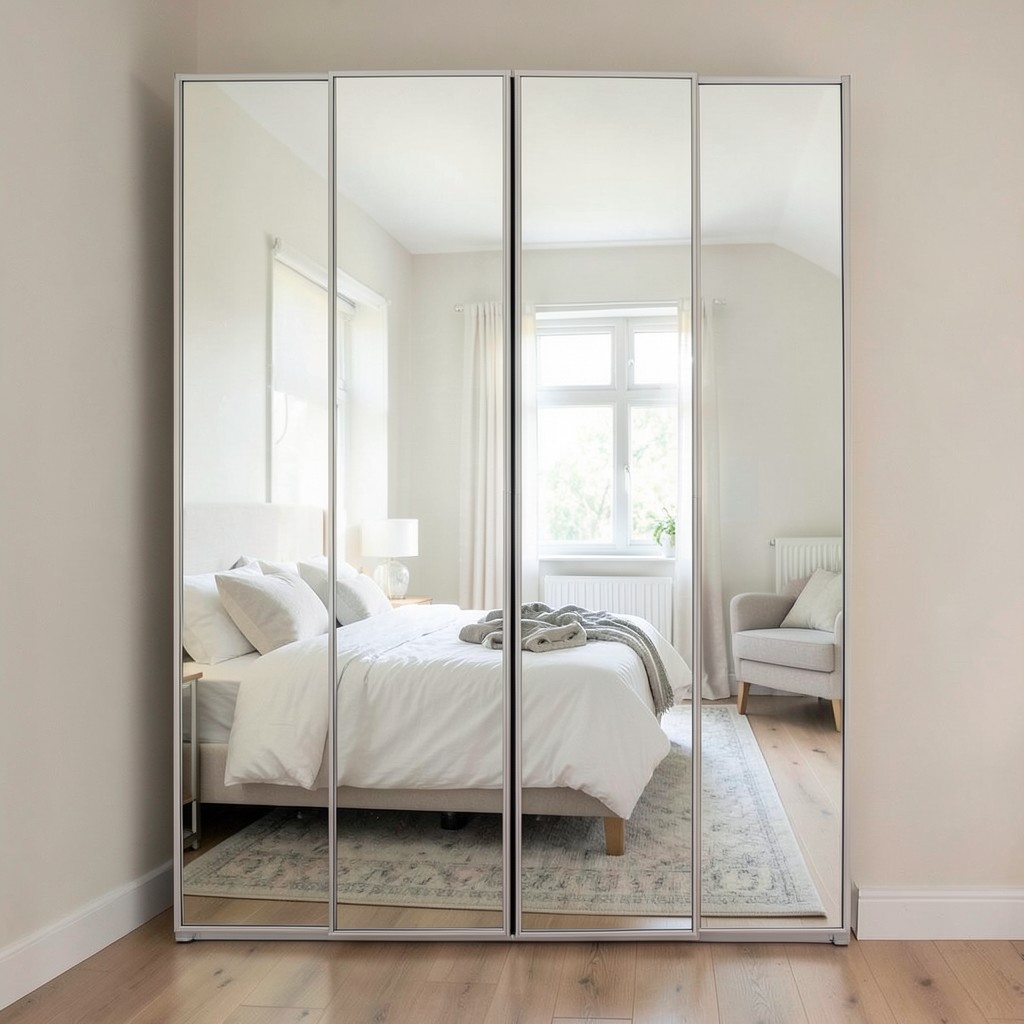
The full-height mirrored wardrobe is the small bedroom’s single most powerful spatial design tool — the mirror’s reflective surface doubles the apparent room width across the wall it occupies, creates the illusion of depth behind its surface that the room’s physical dimensions do not provide, and amplifies the natural light from the bedroom’s window by reflecting it across the room rather than absorbing it. These three spatial benefits — apparent width increase, depth illusion, and light amplification — combine to create the perceived room quality that most small bedroom design strategies attempt to achieve through the accumulation of pale colors, scaled furniture, and minimal decoration, but which the mirrored wardrobe delivers more completely and more immediately through the physics of reflection.
A floor-to-ceiling mirrored wardrobe spanning the full wall width in a frameless or slim-framed specification creates the maximum spatial contribution of the mirrored wardrobe format — the mirror’s uninterrupted reflective surface from floor to ceiling and wall to wall creates the apparent room behind the glass whose quality is the precise replica of the room in front of it. Bright home design small bedrooms whose design strategy prioritizes the amplification of natural light and perceived space receive the full-wall mirrored wardrobe as the single most effective design decision available within the room’s fixed physical constraints. The bedroom’s window, reflected in the floor-to-ceiling mirror across the room, creates the apparent second window that doubles the room’s apparent natural light source and creates the airy quality that the physically modest room achieves through the wardrobe’s reflective surface rather than through the architectural intervention that the room’s structure and budget would not accommodate.
The mirrored wardrobe’s maintenance is the practical consideration that the format’s spatial benefits require in daily exchange — the full-wall mirror surface shows the bedroom’s daily disorder with the same clarity that it shows the room’s spatial quality, and the bedroom whose occupant values the spatial strategy must also accept the discipline of keeping the reflected room’s content at the visual standard that the mirror’s amplification makes constantly visible. The mirror that reflects a well-ordered bedroom creates the spatial amplification of a designed interior; the mirror that reflects an unmade bed and scattered clothing creates the spatial amplification of domestic disorder, and the effect in the second case is precisely the opposite of the spatial benefit the mirror was specified to provide.
6. A Wardrobe With an Integrated Island Drawer Unit

The wardrobe island is the luxury master bedroom design element that transforms the dressing room concept into a functional reality within the bedroom’s own floor plan — the freestanding island unit of drawers positioned in the center of the walk-in wardrobe space or the open area between the bedroom’s wardrobe walls creates the dressing room’s central storage and preparation surface in the format that the genuine dressing room applies as its defining furniture element. The island is the wardrobe’s center of gravity. Everything else organizes around it.
An island drawer unit in a natural walnut veneer or a painted lacquer — its drawers containing the folded items, the accessories, the jewelry, and the smaller wardrobe contents whose organization benefits from the horizontal drawer’s full-width visibility — creates the luxury dressing space’s primary storage furniture in a piece whose quality and scale communicate the bedroom’s design ambition at its most specific level. The island’s countertop — the marble slab, the leather-wrapped surface, or the natural timber panel — creates the preparation surface for the morning’s dressing ritual, and the quality of that surface communicates the design’s investment in the daily experience it was built to serve. Luxury home interior master bedrooms with island drawer units — the wardrobe walls on both sides, the island unit in the center, and the overhead lighting calibrated for both the functional dressing illumination and the atmospheric evening quality — create the private dressing room whose design quality is the bedroom’s most intimate design luxury.
The island drawer unit’s height should be calibrated for the household member’s standing use — the countertop at waist height creates the comfortable surface for laying out clothing, examining accessories, and organizing the morning’s chosen outfit. An island whose height was specified for the standard catalog dimension rather than for the specific occupant’s standing height creates the ergonomic compromise that the luxury specification’s purpose was to eliminate, and the custom height specification is the island detail that most directly communicates the dressing space’s bespoke quality.
7. A Rattan-Fronted Wardrobe in a Bohemian Bedroom

The rattan-fronted wardrobe belongs to the bohemian bedroom with the natural ease of a material that has never needed to justify its presence in the organic, handcraft-valued domestic environment that the bohemian home styling direction creates. The woven cane webbing set within a timber frame door creates the wardrobe surface whose material character is simultaneously practical — the cane’s breathability allows air circulation through the closed wardrobe door, preventing the humidity buildup that tightly sealed wardrobe interiors create — and aesthetically specific to the bohemian, coastal, and natural material directions whose material philosophy values the hand-woven, the organically structured, and the naturally imperfect.
A rattan-fronted wardrobe in a natural timber frame — the pale honey of the natural cane against the warm oak or the painted white of the frame — creates the bohemian bedroom’s primary storage piece in a material whose organic warmth suits the bedroom’s most personal design direction. Bohemian home styling around the rattan wardrobe — the macramé wall hanging above the bed, the layered textile bedding in warm earth tones, and the collection of trailing plants on the room’s surfaces — creates the complete bohemian bedroom whose wardrobe communicates the design’s material philosophy at the room’s largest furniture scale. The bamboo home interiors direction that combines bamboo flooring, bamboo bed frames, and rattan accessories creates the complete organic bedroom environment whose rattan-fronted wardrobe is the storage element that holds the room’s complete material palette together at its largest and most spatially dominant furniture piece.
The rattan panel’s maintenance in a wardrobe application is less demanding than in many other furniture positions because the panel’s height within the door keeps it away from the floor-level moisture and the handling height that a rattan-fronted cabinet in a kitchen or bathroom would experience. The periodic cleaning of the cane webbing with a dry brush removes the dust that the open weave collects, and the application of a linseed oil or natural wax to the timber frame on an annual basis maintains the frame’s surface quality without requiring the panel’s removal or any specialized treatment.
8. A Japandi Wardrobe in Natural Oak and Linen

The Japandi wardrobe is the bedroom furniture piece that the Japandi aesthetic’s synthesis of Japanese material restraint and Scandinavian home interior design values creates at its most functionally specific — the storage element whose design exists entirely in service of the objects it contains and the person who uses it, without any decorative contribution beyond what the material’s own character provides. The natural oak’s grain is the decoration. The linen panel’s woven texture is the ornamentation. Everything else is structure, proportion, and precision.
A Japandi wardrobe in a natural or lightly oiled oak frame — the door panels in either a matching oak veneer or a linen-textured panel whose organic surface creates the material warmth that the Japandi aesthetic applies as its tactile counterpoint to the frame’s clean structural geometry — creates the bedroom’s primary storage piece in the material combination that communicates the design’s philosophy most completely. The Scandinavian home interior bedroom organized around the Japandi wardrobe — the pale walls, the natural linen bedding, and the minimal bedside table creating the complete organic bedroom palette in which the natural oak wardrobe reads as the warm, grounding element — creates the peaceful home decor atmosphere that the Japandi direction values as the bedroom’s primary atmospheric quality. The bedroom that provides genuine rest is not the bedroom of maximum softness or maximum warmth — it is the bedroom whose design creates the conditions of mental quietness that the organized, honest, and materially consistent interior generates.
The Japandi wardrobe’s hardware should match the design’s characteristic restraint in both scale and material — the recessed finger pull routed into the door edge, or the small matte black bar handle in a minimal profile, creates the operating mechanism whose presence is functionally sufficient and whose visual presence does not exceed the design’s restrained ambition. The hardware that attempts to add visual interest to the Japandi wardrobe through its decorative complexity contradicts the design philosophy at the level of its most frequently touched detail.
9. A Coastal White Wardrobe With Rope Hardware

Coastal home design is the residential aesthetic that most directly translates the material palette of the seaside environment into the domestic interior, and the wardrobe’s role in the coastal bedroom is to carry the design’s material language in the room’s largest piece of furniture with the same honesty and the same specific material vocabulary that the coastal aesthetic applies everywhere else. The bleached timber, the natural fiber, the pale painted surface, and the material reference to rope, driftwood, and sail canvas create the coastal bedroom’s design language at the furniture scale.
A white or pale cream painted wardrobe with rope-wound hardware — the door pulls in a thick natural cotton or jute rope formed into a loop or a knot at the door face — creates the coastal bedroom’s wardrobe in a material detail that belongs to the seaside’s own material world rather than to the imported vocabulary of the standard hardware catalog. Beach house interiors apply the rope hardware wardrobe alongside the natural linen bedding, the driftwood accessories, and the white-painted timber architecture of the coastal cottage to create the complete coastal bedroom whose design consistency is felt at the level of the most intimate furniture detail. Summer home design bedrooms with the coastal white wardrobe reach the design’s most seasonal peak of atmospheric quality during the warm months — the pale wardrobe in the summer light, the natural fiber hardware creating the material warmth that the pale palette requires, and the fresh, breezy quality of the coastal bedroom design at its most specifically seasonal expression.
The rope hardware’s practical durability in a wardrobe application is sufficient for the daily use that a bedroom wardrobe’s door operation creates — the natural fiber rope’s thickness and the knot’s structural integrity at the door mounting point create the hardware whose operation is reliable within the residential domestic context. The rope hardware is not the specification for the commercial or high-frequency institutional wardrobe — but for the residential bedroom whose daily use involves the moderate opening and closing frequency of one or two household members, the rope hardware’s practical quality matches its aesthetic contribution.
10. A Wardrobe With a Built-In Vanity Section
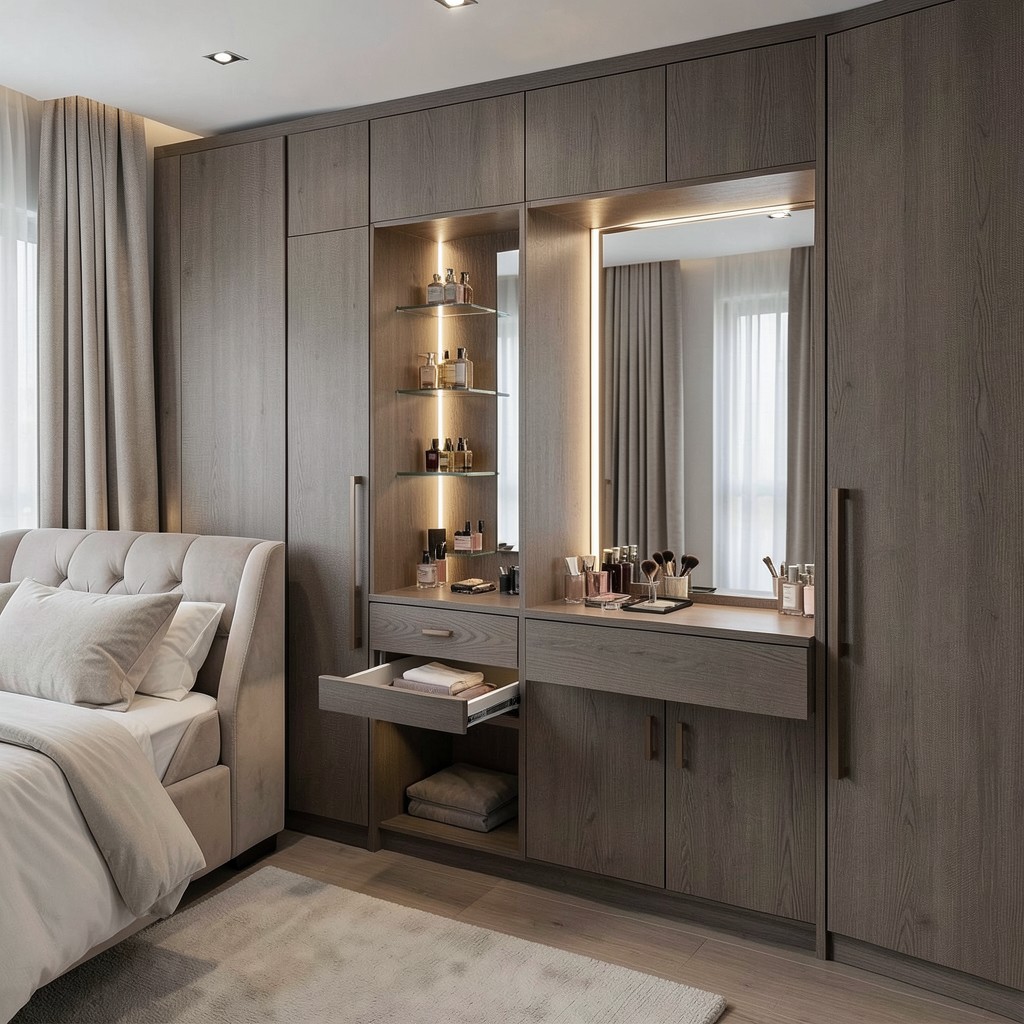
The wardrobe with an integrated vanity section is the design idea that the household without a dedicated dressing room requires most urgently and most rarely discovers until it is suggested — the allocation of one end section of the built-in wardrobe to a vanity unit, whose recessed niche contains the wall-mounted mirror, the concealed lighting, and the surface for the cosmetics and grooming items that the vanity function requires, creates the dressing space within the bedroom without the separate furniture piece whose floor area requirement the bedroom’s dimensions frequently cannot accommodate. The vanity is inside the wardrobe. The floor is free.
A built-in wardrobe whose end section is designed as a vanity niche — the wall-mounted mirror recessed within the wardrobe’s frame, the integrated LED lighting strip at the mirror’s sides creating the correct face illumination for grooming, and the pull-out or fold-down surface beneath providing the cosmetics placement area — creates the bedroom’s complete dressing facility in the wardrobe’s own footprint. Luxury master bedroom design applies this format as the vanity integration that creates the dressing room experience within the bedroom’s own spatial allocation rather than requiring the separate dressing room that the luxury master suite’s floor plan may or may not contain. The vanity section’s lighting specification is the element that determines the function’s quality most directly — the color temperature of the integrated lighting should be warm enough to create the flattering quality of the morning’s dressing routine while being accurate enough in its color rendering to allow the cosmetics color to read correctly before leaving the room.
The vanity niche’s storage integration — the small shelves for perfume bottles and cosmetics within the mirror’s surround, the drawer below the surface for brushes and smaller accessories — creates the vanity function’s complete organizational infrastructure within the wardrobe section’s allocated space. The vanity that was integrated into the wardrobe without the storage planning creates the surface whose beauty is immediate and whose function is insufficient within the first week of use.
11. A Wardrobe With Fluted Door Panels for a Contemporary Bedroom

Fluted door panels on a wardrobe create the contemporary bedroom’s storage wall in a surface whose vertical channeling creates the textural interest and the light-and-shadow quality that the slab door’s flat face prevents, without the period-specific ornamental detail of a traditional raised or recessed panel profile. The fluted panel is the contemporary wardrobe’s answer to the question of how to make the flat door more visually interesting without introducing the design period references that the contemporary bedroom’s aesthetic direction actively avoids. The channel creates the interest through form rather than decoration.
A fluted door wardrobe in a natural oak veneer — the vertical channels interrupting the wood grain with the rhythmic shadow lines that the routed profile creates — creates the contemporary bedroom’s storage wall in a material combination whose organic quality suits the bedroom’s sensory environment. The grain’s horizontal movement between the vertical channels creates the material layering that the plain slab door does not achieve, and from the bedroom doorway, the fluted oak wardrobe creates the wall of composed, organic texture whose visual richness communicates the design’s material intelligence at the room’s largest single surface. Contemporary home ideas bedrooms whose material palette is organized around the natural timber, the linen textile, and the warm neutral paint create the complete contemporary organic bedroom in which the fluted oak wardrobe reads as the room’s dominant material statement.
The fluted panel’s channel depth on a wardrobe door should be calibrated for the panel’s scale — a standard wardrobe door of two meters height benefits from a channel depth of five to seven millimeters whose shadow quality reads from the bedroom doorway with the visual clarity that the standing-distance viewing requires. The shallower channel that reads as a textured surface from close range but recedes to a smooth plane from across the room fails the wardrobe’s design purpose, because the wardrobe is viewed primarily from the bedroom’s standing distance rather than from the arm’s-reach proximity that a cabinet in a kitchen or bathroom creates as its primary viewing condition.
12. A Wardrobe With Integrated LED Lighting Inside

The wardrobe with properly specified interior LED lighting is the design detail whose daily functional contribution to the bedroom’s morning routine is entirely disproportionate to its cost and its design complexity — the warm, accurate, automatic illumination of the wardrobe’s interior when the door opens creates the immediate visibility of every stored item, the correct color rendering of the clothing’s tones for the morning’s selection decisions, and the functional quality that the unlit wardrobe’s dark interior permanently prevents. Every household whose bedroom wardrobe has been retrofitted with interior lighting reports the same response: wondering how they managed without it.
A warm-toned LED strip light mounted above the hanging rail and at the front edge of the upper shelves creates the wardrobe interior’s functional illumination in a position calibrated for the maximum visibility of the stored items. The warm tone — 2700 to 3000 Kelvin — creates the color rendering quality that allows the clothing’s colors to read accurately for the morning’s selection without the cool, blue-white quality of a higher color temperature that creates the task-lighting atmosphere of a workplace rather than the warm domestic quality of a well-designed bedroom storage space. Cozy home design bedrooms apply the warm interior wardrobe lighting as the detail that extends the bedroom’s warm, amber-toned atmospheric quality into the wardrobe’s interior, creating the continuous quality from the bedroom’s ambient light into the storage space rather than the jarring cold-light contrast of the fluorescent interior strip that many production wardrobes specify.
The motion sensor or door-contact switch specification for the interior lighting creates the automatic illumination that the occupant does not need to separately activate — the door opens, the light activates, the interior is immediately visible, and the door closes to extinguish the light. This operational intelligence is the lighting specification detail that separates the designed wardrobe from the wardrobe with a light added as an afterthought, and the motion sensor’s specification should include the timer function that extinguishes the light if the door is left ajar rather than creating the energy waste of a permanently illuminated interior.
13. A Painted Wardrobe With Botanical Illustrations for a Bedroom

The hand-painted wardrobe is the bedroom storage piece that the garden-inspired interiors direction and the floral home decor ideas aesthetic applies as the room’s most personal and most irreplaceable design element — the botanical illustration applied directly to the wardrobe’s door faces creates the furniture as artwork, and the wardrobe’s daily-use presence in the bedroom creates the art’s daily presence in the room at the furniture’s most permanent and most spatially dominant scale. The painted wardrobe cannot be moved or replaced with the same ease as a framed print. It is the room’s permanent art, and that permanence is both its design commitment and its design gift.
A pale cream or sage-ground wardrobe with hand-painted botanical illustrations — the flowers, leaves, and botanical forms of the English garden tradition painted in a loose, naturalistic style — creates the garden bedroom’s primary design piece in a material surface whose visual character belongs to the natural world it depicts. The illustration’s style should suit the bedroom’s aesthetic register — the loose, impressionistic botanical painting for the relaxed home design direction, the more precise, illustrative botanical for the traditional or country house bedroom, and the stylized, graphic botanical for the contemporary bedroom whose design direction applies the natural reference in a more resolved, designed format. The painted wardrobe’s value in the spring home refresh season is specific and pronounced — the blooming botanical illustration creating the seasonal alignment between the wardrobe’s painted surface and the landscape outside the bedroom window, the two botanical references reinforcing each other across the domestic and the natural boundary.
The commissioning of the botanical painting requires the selection of an artist whose specific botanical illustration style suits the bedroom’s design direction, and the brief to that artist should include the wardrobe’s exact dimensions, the door panel layout, the ground color, and the specific botanical species or the general style direction that the bedroom’s aesthetic requires. The artist who understands the domestic context — the wardrobe’s daily functional use, the bedroom’s lighting conditions, and the viewing distances at which the painting will primarily be seen — creates the painted wardrobe whose quality serves the room rather than the portfolio.
14. A Bamboo Wardrobe in a Tropical Bedroom

Bamboo as a wardrobe material creates the tropical home design bedroom’s storage element in a material whose connection to the equatorial and subtropical botanical world is as direct and as specific as any material in the residential furniture range — the bamboo’s origin in the fast-growing grass family, its warm amber color, and its distinctive growth-ring grain pattern create the furniture surface that no temperate-zone timber replicates, and the tropical bedroom whose wardrobe is built from bamboo has the material consistency between the room’s design direction and its storage furniture that the authentic regional aesthetic always creates when its material choices are made honestly.
A solid bamboo wardrobe — the case construction in compressed bamboo board, the door panels in a strand-woven bamboo veneer whose grain’s tight, parallel pattern creates the smooth surface calibrated for the wardrobe’s door face — creates the tropical bedroom’s storage piece in a material of genuine organic warmth. Bamboo home interiors organized around the bamboo wardrobe alongside a bamboo-frame bed, natural fiber rugs, and the tropical planting of the indoor plant collection create the complete tropical bedroom whose material palette is consistent from the floor to the ceiling, from the largest piece of furniture to the smallest accessory. Jungle-inspired home decor applied around the bamboo wardrobe — the monstera and palm plants in ceramic vessels at the bedroom corners, the rattan pendant lamp above, and the deep botanical print textile on the bedding — creates the bedroom whose plant-material world is continuous from the designed objects to the living plants.
The bamboo wardrobe’s practical consideration in the bedroom’s climate management is the material’s dimensional stability — bamboo’s response to humidity variation is similar to timber’s, and the wardrobe’s construction joints and door alignment should be specified with the appropriate gap tolerance for the seasonal humidity range of the room’s climate. A bamboo wardrobe built with the tight tolerances appropriate for a climate-controlled interior that is exposed to the humidity variation of a tropical or subtropical climate will develop the door alignment issues that the wood movement creates when the tolerance specification does not account for it.
15. A Stone and Wood Wardrobe in a Mountain Cabin Bedroom

The mountain cabin wardrobe is the bedroom storage piece that the alpine, highland, and mountain cabin decor direction creates from the same material palette as the structure it inhabits — the solid timber of the local forest, the natural stone detail, and the hand-crafted construction whose joints are visible and whose structural honesty communicates the design’s connection to the building tradition that the mountain vernacular represents. The cabin wardrobe is not a furniture piece imported from the style catalog. It belongs to the cabin the way the stone fireplace belongs to the cabin — made from the same materials, built with the same hands, designed for the same climate.
A solid timber wardrobe in a reclaimed or rough-sawn oak or pine — the surface in a natural oil finish that preserves the wood’s color and grain without the obscuring opacity of a paint or lacquer topcoat — creates the mountain cabin bedroom’s storage piece in a material that communicates the room’s material philosophy at its most direct. Stone and wood home design bedrooms apply the solid timber wardrobe as the primary furniture element whose material weight and honest construction suit the architectural character of the stone-and-timber building it furnishes. Mountain cabin decor around the timber wardrobe — the wool plaid throw on the bed, the antler or iron hardware on the wardrobe doors, and the hand-woven textile rug on the stone or timber floor — creates the complete mountain bedroom whose design is drawn from the mountain environment’s own material vocabulary rather than from the interior design catalog’s approximation of it.
The solid timber wardrobe’s construction quality in the mountain cabin context requires specific attention to the timber’s moisture content — the high-humidity alpine environment and the dry, heated interior of the winter cabin create the seasonal moisture variation that solid timber’s dimensional movement responds to significantly, and the wardrobe’s construction should accommodate that movement in the design of the door joints, the frame connections, and the door alignment system. A cabinet maker experienced in building for the specific climate zone delivers the mountain cabin wardrobe whose construction quality holds across the seasonal humidity range that the location creates.
16. A Handleless Push-to-Open Wardrobe for a Seamless Bedroom

The handleless push-to-open wardrobe creates the bedroom wall of complete material continuity — no hardware protrudes from the door face, no handle catches the light, and no metal or timber element interrupts the continuous surface of the wardrobe’s doors as they span the bedroom wall from end to end. The wall reads as a single designed plane. The wardrobe is present as storage but absent as furniture, and that specific quality is what the design direction that values the architectural resolved over the furniture-decorated bedroom applies as its primary wardrobe specification.
A handleless push-to-open wardrobe in a high-gloss white or a pale linen-toned lacquer — the door face in the bedroom’s primary color, the grain or the flat surface reading as continuous material across the door junctions — creates the bedroom wall of maximum spatial continuity. The high-gloss finish amplifies the bright home design direction’s light quality by reflecting the bedroom’s natural and artificial light across the wardrobe’s surface; the matte linen tone creates the relaxed home design direction’s organic pale quality without the reflective contribution that the gloss surface makes. The push-to-open mechanism’s spring force should be calibrated for the door weight — a heavy, large-format door in a dense material requires a stronger spring force than a lighter door in a thinner panel, and the spring force that is insufficient for the door weight creates the door that fails to open fully from the push, requiring the occupant to hook a fingernail beneath the door edge each morning in the exact expression of the design’s operational failure.
The handleless wardrobe’s door edge profile is the design detail that the push mechanism’s absence of hardware transfers the opening function to — the door edge’s chamfer or the slight rebate that provides the fingertip’s natural grip in the case of the push mechanism’s failure or the occupant’s preference for a positive pull rather than the spring’s release creates the operational redundancy that the designed wardrobe should always maintain.
17. A Wardrobe With a Glass Panel Section for Transparent Storage

The glass panel wardrobe section — the wardrobe whose one or two central door panels are in glass rather than in the opaque material of the surrounding panels — creates the bedroom’s storage piece with the display quality of the glass-fronted cabinet integrated into the wardrobe’s structure. The transparent section reveals the hanging rail behind it, creating the boutique display quality of the organized wardrobe’s hanging clothes — the color-coordinated garments, the consistent hanger style, and the neat hanging arrangement that the glass panel exposes as the wardrobe’s visible content — and the visual quality of that display communicates the occupant’s relationship to their clothing as clearly and as directly as any designed element in the bedroom.
A wardrobe with frosted or reeded glass panels — the slightly opaque glass that creates the silhouette of the hanging garments without the full transparency of the clear glass — creates the display quality with the added privacy that prevents the wardrobe’s contents from being fully visible and from creating the maintenance demand of the completely transparent glass panel. The reeded glass’s vertical channels create the same soft, linear texture at the wardrobe face that the fluted timber panel creates in a material whose light transmission quality the timber cannot provide, and the reeded glass door creates the wardrobe surface of both visual interest and soft translucent illumination when the wardrobe interior is lit from within. Elegant home styling applied to the reeded glass wardrobe — the interior lighting visible through the reeded surface as a warm, textured glow, the organized hanging clothes creating the soft silhouette within — creates the bedroom wardrobe whose evening presence is as atmospherically considered as its daytime visual quality.
The glass panel specification for the wardrobe door should always be in a tempered safety glass whose structural integrity under the impact and the vibration of the door’s daily operation provides the safety standard that the bedroom’s use patterns require. Standard float glass in a wardrobe door creates the breakage risk that the tempered specification eliminates, and the safety consideration is the non-negotiable specification requirement that no aesthetic preference should override.
18. A Wardrobe in a Desert Sand Tone for a Southwestern Bedroom

The desert sand wardrobe — the storage piece in the warm, slightly yellow-toned beige of the desert landscape’s adobe, sandstone, and dried grass color palette — creates the desert home styling bedroom’s primary furniture element in a color that belongs to the environmental palette of the arid, heat-shaped landscape that the Southwestern residential tradition draws from as its most honest design resource. The desert sand wardrobe does not reference the desert through decoration. It is the desert’s own color applied to the bedroom’s storage at the scale of the room’s most dominant furniture piece.
A desert sand painted wardrobe — the tone in the warm beige-gold of the adobe plaster rather than the cooler, greyer beige of the standard neutral paint — with hammered iron hardware creates the Southwestern bedroom’s primary storage piece in a material combination whose specific warm tone and traditional metal detail belong to the same material world as the terracotta tile, the woven Navajo textile, and the hand-formed ceramic vessel of the authentic Southwestern interior. Desert home styling applied to the sand-toned wardrobe bedroom — the rammed earth or warm plaster wall behind the wardrobe, the Navajo-pattern rug on the earthen floor, and the collection of turquoise and terracotta accents on the room’s surfaces — creates the Southwestern bedroom whose design is drawn from the desert’s own material and color vocabulary at every surface and every furniture scale.
The sand-toned wardrobe’s seasonal role in the desert bedroom’s design is consistent across the calendar’s full range — the warm neutral tone suits the summer home design season’s bright, warm light quality, the winter home decor season’s amber lamp-lit warmth, and the transitional seasons’ shifting light with equal facility, making the desert sand wardrobe the most seasonally flexible of all the non-neutral wardrobe tones precisely because the desert landscape’s warm neutral is itself the most climatically stable and the most seasonally consistent palette in the residential design range.
19. A Wardrobe With a Crown Molding Top for a Traditional Bedroom

The crown molding wardrobe top is the traditional home interiors bedroom’s most architecturally specific wardrobe design detail — the classical molding profile running along the wardrobe’s upper edge creates the connection between the furniture piece and the room’s ceiling plane in the architectural vocabulary that the Georgian, Federal, and Victorian residential traditions applied to their finest case furniture. The crown molding transforms the wardrobe from a piece of furniture placed against the wall into an element that appears to belong to the room’s architecture, and in the traditional bedroom whose architectural details are consistent and resolved, this distinction is the most significant design improvement a wardrobe specification can make.
A built-in wardrobe with a painted crown molding top — the molding profile selected to complement the bedroom’s existing cornice and architrave profiles rather than to introduce a new architectural vocabulary — creates the traditional bedroom’s storage wall in a format whose relationship to the room’s architectural language is explicit, designed, and consistent. Traditional home interiors bedrooms in period houses apply the crown molding wardrobe as the built-in element that most convincingly integrates the modern storage requirement into the period architectural character, because the molding’s profile match with the existing cornice creates the visual continuity that makes the wardrobe appear to have always been part of the room’s original architecture. The molding’s paint finish should match the room’s existing woodwork exactly — the same paint reference, the same sheen level, and the same application technique creating the surface consistency that the visual integration requires.
The crown molding’s practical installation consideration is the ceiling height variation that many period houses contain — the plaster ceiling’s settlement and the structural movement of the original building create the ceiling level variation across the room’s width that the molding must accommodate at its junction with the ceiling. The skilled joiner who scribes the molding top to the ceiling’s specific level variation creates the tight, shadow-free joint whose quality communicates the installation’s craft standard; the molding installed against the standard level that does not account for the ceiling’s variation creates the gap between molding and ceiling that communicates the opposite.
20. A Linen-Covered Wardrobe Door for a Soft Feminine Bedroom

The linen-covered wardrobe door is the bedroom furniture treatment that the soft feminine design direction applies when both the hard surface of the painted door and the reflective surface of the glass or mirror panel create materials too assertive for the room’s specifically gentle, textile-forward aesthetic. The linen panel creates the wardrobe door in a material that belongs to the bedroom’s textile world rather than to the furniture’s hard material world, and this material continuity between the wardrobe’s door surface and the bed’s linen, the curtain’s fabric, and the cushion’s textile creates the bedroom of complete material consistency at every surface.
A linen-covered wardrobe door in a natural, unbleached linen or a pale soft linen — the fabric stretched and fixed to the door panel’s face with the consistent tension that prevents the fabric from rippling or sagging at the door’s center — creates the soft feminine bedroom’s storage piece in a material whose organic texture and natural warmth communicate the design’s most specifically sensory qualities. Spring bedroom decor organized around the linen-covered wardrobe — the fresh botanical print cushions on the bed, the garden flowers in the bedside vase, and the warm daylight catching the linen door’s slight surface texture — creates the spring bedroom’s most specifically seasonal and most sensitively material design composition. The linen door’s pale tone and natural texture create the wardrobe surface that recedes into the bedroom’s pale background without the assertive material presence of the painted or lacquered door, and this visual reticence is the design quality that the feminine bedroom’s focus on the textile and the botanical — rather than on the furniture’s material presence — requires from its primary storage piece.
The linen door’s care requirement is the practical consideration that the material’s organic nature creates — the fabric surface collects dust at the rate of any textile in a domestic interior, and the periodic cleaning of the linen door with a vacuum brush attachment and the spot-treatment of any marks or contact soiling with a slightly dampened cloth creates the maintenance routine that the material’s quality and the door’s visual standard both require to be maintained over time.
21. A Scandinavian Wardrobe With a Natural Wood Frame and White Panels

The Scandinavian wardrobe is built on the conviction that storage can be both functional and genuinely pleasant to be near — not the minimalist austerity that the Scandinavian aesthetic’s popular misrepresentation suggests, but the warm, light-filled, naturally materialed domesticity that the actual Scandinavian residential tradition has always produced as its most characteristic home quality. The Scandinavian wardrobe reflects that tradition in its material choice, its proportion, and its quiet insistence that the bedroom’s storage should not compete with the room’s warmth for the occupant’s attention.
A wardrobe in a natural birch or ash frame — the timber’s pale, fine grain creating the warm, light-toned structural element — with painted white or pale grey panels creates the Scandinavian home interior bedroom’s primary storage piece in the material combination that the Nordic design tradition applies most characteristically to its bedroom furniture. The pale panel’s recessive tone allows the timber frame’s warm grain to read as the wardrobe’s visual character rather than as the structural element supporting the panel’s dominant surface, and the balance between the frame’s warmth and the panel’s pale recessive quality creates the material dialogue that the Scandinavian aesthetic’s light-prioritizing, warmth-valuing design philosophy requires of its furniture. Scandinavian hallway design also applies the birch-frame wardrobe as the entrance space’s primary coat and shoe storage piece — the natural timber frame creating the organic warmth at the home’s entry point whose material quality establishes the design’s character from the first moment of arrival.
The Scandinavian wardrobe’s interior should be organized with the same thoughtfulness that the Nordic design tradition applies to every functional element — the interior’s shelf heights calibrated for the specific wardrobe’s contents, the drawer dimensions proportional to the items stored within them, and the hanging rail’s position creating the hanging clearance that the household’s garment lengths require without the wasted space above the garments that an over-high rail installation creates in a wardrobe whose occupant’s longest garment is shorter than the rail-to-floor clearance.
22. A Walk-In Wardrobe Design for a Spacious Master Bedroom

The walk-in wardrobe is the master bedroom’s most coveted private space — the room-within-a-room that houses the household’s complete clothing and accessory collection in a dedicated architectural space whose organization, lighting, and material quality create the dressing experience that the bedroom-integrated wardrobe, however well designed, cannot deliver in the same format. The walk-in provides the 360-degree access, the full-length mirror, the dressing area, and the spatial separation between the sleeping and dressing zones that the luxury master bedroom identifies as among its most valued design attributes.
A walk-in wardrobe whose floor plan allocates the wall surfaces to the hanging, shelving, and drawer storage functions — the long wall to the double-hanging zone for shorter garments, the end wall to the single-hanging zone for full-length dresses and coats, and the island unit in the center for drawers, accessories, and the folded items whose storage benefits from the horizontal drawer’s full-width visibility — creates the luxury master bedroom design dressing space in the most functionally complete and most operationally efficient format. The lighting in the walk-in wardrobe requires specific planning — the overhead fixture for the ambient space illumination, the integrated shelf lighting for the specific visibility of the stored items, and the mirror lighting for the dressing function’s grooming quality, all specified in a layered lighting plan whose components are individually controlled. Luxury home interior master bedrooms with dedicated walk-in wardrobes whose lighting and material quality are treated with the same care as the bedroom’s own design create the private dressing space that the household members experience as the bedroom’s most personally valued daily luxury.
The walk-in wardrobe’s ventilation is the practical consideration that the enclosed space’s concentrated textile storage creates as its primary atmospheric management challenge — the wardrobe’s air circulation must prevent the musty quality that underfurnished air in a textile-dense enclosed space develops over time, and the dedicated ventilation through a discrete grille or the connection to the HVAC system creates the air quality that the walk-in’s enclosed nature otherwise prevents.
23. A Wardrobe With a Chalkboard Panel for a Kids’ Bedroom

The chalkboard wardrobe door is the children’s bedroom design idea that serves three separate childhood development functions simultaneously — the writing and drawing surface that the chalkboard creates, the display medium for the child’s current creative production, and the organizational tool for the daily schedule, the homework list, and the after-school activities whose visual presence on the wardrobe door creates the bedroom’s functional information board. Three functions. One wardrobe door panel. Good design economy.
A wardrobe with one or two chalkboard panel doors — the remaining doors in the standard painted or veneer finish — creates the bohemian kids room decor bedroom’s primary interactive furniture element in a format whose material practicality and functional generosity suit the children’s bedroom’s design philosophy of prioritizing the child’s experience over the adult’s aesthetic preference. The chalkboard panel’s frame should match the wardrobe’s standard door frame material — the consistent frame creating the designed unity between the chalkboard panel and the adjacent standard doors, communicating the chalkboard as an integrated design choice rather than a panel added as a parenting compromise. The chalk rail at the chalkboard door’s base — the narrow shelf that catches the chalk dust and stores the chalk itself — creates the functional detail whose thoughtful inclusion communicates the design’s understanding of the chalkboard panel’s daily operational reality.
The chalkboard panel’s practical maintenance in a child’s daily use — the chalk dust that the erasing creates, the marks that chalk makes on the surrounding surfaces when the child’s drawing enthusiasm exceeds the panel’s boundary, and the periodic re-application of the chalkboard paint whose surface refreshment after several months of heavy use creates the clean drawing surface that the original application’s quality cannot maintain indefinitely — should be considered part of the design decision rather than discovered after the wardrobe is installed.
24. A Wardrobe With a Vintage Mirror Panel in a Classic Bedroom

The vintage mirror panel — the antique-effect glass whose slightly silvered, slightly foxed surface creates the aged mirror quality that new glass cannot replicate — transforms the standard mirrored wardrobe from a contemporary spatial tool into the classic bedroom’s most atmospheric design detail. The vintage mirror’s foxing creates the mirror that suggests age and history in the bedroom whose design direction values the accumulated quality of objects that have been present through time rather than the pristine quality of objects at their manufactured perfection. The vintage mirror is beautiful because it is imperfect. That specific imperfection is a design quality.
A full-height wardrobe with vintage mirror panels in a painted or timber frame — the antique-effect glass set within the frame’s opening, its foxed surface creating the warm, slightly diffused reflection that the new mirror’s perfect silver creates without the atmospheric quality — creates the classic bedroom’s wardrobe in a piece whose material character communicates the room’s relationship to the traditional design aesthetic at its most specifically material level. Traditional home interiors bedrooms apply the vintage mirror wardrobe alongside the upholstered headboard, the bedside table in a period-appropriate timber, and the textile selections in the warm, pattern-rich fabrics of the classic bedroom palette to create the complete traditional bedroom whose wardrobe is the room’s largest and most atmospherically specific furniture element. Holiday home styling in the classic bedroom with the vintage mirror wardrobe — the warm lamp light reflected in the foxed mirror surface, the seasonal throw and cushion additions creating the layered warmth of the festive bedroom — creates the intimate, historically resonant bedroom atmosphere whose quality is inseparable from the mirror’s aged surface quality.
The vintage mirror panel’s reflective quality is, by its nature, inferior to a new mirror’s perfect silver surface — the foxing and the silvering variations create the distortion and the diffusion that the perfect mirror does not create, and the household member whose primary use of the mirrored wardrobe is the full-length dressing mirror function should understand that the vintage mirror provides the atmospheric quality rather than the precise, undistorted reflection of the contemporary mirror.
25. A Wardrobe With a Color-Blocked Interior in Two Tones

The color-blocked wardrobe interior is the design detail that the household whose wardrobe organization has been treated as a design element — rather than merely as a storage problem — applies as the moment where the organizational logic and the design intelligence meet. The color-blocked interior assigns different color tones to different storage zones within the wardrobe — the hanging zone in one color, the shelf zone in another, the drawer section in a third — and the color differentiation creates both the visual organization that makes the wardrobe’s interior layout immediately legible and the design quality that makes the open-door wardrobe a pleasant visual experience rather than a storage cavity.
A wardrobe interior with a deep sage green in the hanging zone and a warm cream in the shelf and drawer zone — the color boundary at the horizontal division between the hanging and the folded storage sections — creates the color-blocked interior in a palette whose organic warmth and considered tone differentiation communicate the design intelligence of a household that treats the wardrobe’s interior as a designed space rather than as a painted box. Warm home decor ideas applied to the wardrobe’s interior — the cedar-scented lining paper on the shelves, the fabric-covered drawer dividers in a complementary textile, and the slim wooden hangers in a consistent timber finish creating the complete interior composition — create the wardrobe opening experience that the color-blocked surface begins and the material layering completes. The interior design of the wardrobe is the design that only the occupant sees daily, and the household that invests in that private design quality is the household that understands the connection between the environments we inhabit privately and the daily mood quality those environments create.
The color-blocked interior’s most practical application is the differentiation between the zones whose contents benefit from the visual contrast — the pale ceiling and back of the hanging zone creating the light background against which the dark clothing reads most clearly, and the deeper tone of the shelf zone creating the backdrop that the pale folded items and the displayed accessories read against with the maximum visual definition. The color is not applied for decoration alone — it is applied for the organizational legibility that the color difference creates in the wardrobe’s interior navigation.
26. A Wardrobe Designed Around a Corner in a Small Bedroom

The corner wardrobe is the small bedroom’s underused spatial opportunity — the corner created by two walls meeting at ninety degrees is the space that freestanding furniture typically ignores and that the built-in wardrobe can occupy with the precision that creates the maximum storage volume from the minimum floor area impact. The corner wardrobe wraps the storage around the room’s geometry rather than placing it in front of it, and the bedroom whose corner is fully exploited by a well-designed built-in discovers the storage volume that was present in the room’s unused corner geometry all along.
A built-in corner wardrobe — the internal corner accommodation achieved through either a carousel mechanism for the corner section’s storage, a fixed corner shelf unit whose angled back panel manages the wall junction, or the simpler solution of a blank corner panel that accepts the loss of the corner’s deepest space in exchange for the accessibility simplicity — creates the small bedroom’s storage wall that uses the room’s full perimeter wall length including the corner sections. Cozy bedroom design in the compact bedroom applies the corner wardrobe as the spatial strategy that extends the storage wall around the corner rather than stopping at it, creating the storage volume whose increase from the corner extension significantly improves the bedroom’s storage capacity without any additional floor area. The corner wardrobe’s door swing should be planned before the installation — the internal corner creates the door clearance challenge where the doors of two adjacent wardrobe sections swing toward each other, and the hinge placement, the door width, and the corner gap must be planned collaboratively to create the operational clearance that the corner format’s geometry creates as its primary design challenge.
The corner wardrobe’s contribution to the small bedroom’s spatial quality extends beyond the storage increase — the wardrobe’s continuous surface wrapping around the corner creates the visual continuity of the designed storage wall as an architectural element of the room rather than as a collection of furniture units placed against the walls, and this architectural quality of the continuous built-in storage wall communicates the bedroom’s design intention at its most spatially specific level.
27. A Wardrobe in a Dusty Pink for a Romantic Bedroom

Dusty pink on a wardrobe is the color choice that declares the romantic bedroom’s design intention without apology or qualification — the muted, grey-toned rose creates the wardrobe surface of the bedroom that was designed for the emotional register of the intimate domestic, the personal, and the specifically feminine in the most considered rather than the most conventional sense. The dusty pink wardrobe is not trying to be pretty. It is communicating the bedroom’s design conviction about the emotional quality it was built to create — the softness, the warmth, and the personal register of the most private room in the house
A matte dusty pink wardrobe — the color in its most subdued, most grey-toned version that prevents the pink from reading as sweet or juvenile — with unlacquered brass hardware creates the romantic bedroom’s storage piece in a color and material combination whose combined warmth communicates the design’s emotional intention at the furniture’s most dominant scale. The matte finish is non-negotiable here — the gloss pink creates the candy quality that the dusty tone’s maturity specifically counters, and the matte surface’s absorption of the bedroom’s warm lamp light creates the color’s most sophisticated and most atmospherically specific quality. Warm home decor ideas applied around the dusty pink wardrobe — the ivory linen bedding, the blush velvet cushions, the amber bedside lamp, and the dried flowers in a ceramic vase on the dresser — create the romantic bedroom whose wardrobe is the color’s primary residential statement at the room’s largest furniture scale.
The dusty pink wardrobe’s hardware scale should be modest in profile — the small oval or round brass knob rather than the long bar handle, the hardware’s scale calibrated to the door’s visual delicacy rather than to the assertive proportion that the dramatic, saturated-color wardrobe’s larger hardware suits. The hardware’s restraint on the dusty pink door creates the complete material composition whose every detail communicates the same gentle, considered quality that the color itself establishes.
28. A Wardrobe With a Woven Textile Panel Door

The textile panel wardrobe door is the design idea that most directly bridges the wardrobe’s hard furniture world and the bedroom’s soft textile world — the woven panel set within the door frame creates the storage piece in a material that belongs to the bedroom’s sensory environment rather than to the furniture’s structural material logic. The textile panel breathes, textures, and communicates the warmth of the woven fiber at the scale of the bedroom’s largest piece of furniture, and the bedroom whose design direction values the tactile quality of natural materials receives the textile panel wardrobe as its most complete and most specifically material storage expression.
A wardrobe with woven jute or seagrass panel doors — the natural fiber’s warm, sandy tone and the basket-weave pattern creating the surface texture at the door face — creates the relaxed home design or earthy home design bedroom’s storage piece in a material combination whose organic quality suits the room’s natural palette. The textile panel’s visual warmth and its sound-absorbing quality create two separate contributions to the bedroom’s sensory environment — the visual warmth of the natural fiber’s color and texture, and the acoustic softness of the woven surface that reduces the bedroom’s sound reflectance at the wardrobe wall’s large surface area. Breezy home interiors whose design language values the natural, the organic, and the unhurried receive the woven textile panel wardrobe as the storage element whose material philosophy perfectly matches the room’s overall design direction.
The textile panel’s care requirement in a bedroom wardrobe context is moderate — the natural fiber surface is cleaned with a dry brush to remove dust, and the frame around the panel in a painted or oiled timber maintains the panel’s edges and prevents the fiber’s edge fraying that an unframed textile panel exhibits under daily contact at the door’s operating points. The frame’s paint finish should be in a tone that complements rather than contrasts the natural fiber panel’s warm, sandy color — the white frame creates the clean contrast; the natural timber frame creates the material continuity of the organic palette.
29. A Fitted Wardrobe in a Bedroom Alcove

The bedroom alcove wardrobe is the residential design opportunity that the house with a chimney breast creates on both sides of the breast — the recessed space beside the chimney, whose depth is determined by the breast’s projection from the wall plane, creates the wardrobe’s natural enclosure without the wardrobe’s own depth consuming the bedroom’s floor area. The alcove wardrobe is the built-in that the house offers rather than the built-in that the design imposes on the house, and the wardrobe that is fitted into the alcove with the precision that the specific recess requires has the quality of belonging to the room’s architecture rather than occupying it.
A fitted alcove wardrobe in a painted MDF or timber — the wardrobe’s frame constructed to fill the alcove’s width precisely, the door opening within the frame creating the storage access whose reveal at the alcove’s front edge creates the clean junction between the wardrobe’s face and the chimney breast’s adjacent plasterwork — creates the bedroom’s storage in the format whose architectural integration is most complete and most spatially efficient of any wardrobe type in the residential design range. The fitted alcove wardrobe’s door proportions should relate to the alcove’s width and height in a designed ratio — the door that is proportional to the alcove opening creates the composed, architectural quality that the mismatched door proportion undermines. Farmhouse home decor bedrooms with painted alcove wardrobes on both sides of the chimney breast — the symmetrical storage flanking the breast creating the bedroom’s primary spatial geometry — create the bedroom whose design is organized around the room’s own architectural structure rather than imposed upon it.
The alcove wardrobe’s internal depth is determined by the alcove’s projection from the wall plane, which in most residential buildings is between forty-five and sixty centimeters — sufficient for hanging garments and shelf storage, though the shallower alcove whose depth is less than forty-five centimeters requires the creative interior organization of the pull-out shelf and the rotary rail whose mechanisms create the usable storage within the dimensional constraint that the shallow alcove creates.
30. A High-Gloss Lacquered Wardrobe for a Glamorous Bedroom
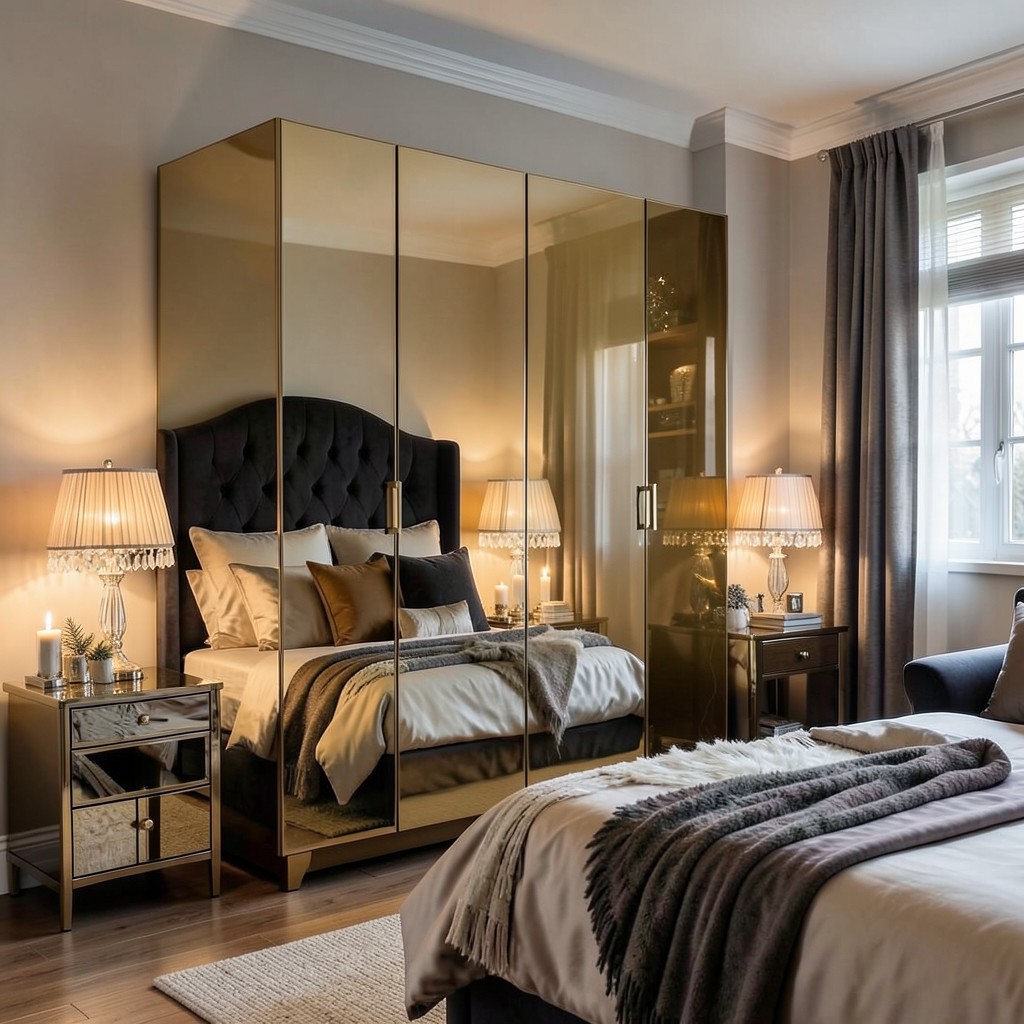
The high-gloss lacquered wardrobe is the glamorous bedroom’s primary design statement — the mirror-quality reflective surface of the lacquered door creates the wardrobe wall as a light-amplifying, visually luxurious surface whose finish communicates the design’s commitment to the glamorous register at the bedroom’s most dominant furniture scale. The high-gloss wardrobe does not participate quietly in the bedroom’s design. It declares its presence through its reflective surface quality, and the bedroom design that selects it has made the decision that the wardrobe’s visual authority should be the room’s design statement rather than its background.
A high-gloss lacquered wardrobe in a deep champagne gold, a pale ivory, or a sophisticated charcoal — the lacquer’s mirror surface creating the color’s maximum depth and reflective quality — creates the chic home decor bedroom’s primary storage piece in a material finish whose luxury quality communicates the design’s investment in the bedroom’s glamorous atmosphere. Elegant home styling applied to the high-gloss wardrobe bedroom — the crystal bedside lamps, the velvet upholstered headboard, and the silk or satin bedding creating the complete glamorous bedroom palette in which the lacquered wardrobe’s reflective surface is the room’s most materially luxurious and most light-responsive element. Holiday home styling transforms the high-gloss wardrobe bedroom into the season’s most specifically glamorous domestic environment — the lacquered surface reflecting the warm candlelight and the festive decorative elements whose reflections in the gloss surface multiply the room’s visual richness.
The high-gloss lacquered wardrobe’s maintenance requirement — the daily polishing of the reflective surface to remove the fingerprints, the dust particles that the static charge of the lacquered surface attracts, and the occasional water mark — is the practical exchange for the finish’s visual quality. The household that accepts this maintenance with the attitude of caring for a valued possession rather than the frustration of a demanding surface finds the high-gloss wardrobe’s daily interaction an extension of the design’s quality rather than a cost of it.
31. A Wardrobe With a Secret Room or Hidden Door
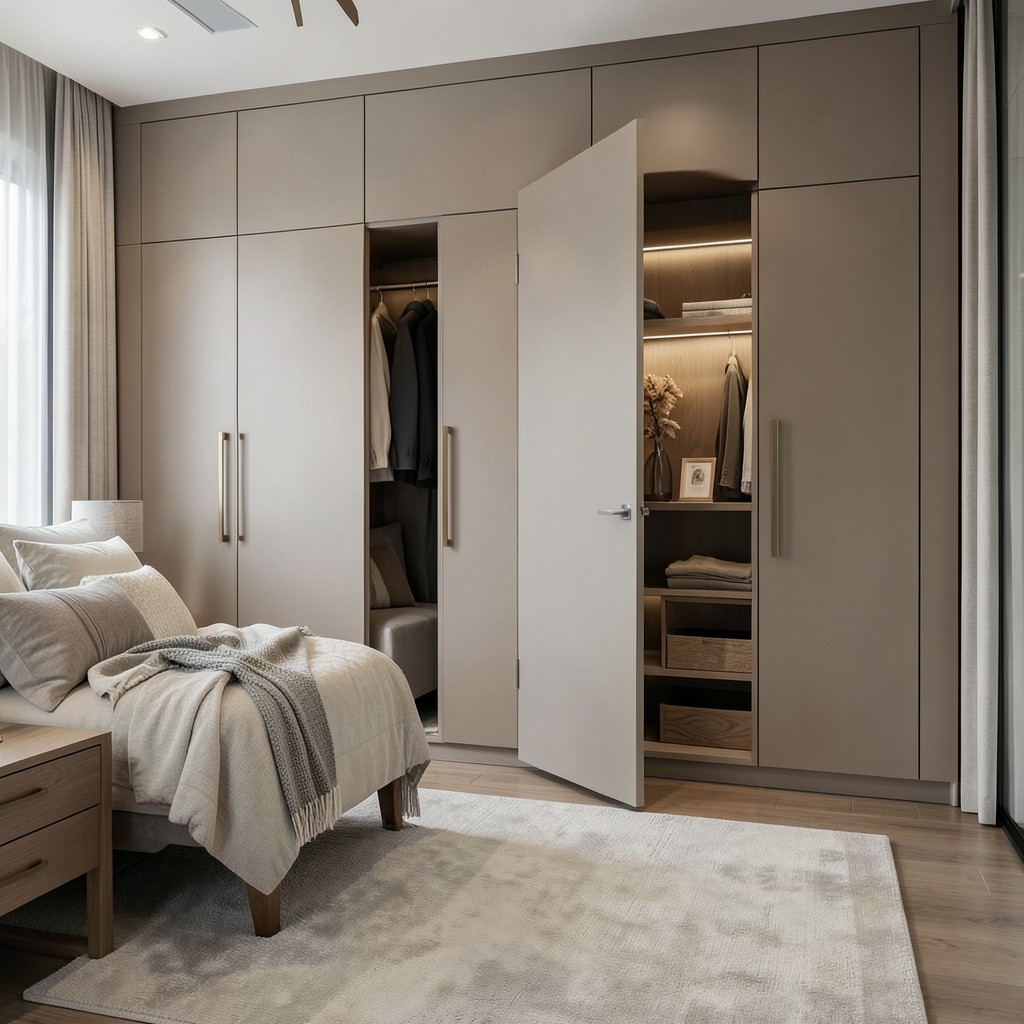
The hidden door wardrobe is the design idea that the household with genuine design ambition and a sufficient floor plan applies when the question is how to create the most spatially surprising and the most architecturally specific bedroom feature available within the residential design range. The wardrobe whose central door opens not to the wardrobe’s interior but to the concealed room beyond — the dressing room, the study, or the private reading nook — creates the bedroom’s most memorable spatial experience in the design element that reveals the room’s architectural depth only when the door is opened and the concealed space is discovered.
A built-in wardrobe wall whose doors are uniform in appearance — the hidden door in the same material, the same profile, and the same hardware as the adjacent wardrobe doors — creates the bedroom’s concealed room access in the format whose seamless integration with the surrounding wardrobe face makes the door’s discovery an experience of architectural delight rather than an obvious design feature. The hidden door’s hinge specification requires the precision engineering of the concealed hinge whose installation creates the door alignment that maintains the flush, seamless junction with the adjacent panels that the concealment requires. Luxury home interior bedrooms with hidden wardrobe doors to dressing rooms, studies, or en-suite bathrooms create the private domestic experience that the luxury residential specification values as among its most specifically individual and most personally rewarding design achievements.
The hidden door wardrobe’s structural consideration is the door’s weight — the full-height, full-material door that matches the surrounding wardrobe panels in thickness and material is significantly heavier than the standard interior door, and the hinge’s load rating and the pivot mechanism’s engineering must accommodate both the door’s weight and the smooth, reliable operation that the concealed mechanism requires to maintain the design’s theatrical quality through daily use over the wardrobe’s full lifespan.
32. A Wardrobe in an Earthy Terracotta Tone for a Desert Bedroom

The terracotta wardrobe is the desert home styling bedroom’s most direct and most materially honest color choice — the warm, fired-clay tone of the terracotta creates the wardrobe surface in the color of the desert building tradition’s most fundamental material, applied to the bedroom’s largest furniture piece as the complete and committed expression of the room’s geographic and cultural design reference. The terracotta wardrobe is not an accent. It is the room’s primary color, and the room organized around it understands the desert aesthetic’s conviction that the landscape’s own color palette is the most authentic source for the interior’s design.
A matte terracotta painted wardrobe — the color in its dusty, slightly grayed tone that references the aged plaster and the weathered adobe rather than the fresh, saturated orange of the unfired clay — with warm iron hardware creates the desert bedroom’s storage piece in a material and color combination of genuine regional specificity. Earthy home design bedrooms organized around the terracotta wardrobe alongside the woven Berber rug, the natural linen bedding, and the collection of handmade ceramic vessels create the complete desert bedroom whose design is drawn from the same material and cultural world as the color it inhabits. The terracotta wardrobe’s seasonal quality is its most consistent and most atmospherically generous contribution to the bedroom — the warm tone suits the summer home design season’s warm light with the natural ease of a color made from the earth under the same sun, and the fall home decorating season’s amber palette finds its most tonally consistent companion in the terracotta’s warm orange-brown.
The terracotta wardrobe’s room context should manage the color’s warmth with the balance that prevents the bedroom from feeling enclosed or heavy — pale walls in a warm white or a soft cream create the essential contrast that allows the terracotta wardrobe’s deep tone to read as designed warmth rather than accumulated heat, and the room’s textile palette in the natural, undyed tones of linen and cotton creates the organic warmth around the terracotta that reinforces rather than competes with the color’s specific character.
33. A Wardrobe With a Pegboard Side Panel for Accessories

The pegboard side panel wardrobe is the design intelligence that the accessories-heavy household discovers when the wardrobe’s interior storage has been maximized for clothing but the handbags, belts, scarves, and jewelry remain without a dedicated, visible, and accessible storage solution. The pegboard panel — mounted on the wardrobe’s end panel or on the interior side wall of a walk-in section — creates the flexible accessory display and storage system whose peg positions are reconfigured as the collection’s content changes, without the fixed shelf or hook whose position requires the joiner’s intervention to change.
A wardrobe with a painted MDF pegboard panel on its end face — the circular holes receiving the standard pegboard hooks, baskets, and shelf inserts that create the accessory storage system in the customized configuration the specific collection requires — creates the bedroom’s accessory organization element in a format whose flexibility and visual accessibility distinguish it from every fixed interior storage system. The pegboard’s visual quality in the bedroom context requires a design decision about its finish — the natural MDF in a painted tone that matches the wardrobe’s exterior color creates the composed visual unity between the pegboard and the wardrobe; the contrasting color pegboard creates the deliberate visual differentiation that communicates the accessory display’s separate functional identity. Chic home decor bedrooms apply the pegboard wardrobe panel as the accessory display whose organized visual content — the handbags on the hooks, the belts on the rails, and the jewelry on the small pegboard shelf — creates the boutique display quality that the open wardrobe system applies to clothing and that the pegboard panel applies to the accessories collection.
The pegboard panel’s installation on the wardrobe’s exterior end creates the accessory organization that is accessible from the bedroom’s open floor without requiring the wardrobe door to be opened — the morning’s accessory selection achieved from the standing position beside the wardrobe’s end rather than from within the wardrobe’s interior — and this operational convenience is the pegboard panel’s most practical daily contribution to the bedroom’s dressing routine.
34. A Wardrobe With Integrated Shoe Storage at the Base

Shoe storage is the wardrobe category whose neglect creates the bedroom’s most consistently frustrating organizational problem — the shoes without a dedicated storage solution accumulate at the wardrobe’s base in the disorder that the morning’s time-pressured search for the matching pair creates, and no amount of organizational discipline maintains the shoe pair’s together-and-accessible arrangement on an open wardrobe floor whose daily use involves the same shoes being taken out, worn, and returned in the compressed temporal window of the morning and evening routine. The shoe needs its place. The wardrobe base is its natural location. The design that formalizes that relationship is the design that resolves the problem.
A built-in wardrobe with integrated shoe storage at the base — the base section behind the lower door containing the angled shoe shelves or the pull-out shoe drawers whose mechanism presents the full shoe collection at the accessible angle that the standard horizontal shelf does not create — creates the bedroom’s shoe storage in the format calibrated for the specific operational demands of the daily dressing routine. The angled shoe shelf tilts the shoe toward the viewer, creating the full visibility of the style, the color, and the pair’s completeness that the flat shelf’s parallel arrangement prevents from the standing position outside the wardrobe. Minimalist home design bedrooms with integrated shoe storage in the built-in wardrobe’s base section — the shoes organized by category and color within the dedicated section, the wardrobe floor clear of the scattered accumulation that the undedicated shoe storage creates — achieve the organizational quality that the minimalist bedroom’s design direction requires as its most consistently tested daily standard.
The shoe storage section’s capacity specification should begin with an honest count of the household member’s current shoe collection and then add the forty percent expansion margin that the shoe collection’s natural growth over the wardrobe’s occupancy period creates. The shoe storage that was specified for the current collection without growth margin becomes the storage that is insufficient within the first year of occupation, and the inadequate shoe storage creates the overflow that the bedroom’s floor receives in the form of the organizational problem the wardrobe’s design was installed to solve.
35. A Navy Blue Wardrobe With Aged Brass Hardware

Navy blue is the wardrobe color that creates the sophisticated bedroom with the consistency and the reliability of a color whose depth and richness communicate design confidence at the bedroom’s primary storage furniture scale. The navy wardrobe is not the easy choice — it requires the commitment to the deep, saturated blue that the design-uncertain household avoids in favor of the safer white or the pale grey, and that commitment is precisely what distinguishes the rooms that are designed from the rooms that are merely furnished. The navy wardrobe declares its presence. The room organizes itself in response.
A matte navy painted wardrobe with aged brass hardware — the small bin pull or the round cabinet knob in the warm, slightly oxidized brass that creates the specific warm-metal contrast against the cool navy surface — creates the sophisticated bedroom’s storage piece in a material combination whose color-and-metal relationship is among the bedroom furniture palette’s most specifically resolved and most consistently beautiful design compositions. Winter interior design bedrooms with the navy wardrobe reach the seasonal design atmosphere whose depth and warmth match the winter season’s natural domestic inclination toward the enclosed, the warm, and the materially rich. The navy wardrobe in the winter bedroom — the warm amber lamp light creating the gold-and-navy visual composition that the aged brass hardware initiates and the room’s lighting completes — creates the winter bedroom’s most atmospherically specific and most design-committed expression.
The navy wardrobe’s room context manages its color authority through the balance of the surrounding palette — pale walls in a warm white or an off-white prevent the navy from creating the heavy, enclosed quality that the dark wardrobe in a dark room creates, and the natural light’s daytime access to the bedroom wall creates the illuminated background against which the navy reads as deep and rich rather than dark and oppressive.
36. A Wardrobe With a Fold-Out Ironing Board Integration

The integrated ironing board wardrobe is the laundry-management design idea that the household without a dedicated utility room applies when the ironing function is performed in the bedroom as its most practical location. The fold-out ironing board — concealed within the wardrobe’s end panel or within a dedicated narrow cabinet section, its mechanism deploying the board to the operational position with a single action — creates the ironing surface that is available when needed and absent when not, without the free-standing ironing board’s permanent floor occupation and its visual intrusion into the bedroom’s designed environment.
A built-in wardrobe with an integrated fold-out ironing board — the board stored vertically within the wardrobe’s end section, its fold-out mechanism deploying at the correct working height for the standing ironing position, and its return to the stored position as smooth and as space-efficient as its deployment — creates the bedroom’s ironing facility in the format whose concealed quality eliminates the stored ironing board’s contribution to the bedroom’s visual disorder. Contemporary home ideas bedrooms in compact apartments apply the integrated ironing board wardrobe as the practical design intelligence that creates the bedroom’s functional completeness within the spatial constraints that the apartment’s limited floor plan creates. The iron’s storage within the same wardrobe section — the small shelf or hook within the fold-out board’s housing accommodating the iron’s stored position adjacent to the board — creates the complete ironing station in the wardrobe’s end section without the floor-standing alternative’s separate storage requirements.
The fold-out mechanism’s quality specification is the practical detail whose long-term reliability determines the integrated ironing board’s value as a design feature — the mechanism that deploys smoothly and locks securely in the operational position on the thousandth use as reliably as on the first is the mechanism specification that the quality wardrobe installation requires. The mechanism that begins to sag, stick, or fail to lock within the first year of daily use creates the annoyance that the design’s convenience was installed to eliminate.
37. A Wardrobe in a Sage Green With White Interior

The sage green wardrobe with a white interior is the design composition that the organic, nature-inspired bedroom applies as its most specifically contrasted storage expression — the exterior’s muted, mineral green creating the bedroom’s dominant organic color, and the interior’s crisp white creating the sharp, light-filled contrast whose clarity makes the wardrobe’s contents most visible and whose material distinction between the exterior design statement and the interior functional quality communicates the design’s understanding that the wardrobe’s interior serves a different purpose than its exterior.
A matte sage green wardrobe with a pure white painted interior — the white extending to the shelves, the back panel, and the drawer interiors — creates the bedroom’s storage piece in a color composition that is designed from the inside out as much as from the outside in. The white interior’s light quality against the sage exterior creates the wardrobe-opening experience of moving from the bedroom’s calm, muted-green atmosphere into the bright, clear functional space of the organized storage, and the contrast between those two qualities is a small but daily pleasure that the thoughtful interior specification creates at negligible additional cost. Spring home refresh design direction applies the sage and white wardrobe as the seasonal bedroom makeover’s most specific expression of the season’s combination of the fresh, growing green and the clean, renewed white that the spring domestic environment translates from the landscape into the interior.
The sage exterior’s paint specification should be in a formulation whose color fastness is sufficient for the bedroom’s light exposure — the south or west-facing bedroom window’s strong afternoon light can fade a poorly formulated paint over time, and the quality paint whose pigment specification is designed for the interior light conditions the bedroom creates maintains the sage’s specific muted tone without the yellowing or the fading that the cheaper formulation’s accelerated light degradation creates.
38. A Wardrobe as a Room Divider in a Studio Apartment

The wardrobe room divider is the studio apartment’s most spatially intelligent furniture piece — the freestanding or built-in wardrobe positioned in the middle of the studio’s floor plan rather than against a wall creates the spatial division between the sleeping zone and the living zone without the permanent partition wall whose installation requires the landlord’s permission, the structural calculation, and the renovation budget that the tenant or the budget-constrained owner typically cannot accommodate. The wardrobe does the wall’s work without being a wall.
A double-sided wardrobe unit — the storage accessible from the sleeping zone’s side, the back panel finishing the living zone’s wall with a material surface that reads as designed rather than as the back of a piece of furniture — creates the studio apartment’s spatial division in a format whose storage function and spatial organization function are both delivered from the same furniture footprint. Contemporary home ideas studio apartments apply the wardrobe room divider as the primary spatial organization strategy for the open-plan single room whose sleeping and living functions share the floor plan without the architectural separation that a separate bedroom’s wall creates. The back panel of the room-divider wardrobe should be treated as a designed surface for the living zone — painted in the living zone’s palette, surfaced in a material that suits the living zone’s aesthetic direction, or used as the mounting surface for the living zone’s shelving or artwork — rather than as the wardrobe’s unseen rear face.
The room divider wardrobe’s stability requires the structural consideration that a freestanding unit’s unsupported position in the middle of a floor plan creates — the wardrobe must be sufficiently structurally self-supporting to resist the tipping load that the door opening, the drawer extension, and the occupant’s habitual lean against the structure creates during daily use. The anti-tip fixing to the ceiling or the floor creates the safety specification that the room-divider wardrobe’s central floor position requires beyond the standard wall-fixed wardrobe’s inherent structural stability.
39. A Wardrobe With a Built-In Bookshelf Section

The wardrobe with an integrated bookshelf section is the bedroom design idea that acknowledges the reality of how most people actually use their bedroom — not as a sleep-only space but as the private retreat where the night-table book, the morning magazine, the evening journal, and the personal reading collection all accumulate alongside the clothing storage that the wardrobe was designed to provide. The bedroom is the most personal room in the house. The wardrobe that acknowledges that personal complexity — that creates the bookshelf alongside the hanging rail — is the wardrobe that serves the actual bedroom rather than the idealized bedroom that exists only in the showroom.
A built-in wardrobe with an open bookshelf section integrated at one end — the shelves in the same painted or timber finish as the surrounding wardrobe panels, the open section’s depth calibrated for the standard book spine rather than for the wardrobe’s full hanging depth — creates the bedroom’s clothing storage and reading library in a single furniture element whose combination serves the bedroom’s actual function. Cozy bedroom design bedrooms organized around the wardrobe-bookshelf combination — the books on the open section’s shelves, the reading lamp positioned beside the wardrobe for the bedside reading session, and the personal objects on the upper open shelves creating the bedroom’s displayed material culture alongside the stored clothing — create the bedroom of genuine personal character whose storage furniture communicates the occupant’s life rather than merely concealing their wardrobe. Rustic home office ideas bedrooms that combine the wardrobe with the bookshelf create the bedroom workspace in the furniture piece that manages the sleeping room’s dual function as both private retreat and personal library.
The bookshelf section’s shelf spacing should accommodate the household member’s actual book collection’s format range — the standard paperback requires the shelf height of approximately twenty-two centimeters; the oversized art or architecture book requires the shelf height of thirty-five centimeters or more — and the shelf positions should be planned in relation to the specific collection rather than the standard shelf spacing specification that the catalog provides.
40. A Two-Tone Wardrobe in Dark Base and Light Upper Sections

The two-tone wardrobe applies the color-blocking logic of the contemporary kitchen’s upper-lower distinction to the bedroom’s storage furniture — the lower section of the wardrobe doors in a dark, grounding tone and the upper section in a lighter, more recessive tone creates the visual composition that gives the wardrobe’s tall, dominant wall presence the visual differentiation that prevents the single-tone wardrobe’s monolithic quality at the bedroom wall’s full height. The division between the two tones at the door’s mid-height creates the horizontal color break that grounds the wardrobe’s visual weight at the lower half and opens the upper half to the bedroom’s light.
A wardrobe with a deep charcoal lower section and a pale warm white upper section — the color boundary at approximately one meter from the floor creating the horizontal division at the door mid-height — creates the bedroom’s storage wall in a color composition whose visual weight management creates the grounded yet light quality that neither tone achieves independently across the wardrobe’s full height. Modern home design bedrooms apply the two-tone wardrobe as the storage wall design that creates the most visual interest and the most composed color division from the single furniture element without the hardware complexity or the material mix that alternative methods of differentiating the wardrobe’s visual character require. The color boundary’s position — the mid-door height versus the lower quarter versus the upper third — creates significantly different visual proportions in the finished wardrobe, and the height of the color division should be selected in relation to the bedroom’s ceiling height, the wardrobe’s total height, and the visual proportion that the household member’s eye finds most compositionally resolved from the bedroom’s standing position.
The hardware should be consistent across both tones — the same metal finish and the same handle profile on the dark lower door and the pale upper door creates the visual continuity that unifies the two-tone composition into a single furniture piece rather than two separate wardrobes at different heights.
41. A Wardrobe in a Tropical Print Lined Interior

The tropical print wardrobe interior is the design detail that the household member who wants the surprise of a designed interior within the standard wardrobe exterior applies — the wardrobe’s outside reads as the standard white or neutral-toned built-in, and the door opens to reveal the tropical botanical print wallpaper or fabric lining that transforms the interior into the designed space whose discovery creates the dressing experience of the most personal and most unexpectedly beautiful kind. The outside is for the room. The inside is for the person who opens the door.
A white exterior wardrobe whose interior — the back panel, the shelf edges, and the drawer fronts — is lined in a tropical botanical print wallpaper creates the wardrobe of private design intelligence in the format that the minimalist bedroom can accommodate within its restrained exterior aesthetic. The tropical print’s large-scale botanical illustrations — the palm, the bird of paradise, and the monstera — create the immersive interior whose presence is felt fully when the wardrobe door is open and disappears completely when it is closed. Tropical home design and jungle-inspired home decor bedrooms apply this interior wardrobe treatment as the most intimate expression of the aesthetic’s botanical enthusiasm — the private, personal tropical environment that exists inside the wardrobe and creates the dressing experience of stepping momentarily into the design direction’s most specific and most immersive expression.
The wallpaper lining of the wardrobe interior requires the moisture-tolerant paper specification and the appropriate adhesive for the wardrobe’s interior conditions — the enclosed space’s reduced air circulation creates the humidity accumulation that standard wallpaper’s paper substrate absorbs and degrades within, and the vinyl-coated or moisture-resistant paper specification creates the lining that maintains its print quality and its adhesion through the wardrobe’s daily use and its interior humidity variation.
42. A Wardrobe in a Burnt Orange for an Autumnal Bedroom

Burnt orange on a wardrobe is the fall home decorating decision that transforms the bedroom into the season’s most complete and most committed domestic expression — the warm, slightly browned orange of the burnt tone creates the bedroom’s dominant color in the palette of the autumn landscape, and the wardrobe’s scale at the bedroom wall delivers that color at the volume that the seasonal atmosphere requires to be genuinely felt rather than merely suggested. The burnt orange wardrobe does not hint at autumn. It is autumn, brought inside and given the room’s largest surface.
A matte burnt orange wardrobe — the color in its most earthy, most organic expression, the slightly brown quality of the burnt tone creating the grounded warmth of the fallen oak leaf rather than the bright energy of the Halloween orange — with natural iron or aged bronze hardware creates the autumnal bedroom’s primary design statement in a color whose seasonal authority is absolute during the fall months. Cozy home design bedrooms in the autumn season organize around the burnt orange wardrobe with the ease of a room whose design was built for the season — the wool plaid throw on the bed, the amber bedside lamp, and the natural timber furniture creating the warm, layered autumn bedroom whose wardrobe is the season’s color expressed at the room’s most dominant furniture scale. Mountain cabin decor and farmhouse home decor bedrooms receive the burnt orange wardrobe as the seasonal furniture choice whose color belongs to the highland and the farmland autumn landscape with the specific material honesty that the authentic regional aesthetic always creates when its color choices are drawn from the surrounding environment.
The burnt orange wardrobe’s summer season presents the design challenge that all deeply seasonal colors create — the warm, autumnal tone in the summer bedroom’s bright, light-filled environment creates the atmospheric mismatch that requires the deliberate styling adjustment of very pale accessories, natural linen textiles, and the reduction of the room’s other warm tones to prevent the summer bedroom from feeling seasonally displaced.
43. A Wardrobe With Integrated Seating at the Base

The wardrobe with a built-in seat at its base — the upholstered bench positioned at the wardrobe’s foot, its seat created from the wardrobe’s base section whose lift-top access provides the concealed storage within the bench’s body — creates the dressing area’s sitting facility and the bedroom’s additional storage in the single design element that most households treat as two separate furniture pieces requiring separate floor area. The wardrobe base bench eliminates the bedroom stool’s floor footprint by integrating the sitting function into the wardrobe’s own base structure, and the storage within the bench’s body creates the capacity for the seasonal wardrobe items whose infrequent access justifies the lift-top mechanism’s slight operational inconvenience.
A built-in wardrobe with an upholstered base bench — the bench seat in a durable fabric that suits the bedroom’s palette, the lift-top mechanism allowing access to the storage below, and the bench height calibrated at forty-five centimeters for the comfortable sitting position for the morning’s shoe-putting routine — creates the complete dressing area in the wardrobe’s own footprint. Luxury master bedroom design dressing areas apply the upholstered wardrobe base bench as the functional seating element whose material quality communicates the dressing space’s luxury specification at the level of the most daily-used sitting surface within the wardrobe zone. The bench fabric should be in a performance specification that handles the daily contact of the dressing routine — the sitting, the shoe placing, and the occasional perching in outdoor clothing whose soiling the bedroom’s interior fabric upholstery should resist — and the removable, washable cover creates the practical maintenance solution that the dressing area bench’s specific use conditions require.
The bench storage’s organization — the seasonal wardrobe items folded in the lift-top section, the spare bedding in the adjacent section, and the luggage and travel accessories accessible from the end — creates the bedroom’s secondary storage category in the wardrobe base’s own footprint, eliminating the under-bed storage that the bedroom aesthetic typically requires to remain clear.
44. A Wardrobe in a Soft Charcoal With Concrete-Effect Panels

The concrete-effect wardrobe panel creates the industrial home design bedroom’s storage piece in the material texture of the raw, poured concrete that the industrial aesthetic applies as its primary surface vocabulary — the wardrobe whose door panels are finished in a concrete-effect laminate or a mineral paint creates the bedroom’s storage in the industrial material register without the structural impossibility of actual poured concrete at the wardrobe door panel’s specific application. The concrete effect is not a deception. It is the translation of the industrial material aesthetic into the residential furniture scale.
A soft charcoal wardrobe with concrete-effect door panels — the textured surface of the mineral paint or the high-quality laminate creating the aggregate depth, the slight tonal variation, and the matte quality of the actual concrete surface at the door’s face — creates the industrial home design bedroom’s storage wall in a material composition whose raw quality communicates the aesthetic’s commitment to the industrial material vocabulary. Stone and wood home design bedrooms apply the concrete-effect wardrobe alongside the natural timber floor and the exposed brick or stone wall to create the complete industrial-organic bedroom whose material palette spans the geological and the constructed with the specific honesty that the industrial aesthetic values as its most design-committed material expression. The concrete-effect wardrobe’s hardware should be in an industrial metal — the raw steel, the gunmetal, or the dark iron bar handle whose material quality belongs to the same industrial material world as the concrete surface it operates.
The concrete-effect panel’s visual quality depends entirely on the quality of the finishing system — the cheap concrete-effect laminate whose grain depth and tonal variation are insufficient to create the genuine texture of the real material reads as printed decoration rather than as material expression, and the investment in the quality mineral paint or the premium laminate whose surface quality approaches the original material’s visual complexity is the specification decision that determines whether the concrete-effect wardrobe communicates the design’s industrial conviction or undermines it.
45. A Wardrobe With a Dedicated Dressing Niche and Lighting

The dedicated dressing niche within the wardrobe wall — the section whose wardrobe storage flanks the open central space, creating the standing position of the dressing room within the bedroom’s own floor plan — creates the dressing experience quality that the separate walk-in wardrobe provides in a format that the standard bedroom’s spatial allocation accommodates. The dressing niche does not require the extra room. It requires the wardrobe wall to be designed with the standing space within it rather than as a continuous door run from end to end.
A wardrobe wall designed with a central dressing niche — the storage panels flanking the niche on both sides, the full-length mirror within the niche’s back wall, and the overhead lighting directed downward into the niche — creates the bedroom’s dressing station in a dedicated spatial allocation whose functional quality is the daily morning experience’s most specifically designed element. The lighting within the dressing niche should be specified for the face illumination quality that the dressing function requires — the warm-toned downlight directed from above the niche’s opening at the angle that illuminates the occupant’s face without casting the overhead shadow that the direct downlight creates when positioned directly above. Luxury home interior master bedrooms with the dedicated dressing niche create the private dressing space whose design quality communicates the bedroom’s investment in the daily ritual whose quality directly determines the occupant’s morning mood and the confidence of the day that begins within it.
The dressing niche’s width should be sufficient for the occupant’s comfortable standing and dressing movement — a minimum of eighty centimeters clear width and two meters of clear height creates the functional dressing station; the wider niche of one meter provides the more generously proportioned dressing experience that the luxury specification’s quality standard warrants.
46. A Wardrobe Inspired by Japanese Shoji Screens

The shoji-inspired wardrobe applies the translucent panel screen of the Japanese architectural tradition to the wardrobe door in a residential furniture format that creates the soft, diffused light quality and the elegant geometric grid of the traditional shoji at the bedroom’s storage scale. The shoji screen’s washi paper — or its contemporary equivalent in a frosted glass or a translucent acrylic — set within the timber grid of the frame creates the wardrobe door of unique light-transmitting quality that no opaque door provides, and the soft illumination of the wardrobe interior visible through the translucent panel creates the bedside light effect when the wardrobe interior’s LED lighting glows through the shoji panel in the evening.
A wardrobe with shoji-inspired door panels — the natural timber frame in a pale ash or bamboo, the translucent panel in a washi-textured frosted glass or a traditional rice paper equivalent — creates the Japanese-influenced bedroom’s storage piece in a material combination whose cultural design reference is both specific and materially honest. Peaceful home decor bedrooms organized around the shoji-inspired wardrobe — the platform bed at floor level, the natural timber floor, and the minimal, organized bedroom surface creating the complete zen-influenced bedroom environment — receive the shoji wardrobe as the design element that most specifically and most authentically communicates the Japanese residential aesthetic’s material philosophy. Bamboo home interiors bedrooms whose bamboo floor, bamboo furniture, and natural fiber textiles create the complete organic Japanese-influenced bedroom receive the shoji wardrobe as the storage element whose cultural material vocabulary belongs to the room’s design tradition with the most specific authenticity.
The washi paper panel requires the protection that the bedroom’s occasional physical contact at the door surface creates as its primary vulnerability — the paper’s fragility under impact is the shoji screen’s historic functional limitation, and the contemporary substitution of the frosted glass or the translucent acrylic in the shoji grid creates the wardrobe door whose translucent quality and grid profile reference the shoji aesthetic in a material whose residential wardrobe use conditions it can actually withstand.
47. A Wardrobe With a Color-Pop Interior in Mustard Yellow

The mustard yellow wardrobe interior is the design decision that the household member whose bedroom’s exterior aesthetic is restrained applies when the question is where to introduce the color that the restrained exterior deliberately withholds — inside the wardrobe, the color commitment creates the private design pleasure that the daily door-opening reveals without the exterior commitment that the household’s shared or more conservative design direction might not accommodate. The color is the secret. The interior is where the design’s personality lives.
A white or pale grey exterior wardrobe with a deep mustard yellow interior — the back panel and the shelf faces in the warm, slightly green-toned yellow that distinguishes the sophisticated mustard from the raw primary yellow — creates the bedroom’s private color statement in the format that combines the exterior’s restraint with the interior’s color confidence. The mustard yellow interior’s effect on the stored clothing is its most unexpected practical contribution — the warm yellow backdrop creates the visual warmth that makes the clothing’s colors read richer, and the morning’s wardrobe selection, made against the mustard yellow interior rather than the standard white, creates the visual environment whose warmth makes the selection feel more considered and more pleasurable. Chic home decor bedrooms apply the color-pop wardrobe interior as the design technique that creates the personality within the restrained bedroom aesthetic without the visual disruption that the same color applied to the exterior would create.
The mustard interior’s color selection should be tested in the specific wardrobe space before the full application — the interior’s limited natural light and the specific color temperature of the interior LED lighting will affect the mustard’s appearance significantly from the open-air paint sample, and the color test applied to the interior’s back panel and left to be observed in the wardrobe’s actual lighting conditions over several days creates the color confirmation whose accuracy the open showroom sample cannot provide.
48. A Wardrobe in a Soft Blush With Gold Leaf Detail

The gold leaf wardrobe detail is the bedroom furniture treatment that the decoratively ambitious household applies when the question is how to elevate the standard painted wardrobe beyond the color choice into the specific territory of the applied decorative art. The gold leaf — the delicate, translucent sheets of genuine gold or gold-tone metal applied to specific areas of the wardrobe’s surface in a size-and-gilding technique — creates the material luxury at the wardrobe face whose warm metallic quality no paint, no hardware, and no surface finish duplicates at the same tactile and visual depth.
A pale blush painted wardrobe with gold leaf panel borders — the gold applied at the door panel’s perimeter frame, creating the gilded surround whose warm metallic quality reads against the soft blush ground with the color relationship of the warm gold against the cool pink — creates the bedroom’s storage piece in a decorative material combination of genuine luxury quality. Elegant home styling bedrooms organized around the blush and gold wardrobe — the marble-effect surface on the dressing table beside it, the brushed gold hardware throughout the room, and the ivory and pale gold textile palette of the bedding creating the complete elegant bedroom composition — communicate the design’s luxury register at every surface and every material detail from the largest furniture piece to the smallest accessory. The gold leaf wardrobe’s decorative detail makes the most atmospheric contribution to the bedroom during the evening’s warm lamp light — the gold’s reflective quality creating the warm, flickering glow at the panel’s perimeter that the daytime’s cool natural light does not generate with the same atmospheric intensity.
The gold leaf application requires a gilding specialist whose skill in the size application, the gold leaf placement, and the sealing topcoat creates the gilded surface that maintains its adhesion and its reflective quality under the bedroom’s domestic conditions. The DIY gold leaf application without the specialist’s technique creates the inconsistent, patchy gilding whose imprecision communicates the opposite of the luxury quality the material was applied to achieve.
49. A Wardrobe in a Deep Teal With a Hidden Safe Inside

The wardrobe with a hidden safe is the design intelligence that the security-conscious household applies to the bedroom’s most accessed and most domestically central storage piece — the wall safe concealed within the built-in wardrobe, positioned behind a false back panel, under a false floor section, or within a specifically designed concealed cavity in the wardrobe’s structure, creates the household’s most secure document and valuables storage in the location whose daily foot traffic creates the best domestic cover for the safe’s existence and prevents the security vulnerability of the obvious safe cabinet that communicates its own presence.
A deep teal built-in wardrobe with an integrated concealed safe — the safe positioned behind the hanging clothes in a false-back panel whose concealed hinge and push-latch mechanism creates the flush, undetectable surface from the wardrobe’s interior — creates the bedroom’s security infrastructure in a design element of genuine ingenuity. The teal exterior’s visual authority in the bedroom creates the wardrobe’s strong design presence that the safe’s concealment within it depends upon — the wardrobe that reads as the bedroom’s primary design statement draws the room’s attention to its exterior rather than to the possibility of its interior’s concealed feature. Contemporary home ideas master bedrooms in high-specification residences apply the concealed wardrobe safe as the security detail that communicates the design’s understanding of the bedroom’s dual role as both the domestic sanctuary and the household’s most private and most valuables-concentrated space.
The hidden safe’s specification should balance the concealment quality with the accessibility requirement — the safe that is genuinely difficult to detect is equally difficult to access in the urgency of the moment whose conditions the safe was installed to serve, and the balance between the concealment design and the operational accessibility requires the careful planning of the reveal mechanism, the locking system, and the interior capacity that the household’s specific security requirements determine.
50. The Wardrobe That Defines Your Bedroom’s Complete Identity

The wardrobe designed as the bedroom’s defining design element — not as the room’s storage infrastructure but as the room’s complete architectural and aesthetic identity — is the bedroom design decision that most households never make and that the household with the genuine design conviction to commit fully to a single piece’s architectural dominance creates the sleeping space of most singular and most personally resonant domestic character. The bedroom whose wardrobe was designed first and whose every other element was selected in explicit dialogue with the wardrobe’s material, its color, its form, and its presence communicates the design intelligence of a household that understands which furniture piece in a bedroom has the most to say.
The defining bedroom wardrobe spans the wall’s full width and the ceiling’s full height, its material selected for the specific light quality the room receives throughout the day, its color chosen for the emotional atmosphere the bedroom was designed to create, and its interior organized for the specific daily life of the person who opens its doors every morning and every evening of their time in the room. The hardware is selected with the same care as jewelry. The lighting within is specified with the same thought as the bedside lamp. The interior’s organization system is planned for the actual wardrobe it will house rather than for the catalog’s standard configuration. And the result is the bedroom whose storage piece is as personal, as considered, and as intimately connected to the occupant’s daily life as the bed itself.
Your wardrobe will be opened more often than any other piece of furniture in your home. It will be the first thing you engage with in the morning and the last thing you close at night. Design it as the daily ritual it is — with the material honesty it deserves, the organizational intelligence your specific life requires, and the design conviction that the bedroom’s most permanent fixture, seen twice a day for as long as you occupy the room, has earned from the first measurement to the final hardware choice. Start there, and let the rest of the bedroom follow.
Leave a Reply