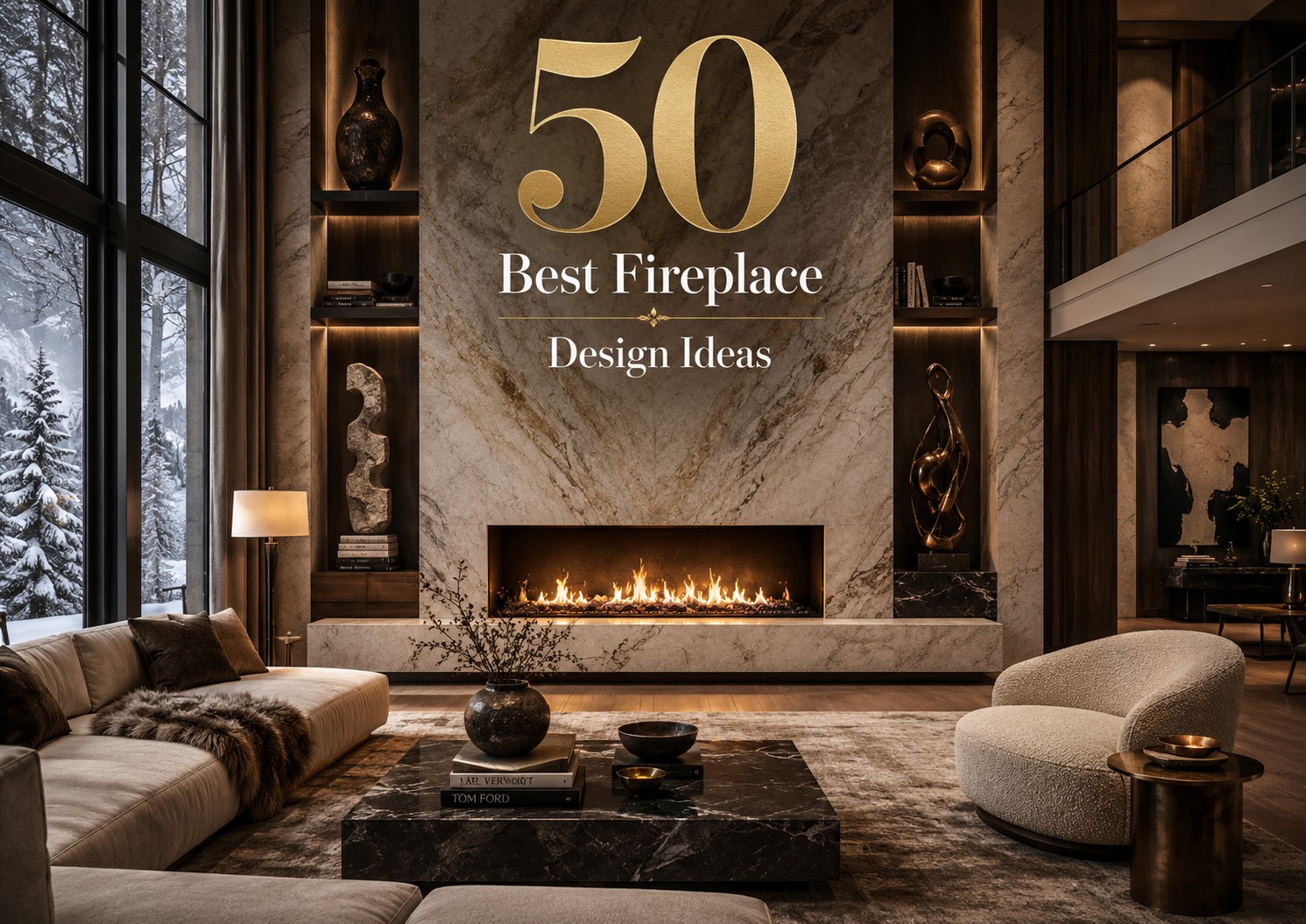
Every room that contains a fireplace organizes itself around it. The furniture faces it. The conversation gravitates toward it. The eye, on entering the room, finds it first and settles there before registering anything else. This is not a design convention that interior styling invented — it is the physical consequence of fire’s presence in a room, the same pull that has organized human social life around combustion for as long as humans have had rooms to sit in. The fireplace is the room’s gravitational center, and the design of that center determines the character of everything in its orbit.
The challenge with fireplace design is that most people approach it at the wrong moment — after the walls are finished, after the furniture is placed, after the room’s budget has been allocated to every other element, and after the architectural decisions that determine what the fireplace can become have already been made. The fireplace then becomes whatever fits in the space remaining, designed to the budget remaining, at the time remaining in the project when patience has been largely spent. The result is the fireplace surround that was selected from a catalog because it was in stock and it fit the opening, surrounded by the tile that was chosen from the remnant pile because it was the right size, with the mantel that was installed because it came with the surround and nobody thought to question whether it was the right one. This is how the majority of residential fireplaces come to exist, and it explains why the majority of them are the least interesting element in the rooms they were supposed to define.
The fireplace deserves different treatment. The fireplace design decision is the room’s primary architectural decision — more defining than the wall color, more permanent than the furniture, and more spatially significant than any accessory choice. Getting it right means thinking about the fireplace before the room is designed rather than after, understanding the surround, the mantel, the hearth, the firebox, and the chimney breast as a single designed element rather than a collection of sourced components, and choosing a design direction whose aesthetic commitment is complete rather than partial. A minimalist fireplace designed halfway remains a minimalist fireplace with too much detail. A traditional fireplace designed halfway remains a traditional fireplace without sufficient character. The fireplace rewards commitment and punishes compromise more than any other room element.
The fifty fireplace design ideas in this collection span every aesthetic direction, every fuel type, every room context, and every budget register — from the raw concrete single-pour fireplace that the modern home design maximalist installs as a sculptural object to the restored Victorian marble surround that the traditional home interiors enthusiast sources from an architectural salvage yard and reinstalls with the precision of a museum conservator. Rustic home decor fireplaces in stone and reclaimed timber sit alongside Scandinavian home interior fireplaces in white-painted steel, and coastal home design outdoor fireplaces share the collection with luxury home interior double-sided installations that serve two rooms simultaneously. Every idea is a complete design direction, not a starting point. Your fireplace should be designed to this standard.
The fire at the center of your home is too important to leave to the remnant pile.
1. A Marble Surround Fireplace With Classic Elegance

Marble has surrounded the firebox in fine residential architecture for centuries, and the reason it has persisted through every aesthetic shift that residential design has experienced in that time is not sentiment — it is material quality. Marble’s thermal behavior, its surface variation, and its combination of cold tactile quality with warm visual tone create a material that suits the fireplace surround’s specific functional and aesthetic requirements better than any synthetic alternative that has been developed to replace it.
Statuary white marble with grey veining — the classic Italian marble that most people picture when they hear the word — creates the traditional fireplace surround at its most formally composed. The veining’s movement across the mantel’s flat surface and the pilaster faces creates a natural pattern whose organic quality prevents the white marble from reading as sterile, and the veining’s grey tone connects the surround to any grey or charcoal accent in the room’s palette without requiring a forced design connection. Elegant home styling applied to the mantel display above the marble surround — a pair of matching candlesticks in tall clear glass, a single framed artwork of restrained scale, and a small clock or a sculptural object at the center — creates the formal mantel arrangement that traditional home interiors applies as the fireplace’s completed composition.
A marble surround requires maintenance that its material quality demands — the sealing of the stone’s porous surface before installation and at regular intervals thereafter, the immediate cleaning of any combustion residue from the firebox opening, and the avoidance of acidic cleaning products that etch the marble’s polished surface. The maintenance commitment is proportional to the material investment, and the household that performs it consistently retains the marble’s quality through generations. Marble fireplaces that have been properly maintained carry the quality of the original installation forward; marble fireplaces that have been neglected carry the evidence of that neglect in etched, stained, and discolored surfaces that no restoration fully reverses.
2. A Sleek Linear Gas Fireplace in a Modern Living Room

The linear gas fireplace — a wide, low rectangular firebox with a glass front and a ribbon flame running the full width of the opening — is the modern home design fireplace that residential architecture has applied most consistently in contemporary houses since the wide-format firebox became technically achievable in residential gas appliances. The linear format’s proportions suit the horizontal emphasis that contemporary home ideas living rooms apply through their furniture profiles, their window formats, and their architectural detail, and the visual alignment between the fireplace’s horizontal flame and the room’s horizontal material language creates a coherence that the traditional tall firebox format cannot achieve in the same room type.
The linear fireplace’s installation requires a dedicated gas line, a venting solution appropriate to the appliance’s specifications, and a surrounding material that handles the firebox’s radiant heat output without the thermal damage that inappropriate materials exhibit. The most common installation format — a large slab of porcelain tile or natural stone covering the full wall behind the fireplace, with the linear firebox recessed into the slab at a height calibrated for the seated sightline — creates the feature wall that the linear fireplace’s horizontal format anchors most effectively. The slab’s material should be non-combustible and thermally stable — a large-format porcelain tile in a concrete or stone look, or a natural stone slab with a polished or honed finish — and its color should suit the room’s palette with the same consideration that the room’s primary material selections received.
The linear gas fireplace’s operational appeal — the immediate ignition from a remote control or a wall switch, the adjustable flame height and heat output, and the complete absence of wood storage, ash management, and chimney maintenance — makes it the most practically convenient fireplace format for the household whose fireplace use is regular but whose domestic schedule does not accommodate the time requirements of a wood-burning appliance. The gas flame’s consistency and cleanliness make the linear fireplace suitable for rooms where the firebox is the room’s primary visual feature rather than a secondary warming element, because the flame’s predictable quality allows it to be designed for as a visual constant rather than managed as a variable one.
3. A Floor-to-Ceiling Stone Fireplace Wall
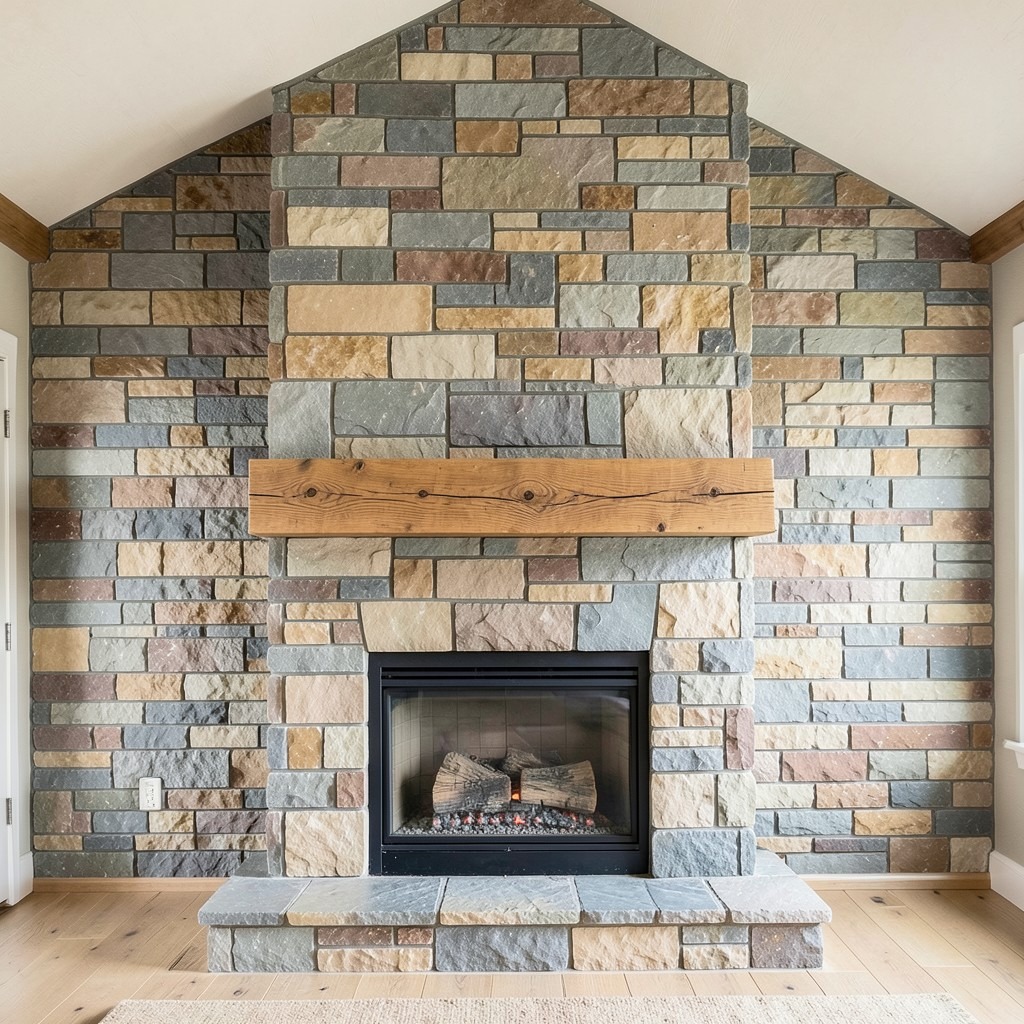
The floor-to-ceiling stone fireplace wall is the residential design statement that commits the room’s entire primary wall to the fireplace as an architectural element — the stone cladding rising from the hearth floor to the ceiling above, the firebox opening positioned at the visual and physical center of the stone field, and the chimney breast above the mantel continuing the stone surface upward until the ceiling terminates it. This is not a fireplace with a surround. This is a wall whose material is stone, and the fireplace lives within it.
Stone and wood home design applied to the floor-to-ceiling fireplace wall creates the rustic home decor statement of the most architectural and most permanent scale — the rough-cut fieldstone or the dimensional quarried stone covering the wall’s full surface in a pattern whose coursing and joint lines create the visual texture that the room’s single most dominant surface deserves. The stone’s color range within a single wall — the warm honey tones of sandstone, the cool grey of bluestone, the warm red of sandstone from certain quarries — creates the natural variation that makes a full stone wall read as a geological surface rather than a tiled pattern, and that geological quality is precisely what the mountain cabin decor and rustic farmhouse aesthetic values as its primary material expression.
The wood mantel projecting from the stone field at the chimney breast’s mid-point creates the material contrast that the stone and wood combination requires — the warm, worked quality of the timber against the cool, raw quality of the stone creates the dialogue that makes both materials more visible and more appreciated than either would be alone. The mantel beam in a reclaimed oak or Douglas fir — the full-width tree beam whose natural character is preserved rather than refined — creates the stone and wood fireplace wall’s human-scale reference point, its organic warmth making the stone above and below it more approachable and more inhabitable.
4. A Minimalist Concrete Fireplace Surround

The concrete fireplace surround is the minimalist home design choice that most directly challenges the aesthetic convention that the fireplace requires a composed, detailed surround — the concrete surround makes no compositional gesture, applies no ornamental detail, and commits to the material itself as the design’s complete expression. The concrete’s surface — its slight aggregate variation, its subtle color shifts from the mixing and the curing, and the traces of the form that shaped it — provides all the visual interest the surround requires, and the designer who understands this resists adding anything that the concrete itself does not call for.
A single-pour concrete surround — cast as a monolithic element whose mantel shelf, pilasters, and surround face are all one continuous material rather than assembled components — creates the minimalist fireplace’s most architecturally resolved expression. The monolithic quality prevents the visual interruption of material joints at the corners and transitions that assembled surrounds exhibit, and the concrete’s ability to be cast in any form allows the design to specify the surround’s profile with geometric precision that manufactured stone and plaster surrounds cannot approach. A contemporary home ideas living room whose architectural language is defined by material honesty — the exposed concrete column, the steel handrail, the polished concrete floor — receives the concrete fireplace surround as a natural extension of the room’s established material vocabulary.
The concrete surround’s surface finish specification determines its visual character significantly — a board-formed texture from the plywood mold creates a horizontal grain across the surround’s face; a smooth steel-formed surface creates the near-mirror quality of refined architectural concrete; and a sand-blasted finish creates the matte, slightly coarse texture that suits a warmer, less formal application. The finish decision should be made in relation to the room’s other surfaces and the fireplace’s role within the room — the smooth steel-formed concrete for the room where the fireplace is the architectural statement, and the board-formed or sand-blasted version for the room where the fireplace participates in a warmer, more textured material environment.
5. A Brick Fireplace With Whitewash Treatment

The whitewashed brick fireplace is the design decision that transforms the standard exposed brick fireplace — a fireplace type common to mid-century and earlier residential construction whose red-orange brick tone clashes with the palette of contemporary interiors — into a surface of warm, organic texture that suits almost any interior direction without sacrificing the brick’s textural quality. The whitewash does not cover the brick; it filters it, allowing the brick’s surface variation and the mortar joint’s shadow depth to remain visible through the diluted white pigment that the treatment deposits in the brick’s surface pores.
The whitewash application requires a diluted latex or limewash formula whose consistency is thinner than standard wall paint — too thick and the mixture fills the brick’s surface texture and creates the flat, opaque coverage of paint rather than the translucent filter of whitewash; too thin and the formula runs off the vertical brick surface before the pigment deposits adequately. The application technique — a wide natural bristle brush in a scrubbing motion that works the diluted formula into the brick’s surface rather than dragging it across the face — creates the uneven, organic distribution that whitewash requires to read as a natural surface treatment rather than an applied coating. The farmhouse home decor and beach house interiors directions both apply the whitewashed brick fireplace as a signature material expression, and the technique’s organic quality suits both aesthetics’ preference for surfaces that appear to have aged authentically.
A whitewashed brick fireplace does not require a mantel surround to be complete — the whitewashed surface reads as the room’s feature wall material, and the firebox opening’s black interior creates the required contrast within the pale surface without a surround’s compositional framing. Where a mantel is desired, a simple timber beam in a bleached or limed finish suits the whitewash’s pale, organic quality without competing with the brick’s texture, and the shelf’s function — the candle, the framed photograph, the small plant — adds the domestic warmth that the whitewashed wall’s architectural simplicity benefits from at the human scale of the eye-level mantel display.
6. A Double-Sided Fireplace Between Two Rooms

The double-sided fireplace is the architectural element that does exactly twice the design work of a standard fireplace — it creates the focal point for two rooms simultaneously, defines the spatial boundary between those rooms while maintaining a visual connection through the shared flame, and communicates the design intention of a house whose architecture was considered at the level of the room relationships rather than only the individual room interiors. It is also the most demanding fireplace installation in this collection, requiring the most planning, the most structural consideration, and the most specific venting arrangement. The reward is proportional.
The double-sided installation suits the architectural boundary between a living room and a dining room, between a master bedroom and an en-suite bathroom, or between a living room and an outdoor covered terrace — room pairings where the shared flame creates a visual connection whose warmth and intimacy serve both spaces’ social functions. The two-room fireplace whose shared flame is visible from a bath on one side and a bedroom on the other creates the luxury master bedroom design quality that boutique hotel suites achieve at significant cost, and the domestic version of that design element — the bath lit by the shared fireplace’s warmth on a winter evening — is one of the most atmospherically specific domestic experiences that residential architecture can create.
The double-sided gas fireplace — the most practical residential format for this installation — requires a sealed firebox with glass panels on both faces, a direct vent system that draws combustion air from outside rather than from the room, and sufficient structural support for the chimney breast or the partition wall that houses the appliance. The firebox’s depth and the partition wall’s thickness must accommodate the appliance’s specified minimum clearances on both faces, and the wall’s total thickness — typically twelve to eighteen inches for a two-sided gas appliance — is the spatial cost that the room plan must accommodate in the boundary between the two spaces the fireplace divides and connects.
7. A Farmhouse-Style Brick Fireplace With a Wood Mantel

The farmhouse fireplace is the domestic archetype — the wide brick firebox, the heavy timber mantel, and the hearth stone extending into the room like the kitchen’s practical center that it originally was. The farmhouse kitchen fireplace was not a decorative element. It was the room’s working infrastructure, and the best contemporary farmhouse fireplace designs honor that working identity rather than aestheticizing it into something too polished to have ever cooked a meal.
A wide firebox — forty-eight inches or wider — creates the farmhouse fireplace’s generous proportions, suggesting a hearth scaled for actual domestic use rather than for a parlor’s ornamental purpose. Handmade or reclaimed brick in a warm red-orange or sandy yellow tone suits the farmhouse aesthetic’s preference for materials that carry the evidence of their making and their age, and the mortar joint’s width and color should be specified to suit the brick’s scale — a wider joint in a sandy buff mortar for handmade brick, a tighter joint in a lighter grey for reclaimed brick whose faces are more consistent and whose edges are less forgiving of wide mortar coverage. Farmhouse home decor applied to the mantel display above — a collection of small terracotta and stoneware pieces arranged in an unforced, asymmetric group, a small potted herb, and the casual lean of a framed print against the chimney breast — creates the mantel’s domestic warmth without the symmetrical formality of a traditional mantel arrangement.
The timber mantel beam should be large enough to read as structural rather than as a shelf — a minimum of six inches in depth and eight inches in height for a fireplace of standard proportions, proportionally larger for the wide farmhouse format — and its finish should preserve the timber’s natural character rather than refining it into furniture quality. A hand-hewn beam with the adze marks visible, or a reclaimed beam with the original notches and surface imperfections preserved, creates the farmhouse mantel’s authentic material quality that a smooth-machined timber beam, regardless of its material, cannot replicate.
8. An Outdoor Stone Fireplace for Alfresco Living

The outdoor fireplace converts the garden or terrace into a four-season room — not by enclosing it, but by providing the warmth source whose presence makes the outdoor space habitable on evenings when the indoor-only household has retreated inside. The outdoor fireplace is the single outdoor investment that extends the usable season of the exterior space most effectively, and its design should be scaled and positioned with the same care that the living room fireplace receives, because the outdoor room it anchors is a genuine room whose social quality depends on the fireplace’s performance.
A dry-stacked or mortar-set stone fireplace in a garden setting — the stone selected from the local geological region where possible, its color and texture suited to the garden’s existing material palette — creates the outdoor fireplace with the permanence and the natural quality that the outdoor environment requires. Coastal outdoor living space designs apply the outdoor fireplace in a locally sourced stone — fieldstone, granite, limestone — whose connection to the landscape creates the feeling that the fireplace grew from the garden rather than being installed in it. The firebox’s opening dimensions should be designed for wood burning at the scale of the gatherings the outdoor space accommodates — a forty-inch opening for a small terrace hosting six to eight people, a larger fifty-four to sixty-inch opening for the open garden setting that accommodates larger gatherings.
A built-in wood storage area beside the outdoor fireplace — either within the fireplace structure itself, as a stone-walled alcove beside the firebox, or as a timber wood store positioned within carrying distance — creates the operational convenience that determines whether the outdoor fireplace gets used regularly or whether the inconvenience of carrying wood from a remote storage location gradually reduces the frequency of use until the fireplace becomes a garden ornament. The operational detail — the easy access to dry wood, the hearth tool set hanging on a hook beside the firebox, and the fireplace’s position relative to the seating that it warms — determines the outdoor fireplace’s practical success more than any aesthetic decision.
9. A Scandinavian Wood-Burning Stove as Fireplace Focal Point

The Scandinavian freestanding wood stove is the fireplace alternative that the Nordic residential tradition developed in response to the specific performance requirements of a cold climate — a closed combustion chamber that burns fuel at high efficiency, radiates heat in all directions from its freestanding position, and requires a fraction of the structural infrastructure that a built-in masonry fireplace demands. The Scandinavian home interior’s relationship with the wood stove is the design culture’s most specific and most direct expression of its climate conditions, and the wood stove installed in a British, American, or Australian home brings those performance values into a setting that the open fireplace’s heat loss and draft requirements have always compromised.
A cast iron or soapstone wood stove in a matte black or dark grey finish — freestanding on a non-combustible hearth pad of slate, stone tile, or polished concrete — creates the Scandinavian fireplace focal point with the minimum structural intervention of any fireplace format in this collection. The stove connects to a single flue pipe that rises to the ceiling and penetrates through the roof or the wall, and the flue pipe’s visible section — in the same dark finish as the stove, or in a satin stainless steel that suits a more contemporary setting — becomes part of the installation’s visual composition rather than an element to be concealed. The stove’s heat output — typically three to eight kilowatts depending on the model — fills a domestic living room or bedroom with genuine warmth far more efficiently than an open wood fire, because the closed combustion system captures the heat that an open firebox allows to escape up the chimney.
Winter home decor organized around the Scandinavian stove creates the cozy home design atmosphere that the Nordic aesthetic celebrates as hygge — the wool throw draped on the armchair beside the stove, the small stack of seasoned logs in a woven basket at the hearth, and the amber glow of the fire through the stove’s glass door creating the warm, flickering light that winter interior design values as its most domestic quality. The wood stove beside a good armchair, with the snow outside the window and the fire burning steadily inside, is the specific domestic scene that the Scandinavian design tradition has organized entire aesthetic philosophies around. It deserves the care its design requires.
10. A Fireplace With Full-Height Bookcase Built-Ins

The fireplace flanked by full-height bookshelves — built-in cabinetry that fills the chimney breast’s flanking alcoves from floor to ceiling, combining the room’s primary book storage with the fireplace’s warmth and visual presence — is the living room design arrangement that traditional home interiors and contemporary home ideas rooms apply most consistently as the room’s definitive feature wall composition. The arrangement works because the bookcase’s organizational complexity — the varied sizes and colors of the books, the objects placed among the shelves — creates a visual richness that balances the fireplace’s material weight and visual simplicity.
Floor-to-ceiling alcove cabinets in the chimney breast’s flanking recesses — a lower section of closed cabinetry below a predetermined shelf height, creating media storage or general closed storage, with open shelving above that section to the ceiling — create the built-in’s functional organization in a format that balances the private and the displayed storage in proportions that the household’s specific storage requirements determine. The open shelving’s height from floor to ceiling on both sides of the chimney breast creates the enclosed, library quality that wraps the fireplace in books and objects, and the visual depth of the shelves’ layered contents creates the room’s most complex and most personalized design surface. The closed cabinetry below conceals the electronic equipment, the media library, and the household documents that the room uses but does not display.
The fireplace surround’s material should be selected in dialogue with the built-in cabinetry’s material — the two elements share the feature wall and their material relationship determines whether the wall reads as a composed, unified design or as two separate elements that happen to share the same wall. A marble surround against white-painted cabinetry creates the traditional home interiors composition; a concrete surround between dark-stained oak cabinetry creates the contemporary home ideas version; a brick surround between painted shaker-style cabinetry creates the farmhouse living room’s feature wall in its most complete expression.
11. A Fireplace With a Reclaimed Wood Mantel

The reclaimed timber mantel is the one fireplace element that no new-manufacture product replicates with any honesty — the beam that was cut from a felled tree a century ago, seasoned over decades, used in a barn or a mill or a warehouse, and then salvaged when the structure was demolished carries a material biography that a freshly milled beam aged with stain and distressing tools can suggest but never claim. The reclaimed mantel is the room’s oldest object, and its age communicates a quality that the room’s other furniture and finishes, however fine, cannot match on the same terms.
A reclaimed oak or elm beam in a format large enough to read as structural — at least four inches in depth and six inches in height for a standard mantel proportion — creates the fireplace’s horizontal anchor in a material whose surface tells the story of its previous life: the saw marks from the original milling, the nail holes from the previous installation, the patina from a century of surface oxidation, and the occasional checked end grain where the beam dried and split along the natural growth lines of the original tree. These imperfections are not defects to be concealed. They are the material evidence that makes the reclaimed mantel worth selecting over a new-manufacture alternative whose surface has no story to tell.
The reclaimed mantel suits the fireplace design across a wider range of aesthetics than any other mantel material — the aged timber sits naturally with rustic home decor, farmhouse home decor, industrial home design, and bohemian home styling, and with lighter surface treatment — a lime wash or a very light sanding — it transitions toward the coastal home design and Scandinavian home interior direction with remarkable ease. The mantel’s adaptability is the direct product of the material’s organic quality, which finds its visual register in the wood’s natural tones and textures rather than in the associations of a manufactured finish.
12. A Fireplace With a Dramatic Black Steel Surround

The black steel fireplace surround is the industrial home design fireplace at its most architecturally direct — the flat, matte black steel plates welded at the corners and fixed to the chimney breast create a surround whose material quality is entirely in the steel’s surface character rather than in the compositional complexity of a traditional surround’s profiles and ornamental detail. The steel is the design. Nothing is added to make the surround interesting; the steel’s matte surface, the precision of its corners, and the contrast it creates against the wall’s pale surface are the complete aesthetic argument.
Flat-rolled steel in a hot-rolled finish — the dark, mineral-surface quality that the steel acquires in the rolling process and that distinguishes it from the cold-rolled steel’s shinier, more uniform surface — creates the industrial surround’s most authentic material expression. The hot-rolled surface’s blue-grey patina and its slight surface variation create the visual warmth that the matte black steel surround provides, and the material’s tendency to develop a gentle surface oxidation over time — a slight deepening of the patina in areas exposed to moisture — creates the living surface quality that manufactured coatings do not produce. A surface treatment of a thin wax or a clear penetrating oil preserves the hot-rolled patina at its installation quality while slowing the oxidation that the untreated steel exhibits in humid environments.
The black steel surround’s mantel — if a mantel is specified — should maintain the material consistency and the design language’s austerity. A flat steel plate projecting from the firebox opening at the mantel height, or a single reclaimed timber beam in a dark stain installed directly above the steel surround without the traditional shelf’s architectural detail, creates the mantel in the same design register as the surround. The household that adds an ornate marble shelf to a black steel firebox surround has designed two different fireplaces in the same opening, and the composition communicates the design confusion rather than hiding it.
13. A Coastal Fireplace With Driftwood and White Tile

The coastal fireplace takes the beach house interiors palette — the bleached whites, the natural greys, and the organic textures of weathered maritime material — and applies it to the fireplace surround with the material commitment that the coastal design direction requires to feel genuine rather than decorative. Coastal is not a color palette applied to a room; it is a material language that communicates the specific sensory environment of the coast, and the coastal fireplace expresses that language through the surfaces the fire inhabits.
White subway tile in a handmade format — the slightly irregular surface, the small size variation from tile to tile, and the hand-applied glaze that creates the tile’s luminous, slightly imperfect surface — covers the fireplace surround’s face and the firebox opening’s reveal in the coastal fireplace’s primary surface material. The handmade tile’s imperfection is the design quality that connects it to the coastal aesthetic’s preference for the organic and the natural over the machine-perfect, and its white surface reflects the fireplace’s flame with the dancing, unpredictable quality of light on water. A driftwood mantel — a single piece of beach-gathered, storm-seasoned timber whose surface has been bleached and abraded by salt water and sun exposure — creates the coastal fireplace’s primary material statement above the white tile, the timber’s silver-grey tone and organic form creating the natural counterpoint to the tile’s regular pattern.
A coastal fireplace in a summer living room decor context — the shell collection arranged on the driftwood mantel shelf, a single beeswax pillar candle in a glass cylinder at each end, and a framed watercolor or a linen-matted coastal photograph above the mantel — creates the summer home design’s most specifically atmospheric room element. During winter home decor season, the same fireplace with the fire burning and the wet weather outside creates the beach house’s most comforting indoor experience — the warmth and the light of the fire against the coastal material quality of the surround creating the specific atmosphere of a seaside cottage on a rainy day.
14. A Fireplace With a Terrazzo Hearth

The terrazzo hearth is the fireplace element that most mid-century residential architecture applied as the floor material immediately in front of the firebox, and its resurgence in contemporary interior design reflects both the material’s genuine quality and the current design culture’s appreciation for materials whose visual complexity is generated by the material’s own composition rather than by applied pattern or surface treatment. The terrazzo hearth is a living geological surface, its aggregate composition fixed at casting and its pattern unique to each pour.
A poured-in-place terrazzo hearth — cast at the level of the surrounding floor, its edges defined by thin brass or steel divider strips that prevent cracking and create the geometric form that contains the pour — creates the fireplace’s ground-plane element in a material of genuine permanence and visual specificity. The aggregate specification for the terrazzo determines its color and pattern entirely — white marble chips in a grey cement matrix create the classic terrazzo; black basalt chips in a white matrix create the dramatic high-contrast version; terracotta and rust aggregate in a warm buff matrix creates the earthy home design expression that suits the farmhouse or Mediterranean aesthetic. The aggregate’s maximum chip size should be proportional to the hearth’s area — a small hearth in a modest room suits a fine aggregate that creates a detailed, close-scale pattern, while a large hearth in a generous room suits a coarser aggregate whose larger-scale pattern reads from the standing distance at which the hearth is normally viewed.
The terrazzo hearth’s relationship to the surrounding floor material determines whether it reads as a distinct design element or as a continuation of the floor — a terrazzo hearth set in a hardwood floor reads as a distinct inset, its smooth, stone-like surface creating the material contrast with the wood’s grain and warmth; a terrazzo hearth in a room whose primary flooring is also terrazzo reads as the same material in a different composition, creating the continuity rather than the contrast. Both approaches work; the choice is a design preference rather than a correctness determination.
15. A Fireplace With a Sculptural Plaster Hood

The sculptural plaster hood is the fireplace element that the designer who is tired of the conventional surround reaches for when the goal is a fireplace that reads as a piece of architecture rather than a piece of furniture. The plaster hood — a custom-formed canopy that descends from the ceiling above the firebox opening, its three-dimensional form creating the chimney breast’s architectural expression in a continuous, surface-worked material — is the fireplace as sculpture, and its design requires the sculptural thinking that no catalog surround requires.
A smooth plaster hood in a warm white or a tinted clay tone — its form tapering from the ceiling’s full width at the top to a narrower lower edge that frames the firebox opening below — creates the minimalist plaster hood in its most architecturally pure expression. The hood’s form can be geometric — straight-sided tapers creating the architectural simplicity of a pure cone or pyramid in profile — or organic, with the plaster worked into curved, flowing forms that reference the natural erosion shapes of the desert home styling and Southwestern residential tradition. The organic plaster hood, whose surface shows the marks of the trowel and the hand that shaped it, creates the earthy home design atmosphere that the geometric plaster hood’s precision cannot provide, and the two directions create entirely different room characters despite sharing the same material and the same basic structural logic.
The plaster hood’s color can be the room’s neutral wall tone, making the hood disappear into the ceiling and allowing the firebox’s dark opening to read as the room’s focal element; or it can be a distinct tone — a warm terracotta, a deep clay, or a cool grey-white — that makes the hood the room’s primary architectural statement. The colored plaster hood creates the room’s dominant feature with the most minimal material intervention of any large architectural gesture available in residential design, because the plaster’s coverage — a thin coat over a substrate — achieves the room-defining effect at a material thickness of a fraction of an inch.
16. A Fireplace Surrounded by Zellige Tile

The zellige tile fireplace is the most visually specific fireplace in this collection — the handmade Moroccan terracotta tile, glazed in a single color and cut into irregular facets by hand, creates a surface of extraordinary light play that no machine-manufactured tile produces because no machine can replicate the slight variations in surface angle that the hand-cut facet creates in each individual tile. The zellige surface does not have a single light response; it has as many light responses as it has individual tiles, and the sum of those individual responses is the shimmering, living surface quality that makes zellige tile one of the most atmospherically distinctive surface materials available in residential interior design.
A zellige-tiled fireplace surround in a single deep color — emerald green, cobalt blue, midnight teal, or warm terracotta — creates the fireplace feature wall whose material intensity suits the bohemian home styling direction’s appetite for rich, saturated color in the handmade, culturally specific material expression. The single-color application prevents the tile’s surface variation from competing with a pattern, allowing the material’s own light response to create the visual complexity that a multi-color zellige application would achieve through color instead. The deep color’s richness against the fire’s amber glow creates the warm, saturated atmosphere that the zellige-tiled fireplace produces with particular effectiveness on the winter evenings when the fire burns at its most intense.
The zellige surround’s mortar joint specification — a wider joint in a colored mortar that suits the tile’s irregular facet dimensions, filled to a slightly recessed level that creates shadow depth at the joint — creates the surface’s additional textural layer beyond the tile face’s own variation. The mortar color should be selected in dialogue with the tile’s glaze color — a buff or sandy mortar for warm-toned tiles, a charcoal or dark grey mortar for the deep blue-green tones that deep zellige colors often carry — to create a joint that contributes to the surface’s visual quality rather than distracting from the tile’s own considerable character.
17. A Fireplace With a Floating Concrete Mantel

The floating concrete mantel — a single horizontal concrete slab projecting from the wall above the firebox opening on concealed steel brackets, with no visible support structure — is the modern home design fireplace element that communicates structural confidence and material directness simultaneously. The slab floats. That is the design. Its cantilevered weight communicates material quality and engineering precision, and the absence of supporting elements below the slab creates the visual lightness that the substantial concrete material would otherwise lack.
The floating concrete mantel’s dimensions should be calibrated to the fireplace’s proportions and the wall’s scale — a mantel that projects too far from the wall becomes visually dominant and physically intrusive; one that projects too little reads as a shelf rather than a mantel. A projection of eight to twelve inches for a standard living room fireplace creates the mantel’s functional surface for display while maintaining the proportional relationship between the horizontal slab and the vertical wall plane that reads as architecturally composed rather than furniture-like. The slab’s thickness — typically two to four inches for the floating concrete mantel — should be specified for the visual weight desired: a thinner slab creates a more refined, graphic quality while a thicker slab creates more material presence and physical weight, which the concrete’s density makes genuinely appreciable.
Warm home decor ideas applied to the floating concrete mantel’s display — a single long-stemmed stem in an architectural glass vase at one end, a matte ceramic vessel at the other, and nothing between them — creates the minimal mantel arrangement that suits the floating concrete’s architectural severity with the same design intelligence that the surround applied to the firebox. The floating mantel that is then overloaded with seasonal decoration, family photographs, and accumulated objects becomes a shelf rather than a mantel, and the architectural gesture that the cantilever creates is lost in the domestic accumulation. The floating mantel rewards restraint consistently and absolutely.
18. A Fireplace With a Distressed Painted Brick Surround

The distressed painted brick fireplace is the designed patina — the appearance of age and use applied to a surface that may be entirely new, or applied to an existing brick surface whose previous color was unsuitable for the room’s current design direction. Distressing is not damage. When it is done with skill, it is the opposite: a controlled application of aging techniques that creates the material history that the surface would have developed naturally over decades of occupancy, compressed into a single informed treatment.
Lime paint in a warm white or a soft grey applied to the brick in a diluted wash, then partially removed with a damp cloth before the wash fully dries, creates the uneven, layered coverage that genuine aging produces over successive paint applications. The areas where the wash is more thoroughly removed — the brick’s raised faces, the corners, the edges — reveal more of the underlying brick color, creating the organic variation that distinguishes distressed paint from a flat paint application. Multiple thin coats of the lime wash in slightly different dilutions, each partially removed before drying, create the layered depth of the distressed finish that a single application cannot achieve, because genuine aging creates layers rather than surfaces.
The distressed painted brick fireplace suits the relaxed home design aesthetic that characterizes coastal home design, beach house interiors, and the lived-in quality that bohemian home styling celebrates as its central design value. The fall home decorating season is when this fireplace type shows its seasonal best — the warm fire behind the pale, layered brick surface, the amber flame visible through the firebox opening, and the autumn colors of the mantel arrangement creating the specifically warm, atmospheric domestic scene that the distressed material’s organic quality amplifies rather than competes with.
19. A Fireplace With a Tropical Botanical Surround

The tropical fireplace is the design idea that most unexpected — the fireplace as an element embedded in a botanical environment, its surround covered in or adjacent to the dense living plant material that tropical home design and jungle-inspired home decor apply as their primary design material. The juxtaposition of fire and foliage creates the visual tension that makes this fireplace type genuinely memorable: the warm, amber fire at the center, surrounded by the deep green of tropical plants whose placement creates the botanical frame for the fireplace’s flame.
Trailing plants positioned on the mantel shelf and on shelves flanking the chimney breast — the pothos, the philodendron, and the heartleaf vine whose natural trailing habit creates the cascading botanical frame around the fireplace opening — create the tropical fireplace’s plant environment without structural complexity. The plants’ trailing stems create the living botanical surround as they grow, filling the space between the mantel and the flanking shelves with the green density that the tropical aesthetic requires. The plants’ heat tolerance should be considered — the ambient warmth of a working fireplace at a distance of three to four feet is manageable for most tropical houseplants whose natural environment includes the warm, humid conditions of the forest floor, but the direct heat of a firebox opening will damage plant material positioned within eighteen inches of the firebox face.
A garden-inspired interiors approach to the tropical fireplace room — the large-format tropical patterned wallpaper on the chimney breast face, the deep rattan furniture beside the fire, and the collection of terracotta vessels on the hearth containing succulent and tropical specimens — creates the complete botanical living room whose fireplace is an element within a plant environment rather than a focal point surrounded by conventional interior furnishing. The tropical fireplace is the most atmospheric interpretation of the fireplace-as-room-center idea — the fire surrounded by green life, the amber warmth and the organic green creating the specific sensory combination that no other design direction produces.
20. A Fireplace With a Mirrored Chimney Breast

The mirrored chimney breast is the fireplace treatment that solves two common residential design challenges simultaneously — the dark room whose light is limited by its orientation or its window area, and the low-ceiling room whose vertical proportions feel compressed. The mirror extends the room’s perceived volume beyond its physical boundaries, reflects the fireplace’s flame across the room in a doubled form, and amplifies every light source in the room with the reflective efficiency that no surface other than a mirror achieves. It is also the most divisive fireplace treatment in this collection. People love it completely or reject it entirely.
Floor-to-ceiling mirror panels on the chimney breast — framed in a thin brass or steel molding that creates the panel’s visual boundary — create the maximum light amplification and the maximum spatial expansion that the mirrored chimney breast produces. The mirror above the mantel and continuing to the ceiling creates the vertical extension of the room that low-ceiling spaces most benefit from, the reflected ceiling appearing to continue above the actual ceiling and creating the impression of a room substantially taller than its measured height. The elegant home styling direction applies the mirrored chimney breast most naturally — the French and Italian residential tradition has applied mirror glass above fireplaces in formal rooms for centuries, and the contemporary interpretation maintains the same spatial logic in a more minimal, less ornamental format.
The mirrored chimney breast in a chic home decor context — flanked by wall-mounted brass sconces, with a sculptural object on the mantel whose reflection doubles its presence in the room, and the fire below creating the animated amber reflection that the mirror captures and distributes around the room — creates the most glamorous fireplace composition available without architectural modification of the chimney breast itself. The mirror is the one surface treatment that requires no structural work, no permanent installation, and no fire-rated material behind it, because the chimney breast’s face above the firebox opening is a standard plaster wall that mirror can be bonded to directly.
21. A Fireplace With a Large-Format Stone Tile Surround
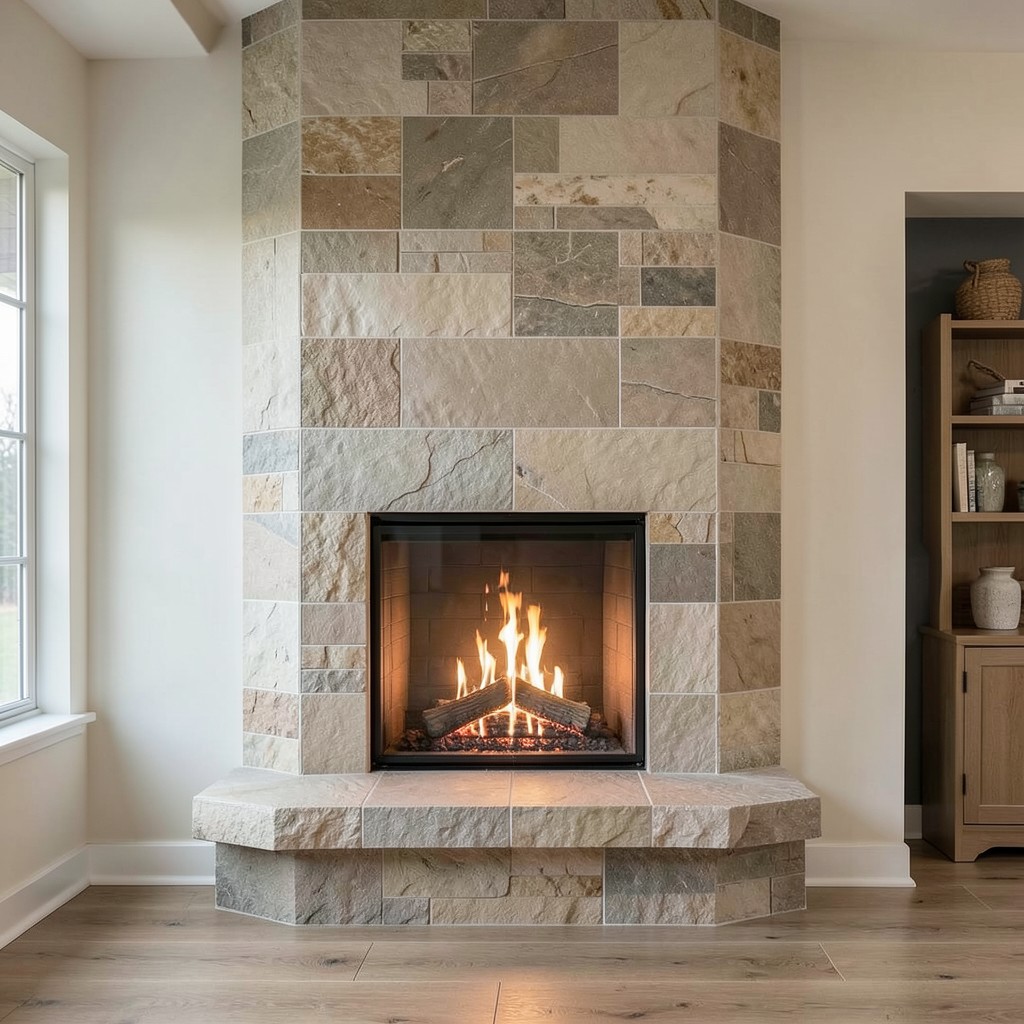
The large-format stone tile fireplace surround is the contemporary interpretation of the stone fireplace for households whose construction context does not accommodate the thickness and weight of full-depth stone cladding — the twenty-millimeter-thick porcelain tile in a stone look, or the ten-to-fifteen-millimeter natural stone tile in a bookmatched or random-lay pattern, creates the stone surface quality in a format whose reduced thickness and weight suits the standard residential construction conditions of an existing chimney breast.
A bookmatched natural stone tile installation — two adjacent panels cut from the same stone block and folded open like a book, their mirror-image veining creating a symmetrical pattern across the fireplace surround’s face — creates the luxury stone quality that the natural material’s geological uniqueness provides and that no machine can program into a manufactured tile. The bookmatched panel’s symmetry draws the eye from the room’s standing distance, and the natural variation within the symmetry creates the visual complexity that the material’s own composition generates without applied pattern. A honed rather than polished finish on the natural stone tile suits the fireplace’s heat environment and creates a matte surface that reflects the fire’s light without the hot spots that a polished surface creates directly below the firebox opening.
Contemporary home ideas applied to the large-format tile surround — a single large panel of a dramatic bookmatch stone from floor to ceiling on the chimney breast, the firebox opening cut through the stone panel’s center, and no surround or frame applied beyond the tile itself — creates the stone fireplace wall of a contemporary character that full-depth stone cladding achieves in a rustic context. The tile’s thin format allows the large panel to be applied to the wall’s plaster surface with appropriate tile adhesive and without the structural support that full-depth stone cladding requires, making the large-format stone fireplace achievable in existing residential construction that the weight of full stone would compromise.
22. A Fireplace With a Built-In Seat and Storage

The fireplace inglenook — the built-in seating that flanks the firebox, creating the enclosed, fire-side seating arrangement that English domestic architecture developed in the sixteenth century and that residential design has returned to consistently whenever the household’s instinct for warmth and intimacy is stronger than its instinct for compositional formality — is the fireplace design that most completely fulfills the social function that the fireplace is designed to serve. The inglenook does not place the fire at one end of the room for the seating to face across the room. It places the seating beside the fire, within its warmth, in the intimate enclosure that the fire-side bench creates.
Built-in bench seating in the chimney breast’s flanking alcoves — typically at standard bench height of seventeen to eighteen inches, with a cushioned seat surface and storage below the seat in a hinged-lid format that conceals the log storage, the kindling, and the fire tools that the fireplace requires — creates the inglenook’s seating and its operational storage in a single continuous built-in element. The bench’s back — either a built-in panel at the alcove’s back wall or the wall itself, painted or tiled to match the surround — creates the enclosure that makes the fire-side seating feel sheltered and separated from the room’s main activity area. Cozy home design principles applied most completely in the inglenook: the enclosed seat, the warm fire, the low ceiling of the alcove — where the built-in’s top creates a lower soffit above the seating — and the direct proximity to the fire create the domestic comfort that no conventional sofa-facing-fireplace arrangement approaches from the same direction.
The inglenook seating’s cushions should be the room’s best-quality textiles — the fire-side seat is used most intensively and most intimately of any seating in the room, and the cushion material should be durable, cleanable, and genuinely comfortable for extended periods in close proximity to the fire’s radiant heat. A heavy linen, a natural wool, or a flame-resistant performance fabric in a warm tone — the terracotta, the forest green, the deep navy — creates the cushion in a material whose quality suits the architectural permanence of the built-in beneath it.
23. A Fireplace in a Luxury Master Bedroom

The bedroom fireplace is the domestic luxury that the hotel industry has understood for decades and that residential design has applied less consistently than its effect on the sleeping environment justifies. A fire in the bedroom is not the same as a fire in the living room — it is more intimate, more personal, and more directly connected to the physical experience of warmth and comfort in the room where the household’s most private domestic life occurs. The bedroom fireplace does not need to be large or architecturally grand. It needs to be exactly right for the room it warms.
A slim, portrait-format gas fireplace insert in a polished stone or pale marble surround — scaled to the bedroom wall’s proportions rather than to the living room’s larger format — creates the luxury master bedroom design fireplace in a format whose intimate scale suits the room’s private character. The gas insert’s remote operation allows the fire to be started from the bed without leaving the warm linen, which is precisely the operational quality that the bedroom fireplace exists to provide on a cold morning or a winter evening. Luxury home interior quality in the bedroom fireplace is expressed through the surround’s material refinement — the polished Carrara marble, the hand-applied plaster hood, or the precision-cut stone panels — rather than through the fireplace’s scale, and the bedroom’s intimate proportions allow the fine material detail to be appreciated at the close distance that the room’s furniture arrangement creates.
The bedroom fireplace’s mantel display should be the most personal of any fireplace in the house — the family photographs, the small personal objects, the candles that are lit on the evenings the fire burns — because the bedroom mantel is not designed for social consumption. It is designed for the household’s private life, and its contents should reflect that privacy with the same honesty that the bedroom’s design direction applies to every other element in the room.
24. A Fireplace With a Herringbone Brick Interior

The herringbone brick firebox interior — the angled brick pattern that lines the back and sides of the firebox opening — is the fireplace detail that most people who have one have never consciously noticed and most people who have a plain-backed firebox have always vaguely wished they had. The herringbone pattern inside the firebox creates the visual interest that the fire illuminates from within, the angled brickwork catching the flame’s light from multiple directions and creating the three-dimensional texture that the flat-laid brick back does not provide. It is a detail that costs a modest additional amount over a standard firebox lining and that improves the visual quality of the firebox whenever the fire burns.
A traditional herringbone firebox lining in a fire-rated brick — the small-format, dense brick specifically manufactured for firebox applications rather than the standard building brick whose lower density makes it unsuitable for the high-temperature environment of the firebox — creates the angled pattern in a material calibrated for the thermal demands of the position. The brick’s color — a warm buff, a deep red, or the varied mixed-tones of a hand-selected batch — creates the firebox’s background color against which the fire’s flame reads, and the selection should be made in relation to the fire’s flame color and the amber-to-blue spectrum that the fuel type creates. A wood fire’s warm orange and amber flame reads most beautifully against a warm red herringbone lining; a gas flame’s cooler blue-white reads most clearly against a pale cream or buff brick.
The herringbone firebox lining is the detail that most directly connects contemporary fireplace design to the traditional home interiors knowledge that the historic fireplace’s craftsmen developed over centuries of working with fire. It is not a decorative innovation. It is the application of a functional detail whose thermal and visual efficiency has been validated by generations of fireplace makers, and its continued relevance in contemporary fireplace design is the evidence that the best traditional details are best precisely because they solved the problem completely the first time.
25. A Fireplace With a Lime-Plastered Chimney Breast

The lime-plastered chimney breast is the fireplace treatment that the Mediterranean and Middle Eastern residential traditions have applied for millennia, and its return to contemporary interior design reflects the current culture’s honest preference for the handmade, the material, and the organically beautiful. Lime plaster is not a modern trend. It is one of the oldest building surfaces in human architecture, and its return is less a trend than a recognition — the recognition that the surface quality lime plaster creates has no synthetic equivalent.
Lime plaster applied to the chimney breast in a single final coat, troweled to a smooth-burnished surface whose slight texture catches the light with the luminous quality that gypsum plaster and emulsion paint cannot produce — creates the fireplace surround’s surface expression in a material of genuine sensory quality. The lime surface’s warmth — its slightly warm white tone that is never the clinical cold white of synthetic emulsion — suits every aesthetic direction from the rustic to the contemporary, and its slight surface texture creates the three-dimensional quality that makes a flat wall surface interesting from the close viewing distance that the fireplace’s seated audience maintains. Fall home decorating season is when the lime-plastered chimney breast reaches its atmospheric peak — the warm amber of the fire against the warm white of the lime plaster creating the specifically domestic light quality that the season’s design direction values most.
A lime plaster chimney breast whose color has been tinted with natural earth pigments — a warm ochre, a soft terracotta, or a cool slate grey — creates the fireplace’s color statement in the most material and most authentic format available. The earth pigment mixed into the lime plaster creates a color of extraordinary depth and subtlety whose tone shifts with the light quality throughout the day — warm in the morning’s east light, cooler at noon’s overhead position, and warmest in the amber artificial light of the evening firelight that the chimney breast’s surface reflects toward the room.
26. A Fireplace With an Arched Opening

The arched firebox opening is the architectural detail that transforms the fireplace from a rectangular aperture in a wall into a genuine architectural element whose form references the building traditions of the southern European, Moroccan, and North African residential architecture that developed the arched opening as both structural logic and ornamental expression. The arch above the firebox creates the visual gesture that the rectangular opening lacks — the upward movement of the arch’s curve against the horizontal of the mantel shelf or the chimney breast’s flat face creates the compositional tension that a purely rectangular composition does not generate.
A round-headed arch in a smooth plaster — the arch’s curve described in a precise semicircle whose radius is half the opening’s width — creates the classical arched firebox in its most geometrically resolved form. The plaster arch’s smooth transition from the firebox opening’s vertical jambs to the semicircular head creates a single continuous surface that reads as both structural and ornamental, and the arch’s reveal depth — typically four to six inches of plastered surface between the room face and the firebox’s back face — creates the three-dimensional depth that makes the arch more than a flat profile. Desert home styling and Moroccan-influenced interiors apply the arched firebox as a signature architectural element, and the arched plaster surround creates the most complete expression of that aesthetic in the residential fireplace context.
A pointed Gothic arch or a Moorish horseshoe arch creates the fireplace’s more historically specific architectural expression in residential interiors that draw from the medieval English or the Andalusian architectural tradition. The pointed arch’s upward thrust creates a more vertical, more dynamic composition than the round arch, and its pairing with the warm stone cladding of a stone and wood home design fireplace creates the most architecturally authentic expression of the Gothic domestic interior. The arch form is the fireplace detail whose commitment to architectural specificity most directly communicates the room’s design intelligence.
27. A Fireplace With an Integrated TV Above

The television above the fireplace is the design arrangement that the interior design establishment has argued against for decades and that the majority of residential clients continue to request regardless. The argument against it — the ergonomic problem of a screen position that requires the neck to extend upward from the seated viewing angle, and the heat and light damage that the firebox’s thermal and luminous environment creates for the display — is legitimate. The appeal of the arrangement — the two most visually dominant elements of the living room organized on the same wall, sharing the same focal point — is also real. The resolution is in the details.
A fireplace design that positions the firebox sufficiently high on the chimney breast — raised to a minimum of forty-eight inches from the floor to the firebox opening’s bottom edge — reduces the television’s height above the firebox to a range whose ergonomic compromise is manageable. The raised firebox creates a more architecturally distinctive fireplace composition regardless of the television, and the horizontal proportions of both elements — the wide television above, the linear or square firebox below — create the chimney breast composition that most contemporary home ideas living rooms achieve without the awkward spatial compression that occurs when a low firebox and a screen are stacked with minimal separation. A mantel shelf between the two elements — projecting enough to shield the screen from the firebox’s direct heat rise — creates the physical and visual separation that reduces both the thermal risk and the compositional compression.
The television integrated seamlessly into a chimney breast panel system — where the screen sits within a panel of the same material as the chimney breast surround, flush-mounted and surrounded by the stone, tile, or plaster of the wall surface — creates the cleanest compositional resolution of the television-above-fireplace arrangement. The flush-panel installation removes the black rectangle’s visual dominance when the screen is off, replacing it with the chimney breast’s material surface, and restores the full screen presence when the display is active. This is the arrangement that suits the minimalist dining room through a pass-through wall fireplace, and that suits the contemporary living room’s commitment to clean, uncluttered surfaces when the television is not in use.
28. A Fireplace With a Hand-Painted Tile Surround

The hand-painted tile fireplace surround is the most personal and the most irreplaceable fireplace design in any collection — the artist who paints the tiles creates a surface that exists nowhere else in the world, whose pattern and color belong entirely to the specific design vision behind it, and whose handmade quality communicates the design intention of a household that values the made-by-hand above the manufactured-in-quantity. You cannot order a hand-painted tile surround from a catalog. You commission it, and that commissioning process is itself a design act of genuine meaning.
Portuguese azulejo tiles in a cobalt blue pattern, Catalonian hand-painted botanicals, or the polychrome floral traditions of Delftware ceramics each bring their own cultural and artistic heritage to the fireplace surround, and the selection of a specific tile painting tradition is the design decision that determines the surround’s complete aesthetic character. The tiles’ painted surface should be fired to a temperature that creates a glaze capable of withstanding the heat environment of the fireplace surround — the tiles are not in the firebox and do not experience direct flame contact, but the radiant heat of an active fire raises the surround’s surface temperature sufficiently to damage an unfired or low-fired glaze over time. A properly fired ceramic glaze on a quality tile body creates a surface of permanent color whose quality the fireplace’s heat environment does not diminish.
Floral home decor ideas applied through the hand-painted tile surround create the most complete and most intimate expression of that aesthetic direction available in interior design — the painted flowers, leaves, and botanical forms covering the surround’s face create a garden-inspired interiors quality at the fireplace’s scale whose handmade character places it beyond any digital or machine-printed alternative. A spring home refresh fireplace — the hand-painted botanical tile surround newly cleaned and gleaming, fresh flowers on the mantel shelf, and the warmth of the late-season fire burning for the last time before the summer warrants it — creates the seasonal transition moment whose domestic specificity the hand-painted tile celebrates with appropriate ceremony.
29. A Fireplace With a Copper Hood and Patina Finish

The copper fireplace hood is the metal fireplace element with the longest residential design history and the most organically beautiful aging behavior of any metallic material — the copper surface that is warm, burnished amber-pink at installation becomes, over years of exposure to heat and the household’s atmospheric conditions, a layered patina of greens, browns, and warm earth tones whose complexity no manufactured finish can reproduce. The copper hood ages into its design. It does not wear out. It deepens.
A hand-hammered copper hood above the firebox opening — its surface worked with a ball-peen hammer to create the organic, multi-faceted texture that the hammered technique produces — creates the fireplace’s primary metal element in a material whose reflective complexity suits the fire’s amber light with the warmth that polished steel’s cooler reflections do not generate. The hammered surface catches the fire’s light from hundreds of small facets at varying angles, creating the living, animated reflection quality that a smooth-rolled copper surface produces only partially. The hood’s form — whether a simple tapered pyramid, a curved canopy, or the more elaborate sculpted form that a skilled metalsmith produces — should be designed in proportion to the firebox opening below and the ceiling height above, its dimensions creating the visual balance between the copper’s warm presence and the room’s remaining design elements.
The copper hood’s maintenance philosophy is the household’s choice rather than the material’s requirement — the hood that is polished regularly maintains the warm, burnished amber of fresh copper; the hood that is left to age naturally acquires the verdigris patina whose green-and-brown complexity creates the earthy home design quality of an ancient material that has inhabited its position for a long time. Neither approach is correct. Both produce beautiful results, and the choice between them communicates something genuine about the household’s design philosophy — the preference for the maintained brightness or the earned complexity.
30. A Fireplace With a Scandinavian Tile Stove Design

The Scandinavian tile stove — the kakelugn in Swedish, the kakkelovn in Norwegian — is the heating element that Nordic residential architecture developed as the most thermally efficient and the most decoratively beautiful alternative to the open fireplace, and its application in contemporary interior design outside the Nordic countries creates a fireplace type of exceptional thermal performance and distinctive visual character. The tile stove is not a fireplace in the conventional sense — it is a thermal mass heater whose glazed tile exterior absorbs the fire’s heat during a short, hot burn and releases it slowly over the following eight to twelve hours, warming the room with the steady, even radiance of a heated thermal mass rather than the direct, variable heat of an open flame.
White glazed tiles in a simple rectangular format — the classic Scandinavian home interior tile stove expression — create the stove’s distinctive exterior in the pale, reflective surface that the Nordic aesthetic applies to its primary surfaces. The tiles’ glazed surface reflects the room’s light with the same ceramic luminosity that white-glazed wall tiles provide in a kitchen or bathroom, and their arrangement in the stove’s geometrically precise exterior — the pilastered corners, the cornice detail, and the plinth base of a classical tile stove form — creates a piece of decorative architecture rather than a heating appliance. The Scandinavian home interior that contains a properly designed tile stove has the room’s most culturally specific and most thermally intelligent heating element, and the cozy home design atmosphere that the tile stove’s steady radiant warmth creates is qualitatively different from the convective warmth of a central heating system — warmer, more direct, and more domestic.
The tile stove’s fire management is the practice that the Nordic household learns as domestic knowledge — the correct size of wood for the firebox, the air supply setting for a complete and clean combustion, and the timing of the fire that charges the thermal mass before the evening rather than during it. The household that masters this practice has a heating element of extraordinary beauty and genuine thermal performance, and the tile stove in its best form is the room’s most important object — not merely its focal point, but its warmth source, its decorative centerpiece, and the physical expression of the Nordic design culture’s deepest domestic values.
31. A Fireplace With a Desert Adobe Surround

The adobe fireplace surround is the design direction most directly drawn from the indigenous American Southwest residential tradition — the Pueblo and adobe architecture that developed the fireplace as the home’s thermal and social center, expressed in the earth-toned plaster and the rounded organic forms that the region’s building traditions have maintained through centuries of practice. The adobe fireplace does not look like it was designed. It looks like it grew from the wall, its rounded edges and organic surface the product of hands working wet earth into form rather than the sharp corners and flat planes of manufactured construction.
Earthen plaster — a mixture of clay, sand, and fiber applied to the chimney breast and the surround area in successive coats, each layer troweled and burnished to create the smooth, dense surface whose organic warmth no synthetic plaster fully reproduces — creates the adobe fireplace surround’s primary material. The earthen plaster’s color is inherent rather than applied — the clay component’s natural iron content creates the warm orange-tan-ochre tones of the adobe aesthetic without pigment additions, and the plaster surface’s variation within a single application creates the organic color depth that the desert home styling palette values as its most authentic material expression. The surround’s rounded form — achieved by building the plaster over a chicken-wire or expanded mesh armature whose organic shape determines the surround’s profile — creates the smooth, three-dimensional sculptural quality that distinguishes the adobe fireplace from every other fireplace type in this collection.
A banco — the built-in bench of adobe architecture, an earthen platform extending from the firebox’s side as an integrated seating element — creates the adobe fireplace’s social furniture in the same continuous material as the surround itself. The banco’s thermal mass absorbs the fire’s warmth and creates the heated seating surface that the adobe tradition values as the fireplace’s most practical and most intimate domestic feature. Earthy home design and the peaceful home decor direction both find their most authentic architectural expression in the adobe fireplace — the material is the earth, the form is the hand, and the warmth is genuine.
32. A Fireplace With a Gold Leaf Mantel Detail

The gold leaf fireplace mantel is the luxury home interior’s most historically specific decorative element — the application of genuine metal leaf to the carved or molded detail of a traditional or classical mantel surround creates the ornamental richness that the Baroque and Rococo residential interiors applied to their fireplaces as the primary domestic display of wealth and artistic ambition. The contemporary application is more restrained, more selective, and more intelligent — gold leaf applied at specific points of the mantel’s decorative detail rather than across its full surface creates the material accent whose luxury communicates through restraint rather than excess.
Gold leaf applied to the carved acanthus leaves of a classical plaster surround, to the egg-and-dart molding of the mantel’s frieze section, or to the capitals of the pilasters flanking the firebox opening creates the luxury statement at the precise ornamental locations where the carving’s three-dimensional quality catches the leaf’s reflective warmth most effectively. The leaf’s application — genuine twenty-two or twenty-four karat gold leaf applied over a size adhesive to the primed and prepared carved surface, then burnished with an agate burnisher to create the smooth, reflective gold surface that oil gilding produces — creates the material quality that gold paint cannot replicate. The difference between genuine gold leaf and gold paint is visible from across the room: gold leaf reflects the light as metal; gold paint reflects it as pigment, and the distinction is immediately apparent to anyone who has seen both.
Elegant home styling that incorporates gold leaf fireplace detail — the mantel’s carved ornament gleaming against the surrounding painted white surface, the fire below creating the warm, amber-reflected illumination that brings the gold to its most dramatic visual expression — creates the formal interior’s most complete and most historically grounded luxury moment. Holiday home styling during the winter festive season enhances the gold-leafed mantel’s visual richness — the candle flames on the mantel shelf reflecting in the gold surface, the deep red of a winter floral arrangement against the warm metal detail, and the fire below creating the golden warmth that the season’s interior design celebrates as its defining atmospheric quality.
33. A Fireplace With an Outdoor Courtyard Setting

The courtyard fireplace is the outdoor fireplace of maximum architectural ambition — not a freestanding garden element but a built fireplace within an enclosed or semi-enclosed outdoor room whose walls, paving, and overhead structure create the interior-quality outdoor space that the Mediterranean, Moroccan, and Spanish colonial residential traditions have applied as the domestic outdoor room’s most architecturally complete form. The courtyard fireplace inhabits an outdoor room rather than a garden; the distinction is material, and the design should honor it.
Stone walls — the courtyard’s enclosing structure in a natural stone whose color and texture suit the garden’s material palette — create the fireplace’s installation context with the architectural permanence that the outdoor setting requires. A recessed arched firebox built into the courtyard’s end wall, its opening framed in a dressed stone reveal and its mantel formed from the same stone at the structural lintel height, creates the courtyard fireplace as a genuine architectural element of the enclosing wall rather than as an object placed within it. The arched opening form suits the courtyard setting’s Mediterranean and North African architectural references, and the stone’s natural weathering — its surface aged by rain, sun, and the moss that grows at the base of its joints — creates the courtyard fireplace’s integration into its outdoor setting over time.
Coastal outdoor living space principles applied to a courtyard fireplace — the terracotta paving, the white-plastered walls with the arched fireplace opening as the courtyard’s focal point, and the hanging lanterns that create the evening illumination — create the Mediterranean courtyard atmosphere that the fire at the center anchors. During fall home decorating season when outdoor evenings cool and the fire justifies its position at the courtyard’s social center, the lit courtyard fireplace creates one of the most specifically beautiful domestic outdoor experiences available in residential design — the fire’s warmth within the enclosed outdoor room, the courtyard’s walls protecting from the wind, and the stars visible above the open sky that the courtyard’s walls frame.
34. A Fireplace With a Lacquered High-Gloss Surround

The high-gloss lacquered fireplace surround is the chic home decor fireplace — the surround whose surface is polished to a mirror-like depth in a single saturated color, creating the glossy finish that fashion and furniture design have applied to their most deliberately sophisticated objects for decades. The lacquered surround’s surface quality communicates luxury through the precision of its finish rather than through the preciousness of its material, and the design intelligence of this approach is its reversal of the typical luxury equation: the most valuable element here is the craft of the finish, not the cost of the substrate.
A MDF or plaster surround — either a purchased profile or a site-built chimney breast treatment — coated in fifteen to twenty thin coats of high-build lacquer, each coat sanded between applications to a glass-smooth surface, creates the base for the final color coat and the finishing clear lacquer topcoat that produces the deep, reflective sheen of the lacquered surround. The color specification is the design’s primary decision — a deep peacock teal, a rich burgundy, a midnight forest green, or a warm cognac amber creates the surround’s complete character from the selection of a single color. Bright home design in a pale, light-filled room receives the high-gloss lacquered surround most dramatically — the surround’s depth of color creates the room’s primary accent against the pale surroundings, and its reflective surface doubles the room’s light and creates the visual richness that high-gloss surfaces achieve with their characteristic combination of depth and reflection.
The lacquered surround’s maintenance requires the same care that lacquered furniture receives — no abrasive cleaners, no direct impact, and the prompt cleaning of any fingerprints or marks that the high-gloss surface reveals with the uncompromising honesty of its reflective quality. The household that accepts these maintenance terms in exchange for the surround’s extraordinary visual quality is the household whose design priorities the lacquered fireplace suits perfectly.
35. A Fireplace With a Concrete Hearth Extension

The extended concrete hearth — a poured-concrete platform that projects from the firebox opening significantly further into the room than the minimum code-required hearth extension — creates the fireplace’s ground-plane design element as a significant architectural feature rather than a functional compliance requirement. The extended hearth changes the room’s spatial organization: it creates a defined zone in front of the fire, it provides seating at floor level for the household members who prefer the hearth’s direct warmth, and it creates the fireplace’s visual weight at the floor level that the surround and mantel provide at the vertical level.
A concrete hearth poured to a depth of four to six inches above the adjacent floor — creating a low platform rather than a flush extension — creates the raised hearth that defines the fire zone as a distinct floor level within the room. The platform’s edge, beveled or bull-nosed in the concrete finishing, creates the clean transition between the hearth surface and the adjacent flooring without the aluminum or steel threshold strip that flush hearth extensions require. The concrete’s warm grey tone suits the minimalist home design and contemporary home ideas directions most naturally, and its aggregate specification — smooth for the refined contemporary application, exposed aggregate for the textured rustic application — adapts the concrete hearth to different aesthetic directions with the material’s inherent flexibility.
The extended hearth provides the one outdoor fireplace atmosphere quality that indoor fireplaces rarely achieve — the floor-level seating position. Cushions on the hearth surface, teenagers sprawled across it during a holiday home styling evening, or the family dog permanently installed in the fire’s warmth at the hearth’s edge are the domestic realities that the extended hearth accommodates with the generosity of its surface area. The hearth that is large enough to be genuinely used — rather than large enough to be legally compliant — is the hearth that the household occupies and that the room benefits from most directly.
36. A Fireplace With a Tropical Rattan and Cane Surround
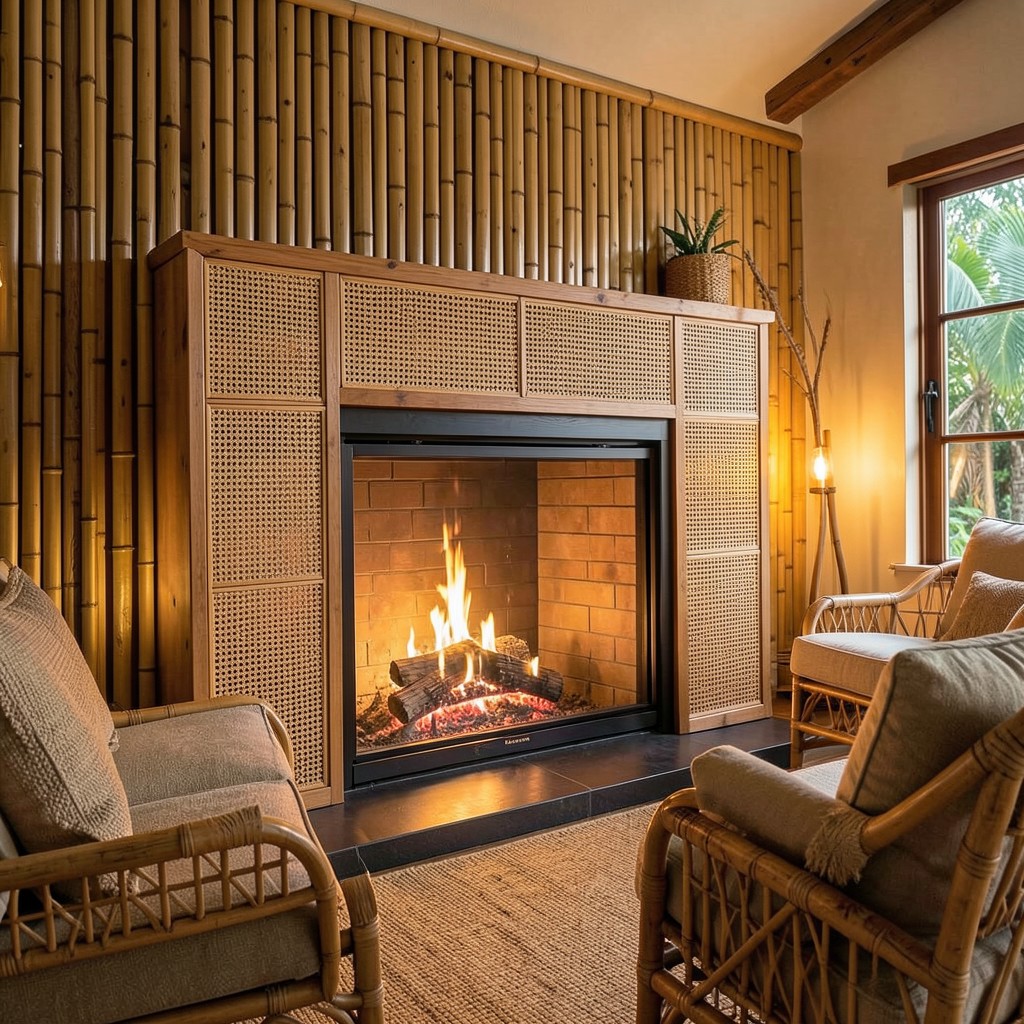
The rattan and cane fireplace surround is the tropical home design and beach house interiors fireplace of maximum material commitment — the woven natural fiber covering the surround’s frame creates the organic warmth and the tropical material character that the coastal and bohemian home styling aesthetic applies across its furniture and accessory palette, brought to the fireplace with the commitment that the room’s focal element deserves. The rattan surround is unexpected. That unexpectedness is the point.
A surround frame constructed in timber, covered in woven cane panels on the facing surfaces — the same cane webbing that vintage furniture and the current bohemian home styling revival applies to cabinet doors, chair backs, and headboards — creates the rattan fireplace surround’s primary surface treatment. The cane panels’ woven pattern creates the organic texture and the warm honey tone of the natural fiber, and the light that the fire below sends upward through the cane’s open weave creates the animated shadow pattern on the surround’s face that solid surface materials cannot produce. The cane panel installation requires a fire-rated substrate behind the woven fiber — the cane is positioned on the surround’s outer face, at sufficient distance from the firebox opening that the radiant heat does not directly contact the natural fiber, and the fire-rated backing layer prevents the fiber from reaching ignition temperature in normal fireplace operation.
Bamboo home interiors elements extended through the room that the rattan-surround fireplace anchors — bamboo panel cladding on the adjacent wall section, rattan furniture in the primary seating arrangement, and the warm amber of an incandescent-temperature lighting palette — create the tropical domestic atmosphere whose fireplace is the warm, organic focal point of a room of consistent natural material quality. The rattan fireplace in a summer living room decor context creates the most unexpected fireplace installation in the collection — the natural fiber material typically associated with outdoor and warm-weather environments framing the domestic fire in a combination whose material tension creates the room’s most memorable design feature.
37. A Fireplace With a Checkered Black and White Tile Hearth

The checkered tile hearth is the fireplace ground element that references the heritage of Georgian and Regency domestic interiors, where the black and white marble tile hearth was the standard finish for the period’s formal fireplaces — and that heritage is precisely what makes its contemporary application either a considered historical reference or a design cliché, depending entirely on the commitment and precision with which the design executes it. Done halfway, it reads as kitchen floor tile applied in front of a fireplace. Done fully, it reads as a design with genuine period intelligence.
The material selection determines the execution’s quality before the installation begins — genuine Carrara white marble squares and Nero Marquina black marble squares, cut to a consistent dimension and laid on the diagonal in the traditional forty-five-degree checkerboard pattern, create the hearth in the historic material that the reference requires. Porcelain tile in a black and white checkered pattern creates the visual approximation at a significantly reduced material cost, and the quality distinction between the two is apparent when viewed closely — the marble’s natural veining and surface depth versus the porcelain’s printed surface uniformity — but less apparent from the standing distance at which most hearths are viewed. The budget and the design’s material commitment level determine the appropriate choice, but the commitment to the full diagonal pattern — not an axis-parallel checkerboard — is the design detail that correctly identifies the historical reference regardless of the material.
Traditional home interiors rooms receive the checkered hearth with the natural ease of a material at home in its period context; contemporary home ideas rooms receive it as the deliberate historical quotation that injects period character into a modern interior, and the contrast between the contemporary room’s clean lines and the hearth’s period pattern creates the productive design tension that the best historical-contemporary mixing always generates. The elegant home styling direction is where the checkered hearth most consistently succeeds across both historical and contemporary room contexts.
38. A Fireplace With a Jungle-Inspired Green Backdrop

The jungle-inspired fireplace wall is the design commitment that takes the botanical atmosphere of the jungle-inspired home decor direction and applies it most densely at the room’s focal point — the fireplace is surrounded, framed, and embedded in the deep, saturated green of a botanical environment whose physical plant material and painted or wallpapered surface treatment create the maximum tropical atmosphere at the room’s design center. This is not a fireplace with some plants nearby. This is a fireplace inside a jungle, and the design commitment required to create that effect is what separates the genuinely atmospheric result from the decorating approximation.
A deep forest green or botanical olive painted chimney breast — from the floor to the ceiling, the full width of the chimney breast treated in the deep, saturated green that forms the backdrop for the botanical display — creates the jungle fireplace wall’s primary color environment. Against this deep green background, the trailing plants on the mantel shelf and the flanking wall-mounted planters read as foreground botanical elements against a receding botanical backdrop, creating the depth of field that the jungle-inspired home decor direction requires for its most convincing atmospheric expression. The fireplace opening’s dark firebox interior and the amber flame within it create the warm, contrasting focal point that the deep green backdrop surrounds, and the contrast between the botanical green and the amber fire creates the specific visual combination that the jungle atmosphere’s combination of lush growth and warm light produces in the natural environment.
Large-format tropical leaf wallpaper behind the mantel on the chimney breast — a monstera or banana leaf pattern in a dark ground printed version — creates the jungle backdrop at the fireplace wall in a format that requires no painting skill and creates a surface of extraordinary botanical richness. The wallpaper’s dark ground makes the fireplace opening’s darkness continuous with the botanical backdrop’s depth, creating the visual effect of a fire burning within a forest canopy, and the combination of the actual plants on the mantel and the printed botanical on the chimney breast creates the layered botanical environment that the jungle-inspired interior design direction at its most committed produces.
39. A Fireplace With a Raw Edge Wood Mantel Slab

The live-edge mantel slab is the single material element that transforms a standard fireplace into the room’s most natural and most organically distinctive feature — the tree’s own form, preserved at the slab’s outer edge rather than cut away by the millsaw’s straight blade, creates the mantel’s design in the wood’s own growth pattern, and no two live-edge slabs are identical because no two trees grow in identical form. The live-edge mantel is the room’s one genuinely irreplaceable object, and its natural uniqueness gives the fireplace a quality of particularity that manufactured mantels cannot approach.
A large walnut, oak, or cherry slab — two to three inches thick, four to eight inches in depth including the live edge, and long enough to extend beyond the fireplace opening’s width by at least six inches on each side — creates the live-edge mantel in the material whose warmth and color suit the room’s palette. The slab’s finish should honor the wood’s natural character — a penetrating oil or a hard wax oil that enhances the grain’s depth and color without the plastic film quality of a polyurethane topcoat, which obscures the wood’s surface texture and creates the artificial uniformity that the live-edge slab’s natural character directly contradicts. The live edge itself — the bark removed but the natural outer contour of the log preserved — should be lightly sanded to remove any loose or deteriorating material, then sealed with the same oil finish as the slab’s face to prevent moisture absorption at the edge’s more porous end-grain exposure.
The live-edge mantel installation requires secure support — the slab’s weight, which is substantial for a large piece of dense hardwood, demands either a built-in bracket system embedded in the chimney breast or a continuous support shelf below the slab’s rear edge — and the slab’s natural expansion and contraction with seasonal humidity changes requires the installation to accommodate slight movement rather than fixing the slab rigidly. A slab that is fixed without allowance for movement will split at the points where the fixing prevents the wood’s natural dimensional change, and the split ruins both the mantel and the installation. Movement is not a defect in a live-edge slab; it is the material’s living character, and the installation should respect it.
40. A Fireplace With a Moroccan Lantern Display

The Moroccan lantern fireplace is not a surround treatment or a material choice — it is a fireplace whose design strategy is the arrangement of light around and above the firebox opening, creating the layered, atmospheric illumination that the Moroccan domestic interior has applied through the hanging metal lanterns of its historic residential tradition. The fireplace provides the warm, amber background; the Moroccan lanterns provide the foreground light display; and the combination creates the most layered and the most atmospheric fireplace lighting composition available without structural modification of the chimney breast.
Moroccan pierced metal lanterns — in brass, in copper-toned steel, or in painted iron — hung at varying heights from the ceiling above the mantel and on hooks installed on the chimney breast face create the lantern display whose individual candle or LED candle flames multiply the fireplace’s warmth with dozens of small light sources. The lanterns’ pierced metal patterns create the star and geometric shadow projections that Moroccan metalwork produces on adjacent surfaces, and these projections on the wall and ceiling above the fireplace create the animated, atmospheric light quality that no fixed lighting installation can replicate. The bohemian home styling direction applies the Moroccan lantern arrangement most naturally, and the warm home decor ideas philosophy finds its most specific and most atmospheric expression in the layered Moroccan lantern display above a burning fire.
The lantern arrangement should be designed as an installation — the heights, the sizes, and the spacing of the individual pieces determining the composition’s visual quality rather than a collection of lanterns accumulated without spatial intention. A mix of two to four large lanterns at varying heights, combined with three or four smaller accent lanterns filling the composition’s visual gaps, creates the arrangement that reads as designed rather than accumulated. Arranging the lanterns against the chimney breast in a compositional sketch before hanging them permanently saves the installation from the awkward symmetry or the visual thinness that a less intentional approach produces.
41. A Fireplace With a Polished Nickel Surround

The polished nickel fireplace surround occupies the territory between the brass surround’s warm amber and the chrome surround’s cool silver — the nickel’s white-silver tone with its hint of warmth creates the metal fireplace element that suits the contemporary interior’s cooler palette without the cold precision of chrome’s blue-silver reflections. The polished nickel surround is the metal fireplace element for the room whose palette is neither warm enough for brass nor cool enough for chrome, and its position at the midpoint of the metallic temperature scale makes it the most versatile metal surround finish in the collection.
A polished nickel surround in a simple geometric profile — the flat face, the minimal reveal, and the clean-edged mantel shelf — creates the contemporary fireplace in the cool metallic finish without the minimalist concrete or steel surround’s industrial associations. The nickel’s reflective surface catches the fire’s amber light and reflects it with the warm-cool quality of a mirror that softens the warmth slightly — the fire reads in the nickel’s surface as a cooler, more refined amber rather than the direct warm yellow-orange of the flame itself, and this modulation of the fire’s color creates the sophisticated lighting quality that the polished nickel surround produces as its atmospheric contribution. Contemporary home ideas living rooms whose furniture and accessory palette applies polished nickel hardware throughout — the lighting fixtures, the cabinet pulls, the bathroom fittings — receive the polished nickel fireplace surround as the cohesive expression of the metallic palette at the room’s largest design element.
The polished nickel surround’s maintenance requires the same care as nickel-plated bathroom fixtures — regular cleaning with a soft cloth and a mild non-abrasive cleaner, prompt drying after any moisture exposure, and the occasional application of a nickel-specific metal polish that removes the oxidation that atmospheric exposure creates on the plated surface over time. The nickel surface maintains its reflective quality consistently with this modest care, and the effort is proportional to the visual quality the material provides.
42. A Fireplace With a Vintage Victorian Surround

The Victorian fireplace surround is the residential design element with the richest ornamental vocabulary in the English domestic tradition — the cast iron insert with its decorative panels, the combination surround in marble and timber, the overmantel mirror with its turned columns and carved pediment, and the tiled cheeks in hand-painted or transfer-printed ceramic all combine to create the fireplace as the Victorian drawing room’s primary display surface. Restoring or sourcing a genuine Victorian surround is the design decision that gives the traditional room its most specific and most historically grounded focal point.
An original cast iron Victorian fireplace insert — sourced from an architectural salvage yard, cleaned of its accumulated soot and rust, and restored with a high-temperature stove black to its original dark, matte finish — creates the fireplace’s primary ornamental element in the period material that no reproduction exactly replicates. The cast iron’s weight and its thermal mass, the precision of its molded ornamental detail, and the specific quality of the Victorian pattern vocabulary — the tiles in the cheeks, the registration bars, and the canopy’s decorative panels — create the fireplace of genuine historical character that the period interior requires as its center. Traditional home interiors organized around the restored Victorian fireplace have the room’s most important design element as a genuine artifact rather than a reproduction, and that distinction communicates through the material quality and the design specificity of the original in ways that the purchaser of a catalog reproduction does not always appreciate until they see an original at close range.
The Victorian surround’s mantel display should honor the period’s own styling conventions with an editorial intelligence that prevents the arrangement from reading as a museum recreation — a large framed mirror on the mantel above rather than the full overmantel structure, two or three objects of quality on the mantel shelf rather than the crowded Victorian accumulation, and the tiled cheeks allowed to be the surround’s ornamental statement rather than supplemented with additional applied decoration. The Victorian fireplace that is styled for living rather than for historical accuracy is the one that suits the contemporary household’s use most comfortably while maintaining the surround’s design character.
43. A Fireplace With a Japandi-Style Minimalism

The Japandi fireplace is the meeting point between Japanese wabi-sabi design philosophy and the Scandinavian home interior’s minimalist material honesty — a fireplace whose design is expressed entirely through the quality of its materials, the precision of its proportions, and the deliberate absence of anything that the fire itself does not require to be present. The Japandi fireplace does not declare itself. It reveals itself, quietly, to the person who sits in front of it long enough to understand what the design has chosen not to do.
A natural stone surround — a single slab of unfussy Japanese-quarried granite or a flat-faced bluestone in a grey-brown tone — with a firebox opening that is proportionally precise and a mantel surface that is flush with the surround’s face rather than projecting from it creates the Japandi fireplace’s primary form. The stone’s surface in a honed, non-reflective finish creates the material quality that the Japandi aesthetic values — the stone’s natural grain visible but not polished into the reflective precision that would make it showy. A single object on the flush mantel surface — one ceramic vessel, one arranged dried branch in a matte pottery vase, one small stone — creates the mantel display whose restraint is the design’s most disciplined gesture. Peaceful home decor and minimalist home design principles share the same commitment to the carefully considered absence as the most powerful design tool available, and the Japandi fireplace applies that tool at the room’s focal element with the conviction that its philosophical origins demand.
The fire within the Japandi fireplace is the room’s only dynamic and only decorative element, and the design’s restraint in everything surrounding it is the deliberate act that creates that clarity. The fire is allowed to be the fire — not a backdrop for the mantel display, not a background for the chimney breast’s material statement, not a feature competing with the surround’s ornamental complexity. At the Japandi fireplace, the fire is the design’s entire point, and every surface choice around it was made in service of that singular focus.
44. A Fireplace With a Fluted Column Surround

The fluted column fireplace surround is the classical residential interior’s most architecturally ambitious fireplace element — the full column forms flanking the firebox opening, their fluted shafts rising from bases at the hearth level to capitals at the mantel’s soffit, create the fireplace as a miniature temple front rather than a wall-mounted surround. This is the fireplace that architects design when the room’s scale and the client’s commitment to architectural quality both justify the ambition, and the rooms that contain it carry the most formally composed fireplace character in residential design.
Fluted columns in a natural stone — Portland limestone, Carrara marble, or a creamy Indiana limestone — flanking a polished dark marble firebox reveal create the classical surround’s material composition in the combination of pale column and dark firebox that the neoclassical fireplace tradition developed as its most formally resolved color contrast. The column’s fluting — the vertical channels cut into the cylindrical shaft surface at regular intervals around the circumference — creates the shadow play that the column’s form generates in any light, and the fireplace’s own light, rising from the firebox, illuminates the fluted column’s lower section with the warm amber quality that the carved surface catches and releases in its shadows and highlights. Elegant home styling reaches its most architecturally complete residential expression in the fluted column fireplace surround — the room that contains it has committed to formal architectural quality at the level that the design’s composition demands.
A simpler interpretation — pilasters rather than full columns, the flat pilaster face carved with fluted channels — creates the fluted surround’s architectural character in a format whose reduced projection suits rooms whose scale does not accommodate the full column’s three-dimensional presence. The pilaster’s fluting creates the same light-and-shadow quality as the full column’s carving, and its flat profile against the chimney breast face creates the classical surround’s compositional formality without the spatial imposition of columns that project six to eight inches from the wall face.
45. A Fireplace With a Modern Bioethanol Insert

The bioethanol fireplace insert is the fireplace installation for the home whose construction does not accommodate a flue — the apartment building, the renovation where the chimney was removed, or the new-build whose structural planning did not include a flue position. The bioethanol fuel burns cleanly enough that the resulting water vapor and carbon dioxide can be safely exhausted into the room’s ventilated interior without the chimney that solid fuel and most gas appliances require, and the fire it creates is genuinely real — a flame burning liquid ethanol, not a simulation — in a format whose design flexibility and installation simplicity suit the modern home design direction’s characteristic problem-solving intelligence.
A built-in bioethanol insert — a stainless steel tray burner recessed into the chimney breast at the correct height, with the surrounding masonry or drywall finished in a fire-rated tile or plaster to create the complete fireplace composition — creates the bioethanol fire in a format that reads as architecturally permanent rather than as an appliance placed in a recess. The contemporary home ideas living room’s clean-lined fireplace wall, with the bioethanol insert’s stainless steel burner recessed into a floor-to-ceiling stone or tile panel, achieves the linear gas fireplace’s visual quality without the gas line installation that the gas appliance requires — the bioethanol fuel is a liquid stored in a refillable burner chamber that lasts approximately four to eight hours per filling, and the refueling process takes less than two minutes with the fuel gel or liquid bioethanol that the insert uses.
The bioethanol fire’s flame behavior differs slightly from wood or gas — the flame is softer, more diffuse, and less structured than a gas flame’s regular burning pattern, and its height varies with the ethanol’s surface evaporation rate rather than with a controlled gas supply. This organic variability creates a flame quality that some prefer to gas for its natural, unregulated character, and the absence of the glass panel that most gas inserts require allows the bioethanol fire to be experienced as an open flame — its warmth, its movement, and its scent of burning ethanol creating the sensory presence that the glass-fronted gas fire partially filters.
46. A Fireplace With an Antique Mirror Overmantel

The antique mirror overmantel — the tall mirror in an ornate frame mounted directly above the mantel shelf, creating the chimney breast’s vertical element above the horizontal of the mantel — is the fireplace composition that English, French, and Italian residential design applied as the standard formal interior treatment from the Georgian period forward, and its continued relevance in contemporary interior design reflects the basic spatial intelligence of the arrangement: the mirror above the fire reflects the room behind the viewer, doubling the space, distributing the fire’s light, and providing the vertical element that the chimney breast’s mass requires to balance its horizontal emphasis.
An antique or antique-style mirror in a gilded carved frame — its glass slightly foxed from age, its frame worn at the high points of its carving — creates the overmantel element whose patina communicates the design intention of a room composed from genuine quality rather than assembled from contemporary reproduction. The foxed mirror glass provides a softer, warmer reflection than a modern polished mirror, and the imperfect reflection it creates — slightly distorted, slightly amber-tinted by the aged silver backing — creates the atmospheric quality that antique mirrors bring to formal rooms that their reproduction equivalents cannot approach. Chic home decor and traditional home interiors both apply the antique overmantel mirror as the fireplace composition’s completing element, and the design traditions that developed the arrangement identified the specific spatial and atmospheric quality that its components create together rather than separately.
The overmantel mirror’s proportional relationship to the mantel below determines the composition’s visual balance — a mirror whose width approximates the mantel shelf’s width creates the aligned composition; a mirror narrower than the mantel creates the composed asymmetry whose narrower vertical element reads against the wider horizontal of the shelf; and a mirror wider than the mantel creates the extended vertical whose relationship to the chimney breast’s full width determines whether the expansion reads as generous or as compositionally overcrowded. The proportion decision should be made by viewing the chimney breast from the room’s primary seated sightline, because the composition is experienced from that position most consistently.
47. A Fireplace With a Carved Wooden Surround

The carved wooden fireplace surround is the residential interior’s most labor-intensive and most craft-specific fireplace element — the hand-carving that creates the surround’s ornamental relief is the work of a skilled woodcarver whose time, precision, and artistic intelligence are embedded permanently in the object, and the surround’s quality is directly proportional to the quality of that work. You cannot improve a poorly carved surround with better paint. The carving is the quality, and the quality is in the carving from the beginning.
A carved surround in a stable hardwood — mahogany for the warmest, richest tone; oak for the most formal English character; basswood for the fine-grained carving that the most detailed ornament requires — creates the carved wooden fireplace in a material whose properties suit the carver’s tools and the design’s ornamental ambition. The carving’s depth — the relief projection of the carved detail from the surround’s ground surface — determines both the visual drama and the shadow quality that the fire’s light creates in the ornament. Deep carving creates dramatic shadows that animate in the fire’s light; shallow carving creates refined, subtle detail that rewards close examination; and the combination of deep and shallow carving within a single surround — the tradition of the period carver who varied relief depth across the ornamental composition — creates the visual complexity that makes the best carved surrounds objects of genuine artistic quality.
A carved surround’s maintenance requires the same care as fine furniture — periodic cleaning with a mild oil soap to remove the accumulated soot and household dust that settle in the carving’s recesses, and an occasional application of a furniture wax that preserves the wood’s surface and maintains the warmth of tone that the carving’s paint or natural wood finish was designed to create. The carved wooden surround that is maintained well ages beautifully — the wood’s surface oxidizing to a slightly deeper tone, the carving’s recesses gathering the shadow quality of age, and the complete surround developing the patina of a fine antique whose beauty increases rather than diminishes with the passage of time and the accumulation of the household’s life around it.
48. A Fireplace With a Waterfall Edge Stone Surround

The waterfall edge stone surround applies the kitchen design concept of the waterfall countertop — the surface material continuing vertically down the element’s sides rather than terminating at the top edge — to the fireplace surround’s side panels, creating a continuous stone surface that wraps from the mantel shelf’s top face down through the surround’s side panels to the hearth floor in a single, uninterrupted material run. The waterfall edge creates the stone surround’s most architecturally resolved and most material-intensive expression, and its effect — the sense that the stone poured over the fireplace’s form rather than being applied to it — is achieved only when the stone’s veining or grain runs continuously across the horizontal and vertical surfaces in the same direction.
Bookmatched slabs whose veining runs continuously from the mantel top across the full pilaster face to the hearth floor create the waterfall effect at its most visually dramatic — the stone’s geological pattern moving in a continuous sweep across the three connected planes creates the impression of a material whose form followed the stone’s own grain rather than the fireplace’s constructed geometry. This bookmatched waterfall installation requires precise planning of the stone slab’s cutting orientation before the slabs leave the quarry, and the installation sequence — the hearth first, the pilasters second, and the mantel slab last — creates the continuous grain alignment that the effect requires. Luxury home interior quality is defined at the fireplace in this installation — the precision of the bookmatching, the quality of the material, and the craft of the installation combine to create the fireplace surround whose quality is immediately apparent and whose investment is unambiguously communicated by the material at every viewing distance.
The waterfall edge stone surround suits the large-scale contemporary or luxury living room most effectively — the sweeping stone planes require the room’s volume to be generous enough to receive their scale without visual compression, and the mantel’s flush or minimally projecting profile in this installation creates the understated quality that allows the stone’s natural pattern to communicate the design’s ambition without the compositional amplification of a projecting shelf or an ornamental detail. The fire below the stone waterfall creates the material’s most dramatic lighting moment — the amber flame illuminating the stone’s veining from below, the geological pattern reading upward through the polished surface in the fire’s reflected light.
49. A Fireplace With a Cottage Garden Styling
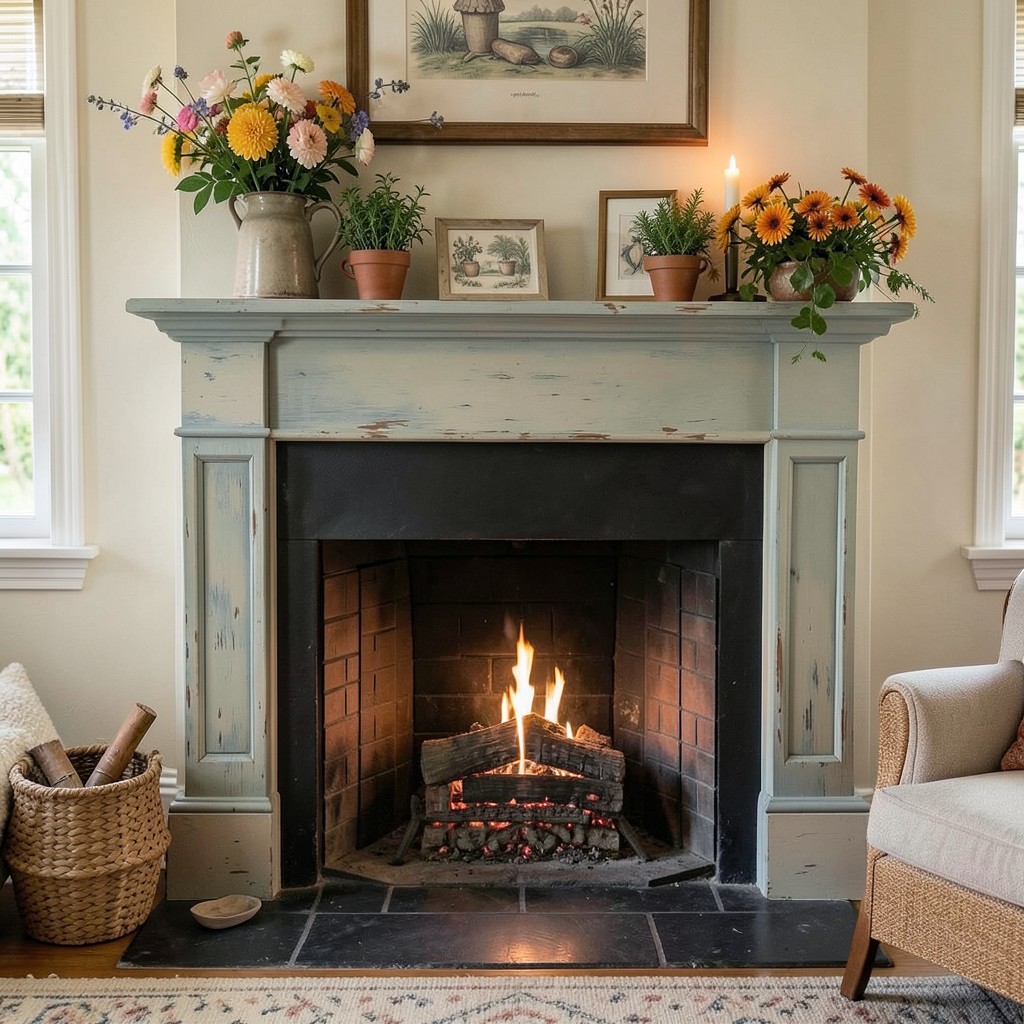
The cottage garden fireplace is the room element whose mantel display, surround material, and surrounding design create the domestic warmth and the seasonal change that the cottage interior aesthetic — the English, the Provençal, the New England cottage traditions all share — values as the home’s most authentic and most lived-in quality. The cottage fireplace is not grand. It is not formal. It is the fireplace in front of which the household has always gathered, whose mantel has held three generations of the same family’s objects, and whose surround has the slight imperfection of something built with skill rather than manufactured with precision.
A painted wood surround in an aged cream or a faded period blue — the paint slightly worn at the high-touch points of the mantel’s edge and the surround’s inner reveal, its surface built up from multiple coats applied over the years rather than a single pristine application — creates the cottage fireplace surround’s primary character. The paint’s aging is the design’s most honest quality, and the household that accepts and honors this aging rather than repainting the surround to pristine condition every few years allows the fireplace to accumulate the domestic patina that makes the cottage aesthetic genuinely inhabitable rather than merely styled. Garden-inspired interiors principles at the mantel — a mixed fresh flower arrangement in a vintage jug, the seasonal herbs from the kitchen garden in a small pot, and the small framed botanical illustration that has always been there — create the cottage mantel display whose organic warmth suits the soft, slightly imperfect surround below it.
The cottage fireplace’s seasonal change is the domestic ritual that the aesthetic values most specifically — the spring home refresh that replaces the winter’s dried flowers with the season’s first garden blooms, the fall home decorating that brings the chrysanthemums and the autumn foliage to the mantel as the fire is lit for the season’s first evening, and the holiday home styling that fills the mantel with the evergreen and the candlelight of the winter festive season. The cottage fireplace mantel is the household’s seasonal calendar, and its changing display marks the year’s rhythm with the same domestic intelligence that the garden outside marks it with the rhythm of its own growth, flowering, and rest.
50. A Fireplace Designed as the Room’s Entire Identity

The fireplace designed to be the room’s sole defining element — not the feature wall’s focal point, not the primary seating arrangement’s anchor, but the room’s complete identity — is the design decision that most fireplaces never receive and that the right fireplace, in the right room, deserves. When the fireplace is the room, every other design decision in the space exists in direct service of the fire, and the clarity of that singular purpose creates the room of most concentrated and most memorable domestic atmosphere in the house.
A room designed for the fire — the seating arranged in a complete enclosure around the hearth rather than facing the fire across the room, the walls in a single deep color that the fire’s amber light fills and warms, the floor in the dark-stained hardwood that the fire’s reflection glows across, and no entertainment technology, no work surface, no secondary function competing for the room’s identity — creates the fire room as a specific domestic typology rather than as a living room with a fireplace. This room does not have a television. It does not have a home office corner. The fire is the room’s complete purpose, and the design’s refusal to dilute that purpose is what creates the atmosphere that the room’s occupants remember long after every other room in the house has blurred together in recollection.
Your fireplace is the room’s gravitational center. Design it first, design it completely, and let every other decision in the room serve the fire rather than compete with it. The room organized around a well-designed fireplace becomes, in the daily experience of living in it, the room you return to most consistently — the room whose warmth and whose light create the domestic atmosphere that the house exists to provide. Start with the fire. Build the room from there.
Leave a Reply