
Every house has a hallway, and almost every hallway tells the same story: a coat hook screwed into the wall without much thought, a mat that has been there since the previous owners left it, a paint color chosen in ten minutes at the hardware store because the hallway felt too small to deserve a longer decision. The hallway receives the first look from every person who enters the building and the last look from every person who leaves it. That makes it the most universally experienced room in the house and, simultaneously, the room whose design receives the least deliberate attention in the average residential interior. That contradiction is where this article begins, and the fifty ideas that follow are the argument that it does not have to be that way.
The hallway’s spatial challenge — the narrow width, the low natural light, the competing demands of circulation, storage, and first impression — is the challenge that most homeowners use as the reason to defer the hallway’s design to some future renovation that never quite arrives. Too narrow to do anything interesting. Too dark to photograph well. Too functional to justify a design investment. These are the conclusions that produce the hallways whose design conversation ended at the second coat of magnolia emulsion, and they are conclusions worth examining rather than accepting. The hallway’s spatial constraints are not the obstacle to good design. They are the conditions that make good hallway design specifically interesting — the narrow space that forces the designer to think harder about material, light, proportion, and detail than the generous room ever demands.
The relationship between the hallway and the rooms it connects shapes the hallway’s design brief in ways that the isolated room-by-room approach to interior design consistently misses. A hallway is not a room you stop in. It is the room whose atmosphere you pass through on the way to every other room in the building, and the atmospheric quality of that passage — the transition from the street’s exterior to the living room’s warmth, from the landing’s quiet to the kitchen’s activity — is established by the hallway’s material, color, light, and spatial character before you have consciously registered any of its individual design elements. The hallway that gets its atmosphere right makes every room it connects feel better, because you arrive in those rooms having passed through a composed space rather than a functional corridor.
The seasonal dimension of hallway design is the dimension most consistently overlooked by the standard design guides, and yet the hallway is the room whose character shifts most dramatically with the seasons precisely because it is the point of contact between the outdoor world and the indoor one. The summer home design hallway — open, light, breezy with the door held wide, the woven basket by the entrance holding sun hats and gardening gloves — is a different atmospheric experience from the winter home decor hallway where the same space holds the damp coats of a household that has just come in from the rain, the boot rack beside the door carrying the weight of the winter’s muddy walks, the overhead light doing the work that the eight months of strong natural daylight had been providing without the need for a switch. The hallway that is designed for both conditions rather than only the summer photograph is the hallway whose design intelligence compounds across every week of the year.
The fifty hallway design ideas in this collection span the full range of spatial scales, design directions, material budgets, and household conditions that the domestic hallway presents across its many possible forms. From the narrow terraced house entry corridor to the double-height entrance hall of the detached family home, from the Scandinavian hallway design whose spare material palette and precise spatial organization produce the most resolved hallway with the fewest elements, to the traditional home interiors entrance hall whose architectural moldings, period furniture, and composed art arrangement make the hallway the building’s most formally considered room — the ideas here are specific, actionable, and argued for rather than merely presented as options. The hallway you have now is the starting point. The hallway you could have is the reason to keep reading.
1. A Hallway With Full-Height Paneling

The paneled hallway — walls dressed from skirting to picture rail or cornice in a composed system of applied timber or MDF moldings whose grid of rails and stiles divides the wall surface into a series of framed fields — is the single hallway treatment that most consistently converts the narrow, featureless entrance corridor from a room you pass through without noticing into an architectural interior whose quality you register at the level of the skin before the conscious design analysis begins. Full-height paneling works because it does two things simultaneously: it gives the wall a three-dimensional surface quality that flat plaster cannot match, and it anchors the hallway’s proportions in a visual framework that makes the narrow width appear as a deliberate spatial decision rather than a dimensional accident.
The paneling system’s proportional logic determines whether the finished wall reads as architecturally resolved or as decoration applied without design intelligence. The rail height — the horizontal timber member that separates the lower panel fields from the upper ones — must be set at a height that responds to the hallway’s specific ceiling height rather than at the standard dado-rail position that the reproduction market defaults to. A hallway of two point four meter ceiling height benefits from the rail positioned at approximately one meter — two thirds of the full wall in the lower panel zone — which shifts the room’s visual gravity toward the floor and makes the ceiling appear higher than the standard dado rail’s lower position allows. A hallway of three meters and above can carry the full-height panel system whose rails extend to the cornice without the upper wall zone being expressed separately.
The paint finish on the paneling’s field and its moldings provides the tonal relationship that defines the paneling’s visual depth and period reference simultaneously. A panel field and molding in the same color and sheen — the entire wall surface in one tone — produces the contemporary version of the paneled hall whose monolithic color makes the three-dimensional surface quality read as sculptural relief rather than as decorative carpentry. A panel field in a slightly deeper tone than the molding — the classic two-tone panel whose molding reads as the paler accent against the deeper field — produces the period paneled hall whose tonal separation echoes the Georgian and Victorian original. The choice between these two approaches is the choice between the contemporary hallway whose paneling is the material, and the traditional home interiors hallway whose paneling is the architecture.
2. A Hallway With a Statement Mirror
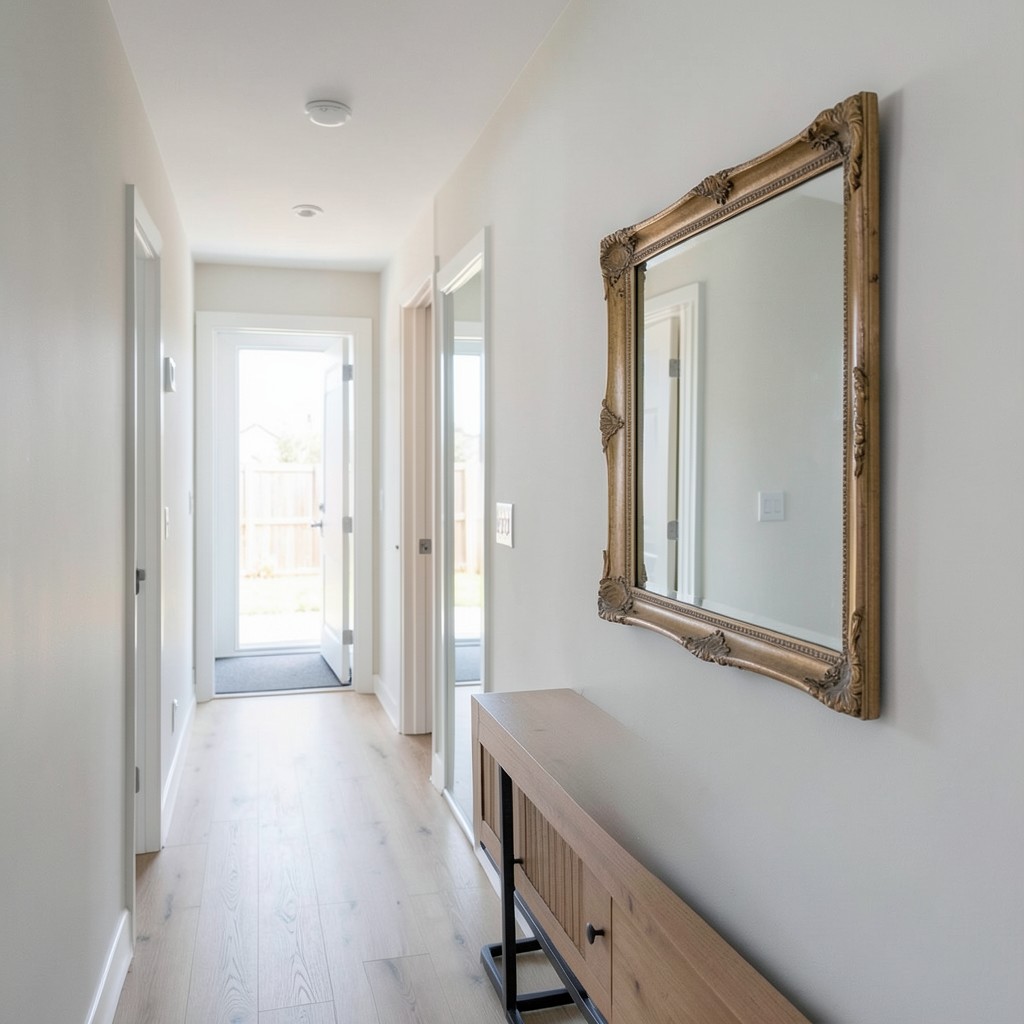
A large mirror positioned on the hallway’s primary wall — the wall that faces the entry door, the wall that receives the first focused look from every person who enters the building — is the hallway modification with the highest spatial return on the smallest material investment of any single item a hallway can receive. The mirror doubles the apparent depth of the hallway, reflects the door’s natural light back into the space, and provides the functional dressing point that converts the hallway from a circulation route into a daily departure ritual. A well-chosen mirror on the right wall does more for the hallway than a full renovation whose budget was spent elsewhere.
The mirror’s size is the specification variable that most homeowners underestimate — the tendency is to select a mirror that feels proportionate to the wall, which produces a mirror that is too small to achieve the spatial depth effect that the statement mirror delivers. The effective hallway mirror occupies between sixty and eighty percent of the wall’s width and extends from a point near the console table’s top surface to within twenty to thirty centimeters of the ceiling. At that scale, the mirror does not read as an object on the wall. It reads as a window into a parallel version of the hallway, and the spatial doubling that results changes the experience of the entire corridor rather than merely providing a reflective surface for checking your coat on the way out.
The mirror’s frame style is the hallway’s secondary design statement — the frame whose scale, material, and profile communicate the room’s design direction independently of the mirror it surrounds. The ornate gilded frame whose carved moldings place it firmly within the elegant home styling or traditional home interiors vocabulary; the slim, unpainted raw oak frame whose minimal presence suits the Scandinavian home interior or the minimalist home design hallway; the industrial flat-bar steel frame whose welded profile belongs to the industrial home design entrance; the rope-wrapped driftwood frame whose coastal material reference suits the beach house interiors corridor. The frame is doing active design work, and its selection deserves the same attention as any other material decision in the space.
3. A Hallway With Patterned Encaustic Tiles
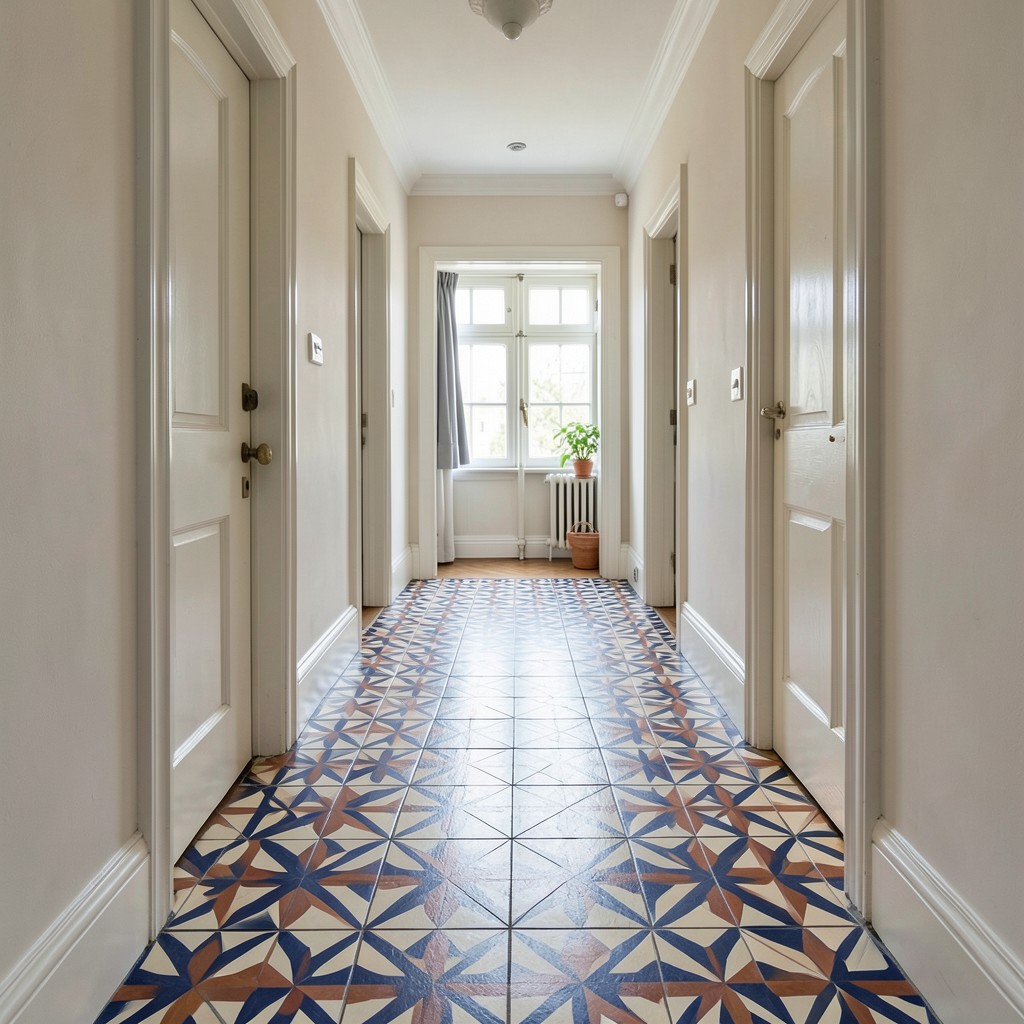
Encaustic tiles on the hallway floor — the cement-bodied, pattern-faced tiles whose design is inlaid into the tile’s body during manufacture rather than printed on its surface, producing a pattern whose color and depth are structural rather than cosmetic — are the hallway floor treatment with the deepest residential history and the most consistently successful design outcome across every hallway style and period of application. The encaustic tile hallway floor has been the correct answer to the Victorian, Edwardian, and period townhouse hallway’s floor design question for over a century and a half, and it remains the correct answer for the contemporary hallway that adopts the same tile for its material quality, pattern richness, and sheer floor area performance relative to any alternative.
The pattern selection for an encaustic tile floor is the design decision that determines the floor’s period reference and its color relationship with the hallway’s walls and ceiling simultaneously. The geometric patterns of the Victorian tile catalog — the star and hexagon, the diamond grid, the running bond of alternating two-color rectangles — produce floors whose period authority is immediate and whose maintenance of the correct proportional relationship between the individual tile unit and the hallway floor’s overall area requires the tile size to be selected relative to the corridor width. A tile too large for the corridor width produces a floor that reads as oversized; a tile too small produces a floor that reads as texture rather than pattern from the standing viewing distance.
The bohemian home styling or traditional home interiors hallway whose encaustic tile floor carries a bold star-and-cross in cobalt, terracotta, and cream — the pattern running from the entry door to the first room’s threshold in an uninterrupted geometric field — produces the entrance whose floor establishes the home’s entire design character before the visitor has looked at a single wall, piece of furniture, or light fitting. The floor is doing all the design work, and the hallway that trusts its floor to carry the design conversation is the hallway that has understood the specific design authority of the domestic entrance floor and committed to it.
4. A Hallway With a Console Table and Lamp

A console table positioned against the hallway wall — a narrow, wall-hugging piece of furniture whose depth allows it to sit in the corridor without obstructing the circulation path, its surface providing the horizontal plane for the lamp, the keys, the seasonal decorative arrangement, and the objects of daily departure and arrival — is the hallway’s most important piece of furniture and the one whose absence is felt as the specific inadequacy of a hallway that has nowhere to put things and nothing to look at. The console table is the hallway’s functional anchor and its decorative center simultaneously, and the household that invests in the right one discovers that the hallway’s entire character organizes around it.
The console table’s relationship to the wall-mounted mirror above it is the hallway’s primary design composition — the horizontal table surface and the vertical mirror frame whose combined presence on the wall creates the entry vignette that the guest photographs in their memory before any conscious design analysis occurs. The table’s top surface should be positioned at approximately nine hundred to one thousand millimeters above the finished floor — a height that suits most adults for placing keys and mail without bending, and that provides the correct vertical relationship with the mirror above it whose lower edge should sit approximately one hundred and fifty millimeters above the table surface. This is not a rule. It is a proportion whose rightness you feel rather than measure.
The console table’s design direction sets the hallway’s furniture register — the slim, powder-coated steel table whose angular profile suits the minimalist home design or the industrial home design hallway; the painted timber console with turned legs that belongs to the farmhouse home decor or traditional home interiors entrance; the lacquered high-gloss table in a deep jewel tone that suits the chic home decor or the luxury home interior entrance hall. The lamp on the table’s surface provides the hallway’s primary atmospheric light source in the evenings — the table lamp whose warm, low output at the entry level produces the welcoming glow that the overhead pendant distributes too evenly and too brightly to provide on its own.
5. A Hallway With Limewash Walls
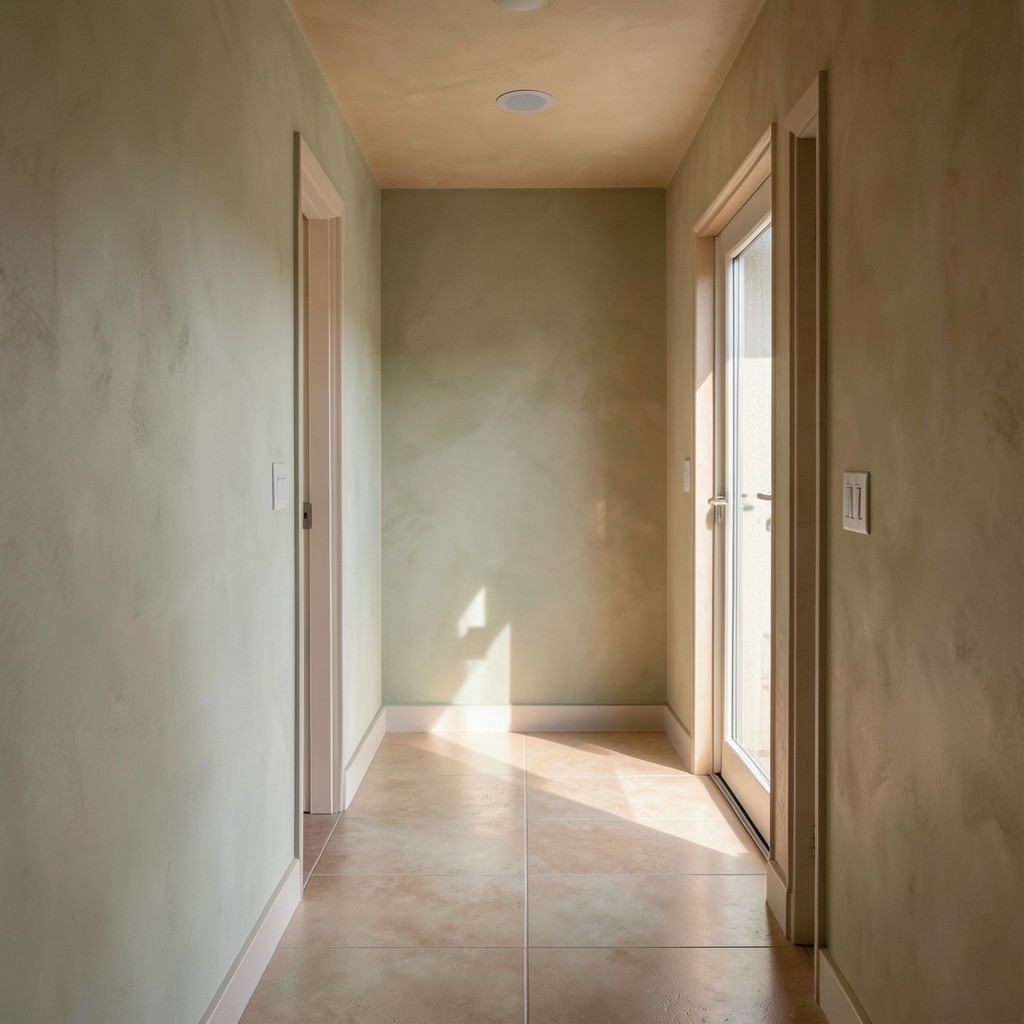
Limewash painted walls in the hallway — the mineral wash applied to the plaster surface in thin, overlapping passes whose characteristic soft variation in tone and surface density produces the living quality of a wall whose color comes from within the material rather than from a film applied over it — are the hallway wall treatment that produces the greatest atmospheric return per application at the most accessible cost of any hallway wall finish. The limewash hallway wall is not a painted wall. It is a mineral-treated plaster surface whose depth and variation make the corridor feel warm, aged, and genuinely considered in a way that the emulsion-painted wall achieves at no comparable level of material investment.
The limewash’s characteristic surface variation — the slight tonal modulation between the lighter areas where the wash was thinner and the deeper areas where it accumulated — is not a quality-control failure. It is the treatment’s specific quality. The wall surface whose variation is the design is the wall surface that never looks flat, never reads as a painted background, and never loses its atmospheric presence as the light changes across the day. The morning light’s raking quality across a limewash surface reveals the wall’s texture in the specific way that no emulsion paint surface can replicate, because the emulsion produces a flat film that the morning light reflects uniformly while the limewash’s mineral surface absorbs, scatters, and distributes the light in a way that is genuinely three-dimensional.
The earthy home design or the desert home styling hallway whose walls carry a warm terracotta or dusty ochre limewash — the color’s mineral warmth amplified by the morning light entering the entry door and raking across the textured surface — produces the arrival experience of a domestic interior whose material warmth is present at the building’s threshold before the visitor has registered any other design element in the space. The spring home refresh that converts a standard hallway’s magnolia emulsion to a limewash in a pale, warm sage or a soft blush is the seasonal home makeover whose visual impact arrives with the season’s own material character, and whose cost is the limewash product and an afternoon’s preparation and application.
6. A Hallway With Built-In Storage Bench
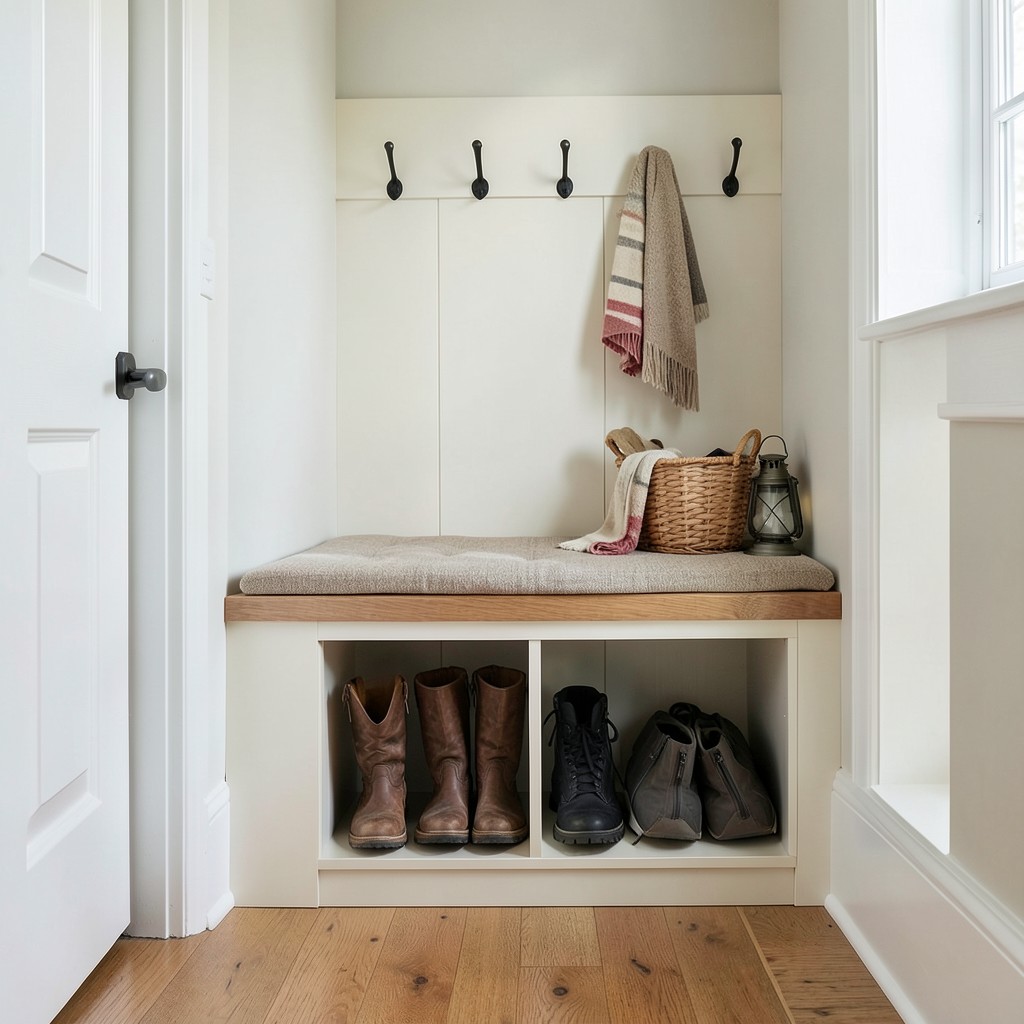
A built-in storage bench at the hallway’s entry zone — a fixed seating unit whose seat lifts to reveal the storage volume beneath, its back panel carrying coat hooks, its side against the wall and its face flush with the door frame or the hallway’s architectural boundary — is the hallway design idea that converts the entry zone from the household’s most consistently chaotic storage problem into a resolved functional system whose organization makes the daily departure and arrival experience the effortless transaction it should be rather than the daily search for the missing boot or the buried key that the undesigned entry zone produces without fail.
The built-in bench’s seat height — the dimension most critical to its daily comfort and usability — should be positioned at four hundred and fifty to four hundred and seventy millimeters above the finished floor, the ergonomic height for sitting with the knee at a right angle for pulling on boots and shoes without the excessive forward lean that a lower seat requires or the high-perching position that a taller bench produces. The storage volume beneath the seat is the functional core of the unit — the compartment depth and height must be sufficient for the household’s specific storage requirement, which for a family typically means one compartment per household member of sufficient size to hold a pair of boots, a pair of shoes, and a sports bag without compression.
The farmhouse home decor family hallway whose built-in bench is in a painted timber finish — the carcass in a classic off-white, the seat in a solid oak that matches the hallway floor, the back panel carrying five double-hook cast iron coat hooks at varying heights for adults and children — produces the entry zone whose functional completeness makes the household’s morning departure and evening return the organized, unhurried ritual that the designed entry system makes possible. The fall home decorating bench whose seat carries a warm textile cushion, a basket of scarves and gloves, and a lantern on the adjacent surface provides the seasonal entry warmth that the summer home design’s light, pared-back entry naturally sheds in the cooler months.
7. A Hallway With a Dark Accent Color

A hallway painted in a dark, saturated accent color — the walls in a deep forest green, a rich navy, a warm charcoal, or a moody plum whose depth and intensity contrast with the standard pale wall color of the rooms it connects — is the hallway design decision that most consistently surprises homeowners with how good it looks and how wrong their initial instinct to choose pale colors for the small space turns out to be. The narrow hallway does not need pale walls to feel larger. It needs a color whose atmospheric presence makes the narrow space feel intentional rather than inadequate, and dark colors achieve that specific quality in a way that pale colors can never approach.
The dark hallway color works because the hallway’s narrowness, which is the feature most homeowners try to work around with pale, expanding colors, is actually the feature that makes the dark color’s atmospheric power most concentrated. A small room painted dark is not a small room that reads as even smaller — it is a small room whose color has removed the walls from the conscious spatial experience and replaced the measurable room with an atmospheric zone whose quality is independent of its dimensions. The dark hallway creates the impression not of a narrow corridor but of a composed, intentional passage whose color is the design statement rather than the default choice.
The cozy home design winter interior design hallway in a deep heritage green — the color from the skirting to the cornice, including the ceiling in a shade one step lighter, the trim in a warm cream-white that provides the tonal relief the composition requires — produces the hallway whose winter atmosphere is the most welcoming domestic arrival experience available in the small hallway footprint. The spring home refresh that refreshes the hallway’s dark walls with a lighter, warmer version of the same hue — moving from the deep forest green of winter to the lighter sage of spring — is the seasonal home makeover whose single color change shifts the hallway’s atmospheric register as completely as any furniture rearrangement or accessory addition.
8. A Hallway With Gallery Wall Art

A gallery wall in the hallway — a composed arrangement of framed artwork, photographs, prints, and objects whose collective composition occupies a significant portion of the hallway’s primary wall and establishes the household’s visual and cultural identity at the building’s most prominently viewed surface — is the hallway design treatment that most directly personalizes the domestic entry while simultaneously providing the visual richness that the hallway’s limited floor space prevents furniture from delivering. The gallery wall does on the vertical surface what the room’s floor plan does not allow below it, and the hallway is the gallery wall’s most architecturally appropriate domestic location.
The gallery wall’s composition — the arrangement logic that determines how the frames relate to each other in terms of spacing, alignment, and visual weight — is the design variable that separates the gallery wall as a composed art installation from the gallery wall as a collection of things hung on the wall without a compositional intention. A gallery wall whose frames are hung without a consistent spacing logic — some close, some far apart, the gaps between frames varying across the composition without a discernible rhythm — reads as unresolved regardless of the quality of the individual pieces it contains. The arrangement whose spacing is consistent, whose bottom edges form a loose horizon line at the visual center of the wall, and whose outer boundary forms a shape whose relationship to the wall’s own rectangle is clear produces the gallery wall that reads as composed.
The traditional home interiors hallway whose gallery wall carries a mix of botanical prints, family photographs in antique frames, and small oil paintings arranged in the composed asymmetry of the salon-hung picture wall — the frames in varied profiles but consistent warm gilt tones, the arrangement covering the full wall from above the console table to within fifteen centimeters of the cornice — produces the hallway whose visual richness rewards the extended examination that the daily departure and arrival provide. The floral home decor ideas spring home refresh moment where the botanical prints are swapped out for fresher, lighter compositions updates the gallery wall’s seasonal register without requiring the entire arrangement to be dismantled and rehung.
9. A Hallway With a Runner Rug
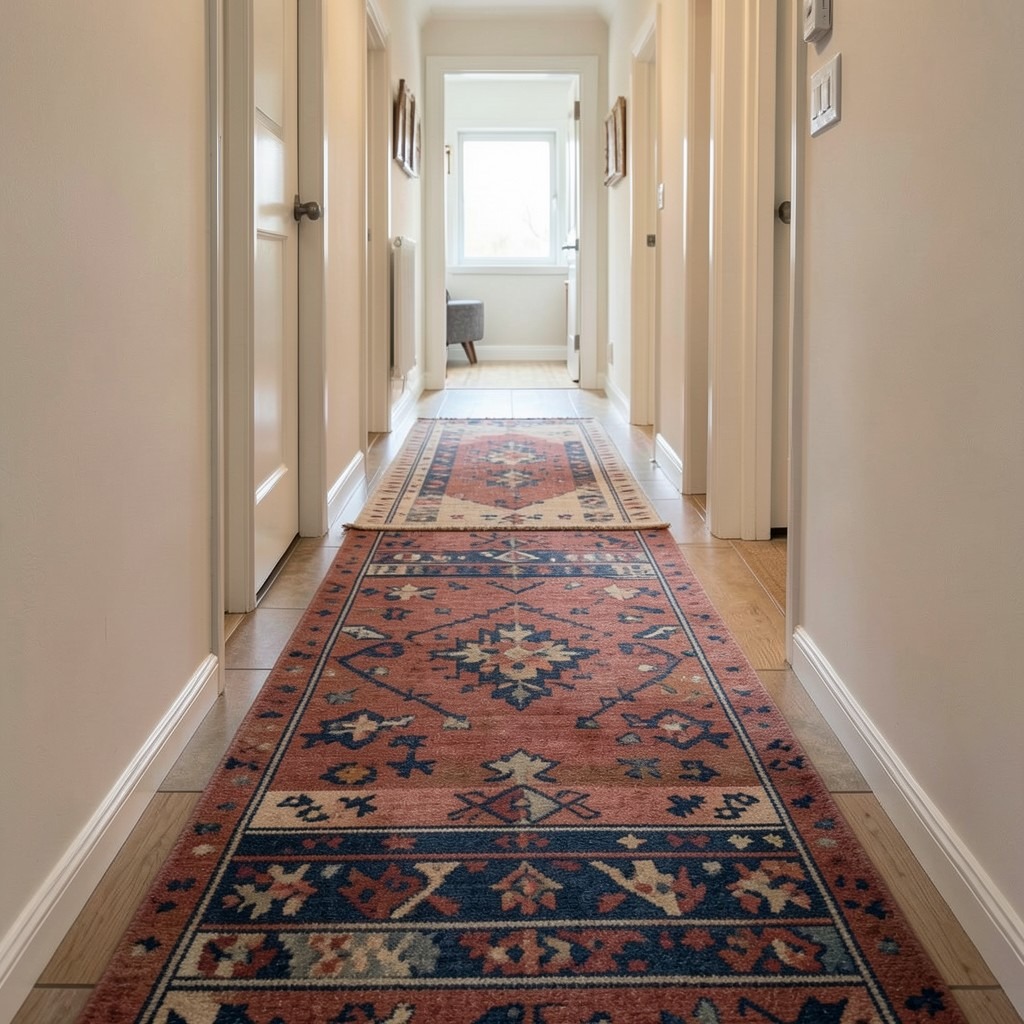
A runner rug laid on the hallway floor — the long, narrow format carpet piece whose proportions were developed specifically for the corridor’s width-to-length ratio and whose textile warmth, acoustic absorption, and practical floor protection make it the hallway’s most functional decorative element — is the hallway addition that most immediately changes the sensory experience of the corridor at the level where the household experiences it most directly: underfoot. The hallway whose floor is entirely hard — whether tiled, timber-boarded, or stone-flagged — without a textile layer is the hallway whose daily sound quality, thermal warmth at the feet, and material welcome at the entry are all measurably lower than the hallway whose runner provides the textile layer that the hard floor alone cannot offer.
The runner’s proportional relationship to the hallway floor determines whether the textile reads as correctly scaled for the space or as either too narrow — a thin strip that reads as a belt rather than a floor covering — or too wide — a runner that leaves insufficient hard floor visible at each side to allow the floor material’s quality to be seen and appreciated. A runner that covers between fifty and sixty-five percent of the hallway’s floor width, leaving an even strip of hard floor visible on both sides, reads as correctly proportioned for the standard residential hallway. The runner that covers more than seventy percent of the floor width begins to read as a fitted carpet that could not quite reach the walls.
The warm home decor ideas or the cozy home design hallway whose runner is in a traditional flat-woven kilim in terracotta, indigo, and natural wool — its pattern creating the composed floor surface that the hard floor’s single material plane cannot provide alone — produces the hallway whose entry floor establishes the home’s material warmth before any wall or ceiling detail is registered. The winter home decor hallway runner in a deep, richly patterned wool, replaced for the spring home refresh with a lighter, flatwoven natural fiber in a pale stripe, is the hallway seasonal home makeover whose impact-to-effort ratio is the highest of any single hallway change available at any budget level.
10. A Hallway With Industrial Pipe Shelving

Open industrial pipe shelving in the hallway — steel pipe brackets and fittings combined with solid timber shelves to produce the freestanding or wall-mounted shelving system whose exposed pipe hardware is the design’s deliberate material statement rather than a cost-saving measure — is the hallway design idea that combines maximum storage capacity with the specific material character of the industrial home design direction in a format that suits the hallway’s wall rather than its limited floor space. The pipe shelf’s horizontal storage planes convert the hall’s vertical wall surface into a usable storage volume whose open format keeps the corridor from feeling closed in by the storage it contains.
The pipe hardware specification — the pipe diameter, the flange fitting design, and the surface finish — determines the shelving system’s visual weight and its material character from across the hallway. A twenty-two millimeter diameter black steel pipe with a matte powder coat and flat-faced flanges produces the slim, precise industrial pipe shelf whose material restraint suits the contemporary industrial or the minimalist home design hallway. A thirty-two millimeter pipe in a polished chrome or a natural brushed steel produces the more assertive shelf whose reflective surface introduces the light-catching quality of the metallic fitting into the hallway’s material palette.
The industrial home design or the rustic home office ideas urban hallway whose pipe shelving carries a series of solid reclaimed timber shelves — the pine or oak boards in their natural aged surface, the black steel pipe brackets providing the structural and visual contrast — produces the hall whose material combination of aged timber and industrial metal communicates the design direction without any additional decorative element being required. The shelves’ open storage format — books, baskets, plants, and seasonal decorative objects on display at the wall level — provides the hallway with the visual content that the furniture-limited corridor floor plan cannot supply from the ground, and the eye travels upward through the shelving’s vertical column in the specific movement that makes a narrow hall appear taller and more generously proportioned than its dimensions alone allow.
11. A Hallway With a Striped Feature Wall
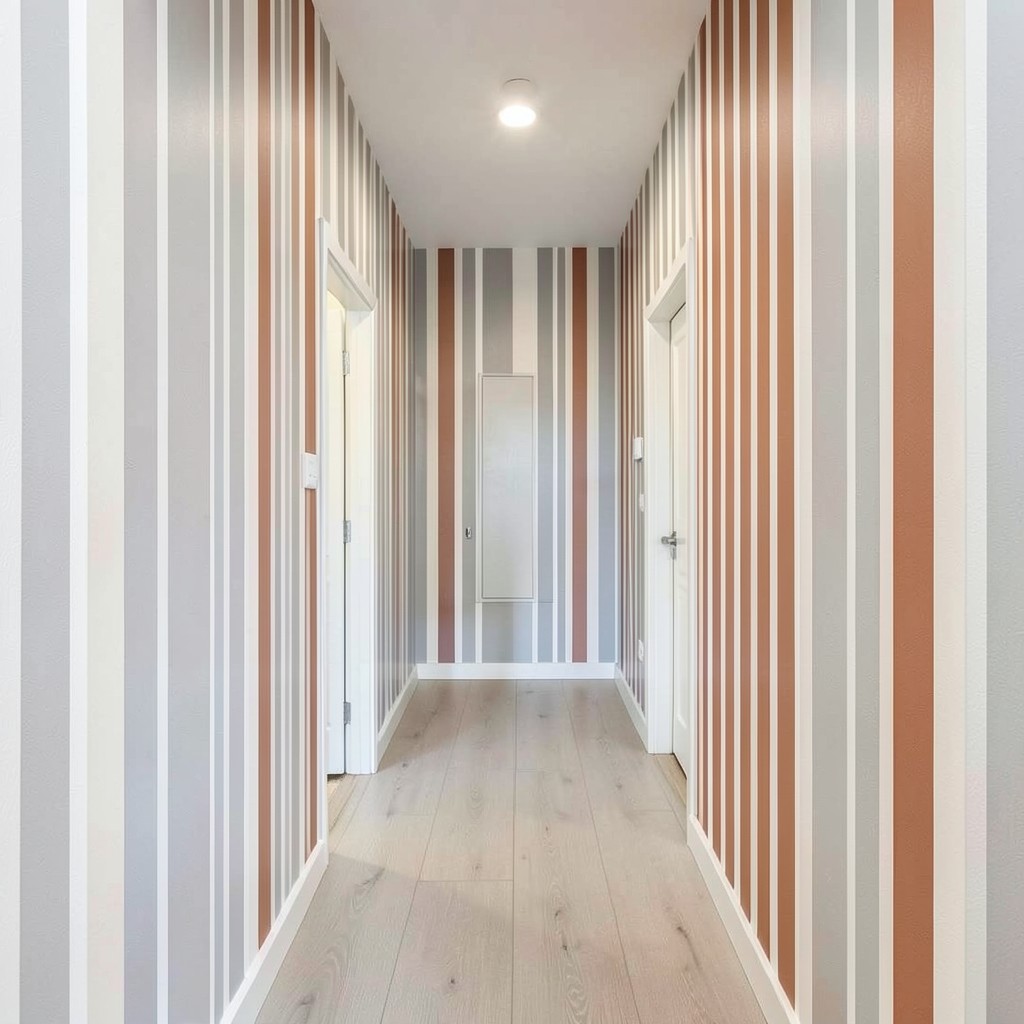
A striped feature wall in the hallway — the primary wall painted in alternating stripes of two colors or two tones whose vertical or horizontal orientation responds to the specific spatial condition that the hallway’s dimensions present — is the hallway design treatment that most directly and most affordably manipulates the apparent spatial dimensions of the corridor through the optical effect of the stripe’s directional emphasis. Vertical stripes increase the apparent ceiling height by drawing the eye upward in a series of parallel lines that the brain reads as height markers. Horizontal stripes increase the apparent depth of the corridor by drawing the eye along the wall’s length in a series of receding lines whose convergence the perspective reading interprets as distance.
The stripe width is the specification variable whose selection is more consequential than the color choice for the stripe pattern’s spatial effect. Narrow stripes — at fifty to seventy-five millimeters — produce a pattern whose detail is read at close range but whose overall effect from the hallway’s entry distance reads as a textured tone rather than a clear graphic. Medium stripes — at one hundred to one hundred and fifty millimeters — produce the stripe whose individual width is readable at the hallway’s viewing distance and whose alternating color or tone creates the clear directional movement that the optical effect requires. Wide stripes — at two hundred millimeters and above — produce the stripe whose graphic weight is strong enough to dominate the wall surface and whose individual color fields are wide enough to read as bands of color rather than as stripe pattern.
The bright home design or the airy home interiors hallway whose vertical stripe in pale grey and bright white — the two tones close enough in value that the stripe reads as a sophisticated tonal variation rather than a high-contrast graphic — produces the ceiling-heightening effect of the vertical stripe with the material restraint of the tonal palette. The fall home decorating context whose hallway wall carries a horizontal stripe in warm terracotta and cream — the stripe running the corridor’s full length, the horizontal emphasis drawing the eye toward the far end of the corridor and making the hall appear longer and more architecturally resolved than its measured dimensions suggest — produces the seasonal material warmth of the autumnal palette at the wall’s primary viewing surface.
12. A Hallway With Herringbone Timber Flooring
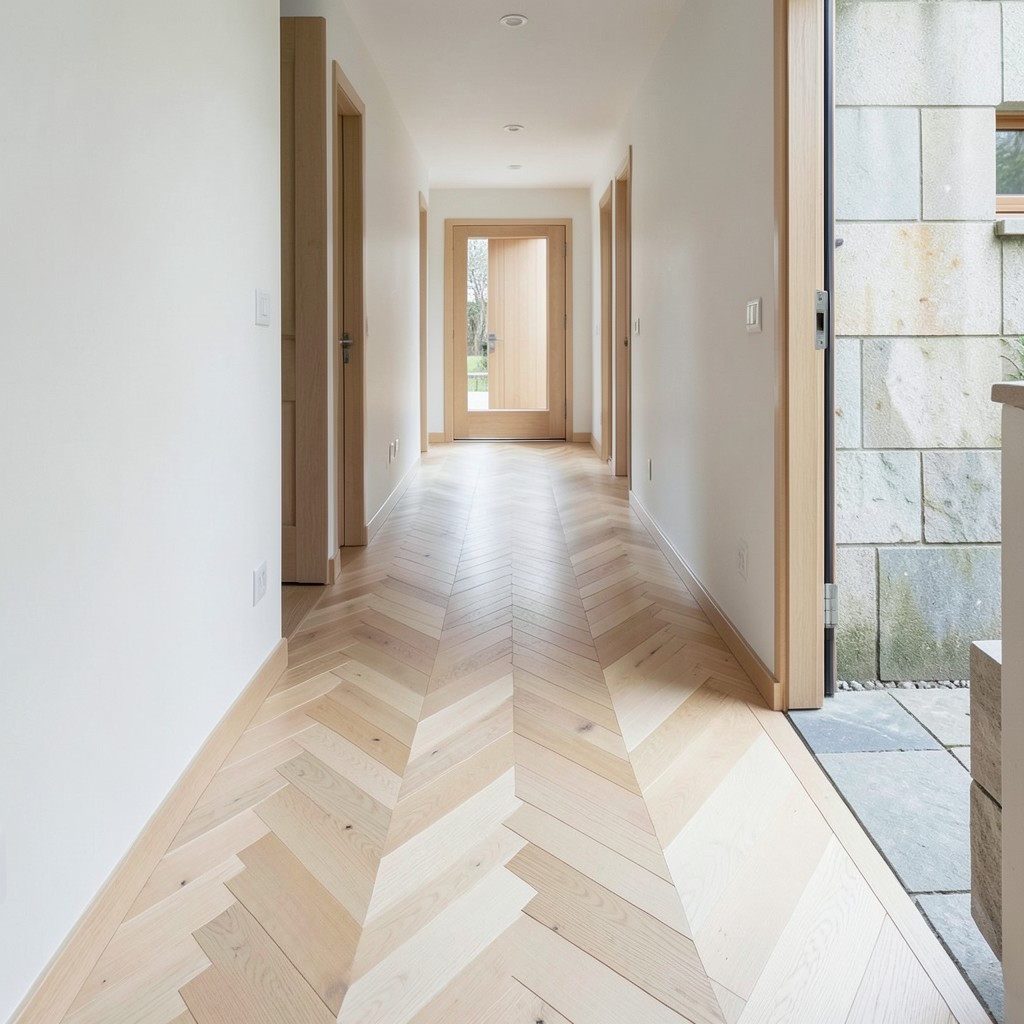
Herringbone timber flooring in the hallway — the parquet pattern whose alternating ninety-degree arrangement of short rectangular blocks creates the V-shaped directional pattern that the herringbone’s name describes — is the hallway floor treatment that produces the greatest combination of material quality, spatial dynamism, and floor-area visual enlargement of any wood floor format available in the domestic setting. The herringbone pattern in a narrow hallway performs a specific spatial function that the straight-run plank floor does not: its directional pattern draws the eye diagonally across the floor’s width and the corridor’s length simultaneously, producing the visual depth effect of a floor that the straight-run plank, whose boards simply reinforce the corridor’s direction, cannot match.
The herringbone’s block dimensions — the ratio of the block’s length to its width — determine the pattern’s proportional character and its visual pace across the floor surface. A block in the classic sixty-six by three hundred and thirty millimeter format — the five-to-one length-to-width ratio of the traditional parquet block — produces the herringbone whose V-pattern is wide and whose visual movement across the floor is relatively slow and composed. A block in a narrower, more elongated format produces a herringbone whose pattern tightens, the V-shapes more frequent and the floor’s visual energy higher. The selection between these options depends on the hallway’s width — wider corridors can carry the bolder, more frequent pattern, while narrow corridors benefit from the wider block whose pattern does not overwhelm the limited floor area.
The Scandinavian home interior or the contemporary home ideas entrance hall whose herringbone floor is in a pale, white-oiled European oak — the natural blond tone of the timber, the herringbone’s diagonal V-pattern in the floor’s surface, the clean joint lines between blocks providing the floor’s compositional geometry — produces the hallway whose floor is the design statement that requires no wall treatment, no ceiling detail, and no furniture arrangement to justify its presence. The stone and wood home design hallway where the herringbone oak floor meets the natural stone flags of the exterior threshold produces the material transition that the building’s boundary requires — the outdoor mineral material handing over to the indoor timber pattern at the door, the junction as designed as the materials on either side of it.
13. A Hallway With Wallpaper on the Ceiling

Wallpaper applied to the hallway ceiling — the ceiling surface papered in the same or a coordinating pattern to the wall treatment, or in a bold graphic pattern on an otherwise plain-walled hallway, the paper hung across the ceiling’s width in the direction that minimizes visible joins — is the hallway design treatment that most consistently surprises visitors whose design expectation ends at the wall level and who look upward in the wallpapered hallway with the specific pleasure of discovering a designed surface where the default white plaster has been replaced by a composed decorative one. The hallway ceiling is the one surface in the corridor that the visitor’s eye naturally tracks upward toward as they move through the space, making it the surface that the design conversation most consistently neglects and most rewards when it does not.
The paper selection for the hallway ceiling must account for the ceiling’s specific light conditions — the hallway ceiling typically receives less natural light than the walls it connects, and the paper’s color and pattern must be selected with the artificial light quality in mind as the primary viewing condition rather than the natural light whose quality the standard wallpaper selection process uses. A paper that reads as warm and rich in the daylight of the showroom may read as muddy and heavy under the hallway’s overhead pendant in the evening, and the test sample on the actual ceiling surface observed in the hallway’s evening light condition is the only reliable selection process for the ceiling paper.
The chic home decor or the elegant home styling narrow hallway whose ceiling carries a fine geometric paper in a warm metallic gold on a deep teal ground — the ceiling’s confined surface concentrating the paper’s pattern into the tight overhead zone that reads as a single composed panel rather than the distributed pattern of a larger room — produces the hallway ceiling whose design authority is most clearly revealed in the first evening the household spends in the newly papered space, when the pendant light illuminates the metallic paper from below and the ceiling appears to glow with the reflected warmth of the gold pattern’s response to the warm light source.
14. A Hallway With Exposed Brick Wall

An exposed brick wall in the hallway — the plaster finish removed to reveal the original brick construction beneath, or the brick-effect tile or panel whose face replicates the texture and color of the genuine masonry — is the hallway treatment that most directly imports the material honesty and the textural depth of the industrial home design, the rustic home decor, and the urban loft aesthetic into the domestic corridor. The exposed brick wall is not a feature wall trend. It is a material decision whose consequences extend into the acoustic, thermal, and atmospheric character of the hallway in ways that the paint or the wallpaper alternative cannot replicate.
The decision to expose genuine original brick in a hallway renovation requires an assessment of the brick’s condition before the plaster is removed — the plaster may be concealing brick whose pointing mortar has deteriorated to the point where the joint material is loose or absent, whose brick faces are stained or damaged in a way that the surface treatment conceals, or whose construction quality is not the architectural feature that the stripped aesthetic assumes is waiting beneath the plaster layer. The brick exposure decision made before the plaster comes off is the decision made in hope. The brick exposure decision made after the plaster survey is the decision made in knowledge.
The industrial home design city apartment hallway or the rustic home decor converted cottage whose exposed brick wall carries the specific material presence of a masonry surface that the building has been constructing for the duration of its life — the mortar joints’ texture, the brick faces’ color variation, the occasional ghost of a previous decorative treatment in the paint remnants that the stripping did not entirely remove — produces the hallway wall whose material depth no applied finish can replicate. The warm home decor ideas approach that applies a warm white limewash over the exposed brick — the wash thinning the brick’s heavy color and lightening the wall while retaining its texture — produces the material compromise between the full brick exposure and the fully covered wall whose atmospheric quality suits the brighter hallway direction.
15.

A cluster of pendant lights suspended from the hallway ceiling — multiple pendants of the same or varied design hung at slightly different heights from a common ceiling point or from a specially fabricated multi-point ceiling canopy — is the hallway lighting treatment that converts the overhead light source from the functional ceiling fitting whose single pendant provides the even, characterless illumination of the utility ceiling lamp into a composed lighting installation whose multiple light sources create the atmospheric layering and the visual depth that the single pendant cannot produce. The cluster pendant is the hallway’s design statement at the ceiling level, and in a narrow corridor whose floor space limits the statement furniture can make, the ceiling is the design zone whose impact is disproportionate to the floor area it occupies.
The pendant cluster’s composition — how many pendants, what heights, what pendant diameters, and what spatial arrangement within the canopy’s footprint — determines the installation’s visual density and its light quality simultaneously. A tightly grouped cluster of five small globe pendants at varying heights, the globes close enough to overlap in the vertical view from below, produces a dense, jewel-like composition whose light output is warm and distributed across the small cluster’s footprint. A loosely arranged cluster of three larger pendants with two hundred millimeters between their canopy fixing points, the pendants at significantly varied heights, produces the more spatially open composition whose individual pendant forms remain readable within the installation rather than merging into the cluster’s collective mass.
The bohemian home styling or the luxury home interior entrance hall whose pendant cluster carries a mix of hand-blown amber glass globes and slender brass stems — the organic form of each glass globe providing the slight variation between pendants that the handmade object delivers where the machine-produced uniform pendant cannot — produces the hallway ceiling’s most atmospheric lighting condition in the evening. The holiday home styling context where the pendant cluster is supplemented with a seasonal wreath or a botanical hanging installation at the ceiling level converts the designed lighting feature into the seasonal decoration’s structural core, and the hallway’s overhead zone carries both the functional light and the festive atmosphere in the same carefully planned ceiling composition.
16. A Hallway With a Bench and Hooks System
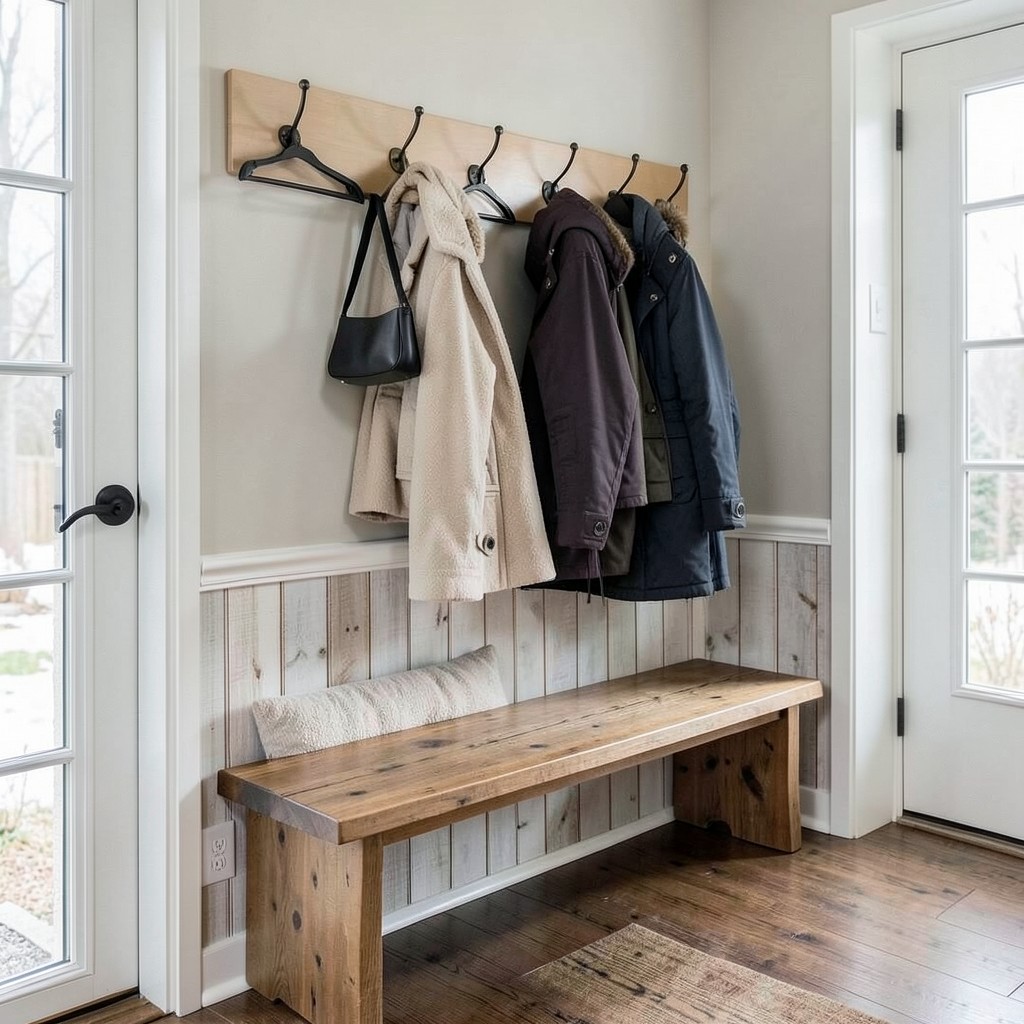
A combined bench and wall hooks system in the hallway — the seating unit positioned below a row of decorative coat hooks whose arrangement on the wall above the bench converts the full height of the entry wall from skirting to picture rail into a functional storage and seating zone — is the hallway design solution that addresses the entry zone’s complete functional brief in a single, composed installation rather than through the accumulation of individual items whose separate positions on the wall produce the visual chaos that the undecided hallway defaults to. The bench and hooks system is the entry zone resolved at the wall level.
The hooks’ design is the detail whose selection makes the difference between a functional installation and a composed one, because the coat hook is the hallway’s most touched, most used, and most visually prominent small hardware item and its design quality is assessed at close range by every household member multiple times every day. A double-arm cast iron hook in a traditional style whose curved arms provide sufficient depth for a coat hanger alongside a flat hook for the bag — the hook’s surface in a powder-coated black whose matte finish reads cleanly against the wall’s paint — performs both the functional and the visual role that the entry zone’s most demanding component requires.
The farmhouse home decor or the coastal home design family hallway whose bench and hooks system is built from shiplap-clad timber in a painted finish — the hooks in aged brass or oil-rubbed bronze hardware, the bench seat in a solid oak or reclaimed timber whose natural warmth provides the material contrast against the painted carcass — produces the entry zone whose design character is declared from the building’s threshold. The winter interior design context where the hooks carry the household’s heaviest coats and the bench seat holds the boot-pull cushion against the winter’s daily arrival routine produces the entry zone whose design intelligence is measured by its performance under the season’s hardest functional demands rather than its appearance in the summer photograph.
17. A Hallway With a Vertical Garden Feature

A vertical garden installation in the hallway — living plants mounted in a modular wall-planting system, a series of individual wall-hung planters whose arrangement creates the composed plant surface at the wall level, or a single large architectural planter positioned against the wall whose climbing or trailing plant forms create the green surface overhead — is the hallway design idea that most dramatically introduces the garden-inspired interiors and the biophilic design direction into the domestic corridor, and whose specific material quality — the living green of the plant surface, the organic irregularity of the leaf forms, the gentle movement of the trailing stems in the hallway’s air — provides the atmospheric quality that no paint, no wallpaper, and no tile can replicate because none of those materials is alive.
The practical requirements of a vertical garden in the hallway begin with the light assessment — the hallway’s natural light quality determines which plant species are suitable for the installation and, in many domestic hallways whose windows are limited to the entry door’s glazing and the landing’s overhead light, the light levels may be insufficient for the plant species that produce the most visually rich vertical garden effects. The hallway that receives direct natural light for at least four hours of the day can support a broader plant palette. The darker hallway requires the specific shade-tolerant species — ferns, pothos, philodendron, and peace lily — whose growth habit and leaf character still produce the green surface quality of the vertical garden without the full-sun requirement of the species whose visual drama is greatest in catalog photographs.
The jungle-inspired home decor or the tropical home design hallway whose vertical garden carries a mix of monstera deliciosa, golden pothos, and trailing heartleaf philodendron — the large-leaved tropical forms providing the bold botanical statement at the wall level, the trailing stems descending from the upper planters and softening the installation’s lower edge — produces the domestic corridor whose material atmosphere brings the tropical garden interior into the home with genuine botanical presence rather than botanical reference. The summer home design hallway whose vertical garden is at its most lush in the growing season, replaced for the winter home decor period with the hardy evergreen species that maintain the green surface through the low-light months, is the hallway seasonal home makeover that the living installation makes possible and that no painted or papered surface can perform.
18. A Hallway With Arched Doorway Details

Arched doorways in the hallway — the entry door frame or the internal door openings whose rectangular form is converted to the arched profile through plastering, carpentry, or applied architectural detailing — are the hallway modification that most profoundly changes the spatial character of the corridor without altering its plan dimensions, because the arch introduces the curved architectural element whose visual richness and period reference the rectangular opening’s flat lintel cannot approach. The arch transforms the functional door opening into the architectural event whose form the eye reads as a composed design decision rather than a standard construction detail.
The arch geometry — the semicircular arch whose height equals half its width, the segmental arch whose rise is less than the radius, the pointed Gothic arch whose two arcs meet at the apex above the opening’s center, and the flat arch whose slight curve is almost imperceptible at the standard viewing distance — each produces a different architectural reference and suits different hallway proportions and design directions. The semicircular arch belongs to the Mediterranean, the Spanish Colonial, and the warm, earthy design directions whose material vocabulary the arch’s simple geometry suits. The segmental arch is the domestic doorway arch of the Georgian and Regency tradition whose restraint and proportion belong to the period interior. The pointed arch is the Gothic reference that the romantic, bohemian, or traditional home interiors direction adopts.
The warm home decor ideas or the Mediterranean-influenced hallway whose entry door and internal door openings are all converted to the semicircular arch — the arch’s plaster soffit in the same warm white as the hallway walls, the profile’s curve continuous from the arch’s springing point on each side to the crown at the opening’s center — produces the hallway whose architectural character is resolved by the arch form alone, without requiring any further wall treatment, art arrangement, or decorative layer to communicate the design direction. The arch is the architecture, and the hallway that places its architectural investment in the door openings rather than in the surface treatments discovers that the form of the space is the design rather than the decoration applied to the space.
19. A Hallway With a Skylight or Sun Tube

A skylight or sun tube installed above the hallway — the glazed roof aperture or the tubular daylight device whose reflective tube channels outdoor light from the roof surface down into the ceiling of the dark interior corridor — is the hallway modification that addresses the domestic hallway’s most persistent and most fundamental design problem: the absence of natural light. The dark hallway is the hallway whose design potential is constrained not by its dimensions, not by its proportions, and not by its surface quality but by the simple fact that the building’s plan position does not connect the corridor to any window or external wall, and every design decision made in the absence of natural light is a decision made against the grain of the space’s most fundamental need.
The sun tube’s specific advantage over the conventional rooflight for the hallway application is its ability to route the daylight horizontally or around obstacles within the roof void before delivering it to the ceiling aperture below — the reflective tube’s internal mirrored surface bouncing the daylight around corners and across distances that the conventional rooflight, which requires a direct vertical path from roof to ceiling, cannot serve. The hallway whose roof void is congested with the building’s structural, thermal, and services elements, whose ceiling is below a first-floor bedroom rather than directly below the roof, is the hallway where the sun tube’s routing flexibility makes it the practical option where the conventional rooflight is not.
The bright home design or the airy home interiors renovation whose dark hallway receives a sun tube installation — the circular ceiling aperture delivering natural daylight into the corridor for the first time in the building’s residential history, the quality of the light at the hall floor level changing the space’s entire design potential — discovers that the hallway is not the design problem it appeared to be before the light arrived. The hallway problem, in nine cases out of ten, is not the hallway’s dimensions or its proportions or its material quality. It is the absence of natural light, and the design conversation that begins after the sun tube is installed is the hallway design conversation that the dark corridor has been preventing from taking place.
20. A Hallway With Textured Wall Plaster
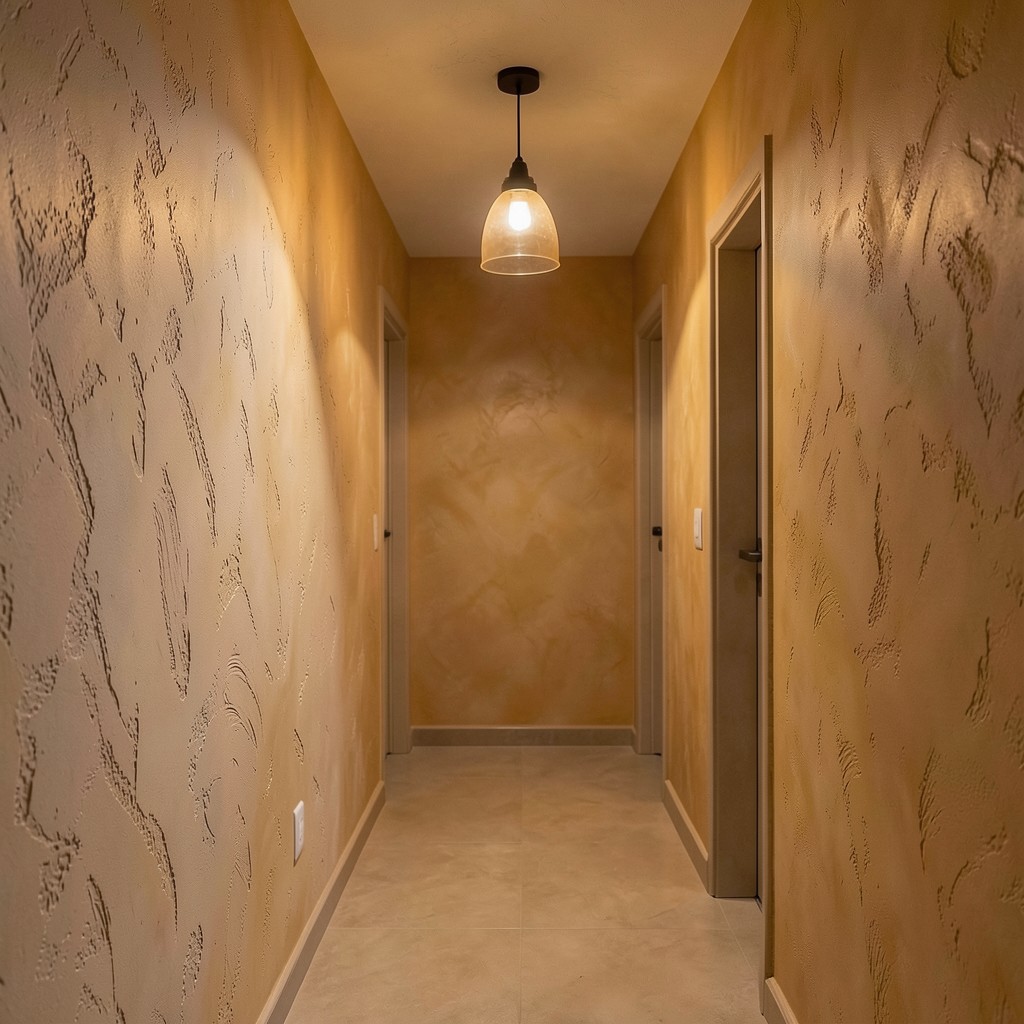
A textured plaster wall finish in the hallway — the troweled or rolled plaster application whose deliberate surface imperfection introduces the three-dimensional wall quality of the traditional lime plaster, the contemporary Venetian plaster, or the textured render into the domestic corridor — is the hallway wall treatment that provides the atmospheric richness of a materially worked surface without the pattern of the wallpaper, the commitment of the material cladding, or the cost of the specialist wall paneling system. The textured plaster wall is the wall that was made rather than painted, and the quality that the made wall provides in a corridor whose other surfaces are flat and smooth is the specific quality of material contrast that makes the textured surface the room’s atmospheric anchor.
The texture type — the circular swirl of the traditional sand-floated lime plaster, the pulled and layered surface of the Venetian plaster whose burnished peaks and compressed valleys produce the specific visual depth that the Italian decorative tradition refined over centuries, the horizontal skip-trowel whose parallel marks create the directional surface that reinforces the corridor’s length, and the rough-cast render whose aggregate finish brings the exterior building tradition into the interior — each produces a different atmospheric register and suits different hallway design directions. The Venetian plaster belongs to the luxury home interior or the elegant home styling direction. The rough lime plaster belongs to the rustic home decor or the earthy home design corridor.
The Mediterranean or the desert home styling hallway whose walls carry a warm ochre Venetian plaster — the burnished surface’s specific quality of depth and warmth providing the corridor with a wall material whose atmospheric presence changes with every variation in the hallway’s light across the day — produces the hallway wall that cannot be replicated by a paint finish at any specification level, because the Venetian plaster’s quality is in the material’s depth and its response to raking light rather than in its surface color alone. The warm light of the hallway’s pendant in the evening, raking across the burnished plaster surface and producing the specific play of highlight and shadow that the textured surface generates, is the hallway’s evening quality that the flat-painted wall will never provide regardless of the paint’s color depth or finish quality.
21. A Hallway With a Dedicated Plant Shelf

A dedicated plant shelf in the hallway — a wall-mounted timber or steel shelf positioned at a height that provides the natural light access and the viewing distance its plant display requires, its surface carrying a curated arrangement of potted plants whose foliage color, texture, and growing habit form the wall’s botanical composition — is the hallway design idea that introduces the organic, living material quality of the garden-inspired interiors direction into the domestic corridor at the most accessible cost and the most modest spatial demand of any living plant application available. The plant shelf is the hallway’s simplest version of the biophilic design principle, and its simplicity is its specific advantage.
The shelf’s positioning relative to the hallway’s natural light source — the entry door’s glazing, the landing window above, the side light beside the door frame — determines the plant palette that will thrive in the specific light conditions the shelf provides. A shelf positioned within one meter of a well-glazed entry door can support a broad range of foliage and flowering plants whose light requirement is met by the door’s daylight. A shelf positioned at the hallway’s far end, away from the light source, requires the shade-tolerant species whose growth habit is less visually dramatic but whose hardiness under the low-light condition makes them the practical choice that the sun-loving alternatives cannot be in the same position.
The Scandinavian home interior or the minimalist home design hallway whose plant shelf carries a simple row of terracotta pots in graduated sizes — the smallest at the shelf’s ends and the largest at its center, the plants in the same species or complementary foliage forms that create the composed botanical arrangement rather than the miscellaneous plant collection — produces the hallway botanical display whose design intelligence is in the editing rather than the accumulation. The spring home refresh plant shelf whose seasonal additions include fresh flowering bulbs — hyacinth, narcissus, and tulip whose spring blooms provide the scent and the color that the hallway’s botanical display provides most directly and most seasonally — is the hallway seasonal home makeover whose design investment is the bulb cost and whose atmospheric return is the spring season’s most direct domestic expression.
22. A Hallway With a Black and White Floor Tile

A black and white checkerboard floor tile in the hallway — the alternating squares of black and white tile in the classic checkerboard pattern whose graphic simplicity and optical impact have made it the defining floor treatment of the formal domestic entrance hall since the Regency period — is the hallway floor design whose architectural authority and graphic clarity produce the most compositionally strong floor surface available in the corridor format. The black and white floor does not need a feature wall to make the hallway interesting. It is the feature, and the hallway that understands this dresses the walls simply to allow the floor to speak without competition.
The tile size selection for the checkerboard pattern must account for the hallway’s width as the primary proportional reference point — the individual tile square should be sized so that an even number of whole tiles fits across the corridor’s width without a cut tile at either side, which requires the tile size to be determined after measuring the hallway width rather than before. The standard domestic tile in a two hundred millimeter format suits the hallway of approximately one to two meters width, providing between five and ten complete tile squares across the floor’s width in the composition that reads as a composed checkerboard rather than as an oversized chess board whose pieces have been removed. A wider hallway can carry the three hundred millimeter tile whose larger format suits the more generously proportioned entry.
The traditional home interiors Georgian townhouse hallway or the elegant home styling formal entrance whose black and white checkerboard floor carries the pure mathematical authority of its two-color geometry — the pattern running from the entry door to the stair hall’s foot or the first internal doorway in an uninterrupted field that anchors the hallway’s entire design composition — produces the entrance floor whose design quality is independent of every other design decision made in the space above it. The contemporary home ideas renovation that adopts the checkerboard in a tonal grey and white rather than the full black and white — the tonal version providing the pattern’s directional movement with reduced graphic contrast — produces the hallway floor whose period reference is present but its graphic intensity is moderated for the modern interior context.
23. A Hallway With a Wall-Mounted Book Ledge
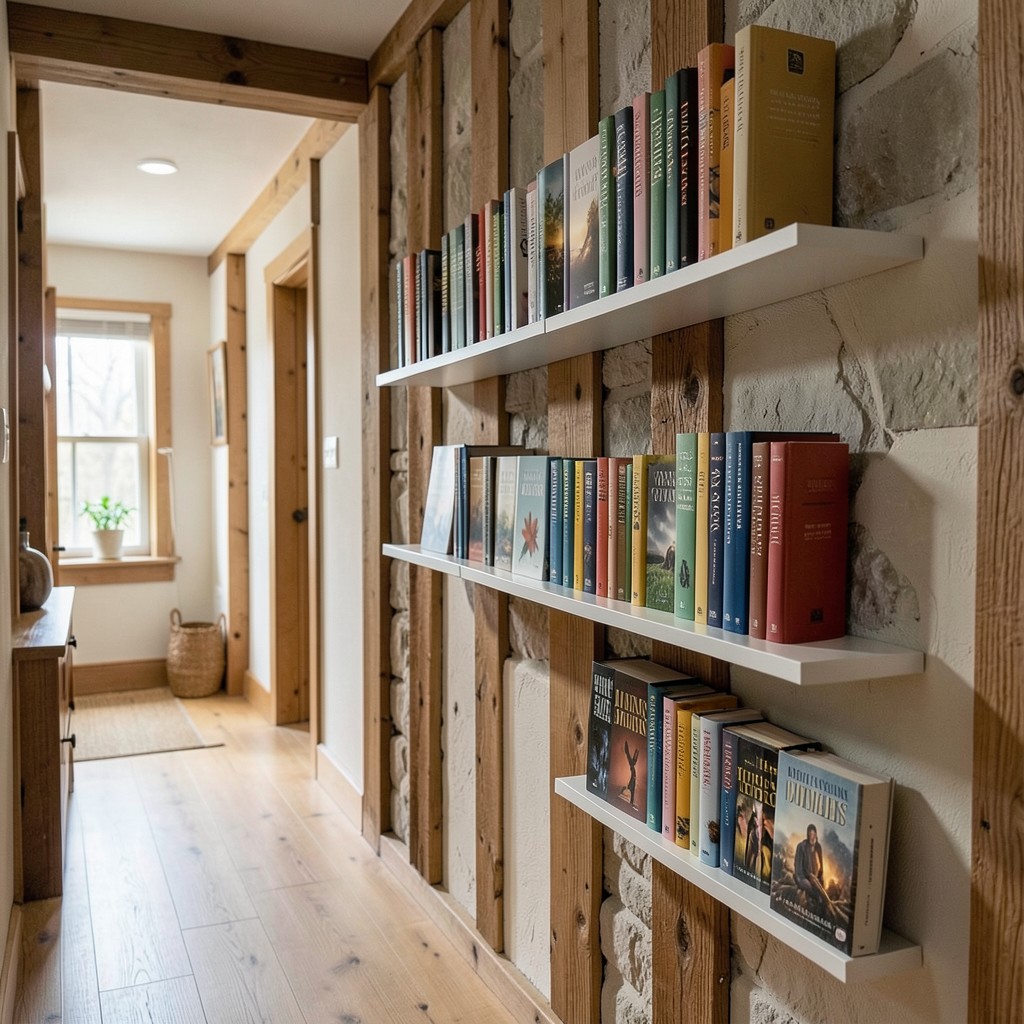
Wall-mounted book ledges in the hallway — slim, shallow shelves whose narrow depth holds books upright with their covers facing outward rather than their spines, the individual book cover visible at the front of each ledge rather than the spine at the shelf’s edge — are the hallway storage and display idea that converts the corridor wall into a displayed library whose cover art, color composition, and curated selection communicate the household’s reading character to every visitor who passes through the space. The book ledge hallway is the hallway that says something about the people who live in the house before any conversation has occurred, and what it says is specifically and directly about intellectual life rather than decorative preference.
The ledge installation requires the shelf’s fixing to be into the wall’s structural substrate rather than into the plasterboard face alone, because the combined weight of a ledge carrying a full row of books — particularly a ledge of eight hundred to one thousand millimeters length whose books may total four to six kilograms — represents a loading that the plasterboard’s pull-out strength cannot reliably sustain over the long term. The fixing into the timber stud or the masonry wall behind the plasterboard, using the appropriate screw length and fixings for the substrate, is the structural requirement that the book ledge’s light, minimal appearance belies and whose neglect is the most common cause of the shelf’s subsequent failure.
The rustic home office ideas or the cozy home design family hallway whose three book ledges are staggered at varying heights on the primary wall — each ledge carrying a curated row of books whose cover colors have been arranged in a gradient from the warm tones at the highest ledge to the cooler tones at the lowest — produces the hallway wall display whose compositional intelligence is in the color arrangement rather than in the frame or the object. The hallway that uses its books as its art is the hallway that has understood that the most personal thing in the household’s interior is the collection of objects chosen for reading rather than for display, and the book ledge is the installation that puts that personal collection on honest, uncontrived display.
24. A Hallway With a Wallpaper Feature Wall

A wallpaper feature wall in the hallway — the end wall that faces the entry door receiving a bold, decorative paper whose pattern, color, and scale draw the eye along the corridor’s length toward the composed surface that terminates the view — is the hallway design treatment that most directly addresses the corridor’s fundamental spatial problem: the narrow width provides no room for the statement furniture piece, the large art work, or the fireplace surround that gives the standard room its focal point. The feature wall at the hallway’s terminus is the focal point that the corridor’s plan allows, and the wallpaper that occupies it is the design statement that holds the visitor’s attention from the moment the entry door opens.
The paper’s scale must be appropriate for the hallway’s specific dimensions — the distance from the entry door to the feature wall determines the viewing distance at which the paper’s pattern is first resolved from the approaching position, and the pattern’s repeat must be large enough to read as a clear composed design at that distance rather than as an undifferentiated texture. A paper with a two hundred millimeter pattern repeat is read as clear design from approximately two meters. The same paper installed at the end of an eight-meter corridor reads as fine texture from the entry distance, and the pattern’s design quality is lost until the visitor has traveled the corridor’s full length.
The maximalist bohemian home styling or the traditional home interiors entrance hall whose feature wall carries an oversized botanical paper in lush tropical greens and warm soil tones — the paper’s large leaf forms filling the wall end with the specific dense botanical quality of the jungle-inspired home decor direction — produces the hallway whose terminus wall the visitor walks toward with the specific pleasure of approaching a surface that rewards the closer inspection. The fall home decorating context where the feature wall paper’s warm ochres and deep russets suit the season’s palette without seasonal intervention is the hallway design choice whose seasonal rightness required no styling effort because the paper was selected with the season’s character already embedded in its color palette.
25. A Hallway With Wainscoting and a Picture Rail

Wainscoting panels from the skirting to the dado rail combined with a picture rail at the traditional picture-hanging height — the hallway wall divided into three horizontal zones whose specific materials, colors, and detailing provide the architectural program that converts the featureless corridor into a room of genuine period character — is the hallway wall treatment that most completely resolves the traditional domestic entrance hall’s decorative brief in a single composed system whose components have been in conversation with each other in the English and American period interior for over three hundred years. The dado-and-picture-rail hallway is the traditional hallway’s defining architectural grammar.
The three-zone wall composition — the paneled dado below the dado rail, the painted or papered field between the dado and picture rails, and the painted frieze above the picture rail to the ceiling’s cornice — creates the hallway wall whose division into horizontal registers makes the corridor appear wider than its dimensions by providing the eye with multiple horizontal lines to track across the wall’s surface rather than the single continuous vertical plane of the un-divided wall. Each horizontal zone carries a different material treatment whose tonal relationship with the other zones determines the wall’s overall compositional balance — the lower dado typically in a deeper tone, the mid-field in a medium tone, and the frieze in a lighter tone that bridges the mid-field and the ceiling above.
The traditional home interiors Victorian terraced house hallway whose wainscoting and picture rail system is installed in the period’s own decorative vocabulary — the dado’s tongue and groove boarding in a painted deep sage, the mid-field in a coordinating wallpaper whose pattern is consistent with the period’s decorative language, the picture rail carrying the framed artwork at the appropriate hanging height — produces the hallway interior whose architectural completeness is the specific quality that the period townhouse renovation achieves when it commits to the building’s own design language rather than imposing a contemporary aesthetic onto a fabric that was built for a different one. The three-zone hallway wall is the period hallway’s most authoritative design decision and the one whose absence is the most architecturally conspicuous.
26. A Hallway With Reclaimed Timber Flooring

Reclaimed timber flooring in the hallway — the solid boards salvaged from demolished buildings whose surface carries the specific character of timber that has already lived a full service life before arriving in the new interior — is the hallway floor treatment whose material quality produces the specific domestic atmosphere of a home that was not assembled from a catalog but built from the fragments of accumulated material history. The reclaimed board’s grey-toned surface, the nail holes whose dark points punctuate the face of each board, the occasional paint ghost at the board edge where the original skirting protected the timber below it from the decorator’s brush — these are the surface details that the new timber board’s clean, consistent face cannot provide at any treatment level.
The sourcing of reclaimed timber for a hallway floor application requires the boards to be assessed for dimensional consistency before purchase — the hallway floor’s high-traffic condition and the daily passage of the household’s footwear make the level transition between adjacent boards the specification requirement that the reclaimed floor’s inherent dimensional variation can undermine if the sourcing and laying process does not address it. The thicknessing of reclaimed boards to a consistent dimension before installation, carried out by the specialist reclaimed timber supplier or the joinery workshop, converts the material’s natural variation from a laying problem into a controlled installation condition whose manageable tolerance the floor layer can work with rather than struggle against.
The stone and wood home design or the rustic home decor hallway whose reclaimed wide-plank pine or oak floor — the boards in the grayed, warm surface of aged timber, the visible nail holes and the occasional adze mark or saw kerf providing the specific character of wood that was made by hand in the specific material tradition of the building it came from — produces the hallway floor whose material depth no new timber product approximates at any price point. The barefoot quality of the reclaimed timber floor — the specific warmth and density of the thick, aged board under the foot’s direct contact — is the floor’s most intimate quality and the one whose daily return across every season justifies the sourcing effort and the material cost that the reclaimed floor requires over its new-timber equivalent.
27. A Hallway With a Dramatic Pendant Lantern
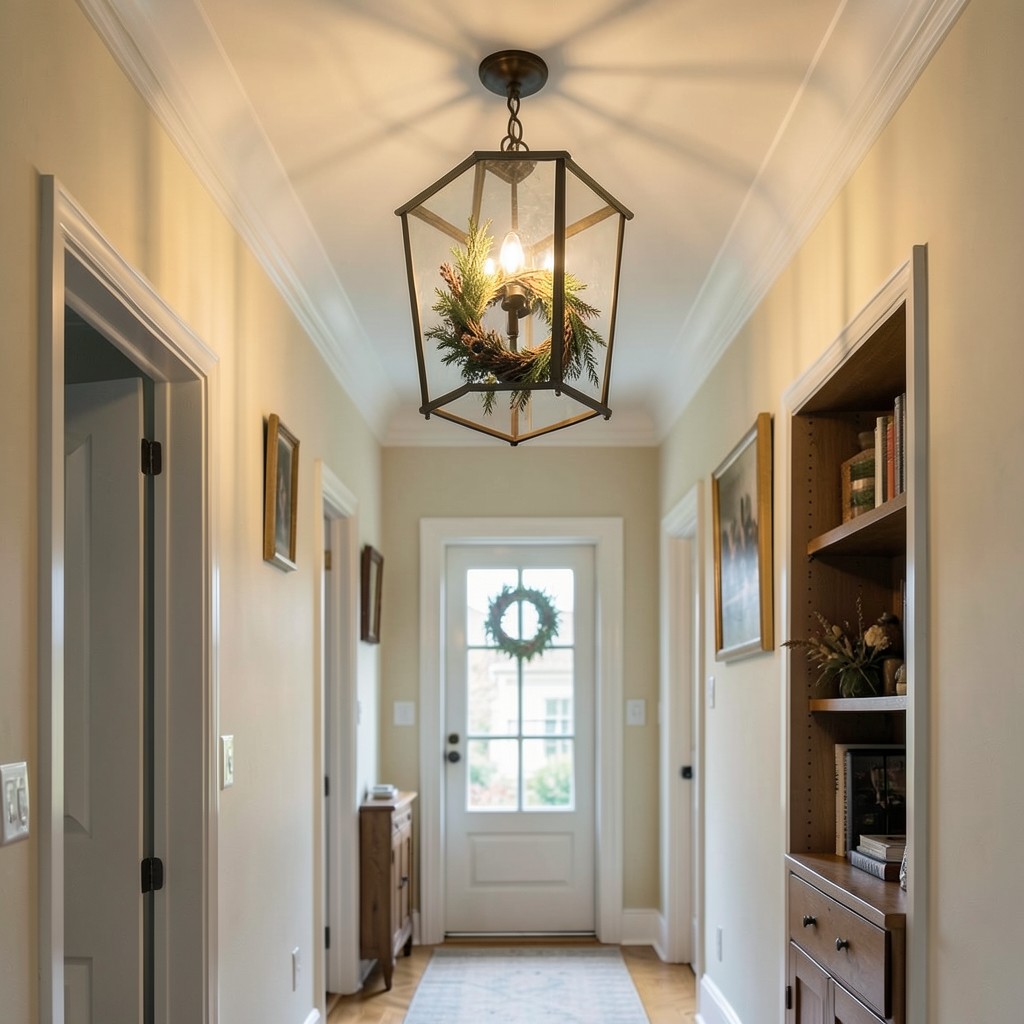
A dramatic pendant lantern in the hallway — a large format hanging lantern whose scale commands the corridor’s ceiling zone and whose material and form make the hallway’s overhead the room’s primary design statement — is the hallway lighting idea that most directly converts the corridor from a space you pass through without registering into a space whose ceiling presence stops the eye and holds the attention from the entry threshold. The large lantern’s scale is the quality that makes it work: the hallway pendant that is correctly sized for the ceiling height and the corridor width announces itself as the room’s designed element rather than its functional component, and that specific shift from utility to intentionality is what makes the difference between a hallway that is functional and a hallway that is designed.
The lantern’s scale is the specification decision most consistently made timidly, for the same reason that the hallway mirror is consistently selected too small — the assumption that the proportions of the domestic hallway require a restrained scale in the overhead fitting. The assumption is wrong. The large lantern in a narrow hallway does not overwhelm the space. The ceiling is the corridor’s most generous spatial dimension, and the pendant that respects the ceiling’s height by filling an appropriate proportion of the overhead zone with a form of genuine visual weight produces the hallway whose ceiling plane is resolved in the same way the console table below it resolves the floor zone.
The traditional home interiors Georgian entrance hall whose pendant lantern is a large antiqued brass hexagonal lantern — the lantern’s frame in a dark aged brass, the six glass panels providing the warm enclosed light of the traditional hall lantern whose specific material form the Georgian domestic interior developed specifically for the entrance hall’s architectural requirements — produces the hallway lighting whose form is so architecturally correct for the space that its presence appears inevitable rather than chosen. The holiday home styling context where the lantern’s interior is dressed with a seasonal botanical arrangement — a miniature wreath of evergreen and dried botanicals suspended from the lantern’s internal frame — converts the architectural fitting into the seasonal decorative gesture whose material restraint suits the lantern’s formal character.
28. A Hallway With Woven Seagrass Flooring
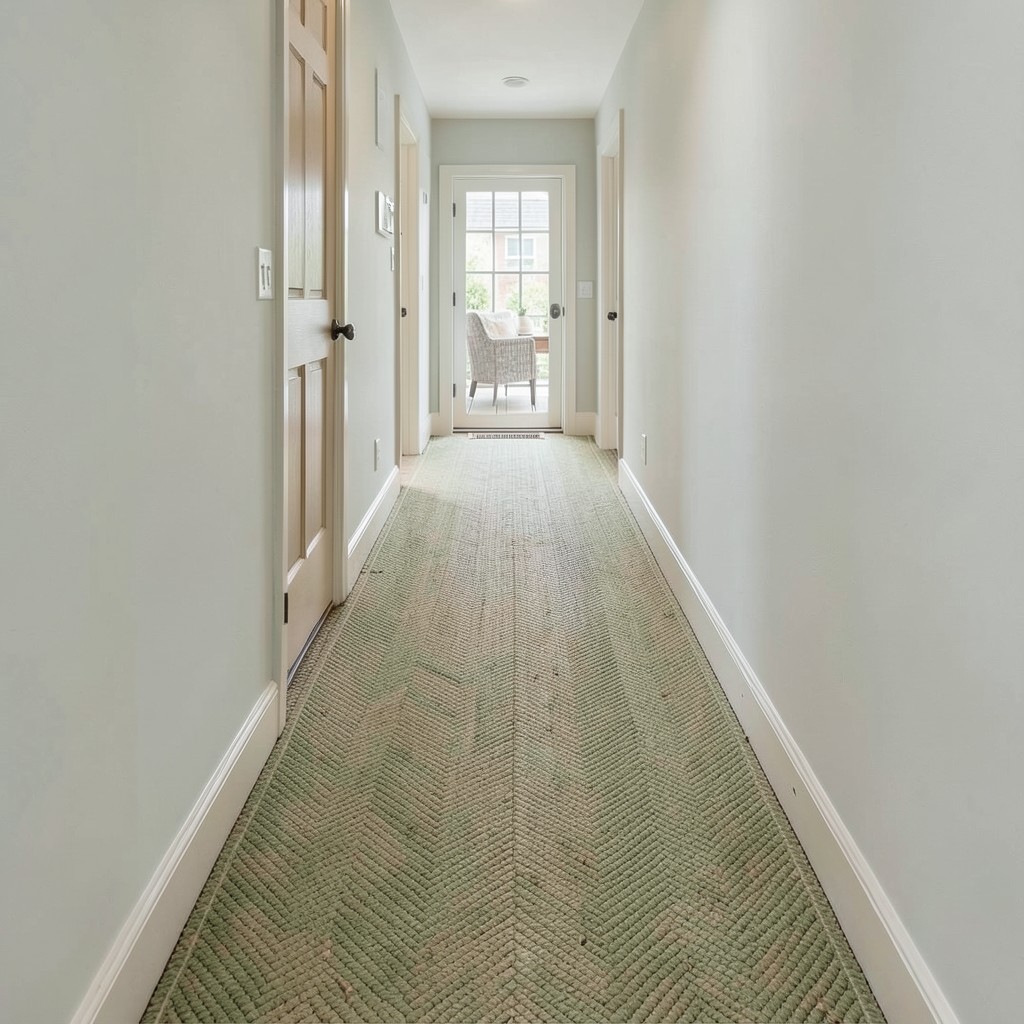
Woven seagrass flooring in the hallway — the natural fiber floor covering whose tight, flat weave produces the surface texture of the traditional coastal and country house floor, the seagrass plant’s specific fiber giving the weave the warm khaki-green tone and the organic variation that no synthetic fiber replicates — is the hallway floor treatment that most consistently provides the material warmth of a natural textile with the practical durability that the hallway’s high-traffic condition and the daily contact with wet shoes and muddy boots demands. Seagrass is one of the toughest natural floor fiber materials available, and its hardness under the foot’s contact makes it the natural fiber floor whose hallway performance matches its agricultural character.
The seagrass floor’s weave pattern — the standard herringbone, the basket weave, and the boucle loop whose varied surface textures each produce a different visual quality from the same natural fiber — determines the floor’s visual character and its tactile quality underfoot simultaneously. The herringbone seagrass provides the directional surface whose diagonal V-pattern adds the spatial depth to the narrow corridor that the basket weave’s more static square composition does not produce. The boucle loop produces the softest surface of the three weave formats at the cost of the slightly higher loop profile that catches the floor cleaning equipment with greater frequency than the flat weaves.
The coastal home design or the farmhouse home decor hallway whose seagrass floor — fitted wall to wall without a border in the standard residential installation, or with a slim painted timber or painted canvas border whose contrasting tone frames the natural fiber panel at the corridor’s perimeter — produces the entry floor whose natural, organic character establishes the home’s material philosophy at the building’s threshold before a single wall, piece of furniture, or ceiling treatment has been observed. The summer home design beach house whose seagrass hallway floor carries the salt-bleached, sun-warmed quality of the coastal material tradition is the floor whose material rightness for the building’s context makes every other floor specification alternative feel like a compromise.
29. A Hallway With a Monochrome Color Scheme
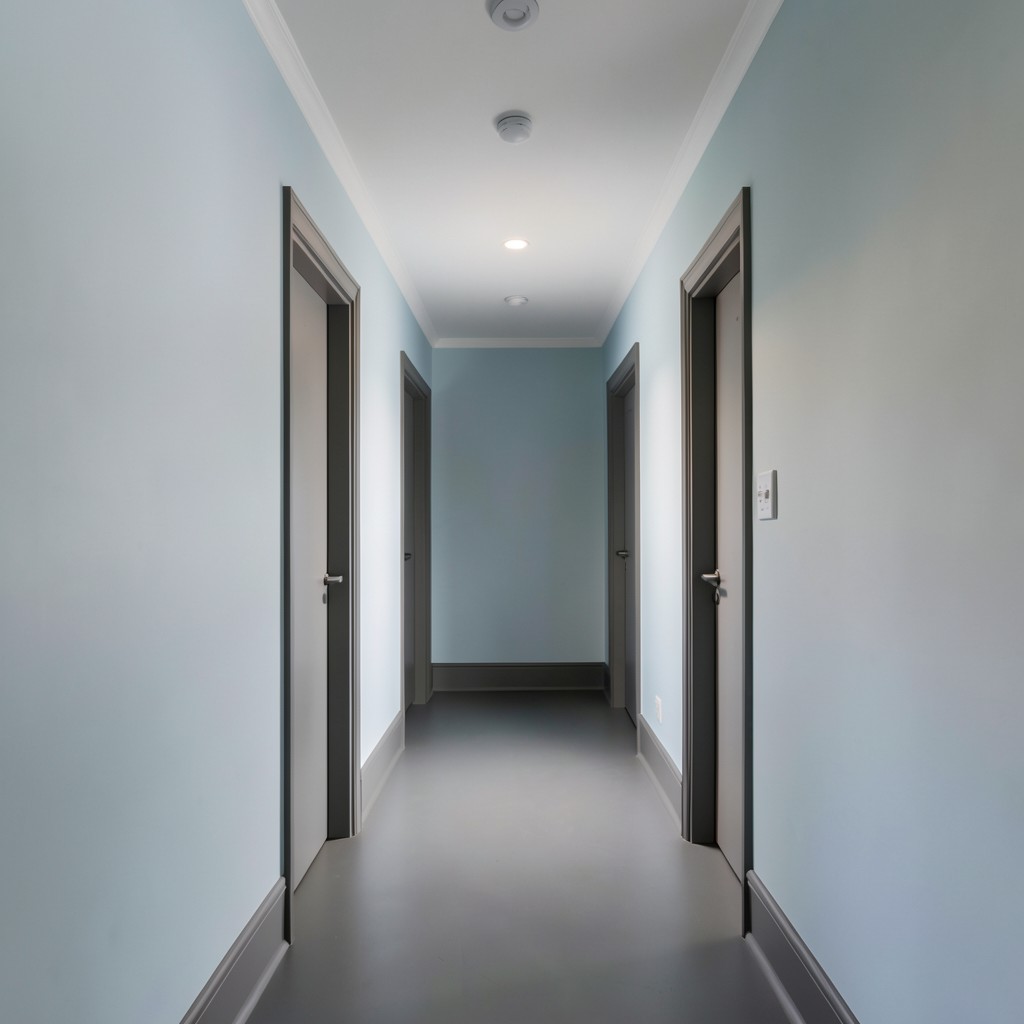
A monochrome hallway — the corridor’s walls, ceiling, trim, floor, and furniture all resolved within a single color’s tonal range from pale to deep, the entire space wrapped in one hue’s graduated expression without the introduction of a contrasting secondary color — is the hallway design approach that produces the most spatially unified and architecturally composed corridor available at any scale and in any period building, because the monochrome scheme removes the visual interruption of the color boundary — the moment where one color ends and another begins — and replaces the conventional multi-color hallway with a space whose color is its atmosphere rather than its decoration.
The monochrome scheme’s success depends entirely on the tonal variation within the single hue being sufficient to prevent the space from reading as flat and textureless rather than as unified and composed. The pale ceiling, the medium-tone walls, and the deeper skirting and floor within the same green or the same grey or the same terracotta produce the tonal depth that the monochrome scheme requires to read as designed rather than as unfinished. The all-one-tone monochrome — ceiling, walls, and trim in the exact same paint — produces the color-drenched effect of the enclosed atmospheric room, which suits certain hallway conditions but requires the correct scale, ceiling height, and light quality to avoid reading as oppressive rather than enveloping.
The elegant home styling or the minimalist home design hallway in a full warm grey monochrome — the ceiling in the palest grey, the walls in a mid-grey with warm undertones, the skirting and door frames in the darkest grey of the three — produces the corridor whose single-color discipline makes every material and form within the space read with a clarity that the multi-color hallway, whose color contrasts compete for attention, cannot provide. The breezy home interiors or the airy home interiors approach to the monochrome in pale blue — the ceiling and walls in the palest coastal blue, the trim in the slightly deeper tone — produces the hallway whose single cool hue amplifies the natural daylight in a way that the warm grey palette’s absorption of the light does not, and the specific quality of the coastal blue monochrome hallway in morning sunlight is the closest a painted interior surface comes to the quality of the sea itself.
30. A Hallway With a Vintage Map or Globe Display

A vintage map or globe display in the hallway — a large antique or reproduction map framed and hung as the hall’s primary artwork, or a pair of terrestrial and celestial globes on a console table whose geographic beauty and warm aged materials provide the hallway’s focal display — is the hallway design idea that most directly places the domestic entry in the territory of knowledge, exploration, and the specific visual beauty of the cartographic tradition whose combination of scientific precision and decorative craft produces objects whose aesthetic quality is independent of their navigational usefulness and whose material character ages as beautifully as any art form available in the residential interior.
The framed map’s scale must match the wall it occupies rather than being selected by the map’s available print size, because a map whose framed dimensions are undersized for the wall reads as a small print that happened to be a map rather than as a composed art hanging whose scale and subject were chosen together as a single design decision. The hallway’s primary wall — the end wall at the corridor’s terminus, the wall beside the console table, or the staircase’s side wall whose ascending surface provides the large, uninterrupted plane that the map display requires — should guide the map’s framed dimensions, and the search for a map of the correct subject and the correct scale is the research process that produces the hallway display whose result justifies the effort.
The rustic home office ideas or the traditional home interiors hallway whose console table carries a pair of matched antique globes — the terrestrial globe’s continents in the warm ochre and verdigris of the aged vellum map, the celestial globe’s star map in the deep blue and gold of the night sky tradition — produces the entry display whose combination of scientific beauty and artisanal material quality makes the hallway the household’s most intellectually specific room. The globe display requires nothing else on the console table to complete its composition, and the hallway that resists the temptation to add objects to the console whose composition is already resolved demonstrates the design intelligence whose restraint is as rare and as valuable as the objects whose selection produced the composition in the first place.
31. A Hallway With Shiplap Wall Cladding
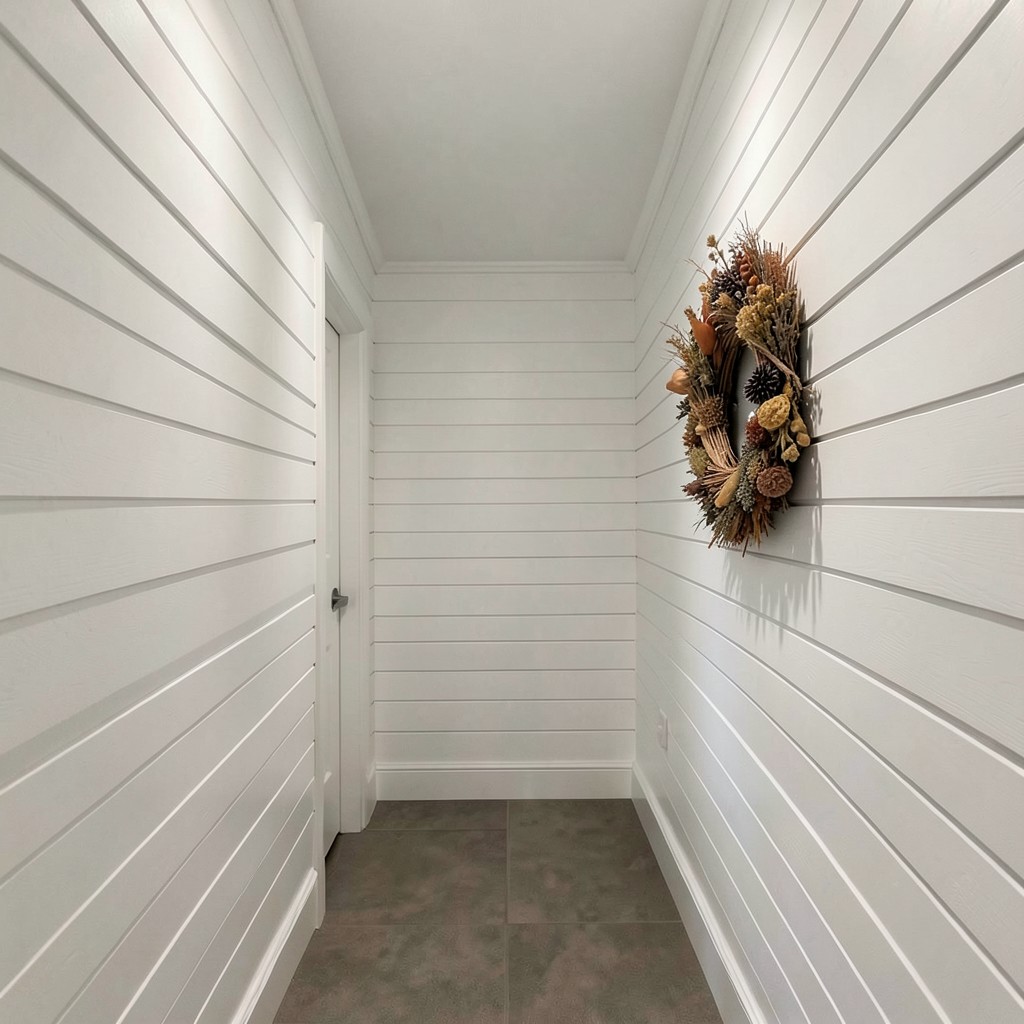
Shiplap wall cladding in the hallway — the overlapping, rebated timber boarding whose horizontal profile and characteristic shadow gap at each board joint produce the specific material texture of the coastal, farmhouse, and Scandinavian interior traditions — is the hallway wall treatment that converts the smooth plaster corridor into a textured timber-lined space whose material warmth and directional surface quality change the corridor’s sensory character as completely as any structural intervention, but whose installation requires only the standard carpentry skills of boarding over an existing plaster wall rather than the structural modification that the architectural change demands.
The shiplap boarding’s horizontal orientation in the hallway produces the specific spatial effect of widening the apparent corridor dimension — the horizontal lines of the board profile and the shadow gap draw the eye across the corridor’s width rather than along its length, and the visual emphasis on the transverse dimension makes the narrow space appear less corridor-like and more room-like in the horizontal register of the eye’s movement. The vertical shiplap — boards running from skirting to ceiling — produces the opposite spatial effect, emphasizing the ceiling height and producing the tall, lean quality of the paneled corridor rather than the wide, low quality of the horizontally boarded one.
The farmhouse home decor or the coastal home design hallway whose shiplap cladding runs from the skirting to the picture rail in a warm white painted finish — the board joints’ shadow lines providing the wall’s texture in a material that reads as entirely white from a distance and as textured timber at close range — produces the hallway wall whose design quality scales correctly across both the entry distance and the close-range inspection. The fall home decorating context where a wreath of dried botanicals and seed heads is hung against the white shiplap wall — the natural tones of the dried materials against the white painted timber — produces the seasonal display whose material logic is complete: the natural material against the natural board, the color of the season against the neutral of the wall.
32. A Hallway With Arched Mirror Alcoves

Arched mirror alcoves in the hallway — shallow recesses formed in the wall whose arched opening frames a flush mirror panel, the mirror sitting within the arch rather than hanging proud of the wall’s face — are the hallway design element that combines the spatial depth-amplifying quality of the mirror with the architectural character of the arch opening in a single wall feature whose design sophistication exceeds the sum of its two component ideas. The arched alcove mirror is not a mirror hung in an arch-shaped frame. The arch is the wall, and the mirror is the alcove’s surface, and the combination produces the hallway feature whose architectural resolution is of a higher order than the frame and the glass alone.
The alcove’s construction — whether formed by building a false wall with the recessed void cut into its face, by cutting into the genuine party wall or internal wall where the structure permits, or by framing a shallow box in the wall’s surface whose depth provides the recess without requiring structural modification — determines the practical depth available and the alcove’s relationship to the existing wall plane. A recess of one hundred millimeters — the depth of a standard stud frame filled with the mirror panel — is sufficient to produce the flush relationship between the mirror’s face and the wall’s surrounding surface that the arched alcove’s architectural logic requires.
The luxury home interior or the chic home decor urban apartment whose hallway carries a pair of arched mirror alcoves positioned symmetrically on the corridor’s side walls — the arches facing each other across the corridor’s width, the mirrors’ mutual reflection producing the infinite corridor of the parallel mirror arrangement whose specific spatial quality is one of the most dramatic spatial effects available in the narrow hallway format — produces the entrance whose spatial experience the visitor does not anticipate from the building’s exterior and whose discovery at the entry door is the domestic interior’s most effective first impression. The space is the design, and the design is the space.
33. A Hallway With Natural Rattan or Cane Furniture
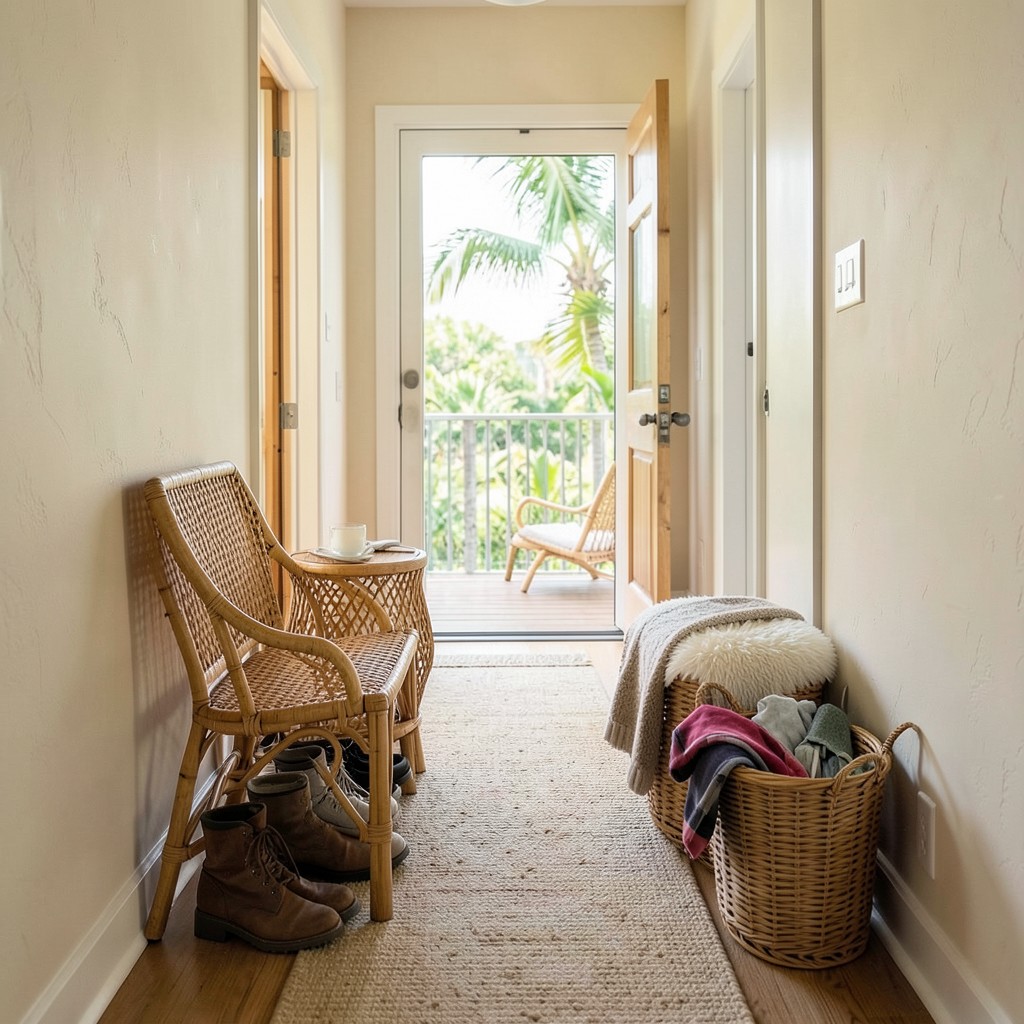
Natural rattan or cane furniture in the hallway — the entry chair, the side table, or the hall stool in the natural woven fiber whose warm honey tone and organic form bring the beach house interiors, the tropical home design, and the relaxed home design material tradition into the domestic corridor at a furniture piece scale — is the hallway furnishing idea that introduces the handmade, natural material character of the bamboo home interiors and woven fiber traditions into the entry zone at the most modest spatial and financial investment of any furniture addition the hallway can receive. The rattan chair at the hallway bench position does the entry furniture’s functional job — a surface to sit on while putting on shoes — while the material’s specific atmospheric character does the design job of establishing the home’s relaxed, natural material direction from the threshold.
The rattan’s care requirements in the hallway’s specific environmental condition — the direct contact with wet coats, umbrellas, and winter boots, and the temperature variation between the entry door’s cold air and the interior’s warmth — are more demanding than the same material in the dry, stable conditions of the sitting room or the summer bedroom. Natural rattan whose surface has not been sealed can absorb moisture and develop mold in conditions of repeated wetting, and the lacquered or varnished surface treatment that the hallway’s environmental demands require should be confirmed before the furniture is placed in the entry zone rather than discovered after the first wet season’s damage. The sealed rattan meets the hallway’s demands without sacrificing the material’s visual warmth.
The coastal outdoor living space-adjacent entry or the beach house interiors hallway whose rattan hall chair, woven seagrass basket, and natural fiber runner combine into the material palette of the natural fiber entry zone produces the specific domestic atmosphere of a home whose interior and exterior material traditions are in the same conversation rather than the different conversations of a house whose interior was designed without reference to the landscape its door opens onto. The summer home design hallway whose rattan furniture carries the season’s material character most naturally is the hallway that the winter interior design season converts — the rattan chair supplemented with a lambswool throw, the natural basket holding gloves and scarves — rather than replacing, and the furniture that earns its place in every season is the furniture whose material quality was selected for the long term rather than the catalog photograph.
34. A Hallway With Terrazzo Floor Tiles

Terrazzo floor tiles in the hallway — the composite surface whose marble, granite, quartz, or glass chip aggregate is embedded in a cement or resin binder and ground and polished to the smooth, speckled surface whose specific material beauty the Italian floor tradition developed for the public building and the domestic interior simultaneously — are the hallway floor treatment whose combination of material richness, color sophistication, and genuine wear resistance makes them the luxury floor option whose performance argument is as strong as its aesthetic one. Terrazzo does not wear. It polishes.
The terrazzo tile’s aggregate composition determines the floor’s color character and its surface depth simultaneously — the aggregate species, the aggregate size, and the aggregate color range embedded in the binder all contribute to the tile face’s specific speckled composition whose visual quality changes with the viewing distance and the light angle in a way that the uniformly colored tile cannot. A terrazzo tile whose aggregate includes pale pink marble chips, white quartz, and occasional dark granite fragments in a pale cream cement binder produces the floor surface whose color is simultaneously the specific blend of its aggregate components and the overall tone of the binder that surrounds them, and the visual result reads as more sophisticated and more materially complex than either the aggregate or the binder produces independently.
The modern home design or the luxury home interior entrance hall whose terrazzo floor is in a bespoke large-format tile — the tile’s scale at six hundred by twelve hundred millimeters producing fewer grout lines across the hallway’s floor area and allowing the terrazzo’s aggregate composition to read as a continuous surface rather than as a series of tile-sized panels whose grout joints interrupt the aggregate’s distribution — produces the hallway floor whose material quality is the highest available in the tiled floor category. The spring home refresh moment where the terrazzo floor’s surface is polished to renew the tile’s original reflective quality — the grinding and polishing process that the terrazzo material accepts and rewards with the restored surface whose depth and clarity the daily foot traffic had gradually muted — produces the seasonal home makeover whose investment is the polishing service and whose return is the hallway floor looking as it did on installation day.
35. A Hallway With a Long Narrow Sideboard
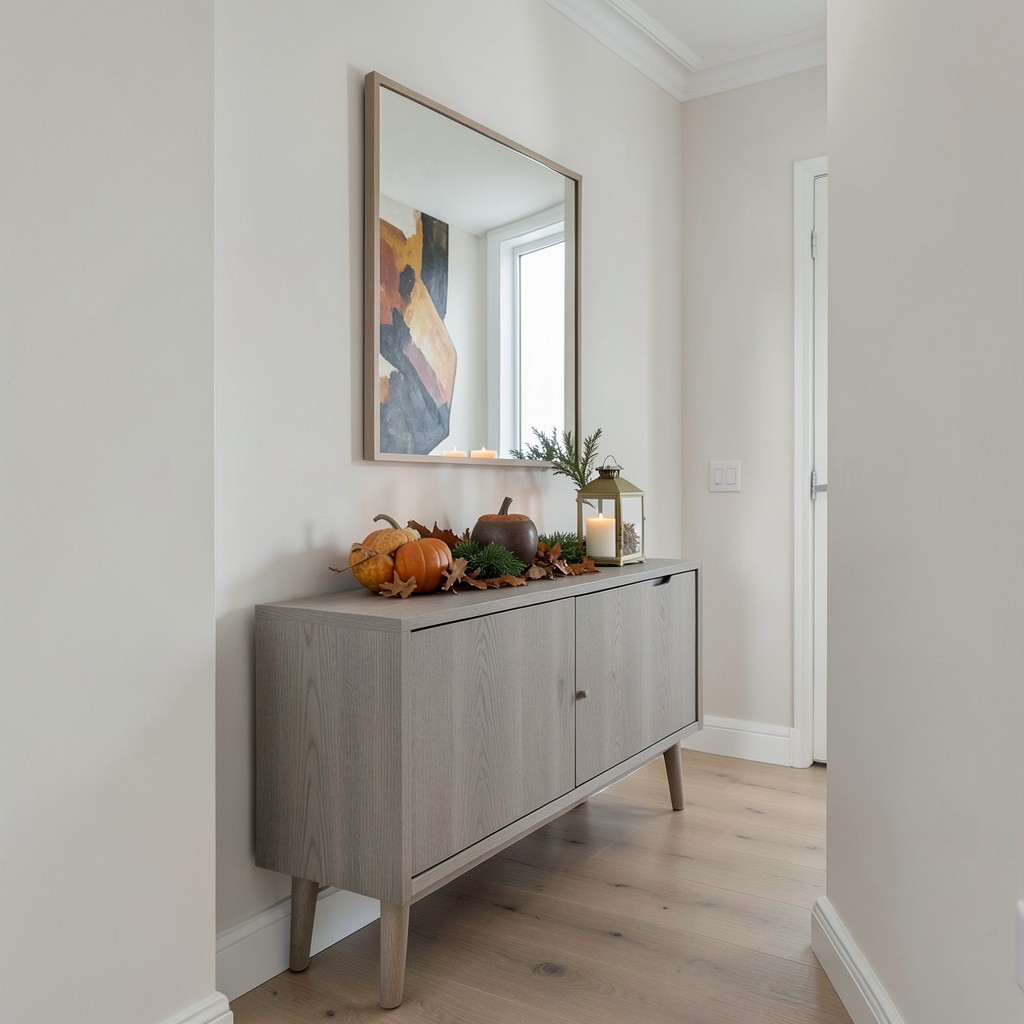
A long, narrow sideboard in the hallway — the low storage cabinet whose elongated proportions suit the corridor’s restricted depth and provide the horizontal surface for display, the internal volume for concealed storage, and the visual mass of a full-length piece of furniture whose presence makes the hallway read as a furnished room rather than a carpeted corridor — is the hallway furniture idea that solves the small-depth, large-width condition of the wide hallway whose entry zone has the wall length for a significant furniture piece but not the floor depth for the standard console table’s implied single-piece display. The sideboard does more than the console. It stores more, displays more, and its lower horizontal mass anchors the wall with the furniture weight that the slim console, however well chosen, cannot provide.
The sideboard’s height in the hallway is the specification variable that most directly determines its proportional relationship with the wall and the mirror or artwork above it. A sideboard at eight hundred and fifty millimeters — higher than the standard dining room version — provides the surface height that suits the coat-dropping, key-depositing function of the hallway furniture piece without requiring the stooped reach that the lower dining sideboard height produces in the tall adult user. The mirror or artwork above the sideboard should be positioned so that its lower edge sits approximately one hundred to one hundred and fifty millimeters above the sideboard’s top surface, and the combined height of the sideboard and the artwork above it should reach to within two hundred and fifty millimeters of the cornice or the ceiling to fill the wall’s vertical dimension without the awkward gap that the undersized furniture-and-artwork combination leaves between the top of the composition and the ceiling above.
The Scandinavian home interior or the minimalist home design hallway whose long sideboard in a pale smoked oak — the timber’s gray-toned surface in a matte oil finish, the sideboard’s profile slim and its legs the tapered solid oak forms of the mid-century Scandinavian furniture tradition — provides the storage volume and the horizontal display surface without the furniture weight and decorative complexity that the traditional home interiors hallway sideboard in a painted or heavily profiled format introduces. The sideboard’s top surface as the seasonal display platform — the fall home decorating arrangement of pumpkins, dried leaves, and a deep-toned ceramic vessel; the holiday home styling grouping of pillar candles, evergreen sprigs, and the brass lantern — converts the functional furniture surface into the hallway’s seasonal design event whose calendar the household manages as naturally as the seasonal change itself.
36. A Hallway With Stone Flag Flooring

Stone flag flooring in the hallway — large format natural stone flags in sandstone, limestone, slate, or travertine whose specific mineral character, surface variation, and thermal mass provide the hallway floor with the specific material authority of a building material rather than a floor covering — is the hallway floor treatment that most directly communicates the material seriousness of the stone and wood home design direction and the traditional home interiors aesthetic at the building’s most durable and most historically appropriate floor surface. Stone flags in the hallway are not a design choice. They are the building’s own material tradition expressed at the floor level.
The stone species selection determines the floor’s color palette, its surface texture, and its maintenance requirement across the hallway’s high-traffic condition. Sandstone flags in a warm golden-honey tone produce the hallway floor whose color warmth suits the farmhouse home decor and the earthy home design direction in the specific way that the cool grey of the slate or the pale cream of the limestone does not. The limestone flag whose pale cream surface carries the specific fossil inclusions and mineral deposits of the sedimentary formation provides the floor whose material content rewards the close inspection that the stone floor makes possible — the individual flag whose specific pattern of inclusions is unique to its position in the building is the floor detail whose individuality no manufactured tile can approximate.
The traditional home interiors or the mountain cabin decor entrance hall whose stone flag floor extends from the entry door across the full hallway width and into the kitchen beyond — the flags running continuously through the ground floor’s circulation without the flooring change that disrupts the material continuity — produces the domestic interior whose ground floor reads as a unified material plane rather than as a sequence of separately floored rooms. The underfloor heating system beneath the stone flag floor converts the hallway’s most atmospheric material choice into the building’s most practical thermal comfort solution — the stone’s thermal mass storing the underfloor heating’s output and releasing it slowly into the corridor’s air across the day, making the winter interior design arrival experience of cold feet on cold stone the specific discomfort that the heated stone flag eliminates entirely.
37. A Hallway With Vintage Lanterns and Sconces

Vintage lanterns and wall sconces in the hallway — the wall-mounted light fittings in aged brass, verdigris bronze, or patinated iron whose period character and warm light output provide the hallway’s atmospheric artificial illumination at the wall level rather than from the ceiling above — are the hallway lighting treatment that most directly produces the evening warmth and the period material quality of the domestic entry whose light comes from the walls rather than the overhead, whose character in the evening is defined by the warm pools of the wall-mounted sources rather than the flat overhead distribution of the pendant or the downlight. The wall sconce is the entry lighting whose quality the standard hallway lighting specification consistently overlooks in favor of the ceiling fitting that is easier to install and less atmospheric to inhabit.
The sconce’s positioning on the hallway wall — its mounting height relative to the eye level and the console table’s surface below it, its lateral position relative to the mirror and the artwork that share the same wall — requires the same compositional attention as the furniture arrangement below it, because the sconce is part of the wall’s overall composition rather than an isolated light fitting whose position is determined by the cable routing rather than the design intention. A sconce positioned at approximately one thousand five hundred millimeters above the floor — midway between the console table surface and the ceiling — provides the light output at the eye level whose quality the hallway’s occupants experience most directly in the evening, and whose relationship to the console table below it creates the layered light quality of the composed entry vignette.
The traditional home interiors or the elegant home styling formal entrance hall whose pair of aged brass wall sconces flank the console mirror — the sconces’ warm candlelight-quality output reflecting in the mirror between them and producing the doubled light warmth of the sconce light and its reflection simultaneously — creates the hallway whose evening character the household returns to every night with the specific pleasure of an arrival that was designed to feel welcoming rather than merely to provide sufficient illumination for the coat hook. The holiday home styling context where the sconces’ warm light illuminates the seasonal display on the console table below them — the garland, the candles, the evergreen arrangement — produces the hallway entry whose seasonal warmth is felt before the door is fully open.
38. A Hallway With a Dedicated Dog or Pet Station

A dedicated pet station in the hallway — the built-in or freestanding installation that provides the dog lead hooks, the food and water bowl storage, the towel rail for the muddy-paw wipe-down, and the cushioned dog bed or pet basket positioned in the corridor’s least obstructive corner — is the hallway design idea that addresses the specific functional reality of the household with pets whose entry zone, without a dedicated pet station, becomes the daily accumulation of leads, bowls, towels, and pet paraphernalia in the miscellaneous arrangement that the undecided hallway defaults to within weeks of a pet’s arrival. The pet station is the entry zone’s functional resolution for the household whose pet is one of the primary users of the hallway’s daily transition between outside and inside.
The pet station’s design integration with the hallway’s overall aesthetic — the station’s materials, its color, and its hardware consistent with the hallway’s own design direction rather than the standard commercial pet product’s indifference to interior design — is the quality that determines whether the pet provision reads as a designed element of the hallway or as the functional compromise whose presence in the entrance zone signals that the pet’s needs were an afterthought rather than a design consideration. A built-in dog station in the same painted timber as the hallway’s built-in bench, with the same hardware profile and the same tonal relationship to the corridor’s walls and floor, reads as a designed element. The bought pet station in a contrasting material and color reads as the functional compromise, and the distinction is immediately apparent to every visitor.
The farmhouse home decor or the relaxed home design family hallway whose pet station carries a row of cast iron dog lead hooks above a small built-in shelf for the pet bag and the treat container, a short towel rail at the dog’s height for the post-walk clean, and a built-in cushioned corner bed whose removable cover is in the same fabric as the hallway runner — produces the entry zone whose domestic completeness extends to the household member whose daily arrival and departure the standard hallway specification consistently forgets. The fall home decorating and winter interior design contexts, where the muddy walk, the wet coat, and the cold paws converge on the entry zone daily, produce the conditions whose management the designed pet station makes graceful rather than chaotic.
39. A Hallway With a Copper Pipe Coat Rack
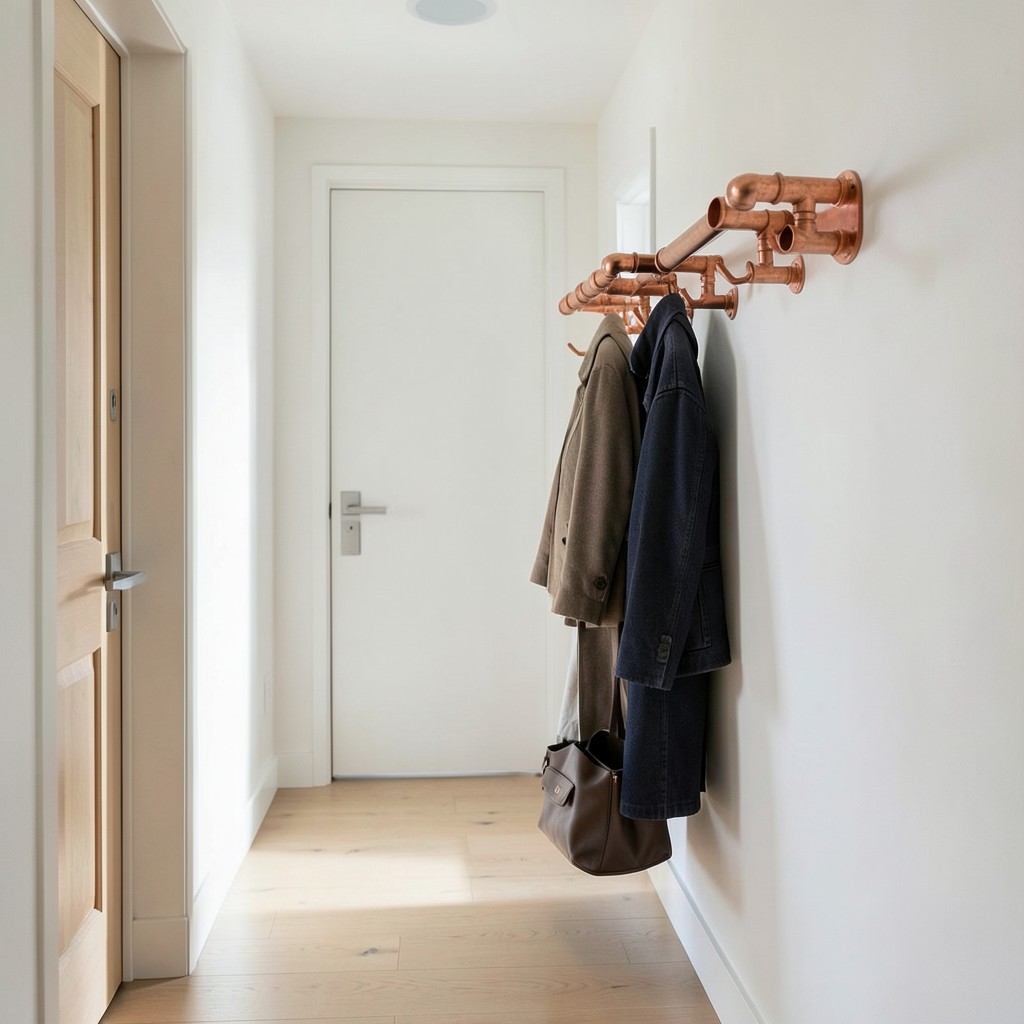
A copper pipe coat rack in the hallway — the coat hanging system fabricated from standard plumbing copper pipe whose warm orange-gold tone and smooth cylindrical profile produce the material character of the industrial-artisanal fitting whose specific copper warmth no painted steel, no powder-coated aluminum, and no injection-molded plastic coat rack provides — is the hallway fitting whose material specificity makes it the coat storage solution that contributes to the hallway’s design palette rather than merely occupying a position on the wall beside the door. The copper pipe coat rack is the functional item that earns its place in the design rather than tolerating its presence.
The copper pipe rack’s design — the number and arrangement of the individual pipe sections, the angle brackets or the wall flange fittings that fix the pipes to the wall surface, and the hooks or the pipe ends whose form provides the actual coat hanging function — determines whether the installation reads as a carefully designed custom fitting or as a plumbing component repurposed without design intention. The rack whose pipe arrangement creates a composed horizontal or geometric composition — the pipes at varying heights in a deliberate pattern, the flanges at consistent spacing intervals, the pipe diameter consistent throughout — reads as designed. The rack whose pipes are arranged arbitrarily reads as improvised, and the improvised material statement, however warm its copper tone, is the statement whose design quality the material’s beauty cannot rescue.
The industrial home design urban apartment or the contemporary home ideas townhouse hallway whose copper pipe coat rack extends across the full width of the entry wall at coat height — six to eight double hooks providing the storage for every household member’s coats and bags in a single composed horizontal installation — produces the entry zone whose functional completeness and material warmth make it the hallway’s most practically successful and visually resolved element simultaneously. The copper’s aging in the hallway’s environmental conditions — the slow progression from the bright new copper toward the warmer, deeper bronze-brown of the oxidized surface — means the coat rack that was installed in the entry is not the coat rack the household will be using in ten years, and the specific quality of the aged copper’s surface in the decade’s wear of daily hand contact is the material biography that the painted steel alternative never develops.
40. A Hallway With an Oversized Clock
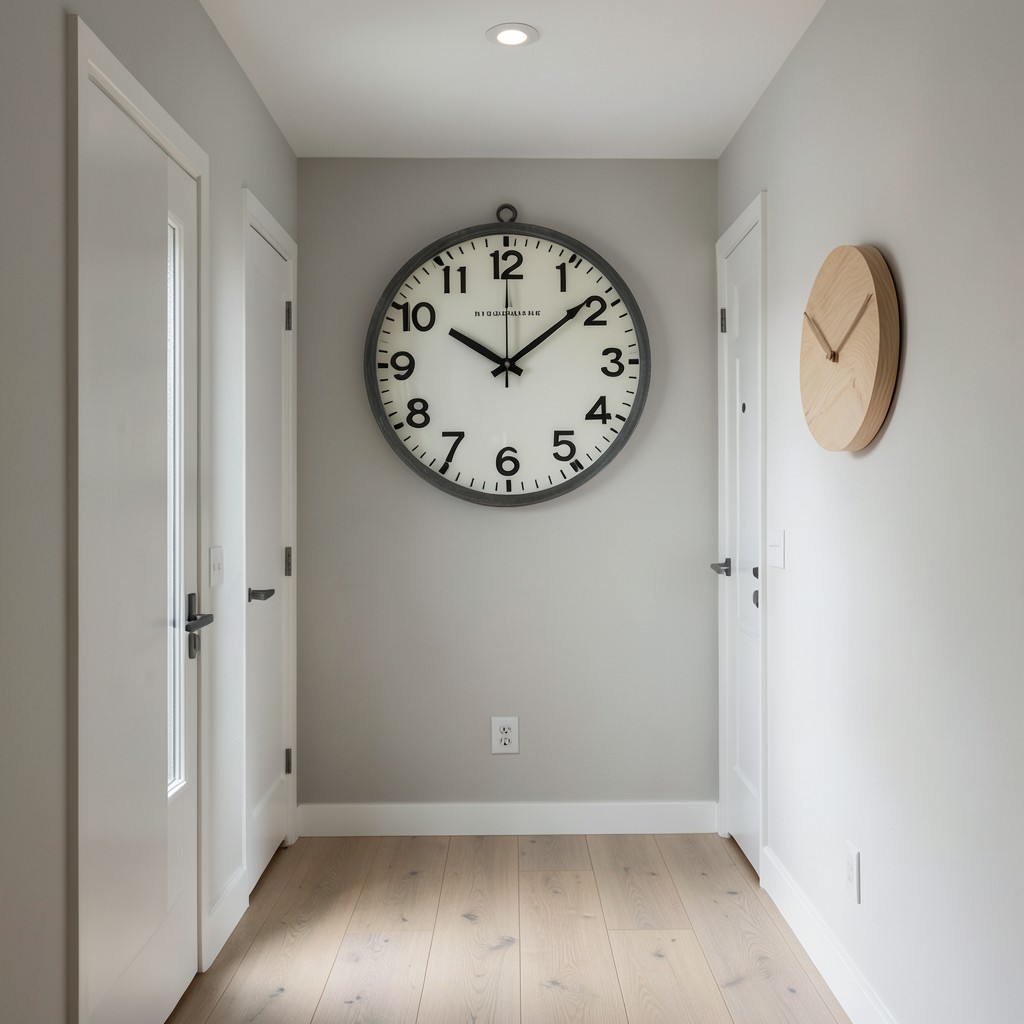
An oversized clock in the hallway — a large format wall clock whose diameter occupies a significant portion of the primary wall and whose design — whether the industrial factory clock, the railway station clock, the carved wooden period timepiece, or the minimal contemporary disc — provides the hallway with the functional object as design statement at the scale that the hallway’s limited furniture floor plan cannot provide from below — is the hallway design idea that solves the specific problem of the wall whose dimensions are too large for an artwork arrangement and too small for the furniture piece the wall would benefit from. The large clock fills the wall zone at the right scale with the right object.
The clock’s diameter relative to the wall’s available width is the proportional decision that determines whether the clock reads as correctly scaled for its position or as either too small — the large wall with a small clock whose scale reads as timid — or too large — the clock whose diameter leaves insufficient wall space at each side to allow the wall’s surface to frame it. A clock whose diameter is approximately fifty to sixty percent of the available wall width provides the proportional relationship that reads as a correctly scaled design object rather than as a clock that could not find a more appropriate wall. The wall that runs the clock at less than forty percent of its width is the wall that needs a different solution.
The industrial home design or the rustic home decor hallway whose large factory-style clock — the industrial metal frame, the plain black numerals on the white or cream enamel face, the bold black hands — provides the entry’s functional time reference and its design character simultaneously produces the hallway whose single design decision on the primary wall is sufficient to establish the space’s entire character without supporting artwork, without additional wall fittings, and without any other design layer competing for the attention that the clock’s direct, confident presence commands. The Scandinavian home interior hallway whose minimal birch disc clock in pale, unfinished timber provides the time-keeping and the material warmth of the natural surface in the single wall object that the Scandinavian design philosophy’s principle of considered sufficiency most directly expresses.
41. A Hallway With Aged Brass Hardware

Aged brass hardware throughout the hallway — the door handles, the coat hooks, the switch plates, the light fitting hardware, and the picture hanging rails all specified in the same warm, lightly patinated brass whose surface carries the color of aged metal rather than the bright, lacquered tone of the new brass — is the hallway design detail whose comprehensive application across every hardware item in the entry zone produces the material coherence that the hallway with mixed hardware finishes — the chrome switch plate, the satin steel door handle, the painted hook — consistently fails to achieve regardless of the quality of the individual items selected. Consistent hardware is the design detail whose presence elevates the hallway and whose absence undermines it.
The aged brass surface — the deliberate patina applied during manufacture to approximate the natural aging that unlacquered brass develops over decades of handling — provides the warm, complex surface quality of the antique metal fitting without the maintenance requirement of the genuinely unlacquered brass whose surface continues to oxidize in the hallway’s environmental conditions and requires periodic cleaning to maintain the desired patina level. The living brass whose surface is left to age naturally produces a more characterful, more variable result than the factory-applied patina, and the household whose hallway hardware was specified in raw unlacquered brass and left to develop its own surface over the years inhabits the hallway whose hardware has the specific quality of age that was earned rather than simulated.
The traditional home interiors or the elegant home styling hallway whose complete hardware program is in an aged brass — the door escutcheon, the door handle, the lever latch, the hat and coat hooks, the picture rail and its hanging hooks, the switch plates, and the pendant’s ceiling rose all in the same warm, patinated brass — produces the hallway whose design coherence at the hardware level makes every other design decision in the space appear more resolved simply by the consistency of the metal context in which it sits. The spring home refresh that polishes the hallway’s brass hardware back to its original warm tone — removing the deeper tarnish that the winter’s damp air and the household’s regular handling has accumulated — is the seasonal maintenance ritual whose result is the hallway looking as resolved on the first warm day of spring as it did on the day the hardware was installed.
42. A Hallway With Botanical Print Wallpaper

Botanical print wallpaper in the hallway — the paper whose design carries the specific visual tradition of the botanical illustration, the pressed herbarium specimen, or the garden sketchbook in a pattern whose leaf forms, flower heads, and stem arrangements provide the wall with the composed visual content of the garden-inspired interiors direction at the decorative surface whose scale is the hallway’s most prominent design opportunity — is the hallway wall treatment that most directly imports the natural world’s visual character into the domestic entry and establishes, from the building’s threshold, the household’s specific material relationship with the botanical and the organic.
The botanical print’s scale must be chosen relative to the hallway’s width and ceiling height as the primary viewing conditions, because the botanical wallpaper seen from the standing position in a narrow corridor is experienced at a closer range than the same paper seen from across a wide sitting room, and the pattern’s botanical subject must be readable at the close-range viewing distance as a composed botanical illustration rather than as a dense green texture. A large-scale botanical whose individual leaf forms are two hundred to four hundred millimeters in size reads as clear botanical subject matter from the sixty to ninety centimeter viewing distance of a narrow corridor. A smaller-scale repeat whose individual elements are below one hundred millimeters reads as texture rather than botanical subject at the same distance.
The garden-inspired interiors or the spring bedroom decor-adjacent hallway whose botanical wallpaper carries an oversized tropical leaf composition in deep green, dusty sage, and warm cream on a natural white ground — the pattern’s scale large enough that a single monstera leaf spans from skirting to picture rail on the corridor’s feature wall — produces the hallway that announces the home’s botanical direction with the material confidence of a design decision whose scale matches its ambition. The spring home refresh moment where a fresh seasonal floral arrangement on the console table — the cut branches, the spring bulbs, the seasonal wildflowers — mirrors the botanical wallpaper behind it in the specific material conversation between the living plant and its painted representation produces the hallway styling moment whose design coherence is felt rather than analyzed.
43. A Hallway With Concrete Effect Flooring

Concrete effect flooring in the hallway — whether poured micro-cement applied directly to the existing floor substrate, large format porcelain tiles in a concrete-textured finish, or a specialist resin overlay whose polished surface replicates the industrial floor of the warehouse and the factory — is the hallway floor treatment whose specific material character suits the contemporary home ideas, the industrial home design, and the minimalist home design directions at their most materially serious, and whose single-pour or continuous surface quality produces the hallway floor most completely free of the grout joints, the board edges, and the tile format boundaries that every other floor treatment introduces into the corridor’s visual field.
The micro-cement poured floor is the most authentic version of the concrete floor aesthetic in the domestic hallway application, and its seamless surface — the material flowing to the wall’s base without the interruption of the junction detail that the tiled or boarded floor requires — produces the specific quality of a floor that was not installed but cast. The practical requirement of the micro-cement application is the substrate preparation whose quality determines the finished floor’s performance — the micro-cement layer, at two to three millimeters total thickness over the two-coat application, is too thin to bridge the dimensional changes in a poorly prepared or cracked substrate, and the surface imperfections in the substrate below read through the micro-cement layer as the finished floor’s own surface quality.
The minimalist home design or the industrial home design open-plan ground floor whose concrete effect micro-cement floor flows from the hallway into the kitchen and the sitting room without interruption — the single material running continuously across the entire ground floor plan, the rooms distinguished by their furniture and ceiling treatment rather than by their floor — produces the spatial unity of a ground floor whose material continuity removes the floor level design boundary between the rooms and makes the whole connected zone read as a single composed space. The summer home design open-plan interior whose pale grey micro-cement floor reflects the natural light from the entry door and the rear garden glazing in the specific quality of the polished mineral surface produces the bright home design effect of a floor that amplifies the building’s light rather than absorbing it.
44. A Hallway With a Seasonal Styling Station

A seasonal styling station in the hallway — the dedicated surface, the dedicated lighting, and the dedicated storage whose design intention is the regular and easy update of the entry zone’s decorative arrangement in response to the season’s specific material palette, botanical availability, and atmospheric character — is the hallway design idea that converts the corridor from the static design statement of the single renovation into the living design environment whose character evolves continuously with the household’s seasonal engagement with the natural world and the domestic calendar. The seasonal hallway is not the hallway that was decorated once and photographed. It is the hallway that is renewed continuously because the surface and the storage that renewal requires were designed into the space from the start.
The styling station’s physical elements — the console or sideboard whose top surface provides the display platform, the deep drawer or the closed cupboard whose storage holds the seasonal objects between their periods of display, and the lighting whose direction and warmth can be adjusted to complement the seasonal display rather than remain fixed at the year-round setting that suits the summer arrangement as poorly as the winter one — are the designed components whose integration makes the seasonal update the quick, pleasurable act of retrieving the season’s objects from storage and arranging them on the prepared surface rather than the annual project of sourcing, buying, and making space for a new arrangement whose previous iteration has no dedicated home.
The hallway whose seasonal styling station carries the summer home design arrangement of pale linen, coastal shells, and the white ceramic vase with dried grasses, shifts at the fall home decorating season to the warm arrangement of dried pumpkins, aged brass lanterns, and the bundled wheat sheaf; moves to the holiday home styling arrangement of the candle, the evergreen, and the seasonal textile; and arrives at the spring home refresh arrangement of the cut botanical branch, the ceramic bud vase, and the first outdoor flowers of the warming year — is the hallway whose design life is as rich, as varied, and as seasonally responsive as the garden beyond its entry door, and whose specific quality of domestic life cannot be achieved by the static hallway whose single designed arrangement was produced for the renovation photograph and has remained unchanged in every subsequent season.
45. A Hallway With a Geometric Tiled Feature Wall
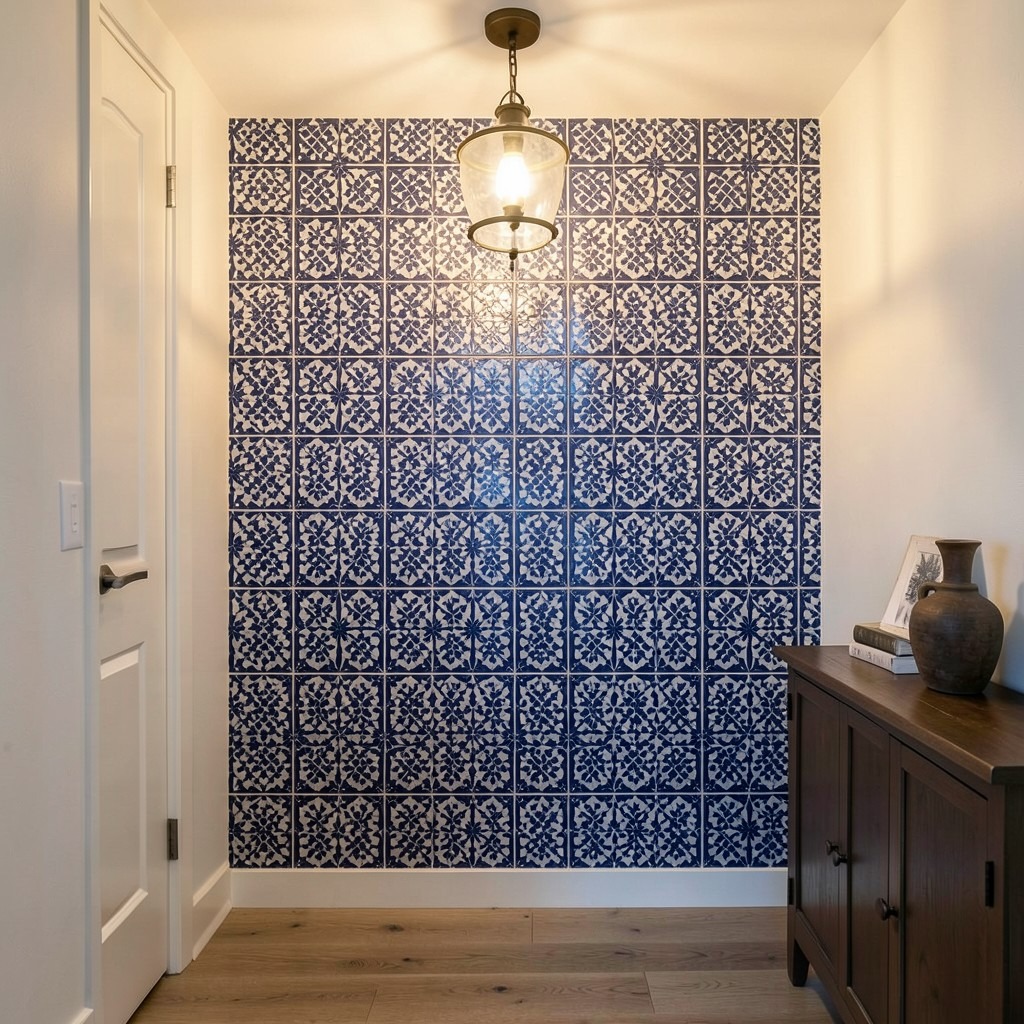
A geometric tiled feature wall in the hallway — the primary wall tiled from floor to ceiling or from floor to dado height in a pattern-faced ceramic or stone tile whose geometric composition provides the wall with the material richness and the surface depth of the applied tile at the hallway’s most visually prominent vertical surface — is the hallway wall treatment that introduces the most materially substantive decorative surface available in the corridor format, because the tile’s three-dimensional surface, its color depth within the glaze, and its pattern’s geometric authority at the close-range viewing distance of the hallway provide a wall quality that no paint, no paper, and no flat cladding can match at the material level.
The tile pattern’s scale and geometry must be resolved against the wall’s specific dimensions before the tile is ordered, because the geometric tile’s pattern repeat creates a tiling layout whose edge condition — the partial tile at the wall’s boundary — determines whether the pattern reads as a composed geometric field terminating cleanly at the wall’s edges or as a pattern interrupted at the wall’s boundary in a way that reveals the layout’s origin point rather than the designer’s intention. The geometric tile layout that begins with the pattern centered on the wall’s midpoint — the full pattern unit at the center and the partial units at the edges cut to equal width on both sides — reads as a composed field. The layout that begins from one edge and runs to the other reads as arbitrarily started.
The chic home decor or the bohemian home styling hallway whose feature wall carries a bold Moroccan zellige-inspired tile in cobalt and white — the tile’s hand-cut face providing the characteristic slight variation between individual tile pieces that the handmade tile delivers where the machine-cut alternative’s precision cannot replicate — produces the hallway wall whose material character and pattern authority establish the home’s design identity at the building’s literal threshold. The winter interior design context where the tiled wall’s cool cobalt tone is warmed by the hallway’s pendant lantern and the seasonal console arrangement brings the tile’s depth and the warm light into the specific atmospheric balance of the domestic entry at its most composed and most seasonally considered.
46. A Hallway With Hanging Pendant Plants

Hanging pendant plants in the hallway — individual potted plants suspended from the ceiling in macramé hangers, ceramic hanging pots, or simple knotted rope holders whose botanical forms hang at varying heights in the corridor’s ceiling zone and provide the hallway’s overhead with the organic, living green of the garden-inspired interiors direction — are the hallway design idea that converts the corridor’s ceiling zone from the underused overhead space of the standard hallway into the living botanical layer that the biophilic interior direction pursues at every available surface, and whose specific contribution to the hallway’s atmosphere — the trailing stems, the hanging leaves, the organic irregularity of the living plant form at the overhead level — no textile, no artwork, and no architectural detail can replicate because the plant is alive.
The plant species selection for the hanging hallway position depends entirely on the hallway’s specific light conditions — the ceiling-level position typically receives less light than the wall-level shelf or the floor-level planter, and the species that trail or hang most effectively from the hanging pot format must be the species whose light requirement the hallway’s ceiling position can meet. The trailing pothos, the heartleaf philodendron, the string of pearls, and the spider plant are the hanging species whose combination of trailing growth habit, shade tolerance, and low maintenance requirement make them the practical selection for the hallway’s overhead botanical installation.
The tropical home design or the jungle-inspired home decor hallway whose ceiling carries a grouping of five hanging plants at varied heights — the longest trails reaching almost to the console table below them, the shortest hanging just below the pendant light whose warm output provides the supplementary light source the lower-light hallway position requires — produces the domestic corridor whose overhead botanical layer creates the specific quality of a passage through a planted space rather than through an interior room. The summer home design hanging plant arrangement, at its most lush in the growing season’s longer daylight hours, provides the hallway’s warmest seasonal expression of the biophilic design direction, and the winter interior design context that supplements the hanging plants with the pendant lantern’s warm evening output maintains the green overhead layer through the low-light months whose daylight reduction the shade-tolerant species manage without growth arrest.
47. A Hallway With Integrated Technology

An integrated technology hallway — the corridor whose entry system, lighting control, climate management, and security are integrated into the architectural fabric of the space rather than applied as visible devices on the wall’s surface — is the hallway design idea that addresses the specific tension between the domestic entry’s functional technology requirements and the composed aesthetic that the designed hallway pursues, and whose resolution produces the hallway whose smart home functions operate invisibly behind the surfaces rather than announcing themselves as the architectural vocabulary of the digital era imposed on the domestic interior’s material tradition.
The flush-mounted switch plate in the same tone as the wall surface, the door sensor embedded in the door frame rather than applied as a separate device, the video intercom panel recessed into the wall at the correct viewing and speaking height rather than surface-mounted at a position determined by the cable routing — these are the technology integration details whose accumulated effect across the hallway’s full entry sequence is the composed technological interior rather than the room where the smart home’s hardware is the most prominent visual element. Each integration detail requires the coordination between the architect, the electrician, and the technology installer at the design stage rather than the sequential installation of each trade whose individual decisions, made without reference to the others, produce the wall whose accumulated applied technology reads as the design’s failure to have considered the technology as a design element.
The modern home design or the contemporary home ideas hallway whose integrated technology includes the flush entry phone at the correct face-height position, the concealed motion sensor whose field covers the entry zone and activates the hallway’s welcome lighting sequence, and the slim, recessed smart panel whose display provides the household’s daily information at the entry glance without the mounted tablet in its commercial stand whose presence the domestic hallway’s material palette consistently rejects — produces the entry zone whose design intelligence in managing the technology’s functional requirement within the aesthetic’s constraints is the most demanding and the most rewarding form of hallway design intelligence available in the contemporary domestic interior.
48. A Hallway With a Custom Mural

A custom mural painted directly onto the hallway wall — the corridor’s primary surface receiving the unique, commissioned artwork of a specific artist whose composition responds to the building’s specific spatial conditions, the household’s specific character, and the hallway’s specific light quality — is the hallway design treatment whose level of personalization and design investment is the highest available in any interior surface category, and whose specific outcome — the unique, unrepeatable painted surface whose subject, palette, and execution belong to this hallway and no other — is the design quality whose value to the household compounds across every year of daily passage through the commissioned space.
The subject selection for the hallway mural benefits from the artist’s direct observation of the hallway’s specific conditions — the light quality, the wall’s dimensions, the views from the entry threshold, and the atmospheric context of the rooms the mural connects — rather than the general brief whose vague instruction produces the general mural rather than the specific one. The mural whose subject was developed in direct response to the building’s specific context — the garden beyond the entry door, the landscape the household inhabits, the botanical character of the climate and the season — is the mural whose presence in the hallway appears to have been prepared for the specific wall rather than adapted to fit it.
The earthy home design or the garden-inspired interiors hallway whose custom mural carries a large-scale depiction of the local landscape in the specific palette of the building’s regional vegetation and light — the warm terracotta of the local earth, the dusty sage of the native scrub, the pale sky of the specific climate’s light condition — produces the hallway interior whose material and artistic content is the direct expression of the household’s geographical and sensory context. The hallway that carries a mural commissioned from an artist who spent time in the building, observed the light across a full day’s cycle, and developed the composition from direct observation of the household’s specific context is the hallway whose design cannot be replicated in any other building, and that irreplicability is the design quality that no catalog, no renovation guide, and no design trend can provide or render obsolete.
49. A Hallway With a Perfume or Scent Element

A hallway designed around a specific scent — the corridor whose olfactory character is as deliberately considered as its visual one, the scent introduced through the reed diffuser positioned on the console table, the beeswax candle lit for the evening’s arrivals and departures, the dried botanical arrangement whose fragrance — lavender, eucalyptus, cedar, or rosemary — provides the first sensory signal of the domestic interior before the visual register has fully processed the entry — is the hallway design dimension that the design guide consistently omits because scent produces no photograph, appears in no material specification, and costs less than a coat of paint while providing more direct emotional impact on the arrival experience than any visual design decision the hallway contains.
The scent selection for the hallway must account for the entry zone’s specific functional conditions — the hall is the room through which outdoor air enters most directly, whose temperature varies most widely between warm and cold seasons, and whose occupancy pattern is brief, repeated, and transitional rather than the extended, settled occupancy of the living room or the bedroom. The hallway scent works best in the lighter, fresher register — the green, woody, or herbal scent whose subtlety is registered in passage rather than the heavy floral or heavily sweet fragrance whose density suits the static bedroom diffuser better than the transient hallway.
The seasonal home makeover approach to hallway scent — the summer home design reed diffuser in a light citrus and green leaf fragrance; the fall home decorating beeswax candle in a warm cedar and cinnamon register; the winter home decor arrangement of the dried clove and orange pomander, the evergreen wreath, and the pinecone whose natural resin scent provides the specific olfactory character of the season’s botanical material; the spring home refresh vase of hyacinth and narcissus whose intense, sweet floral fragrance announces the season before the hallway’s visual styling has been updated — is the scent program whose seasonal rotation makes the domestic entry experience as fully sensory as the home’s physical and aesthetic design, and whose annual cycle provides the household with the specific domestic pleasure of an interior whose character changes with the seasons in ways that go beyond the visual into the deeply atmospheric and the specifically, personally remembered.
50. The Hallway That Belongs to You

The hallway that serves you best is not the one whose photograph stops the scroll or whose renovation cost positioned it in the luxury home interior category — it is the hallway whose design began from an honest assessment of the specific household that uses it every day, the specific building it belongs to, and the specific sequence of sensory experiences you want to provide for every person who passes through it from the street to the room beyond. That assessment is the design brief that no design guide provides for you, because no design guide knows which household you live in.
Begin the hallway’s design process with observation rather than selection — spend a week paying attention to the hallway you have before planning the hallway you want. Notice where the objects accumulate without a home. Notice where the light quality fails the space and at what time of day. Notice the floor surface where the entry mud and the tracked-in wet collect and the material whose daily maintenance cost that produces. Notice the wall whose inadequacy you have accepted as a fact about the hallway rather than a condition the design can address. The hallway’s design brief is written in the daily friction of the space you inhabit rather than in the curated images of the spaces other people have built.
The hallway is the room whose design investment returns the highest daily dividend of any room in the house, because no room is entered and exited as frequently, no room mediates the daily transition between the exterior world and the interior life as directly, and no room whose design was resolved with genuine attention and genuine material commitment goes unappreciated by the household that uses it every morning and every evening of every year. The hallway you design for the life you actually live rather than the life the catalog assumes you have is the hallway that serves you, welcomes your guests, manages your seasons, and holds your household’s daily rhythm with the specific warmth of a room that was made for the people who live in it. Start there. Start with honesty. The design follows.
Leave a Reply