
The entryway is the room that works hardest in your home and gets thanked least for its effort. Every person who enters your house passes through it without pausing. Every coat that arrives wet from the rain lands somewhere in it. Every pair of boots that tracked in the garden mud adds to its daily burden. The entryway receives the full force of the household’s arrival and departure sequence, absorbs the seasonal extremes of the outdoor weather at its threshold, and simultaneously carries the responsibility of presenting the home’s character to every guest who crosses the door. It does all of this in a space that is, in most houses, the smallest room in the building, receives the least natural light, and was furnished last when the budget had already been committed to the kitchen and the living room. The Entryway Design Ideas asks a great deal and receives very little in return, and the result — in most homes — is the room that everyone apologizes for as they usher the guest through it toward the better-designed spaces beyond.
The distinction between the entryway and the hallway is one that most design guides collapse without examination, and the collapse is worth resisting because the two spaces have genuinely different design briefs. The hallway is the connector — the corridor whose design mediates between the rooms it links and whose character is absorbed in passage rather than experienced in occupation. The entryway is the threshold — the specific zone of transition between the outside world and the interior domestic life, the space whose design manages the arrival and departure sequence, absorbs the household’s external life at the point of entry, and communicates the home’s identity at its most direct point of contact with the world beyond. The entryway can be a foyer, a vestibule, a mud room, a boot room, or the squared landing at the base of an open-plan stair, but its specific design brief — to manage the transition between outside and inside with both functional efficiency and atmospheric warmth — is the brief that the hallway’s circulation-focused design does not fully address.
The entryway’s functional program is the starting point that most entryway renovations skip, arriving at the material and aesthetic decisions before the spatial logic has been resolved. The functional program asks: how many people use this entry on a daily basis, at what times, and with what volume of external material — coats, bags, boots, sports equipment, shopping, pets — do they arrive? The entryway designed for the household of two whose daily comings and goings are relatively modest is a different spatial and storage problem from the entryway of the family of five whose morning departure involves the simultaneous location of school bags, sports kits, two dogs, and the car keys that were left in yesterday’s coat pocket. The functional program’s honest completion is the precondition for the entryway design that works in daily use rather than only in the renovation photograph.
The seasonal dimension of the entryway’s design is the dimension most frequently treated as an afterthought and most frequently regretted when the first autumn arrives after a summer renovation. The summer home design entryway — light, open, its hooks carrying the linen jackets and the straw hat, the basket by the door holding gardening gloves and sunscreen — is a space designed for the warmth and the light of the building’s best weather. The winter home decor entryway is a materially different place: the floor carrying the mud of the garden and the wet of the rain, the hooks bending under the weight of the padded coats, the boot rack multiplied in size by the winter footwear whose summer equivalent occupied a fraction of the space. The entryway designed for the summer photograph but inhabited through the full calendar of the building’s active domestic life is the entryway whose design fails the household precisely when the household’s need for its functional competence is highest.
The relationship between the entryway’s material specification and its maintenance reality is the design consideration whose neglect produces the most consistently regretted entryway renovations. The pale limestone floor that photographs beautifully in the renovation journal reads differently in the wet boots of the December morning when the school run arrives simultaneously with the grocery delivery. The white-painted paneling whose brightness makes the dark entryway glow in the afternoon light develops the scuff marks of the school bag and the bicycle helmet within the first month of active family use. The material choices that serve the entryway best are the choices that were assessed for their performance under the hardest conditions the entry zone regularly produces rather than their appearance in the optimal condition of the dry summer afternoon. Material honesty in the entryway is the design quality whose absence every household eventually pays for and whose presence makes the entryway the room whose design intelligence compounds across every season without requiring the apology that the beautiful-but-fragile entry demands from the homeowner who specified it.
1. An Entryway With a Dedicated Mudroom Zone

The entryway that doubles as a functional mudroom — the entry zone whose design deliberately addresses the wet coat, the muddy boot, and the school bag as primary design drivers rather than secondary considerations — is the entryway whose daily performance under the household’s hardest functional demands is the highest available, and whose design intelligence is measured not by its appearance on a calm Saturday morning but by its condition at eight-fifteen on a wet Tuesday when the household has just departed in the school run’s concentrated chaos and the floor shows exactly what the entry zone was asked to absorb in the preceding twenty minutes.
The mudroom zone’s material specification requires the honesty of the industrial floor treatment applied to the domestic aesthetic without apology: the sealed quarry tile or the brushed porcelain whose surface texture provides grip in wet conditions rather than the polished stone whose beauty demands the dry foot and the careful tread; the painted timber bench whose surface can be wiped clean rather than the upholstered seat whose cushion absorbs the wet coat’s drip; the open boot rack whose air circulation dries the footwear overnight rather than the closed cupboard whose sealed interior breeds the damp smell that the season’s wet weather introduces and the closed door traps. These are not compromises. They are the specifications of someone who has lived through winter with children and made their design choices accordingly.
The farmhouse home decor or the rustic home decor working household whose mudroom entryway carries a Belfast sink on the entry wall — the deep ceramic sink providing the muddy-boot rinse, the garden-harvest clean, the flower-stem cut that the outdoor life requires at the building’s entry — converts the entryway from the space that manages the outdoor life’s evidence into the space that actively supports the outdoor life’s practice. The fall home decorating context where the harvest vegetables arrive at the entry door for the sink’s rinse before the kitchen receives them, the winter interior design context where the ice-caked boots receive the warm water treatment before the hall floor does, and the summer home design moment where the cut garden flowers go straight to the sink for their water — these are the entryway moments whose design was made possible by the decision to include a sink and whose quality makes the household wonder, every day, why it took them so long to do it.
2. An Entryway With Double-Height Ceiling

A double-height entryway — the entrance hall whose ceiling rises through two full floor levels, the upper landing visible from the entry floor, the staircase ascending within the full vertical volume of the double-height space — is the residential entryway condition that most completely establishes the home’s architectural ambition at the building’s entry point, because the moment the door opens onto the double-height void the visitor’s spatial experience shifts from the domestic scale of the street to the civic scale of the building whose generosity was designed into the section rather than the plan. The tall entry is the spatial gift the architect gives the house whose footprint cannot provide the horizontal generosity that the vertical dimension compensates for.
The double-height entryway’s design decisions operate on two registers simultaneously — the ground level whose console table, floor treatment, and entry vignette are experienced at the human scale of arrival, and the upper level whose landing rail, the landing’s visual relationship to the entry below, and the void’s aerial quality determine whether the double-height condition reads as architecturally resolved or as a structural accident waiting for the design to address it. The upper landing’s balustrade is the element most visible from the entry door — it is the first thing the eye travels to after registering the door’s threshold and the scale of the void overhead — and its specification in a material and profile consistent with the entry’s design direction is the detail whose neglect in the double-height renovation is felt as the most conspicuous unresolved element in the composition.
The luxury home interior or the contemporary home ideas family home whose double-height entryway carries a statement pendant chandelier — the large format pendant suspended from the upper ceiling at the void’s center, its scale calibrated to the double height rather than the standard single-story dimension, the pendant’s chain or rod passing through the full void’s height and providing the vertical element that anchors the composition of the two-story space — produces the entry whose arrival experience the household never tires of and whose atmospheric quality changes with the pendant’s specific light output across the morning’s natural light flooding the void and the evening’s pendant-lit enclosure of the entry. The warm home decor ideas approach of a warm brass pendant against pale walls in a double-height void is the entryway composition whose resolved simplicity makes every element in it appear more considered.
3. An Entryway With a Bold Front Door Color

The front door’s color is the entryway’s first design statement — the one the visitor encounters before the door opens, the one the household sees from the street on every return home, and the one whose selection communicates the interior’s design character in a single color decision that no interior surface can make with the same directness or the same public visibility. The front door color is the entryway design decision that operates simultaneously inside and outside the building, and its selection deserves more deliberate thought than the standard choice between the builder’s default cream and the neighbor’s heritage green.
The color relationship between the front door and the entryway’s internal wall color — the tonal conversation between the exterior’s color statement and the interior’s first visual impression — is the design dimension that the door color selection most consistently neglects. A door painted in a deep midnight blue whose interior side carries the same color as the door’s exterior face creates the compositional continuity between the outside and the inside that makes the entryway read as designed from the threshold rather than from inside the building alone. A door whose exterior color bears no relationship to the interior’s palette — the black exterior door opening into the warm terracotta entryway — creates a jarring color transition at the entry’s most prominent moment that requires careful management of the adjacent interior surfaces to resolve.
The traditional home interiors Georgian townhouse or the coastal home design beach house whose front door is painted in a deep, glossy navy — the high-gloss finish providing the reflective quality that weathers well in the coastal climate and whose depth of color makes the street-facing facade’s architectural features read with greater clarity against the dark ground — produces the first design statement of an entryway whose interior the visitor approaches with a specific set of aesthetic expectations that the door’s color has already established. The spring home refresh moment where the existing front door receives a fresh coat of a new seasonal color — the winter’s deep forest green giving way to the spring’s warm sage or dusty rose — is the seasonal home makeover whose cost is a single can of exterior gloss and whose design return is the building’s entire street presence refreshed.
4. An Entryway With Encaustic Cement Tiles
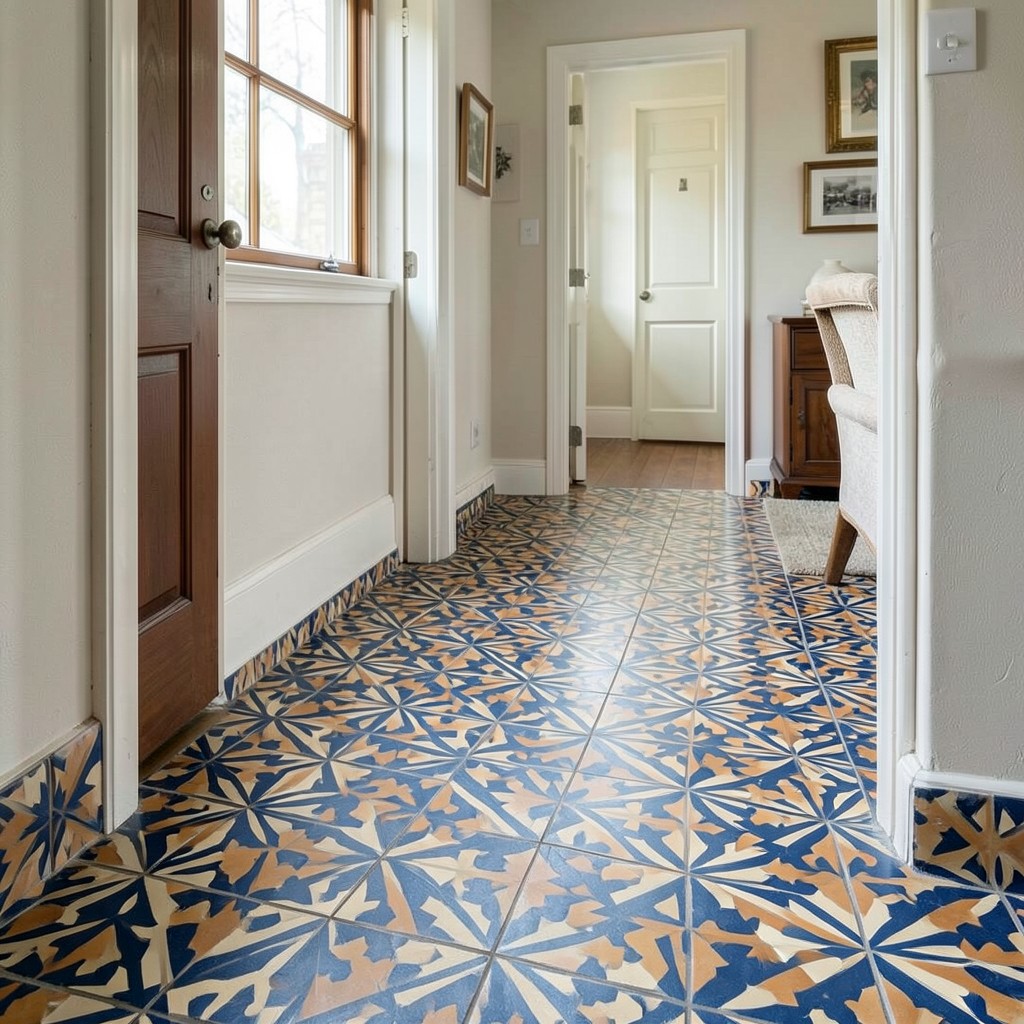
Encaustic cement floor tiles in the entryway — the pattern-faced, cement-bodied tiles whose inlaid geometric or organic design is structural rather than surface-applied, producing the floor that wears through the surface without losing its pattern’s color and depth — are the entryway floor treatment whose combination of visual richness, historical depth, and genuine durability makes them the most consistently rewarding entry floor specification across every design direction and every household condition. The encaustic tile floor is honest in the specific way that the material whose color runs through its body rather than sitting on its surface is always honest — it cannot be worn away into ugliness because the design goes all the way down.
The pattern selection for the entryway encaustic floor should be driven by the entry’s specific spatial dimensions and its relationship to the adjacent rooms whose floor treatments the entry tile must meet at the door thresholds. The encaustic tile’s pattern repeat creates a layout whose boundary condition — the partial tile at the wall base and the threshold edge — must be resolved before the tile is ordered, because the geometric tile’s edge tile is the installation detail whose quality the entry’s small floor area makes conspicuous. In a generous entryway whose floor area accommodates multiple full pattern repeats, the edge condition is less critical. In the small entry vestibule whose floor area barely accommodates a single pattern repeat, the edge tile is visible from every position in the space.
The bohemian home styling or the traditional home interiors entryway whose encaustic cement floor carries a bold Moorish star-and-cross pattern in cobalt, ochre, and cream — the pattern running from the door threshold to the first internal doorway in an uninterrupted geometric field — produces the entry floor that establishes the home’s design character at the building’s literal ground level before the visitor’s eye has risen to register a single wall, ceiling, or furniture element. The floor speaks first. Everything that follows is the room’s response to the floor’s opening statement, and the household whose encaustic entry tile was chosen with that specific design logic — the floor as the room’s first and loudest design voice — inhabits an entry whose design intelligence begins under their feet.
5. An Entryway With Floating Shelves and Display

Floating shelves in the entryway — wall-mounted shelves without visible brackets whose clean undersurface and shadow-gap fixing detail provide the horizontal storage and display planes that the narrow entryway’s restricted floor space prevents floor-standing furniture from providing — are the entryway design element that converts the entry’s vertical wall surfaces from underused painted planes into the active display and storage surfaces that the household needs at the entry zone’s specific functional and aesthetic levels. The floating shelf is not a compromise for the space that cannot accommodate a console table. It is the design solution that works precisely because the wall’s depth, rather than the floor’s area, is the entry’s available design resource.
The shelf’s fixing must be resolved before the shelf’s material and finish are selected, because the fixing method determines the bracket’s visibility, the shelf’s load capacity, and the wall surface’s condition after the shelf is removed. A shelf fixed to a hidden steel bracket whose rod passes through a pre-drilled hole in the shelf’s body and into the wall’s structural substrate provides the floating appearance without any visible support and the load capacity that the entry shelf’s daily content — keys, mail, a plant, a lamp, a small ceramic vase — requires. The shelf whose bracket is visible at its underside — the standard shelf bracket applied without thought to the floating aesthetic — is the shelf that reads as an afterthought rather than a design decision.
The minimalist home design or the Scandinavian home interior entryway whose floating shelves in pale, natural oak — two shelves at staggered heights on the entry’s primary wall, the lower shelf at key-deposit height and the upper at display height — carry the entry’s functional objects in the composed arrangement whose editing is the design rather than the accumulation, produces the entryway shelf that the household returns to daily with the specific pleasure of a surface that was thoughtfully curated rather than opportunistically filled. The spring home refresh that rearranges the floating shelf’s botanical display — the dried winter arrangement replaced with the fresh spring flowers in the simple ceramic bud vase — is the entryway seasonal home makeover whose cost is the flowers and whose result is the entry refreshed at its most prominent display surface.
6. An Entryway With a Statement Area Rug

A statement area rug in the entryway — the textile layer positioned at the entry’s floor level whose pattern, color, material, and scale define the entry zone’s character from the ground up and whose specific presence converts the hard entry floor from a purely practical surface into the designed ground plane that sets the room’s aesthetic register before any wall or furniture element has been registered — is the entryway design addition whose impact per unit of cost and per unit of installation effort is among the highest available in any design category. A great rug in the right entry does more in ten minutes of unrolling than a week of painting and accessorizing.
The rug’s scale relative to the entryway floor is the specification decision whose mishandling produces the most common rug-in-entry failure: the undersized rug that floats in the center of the entry floor with insufficient perimeter clearance on all sides, reading as a small object placed in a large space rather than as the room’s ground plane treatment. The entryway rug should cover between sixty and seventy percent of the available floor area, leaving a consistent border of hard floor visible at the room’s perimeter. The rug that is too small for the floor makes the entry feel unresolved regardless of the rug’s own design quality — the proportional mismatch overwhelms the material beauty.
The warm home decor ideas or the bohemian home styling entryway whose area rug is a large-format vintage Persian or Oushak in faded terracotta, dusty blue, and ivory — the rug’s aged color and worn pile surface providing the specific warmth of a textile whose character was developed over decades of use rather than manufactured into it — produces the entryway floor treatment whose atmospheric depth the new rug, however well designed, cannot match at the same emotional register. The fall home decorating context where the summer’s light natural fiber rug is replaced by the autumn’s richer, deeper-toned textile is the entry seasonal home makeover whose single floor change shifts the entire entry zone’s atmospheric character as completely as a full redecoration at a fraction of the disruption and cost.
7. An Entryway With a Lantern-Style Pendant

A lantern pendant in the entryway — the hanging light fixture whose four, six, or eight-sided glazed or open-frame structure provides the entry’s atmospheric overhead light in the specific warm, enclosed quality of the traditional lantern form whose material and form the domestic entry has used as its primary light fixture for centuries — is the entryway lighting decision whose design authority in the entry zone exceeds every alternative light source option available, because the lantern form’s specific atmospheric quality of light-through-glass or light-within-frame is the light quality most directly suited to the entry’s transitional character and its specific requirement for warmth at the threshold.
The lantern’s scale — its diameter, its height from the canopy to the base, and its vertical position within the entryway’s ceiling height — is the specification decision that most directly determines whether the pendant reads as correctly proportioned for the entry space or as either timid (too small, hanging too high) or overbearing (too large, hanging too low). The correctly scaled entryway lantern occupies approximately one-fifth to one-quarter of the entry ceiling’s smaller plan dimension in diameter, hangs with its base at a height that provides comfortable clearance for the tallest regular user of the entry — typically two thousand one hundred to two thousand two hundred millimeters above the finished floor — and whose chain or rod length positions the lantern within the ceiling zone rather than in the eye-level zone of the entry’s circulation path.
The elegant home styling formal entryway or the traditional home interiors Georgian entrance hall whose pendant is a large aged brass hexagonal lantern — the brass frame in a patinated matte finish, the clear glass panels providing the warm enclosed light of the traditional hall lantern at the entry’s center — produces the entryway lighting whose period authority and atmospheric quality make every other element in the entry appear more resolved simply by the consistency and the intentionality of the light source above them. The holiday home styling context where a seasonal arrangement of dried botanicals or evergreen sprigs is positioned on the console below the lantern, the lantern’s warm upward light illuminating the arrangement from above, produces the entry vignette whose seasonal warmth is the most atmospherically complete moment in the entryway’s design year.
8. An Entryway With Vertical Shiplap Paneling

Vertical shiplap paneling in the entryway — the overlapping timber boarding installed with the boards running from floor to ceiling in the vertical orientation whose directional lines draw the eye upward and increase the apparent ceiling height of the entry zone — is the entryway wall treatment that converts the narrow, low-feeling entry corridor into the taller, more spatially generous space whose vertical emphasis makes the standard residential ceiling height read as architecturally considered rather than as the builder’s minimum. Vertical shiplap is the hallway trick that works without requiring the structural modification that the real ceiling height increase demands.
The vertical boarding’s shadow gap — the narrow dark reveal between each board’s face where the overlapping rebate produces the fine shadow line that provides the surface’s texture — is the element that makes the vertical shiplap’s height-increasing effect work, because it is the multiplication of vertical lines across the wall’s width that the eye reads as height markers. The shadow gap whose depth is too shallow to cast a clear shadow in the entry’s light conditions loses the surface’s defining feature and reads as a joined-plank wall rather than a shiplap composition. A minimum shadow gap depth of three to four millimeters provides the clear shadow line that the vertical surface requires in the standard residential entry’s light conditions.
The farmhouse home decor or the coastal home design entryway whose vertical shiplap paneling covers the full height of the entry walls — from the skirting board’s top face to the cornice or the ceiling’s base in a continuous vertical boarding that wraps all four entry walls including the door’s return wall — in a painted warm white or pale sage produces the entry whose material character is declared completely by the boarding’s texture and the paint’s tone before any accessory, furniture, or artwork is introduced. The winter interior design entryway whose white vertical shiplap walls hold a single brass lantern pendant and a natural fiber runner produces the material palette of the coastal winter interior whose specific warmth comes entirely from the combination of the white timber surface and the warm brass light.
9. An Entryway With a Sculptural Console Table

A sculptural console table in the entryway — a piece of furniture whose form has been designed as an object of aesthetic interest independent of its functional role, whose legs, base, or top profile provide the visual complexity and the material quality of a designed object rather than a functional surface on four legs — is the entryway furniture investment whose return is the highest of any single piece of furniture in the domestic interior, because the console table in the entry is seen by every person who enters the house, at close range, in the specific attentive looking of the arrival moment when the guest’s senses are most engaged with their new environment.
The sculptural console’s material selection is the decision that determines whether the piece reads as a considered investment in a designed object or as the standard furniture purchase whose form was acceptable and whose price was appropriate. A console table in a hand-forged blackened steel whose welded base structure produces the specific organic geometry of the metalsmith’s direct work; a console in a hand-turned solid walnut whose leg profile and top edge detail communicate the woodturner’s craft; a console in a composite of cast concrete and steel whose material tension between the mineral top and the metal base produces the specific weight and the specific lightness of the two materials in material dialogue — these are the sculptural console choices whose quality is felt rather than measured and whose presence in the entryway makes the arrival experience the daily aesthetic event the designed entry demands.
The luxury home interior or the chic home decor entryway whose sculptural console in hand-forged blackened steel — the base’s irregular, organic welded form visible below the slim dark metal top, the piece positioned below a large-format mirror whose frame echoes the base’s metalwork in a coordinating finish — produces the entry vignette whose design sophistication is felt at the door’s opening rather than assembled from the approach across the room. The artist-made object in the place of the catalog furniture is the entryway design decision that the household whose aesthetic sensibility is fully formed makes as the natural expression of that formation, and whose daily presence in the entry provides the ambient pleasure of living with a designed object whose quality rewards repeated looking rather than familiarity diminishes.
10. An Entryway With a Herringbone Brick Floor
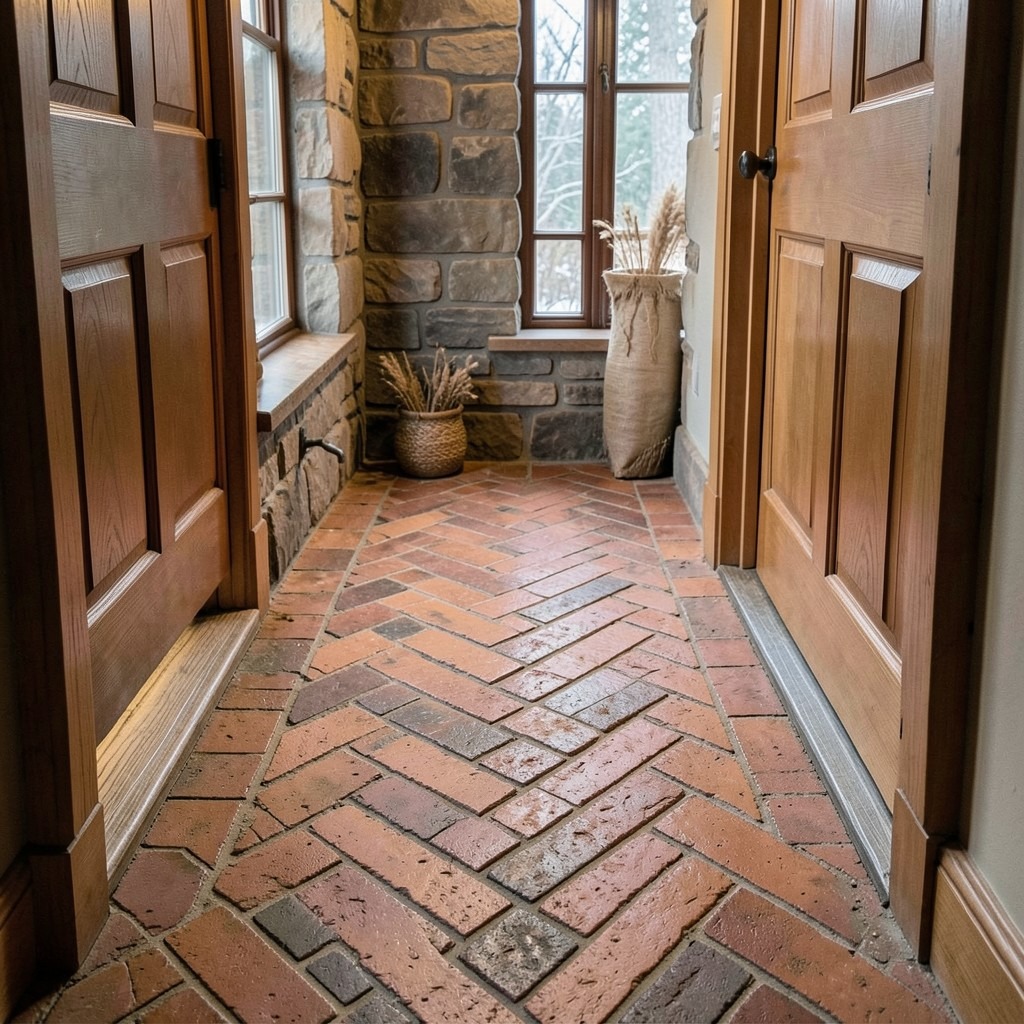
A herringbone brick floor in the entryway — the antique or handmade brick pavers laid in the classic herringbone pattern whose alternating ninety-degree orientation of individual brick units produces the V-shaped directional surface whose material warmth and historical depth suit the farmhouse, the cottage, the traditional country house, and the stone and wood home design direction at their most materially honest — is the entryway floor treatment whose specific combination of material character, durability under hard conditions, and atmospheric warmth the designed entry achieves without any other floor treatment offering the same combination of qualities at the same material level.
The brick specification for the entryway floor application requires the brick pavers to be the solid, dense, low-porosity engineering brick or the handmade paver whose fired body is resistant to the moisture absorption that the entry floor’s wet boot contact introduces on a daily basis in the wet seasons. The standard facing brick, whose open-textured surface and higher porosity are designed for the vertical wall application rather than the horizontal floor condition, absorbs the moisture that the entry floor’s traffic produces and develops the freeze-thaw deterioration in unheated entries whose winter temperature drops below zero. The paver brick — the brick whose specification includes the floor application’s durability requirements — is the correct product for the herringbone entry floor regardless of its higher per-unit cost over the facing brick alternative.
The mountain cabin decor or the farmhouse home decor entryway whose herringbone brick floor extends from the outer door threshold across the full entry zone to the first internal door — the brick’s warm terracotta tone providing the floor’s color contribution to the entry’s material palette of timber, stone, and natural fiber — produces the floor whose practical performance in the muddy-boot, wet-coat, and tracked-in-harvest conditions of the active rural household matches its atmospheric quality in the calm of the evening’s warm entry. Underfloor heating beneath the herringbone brick floor is the entry floor specification whose combination of material warmth above and thermal warmth below produces the specific domestic pleasure of the cold winter arrival whose entry floor, rather than chilling the foot through the wet boot, radiates the specific comfort of the heated mineral surface.
11. An Entryway With a Large Botanical Print

A large botanical print in the entryway — a framed artwork of significant scale whose subject is the botanical illustration tradition: the detailed, scientifically observed, and beautifully rendered plant subject whose combination of scientific precision and artistic beauty makes the botanical print the artwork form most consistently suited to the domestic interior’s wall — is the entryway art installation that establishes the home’s aesthetic register and its relationship with the natural world at the building’s primary viewing surface before any other interior element has been registered by the arriving visitor.
The botanical print’s scale in the entryway is the specification decision that determines whether the artwork reads as a composed design element or as a print that arrived in the entry without a spatial brief. A print whose framed dimensions span sixty to seventy percent of the available wall width, positioned with its center at approximately one thousand six hundred millimeters above the finished floor — the standard picture-hanging height whose center sits at the average adult’s eye level — reads as correctly scaled for the wall at the standard domestic entry’s viewing distances. A smaller print on the same wall reads as the object whose scale communicates the designer’s uncertainty about the wall’s design intention.
The garden-inspired interiors or the floral home decor ideas entryway whose large botanical print — a framed antique herbarium illustration of an oversized magnolia branch in the warm gold and soft green of the aged botanical plate — hangs above the console table in the entry’s primary wall position produces the artwork installation whose subject matter, material quality, and scale all work together as a single composed design decision. The spring home refresh that replaces the winter entry’s darker landscape print with the botanical print’s lighter, more organic composition is the seasonal art rotation whose single swap shifts the entry’s atmospheric character toward the spring’s own material sensibility, and the ease of that rotation — made possible because the hook, the wall, and the console below were designed to receive the seasonal change — is the design intelligence that the static entry never develops.
12. An Entryway With a Mirrored Side Wall

A mirrored side wall in the entryway — the full or near-full coverage of one of the entry’s side walls in mirror glass, whose reflection doubles the apparent width of the narrow entry corridor and provides the dressing function of the entry mirror at the architectural scale of a wall surface rather than the furniture scale of a hung mirror — is the entryway modification that most effectively addresses the dimensional inadequacy of the narrow entry corridor by removing one of its walls from the spatial equation. The mirrored wall is not a decoration applied to the corridor. It is the corridor’s side wall dematerialized into reflection, and the narrow space whose mirror wall makes it appear twice its actual width is the specific spatial trick whose physics are simple and whose architectural impact is the highest available in the narrow entry’s limited design toolkit.
The mirror’s installation on the entry wall requires the wall surface to be prepared to a standard that exceeds the typical plasterwork quality — the mirror’s flat, reflective surface reveals every undulation, every joint, and every imperfection in the substrate beneath it with a fidelity that the painted wall’s matte surface conceals, and the plasterboard or plaster wall whose skim coat was not finished to the standard required for a high-quality tiled or mirrored surface installation produces the mirror wall whose reflective face carries the memory of every deficiency in the preparation behind it. The mirror installation is only as good as the wall preparation it was applied to.
The chic home decor or the modern home design urban apartment entryway whose narrow corridor carries a full-height mirror panel on the entry’s longer side wall — the mirror positioned from the skirting board’s top surface to the cornice, the mirror’s lateral extent covering the wall’s full length from the door frame to the adjacent room’s opening — produces the entry whose spatial doubling in the mirror’s reflection converts the tight corridor into the generous entry the floor plan refused to provide. The natural daylight from the entry door’s glazing, reflected from the mirrored wall back into the corridor, amplifies the entry’s light quality in the specific way of the mirror’s reflection — the reflected light warmer and more directionally complex than the source light whose flat, single-direction quality the mirror multiplies into the distributed, ambient quality of the reflected entry.
13. An Entryway With a Built-In Wardrobe

A built-in wardrobe in the entryway — the full-height fitted cupboard whose doors occupy the entry’s wall from floor to ceiling, concealing the coat storage, the boot rack, the umbrella, the seasonal textile collection, and the household’s full outer-garment wardrobe within a single fitted unit whose face reads as a composed architectural element rather than as a collection of individual storage items competing for wall space — is the entryway design idea that most completely resolves the domestic entry’s storage problem in a single installation whose benefit to the entry’s functional and aesthetic performance simultaneously is the most efficiently achieved of any single entryway design decision.
The wardrobe door’s face material and profile is the design decision that determines whether the built-in unit reads as an architectural element of the entry’s wall composition or as a furniture piece installed against the wall — a distinction that matters because the former produces the entry whose storage is absorbed into the architecture while the latter produces the entry whose storage is visible as storage despite the doors’ concealment. Flush panel doors in the same paint color as the adjacent wall — the door face flush with the wall’s face, the finger-pull recessed into the door rather than protruding into the entry’s limited floor space — produce the wardrobe whose presence in the entry is architectural rather than furniture-based. The slightly proud reveal of the door frame against the wall surface, even in the same color, signals the transition between wall and door that the perfectly flush installation eliminates.
The Scandinavian home interior or the minimalist home design entryway whose floor-to-ceiling built-in wardrobe carries flush, handle-free doors in the same pale grey as the entry walls — the entire wall surface appearing continuous until the door’s push-to-open mechanism reveals the wardrobe’s interior of organized coat hooks, shelf storage for hats and accessories, and the boot rack at the floor level whose depth was designed to accept the household’s full winter boot collection — produces the entry whose design achievement is the complete disappearance of its own storage infrastructure. The entry that stores everything and shows nothing is the entry whose design intelligence most directly serves the household’s daily life, and the built-in wardrobe is the single element that makes that specific achievement possible.
14. An Entryway With a Vintage Turkish Kilim
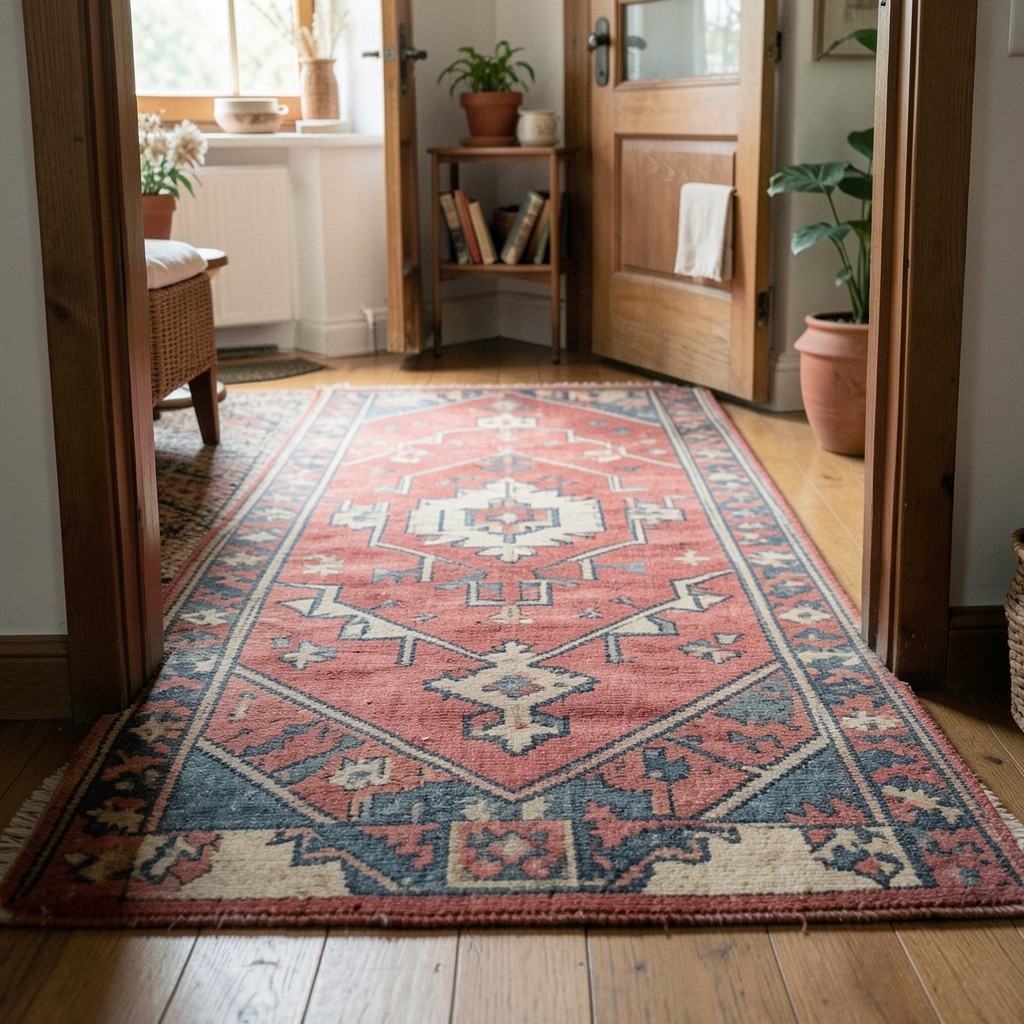
A vintage Turkish kilim in the entryway — the flat-woven wool textile whose geometric patterns, saturated vegetable dye colors, and specific tactile surface provide the floor’s design character in the specific material tradition of the Anatolian weaving culture whose combination of geometric abstraction and natural material warmth suits the bohemian home styling, the rustic home decor, and the warm home decor ideas directions simultaneously — is the entryway floor textile whose specific atmospheric contribution to the domestic entry is the warmth and the specificity of a made object whose production tradition spans centuries and whose individual piece belongs to that tradition in a way that the machine-produced rug cannot approximate at any price point.
The vintage kilim’s practical performance in the entryway requires honest assessment before the decision to install it in the home’s hardest-wearing floor zone is made. The flat-woven construction, whose lack of pile makes the kilim thinner and lighter than the knotted rug, provides the surface whose wear condition is more directly visible than the knotted rug’s pile whose fiber loss occurs at the individual fiber level before the surface deterioration becomes visually apparent. The vintage kilim in the entryway whose daily boot traffic and seasonal wet conditions include the full range of the family entry’s hard use develops the wear record of a textile that was not designed for institutional floor traffic, and the household that accepts this and embraces the kilim’s aging as the material biography of a beautiful object rather than the damage accumulation of a poorly specified floor covering is the household that can genuinely enjoy the kilim in the entry rather than anxiously protect it.
The earthy home design or the bohemian home styling entryway whose large vintage kilim in faded madder red, natural ivory, and dusty indigo covers the entry floor from the door threshold to the first room’s opening produces the entry whose ground plane carries the specific visual warmth of the handwoven geometric textile at the building’s threshold — the pattern’s absorbed, aged color the product of the vegetable dyes’ specific light-fading behavior across decades of service in a previous household whose domestic history the kilim’s surface carries silently into the new interior. The textile that has already lived a life before arriving in your entryway is the floor textile whose character the new rug’s manufactured perfection cannot approach, and its presence under your feet every morning is a specific kind of domestic beauty that the purchased-new alternative simply does not provide.
15. An Entryway With an Arched Niche Display

An arched niche in the entryway wall — a shallow recess formed in the entry’s masonry or framed wall, its opening profile in the semicircular arch whose curved soffit provides the architectural frame for the display object, the artwork, or the seasonal arrangement the niche presents at the entry’s most focused viewing position — is the entryway design element that converts the undifferentiated wall surface into an architectural event at the specific location where the entry’s primary viewing axis arrives, providing the focal composition that the furniture-limited entry’s floor plan cannot deliver from below and directing the arriving visitor’s attention to the display the household has composed for exactly this moment of looking.
The niche’s depth determines what the display can contain and how the contained object reads within the arch’s frame — too shallow and the niche reads as a decorative recess whose display objects project proud of the wall face rather than being composed within the niche’s depth; too deep and the display object recedes into a shadowed cave whose lighting requires supplementary fixtures to illuminate the rear wall and the object it presents. A depth of two hundred to two hundred and fifty millimeters provides the sufficient volume for a ceramic vase, a sculptural object, or a botanical arrangement while keeping the display close enough to the niche’s open face to be seen clearly from the entry’s approach position without additional illumination.
The traditional home interiors or the Mediterranean-influenced entryway whose arched niche carries a single oversized ceramic vessel in a warm terracotta glaze — the vessel’s simple form and material warmth receiving the niche’s specific framing as the focused presentation of the entry’s most considered object — produces the entryway feature whose formal simplicity is the achievement rather than the limitation. The seasonal home makeover approach to the arched niche display — the autumn’s dried botanical arrangement in aged copper tones, the winter’s candle and evergreen composition whose holiday home styling character requires only the niche’s warm light to complete, the spring’s fresh botanical arrangement whose seasonal character the niche presents with the focused attention of a display designed specifically for the purpose — converts the architectural element into the household’s seasonal design calendar expressed at the entryway’s most composed display position.
16. An Entryway With Polished Concrete Flooring

Polished concrete flooring in the entryway — the poured or overlaid mineral surface whose grinding and polishing process produces the smooth, semi-reflective floor whose aggregate content provides the subtle color variation and the material depth that the uniform factory tile’s consistent surface cannot match — is the entryway floor treatment whose specific material character suits the industrial home design, the minimalist home design, and the contemporary home ideas directions at their most materially serious, and whose practical performance under the entryway’s hard daily conditions — the wear, the moisture, the thermal cycling of the entry zone — is among the highest of any domestic floor specification when the sealing is correctly applied and maintained.
The polished concrete’s color tone is determined by the aggregate composition and the cementitious binder’s base color, both of which are selected during the mix design rather than applied as a surface treatment after installation, and the color’s durability is therefore the durability of the material itself rather than the durability of the applied finish. A concrete floor whose warm grey tone was produced by the specific aggregate blend of the mix design will maintain that tone as the floor ages, the grinding process having exposed the aggregate composition’s color across the slab’s face. The colored concrete whose pigment was added to the mix provides a broader color palette but requires the pigment’s UV stability to be assessed for the entry’s light exposure conditions.
The industrial home design or the modern home design open-plan ground floor whose polished concrete flows continuously from the entryway through the hall and into the kitchen — the single material plane eliminating the floor-level design boundary between the entry zone and the interior rooms — produces the specific spatial unity of the floor that ignores the building’s internal partitions and treats the ground floor as a single connected zone whose material continuity the concrete’s poured nature makes possible in a way that the laid tile or the installed board does not. The summer home design coastal home whose pale grey concrete entry floor reflects the natural daylight from the front door’s glazing in the specific quality of the polished mineral surface produces the bright home design quality of an entry that amplifies the incoming light rather than absorbing it.
17. An Entryway With a Woven Basket Collection
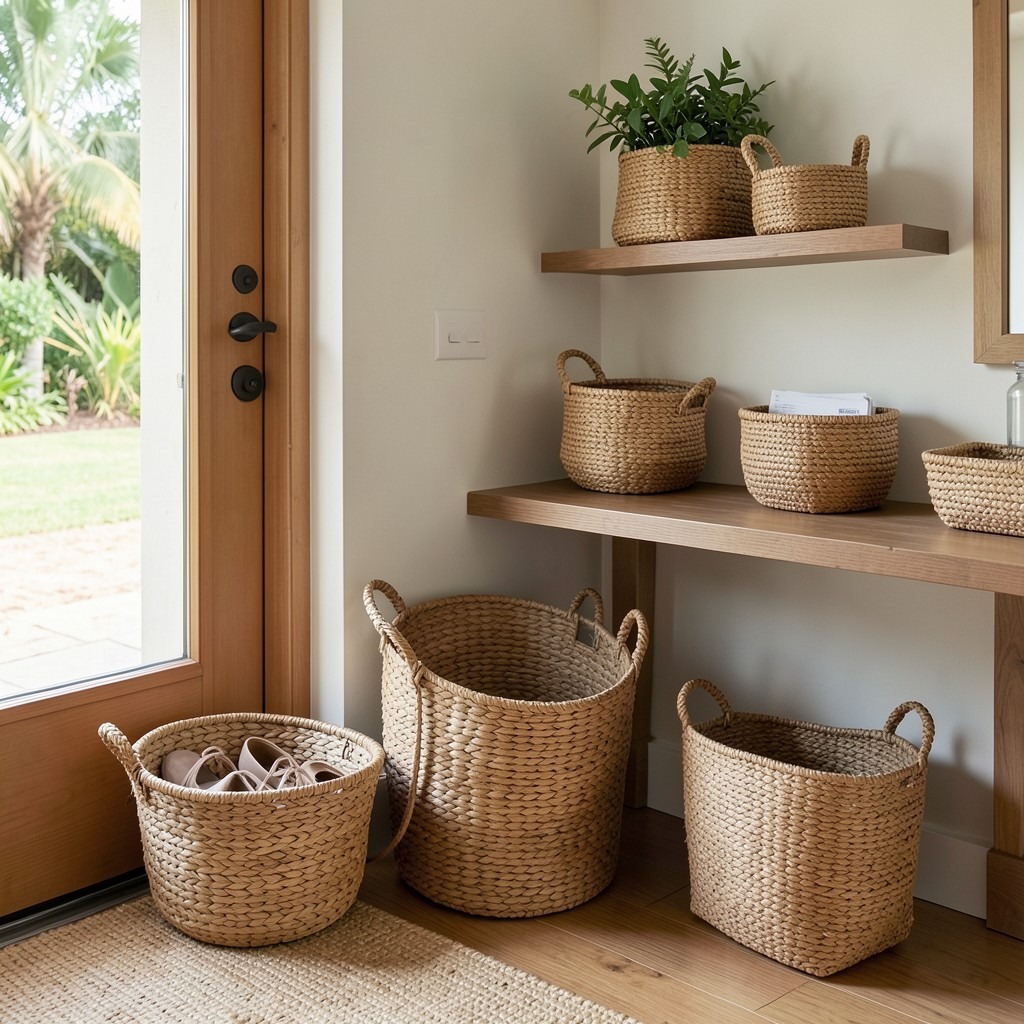
A curated collection of woven baskets in the entryway — baskets in natural fiber, seagrass, rattan, or coiled rope positioned as the entry’s primary storage and display element, their forms ranging from the deep open-top storage basket at the floor level to the shallow display basket on the shelf or console surface — is the entryway design idea that delivers the greatest material warmth, the greatest textural variety, and the most direct connection to the bamboo home interiors and natural fiber traditions at the most accessible cost of any entryway material addition, and whose specific atmospheric contribution — the organic irregularity of the handwoven surface, the warm natural tones of the unprocessed fiber, the specific basket tradition of the material’s origin culture — is the quality no manufactured storage product can replicate.
The basket collection’s arrangement in the entryway must be composed rather than accumulated, because the basket’s specific power as an entryway design element depends on the group’s collective visual weight rather than the individual basket’s beauty. Three baskets of different scale, material, and weave pattern arranged in a descending size composition at the entry’s floor level produce the grouping that reads as a composed collection. The same three baskets positioned without relationship to each other at arbitrary heights and positions on the entry’s wall read as the baskets that were placed without a compositional intention and whose arrangement communicates the design decision that was deferred rather than made.
The coastal home design or the tropical home design entryway whose woven basket collection carries the seagrass belly basket at the floor beside the door — the deep, open basket holding the household’s shoes and the dog’s lead — the rattan wall basket at the console’s side holding the mail and the day’s papers, and the tightly coiled rope basket on the floating shelf above holding the entry’s seasonal botanical arrangement, produces the entry zone whose functional storage and decorative display are achieved through the same material family in a composed, graduated installation that reads as the deliberate domestic curation of the household whose material sensibility is expressed at the entry’s most used and most observed elements. The summer home design beach house entry whose basket collection is at its most natural and most contextually complete in the season when the outdoor life fills the baskets daily is the entry design whose material logic and its daily use are in the most direct possible relationship.
18. An Entryway With Exposed Stone Walling

Exposed stone walling in the entryway — the original stone construction of the building revealed at the entry zone by removing the plaster finish, or the dry-stack or mortared stone panel installation applied to the entry wall — is the entryway treatment that most directly communicates the stone and wood home design direction’s material philosophy at the building’s threshold, and whose specific material presence — the mineral weight of the stone face, the mortar joint’s texture between the units, the color variation across the individual stone surface — provides the entry wall with the specific atmospheric quality of a building material rather than a wall decoration.
The decision to expose genuine original stone in an entryway renovation requires the structural assessment of the stone construction’s condition before the plaster removal begins — the plaster may be serving as the weather barrier for a stone construction whose pointing mortar has deteriorated to the point where the exposed face would present an uneven, poorly pointed surface rather than the composed masonry feature the exposure is intended to produce. The stone wall that was plastered for practical reasons rather than aesthetic ones may present a practical problem rather than a design opportunity when the plaster is removed, and the pre-removal assessment is the step that the entryway renovation’s enthusiasm most commonly skips and most frequently regrets.
The mountain cabin decor or the rustic home decor entryway whose original fieldstone construction — the irregularly shaped, randomly coursed stone of the traditional vernacular wall — is exposed at the entry zone’s primary wall, its surface in the natural, unpointed condition of the building’s own construction, produces the entry whose material presence is the building itself rather than a design applied to the building’s surface. The warm home decor ideas approach of fitting a simple timber shelf to the exposed stone wall — the shelf’s bracket fixed into the mortar joint rather than the stone face, the shelf carrying the entry’s functional objects in the specific material contrast of the pale timber against the dark stone — converts the building’s raw material presence into the designed domestic feature whose restraint is the quality that makes the stone wall’s authority fully felt.
19. An Entryway With a Backlit Glass Panel

A backlit glass panel in the entryway — a structural or decorative glass panel whose edge or surface is illuminated by a concealed LED source, the light traveling through the glass and emanating from the panel’s face as a soft, diffused glow that provides the entry’s ambient illumination in the specific quality of light emitted from a surface rather than projected from a source — is the entryway lighting and material design idea that most completely converts the standard dark entry into the bright home design or the airy home interiors space whose light quality changes the entry’s spatial experience at its most fundamental level. The entry whose light comes from the wall is the entry whose spatial conditions the overhead pendant cannot replicate.
The glass panel’s translucency specification — the glass type, thickness, texture, and any applied film or fritting pattern — determines both the panel’s daytime visual character as a material surface and its evening character as an illuminated element. A textured acid-etched glass produces the diffused, even glow whose light quality is closest to the natural north light that the dark entryway typically lacks. A clear glass with a printed pattern — the leaf silhouette, the geometric grid — produces the illuminated panel whose light output varies across its face in the pattern’s composition, creating the backlit graphic effect of the panel’s specific design rather than the uniform diffusion of the frosted glass.
The contemporary home ideas or the luxury home interior entryway whose entry wall carries a backlit glass panel in a reeded texture — the vertical reed pattern of the glass providing the diffused light distribution of the frosted surface while the reed’s directional texture provides the panel’s daytime visual character as a composed surface whose vertical lines echo the entry’s architectural verticals — produces the entry whose light quality transforms the dark corridor into the luminous space that the building’s plan position had prevented and whose warm evening glow provides the welcome of a naturally lit entry in the conditions where the entry door’s glazing cannot. The peaceful home decor approach whose backlit entry panel provides the only light source in a dark-walled entryway — the panel’s soft glow providing all the illumination the entry requires for the evening arrival — produces the entry whose atmospheric quality is the specific domestic pleasure of a space lit from within.
20. An Entryway With a Potting Bench or Garden Station

A potting bench or garden station in the entryway — the work surface at the entry zone’s perimeter whose specific function is the garden interface: the potting of new plants, the arrangement of cut flowers, the cleaning of garden tools, and the storage of the outdoor gardening equipment that the garden door’s proximity makes the entry zone’s natural landing point — is the entryway design idea that makes the specific domestic pleasure of the garden-inspired interiors direction a daily functional reality rather than an aesthetic aspiration, and whose installation acknowledges that the household whose entry faces the garden is the household whose entry is the garden’s threshold as much as the street’s.
The potting bench’s surface specification requires the durability of the material that weathers the garden’s own conditions — the water, the soil, the fertilizer, the pot’s drainage — at the indoor scale of the entry zone. Sealed hardwood timber provides the surface warmth of the natural material with the water resistance that the frequent wetting requires. Ceramic tile in a dark, earth-toned glaze provides the most easily cleaned surface whose color conceals the soil contact that the potting bench’s function inevitably produces. The stainless steel surface provides the most hygienically cleanable option whose cold, hard character is suited to the practical working surface rather than the atmospheric entry feature, and the choice between these options reflects the household’s balance between the potting bench as a working tool and the potting bench as a design element.
The garden-inspired interiors or the earthy home design entryway whose potting bench carries a Belfast sink fitted in the counter surface — the deep ceramic sink providing the plant watering, the bulb cleaning, and the cut flower stemming functions that the garden interface requires — a row of terra cotta pots on the shelf above, and the garden trug hanging from the hook below the shelf, produces the entryway whose design fully integrates the household’s garden practice into the building’s entry zone as an acknowledged and designed element of the domestic program. The spring home refresh gardening season that fills the entryway’s potting bench with the season’s planting activity — the seed trays, the fresh compost, the first of the season’s outdoor pots — is the entryway seasonal home makeover whose content is the garden’s own seasonal program expressed at the building’s most direct point of contact with the soil outside.
21. An Entryway With Rattan Pendant Lighting

Rattan pendant lighting in the entryway — the woven natural fiber ceiling fixture whose organic, handmade form provides the entry’s overhead light in the warm, filtered quality of the light that passes through the rattan’s weave and falls into the entry zone in the dappled, irregular pattern of light through leaves rather than the flat, even distribution of the standard ceiling fitting — is the entryway lighting choice that introduces the bamboo home interiors, the tropical home design, and the relaxed home design material tradition into the overhead zone of the entry at the specific light quality that no glass, no metal, and no ceramic pendant can provide, because the rattan’s woven structure is the light filter rather than the shade.
The rattan pendant’s practical performance in the entryway requires the bulb specification to account for the woven fiber’s proximity to the light source’s heat output — the compact LED bulb whose low heat emission is safe within the rattan pendant’s enclosed fiber structure provides the light output the entry requires without the thermal risk that the incandescent or halogen bulb’s higher heat output presents within a natural fiber shade whose material is combustible at sustained elevated temperatures. The LED specification for the rattan pendant is not an aesthetic concession but a practical safety requirement that the natural fiber shade’s enclosed structure makes non-negotiable.
The coastal home design or the beach house interiors entryway whose rattan pendant is a large, generously scaled natural fiber woven shade — the pendant’s warm honey tone and organic form providing the entry’s overhead character as the most prominent single decorative element in the ceiling zone — produces the entry lighting whose specific atmospheric quality changes with the light condition: the morning’s natural daylight passing through the pendant’s weave and casting the woven fiber’s shadow pattern across the entry ceiling and the upper wall in the specific dappled quality that the rattan produces when backlit from above, and the evening’s warm bulb light filtered outward through the weave in the amber-tinted glow of the woven fiber’s specific translucency. The summer home design entry whose rattan pendant provides the most contextually correct overhead material for the beach house or the coastal home is the entry lighting that requires no seasonal change because the material’s own atmospheric quality belongs to the season’s character.
22. An Entryway With a Black Door and Frame
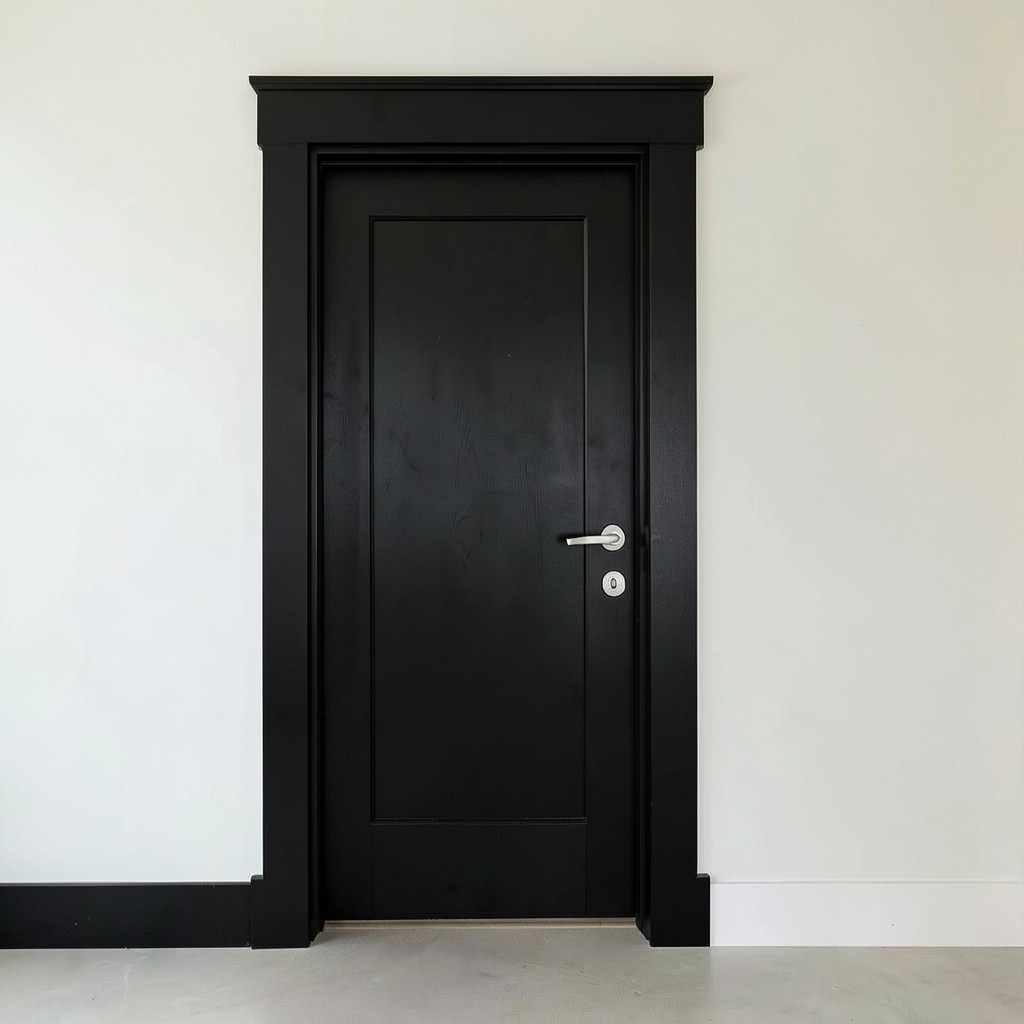
A black-painted entry door and door frame — the door’s face and the surrounding architrave both in the same deep, flat black, the monolithic dark form of the combined door and frame reading as a composed architectural portal rather than as a door set within a frame — is the entryway design decision that produces the most graphic, the most architecturally assertive, and the most design-conscious visual statement available from a single paint decision in the entry zone, and whose specific quality depends on the monolithic treatment of the door and frame together rather than the door alone, because it is the door-and-frame’s combined dark form that creates the portal effect whose architectural authority the door alone cannot produce.
The black door and frame combination works in any entry design direction — the black architrave against the white wall of the minimalist home design entry; the black door and frame against the deep green wall of the traditional home interiors entrance hall; the black painted door and frame against the exposed brick of the industrial home design entry; the black lacquered door and frame against the pale limewash walls of the earthy home design entryway — because the black’s graphic authority is design-direction agnostic. Black belongs to every palette in the way that no other color quite does, and the black entry door and frame is the specific entry design decision that holds its authority regardless of the design direction it is applied within.
The contemporary home ideas or the modern home design open-plan ground floor whose entry zone carries the black-painted door and full-height frame — the black architrave extending from the skirting to the ceiling without interruption, the frame’s height amplifying the door’s apparent scale and the portal’s formal authority — produces the entry element whose graphic presence dominates the room from every viewing angle, making the entry zone’s primary design statement with the precision and the economy of a single paint decision applied to an existing architectural element. The spring home refresh that introduces the black door and frame paint into an entry whose previous paint scheme was the builder’s off-white produces the single greatest design impact-to-effort ratio available in the entire entryway design category.
23. An Entryway With a Built-In Window Seat

A built-in window seat in the entryway — a fixed seating unit constructed beneath the entry’s window, its seat positioned at the window sill’s level, its cushioned surface providing both the seating function for the shoe-putting-on moment and the display surface for the seasonal botanical arrangement, the stack of books, and the throw textile that the entry window’s ledge provides as the room’s secondary display surface after the console table — is the entryway design idea that converts the entry window’s under-sill space from the zone occupied by the radiator and the accumulated mail into the composed architectural feature whose built-in seating, storage, and display functions make the entry window the room’s most productive design element per unit of floor area.
The window seat’s storage volume — the space beneath the seat whose access through the lifting lid or the hinged front panel converts the sitting platform into the concealed storage that the entry zone perpetually requires — is the functional core whose design must be resolved with the same practical clarity as the entry’s boot rack and coat hook. The storage compartment’s internal dimension should be sufficient for the household’s seasonal storage — the summer entry whose window seat stores the winter boots, the throws, and the heavy coats that the season’s warmth makes redundant; the winter entry whose window seat provides the additional storage for the seasonal decorative objects that the holiday home styling period introduces and the spring home refresh removes.
The farmhouse home decor or the Scandinavian home interior entryway whose window seat is built in painted timber with the same profile as the adjacent paneling — the seat in a solid oak or painted hardwood, the storage below accessed through the hinged seat whose piano hinge provides the full-width access the deep storage volume requires — produces the entry’s built-in element whose design integration with the adjacent wall paneling makes the seat read as part of the architecture rather than as furniture added to the space. The entry’s window seat in the winter interior design context, dressed with the cozy layered textiles of the season — the lambswool throw, the textured cushion, the small tray with the candle and the seasonal botanical — is the entry’s most domestic, most welcoming, and most specifically seasonal surface.
24. An Entryway With a Statement Ceiling Color

The color selection for the statement ceiling must account for the entry’s specific light conditions — the dark entry whose ceiling receives no natural light appears considerably darker than the ceiling color’s paint chip suggests in the showroom’s daylight, and the dark-painted ceiling in the dark entry can feel oppressive rather than dramatic unless warm-toned lighting counteracts the effect. A deep navy, forest green, or terracotta ceiling works best when the walls stay lighter by at least two or three value steps, creating contrast that draws the eye upward without making the space feel like a sealed box. Recessed fixtures or a central pendant hung close to the ceiling push light directly into the painted surface and turn that color from flat to luminous.
The ceiling color should wrap slightly down onto the top few inches of the wall — a technique called color capping — which eliminates the hard visual line where ceiling paint meets wall paint and makes the ceiling feel like a deliberate architectural feature rather than a happy accident. This move appears frequently in luxury home interior design and traditional home interiors, where rooms are treated as three-dimensional volumes rather than flat surfaces with a white lid dropped on top. The ceiling becomes part of the room’s identity rather than dead space overhead.
Lighting temperature matters enormously — bulbs rated between 2700K and 3000K pull the warm undertones from painted ceilings and prevent the color from looking gray or washed out at night. Warm home decor ideas contexts favor a terracotta or burnt sienna ceiling set against linen-white walls, producing an effect that feels grounded and inviting in every season, from summer home design through winter home decor. A dimmer switch transforms the effect entirely, letting the homeowner dial the ceiling from a daytime accent to an evening mood through light intensity alone.
25. An Entryway With Built-In Seating and Hidden Storage

Built-in seating solves two entryway problems at once — the absence of a convenient place to sit while pulling on shoes and the shortage of storage for items that accumulate near the door. A bench built into the wall with a hinged seat that lifts to reveal a deep cavity below turns dead space into the most hardworking square footage in the entire house. The built-in feels permanent and intentional rather than like furniture placed to compensate for poor planning.
The depth of the seat box determines what actually fits inside — a bench seat set sixteen inches deep can swallow a season’s worth of shoes, folded reusable bags, dog leashes, and sports equipment without a single item visible when the lid closes. Farmhouse home decor treatments finish the bench with shiplap paneling painted in the same color as the wainscoting so the storage disappears into the architecture. A cushion upholstered in a durable, cleanable fabric adds comfort while protecting the wood from daily scuff marks.
The bench performs best when flanked by vertical cabinets or open cubbies that give each household member a dedicated slot for their belongings, a system borrowed from Scandinavian home interior tradition where every object owns a specific home. Hooks mounted at varying heights above each cubby handle backpacks, coats, and umbrellas without competing for space. Color choice for the painted built-ins can either blend with the walls for a seamless, airy home interiors effect or contrast in a deeper tone that frames the bench as a deliberate feature wall.
26. An Entryway With a Dramatic Black Front Door Interior

The front door’s interior face is one of the most overlooked design surfaces in the house — most homeowners paint the exterior in a bold color and leave the inside face the same white as every other interior door, surrendering an opportunity to create an immediate visual statement the moment the door swings open. Painting the interior face of the front door in matte black, deep navy, or forest green creates an instant frame around the entry experience, making the entire foyer feel more considered and complete. The dark door face reads as a confident design choice rather than a decorative afterthought.
Matte black on the interior door face pairs naturally with modern home design aesthetics, especially when balanced with warm wood tones on the floor and furniture. The contrast between the dark door and a lighter entryway wall color sharpens the entry’s visual edges, creating depth that a monochromatic space never achieves. Black hardware on the door — lockset, hinges, and kickplate — connects the door face to the room’s other metal finishes without requiring a complete hardware replacement throughout the house.
In farmhouse home decor contexts, the black door interior works against white shiplap walls with leather accessories and iron hooks, evoking the honest, utilitarian character of working farm architecture. In a coastal home design setting, the same black door face sits beside white walls and natural fiber rugs, creating graphic contrast that reads as bold and fresh rather than heavy. The finish matters as much as the color — a flat or matte finish absorbs light and creates a soft, sophisticated effect, while semi-gloss on the same black reads as sleeker and more contemporary.
27. An Entryway With Natural Stone Flooring

Natural stone flooring in an entryway announces the home’s character before a single piece of furniture is encountered — the cool, dense surface of slate, travertine, or marble underfoot communicates permanence, quality, and intentional design in a way that ceramic tile mimics but never fully replicates. Stone’s natural variation means no two floors are identical, giving the entryway a surface that carries genuine visual interest without pattern, color, or added decoration. The material’s thermal mass makes it feel cool in summer and, when paired with radiant in-floor heating, warmly welcoming through winter home decor season.
Slate works particularly well for earthy home design and mountain cabin decor approaches, its split surface texture providing grip in wet conditions while its dark gray and brown tones connect naturally to wood ceilings and stone accent walls. Travertine suits Mediterranean, desert home styling, and traditional home interiors, its warm ivory and gold tones picking up natural light and reflecting it back into the space. Marble reads as luxury home interior design whether honed for a matte effect or polished to a mirror finish, though a honed finish hides scratches and water marks far better in a high-traffic entry.
Stone requires sealing on installation and resealing periodically depending on traffic volume and the stone’s porosity — travertine and limestone demand more frequent attention than dense granite or slate. A penetrating sealer applied correctly makes the stone resistant to mud, water, and salt that enter with every visitor during fall home decorating and winter seasons. The grout joint width and color shape the floor’s final character as dramatically as the stone itself — wide, dark grout between slate tiles reads as rustic, while tight, tone-matched grout between marble tiles reads as seamless and refined.
28. An Entryway With Oversized Wall Art

A single large-scale artwork on the main wall of the entry creates an immediate focal point that smaller grouped pieces rarely match — the human eye settles on one commanding image faster than it navigates a gallery arrangement, and in an entry where visitors pass through in seconds, that speed of visual impact determines whether the art registers at all. The artwork’s subject and palette introduce the home’s personality before any conversation begins, functioning as a visual handshake between the space and its guests. A piece that genuinely reflects the homeowner’s taste works harder than a decorative placeholder chosen simply to fill a wall.
Scale is the variable most homeowners underestimate — an artwork measuring thirty-six inches wide on a wall that spans eight feet reads as timid rather than bold, and the entry’s character deflates accordingly. The general rule borrowed from modern home design practice suggests the artwork should occupy between two-thirds and three-quarters of the wall’s width, leaving enough breathing room on either side to frame the piece without crowding it. Bohemian home styling entries benefit from large textile art or bold abstract paintings in terracotta, ochre, and deep teal that read as warm and deeply personal.
Coastal home design entries lean toward oversized photography of water, driftwood, or shoreline landscapes that extend the outdoor feeling indoors, while minimalist home design contexts demand a single canvas in a restrained palette where the artwork’s power comes from composition and scale alone. The frame choice either elevates the artwork or flattens it — a raw wood float frame around an abstract canvas adds warmth, while a thin black metal frame around a graphic print sharpens the contemporary edge. Whatever framing approach the room calls for, the oversized artwork anchors the entry and gives every other decorative element something to respond to.
29. An Entryway With a Console Table Styled for Every Season
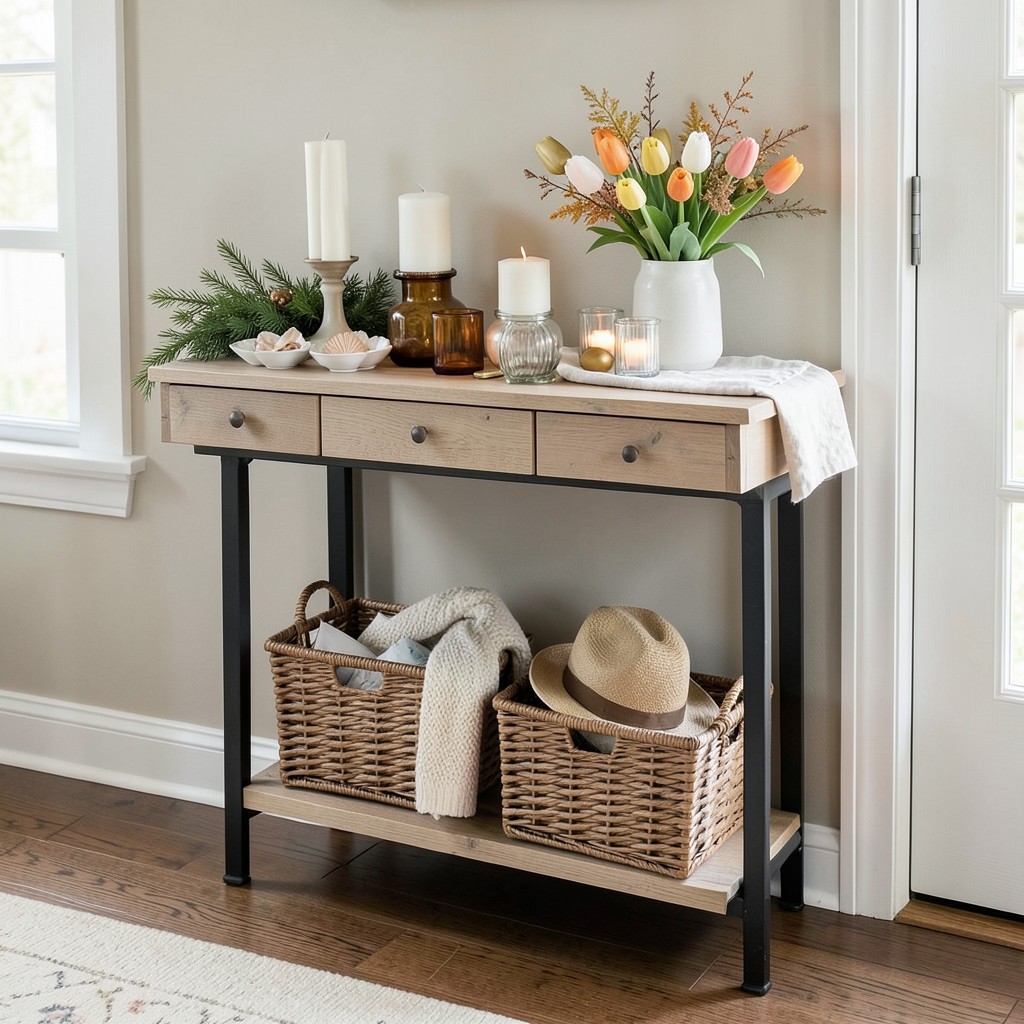
The console table is the entry’s most versatile staging surface — a narrow table positioned against the main wall provides a landing spot for keys and mail while its top surface becomes a rotating canvas for seasonal home makeover moments that keep the house feeling current throughout the year. Unlike built-in fixtures that commit to a single look, the console table’s styling can shift from a summer home design arrangement of shells, white ceramics, and linen-wrapped candles to a fall home decorating display of amber glass and warm-toned foliage without any permanent change. The table itself remains constant while the story it tells evolves with the calendar.
A console table with a lower shelf doubles the available styling surface and provides logical storage for baskets that hold seasonal accessories — lightweight scarves in spring, heavier knits in winter home decor season, and sunhats through summer. The table’s material sets the styling’s tonal range — a bleached oak console creates a foundation for breezy home interiors and coastal home design arrangements, while a dark walnut or ebony-stained table grounds richer, moodier seasonal displays. An iron and reclaimed wood console suits industrial home design and farmhouse home decor styling year-round, its material character strong enough to anchor any seasonal decoration placed on top.
Holiday home styling transforms the console table more dramatically than any other seasonal shift — a holiday arrangement of evergreen branches, gold and white candles, and a collection of mercury glass objects turns the entry into a welcoming celebration the moment the front door opens. The transition from holiday styling back to a clean spring home refresh display of tulips in a simple vessel and pale linen runners signals the season’s change as clearly as anything happening outdoors. The console table, styled with genuine intention, makes the entryway the most emotionally responsive room in the entire house.
30. An Entryway With Wainscoting and Bold Upper Wall Color

Wainscoting divides the entry wall into two distinct zones — the paneled lower section from floor to chair rail height, and the open wall above — and that division creates a structural opportunity to use bold color on the upper portion without overwhelming the space. Painting the upper wall in a deep, saturated tone while keeping the wainscoting in white or cream produces a room that feels both grounded and dramatic, a combination that neither element achieves on its own. The paneling’s geometry gives the eye something to rest on before the bold color takes over above.
Traditional home interiors have used this pairing for centuries, with navy, forest green, and burgundy appearing above white wainscoting in hallways that still feel as relevant today as when they were first painted. Contemporary home ideas reinterpret the same structure with colors that would have been unthinkable in period rooms — deep charcoal above bright white raised panels, terracotta above painted gray-green panels, or dusty mauve above natural wood paneling. The chair rail height makes a significant difference in the entry’s proportions, and elegant home styling in a high-ceilinged entry benefits from a higher rail that gives the paneling proper architectural weight.
Lighting the upper wall correctly activates the bold color — sconces mounted above the chair rail wash the saturated surface with warm light, while recessed fixtures angled toward the wall create a soft glow that deepens the color’s intensity at night. During daylight hours, the color reads differently in a north-facing entry than a south-facing one, with north-facing rooms pulling the cool undertones from any paint and south-facing rooms warming the same color considerably. Testing the paint in the actual entry under both daylight and artificial light conditions prevents the disappointment of a color that behaves perfectly on the paint chip and unexpectedly on the wall.
31. An Entryway With a Sculptural Light Fixture

The light fixture in an entryway is never purely functional — in a room where ceiling height and wall space often limit decorative options, the fixture becomes the primary three-dimensional art object and the element guests notice first when they look up. A sculptural fixture, whether a blown-glass globe cluster, a hand-forged iron chandelier, or a woven natural fiber pendant, introduces craft, scale, and visual personality that a standard drum shade or recessed fixture simply cannot deliver. The fixture’s silhouette in daylight and its light quality at night are two separate design contributions, and the best choices succeed at both.
Warm home decor ideas entries respond to fixtures made from natural materials — a pendant woven from bamboo home interiors-inspired fibers casts patterned shadows across walls and ceilings that turn the entire room into a light installation at dusk. A hand-thrown ceramic shade in a warm white or terracotta glaze adds a handcraft quality that connects to farmhouse home decor and bohemian home styling simultaneously. These material-forward fixtures work because they carry visual weight and texture beyond their light output, remaining interesting objects even when the bulb is off.
Scale determines whether the fixture functions as a focal point or disappears — a fixture whose diameter measures less than one-third the room’s narrowest dimension reads as undersized regardless of its design quality. A useful starting point sizes the fixture’s diameter in inches to equal the room’s width and length added together in feet — a seven-by-eight entry produces a fifteen-inch fixture minimum. Pushing slightly larger than that formula suggests creates the bold, confident character that makes an entry feel genuinely designed rather than merely furnished.
32. An Entryway With Layered Textiles

Textiles in an entryway perform more design work than they receive credit for — a layered textile approach that combines a flat-woven base rug, a smaller natural fiber accent rug, an upholstered bench cushion, and fabric wall hangings creates acoustic softening, visual warmth, and tactile richness that hard surfaces alone never generate. The entry is typically dominated by hard materials — stone, wood, plaster, metal — and textiles are the primary tool for making that hardness feel hospitable. Layering rather than selecting a single textile statement produces depth that reads as collected rather than decorated.
The base rug anchors the entry’s color story — a neutral jute or sisal rug creates a warm, organic foundation for nearly any decorating direction, while a patterned flat-weave in kilim style introduces color and geometry that can guide the entire room’s palette. A smaller accent rug layered on top, typically centered in front of the bench or console, adds a second texture and color without requiring the cost of a single large statement rug. This technique from bohemian home styling and relaxed home design traditions gives the floor visual complexity that a single rug achieves only with a very elaborate pattern.
Seasonal textile rotation keeps the entry feeling current with minimal investment — a lightweight linen or cotton rug and a thin cotton bench cushion in a soft stripe suits spring home refresh and summer home design perfectly. Swapping to a wool or wool-blend rug and a sheepskin or faux-fur bench cushion introduces the cozy home design quality that makes an entry feel genuinely welcoming during fall home decorating and winter home decor seasons. Floral home decor ideas appear naturally through printed cotton panels or embroidered linen pieces, bringing garden-inspired interiors energy indoors without requiring fresh flowers or live plants.
33. An Entryway With a Floating Shelf Display

Floating shelves in an entryway solve the space problem that defeats most standard furniture — a wall-mounted shelf positioned at eye level provides display and storage surface without claiming a single square inch of floor space, making it the only genuinely practical storage solution for entries too narrow to accommodate a console table or bench. A single deep shelf can hold a tray for keys, a small plant, a stack of books, and a candle without feeling cluttered. Two or three shelves staggered at different heights create a display wall that functions as both art and storage simultaneously.
The shelf material and mounting hardware determine the visual character entirely — a thick slab of live-edge wood mounted on raw steel brackets reads as industrial home design or rustic home decor, while a painted shelf on hidden French cleats reads as sleek and minimalist home design. Solid walnut shelves on brass rod brackets land in the warm contemporary register that suits both modern home design and traditional home interiors without fully committing to either. The bracket is not merely structural — it is a design element that deserves the same consideration as the shelf material itself.
Seasonal updates to the floating shelf display make the entry feel actively maintained and personally connected to the moment — a spring home refresh arrangement of bud vases with single stems and pale ceramics replaces a winter home decor display of pinecones and small lanterns in minutes. The shelf becomes a small domestic expression of the season, changing with the rhythm of the household’s life. This practice, borrowed from Scandinavian home interior tradition, treats the home as a living thing that responds to time rather than a fixed installation.
34. An Entryway With an Arched Doorway Treatment

The arch is among the oldest and most emotionally resonant architectural forms — a curved opening between entryway and interior hallway creates a sense of passage that a square-cornered opening never quite achieves, signaling to anyone who passes through that a genuine threshold has been crossed. In new construction or renovations where square openings are standard, creating an arch through drywall work transforms the entry’s relationship to the rest of the house. In existing homes where arches already exist, highlighting rather than minimizing them through paint, tile, or lighting honors the architecture’s best feature.
An arched opening painted in a contrasting color — a deep green or terracotta arch set against white walls — creates a framing device that draws the eye from the entry toward whatever lies beyond, extending the room’s perceived depth. This technique appears in Mediterranean, desert home styling, and jungle-inspired home decor contexts where indoor-outdoor connection and flowing spatial transitions define the architecture’s character. The arch color need not match the entry’s accent color — it can introduce a third tone that bridges the entry palette with the palette of the adjacent room.
Tile applied to the arch’s curved face creates a threshold treatment that reads as both decorative and permanent, an approach common in traditional home interiors and coastal home design contexts where hand-painted or encaustic tiles mark significant transitions between spaces. A zellige or terracotta tile band lining the arch’s interior curve turns the opening into a jewelry-quality architectural moment without requiring a full room renovation. Whatever proportion the arch takes — tall and pointed, wide and low, or a perfect semicircle — the treatment at its edges either reinforces its character or contradicts it, and consistency between proportion and material produces the most convincing result.
35. An Entryway With Indoor Plants as the Central Feature

Plants in an entryway introduce the one element that no manufactured material can replicate — actual living growth, the visible evidence of care and attention over time, and the subtle environmental shifts of fresh oxygen and absorbed humidity that make a room feel genuinely alive. A plant-centered entryway does not require an elaborate collection; a single specimen plant of significant size and architectural form — a large monstera, a fiddle-leaf fig, or a braided ficus standard — creates more visual impact than a dozen small pots arranged on a shelf. The plant’s scale relative to the entry’s ceiling height determines whether it reads as a feature or merely a decoration.
Garden-inspired interiors use the entry as the first expression of a home’s relationship to the natural world, positioning plants where arriving guests encounter them immediately and where the transition from outdoor to indoor feels softened rather than abrupt. A tall potted palm in a coastal home design entry connects the sandy exterior to the interior’s rattan and linen furnishings without a single additional design gesture. A large olive tree in a terracotta pot suits Mediterranean, earthy home design, and Scandinavian home interior contexts where the organic form of the tree’s twisted trunk becomes the room’s primary sculptural element.
Tropical home design and jungle-inspired home decor entries maximize plant density — a cluster of plants at varying heights, from a tall bird-of-paradise down through medium-height calathea and trailing pothos at shelf level, creates a layered botanical environment that feels genuinely lush. Bamboo home interiors aesthetics layer in bamboo plants as accent pieces beside larger tropical specimens, connecting the material palette to the living plant selection. Light is the non-negotiable requirement — plants in an entry with no natural light will decline regardless of care, and positioning the plant to take advantage of whatever natural light the entry receives ensures it remains a feature rather than becoming a maintenance problem.
36. An Entryway With a Vintage or Antique Mirror

An antique or vintage mirror brings something into an entry that new mirrors simply cannot manufacture — the patina of age, the slight irregularities of hand-silvered glass, and the history embedded in an ornate carved frame that has survived long enough to develop genuine character. These qualities make the vintage mirror one of the most effective single-purchase upgrades for an entry that reads as anonymous or generic, instantly introducing a layer of depth and personality that new furnishings take years of accumulation to achieve. The mirror does not need to match the entry’s other pieces; its age contrast with newer elements reads as collected and layered rather than mismatched.
A gilded baroque mirror above a modern console table creates the kind of high-low juxtaposition that defines chic home decor — the ornate frame’s excess balanced by the table’s restraint produces a tension that makes both pieces more interesting than either would be in a matched set. Traditional home interiors use the antique mirror as a unifying period piece that connects the entry to the house’s broader historical design language. Bohemian home styling embraces multiple mirrors of different vintages and frame styles grouped together, their shared age connecting them despite their formal differences.
The mirror’s glass condition matters as much as its frame — a lightly foxed mirror with clear reflection at center and soft aging at edges delivers both functional reflection and decorative character simultaneously. Sizing the vintage mirror for the entry requires the same attention as sizing any mirror — it should relate to the furniture beneath it and the wall behind it rather than appear as a random selection from a different room’s scale. Hanging the mirror at a height where its center point falls at approximately sixty to sixty-five inches from the floor places the reflective surface at average eye level, making it both a functional grooming mirror and a design element that works from across the room.
37. An Entryway With a Graphic Floor Pattern
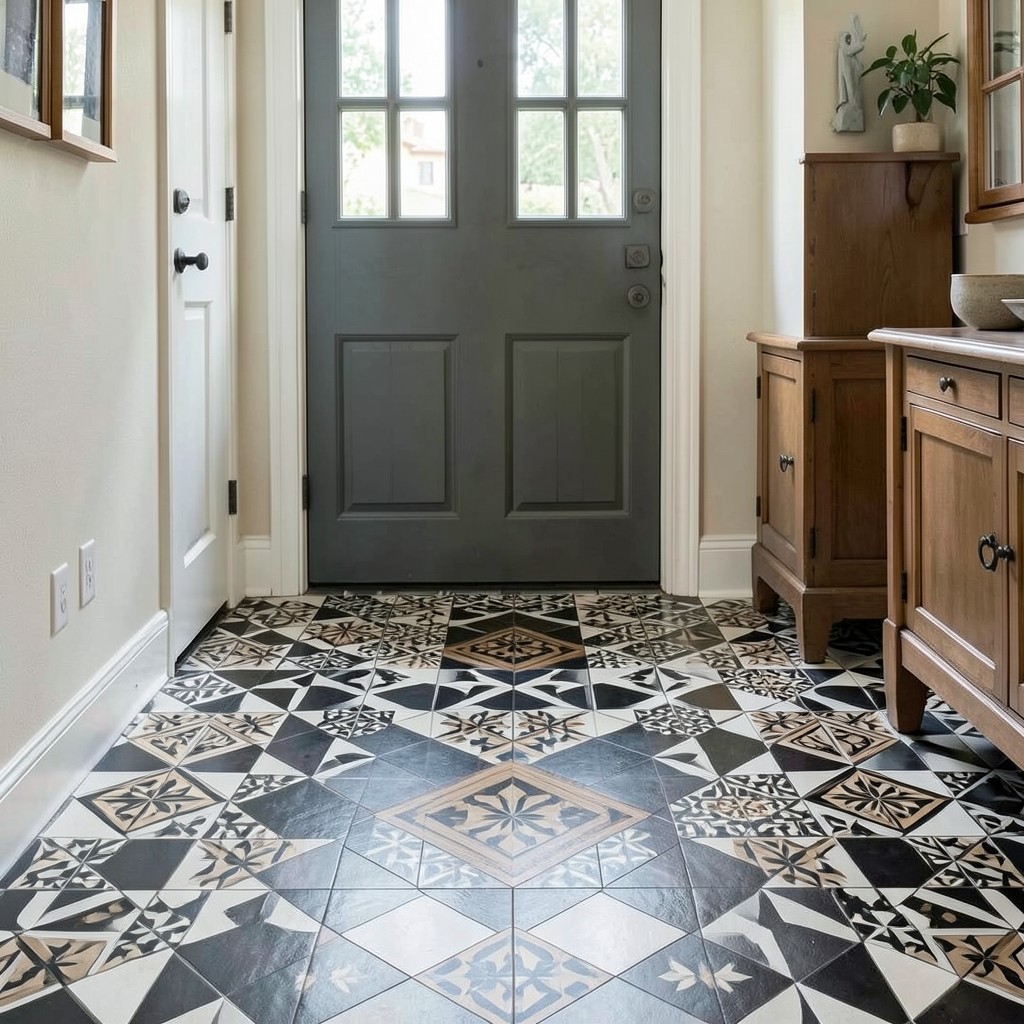
A graphic floor pattern transforms the entry’s floor from a background element into the room’s defining statement — a bold checkerboard, a complex encaustic tile mosaic, a painted geometric pattern, or an inlaid wood medallion creates a focal point that every other design decision in the room must acknowledge and respond to. The floor in the entry receives more visual attention than floors in most other rooms because the relatively small scale of the space puts the floor in direct eye range from multiple angles. That attentiveness makes graphic floor pattern investment in the entry more visually efficient than the same investment anywhere else in the house.
Classic black and white checkerboard tile suits traditional home interiors and contemporary home ideas simultaneously, its graphic quality strong enough to anchor any furniture style placed on top of it. The scale of the check determines the room’s character — a large check with eighteen-inch tiles reads as bold and graphic, while a small check with three-inch tiles reads as intricate and detailed. Encaustic cement tiles allow for geometric pattern complexity in earthy tones that suits bohemian home styling and Mediterranean-influenced traditional home interiors, their matte surface and slight color variation giving the floor a handmade quality that machine-produced ceramic tiles cannot replicate.
Painted floors offer the most affordable graphic pattern option for entries where the existing floor surface is sound but visually uninteresting — a concrete, wood, or even existing tile floor can receive a painted geometric pattern using porch and floor paint, a level, painter’s tape, and careful measurement. The painted floor suits relaxed home design and farmhouse home decor contexts where the slightly imperfect hand-painted quality adds charm rather than detracting from the result. Sealing the finished painted pattern with a polyurethane topcoat rated for foot traffic extends its life to several years before repainting becomes necessary.
38. An Entryway With Warm Wood Paneling

Wood paneling in an entry has shed its dated association with dark, poorly lit rooms and re-emerged as one of the most sought-after finishes in warm home decor ideas, stone and wood home design, and contemporary home ideas contexts. The difference between paneling that feels current and paneling that feels dated comes entirely from the wood’s tone and the panel format — pale oak or ash in a vertical board-and-batten arrangement reads as fresh and airy, while deep walnut in a horizontal groove pattern reads as luxurious and modern. Either direction, natural wood introduces material warmth that paint cannot fully replicate.
Vertical wood paneling applied to the entry’s main wall creates height and draws the eye upward, particularly in entries where ceiling height is modest and every inch of perceived height matters. The gap between boards — the shadow line created by a small reveal — adds visual rhythm and depth, making the wall feel like a designed surface rather than a covered one. Warm, natural wood tones connect naturally to farmhouse home decor and rustic home decor sensibilities, where the material’s honest quality reads as grounded and genuine rather than decorative.
A full-height wood-paneled wall opposite the front door creates an immediate warmth that arrivals feel before they consciously register the material, a response consistent across Scandinavian home interior, Japanese-influenced earthy home design, and mountain cabin decor contexts worldwide. The wood’s finish level shapes the entry’s maintenance requirements considerably — an oiled or natural-waxed surface develops a patina with handling and age that becomes more beautiful over time but requires periodic reapplication to stay protected. For entries with heavy daily traffic and young children or pets, a hardwax oil finish offers the natural appearance of an oiled surface with significantly better durability and easier spot repair.
39. An Entryway With a Curated Bookshelf
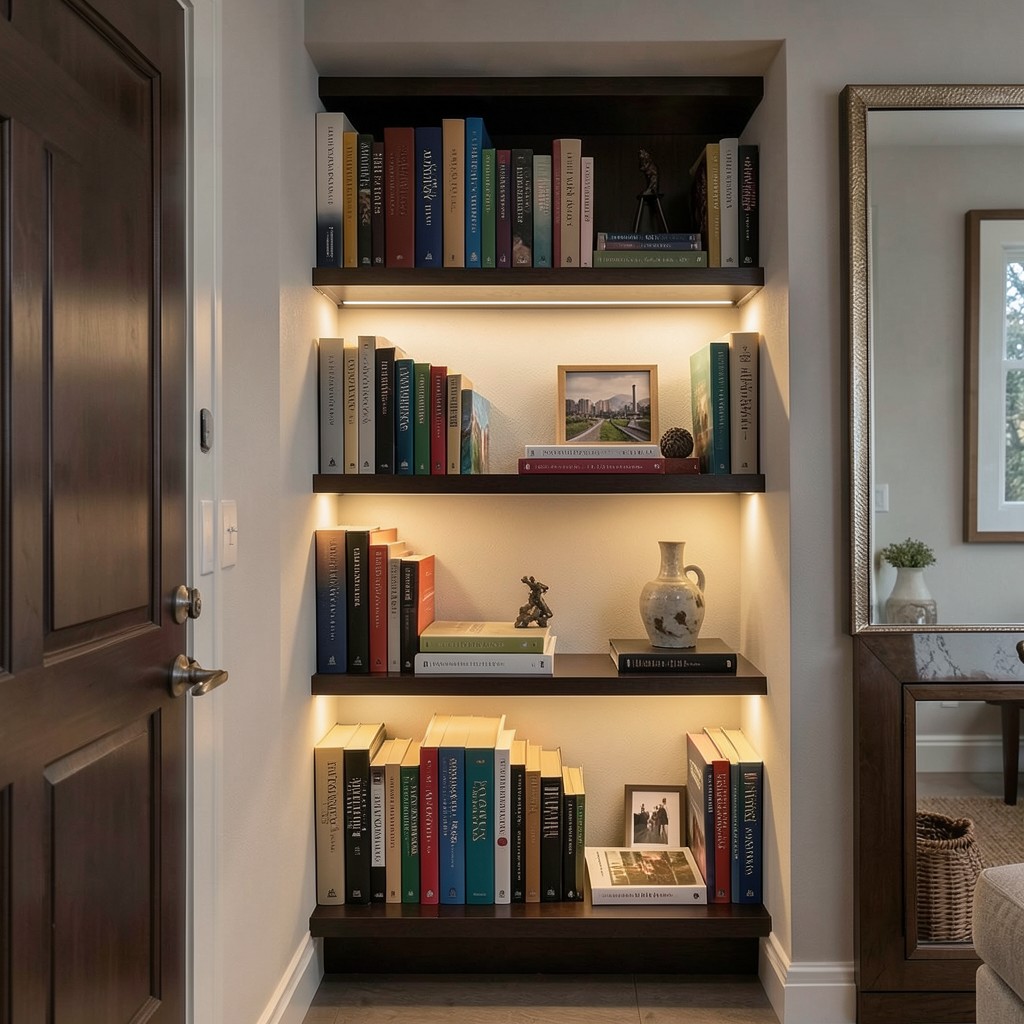
A bookshelf in the entry makes a statement that no other furniture type replicates — it declares that the people who live here read, that ideas matter in this house, and that the visitor is entering a space that values intellectual life alongside aesthetic pleasure. A narrow bookcase or a pair of wall-mounted shelves holding a curated selection of books alongside carefully chosen objects creates an entry that functions as a personal introduction as much as a functional transitional space. The books’ spines, their colors and titles visible from the door, communicate something genuinely personal that a vase or mirror cannot.
The bookshelf’s styling determines whether it reads as a polished design element or an overflow storage solution — the distinction lies in the balance between books and objects, and in the books’ own visual organization. Arranging books by color produces the graphic, cohesive effect favored in chic home decor and modern home design contexts, where the bookshelf reads as a designed color installation. Organizing by subject or author with objects interspersed at intervals creates the layered, collected feel of a traditional home interiors library brought into the entry at reduced scale.
Lighting the bookshelf transforms its daytime functionality into an evening design feature — small LED puck lights mounted inside the shelf above each section cast warm directional light across the books and objects and turn the shelf into a glowing focal point after dark. This kind of deliberate lighting is a hallmark of luxury home interior design and elegant home styling, where every surface in a room’s primary sightline is lit with intention. A few personal objects mixed into the arrangement — a small photograph, a found object from a significant trip, a handmade ceramic — make the collection genuinely specific to the people who live there.
40. An Entryway With High-Contrast Black and White

A black and white entry reads as one of the most timeless and confident design choices available — the palette’s graphic simplicity means it never goes out of fashion, and its high contrast creates visual clarity that makes even modest-sized entries feel sharply defined and deliberately composed. The balance between black and white determines the room’s character: a primarily white entry with black accents feels bright, clean, and airy home interiors in quality, while a primarily dark entry with white accents feels dramatic, moody, and luxuriously intimate. Both interpretations are valid, and the choice depends entirely on the entry’s light conditions and the homeowner’s emotional preference.
Minimalist home design finds its natural expression in the black and white entry — a white wall, a black console table, a round mirror with a black frame, a geometric black and white floor tile, and a single black hook rail produces a complete entry composition without a single decorative accessory or color accent. The beauty of this approach is in its editing discipline: every element earns its place through function or structural necessity, and decoration emerges from the composition of those necessary elements rather than from added ornament. Pattern mixing within a two-color palette — a black and white geometric tile floor under a black and white ikat bench cushion — maintains cohesion through the shared palette rather than through matched patterns.
Graphic art in an exclusively black and white palette takes on particular power in this entry context — a large-scale architectural print, a botanical illustration in black ink on cream paper, or an abstract monochromatic canvas reads as both artwork and extension of the room’s palette simultaneously. Farmhouse home decor interprets the black and white entry through contrast rather than minimalism, with white shiplap walls against black iron hooks and black-framed windows creating a graphic farmhouse character that feels fresh rather than historically rigid. The art stops being a decoration placed against the room and starts being a continuation of the room’s own visual logic — and that integration is the hallmark of elegant home styling at its most considered.
41. An Entryway With a Scent Strategy

The entry’s sensory experience extends well beyond the visual — the first thing many people consciously register when entering a home is its smell, and a deliberate scent strategy makes the entryway experience complete in a way that visual design alone never achieves. A home that smells welcoming signals cleanliness, care, and warmth before a single design element is consciously noticed, and conversely, even the most beautifully designed entry is undermined by the smell of shoes, outdoor gear, or stale air. The entry’s scent is a design decision as real as the choice of wall color or floor material.
Reed diffusers positioned on the console table or floating shelf release scent gradually and continuously, their elegance of form adding to the entry’s visual composition while they work invisibly on the sensory experience. Choosing a scent that aligns with the season creates a full sensory seasonal home makeover — a citrus-forward scent with green notes for spring home refresh, a heavier white floral for summer home design, a spiced cedar note for fall home decorating, and a warm amber or pine note for winter home decor. The scent’s intensity should remain subtle in the entry — powerful enough to register as welcoming but never so dominant that it overwhelms on arrival.
Fresh plants contribute their own natural scent to the entry — a gardenia, jasmine, or fragrant geranium placed near the door in good light releases fragrance that reads as genuinely natural rather than manufactured. These plants suit garden-inspired interiors and bohemian home styling contexts where the boundary between indoor and outdoor experience intentionally blurs. A fresh arrangement of eucalyptus branches in a vase near the entry provides both visual softness and a clean, herbal scent that makes the space feel alive without requiring any manufactured fragrance product at all.
42. An Entryway With a Gallery Wall of Personal Photography

Personal photography on an entry gallery wall does something that curated art prints and abstract paintings cannot — it tells the specific story of the people who live in the house, their faces, places, and memories greeting every arrival with genuine warmth. A gallery wall of black and white family photographs in matching simple frames creates a cohesive, elegant display that suits modern home design, traditional home interiors, and minimalist home design contexts without requiring any matching of subject matter or composition between individual images. The shared frame and the shared editing treatment unify photographs taken across different decades and locations into a single visual statement.
The arrangement of the gallery wall determines its visual energy — a tight grid of equally spaced identical frames reads as ordered and graphic, while an organic salon-style arrangement of frames in varied sizes reads as casual and accumulated over time. Elegant home styling and chic home decor contexts favor the tight grid for its precision and symmetry, while relaxed home design and bohemian home styling contexts favor the salon arrangement for its lived-in quality. Planning the arrangement on the floor before putting a single nail in the wall prevents the frustration of misaligned holes and misplaced anchors.
The gallery wall’s height on the entry wall affects its relationship to the furniture below — hung too high, the photographs float disconnected from the console or bench, while hung at the correct height with the arrangement’s center at approximately sixty inches from the floor, the photographs feel naturally related to the room’s other elements. A cozy home design approach mixes the photography with small framed pressed botanicals, a child’s drawing mounted in a simple mat, and a small mirror interspersed within the arrangement, producing the layered, personal quality that makes a house feel like a home from the moment of arrival.
43. An Entryway With Textured Plaster Walls

Textured plaster walls in an entry introduce a material richness that flat-painted drywall simply cannot achieve — the depth of a hand-applied lime plaster, a Venetian polished plaster, or a sand-finish stucco catches light differently at different times of day, making the wall a dynamic surface rather than a static backdrop. The texture does not need to be dramatic to be effective; even a subtle sand finish applied over a base coat adds enough surface variation to make the walls feel substantial and crafted. This material honesty is central to earthy home design, Mediterranean-influenced traditional home interiors, and desert home styling.
Venetian polished plaster in a warm ivory or pale terracotta tone achieves a burnished, almost marble-like appearance that reads as luxury home interior design without requiring any actual stone. The application process builds up multiple thin layers of lime putty plaster, each burnished with a steel trowel while still slightly damp, creating a depth in the finished surface that catches light from different angles and appears to shift color throughout the day. This quality makes polished plaster particularly beautiful in entries that receive strong directional light from a sidelight or transom window.
Lime wash paint, while not a true plaster, achieves a similar weathered, layered quality on smooth walls and suits farmhouse home decor, rustic home decor, and Scandinavian home interior contexts where the effect reads as organic and unpretentious. The application requires no special tools — a wide brush applied in crossing strokes builds up the characteristic mottled, aged appearance in two to three coats. Either true plaster or lime wash transforms the entry’s walls from a painted surface into a material feature that holds its own alongside stone floors, wood furniture, and metal fixtures without requiring additional decoration.
44. An Entryway With a Dedicated Pet Station

Homes with dogs or cats generate a specific set of entry challenges — muddy paws, leashes, treats, waste bags, and grooming tools that accumulate near the door and undermine even the most carefully designed entry if no dedicated storage addresses them. A purpose-built pet station integrated into the entry’s design contains this reality cleanly, giving the entry its designed appearance even during the chaotic reality of daily dog walks and outdoor adventures. The pet station functions best when it is built into the entry’s existing storage system — a section of the built-in bench cubby assigned entirely to pet gear, or a lower cabinet beneath the coat hooks.
A wall-mounted hook rack at lower height beside the main coat hooks handles leashes, harnesses, and training pouches without mixing pet gear into the household members’ personal items. A small basket or woven bin at floor level holds toys, balls, and outdoor accessories that the dog brings in and out with regularity. Farmhouse home decor and rustic home decor entries integrate these elements naturally through the use of galvanized metal bins, natural rope hooks, and raw wood shelving that treats utilitarian objects as decorative ones.
A small boot tray or waterproof mat stationed just inside the door with a dedicated towel hanging on a hook beside it handles the muddy paw situation that every dog owner faces without letting the solution become an eyesore. Choosing a boot tray in a material that suits the entry’s aesthetic — a copper tray for a warm traditional entry, a matte black metal tray for a modern home design entry, a woven seagrass tray for a coastal home design entry — makes even this purely functional object part of the room’s visual story. The pet station succeeds when it is invisible to guests and indispensable to the household, blending into the entry’s design while solving the specific messy reality of life with animals.
45. An Entryway With a Statement Wallpaper Ceiling
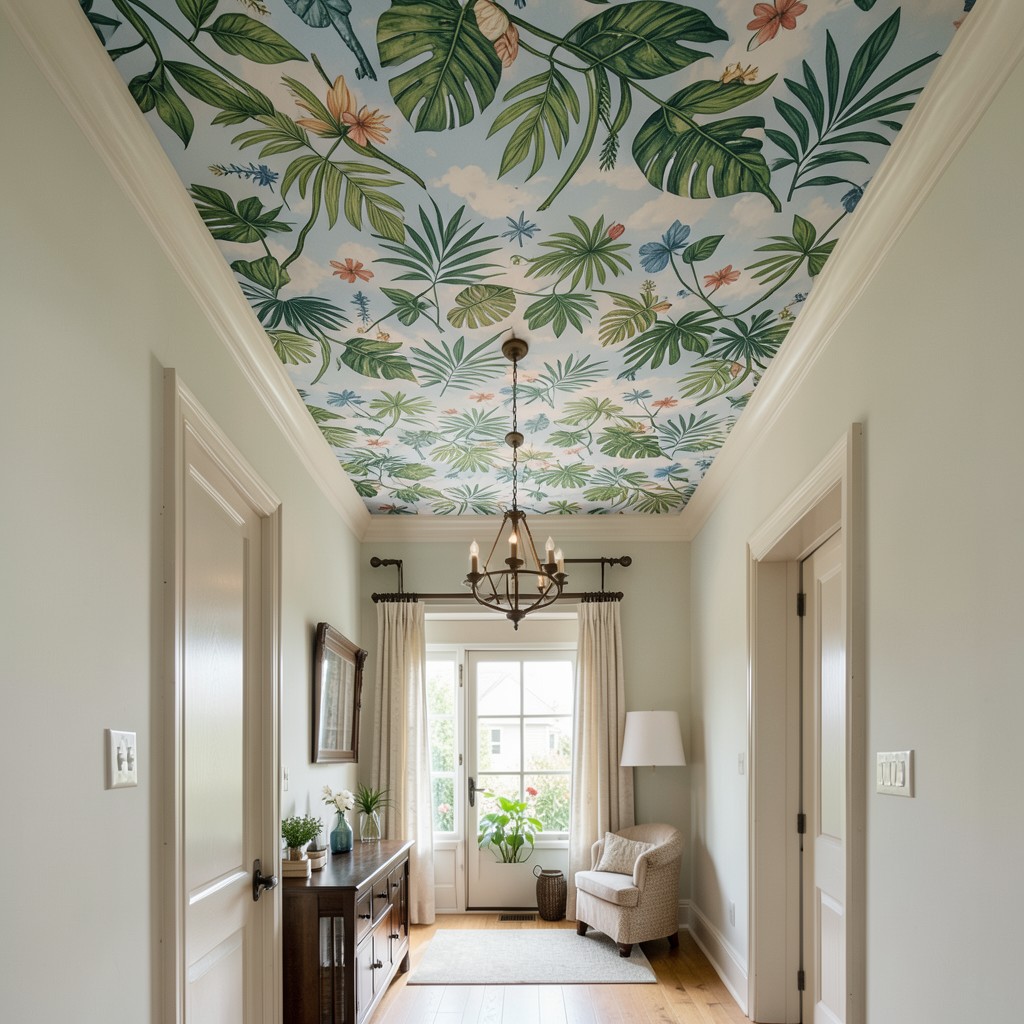
Wallpaper applied to the ceiling rather than the walls creates one of the most unexpected and memorable entry moments possible — the overhead surface is the one place in the room that arrives in peripheral vision first and registers as deliberate surprise rather than expected decoration. A ceiling covered in a botanical print, a geometric repeat, or a sky and cloud illustration turns the entry’s fifth wall into the room’s true focal point, making every other surface feel intentionally restrained by comparison. This approach suits entries where wall space is limited by doors, windows, and built-ins that leave no single wall large enough to anchor a bold pattern.
The pattern scale for a ceiling application should be considered differently than for a wall — a small repeat pattern on a ceiling can feel busy and disorienting, while a large-scale botanical or abstract print on the ceiling reads as expansive and dramatic. Garden-inspired interiors achieve their most complete expression with a large-scale leaf or tropical print on the ceiling, creating the impression of a canopy overhead that connects the interior to an outdoor, jungle-inspired home decor sensibility. Floral home decor ideas applied to the ceiling in a chinoiserie or botanical style suit traditional home interiors entries where the decorative excess reads as historically appropriate rather than fussy.
The ceiling wallpaper installation requires more precision than wall application because gravity works against the installer, and bubbles or misaligned seams are more visible on a horizontal surface viewed from directly below. Hiring a professional installer for the ceiling application preserves the pattern’s integrity and prevents the seam misalignment that undermines the dramatic effect the treatment is meant to achieve. Once installed correctly, a wallpapered ceiling requires no additional decoration in the entry — it is sufficient, complete, and genuinely unforgettable.
46. An Entryway With Mixed Metal Finishes

The rule that all metal finishes in a room must match belongs to a design era that has passed — contemporary home ideas, modern home design, and chic home decor have all embraced the deliberate mixing of metal finishes as a more sophisticated, collected approach than the uniformity of a single metal throughout a space. The key distinction between mixed metals that read as intentional and mixed metals that read as accidental lies in the ratio and the deliberateness — choosing two primary metals and allowing a third as an accent, then applying them consistently to specific categories of objects, creates a layered palette that feels designed.
Brass and black are the most common mixed metal pairing in current warm home decor ideas and modern home design contexts — brass on the mirror frame, door hardware, and light fixture arms, black on the hook rail, coat hooks, and boot tray brackets. The warm and cool contrast between the two metals creates the same visual tension that color mixing achieves, making each metal more interesting by the presence of the other. A third metal — a single object in brushed nickel, chrome, or copper — appears as an accent that reads as collected rather than designed, the piece that arrived from a different place and stayed because it belonged.
In a coastal home design or beach house interiors entry, the mixed metal approach might pair aged brass with natural iron or bronze, two warm metals that sit close together on the tonal scale but differ in texture and finish level — the aged brass polished to a soft glow, the iron left raw and slightly rough. This tonal proximity between the two metals creates sophistication without sharp contrast, and the overall effect reads as relaxed and warm rather than graphic and modern. Whatever metals the entry combines, applying them with consistency — the same metal on all hook hardware, the same metal on all light fixture components — creates cohesion even within the deliberate mixing strategy.
47. An Entryway With a Reading Nook Alcove
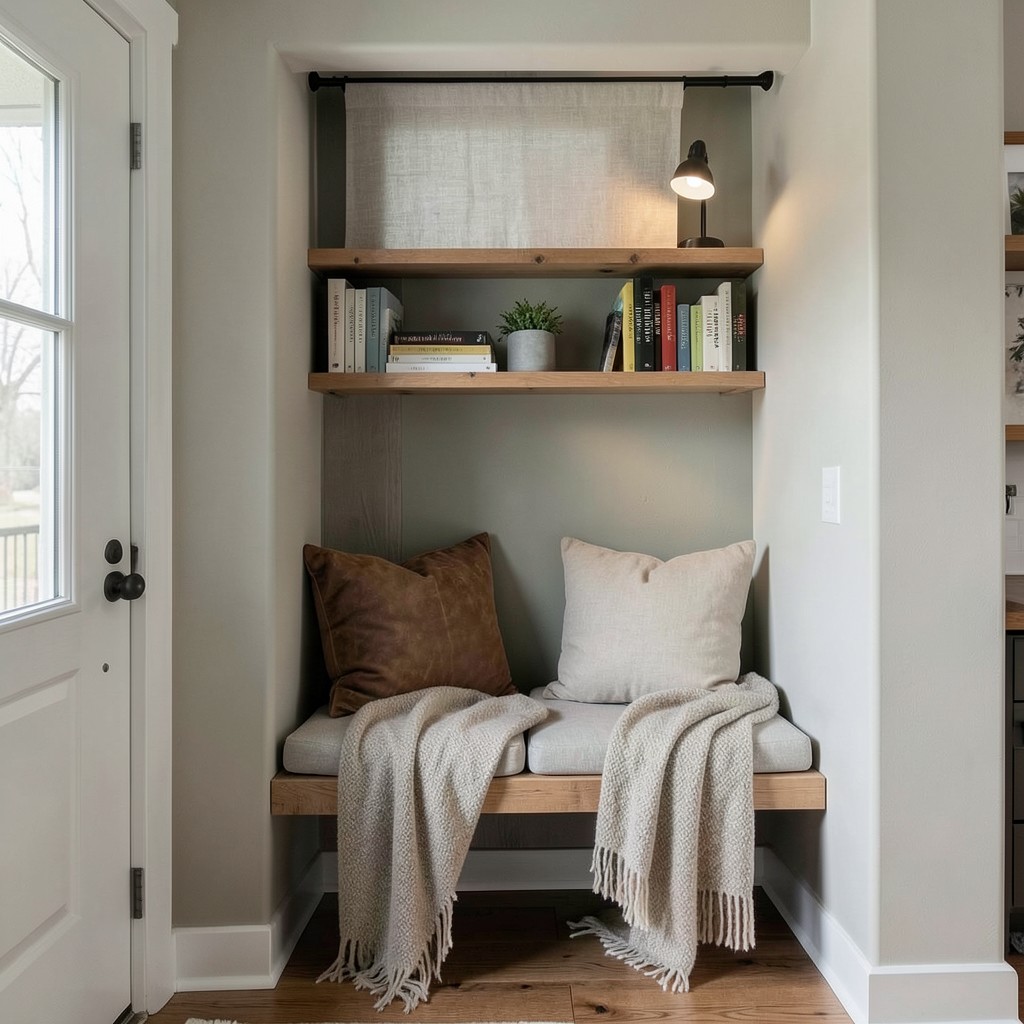
An entryway alcove — a recessed section of wall created by the home’s structural layout or deliberately framed during renovation — offers an opportunity to create a small reading nook that serves both the entry’s functional needs and the household’s desire for a quiet personal retreat near the home’s threshold. A bench cushion fitted into the alcove, two wall-mounted shelves above holding books and a small lamp, and a pull-down shade or curtain panel on a tension rod create a genuinely usable sitting space in what would otherwise be dead architectural space. The reading nook in the entry signals that the house values quiet and contemplation as much as it values hospitality and movement.
The alcove nook reads as cozy home design at its most intentional — the enclosed quality of a recessed space creates the sense of containment that makes reading nooks psychologically satisfying, the same principle that makes window seats and bay windows so persistently popular in residential design. Covering the nook’s back wall in a different paint color, a small-scale wallpaper, or a section of wood paneling differentiates the alcove from the surrounding entry and gives it the character of a room within a room. A rustic home office ideas aesthetic fits the reading nook perfectly, with a simple wood plank shelf, a worn leather cushion, and a clip-on reading light creating a functional, personal space that feels genuinely inhabited.
The nook’s textile choices determine its seasonal character — a linen cushion and a lightweight cotton throw create a breezy home interiors quality through spring home refresh and summer home design seasons, while a velvet cushion and a wool blanket produce the cozy bedroom design quality that makes the nook irresistible through fall home decorating and winter home decor months. Children in the household will claim the reading nook as their own regardless of the homeowner’s design intentions, which is the best possible indicator that the space has achieved its goal of being both beautiful and genuinely useful.
48. An Entryway With a Meaningful Collection on Display
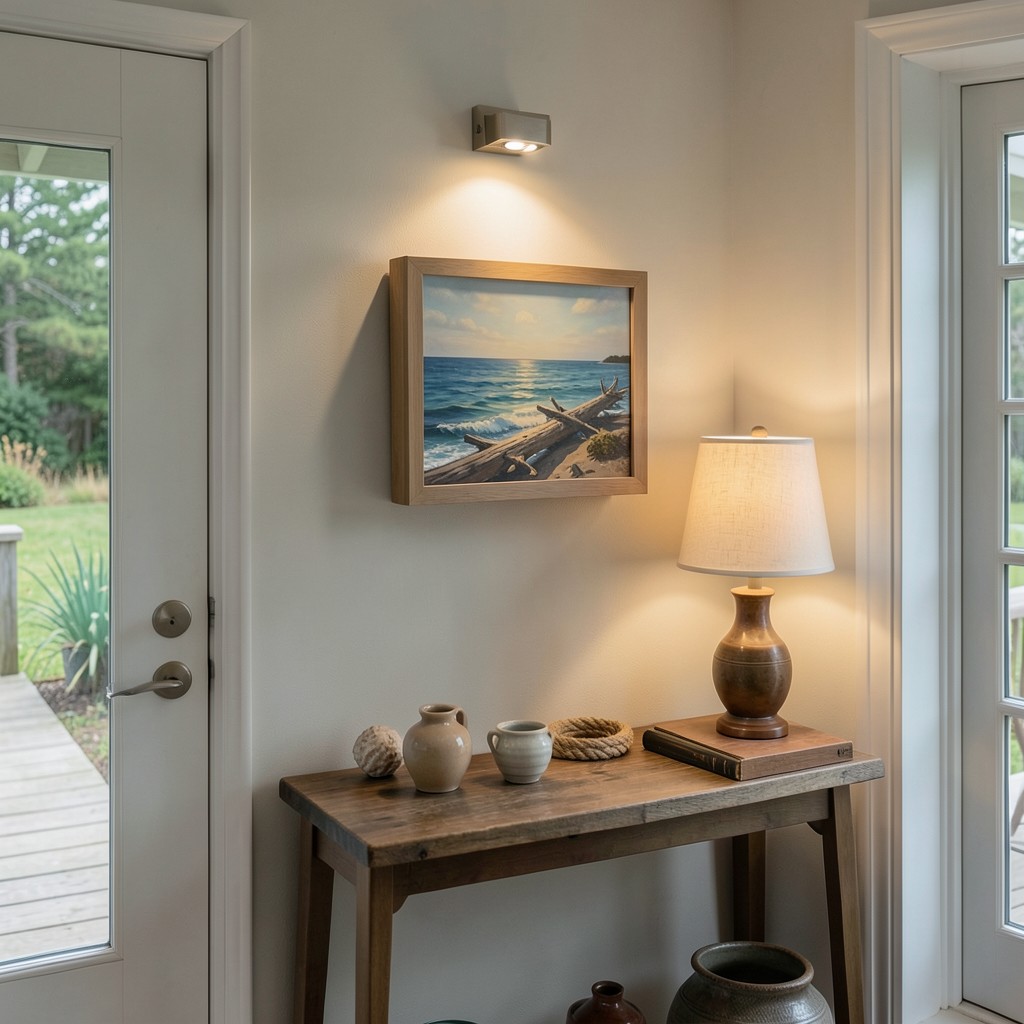
Every household accumulates objects with genuine personal significance — travel souvenirs, inherited pieces, handmade objects from friends, found natural objects — and the entry is the ideal room to display a small curated collection of these meaningful things because it is the first and last space every household member and every guest encounters. A collection displayed with intention reads as a portrait of the people who live in the house, more revealing and more interesting than any purchased decorative object could ever be. The collection need not be large or formally arranged — three to five objects on a console table, a shelf, or a small wall-mounted shadow box constitute a complete and powerful display.
The collection’s visual coherence comes from a shared quality among the objects rather than from matching materials or styles — a group of objects all connected to the sea, whether driftwood, shells, beach glass, a small painting of water, and a piece of rope, reads as a collection even though the materials are entirely different. This approach suits coastal home design and beach house interiors entries where the collection extends the outdoor environment indoors in a way that feels genuinely personal rather than themed. A collection of small ceramic vessels from different makers, different countries, and different periods reads as a collection through the shared form rather than through any other similarity.
Lighting the collection correctly is what separates a meaningful display from a cluttered shelf — a small picture light mounted above the arrangement, a directional recessed fixture angled to graze across the objects, or a small table lamp positioned beside the collection casts the objects in warm relief that makes each one appear considered and intentional. This lighting treatment is standard in luxury home interior design and elegant home styling, where the difference between a beautiful room and a merely attractive one often comes down entirely to how deliberately each surface and object is lit. The collection in the entry, lit with care, becomes the household’s self-portrait — specific, honest, and entirely impossible to replicate.
49. An Entryway With a Bold Color Drenching Technique

Color drenching — the practice of painting walls, ceiling, trim, and all architectural details in the same color or closely related tones — produces an entry that feels like a complete immersive environment rather than a decorated room, and the effect is particularly powerful in small entryways where the color wraps around the occupant from every direction simultaneously. The technique eliminates the visual interruptions created by contrasting trim and ceiling colors, making the room appear larger and more cohesive than its actual dimensions suggest. Choosing a color with enough depth and character to sustain this total commitment is the first and most important decision.
Deep, saturated tones perform best under the color drenching approach — a forest green that covers walls, ceiling, trim, and door reads as lush and enveloping, evoking the quality of a garden folly or conservatory in a traditional home interiors register, while the same forest green in a modern home design context reads as graphic and confident. A deep terracotta drenched entry connects to earthy home design, desert home styling, and Mediterranean influences, its warmth intensified by the color’s presence on every surface. A midnight navy drenching creates the kind of dramatic, jewel-box entry character that luxury home interior design clients request and that photographs more beautifully than almost any other treatment.
The finish level of the paint matters enormously in a drenched entry — a flat or matte finish on every surface, including trim where semi-gloss is traditionally used, creates a seamless, velvety effect where the color reads as completely unified. A higher sheen on the trim alone creates subtle differentiation between surfaces within the same color, adding depth and architectural interest without breaking the drenching effect. Warm home decor ideas approaches to color drenching finish with natural materials — a jute rug, a wooden console, a terracotta planter — that provide the neutral contrast the room needs without introducing a second color that would undermine the drenching’s immersive quality.
50. An Entryway With a Custom Monogram or House Number Feature

A monogram or house number transformed from a functional identifier into a designed feature gives the entry a finishing detail that reads as personal, commissioned, and complete — the kind of detail that distinguishes a genuinely considered home from one that is simply well-furnished. A large brass monogram letter mounted on the entry wall above the console table, a custom-cut steel house number mounted as a wall sculpture, or a hand-painted monogram on the inside of the front door all achieve the same goal through different material registers: they declare that this home belongs to specific people who made specific choices about its appearance. The custom detail makes the entry irreducibly personal.
The material and scale of the monogram or number feature determines which design conversation it joins — a large raw brass letter in a serif typeface suits traditional home interiors and elegant home styling, a blackened steel letter in a sans-serif face suits industrial home design and modern home design, and a hand-carved wooden initial in a natural finish suits farmhouse home decor and rustic home decor. The object’s scale should make it readable from the entry’s doorway, large enough to register as a deliberate feature rather than a small accessory that requires close inspection to identify. Positioning the feature at eye level on the wall facing the front door ensures it is the first distinct personal element the arriving guest encounters.
The monogram detail works equally well as a floor treatment — a custom brass or tile inlay in the entry floor’s center, or a painted monogram on a painted wood floor, creates a moment directly underfoot that announces the household’s ownership of the space with confidence and warmth. This floor treatment appears in traditional estate homes and luxury home interior design contexts as a marker of genuine commission and craft, and the revival of this treatment in contemporary home ideas reflects an appetite for permanence and personalization in spaces that often receive only generic treatment. Whatever form the monogram or house number feature takes, it completes the entry’s design story by making the one statement that no amount of furniture, art, or lighting alone can make — that this specific home belongs to these specific people, and it was made for them.
Leave a Reply