
The patio is the most underestimated room in the house. It sits right outside the back door, receives full sunlight, catches the evening breeze, and offers every condition for an exceptional living experience — and most people cover it with a plastic table and two chairs that wobble on uneven concrete. Then they wonder why they never actually go out there. The problem is never the space. The problem is that the space was never treated like a room.
A well-designed patio changes the entire rhythm of a household. It extends the home’s usable square footage in a way that no interior renovation can replicate at comparable cost, and it does something even more valuable than that — it pulls people outdoors. Children migrate to it without being asked. Adults linger there long after dinner is finished. Guests gather around the table and stay until the sky goes dark. That behavior does not happen by accident. It happens because the space was designed to earn it.
The gap between a patio that gets used and one that collects leaves is entirely a design problem. Patios that work have a defined floor, an overhead structure for shade or weather protection, furniture scaled correctly to the space, lighting that extends usability into evening, and material choices that respond honestly to the climate they live in. Patios that fail are spaces where each of those decisions was either avoided or made without thought. The difference in outcome is dramatic, and the difference in effort is smaller than most homeowners assume.
This article covers fifty patio design ideas drawn from the full spectrum of outdoor living possibilities — from small urban terraces that need every square foot to work harder than it appears, to generous suburban backyard spaces where the opportunity is simply to organize the potential that already exists. Some ideas work naturally in coastal home design climates where outdoor living is a year-round practice. Others address the concentrated seasonal window of mountain cabin decor settings, where every warm day carries extra weight and the design must make the most of a short calendar. Several ideas approach the challenge from a budget-first perspective, showing how to achieve the layered quality of luxury home interior outdoor spaces without the price tag that phrase usually carries.
The design directions in this collection span modern home design, rustic home decor, farmhouse home decor, minimalist home design, bohemian home styling, Scandinavian home interior tradition, earthy home design, and the entire range of coastal outdoor living space aesthetics. What connects all fifty ideas is a single underlying conviction: the patio is a room, and it deserves to be designed like one. When you give it the same intentional attention you give the spaces inside your house — a real floor treatment, a considered overhead plane, deliberate lighting, and furniture that fits — it becomes the room you use more than any other. Start with the idea that solves your most immediate problem, and build from there.
1. A Patio With a Defined Outdoor Rug

The single fastest way to transform a bare concrete or paver patio into a space that reads as designed is to lay an outdoor rug beneath the seating area. Without a rug, even well-chosen furniture sits in open space without a visual anchor, and the arrangement looks temporary rather than intentional — like chairs placed while waiting for a decision to be made rather than a room where sitting is the whole point. A rug defines the territory, signals a specific purpose for the space, and immediately bridges the gap between unfinished and composed.
Outdoor rugs manufactured today handle UV exposure, rain, and heavy foot traffic without fading or deteriorating through a single season. Polypropylene flat-weave options offer patterns that rival interior rugs — bold stripes, global geometrics, and naturalistic textures that work as naturally in coastal home design settings as they do in earthy home design contexts. The rug’s pattern becomes the patio’s foundational design element, and every furniture and accessory choice builds on top of that foundation rather than competing with it.
Size is the variable most homeowners underestimate — a rug that fits only beneath the coffee table while sofa legs float on bare pavement creates the opposite of the grounded, room-like quality the rug is supposed to achieve. All front legs of every seating piece should sit on the rug, and the ideal sizing extends at least twelve inches beyond the furniture’s outer edges on every side. Rotating seasonal rugs — a tropical print for summer home design, a warm plaid for fall home decorating, a clean neutral stripe for spring home refresh — is among the most affordable ways to keep the patio feeling current without changing a single piece of furniture.
2. A Patio With a Pergola for Overhead Structure

A patio without an overhead structure is fundamentally incomplete, and most homeowners who rarely use their outdoor space discover, when they think honestly about it, that the reason is exposure rather than any other factor. The open sky above an unshaded patio creates a sense of vulnerability rather than comfort, and people do not naturally linger in spaces that feel unprotected. A pergola resolves this problem with permanent architecture that transforms the patio from a surface into a room.
A pergola’s open rafter or lattice structure provides meaningful shade while preserving the breezy home interiors quality that makes outdoor living distinct from sitting inside. The overhead framework creates psychological enclosure — the sense of a ceiling without the weight of one — and gives the space the room-like character that earns extended use. Climbing plants like wisteria, jasmine, or bougainvillea trained across the rafters add seasonal beauty and additional shade density that shifts organically through the year, giving the patio a living ceiling that changes with every season.
The pergola’s material determines its design register: a raw cedar or Douglas fir pergola suits farmhouse home decor and rustic home decor settings naturally, while a painted white or black steel pergola fits modern home design and contemporary home ideas contexts. Stone and wood home design palettes benefit from a rough-hewn timber pergola set on stone columns, a combination that reads as permanent and deeply considered. Adding a ceiling fan to the pergola’s center beam extends the patio’s comfortable use into the hottest weeks of summer home design season, solving the heat problem that shade alone does not fully address.
3. A Patio With String Lights for Evening Ambiance

The hours between sunset and full dark are the most beautiful outdoor hours of the day, and a patio without deliberate evening lighting surrenders all of them. Natural light fades fast, and a space that has no lighting plan becomes unusable the moment the sun drops below the fence line — which, in the seasons when outdoor living matters most, happens earlier than anyone wants. String lights solve this problem with a warmth and character that no floodlight or wall-mounted fixture can replicate.
Warm-white Edison-style string lights draped across a pergola, strung between fence posts, or hung in a canopy above the seating area create an evening atmosphere that reads as genuinely magical rather than artificially bright. The amber glow of incandescent or warm-LED string lights flatters every person and every object they illuminate, making the food look better, the drinks look warmer, and the conversation feel more intimate. This quality of light is what turns a functional patio into the kind of space people talk about long after the evening ends.
The installation approach shapes the effect entirely — a tight, uniform grid of string lights across a pergola ceiling reads as chic home decor and elegant home styling, while lights looped loosely in organic curves between posts reads as relaxed home design and bohemian home styling. Pairing string lights with a dimmer switch or a smart plug with a timer app extends their usefulness and allows the light level to shift from a bright, active dining setting to a softer, quieter ambient glow for late-evening conversation. Solar-powered string light options eliminate the need for outdoor electrical outlets and perform well enough in direct-sun installations to last through a full evening without dimming.
4. A Patio With a Built-In Outdoor Kitchen

An outdoor kitchen changes the patio’s identity from a place where you eat what was cooked inside to a place where the cooking is part of the experience. The ritual of grilling, the smell of food on an open flame, and the gathering that happens naturally around a cooking station when guests watch the food being made — none of that is available on a patio where the cooking happens somewhere else and only the eating happens outside. The built-in outdoor kitchen brings the full experience of a meal together in one place.
A well-built outdoor kitchen includes a built-in grill or smoker as its anchor, flanked by weather-resistant countertop surface on both sides for prep and plating. Stone and wood home design outdoor kitchens pair a natural stone counter with a stainless steel grill housing, producing the material combination that reads as both durable and considered. A side burner, an under-counter refrigerator, and a small sink extend the outdoor kitchen’s functionality to the point where the indoor kitchen becomes genuinely optional for any meal that doesn’t require an oven, and that range of outdoor cooking capability makes the patio the household’s primary summer home design gathering hub.
The counter material determines the outdoor kitchen’s maintenance commitment — natural granite and quartzite perform exceptionally well outdoors in most climates, requiring only sealing once per year to remain stain-resistant and structurally sound. Poured concrete counters suit the industrial home design aesthetic and develop a patina with use and weather that becomes a design feature rather than a flaw. Covering the outdoor kitchen with a dedicated overhead structure, whether a pergola extension, a solid patio cover, or a purpose-built outdoor kitchen pavilion, protects the appliances and surfaces and allows cooking to continue through light rain, which in practical terms extends the outdoor kitchen’s usable season by several months on either side of summer.
5. A Patio With a Fire Pit as the Central Feature

The fire pit earns its place as the patio’s central gathering feature through one quality that no other outdoor element possesses: it changes the temperature and the atmosphere of the space simultaneously, making it usable on cool evenings when an unconditioned patio would otherwise sit empty. A fire pit extending the patio season from a narrow summer window to a broader range that reaches from early spring through late fall is not a trivial benefit — in most climates, that expansion nearly doubles the number of days the outdoor space is genuinely used.
A round fire pit placed at the center of a circular seating arrangement creates the campfire social geometry that human beings respond to instinctively — everyone faces the fire, everyone faces each other, and the conversation that emerges has a quality distinct from what happens around a rectangular dining table. This arrangement suits relaxed home design and bohemian home styling equally, and it works as naturally in a rustic home decor backyard with rough stone paving as it does in a minimalist home design setting with clean concrete pavers and low-profile seating. The fire pit’s material — cast iron, corten steel, stacked stone, or poured concrete — should connect to the patio’s broader material palette rather than arriving as an unrelated object.
Built-in fire pits integrated into raised paver platforms or stone surrounds become permanent landscape features that read as architectural rather than portable, and the permanence signals to guests that this space was designed for long evenings rather than occasional use. Gas-fed fire pits offer the convenience of instant ignition and flame control that wood-burning pits cannot match, which in practical terms means the fire happens more often because the barrier to starting it is lower. Surrounding the fire pit with deep, comfortable seating — wide-arm Adirondack chairs, curved sectional pieces, or low-slung floor poufs in outdoor-rated fabric — completes the cozy home design effect that makes the fire pit area the place everyone wants to be as the evening cools.
6. A Patio With Lush Potted Plants and Greenery

A patio furnished without plants is a patio that feels like a room without walls — the furnishings are present but the space lacks the life and layering that distinguish a genuinely outdoor room from furniture set on concrete. Plants bring the one quality no manufactured material can replicate: actual growing, changing, living organisms that respond to season, light, and care in ways that make the patio feel actively tended rather than simply installed. The presence of healthy plants communicates that someone pays attention to this space.
Large statement containers positioned at the patio’s corners or flanking the entry points provide the structural planting that establishes the garden-inspired interiors quality outdoor rooms need. A wide terracotta pot holding an olive tree, a square zinc planter growing a tall ornamental grass, or a concrete bowl supporting a cascading rosemary plant each function as both living decoration and architectural element, defining the patio’s edges and scale in the way built structures do. Tropical home design patios maximize the lushness of large-leafed tropicals — elephant ears, canna lilies, bird-of-paradise — in oversized glazed pots that make the seating area feel genuinely immersive.
Seasonal container planting rotations keep the patio connected to the natural rhythm outside its edges — spring home refresh brings tulip bulbs, daffodils, and violas in cool-toned pots, summer shifts to herbs, dahlias, and lush annuals, fall home decorating introduces ornamental kale, mums, and pumpkins in warm-toned containers, and winter home decor season keeps the patio alive with evergreen boughs, holly, and white lights woven through the containers. This rotating practice costs relatively little per season but creates a patio that always looks freshly considered. Floral home decor ideas translate naturally to the outdoor container garden, where a mix of texture, color, and form produces the layered visual complexity of a designed garden without requiring in-ground planting beds.
7. A Patio With a Water Feature

The sound of water does something to outdoor spaces that no other design addition replicates — it creates a continuous ambient layer that masks street noise, neighboring conversations, and the low-frequency urban background hum that urban and suburban patios absorb from every direction. A water feature is not merely a decorative object. It is an acoustic tool that makes the patio feel quieter, more private, and more genuinely removed from the surrounding environment than the actual physical distance between the patio and the street would suggest.
A freestanding fountain in natural stone, cast concrete, or glazed ceramic suits patios of almost any size, requiring only a standard outdoor electrical outlet for the recirculating pump and a flat, stable surface for installation. The fountain’s style should respond to the patio’s design language — a tiered classical fountain suits traditional home interiors garden aesthetics, a simple sphere or basin-style fountain fits minimalist home design and modern home design, and a rough-carved basalt fountain suits earthy home design and stone and wood home design palettes. The sound produced by different fountain configurations varies from a gentle trickle to a more generous pour, and selecting the sound intensity that complements the patio’s scale prevents the fountain from overwhelming conversation at the scale of a small terrace.
Built-in water features integrated into retaining walls, patio borders, or garden beds become permanent landscape architecture that dramatically increases the property’s design quality and perceived value. A wall-mounted water blade — a thin sheet of water falling from a horizontal slot into a basin below — suits contemporary home ideas and industrial home design outdoor spaces with clean lines and precise material application. Surrounding the water feature with moisture-loving plants like ferns, hostas, or creeping jenny creates the lush, jungle-inspired home decor quality that makes the water feature feel embedded in its environment rather than placed on top of it.
8. A Patio With a Daybed or Outdoor Lounger

The daybed on a patio communicates something specific about how the household values outdoor time — not just as a setting for meals and gatherings, but as a genuine place for rest, reading, afternoon napping, and the kind of horizontal relaxation that indoor life often fails to accommodate properly. A patio with a daybed tells guests and household members alike that outdoor living here means more than sitting upright over food and drink. It means actually being in the space, unhurried, for as long as the afternoon allows.
An outdoor daybed framed in teak, powder-coated aluminum, or wrought iron and cushioned with weather-resistant foam in an outdoor-rated fabric provides a sleeping-quality comfort that standard patio chairs never approach. Deep, wide cushions in natural linen, striped canvas, or a solid neutral in an outdoor performance fabric suit coastal home design and breezy home interiors settings, where the daybed positioned to catch the prevailing breeze becomes the most sought-after seat on the property. Adding a light canopy on a simple steel frame above the daybed creates shade, privacy, and the four-poster quality that makes the outdoor daybed feel like a genuine retreat rather than simply a long chair.
Placement determines the daybed’s success — positioned facing the garden, the tree line, or the water view, the daybed orients the person lying on it toward the most compelling outdoor prospect available. A daybed tucked into a partial enclosure — beneath a pergola, in the corner where two walls meet, or between two large container plants — creates the sense of a room-within-a-room that makes outdoor rest feel sheltered rather than exposed. Throw pillows in a mix of textures and scales, a small side table for a glass of water and a book, and a lightweight outdoor blanket complete the setup and turn the daybed corner into the most peaceful home decor moment the property offers.
9. A Patio With an Outdoor Dining Table for Alfresco Meals

Eating outside changes the quality of a meal in ways that have nothing to do with the food itself. The same dinner that would be ordinary at an indoor table becomes something different when it happens under open sky, with natural light at the right angle, and the ambient sensory layer of outdoors wrapping the experience. Outdoor dining is not a compromise for when the interior table is occupied — it is a distinct and genuinely superior experience when the space and the table are designed to support it properly.
A dining table sized correctly for the patio’s scale and the household’s typical gathering number is the anchor around which every other patio decision should orbit. A table that seats eight on a patio designed for four creates a sense of overscale that makes the space feel cramped; a table for four on a patio that can hold twelve creates a sense of underfill that makes even a full table feel sparse. Natural teak or eucalyptus wood dining tables suit farmhouse home decor and rustic home decor outdoor settings with warmth and material honesty, aging over time to a silver-gray patina that becomes more beautiful than the original finish. Powder-coated steel or cast aluminum tables suit modern home design and contemporary home ideas patios with their precision of line and color stability through weather extremes.
Lighting the dining table correctly is what separates a patio that hosts dinner from a patio that hosts an experience. A pendant hung from the pergola directly above the table, a cluster of hanging lanterns at staggered heights, or a string light canopy pulled tight above the dining area creates the intimate, restaurant-quality ambiance that turns a meal into an occasion. During summer home design season this lighting becomes the household’s primary entertaining infrastructure, carrying dinner parties from dusk through the full evening with the kind of warm, flattering light that no indoor dining room achieves without significant investment in a dedicated chandelier and a skilled electrician.
10. A Patio With a Privacy Screen or Living Wall

Privacy is the most practically important and most consistently overlooked element in patio design. A patio that feels exposed to neighbors, to the street, or to adjacent upper-story windows is a patio that its owners use differently — more self-consciously, more briefly, and less freely — than one that feels genuinely enclosed and personal. The exposed patio is always operating under a low-level awareness of being visible, and that awareness changes the behavior of the people in it whether they consciously acknowledge it or not.
A privacy screen constructed from cedar or redwood boards, laser-cut corten steel panels, powder-coated aluminum sections, or woven willow and bamboo home interiors materials creates immediate enclosure that transforms the patio’s psychological character. The screen’s material should respond to the property’s existing architecture — a cedar slat screen suits a wood-framed house with farmhouse home decor sensibilities, a corten steel panel suits an industrial home design exterior, and a painted concrete block screen suits a stucco or masonry home. The screen need not enclose the entire perimeter to be effective; a single well-placed panel that blocks the primary sight line from the neighboring property creates a meaningful sense of privacy without boxing the patio into a fully enclosed courtyard.
A living wall of climbing plants on a trellis or wire panel system provides privacy that improves over time as the plants fill in, creating a green screen that suits garden-inspired interiors and bohemian home styling with its lush, organic quality. Climbing hydrangea, climbing roses, star jasmine, and English ivy all perform well on vertical support structures and provide seasonal variation — flowering beauty through spring and summer, turning color through fall, and a structured branching form through winter home decor season. The combination of a structural screen and a planted layer in front of it creates both immediate and long-term privacy, giving the patio privacy on day one while the living layer develops the full richness it will eventually provide.
11. A Patio With a Sectional Sofa for Relaxed Seating

The sectional sofa is the furniture piece that shifts a patio’s function from formal outdoor dining to genuine outdoor living room, and that shift is significant. A patio organized around a dining table invites eating. A patio organized around a sectional sofa invites lingering, conversation, afternoon reading, and the casual, unscheduled use that makes an outdoor space feel like a real extension of the home rather than a venue reserved for meals. The sectional redefines what the patio is for.
Outdoor sectionals manufactured with weather-resistant aluminum or powder-coated steel frames and cushions upholstered in solution-dyed acrylic fabrics handle sun, rain, and humidity without deteriorating through multiple seasons. Deep seating dimensions — cushion depths of twenty-four inches or more — produce the relaxed, sink-into-it comfort that reads as cozy home design and relaxed home design rather than the upright, alert posture of standard patio dining chairs. Sectionals in warm neutral fabrics — linen-look beige, warm white, or natural gray — suit summer home design, beach house interiors, and coastal outdoor living space contexts with the same ease they suit farmhouse home decor and traditional home interiors settings.
Styling the sectional with outdoor throw pillows and a lightweight outdoor throw blanket gives the seating arrangement the layered, dressed quality of an indoor living room brought outside. Pillows in patterns that reference the season — florals for spring, bold stripes for summer, warm earth tones for fall home decorating, plaid for winter home decor — keep the patio looking actively maintained without requiring any furniture change. A low outdoor coffee table centered in the sectional arrangement, scaled to allow comfortable reach from the seating without forcing anyone to lean, completes the living room composition and gives the patio the functional completeness that earns daily use.
12. A Patio With Concrete Pavers in a Geometric Pattern

The floor beneath a patio is doing more design work than most homeowners credit it for, and the choice of paving material and pattern shapes the space’s entire character from the ground up. Poured concrete slabs read as utilitarian unless broken by a joint pattern or surface finish. Standard square pavers in a running bond create a background that neither distracts nor contributes. Concrete pavers laid in a deliberate geometric pattern — a herringbone, a basket weave, a pinwheel, or a large-format grid with contrasting inset tiles — turn the floor into the patio’s primary design feature.
Large-format concrete pavers in twenty-four-by-twenty-four-inch or twenty-four-by-forty-eight-inch sizes suit modern home design and minimalist home design patios with their scale and precision, creating a floor that reads as expansive and considered. Smaller pavers in a herringbone or basketweave pattern suit farmhouse home decor and traditional home interiors settings, their pattern’s complexity and historical resonance connecting the patio to architectural traditions that predate any contemporary design trend. Pavers with a lightly brushed or exposed aggregate surface provide better grip in wet conditions than smooth-finished alternatives, which in practical terms makes them the safer choice for patio floors that are also pool surrounds or outdoor kitchen adjacencies.
The joint width between pavers and the joint filler material shape the final appearance considerably — tight joints filled with polymeric sand read as precise and formal, while wider joints planted with low-growing ground covers like thyme, moss, or corsican mint read as garden-inspired interiors and relaxed home design. This planted joint approach suits patios in earthy home design and bohemian home styling contexts where the boundary between hardscape and planted garden is deliberately blurred rather than clearly defined. The planted joint also softens the visual mass of a large paved surface, preventing the patio from reading as a parking lot dressed with furniture.
13. A Patio With a Shade Sail for Modern Sun Protection

A shade sail offers a modern home design alternative to the traditional pergola that suits spaces where a fixed structure is either impractical or architecturally incongruent. The shade sail’s angled, tensioned geometry creates a visual dynamic that a flat pergola roof cannot — the sail’s taught diagonal pulls the eye across the sky above the patio and creates a sense of movement and lightness that suits contemporary home ideas and minimalist home design settings. It is one of the few functional shade solutions that is also, independently, an interesting design object.
Shade sails are available in triangular and rectangular formats in high-density polyethylene fabric that blocks between eighty and ninety-five percent of UV radiation while allowing air to pass freely beneath, preventing the heat trap that solid patio covers create. The color of the sail fabric is a genuine design decision — a warm terracotta or sand-colored sail suits desert home styling and earthy home design palettes, a deep charcoal sail suits modern home design and industrial home design, and a bright white sail suits coastal home design and beach house interiors settings. Multiple overlapping sails in the same or complementary colors create more complete coverage and a more architecturally dramatic overhead installation than a single large sail achieves.
The hardware points that anchor the shade sail — wall-mounted steel brackets, free-standing steel posts, or existing tree trunks — must be engineered for the tension load the sail places on them, particularly in climates where afternoon wind adds dynamic load to the static tension of the sail. Stainless steel hardware in a brushed or matte finish reads as finished and intentional rather than structural and utilitarian. Lowering and storing shade sails during winter home decor season or during high-wind weather events extends their lifespan significantly, and most shade sail manufacturers provide storage bags sized for the sail that make this seasonal practice quick and easy.
14. A Patio With a Container Herb Garden

The container herb garden on a patio is one of the most practical design additions possible — it is beautiful, it is useful, it smells extraordinary on a warm afternoon, and it gives the space a connection to daily domestic life that purely decorative planting never achieves. Reaching from the patio dining table to clip fresh basil for the pizza, or snipping rosemary into the cocktail before handing it to a guest, integrates the outdoor space into the household’s actual daily rhythms in a way that no ornamental plant arrangement does. The herb garden earns its place through usefulness as much as through beauty.
A collection of herbs in matching terra cotta pots arranged on a tiered plant stand creates a vertical garden quality that suits garden-inspired interiors and farmhouse home decor settings with equal ease. Basil, thyme, oregano, chives, mint in a container of its own to contain its spread, flat-leaf parsley, and a rosemary topiary standard provide the full culinary herb range in a collection that, when arranged thoughtfully, reads as a designed planting installation rather than a utilitarian pot collection. Warm home decor ideas approaches to container herb gardens choose pots with tonal variation — a mix of aged terracotta, cream-glazed ceramics, and raw concrete — that creates a cohesive palette while avoiding the matched uniformity that reads as decorative rather than genuinely gardened.
The summer home design season is peak season for the container herb garden, when warmth and sunlight drive vigorous growth that requires regular harvesting to prevent bolting. That regular harvesting is itself part of the outdoor living experience — the interaction with the plants, the scent on your hands, the direct connection between the patio and the meal being prepared. Replacing bolted herbs mid-summer and refreshing the collection with cool-season herbs like cilantro and parsley through the fall home decorating season keeps the herb garden productive and visually fresh from first warmth through the last weeks before frost.
15. A Patio With an Outdoor Bar Cart or Beverage Station

The outdoor bar cart or built-in beverage station solves a practical problem that every patio hosting situation generates — the repeated trips inside to refill drinks, retrieve ice, or locate the bottle opener that disappeared between the first and second round of cocktails. Every one of those trips interrupts a conversation, breaks the outdoor flow, and reminds everyone that the patio is not quite as self-sufficient as it should be. A dedicated outdoor beverage station eliminates the problem entirely and, in doing so, makes the patio feel genuinely complete.
A weather-resistant bar cart in powder-coated steel or teak with a lower shelf for bottles, a small ice bucket station, and a surface for glasses and garnishes constitutes a complete outdoor bar setup in a portable format that can move to wherever the party has migrated. For permanent outdoor bars, a built-in station in the outdoor kitchen island with an undercounter refrigerator, a dedicated bar sink, and open shelving for glassware and spirits creates a hospitality setup that matches the quality of any interior home bar. Chic home decor outdoor bars in polished brass hardware and marble-look concrete counter suit elegant home styling settings, while industrial home design patios pair the bar station with raw steel shelving, exposed concrete, and matte black fixtures.
Styling the bar station with seasonal intention keeps it connected to the patio’s broader decorating approach — summer home design brings citrus, fresh herbs, and colorful glassware to the bar surface, while fall home decorating introduces amber-toned decanters, cinnamon sticks, and warm-toned ceramic mugs for hot drinks. A small plant on the bar surface — a potted mint, a trailing ivy, or a compact succulent — adds the living quality that elevates the station from a functional object to a designed vignette. The bar station that looks good, works efficiently, and stays stocked for the household’s preferred outdoor entertaining style becomes one of the most frequently used features on the entire patio.
16. A Patio With Tropical Plants for a Lush Atmosphere

Tropical planting on a patio creates an immersive quality that no other planting approach achieves — the broad, dramatic leaves of tropical specimens create a visual density and a sense of enclosure that makes the patio feel like an outdoor room rather than an open space with furniture in it. This effect is not exclusive to warm climates. Large tropical plants in oversized containers can be brought outdoors for the warm season and moved to a sheltered indoor location through winter, extending the tropical patio aesthetic to climates where these plants could never survive year-round outdoors.
Elephant ears in a large glazed container, bird-of-paradise in a concrete planter, canna lilies in a massed grouping, and a potted banana plant at the patio’s corner create the layered tropical canopy that defines tropical home design outdoor spaces. The key to making tropical container planting read as designed rather than collected is scale — the containers must be large enough to support the plants’ mature size, and the plants must be allowed to reach their full proportions rather than being replaced while still small. A bird-of-paradise plant in a twenty-four-inch concrete bowl with its full six feet of height and broad, arching leaves is a sculptural element that anchors the patio as definitively as any built structure.
The contrast between tropical planting and a clean, minimalist patio surface creates the graphic tension that makes tropical home design and jungle-inspired home decor so visually compelling — a precise concrete patio with clean geometric pavers becomes infinitely more interesting when dramatic tropical foliage overhangs its edges and fills its corners. This contrast is the same principle that makes Scandinavian home interior design’s plant-styling tradition so effective: hard, precise architecture softened by living, organic form. Bamboo home interiors aesthetics translate naturally to the outdoor patio through bamboo plant clusters in large containers, their vertical canes and rustling leaves adding both height and sound to the tropical composition.
17. A Patio With Built-In Bench Seating Along the Perimeter
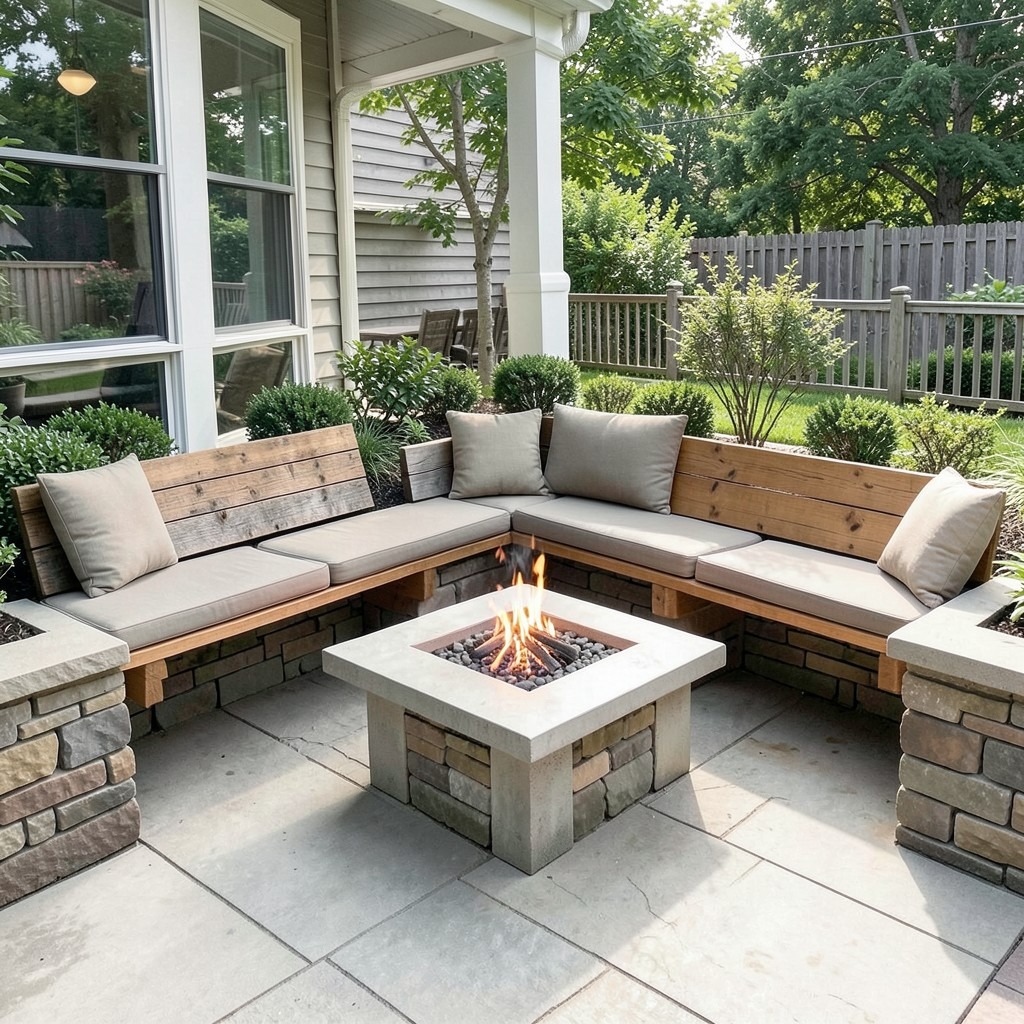
Built-in bench seating along the patio’s perimeter walls or raised planter edges solves one of outdoor entertaining’s most persistent problems: there is never enough seating when it matters. Movable chairs disappear into the house, the garage, and the neighbors’ yards over the course of a season, and pulling them back together for a gathering takes time and reveals gaps in the collection. Built-in benches cannot disappear. They are always there, always complete, and always ready.
A concrete or stone bench built into the top of a retaining wall or raised planter creates a dual-purpose structure that provides both planting space and seating without requiring a square inch of additional patio floor space for furniture. The bench surface can be left as bare stone or concrete for a minimal, modern home design aesthetic, or cushioned with weather-resistant outdoor cushions in a fabric that suits the patio’s broader palette. Farmhouse home decor built-in benches use rough-sawn cedar or reclaimed wood planks set on stone or concrete supports, their material honest and warm against the patio’s harder surfaces.
The addition of a back cushion or a railing behind built-in bench seating transforms what would otherwise be a perch into genuinely comfortable long-duration seating, the kind of seat someone stays in for two hours rather than fifteen minutes. Built-in benches along two adjacent walls of a corner patio create an L-shaped seating arrangement that faces a central coffee table or fire pit, generating the intimate gathering geometry that makes outdoor socializing feel relaxed and easy. This arrangement suits cozy home design settings particularly well, where the slight enclosure created by the right-angle bench configuration creates a social warmth that open-faced furniture arrangements rarely achieve.
18. A Patio With an Outdoor Rug and Matching Throw Pillows

The coordination between an outdoor rug and throw pillows on the patio furniture creates the same layered, finished quality that textile coordination creates in an indoor living room — the repetition of a color, a pattern, or a texture across both the floor and the seating produces visual coherence that reads as designed rather than assembled. This is the principle that distinguishes a patio that has furniture from a patio that has been decorated, and the distinction is visible from across the yard.
An outdoor rug in a geometric pattern with terracotta, white, and navy tones, paired with throw pillows that pull each of those three colors individually across the sofa cushions, creates a color dialogue between floor and seating that ties the entire arrangement together. The pillows do not need to match the rug pattern — they only need to share one or two of the rug’s tones to create the connection. This approach suits modern home design, coastal home design, and contemporary home ideas settings equally, because the principle of textile coordination is stylistically neutral even while the specific colors and patterns reflect a particular aesthetic.
Seasonal pillow rotation is the fastest and most affordable seasonal home makeover tool available for the patio. Changing from bright, saturated summer home design pillow tones — coral, turquoise, citrus — to the richer, warmer tones of fall home decorating — deep rust, olive, burnt amber — updates the patio’s entire feeling without touching the furniture, the rug, or any other element. Spring home refresh pillow swaps bring soft blush, sage, and pale yellow onto the patio, carrying the season’s color story outside as effectively as fresh tulips do inside. This rotating textile practice costs less than any other patio update and delivers the most visually immediate result.
19. A Patio With Landscape Lighting for Drama After Dark

Landscape lighting does for a patio at night what the sun does for it during the day — it makes the space visible, beautiful, and usable. Without lighting, a patio ceases to exist at dusk from a practical standpoint, and that elimination of the evening hours represents a significant loss in the total usable time the space offers. Good landscape lighting does not simply illuminate the space; it sculpts it, highlighting the features worth seeing while letting the uninteresting edges of the property recede into the dark.
Uplighting a specimen tree or a large architectural plant at the patio’s edge from a low-voltage fixture buried at its base creates a dramatic silhouette effect that reads as professionally designed and adds visual depth to the patio’s nighttime environment far beyond what the fixture’s modest cost would suggest. Path lighting along the patio border and the steps from the house provides safety and defines the outdoor room’s edges after dark. Well lights recessed flush into the patio surface to illuminate steps, walls, or the patio’s perimeter edge provide the architectural layer of lighting that separates luxury home interior outdoor spaces from ordinary ones.
The lighting system’s color temperature determines the patio’s evening character — bulbs rated at 2700K produce the warm amber glow that flatters people and materials, creating the inviting, intimate atmosphere that makes outdoor dining feel special. Cooler bulbs at 4000K or above read as task lighting rather than hospitality lighting and create a clinical quality in an outdoor setting that undermines the relaxed, peaceful home decor atmosphere the patio should deliver at night. Smart outdoor lighting systems controlled by app or voice allow the homeowner to program different lighting scenes for dining, entertaining, and quiet evening use, giving the same physical installation multiple emotional registers depending on the moment’s need.
20. A Patio With a Mosaic Tile Accent Wall
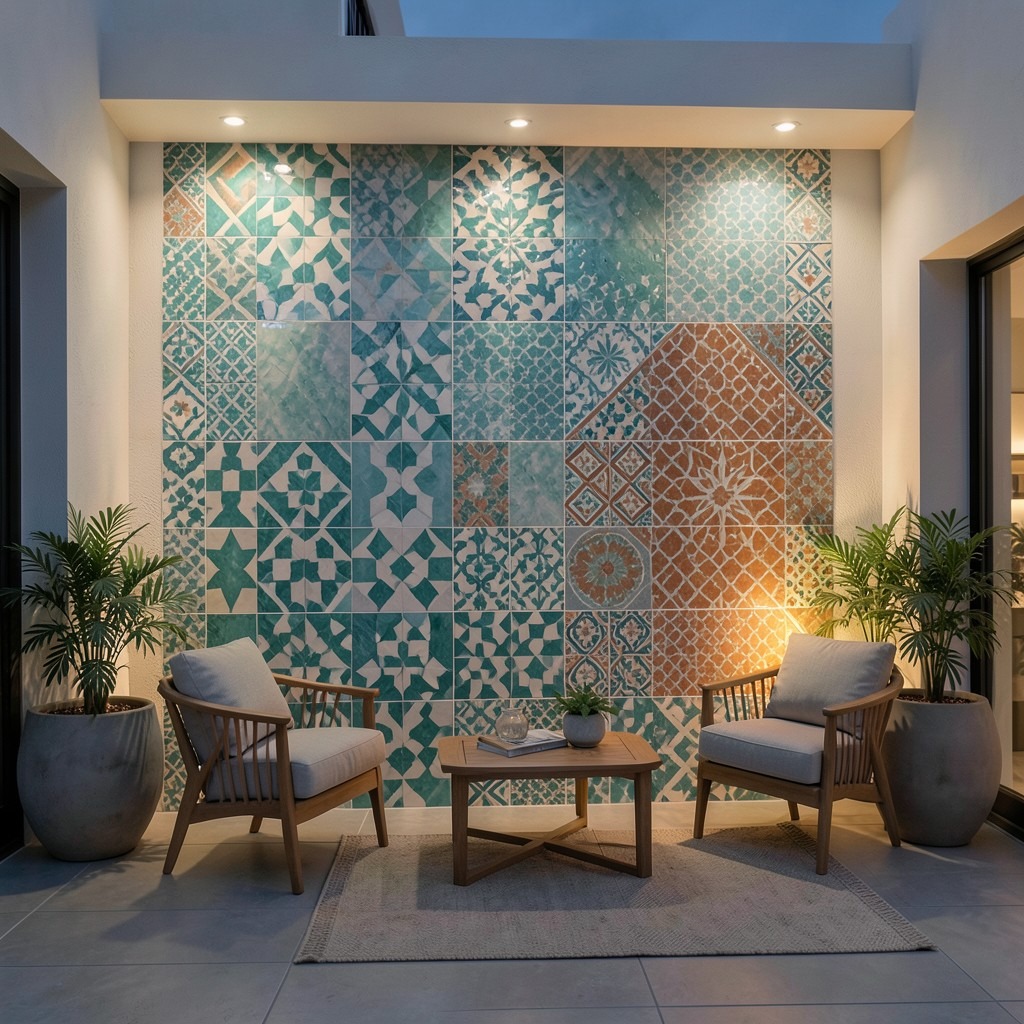
A mosaic tile accent wall on the patio brings a decorative intensity and material richness that paint and plaster cannot match outdoors — the tile’s color and reflectivity change throughout the day as the light’s angle shifts, creating a surface that is never exactly the same twice. This quality makes mosaic tile particularly valuable on exterior walls where the architectural surface would otherwise be a flat, static backdrop to the furniture and planting in front of it. The tile turns the wall into a participant in the design rather than a boundary.
Hand-cut glass mosaic in aqua, turquoise, and white tiles suits coastal home design and beach house interiors settings, where the water reference in the tile’s color palette connects the patio to its broader environment. Terracotta and ochre mosaic in geometric Moroccan patterns suits traditional home interiors, earthy home design, and bohemian home styling, where the richly patterned surface references craft traditions with genuine decorative depth. A more restrained mosaic — large format tiles in a single color with subtle texture variation — suits minimalist home design and modern home design contexts, where the tile’s material quality rather than its pattern carries the decorative value.
The mosaic accent wall works best as a single feature surface — one wall treated as the patio’s focal point, with the surrounding walls left in a plaster or painted finish that allows the mosaic to carry the visual attention it is designed to attract. Flanking the mosaic wall with a pair of planted containers and positioning the primary seating to face it creates a room-like composition where the wall functions as the patio’s visual anchor. Uplighting the mosaic wall after dark activates the tile’s reflective quality and creates an evening effect entirely distinct from its daytime character — shimmering, warm, and genuinely theatrical.
21. A Patio With a Hammock for Ultimate Relaxation
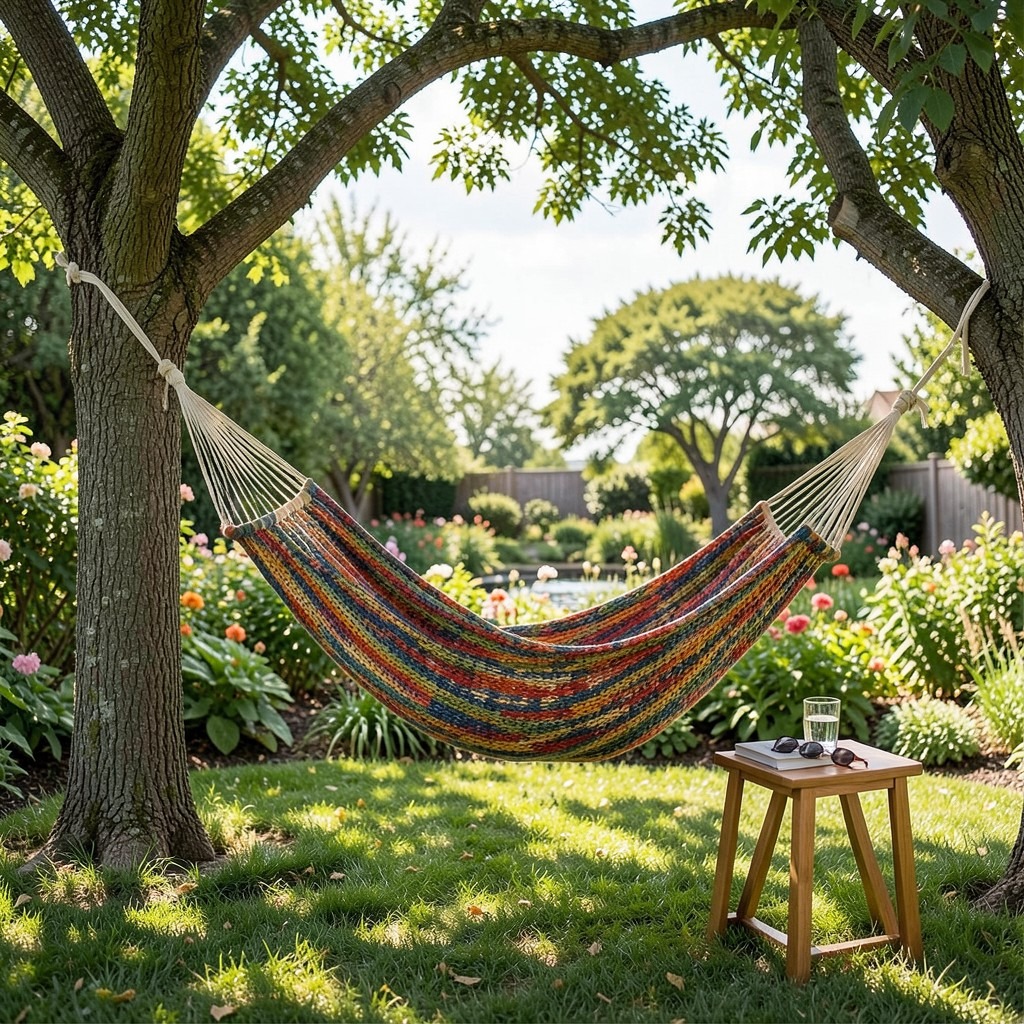
The hammock on a patio makes a specific promise to anyone who sees it — that this outdoor space is designed not just for activity and socializing but for genuine rest. That promise changes the way people approach the space and the time they spend in it. A hammock signals permission to do nothing, which is something that the design of most patios fails to communicate and most people genuinely need to be reminded is an option. The hammock earns its place as a design element through that psychological invitation alone.
A Brazilian woven cotton hammock hung between two mature trees creates the most organic and beautiful installation, its colorful weave pulling warm, bohemian home styling tones into the outdoor space. Where trees are not positioned correctly, a freestanding hammock stand in powder-coated steel or natural teak provides a portable solution that can be relocated seasonally to follow the best shade patterns on the property. A rope hammock in natural cotton or weather-resistant synthetic cord suits coastal home design and relaxed home design settings with its maritime material reference and its easy, breezy home interiors character.
Positioning the hammock to face the garden’s best view — a flowering border, a water feature, a specimen tree, or simply the open sky above — ensures that lying in it delivers the visual experience that makes rest genuinely restorative rather than merely horizontal. A small side table within arm’s reach of the hammock, holding a glass of water, a book, and a pair of sunglasses, provides the supporting detail that makes the hammock a complete rest installation rather than simply a suspended seat. During summer home design season, the hammock in morning shade and afternoon dappled light becomes the most used square footage on the entire property.
22. A Patio With a Vertical Garden Feature

Vertical garden panels, pocket planters, and trellis-mounted planting systems bring garden-inspired interiors character to patios where horizontal floor space is limited or fully committed to hardscape. The vertical surface is the patio’s most consistently underused resource — the walls, fences, and structural columns that define the patio’s edges offer a significant planting area that standard container gardening never touches. A vertical garden turns those surfaces from boundaries into living features.
A modular pocket planter system in felt or recycled plastic, mounted on a fence or wall and planted with trailing annuals, herbs, succulents, or ferns creates an immediate green wall effect that suits bohemian home styling, garden-inspired interiors, and coastal outdoor living space aesthetics. The planting palette determines the vertical garden’s character — a monochromatic planting of different fern and moss species creates a lush, forest-inspired texture wall that suits earthy home design, while a colorful mix of petunias, verbena, and trailing nasturtiums creates the floral home decor ideas effect that reads as playful and seasonally celebratory. A vertical herb garden mounted near the outdoor kitchen provides both visual interest and culinary function in the same installation, connecting beauty and usefulness in the way the best outdoor design always does.
Maintenance is the vertical garden’s primary practical consideration — pocket planters dry out faster than ground-level containers because their limited soil volume combined with wall-mounted exposure to wind and sun creates demanding moisture conditions. A drip irrigation system installed behind the panels at the time of installation addresses this challenge permanently and makes the vertical garden genuinely low-maintenance rather than a beautiful project that becomes a burden. Choosing plants rated for the patio’s sun exposure and climate zone rather than simply those that look best in photographs prevents the discouraging experience of installing a beautiful vertical garden that declines within a season.
23. A Patio With a Swing or Hanging Chair

The hanging chair or porch swing occupies a category between furniture and experience — it is a seat, but sitting in a gently moving suspended seat produces a qualitatively different sensation than sitting in any fixed chair, and that difference is one of the reasons these pieces are consistently among the most loved features on any patio that includes them. The slight motion of a hanging chair creates a meditative quality that still furniture cannot replicate, and children specifically are drawn to it with an enthusiasm that makes it among the most socially active pieces on any patio.
A rattan or wicker hanging egg chair in a natural or painted finish suits bohemian home styling, coastal home design, and relaxed home design contexts with equal ease, its rounded form creating a softness that contrasts productively with the patio’s harder material surfaces. A wooden porch swing hung from a pergola beam or a dedicated steel A-frame suits farmhouse home decor and traditional home interiors settings, its back-and-forth motion slower and more deliberate than the egg chair’s pendular sway. A macramé hanging chair in natural cotton rope suits bohemian home styling and beach house interiors, its woven form and warm material connecting to the textile tradition that defines both those design sensibilities.
Siting the hanging chair for both visual effect and functional comfort requires considering the direction of the predominant breeze, the afternoon sun position, and the view the occupant will face while sitting. A hanging chair that faces the garden’s best prospect, catches the breeze from the prevailing direction, and sits in afternoon shade rather than direct sun is a chair that will be used constantly. One placed for visual effect in a position that catches full afternoon sun becomes an attractive object that no one actually sits in — and the difference between those two outcomes is entirely in the siting decision made at installation.
24. A Patio With a Dedicated Reading Corner
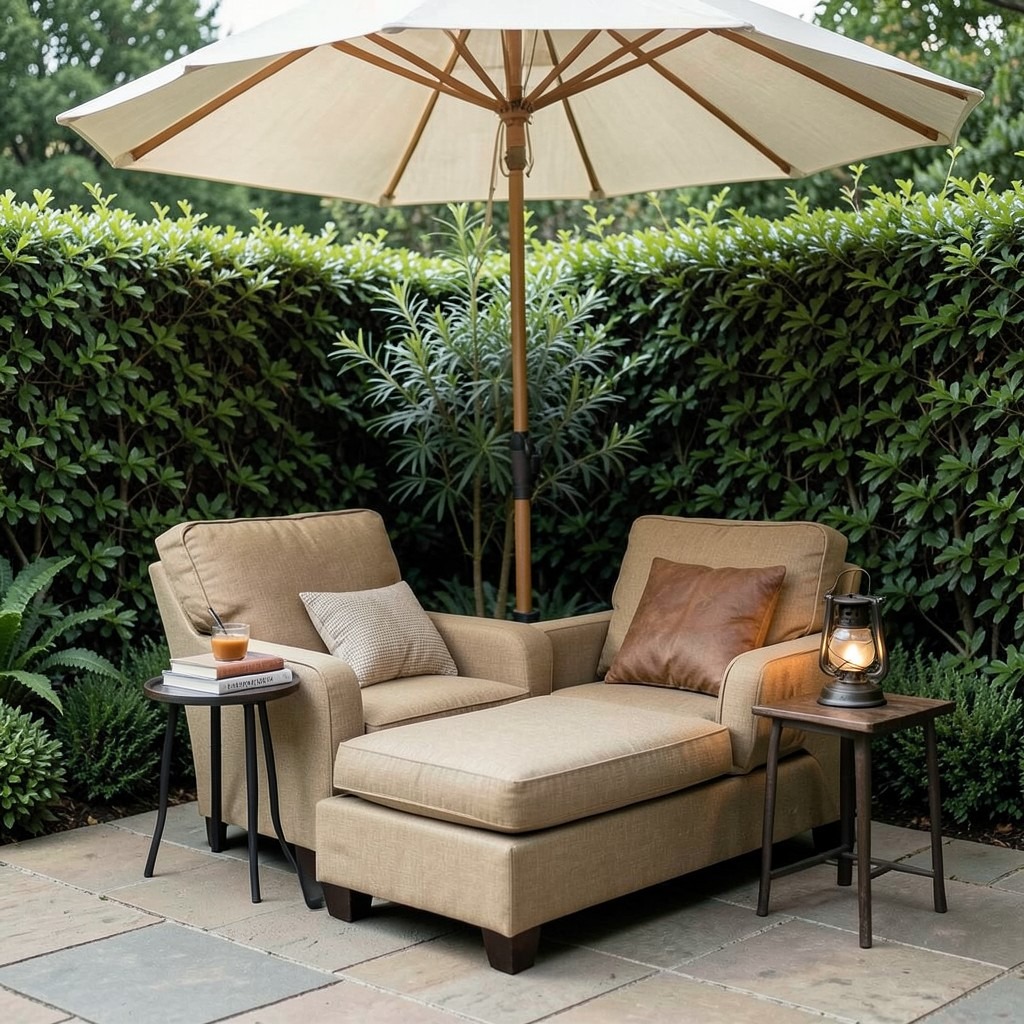
A dedicated reading corner on the patio formalizes the permission to use outdoor space for quiet, solitary activity — an activity that most patios are not explicitly designed to support. The typical patio is organized around gathering, dining, and socializing, and those are worthy functions. The reading corner acknowledges that the outdoor room should also serve the household member who wants to sit alone for an hour with a book, and that designing specifically for that person’s experience makes the entire patio more complete.
A deep, cushioned armchair or a chaise lounge positioned at the patio’s quietest corner, shaded by a broad umbrella or a pergola overhang, flanked by a small side table at the right height for a drink and a bookmark, and backed by a planted screen for privacy constitutes a complete reading installation. The chair’s upholstery in a performance fabric that resists fading and moisture — a solid warm linen tone, a small-scale stripe, or a subtle texture — suits this corner’s contemplative function better than a bold pattern that competes for attention with the book. Rustic home office ideas aesthetics translate naturally to the outdoor reading corner, where a worn leather cushion, a stack of books on the side table, and a small lantern-style lamp for cloudy afternoons create a retreat of genuine character.
The reading corner’s success depends on its separation from the patio’s main social and dining functions — a reading corner positioned directly beside the outdoor dining table will always be commandeered as an overflow dining seat, defeating its purpose. Physical separation through planting, a partial screen, or simply distance creates the psychological distinctness that allows the reading corner to maintain its quiet function even when the rest of the patio is in active social use. Peaceful home decor principles applied to this corner — a single plant, a simple cushion, a good light source, and nothing extraneous — produce the most genuinely useful reading retreat the patio can offer.
25. A Patio With Natural Wood Decking
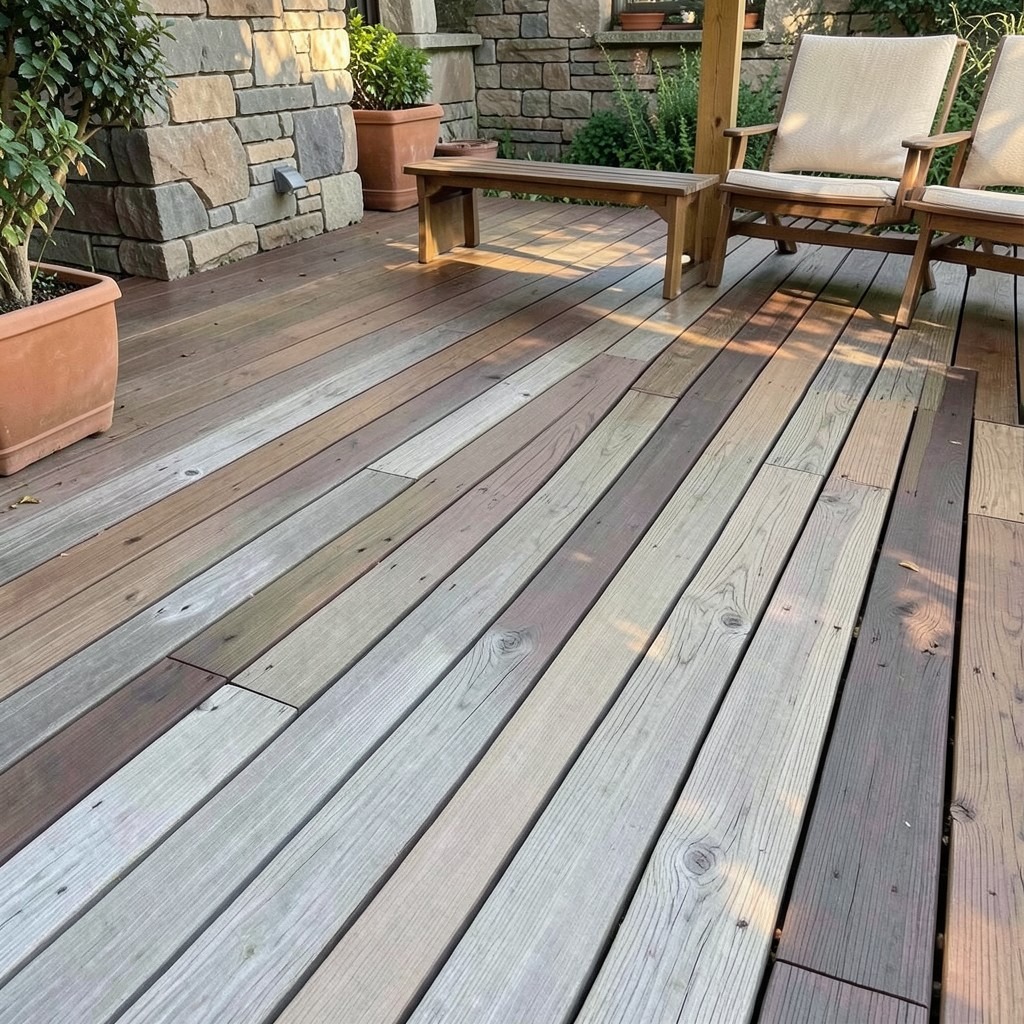
Natural wood decking transforms a ground-level patio from a hard, flat surface into a warm, textured platform that reads as a genuine outdoor room rather than a paved area. The warmth of wood underfoot is impossible to replicate with any manufactured material — not composite decking, not porcelain tile, not concrete — and that warmth fundamentally changes the sensory experience of the space. Standing on a natural wood deck in bare feet on a warm morning is a qualitatively different experience from standing on any other outdoor surface, and that difference shapes the way the space is used every single day.
Teak is the premium choice for outdoor decking, its natural oil content providing exceptional weather resistance and dimensional stability without requiring annual sealing or treatment. Over time, untreated teak develops a beautiful silver-gray patina that suits coastal home design, Scandinavian home interior, and contemporary home ideas settings — the color change is a mark of the material’s authenticity rather than evidence of neglect. Ipe, also known as Brazilian walnut, offers similar performance characteristics to teak at a lower initial cost, its deep brown tone and close grain making it one of the most visually striking deck materials available and a natural fit for stone and wood home design palettes.
Cedar and Douglas fir offer the warmth and character of natural wood decking at a more accessible price point, though both require more consistent maintenance — annual cleaning and every-other-year sealing — to prevent graying, checking, and moisture damage in wet climates. The gap between decking boards is a functional decision as well as an aesthetic one: a tighter gap of one-eighth inch prevents small objects from falling through and creates a more finished, floor-like appearance, while a wider gap of one-quarter inch sheds water and debris more efficiently in climates with heavy rainfall. Either approach produces a deck that suits the farmhouse home decor and rustic home decor contexts where natural wood’s honest, unmanufactured quality is exactly the point.
26. A Patio With a Dedicated Yoga or Meditation Area

A corner of the patio designated for morning yoga or quiet meditation creates a use category that most outdoor spaces never even attempt to accommodate, and that specificity is its value. The outdoor yoga space connects the practice to the sensory richness of being outside — natural light, fresh air, birdsong, the garden’s smell in the morning — in a way that indoor practice cannot replicate. When the space is set up and ready, the barrier to actually practicing drops significantly, and the practice happens more often.
A section of natural wood decking or smooth, sealed stone pavers wide enough for a full yoga mat with comfortable margin on all four sides provides the physical foundation for the outdoor practice area. A simple teak bench or stone seat at the edge of the practice space serves as the transition point between the patio’s social areas and the meditation corner — a place to remove shoes, set a water bottle, and make the mental shift from household activity to personal practice. Peaceful home decor principles govern the styling of this corner: a single pot of fragrant jasmine or lavender, a smooth river stone or a small singing bowl on the bench, and nothing else competing for the space’s quiet attention.
Orienting the practice mat toward the garden, a water feature, or a view of trees rather than toward the house creates a visual horizon for the practice that supports rather than distracts from the meditative intention. Morning sun from the east makes this orientation particularly valuable for early practice, providing natural light warmth that energizes without overheating. The outdoor yoga and meditation area suits every design aesthetic from modern home design to bohemian home styling and works at any scale — even a six-by-eight section of patio dedicated to this purpose, clearly defined by a rug or a change in paving material, delivers the psychological benefit of a space that knows what it is for and holds that purpose reliably.
27. A Patio With an Outdoor Movie Screen

An outdoor movie setup on the patio creates the most event-like experience available in residential outdoor living — a communal gathering around a large-format projected image with food, drinks, and seating arranged to support the shared experience. The outdoor movie night functions as its own occasion rather than a supplement to another activity, and patios designed to support it become the social centerpiece of summer home design entertaining rather than a background space where guests arrive and depart. One well-executed outdoor movie night tends to generate immediate requests for the next one.
A freestanding inflatable movie screen or a retractable projection screen on a tension system provides the display surface for an outdoor theater setup that takes less than twenty minutes to assemble and packs away in a bag when not in use. The projector should throw a bright enough image — measured in lumens, with outdoor viewing requiring a minimum of three thousand lumens for dusk viewing and five thousand for viewing before full dark — to overcome the ambient light that lingers in outdoor spaces longer than indoor darkness requires. Deep seating on a sectional sofa or a collection of floor cushions and bean bags in front of the screen creates the casual, low-slung viewing geometry that suits movies outdoors better than upright dining chairs.
Sound quality determines the outdoor movie experience as much as image quality — a pair of portable Bluetooth speakers positioned behind the seating area, angled toward the screen, or a small outdoor sound system with satellite speakers mounted on the pergola provides the audio complement to the projected image that makes the experience feel genuinely cinematic. Mosquito control through citronella candles, a nearby oscillating fan creating breeze, or a permethrin-treated perimeter makes the summer evening outdoor theater experience comfortable rather than merely beautiful. The outdoor movie setup is also one of the most effortless ways to transform the patio for holiday home styling — a projected holiday movie, warm blankets, and hot cocoa make the outdoor space magical in a way that few decorating additions match.
28. A Patio With a Stone Fireplace as a Focal Point

A stone fireplace built into the patio wall or standing as a freestanding structure becomes the outdoor room’s permanent focal point in a way that a portable fire pit never quite achieves — the fireplace’s mass, its permanence, and its architectural presence signal that this outdoor space was designed with real intention and real investment. The fireplace anchors the patio the way a hearth anchors a living room: everything else in the space arranges itself in relation to it, and the orientation toward fire creates a gathering geometry as old as human civilization.
Natural stone fireplaces in fieldstone, stacked limestone, or cut sandstone suit rustic home decor, farmhouse home decor, and mountain cabin decor patio settings with a material authenticity that manufactured stone veneers approximate but never fully replicate. A smooth stucco-finished outdoor fireplace in a crisp white or warm plaster tone suits contemporary home ideas and modern home design patios, its clean-faced form providing the fireplace’s functional and psychological benefits within a minimal aesthetic that does not compete with the surrounding design. The fireplace’s mantel — whether a thick cedar slab, a stone shelf, or a simple concrete ledge — provides the horizontal surface that the patio needs for seasonal styling, functioning as the outdoor equivalent of the living room mantelpiece.
Gas fireplaces offer instant ignition and clean burning without the ash management and firewood storage that wood-burning installations require, which in practical terms means the fireplace is used far more frequently throughout the season. The choice between wood-burning and gas often comes down to the ritual value of the fire — some people find the process of building and tending a wood fire central to the experience, while others find the on-demand convenience of gas liberating. Either way, the stone fireplace extends the patio’s seasonal use through fall home decorating and into early winter home decor territory, offering warmth, light, and the atmospheric quality of a real fire on evenings when the temperature alone would otherwise drive the household indoors.
29. A Patio With a Herb Spiral Garden
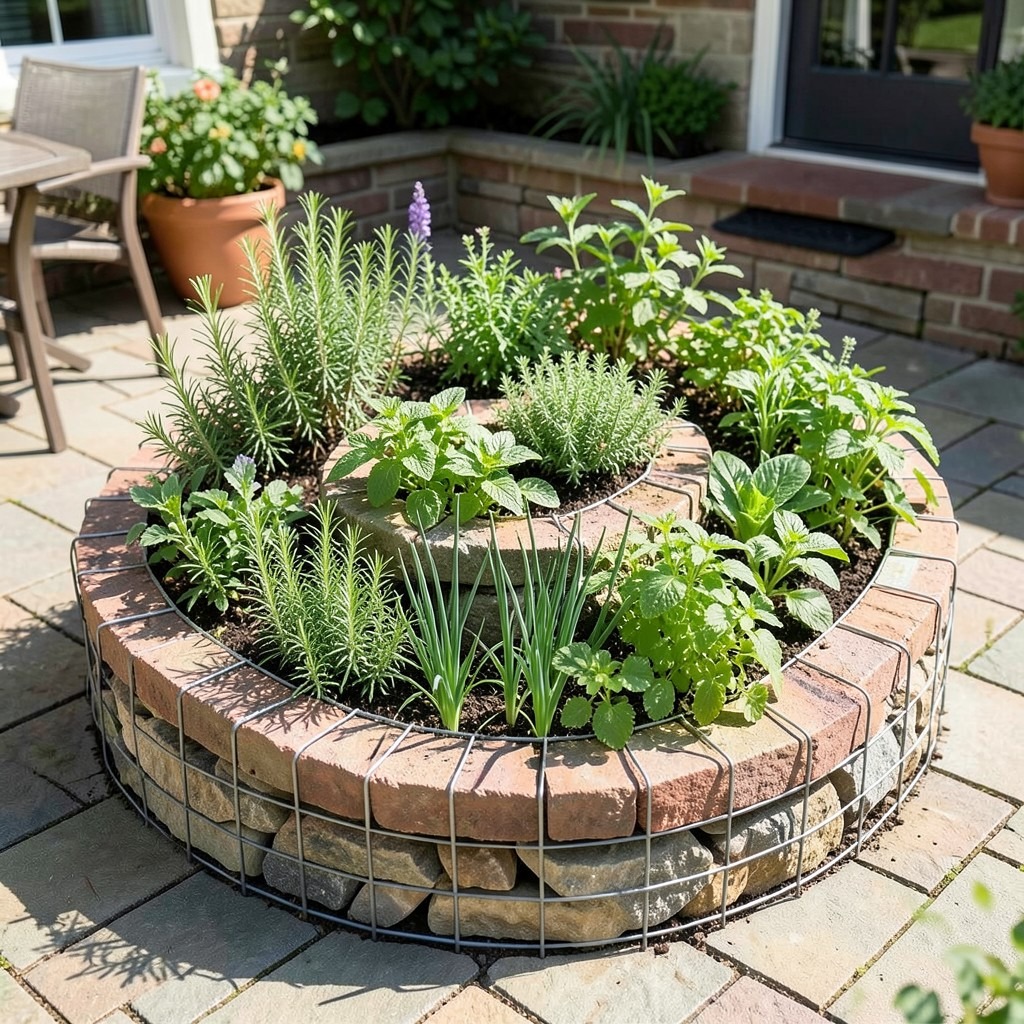
The herb spiral is a design-forward approach to container planting that turns the herb installation into a genuine landscape feature rather than a collection of pots arranged on a shelf. Built as a raised spiral of stone, brick, or gabion wire filled with layered soil, the spiral’s three-dimensional form creates multiple microclimates within a compact footprint — the top receives maximum sun and drains fastest, suiting drought-tolerant Mediterranean herbs like rosemary, thyme, and oregano, while the base retains moisture and partial shade, suiting mint, chives, and parsley. The result is a single installation that grows more herb variety than any flat container arrangement of equivalent footprint.
The spiral’s construction materials should connect to the patio’s existing material palette — a fieldstone spiral suits rustic home decor and earthy home design, a mortared brick spiral suits traditional home interiors and farmhouse home decor, and a gabion wire cylinder with exposed stone infill suits modern home design and industrial home design contexts. Even unplanted, the spiral reads as a deliberate landscape element with genuine three-dimensional presence, contributing structural interest to the patio that flat-bedded container planting cannot match. Planted at full density, the herb spiral reads as a small forest of culinary abundance that changes in color, texture, and fragrance through every season.
The herb spiral’s position on the patio should balance proximity to the outdoor kitchen or dining table — close enough to reach while cooking without walking across the full patio — with adequate sun exposure for the herbs at the spiral’s upper tiers. During summer home design season, regular harvesting prevents bolting and keeps the spiral productive and visually lush. Replacing exhausted summer herbs with cool-season varieties through the fall home decorating period keeps the spiral in active production and gives the patio a planting feature that participates in the household’s actual daily cooking life rather than functioning as decoration alone.
30. A Patio With a Pergola Draped in Climbing Vines
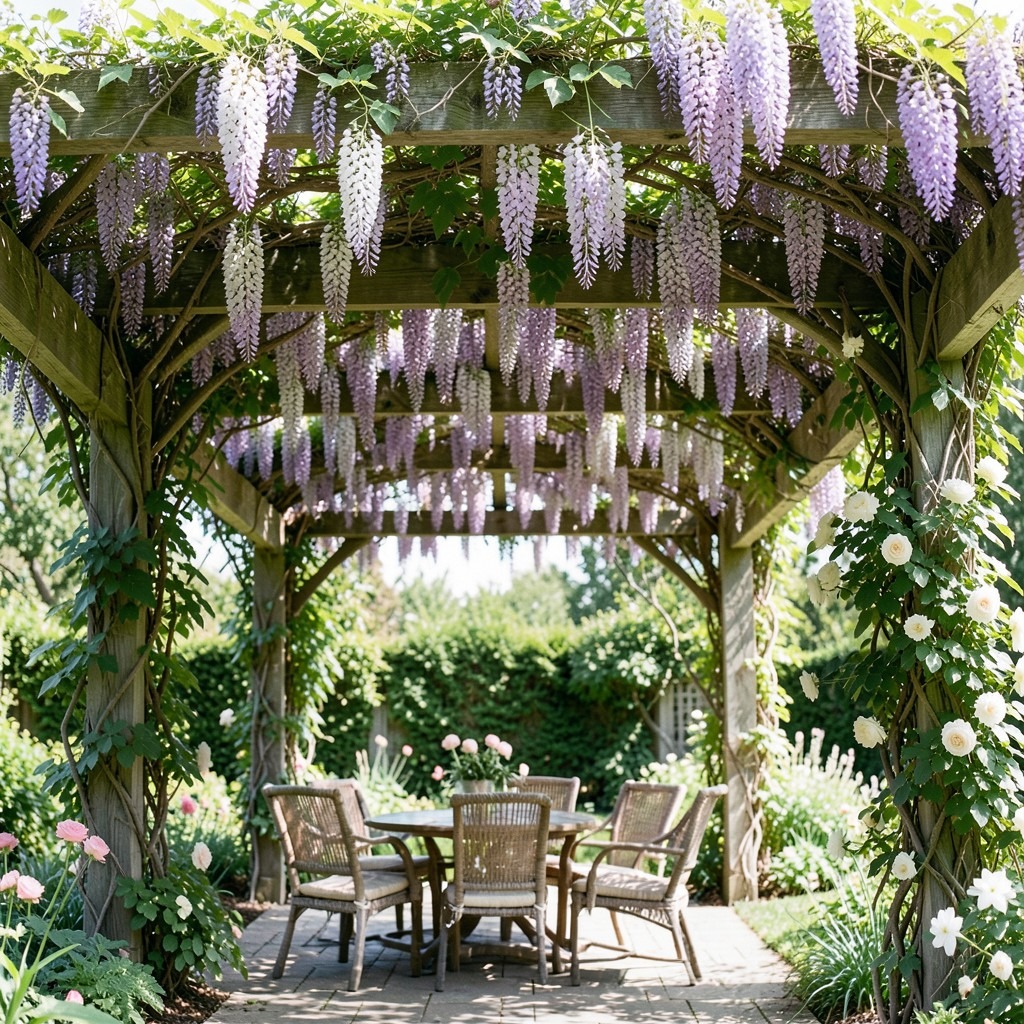
A bare pergola is a structure. A pergola covered in climbing vines is an experience. The distinction is not subtle — the moment a climbing plant reaches maturity on a pergola’s rafters, the overhead plane transforms from constructed timber into a living canopy that moves in the breeze, changes through the season, and fills the space below with filtered green light that no artificial shade structure replicates. This transformation is among the most powerful design effects available in outdoor living, and it costs almost nothing beyond time.
Wisteria is the most dramatic climbing plant for pergola coverage, its cascading flower clusters in lavender, white, or soft pink creating a spring bloom so spectacular that it draws people outdoors specifically to sit beneath it. Climbing roses in a single variety trained along the rafters provide a summer flowering display followed by a structural framework of thorny canes that suits farmhouse home decor and traditional home interiors settings through every season. Star jasmine suits coastal home design and breezy home interiors contexts with its smaller leaf texture and powerfully fragrant white flowers that perfume the entire patio through warm evenings — a sensory dimension that visual design choices alone cannot produce.
The vine selection must account for the pergola’s structural capacity — wisteria in particular develops woody stems of considerable mass over decades and requires a robustly built pergola to support its mature weight. Deciduous climbers like wisteria and climbing roses offer the seasonal benefit of full shade through summer while allowing winter sunlight through their bare framework, a quality that suits patios in four-season climates where summer shade and winter warmth are both priorities. The annual task of pruning, training, and tying the climbing plant into the pergola’s structure is not a maintenance burden — for most gardeners it becomes one of the most satisfying seasonal rituals of the outdoor room’s year.
31. A Patio With Recycled and Reclaimed Materials

A patio built from recycled and reclaimed materials carries a story that no new material can match — the worn edges of reclaimed brick, the silver patina of salvaged timber, and the aged character of antique stone pavers communicate a history and a material authenticity that manufactured equivalents approximate but never fully replicate. This quality is not nostalgia. It is the genuine visual richness that comes from materials shaped by time, use, and weather rather than by a factory production line, and it makes the patio feel permanently embedded in its landscape rather than recently installed on top of it.
Reclaimed brick laid in a running bond or herringbone pattern creates a patio floor with the warm, irregular character that suits rustic home decor, farmhouse home decor, and traditional home interiors settings with equal depth. The color variation in reclaimed brick — the range of reds, ambers, and near-blacks produced by different firing conditions and decades of weathering — creates a floor surface of genuine visual complexity that new brick fired to uniform color never achieves. Salvaged timber beams repurposed as pergola rafters, bench supports, or retaining wall elements introduce the same aged, authentic quality at the vertical and overhead levels of the patio’s design.
Antique stone pavers recovered from demolished roads, buildings, or farm properties bring a density and weathered surface texture to the patio floor that no quarried stone freshly cut matches. The irregular sizing of truly reclaimed stone requires more skill in laying and accepts a more organic joint pattern than precision-cut new stone, and that organic quality is exactly what earthy home design and bohemian home styling patios are designed around. Sourcing reclaimed materials from local salvage yards, architectural salvage dealers, and demolition contractors serves the design goal and the environmental one simultaneously, keeping material out of landfill while bringing character into the patio that money alone cannot manufacture.
32. A Patio With a Japanese-Inspired Zen Garden Corner

A Zen-inspired corner within a larger patio creates a designed retreat space whose visual stillness provides psychological contrast to the activity and socialization the rest of the patio supports. The Japanese garden tradition distills natural landscapes into their essential qualities — rock representing mountain, raked gravel representing water, carefully placed moss representing forest — and that distillation creates a miniature landscape of extraordinary visual calm. Even a small section of the patio dedicated to these principles produces a focal point of genuine serenity that changes the character of the entire outdoor space.
A contained rectangle of decomposed granite or fine gravel raked into a simple wave or parallel line pattern, bordered by a low cedar or stone edge, anchors the Zen corner on the patio floor. Two or three carefully selected stones of contrasting size placed within the raked gravel — one large, one medium, one small — create the compositional balance that Japanese garden design achieves through asymmetry rather than symmetry. A single specimen plant — a Japanese maple, a dwarf pine, or a clipped azalea in a glazed container — positioned at the corner’s edge provides the living element that grounds the rock and gravel composition in organic form.
The Zen corner suits minimalist home design, Scandinavian home interior, and earthy home design patios where the design language already values restraint and the removal of excess rather than the accumulation of decoration. A low stone lantern positioned beside the raked gravel provides evening lighting through a tea-light candle that suits the corner’s contemplative character far better than any electrical fixture would. The maintenance routine of raking the gravel — typically a five-minute task performed as often as the household finds calming — becomes a mindfulness practice that connects the daily act of tending the patio to the broader peaceful home decor intention the Zen corner is designed to express.
33. A Patio With Weathered Steel Corten Accents

Corten steel — the self-passivating steel alloy that develops a stable, rich rust-orange patina on outdoor exposure — brings a material quality to the patio that occupies an unusual position in the design spectrum: it is simultaneously industrial and organic, hard and warm, manufactured and weather-developed. The patina that forms on corten’s surface through rain, humidity, and sun exposure is not a sign of deterioration but a designed surface finish, and that distinction makes corten one of the most interesting material choices in outdoor design. No two corten installations develop exactly the same patina, because no two outdoor environments are identical.
Corten steel planter boxes on the patio suit industrial home design, modern home design, and contemporary home ideas settings with their precise, geometric forms and warm oxide surface finish. A corten privacy screen with a laser-cut botanical or geometric pattern creates both functional enclosure and decorative interest, the cut-out pattern throwing shadow patterns across the patio floor as the sun tracks across the sky. Corten steel edging between the patio pavers and the planted garden border creates a clean material transition that suits minimalist home design and earthy home design, its warm rust tone connecting the manufactured patio surface to the organic planting beyond it.
The color relationship between corten’s orange-rust patina and the patio’s other materials determines whether the combination reads as designed or accidental. Corten pairs naturally with concrete, because the warm orange against the cool gray creates the complementary contrast that makes both materials more interesting. It works equally well against dark charcoal board-formed concrete, pale limestone pavers, and warm natural wood decking — in each case, the corten’s color is strong enough to hold its own without overpowering the surrounding palette. Stone and wood home design patios that incorporate corten as a third material element achieve a three-way material dialogue between warm, cool, and organic that produces some of the most visually sophisticated outdoor spaces in contemporary residential design.
34. A Patio With a Built-In Planter and Garden Bed Border

Built-in planter beds along the patio’s perimeter walls or integrated into raised retaining structures create a seamless transition between the hardscaped outdoor room and the planted garden surrounding it, blurring the boundary between patio and landscape in the way that the best garden-inspired interiors always do. The built-in planter is not a pot placed against a wall — it is architecture that plants occupy, a permanent element of the patio’s structure that commits to planting as a year-round design feature rather than an accessory that can be removed. That commitment signals design intention that guests and household members both feel without necessarily identifying its source.
The planter’s construction material should match the patio’s primary hardscape material for maximum design cohesion — a concrete patio with concrete planter walls reads as a unified, designed outdoor room, while a brick-edged planter on a paver patio connects the two elements through shared material language. The planter’s interior depth determines what can be grown: a minimum of eighteen inches of soil depth is required for perennials and small shrubs, twenty-four inches for larger ornamental grasses and compact shrubs, and thirty-six inches or more for structural plantings like boxwood hedging, small specimen trees, or roses. Tropical home design patios use built-in planters at generous scale to grow the large-leafed tropicals that create immersive lushness around the seating area’s perimeter.
Seasonal planting rotations within the built-in planter keep the patio connected to the natural calendar — spring home refresh brings bulbs and cool-season annuals, summer planting shifts to bold tropical annuals and fragrant herbs, fall home decorating fills the planters with ornamental kale, grasses in autumn color, and compact asters, and winter home decor season installs evergreen boughs, berry branches, and white twig dogwood for structural winter interest. This seasonal rotation practice makes the built-in planter the patio’s most dynamic design element, the feature that tells guests which season the household is in and how much attention the outdoor room receives year-round.
35. A Patio With an Outdoor Projector and Sound System

A permanently installed outdoor projector and sound system transforms the patio from a seasonal furniture arrangement into a full-function entertainment venue that rivals any interior room for audiovisual experience. The system does not need to be expensive to be excellent — the gap between a serviceable outdoor AV setup and a professional-grade installation has narrowed considerably as outdoor-rated audio equipment has improved in quality and dropped in cost. What the system does need to be is installed with thought, positioned correctly, and integrated into the patio’s design rather than bolted onto it as an afterthought.
A weatherproof projector mounted on a pergola beam or a purpose-built bracket throws the image onto a retractable projection screen that rolls down when in use and disappears into a ceiling-mounted housing when not. The projection surface should face away from the prevailing evening sun angle so that the last hour of daylight does not wash out the image before full dark arrives. Outdoor-rated in-ceiling or wall-mounted speakers positioned to create a stereo field across the seating area deliver sound quality that portable Bluetooth speakers cannot match, and their permanent installation means the sound system is available for music during casual outdoor dining as well as for movie viewing without any additional setup.
The integration of the AV system into the patio’s broader design requires cable management that conceals power and signal runs within the pergola’s structure or through conduit embedded in the patio wall — surface-run cables undermine the designed quality of the space and create trip hazards. Smart home integration that controls the projector, screen, and speakers from a single app or voice command reduces the friction between wanting to use the system and actually using it, which in practical terms means the system is used far more often. During fall home decorating and holiday home styling seasons, the outdoor screen becomes a backdrop for ambient fall foliage projections or holiday light shows that transform the patio’s character entirely without a single piece of physical decoration changing.
36. A Patio With a Moroccan-Inspired Design Theme

The Moroccan-inspired patio carries one of the most complete and transportive design languages available in outdoor decorating — the combination of geometric tile work, lantern lighting, rich textile draping, carved wood screens, and layered color creates an outdoor environment that feels like a destination rather than simply an extension of the house. The richness of the Moroccan design vocabulary means that even a partial commitment to the aesthetic produces significant visual impact, because the components are so recognizable and so mutually reinforcing that a few well-chosen pieces communicate the entire direction clearly.
Zellige tile in turquoise, cobalt, and amber applied to the patio floor, the base of a fire pit, or the face of an outdoor kitchen backsplash anchors the Moroccan reference in the patio’s permanent architecture. Wrought iron lanterns in hammered or pierced patterns hung from the pergola at varying heights fill the patio with candlelight or warm LED patterns at dusk, casting the geometric cutout shadows across walls and floors that are among the most evocative atmospheric effects in any design vocabulary. A low carved cedar screen used as a privacy partition adds the woodcraft dimension of the Moroccan interior tradition, its intricate geometric pattern catching side light beautifully and providing the spatial privacy that transforms an exposed patio into a genuinely intimate outdoor room.
Textile layering completes the Moroccan-inspired patio with the color and tactile richness that hard materials alone cannot provide — a kilim or Beni Ourain-style outdoor rug beneath the seating area, cushion covers in rich jewel-tone fabrics with tasseled trim, a draped textile canopy overhead, and poufs in embossed leather as supplemental seating create the layered, enveloping quality that defines bohemian home styling and traditional home interiors at their most expressive. The Moroccan patio’s color palette — deep cobalt, burnt sienna, saffron, and cool white — suits warm-climate outdoor living and reads with particular beauty under the warm, low light of evening when the lanterns are lit and the tile colors shift from bright daytime saturation to a richer, moodier glow.
37. A Patio With a Scandinavian-Inspired Minimalist Setup

The Scandinavian approach to outdoor living brings a precision and intentionality to the patio that cuts through decorative excess and arrives directly at what the space needs to function beautifully. The Scandinavian home interior tradition does not design by subtraction — it designs by selection, choosing each element with specific purpose and placing it with specific intention, so that what remains in the space is exactly what is needed and nothing else competes for attention. Applied to the patio, this discipline produces outdoor rooms of extraordinary clarity and calm.
A Scandinavian-inspired patio begins with a clean, neutral material foundation — pale concrete pavers, natural light oak decking, or light gray composite boards provide the floor in a tone that reflects rather than absorbs light, giving the outdoor room its bright home design and airy home interiors quality. A simple teak or pale ash dining table with matching benches, a clean-lined outdoor sofa in natural linen or pale gray performance fabric, and a single large ceramic pot holding a structural plant constitute the entire furniture and decoration program. The palette is deliberately restricted — warm white, pale gray, natural wood, and one muted accent color pulled from the planting — and that restriction gives the patio a visual quiet that allows the natural landscape beyond it to become the room’s primary visual experience.
Outdoor lighting in the Scandinavian-inspired patio takes the form of simple steel pendants hung from the pergola, low-profile path lights along the patio border, and a collection of pillar candles in varying heights grouped on the dining table for evening meals. The quality of these light sources — warm, soft, and deliberately positioned — matters more than their quantity, and the Scandinavian tradition of hygge, the Danish concept of cozy, candlelit warmth, translates to outdoor living as naturally as it does to interior spaces. During fall home decorating and winter home decor seasons, the Scandinavian patio excels — warm blankets in natural wool, candlelight, and a fire pit create the quintessential outdoor hygge experience that makes cold-weather patio use not a compromise but the season’s best offering.
38. A Patio With a Dedicated Children’s Activity Zone
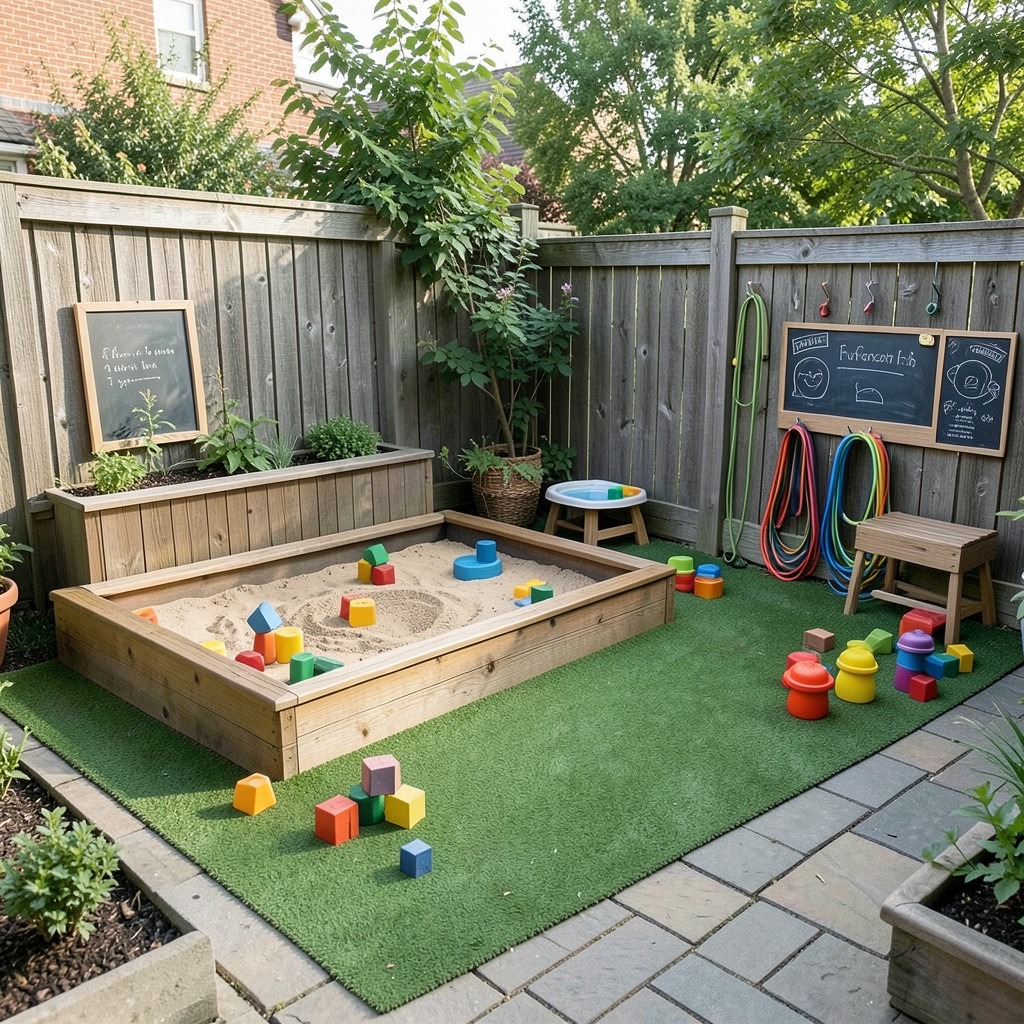
A patio designed only for adults fails to serve the household as a whole, and the result is a space that parents cannot fully use because the children have no reason to stay in it. A dedicated children’s activity zone integrated into the patio design — clearly defined, appropriately equipped, and positioned to remain visible from the adult seating area — solves this problem by giving children their own designed space within the broader outdoor room. When children have a place that is designed for them, they stay in it voluntarily, which is the design outcome that makes the patio genuinely useful for every member of the household simultaneously.
A section of the patio surface covered with a rubber safety mat or artificial turf defines the children’s zone without fencing or physical separation, and the material change signals the zone’s purpose to children and adults alike. A built-in sandpit with a removable cover, a chalkboard panel mounted on the fence, a small water table for younger children, or a dedicated art surface at the correct height for the household’s children all provide age-appropriate activity options that are also visually contained within the defined zone. Bohemian kids room decor principles applied to the outdoor children’s zone — primary colors, natural materials, open-ended play objects like wooden blocks and loose sand — create a play environment that encourages creative engagement rather than passive screen use.
Storage integrated into the children’s zone — a weatherproof deck box sized for outdoor toys, a hook rail for jump ropes and sport equipment, or a small outdoor cubby for art supplies — keeps the zone organized and prevents the toys from spreading across the adult portion of the patio after every play session. The children’s zone should be designed to evolve with the household’s children — a sandbox that converts to a raised planting bed when the children outgrow sand play, or a chalkboard wall that becomes a display board for teenagers, preserves the zone’s usefulness across the household’s full lifecycle. A patio that genuinely works for children without compromising the adult outdoor experience is a design achievement that serves the household for a decade or more.
39. A Patio With a Bold Painted Concrete Floor
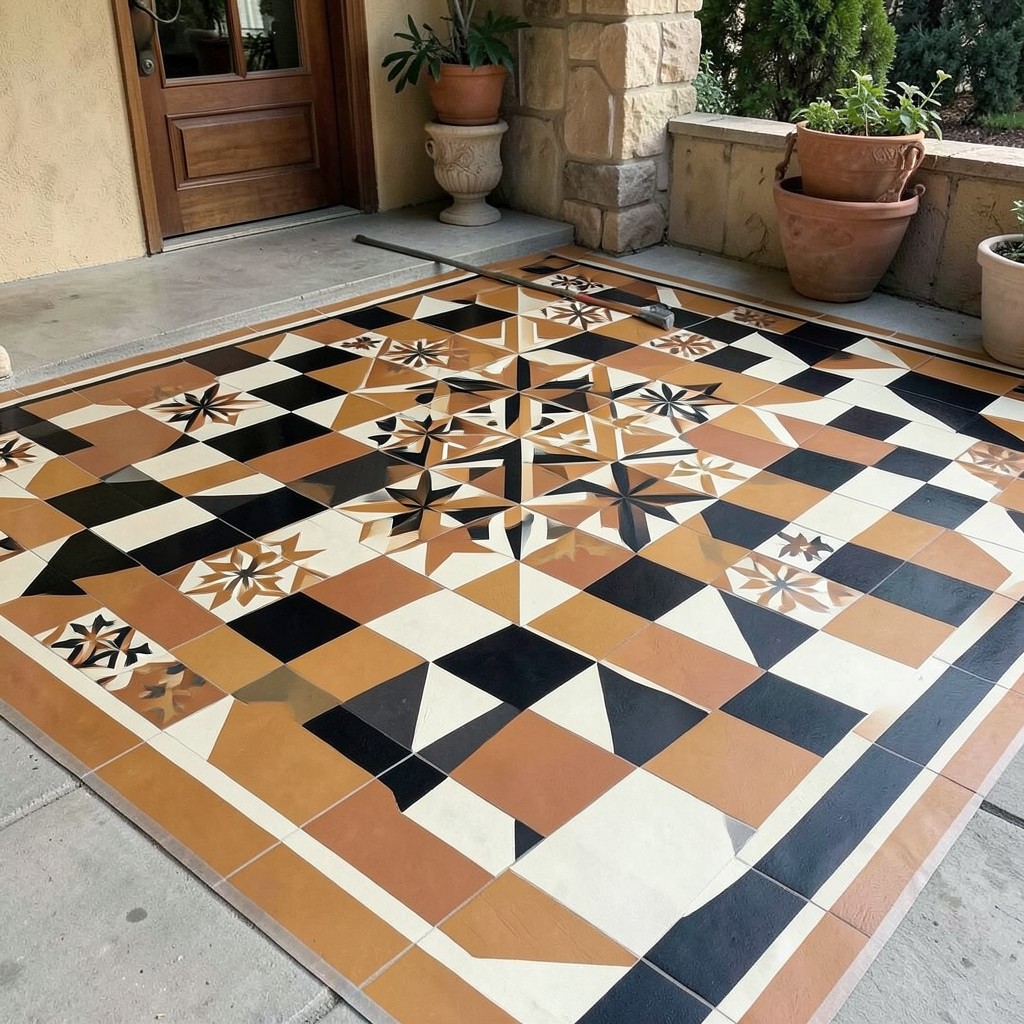
A painted concrete floor is among the most affordable and most dramatically transformative upgrades available to a patio whose existing concrete slab is sound but visually uninspiring. The raw gray of poured concrete communicates industrial utility rather than outdoor hospitality, and painting it — with a pattern, a border treatment, or a solid bold color — immediately shifts that communication. The cost of the transformation is a few gallons of concrete paint and a weekend of preparation and application, but the visual result can read as a designed surface rather than a raw one.
A large-scale painted geometric pattern — a Mediterranean tile impression, a bold Moroccan star repeat, or a clean graphic checkerboard — applied in two to three colors of concrete floor paint turns the slab into the patio’s most distinctive design feature. The pattern should be measured and taped with precision before painting begins, because the geometry’s accuracy determines whether the finished floor reads as a deliberate design or a practice session. Warm, earthy tones in ochre, terracotta, and cream suit earthy home design and farmhouse home decor patio settings, while a black and white checkerboard suits traditional home interiors and contemporary home ideas with equal confidence.
Sealing the painted concrete with a penetrating, UV-stable polyurethane topcoat rated for exterior use protects the paint from the foot traffic, UV exposure, and moisture that outdoor surfaces absorb continuously. The topcoat also deepens the paint colors slightly, giving them the saturated richness of sealed concrete rather than the flatter tone of unsealed paint. Repainting becomes necessary every three to five years depending on traffic volume and climate severity, but the refresh is always faster than the original installation because the pattern is already established and only the paint condition — not the design — needs attention.
40. A Patio With a Coastal Nautical Theme
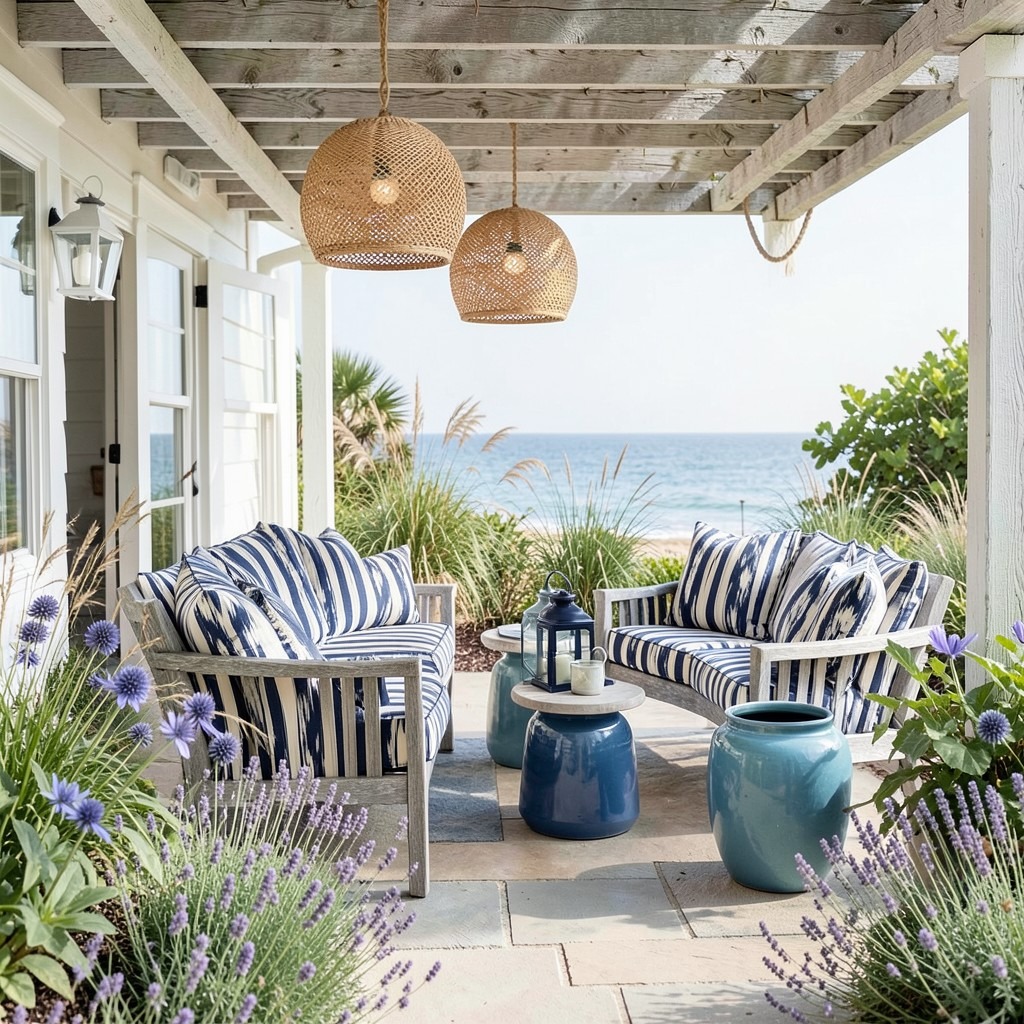
The coastal patio aesthetic operates from a design principle that seems simple on the surface but requires careful editing to execute well: every element should feel like it belongs near the water, without announcing that relationship so loudly that the space reads as a themed environment rather than a designed one. The best coastal home design patios feel fresh, sun-bleached, and gently salt-worn — they suggest proximity to the ocean through material quality and color palette rather than through explicit nautical props. The anchor and rope motif school of coastal decorating is, in this respect, the approach to avoid.
The coastal patio palette centers on the spectrum between warm white and pale sand on one side and the range of blues and greens — aqua, turquoise, navy, seafoam — on the other, with natural rope, rattan, and weathered teak as the material connectors between those color poles. Teak furniture aged to a silver-gray naturally achieves the weathered, driftwood quality that defines beach house interiors without any artificial distressing or finishing. Woven rattan or seagrass pendant lights beneath a pergola add the natural fiber texture that reads as coastal without being explicitly nautical, their warm material tone complementing both the teak furniture and the blue-and-white textile palette.
The coastal outdoor living space extends its indoor-outdoor connection through the use of oversized lanterns in white or powder-coated navy, ceramic garden stools in a warm sea-glaze blue used as side tables, and outdoor cushions in classic navy and white striping or a broad ikat in ocean tones. Coastal living plants — ornamental grasses that move in the wind, agapanthus with its blue-purple globular flowers, lavender in drifts along the planter edge — provide the planted layer that grounds the coastal aesthetic in the actual outdoor environment. During summer home design season this patio reaches its peak expression, when the light quality, the warmth, and the breezy home interiors character of the outdoor setting perfectly amplify the design’s seaside associations.
41. A Patio With an Elevated Deck Platform

An elevated deck platform adds a level change to the patio that does more than create visual interest — it defines distinct functional zones through architecture rather than furniture arrangement alone, and that architectural definition is more durable and more convincing than any furniture-based zoning strategy. The raised platform creates a dining or seating area that literally occupies a different elevation from the surrounding garden, giving it the sense of a room set above the landscape rather than embedded in it. That slight elevation changes the view, the sense of enclosure, and the relationship between the seating area and the garden in ways that feel genuinely significant despite involving only a modest height change of twelve to twenty-four inches.
A platform deck built from natural teak, ipe, or cedar at one end of the patio, accessed by a single or double step from the main patio surface, defines the primary gathering space with architectural permanence. The step between levels can be treated as a design moment — a broad, low step in natural stone or a matching hardwood that invites sitting on its edge as an informal additional seating surface — rather than simply a functional transition. The platform’s perimeter can be finished with a simple cable railing, a horizontal wood rail, or low-profile planting at the platform’s edge, each option producing a different relationship between the elevated space and the garden at grade level.
The platform deck creates a natural opportunity for integrated bench seating along its elevated perimeter, combining the practical benefit of perimeter seating with the architectural benefit of a defined edge to the raised structure. Built-in benches on two or three sides of the platform, cushioned and backed with a low planter rail, create a partially enclosed gathering space that feels protected and defined without being physically enclosed. Lighting the platform’s step edge with low-voltage recessed fixtures, or incorporating LED strip lighting beneath the deck’s rim, creates evening definition that makes the level change both visible for safety and beautiful as a design detail.
42. A Patio With a Desert Landscape Planting Palette

Desert-inspired planting on the patio creates one of the most architecturally striking planted environments available in outdoor design — the sculptural forms of cacti, agave, yucca, and ornamental grasses against a gravel or crushed granite ground surface produce a composition of genuine graphic power that suits modern home design, contemporary home ideas, and desert home styling with its combination of organic form and minimalist material restraint. This planting palette is also the lowest-maintenance outdoor planting approach available, requiring water only at establishment and thriving on the benign neglect that busy households inevitably provide.
Large specimen agaves in wide, shallow concrete bowls serve as the primary sculptural anchors of a desert patio, their architectural rosette form as visually compelling as any manufactured object placed in the same position. A single large barrel cactus, a multi-armed saguaro-type columnar cactus in a climate that supports it, or a dramatic yucca rostrata with its silver-blue leaf blades provides the vertical accent that the horizontal spread of the agave’s rosette requires as a counterpoint. Ornamental grasses — feather grass, blue oat grass, Mexican feather grass — fill the spaces between the sculptural succulents with soft, movement-responsive texture that contrasts the stiff architectural forms beside them.
The ground surface beneath desert patio planting should be crushed granite, decomposed granite, or white marble chip rather than standard mulch, connecting the planting palette to its arid climate context and completing the desert home styling reference with material as well as botanical choices. Warm-toned terracotta, concrete, and unglazed ceramic pots suit the desert palette far better than glazed ceramics in cool tones, their color and material resonating with the palette’s warm, earthy, sun-bleached character. During the summer home design season when other planting palettes struggle in heat and drought, the desert-planted patio thrives with an effortless vitality that makes it the most reliably beautiful outdoor approach in hot, dry climates.
43. A Patio With a Greenhouse or Plant Conservatory Annex

A small greenhouse or glazed conservatory structure attached to or adjacent to the patio extends the household’s growing season, provides a year-round indoor-outdoor transition space, and creates one of the most atmospherically beautiful settings available in residential outdoor design. The experience of sitting surrounded by plants in a glass-and-steel structure that lets in full light while providing weather protection is one that most people associate with grand estate gardens, but scaled-down lean-to greenhouse structures make this experience accessible at a residential scale and budget.
A lean-to greenhouse built against the house wall adjacent to the patio creates a direct visual and physical connection between the outdoor room and the growing space, so that the patio becomes an extension of the greenhouse rather than a separate zone. Garden-inspired interiors principles govern the greenhouse’s interior styling — slatted wood shelving for potted plants at multiple heights, terracotta pots in graduated sizes, a small bistro table and two chairs for morning coffee surrounded by green, and hanging baskets from the structural glazing bars overhead. This combination of growing space and sitting space creates the indoor-outdoor hybrid that connects most closely to the breezy home interiors and peaceful home decor intentions that drive most people’s investment in outdoor living.
Through winter home decor season, the greenhouse-adjacent patio extends its use as a sheltered outdoor space with the warmth generated by the glass structure on sunny days and the ambient warmth of the plants’ moisture on cloudy ones. Tender plants that would not survive outside — citrus trees in large terracotta pots, bougainvillea standards, hibiscus, and passionflower — overwinter in the greenhouse and emerge onto the patio each spring home refresh with the vigor of plants that spent the cold months protected rather than stressed. The greenhouse annex transforms the patio from a summer-primary outdoor room into a genuine year-round living space, and that seasonal extension is its most practical and most compelling design contribution.
44. A Patio With Warm Ambient Candlelight and Lanterns

Candlelight and lantern lighting on the patio create an atmospheric quality that no electrical light source fully replicates — the living flame’s flicker, warmth, and subtle scent from a beeswax or soy candle produce an environmental richness that engages multiple senses simultaneously. This sensory completeness is what makes candlelit outdoor spaces feel genuinely romantic and hospitable in a way that even warm, well-designed electrical lighting approaches but does not quite match. The candle flame is alive in a way that no bulb is, and people respond to that aliveness instinctively.
Groupings of pillar candles in graduated heights arranged on the dining table, the console table beside the entry, or the wide edge of a built-in planter create the clustered candlelight effect that suits elegant home styling and warm home decor ideas outdoor settings. Wrought iron or hammered brass lanterns hung from the pergola, placed at intervals along the patio perimeter, or grouped at the base of the steps hold pillar candles or tea lights and cast warm patterned light across the patio surfaces when the candle is lit. For patios where open flame is not permitted or practical, battery-operated flameless candles in realistic wax finishes, controlled by remote and programmed to flicker, provide the visual warmth of candlelight in a weather-safe and flame-free format.
The scent dimension of outdoor candlelight is an underused design tool — a citronella pillar candle in a terracotta pot does triple duty as mosquito deterrent, ambient fragrance source, and warm light provider. Beeswax candles in natural ivory add a honeyed, subtle fragrance to the outdoor space that suits summer evenings and early fall home decorating contexts with its natural, warm quality. Arranging candles on a mirrored or metallic tray surface doubles their light output by reflecting the flame, an effect that creates the warm, flickering ambiance of holiday home styling on the patio without requiring any permanent light installation or electrical infrastructure.
45. A Patio With a Dedicated Outdoor Workspace
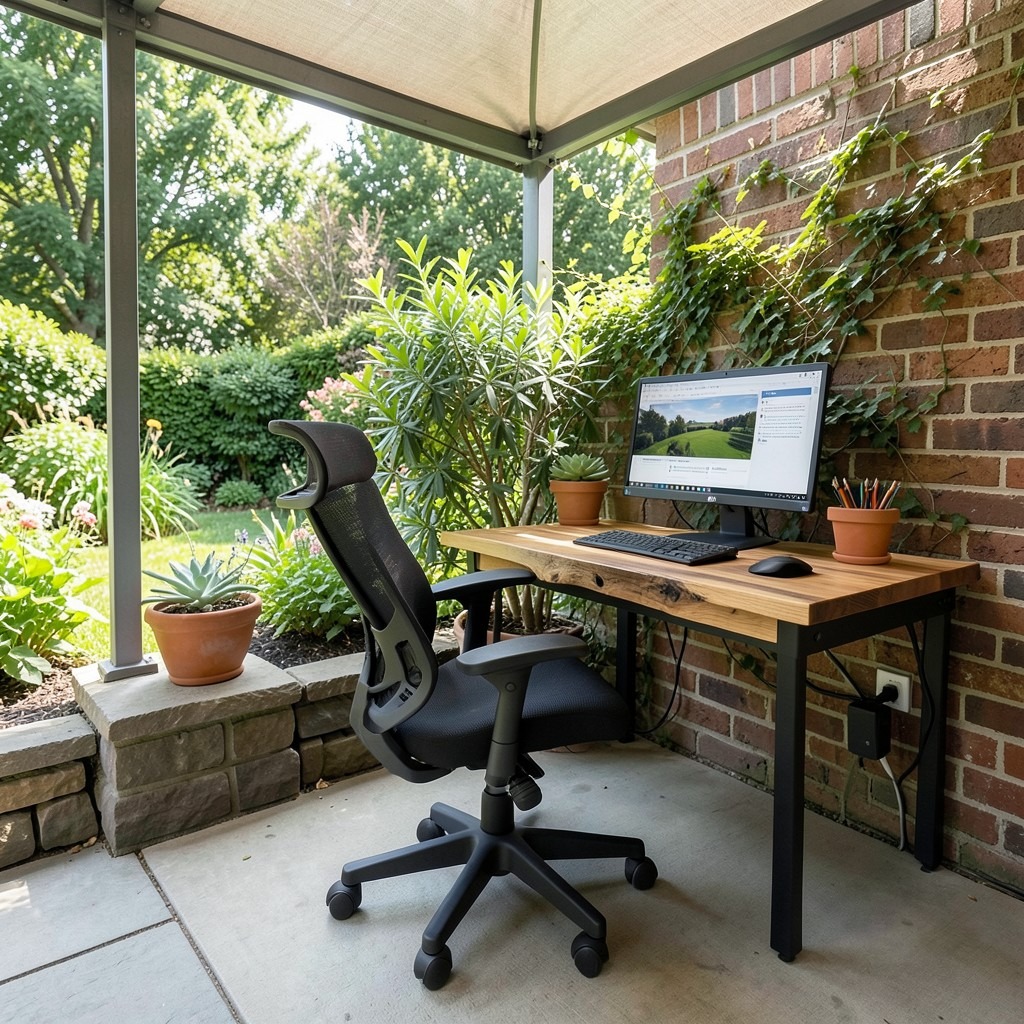
The outdoor workspace on a patio acknowledges a reality that the past several years of changing work culture have made undeniable: people work from home, and working outdoors on a good day is better than working inside on the same day. A patio designed to support focused work — with shade, a stable surface, power access, and enough separation from the social areas of the outdoor room to maintain concentration — adds a genuinely productive function to the space that raises its daily use frequency dramatically. The patio that you can work on is a patio you go to every morning, not only on weekend afternoons.
A covered corner of the patio with a weather-resistant desk surface — a teak table, a sealed concrete work surface, or a compact outdoor-rated writing desk — positioned in shade through the morning working hours creates the physical infrastructure for outdoor work. Power access through a weatherproof outdoor outlet or a portable battery station eliminates the laptop-battery anxiety that limits how long outdoor work sessions last. An outdoor-rated task chair with genuine lumbar support, rather than a decorative garden chair, makes the difference between a workspace that can be used for two hours and one that causes back discomfort after thirty minutes.
The outdoor workspace should be positioned facing the garden rather than the house, creating the visual field of green and natural form that makes outdoor working genuinely restorative rather than simply a change of location. A small planted privacy screen between the workspace and the patio’s social seating creates enough visual separation to maintain the psychological conditions for focus without physically isolating the work area from the rest of the outdoor room. Rustic home office ideas applied to the outdoor workspace — a live-edge desk surface, a terracotta pot of pencils, a small succulent planting beside the monitor — create a workspace of genuine character that suits its outdoor context and makes the act of going to work on the patio feel like a small daily pleasure rather than a logistical compromise.
46. A Patio With a Gravel Garden and Stepping Stone Path

A gravel garden on the patio creates a low-maintenance planted environment with strong visual texture and the satisfying crunch underfoot that makes the outdoor space feel actively inhabited. Loose gravel or crushed granite as a ground surface between stepping stones, raised planter beds, and specimen container plants produces the garden-room hybrid that earthy home design and minimalist home design patios both work toward from different stylistic directions. The gravel surface is forgiving of irregular terrain, drains perfectly, and requires no mowing, watering, or seasonal replacement — its maintenance commitment is essentially zero once established.
Stepping stones — natural flagstone, irregular slate, or precisely cut concrete squares — placed through the gravel surface at natural walking stride intervals create a path that guides movement through the patio garden while providing a clean, dry surface underfoot. The stepping stone’s material should connect to the patio’s primary hardscape material — flagstone stepping stones through a gravel garden bordered by a natural stone planter wall creates a unified material story, while concrete stepping stones through gravel on a poured concrete patio reads as a single material family at two surface treatments. The space between and around the stepping stones, left in gravel or planted with low-growing thyme, moss, or creeping jenny, determines whether the path reads as formal or relaxed in its final character.
The gravel garden suits a planted palette of ornamental grasses, drought-tolerant perennials, and structural shrubs — plants that look natural emerging from a mineral ground surface and that require minimal supplemental water once established. Coastal outdoor living space contexts use beach pebble or crushed shell as the gravel surface material, connecting the patio’s ground texture to the coastal landscape beyond the property boundary. The gravel garden’s low cost, low maintenance, and high visual quality make it particularly valuable in large-area patio contexts where paving the entire surface would be expensive and planting the entire surface would be demanding, and the gravel occupies the middle ground between the two with practical intelligence.
47. A Patio With a Custom-Built Outdoor Shower

An outdoor shower on the patio is the feature that, more than almost any other, signals that the household has fully committed to the idea of outdoor living as a genuine way of life rather than occasional furniture use. The outdoor shower is not merely a practical amenity for rinsing off after the pool or garden work — though it serves those purposes excellently — it is a statement about the household’s relationship to being outside, to the body in outdoor space, and to the specific pleasure of showering under open sky that no indoor bathroom can replicate. Once installed, it becomes a feature that guests remember and household members use with a frequency and enjoyment that surprises even those who thought they were installing it for practical reasons only.
The outdoor shower’s construction suits the patio’s existing material palette — a teak-paneled outdoor shower enclosure with a pebble floor suits coastal home design and beach house interiors contexts, a stacked stone enclosure with a concrete floor suits earthy home design and rustic home decor, and a powder-coated steel frame with frosted glass panels suits modern home design and contemporary home ideas settings. The showerhead should be a rain head format at a height that suits the household’s tallest member, and the hardware — valve, handle, and head — in a coordinated metal finish that connects to the patio’s other hardware finishes. Warm-toned materials for the enclosure’s walls — teak, cedar, terracotta tile, or warm stone — make the shower experience feel warm and enveloping even when the water temperature is cool.
Privacy screening for the outdoor shower can take the form of a partial wall of the patio’s perimeter fence with a cedar or teak door on a barn hardware track, a planted green wall of dense evergreen shrubs that provides year-round screening, or a slatted cedar screen that provides privacy while allowing air movement through the enclosure. The planting adjacent to the outdoor shower — fragrant herbs like lavender, rosemary, and eucalyptus that release their scent when brushed by a hand or warmed by the shower’s steam — adds a sensory dimension to the experience that no indoor bathroom achieves. During summer home design season, the outdoor shower becomes a daily ritual that connects the household to the season’s warmth, light, and outdoor character with an immediacy and intimacy that no other patio feature matches.
48. A Patio With a Moongate or Circular Arch Garden Feature

The moongate — a circular opening in a garden wall, fence, or planting structure that frames a view through to the space beyond — is one of the oldest and most enduringly beautiful architectural features in garden design, originating in Chinese classical garden tradition and adopted into Western garden design through its sheer visual power. A circular frame performs something that rectangular openings do not: it transforms a view into a composed picture, turning whatever lies beyond the gate into a deliberate visual destination rather than simply the next section of the garden. The circular form communicates that what lies beyond was designed to be seen.
A moongate constructed from stacked stone, brick, or rendered concrete creates a permanent garden architectural feature that suits traditional home interiors gardens, earthy home design, and bohemian home styling settings with equal depth. The aperture’s size determines the view it frames — a moongate large enough to walk through functions as both portal and picture frame simultaneously, while a smaller moongate built as a purely visual feature in a garden wall frames a view of the planted garden beyond without inviting passage. Climbing plants trained around the moongate’s circumference — roses, clematis, or star jasmine — soften the hard architectural edge with living material and make the gateway itself a seasonal flowering feature through spring and summer.
Positioning the moongate to frame the patio’s most compelling garden view is the most important design decision in its installation — a moongate placed opposite the primary seating so that its circular frame is the first thing a seated person sees creates a garden focal point of extraordinary elegance that draws the eye, holds it, and rewards extended viewing as the light changes through the day. Lighting the view beyond the moongate with a buried uplight on a specimen plant or a path light along the stepping stones visible through the aperture creates an evening version of the daytime effect that is, if anything, even more beautiful. The moongate adds nothing functional to the patio’s operation, and that is exactly the point — it is pure garden beauty, justifying its presence entirely through the quality of the visual experience it creates.
49. A Patio With Warm Terracotta and Earth Tone Materials

Terracotta and earth tone materials — warm clay, sienna, ochre, and sand — bring a timeless, grounded quality to the patio that cooler palettes of gray, white, and black simply cannot replicate. The warmth of these tones connects directly to the natural landscape, to the color of bare soil, fired clay, and sun-bleached stone, and that connection makes patios built around earth tones feel genuinely embedded in their outdoor environment rather than imposed on top of it. This palette suits almost every residential context because the earth tones it draws from are the tones of the land itself, and the land is always present in the view beyond the patio’s edge.
Terracotta tile pavers on the patio floor create the material foundation for an earthy home design or Mediterranean-influenced traditional home interiors outdoor room, their warm clay color collecting and radiating the sun’s warmth through the afternoon. Terracotta pots in multiple sizes — graduated cylinders, broad low bowls, tall olive jar forms — planted with herbs, succulents, and seasonal annuals create the container planting layer that suits this material palette most naturally. The relationship between terracotta pots and terracotta tile pavers, far from creating a monotonous same-toned environment, creates a warm tonal harmony that allows every other color in the space — the greens of the plants, the white of the cushions, the blue of the sky — to read with extraordinary clarity and freshness.
Warm home decor ideas applied to the terracotta patio integrate natural fiber textiles in sandy and warm cream tones on the seating cushions, carved wood furniture in a honey or walnut finish, and woven rattan or seagrass baskets and side tables that reference the same warm, natural material family as the terracotta itself. A single deep accent color — a rich cobalt blue pot against the terracotta pavers, a deep teal cushion on the warm wood bench — provides the complementary contrast that prevents the earth tone palette from reading as monotonous and gives the eye a resting point of maximum visual interest. This accent is borrowed from the Mediterranean and desert home styling design traditions that have built entire regional aesthetics around the pairing of warm earth tones with cool, jewel-toned accents — a combination proven across centuries of outdoor living culture.
50. A Patio That Changes With Every Season

The patio designed for seasonal transformation is not a patio with one fixed look — it is an outdoor room with a base installation of permanent materials and furniture and a rotating layer of textiles, plants, lighting, and accessories that shifts with the calendar. This approach is the most sophisticated and the most honest expression of outdoor living because it acknowledges what every outdoor space knows but most fixed-design patios ignore: the seasons are real, they are different, and the outdoor room that responds to that difference provides a richer year-round living experience than one that stays identical from January through December.
The base layer of a seasonal patio is permanent and seasonal-neutral — natural wood or concrete pavers in a warm tone, a weather-resistant furniture set in a neutral fabric, a pergola or overhead structure for shade and weather protection, and a planting framework of structural evergreen specimens that provide year-round form. On top of this base, each season installs its rotating layer: summer home design brings bright outdoor cushions, a string light canopy, a full tropical container collection, and the outdoor bar cart stocked for cold drinks; fall home decorating swaps in warm amber textiles, candle lanterns, ornamental grass containers, and a fire pit with a surrounding circle of deep seating; winter home decor season keeps the patio alive through a gas fireplace, wool blankets on the bench, evergreen container plantings, and warm-toned string lights that suit the season’s short days.
Spring home refresh is the season most transformative in its sensory impact — the first container plantings of tulips and daffodils, the first herb planting of the new growing season, and the first outdoor meal on the newly cleaned furniture after a winter’s dormancy all carry an emotional quality that the more established summer season cannot match. That sense of return, of the outdoor room waking up alongside the garden around it, is one of the genuine pleasures of a patio designed for seasonal engagement rather than frozen in a single look. The patio that changes belongs to its household in a way that the fixed patio never quite achieves — it is a room that keeps pace with the people who use it, reflecting not just their design preferences but their daily lives, their seasons, and the passage of time through a home that was always meant to be lived in.
Leave a Reply