
Nobody designs their dream home around the laundry room. The laundry room is where good intentions go to fold and die — where clean clothes pile on a counter for three days before anyone moves them, where mismatched socks accumulate on a shelf above the dryer, and where the lighting is always one shade worse than a parking garage. Most laundry rooms were not designed at all. They were assigned. A corner of the basement, a closet off the hallway, a narrow galley between the garage and the kitchen — spaces allocated to function with zero conversation about experience. That allocation has consequences you feel every single week.
The average household runs five to ten laundry loads per week. Over the course of a year, that adds up to several hundred hours spent in this room — loading, unloading, sorting, folding, hanging, ironing, and searching for the other sock. Several hundred hours. In a room that most people have never given a single hour of deliberate design attention. The math alone makes the case for investing in this space, but the emotional argument is even stronger: a room you visit that often deserves to feel good. It deserves light. It deserves organization. It deserves a material palette that does not make you feel worse about the task you came in to do.
The laundry room’s design challenge is different from every other room in the house. Unlike the living room or bedroom, it cannot afford to prioritize aesthetics at the expense of function — the appliances are fixed, the plumbing is fixed, and the workflow of sorting, washing, drying, and folding follows a physical logic that the layout must respect. The design has to work before it can look good. The rooms in this collection do both, and the ones that succeed longest are the ones where the designer started with the workflow and built the aesthetic on top of a foundation of genuine operational intelligence.
This collection of fifty laundry room design ideas spans the full range of scale, budget, style, and spatial challenge. Some ideas address the closet-conversion laundry room where every inch of wall space is load-bearing in a practical sense. Others address the generous dedicated laundry room where there is space for a sink, folding counters, hanging areas, and decorative choices that bring the space in line with the home’s broader design language. Several ideas apply farmhouse home decor sensibilities to the laundry room with shiplap, open shelving, and apron-front utility sinks. Others pursue the clean precision of modern home design with handle-free cabinets, integrated appliances, and a monochromatic palette that reads as architectural rather than domestic.
The styles represented here include minimalist home design, Scandinavian home interior, industrial home design, coastal home design, bohemian home styling, luxury home interior, and the warm, relaxed registers of farmhouse home decor and traditional home interiors. Within each style, the ideas address real problems — insufficient storage, poor lighting, wasted vertical space, ugly appliances, nowhere to hang wet clothes — with solutions that are both functional and beautiful. The laundry room that works on both levels is not a luxury. It is the result of applying the same design intelligence you would give any other room in the house to the one room that needs it most and receives it least.
Start with the idea that solves your most urgent laundry room problem. The room that works will follow.
1. A Laundry Room With Floor-to-Ceiling White Cabinetry
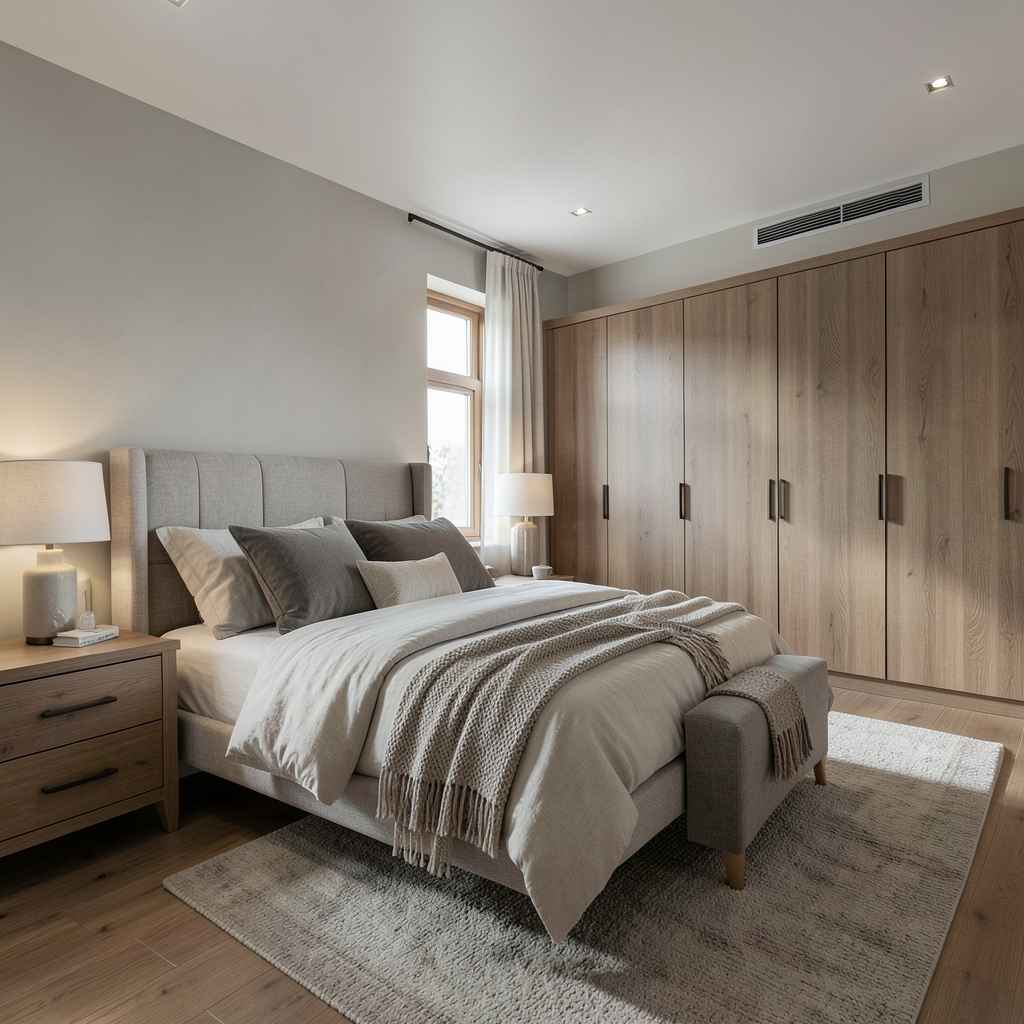
White cabinetry covering every wall surface from floor to ceiling transforms a laundry room from a utility space into something that reads as genuinely designed — the continuous cabinet face eliminates visual clutter, hides every supply and accessory behind closed doors, and creates the clean, uninterrupted surface that makes even a small room feel considered and controlled. The white finish reflects light back into the space, amplifying whatever natural or artificial light is available and preventing the dim, slightly oppressive quality that most laundry rooms share. This is the single upgrade that changes the room’s character most completely for the investment made.
Shaker-style cabinet doors in a bright white or soft white suit farmhouse home decor and traditional home interiors laundry rooms with their simple, honest panel geometry, while flat-panel handle-free doors in a pure white suit modern home design and minimalist home design contexts with their architectural precision. The cabinet hardware choice — polished nickel, brushed brass, matte black, or no hardware at all on push-to-open doors — connects the cabinetry to the rest of the home’s interior hardware palette, giving the laundry room the same design coherence as any other room despite its utilitarian function. Upper cabinets store infrequently used items like spare hangers, seasonal linens, and laundry supplies bought in bulk; lower cabinets house the sorting hampers, cleaning products, and ironing accessories that need daily access.
The floor-to-ceiling format maximizes storage capacity without expanding the room’s footprint, which matters most in compact laundry spaces where every square inch of floor space is occupied by appliances. A dedicated ironing center built into the cabinetry — a pull-out ironing board that folds back behind a cabinet door when not in use — eliminates the need for a freestanding ironing board that consumes floor space and has nowhere logical to live. This integrated approach is a hallmark of luxury home interior design applied to the most practical room in the house, and its effect on daily usability is immediate and substantial.
2. A Laundry Room With a Farmhouse Apron-Front Sink
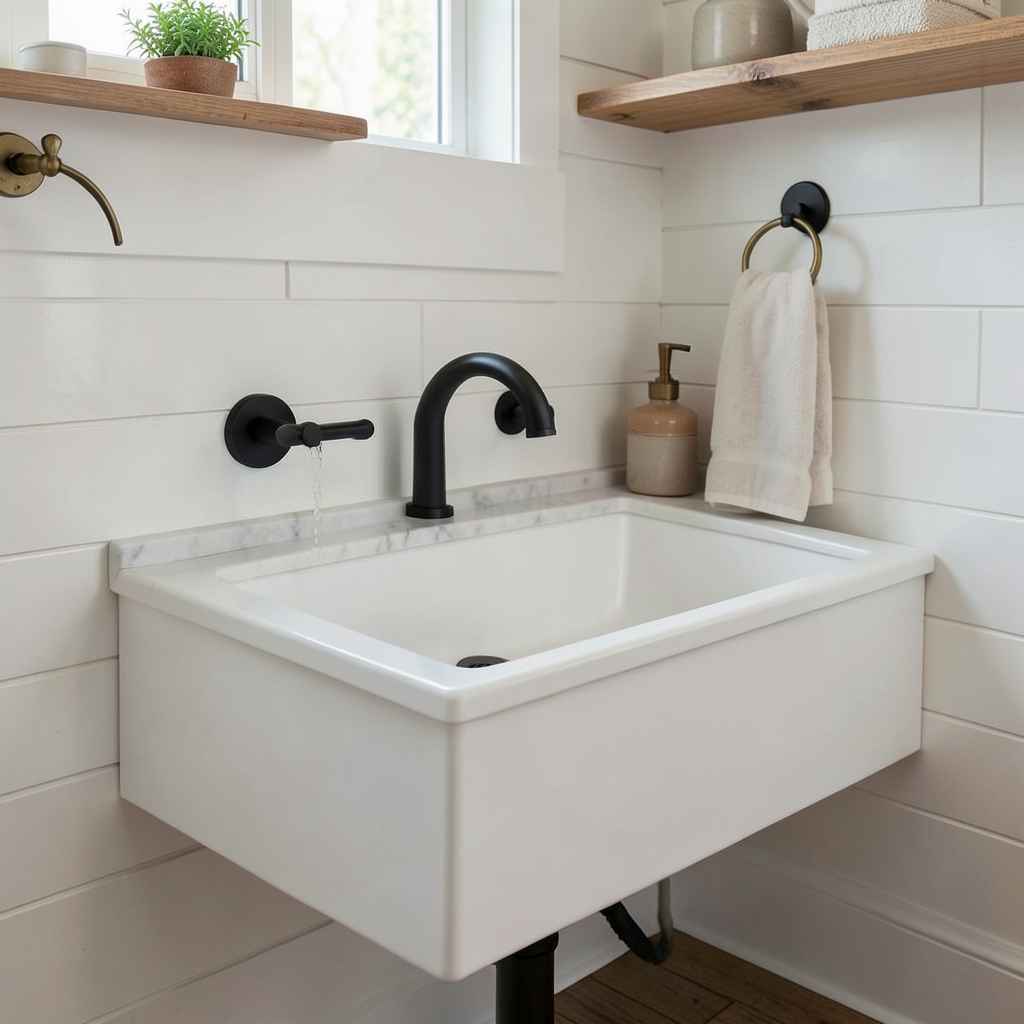
The apron-front utility sink is the single most character-defining fixture choice in a farmhouse-influenced laundry room — its deep, wide basin and exposed front face carry the same material honesty and domestic warmth as the apron-front kitchen sink, connecting the laundry room to the farmhouse home decor vocabulary of the house with a single fixture selection. This sink does more than look the part: the deep basin handles hand-washing delicate garments, soaking stained items, and cleaning large objects like pet beds and muddy athletic gear with a practical capacity that standard utility sinks lack. The functionality and the aesthetics are inseparable in this case.
A white fireclay apron-front sink in a laundry room with white shiplap walls, open wood shelving, and matte black faucet hardware creates the farmhouse bathroom decor quality that homeowners seek in the laundry room — the room feels as considered and warm as any other designed space in the house rather than like a utility closet that received leftover budget. The sink surround can be finished in butcher block, marble, quartz, or painted concrete depending on which material palette the home prioritizes, and each choice produces a different register within the farmhouse aesthetic: butcher block for the warmest, most rustic expression; marble for the most refined; quartz for the most practical. Warm home decor ideas applied to the sink area — a small potted herb on the windowsill above, a linen hand towel on a brass ring, a ceramic soap dispenser in a warm tone — complete the vignette and turn a functional sink into a designed moment.
The faucet selection deserves the same consideration given to any kitchen or bathroom faucet, because the laundry room sink is used frequently enough that the faucet’s operation, finish, and scale affect daily satisfaction. A wall-mounted bridge faucet in an unlacquered brass or oil-rubbed bronze finish suits the farmhouse and traditional home interiors aesthetic and creates the period-appropriate pairing with a fireclay sink that reads as historically consistent. A single-hole pull-down faucet in a matte black finish suits a farmhouse laundry room with modern home design leanings, where the clean fixture silhouette bridges the two design territories without fully committing to either.
3. A Laundry Room With Open Shelving for Organized Display
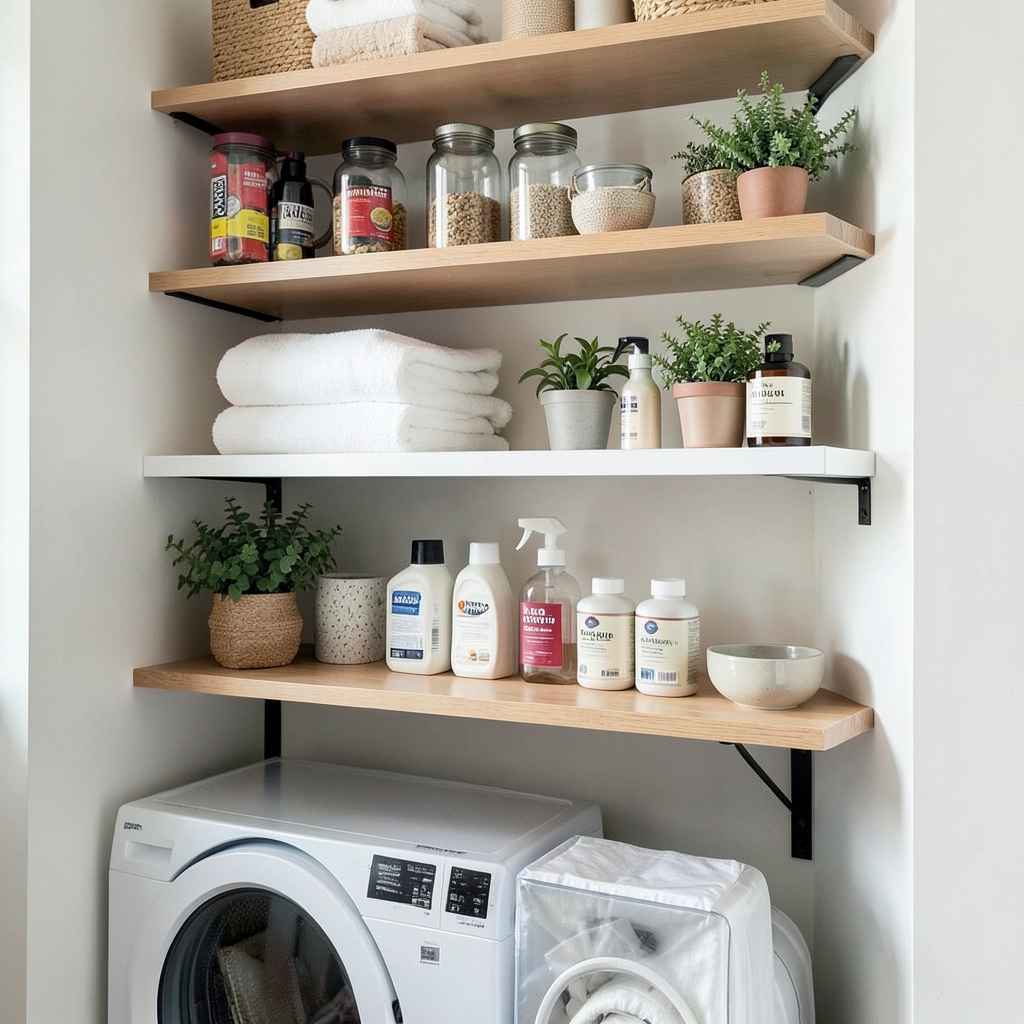
Open shelving in a laundry room serves a design function that closed cabinetry cannot — it creates the opportunity to make the storage itself part of the room’s visual composition, turning glass jars of detergent pods, stacked white towels, a row of matching spray bottles, and small potted plants into the decorative layer that gives the room personality. This approach requires more styling discipline than closed storage, because everything on an open shelf is permanently on display, and the difference between curated open shelving and ordinary clutter is entirely in the editing. Get the editing right, and open shelving makes a laundry room feel like the most organized space in the house.
Natural wood shelving — solid pine, poplar, or oak on black iron pipe brackets — suits industrial home design and farmhouse home decor laundry rooms with material warmth and straightforward structural honesty. White-painted MDF shelving on hidden floating brackets suits minimalist home design and Scandinavian home interior contexts, its clean face and precise shadow line creating an architectural quality that heavier brackets undermine. The shelf’s depth should account for the objects it will hold — a twelve-inch deep shelf handles standard detergent bottles, stacked folded linens, and small baskets comfortably, while a shallower eight-inch shelf suits a display-only role for decor objects and small accessories.
Matching containers on open laundry room shelving create the cohesion that transforms a collection of different products into a curated display. Decanting powdered detergent into a clear glass canister, liquid detergent into a glass dispenser with a pump, and dryer sheets into a small ceramic bowl means the shelf reads as designed rather than stocked. Chic home decor laundry rooms apply this principle consistently — every supply has a container that suits the room’s palette, and the result is shelving that looks as good as any display in the kitchen or bathroom. The practice takes ten minutes to set up and makes every subsequent load of laundry slightly more pleasant because the environment it happens in is pleasant.
4. A Laundry Room With a Folding Counter Above the Appliances
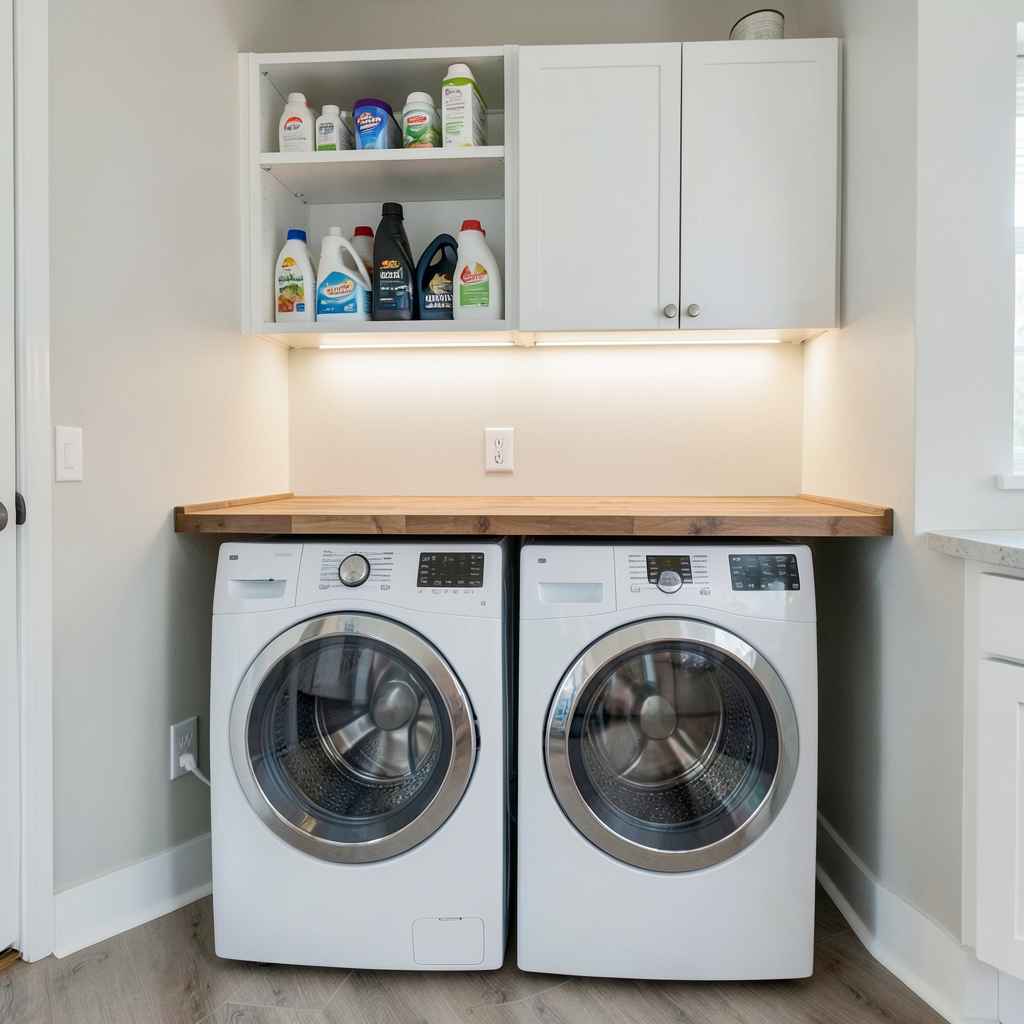
The most consistently underserved surface in the typical laundry room is the one directly above the washer and dryer — a span of wall that most rooms leave entirely empty while homeowners fold laundry on the living room sofa, the bed, or the floor. A custom counter spanning the top of both appliances at the correct ergonomic height creates a dedicated folding surface that makes the laundry workflow complete within the laundry room itself, eliminating the migration of clean laundry to other rooms where it tends to remain unfolded for days. This counter changes how the household uses the space more than almost any other single addition.
The counter material should be durable, easy to wipe clean, and visually connected to the room’s broader palette — a butcher block counter suits farmhouse home decor and warm, rustic registers, a quartz counter suits contemporary home ideas and modern home design, and a laminate counter in a solid color or stone look suits budget-conscious laundry room renovations where the priority is function over premium material. The counter’s depth should match the appliances’ depth so the surface aligns flush with the front of the machines, creating an uninterrupted work surface that feels like a designed installation rather than a shelf balanced on top of the appliances. Adding a lip or low rail along the back edge of the counter prevents items from falling behind the machines during folding — a practical detail that anyone who has ever reached behind a washer for a fallen dryer sheet will appreciate immediately.
Cabinetry above the counter provides the upper storage tier that makes the laundry room’s organization complete — shelves for detergent and supplies directly above the workspace, and closed cabinets for less frequently used items further above the sight line. The counter and cabinet combination creates the kitchen-like functionality that the most efficient laundry rooms share with the most efficient kitchens: a work surface at the correct height, storage immediately above it, and appliances within arm’s reach. Bright home design laundry rooms finish this counter-and-cabinet installation in white or light wood with undercabinet LED strip lighting that illuminates the folding surface directly, eliminating the shadow that upper cabinets create over the work surface below.
5. A Laundry Room With Patterned Encaustic Floor Tiles
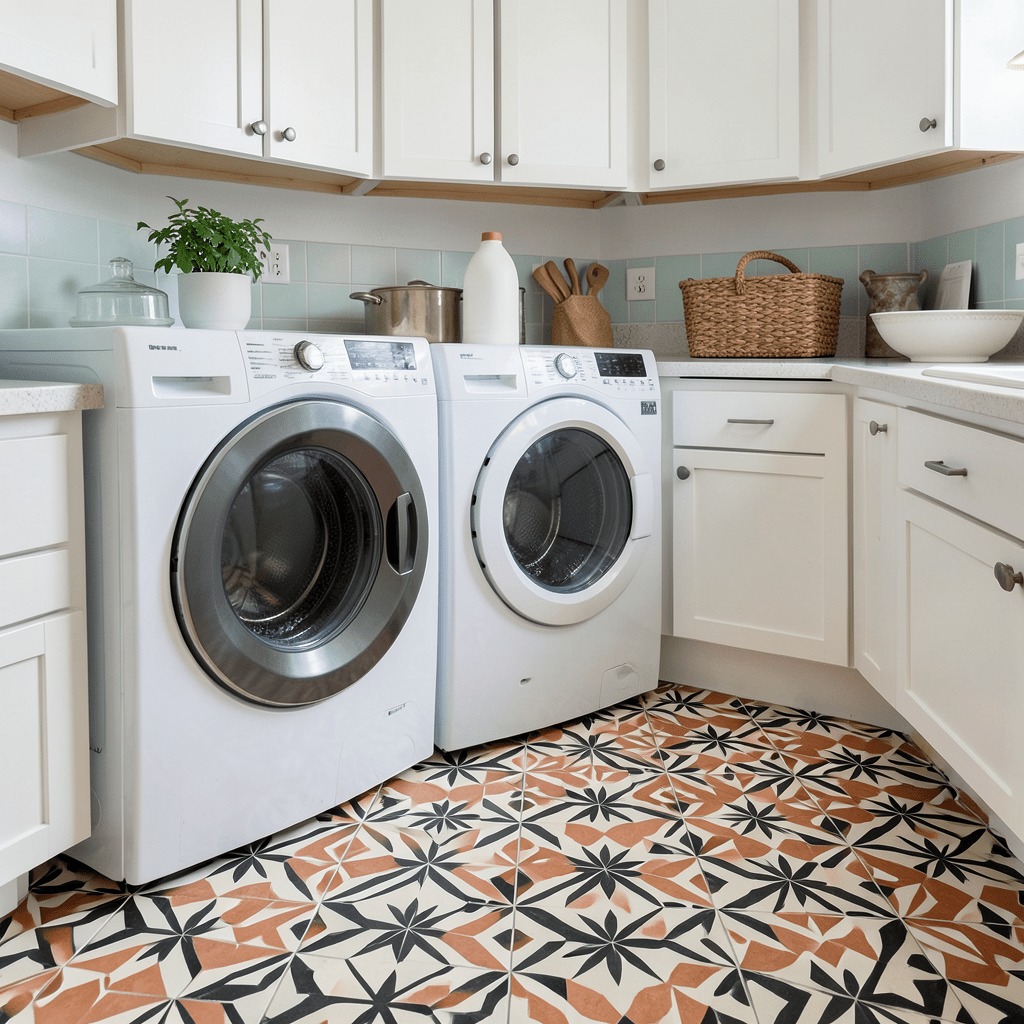
The floor of a laundry room is one of the few surfaces that can carry a bold pattern without the visual density becoming overwhelming, because the appliances, cabinetry, and overhead elements occupy the eye’s primary attention and the floor reads as a background plane rather than a dominant one. A patterned encaustic cement tile — a Moroccan geometric, a Spanish Mediterranean star-and-cross, or a bold graphic black and white pattern — turns the laundry room floor into the room’s most distinctive design feature, the element that makes guests stop and look more carefully at a space they expected to be unremarkable. That surprise is a design achievement worth pursuing.
Encaustic cement tiles in a warm terracotta and cream geometric pattern suit farmhouse home decor, earthy home design, and traditional home interiors laundry rooms, their hand-pressed surface variation and warm color family creating the artisan quality that machine-printed ceramic tiles approximate but do not match. A bold black and white geometric encaustic tile suits modern home design and minimalist home design contexts, where the graphic contrast between the tile pattern and white cabinetry above creates the room’s entire visual interest without requiring any additional decorative layer. Coastal home design laundry rooms lean toward encaustic tiles in aqua, white, and sand tones that reference the coastal exterior palette and give the utility room a breezy home interiors freshness unexpected in a functional space.
The installation of encaustic cement tiles requires sealing before grouting and again after installation, because the tiles’ porous surface absorbs grout haze and staining agents permanently without this protection. The sealing adds a step to the installation process but extends the tile’s appearance through years of the wet conditions and cleaning products that laundry rooms generate. The grout color choice is the final design decision — a white grout with a bold tile pattern reads as bright and graphic, while a tone-matched grout that blends with the tile’s darkest color reads as richer and more sophisticated, allowing the pattern itself to read rather than the grid of grout lines that describes it.
6. A Laundry Room With a Stacked Washer and Dryer Configuration
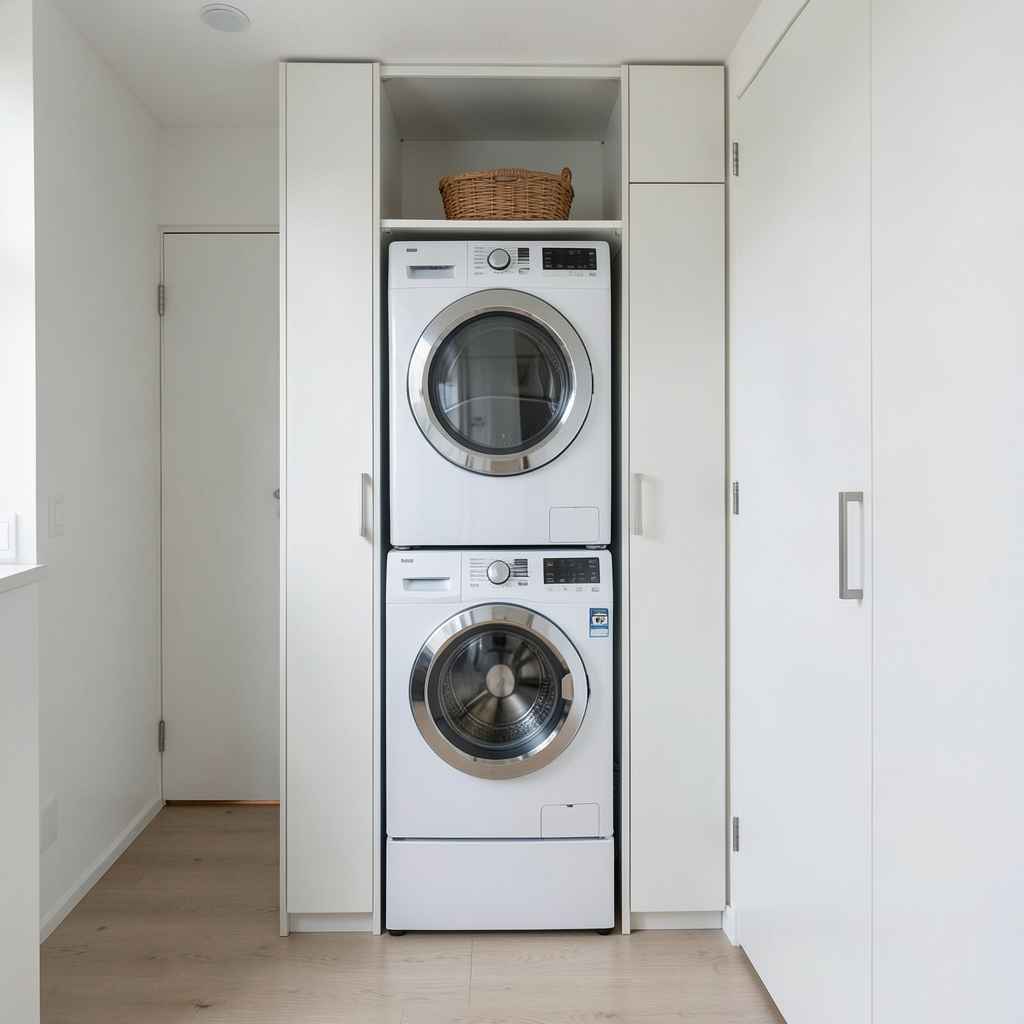
Stacking the washer and dryer vertically rather than placing them side by side doubles the floor space available for other functions — folding counters, utility sinks, storage cabinetry, and hanging areas — and in a small laundry room, that recovered floor space is the difference between a room that functions adequately and one that functions excellently. The stacked configuration is not a compromise for small spaces. It is a strategic allocation of vertical space that most rooms with generous height can exploit to significant advantage, and the design opportunities it creates often produce more functional rooms than the standard side-by-side arrangement would allow in the same square footage.
A stacked washer-dryer pair enclosed within a floor-to-ceiling cabinet surround — with the cabinet doors closing over the machines when not in use — creates a laundry alcove that disappears entirely behind closed doors, turning the laundry function invisible in a hallway, kitchen, or bathroom. This approach suits Scandinavian hallway design and minimalist home design contexts where the visual cleanliness of the space demands that utility functions remain concealed during their off-hours. The cabinet surround also provides upper storage above the dryer and lower storage below the washer, using the full height of the alcove rather than allowing the space above and below the stacked machines to go unused.
Front-loading machines are required for stacked configurations, and the ergonomic reality of a front-loading dryer at chest height means loading and unloading the upper machine requires less bending than the ground-level front loader. Some homeowners find the elevated dryer position — typically fifty to sixty inches from the floor to the dryer door — more comfortable than bending to a floor-level machine, particularly for households with back concerns. Pedestal drawers under a stacked pair are not possible, but the floor space freed by the stacking arrangement creates far more total usable room than the pedestal storage would have provided — a trade that almost every laundry room benefits from making.
7. A Laundry Room With Brick or Shiplap Accent Wall
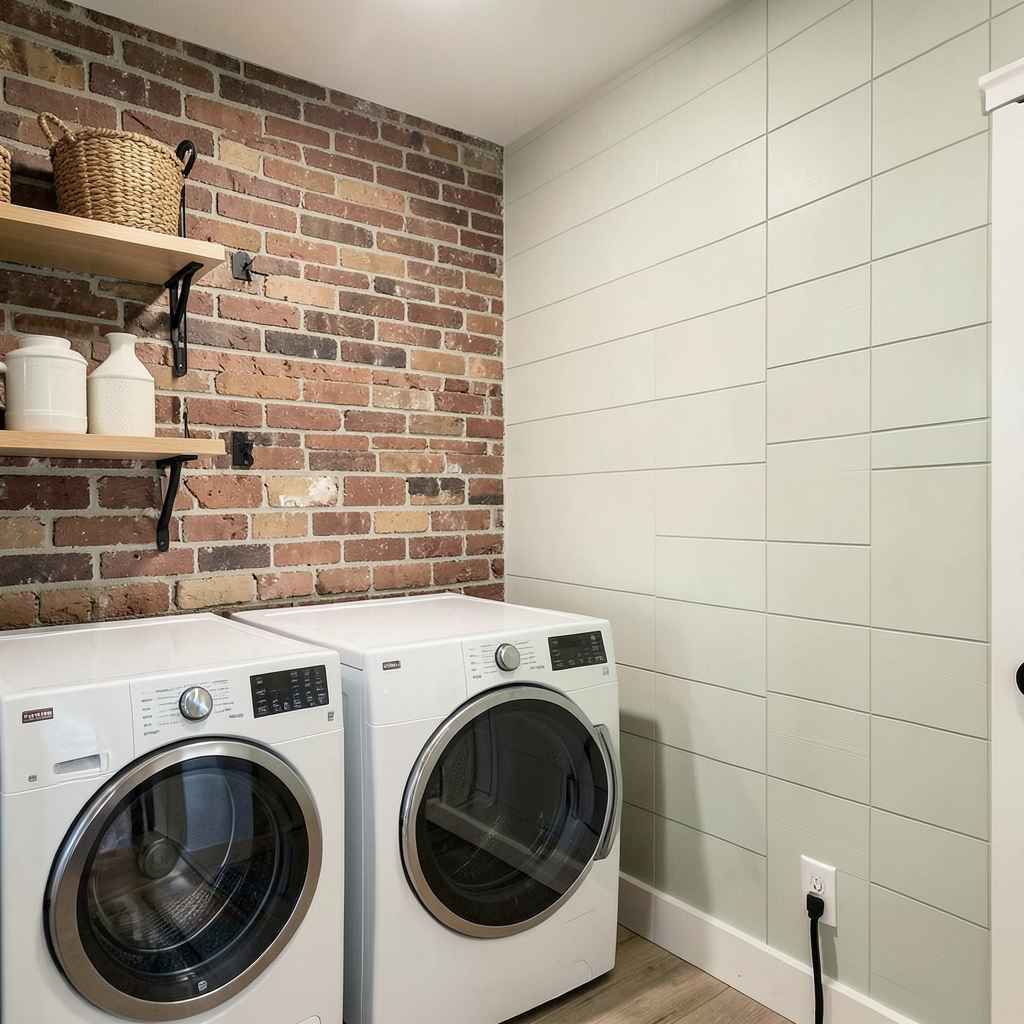
A textured accent wall in a laundry room does something that painted walls cannot — it adds dimensional character to a space that tends toward hard, flat surfaces, and that character makes the room feel inhabited and designed rather than functional and forgotten. Exposed brick and shiplap are the two accent wall treatments that achieve this most reliably, and they do so in distinctly different registers. Brick reads as urban, raw, and historically textured, suiting industrial home design and earthy home design laundry rooms. Shiplap reads as clean, coastal, and warm, suiting farmhouse home decor and beach house interiors contexts.
A real brick accent wall in a laundry room — whether structural brick exposed during renovation or reclaimed brick applied as a thin veneer — creates a material presence that no faux finish replicates convincingly. The brick’s color variation, the texture of the mortar joint, and the slight irregularity of individual bricks produce a surface that catches laundry room lighting from multiple angles and creates the visual depth that makes the room feel larger and more interesting than its actual dimensions suggest. Painting the brick white or a warm off-white — a lime wash rather than a standard paint application — softens the texture’s intensity while preserving its dimensionality, producing a surface that reads as both refined and honest.
Shiplap applied horizontally in a laundry room and painted in a warm white or soft sage creates the classic coastal home design and farmhouse home decor backdrop that suits open shelving, black iron fixtures, and woven baskets with equal ease. The shadow lines between shiplap boards add visual rhythm to the wall surface without the complexity of a pattern, giving the eye enough to rest on without demanding attention. Running shiplap vertically rather than horizontally creates height — a particularly valuable effect in low-ceilinged laundry rooms where the vertical lines visually pull the ceiling upward and make the room feel less compressed.
8. A Laundry Room With a Hanging Drying Rod System
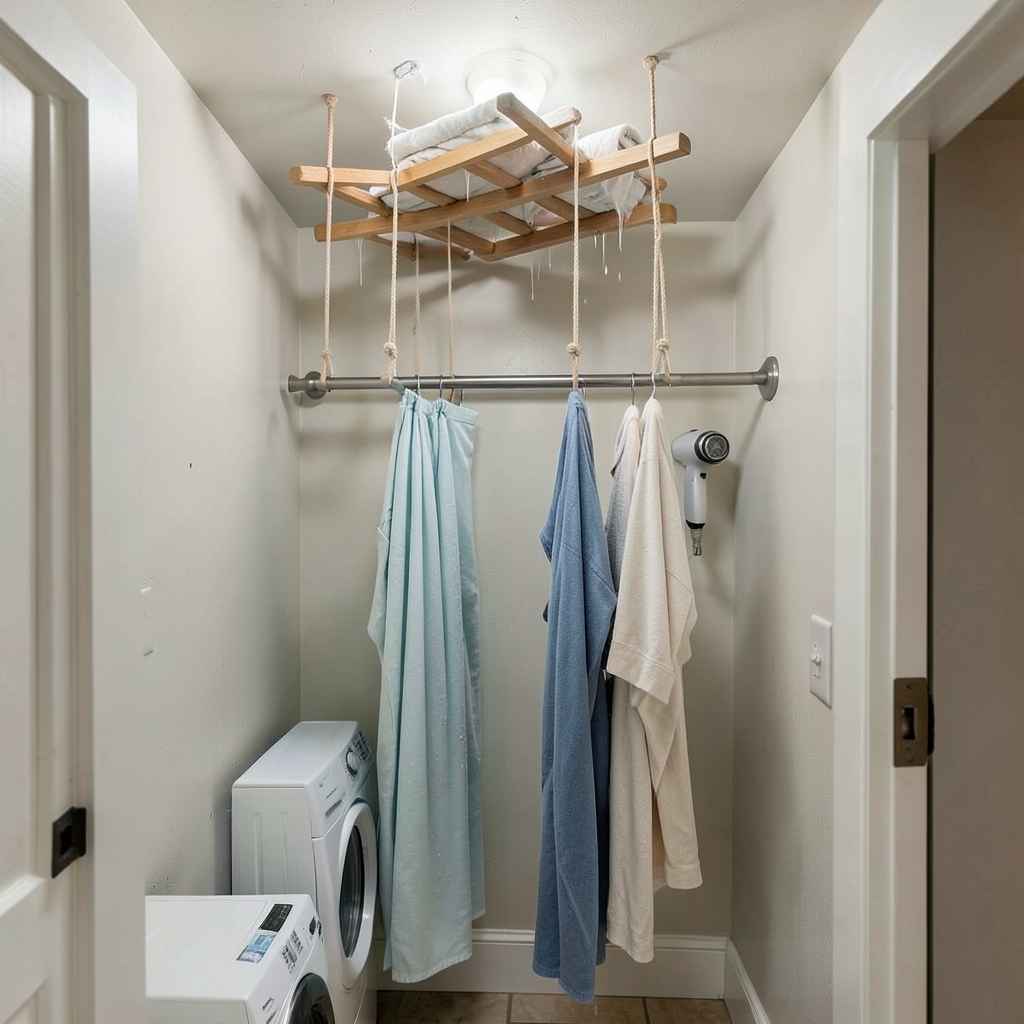
A well-designed hanging system in the laundry room solves one of the household’s most persistent laundry problems: where to put wet or freshly ironed clothes that are not ready for the closet. Without a dedicated hanging area, these clothes migrate to door frames, shower curtain rods, and the backs of chairs throughout the house, spreading the laundry function into rooms where it does not belong. A ceiling-mounted or wall-mounted drying rod keeps the hanging function contained within the laundry room, and that containment is itself a significant quality-of-life improvement for the household.
A ceiling-mounted pulley drying rack — a traditional design with multiple wooden rungs suspended from four cords that raise and lower on a wall-mounted cleat — suits the laundry room’s need for flexible drying capacity that folds away when not in use. When loaded with wet garments and raised toward the ceiling, the rack uses airspace that would otherwise be wasted, and the garments dry effectively in the warmth that accumulates near the ceiling. This design originated in traditional home interiors of northern European households and still performs the function better than most modern alternatives — the pulley system is mechanically simple, durable, and space-efficient in a way that extendable tension rods and freestanding drying stands are not.
A fixed stainless steel hanging rod mounted at ceiling height between two walls of a narrow laundry room creates a permanent hanging area that suits contemporary home ideas and modern home design with its clean material and precise installation. The rod’s height — ideally two feet below the ceiling to allow full-length garments to hang without touching the floor — determines the length of garments it accommodates and the clearance below it for folding or other laundry functions. Pairing the hanging rod with a steam function on a handheld steamer kept on a hook beside the rod turns the laundry room’s hanging area into a garment finishing station where wrinkles are addressed before clothes return to the closet, eliminating the ironing step for most garments entirely.
9. A Laundry Room With Wallpaper for Unexpected Personality
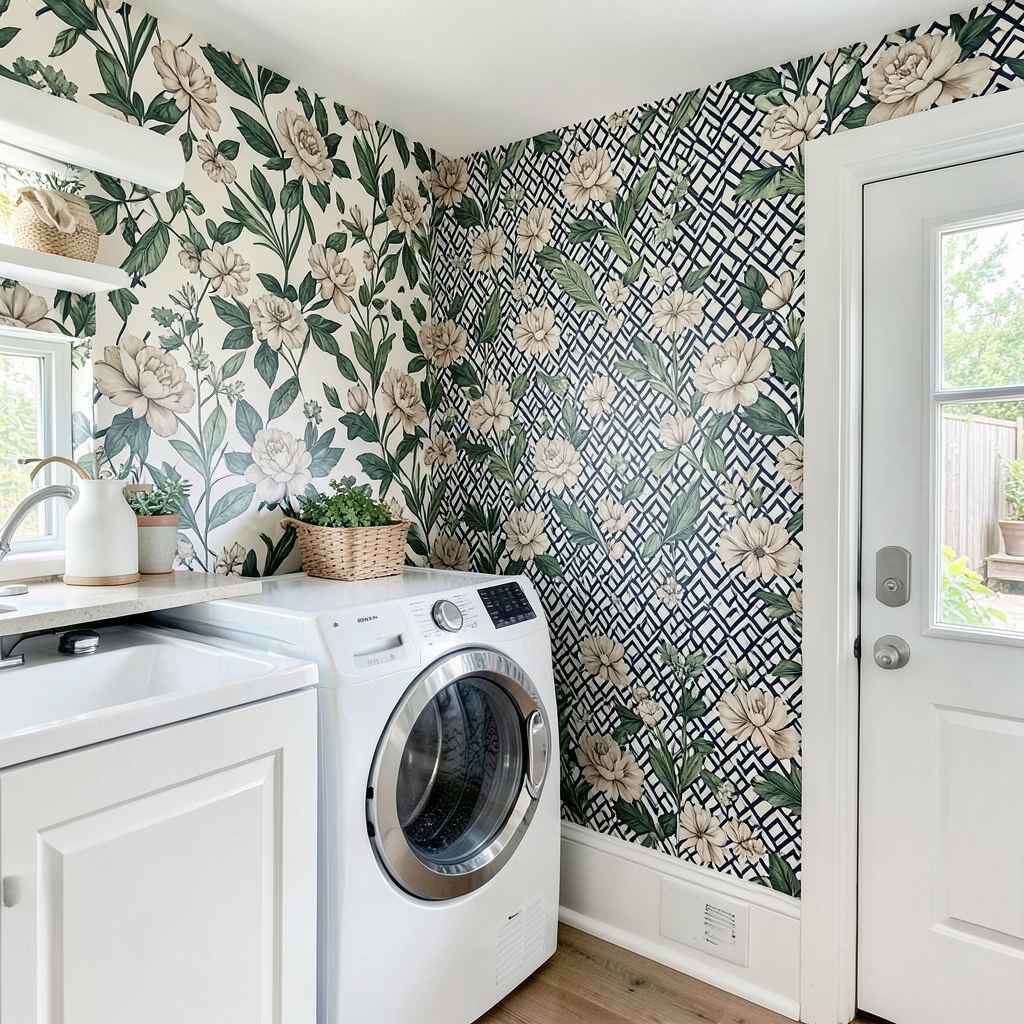
Wallpaper in a laundry room is the design move that most homeowners talk themselves out of and then regret when they see someone else do it well. The hesitation makes sense — it is a humid room, the wallpaper will get wet, the investment seems disproportionate for a utility space. All of those concerns are addressable, and the result of addressing them and installing wallpaper in the laundry room is a space that people specifically take friends to see, not because it is extravagant, but because it is surprising. The laundry room is the last place anyone expects beauty, which makes it the room where beauty has the most impact.
Moisture-resistant vinyl wallpaper or paste-the-wall wallpaper applied with a moisture-resistant adhesive handles the laundry room’s humidity without peeling, bubbling, or losing adhesion over time. A bold botanical print in deep greens and creams suits garden-inspired interiors and bohemian home styling laundry rooms, creating the lush, jungle-inspired home decor quality that feels genuinely unexpected in a utility room. A graphic geometric print in navy and white suits coastal home design and contemporary home ideas contexts, its crisp pattern connecting the laundry room to the home’s broader design vocabulary through a deliberate decorating choice rather than an afterthought. Floral home decor ideas applied to laundry room wallpaper — a large-scale peony or magnolia print, a delicate trailing botanical — bring the spring home refresh energy into the one room that otherwise has no seasonal design identity.
The wallpaper need not cover all four walls to be effective — a single accent wall behind the appliances or the laundry room’s primary sightline from the door creates the full design impact of wallpaper while reducing the installation area and the associated cost and effort. The wall behind the folding counter or the apron-front sink, positioned opposite the entry, creates a focal point that frames the room’s primary work area in pattern and color. This limited application also makes wallpaper removal and replacement easier when the design direction shifts, preserving the laundry room’s ability to participate in future seasonal home makeover updates without a full-room renovation.
10. A Laundry Room With a Utility Sink and Custom Surround
A utility sink in the laundry room serves functions that no other room in the house covers efficiently — hand-washing delicate garments, pre-treating stains before machine washing, cleaning muddy shoes and sports gear, and handling the countless household cleaning tasks that require water but do not belong in the kitchen or bathroom sink. The utility sink’s presence makes the laundry room genuinely self-sufficient for the full range of household laundering needs rather than requiring trips to other rooms for tasks the laundry room should handle internally. The sink is a functional necessity in any laundry room designed to its full potential.
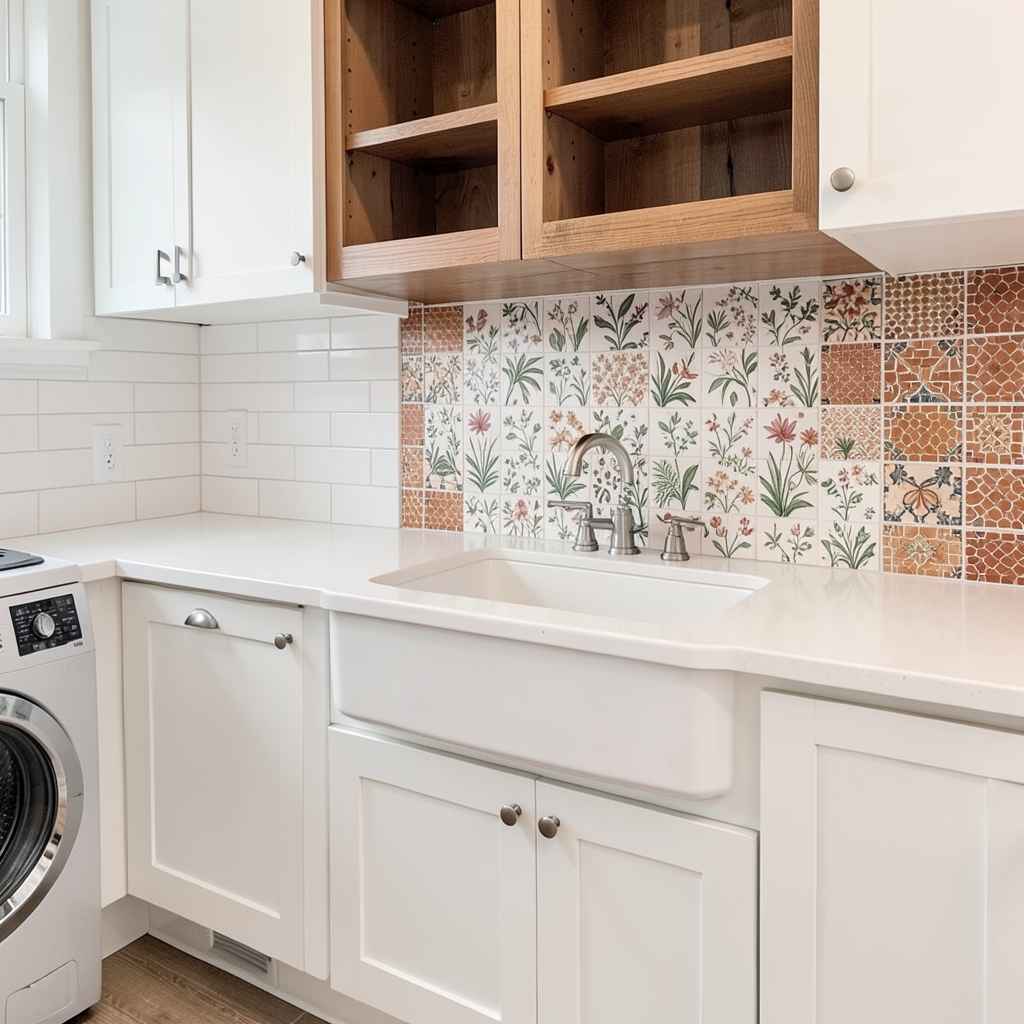
The surround — the countertop, cabinet, and splashback assembly around the utility sink — determines whether the sink reads as a designed element or an afterthought. A custom surround built to match the laundry room’s cabinetry in material, color, and hardware integrates the sink into the room’s overall design in the same way a kitchen sink integrates into the kitchen’s design composition. White quartz countertop with a white ceramic utility sink, surrounded by white shaker cabinets and a white subway tile splashback, creates the bright home design, airy home interiors quality that makes small laundry rooms feel open and clean. A butcher block surround with an apron-front fireclay sink, white painted lower cabinets, and open wood shelving above creates the farmhouse home decor utility room character that suits the same household aesthetic applied throughout the rest of the house.
The splashback behind the utility sink deserves the same tile attention given to kitchen and bathroom backsplashes — a hand-painted ceramic tile in a repeating botanical pattern suits garden-inspired interiors and traditional home interiors contexts, a white subway tile suits farmhouse bathroom decor and minimalist home design, and a zellige tile in a warm terracotta suits earthy home design and Moroccan-influenced bohemian home styling. The splashback’s scale relative to the sink surround should match the design treatment given to similar tiled surfaces elsewhere in the home, creating visual consistency that makes the laundry room feel like a room that belongs to the house rather than a space that was designed separately.
11. A Laundry Room With Wicker Baskets for Organized Sorting
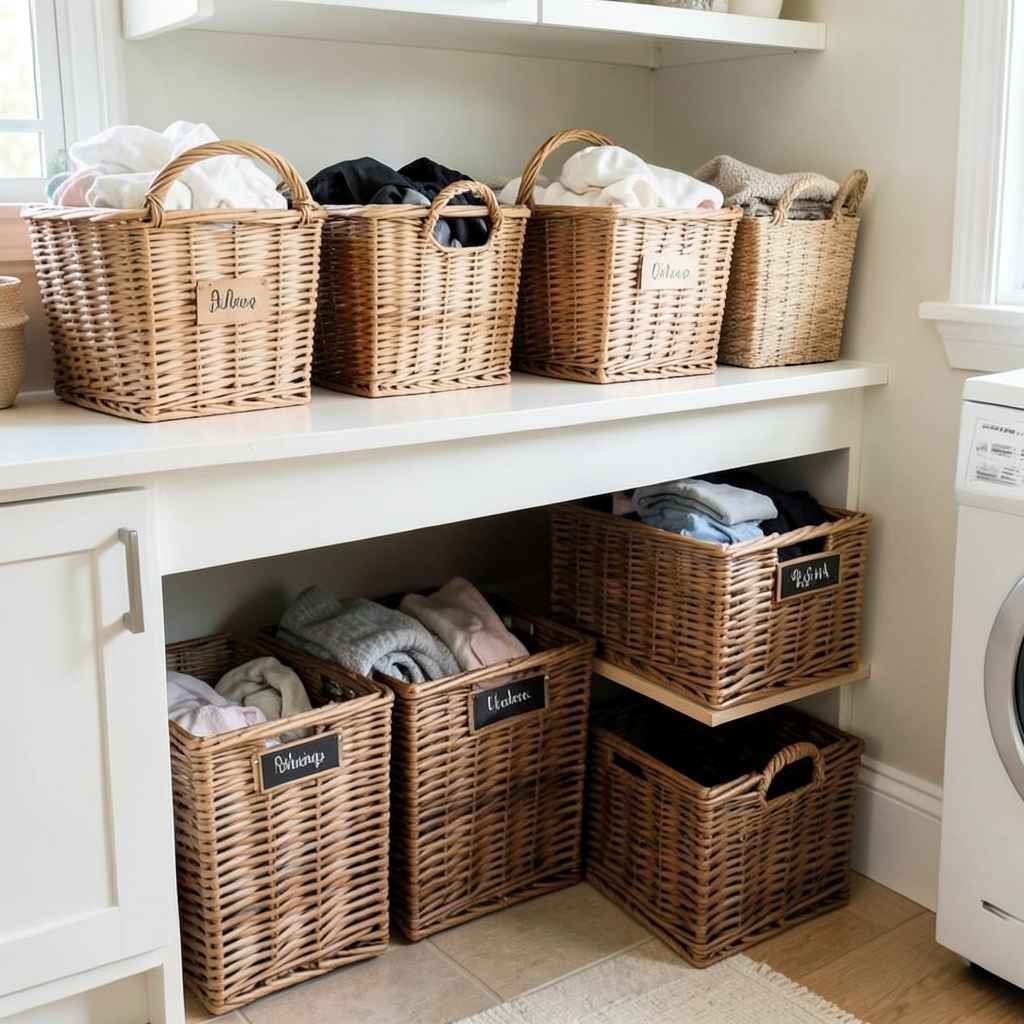
Wicker baskets handle the sorting and staging problem that laundry rooms generate continuously — the constant flow of dirty clothes in, clean clothes out, and the in-between states of sorted-but-not-washed and washed-but-not-folded that produce the visual chaos most laundry rooms live in permanently. A set of matching wicker baskets in a clearly organized system — one basket per person, or one basket per category of laundry — contains that chaos within a visual framework that reads as organized even when every basket is full. The baskets are working storage, not decoration, but chosen well they function as both simultaneously.
Natural rattan or seagrass baskets in a warm honey or bleached white tone suit coastal home design, Scandinavian home interior, and farmhouse home decor laundry rooms with their organic material quality and neutral color. Darker wicker or woven water hyacinth baskets suit earthy home design and bohemian home styling, their deeper tone connecting to the richer, more textured material palette of those design sensibilities. Matching labels on each basket — hand-lettered ceramic tags, printed linen labels, or simple chalk labels on small blackboard inserts — transform the basket system from an informal arrangement into a genuinely organized station that every household member can participate in correctly.
The basket’s position in the laundry room determines how well the sorting system actually functions. Baskets placed at floor level on a low shelf or in a row along the base of the cabinetry suit the informal, drop-and-go behavior of most household laundry sorting. Baskets placed on pull-out drawer inserts within a lower cabinet suit more organized households that prefer a concealed sorting system. A tiered basket shelf — a freestanding unit or a built-in niche with three to four stacked basket positions — maximizes vertical storage while keeping the basket system accessible and visible, which is the practical requirement that makes any sorting system actually used rather than merely installed.
12. A Laundry Room With Subway Tile Walls
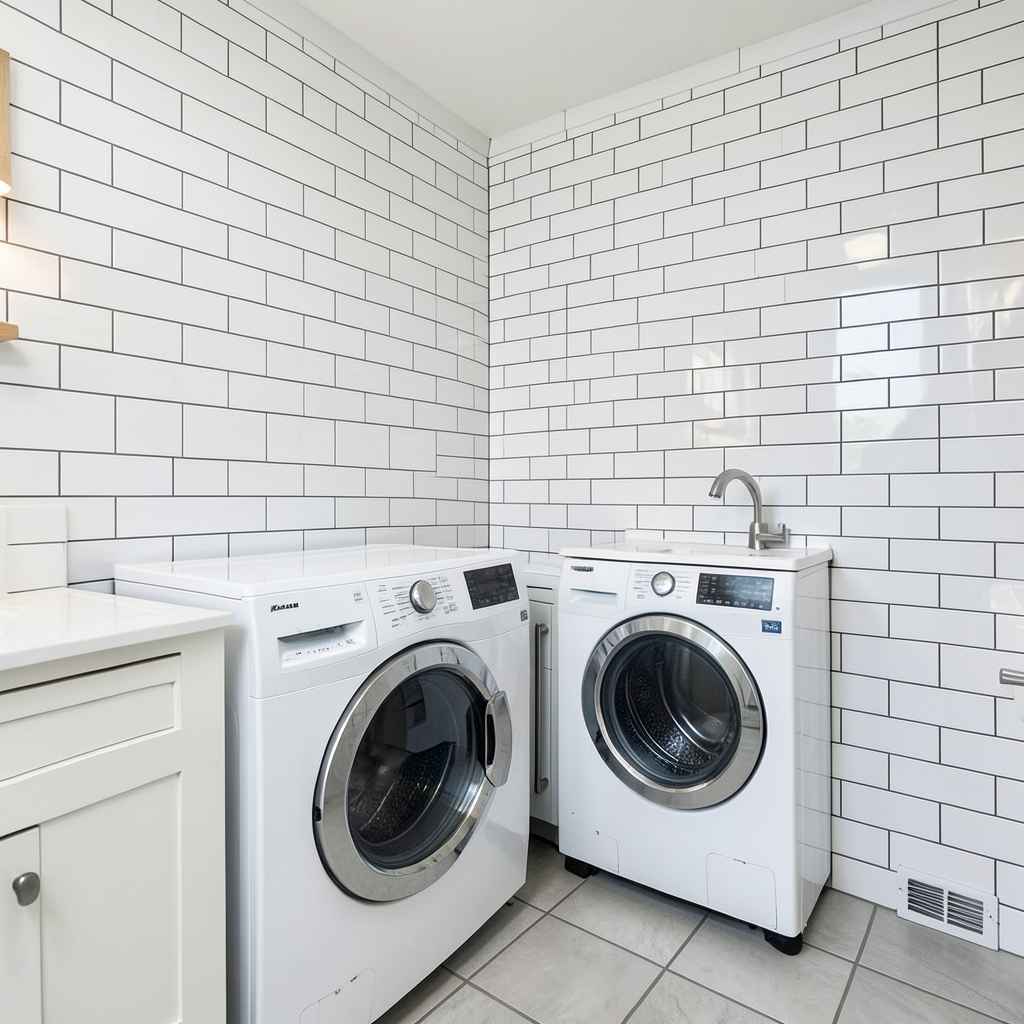
Subway tile walls in a laundry room create the clean, bright, easily maintained surface that this humidity-prone, cleaning-product-heavy room needs above any other material consideration. The tile’s impermeable surface resists moisture, stains, and the bleach splatter that laundry rooms accumulate without requiring any special treatment or periodic resealing. Its reflective quality bounces light around the room, amplifying the effect of both natural and artificial light sources. And its design neutrality — the white subway tile has suited every residential design era it has passed through — means it remains current and compatible with every future decorating direction the homeowner might choose.
White three-by-six-inch subway tile in a classic running bond pattern applied floor to ceiling on the laundry room’s walls creates the bright home design, spa-like quality that turns a functional room into a space that feels genuinely pleasant to work in. The grout color is the single decision that shifts the white subway tile’s character most significantly — bright white grout creates a seamless, clean look that reads as modern home design, while a medium gray grout defines each tile’s individual form and creates the graphic quality associated with farmhouse home decor and traditional home interiors. A dark charcoal grout with white tile creates the highest contrast, reading as boldly graphic and suiting industrial home design and contemporary home ideas contexts where the design language prioritizes edge and precision.
Extending the subway tile beyond the standard backsplash height to cover the full wall creates a material commitment that reads as more intentional than a standard waist-high tile installation. The floor-to-ceiling tile treatment eliminates the painted drywall above the tile line, removes the maintenance challenge of that painted surface in a humid environment, and creates the complete, envelope-like quality that luxury home interior laundry rooms use to achieve a spa-quality finish. The investment in additional tile and labor is modest relative to the improvement in the room’s appearance and durability, and the result is a surface that looks as good in ten years as the day it was installed.
13. A Laundry Room With a Barn Door for Space Efficiency
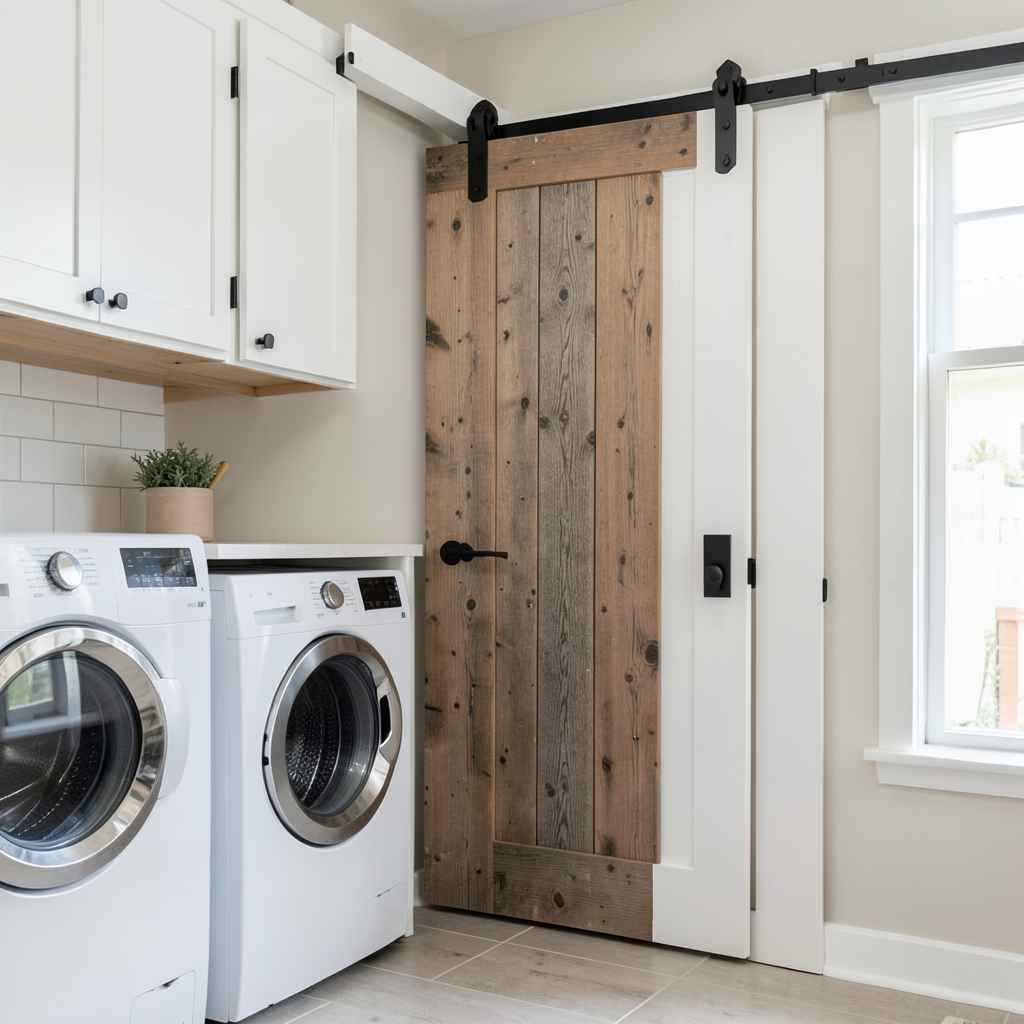
A sliding barn door on the laundry room entrance solves the swing-door problem that affects every small or awkwardly positioned laundry room — the standard hinged door that swings into the room consumes floor space, blocks access to appliances during operation, and limits furniture arrangement options in the room itself. The sliding barn door moves parallel to the wall rather than swinging through the room’s floor space, eliminating these constraints entirely and often recovering enough floor space to accommodate a folding counter, a sorting cart, or an additional storage unit that the swinging door would have prevented.
A wide-plank cedar or pine barn door with black wrought iron hardware suits farmhouse home decor and rustic home decor laundry rooms with the same material honesty it brings to the farmhouse bathroom decor and kitchen contexts where it appears most frequently. A painted MDF barn door in the same white as the laundry room’s cabinetry, on matte black hardware, suits modern home design and Scandinavian home interior contexts, where the door’s sliding function is valued but its decorative character should recede into the overall architectural composition. A salvaged antique door repurposed on a barn door hardware track suits bohemian home styling and traditional home interiors laundry rooms, its weathered character and unique history adding the layered, collected quality that bohemian home styling pursues across every design decision.
The barn door’s hardware track must be mounted to a solid structural element — a header, a stud, or a reinforced backing board — capable of carrying the door’s full weight through years of daily sliding use. Cheap hardware with inadequate mounting creates a door that wobbles, squeaks, and eventually falls out of level, undermining the practical benefit and the aesthetic quality the installation was meant to deliver. Investing in hardware from a reputable manufacturer with adequate weight ratings for the specific door material and size ensures that the barn door functions as smoothly on the thousandth use as on the first, which is the performance standard any daily-use door must meet.
14. A Laundry Room With Dedicated Pet Washing Station
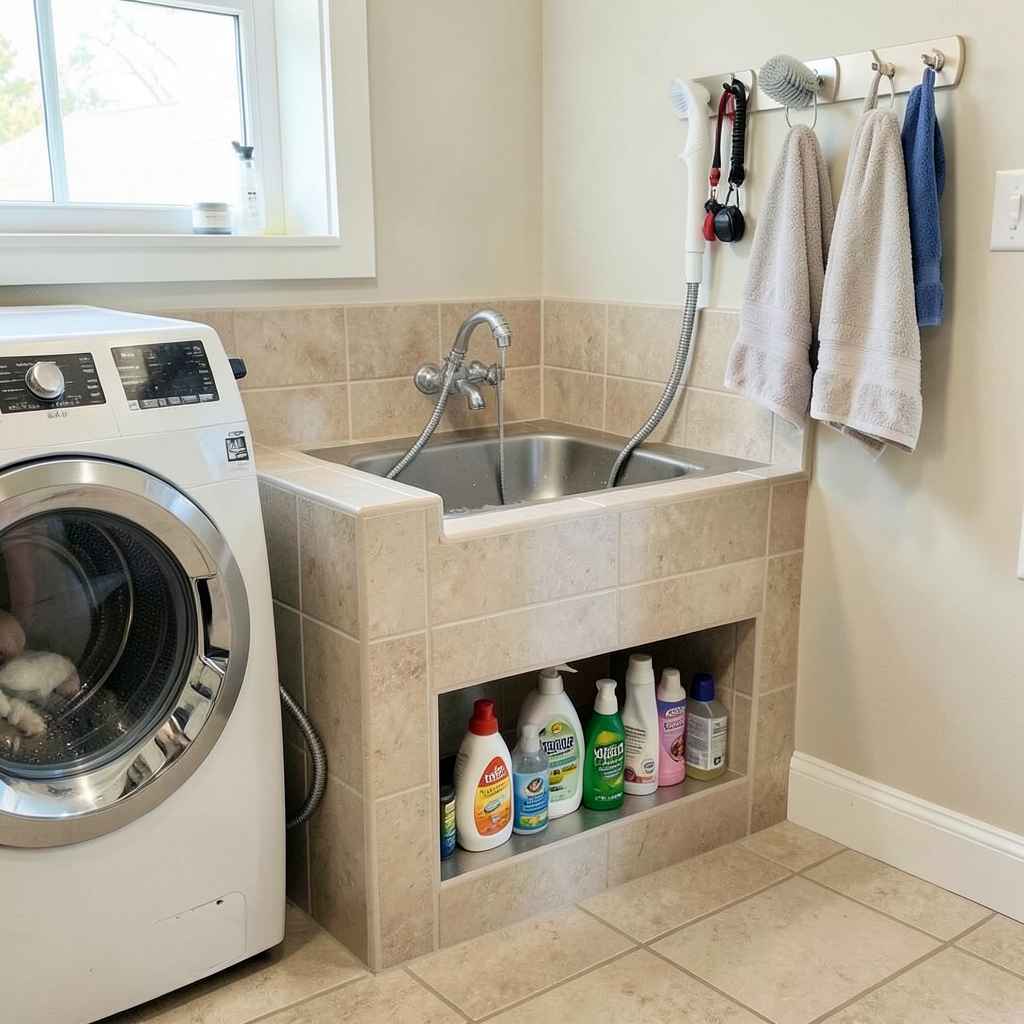
A pet washing station integrated into the laundry room addresses one of the messiest household tasks without spreading the mess into the bathroom, the kitchen, or the backyard. Dog bathing — the specific activity that creates the most water, mud, and fur migration in most family households — is best handled in a purpose-designed station with the right height, the right drainage, and the right fixtures for the task. When the laundry room contains this station, the entire operation happens in a room already designed for water and easy cleaning, and the pet bathing experience improves for both the household and the dog.
A tiled basin set at a height that eliminates bending — approximately eighteen to twenty-four inches off the floor for a mid-size dog — with a handheld spray hose on a long flex hose and a non-slip floor surface inside the basin creates the functional infrastructure of a dog washing station that makes the task efficient and contained. The basin’s tile surround in the same tile as the laundry room’s wall treatment creates a designed continuity that prevents the pet station from reading as an addition rather than an integral element of the room’s plan. A pull-out ramp or built-in step beside the basin allows larger dogs to self-load rather than being lifted, a practical detail that makes the station genuinely usable on a daily basis rather than a showpiece used only when the mess is critical.
Hooks on the wall adjacent to the pet station hold dog towels, grooming tools, and the leash and collar that typically come off the dog at the same moment bath time begins. A small cabinet below the basin stores pet shampoo, conditioner, flea treatment, and grooming supplies in a dedicated zone that prevents these products from migrating throughout the house. The pet washing station in the laundry room also makes seasonal home makeover moments more achievable — a mud-season spring home refresh that sees every dog washed weekly is manageable when the washing station is efficient, well-stocked, and designed to be used rather than avoided.
15. A Laundry Room With Industrial Pipe Shelving
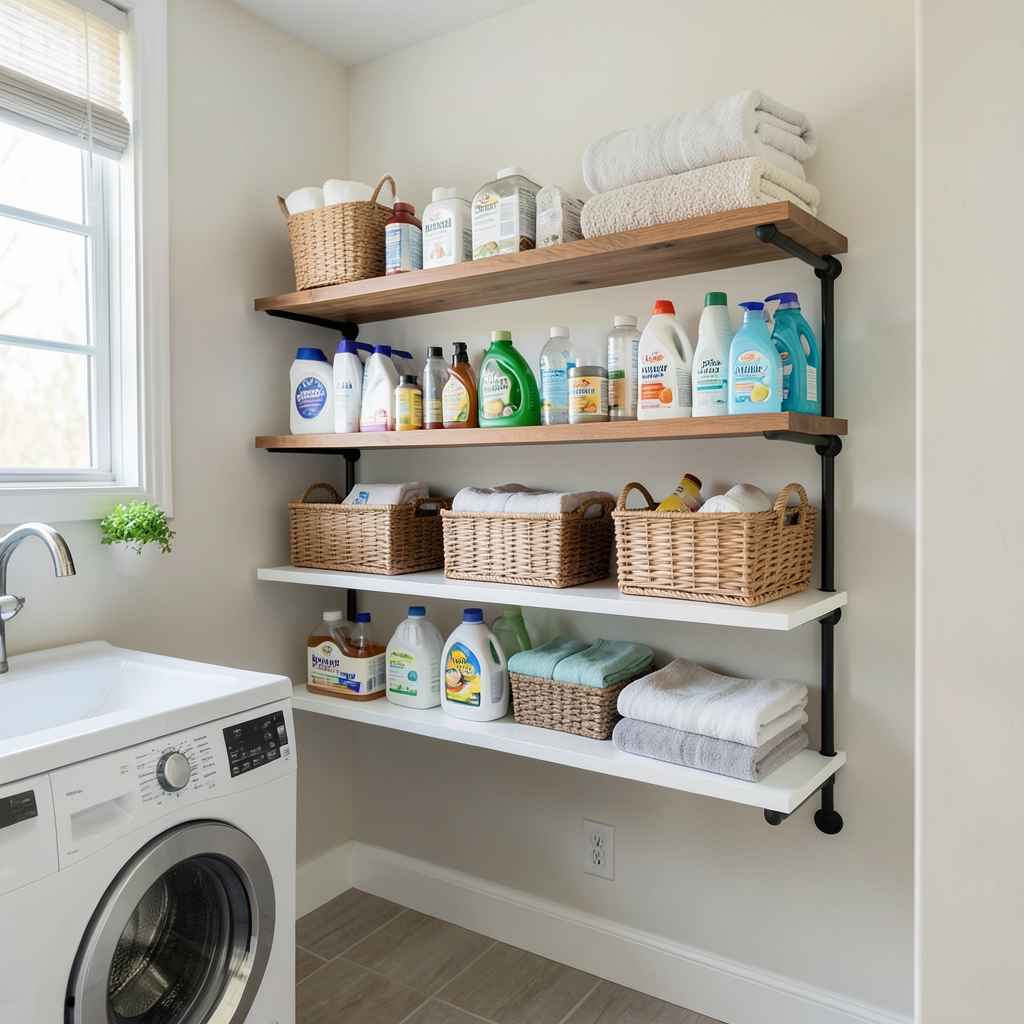
Industrial pipe shelving — open shelves supported by steel pipe brackets in a standard plumbing pipe diameter — brings the material honesty and utilitarian beauty of industrial home design into the laundry room with a directness and affordability that custom cabinetry cannot match. The pipe brackets read as structural rather than decorative, communicating that the shelving exists to carry weight and do work rather than to look good, and that functional transparency is exactly the quality that industrial design celebrates. The shelves look best when they are working hard, loaded with organized supplies and containers that make the room’s function visible and legible.
Black iron pipe brackets with raw pine or solid walnut shelf boards create the most classic industrial laundry room shelving composition — the warm wood against the dark metal producing a material contrast that suits rustic home office ideas aesthetics and industrial home design equally. Natural pipe-finish brackets with white-painted MDF shelf boards creates a lighter, more contemporary reading of the industrial aesthetic that suits bright home design and airy home interiors contexts where the pipe’s industrial character is valued but the room’s overall light quality must be preserved. The shelf boards’ width — twelve to sixteen inches — determines the practical capacity of the storage, and the choice should account for the specific containers, baskets, and items the shelves will hold rather than a generic average.
The installation of pipe shelving requires studs or wall anchors capable of supporting the combined weight of the shelves and their contents — a fully loaded laundry room shelf holding detergent, supplies, and folded linens can weigh fifty pounds or more, and inadequate anchoring creates a safety hazard in a room where the shelf is accessed multiple times daily. Pipe flange hardware in a standard floor flange format provides the most secure wall connection, and mounting each bracket into at least one wall stud ensures the installation stays level and secure through years of heavy use. The finished pipe shelving installation adds significant visual character to the laundry room at a fraction of the cost of built-in cabinetry, and its open format keeps every stored item visible and accessible without the overhead of opening and closing cabinet doors throughout the laundry workflow.
16. A Laundry Room With a Window and Natural Light
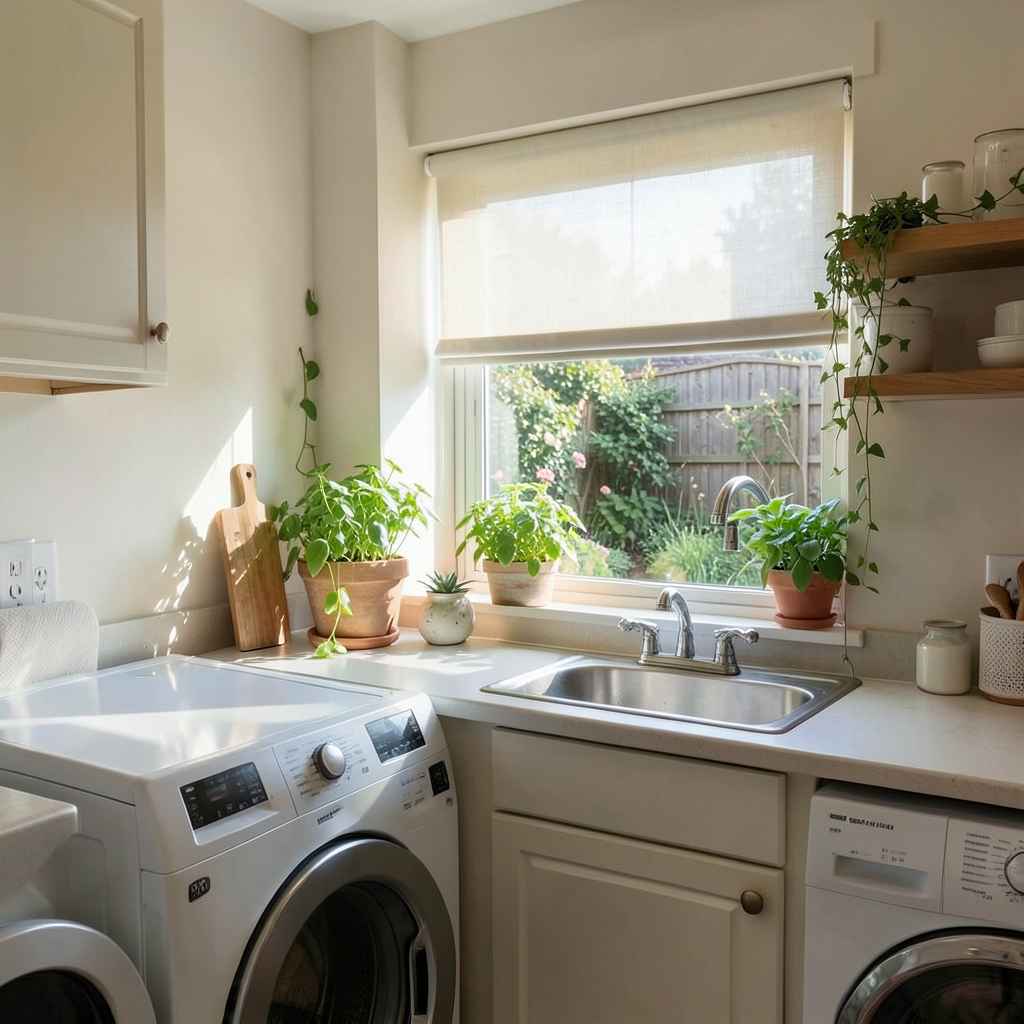
Natural light in a laundry room changes the room’s character more profoundly than almost any decorating decision — a laundry room with a window feels like a room, while one without feels like a closet. The light quality that comes through even a modest-sized window, particularly in the morning hours when most households run laundry, shifts the room from a space you want to finish quickly to one you can spend time in without the ambient discomfort of being in an artificially lit, windowless utility space. If the laundry room’s position on the exterior wall allows for a window, the window should be installed regardless of size.
A casement or awning window above the utility sink or the folding counter provides both natural light and ventilation, the latter being particularly valuable in a room that generates heat and humidity from running appliances through every season. The window’s exterior view — even if it faces only a fence line, a garden bed, or a narrow side yard — provides the visual escape from the room’s interior that makes extended time in the space tolerable. Garden-inspired interiors laundry rooms position the window to face a planted border or a kitchen garden so that the view while standing at the utility sink is green and growing rather than structural and static.
Dressing the window in a laundry room requires balancing privacy with light — a sheer linen roman shade that filters light while obscuring the room’s interior from outside view suits this balance in most urban and suburban contexts. For laundry rooms in more private settings, leaving the window undressed maximizes light entry and connects the room directly to the outdoor environment. The window sill becomes a small display surface — a potted herb, a small ceramic container, a trailing plant — that introduces the domestic warmth the window itself begins to create, turning the window from a light source into a designed moment that makes the room feel personally inhabited.
17. A Laundry Room With a Color-Drenched Bold Wall
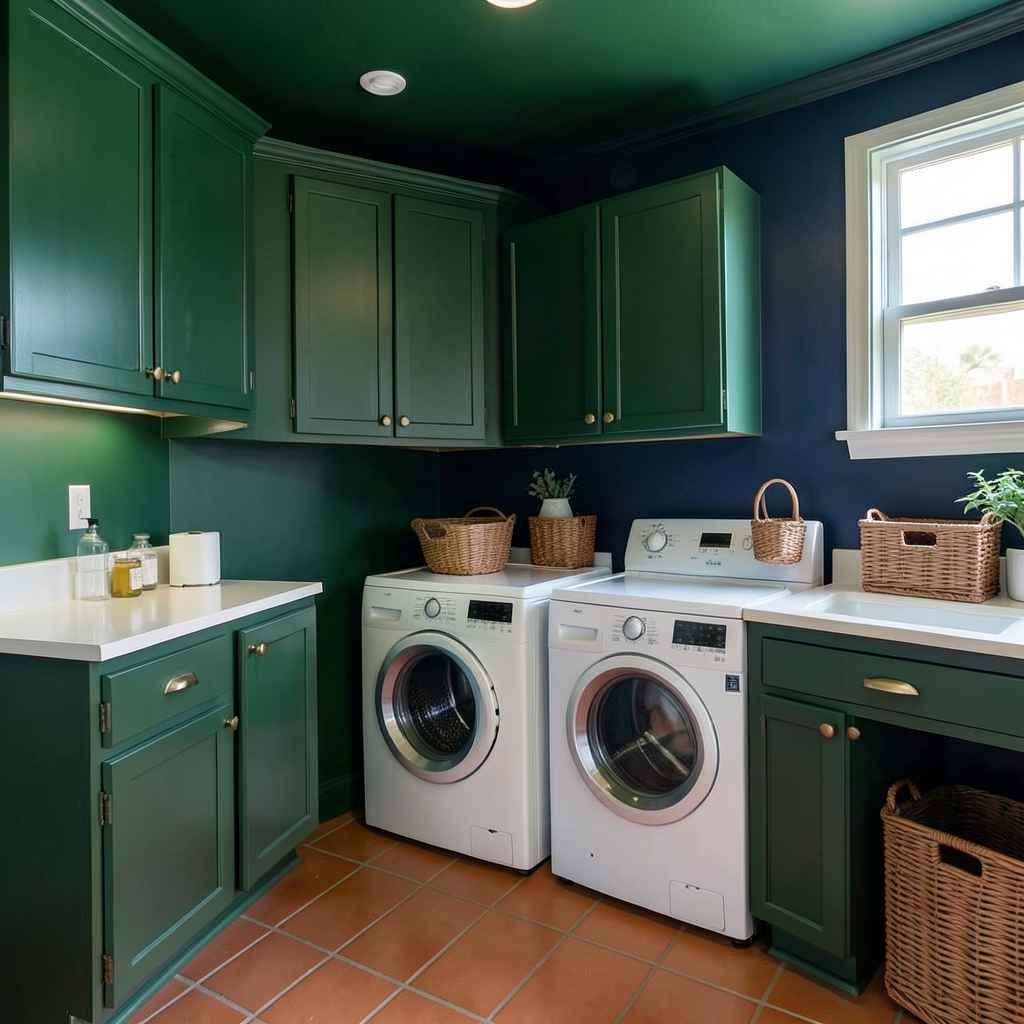
A laundry room painted in a single bold, saturated color — drenched wall to wall, ceiling and trim included — creates the immersive color experience that the room’s small scale makes possible. Color drenching works in small rooms because the limited wall area means the color wraps around the occupant in a way that does not happen in a larger room, creating the enveloping quality that makes bold color feel exciting rather than overwhelming. The laundry room is the ideal candidate for a color experiment the homeowner is not willing to risk in a more visible or larger room, and the result is consistently one of the most talked-about rooms in the house.
Deep forest green on every surface — walls, ceiling, trim, and cabinet faces — creates the moody, garden-folly quality that suits bohemian home styling and traditional home interiors laundry rooms with brass hardware on the cabinets and doors, white appliances, and a terracotta tile floor. Navy blue wall-to-wall creates a jewel-box character that suits coastal home design and elegant home styling when paired with white appliances, brass fixtures, and natural rattan baskets. Terracotta or burnt sienna creates the earthy home design and desert home styling enveloping warmth that suits households whose interior palette already runs warm, extending the home’s color story into the utility room with the same confidence applied elsewhere.
The practical consideration with color-drenched laundry rooms is the paint finish — a satin or semi-gloss finish on walls in a humid, frequently cleaned room provides better moisture resistance and cleaning durability than flat paint, and in a dark, saturated color the added sheen creates a luminous depth that flat paint suppresses. Testing the color under both the room’s artificial lighting and in daylight from the window is non-negotiable — a forest green that reads as rich and warm under incandescent light may read as flat and dull under the blue-white of a fluorescent tube. Choosing the light sources carefully, and ensuring they complement the chosen wall color, is the step that determines whether the drenched laundry room reads as a design success or a miscalculation.
18. A Laundry Room With Retractable Clothesline and Drying Area
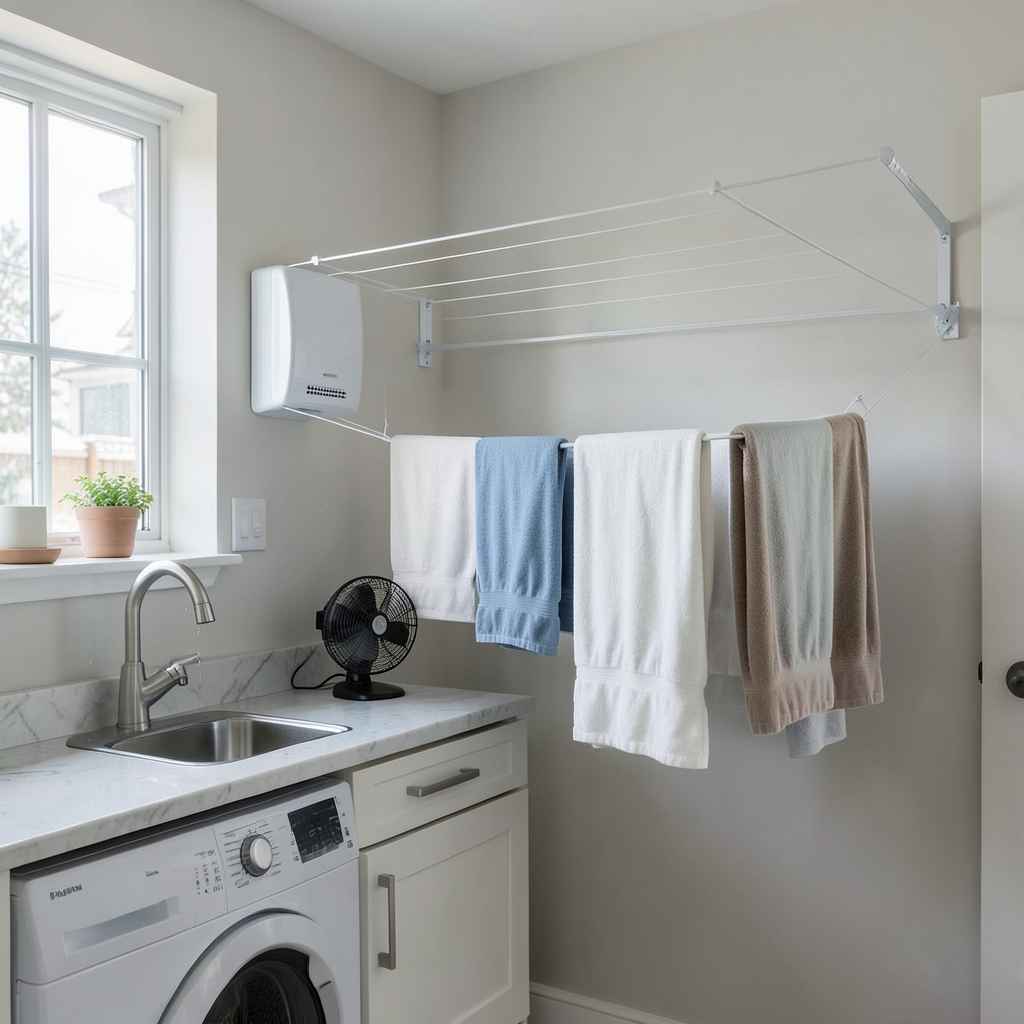
A retractable clothesline is the laundry room feature that apartment dwellers, townhouse owners, and small-home inhabitants genuinely miss when they move into a larger house without one — the ability to air-dry garments with zero floor space consumed and zero visual impact when the line is retracted is a practical elegance that no freestanding drying rack matches. A retractable clothesline mounted on the laundry room wall extends multiple cotton or nylon cords across the room’s width, holds a full load of wet laundry, and snaps back into a compact wall-mounted housing when not in use. The mechanism is simple, the installation is quick, and the utility is substantial.
Multi-line retractable systems spanning the room’s full width between two wall-mounted brackets hold ten to fifteen garments simultaneously — enough for a full delicate garment cycle or a hand-wash of mixed items — without requiring any floor space during drying or any storage space when retracted. The hardware’s design has improved considerably, with current retractable systems offering cord tension adjustment, line spacing options, and housing in materials ranging from white ABS plastic for utility contexts to brushed stainless steel for modern home design and Scandinavian home interior laundry rooms where the hardware’s appearance is as considered as its function. Positioning the retractable lines above the utility sink or near the room’s primary ventilation path maximizes drying speed by placing the wet garments in moving air rather than still air.
The retractable clothesline suits the winter home decor season particularly well — the months when outdoor line drying is impossible and energy-efficient garment drying alternatives become relevant. Air-drying extends garment life significantly compared to machine drying because heat damages fabric fibers over time, and the laundry room that provides a dedicated air-drying space actively protects the household’s clothing investment. Pairing the retractable clothesline with a small oscillating fan on a low shelf below the lines creates a gentle airflow that reduces drying time to three to four hours for most garments, matching the convenience of machine drying while providing the garment-preservation benefit of air drying.
19. A Laundry Room With Built-In Ironing Board Cabinet
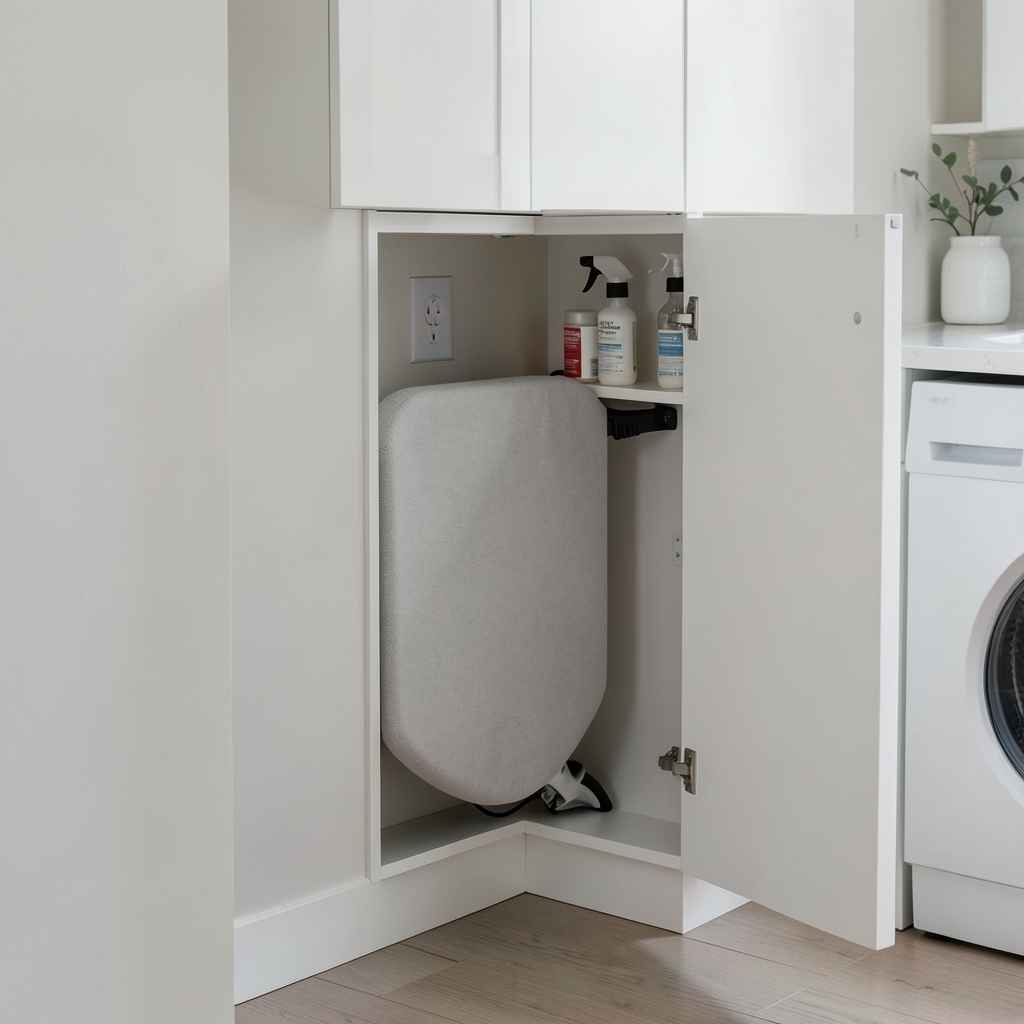
A built-in ironing board cabinet eliminates the freestanding ironing board — one of the most spatially awkward objects in any home — by mounting a full-size ironing board within a wall cabinet that closes flush with the surrounding cabinetry when not in use. When the cabinet door opens, the ironing board swings out and locks in position at the correct ironing height, and when the task is done, it folds back into the cabinet in seconds. The floor space that a freestanding board occupied is permanently recovered, the visual clutter of the board leaned against a wall disappears, and the ironing function integrates cleanly into the laundry room’s overall design.
Built-in ironing board cabinets are available as recessed units that install between wall studs — requiring no additional wall thickness — and as surface-mounted units that project slightly from the wall face. The recessed format is architecturally cleaner and suits modern home design, minimalist home design, and Scandinavian home interior laundry rooms where projecting objects interrupt the wall plane’s visual continuity. The cabinet door finish can match the surrounding cabinetry exactly, making the ironing board installation completely invisible in the closed position — a design integration that luxury home interior laundry rooms achieve as a matter of course and that any laundry room benefits from immediately.
The built-in ironing board cabinet can include a built-in outlet inside the cabinet housing, allowing the iron to be plugged in and heated while still in the stored position, ready to use within seconds of pulling the board out. This convenience eliminates the step of retrieving the iron from a separate storage location, locating the outlet, and managing the cord during the ironing session — all friction points that make ironing less likely to happen promptly after laundry is done. An iron holder mounted on the cabinet’s interior wall, a cord organizer on the cabinet’s side wall, and a small shelf inside the housing for a spray bottle and starch complete the integrated ironing station that makes the task efficient enough to actually be done rather than perpetually deferred.
20. A Laundry Room With Herringbone Brick Effect Tiles
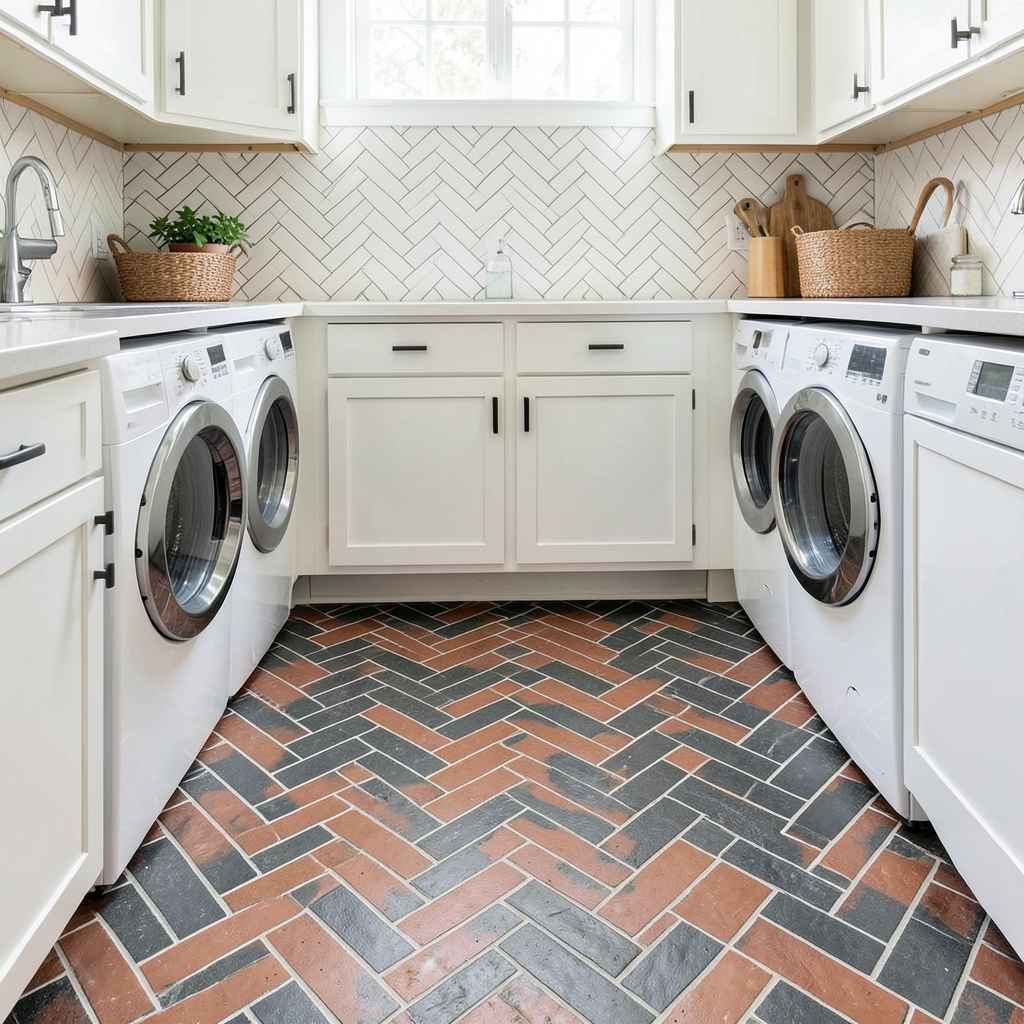
Herringbone brick-effect tiles create a floor or wall treatment in the laundry room that carries the visual interest of a complex pattern through a format that is installed quickly, cleaned easily, and maintained without special treatment. The herringbone pattern’s interlocking V-form creates an optical energy in the tile surface — a sense of directional movement — that a running bond or grid pattern does not generate, and that energy makes the room feel active and designed rather than static and functional. The pattern works equally well as a floor tile, a wall tile, and a backsplash, giving the laundry room designer multiple application options from a single format choice.
Terracotta herringbone brick-effect tiles on the laundry room floor suit farmhouse home decor, earthy home design, and traditional home interiors with their warm clay color and slightly textured matte surface. White or off-white herringbone tiles on the wall behind the appliances suit Scandinavian home interior, coastal home design, and minimalist home design, the crisp herringbone pattern providing visual interest on the wall without competing with the room’s storage and appliance elements. A charcoal or dark gray herringbone tile on the floor suits industrial home design and modern home design laundry rooms, the dark floor providing the graphic contrast with white cabinetry and white appliances that gives the room its design tension.
The herringbone installation requires careful layout planning because the pattern’s symmetry is only achieved when the starting point is correctly positioned relative to the room’s center — a herringbone that starts from a wall rather than the room’s center arrives at the opposite wall with a partial tile cut that creates an awkward, asymmetric appearance. A dry layout on the floor before any adhesive is applied confirms the pattern’s symmetry and allows adjustment before the installation becomes permanent. Grout color in a herringbone installation is more critical than in a standard grid tile because the diagonal lines of grout are more prominent to the eye — matching the grout closely to the tile tone produces a refined, settled result, while a contrasting grout emphasizes the pattern’s geometry with a graphic boldness that suits the design contexts where that energy is welcome.
21. A Laundry Room With a Murphy Bed Integration
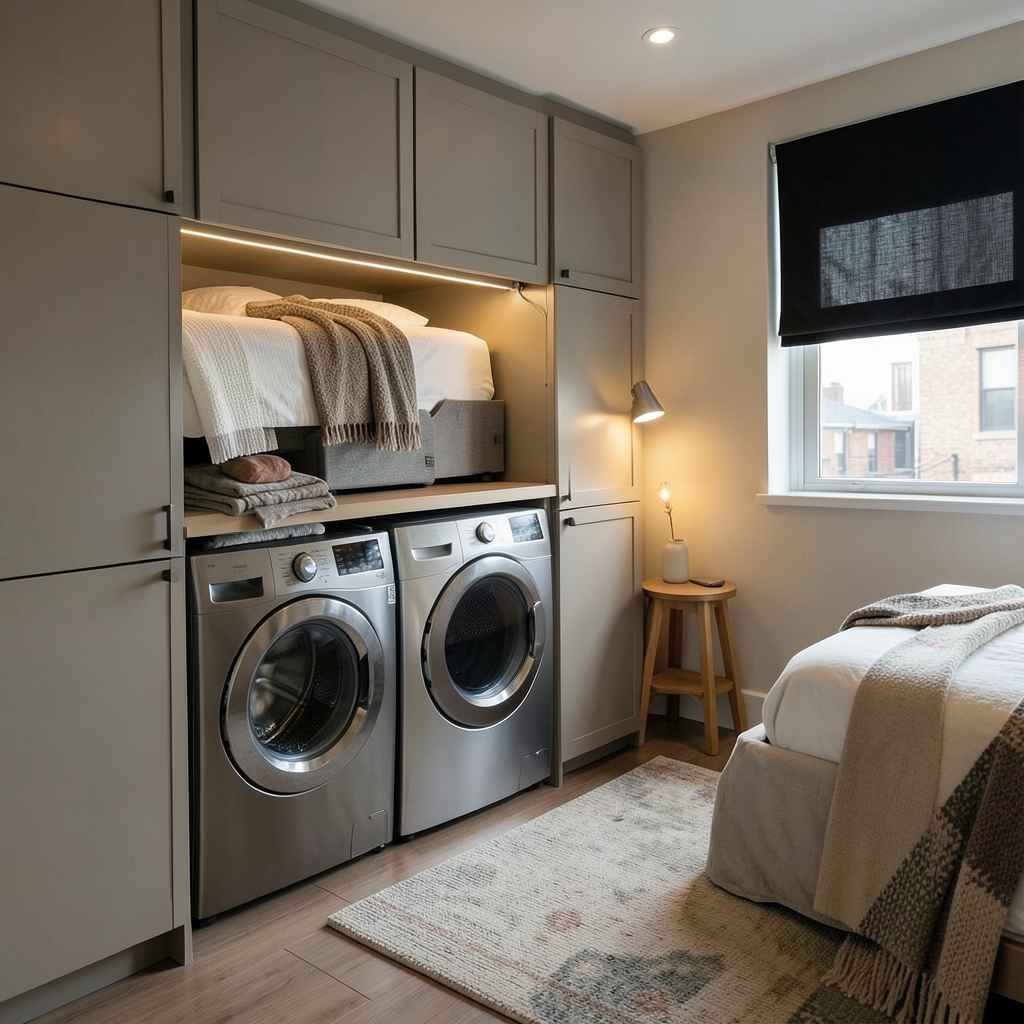
The laundry room Murphy bed combination is the small-home design move that doubles the room’s function without expanding its footprint — in a studio apartment, a guest room annex, or a multipurpose household space, integrating a fold-down Murphy bed into the laundry room’s cabinetry converts the room from a single-function utility space into a genuine dual-purpose room that handles laundry by day and guest accommodation by night. This integration works because Murphy bed cabinetry and laundry room cabinetry share the same format — floor-to-ceiling units with closed door faces — and a skilled cabinet designer can incorporate both functions within a single cabinetry wall that conceals the bed behind panels matching the surrounding storage.
The practical requirements for this integration are specific: the washer and dryer must be front-loading to allow the folding counter above them to remain accessible while the bed is deployed, the bed’s drop zone must be clear of all obstacles on the floor, and the cabinetry layout must provide full access to the laundry functions without requiring the bed to be folded up first. When these conditions are met, the dual-function room provides a genuine guest space without dedicating a full bedroom to that purpose — a resource allocation that makes significant practical sense in urban apartments and compact homes where square footage carries a premium. Cozy home design Murphy bed laundry room integrations finish the deployed bed area with warm textiles, a small reading light built into the cabinetry, and a bedside surface that converts from laundry room function to bedside table with a simple fold or hinge.
The guest bedroom function of the combined room improves when the laundry room’s design quality is elevated — a guest room that doubles as a laundry room is less hospitable if the laundry function is visually prominent. Closed cabinetry that completely conceals the appliances and supplies when not in active use, a well-chosen rug that covers the utility flooring in the sleeping area, blackout shades on the window, and a wall-mounted reading light beside the bed all contribute to a guest experience that does not feel like sleeping in a utility room. The Murphy bed integration is both a spatial strategy and a hospitality commitment, and the design quality that makes the guest comfortable also makes the laundry function more pleasant to perform.
22. A Laundry Room With a Dedicated Craft and Hobby Corner
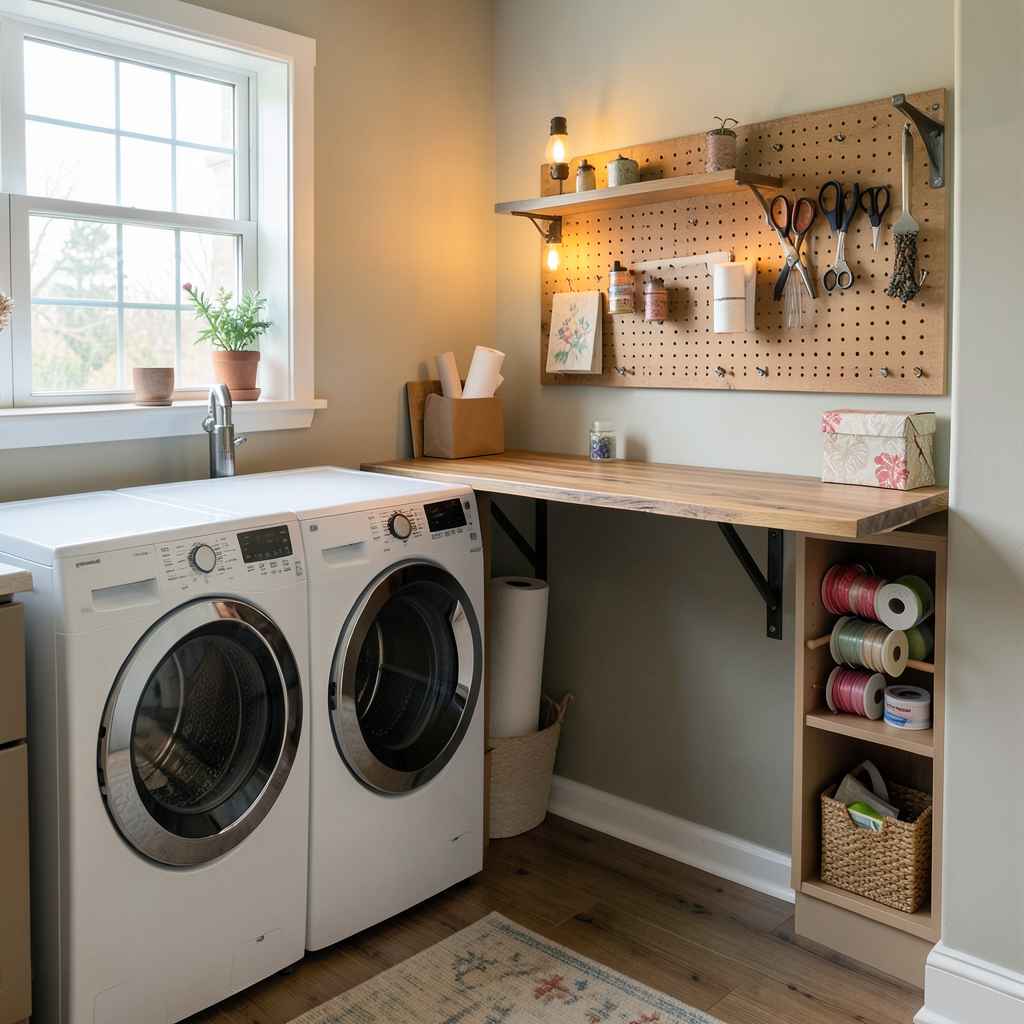
A laundry room with spare floor space or wall space is an underutilized room, and the household that runs laundry in batches rather than continuously has intervals when the room’s appliances are running but the room’s workspace is unoccupied. A dedicated craft or hobby corner in the laundry room uses that interval productively, giving a household member a quiet, private workspace adjacent to a running appliance that does not require supervision. The combination of laundry management and creative work occupies the same block of time more efficiently than doing either separately, and the craft corner in the laundry room is one of the most genuinely useful home design innovations available to households that need more workspace than their home’s current layout provides.
A fold-down wall-mounted work surface positioned at desk height on the laundry room wall that is not occupied by appliances creates a craft workspace that folds flat when not in use, recovering the floor space it occupies during active use. The work surface in a width of thirty-six to forty-eight inches provides enough area for most craft, sewing, and hobby work, and pairing it with pegboard storage on the wall above — painted to match the room’s color palette and fitted with hooks for tools, scissors, and supplies — creates a complete, organized craft station. Rustic home office ideas aesthetics suit the craft corner naturally, with a live-edge fold-down surface on natural steel brackets, warm Edison bulb task lighting, and open pegboard storage in a natural wood finish creating a workspace of genuine character.
The craft corner in the laundry room also serves as the household’s gift-wrapping station, sewing and mending center, and art supply storage location — functions that tend to migrate throughout the house without a dedicated home and create storage and visual chaos wherever they land. A closed cabinet section beside the fold-down surface holds wrapping paper rolls vertically, ribbon spools on a dowel, tape and scissors in a drawer, and seasonal decoration supplies that only emerge during holiday home styling periods. This concentrated storage approach keeps holiday and craft supplies contained and accessible without the seasonal search through multiple closets that most households experience at every occasion.
23. A Laundry Room With Vintage and Antique Accents
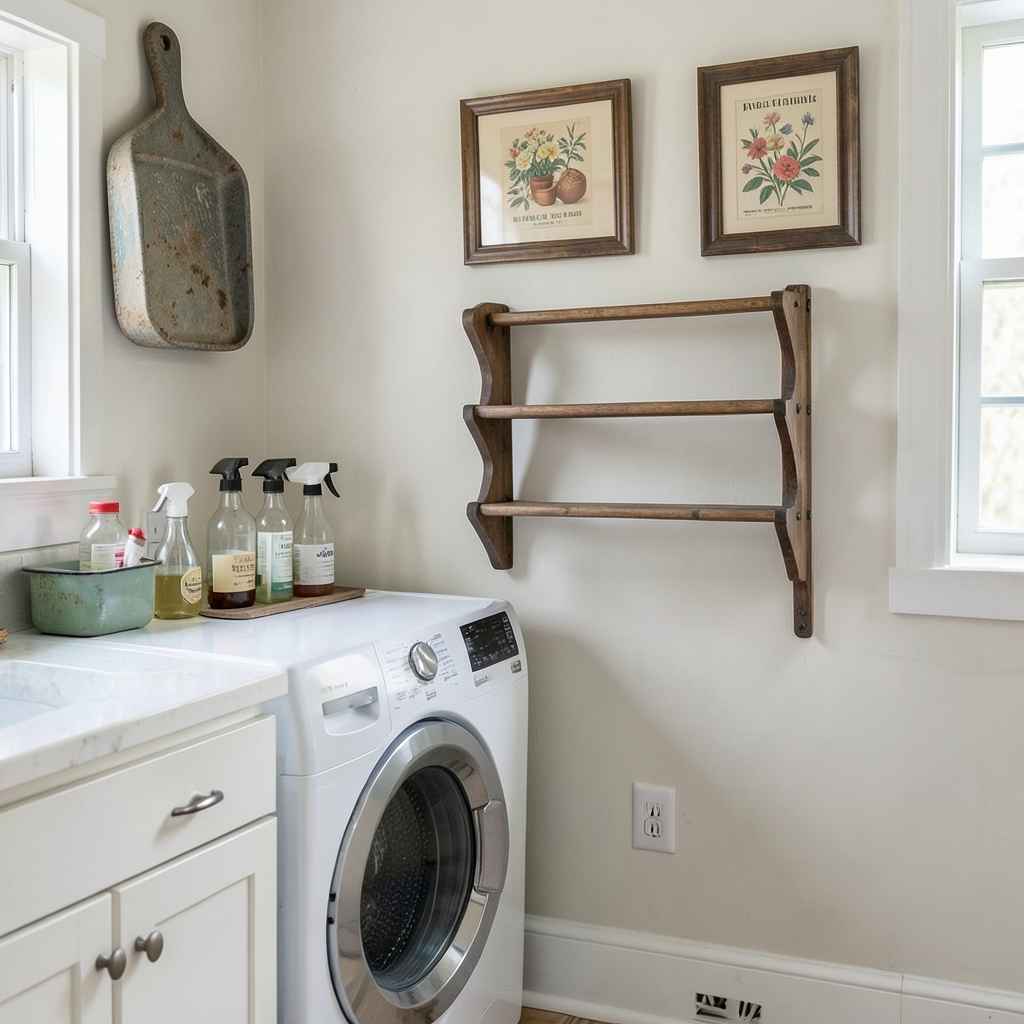
Vintage and antique accents in a laundry room create the layered, collected character that distinguishes a room designed by a person from a room assembled from a catalog. A single vintage piece — an old washboard hung on the wall as art, an enamelware basin repurposed as a storage vessel, a framed laundry advertisement from an earlier era, or a set of antique glass apothecary jars used to hold detergent and starch — introduces a historical layer that the room’s new appliances and cabinetry cannot provide on their own. The contrast between the new and the old is what creates the visual interest that makes the room feel genuinely personal.
An antique wooden drying rack — the floor-standing accordion type that folds flat for storage — hung on the laundry room wall as a functional art object when not in use suits farmhouse home decor, traditional home interiors, and bohemian home styling contexts equally. The rack’s worn wood, the metal hinges darkened with age, and the narrow rungs’ simple functional form create an object of genuine domestic beauty that modern drying solutions do not approach. A vintage enamel bread bin repainted in a color that suits the laundry room’s palette functions as a counter caddy for small supplies; a collection of old glass milk bottles holds spray solutions; a framed vintage seed catalogue or botanical print on the wall brings floral home decor ideas into the room through a historical lens.
The vintage accent approach to laundry room design suits households whose interior aesthetic across all rooms draws from collected, historically layered sources — bohemian home styling, traditional home interiors, and the relaxed home design sensibility that prizes objects with stories over objects with brand recognition. Sourcing vintage pieces for the laundry room requires the same eye applied to any other room in the house, which means estate sales, antique markets, and online vintage sellers rather than home goods retailers. The best vintage laundry room accents are objects that were actually made for domestic laundry use, because their historical function connects them to the room’s current function in a way that makes them feel genuinely placed rather than decoratively borrowed from an unrelated context.
24. A Laundry Room With Smart Storage Solutions for Small Spaces
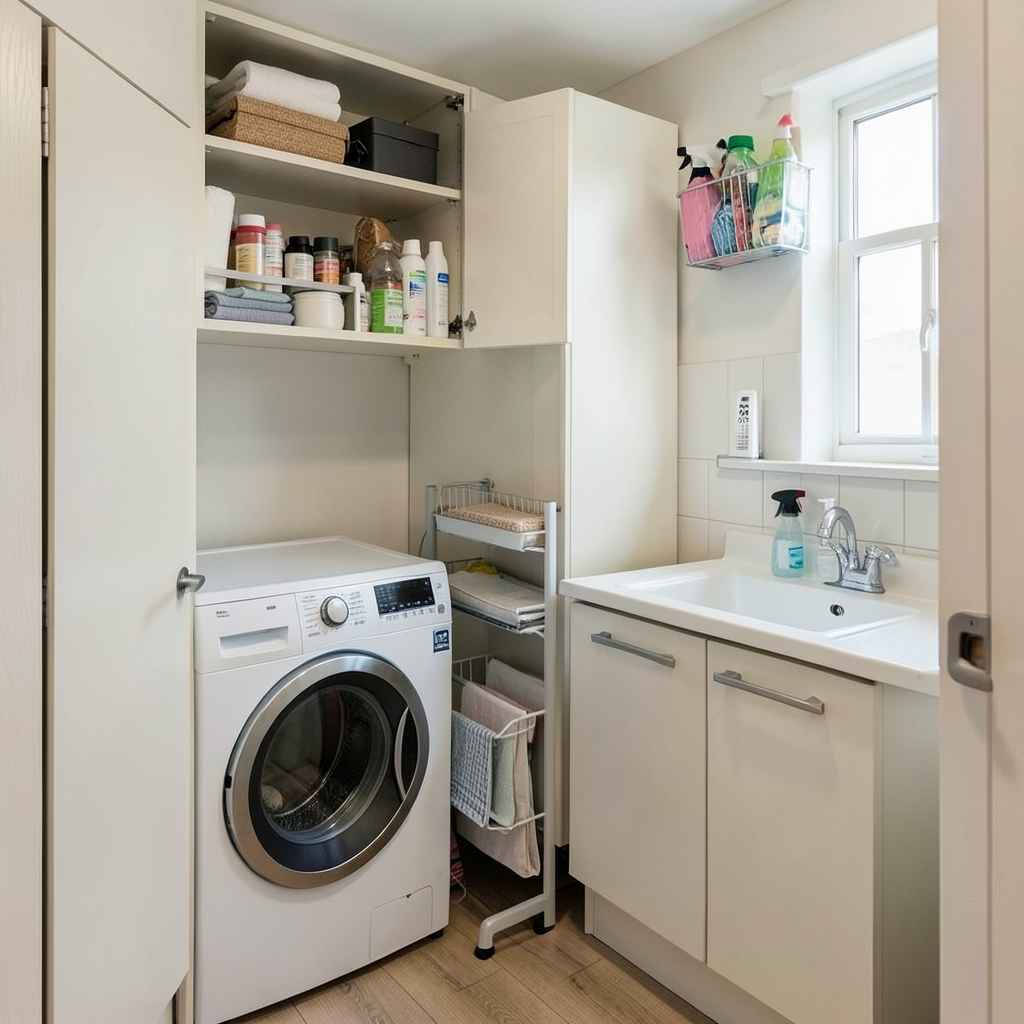
A small laundry room is not a room with a storage problem — it is a room with a space allocation problem, and the difference between those two framings matters. A storage problem implies there is not enough stuff to organize; a space allocation problem implies that the existing space has not been thought through carefully enough to support the storage the room needs. Small laundry rooms almost always have more storage potential than their owners recognize, and the reason that potential goes unrealized is that most small-room storage thinking works horizontally when the available opportunity runs vertically.
The space above the appliances, between the appliances and the ceiling, on the inside of cabinet doors, in the gap between the machine and the adjacent wall, and in the wall space above the door are all laundry room storage locations that standard planning ignores. Slimline pull-out towers in the gap between an appliance and a wall — sometimes as narrow as four inches — store laundry sheets, small bottles, and flat accessories without consuming any additional floor space. An over-door organizer on the laundry room door holds ironing supplies, cleaning gloves, and small items that would otherwise clutter the counter. Tension rod organizers under the utility sink hold spray bottles and cleaning cloths off the cabinet floor, recovering the cabinet interior for bulkier storage.
Scandinavian home interior design applies this thinking most rigorously, because the Scandinavian tradition of making small spaces work efficiently through precise, purpose-specific storage design is the intellectual lineage from which most contemporary small-room storage innovation descends. A Scandinavian-influenced laundry room in a small space uses every wall surface, optimizes every cabinet interior with pull-out organizers, eliminates every unnecessary object, and creates a room that functions at full capacity within a modest footprint. The result feels spacious not because it is large but because nothing in it is wasted, and that sense of efficient purposefulness is its own form of design beauty.
25. A Laundry Room With a Luxury Spa-Inspired Aesthetic
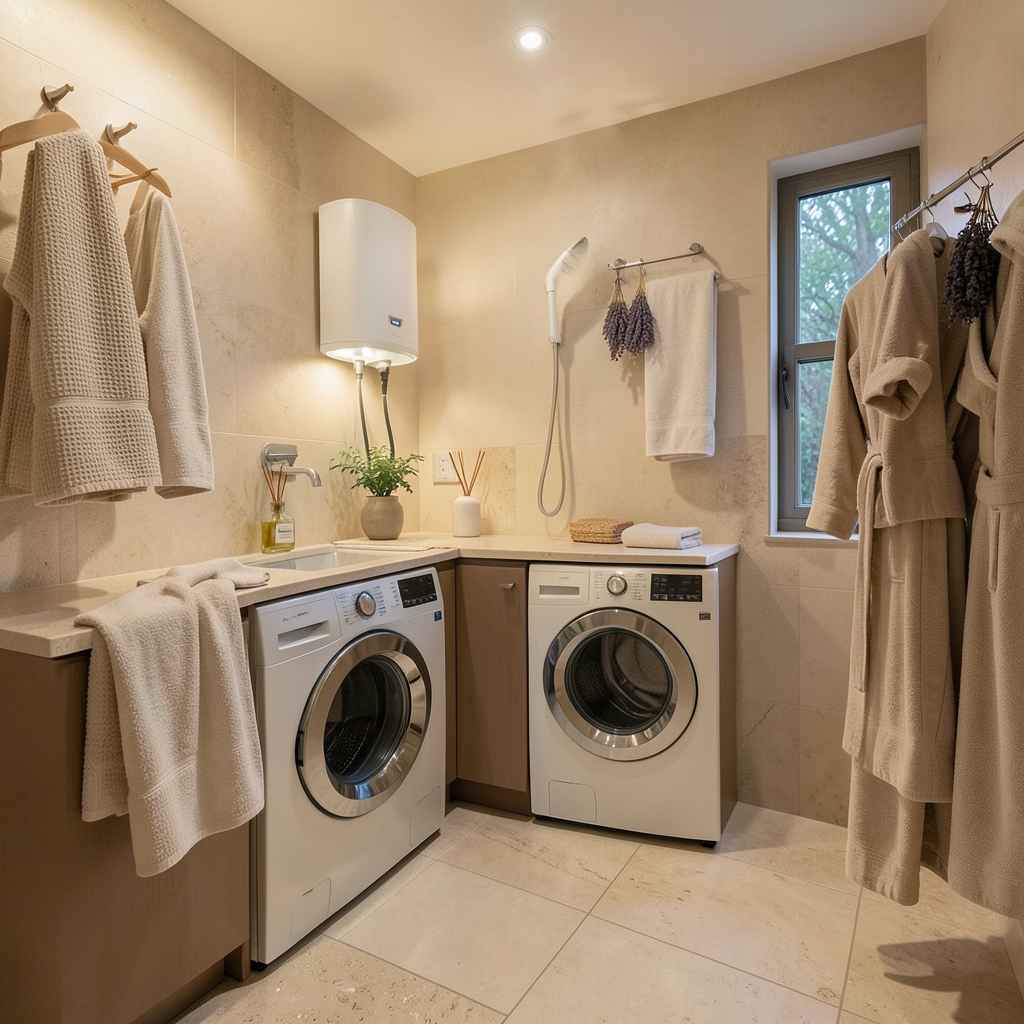
The luxury spa laundry room is a design direction that most people have not considered and most people, once they see it, immediately want. The spa aesthetic applied to the laundry room takes the same sensory principles that make spa environments — warm lighting, natural materials, clean surfaces, a scent strategy, and the absence of visual clutter — and applies them to the utility room’s specific constraints. The goal is not to make the laundry room look like it is not a laundry room. The goal is to make it feel as calm and pleasant to spend time in as any other room in the house.
Heated floors beneath a natural stone or large-format porcelain tile in a warm cream or pale taupe create the thermal comfort that spa environments prioritize, eliminating the cold-floor discomfort that makes early-morning laundry feel more punishing than it needs to be. A steam generator connected to a handheld steam wand mounted on the laundry room wall provides both fabric steaming capability for garment finishing and the aromatic, humid warmth of a steam environment when the room is in use. Luxury master bedroom design principles applied to the laundry room’s textile choices — thick waffle-weave hanging towels, a linen runner on the folding counter, a cashmere throw draped on a hook — bring tactile quality into a room that standard domestic linens never reach.
The scent dimension of the spa-inspired laundry room is the element most consistently overlooked and most immediately impactful — a reed diffuser on the counter in an eucalyptus or cedar scent, or dried lavender bundled and hung from the drying rod, transforms the room’s olfactory environment from the detergent-and-humidity smell of a standard laundry room to the clean, herbal warmth of a considered sensory space. Lighting on dimmer switches, with warm-toned bulbs rated at 2700K, allows the room’s illumination to shift from a bright, functional level during active laundry work to a softer, ambient level during the quiet moments between cycles. The spa-inspired laundry room is the clearest argument for treating this room with the same design investment given to any other room in the home.
26. A Laundry Room With a Chalkboard Wall for Organization
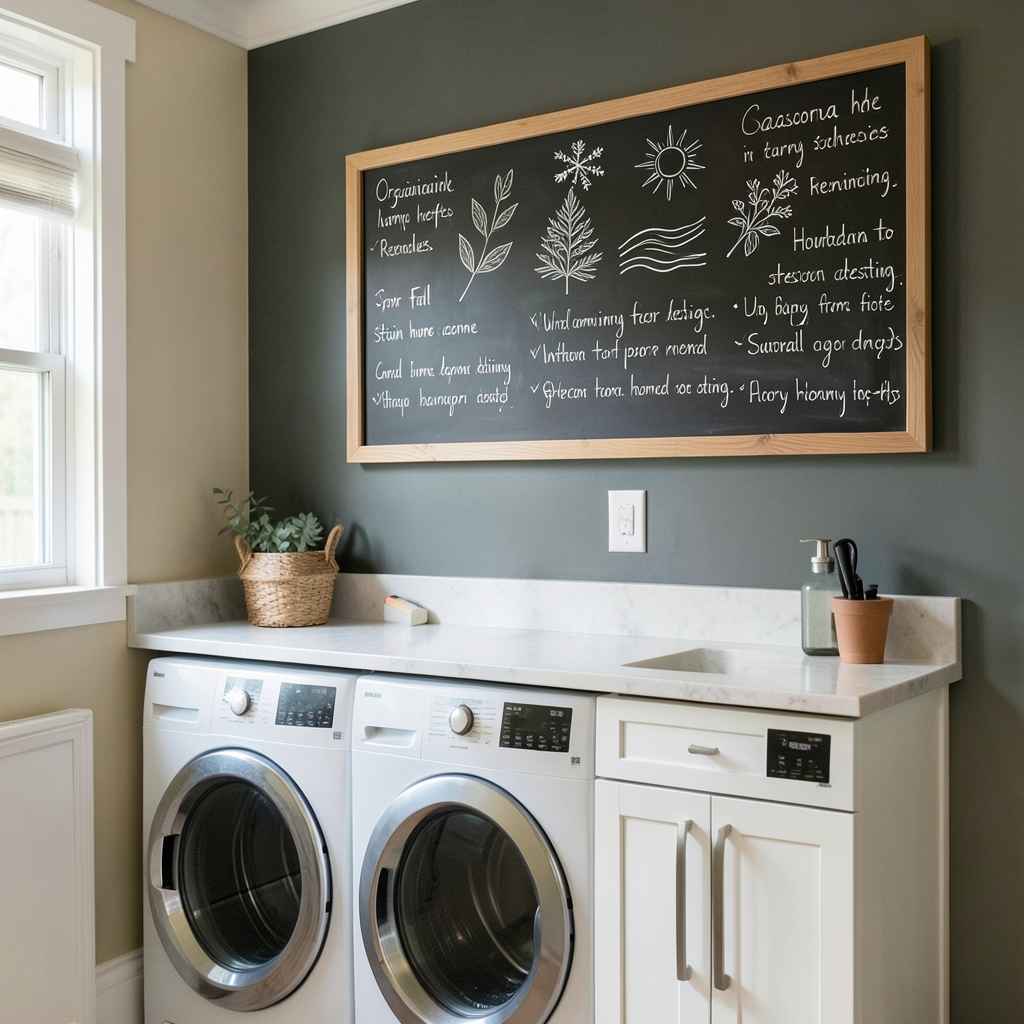
A chalkboard wall in the laundry room serves the organizational function of a bulletin board, a whiteboard, a family scheduling system, and a reminder system simultaneously, without requiring any hardware, frames, or additional wall surface beyond the chalkboard paint itself. The chalkboard wall in the laundry room is permanently useful because the room is a natural organizational hub — laundry schedules, stain treatment reminders, garment care notes, and household to-do items written in chalk on the wall are visible to every household member who passes through, and updating them requires nothing more than a piece of chalk and an eraser. The function is analog, immediate, and requires no power or connectivity.
Chalkboard paint applied to a full wall or a defined section of wall in a contrasting color to the room’s primary palette suits farmhouse home decor, industrial home design, and contemporary home ideas laundry rooms where the blackboard surface reads as functional and characterful simultaneously. A chalkboard section above the folding counter — framed in a simple wood trim painted to match the cabinetry for a cleaner, more designed appearance — creates a dedicated organizational surface without consuming a full wall. The framed chalkboard reads as a designed element rather than an unpainted wall, and the trim detail elevates the treatment from a budget DIY solution to a considered design choice.
Seasonal chalk art on the laundry room chalkboard — a simple botanical drawing for spring home refresh, a leaf motif for fall home decorating, a snowflake or evergreen for winter home decor season, a sun and wave for summer home design — connects the room’s decorating to the household’s seasonal calendar with a minimal, impermanent, and completely free design gesture. The chalkboard becomes the laundry room’s ever-changing seasonal identity, updated in minutes and erased just as quickly when the season shifts. No other room in the house offers a decoration surface with that level of flexibility and zero recurring cost.
27. A Laundry Room With a Linen Closet Integration
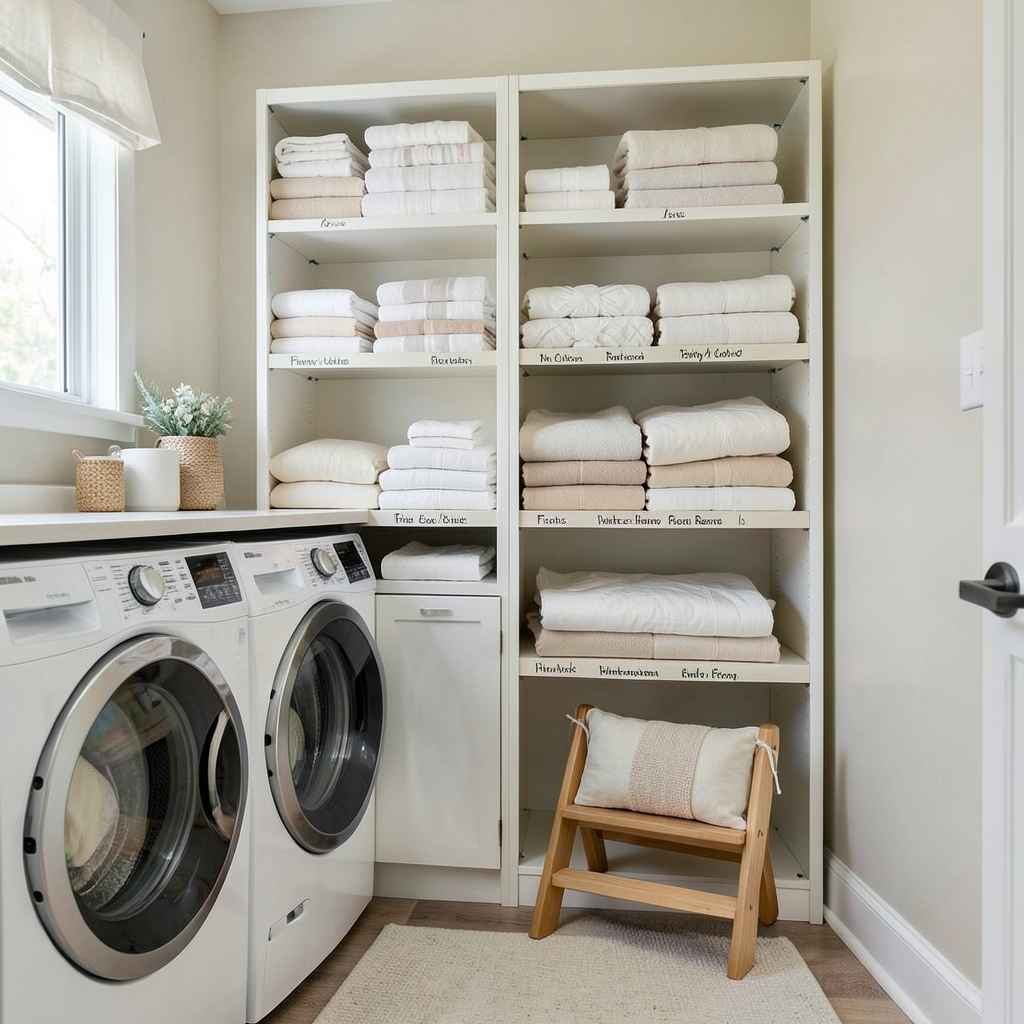
A laundry room that also functions as the household’s linen closet eliminates the unnecessary step of carrying clean linens from the laundry room to a separate storage location in a different part of the house. When sheets, towels, and household linens are washed, dried, folded, and stored in the same room, the laundry workflow closes within its own space rather than bleeding outward into hallways and bedrooms. That closed loop is a functional efficiency that most households do not have and do not realize they are missing until they experience it.
Deep shelving built into the laundry room wall — at least sixteen inches deep for folded sheet sets, twelve inches for folded towels — with a dedicated shelf assignment for each linen category creates the linen closet organization that allows any household member to find and return items correctly. Labeling each shelf section, whether with printed labels, hand-lettered ceramic tags, or simple chalk writing on a painted shelf edge, removes the guesswork that causes linen closets to become disordered within weeks of being organized. Airy home interiors laundry rooms with linen integration keep the shelving open and the folded linens visible, using the clean stacks of white and cream towels and sheets as part of the room’s visual composition — a practice borrowed from boutique hotel design, where the sight of neatly stacked linens signals quality and care.
The linen closet integration also solves the seasonal storage challenge that households face when transitioning between summer home design bedding sets — lightweight cotton duvets and linen sheet sets — and winter home decor bedding — heavier flannel and fleece. A dedicated high shelf in the linen closet section of the laundry room, accessed by a small step stool stored in the broom cabinet, holds the off-season bedding in vacuum storage bags that compress the bulky items to a fraction of their normal volume. This storage approach keeps the seasonal bedding accessible without consuming bedroom closet space, and the organization system that the laundry room linen closet provides ensures seasonal home makeover bedding transitions take minutes rather than the chaotic half-hour search through multiple closets that most households experience.
28. A Laundry Room With Terrazzo Flooring
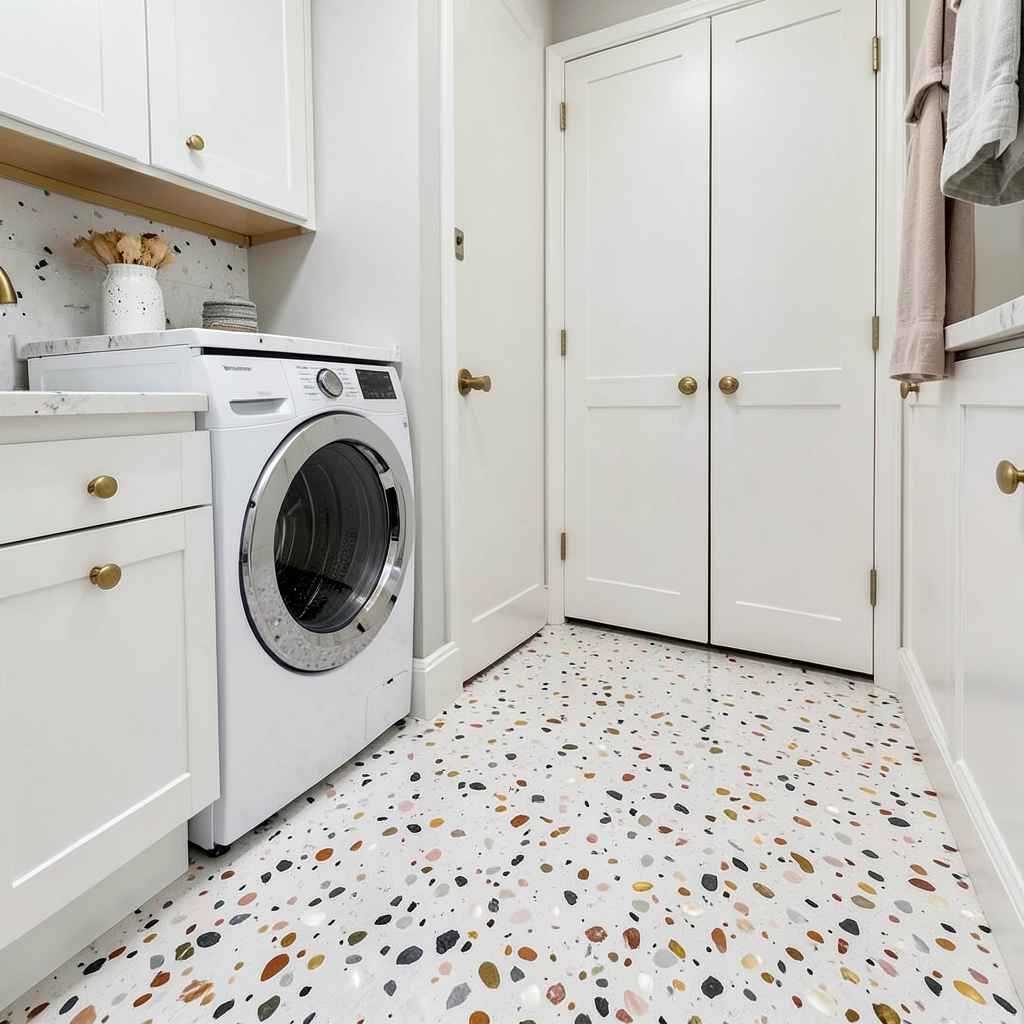
Terrazzo in a laundry room brings a material sophistication typically associated with luxury hotel lobbies and high-end residential renovations into a utility space, and the contrast between the material’s elevated character and the room’s functional purpose creates an unexpected design tension that makes the room genuinely memorable. Terrazzo — a composite of marble, granite, glass, or shell chips set in a cement or epoxy matrix and ground to a smooth, polished finish — is among the most durable flooring materials available, impervious to the water spills, detergent drips, and heavy foot traffic that laundry rooms generate continuously. It is also, in a single-color chip selection, among the most beautiful.
White terrazzo with gray and black marble chip aggregates suits modern home design and minimalist home design laundry rooms, its cool, speckled surface reading as architectural rather than decorative and connecting naturally to a white-cabinetry, stainless-steel-appliance palette. Warm terrazzo with terracotta, gold, and cream aggregates suits earthy home design and traditional home interiors, its color warmth compatible with natural wood elements, brass hardware, and the warm linen tones that define those design sensibilities. Pink or blush terrazzo with white and gold chip aggregates suits chic home decor and elegant home styling laundry rooms where the femininity of the color choice is embraced rather than avoided, and the material’s durability ensures that the softness of the color is not a softness of the surface.
Epoxy terrazzo poured in place creates a seamless floor without grout lines, eliminating the maintenance surface that grout joints represent in a wet, heavily used room. The seamless surface reads as a single continuous material rather than a tiled installation, giving the laundry room floor an uninterrupted quality that suits both the minimalist home design sensibility that abhors visual interruption and the luxury home interior standard that requires surfaces to read as premium regardless of the room they occupy. Pre-cast terrazzo tiles, while not seamless, are more accessible in cost and installation complexity and provide the same material quality within the tile format that most homeowners are more familiar with managing during a renovation.
29. A Laundry Room With a Botanical Print Wallpaper
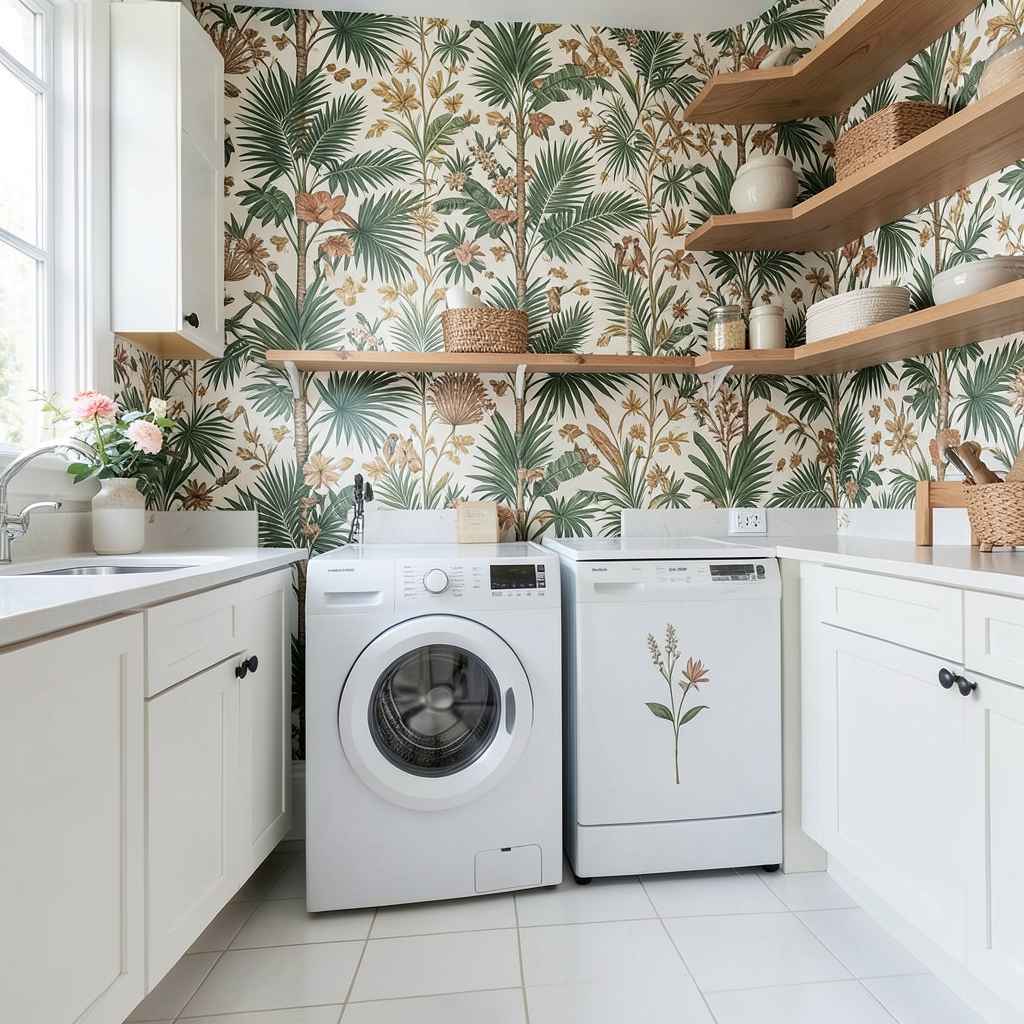
Botanical wallpaper in the laundry room is the design decision that communicates more clearly than any other that this household treats every room — including the one with the washing machine in it — as a designed space deserving genuine attention. The botanical print carries the language of garden-inspired interiors, floral home decor ideas, and the organic visual richness of living plants into a room that would otherwise contain nothing growing or green. That introduction of nature into a functional utility room creates a sensory contrast that makes the laundry experience feel lighter and more pleasant in a way that is difficult to rationalize but immediately felt.
A large-scale palm leaf or tropical botanical print in deep greens on a white or cream ground suits tropical home design and jungle-inspired home decor laundry rooms, the oversized leaf pattern creating an immersive quality in the room’s limited wall space that makes the room feel larger rather than smaller. A dense, all-over William Morris-style botanical print in muted golds, greens, and terracottas suits traditional home interiors and bohemian home styling, its historical richness referencing the Arts and Crafts design tradition that elevated the domestic craftsmanship of ordinary household spaces. A delicate single-stem botanical illustration print — refined, quiet, and precise — suits Scandinavian home interior and minimalist home design laundry rooms where the botanical reference is valued but the pattern density is kept restrained.
The botanical wallpaper’s relationship to the laundry room’s other surfaces determines whether it reads as the room’s primary design statement or as one of several competing elements. Paired with white painted cabinetry, white appliances, and a simple white tile floor, the botanical wallpaper carries the entire room’s decorative weight without competition — the simplicity of every other surface makes the wallpaper the singular point of visual interest that demands and deserves all of the room’s design attention. Adding open wood shelving in a natural finish as the only other decorative layer completes the composition without complicating it, creating a laundry room of genuine botanical beauty that takes ten minutes to appreciate and years of daily use to fully enjoy.
30. A Laundry Room With Brass Hardware and Fixtures Throughout
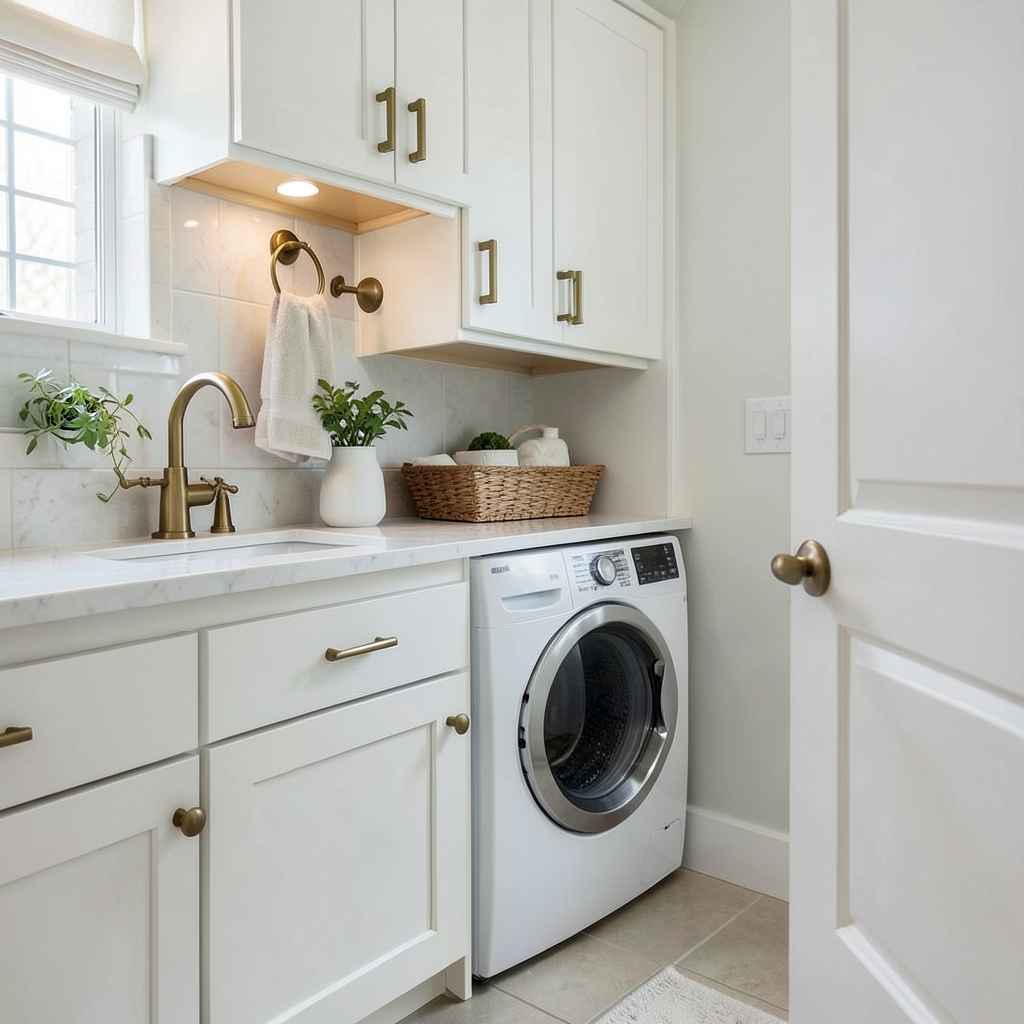
Brass hardware and fixtures in the laundry room apply the material warmth and design intentionality that brass brings to kitchens and bathrooms to a room that typically receives whatever hardware was cheapest at the time of installation. The commitment to a single warm metal tone across every hardware element — cabinet pulls, faucet, towel hook, shelf brackets, light fixture, and door handle — creates the cohesion that makes a room feel designed rather than assembled, and brass achieves this effect in the laundry room with particular power because its warmth contrasts so productively with the white cabinetry and appliances that most laundry rooms use as their primary surface.
Unlacquered brass hardware develops a living patina over time — darkening in areas of heavy use, brightening where friction polishes the surface — that creates a warmth and character distinction from the static appearance of lacquered brass or gold-toned finishes that remain unchanged indefinitely. This patina development suits farmhouse home decor, traditional home interiors, and warm home decor ideas laundry rooms where the evidence of use and time is valued as an aesthetic quality rather than treated as wear. Brushed brass, which carries a matte texture that does not develop a living patina but provides consistent warmth without the high sheen that polished brass can read as excessive, suits modern home design and contemporary home ideas contexts where restraint in the metal’s visual intensity is preferred.
The investment in quality brass hardware for the laundry room is proportionally modest relative to the room’s overall renovation cost, and the improvement to the room’s design quality is disproportionately large. A full set of brass cabinet pulls for ten to twelve cabinet doors, a brass faucet for the utility sink, and three or four brass hooks for towels and aprons costs less than the room’s tile installation but delivers more daily visual satisfaction than any surface upgrade of equivalent cost. Brass hardware also connects the laundry room to the broader home’s hardware palette when that palette is brass-dominant, creating a design continuity that the laundry room’s typical chrome or nickel hardware interrupts.
31. A Laundry Room With a Fold-Down Wall Drying Rack
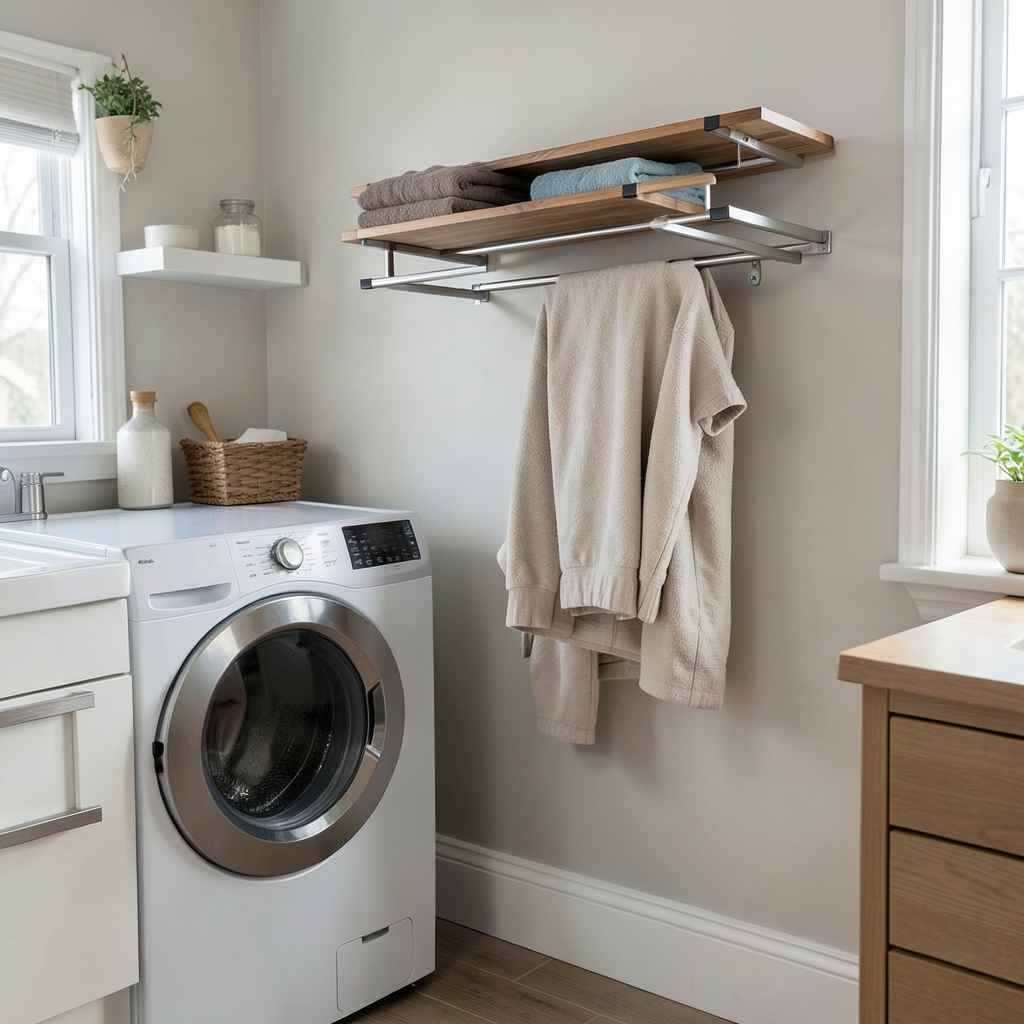
The fold-down wall drying rack is the space efficiency solution that most laundry room planners overlook in favor of freestanding drying stands that consume floor space, tip over when overloaded, and have no defined storage location when not in use. A fold-down rack mounted flush to the wall — its multiple wooden or stainless steel rungs folding into a flat profile when collapsed — occupies less than four inches of wall depth in its stored position and extends to provide multiple linear feet of drying surface when deployed. This ratio of stored footprint to deployed capacity is unmatched by any freestanding alternative.
Wall-mounted wooden fold-down drying racks in a natural teak or oiled walnut finish suit warm home decor ideas, farmhouse home decor, and Scandinavian home interior laundry rooms, their material warmth and craft quality making them genuinely attractive objects when deployed as well as when stored. Stainless steel fold-down racks suit industrial home design and modern home design contexts, their material precision and clean geometric form reading as intentionally architectural in a room designed around similar qualities. A fold-down rack with multiple tiers — two or three horizontal panels at slightly different heights — provides enough surface for a full delicate-garment cycle without requiring wall space proportional to its storage capacity.
The mounting height of the fold-down rack determines its usability — mounted at shoulder height, the deployed rack allows full-length garments to hang without touching the floor while the rack’s lower rungs remain at a convenient reach for loading and unloading. A rack mounted too low forces bending that turns a simple task into a physical inconvenience; a rack mounted too high places the upper rungs out of reach for shorter household members. The wall between the washer-dryer and the utility sink is typically the most logical mounting location, where the rack’s deployment falls into the room’s primary workflow path and wet garments are removed from the machine and transferred directly to the rack without crossing the room.
32. A Laundry Room With a Coastal Blue and White Palette
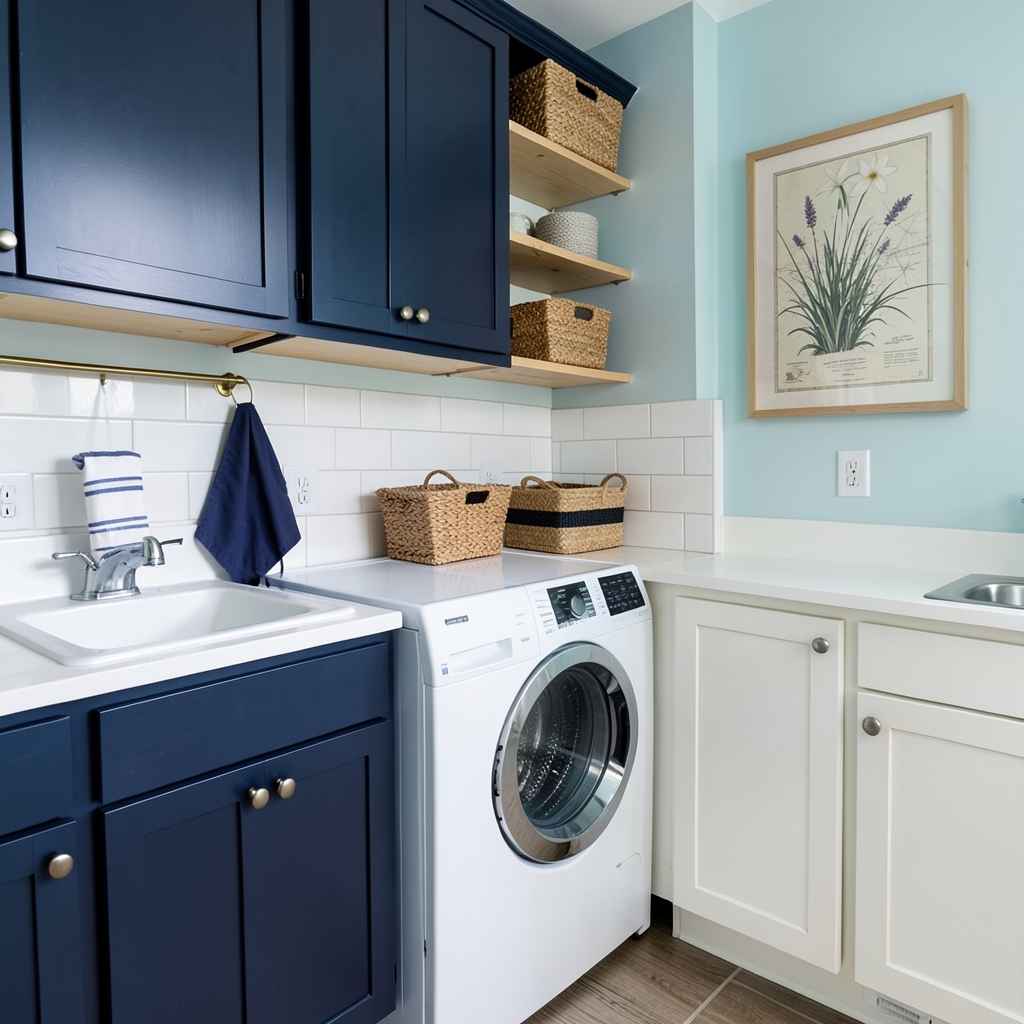
A coastal blue and white palette in the laundry room creates an immediate freshness and light quality that the room’s inherent dampness and utility associations work against, making the color choice a deliberate act of design optimism. The blue and white combination connects naturally to clean water, fresh air, and coastal outdoor living space — associations that make the laundry room feel connected to cleanliness and light rather than to the damp, steamy utility that uninspired laundry rooms communicate through their palette of institutional beige and fluorescent white. The color palette is doing emotional work here, and it does it well.
Navy blue cabinetry paired with white appliances, white countertops, and a white subway tile splashback creates the boldest expression of the coastal palette in the laundry room — the deep blue cabinet faces provide the room’s primary color statement, and every other surface in white provides the clean contrast that makes the navy read as confident rather than heavy. A softer version of the same palette uses sky blue or aqua on the walls, white cabinetry, and natural wood open shelving to create the breezy home interiors, beach house interiors character that feels relaxed rather than graphic. Both expressions suit coastal home design households and extend the home’s coastal vocabulary into the laundry room with the same confidence applied in the kitchen, bathroom, and living spaces.
Textiles in the coastal laundry room — a blue and white stripe hand towel at the utility sink, a navy linen apron hanging on a brass hook, a woven seagrass basket on the shelf — reinforce the palette with the softness that painted and tiled surfaces cannot provide alone. A framed vintage nautical map or a simple botanical print of a coastal plant — sea grass, lavender, white agapanthus — on the wall beside the folding counter adds the personal, collected quality that distinguishes a designed room from a decorated one. During summer home design season this palette performs at its peak, the blue and white combination resonating with the season’s light quality and the household’s general orientation toward outdoor, coastal living.
33. A Laundry Room With a Built-In Hamper System
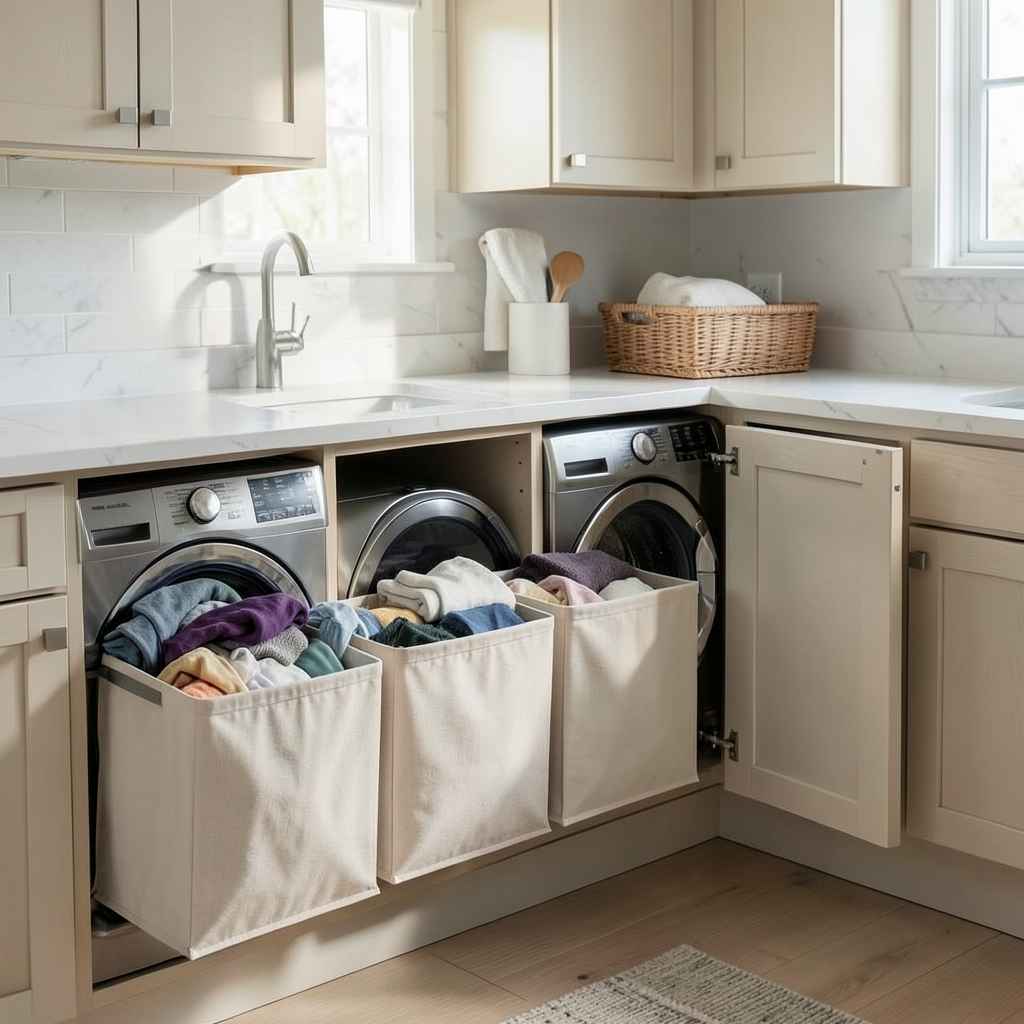
A built-in hamper system integrated into the laundry room’s cabinetry solves the dirty laundry’s homelessness problem — the tendency of unwashed clothes to accumulate on bedroom floors, bathroom counters, and chair backs throughout the house because the laundry room’s sorting system is either inaccessible or inconvenient. When the sorting hampers are built into the room’s lower cabinetry as pull-out bins or tilt-out frames, the sorting step happens efficiently within the laundry room during each load’s preparation, and the room maintains its organized appearance even at peak dirty-laundry volume. The built-in system contains the mess without hiding the fact that the household produces laundry — it simply manages that production with better architectural infrastructure.
Pull-out canvas hamper bins within lower cabinet frames are the most common built-in hamper format, their fabric bags removable for emptying directly into the washing machine and replaceable when worn. Three pull-out hampers in a row — labeled lights, darks, and delicates or colors — provide the pre-sort system that eliminates the sorting step at wash time, because the sorting has already been done continuously throughout the week as laundry was deposited. This system’s efficiency depends entirely on household members using it correctly, which requires the hampers to be at a height and location that makes correct deposit easier than incorrect deposit — a design principle that any well-designed organizational system must satisfy.
Tilt-out hamper frames in a face-frame cabinet design create a cleaner, more polished appearance than pull-out canvas bins because the tilt-out door matches the surrounding cabinetry exactly, making the hamper invisible in the closed position. The tilt-out format suits modern home design and elegant home styling laundry rooms where the visual continuity of the cabinet faces is prioritized. A hybrid system — two pull-out hampers for the high-volume categories of lights and darks, and a smaller open basket on an adjacent shelf for delicates — provides the maximum practical flexibility within the built-in format, addressing the real sorting patterns of the household rather than imposing an idealized three-category system that may not match how the family actually generates laundry.
34. A Laundry Room With a Moody Dark Color Palette
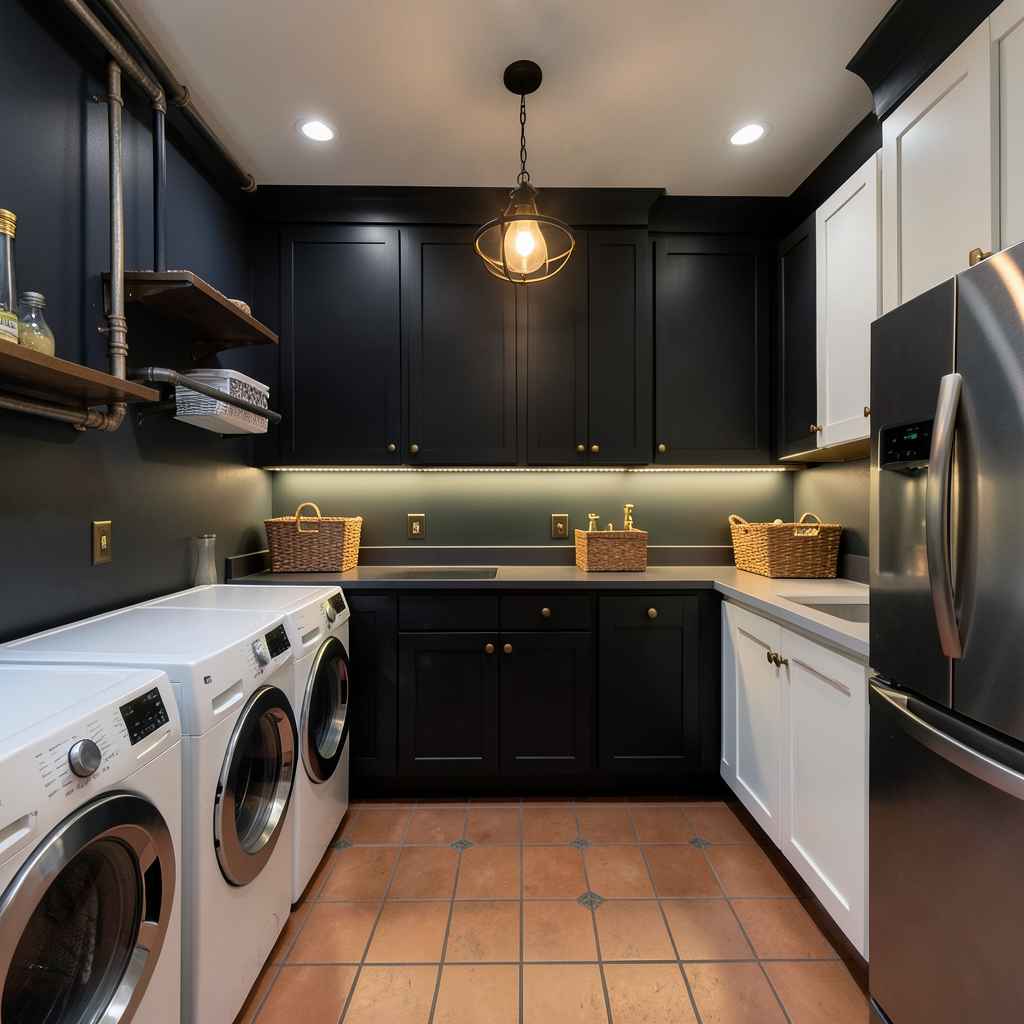
A dark-colored laundry room challenges the assumption that utility spaces must be light, bright, and clinical to function well, and that challenge is worth making. The moody laundry room — walls in deep slate, charcoal, dark sage, or near-black — creates a dramatically different room from the standard white-and-gray utility, and the difference is not merely aesthetic. Dark walls reduce visual fatigue in a room where the bright white appliances and cabinetry are the primary visual elements, and the moody background makes those white elements pop with a contrast and clarity that the same elements against a white wall never achieve. The dark room makes the white things look whiter.
Deep charcoal walls with matte black cabinetry, stainless steel appliances, and industrial pipe shelving in raw steel create the industrial home design laundry room that reads as a considered, design-forward environment rather than an unconventional choice made without direction. Dark forest green walls with white shaker cabinetry, brass hardware, and a terracotta tile floor create the rich, country house quality associated with traditional home interiors and the kind of farmhouse bathroom decor that appears in renovated English country homes — a design register that feels grounded and permanent rather than trendy. Near-black navy walls with white appliances, brass fixtures, and natural rattan baskets create the elegant home styling register that connects the laundry room to the luxury home interior vocabulary applied elsewhere in the house.
The practical consideration of lighting is more critical in a dark laundry room than any other design decision that follows the color choice. A dark room without adequate lighting reads as gloomy and oppressive; the same dark room with well-placed, warm-toned lighting reads as intimate and designed. Recessed downlights directly above the appliances and the folding counter, LED strip lighting under upper cabinets, and a decorative fixture at the room’s center providing ambient fill create the three-layer lighting scheme that makes dark walls read as a deliberate design choice rather than a maintenance problem waiting to happen.
35. A Laundry Room With a Folding Station and Sorting Table
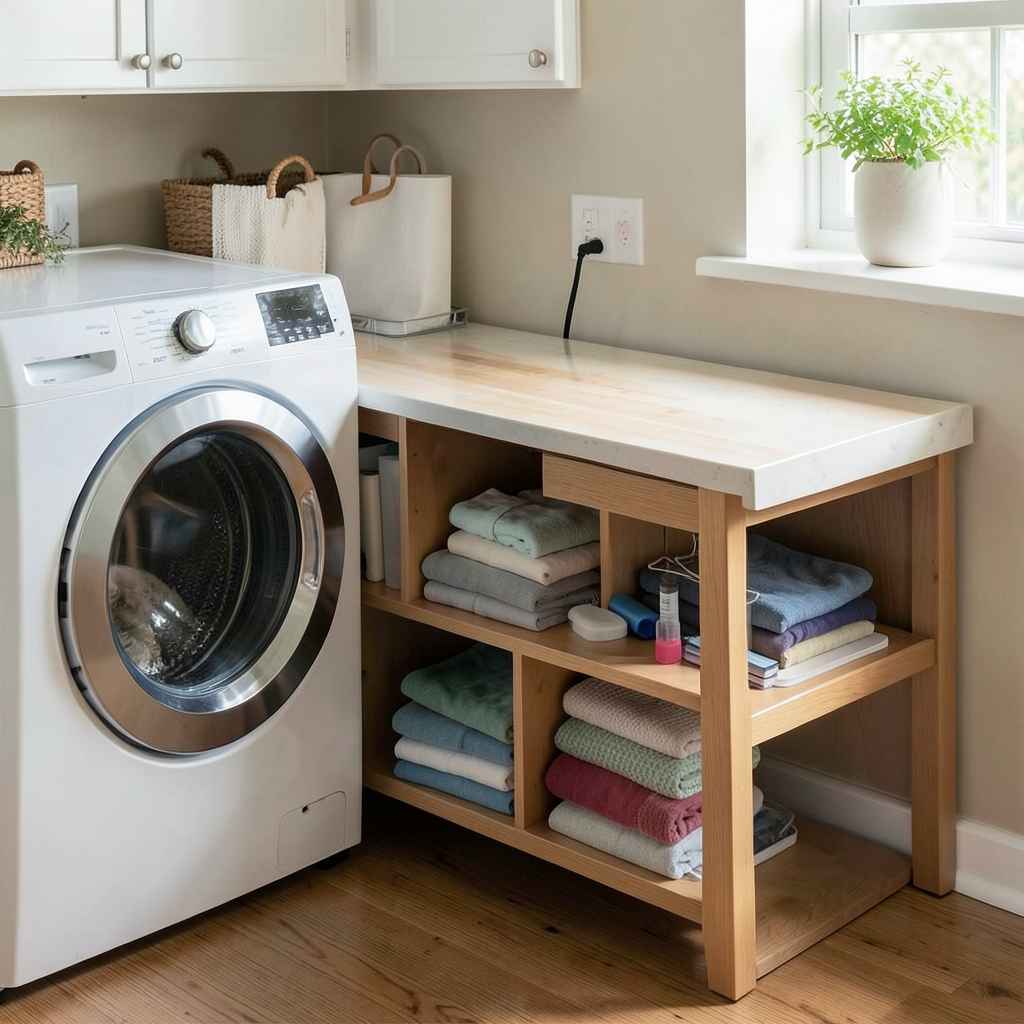
The sorting and folding table in the laundry room is the piece of furniture most often absent from the rooms that need it most — the rooms where laundry migrates to the bed, the couch, and the dining table for folding because the laundry room itself provides no surface adequate to the task. A dedicated sorting and folding table, positioned at the correct ergonomic height and sized generously enough to hold a full dryer load spread flat for folding, transforms the laundry workflow from a distributed multi-room process into a self-contained single-room operation. This change alone improves the household’s laundry completion rate more than any other single laundry room upgrade.
A custom folding table built to the room’s specific dimensions — spanning the full width of the laundry room’s available wall space at a counter height of thirty-six inches — provides the maximum folding surface the room can accommodate. The material choices for this table surface should prioritize durability and ease of cleaning: quartz or laminate in a light tone is the most practical surface for active folding use, while butcher block suits the farmhouse home decor aesthetic with the understanding that it requires periodic oiling to resist the moisture and light abrasion that regular folding traffic generates. A drawer or two beneath the folding table surface provides storage for folding tools — a clothes-folding board, extra hangers, a lint roller, fabric markers for labeling — that belong in the folding zone and have nowhere logical to live without this dedicated drawer.
The sorting function happens most efficiently when the folding table includes built-in cubbies or open sections below the surface where sorted items can be held in destination order — a cubby per household member, or a cubby per room, so that folded laundry moves from the dryer to the folding surface to the correct cubby without being relocated again until it reaches its final home. This cubby system is the laundry room equivalent of the mudroom’s per-person cubby system, and it works for the same reason: assigning a specific physical location to each person’s items creates organizational clarity that generalized storage cannot provide. Peaceful home decor principles applied to the folding station keep the surface clear between laundry sessions — the clean counter reads as an invitation to fold promptly rather than a surface covered in last week’s avoided folding.
36. A Laundry Room With Mirrored Cabinet Doors
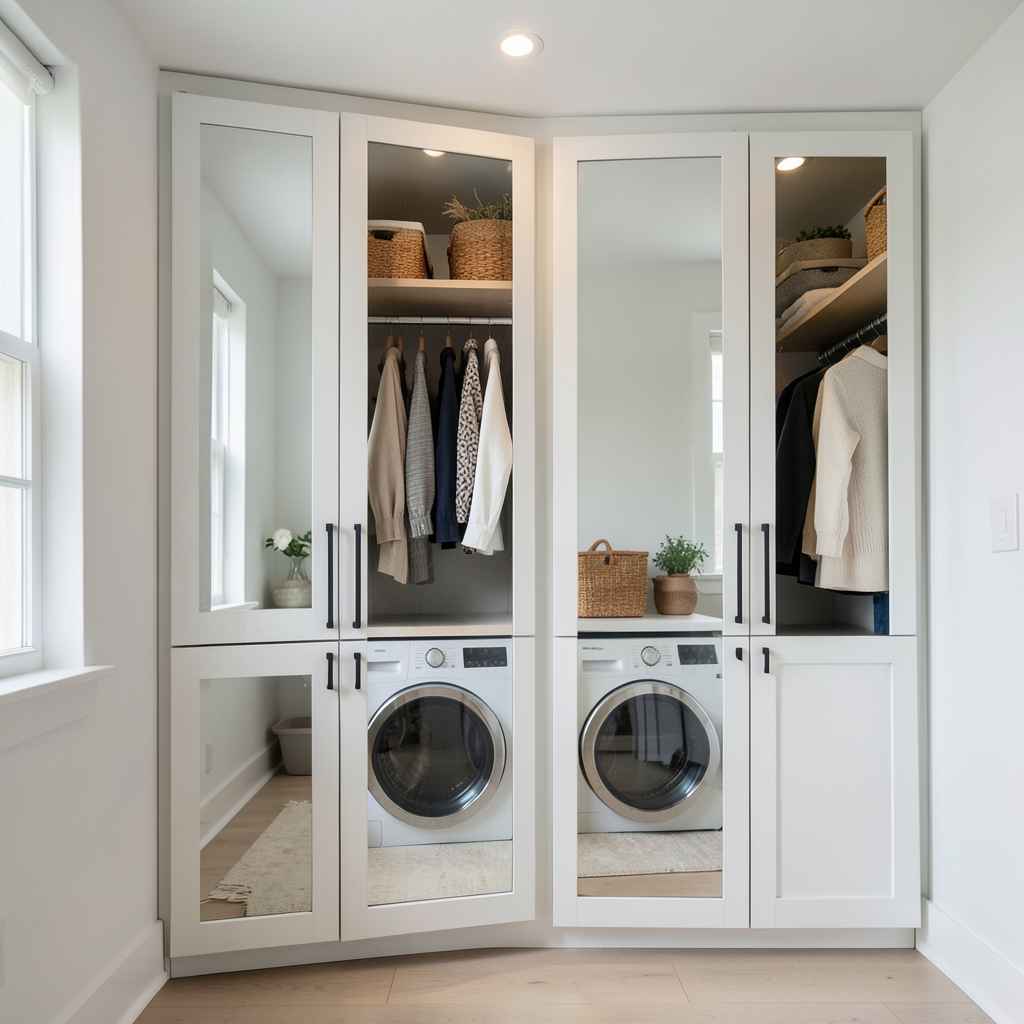
Mirrored cabinet doors in the laundry room perform two design functions simultaneously: they amplify the room’s light by reflecting it from every direction, making a typically dark utility space feel dramatically brighter, and they create depth by visually doubling the apparent size of the room. The mirror does not add light to the room — it multiplies what is already there, and in a small room with limited natural light and a single overhead fixture, that multiplication can be the difference between a room that feels adequate and one that feels generous. This effect costs no more than standard cabinet doors with mirrored inserts rather than wood panels.
Frameless mirrored cabinet inserts on shaker-style door frames suit modern home design and contemporary home ideas laundry rooms, the clean mirror face within the door frame creating a hotel-quality finish that reads as luxury home interior design applied to a utility context. Full-mirror cabinet door faces with no frame around the mirror suit minimalist home design and Scandinavian home interior contexts, where the continuous mirror surface eliminates the visual interruption of the frame and creates an unbroken reflective plane across the full cabinet face. Antiqued or smoked mirror inserts — mirror glass with a slightly darkened, aged treatment — suit bohemian home styling and traditional home interiors laundry rooms, their atmospheric quality adding decorative character beyond the purely functional reflection of standard clear mirror.
The practical benefit of mirrored cabinet doors in a laundry room extends to garment checking — hanging a garment after ironing and stepping back to check it in the mirrored cabinet door before returning it to the closet eliminates the post-laundry discovery of wrinkles and misaligned collars that standard cabinet doors never reveal. This functional benefit makes mirrored laundry room cabinets genuinely useful rather than merely decorative, aligning the mirror’s design contribution with the room’s actual daily workflow. The combination of amplified light, expanded perceived space, and garment-checking function makes mirrored cabinet doors one of the most efficient design upgrades available in a laundry room renovation.
37. A Laundry Room With a Vintage Tin Ceiling
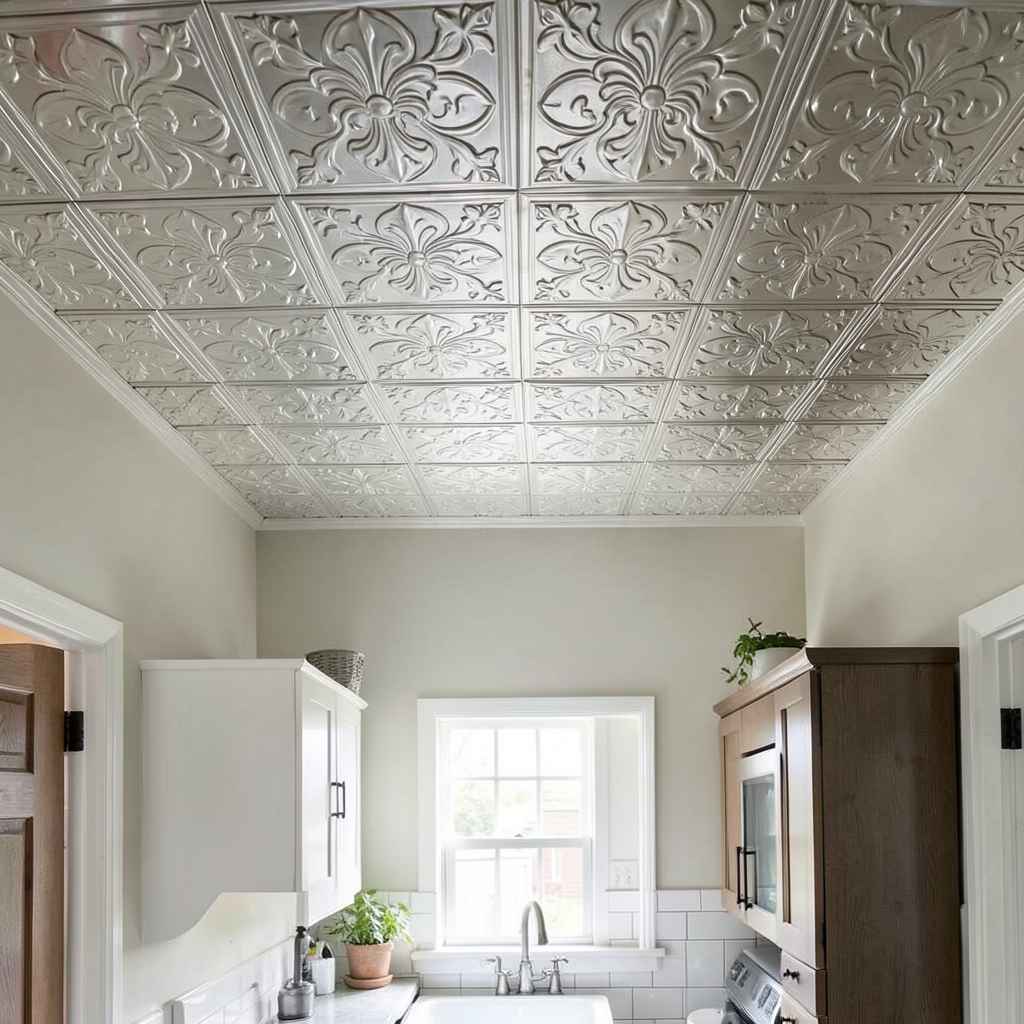
A vintage tin ceiling in the laundry room introduces architectural detail to the one plane most laundry room renovations leave entirely untouched — the ceiling. The pressed metal tiles in traditional Victorian or Edwardian patterns bring a period decorative richness to the overhead surface that transforms the room from a functional box into a space with genuine historical character. This treatment costs less than most homeowners expect, installs over most existing ceiling surfaces with adhesive or nails, and provides a finished appearance that no paint color or standard ceiling treatment can approach in terms of visual complexity and period authenticity.
Pressed tin ceiling tiles in a classic fleur-de-lis or geometric relief pattern painted in white or off-white suit traditional home interiors and farmhouse home decor laundry rooms, the pattern’s dimensional quality catching the room’s light and creating soft relief shadows that shift as the light source angle changes through the day. The same tiles in a metallic finish — unlacquered aluminum that develops a living patina, or a bronze-toned metallic paint — suit industrial home design and rustic home decor contexts where the raw metallic quality connects to the material language of pipe shelving, cast iron fixtures, and aged wood. A tin ceiling painted in the same color as the room’s walls, continuing the color drenching approach, creates a continuous enveloping effect where the ceiling’s relief pattern reads as dimensional texture within the single-color environment rather than as a contrasting surface.
The tin ceiling’s reflective quality, even when painted, bounces light through the room more effectively than a matte painted plaster ceiling, contributing to the bright home design quality that laundry rooms benefit from most. The relief pattern also provides a level of acoustic softening — the three-dimensional surface scatters sound waves rather than reflecting them directly, reducing the mechanical noise of running appliances that flat ceilings transmit without modification. The tin ceiling is the laundry room’s most unexpected upgrade, the one that guests notice and comment on, and the one that costs the least relative to the design impact it creates.
38. A Laundry Room With a Hidden Laundry Chute
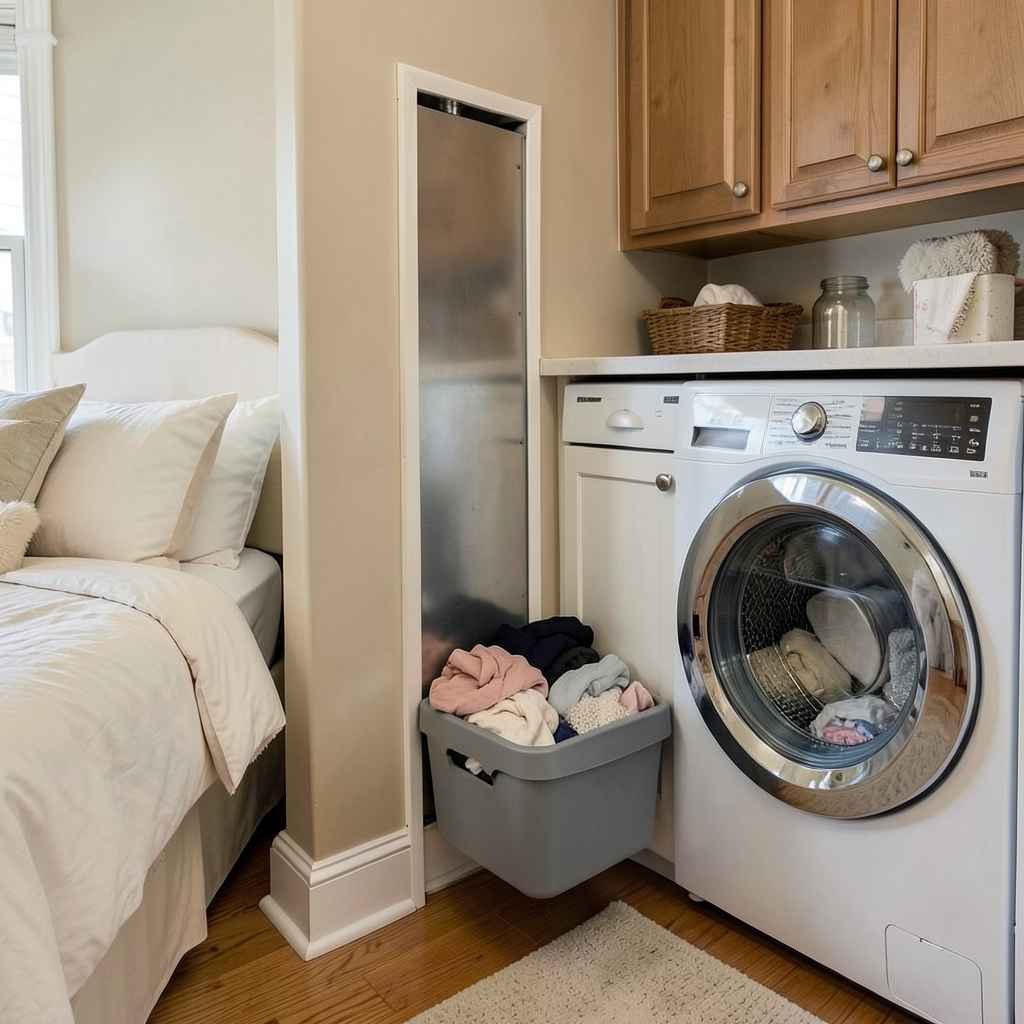
A laundry chute connecting the bedroom level of the house directly to the laundry room eliminates the carrying task that represents a significant portion of the household laundry’s physical labor — the collection of dirty clothes from bedrooms and bathrooms, their transport to the laundry room, and their sorting upon arrival. A chute drops the laundry from an upper floor directly into a sorting bin or hamper in the laundry room below, and while that sounds like a minor convenience, in a household with multiple children, multiple bathrooms, and multiple daily outfit changes, the elimination of laundry transport saves meaningful time and effort across every week of the year.
The chute requires a framed vertical shaft between the upper floor’s access point — typically a small door in a bedroom hallway wall or a cabinet in the master bathroom — and the laundry room below. The shaft should be at least sixteen inches square to prevent garments from catching on the sides, and it must be lined with a smooth material — sheet metal, or a PVC sleeve — that allows clothing to slide freely rather than snagging. The access door at the upper level should be self-closing and latching to prevent the chute from becoming a vertical air duct that pulls cold air from the laundry room into the bedroom level during winter interior design season, or a smell conduit that carries laundry room scents upward.
The laundry chute’s landing zone in the laundry room requires the same design attention as the chute itself — a built-in sorting bin or a custom hamper built into the cabinetry directly below the chute’s exit point catches arriving laundry cleanly and prevents the pile-on-the-floor accumulation that defeats the chute’s organizational benefit. A hinged bin cover on the landing hamper closes the exit point when the chute is not in active use, preventing odors and humidity from traveling upward through the shaft. The laundry chute is a house feature that buyers consistently respond to positively, connecting the home to the comfortable domestic infrastructure of well-designed traditional home interiors while solving a genuinely practical daily household workflow problem.
39. A Laundry Room With a Scent and Sensory Strategy
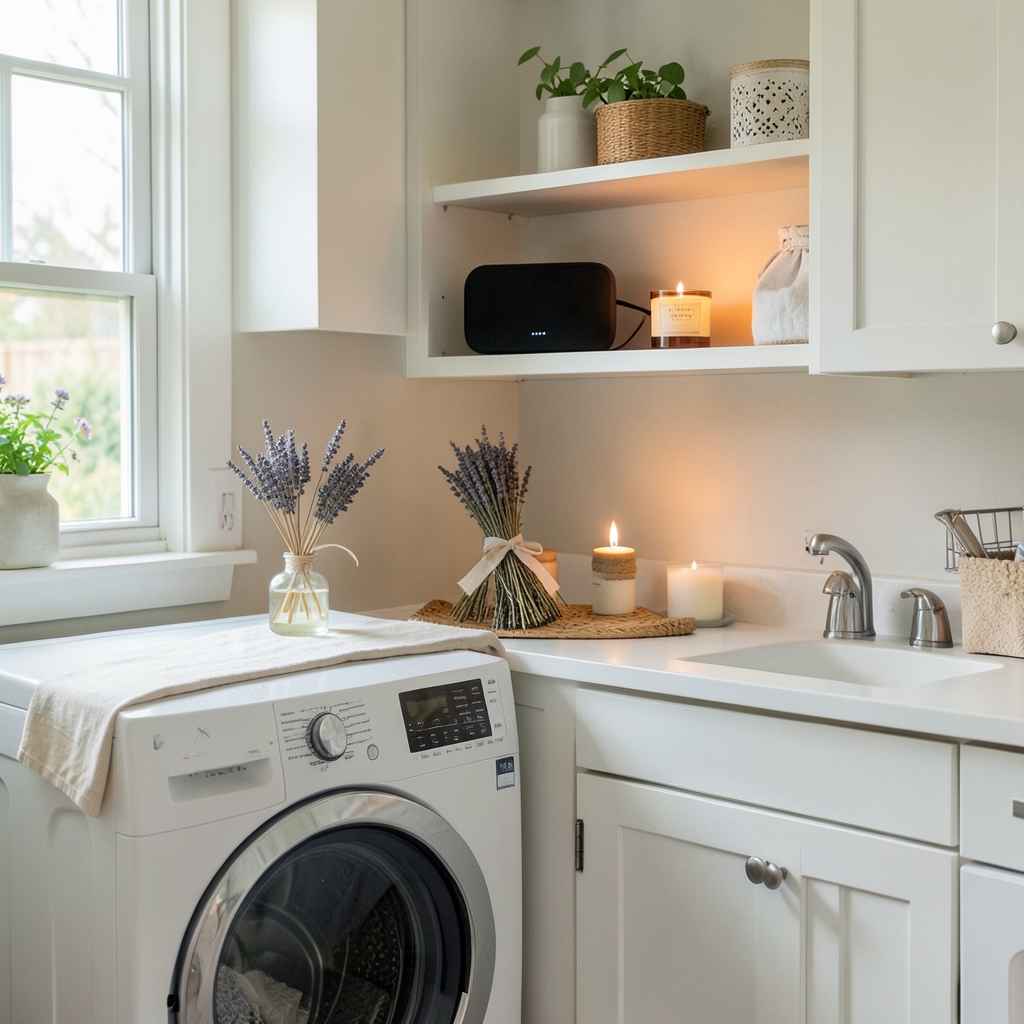
The laundry room’s sensory environment — its smell, its sound, its light quality, and its temperature — shapes the experience of spending time in it as much as its visual design does, and most laundry room renovations address only the visual dimension while leaving the sensory experience unchanged. A deliberate scent strategy transforms the room’s atmosphere without a single architectural change, and the investment is minimal relative to the improvement in how the room feels to occupy. The laundry room that smells of clean linen, cedar, and lavender is a room you want to work in; the one that smells of damp and detergent residue is a room you want to leave.
A reed diffuser in a clean, fresh scent — linen, white tea, eucalyptus, or cedar — placed on the folding counter or the open shelf above the utility sink introduces continuous ambient fragrance that overcomes the machine humidity and detergent smell the room generates during operation. Dried lavender bundles tied with a linen ribbon and hung from the drying rod add a natural, botanical fragrance source that suits garden-inspired interiors and farmhouse home decor contexts — the scent is real and living rather than manufactured, and its botanical origin connects to the floral home decor ideas thread that runs through those design sensibilities. A small beeswax candle on the shelf, lit during the folding session, adds the warm, honeyed scent of natural wax burning alongside the visual warmth of candlelight that makes even a brief task feel less hurried.
The sound environment of the laundry room is a sensory element no visual design choice addresses, but a small Bluetooth speaker mounted on the shelf or installed into the upper cabinet transforms the mechanical hum of running appliances into the background layer beneath music, a podcast, or an audiobook that makes the laundry session genuinely enjoyable. Households that set up audio in the laundry room consistently report spending more time in it, completing laundry tasks more promptly, and feeling more positively about a chore they previously avoided. The peaceful home decor goal in any well-designed room is a space that feels worth being in, and in the laundry room that goal is achievable with lighting, scent, and sound investments that cost almost nothing relative to any material renovation.
40. A Laundry Room With Custom Label Systems
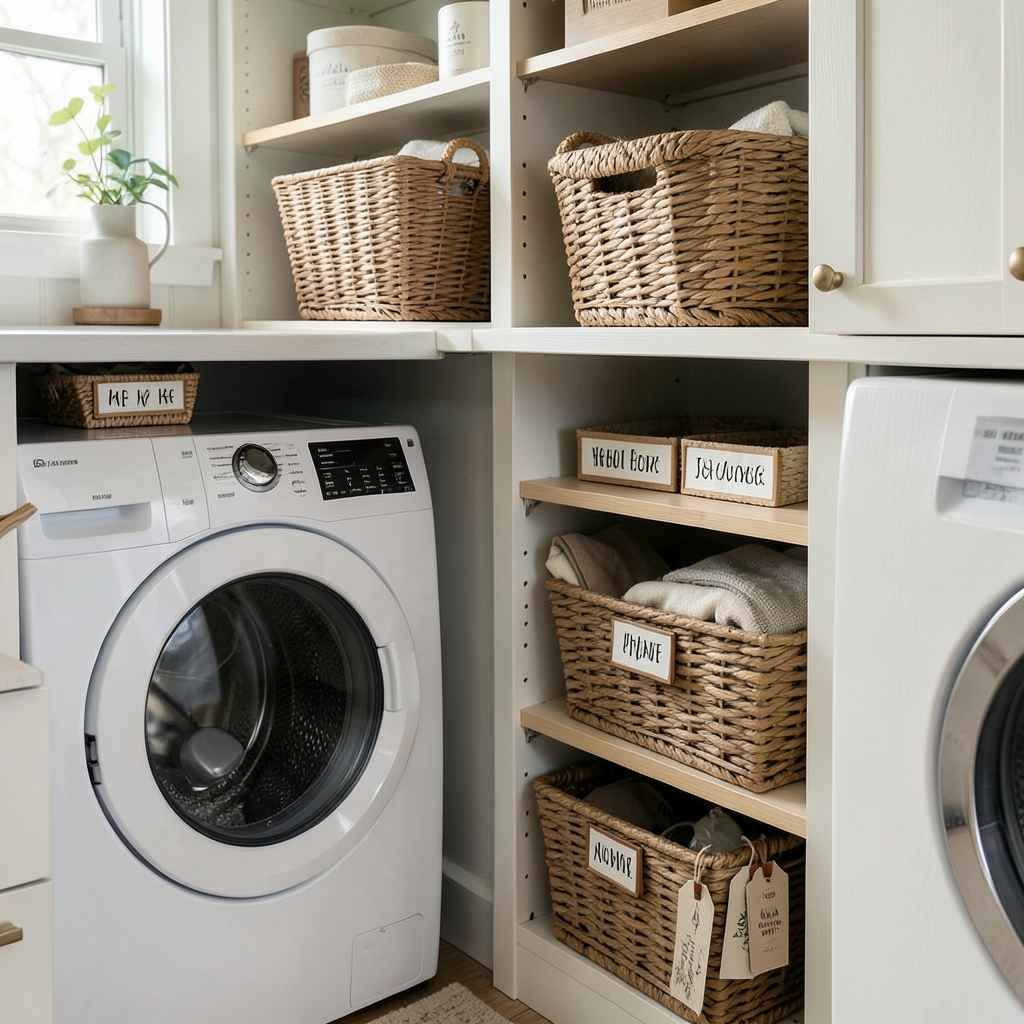
A custom label system in the laundry room creates the organizational clarity that makes every household member capable of participating in the laundry workflow correctly — finding the right basket, returning supplies to the right shelf, and sorting clothes into the right category without requiring instructions or supervision. The label is not decorating. It is information design, and in a room whose organizational system depends on consistent participation from multiple people with different habits and motivations, clear visual information is the functional infrastructure that makes the system self-maintaining rather than self-defeating.
Hand-lettered ceramic labels in a warm cream or white tone with black lettering suit farmhouse home decor, Scandinavian home interior, and traditional home interiors laundry rooms, their artisan quality adding a decorative dimension to the organizational function that printed paper labels do not provide. Printed linen tags on leather ties suit bohemian home styling and warm home decor ideas contexts, their natural material and casual typography reading as collected and personal. Brass or copper engraved label holders mounted directly on shelf edges suit luxury home interior and elegant home styling laundry rooms, the metal label frame providing a permanent, premium-quality identifier that matches the room’s hardware finish and reads as intentional architecture rather than organizational afterthought.
The label system’s value multiplies as the household size increases — a two-person household can manage without labels through familiarity, but a household of four or five people with shared laundry responsibilities benefits immediately and substantially from the clarity that labels provide. Labeling not just the storage baskets but the shelf sections, the cabinet zones, and the drawer contents creates a room that self-explains its own organizational logic, requiring no maintenance conversations and no recurring instructions about where things belong. The labeled laundry room is, in this respect, a design solution to a household communication problem — the physical information system replaces the verbal one, and the organizational quality of the room improves in proportion to the household’s size and complexity.
41. A Laundry Room With Marble Countertops and Backsplash
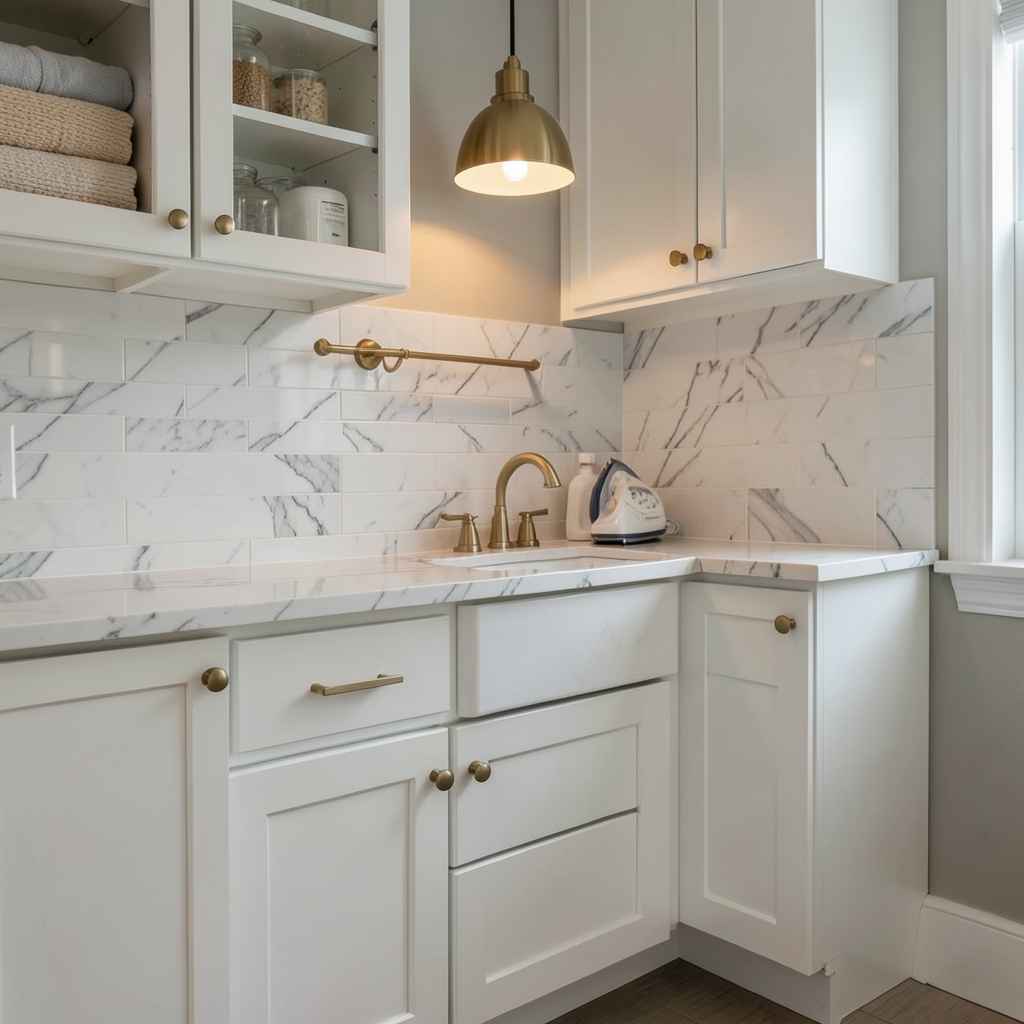
Marble in the laundry room applies the most premium countertop and backsplash material in residential design to a room where its surface beauty is seen and touched multiple times daily during folding, sorting, and ironing tasks. The argument against marble in utility spaces — that it is too precious for hard use — misunderstands how marble performs in practice. Properly sealed Carrara or Calacatta marble resists the moisture, cleaning products, and light abrasion of laundry room use without requiring extraordinary maintenance, and the visual quality it delivers is incomparable within any material category at any price point.
White Carrara marble with soft gray veining on the folding counter and the utility sink surround, paired with a white marble subway tile splashback with the same gray vein pattern, creates the continuous marble surface treatment that reads as luxury home interior design regardless of the room it occupies. The folding counter’s marble surface is cool and smooth underfoot — qualities that suit pressing and steaming tasks where a cool surface prevents garments from retaining heat during handling. Elegant home styling laundry rooms finish the marble installation with unlacquered brass hardware, white shaker cabinetry, and a warm-toned pendant light above the folding counter, creating a room that would not look out of place in a luxury boutique hotel laundry service.
The marble backsplash above the utility sink requires the same sealing care as any marble wet area installation, with penetrating sealer applied before grouting and reapplied annually to maintain the stone’s stain resistance against the detergent and bleach that laundry room backsplashes absorb. Honed marble — a matte, slightly textured finish rather than the high-gloss polish — suits the laundry room’s functional context better than polished marble, because the honed surface disguises the water spotting and fingerprint marks that polished marble reveals acutely in a room with constant moisture exposure. The investment in marble for the laundry room is the strongest possible statement of the principle this article holds throughout: every room in the house deserves the best design thinking and the best materials the budget allows, and the laundry room is no exception.
42. A Laundry Room With a Greenery and Plant Wall
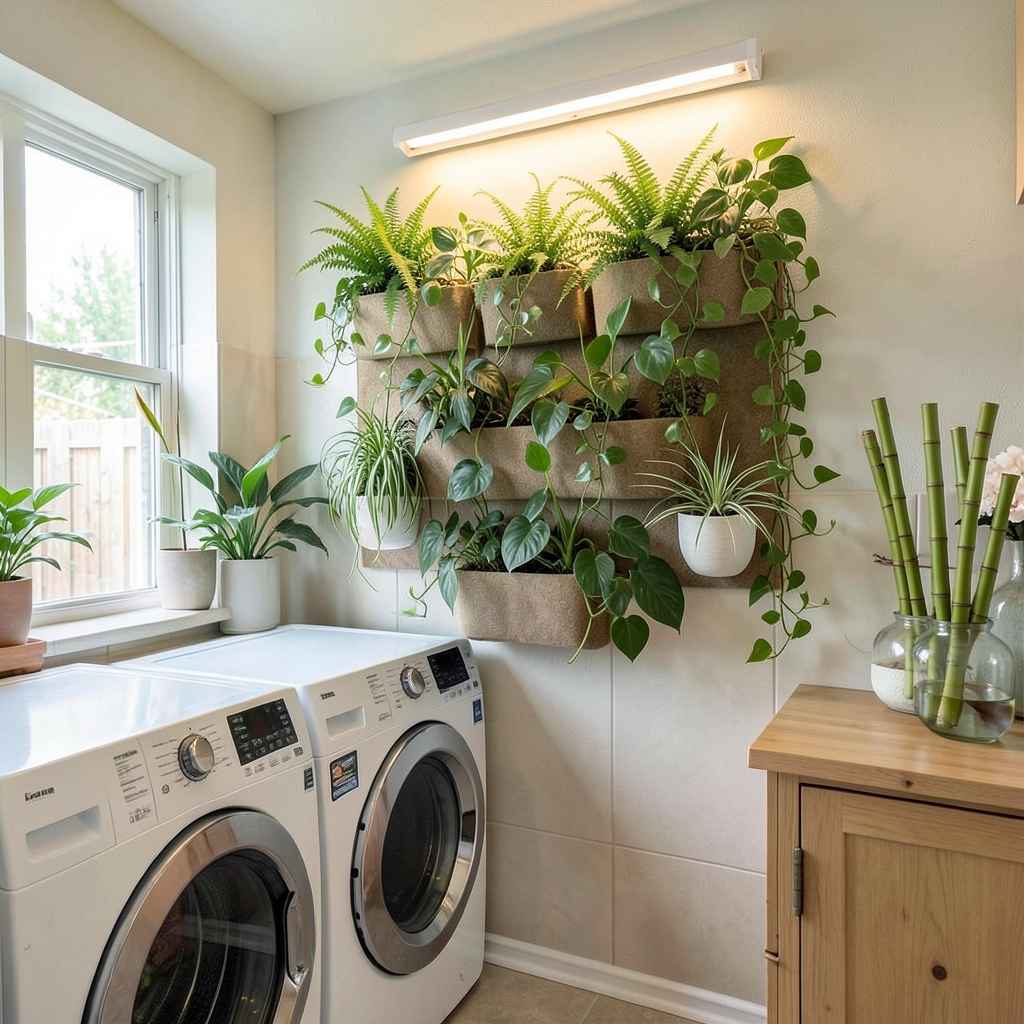
A plant wall in the laundry room — a structured vertical garden of potted plants, trailing vines, or a mounted pocket planter system on the room’s primary wall — brings the living, breathing quality of the natural world into the most mechanically dominated room in the house. The contrast between the plants’ organic form and growth and the room’s hard appliances, tile, and cabinetry creates a visual tension that makes the room feel genuinely alive in a way that no decorative object achieves. Plants in the laundry room also respond to the room’s elevated humidity during machine operation, absorbing the moisture that causes the slightly damp smell most laundry rooms carry.
Moisture-tolerant plants are the non-negotiable selection criterion for laundry room plant walls — pothos, peace lily, fern, spider plant, and heartleaf philodendron all thrive in the warm, humid conditions the laundry room generates and require minimal care beyond periodic watering. A wall-mounted pocket planter in natural felt material, planted with a mix of trailing pothos and upright ferns at the room’s primary sightline from the entry, creates the immediate green wall effect that suits bohemian home styling, jungle-inspired home decor, and garden-inspired interiors contexts. Bamboo home interiors aesthetics incorporate lucky bamboo plants in ceramic water vessels on the open shelving, their vertical canes adding height and the material connection to bamboo that defines the aesthetic.
The plant wall’s position in the laundry room should prioritize the wall with the best natural light — the wall adjacent to or beneath the window, or the wall that receives reflected natural light from the window, provides the growing conditions that keep plants genuinely healthy rather than slowly declining. A grow light strip mounted at the top of the plant wall and set on a twelve-hour timer supplements the natural light in rooms where the window is small or north-facing, providing the photon energy the plants need without changing the room’s ambient light quality during occupied hours. The laundry room plant wall is the single addition that most reliably makes the room feel like it belongs in the rest of the house rather than outside of it.
43. A Laundry Room With a Pegboard Organization Wall
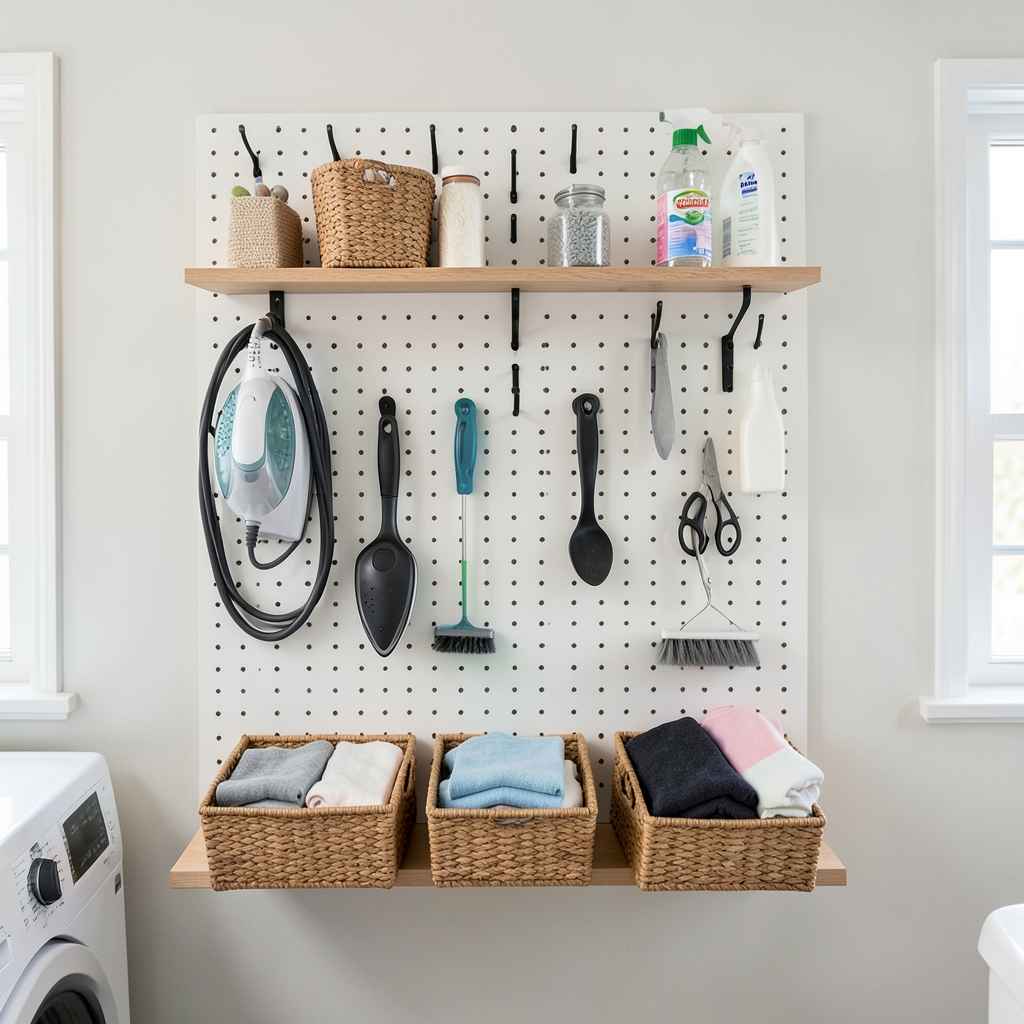
Pegboard is the most honest organization surface in any utility room — it makes every tool and accessory visible, accessible, and explicitly placed, eliminating the searching and rummaging that characterize the typical laundry room supply situation. A pegboard wall in the laundry room, fitted with hooks, small baskets, shelves, and bins in a configuration matched to the specific supplies and tools the household uses, creates a visual inventory of the room’s contents that restocks itself in the mind every time it is seen. The pegboard’s value is in the visibility it provides rather than the storage it creates — the same amount of storage behind closed cabinet doors would feel less organized because the contents would be invisible.
Painted pegboard in white or the room’s primary wall color suits modern home design, Scandinavian home interior, and minimalist home design laundry rooms, the painted surface reading as a designed feature rather than a hardware store tool board. Natural wood pegboard — a panel of solid wood with drilled holes rather than the standard Masonite hardboard — suits farmhouse home decor and rustic home decor contexts with material warmth and genuine craft quality. Black painted pegboard suits industrial home design laundry rooms, the dark board with black metal hooks creating a cohesive, high-contrast organization wall that reads as deliberate and sharp rather than industrial and rough.
The pegboard’s configuration is most effective when it is designed around the specific workflow of the room’s primary tasks — hooks for the iron and its cord, a small shelf for the spray starch and water bottle used during ironing, a set of open-front bins for sorted sock pairs and garment accessories, hooks for the lint roller and the fabric shears used for delicate garment care. This specificity of organization is what distinguishes a designed pegboard from a generic one, and achieving it requires spending ten minutes mapping out the actual laundry tasks performed in the room and the tools each task requires before installing a single hook. The pegboard that organizes what you actually do — rather than what a generic organization article suggests — is the pegboard you use consistently and maintain without effort.
44. A Laundry Room With a Warm Farmhouse Lighting Scheme
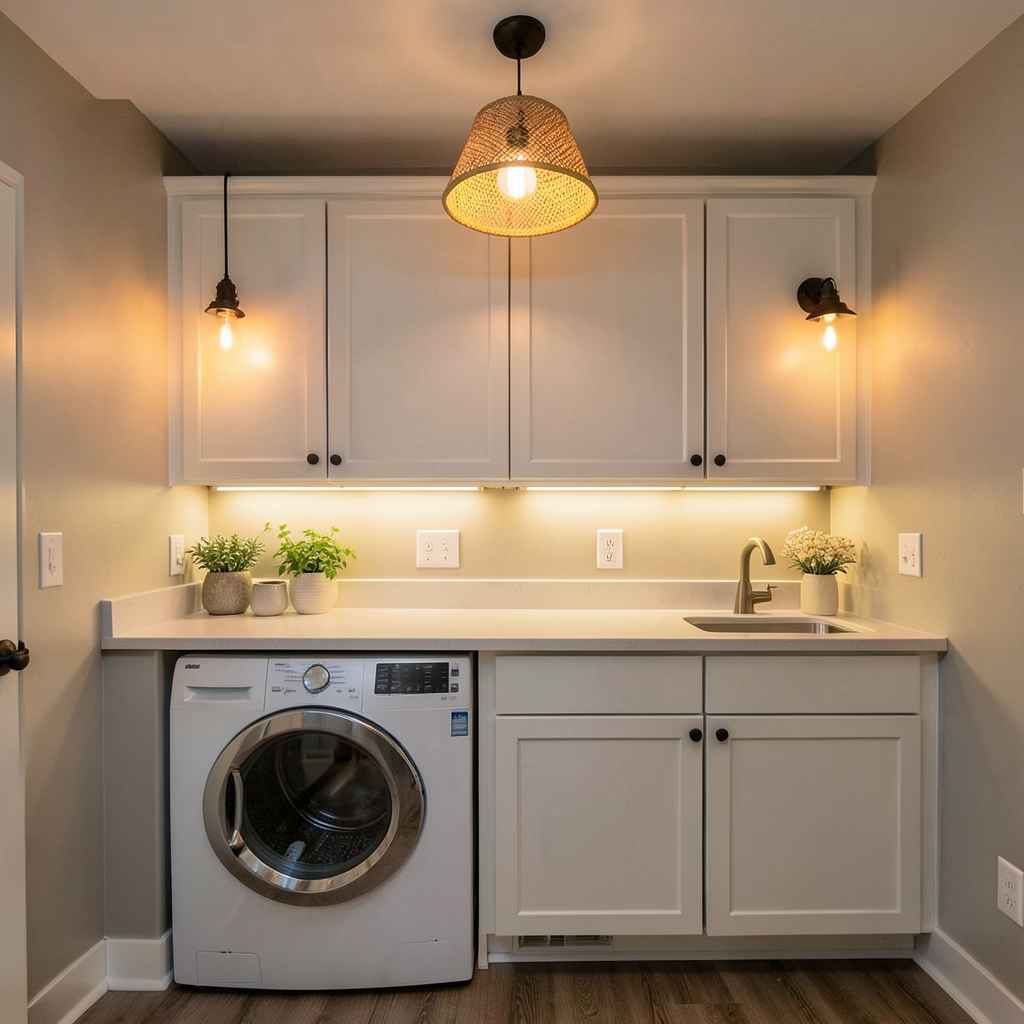
Lighting in the laundry room is the design decision that most directly shapes the experience of spending time in the space, and most laundry rooms are lit by a single ceiling-mounted fluorescent or LED fixture that provides adequate illumination without any warmth, direction, or atmospheric quality. Replacing that single fixture with a deliberately designed lighting scheme — a central ambient fixture, undercabinet task lighting above the folding counter, and a decorative accent light above the utility sink — transforms the room from a utility space lit for visibility into a domestic environment lit for experience.
A pendant or semi-flush mount light fixture in a warm material — a woven seagrass shade, a black cage with Edison-style bulb, a ceramic dome in a warm cream glaze — replaces the utilitarian ceiling fixture and immediately shifts the room’s atmospheric register. Farmhouse home decor laundry rooms respond to a pair of vintage-style Edison bulb pendants hung at equal heights above the folding counter, their warm filament glow producing the soft, directional task light that makes folding and sorting feel less clinical. A ceramic barn light sconce in an oil-rubbed bronze or matte black finish mounted above the utility sink suits both farmhouse home decor and industrial home design, its directional reflector bouncing warm light directly onto the sink basin and work surface below.
Undercabinet LED strip lighting in a warm 2700K color temperature, installed along the underside of every upper cabinet, provides continuous task illumination across the entire counter and appliance surface that overhead fixtures alone cannot achieve without casting the shadow of the person working at the counter onto the work surface below. This lighting layer is the most practically valuable upgrade in a laundry room lighting scheme, and its installation cost is modest — LED strip lighting with an adhesive backing and a plug-in transformer installs in an afternoon without an electrician. The full lighting scheme — ambient fixture, undercabinet strips, and accent sconce — costs less to add to a laundry room than almost any surface material upgrade and delivers more daily improvement to the experience of using the room.
45. A Laundry Room With a Dedicated Mending and Sewing Corner
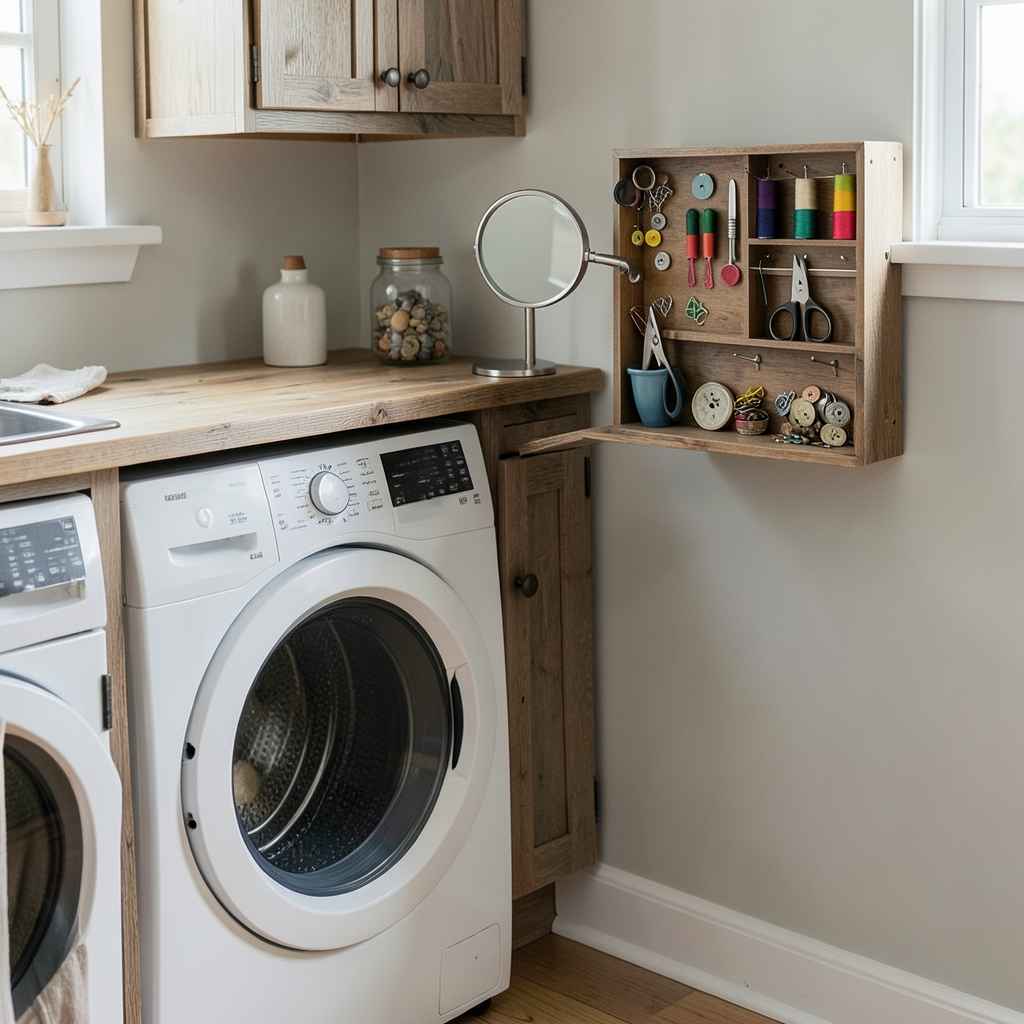
A mending corner in the laundry room acknowledges a domestic practice that most households perform on a makeshift basis — a button sewn on at the kitchen table, a hem repaired on the bedroom floor — because there is no defined space for these small repair tasks that generate from the laundry room’s workflow and logically belong within it. A small, well-equipped mending station integrated into the laundry room’s cabinetry or wall space creates the infrastructure for a repair practice that extends garment life, reduces clothing expenditure, and connects the household to the craft tradition of material care that most modern domestic environments have abandoned entirely. The mending corner is both a practical asset and a small act of resistance against disposable consumption.
A compact sewing kit mounted in a wall-hung box with a fold-down work surface — needles, thread in a spectrum of common colors, scissors, seam ripper, buttons, and safety pins organized in small compartments — provides the complete mending toolkit within a wall-mounted cabinet that closes flush when not in use. A magnifying glass on a small articulating arm mounted beside the mending station addresses the fine detail work that hand sewing requires without the eye fatigue that working on small stitches in average ambient light produces. Rustic home office ideas aesthetics suit the mending corner naturally — a weathered wood cabinet, a small ceramic thimble holder on the work surface, and a collection of vintage buttons in a glass jar create a workspace of genuine charm.
The mending corner also handles the garment triage function that laundry naturally generates — the decision point when a garment comes out of the dryer with a torn seam, a missing button, or a small hole, and the household must decide whether to repair it, repurpose it, or discard it. A designated triage hook or basket beside the mending station gives garments in this undecided state a proper temporary home rather than sending them back into the closet unrepaired or onto the floor awaiting a decision that never comes. The mending corner that is organized, supplied, and positioned correctly in the laundry room workflow transforms garment repair from an occasional good intention into a habitual practice that runs alongside the laundry routine with minimal additional effort.
46. A Laundry Room With a Custom Monogram or Personalization Detail
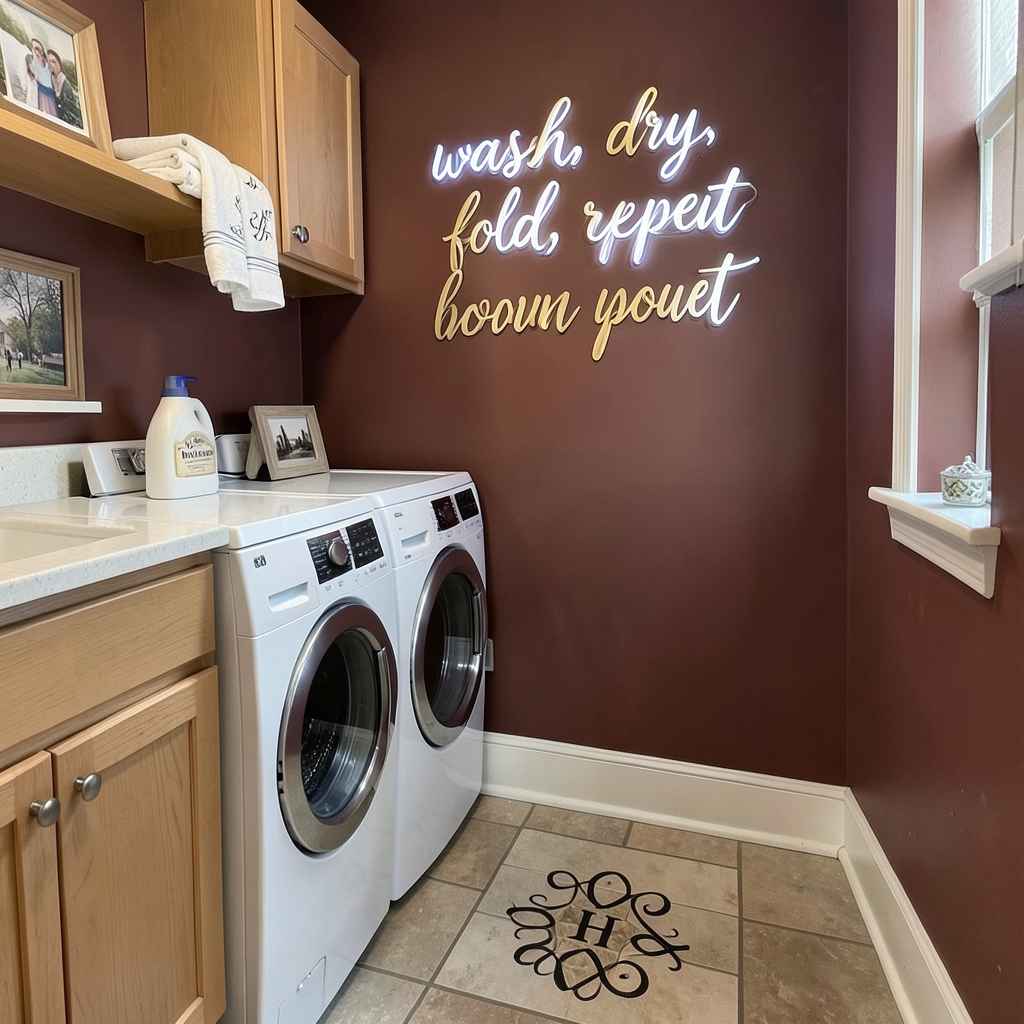
A personalized detail in the laundry room — a monogram, a family name, a meaningful phrase, or a custom pattern that references the household’s specific identity — gives the room a character that generic utility design cannot provide. The laundry room is the household’s most consistently used domestic workspace, and the detail that makes it specific to this family in this house elevates the daily experience of using it from neutral to personal. That elevation costs almost nothing in material terms but registers deeply in the daily quality of life that the space contributes to.
A custom monogram tile inlaid into the laundry room floor — a single initial or a full family surname initial in a contrasting tile set into the floor’s center — creates a permanent personalization that reads as luxury home interior craftsmanship applied to the most unpretentious room in the house. A hand-lettered phrase on the laundry room wall — painted directly, applied as a vinyl graphic, or rendered in a custom neon sign — can range from the practical (“wash, dry, fold, repeat”) to the warmly personal, and its presence gives the room the voice that walls of cabinetry and appliances cannot express. Custom monogrammed linen hand towels at the utility sink, a personalized label on the detergent canister, and a small framed family photograph on the shelf all contribute to the sense that this room was designed for this household rather than assembled from a generic supply list.
The personalization principle extends to the color palette — choosing the laundry room’s primary color not from a trends list but from the family’s actual preferences, the colors that make each individual household member happy when they encounter them, produces a room of genuine emotional resonance that trend-driven color choices never quite achieve. A household that loves deep terracotta puts terracotta in the laundry room not because it is prescribed by any design source but because it makes the room feel like home. That feeling is the laundry room’s ultimate design achievement, and personalization — in whatever form suits the household’s aesthetic — is the path to it most directly.
47. A Laundry Room With a Clever Corner Utilization
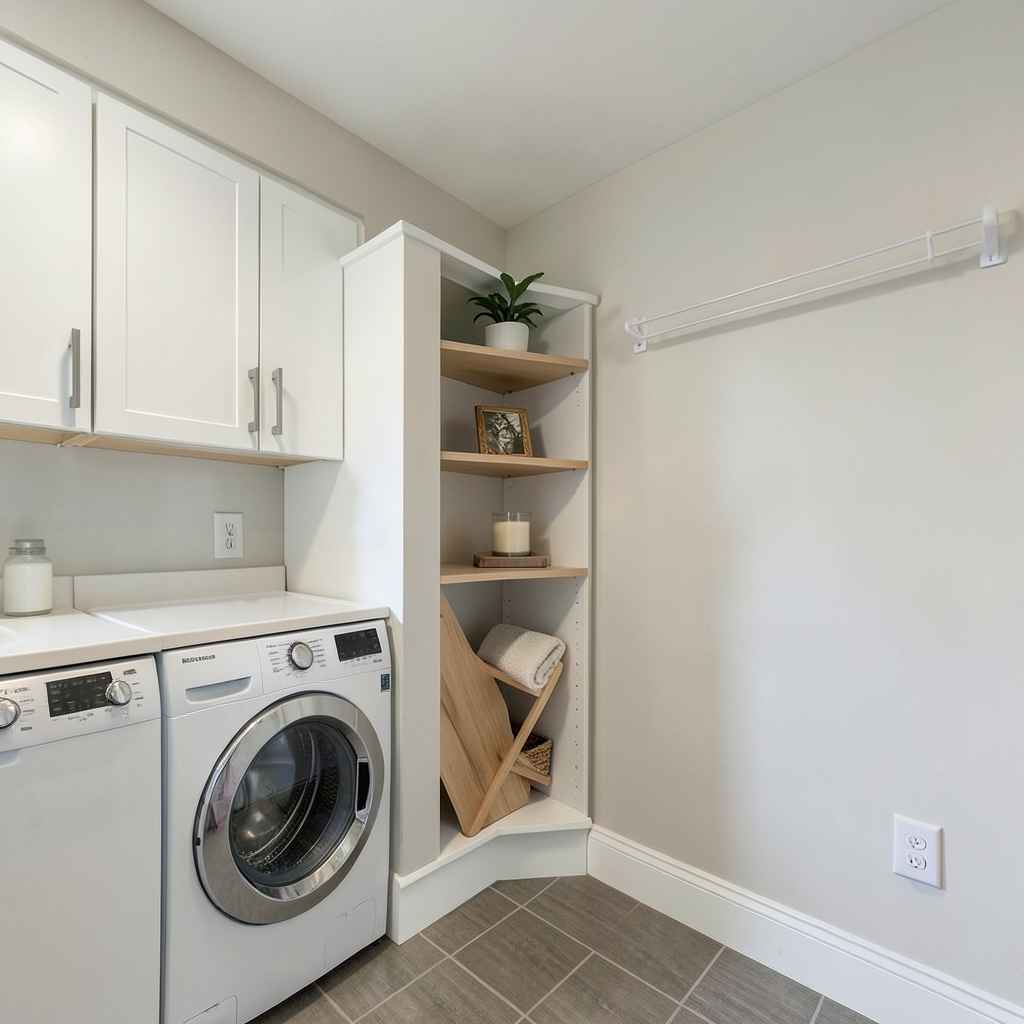
Corner spaces in the laundry room are the locations most likely to become dead zones — areas where nothing fits quite right, where cleaning is difficult, and where the inefficiency of the right-angle creates a spatial awkwardness that most renovation plans simply route around rather than address. Clever corner utilization turns these dead zones into the room’s most space-efficient storage areas, using the corner’s depth to store items that front-facing shelving cannot accommodate and recovering floor space from the room’s least productive location.
A corner cabinet with a lazy Susan interior, a pull-out corner shelf system, or a diagonal corner drawer cabinet — the three standard solutions for kitchen corner cabinetry, all applicable to the laundry room — converts the awkward right-angle space into accessible storage without requiring any additional floor space. In a laundry room with an open corner rather than a cabinet corner, a tall freestanding shelf unit with angled corner-fitting sides — designed specifically to fit flush into a ninety-degree corner — provides maximum shelving capacity in minimum floor footprint. The corner floating shelf — a triangular shelf that fills the corner angle completely — provides a display surface for a plant, a candle, or a seasonal decorative object in a location that would otherwise hold nothing.
The corner utilization principle extends to the laundry room’s ceiling corners, which in rooms with ceiling heights above nine feet often contain the room’s only genuinely unused cubic footage. A ceiling-mounted corner drying rod extending from one wall to the adjacent wall at a diagonal creates a single drying line of significant length in a location that uses airspace rather than floor space or wall space. This diagonal corner installation is invisible in the room’s sightline when not in use and provides a functional drying surface that complements the wall-mounted retractable system without duplicating it. The laundry room that uses its corners well uses its entire room well, and that discipline of total spatial optimization is what distinguishes the best-designed small laundry rooms from the ones that feel chronically short of space.
48. A Laundry Room With a Scandinavian Minimalist Approach
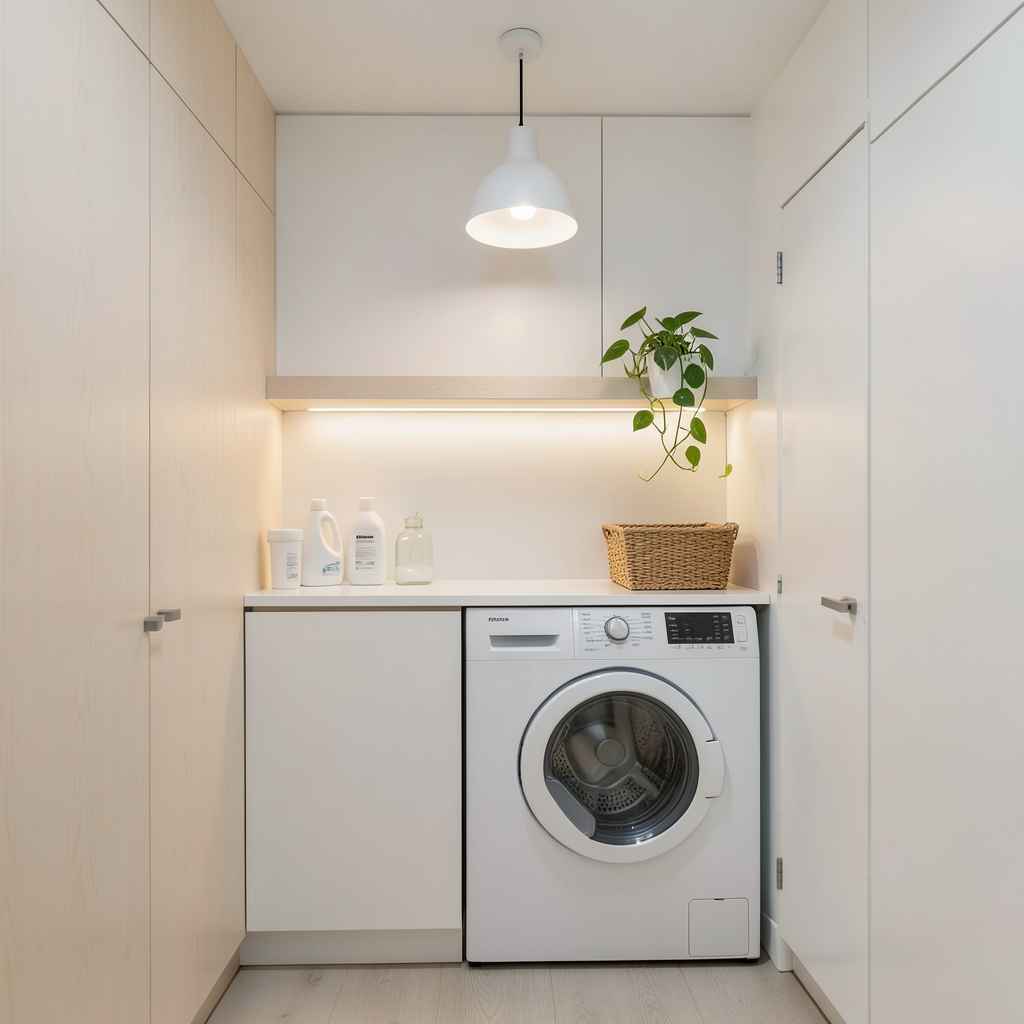
The Scandinavian approach to the laundry room design eliminates every element that does not serve a specific function, selects each remaining element with precise attention to its material quality and formal simplicity, and arranges the whole within a palette of white, pale wood, and one restrained accent that recedes rather than announces itself. The result is a room that feels immediately calm, organized, and complete — a room where the absence of excess is the design statement rather than a limitation. This approach is harder to execute than it appears because it requires genuine discipline about what belongs and the willingness to remove what does not.
Pale birch or ash-veneered flat-panel cabinetry in a handle-free push-to-open format lines the laundry room walls, its warm wood grain providing the only material variation in an otherwise white palette. The appliances are front-loading and ideally integrated behind cabinetry panel fronts that match the surrounding cabinets, making the machines invisible when the doors are closed and the laundry function completely concealed within the room’s architectural composition. A single pendant light in a simple white ceramic or glass form provides the ambient lighting, supplemented by LED strip lighting under the upper cabinets — the lighting is warm, directed, and sufficient without excess. This is Scandinavian hallway design discipline applied to the laundry room, and the result is a space of extraordinary visual quiet.
The Scandinavian minimalist laundry room’s organizational system is its most demanding design requirement, because the minimalist aesthetic only succeeds if every item in the room has a defined home and every session of use ends with the room restored to its baseline order. Matching containers for detergent and supplies in white ceramic or clear glass, a single woven basket in natural sea grass for miscellaneous items, and a single potted plant — a trailing pothos or a small peace lily — on the open shelf above the folding counter constitute the entire decorative program. The room works not despite its restraint but because of it, and the daily experience of using a space this precisely organized and this visually calm is the most persuasive argument for the minimalist approach in any domestic context.
49. A Laundry Room With a Statement Ceiling Treatment
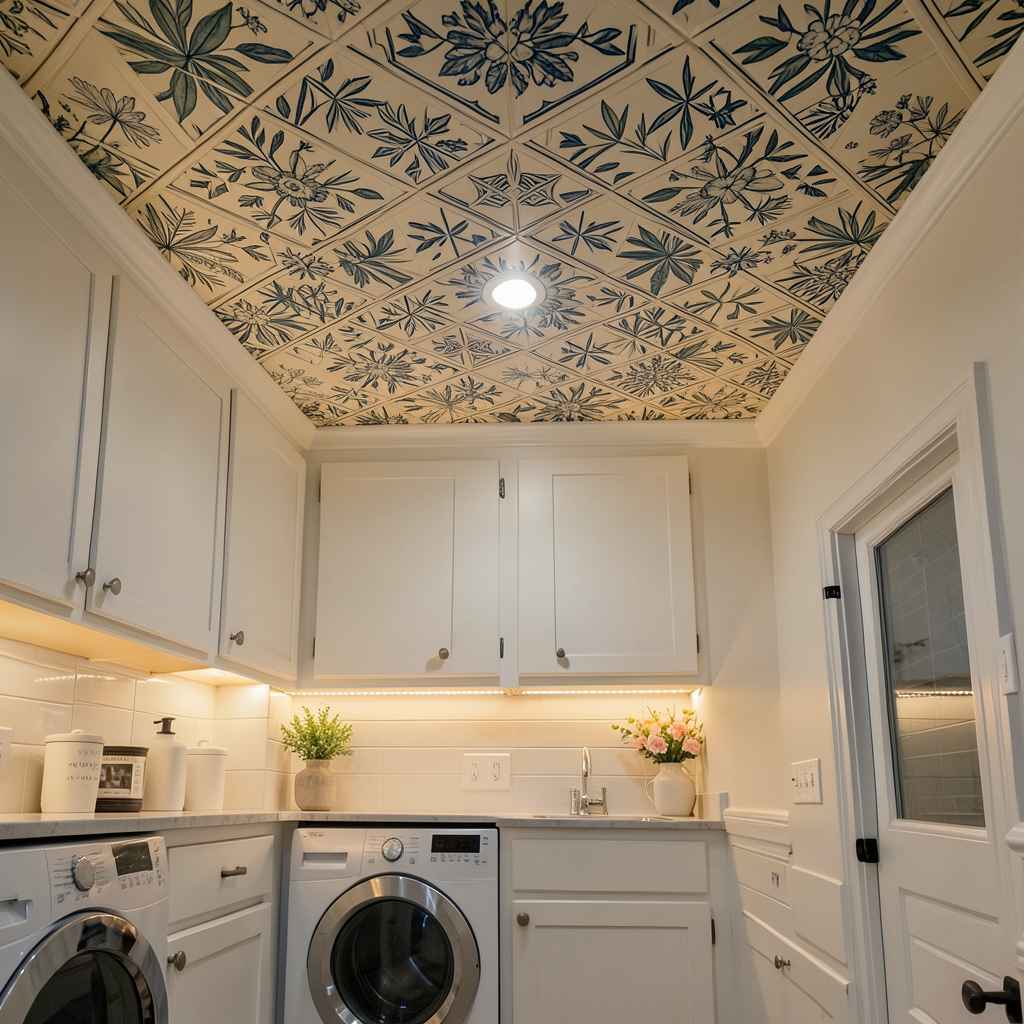
A statement ceiling in the laundry room is the design move that no one sees coming and everyone remembers — while most renovation attention focuses on floors, walls, and cabinetry, the ceiling remains an untouched plane that the right treatment converts from a blank overhead surface into the room’s most distinctive feature. The ceiling’s unusual position — seen in peripheral vision rather than direct sightline during most laundry tasks — means that a ceiling treatment registers as an unexpected surprise rather than an expected element, and that element of surprise is what makes it so effective as a statement-making surface in a room that cannot rely on large-scale furniture or art for its design impact.
A pressed metal ceiling tile installation in a Victorian geometric pattern painted in a warm cream suits traditional home interiors and farmhouse home decor laundry rooms with its period craftsmanship reference. Shiplap applied to the ceiling horizontally and painted in a color that contrasts the walls creates a bold color moment overhead that suits coastal home design and contemporary home ideas — ceiling shiplap in a navy blue above white walls and white cabinetry creates the graphic contrast that makes the ceiling read as a designed architectural element rather than a structural necessity. A wallpaper ceiling — a bold botanical print or a geometric repeat in a scale and color chosen for ceiling application — creates the most dramatically unexpected overhead surface in the laundry room’s design vocabulary, and the botanical or floral home decor ideas print applied overhead creates the canopy quality of a garden conservatory in a room with no windows large enough to achieve that effect through architecture alone.
The lighting strategy for a statement ceiling is more critical than for a standard white ceiling because the overhead treatment must be lit to be seen and appreciated — recessed fixtures angled slightly toward the ceiling rather than directed straight down illuminate the ceiling surface rather than simply illuminating the floor. LED strip lighting installed along the top edge of the upper cabinetry, directed upward toward the ceiling, provides a continuous warm wash of light across the ceiling’s full surface, making the pattern or material visible from below in the ambient glow that reads as both functional and atmospheric. The lit statement ceiling at night — when the directed light creates the ceiling’s full visual effect — turns a practical utility room into a space that the household genuinely looks forward to entering, which is the final measure of whether any laundry room design has succeeded.
50. A Laundry Room Designed to Work for You
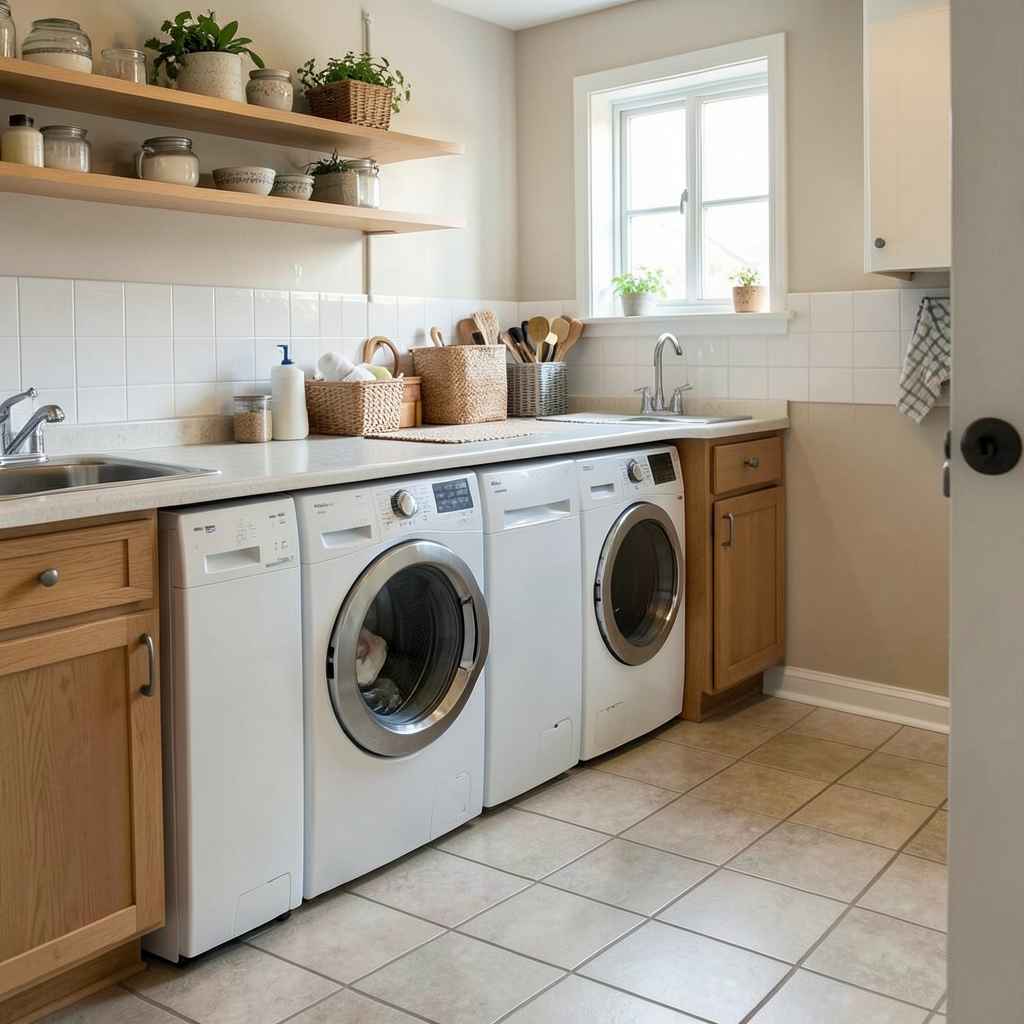
The laundry room that works is the one designed honestly around the household it serves — its specific appliance layout, its particular storage needs, its daily workflow patterns, and the aesthetic that makes its users feel at home rather than at work. Every idea in this collection has pointed toward that conclusion from a different angle: the floor material that holds up to the room’s traffic pattern, the lighting scheme that makes the folding session feel less punishing, the storage system that matches the household’s actual organizational behavior, the color that makes the room feel worth being in. None of these decisions are universal. All of them are personal.
Start with your laundry room’s most urgent problem — the one that makes the room feel most dysfunctional, most unpleasant, or most incomplete — and address it directly with whichever idea in this collection solves it most precisely. One well-chosen upgrade, installed and maintained correctly, improves the room’s daily performance more than ten half-measures spread across its entire surface. The folding counter that eliminates bedroom laundry piles is worth more than new tile on a floor that already works. The lighting upgrade that makes the room feel pleasant at seven in the morning is worth more than a decorative detail that looks good in photographs but contributes nothing to the daily experience.
The laundry room designed for you — your workflow, your aesthetic, your household’s specific needs — is the room you use without reluctance, maintain without resentment, and inhabit with the same ease as any other room in your home. That ease is the goal, and it is achievable in any laundry room, at any scale, at any budget, when the design decisions are made with genuine intention rather than functional resignation. Your laundry room deserves that intention. Start giving it to the room today.
Leave a Reply