The garden is the room most people forget to design. They paint walls, choose sofas, hang art, and agonize over kitchen tiles — and then they step outside and accept whatever the previous owner left behind or whatever grew without direction because nobody stopped it. That gap between the care given to interior spaces and the neglect applied to outdoor ones is one of domestic life’s most persistent and least examined habits, and the gardens it produces are exactly what you would expect: functional in the sense that they contain grass and air, but uninspiring in every other sense that matters.
What a well-designed garden actually provides goes considerably beyond aesthetics. The outdoor space attached to a house is — when it is designed with genuine intention — an extension of the home’s living area, a place where meals happen and children play and adults sit without the pressure of productivity. It is the space where the quality of life experienced within the property is either amplified or reduced, depending on whether the ground beyond the back door was given the design attention it deserved or left to accumulate whatever the wind, the birds, and the previous occupant’s abandoned projects deposited there. A garden that works is one of the most significant quality-of-life improvements available to a household, and it requires no more than the willingness to think carefully about what the space needs to be.
The challenge of garden design is that most people approach it with the wrong tools. They arrive at a garden center on a Saturday morning with no plan, fill a trolley with whatever looks attractive at that exact moment, plant everything within reaching distance of the car, and then wonder why the garden never quite coheres. Individual plants can be beautiful and a garden can still be a mess if the spatial organization, the material selection, the seasonal planning, and the relationship between the garden’s zones were never considered as a whole. Garden design is not about plants. It is about space — the organization of outdoor space into zones and volumes and pathways and focal points — and the plants are the materials through which that spatial organization is expressed.
The scale of the garden is the constraint that most design guides treat as a limitation when it is more accurately understood as a clarifying condition. A small garden with clear design intentions produces a space with the quality of an outdoor room — contained, deliberate, every element chosen for its relationship with the others. A large garden without design direction produces a space that requires maintenance without providing atmosphere, and atmosphere is what every garden visit should deliver. The size of your outdoor space tells you what the design constraints are. It does not tell you what the quality ceiling is.
The fifty garden design ideas collected here address every scale, every climate direction, every functional requirement, and every aesthetic ambition that the outdoor space of a residential property might need to express. Some of these ideas are structural — the hard landscaping decisions about paving, levels, water, and built elements that form the garden’s bones. Others are planted — the species selection, the planting arrangement, the seasonal succession that keeps the garden interesting across all twelve months rather than just the peak flowering weeks. Others are atmospheric — the lighting approach, the furniture selection, the designed moments of surprise and enclosure that make a garden genuinely memorable rather than merely adequate. All of them begin from the same position: the garden you have is already the garden you need. The design is the act of revealing what it can become.
1. A Garden With a Formal Symmetrical Layout
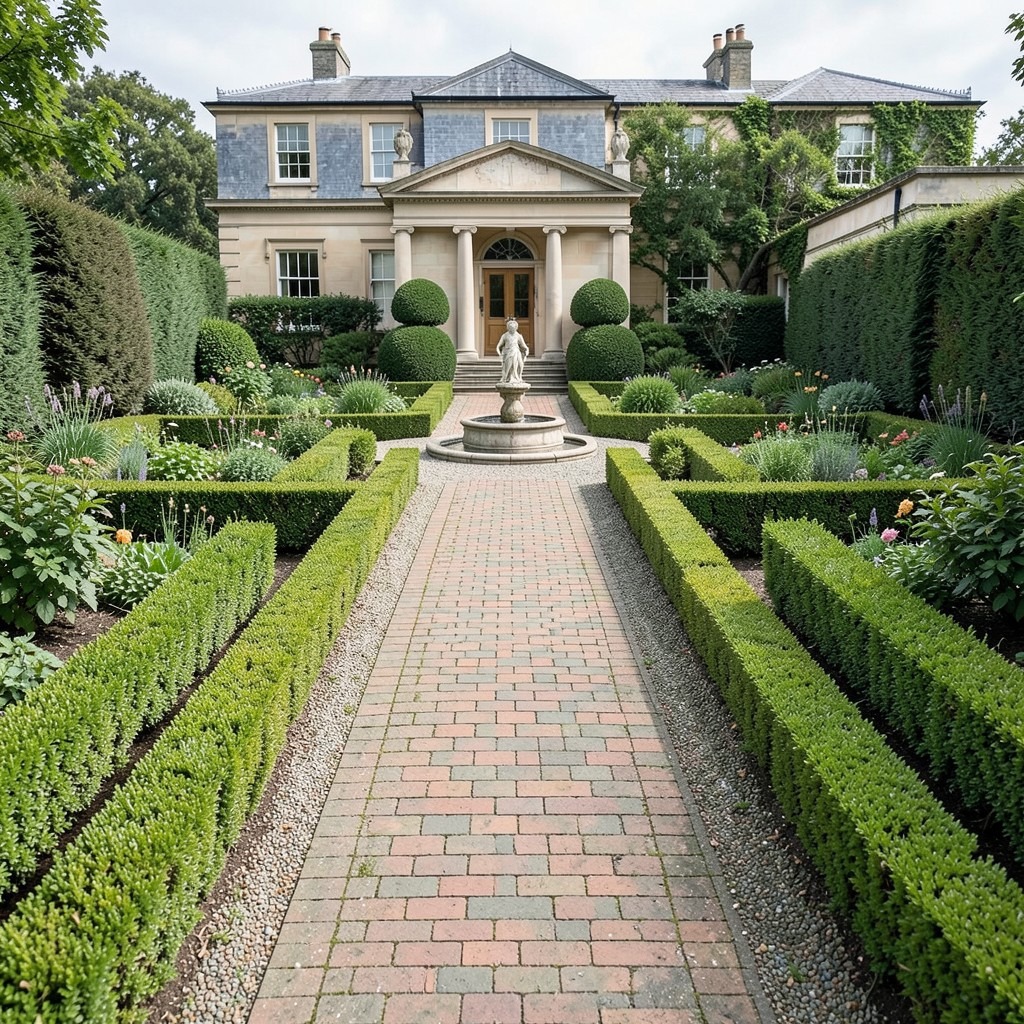
The formal garden earns its authority through the discipline of symmetry — not as an exercise in rigidity, but as the expression of a design philosophy that treats the outdoor space with the same geometric precision that classical architecture applies to buildings. When two matching borders flank a central axis, when clipped hedges create mirrored planes on opposite sides of a central path, and when the eye is drawn from the garden’s entrance to its terminal focal point in an uninterrupted line, the outdoor space communicates a quality of composed intentionality that no informal planting arrangement approaches at the same level of immediate visual authority.
The central axis is the structural spine of the formal garden and the decision with the most consequence for every subsequent design choice. The axis runs from the house’s primary outdoor door or from the garden’s most prominent entrance point to the garden’s terminal feature — a focal point sculpture, a clipped topiary sphere, a water feature, or a garden building that provides the visual destination toward which the axis guides the eye. The path material for the axis should be the garden’s most considered paving choice — a stone, a brick, or a gravel path whose material quality announces that this is the garden’s organizing line rather than one of several routes.
The planting within a formal symmetrical garden must be managed with the consistency that the layout demands. A box-edged border that is trimmed on the left side of the axis and allowed to overflow on the right defeats the symmetry the design is built around and reads as maintained on one side and neglected on the other. The discipline of the formal garden is not its constraint — it is its maintenance commitment, and that commitment requires a realistic assessment of the time the household can invest in the clipping, edging, and shaping that keeps the symmetry honest across the growing seasons.
2. A Garden With a Cottage Garden Planting Style
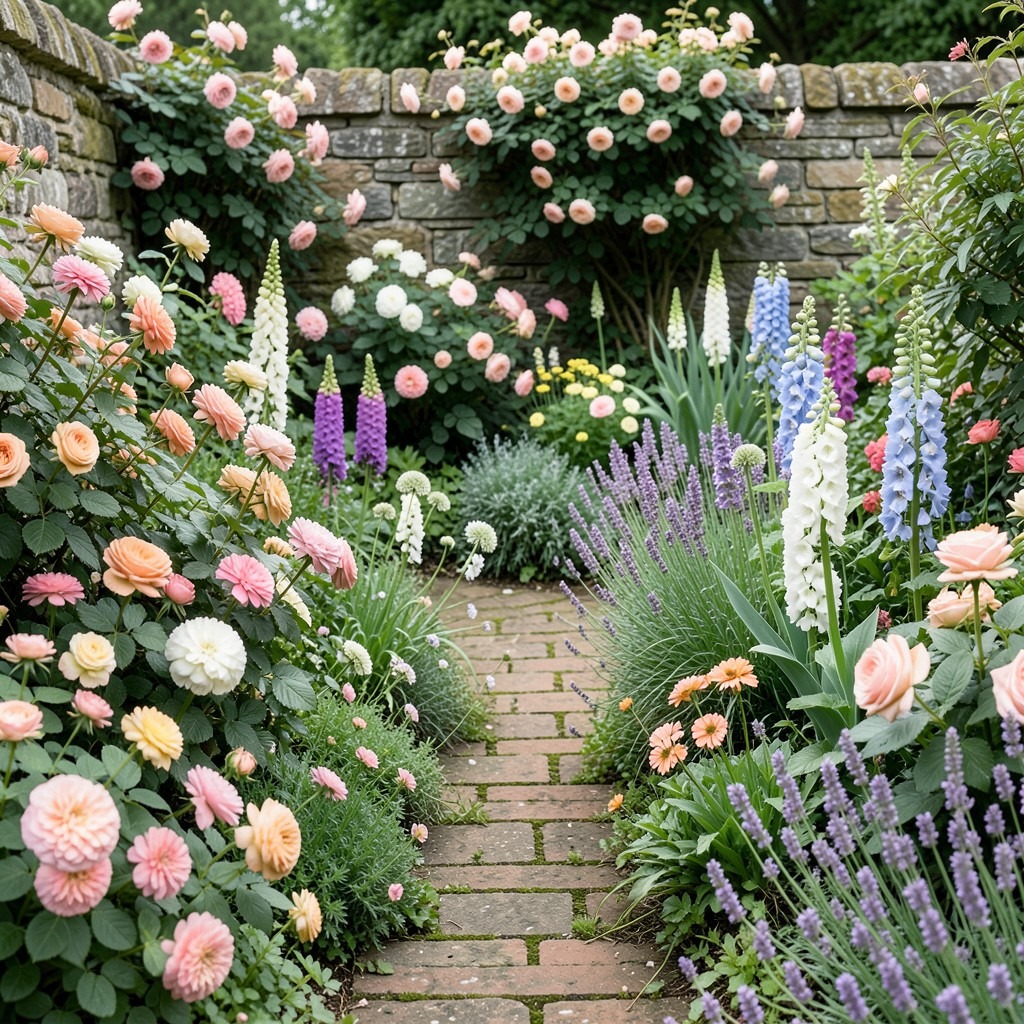
The cottage garden is the planting style that most directly captures the quality of abundant, slightly overgrown floral generosity that most people carry as their ideal image of an English garden — the kind of garden where roses tumble over an old stone wall, where foxgloves push up through the middle of a lavender hedge, and where the sense of deliberate artlessness required far more planning than the accidental quality it communicates would ever suggest. A true cottage garden is not a happy accident. It is a carefully managed theater of apparent chaos, and achieving it requires both horticultural knowledge and genuine design skill.
The plant palette for a cottage garden prioritizes species with the specific informal habit and the generous flowering character that the style demands: roses — particularly the old-fashioned David Austin varieties in soft pink, apricot, and white — geraniums, delphiniums, sweet william, foxgloves, alliums, and the sprawling, tumbling perennials that produce the layered quality of planting where one species grows through another and the border has depth rather than a flat, regimented front face. The cottage garden border is never bare soil between plants. The plants occupy every available square centimeter of ground, which suppresses weeds and creates the lush, filled quality that is the style’s defining visual characteristic.
The path through a cottage garden border is the one structural element that brings discipline to the planting without interrupting its informal character. A narrow path in reclaimed brick or small-format natural stone, wide enough for one person to walk while brushing the border planting on both sides, provides the route through the garden that allows the planting to be experienced at close range rather than viewed from a distance. The path’s informality — its slight meandering, its edges softened by overhanging plants — is the transition from the garden’s designed structure to its planted exuberance.
3. A Garden With a Paved Courtyard Design
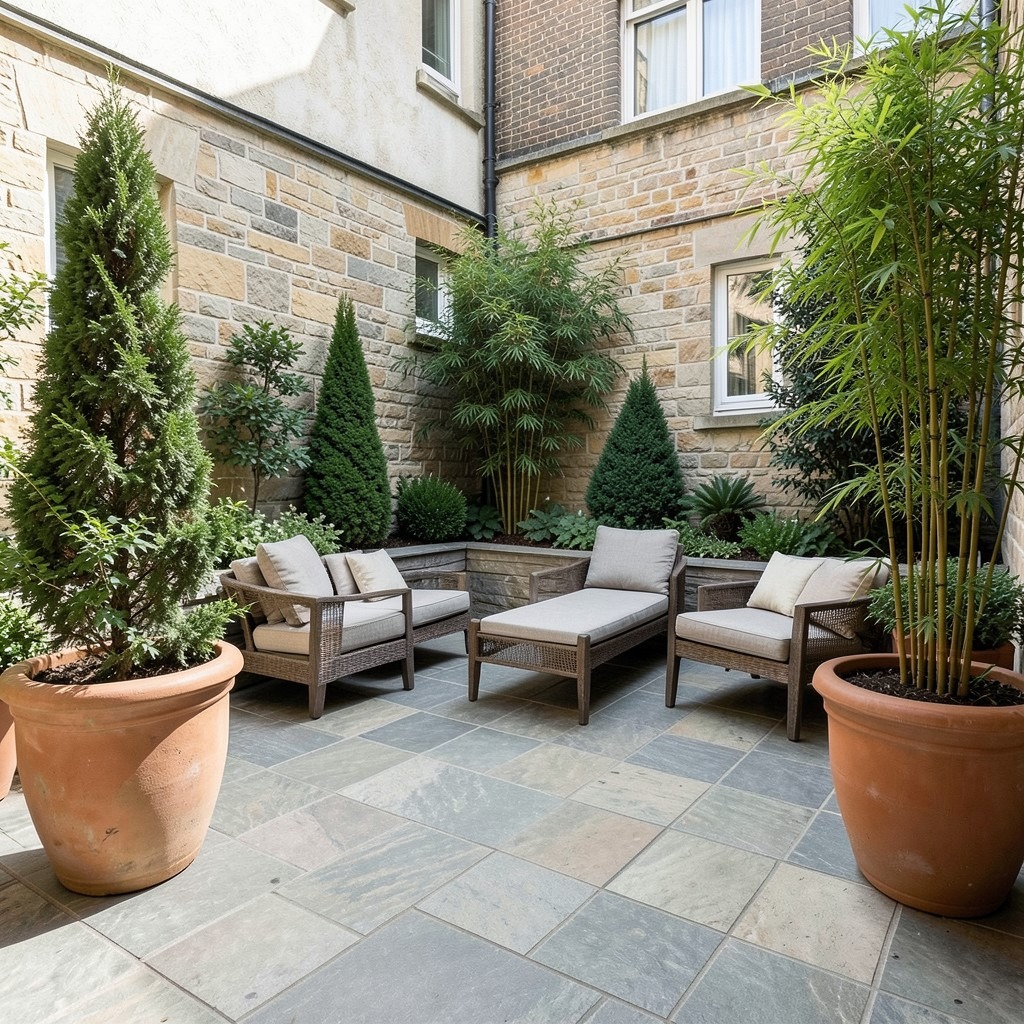
A paved courtyard garden — a space whose primary surface is a hard material rather than planted ground, organized around seating, planting in containers, and the quality of enclosure that walls or high planting create — is the garden design solution that provides the highest ratio of usable outdoor living space to total garden area, and it is the design solution that urban homeowners with small, shaded, or irregularly shaped plots consistently find serves them better than the lawn-and-border alternative. The courtyard is an outdoor room in the truest sense — bounded, paved, furnished, and inhabited rather than tended.
The paving material selection is the courtyard’s most consequential design decision because the hard surface covers the majority of the visible garden floor and determines the visual character of the space more directly than any other single element. Natural stone — limestone, sandstone, slate, or granite — provides the material quality that weathers well, ages beautifully, and suits both period and contemporary architecture with the versatility that concrete and porcelain alternatives offer only at their best. Porcelain paving — a large-format fired tile in a natural stone effect — provides the low-maintenance, frost-resistant alternative that many domestic gardens prefer for its consistent surface and resistance to the moss and lichen growth that natural stone accumulates in shaded conditions.
The planting in a courtyard garden works through containers, raised beds, and the vertical surface of the surrounding walls — the three planting modes that substitute for the ground planting that the paved surface prevents. A large terracotta or weathered stone planter at the courtyard’s corners provides the vertical interest of tall architectural plants — a clipped standard bay, a slim columnar evergreen, a bamboo in a wide pot — at the positions where the eye naturally travels in a bounded space. The container planting requires a watering discipline that ground planting does not, because container growing media dries quickly in warm weather, and the courtyard garden that relies on containers without an automated drip watering system demands daily attention that many households cannot consistently provide.
4. A Garden With a Japanese Zen Aesthetic
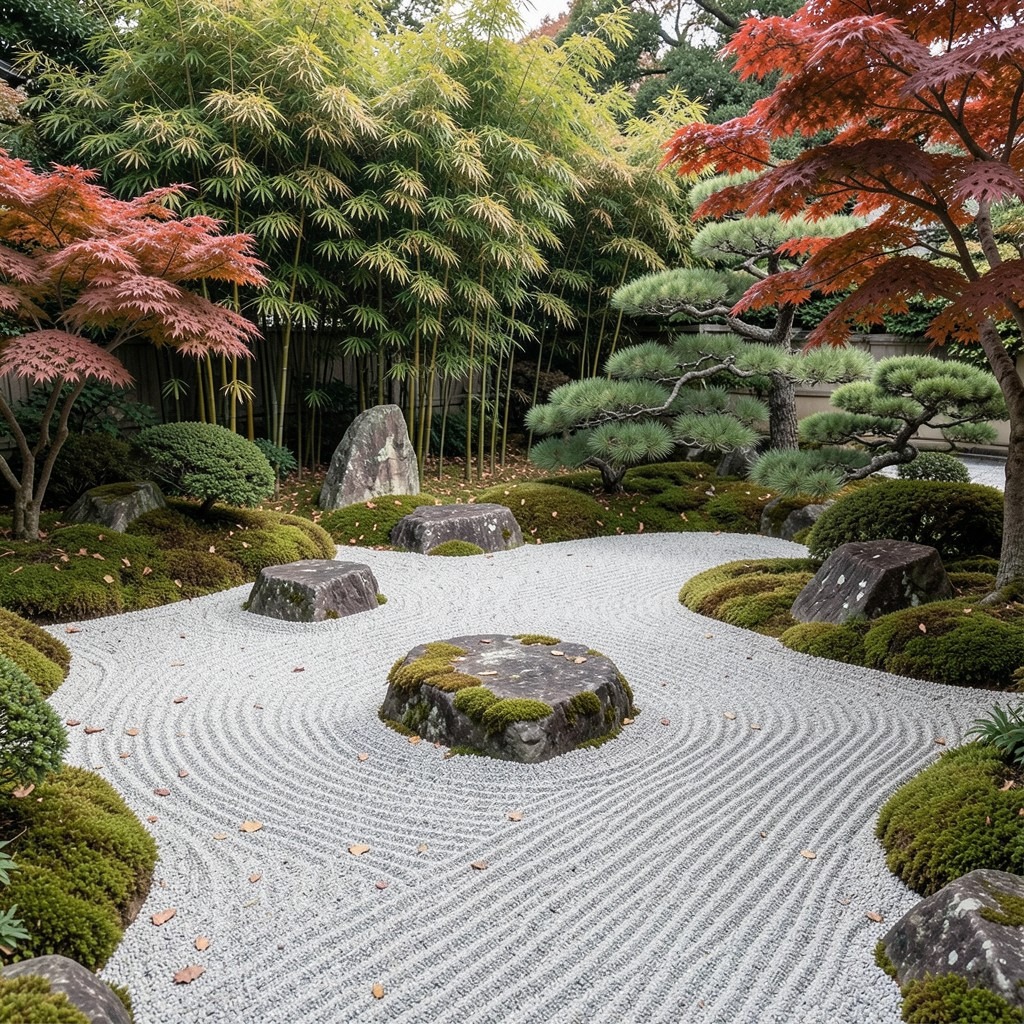
The Japanese-inspired garden operates on a design philosophy so different from the Western horticultural tradition that understanding it requires a genuine rethinking of what a garden is for. The Zen garden does not try to contain as many plants as possible. It does not celebrate abundance, peak flowering, or the generous overflow of a fully stocked border. Its purpose is to create a space for contemplation — a designed environment where the relationships between stone, gravel, water, moss, and carefully placed plants produce a quality of visual stillness that the garden’s occupant carries inward as the experience of having been in a considered place.
The raked gravel or crushed granite panel — the karesansui dry garden element that most Western interpretations of the Japanese aesthetic adopt — is not a maintenance shortcut or a drought-tolerant ground cover. It is a representation of water, specifically the movement of water around islands of stone, and the raking pattern communicates that representation with the same deliberate intention that a Japanese garden designer brings to every element of the composition. A raked gravel garden that is allowed to become irregular, leaf-littered, and unraked reads as neglect. Maintained with consistent raking, it reads as meditation made visible.
The plant selection for a Japanese-inspired garden in a temperate climate prioritizes form over flower — the architectural quality of the plant’s shape and its seasonal transformation rather than its flowering performance. Japanese maples, with their specific fine leaf texture and their autumn color that shifts from green through gold to copper to near-crimson, provide the seasonal interest that the Zen garden requires without the floral exuberance that the aesthetic avoids. Bamboo, moss, pine in a clipped form, and the winter skeleton of a carefully shaped deciduous tree against a raked gravel ground — these are the plant elements that produce the Japanese aesthetic’s characteristic quality of beautiful restraint.
5. A Garden With a Wildflower Meadow
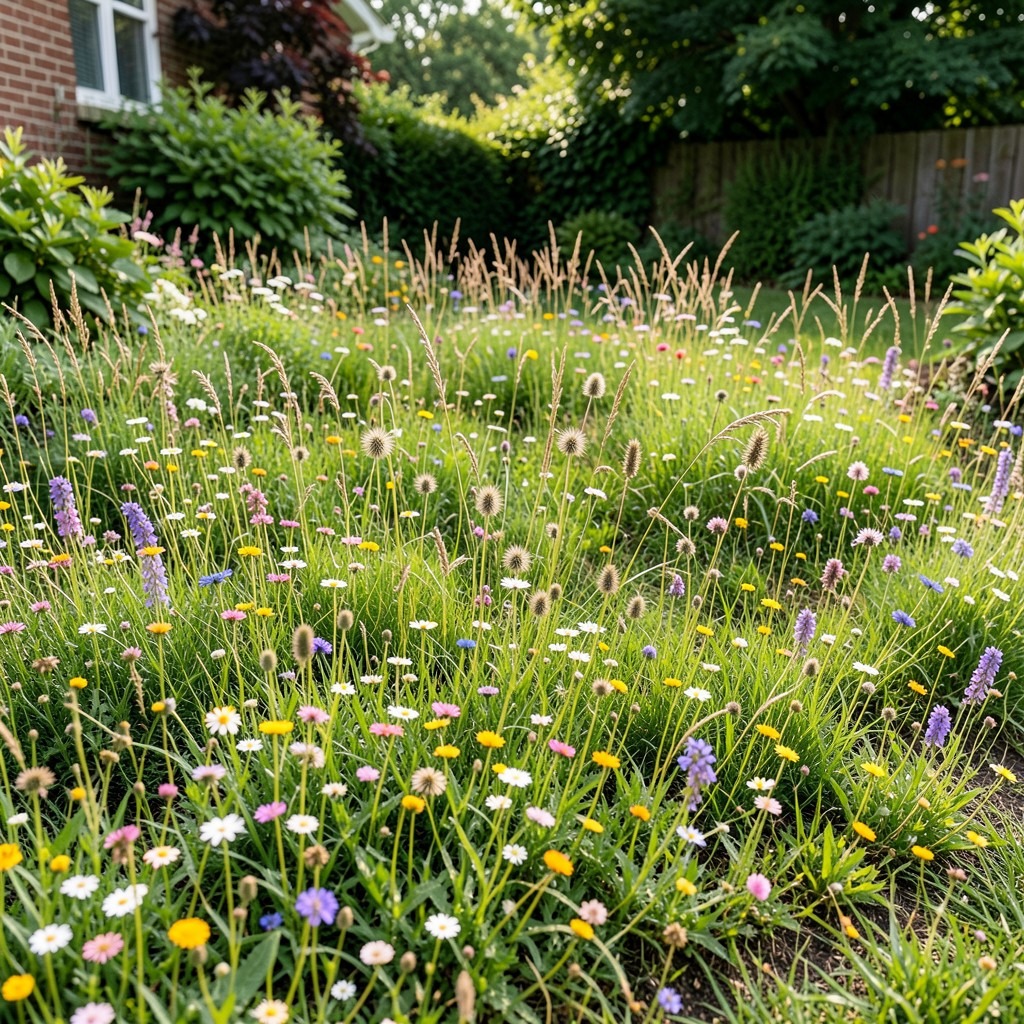
A wildflower meadow in a domestic garden — a section of the lawn or a dedicated bed area sown with native wildflower species and managed for biodiversity rather than for tidiness — is the garden design decision that simultaneously reduces maintenance, increases ecological value, and produces one of the most genuinely moving garden experiences available at any scale. When a section of lawn is allowed to grow and flower, and the grasses produce their seed heads in the summer light, and the meadow plants come and go through the season in the unpredictable succession that nature rather than a gardener organizes, the garden acquires a quality of living character that no designed planting scheme quite matches.
The establishment of a wildflower meadow requires the single most counter-intuitive soil management decision in horticulture: the ground must be impoverished before sowing. Wildflower species are adapted to low-fertility soils, and they are outcompeted by coarse grasses and agricultural weeds in rich, well-fed garden soil. Removing the topsoil layer, or growing a green manure to exhaust fertility before cultivation, creates the conditions that native wildflowers require to establish and persist — and this counter-intuitive fertility reduction is the reason why wildflower seeds sown into a standard garden bed without soil preparation fail within two seasons, which is the most common wildflower meadow failure mode.
The mowing regime for a wildflower meadow section determines its ecological value and its visual quality through the season. A late summer cut — after the majority of the wildflower species have set seed, typically from August onward depending on climate — removes the standing material and allows the following season’s seedlings to establish without the shade competition of standing dead stems. The hay must be removed after cutting rather than left to decompose in place, because decomposing organic material restores the fertility that the meadow establishment process reduced, and the wildflower balance shifts back toward coarse grass dominance within a few seasons if this removal step is skipped.
6. A Garden With a Kitchen Garden Zone
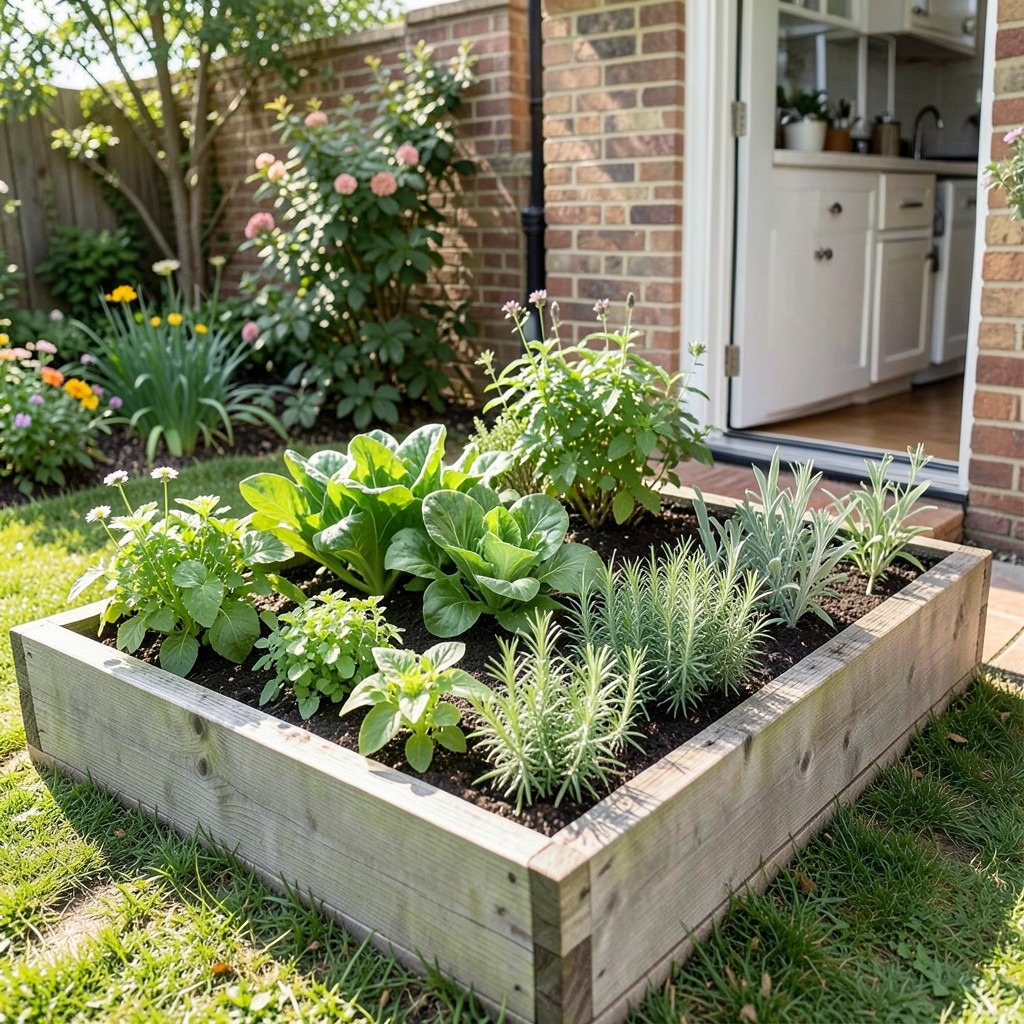
A dedicated kitchen garden within a domestic garden — a zone of productive planting producing vegetables, herbs, soft fruit, and cut flowers for household use — is the garden feature that changes the most the household’s relationship with both the garden and the food they eat. A kitchen garden that provides the tomatoes for the August salad, the herbs for the Friday pasta, and the courgettes that appeared before the gardener knew what to do with them is not an ornamental feature. It is an active participant in the household’s daily life, and that participation changes the quality of the domestic experience in a way that a purely decorative garden, however beautiful, does not.
The raised bed kitchen garden is the format that most domestic gardens adopt for productive growing, and for good reason: raised beds warm faster than the surrounding soil in spring, drain more effectively than level ground in wet conditions, keep the growing medium separate from the garden’s native soil, and allow intensive growing at the high plant density that produces maximum yields from minimum space. A raised bed of one meter twenty centimeters in width — accessible from both long sides without stepping into the bed — provides the growing area management that allows the bed’s full surface to be planted, weeded, and harvested without soil compaction from foot traffic.
The herb component of a kitchen garden is the section whose return on space investment is highest and whose failure rate is lowest for a new kitchen gardener. Mediterranean herbs — rosemary, thyme, sage, oregano, and chives — require well-drained soil, full sun, and minimal watering once established, and they provide fresh culinary material across a long growing season from a planting area of less than two square meters. A small raised bed of herbs adjacent to the kitchen door is the kitchen garden entry point that converts the garden’s productive potential from a weekend project into a daily habit.
7. A Garden With a Water Feature
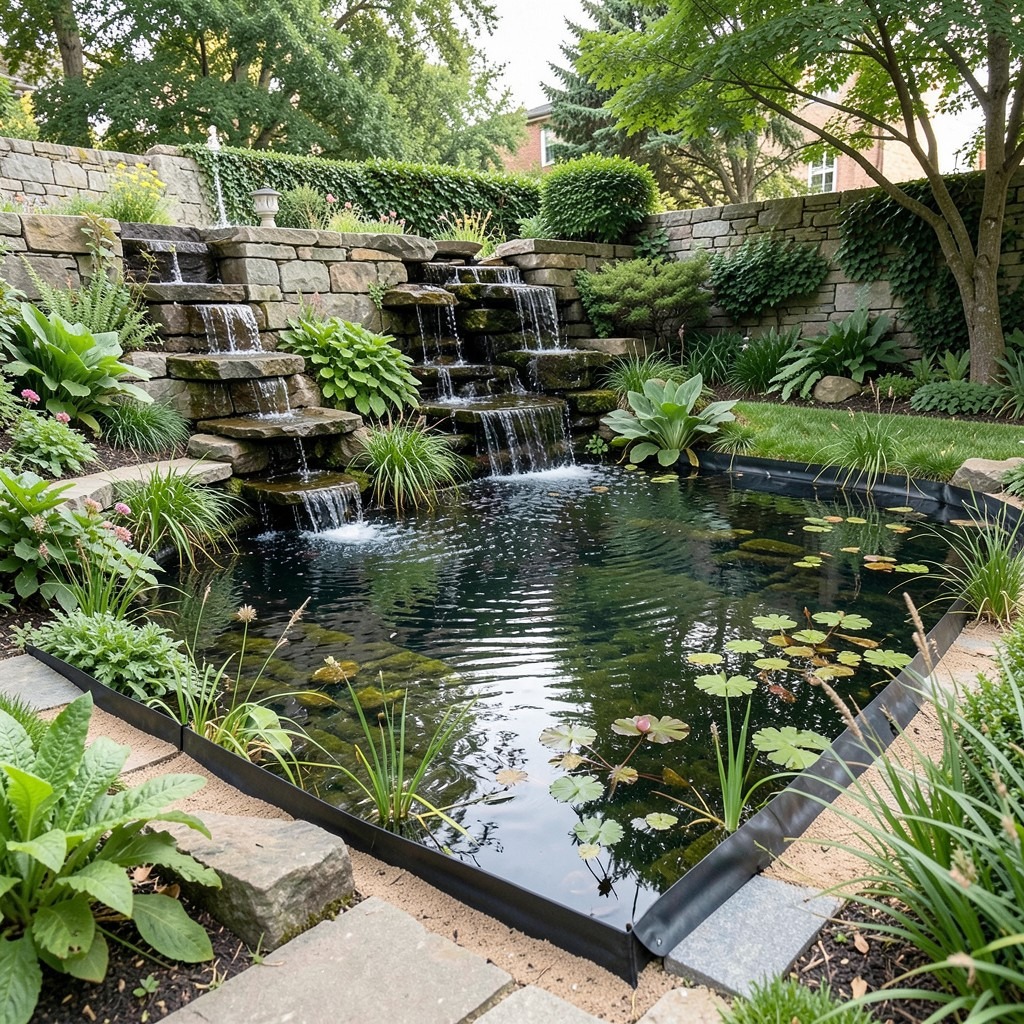
The sound of water in a garden is the atmospheric element that most immediately changes the quality of time spent outdoors, and this is not poetic exaggeration — it is the observable result of the acoustic environment that moving water creates. A garden with a fountain, a rill, a cascading wall panel, or a naturalistic pond introduces a continuous sound layer that masks the ambient noise of traffic, neighbors, and the general acoustic pollution of urban and suburban environments, and the masked sound produces the quality of withdrawal from the surrounding world that makes the garden feel like a genuinely private and restorative place.
The choice between a formal water feature — a geometric pool with a wall-mounted spout or a central fountain jet — and a naturalistic water element — a pond with planted margins, wildlife access, and an irregular outline — is a choice about the garden’s overall design direction as much as it is a choice about the water element itself. A formal pool belongs to a garden with structure and geometry. A naturalistic pond belongs to a garden with the ecological intention and the informal planting character of a space that is oriented toward wildlife as much as toward aesthetic effect.
The depth and liner specification for any garden pond determines both its ecological health and its maintenance requirement across the years of its occupation. A pond of at least sixty centimeters in the deepest zone provides a refuge of consistent water temperature for aquatic life through winter freezing and summer heating that shallower ponds cannot provide. A butyl rubber liner at a minimum thickness of 0.75 millimeters, installed over a sand or protective fleece underlay that prevents sharp stone penetration, provides a thirty-plus year working life that pond concrete and rigid preformed liners cannot match for longevity or reliability in conditions where the ground moves seasonally.
8. A Garden With a Privacy Screen Design
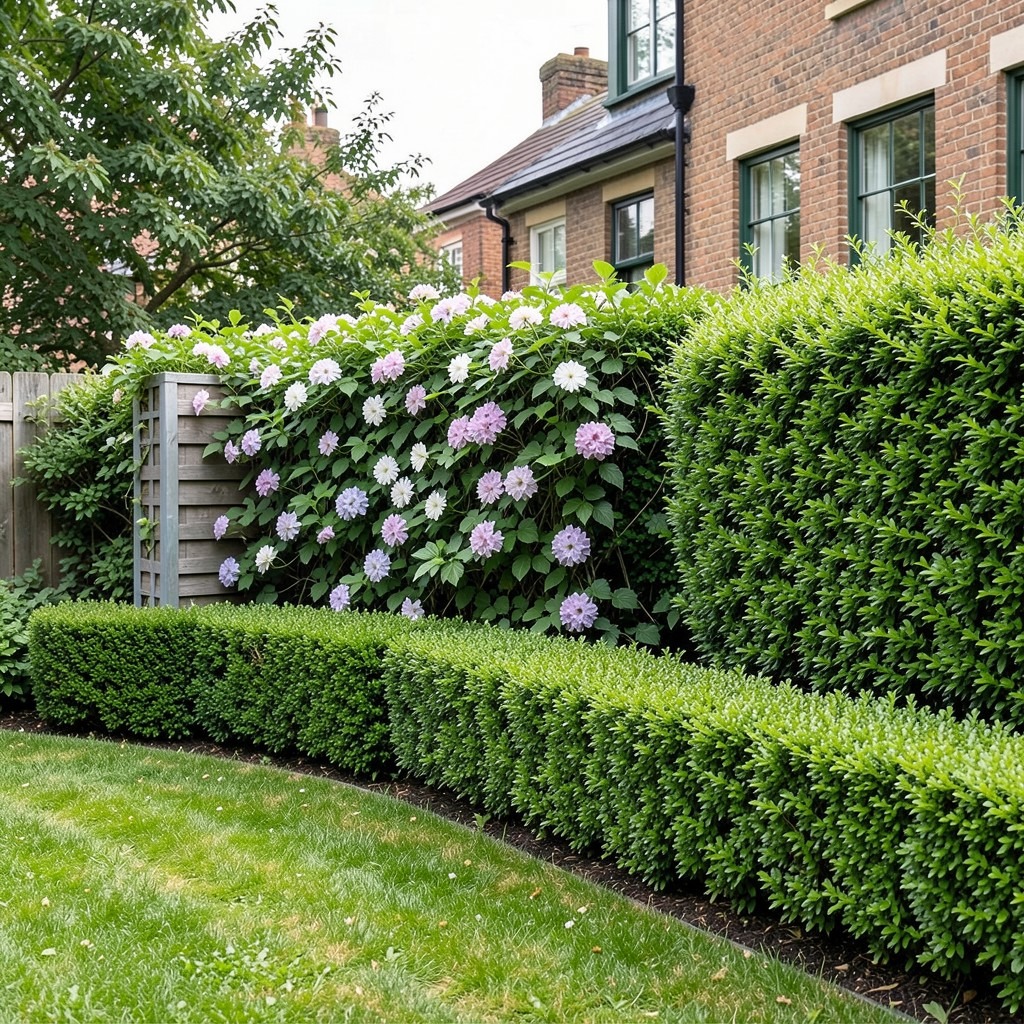
Privacy is the garden quality that urban and suburban homeowners rate most highly and achieve least reliably, and the gap between the desire for a genuinely private garden and the reality of a plot overlooked from three sides by neighboring windows is the design problem that most garden planning processes address too late or too cheaply. A trellis panel with a fast-growing clematis is not a privacy screen. It is an aspiration. A designed privacy solution addresses the specific viewing angles from the specific overlooking points and provides a physical screen of the correct height at the correct position to address each one.
The evergreen hedge is the privacy screen with the best long-term performance and the worst short-term delivery of any garden boundary treatment available. A yew, a hornbeam, or a Portuguese laurel hedge planted at one meter in height requires five to seven growing seasons to reach the two-meter height that provides effective privacy from a neighbor’s ground-floor window, and eight to ten seasons to reach the height that addresses a two-story neighbor’s first-floor sightline. The patience that the hedge requires is the price of its eventual quality — a mature hedge of any good species provides a privacy screen with the ecological value, the wind filtration, and the visual quality that no manufactured panel fence or trellis structure approaches.
The immediate privacy screen — the timber fence panel, the powder-coated steel screen, or the modular privacy planter system — provides the sightline blocking that the hedge will eventually deliver but cannot provide from the first growing season. A good immediate screen in a considered material reads as a designed element rather than a temporary solution, and the combination of an immediate screen for the first years and a hedge planted in its shadow for the long-term is the privacy strategy that most garden designers recommend: you have privacy from day one, and you have the hedge’s mature beauty from year seven.
9. A Garden With a Pergola Structure
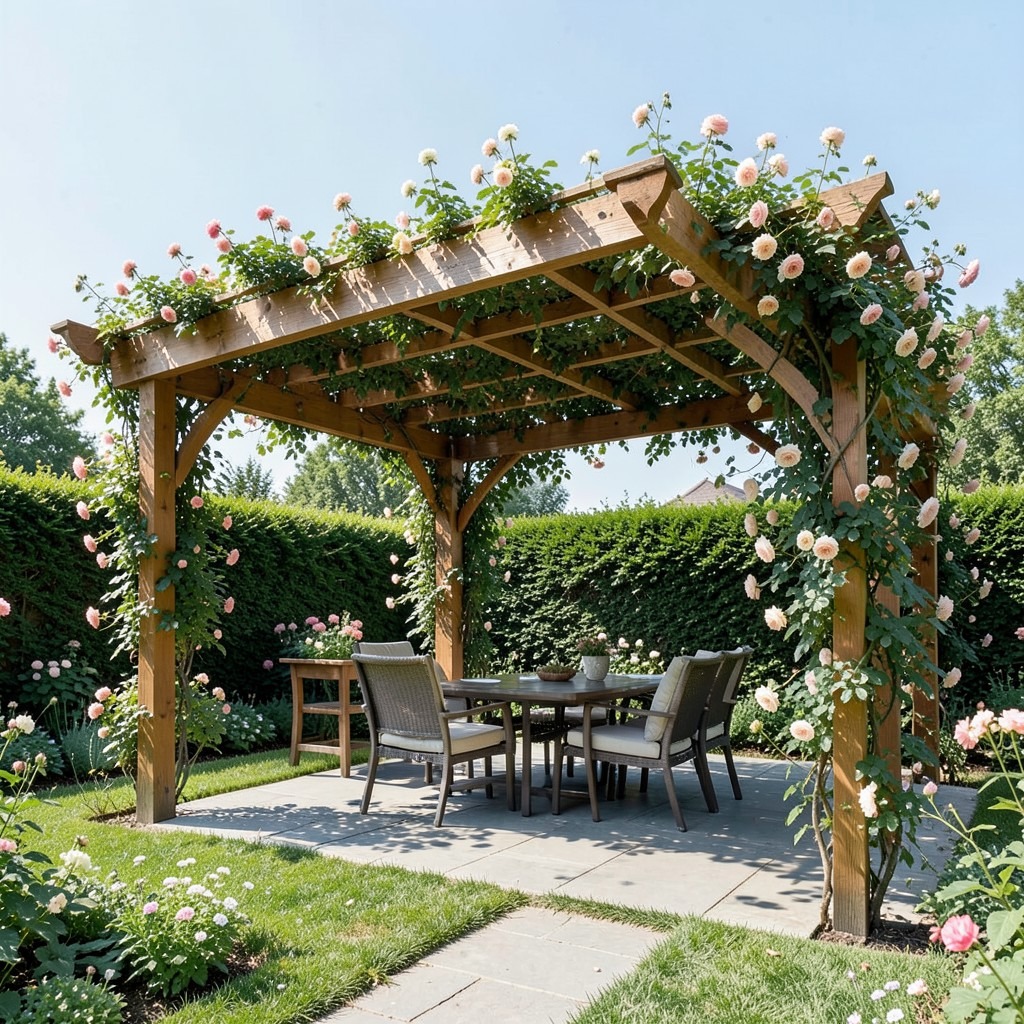
A pergola in a garden — a timber or steel overhead structure with an open or slatted roof, positioned over a seating area, a path, or a dining terrace — creates the one quality that a flat garden without any built elements lacks entirely: overhead definition. When you sit beneath a pergola, you are in a defined outdoor room rather than on an exposed patch of ground. The sky is still visible — the pergola roof does not enclose — but the overhead structure provides the psychological sense of containment and shelter that makes the space feel inhabited rather than exposed, and that quality changes the experience of sitting outside in the same way that the difference between sitting at a cafe table under an awning and sitting in an open car park affects your willingness to stay.
The timber pergola in a domestic garden is typically constructed from pressure-treated softwood or from a hardwood species with natural durability — oak, iroko, or Western red cedar — in a post-and-beam format where vertical posts support horizontal beams and the roof is formed by rafters spanning between the beams at regular intervals. The post dimensions must be appropriate to the structure’s scale: a pergola of four meters in length by three meters in width requires posts of at minimum one-hundred-millimeter-square section to provide the structural adequacy and the visual proportion that a pergola at that scale demands.
The planting trained over a pergola is the element that converts the structure from a bare timber frame into the garden feature it is designed to be. A climbing rose — particularly a vigorous repeat-flowering variety like Albéric Barbier, New Dawn, or Paul’s Himalayan Musk — trained over the pergola’s overhead beams provides the overhead canopy of foliage and flower that makes a pergola genuinely atmospheric. The training takes three to four seasons to reach full coverage, and the structure’s position must receive adequate sunlight for the climbing plants to flower rather than simply produce foliage in shade.
10. A Garden With a Sunken Garden Design
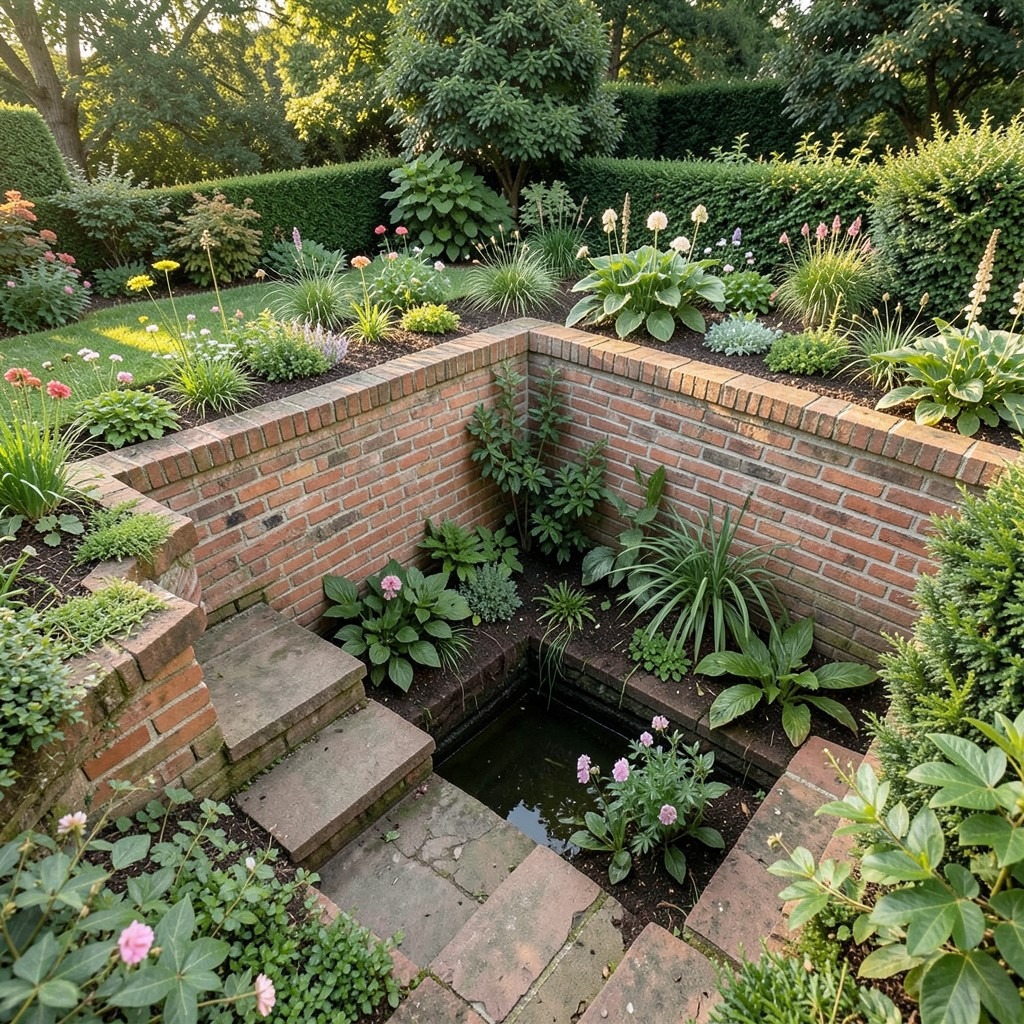
A sunken garden — a section of the garden at a lower level than the surrounding ground plane, accessed by steps and enclosed by retaining walls on which planting is arranged at the sunken level — is the garden design feature that most directly references the great historic garden traditions of England and Italy, and the one that produces the specific experience of descent — of moving from the open garden into an enclosed, lower space — that no flat-plan garden element replicates. Going down a flight of steps into a sunken garden is a transition between one atmospheric condition and another, and that transition is the experience the feature is designed to provide.
The retaining wall structure of a sunken garden must be engineered for the lateral soil pressure that the retained earth generates against the wall face. A wall retaining a soil height of one meter or more requires structural specification — either mass masonry of sufficient thickness to resist the overturning force, or a reinforced concrete or block wall designed specifically for the retained height and the soil type behind it. A retaining wall built from standard single-course brick at the thickness of a standard garden wall and retaining a meter of soil is not an engineering solution — it is a liability, and the failure of undersized retaining walls is a more common garden problem than most new garden designers appreciate when they encounter the concept for the first time.
The planting within a sunken garden occupies a sheltered microclimate that the retaining walls and the lower ground level create — warmer in summer from the radiated heat of the enclosing walls, more sheltered from wind than the surrounding garden, and more humid at the base of the walls where moisture collects. This microclimate makes the sunken garden the correct location for slightly tender plants that the exposed garden level cannot support, and the opportunity to grow species at the edges of hardiness in the sheltered sunken microclimate is one of the design benefits that the feature provides beyond its primary atmospheric contribution.
11. A Garden With a Modern Minimalist Approach
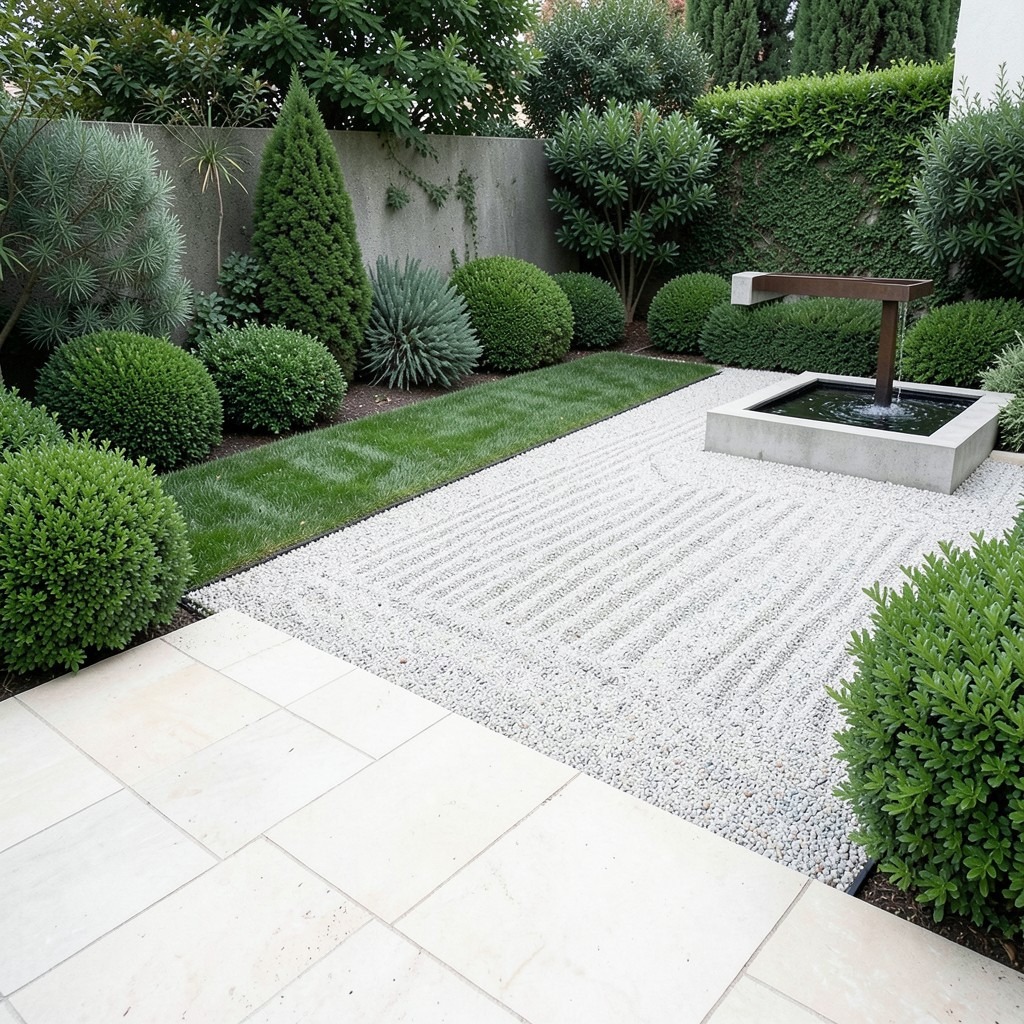
The minimalist garden is the design direction that most people describe as wanting and most people fail to execute, because minimalism in a garden context requires the same discipline that it requires in interior design — the willingness to leave space unoccupied, to resist the impulse to fill every available ground surface with plants, and to trust that a few elements of genuine quality provide more visual satisfaction than many elements of average quality crowded together. The minimalist garden is not a garden with fewer plants. It is a garden where every decision was made at maximum selectivity, and where nothing remains that does not earn its place completely.
The material palette of the minimalist garden restricts itself to two or three complementary materials, used consistently and generously rather than mixed across too many surface types. A garden of pale limestone paving, a single species of clipped evergreen used throughout in consistent forms, and a steel water feature or a cast concrete element as the single focal point — this is the minimalist material vocabulary that produces the resolved quality of a garden designed from one clear direction. The introduction of a third paving material, a second planting species of a different character, or a second focal element at a different scale begins to dilute the minimalist resolution and moves the garden toward an eclectic direction that requires a different set of compositional rules to manage.
The negative space in a minimalist garden — the areas of open paving, of raked gravel, of close-cut grass where no planting interrupts the surface — is as much a designed element as the planting and the structures. The temptation to fill the open areas, which grows with every passing growing season as the planting matures and the available ground becomes visible, is the minimalist garden’s primary maintenance challenge. Resisting the fill impulse and maintaining the designed open spaces with the same discipline that produced them is the ongoing work of the minimalist garden — and that work is harder than it sounds when the beds are empty in winter and the planting center is selling attractive things in April.
12. A Garden With a Night Garden Lighting Design
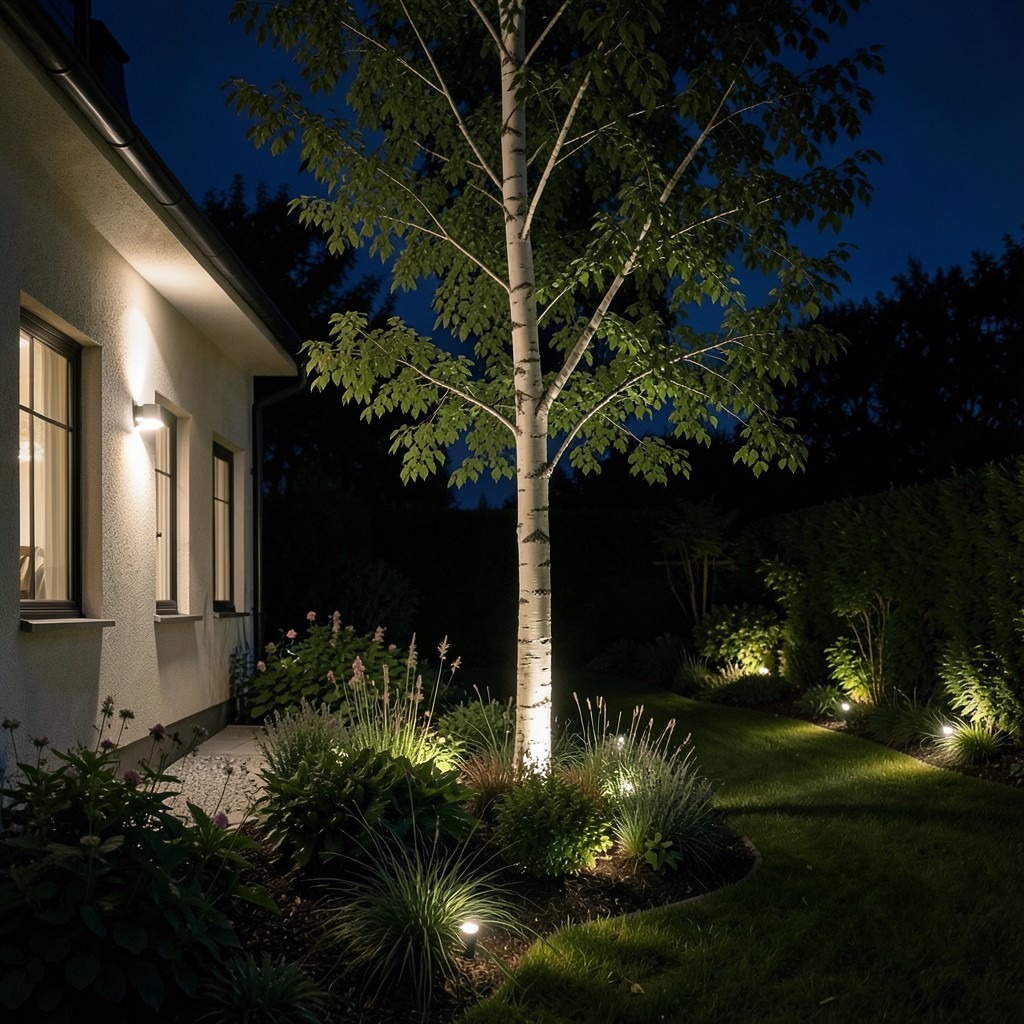
The garden after dark is a different place from the garden in daylight, and most gardens fail to acknowledge that difference because the lighting was an afterthought rather than a designed element. A garden lit with a single flood light mounted on the house wall produces the security lighting quality of a car park and none of the atmospheric quality of a designed outdoor room after dark. The night garden — one that was planned with the evening’s specific light qualities in mind from the beginning of the design process — is the garden that extends its usability through the full day rather than becoming inaccessible when the sun goes down.
The layered lighting approach for a garden after dark follows the same principle as interior lighting design: ambient illumination provides the overall light level for safe movement, task lighting addresses the specific activity zones, and accent lighting creates the atmosphere through the selective illumination of planting, architecture, and water. An uplighter at the base of a silver birch, casting its light upward through the tree’s canopy in the way that no natural light source illuminates a tree, produces the specific theatrical quality of garden lighting at night — a tree that exists in daylight as one element among several becomes the garden’s dominant visual feature when lit from below after dark.
The specification for garden-grade light fittings — IP65 rated as a minimum for all fittings installed in planted beds and lawn areas — is the technical requirement that most domestic garden lighting installations get wrong through the use of indoor or semi-outdoor fittings that fail within the first growing season under the combined effects of rainfall, irrigation water contact, soil moisture, and the general dampness of an outdoor planting environment. IP65 is the outdoor standard that provides protection against water jets from any direction — adequate for all garden installations except those submerged in ponds, which require IP68 submersible ratings.
13. A Garden With a Mediterranean Planting Design
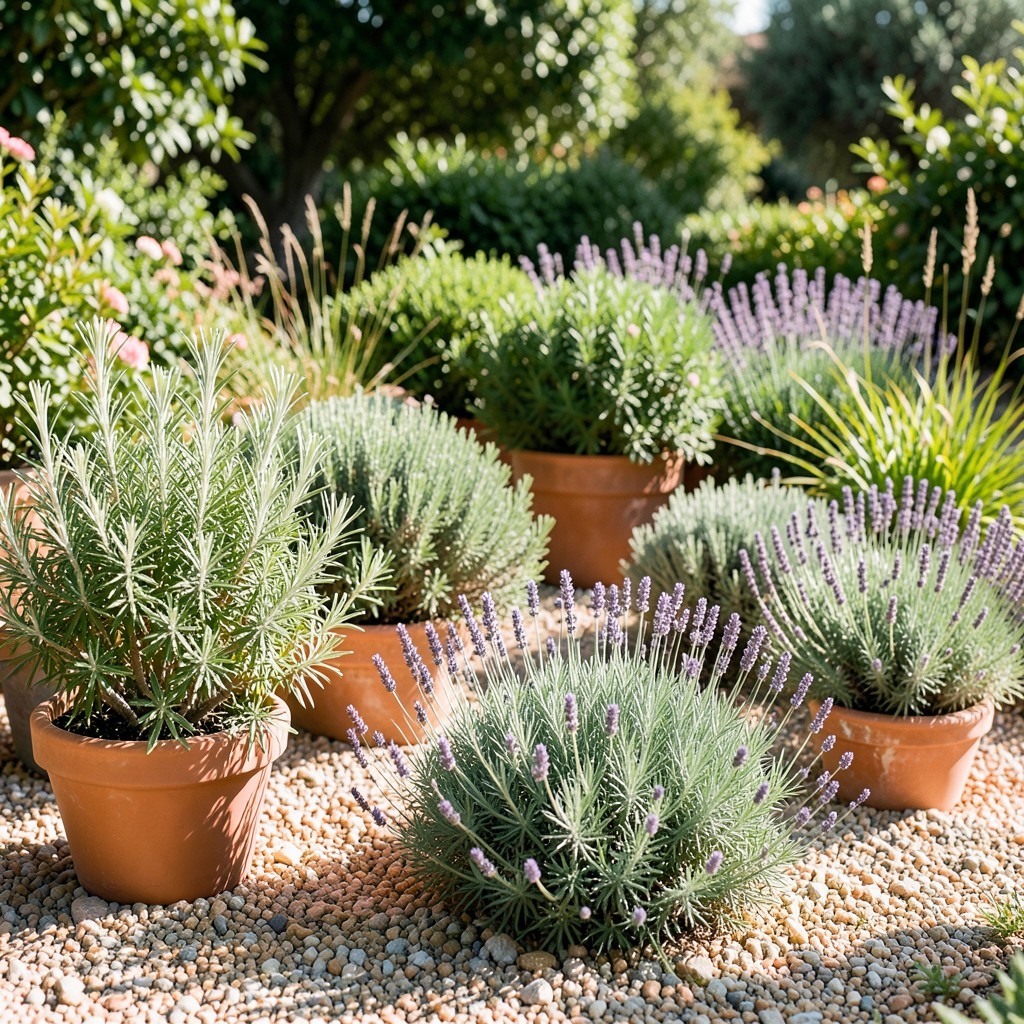
The Mediterranean garden — silvery foliage, aromatic herbs, terracotta pots baking in full sun, drought-tolerant shrubs with the specific dry warmth of lavender and cistus in their scent — is the planting direction that suits the increasing warmth and dryness of summer conditions in temperate climates better than any other style, and it produces an outdoor environment with a sensory quality that genuinely evokes the specific pleasures of southern European landscapes without requiring the latitude to match. The Mediterranean garden smells like holiday. That is its most immediate and most powerful atmospheric quality.
The plant palette for a Mediterranean-inspired garden in a temperate climate selects from the range of drought-tolerant, sun-loving species whose cultural requirements match the exposed, free-draining conditions that the style demands: lavender in multiple species — from the compact Lavandula angustifolia varieties to the French lavender Lavandula stoechas with its butterfly wing bracts — rosemary in full sun, cistus in a rocky, gravelled area, santolina for its silver-grey mounded form, and the architectural presence of Eryngium, Stipa grasses, and the bold leaf of a Euphorbia characias for the border’s structural backbone. These are not exotic plants in most temperate gardens — they are available from any good nursery, they establish quickly in the right conditions, and they require almost no supplementary watering once their root systems are established.
The ground surface under Mediterranean planting must drain freely enough to prevent the waterlogging that kills most drought-tolerant species more quickly than drought itself — the specific gardening irony that lavender, which survives a southern French August without rain, dies in an English winter because the soil holds water around its crown during the cold months. A gravel mulch of five to seven centimeters applied around Mediterranean plants keeps the crown above the wet soil surface, suppresses weeds that compete with the established plants, retains soil warmth, and provides the aesthetic reading of a dry Mediterranean landscape that completes the planting direction’s visual character.
14. A Garden With a Tropical Planting Design
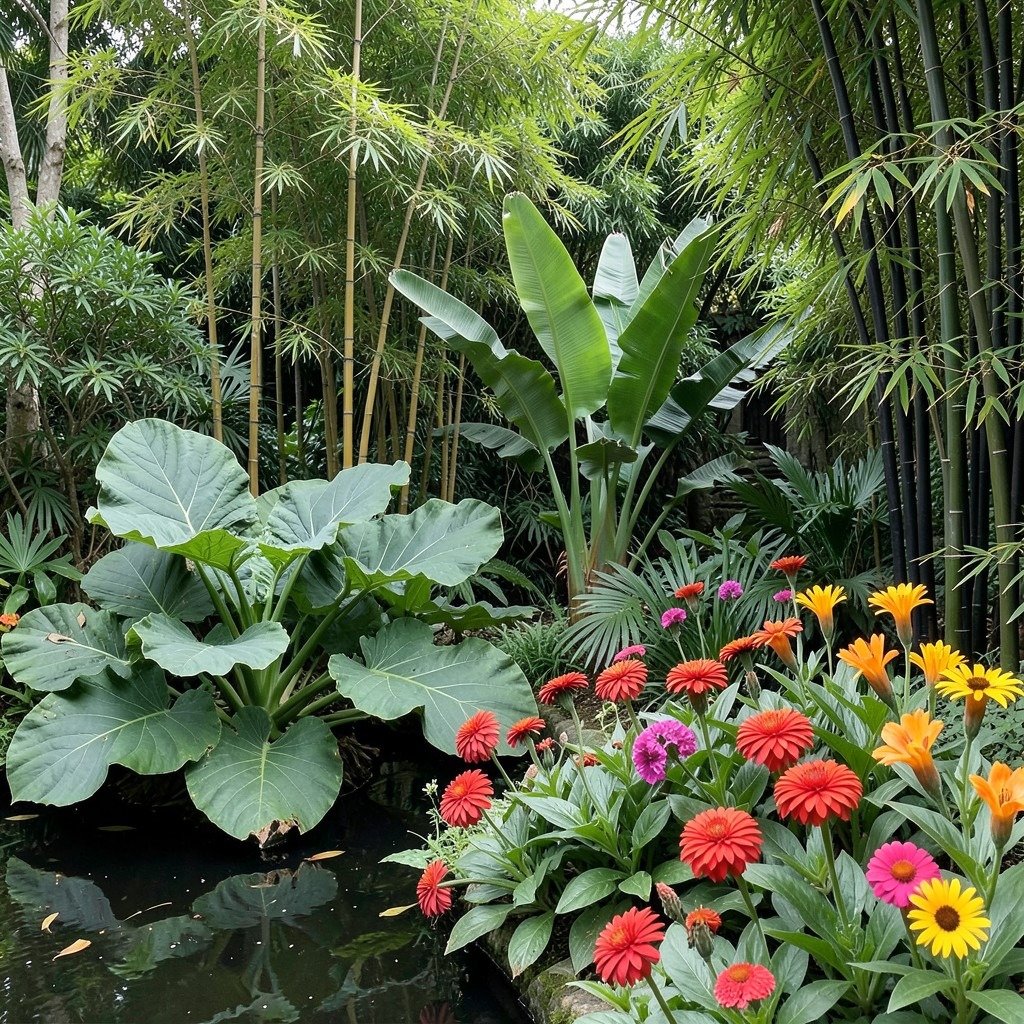
A tropical-inspired garden in a temperate climate — large-leafed bold architectural plants, vibrant flower colors in the warm red and orange range, bamboo for height and movement, and the overall quality of lush, layered planting that produces the atmosphere of a warmer climate’s outdoor environment — is not a botanical impossibility outside the tropics. It is a selection and placement exercise that identifies the hardy and near-hardy species whose leaf form, height, and growth character communicate the tropical aesthetic even when their biology is entirely adapted to a temperate growing season.
The structural plants of a hardy tropical garden provide the scale and the architectural leaf character that distinguish the direction from an ordinary mixed border: Gunnera manicata — the giant rhubarb with leaves of two meters diameter — at a water feature margin, Musa basjoo — the Japanese banana, the most cold-tolerant banana species, which survives to minus ten with crown protection — as the garden’s statement height plant, Fatsia japonica for its glossy tropical-leaf quality in shade, and the bamboo Phyllostachys nigra for its black canes and its graceful overhead movement in wind. These are not greenhouse plants. They are genuinely outdoor species in a temperate climate, and their combination produces the tropical aesthetic without the tender plant management that a literalist interpretation of the style would require.
The color palette in a tropical garden planting scheme pulls from the warm range — the red dahlias, the orange cannas, the magenta of Hardy Geranium ‘Patricia’, and the acid yellow of Rudbeckia — in a combination whose intensity and warmth reads as tropical against the green depth of the structural foliage. The contrast between the deep green of large leaves and the saturated warm-range flowers produces the visual heat of tropical planting without any plants that cannot survive outdoors in a temperate garden.
15. A Garden With a Formal Topiary Collection
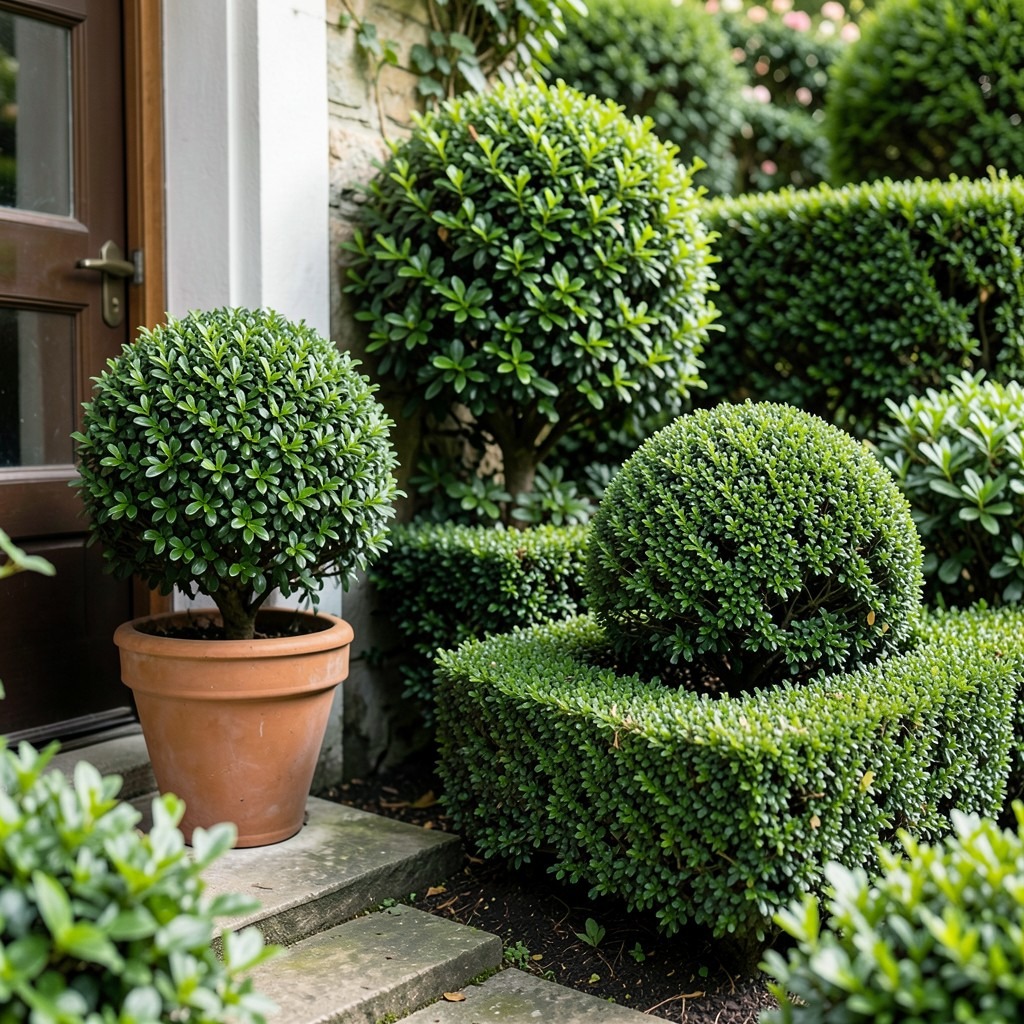
Topiary in a garden — the art of training and clipping woody plants into geometric, architectural, or representational forms — provides the garden with a type of living architectural element that grows rather than deteriorates with time, and whose quality increases with the patient seasons of shaping rather than diminishing as the plant establishes. A well-clipped sphere of box in a terracotta pot at the side of a doorway does not look like a plant that has been cut. It looks like a designed object that happens to be alive, and that distinction is the quality that topiary brings to a garden above any other ornamental shrub.
Box blight — the fungal disease that has decimated the Buxus sempervirens used in traditional topiary across European gardens — is the contemporary context that makes the plant choice for a topiary collection more complex than it was previously. Ilex crenata, the Japanese holly with a leaf form and growth habit closely resembling box, provides a blight-resistant alternative for small-scale topiary forms that is now widely available and performs comparably in the dense, clippable quality that topiary requires. For larger structures and for growing conditions that support the greater vigor they require, Taxus baccata — yew — provides the ideal topiary species: dense, dark, responsive to clipping, and genuinely long-lived in a way that fast-growing alternatives cannot match.
The clipping schedule for topiary determines whether the forms remain crisp and architectural or begin to develop the growth softness that makes a clipped form read as a plant with recent haircuts rather than as a maintained piece of living sculpture. Box and yew require one or two clips per growing season — a late spring clip to remove the new season’s extension growth and return the form to its correct profile, and a late summer clip in productive growing conditions to address any second-flush growth that the first clip did not fully capture. The precision of each clip — the consistent use of a template or a trained eye to maintain the form’s geometry — is the difference between a topiary collection and a garden of misshapen hedges.
16. A Garden With a Gravel Garden Design
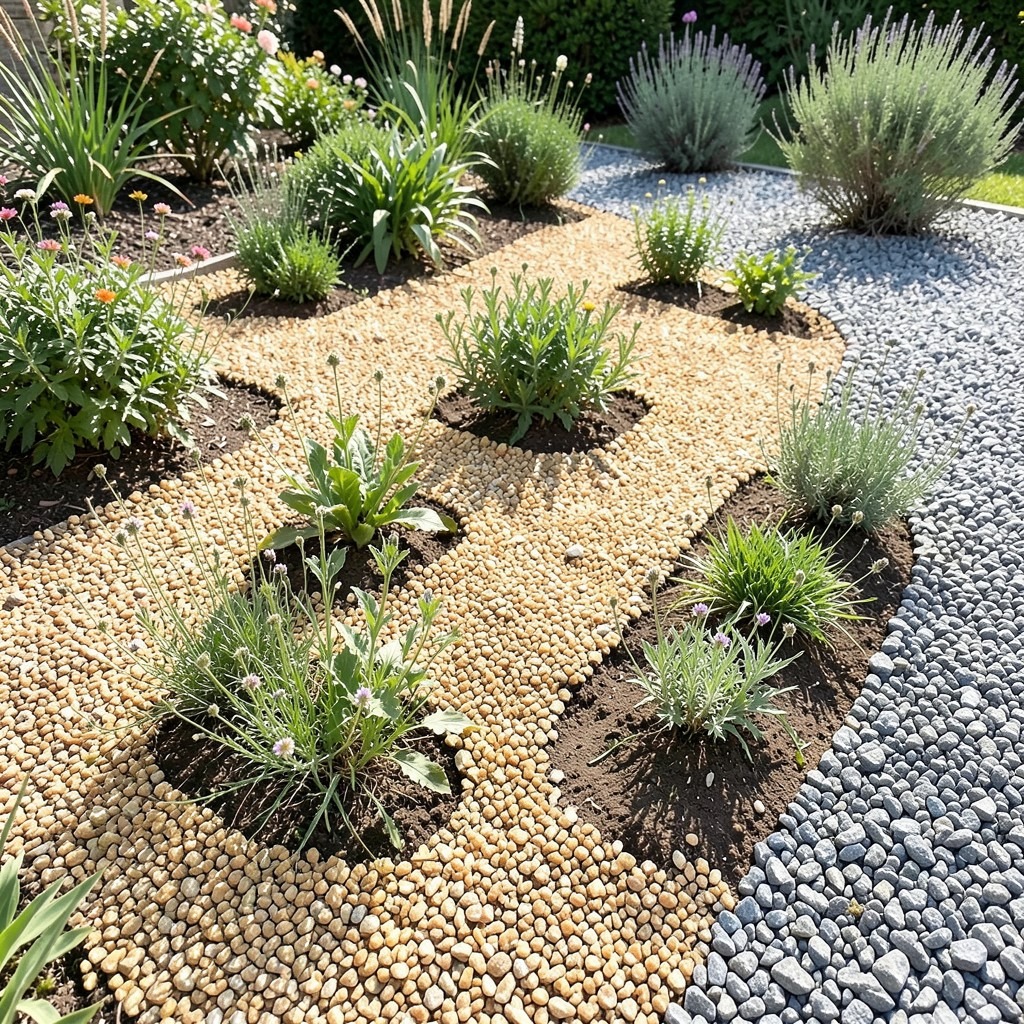
A gravel garden — a planted area where gravel replaces lawn and soil as the primary ground surface, with plants emerging through the gravel layer in a naturalistic, self-seeding arrangement — is the garden design format that most honestly acknowledges the direction of most temperate climates toward hotter, drier summers while simultaneously providing a low-maintenance surface that suppresses weeds, retains moisture, and improves the drainage that most garden plants appreciate. The gravel garden is not a substitute for a proper garden. It is a proper garden whose design logic starts from the ground material rather than the plants.
The gravel selection for a domestic garden gravel planting requires matching the stone material, size, and color to both the garden’s design direction and the practical requirements of the growing conditions beneath. A pea gravel of ten to twenty millimeters diameter in a warm buff or honey tone suits the Mediterranean or dry garden planting direction and provides the size range that allows small seeds to germinate through the layer without being smothered. A larger angular crushed gravel in a grey or blue-grey tone suits a more contemporary or minimalist garden direction and provides better weed suppression from its interlocking angular form than rounded pea gravel, which plants and weeds penetrate more easily.
The planting within a gravel garden succeeds or fails based on the soil preparation beneath the gravel layer rather than on the gravel itself. Plants must root into prepared, amended soil below the gravel mulch, not into the sub-base layer that some gravel garden installations compact and stabilize as a weed barrier. The gravel layer sits on soil — amended with grit for drainage, cleared of perennial weed roots — and the plants are installed through the gravel into the prepared soil below, with the gravel drawn back around the planting hole and firmed around the plant’s base after installation.
17. A Garden With a Raised Deck Area
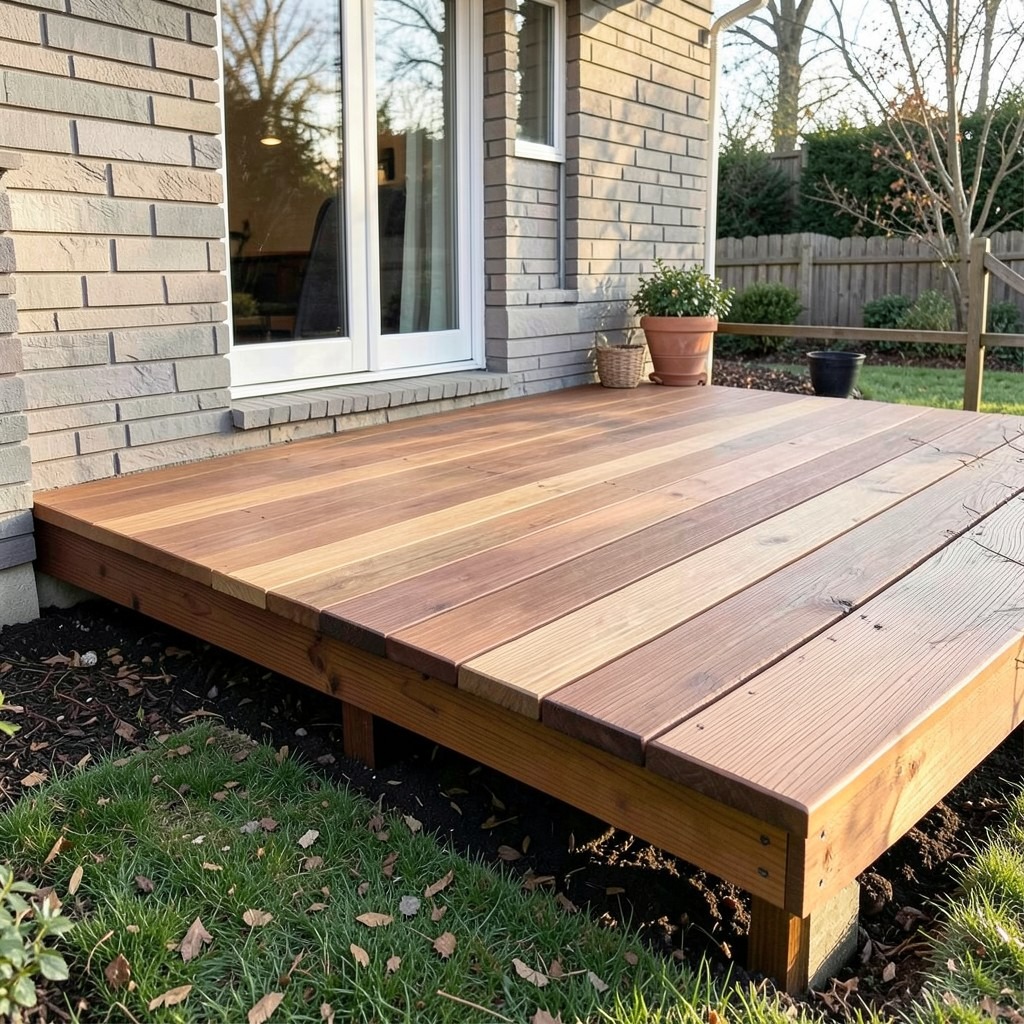
A raised timber deck adjacent to the house — elevated above the garden’s ground level on a sub-frame, accessed from the house at floor level and stepping down to the garden at its outer edge — is the outdoor living surface that most efficiently converts the house’s indoor floor level into an outdoor platform level, eliminating the physical and atmospheric transition between interior and exterior that a downward step to a lower patio creates. When the indoor floor level and the outdoor deck level are the same, the garden becomes an extension of the room rather than a destination accessed from it.
The timber decking board specification requires more material consideration than most deck installations receive. Softwood decking — pressure-treated pine or larch — provides the least expensive option and deteriorates most quickly without regular oiling or staining maintenance that the wood requires annually to resist the surface weathering that results in grey, checked, and eventually splinter-prone boards. Hardwood decking — in ipé, Garapa, or thermally modified ash — provides a longer service life and better natural resistance to weathering but at a significantly higher initial cost and with the sourcing responsibility of specifying timber from certified, sustainably managed forests. Composite decking — a mixture of wood fiber and polymer produced into a board profile — provides the visual character of timber without the maintenance requirement, but produces a surface that retains heat in summer and lacks the specific natural material quality that genuine wood provides.
The subframe and joist spacing beneath the deck surface determines the deck’s structural adequacy and its long-term performance under the loading of furniture, occupants, and the accumulated weight of winter water and debris. Joist spacing of four hundred millimeters — closer than most deck suppliers specify for their minimum recommendation — provides the rigidity underfoot that prevents the sprung, deflecting quality of a deck whose joists are too widely spaced for the board thickness. The subframe must have adequate drainage below it to prevent the standing water accumulation that rots timber framing from beneath regardless of the surface board specification.
18. A Garden With a Wildlife Garden Design
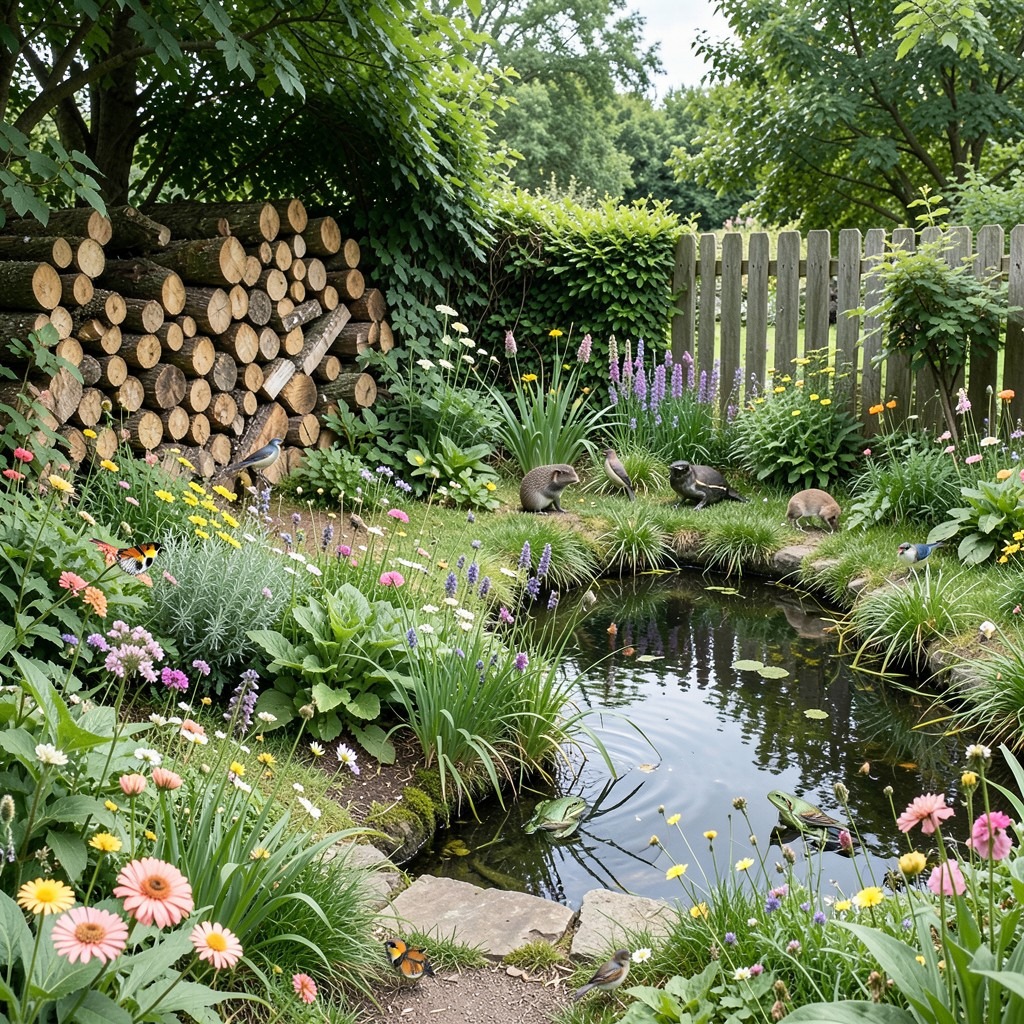
A wildlife garden — one designed with the expressed intention of providing habitat, food sources, and movement corridors for the range of garden species including birds, bees, butterflies, hedgehogs, frogs, and the full community of invertebrates that a healthy garden ecosystem depends on — is the garden direction that most directly addresses the documented decline of garden wildlife and that rewards its design investment with the most dynamic and the most unpredictable garden experience of any style available. The wildlife garden does not have a finished state. It is always in process, always arriving at something new, and always providing the specific quality of daily discovery that designed gardens achieve only at their seasonal transitions.
The habitat provision for a wildlife garden must address the range of different species’ specific requirements rather than applying a generic ‘wildlife-friendly’ approach that treats the needs of a hedgehog and a bumblebee as equivalent. The log pile in a shaded corner provides the overwintering habitat for hedgehogs, slow worms, and the range of wood-boring insects whose ecological function in the garden includes the decomposition of organic matter. The wildflower section provides the pollen and nectar source for bees and butterflies. The pond with its marginal planting and its shallow entry point provides the breeding habitat for frogs and the water source for birds and small mammals. Each of these elements serves a different community of species, and a wildlife garden that provides all of them creates the habitat complexity that genuinely supports garden biodiversity.
The connectivity between a garden wildlife habitat and the surrounding landscape — through hedgehog-access gaps in fence panels, through the selection of native plant species that form part of the local food web, and through the avoidance of pesticides that break the invertebrate food chain on which all the garden’s vertebrate wildlife ultimately depends — is the wildlife garden principle that most single-garden wildlife designs overlook because they focus on the garden as an isolated unit rather than as a node in the wider ecological network.
19. A Garden With a Scented Garden Design
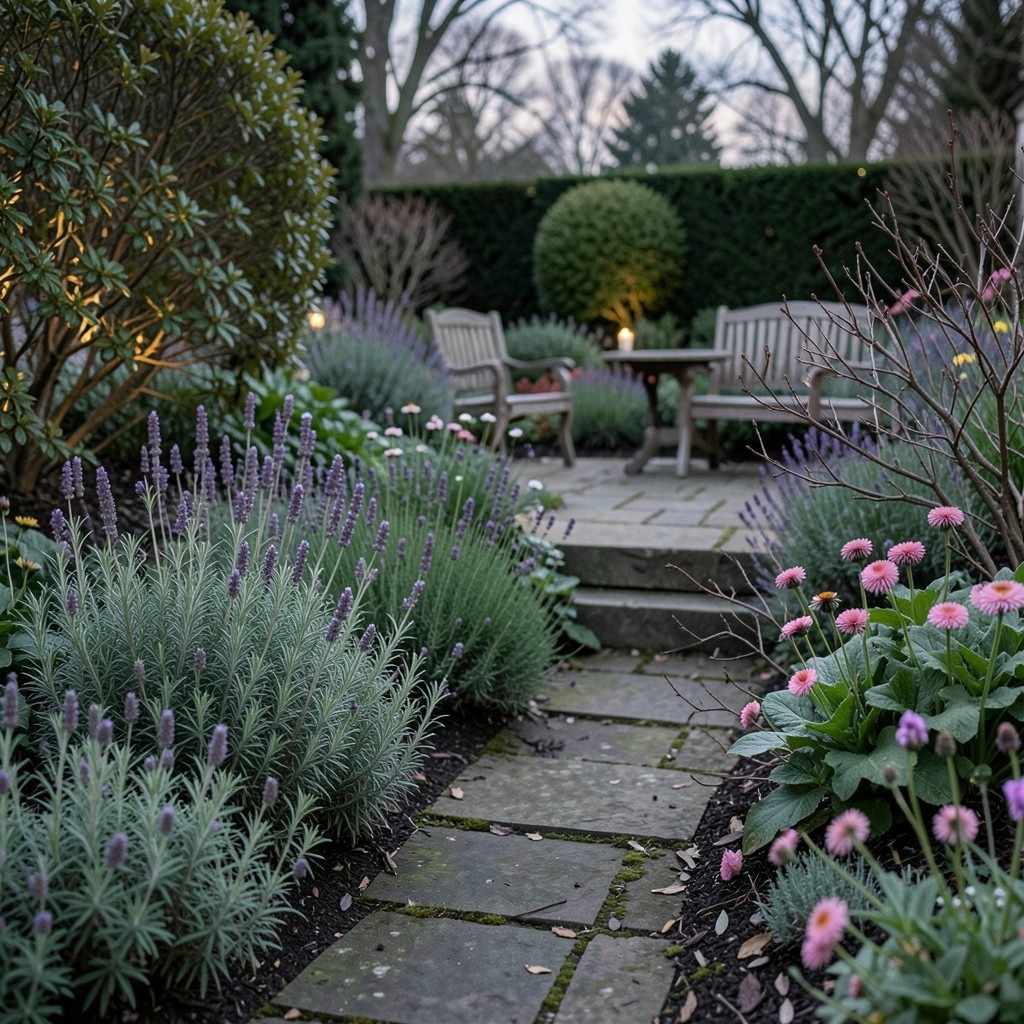
A garden designed around scent — one where the path through the garden passes through successive olfactory experiences rather than through purely visual ones — provides an outdoor experience of a quality that no amount of visual design produces on its own. The scented garden engages a sensory dimension that most garden design ignores entirely, and the result of ignoring it is a garden that looks beautiful in photographs and feels adequate in person. The garden that smells as good as it looks produces the full sensory experience that outdoor space is capable of providing.
The placement of scented plants in a garden requires understanding the conditions under which the plants release their fragrance most effectively. Most aromatic foliage plants — lavender, rosemary, thyme, and the herbal family generally — release their volatile oils most intensely when their leaves are physically disturbed, which is why planting them beside a path, at the garden entrance, or over steps where they will be brushed by passing feet or hands produces the strongest fragrance experience. Evening-scented plants — nicotiana, matthiola, the evening primrose — release their fragrance at dusk as a pollinator attraction mechanism, and their position near seating areas that are used in the evening is the planting decision that delivers their fragrance to the people who would otherwise miss it because they are indoors by the time the plant’s performance peaks.
The winter scent garden is the planning dimension that most scented garden designs omit because winter is the season when outdoor time is most limited and the value of a scented garden element seems least urgent. In practice, the winter-scented plant — Sarcococca confusa with its vanilla-rich tiny flowers in deep shade, Viburnum x bodnantense ‘Dawn’ with its pink flower clusters in the coldest months, Lonicera fragrantissima spilling its sweet scent from bare stems in a mild February — provides one of the most surprising and most valued garden experiences of the year precisely because scent in winter is unexpected. The winter scented shrub makes the walk to the car or the bin on a cold morning into a briefly sensory experience, and that quality is the winter garden’s understated gift.
20. A Garden With an Edible Landscaping Approach
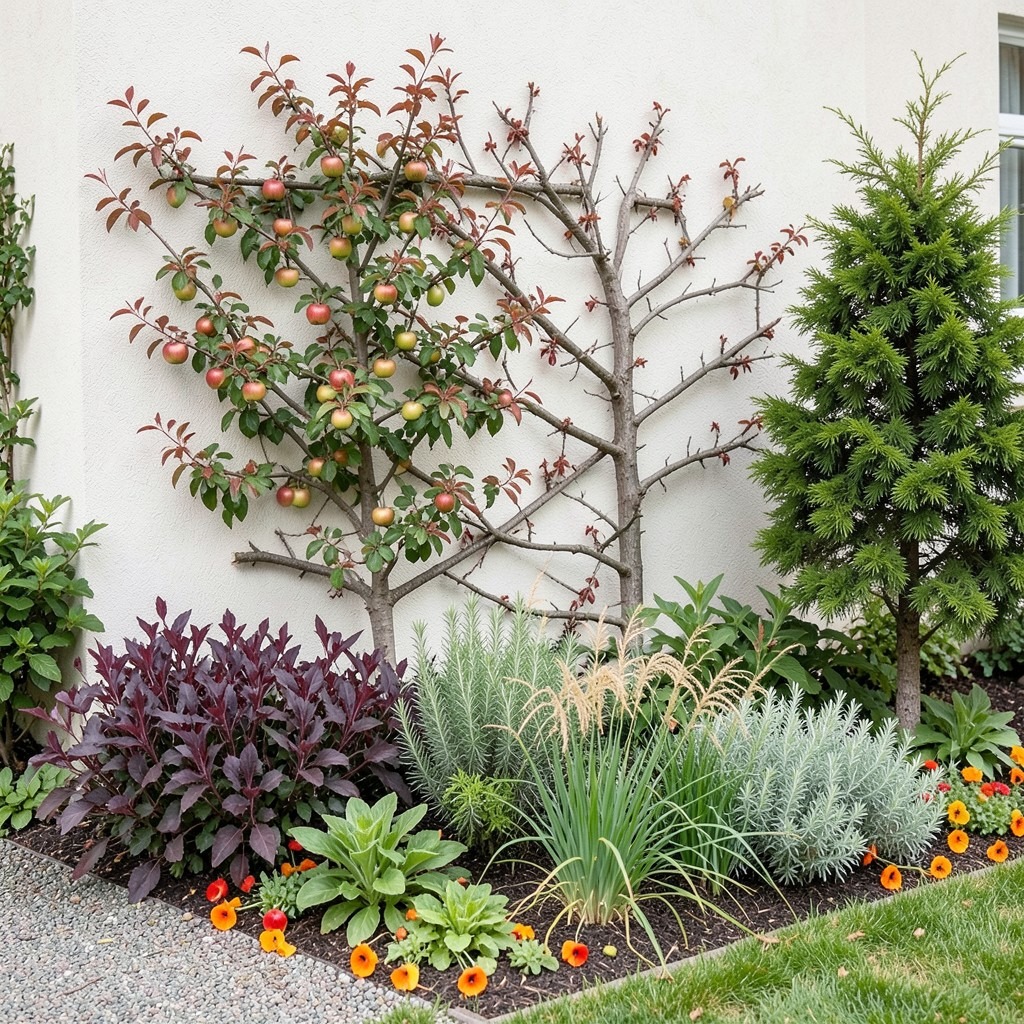
Edible landscaping — the integration of productive food plants into the garden’s ornamental design rather than their segregation into a dedicated vegetable plot that functions as a separate working zone — is the garden design philosophy that produces both the aesthetic quality of an ornamental garden and the productive function of a kitchen garden from the same design decisions. The espaliered apple against the garden wall that provides both architectural structure and autumn fruit. The purple-leafed Atriplex hortensis alongside the ornamental border plants for its beetroot-red seed heads and its edibility. The nasturtium tumbling over the path edge with its peppery edible flowers. These are not compromises between ornament and productivity — they are plants that achieve both simultaneously.
The fruit tree as a structural garden element is the edible landscaping choice with the highest ornamental return per plant. A trained apple on a dwarfing rootstock in an espalier form against a south-facing wall provides the architectural elegance of a wall-trained formal plant, the seasonal interest of blossom in spring and developing fruit through summer, the harvest satisfaction of autumn picking from a tree you have trained over years, and the winter skeleton of a carefully managed branch structure that reads as garden art against a light-colored wall. The space occupied by an espalier is the wall surface behind it and a planting strip of sixty centimeters in front of it — the most space-efficient productive planting format available in a domestic garden.
The herb border — a planted area immediately adjacent to the kitchen door that integrates the standard culinary herbs into an ornamentally designed planting scheme rather than growing them in isolated pots or a separate utility zone — provides the edible landscaping opportunity that most households overlook because they compartmentalize ‘herb pots on the windowsill’ as kitchen accessories and ‘garden planting’ as a separate activity. A border of rosemary, sage, chives, bronze fennel for its feathery golden height, and a standard bay tree for its architectural evergreen form provides both the fresh herb supply that daily cooking requires and an ornamental planting with year-round interest.
21. A Garden With a Dry Garden Design
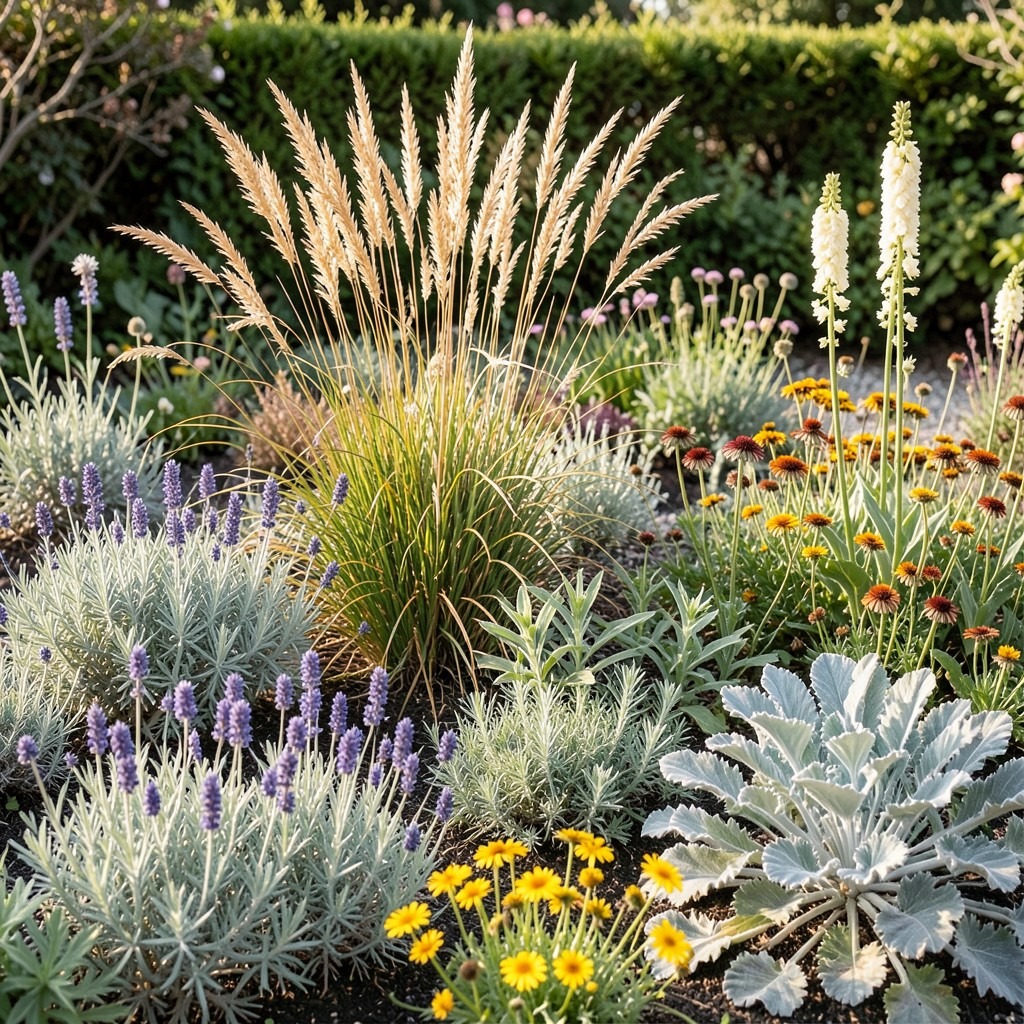
The dry garden — a planting approach specifically designed for free-draining soils, low rainfall conditions, and the extended summer droughts that increasingly characterize temperate gardens — is the garden design direction that most honestly confronts the climatic conditions that gardens now face rather than persisting with the moisture-hungry planting traditions of a cooler, wetter growing context. The dry garden is not a compromise for gardeners with difficult conditions. For those who design it well, it is the most atmospherically compelling garden style available — a landscape of silver, bronze, and sage-green foliage, seed heads in winter light, and the specific quality of disciplined abundance that drought-adapted plants produce in conditions that suit them perfectly.
The backbone planting of a dry garden provides the structure that the style requires to avoid the sparse, struggling quality of an under-planted gravel area: Stipa gigantea — the golden oats grass whose flower panicles catch the light at two meters in height — as the garden’s primary vertical element; Salvia officinalis and its ornamental relatives for the grey-silver low foliage and the blue-purple summer flower; Eryngium planum for the steel-blue architectural flower heads; Achillea millefolium in the warm yellows and brick reds that tolerate the dry conditions they are bred to occupy; and Verbascum for the tall, candled flower spike that rises from a basal rosette of grey felted leaves with the architectural certainty of a designed element.
The dry garden requires the most rigorous weed management of any garden style during the establishment phase, because the free-draining, open conditions that drought-tolerant plants require are also the conditions that wind-blown weed seeds germinate in most rapidly. The first two growing seasons after a dry garden installation require weekly weed patrol rather than the monthly maintenance that an established dry garden needs, and most first-time dry garden makers who abandon the project in year two do so because they were not prepared for the establishment phase’s weed pressure, which is temporary and entirely manageable with consistent attention.
22. A Garden With a Vertical Garden Wall
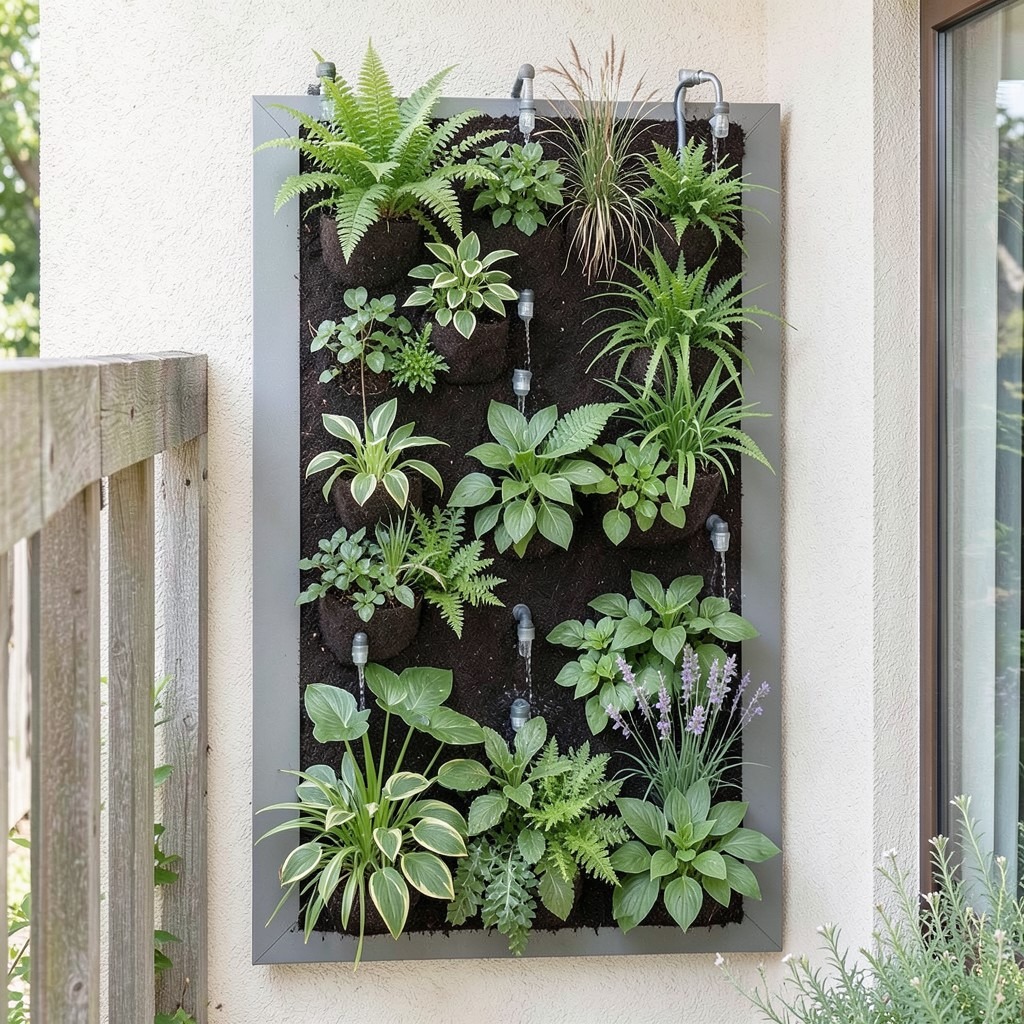
A vertical garden wall — a planted surface installed on a fence, a house wall, or a freestanding structure, using a modular planting system, a pocket planting felt, or a hydroponic panel to support plants in a vertical orientation — is the garden design solution that produces maximum planted surface area from minimum ground footprint, and it is the feature that most effectively brings the garden to a wall that would otherwise contribute nothing to the planting scheme beyond a background surface.
The irrigation system for a vertical garden is non-negotiable, not optional. Plants growing in a vertical panel orientation experience root zone conditions that no horizontal planting system creates: gravity pulls both water and dissolved nutrients downward through the growing medium, which concentrates both at the panel base and creates the deficit at the panel top where the most visually prominent plants are often positioned. An automated drip system with emitters at the panel top and at regular vertical intervals — delivering water slowly and consistently rather than in the large volumes that top-watering would require to penetrate the full panel depth — is the only reliable approach for maintaining a vertical garden in healthy condition through the growing season.
The plant selection for a vertical garden must match the panel’s light condition honestly rather than optimistically. A vertical panel on a north-facing fence receives the consistent, cool, indirect light that ferns, hostas, and shade-tolerant foliage plants require and thrive in. The same panel on a south-facing wall receives the full intensity of summer sun and the high temperatures that Mediterranean and dry-garden species handle and shade plants do not. Vertical garden failures are almost always the result of plant selection that ignored the panel’s actual light and temperature conditions in favor of the plants that looked best in the nursery on a cloudy day.
23. A Garden With a Rock Garden Design
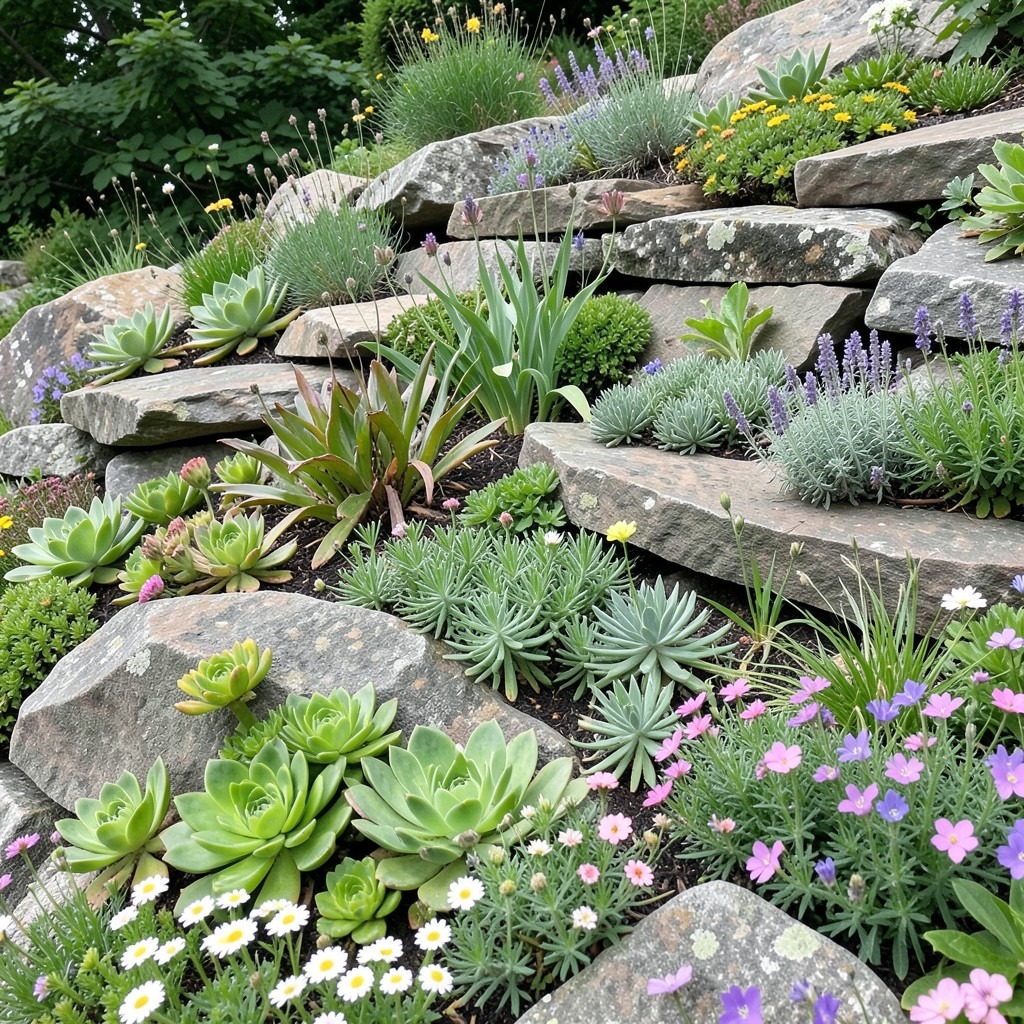
A rock garden — a planting area designed to replicate the conditions of a natural rocky hillside or alpine slope, using large stone elements as both structural features and as the drainage-improving, heat-retaining condition-creators that alpine and rock garden plants require — provides the domestic garden with one of its most dramatically three-dimensional landscape features and with the planting opportunity for a range of species whose small scale, intense flowering, and specific soil requirements make them unsuitable for any other garden setting.
The stone selection and placement in a rock garden requires the understanding that the rocks are not decorative additions to the planting area — they are the structural geography of a miniature landscape, and their placement must follow the logic of natural rock formation rather than the aesthetic logic of a garden ornament collection. Natural rock strata tilt in consistent directions — the same angle and the same compass orientation running through all the stones in a natural outcrop — and replicating this consistency in a rock garden placement produces a feature that reads as a geological formation rather than as a collection of stones arranged for visual effect.
The alpine and rock garden plant palette — sempervivums, saxifrages, dianthus, thyme, gentians, and the range of compact, drought-tolerant species adapted to the free-draining, high-altitude growing conditions of their natural habitats — provides the gardener with an enormous range of species in a small physical footprint. A well-planted rock garden of two square meters contains more distinct species than a mixed border of ten square meters, because the compact growth habit of alpine plants allows intensive planting at a density that border perennials cannot support.
24. A Garden With a Garden Room or Studio
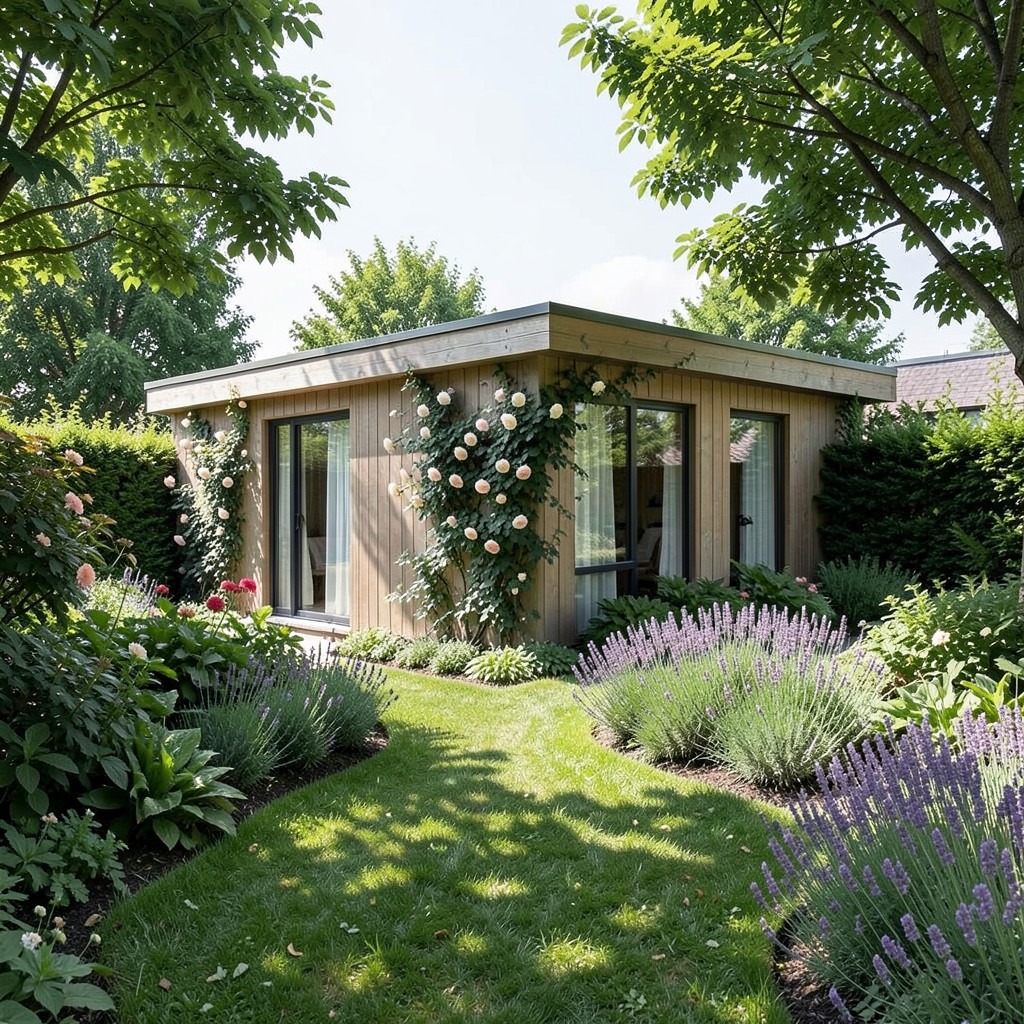
A garden room or garden studio — a detached building at the garden’s perimeter, used as a home office, a creative studio, a gym, or a retreat from the main house — changes the functional relationship between the garden and the household more profoundly than any planted feature, and it does so by making the garden a destination that is visited with a purpose rather than merely an outdoor space that is looked at from the house windows. The garden room turns the act of going into the garden into a daily habit, and that daily habit changes the garden’s role in the household’s life from seasonal amenity to permanent resource.
The garden room’s position in the garden determines both its functional performance and its contribution to the garden’s design. A building positioned at the furthest point from the house — facing back toward the main building across the garden — provides the maximum separation from the house’s domestic sounds and activity, which suits the home office or the creative studio use. It also provides the aesthetic contribution of a terminal feature that the garden’s central path or axis leads toward, which makes the building the garden’s focal point as well as its functional endpoint. A building at a corner of the garden, partially screened by planting, provides a more secluded quality that suits a retreat or a yoga studio.
The planting around a garden room mediates between the building and the garden with the same function that planting performs around any garden building: it softens the architecture’s hard edges, roots the structure in its garden context rather than allowing it to sit as an object on the ground, and provides the transition between the built and the planted that makes the garden read as a composed whole rather than a landscape with an inserted box. A climbing rose on the garden room’s side wall, a low planting of lavender or box-edged beds immediately in front of it, and a tree positioned to provide afternoon shade on the south-facing facade — these are the three planted relationships that connect a garden building to its setting.
25. A Garden With a Children’s Garden Zone
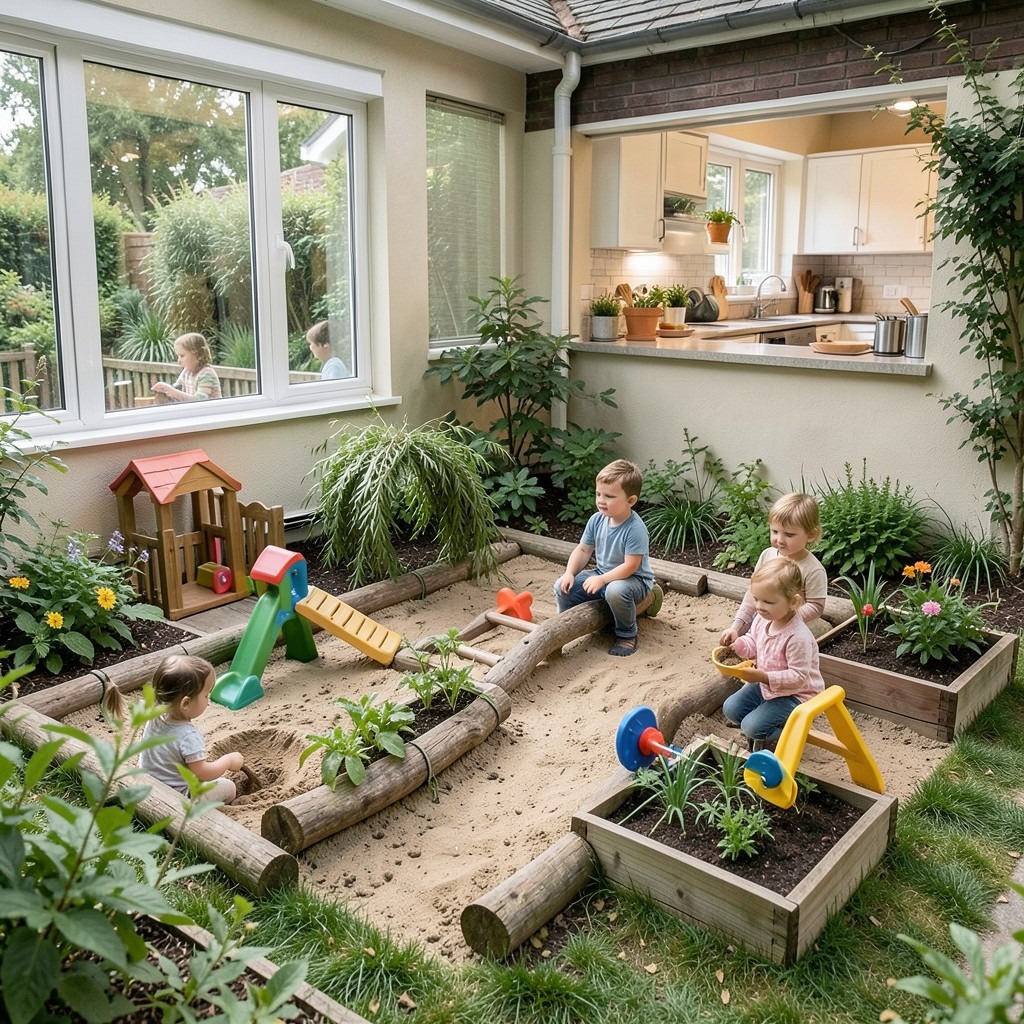
A dedicated children’s zone within the garden — a designed area that provides the specific play, discovery, and active outdoor experience that children need and that the garden can provide at a quality no indoor alternative matches — is the garden feature that most directly serves the household’s most active occupants and that pays the highest return in terms of daily outdoor time encouraged and independent play supported. A garden with a well-designed children’s zone produces children who want to be outside. That outcome is worth designing for.
The children’s garden zone must be visible from the house’s primary kitchen or living room window — not for aesthetic reasons but for the practical supervision requirement of any child-occupied outdoor area. The zone that requires a parent to leave the kitchen to check that a child is safe will be used less than the zone that is visible from the washing-up position, and a less-used outdoor play area is a design failure regardless of how well it is designed in its own terms.
The play elements within a children’s garden zone should be chosen for their developmental quality rather than for their scale or their branded status. A natural play area — a sand pit, a log balance trail, a willow tunnel, a digging patch, and a small growing bed where children maintain their own plants — provides the sensory, physical, and cognitive engagement that standardized plastic play equipment does not. The natural play garden produces children who are engaged with the outdoor environment as a living, variable, interesting place rather than as a backdrop for the same equipment available in every school playground.
26. A Garden With a Prairie Planting Scheme
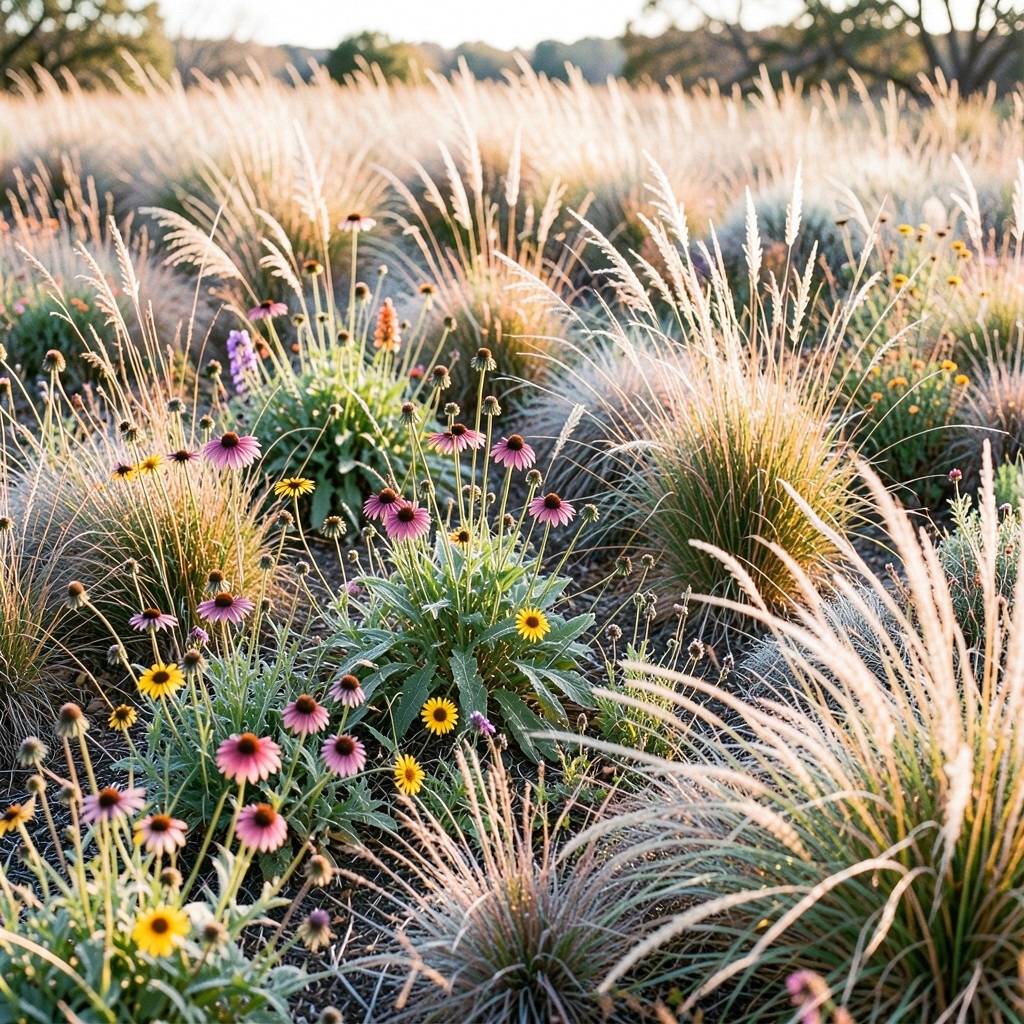
Prairie planting — the naturalistic herbaceous planting style that draws on the visual character of the North American grassland landscape, using perennial grasses and flowering perennials in a loose, inter-planted arrangement that moves with the wind and changes through the season — is the planting approach that produces the most atmospheric and the most ecologically rich herbaceous garden of any available style, and it is considerably less demanding of horticultural skill than the traditional mixed border that most formal planting manuals prescribe as the standard for herbaceous garden achievement.
The species matrix of a prairie planting scheme works on the principle of a plant community rather than a designer’s arrangement: multiple species are planted in drifts and single plants interspersed throughout the bed, each species finding the positions within the matrix where its vigor and its tolerance of competition from neighboring species produces the density and the spread that the planting scheme requires. Echinacea purpurea, Rudbeckia fulgida, Penstemon, Sanguisorba, and the full range of ornamental grasses — Molinia, Calamagrostis, Panicum — are the core species whose combination produces the prairie character in a temperate climate garden.
The winter structure of a prairie planting scheme is one of its most specific and most valuable qualities: the standing stems of the grasses and the dried seed heads of the perennials through the winter months provide the garden’s most atmospherically beautiful moments, when a frost settles on the grass plumes and the backlit seed heads hold the low winter sun at the level of detail that summer’s fullness obscures. The prairie-planted garden is not cut down in autumn — it stands through winter, feeding the birds and providing the invertebrate overwintering habitat that the tidy autumn cut destroys in both the garden’s ecological value and its winter beauty.
27. A Garden With a Herb Spiral Design
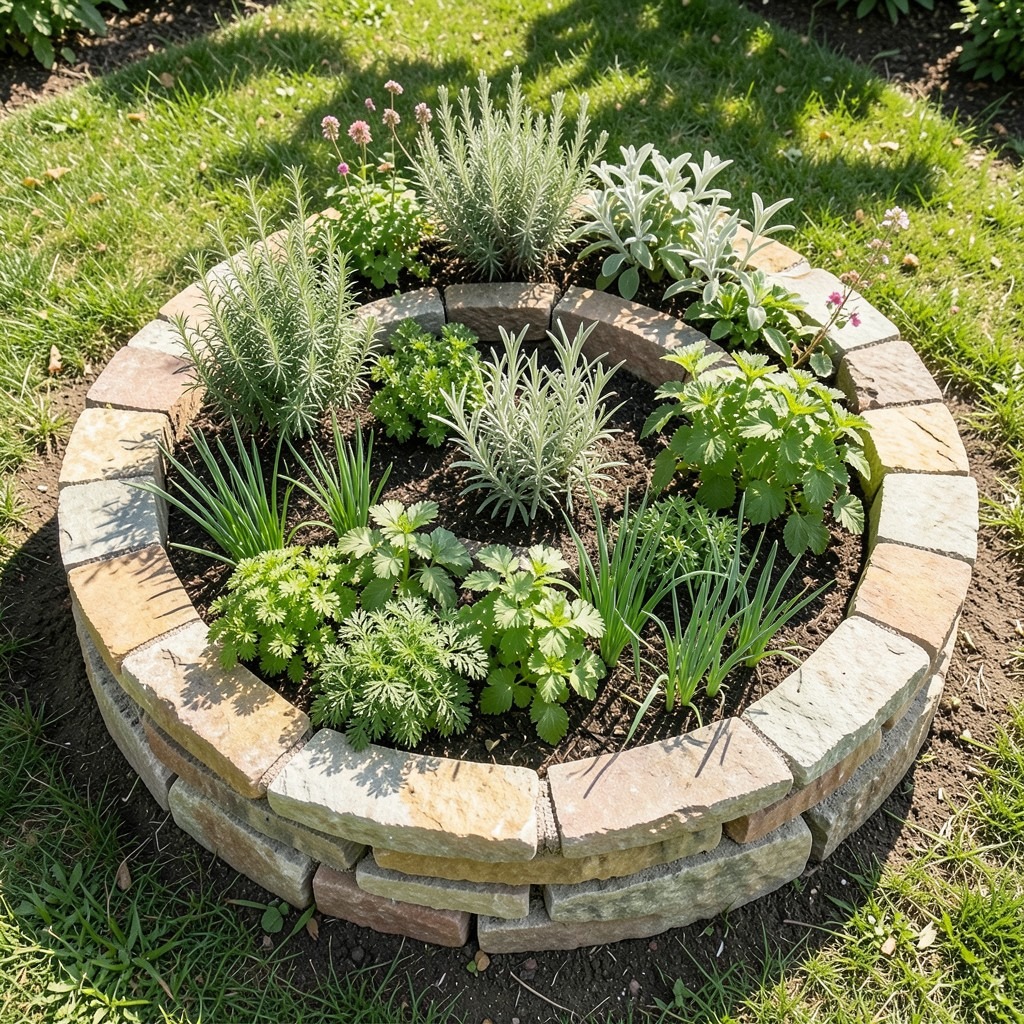
A herb spiral — a circular raised planting structure of approximately two meters in diameter, built in a spiral form from stone, brick, or timber that rises from ground level at the outer edge to a height of approximately one meter at the center, creating a range of different microclimate zones within a single small planting area — is the permaculture-derived garden design feature that maximizes the diversity of growing conditions available to herb plants in the minimum possible ground footprint. The spiral’s south-facing upper zone is hot, dry, and exposed — perfect for Mediterranean herbs. The north-facing lower zone is cooler, moister, and shadier — suitable for the parsley, chives, and mint that sun-lovers cannot share without domination.
The construction of a herb spiral from dry-stone or mortared stone requires the structural consideration that a spiral form distributes its retaining requirement differently from a straight-sided raised bed: the tapering spiral wall narrows toward the center and widens at the outer base, and the stones or materials must be laid to follow this tightening radius at each course level rather than on the straight horizontal runs that standard wall construction assumes. A rough-cut stone in a local material — sandstone, limestone, or any indigenous material available in the garden’s region — provides the thermal mass that the herb spiral’s microclimate advantage depends on, because the stone absorbs heat from the sun and releases it slowly back toward the plants through the cooler hours.
The plant selection for a herb spiral must respect the microclimate zones the structure creates rather than distributing plants by culinary preference regardless of their growing requirements. Thyme, oregano, and rosemary at the sunny, dry apex. Sage at the mid-level where the drainage is still good but the exposure slightly less intense. Chives, parsley, and coriander at the lower, moister zones where the Mediterranean herbs would rot through winter. The herb spiral that is planted to match its microclimates produces a thriving, self-maintaining herb collection; the one planted by aesthetic preference alone produces the confusing mixture of thriving and struggling plants that makes the structure’s design logic invisible.
28. A Garden With a Container Garden Design
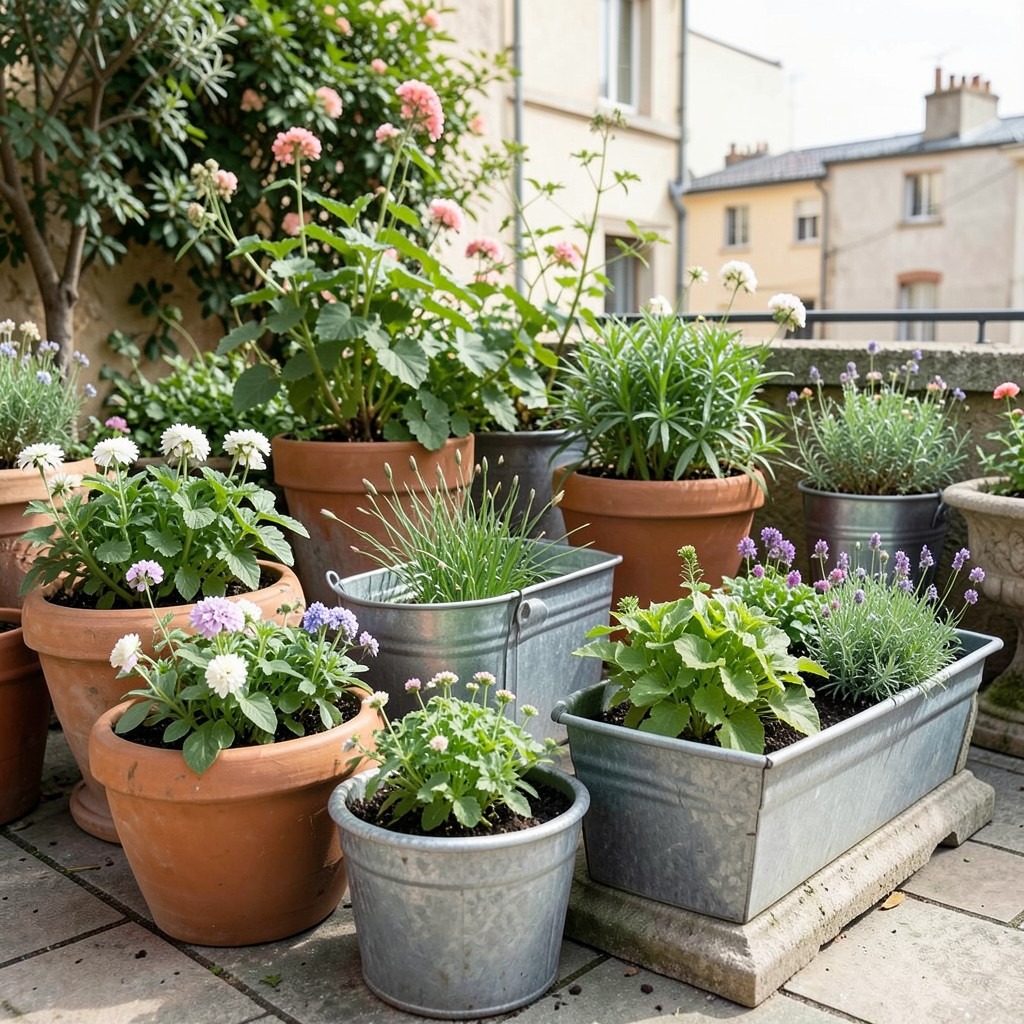
A container garden — a garden composed primarily or entirely of plants in pots, troughs, boxes, and vessels of various materials and sizes — is not a lesser version of an in-ground garden. In a small urban courtyard, on a roof terrace, or on a north-facing townhouse rear plot where the soil quality is too poor and the light too limited for conventional planting, the container garden is the only garden that is actually possible, and it is capable of providing a level of design quality, seasonal interest, and planting diversity that a ground planting scheme in difficult conditions cannot match.
The container material selection for a designed container garden requires matching the vessel’s character to the garden’s design direction as carefully as any piece of furniture is matched to an interior scheme. Weathered terracotta — the hand-thrown or machine-pressed clay pot in the warm orange-buff tone that terracotta produces when fired at traditional temperatures — suits the Mediterranean, cottage, and informal garden directions with a natural material quality that no synthetic alternative reproduces at the same sensory standard. Weathered zinc, galvanized steel, and other metal containers suit the contemporary, industrial, and urban garden directions. Cast stone, reconstituted stone, and genuine antique stone troughs suit the formal and historical garden directions.
The watering and feeding regime for a container garden is the maintenance commitment that determines whether the container planting thrives or merely survives through the growing season. Container-grown plants have access only to the nutrients contained in their growing medium, which deplete rapidly under the active growing season, and liquid feeding at the frequency that container plants require — weekly during peak growing season for most flowering and fruiting species — is the maintenance step most often skipped and most responsible for the mid-summer decline in container garden quality that produces the tired, pale-leaved appearance of containers that started the season strongly and lost their vigor by August.
29. A Garden With a Formal Parterre
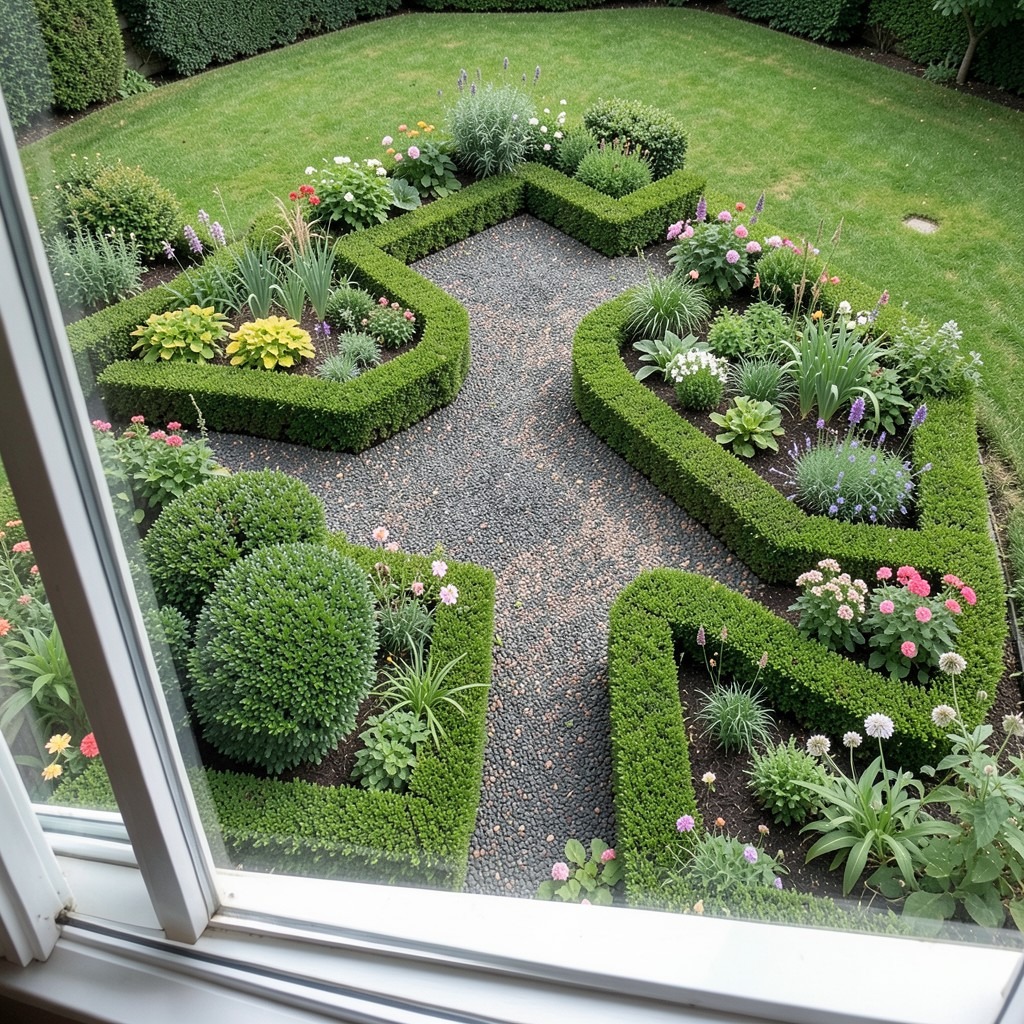
A parterre — a pattern of low hedging laid out on a flat ground plane, the spaces between the hedged compartments filled with gravel, coloured stone, flowering plants, or clipped ground-cover — is the most formally ambitious of all garden design forms, and the one that commits most completely to the idea that a garden can be a piece of ground-level architecture rather than simply an outdoor space with plants in it. The parterre is a drawing translated into landscape at full scale, and the experience of looking down on it from an elevated position — a window above the garden, a raised terrace, or a grass bank — reveals its geometric logic in a way that the ground-level view does not.
The hedging material for a domestic parterre must be capable of maintaining the precise line and the contained height — typically twenty-five to forty centimeters — that the pattern’s geometric legibility requires. Ilex crenata, replacing the now-vulnerable Buxus sempervirens, provides the dense, small-leaved, clippable quality that low hedging in a parterre demands, with the additional benefit of genuine resistance to the blight that has forced so many historic parterres through costly replanting programs. The clipping schedule — two clips per growing season as a minimum — must be maintained with the consistency of a surface that reads as pattern only when its edges are precise.
The ground fill between the hedged compartments determines the parterre’s visual character from a distance and its practical management requirement from close range. Coloured gravel — dark slate, pale limestone, red granite chips — provides the low-maintenance fill option whose colour contrast with the green hedging reads at the largest viewing scale. Flowering plants within the compartments provide the seasonal colour intensity of a formal display but require replanting twice a year and the regular deadheading and watering that a gravel fill does not.
30. A Garden With a Shade Garden Design
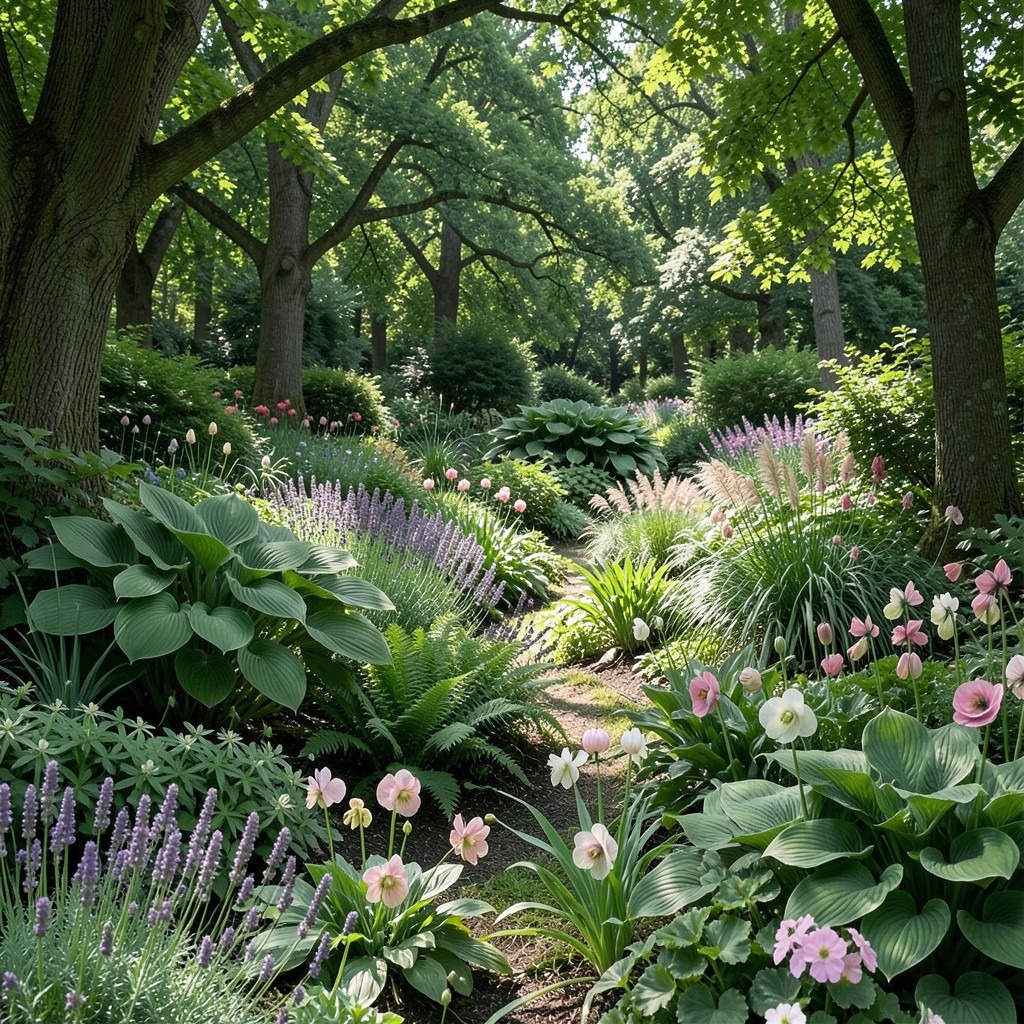
A shaded garden is one of the most commonly lamented growing conditions and one of the most genuinely rewarding garden environments when its specific plant community is understood and embraced rather than fought. The gardener who spends years trying to grow sun-loving plants in a heavily shaded plot — watching lavender stretch toward light it cannot reach and roses produce one stem where they should produce twenty — is not a failure. They are a gardener who has not yet been introduced to the shade-loving plant palette that makes a deeply shaded garden one of the most atmospherically beautiful environments in the temperate plant world.
The woodland garden floor — a shade garden that takes the structure of a deciduous woodland as its reference point, with a tree canopy layer, a shrub layer, and a ground layer of spring bulbs and shade perennials — produces a specific quality of dappled, shifting light and deep green coolness that full-sun gardens cannot replicate. Hostas for their substantial ribbed foliage in every shade of green and blue-grey, ferns for their arching delicacy, astilbes for their feathery summer plumes in pink and white, hellebores for their late winter nodding flowers — these are the plants that perform in shade conditions where sun-lovers struggle and that produce a garden of genuine depth and seasonal interest through the full growing year.
The soil management of a shade garden must address the specific conditions that shade creates: dry shade under established tree canopies, where feeder roots compete aggressively for water and nutrients, requires the addition of organic matter and the selection of genuinely drought-tolerant shade plants rather than the moisture-loving shade species that require more soil water than the root competition allows. Epimediums, cyclamen, and the toughest of the ground-cover geraniums handle dry shade with the resilience that the most demanding garden growing condition requires.
31. A Garden With a Roof Terrace Design
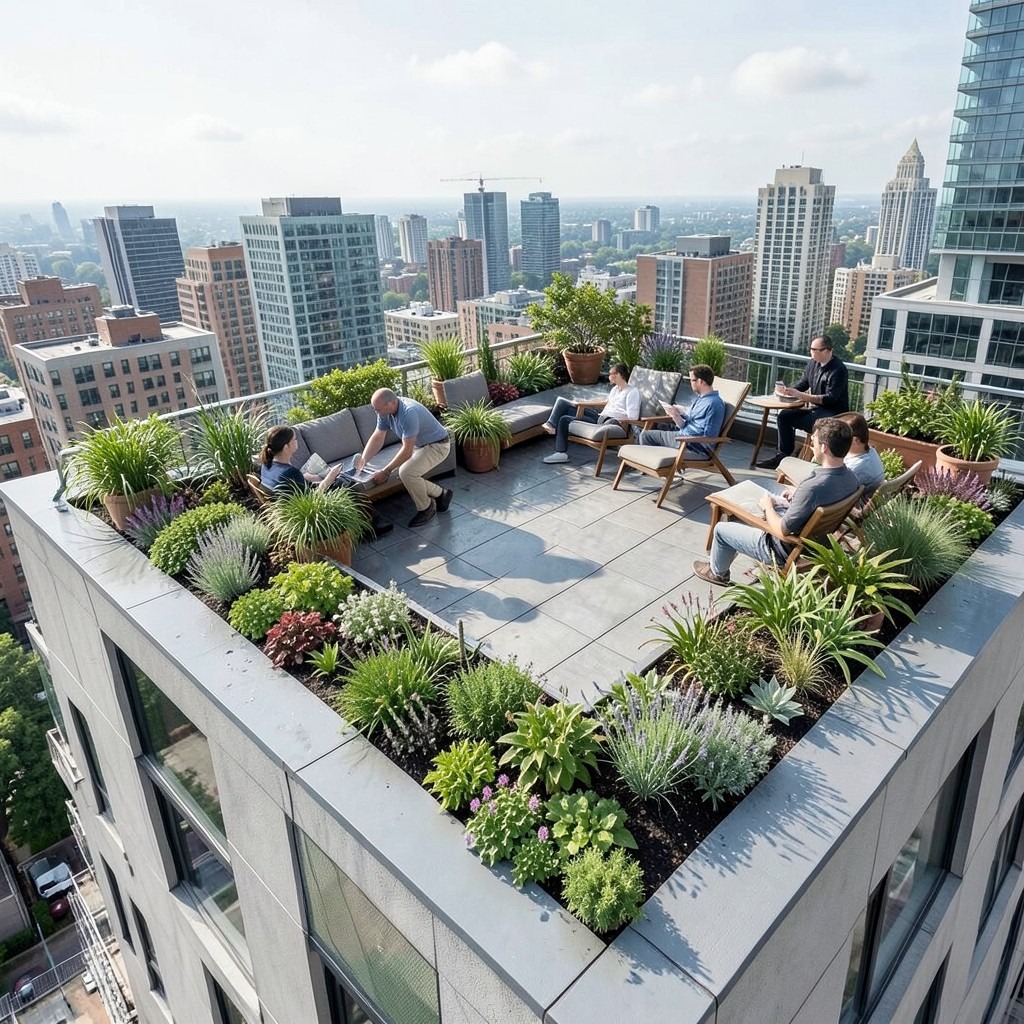
A roof terrace garden — an outdoor space on the flat or low-pitched roof of a building, designed as a planted and furnished living area — operates under structural, wind, and weight constraints that no ground-level garden imposes, and understanding those constraints is the prerequisite for every design decision that follows. The roof terrace is not a garden moved upward. It is a fundamentally different type of outdoor space with its own engineering context, its own growing conditions, and its own design opportunities that the ground-level garden cannot provide — including the panoramic view, the light quality of an elevated, unobstructed position, and the specific urban privacy of being above rather than within the surrounding built environment.
The loading constraint of a roof terrace is the structural fact that determines every material and planting decision: the roof structure can bear a finite weight per square meter, and the combination of paving, containers, growing media, water, furniture, and people must remain within that limit at the maximum saturation loading — when the growing media is fully waterlogged after heavy rain and the full occupancy of people and furniture coincides. A structural engineer’s assessment of the specific roof’s load capacity must precede the design, not follow it, and the design brief must specify the target loading in kilograms per square meter before any material or planting decisions are made.
The wind exposure at roof terrace level is the growing condition that most differentiates roof planting from ground planting. At building roof level, particularly in urban settings where the surrounding structures create unpredictable wind acceleration and turbulence, plants experience wind speeds and the associated transpiration stress and physical buffeting that ground-level plantings in the same location do not encounter. The planting palette for a roof terrace must be drawn from wind-tolerant species — and the perimeter screening that reduces wind speed across the planted areas must be designed before the planting is specified, because no plant selection compensates for wind exposure that the garden’s physical design has not addressed.
32. A Garden With a Sensory Garden Design
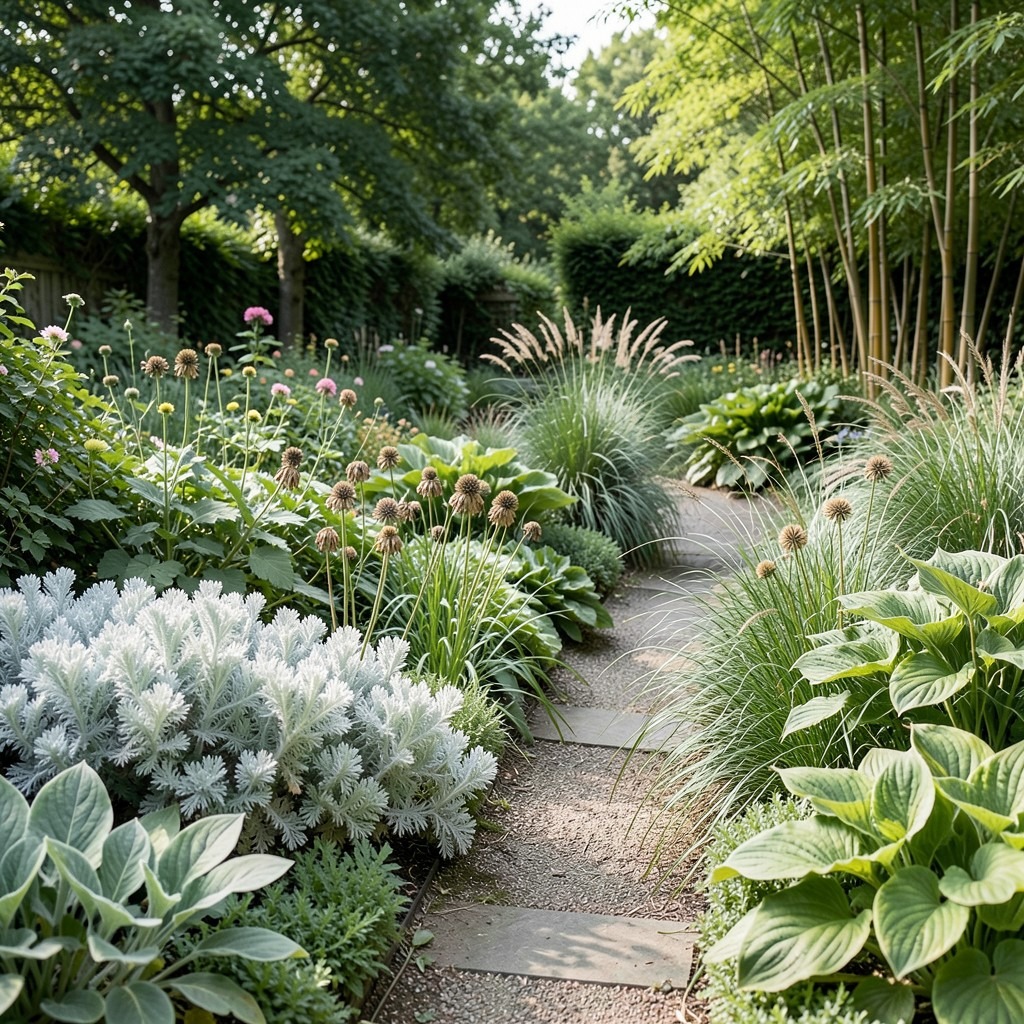
A sensory garden — one designed with explicit intention to engage all five senses rather than primarily the visual — is the garden type that produces the most genuinely immersive outdoor experience and the deepest quality of physical engagement with the natural environment. The visual garden is a beautiful place to look at. The sensory garden is a place whose full experience requires you to slow down, touch the foliage, close your eyes to identify the scent on the air, listen for the sound of the water feature and the wind through the grasses, and taste the herb you just brushed with your hand.
The textural planting layer of a sensory garden engages the tactile dimension that most garden designs ignore completely. Stachys byzantina — lamb’s ears — whose silver-white felted leaves are the softest plant surface in the temperate garden; Verbascum with its grey woolly rosette; the rough, papery surface of dried allium seed heads in late summer; the cool, waxy surface of large-leafed hostas in a shaded corner — these are the plants that reward physical contact and that invite the specific quality of attentive touch that a sensory garden encourages. The sensory path — a route through the garden whose edges are planted specifically for the brushing contact of a walking person — is the design tool that delivers this experience without requiring visitors to step off the path into the planting.
The acoustic dimension of a sensory garden extends beyond the water feature to include the sound of specific grasses moving in wind — Stipa tenuissima produces a whispering, papery sound in the lightest breeze that is unlike any other garden sound — and the sound of deciduous trees in summer leaf, the specific hiss of bamboo culms moving against each other, and the silence of a well-designed garden enclosure where surrounding planting and structure have reduced the ambient noise level to the point where the garden’s own sounds become audible.
33. A Garden With a Potager Kitchen Garden
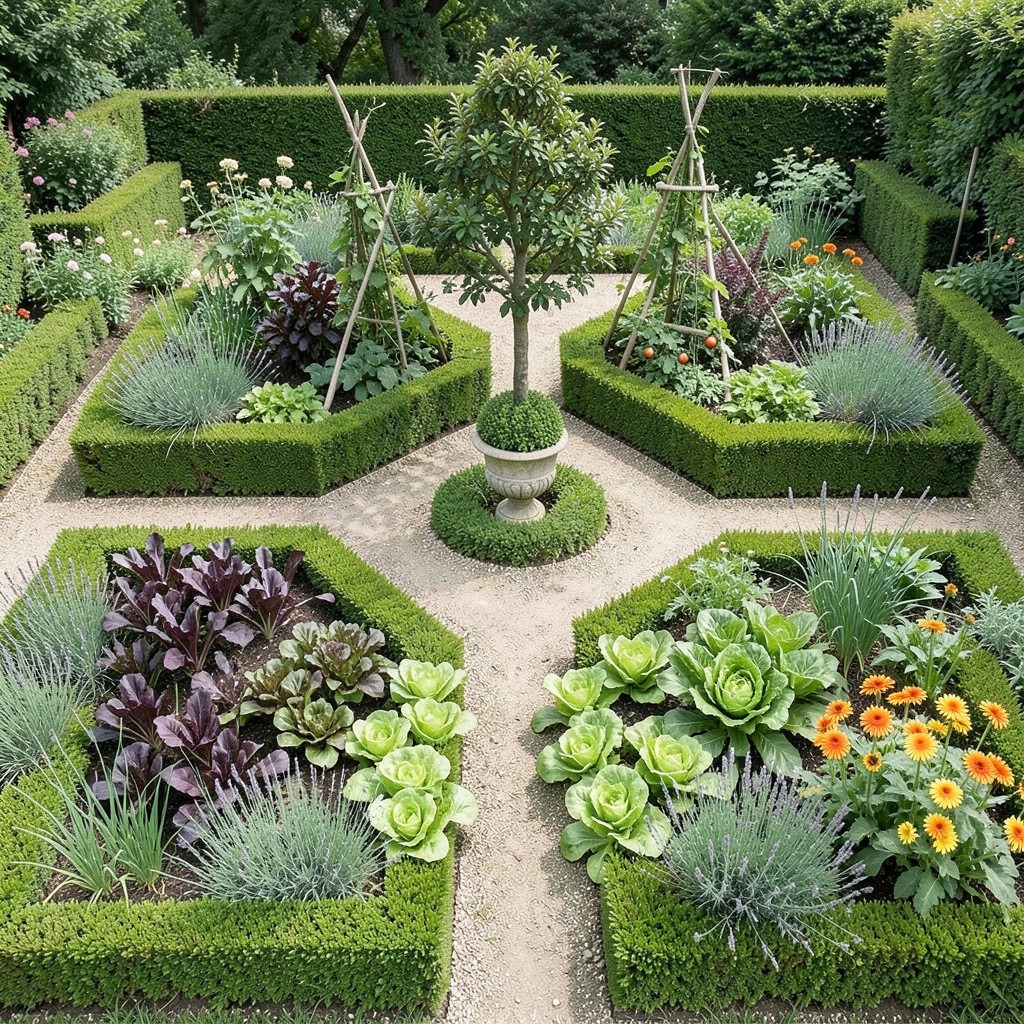
A potager — a kitchen garden in the French tradition, where the productive planting of vegetables, herbs, and fruit is organized within a formal geometric layout whose aesthetic quality is as considered as any ornamental garden — is the garden design format that most elegantly refuses the separation between the useful and the beautiful that most British kitchen garden traditions enforce. The potager is both things simultaneously: a garden that produces food and a garden that provides the visual pleasure of formal layout, seasonal colour, and the specific beauty of productive plants at their different growth stages.
The layout of a potager garden typically organizes its planting beds in a symmetrical arrangement around a central feature — a standard rose, a dwarf apple tree, a topiary sphere, or a decorative urn — that provides the garden’s ornamental focal point within the productive framework. The beds radiate from this center in a geometric pattern, separated by paths of sufficient width for comfortable access with a wheelbarrow, and each bed is edged in clipped box, lavender, or a productive alternative such as chives or parsley that provides the edging function while contributing to the harvest.
The visual interest of a potager through the growing season comes from the succession planting that keeps the beds in constant productive and visual transition: the purple-red leaves of beetroot following the pale green of early lettuce, the tall vertical stems of climbing beans on a central wigwam replacing the low spring crops, the orange and yellow dahlias grown for cutting providing colour at the season’s end among the last of the summer’s productive plants. The potager that is planted for visual sequence as well as culinary succession is never static, which is its most specific quality as both a productive and an ornamental garden.
34. A Garden With a Fire Pit Area
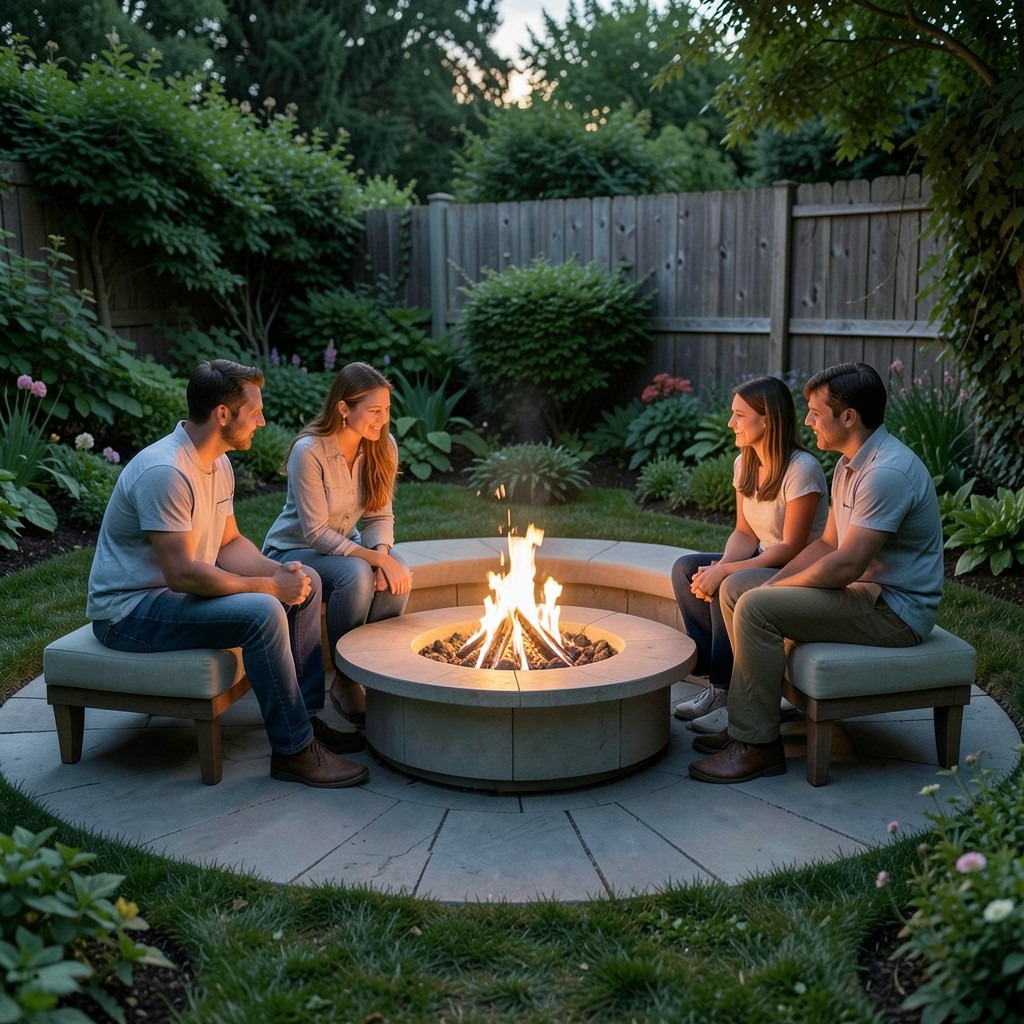
A fire pit area in a garden — a dedicated zone built around an outdoor fire, whether a permanent built hearth, a sunken fire pit, a free-standing fire bowl, or a chiminea — is the outdoor living feature that most directly produces the quality of evening gathering that extends the garden’s usability from the warmer months into the cooler ones. The garden without any form of outdoor fire is essentially finished as a social space when the temperature drops below comfortable shirt-sleeve conditions. The garden with a fire becomes usable — and genuinely enjoyable — in temperatures that would otherwise drive the gathering indoors.
The sunken fire pit — a circular opening in the garden’s paving or ground surface, lined with fire-rated materials, surrounded by the low seating that positions occupants at the correct height relative to the fire — is the format that produces the most atmospheric quality of fire-gathered seating of any outdoor fire design. The seating height relative to a sunken fire is lower than it is relative to a raised fire bowl, which changes the physical dynamic of gathering around it: people lean in toward the heat source rather than gathering upright around it, and that lean-in posture produces the quality of close, inward-facing conversation that fire historically and consistently generates.
The fuel and management of an outdoor fire pit requires the same responsibility that any open fire demands in a domestic garden context: the clearance distance from combustible materials including timber fences, garden furniture, and overhanging vegetation must be maintained, and the fire management practices — never leaving the fire unattended, maintaining access to extinguishing material, and ensuring the fire is completely extinguished before the area is left — are the practical requirements that make outdoor fire in a domestic garden a pleasure rather than a liability.
35. A Garden With a Biodiverse Pond Planting
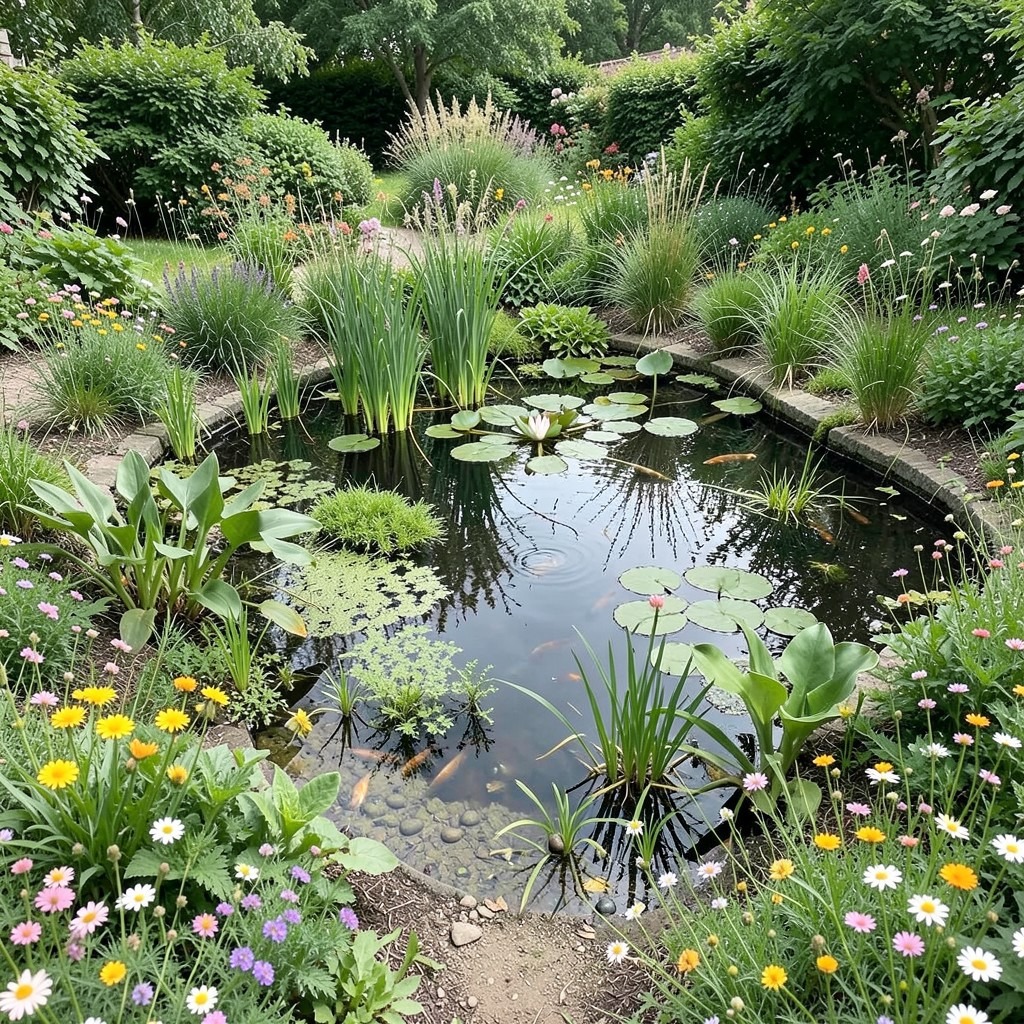
A garden pond planted for maximum biodiversity — with a range of aquatic plant types at different water depths, a shallow wildlife entry beach, marginal planting of native wetland species, and the surrounding terrestrial planting that connects the aquatic habitat to the wider garden ecosystem — is the single garden feature with the highest ecological return on investment of any garden addition available. A pond of two square meters, correctly sited, correctly planted, and correctly managed, supports more species of wildlife than the same two square meters of any other garden habitat type. The ecological productivity of water in a terrestrial environment is disproportionate to its physical scale.
The planting zones of a wildlife pond work at different water depths and provide different ecological functions: deep water plants — water lilies and hornwort — oxygenate the water and provide cover for fish and invertebrates; marginal plants at ten to thirty centimeters depth — marsh marigold, water forget-me-not, flowering rush — provide the stems and leaves that aquatic invertebrates use for emerging from the water at metamorphosis; and the terrestrial planting immediately around the pond margin — native wildflowers, sedges, and moisture-tolerant grasses — provides the habitat continuity between the pond and the surrounding garden that makes the pond accessible and useful to species that forage in both environments.
The fish decision for a wildlife pond is the choice that most significantly affects the pond’s biodiversity in the long term. Fish — particularly goldfish and common carp — consume the aquatic invertebrate community that the pond’s ecological function depends on, and a wildlife pond stocked with ornamental fish very quickly becomes a fish pond rather than a wildlife pond, because the predation pressure on tadpoles, water snails, and larval invertebrates removes the biological community that makes the pond valuable as habitat. The wildlife pond is a fishless pond by design.
36. A Garden With a Secret Garden Design
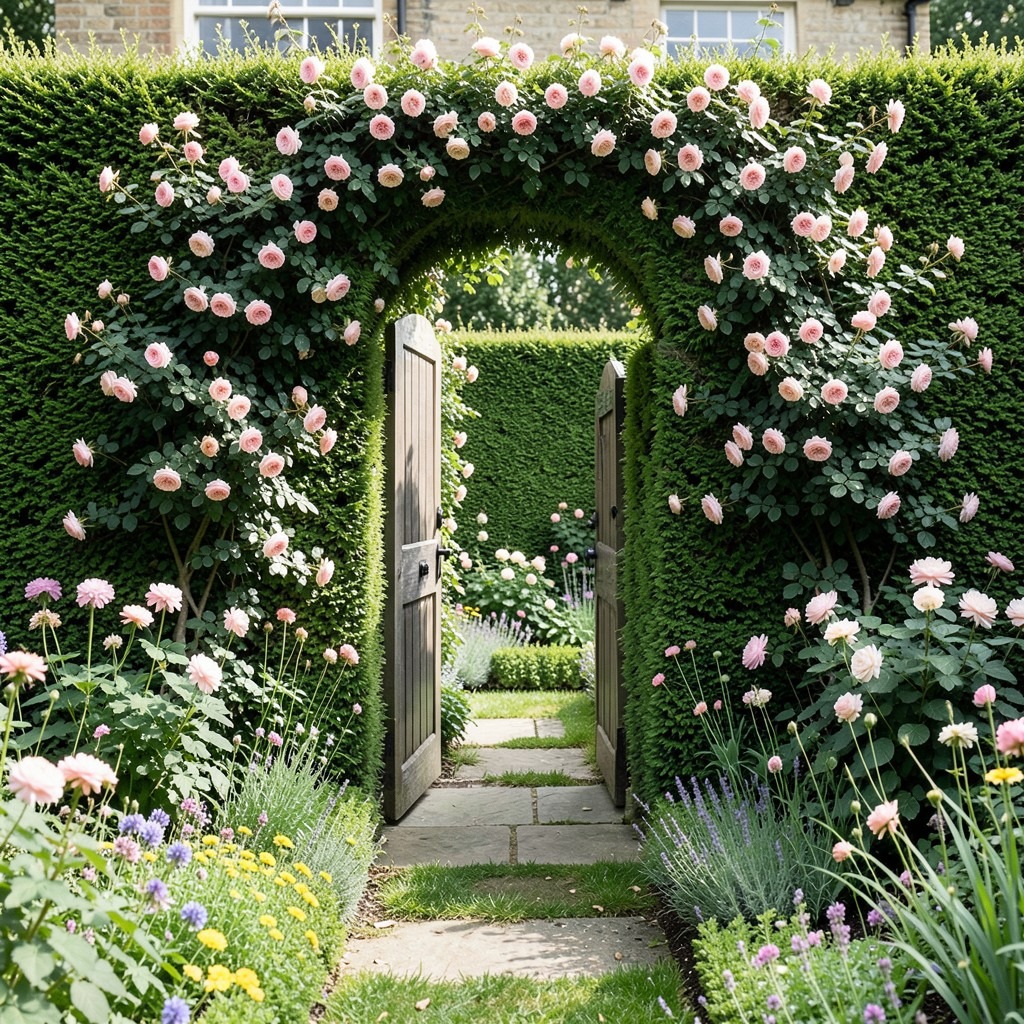
The secret garden — an enclosed outdoor space, hidden from the main garden by hedging, walls, or a planted screen and accessed through a gate, an arch, or a gap in the planting — is the garden design feature whose power lies entirely in the experience of discovery and transition it provides rather than in its own planting or design content. A secret garden does not need to contain extraordinary planting. It needs to be reached by the specific act of deliberate entry through a threshold that separates it from the space before it, and the experience of what lies beyond that threshold is transformed by the act of crossing it.
The threshold design — the gate, the arch, or the opening in the hedge — is the most consequential design decision in the secret garden concept because it governs the quality of the transition experience. A gate of adequate height to require the visitor to attend to it — to lift a latch, to push open a door, to notice the physical act of entering — creates the psychological punctuation between outside and inside the secret garden that makes the latter feel like a different place. A gap in a hedge wide enough to walk through without ducking or noticing creates no transition at all and fails the secret garden’s entire premise.
The planting within a secret garden benefits from the specific microclimate that the enclosing walls or hedges create: a sheltered, semi-shaded environment that suits the romantic, abundant planting of climbing roses on the enclosing structure, shade-tolerant perennials in the beds, and the specific quality of slightly overblown floral generosity that a hidden garden, removed from the main garden’s public quality, can indulge without the need for the restrained formality that a garden visible from the house’s principal windows may require.
37. A Garden With a Butterfly and Bee Garden
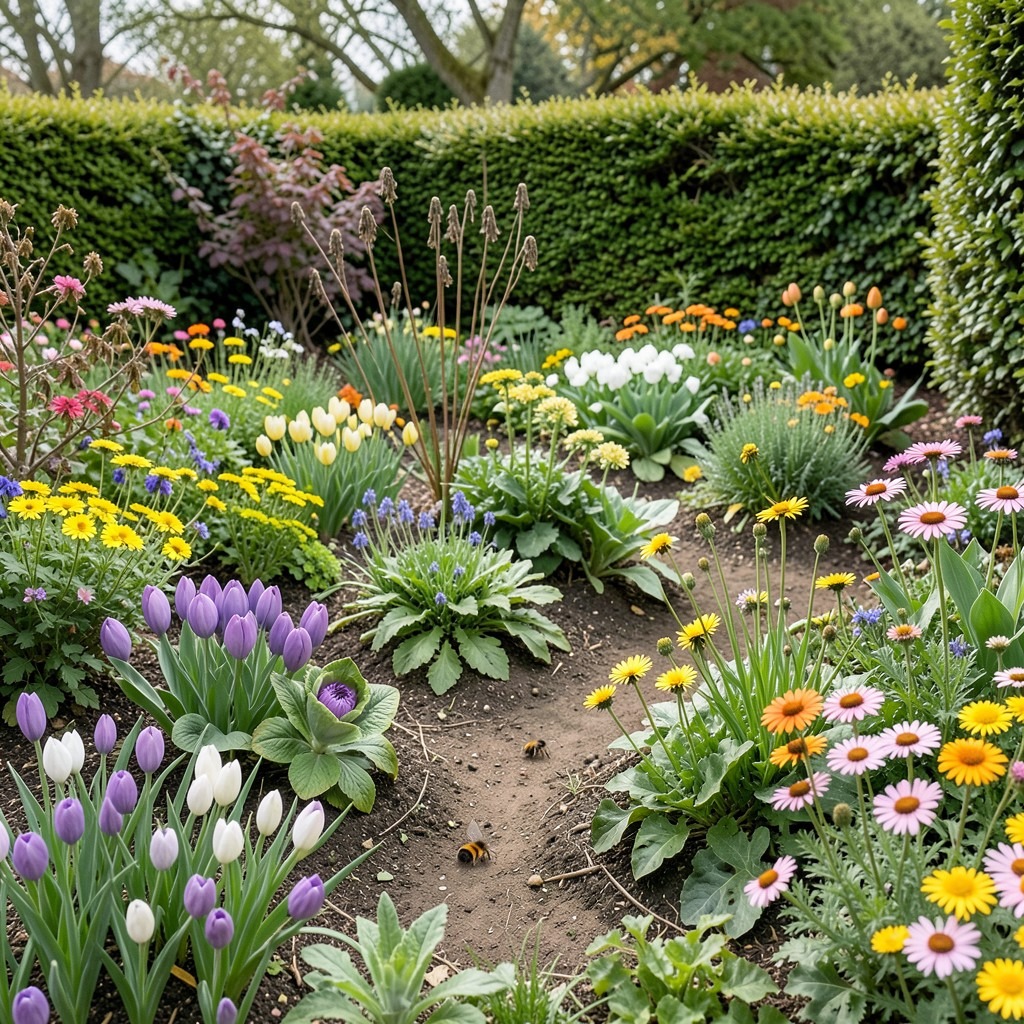
A garden designed specifically to support pollinating insects — selecting plants for their nectar and pollen value rather than their ornamental impact, structuring the planting for a continuous flowering succession from early spring to late autumn, and providing the habitat features that nesting bees and overwintering butterflies require — is the garden that does most for the ecological health of the surrounding landscape while simultaneously producing the most animated and the most genuinely alive garden experience available at any scale.
The planting succession for a pollinator garden must address every month of the active flying season rather than focusing exclusively on the peak summer period when most ornamental gardens are fully in flower anyway. The early spring sources — crocus, hellebore, pulmonaria, and single-flowered prunus species — provide nectar for the emerging queen bumblebees and the early-season solitary bees whose annual cycle begins before most garden plants are in flower. The late autumn sources — sedums, asters, echinacea, and the ivy that most gardeners cut back before its October-November flowering period — provide the last fuel before winter for the butterflies and late-flying bees whose season extends beyond the conventional garden’s last flowers.
The bee habitat provision extends beyond the planted element to the garden’s structural management: a section of bare, south-facing soil for ground-nesting solitary bees, the hollow stems of dead herbaceous plants left standing through winter for cavity-nesting species, and the undisturbed areas beneath hedges and in rough ground for bumblebee nest sites. These management decisions cost nothing, require no additional planting, and convert the maintenance reduction of leaving certain garden areas untouched into a genuine ecological benefit rather than an apology for insufficient tidying.
38. A Garden With a Living Wall on a House Facade
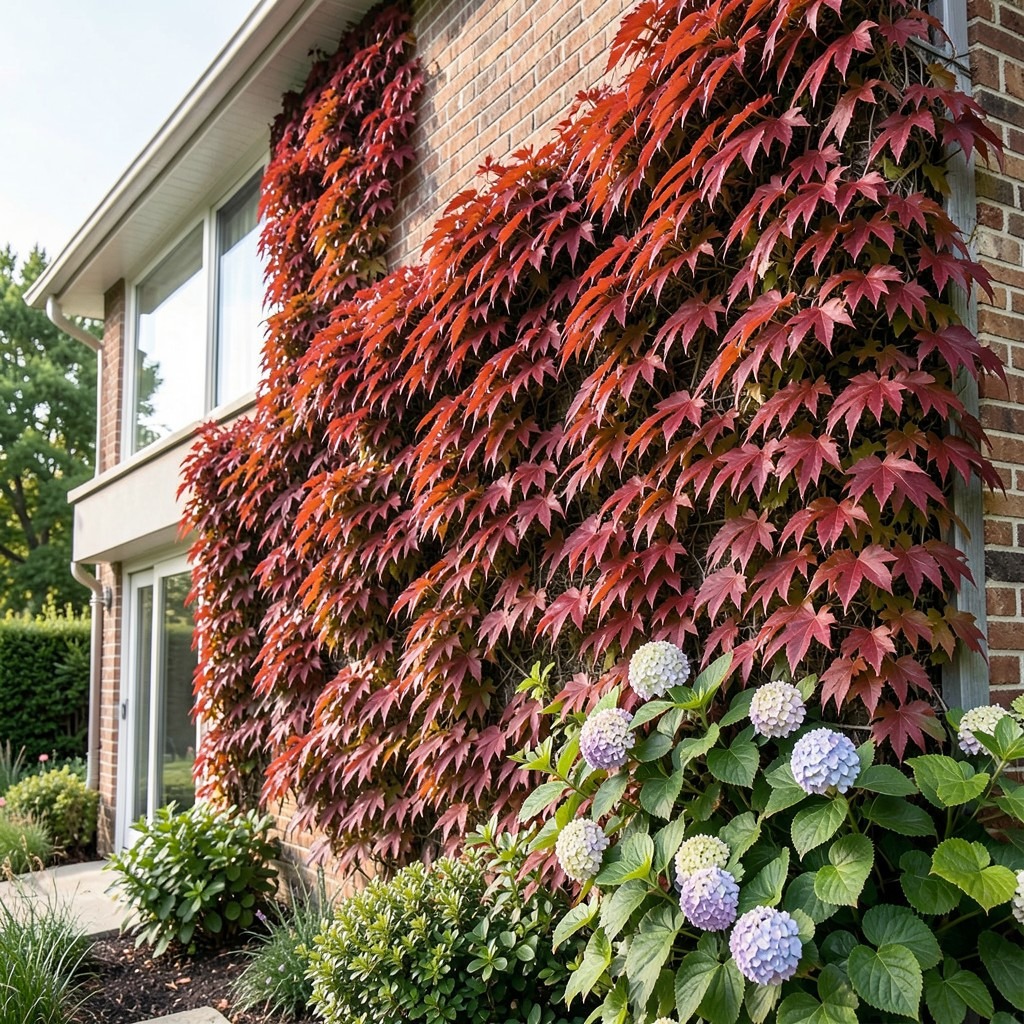
A living wall installed on the exterior facade of the house — either in the traditional form of a self-clinging climbing plant trained directly against the wall surface or as a modular planted system in a supporting frame — is the garden element that most directly blurs the boundary between the built and the grown, and that changes the house’s relationship with the garden from a building standing in an outdoor space to a building that is itself part of the planted landscape.
The self-clinging climbers — Virginia creeper, Boston ivy, and the climbing hydrangea Hydrangea anomala subsp. petiolaris — attach to masonry surfaces directly through adhesive pads or rootlets without requiring any supporting framework, and their wall coverage over a decade of establishment transforms a flat rendered or brick facade into a planted surface that changes colour through the seasons with more drama and more constancy than any coat of paint. The autumn color of Virginia creeper on a north-facing wall — the deep crimson-scarlet that the leaves achieve in October before they fall — is one of the most spectacular seasonal transformations in the garden calendar.
The insulation and thermal performance benefit of a well-established climbing plant on a building facade is the practical argument that complements the aesthetic one: the air layer trapped between the foliage canopy and the wall surface provides additional thermal insulation in winter, and the evaporative cooling of the leaf mass reduces solar heat gain through the wall in summer. These are genuine performance benefits that contribute to the building’s energy efficiency alongside the climber’s aesthetic and ecological value.
39. A Garden With a Gravel Path Network
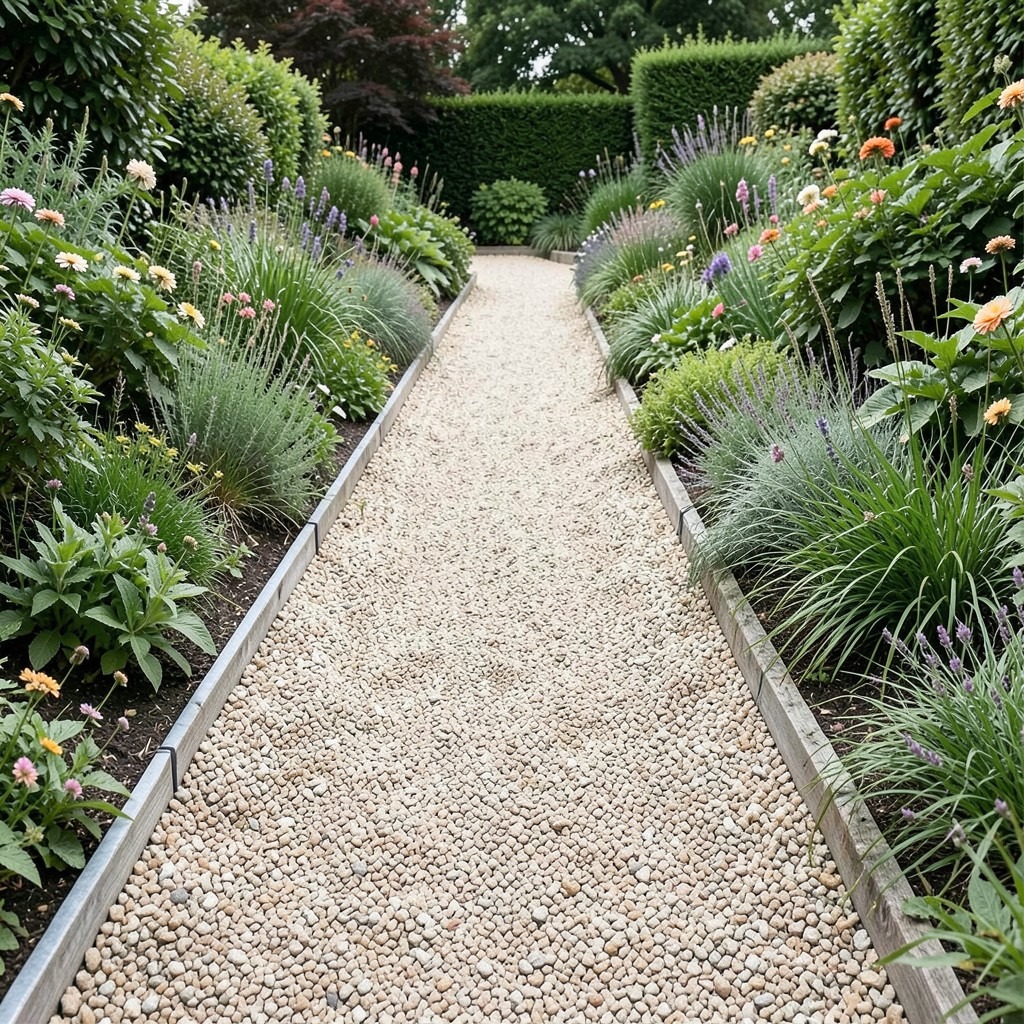
A network of gravel paths through a garden — paths whose material is loose aggregate rather than a bound surface, whose edges are defined by metal or timber edging or by the overhanging planting that spills across their margins — provides the garden’s movement infrastructure at a lower cost and with a more informal, organic quality than any paved alternative, and it does so while simultaneously providing the free-draining surface that suppresses path weeds more effectively than grass or bare soil.
The gravel specification for garden paths requires matching the stone size to the path’s traffic type and to the aesthetic direction of the planting on either side. A fine angular gravel of six to ten millimeters — the size commonly described as pea gravel — provides a firm walking surface when laid at adequate depth over a compacted sub-base but tends to migrate onto planted areas adjacent to the path edge and requires periodic consolidation. A coarser angular crushed stone of fourteen to twenty millimeters diameter provides better resistance to migration and better interlocking stability underfoot, but its larger particle size makes it less comfortable under thin-soled footwear and less suitable for paths used by barefoot children.
The sub-base preparation beneath a gravel path determines its long-term performance more than the gravel selection itself. A path laid over uncompacted soil without a sub-base compresses under foot traffic and develops the soft, sinking quality that makes walking on it feel uncertain. A path laid over a compacted sub-base of one hundred millimeters of hardcore or crushed stone, topped with a permeable membrane to prevent sub-base contamination of the gravel layer, and then covered with the gravel at fifty to seventy millimeters depth provides the firm, consistent walking surface that a regularly used garden path requires.
40. A Garden With a Topographic Garden Design
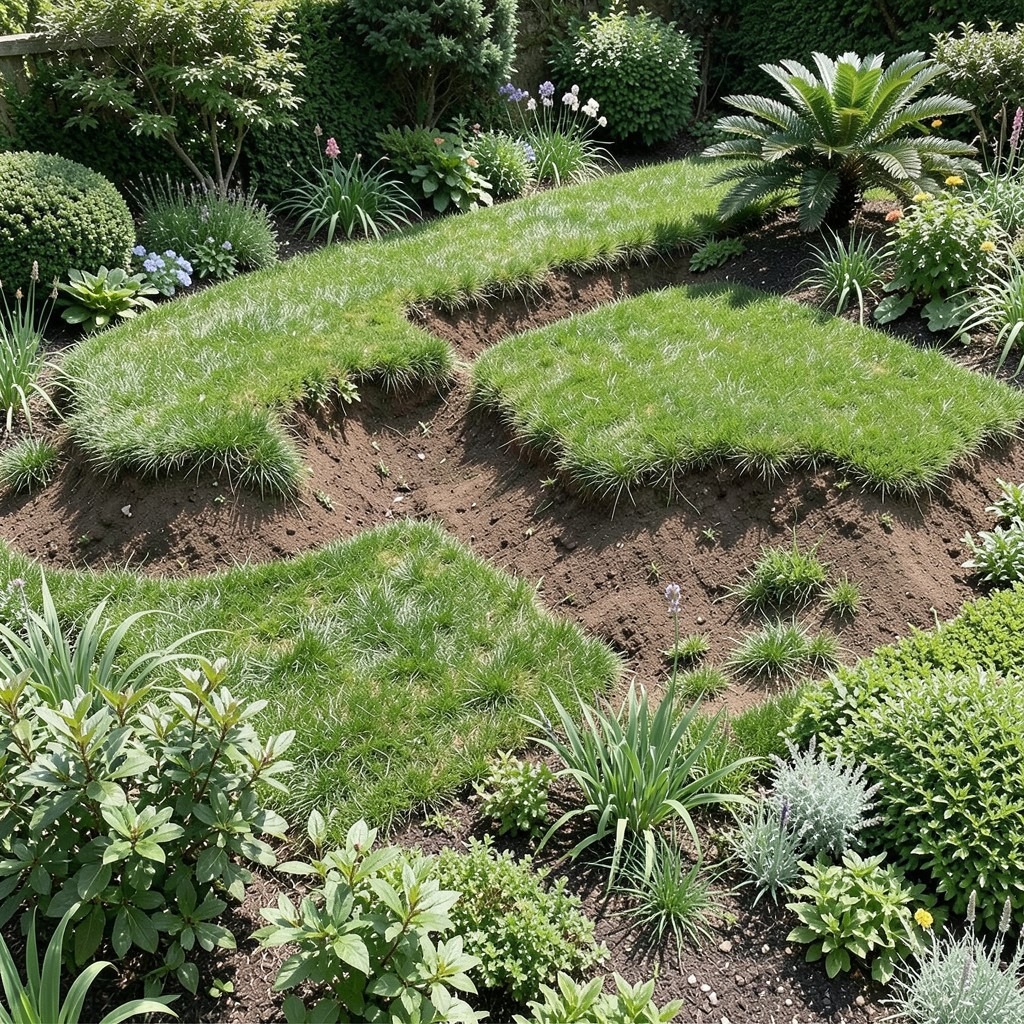
A topographic garden — one that introduces changes in ground level as a primary design tool, creating berms, mounds, terraces, and hollows that change the flat garden floor into a landscape with genuine three-dimensional form — is the garden approach that produces the most dramatic spatial transformation available from a purely earth-moving operation. No plants, no structures, and no materials are required to create the spatial interest of a well-designed topographic garden — the moulded ground itself creates enclosure, exposure, surprise, and transition in the same way that a room’s walls, steps, and doorways create spatial experience in a building.
The berm — a raised mound of earth formed from topsoil and sub-soil excavated from elsewhere in the garden or brought in as fill material — provides multiple garden benefits from a single earthworks operation: the raised ground provides an elevated planting bed with better drainage than the surrounding flat garden; the north face of the berm creates a shaded microclimate for shade-loving species; and the berm’s visual mass provides a screening element, a backdrop for planting in front of it, and a viewing platform from its crest that the flat garden does not provide at any position.
The gradient of a garden berm’s sides determines both its stability and its maintenance requirement. A shallow gradient of one-in-three — one meter of vertical rise for every three meters of horizontal run — provides adequate stability for grass or planted surfaces without erosion under normal rainfall. A steeper gradient requires either planted ground cover of sufficient root density to bind the surface or an engineered surface treatment to prevent the erosion and slumping that exceeds the grass cover’s ability to stabilize.
41. A Garden With a Cloud Pruning Technique
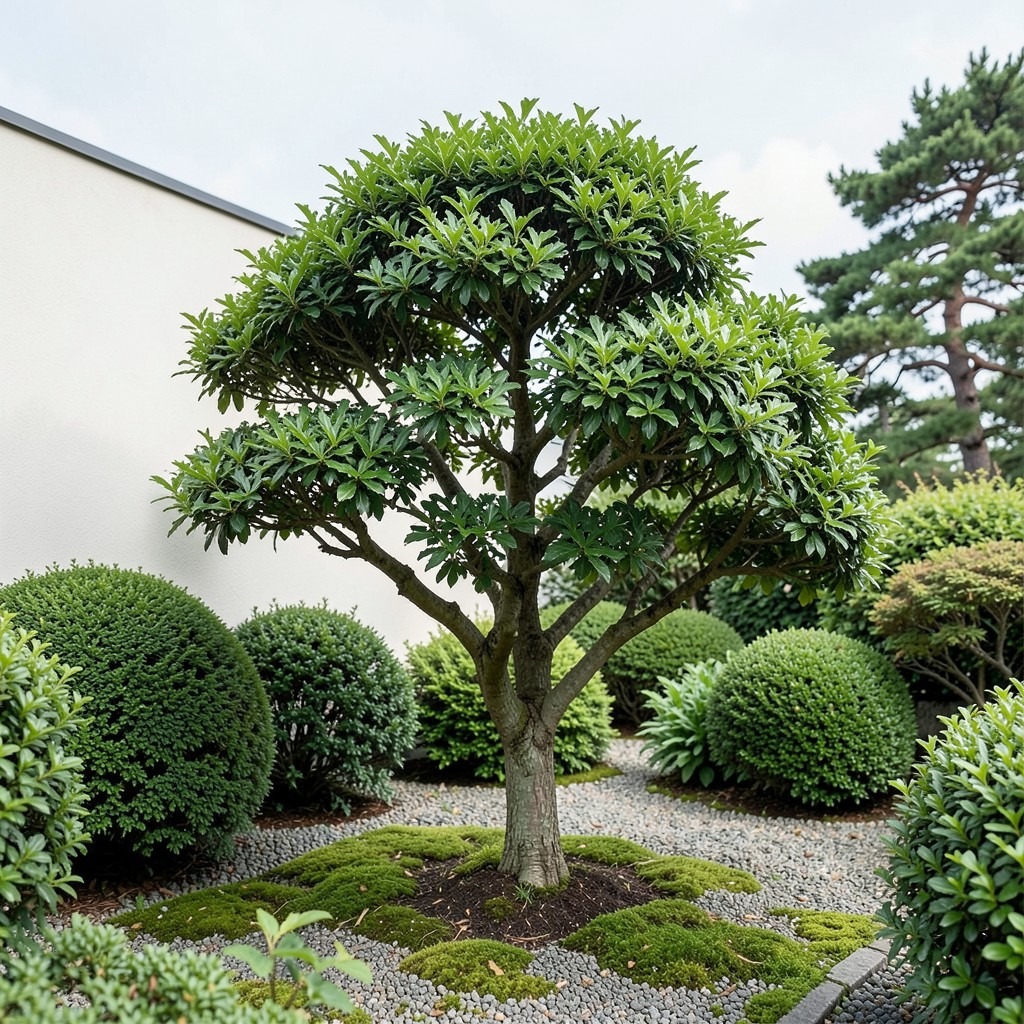
Cloud pruning — the Japanese technique of training and clipping woody plants into organic, billowing, cloud-like forms that reference the aesthetic of natural cliff-top and coastal trees shaped by prevailing wind — applied to garden plants in a temperate climate produces the most sculpturally distinctive plant forms available to the domestic gardener, and it does so from species that are already widely grown and entirely familiar: box, yew, and the large-leafed hollies that respond to precise clipping with the dense, manageable growth that the technique requires.
The cloud-pruned form develops over years rather than seasons — a young Ilex crenata or yew plant requires a minimum of five years of guided training before the cloud structure is recognizable, and a decade before the billowing form reaches the maturity that makes the technique’s aesthetic quality fully apparent. The training begins with the selection of the plant’s primary branches — the framework that will become the stems lifting between the cloud pads — and the removal of all growth that fills the space between those primary branches, leaving the branch structure clean and the foliage concentrated at the branch ends in the dense pads that clipping progressively refines into cloud forms.
The garden context for cloud-pruned plants must provide the visual setting that allows the sculptural form to read clearly. A cloud-pruned shrub surrounded by competing rounded forms and dense border planting loses its distinctiveness in the visual noise of the surrounding planting. Positioned against a pale wall, against an open sky, or in a gravelled or moss-covered clearing where the ground plane provides the neutral backdrop, the cloud-pruned form reads with the specific quality of designed sculpture that justifies the years of patient training the technique requires.
42. A Garden With a Contemporary Garden Room
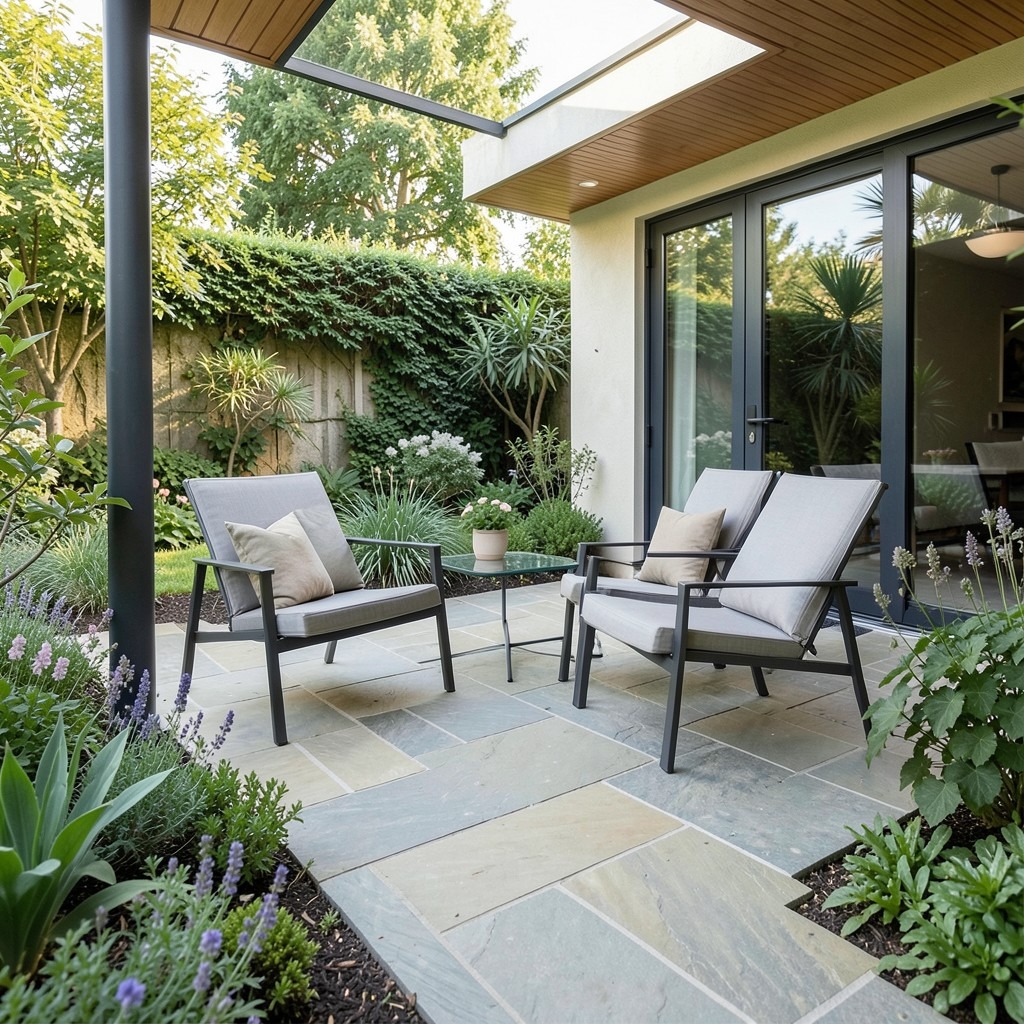
A garden designed as an outdoor room — where the spatial organization, the material palette, the furniture selection, and the atmospheric qualities are planned with the same design intention as an interior room rather than as an outdoor space that happens to contain furniture — produces the seamless extension of the home’s living space into the garden that contemporary domestic design aspires to but rarely achieves with complete success. The outdoor room succeeds when the transition from inside to outside feels like a change in light quality and air temperature rather than a change in design quality and design intention.
The paving material at the outdoor room’s floor level should connect visually to the interior floor material it continues from — the same stone species, the same format, or the same tonal range — so that the eye reads the transition from inside to outside as a continuation of the same surface in different conditions rather than as an abrupt shift from one material to another. A limestone floor inside continuing as the same limestone format outside, with the threshold detail of a single linear drain concealed in the floor surface at the door opening, creates the floor-level continuity that makes the inside-outside design connection legible.
The furniture in an outdoor room must be specified for the specific conditions of outdoor use — UV stability, moisture resistance, frost resistance, and the structural adequacy to handle the thermal and moisture cycling that outdoor furniture experiences over a full annual cycle — without sacrificing the design quality and the material warmth that an outdoor room’s furniture must provide to participate successfully in the indoor-outdoor design connection. The powder-coated steel frame with a weatherproof fabric cushion is the standard outdoor furniture solution whose performance is reliable but whose design quality rarely equals the indoor furniture it is placed alongside.
43. A Garden With a Rain Garden Design
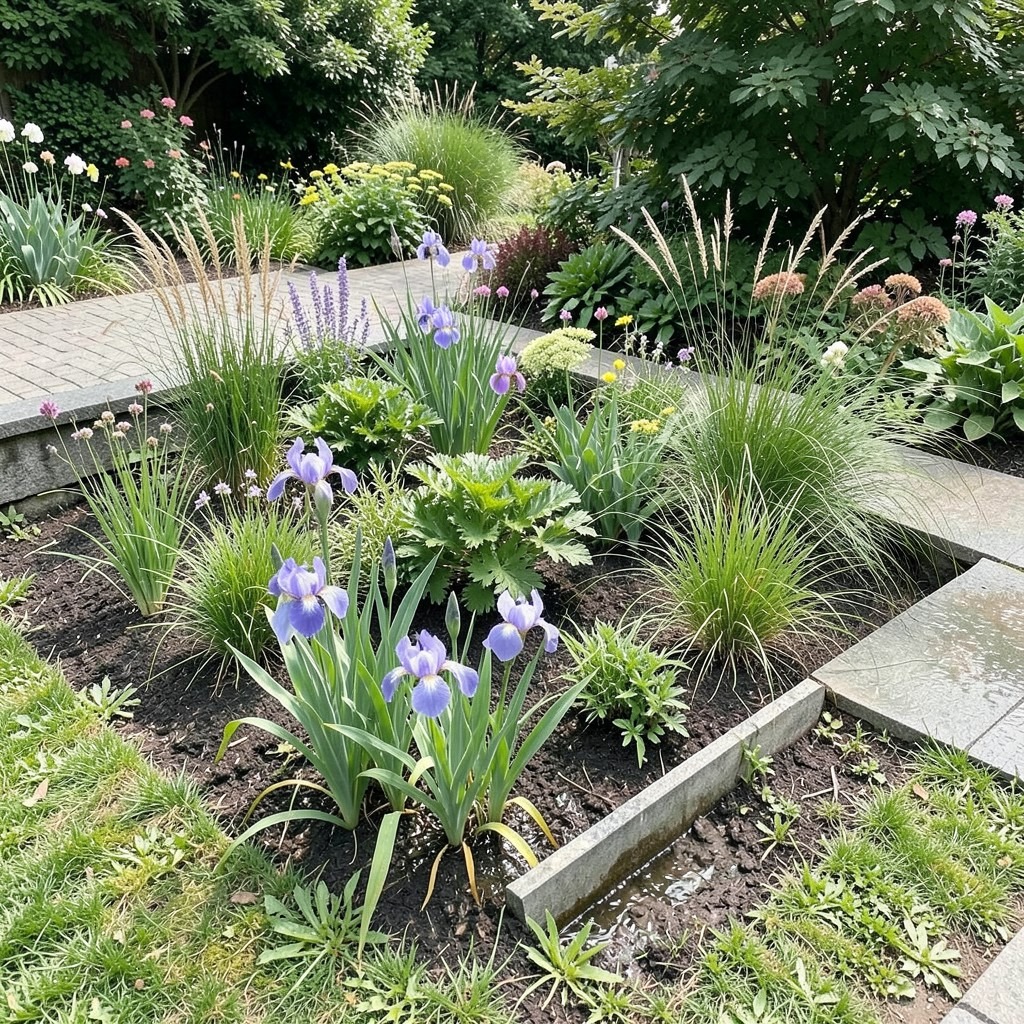
A rain garden — a shallow depression in the garden’s ground surface, planted with moisture-tolerant and periodically flood-tolerant species, designed to capture and absorb surface run-off from adjacent hard-paved areas or from roof drainage — is the garden design feature that converts a water management engineering requirement into an attractive garden element while simultaneously reducing the volume of surface water that reaches the drainage system during heavy rainfall. The rain garden is a piece of green infrastructure that works as a garden feature: beautiful when dry, briefly flooded when it is performing its designed function, and self-draining back to its planted condition within twenty-four hours of a standard rainfall event.
The planting selection for a rain garden must tolerate the two extreme moisture conditions the feature creates: the periodic flooding of a heavy rainfall event and the dry, free-draining conditions that the garden bed experiences between rain events, particularly in summer. This tolerance range restricts the palette to species with genuine flexibility of moisture requirement rather than the dedicated wetland plants that a permanently moist pond margin supports or the dry-garden plants that free-draining borders require. Iris sibirica, Deschampsia cespitosa, Carex varieties, Filipendula ulmaria, and the moisture-tolerant ornamental grasses manage the flood-to-drought range that the rain garden imposes on its planting.
The size and depth of a rain garden must be calculated against the area of hard surface whose run-off it is designed to capture. A garden rain garden designed to manage the run-off from a twenty square meter paved terrace in a medium-rainfall climate requires a minimum depression volume of approximately one cubic meter — achievable in a rain garden of four square meters at thirty centimeters maximum depth. Under-sizing the rain garden produces a feature that overflows in moderate rainfall events rather than absorbing the run-off its design intent specified.
44. A Garden With a Woodland Garden Planting
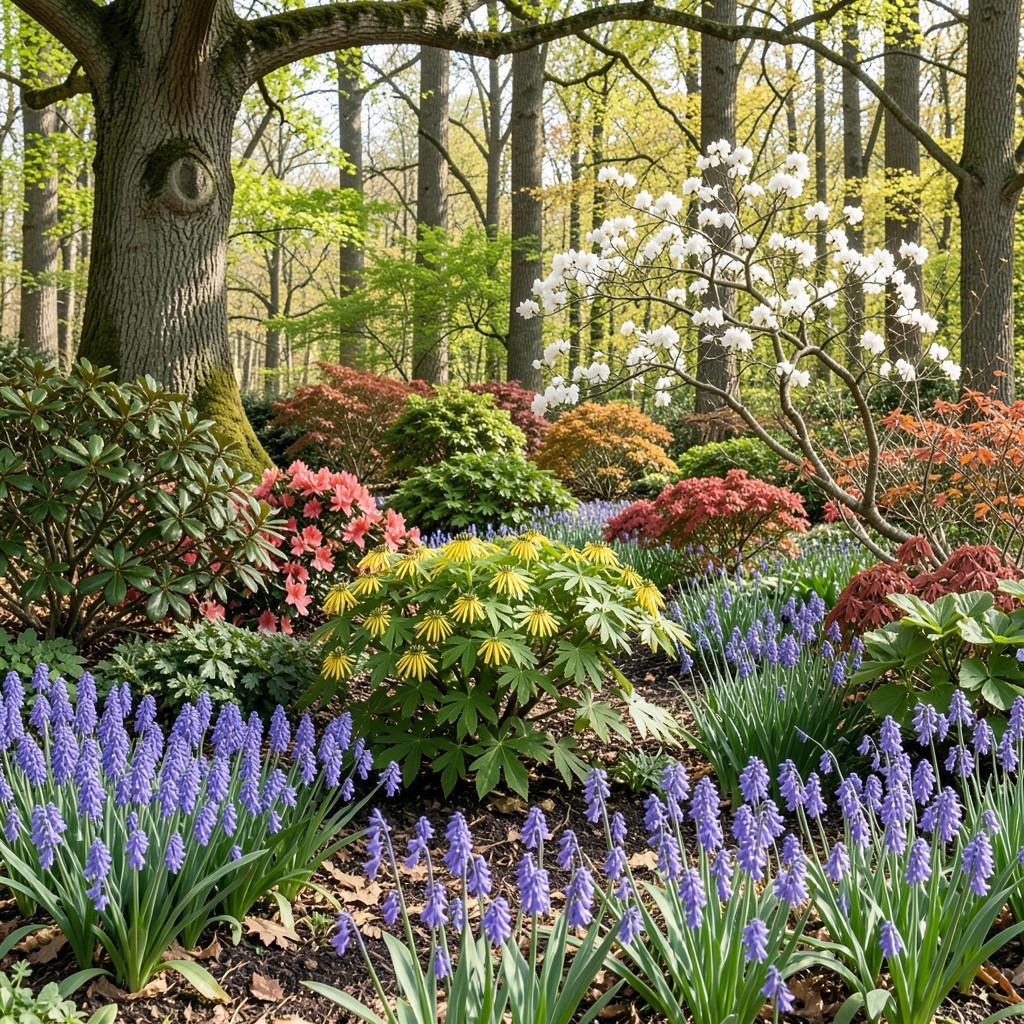
A woodland garden — a planting scheme that takes the structure and the species community of a deciduous woodland floor as its reference, with a canopy layer, a shrub layer, and a ground layer of spring-flowering and shade-tolerant species — is the planting approach that most naturally suits a garden with existing mature trees, dappled shade, and the leaf litter soil that deciduous trees produce annually as the most generous free soil amendment available.
The spring bulb layer of a woodland garden provides the season’s most concentrated flowering display in the brief window between the soil warming enough for bulb emergence and the tree canopy closing to shade that the bulbs require to photosynthesize and build their reserves for the following season. Bluebells in their native English form — Hyacinthoides non-scripta, with its arching one-sided flower stem and its specific blue-violet tone — planted in generous drifts under deciduous trees produce the most atmospherically moving spring garden display of any single species, and their naturalizing capacity means the initial planting expands annually without any gardener intervention.
The shrub layer of a woodland garden provides the mid-story interest between the tree canopy and the ground layer: rhododendrons and azaleas for acid-soil woodland conditions, the mahonia with its architectural pinnate leaves and winter yellow flower spikes for alkaline or neutral soils, and the flowering dogwoods — Cornus florida, Cornus kousa — for their late spring floral bracts that make the tree appear from a distance to be covered in white birds landed briefly on every branch. The dogwood’s autumn colour and the winter stem colour of the Cornus species planted for that quality extend the woodland garden’s interest beyond the spring bulb season into the full annual cycle.
45. A Garden With a Productive Orchard
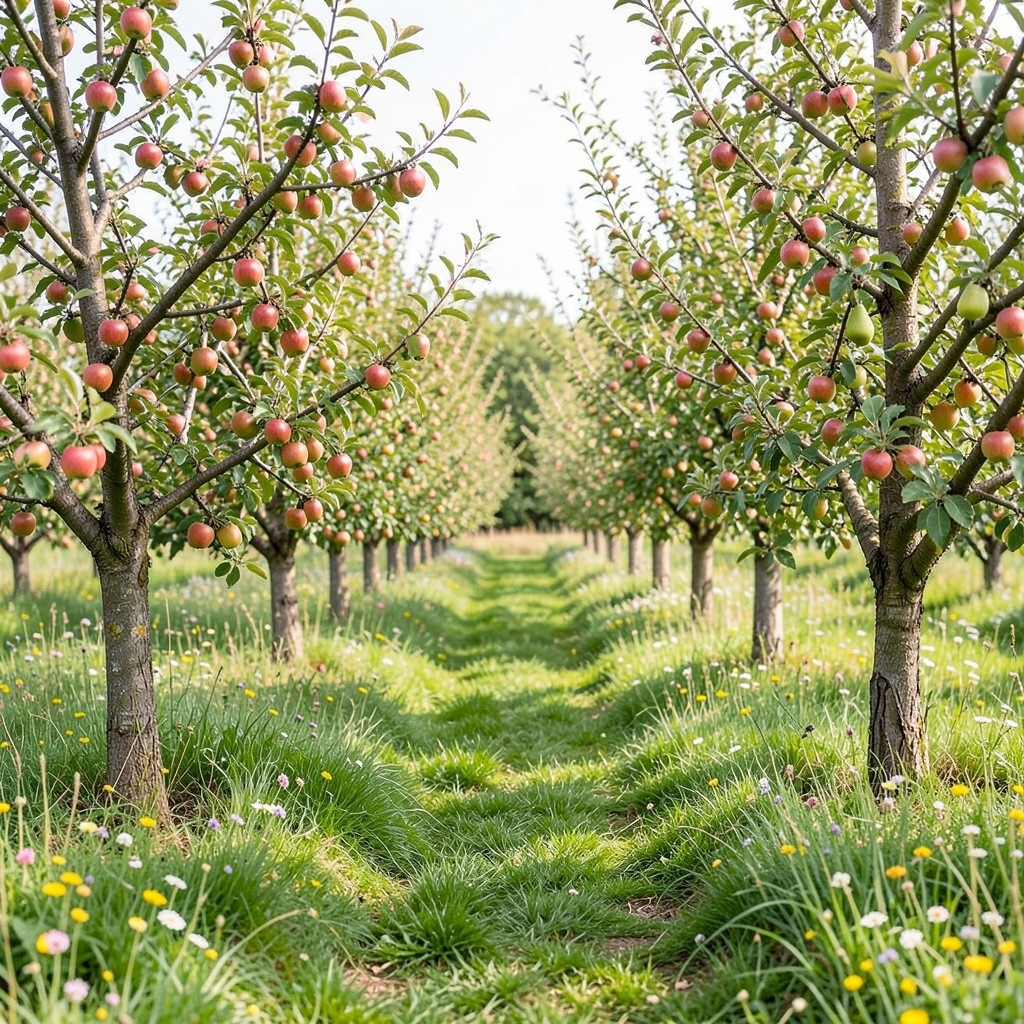
A domestic orchard — a collection of fruit trees planted in a section of the garden managed for fruit production, seasonal blossom, wildlife habitat, and the specific quality of an outdoor space defined by the presence of mature trees — is the garden feature with the longest investment horizon and the deepest quality of return of any garden planting decision available. An orchard planted in a young family’s garden and managed through their children’s growth provides those children with the blossom memory of spring, the harvest memory of autumn, and the physical experience of fruit grown without intermediary that no supermarket purchase replicates.
The rootstock selection for domestic orchard fruit trees determines the mature tree’s size and its productive timeline more directly than the variety selection. A dwarfing rootstock — M9 for apples, Quince C for pears — produces a tree of two to three meters height that begins fruiting within two to three years of planting but requires permanent staking and good soil conditions to perform reliably. A semi-vigorous rootstock — M26 for apples, Quince A for pears — produces a tree of three to four meters height that fruits within four to five years, is largely self-supporting, and tolerates a wider range of soil and growing conditions with more reliability than the dwarfing alternatives.
The grass management beneath an orchard is the detail that determines whether the orchard floor reads as a managed landscape or as a neglected area of rough ground. A close-cut grass path through the orchard, with the grass beneath the tree canopies left long and managed as a wildflower meadow, provides the formal-informal balance that makes a domestic orchard both practically accessible and ecologically valuable. The unmown grass beneath the tree canopies supports the ground-nesting bees, the overwintering invertebrates, and the predatory insects that contribute to the orchard’s pest management far more effectively than any pesticide application.
46. A Garden With a Dry Stone Wall Feature
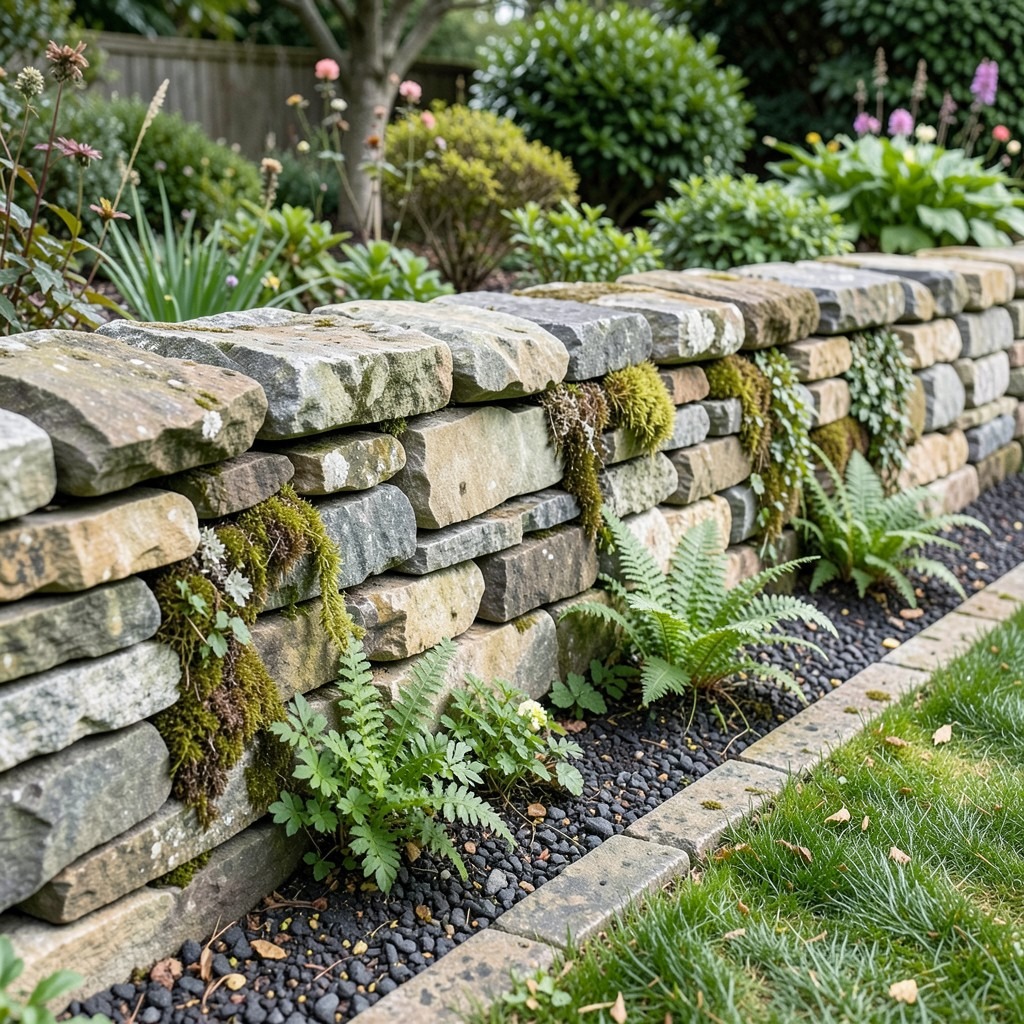
A dry stone wall in a garden — a wall built from local stone laid without mortar, using the interlocking weight and friction of the stones themselves as the structural mechanism — is the garden boundary or feature element with the greatest ecological value per linear meter of any built garden structure, and the one whose material character improves with age rather than deteriorating as conventional mortared construction does when the mortar weathers. The crevices between the stones of a dry stone wall provide nest sites for solitary bees, hibernation sites for reptiles and amphibians, and a specific microhabitat for the wall ferns, mosses, and lichens that colonize undisturbed stone surfaces over decades of settlement.
The stone selection for a dry stone wall must come from local or regional geology where possible — not for the romantic reason of local character, though that matters, but for the practical reason that stone from the local geological formation has already been shaped by the same weathering processes and the same freeze-thaw cycles that the finished wall will experience, which means it behaves with the predictability of a known material rather than the uncertainty of an imported stone in unfamiliar conditions. Limestone behaves differently from sandstone, which behaves differently from granite, and each requires different laying techniques and different selection criteria for the individual stones.
The dry stone wall’s structural stability depends on the batter — the slight inward lean of both faces toward the wall’s center — and on the through-stones that span the full wall width at regular vertical intervals, tying the two outer leaf faces together through the rubble hearting that fills the wall’s core. A dry stone wall built without adequate batter or without sufficient through-stones is a wall that stands while conditions are stable and fails when frost, heavy rainfall, or the gradual creep of the supporting ground removes the stability that careful construction would have built in.
47. A Garden With a Seasonal Color-Focused Border
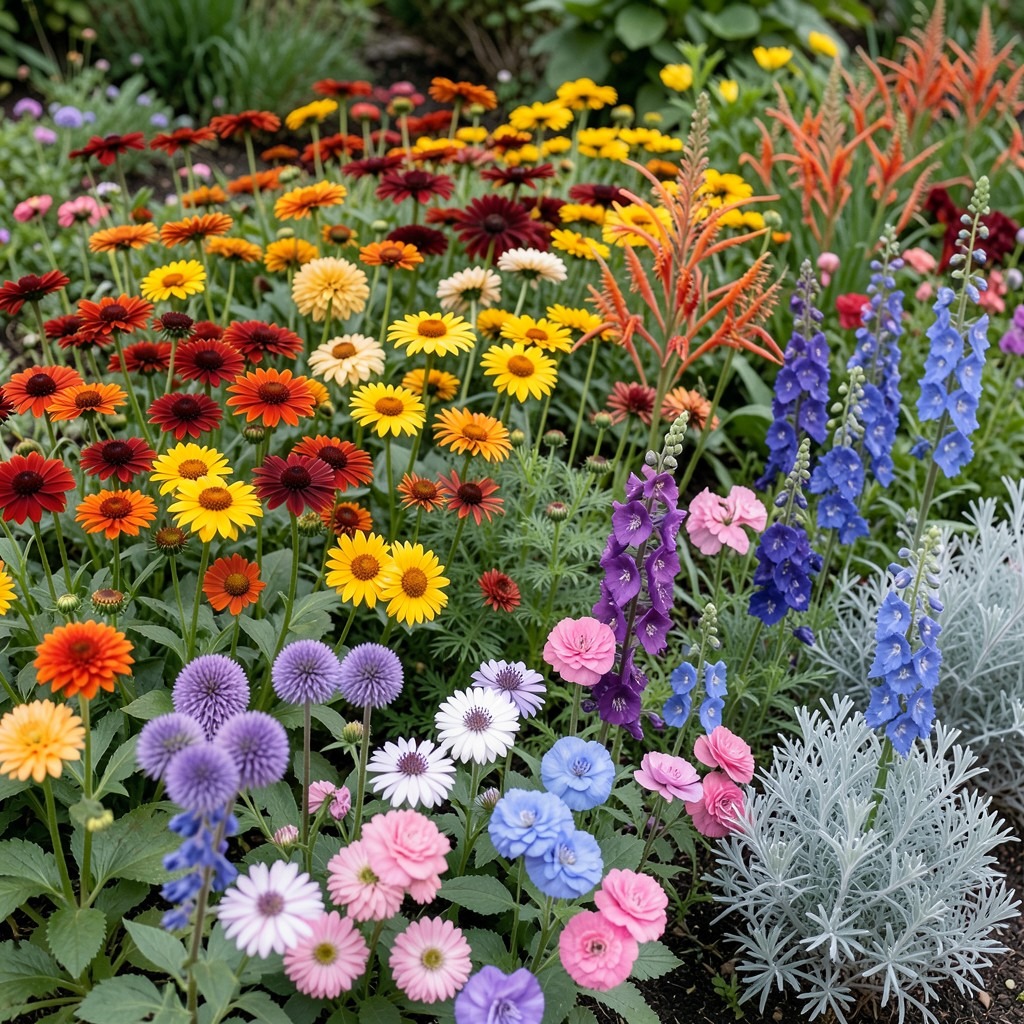
A border designed for specific seasonal colour peak — one whose plant selection, proportions, and succession planting was planned around a defined seasonal window of maximum ornamental effect rather than the general principle of year-round interest — produces a garden moment of concentrated colour intensity that the year-round border, spreading its visual interest across twelve months of mild performance, cannot match within its designated season.
The hot-color summer border — reds, oranges, and deep yellows in a planting scheme whose specific warmth peaks in July and August — provides the seasonal moment that the temperate garden’s planting calendar supports with the widest range of species: heleniums in copper and mahogany, rudbeckias in deep gold, dahlias in all the warm range from pale apricot through orange to near-black burgundy, crocosmias leaping through the neighboring foliage in arching sprays of scarlet and orange. The hot border at peak in August is not a subtle garden experience. It is a concentrated assault of warm colour that demands attention and rewards time spent in front of it.
The cool late-spring border — the planting scheme that peaks in May and June in the blue, violet, pink, and white range — provides the atmospheric counterpoint to the hot border’s midsummer display: alliums in globes of violet-purple above the early perennial foliage, geraniums in clear blue-pink, delphiniums in the specific blue that no other temperate garden plant approaches, and the Rosa glauca with its grey-purple foliage as the border’s cool-toned structural backbone. The seasonal border’s design discipline — accepting that it will be quieter outside its peak period in exchange for the concentrated quality of its best weeks — is the investment in patience that produces the garden’s most compelling annual moment.
48. A Garden With a Statement Garden Gate
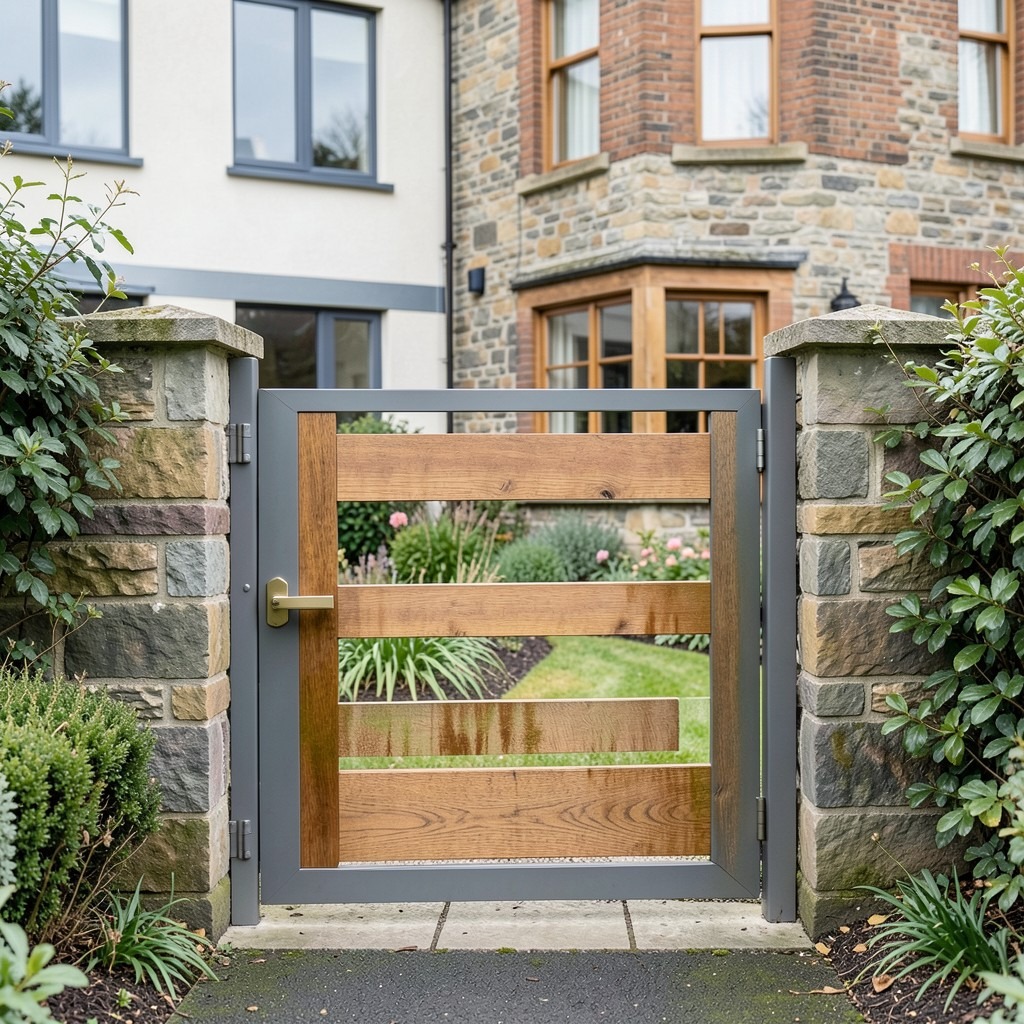
A garden gate — the threshold between the public space of the street or the path and the private space of the garden — is the garden’s first impression and the design element that sets the visitor’s expectations for everything that follows. A gate of genuine quality and considered design communicates that the garden beyond it was made by someone who thinks carefully about the things they make, before the garden itself is seen. A gate of indifferent quality communicates the opposite, and that communication happens before any planting or any material in the garden beyond is encountered.
The gate material and design must respond to the house’s architectural character rather than operating as an independent decorative statement unconnected to its setting. A contemporary house with clean steel windows and a rendered facade suits a gate in a powder-coated steel with minimal horizontal and vertical bar sections at a consistent weight — the gate as a piece of industrial design rather than a craft object. A period house in stone or brick with timber windows suits a timber gate in a hardwood of sufficient durability — iroko, oak, or accoya — in a design whose proportions reference the building’s own timber elements.
The gate’s hardware — the hinges, the latch, the bolt, and the handle — is the detail that most immediately reveals the quality of the gate’s specification. Hardware in a stainless steel or a marine grade brass, specified for outdoor use and installed with fixings of the same corrosion resistance as the hardware itself, provides the longevity that the gate’s structural investment requires. Gate hardware in a plated finish that corrodes within the first winter and leaves rust streaks down the gate face is the quality failure that undermines the gate’s entire design contribution from the first frost.
49. A Garden With a Green Roof on a Garden Building
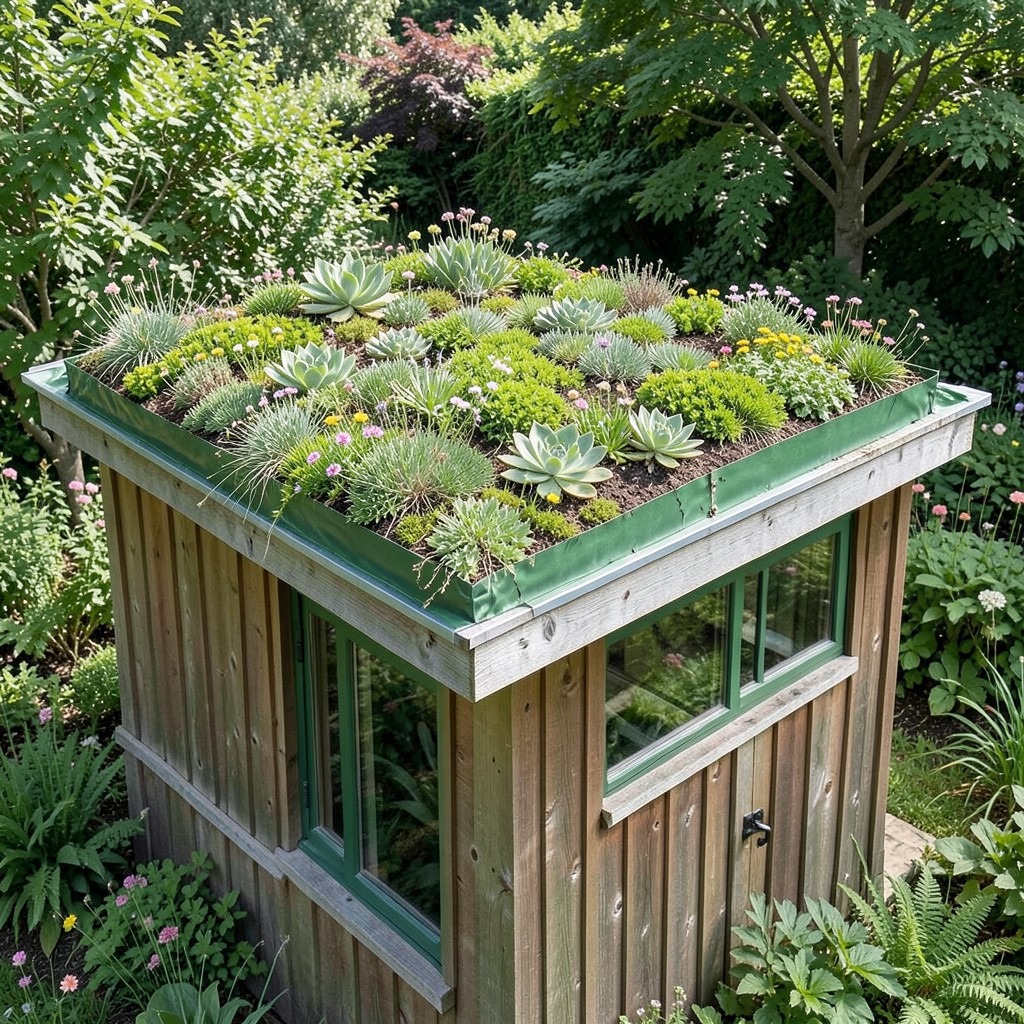
A green roof on a garden studio, shed, or outbuilding — a planted roof surface rather than a conventional felt, tile, or metal roof — is the garden design feature that provides ecological habitat at roof level, improves the building’s thermal performance, manages a portion of the rainwater that the roof would otherwise discharge to the drainage system, and provides the garden with an additional planted surface that contributes to the garden’s biodiversity without occupying any ground-level area.
The green roof construction — a waterproof membrane over the roof structure, a root barrier above the membrane, a drainage layer, a filter layer, and the growing medium topped with the planted layer — must be specified with reference to the roof structure’s load-bearing capacity, because the saturated green roof growing medium at its maximum water content adds a load of between eighty and one-hundred-and-fifty kilograms per square meter depending on the growing medium depth. The structure supporting a green roof requires assessment by a structural engineer before installation, particularly for existing garden buildings whose original construction was specified for a conventional lightweight roof covering rather than a planted one.
The sedim green roof — a shallow-substrate extensive green roof planted with sedum species and other low-growing, drought-tolerant succulents — is the standard domestic green roof specification for its combination of low growing medium depth, low weight, minimal maintenance requirement, and genuine ecological value for pollinators. The sedum species that colonize an extensive green roof in a temperate climate provide a flowering period from April through September that delivers nectar and pollen to the garden’s bee and butterfly community from a surface that would otherwise contribute nothing to the garden’s ecological function.
50. A Garden That Grows With the Life You Are Living
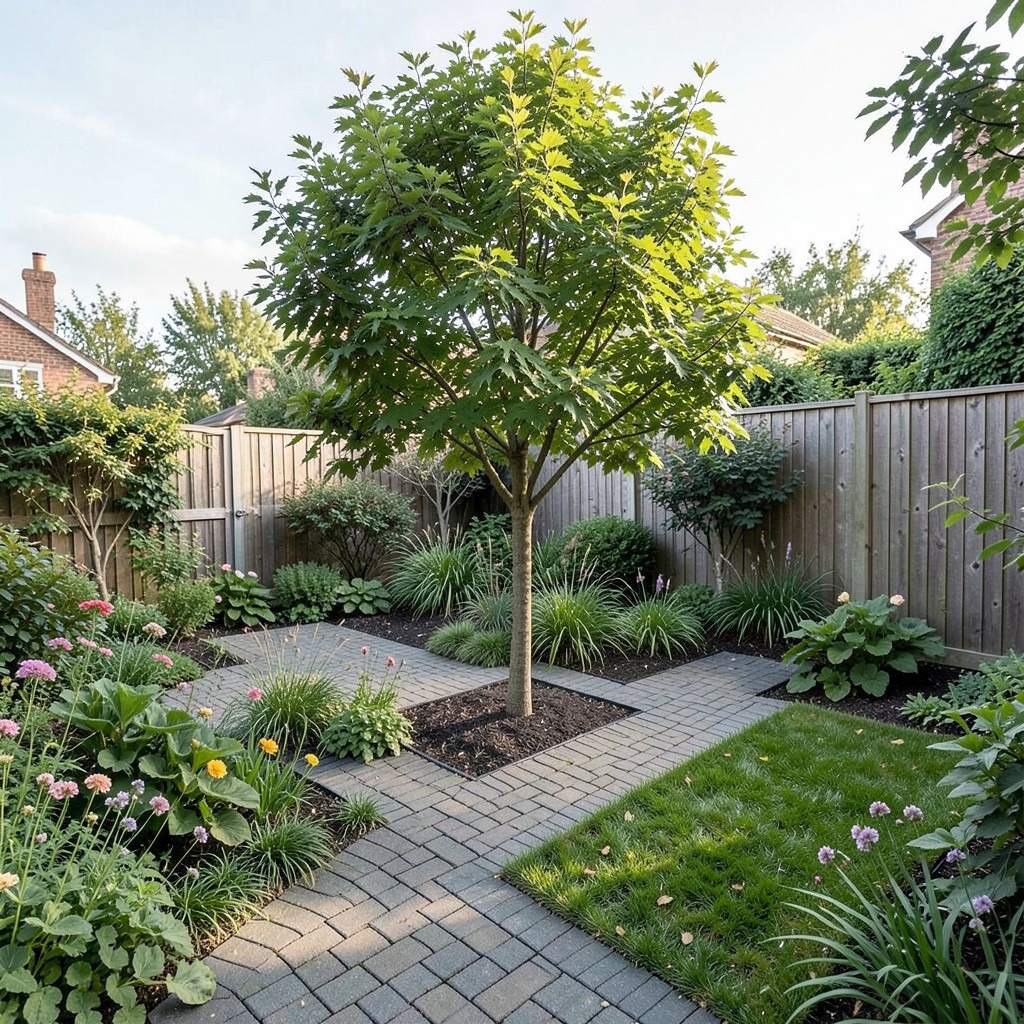
The garden that works across the years is not the one built to the plan drawn at the moment of maximum design enthusiasm and then maintained unchanged through every subsequent season. It is the garden whose design was honest about the household’s current circumstances — the energy, the time, the children’s ages, the growing experience, the budget — and then allowed to grow and change as those circumstances evolved, accumulating the quality that only time and genuine engagement produce.
Begin with the ground plane and the bones: the paving, the paths, the boundaries, and the single tree or structural planting decision that the garden needs most urgently and that will take the longest to establish. Plant the tree before any other decision is finalised, because the tree that was planted ten years from now will be needed ten years from now, and no amount of other garden work substitutes for a tree whose planting was indefinitely deferred. The rest of the design can arrive in sequence — the borders, the hard landscaping, the built features, the lighting — but the tree starts now.
The garden designed from the inside out — starting from the view from the kitchen window and working outward from the most used outdoor threshold toward the garden’s perimeter — is the garden that serves the household daily rather than performing for the occasional planned visit. Identify the one thing your garden currently lacks that you feel most strongly every time you walk out the back door. Fix that one thing first. Build the rest from there. The garden that grows from honest observation of your own daily life will always serve you better than the one built to the standard of a design guide’s prescribed outcome — and these fifty ideas were written to give you the range of options from which to choose the ones that are genuinely yours.
Leave a Reply