Every design decision in a room floats above the floor. The furniture rests on it, the walls rise from it, the light bounces off it, and every person who enters the room makes contact with it in the most physical sense possible — they walk across it, they sit on it, they feel its temperature through their feet before they consciously register its color or pattern. The floor is the room’s foundation in the most literal sense, and it is also, paradoxically, the surface that most homeowners approach with the most anxiety and the least confidence. The wall color can be changed in a weekend. The floor is the decision you live with for a decade or longer, and that permanence turns what should be an exciting design decision into a cautious, risk-averse one whose outcome is usually the safest option in the showroom rather than the right option for the room.
The floor’s design impact on a room’s overall character is structural rather than decorative. When the wall color changes, the room’s atmosphere changes. When the floor changes, the room’s identity changes. A room whose floor is wide-plank natural oak and a room whose floor is polished concrete are not the same room with different surfaces underfoot — they are fundamentally different rooms whose entire material logic, their acoustic behavior, their thermal character, their relationship with light, and the furniture that makes sense within them are all shaped by that one decision made at the lowest level of the space. This is why the floor deserves more design attention than it typically receives, and why the homeowner who approaches the Flooring Design Ideas decision with genuine thought rather than with a budget limit and a safety preference ends up with rooms that reward the investment at every scale of experience.
The range of flooring options available in contemporary residential design is wider than at any previous point in the history of domestic interiors, and that width creates its own specific challenge. The choice between twenty types of timber flooring, twelve categories of stone, six varieties of ceramic and porcelain, four grades of carpet, and the expanding territory of engineered, luxury vinyl, and specialist finishes produces a decision space so large that most people navigate it by narrowing immediately to the familiar — the product they have seen before, the material their neighbor used, the display that was at the front of the showroom. The narrowing is understandable. But the decisions made within the narrow range produce the average result, and average floors produce average rooms.
The practical constraints of the flooring decision are real and they are the correct place to start. The room’s subfloor condition determines which materials can be installed and at what cost. The household’s occupancy pattern — the pets, the children, the volume of traffic through specific zones — determines the durability specification that the design must meet. The room’s heating system — whether underfloor heating is installed or planned — determines which floor materials are thermally compatible and which are not. The building’s floor-to-ceiling height determines whether certain thick floor constructions will compromise the room’s proportion or the function of the door thresholds. These are the physical facts that the design must respect, and any flooring idea in this collection that does not work within your room’s specific conditions is not the right idea for your room, regardless of its atmospheric quality in the photograph.
The seasonal dimension of flooring design is consistently underappreciated. A floor that suits the summer home design direction — the pale, reflective, cool-toned surface that amplifies the room’s light and supports the airy home interiors quality of a warm-weather interior — may feel cold and hard during winter home decor months when the household needs warmth, texture, and the comfort of soft materials underfoot. The floor that performs well across the full seasonal range — the warm-toned timber, the stone with underfloor heating, the carpet whose specific pile weight is neither too formal nor too casual for any season — is the floor whose investment compounds rather than depreciates as the years and the seasons pass over it.
1. Wide-Plank Solid Oak Flooring
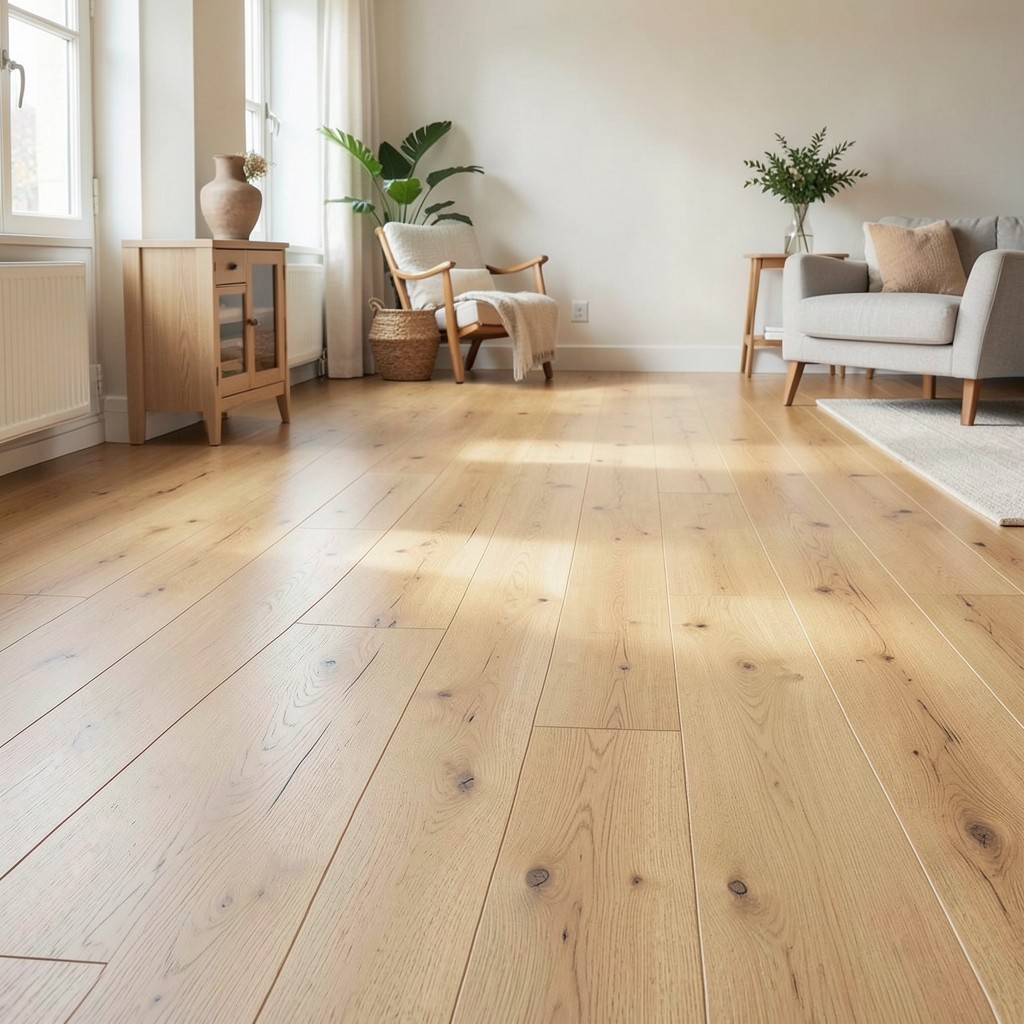
Solid oak flooring in a wide-plank format is the floor that most consistently delivers what every other floor is trying to approximate — the warmth of genuine natural material, the character of wood grain at a width that allows each board’s full individuality to read, and the permanence of a floor whose depth allows sanding and refinishing across decades of occupancy rather than replacement when the surface wears. Wide-plank oak is the floor that gets better with age. Not all floors can make that claim honestly, and the ones that cannot are usually pretending to be this one.
The plank width is the specification variable that most determines the floor’s design register. A narrow strip floor in twenty-five to fifty millimeter boards reads as traditional, formal, and compact — the floor of the period townhouse whose rooms are sized and detailed for a narrow-board aesthetic. A wide-plank floor in one hundred and fifty to two hundred and fifty millimeter boards reads as generous, relaxed, and contemporary — the floor whose width signals space, confidence, and the farmhouse home decor quality of a room whose material abundance is expressed in the size of the boards underfoot. The wider the plank, the more the individual board’s grain character is visible, and the more the floor reads as material rather than as pattern.
The finish specification of a solid oak floor determines its daily maintenance requirement, its appearance under different light conditions, and its contribution to the room’s atmospheric palette. A white oil finish on natural oak produces the pale, Scandinavian home interior quality of a floor that appears almost blonde in daylight and warm cream in evening light, whose matte surface absorbs rather than reflects the light and whose color suits the minimalist home design or the airy home interiors direction equally well. A hardwax oil in a natural tone allows the oak’s natural warm amber to develop with age, and this is the finish most consistent with the stone and wood home design direction whose material philosophy is to let the natural material perform without significant alteration of its inherent character.
2. Herringbone Parquet Flooring
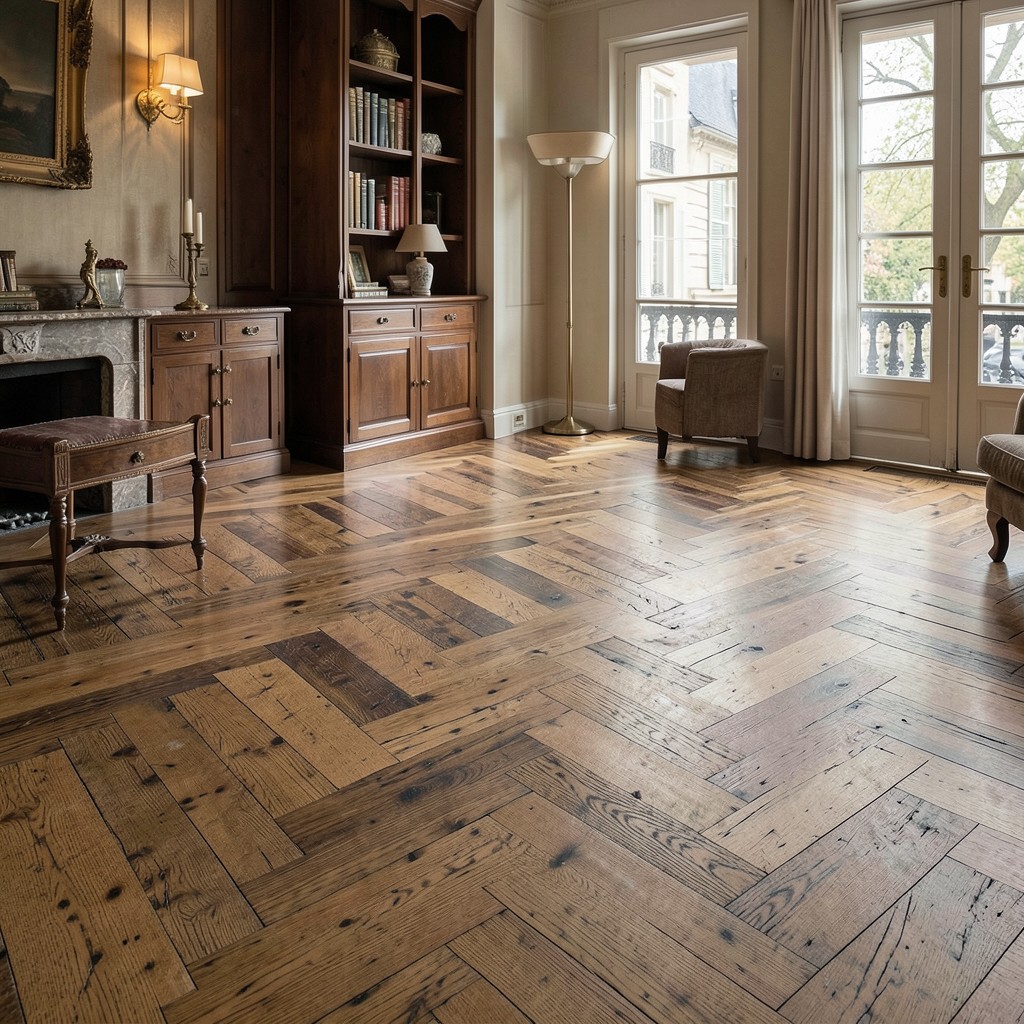
A herringbone parquet floor carries more design authority per square meter than almost any other residential flooring format, and the reason is the pattern’s specific combination of geometric precision and material warmth — the two qualities that most domestic interiors need to balance but that most floor treatments provide only one of. The herringbone is not a new floor idea. It is an old floor idea so well-resolved that centuries of application in the finest European interiors have not improved on it, only varied the material and the scale in which it is executed.
The herringbone pattern’s directional energy — the alternating diagonal of each course directing the eye in a continuous chevron movement across the floor plane — produces the spatial effect of a floor that appears larger than its measured area because the eye is given movement to follow rather than a static field to rest on. This is the counterintuitive quality of the herringbone that most floor selection guides miss: the pattern adds apparent space rather than reducing it, provided the individual block or strip dimension is correctly scaled for the room. A block of seventy millimeters width in a room of thirty square meters reads correctly. The same pattern at thirty millimeters width produces a visual density that makes the room feel smaller rather than larger.
The material selection for a herringbone parquet spans from the reclaimed antique parquet of the French château — original nineteenth-century oak blocks in the dimensional irregularity of genuinely aged timber whose surface has been worn, waxed, and worn again across multiple lifetimes — through the engineered oak herringbone strip of the contemporary residential installation whose dimensional stability and ease of installation suit the heated screed subfloor that a period antique block cannot tolerate. The reclaimed herringbone is the floor of the luxury home interior whose material authenticity is the design priority. The engineered herringbone is the floor of the contemporary home ideas renovation whose performance, consistency, and installation practicality are the priority alongside the design quality.
3. Polished Concrete Flooring
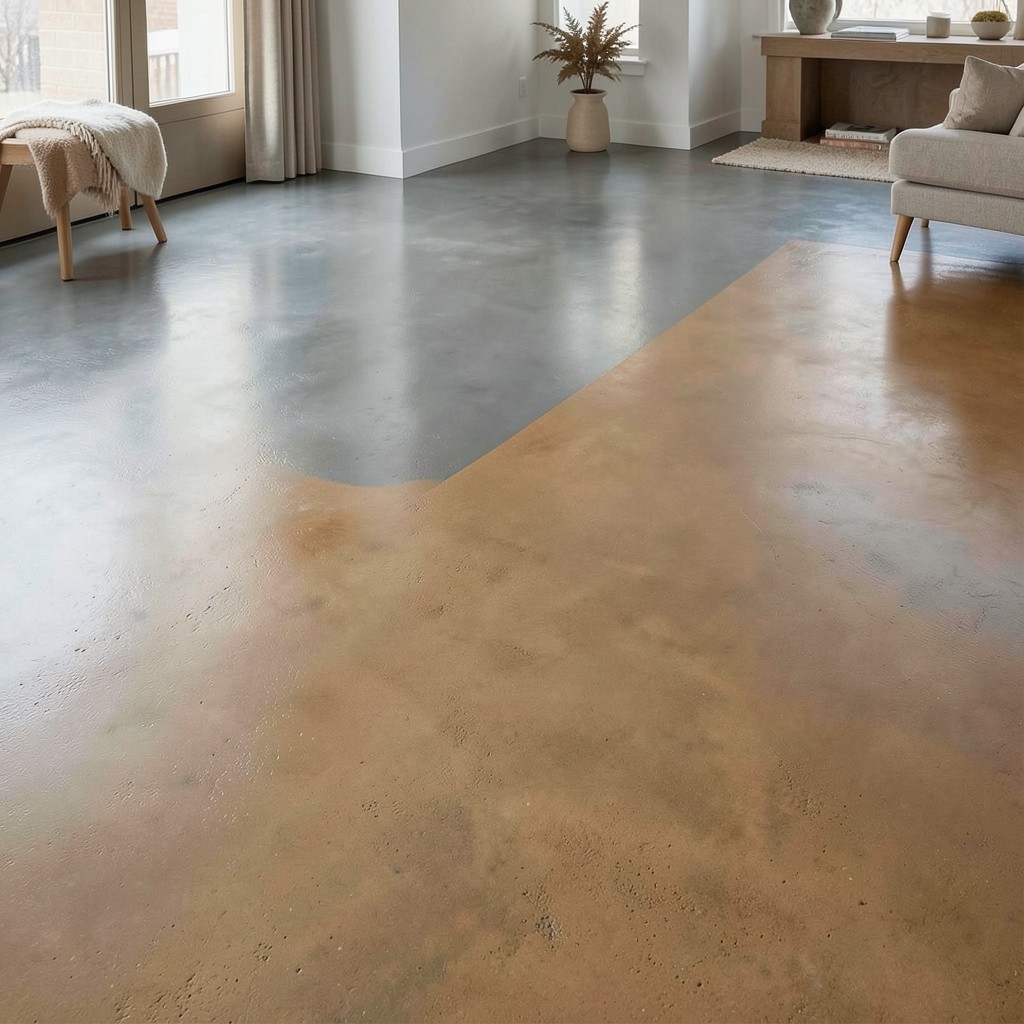
Polished concrete is the floor that divides opinion most sharply in residential design circles, and the division says as much about what people want from their floors as it does about the material itself. Those who find polished concrete cold, hard, and unforgiving are responding to the material’s actual physical properties — it is thermally cold without underfloor heating, acoustically hard in a room without soft furnishings, and unforgiving on anything dropped onto its surface. Those who find it beautiful, architectural, and spatially generous are also responding to the material’s actual properties — because all three of those assessments are equally true. The decision to use polished concrete is the decision to accept the material’s full character, not to select the flattering aspects while denying the demanding ones.
The polished concrete floor’s color is determined by the concrete mix’s aggregate composition, the water-cement ratio, and the mineral pigments added to the mix if the natural grey is not the desired outcome. A standard grey concrete floor polished to a medium sheen reads as the industrial home design aesthetic at its most authentic — the smooth, mineral surface whose color ranges from pale ash grey to deep charcoal depending on the mix, the aggregate, and the polishing level. A concrete floor with a warm ochre or terracotta mineral pigment added to the mix produces the desert home styling or earthy home design quality of a warm, mineral floor whose color is geological rather than applied.
The underfloor heating specification beneath a polished concrete floor is not optional in a domestic interior that occupies a climate with cold seasons. Bare concrete without underfloor heating in a winter interior design context produces a floor whose thermal extraction from standing feet is the most immediate sensory experience in the room — and that experience overrides every visual quality the floor provides. A polished concrete floor over a well-specified electric or hydronic underfloor heating system is a completely different floor from the same concrete without it: warm, thermally mass-generous, and the floor that holds heat longer than any other after the system cycles off.
4. Encaustic Cement Tile Flooring
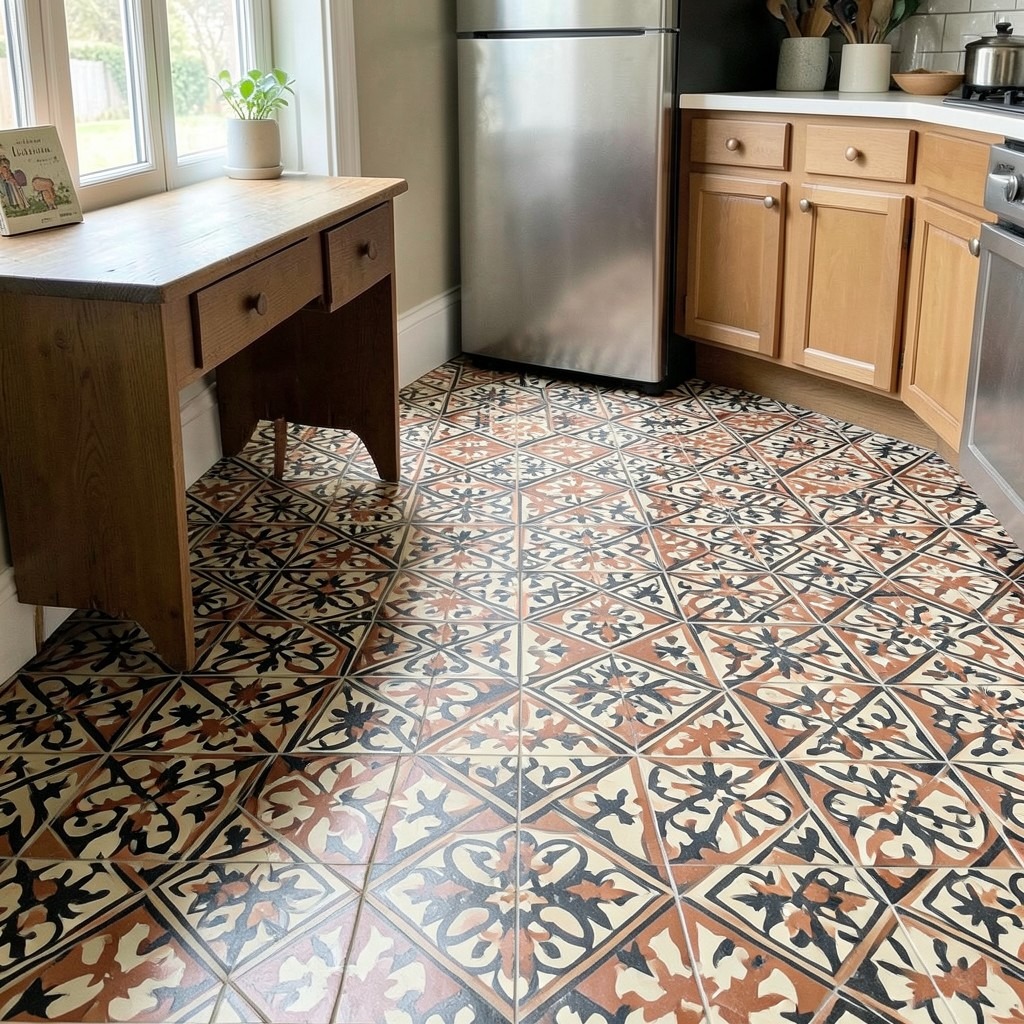
Encaustic cement tiles — the handmade, pigmented cement tiles whose pattern is inlaid into the tile body during the manufacturing process rather than printed or glazed over a fired ceramic surface — are the floor material that produces the single most immediate impact of any tile flooring option, and whose installation in a domestic space converts the floor from a surface into a composition. The pattern logic of an encaustic tile floor is cumulative: each individual tile contains one element of the repeat, and the full pattern only resolves across the field of multiple tiles in the complete installation. You are not selecting a tile. You are selecting a floor composition.
The color palette of encaustic cement tiles spans the full range from the bright, saturated primary combinations of the traditional Moroccan and Spanish encaustic traditions through the dusty, oxidized earth tones of the artisan studio tile to the paired two-color geometric of the Victorian encaustic floor tile whose black and white or buff and terracotta combinations defined the entry halls and kitchen floors of the Victorian domestic interior. The fall kitchen decor or the farmhouse home decor kitchen floor in a terracotta and cream encaustic geometric produces the specific material quality of a floor that reads as historical without being a reproduction — the pattern is from the tradition, but the specific tile, the specific installation, and the specific room are entirely contemporary.
The practical care requirement of an encaustic cement tile floor is the honest caveat that the visual quality requires. The cement surface is porous and requires sealing before installation, re-sealing periodically during service, and specific maintenance products that preserve the sealant rather than attacking it. An unsealed encaustic tile floor stains permanently from oil, coffee, and acidic liquids within the first use, and this is not a minor caveat — it is a fundamental care condition that determines whether the floor’s visual quality is maintained across its service life. The sealed and correctly maintained encaustic tile floor, however, is the floor that the best rooms in this article’s design range are built on.
5. Large-Format Porcelain Tile Flooring
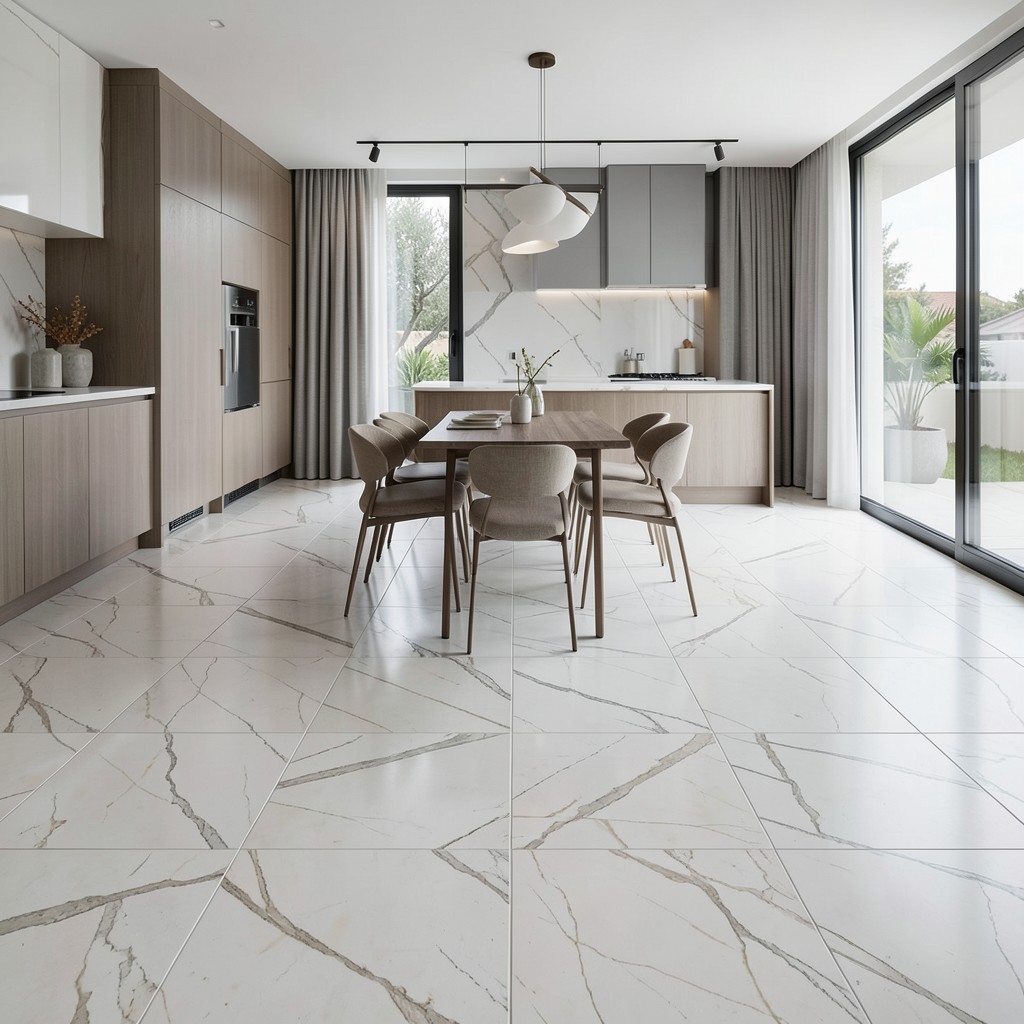
Large-format porcelain tiles — floor tiles whose individual dimensions exceed six hundred by six hundred millimeters and whose face spans from the standard eight hundred by eight hundred format through the rectangular twelve hundred by six hundred format to the slab format of twelve hundred by twenty-four hundred millimeters or larger — are the floor format that most efficiently produces the quality of a continuously surfaced floor whose grout joint interruptions are reduced to the minimum that installation tolerances permit. The large format reads as expansive, controlled, and architecturally serious in a way that smaller format tiles arranged in the same material do not achieve, because the fewer the joints, the more the floor reads as a single material field rather than as a collection of individual tiles.
The stone-effect large-format porcelain — the tile whose surface replicates the veining, the color variation, and the surface texture of natural marble, travertine, limestone, or slate — is the most widely installed residential floor tile in the current market, and the reasons for its dominance are the combination of practical performance and design quality that no natural stone tile matches simultaneously. The porcelain’s fired vitrified body is impervious to moisture penetration, resistant to most household staining agents, dimensionally stable across temperature changes, and consistent in color and pattern across an entire production batch — qualities that natural stone provides none of with equivalent reliability.
The minimalist dining room or the modern kitchen ideas direction that adopts large-format porcelain in a pale marble-effect finish — the veining reading as a composed pattern across multiple tiles whose joint positioning was planned to avoid cutting the principal vein lines at the room’s center — produces the floor of the luxury home interior at the maintenance performance of an engineered product. The planning of a large-format tile floor — laying the tiles dry across the room before cutting and fixing, ensuring the principal pattern features land in the optimal positions — is the installation step that separates a professional-quality installation from one whose full-size tiles happen to end at whatever point they fall.
6. Reclaimed Brick Paver Flooring
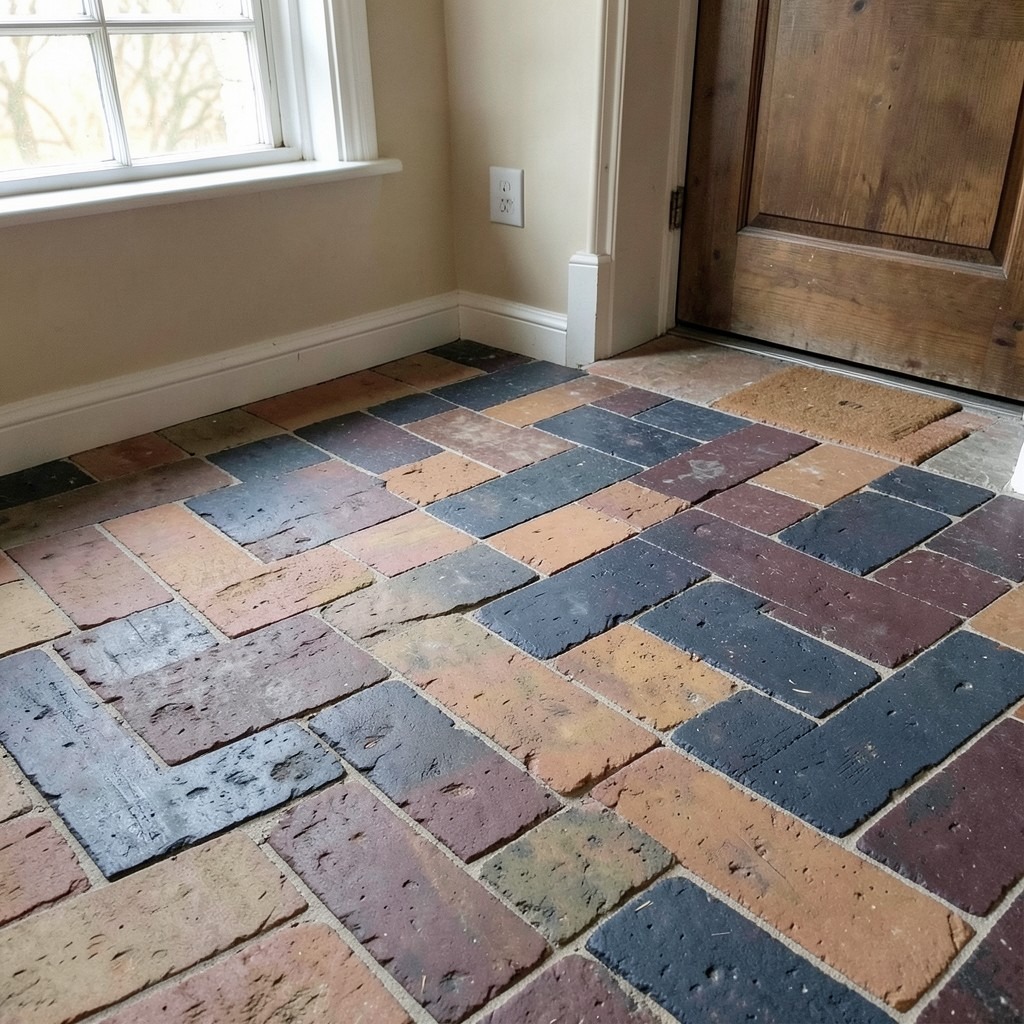
Reclaimed brick pavers — original clay bricks salvaged from demolished Victorian, Edwardian, or industrial buildings, cleaned and laid flat as floor tiles rather than stacked as wall masonry — are the floor material whose accumulated material history is visible in every surface variation, fire mark, and wear pattern that the bricks’ prior service has deposited on their faces. The reclaimed brick floor is not a rustic aesthetic choice. It is a material-honest choice whose specific quality comes from the fact that the floor’s character was earned in a previous life rather than manufactured to appear as though it was.
The color variation of reclaimed clay brick pavers spans the range from the pale buff and cream of London stock brick through the warm red-orange of the Midlands handmade machine-pressed brick to the deep plum-red and blue-engineering combinations of the Victorian stable floor and the heavy-duty industrial pavement. Each regional and period brick tradition produces a different color palette, and the palette of the selected bricks determines the floor’s contribution to the room’s overall color scheme more directly than any other specification variable. A floor of pale buff stock brick laid flat in a herringbone arrangement reads as warm, Mediterranean, and rustic home decor in character. The same herringbone in deep engineering blue-red brick reads as darker, harder, and more industrial home design in register.
The practical installation of reclaimed brick pavers as a floor requires attention to the thickness variation that hand-made and hand-pressed bricks exhibit — the individual brick’s face dimension and thickness are not uniform in the way that modern machine-made bricks are, and the bedding mortar must accommodate these dimensional variations rather than being specified at a uniform depth. The finished floor level must account for the brick’s additional height above a standard tile floor, and the door thresholds in the room must be adjusted if the existing floor is being replaced with brick whose total construction thickness differs from the original floor build-up.
7. Bamboo Flooring
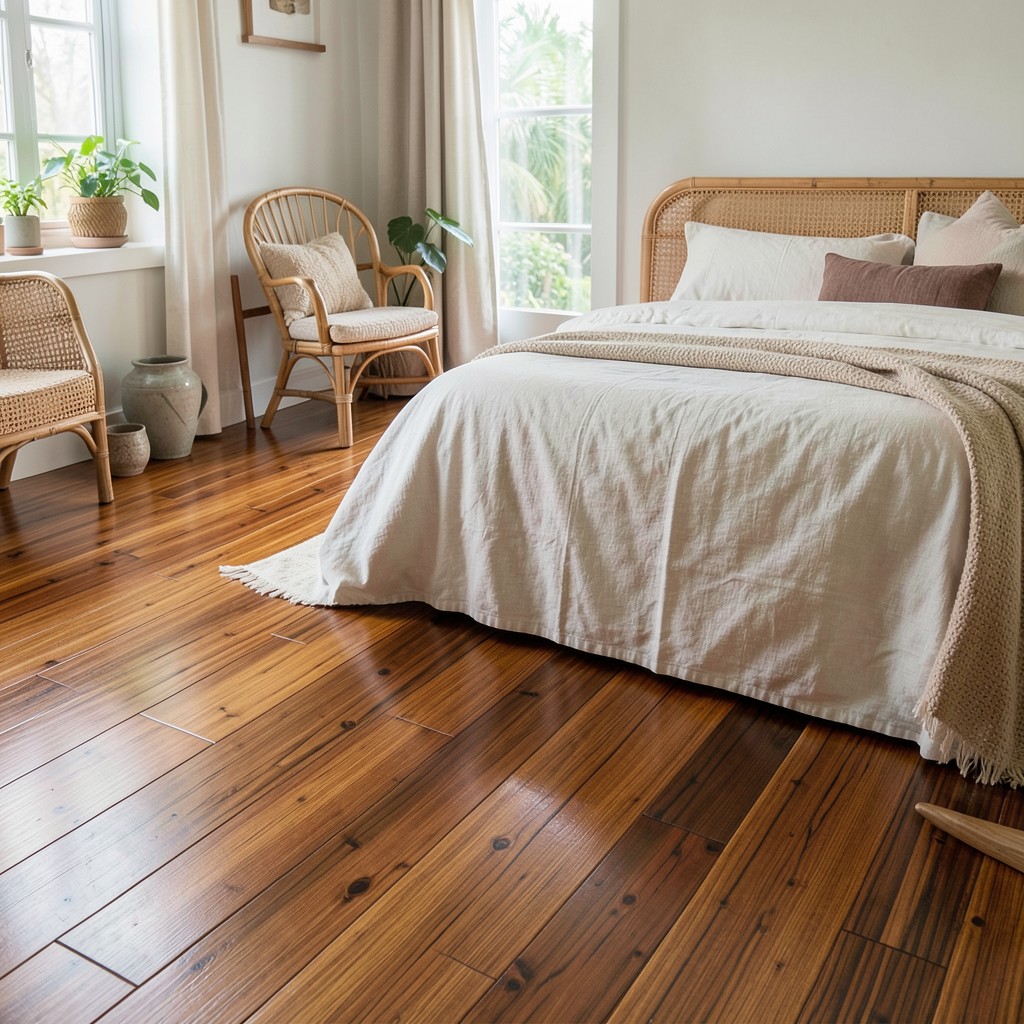
Bamboo flooring has spent the last decade being categorized as an eco-friendly alternative to timber flooring, and that categorization — while accurate — undersells the material’s actual design quality in the domestic interior. Bamboo floors are beautiful in a way that the sustainability narrative rarely gets around to discussing, because the bamboo stem’s growth structure produces a grain and surface character that is genuinely distinct from timber rather than being an approximation of it. The bamboo home interiors direction finds in bamboo flooring its most natural material expression at the floor level — the material consistent throughout the room rather than imported as an accent from another source.
The strand-woven bamboo — bamboo fiber compressed under high pressure into a dense, exceptionally hard board — produces the floor whose surface hardness exceeds most domestic hardwood species and whose dimensional stability in conditions of humidity variation surpasses solid timber with equivalent performance. This is the bamboo floor for active household rooms, for kitchens, for hallways, and for the high-traffic areas of a family home whose floor must perform as well as it looks. The strand-woven bamboo’s surface, when finished in a natural or medium stain, produces the warm, fine-grain quality of a floor that reads as timber from a distance and reveals its bamboo identity at close range in the characteristic node marks and the slightly different grain direction that appear within the compressed fiber.
The carbonized bamboo floor — bamboo that is steamed under pressure to caramelize its natural sugars, producing a rich caramel or chocolate brown color throughout the material’s depth rather than as a surface stain — provides the darker, warmer bamboo floor tone that suits the tropical home design and warm home decor ideas directions. The carbonization process produces the color and softens the material slightly compared to natural bamboo — a practical tradeoff that the design-focused specification should acknowledge. The carbonized bamboo floor in a bedroom with natural linen textiles, rattan furniture, and ceramic accessories produces the complete material environment of the bamboo home interiors direction at its most atmospherically coherent.
8. Limestone Flooring
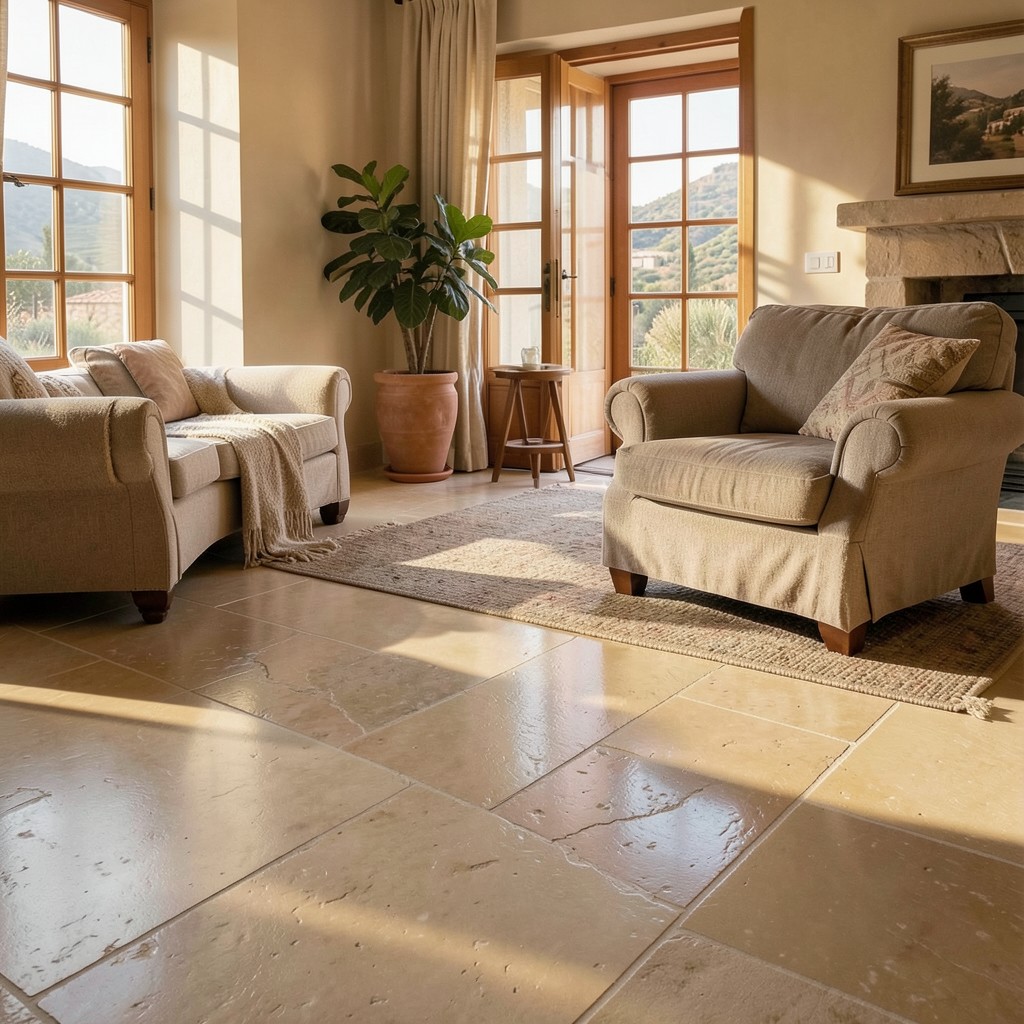
Limestone is the floor material that most reliably produces the specific quality of a room that belongs somewhere — the Provençal farmhouse, the Mediterranean villa, the desert hacienda, the English manor — because limestone is a regional material whose color, grain, and surface quality are determined by the geological deposit from which it was quarried, and geological deposits belong to places in a way that manufactured materials do not. A floor of French Burgundy limestone is a floor that is specifically, irreducibly French. A floor of Jerusalem stone is a floor from the hills above that city, and the pale honey warmth of its surface is the color of those hills in morning light.
The surface finish of limestone determines its practical performance and its atmospheric quality in equal measure. A honed limestone — ground smooth but not polished to a shine, producing a matte, slightly warm surface that reads as stone rather than mirror — is the correct finish for domestic floor applications where foot traffic, furniture contact, and the general activity of a household are the conditions the floor must withstand. A polished limestone — buffed to a moderate reflective sheen — is more vulnerable to surface scratching and requires more consistent maintenance than the honed version, but it provides the luxury home interior quality of a floor that reflects the room’s light back upward and amplifies the sense of space and luminosity in the room above it.
The thermal mass quality of limestone flooring — the material’s ability to absorb heat during the day and release it slowly over the cooler evening hours — is the performance characteristic that makes limestone the ideal floor material for rooms with significant sun exposure through south or west-facing glazing. The fall home decorating context where a limestone floor in a south-facing sitting room has been storing the afternoon sun’s warmth and releasing it into the room during the cool evening is the floor performing its thermal role in addition to its visual one. This is the floor that earns its specification through performance as well as appearance.
9. Patterned Vinyl Plank Flooring
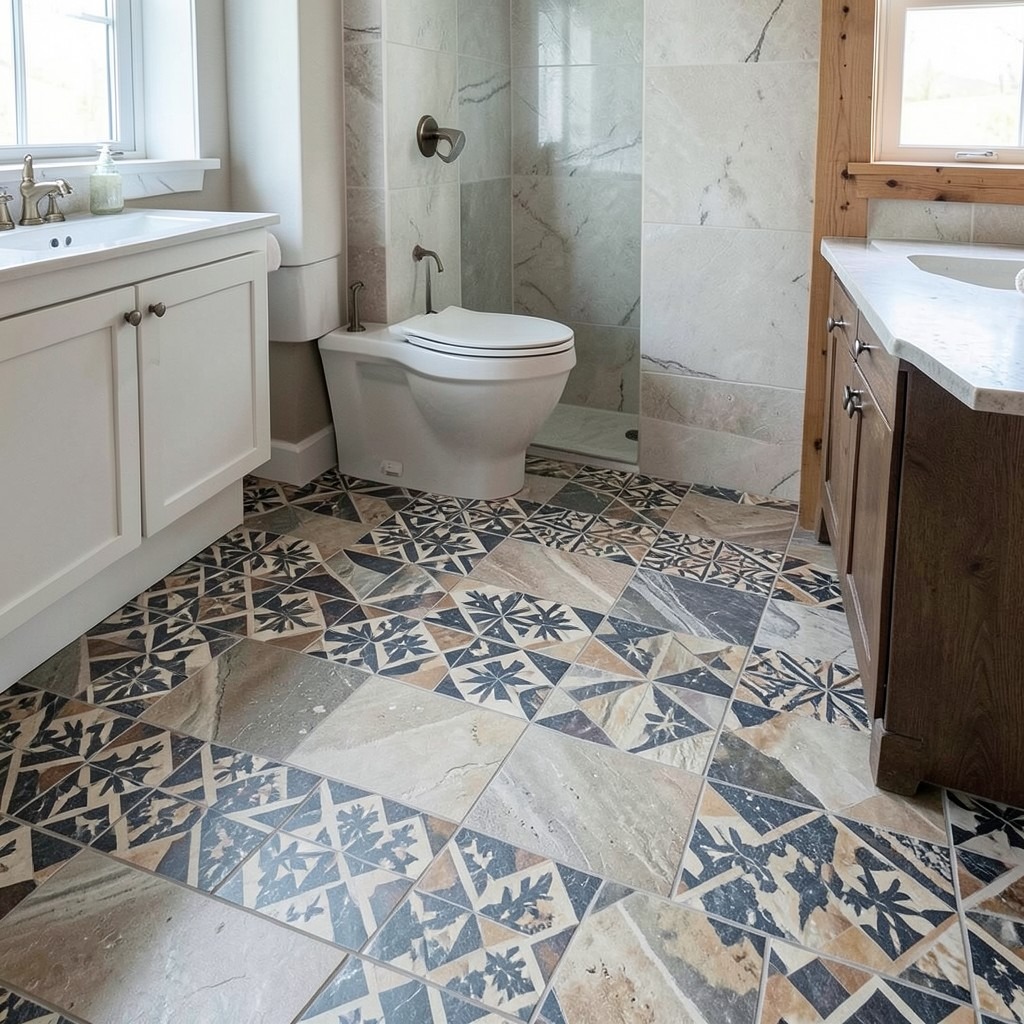
Luxury vinyl plank flooring whose surface layer carries a bold geometric, tile-pattern, or wood-effect print — positioned here not as a budget compromise but as a deliberate design choice whose specific practical advantages in demanding domestic environments are as relevant as its design qualities — is the floor treatment that the residential renovation market has most dramatically misunderstood by treating it as the material you use when you cannot afford something else, rather than the material you specify when the application demands its specific combination of waterproof performance, acoustic comfort, dimensional stability, and installation simplicity that no other floor category provides simultaneously.
The design-forward luxury vinyl tile in a bold encaustic pattern — the vinyl tile whose printed surface replicates the geometric color combinations of the handmade encaustic cement tradition with the technical accuracy of high-resolution digital printing — provides the design quality of the encaustic tile floor without the maintenance conditions, the weight loading implications, or the installation complexity that the genuine article requires. In a farmhouse bathroom decor application, where the floor sees daily water contact and regular cleaning with household products, the encaustic-pattern vinyl tile provides the complete visual program of the traditional tiled floor at the practical performance of a waterproof, dimensionally stable, resilient surface.
The large-format patterned luxury vinyl plank in a stone effect — the vinyl whose printed surface replicates a wide-plank travertine or concrete-look tile — provides the coastal home design or modern home design kitchen floor at a thickness and weight loading that a timber-suspended floor can carry without structural reinforcement. This is the specific application advantage that makes the luxury vinyl plank a design choice rather than a compromise for the residential renovation on a timber-framed suspended floor above ground level, where the weight of natural stone or ceramic tile would require structural engineering work to support that the vinyl eliminates entirely.
10. Black and White Checkerboard Tile Flooring
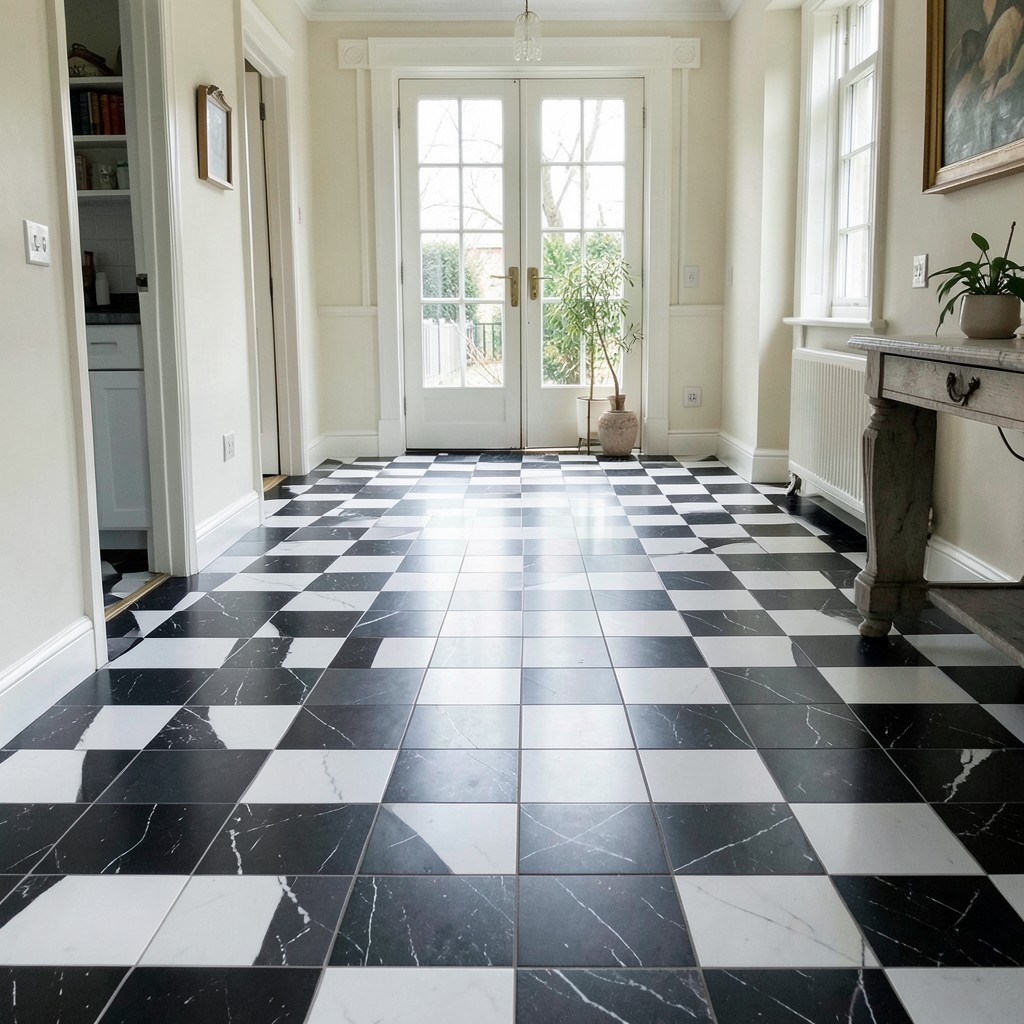
A black and white checkerboard tile floor is the floor design whose visual power and design authority have been consistent across three centuries of domestic interior application, from the Georgian entrance hall through the Victorian kitchen through the Edwardian scullery to the contemporary chic home decor renovation that adopts the pattern with complete confidence and finds it as fresh, as graphic, and as spatially powerful as it was when it first appeared in the domestic interior vocabulary. The checkerboard is not a nostalgic choice. It is a pattern so geometrically resolved that it has not aged because it was never a trend.
The tile scale is the variable that most determines the checkerboard floor’s design register and its relationship with the room’s spatial character. Small-format tiles — fifty to one hundred millimeters square — produce the fine checkerboard of the Victorian and Edwardian kitchen floor tradition, whose pattern density reads as textile-like from a standing height and whose individual tile size is scaled to the human hand rather than to the room’s plan dimensions. Large-format tiles — three hundred millimeters and above — produce the bold, graphic checkerboard whose scale reads as architectural from the room’s entry point and whose pattern geometry is the primary design statement of the space.
The material selection for a checkerboard floor spans from the authentic natural stone of the Georgian tradition — black Belgian marble and white Carrara marble, the combination of two geological materials whose contrast produces the floor quality of a building whose materials were sourced from the earth with genuine deliberation — through the durable, low-maintenance porcelain format whose performance suits the traditional home interiors kitchen or farmhouse home decor hallway where the checkerboard pattern is desired but the natural stone’s care requirements are not compatible with the room’s daily demands. Either material serves the pattern. The pattern serves any room that adopts it with the full commitment it deserves.
11. Engineered Oak Flooring
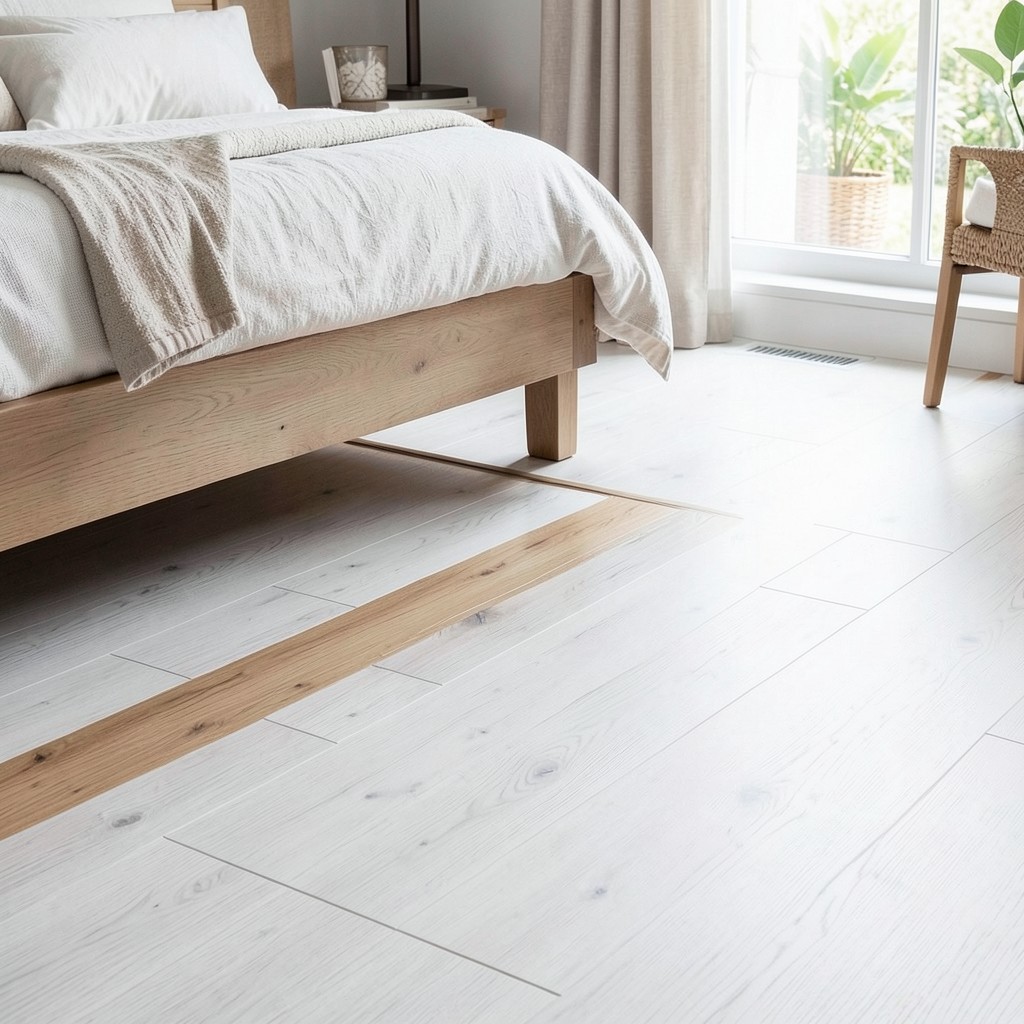
Engineered oak flooring — a floor board whose construction comprises a surface layer of solid oak veneer bonded to a multi-ply core of cross-layered timber or HDF, producing a board that looks and feels like solid oak from above while behaving with the dimensional stability of an engineered product below — is the flooring specification that most consistently produces the correct outcome when the application requires a timber floor whose installation conditions would compromise solid timber’s performance. Over underfloor heating, over concrete subfloors, in rooms with variable humidity, and in the wide-plank formats that solid timber cannot produce at stable dimensions, the engineered board delivers the solid timber result without the solid timber’s material vulnerabilities.
The veneer thickness of the engineered oak surface layer is the specification variable that most determines the product’s long-term maintenance options and its material quality. A surface veneer of three to four millimeters is the minimum that allows one light sanding refinish over the product’s service life. A veneer of six millimeters allows two to three refinishing cycles. A veneer of twelve millimeters — the thickest commercially available engineered oak surface layer — allows the same number of refinishing cycles as a mid-thickness solid oak floor and produces the surface quality that is genuinely indistinguishable from solid timber at the standing viewing distance. The specification of veneer thickness is therefore a long-term value decision rather than a short-term cost one.
The finish range available in engineered oak — from the pale white oil and the platinum smoked grey through the natural hardwax to the deep ebonized stain — allows the engineered floor to serve every design direction from the Scandinavian home interior to the contemporary home ideas dark-floor aesthetic without the material limitations that a solid oak specification might impose on the same finish range. The spring bedroom decor refresh that adopts a pale, wire-brushed engineered oak floor in a cool white oil finish produces the specific quality of a bedroom floor whose light, natural character supports the room’s seasonal shift from the cozy enclosed quality of winter toward the airy home interiors direction of the warmer months.
12. Terracotta Tile Flooring
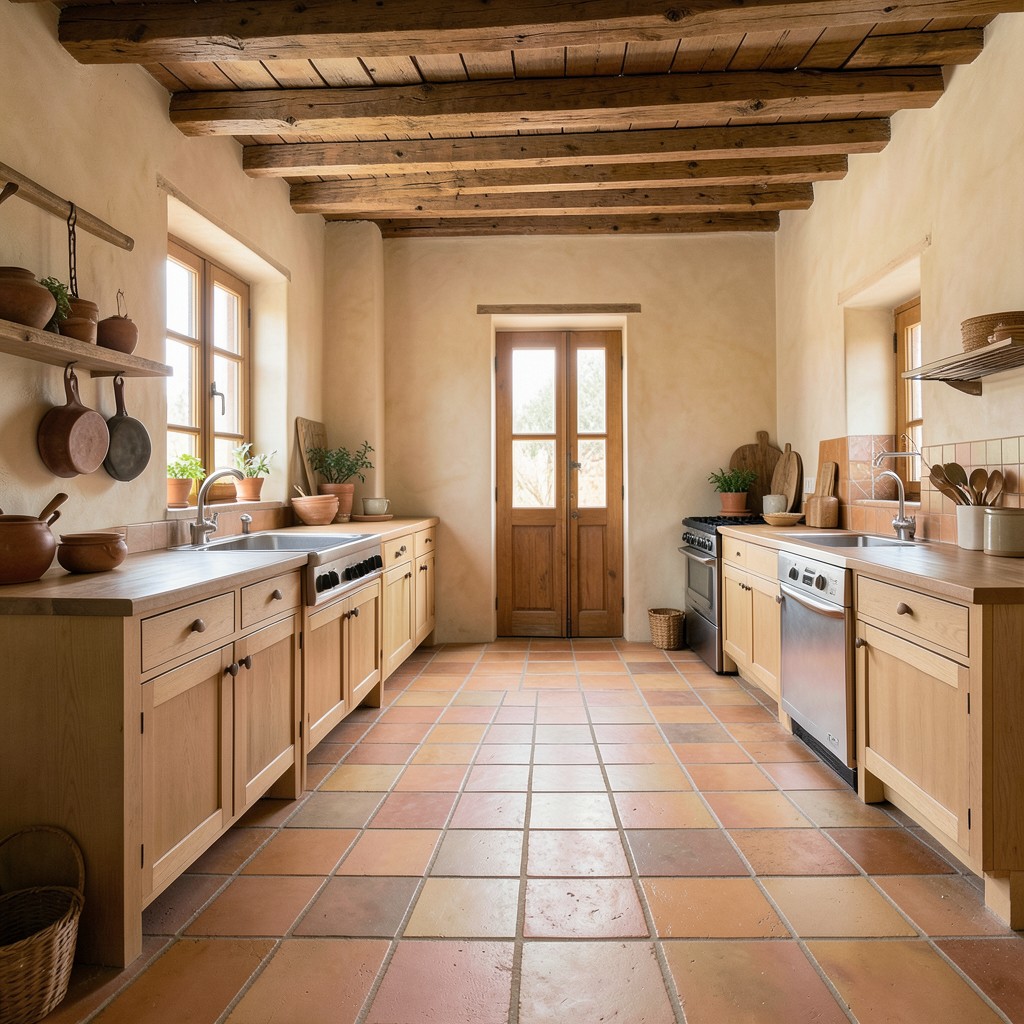
Terracotta tiles — the unglazed, kiln-fired clay tiles whose warm red-orange color is the color of the earth they were made from — are the floor material whose specific warmth has no synthetic equivalent and no manufactured alternative that produces the same sensory quality underfoot and the same atmospheric contribution overhead. The terracotta floor is warm before you even apply heat to it, because the color itself — the specific fired-clay red-orange whose warmth is the geological composition of the clay deposit — reads as warm at the level of the visual system without requiring any actual thermal source to reinforce it.
The surface finish of terracotta tiles determines their practical maintenance requirement and their visual character simultaneously. An unfinished, naturally sealed terracotta tile — the floor sealed only with a natural beeswax finish after installation — retains the matte, absorbent surface quality of the traditional Mediterranean kitchen and courtyard floor, whose specific worn character accumulates with use rather than being specified in advance. This is the terracotta floor whose beauty increases with the years as the wax builds, the color deepens, and the surface’s organic irregularity becomes more pronounced. An impermeable penetrating sealer applied over the terracotta produces the more maintenance-practical floor suitable for the contemporary kitchen, but it sacrifices the surface’s living quality for a protection standard the traditional finish does not provide.
The farmhouse home decor kitchen, the earthy home design sitting room, and the desert home styling entrance hall all find in the terracotta tile their most natural floor material — the one whose color, warmth, and material origin are most consistent with the design direction’s underlying philosophy. A kitchen whose floor is antique Provençal terracotta tiles in their varied warm ochres and red-browns, whose walls are limewashed plaster, and whose ceiling carries exposed oak beams, produces a room whose material program is so internally consistent that the design appears to have been inevitable rather than chosen.
13. Moroccan Zellige Tile Flooring
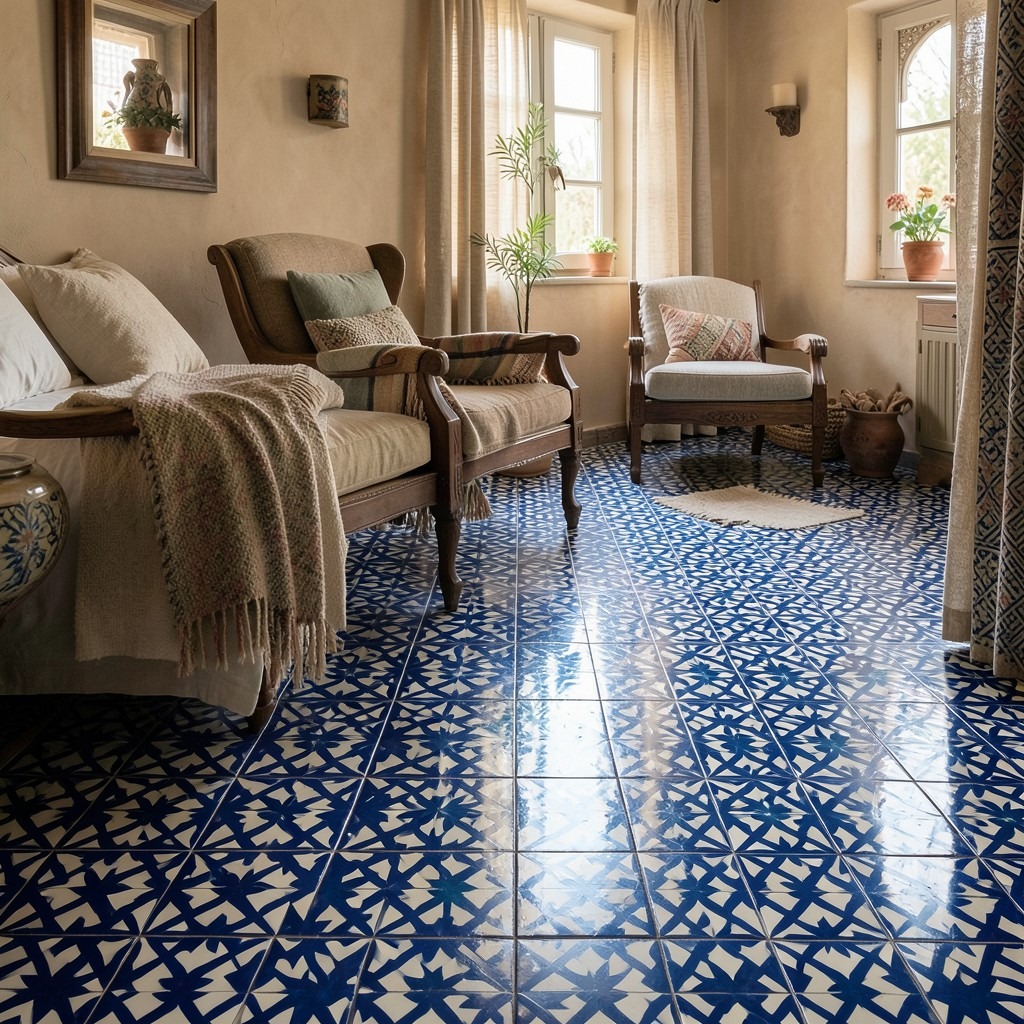
Zellige tile on a floor — the hand-cut, hand-glazed ceramic tile of the North African decorating tradition, laid in geometric arrangements whose color combinations and pattern logic belong to an Islamic geometric vocabulary refined over ten centuries of architectural application — is the floor that produces the most immediate, most atmospheric, and most culturally specific visual impact of any tiled floor in the domestic interior. The zellige floor is the floor whose entire room is organized by its presence. The furniture, the walls, the lighting, and the textiles all become the supporting cast for the floor’s performance.
The production process of authentic zellige tile — the individual tile cut by hand with a hammer and steel chisel from a larger fired and glazed ceramic blank, each piece slightly irregular in its dimensions, its surface, and its glaze depth — produces the characteristic shimmer of a zellige field that machine-produced tile cannot replicate. The slight variation in each tile’s face plane, the inconsistency of the glaze’s depth and color across the tile’s surface, and the hand-cut edge at each joint combine to produce a floor whose light reflection is distributed rather than uniform — the surface sparkles rather than shines, and the difference between those two conditions is the entire distinction between the zellige floor and the polished porcelain tile whose surface is technically flawless and aesthetically flat.
The bohemian home styling sitting room, the luxury master bedroom design bathroom, and the traditional home interiors courtyard-adjacent space all find in the zellige floor their most atmospheric material contribution. A bathroom floor whose entire surface is laid in hand-cut zellige in a deep peacock blue and white geometric — the pattern reading as a continuous composition from wall to wall — produces the specific quality of a room whose floor is an artwork that the room was built around rather than a surface applied after the room was designed. That inversion of the conventional design sequence is what the zellige floor produces when it is selected with genuine conviction.
14. Slate Flooring
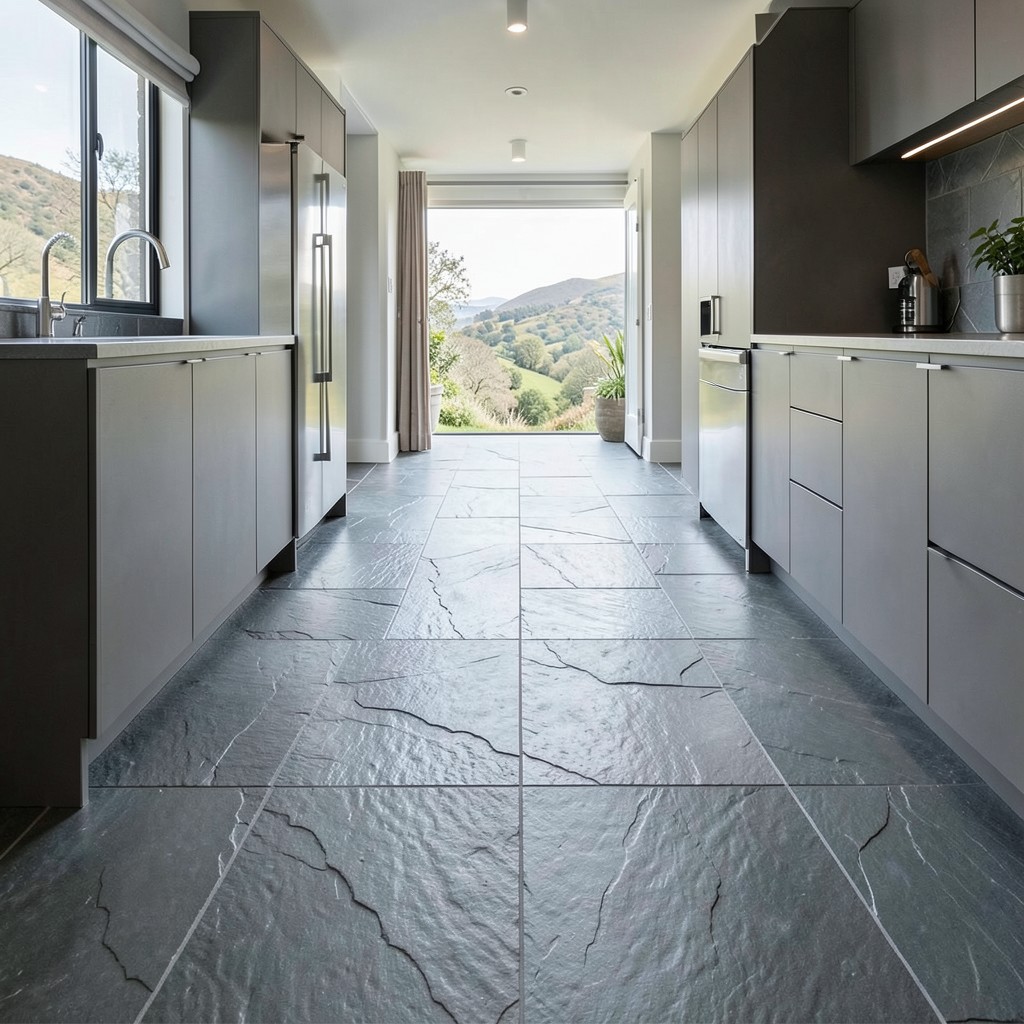
Slate is the floor material that most honestly communicates the geological character of the landscape it came from, and the specific quality of a slate floor — the deep blue-grey of Welsh slate, the warm purple-green of Cornish slate, the rustic green-grey of Vermont slate, the silver-black of Indian Kota — is the color of the specific hillside or quarry face from which the material was extracted, compressed across millions of years into the layered metamorphic stone that cleaves along its bedding planes into the flat slabs that become flooring tiles. The slate floor is, in the most literal sense possible, a piece of the landscape installed in the home.
The surface quality of slate flooring is determined by the cleaving method used to produce the tile’s face. A riven slate — split along the natural cleavage plane rather than sawn or ground — produces the slightly undulating, naturally irregular surface whose texture and thickness variation is the slate’s authentic expression. The riven surface catches light along its micro-relief in the specific way of a stone tile whose surface was made by the earth’s own pressure rather than by a machine’s cutting blade. The honed slate — ground smooth after splitting — produces the flatter, more uniform surface whose color appears deeper and whose reflectivity is slightly higher than the riven version.
The industrial home design hallway or the coastal home design kitchen floor in a large-format riven grey slate — the slate’s natural surface reflecting the hallway’s overhead light in the distributed, irregular way of the riven face — produces the specific material quality of a room whose floor was chosen for its geological character rather than for its design trend. Slate is a floor that the mountain cabin decor direction adopts as the floor material most consistent with the building’s relationship to the landscape around it, and that relationship between the floor material and the landscape outside the building is the design quality that makes slate more than a practical, durable, waterproof floor tile.
15. Poured Resin Flooring
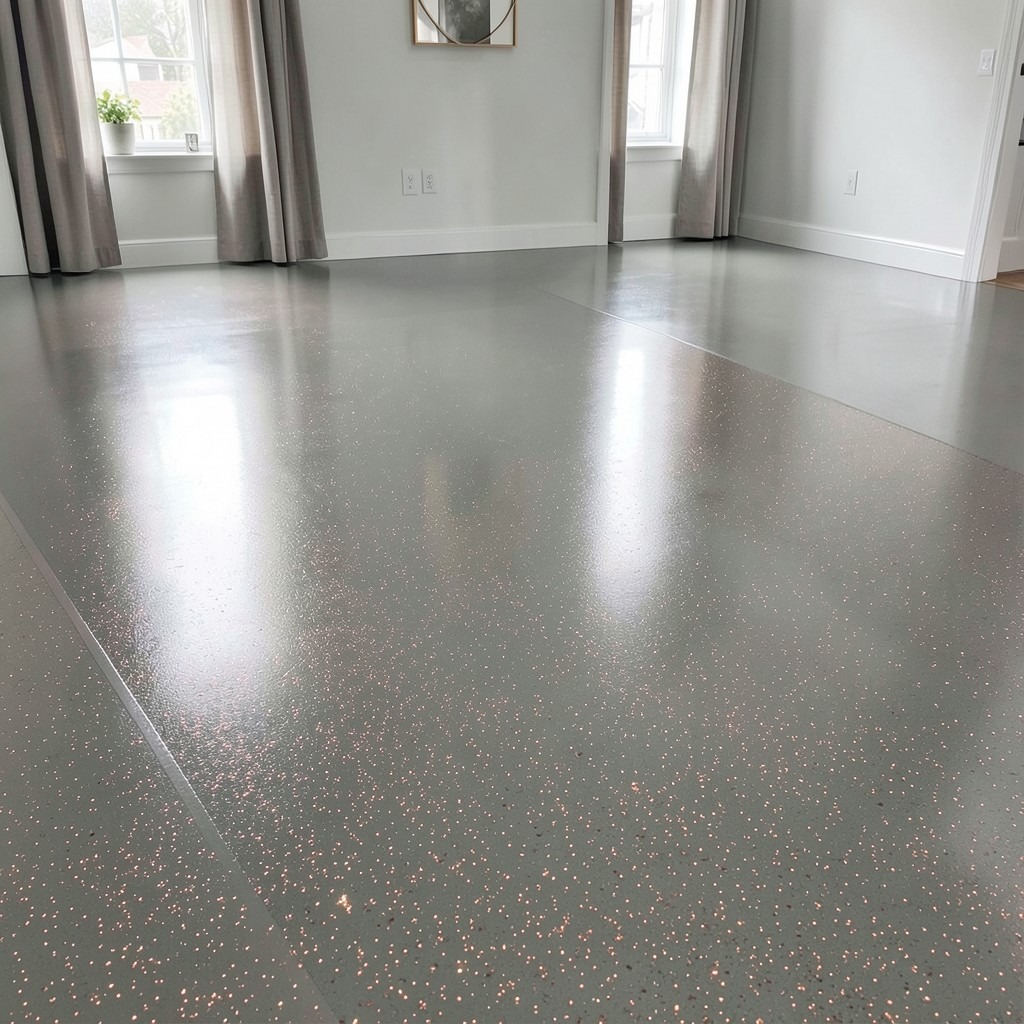
Poured resin flooring — a liquid epoxy or polyurethane compound poured onto the floor substrate and spread to a self-leveling finish whose surface, after curing, is a seamless, jointless, completely continuous floor plane — is the flooring format that most completely eliminates the grout line, the plank joint, and the tile boundary from the floor surface, producing the quality of a floor that is one continuous material from wall to wall with no interruption. The seamless floor reads as spatially expansive in a way that jointed floors do not, because the eye receives no boundary within the floor field to rest on.
The color range of poured resin flooring spans from the pure, glossy white of the gallery floor through the pigmented mid-tones of terracotta, sage, and charcoal to the metallic finishes whose flake, mica, or pearl additive produces a floor surface with a depth and shimmer quality that no other domestic flooring material provides. The metallic resin floor — a mid-grey base with a fine copper or bronze metallic flake suspended in the resin matrix, the flake distributing the room’s light in a fine, scattered sparkle across the entire floor surface — produces the specific quality of the chic home decor or luxury home interior direction whose floor must be as designed as any other surface in the room.
The practical installation of a poured resin floor requires a prepared, clean, correctly primed substrate whose surface moisture content is below the resin system’s specified tolerance — typically below four percent for epoxy systems — because moisture trapped beneath the resin layer produces the bubbling, delamination, and adhesion failure that are the resin floor’s primary failure mode. This substrate preparation is the condition on which the entire installation depends, and the cost of cutting preparation corners is the full cost of removing and replacing the failed resin floor rather than the marginal saving that the reduced preparation produced. The preparation is not optional; it is the specification.
16. Stripped and Stained Original Floorboards
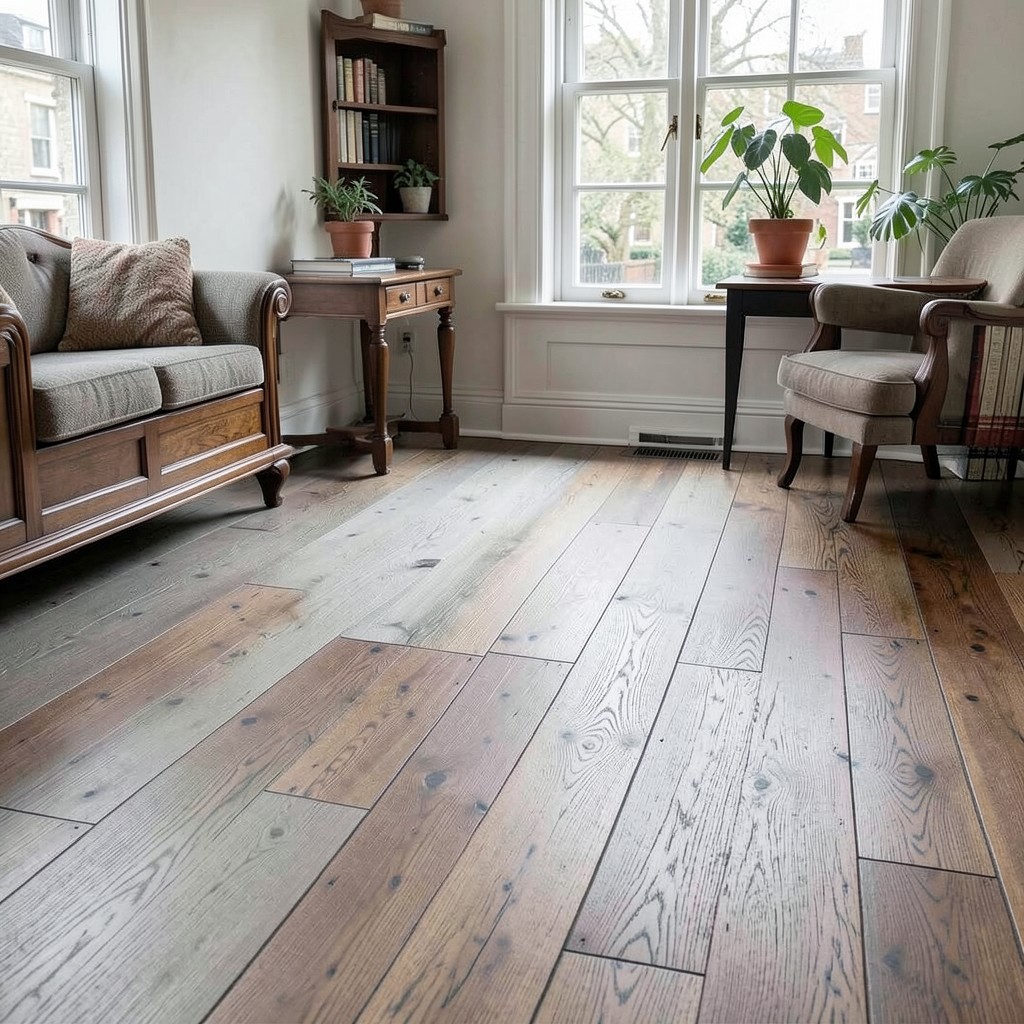
The original floorboards beneath the carpet — the boards that were installed when the house was built, hidden under layers of covering material applied across subsequent decorating cycles, present in the building before any of the current occupants arrived — are the most sustainable, the most materially specific, and frequently the most beautiful flooring option available in a period property, and they are the option that the property’s current occupant has already paid for without knowing it. Stripping the carpet to discover what the floor holds is one of the few renovation moments where the result is frequently better than the expectation.
The condition of original floorboards beneath removed carpet varies considerably depending on the quality of the carpet installation over them — whether the carpet was direct-fixed to the boards, whether a foam underlay bonded to the surface, and whether the boards received any surface treatment before the carpet was laid. Boards that are stained from adhesive residue, marked from previous fixings, or variably surfaced from inconsistent previous treatments benefit from mechanical sanding — belt sanding across the grain followed by orbital sanding with the grain — whose process restores the raw timber surface to a consistent condition for the application of the chosen floor finish.
The stain selection for original floorboards is the design decision that most determines the floor’s contribution to the room’s palette and its design direction. A pale grey stain on original pine floorboards in a Victorian terrace produces the Scandinavian home interior quality of a period house whose floor speaks a contemporary material language without disguising its historical substrate. A rich dark oak stain on the same boards produces the traditional home interiors quality of a period-appropriate floor whose warmth and depth suit the room’s original architectural character. The raw, unsealed board — oiled but unstained — is the rustic home office ideas or bohemian home styling choice whose material honesty suits the room that is not trying to appear as anything other than what the building actually is.
17. Concrete Effect Microtopping Flooring
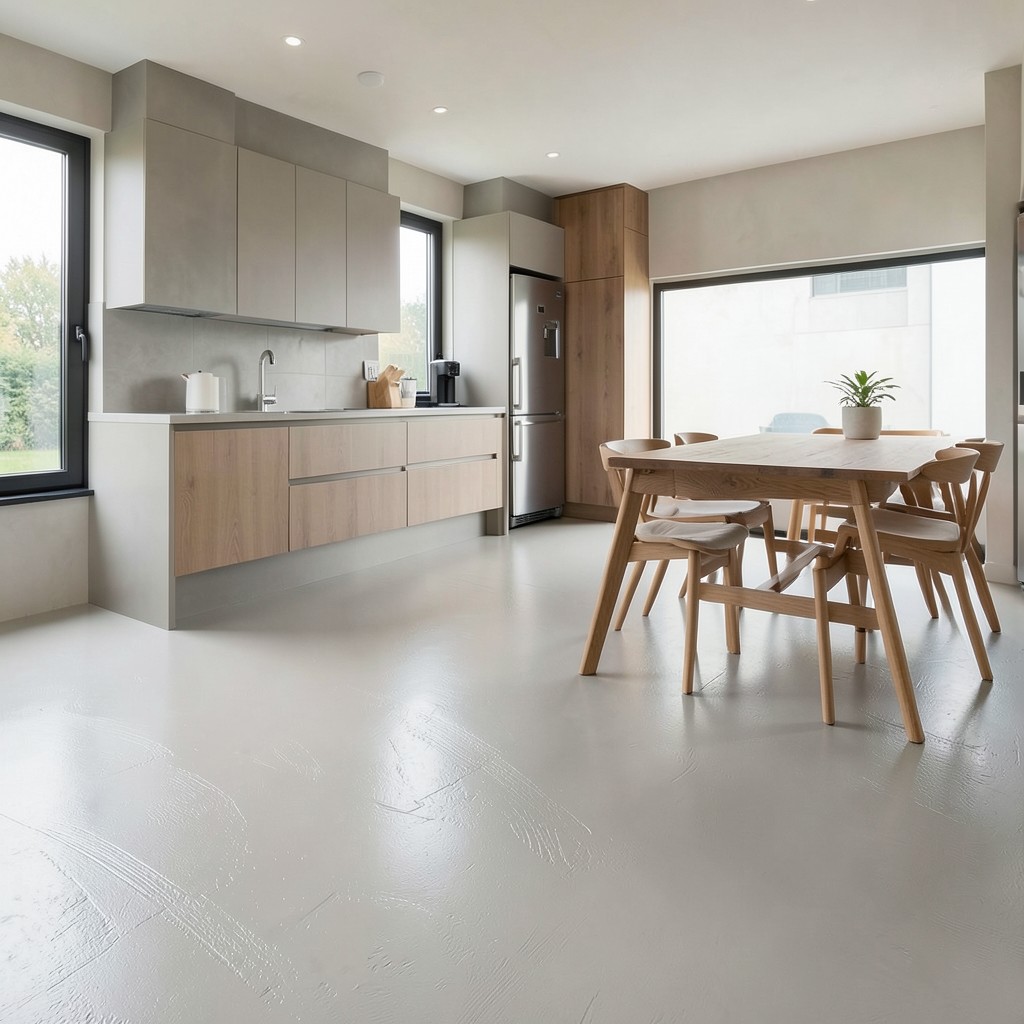
Microtopping — a cement-based polymer-modified coating applied over an existing floor substrate in a total thickness of two to three millimeters, producing the visual character of polished concrete on a surface that was not originally concrete — is the flooring solution that combines the aesthetic of poured concrete with the practical advantage of application over existing floor constructions without the weight, the depth, or the demolition that a genuine poured concrete floor replacement requires. The microtopping is not a reproduction of concrete. It is the concrete surface experience applied to the floor that already exists below it.
The application of microtopping over an existing ceramic tile, timber, or screed floor requires the existing surface to be mechanically abraded, cleaned, and primed before the first coat of microtopping compound is applied by trowel. The trowel application technique — broad strokes in overlapping passes that leave the tool marks visible in the finished surface or that are worked to a smooth, close finish depending on the design intention — produces the surface texture range from the smooth, polished appearance of a precision concrete floor to the slightly directional, troweled texture of a more raw application. The texture choice determines the floor’s light response and its atmospheric register in the same way that the plaster application technique determines the wall’s character.
The contemporary home ideas kitchen or the minimalist dining room whose existing ceramic tile floor is covered in a pale warm grey microtopping — the new surface continuous and seamless where the original tile’s grout grid was broken and pattern-forward — produces the specific quality of a floor renewal whose material result is superior to the original surface in both design character and daily experience. The microtopping’s matte, mineral surface reflects the kitchen’s overhead light softly rather than with the hard gloss of a polished ceramic, and the seamless quality of the continuous floor surface reads as architecturally resolved in a way that the grout-jointed tile it replaced did not.
18. Cork Flooring
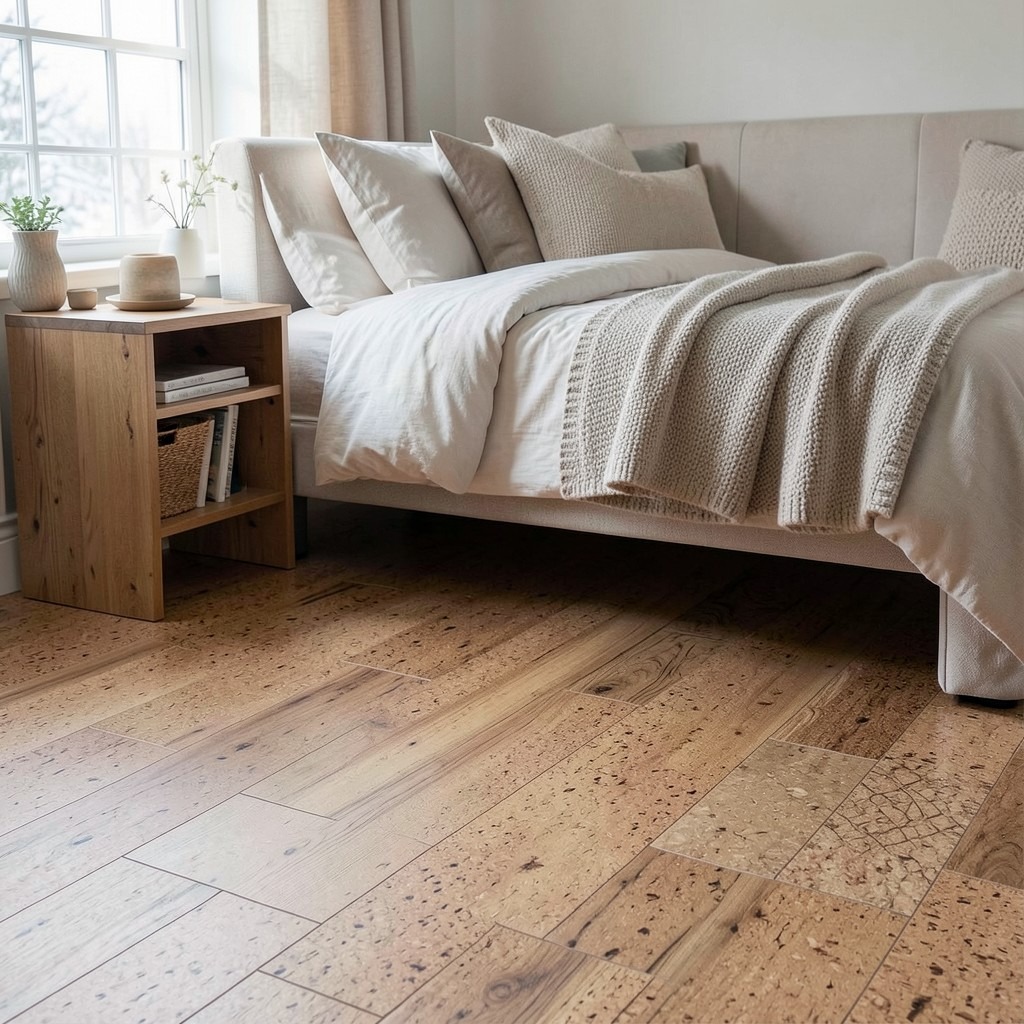
Cork flooring is the floor material that most consistently gets the short end of the design conversation, dismissed as the choice of the 1970s renovation and associated with the specific beige-brown tile format that the decade produced in such abundance. That association is outdated and unfair to a material whose physical properties — its acoustic absorption, its thermal insulation, its natural resilience underfoot, its hypoallergenic surface, and its genuine sustainability credentials — are among the most genuinely beneficial of any residential flooring material. The cork floor’s design reputation suffered from a period when it was produced badly. The material itself was never the problem.
The contemporary cork floor is available in a range from the traditional printed cork tile in a variety of natural tones through the glued cork plank in a wide-plank format that reads as timber from a distance, to the cork-faced floating floor whose dimensional stability and surface quality represent the most domestically practical cork floor format currently available. The surface print technology applied to contemporary cork products allows the material to carry realistic wood-grain, stone-pattern, and geometric designs over the cork substrate, combining the cork’s physical performance with a surface visual character that the raw cork tile’s natural pattern does not provide.
The cozy bedroom design application of a cork floor — the natural resilience of the material producing the specific softness underfoot that a bedroom floor benefits from more than any other room’s floor — is the domestic application where cork’s combination of thermal warmth, acoustic softness, and physical cushioning provides the most direct improvement to the room’s daily experience. Standing barefoot on a cork floor on a winter morning is the specific sensory quality that no tile, no stone, and no timber floor replicates — the cork does not extract heat from the foot the way harder, denser materials do, and that warmth at foot level in a winter interior design bedroom is one of the simplest and most overlooked quality-of-life investments a floor renovation can deliver.
19. Mosaic Tile Flooring
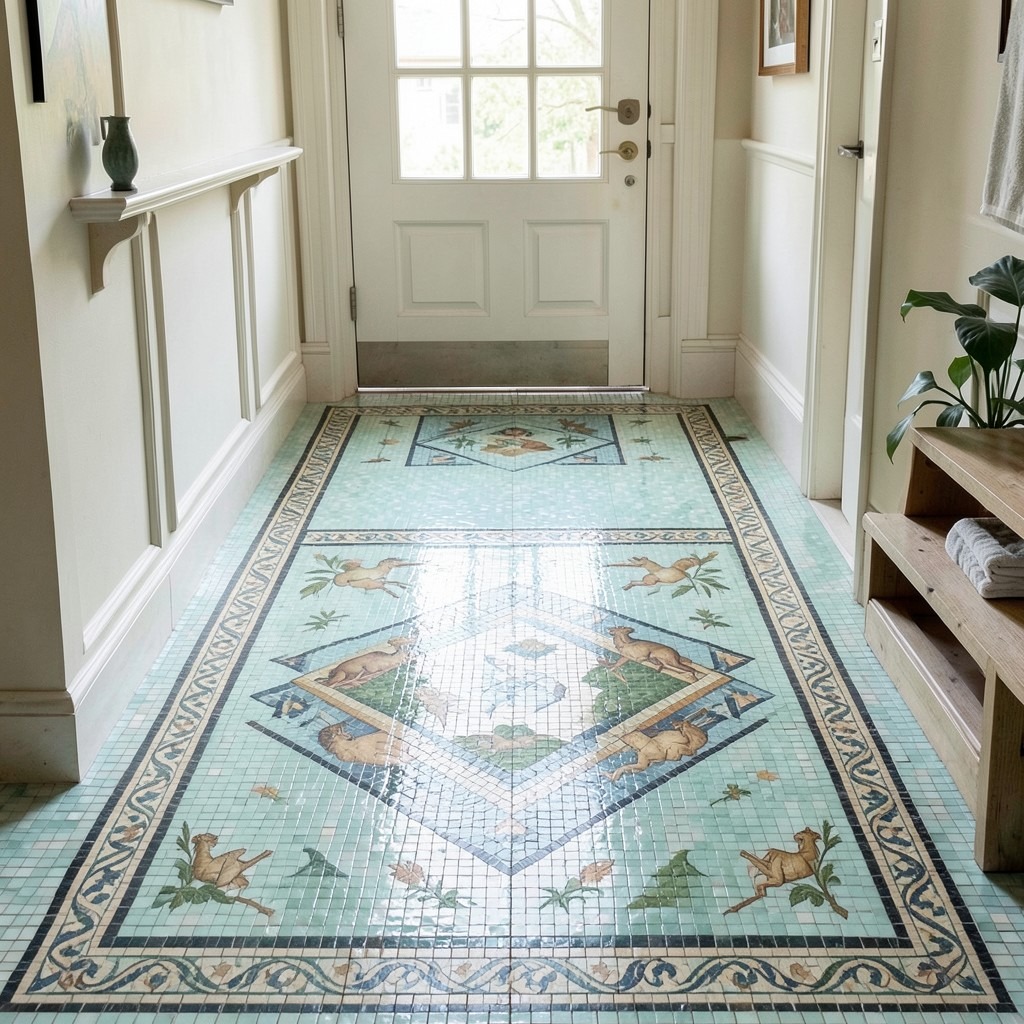
Mosaic tile on a floor — the small-format individual tessera arranged in pattern, image, or field across the floor surface — is the flooring format whose design range spans from the purely functional bathroom floor in a small white ceramic mosaic through the geometric pattern of the Islamic tradition to the figurative floor mosaic of the ancient Roman house whose domestic floors depicted hunting scenes, mythological narratives, and the geometric borders of the Mediterranean decorative tradition in cut stone, glass, and ceramic. The mosaic floor is the oldest designed floor in Western domestic architecture, and its endurance across three millennia of application is the most compelling argument for its continued relevance.
The glass mosaic floor — small glass tesserae in a color range from the palest pale to the most saturated jewel tone, distributed across the floor surface in a gradient, a pattern, or a field of mixed tones — is the mosaic floor treatment that most directly engages the floor’s relationship with light, because the glass tesserae reflect light from their surface in directions that ceramic and stone mosaic do not, producing the characteristic shimmer of a glass mosaic installation that changes in character as the light source and the viewing angle shift across the day. The farmhouse bathroom decor shower floor in a pale aquamarine glass mosaic — the individual tesserae’s color shifting between pale blue, soft green, and near-white depending on the wet or dry surface condition — produces the specific quality of a floor whose material responds to the water that passes over it rather than merely tolerating it.
The floor mosaic in a domestic entrance hall — a central geometric composition in natural stone mosaic, the pattern drawn from the Islamic or Roman geometric tradition and executed in two or three stone colors whose contrast resolves the pattern clearly — is the floor treatment that most directly converts the hallway from a circulation space into an architectural event. The entry hall floor is the floor whose design investment produces the highest first-impression return in the domestic interior, because it is the first floor surface every visitor encounters, and the mosaic floor in the entry tells the visitor, without words, that the building they have entered takes its material culture seriously.
20. Chevron Wood Flooring
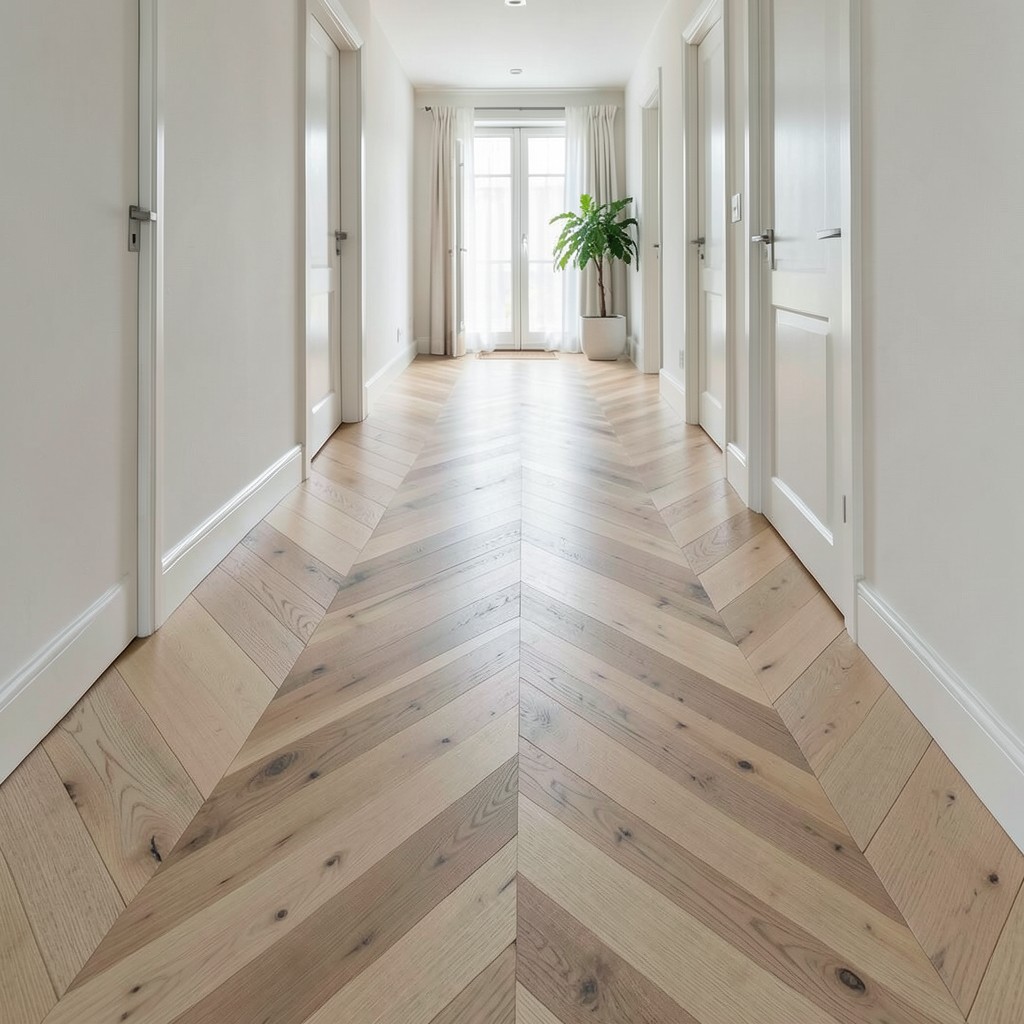
The chevron floor — solid or engineered timber strips whose ends are cut at a forty-five-degree angle and arranged so that the pattern’s directional lines meet at a continuous V rather than the alternating interruption of the herringbone — is the floor that most people confuse with the herringbone until they stand in a room that has one, at which point the difference becomes apparent. The herringbone’s energy is lateral — the alternating diagonal courses direct the eye across the floor in a back-and-forth movement that reads as active and rich. The chevron’s energy is longitudinal — the continuous V formation directs the eye down the length of the room, and the floor appears to extend the room’s dimension along its primary axis.
The directional energy of the chevron floor makes it the floor format most useful in rooms that need apparent lengthening — the rectangular room whose width is proportionate but whose length is short, the hallway whose dimension benefits from the floor’s emphasis of its longitudinal axis, and the dining room whose table is oriented along the room’s length and whose floor treatment should reinforce that orientation rather than cross it. The chevron floor in a long, narrow room is a spatial amplifier. The same floor in a square room produces directional tension because the V pattern has no natural axis to align with, and the floor reads as pointing at a wall rather than along the room.
The timber species selection for a chevron floor determines the pattern’s color contrast and its visual clarity. A tight-grained species — European oak, maple, ash — produces the chevron pattern with clear, consistent grain lines whose directional quality reinforces the V pattern’s geometry. A wide-grained, figured species — American walnut, tiger maple, figured cherry — produces a floor whose surface character competes with the pattern rather than supporting it, and the chevron geometry is partially lost in the figure. The elegant home styling drawing room or the luxury master bedroom design application of a pale chevron oak floor in a fine wire-brushed finish is the application that most clearly demonstrates the pattern’s spatial sophistication.
21. Penny Round Tile Flooring
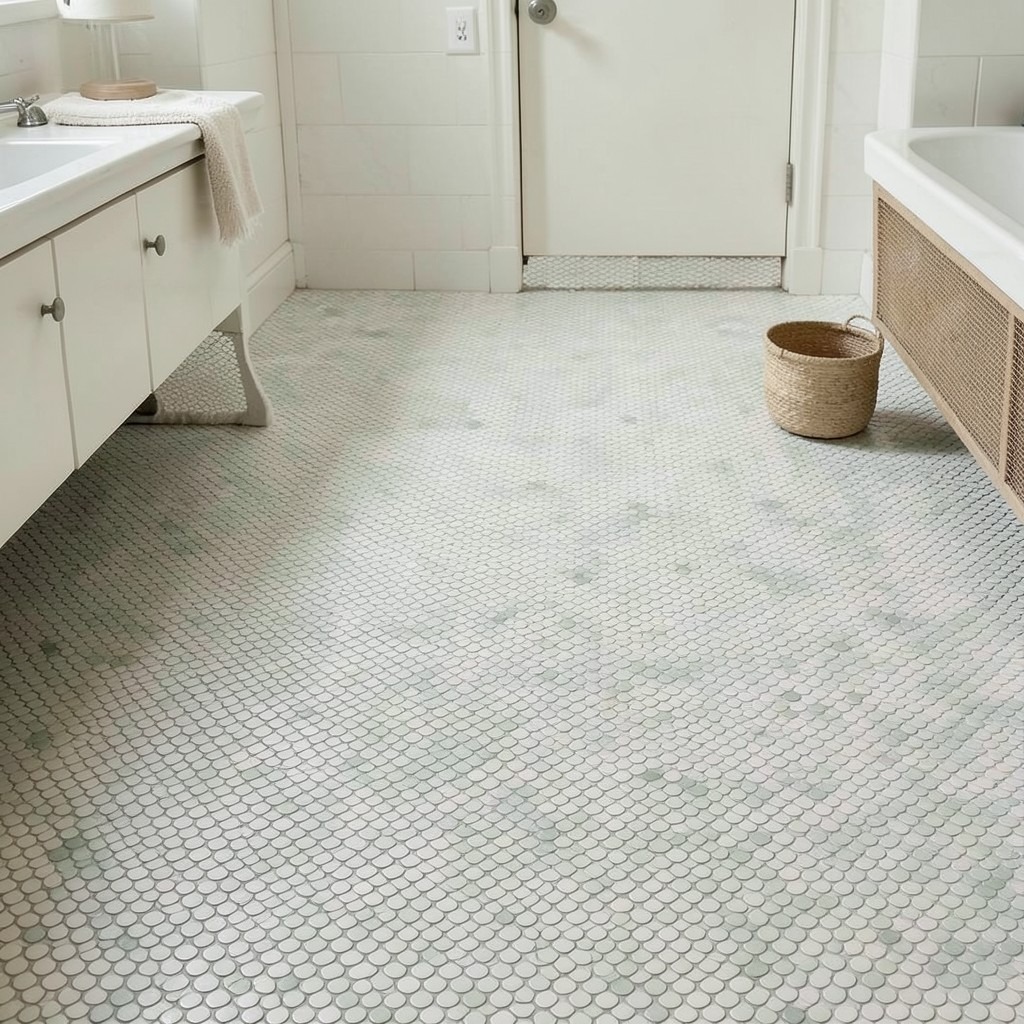
Penny round tiles — small circular mosaic tiles of approximately nineteen to twenty-five millimeters diameter, arranged in a honeycomb-grid pattern on mesh backing sheets — are the floor tile format whose specific combination of small scale, circular geometry, and the visual density of a tightly packed field produces an effect that is simultaneously pattern-forward and surface-quiet, because the individual tile’s small size and the geometric regularity of the arrangement read as texture from a distance rather than as a pattern whose individual elements are distinct. The penny round floor reads as a textured surface from across the room. The individual circles only resolve at close range.
The color selection for a penny round tile floor determines the visual register of the treatment’s texture. A single-color penny round field — all tiles in a pale cream, a soft sage, or a mid-grey — reads as a textured neutral floor whose surface character is subtle and whose contribution to the room’s palette is through texture rather than color. A mixed-color penny round field — tiles in two or three related tones distributed in the arranged pattern — reads as a softer version of the mosaic color field, the multiple tones blending at the viewing distance of a standing person into the single composite tone that the mixture produces.
The farmhouse bathroom decor bathroom floor in white penny round tiles — the classic application whose historical precedent in the American Arts and Crafts and Edwardian tile tradition gives it the period authority of a floor that has always been appropriate in this specific room type — is the application that most consistently produces the specific quality of a bathroom whose floor reads as considered rather than merely practical. The white penny round’s fine texture prevents the floor from reading as visually hard in the way that large-format white tile does, and its circular geometry introduces the organic quality of a non-rectilinear form into the bathroom’s typically rectangular tile geometry.
22. Herringbone Terracotta Tile Flooring
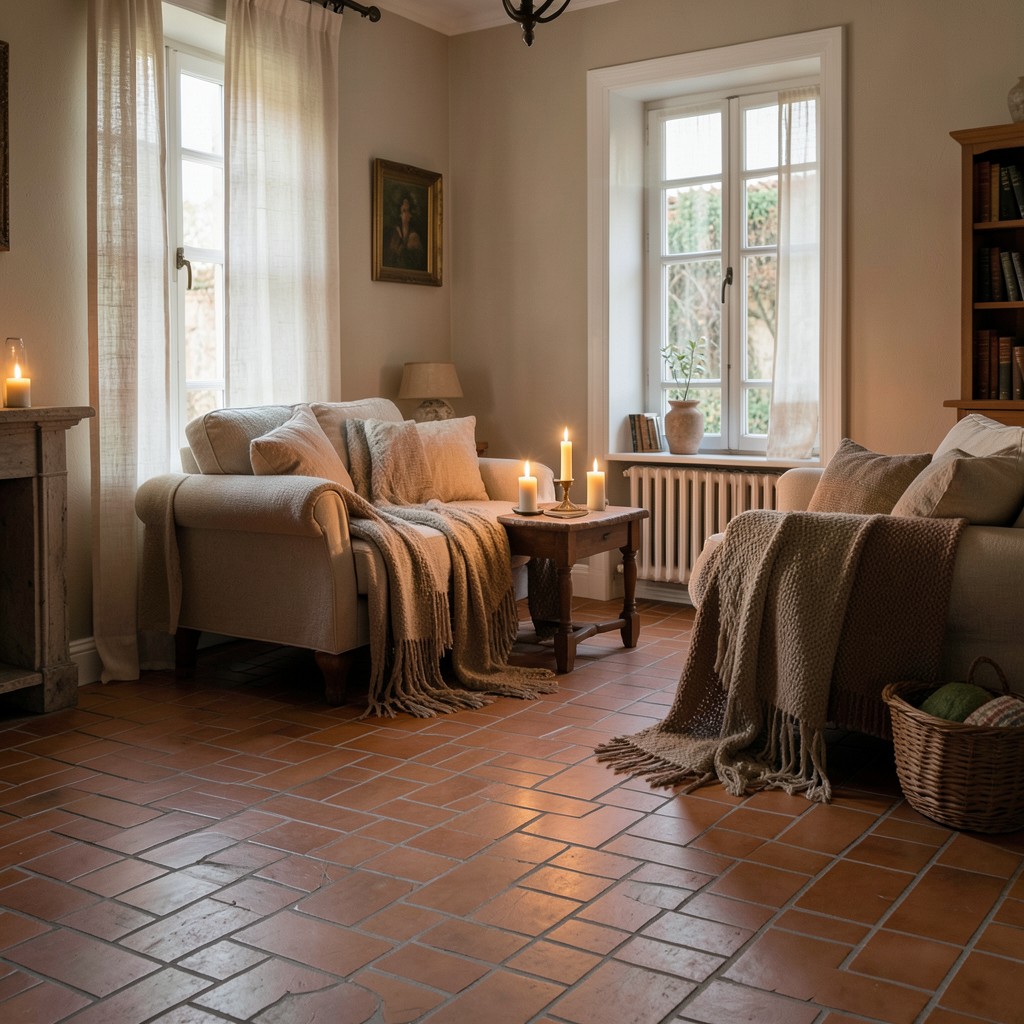
The combination of the herringbone pattern with the terracotta tile material produces a floor that belongs to two different design traditions simultaneously — the herringbone’s architectural geometry and the terracotta’s geological warmth — and whose combination creates a floor character that neither tradition produces alone. A straight-laid terracotta floor is warm and organic. A herringbone stone floor is geometric and architectural. The herringbone terracotta floor is both warm and geometric, both organic and structured, and that specific dual character is what makes it the most atmospherically complete version of either floor treatment available.
The scale of the herringbone block in terracotta is determined by the specific brick or tile format used for the installation. A traditional hand-made terracotta brick laid flat in a herringbone arrangement — the brick format of approximately two hundred by one hundred by twenty-five millimeters providing the classic elongated herringbone proportion — produces the traditional Mediterranean courtyard and kitchen floor quality that the earthy home design and rustic home decor directions pursue at their most historically grounded. The contemporary terracotta tile cut to the square herringbone block format of seventy by one hundred and forty millimeters produces the same pattern at a more refined scale that suits the contemporary home ideas direction without the rustic character of the traditional brick format.
The seasonal atmospheric contribution of a herringbone terracotta floor shifts more visibly than almost any other floor material between the warm seasons and the cool ones. The summer home design sitting room with a herringbone terracotta floor and pale, linen-curtained windows reads as a room flooded with warm light whose floor material amplifies the warmth rather than reflecting the light back as a cooler tone. The same room in fall home decorating mode — with the candles lit, the textiles layered, and the room’s thermal warmth emanating from the terracotta’s stored daytime heat — produces the specific quality of a room whose floor is an active participant in the evening’s atmosphere rather than a passive surface beneath it.
23. Dark Stained Hardwood Flooring
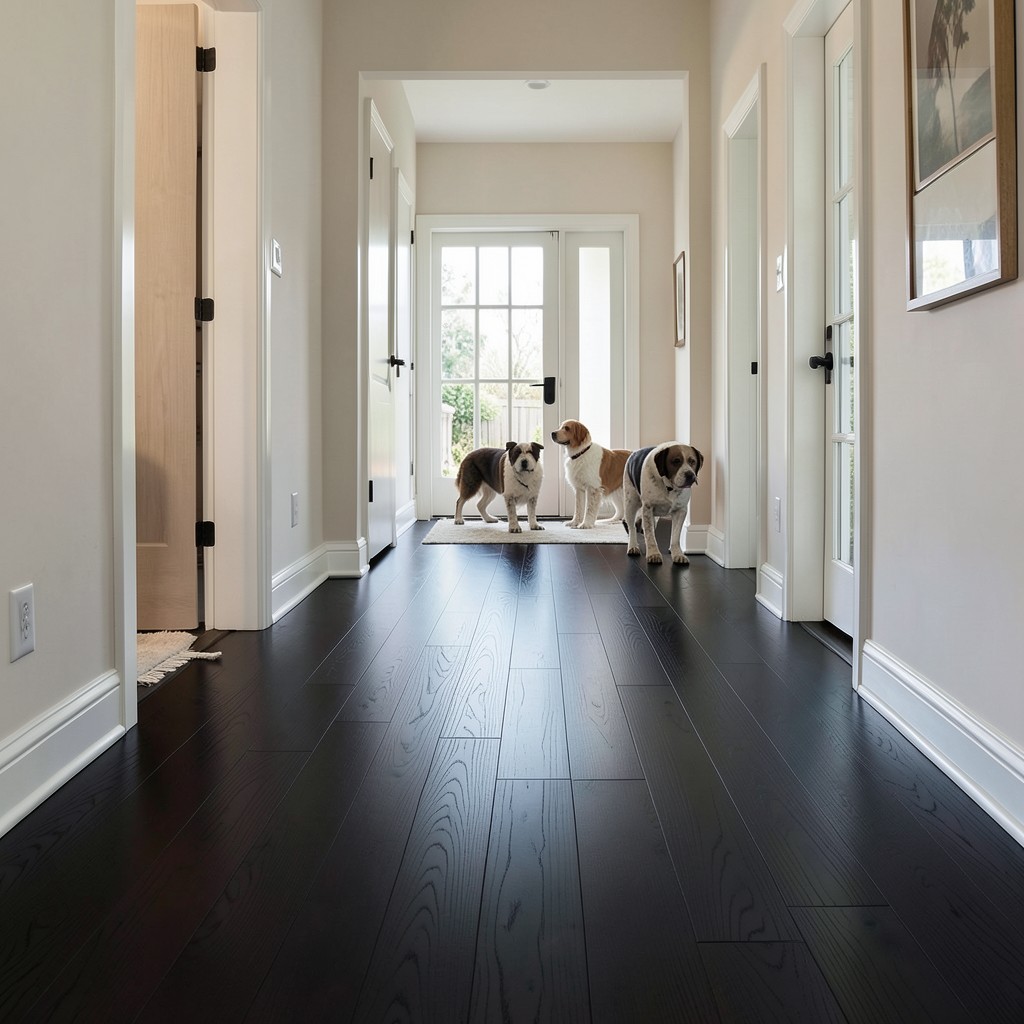
A dark-stained hardwood floor — solid or engineered timber whose surface is finished in a deep ebony, dark walnut, espresso, or near-black stain — is the floor design decision that most polarizes the domestic interior conversation, because the floor that reads as sophisticated, dramatic, and spatially authoritative in one context reads as oppressive, impractical, and maintenance-demanding in another. Both assessments are correct, and the choice of whether to adopt a dark hardwood floor must be made with honest acknowledgment of both its design strength and its daily reality.
The design strength of a dark hardwood floor lies in its relationship with the room’s other surfaces — specifically its ability to ground the room’s palette by providing the deepest tone in the room’s color hierarchy at the floor level, allowing the walls and ceiling to read as lighter and more expansive in contrast. The dark floor reads as the room’s visual foundation in the most direct sense: the heavy, grounded dark tone at the base of the space makes everything above it appear to float rather than sit on the floor, and that floating quality is the specific spatial sophistication that the dark hardwood floor produces when the room’s other surfaces are handled correctly.
The practical reality of a dark hardwood floor is that every particle of dust, every pet hair, and every surface scratch is more visible on a dark floor than on a pale one, and this is not a minor maintenance observation — it is the defining daily condition of life with a dark floor that must be accepted as the price of the design quality it provides. The luxury master bedroom design application of a dark ebonized oak floor in a room with pale walls and linen textiles, whose surface is maintained with daily sweeping and periodic oiling, produces the specific quality of the floor at its best. The same floor in the family hallway of a household with two dogs and muddy shoes is the floor at its daily most demanding.
24. Patterned Cement Tile Runner in Hallway
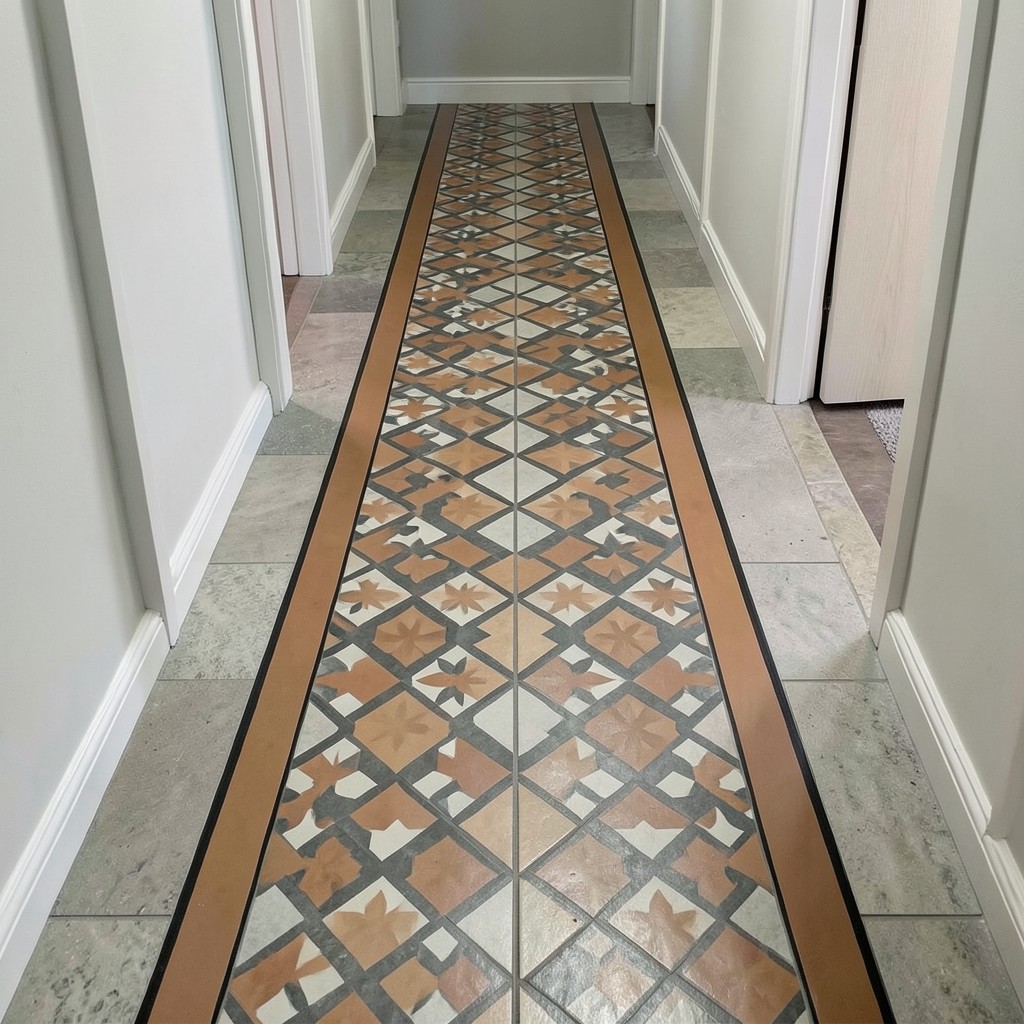
A patterned cement tile runner — a strip of bold encaustic or hydraulic cement tile laid down the center of a hallway floor, bounded on either side by a border tile and flanked by a plain stone, timber, or ceramic field tile — is the floor design technique that produces the greatest visual impact in the hallway at the lowest total tile quantity, because the runner concentrates the patterned tile in the floor zone where the pattern’s directional movement most reinforces the hallway’s function as a passage. The runner is the floor’s equivalent of a rug: it marks the path, defines the zone, and provides the pattern without requiring the pattern to cover the full floor area.
The pattern selection for a hallway cement tile runner must account for the tile’s directional qualities relative to the hallway’s orientation. A tile pattern with strong longitudinal directionality — a geometric that reads differently along its length than across it — should be oriented to run along the hallway’s length rather than across it, reinforcing the passage’s directional movement rather than interrupting it. A symmetrical, non-directional pattern — the eight-pointed star, the hexagonal field, the diamond grid — works in either orientation because its rotational symmetry produces the same visual character regardless of the viewing direction from which it is approached.
The border tile that flanks the runner — the narrow strip of plain tile in a contrasting color that frames the patterned runner against the field tile on either side — is the detail that converts a strip of patterned tile in a floor into a designed floor composition. The border’s color is the key specification variable: a border in the runner’s dominant color with the field tile in the runner’s secondary color produces the floor whose color harmony is maintained across the full width. A border in a contrasting third color — the metallic brass tile, the deep black border, the warm terracotta against a grey-and-white pattern — produces the floor whose graphic definition is sharpest and whose design confidence is most directly expressed.
25. Whitewashed Pine Flooring
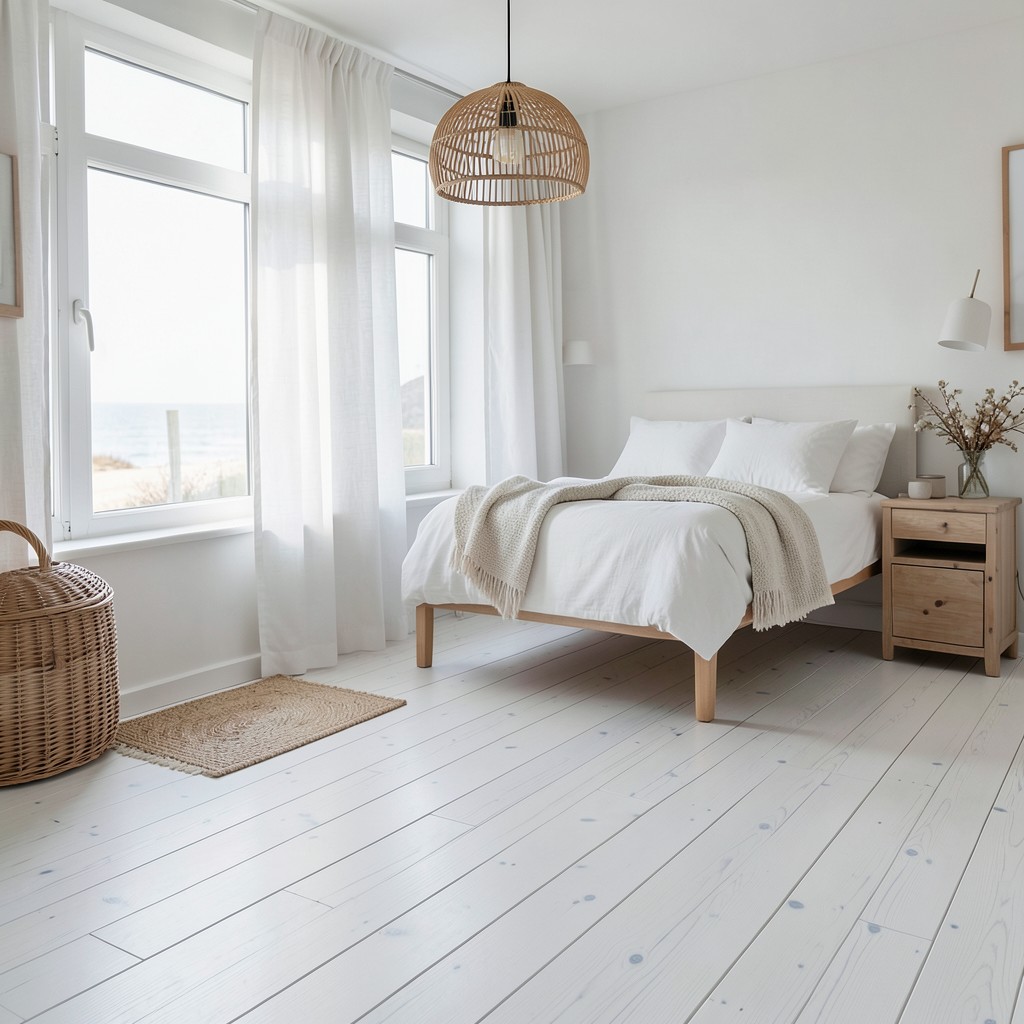
Whitewashed pine flooring — original or new pine boards whose surface has received a diluted white paint wash, a white liming wax, or a specialist white-pigmented oil that partially fills the wood’s open grain and leaves a pale, bleached-looking surface through which the natural grain pattern remains visible — is the floor treatment that most efficiently converts a standard timber floor into the Scandinavian home interior, coastal home design, or spring bedroom decor aesthetic at a fraction of the cost of installing new pale-toned flooring, because the whitewash is applied over the floor that is already there.
The technique of whitewashing a pine floor — whether by a diluted emulsion wash brushed across the raw sanded surface and wiped back before drying to leave the color in the grain rather than on the surface, or by a specialist lime or liming wax product worked into the open grain with a brush and buffed off the surface after a short dwell time — produces the floor whose specific pale character is the result of material interaction rather than surface coating. The whitewashed pine is not a painted floor. The paint or the lime is within the wood, and the wood’s own surface — its grain, its knots, its annual ring pattern — reads through the pale wash rather than beneath it.
The beach house interiors direction whose entire palette is built on the combination of pale, sun-bleached surfaces, natural rattan and linen textiles, and the cool blue and white of sea and sky finds in the whitewashed pine floor its natural material complement at the ground plane. A coastal home design bedroom with whitewashed pine boards underfoot, white linen curtains at the window, a rattan pendant overhead, and the sound of the sea outside is a room whose floor was not chosen to match the sea view — the floor was chosen because it is the material expression of the same bleached, weathered, sun-washed character that the sea view communicates from the window.
26. Carpet Tiles in a Geometric Pattern
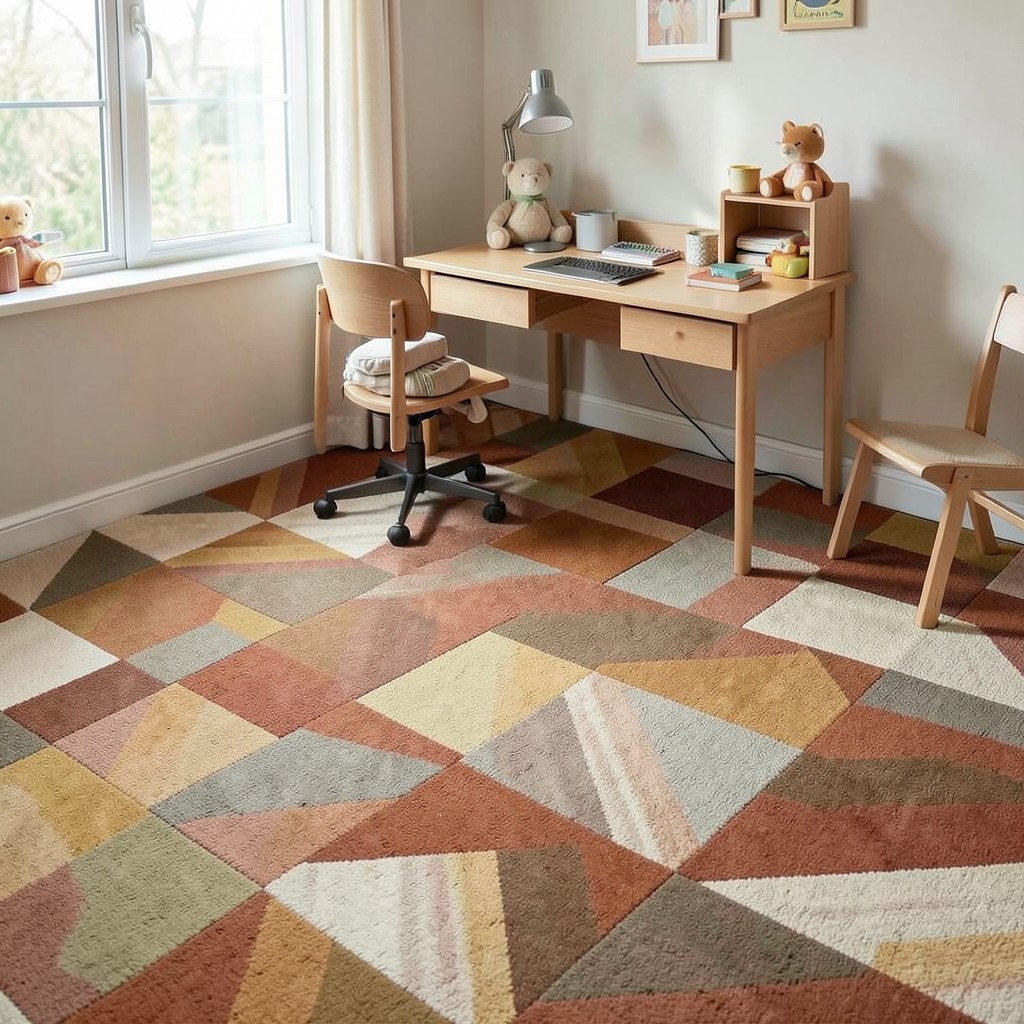
Carpet tiles — modular carpet squares whose individual unit can be arranged in patterns, rotated to vary the pile direction’s light reflection, and replaced individually when worn or stained — are the flooring format that most consistently delivers the practical performance of carpet with the design flexibility of a modular tile system, and whose reputation as a commercial product has obscured their genuine potential in the domestic interior where the same modularity and the same replacement practicality that makes them useful in offices makes them genuinely useful in family homes.
The geometric pattern potential of carpet tiles — the ability to arrange different colored or different pile-direction squares in a composed floor pattern whose geometry is resolved at the installation planning stage rather than manufactured into the carpet before cutting — is the design quality that most distinguishes the carpet tile from the broadloom carpet it is compared against. A carpet tile floor in two complementary tones arranged in a large-scale checkerboard, a herringbone, or a chevron provides the patterned carpet floor whose visual interest the broadloom carpet achieves only through woven or printed pattern that is fixed at the point of manufacture and cannot be adjusted at installation.
The bohemian kids room decor application of carpet tiles in a deliberately mixed palette of related tones — warm terracotta, rust, ochre, and pale cream arranged in a random patchwork pattern that reads as collected rather than designed — produces the floor treatment whose character is warm, playful, and genuinely soft underfoot in the room where a child spends the most time at floor level. The practical replacement of individual tiles in high-wear positions — in front of the desk, at the door threshold, in the center of the room where the most activity concentrates — extends the carpet tile floor’s visual freshness without the cost or the disruption of a full floor replacement.
27. Concrete Pavers for Indoor-Outdoor Flow
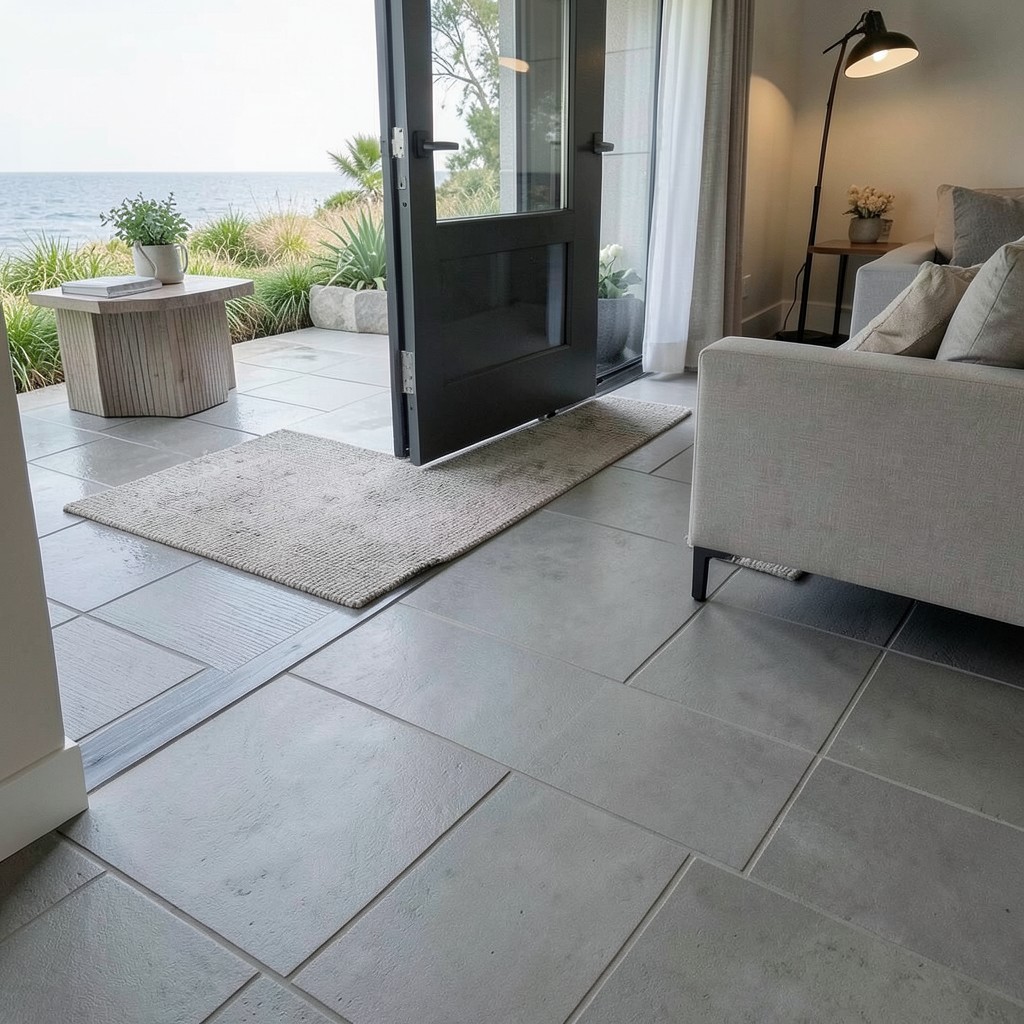
Concrete pavers — precast concrete units in a range of formats from the small-format individual paver through the large-format architectural slab to the bespoke poured-in-place stepping stone — used as a floor material that runs continuously from the interior room through the threshold to the exterior space, producing the seamless material continuity between inside and outside that the indoor-outdoor design direction requires — are the floor treatment that most directly converts the threshold from a design boundary into a design continuation. The floor does not stop at the door. It continues, and the continuation is the design.
The material specification for a concrete paver used in both interior and exterior applications must account for the differing practical requirements of the two environments it bridges. The exterior paver requires a surface texture sufficient to provide slip resistance when wet — the smooth, polished concrete appropriate for the interior floor is not an appropriate specification for the exterior paver in the same run. A lightly brushed or exposed aggregate surface treatment on the exterior portion of the same concrete paver run provides the slip resistance the exterior requires while maintaining the material continuity that the design pursues across the threshold.
The coastal outdoor living space or the summer living room decor direction whose interior floor connects continuously to an outdoor terrace, whose material is the same large-format concrete paver in a warm grey tone across both surfaces, produces the specific spatial quality of a room that extends into the landscape rather than meeting it at a doorstep. The interior furniture, the rug, the lighting — all of these elements float on the continuous floor surface whose material continuity is the spatial argument that the indoor and outdoor environments are one extended living space rather than two adjacent but separate ones.
28. Bleached and Limed Oak Flooring
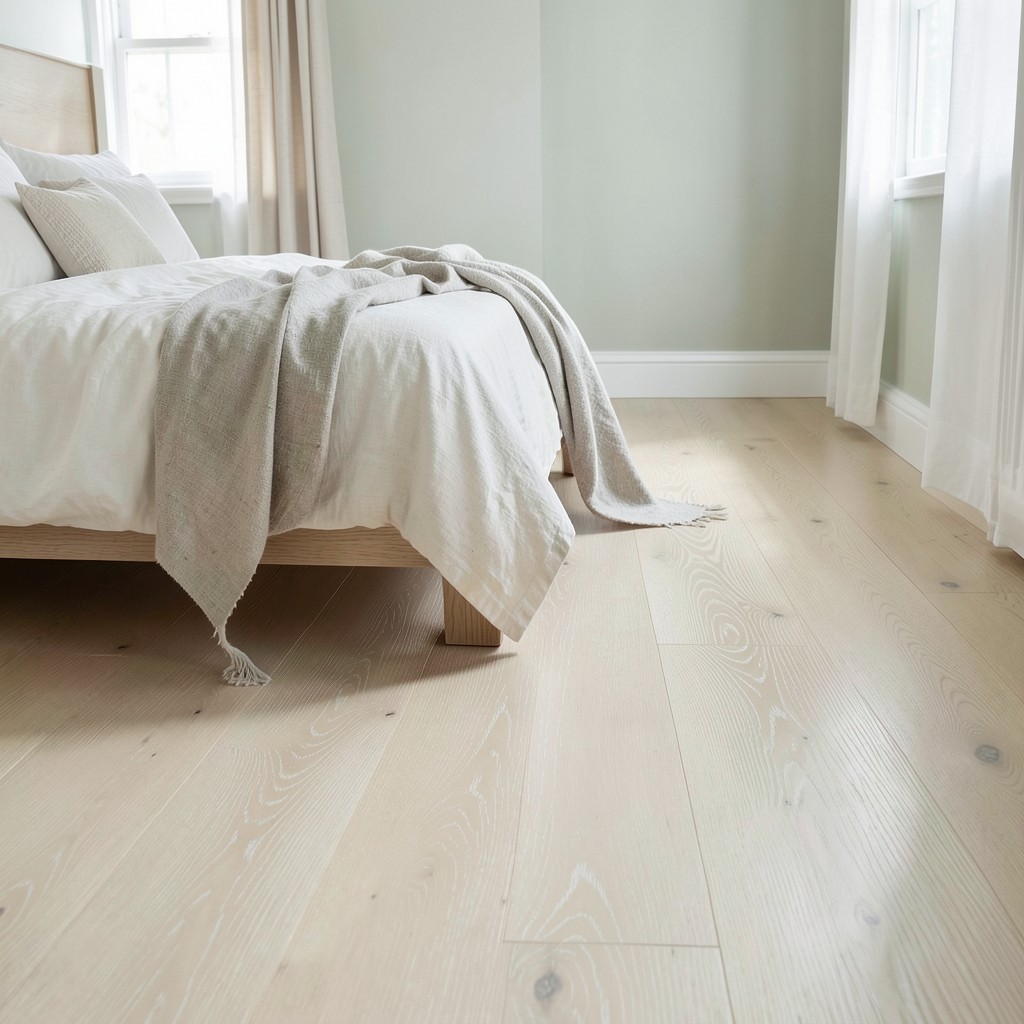
Limed oak flooring carries the specific pale character that the coastal home design, Scandinavian home interior, and airy home interiors directions require from their floor surfaces, and it achieves that character through material interaction rather than surface painting — the lime or liming wax product fills the oak’s open grain channels with a white residue while the timber surface between those channels retains its natural honey tone, producing a floor whose paleness is distributed through the grain rather than applied over the wood as a uniform coat. The limed oak is not a white floor. It is an oak floor whose grain has been filled with white, and the distinction produces a surface of far greater visual depth than any paint application provides.
The liming process begins with a wire-brushed oak surface — the brushing step opens the grain channels by removing the softer early-wood fibers between the grain lines, creating the physical recess that the liming product fills. A board that skips the wire-brushing step and receives liming wax over its standard sanded surface produces a much flatter result whose pale character is limited to the thin surface layer rather than distributed across the grain’s depth. The brushed surface is the preparation step on which the liming treatment’s quality depends, and it is the step most commonly omitted in the rush to apply the finish.
The spring bedroom decor or the bright home design application of a limed oak floor — the pale, grain-highlighted surface amplifying the room’s natural light from below while the walls carry the room’s color — produces the specific luminous quality of a floor that participates actively in the room’s light management rather than simply existing as a warm neutral underfoot. A bedroom whose floor is limed oak in a pale wire-brushed finish, whose walls are in a soft sage or warm white, and whose textiles are in natural linen and cotton, produces the room whose floor is the lightest surface in the space — an inversion of the usual floor-as-darkest-anchor logic that gives the room its airy, upward quality.
29. Saltillo Tile Flooring
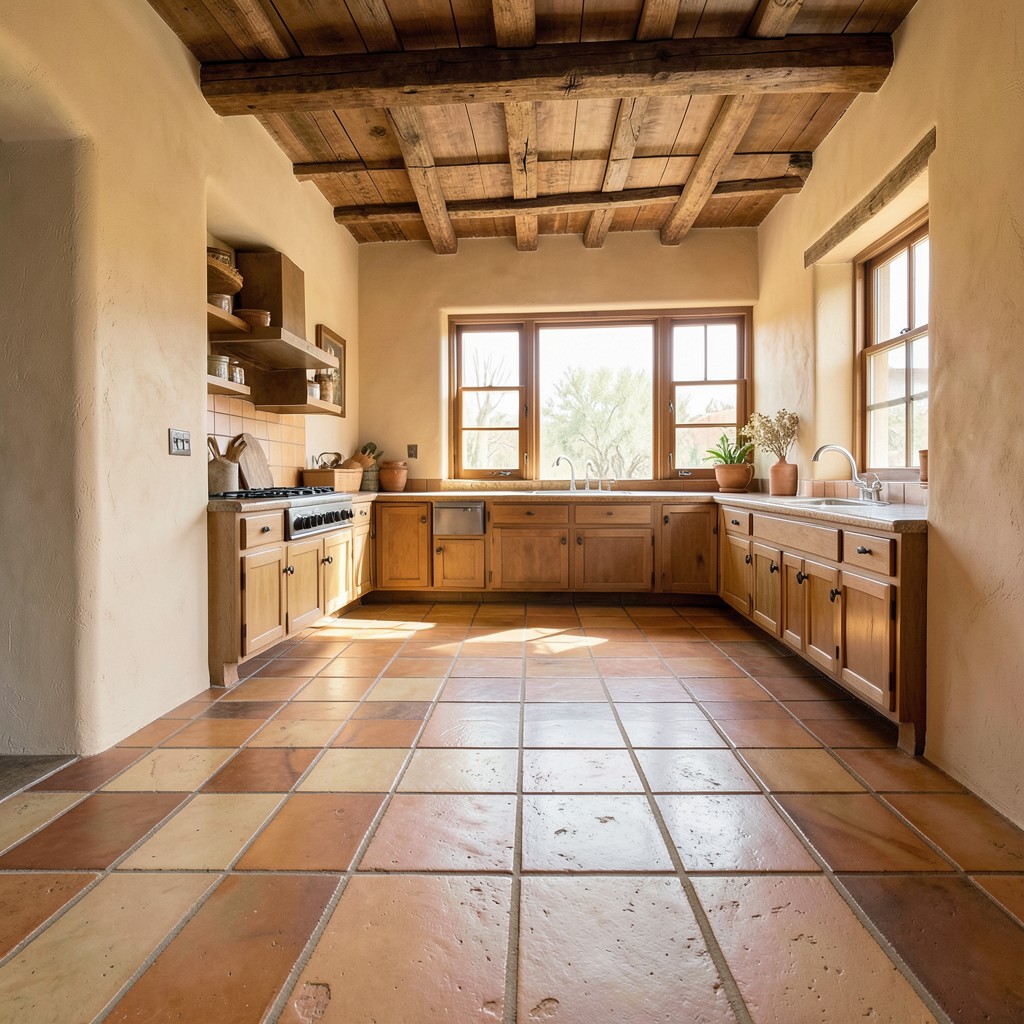
Saltillo tiles — the large, square, hand-formed sun-dried and kiln-fired terracotta tiles whose name comes from the Mexican city whose clay deposits and traditional production methods have supplied this specific tile to the North and Central American market — are the floor material that carries the warmth and material informality of the handmade clay tile at the largest scale of the terracotta family. Each Saltillo tile is pressed by hand into a mold, which means the surface carries the slight depression of the palm, the edge carries the maker’s finger marks, and the face is never perfectly flat — the tile’s character is an inventory of the human contact that produced it.
The color range of Saltillo tiles spans from the pale, warm cream of a low-iron clay deposit through the classic orange-red of the standard tile to the deep, almost brick-red of a high-iron mix fired at a higher temperature. The variation within a single delivery of tiles — some paler, some darker, some with the occasional cat paw print or grain husk embedded in the surface from the traditional drying process — is the material quality that makes a Saltillo floor irreplaceable by any manufactured tile, because the variation is not a quality defect. The variation is the evidence of the making process, and that evidence is the design quality being specified.
The desert home styling and earthy home design directions find in Saltillo their most authentic floor material — the warm, irregular, ochre-tinted surface consistent with the architectural traditions of the American Southwest and Mexican colonial interior that both design directions reference. A kitchen with Saltillo floors, adobe-plastered walls in warm cream, timber-beamed ceiling, and deep-set windows produces the specific quality of a room that belongs to its climate and its landscape rather than to a design catalog. Saltillo requires sealing and periodic maintenance with a penetrating sealer and a topcoat wax appropriate for the application — a care cycle that the floor rewards with a deepening, aging character that no manufactured tile develops.
30. Marble Effect Epoxy Flooring
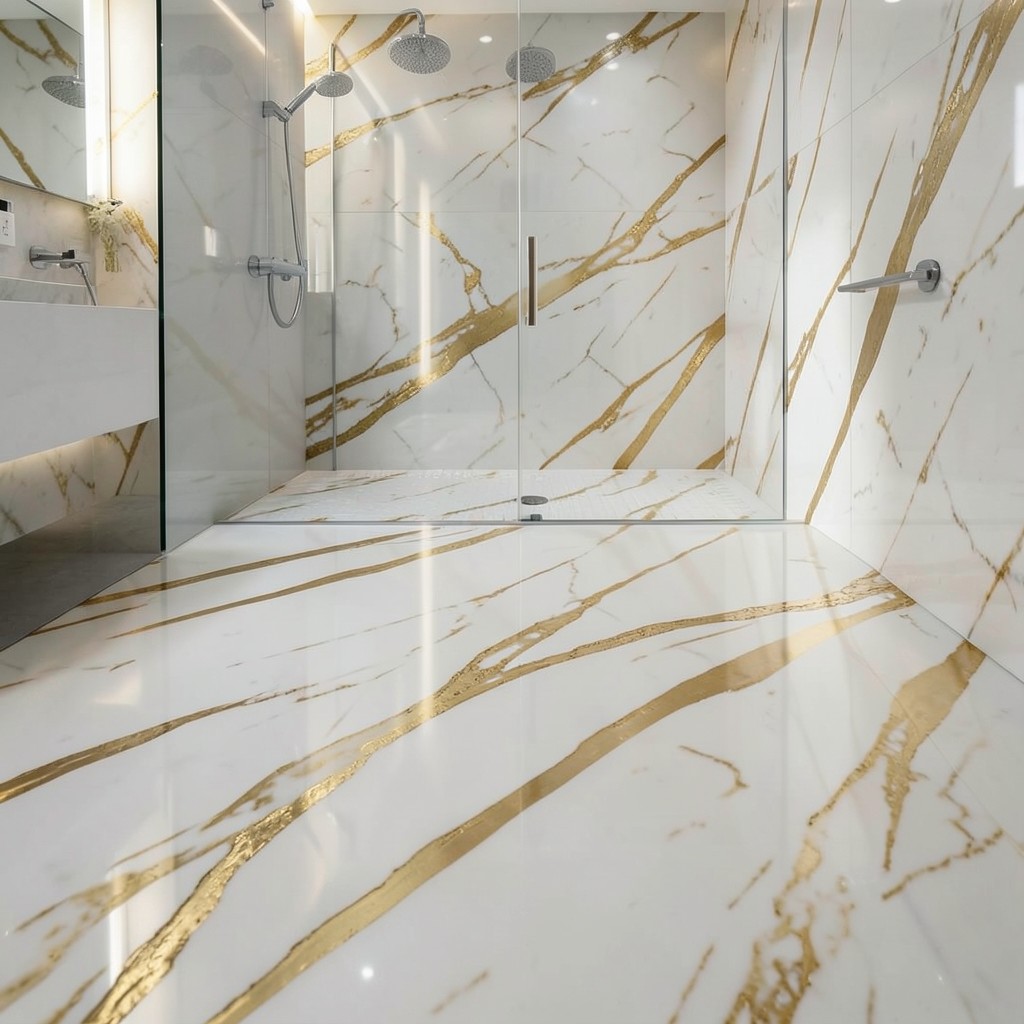
Marble effect epoxy flooring — a multi-layer resin system whose application technique involves the manipulation of contrasting pigmented resin layers to produce flowing veining, color depth, and the visual character of natural marble in a seamless, jointless floor surface — is the floor treatment that most aggressively pursues the luxury home interior aesthetic while operating entirely within the technical territory of the engineered floor product. The marble epoxy floor is not trying to pass as natural marble when examined closely. It is producing the marble visual experience in a material whose performance characteristics — seamless, waterproof, chemically resistant, highly reflective — natural marble cannot match.
The application technique for marble effect epoxy requires the base coat, the first pigment layer in the floor’s primary color, the second contrasting pigment layer in the veining color, and the manipulation of those two layers while they remain wet — through brushing, blowing with compressed air, or pulling with a wide brush — to produce the flowing vein patterns that read as marble from the finished floor’s viewing distance. The depth of the veining, its scale relative to the floor’s plan area, and the color contrast between the base and vein tones all determine whether the finished floor reads as a convincing marble effect or as a paint-pour technique whose abstract pattern merely suggests marble without resolving the illusion.
The luxury master bedroom design bathroom application of a white and gold marble effect epoxy — a pearl white base with warm gold veining manipulated to flow diagonally across the floor from one corner to the opposite wall — produces the specific quality of a bathroom whose floor is its primary luxury statement. The seamless surface wraps from the shower area across the main floor without grout joints, and the reflective high-gloss topcoat amplifies the room’s light sources in the specific way of a polished natural stone whose surface is the room’s secondary mirror. This is the floor for the bathroom that was designed to impress, and it performs that role without apology.
31. Natural Stone Cobble Flooring
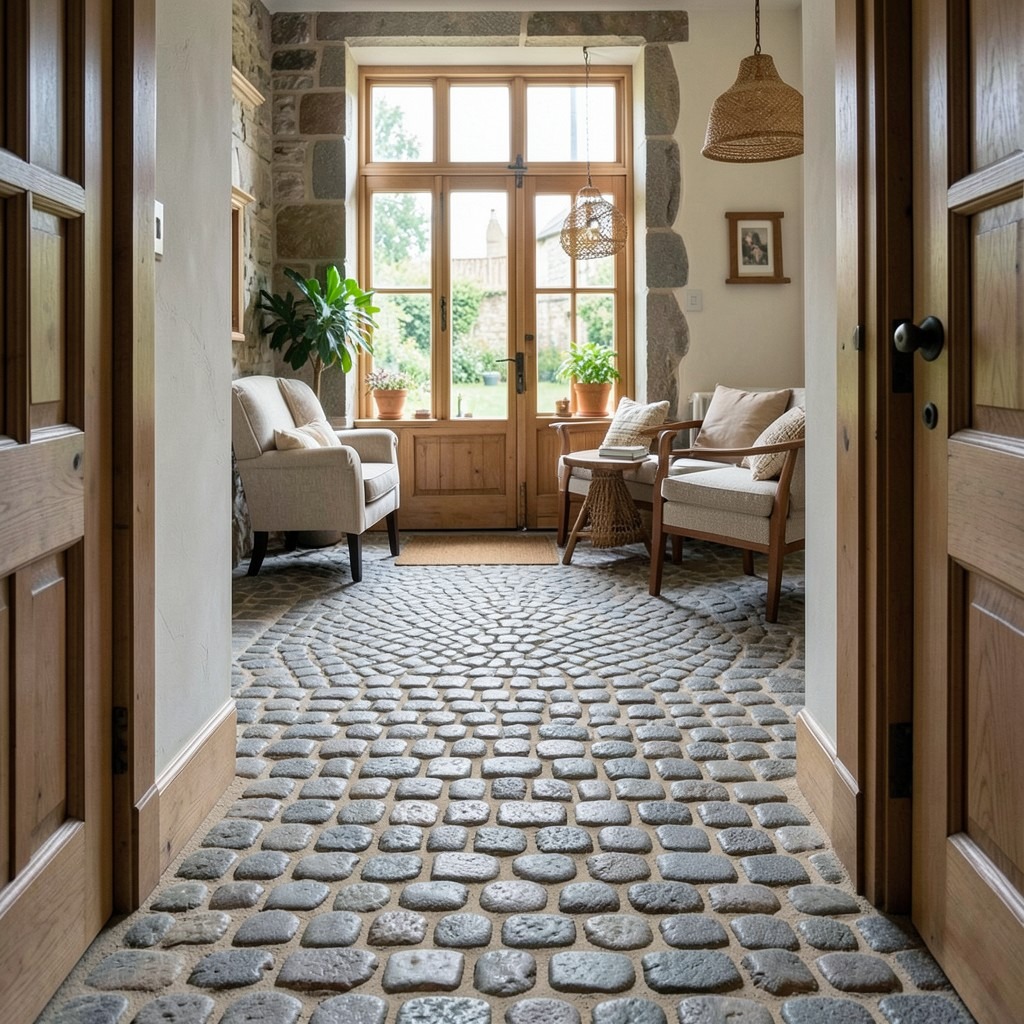
Natural stone cobblestones — rounded or roughly squared river stones, granite sets, or limestone cobbles laid in a sand or mortar bed — are the floor material that most directly imports the exterior landscape of the traditional European street, garden path, and courtyard into the domestic interior in a format whose tactile quality, visual density, and material weight are unlike any other residential flooring option. The cobble floor is not smooth, not flat, and not quiet underfoot. Those are not its limitations. Those are its defining qualities, and the spaces that benefit from those qualities are the spaces where the cobble floor belongs.
The interior application of cobblestones in a domestic setting suits the entrance vestibule, the utility room, the garden room, the conservatory, and the architectural transition space between the interior and the landscape rather than the main living spaces whose comfort requirements the cobble’s irregular surface does not serve. The rough, rounded surface of a river cobble floor in an entrance vestibule — the floor whose material signals the transition between the outdoor and the indoor without the abruptness of a hard material change at the threshold — is the application where the cobble’s character is most architecturally appropriate and most atmospherically effective.
The garden-inspired interiors or stone and wood home design direction whose ground floor transition space carries a natural cobble floor — the rounded grey granite set in a sand bed whose surface reads as the garden path brought indoors — produces the specific quality of a home whose boundary between the planted exterior and the furnished interior is deliberately blurred by the material that crosses it. The floor continues from the courtyard into the vestibule without interruption, and the continuation tells everyone who crosses the threshold that the exterior landscape does not stop at the door frame in this particular house.
32. Reclaimed Parquet Block Flooring
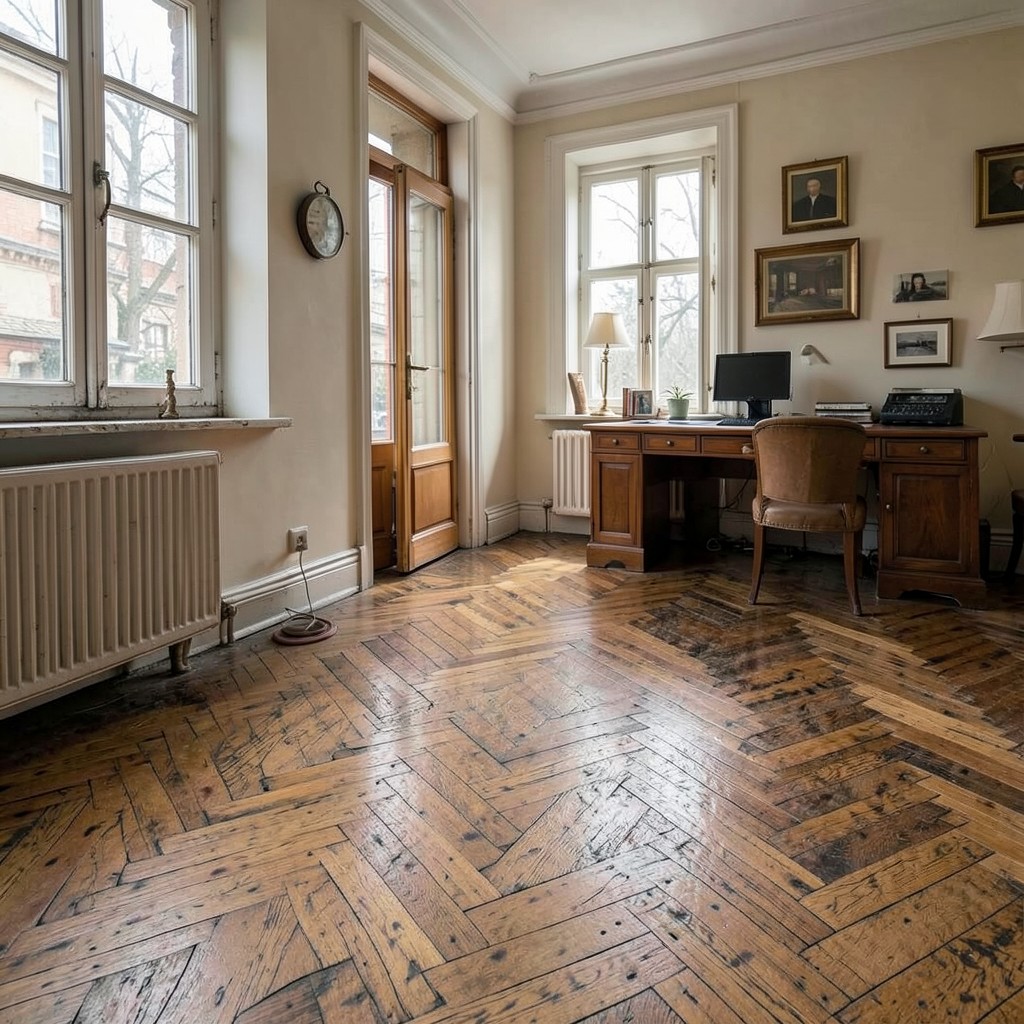
Reclaimed parquet blocks — original hardwood parquet flooring salvaged from demolished school gyms, factory floors, sports halls, and pre-war domestic properties — are the flooring material whose specific combination of aged surface character, dimensional consistency, and historical material quality produces the domestic floor whose depth and warmth no newly manufactured product approaches. The reclaimed parquet block arrives already worn, already warm, already marked with the decades of use that produced its surface patina, and the floor made from these blocks is a floor that appears to have belonged to the house for decades on the morning after installation.
The sourcing and preparation of reclaimed parquet blocks requires more attention than new flooring product selection because the material’s quality, condition, and dimensional consistency vary considerably between salvage sources. Blocks salvaged from a school gymnasium — typically in solid beech or maple, approximately twenty millimeters thick, seventy to ninety millimeters wide — arrive with the hardened gymnasium floor finish intact on their face side, requiring mechanical sanding before installation to reveal the raw timber surface beneath the accumulated finish layers. The sanding reveals the timber’s natural color, its grain character, and the specific wear patterns and marks that the block’s previous life has imprinted on its face.
The rustic home office ideas home study or the traditional home interiors sitting room whose floor is laid in reclaimed parquet blocks in a traditional basket-weave or herringbone arrangement, finished in a natural hardwax oil that allows the aged timber’s color to read without significant modification, produces the specific quality of an interior whose floor was acquired rather than installed — whose material history is the room’s most genuine design credential. This is the floor that guests ask about, not because it is fashionable, but because it is specific, and specificity in a domestic floor is rarer and more valuable than any trend.
33. Graphic Black Grout Tile Floor
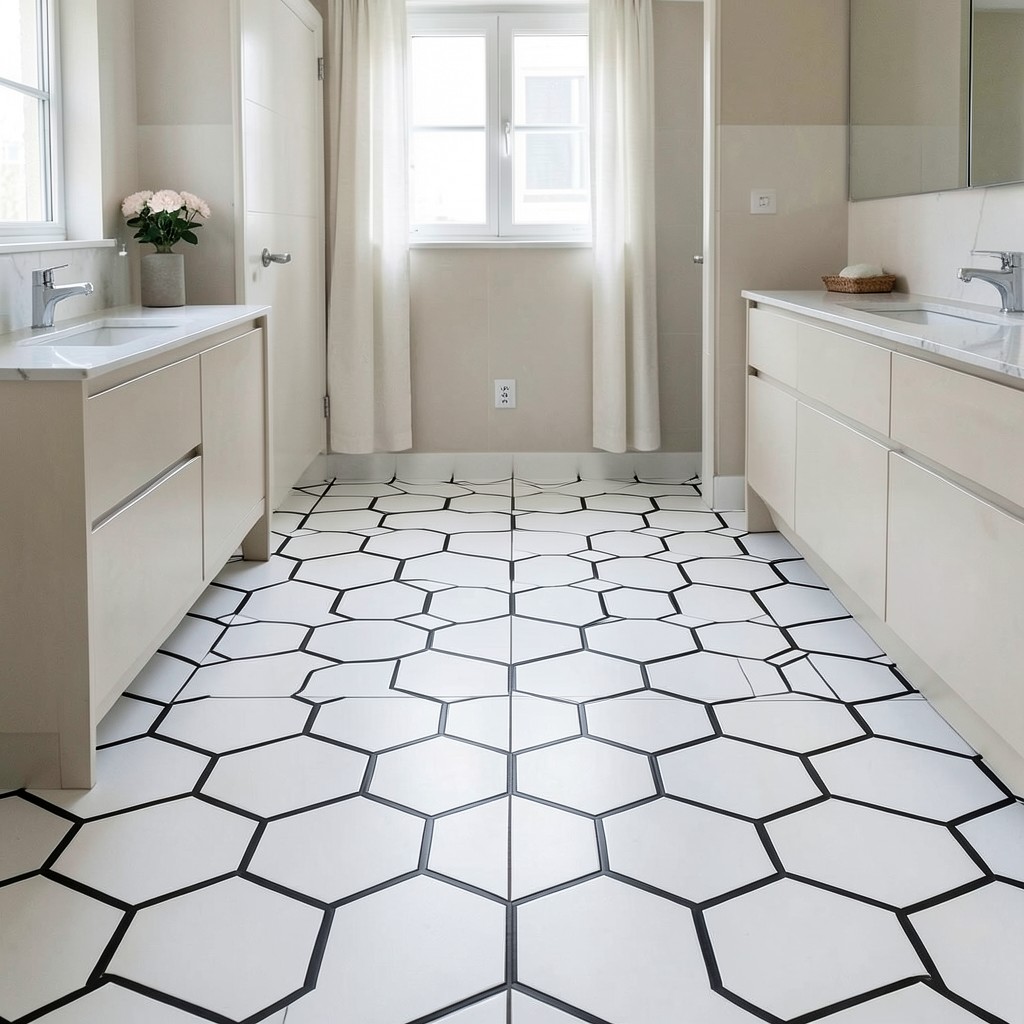
A tile floor whose design impact depends as much on the grout color as on the tile itself — specifically, the white or pale tile laid with a bold black grout that makes every joint line a graphic element rather than a functional seal — is the flooring technique that converts the standard tile floor installation into a composed floor graphic whose geometry is defined by the grout as much as by the tile. The black grout tile floor does not conceal the joints. It celebrates them, and the celebration is the design.
The tile format most suited to the black grout treatment is the small-to-medium format whose joint frequency is high enough to make the black grout’s graphic quality read as a pattern rather than as individual lines — the one-hundred-millimeter square tile, the seventy-five by one-hundred-and-fifty-millimeter subway tile, and the hexagonal tile in a one-hundred-millimeter point-to-point dimension all provide the joint frequency that the black grout technique requires to produce its grid pattern clearly across the floor surface. A large-format tile with black grout has too few joints at too wide a spacing to produce the graphic quality — the isolated black lines read as faults rather than features in the widely spaced field.
The modern kitchen ideas or chic home decor bathroom whose floor uses white hexagonal tiles with black grout — the floor’s hexagonal grid clearly defined in bold black lines against the white tile field — produces the graphic, design-forward floor treatment that the kitchen or bathroom renovation whose other surfaces are in restrained neutrals needs to carry the room’s design interest. The black grout floor in this context is the room’s pattern element, the visual work that the walls and cabinetry deliberately leave for the floor to perform, and the specific quality of a monochrome geometric floor in a pale-toned room is the contrast that makes both the floor and the room above it read more clearly than either would alone.
34. Tumbled Travertine Flooring
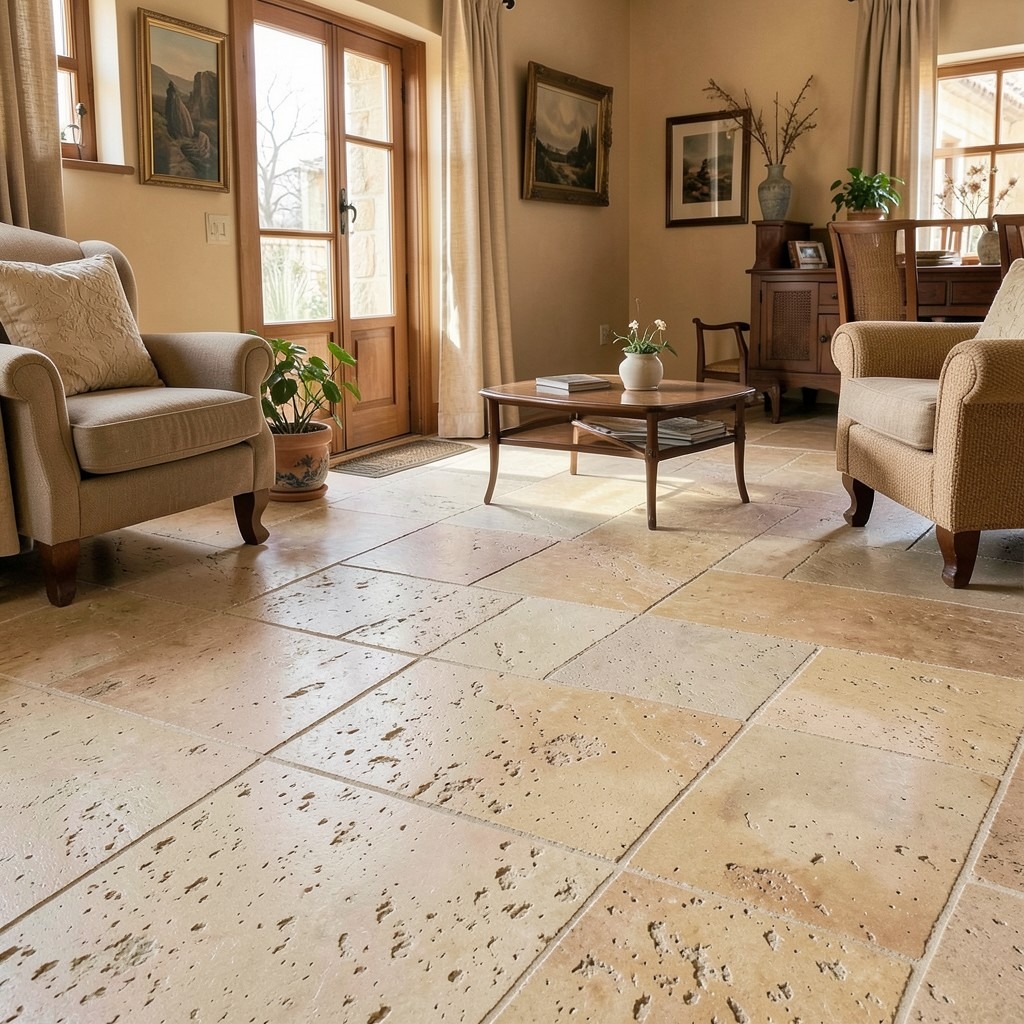
Tumbled travertine — the natural travertine tile whose edges and surface have been processed in a tumbling drum with abrasive media to produce the rounded corners, the slightly worn surface, and the aged character of a stone that has been handled and walked upon for many years — is the floor material that provides the warm, golden Mediterranean quality of travertine with an added surface informality that the square-cut polished or honed version does not possess. The tumbled finish makes the travertine tile look as though it was reclaimed from an ancient floor rather than freshly cut from the quarry, and that transformation of the new into the apparently old is achieved entirely through the physical tumbling process rather than through any surface treatment or staining.
The characteristic pitting of travertine — the natural voids in the stone’s surface produced by the gas bubbles present in the original calcium carbonate deposit’s formation — is more visible in the tumbled travertine than in the filled-and-honed version because the tumbling process neither fills the voids with grout or resin nor grinds the surface smooth enough to minimize their presence. The unfilled travertine tile’s voids accumulate the grout haze, the cleaning product residue, and the general marks of use in the floor’s first years of service, producing the naturally aged character that the tumbling process initiates and that the occupancy continues. This is the floor that the house grows into rather than the floor that the house begins with.
The Mediterranean-inspired sitting room, the traditional home interiors entrance hall, and the warm home decor ideas open-plan living space all find in tumbled travertine the floor material whose warm golden-cream tone and aged surface character provide the room’s most consistent atmospheric contribution across every season. The winter home decor context where a tumbled travertine floor over underfloor heating becomes the room’s primary warmth source — the stone’s thermal mass storing the heat and releasing it slowly through the day — is the floor performing its geological character in the most direct possible way.
35. Industrial Steel Plate Flooring
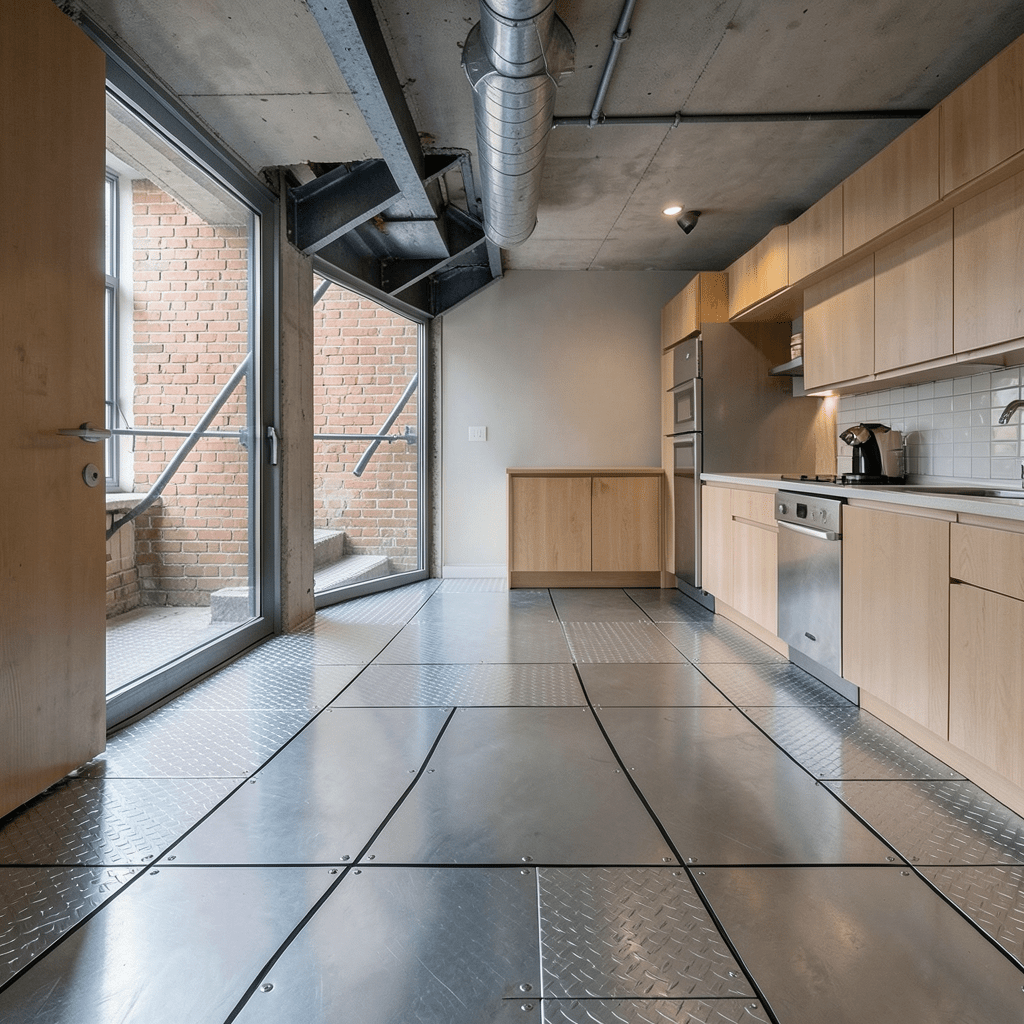
Steel plate flooring — checker plate or smooth mild steel sheet installed as a floor surface in domestic spaces whose design direction is committed to the industrial home design aesthetic at its most material-honest — is the floor treatment that most completely eliminates the distinction between the floor as a construction element and the floor as a design surface, because the steel plate’s identity is entirely industrial and its use in the domestic interior is the declaration that the building’s material program does not make that distinction. The steel floor does not reference industrial aesthetics. It is industrial, and the room it inhabits is honest about that.
The practical installation of steel plate flooring in a domestic interior requires addressing the material’s significant weight — a ten-millimeter mild steel checker plate floor adds approximately seventy-eight kilograms per square meter to the floor loading, which is beyond the capacity of most timber suspended floor structures without structural reinforcement. The ground floor slab application is the most structurally straightforward domestic installation position for steel plate flooring, where the concrete slab below provides both the load capacity and the flat, level substrate that the steel plate installation requires. The plates are fixed to the substrate with countersunk fasteners whose heads sit flush with the plate surface, and the joints between plates are either left as deliberate black lines in the surface or welded and ground flush depending on the design intention.
The urban loft conversion whose entrance, staircase, and kitchen floor is in checker plate mild steel — the raised diamond pattern providing the slip resistance the stair application requires — produces the industrial home design aesthetic at the floor level most consistent with the overall material program of a building whose exposed structural steel, concrete ceiling, and brick walls already commit to the honest expression of the building’s construction. The steel floor in this context is not decoration applied to the building. It is the building’s floor, and the design’s job was simply to not cover it.
36. Aged Pine Flooring With Distressed Finish
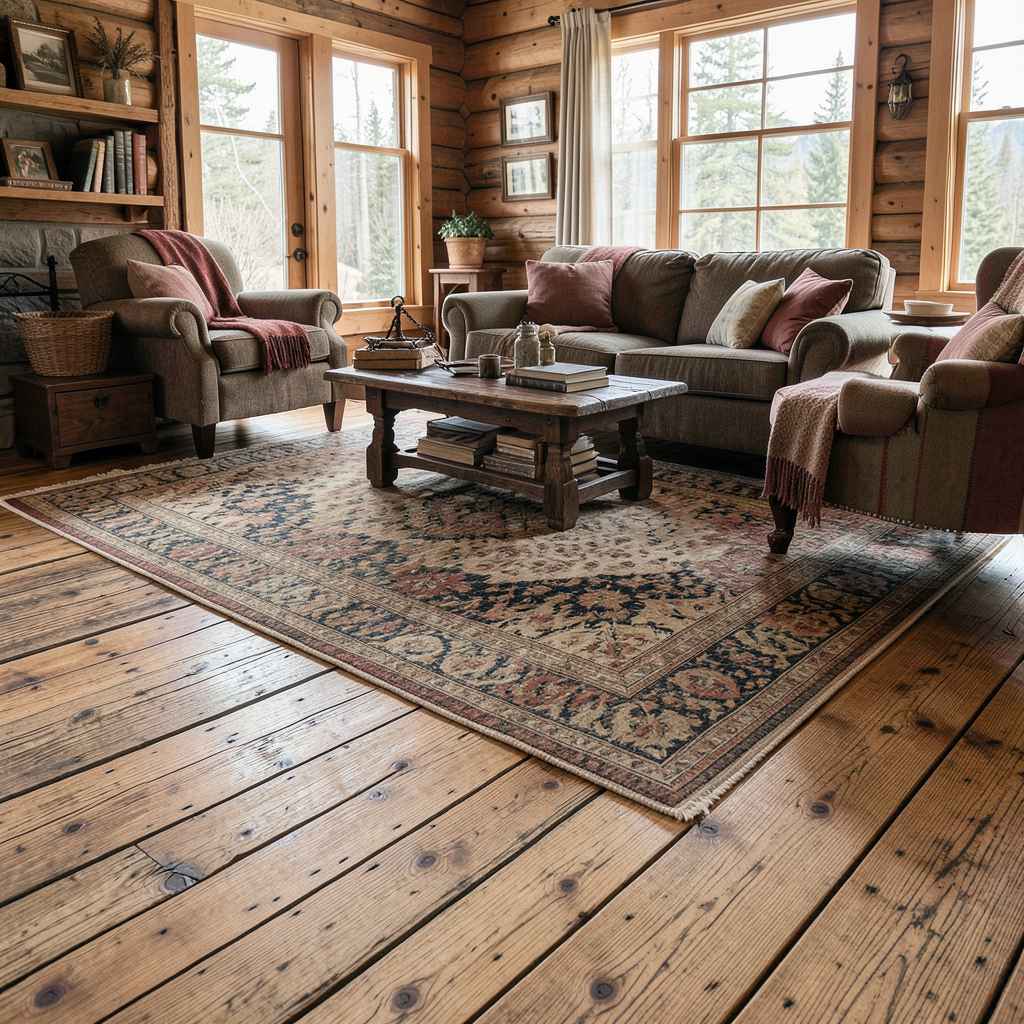
Aged pine flooring — either genuinely reclaimed antique pine boards from demolished structures or new pine that has received a mechanical distressing and aging treatment — produces the floor material that the mountain cabin decor and rustic home decor directions use as their primary floor specification because no other material communicates the history of a well-used, well-lived-in building more directly than pine floorboards whose surface carries the accumulated evidence of decades of occupancy. The knots, the surface marks, the slight undulation between boards, and the color depth that comes from years of wax and oil application combine to produce a floor that the house appears to have always had.
The distressing process applied to new pine to produce the aged appearance involves a combination of mechanical processes — wire brushing to open the grain, hand-scraping to produce irregular surface undulation, hitting the surface with chains or keys to produce impact marks, and the application of a dark wax or oil to the grain channels that simulates the accumulated dirt and polish of decades. The quality of a distressed pine floor depends entirely on the conviction of the distressing process — a light, cautious treatment produces a floor that reads as new timber with surface marks, while a committed, thorough distressing produces a floor that reads as genuinely old at first sight.
The fall home decorating sitting room whose aged pine floor carries a large antique wool rug over the central seating area — the floor’s warm, worn surface visible at the rug’s perimeter and between the furniture groupings — produces the specific quality of a room whose material layers communicate a domestic history accumulated over time rather than assembled from a single design scheme. The pine floor is the lowest and oldest-appearing layer in the room’s material stratigraphy, and everything else in the room sits above it as evidence of the life lived on that floor.
37. Penny Tile Mosaic With Border Flooring
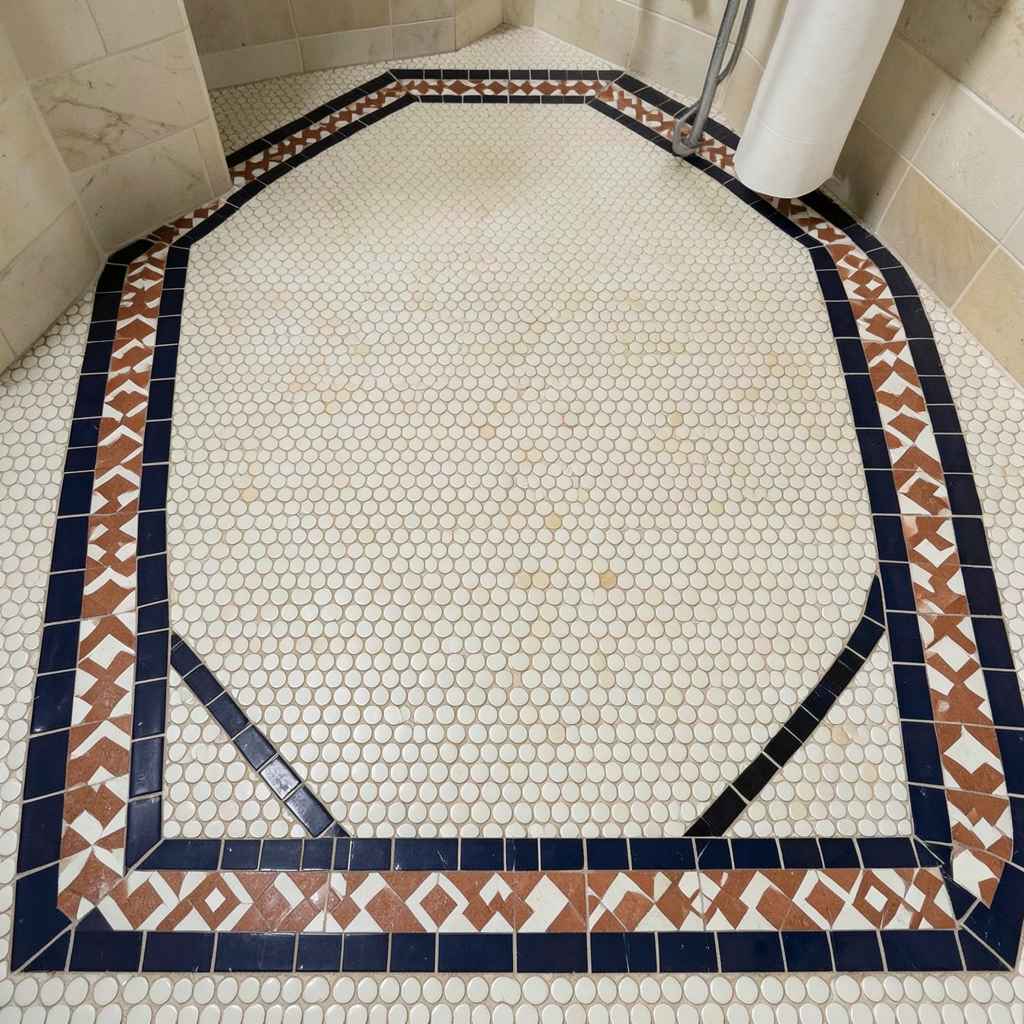
A penny tile mosaic floor with a designed border — the circular penny tile field bounded by a composed geometric border whose tile format, color, and pattern differ from the field tiles — is the floor composition technique that most directly references the classical Roman and Victorian tile floor tradition of the designed floor as a complete architectural composition rather than a single material applied uniformly across the floor plane. The border converts a tile floor into a floor design, and the distinction between those two outcomes is the difference between a floor that covers the room and a floor that composes it.
The border design must relate to the field tile in a color logic that is internally coherent: the border’s colors drawn from the palette established by the field tile’s own color range, or in a contrasting tone whose relationship with the field color is resolved rather than accidental. A white penny tile field with a border of deep navy subway tiles laid in a soldier course produces the classic two-color border whose high contrast reads clearly from the room’s entry point. A cream penny tile field with a terracotta and white geometric border in an encaustic tile format produces the Mediterranean floor composition whose material and color combination suits the earthy home design or traditional home interiors direction.
The farmhouse bathroom decor or the classic spring home refresh bathroom renovation whose floor uses a white penny tile field with a simple black border tile enclosing the room’s perimeter — the border approximately three tile widths wide, the corner mitred at forty-five degrees — produces the period-appropriate floor composition of the Arts and Crafts and Edwardian bathroom whose design language this border treatment directly references. The border anchors the floor within the room’s perimeter, prevents the penny tile field from reading as a continuous surface that runs to the wall without acknowledgment of the room’s geometry, and produces the floor quality of a room whose materials were thought about rather than laid without a plan.
38. Floating Engineered Bamboo Flooring
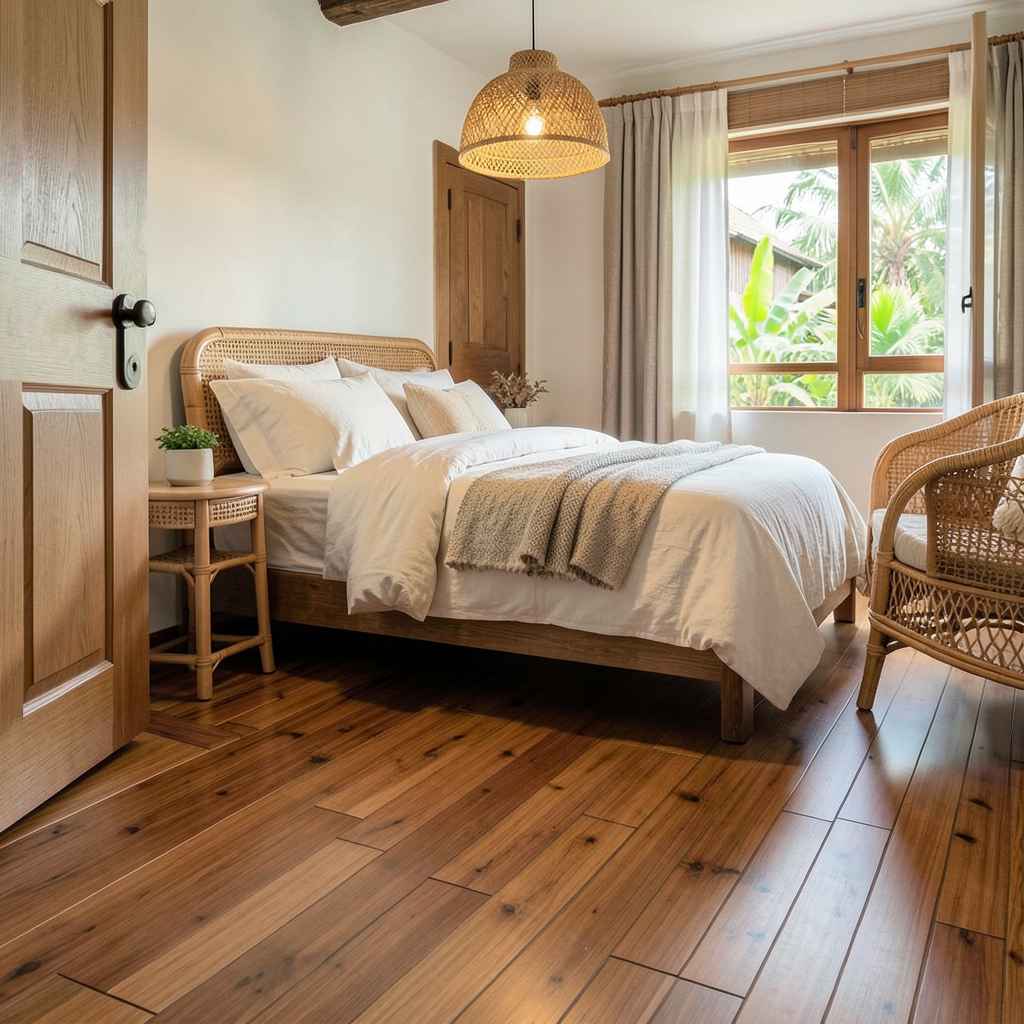
A floating bamboo floor — engineered bamboo planks installed without adhesive or mechanical fixing to the subfloor, the boards click-locked together and floating as a connected assembly above the substrate with an expansion gap at the perimeter — is the installation method that most reduces the bamboo floor’s installation complexity, its installation cost, and the permanence of its connection to the substrate, making it the bamboo floor format most appropriate for rental properties, for rooms over underfloor heating systems whose thermal expansion requires accommodation, and for DIY installation without specialist tools or expertise.
The floating installation method’s specific advantage over glued or nailed bamboo installation is the ability to accommodate the significant dimensional movement that bamboo exhibits in response to humidity changes — the expansion gap at the floor’s perimeter allows the assembly to expand and contract without buckling at the center or opening gaps at the joints. The gap must be covered by the room’s skirting board or a specific expansion gap cover molding, and the planning of the floor layout must account for this gap’s position relative to the door thresholds, the kitchen unit toe boards, and any fixed furniture that sits close to the wall.
The tropical home design bedroom or the bohemian home styling living room whose floating engineered bamboo floor provides the natural material character of the bamboo home interiors direction at the practical installation simplicity of the floating system produces the complete atmospheric quality of the natural fiber floor without the installation investment that glued and nailed bamboo requires. A warm-toned carbonized bamboo floating floor in a bedroom with natural cotton bedding, woven rattan furniture, and a pendant light in a woven fiber shade produces the material environment of the tropical home design direction from the floor upward, each element in the room’s palette consistent with the bamboo floor’s warm, natural material character.
39. Coloured Resin Screed Flooring
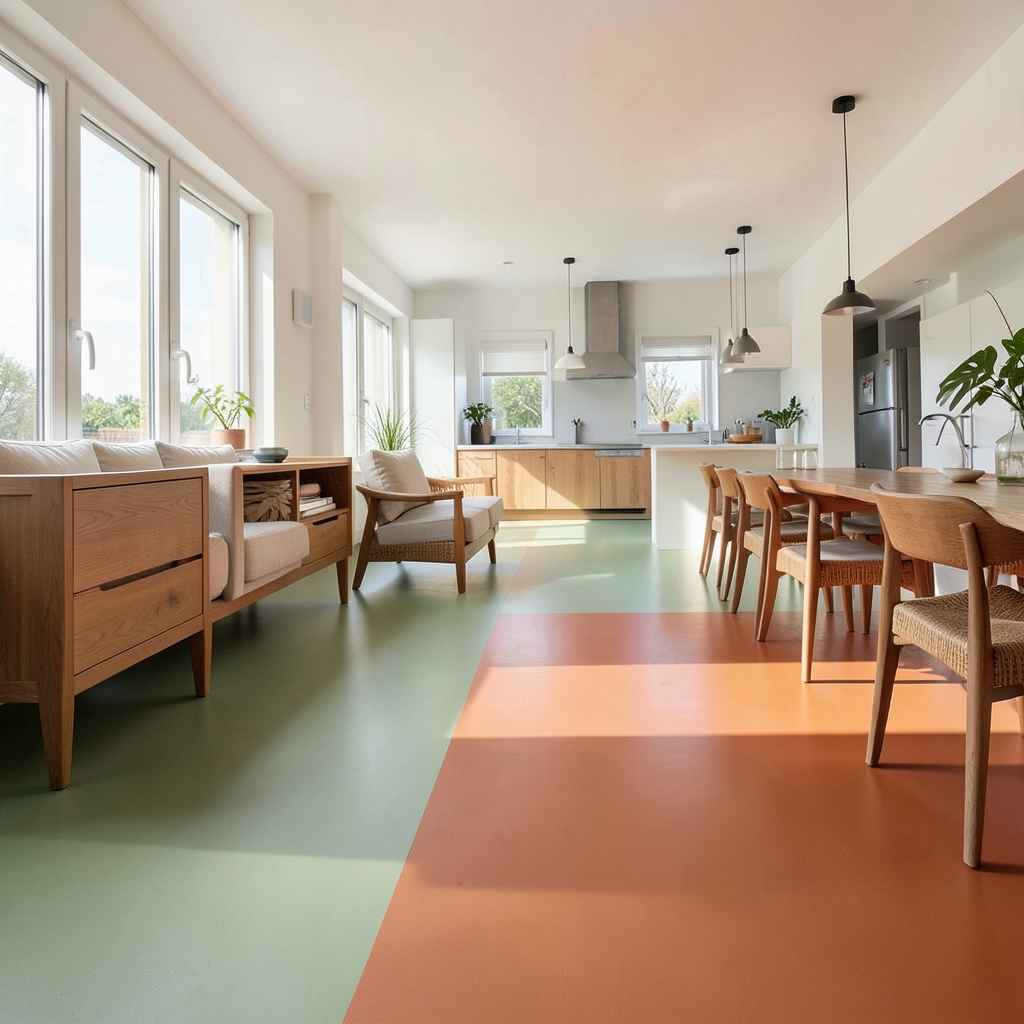
A coloured resin screed floor — a cementitious or polymer-modified screed whose fine, troweled surface receives a saturated pigment color before a clear seal is applied, producing a flat, continuous floor surface in a strong architectural color rather than the grey neutrality of the standard screed — is the floor design approach that applies the design logic of the bold painted wall to the floor plane, using color on the floor surface to produce the same kind of spatial and atmospheric impact that the bold wall color provides at the vertical surface. A coloured floor is a committed floor. There is no hedging available in a floor that is sage green or terracotta red from wall to wall.
The color selection for a resin screed floor works with a different logic from wall color selection because the floor’s large horizontal plane occupies the room’s entire base and relates simultaneously to every wall surface, every furniture piece, and every light source in the space. Colors that work well on walls — the deep navy, the forest green, the saturated terracotta — work equally well on a coloured screed floor when the room’s other surfaces are pale enough to provide the tonal counterweight that the floor’s saturation requires. The sage green resin screed floor in a room with white walls and warm timber furniture produces the botanical, garden-inspired interiors quality of a room whose floor reads as the planted earth beneath the room’s pale sky.
The summer home design direction whose ground floor is in a continuous terracotta resin screed — the warm orange-red floor running without interruption from the living room through the kitchen to the dining area in an open-plan configuration — produces the specific quality of a living environment whose warm floor unifies the multiple functional zones under a single material and color identity. The floor’s warmth is visual rather than thermal in this context, but the visual warmth of a saturated terracotta floor in a room flooded with summer afternoon light is a warmth that the occupants feel at the level of the visual system before they consciously identify its source.
40. Reclaimed Schoolhouse Maple Flooring
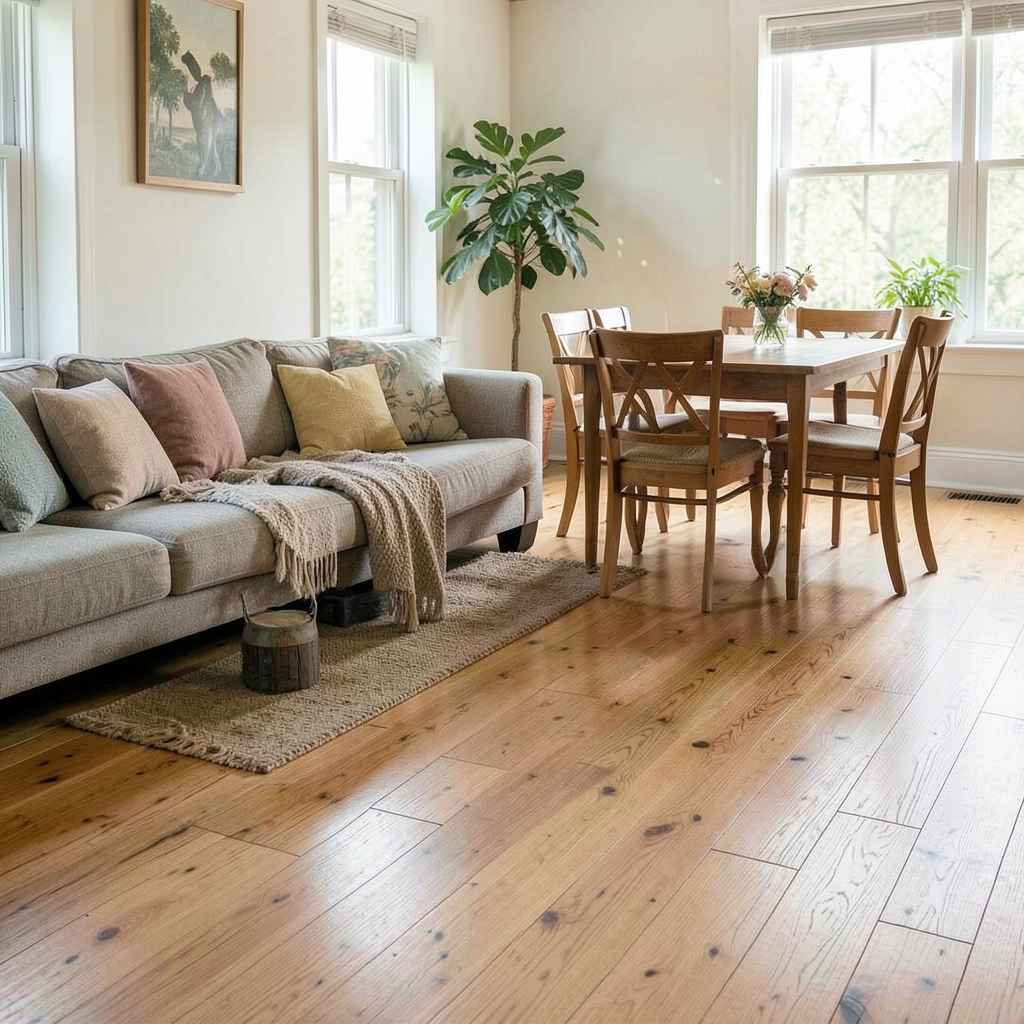
Reclaimed schoolhouse maple flooring — the dense, pale hardwood flooring salvaged from the gymnasium and classroom floors of demolished educational buildings, whose decades of foot traffic have compressed and burnished the surface to a specific hardness and sheen that new maple cannot replicate — is the reclaimed timber floor whose material character is the most distinct from any new timber product currently available, because the conditions that produced its specific surface quality — the compression of thousands of young feet over fifty or more years of daily use — cannot be manufactured or accelerated.
The surface of reclaimed schoolhouse maple carries the accumulated refinishing cycles of the building’s maintenance history — the layers of gymnasium sealant, the refinishing sands, the accumulated wax — compressed into a surface whose depth and warmth are completely unlike the flat, consistent sheen of a newly finished maple board. Beneath the surface layers, the maple itself has darkened slightly from decades of indirect light exposure and the slow oxidation that produces the amber honey tone that distinguishes well-aged maple from the almost white color of newly milled material. The floor’s character is therefore both surface and depth.
The bright home design living room or the relaxed home design dining area whose reclaimed schoolhouse maple floor is installed with a natural hardwax oil finish — no stain, no color modification, just the oil enhancing the timber’s own aged tone — produces the specific quality of a floor that reads as having earned its place in the house through time rather than through specification. The pale honey warmth of the aged maple floor suits the spring home refresh and summer living room decor directions equally well, providing the light, warm base that the room’s seasonal transitions in textile and accessory color play against without the floor ever feeling inconsistent with the season.
41. Spanish Glazed Terracotta Flooring
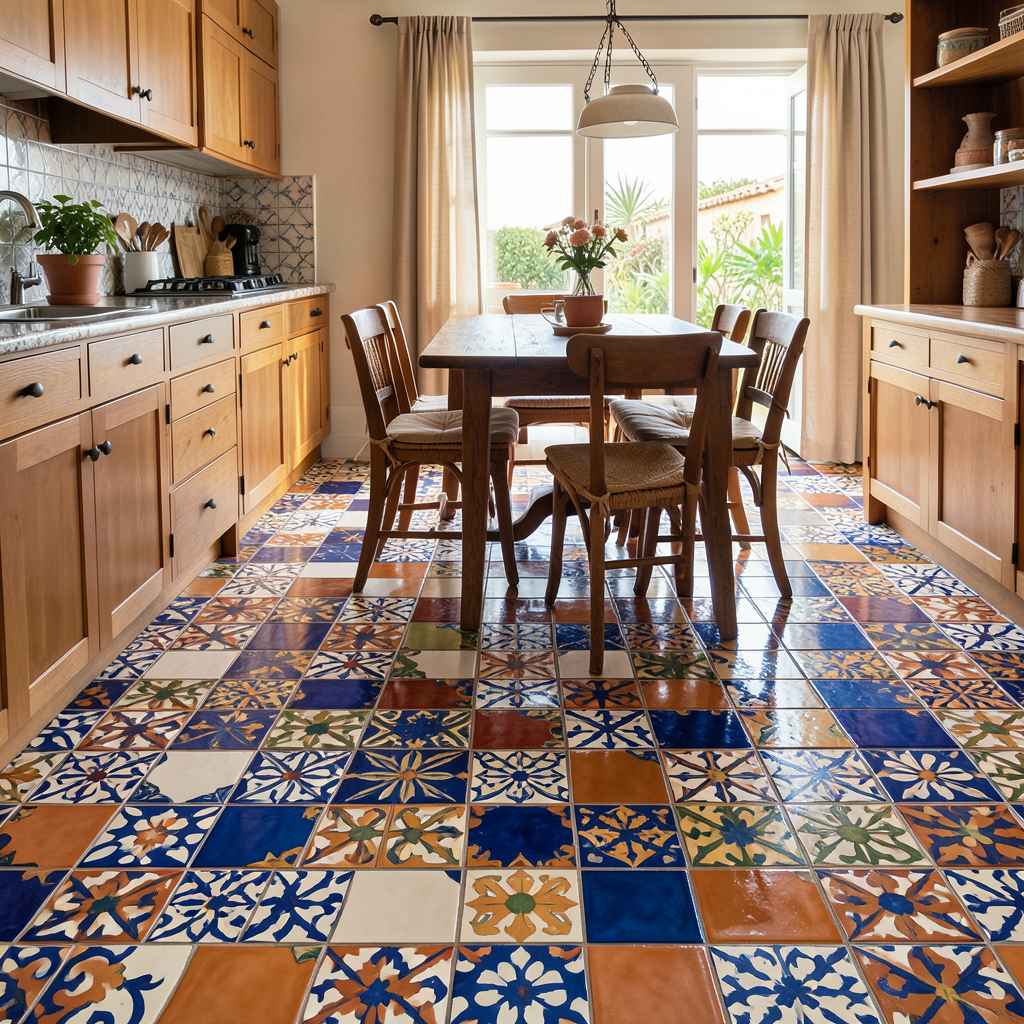
Glazed terracotta tiles — the traditional Spanish and Moroccan ceramic tile whose clay body is coated in a thick lead-free glaze before firing, producing a tile with the warmth and weight of terracotta combined with the color depth, gloss, and practical impermeability of a glazed ceramic surface — are the floor material that provides the warmest, most richly colored tile floor in the domestic interior without the maintenance demands of the unglazed terracotta whose porous surface requires regular sealing and waxing to resist staining. The glaze provides both the color intensity and the practical protection simultaneously.
The color range of Spanish glazed terracotta spans the full spectrum of the traditional Mediterranean palette — the deep cobalt blues, the warm ochres, the forest greens, the burnt siennas, and the terracotta reds that the Moorish and Andalusian decorative ceramic traditions developed across centuries of production. A floor tiled in handmade glazed terracotta in alternating cobalt and white squares — the classic Spanish floor tile combination whose graphic contrast produces the floor that reads simultaneously as pattern and as material — provides the holiday home styling or traditional home interiors floor quality whose visual richness contributes the room’s primary color and pattern element from the ground up.
The coastal home design kitchen or the bohemian home styling dining room whose floor is in handmade glazed terracotta in a mixed palette of warm tones — terracotta, ochre, russet, and cream — laid in a random or chequerboard arrangement, produces the specific Mediterranean atmosphere of a room whose floor was made rather than manufactured. Each handmade tile’s slight dimensional variation, each glaze’s slightly different color saturation, and the irregular reflectivity of the handmade glaze surface across the floor field combine to produce the visual richness of a material whose character is the sum of its individual variations rather than the uniformity of its standard specification.
42. Poured Terrazzo Flooring
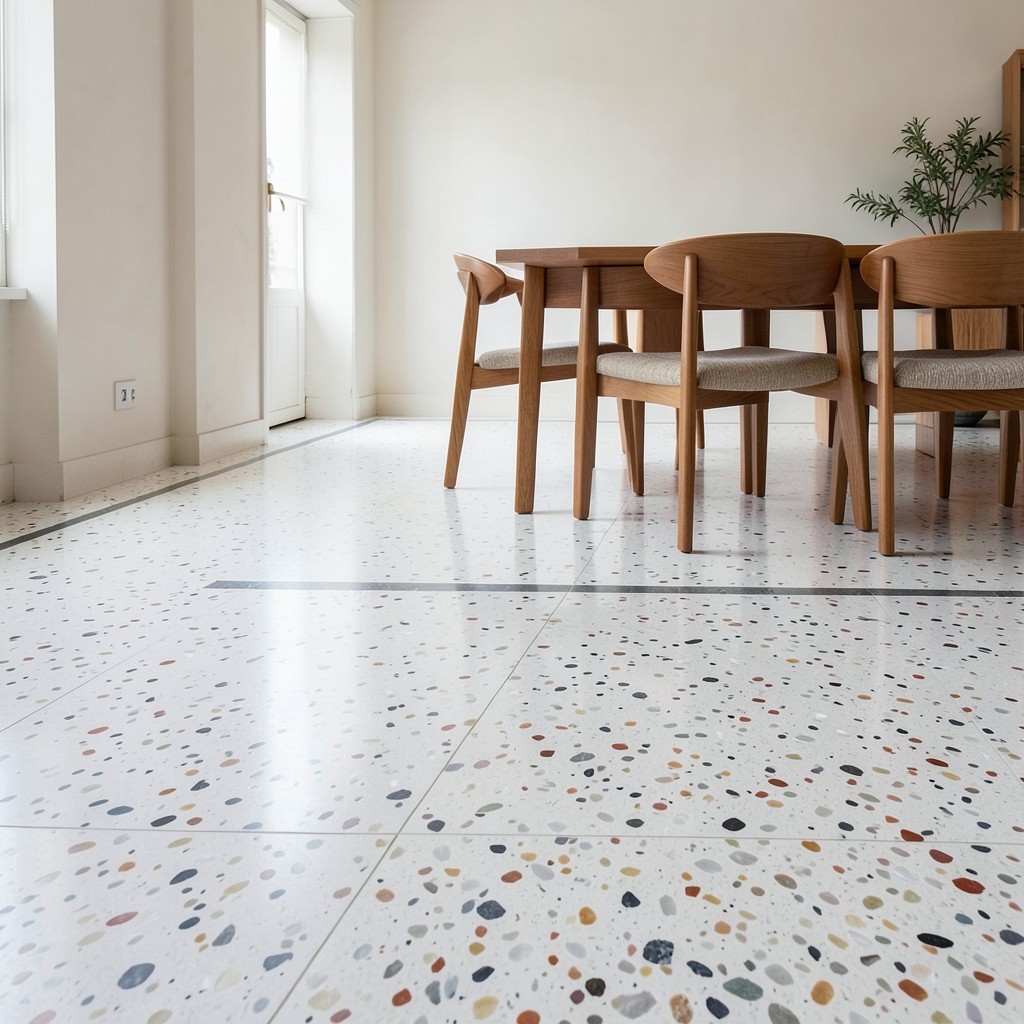
Terrazzo — the floor surface whose composition is a matrix of marble, granite, glass, or shell aggregate set in a cement or resin binder, ground flush and polished to produce the smooth, continuous surface whose color and pattern come entirely from the aggregate distribution — is the floor material with the longest continuous production history in Western domestic architecture and the most genuinely infinite design range, because the aggregate selection, the binder color, the divider strip pattern, and the final polish level all offer independent specification variables whose combinations produce a floor that can be as pale, as colorful, as fine, or as bold as the design requires.
The cement terrazzo floor — the traditional poured-in-place terrazzo whose aggregate is set in a grey or pigmented Portland cement binder, ground progressively from coarse to fine diamond and polished to a smooth, matte or semi-polished finish — is the floor material of the finest public buildings and private residences in the Italian, South American, and Modernist architectural traditions, and its domestic application produces the floor whose material seriousness is immediately apparent to anyone who has encountered the genuine article in a well-maintained historic building. The poured-in-place terrazzo cannot be removed and relocated. It is the floor of the house, as permanent as the walls and the foundations.
The luxury home interior or the minimalist dining room whose floor is poured terrazzo in a warm white cement binder with large-chip white Carrara marble aggregate and a fine pale grey chip producing the secondary texture — the floor polished to a semi-gloss whose surface reads as both stone and water simultaneously — produces the most refined floor in this entire collection. The simplicity of the palette — the near-white floor against the pale wall and the warm timber furniture — allows the floor’s material quality, its depth, its continuity, and its specific light response, to perform without competition from color complexity in the room above it.
43. Cork and Timber Inlay Flooring
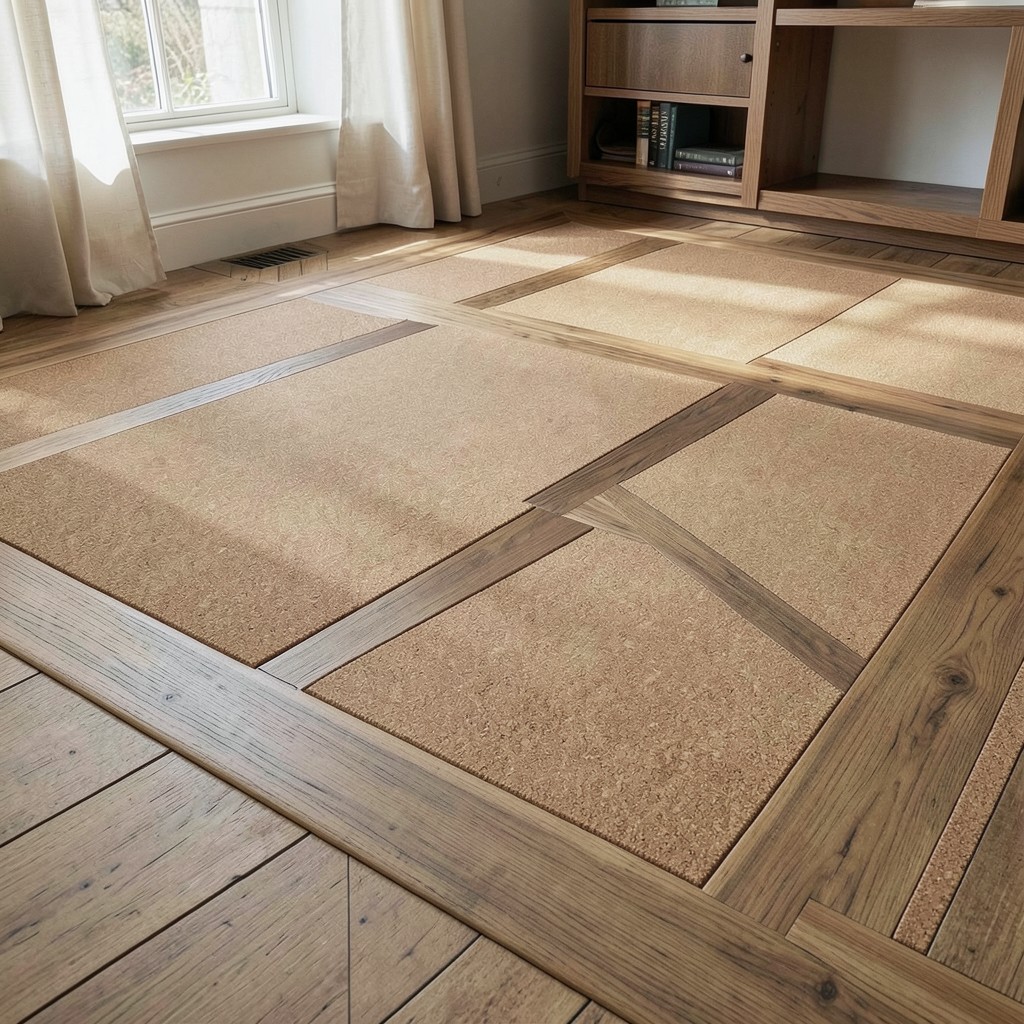
A floor whose composition combines cork tiles and solid timber boards in a designed inlay pattern — alternating cork and timber strips, a cork central field within a timber border frame, or geometric inlay of timber pieces within a cork field — is the flooring format that most intelligently combines two materials whose complementary physical properties address the floor’s competing requirements simultaneously. The timber provides the hardness, the definition, and the structural character that the floor’s framing elements and high-traffic zones require. The cork provides the acoustic softness, the thermal insulation, and the physical comfort underfoot that the floor’s main field needs to support the room’s daily activity.
The inlay pattern’s geometry determines the floor’s visual character and the distribution of the two materials across the room’s plan. A wide timber border enclosing a cork field — the timber’s warm grain framing the cork’s softer, more organic surface at the room’s perimeter — produces the floor that reads as a large rug inlaid in the timber rather than as a rug placed on the floor, the distinction being that the inlaid surface is the floor rather than an element placed on it. This inlay quality — the pattern as floor rather than the pattern on floor — is the design sophistication that the cork and timber combination achieves at its most resolved.
The cozy bedroom design or the rustic home office ideas home study whose cork and timber inlay floor provides the acoustic quiet of the cork field in the primary occupation zone while the timber border frames the room and marks its architectural boundary produces the specific quality of a floor that was designed for the way the room is used rather than for the way it appears in a photograph. The cozy quality of a cork floor underfoot — its slight give, its thermal warmth, its sound absorption — is felt across the day in the room that occupies it most heavily, and the timber border’s visual definition prevents the all-cork floor’s potential softness from reading as unresolved at the room’s perimeter.
44. Patterned Cement Tile in a Bold Geometric
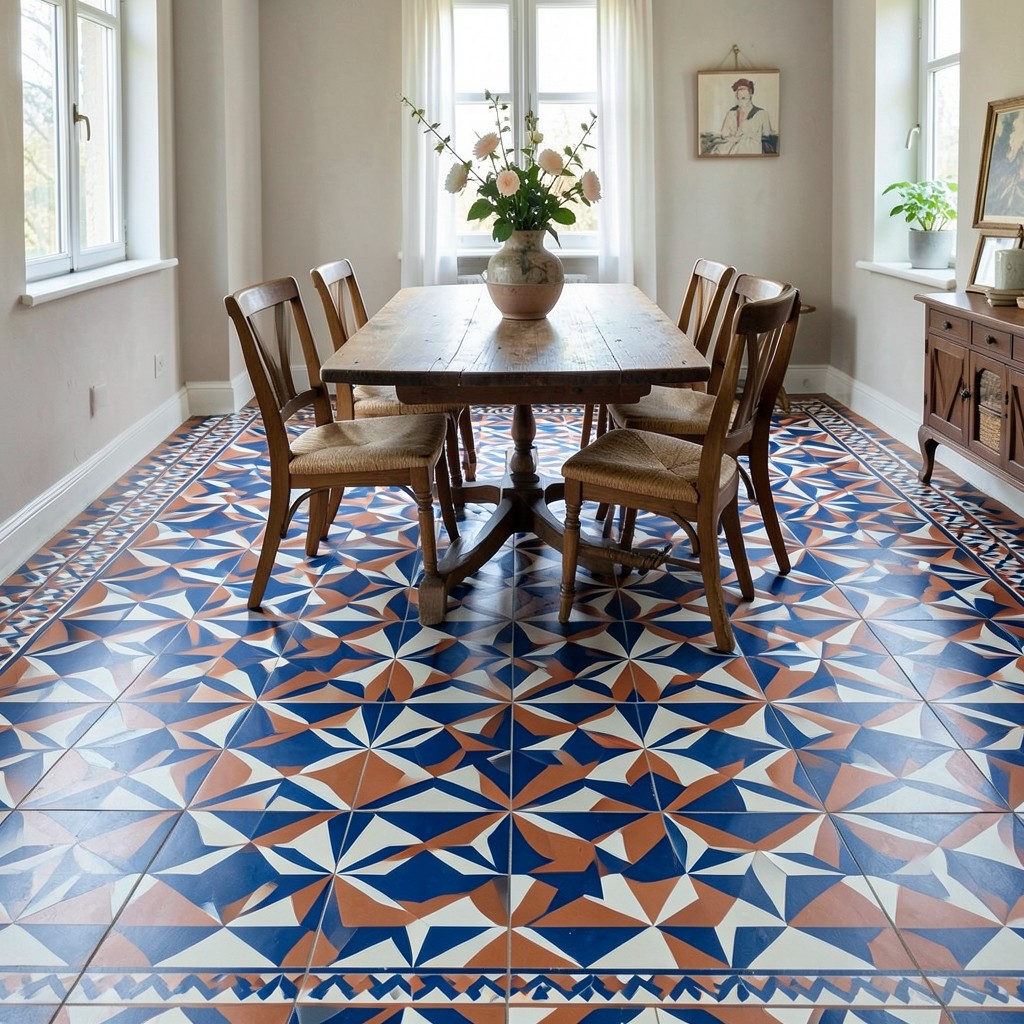
A full room floor of bold geometric patterned cement tile — the pattern covering the entire floor surface from wall to wall in the kind of total commitment that makes the floor the room’s dominant design statement — is the flooring decision that requires more conviction than any other in this collection, because there is no partial version of this commitment and no retreat from it once the installation is complete. The full-pattern cement tile floor does not support or complement other strong design elements. It controls the room, and everything else in the room must respond to it rather than competing with it.
The geometric pattern selection for a full-floor cement tile installation must account for the pattern’s behavior at the room’s perimeter — specifically, how the repeat cuts at the walls and whether the cut pieces at the edge read as intentional partial tiles or as damaged complete tiles. A border tile that frames the central field in a plain complementary color addresses this edge condition by providing the deliberate boundary that converts the cut perimeter tiles into a composed floor edge rather than an accident of installation. The border’s presence or absence is the detail that most determines whether the full-pattern cement tile floor reads as a designed floor installation or as a tile that ran out of room before it reached the wall.
The bohemian home styling or the traditional home interiors dining room whose floor is laid in a bold eight-pointed star pattern in cobalt, white, and terracotta cement tile — the pattern covering the full floor from the perimeter border inward — produces the room whose floor is the event around which the furniture is arranged rather than the surface beneath it. The table and chairs sit within the pattern’s field as though placed in a composed architectural composition rather than positioned for convenience, and the room’s design authority comes from the floor’s total commitment to its specific material and geometric language.
45. Antique Oak Floorboards With Visible Pegs
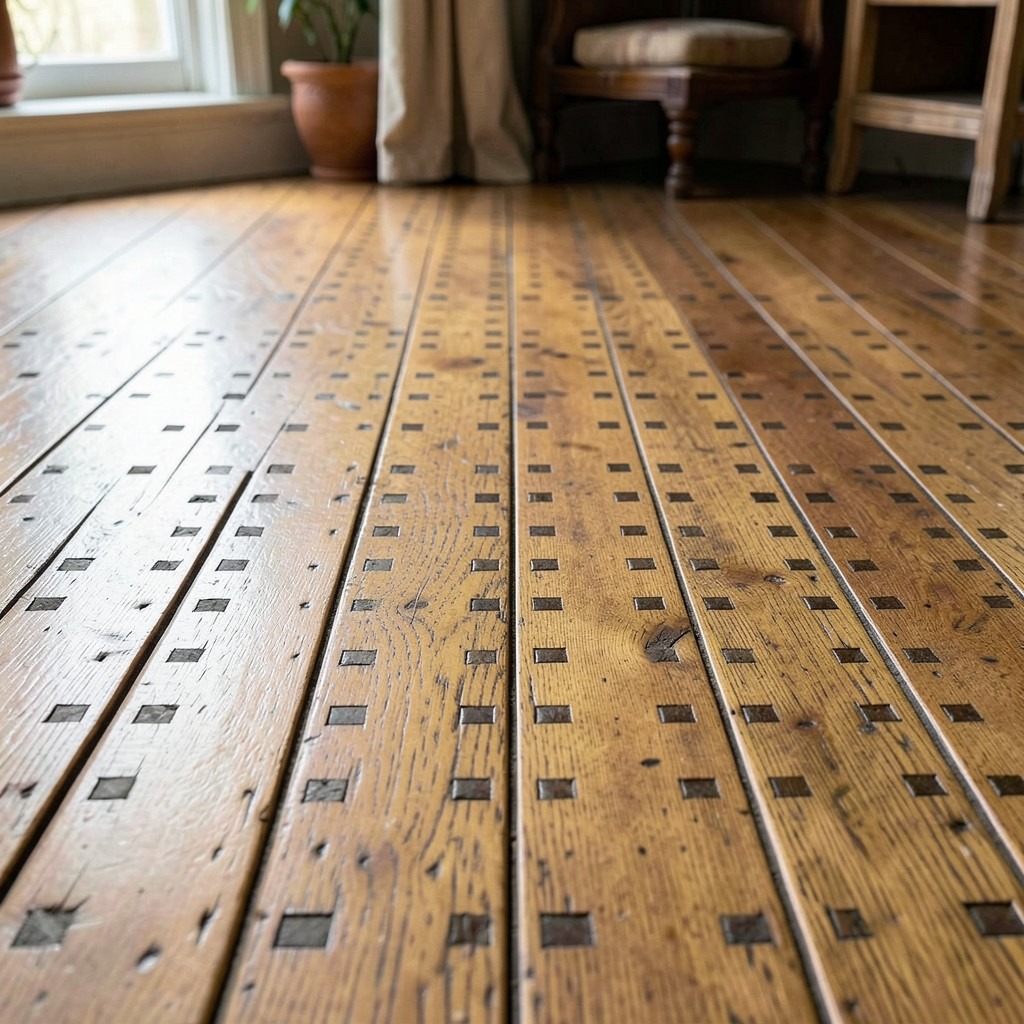
Antique oak floorboards — wide, thick solid oak boards whose face surface is pegged with visible square wooden pegs at regular intervals across the board’s width, the peg’s color slightly different from the surrounding board face providing the grid of dark square points that identifies the traditional pegged oak floor — are the floor material whose combination of width, mass, material age, and visible construction detail produces the domestic floor closest to the genuinely architectural in character. The pegged oak board is not merely a timber floor. It is a timber floor that tells you how it was made, and the visible construction detail is part of the design rather than a functional residue.
The square peg pattern across the board face marks the position of the board’s floor joist fixings — the pegs driven into the pre-bored holes after the fixing screw or nail was set below the surface, covering the mechanical fixing and producing the flush, smooth face of the traditional oak floor board. The peg’s slightly contrasting color — the oak peg against the oak board, the heartwood of one against the sapwood of the other, the slight color difference produced by different grain orientation in the round peg versus the straight grain of the board — produces the visual pattern of the pegged floor whose character is architectural rather than decorative.
The traditional home interiors drawing room, the mountain cabin decor main living space, and the farmhouse home decor entrance hall all find in the pegged antique oak board the floor that most completely expresses the material and constructional tradition of the historical domestic interior. The floor laid in two-hundred-millimeter-wide antique oak boards pegged at four hundred millimeters centers on a sand-and-cement screed, finished in a natural beeswax whose color has been developing in the oak for the preceding century, is the floor whose quality rewards the investment at every scale of observation — from the width of the boards visible from the room’s entry to the close detail of the peg’s surface revealed at the foot’s level.
46. Radiant Heated Stone Floor
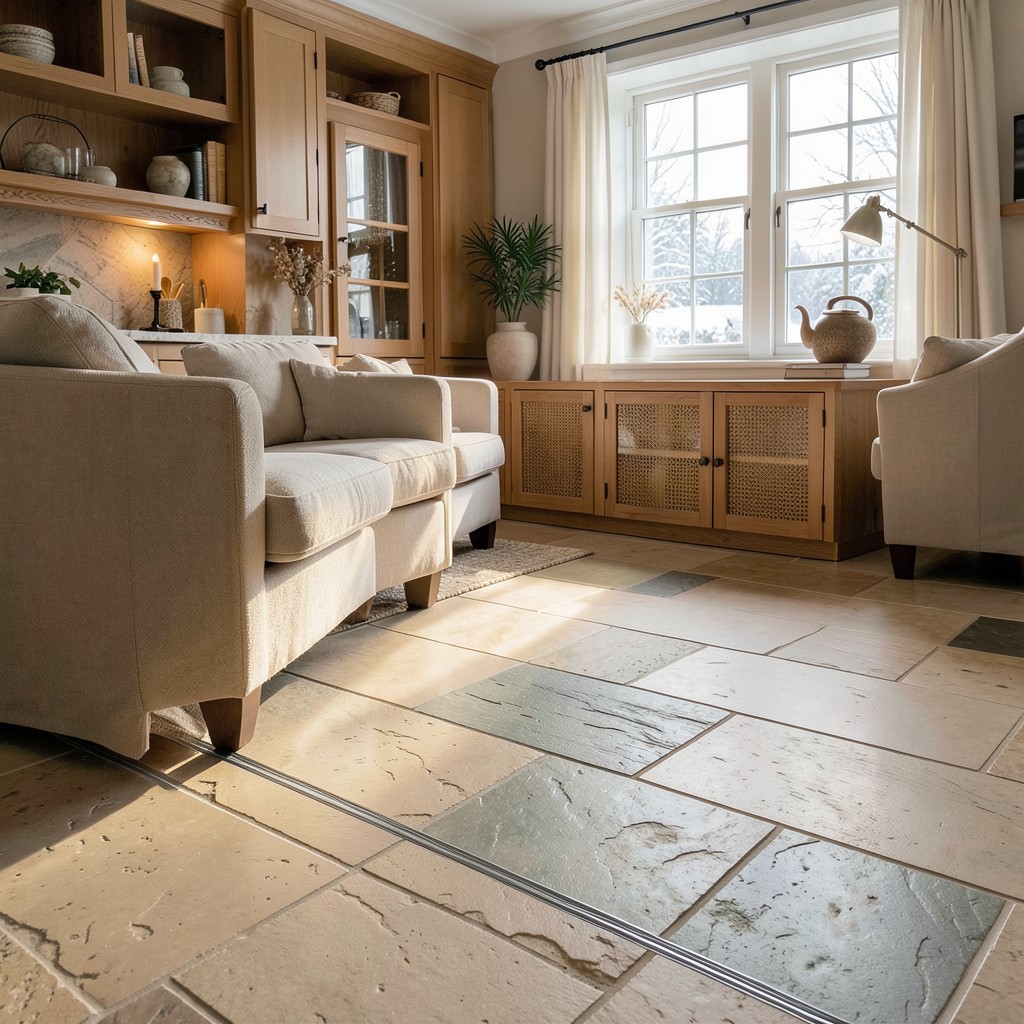
A heated natural stone floor — large-format limestone, slate, or travertine tile installed over an electric or hydronic underfloor heating system whose heat output warms the stone from below and radiates it gently upward into the room — is the floor system that most completely resolves the fundamental tension in natural stone flooring between the material’s extraordinary visual and tactile quality and its equally extraordinary capacity to extract heat from anything that rests on it without a supplementary heat source below. Cold stone is uncomfortable. Warm stone is one of the most physically pleasurable floor experiences available in the domestic interior.
The hydronic underfloor heating system — warm water circulated through cross-linked polyethylene pipes embedded in a screed layer beneath the stone — provides the most energy-efficient and the most thermally comfortable underfloor heating specification for a large-area stone floor because the hydronic system heats the thermal mass of the stone and screed gradually and maintains it at a consistent temperature whose stability the electric system, which cycles on and off to maintain the set point, does not match. The hydronic system’s warmth is felt as the floor’s own temperature rather than as the heat source cycling beneath it, and that distinction in thermal experience is one of the domestic comfort details worth specifying correctly.
The winter home decor context where a heated limestone floor in the main living and kitchen area is the primary ambient heat source for the ground floor — the stone’s warm surface radiating heat upward into the room at the most efficient possible level, directly at the occupants’ feet and bodies rather than from the ceiling where forced-air heating deposits its warmth — produces the specific quality of a winter domestic environment whose warmth is physical and immediate rather than mechanical and distributed. The warm stone floor in the winter morning, before any artificial light is switched on, before the kettle has been turned on, is one of the small architectural luxuries that costs no more than the correct floor specification and the correct heating system specification from the beginning.
47. Graphic Tile in an Unexpected Room
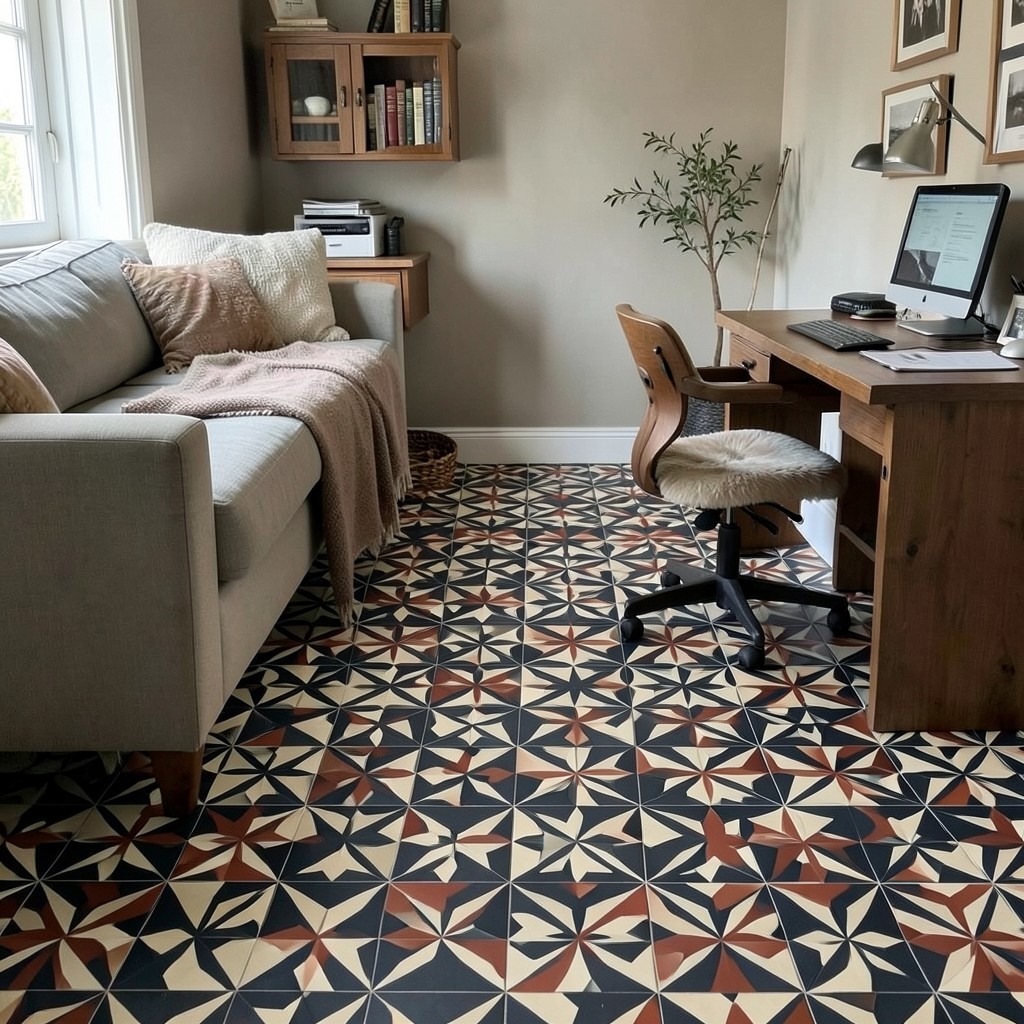
Graphic tile on a floor in a room that does not typically receive graphic tile — the bedroom, the home office, the sitting room, or the entrance hall rather than the kitchen or bathroom where patterned tile has been normalized — is the floor design decision that produces the highest impact per square meter of any flooring specification because the surprise of the unexpected material in the unexpected location is the design quality that the conventional placement of the same tile cannot provide. The graphic tile’s impact in the kitchen is expected. The same tile in the home office is a statement of genuine design intention.
The sitting room floor in a bold Moroccan-style geometric cement tile — deep cobalt, warm rust, and cream in a ten-pointed star arrangement — produces the floor that anchors the room’s entire design program around a single material decision. The furniture selection for the room must respond to the floor’s color and pattern rather than being independent of it, which means the room’s design process begins with the floor rather than with the sofa, and that inversion of the standard design sequence produces the room whose hierarchy of design decisions is resolved from the floor up rather than accumulated from the furniture down.
The rustic home office ideas home study whose floor is in a graphic hexagonal tile in a dark charcoal and pale cream two-color combination — the pattern covering the full floor from wall to wall in the room where a timber or carpet floor would be the default specification — produces the specific quality of an office whose material character is far more resolved and far more interesting than its function requires, and that surplus of design quality in a functional space is the quality that makes working in the room a different experience from working in a room whose floor was specified only for its practical properties.
48. Luxury Vinyl Tile in Stone Effect
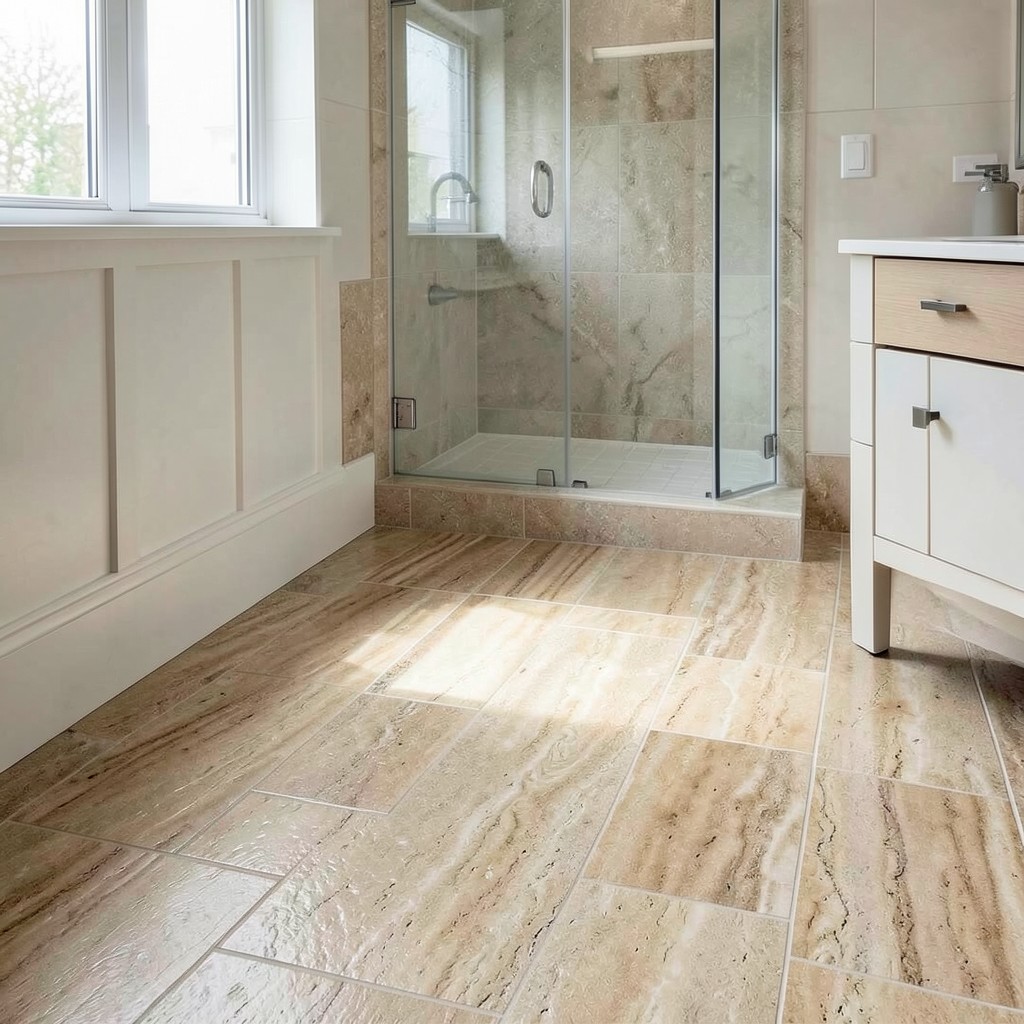
Luxury vinyl tile in a convincing stone effect — the high-resolution digitally printed surface layer whose printed image replicates natural stone’s veining, color variation, and surface texture on an embossed vinyl surface whose tactile quality reinforces the printed visual — is the floor material that the contemporary residential renovation market has most substantially improved in quality and most expanded in design range, and whose current product generation closes the gap between the vinyl tile experience and the genuine stone experience to the point where a standing observer cannot distinguish the two with confidence in many product ranges. That is a design fact worth acknowledging honestly.
The practical performance advantages of luxury vinyl tile over natural stone in domestic applications where stone is the aesthetic aspiration are the reasons the product exists and the reasons it deserves honest consideration rather than dismissal on material-snobbery grounds. The luxury vinyl tile is waterproof, warm underfoot without supplementary heating, soft enough to be comfortable on standing bare feet, acoustically absorbent relative to stone, lightweight enough for timber suspended floor installation without structural concern, and installable by a competent DIY practitioner. Natural stone is none of those things, and the domestic bathroom or kitchen where those practical qualities matter more than the material’s geological origin is the room where the luxury vinyl tile in a convincing stone effect is not the compromise. It is the correct specification.
The farmhouse bathroom decor wet room whose luxury vinyl tile floor replicates a warm brushed travertine in a large-format plank tile — the warm honey tones of the travertine print convincing in the bathroom’s ambient light, the floor’s waterproof performance making the wet room’s drainage zone specification simple rather than requiring the tile to be selected for its permeability characteristics — produces the specific quality of a bathroom that looks and feels expensive without any of the practical complications that natural stone in a wet room installation requires.
49. Mosaic Glass Tile in a Gradient Floor
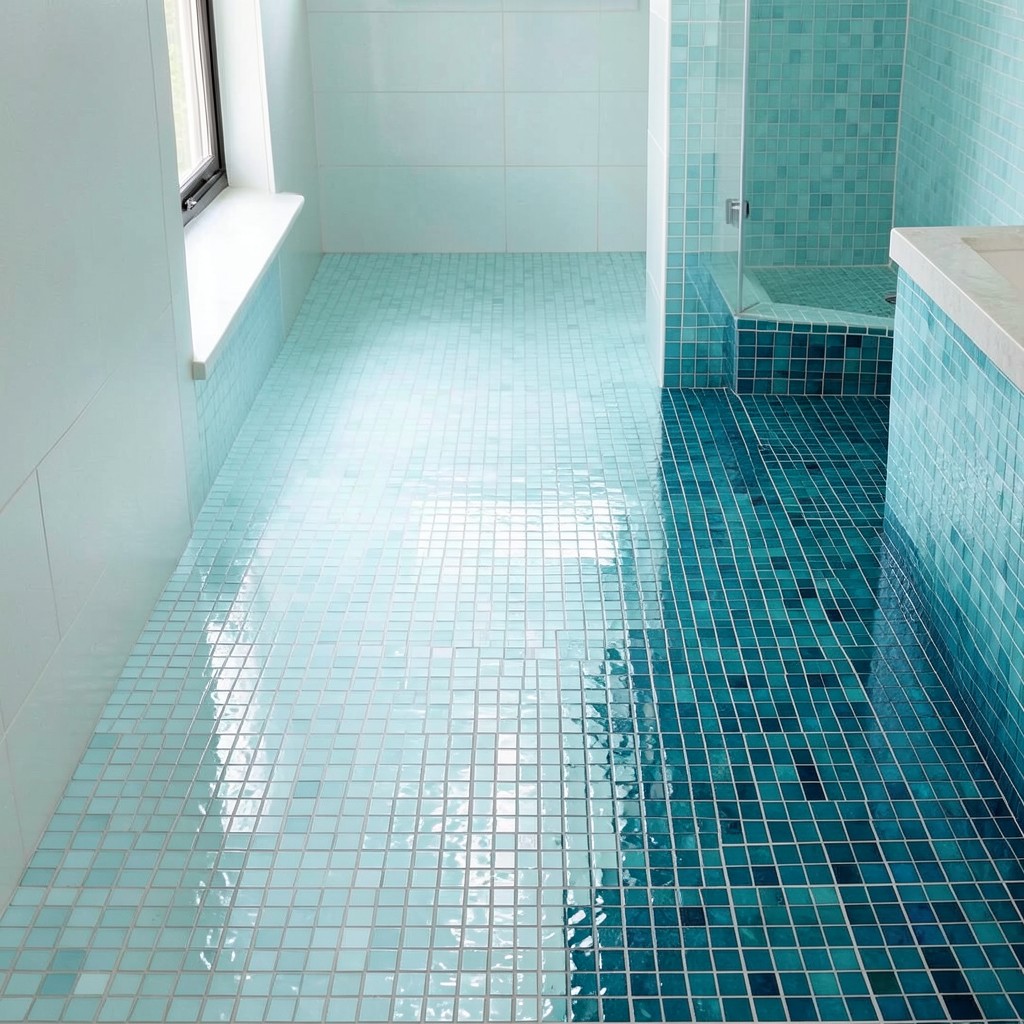
A mosaic glass tile floor in a gradient composition — small glass tesserae arranged in a color transition from one tone at one end of the floor to a contrasting tone at the opposite end, the transition occurring across the floor’s full length through a carefully staged sequence of intermediate mixed tones — is the floor design technique that most completely applies the designer’s color intelligence to the floor plane in a format whose result is both materially rich and spatially animated. The gradient floor is the floor that changes as you walk across it, and that change — the experience of moving through a floor’s color composition rather than walking across a uniform field — is a spatial quality no other floor treatment provides.
The color transition logic of a gradient glass mosaic floor must account for the visual mixing that occurs when adjacent different-color tesserae are seen from the standing viewing distance — two adjacent colors in a mosaic blend optically into the intermediate tone their mixing produces, and the gradient designer must work backward from the desired intermediate tones to determine the adjacent tile color combinations that will produce those tones in the optical mix at the standing viewing distance. This is not a skill that tile selection alone provides — it requires the same color intelligence as the gradient paint wall but applied to a much more complex physical system whose variables include tile color, tile distribution, gap width, grout color, and light reflectivity.
The coastal home design or summer home design bathroom whose floor transitions from the palest sky blue at the entry end to the deepest aquamarine at the shower end, the glass tesserae’s reflective surfaces distributing the wet room’s light across the full gradient’s color range, produces the floor whose material quality is the direct expression of the sea’s color behavior — the shallow water’s near-white through the deep water’s dark blue, compressed into the floor’s six linear meters. This is the floor design idea whose concept and execution are inseparable from each other, and whose result rewards the execution effort with a floor that no other material or technique produces.
50. The Floor That the Room Deserves
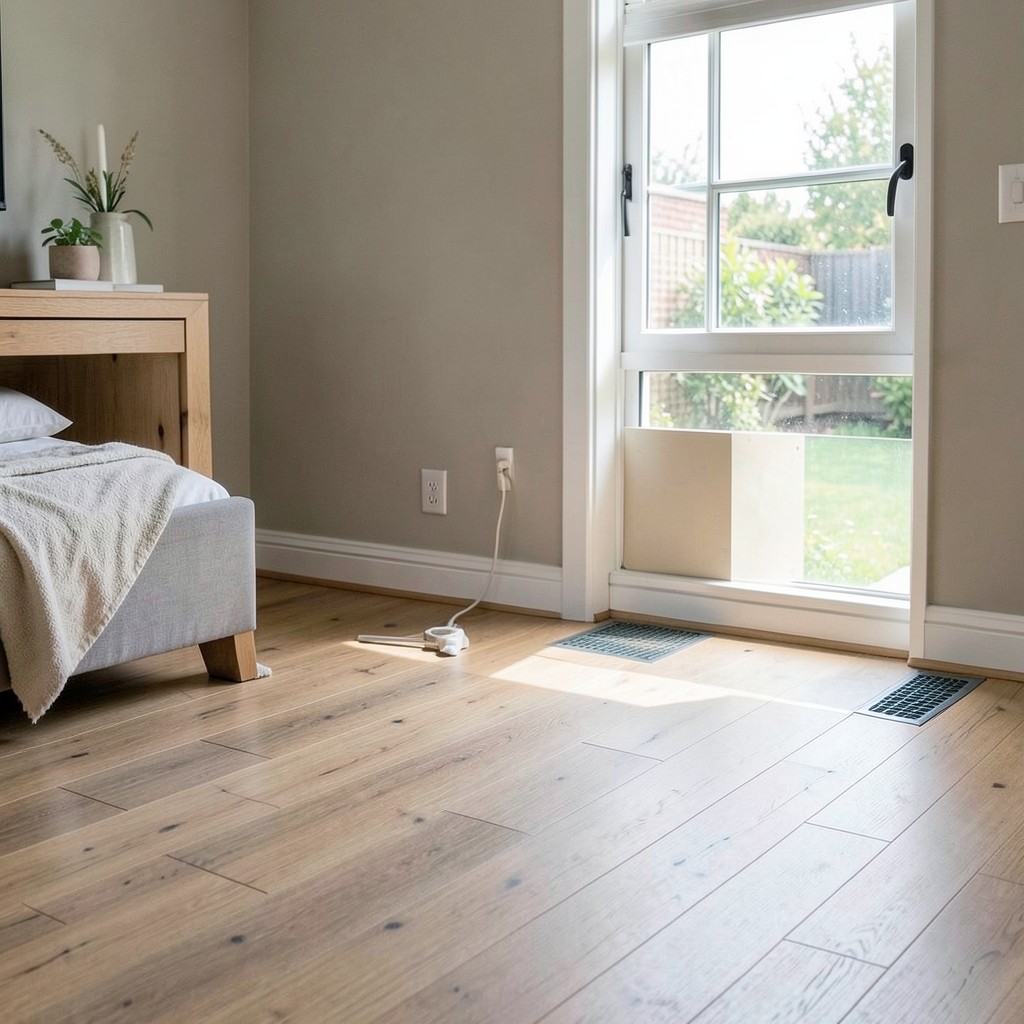
The floor that serves your room correctly is not the floor you chose because it was safe, because the installer recommended it, or because it appeared most frequently in the renovation photographs you saved to your phone over the preceding months. It is the floor selected by honest interrogation of the room’s actual conditions, its actual use patterns, and the actual atmospheric quality you want the space to produce across every day and every season of your occupancy.
Begin with the room’s primary performance requirement and let that determine the material territory before any aesthetic consideration is introduced. The room with underfloor heating needs a floor material with a thermal resistance low enough to allow the heat to pass through it rather than accumulating below — stone, tile, and thin engineered timber serve this requirement; thick solid timber and carpet impede it. The room with children, pets, and regular high traffic needs a floor material whose surface quality is maintained under that activity level rather than revealing every mark within the first season of use. The room that connects to an outdoor space needs a floor material whose relationship with the threshold — whether it bridges the indoor-outdoor transition or marks it — was decided before the material was selected.
The floor you commit to today is the floor you walk on every morning for the next decade. You feel it before you see it — the temperature, the give, the acoustic quality, the specific sensation of the material under bare feet before the eyes have registered the room’s other qualities. The floor that was selected for its photograph is the floor that produces an image. The floor that was selected for its material quality, its performance characteristics, its relationship with the room’s light and seasonal atmosphere, and its contribution to the household’s daily physical experience is the floor that produces a life. Give your floor the attention that daily contact with your bare feet at six in the morning deserves. You have the full range of possibilities in this article. The correct choice for your specific room is the one that starts from the room rather than from the catalog.
Leave a Reply