
The ceiling is the surface that most rooms never ask you to think about, and that is precisely the problem. Walk into any standard home — the well-furnished living room, the carefully decorated bedroom, the kitchen with its considered tile backsplash and its chosen cabinet hardware — and look up. What you find, in the overwhelming majority of cases, is a flat white plane that was painted once, possibly twice, and left to sit above every other design decision in the room like a blank afterthought that nobody had the energy or the imagination to address. The Ceiling Design Ideas covers more surface area than any single wall in the room. It receives indirect light from every lamp and every window. It shapes the room’s perceived height, its acoustic character, its warmth, its atmosphere. And most of the time, it contributes nothing at all.
That is not a small failure. The ceiling’s design impact on a room’s overall quality is genuinely disproportionate to the attention it typically receives, and the rooms that most reliably produce a quality of atmosphere that stops visitors mid-sentence and makes them look around for what is different are often the rooms where the ceiling was treated as a primary design surface rather than as the place above the furniture. A cozy bedroom design where the ceiling was painted in the same saturated tone as the walls produces the canopy quality of being enclosed rather than just covered. A modern kitchen with a coffered ceiling grid reads as an architectural space rather than a functional box with appliances. A luxury home interior whose entrance hall carries a hand-painted ceiling mural turns the entry from a corridor into an event.
The range of ceiling design possibilities available in a standard domestic room spans from the technically simple — a paint color change, a strip of crown molding, a pendant light that actually responds to the space it serves — to the architecturally ambitious — the removal of a ceiling to expose the roof structure above it, the construction of a new coffered or vaulted form within an existing flat ceiling, the installation of acoustic panels that are designed as well as they perform. Between those poles sits every ceiling idea this article covers, and most of them require considerably less specialist skill, structural intervention, or financial outlay than you are probably assuming.
The ceiling’s relationship with the room’s design direction is the first thing to understand before any specific treatment is considered. A rustic home decor direction — the exposed timber beams, the plank-board ceiling, the whitewashed rafters — demands a ceiling treatment that expresses material honesty and structural character. A minimalist home design direction demands a ceiling that contributes through absence — through the perfection of its finish, the precision of its cornice, or the purity of its surface — rather than through applied decoration. A bohemian home styling direction gives the ceiling permission to carry the room’s most expressive element, the hanging installation or the painted pattern that the room’s other surfaces support rather than compete with. The ceiling does not operate independently of the room below it. It responds to that room’s character and either amplifies it or contradicts it, and those are the only two outcomes available.
The practical constraints are real and should be acknowledged upfront. Rental properties limit what can be permanently altered. Low ceilings restrict the three-dimensional treatments that work beautifully at standard height. Structural elements — joists, beams, pipes, conduit — present either obstacles or opportunities depending entirely on the design direction chosen to engage with them. Budget shapes the scope at every level, though the ceiling is one of the few interior surfaces where the investment-to-impact ratio strongly rewards even modest effort. A pot of ceiling paint in a considered color costs the same as a pot of wall paint and produces a change in room atmosphere that a fifth piece of accent furniture never could.
1. A Coffered Ceiling Design

Few ceiling treatments communicate architectural seriousness as directly as a coffered ceiling, and the reason is that the form has been associated with considered, well-built spaces since classical antiquity. The coffers — the recessed panels set into a grid of intersecting beams — carry the historical weight of libraries, dining rooms, and reception halls where the architecture was expected to perform. Bringing that form into a contemporary home is not an act of nostalgic recreation. It is the decision to give a room’s ceiling the same design authority that the best rooms in architectural history have always given theirs.
The construction of a coffered ceiling in a standard domestic room uses applied moldings rather than structural beams in most installations. Lightweight polyurethane or plaster composite beam profiles are fixed to the existing flat ceiling surface in a grid layout, with the spaces between the grid members forming the recessed coffer panels. The key proportion decision is the grid spacing — coffer panels whose width is between forty and sixty centimeters read as correctly scaled for a room of standard residential height, while panels wider than this begin to flatten the grid’s visual rhythm and lose the depth quality that the coffers create.
The paint treatment of a coffered ceiling makes or breaks the form’s impact. Painting the beam members and the coffer panel faces in the same tone produces a monolithic quality that reads as sculptural from below — the shadow from the beam depth provides the three-dimensional definition without the color contrast doing the work for it. A coffer panel face in a slightly different tone — a deeper shade of the beam color, or the room’s accent color introduced at ceiling level — produces a more graphic, pattern-forward result that suits spaces with a traditional home interiors direction. Either approach works; the failure mode is applying the coffers and leaving the entire ceiling in standard white, which misses the depth and shadow that the form was built to provide.
2. A Painted Ceiling With Bold Color
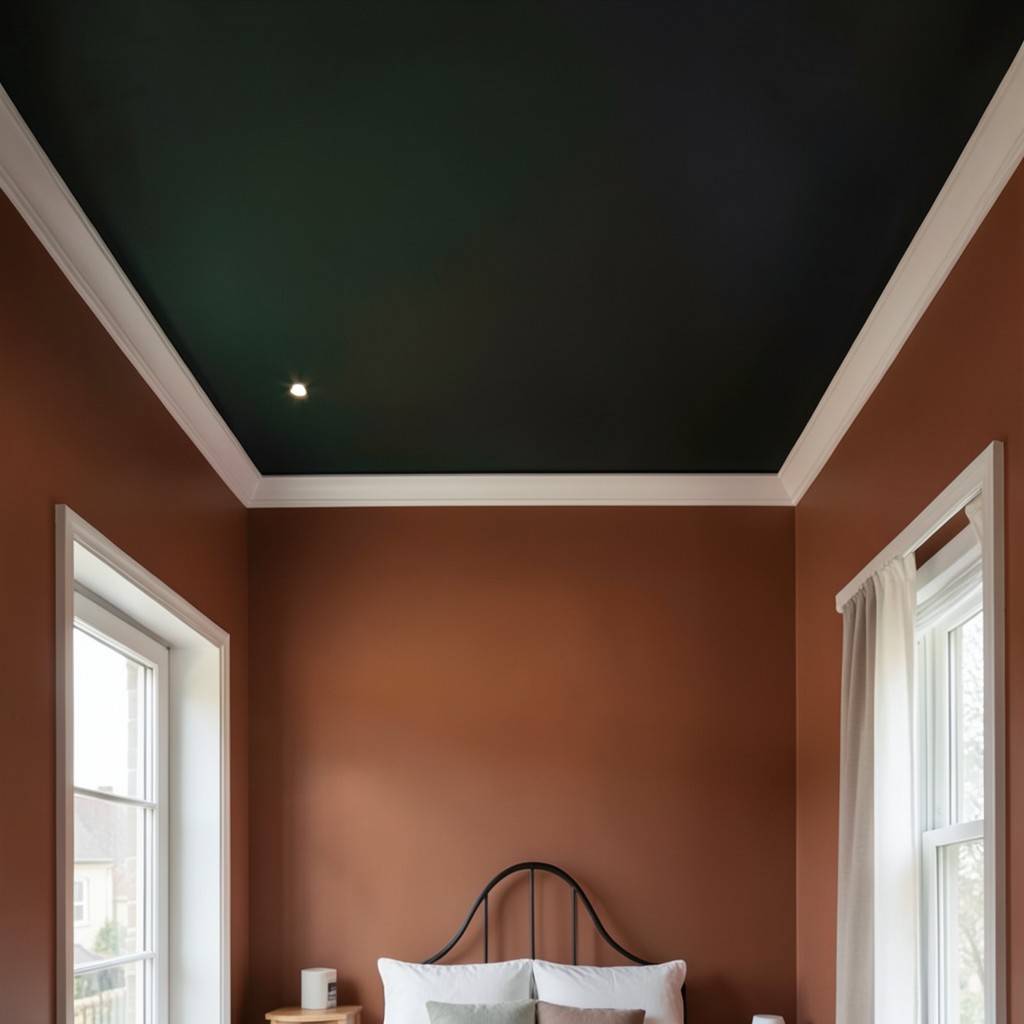
The painted ceiling in a bold color is the ceiling design decision that costs the least, requires no structural modification, and produces the single most dramatic atmospheric change available to any room in a domestic interior. That combination — maximum impact, minimum investment — makes the bold ceiling color the most underused design tool in most households, and the reason it stays underused is the persistent fear that a dark or saturated ceiling will make the room feel small and oppressive. That fear is understandable and largely wrong.
The ceiling that is painted in a deep color — a saturated forest green, a warm terracotta, a rich navy, a charcoal that reads almost black — does make the room feel more enclosed. Enclosed is not the same as small. A cozy bedroom design depends on enclosure: the feeling of being held by the room rather than exposed within it. A warm home decor palette where the ceiling carries the warmest tone in the room’s color scheme produces the specific quality of being inside a warm space rather than looking at warm colors on the walls. The color overhead is a fundamentally different experience from the color on the wall beside you, and it is the difference between a painted surface and a painted atmosphere.
The technical execution of a bold ceiling color requires attention to the cut-in line where the ceiling meets the wall — the junction whose precision determines whether the painted ceiling reads as a designed element or as a paint job that ran over the line. For rooms with a picture rail or a strong cornice profile, the ceiling color is taken only to the cornice’s upper edge, leaving the cornice itself in a neutral or wall-adjacent tone that provides the visual separation between the bold ceiling and the wall below. In rooms without a cornice, the ceiling color can be brought slightly down the wall — ten to fifteen centimeters — in the approach that some interior designers call a painted sky technique, where the ceiling color wraps gently onto the wall and softens the geometric boundary between horizontal and vertical surfaces.
3. An Exposed Wooden Beam Ceiling

There is a specific quality that exposed timber ceiling beams bring to a room that no other ceiling treatment replicates — the warmth of natural wood at the room’s highest surface, the structural honesty of seeing how the building above you is held together, and the visual interest of the beam’s texture and grain against the lighter field of the plaster ceiling between them. Whether the beams are genuine — exposed original structural timbers revealed when a suspended ceiling is removed — or applied — decorative timber profiles fixed to an existing flat ceiling — the effect is the same quality of grounded, lived-in character that connects the room’s interior to its material reality.
The genuine structural beam, revealed in a Victorian or older property when a later suspended ceiling is removed, carries the material history of the building in every adze mark and weathering tone that decades of concealment have preserved rather than erased. The decision of how to treat these revealed beams matters considerably: sanding them back to raw timber removes the patina that makes them irreplaceable, while simply cleaning them and applying a natural oil or a beeswax finish preserves the color variation and the surface character that new timber cannot replicate. This approach suits a rustic home decor direction or a mountain cabin decor aesthetic where material authenticity is the design priority rather than a decorative approximation of it.
The applied decorative beam — a hollow timber casing fixed to a flat ceiling in a structural-beam pattern — provides the farmhouse home decor or stone and wood home design aesthetic in buildings whose construction has no original beams to reveal. The hollow casing installs over the existing ceiling surface with adhesive and fixing screws, and the junction between the casing’s base and the ceiling surface is the detail whose quality determines whether the beam reads as a designed feature or as a fitted accessory. A beam casing whose base profile includes a small shadow molding that creates a deliberate gap between the casing and the ceiling reads as more architecturally resolved than one flush-fixed without that transitional detail.
4. A Tray Ceiling Design
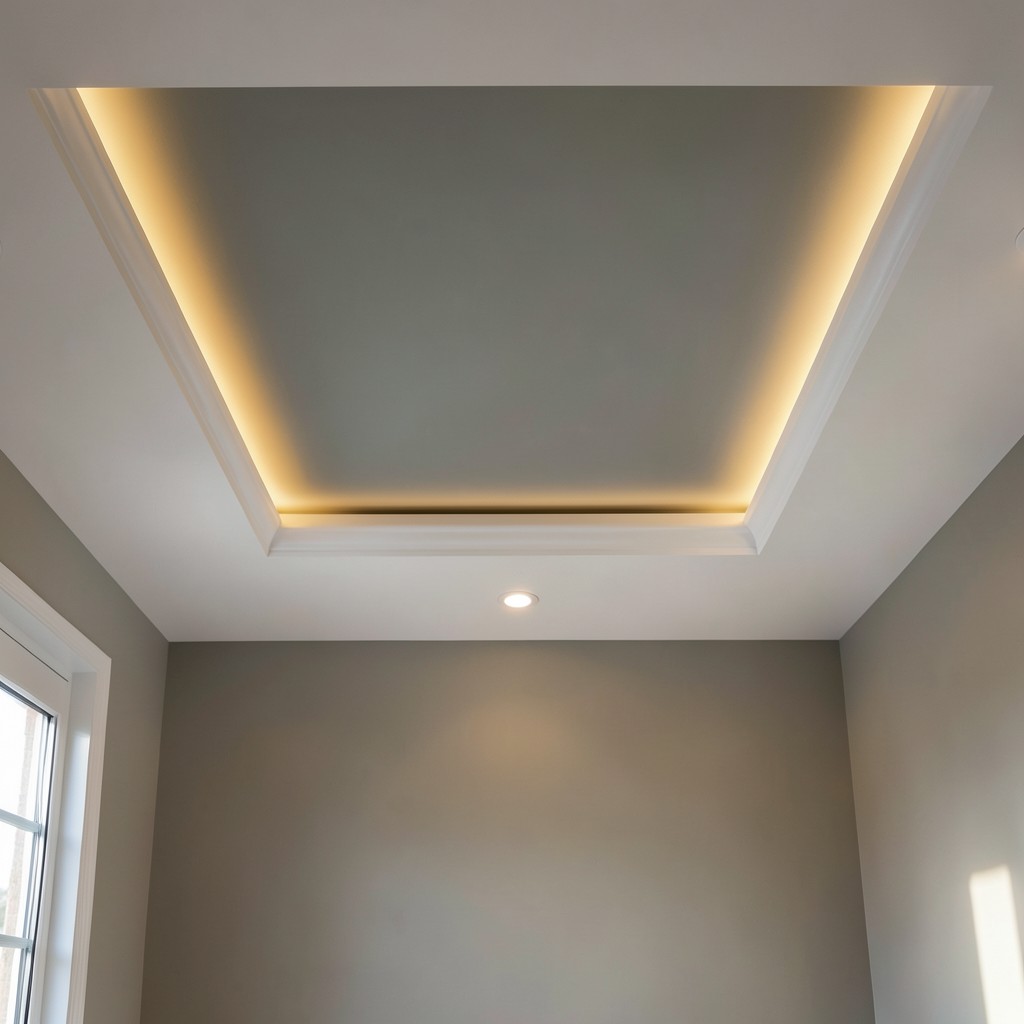
The tray ceiling — a ceiling form where the perimeter of the room drops to a lower level and the central section rises to a higher plane, producing the recessed central panel whose stepped edge gives the form its name — is the ceiling treatment that most efficiently adds apparent height to the room’s center while simultaneously providing the architectural frame that accent lighting, color, and decorative treatment can inhabit with the precision that a flat ceiling’s uniform plane does not offer. The tray ceiling is the ceiling’s answer to the question of how to make a room feel both contained and spacious at the same time.
The depth of the tray step — the vertical dimension between the lower perimeter band and the raised central panel — determines both the ceiling’s visual drama and its lighting provision opportunity. A step of twenty to thirty centimeters provides the depth that conceals a cove lighting channel within the dropped perimeter band, directing the light upward into the central panel in the indirect wash that gives tray-ceiling rooms their specific quality of luminous overhead warmth. The cove lighting installation within a tray ceiling is one of the domestic interior’s most cost-effective atmospheric investments — LED strip lighting in a warm color temperature, directed upward within the concealed cove, produces the quality of light that resembles sunlight filtered through a high window rather than the flat distribution of a standard ceiling fixture.
The color treatment of a tray ceiling’s components — the dropped perimeter band, the vertical riser between the two levels, and the raised central panel — provides the design opportunity that the tray form creates but that most applications leave as a uniform white field. Painting the central panel in a tone two or three values deeper than the room’s wall color produces the quality of atmospheric depth overhead without the full commitment of a bold ceiling color. The perimeter band in the wall color, the riser in a slightly darker tone, and the central panel in the deepest tone of the three creates the visual recession of the tray that reinforces the ceiling’s three-dimensional quality in pure paint without any additional molding or decorative material.
5. An Exposed Concrete Ceiling
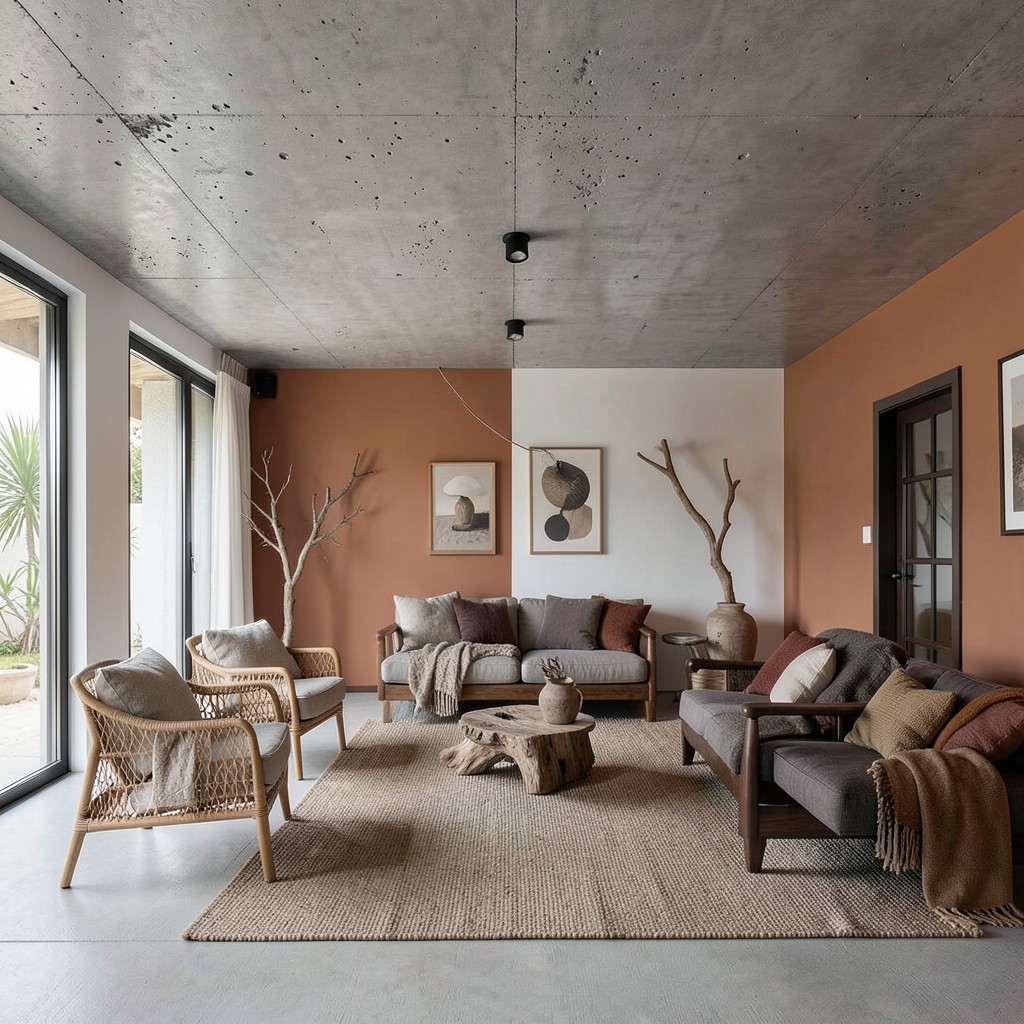
The exposed concrete ceiling is the ceiling treatment that most directly divides aesthetic opinion in residential interiors, and the division is worth understanding rather than avoiding. The people who find it cold, industrial, and oppressive are responding to the same quality that makes the people who love it find it sophisticated, material-honest, and architecturally grounded. The concrete ceiling does not soften the room. It anchors it. And the decision to accept that anchor rather than cover it with plasterboard and paint is an architectural commitment to the building’s material reality.
In a new-build concrete frame building, the exposed soffit — the underside of the concrete slab — provides the floor above as the ceiling below without any applied surface treatment. The quality of this exposed surface depends entirely on the formwork quality and the concrete mix used in the original pour: a smooth, consistent soffit in a well-controlled pour reads as genuinely architectural in the way that industrial home design pursues at its best. A rough, blowholes-pocked soffit with visible formwork joint marks reads as unfinished rather than exposed, and the distinction is one of construction quality rather than design intent.
The furniture and textile palette that works beneath an exposed concrete ceiling must provide the thermal counterweight that the grey, cool material overhead demands. A concrete ceiling over a beach house interiors scheme — white painted walls, natural rattan, linen textiles, driftwood accessories — produces the coastal home design quality of an environment that sits between interior and exterior in both material character and atmospheric feeling. The same concrete ceiling over a fully warm interior — terracotta walls, dark timber furniture, wool textiles in deep earthy tones — produces the earthy home design quality of a space whose material contrast between warm and cool creates tension rather than uniformity.
6. A Wallpapered Ceiling
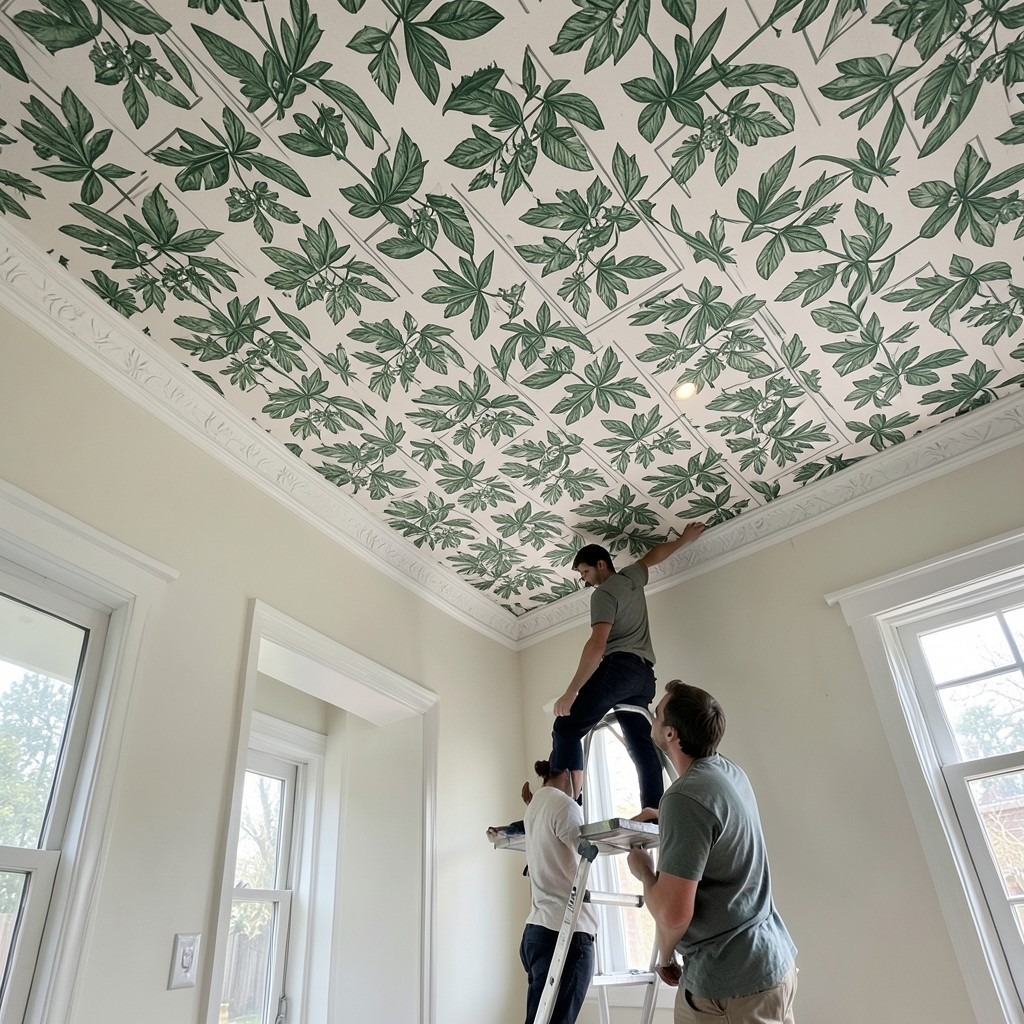
A ceiling covered in wallpaper — a pattern applied to the overhead surface with the same intention and the same material that the best wallpapered walls receive — is the ceiling treatment that most immediately signals that the person who designed the room thought about every surface rather than accepting the default. The wallpapered ceiling is not a particularly new idea: the Victorian interior regularly used paper borders and patterns at ceiling level, and the high-end decorating tradition has applied paper to ceilings with consistent success for generations. What makes it feel surprising in most contemporary homes is simply that it is rare enough to be memorable.
The pattern selection for a wallpapered ceiling must account for the ceiling’s specific visual conditions: the paper is viewed from below, typically in indirect or artificial light, and from a distance that makes small-pattern detail invisible while large-scale pattern reads with clarity. A botanical print in a large format — the kind of jungle-inspired home decor pattern whose leaf forms read at two meters of distance — works on a ceiling in a way that the same pattern’s detail would be lost on a wall where it is viewed from much closer. A geometric repeat whose scale is calibrated for ceiling viewing provides the directional interest of a pattern that changes character depending on which corner of the room you are standing in.
The practical application of wallpaper to a ceiling requires two people — one to hold the pasted paper against the ceiling and manage the fall, one to smooth and align — and a paste table at ceiling height or a steady scaffold platform. Standard wallpaper paste works for most ceiling applications, but the adhesion on a ceiling is working against gravity rather than with it, and a heavy textured paper requires a stronger adhesive formulation and a longer soaking time to develop the tack that the overhead position demands. The spring home refresh or the summer home design project that includes a wallpapered ceiling rewards the application effort with a surface that most visitors notice before they identify what is different.
7. A Tin Ceiling Design
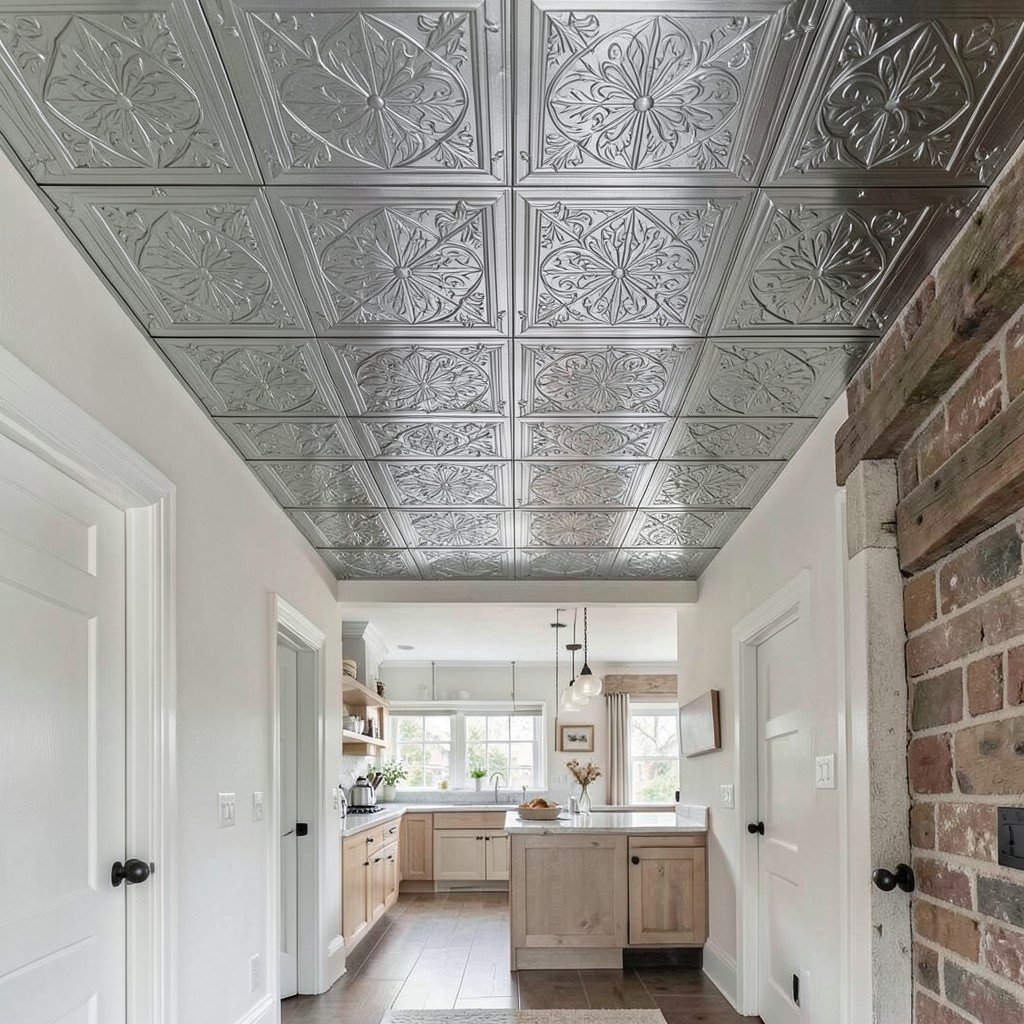
Pressed tin ceilings — the embossed metal panels in geometric and botanical patterns that covered the ceilings of commercial and domestic buildings in the American Victorian and Edwardian building tradition — are one of interior design’s most unfairly neglected surface treatments, and their neglect is largely a function of their association with a specific period and a specific type of building rather than any intrinsic limitation of the material or the form. A tin ceiling installed in a contemporary kitchen, a contemporary bar, or a contemporary corridor reads as a material decision that was made from design knowledge rather than from habit, and the confidence of that choice is part of the result.
The tin ceiling tile — typically thirty centimeters square or sixty centimeters square in a pressed steel or aluminium substrate with an embossed pattern in relief — installs directly over an existing flat ceiling surface with adhesive and small pins, making the tin ceiling one of the most installation-friendly ceiling treatments available for a rental property or a space where structural modification is not possible. The pattern range spans from the ornate scrolling botanical designs of the historical tradition through geometric repeats in a more contemporary spirit, and the finish options include raw silver, aged bronze, antique white, and the full range of paint colors that the metal surface accepts.
The farmhouse bathroom decor direction, the rustic home office aesthetic, or the period-influenced traditional home interiors scheme all find in the tin ceiling a material that provides both historical specificity and genuine surface interest at a cost per square meter that most decorative ceiling treatments cannot approach. The tin ceiling also performs acoustically — the embossed surface diffuses sound more effectively than a flat hard ceiling and reduces the acoustic harshness of a room with too many reflective surfaces, which makes it a practical as well as a decorative specification in spaces where both qualities are needed simultaneously.
8. A Vaulted Ceiling Design
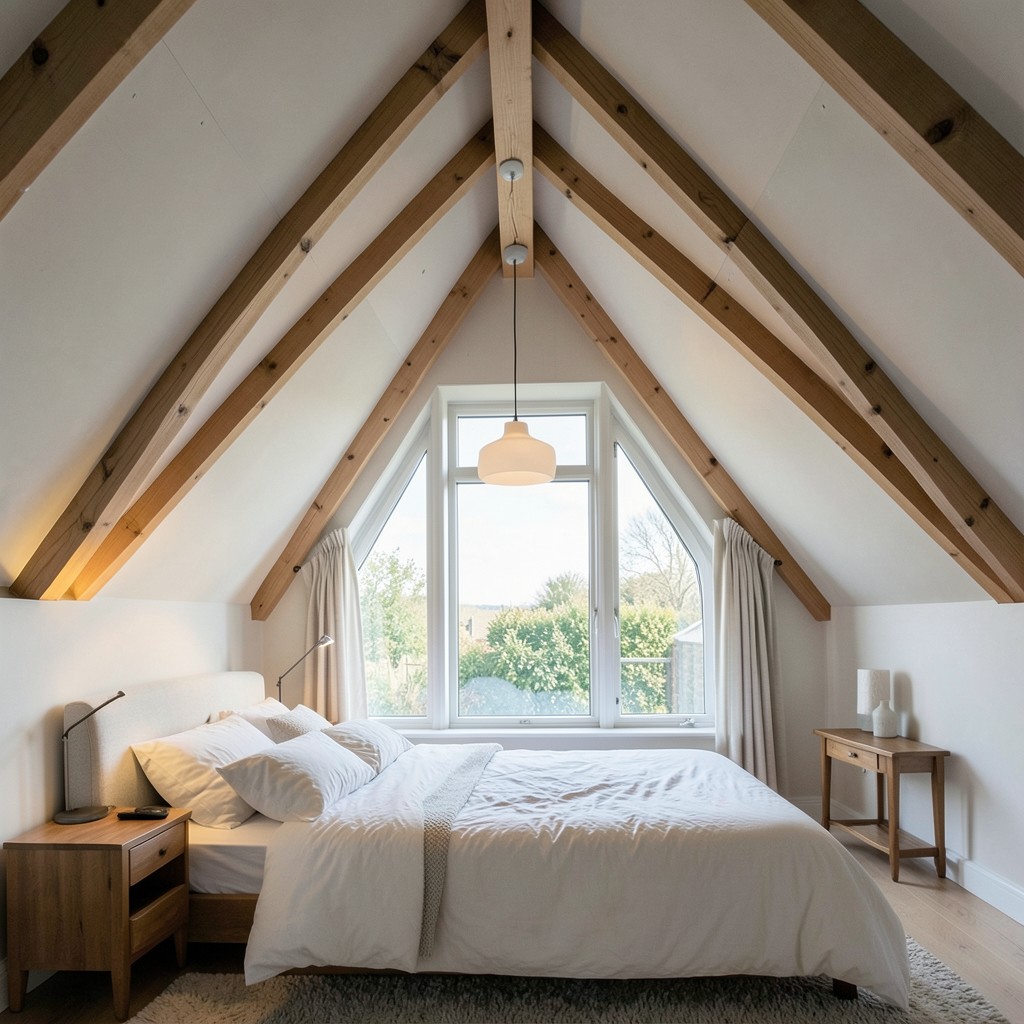
The vaulted ceiling is the architectural intervention with the highest spatial impact of any ceiling modification available in a domestic building, and it is the ceiling treatment that changes a room most fundamentally — not just in its visual character but in its entire spatial experience. A room whose ceiling rises to a vault at the ridge of the roof structure above it is a different category of space from the same room with a flat suspended ceiling at the standard height. The vault introduces the sky above the building into the room’s spatial experience, and the vertical volume it adds changes the room’s acoustics, its light quality, and the way the human body orients itself within it.
The cathedral ceiling — where the ceiling follows the pitch of the roof structure rather than sitting below it at a suspended horizontal plane — is the residential vault type most commonly created by removing the flat ceiling of an existing upper-floor room to expose the rafters and the apex above. The structural implication of this removal is the consideration that the building’s construction professional must assess before the ceiling plasterboard is touched: in some roof structures, the ceiling joists perform a structural function — holding the roof’s feet from spreading — and their removal requires the replacement of that structural function through a ridge beam or a structural collar tie arrangement before the ceiling is opened up.
The airy home interiors quality that a vaulted ceiling produces in a bedroom — the sense of sleeping under the roof rather than in a box below it — is the spatial experience that the Scandinavian home interior tradition has always pursued through the exposed rafter ceiling, the whitewashed apex, and the pendant light that hangs from the ridge point to illuminate the room below with the specific warmth of a single warm source in a large, pale volume. Getting this right requires controlling the thermal performance of the roof above the exposed surface — insulating between the rafters rather than at ceiling level — which is a more complex and more expensive insulation specification than the standard cold-roof construction that a suspended ceiling below the rafters allows.
9. A Reclaimed Wood Plank Ceiling
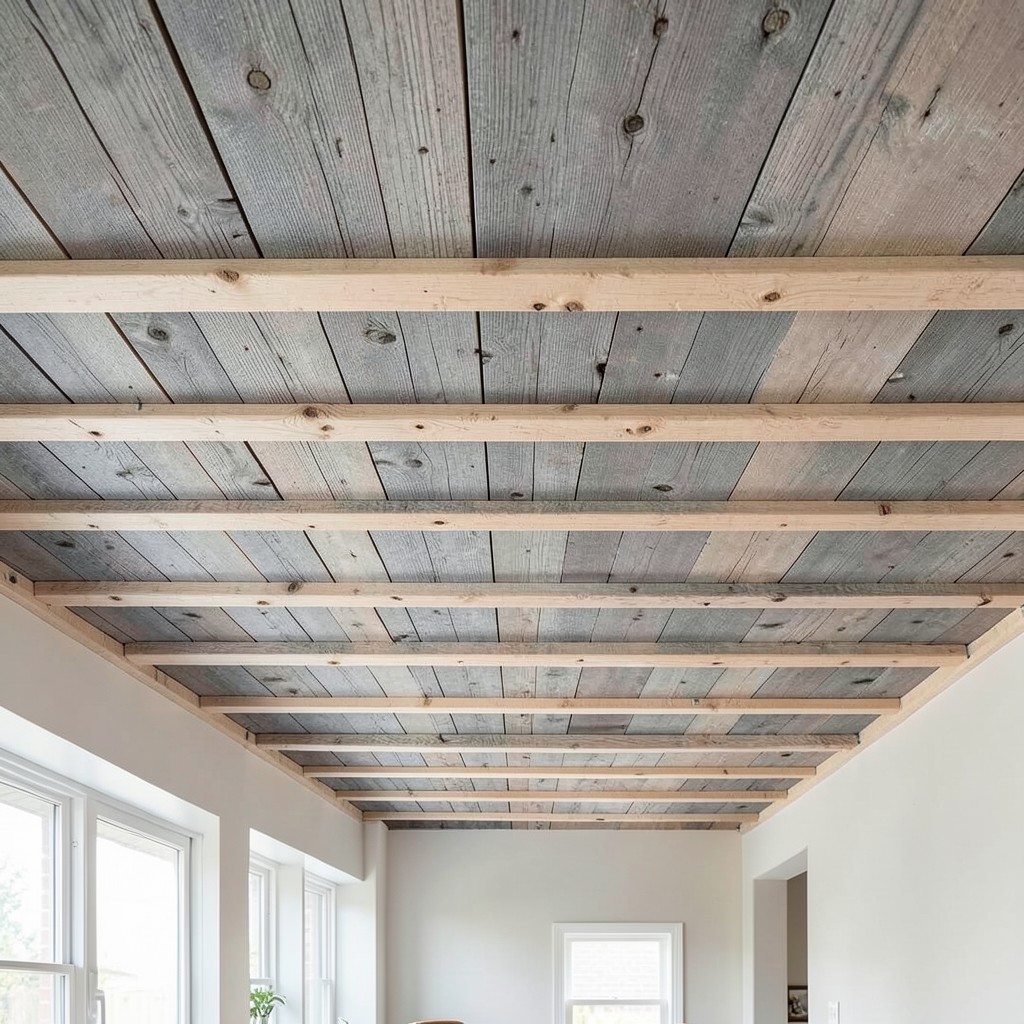
A ceiling clad in reclaimed wood planks — salvaged timber boards in their original paint, stain, or raw patina, applied to the ceiling surface in a horizontal run that covers the entire plane — is the ceiling treatment that most directly brings the warmth, the material depth, and the lived-in character of salvaged wood into the overhead position where its visual impact is distributed across the entire room simultaneously. The reclaimed wood plank ceiling does not look like new wood that was stained to appear old. It looks exactly like what it is: material with a prior life, and that prior life is the design quality you are bringing into the room.
Reclaimed barn board, painted floorboard, workshop shelving, and old packing case timber all provide the raw material for a reclaimed plank ceiling, and the source material’s character — the faded paint layers, the nail holes, the surface marks and color variation from years of use — determines the ceiling’s specific texture and tone. A barn board ceiling in grey-weathered timber over a neutral interior reads as the specific earthy home design quality of a space that connects architecture to agricultural material culture. The same boards painted over in a single color — a white wash that allows the wood’s grain and relief to read through the paint layer — produces a brighter, lighter result that suits contemporary home ideas or a coastal outdoor living space-adjacent dining room.
The installation of reclaimed plank ceiling boards requires the same batten framework used for any timber ceiling cladding: a grid of softwood battens fixed to the existing ceiling structure at centers matching the plank width, with the reclaimed boards fixed to the battens using a combination of construction adhesive and hidden fixing clips or face nails whose head color matches the board surface. The weight of the reclaimed timber ceiling — higher per square meter than lightweight sheet materials — requires the batten fixings to penetrate the existing ceiling surface to the structural joists above rather than relying on fixings into the plaster alone.
10. A Mirrored Ceiling Panel Design

Mirrored ceiling panels — sections of the ceiling covered in reflective glass or mirror film, positioned to reflect specific elements of the room below them — are the ceiling treatment most associated with 1970s excess and the glamour hotel bathroom, and both associations are accurate enough to be worth naming rather than pretending away. The mirrored ceiling has a reputation. The question is whether the reputation is deserved as a wholesale verdict on the treatment or whether it reflects the specific misapplication of a material whose design potential extends considerably beyond the context in which it is most remembered.
Used with precision — a single panel of mirror above a coffee table reflecting the pendant light above it and doubling its apparent glow, or a mirrored ceiling section in a hallway that makes a low-ceiling corridor appear twice its actual height — the reflective ceiling panel is one of the most space-expanding tools available without structural modification. The mirror’s reflection of the room’s light sources multiplies the apparent luminance of the space and creates the airy home interiors quality that a genuinely small or dark room cannot achieve through paint or furniture arrangement alone. The elegant home styling tradition has used strategically placed mirror at ceiling level in exactly this way — not as a continuous surface treatment but as a considered panel in a specific position — for longer than the 1970s association suggests.
The practical ceiling mirror specification requires either silvered glass panels fixed to a ceiling-mounted track or batten system, or a contemporary mirror film applied to a flat ceiling surface whose preparation must meet the adhesion standards that any film application requires. The glass panel option provides the reflective quality of genuine mirror but requires careful handling of heavy panels at ceiling height. The film option provides adequate reflective quality in a lightweight, self-adhesive format that one person can manage without specialist equipment, making it the accessible version of the mirrored ceiling concept for the spring bedroom decor refresh that does not involve contractors.
11. A Stretch Ceiling System

The stretch ceiling — a system where a thin PVC or fabric membrane is tensioned across the room’s ceiling space within a perimeter track profile, concealing the existing ceiling structure behind a new, perfectly smooth or backlit surface — is the ceiling treatment that most efficiently resolves the problem of a ceiling whose existing condition is beyond cosmetic repair: the ceiling with structural cracks, the water-stained surface, the historic artex that no amount of skim coat work will fully conceal. The stretch ceiling does not fix the existing ceiling. It replaces it visually at a fraction of the structural repair cost, and the replacement it provides is categorically better-looking than the ceiling it covers.
The backlit stretch ceiling — a stretch membrane with LED lighting installed in the void between the membrane and the original ceiling above, producing an evenly glowing surface that reads as a luminous overhead plane rather than a lit ceiling — is the luxury home interior ceiling treatment that hotel design adopted enthusiastically and that domestic interiors can achieve with the same product at the residential scale. The membrane’s light diffusion quality — the specific scatter characteristic that converts the point sources of the LED array behind it into a uniformly luminous plane — depends on the membrane’s translucency specification, and the uniformity of the illumination depends on the depth of the void between the LED source and the membrane surface.
The practical application of stretch ceilings has expanded significantly beyond the commercial and hospitality market into residential projects, and the installation is faster and less disruptive than almost any other ceiling renovation approach: a stretch ceiling installation in a standard domestic room typically completes in a single day without the mess of plasterwork, the drying time of skim coat, or the furniture disruption of a ceiling that requires scaffolding access for extended periods. The minimalist dining room or the modern home design bedroom that needs a ceiling treatment without a building site receives the stretch ceiling with a welcome that its speed and cleanliness fully justify.
12. A Geometric Pattern Ceiling

A ceiling carrying a geometric pattern — applied through paint, through applied moldings, through tile, or through the geometry of the structural system itself — produces the specific quality of a designed surface whose pattern rewards the upward glance without demanding it, and whose presence in the room changes the ceiling from a boundary to a visual event. The geometric ceiling pattern occupies the category of ceiling design where the cost is in the labor and the creativity rather than in the materials, and the result is achievable by any household willing to invest the time that the masking and painting process requires.
The painted geometric ceiling pattern — achieved with painter’s tape, a level, and the patience to mask and paint a grid, a herringbone, a diamond, or any repeating polygon arrangement — is the ceiling design technique whose results most significantly exceed its material cost. A ceiling grid of twelve-inch squares in two tones of the same base color produces the subtle tonality of a coffered ceiling at flat surface cost. A bold chevron in two contrasting colors produces the pattern ceiling of a contemporary home that references the Scandinavian hallway design tradition’s love of graphic surface pattern in a space whose overhead position makes the geometry omnidirectional rather than directional.
The applied molding geometric ceiling — a pattern of square, hexagonal, or diamond molding frames fixed to the ceiling surface and painted over in a single tone — produces the three-dimensional quality that paint alone cannot achieve, because the molding’s depth creates shadow that changes with the room’s lighting conditions through the day. This is the ceiling treatment that produces different visual results at different times — the morning side-light from the east window reads the shadow on the moldings differently from the evening lamp light below, and the ceiling becomes a surface whose character is partially determined by the light it receives rather than by a fixed decorative pattern.
13. A Ceiling Medallion and Statement Pendant
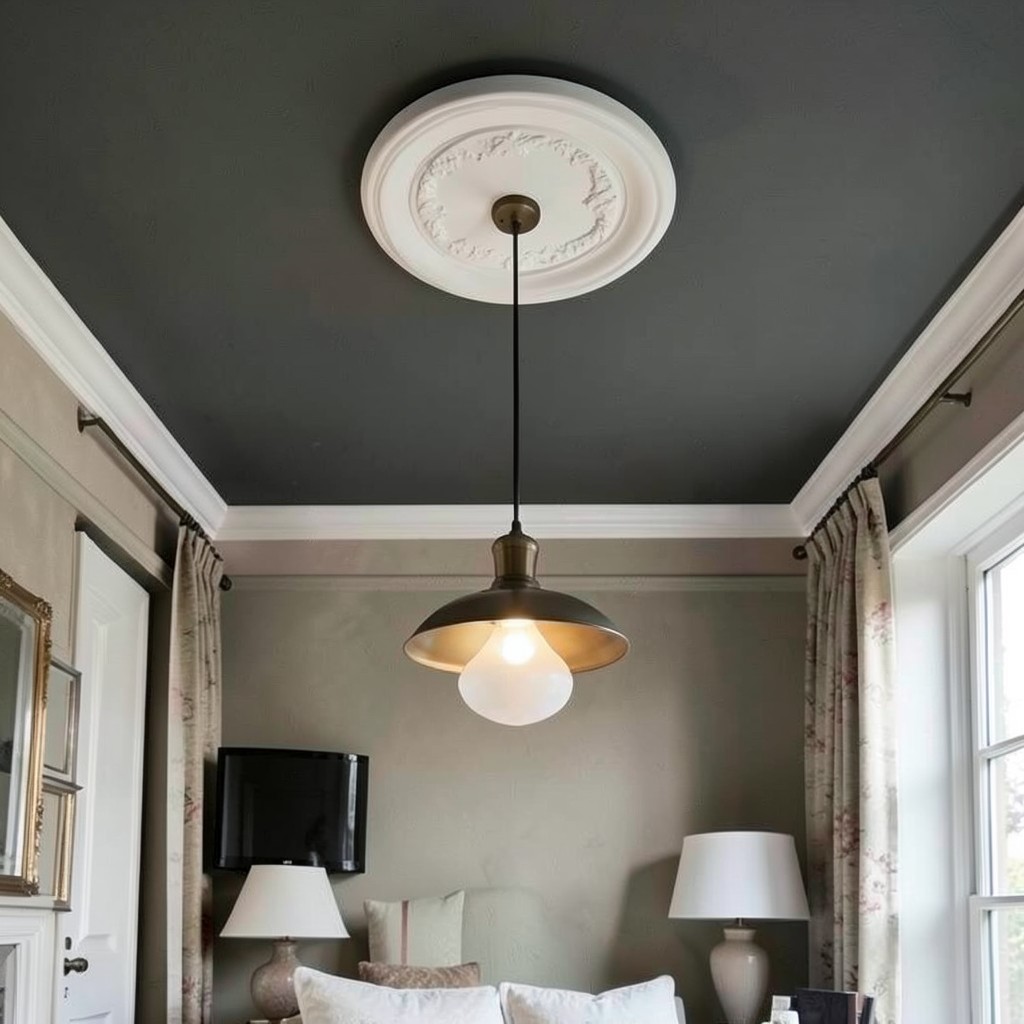
A ceiling medallion — the circular plaster or polyurethane ornament at the ceiling’s center, surrounding the electrical outlet from which a pendant light is suspended — is the architectural detail that connects the room’s lighting provision to the ceiling’s decorative program with the most economical intervention available, and it is the detail whose absence from a room that needs it reads as a subtle incompleteness that the eye notices without the occupant necessarily articulating. The ceiling rose — the British term for the same element — is the mark of a room that understood its pendant light as an architectural feature rather than as a functional fitting hung from an unadorned electrical point.
The medallion’s diameter must be proportional to the pendant it serves: a small pendant in a delicate shade requires a medallion of modest diameter whose scale matches the fitting’s visual weight, while a large statement pendant in a heavy material requires a medallion whose diameter provides the ceiling-level base that the pendant’s visual mass needs to land from. A medallion too small for its pendant reads as a boutonniere on a heavy coat; a medallion too large for its pendant reads as a decorated ceiling with a small light attached to it. The correct proportion — where the medallion and the pendant read as designed companions — is the one that makes both elements look as though the room was designed with both of them in mind from the beginning.
The ceiling medallion in a luxury master bedroom design or a traditional home interiors reception room can be painted in the same color as the ceiling for the quiet, tonal-relief quality of a design that knows it is there without announcing itself loudly. The same medallion in a contrasting accent color — the ceiling’s color on the medallion and the wall’s accent color on the ceiling field — produces the bold visual punctuation of a ceiling that treats its center as the room’s graphic focal point. Both approaches are legitimate; the choice between them reveals the room’s design confidence more directly than almost any other single ceiling decision.
14. A Stenciled Ceiling Pattern

The stenciled ceiling — a repeated motif applied to the ceiling surface through a cut stencil and a dry-brush or sponge technique — is the ceiling treatment that comes closest to the handmade quality of a painted mural at a fraction of the skill level that freehand painting requires, and it is the ceiling that most directly communicates the bohemian home styling aesthetic of a room whose surfaces were decorated with effort and personality rather than with a contractor’s standard labor rate. The stenciled ceiling is the ceiling that someone made with their hands. That quality is visible, and it matters.
The pattern selection for a stenciled ceiling should begin with the room’s existing design direction rather than with the stencil catalog’s most popular offering. A floral home decor direction in a bedroom — the bedding, the curtains, the soft furnishings carrying botanical and floral pattern — is amplified rather than competed with by a ceiling stencil in a botanical repeat whose scale and tone relate to the room’s existing patterns. A tropical home design direction in a bathroom or a sitting room takes the stenciled ceiling’s botanical potential and elevates it to the full-room immersion of jungle-inspired home decor when the ceiling’s pattern density is high enough to read as canopy rather than as wallpaper at ceiling level.
The practical execution of a stenciled ceiling requires a spray adhesive to hold the stencil flat against the ceiling surface during application — the overhead position means gravity works against the stencil’s adhesion in a way that wall stenciling does not encounter — and a paint application that is dry enough to prevent bleeding under the stencil edge but fluid enough to produce a consistent tone across each motif. The technique takes one test area to calibrate; the first stencil position in an inconspicuous corner of the ceiling is the practice application before the visible center positions receive the refined technique that the test area produces.
15. A Bamboo Ceiling Design

Bamboo as a ceiling material — applied as split-reed panels, woven matting, or solid culm sections, providing the natural material warmth and the specific organic texture of one of the world’s most renewable materials at the room’s overhead surface — produces a ceiling that belongs simultaneously to the bamboo home interiors tradition of tropical Asian domestic architecture and to the contemporary natural material movement that treats plant-derived building materials as the design direction rather than the ecological compromise. The bamboo ceiling is warm, textured, aromatic when new, and connected to the natural world in a way that plasterboard and paint cannot approach regardless of the color applied to them.
The woven bamboo mat ceiling panel — thin strips of bamboo woven into a flat panel in a herringbone, diagonal, or checkerboard pattern — provides the most refined surface treatment of the bamboo ceiling options, with the tightest weave producing the most consistent texture and the loosest weave allowing more light and air movement through the panel from behind. Fixed to a timber batten framework over an existing ceiling, the woven panel installation follows the same logic as any panelled ceiling system, with the panel edges concealed by a timber strip or cane banding that provides the frame detail. The result reads as the garden-inspired interiors aesthetic of a space that brought the outdoor material world into the domestic interior without pretending it was something more processed.
The split-reed bamboo ceiling — straight lengths of bamboo reed fixed in parallel courses across the ceiling surface — produces a more linear, more clearly directional surface than the woven panel and suits the coastal home design or beach house interiors direction where the ceiling’s reed quality relates visually to the natural thatched or woven surfaces of tropical coastal architecture. The color of split-reed bamboo varies from the pale cream of freshly harvested material through the warm honey of cured bamboo to the deep amber-brown of aged or smoked culms, and the selection of the tone must account for the room’s light conditions — pale bamboo reads as warm in a bright room and washed-out in a dim one.
16. A Tin Tile and Wood Combination Ceiling
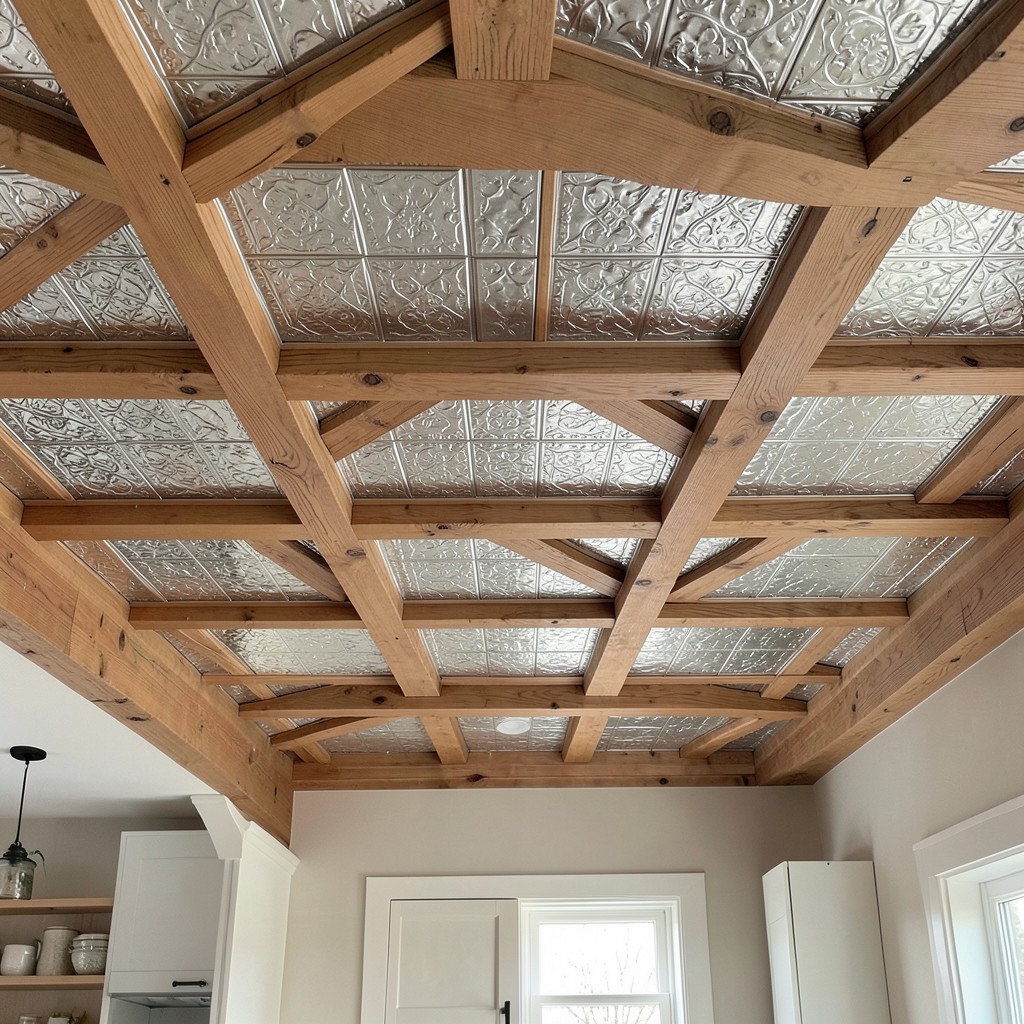
A ceiling that combines pressed tin tile panels and timber elements — either timber beam profiles framing the tin tile fields or timber plank sections alternating with tin panel strips — produces the material combination whose warmth and texture contrast delivers the specific quality of a ceiling that contains more design interest than either material alone would provide. The combination is the stone and wood home design principle applied to the ceiling plane: the material contrast between the organic warmth of timber and the cool, embossed precision of tin creates the visual tension that makes the surface complex without being complicated.
The grid of timber beams framing tin tile coffer panels is the combination format that most directly references the historical tradition of the coffered ceiling applied in vernacular rather than classical materials. The timber grid provides the three-dimensional structure of the coffers while the tin tile within each panel provides the embossed pattern detail that would require skilled plasterwork in a classical application. The result — accessible in materials, bold in impact — suits the farmhouse home decor direction of a kitchen or dining room where the ceiling treatment contributes the material character that the room’s other surfaces cannot carry alone.
The scale relationship between the timber beam sections and the tin tile panels determines the ceiling’s visual proportion from below: timber beams that are too narrow for the panel width they frame read as a trim detail rather than a structural grid, while beams that are too wide consume the ceiling’s surface in timber at the expense of the tin panel’s decorative contribution. A beam face width of approximately eight to ten percent of the panel width produces the correct proportion — substantial enough to read as structure, restrained enough to allow the panel’s pattern to dominate the field between the beams.
17. A Dome Ceiling Design

A dome ceiling — a curved, hemispherical or segmental ceiling form rising from the room’s perimeter to a central apex, whose curved surface distributes the overhead space in a continuous flowing geometry rather than the flat, planar termination of the standard horizontal ceiling — is the ceiling treatment that most directly references the grandeur of the great religious and civic interior traditions, and that translates most surprisingly and most powerfully into a domestic setting at the scale of a bathroom, a bedroom, or a small reception room where the dome’s proportional relationship with the room’s plan creates an intimacy rather than a monumentality.
The construction of a domestic dome ceiling uses a structural framework of bent metal or timber ribs radiating from the dome’s central crown point to the perimeter ring beam, clad with flexible plasterboard or a fibrous plaster system that accommodates the double curvature of the dome surface. The plastering of a dome ceiling requires a plasterer with genuine curved work experience, because the standard flat-work skills of a domestic plasterer do not transfer to the curved surface management that a dome’s geometry demands. The finished plaster dome, painted in a single pale tone that maximizes the reflection of light from the curved surface to the room below, produces the specific overhead luminance of a room where the ceiling is a light-gathering bowl rather than a flat boundary.
The decorative potential of a dome ceiling is the quality that justifies its construction cost — the curved surface is the ideal canvas for the hand-painted sky, the mosaic installation, the gilded coffers, or the sculptural relief that the flat ceiling accommodates only with significant visual awkwardness. A dome over a bathroom — the room where the luxury home interior aspiration is most concentrated in domestic interiors — carries a painted botanical or sky composition in a way that transforms the act of bathing from a functional routine into an atmospheric experience that the flat white ceiling above a standard bathtub simply cannot provide.
18. A Fabric-Draped Ceiling

A fabric-draped ceiling — lengths of lightweight fabric gathered and draped from a central ceiling point to the room’s perimeter in the swag arrangement, or stretched across the ceiling in a tent-like canopy, or cascading from a central ring in the style of a traditional Bedouin tent interior — is the ceiling treatment that brings softness, movement, and the specific acoustic quality of an overhead textile surface to a room that needs warmth and intimacy rather than architectural permanence. The draped ceiling is not a long-term installation in the way that plasterwork or timber is. It is a designed atmosphere whose changeability is part of its appeal.
The fabric selection for a draped ceiling must prioritize lightweight materials that gather well and hold a soft drape without the stiffness that heavier textiles produce at ceiling scale: voile, organza, lightweight muslin, fine cotton lawn, and the sheer linens that hold shape without weight are the materials that produce the airy, canopy quality that a draped ceiling at its best delivers. A bedroom where sheer white fabric is draped from a central ceiling point outward to wall hooks at each corner produces the specific quality of sleeping under a pavilion — the bed enclosed by soft overhead material, the room’s other surfaces visible beyond the fabric boundary, the light diffused through the sheer layer in the quality of dawn light under canvas.
The bohemian kids room decor ceiling draped in lengths of natural dyed cotton in warm earth tones — terracotta, mustard, forest green — creates the den-like overhead enclosure that children find deeply comfortable, converting the standard bedroom ceiling from an empty surface into the underside of a private world. This ceiling treatment requires only fabric, scissors, a staple gun or adhesive ceiling hooks, and the willingness to arrange the drape until the folds are right. The result, at minimal cost, is a ceiling with the highest ratio of designed atmosphere to financial investment of any treatment in this collection.
19. A Decorative Plaster Ceiling

Decorative plasterwork on a ceiling — the applied ornamental work of cornices, ceiling roses, panel moldings, and relief modeling in lime or gypsum plaster — is the ceiling treatment whose historical association with the formal domestic interior of the Georgian, Regency, and Victorian periods does not limit its contemporary application as much as most people assume. The decorative plaster ceiling in a contemporary interior reads as a deliberate and knowing reference to a material tradition, not as a period recreation, and the confidence of that reference is what makes the contemporary decorative plaster ceiling feel like a design decision rather than a restoration project.
The period-accurate decorative plaster ceiling — in a listed building or a conservation area property where the original plasterwork survives and requires restoration rather than replacement — is the application where the distinction between the genuine lime plaster artisan and the polyurethane reproduction product matters most. Original plasterwork in a Georgian dining room or a Victorian entrance hall is an irreplaceable architectural asset whose repair requires the specialist lime plasterer rather than the general contractor, and whose reproduction in lightweight polyurethane for the sections too damaged for repair requires the reproduction to be an honest match of the original profile rather than a generic approximation.
The contemporary decorative plaster ceiling — in a new house or a room without historical ornament where the decorative work is added as a design choice rather than a restoration requirement — can use the full range of polyurethane and resin-composite reproduction ornament available from specialist suppliers at a fraction of the cost and weight of genuine plaster. A contemporary bedroom whose ceiling receives a simple panel molding arrangement — a rectangular frame of beaded molding centered on the ceiling field — produces the elegant home styling quality of a room that invested in its ceiling detail without the installation complexity or the expense of traditional plasterwork.
20. A Beadboard Ceiling Design

Beadboard — the tongue-and-groove timber boarding characterized by the narrow bead or ridge running the length of each board between its flat faces — is the ceiling material most associated with the veranda, the screened porch, and the summer cottage of the American coastal tradition, and its specific domestic warmth, the way it reads as both simple and crafted simultaneously, is the quality that the coastal home design and farmhouse home decor directions have adopted most enthusiastically for interior ceiling applications. The beadboard ceiling knows exactly what kind of room it belongs to, and that knowledge communicates itself immediately to anyone who walks beneath it.
The paint treatment of a beadboard ceiling in an interior application is the decision that most shifts the material between its vernacular origins and its contemporary applications. White-painted beadboard — the classic porch-ceiling specification — provides the bright, airy home interiors quality of a ceiling that reads as light without being glary, the beads creating just enough surface relief to prevent the white from reading as flat. The same beadboard in a pale blue — the haint blue of the Southern American tradition, the specific pale grey-blue that was traditionally painted on porch ceilings to confuse spirits and repel insects in the folk tradition — produces the ceiling color that sits between grey and blue in a tone that changes quality more than any other paint color under different lighting conditions.
The MDF beadboard panel — a manufactured sheet product with the beadboard profile machined into its face, available in large format panels that install more quickly than individual tongue-and-groove boards — provides the beadboard aesthetic at a reduced installation time and a lower material cost than solid timber boarding. The distinction between the genuine tongue-and-groove timber beadboard and the MDF panel product is visible at close range — the machined profile’s consistency differs from the slight variation of the timber board — but from the standing viewing distance of a standard domestic room, the two treatments read with comparable character. For a rental property beadboard refresh or a budget spring home refresh, the MDF panel version earns its compromise.
21. A Star Ceiling Design
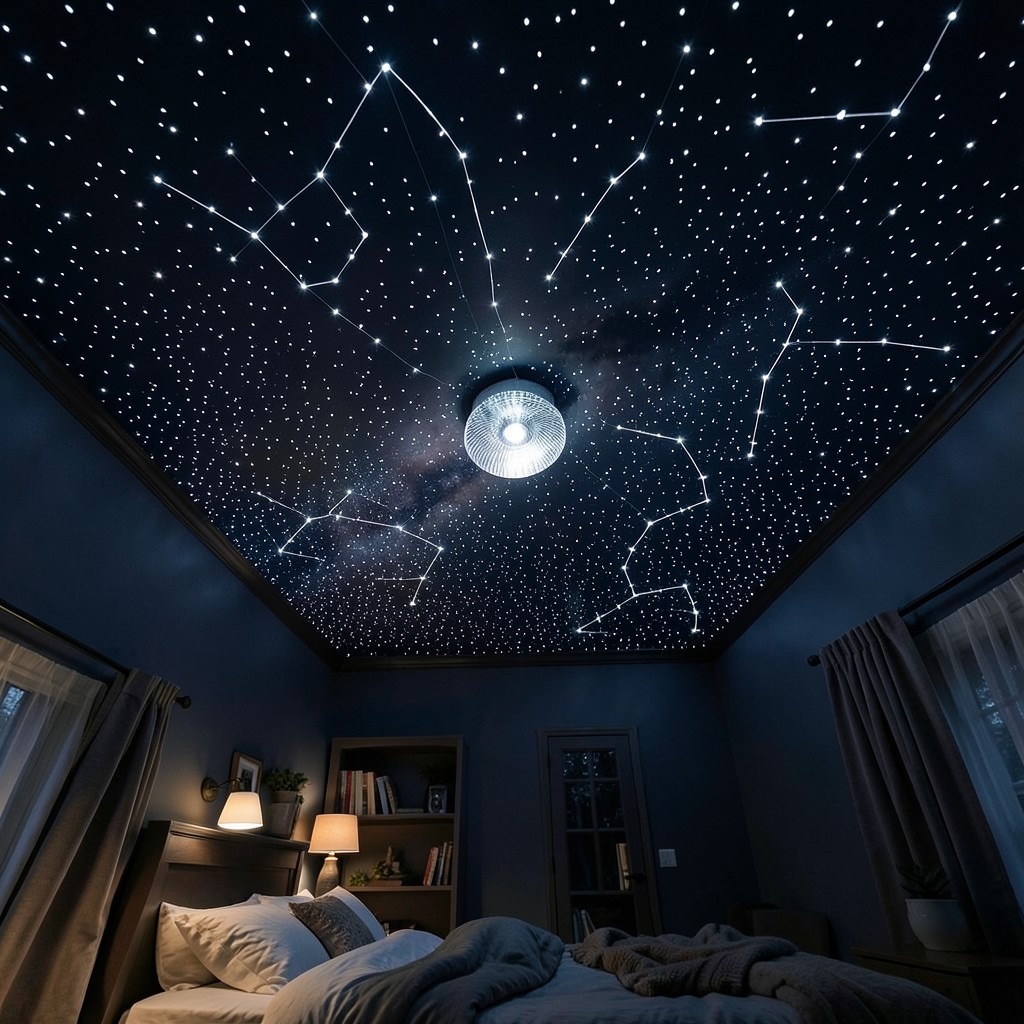
A star ceiling — a ceiling whose surface is embedded with fiber-optic points of light that recreate the night sky from below, their distribution either random in the style of natural starfield scatter or arranged in recognizable constellation patterns — is the ceiling treatment most specifically designed for the bedroom, and it is the ceiling idea that most directly serves the specific experience of lying in bed looking upward rather than the general room experience of standing or sitting within the space. The star ceiling is not for the room’s daytime character. It is designed for the specific hours between getting into bed and falling asleep, and the quality of that experience is what the design was made for.
The fiber-optic star ceiling uses a lighting unit — typically a halogen or LED projector — to feed light through hundreds of thin optical fibers whose ends are distributed across the ceiling surface and terminate flush with it. The fiber ends emit the point light that each star represents, with the fiber diameter at approximately one millimeter providing the tiny, sharp light quality that makes the ceiling’s light points read as stars rather than as LEDs. The twinkle effect — a slowly rotating crystal wheel in the light feed that causes the fiber ends to dim and brighten in a random sequence that replicates the atmosphere-caused scintillation of real stars — is the detail that converts the star ceiling from a good idea to a genuinely moving experience.
The cozy bedroom design context where a star ceiling performs best is the room whose other surfaces are dark or deeply toned — a navy ceiling with fiber-optic stars reads as a night sky over the bed in a way that a white ceiling with the same fibers cannot, because the dark field provides the contrast that makes the tiny light points read as luminous rather than as bright dots on a light background. A bedroom with a dark ceiling and star fibers during winter home decor redecoration — the season when the night sky quality matters most to the occupant’s daily experience — provides the specific atmospheric quality of sleeping outdoors without any of the temperature involved.
22. A Metallic Ceiling Finish

A metallic ceiling finish — a paint or plaster application that produces the reflective, shimmering surface quality of metal at the ceiling plane — is the ceiling treatment that most dramatically changes the quality of light in a room without introducing any additional light sources, and it is the treatment whose impact changes most dramatically between daytime and evening conditions. During the day, the metallic ceiling reflects the natural light from windows and skylights across its surface in the shifting, traveling quality of reflected water — the light moves across the ceiling as the sun moves. In the evening, under artificial light, the metallic ceiling gathers every lamp’s output and distributes it throughout the room in a warm, diffused glow.
The gold or warm bronze metallic ceiling — applied in a venetian plaster or a metallic paint system in a brushed technique that creates the directional shimmer of polished metal — is the ceiling treatment of the luxury home interior’s most opulent register, and it is the treatment whose execution most rewards the specialist decorator’s skill over the DIY application. The venetian plaster metallic ceiling builds its reflective quality through multiple thin coats of colored plaster — each coat burnished with a steel trowel to compact and polish the surface before the next coat is applied over it — in a process whose final result is a ceiling that reflects light with the depth and complexity of a cast metal surface rather than the flat reflectivity of a painted one.
The silver metallic ceiling — cooler, more contemporary, and more at home in the Scandinavian home interior or the minimalist home design direction — provides the reflective quality of the gold ceiling in a tone that suits the grey, white, and pale palette of contemporary residential design without the decorative warmth of the gold version. A silver metallic ceiling in a kitchen or a bathroom reflects the cool natural light of those spaces in a way that amplifies the room’s brightness and spatial quality, making a tight, narrow room feel wider and more open through the ceiling’s contribution to the room’s apparent luminance.
23. A Skylight Ceiling Design

A ceiling designed around a skylight — or, in the most ambitious versions of this idea, multiple skylights arranged in a deliberate pattern across the ceiling plane — is the ceiling treatment that produces the most direct connection between the room’s interior atmosphere and the quality of the sky above it, because the skylight is not a surface treatment at all. It is an opening. The ceiling with a well-designed skylight is a ceiling that has been given a window, and that window admits the living, changing quality of natural light that no artificial system can replicate at equivalent atmospheric impact.
The skylight’s position relative to the room’s primary occupation zone determines the quality of the light experience it produces. A skylight directly above the kitchen island illuminates the work surface from above in the task-light quality that overhead natural light provides more effectively than any undercabinet artificial system. The same skylight in a modern kitchen ideas redesign provides the ceiling feature that makes the kitchen feel connected to the outdoor environment rather than enclosed within it, and that connection changes the quality of time spent cooking in that kitchen across every hour it is in use. The skylight is not an architectural luxury in the kitchen — it is one of the spaces where the overhead light quality most directly improves the daily activity the room exists to support.
The glazing specification for a residential skylight must include both the thermal performance and the solar shading provisions that the overhead position demands in each specific climate condition and each specific room use. A skylight over a south-facing bathroom in a warm climate without solar control glazing creates the overheating greenhouse effect that makes the bathroom unusable in summer — a performance failure that the glazing specification should prevent rather than the room management should compensate for. The thermal blind, the solar control coating, or the external louvre screen are the technical solutions; the decision about which one is appropriate depends on the skylight’s orientation, the room’s use, and the climate’s specific solar radiation profile.
24. A Mural Painted Ceiling

A painted ceiling mural — an artwork applied directly to the ceiling surface by a skilled decorator or artist — is the ceiling treatment with the longest history, the deepest cultural associations, and the most site-specific character of any interior decoration form. The painted ceiling mural is by definition the one design decision in an interior that cannot be reproduced elsewhere, cannot be purchased from a catalog, and cannot be achieved without the specific combination of the artist’s skill, the room’s proportions, and the household’s design ambition that produced it. That irreproducibility is its most distinctive quality, and it is the quality that makes a painted ceiling mural the most memorable interior design decision in any house that contains one.
The contemporary ceiling mural in a domestic interior is not limited to the formal ceiling compositions of the palaces and churches that defined the tradition’s historical highest register. A bedroom ceiling painted with a loose, botanical night-sky composition — dark field, pale stars, botanical forms emerging from the darkness in whites and sage greens — is a contemporary ceiling mural whose intimacy and restraint suit the cozy bedroom design context without the grandeur of the full narrative historical composition. A child’s room ceiling painted with the specific constellation map that the child’s birthday night sky displayed — personal, precise, uniquely theirs — is a ceiling mural whose meaning goes beyond decoration into the territory of family memory.
The commissioning process for a ceiling mural begins with the artist selection rather than the design brief, because the mural’s character is determined as much by the artist’s hand and sensibility as by the brief’s specifications. An artist whose portfolio shows the specific quality — the botanical detail, the loose sky painting, the precise geometric pattern work, the figurative composition — that the room requires is the starting point. The design brief follows from the artist’s natural direction rather than preceding it, and the mural that results from that sequence — where the artist’s strengths inform the brief rather than a brief constraining the artist’s strengths — is the one whose quality justifies the ceiling’s position as the room’s primary art work.
25. A Teak Wood Ceiling

Teak as a ceiling material — solid or engineered teak planks, teak slat panels, or teak veneer applied to the ceiling plane — brings the specific warm amber-honey tone and the straight, fine grain of one of the world’s most respected timber species to the overhead surface where its color and its material density produce a ceiling of physical richness that no paint color or applied surface treatment approaches. The teak ceiling is the ceiling that makes a room feel genuinely material rather than merely decorated, and that distinction — between a room that has good things in it and a room that is made of good things — is one of the central quality differences between interior design that lasts and interior design that merely impresses on first encounter.
The teak slat ceiling — thin strips of teak timber spaced at regular intervals across the ceiling surface, with the gaps between slats revealing the ceiling substrate above — provides the acoustic absorption benefit that a solid timber ceiling does not, because the open area between the slats allows sound to pass through the ceiling into the absorption layer of mineral wool typically installed in the void above it. This combination of teak surface and acoustic backing is the ceiling specification used in high-quality residential and commercial audio environments where both the material quality of the teak surface and the acoustic performance of the voided ceiling system need to be delivered simultaneously.
The tropical home design direction or the luxury master bedroom design context where teak provides its richest contribution is the room whose other surfaces allow the timber’s warmth to dominate without competition. A bedroom with pale walls, white linen, and a teak slatted ceiling reads as the luxury resort aesthetic that beach house interiors pursue at their most aspirational — the material that connects the interior to tropical building tradition without the thatch or bamboo of a more vernacular interpretation. The teak ceiling in this context is the room’s single material statement, and its restraint in application allows the timber’s quality to carry the room’s entire material character.
26. A Washi Paper Ceiling Light Panel

Washi paper ceiling panels — lightweight Japanese handmade paper stretched across a frame and backlit by an LED array to produce the soft, warm glow of diffused overhead illumination — bring the specific aesthetic of Japanese paper lantern lighting to the ceiling plane and produce the peaceful home decor quality of a room whose light source is warm, diffused, and material rather than point-source and industrial. The washi paper ceiling panel is not a lighting fixture in the conventional sense. It is a light-emitting surface, and the quality of its output — soft, warm, with the slight texture of the paper’s fibrous structure visible as the light passes through it — is the specific light quality that most closely resembles the quality of natural light filtered through shoji screens.
The DIY washi paper ceiling panel uses a simple timber frame of the desired dimensions, stretched with genuine Japanese washi paper or with a Western equivalent such as mulberry paper or tissue-weight rice paper, and backlit with warm-white LED strip mounted within the frame’s depth. The paper’s translucency — typically between forty and sixty percent light transmission for the weights suitable for ceiling panel use — diffuses the LED point sources into the even wash of the final glowing surface, and the frame can be scaled from a small accent panel of sixty centimeters square to a full ceiling replacement that covers the entire room in diffused overhead light.
The Scandinavian hallway design context where a washi paper ceiling panel provides its most practical atmospheric contribution is the entry space whose standard ceiling light produces the harsh, unflattering quality that greeting guests under a bare bulb or a flush fitting provides. A washi paper panel at entry ceiling level — framed in slim timber, backlit in warm white, providing the room’s entire ambient illumination — converts the hallway from a transitional space into one whose light quality sets the tone for the entire domestic interior it introduces.
27. A Copper Pipe Ceiling Installation

A ceiling installation using copper pipe — the same standard plumbing copper tube available from any builders’ merchant, arranged in a geometric or organic pattern across the ceiling plane and fixed to a grid of ceiling hooks or a mounting framework — is the industrial home design ceiling treatment that converts a functional material into a decorative one with the specific material character of a craft object made from a construction product. The copper pipe ceiling is not the most refined ceiling treatment in this collection. It is the one that demonstrates most clearly that the distinction between building material and design material is a decision about context rather than about the material itself.
The geometric copper pipe ceiling grid — horizontal pipe lengths fixed to the ceiling in a regular grid pattern, the pipe-to-pipe junctions left open or fitted with standard copper tee and elbow fittings — produces the industrial aesthetic of a construction system repurposed as architecture, and the material’s natural warm tone prevents the grid from reading as purely mechanical. The copper develops its patina over months of exposure to the room’s atmosphere, darkening from the bright new metal through the warm amber of early tarnishing toward the darker, richer tone of well-aged copper that provides the room’s warmest material surface. The ceiling that changes color over time is the ceiling that gives the room a reason to look up regularly across the months and years of living beneath it.
The rustic home office ideas context where a copper pipe ceiling installation provides its most congruent application is the workspace whose design direction combines the industrial material honesty of exposed pipe and raw metal with the warmth of reclaimed timber and natural textiles — the design combination that contemporary hybrid working environments adopt when they want the productivity association of a workspace and the comfort association of a domestic room simultaneously. The copper ceiling in this context is the design gesture that commits the room’s industrial aesthetic most fully without requiring structural exposure or architectural modification.
28. A Lacquered High-Gloss Ceiling

A lacquered high-gloss ceiling demands the most honest surface preparation of any ceiling treatment, because the high sheen that makes it spectacular also makes every imperfection in the ceiling substrate visible from across the room in a way that a flat paint finish conceals entirely. The preparation work — the filling, the skim coating, the sanding — is the invisible labor that determines whether the finished lacquered ceiling reads as the chic home decor statement it was intended to be or as a glossy surface that maps every historic crack and patched repair in brilliant reflection. No finish rewards good preparation more generously, and none punishes its absence more mercilessly.
The color selection for a lacquered ceiling operates differently from the same color in a flat finish because the gloss multiplies the color’s luminosity and changes its relationship with the room below. A deep navy in flat paint on a ceiling is atmospheric and enclosing. The same navy in a high-gloss lacquer is a mirror the color of the sea, and the room below it doubles in apparent height as the floor and furniture reflect in the ceiling above. A deep forest green lacquered ceiling in a dining room with candlelight below it produces the specific quality of a room that exists inside a jewel box — contained, luminous, and unlike any other room in the house.
The application of a true lacquer finish requires multiple thin coats applied by sprayer rather than roller — the roller nap leaves a texture that the gloss magnifies rather than conceals, and the brush leaves stroke marks that the sheen renders permanently visible. A professional spray application, properly masked and ventilated, produces the glass-smooth surface that the lacquered ceiling requires to deliver its full visual impact. The investment in correct application is not optional here; it is the condition on which the entire result depends.
29. A Suspended Acoustic Tile Ceiling

The standard suspended acoustic tile ceiling — the grid of metal tracks holding mineral fiber tiles that covers the majority of office and commercial interiors — has acquired a reputation in residential design circles that its performance characteristics do not deserve, largely because the version most people have encountered is the lowest-grade commercial product specified for cost rather than for quality. The residential acoustic tile ceiling, designed from a completely different starting point, produces a ceiling whose sound absorption, whose thermal performance, and whose visual character are all categorically superior to the suspended ceilings that earned the category its reputation.
The high-design acoustic panel ceiling — suspended acoustic tiles in a refined material such as formed felt, woven textile, perforated timber veneer, or molded wool fiber — provides the acoustic absorption of the commercial product in a material whose surface quality belongs in a residence rather than a conference room. The perforated oak veneer acoustic panel, suspended in a slim aluminum grid system whose track profile is minimal enough to read as a detail rather than a framework, produces a ceiling of genuine material warmth whose acoustic performance — a noise reduction coefficient of 0.70 to 0.85 depending on the panel specification — converts a hard-surfaced living room from an echo chamber into a room where conversation is comfortable and music sounds considered rather than reflected.
The practical benefit of the suspended acoustic ceiling in a renovation context is the void it creates between the new ceiling surface and the original ceiling above — a void that accommodates the routing of new electrical circuits, the installation of recessed lighting, the concealment of structural elements, and the addition of acoustic insulation that the original ceiling construction does not contain. The relaxed home design that wants a music room, a home cinema, or a home office with genuinely controlled acoustic character finds in the suspended acoustic ceiling the most complete and most installation-practical solution available without structural modification to the room’s shell.
30. A Recessed Lighting Ceiling Design

A ceiling designed around recessed lighting — the configuration of multiple recessed downlights positioned within the ceiling plane to provide a distributed pattern of illumination whose sources are invisible within the ceiling surface — is the approach that most domestic lighting renovations default to, and it is the approach that most domestic lighting renovations get wrong. The recessed downlight is not inherently a good ceiling design decision. The grid of equal-spacing recessed downlights, positioned by the electrician at regular intervals without reference to the room’s furniture layout or its intended atmosphere, is one of the most reliably mediocre lighting outcomes in residential design and it happens in almost every home that undertakes a ceiling renovation.
The ceiling designed well around recessed lighting begins with the room’s furniture layout and its atmospheric intention rather than with the electrical grid. Downlights positioned to illuminate the task surfaces — the kitchen counter, the reading chair, the bathroom vanity — and to wash the walls from positions close to the wall plane rather than centered in the ceiling produce the specific quality of a lighting scheme that serves the room’s activities while creating the atmospheric gradient of a lit interior rather than the flat uniformity of a uniformly illuminated box. Wall washing with recessed lights positioned three hundred millimeters from the wall face and spaced at equal intervals along that wall converts the vertical surface from a background to a lit architectural element, and the room’s apparent size increases as the eye is drawn to the illuminated boundary rather than confined to the ceiling’s flat-lit center.
The dimmer control specification for a recessed lighting ceiling is the investment that converts an adequate ceiling lighting design into a genuinely atmospheric one, because the recessed downlight at full output is a functional light source and the same downlight at thirty percent output is an atmospheric one. A ceiling circuit that cannot be dimmed is a ceiling whose lighting contribution to the room is fixed at one intensity regardless of the hour, the activity, or the mood the room is intended to support. Every recessed lighting circuit in a residential interior should be on a dimmer control as a design requirement rather than as a luxury upgrade.
31. A Floating Ceiling Panel Design

A floating ceiling panel — a designed element suspended below the main ceiling plane, either a single large panel centered in the room or a series of panels arranged in a deliberate composition across the ceiling zone, creating the layered overhead quality of a ceiling that has depth and dimension rather than a single flat surface — is the ceiling treatment that most efficiently introduces architectural complexity to a high-ceilinged room where the ceiling’s distance from the floor makes it visually remote and acoustically problematic. The floating panel brings the ceiling down — not physically, but perceptually — and in doing so, it makes the room feel more intimate without reducing its actual volume.
The floating panel’s material defines the ceiling treatment’s character as directly as the panel’s shape and position. A floating panel in painted MDF, suspended on slim steel cables from the ceiling above it, provides the minimalist home design aesthetic of a ceiling element that is present without being decorative — the geometry of the panel and its shadow on the ceiling above it providing the visual interest rather than any surface treatment. A floating panel in natural linen-wrapped acoustic board brings both the textile warmth of the fabric and the sound absorption performance of the acoustic substrate — a dual-function panel that addresses the room’s acoustic condition and its atmospheric quality simultaneously.
The lighting integration within a floating panel installation — the LED strip mounted on the panel’s upper face to wash the original ceiling above in indirect light, or the recessed fixture built into the panel’s face to provide focused light below — is the detail that converts a floating panel from an architectural element into an integrated lighting and ceiling design system. The panel that carries its own light source, directing light both upward to the ceiling above and downward to the room below, is the element that makes the ceiling feel active rather than static, and that specific quality of an overhead surface that contributes light to the room rather than merely receiving it is one of the more genuinely elegant solutions in residential ceiling design.
32. A Shiplap Ceiling Design

Shiplap — the overlapping horizontal timber boards whose rebated edges create the characteristic shadow line between courses — has spent the last decade as the most photographed wall treatment in residential interiors, appearing in farmhouse home decor schemes, coastal home design projects, and the full range of warm, natural material interiors that contemporary renovation culture produced with remarkable consistency. The ceiling application of shiplap is the direction that most practitioners of the wall-shiplap aesthetic have not yet taken, and it is the application where the material’s specific combination of surface texture and linear rhythm provides its most unexpected spatial contribution.
A shiplap ceiling in a low-ceiling room — the bedroom, the cottage sitting room, the converted attic — produces the effect of a ceiling that is actively finishing the room rather than merely closing its top. The horizontal lines of the shiplap run in the direction that most effectively extends the apparent width of the ceiling, which in a low-ceiling room is the more useful perceptual expansion — wider reads as more comfortable than taller when the room’s height cannot be increased and its width is fixed. The shadow line between each board course adds the surface relief that prevents the ceiling from reading as a flat plane, and the timber’s natural warmth prevents the shiplap ceiling from reading as clinical even in all-white painted applications.
The fall home decorating context where shiplap on a ceiling produces its richest atmospheric contribution is the living room whose seasonal transition to warm materials, candlelight, and textile layering benefits from the overhead warmth that the timber ceiling provides to the room’s overall sensory environment. The ceiling’s material warmth is felt rather than seen in the literal sense — the timber boards do not make the room thermally warmer — but the visual warmth of natural timber overhead is part of the cozy home design experience that autumn and winter interior aesthetics pursue, and the shiplap ceiling delivers that contribution from the surface that affects the room’s atmosphere most broadly.
33. A Black Ceiling Design
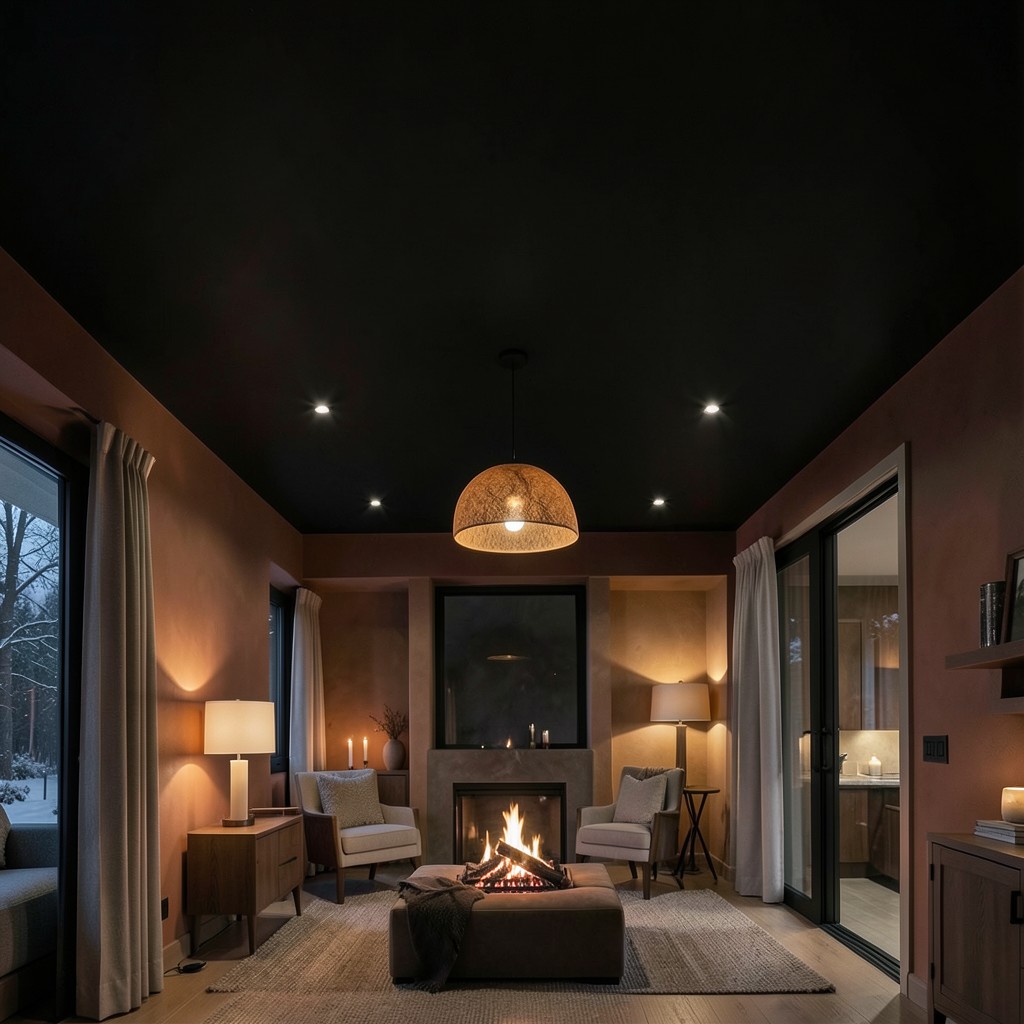
A black ceiling is the ceiling decision that requires the most conviction and rewards it most generously, and the interior designers who use it consistently are the ones who understand that the room’s atmosphere is not produced by the color’s inherent warmth or lightness but by the specific spatial relationship the color creates between the ceiling and the room below it. A black ceiling does not make a room feel dark in the oppressive sense. It makes the ceiling disappear — receding into the overhead space in the way that the night sky recedes above a well-lit room — and the visual effect of a ceiling that has retreated from the room’s lower space is a room whose walls and furniture and light sources appear to float in an undefined vertical volume rather than to sit in a box.
The black ceiling works best in rooms where the light sources are below the ceiling plane rather than at it — where floor lamps, table lamps, pendants hung low, and architectural wall washing keep the room’s illumination within the lower half of the space and allow the black ceiling to remain in shadow above the lit zone. The black ceiling that is directly illuminated by recessed downlights loses its atmospheric quality entirely: the downlights illuminate the black surface and produce a dark grey ceiling with visible light sources, rather than the receding overhead darkness that the atmospheric effect requires. The lighting design for a black ceiling room is the condition on which the ceiling’s effect depends.
The winter home decor interior whose black ceiling is combined with warm-toned walls — terracotta, deep ochre, warm taupe — candlelight from below, and a single large pendant in a warm material creates the specific quality of intimate enclosure that no other ceiling treatment can produce with equivalent intensity. The room feels gathered and protected in the way that a fire-lit room in a deep winter landscape feels gathered and protected — the darkness above and the warmth below creating the precise atmospheric combination that makes interior spaces feel necessary rather than merely comfortable.
34. A Ceiling With Architectural Molding Frames

A ceiling whose flat surface is organized by a pattern of applied molding frames — rectangular, square, or octagonal profiles of plaster or polyurethane molding fixed in a regular arrangement across the ceiling plane — is the ceiling treatment that produces the architectural richness of a decoratively programmed interior at the lowest technical complexity of any applied ceiling ornament. The molding frame arrangement on a flat ceiling converts the undifferentiated surface of a standard plaster ceiling into a field of architectural panels whose shadow edges and interior fields provide the visual organization that the room’s overhead plane needs to feel designed rather than merely closed.
The panel molding arrangement’s geometry must be resolved in relationship to the room’s plan dimensions rather than applied at a standard module without reference to the ceiling’s specific proportions. A ceiling whose molding frames are centered on the room’s axes — with a central larger panel occupying the ceiling’s center field and smaller border panels filling the perimeter zone — produces the classical panel arrangement whose geometric logic is self-evident from below. A ceiling whose molding frames are applied in a regular all-over grid without axis reference reads as a surface pattern rather than as an architectural composition, and the distinction between the two approaches is entirely in the resolve with which the geometry was set out before the first molding strip was fixed.
The holiday home styling context where a molding-paneled ceiling produces its most formal and most atmospheric contribution is the dining room whose ceiling is the overhead element that frames the table and the gathering beneath it as an event rather than as a meal. The molding-paneled dining room ceiling — painted in a tone that relates to the room’s wall color while providing the differentiation that the ceiling plane needs to read as a designed surface rather than an upward extension of the wall — is the architectural detail that makes the dining room feel like a room where important meals are eaten, not merely a room where the table and chairs happen to be positioned.
35. A Herringbone Wood Ceiling
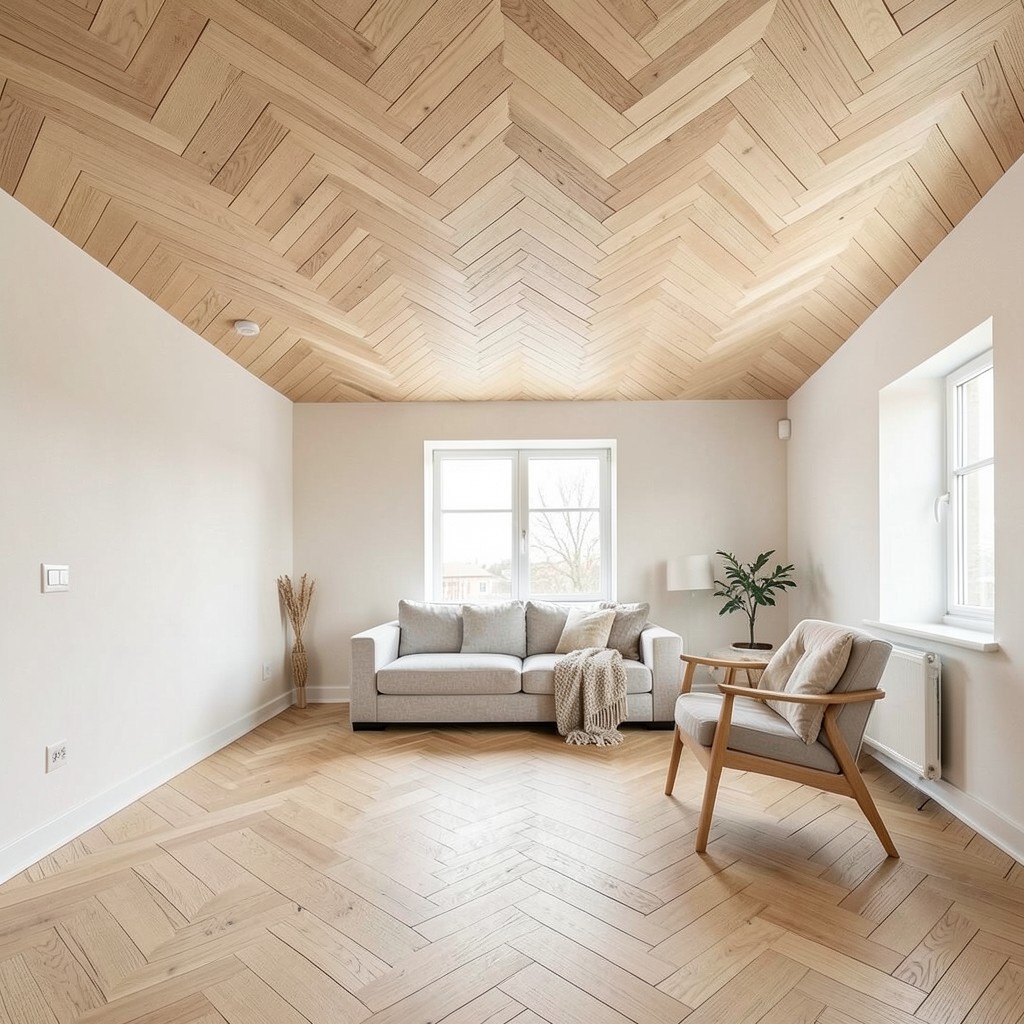
A herringbone-patterned timber ceiling — solid wood or engineered timber strips arranged in the forty-five-degree alternating diagonal pattern that produces the characteristic chevron-within-chevron visual rhythm — is the ceiling treatment that takes the warmth and material quality of the timber plank ceiling and adds the geometric dynamism of a pattern whose directionality changes with every viewing angle. The herringbone ceiling is more complex than the straight-run plank ceiling in both its installation requirement and its visual character, and the investment in that complexity is a room whose overhead surface reads as made rather than applied — a ceiling that required decisions beyond choosing a material.
The scale of the individual herringbone strip — its width and length relative to the room’s ceiling dimensions — determines whether the pattern reads as fine and textile-like or bold and architecturally graphic from the standing viewing position below. Narrow strips of twenty to forty millimeters width produce a fine herringbone whose individual elements are only distinctly visible at close range, reading from the center of the room as a warm, textured surface with directional movement rather than as a clear geometric pattern. Wide strips of eighty to one hundred millimeters width produce a bold herringbone whose pattern geometry is clear from any position in the room and whose individual boards are large enough for the wood’s grain and natural color variation to contribute to the surface’s visual interest.
The Scandinavian home interior application of a herringbone oak ceiling — pale, almost white-stained narrow oak strips in the traditional herringbone arrangement, the ceiling’s pattern echoing a matching herringbone floor treatment below — produces the room-within-room quality of an interior whose ceiling and floor are designed as a coordinated pair, with the furnishings and the walls occupying the space between two patterned natural surfaces. This approach suits the spring home refresh or the breezy home interiors direction where the room’s material palette is light, natural, and consistent from floor to ceiling.
36. A Raft Ceiling in a Double-Height Space

A raft ceiling — a horizontal panel installed at a lower level within a double-height or high-ceiling space, creating a new ceiling plane at a human-scale height beneath the full architectural height of the room above — is the spatial design tool that most directly addresses the specific livability problem of double-height rooms: their visual drama is undeniable, but their acoustic and thermal performance, and their human-scale comfort for seating and domestic activity, are compromised by the volume’s sheer size. The raft brings the ceiling to you without removing the height it hangs below.
The raft’s material and finish determine whether the double-height room reads as having a ceiling or as having a floating element within a taller space — the distinction between the two depends entirely on how opaque and how defined the raft’s perimeter is. A raft whose edges are sharp and whose material is opaque reads as a ceiling installed at a lower level, and the space above it reads as an inaccessible void. A raft whose edges are open and whose surface is translucent — a light-transmitting acoustic panel, a stretched fabric membrane, an open slat system — reads as a designed element within a taller space, allowing the eye to travel upward through or around the raft to the architectural volume above while still providing the perceptual scale of an overhead surface at human-comfortable height.
The lighting integration that the raft installation enables is the design opportunity that most justifies the raft’s construction in a renovation context. LED strip mounted on the raft’s upper perimeter face washes the original ceiling above in indirect light — creating the specific quality of a ceiling that glows from the architectural height above the raft while the raft itself provides the intimate scale of a room ceiling at sitting and standing height. The combination of the high, softly lit original ceiling and the close, architecturally detailed raft below it is the double-height room solution whose sophistication most rewards the attention it requires.
37. A Ceiling With a Nature-Inspired Canopy Installation

A ceiling installation that references the natural canopy — suspended branches, dried botanical forms, trailing vines, paper or textile leaves in overhead arrangements that convert the ceiling zone from an architectural boundary into a natural shelter — is the ceiling treatment whose design direction sits at the intersection of interior design and installation art, and whose impact on the room’s atmosphere is immediate, visceral, and unlike any paint or material treatment. The canopy ceiling works because the human nervous system responds to overhead foliage with a specific quality of relaxation — the shelter of the tree canopy is one of the most primally comfortable spatial conditions our species evolved within.
The dried botanical canopy — eucalyptus branches, pampas grass plumes, dried banksia stems, and seed heads suspended from ceiling hooks on varying lengths of clear monofilament — is the installation format most accessible for a domestic DIY application because the materials are inexpensive, the installation requires no structural modification, and the arrangement can be revised and refreshed seasonally. A summer home design in a dining room or living area whose ceiling carries a loose, generous dried botanical installation reads as the garden-inspired interiors aesthetic at its most relaxed and most personal — the room’s ceiling becomes the extension of the garden that the season outside is producing.
The living plant canopy — trailing pothos, hanging ferns, or climbing plants trained across a ceiling-level trellis system — is the version that most fully delivers the jungle-inspired home decor or tropical home design quality of genuine green overhead material, but it demands the irrigation, the lighting, and the humidity management that live plants at ceiling level require in an interior context. The trailing pothos installation over a bathroom ceiling, where the humidity from bathing supports the plant’s water requirements naturally, is the domestic location where the living canopy ceiling works with the building’s environmental conditions rather than against them.
38. A Ceiling With Linear Timber Slats
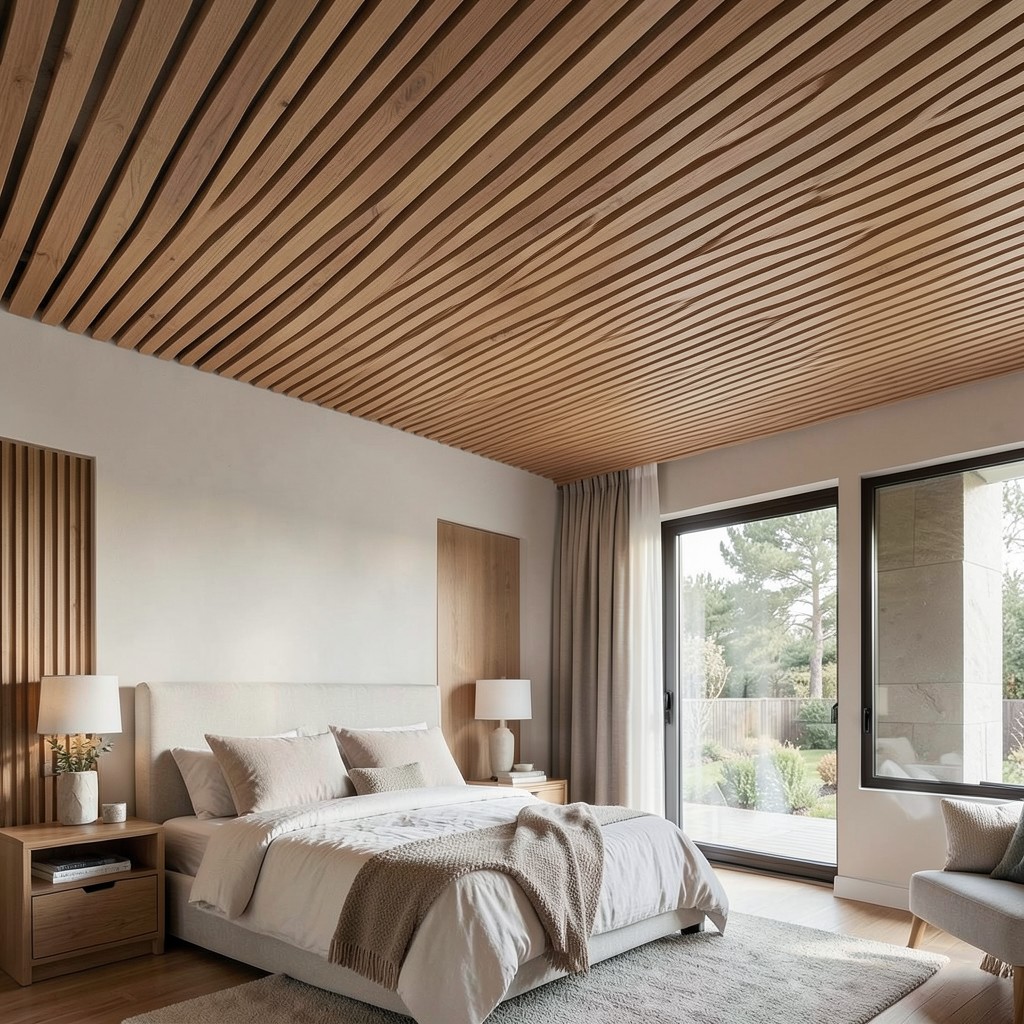
Linear timber slatted ceilings — parallel strips of timber fixed at regular intervals across the ceiling plane with a consistent gap between each slat, the gap revealing either the ceiling substrate above or an acoustic layer concealed within the void — are the ceiling treatment that contemporary commercial and hospitality design has applied most consistently over the past decade, and the residential sector is only beginning to understand the specific warmth and acoustic quality that this ceiling form delivers at the domestic scale. The slatted ceiling is not a commercial ceiling applied to a house. It is a ceiling form whose domestic scale reveals qualities that the large commercial application obscures.
The gap dimension between the slats is the specification variable that most determines the ceiling’s character and its acoustic performance. A tight gap of five to ten millimeters between slats produces a dense surface whose timber coverage is high and whose revealed acoustic backing is minimal — the ceiling reads primarily as a timber surface with thin shadow lines rather than as an open grid. A wide gap of twenty to forty millimeters produces a more open surface where the gaps and the slats contribute equally to the ceiling’s visual character and where the acoustic absorption of the backing layer is more fully exposed to the room’s sound field. The contemporary residential slatted ceiling typically specifies a gap of fifteen to twenty-five millimeters as the balance between the timber surface’s warmth and the void’s acoustic benefit.
The warm home decor direction of a bedroom or living room with a linear oak or walnut slatted ceiling receives the material’s natural color variation — the pale sapwood and the warm heartwood — across the ceiling’s full plane in the pattern of a surface whose raw material origin is visible in its finished appearance. This is the ceiling version of the stone and wood home design philosophy: the material’s natural character is the decoration, and the design’s job is to select, position, and proportion it correctly rather than to decorate or cover it.
39. A Ceiling With Pendant Light Clusters

A ceiling designed around a cluster of pendant lights — multiple pendant fittings of varying drop lengths grouped above a single table, seating area, or architectural zone — is the ceiling treatment that produces the greatest atmospheric density of any lighting intervention and the most direct translation of the chic home decor aesthetic into a ceiling specification. The pendant cluster is not multiple lights. It is a composition whose individual elements read collectively as a single overhead feature, and the quality of that composition — the range of drop lengths, the relationship between fitting types, the density of the cluster’s plan footprint — is the design variable that distinguishes a resolved pendant installation from a crowded ceiling with too many fittings.
The drop length variation within a pendant cluster is the dimension that produces the installation’s visual depth. A cluster of pendants all hung at the same drop length reads as a row rather than as a composition — the eye reads the common horizon of the fitting bases as a line rather than as a three-dimensional grouping. A cluster whose drop lengths span a range of three hundred to six hundred millimeters — some fittings close to the ceiling, others hanging low toward the table or surface below — produces the staggered, dimensional quality that makes the cluster read as a composed installation rather than a uniform product specification.
The fall home decorating dining room whose pendant cluster is composed of warm-toned fittings — amber glass, warm brass, natural rattan, dried botanical shades — produces the ceiling focal point that organizes the room’s entire atmospheric character around the table below it. The cluster is the room’s event, and the table is the stage it illuminates. Getting this relationship right — the pendant cluster sized and positioned for the specific table dimensions below it rather than for the ceiling’s geometric center — is the detail that separates a pendant installation designed for the room from one designed for the catalog photograph.
40. A Ceiling With Integrated Cove Lighting

A ceiling with integrated cove lighting — a concealed LED or fluorescent strip light source installed within a recessed channel or shelf at the ceiling-wall junction, directing light upward to wash the ceiling surface in indirect illumination — is the residential lighting installation that produces the highest quality of ambient light in a domestic room at the lowest visual intrusion, because the light source is entirely hidden and the light itself appears to come from the ceiling surface rather than from a fixture. The cove-lit ceiling is the ceiling that glows. Not shines. Glows.
The cove’s position at the ceiling perimeter — whether it is built into the wall’s top plate, formed by a dropped soffit at the room’s edge, or created by a purpose-built plaster or timber cornice profile with a concealed recess on its back face — determines the angle at which the light washes the ceiling and the distance from the wall at which the illumination is brightest. A cove positioned tight to the ceiling-wall junction washes the ceiling surface from the edge inward, with the brightest illumination at the ceiling’s perimeter and a gradual falloff toward the center. A cove positioned on a dropped soffit two hundred to three hundred millimeters below the main ceiling level washes the ceiling above it with a broader, more even spread whose brightness gradient is less steep.
The color temperature of the LED strip within a cove lighting installation is the specification that most directly determines the ceiling’s atmospheric contribution. A warm white LED at 2700 Kelvin produces the ceiling glow that reads as firelight quality — the warmest, most flattering, most evening-appropriate illumination the cove can provide. A neutral white at 3000 Kelvin provides the same warmth quality with slightly more color accuracy — the choice for spaces where the ceiling’s cove light is the primary ambient source and the rendering of the room’s colors is important as well as the atmosphere it creates.
41. A Plaster Coving and Cornice Ceiling Detail

The plaster cornice — the molded profile at the junction between the ceiling and the wall, providing the transitional element that separates two planes in a architecturally considered way — is the ceiling detail whose presence or absence communicates the building’s design care at a level of detail that most occupants cannot articulate but every occupant perceives. A room with a well-chosen, correctly proportioned cornice reads as complete. A room whose ceiling meets its walls at a bare ninety-degree junction reads as not yet finished, regardless of the quality of the surfaces on either side of that junction.
The cornice profile’s scale must relate to the room’s ceiling height and floor area with the proportional discipline of the classical interior tradition that developed the relationship between room dimension and molding scale through centuries of practical application. A large-profile cornice — a tall, deeply modeled section with multiple fascia elements and a pronounced cove or ogee — suits the high-ceiling reception room of a period house and reads as correctly substantial at that scale. The same profile in a low-ceiling cottage bedroom is oppressive, consuming the wall height at the cornice level and reducing the room’s apparent height below the comfortable threshold. A small, clean-profiled cornice of sixty to eighty millimeter overall height suits the low-ceiling domestic room.
The contemporary cornice — a shadow gap rather than a built-up molded profile, created by recessing the ceiling plasterboard slightly from the wall face and painting the resulting gap in a dark tone — is the minimal home design approach to the ceiling-wall junction whose restraint suits the contemporary interior as precisely as the classical cornice suits the period room. The shadow gap cornice is not a cornice at all in the traditional sense; it is the deliberate marking of the junction by its absence rather than by its presence, and the line it creates — slim, dark, precisely consistent around the room’s perimeter — is the minimalist home design’s version of the same architectural intention.
42. A Ceiling with Recessed Bookshelves
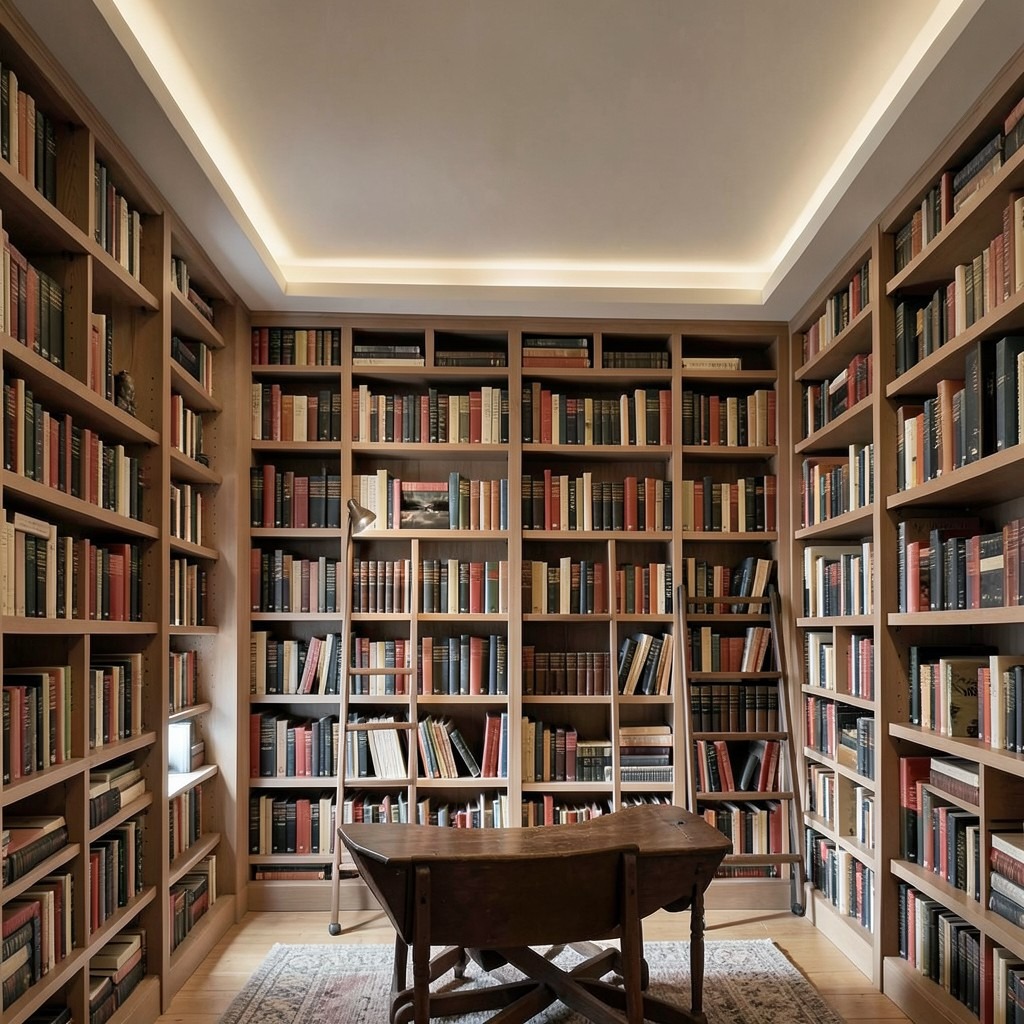
A ceiling that incorporates recessed bookshelves — built-in shelving units whose top surface is flush with the ceiling plane, the shelves reading as a ceiling element rather than as wall furniture — is the ceiling treatment that most efficiently converts the overhead zone into functional storage while producing the specific quality of a room whose books are elevated to an architectural element rather than contained in a piece of furniture that sits on the floor. The ceiling-level bookshelf is the library aesthetic applied to the domestic room at the scale that makes every book a part of the room’s architecture.
The structural requirement for recessed ceiling-level shelving is the same as for any built-in case: a framework of adequate strength to carry the weight of books at the specified shelf span and depth, fixed to the wall structure rather than to the ceiling surface alone. A full run of ceiling-height built-in shelving whose top unit is built to the ceiling creates the flush-to-ceiling effect without actual ceiling modification — the shelf unit’s face aligns with the ceiling plane, and the unit’s sides, top, and back are built into the wall alcove or across the full wall face. The distinction between a ceiling-height bookcase and a recessed ceiling shelf is largely visual rather than structural, and the visual result — the books overhead, the space below, the wall organized from floor to ceiling in a single continuous architectural element — is what the design is pursuing.
The rustic home office ideas context where ceiling-height bookshelves create their most atmospheric contribution is the home library or study whose entire wall-to-ceiling zone is given over to books — the floor-to-ceiling library wall whose upper shelves require the rolling ladder of the traditional private library, and whose density of book coverage converts the room from an office into a room whose intellectual character is expressed in every surface. The books on the upper shelves do not need to be frequently accessed. Their role is architectural rather than functional, and the ceiling they fill is a ceiling that the room would lose something essential without.
43. A Ceiling With Decorative Tiles

A tiled ceiling — ceramic, porcelain, terracotta, or encaustic cement tiles applied to the ceiling surface in a pattern that reads from below as a decorative overhead plane — is the ceiling treatment whose installation complexity is significantly higher than any paint or applied molding approach and whose result, when the tile selection and the setting pattern are resolved correctly, is a ceiling of material density and decorative richness that no other ceiling treatment in the domestic interior matches. The tiled ceiling is the ceiling that stops people mid-conversation and produces the instinctive upward look.
The bathroom is the room where the tiled ceiling most naturally extends the room’s existing material program — the walls are already tiled, the floor is already tiled, and the ceiling is the surface whose hard, washable tile covering is both practically appropriate and aesthetically continuous with the room’s existing material palette. A bathroom whose shower enclosure walls and ceiling are tiled in a continuous field of the same small mosaic tile — the tile wrapping from floor to ceiling without interruption — produces the immersive, material-complete quality of a room that was designed as a single architectural gesture rather than assembled from independent surface decisions.
The kitchen ceiling in a traditional home interiors direction — hand-painted Delftware tiles in a blue and white pattern arranged in a continuous field above the cooking zone — is the ceiling detail that most directly references the historical decorative tile programs of the Dutch and Portuguese kitchen traditions and that translates most specifically into the contemporary farmhouse or traditional kitchen whose ceiling is the surface that the room’s decorative ambition reserves for its most expressive material.
44. A Ceiling With a Skylight Tunnel
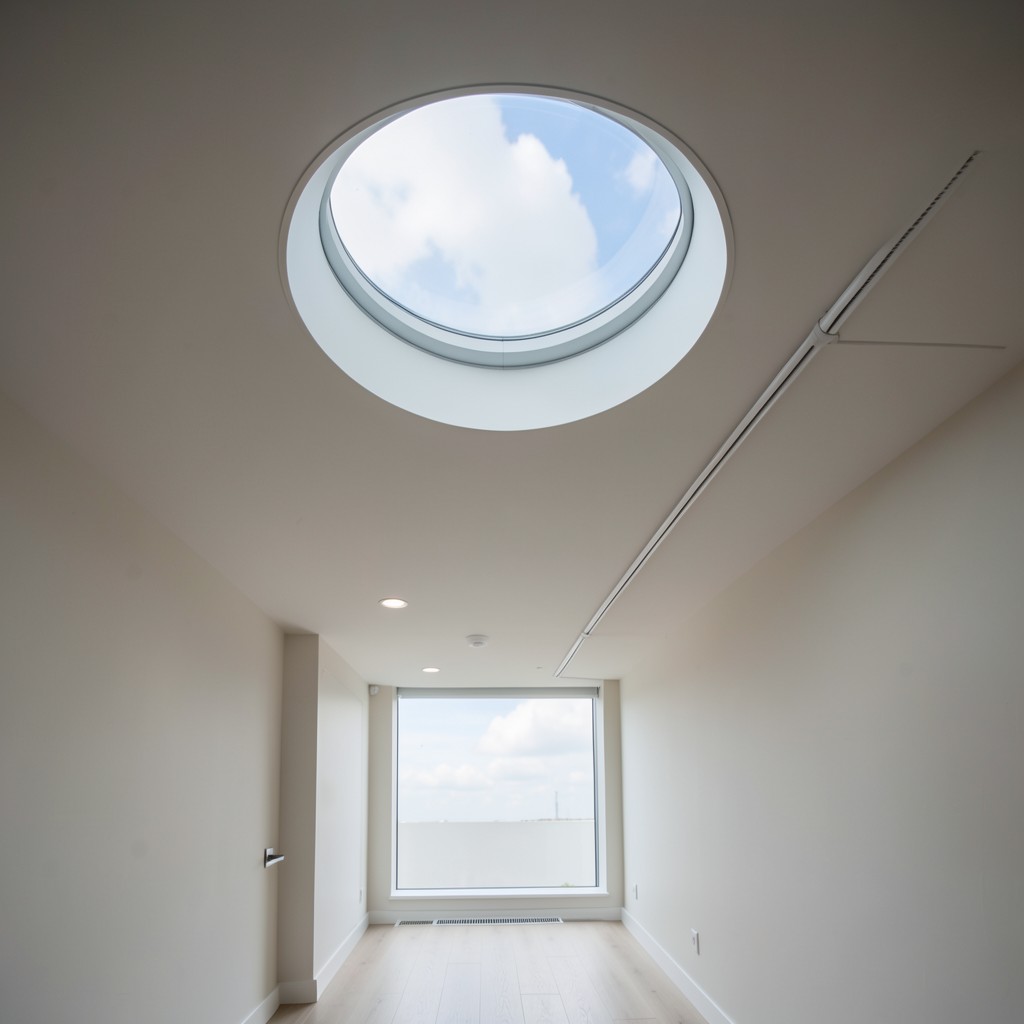
A skylight tunnel — a reflective tube that channels daylight from a roof-level dome through the ceiling of a room that does not sit directly below the roof, delivering natural light to interior rooms, hallways, and spaces whose position within the building plan prevents a conventional skylight from reaching them — is the daylighting device that addresses the specific problem most domestic buildings contain: the ground-floor room, the internal bathroom, the windowless hallway that is surrounded by other rooms and has no external wall for a window. The skylight tunnel does not require the room to be below the roof. It requires only a clear path from the roof surface to the ceiling below.
The reflective tube that carries the daylight from the rooflight collector to the ceiling diffuser below loses a portion of the collected light at each bend and at each meter of tube length, which means the effective light delivery at the room below depends on the tube’s diameter, its total length, and the number of directional changes it makes through the building’s structure. A straight-run tube of three hundred millimeters diameter delivers approximately seventy percent of the collected light to the room below at a tube length of three meters. The same tube with two forty-five-degree bends delivers approximately fifty percent. The specification must account for these losses in its prediction of the delivered light level.
The ceiling diffuser of a skylight tunnel — the circular lens at ceiling level through which the delivered daylight enters the room — reads from below as a circular glowing disc in the ceiling whose light output changes with the weather and the time of day in the way that only natural light does. On a bright day, the diffuser provides the equivalent of a one-hundred-and-fifty-watt bulb in diffused natural light quality. On an overcast day, it provides the gentle, even luminance of diffused sky light. The experience of being in a room lit by a skylight tunnel is the experience of a room connected to the sky above the building — a connection that the internal room, by its very definition, was designed to prevent.
45. A Ceiling With a Chandelier as the Focal Point
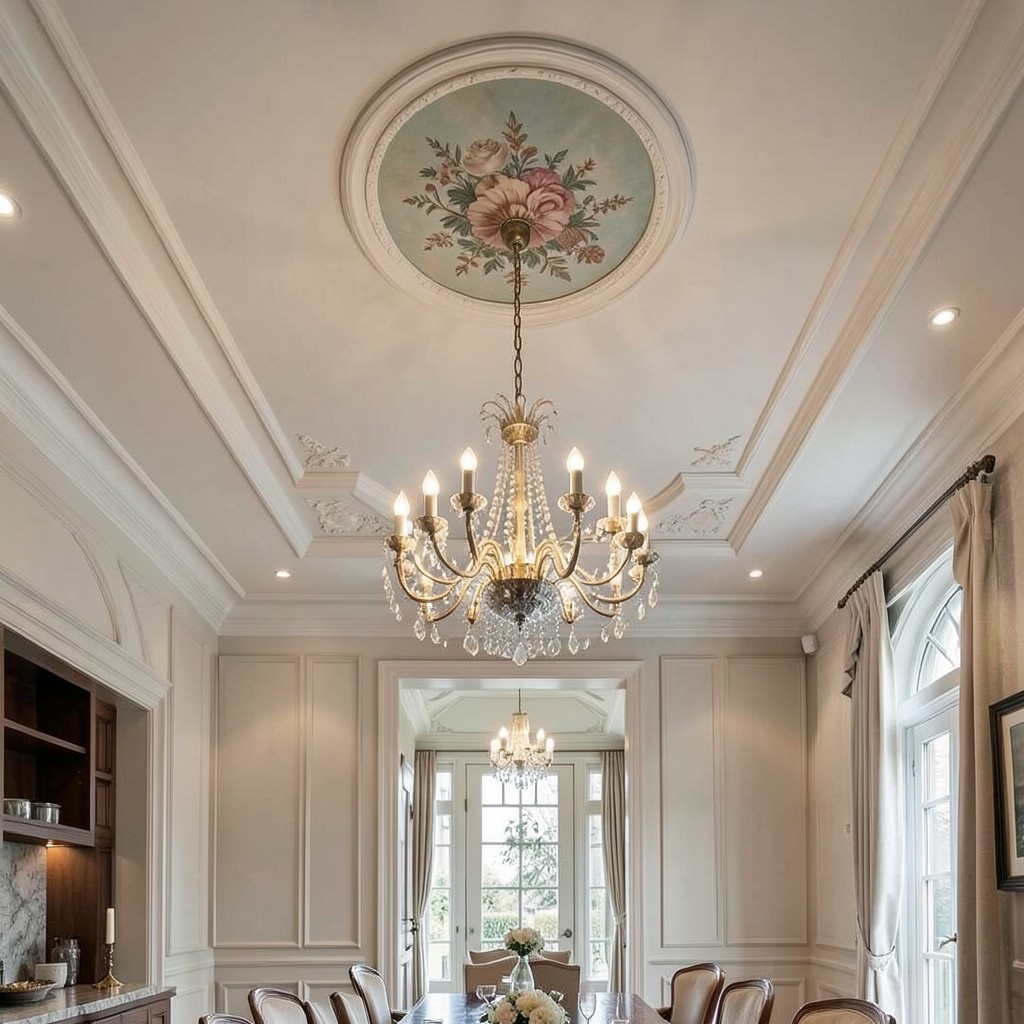
A ceiling designed around a chandelier — where the selection of the fitting, its position, its drop length, and its relationship with the ceiling above it are all resolved as a coordinated design decision rather than as a lighting specification made independently of the ceiling’s treatment — is the ceiling approach that produces the most classical quality of a room whose overhead element is the primary decorative focal point around which everything else in the room is arranged. The chandelier is the ceiling’s reason for existing as a designed surface, and the ceiling design exists to frame the chandelier as the room’s event.
The chandelier’s scale relative to the room’s plan dimensions is the single specification error most commonly made in residential chandelier selection — the fitting too small for the room loses its focal point authority and reads as a modest light source rather than an architectural feature; the fitting too large for the room fills the ceiling with a fixture that crowds the space and prevents the eye from resting on any other element in the room. A rough guide for dining room chandelier scale specifies the fitting’s diameter in centimeters as approximately the sum of the room’s length and width in meters — a room of four by five meters requires a chandelier of approximately ninety centimeters diameter — and this rule produces the correct scale for most standard residential dining room applications.
The ceiling treatment above a chandelier — whether a decorated medallion, a shallow dome, a coffered panel, or a painted detail that extends from the fitting’s canopy across the ceiling field above it — is the design decision that converts the chandelier from a fitting hung from a ceiling into a chandelier that belongs to a ceiling designed to receive it. The luxury home interior whose entrance hall chandelier hangs beneath a hand-painted oval medallion, the ellipse of the painted detail responding to the circular fitting below it, produces the coordinated relationship between ceiling and fitting that reads as the designed interior rather than the furnished room.
46. A Ceiling With a Two-Tone Paint Treatment
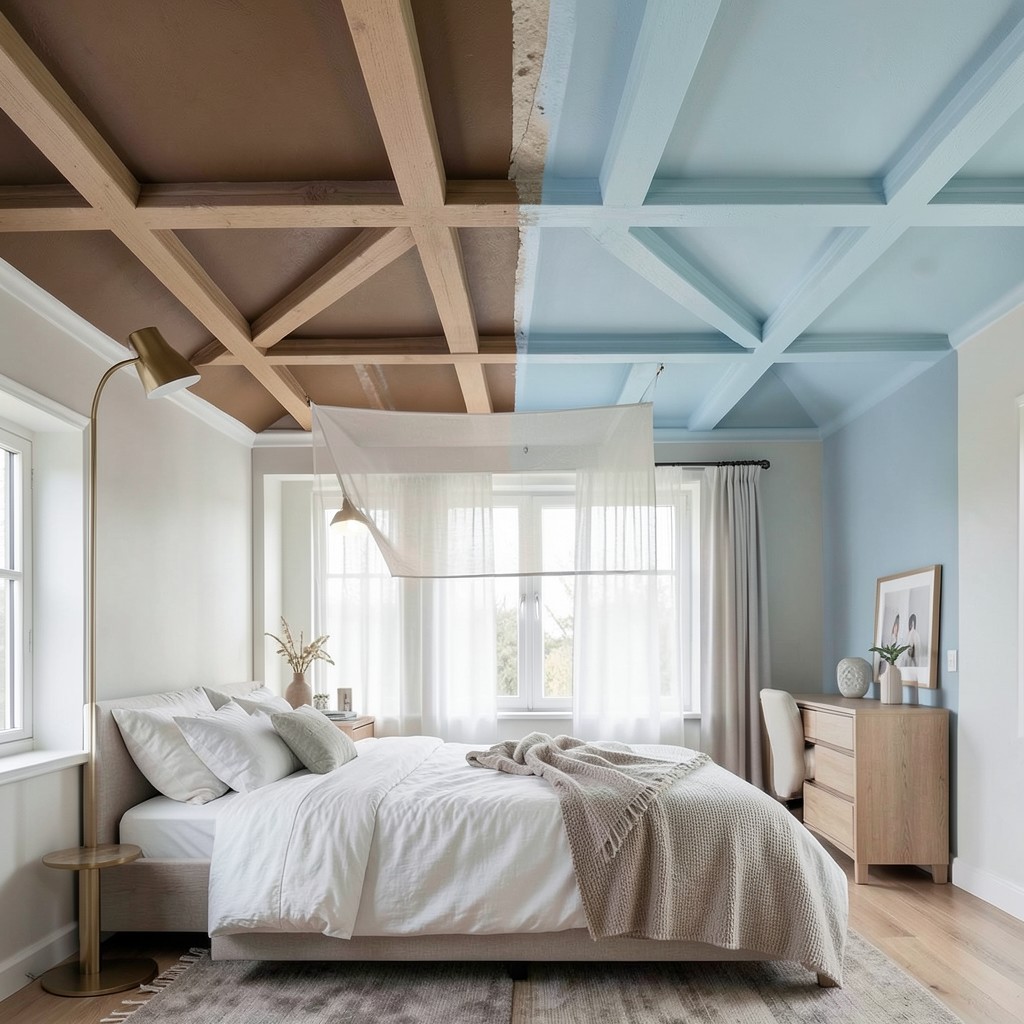
A ceiling with a two-tone paint treatment — a ceiling whose surface is divided into distinct color zones by a geometric, architectural, or free-form boundary, with two different tones inhabiting the two sides of that boundary — is the ceiling design that produces the highest design interest-to-effort ratio of any painted treatment, and whose execution requires nothing more than the masking tape, the two paint colors, and the precision with which the dividing line is resolved. The two-tone ceiling is the ceiling that makes a room feel designed without requiring a designer.
The architectural division — using the room’s existing structural or decorative elements as the boundary between the two colors — is the approach that produces the most resolved result because the dividing line has a reason that the room provides rather than a reason the designer invented. A ceiling whose two-tone division follows the ridge line of the vaulted space above, one plane in a warm stone and the other in a pale blue, produces the impression of a ceiling whose color acknowledges the architectural form that generates it. A coffered ceiling whose coffer fields are in one tone and whose beam grid is in a complementary tone uses the same principle — the architecture provides the boundary and the color responds to it.
The contemporary residential bedroom whose ceiling is divided by the position of the hanging canopy — one half of the ceiling above the bed in a deep, warm tone and the other half over the room’s active zone in a lighter, cooler one — produces the zoning quality of a room that uses color to differentiate its activities overhead as well as below. This is the two-tone ceiling as spatial planning rather than as decoration, and the rooms that adopt this approach find that the color differentiation above them reinforces the spatial differentiation of the room’s zones in a way that floor rugs and furniture arrangement alone cannot achieve at the overhead scale.
47. A Ceiling With Exposed Steel Structure

An exposed steel ceiling — the structural steel beams, columns, and connections of a steel-frame building left visible within the ceiling zone rather than concealed behind a plasterboard soffit — is the ceiling treatment that most directly expresses the industrial home design aesthetic at the scale of the building’s primary structure, and whose authenticity as a design statement derives from the fact that the exposed steel is not decoration. It is the building. The design decision was not to add something to the ceiling. It was not to remove the thing that would have hidden what was already there.
The domestic application of the exposed steel ceiling is most common in the converted warehouse, factory, or commercial building where the original steel frame sits at heights that the residential conversion retains rather than lowering with a new suspended ceiling. In these buildings, the steel is the ceiling — the universal beam profiles, the web-cleat connections, the occasional exposed bolt group — and the decision to accept the steel as the room’s overhead finish is the decision to live within the building’s structural honesty rather than to import a conventional residential ceiling finish that would deny it. The contemporary home ideas renovation that makes this choice produces an interior whose ceiling is unlike any residential ceiling built from scratch.
The paint treatment of an exposed structural steel ceiling is the specification that most determines whether the exposed steel reads as a considered design feature or as an unfinished building. An even coat of satin black or dark graphite paint on the steel sections — beam flanges, webs, connection plates — produces the uniform surface that reads as deliberate. The steel sections in their original mill finish or their original red oxide primer read as construction-phase material rather than finished interior, and the distinction between the two conditions is visible from the first glance upward. Two coats of the right paint color is the entire specification required to convert structural steel from a construction element into an interior design feature.
48. A Ceiling With Artistic Hanging Installations

A ceiling fitted with artistic hanging installations — sculptural forms, textile pieces, paper constructions, natural objects, or mixed-media assemblages suspended from the ceiling structure to occupy the overhead zone as a three-dimensional artwork rather than as a two-dimensional surface treatment — is the ceiling approach that most fully commits to the idea that the ceiling is not a surface but a spatial zone, and that the most interesting things in that zone are not applied to its surface but suspended within its volume. The hanging installation ceiling is the ceiling that lives in the air.
The textile hanging installation — woven wall hangings, macramé constructions, fabric panels, or sewn forms suspended at varying drops from a ceiling-mounted rod or series of hooks — is the ceiling installation type most accessible at the domestic scale and most consistent with the bohemian home styling or the warm home decor ideas direction that values handmade, natural-material objects in the interior environment. A single large macramé panel hung from a ceiling rod above the bed produces the canopy quality of the fabric-draped ceiling with the craft object quality of a specific made thing, and the two qualities together produce a bedroom ceiling that is simultaneously cozy and personal.
The natural object hanging installation — dried eucalyptus branches suspended horizontally, driftwood pieces hung at varying angles, seed pods and botanical forms on trailing lengths of linen thread — is the ceiling treatment that most directly references the garden-inspired interiors or the floral home decor direction whose material palette is plant-derived and whose atmospheric quality is the indoors of the outdoors rather than the outdoors brought indoor as illustration. The natural object ceiling changes through the seasons as the botanical materials dry, shift color, and are replaced with the materials that the current season’s garden or landscape is producing.
49. A Ceiling With Smart Lighting Integration

A ceiling designed from the beginning around a smart lighting system — color-tunable LED fixtures, addressable zones, automated scenes, and the integration of circadian lighting principles that adjust the ceiling’s light quality through the day in response to the time and the activity — is the ceiling design whose investment produces returns in daily quality of life that no static lighting specification can approach. The smart ceiling is the ceiling that works differently at seven in the morning, at noon, at seven in the evening, and at midnight, and whose different operation at each of those hours is designed for the specific activity and the specific atmospheric need of each part of the day.
The circadian lighting principle — the progressive shift from cool, high-intensity white morning light through neutral midday white to warm, low-intensity evening white — is the smart ceiling’s most practical daily contribution, because it aligns the ceiling’s light quality with the body’s natural rhythm of alertness and relaxation across the waking day without requiring the occupant to manually adjust the lighting at each transition. The bedroom ceiling whose smart lighting shifts from the warm, dim amber of early morning through the cooler, brighter white of the working morning to the warm evening quality of pre-sleep preparation is the ceiling that actively supports the occupant’s sleep quality rather than being indifferent to it.
The scene-setting capability of a smart lighting ceiling — the ability to store and recall specific combinations of dimmer levels, color temperatures, and zone configurations as named presets — is the feature that makes the smart ceiling most practically useful in rooms whose activities span a wide range of lighting needs. A living room ceiling that stores a bright, cool cooking scene, a warm, medium dinner scene, a low, warm relaxed evening scene, and a party scene with specific accent zones activated is the ceiling that serves every activity the room hosts without requiring manual adjustment at each transition. This is not a luxury specification; it is the correct specification for any room that is used for more than one activity.
50. A Ceiling That Belongs to the Room It Covers

The ceiling design that works is not the one borrowed from a hotel lobby, a design magazine spread, or the showroom photograph whose room dimensions, lighting conditions, and architectural context bear no relationship to the specific room it is being applied to. The ceiling that belongs to its room is the one whose treatment was selected in honest response to that room’s actual conditions — its height, its light quality, its acoustic problems, its architectural features, and the specific atmospheric quality that the household wants the room to produce.
Start with what the room needs rather than what looks interesting. A low-ceiling room needs a ceiling treatment that adds apparent height rather than reduces it — pale color, limited surface texture, an absence of horizontal lines at the ceiling’s perimeter. A high-ceiling room needs a treatment that brings the ceiling perceptually closer — a bold color, a rich material, a pendant at the correct drop length that creates the inhabited scale below the full architectural height. An acoustically harsh room needs a soft, absorptive ceiling material. A dark room needs a pale, reflective ceiling that multiplies the light it receives rather than absorbs it. These are not aesthetic preferences. They are functional requirements, and the ceiling design that ignores them in favor of a treatment that photographs well but performs poorly is a ceiling design that has prioritized the wrong outcome.
The ceiling you choose for your room is the design decision that will affect every hour you spend in that room, because the ceiling is always there, above every activity, every conversation, every quiet morning and every late evening. It shapes the quality of the light, the behavior of the sound, the perceived dimensions of the space, and the atmosphere that the room produces at every hour and in every season — from the warm enclosure of winter home decor to the bright openness of summer living room decor, from the cozy bedroom design of a February morning to the airy home interiors quality of a May afternoon. Give it the attention it deserves, make the decision with the room’s specific needs as the first criterion, and the ceiling will contribute to the quality of your daily life in a way that most other design decisions cannot match from the same surface area.
Leave a Reply