
The staircase is the only architectural element in a home that demands physical participation. You do not simply look at it — you move through it, your hand traces its railing, your foot reads the depth of each tread, and your eye travels its full height from bottom to top in a single sweep that no other interior surface permits. Every other room reveals itself gradually as you enter and move through it. The staircase delivers its entire design statement in one uninterrupted visual moment, and that compression of impact into a single sightline is exactly what makes it the most powerful design opportunity in any multi-story home.
Most homeowners treat the staircase as a fixed structural reality — something that exists because it must, positioned where the floor plan required it, finished in whatever material the builder selected from the standard package. The railing came with the house. The treads are the same wood as the hall floor. The wall beside the stair is painted the same white as every other wall. The staircase functions. It connects the floors. Nobody thinks about it much. That absence of thought is the design failure this article exists to correct, because the staircase that nobody thinks about is the staircase that nobody feels anything about — and a house full of rooms that function but fail to move you is a house that falls short of what a home can be.
The staircase’s design leverage comes from its position in the home’s circulation path — every person who enters the house eventually reaches the stair, and the impression it makes accumulates across thousands of daily passages. A staircase that is beautiful stops you for a second on the way upstairs. A staircase that is dramatic makes guests pause in the entry to look at it before they are shown anywhere else in the house. A staircase that is personal — whose materials, proportions, and details reflect genuine choices made by the people who live in the house — tells more of the home’s story in a glance than any decorated room does in an hour of touring.
The fifty staircase design ideas in this collection span every design direction, every budget category, every spatial challenge, and every architectural context from modern home design and minimalist home design to farmhouse home decor, traditional home interiors, industrial home design, and the full range of material-led approaches that stone and wood home design, bamboo home interiors, and coastal home design represent. Some ideas address the grand staircase in a generous entry hall where scale and drama are the design mandate. Others address the compact stair in a small home where the challenge is extracting maximum beauty and functional efficiency from minimum structural footprint.
Across all fifty ideas, one conviction runs unchanged: the staircase deserves the same level of design investment as any room in the house, because it is seen more often, touched more frequently, and experienced more intimately than almost any other element within the home. The railing your hand slides along every morning, the tread your foot lands on before the first cup of coffee, the wall beside the stair that catches the afternoon light — these are not background details. They are the physical texture of daily life in your home, and they are worth designing with intention, material honesty, and the kind of considered beauty that improves rather than merely impresses.
1. A Staircase With Floating Treads and Open Risers

The floating staircase with open risers is the design statement that says more about a home’s commitment to modern home design than almost any other single architectural decision. When treads appear to project from the wall without visible support — the steel stringers or concealed structural hardware hidden within the wall’s mass — and the risers are left entirely open, the staircase stops reading as a functional structure and starts reading as a sculptural installation. The visual lightness this creates in the entry or living space is immediate and dramatic, because the eye reads through the open stair rather than stopping at it, and that visual permeability makes the surrounding space feel larger and more connected.
The tread material determines the floating stair’s emotional character — solid white oak treads two inches thick with a natural oil finish suit warm contemporary home ideas and Scandinavian home interior aesthetics, their grain visible and their warmth tangible even from across the room. Thick black walnut treads on a powder-coated black steel stringer create the high-contrast, graphic quality of industrial home design applied to architectural structure. Polished concrete treads cantilvering from a single structural wall represent the most technically demanding and most architecturally pure expression of the floating concept, their mass and precision delivering a quality that only concrete at its best achieves.
The open riser format has a practical consideration that the design conversation often skips: households with young children or pets must evaluate whether the gaps between treads create a safety hazard, and in many cases a simple glass panel or cable system behind the tread line provides the required visual stop without closing the riser visually. This solution — a thin glass sheet or tight horizontal cables set behind the tread’s back edge — preserves the floating aesthetic while meeting building code requirements for riser closure in jurisdictions that mandate it. The structural engineering behind a floating staircase must be handled by a qualified structural engineer regardless of the design direction, because the loads and moments involved in cantilevered treads are not intuitive and the consequences of inadequate support are serious.
2. A Staircase With a Bold Painted Runner

The painted stair runner is the fastest and most affordable way to transform a staircase that reads as generic into one that reads as deliberately designed, and its power comes from the same principle as any good graphic design: a strong color or pattern on a neutral background creates immediate visual impact that the neutral background alone could never generate. A painted runner — a stripe of color applied to the center of each tread in a contrasting tone, typically framed by a painted border that defines its edges with precision — creates the visual impression of an upholstered stair runner without the cost, the installation labor, or the cleaning demands that a fabric runner requires.
A classic navy blue painted runner on white-painted wood stairs suits coastal home design and traditional home interiors with equal elegance, its nautical reference subtle enough to read as refined rather than themed. A terracotta or sienna runner on pale oak treads suits earthy home design and bohemian home styling, the warm clay tone connecting the staircase to the home’s broader palette through a single emphatic color decision. A black runner on a white stair creates the most graphic, high-contrast result and suits modern home design, minimalist home design, and Scandinavian home interior contexts where the staircase’s design language matches the home’s broader commitment to precision and bold contrast.
The technical execution of a painted runner requires the same precision planning as any painted pattern on a floor surface — the center line of each tread must be measured and marked, the border lines taped with precision, and the paint applied in thin coats that avoid the brush ridging and edge bleeding that undermine the finished quality. A porch and floor paint in an eggshell or satin finish provides the durability the tread surface demands, and a polyurethane topcoat over the painted area extends its life through the heavy foot traffic that painted stairs receive. Seasonal home makeover updates are possible with painted runners — the same staircase can carry a deep hunter green runner through fall home decorating and winter home decor season and shift to a soft sage or warm cream runner for spring home refresh without any structural change.
3. A Staircase With Black Steel and Glass Balustrade
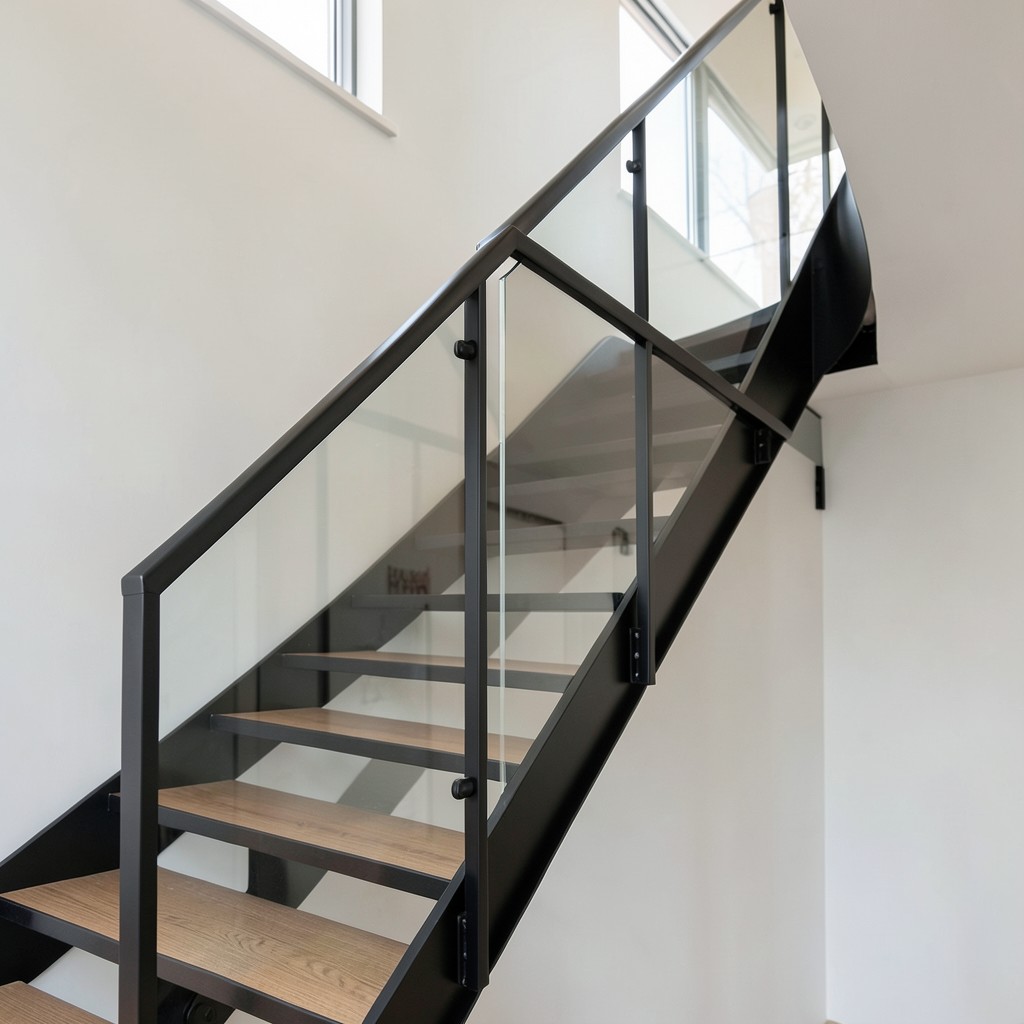
A balustrade in black steel with glass infill panels creates the defining visual element of a contemporary staircase design — the thin steel frame provides structural strength while the glass panels provide unobstructed views through the stair’s structure, and together they create a balustrade of genuine architectural quality. The combination reads as modern home design at its most assured: the material choices are industrial in origin but refined in application, the glass’s transparency preserves the spatial flow between floors, and the black powder coat on the steel provides the graphic edge that prevents the whole assembly from reading as too minimal or too cold. This balustrade suits a wide range of staircase configurations, from straight single-run stairs to complex curved and switched-back designs.
The glass panel selection shapes the balustrade’s character significantly — frameless tempered glass panels in a clear finish create the most transparent, invisible-barrier quality and suit airy home interiors and minimalist home design where the staircase’s structural lines should read without visual interference. Lightly frosted glass panels provide privacy and a softer, more diffused appearance that suits residential settings where the staircase faces the street or a neighbor’s sight line. A tinted glass — a subtle bronze or gray — creates a design distinction from standard clear glass while maintaining its transparency, producing a balustrade that reads as more considered and less generic than the clear alternative.
The steel’s finish and thickness are the variables that separate a premium installation from a standard one — steel frames laser-cut to precise dimensions with consistently welded joints and an even, durable powder coat in a true matte black read as architectural quality, while thinner steel with visible weld marks and an inconsistent coat finish reads as contractor-grade regardless of the glass quality paired with it. Spending the budget on the steel fabrication rather than on the glass specification produces a better overall result, because the glass is secondary to the steel’s visual presence in this assembly. During winter interior design season when the home’s interior layers are richest and most observed, the black steel and glass staircase reads as a permanent architectural feature that anchors the home’s contemporary character as confidently as any other design decision made within the renovation.
4. A Staircase With Shiplap Wall Treatment Alongside

The wall that runs beside and above a staircase is one of the most prominent vertical surfaces in any home — it spans the full height between floors, receives a steep diagonal sightline from the entry or hall below, and is visible from multiple points throughout the house’s main circulation path. Most homes leave this wall painted white or the same neutral as every other wall, which means a significant architectural opportunity goes unaddressed every time someone walks past it. Shiplap applied to the staircase wall creates immediate character, horizontal rhythm, and material warmth that paint alone cannot produce in this location.
Horizontal shiplap boards in a natural white-painted finish run parallel to the floor below rather than following the stair’s diagonal, creating a stable visual reference that grounds the wall’s composition despite the angled stair line cutting across it. This horizontal orientation suits farmhouse home decor, coastal home design, and beach house interiors staircase aesthetics with the relaxed, board-and-batten material reference that defines those design vocabularies. Vertical shiplap — boards running from floor to ceiling rather than horizontally — creates height on the staircase wall, drawing the eye upward and making the transition between floors feel more expansive. This vertical treatment suits modern home design and contemporary home ideas settings where the wall’s height is the feature worth emphasizing.
The shiplap wall becomes the staircase’s primary gallery surface when combined with a picture ledge or a series of small wall-mounted shelves that hold framed art, photographs, or seasonal decorative objects. The gallery staircase wall is among the most personal design statements in any home — the accumulated photographs and art that line the ascent create a visual autobiography that guests read on their way upstairs and household members absorb unconsciously across thousands of daily passes. Seasonal home makeover updates to the gallery wall — adding floral home decor ideas prints for spring home refresh, warm-toned botanical illustrations for fall home decorating, and holiday-themed frames for holiday home styling — keep the wall connected to the household’s calendar without touching the shiplap installation beneath.
5. A Staircase With Reclaimed Wood Treads

Reclaimed wood treads bring a material history to the staircase that no newly milled timber can replicate — the worn patches, the nail holes filled with patina, the color variation from decades of prior use, and the dimensional irregularities that characterize genuinely salvaged timber all contribute to a surface whose beauty comes from time rather than from manufacture. The foot traffic a reclaimed wood tread receives on a staircase adds to its character rather than diminishing it, deepening the patina and polishing the high points of the grain in a way that makes the stair more beautiful with use rather than less. This is the quality that no new material genuinely possesses.
Wide-plank reclaimed oak, heart pine, or Douglas fir treads suit rustic home decor and farmhouse home decor staircase settings most naturally, their generous width — typically eight to twelve inches — and their surface character connecting the staircase directly to the material traditions of American vernacular architecture. Reclaimed barn wood treads with their weathered gray surface and visible nail holes suit industrial home design and mountain cabin decor settings, where the raw, unrefined quality of the material reads as honest and appropriate rather than as insufficient finishing. Reclaimed teak treads from demolished tropical structures bring the color and grain of tropical home design to staircase contexts where their material warmth and natural oil content provide durability alongside character.
The structural soundness of reclaimed timber must be assessed before installation — wood with structural checks, significant splitting, or hidden rot does not belong in a stair tread application regardless of its visual appeal, because the tread must support the full dynamic load of household traffic without failing or compressing beyond acceptable limits. Properly selected and prepared reclaimed treads, sealed with a penetrating hardwax oil that protects the surface without obscuring its character, last for generations of staircase use with nothing more than periodic reapplication of the finish oil. The reclaimed wood staircase is the design choice that takes the longest to find, costs a variable amount depending on the source and species, and produces the most enduringly beautiful result of any stair tread material the market provides.
6. A Staircase With Painted Risers in a Pattern or Color

Painted risers are the staircase’s most accessible decorating canvas — the vertical face of each step that the eye sees directly from the base of the stairs, visible at a natural reading height, and sufficiently sized to carry a meaningful pattern, color, or graphic element. Most staircase risers are painted white because white is what happens when no decision is made, and that default is the design equivalent of leaving a blank canvas at the most prominent visual position in the room. Painting the risers — in a solid color, a repeating pattern, or a different treatment on each individual riser — is the staircase upgrade that requires the least structural intervention and delivers the most immediate and visible design reward.
Navy blue risers against white-painted treads create the graphic pattern that suits coastal home design and traditional home interiors with equally confident results — the alternating white and navy creates a visual rhythm ascending the stair that reads as considered and intentional from across the room. A different color on each riser — a spectrum progression from warm amber at the bottom through terracotta, coral, and blush to soft white at the top — creates the bohemian home styling and relaxed home design effect that suits households whose interior aesthetic celebrates color as a form of personal expression rather than as a backdrop for furniture. Geometric patterns on individual risers — hand-painted tile impressions, simple stripes, or chevron patterns — suit garden-inspired interiors and chic home decor settings where the staircase functions as the home’s most personal piece of art.
The execution standard for painted riser treatments requires the same discipline as any painted floor surface — primer coat, multiple thin finish coats, precise edge taping, and a protective topcoat that handles the abrasion and scuff marks that feet inevitably apply to the riser face during normal stair use. The lower half of each riser receives more contact than the upper half, and the corners between riser and tread are the highest-abrasion points in the installation — these areas require the heaviest protective coat application and the most frequent spot-touch-up as the treatment ages. A staircase with beautifully painted risers is worth the maintenance commitment because the visual contribution to the home’s daily life is genuine, substantial, and entirely impossible to achieve through any other means at the same cost.
7. A Staircase With a Dramatic Chandelier or Pendant Over the Well

The staircase well — the vertical airspace above a staircase that opens to the ceiling above — is the most generous and most consistently underused vertical space in any home. In most houses, this airspace holds nothing: a standard ceiling fixture at the top, perhaps, or nothing at all, leaving the stair well feeling empty and the transition between floors feeling architecturally incomplete. A dramatic chandelier or multi-pendant installation hung to fill the stair well creates the defining design moment that elevates the staircase from a circulation element to the home’s primary architectural event. This is the upgrade that makes every other renovation investment in the staircase look more considered by association.
A large-scale chandelier in forged iron, hand-blown glass globes, or clustered crystal drops descended to a point midway between floors occupies the stair well’s airspace at the height that maximizes its visual impact from both floors simultaneously. From the ground floor, the chandelier is seen against the ceiling above in its full vertical depth — the fixture’s drop length becomes a vertical sculpture occupying the stair well’s height. From the upper landing, the fixture is seen at eye level and slightly below, its top elements and structural hardware visible in a way that ground-level viewing does not reveal, giving the chandelier a second design character at the upper floor that makes it interesting from multiple vantage points. Luxury home interior staircase designs treat this chandelier as the home’s primary decorative statement, investing in a fixture of genuine scale and material quality that anchors the entire entry and stair composition.
The electrical and structural requirements for stair well chandelier installation are more demanding than standard fixture installation — the fixture must be supported by dedicated blocking in the ceiling structure, wired with sufficient gauge wire for the fixture’s wattage, and installed on a chandelier hoisting system or lift if its height places it above comfortable re-lamping reach. The cleaning and maintenance of a large chandelier in a stair well, particularly one with crystal or glass elements, requires planning for access — a chandelier cleaning service or a professional electrician with a working platform is the practical answer in high-ceiling installations where the standard step ladder approach is inadequate. These practical requirements are worth navigating, because the stair well chandelier is the single light fixture in the entire house with the most architectural presence and the greatest daily visual contribution.
8. A Staircase With Carpet Runner for Warmth and Sound

A carpet runner on a hard staircase performs three functions simultaneously — it softens the acoustic impact of foot traffic on wood or stone treads, it provides a non-slip surface that improves safety particularly on steep or highly polished stair configurations, and it introduces the textile warmth and pattern that hard stair materials cannot generate alone. The runner is not a covering that hides the staircase — it is an addition that completes the staircase, giving the eye a textile layer to rest on that the bare tread surface does not provide. The right runner choice makes the staircase feel as considered as any furnished room in the house.
A classic stair runner in a deep-pile wool with a traditional medallion or geometric pattern suits traditional home interiors and elegant home styling settings, its luxurious pile depth and refined pattern connecting the stair to the home’s formal design vocabulary. A flat-woven kilim or dhurrie runner in earthy tones suits bohemian home styling and warm home decor ideas settings, its ethnic weave tradition and hand-knotted character adding the collected, layered quality that those design sensibilities prioritize over uniformity. A sisal or seagrass woven runner suits coastal home design and breezy home interiors staircase contexts, its natural fiber connecting the stair to the organic material palette that those aesthetics build around.
The runner’s installation method — whether rod-mounted on brass or black stair rods that hold the runner in place across each riser, or tack-strip installed and stretched like wall-to-wall carpet — changes the staircase’s visual character as significantly as the runner material itself. Stair rods expose the runner’s edge and the riser paint or tread material on either side of the runner, creating the layered carpet-on-wood appearance that suits traditional home interiors and cozy home design. Tack-strip installation creates a seamless, wall-to-wall carpet effect that covers the full tread width and suits the continuous material quality of contemporary home ideas staircases where the runner should read as an architectural surface rather than a decorative addition.
9. A Staircase With Industrial Steel and Reclaimed Wood
Combination

The combination of industrial steel structure with reclaimed wood treads creates a material dialogue that suits industrial home design, rustic home decor, and the hybrid aesthetic that stone and wood home design represents — the tension between the manufactured precision of steel and the time-worn character of salvaged timber produces a visual interest that neither material achieves in isolation. This combination is the staircase equivalent of a leather sofa beside a raw concrete wall: the materials belong to different worlds but create a more compelling space together than either would in a matched environment. The staircase that plays this game well is one of the most photographed interiors in residential design.
A welded black steel stringer — a single central spine or twin side stringers — with reclaimed oak or pine treads bolted directly to the steel through countersunk hardware creates the structure of an industrial stair at its most elemental. The steel’s precise, machined quality and the wood’s irregular, aged quality contrast at every surface and every junction, and those contrasting qualities make each material more vivid. The steel reads as harder and more precise beside the soft, worn wood; the wood reads as warmer and more human beside the cold, dark steel. The contrast enhances both, and the staircase as a whole acquires a character that a single-material design never reaches.
The reclaimed wood tread’s thickness in a steel-framed stair should be generous — two inches minimum — to provide the visual mass that makes the tread read as a substantial material element rather than a thin facing applied to a steel platform. A thin tread on a steel frame reads as economical; a thick, heavy tread on the same frame reads as deliberate. The steel stringer’s visibility — whether fully exposed as a design feature or partially concealed within a wall or floor detail — determines the degree to which the steel reads as the primary structural element or as a secondary support behind the wood’s visual dominance. Full exposure of the steel stringer is the industrial home design position, and it produces the most honest, direct expression of the material combination’s design intent.
10. A Staircase With a Gallery Wall of Art and Photography
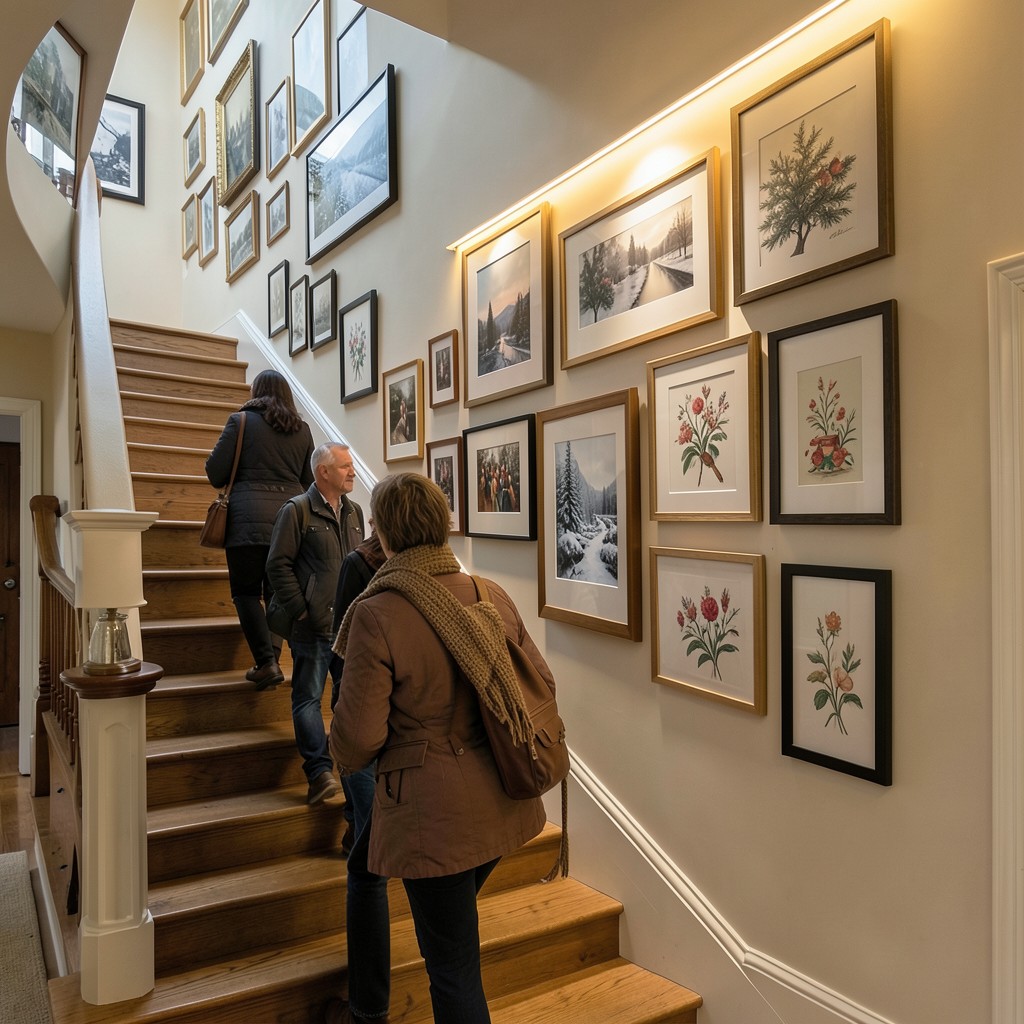
The staircase wall that receives a carefully curated gallery of art and photography becomes one of the most visited and most observed display surfaces in the entire house, because every person who uses the stair spends time moving slowly past it at close range — a circumstance that living room gallery walls, seen from across the room in a single glance, never create. The ascending and descending passage along the stair wall creates a sequential viewing experience closer to a gallery corridor than to a residential wall display, and designing the staircase gallery with that sequential quality in mind produces a more powerful installation than arranging pictures simply to fill available wall space.
The gallery’s organizational principle determines its visual character and its emotional effect — a tight grid of identical frames in a single finish creates the museum-quality installation that suits elegant home styling and luxury home interior staircases, where the discipline of the arrangement communicates the care taken in the curation. A salon-style arrangement of frames in varied sizes, finishes, and orientations creates the bohemian home styling and relaxed home design quality that reads as accumulated rather than designed, as though each piece arrived on the wall independently over time and found its position through gradual arrangement rather than advance planning. The mixed arrangement, done well, is harder to achieve than the grid because it requires genuine compositional judgment rather than the rule-following that a grid permits.
Lighting the stair gallery wall correctly makes the difference between art that is displayed and art that is seen — individual picture lights on the larger pieces, or a continuous LED strip mounted in a recessed channel along the top of the wall above the stair, cast direct, warm light on the artwork at the correct angle to reveal detail without creating hot spots or glare. This lighting investment connects the staircase gallery to the design standard of a properly lit exhibition space, and the daily experience of passing art that is correctly lit — where every color, every brush mark, and every photographic detail reads clearly — is qualitatively different from passing pictures mounted on a poorly lit wall. During holiday home styling periods, the gallery wall can incorporate seasonal additions — a framed winter botanical print, a small seasonal illustration — that update the display without disrupting its overall composition.
11. A Staircase With Concrete Treads and Minimalist Design

Concrete staircases are the material choice of architects who value structural honesty above all other design considerations, and the residential concrete staircase done correctly is one of the most sophisticated and durable stair designs available. Poured-in-place concrete or precast concrete treads carry an inherent mass and gravity that wood and metal cannot simulate — standing at the base of a well-made concrete staircase, you feel the weight of the material before you consciously identify it, and that physical presence creates a psychological grounding that lighter materials do not produce. Concrete is heavy, permanent, and honest, and those qualities are precisely why minimalist home design and contemporary home ideas staircases return to it consistently.
The concrete tread’s finish is the variable with the greatest design impact — a polished concrete surface with aggregate exposed through grinding creates a terrazzo-like quality that suits luxury home interior and chic home decor staircases, the aggregate’s color and the matrix’s tone determining the tread’s aesthetic register. A brushed or broom-finished concrete surface provides the texture that prevents slipping and creates a matte, understated character that suits Scandinavian home interior and minimalist home design settings where the tread’s material quality is valued but its presence should not dominate. A sealed, smooth concrete tread in a warm gray or near-black tone suits industrial home design and modern home design, the consistent color and texture creating the uniform surface that these aesthetics require.
Concrete stair treads combined with a white plaster wall, a simple steel handrail, and no riser treatment — the open riser floating configuration — create the purest expression of minimalist staircase design. The palette of materials is limited to three: concrete, plaster, and steel. The form is reduced to its functional essence: treads that ascend, a rail that guides the hand, a wall that defines the space’s edge. Within that reduction, the quality of each material — the concrete’s surface finish, the plaster’s texture, the steel’s weld quality — becomes the only design variable, and the room in which such a stair stands feels more architecturally resolved than almost any other residential interior space.
12. A Staircase With Wood Paneling on the Underneath Structure

The underside of a staircase — the sloped soffit beneath the treads and risers that most homes finish in plain plaster or drywall — is one of the most consistently ignored architectural surfaces in residential design. This surface is visible from the entry or hallway below, angled downward toward the approaching person, and it spans the full length of the staircase’s run at a height and angle that makes it a prominent and permanent part of the entry’s visual composition. Applying wood paneling to this surface transforms it from an unfinished structural element into one of the staircase’s most beautiful features.
Tongue-and-groove pine boards applied to the stair soffit in a natural or white-painted finish create the warm, crafted quality associated with farmhouse home decor and traditional home interiors, their linear pattern running parallel to the stair’s slope and creating a ceiling-like surface beneath the ascending structure. Wide flat panels of book-matched walnut veneer applied to the soffit create the luxury home interior quality that hotel lobbies and high-end residential designs apply to this surface — the grain pattern’s symmetry across the soffit’s full width creates a visual continuity that reads as genuinely premium. Whitewashed or limed oak panels suit Scandinavian home interior and coastal home design contexts, their pale, bleached tone connecting the soffit to the home’s light, natural material palette.
The paneled stair soffit creates an opportunity for concealed lighting that the plain drywall soffit never offers — a recessed LED strip mounted along the soffit’s lower edge, directed downward toward the floor, creates a warm pool of light beneath the staircase that illuminates the space below and draws attention to the paneling’s material quality from the exact angle at which it is seen. This combination of paneled soffit and integrated lighting creates the most sophisticated under-stair treatment available in residential design, and it transforms the space beneath the stair — often wasted or used for rough storage — into a lit, finished architectural feature that improves the entire entry’s design quality.
13. A Staircase With Herringbone Wood Tread Pattern

A herringbone pattern applied to stair treads creates the same visual sophistication on the horizontal stair surface that herringbone parquet creates on a floor — the interlocking diagonal arrangement of timber blocks produces a surface pattern of extraordinary richness that exceeds the complexity of straight plank treads by an order of magnitude. This pattern choice communicates that the staircase was designed with the same precision and material attention given to the home’s finest floors, and on a staircase where each individual tread is a self-contained surface, the herringbone pattern has the further advantage of fitting entirely within a single tread’s rectangular boundary without the repetitive continuity that makes herringbone floor patterns most effective.
White oak herringbone treads with a natural hardwax oil finish suit traditional home interiors and elegant home styling staircases, their warm grain and disciplined pattern creating a surface of genuine luxury that rewards close inspection. Smoked or fumed oak herringbone treads — wood that has been darkened through an ammonia vapor process rather than through stain — suit contemporary home ideas and modern home design staircases where the darker, more uniform tone suits the home’s controlled palette. Walnut herringbone treads create the richest and most dramatic version of this treatment, the timber’s natural chocolate and ebony grain variation producing a pattern surface of depth and warmth that suits luxury master bedroom design level materials applied to the staircase.
The installation of herringbone stair treads requires a timber installer with specific experience in the pattern, because the precise cutting and alignment of each individual block within the tread’s boundary must be executed without accumulated error — any drift in the block’s angle creates a pattern that reads as imprecise rather than crafted. Each tread is effectively a miniature herringbone floor installation in its own right, and the care and time required for the installation is proportional to the visual quality of the result. The investment in skilled installation is the deciding factor between herringbone treads that look magnificent and herringbone treads that look like an expensive attempt at something that did not quite come off.
14. A Staircase With Rope Balustrade for a Coastal Look

A rope balustrade transforms the staircase into a nautical architectural detail that suits coastal home design, beach house interiors, and relaxed home design contexts with a specificity and material authenticity that no painted or stained surface achieves. Thick natural manila or sisal rope looped between vertical wooden posts at regular intervals, or woven in a horizontal cable pattern between a top and bottom rail, creates a balustrade of genuine material character — the rope’s texture, its irregular twist, and its warm cream or tan color all connect directly to the marine and coastal environment that the aesthetic references. The rope balustrade is not a stylistic affectation. In the right context, it is the most honest material choice available.
The structural approach to rope balustrade design requires the rope’s attachment points and tensioning hardware to carry the lateral load that building codes specify for balustrades — in most jurisdictions a minimum two hundred pounds of outward force at any point along the top rail. Stainless steel thimbles and swage terminals at each post’s entry and exit point provide the secure, corrosion-resistant connection that the coastal environment demands, because the salt air that follows a home in a coastal setting attacks ferrous metals aggressively and requires stainless steel hardware throughout. The posts should be in a hardwood species with natural weather resistance — teak, white oak, or ipe — or in a painted metal that can withstand coastal humidity without rusting at the joint between post and rope.
The rope balustrade’s maintenance requirement is specific and seasonal — UV exposure breaks down natural fiber ropes over time, and a biannual application of hemp seed oil or teak oil to manila rope preserves the fiber’s strength and color. Synthetic rope alternatives in a twisted marine nylon or polyester that mimics the appearance of natural fiber provide greater UV resistance and longer service life without the periodic oiling requirement, though the synthetic rope’s surface lacks the slight roughness and organic variation of the natural material. During summer home design season when the coastal home is at its most active, the rope staircase performs its aesthetic function at peak expression — the rope, the sunlight, and the sea air all belonging to the same environmental and design vocabulary.
15. A Staircase With a Statement Color on the Balustrade

Painting the staircase balustrade — the handrail, balusters, and newel posts — in a color that contrasts with the wall and tread surfaces creates the staircase’s most immediate and most affordable design intervention. The balustrade is the staircase’s most prominent decorative element, its continuous linear presence running the full length of the stair at a height and proximity that make it the first thing the eye reads when approaching the stair. A balustrade painted in a neutral white or cream is a convention so thoroughly established that departing from it reads as a genuine design decision. And genuine design decisions are exactly what make homes feel alive.
Black balustrades against white walls and pale wood or painted treads create the graphic contrast that modern home design and Scandinavian home interior settings use most effectively — the deep, consistent black of a fully painted balustrade gives the staircase a structural precision and visual weight that white paint obscures entirely. The black balustrade reads as an architectural line rather than a decorative element, and its presence defines the staircase’s form with the same clarity that a drawn line defines a sketch. Navy, deep green, or dark burgundy balustrades achieve similar visual weight in design directions where pure black feels too stark — these deep colors suit traditional home interiors, farmhouse home decor, and cozy home design contexts where the warmth of the color tone matters as much as its depth.
An unexpected color choice — a soft dusty rose, a warm terracotta, a faded sage — applied to the balustrade creates the chic home decor and bohemian home styling quality that announces a homeowner’s design confidence without requiring expensive material investment. The single color decision on the balustrade changes the staircase’s entire character while touching nothing else in the space — no structural change, no material upgrade, no contractor required beyond a painter comfortable with the color choice. This is the design leverage that paint provides at its most concentrated: one decision, one surface, complete transformation.
16. A Staircase With a Built-In Bookshelf Below

The space beneath a staircase is the home’s most consistently misused square footage — in most houses it contains the water heater, a collection of miscellaneous storage, or nothing at all, protected by a door that visitors hope they never need to open. Built-in shelving that occupies this triangular space converts it into the home’s most distinctive small library, the one that guests notice immediately because its architectural form — the shelves following the stair’s diagonal profile, growing progressively shorter as they approach the floor — is unique to this specific location in this specific house. There is no piece of freestanding furniture that creates this effect, and that uniqueness is the built-in bookshelf’s primary design argument.
The bookshelf’s depth should account for standard paperback depth — nine to ten inches provides comfortable book storage without the shelf projecting so far into the adjacent passage that it narrows the walkway unreasonably. Adjustable shelf heights within the diagonal structure allow the tallest shelf spaces, at the stair’s highest point, to accommodate oversized art books, record albums, or tall decorative objects, while the lowest shelf spaces near the floor accommodate paperbacks, DVDs, or small baskets. Finishing the built-in in a painted white or the room’s primary color makes the bookshelf read as a designed architectural feature rather than a cabinet inserted into a corner, and that integration with the room’s architectural language is what separates a custom built-in from a furniture piece.
The built-in under-stair bookshelf also accommodates a small reading chair tucked into the deepest point of the triangular space — a single armchair with a reading light mounted on the adjacent wall creates the cozy home design reading nook that the under-stair space naturally suggests. The containment of the triangular form, the proximity of books on three sides, and the private, tucked-away location create the conditions for reading concentration that open-plan living spaces cannot generate. Children particularly claim under-stair reading nooks with a proprietary enthusiasm that makes clear these spaces respond to an innate human preference for contained, sheltered, book-lined refuges from the open floor plan’s social exposure.
17. A Staircase With Moroccan-Inspired Tile Risers

Hand-painted Moroccan or encaustic cement tile applied to the stair risers creates a staircase of extraordinary decorative richness — each riser becomes an individual tile panel whose geometric or floral pattern contributes to a cumulative visual experience that builds as the eye travels up the stair. The ascending sequence of tiled risers reads like a textile installation moving upward through space, the pattern repeating with the slight variation that handmade tile always introduces and that machine-printed tile never captures. This is a staircase that takes a full minute to look at properly, and that minute of careful looking reveals details and pattern relationships that a single glance from the base of the stair cannot encompass.
Classic Moroccan geometric tile in blue, white, and terracotta suits traditional home interiors and bohemian home styling staircases with the full weight of a centuries-old decorative tradition behind it — the zellige and encaustic tile traditions of North Africa produced some of the most sophisticated geometric pattern vocabulary in world design history, and applying them to the staircase riser brings that tradition into residential design with both honesty and beauty. Spanish Talavera-style hand-painted tiles in a white ground with cobalt and ochre patterns suit coastal home design and Mediterranean-influenced contemporary home ideas, their slightly irregular painted surface reading as crafted and personal. A single geometric tile pattern in a two-color palette — terracotta and cream, or navy and white — repeated across all risers creates cohesion and restraint within the richly patterned treatment.
The tile riser installation requires a grout joint consistent with the tile’s format — encaustic cement tiles with their slight dimensional variation require wider joints than precision-cut porcelain, and the grout color must complement the tile’s palette without competing with it. Each riser’s tile panel should be planned and cut so that the pattern appears complete and centered within the riser’s rectangle — partial pattern tiles at the edges of a riser read as installation errors rather than design decisions, and the planning required to avoid them is part of the installation’s quality standard. The floral home decor ideas dimension of a botanical tile riser treatment — small-scale repeating floral patterns on individual risers — suits spring home refresh and summer home design contexts where the staircase participates in the seasonal decorating direction applied throughout the rest of the house.
18. A Staircase With a Velvet Carpet Runner in a Bold Color

Velvet carpet on a staircase runner is the textile choice that communicates luxury, commitment, and genuine design confidence simultaneously. The pile depth and sheen of a quality wool velvet — its color appearing to shift between light and shadow as the pile’s direction changes with the stair’s angle — creates a surface of extraordinary visual richness that flat-woven runners and standard broadloom cannot approach in terms of tactile and optical quality. A velvet runner in a deep, saturated color on a pale staircase is one of the most photographed residential design elements because it produces the exact contrast between rich textile and pale architecture that creates maximum visual drama with minimal additional investment.
Deep emerald green velvet on a white-painted staircase with brass stair rods creates the elegant home styling and luxury home interior quality that boutique hotels apply to their staircases precisely because the effect communicates hospitality, investment, and genuine design intention. A deep plum or wine velvet on a natural wood staircase with brushed gold hardware creates the chic home decor and traditional home interiors richness that suits formal domestic settings where the staircase is a social space as much as a circulation element. A burnt orange or saffron velvet on a pale gray or white staircase creates the earthy home design and bohemian home styling warmth that suits households whose design direction prioritizes color richness over formal restraint.
The velvet runner’s maintenance commitment must be honestly considered before installation — velvet pile traps pet hair and debris more effectively than flat-weave alternatives, and the pile’s directional nature means that vacuuming against the pile direction creates a different visual effect from vacuuming with it, requiring consistent technique to maintain the runner’s appearance. A high-quality wool velvet from a reputable manufacturer, selected in a grade appropriate for stair traffic intensity, performs better and longer than budget velvet alternatives that sacrifice pile density for initial price reduction. The velvet staircase runner is an investment in daily beauty that returns its cost in the quality of daily experience many times over during the years of use it provides when properly maintained.
19. A Staircase With Integrated LED Lighting in the Treads

LED lighting integrated into the stair treads or risers solves the safety challenge of navigating stairs in low light conditions while simultaneously creating one of the most striking nighttime architectural effects available in residential design. A thin LED strip recessed into the riser face or under the tread nosing, emitting warm directional light downward onto each successive tread, creates a staircase that practically glows in the dark — the light defines each step precisely and creates a visual rhythm ascending the stair that reads as both beautiful and immediately legible for safe navigation. This is the rare design element that is both more functional and more beautiful in its operational state than in its resting state.
Warm white LED strips at 2700K suit traditional home interiors, warm home decor ideas, and elegant home styling staircases where the light quality should feel domestic and inviting rather than clinical. Cool white or blue-toned LEDs suit modern home design and minimalist home design contexts where the precision of the light’s color temperature matches the architectural precision of the stair’s material palette. Color-changing smart LED strips offer the flexibility of adjusting the stair lighting’s color for different occasions — warm amber for cozy winter evenings, soft blue for summer night ambiance, warm white for everyday use — through app control that makes the staircase a seasonal lighting element as well as a permanent architectural feature.
The technical installation of recessed tread or riser LED lighting requires a low-voltage LED system with individual drivers, a dedicated circuit from the electrical panel, and recessed channels in the tread nosing or riser face machined or formed before the tread installation is complete. Retrofitting LED lighting into existing stairs requires a different approach — surface-mounted LED strip holders or purpose-designed tread lighting fixtures that clip or adhesive-mount to the riser face without cutting into the existing material. Both approaches produce similar visual results but different installation complexity and cost, and the choice between them depends on whether the stair is being designed from scratch or upgraded from an existing configuration.
20. A Staircase With a Curved Handrail and Traditional Newel Post

The curved handrail and traditional newel post are the staircase elements that most directly reference the craft traditions of historical residential architecture — the continuous curve of a hand-railed starting easing, the scroll of a volute termination at the base, and the turned or carved detail of a substantial newel post communicate that this staircase was made by someone with specific skill applied to specific material. That communication of craft is what traditional home interiors staircases achieve that no other design direction can replicate, because craft of this kind requires time, skill, and genuine material investment that cannot be abbreviated or substituted.
A starting newel post in solid mahogany, oak, or cherry — turned on a lathe to produce classical column proportions with a decorative base block and capital detail, standing four feet tall at the base of the stair — announces the staircase’s design intentions before a single step is climbed. The newel post’s size relative to the balustrade’s balusters is the proportion decision that determines whether the whole assembly reads as correctly scaled traditional design or as a collection of mismatched period references. A newel post that is substantially larger and more complex in detail than the balusters creates the correct hierarchical relationship — the newel as the primary element, the balusters as the repetitive secondary element, and the handrail as the connecting continuous element that unifies the composition.
The handrail’s profile — its cross-section shape as the hand wraps around it — is the element of traditional staircase design most directly felt rather than seen. A rake rail with an ovolo top molding and a flat bottom provides a grip that the human hand accommodates naturally, the ovolo’s curved top allowing the thumb and fingers to wrap around the rail’s width while the flat bottom provides a thumb rest. This profile was refined through centuries of traditional staircase building because it worked — the anatomy of the human hand and the geometry of a good handrail profile are not independent variables, and the traditional profile represents accumulated knowledge that modern rail profiles sometimes sacrifice for visual novelty.
21. A Staircase With Plant Life Along the Banister

Plants along the staircase banister or on the treads themselves create the garden-inspired interiors quality that transforms a circulation element into a living, growing design installation. The staircase’s ascending structure offers a natural vertical display framework — each tread’s edge or the landing’s surface provides a horizontal platform at a different height, and plants positioned at multiple levels along this ascending sequence create a vertical garden composition that no flat wall-mounted planting arrangement can replicate. The staircase plant installation is a domestic garden in a vertical dimension, and in homes with limited outdoor space, it provides the green, living quality of a garden experience within the home’s interior circulation.
Trailing plants — pothos, string of pearls, or heartleaf philodendron — placed in small planters on the stair treads or on narrow shelves mounted beside the handrail trail their vines downward along the rail, creating the cascading green quality of a living curtain beside the ascending structure. Structural plants in larger containers on the landing at the stair’s base — a fiddle-leaf fig, a large monstera, or a dramatic bird-of-paradise — provide the vertical anchor that trails downward while the staircase ascends upward, creating a meeting of two vertical energies that suits tropical home design and jungle-inspired home decor domestically. A collection of small terracotta pots on successive treads, each planted with a different herb or small succulent, creates the garden-inspired interiors quality in a compact, affordable format that suits any staircase width and any design direction.
The light conditions of the staircase determine which plants survive and which decline — a staircase with a skylight or a large glazed window at landing height can support light-demanding plants throughout its length, while a naturally dark staircase is limited to the shade-tolerant species that handle low light without photosynthetic stress. Low-light performers like ZZ plants, cast iron plants, and snake plants maintain their appearance in dim conditions that would stress most other species, and their architectural forms — upright, structural, and sculptural — suit staircase plant styling particularly well. The plant-lined staircase requires a watering routine that the household must commit to as a genuine maintenance practice, because plants at staircase height are not automatically within the daily sightline that would otherwise prompt regular care.
22. A Staircase With a Skylight Above the Well

A skylight positioned above the staircase well is the single architectural modification that produces the most dramatic improvement in the quality of light throughout the home’s interior — the staircase, positioned at the house’s center, draws daylight from above through the well and distributes it horizontally to the surrounding corridors, landing, and rooms whose doors open onto the stair. In a house with a naturally dark interior, a staircase skylight changes the light quality of the entire floor plan, not merely the staircase itself. This is the renovation with the widest impact radius of any single modification available in residential construction.
A fixed flat skylight in a standard rectangular format brings the most light for the least cost and structural complexity — a three-by-four-foot or four-by-six-foot opening in the roof directly above the stair well, glazed with triple-glazed units to handle the thermal and acoustic requirements of a roof penetration in any climate, creates a column of daylight that reaches the ground floor entry through the stair’s open structure. A structural glass floor on the upper landing — tempered laminated glass tiles set in a steel frame at the level of the upper corridor — allows light from the skylight to pass through the upper floor surface and illuminate the stair below, extending the skylight’s light reach from the roof to the ground floor entry in a single unobstructed vertical shaft. This combination of roof skylight and glass floor produces the most generous natural light quality available in any interior residential design.
The skylight above the staircase produces different light quality through different seasons — the summer sun’s high angle delivers direct, warm light that falls sharply through the skylight and creates changing shadow patterns on the stair wall as the sun tracks across the sky. The winter sun’s low angle delivers softer, more diffuse light that glows rather than falls, creating the gentle luminosity that suits winter interior design and the cozy home design atmosphere that winter months call for. A venting skylight provides the additional benefit of stack-effect ventilation — warm air rising through the stair well exits through the open skylight, drawing fresh air from lower windows and naturally cooling the home during summer home design season without mechanical assistance.
23. A Staircase With Wainscoting on the Adjacent Wall

Wainscoting on the staircase wall creates the architectural detail that the ascending circulation space needs to feel like a designed room rather than a passage — the paneling’s presence gives the wall a defined lower zone of material richness that grounds the staircase’s proportions and connects the ascending space to the home’s broader architectural vocabulary. Traditional wainscoting on a stair wall follows the chair rail height on the horizontal sections and angles down with the stair’s pitch on the raking sections, creating a paneling installation that is technically more demanding than flat-wall wainscoting but architecturally more resolved.
Raised panel wainscoting in a painted white or soft cream finish suits traditional home interiors, elegant home styling, and farmhouse home decor staircases where the period craft of the paneling is the design point rather than a background element. The panel geometry — the proportions of stiles, rails, and raised panels — should connect to the proportions used in other paneled elements throughout the house, whether in the entry, the dining room, or the library, so that the stair wainscoting reads as part of a continuous architectural language rather than an isolated detail applied only to this surface. Flat-panel wainscoting in a simple board-and-batten format suits contemporary home ideas and Scandinavian home interior staircases where the paneling’s function is to create wall division and material character without the period ornament of raised panels.
The paint color treatment applied to the wainscoting can either match the wall above it — creating a tone-on-tone paneling effect that reads as architectural detail within a single-color environment — or contrast with the wall above, creating the two-tone staircase wall treatment that divides the wall height into distinct zones of color. A deep navy or forest green wainscoting panel against a warm white wall above creates the staircase wall treatment most associated with traditional home interiors and luxury home interior settings, the dark paneling below providing the visual ballast that prevents the tall, ascending wall from reading as top-heavy. During fall home decorating and winter home decor seasons, this dark-panel-light-wall staircase treatment reads as particularly rich and warm, its combination of depth and lightness perfectly suited to the interior-focused quality of the colder months.
24. A Staircase With Cable Rail for a Modern Look

Cable railing — stainless steel wire cables running horizontally between posts under tension — creates the contemporary staircase balustrade that suits modern home design, coastal home design, and contemporary home ideas contexts with precision and material durability. The cable’s small diameter creates a visual transparency that is more pronounced than glass panel balustrades in some configurations, because the horizontal cables’ fine lines allow the eye to read through the balustrade to the space beyond while the cables’ regularity provides a subtle geometric pattern that glass panels do not. In a staircase facing an interior view worth preserving — a garden beyond glass walls, a living room with a double-height ceiling, or a carefully designed kitchen visible from the stair — cable railing preserves that view in a way that solid balustrades sacrifice.
Stainless steel cable posts in a brushed or polished finish suit modern home design and industrial home design staircases where the metal’s material quality is the design point. Timber posts — typically in a dense hardwood species like white oak, ipe, or teak — with stainless cable infill suit coastal home design and warm contemporary home ideas settings where the combination of warm wood and cool metal produces the material contrast that makes the cable railing design most visually interesting. A single-material solution — posts and cable both in stainless — creates the most minimal, architectural expression of the cable railing concept and suits the minimalist home design conviction that the fewest materials, used with the greatest precision, produce the most resolved design outcome.
The cable railing’s maintenance requirement in a coastal or humid environment is the primary practical consideration — marine-grade stainless steel cable and hardware resists salt air and moisture without surface corrosion, but standard grade stainless develops surface rust in coastal environments within a few seasons of installation. Specifying marine grade from the initial installation eliminates the premature replacement cycle that standard-grade hardware in coastal settings creates, and the marginal additional cost of the marine-grade specification represents genuine long-term value in any coastal outdoor living space-adjacent or beachside staircase application.
25. A Staircase With a Dramatic Two-Story Feature Wall

The two-story feature wall beside a staircase is the home’s single largest uninterrupted interior surface — taller than any room wall, wider than most gallery installations, and angled by the stair’s diagonal structure into a composition of unique proportions that no other wall in the house shares. Most homeowners paint this wall the same color as every other wall in the house and consider the decision made. That choice is the equivalent of receiving the most prominent canvas in the building and leaving it blank because blank is safe. The two-story staircase wall deserves its own design program, executed at the scale its dimensions demand.
A large-scale mural painted directly on the two-story staircase wall creates the home’s most impactful single design statement — a botanical scene in deep greens, ochres, and terracotta suits jungle-inspired home decor and garden-inspired interiors, the oversized leaves and climbing vines creating an enveloping quality that makes the staircase feel like an ascent through a living garden rather than a transition between floors. An abstract landscape mural in the warm amber and sage tones of earthy home design suits households whose interior aesthetic draws from the natural world without direct literal representation. A geometric mural in the bold color palette of bohemian home styling brings graphic energy to the staircase’s dramatic scale without requiring the representational skill that landscape murals demand from the artist.
Stone cladding applied to the two-story staircase wall — large-format limestone slabs, rough-hewn sandstone panels, or smooth quartzite sheets — creates a material presence at two-story height that reads as genuinely architectural rather than decorative. Stone and wood home design applied to this wall produces the most permanent, most material-honest staircase feature wall available, and the stone’s color and texture variation ensures that no two installations ever look identical. The two-story height requirement means the stone installation must account for the stair’s diagonal path — the cladding panels cut to meet the stair’s slope line — and the weight of two-story stone cladding requires structural wall reinforcement in most residential construction. The result, when properly engineered and carefully installed, is a staircase wall that makes guests stop climbing halfway up and simply look.
26. A Staircase With a Spiral Configuration

The spiral staircase occupies the smallest floor footprint of any staircase configuration that connects two floors — its circular plan, typically four to five feet in diameter, fits into corners, closets, and structural gaps that a standard straight stair would require eight to twelve times the floor area to accommodate. This spatial economy is the spiral’s primary practical argument, and in homes where a second stair connection is needed between floors but no conventional stair space exists, the spiral solves the structural problem elegantly. The spatial economy is real. But the spiral’s design character is what most people respond to first, before they have calculated the square footage it conserves.
A steel spiral staircase in a powder-coated black finish with solid oak treads creates the industrial home design and contemporary home ideas quality that suits urban lofts, converted warehouse residences, and modern new builds where the stair’s structural honesty is a design value rather than a practical concession. The tight spiral creates a visual compression that the open straight stair does not — ascending the spiral, the world above appears gradually as the head clears the upper floor level, creating a reveal that the open stair never produces. A cast iron spiral staircase with ornamental balusters and a hardwood handrail suits traditional home interiors and elegant home styling settings, its Victorian heritage and decorative iron detailing connecting it to the craft traditions of period residential architecture.
The spiral’s practical limitation is well-known but often underestimated until it is lived with — moving furniture between floors through a spiral staircase is genuinely difficult, and in some cases impossible for larger pieces. A spiral serving a bedroom or home office where furniture arrives once and stays must be accompanied by a plan for furniture delivery that does not require the stair. A spiral serving a rooftop terrace, a basement study, or a mezzanine library does not present this problem because the spaces it connects typically contain furniture that was installed during construction rather than moved in after. Choosing the spiral staircase for the right connection — where its spatial economy is genuinely needed and its furniture-movement limitation is genuinely manageable — produces one of the home’s most architecturally distinctive elements.
27. A Staircase With Wide Treads and a Generous Landing

A wide-tread staircase changes the experience of climbing stairs at a fundamental physical level — when the tread depth is generous enough to accommodate the full length of the foot rather than just its ball, the body’s gait on the stair shifts from the quick, mechanical alternating step of a standard stair to the slower, more deliberate pace of a genuine ascent. Wide treads demand a more conscious physical engagement with the staircase, and that engagement, counterintuitively, makes the stair feel more comfortable and less effortful to climb. Standard stair treads are designed for minimum compliance with code requirements. Wide treads are designed for the actual human experience of climbing them.
A tread depth of fourteen to eighteen inches — significantly beyond the code minimum of ten to eleven inches in most jurisdictions — creates the wide-tread quality that luxury home interior staircases apply consistently. At this depth, each tread is a small platform rather than a foothold, and the staircase as a whole reads as more architectural — more like a series of connected levels than a mechanical ramp divided into steps. Stone and wood home design wide-tread staircases typically feature treads in a premium material — thick-cut natural stone, solid hardwood planks, or polished concrete — whose material quality is enhanced by the generous surface area the wide tread format provides. The wider the tread, the more of the material’s beauty is visible in each individual step.
The landing between flights of a wide-tread staircase should be proportional to the tread’s generosity — a landing that is merely code-compliant in depth reads as an afterthought between two wide-tread flights. A deep landing of four to five feet creates a genuine pause in the stair’s ascent, a platform large enough to accommodate a small chair or bench, a plant, or a window seat if the wall beside the landing includes a window. Cozy home design and warm home decor ideas principles applied to the staircase landing — a upholstered bench, a reading light, a small side table — create a micro-destination on the way between floors, a place where the staircase’s function as a circulation element briefly becomes a place to rest rather than a surface to traverse.
28. A Staircase With an Artistic Mural on the Risers

A mural spanning all the stair risers in a continuous scene — the individual riser panels assembled into a single large-format image when viewed from the base of the stair — creates the staircase’s most distinctly personal design statement. Unlike individual tile patterns or painted colors on separate risers, the continuous mural treats the entire riser surface as a single canvas, and the ascending sequence of risers becomes a progressive reveal of the image as the viewer moves closer. This format transforms the stair’s vertical surface into a narrative installation, and the experience of ascending toward a mural that grows more detailed and more legible with each step is qualitatively unlike any other staircase design experience.
A botanical botanical scene spanning ten to fourteen risers — a garden’s worth of flowering plants, climbing vines, and hovering birds painted in the warm, slightly faded palette of traditional botanical illustration — suits garden-inspired interiors, floral home decor ideas, and traditional home interiors staircases whose aesthetic connects to the natural world through representational imagery. A geometric abstraction in the bold, high-contrast palette of modern home design — a series of interlocking shapes in black, white, and a single accent color that resolves into a recognizable large-scale pattern when viewed from a distance — suits contemporary and minimalist staircase contexts where the mural’s graphic quality is the design point rather than its representational content. A landscape scene — rolling hills, a coastline, a forest canopy — applied in the loose, painterly style of a plein air painting suits relaxed home design and breezy home interiors staircases where the naturalistic scene creates the feeling of looking through a window rather than looking at a wall.
Commissioning an artist to paint a custom riser mural — rather than applying a pre-printed riser decal or a DIY painted version — produces a result whose hand quality, material depth, and artistic authorship are irreplaceable by any reproduction method. The brush marks, the layered paint quality, and the slight variations that characterize a hand-painted work give the mural riser surface a presence that digital printing on vinyl cannot approach, and in a staircase that will be seen thousands of times from close range, that material quality is felt rather than merely noticed. The commission cost is real and variable, but the result is permanent, unique to this house, and genuinely impossible to replicate elsewhere — qualities that no mass-produced product shares.
29. A Staircase With a Glass-Enclosed Balustrade for Openness

The frameless glass balustrade is the staircase design decision that makes the surrounding space feel larger without moving a single wall — the glass’s transparency allows the eye to travel through the balustrade to the space beyond, and that visual continuity between the staircase zone and the adjacent living or dining space creates the open, connected floor plan quality that contemporary residential design consistently pursues. In a home where the staircase sits at the edge of an open living area, the glass balustrade’s transparency connects the two zones visually without eliminating the balustrade’s required structural function. The safety barrier becomes invisible, and the space expands.
Frameless glass panels in a structural frameless system — the glass fixed at floor level by concealed clamp hardware without any top rail — create the purest version of this transparency effect. The absence of a top rail means the eye travels from the floor below to the ceiling above with no horizontal interruption, and the staircase reads as a series of ascending treads in open space rather than a defined structural element enclosed by a visible frame. This configuration suits minimalist home design and airy home interiors settings where visual interruption of the floor plan is the primary design concern. Structural frameless glass requires toughened laminated glass of at least ten millimeters in thickness, and the clamp hardware must be designed specifically for the load requirements of a structural balustrade installation — this is not a specification context where standard frameless glass hardware provides adequate performance.
A semi-frameless system with a slim stainless steel top rail and minimal side posts suits modern home design and Scandinavian home interior contexts where the structural honesty of the top rail’s presence is preferred to the purely frameless look. The slim rail provides a visual edge that grounds the glass panels’ upper boundary without the visual weight of a standard timber or thick steel rail, and the rail’s material — brushed stainless, powder-coated black, or warm brass — connects the balustrade to the home’s broader metal finish palette. Glass balustrades in coastal home design settings require the same marine-grade hardware specification as cable railings — the salt air environment that beach house interiors face is unforgiving to standard stainless, and marine-grade hardware is the only specification that performs without surface corrosion in that context.
30. A Staircase With Antique Mirror Paneling on the Adjacent Wall

Antique mirror panels applied to the staircase’s adjacent wall create a surface of atmospheric depth and light multiplication that plain mirror and plain paint cannot separately achieve. The antique mirror’s slightly smoked, silvered, or foxed surface reflects light with the softened, slightly distorted quality of aged glass rather than the sharp, precise reflection of modern mirror, and that quality — the warmth and slight imperfection of the reflection — creates a spatial effect that reads as genuinely beautiful rather than merely functional. The staircase wall treated in antique mirror panels seems to contain depth rather than to form a boundary, and that illusion of depth makes the staircase space feel dramatically larger.
Large-format antique mirror panels — twelve to twenty-four inches wide by thirty to forty-eight inches tall — applied in a grid or an offset brick pattern to the staircase wall create a continuous reflective surface of considerable impact. The antique treatment’s color variation between individual panels — each sheet of antique mirror having a slightly different degree of silvering loss and foxing pattern — creates a mosaic of related but distinct reflective surfaces that reads as a material composition rather than a simple installation. Elegant home styling and chic home decor staircase settings use antique mirror panels to create the jewel-box quality associated with luxury residential interiors — the reflected candlelight, the flickering chandelier, and the moving figures ascending the stair all appear in the antique mirror with a warmth and atmospheric quality that modern mirror suppresses entirely.
The antique mirror panel’s installation requires a flat, smooth substrate prepared with the same care given to any tile installation — the mirror panels reveal any substrate irregularity as a distortion in the reflection surface, and a substrate with waves, humps, or hollow points creates a funhouse mirror effect that undermines the installation’s elegance entirely. Mirror mastic adhesive applied with a notched trowel to the substrate and the mirror’s back creates a bond that holds without point-loading the glass, and silicone expansion joints between panels allow for the thermal movement that glass undergoes between seasons without cracking the panels at their edges. The installation’s technical demands are manageable and the result is genuinely extraordinary — one of the few wall treatments that changes the staircase’s perceived volume as dramatically as removing a wall would.
31. A Staircase With Bamboo Treads for an Organic Touch

Bamboo stair treads occupy a specific position in the spectrum of organic tread materials — harder than most domestic hardwoods, dimensionally stable enough to resist seasonal movement in the humidity cycles that wood treads often respond to with gaps and squeaks, and possessed of a distinctive linear grain that reads as both natural and architectural. Bamboo home interiors design principles applied to the staircase produce a tread surface of genuine character that connects the staircase to the organic, biophilic material palette increasingly prioritized in contemporary residential design. The bamboo tread also carries an environmental story — rapidly renewable, harvested without killing the plant, and processed with minimal chemical treatment compared to some hardwood alternatives.
Strand-woven bamboo treads in a natural or caramelized finish provide the surface hardness required for high-traffic stair use, their compressed fiber structure creating a density that carbonized or plain flat-pressed bamboo cannot match. The caramelized finish — achieved through a heat treatment process that darkens the bamboo’s sugars — produces a warm amber tone that suits warm home decor ideas and tropical home design staircase settings, connecting the tread material to the warm, golden palette of those design directions. Natural strand-woven bamboo in its pale cream and light brown tone suits Scandinavian home interior and minimalist home design settings where the tread material’s lightness and natural quality are the valued qualities.
The bamboo tread’s installation requires the same care as hardwood tread installation — acclimation to the home’s humidity conditions before installation, full adhesive or mechanical fastening to the substrate to prevent seasonal movement, and a gap at the wall ends to allow for the minor dimensional movement that even dimensionally stable bamboo undergoes through the year. A hardwax oil or a penetrating natural oil finish protects the bamboo surface without the plastic coating quality of polyurethane that obscures the material’s natural texture. Bamboo treads treated with a penetrating oil require periodic reapplication — once or twice across a decade of heavy use — which is a maintenance commitment that any homeowner considering natural oil finishes on high-traffic surfaces must honestly plan for.
32. A Staircase With a Statement Newel Post

The newel post is the staircase’s punctuation mark — the single element that announces where the stair begins, defines its structural character, and sets the design register for everything that follows it on the ascent. Most homes have newel posts that were selected from a standard builder’s package — a turned wood post in a generic colonial profile, painted white like the rest of the balustrade, doing its structural job without contributing a single design idea. Replacing the standard newel with a post of genuine design character requires modest structural work and produces an immediate, dramatic improvement to the staircase’s entire presence. One post. Full transformation.
A solid square newel post in a dark stained walnut or ebony finish — flat-faced, with clean ninety-degree edges and a cap detail in a matching dark metal — creates the contemporary home ideas and modern home design newel character that flat-profile balusters and cable railings require as their structural anchor. The square newel’s geometric precision suits the angular, controlled palette of industrial home design and minimalist home design settings, its absence of turned detail communicating that the staircase’s design language is contemporary and self-assured. A carved or lathe-turned newel post in solid oak or cherry with a traditional column profile — fluted shaft, decorative base plinth, and cap molding in a period-appropriate profile — suits traditional home interiors and elegant home styling, its craft detail announcing the staircase’s allegiance to architectural tradition.
An architectural newel post designed as a genuine custom element — a steel tube column with a cast bronze cap detail, a stone monolith with a copper insert, or a timber post with carved relief panels commissioned from a craft woodworker — produces a staircase anchor that belongs uniquely to this house and this stair. The commission cost of a custom newel is the staircase renovation’s most discretionary expenditure, and it also carries the highest design return of any single element investment. The newel post that guests reach out to touch — whose material quality they register with the hand before the eye — is a design achievement that few other elements in the home can claim.
33. A Staircase With a Hidden Storage Integration

The space within a staircase’s structural form — not just below the stair but within the stair structure itself — holds more storage potential than most homes access. Pull-out drawers fitted within the depth of each riser, hinged tread-doors that lift to reveal storage chambers within the stair’s internal volume, and sliding panels in the stair’s side face that reveal shelves built between the structural stringers all convert the staircase’s solid internal mass into a distributed storage system of considerable capacity. Each step can hold the equivalent of a small drawer’s worth of flat storage — shoes, linens, seasonal accessories — and a full staircase of twelve to fourteen steps represents twelve to fourteen drawers of concealed storage recovered from structure that was previously purely solid.
Pull-out drawers built into the stair riser face are the most accessible form of within-stair storage — mounted on full-extension drawer slides that allow the drawer’s full depth to be reached from the front, and fitted with a handle that matches the home’s hardware palette, these drawers appear as a subtle horizontal line in the riser face when closed and reveal their contents completely when open. A staircase with pull-out drawers in alternate or all risers stores the household’s shoes, children’s toys, seasonal accessories, and household linens in a location that is on the direct path between the front door and the upper floor — exactly where these items are most needed. The cozy home design and organized-living dimension of stair drawer storage is the design feature that practical homeowners appreciate most immediately after installation.
The hinged tread-door approach — a tread that lifts on piano hinges to reveal a storage chamber within the stair’s structural depth — provides deeper, box-like storage suitable for larger items that a drawer’s flat profile cannot accommodate. A staircase with three or four hinged tread-doors provides genuinely useful storage for sports equipment, seasonal bedding, holiday home styling decorations, and bulky household items that typically occupy closets or under-bed containers. The engineering of a load-bearing tread that also functions as a storage door requires specific hardware — full-width piano hinges, a lid-stay or gas strut to hold the tread open while the storage chamber is accessed, and a latch that prevents accidental opening under foot pressure during normal stair use. These requirements are entirely manageable and the resulting storage capacity rewards the investment in both hardware and installation labor.
34. A Staircase With a Natural Stone Balustrade

Stone balusters on a staircase are among the oldest and most materially authoritative staircase design elements in residential architecture — carved marble, sandstone, or limestone balusters carrying a stone or timber handrail represent a construction tradition that predates most other domestic design decisions by centuries, and the physical presence, weight, and permanence of stone in the staircase creates a quality of architectural gravitas that no substitute material matches. A stone balustrade does not merely suit a formal or traditional staircase — it defines one, its material presence establishing the architectural register of the entire space around it.
Carved Tuscan Doric marble balusters in a white Carrara or pale crema marfil stone suit traditional home interiors and luxury home interior staircases where the period architectural vocabulary is maintained with material precision as well as formal correctness. The classical proportions of the Doric baluster — the swelling entasis, the necking detail at the top, and the plinth at the bottom — represent a formal geometry refined over millennia of architectural practice, and their presence on a staircase communicates a design commitment to historical architectural quality that no contemporary alternative replicates. Desert home styling staircases apply local sandstone or travertine in carved baluster forms that suit the warm, earthy material palette of the desert aesthetic while maintaining the formal gravity that stone balusters provide in any context.
The structural requirements of stone balusters demand a balustrade design in which the stone carries only compressive loads — stone’s strength in compression is extraordinary while its tensile strength is comparatively limited. Each baluster supports the load transmitted from the handrail above it through vertical compression to the tread or base rail below, and this load path is within stone’s structural competence. Horizontal impact loads — the lateral force someone applies to the balustrade when leaning or stumbling — must be resisted by the baluster’s dowelled connection at the top and bottom rather than by the stone’s tensile strength, and the engineering of these connections is the structural variable that makes stone balustrades safe or unsafe. A structural engineer’s review of the connection design is the non-negotiable step before installing any stone balustrade, regardless of the material’s ancient precedent.
35. A Staircase With an L-Shaped or U-Shaped Configuration

The L-shaped and U-shaped staircase configurations are the residential plan solutions that the straight single-run stair cannot provide when the vertical rise is too great for a single flight or when the floor plan requires the stair to change direction between floors. The L-shaped stair turns ninety degrees at a landing, typically positioned where a corner of the room or building provides the geometric logic for the turn. The U-shaped stair turns one hundred eighty degrees at a landing, returning parallel to the first flight in the opposite direction. Both configurations produce staircases of greater architectural presence than the single-run straight stair, because the turn creates a landing platform that the straight stair lacks, and that landing creates both an architectural pause and a design opportunity.
The landing in an L-shaped staircase is the most natural location for a window — positioned at the turn where the stair pauses before resuming its ascent, the landing window provides a moment of natural light and exterior view at the midpoint of the climb. A window seat built into the landing’s depth makes this pause-point a genuine destination, a small reading platform or daydreaming perch at the halfway point between floors that suits cozy bedroom design energy applied at the staircase’s transitional level. The landing window also serves the practical function of venting the staircase well during warm months — an operable casement at landing height creates a stack-effect air path between the lower floor and the upper level that supports natural ventilation during summer home design season without any mechanical assistance.
The U-shaped stair’s second flight returning parallel to the first creates a double-height volume between the two flights — typically a narrow lightwell or structural column bay — that can be expressed as an architectural feature within the stair’s composition. A full-height wall of book shelving in this narrow slot, accessible from both flights at different levels, creates a library stair where books surround the ascent from all sides and the act of climbing becomes inseparable from the experience of being surrounded by reading material. Mountain cabin decor and rustic home decor staircase applications favor the U-shaped configuration for its inherent solidity and enclosure, the two-sided ascent creating a sheltered, protected quality that suits the cabin’s emphasis on warmth and containment against the outdoor environment.
36. A Staircase With Wrought Iron Balusters in Decorative Patterns

Wrought iron balusters in decorative patterns create the staircase’s most overtly ornamental design statement — the hand-forged iron’s dark, dense presence and the flowing geometry of its pattern vocabulary bring a formal decorative richness to the staircase that no wood, cable, or glass alternative provides in the same register. The patterns available in wrought iron baluster design range from the simple basket twist to the elaborate scrolled acanthus, and the choice between them positions the staircase on the spectrum between restrained classical and fully ornamental Gothic. There is no neutral choice in wrought iron baluster design — every pattern selection makes a commitment to a specific design position.
A basket twist baluster — two or four bars of square-section iron twisted around each other to form an interlocking spiral — creates the wrought iron staircase’s most common and most broadly compatible pattern. Its visual interest comes from the geometric complexity of the twist rather than from representational ornament, making it compatible with both traditional home interiors staircases and the more restrained end of farmhouse home decor settings. The twist’s shadow play — the way the iron’s ridges and valleys catch and redirect light as the viewer moves past the balustrade — creates a surface animation that flat or cable balusters cannot generate, and that animation makes the wrought iron staircase a constantly shifting visual element rather than a static backdrop.
Scrolled wrought iron balusters in a full acanthus or floral scroll pattern suit traditional home interiors and luxury home interior staircases where the historical ornament vocabulary is maintained with material authenticity. The scroll’s flowing geometry and its reference to natural forms — the unfurling leaf, the spiraling vine — connects wrought iron ornament to the botanical and natural world in a way that purely geometric patterns do not. Painting wrought iron balusters in a finish other than standard black — a deep bronze, a dark forest green, an aged verdigris — creates a staircase balustrade of unexpected color character that personalizes the wrought iron form beyond its standard monochromatic presentation. The color choice on wrought iron balusters is the staircase renovation decision that most effectively bridges traditional craft and contemporary personalisation.
37. A Staircase With a Floating Shelf Display Alongside

Floating shelves mounted in a staggered ascending pattern alongside the staircase create a display system that follows the stair’s rising path, each shelf at a height that suits both the staircase’s ascending sightline and the object it is designed to display. The staggered shelf arrangement reads as designed to the specific geometry of the staircase rather than as standard shelving applied to any available wall, and that specificity of relationship between the shelf pattern and the stair’s structure gives the installation an architectural quality that generic shelving does not achieve. The ascending shelf cascade is a staircase design detail unique in its spatial logic to the staircase context.
Each shelf in the ascending cascade holds a curated object — a small sculpture, a potted plant, a framed photograph, a ceramic vessel, a collection of books arranged by spine color — and the cumulative sequence of objects creates a display composition that the viewer reads progressively while ascending or descending the stair. The sequential nature of the staircase as a viewing path suits the sequential display of a shelf cascade in a way that no other wall in the house provides, because no other wall is viewed from a moving body traveling at a consistent pace across the full display surface. Scandinavian home interior staircase displays apply the shelf cascade with characteristic restraint — each shelf holds one or two objects of genuine quality, and the spaces between shelves are as considered as the shelves themselves.
The shelf material should respond to the staircase’s material palette — floating shelves in solid white oak suit warm contemporary and farmhouse home decor settings, thin black steel floating shelves suit industrial home design and modern home design, and painted MDF shelves in the wall color create the tonal display system where objects float without visible support against a continuous color background. The floating shelf’s concealed bracket hardware — threaded metal rods fixed into wall studs or masonry, projecting horizontally into drilled channels in the shelf’s back face — provides the load capacity and invisible appearance that make the shelf read as genuinely floating rather than merely wall-mounted. This hardware quality is the technical foundation that allows the display composition above it to read with the precision and lightness its design intends.
38. A Staircase With a Timber Box Stringer Configuration

The timber box stringer staircase — in which the structural stringer on each side of the stair is an enclosed timber box of generous dimension rather than a cut-away profile that follows the tread-and-riser profile — creates a staircase of pronounced solidity and material weight. The box stringer’s flat, uninterrupted outer face running the full diagonal length of the stair reads as an architectural plane rather than a structural detail, and its material quality — a fine-grained hardwood with consistent color, or a painted finish of precise smoothness — determines the staircase’s overall material register. The box stringer is the element that gives a staircase its structural presence without relying on the balustrade or tread materials alone to carry the design’s weight.
A wide-format box stringer in solid American white oak — eight to ten inches wide, two to three inches thick, with a lightly oiled surface that reveals the grain without plastic coating — creates the warm, material-confident character of Scandinavian home interior and contemporary home ideas staircases. The oak’s pale gold tone against a white wall creates the specific color relationship that warm minimalist staircase design achieves most effectively, the material’s warmth preventing the composition from reading as cold or stark. A painted box stringer — the timber form finished in the same color as the adjacent wall, creating a monochromatic architectural composition — suits minimalist home design and airy home interiors settings where the staircase’s form is more important than its material’s individual character.
The box stringer’s junction with the floor below and the landing or floor above is the installation detail with the greatest impact on the finished quality of the staircase. A box stringer that meets the floor in a precise, clean horizontal joint — with a hairline reveal rather than a clumsy baseboard detail at the transition — reads as architect-level design quality. A box stringer that meets the floor with a standard baseboard applied over the transition reads as a contractor-level finish that undermines the refinement of the stringer detail above it. The quality of the transitions — at floor, at wall, and at the landing — is where most staircase installations succeed or fall short of their design potential, and specifying these details explicitly is the designer’s most important role in the staircase’s execution.
39. A Staircase With Leather-Wrapped Handrail

A leather-wrapped handrail creates the most directly tactile staircase upgrade available — the material difference between a bare wood or metal handrail and a leather-wrapped one is felt in the first touch, and the impression it creates is one of genuine luxury that the visual quality of the rail cannot fully communicate until the hand makes contact. Leather’s warmth, its texture, and its slight give under the hand’s grip produce a grip experience that wood and metal cannot replicate, and in a handrail that is touched thousands of times a year, the quality of that tactile contact is a design variable with genuine daily significance.
Full-grain vegetable-tanned leather wrapped tightly around the handrail’s core and stitched or glued along the underside creates the most durable and most beautiful leather rail treatment. The leather’s color deepens and the grain becomes richer with handling over time, developing the patina that makes aged leather objects of any kind — a fine bag, a well-used notebook, a loved shoe — read as more beautiful than their new-bought counterparts. A warm cognac or chestnut leather suits traditional home interiors and cozy home design staircases where the leather’s warmth connects to the interior’s broader palette of aged wood, warm metals, and rich textiles. A dark chocolate or black leather suits contemporary home ideas and elegant home styling settings where the leather’s depth and restraint communicate luxury without overt warmth.
The leather wrapping must be applied with consistent tension throughout the handrail’s length to prevent the material from loosening or developing wrinkles at the rail’s curves and returns. At the handrail’s volute or easing at the bottom of the stair, the leather must be cut and lapped to accommodate the rail’s changing direction without bunching or gapping — this is the installation point that separates a professional leather wrapping from a well-intentioned amateur one. The leather surface should be finished with a quality leather conditioner after wrapping and twice annually thereafter, particularly on the handrail’s most-gripped sections where the leather’s oils are drawn out by repeated contact more rapidly than on the less-handled stretches.
40. A Staircase With a Colorful Patterned Tile Floor at the Base
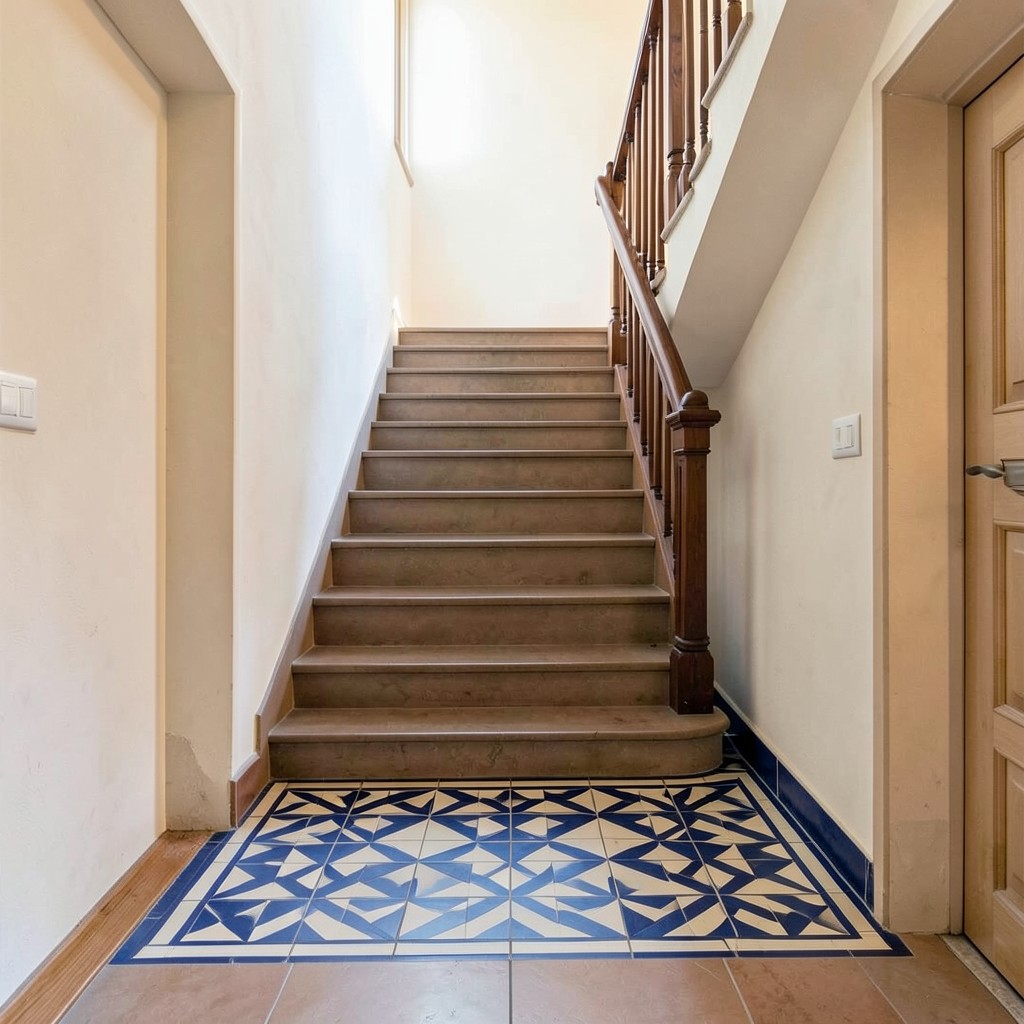
The floor at the base of the staircase — the landing that receives the staircase’s descent and connects it to the home’s ground-floor circulation — is the surface that frames the staircase from below and creates the visual context in which the stair’s structure reads. Most homes extend the hall or entry floor material straight through to the stair base without differentiation, treating the landing as a continuation of the passage rather than as a designed arrival point. A patterned tile at the stair’s base creates a floor medallion effect — a defined, differentiated zone that marks the staircase’s beginning and the hallway’s transition point with a material gesture that says: this is where one thing ends and another begins.
An encaustic cement tile in a bold geometric pattern — a large-format star-and-cross in cobalt and cream, or a bold black and white diamond — at the staircase’s base creates the arrival moment that the Moroccan riad tradition applies to every significant threshold in the building. The patterned tile zone, defined by a border tile that frames its extent and separates it from the surrounding hall floor material, creates a floor composition of genuine architectural presence whose scale and color anchor the staircase’s bottom point with a designed clarity that plain flooring never achieves. Traditional home interiors, bohemian home styling, and earthy home design staircase landings respond most strongly to the patterned tile base — each design direction finds a tile pattern in its own material vocabulary that suits the staircase’s bottom transition point.
The tile zone’s extent — how many tiles out from the stair’s base it covers — must be proportional to the hall’s width and the staircase’s own dimensions. A medallion too small reads as an afterthought; one too large overwhelms the passage. The border tile that defines the medallion’s edge should be in a scale that relates to the main field tile — a border one-quarter to one-third the width of the field tile creates the proportional relationship that traditional floor tile design has consistently used to create composed floor surfaces. This proportion rule is not arbitrary: it is the spatial logic that makes the eye read the border as frame rather than as competing element, and getting it right is the difference between a floor composition and a floor collision.
41. A Staircase With a Mid-Century Modern Aesthetic

The mid-century modern staircase applies the formal language of the postwar design movement — clean geometric forms, warm natural materials in combination with manufactured materials, and the elimination of applied ornament — to the staircase with a specificity that connects the design direction to its particular historical moment without reading as pastiche. The mid-century staircase is not modern in the sense of contemporary — it is modern in the precise historical sense of the mid-twentieth-century rejection of Victorian ornament and Beaux-Arts formalism in favor of structural honesty and material quality. That distinction matters for the design decisions it drives.
Solid walnut treads on a single central steel stringer in a brushed satin steel finish create the mid-century staircase’s primary material relationship — the warm, dark richness of the walnut against the precision of the steel, each material performing its specific structural role without concealment or decoration. The single central stringer is a structural solution specific to the mid-century period’s engineering confidence — rather than two side stringers, a single spine carries the tread loads in torsion, and the engineering statement is allowed to read as the design statement simultaneously. The balustrade in a mid-century staircase is typically a simple horizontal cable or flat steel bar system that does not compete with the structural clarity of the tread-and-stringer composition below it.
Mid-century modern staircase design also applied the Eames-era understanding of plywood’s formal possibilities — shaped, molded plywood treads in a single sculptural form rather than a flat plank were explored in residential stair design of the period, and their residue in contemporary staircase design is visible in the sculptural, form-driven tread shapes that some custom staircase designers continue to pursue. In a home whose interior applies mid-century modern design principles through its furniture and material choices — rustic home office ideas notwithstanding, the mid-century interior is a precise palette of walnut, wool, leather, and engineered materials — the staircase designed in the same vocabulary creates an architectural consistency that makes the whole house feel resolved and coherent rather than assembled from different design periods.
42. A Staircase With a Horse-Shoe Arch Frame at the Top Landing

An arched opening at the staircase’s top landing — framing the transition from stair to upper corridor with an architectural arch cut into the wall or expressed as a freestanding portal — creates the theatrical arrival moment at the upper floor that most landings entirely lack. The arch turns the upper landing’s transition into a genuine threshold: an architectural event that marks the top of the ascent with a designed frame rather than simply ending the stair at a flat corridor wall. The horse-shoe arch profile — the Moorish form broader than a semicircle — suits bohemian home styling and traditional home interiors settings with its historical reference to North African and Spanish architectural traditions.
A plaster arch formed by a curved metal lath profile and finished in a smooth lime plaster creates the soft, organic arch form that suits earthy home design and desert home styling interiors whose material palette favors natural plaster surfaces and hand-worked finishes. The arch’s interior — the soffit of the curved form — can be painted in a deeper tone than the surrounding wall, creating a depth of shade within the arch’s curvature that makes the opening read as a genuine spatial pocket rather than a flat painted curve. The jambs of the arch, the vertical sections below the curve’s spring line, should be thick enough to read as three-dimensional — four to six inches of reveal — so that the arch communicates as an architectural element with physical depth rather than as a painted profile on a flat surface.
A rounded arch in a standard semicircular profile suits contemporary home ideas and modern home design upper landing frames, its cleaner geometry connecting to the architectural vocabulary of current residential design without the historical specificity of the horse-shoe form. The proportions of the arch — its width relative to its height, the thickness of its reveal relative to its span — determine whether it reads as architecturally considered or as an accidental form. An arch that is too narrow for its height reads as squeezed; one too wide for its height reads as shallow. The correct proportion connects the arch to the classical and vernacular traditions that have used arches as architectural elements for millennia, whether or not the designer consciously references those traditions.
43. A Staircase With a Recessed Niche Display Along the Wall

Recessed niches built into the staircase wall create display alcoves of architectural depth that project nothing into the passage space yet provide a contained, framed surface for objects that deserve their own spatial setting. The niche’s depth — typically six to twelve inches, depending on the wall’s construction — creates a shadow box effect around whatever it contains, the niche’s inner walls catching the light from multiple angles and creating a rich, three-dimensional frame for the displayed object. A staircase wall with a sequence of ascending niches at varying heights creates a permanent gallery of alcoves that rises with the stair, each containing a curated piece at the height that suits both the ascending sightline and the object’s own scale.
Framed LED downlights recessed into the niche’s ceiling — small, directional spots that focus light directly on the displayed object rather than illuminating the surrounding wall — elevate each niche from a structural alcove to a display case of gallery quality. The directed light creates the micro-drama of a spotlight installation within the niche’s contained space, making the displayed object read with the same presence and intensity that a museum’s display lighting achieves in a professional context. Elegant home styling and luxury home interior staircase alcoves apply this lighting standard consistently, understanding that the quality of the lighting determines the quality of the display experience as much as the quality of the displayed object itself.
The niche’s interior finish — plaster, tile, mirror, or a contrasting paint color — further defines its character. A niche with a deep-colored interior against a white staircase wall creates a jewel-box depth that draws the eye from across the space. A mirrored niche interior reflects and multiplies the displayed object’s appearance, doubling its presence within the alcove. A tiled niche interior in a small mosaic or hand-painted ceramic tile suits traditional home interiors and bohemian home styling staircase walls where the niche’s own surface treatment is as important as the object it holds. The recessed niche is, in this sense, both a display system and a decorative element — it functions by holding objects and looks beautiful even when it holds nothing at all.
44. A Staircase With a Bi-Fold or Pocket Door Below

The space below a staircase that is accessed through a bi-fold or pocket door is the home’s most efficiently closed storage location — the door occupies no swing space in the open position, which matters enormously in a hallway or entry where every square foot of floor space is in constant use by passing traffic. A bi-fold door that folds flat against the stair’s side face, or a pocket door that slides into the wall beside the stair opening, closes the under-stair storage cleanly without the floor-space penalty that a hinged door imposes. The result is a storage room whose opening mechanism is as space-efficient as the storage itself.
The under-stair space accessed through a pocket door can be fitted with a dedicated organization system — hooks, shelves, pull-out drawers, and hanging rods arranged to the specific storage requirements of the household. A mudroom-quality under-stair closet, with a bench, boot storage at floor level, coat hooks at mid-height, and shelf storage for bags and accessories above, creates the entry organization function within the stair structure itself. This integration suits farmhouse home decor, Scandinavian hallway design, and contemporary home ideas entries where the staircase is positioned at or near the home’s front entry and the under-stair volume is accessible from the entry passage. The pocket door’s finish — matching the adjacent woodwork in paint and profile — makes the under-stair opening invisible when closed, the stair’s side face reading as a continuous architectural surface with no indication of the storage volume behind it.
The pocket door’s track and hardware must be specified for the door’s weight and width — a wide opening in a heavy solid-core door requires a commercial-grade pocket door hardware system with a robust track, not the light-duty residential hardware appropriate for a standard interior door. The structural lintel above the pocket opening must carry the loads from the staircase structure above it, and in most cases this requires a steel beam or engineered lumber member capable of spanning the opening width without deflecting under the stair’s live and dead loads. These structural requirements are standard for any residential pocket door installation in a load-bearing wall, and a structural engineer’s specification of the lintel ensures the installation is safe, durable, and code-compliant.
45. A Staircase With a Dramatic Color Drench on All Surfaces

Color drenching the staircase — applying a single saturated color to every surface including the treads, risers, balustrade, handrail, adjacent wall, and ceiling — creates the most immersive and most psychologically distinctive staircase experience available without structural modification. The drenched staircase envelops the person ascending or descending within a single color environment, and that envelopment produces a quality of spatial experience — a mood, a feeling, a sense of being contained within a specific chromatic world — that no other decorating approach achieves with equal intensity. The color drench is the decorating decision that requires the most commitment and produces the most impact.
A deep forest green drench — the treads, risers, balustrade, handrail, wall, and ceiling all in the same deep sage or hunter green — creates a garden pavilion quality that suits garden-inspired interiors and traditional home interiors staircase settings whose design direction welcomes the enclosing richness of deep color. The green’s natural associations — with foliage, growth, and the outdoor environment — make the drenched staircase feel less like a confined utility space and more like an ascent through a planted canopy, a quality that no other color or treatment achieves as effectively. A deep terracotta drench suits earthy home design and desert home styling, the warm red-orange enveloping the staircase in the color of fired earth and sun-warmed adobe. A midnight navy drench suits coastal home design and traditional home interiors, the deep blue creating the atmospheric depth of a night sky contained within the stair’s architectural form.
The practical execution of a staircase color drench requires the correct paint finish selection for each surface type — a porch and floor paint in satin or semi-gloss on the treads and risers for durability, an eggshell or satin on the balustrade and walls for a slightly softer version of the same color, and a flat or matte on the ceiling to prevent the overhead surface from reading as too glossy. All finishes should be from the same paint range and in the same color mixed to the same formula, because slight color variations between finishes can read as mismatched rather than tonal when placed in direct adjacency. The drenched staircase requires no other decorating — no art, no plants, no runner — because the color itself is the complete design statement, and adding decorative layers to it dilutes the immersive quality that makes the drench effect powerful.
46. A Staircase With a Window Seat at the Landing

A window seat built into the staircase landing — a padded bench fitted against the landing’s window, flanked by storage cabinets or open shelving on each side — creates the home’s most architecturally specific cozy space, because the landing’s position at mid-stair height, its generally smaller scale relative to the rooms above and below, and the natural light that the landing window provides all conspire to create a reading nook of genuine domestic charm. No furniture arrangement in a room creates the same spatial quality as a window seat fitted precisely to an alcove or landing — the built-in nature of the seat, its integration with the surrounding architecture, produces a containment and belonging that a chair placed beside a window in an open room does not approach.
The window seat’s cushion should be substantial — four to six inches of high-density foam covered in a fabric suited to the staircase’s design direction. A bouclé fabric in a warm cream or sage suits Scandinavian home interior and contemporary home ideas landings, its textured surface providing the tactile richness that the landing’s hard architectural materials need as a counterpoint. A patterned linen or cotton in a botanical or geometric print suits bohemian home styling and garden-inspired interiors landings. The cushion’s cover should be removable and washable — the landing window seat collects use and exposure from every member of the household, and a fixed, non-removable cover is a maintenance problem that becomes progressively more visible as use accumulates.
Storage built below the window seat’s bench platform — accessible through hinged seat-lid panels or through drawers in the seat’s front face — provides the landing’s organizational function alongside its comfort function. The storage in a landing window seat holds the household’s seasonal textile supply most naturally — extra blankets, spare pillows, and the weighted blankets and heated throws that winter home decor season generates — because the landing’s position between floors places it equidistant from the bedrooms above and the living areas below where these items circulate. The window seat landing that serves as both reading destination and textile storage point is the home’s most multifunctional small space, and its design quality repays every hour and dollar invested in getting it right.
47. A Staircase With a Scandinavian-Inspired White and Wood Palette

The Scandinavian staircase’s material palette is arguably the most widely influential residential design formula of the current design generation — white painted structural elements combined with natural light wood treads and a spare, precisely proportioned balustrade in a single warm metal or the same light wood as the treads. The formula succeeds because it is genuinely appropriate to the staircase context: the white amplifies whatever natural light the staircase receives, the wood provides the warmth that prevents the white from reading as clinical, and the spare balustrade keeps the whole composition visually light without sacrificing its structural clarity. This palette does not succeed because it is fashionable. It succeeds because it is correct.
Ash or white-oiled oak treads in a natural finish on a white painted stringer, with simple white or pale oak balusters and a matching oak handrail, create the definitive Scandinavian home interior staircase — a composition of such restrained beauty that it suits almost every contemporary domestic context without imposing its stylistic identity on the rooms it connects. The natural oil finish on the treads preserves the wood’s color and grain without the plastic coating of polyurethane, aging gracefully toward a deeper, richer tone over years of use rather than yellowing and flaking as polyurethane finishes eventually do. The spring home refresh energy that Scandinavian interiors capture so effectively — the relationship between fresh white surfaces and warm natural wood — is most purely expressed in the Scandinavian staircase design, where the material combination has no competing elements to negotiate with.
The Scandinavian staircase’s apparent simplicity conceals the precision it requires to read correctly — the proportions of the baluster spacing, the handrail’s profile depth, the tread’s overhang at the nosing, and the stringer’s width relative to the tread’s surface are all variables that must be resolved within a narrow range to achieve the composition’s characteristic lightness. Too wide a stringer makes the staircase read as heavy; too narrow makes it read as mean. Too close a baluster spacing creates visual density; too wide creates a safety concern that undermines the spare, open quality of the composition. The Scandinavian staircase rewards precise design development, and the investment of that precision in the design phase returns as the lasting, stable quality of a staircase that never looks wrong regardless of the season, the furnishings around it, or the light conditions it is seen in.
48. A Staircase With a Statement Lighting Fixture in Each Baluster

Individual lighting elements incorporated into the balustrade — not as a secondary addition to the baluster’s form but as an integral element of its design — create a staircase illuminated from within its own structure rather than lit from above or beside it. This inside-out lighting approach produces a completely different quality of light along the staircase than conventional fixtures provide, because the light source is at the baluster spacing interval throughout the staircase’s full length, creating an even, low-level illumination at the balustrade height that is warm, directional, and architectural in its quality. The staircase does not merely have lighting — it is the lighting.
Individual LED capsule inserts built into hollow steel or aluminum baluster forms emit a warm, controlled wash of light through a slot, a perforation pattern, or a translucent section in the baluster’s wall. The light from each baluster combines along the full staircase length to create a continuous luminous ribbon at rail height — an architectural light installation of genuine beauty that performs its safety function simultaneously with its aesthetic one. Minimalist home design and modern home design staircase contexts apply this baluster lighting most consistently, because the material precision and design intentionality it requires aligns with those aesthetics’ commitment to resolving every element to its functional and formal potential simultaneously.
A simpler version of the within-balustrade lighting concept applies standard LED post cap lights to the top of wooden balusters — small, self-contained fixtures that fit over the baluster’s cap and emit a controlled downward wash of warm light from each post’s position. This approach requires no custom fabrication, works with standard residential voltage and switch control, and creates the same multi-point illumination effect at a fraction of the custom baluster’s cost. The post cap light’s visual character is more domestic and less architectural than the integrated LED baluster, but its lighting quality and its practical accessibility make it the correct choice for renovation contexts where the staircase’s structure already exists and custom fabrication of new balusters is not economically justified.
49. A Staircase With a Carved Wood Balustrade

A carved wood balustrade is the staircase element that most unambiguously declares the home’s commitment to craft as a design value — the depth of relief, the precision of the carved detail, and the quality of the timber from which the carving is cut are all qualities that can only be achieved through specific skills applied across significant time. Flat, turned, and cable balusters can all be manufactured at scale; carved wood balustrades cannot. Each carved panel is an individual object, and the variation between panels — the slight differences in depth, in angle, and in the carver’s hand that distinguish one from the next — creates a visual life in the balustrade that mechanical reproduction cannot synthesize.
Carved foliage panels in solid oak or cherry — each panel occupying one baluster bay, with a continuous vine and leaf motif that links across adjacent panels to create a flowing botanical composition running the staircase’s full length — suit traditional home interiors and luxury home interior settings of the most considered kind. The botanical carving’s connection to the natural world — to the floral home decor ideas and garden-inspired interiors design traditions — makes it simultaneously decorative and architecturally relevant, its leafing forms connecting the interior staircase to the outdoor garden through an art form whose subject is explicitly natural. A geometric carved panel — interlocking lattice, a running key pattern, or a series of recessed diamond forms — suits contemporary home ideas and minimalist home design contexts where the carving’s abstract geometry suits the home’s design vocabulary better than representational botanical form.
A carved wood balustrade in a well-maintained home improves with age, the depth of its relief becoming richer and more defined as the wood’s surface patina develops and the carved surfaces catch light differently through seasons of daily exposure. During winter home decor season when the interior is most observed and most appreciated, the carved balustrade’s shadow play under warm incandescent light produces a quality of domestic beauty that makes the staircase feel like the home’s most ancient and most valued possession — which, in terms of craft investment and material permanence, it genuinely may be.
50. A Staircase Designed as the Home’s Central Architectural Statement

The staircase that is designed last, after every other room has been planned and furnished, is the staircase that never quite fulfills its potential — because the most powerful residential staircases are the ones designed first, before the floor plan is fixed, before the material palette is finalized, before the ceiling heights are confirmed. When the staircase is the starting point of the home’s design rather than its final practical resolution, everything else in the house organizes around it, and the result is a home whose spatial coherence and architectural character are traceable to that single central decision. The staircase designed as the primary architectural event produces a house whose identity is inseparable from its stair.
Designing the staircase as the home’s central statement means giving it the spatial generosity that a primary element deserves — a hall wide enough that the stair can be seen in full from the entry, a ceiling height sufficient that the stair’s full vertical movement reads from the ground floor, and a material palette that is resolved at a level of quality consistent with the most considered room in the house. The floor plan’s circulation paths are arranged to pass the staircase rather than avoid it, so that every movement through the house’s ground level involves at least a peripheral engagement with the stair’s presence. This is the planning principle that distinguishes houses whose staircases are destinations from houses whose staircases are merely routes. Luxury home interior design applies this principle as a matter of course; the homes that feel most architecturally resolved at every price point apply it with equal discipline.
The materials, proportions, lighting, and detailing of the central statement staircase must be executed at the same standard throughout — not the tread material alone, or the balustrade alone, or the chandelier above the well alone, but every element resolved to its full potential simultaneously. A staircase with magnificent treads and mediocre balusters reads as a staircase with a problem, not as a staircase with a feature. The one that earns its status as the home’s architectural centerpiece is the one where every component — from the tread’s material quality to the handrail’s profile to the newel post’s scale to the lighting’s warmth — has been designed with the same deliberate intention and executed with the same uncompromising standard. That consistency of quality across every element, at every scale, is what produces a staircase that stops people in their tracks, that makes guests reach for their phone to photograph it, and that makes the household who lives with it every day feel, across years of daily ascent and descent, that their home is genuinely, particularly, irreplaceably beautiful.
Leave a Reply