Most basements get used the way most people use the space under their bed — as the place where things go that have nowhere better to be. The boxes from the last move that were never fully unpacked, the holiday home styling decorations that come out twice a year, the exercise equipment that was used enthusiastically for three weeks and has been collecting dust ever since, and the general overflow of a household that has run out of space upstairs and sent the remainder below. This is not a design strategy. It is organized avoidance, and the result is a floor of your house contributing almost nothing to the quality of your daily life despite representing hundreds, sometimes thousands, of square feet of genuine potential.
The basement’s design reputation suffers from a specific compound problem. The space is typically the last to be renovated, which means it receives whatever is left of the budget after every other room has absorbed its allocation. The ceiling is lower than every room above it, which creates the immediate psychological impression of compression. The windows, where they exist at all, are small and positioned near the ceiling, providing minimal natural light and creating the underground quality that the space’s position below grade already suggests. And because the basement was not originally finished — or was finished decades ago in the paneled, carpeted, drop-ceiling style of a previous era — most people’s mental image of what a basement can be is shaped by the worst examples rather than by the genuine possibilities the space contains.
Those problems are all real. They are also all solvable, and solving them is the design project that converts a basement from the home’s least valuable room to its most distinctive one. The ceiling height that feels limiting becomes the architectural feature that forces the design to work harder with smart lighting, lower furniture profiles, and the visual tricks that make a room feel taller than its measurements suggest. The limited natural light becomes the opportunity for a lighting design more sophisticated and more atmospheric than any above-grade room, because the basement’s complete control over its light environment — no direct sun, no glare management, no time-of-day color temperature shifts — allows the artificial lighting to define the room’s mood with a precision that upstairs rooms cannot match. The underground quality that seems like a disadvantage becomes the asset of a room that is cooler in summer home design season, acoustically isolated from the house above, and naturally insulated against the temperature extremes that the upper floors experience.
The fifty basement design ideas in this collection treat none of these challenges as acceptable compromises. Each idea addresses a specific combination of use, aesthetic direction, and physical condition — from the low-ceiling basement that becomes a cozy home design retreat to the full-height walkout basement that becomes a luxury home interior extension of the main living space. The ideas span industrial home design workshops and farmhouse home decor family rooms, minimalist home design meditation spaces and bohemian home styling creative studios, traditional home interiors bars and contemporary home ideas home theaters. Every aesthetic direction is represented. Every use type is addressed.
Your basement is a room. Design it like one.
1. A Basement Home Theater With Acoustic Panels and Tiered
Seating
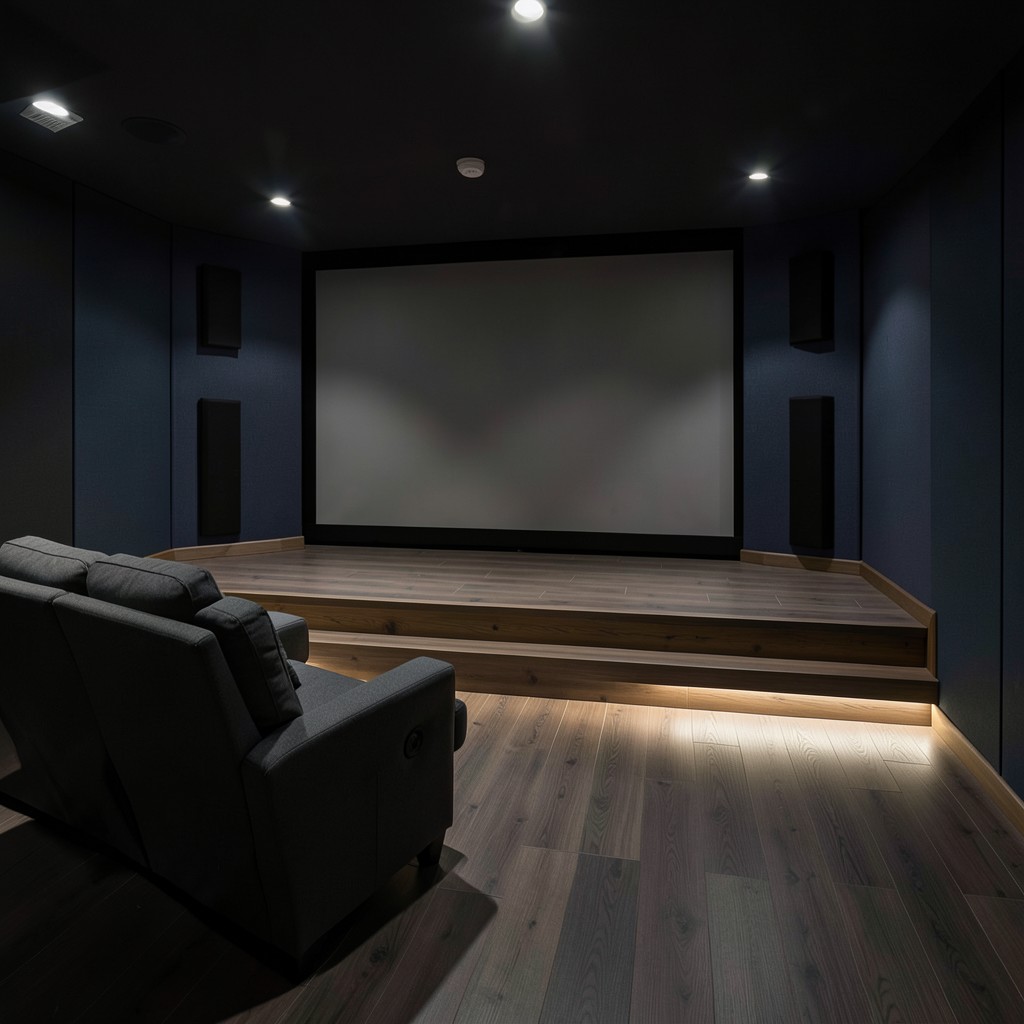
The basement is the one location in the house where a home theater achieves its full potential — not because basements are inherently cinematic, but because the physical conditions the basement provides are the exact conditions a proper theater requires. Acoustic isolation from the floors above, complete darkness when the lights go off, no exterior window glare management, and a ceiling low enough that the room’s volume is contained rather than cavernous all conspire to make the basement the home’s best theater room before a single design decision is made. The design decisions that follow simply have to respect and enhance what the space already provides.
Tiered seating — a front row at floor level and a raised rear platform that elevates the back seats above the front row’s sight line — creates the cinema-quality viewing geometry that a flat floor arrangement never achieves because the sightlines from the back seats are blocked by the heads in front. The rear platform’s height of eight to twelve inches is sufficient to clear the front row’s head positions, and the platform can be framed in standard lumber and covered in the same flooring as the main theater floor — typically a luxury vinyl plank in a dark, low-reflectance tone that absorbs light rather than bouncing it toward the screen. The riser edge receives a low-voltage LED lighting strip that provides safe foot-level illumination during the theater’s darkened use without creating ambient light that spills onto the projection surface.
Acoustic panels mounted at the first and second reflection points — the side walls at the seated listening distance, the rear wall behind the back row, and the ceiling above the seating position — absorb the echo that untreated hard walls create in the confined basement volume. Fabric-wrapped acoustic panels in a charcoal or deep navy material suit the theater’s dark palette while providing the sound absorption coefficient that the room’s dimensions require for clear dialogue and defined bass response. The front wall behind the screen receives bass trap panels in the corners, where low-frequency buildup is most concentrated in a rectangular room, and the combined treatment creates an acoustic environment where the sound system’s quality is heard rather than masked by the room’s own reflections.
2. A Basement Bar and Entertainment Space
The basement bar is the social destination that every household with a functional below-grade space should seriously consider — not the builder-grade wet bar with the plastic laminate counter and the fluorescent strip light, but a properly designed bar space whose material quality, lighting atmosphere, and organizational completeness makes the basement the household’s preferred gathering place for the evenings that matter. When the basement bar is designed well enough, nobody asks why you’re having the party downstairs. They just want to know when the next one is.
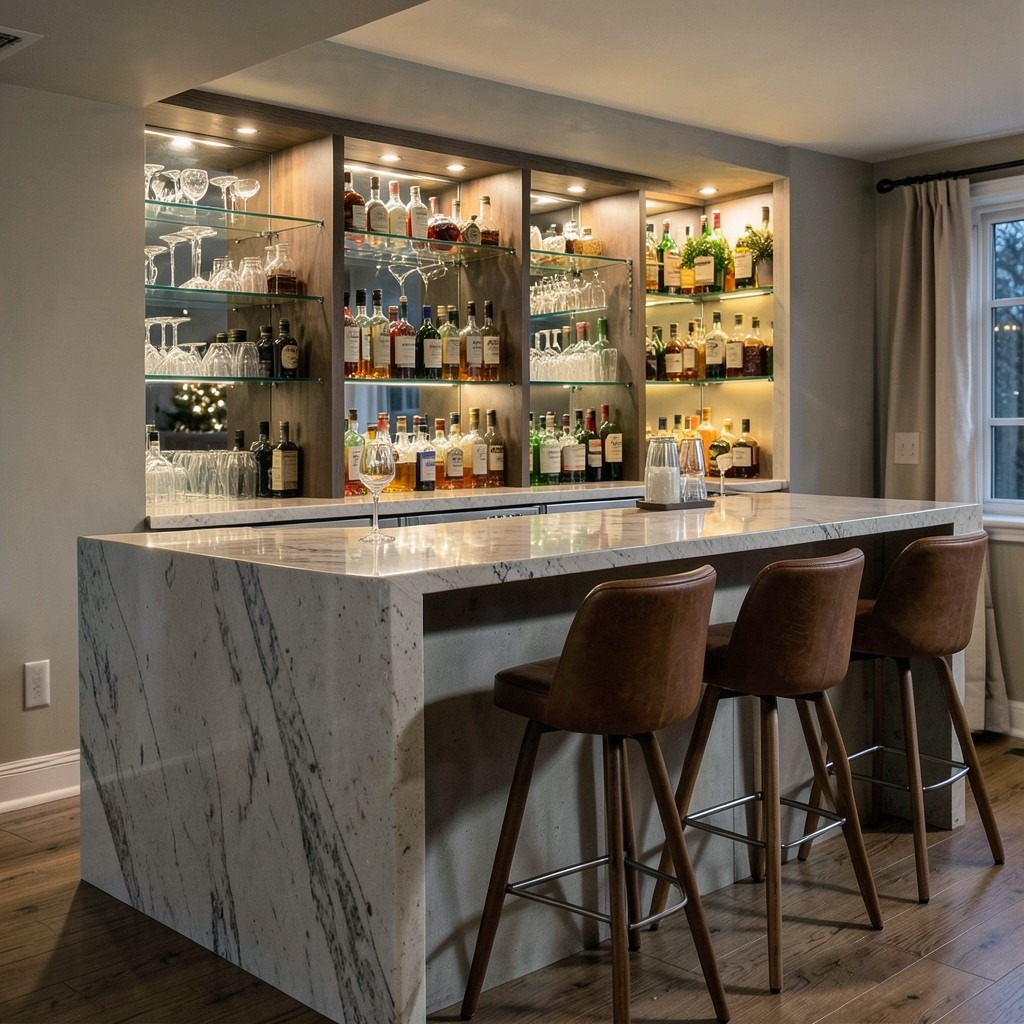
A bar counter in a premium material — a slab of honed marble, a thick-cut butcher block, a poured concrete counter, or a quartz surface in a stone-veined pattern — creates the bar’s primary surface statement at a quality level that communicates the space’s design intention from the first moment a guest sets their glass down. The counter’s overhanging front edge should accommodate bar stools at a comfortable knee height — typically fifteen to eighteen inches of overhang with a counter surface of forty-two inches from the floor — creating the bar seating configuration that distinguishes a designed bar from a serving counter with stools added as an afterthought. Bar stools in an upholstered seat with a metal base suit industrial home design and contemporary home ideas basement bars, while wooden stool frames with leather seats suit warm home decor ideas and rustic home decor settings where the bar’s material palette draws from organic and aged materials.
Back bar shelving in an illuminated format — glass shelves mounted on a mirrored back panel with recessed LED lighting above each shelf row — displays the bottle and glassware collection in the same way that a commercial cocktail bar presents its inventory. The mirror’s reflective quality doubles the visual depth of the bar display and bounces the LED shelf lighting across the mirrored surface, creating the luminous quality that makes a well-stocked bar shelf read as genuinely attractive rather than merely organized. During holiday home styling season, the illuminated bar display creates one of the home’s most naturally festive settings, the reflected light and glass surfaces capturing the ambient warmth of the season without requiring any additional decoration.
3. A Basement With a Cozy Family Room Design
The basement family room is different from the main floor living room in one fundamental way: it can be genuinely messy without consequence. The upstairs living room carries the household’s social presentation burden — it is what guests see first, what the home’s design quality is judged against, and what needs to look composed at any moment when someone unexpected arrives. The basement family room carries none of that burden. It is the room for the actual daily behavior of the actual household, and designing it for that behavior rather than for that presentation creates the space that the household spends the most time in most comfortably.
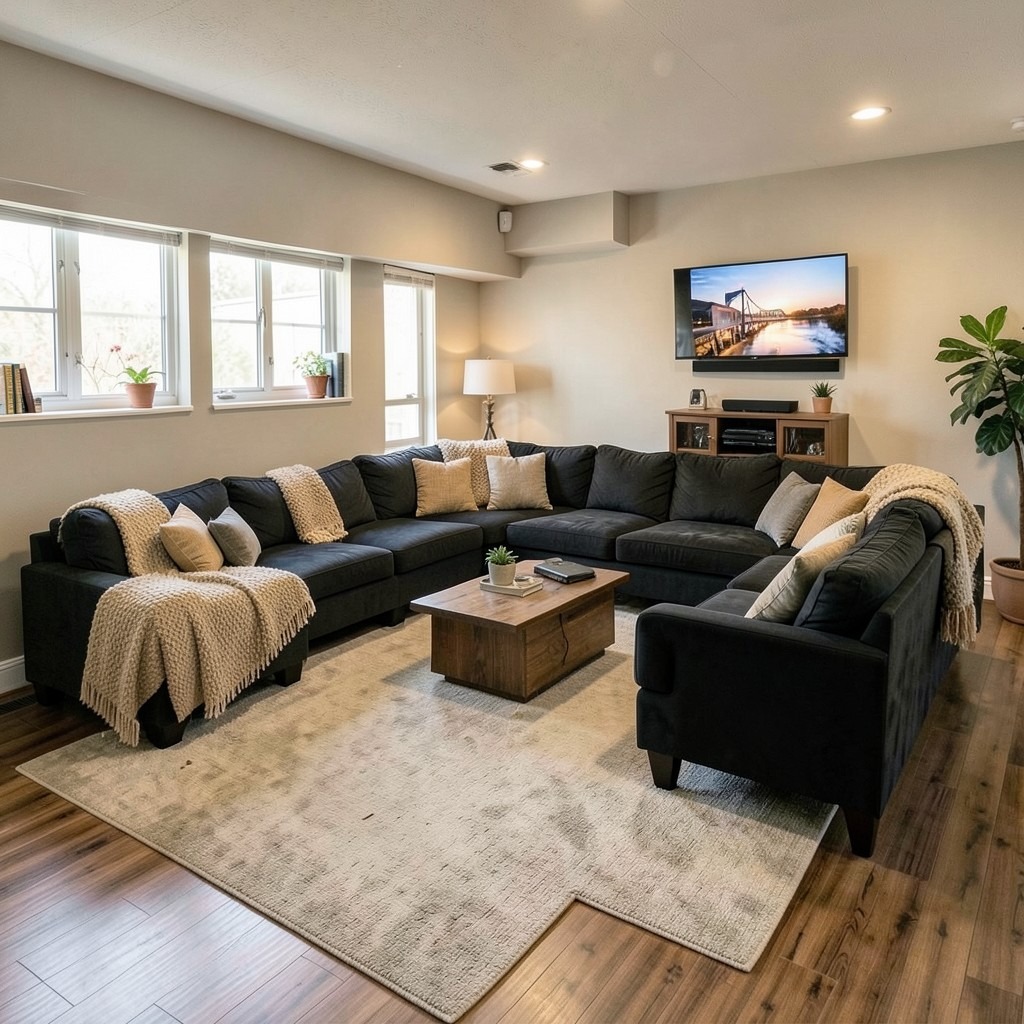
Deep sectional seating in a performance fabric — a tight-weave microfiber, a solution-dyed outdoor-grade fabric applied to an indoor sofa, or a velvet in a dark tone that hides the daily wear of family use — creates the seating that a family room requires to sustain consistent heavy use without the surface degradation that lighter domestic upholstery exhibits under the same conditions. The sectional’s configuration should suit the basement’s specific geometry — an L-shape that fits into the corner and faces the entertainment wall, or a U-shape that creates the social enclosure in the room’s center where the ceiling height is greatest. Cozy home design principles applied here — layered throw blankets in a warm pile on each seat section, a collection of floor pillows for the youngest household members’ preferred floor-level sitting position, and a low coffee table whose surface tolerates the use it will receive — create the family room’s functional comfort at a level that the upstairs living room’s design standards preclude.
Durable flooring in the basement family room should prioritize resilience over refinement — luxury vinyl plank in a warm wood-look tone provides the hardwood appearance with the moisture resistance and impact tolerance that basement floors require, and the floating installation format allows the floor to respond to the basement’s seasonal humidity changes without the buckling or gapping that nail-down hardwood exhibits when the concrete subfloor’s moisture content fluctuates. A large area rug over the vinyl plank creates the soft, warm zone that the seating arrangement requires, defining the room’s social area within the basement’s larger volume and providing the acoustic absorption that hard flooring alone cannot deliver in a room where noise management matters.
4. A Basement With an Industrial Loft Aesthetic
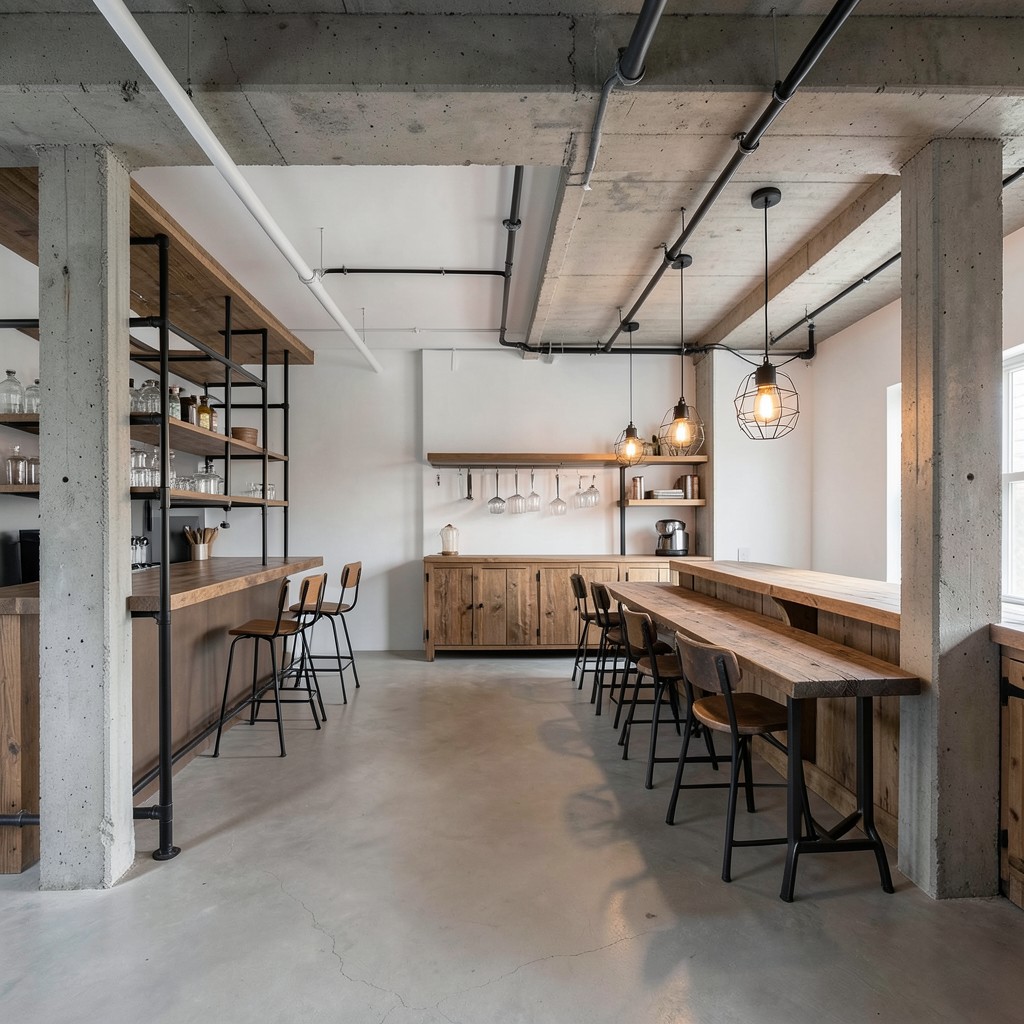
The industrial basement is the design direction that works with the basement’s inherent raw qualities rather than hiding them — the exposed concrete columns, the visible structural beams, the mechanical systems running through the ceiling space, and the bare concrete floor all become design elements in an industrial aesthetic that celebrates material honesty rather than apologizing for it. Most basement renovations spend significant budget concealing these elements behind drywall, drop ceilings, and flooring materials. The industrial basement design spends that budget on design elements that the raw structure supports and enhances.
Exposed concrete ceiling — the underside of the floor structure above the basement left unpainted or painted in a single flat white to brighten the surface — creates the industrial aesthetic’s overhead expression and removes the drop ceiling that most finished basements install to hide the mechanical systems above. Where mechanical systems run below the floor structure’s underside, a partial drop-out section — a framed soffit that conceals only the mechanical runs while leaving the remainder of the ceiling structure exposed — addresses the visual conflict without lowering the entire ceiling. In a basement whose floor-to-ceiling height is already limited, every inch of ceiling height is worth preserving, and the decision to frame a targeted soffit rather than drop the entire ceiling often recovers six to eight inches of perceived room height that the full drop ceiling permanently eliminates.
Steel and wood industrial home design elements — black steel pipe shelving, steel-frame furniture with exposed weld points, reclaimed wood surfaces on the bar counter and work tables, and Edison-style pendant lighting in black metal cages hanging from ceiling cables — create the material palette that suits the exposed structure above and the concrete floor below. The raw material dialogue between the steel, the wood, and the concrete creates a visual consistency that makes the industrial basement feel fully designed rather than deliberately unfinished, and that distinction — between a finished industrial aesthetic and an unfinished room — is entirely in the intentionality of the design choices.
5. A Basement Converted Into a Legal Apartment or Suite
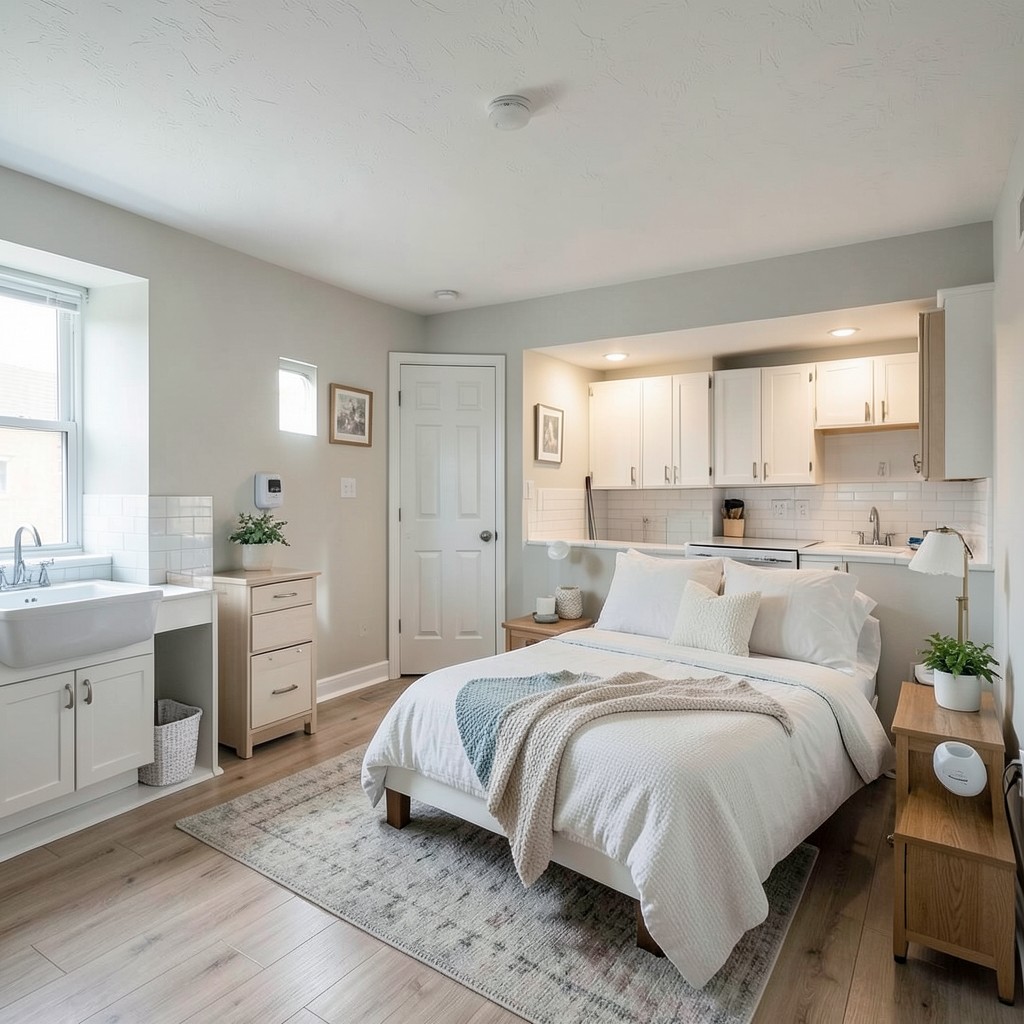
A basement suite conversion is the most financially significant design decision on this list — a properly designed and permitted basement apartment adds rental income, increases the property’s market value, and creates flexible living accommodation for extended family members, adult children, or short-term guests that no renovation of the upper floors can match. The suite conversion requires the most planning, the most regulatory compliance, and the most technical investment of any basement project, and it also returns the most in both immediate financial value and long-term property equity.
The legal basement suite requires specific physical conditions that many basements do not meet without modification: a minimum ceiling height in habitable rooms — typically seven feet in most jurisdictions — emergency egress from the sleeping room, a separate exterior entrance that does not require passage through the main dwelling’s interior, fire separation between the suite and the main house above it, and independent utility metering if the suite is to be rented. Each of these requirements involves structural work, electrical work, or both, and their combined cost represents the suite conversion’s primary investment. The return on that investment — in rental income at market rates for the suite’s location and configuration — is calculated as the suite renovation’s net present value, and in most urban and suburban markets where housing demand is high, the calculation favors the investment strongly.
The suite’s interior design should be designed for its occupant rather than for the homeowner’s aesthetic — the tenant or family member who lives in the suite will occupy it as their primary residence, and the space should be designed with the same attention to livability, light, storage, and comfort that the homeowner’s own rooms receive. A suite designed as a thoughtful small apartment — with a proper bedroom that meets the minimum size and window requirements, a bathroom with full fixtures, a kitchen with adequate appliance capacity, and a living area proportioned for comfortable daily use — is a suite that commands full market rent and retains good tenants. A suite designed as the minimum-code-compliant accommodation of a basement conversion is a suite that commands reduced rent and generates the tenant dissatisfaction that comes from living in a space designed for compliance rather than for habitation.
6. A Basement Gym With Rubber Flooring and Mirror Walls
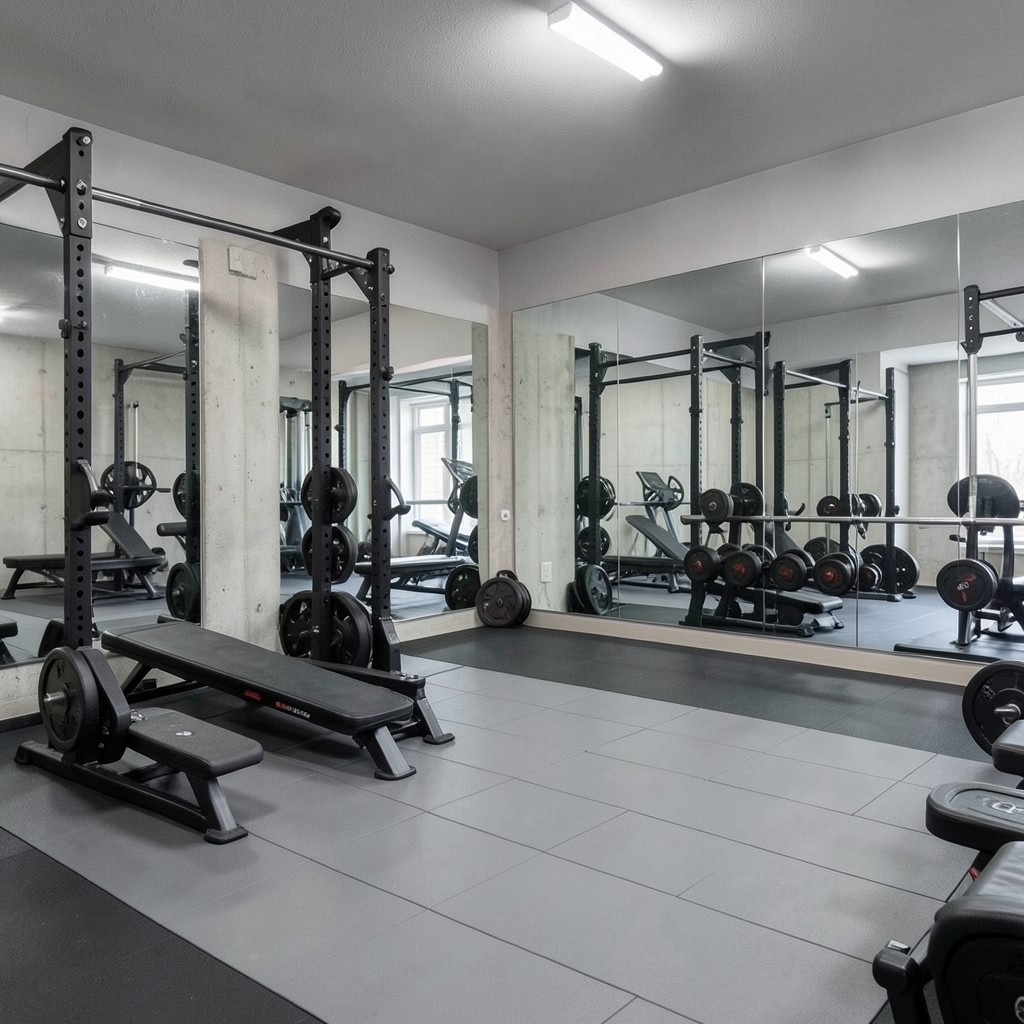
The basement gym is the home fitness investment that pays back across months and years of daily use in a way that commercial gym memberships do not — the sunk cost of the equipment purchase is real, but the marginal cost of each workout in a home gym is zero, and the accessibility of a gym that requires walking downstairs rather than driving across town removes the single most common obstacle between the intention to exercise and the act of doing it. The basement gym does not eliminate the need for discipline. It eliminates the logistical barriers that discipline has to overcome before the workout can begin.
Rubber flooring in a heavy-gauge interlocking tile format — rated for the impact of dropped Olympic weights and the friction of power rack legs on the floor surface — creates the gym’s foundational surface layer. The rubber tile’s density rating should match the gym’s heaviest use: a cardio-only basement gym can use a lighter, thinner tile; a strength training gym with free weights requires the heavy-gauge format that protects the concrete subfloor from the impact energy that dropped barbells transfer. The color choice in gym rubber tile matters more than most people expect — a light grey tile creates the bright, clean gym aesthetic that suits a basement whose natural light is limited, while a dark charcoal tile suits the dramatic, focused atmosphere that some training environments favor.
Full-height mirrors on the gym’s primary wall — tempered safety glass panels installed from floor to ceiling across the full width of the mirror wall — serve both the form-check function that technique-focused training requires and the spatial expansion function that the basement’s enclosed volume benefits from. The mirror wall’s installation in a basement should use adhesive mounting systems specifically rated for the humidity fluctuations that below-grade spaces experience, because the thermal and moisture movement of a basement’s concrete wall can loosen mirror adhesives rated for above-grade interior conditions. The visual result — a gym that appears to double in volume in the mirror wall’s reflection, with the full range of equipment visible from every position in the room — creates the training environment quality that motivates the consistent use the investment requires.
7. A Basement With a Scandinavian-Inspired Retreat
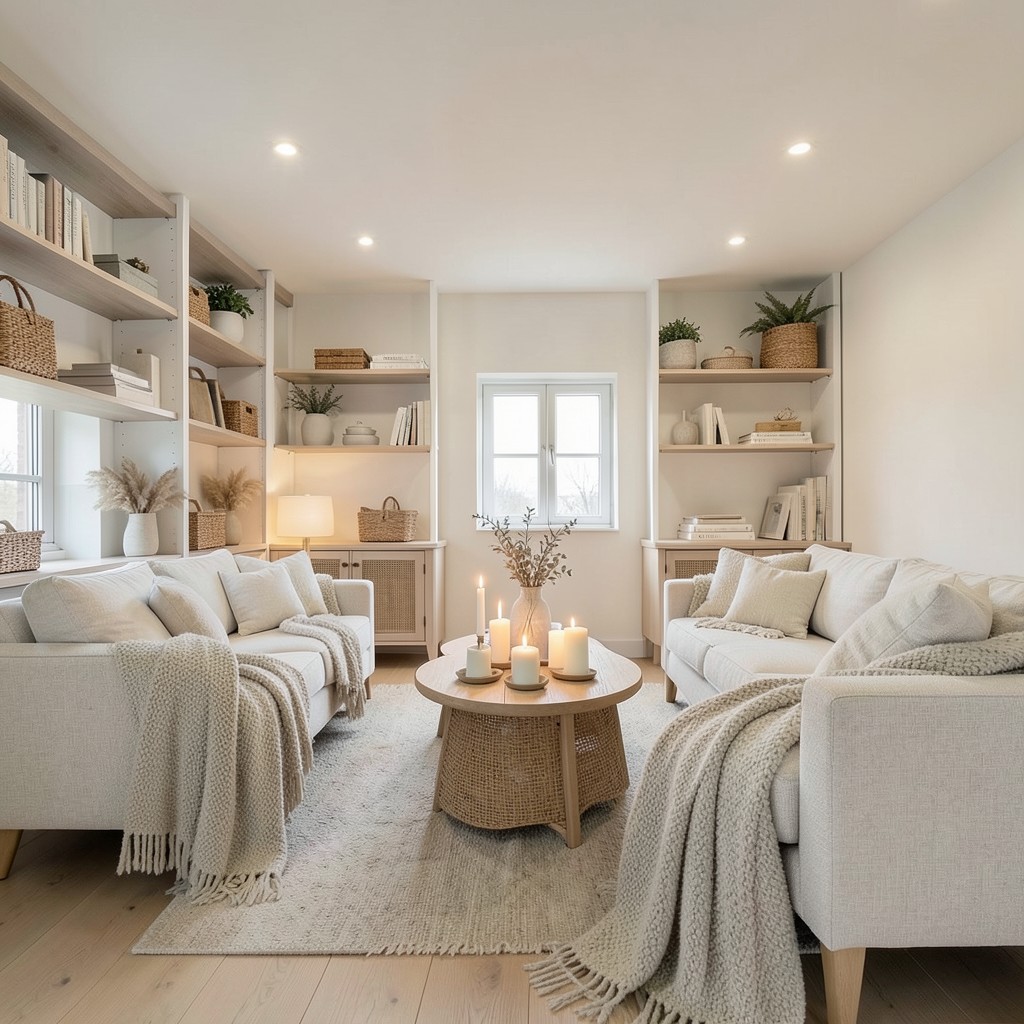
The Scandinavian basement treatment is the design answer to the basement’s most persistent atmospheric challenge — the enclosure, the limited light, and the underground quality that the space’s position creates — applied with the design intelligence that Scandinavian home interior design brings to every low-light, high-latitude environment it inhabits. Nordic design was not developed for spaces with abundant sunshine and expansive views. It was developed precisely for environments where the light is limited, the winter is long, and the interior must create its own warmth and brightness from within its own design resources. The Scandinavian basement is the design direction that understands this challenge from the inside.
White painted walls and ceiling — not the blue-white of a cold environment but the warm off-white of a cream or warm grey that carries yellow or red undertones — create the reflective backdrop that Scandinavian home interior design applies to create the sense of light in spaces that receive limited natural illumination. The pale palette’s reflective quality captures and amplifies the artificial lighting, and in a basement where the lighting design can be fully controlled, the pale backdrop allows a moderate number of light fixtures to create a room that reads as genuinely bright. Layered natural materials — pale ash shelving, light oak furniture, white-washed linen textiles, and natural rattan accessories — provide the organic warmth that prevents the pale palette from reading as cold or clinical, connecting the basement to the Scandinavian aesthetic’s constant dialogue between white and natural material.
Hygge-quality furnishing — the deep wool blankets, the candle clusters on the coffee table, the low-slung upholstered furniture in a natural linen or bouclé — creates the cozy bedroom design level warmth in the basement’s living zone that makes the underground location feel like a deliberate choice rather than a structural given. The basement Scandinavian retreat during winter interior design season reaches its atmospheric peak — the warm interior, the soft lighting, the layered textiles, and the complete silence of the below-grade room create an environment of genuine peaceful home decor quality that the household above cannot match in any room exposed to the outside world’s sound and temperature.
8. A Basement With a Rustic Farmhouse Living Space
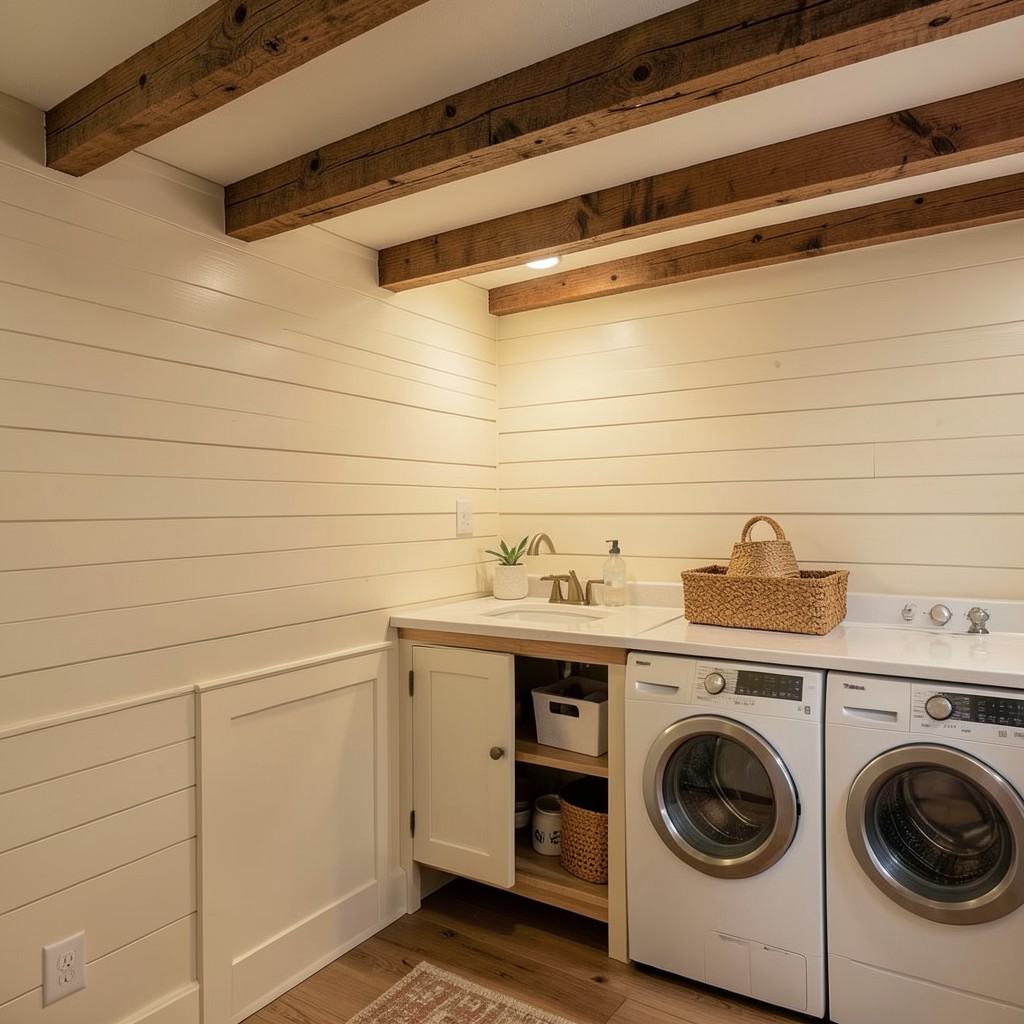
The farmhouse basement applies the warm, honest, material-genuine quality of farmhouse home decor to the below-grade space with the same conviction that the aesthetic brings to every room it inhabits — and the basement’s natural qualities, including its connection to the earth and its structural honesty, suit the farmhouse vocabulary with a compatibility that more polished, refined interior aesthetics occasionally strain to achieve. The farmhouse basement feels grounded. It feels like a room that knows what it is and sees no need to pretend otherwise.
Shiplap paneling on the basement walls — painted in a warm cream or cotton white, applied horizontally to cover the concrete block or poured concrete walls that most basements expose — creates the farmhouse surface that converts the basement from an unfinished utilitarian space to a domestic room with genuine wall character. The shiplap’s horizontal board rhythm and the slight shadow lines between each plank’s edges create the visual texture that distinguishes the farmhouse basement’s wall surface from a plain painted wall of any material, and the paint’s warm undertone ensures the basement reads as warm and inviting rather than cool and institutional. Farmhouse bathroom decor principles applied to the basement’s utility wet bar or laundry area — apron-front fixtures, oil-rubbed bronze hardware, and open shelf storage in natural wood — extend the aesthetic’s material consistency into the functional elements.
Exposed ceiling beams — either genuine structural timber exposed by removing the drop ceiling above, or decorative faux beams in a lightweight foam or polyurethane material installed to simulate structural timber — create the farmhouse ceiling character that flat drywall ceilings cannot provide. In a basement where the structural floor joists above are not visually attractive, decorative box beams in a stained wood finish — installed across the basement ceiling at regular intervals in the direction that suits the room’s layout — create the farmhouse overhead character at a fraction of the cost of replacing the ceiling structure. The beam’s stain color should respond to the floor material’s warm tone, creating the consistent wood palette between ceiling and floor that the farmhouse aesthetic’s material honesty requires.
9. A Basement With a Luxury Wine Cellar
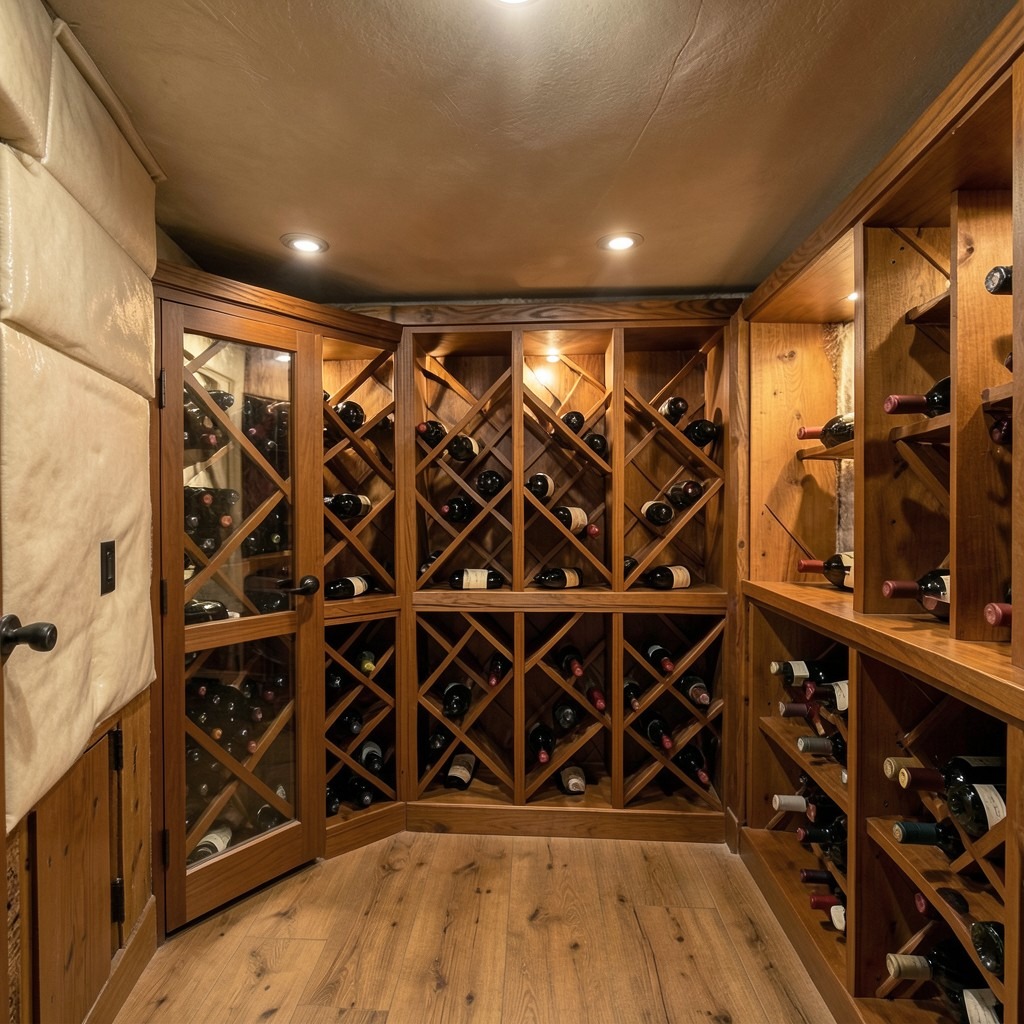
A basement wine cellar is the luxury home interior amenity that makes the most direct use of the basement’s single greatest inherent quality — its naturally stable, cool, and dark environment. A basement that maintains a consistent temperature between fifty-five and sixty-five degrees Fahrenheit with moderate humidity is doing exactly what a wine storage environment requires, without a single mechanical intervention. The basement is, in the most literal sense, a naturally occurring wine cellar, and designing a dedicated storage room within it to capitalize on that environmental advantage is the logical response to a physical condition that the rest of the house cannot replicate.
A passive wine cellar — a dedicated room built within the basement, insulated to maintain a stable temperature independent of the HVAC system’s cycling, with a solid or glass-front door that seals the room’s humidity and prevents the temperature fluctuations that a kitchen or living room wine rack experiences — stores a collection of several hundred to several thousand bottles in the optimal long-term aging conditions. The room’s construction requires vapor-barrier insulation on all six surfaces — walls, ceiling, and floor — to prevent the exterior humidity from migrating through the insulation and condensing on the room’s interior surfaces, which would create the mold conditions that destroy both the wine and the storage materials. A dedicated through-wall cooling unit maintains the room’s temperature during the summer home design season when the basement’s ambient temperature rises above the ideal storage range.
The cellar’s racking system — in a redwood, mahogany, or metal format with individual bottle positions that hold each bottle at a slight angle keeping the cork moist — creates the storage infrastructure whose configuration determines the cellar’s aesthetic character as well as its organizational function. Diamond-bin sections for case storage alternate with individual bottle rows for the display bottles in the cellar’s primary visible section, and the configuration should balance the practical storage requirements against the visual composition that the cellar’s display quality requires. Elegant home styling applied to the wine cellar’s finishing details — reclaimed wood accent sections, barrel-stave decorative panels, and warm amber lighting designed for the visual quality of the storage display — creates a cellar whose atmospheric quality suits the serious collection it contains.
10. A Basement With a Home Recording Studio
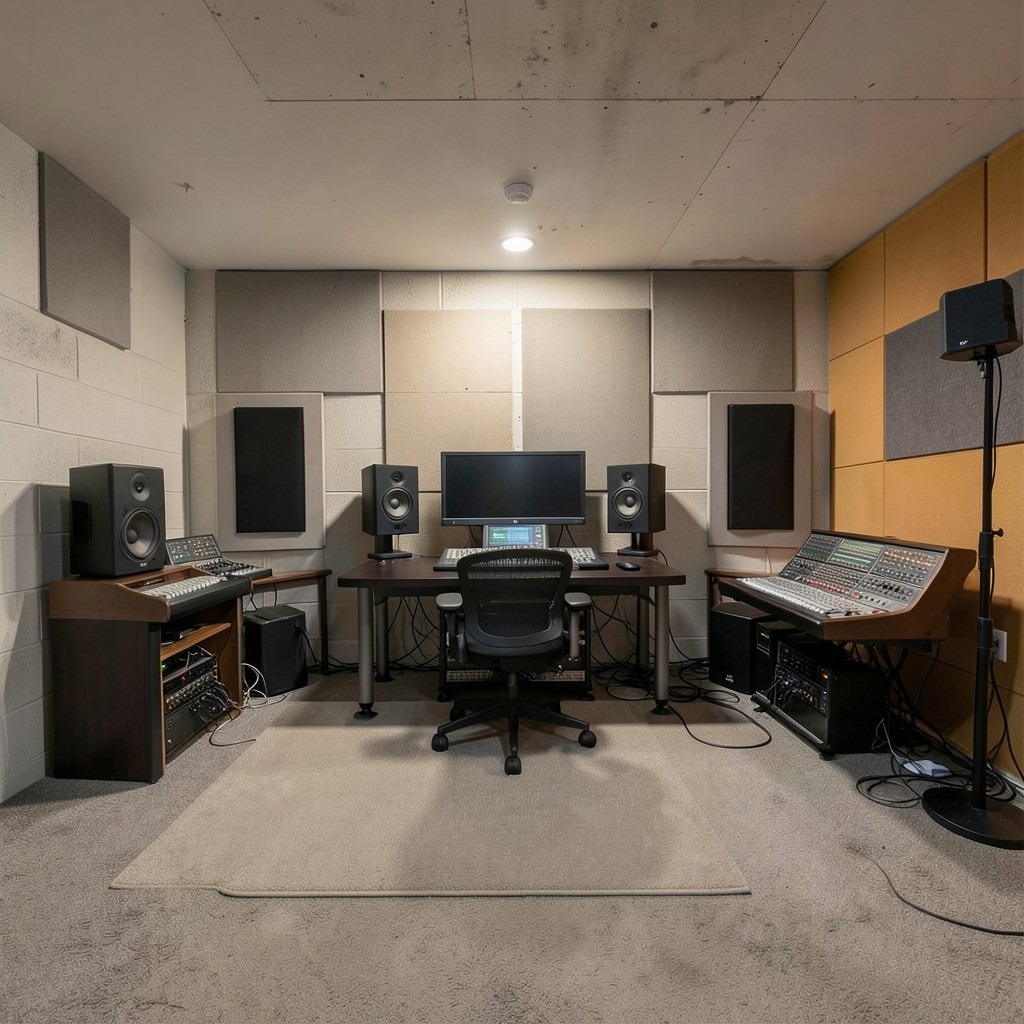
A recording studio in the basement occupies the space that the building’s physics have already prepared for the purpose — the below-grade location provides the sound isolation from street noise and household activity that above-grade rooms require expensive construction to achieve, and the basement’s typical concrete or block construction adds the mass-based sound barrier that studio acoustic consultants specify at considerable expense when building above-grade. The basement studio starts with structural advantages that money spent elsewhere in the house cannot replicate.
Acoustic treatment in the recording studio requires two distinct approaches that most home studio builders confuse — sound isolation, which prevents sound from leaving or entering the room, and acoustic treatment, which controls the behavior of sound within the room. The basement’s existing mass construction provides the foundation for sound isolation, supplemented by a room-within-a-room construction for the most demanding recording environments: a floating inner room built on resilient mounts that physically decouple the inner room’s walls and floor from the building structure, preventing the structural vibration transmission that flanking paths create in solid-connected construction. This double construction is the professional studio standard, and while its full implementation is expensive, even a partial version — a floating floor and independently supported walls in the tracking room — provides a measurable improvement in the isolation performance that affects the recording quality directly.
The control room and tracking booth layout — the two functional zones that professional recording studios separate for acoustic and workflow reasons — suits the basement’s typical rectangular floor plan when the room division aligns with the rooms’ specific acoustic requirements. The control room, where monitoring is performed, requires the most precise acoustic treatment, and its position should have the most symmetrical wall geometry to allow the monitoring position to be centered in the room’s acoustic field. The tracking booth, where instruments and vocals are recorded, requires absorption-heavy treatment to create the dead, dry recording environment that recording engineers prefer for post-production flexibility.
11. A Basement With a Children’s Playroom and Activity Zone
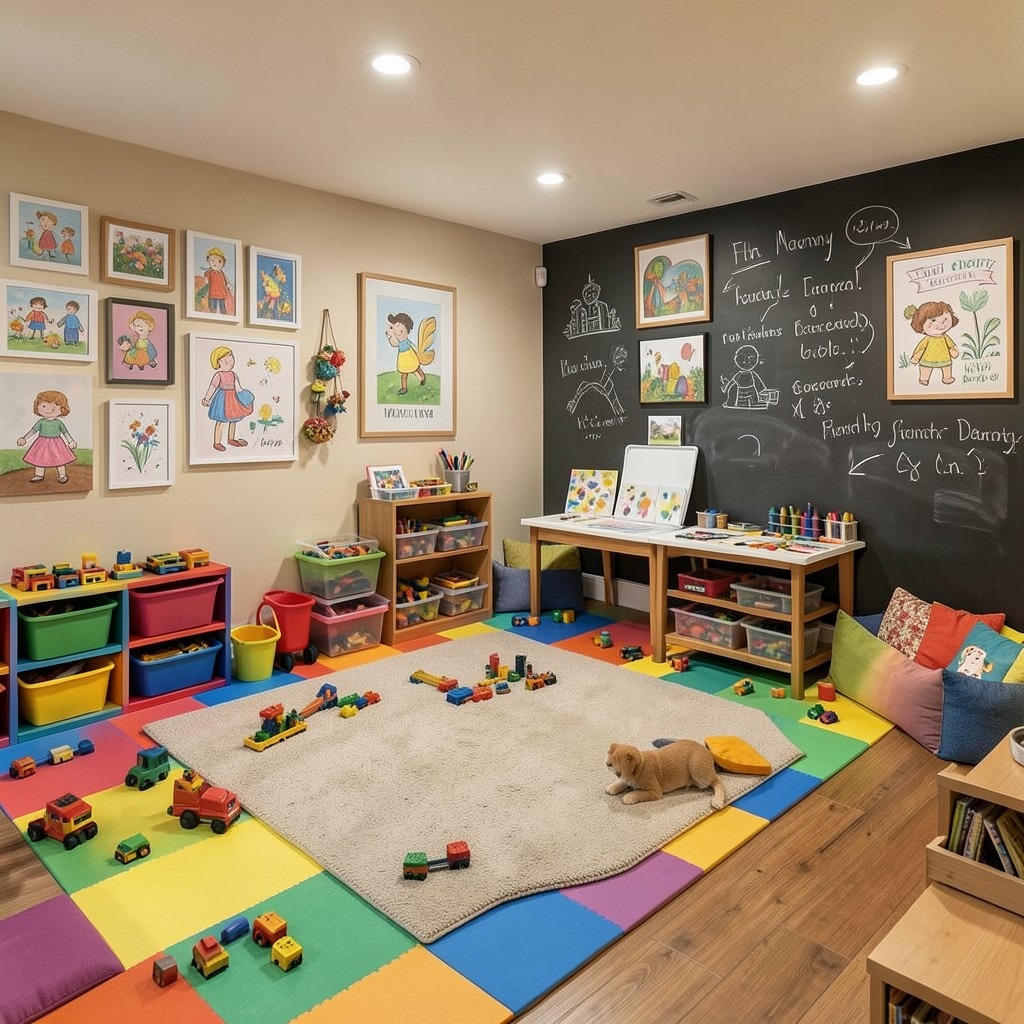
The basement children’s playroom is the design idea that provides the greatest relief to the household where the living room has been colonized by toys, art supplies, and the general detritus of active childhood — the relief of recovery. A dedicated basement playroom that contains the children’s activities within a space specifically designed for those activities returns the main floor rooms to their adult design intentions and gives the children a space where their mess, their noise, and their energy are not only tolerated but structurally anticipated by every design decision the room contains.
The playroom floor needs to handle the full range of children’s activities — LEGO construction, art projects, indoor physical play, and the general floor-level occupation that young children favor — without the fragility of surfaces that require protective treatment or careful maintenance. Foam tile flooring in a primary color grid creates the cushioned, colorful, easy-clean surface that the youngest children’s activities require, while an upgrade to luxury vinyl plank in a durable warm tone with a large area rug in the center suits an older child’s playroom aesthetic without sacrificing the durability requirement. Bohemian kids room decor principles applied here — colorful storage bins at child height, gallery-style artwork displays at the children’s eye level, and a reading nook in a corner with floor cushions and a low bookshelf — create a playroom whose atmosphere celebrates childhood rather than merely containing it.
A dedicated art station within the playroom — a table at the children’s height with a washable surface, organized art supply storage in clearly labeled open containers, and a painted chalkboard or whiteboard wall section beside the table — creates the creative infrastructure that makes art activities contained and independently accessible. The chalkboard wall is the one playroom element that genuinely improves with use, accumulating the drawings, the messages, and the creative expressions of the children who use it into a rotating display of family memory whose value no purchased decoration can match.
12. A Basement With a Luxurious Guest Suite
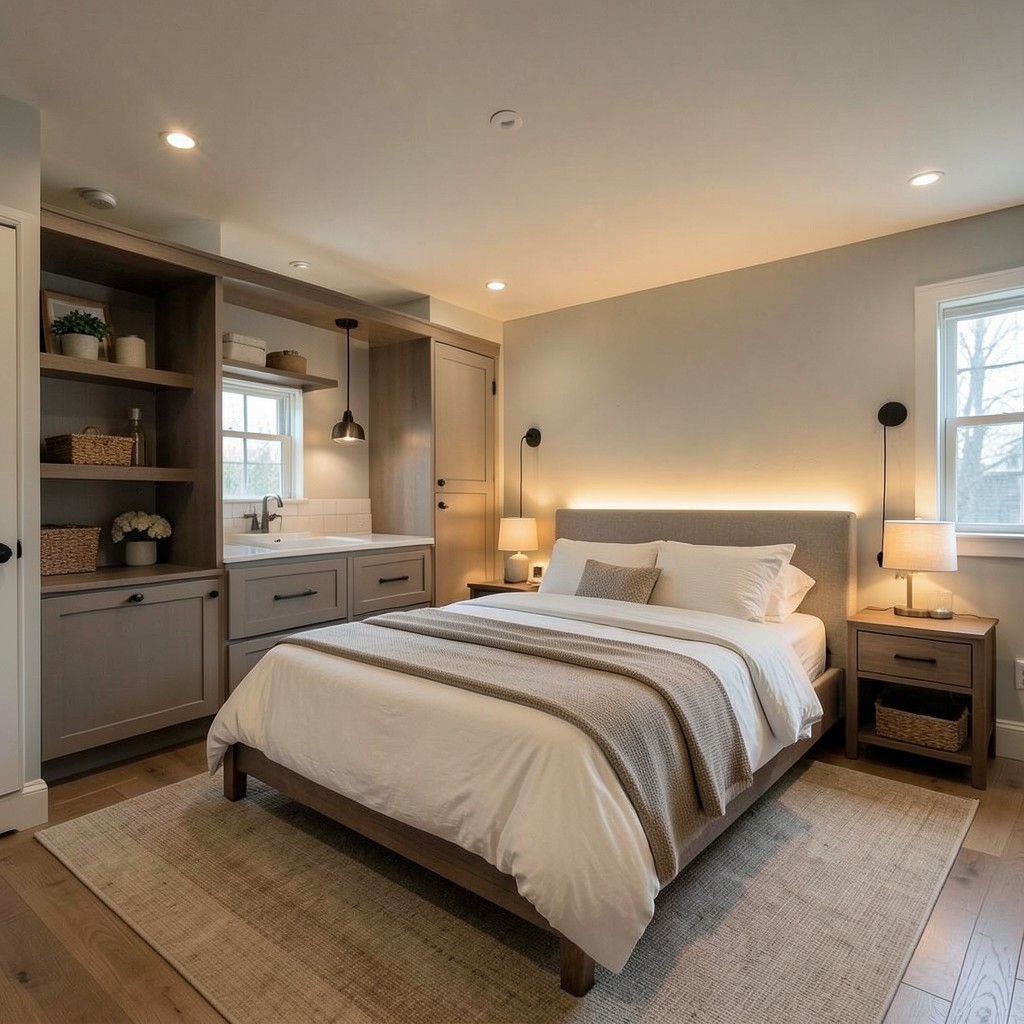
The basement guest suite is the accommodation solution that converts the household’s below-grade space from seasonal storage to a year-round asset — the guest who stays in a properly finished basement suite with a dedicated bathroom, adequate natural light, comfortable sleeping space, and a design quality consistent with the home’s upper floors has a qualitatively different experience from the guest who sleeps on a sofa bed in a space that the basement’s unfinished surfaces communicate was not designed for overnight habitation. The difference is not just comfort. It is the household’s hospitality statement, made in the quality of the accommodation provided.
The basement guest suite’s primary design challenge is creating the hotel-quality sleeping environment in a room with limited natural light, and addressing this challenge requires a lighting design that compensates for the absent daylight with quality artificial light that supports the full range of the room’s functions. A bedside reading light — a well-placed sconce or adjustable pendant at the correct height for in-bed reading — provides the task lighting that the sleeping and reading functions require. Ambient fill from a ceiling fixture or recessed downlights on a dimmer provides the room’s general illumination. And a soft accent light — a small lamp on the dresser, an LED strip behind the bed head — creates the warm atmospheric quality that cozy bedroom design requires for the settling-in and waking-up periods of the room’s use cycle.
The basement guest suite’s bathroom — a farmhouse bathroom decor influence applied to a compact three-fixture layout — should be designed to the same material standard as the main bathroom above it rather than to the value-engineered specification that basement bathrooms typically receive. A guest who uses the bathroom’s fixtures, faucets, and surfaces will experience the quality of each component directly and judge the accommodation’s overall quality accordingly. Specifying the same faucet finish, the same tile quality, and the same fixture brand as the main bathroom creates the material consistency that communicates care rather than compromise.
13. A Basement With a Bohemian Creative Studio
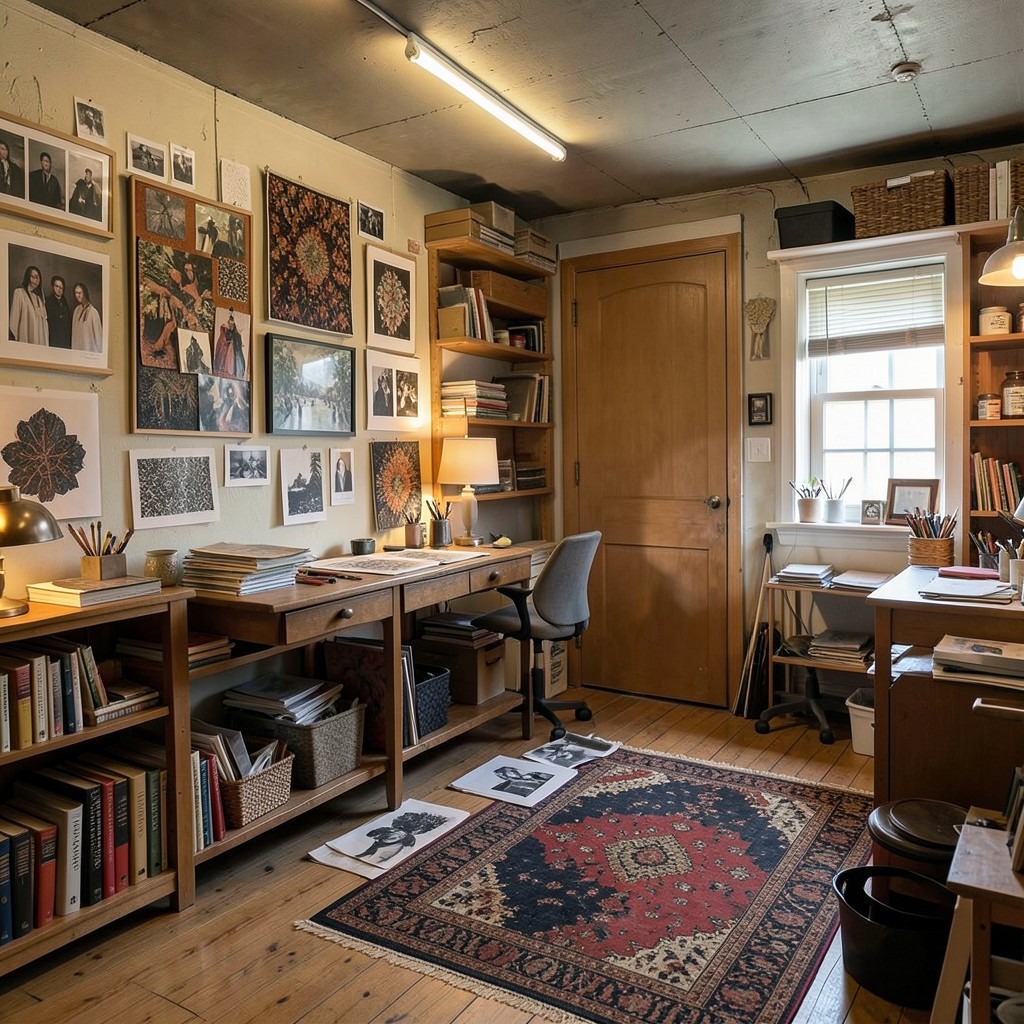
The bohemian basement studio gives the creative practice the space, the light, and the organizational freedom that a shared-room corner never fully provides — and the basement’s below-grade insulation from the household’s ambient noise creates the quiet that sustained creative work consistently requires. The studio that can be entered, the door closed, and the activity begun without the household’s daily sounds competing for the creative practitioner’s attention is a studio that produces better work than one in a shared room where the work and the household noise occupy the same acoustic space.
Bohemian home styling applied to the basement studio creates an environment of accumulated personal expression rather than a designed professional installation — the walls hung with reference images, textile samples, and the work-in-progress documentation that a creative practice generates; the shelving open and accessible with materials organized by category but not by the rigid precision of a storage system designed for visual presentation; and the floor area generous enough for the large-format work that fabric, canvas, and paper arts require when the work’s scale exceeds the table surface. This is the studio that looks chaotic to visitors and perfectly organized to the person who works there, and that apparent paradox — a room whose organization serves the work rather than the viewer’s comfort — is the studio design principle that most creative practitioners discover by experience and then reproduce deliberately in every subsequent studio space.
Natural and artificial light should be layered in the basement studio with the specific needs of the creative practice in mind — a painter needs color-accurate light at the work surface at a consistent intensity throughout the working day; a textile artist needs diffuse light that reveals the fabric’s texture without directional shadow; a photographer needs a controllable light environment that can be set precisely for the image-making context. The basement’s complete control over its light environment — achieved through artificial lighting systems and the absence of variable natural light — is the studio quality that above-grade rooms cannot match, because above-grade rooms must manage and work around the natural light that enters regardless of the work’s requirements.
14. A Basement With a Tropical Biophilic Design
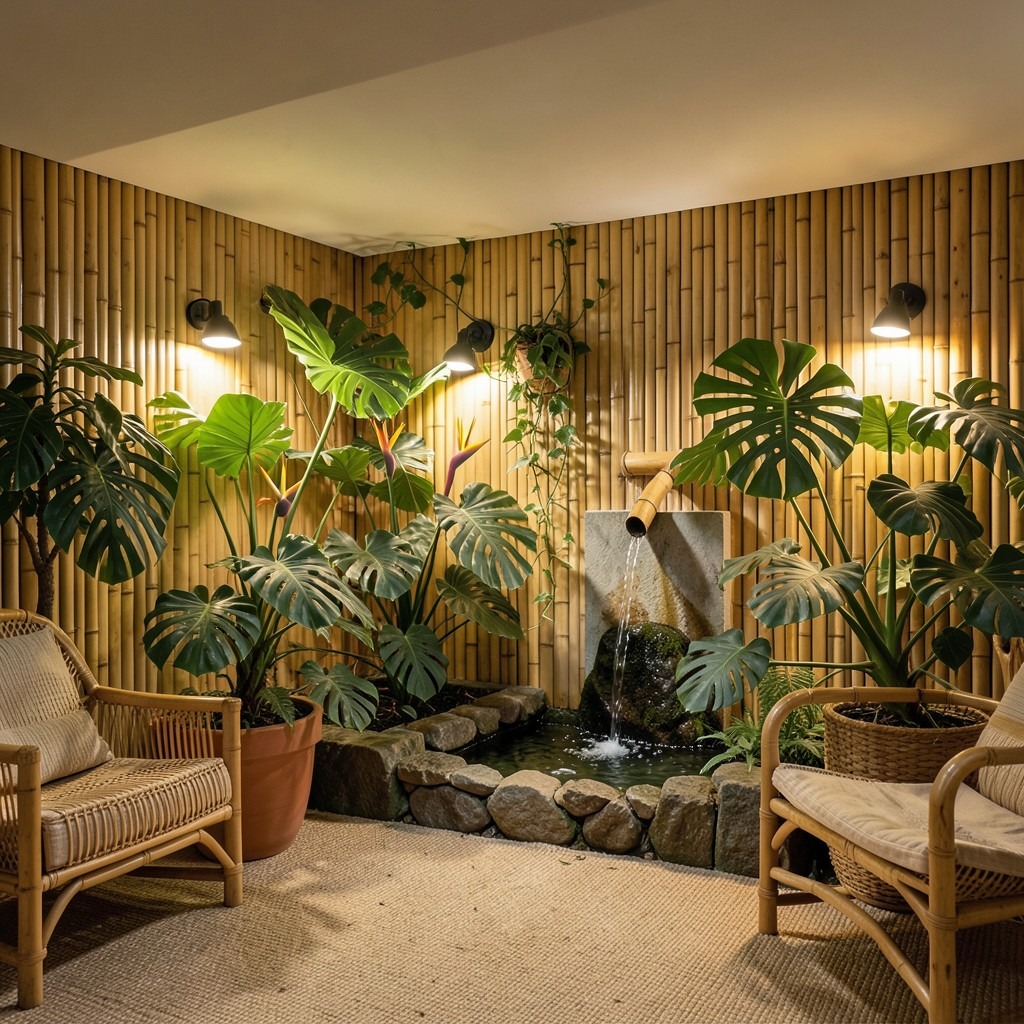
The tropical basement is the design idea that most directly confronts the underground room’s ambient quality — its enclosure, its separation from the outdoor world, and its absence of the visual connection to landscape and sky that above-grade rooms take for granted — and resolves it not by pretending the basement is above grade but by bringing the organic richness of the natural world inside with the full commitment that tropical home design and jungle-inspired home decor apply to creating interior environments of living, breathing natural character.
Large tropical plants — monstera deliciosa, bird-of-paradise, fiddle-leaf fig, and the large-leaved climbing aroids that tropical home design consistently features — require supplemental grow lighting in the basement’s limited or absent natural light environment. Full-spectrum LED grow lights positioned above each plant group provide the light spectrum that tropical plants require for healthy growth, and their warm output color suits the ambient lighting palette of the tropical basement setting. The plants’ presence in a basement creates an immediate improvement in the air quality, humidity management, and sensory richness of the space that no designed surface treatment alone approaches, and their living quality — the new leaf unfurling on the monstera, the flower opening on the bird-of-paradise — creates a dynamic visual interest that static design elements cannot replicate.
Bamboo home interiors elements applied throughout — bamboo panel wall cladding, bamboo furniture with natural rattan accents, and woven natural fiber floor coverings — create the material consistency of the tropical aesthetic without the literal exoticism of themed design. The bamboo wall cladding’s organic linear grain and warm golden tone create a surface of natural character that converts the basement’s concrete or drywall walls into surfaces of genuine material warmth, and the material’s connection to tropical environments suits the living plant installation that animates the basement’s interior environment. A small indoor water feature — a wall-mounted bamboo spout cascading into a stone basin — adds the sound and moisture of moving water to the tropical basement’s sensory environment, completing the organic atmosphere with the one element that visual design cannot provide.
15. A Basement With a Minimalist Meditation and Yoga Space
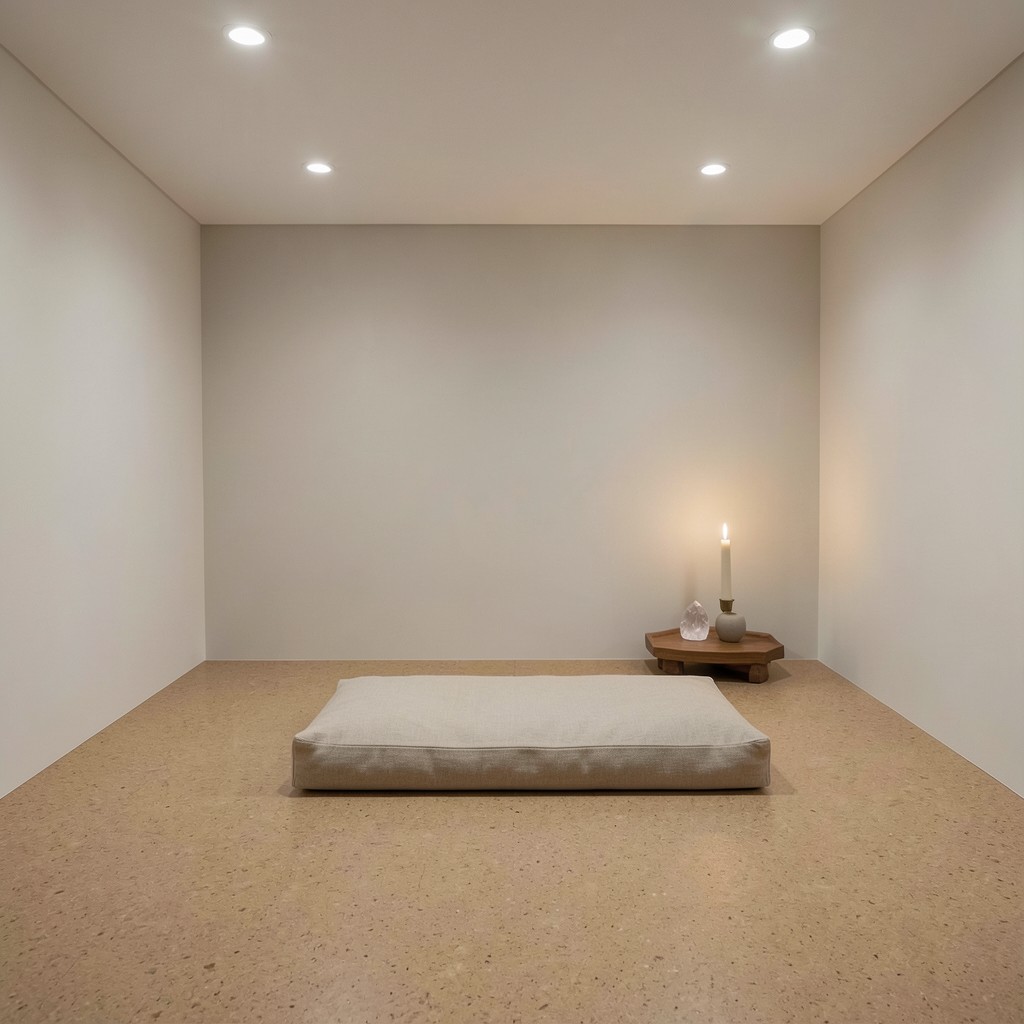
The basement meditation room is the design solution for the household member who needs a space of genuine silence, genuine stillness, and genuine privacy for the practice that restores their capacity for everything else. The basement provides the acoustic isolation and the separation from household activity that a bedroom-corner meditation practice cannot consistently achieve, and when the space is designed with the minimalist rigor and material restraint that the practice requires, it becomes the most important room in the house for the person who uses it — not because of what it contains, but because of what it excludes.
Minimalist home design applied to the meditation and yoga space means stripping the room to its absolute functional and sensory essentials — a smooth, clean floor surface appropriate for barefoot practice, a ceiling and wall palette that creates calm without visual distraction, adequate ventilation to maintain the air quality that extended breathing practice requires, and the lighting control that allows the room’s illumination to be adjusted from bright and energizing for active yoga practice to warm and dim for meditation and restorative poses. Nothing more. The minimalist meditation room is the design exercise in subtraction rather than addition, and the quality of the room is measured by the experience of being in it — the clarity it creates, the distraction it removes, and the quality of the practice it supports.
Cork flooring in a natural tone creates the meditation and yoga room’s ideal surface — warm underfoot, acoustically absorptive, soft enough to cushion the joints during floor postures, and resilient enough to handle the movement and weight transfer of standing practice without the rolling or bunching that mat-only surfaces create over a yoga session’s full range of movements. A single large cushion in a natural linen and a small altar or focal surface for the candle, the crystal, and the personal objects of the practice complete the room’s furnishing in a format that places everything the practice requires within reach and keeps everything the practice does not require outside the room.
16. A Basement With a Stone and Wood Mountain Lodge Interior
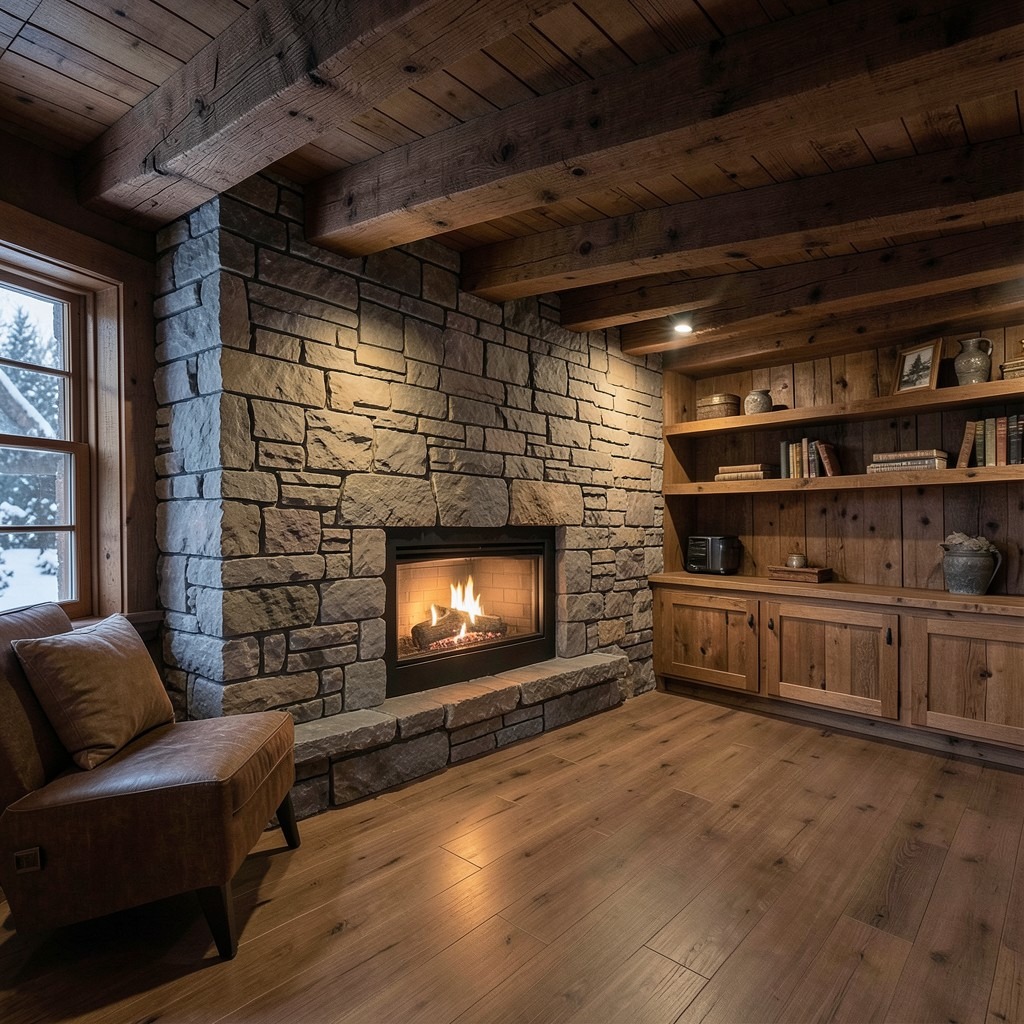
The mountain lodge basement applies the material vocabulary of mountain cabin decor to the below-grade space with the specific architectural logic that the lodge aesthetic most naturally inhabits underground — the heavy stone, the dark timber, and the enclosed warmth of the mountain lodge design direction create a basement interior of extraordinary atmosphere, particularly in the winter interior design season when the room’s warmth, weight, and sheltered quality resonate most directly with the outdoor cold that the household is retreating from.
Rough-cut stone cladding on the basement’s primary feature wall — a dry-stack limestone, a rough sandstone panel system, or a river rock mortar application — creates the foundation of the lodge aesthetic in a material that suits the basement’s underground character with conceptual precision. Stone belongs underground. A stone-clad basement wall does not require the visual persuasion that stone requires in an above-grade context, because the material’s connection to its own underground origin makes its presence in a basement room feel natural and contextually correct. Stone and wood home design applied at full commitment — the stone wall, the heavy timber beam ceiling, the solid oak floor, and the reclaimed wood shelving and furniture — creates the lodge interior whose material weight and organic richness create the warmth and shelter that the aesthetic values above all other qualities.
A wood-burning or gas fireplace insert in the stone feature wall — properly vented through the basement ceiling and the floors above to the exterior — creates the mountain lodge interior’s central focal point, the fire that defines the gathering place in every lodge, cabin, and mountain home design tradition. The fireplace’s heat contribution to the basement’s winter comfort is supplemental rather than primary, but its atmospheric contribution is primary in every sense — the basement with a fireplace is a different room from one without it, and the difference is felt rather than seen.
17. A Basement With a Dedicated Home Office
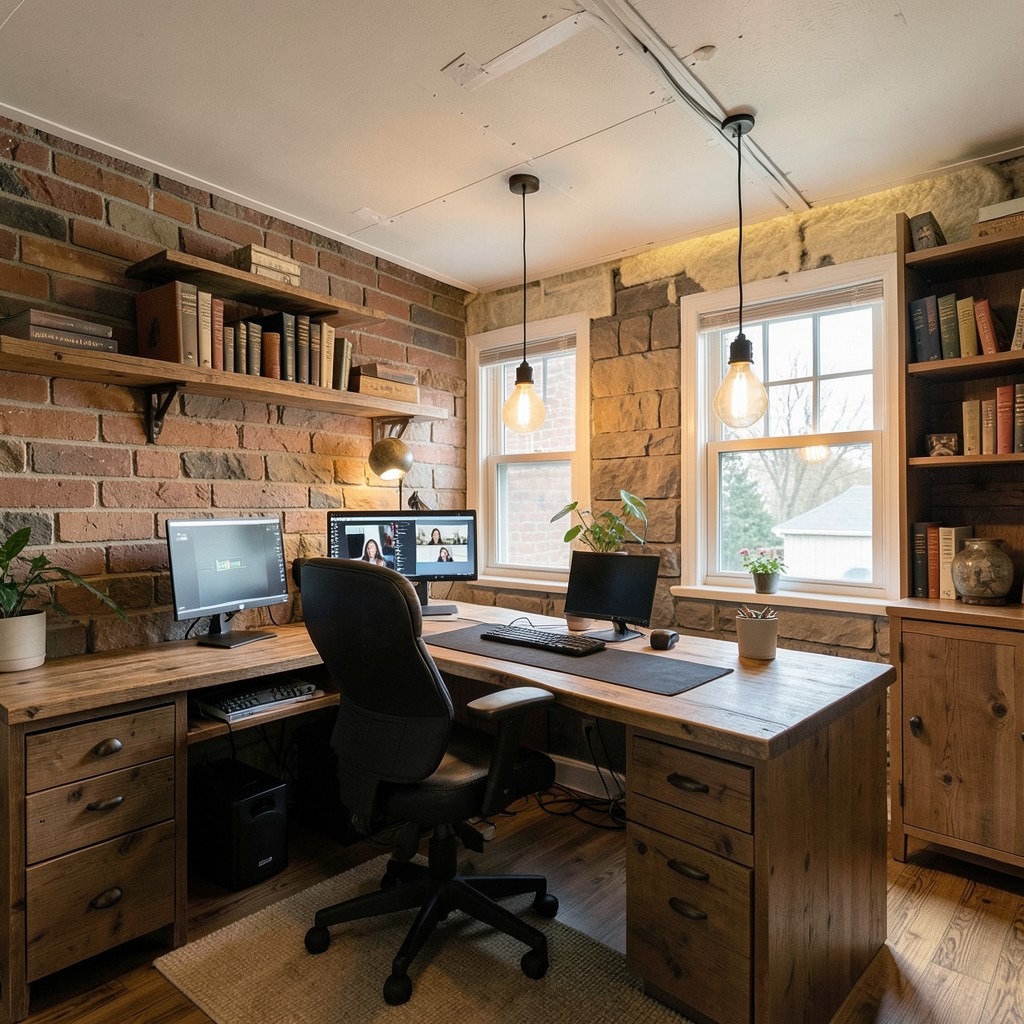
The basement home office is the workspace solution for the household member whose work demands the acoustic privacy, the separation from domestic distraction, and the professional focus that no shared main-floor space consistently provides. Working from a bedroom, a kitchen corner, or a living room demands constant vigilance against the household’s sounds and activities, and that vigilance itself — the background monitoring of what is happening around the work — consumes the cognitive capacity that the work itself requires. The basement office removes this demand entirely.
Acoustic treatment in the basement office focuses on the ceiling — the primary sound transmission path between the workspace and the household above — rather than on the walls, which the basement’s concrete construction already manages effectively. Resilient channel mounting for the ceiling drywall, a heavy-gauge drywall installation, and the addition of acoustic mineral wool within the ceiling cavity between the basement and the floor above create the sound isolation that converts the basement office from a quieter-than-average workspace to a genuinely isolated professional environment. This investment in ceiling acoustic treatment pays back every day in the quality of the phone calls, video conferences, and focused work sessions that the office supports without the household noise interruptions that above-grade offices accumulate.
Rustic home office ideas applied to the basement office’s aesthetic — an exposed brick or stone accent wall, reclaimed wood shelving, warm Edison-style pendant lighting above the desk, and a solid wood desk surface in a characterful natural material — create a workspace of genuine personal quality that connects the office’s design to the household’s broader aesthetic rather than applying the generic corporate-neutral palette that most home office advice defaults to. The office you want to spend time in is the office you produce good work in, and the design of that office is worth the same consideration given to any other room in the house.
18. A Basement With a Coastal Beach House Aesthetic
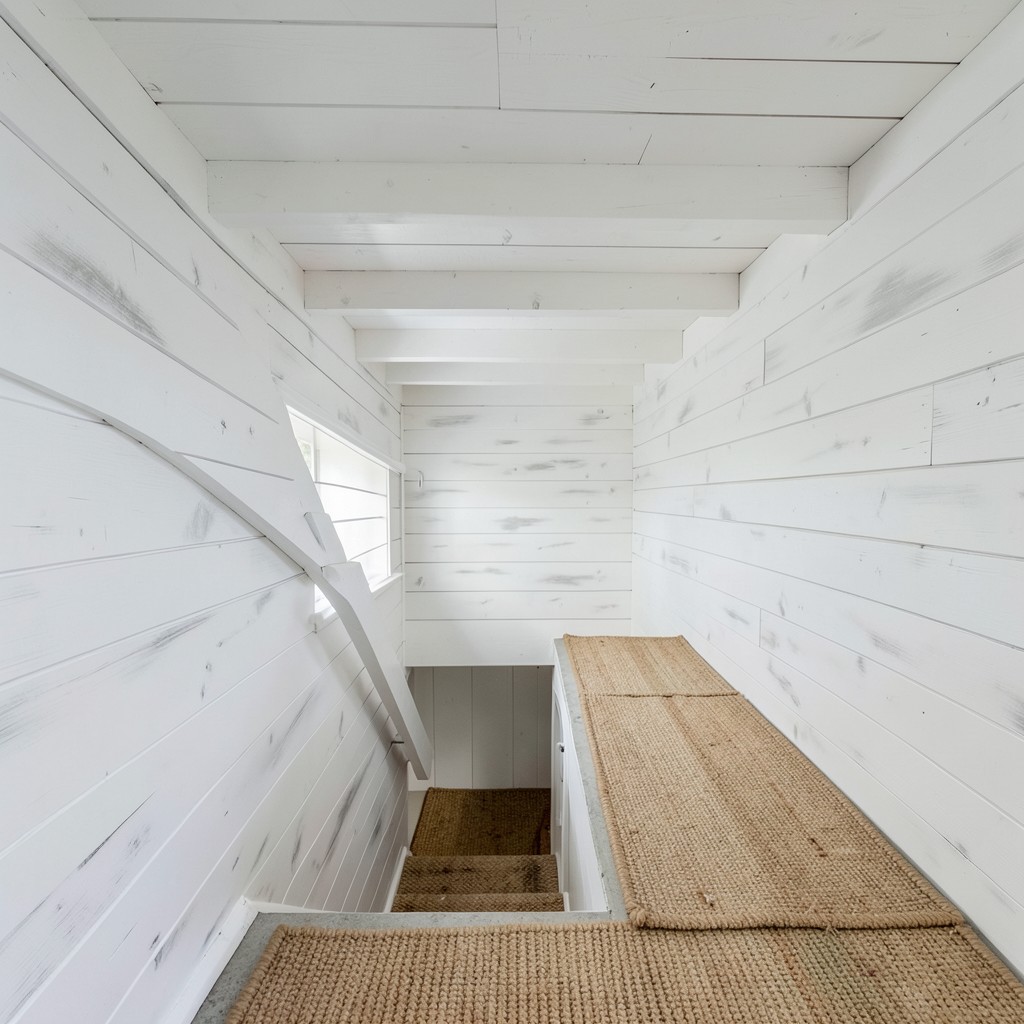
The coastal basement is the design decision that the house’s below-grade floor becomes a beach house interior extension — the place where the household brings the relaxed, sun-washed, materiality-light quality of beach house interiors into the room that is physically furthest from the beach, and does so with enough conviction that the distance becomes irrelevant. The coastal basement succeeds when you walk down the stairs, breathe in the air of the space, and feel the atmospheric shift that the design creates regardless of what the weather outside is doing.
Whitewashed plank paneling on the basement walls — either tongue-and-groove in a wide format or shiplap applied horizontally — creates the beach house wall surface whose weathered, slightly bleached appearance suits the coastal home design palette’s emphasis on sun-faded natural materials. The whitewash treatment — a diluted white paint applied and then partially wiped before drying to allow the wood grain to show through the white film — creates the distinctive coastal surface that pure white paint and unpainted wood both fail to achieve separately. Coastal home design applied to the basement’s ceiling — white-painted exposed joists or a white beadboard ceiling panel system — continues the pale palette overhead without the drop ceiling that conventional basement finishing typically installs.
Natural fiber flooring in the basement coastal space — a sisal or jute area rug over a sealed concrete or vinyl plank base — creates the beach house tactile quality that hard smooth flooring lacks and that carpet’s maintenance requirements make impractical in a space prone to the humidity fluctuations that below-grade rooms experience. The natural fiber rug’s texture and warmth connect the floor surface to the coastal material palette’s emphasis on organic, sun-bleached natural materials, and its color — the natural cream and brown tones of undyed sisal — suits the whitewashed wall and pale ceiling palette with the relaxed, breezy home interiors quality that the coastal aesthetic requires as its defining atmospheric characteristic.
19. A Basement With a Dark, Moody Cinema Lounge
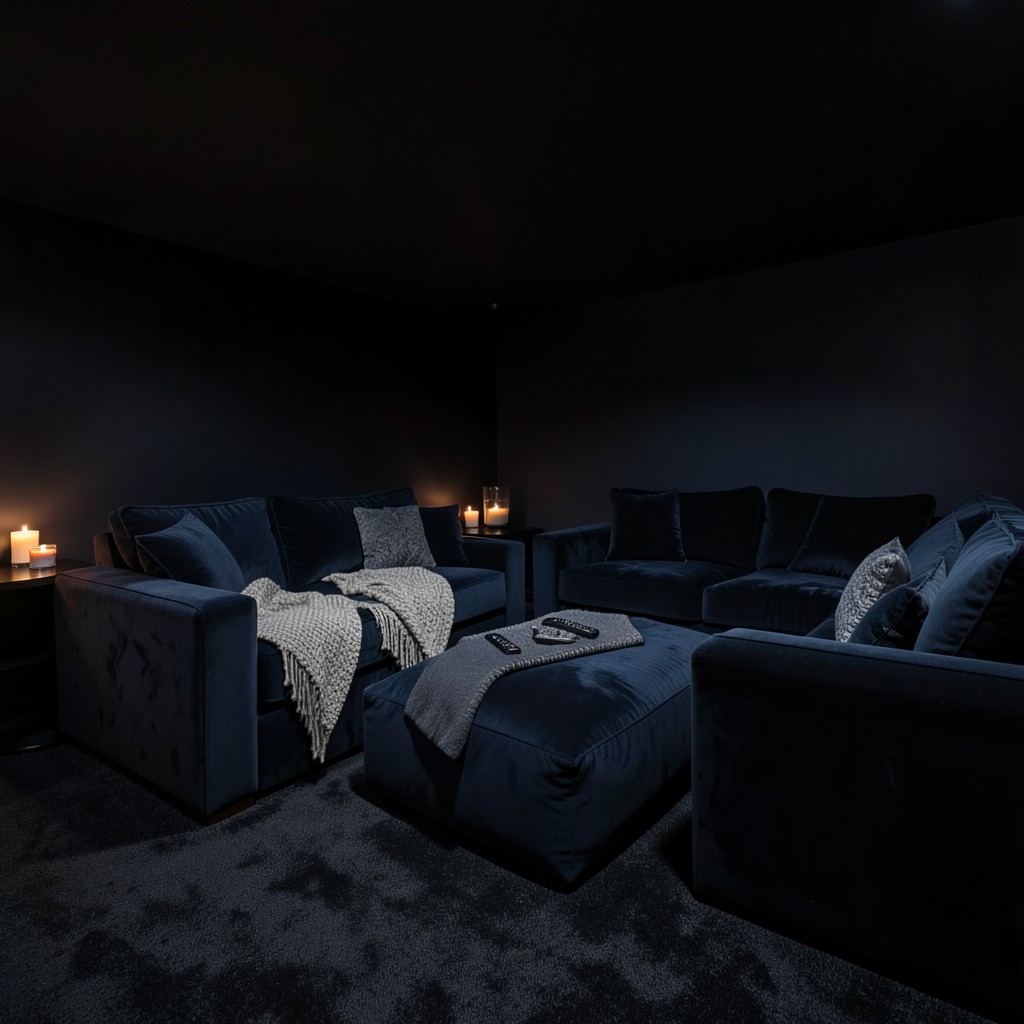
The cinema lounge basement is the moody, atmospheric alternative to the structured home theater — less about engineering the optimal acoustic and visual cinema experience and more about creating the room where watching films feels like an event, where the space itself contributes a quality of occasion to the activity. The cinema lounge is where the household goes when they want to watch something that deserves more than the living room sofa, and the design of the room communicates that understanding from the moment the lights go down.
Deep, saturated color on every surface — the walls in a near-black navy, the ceiling in a flat black, the floor in a dark charcoal plush carpet — creates the enclosed, cocoon quality that the cinema lounge aesthetic requires. The dark palette absorbs light rather than reflecting it, preventing the ambient light bleed that light-colored surfaces create in a room whose projection screen or large-format television requires the surrounding surfaces to contribute zero visual competition. Every pale or reflective surface in a cinema room is a source of ambient brightness that reduces the perceived contrast ratio of the image on screen, and the dark palette is the design decision that prioritizes the viewing experience above the room’s daytime appearance.
Plush seating in a deep velvet or performance fabric — large-scale sofas with deep seat cushions, an oversized ottoman that doubles as a footrest and a surface for snacks and remotes, and a few large floor cushions for the front position — creates the seating comfort that extended film watching requires. The cinema lounge’s seating differs from the structured theater’s tiered arrangement — it is informal, varied in height and orientation, and designed for the social viewing experience of a household gathering rather than the individual focused experience of a cinema seat. The warmth of a few table candles on a side surface, the smell of the room — specifically chosen scented candles or an oil diffuser in a warm, dark fragrance — and the weight of a heavy throw blanket on the lap create the full sensory environment of the cinema lounge that the screen alone cannot provide.
20. A Basement With a Dedicated Craft and Hobby Room
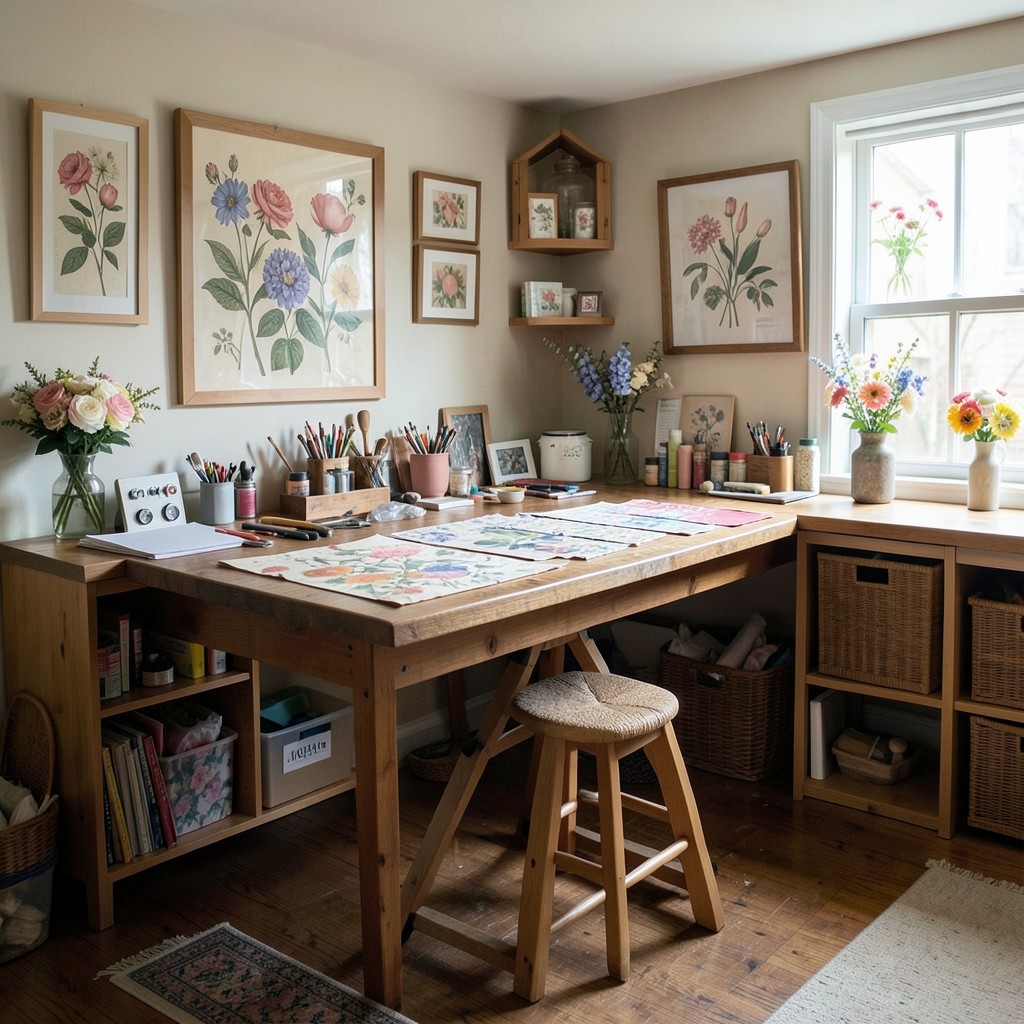
The craft room basement gives the household’s creative hobby practitioner the space, the organization, and the material access that a dining table or a bedroom corner can never sustainably provide — and the specific organization of a dedicated craft room, designed around the particular materials and processes of the practice it serves, is what separates a genuinely functional craft space from a storage room that also has a table in it. The dedicated craft room is designed for the craft. Everything else follows from that.
Storage in a craft room must be organized by use frequency and material category — the supplies used daily should be at immediate reach from the primary work position, the supplies used weekly should require a single step or reach to access, and the seasonal or project-specific supplies should be in closed storage accessible without disruption to the primary work area. This organization principle sounds obvious and is almost universally ignored in favor of the impulse to simply find a container for everything and label it. The container system without the use-frequency hierarchy creates a craft room that is organized in appearance and disorganized in function — everything is labeled, nothing is findable at speed.
The work surface in the craft room should be calibrated to the height that the primary craft requires — a lower surface of thirty inches for seated detailed work, a standard counter height of thirty-six inches for standing cutting and assembly, and a generous depth of at least twenty-four inches for the layout space that fabric, paper, and pattern work require. Multiple surfaces at different heights, or a single surface with an adjustable stool that allows seated work at varying heights, accommodates the range of postures that a full crafting session typically moves through. Floral home decor ideas applied to the craft room’s decorative elements — pressed flower frames, a vintage botanical print on the wall, a vase of fresh-cut stems on the windowsill if a window exists — create the aesthetic connection between the craft room’s decorative quality and the floral and botanical work that many craft practices produce.
21. A Basement With a Traditional Library and Reading Room
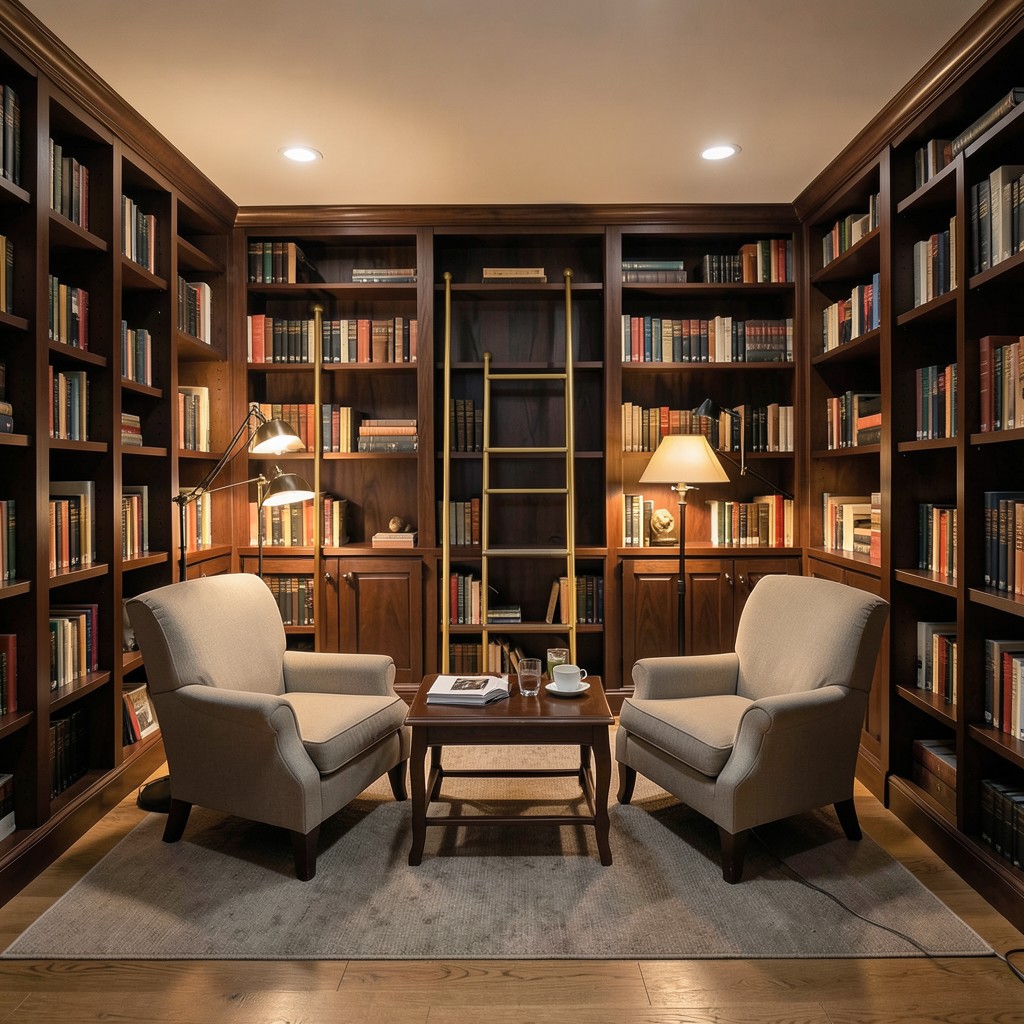
The basement library is the room that the book-owning household has been waiting for without knowing it — the room where the collection can finally be housed at a scale that the upstairs rooms cannot accommodate without displacing furniture, overcrowding shelves, or storing books in boxes. A proper library requires wall space, and the basement’s full perimeter of uninterrupted wall surfaces, free from the windows and doors that fragment the upper floors’ wall availability, offers more continuous shelving potential than any other room in the house.
Floor-to-ceiling built-in bookshelves on the basement library’s perimeter walls — in a solid wood or high-quality MDF construction with a painted or stained finish that suits the library’s design direction — create the reading room’s primary architectural character and its primary organizational function simultaneously. Traditional home interiors library shelving in a dark mahogany or rich walnut stain, with a rolling library ladder on a brass rail that spans the bookcase run, creates the classic library aesthetic that no prefabricated shelving unit approaches in either visual quality or functional capacity. The ladder is not purely decorative — a library whose upper shelves are not accessible without it is a library that stores books rather than organizes them, because inaccessible books are effectively stored books regardless of the shelf’s quality.
A seating arrangement at the library’s center — a pair of upholstered reading chairs with floor lamps positioned at the over-the-shoulder reading angle, flanking a low table for drinks and notes — creates the library’s inhabitable core, the functional purpose that the bookshelves serve. The reading chair’s material quality should be the highest in the room’s furnishing — a chair that is comfortable for two to three hours of continuous reading without postural fatigue is the chair that the library is actually used for its purpose, and the chair that becomes uncomfortable at thirty minutes is the reason the library becomes a room that is admired but not occupied.
22. A Basement With a Bright, White Open-Plan Design
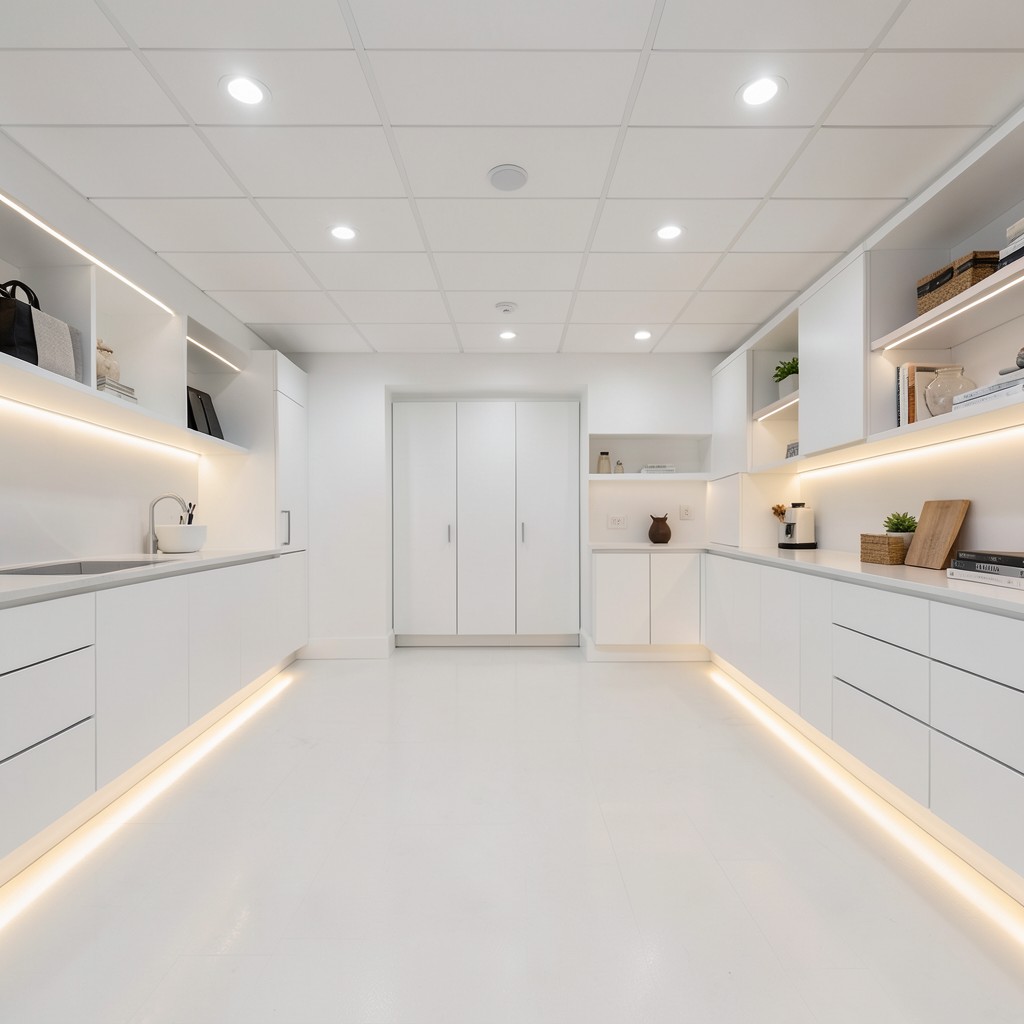
The white basement is the design response to the underground room’s light challenge that does not make concessions — it does not accept that a basement must feel dark, and it does not try to disguise the basement’s nature with warm tones and soft lighting. It attacks the light problem directly with the design tools that light amplification requires: reflective pale surfaces throughout, layered artificial lighting at every functional zone, and the spatial openness of an open plan that prevents walls from creating the dark shadows that partitioned basements accumulate. The result, when executed with commitment, is the basement that surprises every visitor who descends expecting the underground aesthetic and finds a room as bright as any above-grade space in the house.
Bright home design applied to the basement starts with the floor — a light-toned luxury vinyl plank or a polished concrete in a warm white tone reflects the overhead lighting back into the room from the largest horizontal surface, creating the most efficient light amplification available. The floor’s light reflection quality determines how much of the room’s artificial lighting budget ends up as useful ambient illumination versus wasted absorption into a dark floor surface, and choosing a light floor in a basement is a functional decision before it is an aesthetic one. White walls and a white ceiling in a flat or eggshell finish create the uniform reflective envelope that bounces the lighting between all six surfaces of the room, creating the even, diffuse ambient quality that single-source overhead lighting cannot achieve in a space without natural light.
Recessed LED downlights in a grid pattern — spaced evenly across the ceiling at a density that provides even illumination across the full floor area without hot spots directly below each fixture — provide the primary ambient layer. LED strips in a warm 3000K temperature along the toe-kick of any cabinetry, under floating shelf units, and behind display features create the secondary accent layer that gives the bright basement its depth and its visual interest beyond the plain ambient illumination. The combination of ceiling downlights and low-level LED accents in a white room creates the airy home interiors quality that makes the basement feel not just bright but spacious and genuinely pleasant — a room that neither looks nor feels like a basement.
23. A Basement With a Desert-Inspired Adobe Aesthetic
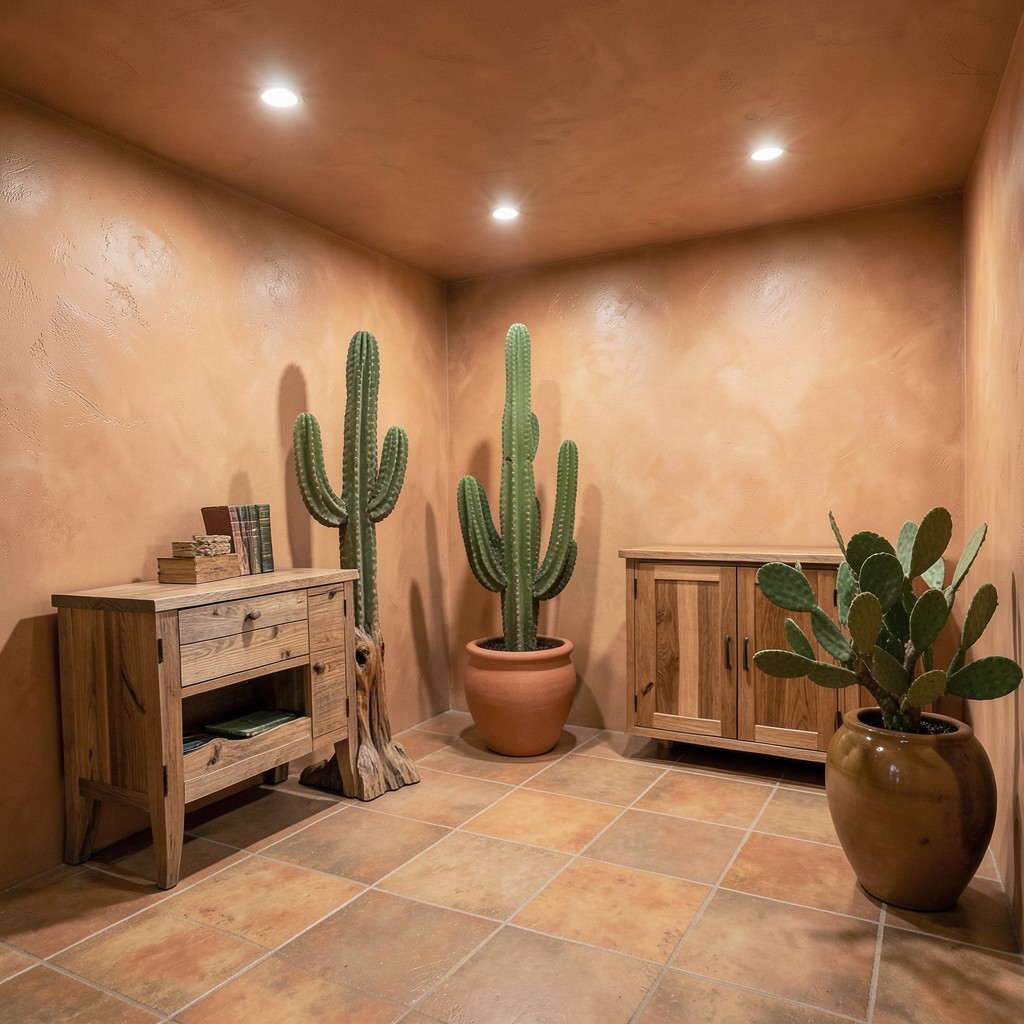
The desert basement applies the warm, mineral-rich palette of desert home styling to the underground space with a design logic that suits the basement’s physical character — the earth-toned walls, the terracotta surfaces, and the warm sandy textures of the desert aesthetic connect to the below-grade room’s literal connection to the earth in a way that no above-grade design direction shares. The desert basement does not pretend to be anywhere other than where it is. It draws from the quality of that location — the earth, the stone, the mineral warmth of the underground — and makes it beautiful.
Adobe-toned wall plaster — a warm Venetian plaster in a sandy terracotta or sun-baked clay tone, applied over the basement’s drywall or directly onto textured concrete surfaces — creates the desert aesthetic’s primary wall expression in a material that suits the below-grade environment’s stable humidity and temperature conditions. The Venetian plaster’s slightly shiny surface reflects the basement’s artificial lighting with a warm, atmospheric quality that flat paint cannot achieve, and the hand-applied texture variation creates the organic surface character that the desert adobe vernacular expresses in its historically hand-worked earthen walls. Earthy home design extended through the flooring — large-format terracotta tile or a warm-toned concrete overlay in an earthy oxide pigment — grounds the space in the mineral warmth that desert home styling applies consistently across all horizontal surfaces.
Natural wood elements in a sun-bleached or muted warm stain — mesquite, acacia, or live-edge local hardwood in the furniture and shelving — provide the organic counterpoint to the plaster and tile surfaces’ mineral quality. A few deliberately placed desert plants — a large saguaro cactus arm in a carved wooden stand, a cluster of tall columnar cacti in a terracotta planter, or a spreading prickly pear in a glazed desert-tone ceramic vessel — introduce the living material of the desert landscape into the basement interior without the care requirements that tropical plants demand in a low-light environment.
24. A Basement With a Vintage Game Room
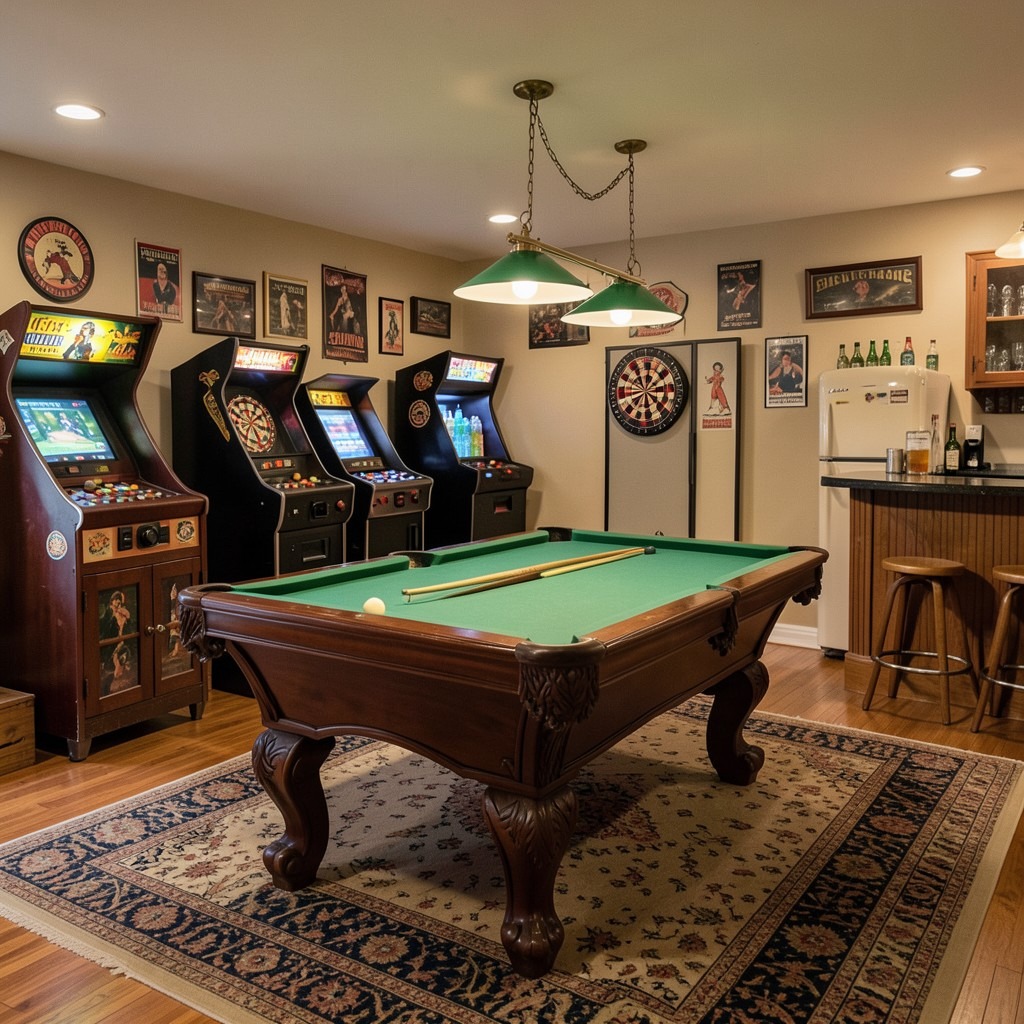
The vintage game room basement creates the social destination that most households want and most basements fail to become — the room that people are genuinely excited to spend time in, that generates the particular atmosphere of relaxed, playful gathering that the upstairs rooms’ design standards prevent. The vintage game room achieves this through the specific combination of period-appropriate design elements and the full range of gaming entertainment that its dedicated space allows.
A regulation-size pool table at the room’s center — billiard green felt, a solid hardwood or slate playing surface, and pendant lighting hung precisely at the play height to illuminate the table without glare — creates the game room’s primary activity and its primary design anchor simultaneously. The pool table’s size requirements — approximately five feet of clearance on all sides for cue extension — determine the room’s minimum functional dimensions, and this sizing calculation should be the first step in the game room’s floor plan development before any other element is positioned. A vintage table in a period-appropriate style — a deep mahogany cabinet with carved leg detail, or a clean mid-century aluminum and wood frame — suits traditional home interiors and warm home decor ideas game room settings respectively.
Period arcade cabinets in working condition, a dedicated dart board section with appropriate surround protection, and vintage sports memorabilia on the walls create the game room’s atmosphere beyond its primary activity. The vintage aesthetic in the game room is not merely decorative — it is the design direction that creates the room’s specific social atmosphere, distinct from the living room’s sophistication and the home theater’s cinematic focus. A small bar section at the room’s perimeter, a retro-style refrigerator stocked with cold beverages, and period-appropriate bar stools create the refreshment infrastructure that extended game sessions require without interrupting the room’s activity flow.
25. A Basement With a Spa-Inspired Bathroom and Sauna
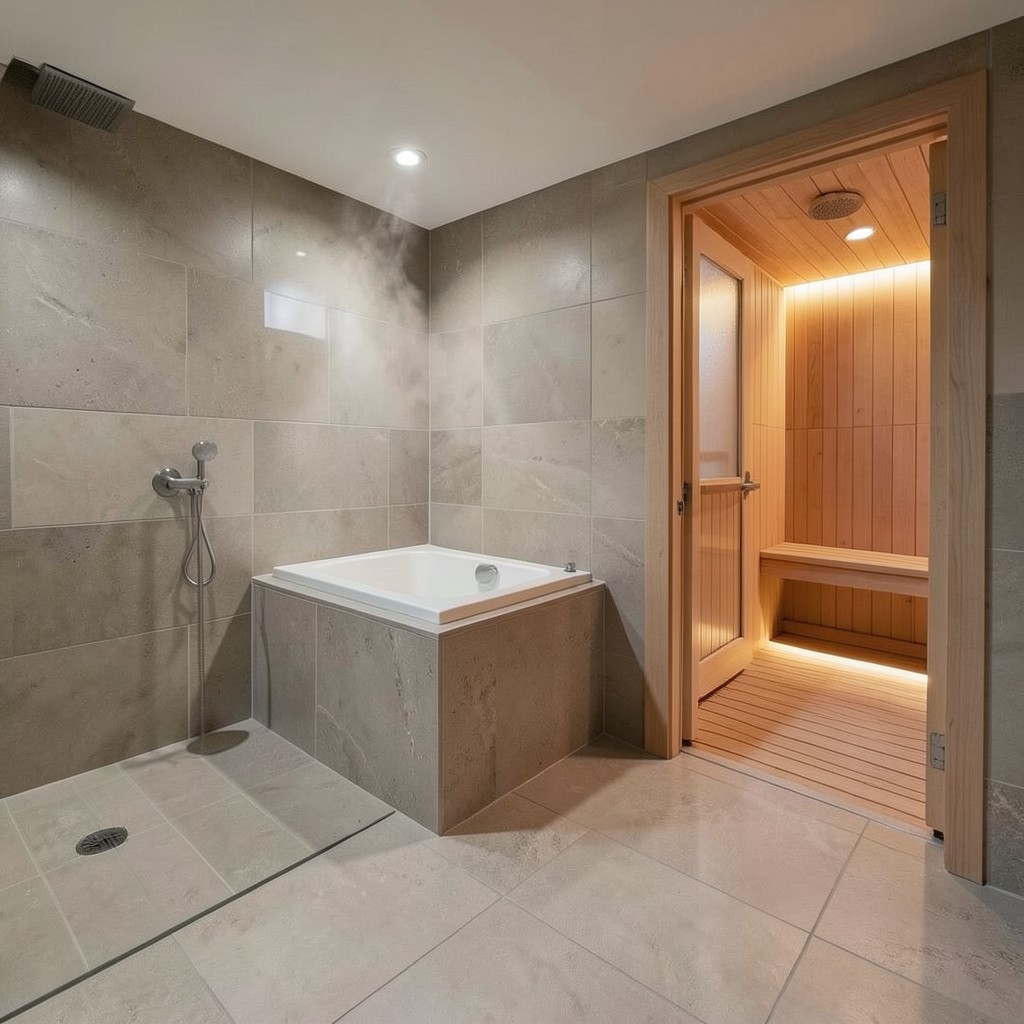
A spa bathroom installed in the basement gives the household the bathing experience that the main floor bathroom, with its shared schedule demands and its daytime-accessible position in the house, never consistently provides — the experience of bathing without time pressure, without ambient household sounds penetrating the room, and in a space specifically designed for extended relaxation rather than efficient daily hygiene. The basement spa bathroom is the room that makes the homeowner feel, at least twice a week, that their house is genuinely a sanctuary.
A wet room format — a shower space, a soaking tub, and a steam generation system within a single waterproofed room — creates the spa experience’s immersive quality in a basement space whose structural floor slab provides the waterproof base that above-grade bathroom construction must create artificially. The wet room’s tile specification — large-format stone-look porcelain in a warm grey or beige tone on the walls and floor — creates the material continuity of a tiled spa space whose surfaces read as a composed environment rather than a functional necessity. Radiant floor heating beneath the tile transforms the bathroom floor from the coldest surface in the house to the warmest, which in a basement context — where the concrete slab’s thermal mass draws heat from the room’s air significantly — is the comfort upgrade that separates a luxurious basement bathroom experience from a merely attractive one.
A separate sauna room adjacent to the wet room — Finnish dry sauna or infrared cabin, depending on the household’s preference — extends the spa experience into the therapeutic heat treatment that Finnish sauna culture has made the center of domestic wellness practice for generations. The basement provides the sauna’s structural requirements — a ventable wall or ceiling for the heat management system, a wood-lined interior that resists the extreme heat cycling, and the spatial separation from the main living area that the sauna’s heat and humidity require. Elegant home styling applied to the sauna’s cedar or hemlock interior — precise joinery, clean bench proportions, and a frosted glass door that allows light to pass without revealing the interior — creates the architectural quality that distinguishes a thoughtfully designed sauna from a prefabricated kit installation.
26. A Basement With an Art Gallery Display Space

An art gallery in the basement treats the household’s art collection with the display quality and environmental conditions it deserves, rather than the ad hoc arrangement of pictures hung on living room walls around furniture, windows, and competing decorative objects. A dedicated display space — where the art can be viewed without distraction, lit with the precision that gallery display requires, and arranged in compositions that serve the individual work and the collection’s relationships — is the environment that makes art meaningful rather than merely decorative.
The lighting’s color temperature should be consistent throughout the gallery — a warm 3000K for paintings that benefit from warm illumination, a neutral 3500K for photography and mixed-media work whose color accuracy demands a more neutral rendering. The lighting system should be on dimmer circuits that allow the gallery’s ambient level to be adjusted for different viewing conditions — brighter for detailed close examination, dimmer for the atmospheric viewing experience that some works demand. Picture rail systems mounted at the ceiling perimeter allow the hanging positions to be adjusted without drilling new wall holes for each configuration change, making the gallery a dynamic display space that can be reconfigured as the collection evolves.
The gallery space’s wall color deserves more consideration than most people give it — the standard assumption that art must hang on white walls is a gallery convention borrowed from commercial white-cube exhibition spaces whose function is to provide a neutral backdrop that allows the artwork to define the room’s visual experience entirely. In a residential gallery basement, a warmer wall tone — a warm grey, a dusty putty, or a deep charcoal behind specific work groupings — can enhance rather than compete with the art, particularly for work whose palette contains warm tones that sing against a warm background. The wall color decision should be made in reference to the specific collection rather than in deference to gallery convention.
27. A Basement With a Dedicated Podcast or Video Studio
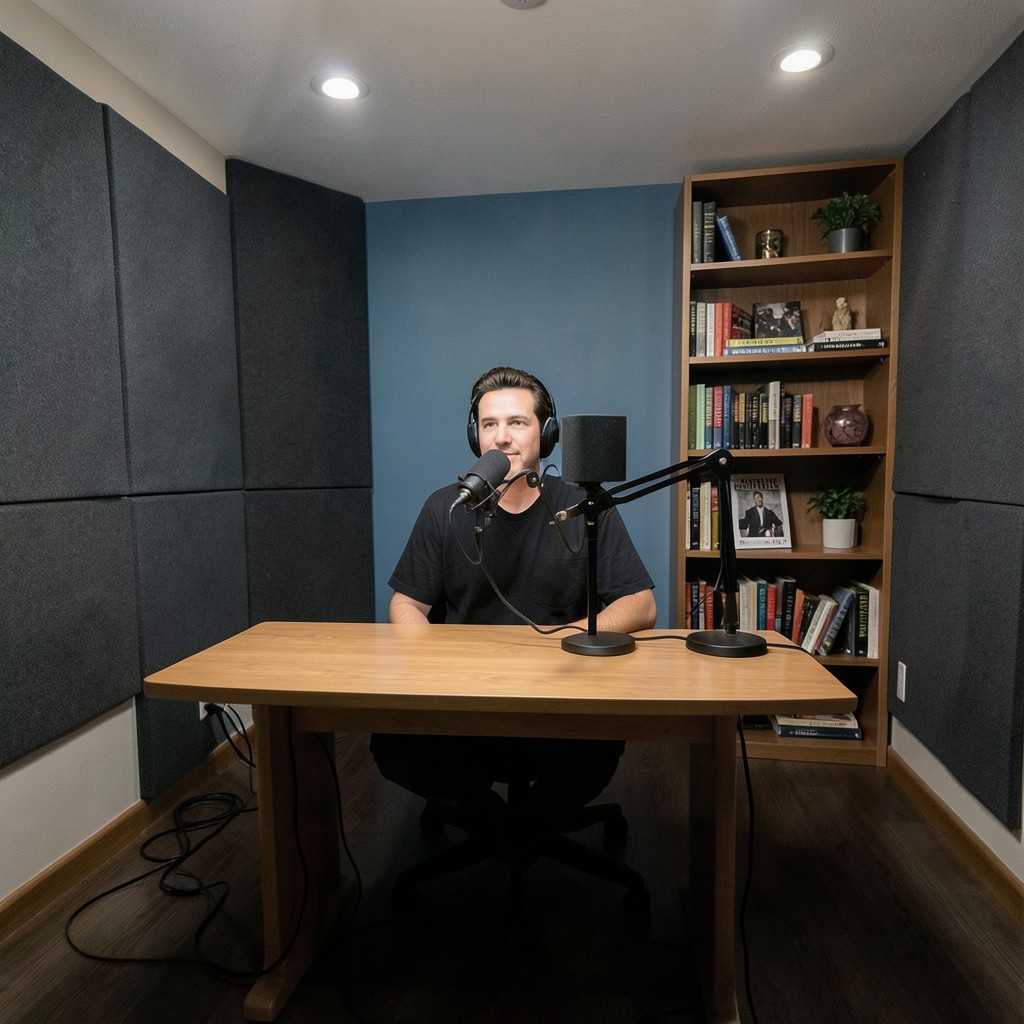
The basement podcast and video studio is the production space that content creators consistently discover provides their best audio and visual output — the acoustic isolation, the controlled light environment, and the separation from the household’s ambient noise that the basement’s below-grade position provides create the recording conditions that professional studios are expensive specifically to replicate. The basement provides these conditions at the cost of finishing and treating the space, which is significantly less than the cost of building or renting a studio whose physical conditions the basement already matches.
Acoustic treatment for the podcast and video studio prioritizes the recording area’s sound quality above the general room’s aesthetic — acoustic panels in a fabric-wrapped format at the primary reflection points around the microphone position, a bass trap installation in the two corners behind the recording desk, and a reflection filter or acoustic shield directly behind the microphone for close-range recording cleanliness. The treated recording position creates the dry, flat acoustic environment that professional podcast audio achieves, and the difference between a recording made in an untreated basement and one made in an acoustically treated recording position is audible to every listener on every playback device. Treatment is not optional for audio content whose quality determines the audience’s retention.
The video recording area requires a different design consideration — the visual backdrop that appears behind the presenter in the frame. A dedicated background wall in a solid color, a styled bookshelf arrangement, or a branded graphic panel creates the visual consistency that professional video content maintains across episodes. Lighting for the video position — a key light at forty-five degrees to the subject’s face, a fill light from the opposite side, and a hair light from behind and above — creates the three-point lighting setup that separates professional-quality video from the flat, shadow-heavy appearance of single-source lighting in an untreated room. The basement’s complete control over its ambient light conditions makes the three-point lighting setup precisely controllable in a way that a room with windows can never fully achieve.
28. A Basement With a Retro Arcade and Games Room
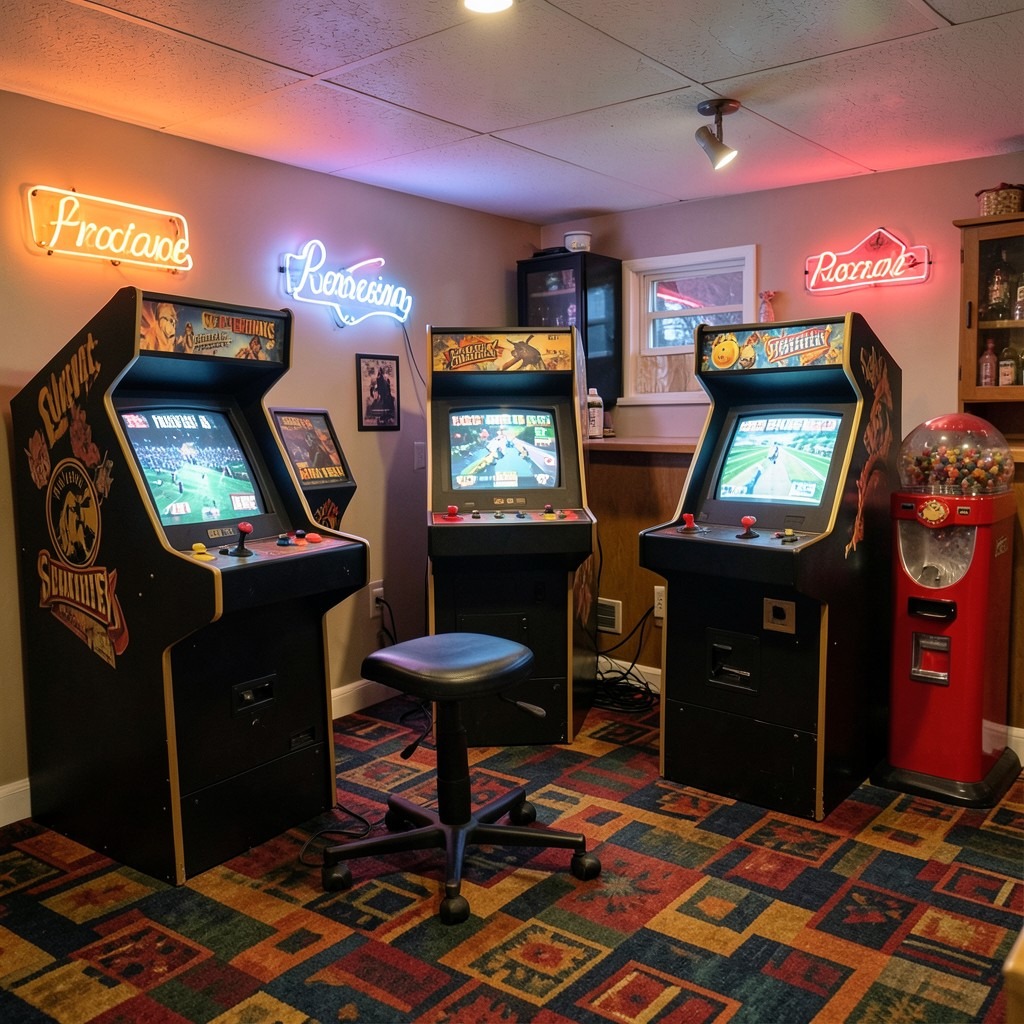
The retro arcade basement channels the specific nostalgia of the arcade experience into a residential space that the household’s gaming members use as the most consistently entertaining room in the house — the experience of playing a physical arcade cabinet, standing at a genuine joystick in a purpose-built housing with the original game running on period-appropriate hardware, is qualitatively different from playing the same game emulated on a television screen. The physical presence of the cabinet, the sound of the specific speaker, and the feel of the original control hardware create a sensory experience that no digital emulation fully replicates.
A collection of three to six working arcade cabinets — a mix of vertical and cocktail-style cabinets in restored or well-preserved original condition — creates the arcade room’s primary content and its design character simultaneously. The cabinets’ bezel artwork, the glow of their CRT or LED-backlit screens, and the varied heights and widths of different cabinet formats create an organic, varied visual arrangement that suits the retro gaming aesthetic’s deliberate imprecision and period charm. The basement’s ventilation system should accommodate the heat that operating CRT-screened cabinets generate — each cabinet’s power supply and CRT circuitry generates significant heat in operation, and a basement arcade room with six running cabinets requires active ventilation that the finished basement’s typical HVAC may not provide without supplemental exhaust.
Carpet in a retro geometric pattern — the kind of busy, slightly garish commercial carpet that actual arcades used in their heyday — creates the most committed and most authentically atmospheric arcade flooring choice, and its acoustic absorption quality suits the noisy, multi-speaker environment that a room full of working arcade cabinets generates. Neon sign accents on the walls, a vintage coin-op gumball or candy machine in the corner, and period-style bar lighting overhead create the complete arcade atmosphere that the cabinet collection anchors. During fall home decorating season when households spend more time indoors, the arcade basement becomes the household’s most-visited room and its most reliable source of the competitive, playful social atmosphere that indoor gathering in cooler weather requires.
29. A Basement With a Scandinavian Hallway Entry and Stair Design
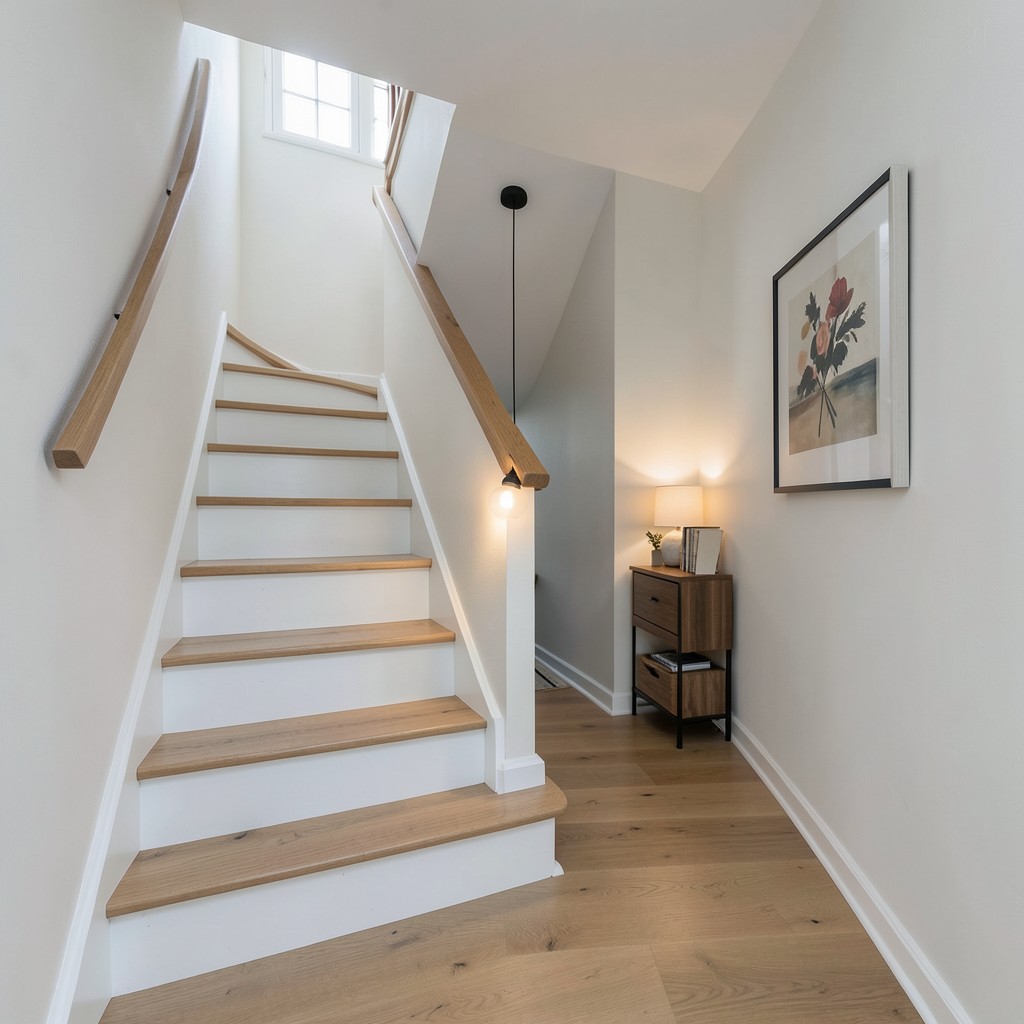
The basement staircase and entry hall are the design elements that most finished basements treat as transitional spaces — the architectural connective tissue between the upstairs and the downstairs that receives the minimum design attention and communicates the minimum design intention. This neglect creates the basement entry experience that makes every descent feel like leaving the designed part of the house and entering the utilitarian part, regardless of how well the basement’s main space has been finished. The entry deserves the same design consideration as the destination.
Scandinavian hallway design applied to the basement stair and entry creates the design continuity that makes the transition between floors feel intentional rather than abrupt. White painted stair risers with natural oak or ash treads — the Scandinavian palette’s signature combination of pale structure and warm natural wood — create the staircase that reads as a design element rather than a structural necessity. The tread’s wood tone should match or complement the basement’s floor material, creating the visual connection between the transition element and the destination that good hallway design consistently establishes. Pendant lighting on the stairwell wall — a single ceramic or glass pendant at the stair’s mid-height, on a long cord that drops it to the standing eye level of someone ascending — provides the illumination and the design gesture that the stair transition requires.
The basement entry landing — the floor area at the base of the stair where the transition from stair to basement floor completes — should be treated as a designed threshold rather than simply a floor section that the stair deposits you onto. A framed artwork on the end wall of the entry, a small credenza or console table with a lamp if the space allows, and a deliberate connection between the landing’s floor material and the room beyond it creates the entry experience whose quality communicates the basement’s design intention before the main space is even fully visible.
30. A Basement With a Warm, Earthy Bohemian Lounge
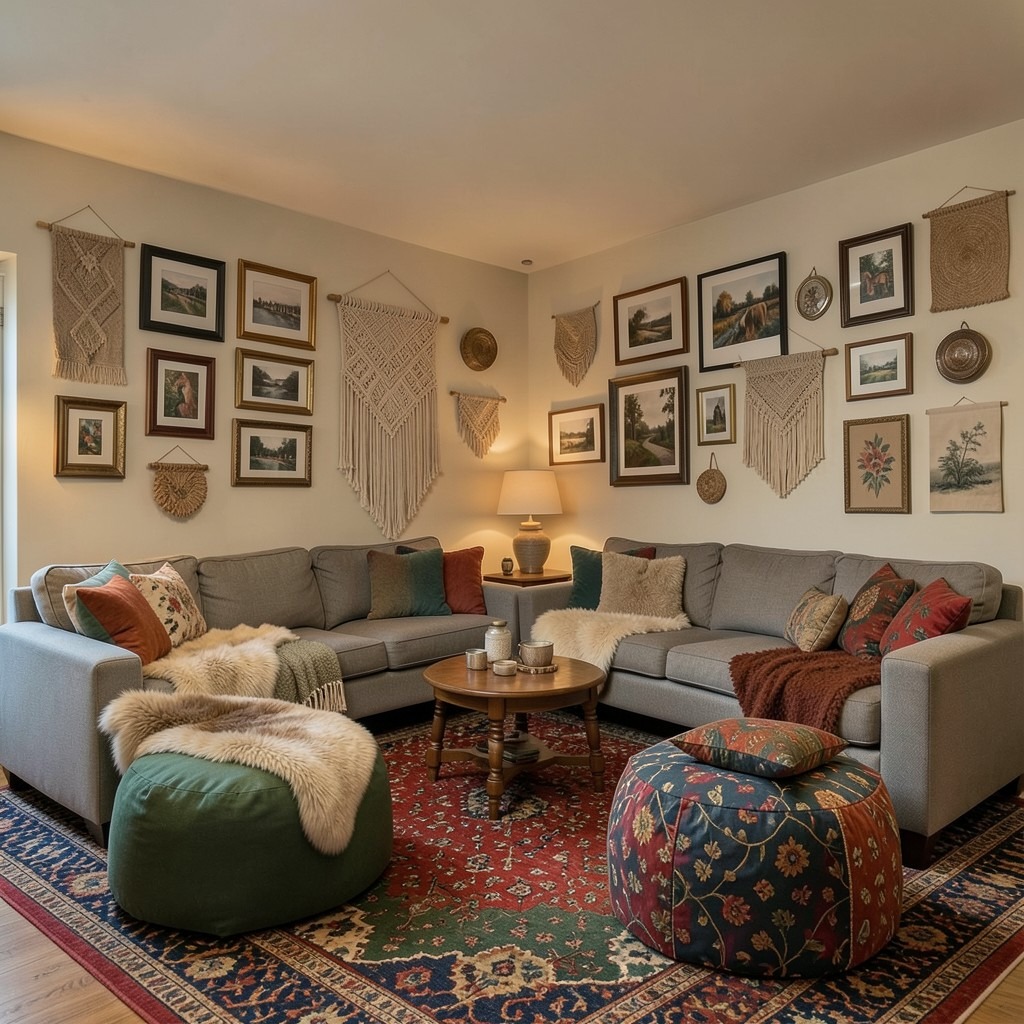
The bohemian basement lounge is the room where the design rules that the upstairs living spaces apply — the restrained palette, the controlled material palette, the edited accessory selection — are suspended in favor of the accumulated warmth, personal expression, and material layering that bohemian home styling celebrates as its central design value. The bohemian basement does not try to look designed. It tries to look lived in, loved, and belonging to the specific household that inhabits it, and the design intelligence that achieves that quality is significant even if the aesthetic it creates appears casual.
Floor-level seating — low-profile sofas, large poufs, floor cushions in layered natural and jewel-toned fabric covers, and a few sheepskin throws across the seating surfaces — creates the informal, ground-level gathering quality that the bohemian lounge aesthetic values. The lowered seating height makes the basement ceiling feel more generous — furniture that sits lower to the floor makes the ceiling appear proportionally higher, which is the perceptual correction that basement rooms with limited ceiling height benefit from most directly. A large vintage or vintage-style Moroccan or Persian rug over the basement floor creates the bohemian lounge’s foundation layer, its pattern and warmth defining the social zone and providing the acoustic absorption that hard flooring surfaces lack.
Gallery wall arrangements in the bohemian basement — a mix of framed art in varied frame widths and finishes, hanging macramé panels, woven textile art, and small decorative objects mounted directly to the wall — create the accumulated, personal visual character that bohemian home styling builds over time rather than installs at once. The gallery wall’s success depends on the density and variety of the elements — too sparse and it reads as an incomplete arrangement; properly dense and it reads as the personal archive of a household with genuine aesthetic curiosity and the commitment to express it without apology.
31. A Basement With a Luxurious Home Spa Retreat
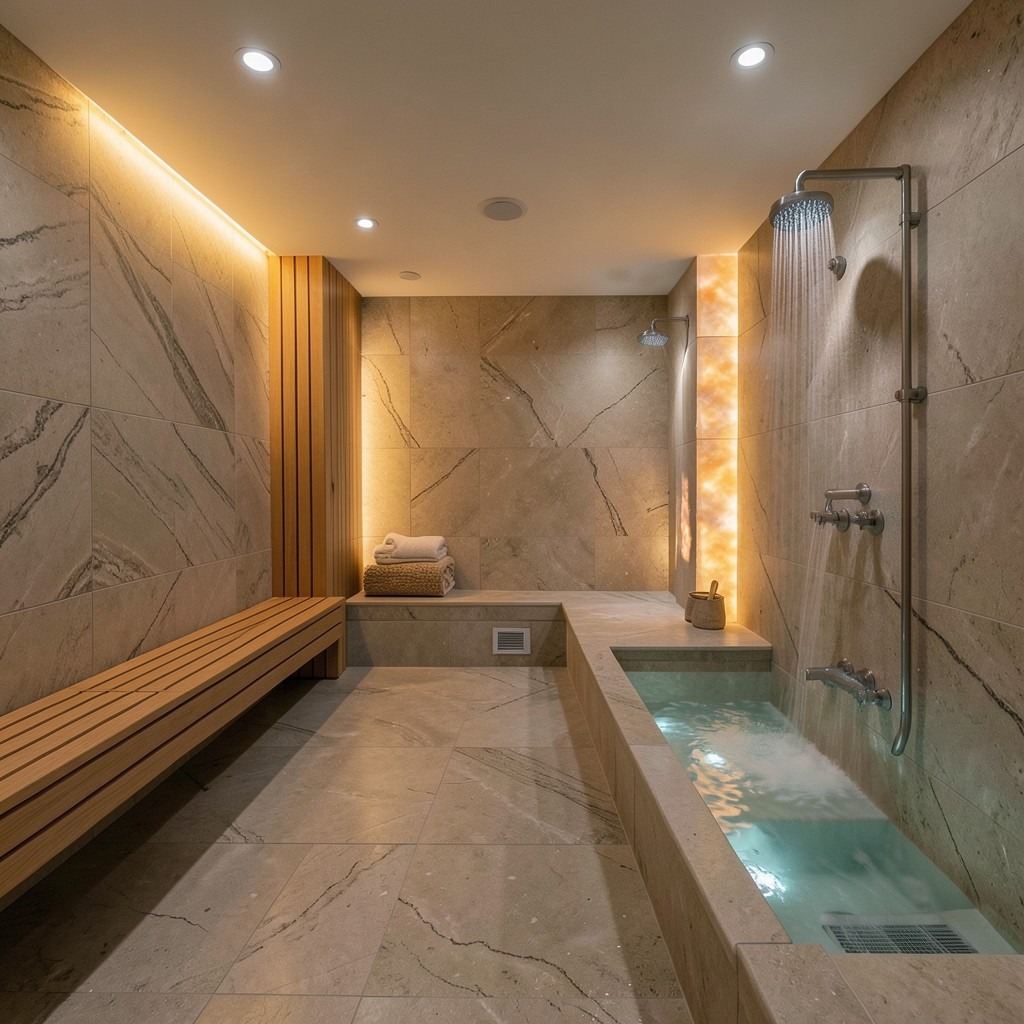
The basement home spa goes beyond the spa bathroom of idea twenty-five to address the full sensory and therapeutic experience of a dedicated wellness retreat within the home — a space whose design purpose is the restoration of the person who enters it, achieved through the deliberate combination of sensory environments, therapeutic equipment, and material quality that professional spa facilities have standardized and that residential design has rarely attempted at a comparable level of completeness. The basement spa retreat is ambitious. It is also, for the household whose wellness practice is consistent and whose daily stress is high, the most valuable room in the house.
A halotherapy salt room — a small room lined with Himalayan salt blocks that release the mineral particles associated with respiratory and skin wellness benefits — creates the most distinctive and most atmospheric spa element available for residential installation. The salt blocks’ warm amber glow when backlit with LED lighting creates the most visually distinctive room in any home, and the room’s mineral air quality and sensory warmth create a retreat experience that no other room in the house approaches. The room requires sealed construction to maintain the salt environment’s integrity and a HEPA filtration system to manage the fine salt particle concentration in the air.
A hydrotherapy area — an infrared sauna, a cold plunge pool, and a shower with multiple body jets and a rainfall head — creates the thermal contrast therapy sequence that professional athletic recovery facilities provide and that the basement’s below-grade plumbing infrastructure makes practically achievable. The cold plunge pool requires a chiller unit to maintain the water temperature at the therapeutic range, and its installation in a basement is preferable to above-grade installation because the cool underground environment reduces the chiller’s operating load and extends its service life. Luxury home interior quality finishes throughout the spa — book-matched stone on the feature wall, teak wood benching in the sauna, and precision tile work in the hydrotherapy area — create a space whose material quality matches the therapeutic intention it serves.
32. A Basement With a Colorful Playful Teen Retreat
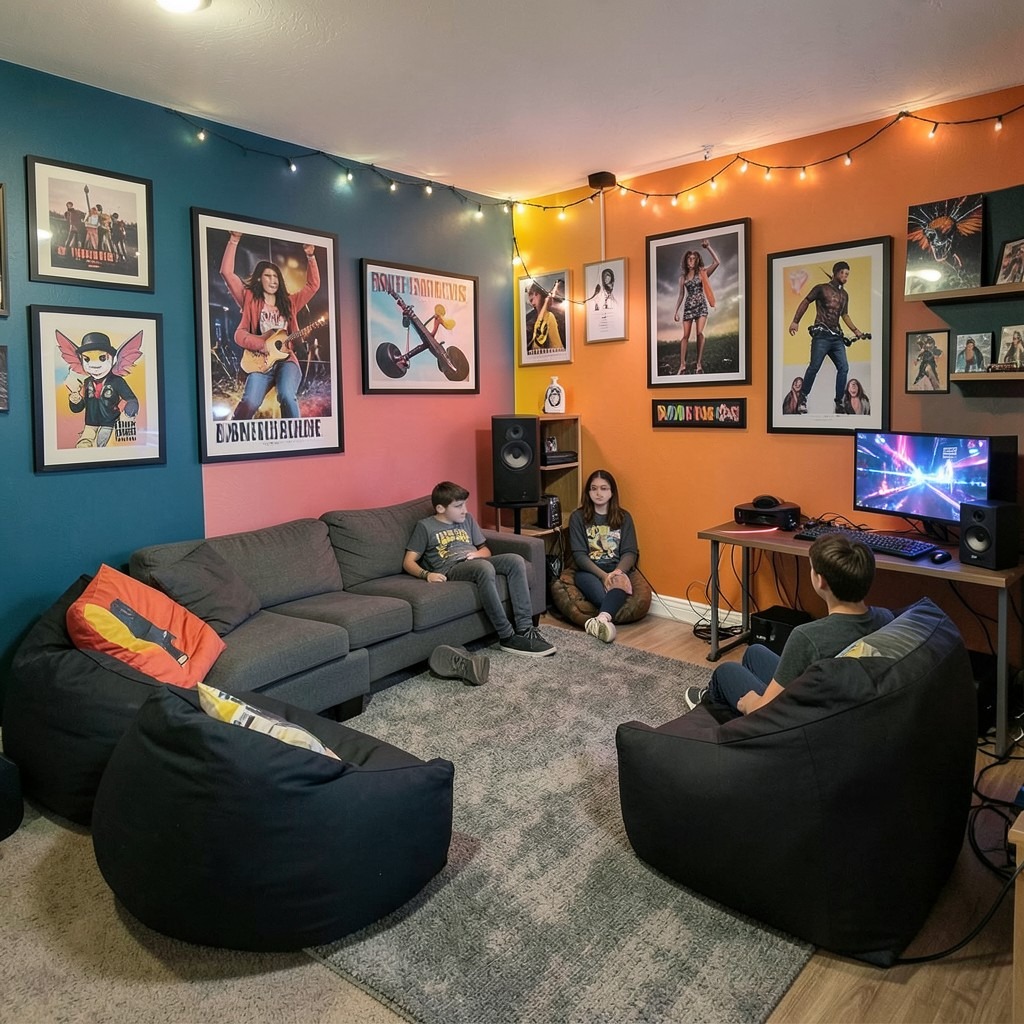
The teenager’s basement retreat is the room that gives the adolescent household member the social space, the privacy, and the personal expression territory that shared living areas never fully provide — the place where their friends can gather without the supervision of the main living spaces, where their music can be played at the volume it was intended for, and where their design preferences can be applied without negotiating against the household’s adult aesthetic standards. The teen retreat is the room that makes the teenager want to be home rather than elsewhere, and the household that provides it understands the value of that preference.
Bold color is the non-negotiable starting point — the teenager who selected the color for their retreat and sees it applied to the walls of their space has an immediate, personal connection to the room that no design imposed by an adult advisor creates. Whether the choice is a deep teal, a bright coral, a saturated yellow, or a near-black charcoal, the commitment to the chosen color applied fully and without the parental moderation that typically dilutes bold choices is the design decision that makes the space feel genuinely personal. Chic home decor principles applied at a youthful register — large format posters in gallery frames, a collection of string lights as secondary ambient lighting, and a display section for personal objects and collections — create the room’s personal content within the bold color palette.
Seating for social gathering — a sectional or a combination of beanbags, floor cushions, and a small sofa arranged for the social interaction patterns of adolescent groups — creates the functional infrastructure for the room’s primary social purpose. A gaming setup, a small music listening area with decent speakers, and a dedicated surface for creative projects or study create the activity infrastructure that keeps the space genuinely useful across the range of activities that teenagers bring to it. The teen retreat needs durability as much as style — the flooring, the seating upholstery, and the wall surfaces should be selected for their resilience against the wear of consistent intensive use by people whose relationship with household surfaces is not yet fully cautious.
33. A Basement With a Dedicated Wine Tasting and Entertaining Lounge
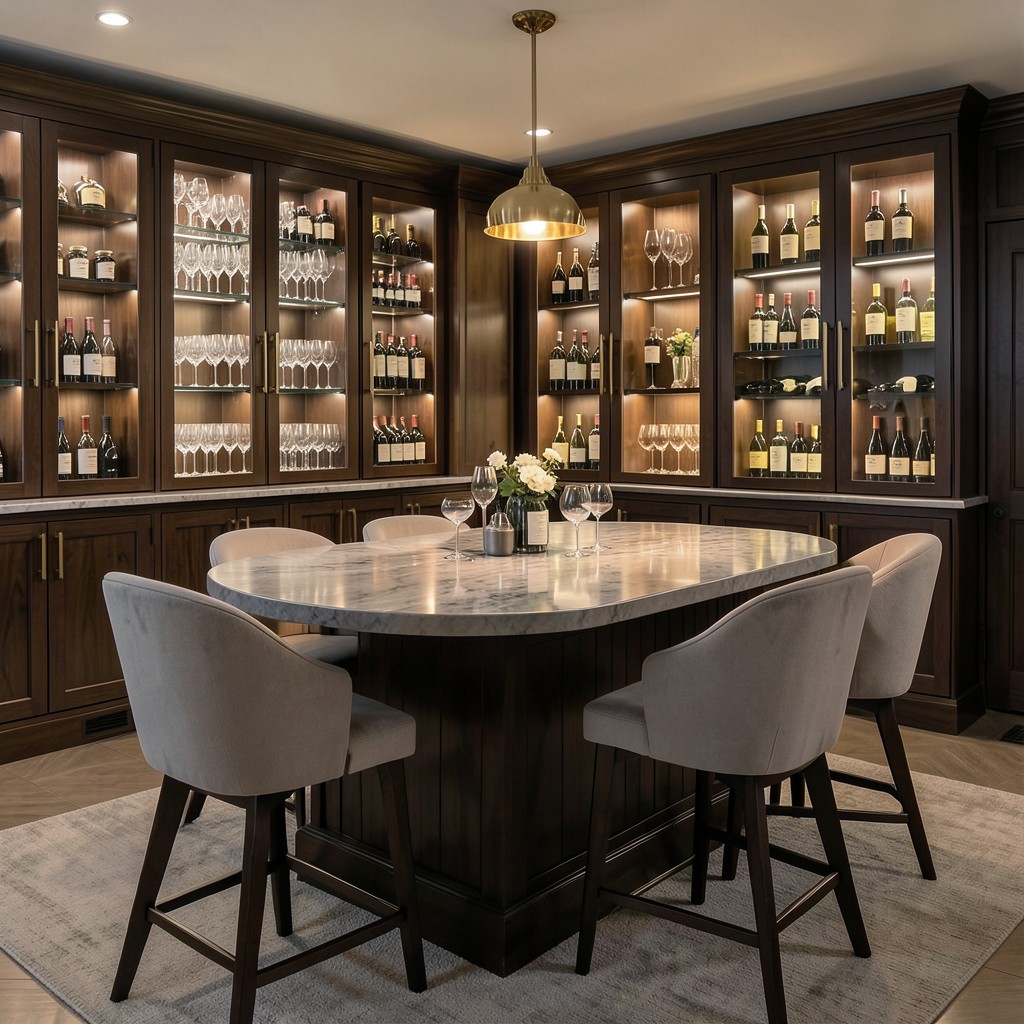
The wine lounge basement extends the wine cellar concept into a fully realized entertaining space — not just storage for the collection but a room designed for the experience of tasting and sharing it with the specific people for whom wine is a genuine pleasure rather than a functional beverage. The wine lounge is the room that the wine enthusiast household has earned, and designing it with the seriousness that the practice deserves produces one of the home’s most distinctive and most genuinely pleasurable gathering spaces.
A tasting table at the room’s center — a large oval or rectangular table at counter height with bar stools on all sides, or a lower dining height with upholstered chairs for more relaxed tasting sessions — creates the social infrastructure for the lounge’s primary function. The table’s surface material should be non-porous and resistant to the wine staining that tasting sessions inevitably generate — a honed marble, a sealed concrete, or a dark-stained solid wood with a penetrating finish that resists saturation suits the tasting table’s use conditions better than a light-colored, open-grained wood surface that requires anxious protection at every pour. Elegant home styling applied throughout — a crystal stemware display in the back bar’s glass-front cabinets, a polished brass or satin nickel hardware palette, and a warm, intimate lighting atmosphere — creates the lounge quality that suits the experience of drinking good wine in genuinely good company.
A temperature-controlled display section — glass-front wine cabinets with LED lighting and precise temperature control for the bottles intended for current drinking — creates the visual centerpiece of the wine lounge’s design, the illuminated bottle display that communicates the room’s purpose and its pleasures to every guest from the moment they enter. The display section’s wine selection should include a rotating curation of bottles at their optimal drinking windows, presented with the same thoughtfulness that a restaurant’s by-the-glass selection applies to its visible bottle display — the visual promise of the display should match the quality of what is poured from it.
34. A Basement With a Coastal Outdoor Living Extension
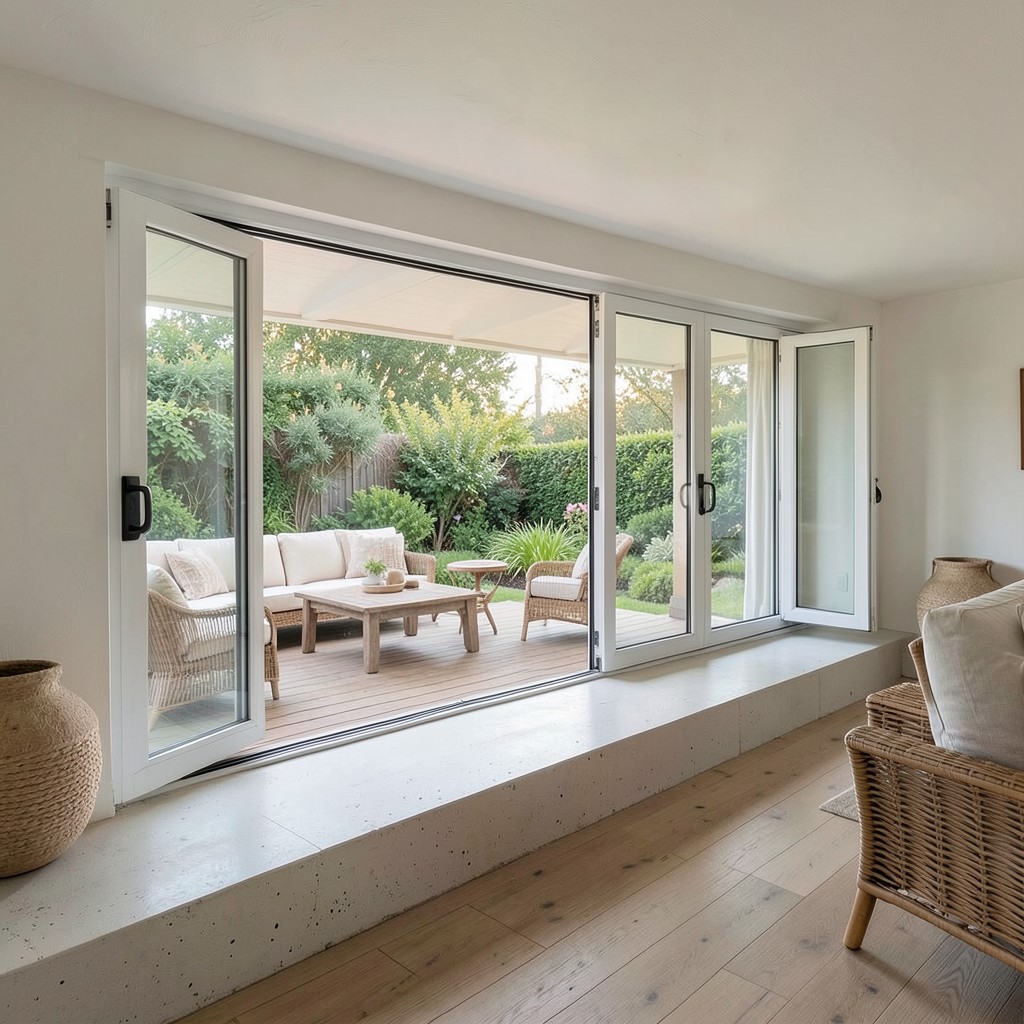
A basement with a direct walkout to a patio, a garden level, or a below-grade outdoor space creates the opportunity for the indoor-outdoor connection that coastal outdoor living space principles apply so effectively — the threshold between the indoor basement space and the outdoor below-grade terrace becomes the design opportunity to create a room that expands seasonally, whose inside and outside share a material and visual language, and whose combined footprint is greater than either space alone. The walkout basement is the configuration that residential design consistently underdesigns and whose potential it consistently underestimates.
Large sliding or bifold glass doors at the walkout connection — floor-to-ceiling panels that open the basement’s full wall width to the outdoor space — create the indoor-outdoor relationship that gives both spaces their quality. When the doors are open, the outdoor terrace is a direct extension of the basement’s floor area, its furniture arranged in a conversation with the interior seating; when the doors are closed, the glass panels provide the visual connection that maintains the sense of outdoor access even in the cooler seasons when the outdoor space is not in active use. The glass doors’ double-glazed insulated unit reduces the thermal transfer from the outdoor temperature to the basement interior, maintaining the indoor climate quality that the basement’s excellent insulation naturally supports.
Beach house interiors principles applied to the walkout basement — the whitewashed surfaces, the natural rope and rattan accessories, the pale palette and the natural light quality of the large glass openings — create the indoor-outdoor coastal space whose material continuity between inside and outside makes the transition between the two zones feel like movement within a single room rather than passage between two separate spaces. During summer home design season this room reaches its full potential — the indoor-outdoor flow, the outdoor terrace’s morning light and evening breeze, and the basement’s cool temperature beneath the outdoor heat creating the most comfortable living environment in the house.
35. A Basement With a Fully Equipped Home Gym and Wellness Suite
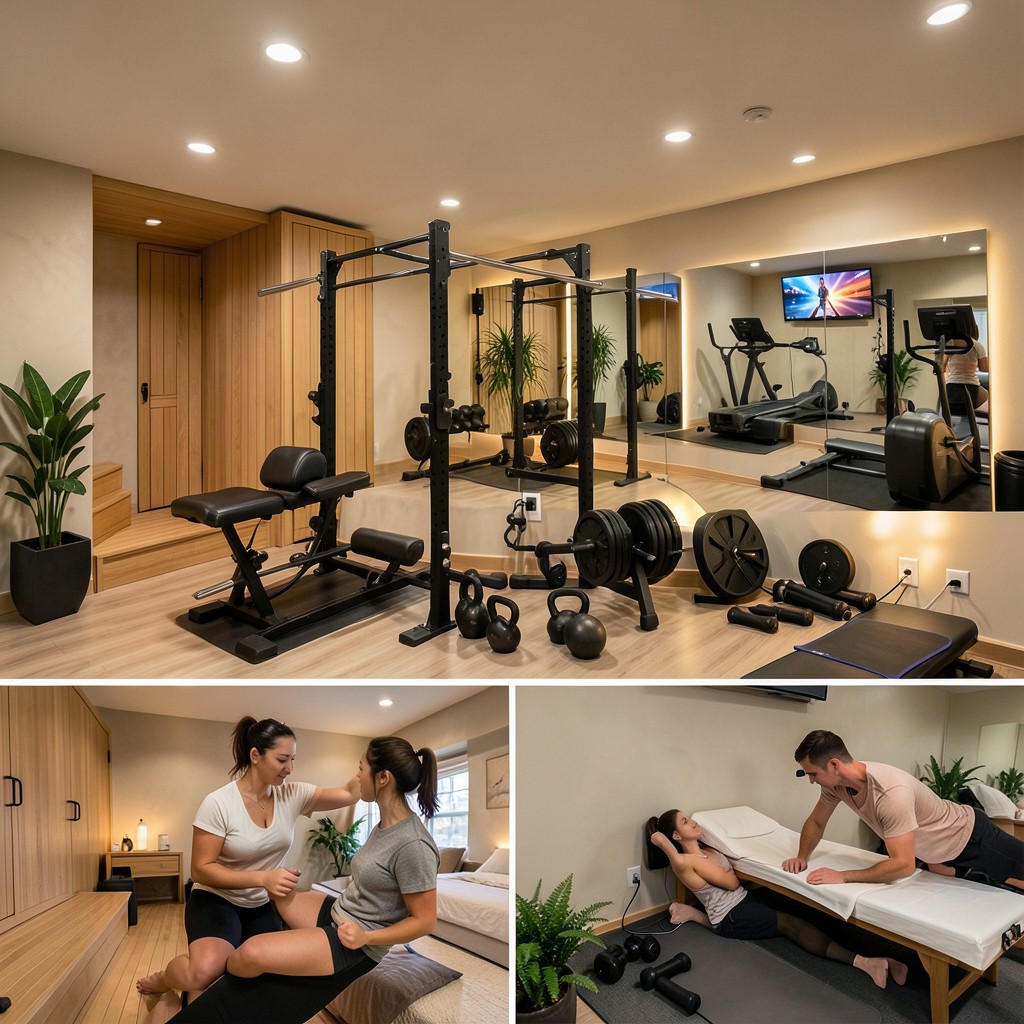
The basement wellness suite combines the home gym of idea six with a broader wellness infrastructure — a sauna, a stretching and mobility area, a recovery zone with massage and rest capacity, and a dedicated hydration and nutrition station — to create the complete domestic wellness environment that addresses the full cycle of physical practice from warm-up through training through recovery. The standalone gym addresses the training phase. The wellness suite addresses the complete physical practice, and the suite’s completeness is what makes it a space that supports a serious, sustainable wellness lifestyle rather than simply a place to exercise.
The gym’s training zone within the suite should be organized by movement type — a strength zone with the power rack, barbell, and plate storage; a functional training zone with kettlebells, medicine balls, and a pull-up rig; and a cardio zone with one or two cardio machines positioned to face the mirror wall or the motivating display screen. Organizing by movement type rather than by equipment category creates the training flow that allows a full workout to move naturally from zone to zone without the equipment reconfiguration and repositioning that a single undifferentiated gym space requires between exercise types. The zone organization also allows multiple users to train simultaneously without interference, which in a household with two or more regular exercisers is the spatial planning quality that distinguishes a multi-user gym from a single-user space with multiple pieces of equipment.
The recovery zone — a dedicated area with a massage table or recovery mattress, a stretching mat, and the electrical outlet positions for recovery technology including compression therapy devices, heat pads, and percussion massage tools — creates the post-training environment that the training zone alone does not provide. The recovery zone’s design should be deliberately calm — warm, lower-level lighting, a few plants for the biophilic quality that recovery environments benefit from, and the acoustic separation from the gym’s harder training sounds that allows the nervous system to begin its post-exercise restoration while still within the wellness suite’s space. The suite that accommodates the full training and recovery cycle is the suite that gets used consistently rather than the suite that gets used until the novelty wears off.
36. A Basement With a Floral and Garden-Inspired Interior
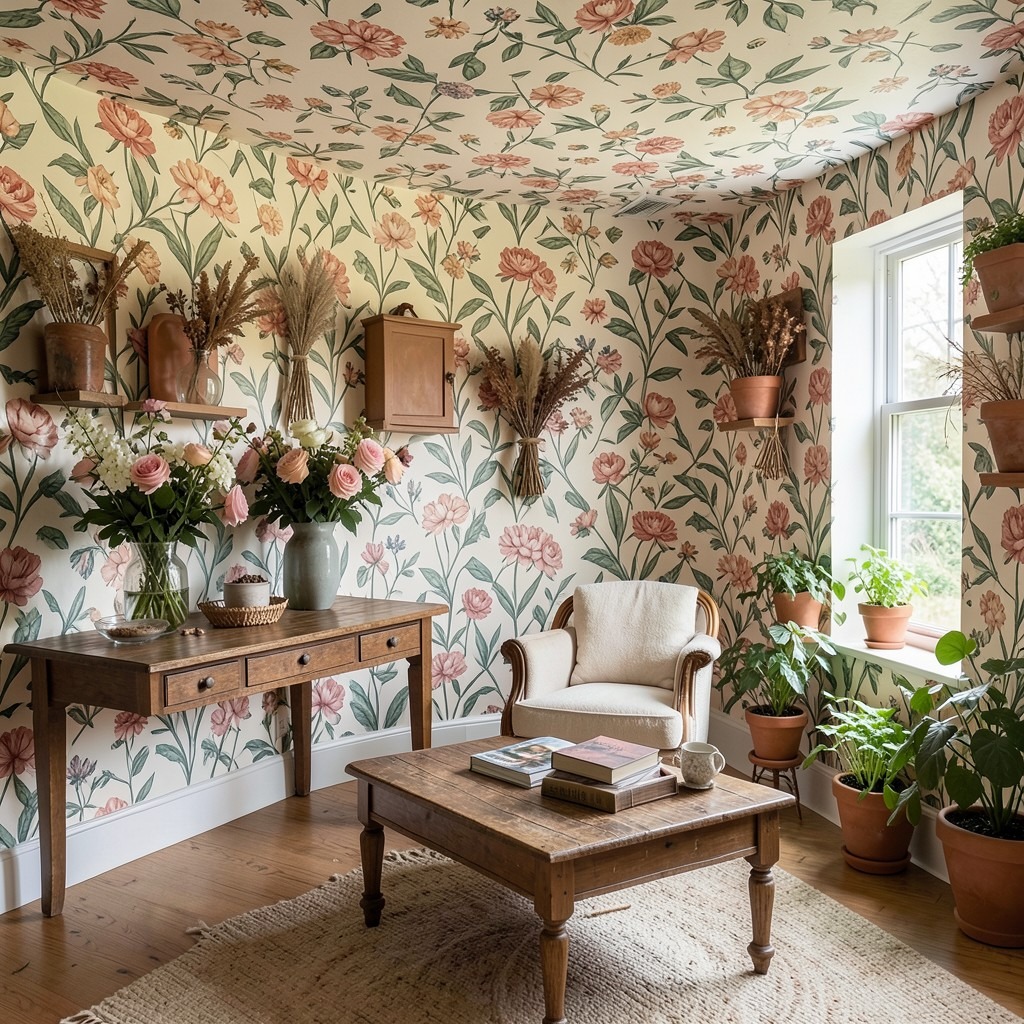
The garden-inspired basement applies the organic richness, botanical pattern vocabulary, and living material quality of a well-loved garden to an interior space that, by definition, exists below the garden level — and the design tension between the below-grade location and the above-grade natural world that the aesthetic references creates the most interesting design challenge in the basement design collection. The garden basement does not pretend to be a garden. It brings the garden’s sensory qualities — its color, its texture, its fragrance, and its living character — into an interior room with the same intelligence that great garden design applies to creating atmosphere from natural material.
Botanical wallpaper in a large-scale floral or leaf pattern — applied to the basement’s primary feature wall in a format whose scale suits the room’s ceiling height — creates the garden-inspired interiors quality instantly and at a material investment that is significantly lower than the structural and material changes that most other basement design directions require. The botanical pattern’s scale is critical — a pattern calibrated for a ten-foot ceiling applied to a seven-and-a-half-foot basement ceiling creates a compressed, overwhelming visual experience, while a pattern whose repeat height is proportioned to the actual ceiling height creates the designed quality that suits the space. A hand-painted botanical mural applied directly to the feature wall by a skilled muralist creates a one-of-a-kind design element of extraordinary quality whose personal and artistic value exceeds any printed wallpaper alternative.
Floral home decor ideas extended through the basement interior — fresh-cut flowers in statement vessels on the tasting table and the coffee table, dried botanical arrangements in warm terracotta tones mounted on the walls, and potted herbs and blooming plants at the window wells where natural light enters — create the living botanical content that the garden-inspired aesthetic values above any static decorative element. The fragrance of the flowers — the jasmine, the garden rose, the eucalyptus — is the sensory quality that photographs cannot communicate and that visitors remember most immediately, and designing the room’s fragrance with as much intention as its visual qualities creates the complete sensory environment of a garden brought indoors.
37. A Basement With a Dedicated Music Room and Rehearsal Space
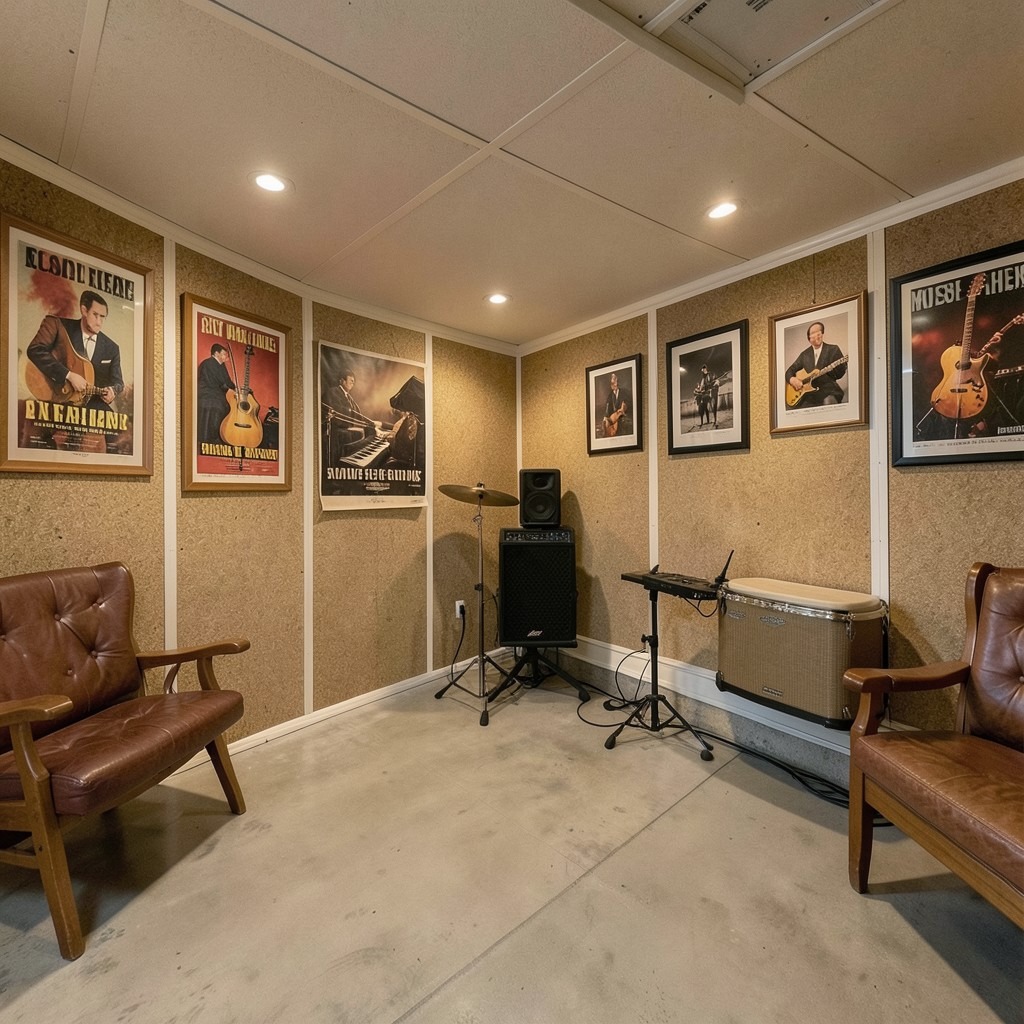
The basement music room is the acoustic environment that musicians consistently struggle to create within the living spaces of a shared home — and the challenge is bilateral. The household wants to hear something other than the musician’s practice scales through the ceiling at all hours, and the musician wants to play without the self-consciousness of disturbing every other occupant of the house. The basement music room solves both problems with a single structural investment in the room’s acoustic isolation.
Sound isolation for the music room requires addressing all three transmission paths — airborne sound through the walls, impact sound through the floor, and flanking paths through structural connections. The wall and ceiling assembly uses the same double-layer drywall on resilient channel construction that the recording studio employs, with acoustic mineral wool filling the stud bays completely. The floor requires a floating decoupled construction — a concrete sleeper system or a neoprene pad isolation system that physically breaks the connection between the music room floor and the building structure — to prevent the bass frequencies from an amplified instrument or a drum kit from transmitting through the concrete slab as structural vibration audible throughout the house. This isolation investment is proportional to the instrument being played — a classical guitarist requires less isolation than a drum kit, and a drum kit in an inadequately isolated basement music room is audible to every neighbor within fifty feet of the house.
The music room’s interior acoustic treatment — beyond the isolation — addresses the room’s internal sound quality for the musician’s monitoring and performance experience. An asymmetric room geometry, achieved through a canted wall or a non-parallel ceiling section, prevents the standing waves that perfectly rectangular rooms create at specific frequencies. Acoustic diffuser panels on the back and side walls scatter the sound energy rather than absorbing it fully, creating the lively, natural acoustic environment that musicians prefer for performance over the completely dead sound of an over-absorbed room. Spring home refresh energy applied to the music room’s decorative quality — vintage concert posters in gallery frames, a collection of framed instrument photography, and the warm, personal accumulation of a space that belongs to someone whose relationship with music is lifelong — creates the atmosphere that sustains the practice.
38. A Basement With a Jungle-Themed Biophilic Design
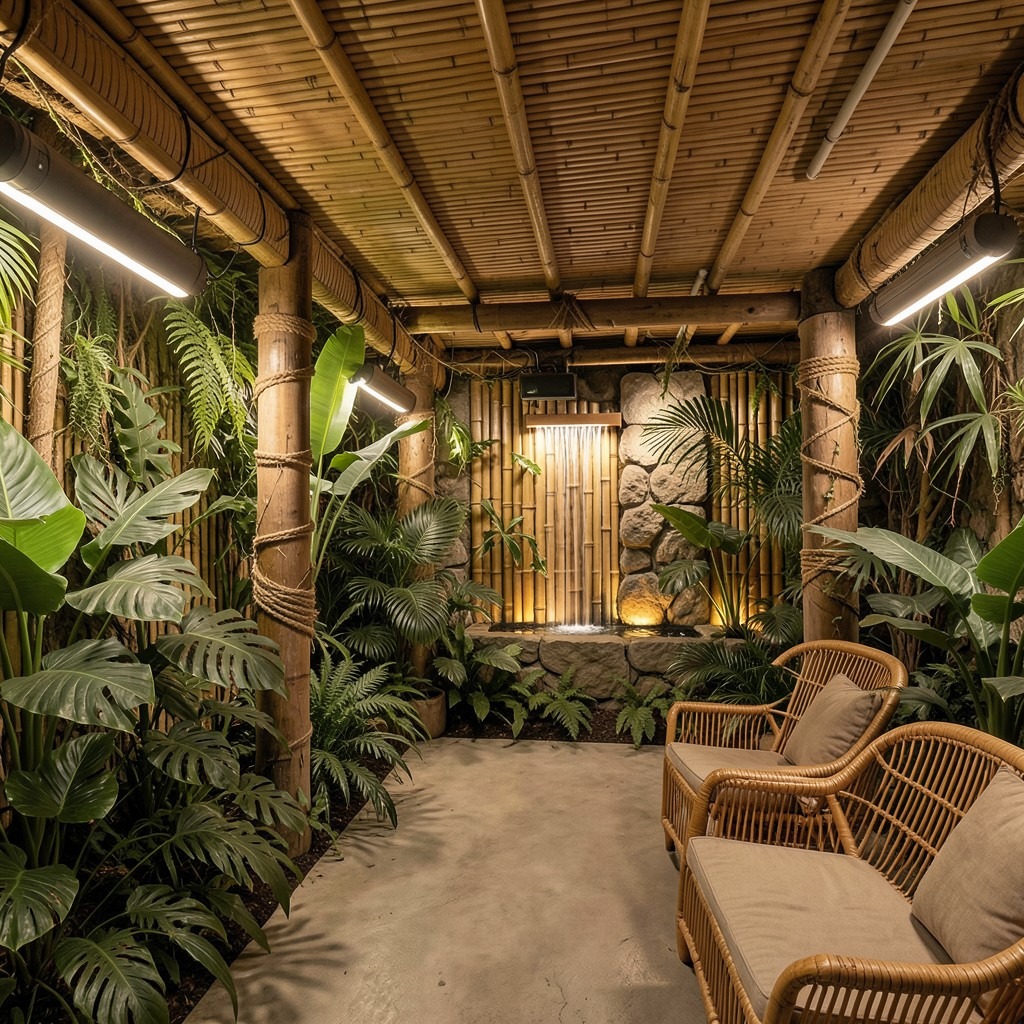
The jungle basement takes the tropical biophilic concept of idea fourteen and commits to the full immersive environment that the jungle-inspired home decor aesthetic requires when applied without restraint — the dense, layered green of overlapping large-leaved tropical plants, the organic materials of bamboo, rattan, and woven vine, the warm amber lighting that filters through the canopy of foliage, and the sounds of water and the suggestions of the natural world that the design direction creates in a room that is, physically, beneath the ground. The jungle basement is the most committed and the most dramatically atmospheric design direction in the collection.
The plant installation in the jungle basement requires a grow lighting infrastructure sufficient to maintain large tropical specimens in a below-grade environment — LED grow lights in a full-spectrum output mounted above each plant group, on a programmable timer that creates the twelve-hour light cycle that tropical plants require for healthy growth and foliage density. The cumulative heat output of multiple grow lights in an insulated basement room creates the warm, humid microclimate that tropical plants prefer and that the design direction’s sensory atmosphere reinforces. A humidity monitoring system — a digital hygrometer with a connected humidifier on an automatic controller — maintains the room’s relative humidity at the fifty-five to sixty-five percent range that tropical plants require without the condensation on walls and ceiling that uncontrolled humidity creates in a below-grade room.
The jungle basement’s non-plant design elements — bamboo home interiors surfaces on the ceiling and wall panels, natural vine rope wrapped around exposed structural columns, and woven rattan furniture whose organic forms suit the botanical atmosphere — create the complete material environment in which the plants become the foreground expression of a fully designed sensory world. A wall-mounted indoor water feature, where water falls over a textured stone or bamboo surface into a recirculating basin, adds the sound that completes the jungle atmosphere’s sensory environment — the sound of water in a basement room that is acoustically sealed from the house above creates a depth of natural atmosphere that no visual design element alone achieves.
39. A Basement With a Dedicated Laundry and Utility Organization
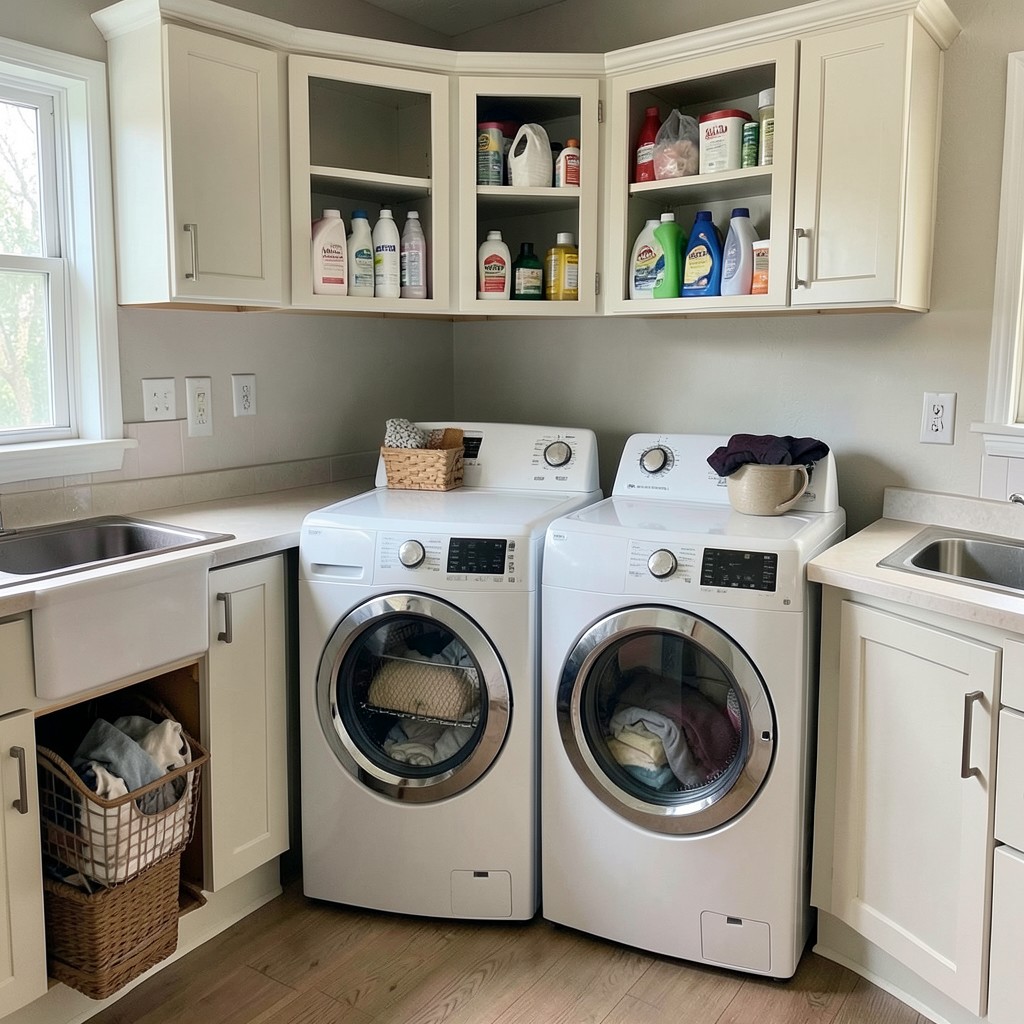
The basement laundry room is the household infrastructure space that most people treat as an afterthought and then encounter every day of their lives — and the frustration of a poorly organized laundry room accumulates across every load of washing into a significant and entirely preventable quality-of-life reduction. The laundry room designed with the same intention given to the kitchen’s workflow — because the laundry process is a workflow as specific and as repeated as cooking — eliminates the friction that makes laundry the domestic task that most people delay, dread, and rush through without satisfaction.
A side-by-side washer and dryer installation with a continuous counter surface above both machines — in a material that handles the moisture, the vibration, and the folding use that the laundry counter receives without the surface degradation that inferior materials exhibit — creates the laundry room’s functional infrastructure. The counter height should be the standard thirty-six inches that kitchen counters apply, because the folding motion uses the same arm and back mechanics as kitchen prep, and a lower counter height that some laundry rooms apply creates the posture problems that accumulate over a lifetime of folding at an incorrect height. A utility sink beside the counter — deep-basin, apron-style in a cast iron or fireclay material for a farmhouse home decor laundry room aesthetic — provides the hand-washing, pre-soaking, and general utility function that the laundry room requires beyond the machines’ automatic cycles.
Upper cabinet storage above the counter and the machines closes the laundry room’s organizational system, housing the detergents, the fabric care products, and the laundry supplies in an enclosed format that keeps the room tidy and the supplies organized without the visual clutter that open shelving in a humid laundry environment creates. Pull-out hamper drawers built into the lower cabinetry — separate compartments for lights, darks, and delicates — pre-sort the laundry at the point where it enters the system rather than at the point where it is loaded into the machine, removing one step from the weekly laundry process and maintaining the room’s organizational quality between laundry days.
40. A Basement With a Serene Meditation and Prayer Room
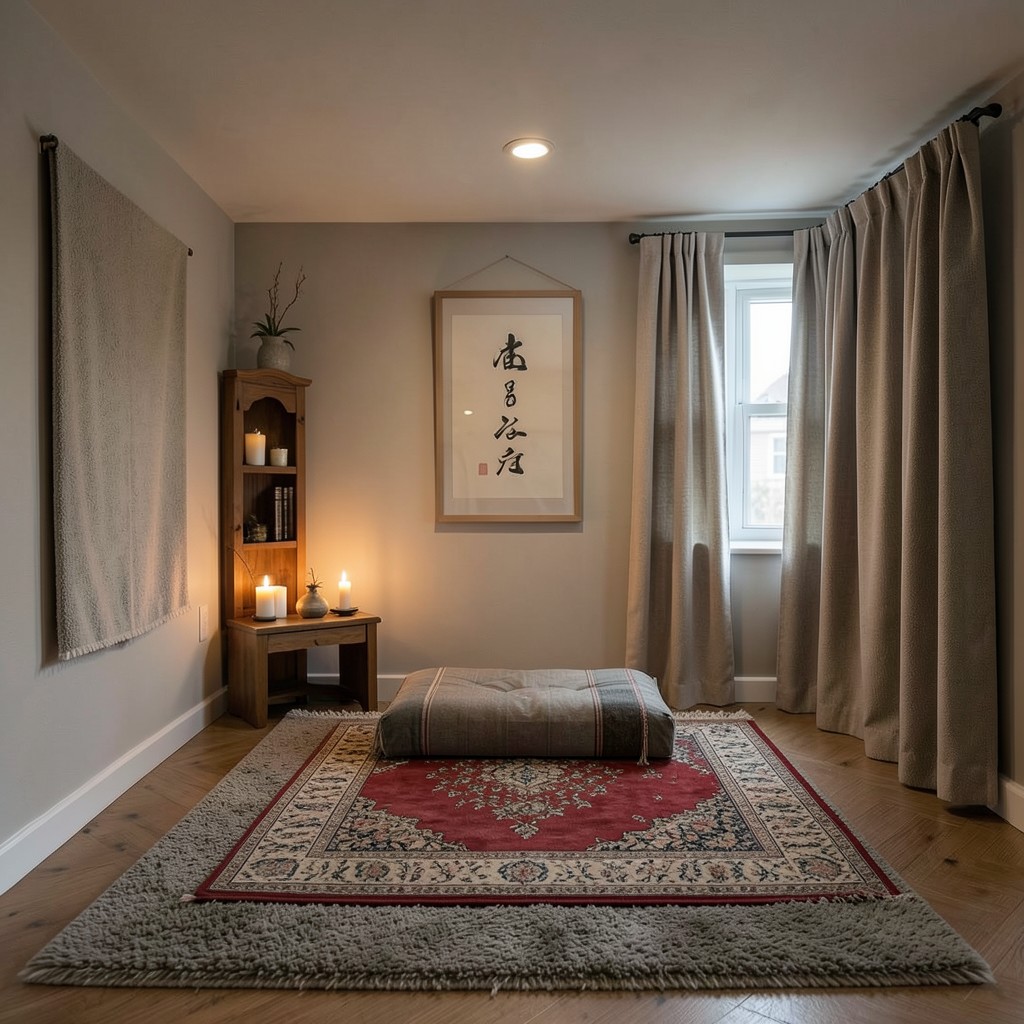
A dedicated meditation and prayer space in the basement creates the environment of complete quiet and intentional atmosphere that the spiritual or contemplative practice requires — the below-grade room’s natural sound isolation from street noise, ambient household sounds, and the general auditory environment of a functioning home creates the silence that meditation and prayer traditions consistently identify as the environmental prerequisite for the quality of inner attention the practice cultivates. The basement provides this silence without acoustic treatment that above-grade rooms require structurally to approach the same quality.
The prayer and meditation room’s design strips every non-essential element from the space with more rigor than any other room type — there is no entertainment function, no storage function, and no ambient lifestyle display. The room’s contents serve the practice entirely: the prayer rug or meditation cushion positioned at the room’s correct orientation, the focal element on the front wall — a calligraphy piece, a simple devotional object, or a plain painted surface — and the lighting control that adjusts the room’s illumination from the functional level of room entry to the low, warm, candlelight-quality level that the practice’s atmosphere requires. Peaceful home decor principles applied here — the absence of visual distraction, the presence of natural material quality in the floor and wall surfaces, and the gentle fragrance of incense or natural essential oil — create the sensory environment that the contemplative practice inhabits with the same intelligence that any other room type applies to its primary function’s environmental requirements.
The room’s acoustic quality beyond its natural isolation should address the internal reflections that concrete or hard-plaster surfaces create — a prayer or meditation room whose surfaces echo the voice and the ambient sounds creates the dispersed attention that the practice is designed to collect. Soft textile wall hangings, a heavy pile rug on the floor, and thick curtains over the window well if one exists provide the sound-absorptive surfaces that create the warm acoustic quality — not the dead silence of an anechoic chamber but the gentle, contained quiet of a naturally softened room — that the contemplative practice inhabits most comfortably.
41. A Basement With a Farmhouse-Style Kitchenette
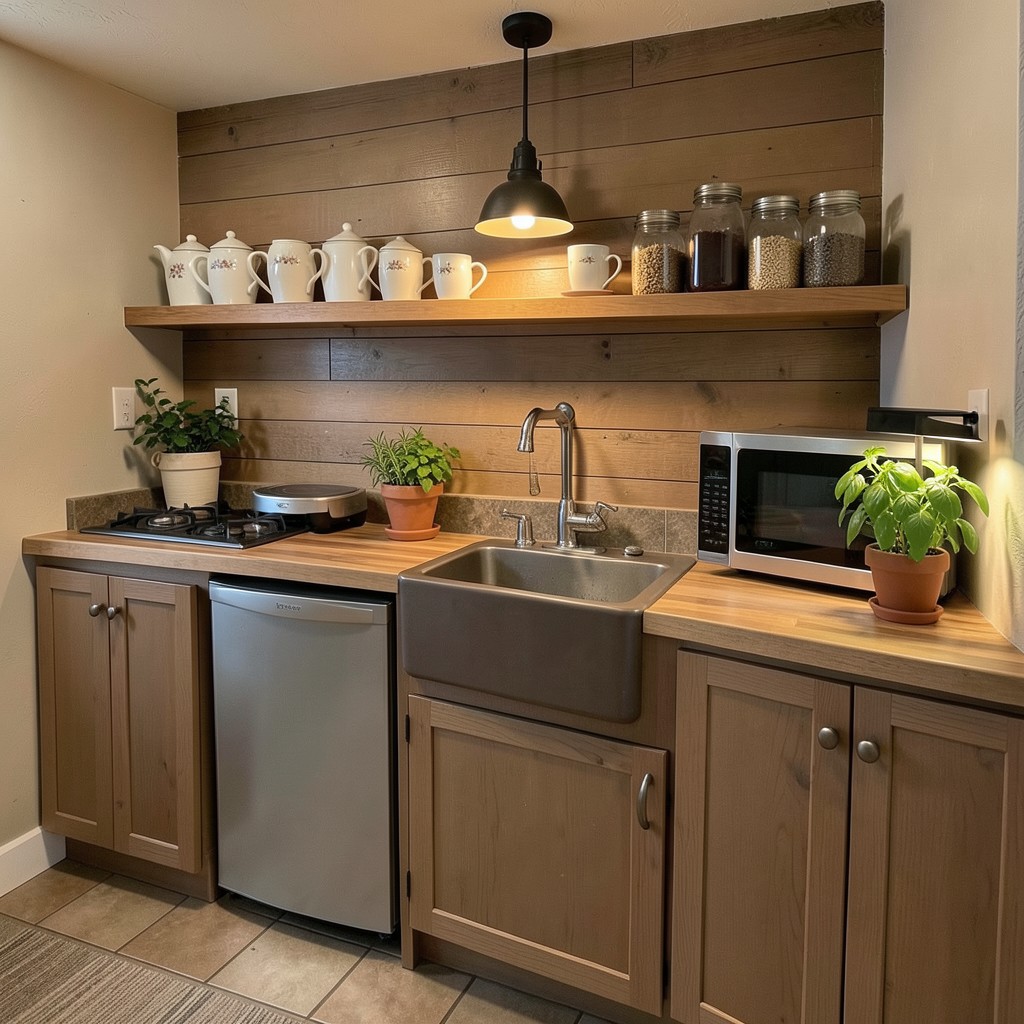
A kitchenette in the basement gives the below-grade space the functional independence that transforms it from a room that requires trips upstairs for food and beverages into a self-contained floor of the house. The kitchenette is not a full kitchen — it does not need a full cooking range, a full refrigerator-freezer, or the counter depth of a primary kitchen. It needs the appliances and the surface area that the basement’s specific functions require: a mini-refrigerator, a two-burner cooktop or an induction countertop unit, a microwave, a sink, and a reasonable amount of counter and cabinet storage for the supplies that the basement’s activities generate.
Farmhouse home decor applied to the basement kitchenette creates the warm, domestic quality that a well-designed kitchenette should communicate — the small apron-front sink in a fireclay or cast iron material, the open shelving above the counter displaying the ceramic mugs and the glass jars of coffee and tea, the shiplap-paneled backsplash behind the counter, and the warm pendant light above the sink position. The kitchenette’s compact scale suits the farmhouse aesthetic’s preference for the functional and the genuine over the showy and the oversized, and the domestic warmth that the farmhouse detail creates in a small space exceeds what more elaborate, less personal material choices would create in the same square footage.
The kitchenette’s counter material should be moisture-resistant and easy to clean given its food-preparation use — a butcher block sealed with a food-safe oil and wax finish provides the farmhouse warmth and the practical surface that the basement kitchenette’s moderate use requires, while a quartz composite in a warm stone-look tone provides the lower maintenance alternative that benefits the basement setting’s humidity-variable environment. A small herb planter on the kitchenette counter — fresh basil, rosemary, or mint in a terracotta pot under a compact grow light — brings the garden-inspired interiors quality to the basement’s most functional zone and provides the fresh herbs that transform a basic basement beverage or snack into something that tastes like someone actually cooked it.
42. A Basement With a Bright, Contemporary Open Living Space
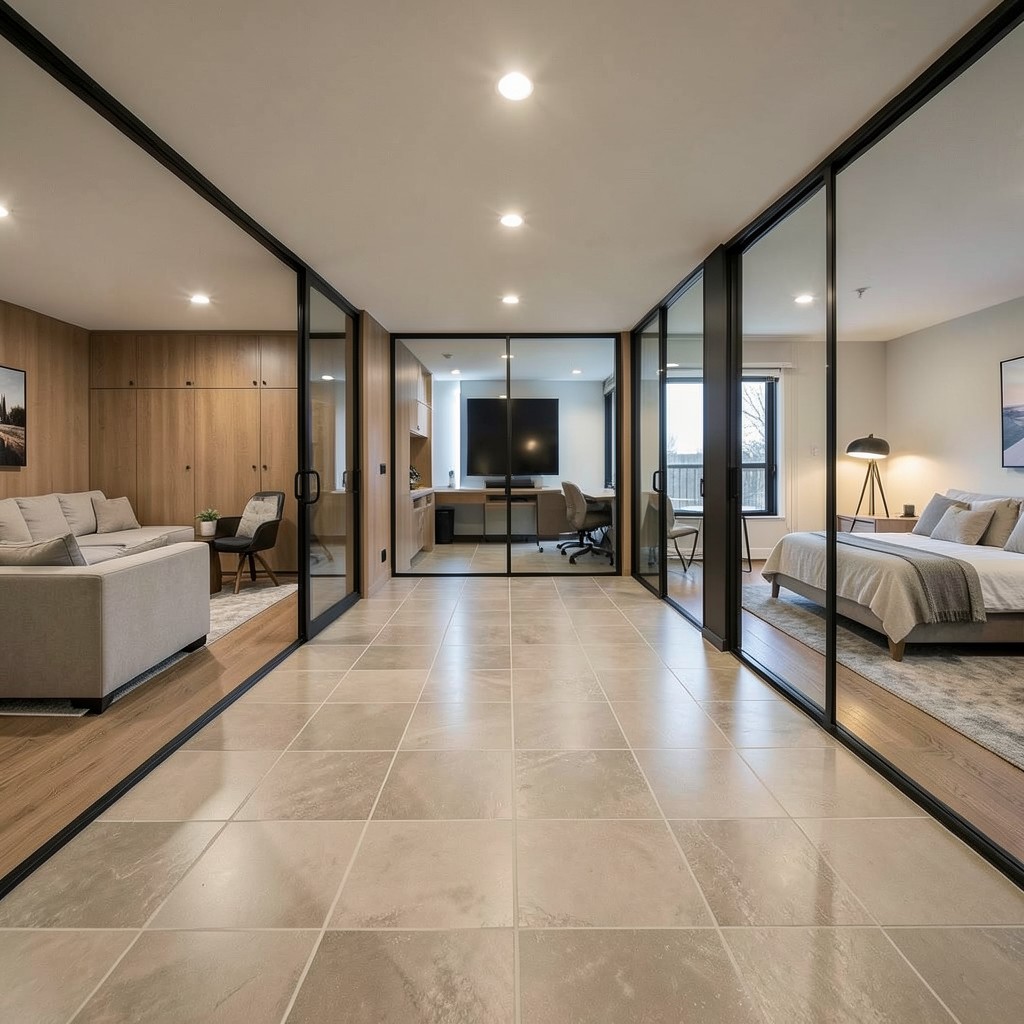
The contemporary basement design that succeeds is the one that refuses to design downward — that applies the same material quality, the same spatial intelligence, and the same attention to the occupant’s experience that the best above-grade contemporary home ideas rooms achieve, rather than the value-engineered, lowest-cost-to-finish approach that most basement renovations settle for. A basement designed to contemporary residential standards feels, when you are in it, like a deliberately designed floor of the house rather than a finished space that was added as an afterthought.
Large-format porcelain tile on the basement floor — sixty by sixty centimeter slabs in a warm concrete or stone look, laid in a running bond pattern that extends the floor plane’s perceived length — creates the foundation of the contemporary basement in a material that handles the below-grade moisture environment with the reliability that real stone and hardwood cannot consistently provide. The tile’s large format reduces the visual complexity of the floor surface, contributing to the clean, expansive quality that contemporary home ideas interiors apply as their defining spatial characteristic. Polished tile reflects the overhead lighting; matte tile absorbs it — the matte finish suits the basement’s artificial light environment better by preventing the hot spots that polished tile creates directly below each ceiling fixture.
Full-height glazed partitions or frameless glass walls dividing the basement’s functional zones — the living area from the home office, the entertainment zone from the guest sleeping area — create the spatial division that the open plan’s multiple uses require without the visual compression that solid walls create in a space where every square foot of perceived volume matters. The glass partition’s transparency maintains the sightline from one zone to the other, creates the sense of a larger single space that is simultaneously organized into distinct functional areas, and allows the artificial lighting to pass between zones rather than trapping each zone’s light within its own boundaries.
43. A Basement With a Vintage Hollywood Glamour Aesthetic
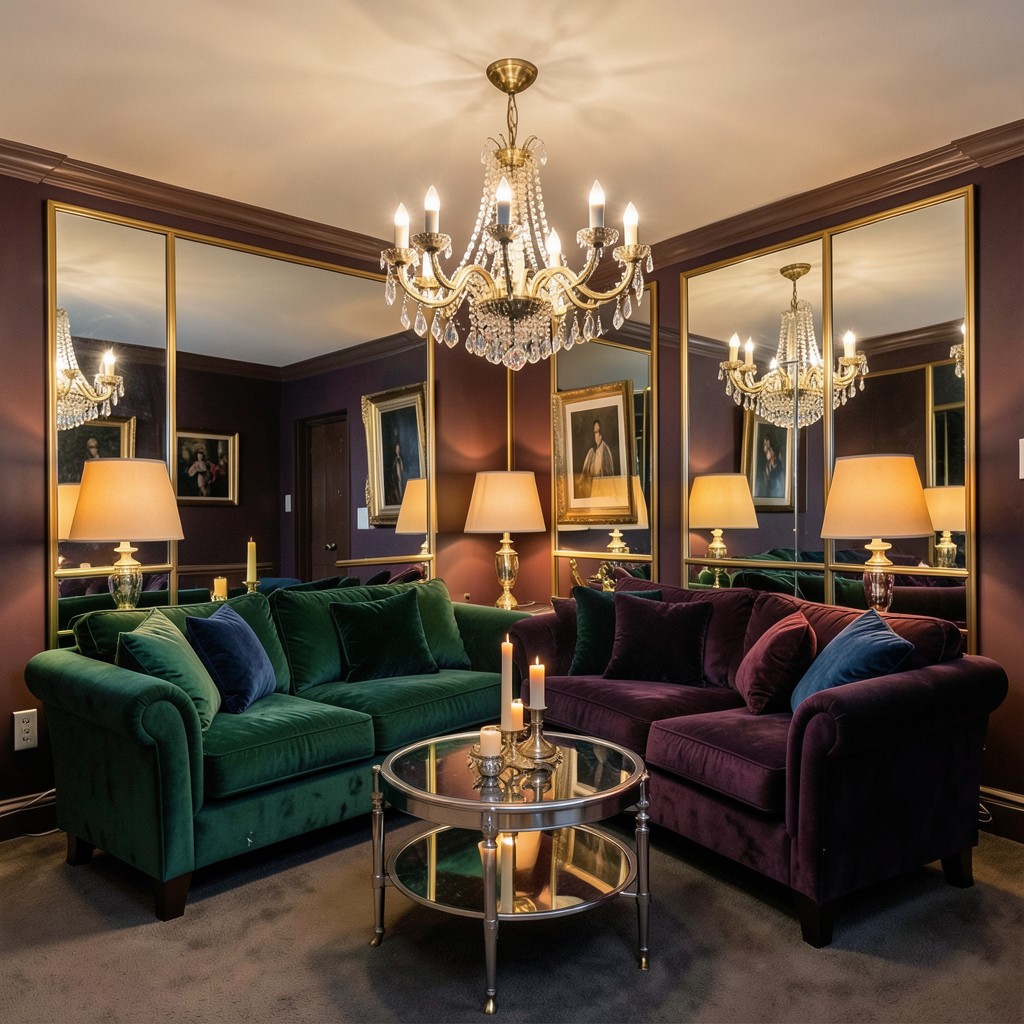
The Hollywood glamour basement applies the design vocabulary of early American entertainment culture — the mirrored surfaces, the jewel-toned velvet, the brass and chrome hardware, and the dramatic lighting fixtures of the golden age of film — to the basement with a commitment to period-inspired luxury that makes no apologies for its theatrical quality. The glamour basement is not subtle. It is the room that announces itself immediately and completely, and the household that commits to it fully creates one of the home’s most memorable and most photographed spaces.
Jewel-toned velvet upholstery — deep emerald, sapphire, or amethyst on the primary seating — creates the glamour palette’s central sensory statement. The velvet’s pile depth and sheen catch the room’s lighting and shift their color with the angle of view, creating the dynamic, living surface quality that flat fabric cannot approach. The velvet’s tone sets the room’s primary color, against which the metallic hardware elements — brass picture frames, chrome table legs, gold-finish ceiling fixtures — create the contrast that glamour interiors depend on for their characteristic visual tension between rich color and bright metal. A large mirrored wall section — either full panels of framed mirror or a custom mirrored paneling system — reflects the seating, the lighting, and the room’s full visual content back into the space, doubling its perceived volume and creating the theatrical self-consciousness that the glamour aesthetic deliberately cultivates.
Dramatic lighting is the glamour basement’s essential atmospheric element — specifically, the combination of a large statement chandelier at the room’s center, low-level side table lamps in a warm amber glow, and the occasional candle cluster that shifts the room from its bright daytime use mode to its evening atmosphere mode. The chandelier’s presence in a basement ceiling — its scale demanding the ceiling height that most basements barely allow — creates the immediate design statement that the glamour aesthetic requires as its dominant architectural gesture. A chandelier in a basement is unexpected. And that unexpected quality is precisely the point.
44. A Basement With a Smart Home Technology Hub
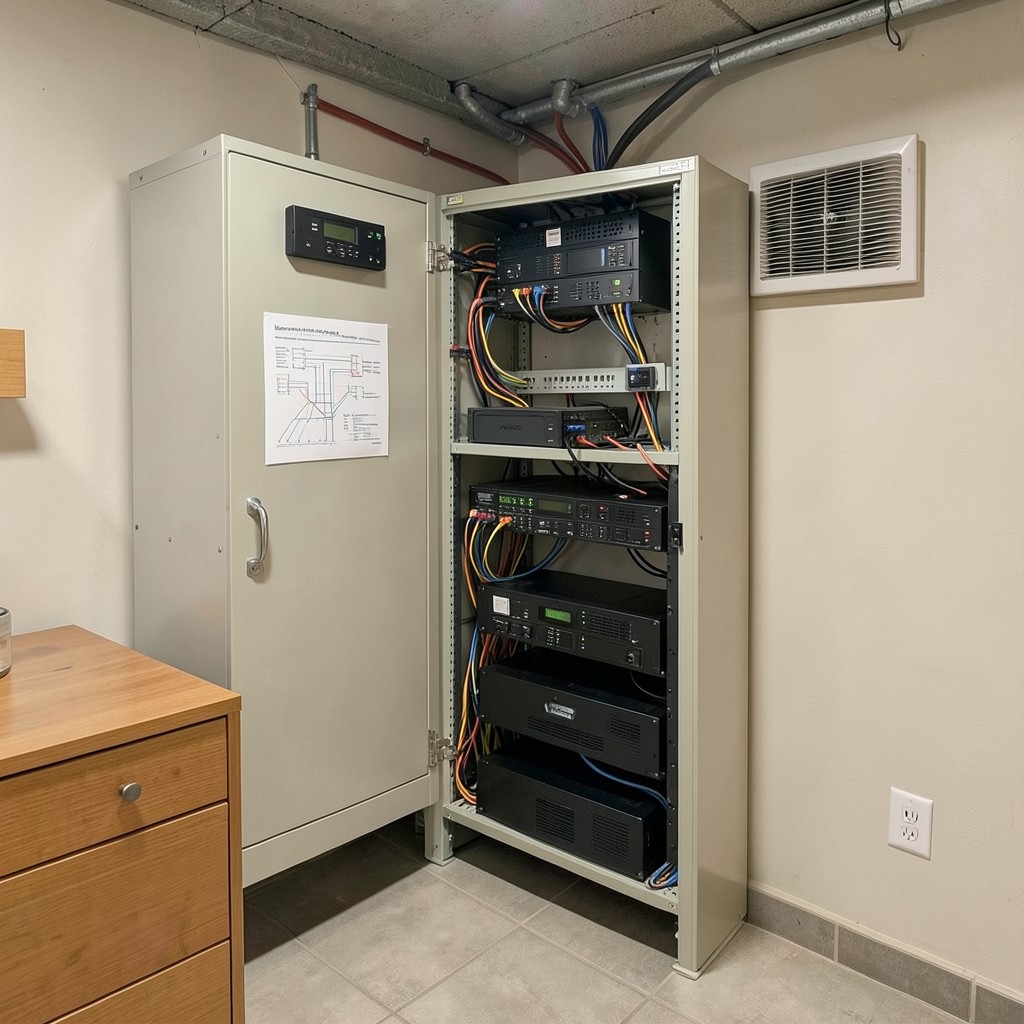
The basement technology hub organizes the smart home’s technical infrastructure — the network equipment, the home automation controllers, the security system panel, the whole-home audio distribution system, and the centralized media equipment — in a dedicated below-grade room that provides the environmental stability, the cable routing access, and the maintenance accessibility that distributed technology installations in closets, attics, and wall cavities cannot match. The basement technology room is the home’s operational center, and designing it specifically for its purpose creates the system reliability that consumer-grade installations in non-purpose spaces consistently fail to achieve.
A structured wiring cabinet — a wall-mounted or rack-mounted enclosure that houses the network switch, the router, the modem, the patch panel, and the home automation hub in an organized, labeled, and documented format — creates the technology room’s primary organizational infrastructure. The rack’s organized cable management — horizontal and vertical cable managers, labeled patch cables at every connection, and a printed network diagram mounted inside the cabinet door — creates the maintainability that a cable tangle in a closet completely lacks, and the time saved on every future network troubleshooting session because the infrastructure is clearly organized and documented pays back the installation investment across the first year of ownership. The equipment rack should be mounted at a comfortable working height with clearance above for future equipment additions and below for the cable management that a working installation always generates.
The technology room’s environmental control — a small wall-mounted HVAC unit or a through-wall ventilation fan with a thermostat that activates when the equipment’s heat output raises the room temperature above the electronics’ safe operating range — prevents the thermal damage that equipment installed in non-ventilated enclosures consistently experiences. Network equipment and media servers are significantly more reliable at a stable operating temperature than they are in environments that cycle between comfortable and hot depending on the load, and the dedicated climate control of the technology room is the infrastructure investment that extends the equipment’s service life and prevents the mid-movie server crash that every household with unstable AV equipment knows intimately.
45. A Basement With a Private Whiskey and Cigar Lounge
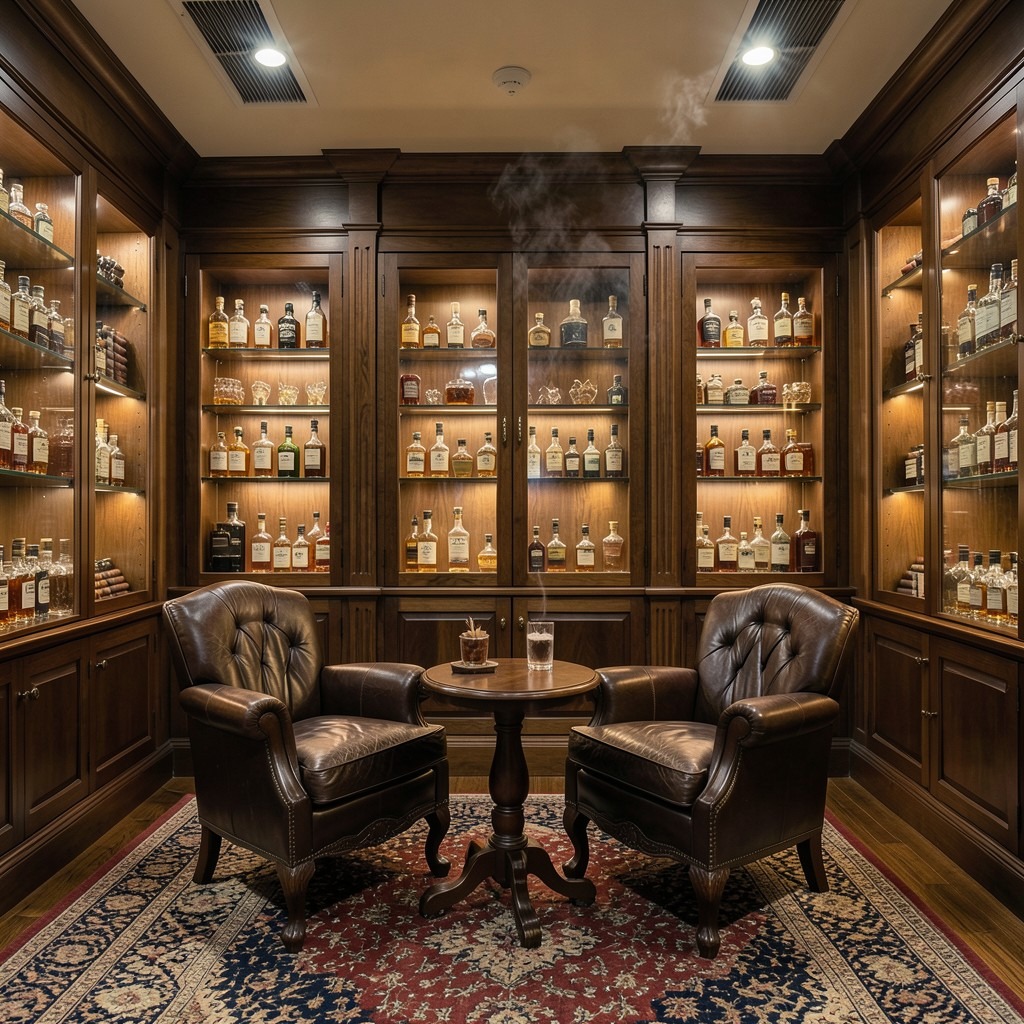
The whiskey and cigar lounge basement is the most atmospheric room type in the collection — a space whose design is entirely organized around a specific sensory ritual, the combination of aged spirit and tobacco in a setting of warm material quality and complete private comfort. The lounge is not a bar in the general sense. It is a room with a specific atmosphere, designed for a specific practice, by someone who takes that practice seriously enough to give it a room of its own.
Proper cigar lounge construction requires a dedicated HVAC solution — a ventilation system designed to exhaust the tobacco smoke from the room before it can penetrate the building’s structure and the surfaces that surround the lounge. A direct exhaust fan connected to an exterior vent, operating at sufficient capacity to create a negative pressure within the lounge relative to the surrounding basement space, prevents the smoke migration that would make the lounge impractical in a space connected to the main living areas. The ventilation’s capacity should be calculated for the maximum number of cigars simultaneously in use — a generous sizing margin prevents the smoke accumulation that an undersized system allows in extended sessions with multiple smokers.
Dark wood paneling in a rich walnut or mahogany — floor-to-ceiling library paneling with built-in display cabinets for the whiskey collection and the humidor’s overflow — creates the lounge’s primary material and atmospheric statement. The warm amber of the aged spirit in the backlit display, the dark wood’s rich tone, and the leather-upholstered club chairs at the room’s center create the specific sensory environment of the connoisseur’s private space that the design is building toward. Traditional home interiors principles applied at their most committed and most luxurious register — the deep architectural detail of the paneling, the quality of the leather, and the precision of the lighting design — create a room whose atmosphere is unmistakable from the moment the door opens.
46. A Basement With a Dedicated Painting and Visual Art Studio

The painting studio basement gives the visual artist the one working environment that every other room in the house withholds — the space large enough for large-scale canvases, equipped with the correct lighting for color accuracy, organized for the specific material requirements of the painting practice, and separated from the household’s circulation by a door that closes and contains the odors, solvents, and physical evidence of an active painting practice. The artist who works in a dedicated studio produces different work from the artist who works in a shared space, and the difference is not discipline. It is environment.
North-facing skylights — the standard professional painting studio’s light source, providing consistent, shadow-free diffuse illumination whose color temperature changes minimally through the day — create the ideal natural light for the below-grade painting studio when the basement’s position on the property allows north-facing roof penetrations. Where skylights are not possible, a full-spectrum LED lighting system calibrated to the 5000K color temperature of overcast natural daylight provides the color-accurate artificial illumination that color mixing and tonal assessment require. The painting studio’s lighting should be assessed by painting in the space — color mixed under the room’s light, applied to the canvas, and assessed at the viewing distance — before the lighting installation is finalized, because the perceived accuracy of color is the functional test that specifications and color temperature numbers alone cannot fully predict.
Canvas storage — a vertical slot system that holds each canvas independently without face contact that could damage the painted surface — organizes the studio’s work-in-progress and completed work inventory in an accessible, damage-free format. The slots should be lined with a soft material that protects the canvas edges, spaced generously enough to allow canvases to be removed without disturbing adjacent pieces, and positioned in the studio’s least-used circulation zone to allow the primary working area to remain clear for active painting. A large flat surface for reference materials — the photo reference, the color studies, the sketches — at eye level beside the primary easel position keeps the reference visible without requiring the painter to redirect their gaze between the canvas and a reference lying flat on the table below.
47. A Basement With a Warm, Inviting Traditional Interior
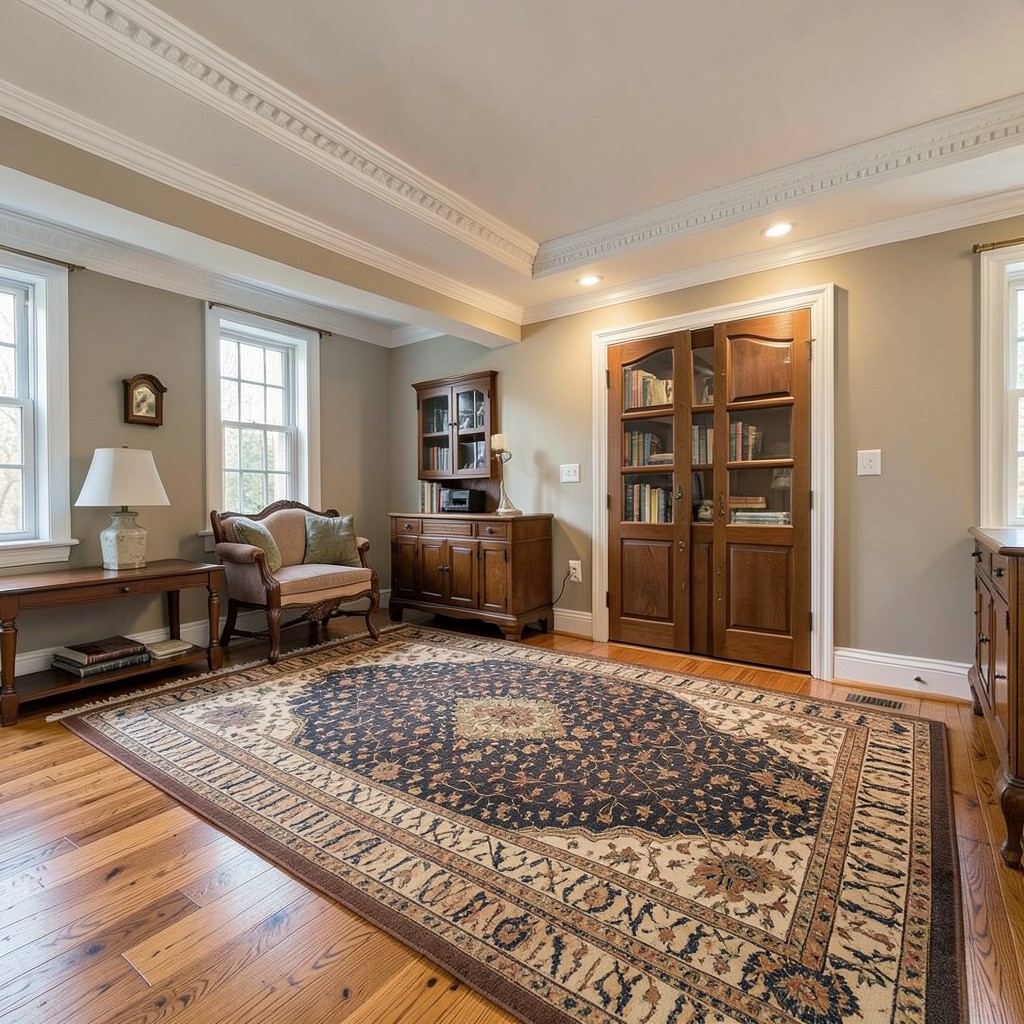
The traditional basement applies the formal warmth, material depth, and design heritage of traditional home interiors to the below-grade space with the conviction that below-grade simply means a different floor of the house — not a different standard of design, not a different level of material investment, and not a different set of design principles than those applied to every room above it. The traditional basement is the design decision that treats the basement as the home’s lowest floor rather than its least important one.
Crown molding at the ceiling perimeter of a traditional basement room — even in a seven-and-a-half-foot ceiling where the molding scale must be calibrated carefully to avoid the overpowering quality that large-scale profiles create in a low-ceiling space — creates the architectural detail that distinguishes a finished traditional interior from a simply painted room. The molding’s profile and scale should be selected for the room’s proportions rather than carried directly from the upper floors, where the ceiling heights and room volumes may support a more substantial profile. A smaller-scale egg-and-dart or simple cove profile in a low-ceiling basement room creates the same architectural intention as a large-scale dentil molding in an eight-foot main floor room — the intention, rather than the profile’s scale, is what communicates the traditional design direction.
Warm-toned hardwood flooring — an engineered oak in a warm honey or cognac stain, installed as an engineered floating product that handles the basement’s humidity fluctuations with less movement than solid hardwood — creates the traditional interior’s signature floor warmth in a below-grade format suited to the environmental conditions. An area rug over the hardwood in the room’s primary social zone — a traditional Aubusson or Oriental pattern in the warm tones of the room’s palette — creates the textile warmth and the visual pattern that traditional home interiors consistently layer over hardwood floors to create the room’s finished, composed quality.
48. A Basement With a Flexible Multi-Use Space Design
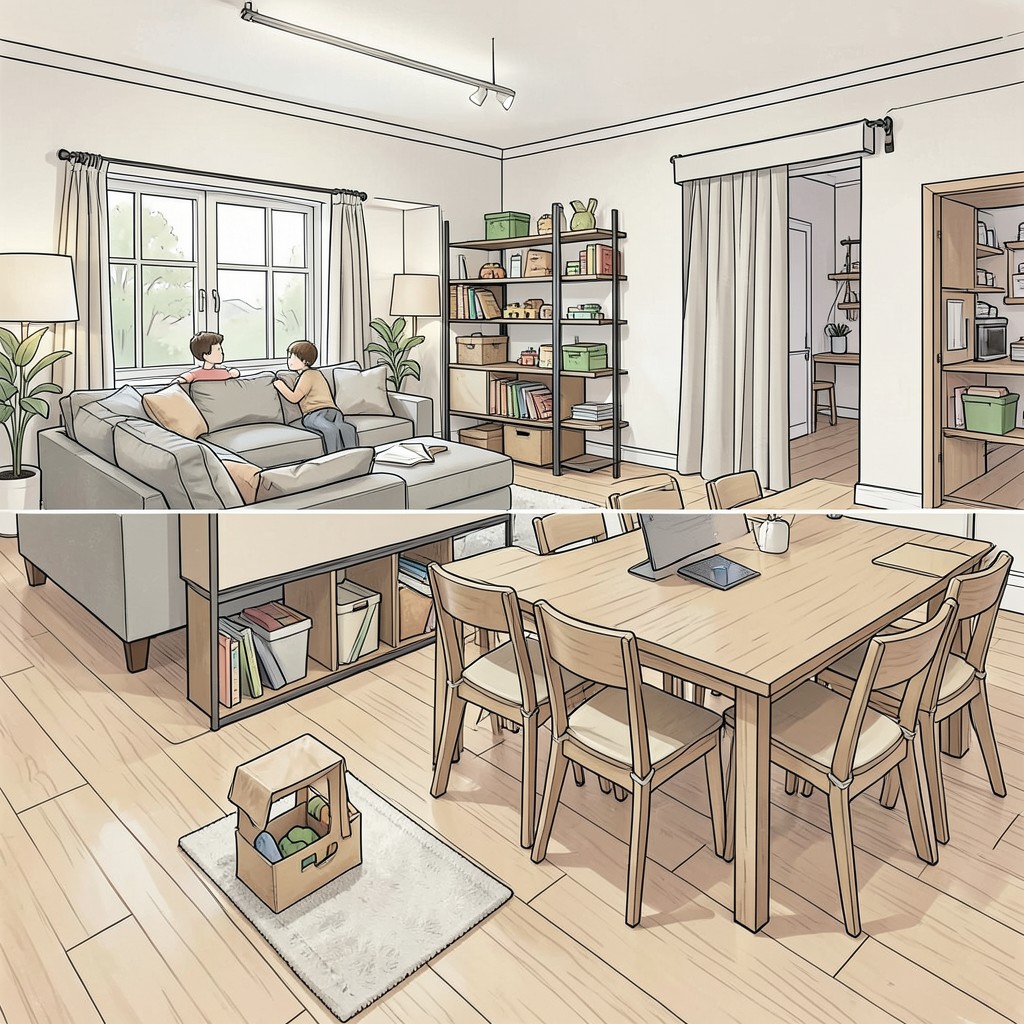
The flexible basement is the design answer for the household that cannot commit to a single function — the family that needs the space to be a playroom when the children are young, a study and hangout space when they are teenagers, and a guest suite or entertainment room when they have grown and the house’s needs have shifted. The flexible basement is designed not for the present moment but for the full lifecycle of the household’s use, and the design decisions that enable flexibility are different from those that optimize for a single, permanent function.
Furniture-defined zones rather than wall-defined zones create the primary flexibility mechanism — instead of dividing the basement into dedicated rooms for each function, the open plan floor is organized by furniture arrangement into functional areas that can be reconfigured as needs change without any structural modification. A sectional sofa defines the entertainment area; a large table and chairs defines the activity and dining area; a curtained alcove defines the private retreat or sleeping area when guests require it. The zones shift as the furniture shifts, and the floor plan that suits the household’s current life adapts without the renovation cost of permanent structural changes.
Modular, reconfigurable shelving — a wall-mounted system whose individual components can be rearranged, added to, or removed without damage to the wall — creates the storage flexibility that the multi-use basement requires as its function evolves. A shelving configuration optimized for children’s toy and activity storage at child-accessible heights reorganizes into a media and entertainment storage configuration at adult-accessible heights as the household’s needs change, using the same components in a different arrangement. The modular system’s investment is recovered across the entire lifecycle of its use rather than the single configuration period that fixed built-in storage provides before the household’s needs outgrow it.
49. A Basement With an Outdoor Garden Staircase Entry
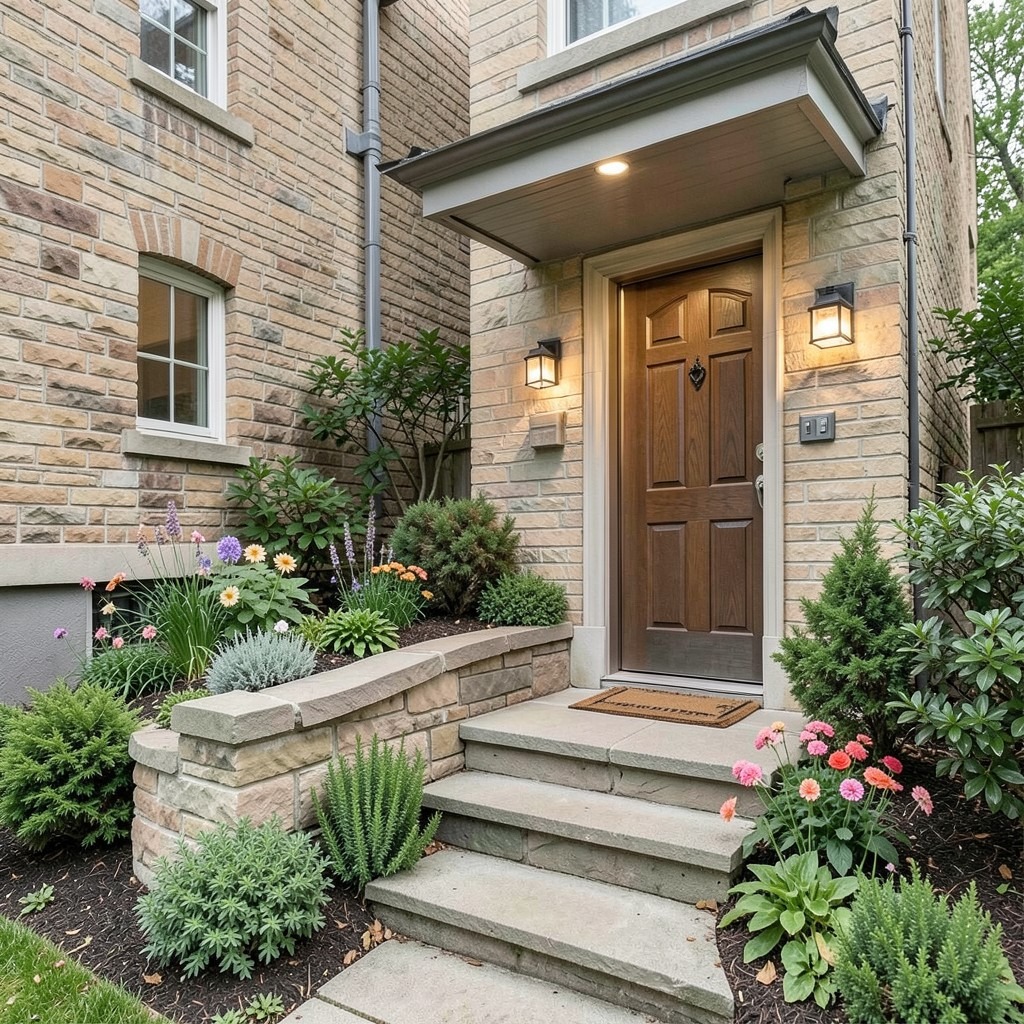
The garden-entry basement — accessed from the exterior by a staircase that descends from the garden level to a below-grade door, creating a separate entry entirely distinct from the main house entry — transforms the basement from a floor of the house into a semi-independent space whose distinct entry creates the functional separation that rental suites, home offices, and guest accommodation all benefit from. The garden staircase entry is the architectural feature that makes the basement’s independent function genuinely independent rather than theoretically separated.
The exterior staircase design should suit the garden’s character and the home’s architectural style — a straight run of stone or concrete steps with a planted border on each side creates the garden-inspired entry in a formal setting; a curved descent through a planted retaining wall with an arbor at the top creates the more romantic, garden-immersed entry that suits cottage and farmhouse home decor settings. The planting alongside the stair descent — a mix of evergreen foundation plants at the base for year-round presence and seasonal flowering plants at the upper level for the spring home refresh and fall home decorating color that marks the seasonal calendar — makes the garden entry a landscape feature rather than a functional concession.
The below-grade entry door and landing should be treated to the same design standard as the interior room beyond it — a well-lit, weather-protected landing with a covered canopy or an overhanging architectural element that protects the door position from rain and snow, a non-slip surface on the landing and the stair treads, and a doormat of appropriate quality create the entry experience that the interior’s design deserves. The entry door itself — in a design that suits the architectural style and the interior aesthetic — is the first element of the basement’s design that visitors encounter, and the connection between the door’s quality and the interior’s quality communicates the design’s consistency before the door is opened.
50. A Basement Designed as the Home’s Most Distinctive Room
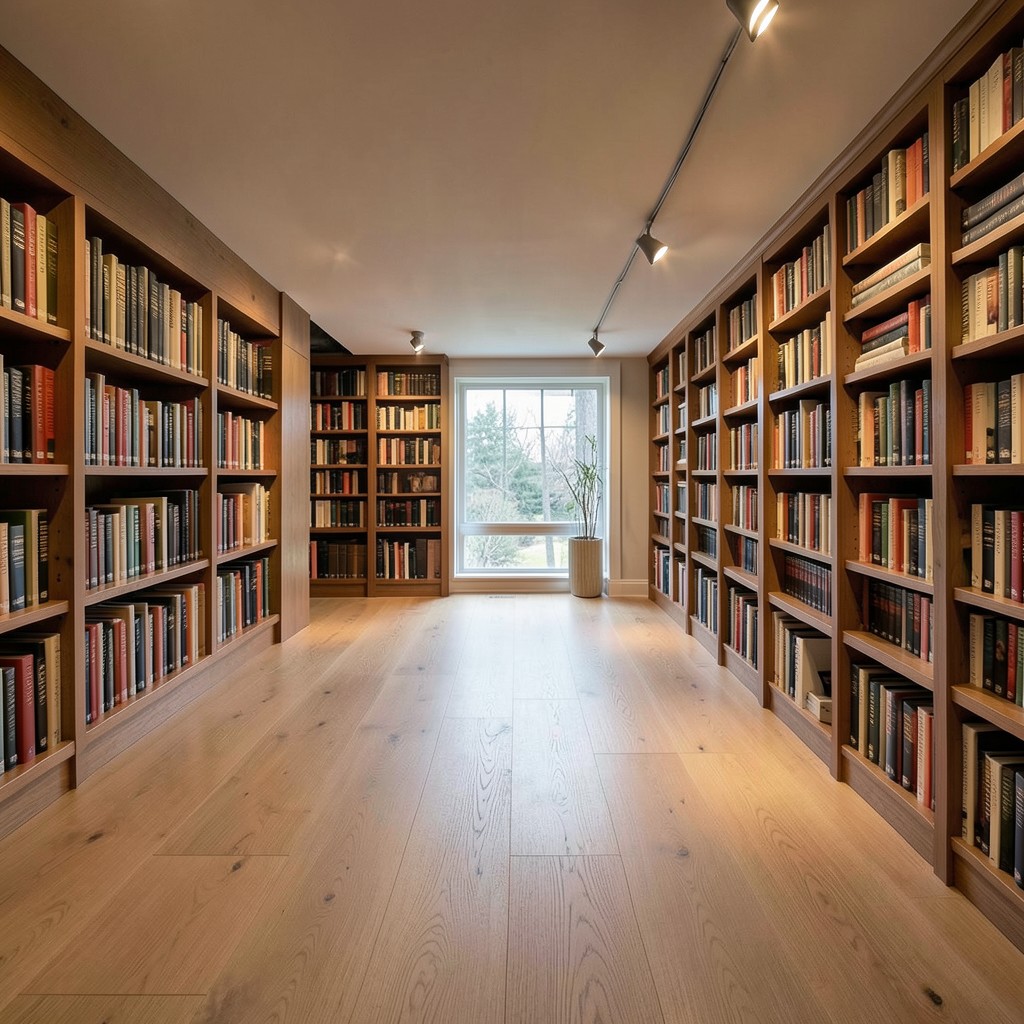
The basement designed without apology to be the home’s single most distinctive and most personal room starts from the recognition that the below-grade floor’s physical differences from the floors above are not limitations to be overcome but design conditions to be inhabited fully. The lower ceiling is the intimacy that no above-grade room achieves without a structural intervention. The limited natural light is the control over atmosphere that every room designer who works with daylight envies. The acoustic isolation is the privacy that the household’s busiest rooms are perpetually negotiating against. These are the conditions. Work with them.
The most distinctive basement designs in residential architecture share one characteristic: the designer committed to a single, specific vision and executed it without the compromises that result from designing for all possible futures simultaneously. The basement bar that is genuinely a bar — not a bar with a home theater corner and a gym section — is the one that visitors remember. The basement library that covers every wall with books from floor to ceiling is the one that becomes the household’s defining room. The basement spa that dedicates its full square footage to the therapeutic experience rather than sharing it with a laundry and a storage area is the one that justifies its investment daily. The commitment to the vision is the design decision that the basement demands more than any other room in the house.
Your basement’s potential is not in the floor plan, the window count, or the ceiling height. It is in the decision you make about what the space is going to become and the conviction with which you design toward that decision. Every room in this collection began with someone making exactly that decision — committing to a vision, designing without apology, and discovering that the room beneath their feet was the best room in their house the entire time.
Leave a Reply