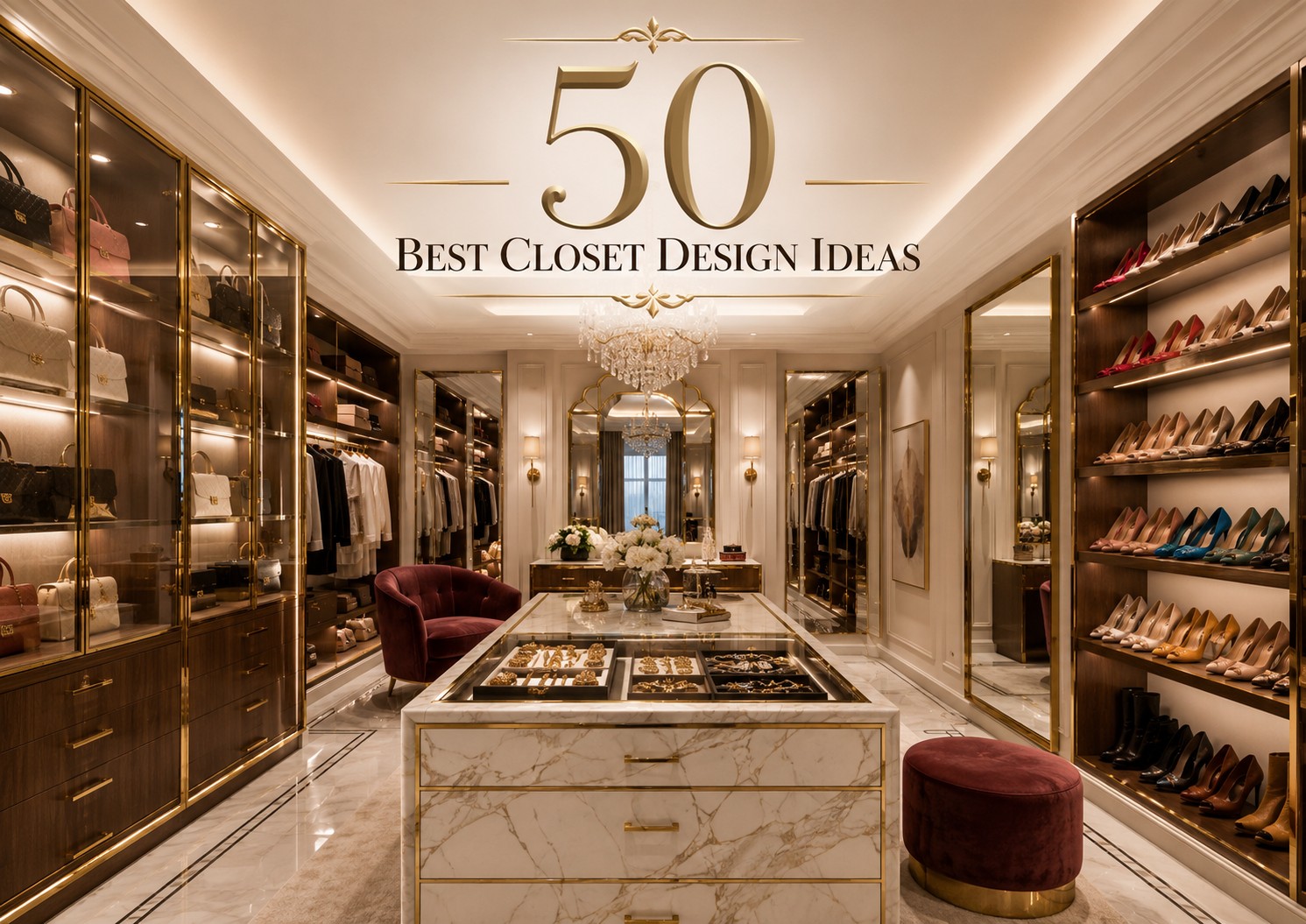
Your closet tells you something about yourself every time you open it. Not in the motivational-poster sense of that statement — in the practical, immediate sense of whether you can find what you need in under thirty seconds or spend four minutes excavating through a pile of things that have nowhere better to be. A closet that works is not a luxury reserved for large homes and generous budgets. It is the result of thinking clearly about what you own, how you dress, and what kind of spatial organization actually supports your daily routine rather than fighting against it. Most closets fail not because they are too small but because they were designed without any of that thinking applied.
The standard builder closet — a single hanging rod spanning the full width, one shelf above it, a bare bulb overhead — represents the minimum possible response to the question of clothing storage. It holds garments. It does nothing else. It offers no differentiation between hanging and folded storage, no dedicated space for shoes, no drawer storage for accessories, no lighting that helps you distinguish navy from black at seven in the morning, and no organization system that remains coherent when you are in a rush and putting things away carelessly. That minimum response, applied to a space you enter and exit at least twice daily across every day of the year, is a design failure that compounds itself across hundreds of frustrating mornings.
The fifty closet design ideas in this collection represent the full range of responses to that failure — from the budget-conscious small closet reorganization that costs a weekend and the price of a few organizational components, to the fully custom walk-in wardrobe that rivals the best luxury home interior dressing rooms in terms of material quality, thoughtful layout, and daily functional performance. Between those two extremes lies every configuration, every style, and every spatial challenge that real closets present, and each idea addresses a specific combination of circumstances rather than offering the same generic advice in different formatting. The ideas span modern home design precision and farmhouse home decor warmth, minimalist home design restraint and bohemian home styling abundance, Scandinavian home interior spare elegance and traditional home interiors layered richness.
What connects all fifty ideas is the conviction that the closet is a room — not a storage unit, not a utility space, not a box that holds the overflow from better-designed spaces. It is a room you enter with a specific purpose, perform a specific task, and exit on your way to the rest of your life. Rooms deserve light, surfaces that suit their function, materials that feel good at close range, and an organization system that accounts for the actual behavior of the person who uses them. The cozy bedroom design that surrounds your bed with warmth and intention deserves a closet that extends the same quality of care into the space where you prepare for the day. That closet is what this collection is about.
Start with the idea that solves your specific problem. The well-designed closet follows.
1. A Walk-In Closet With Full Custom Cabinetry

Custom cabinetry in a walk-in closet is the design decision that separates a room that stores clothes from one that organizes them — the difference between a space that accommodates your wardrobe and one that actively supports the way you dress each morning. When every cabinet, drawer, shelf, and hanging section is designed to the specific dimensions of your clothing, the specific categories of your wardrobe, and the specific sequence of your dressing routine, the closet stops working against you and starts working for you. That shift is more significant in daily life than any surface material or decorative choice the room contains.
Floor-to-ceiling custom cabinetry in a painted white or warm off-white finish maximizes every cubic inch of the walk-in’s volume — upper shelves for seasonal storage, mid-level hanging sections in both full-length and double-hang configurations calibrated to your specific garment lengths, and lower drawer banks for folded items, accessories, and the small categories that open shelving never quite manages well. The cabinetry’s door choice shapes the room’s visual register: handle-free flat-panel doors suit minimalist home design and Scandinavian home interior sensibilities with their architectural clean lines, while shaker-panel doors suit farmhouse home decor and traditional home interiors with their honest, crafted simplicity. Both read as premium when executed precisely, and both read as mediocre when the reveal gaps and door alignment are careless.
The drawer interiors of a well-designed custom closet deserve the same attention given to the cabinet faces — felt-lined drawers for jewelry and accessories, cedar-lined drawers for seasonal woolens, and soft-close hardware throughout that prevents the percussive closing sound that breaks the peaceful home decor quality of early-morning routines. The custom cabinetry’s material depth and hardware quality are the variables that most directly affect the daily tactile experience of using the closet, and investing the renovation budget in drawer quality rather than in decorative surfaces pays the highest return in daily satisfaction.
2. A Reach-In Closet With a Modular Organization System

The reach-in closet is the closet that most households actually have, and most reach-in closets are catastrophically under-organized — a single rod and shelf doing the work that a well-thought-out modular system would distribute across hanging zones, drawers, shelves, and specialty storage that together provide three to four times the practical capacity of the standard installation. The reach-in is not a small problem. It is the daily organization challenge for the majority of bedrooms in the majority of homes, and the modular system is its most accessible, most affordable, and most adaptable solution.
A modular closet system from a quality manufacturer — adjustable shelving units, stackable drawer components, hanging rods at adjustable heights, and shoe shelves that can be reconfigured as needs change — installs without professional help in a full day and transforms the reach-in’s functional capacity immediately. The system’s modularity is its primary design value: the configuration that suits a single professional’s wardrobe is entirely different from one that suits a household’s seasonal storage, and the ability to reconfigure without tools or cost makes the modular system the closet solution that adapts to life changes rather than requiring replacement when circumstances shift. Bright home design reach-in closets use white or light-toned modular components to amplify the limited natural light that most reach-in closets lack, the reflective surfaces compensating for the absence of windows with painted surface reflection.
The reach-in closet’s door is the organizational element that most people overlook completely — the interior of a bifold or sliding door panel holds a significant amount of additional storage on over-door organizers, shoe pockets, and mounted hooks that extend the reach-in’s capacity beyond the cabinetry behind it. An over-door shoe organizer adds storage for twelve to twenty pairs of shoes without occupying a single inch of the closet’s interior volume. The door’s interior surface, properly equipped, converts the closet from a two-sided storage space — the back wall and the two side walls — into a three-sided one, and that third side’s capacity is always available and always free.
3. A Closet With Floor-to-Ceiling Open Shelving

Open shelving in a closet is an organizational commitment, not a decorating shortcut. The open shelf holds everything visible and nothing hidden, which means the shelving’s organization quality is permanently on display and the difference between curated open shelving and unaddressed visual chaos is entirely in the discipline of the person who uses it. Get the discipline right — consistent folding, consistent spacing, consistent return of items to assigned locations — and open shelving creates a closet of striking visual order that closed cabinetry never achieves because it hides its organization behind doors. Open shelving shows you exactly what you have and exactly how organized you are. That honesty is its greatest strength and its most demanding requirement.
Floor-to-ceiling open shelves in a solid wood or painted MDF finish with consistent spacing create the closet that reads as a designed space rather than a storage solution. White painted shelves in a bright home design, airy home interiors context maximize the perception of space by eliminating the visual break of door panels and hardware, creating a continuous field of organized clothing and accessories that reads as generous and composed. Natural wood open shelves — solid oak or walnut with a clear oil finish — suit warm home decor ideas and cozy bedroom design contexts, their material warmth connecting the closet’s organization system to the bedroom’s broader aesthetic with a material consistency that painted shelves do not provide.
The shelf depth and spacing require genuine planning against the specific items they will hold — a shelf for folded sweaters needs twelve to fourteen inches of depth and ten to twelve inches of vertical spacing; a shelf for shoes needs nine to ten inches of depth and six to eight inches of vertical clearance; a shelf for folded denim needs ten to twelve inches of depth and nine to ten inches of vertical spacing. Applying a single depth and spacing throughout the closet creates a storage mismatch where some items are perfectly housed and others are poorly accommodated, and that mismatch is what causes open shelving to deteriorate from organized to chaotic within weeks of installation.
4. A Closet With a Built-In Island Dresser
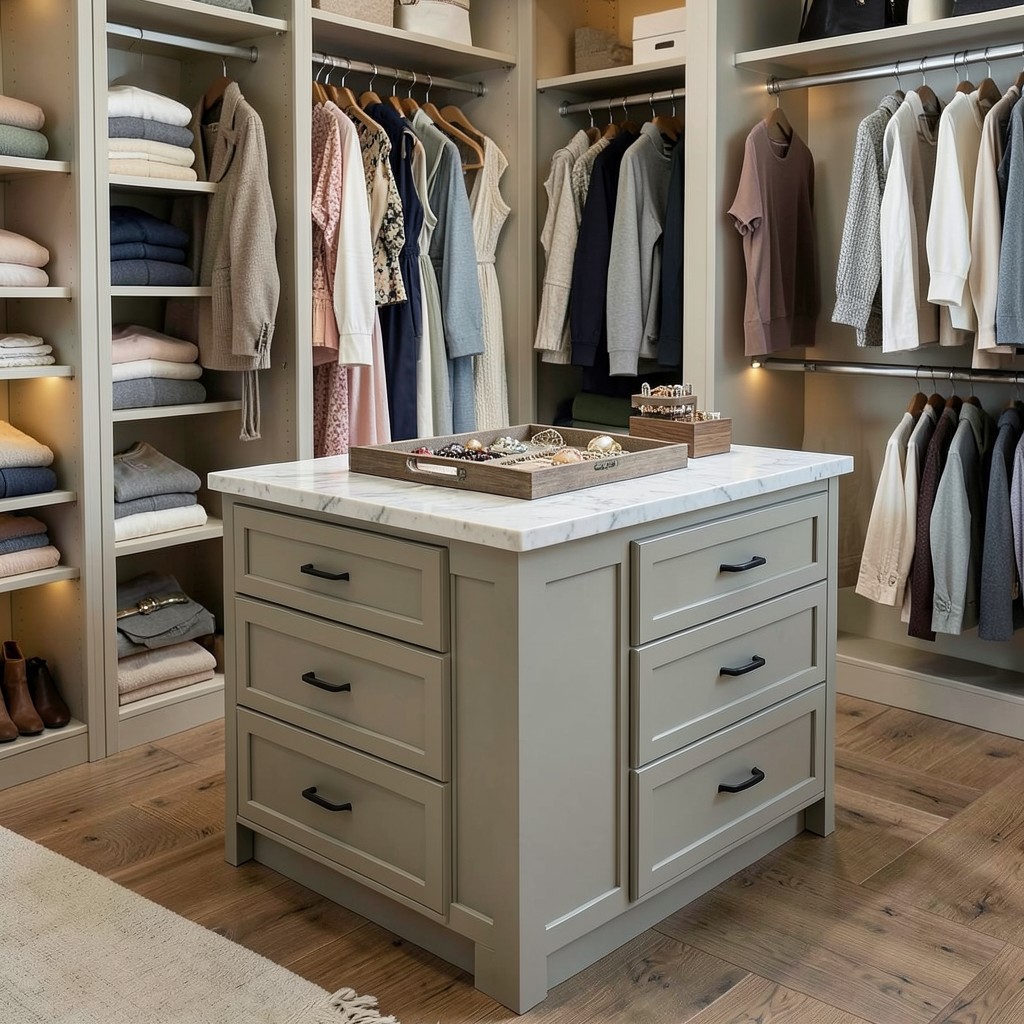
A central island in a walk-in closet is the organizational feature that transforms the space from a storage room into a genuine dressing room — the island’s drawer storage handles the folded items, accessories, and small clothing categories that wall-mounted storage cannot address efficiently, and its countertop surface provides the flat working platform for folding, sorting, and staging outfits that every well-functioning closet needs but few closets provide. The island is the closet’s equivalent of the kitchen island: the element that makes the room’s workflow complete within its own space rather than requiring support from the bedroom or bathroom beyond.
A built-in island in solid painted cabinetry — four to six drawers on each side, a countertop of marble, quartz, or butcher block depending on the room’s design direction — creates a closet centerpiece of genuine luxury home interior quality. The countertop’s material connects to the master bedroom and bathroom’s material palette, creating a design continuity between the closet and the adjoining rooms that makes the entire suite read as a cohesive designed environment. The island’s height — typically thirty-four to thirty-six inches, matching kitchen counter height — provides an ergonomically correct surface for the folding and sorting tasks it supports.
The island’s top surface deserves a felt liner, a decorative tray, or a small mirrored plateau to organize the accessories, jewelry, and daily-use items that migrate to flat surfaces everywhere. Without this surface organization, the island’s countertop becomes the closet’s primary chaos zone — the place where everything lands when it has nowhere more specific to go. A clearly defined accessory tray at one end of the island and a small stacked jewelry holder at the other create zones within the surface that direct items to their correct locations automatically, which is the principle that all closet organization must embody: the correct location must be easier to reach than any incorrect one.
5. A Closet With LED Strip Lighting Throughout
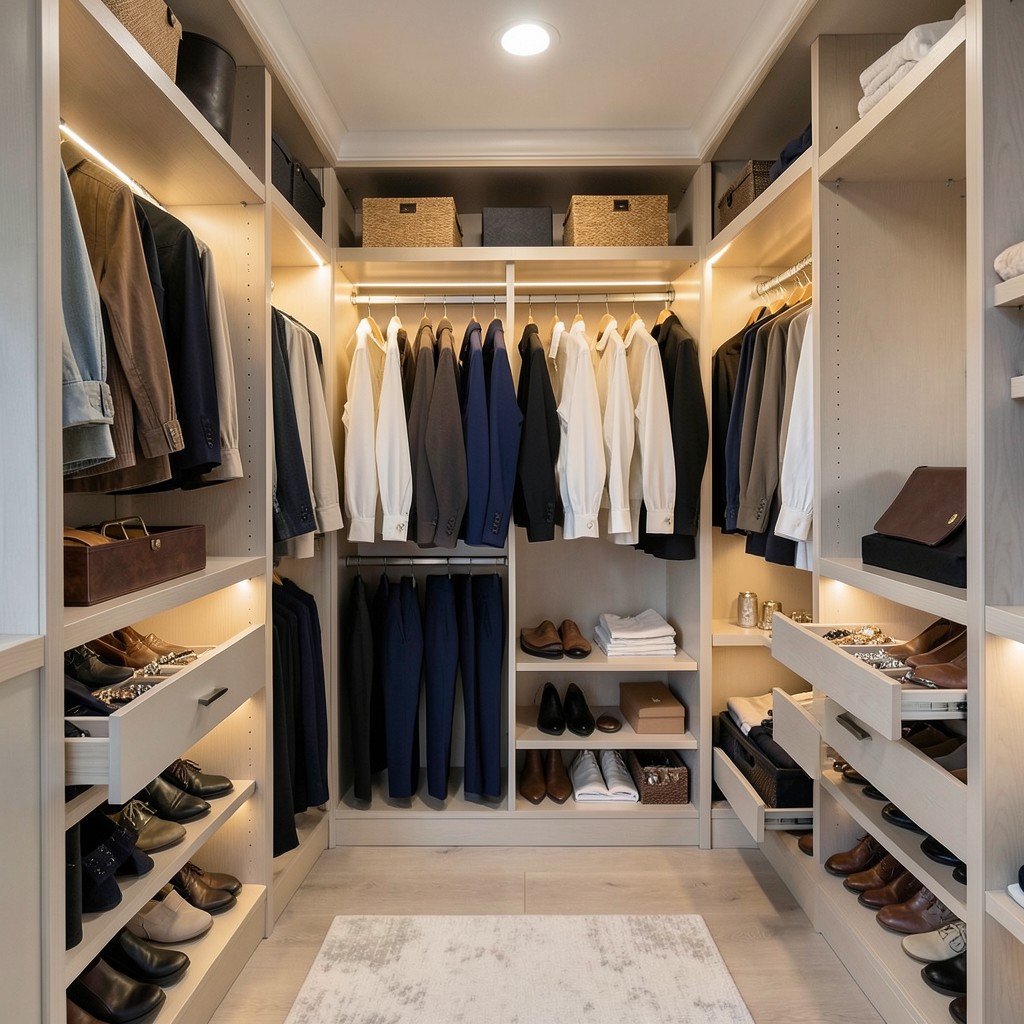
The closet without good lighting is the closet where you dress incorrectly — where navy trousers leave the house paired with black shoes because the overhead bulb cast both colors in the same dark ambiguity, where the cream blouse chosen for its softness reads as white in the artificial light and arrives at the office in the wrong tone for the planned outfit. Lighting in a closet is not a comfort upgrade. It is a functional requirement that determines whether the room serves its primary purpose correctly or fails it silently every single morning.
LED strip lighting installed on the underside of each shelf, along the top rail of every hanging section, and in the interior of every drawer that holds jewelry or accessories creates an evenly illuminated closet where every surface is seen clearly regardless of the ambient light conditions outside the room. The warm 2700K color temperature is the specification that matters most for a closet — this warmth renders clothing colors in the same tones they will appear in natural daylight, preventing the color misread that cooler, blue-toned LEDs produce. A closet lit at 2700K is a closet where you dress correctly the first time, every time.
Motion-activated LED strips that illuminate when the closet door opens and turn off when it closes eliminate the switch-hunting step in dark early-morning closet visits, and the automatic function ensures the lighting is never accidentally left on in an unoccupied closet. Smart LED systems that connect to the home’s lighting control app allow the closet’s light level and color temperature to be adjusted by time of day — brighter and cooler in the morning for clarity, warmer and dimmer in the evening for a less jarring dressing experience. Luxury master bedroom design level closets apply all of these lighting layers simultaneously, the result being a room that functions as well at five in the morning as at noon on a sunny day.
6. A Closet With a Dedicated Shoe Wall Display

Shoes are the clothing category that most people own in quantities disproportionate to the storage their closets dedicate to them — a household with forty pairs of shoes and a single low shelf for twelve pairs has a storage problem that causes shoes to live on the closet floor, under the bed, in hall closets, and in bags stored in guest room corners. A dedicated shoe wall — floor-to-ceiling shelving calibrated specifically to shoe storage with individual shelf heights matched to the tallest shoe in each category — solves this storage deficit completely and creates one of the closet’s most visually striking organizational features in the process.
Angled shoe shelves — shelves tilted slightly downward at the front — display each pair with its toe visible rather than its heel, creating the shoe store presentation quality that makes the shoe wall legible and visually appealing simultaneously. The angled shelf allows the eye to read the full range of available shoes in a single sweep, comparing styles and colors at a glance that flat-shelf storage prevents. Chic home decor closet shoe walls apply this presentation principle with the material quality to match: glass shelf faces that make the shoes appear to float, warm recessed lighting above each shelf row, and a palette limited to two or three complementary box colors for shoe storage that creates a composed display rather than a busy one.
The shoe wall’s depth requirement varies by category: men’s shoes need ten to twelve inches, women’s heels need seven to nine inches for the sole depth, and boots need a full-length section with sufficient height clearance. A shoe wall that groups categories — heels together, flats together, athletic shoes together — creates the organizational logic that makes the wall functional rather than merely beautiful, because a beautiful shoe display that requires searching through mismatched categories defeats the purpose of the display format entirely.
7. A Closet With a Mirrored Sliding Door System

Mirrored sliding doors on a closet serve two design functions that no other door format combines as efficiently — they provide the full-length mirror that any well-functioning dressing space requires, and they visually double the room’s perceived size by reflecting the space back on itself in a continuous horizontal sweep. A mirrored sliding door system spanning the full width of a reach-in closet turns the bedroom wall into a reflective surface of generous scale, and that reflected image creates the depth and light amplification that makes a moderate-sized bedroom feel substantially larger. The mirror is doing functional work and spatial work simultaneously, and the combination makes it among the highest-value upgrades available in any bedroom renovation.
A frameless mirrored sliding door system in a brushed aluminum track suits minimalist home design and contemporary home ideas bedrooms with its clean, hardware-minimal appearance. The glass panels glide on a top-hung track that leaves the floor free of obstruction, making the sliding door’s operation smooth and its floor line uninterrupted. A framed mirrored panel system with a visible frame in a warm brass, matte black, or dark bronze finish suits elegant home styling and luxury master bedroom design contexts where the frame’s material connects to the bedroom’s hardware palette and the mirror reads as a designed element rather than a utility installation.
The mirrored sliding door’s placement relative to the bedroom’s natural light source determines its greatest design benefit — a closet wall mirrored on the side of the room that faces the window reflects the incoming natural light across the full bedroom, effectively doubling the room’s daylight fill and creating the bright home design quality that transforms a north-facing or poorly lit bedroom. This light-reflection benefit is most pronounced during winter interior design season when natural light is limited and the reflected light from the mirrored door contributes more meaningfully to the room’s daylight quality than it does in the long, bright days of summer home design.
8. A Closet With Velvet-Lined Jewelry Drawers

The jewelry drawer in a closet is the single most frequently ransacked storage location in any bedroom — the drawer where chains become tangled, earrings lose their partners, and the ring you were certain was in the front left corner has inexplicably migrated to the back right. Velvet-lined jewelry drawers with individual compartments sized and arranged for specific jewelry categories solve this problem permanently by assigning every piece a defined location that it cannot leave accidentally. The velvet lining prevents scratching between adjacent pieces, the individual compartments prevent tangling, and the drawer’s organization gives every piece a location clear enough to be returned to without thought.
Custom drawer inserts in a soft dove-gray or dusty rose velvet — divided into ring rolls, earring slots, watch cushions, necklace hooks, and flat compartments for bracelets and brooches — create the jewelry storage quality associated with high-end retail display cases applied to the personal closet context. The drawer’s dimensions should be calibrated to the specific depth of each jewelry category it holds: ring rolls at two to three inches deep, necklace hooks at four to five inches to accommodate pendant length, watch cushions at two inches to hold the watch face above the drawer floor. These dimensional specifics are what distinguish a custom jewelry drawer from a generic insert that technically holds jewelry but provides none of the organizational benefit that custom sizing delivers.
A pull-out tray above the drawer section — a shallow velvet tray that slides out from the cabinetry at counter height to provide a staging surface for jewelry during dressing — adds the functional dimension that makes the jewelry drawer system complete. The staging tray holds the day’s chosen pieces during the dressing process without requiring the drawer to remain open, and its shallow depth keeps the jewelry’s visibility high during selection. Elegant home styling closets finish the jewelry section with a small angled mirror mounted above the staging tray so the earring or necklace selection can be evaluated on the face before the final choice is made.
9. A Closet With a Dedicated Bag and Purse Section
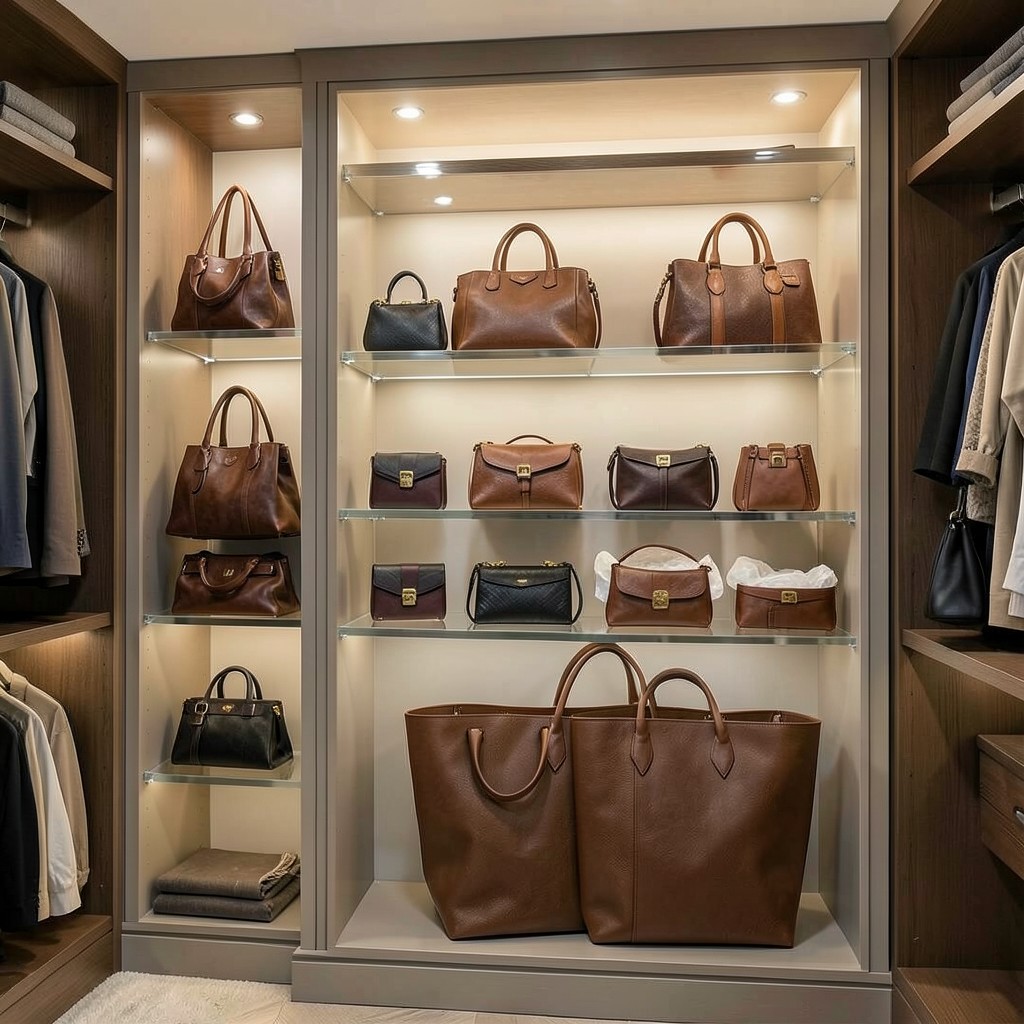
Handbags are among the most expensive and most poorly stored items in the average closet — heavy bags stacked on top of each other lose their shape, bags hanging from a single hook develop handle creases, and bags stored in their dust bags on a shelf require the entire shelf to be disturbed to locate the bag at the back. A dedicated bag storage section — shelves sized and spaced specifically for handbags, hooks at bag height, and lighting that makes every bag visible — solves the storage quality problem and preserves the material integrity of bags whose replacement cost the storage quality directly affects.
Individual clear acrylic bag shelves — each shelf set at a height that suits the bag stored on it, from small clutches at four inches to large totes at twelve inches — display the collection in a way that makes every bag visible and accessible without disturbing adjacent ones. The clear acrylic material preserves the visual lightness of the shelf area rather than adding the visual mass of wood or painted shelving, keeping the bag display airy and open. Luxury home interior closets apply museum-quality display lighting above each shelf section, the directed light illuminating the bag’s material quality — the grain of leather, the weave of canvas, the hardware’s finish — in the same way a boutique’s display lighting presents the product to its greatest advantage.
Stuffing each stored bag with acid-free tissue paper or a bag shaper before placing it on the shelf maintains the bag’s structure through storage, preventing the collapse and crease that unstuffed bags develop over time. This maintenance practice is inseparable from the storage design — a dedicated bag section without the maintenance practice it supports provides half the benefit, because the preservation of the bag’s condition is the ultimate goal that the storage design serves.
10. A Closet With a Dedicated Seasonal Storage Zone

Seasonal storage in a closet — the management of the clothing that is actively worn now versus the clothing that will not be needed until the season changes — is the organizational challenge that most closets handle by cramming everything into a single shared space until the whole system becomes unmanageable. A dedicated seasonal zone, positioned at the closet’s highest or least accessible area, holds the current season’s out-of-rotation items and the incoming season’s preparation pieces, creating a rotation system that keeps the primary closet area populated only with what is currently in use.
The highest shelves in the closet — the sections above primary reaching height, typically above seven feet — make the natural seasonal storage zone, accessible with a small step stool and removed from the daily circulation area where in-season clothing requires quick access. Vacuum storage bags compress bulky winter coats, down comforters, and heavy sweaters to a fraction of their normal volume for summer home design season storage, freeing the primary hanging and shelf areas for the lighter, more numerous garments that warm weather dressing requires. Clear labeled bins on the upper shelves hold the folded seasonal items — spring bedroom decor textiles, holiday home styling accessories, and the extra blankets and throws that winter home decor calls for — in a system that makes the seasonal rotation a thirty-minute swap rather than a day-long excavation.
The seasonal storage zone also handles the closet’s holiday-specific items — the special-occasion pieces that come out for holiday home styling gatherings and formal events a few times each year, and the seasonal accessories — scarves, gloves, sun hats — whose storage in the primary closet area creates clutter for the nine months they are not in rotation. A clearly labeled bin for each season’s accessories, stored in the seasonal zone and rotated with the clothing transition, keeps the primary closet area focused on current-use items and eliminates the chronic background clutter of out-of-season accessories that have no assigned location.
11. A Closet With a Barn Door Entry

A barn door on a closet entrance solves the bedroom’s most persistent furniture arrangement problem — the swing-door clearance zone that prevents placing furniture on the wall beside or opposite the closet, limiting the bedroom’s layout options significantly. The sliding barn door moves parallel to the wall rather than into the room, recovering the floor space the swing door’s arc consumed and opening bedroom layout possibilities that the hinged door permanently closed. This is not a stylistic decision dressed as a practical one. The space recovery is real, and in a bedroom where every foot of floor space is in use, the recovered area matters.
A wide-plank cedar or pine barn door on black iron hardware suits farmhouse home decor and rustic home decor bedroom contexts, its material warmth and the hardware’s honest industrial quality connecting the closet to the room’s broader design vocabulary. The door’s width should match or slightly exceed the closet opening’s width so that the door fully covers the opening in the closed position without leaving a gap at either side — this fit quality is the detail that distinguishes a well-specified barn door installation from one that reads as an approximate solution. The track length must accommodate the door’s full width in the open position plus a few inches of additional travel, which requires a clear wall section beside the opening sufficient to park the open door without blocking an adjacent window, switch, or artwork.
A painted barn door in the same color as the bedroom wall creates the tonal barn door effect where the door’s form reads as a subtle architectural feature rather than a furniture piece — the door is present but recedes, and the effect is one of quiet design confidence. A door painted in a contrasting color or finished in a bold pattern becomes the bedroom wall’s primary visual feature, and that choice suits bohemian home styling and chic home decor bedroom contexts where the barn door is invited to express a design point rather than recede into the background.
12. A Closet With a Dressing Table Integration

A dressing table built into the closet cabinetry — a knee-hole desk-like section with a seated surface at the correct height, flanked by drawers and shelves for makeup, skincare, and hair accessories, and fitted with a large lighted mirror above — creates the dressing room quality that luxury master bedroom design applies as standard and that every bedroom benefits from regardless of size. When the dressing table is within the closet rather than in the bedroom, the beauty and dressing functions are contained in the space that serves them most logically, and the bedroom retains the serene, furniture-clear quality that cozy bedroom design and peaceful home decor require.
The dressing table’s seated surface height — twenty-eight to thirty inches from the floor — suits the chair or stool placed at it and provides the correct arm-height for makeup application. The mirror above should be large enough to show the full face and décolletage in a single frame — a minimum of twenty-four inches wide by thirty inches tall — and lighted with warm bulbs at both sides rather than from above, because overhead lighting creates downward shadows on the face that distort color application accuracy. Hollywood-style bulb surrounds in a warm 2700K temperature provide the most accurate makeup lighting available in a residential context, and their installation in a dressing table mirror is the upgrade that changes the outcome of every morning’s makeup application.
The drawer organization at a built-in dressing table requires the same specificity applied to jewelry drawers elsewhere in the closet — a dedicated section for daily-use skincare, a partitioned drawer for makeup by category, and a small drawer for hair accessories organized in labeled cups. The organization system directly below the work surface is the one used most frequently and most carelessly, and designing it for fast, intuitive access rather than for visual tidiness in the closed position produces a dressing table that works at full speed during the timed morning routine.
13. A Closet With Color-Coded Organization

Color coding a closet — organizing every hanging section by garment color from light to dark, and organizing every shelf section by the same principle — creates a visual system of such immediate legibility that the closet’s entire contents become findable by sight rather than by rummaging. The color-coded closet does not merely look organized. It is organized, and the organization system is visible and self-enforcing: returning a garment to its correct color position is as intuitive as returning a book to its alphabetical shelf position, because the visual logic of the sequence makes the correct location obvious.
The organization begins with sorting every category of garment — all shirts together, all trousers together, all jackets together — and within each category, arranging from white and cream through pastels, warm tones, cool tones, and finally to black. This arrangement turns the closet’s hanging section into a color spectrum that reads as both aesthetically pleasing and organizationally functional, and the aesthetic pleasure is not a secondary benefit — a closet that looks as good as this one encourages the maintenance behavior that keeps it looking good. Airy home interiors and spring bedroom decor-influenced closets respond particularly strongly to the color-coded system because the visual lightness of the spectrum from white through color to black suits the light, fresh quality those aesthetics prioritize.
Extending the color coding to folded shelf items — towels, sweaters, and casual tops folded with the color edge facing outward — creates a shelf face that reads as a composed color display. The Japanese retail influence on this folding approach is worth acknowledging: stores that fold garments with the color visible rather than the logo facing out demonstrate that the aesthetic quality of organized clothing storage is achievable through folding method rather than through container purchase, and that the simplest organizational tool in the closet is the discipline of the person who uses it.
14. A Closet With Wallpaper as a Feature Wall

Wallpaper inside a closet creates the unexpected design moment that guests discover when the closet door opens during a tour of the house and react with genuine surprise — not because wallpaper in a closet is extravagant, but because it communicates that the person who lives here thought about the inside of their closet with the same intention they brought to every other room. That communication is the design point. It says: nothing in this home is incidental, not even the surfaces behind the closed doors.
A bold botanical print on the closet’s back wall — lush oversized leaves in deep greens and ochres against a cream ground — creates the garden-inspired interiors quality that connects even a windowless closet to the natural world. The small scale of most closet back walls means a large-pattern botanical print reads at its most intense and most beautiful in this context, because the scale of the pattern relative to the wall’s area creates the enveloping quality that the same pattern applied to a full bedroom wall dilutes. Floral home decor ideas applied to a closet wallpaper — a large-scale peony, magnolia, or cherry blossom print — suit spring bedroom decor and the spring home refresh energy that makes people want to add freshness and living color to every space including the ones nobody else sees.
A geometric wallpaper in a precise two-color pattern — navy and white, terracotta and cream, sage and ivory — suits minimalist home design and contemporary home ideas closets where the pattern’s formal control suits the design direction while providing the visual interest that plain paint cannot generate. The wallpaper’s application inside the closet requires moisture-resistant paste and a standard room-temperature adhesive — the closet’s stable humidity makes wallpaper installation more reliable here than in bathrooms or kitchens — and the installation’s limited area makes it a manageable half-day project for a competent DIYer willing to match the pattern carefully at the seams.
15. A Closet With a Cedar Lining for Natural Preservation

Cedar-lined closet walls are among the oldest and most effective natural wardrobe preservation strategies — the aromatic oils in eastern red cedar repel moths, silverfish, and the other textile-damaging insects that target natural fibers, while simultaneously maintaining a low-humidity microclimate within the closet that prevents the mold and mildew growth that damages stored garments in humid climates. The cedar lining does its preservation work continuously without any chemical treatment, replacement, or maintenance beyond the periodic light sanding that reactivates the wood’s aromatic oils as the surface weathers. This is the closet upgrade that works hardest while you are paying no attention to it at all.
Tongue-and-groove cedar planking applied to all four walls and the ceiling of the closet creates a fully enclosed cedar environment whose aromatic quality fills the closet with the distinctive clean, woody scent that cedar releases. The scent is not incidental — it is the functional indicator that the cedar’s oils are active and the preservation process is working. Cedar closet planking suits mountain cabin decor, rustic home decor, and warm home decor ideas bedroom contexts where the wood’s natural quality connects to the home’s broader material vocabulary, and the cedar’s color — a warm reddish-amber when freshly installed — adds a richness to the closet’s interior that painted walls cannot match.
Cedar drawer inserts — thin cedar panels that line the bottom of each drawer and the sides of hanging sections where stored woolens are most vulnerable — provide the preservation benefit in a less complete but more affordable format than full cedar planking. Cedar sachets hung from the closet rod and placed between folded sweaters provide the most basic level of cedar protection for closets where lining is not feasible, their small size and low cost making them the accessible entry point into cedar’s natural preservation benefits. The full cedar closet, however, is in a different category of performance and sensory quality from sachets and inserts — it is an environment, not a treatment, and the difference is immediate and lasting.
16. A Closet With Glass-Front Cabinet Doors

Glass-front cabinet doors in a closet create the display case quality that transforms the closet from a storage room into a curated wardrobe presentation — the glass’s transparency shows the organized contents of every cabinet, creating the visual inventory that open shelving provides but with the dust protection and organizational containment that closed doors maintain. The glass-front cabinet is the hybrid between open shelving and closed cabinetry, providing visibility without full exposure, and in a closet whose contents are organized well enough to display, the glass-front cabinet is the design choice that rewards the organization quality most directly.
Clear glass inserts in flat-panel or shaker-style door frames suit elegant home styling and luxury home interior closets where the display quality of the glass is the design point. The cabinet interiors visible through the glass should be organized to the standard of a retail display: folded items face-out with consistent fold lines, shoes angled uniformly toward the glass, handbags facing outward with handles upright, and accessories arranged in compatible color groups. This display-quality organization behind glass doors is achievable and maintainable for a household committed to the discipline the format requires, and the daily reward of opening a closet whose glass-front cabinets display a composed, organized wardrobe is a quality of morning experience that most people have not yet had.
Smoked or bronze-tinted glass suits chic home decor and contemporary home ideas closets where the full transparency of clear glass is too revealing or where the bronze tone connects to the room’s warm metal finish palette. The tinted glass provides the display visibility at close range while obscuring the detail from across the bedroom, creating privacy for the closet’s contents when the closet door is left open during the day. Reeded or fluted glass — glass with a vertical linear texture pressed into its surface — provides the most privacy of any glass type while still allowing color and form to read through the texture, creating a cabinet face of genuine decorative character that suits bohemian home styling and traditional home interiors equally.
17. A Closet With a Pull-Out Valet Rod

The valet rod is the closet accessory that solves the outfit-staging problem almost every person who plans their clothing in advance faces daily — the need for a temporary hanging location where tomorrow’s outfit, a freshly ironed shirt, or a just-returned dry cleaning can hang without occupying the primary rod space or being draped over a chair. The pull-out valet rod extends from the cabinetry on a retractable mechanism, holds two to four garments, and slides back flush with the cabinet face when not in use, occupying no permanent space and adding no visual clutter to the closet’s primary sightline.
A chrome or brushed brass pull-out valet rod mounted at hanging height within one of the cabinetry columns — recessed into a dedicated housing that conceals it flush with the column face when retracted — creates the most refined version of this function. The hardware quality of the retraction mechanism determines how smoothly the rod extends and retracts across thousands of daily uses, and investing in a mechanism with a smooth, dampened action rather than a stiff pull-and-push system makes the valet rod a pleasure to use rather than a mild inconvenience. Luxury master bedroom design closets treat the valet rod as a standard feature alongside the dressing table and the jewelry drawer, and once it is part of the dressing routine, its absence in any future closet is felt immediately.
The valet rod also serves as a temporary home for garments that have been worn once but do not need washing — the jacket worn for an evening, the trousers worn for a short meeting — that are too clean to return to the worn-clothing hamper and too worn to return to the fresh-clothing section of the primary rod. This intermediate garment state is one of the closet’s most persistent organizational challenges, and the valet rod’s temporary hanging surface addresses it directly with a defined, contained location that prevents these garments from migrating to chairs, door handles, and every other horizontal surface in the bedroom.
18. A Closet With a Minimalist White and Brass Palette

The closet designed in a palette of white painted surfaces and warm brass hardware is the design combination that achieves the most with the fewest variables — the white provides the neutral, light-reflective background that makes the closet’s contents the primary visual focus, and the brass provides the warmth that prevents white from reading as clinical or institutional. The combination suits minimalist home design, Scandinavian home interior, and elegant home styling bedroom contexts with equal ease, its design language sufficiently restrained to serve as the design direction’s defining palette and sufficiently warm to feel domestic and personal rather than hotel-like.
Flat-panel white cabinetry with brushed brass cup pulls, a brass hanging rod, and brass light fixture hardware throughout creates the visual consistency that makes the closet read as a designed room rather than an assembled storage system. The brass hardware’s warm tone connects naturally to the warm white of the cabinetry — a pure bright white would make the brass read as yellow by contrast, while a warm off-white in a cream or warm gray makes the brass read as gold, which is the correct relationship. The paint color choice behind the white and brass palette is the decision that determines whether the combination reads as warm and refined or as cold and generic, and the difference between the two is often a single step on the white spectrum toward warmth.
Adding one material counterpoint to the white and brass palette — a natural rattan basket on the lower shelves, a small wood-framed mirror above the dressing table, or a single velvet cushion on the closet bench — provides the organic texture that prevents the all-white, all-brass composition from reading as too curated or too perfect. The single natural material element grounds the palette in domestic warmth without disrupting the closet’s design clarity, and its presence signals that this is a lived space rather than a showroom installation.
19. A Closet With a Dedicated Tie and Belt Rack

The tie and belt rack is the organizational accessory that most closets lack and most people who own ties and belts genuinely need — without it, ties are coiled in a drawer where they develop storage creases, and belts are looped through hanger slots where they distort the hanging space and create a tangled extraction process every time a specific one is needed. A dedicated rack for each category — a motorized tie carousel or a fixed peg-board system for ties, and a pull-out belt bar or a series of J-hooks for belts — transforms accessories from the closet’s most chaotic category into its most organized one.
A motorized tie carousel — a rotating drum with individual tie pegs that rotates to present each tie sequentially — is the most space-efficient and most functionally sophisticated tie storage option, accommodating forty or more ties in a housing that fits within a single cabinet column. The rotation function presents each tie without requiring the others to be moved, making the selection process both fast and gentle on the ties’ material. A simple fixed peg board — a panel of horizontal wooden pegs mounted within a cabinet section or on the closet wall — provides the same organizational function at a fraction of the motorized carousel’s cost, and its non-mechanical simplicity means it will still be functioning correctly in twenty years without maintenance.
The belt rack’s pull-out format — a bar or series of hooks mounted on a full-extension pull-out mechanism that brings the full collection into view when extended — provides the clearest presentation of the belt collection and the fastest selection access of any belt storage format. Mounted within a cabinet section at the same height as the shirt shelves or in the drawer section below them, the pull-out belt bar occupies no more space than a standard drawer and provides considerably more organizational value for the specific category it serves.
20. A Closet With a Luxury Perfume and Fragrance Display

A dedicated perfume display section in a closet applies the design principles of luxury retail fragrance presentation to a personal collection — the perfume bottles arranged on a lit glass shelf, each bottle’s form and color visible from the dressing position, create a display of decorative quality that contributes to the closet’s visual character while keeping the fragrance collection organized, accessible, and protected from the temperature fluctuations that damage fragrance quality over time. The display serves both an aesthetic and a preservation function, and the two are inseparable.
A single glass shelf mounted at nose height at the dressing table, lit from above by a recessed LED strip in a warm tone that illuminates the bottles from above without creating glare on the glass surfaces, creates the fragrance display’s essential infrastructure. The shelf depth should accommodate the tallest bottle in the collection with clearance above — a typical tall fragrance bottle stands seven to ten inches, and a shelf-to-ceiling clearance of twelve inches provides the accessibility needed to retrieve and replace bottles without catching them on the shelf above. Chic home decor and elegant home styling closets treat the fragrance display as a serious design element, mirroring the back of the display shelf so that each bottle reads from both the front and the reflected back.
Organizing the fragrance collection by bottle height or by color family — rather than by brand or scent profile — creates the most visually coherent display composition and suits the aesthetic function of the shelf as a decorating element. The fragrance display is the closet’s most purely personal design feature, the one where the collection itself is the decoration, and its organization should prioritize the visual quality of the display as prominently as the practical accessibility of the individual bottles.
21. A Closet With Antique Dresser Integration

An antique dresser incorporated into a walk-in closet instead of — or alongside — custom built-in drawer cabinetry brings the layered, collected character to the closet that new custom cabinetry cannot provide on its own. The antique dresser’s presence communicates history, craft, and personality in a room that typically contains only new manufactured elements, and the contrast between the antique’s aged patina and the custom cabinetry’s precise finish creates a visual richness that single-material closet designs never achieve. This is the design approach that makes a closet feel like a room rather than a storage installation.
A Victorian mahogany chest with its original brass hardware, positioned at the center of a wall in a walk-in closet and flanked by custom cabinetry on both sides, creates the focal point that the closet’s composition needs to read as a designed room rather than a storage installation. The mahogany’s dark, warm reddish tone against white cabinetry creates a color contrast that suits traditional home interiors and elegant home styling contexts, while an antique bleached oak or painted pine dresser suits farmhouse home decor and warm home decor ideas closet settings where the lighter antique tone suits the room’s palette better than a dark wood. The key design requirement is that the antique’s top surface height aligns reasonably closely with the custom cabinetry’s counter height so that the integrated composition reads as intentional rather than accidental.
The antique dresser’s drawers hold the same folded garments and accessories that custom built-in drawers would otherwise contain, and the daily use of an antique dresser — the slight effort required to pull a slightly swollen drawer, the particular sound of antique hardware against an aged wood case — creates a textural experience that no custom cabinetry drawer provides. There is something grounding in the physical encounter with an object that was made a long time ago for the same purpose you are still using it for, and the closet that contains such an object carries a quality of domestic continuity that purely new installations do not achieve.
22. A Closet With Industrial Pipe Clothing Racks

Industrial pipe clothing racks — open hanging systems built from standard plumbing pipe in a black iron or raw steel finish, supported on wall-mounted flanges — bring the honest utility aesthetic of industrial home design into the closet with a directness and material accessibility that custom cabinetry cannot match. The pipe rack is the anti-closet closet: it hides nothing, conceals nothing behind doors, and makes no pretense of being anything other than a functional hanging system. In the right aesthetic context — and with the right level of organization discipline from the person who uses it — the pipe clothing rack creates a closet of striking industrial beauty.
Black iron pipe in a standard half-inch or three-quarter-inch diameter, mounted at double-hang height to accommodate two rows of garments on a single wall section, creates the hanging capacity of a standard closet within an open industrial framework whose visual quality suits rustic home office ideas and industrial home design bedroom contexts. The pipe’s exposed fittings — elbows, tees, flanges — become part of the design language rather than structural elements to be hidden, and the consistency of the fitting style throughout the installation creates the visual coherence that makes an industrial pipe rack read as designed rather than improvised. Pairing the pipe rack with raw wood shelving on iron brackets creates the complete industrial closet composition whose warm wood and dark metal material dialogue suits the stone and wood home design aesthetic at its most applied and domestic.
The pipe rack’s openness creates a display requirement: every garment must be organized, hung consistently, and aesthetically compatible with its neighbors, because nothing is hidden and the visual quality of the display is the visual quality of the room. Garments arranged by category and then by color, hung on matching slim black velvet hangers that maintain a consistent silhouette throughout the rack, create the organized industrial closet display that reads as considered and controlled. The pipe rack closet that contains mismatched hangers, randomly arranged garments, and accumulated accessories draped over the pipes reads as a construction site rather than a designed space — the format demands the organization quality that makes its openness work.
23. A Closet With a Built-In Bench and Seating

A built-in bench in the closet is the functional element that most dressing routines need and most closets never provide — a surface at the correct height for sitting while putting on shoes, setting down folded garments during outfit assembly, or simply resting during the closet’s use. Without a bench, these activities happen on the bed, the floor, or the edge of whatever furniture is nearest, and the closet’s inability to contain its own dressing function is a daily reminder that the room was designed to the minimum rather than to the optimum. The bench is not a luxury. It is the basic ergonomic furniture the dressing function requires.
A custom built-in bench with upholstered seating and under-bench drawer or cabinet storage creates the closet’s central dressing station — the fixed point around which the daily dressing routine organizes. The bench seat’s upholstery connects to the bedroom’s textile palette: a bouclé in a warm cream suits Scandinavian home interior and contemporary home ideas contexts, a linen in a soft sage suits coastal home design and breezy home interiors settings, and a velvet in a deep jewel tone suits elegant home styling and luxury master bedroom design contexts where the bench’s material richness sets the closet’s design register. The upholstery’s color and texture are the closet’s primary textile choice, and making them with the same care applied to bedroom cushion choices is the standard this surface deserves.
Under-bench storage in the form of pull-out drawers — two to four drawers running the bench’s full depth, accessible from the front while seated or standing — stores the items that the dressing routine requires at the bench position: shoe-care supplies, stocking and hosiery, belt accessories, and the small daily-use items that accumulate at the dressing position without a defined storage home. The under-bench drawer’s organization directly below the seated dressing position is the storage location with the highest daily access frequency in the entire closet, and its design should reflect that frequency: full-extension drawer slides, a clear organizational system within the drawer, and contents limited to the items genuinely used at the bench rather than treated as an overflow drawer for the rest of the closet.
24. A Closet With a Pegboard Accessory Wall

A pegboard wall in a closet — a panel of perforated hardboard or solid wood with evenly spaced holes for standard peg hooks — organizes the accessories, belts, bags, scarves, and jewelry that shelves and drawers handle poorly, by hanging them in visible, individually assigned positions that make every accessory findable by sight rather than by excavation. The pegboard is the accessory wall’s organizational infrastructure: the hooks create specific locations, the visibility creates accountability, and the adjustability allows the system to evolve as the collection changes without requiring new furniture or new hardware.
A painted pegboard panel — the standard Masonite hardboard finished in white, the wall color, or a contrasting accent tone — creates the accessible version of the accessory wall that suits any closet style from contemporary home ideas to farmhouse home decor. Painted pegboard in the same color as the closet’s walls reads as a built-in feature rather than a hardware-store addition, and the hooks’ arrangement within the painted panel creates the organized display without the visual interruption of a distinctly different panel color. Solid wood pegboard in an oak or walnut finish creates the premium version of the accessory wall that suits luxury home interior and elegant home styling closets, the wood’s material quality making the pegboard a genuine design element rather than a utility surface.
The hook configuration on a closet pegboard should be planned specifically against the accessory categories it will hold — J-hooks at different heights for belts and long scarves, small round hooks for bag handles and short necklaces, shelf inserts for small clutches and folded accessories, and flat hooks for flat accessories like sunglasses and hair ties. This specific configuration, designed around the actual collection rather than a generic accessory assortment, creates the pegboard that every person who sees it wants for their own closet — not because it looks good in photographs, but because it makes the morning routine genuinely, measurably faster.
25. A Closet With a Scandi-Inspired Natural Wood Finish

The Scandinavian-influenced closet applies the design philosophy of northern European interior design to the wardrobe space with the same precision and material honesty that Scandinavian home interior design brings to every other room it touches — and the result is a closet of spare, warm, enduringly beautiful character that suits a wider range of bedroom aesthetics than almost any other closet design direction. The pale natural wood, the white-painted elements, and the absence of ornament or decorative complication create a closet that feels like a room designed by someone who knows exactly what they are doing and needs no additional elements to prove it.
Ash or white-oiled oak cabinetry — either in a fully open-shelving format or in a combination of open shelves and flat-panel closed cabinets in the same natural wood tone — creates the Scandinavian closet’s primary material statement. The wood’s pale, straight-grained surface catches the closet’s LED lighting and reflects it with a warmth that white-painted surfaces cannot match in the same register. The natural wood finish requires a penetrating oil rather than a film-forming lacquer — the oil preserves the wood’s color and texture while allowing the surface to breathe and age gracefully, and the aging of a naturally oiled wood surface creates a richer, more settled appearance over time rather than the yellowing and flaking that film finishes develop. Spring bedroom decor and airy home interiors aesthetics connect most naturally to this finish choice, the closet’s pale wood resonating with the season’s light, fresh, nature-referenced quality.
Single-bar hanging sections in the natural wood tone, spaced at the heights calibrated for the hanging categories they serve, create the Scandinavian closet’s characteristic horizontal rhythm — an alternating pattern of hanging sections and shelf sections that reads as organized without being regimented. The absence of decorative hardware is the final commitment to the Scandinavian approach: doors in push-to-open formats, drawers with finger-pull recesses in the drawer face rather than applied handles, and a complete absence of applied ornament of any kind. The closet’s design quality must come entirely from its proportions, its material, and its organization — and when those three elements are executed correctly, they are sufficient.
26. A Closet With a Full-Length Tilting Mirror

The full-length tilting mirror in a closet provides the viewing function that a fixed mirror cannot — the ability to angle the mirror’s face to catch the full outfit from head to toe at the angle that best reveals its proportions, without the viewer needing to stand at a specific distance or height to use it correctly. A fixed mirror presents the same viewing angle regardless of the viewer’s height and position; a tilting mirror adjusts to each individual’s height and each outfit’s specific assessment needs. For the person who takes their dressing seriously, that adjustability is the difference between a mirror that serves its function and one that approximately serves it.
A large tilting mirror in a solid wood frame — the frame finished in the same material or painted finish as the closet’s cabinetry — creates the closet’s primary visual anchor and its most actively used functional element. The frame’s depth should be sufficient to support the mirror’s weight in the tilted position without a counterbalance mechanism, and the tilting hardware — a pair of pivot bolts set in the frame’s side rails — should operate smoothly and hold the selected angle without drifting. The mirror’s size should be at least twenty-four inches wide and sixty inches tall to show the full outfit from neckline to floor with the viewer standing three to four feet away from the glass — a smaller mirror forces closer proximity that changes the visual perspective and makes outfit assessment less accurate.
The tilting mirror’s installation position — freestanding on the closet floor, wall-mounted at a pivot point, or built into the cabinetry on a swing-out mechanism — determines how much floor space it occupies and how the closet’s layout accommodates it. A wall-mounted tilting mirror takes the least floor space and suits reach-in and smaller walk-in closet configurations. A freestanding tilting cheval mirror suits the center of a generous walk-in where its freestanding presence can be circled for all-angle assessment. The built-in swing-out mirror — folding flat against the cabinetry when not in use and swinging out on a pivot to present itself at the standing position when needed — is the most space-efficient and most architecturally integrated option in custom cabinetry contexts.
27. A Closet With a Bohemian Eclectic Styling
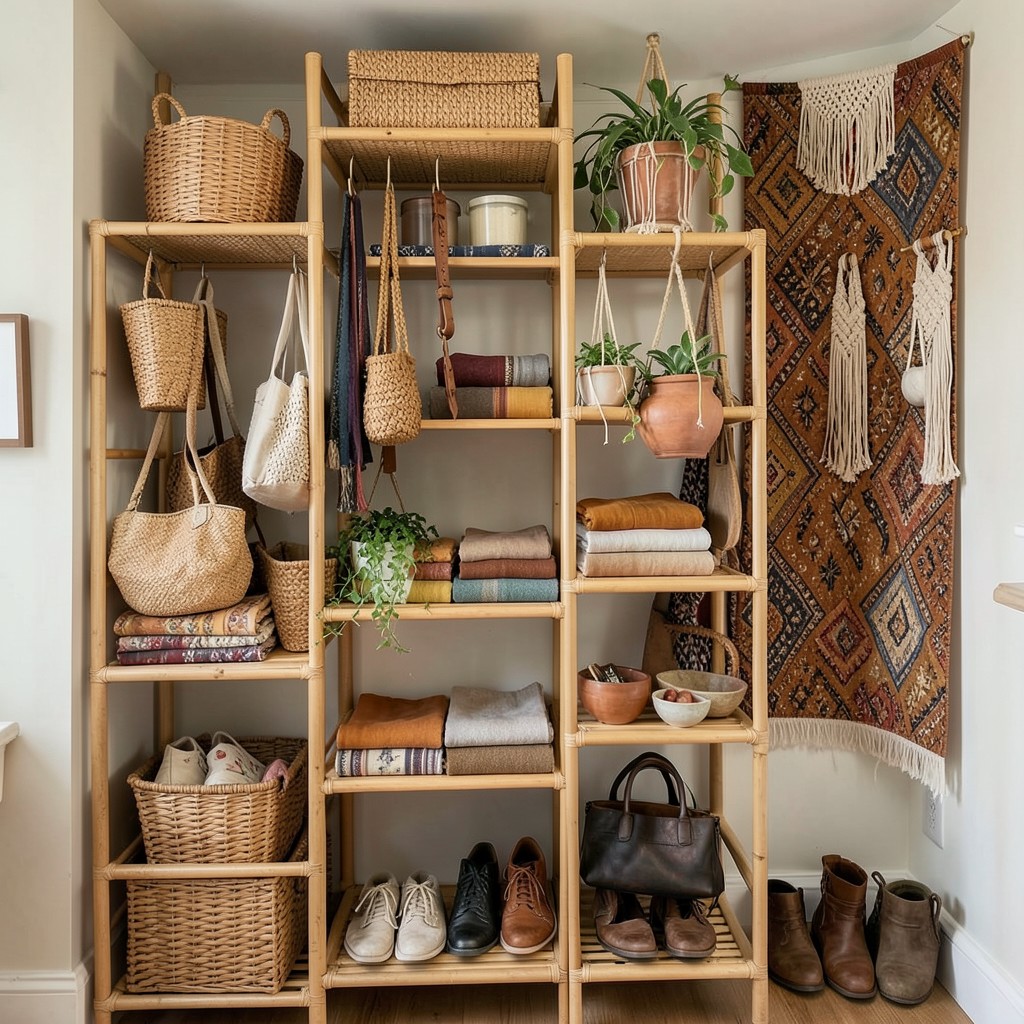
The bohemian closet rejects the premise that a closet must look like a retail display to function well and proposes instead that the closet can be as layered, personal, and aesthetically expressive as any other room in the house — that the mix of wicker baskets, macramé hooks, printed textiles, framed artwork, and accumulated accessories that defines bohemian home styling is as valid in the closet context as in the living room or bedroom. The bohemian closet is not a disordered closet. It is a closet whose organization follows a personal logic rather than a standardized one, whose aesthetic comes from accumulation and personality rather than from a single design package.
Open rattan shelving units — the freestanding wicker shelf tower common in beach house interiors and tropical home design settings — hold folded textiles in warm natural tones alongside small accessories in ceramic bowls and hanging plants in hand-thrown pots. Macramé hooks mounted on the wall above the shelving hold bags and belts in the same hand-knotted material that the bohemian home styling vocabulary applies to wall hangings elsewhere in the house. A printed textile pinned to the back wall of an open closet section — a batik, an ikat, or a hand-block-printed cotton in warm earthen tones — creates the backdrop that connects the closet’s organizational elements to a unified aesthetic field rather than leaving them as isolated functional objects against a plain painted surface.
The bohemian closet’s organizational logic is personal rather than universal, but it is nonetheless a logic — shoes arranged by the frequency of wear rather than by color, bags grouped by size and occasion rather than by brand, accessories organized by sensory association and daily mood rather than by category type. This personal organization system works for the person who designed it because its categories match their actual behavior, and that behavioral alignment is what makes any closet system sustainable long-term regardless of its aesthetic direction. The bohemian closet that follows its owner’s genuine organizational instincts, expressed through the material warmth and layered character of the aesthetic, is a more functional space than the one that follows a standardized system imposed from outside.
28. A Closet With a Capsule Wardrobe Display System

The capsule wardrobe closet is built on a fundamentally different premise from the standard closet — instead of maximizing storage capacity to accommodate every garment owned, it minimizes the wardrobe to a curated set of high-quality pieces that work in multiple combinations, and designs the closet specifically to display and maintain that reduced collection at the highest possible level of organization and care. The capsule wardrobe approach starts with the edit, not the storage, and the closet that results from a genuine edit is a room of extraordinary visual calm that the over-stuffed closet cannot approach regardless of its organizational system.
A row of matching wooden hangers — slim, in a uniform natural or stained wood tone — on a single hanging rod with three to four inches of breathing space between each garment creates the capsule wardrobe’s primary visual statement. The breathing space between garments is the detail that signals the capsule edit most clearly: standard closets pack garments to the rod’s capacity, while the capsule closet leaves space around each piece as a deliberate acknowledgment that each garment has been chosen for inclusion and deserves the physical respect of room to hang without contact. Minimalist home design and Scandinavian home interior closet settings apply the capsule principle most consistently, their design philosophy aligning naturally with the reduction and curation that the capsule wardrobe requires.
The capsule closet’s shelf sections hold a limited number of folded items — six to eight perfectly folded sweaters, four to six pairs of folded trousers, a curated selection of shoes — each item present because it was specifically chosen to remain. The closed-door sections hold the off-season rotation and the formal pieces that come out for specific occasions, keeping the primary capsule display focused on the current season’s active wardrobe. The discipline the capsule closet requires is significant and ongoing, but the daily experience it provides — opening a closet of intentional, high-quality pieces that all work together — is qualitatively different from opening one that holds everything accumulated without edit.
29. A Closet With a Luxury Island With Marble Top

The marble-topped island in a walk-in closet is the material statement that most clearly communicates the design direction of luxury home interior applied to the wardrobe space — the stone’s color and veining, its cool surface temperature, and its material permanence create an island of genuine presence that no other countertop material matches in the closet context. The marble top is not chosen for its durability above all else — this is not a kitchen where the surface is subjected to acidic food and abrasive cleaning. In the closet, the marble’s beauty and its tactile quality are the primary values, and in that context marble performs without compromise.
Calacatta gold marble — its warm white ground with bold gold and caramel veining — creates the most opulent closet island surface, its coloring connecting naturally to the brushed brass hardware and warm wood elements that luxury closet design pairs with it. The island’s cabinetry in a deep navy blue or forest green painted finish with brushed gold hardware creates the jewel-box quality — the dark cabinet providing the visual weight that the light marble top sits above — that luxury master bedroom design applies to the closet’s central organizing element. The island’s dimensions should be generous: at least forty-eight inches long and twenty-four inches deep to provide a meaningful folding and staging surface above the drawer storage it contains.
The marble top’s sealed surface handles the closet’s use conditions — folding, placing accessories, staging bags — without the maintenance anxiety that marble in a kitchen or bathroom requires. A penetrating marble sealer applied before use and reapplied annually provides complete protection against the mild contact conditions the closet island generates, and the annual sealing is a five-minute task rather than a meaningful maintenance burden. The sealed marble develops a surface that improves with handling — the high-contact areas taking on a slight polish that deepens the stone’s visual quality over time in the same way that frequently touched marble surfaces in historic buildings develop their distinctive, lived-in depth.
30. A Closet With a Dedicated Athletic and Activewear Section

Athletic wear is the clothing category that standard closet organization handles worst — the garments’ technical fabrics require specific storage that avoids the compression creases that folding creates, the accessories in the category are numerous and small, and the equipment storage that active households require sits entirely outside what conventional closet systems accommodate. A dedicated activewear section designed specifically around athletic clothing’s storage requirements creates a closet zone of genuine functional intelligence that the gym bag dropped at the bedroom door represents the failure to provide.
A dedicated hanging section at a single-hang height calibrated for athletic tops, jackets, and hoodies — with a second row below for hung athletic shorts and leggings on clip hangers — keeps athletic garments wrinkle-free and immediately accessible for the morning workout routine. Open cubbies at the section’s base hold rolled yoga mats, resistance bands, and small equipment; a set of wide, shallow shelves above the hanging section holds folded athletic shorts, running socks rolled in pairs, and performance base layers. The activewear section’s position within the closet should reflect the household’s dressing routine — if athletic wear is the first outfit of the day, the section should be the first encountered on entering the closet.
A small ventilated laundry bag or hamper within the activewear section holds worn athletic wear in a location separate from the primary clothing hamper — the ventilated format prevents the odor concentration that worn technical fabric develops in a sealed container, and the dedicated location prevents post-workout garments from migrating to the bedroom floor. This containment of the activewear’s used-garment flow is the small infrastructure decision that prevents the athletic household’s bedroom from developing the post-workout disorder that accumulates without a defined interception point.
31. A Closet With a Warm Farmhouse Aesthetic

The farmhouse closet applies the same material warmth and honest craft sensibility of farmhouse home decor to the wardrobe space — the shiplap walls, the open wood shelving on iron brackets, the apron-front utility sink replaced here by a farmhouse-style dresser, and the warm, practical palette of cream, warm white, and natural wood create a closet that feels as personal and as domestic as the home it lives within. The farmhouse closet is not precious. It is warm, genuine, and designed for use rather than for admiration, and that quality makes it one of the most habitually well-maintained closet types because its aesthetic does not suffer from daily wear.
Shiplap applied to the back wall of the closet’s primary sightline — painted in a warm cream or cotton white and serving as the backdrop for an open shelving section — creates the farmhouse closet’s defining architectural element. The shiplap’s horizontal board rhythm provides the visual interest that flat painted walls cannot generate, and the paint’s warm undertone connects to the natural wood shelving and wrought iron hardware that complete the farmhouse palette. A sliding barn door on the closet itself — in a wide-plank cedar or knotty pine with black hardware — continues the farmhouse architectural vocabulary from the entry point through to the interior.
Open shelving on black iron pipe brackets holds the folded clothing in woven baskets and stacked linens that suit the farmhouse aesthetic’s material warmth. Each basket — in a natural rattan, seagrass, or woven cotton — is labeled with a hand-lettered tag that identifies its contents with the casual precision that farmhouse home decor brings to organizational detail. The warm light from Edison-style bulb pendants hung at the closet’s center or mounted as sconces at the mirror position completes the farmhouse aesthetic’s commitment to warm, incandescent-quality illumination that makes every surface and every textile glow with the domestic warmth the style values above all other lighting qualities.
32. A Closet With a Corner Storage System

The corner in a walk-in closet is the location where most organization systems fail — the right-angle creates a depth that standard shelving cannot reach from either wall, and the result is a dead zone that holds nothing useful while consuming the closet’s most generous square footage. A corner storage system designed specifically for the right-angle geometry — a rotating carousel, a diagonal corner shelf, or a custom angled cabinetry unit — converts the closet’s most poorly used space into its most accessible and most efficiently organized zone.
A lazy Susan carousel in a corner closet tower — rotating shelves that spin to bring the full depth of the corner storage into reach from the front — provides the rotating access that makes deep corner storage practical. Each shelf level holds shoes, folded accessories, or small storage boxes, and the rotation brings every stored item to the front without any item needing to be moved to reach one behind it. The carousel mechanism requires quality hardware — a full-bearing carousel with a smooth, level rotation and a weight capacity appropriate for the stored items — because a stiff or uneven carousel that binds under load defeats the purpose of the rotating access it was installed to provide.
A diagonal corner cabinet — a custom-built unit with its front face angled at forty-five degrees across the corner — creates the most architecturally resolved corner treatment in a built-in closet system. The diagonal face eliminates the dead zone entirely by making the corner’s full depth accessible from the angled cabinet front, and the resulting storage capacity — typically a large, deep cabinet volume with pull-out shelves or a hanging section — is greater than any standard right-angle cabinetry configuration at the same location. Custom cabinetry is required for this solution because no standard modular system provides the forty-five-degree angled unit, and the investment in the custom piece returns as a corner closet zone that genuinely works rather than one that is perpetually avoided.
33. A Closet With Coastal Blue Tones and Natural Textures
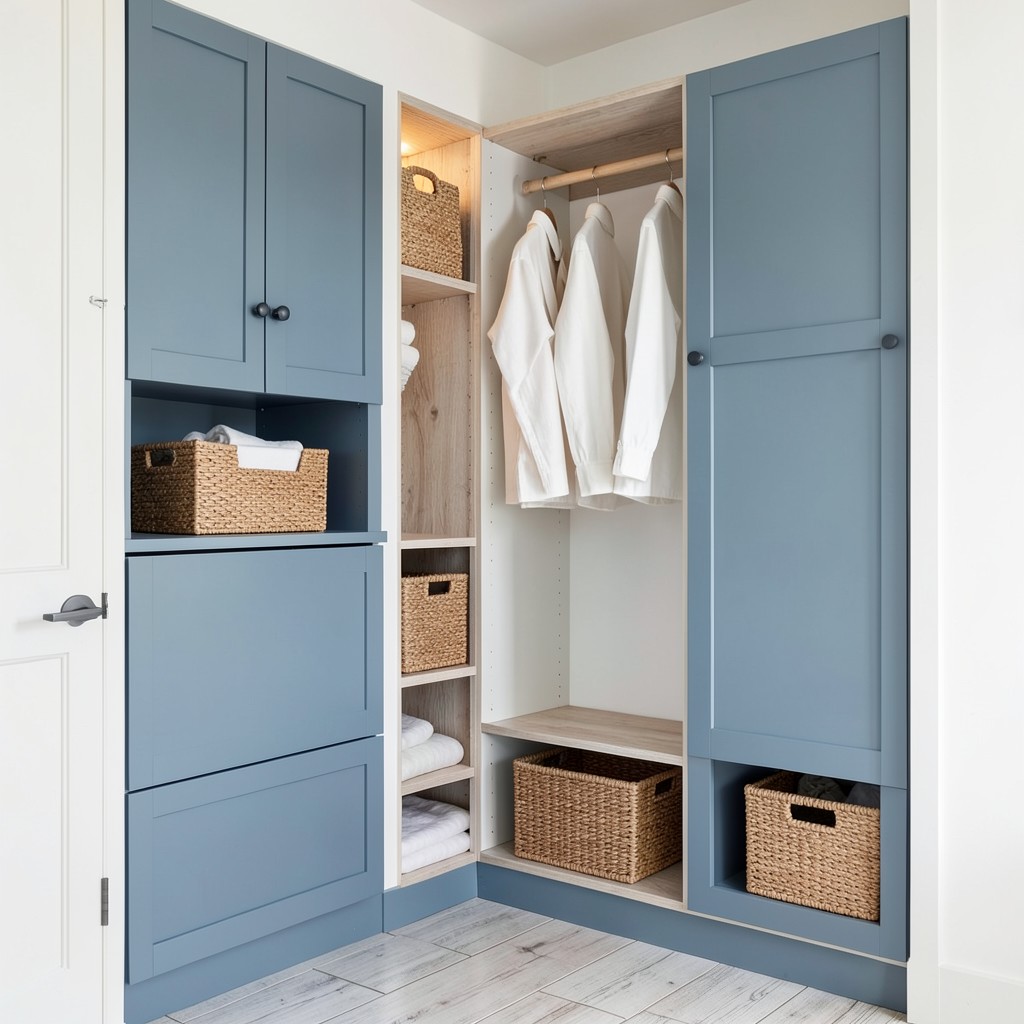
The coastal closet applies the beach house interiors material palette — soft blues, sandy whites, weathered naturals, and the organic textures of woven fiber and natural wood — to the wardrobe space with the same relaxed, light-filled quality that coastal home design brings to every interior it inhabits. The coastal closet feels like getting dressed near the water: the light is soft, the colors are clean, and the atmosphere is one of easy, unforced calm that makes the morning routine feel less like a task and more like a pleasant start. That emotional quality is entirely achievable through material and color choices, without any water in sight.
Cabinetry in a soft navy blue or washed sky blue — flat-panel doors in a matte finish that prevents the blue from reading as too saturated — creates the closet’s primary color statement. The blue cabinetry against white walls and natural wood or rattan accessory elements creates the coastal color composition that suits beach house interiors and the breezy home interiors aesthetic without the nautical thematics that overly literal coastal design applies. A bleached wood open shelf section alongside the blue cabinetry provides the material contrast that prevents the blue from dominating and introduces the sandy, sun-bleached quality that coastal natural materials carry.
Woven seagrass baskets on the open shelves hold folded accessories in the natural fiber texture that connects the closet to the coastal material vocabulary. White linen garment bags on the hanging section’s more formal pieces continue the texture palette into the hanging zone. The closet’s flooring in a whitewashed wood plank — either real wood or a convincing wood-look tile — grounds the composition in a surface that reads as weathered, natural, and consistent with the coastal palette applied above it. During summer home design season this closet reaches its peak atmospheric quality, the blue and natural material palette resonating with the season’s light and the household’s orientation toward coastal outdoor living.
34. A Closet With an Integrated Laundry Hamper System

The closet that includes an integrated laundry hamper eliminates one of the bedroom’s most persistent sources of visual disorder — the freestanding hamper that occupies floor space, tips over when full, and creates a visual acknowledgment of the household’s unwashed laundry that no other bedroom item announces so explicitly. A built-in hamper integrated into the closet’s lower cabinetry — a pull-out canvas bag within a cabinet frame, a tilt-out hamper door, or a fixed hamper basket within a dedicated lower cabinet section — contains the used laundry within the closet’s organizational system and keeps the bedroom floor clear of the hamper’s presence.
A pull-out canvas hamper on full-extension drawer slides occupies a lower cabinet section the width of a standard drawer and pulls out to reveal a removable canvas bag that lifts out for transport to the laundry room. The canvas bag’s generous volume — typically twenty to thirty liters — handles several days of normal household laundry generation without requiring daily emptying, and the pull-out format means the hamper is invisible when closed and fully accessible when open. The cabinet section housing the hamper should be positioned at the closet’s dressing entry point, where the natural movement of undressing brings the hamper into immediate reach without a detour.
A two-compartment integrated hamper system — two pull-out bags side by side within adjacent lower cabinet sections, labeled for lights and darks — pre-sorts the laundry at the point of deposit rather than requiring sorting at the laundry room, saving a step from the weekly laundry workflow. This sorting integration is the functional innovation that most households appreciate most immediately after installation, because the sorting step is the most frequently skipped and most consequential laundry task, and eliminating it at the closet level removes the decision burden from the laundry room process entirely.
35. A Closet With a Custom Lighting Scheme With Dimmers

A closet with a fully designed lighting scheme — not a single overhead fixture but a layered system of ambient fill, task-specific illumination, and accent light on display areas, all on individual dimmer circuits — demonstrates a level of design intention in the wardrobe space that most residential renovations reserve for the kitchen or the primary living room. The closet that functions as a luxury dressing room applies hotel-quality lighting design, because the outcome of getting dressed correctly depends as directly on the quality of the lighting as on the quality of the garments themselves.
A central pendant or semi-flush ceiling fixture providing the closet’s ambient fill — warm 2700K, on a dimmer set at full brightness during active use and reduced to twenty percent for passive evening access — creates the base layer of illumination that orients the occupant within the space. Undercabinet LED strips on each shelf section provide the secondary task layer — directing light downward onto the folded garments and accessories that the overhead fixture illuminates obliquely. A pair of warm-toned sconces flanking the full-length mirror provides the tertiary layer of facial and outfit assessment lighting that neither the overhead fixture nor the shelf LEDs can adequately provide from their positions.
The dimmer circuit for each lighting layer allows the closet’s illumination to be adjusted independently based on the time of day, the specific task being performed, and the user’s preference for light intensity during different phases of the dressing routine. At full brightness on all circuits, the closet functions as a well-lit professional dressing room. At ambient level on the central fixture only, it functions as a relaxed browsing space for outfit planning. At minimal ambient with sconces at full intensity, it functions as a focused outfit assessment space where the facial and full-body view is prioritized. Elegant home styling closets treat this lighting control as a genuine design system rather than a convenience feature.
36. A Closet With a Dedicated Hat and Headwear Display
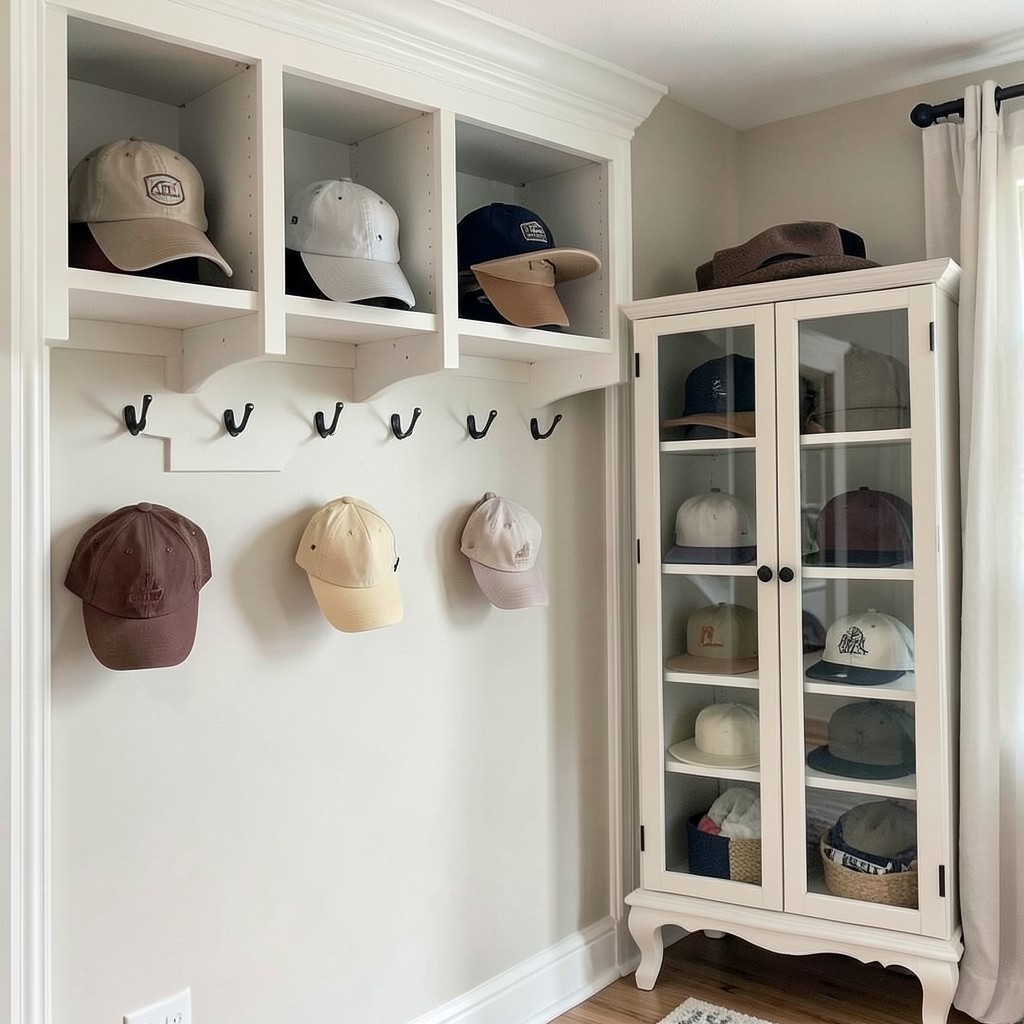
Hats are among the most poorly stored accessories in the average household — a baseball cap shoved onto a shelf loses its crown shape permanently, a wide-brimmed hat stacked under other items loses its brim’s geometry within a season, and a collection of diverse hat styles stored together in a single drawer creates a tangle of shapes that makes retrieval a damaging archaeological process. A dedicated hat storage section — hooks, individual shelf cubbies, or a purpose-built hat rack — preserves each hat’s form while making the collection accessible and visually organized.
Individual shelf cubbies at hat-head depth — each cubby nine to ten inches wide, nine to ten inches deep, and ten to twelve inches tall — hold one hat per cubby in a presentation that shows the hat’s form and color from the front without compressing its crown or brim. A row of cubbies at eye height above the closet’s primary sightline creates a hat gallery that suits chic home decor and elegant home styling closets where the hat collection is a genuine design asset to display rather than an overflow category to conceal. Hat hooks — a series of coat-hook style pegs at staggered heights on the closet wall — provide the lowest-cost and most flexible hat storage format, suitable for casual hats and caps in farmhouse home decor and relaxed home design closet contexts.
A glass-fronted hat cabinet — individual cubby sections behind a hinged glass door — suits both display and dust protection, the glass showing the collection while protecting the hats from the ambient dust that open cubbies accumulate. The glass-fronted hat cabinet in a luxury home interior closet treats the hat collection with the same display and preservation care that a boutique applies to its displayed merchandise, and the daily experience of selecting from a clearly organized, visually presented hat collection improves the quality of the accessory selection process in a way that pulling hats from a compressed shelf pile never approaches.
37. A Closet Converted From a Spare Room

A spare bedroom or underused room converted entirely into a walk-in closet and dressing room is the residential renovation that produces the highest daily quality-of-life return per square foot for households who prioritize their wardrobe and daily dressing routine. The conversion takes a room that hosted occasional guests or held miscellaneous storage and transforms it into the most-used designed space in the house — a room that the primary bedroom’s occupants enter and exit at least twice daily, every single day, and whose quality and functionality directly affect the tone of every morning and evening. The room-to-closet conversion is the renovation that most homeowners who have done it wish they had done earlier.
The full room’s dimensions allow the dressing room’s components — the wall-to-wall cabinetry, the central island, the dressing table, the full-length mirrors, the bench seating, and the dedicated shoe display — to be accommodated with the breathing space that makes each element accessible and comfortable in use. The closet that occupies a full room does not need to make spatial compromises that reach-in and small walk-in closets accept as given: the hanging sections can be generously wide, the island can be properly proportioned, and the bench can be comfortable rather than token. A full room dedicated to dressing is a genuine luxury home interior amenity that also happens to be one of the most practically useful rooms in the house.
The spare room conversion requires the same design development given to any other room renovation — a measured floor plan, a cabinetry layout developed around the specific wardrobe’s categories and volumes, a lighting design that covers all three layers of illumination, and a flooring and wall finish that suits the aesthetic direction applied across the master suite. The room should connect directly to the master bedroom and ideally to the master bathroom, creating the dressing room corridor that luxury residential design standardizes and that the daily dressing routine benefits from most completely. The connection quality — whether a door, a sliding panel, or an open archway — determines how naturally the dressing room integrates with the morning and evening routine it serves.
38. A Closet With a Tropical and Bamboo-Inspired Interior

A closet designed with bamboo home interiors principles brings the tropical warmth and organic precision of bamboo as a design material into the wardrobe space — the material’s distinctive linear grain, its warm golden tone, and its structural lightness create a closet interior of natural beauty that connects the personal daily dressing routine to the organic material world in a way that manufactured cabinetry cannot replicate. The bamboo closet is the design choice of households whose interior aesthetic draws from tropical home design and the warm, living-material vocabulary of jungle-inspired home decor applied domestically.
Strand-woven bamboo cabinetry — a premium bamboo composite of outstanding hardness and dimensional stability — creates the hanging sections, shelf structures, and drawer banks of the bamboo closet in a material that reads as warm and natural while performing at a level that surpasses many conventional hardwoods in surface hardness and moisture resistance. The bamboo’s characteristic pale gold tone suits the tropical and warm natural material palette naturally, and the material’s linear grain — running consistently through the cabinetry faces — creates a surface pattern of organic regularity that wood grain matches in variety but not in the bamboo’s specific visual precision. Pairing bamboo cabinetry with rattan drawer inserts, linen garment bags, and natural fiber baskets creates the full tropical natural material composition that suits beach house interiors and tropical home design closet contexts.
Bamboo home interiors applied to the closet also extends to the wall surface — bamboo panel wallcovering, applied to the closet’s back wall as a feature surface, creates the textural warmth that painted walls lack and the material consistency that connects the cabinetry to its architectural setting. The bamboo panel’s variation between light and shadow as the wall’s natural light source moves through the day creates a surface animation that makes the closet’s interior feel more alive than a static painted or wallpapered surface. A single large potted tropical plant — a bird-of-paradise, a large palm, or a dramatic monstera — in the closet’s corner beside the bench adds the living, growing dimension that bamboo home interiors consistently pair with the material’s static presence.
39. A Closet With a Luxe Velvet and Gold Palette

The velvet and gold closet occupies the most overtly luxurious register of residential wardrobe design — the combination of deep, saturated velvet on drawer fronts or upholstered surfaces and warm gold hardware throughout creates a closet of deliberate opulence that makes no apology for its material commitment. This is the closet that communicates, from the moment the door opens, that the person who designed it understands exactly what they wanted and made it happen — no hedging, no budget compromise, no apologetic restraint. Deep satisfaction. Held.
Cabinetry faces in a jewel-toned velvet application — emerald, sapphire, or deep amethyst panel inserts within painted frame cabinets — create the texture contrast that the gold hardware’s specular quality requires as its foil. The velvet’s matte depth against the gold’s specular brightness creates the material opposition that makes both more vivid simultaneously. The gold hardware — brushed rather than polished to avoid the brass-adjacent quality of high-sheen gold — appears on every cabinet pull, every hanger bar, and every lighting fixture throughout the closet, creating the material consistency that elevates the velvet panel treatment from an isolated moment to a complete design palette. Luxury master bedroom design contexts apply this palette at the dressing room level, the closet’s material quality matching and extending the master suite’s commitment to premium materials throughout.
The velvet application in a closet requires a durable, cleanable velvet — a solution-dyed acrylic velvet or a tightly woven cotton velvet rated for upholstery use rather than a decorative-weight velvet whose pile depth and weave structure cannot withstand daily contact. The drawer face velvet receives the most direct contact — hands touching it at the same spot with every opening — and the abrasion resistance of the velvet’s weave determines how the panel maintains its appearance through years of this concentrated daily touch. Quality specification here is the non-negotiable foundation that the closet’s visual impact rests upon.
40. A Closet With a Dedicated Children’s Section

A children’s section within the master closet — or a fully dedicated children’s closet designed at their specific scale — applies the same organizational intelligence to children’s clothing as the adult wardrobe receives, and the benefit is both practical and developmental. A child who has a closet designed at their height, with their categories organized legibly for their understanding, and with the correct storage for their specific wardrobe, develops independent dressing habits earlier and more reliably than one who navigates an adult-scaled system whose logic they cannot fully access. The children’s closet is not a smaller version of an adult closet. It is a child-specific environment designed around child-specific behavior.
Hanging rods at sixty to seventy-two inches from the floor — approximately the child’s stretched-reach height — create the hanging section accessible without a stool for the garment categories that children hang: school uniforms, special occasion outfits, and coats. A second lower rod at forty to forty-eight inches, where young children can hang their own clothing independently, encourages the self-sufficiency that parents want and the child is capable of when the physical infrastructure supports it. The hanging double configuration — one rod at child height, one at the standard adult height for future use — makes the children’s closet adaptable without requiring renovation as the child grows.
Open shelves at waist height to the child — in the thirty-two to thirty-six inch range — hold the folded clothing, shoes, and accessories that children access most frequently, and the open format’s visibility allows the child to find and return items without assistance. Labeled bins and baskets at the child’s eye level create the organization system that a young child can maintain independently when the labels are clear, the categories are simple, and the containers are easy to access and return. Bohemian kids room decor applied to the children’s closet — colorful bins, playful labels, a small personalized name hook for the coat and bag — creates a closet whose functional design is also a space the child enjoys using, which is the quality that makes the organization system self-sustaining.
41. A Closet With a Desert-Inspired Earthy Palette

The desert-inspired closet applies the material vocabulary of desert home styling and earthy home design to the wardrobe space — the warm terracotta, sandstone, and adobe tones, the rough-textured natural plasters, the woven natural fibers, and the stone and wood material quality that characterize desert interiors create a closet of distinctive warmth and material depth. The desert closet is the antidote to the grey-and-white palette that dominated residential design for an extended period — it is warm, grounded, and unambiguously connected to the natural world’s material richness.
Cabinetry in a warm terracotta or adobe-tinted paint — a muted, slightly sandy red rather than a bright orange — creates the closet’s primary color statement in a tone that suits the earthy home design palette with precise appropriateness. The terracotta cabinetry pairs with warm brass hardware, natural rattan basket inserts in the open shelf sections, and a concrete or travertine tile floor in a format that extends the stone and wood home design material vocabulary into the closet’s flooring. The wall surfaces between cabinetry sections — visible at the back of open shelving areas and at the wall sections beside the mirror — can be finished in a warm Venetian plaster or a natural clay plaster that adds the textural depth and thermal quality of traditional desert wall finishes.
Accessories in the desert closet — the baskets, the mirror frame, the bench cushion, and the small decorative objects that complete the room’s composition — should reinforce the material palette with consistency: natural linen cushioning, an unfinished wood mirror frame, ceramic hooks in an ochre glaze, and a single potted succulent or desert plant on the shelf. The succulent’s low-maintenance nature suits the closet environment — limited watering, no high humidity requirement — and its form connects the closet to the desert landscape whose material vocabulary defines the room. During fall home decorating season this palette reaches its most resonant quality, the warm terracotta and sandy tones connecting to the season’s natural color story with a coherence that the closet then maintains through the winter months.
42. A Closet With a Compact Wardrobe Capsule for Small Spaces

The small closet is not a problem to be compensated for with clever tricks — it is a constraint that, properly respected, produces the best-organized wardrobes in any household. The person who has only a small closet to work with is forced to make the wardrobe decisions that large-closet households defer indefinitely: what actually gets worn, what fits, what is worth keeping, and what is occupying space on the merit of purchase price rather than actual use. The small closet as design constraint is the most effective wardrobe audit tool available, and the closet that results from taking it seriously is consistently the one that functions best on a daily basis.
A compact reach-in closet organized with a double-hang section for shorter garments, a single-hang section for full-length items, a shoe shelf at floor level, and two or three drawers in a stacked configuration within the available wall width provides the full range of storage categories in a format that fits within forty-eight to sixty inches of wall width and twenty-four inches of depth. The double-hang section’s efficiency — two rows of garments in the space one row would occupy at full-length hanging height — is the single most impactful change available in a small closet, typically doubling the hanging capacity of the previous single-rod configuration. Maximizing the double-hang area for the short garments that make up the majority of most wardrobes — shirts, folded trousers, blazers, and folded jeans — and reserving only the necessary width for full-length hanging creates the most efficient small closet layout available.
Vertical space above the primary hanging sections — the wall between the top of the hanging rod and the ceiling — holds a shelf for seasonal storage, luggage, or infrequently used items in a location that the daily reach-in routine does not require accessing. A slim rolling cart beside the closet — in the bedroom’s floor plan rather than within the closet — supplements the small closet’s drawer storage without occupying the closet’s interior volume, expanding the functional system beyond the closet’s physical boundaries without pretending the closet is larger than it is.
43. A Closet With a Dedicated Formal and Occasion Wear Section

Formal clothing — the suits, the evening wear, the special occasion pieces — lives uncomfortably in most closets, wedged between daily casual wear and weekend options in a section that gives the formal pieces neither the space nor the care their material quality and replacement cost require. A dedicated formal wear section within the closet, designed specifically around the needs of structured garments, delicate fabrics, and the accessories that accompany formal dressing, treats this category with the consideration it deserves and protects the investment each piece represents.
Full-length single-hang space is the formal section’s primary requirement — suits, gowns, and long dresses need uncompromised vertical clearance to hang without contact between the hemline and the floor, and the compression that double-hang or crowded single-hang configurations impose on structured garments creates fold creases in fabric that dry cleaning cannot always remove. The formal section’s hanging rod should provide four to six inches of breathing space between each garment, allowing the fabric to maintain its pressed condition between wearings and preventing the transfer of lint, fiber, and fragrance between adjacent garments.
Suit bags and garment bags hanging alongside the formal pieces protect them from dust accumulation and moth exposure during the extended periods between wearings that formal clothing typically experiences. The garment bag’s material — a breathable cotton or linen rather than a non-breathable plastic — allows air circulation that prevents the musty quality that sealed plastic bags concentrate over time. A cedar block or lavender sachet within each garment bag provides the natural moth deterrent that formal wool suits and structured pieces require during long storage periods, applying the same preservation principle as the cedar-lined closet at the individual garment level.
44. A Closet With a Floating Shelf and Hook Entry System

The closet entry — the first zone encountered on opening the door — is the location where the dressing and undressing routines intersect most frequently, and its organization determines whether the rest of the closet maintains its order or continuously receives the overflow of items that have no defined home at the entry point. A floating shelf and hook system at the closet entry creates the reception zone that intercepts incoming items — the day’s bag, the jacket removed on arriving home, the accessories taken off at the end of the day — before they migrate to surfaces throughout the bedroom.
A floating shelf at shoulder height, twelve inches deep, holds the bag and small accessories of the day’s outfit before they are returned to their designated storage locations. Two to four hooks below the shelf at coat height hold the jacket, coat, or cardigan that the entry greeting of the closet should receive before any deeper organizational commitment is made. The hooks’ material connects to the closet’s hardware palette — brushed brass hooks for the warm-palette closet, matte black hooks for the dark-palette or industrial-influenced closet, natural wood pegs for the Scandinavian and farmhouse contexts. This entry system costs very little in material terms and returns an outsized organizational benefit by containing the closet entry’s natural chaos at its source.
The entry system also handles the valet function — the temporary overnight home for the next day’s outfit laid out in advance. A fold-down bracket below the floating shelf, or a dedicated hook positioned slightly apart from the daily-use hooks, provides the specific location for the pre-staged outfit that makes the morning routine’s first task complete before the day even begins. The closet that supports advance outfit planning at the entry level is a closet that participates in the household’s daily efficiency rather than simply receiving the results of it.
45. A Closet With a Stone and Wood Design Palette

The stone and wood home design palette applied to a closet creates one of the most materially grounded and architecturally honest wardrobe environments available in residential design — the stone’s permanence and thermal mass against the wood’s warmth and organic variability produce the material dialogue that suits earthy home design, mountain cabin decor, and the design direction of households whose interior aesthetic prioritizes natural material quality above synthetic alternatives. This closet is heavy in the best sense: its materials have weight, permanence, and the kind of inherent quality that does not fade with fashion changes.
Rough-cut travertine or slate tile on the closet floor — set in a large-format configuration with minimal grout joints — creates the stone surface whose cool, slightly textured quality suits the heavy natural material palette above it. Solid oak or walnut cabinetry with a natural oil finish provides the wood element — its grain and warmth opposing the stone’s grey-brown cool with an organic vitality that makes the two materials read as complementary rather than competing. The hardware in an unlacquered bronze or natural iron connects to both materials with a tone that suits neither exclusively but belongs to the general register of natural, aged-metal finishes that stone and wood home design consistently employs.
The stone and wood closet’s sensory quality is as distinctive as its visual quality — the cool solidity of the travertine floor underfoot, the smooth warmth of the oiled oak cabinetry under the hand, and the earthy mineral quality that natural stone surfaces release in a closed room create an environment of material richness that other design directions do not approach from the same sensory direction. A closet this materially honest is also materially demanding in maintenance — the travertine requires periodic sealing, the oiled oak requires periodic maintenance oil application, and the natural iron hardware develops patina that some find beautiful and others find requiring regular wax protection. The materials’ maintenance demands are inseparable from their beauty, and the closet owner who accepts that relationship owns a space that improves with age.
46. A Closet With a Smart Storage Technology Integration

Smart storage technology in a closet — motorized components, sensor-activated features, and connected control systems — applies the same category of technological thinking to the wardrobe space that smart home design has applied to lighting, climate, and security throughout the rest of the house. The smart closet is not a technology showcase for its own sake. Each smart feature should address a specific functional problem that the non-smart alternative handles less effectively, and the value of each technology is measured by the daily friction it eliminates rather than by the sophistication it demonstrates.
A motorized wardrobe lift — an electric mechanism that lowers a high hanging rod to accessible height at the touch of a button and returns it to its elevated position — solves the vertical space problem in closets with high ceilings, where the space above seven feet is typically wasted because standard reach cannot access it conveniently. The motorized lift brings the elevated rod to waist height for loading and unloading, then raises it to its stored position, using the closet’s full ceiling height for seasonal or occasional-use garments without requiring the precarious step-stool maneuver that fixed high rods demand. Luxury home interior closets in rooms with ten or twelve foot ceilings apply motorized lifts as a standard component of the storage system rather than as an exceptional addition.
A sensor-activated lighting system that detects the presence of a person in the closet and illuminates the appropriate sections automatically — full brightness on the hanging and shelf sections immediately accessed, lower ambient light elsewhere — reduces the friction of the morning closet visit to near zero for the user who never needs to find a switch or wait for an app to respond. The sensor system’s intelligence improves with a learning algorithm that adjusts the lighting pattern based on observed usage — brightening the shoe section when footwear selection typically follows hanging selection, for example — and the cumulative effect of this automated responsiveness is a closet that behaves as though it knows your routine.
47. A Closet With a Gender-Neutral Shared Design
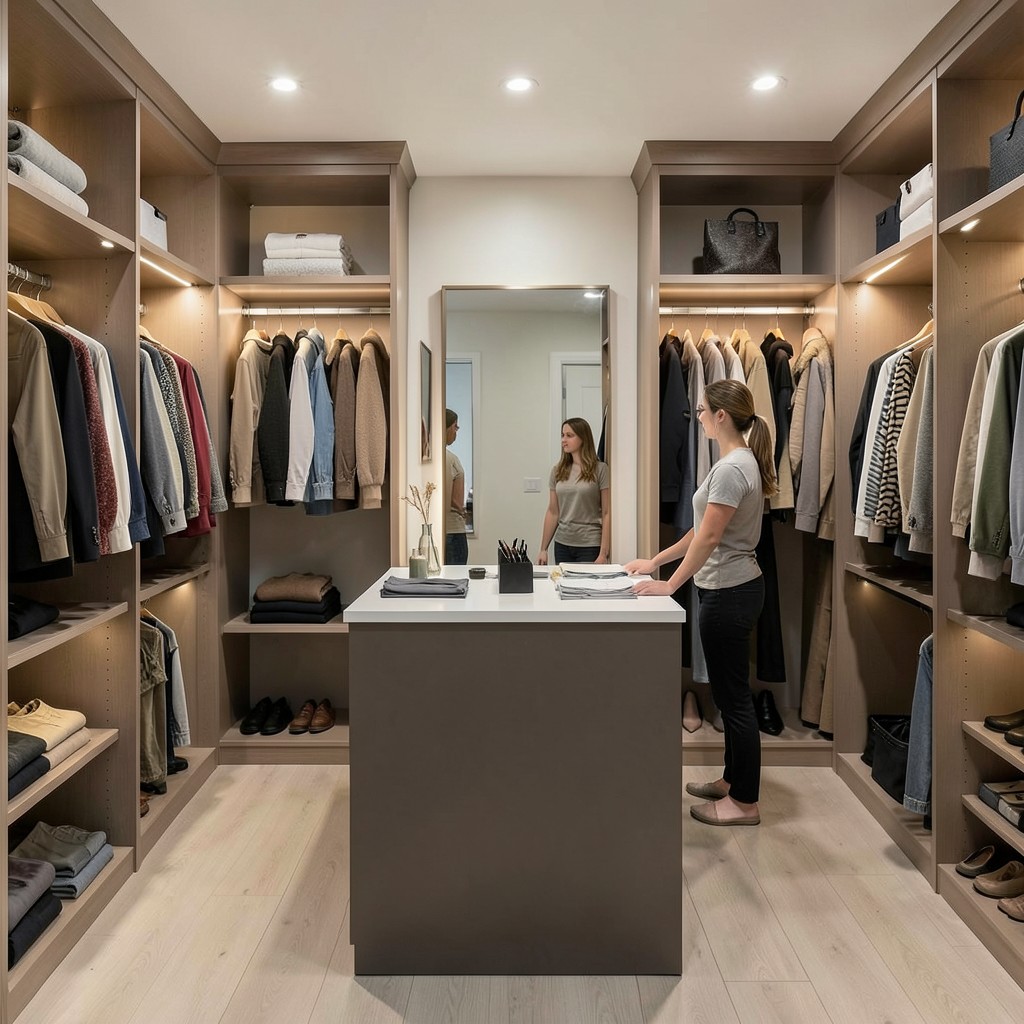
The shared closet — serving two people with different wardrobe compositions, different organizational preferences, and potentially different aesthetic sensibilities — requires a design neutrality and organizational specificity that single-occupant closets do not need to consider. The shared closet’s design challenge is the allocation problem: assigning enough space to each person’s wardrobe without the assignment being so visible that it reads as a territorial division rather than a shared organizational system. The best shared closets feel like a single designed space in which two different people’s needs are met without either person’s aesthetic dominating.
A clear physical division — one side of the walk-in for each person, with the cabinetry configuration on each side calibrated to that person’s specific wardrobe categories — creates the functional distinction without the visual boundary that a painted dividing line or a different cabinet finish would create. Both sides share the same cabinetry material, color, and hardware, creating the visual unity that makes the shared closet read as a single designed room rather than two separate storage systems placed side by side. The shared island at the closet’s center belongs to both occupants and serves both dressing routines, its central position reinforcing the shared quality of the space rather than claiming it for one side.
A shared full-length mirror — positioned at the closet’s entry point where both occupants can access it before exiting — serves both persons’ outfit assessment needs without the territorial awkwardness of placing the mirror on one person’s side of the closet. The mirror’s position at the shared entry zone completes the shared closet’s organizational logic: each person has their own storage zone, both share the functional center island and the exit-point mirror, and the room as a whole reads as a single designed environment that belongs equally to both.
48. A Closet With Vintage-Inspired Hardware and Details

Vintage-inspired hardware — the cup pulls, the knob forms, the hinge profiles, and the finish qualities of an earlier design era applied to contemporary closet cabinetry — creates the layered, collected character that separates a closet that feels designed from one that feels recently installed. The vintage hardware’s contribution is not nostalgic. It is material and formal: the slightly heavier weight of a solid brass cup pull, the specific concave form of a period-appropriate knob, and the aged patina of an unlacquered finish create tactile and visual qualities that contemporary hardware minimalism consistently lacks. The hand that touches vintage-inspired hardware registers the difference immediately.
Unlacquered brass in a ring pull format — the classic ring that pivots on a backplate and falls against it when released — applied to a painted flat-panel cabinetry in a soft white or warm cream creates the period dressing room quality associated with traditional home interiors and elegant home styling. The ring’s pivot movement and the slight metallic sound it makes when released add the sensory dimension that fixed-position pulls and recessed handle formats suppress entirely. A collection of different pull styles within a single hardware family — larger ring pulls on the drawer fronts, smaller knob versions on the cabinet doors, and a continuous bar pull on the hanging section — creates the varied-hardware quality of a traditional closet without the inconsistency of using entirely unrelated hardware types.
Hand-applied patina on the hardware — a darkening treatment applied to the metal’s recessed areas that simulates the gradual toning of an aged unlacquered surface — creates the period quality in a new piece that unlacquered hardware develops naturally over several years of use. The hand-applied patina is a quality specification that distinguishes a custom hardware supplier’s work from a mass-produced period-style hardware alternative, and in a closet whose material investment the hardware is designed to complete, the quality of the patina application matters as much as the quality of the underlying metal and form.
49. A Closet With a Dedicated Workout-Ready Morning Station
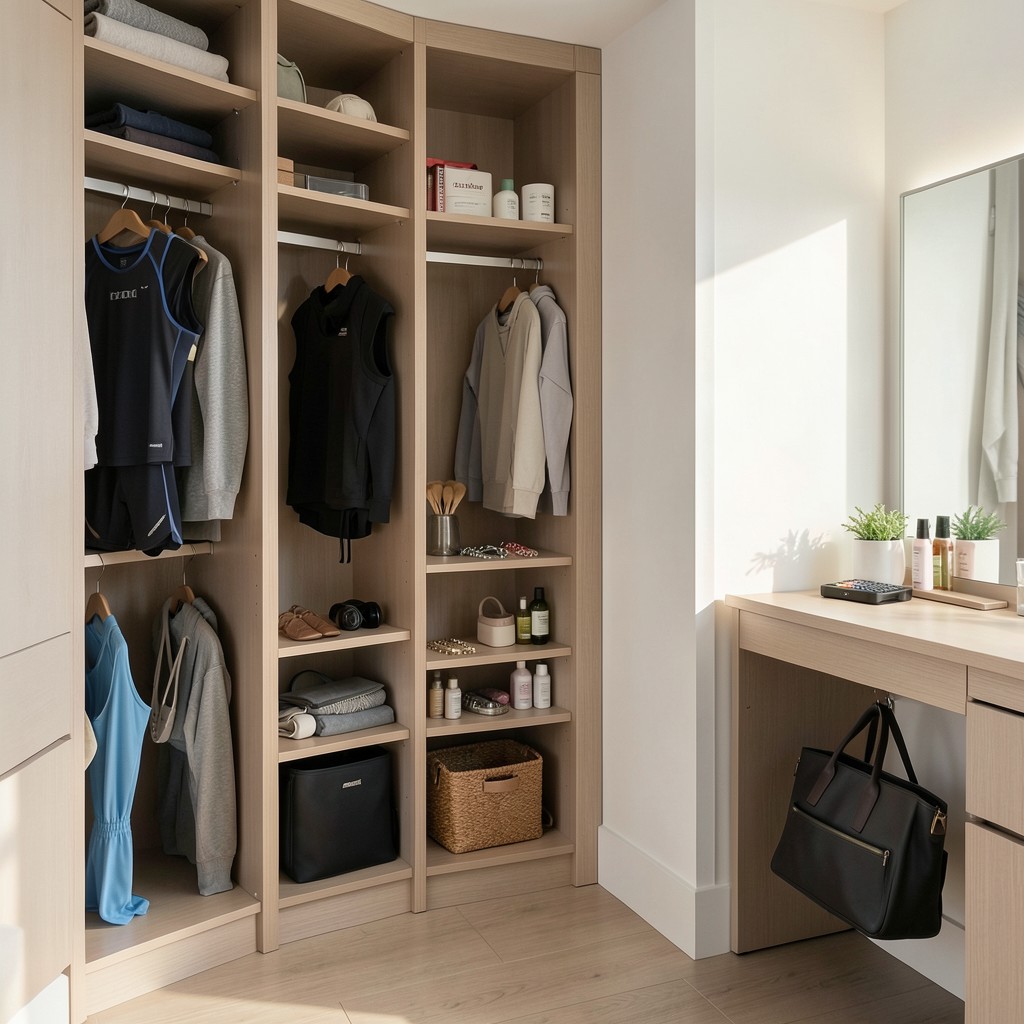
The morning station closet goes one conceptual step beyond the standard closet organization — it is designed around the complete morning routine from wake-up through dressed-and-out-the-door, rather than simply around the storage of clothing. The morning station concept positions everything needed for the first ninety minutes of the day within a single, logically organized space: the athletic wear for the morning workout, the post-workout outfit, the grooming and skincare supplies, the jewelry for the day, and the bag ready-packed with the day’s essentials. When everything the morning requires lives in one designed space, the routine runs on infrastructure rather than on memory or decision.
The morning station’s physical organization follows the routine’s sequence: the athletic wear section first at the closet’s entry, the grooming station at the dressing mirror, the day outfit section beyond, the accessories at the dressing table, and the bag staging hook at the exit point. This sequential arrangement — the closet organized in the order the morning uses it — is the design principle that converts a storage room into a functional routine system. The person who moves through this closet in sequence has no backtracking, no searching, and no decision-making beyond the choices the organized system presents clearly. Peaceful home decor principles apply here in a specific, grounded way — the peace comes from a morning that flows rather than lurches.
The bag staging hook is the morning station’s final functional element and its most consistently overlooked — a hook or shelf beside the closet’s exit point where the day’s bag is placed the previous evening, packed and ready, so that the morning’s final act is picking up a prepared bag rather than assembling one under time pressure. This single preparation habit, supported by the specific hook infrastructure that makes it the path of least resistance, changes the quality of the morning’s final minutes as reliably as any other organizational decision the closet contains. Design the space to support the behavior you want, and the behavior follows.
50. A Closet Designed as Your Most Personal Room

Every room in the house serves someone — the kitchen serves the cook, the bedroom serves the sleeper, the living room serves the gathering. The closet is the one room that serves only you, specifically and exclusively, in the task of preparing yourself for the world each day. No other room in the house knows as much about you as the closet does — your actual wardrobe rather than the wardrobe you imagine you have, your real organization habits rather than the ones you intend to maintain, and the daily choices that express who you are before you leave the house each morning. The closet designed honestly around those realities is the most personal room in the home.
Designing the closet as your most personal room means starting with genuine self-knowledge rather than with aspirational templates — knowing the ratio of your actual hanging to folded garments rather than the ratio you plan to achieve, knowing how many shoes you own and genuinely wear rather than how many you intend to keep, and knowing the organization behavior you actually maintain rather than the one you resolve to adopt each time the closet becomes unmanageable. The closet built around what is real works. The one built around what is aspirational fails within three months when the reality it did not account for fills the spaces the aspiration left empty.
The investment in a well-designed closet returns in the daily experience of a morning that starts in a space that works — where the light is correct, the organization is legible, the materials feel good, and the room’s design communicates that the person who uses it matters enough to deserve a space of genuine quality. That daily return compounds across every morning of every year the closet is used, and the total experiential value of a well-designed closet across a decade of daily use is among the highest returns available from any residential design investment made in any room of the house. Start with the idea that solves your most specific problem. Design it with material honesty and organizational precision. Open the door tomorrow morning and feel the difference.
Leave a Reply