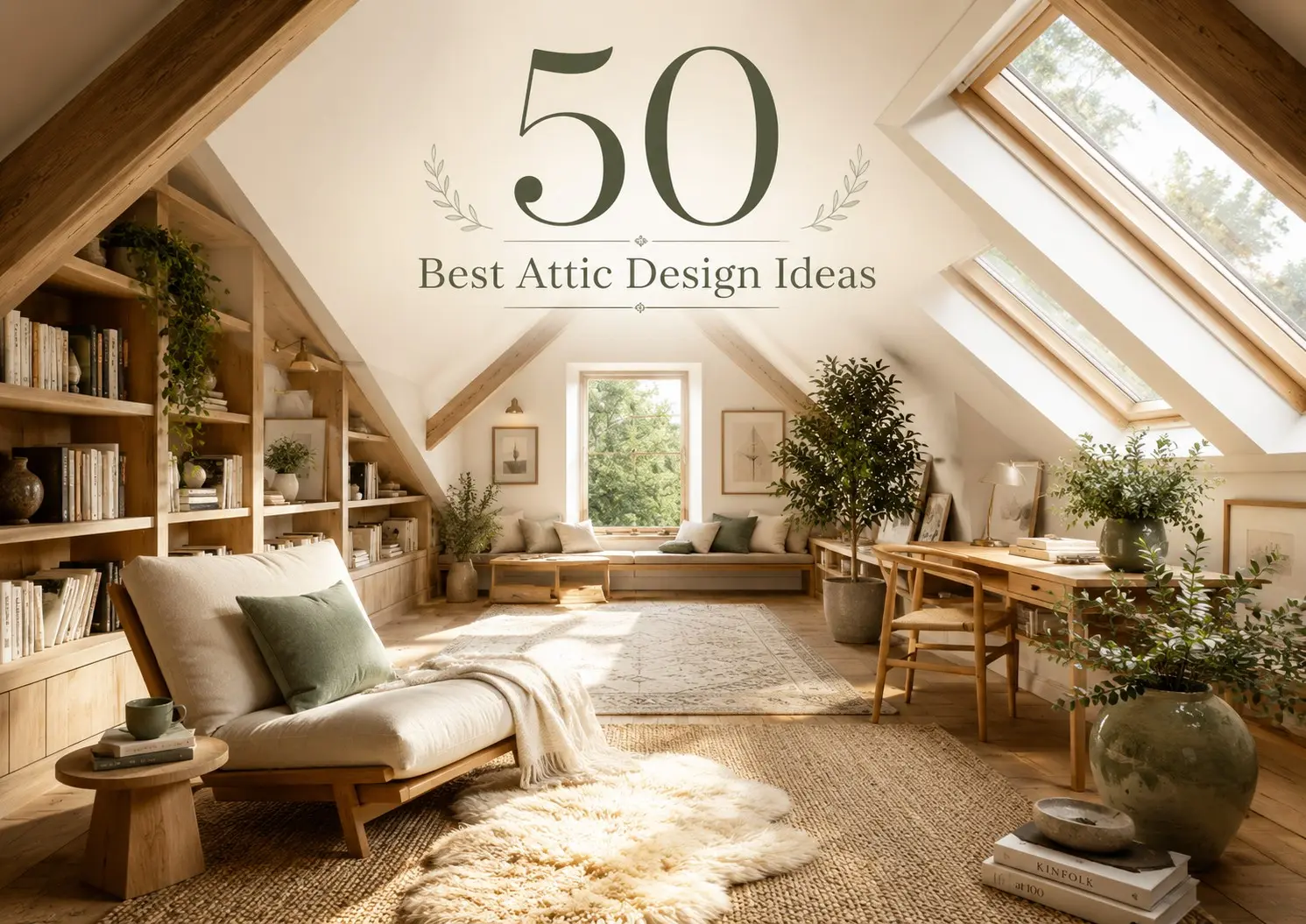
The attic is the one room in the house that most people have never properly entered. They have pushed boxes into it, dragged holiday home styling decorations out of it, and occasionally squinted into its dim corners when a strange sound from above required investigation — but they have never stood in it and thought, with genuine seriousness, about what it could become. That single act of consideration is all that separates a household whose attic is a dark, insulated crawl space full of things they have forgotten they own from one whose attic is the house’s most distinctive, most personal, and most surprising room.
The attic’s design potential is not a secret that renovation media has recently uncovered. The converted attic has existed in residential architecture for as long as there have been pitched roofs above habitable floors — the garret studio of the Parisian artist, the dormer bedroom of the Victorian townhouse, the loft conversion of the twentieth-century row house — all of these are the same idea at different scales and in different cultural contexts: the recognition that the space beneath the roof’s peak contains something worth inhabiting. The design traditions that have developed around attic conversion over centuries are the accumulated evidence that this instinct is correct.
What changes with each generation of attic design is the range of functions that the space is asked to perform and the quality of the design execution that the conversion receives. The attic bedroom of an earlier era was a single-use, often poorly insulated, minimally detailed room that happened to be above the second floor. The attic of a contemporary home renovation can be a luxury master bedroom suite with a dormer-expanded floor plan, a skylight-lit artist’s studio, a home office acoustically isolated from the household below, a cinema room whose ceiling follows the dramatic pitch of the roof structure, or a guest suite whose character — the exposed rafters, the slanted ceilings, the intimate scale — creates the accommodation atmosphere that no standard-proportioned room achieves. The range of what the attic can become has expanded dramatically as both design ambition and construction technique have risen to meet it.
The fifty attic design ideas in this collection address that full range — from the minimal, budget-conscious attic storage organization that converts a chaos of boxes into an organized seasonal archive, to the fully engineered attic conversion that adds a legal bedroom, a bathroom, and significant square footage to the home’s habitable area. Between those ends of the spectrum, the ideas address home offices, yoga studios, reading rooms, children’s play spaces, art studios, and every aesthetic direction from industrial home design honesty to the layered warmth of bohemian home styling, from the pale precision of Scandinavian home interior design to the organic richness of tropical home design applied to a rooftop space.
Every attic is different. The pitch of the roof, the height at the ridge, the presence or absence of dormers, the existing insulation, the structural condition of the floor joists — these variables determine the scope and the approach of each conversion. But every attic shares the quality that makes it worth designing: it is the top of the house, and the top of the house sits closer to the sky, catches more light through its roof openings than any room below, and carries the roof’s structural character directly into its interior in a way that no other room in the building does. The attic is the one room where the building’s architecture is most visible from the inside. Design it accordingly.
1. An Attic Bedroom With Exposed Rafter Ceilings
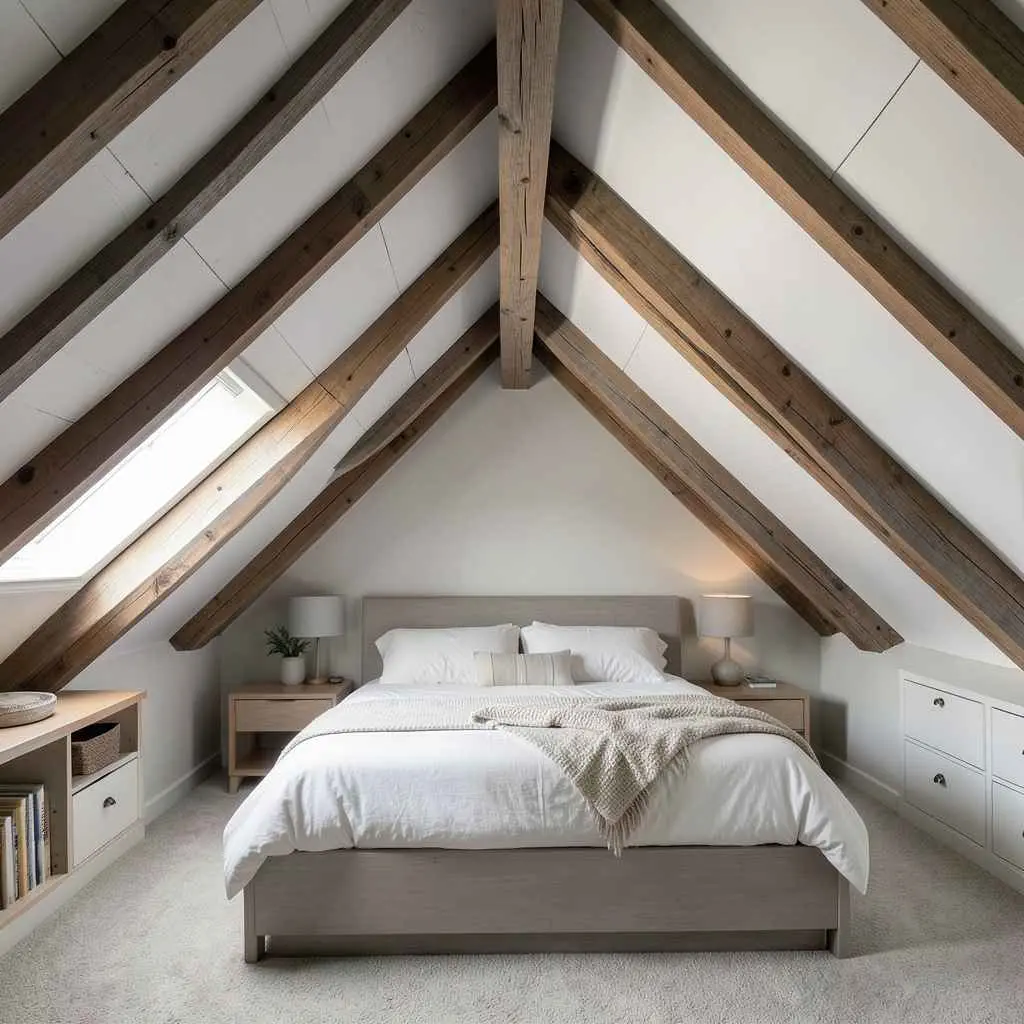
The attic bedroom that leaves the roof structure exposed — rafters, ridge beam, collar ties, and the underside of the roof sheathing all visible from the bed — creates a sleeping environment of extraordinary architectural character that purpose-built bedrooms with flat drywall ceilings cannot approach from any design direction. The exposed structure is not a design feature that was added to the room. It is the room, revealed rather than covered, and its quality is the direct expression of the building’s making.
Exposed rafters in a softwood that has aged to a warm honey or silver-grey tone — depending on whether the attic was heated or cold through its previous life — create the ceiling’s primary visual texture. The rafter spacing, typically sixteen to twenty-four inches on center, creates the rhythmic repetition that architectural ceilings achieve through molding profiles in standard rooms, and the rafter depth — typically six to ten inches — creates the three-dimensional shadow quality that flat ceilings cannot generate. A white-painted or whitewashed surface applied to the underside of the roof sheathing between the rafters creates the reflective background that makes the exposed structure legible and visually organized, and the contrast between the pale background and the warm wood of the rafters creates the ceiling’s composed character without any applied decoration.
Cozy bedroom design at its most architecturally honest appears in the attic bedroom — the pitched ceiling that follows the roof slope creates the intimate enclosure above the bed that flatly ceilinged rooms attempt to simulate with canopies, draperies, and bed frames. Here, the architecture provides the enclosure directly, and the bed positioned beneath the ridge or at the highest point of the slope takes advantage of the room’s maximum headroom while surrendering the peripheral areas under the eaves to lower storage furniture, built-in drawers, and the reading nooks that the sloped ceiling naturally creates at knee height.
2. An Attic Home Office With Skylight Illumination
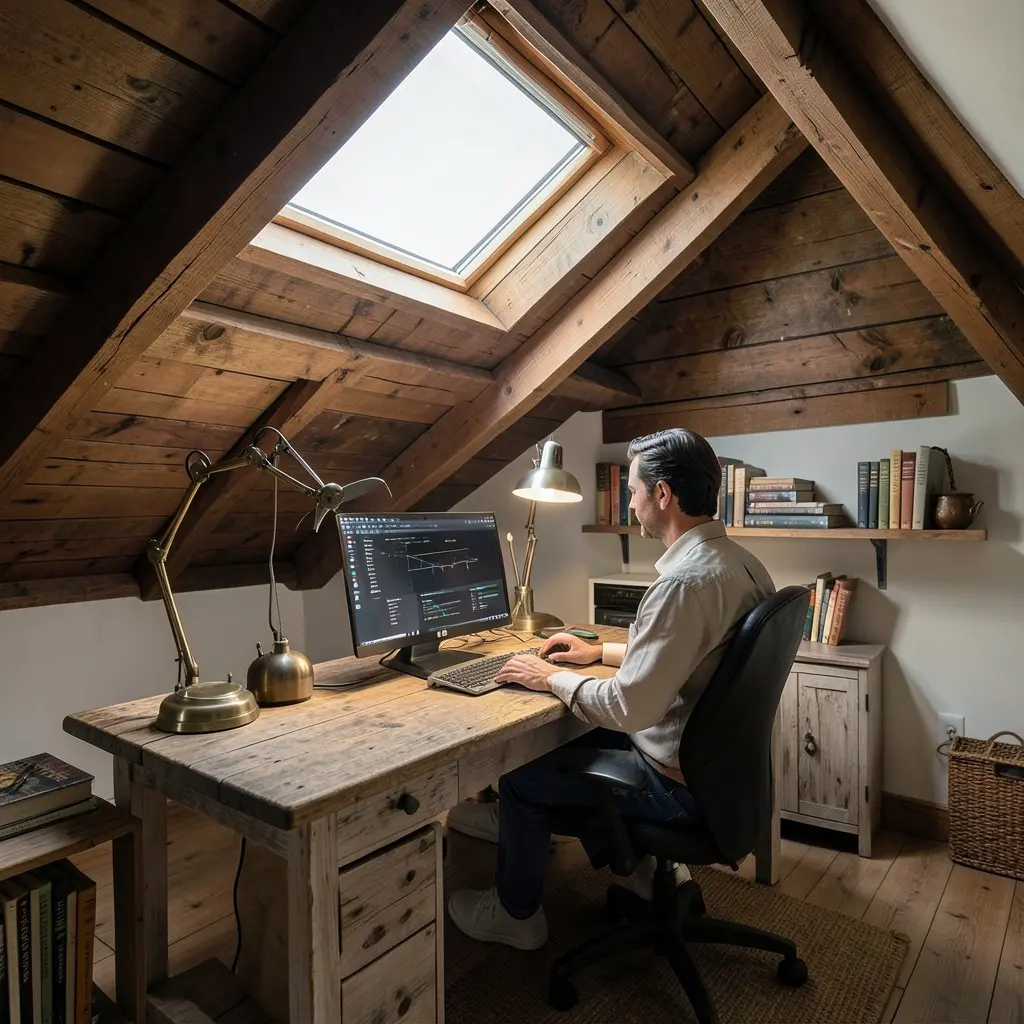
Working in an attic home office is the closest residential equivalent of a lighthouse keeper’s desk — the position at the top of the building, surrounded by the sounds of the household below but separated from its activity, with the sky directly above and the quality of light that only a roof opening provides. The skylight in an attic office is not an optional amenity. It is the functional center of the room, and every other design decision in the space follows from its position, its size, and the quality of light it delivers.
A fixed skylight above the primary desk position — sized to provide the natural illumination that extended close work requires — creates the overhead light that prevents the eyestrain and the circadian disruption that windowless interior rooms generate in people who work in them for eight or more hours daily. The skylight’s position directly above the desk means the light falls from above and behind the seated worker, illuminating the desk surface without the glare that a south-facing window creates on a screen. This is precisely the light quality that traditional drawing rooms and artists’ studios placed their primary work surface under for centuries, and the skylight above the attic desk replicates the condition with the directness that any above-grade window achieves only with the correct orientation and careful shading.
Rustic home office ideas applied to the attic office’s aesthetic — the exposed rafter ceiling above the desk, the reclaimed wood surface on the work table, the vintage architect’s lamp on an adjustable arm, and the small collection of reference books on a simple open shelf beside the skylight — create the workspace character that suits the attic’s architectural honesty. The office that feels like it belongs to the building it sits within — whose design draws from the structure rather than imposing a generic workspace aesthetic on top of it — is the office that the person working in it is most comfortable spending long hours inside.
3. An Attic Reading Room and Library Nook
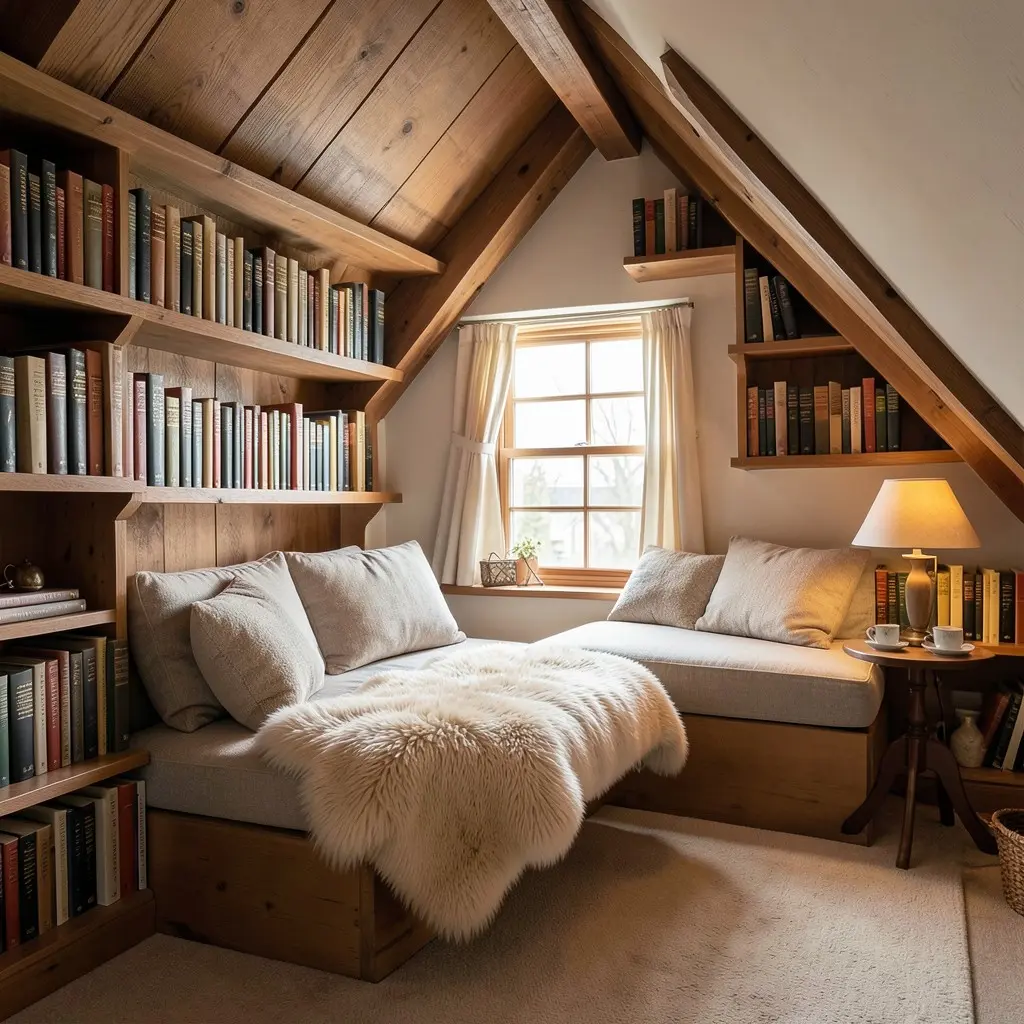
The attic reading room is the room that book lovers describe, almost universally, as their ideal — the private space above the household’s activity, physically removed from the interruptions that the ground and first floors generate, with a scaled intimacy that makes the act of reading feel exactly as sheltered and contained as sustained attention to a book requires. The standard challenge is fitting bookshelves into a room where the walls slope toward the floor, and the solution to that challenge produces the attic’s most compelling organizational feature.
Built-in bookshelves following the pitch of the roof — shelves at graduated heights that decrease toward the eaves, their top edges following the slope of the slanted ceiling — create the attic library’s signature storage form. The shelves’ graduated height mirrors the roof’s geometry with a precision that makes the storage feel designed for the space rather than fitted into it, and the books displayed at the varied shelf heights create the visual rhythm that a flat wall of uniform shelving cannot generate. Deep cushioned window seats in the dormer recesses — if dormers are present — create the primary reading positions, the window’s natural light illuminating the page and the seat’s physical comfort supporting the extended posture of committed reading.
Warm home decor ideas applied to the attic reading room — a large sheepskin throw across the window seat cushion, a small side table for tea and a lamp, and the accumulated personal quality of the books themselves as decoration — create the room’s domestic warmth without requiring applied ornament. The attic reading room’s charm is architectural rather than decorative, and the most successful versions of this room are the ones that trust the structure’s character to provide the design and invest the budget in the quality of the seating, the lighting, and the book storage rather than in surface treatments the room does not need.
4. An Attic With a Scandinavian Minimalist Bedroom
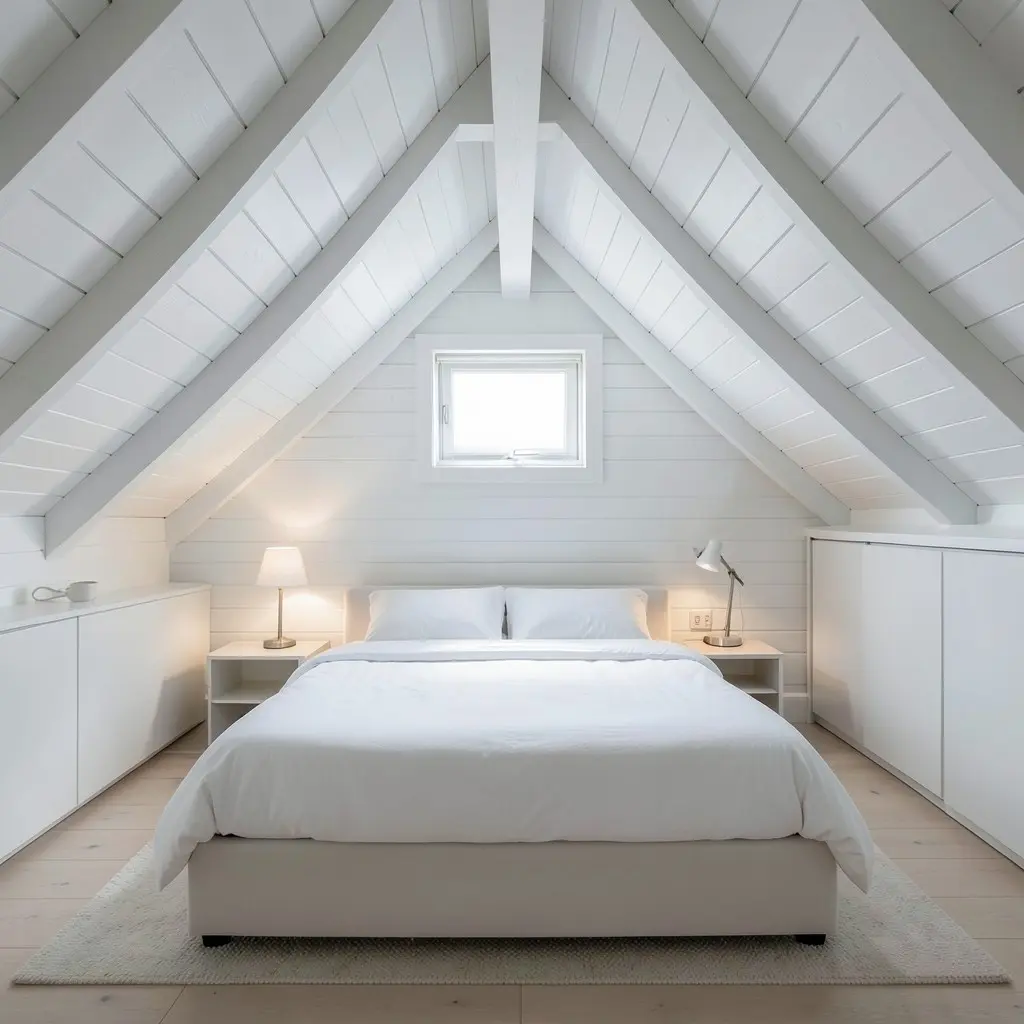
The Scandinavian attic bedroom applies the design philosophy most naturally suited to a room whose architectural complexity is already high — the pale palette, the minimal furnishing, and the material precision of Scandinavian home interior design create the visual calm that allows the exposed roof structure to read as the room’s design rather than competing with applied decoration. Less, in the attic context, genuinely is more, because the space already contains more architectural interest than any standard room.
White-painted rafters and sheathing — applied uniformly across the full ceiling surface, including the undersides of the structural members — create the pale, unified overhead surface that Scandinavian design applies as its signature interior condition. The white paint does not diminish the structure’s three-dimensional quality; it unifies it, creating the impression of a single sculptural surface rather than a collection of individual timber pieces, and the light that the skylight or dormer windows introduces bounces across the white surface with a diffuse, even quality that the warm-toned natural wood surface does not produce. This is the counterintuitive insight that Scandinavian attic design exploits: painting the beautiful exposed wood white creates a better room for sleeping than leaving the wood in its natural state, because the pale, bright room supports the full range of the bedroom’s uses — reading, working, and sleeping — better than the warm but darker natural wood interior.
Furnishing in the Scandinavian attic bedroom should be limited to what the bedroom genuinely requires — a bed with a quality mattress and crisp white linen, a single bedside table on each side with a reading lamp, and a low-profile wardrobe that fits beneath the eave height without requiring the central standing height that the roof’s peak provides. Nothing else. The restraint is not poverty of imagination. It is the acknowledgment that the room’s architecture is providing everything that decoration would try to add, and adding decoration on top of architecture creates visual noise rather than design quality.
5. An Attic Converted Into a Full Master Suite
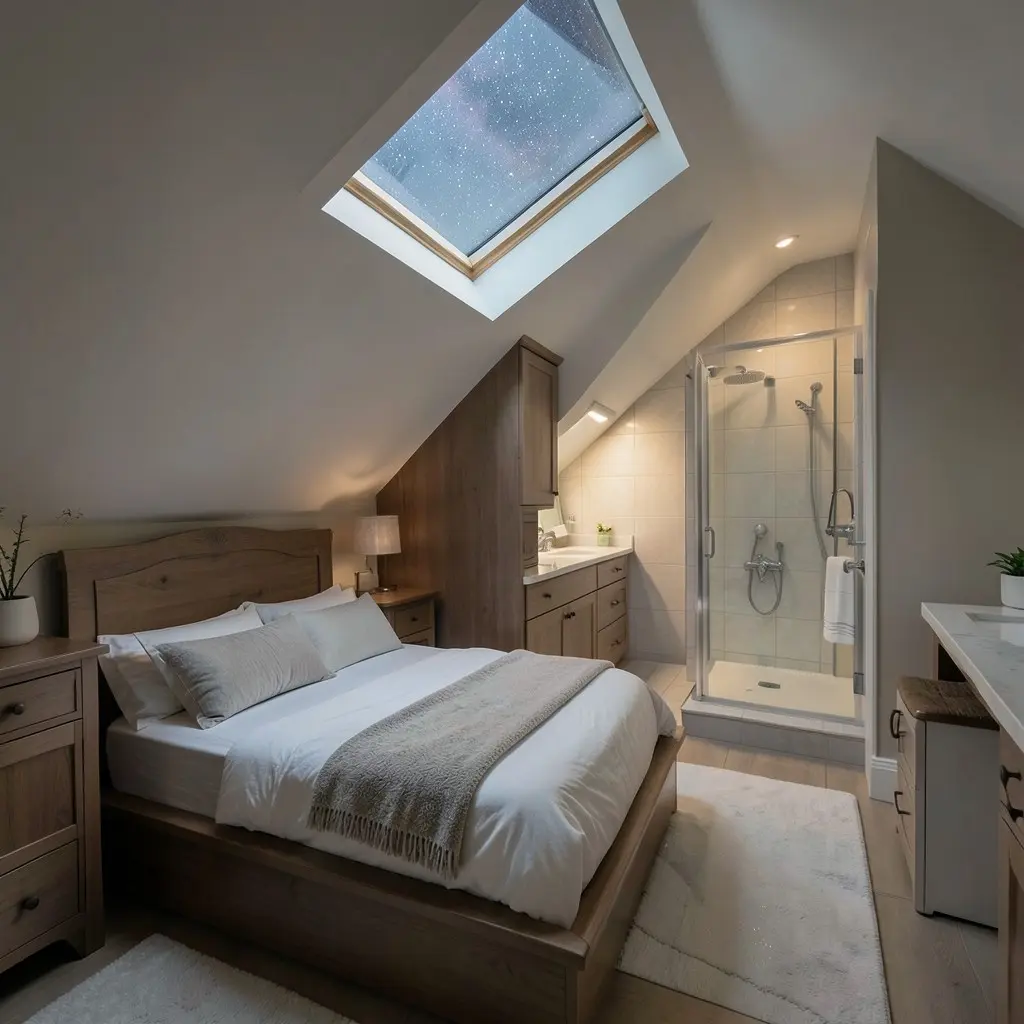
The attic master suite is the residential conversion whose outcome justifies the investment most dramatically — the bedroom, the en-suite bathroom, and the dressing area that occupy the home’s topmost floor create a primary sleeping suite of genuine privacy, distinctive character, and architectural quality that no below-roofline room achieves. The master suite at the top of the house is above the household’s nighttime sounds, above the street noise that penetrates the lower floors, and surrounded by the particular quiet of being the highest occupied point in the building.
The master suite’s floor plan in a converted attic requires the most careful development of any room type in this collection — the sloped ceilings constrain the positioning of beds, wardrobes, and bathroom fixtures in ways that below-roofline rooms do not experience, and placing a full bathroom in an attic requires planning the floor penetrations for the drain lines and the wall penetrations for the supply lines before any finishing work begins. The bathroom’s wet areas — the shower and the bathtub — should be positioned in the areas where the headroom is sufficient for safe, comfortable use: typically at least six feet six inches for the shower and at least six feet for the bathtub surround. The sloped areas under the eaves suit low-profile vanity installations, towel storage, and the under-eave cabinet sections that attic bathrooms use effectively for their storage functions.
Luxury home interior quality applied to the attic master suite — in the material quality of the bathroom tile, the finish of the plumbing fixtures, the detail of the built-in wardrobe cabinetry, and the precision of the skylight installation above the bed or the bathtub — creates a suite whose premium quality is consistent from the entry to the most private corners. The bath positioned under a skylight is the attic master suite’s single most memorable design feature — bathing beneath the sky, with stars visible on clear evenings and rain audible on the roof glass during storms, is a domestic experience that no standard bathroom position provides regardless of its material quality.
6. An Attic With an Industrial Loft Conversion
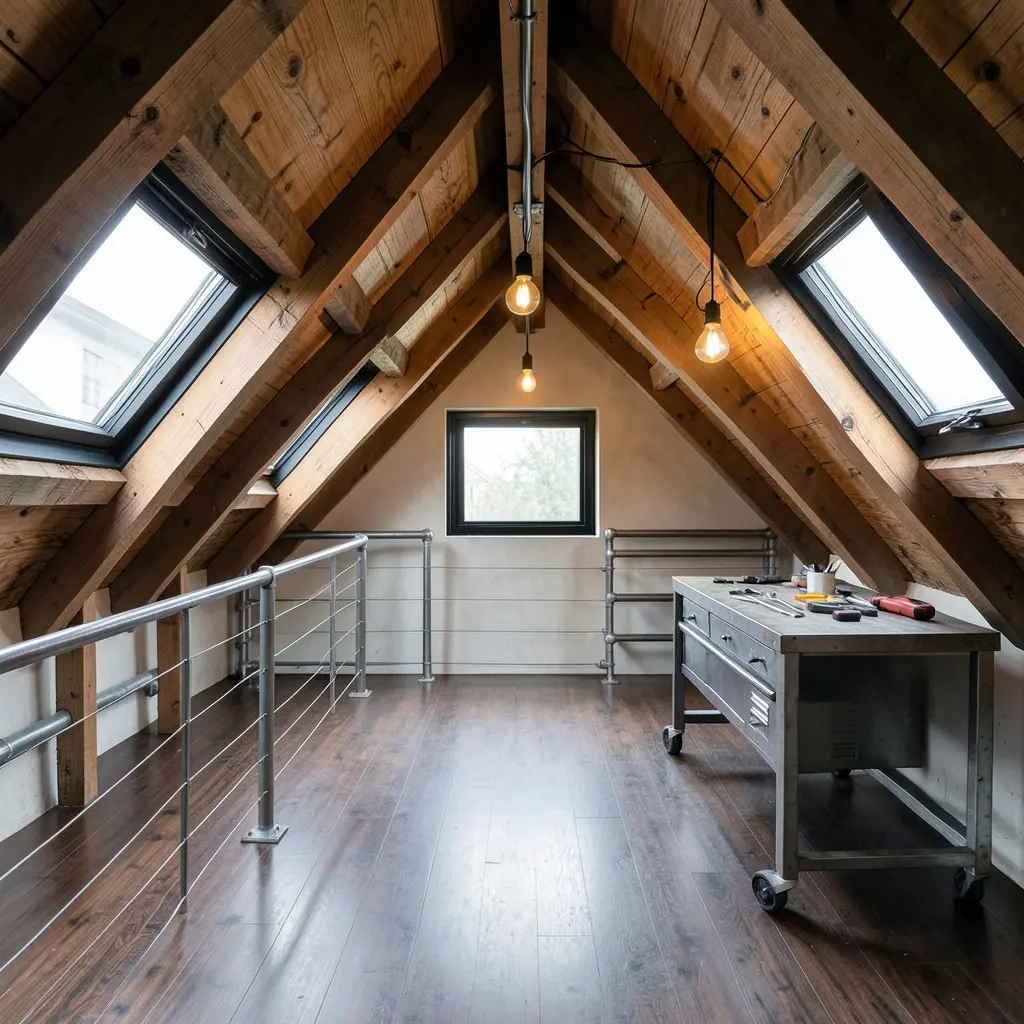
The industrial attic conversion is the design direction that treats the attic’s raw structure — the timber frame, the board sheathing, the exposed mechanical systems, and the bare floor joists — as the design material rather than the pre-renovation condition. The industrial home design aesthetic celebrates material honesty, and the attic’s structural exposure before finishing is the most materially honest condition of any room in the house. Working with that honesty rather than concealing it creates the attic’s most architecturally direct design outcome.
Steel cable railings on the attic stair opening — replacing the standard timber balustrade with a sleek horizontal cable tension system on steel posts — creates the industrial aesthetic’s first design gesture at the attic’s primary entry point. The cable’s visual transparency preserves the sightlines across the attic floor plan, which in open-plan attic conversions is the sightline quality that the vertical timber balustrade interrupts and the horizontal cable maintains. Steel-framed windows in the dormers — powder-coated black, with minimal sightlines and maximum glass area — create the industrial window aesthetic that suits the loft conversion’s design direction and provides the maximum light admission that the attic’s limited window openings can achieve.
Polished concrete or dark-stained engineered timber flooring creates the industrial attic’s ground plane in a material that suits the raw overhead structure. The contrast between the warm timber above and the cool, precise floor below creates the material dialogue that industrial home design applies as its characteristic spatial quality. Steel pipe shelving on the kneewalled sections, Edison-style bulb pendants hanging from the ridge beam, and a rolling tool chest or a steel-frame work table as the room’s primary furniture complete the industrial attic palette with materials whose weight and age suit the structure’s age and character.
7. An Attic With a Cozy Mountain Cabin Bedroom

The mountain cabin attic is the design direction that suits the timber-framed attic most naturally — the heavy rafters, the timber purlins, the rough-cut texture of the structural wood, and the intimate scale of the sloped ceiling all belong to the same material vocabulary as mountain cabin decor, and their combination in an attic bedroom creates the shelter-and-warmth quality that alpine residential design has applied for generations to the rooms tucked under mountain roofs.
Dark stained timber — the rafters and ridge beam in a rich walnut or deep ebony stain that acknowledges the wood’s natural warmth while creating the dramatic overhead statement that mountain cabin interiors apply to their primary structural timber — creates the attic bedroom’s most commanding design gesture. The dark overhead structure against a warm white ceiling surface creates the visual contrast that makes the timber’s three-dimensional quality most apparent, each rafter’s depth and shadow reading clearly against the pale background. Stone and wood home design elements at the floor level — a rough stone feature at the attic’s end wall, heavy oak board flooring, and a cast iron wood stove where the chimney can be accommodated — create the mountain cabin’s material fullness across the complete room.
Bedding in heavyweight wool and flannel — the layered textile warmth that winter home decor and mountain cabin styling apply to the sleeping environment — creates the cozy bedroom design atmosphere that the architectural character of the exposed timber overhead supports. A handmade quilt, a wool plaid throw, and the pillows in a natural linen and wool mix create the textile richness whose organic warmth suits the structural timber’s organic weight. During the winter interior design season, this attic bedroom is the house’s most atmospheric room — the timber overhead, the warm bedding, and the sound of wind against the roof slates creating the sheltered, private quality that the best mountain accommodation provides.
8. An Attic With a Bohemian Creative Studio
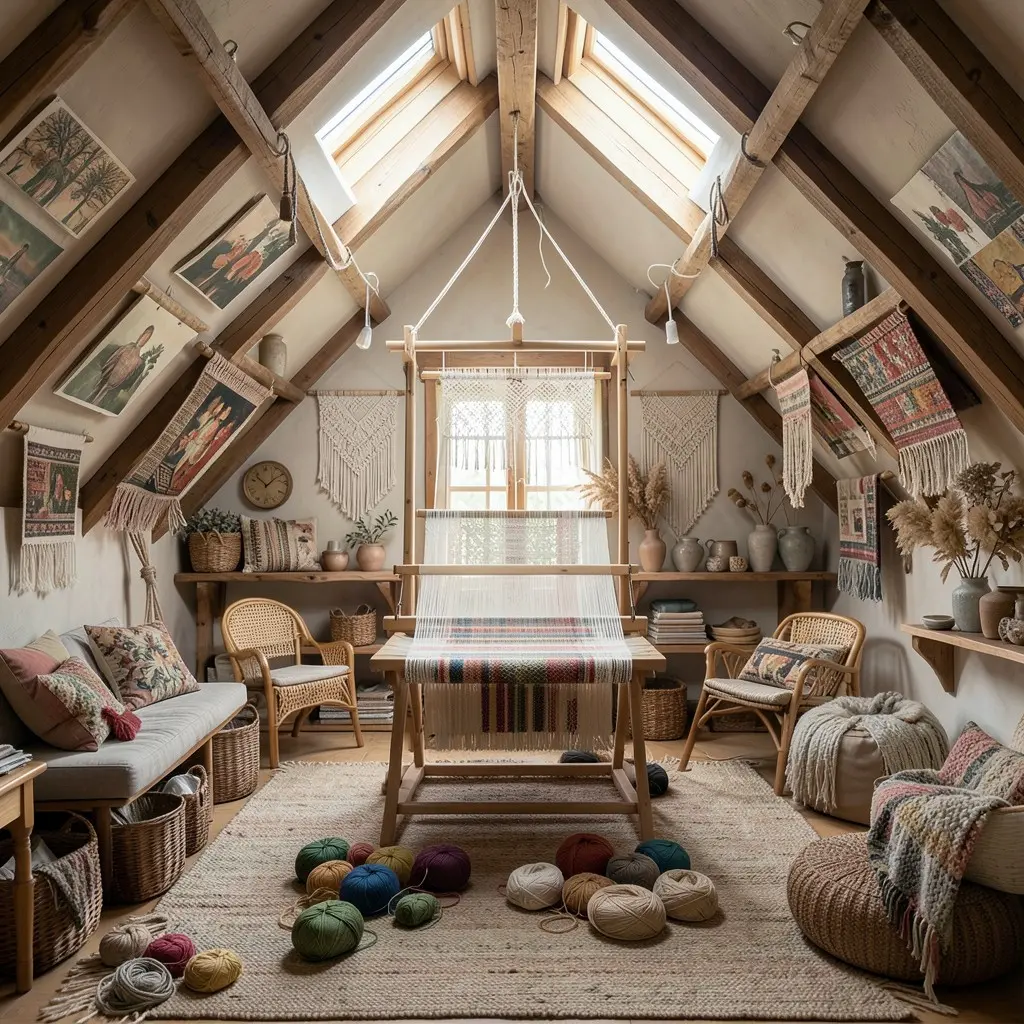
The bohemian attic studio is the one room type that the attic’s sloped walls, irregular geometry, and distributed natural light serves without a single compromise — the bohemian home styling aesthetic values exactly the qualities that standard room design treats as limitations. The low corners become the niches that hold cushion reading areas, textile displays, and the accumulated personal objects of a creative life. The irregular wall surfaces become the hanging surfaces for the layered artwork and textiles that bohemian studios accumulate. The varied ceiling height creates the spatial interest that the aesthetic’s layered, multi-height furnishing inhabits with comfort.
A large weaving loom in the attic studio’s highest area — the central standing height beneath the ridge — anchors the creative practice in the room’s most generous volume and creates the studio’s defining visual object. The loom’s scale and presence communicate the room’s creative purpose from every angle, and the textile work in progress — the warp threads catching the light from the skylight or the dormer window, the weft colors building the pattern’s horizontal bands — creates the studio’s living, growing content that static decoration cannot approach. The floor around the loom accumulates the yarns, the color samples, and the reference textiles of the practice in an organic organization that bohemian home styling accommodates rather than corrects.
Natural materials throughout the studio — bamboo home interiors elements in the shelving and the accessory baskets, rattan chairs and poufs for the informal seating areas, and woven natural fiber rugs layered over the attic floor — create the bohemian material palette that suits the creative studio’s organic, personal atmosphere. Macramé wall hangings beside the skylight, a collection of dried botanicals in ceramic vessels along the kneewalled shelves, and the studio’s accumulated work hanging from the rafters on simple wooden dowels create the environmental richness that the bohemian aesthetic builds through accumulation rather than through single grand gestures.
9. An Attic With a Children’s Magical Playroom
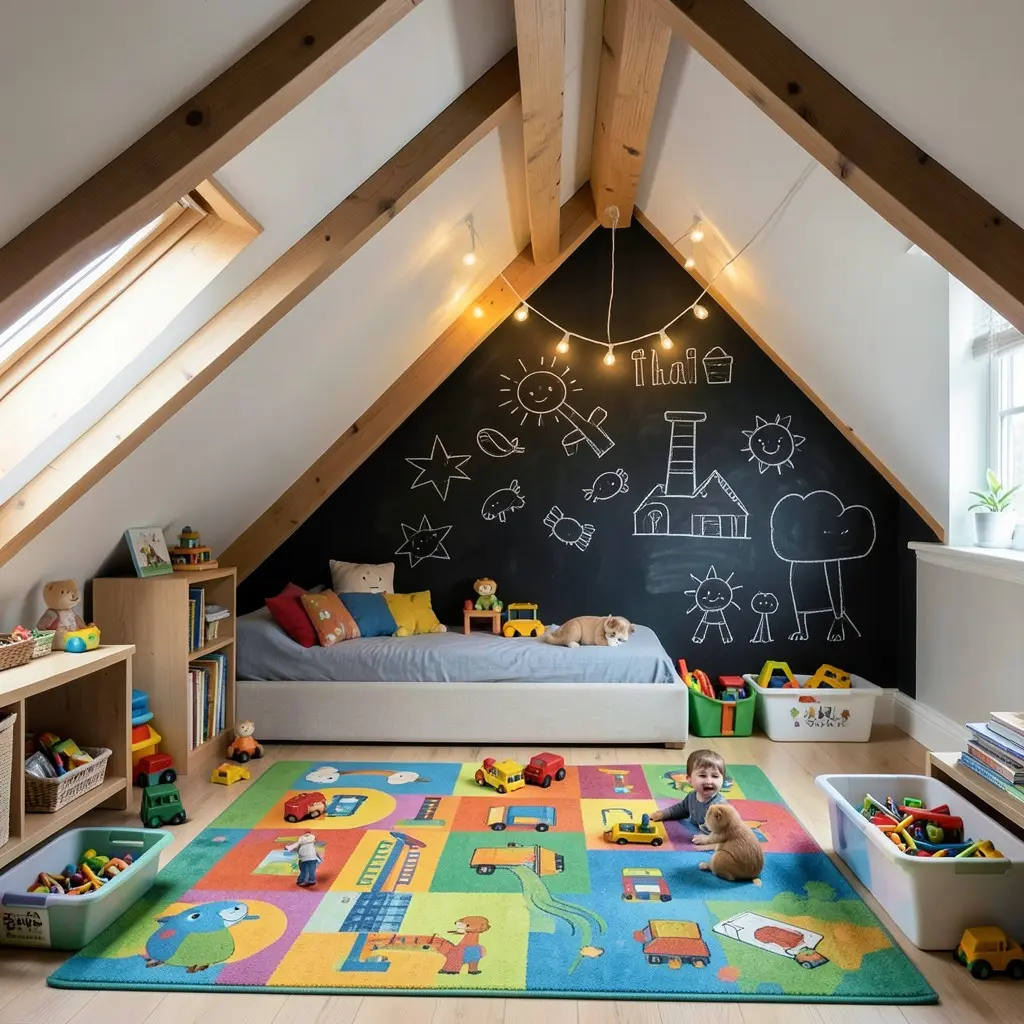
The attic playroom is a design idea that gets children unreasonably excited before a single toy has been installed — the sloped ceiling that adults find constraining is, at a child’s height, not constraining at all, and the private, above-everything quality of the attic creates the secret-space atmosphere that childhood imagination requires as its physical setting. The child who has a playroom at the top of the house has, in their own mind, the best room in any house they have ever visited.
The attic playroom’s design should prioritize the child’s scale above the adult’s — the furniture, the storage, and the play surfaces are all dimensioned for the household’s youngest members, and the sloped ceiling areas that adults cannot stand in become the playroom’s most useful zones precisely because children can. Bohemian kids room decor applied at child scale — bright colors on the floor in the form of a large play rug, chalkboard paint on the kneewalled section that creates the playroom’s primary drawing surface, and open storage bins at floor level for toys and art supplies organized by category — creates the playroom whose atmosphere is energetic, personal, and designed for genuine creative use rather than for the Instagram photograph of a styled children’s space.
A reading nook tucked under the lowest eave section — a cushion fitted to the sloped floor area, a small bookshelf at the child’s reach height, and a string light arrangement overhead — creates the calm complement to the playroom’s active central zone, the place where the energy of play gives way to the quieter absorption of a picture book or a chapter. The nook’s intimate scale, determined by the roof’s slope rather than by any constructed enclosure, creates the private shelter quality that children seek in their play environments and that no purpose-built playhouse reproduces as authentically as an actual architectural alcove beneath a real sloping ceiling.
10. An Attic With a Farmhouse-Style Guest Bedroom
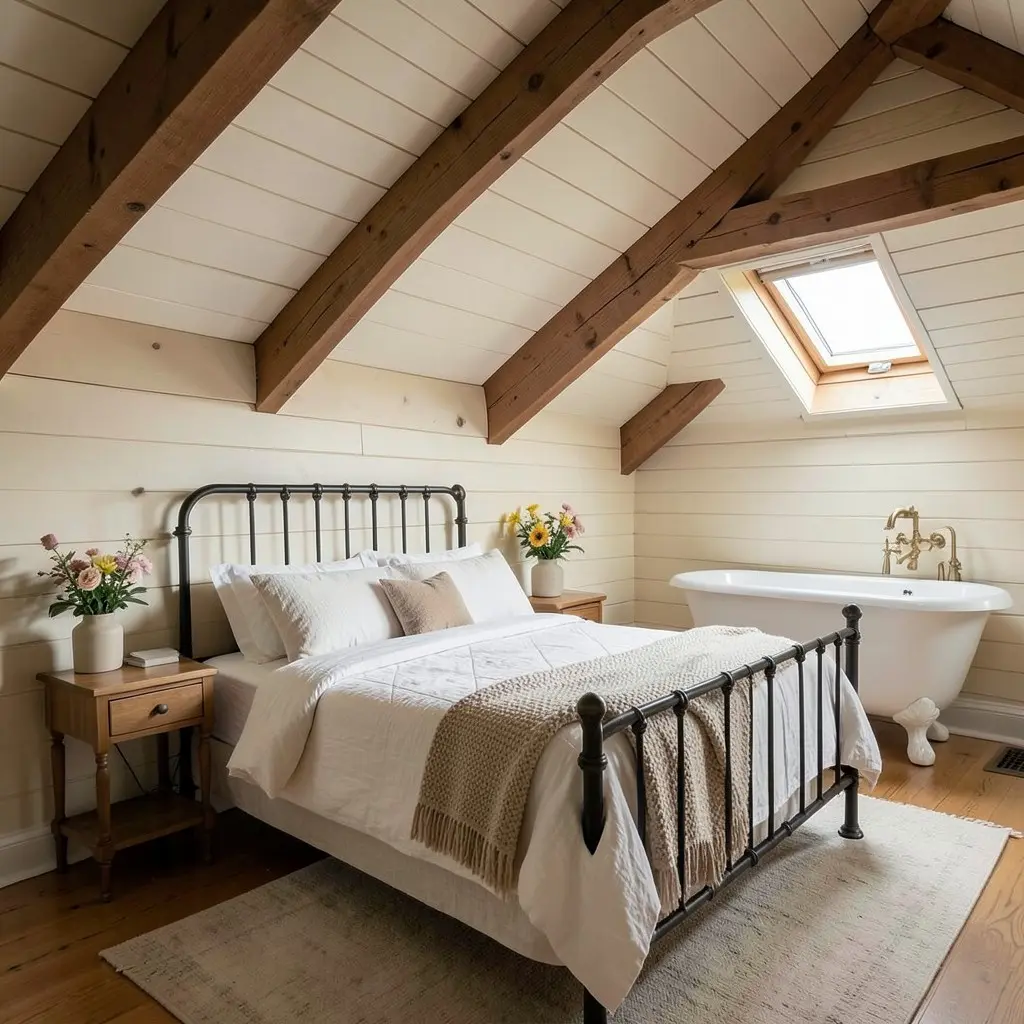
The farmhouse attic guest room applies the warm, genuine, material-honest quality of farmhouse home decor to the most architecturally interesting sleeping space in the house, and the combination creates an accommodation experience that guests mention for years afterward. The farmhouse aesthetic’s preference for authentic materials and architectural honesty suits the attic’s exposed structure with a directness that more polished interior styles require deliberate effort to achieve in the same space.
Shiplap applied to the kneewalled sections and the dormer cheek walls — painted in a warm cream or soft white that suits the farmhouse palette — creates the attic guest room’s signature surface treatment, covering the structural areas that require insulation and finishing while creating the horizontal board rhythm that farmhouse home decor applies as its defining interior texture. The shiplap’s warm white against the natural or lightly stained rafter ceiling above creates the material contrast that suits the farmhouse aesthetic’s combination of pale surface and warm structural wood. Farmhouse bathroom decor extended into the en-suite bathroom if the attic suite includes one — a pedestal sink in a classic style, a clawfoot or slipper tub under a roof skylight, and oil-rubbed bronze hardware throughout — creates the accommodation’s private facilities in the same material vocabulary as the sleeping area.
An iron bed frame in a simple design — wrought iron headboard and footboard in an aged black finish — sits naturally in the attic farmhouse bedroom, its material and its visual simplicity suited to the room’s structural character and the farmhouse aesthetic’s honest material preference. White linen bedding in a heavy weave, a quilted coverlet in a warm neutral, and the layered textile warmth of a chunky knit throw create the bed’s visual and tactile quality. A small flower arrangement on the bedside table — the fresh farmhouse touch of garden-cut blooms in a simple ceramic vase — adds the floral home decor ideas quality that completes the farmhouse guest room with the living, scented detail that makes the space feel prepared and welcoming rather than simply available.
11. An Attic Yoga and Meditation Studio
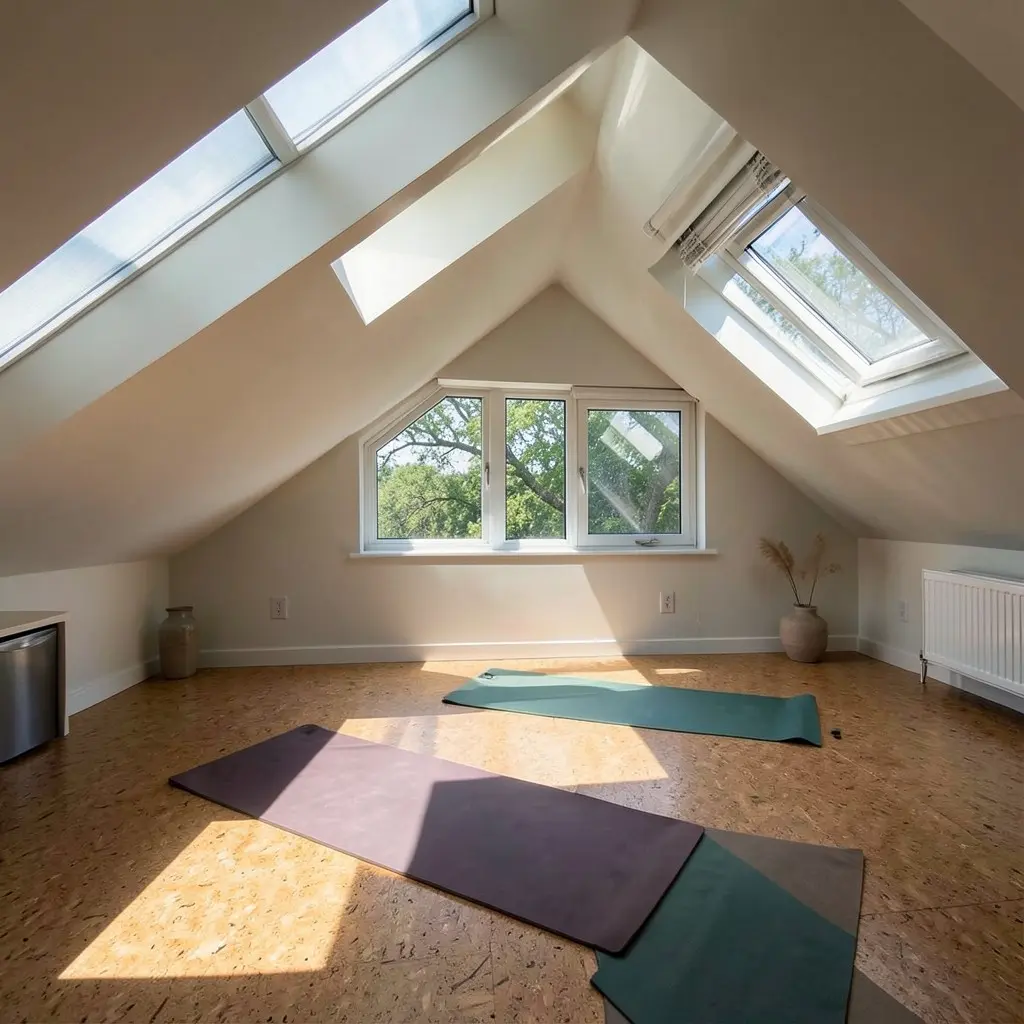
The attic yoga and meditation studio is the spatial arrangement that the practice consistently rewards — the elevated position, the proximity to the sky, the natural quiet of the highest floor, and the privacy of a room that the household’s daily circulation does not pass through create the environmental conditions that yoga and meditation traditions identify as optimal for the inward focus the practice requires. Not every household needs a dedicated yoga studio. Every household whose practice is consistent and whose main floor rooms cannot provide thirty minutes of uninterrupted morning quiet does.
The attic studio’s floor preparation — a clean, level, smooth surface that accommodates the full extension of a yoga mat with clearance on all sides — is the primary physical requirement, and the attic floor’s condition after conversion determines the flooring specification. Cork flooring in a natural tone is the yoga studio’s optimal floor material: warm underfoot for bare-foot practice, acoustically absorptive enough to prevent the echo that hard floors create in a room used for breathing practice and movement, and resilient enough to cushion joint impact during standing postures without the instability that thick foam mat-only surfaces create for balance poses. The cork’s natural material quality suits the peaceful home decor direction that the meditation and yoga studio applies as its foundational aesthetic principle.
Skylight placement in the attic yoga studio creates the light quality that outdoor practice provides and indoor rooms cannot otherwise achieve — the overhead natural light that illuminates the practice space from above, follows the sun’s arc across the studio’s floor during the practice session, and creates the connection between the interior space and the outdoor sky that the practice’s philosophical orientation consistently values. A practice session in an attic yoga studio with a well-positioned skylight, as the morning light moves across the cork floor and the tree outside the dormer window shifts in the wind, is a qualitatively different experience from the same practice in a carpeted bedroom with the blinds drawn.
12. An Attic With a Tropical Botanical Atmosphere

The tropical attic is the design idea that most directly addresses the attic’s primary challenge — the potential for heat, stuffiness, and the greenhouse effect that direct roof exposure creates during summer home design season — by turning those conditions into design assets. The tropical aesthetic thrives in warm, light-rich, plant-dense environments, and the attic that is properly ventilated but warmly lit from above is the closest residential equivalent of the tropical botanical environment that the design direction references.
Large-leaved tropical plants in the attic’s highest floor areas — the monstera, the banana plant, the fiddle-leaf fig — fill the vertical space between the floor and the ridge beam with the organic green density that tropical home design and jungle-inspired home decor apply as their primary visual material. The plants’ scale relative to the sloped ceiling creates a layered canopy effect — the large leaves of the tall plants overlapping the lower foliage of the medium-height plants, creating the dense, multi-level botanical atmosphere of a real tropical interior rather than the isolated specimen planting of a living room. Grow lights positioned above each plant group provide the supplemental illumination that extends the plants’ active growing period beyond the natural light that the skylights and dormers provide.
Bamboo home interiors elements — bamboo cladding on the kneewalled sections, a bamboo tray ceiling on the dormer interior, and bamboo furniture throughout the attic’s seating areas — create the tropical material vocabulary that connects the botanical planting to its cultural and architectural context. Rattan pendant lights hanging from the ridge beam, woven seagrass floor matting over the structural subfloor, and the warm amber of the overhead artificial lighting creating the filtered-light quality of sunlight through a tropical canopy complete the attic’s atmospheric transformation from a standard converted space to an environment of genuine tropical character.
13. An Attic With a Coastal Bedroom and Dormer Views

The coastal attic bedroom combines the beach house interiors palette with the attic’s most visually valuable feature — the dormer window that frames the view of sky, rooftop, and treetops in a format that no below-roofline window provides. The dormer view from an attic bedroom is the one above the domestic horizon, the one that shows the sky rather than the street, and the one that creates the sense of elevation and openness that coastal living consistently provides.
White-painted walls and ceiling in the attic coastal bedroom — the whitewash extending across the rafters and the dormer cheek walls in the same tone — create the pale, washed-out quality of beach house interiors whose surfaces have been bleached by years of salt air and sunlight. The uniformly pale interior makes the sky-blue or ocean-blue of the dormer view the room’s primary color accent, the exterior world’s color framed by the white interior and read as the dominant visual note without any applied decoration in the same hue. Coastal home design applied to the bedroom’s furnishing — a weathered driftwood-grey bed frame, white linen bedding with a navy stripe, a sisal area rug over the painted floor — creates the beach house sleeping environment whose atmosphere is inseparable from the view it is positioned to receive.
The dormer window seat — a padded bench built into the dormer bay, at a height that allows either seated or reclined viewing of the exterior — is the coastal attic bedroom’s most valuable furnishing element and the position that the room’s occupant will return to more consistently than any other. The window seat’s position at the dormer creates the framed exterior view that turns the bedroom’s primary sitting position into a daily connection to the outdoor landscape. A window seat in a dormer, with a cup of tea and the morning light coming across the rooftops, is the specific domestic experience that this room exists to provide.
14. An Attic With a Desert-Inspired Warm Palette
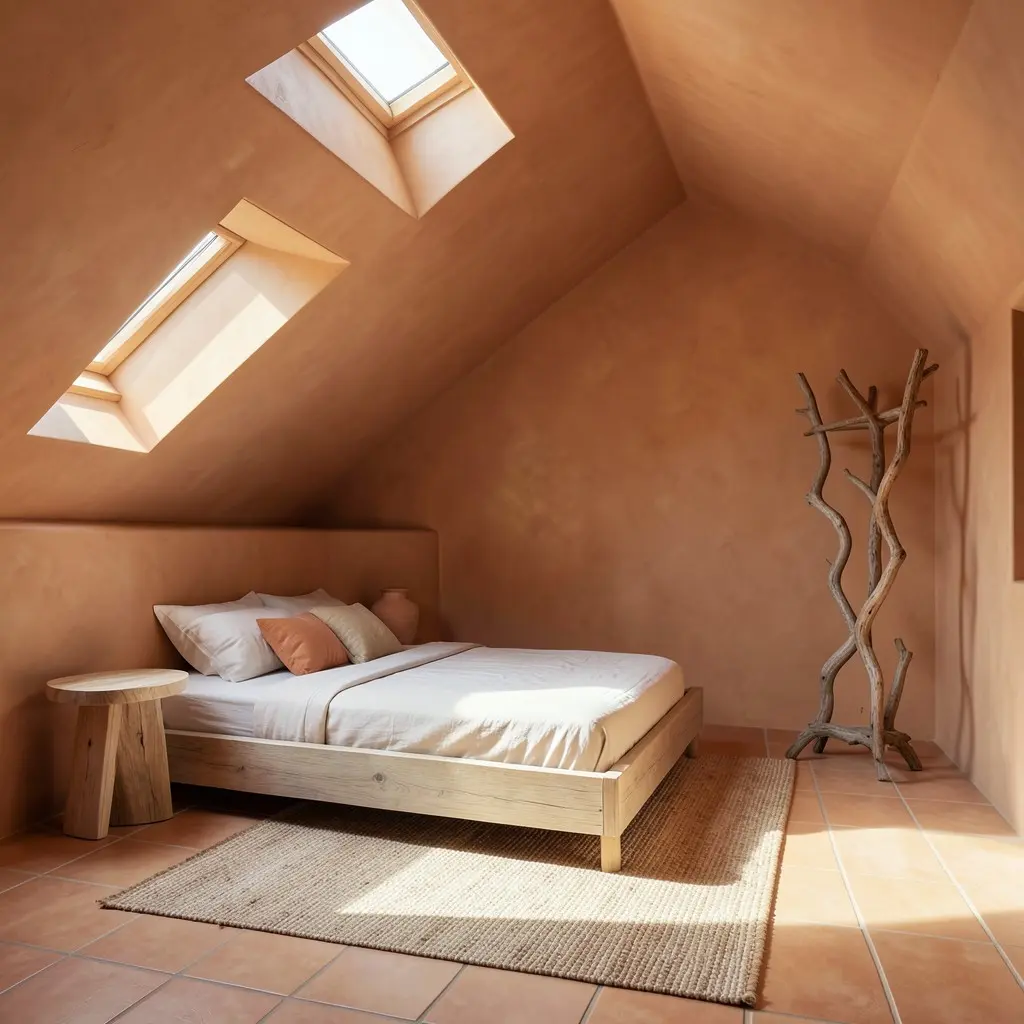
The desert attic applies the warm, mineral-toned palette of desert home styling to the upper floor’s unique light conditions — and the light in a well-glazed attic space has more in common with the quality of desert sunlight than any below-roofline room achieves. The overhead illumination from skylights, the warmth of the late-afternoon sun entering through west-facing dormers, and the absence of the ground-reflected light that fills below-grade and main-floor rooms create a light quality in the attic that the desert palette inhabits as its natural home.
Adobe-toned plaster on the attic’s vertical surfaces — the kneewalls, the dormer cheek walls, and the small flat ceiling sections — applied in a warm terracotta or sun-baked clay tone creates the desert palette’s primary wall expression. The Venetian plaster’s slightly luminous surface catches the overhead light from the skylights and reflects it with the warm, amber quality that terracotta tile on a desert floor reflects afternoon sunlight. Desert home styling extended through the flooring — large-format terracotta tile or a warm-toned concrete overlay in the attic’s main floor area — creates the material continuity between the wall and floor surfaces that the desert vernacular applies across its horizontal and vertical planes with equal consistency.
Natural wood furniture in a sun-bleached or matte warm stain — a low-profile platform bed in a pale mesquite or acacia, a single solid-wood side table, and a standing coat rack in a twisted-branch natural form — suits the desert aesthetic’s celebration of organic, weathered natural materials in forms that reveal rather than conceal the wood’s natural character. A few carefully placed ceramic vessels in warm terracotta and sandy earth tones on the kneewalled shelves, and a woven natural fiber rug in the desert’s sandy cream and warm brown tones on the floor, complete the attic’s earthy home design atmosphere without overdecorating a space whose light quality is already providing significant sensory richness.
15. An Attic With a Luxury Home Office Suite
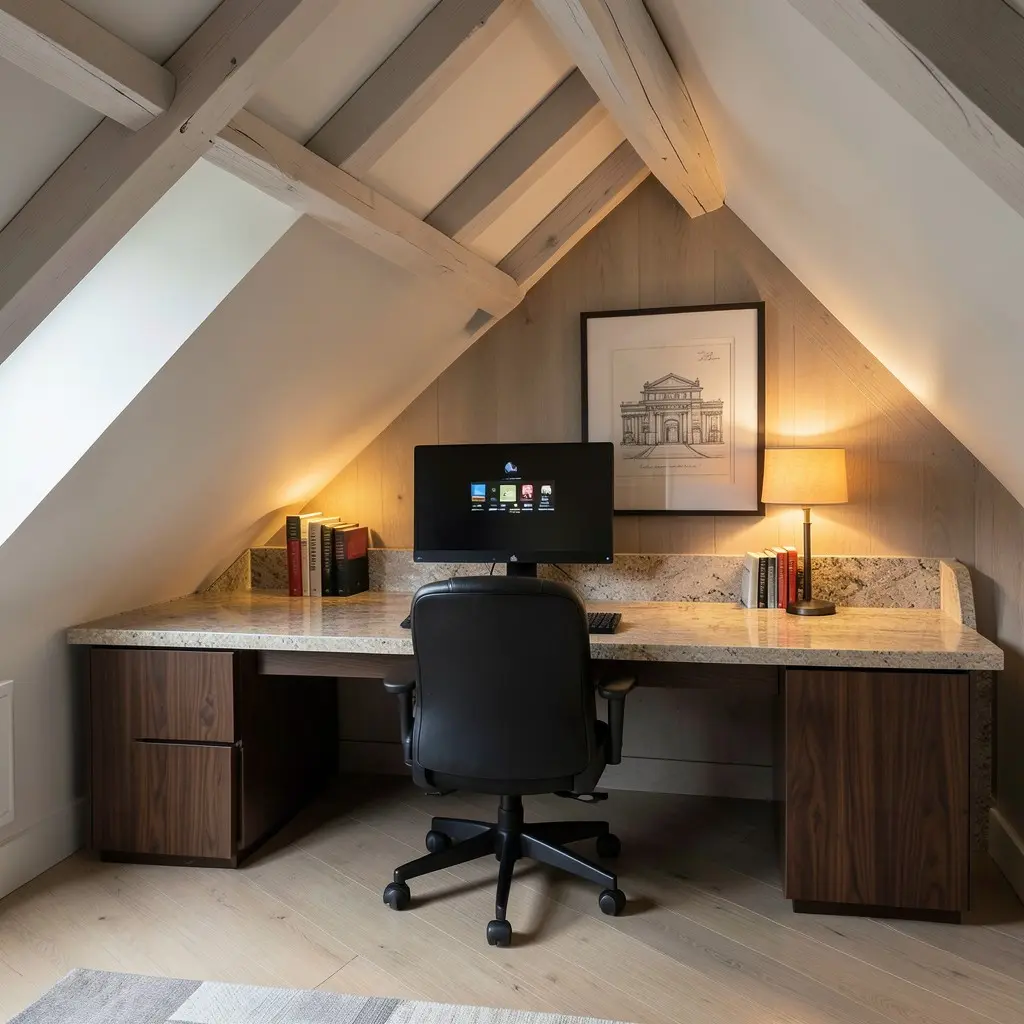
The luxury attic home office treats the workspace with the material quality and the design intention that the executive office applies to the professional environment, and places it in the home’s most architecturally distinctive room. Working in a space of genuine design quality — where the materials are considered, the lighting is designed, and the architecture itself communicates the seriousness of what happens there — produces a psychological separation from the domestic context below that the bedroom desk, the kitchen corner, and the spare room cannot create regardless of their equipment quality.
A custom-built desk fitted along the attic’s ridge kneewalled section — a continuous surface spanning the full length of the room’s primary working wall, with the monitor position centered on the kneewalled section and the working surface extending generously on both sides — creates the workspace scale that serious professional work requires. The desk surface in a honed natural stone or a thick-cut solid hardwood creates the material quality statement that luxury home interior workspaces apply as the primary expression of their design intention. The surface’s material quality is experienced directly and repeatedly through every working day — the cool weight of the stone under the forearms, the warm grain of the hardwood under the palm — and its permanence is the furniture-quality investment that the luxury workspace justifies over the replaceability of a standard office desk.
Elegant home styling applied to the attic office’s decorative details — a museum-quality architectural drawing framed on the end wall, a small collection of design books arranged on the kneewalled shelf with the precise casualness of a styled editorial set, and the warm amber of a table lamp against the pale exposed rafter ceiling — creates the workspace atmosphere of genuine aesthetic intelligence. The office that looks like it belongs to someone with taste and seriousness of purpose is the office that produces work consistent with those qualities, and the design creates the environment that the ambition requires.
16. An Attic With a Skylight-Lit Art Studio
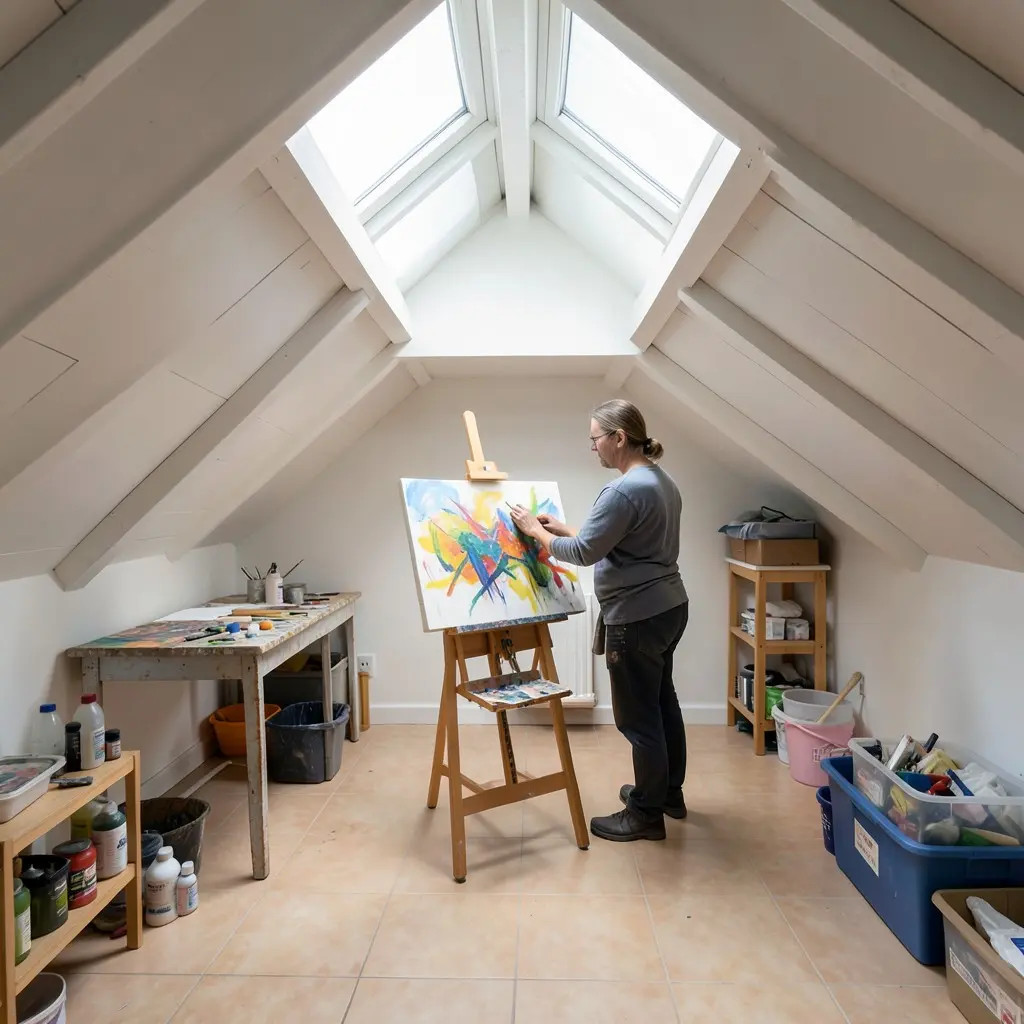
The skylight art studio in an attic is the design outcome that artists have sought from attic spaces since painters first climbed above the city’s rooflines to find the north light that their work required. The north-facing rooflight — still, arguably, the optimal light source for painting and color-sensitive art making — provides the consistent, diffuse, directional overhead illumination that the attic’s roof plane delivers most naturally and that no below-roofline room achieves without the intervention of an expensive dormer or roof extension.
The studio’s working area should be positioned directly beneath the primary skylight, with the artist’s standing position at the easel receiving the light from above and slightly behind the working direction — illuminating the canvas surface without glare and without the shadow that the artist’s body casts when positioned between a side window and the work surface. The studio’s secondary zones — the palette table, the supply storage, the reference shelf — can occupy the lower-light areas under the eaves, their activities not requiring the color-accurate illumination that the painting position demands. This spatial organization of the attic art studio — the active working zone at the light source and the support zones at the periphery — mirrors the professional studio organization that working artists develop through experience and that the attic’s geometry makes almost instinctive.
The studio floor’s material priority is cleanability and material compatibility — a sealed concrete, a painted floor, or a large-format porcelain tile in a warm mid-tone provides the easy-clean surface that painting practice requires in a space where solvent spills, dropped pigment, and the tracked-in evidence of the material process are not occasional accidents but the room’s daily condition. Airy home interiors quality created by the pale floor, the white-painted rafter ceiling above, and the generous overhead light from the skylights creates the studio atmosphere of active, energized creative focus — the quality of light in a well-designed attic studio is the most direct reason that artists who work in them consistently produce their best work there.
17. An Attic With a Modern Minimalist Design
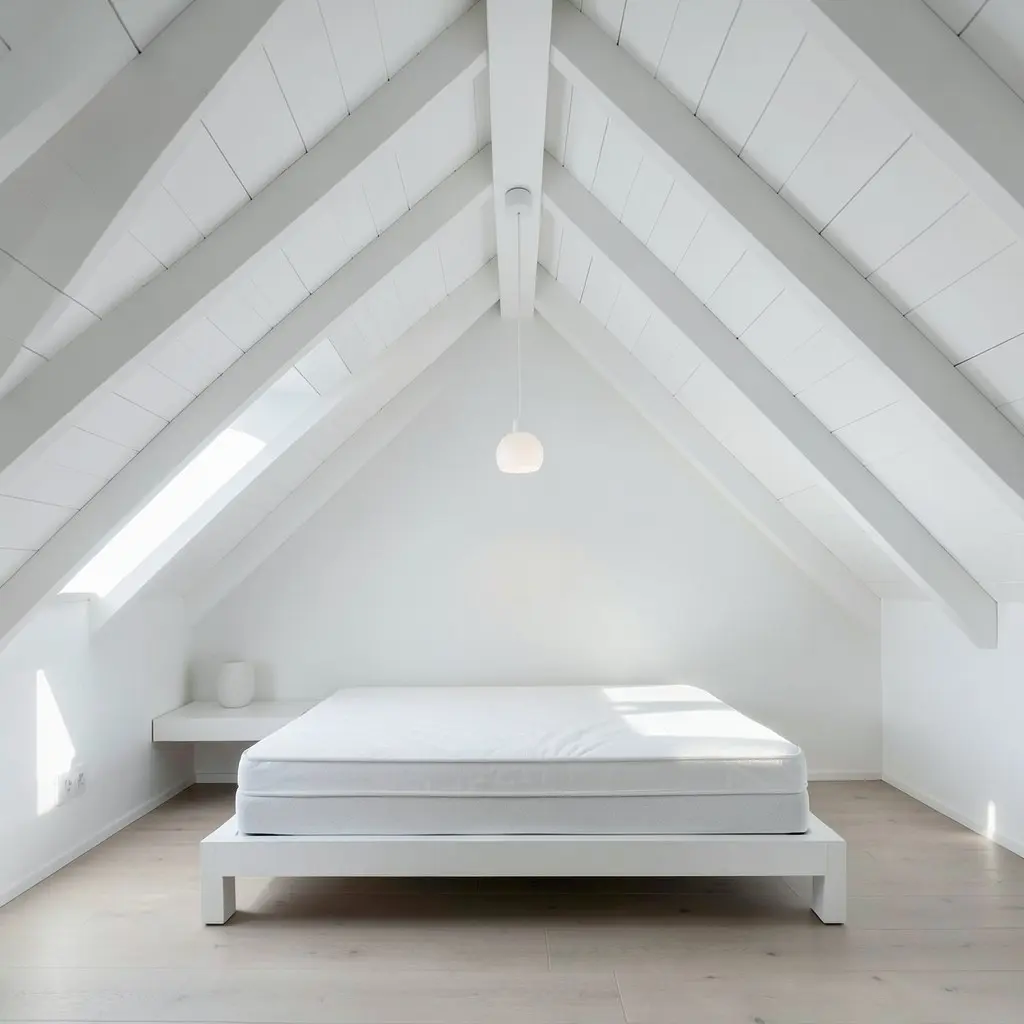
The modern minimalist attic applies the design philosophy of reduction to the room that has the most inherent architectural complexity in the house, and the result — when the reduction is executed with the confidence it requires — is the attic space that reads most powerfully, precisely because the complexity of the structure is allowed to be the room’s sole visual content. Nothing competes. The rafters, the ridge, and the slope are the design. Everything else supports them without intruding.
White paint applied uniformly to all surfaces — the rafters, the ridge beam, the kneewalls, the dormer returns, and the ceiling sheathing — creates the modern minimalist attic’s primary move. The uniform white eliminates the material differentiation between structural wood and applied finish, creating a single continuous sculptural surface whose three-dimensional quality reads as pure form rather than material assembly. This approach looks wrong on paper and looks extraordinary in a room — the structural complexity that the natural wood finish makes visible as a collection of individual components reads, in uniform white, as a designed surface of elegant geometric complexity.
Modern home design furniture at the minimum — a low-profile bed or mattress on a platform frame, a single narrow bedside surface, and one pendant light hung from the ridge beam on a white cord — furnishes the attic for its function without introducing the visual noise that a more fully furnished room generates in a space where the architecture is already providing maximum visual interest. Minimalist home design’s fundamental principle — that the most visually powerful space is the one where every element was deliberately included and everything else was deliberately excluded — applies nowhere more directly than in the attic, where the structural complexity has already done the design work.
18. An Attic With a Traditional Library and Study
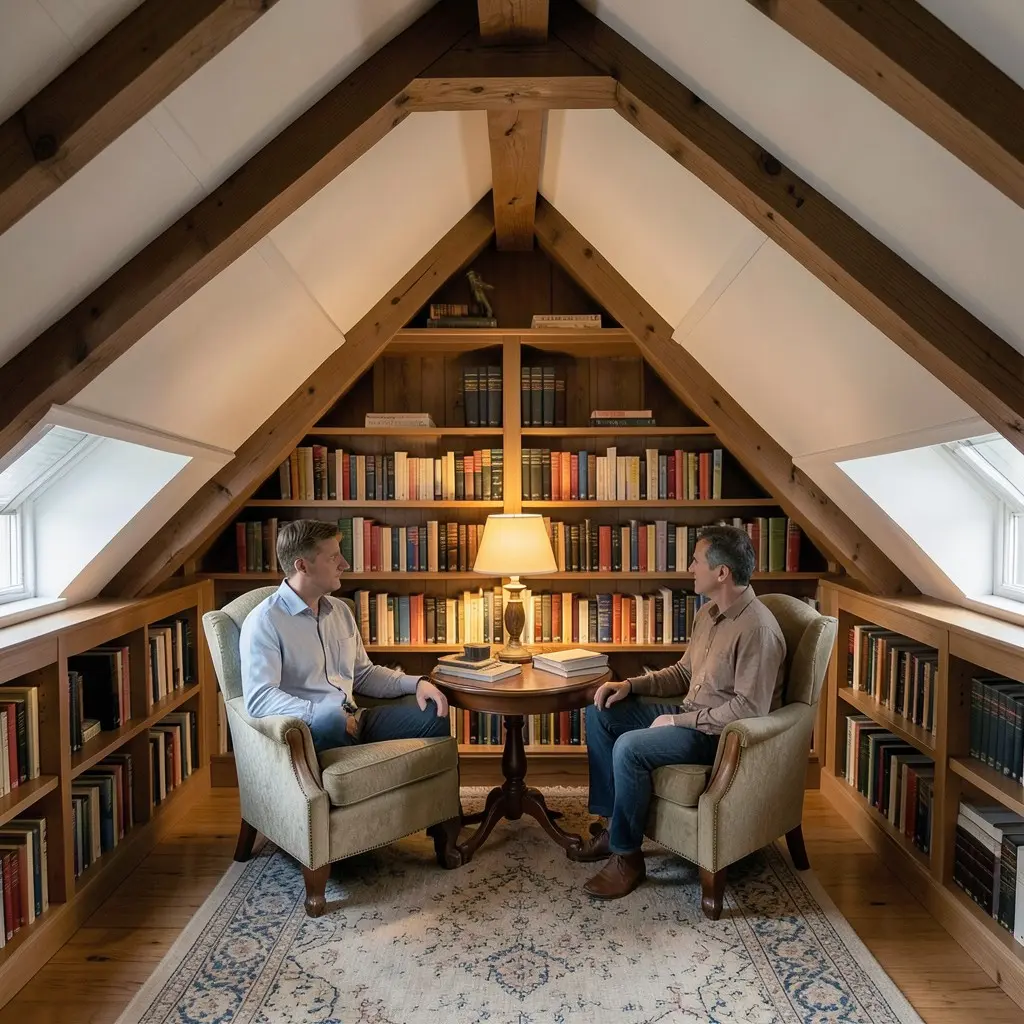
The traditional attic library is the design idea that the bibliophile household should seriously consider before installing a single shelf anywhere else in the house — the attic’s perimeter kneewalls create a continuous surface for built-in bookshelves that wraps the room’s entire lower perimeter, and the shelves’ graduated height following the kneewalls’ varying height creates the library’s most organizationally and visually distinctive feature. Traditional home interiors applied to an attic space create a room whose formal material quality and architectural detail create the most unexpected design contrast in the house — the library that is also the room at the top of the building.
Kneewalled bookshelves — built-in units that fill the full kneewalled section from floor to the point where the roof slope begins, creating a continuous perimeter of book storage around the room’s lower edge — provide the attic library’s primary storage capacity. The shelves’ height at the kneewalled section typically ranges from three to five feet depending on the rafter’s spring line height, and this range suits the storage of hardcover books, paperbacks, and small reference volumes without modification. Above the kneewalled shelves, the sloped ceiling faces can carry additional shelving on the flat sections between the rafters, extending the library’s capacity into the roof structure itself and creating the completely book-lined room that traditional library design applies as its defining spatial quality.
A pair of upholstered reading chairs at the attic library’s central standing height area — flanking a small round table for the lamp and the reading accessories, positioned beneath the ridge beam at the room’s highest point — creates the library’s inhabited core. The chairs’ back-to-back placement allows two simultaneous readers in the same space without visual disturbance, each facing their own wall of books with the shared lamp between them. This arrangement is specific to the attic’s geometry — the two readers facing opposite kneewalled book sections, with the ridge overhead and the sloped ceiling descending symmetrically toward each reader’s book wall — and creates the reading environment that traditional home interiors values above all other furniture arrangements.
19. An Attic With a Luxury Spa-Like Bathroom
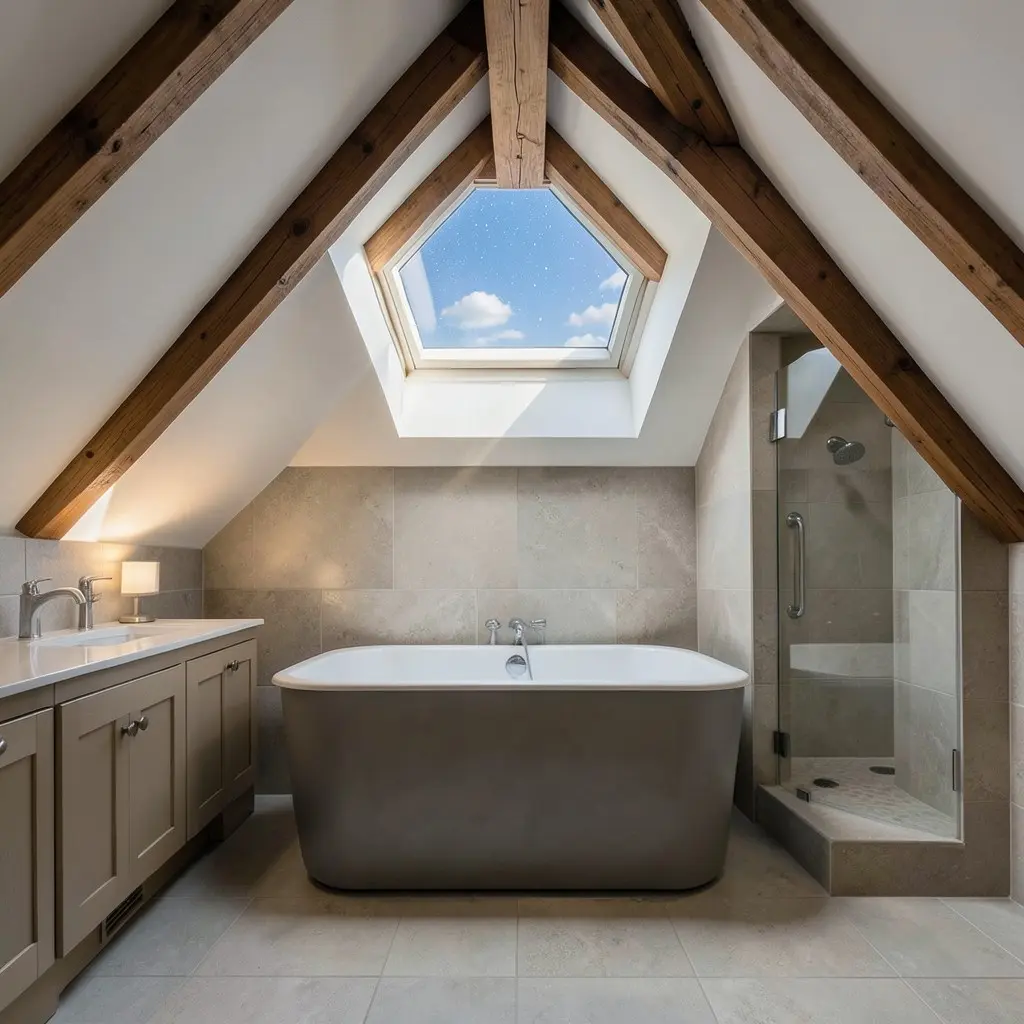
Installing a bathroom in an attic is the structural engineering challenge that produces the most dramatically atmospheric result in residential bathroom design — the sloped ceiling above the soaking tub, the skylight above the shower, and the dormer window above the vanity create a bathing environment of extraordinary character that no standard-proportioned bathroom, regardless of its material quality, approaches in spatial interest. The attic bathroom is the room where the architectural conditions and the bathing function combine to produce something genuinely memorable.
A freestanding soaking tub positioned at the attic’s highest central section — beneath the ridge beam, under a fixed skylight that provides the overhead illumination and the sky connection — creates the signature bathing position of the attic spa bathroom. The tub’s material — a cast iron in a matte white or a natural stone in a warm grey — suits the attic’s structural character, its material weight communicating permanence and quality in a room whose architecture already communicates both. Bathing beneath a skylight, with natural daylight overhead or stars visible on clear evenings, creates the outdoor bathing experience that landscape architects achieve in rooftop pools at considerable structural cost and that the attic bathroom achieves with a well-positioned skylight at a fraction of the complexity.
The shower in the attic spa bathroom should be positioned in a dormer bay if the plan allows — the dormer’s three-sided enclosure creates a naturally sheltered shower space whose head height is determined by the dormer’s internal height rather than the main attic’s sloped ceiling, and whose window on the dormer’s front wall provides ventilation and natural light to the showering position. A walk-in format without a door — a wet room approach where the shower area is separated from the bathroom floor by a simple threshold and adequate drainage — suits the attic geometry’s irregular surfaces and avoids the fitting complications that hinged or sliding shower doors create when the ceiling above the door position slopes at a varying angle.
20. An Attic With a Warm Rustic Bedroom
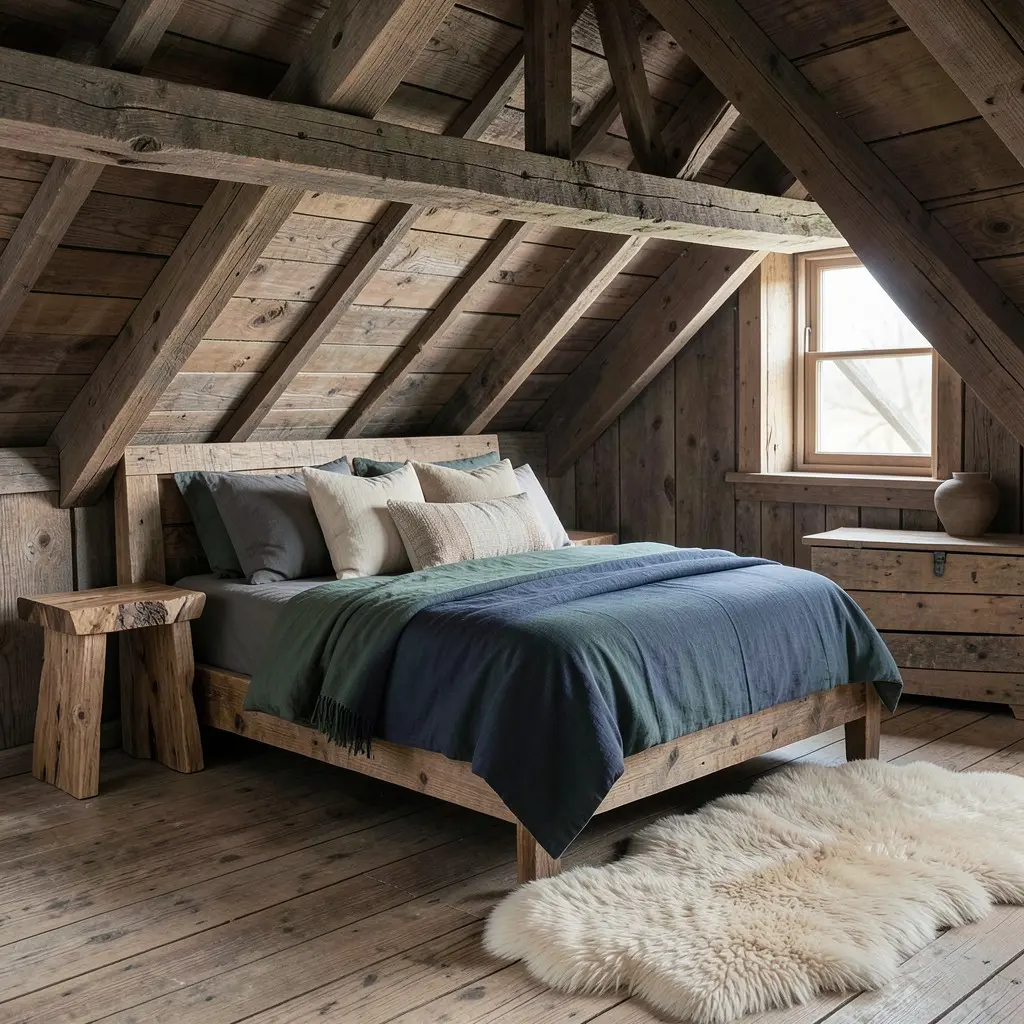
The rustic attic bedroom is the design outcome that the natural timber attic structure most directly supports — the rough-sawn rafters, the aged board sheathing, and the structural timber’s organic warmth are already the rustic material palette, revealed rather than applied, and the design’s task is to furnish and finish the room in a way that responds to those materials with the same sensibility rather than contrasting against them with polished or contemporary elements.
Natural, aged wood throughout the furnishing — a reclaimed barn wood platform bed frame, a solid oak side table with the live edge preserved, and a simple timber blanket chest at the bed’s foot in an unfinished or lightly oiled finish — creates the rustic aesthetic’s material consistency between the structure above and the furnishing below. The wood species and the finish treatments across the structural and furniture elements do not need to match precisely; they need to occupy the same material register — aged, organic, honest — so that the complete room reads as a unified material environment rather than a collection of period furniture placed under a period ceiling. Rustic home decor applied with this material intelligence creates the attic bedroom whose atmospheric warmth is immediate and genuine.
Textile warmth completes the rustic attic bedroom — heavy cotton twill in an aged navy or a deep forest green on the duvet cover, a collection of throw pillows in natural linen and wool, and a large sheepskin on the floor beside the bed create the layered textile quality that the rustic bedroom requires to balance the hardness of the structural timber and the wooden furnishing. The specific combination of the rough-hewn timber overhead, the organic wood furnishing at floor level, and the textile warmth of the bed in between creates the rustic bedroom’s complete sensory atmosphere — a room that feels simultaneously ancient and completely comfortable, as though it has been used and loved for a long time.
21. An Attic With a Bright Coastal Studio Apartment

The attic studio apartment — a fully self-contained living space with sleeping, living, cooking, and bathing functions organized within a single attic floor — is the residential design challenge that rewards the most creative planning and produces the most distinctive living environment in any house. The coastal aesthetic applied to an attic studio creates a small home of genuine character and genuine livability, and the challenge of organizing all functions within the sloped, irregular attic geometry produces the design precision that the coastal aesthetic’s clean, light palette makes the most of.
Bright home design in the attic studio apartment requires maximizing every natural light source — adding skylights in the sections where the roof structure allows, enlarging existing dormers to their maximum practical size, and painting every surface white to maximize the light’s reflection throughout the space. The attic studio without adequate natural light is a compromised living space regardless of its design quality; the attic studio with generous skylights and well-positioned dormers has the light quality that compensates for the intimate scale that the attic’s geometry imposes. Beach house interiors quality in the coastal attic studio — the whitewashed surfaces, the natural rope and rattan accessories, the pale palette with accents in the soft blues and sandy neutrals of the coastal palette — creates the atmosphere of a seaside apartment at the top of a house that may be nowhere near the coast.
The studio’s kitchen — a galley format along the kneewalled section, with appliances calibrated for single-occupancy or couple living rather than family-scale cooking — suits the coastal studio in a material that the modern kitchen ideas aesthetic applies: white shaker cabinetry, a marble-look quartz countertop, and open shelving for the everyday ceramics and glass in the accessible upper position. The studio’s sleeping area, where the sloped ceiling creates the enclosed overhead quality above the bed, suits the coastal bedroom aesthetic’s preference for pale linen and the soft textures of beach house interiors bedding.
22. An Attic With a Garden-Inspired Green Retreat

The garden attic retreat is the design direction that converts the roof’s relationship to the sky and the natural world into the room’s dominant design theme — an interior whose palette, material selection, and living plant content create the feeling of being inside a garden pavilion rather than a room beneath a roof. The connection between the attic’s proximity to the sky and the garden-inspired interiors aesthetic is conceptual as much as physical, but it produces a room of exceptional atmospheric warmth when the concept is followed through with material commitment.
Botanical wallpaper on the attic’s kneewalled sections — a large-scale leaf or floral pattern in the warm, saturated greens and botanicals of a jungle-inspired home decor print — creates the garden retreat’s primary visual environment. The kneewalled scale suits a large botanical repeat precisely — the three-to-five-foot height of the kneewalled section is ideal for showing one to two repeats of a large-scale pattern, creating the wallpaper’s designed quality in a format that a full-height application on a low-sloped attic wall would compress into illegibility. The botanical pattern’s interaction with the natural light from the skylights above — the leaves’ rendered shadows responding to the actual light changing through the day above the wallpapered section — creates the garden room quality that static, flat-lit wallpaper cannot produce.
Living plants throughout the attic garden retreat — placed at the floor level beside the skylights where the natural light concentration is highest, and on the kneewalled shelf sections where medium-light species thrive — bring the garden-inspired interiors concept into its fullest expression. The combination of the botanical wallpaper’s illustrated garden and the actual plants’ living garden creates the layered garden quality that neither element alone achieves — the flat and the dimensional, the illustrated and the living, occupying the same room and creating together the experience of a genuine garden interior.
23. An Attic With an Elegant Dressing Room
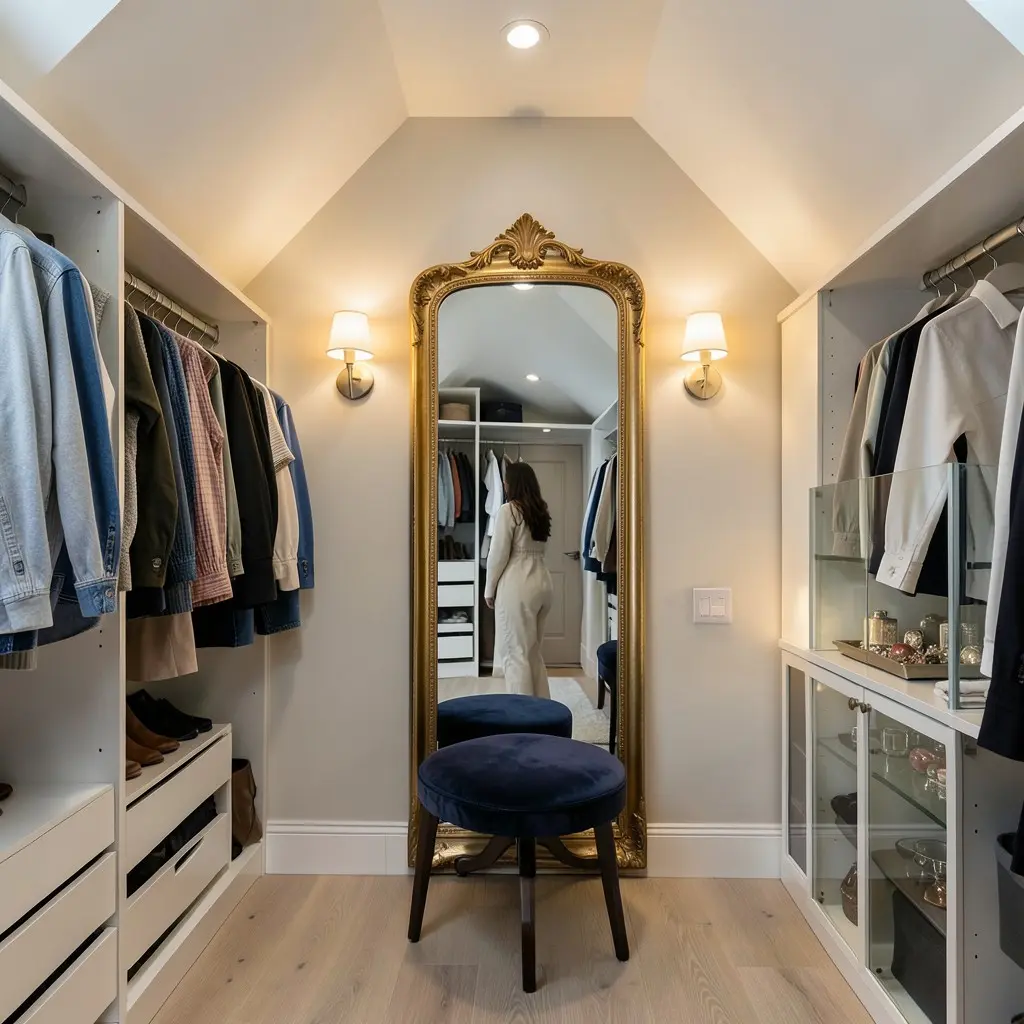
The attic dressing room is the personal luxury that the household whose wardrobe has outgrown its allocated closet space and whose schedule requires a dedicated getting-dressed environment should design without guilt. The dressing room is not an indulgence. It is the room that makes the daily ritual of dressing — which happens every single morning and evening of every adult life — a pleasant experience rather than a frustrating search through overcrowded closet rails in a bedroom whose floor is occupied by the clothes that didn’t make it back to their hangers.
Fitted wardrobe systems along the attic’s kneewalled sections — hanging rails at the maximum height the kneewalled area allows, typically four to five feet, with drawer stacks beneath — create the dressing room’s primary clothing storage in the areas where the attic’s ceiling height is least suitable for standing occupation. The full-height standing area at the center is preserved for the dressing activity itself — the floor-length mirror, the dressing chair, and the accessory display — while the lower peripheral areas work at their maximum capacity as storage. This layout uses the attic geometry’s limitations as organizational opportunities rather than working around them.
Elegant home styling in the attic dressing room — a gilded or antique-framed full-length mirror against the kneewalled backdrop, a velvet-upholstered dressing stool, and a display of accessories on a tray or in a glass-front display case — creates the dressing room’s aesthetic character at a level that suits the luxury of the dedicated space. Lighting that flatters the occupant at the dressing position — a pair of sconces flanking the full-length mirror, providing the side-lit facial illumination that overhead-only lighting distorts — is the single lighting decision that most improves the quality of the dressing room’s primary function, and getting it right is the detail that the household notices every single morning.
24. An Attic With a Scandinavian Hallway and Stair Design
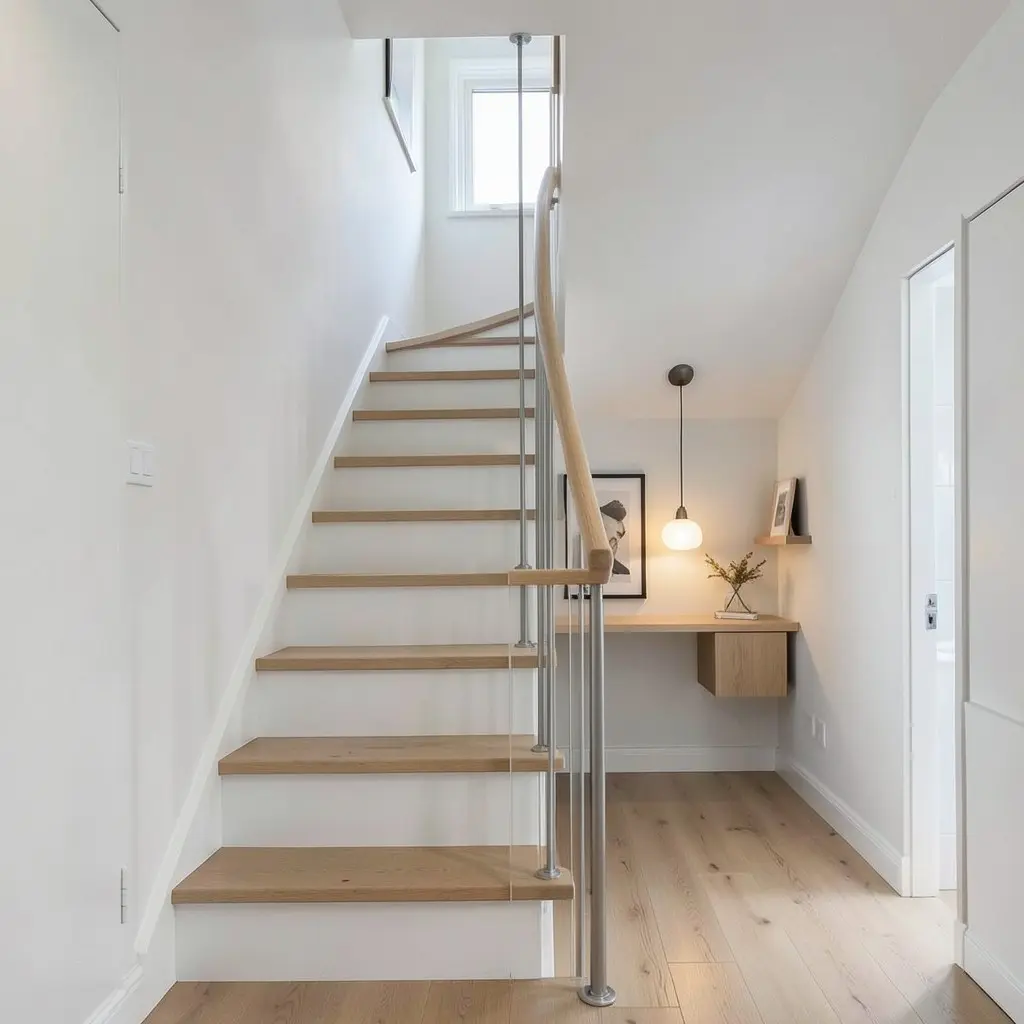
The stair that rises to the attic and the landing that receives the arriving occupant are the design elements that most finished attic conversions under-invest in — the stair is treated as access infrastructure rather than as the architectural transition between the house below and the attic above, and the landing is treated as a residual space between the stair head and the room rather than as the entry threshold that frames the attic experience. Getting both elements right elevates the quality of every ascent and every first impression the attic makes.
Scandinavian hallway design applied to the attic stair and landing creates the design continuity that makes the transition feel intentional — white-painted stair risers with natural wood treads, a simple pale oak handrail on a clean steel baluster, and a pendant light on a long drop cord that illuminates the stair’s full height from the landing above. The Scandinavian aesthetic’s preference for the functional made beautiful — no ornament for its own sake, but quality of material and precision of detail in every element the hand touches — creates the stair as the one design element in a house that is also a piece of furniture, and treating it with furniture-quality attention to detail produces a stair that the household appreciates with each daily use.
The attic landing — typically a small floor area immediately off the stair head, with access to the main attic room in one direction and perhaps a bathroom or secondary space in another — should be designed as the attic’s entry vestibule. A narrow console table or a floating shelf with a small lamp, a framed artwork on the end wall, and a floor treatment that bridges the stair’s material and the attic room’s material with a deliberate transition creates the landing as a designed threshold. The five square feet of the attic landing that receives the design attention it deserves is worth more to the attic’s overall quality than five additional square feet of an already-designed main room.
25. An Attic With an Industrial Workshop Space
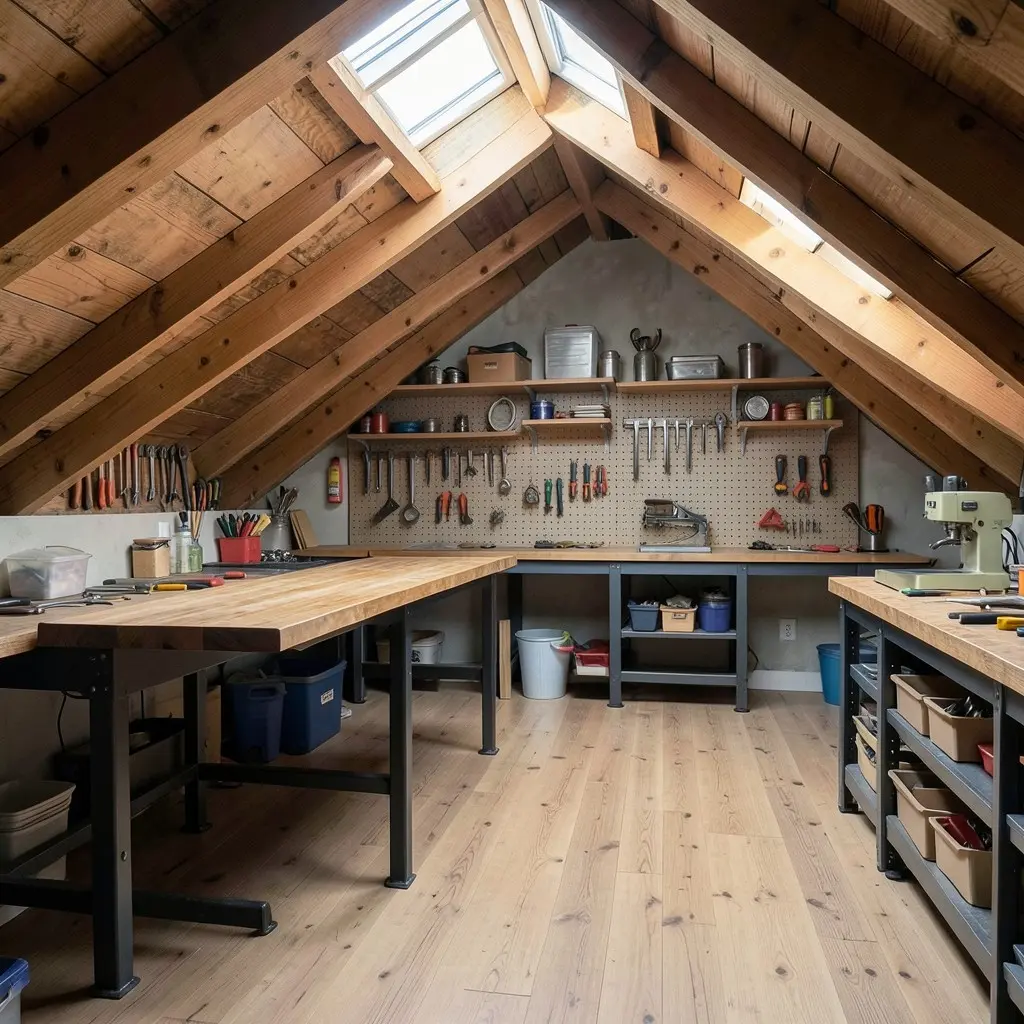
The attic workshop applies the industrial home design aesthetic to a working space whose elevation from the ground floor creates the one quality that basement and garage workshops lack: the overhead natural light that skylights provide in a working environment oriented upward rather than outward. The attic’s roof openings provide the zenith light — the highest-angle, most diffuse, most even illumination available within a building — and a workshop that operates under zenith light works in a quality of illumination that no side-window or artificial lighting configuration can fully replicate.
The workshop’s floor preparation in the attic requires addressing the structural load capacity of the attic floor joists before any heavy equipment is placed — the joists designed for residential attic storage loads may not carry the concentrated point loads of a heavy workbench, a large lathe, or a stone working surface without reinforcement. A structural engineer’s assessment of the existing floor system’s load capacity is the non-negotiable first step in the attic workshop conversion, and the reinforcement cost — if required — is the structural investment whose absence creates the safety risk that no design budget justifies accepting. The workshop’s equipment selection, placement, and layout should follow the structural assessment rather than preceding it.
Steel and wood work surfaces — a thick-cut hardwood bench top on a steel tube frame, industrial shelving on heavy-duty steel brackets along the kneewalled section, and a French cleat tool wall above the kneewalled storage — create the workshop’s working infrastructure in the material palette that suits the industrial home design direction and the practical demands of working material. The overhead zenith light from the skylights provides the shadow-free illumination that detail work and tool selection require, and the combination of abundant natural light and the industrial material quality of the workshop’s equipment creates a working environment of genuine atmospheric character — the kind that people who work with their hands find genuinely motivating.
26. An Attic With a Cozy Winter Reading and Retreat Space
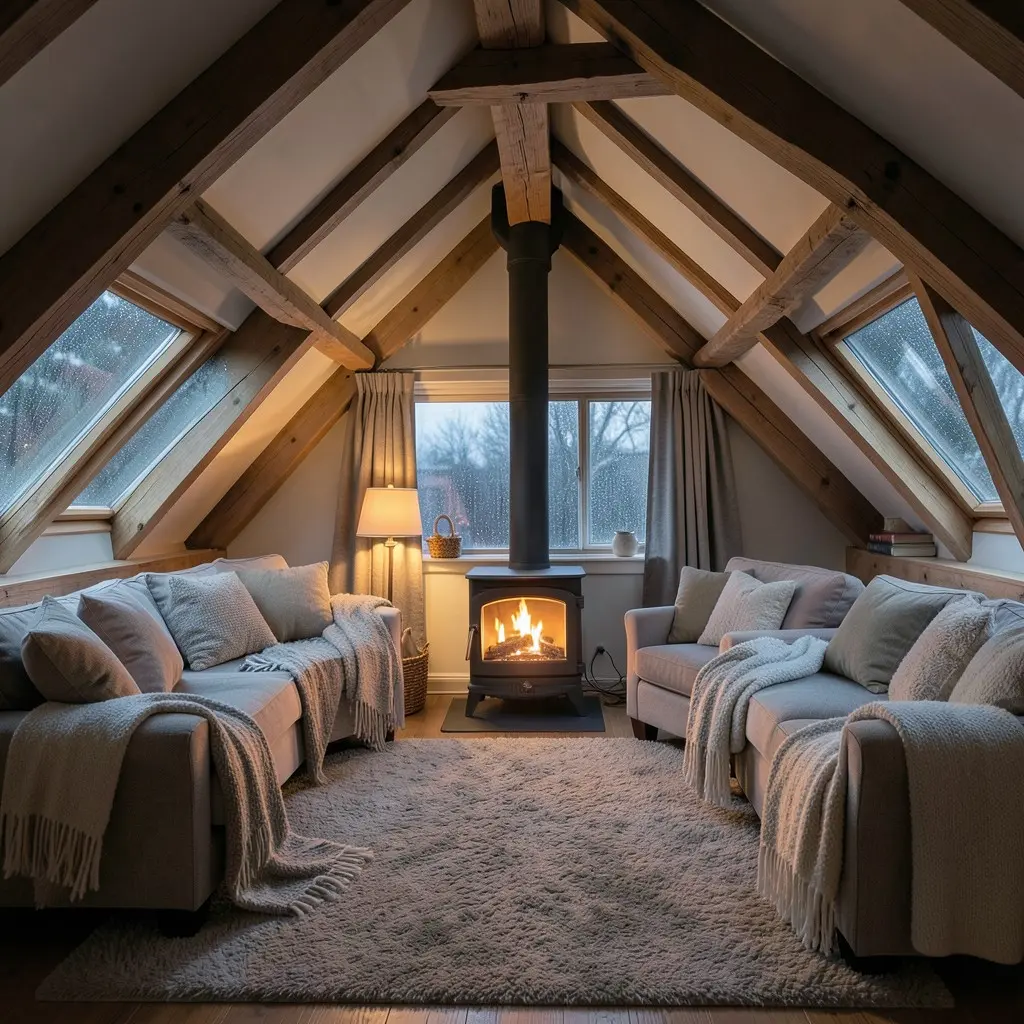
The attic winter retreat is the room that earns its keep most completely during the months when the house turns inward — when the outdoor world goes dark early and the household’s evening energy concentrates within the heated interior. No room in the house is better positioned to become the winter retreat than the attic, whose proximity to the roof creates a sound environment on rainy and snowy evenings — the rain on the slates, the wind against the ridge tiles, the creak of the timber in the cold — that is specific to the upper floor and that the rooms below cannot hear. The attic winter room is the room that gives the household its most atmospheric domestic evenings.
Winter home decor applied to the attic retreat requires the heaviest textile investment of any room in the house — the ceiling is not insulated from the outside environment at the same remove as the rooms below, and the sensory experience of warmth in a room close to the roof’s surface requires the layered textile quality that compensates for the ambient coolness of proximity to the outside. Heavy curtains across the dormer windows, a thick wool rug over the entire attic floor, generous cushioning on every seating surface, and a collection of throws and blankets in heavyweight wool and cashmere create the enveloping warmth that the winter retreat requires as its foundational design quality. Cozy home design achieved through textile layering is more effective in the attic than in any other room precisely because the textile’s thermal contribution is a genuine functional asset rather than merely a decorative one.
A wood-burning stove or a gas stove insert — where the chimney can be accommodated through the roof — creates the winter retreat’s atmospheric focal point and its primary heat source. The stove’s fire is the visual anchor of the winter evening in the attic — the light it casts, warm and unsteady, against the pale rafter ceiling creates the light quality that winter interior design has always valued as its most domestic expression. Seasonal home makeover energy applied here — the attic’s transformation from its summer version to its winter retreat configuration, with the heavy textiles replacing the lighter summer fabrics and the stove being lit for the first time of the season — marks the year’s rhythm with a physical domestic ritual that the modern household rarely performs elsewhere.
27. An Attic With a Floral and Feminine Bedroom
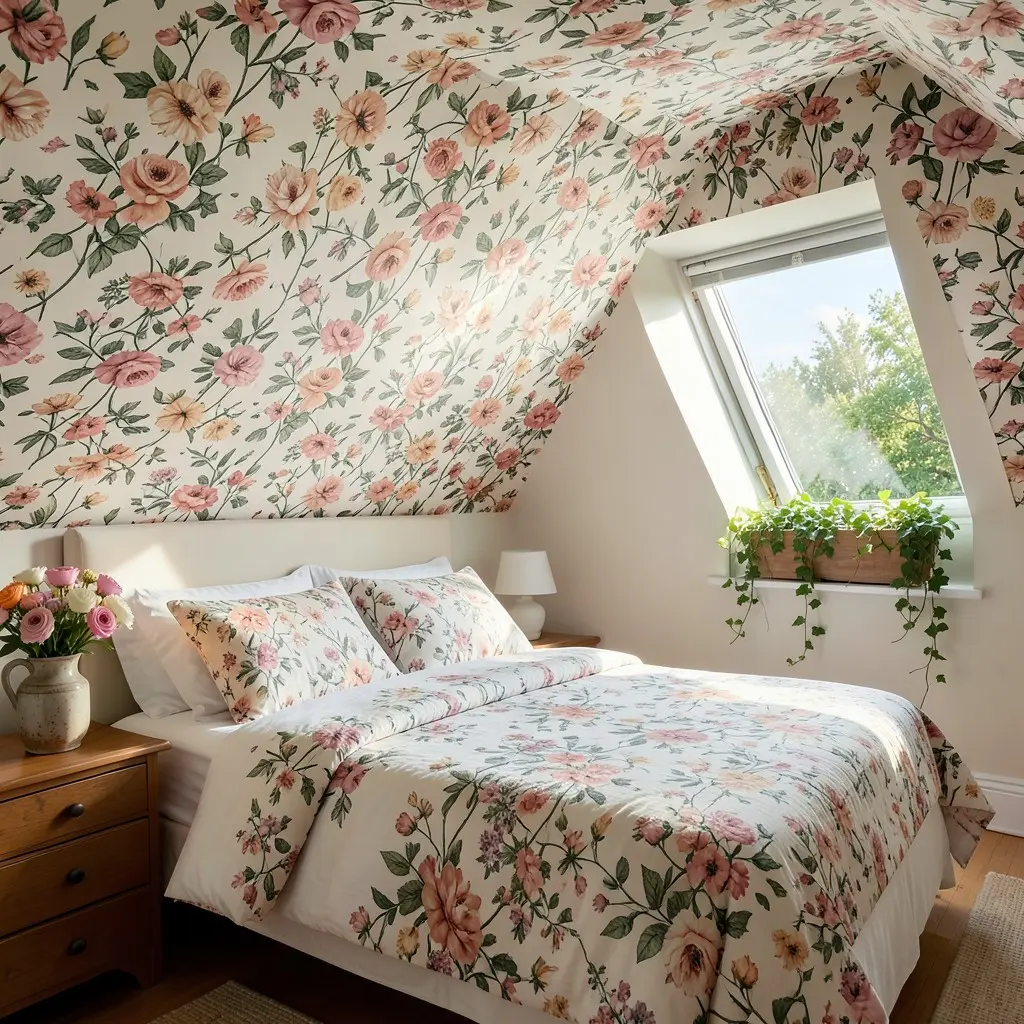
The floral attic bedroom creates the most deliberately romantic sleeping environment in the house — the sloped ceiling’s intimate overhead quality, the dormer window’s framed sky view, and the botanical richness of a full floral design applied across the attic’s surfaces create a bedroom of extraordinary feminine warmth that traditional bedroom design in standard-proportioned rooms works considerably harder to achieve. The floral design reads differently in an attic context — the ceiling’s closeness brings the pattern within touching distance above the bed, creating an immersive quality that a tall-ceilinged room’s floral wallpaper cannot approach from the distance of nine or ten feet.
Floral wallpaper on the attic ceiling — applied to the sloped ceiling face above the bed’s position, so the pattern is directly visible to the occupant lying in bed looking upward — creates the most intimate floral design application in any residential context. The scale of the floral pattern above the bed should be proportioned to the ceiling’s distance — a larger-scale botanical repeat suits a ceiling four feet above the mattress; a smaller, more detailed pattern suits a ceiling six feet above. Floral home decor ideas carried through the bed linen — a floral duvet cover or a floral quilt in a pattern that harmonizes with the ceiling wallpaper without exactly matching it — creates the layered botanical environment of a room designed for pleasure in the specific, unapologetic manner that genuinely romantic interiors commit to.
Spring bedroom decor principles applied here — the fresh cut flowers in a vintage ceramic jug on the bedside table, the botanical print on the small section of flat wall beside the dormer, and the green of a trailing ivy in a window box on the dormer’s external sill — bring the seasonal energy of the garden into the bedroom at the level of living, fragrant detail that the botanical wallpaper illustrates in flat print. The floral attic bedroom at its spring home refresh peak, with the dormer window open to the morning garden scent and the light crossing the botanical pattern on the ceiling above the white linen bed, is the specific domestic experience this room is designed to deliver every morning it is used.
28. An Attic With a Dedicated Music Listening Room
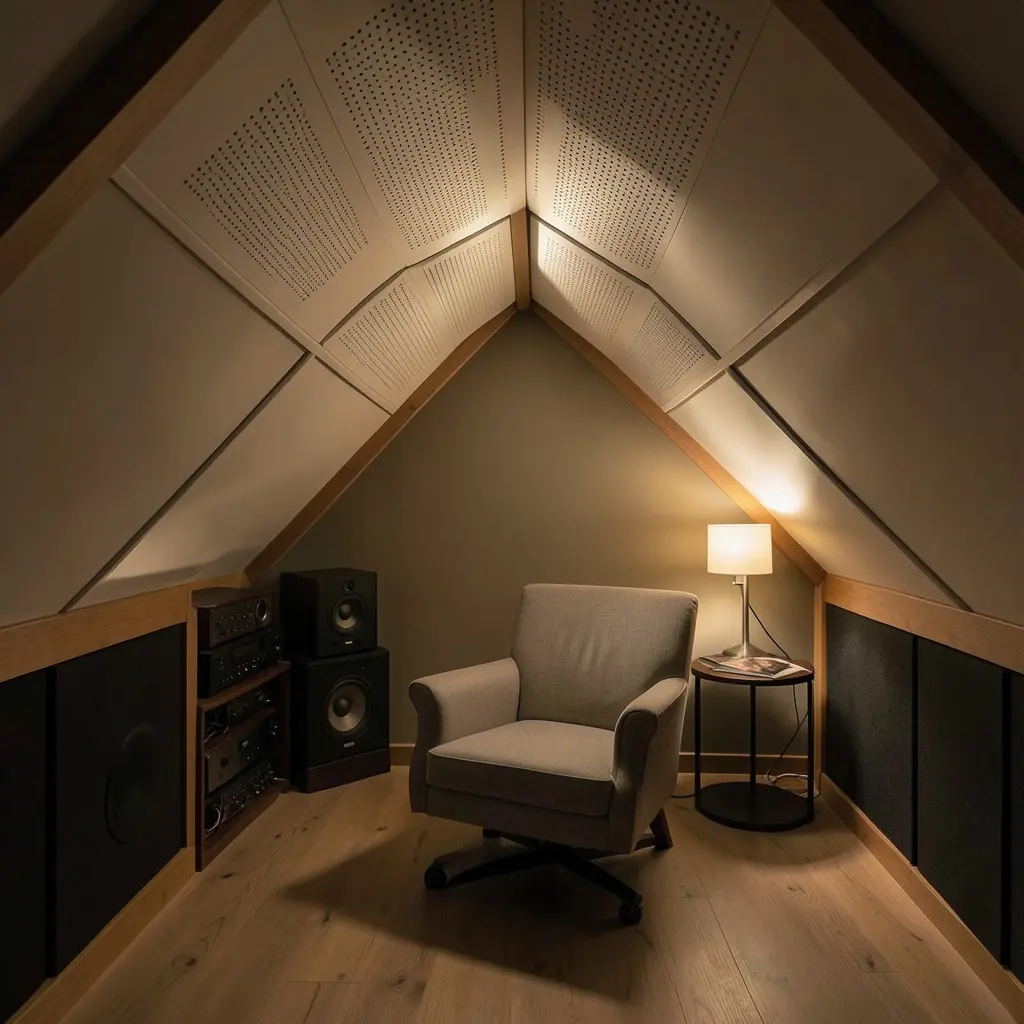
The music listening room in an attic creates the acoustic environment that serious music listeners have pursued in dedicated listening rooms for generations — the intimate enclosed space, acoustically treated for the specific reproduction of recorded sound, positioned at the top of the house where the building’s mass below provides the structural isolation that absorbs the low-frequency energy that floor-level rooms transfer into their supporting structures. The attic listening room is the audiophile’s ideal residential position, and the design should honor that function with the same rigor that the equipment within it receives.
Acoustic treatment in the attic listening room must address the sloped ceiling’s surface as the room’s primary acoustic challenge — the parallel angled surfaces of opposite roof slopes create specular reflections whose path length and angle are irregular and frequency-specific in ways that rectangular rooms are not. Diffuser panels mounted on the ceiling at the first reflection points from the listening position scatter these reflections rather than absorbing them, creating the live but controlled acoustic environment that audiophiles describe as the listening room’s ideal character. Bass trap panels in the room’s lower corners — where the roof slope meets the kneewalled sections — address the low-frequency buildup that asymmetric rooms generate at specific frequencies, and their positioning at the attic’s structural corners creates the most effective treatment possible at the locations where bass energy concentrates most severely.
The listening position — a single chair or a two-seat arrangement at the room’s equilateral triangle apex from the loudspeakers — should be positioned at approximately one-third of the room’s depth from the rear wall, away from the bass pressure zones that the rear corners create. The chair’s material — an upholstered seat of medium density that absorbs some of the ambient acoustic energy rather than reflecting it — contributes meaningfully to the room’s total absorption coefficient at mid-to-high frequencies. Peaceful home decor in its most focused application creates the listening room’s non-acoustic design character: a single excellent lamp for the session’s low-ambient illumination, a small side table for the album sleeve and the listening notes, and the absence of every visual element that competes for the attention that the music deserves entirely.
29. An Attic With an Open-Plan Living Space
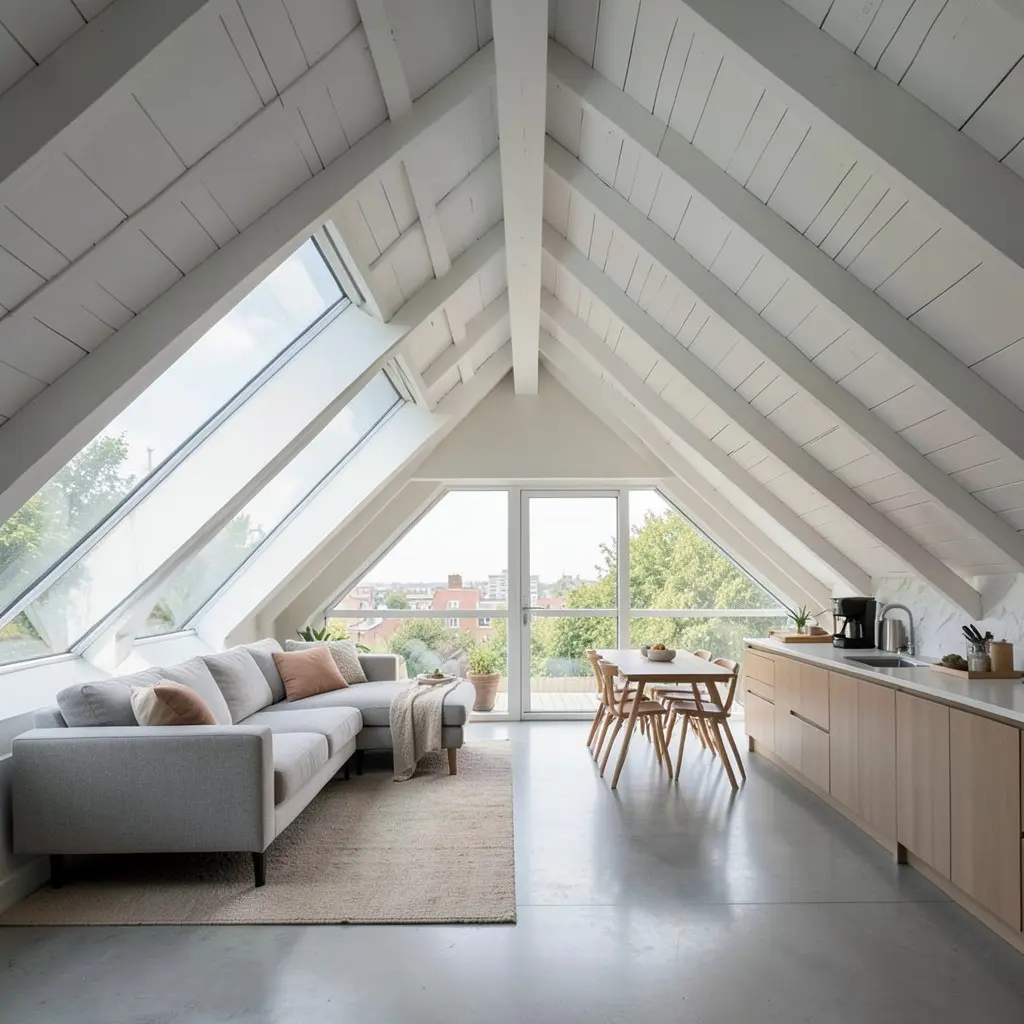
The open-plan attic conversion is the design outcome that most fundamentally changes the character of a house — the addition of a fully habitable living floor at the roof level, open in plan and connected to the outdoor sky through generous glazing, creates a floor of the house whose spatial quality differs from every room below it in the way that a penthouse floor differs from the floors beneath it in a commercial building. The open plan exploits the attic’s full footprint without partitioning it into sub-rooms, allowing the total volume — the floor area, the ridge height, and the full sweep of the sloped ceiling on both sides — to read as a single, architecturally generous space.
The open plan’s primary organizational tool in the attic is furniture rather than walls — a sofa group defines the living zone, a dining table defines the eating zone, and a desk or worktable defines the productive zone, all within the same undivided floor area whose visual boundaries are the relationships between the furniture groups rather than constructed partitions. The sloped ceiling’s profile above each zone creates a spatial differentiation that the open plan’s furniture cannot — the highest zone under the ridge reads as the grandest and most socially important, while the lower zones under the eaves read as more intimate and more private. Arranging the social and active zones under the ridge and the private and restful zones under the eaves follows the attic’s natural spatial hierarchy with a logic that no constructed partition could improve upon.
Contemporary home ideas applied to the open-plan attic — a polished concrete floor across the entire floor area, white-painted rafters overhead, a single large skylight running the ridge length, and the precision-detailed joinery of the kitchen or bar section along one kneewalled run — creates the residential loft quality in a domestic scale that the commercial loft apartment’s full-floor plate achieves at the cost of urban density. The attic loft’s intimacy — the lower ceiling at the ridge than a true commercial loft, the domestic scale of the structural elements, and the garden or rooftop views through the dormers — creates a living environment of genuine personal warmth that the commercial loft’s industrial scale cannot match.
30. An Attic With a Bamboo and Natural Material Interior
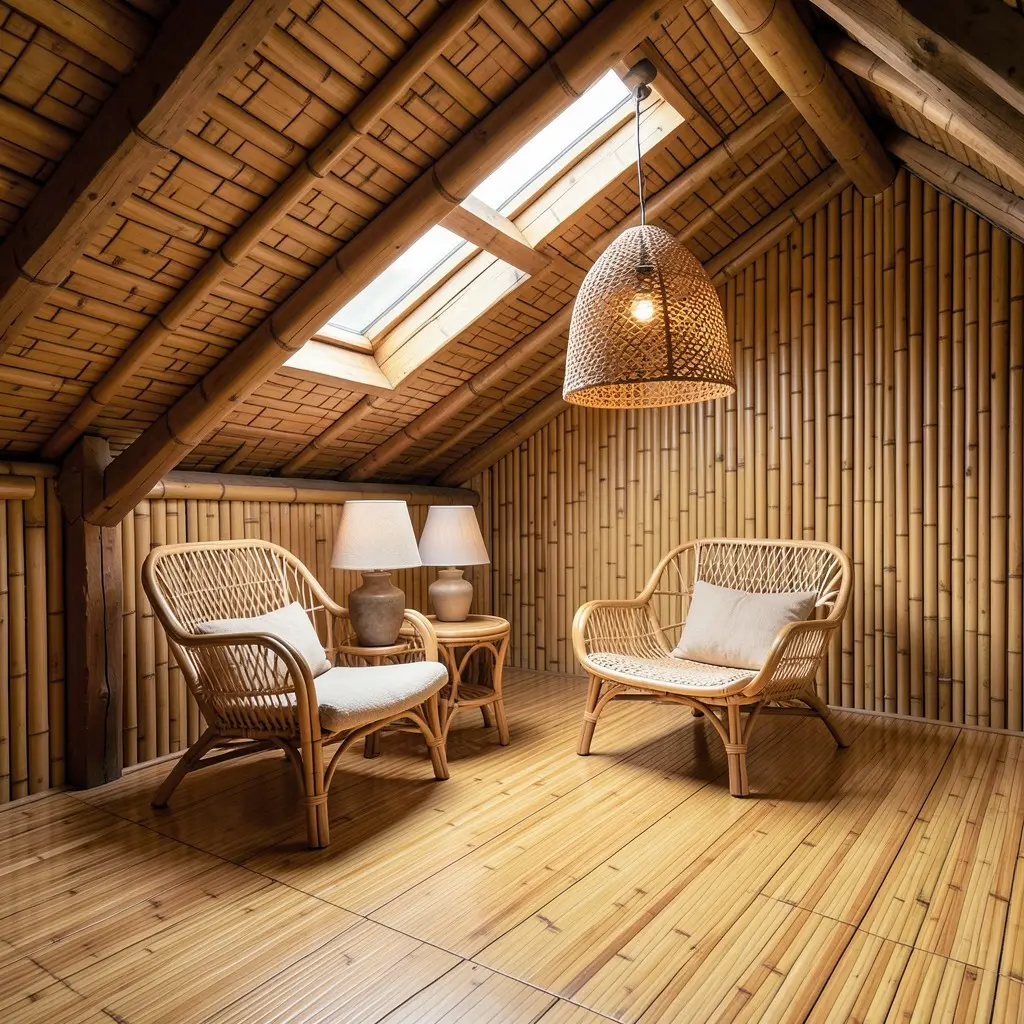
The bamboo attic interior applies the organic material philosophy of bamboo home interiors to a room whose structural timber already establishes the design’s relationship with natural material — and the extension of that relationship from structural timber to finish material, furnishing, and accessory creates the complete organic material environment that the bamboo design direction values as its highest expression. The attic that began as a timber frame becomes, with bamboo finish elements applied, a room of layered natural material depth that synthetic and manufactured material environments cannot approach from the same sensory register.
Strand-woven bamboo flooring on the attic’s structural floor — installed as a floating floor over the existing subfloor with the same moisture management precautions that any organic flooring material requires in an attic’s variable humidity environment — creates the room’s ground plane in a material of outstanding hardness and distinctive natural character. The bamboo floor’s warm golden or dark caramelized tone responds to the overhead natural light from the skylights with the surface warmth that the cool precision of stone or ceramic tile cannot replicate, and the material’s linear grain running the length of the attic floor creates the directional visual movement that makes the floor read as a continuous, generous surface. Bamboo panel cladding on the kneewalled sections — the same material in a vertical application — creates the material continuity between floor and wall that earthy home design consistently applies in its most architecturally resolved interiors.
Rattan furniture throughout the attic bamboo interior — a rattan lounge chair beside the skylight, a rattan side table with a ceramic lamp base, and a woven rattan pendant light hanging from the ridge beam — creates the organic material palette’s furnishing layer with the same natural material commitment that the floor and wall cladding establish in the structural layer. The complete bamboo and rattan attic interior, in the warm overhead light of the roof’s skylights, creates a room of consistent organic warmth whose natural material quality is felt as much as seen — the tactile quality of the rattan and bamboo, the warm light on the natural surfaces, and the absence of any synthetic or manufactured surface finish creating the complete organic environment that the design direction’s highest expression requires.
31. An Attic With a Luxury Penthouse Bedroom Suite
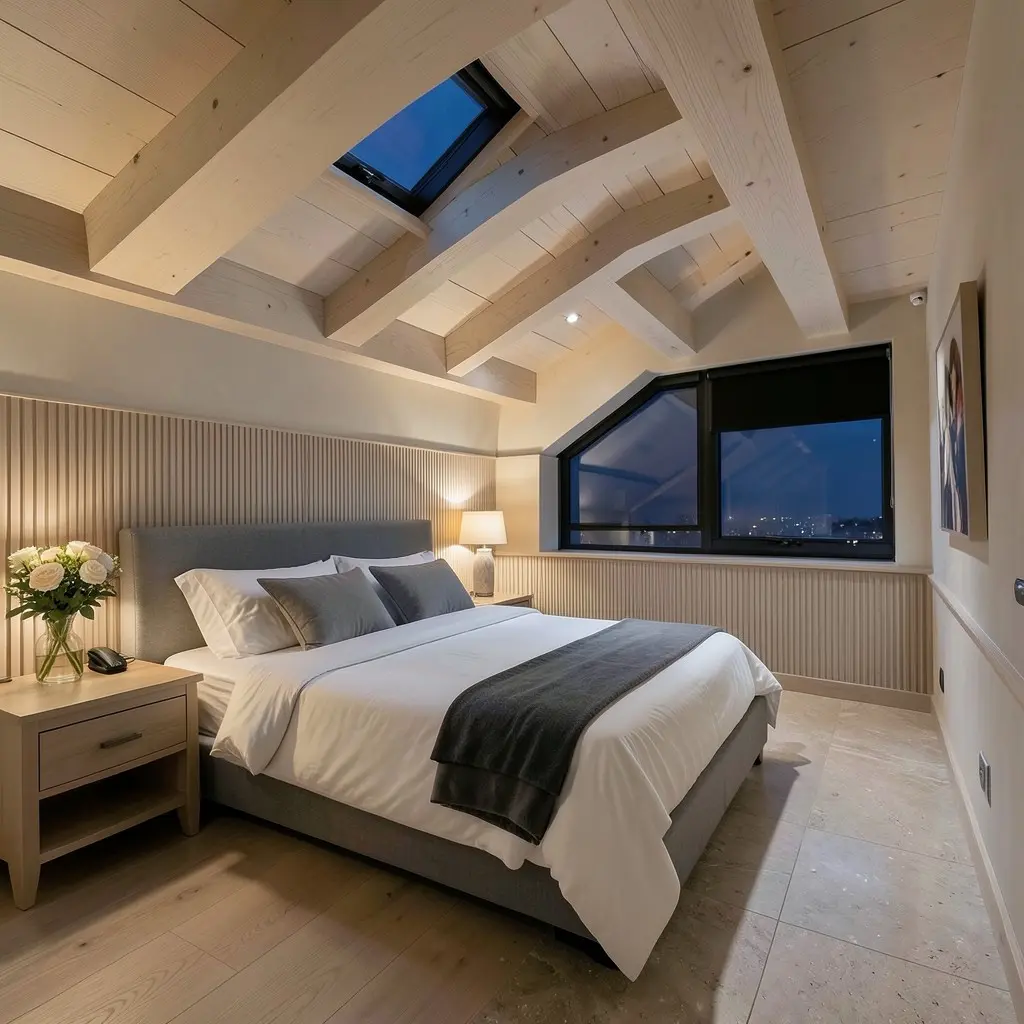
The penthouse attic bedroom is the most ambitious residential sleeping suite that a standard house can contain — a bedroom designed and finished to the standard of a boutique hotel’s best room, positioned at the building’s highest floor, with the architectural distinction of the exposed roof structure as its primary design asset. The household that commits to this outcome fully — the material quality, the lighting design, the finish precision, and the atmospheric completeness of a genuinely luxury bedroom — creates the room that defines the entire house’s design ambition.
Luxury home interior quality in the attic bedroom requires addressing every surface and every detail at the standard that the designation demands — the ceiling’s exposed rafters in a precision-sanded and oil-finished white oak, the floor in a wide-board engineered oak or a polished limestone tile, the kneewalled sections in a fluted plaster or a book-matched natural stone veneer. Each material’s selection is made for its combination of visual quality and the tactile experience it provides to the occupant who lives with it daily — the limestone floor’s cool weight underfoot on a summer morning, the white oak ceiling’s warm grain visible from the reclined position in bed, and the fluted plaster’s precise rhythm on the kneewalled sections creating the architectural detail of a room that was designed at the level of a commissioned interior rather than a residential renovation.
The lighting design in the luxury penthouse attic bedroom creates the full range of atmospheric conditions that a bedroom uses through its daily cycle — the full brightness of the grooming and dressing period in the morning, the mid-level ambient quality of the relaxed evening reading period, and the near-total darkness of the sleeping period managed through blackout blinds on the skylights and dimmers on every circuit. Elegant home styling in the bedroom’s accessory layer — the hotel-quality linen on the bed, the fresh flowers on the bedside table, the single well-chosen artwork on the flat wall section at the end of the room — creates the composed completeness of the luxury suite whose every detail communicates that the design was finished, not merely started.
32. An Attic With a Peaceful Zen Retreat

The zen attic retreat is the room that the household’s most architecturally sensitive member creates when they understand that the attic’s qualities — the closeness of the sky, the structural simplicity of the timber frame, and the quiet of the highest floor — align naturally with the zen aesthetic’s core values: simplicity, natural material, and the designed absence of visual noise. The zen retreat does not need to be decorated. It needs to be cleared, ordered, and allowed to breathe.
A single tatami area — authentic rush mat panels fitted to the attic’s floor in the central standing area — creates the zen retreat’s floor surface in a material whose agricultural origin, sensory warmth, and traditional association with Japanese spatial design communicates the aesthetic’s cultural roots while providing the functional surface for floor-level living, seated meditation, and the low-profile furniture the space uses. The tatami’s standard module — ninety by one hundred eighty centimeters — creates the spatial planning grid that traditional Japanese room design has applied for centuries, and laying out the attic floor in tatami modules creates the spatial order that the zen retreat requires at the foundation level. The natural rush’s green-to-honey color cycle, as the fresh tatami ages with light exposure and use, creates the room’s living material quality — a floor that changes color through the seasons with the same organic inevitability that the bamboo and rattan elements of the room’s furnishing exhibit.
A single ink-brush painting or a calligraphy scroll on the attic’s flat end wall — the tokonoma alcove principle applied at the attic’s architectural equivalent of the alcove position — creates the focal point for the retreat’s visual attention. Nothing else on the walls. The structural timber above, the tatami below, and the single piece of art in its designated position create the complete room. The restraint required to leave it at this is not easy, and the reward for maintaining that restraint is a room of extraordinary calm whose quality increases precisely because nothing has been added beyond what the space genuinely requires.
33. An Attic With a Bright Coastal Summer Retreat
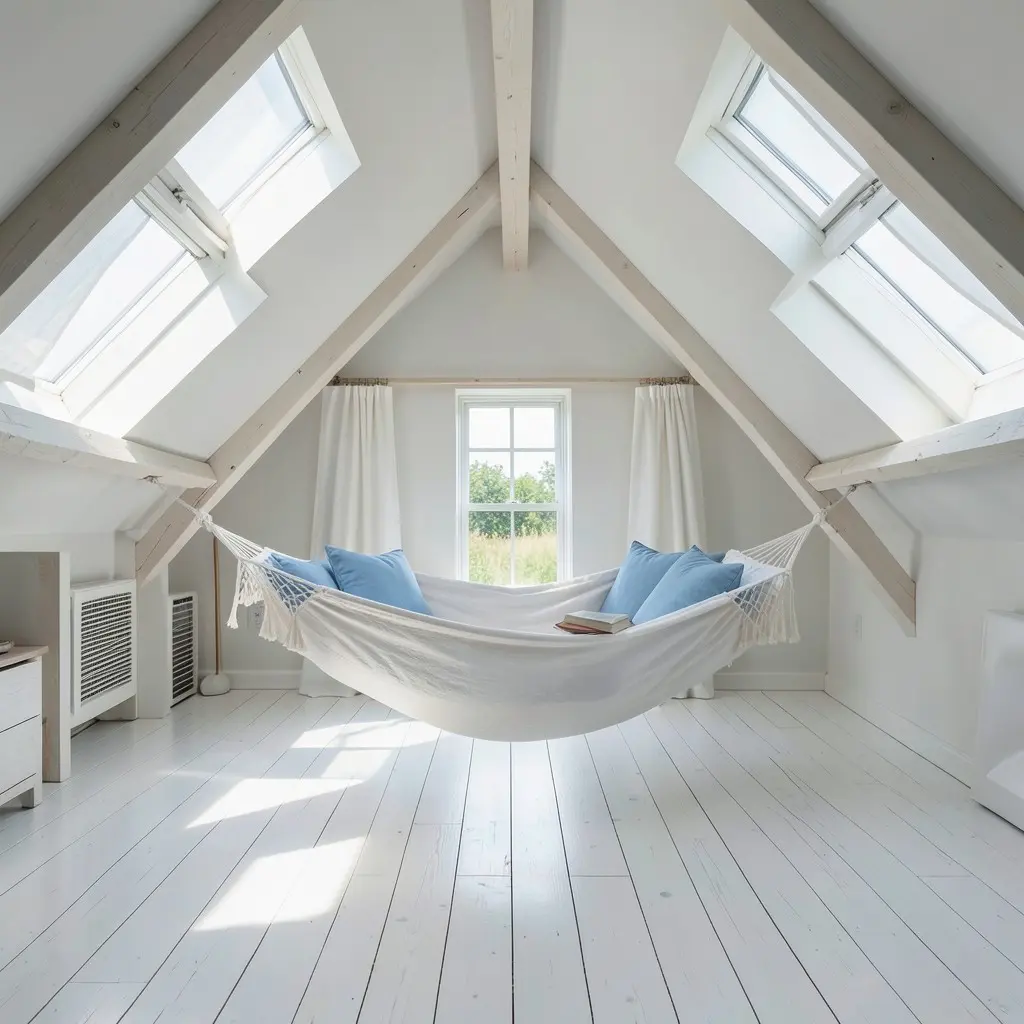
The coastal attic summer retreat is the room that performs at its absolute best during the long days of summer home design season — the skylights admitting the long morning light at angles that lower windows never achieve, the natural ventilation through the roof openings creating the cross-ventilation that the attic’s position at the building’s thermal peak makes most effective, and the pale coastal palette reflecting the abundant summer light with a quality that makes the room glow even on overcast days. The coastal summer attic is the house’s warmest and brightest room when the sun is high, and its design celebrates rather than manages that condition.
Whitewashed timber floors — the existing attic floor boards bleached or painted in a salt-white or warm grey-white that suits beach house interiors — create the coastal summer retreat’s ground plane in the bleached, sun-worn surface that the seaside aesthetic values as its material signature. The whitewashed floor amplifies the overhead light from the skylights with the maximum reflective efficiency, and the wood grain visible through the white wash creates the organic texture that prevents the pale surface from reading as blank. Breezy home interiors quality created by white linen curtains on the dormers that move in the attic’s natural ventilation, the pale floor reflecting the overhead light, and the sea-blue or sky-blue accents in the cushions and ceramics creates the summer living room decor atmosphere at the top of the house.
A hammock strung between two rafter posts at the attic’s central standing height — the casual, horizontal leisure furniture of the coastal outdoor living space brought indoors — creates the summer retreat’s signature comfort element. The hammock in an attic is not a decorating trick. It is the most direct physical expression of what the summer coastal attic is for: the slow afternoon, the book balanced on the chest, the light moving across the pale ceiling above, and the faint sound of the outdoor summer world below coming up through the floorboards. That is the room this design is building toward, and every material choice serves that specific afternoon.
34. An Attic With a Moody Dark-Painted Interior
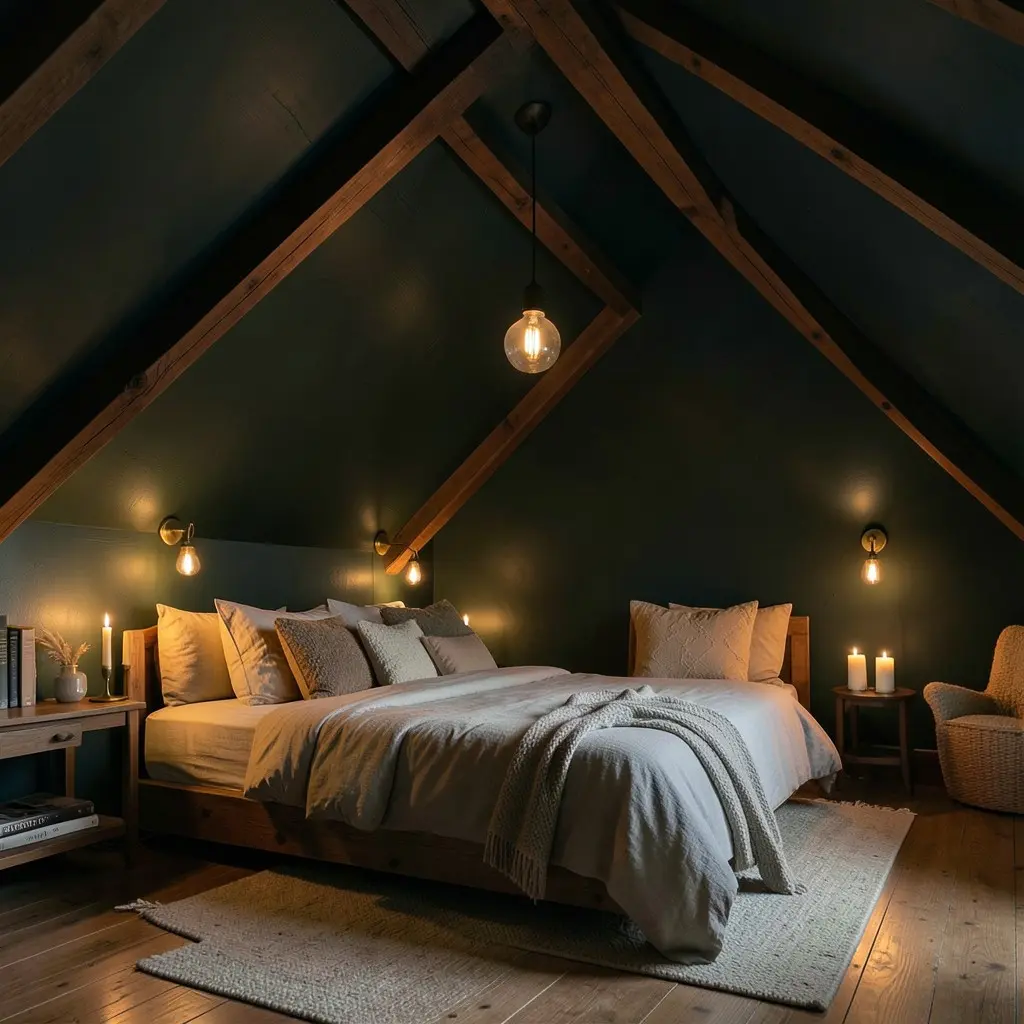
The dark-painted attic is the design idea that requires the most conviction to execute and produces the most dramatic result — painting the attic’s pale, reflective surfaces in a deep, saturated color creates an interior whose atmospheric quality is entirely different from the pale, light-amplifying approach that most attic conversions adopt. The dark attic is not fighting the space’s limited light. It is embracing the intimate, enclosed quality that limited light creates, and designing toward a room whose atmosphere is defined by depth and warmth rather than by brightness and openness.
A near-black forest green or a deep charcoal blue applied across the rafters, the kneewalls, and the ceiling sheathing creates the uniform dark envelope that the moody attic requires. The dark color applied uniformly — including to the structural timber elements that pale attics typically feature in natural wood — eliminates the material differentiation that the structure’s exposed character creates, and the result is a room whose envelope reads as a single dark surface of irregular texture rather than a collection of structural components of different materials. This is the counterintuitive insight of the dark attic: painting the exposed structure dark unifies it more completely than painting it white, because the dark surface’s shadow absorption prevents the structure’s three-dimensional relief from reading as pattern.
Warm amber lighting throughout the dark attic — Edison-style pendants hanging from the ridge beam, small brass wall sconces on the kneewalled section, and candle clusters on the low surface beside the bed — creates the golden warmth that makes the dark envelope glow rather than oppress. The combination of the dark surfaces and the warm amber light creates the light-in-darkness quality that candlelit interiors have always possessed, and the attic’s intimate scale amplifies this quality to a degree that larger, higher-ceilinged rooms cannot achieve with the same lighting intensity. Fall home decorating season is when this attic reaches its atmospheric peak — the dark interior, the amber light, and the sounds of wind against the roof creating the most atmospheric domestic room in the house.
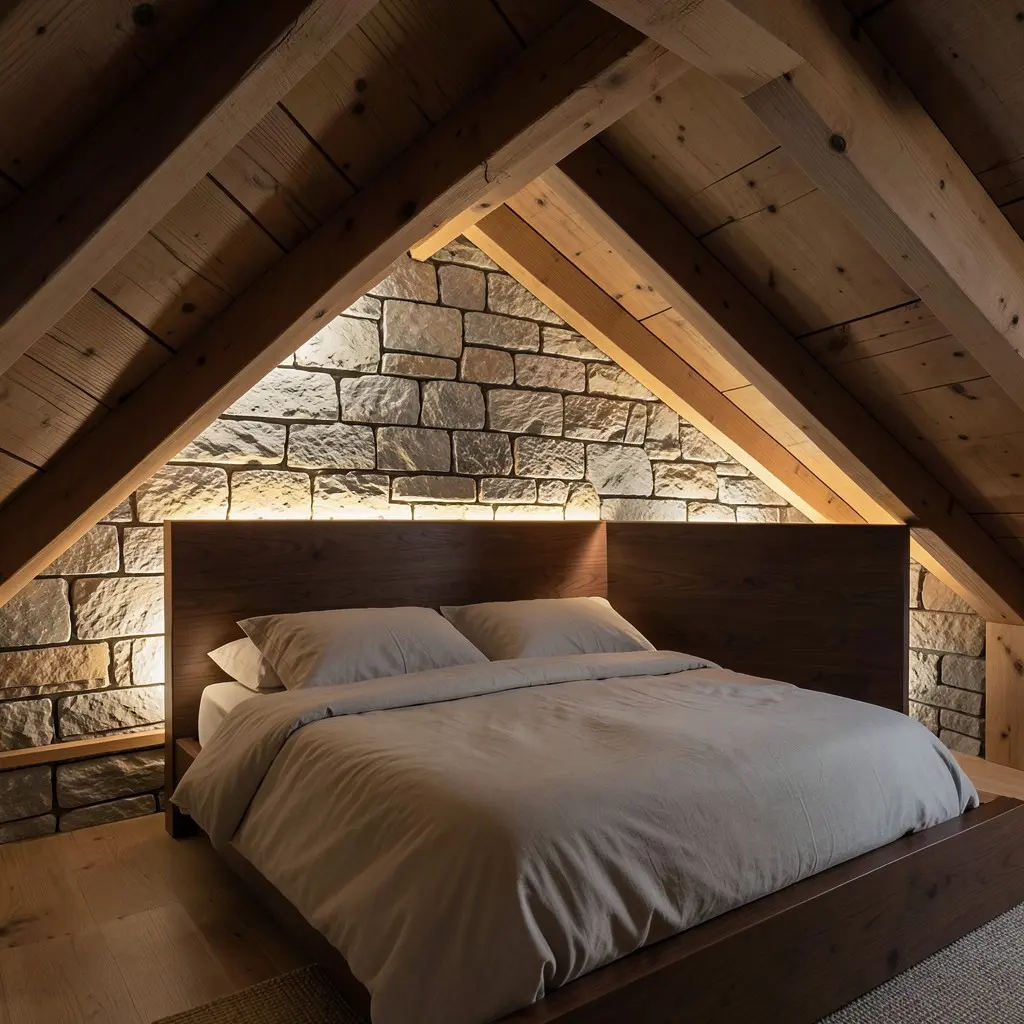
35. An Attic With a Stone Feature Wall Bedroom
The stone feature wall in an attic bedroom creates the material contrast that the space’s organic timber structure sets up most compellingly — the warm, directional grain of the structural wood above and around the stone creates a frame for the stone’s mineral weight and textural density, and the contrast between the timber’s organic warmth and the stone’s cool mass creates the material dialogue that stone and wood home design values as its fundamental compositional principle. The attic is the room where stone and wood meet most naturally, because both materials belong to the building’s fundamental structural vocabulary.
Rough-cut limestone cladding panels on the attic’s flat end wall — the gable end where the roof’s full height is available and the structural wall runs vertically rather than sloping — creates the feature wall at the bedroom’s primary sightline. The cladding panels’ irregular surface and the natural color variation of the limestone create a visual texture of organic complexity that no painted or wallpapered surface approaches, and the stone’s thermal mass — absorbing the attic’s warmth through the day and releasing it slowly through the night — contributes to the bedroom’s thermal comfort in a way that no lightweight surface material does. Warm-wash lighting from below — LED uplights at the stone wall’s base directed at the surface — creates the dramatic three-dimensional texture expression that makes the stone feature wall visible as architecture at night when the daylight that reveals it naturally is absent.
The bed positioned against the stone feature wall or angled toward it as the primary sightline creates the bedroom’s spatial hierarchy — the stone wall is the visual anchor from which the room’s entire layout radiates. A solid wood headboard in a dark-stained walnut against the stone wall creates the material layering that stone and wood home design applies as its characteristic detail: the stone’s mineral quality behind the wood’s organic warmth, the two materials in direct contact creating the composed material joint that suits the attic’s structural honesty.
36. An Attic With a Garden Studio and Potting Area
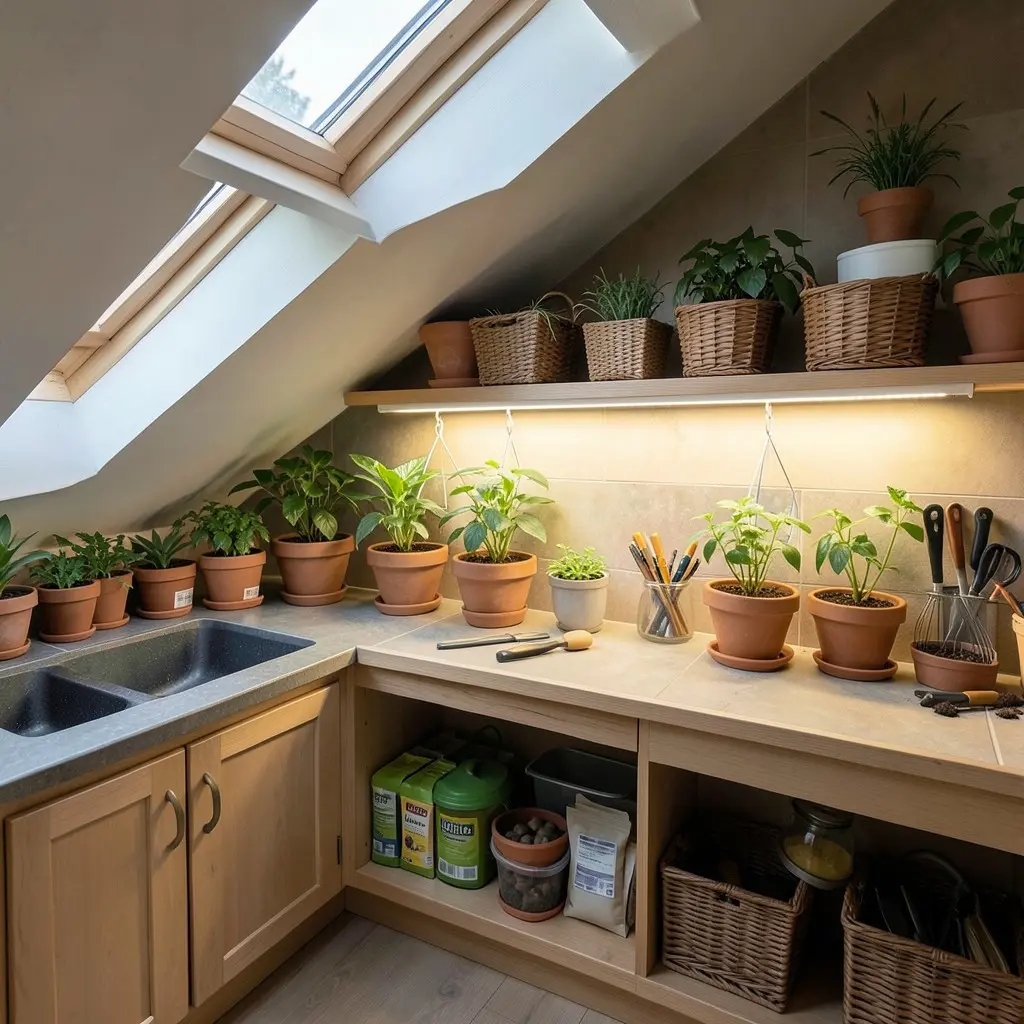
The garden studio attic is the design idea that creates a working connection between the house’s highest interior room and the garden below — a studio space dedicated to garden-related creative work, plant care, and the seasonal cultivation activities that the garden-inspired interiors aesthetic values as the living material expression of its design philosophy. The attic garden studio is not a greenhouse; it is a working room whose relationship to the garden is expressed through its material quality, its plant content, and the tools and activities it houses.
A long potting bench along the kneewalled section — a water-resistant surface in a sealed hardwood or a stone tile top, with a shallow sink at one end and organized storage for the tools, the potting media, and the seed packets below — creates the garden studio’s primary working surface. The bench’s position at kneewalled height suits the garden work’s specific ergonomic requirements — the slightly lower surface than a standard kitchen counter allows the leverage that potting and soil working require without the back fatigue that an overly high surface creates. Above the potting bench, open shelving holds the seasonal garden supplies in labeled terracotta pots and woven baskets — the storage containers whose material quality matches the garden aesthetic’s preference for natural, organic material.
Grow lights above the bench’s plant propagation area — full-spectrum LED panels on adjustable hangers that can be raised as seedlings develop — create the controlled growing environment for the seed starting, propagation, and overwintering plant care that the garden studio performs through the winter home decor season when the outdoor garden is dormant. The attic’s natural light from the skylight above supplements the grow lighting during the day, and the combination of natural overhead light and supplemental grow light creates a growing environment whose quality approaches that of a cold frame or a lean-to greenhouse at a fraction of their construction cost.
37. An Attic With a Traditional Gentleman’s Study
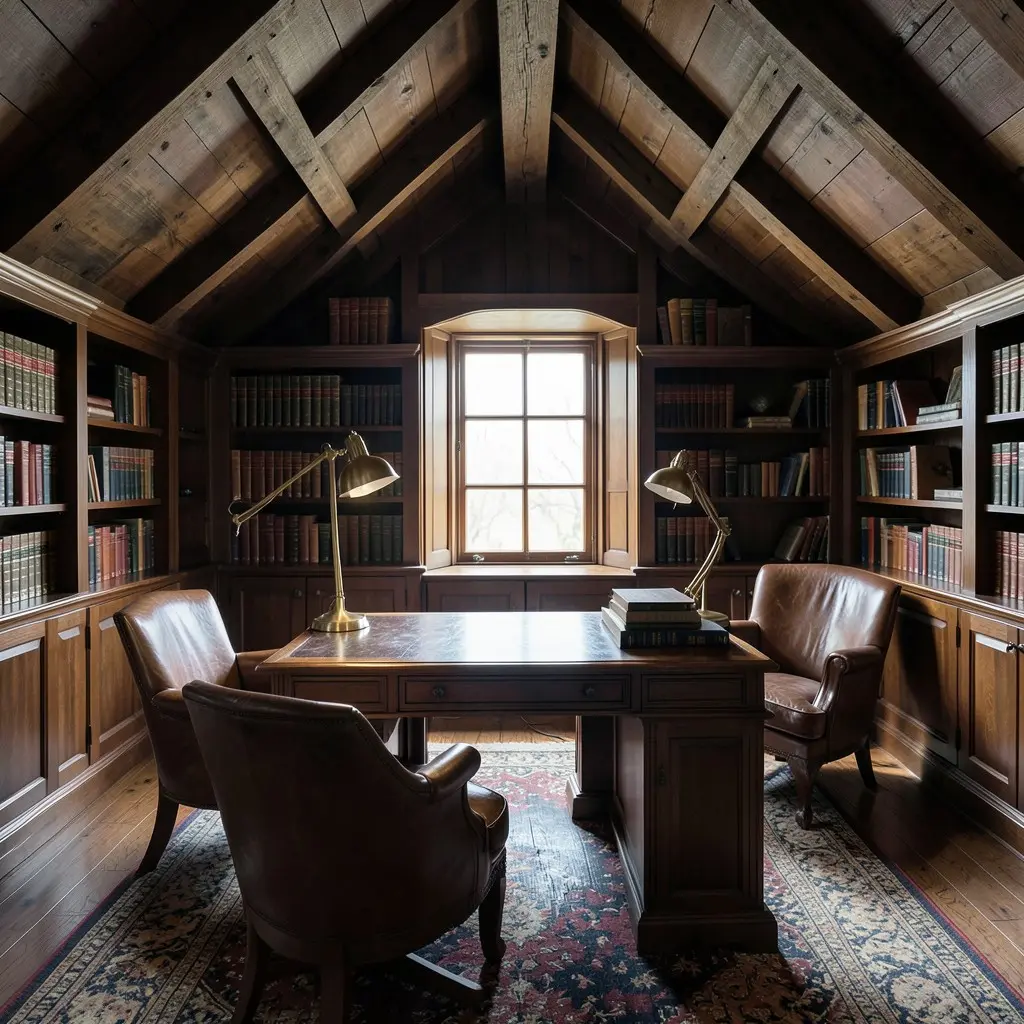
The traditional gentleman’s study in an attic applies the design vocabulary of the private study — the leather-bound books, the dark wood furniture, the brass desk lamp, and the leather armchair — to the top floor’s intimate scale with the specific atmospheric quality that the attic’s enclosed, above-everything position provides. The traditional study has always been the room of retreat and concentrated thought, and the attic position enhances both qualities: the retreat from the household below and the silence that concentrated thought requires.
Dark-stained wood paneling on the kneewalled sections — in a deep walnut or aged mahogany that creates the library quality of traditional home interiors — creates the study’s primary wall surface and the context for the built-in shelving that houses the reference library, the document storage, and the personal collections that a working study accumulates over a lifetime. The paneling’s warmth and depth suit the attic’s structural timber overhead with the natural material consistency of a room whose every surface has aged well — the same time that darkens the paneling also darkens the rafters, and the two materials’ shared age creates the study’s atmosphere of settled, unhurried permanence.
A partner’s desk in a solid hardwood — its leather top surface worn to the glossy dark patina of long daily use — occupies the attic’s standing height central area with the physical presence and visual authority that a working desk requires as the study’s defining furniture piece. A brass adjustable desk lamp at one corner, a globe on a brass stand at the other, and a collection of reference books stacked at one end create the desk’s working surface arrangement with the personal specificity that a designed workspace accumulates through genuine occupation rather than styling. The leather armchair at the dormer window — the secondary reading position where the desk’s formal posture gives way to the chair’s reclined ease — completes the study’s functional program.
38. An Attic With a Vibrant Maximalist Bedroom
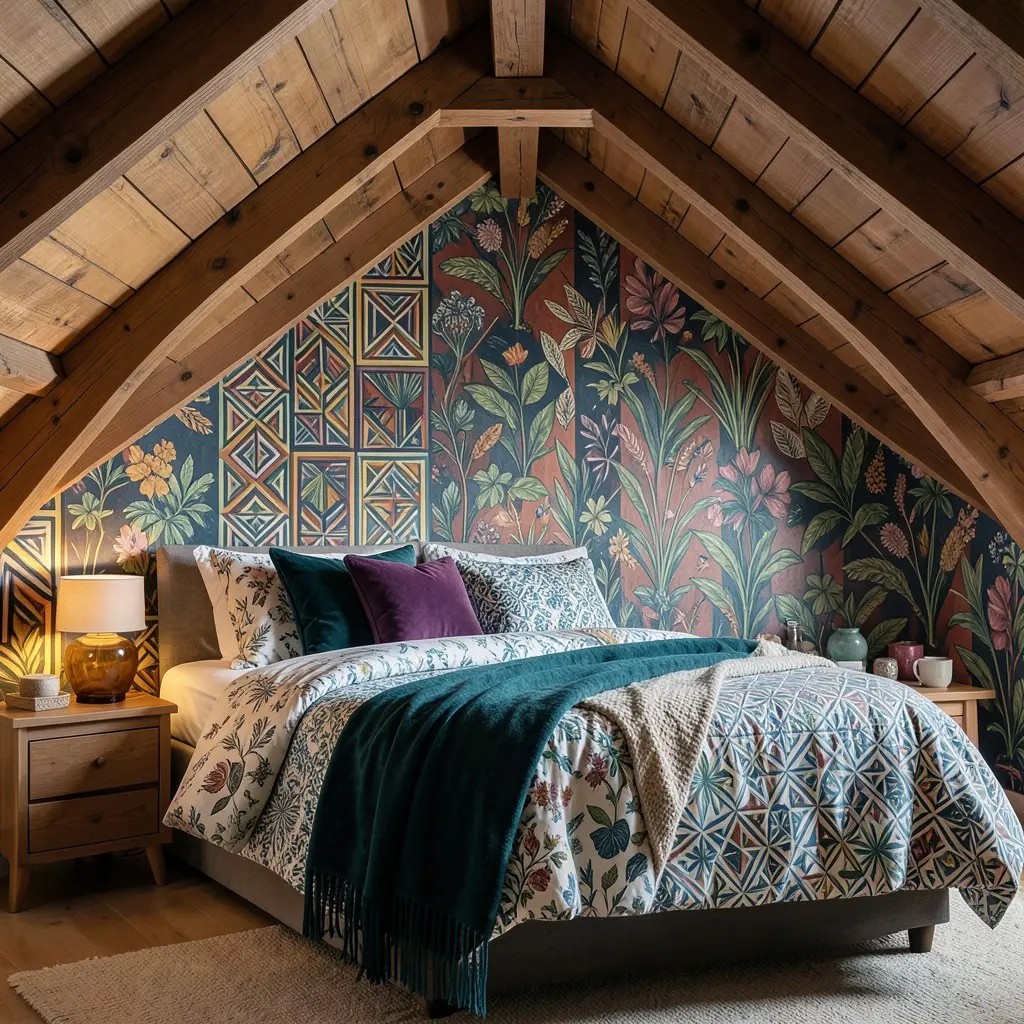
The maximalist attic bedroom is the design permission that the attic’s architectural character grants more readily than any other room in the house — because the exposed structure already provides significant visual complexity, adding pattern, color, and texture to the surfaces and furnishing creates a layered richness rather than the overwhelming density that maximalism creates in a plain-walled room. The structure is the maximalist backdrop. The design fills it.
Bold pattern wallpaper on the kneewalled section — a large-scale geometric, a dense botanical, or a dramatic painterly print in a palette of three to four colors — creates the maximalist bedroom’s primary pattern layer against the structural timber above. The kneewalled section’s three-to-five-foot height suits the bold pattern at a scale that creates impact without the visual compression that covering a full-height wall would create with the same pattern. A contrasting pattern in the bed linen — a different geometric or a loose organic print in colors that respond to the wallpaper’s palette rather than repeating it exactly — creates the maximalist layering that skilled pattern mixing achieves through color harmony rather than pattern matching.
Jewel-toned accessories throughout — a deep teal velvet throw, an amethyst cushion, an amber ceramic lamp base on the bedside table, and a collection of small objects in a mix of materials arranged on the kneewalled shelf — create the color richness that maximalist home design builds through accumulation. The maximalist bedroom is the room where more is genuinely more, and the attic’s structural frame above provides the organizing principle — the exposed rafter grid — that prevents the maximalist layering below from dissolving into chaos.
39. An Attic With a Scandinavian Bedroom for All Seasons
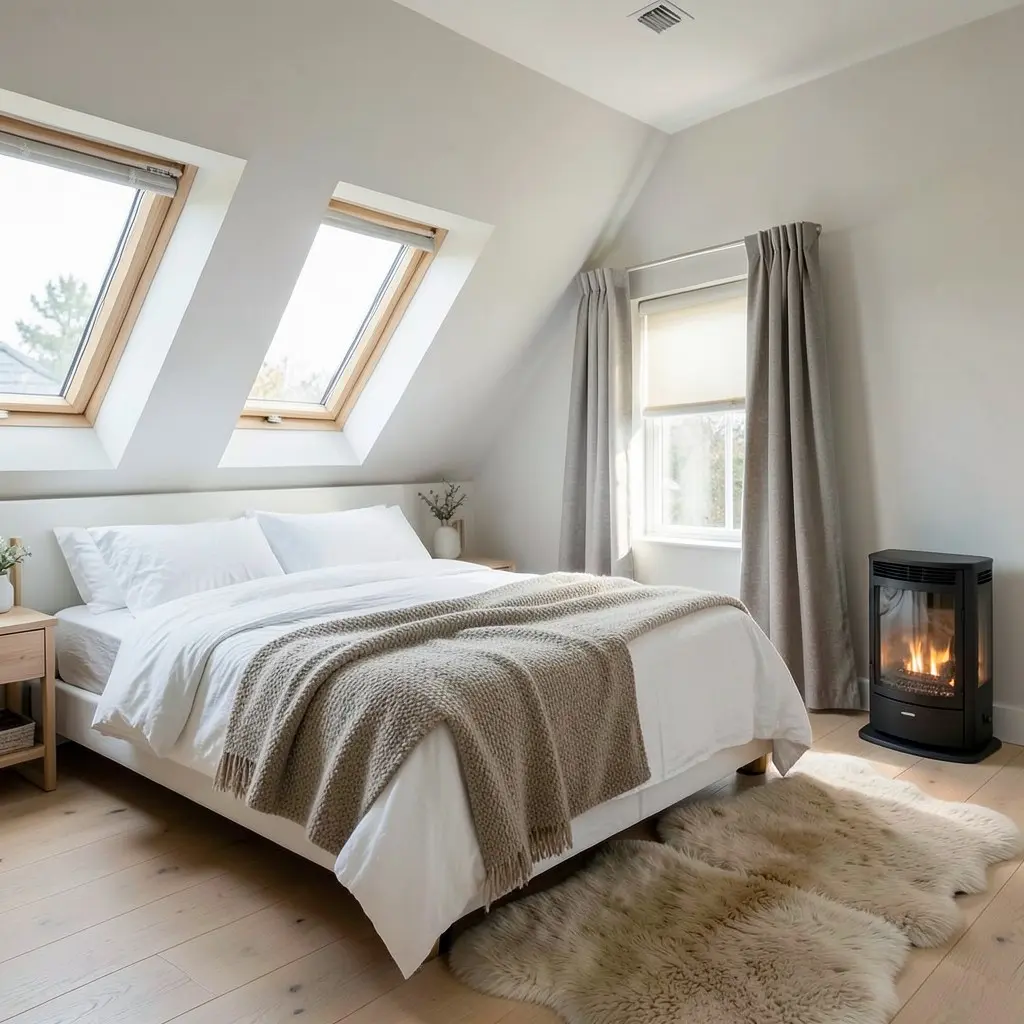
The Scandinavian attic bedroom that changes its character through the seasonal calendar — lighter and more open in summer home design configuration, warmer and more enveloped in winter home decor mode — is the seasonal home makeover applied most thoughtfully to the room where the seasonal change in temperature and light is most directly felt. The attic’s proximity to the outdoor temperature makes it the first room in the house to feel the change of season, and designing for that responsiveness rather than against it creates a bedroom that is always appropriate to its moment.
Summer configuration of the Scandinavian attic bedroom removes the heavy textiles and replaces them with white linen and cotton — the bed in a single sheet-weight duvet and white linen pillowcases, the dormer windows open to the summer breeze, and the floor rug absent to reveal the pale wood floor’s full surface. The pale, minimal attic summer bedroom is one of the most restorative sleeping environments available in a domestic house — the cool morning light through the skylights, the summer birdsong through the open dormers, and the white linen’s clean sensory quality creating the summer bedroom ideal that spring bedroom decor traditions have always described. This is the room at its most airy home interiors quality, and the restraint of the design is what allows the season itself to provide the atmosphere.
Winter configuration brings the heavy natural wool blankets back to the bed, the sheepskin rug to the floor beside it, the thick curtains to the dormers, and the small electric oil heater to the corner — the attic becoming the wrapped, enclosed room whose warmth is earned against the cold above the ceiling slates. The transition between these configurations — the seasonal home makeover that takes an afternoon and costs nothing beyond the storage of the off-season textiles — keeps the bedroom’s relationship with the seasonal world alive and active rather than managed and controlled.
40. An Attic With a Farmhouse-Style Children’s Bedroom
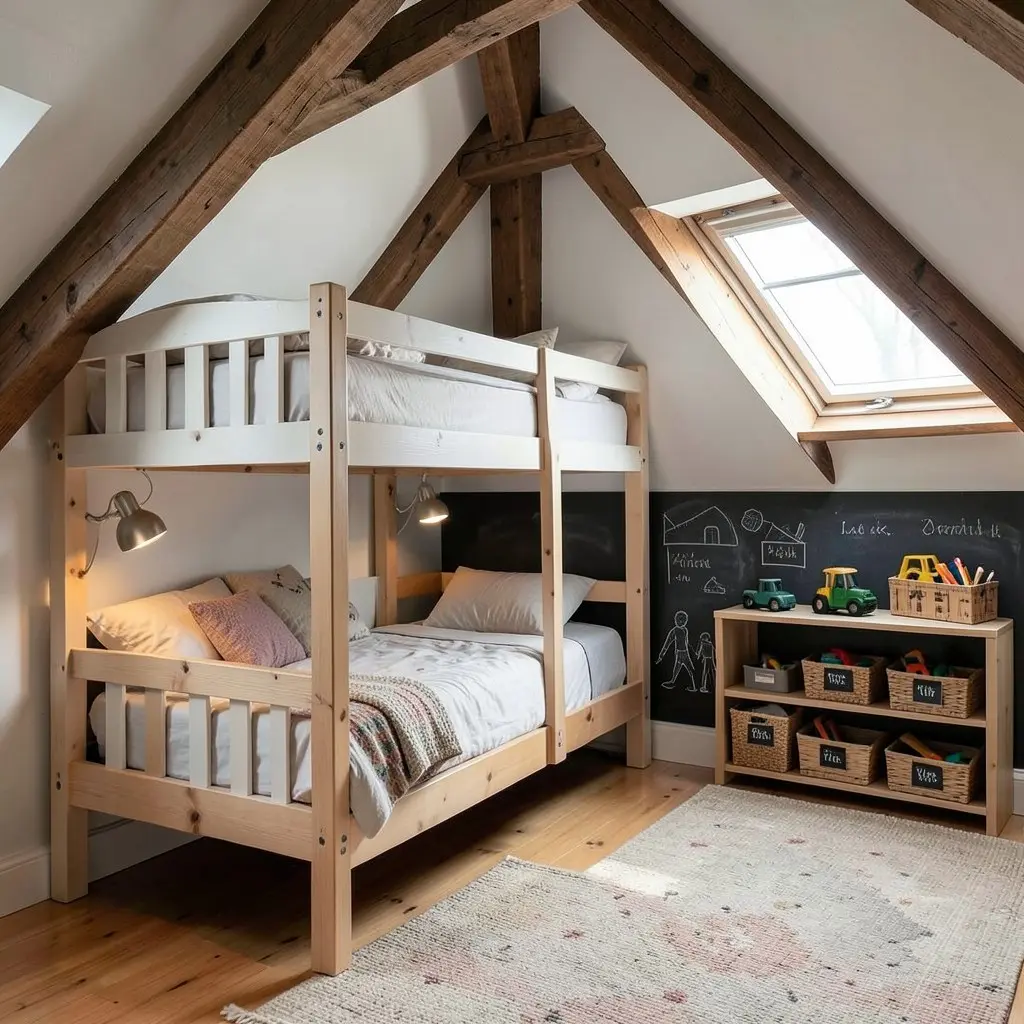
The farmhouse attic children’s room applies the warm, honest material quality of farmhouse home decor to the sleeping space whose architecture — the sloped ceiling, the dormer window, the exposed timber — creates the storybook-quality bedroom that children’s imaginations inhabit with the same enthusiasm that the bohemian kids room decor direction celebrates in its own way. The farmhouse attic children’s room is the bedroom that children remember into adulthood as the room they grew up in and the room they miss.
A bunk bed built into the attic’s kneewalled section — a custom-made timber bunk whose frame is designed specifically for the slope and the height of the attic’s lower section, with the lower bunk at floor level and the upper bunk at the point where the rafter slope allows head clearance in the seated position — creates the sleeping arrangement that suits a shared children’s room in a format whose custom fit makes it feel purpose-built rather than placed. The bunk’s timber construction in a white-painted or natural oak finish suits the farmhouse aesthetic’s honest material preference, and the individual reading lights mounted at each bunk’s headboard position create the functional detail that children use independently from the day they are installed.
A play and activity area at the attic’s central standing height — where the ceiling allows the full-body movement of active play — creates the room’s daytime function alongside its nighttime sleeping purpose. Farmhouse home decor applied to the play area’s storage — wooden toy bins on a natural wood shelf, labeled in a hand-lettered style on small chalkboard tags, and a chalkboard-painted section of the kneewalled surface for drawing — creates the warm, domestic organization that suits both the farmhouse aesthetic and the genuine use requirements of a working children’s bedroom.
41. An Attic With a Cozy Reading Loft Above a Bedroom
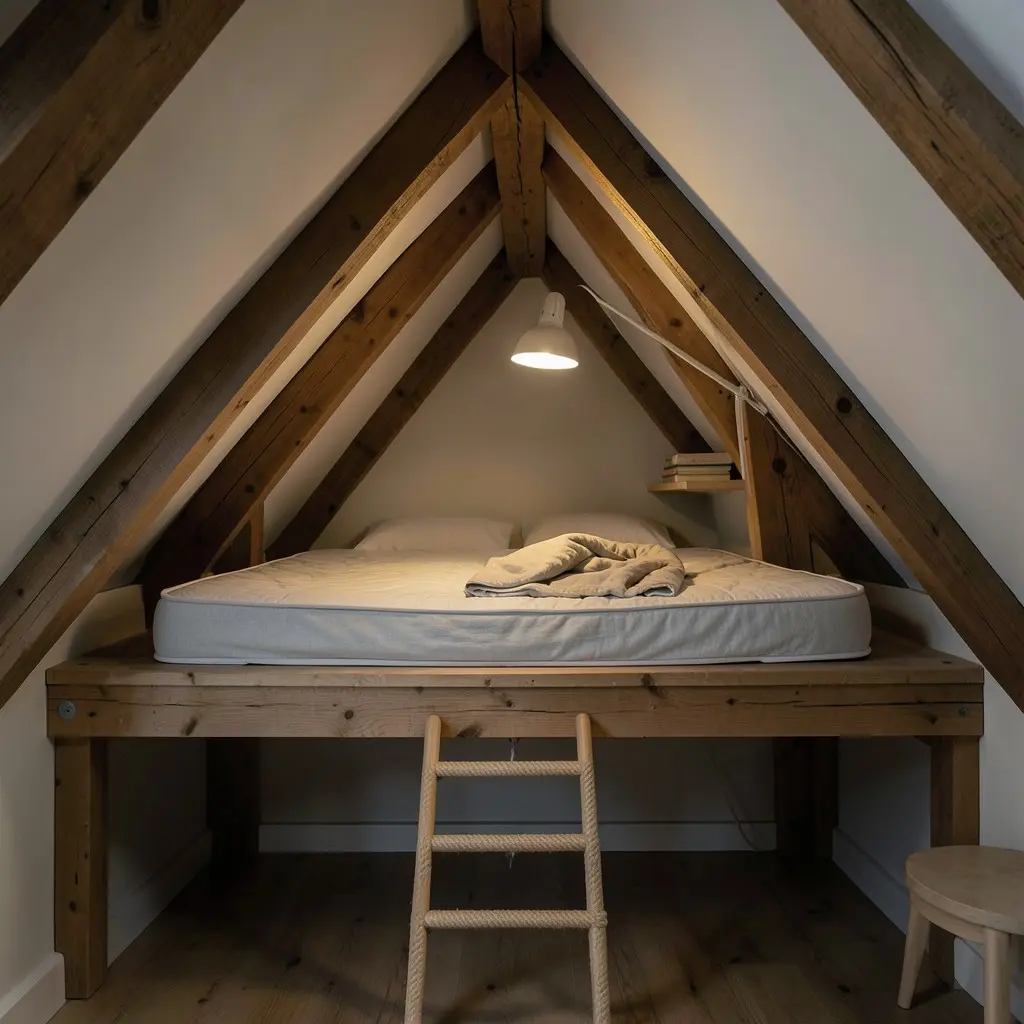
A reading loft built within an attic space — a raised platform with its own even more intimate ceiling created by the ridge above it, positioned at the attic’s highest point and accessed by a short ladder from the bedroom floor below — creates the most private and most architecturally distinctive reading position in any house. The loft within the loft principle, applied to the attic’s upper geometry, creates a space whose intimacy and physical separateness from the room below make every reading session feel like a genuine retreat rather than a relocation within the same room.
The reading loft platform — typically six to eight feet in width and depth, with a sleeping or reading surface at the height where the ridge provides maximum clearance above the lying position — requires structural support from the attic’s existing timber frame. The platform’s joists bear on the existing rafters or on blocking installed between the rafters, and the load-bearing capacity of the existing frame determines the platform’s maximum size and finish weight. A simple rope or timber ladder provides the access to the loft, its informal quality communicating the cozy, childhood-retreat character of the space rather than the architectural seriousness of a fixed stair.
The reading loft’s contents are determined entirely by the minimum requirements of sustained comfortable reading: a mattress or a thick futon on the platform floor, a single reading lamp on a flexible arm mounted to the ridge beam above, a small shelf built into the rafter space beside the platform for the current reading stack, and nothing else. The loft’s intimate ceiling — the ridge beam directly above, the rafters descending on both sides to the platform’s edge — creates the enclosed, cave-like quality that the best reading environments share and that no purpose-designed room at standard ceiling height can fully replicate.
42. An Attic With a Tropical Rooftop Feel
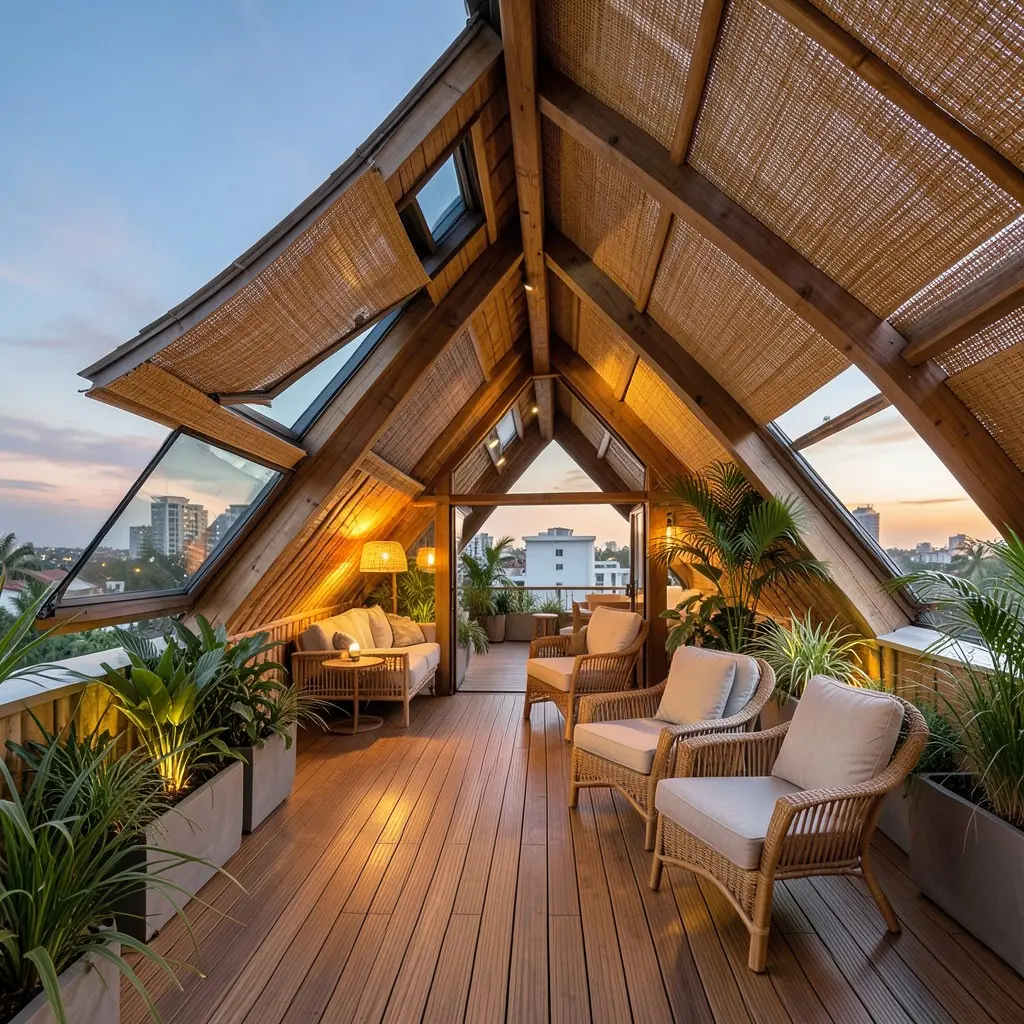
The tropical rooftop attic takes the tropical home design direction and applies it specifically to the attic’s unique relationship with the sky — the skylights, the roof windows, and the possible addition of a rooftop terrace accessed from the attic’s end creates the indoor-outdoor tropical experience at the building’s peak. This is the attic that makes the household feel, in the morning light and the evening warmth, that they are living above the city in a tropical pavilion rather than in the upper floor of a domestic house.
Large roof windows — specifically the opening format that allows the window to be pushed out and up, creating a partial balcony-like aperture at the attic floor level — create the outdoor connection that the tropical attic requires. Where the building’s structure and planning permissions allow, a rooftop terrace accessed through a roof window or a dedicated hatch at the attic’s ridge level creates the actual outdoor rooftop space that the tropical outdoor living experience requires for its fullest expression. The terrace’s material — composite decking boards in a tropical-wood look, planters of tropical grasses and palms at the parapet edges, and a pair of rattan outdoor chairs with weather-resistant cushions — creates the rooftop tropical living space that the attic’s top-of-building position makes uniquely possible.
Inside the tropical attic, the design direction’s material vocabulary — bamboo home interiors elements, natural rattan furniture, tropical planting in large floor planters, and warm amber lighting filtered through woven rattan shades — creates the indoor tropical environment that connects to the outdoor terrace above through material continuity and the shared warm, light-rich atmosphere. The tropical attic at the summer solstice — the long evening light coming through the roof windows onto the bamboo floor, the breeze from the open skylights moving through the rattan shades, and the city spread below the terrace parapet — is one of the most specifically pleasurable domestic experiences that residential design can create.
43. An Attic With a Dedicated Dance and Movement Studio
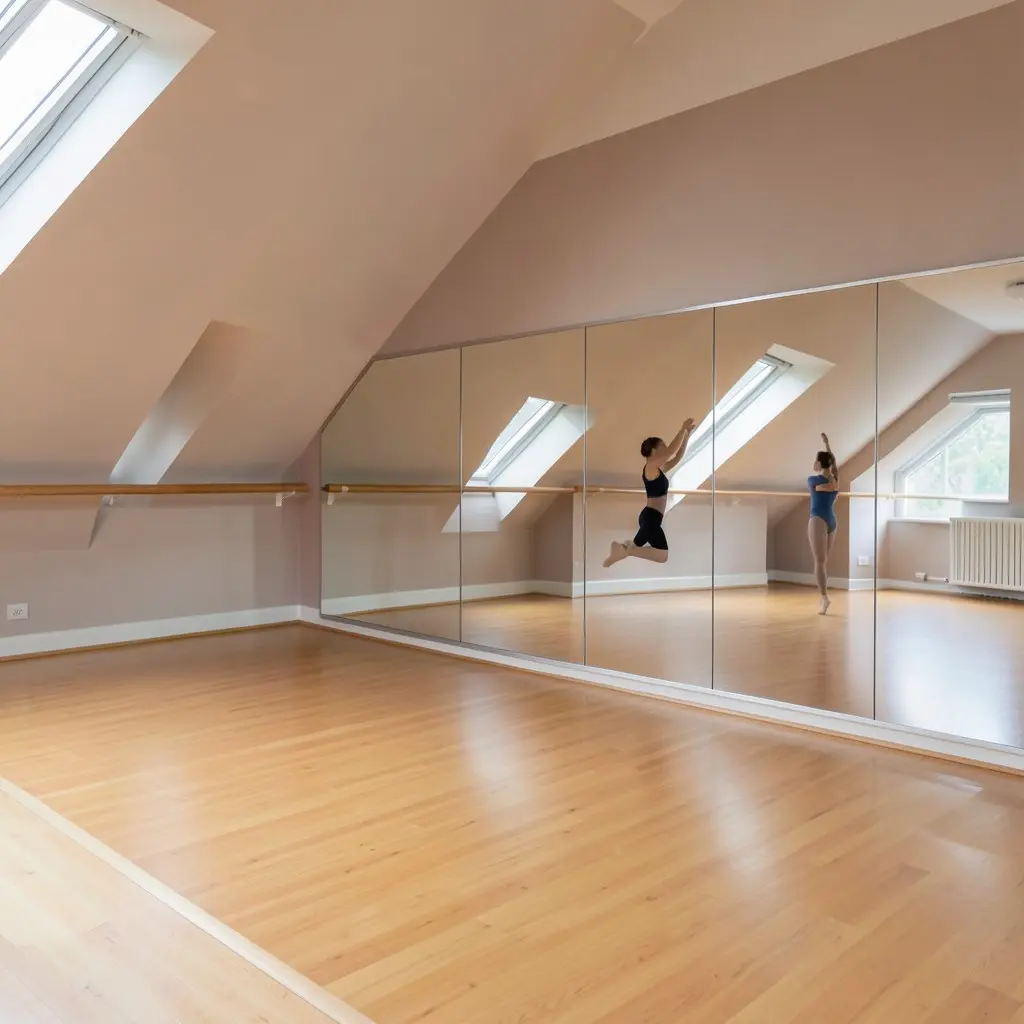
The attic dance studio is the converted space that gives the serious dance or movement practitioner the one thing that no other room in the house provides: a proper floor. The floor is the dance studio’s most important and most specific infrastructure requirement, and getting it right is the difference between a room where you can dance and a room where you can train.
A sprung dance floor — engineered panels whose resilient substrate absorbs and returns the impact energy of jumping, turning, and landing movements — protects both the dancer’s joints and the building’s structural floor from the repeated impact loads that dance training generates. The sprung floor’s top surface should be a smooth hardwood or a vinyl dance surface in a medium-toned finish that reads clearly in the mirror wall’s reflection and provides the friction coefficient that specific dance disciplines require. Ballet and contemporary dance require a non-slip but smooth wood surface; ballroom and Latin dance require the slightly lower-friction surface that hardwood or dance vinyl provides; hip-hop and breaking prefer the smooth, slightly slippery surface of vinyl over a sprung substrate. The surface specification should match the primary discipline practiced rather than applying a generic dance floor solution.
A full wall mirror on the studio’s primary practice wall — the wall facing the dancer’s primary working direction — provides the form-check feedback that independent technical training requires. The mirror should be floor-to-ceiling and wall-to-wall on its designated surface, installed in the largest possible panels to minimize the visual disruption of joints, and positioned so the dancer’s full body is visible from a five-meter working distance at any point on the attic’s dance floor area. A barre at the correct working height — typically thirty-five to forty-two inches depending on the dancer’s height — mounted along the mirror wall creates the classical training infrastructure that the studio shares with every professional dance school.
44. An Attic With a Vintage Parisian Apartment Aesthetic
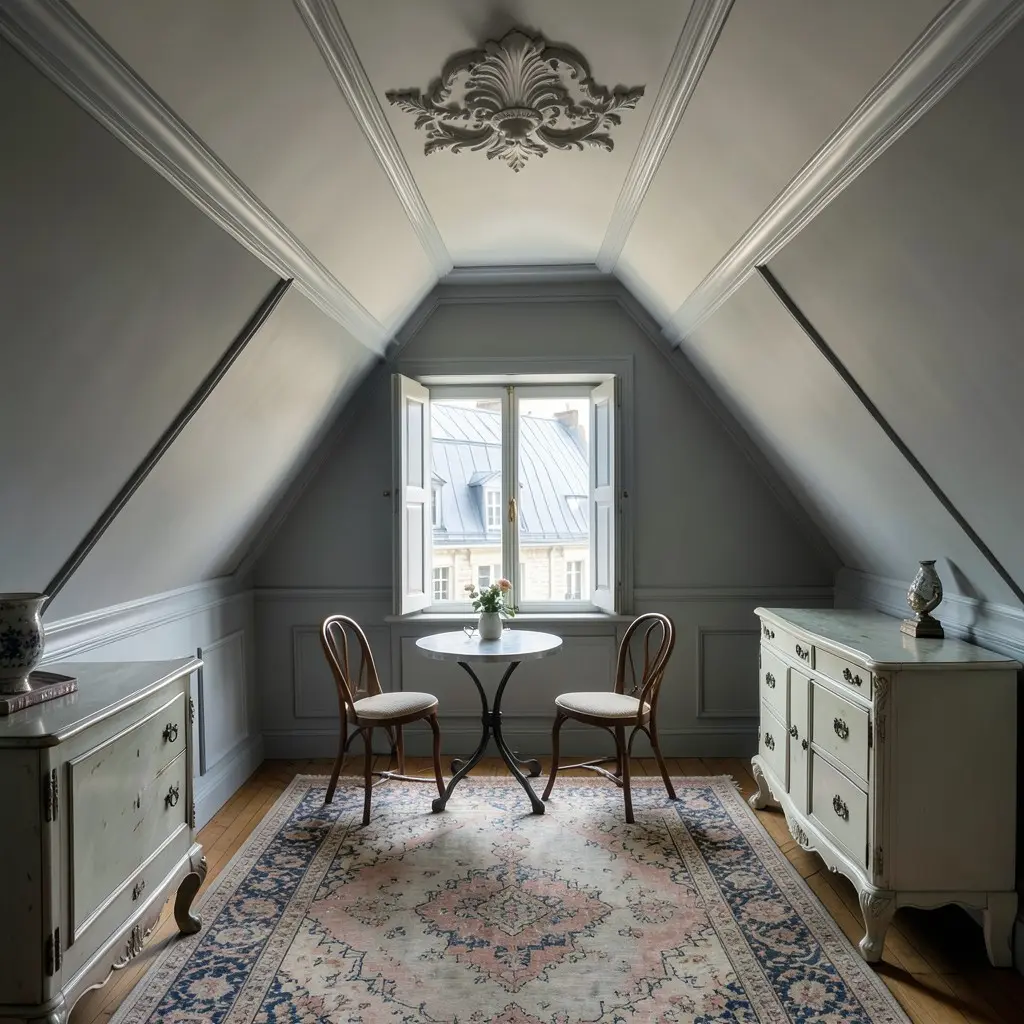
The Parisian attic apartment is the residential design direction that draws from the specific atmospheric quality of the top-floor Parisian apartment — the sloped ceiling expressed in ornamental plaster, the zinc-topped mansard roof visible through the dormer window, the warm afternoon light that Paris’s latitude and the city’s zinc roofscapes create at the upper floor level — and applies it to a domestic attic with the same Romantic commitment to the aesthetic that the Parisian apartment embodies in its most compelling examples.
French grey-painted walls — the dusty, muted blue-grey that appears on the woodwork and plasterwork of Parisian apartments at a thousand different tonal variations — on the kneewalled sections and the flat wall areas of the attic create the palette that identifies the Parisian aesthetic more directly than any other single color choice. The grey’s dusty quality — a tone that appears to have aged gently from a more saturated version of itself — creates the atmosphere of a room that has been lived in and loved over time, which is precisely what the Parisian apartment’s design tradition values as its highest aesthetic quality. A carved plaster ceiling medallion at the attic’s central ridge position — the ornamental element that references the Parisian interior’s decorative plaster tradition in a form whose scale suits the attic’s lower ceiling height — creates the architectural detail that completes the Parisian aesthetic’s visual vocabulary in the converted roof space.
Vintage French furniture — a zinc-topped bistro table and two mismatched cafe chairs at the dormer window, a painted French commode on a flat wall section, and a faded Aubusson rug on the floor — furnishes the Parisian attic with the period-specific pieces that communicate the design direction’s cultural context. The lived-in quality of the furniture — the small chips in the commode’s paint, the slight unsteadiness of the bistro table’s legs, the fading of the rug’s central medallion — is the design quality that makes the Parisian aesthetic convincing rather than costumed, and the restraint required to leave the imperfections in place rather than replacing them with pristine reproductions is the design discipline the aesthetic demands.
45. An Attic With a Dedicated Sewing and Textile Studio
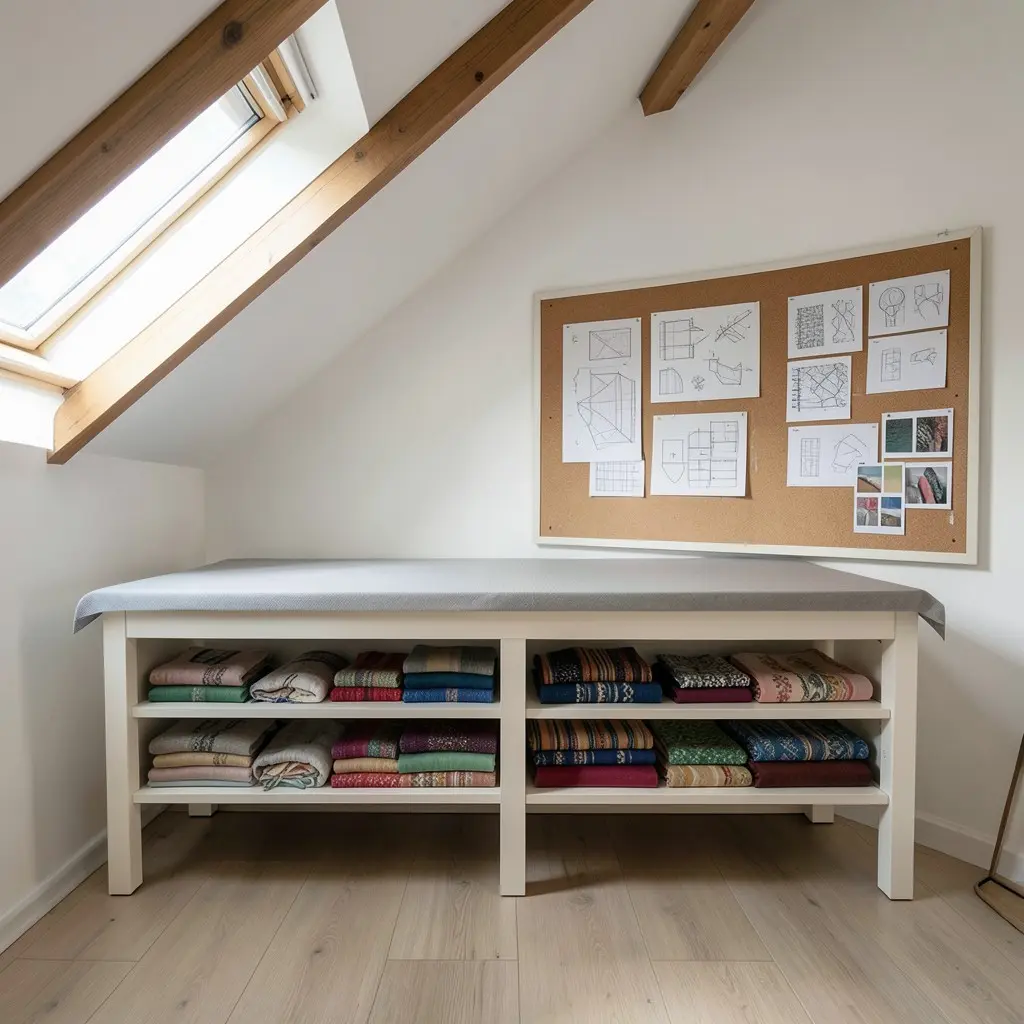
The textile studio attic gives the serious sewing, weaving, or textile arts practitioner the dedicated space whose organizational infrastructure — the cutting table, the sewing machine setup, the fabric storage, and the fitting area — requires more floor area and more specialized furniture than any interior room in the house can consistently provide without displacement of the room’s primary domestic function. The textile studio in the attic is a professional-quality workspace at the top of the house, and its design should honor the practice’s specific physical requirements with the same specificity that a kitchen design honors cooking.
A large cutting table at standing height — at least sixty by forty-eight inches of continuous, smooth, level surface with a self-healing mat cover protecting the tabletop — is the textile studio’s primary working surface, and its size requirement determines the attic studio’s minimum workable floor plan. The cutting table position should be accessible from all four sides for large fabric layouts, which means the table’s clearance from the surrounding walls and storage should be at least thirty inches on each side. The attic’s central standing height area is the natural position for the cutting table, placing the largest and most active working surface at the room’s most generous volume and reserving the lower kneewalled sections for the storage and the secondary work positions.
Fabric storage in the attic textile studio suits the kneewalled section’s low shelving format perfectly — folded fabric bolts arranged by color and weight on open shelving at the kneewalled height create the inventory display that allows fabric selection by sight rather than by excavation. The color-organized fabric display creates the studio’s most visually rich design element — the folded fabric’s varied colors and textures against the pale shelf surface creating the organic, personal gallery quality that textile work’s material wealth naturally generates. A large design board — a corkboard or a magnetic panel on the flat end wall — holds the current project’s pattern pieces, color swatches, and reference images in the accessible, visible format that active design work requires.
46. An Attic With a Mid-Century Modern Interior
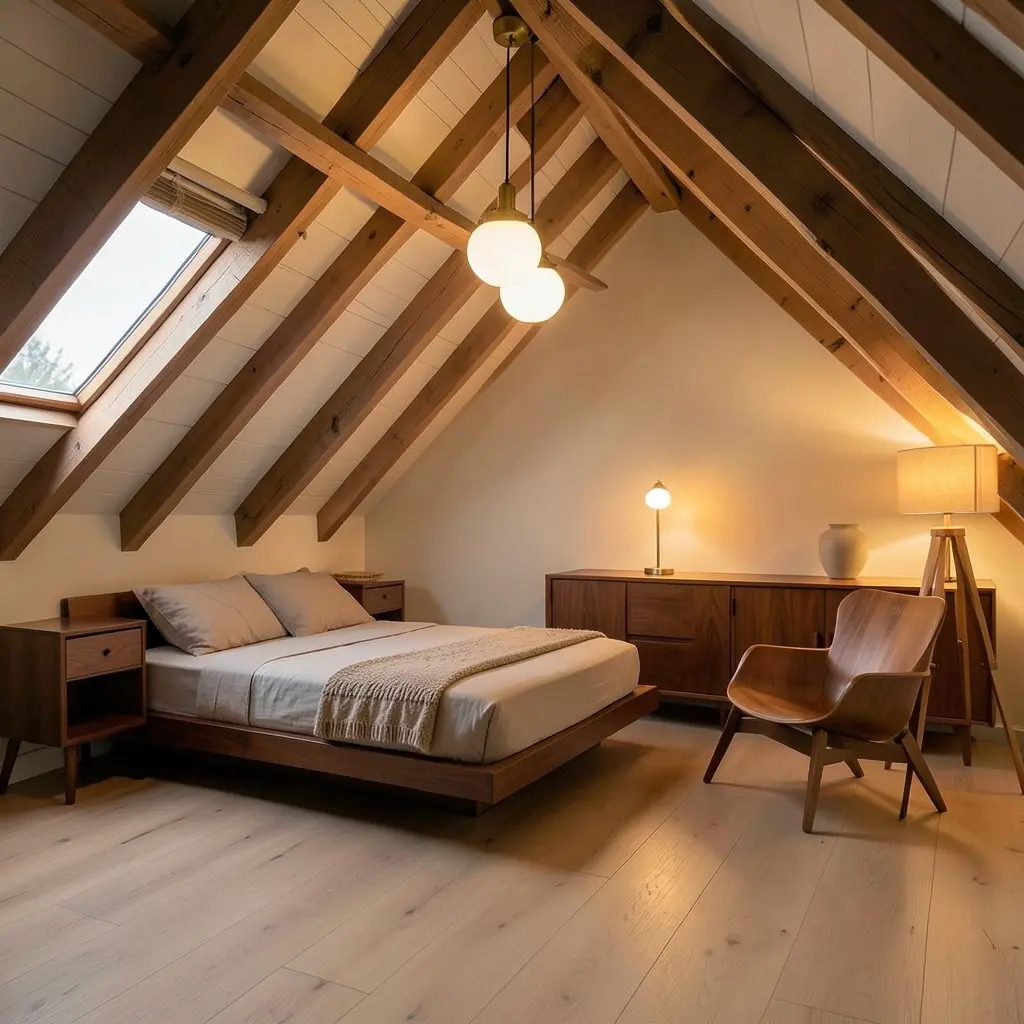
The mid-century modern attic applies the clean lines, organic forms, and warm material palette of the mid-century aesthetic to the attic’s structural complexity with the design intelligence that the style’s own history provides — mid-century architecture consistently placed living spaces under expressed roof structures, and the design language developed in those spaces is the same language that the attic conversion applies. The mid-century attic is not the adaptation of an aesthetic to an unusual context; it is the return of an aesthetic to the context that formed it.
Teak and walnut furniture in the flat-profiled, low-to-the-ground format that the mid-century modern style applies — a teak platform bed, a walnut credenza along the kneewalled section, and a molded plywood or fiberglass accent chair beside the dormer — creates the furniture layer whose warm wood tones and clean geometric profiles suit the attic’s structural timber overhead. The furniture’s horizontal emphasis — the low profile, the wide credenza, the platform bed close to the floor — creates the visual stability that the sloped ceiling’s diagonal movement above requires as its compositional counterpoint. The mid-century principle of furniture as sculpture — each piece designed to be seen from every angle rather than pushed against a wall — applies in the attic’s open floor area with a directness that conventional rooms’ furniture arrangements rarely achieve.
Warm amber lighting throughout the mid-century attic — globe-shaped pendant lights on brass fittings hanging from the ridge beam, a tripod floor lamp in a natural teak beside the reading chair, and a small ceramic table lamp on the walnut credenza — creates the warm, intimate quality that mid-century interiors consistently applied through the incandescent-temperature bulb whose amber warmth was the visual signature of the era’s domestic light environment. The combination of the warm amber light, the teak and walnut furniture’s warm grain, and the pale rafter ceiling’s structural honesty creates the mid-century attic interior of genuine aesthetic coherence.
47. An Attic With a Warm Earthy Boho Bedroom
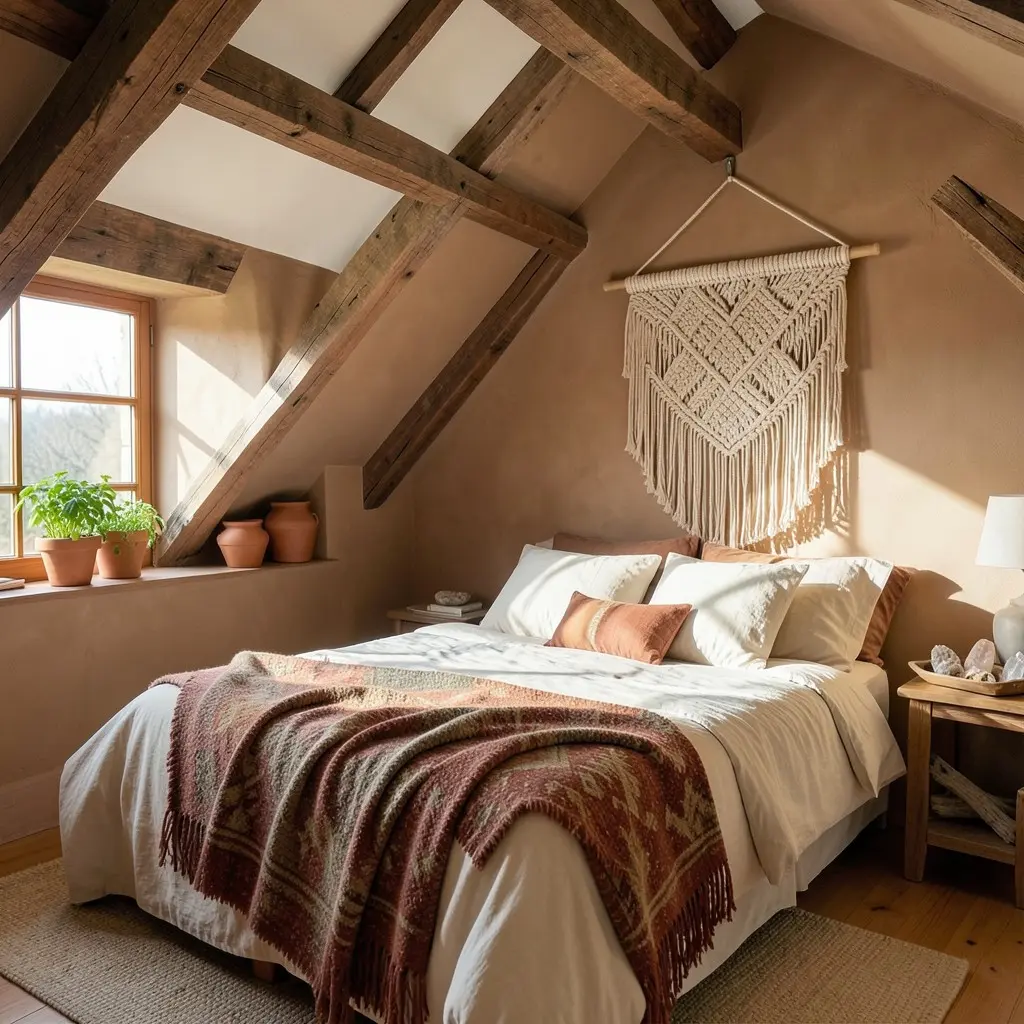
The earthy boho attic bedroom layers the warm, organic, personal material quality of bohemian home styling with the specific earth tones that connect the design to the natural world’s most grounded palette — the terracotta, the camel, the warm white, and the moss green that the earthy home design direction applies as its color foundation. The combination of the bohemian layering method and the earthy palette creates a bedroom of extraordinary warmth whose organic material depth suits the attic’s timber structure with the natural material consistency that the earthy aesthetic values above all other design qualities.
A macramé wall hanging on the attic’s flat end wall — a large, handmade piece in a natural cotton rope whose knot patterns create the organic texture that the earthy boho aesthetic applies as its signature decorative gesture — creates the bedroom’s primary wall feature in a material that connects to the structural timber above through their shared organic, natural origin. The macramé’s cream and natural cotton tone suits the earthy palette’s warm white without the coolness that a bright white creates, and the hanging’s scale — ideally filling the flat end wall section from the floor to the point where the roof slope begins — creates the presence that the room’s focal wall requires.
Terracotta clay pots on the kneewalled shelves, a hand-woven wool blanket across the foot of the bed in a warm rust and camel pattern, and a collection of natural crystals and driftwood pieces on a small wooden tray on the bedside table create the earthy boho bedroom’s accessory layer with the personal, organic specificity that the aesthetic requires to feel genuine rather than styled. The attic boho bedroom at its spring home refresh peak — the fresh herbs on the windowsill, the new macramé replacing the winter’s darker textiles with a lighter natural one, and the morning light casting the rafter shadows across the cream-toned bedding — is the room that the earthy bohemian interior design direction was always building toward.
48. An Attic With a Home Cinema and Projection Setup
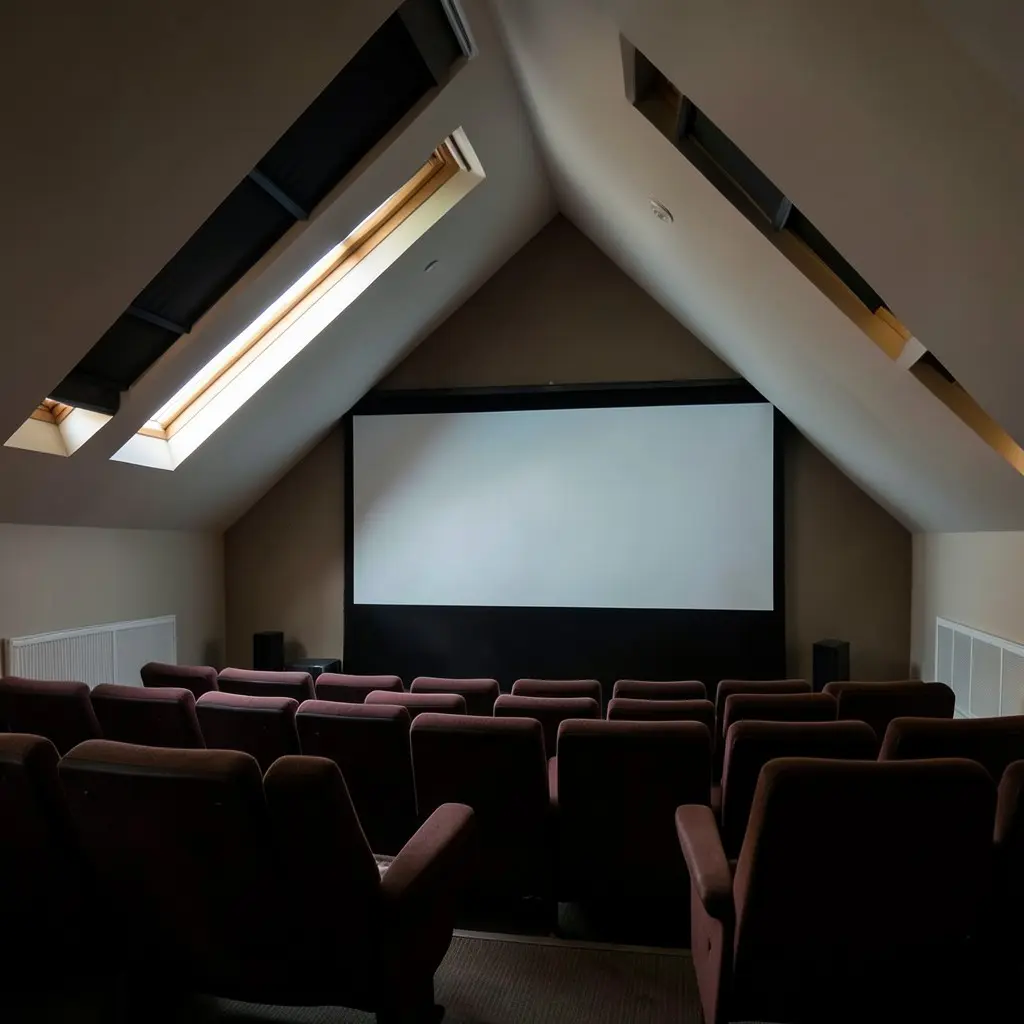
The attic cinema room exploits the one quality that distinguishes it from the basement cinema of any other room type used for film watching: the sloped ceiling. A projector aimed at the flat gable end wall from a position at the attic’s rear achieves a throw distance that most interior rooms cannot provide, and the raked seating arrangement that the attic floor can accommodate — the viewing position stepping up from front to rear as the floor rises toward the ridge — creates the cinema geometry without the constructed riser that basement theaters require. The attic provides the cinema’s sightlines as a gift of its geometry.
Blackout treatment on the skylights and dormers — motorized blinds whose fabric blocks one hundred percent of incident light — creates the cinema room’s complete darkness condition, allowing daytime screenings at the same visual quality as evening sessions. The attic’s natural light is the cinema room’s primary challenge, and the motorized blackout system is the solution whose capital cost is recovered across every afternoon screening that a fixed non-blackout system would have prevented. The blinds’ motorization allows the blackout to be engaged from the seating position without disrupting the pre-screening preparation that a manual blind system requires reaching the windows for.
The projection surface on the flat gable wall — a short-throw or standard throw projector installation depending on the available throw distance — should be a dedicated tensioned projection screen rather than a painted wall surface, because the screen’s optical gain and uniform surface flatness create the image quality that the projector’s specifications achieve in full. A painted wall can approximate the projection surface at a significant visual quality reduction whose impact is most apparent in dark scene detail and color saturation — the two image qualities that the attic cinema’s blackout investment was specifically designed to optimize.
49. An Attic With a Dedicated Writing Studio
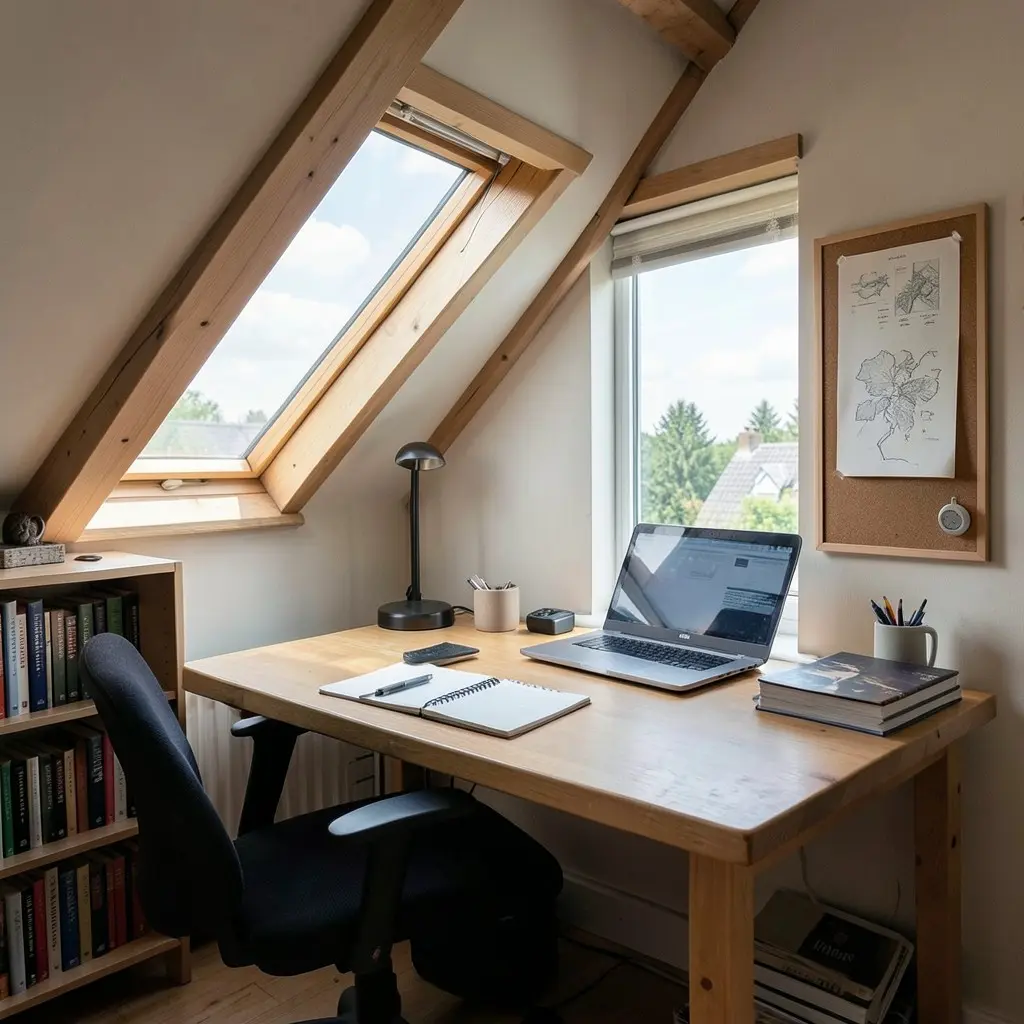
The writing studio in an attic gives the writer the specific environmental conditions that the practice consistently requires and that shared living spaces consistently fail to provide — the silence, the separation, and the spatial removal from the domestic world that allows the writer’s attention to remain with the work across the extended uninterrupted periods that serious writing demands. Writing is the domestic practice most sensitive to interruption, and the attic studio is the domestic room most resistant to being interrupted in.
A single desk at the dormer window — the writing position that every serious writer who has used a dormer describes as the one they return to — creates the studio’s working infrastructure in its most essential form. The desk’s surface should be generous enough for the notebook, the reference stack, and the laptop or typewriter without requiring constant repositioning of materials, and its height should be the standard ergonomic desk height calibrated for the writer’s own seating height. The dormer window’s view — the sky, the rooftops, the treetops — provides the visual resting point that writing requires between the periods of focused attention, the place where the eye goes when the mind is working on a sentence that is not yet ready to be written. That view, and its quality, is the writing studio’s most important design element after the desk itself.
The writing studio’s walls hold only what the writing requires — the reference books in a simple bookcase beside the desk, the manuscript in progress on a corkboard beside the window, and the personal objects that the writer’s practice has always surrounded itself with. Nothing decorative, nothing aspirational, nothing designed to communicate the room’s function to visitors. The writing studio is designed for the writer working alone in it, and its quality is measured entirely by the quality of the work produced there. If the room produces good work, the design succeeded. That is the only standard that matters.
50. An Attic Designed as the Home’s Most Memorable Room
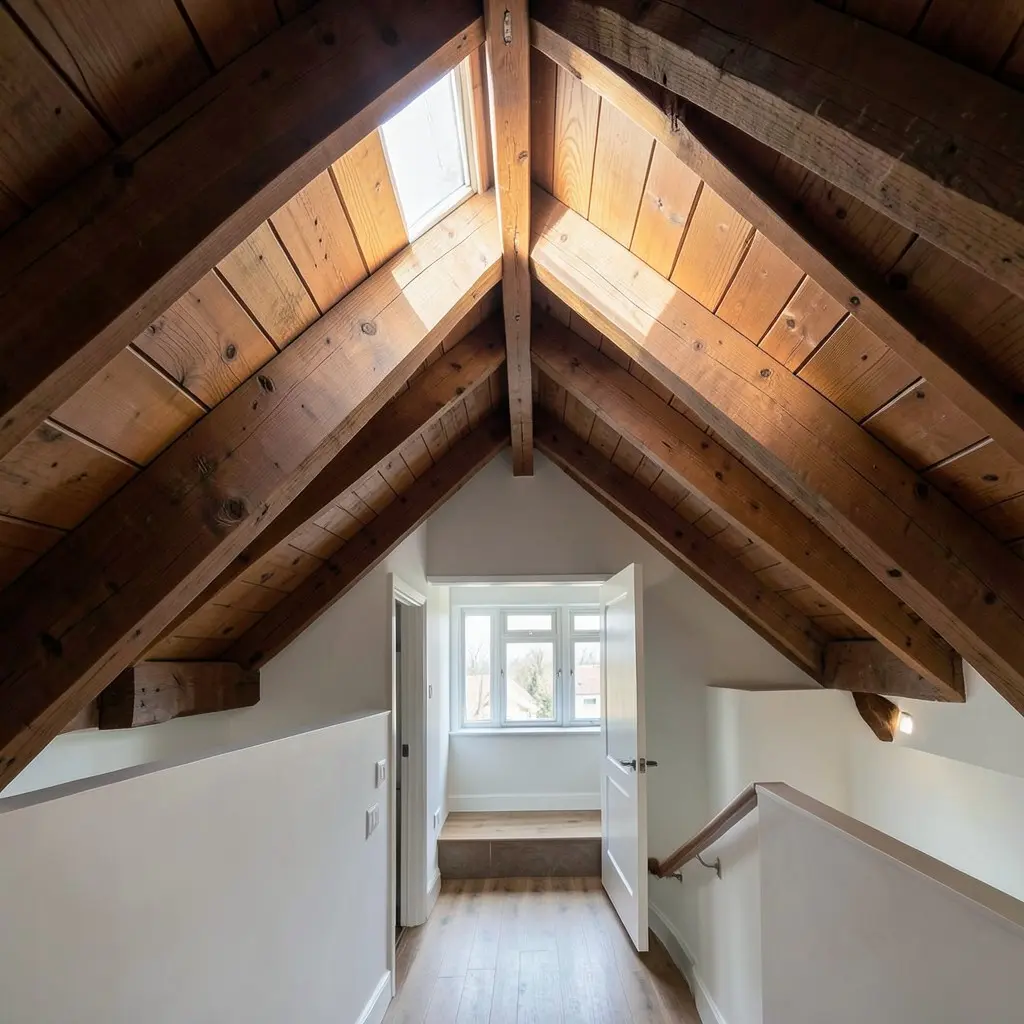
The attic designed without compromise to be the single most memorable room in the house starts from the honest acknowledgment that this room, at the top of the building, with the sky directly above and the whole house supporting it from below, occupies the most architecturally distinctive position in the domestic structure. Every design decision made in its service should honor that position — not by making the room shout about its altitude, but by creating within it the specific quality of experience that only this position in this building can provide.
The most memorable attic rooms in residential design share a single characteristic: the designer understood what the room’s physical conditions were offering and had the confidence to design directly toward those conditions without the deflection of applied style, without the anxiety of the unusual proportions, and without the compromise of trying to make the attic look like a room that could be anywhere. The sloped ceiling is the design. The exposed timber is the design. The skylight’s specific quality of overhead light is the design. The work of designing the memorable attic room is the work of understanding those gifts clearly enough to serve them without obscuring them.
Your attic is the room at the top of your house. Design it with the conviction that position deserves — the conviction that the room above everything else should be the room that, when someone experiences it for the first time, makes them stop at the stair head and take a breath before walking in. Design it so they take that breath. That pause, that moment of genuine surprise and recognition, is what every idea in this collection is building toward.
Leave a Reply