
The garage is the most honest room in the house. It holds what the rest of the home has decided it cannot manage — the tools, the sports equipment, the seasonal decorations, the car that actually owns the space in theory but shares it in practice with everything else that has nowhere better to go. Most garages exist in a state of permanent organizational defeat, and the people who use them have quietly accepted that defeat as the natural condition of the space rather than as the result of a design problem that has a genuine solution. That acceptance is the thing worth challenging first, before any design decision is made, because the garage that works well is not the product of more storage or better shelving alone. It is the product of someone deciding that the space deserves the same quality of thinking applied to every other room they live in.
The garage’s design potential is genuinely underestimated across residential design culture. Most home design media focuses on the kitchen’s material quality, the primary bedroom’s atmosphere, and the living room’s social function — all of which are important — while the garage receives the afterthought treatment of a single organizational article about pegboards and clear bins. But the garage occupies more square footage than most bedrooms, is used by every member of the household multiple times daily, and directly affects the quality of every activity that passes through it: the morning commute that starts in the garage, the weekend project that lives in it, the seasonal storage that makes every other room in the house function properly, and the hobby or workshop that the garage is the only room large enough to contain. A garage designed badly makes all of those activities harder. A garage designed well makes them easier every single day.
The fifty garage design ideas in this collection span the full range of what this space can become — from the efficient single-car garage with a compact wall storage system that maximizes every square foot without sacrificing the car’s place, to the fully finished multi-car garage with heated epoxy floors, custom cabinetry, and the material quality of a luxury home interior applied without apology to a working space. Between those two ends of the spectrum lie workshop garages, gym garages, artist studio conversions, man cave designs, family activity hubs, and the clean, organized vehicle storage spaces that make daily life measurably smoother. The ideas address every design direction — from industrial home design honesty to farmhouse home decor warmth, from minimalist home design restraint to the personal, layered character of a rustic home decor workshop.
Some of the ideas here will suit your garage immediately. Others will challenge how you think about what a garage can be. Both of those outcomes serve the same purpose: the decision, made deliberately, about what your garage is going to become. Make that decision first. Then design toward it with the conviction it deserves.
The garage you walk into every morning is either working for you or against you. These fifty ideas exist to change that math decisively.
1. A Modern Epoxy Floor Garage With Sleek Wall Storage
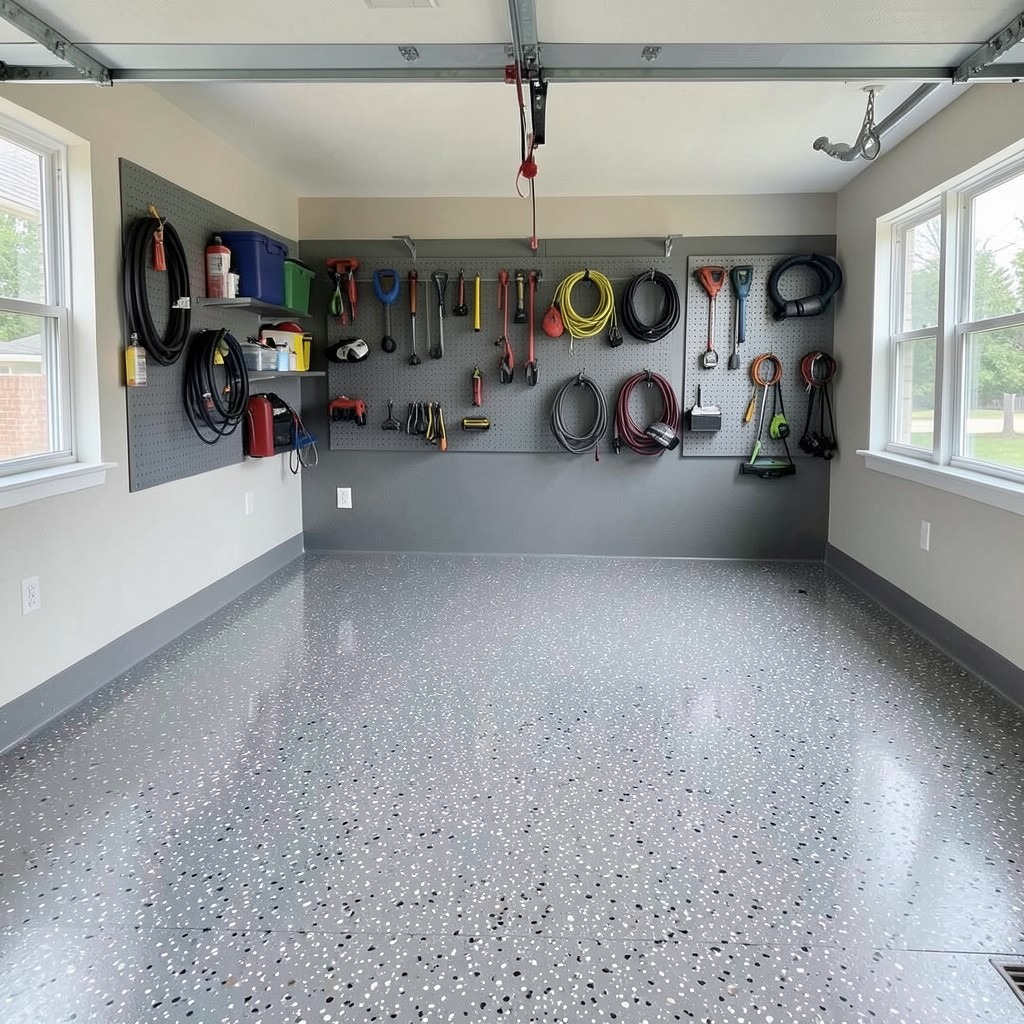
The garage floor is the single most impactful surface in the space — it covers more area than any wall, receives the most physical abuse from vehicles, foot traffic, and dropped tools, and its condition determines the garage’s overall quality register more directly than any other element. A standard bare concrete floor reads as unfinished regardless of what else the garage contains. An epoxy-coated floor in a solid color or a fleck finish reads as a room — a designed space that someone took seriously enough to give its floor a proper surface treatment.
A full broadcast epoxy floor system — a primer coat, a colored base coat, a full broadcast of decorative vinyl fleck chips, and a clear polyaspartic topcoat — creates the garage floor that handles daily vehicle parking, chemical spills, and impact from dropped tools without degrading or staining. The polyaspartic topcoat’s UV stability prevents the yellowing that older epoxy topcoat systems developed under sunlight exposure, and its cure time — typically twenty-four hours to light foot traffic — means a weekend installation is back in service before the following workday. A medium-grey base with a multi-tone chip blend suits modern home design and contemporary home ideas garage contexts, reading as clean and professional without the severity of a single-color solid.
Paired with wall-mounted steel panel storage systems on the garage’s perimeter walls — slatwall, pegboard, or a proprietary steel slot system — the epoxy floor creates the clean, organized garage environment that suits the industrial home design and minimalist home design aesthetics equally. The wall storage system holds tools, sports equipment, hoses, and seasonal accessories on hooks and brackets mounted directly to the panel surface, keeping the floor clear of the organizational clutter that typically colonizes the garage’s perimeter. Floor-clear organization is the design principle that makes the epoxy floor’s investment visible — a garage where equipment sits on the floor defeats the floor finish’s visual purpose, and the wall storage system is the non-negotiable partner that allows the floor to read as designed rather than merely coated.
2. A Garage Workshop With Custom Built-In Workbench

A workshop garage built around a purpose-designed workbench is the garage that transforms a hobby into a proper practice — the difference between a workbench that is an afterthought and one that was designed for the specific work performed at it is the difference between a frustrating working experience and a genuinely productive one. Most garage workbenches are improvised: a door blank on sawhorses, a kitchen cabinet inherited from a renovation, a sheet of plywood screwed to the wall studs at an arbitrary height. These surfaces work, in the way that any horizontal surface works for placing things, but they do not support skilled work at the level a proper workbench does.
A custom built-in workbench at the correct working height — typically thirty-four to thirty-six inches for standing work, matching kitchen counter height — with a solid wood or steel top of at least two inches in thickness, mounted rigidly to the wall and supported on a base cabinet system that provides organized tool storage directly below the work surface, creates the workshop’s productive infrastructure. The workbench’s top material should match the primary work performed: a hardwood maple or beech top for woodworking, a steel top for metalworking, and a replaceable MDF or plywood surface for general assembly and finishing work. The top’s material quality determines the quality of the work surface over years of heavy use, and specifying it correctly at installation avoids the replacement cost of a surface chosen for convenience rather than suitability.
Above the workbench, a wall-mounted tool storage system — hanging tools on shadow-board outlines, French cleat strips accepting custom-made holders, or a steel pegboard with purpose-designed hooks — keeps every tool within immediate reach of the standing work position without requiring a drawer search or a floor-level dig. The shadow board system, in which each tool’s silhouette is painted on the board behind its designated hook, provides the visual inventory function that workshop organization most values: at a glance from the workbench position, the user sees which tools are present and which are missing, and the missing tool’s shadow on the board is a more effective accountability system than any label or list. Rustic home office ideas applied here — a worn workbench, open tool storage, and the honest patina of a space that produces things — create the workshop aesthetic that suits the work.
3. A Garage With a Full Gym and Fitness Setup

Converting a portion or the entirety of a garage into a home gym is among the highest-return garage design decisions available for the household whose fitness practice is consistent and whose gym membership cost is ongoing. The garage gym provides the equipment variety, the privacy, the schedule flexibility, and the acoustic freedom that no commercial gym matches for a household of regular users, and the upfront cost of the equipment and the space treatment is typically recovered against commercial gym fees within twelve to thirty-six months of consistent use. The financial case is clear. The design case is what most garage gym setups get wrong.
A garage gym that works as a designed space rather than a pile of equipment in an unfinished room requires three things: a floor surface that handles the specific loads the equipment imposes, a ceiling height sufficient for the tallest movements performed, and wall organization that keeps the equipment accessible and the floor clear between uses. Rubber gym tile flooring — interlocking tiles in a heavy rubber compound rated for weight-dropping impact — protects the concrete floor from the damage that dropped barbells and heavy equipment feet create while providing the non-slip, foot-comfortable surface that hard concrete cannot offer during extended training sessions. The tile’s density should match the heaviest loads the gym will experience, because a light-duty tile under a serious powerlifting setup deteriorates rapidly.
Ceiling height is the variable that limits equipment options and training movements before any purchase is made — a standard eight-foot garage ceiling limits overhead pressing, bar muscle-ups, and rope climbing, while a ten or twelve-foot ceiling opens the space to the full range of barbell and gymnastics movements. The garage gym’s equipment layout should position the most space-demanding equipment — the squat rack, the cable system, the plyometric area — against walls rather than at the center, preserving a clear working floor that can be used for mat-based training, stretching, and the general warm-up movements that require more lateral space than any single piece of equipment. A mirrored wall section on the garage’s end wall serves both the form-check function that technique training requires and the psychological function of making the space read larger and more gym-like — a practical and perceptual benefit in one installation.
4. A Garage With Industrial Shelving and Metal Storage Cabinets

Industrial shelving in a garage — heavy-duty steel bay shelving units with adjustable shelf heights and load ratings sufficient for the garage’s actual storage demands — creates the organizational backbone of the garage space in a material that suits the industrial home design aesthetic and the genuine functional requirements of the environment simultaneously. The garage does not need decorative shelving. It needs shelving that holds heavy power tools, full paint cans, large automotive supply containers, and seasonal equipment without deflection, wobble, or load-induced failure. Industrial steel shelving provides that capacity without pretense.
Boltless steel shelving units in a powder-coated finish — twelve to twenty-four inches deep, four to five shelves high, with shelf ratings of seven hundred to one thousand pounds per shelf — hold the garage’s bulk storage in an organized, accessible format that domestic shelving units cannot approach in capacity or durability. The adjustable shelf pitch allows the shelving to be reconfigured as the storage categories change without purchasing new units — a shelf configuration that accommodates gallon paint cans today can be adjusted tomorrow to accommodate the taller seasonal decoration bins that arrive after fall home decorating, and the adjustment requires no tools and takes minutes. Grouping the shelving into functional zones — automotive supplies, yard and garden tools, holiday home styling storage, sports equipment — creates the organizational logic that makes the shelving system legible and maintainable rather than simply large.
Metal storage cabinets — either free-standing or wall-mounted, in a steel construction with lockable doors — house the garage’s hazardous materials, precision tools, and small valuables in a secure, organized container that the open shelving system cannot provide. A lockable cabinet for chemicals, solvents, and automotive fluids keeps these materials safe from children and pets while storing them in a ventilated, fire-rated container appropriate for their hazard class. A separate lockable cabinet for precision hand tools, measuring equipment, and electrical tools stores the highest-value items in the garage in a secure location where their condition is protected from the humidity, dust, and accidental contact that open storage accumulates.
5. A Garage With a Polished Concrete Floor and Minimalist Design

Polished concrete in a garage applies the same finish treatment to the existing concrete slab that high-end commercial and residential interior projects have applied to concrete floors for decades — the grinding, honing, and polishing sequence that brings the concrete’s surface to a tight, reflective finish creates a garage floor of genuine architectural quality that suits minimalist home design and contemporary home ideas aesthetics without requiring the application of a coating system over the existing slab. The polished concrete is the slab itself, refined rather than covered, and its material honesty — showing the aggregate, the trowel marks, and the natural variation of the original pour — is its primary design quality.
The polishing process begins with a coarse diamond grinding head that removes surface laitance and low spots, levels the floor, and opens the concrete’s pore structure for the densifier treatment that follows. A lithium silicate densifier applied to the open pores reacts chemically with the concrete’s calcium hydroxide to form a hard crystalline compound that increases the surface’s hardness and resistance to the abrasion and staining that unprotected concrete readily exhibits. Subsequent finer diamond heads — progressing from one hundred grit through four hundred, eight hundred, and fifteen hundred grit in sequence — bring the surface to the chosen sheen level, from a satin matte to a high-gloss mirror finish. The high-gloss level suits the airy home interiors and bright home design garage contexts, its reflective surface amplifying the garage’s overhead lighting to a degree that flat concrete cannot approach.
A polished concrete floor without a protective sealer applied after the final polishing pass remains vulnerable to the oil staining that vehicle parking creates — the drips and spills from engine components that every car deposits over time will penetrate an unsealed polished surface and create permanent staining that grinding back is the only remedy for. A penetrating reactive sealer — not a topical film sealer that creates a coating over the polished surface — protects the concrete’s pores while maintaining the authentic concrete appearance and the non-slip texture that a topical coating can compromise when wet.
6. A Garage Converted Into a Home Office or Studio

The garage converted to a home office or creative studio is the residential adaptation that produces the most dramatically improved work quality for the household member whose professional or creative practice has outgrown the bedroom desk, the kitchen table, and the dining room corner. The garage offers the most significant advantage that no interior room in the house can match: genuine separation from the household’s domestic activity. A door that closes and stays closed, a space that the rest of the house does not pass through, and square footage that allows the work environment’s physical layout to be designed around the work rather than fitted into the gaps of a shared living space.
The conversion’s first physical requirement is thermal control — a garage that is not insulated, sealed, and conditioned for year-round human occupancy is a space that is comfortable for four months and hostile for eight. Insulating the garage door with a batt insulation kit or replacing it with an insulated panel garage door dramatically reduces the thermal transfer that makes an uninsulated garage unbearable during winter interior design season and summer home design heat. Adding wall insulation between the garage’s interior framing bays — or, where the garage walls are solid masonry, applying a furring-and-batt or rigid foam interior insulation system — creates the thermal envelope that makes the garage consistently comfortable through the temperature range the home’s location demands.
The office or studio’s interior design follows the conversion’s thermal preparation, and its aesthetic direction can range from the Scandinavian home interior clarity of a white-walled, natural-wood-furnished creative studio to the warm, layered character of a rustic home office ideas workspace with reclaimed wood desk surfaces, vintage shelving, and industrial pendant lighting. The key distinction from any interior room is that the garage’s large floor area allows the work layout to be generous — a full-size drafting table and a reference library in the same room, a painting studio with wall-mounted canvas storage and a separate framing area, or a recording setup with acoustic treatment panels and equipment racks that a bedroom cannot physically contain. The converted garage gives the work the space it actually needs, which is what makes the work better.
7. A Garage With a Dedicated Tool Wall Organization System

The tool wall is the garage workshop’s most practical organizational investment — a system designed specifically to make every tool visible, accessible, and accountable without requiring a drawer, a box, or a cabinet to be opened to find what is needed. The organizational principle is simple: if you can see it, you can find it, and if it has a specific location, it goes back there. The execution of that principle at sufficient scale, with sufficient variety of hook types and mounting options, and at a quality level that holds the tool weight without pull-out failure across years of daily use, is what separates a functional tool wall from a frustrating one.
A French cleat wall system — horizontal strips of wood or steel with a forty-five-degree bevel cut along the upper edge, mounted horizontally across the full tool wall in parallel rows spaced two to four inches apart — provides the most adaptable tool storage infrastructure available for a garage workshop. Any bracket, shelf, holder, or hook fitted with a matching forty-five-degree cleat on its back face engages with the wall strips at any horizontal position and at any height, creating a tool storage configuration that can be instantly reconfigured without tools, without pre-drilling new holes, and without disturbing the other elements mounted alongside the changed piece. The French cleat’s flexibility is its design value: the tool wall that can be reorganized in minutes adapts to the workshop’s evolving tool collection without the permanent commitment that fixed pegboard or slatwall systems impose.
The tool wall’s coverage should match the workshop’s tool inventory in size — too small a tool wall forces the overflow to the floor and the bench, defeating the organization system’s purpose — and the hardware quality of the hooks and brackets must match the weight of the tools they hold. A ten-pound circular saw on a hook rated for two pounds is not an organization system. It is a hazard. Specifying load-rated hooks matched to the tool categories the wall holds is the safety and quality standard that any serious workshop tool wall applies without exception.
8. A Garage With a Car Enthusiast’s Showroom Aesthetic

The car enthusiast’s garage is a room designed around the car rather than despite it — the vehicle is not a tenant whose presence the garage tolerates while being used for everything else, but the primary occupant whose display quality, accessibility, and protection from the elements determine the garage’s entire design direction. The showroom garage treats the car with the respect it would receive in a professional display environment, and the result is a space that car people find genuinely aspirational and that occasional visitors find unexpectedly impressive.
Glossy tile or high-gloss epoxy on the floor — in a white, light grey, or the car’s complementary color — creates the showroom floor reflectivity that mirrors the car’s lower panels and creates the display quality of a professional automotive exhibition. The floor’s reflective surface catches the overhead lighting and bounces it back at the car’s body panels, eliminating the bottom-shadow that creates the unglamorous, parked-in-a-dark-garage appearance that most garage floors produce. Recessed LED lighting in the ceiling above each parking bay — track lighting with adjustable heads aimed at the car’s body — provides the directional display illumination that brings out the paint’s depth and metallic quality in the same way that automotive show lighting does.
Wall panels in a glossy white painted finish or in the precision-painted aluminum panel cladding used in commercial dealerships create the clean, professional backdrop that the car showroom aesthetic requires. Tool storage in this context is housed in matching custom cabinets — gloss white or body-color painted cabinetry with seamless handles and no visible hardware — that contain the workshop function without disrupting the showroom aesthetic. Luxury home interior quality cabinetry in a space that still functions as a working garage is the design tension that the car enthusiast’s showroom resolves by treating both purposes — display and use — with equal seriousness.
9. A Garage With a Farmhouse-Inspired Storage Wall

The farmhouse garage brings the warm, practical material vocabulary of farmhouse home decor to the garage’s storage and organizational design, creating a space that feels domestic and intentional rather than industrial and accidental. The farmhouse garage rejects the premise that utility spaces must look like utility spaces — it applies the same care for natural materials, honest construction, and warm visual atmosphere that the farmhouse kitchen and farmhouse bathroom decor aesthetic carries to the rest of the house.
Shiplap paneling on the garage’s back wall — painted in a warm cream or cotton white — creates the farmhouse backdrop for a storage system of open wood shelving on black iron brackets, hanging hooks in a forged iron style, and stacked wicker baskets that hold the garage’s supply categories in the natural fiber containers that suit the farmhouse material palette. The shiplap’s horizontal board rhythm provides the visual texture that flat drywall cannot generate, and its warm white tone against the natural wood and dark iron of the storage system creates the contrast that farmhouse home decor consistently applies between its light backgrounds and its darker accent materials. The wall’s surface character makes the storage in front of it part of a composed design rather than simply objects attached to a flat surface.
A sliding barn door on a black iron track, positioned across the garage’s interior storage room or mechanical equipment area, continues the farmhouse architectural vocabulary into the garage with the same material authenticity the aesthetic demands in every other room it inhabits. The barn door’s function in the garage — concealing the messy storage area that organized garage systems often generate behind a single door panel — is practical and aesthetic simultaneously. Warm pendant lights in an Edison bulb style hung at the garage’s center provide the quality of warm, incandescent-temperature light that farmhouse home decor applies throughout the home, making the garage feel inhabited and domestic rather than utilitarian and transitional.
10. A Garage With a Sports Equipment Organization Zone

Sports equipment is the garage’s most organizationally challenging category — the items are awkwardly shaped, heavily varied in size, seasonal in their rotation, and owned in quantities that the household’s active members multiply across years of accumulated sports participation. A bike with three different wheel sets, a set of golf clubs with a travel bag, a surfboard and two paddleboards, a collection of ski equipment, four sets of rackets in different sports, and a wall of ball equipment in various inflations and sizes — this is not an unusual garage sports inventory for an active household, and it is also not a collection that any generic storage system handles well. A sports-specific organization system designed around the actual inventory handles it exactly.
Dedicated wall-mounted bike hooks — vertical or horizontal, positioned at a height that clears the bike’s handlebars from the floor and keeps the wheels flat against the wall — hold the cycling equipment in a format that takes the least floor space per bike and keeps each bike accessible without moving others. Horizontal ceiling-mounted bike hoists — a rope and pulley system that raises the bike to the ceiling with a single pull — hold infrequently used bikes above the active floor area, recovering their floor footprint entirely. A household with four bikes whose garage floor space is limited can accommodate two bikes on the wall and two on ceiling hoists without sacrificing any floor area to bike storage, which changes the garage’s functional layout significantly.
Ball storage in a vertical column of fixed wire baskets or a purpose-designed ball caddy holds the inflated equipment accessibly without the roll-out chaos of balls stored on flat shelves or in open bins. Ski and snowboard equipment hangs on wall-mounted ski racks positioned at the ceiling’s perimeter during summer home design season, the ceiling-height storage keeping the seasonal equipment out of the working floor area for the nine or ten months it is not in use. The sports organization zone’s full effectiveness depends on consistent equipment return after each use — the system must make returning equipment to its designated location as easy as removing it, which means hooks at reachable height, clear designated positions for every item, and no section where the correct location is ambiguous.
11. A Garage With Ceiling Storage for Seasonal Items

Ceiling storage in a garage recovers the one volume of space that most organization systems completely ignore — the zone between the tops of the wall storage and the ceiling, which in a standard eight-foot garage represents eighteen to twenty-four inches of height across the garage’s entire floor area. That volume, properly equipped, holds the seasonal and infrequent-use items that clutter every other storage surface without providing daily utility: the holiday home styling bins, the seasonal sports equipment, the camping gear used twice a year, and the suitcases that occupy floor space for the fifty-one weeks they are not being packed.
Ceiling-mounted storage platforms — steel grid systems suspended from the ceiling joists by adjustable threaded rods, with a weight capacity of several hundred pounds per platform — create the overhead storage infrastructure that suits the garage’s structural ceiling. The platform’s grid spacing allows items to be loaded and retrieved without requiring everything to be repositioned, and the adjustable rod height allows the platform’s clearance below to be set to the minimum that clears the tallest vehicle or the tallest items on the wall storage below. The platform holds large plastic storage bins, bagged seasonal items, and flat stored equipment in a zone that the garage’s floor and wall systems have no reason to compete for.
The ceiling storage zone’s organization benefit is conditional on the stored items being genuinely seasonal and genuinely infrequent in their access — items needed daily or weekly should not be on the ceiling platform regardless of the space pressure below, because the access effort of retrieving a ceiling-stored item is significantly greater than accessing a wall shelf or floor cabinet. The ceiling platform works for fall home decorating bins, winter interior design textiles stored through summer, and camping equipment used on occasional trips. It does not work for power tools, frequently used supplies, or anything that the household reaches for more than once a month.
12. A Garage With a Dedicated Gardening Station

A gardening station built into the garage — a workbench of appropriate height with a heat-resistant or moisture-resistant surface, organized tool storage, potting supply bins, and a sink if the plumbing can be extended to the space — creates the garden preparation area that turns the garage into a genuine support space for the garden rather than merely a storage location for garden equipment. The gardening household that has a proper potting bench in the garage works with more efficiency, more organization, and less mess transferred into the house than the one that pots plants on the kitchen counter or the back step.
The potting bench surface needs to handle soil, water, and the physical impact of large pots being set down with the weight of soil they contain — a concrete board surface, a thick-cut natural stone tile, or a pressure-treated wood surface with a sealed finish handles these conditions better than painted wood or laminate that swells, stains, and degrades rapidly under regular moisture exposure. A deep stainless steel sink — or a simple laundry tub in a utilitarian context — at one end of the potting bench provides the water access that every gardening task eventually requires, from mixing fertilizers to washing tools to hosing the soil off the bench surface after a potting session. The sink’s connection to the garage’s plumbing requires a cold supply line and a drain connection to the existing drainage system, and in climates where the garage falls below freezing, the supply line needs an isolation valve inside the heated portion of the house to prevent freezing damage.
Tool storage at the gardening station — dedicated hooks and brackets for long-handled garden tools, a wall-mounted tool roll for hand tools, and closed bins for fertilizers, soil amendments, and seed packets — keeps the gardening category’s equipment in one organized location rather than dispersed through the garage’s general storage. Garden-inspired interiors principles applied here — a few potted plants on the bench surface, a hanging basket of herbs near the workbench window, and the earthy, organic material quality of terracotta, natural wood, and woven fiber — create a gardening station whose aesthetic connects to the outdoor garden it serves.
13. A Garage With an Art Studio Conversion

The garage art studio conversion applies creative space design principles to a working environment where the scale of the work and the mess of the materials make a dedicated space not a luxury but a genuine functional requirement. Artists who work in shared living spaces adapt their practice to the space rather than adapting the space to their practice, and the compromises that results — smaller canvases, limited color mixing, restricted material use, constant cleaning anxiety — erode the practice’s quality as surely as any technical skill gap. The garage gives the practice the space to breathe without adaptation.
Natural light is the art studio’s primary environmental requirement, and the standard garage’s window configuration rarely provides it adequately. Adding a skylight to the garage roof — a fixed or operable unit oriented to face north in the northern hemisphere, providing consistent, shadow-free diffuse illumination — creates the light quality that artists specifically require for color accuracy. North light changes quality less dramatically through the day than direct sunlight, preventing the color shift that east, south, or west-facing direct light creates as the sun moves across the sky and changes the apparent hue of the work surface throughout the painting session. A north skylight in the garage studio is the single installation that most directly improves the quality of the work done there.
The studio floor needs to handle the specific materials of the practice — paint, solvent, clay, resin, or whatever medium the artist works in — without the maintenance anxiety that a premium floor finish creates. A sealed concrete floor, a painted floor coating in a medium-tone grey, or large-format porcelain tile in a matte finish provides the easy-clean surface that studio work requires. Dedicated storage for materials — a flat file cabinet for paper and canvas sheets, wall-mounted slots for stretched canvases, shelf storage for paint and medium containers — keeps the studio organized at the level that productive creative work requires without the domestic tidiness standard that interior room aesthetics impose and studio work cannot sustain.
14. A Garage With a Dark, Moody Man Cave Aesthetic
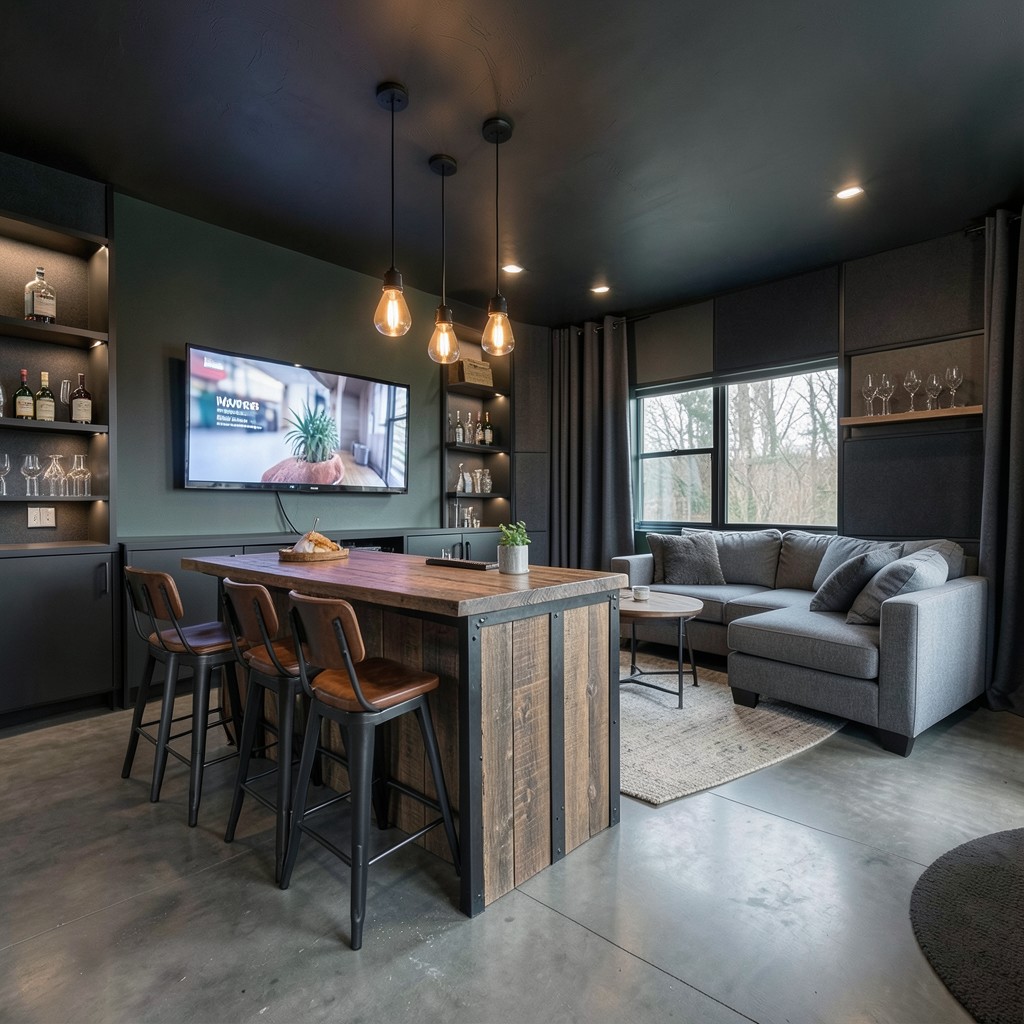
The man cave garage is the room where aesthetic restraint is genuinely not the highest value — the dark, saturated palette, the heavy furniture, the bar setup, and the entertainment technology that define the man cave aesthetic create a space of deliberate atmosphere rather than architectural refinement, and the freedom to commit fully to that atmosphere without negotiating with the rest of the house’s design direction is a significant part of the space’s appeal. The best man cave garages own their design intention completely. No apologies. No toning it down.
A dark paint palette — a deep charcoal, a near-black navy, or a forest green on the walls and ceiling — creates the enclosed, atmospheric quality that the man cave aesthetic depends on. Industrial Home Design elements applied throughout — exposed Edison bulb pendant lighting, a bar counter in a reclaimed wood or steel-and-wood format, metal stools with leather seats, and open shelving in black steel for the bar’s glassware and bottle display — create the material palette that suits the dark atmosphere without veering into the overly formal territory of a traditional home interiors bar room. The industrial aesthetic is the man cave’s most natural design direction because its honest, functional material vocabulary suits a working garage space that is being converted to a leisure purpose without the pretense of fine dining or formal entertaining.
A large-format display screen mounted at the garage’s end wall — positioned for visibility from the bar seating, the sofa arrangement, and the games area — organizes the entertainment function around a single focal point that anchors the room’s layout. Sound treatment on the garage walls — acoustic panels in a fabric covering that matches the room’s dark palette, or heavy curtains on the window wall — addresses the concrete and hard-surface echo that makes an untreated garage room uncomfortable for extended audio content. The man cave that addresses its acoustic quality before specifying the sound system achieves a listening experience that the most expensive speaker installation in an untreated room cannot match.
15. A Garage With a Scandinavian-Inspired Clean Storage System

The Scandinavian garage applies the same organizational philosophy that Scandinavian home interior design brings to the home’s living spaces — the principle that a well-organized space is a beautiful one, that every object should have a specific location that suits its use frequency and its category, and that the visual simplicity of a system where everything is in its place and nothing is surplus is both an aesthetic and a functional achievement. The Scandinavian garage does not need ornamentation. It needs precision, pale materials, and the confidence to keep the storage honest.
White-painted wall storage — a combination of white powder-coated steel shelving, white painted MDF cabinets with push-to-open doors, and white painted pegboard for hanging tools — creates the Scandinavian pale, clean backdrop that makes the garage feel like an organized room rather than a storage facility. The pale palette amplifies the garage’s overhead LED lighting, creating a bright home design quality that makes the space pleasant to work in and easy to navigate. Natural wood accents — a solid ash workbench top, a pale oak stool, a few natural wood bins on the open shelves — provide the warmth that Scandinavian design consistently places against its white backgrounds to prevent the palette from reading as sterile.
The Scandinavian organization principle applied to the garage storage means every item in the garage has an assigned home, and items without an assigned home are removed from the garage rather than stored on the nearest available surface. This discipline is harder in the garage than in any interior room because the garage is the household’s default overflow location — the place where things go when they have no better address. The Scandinavian garage requires a periodic edit, applied with the same rigor that the spring home refresh brings to the interior rooms: everything is assessed, everything either earns its place or leaves, and the system that remains is maintained with the consistency that keeps it beautiful.
16. A Garage With a Coastal-Inspired Finished Interior

A coastal-finished garage brings the relaxed, sun-washed quality of coastal home design to a space that most households treat as the home’s least designed room, and the contrast between that ambient expectation and a garage finished with genuine coastal warmth and material quality creates one of the home’s most surprising design moments. The coastal garage is not attempting to pretend it is a beach house living room. It is applying the same thoughtfulness about color, material, and atmosphere to a working space that the best beach house interiors apply to every room they contain.
Whitewashed or painted white tongue-and-groove wall paneling — the same shiplap-adjacent surface treatment that coastal home design applies to interior walls and ceilings throughout — gives the garage’s walls the material warmth of a finished room rather than the painted concrete or bare stud finish of an unaddressed working space. The white paneling’s backdrop suits the natural rope, rattan, and weathered wood accessories that coastal organization systems apply to their storage components — rope-handled storage baskets, driftwood-style hooks, and natural fiber bins on open wood shelving create the material consistency that makes the coastal aesthetic feel coherent throughout the space. Coastal outdoor living space principles applied here — the casual material quality, the salt-air-resilient finishes, and the emphasis on natural light — create a garage that feels like an extension of the home’s outdoor-indoor connection.
Overhead lighting in a warm white temperature — bulkhead fittings in a white powder-coated housing — provide the even, glare-free illumination that the white-paneled walls amplify through reflection, creating a genuinely bright and pleasant working environment. The coastal garage’s door treatment — either a white-painted standard panel door or a glass-panel garage door whose natural light admits the outdoors into the space — continues the coastal palette’s commitment to light and airiness into the garage’s primary functional opening. During summer home design season this garage reaches its peak quality, the light-filled white interior and the casual material quality resonating with the season’s outdoor orientation and the household’s connection to the water and sun.
17. A Garage With Smart Technology and Automated Features
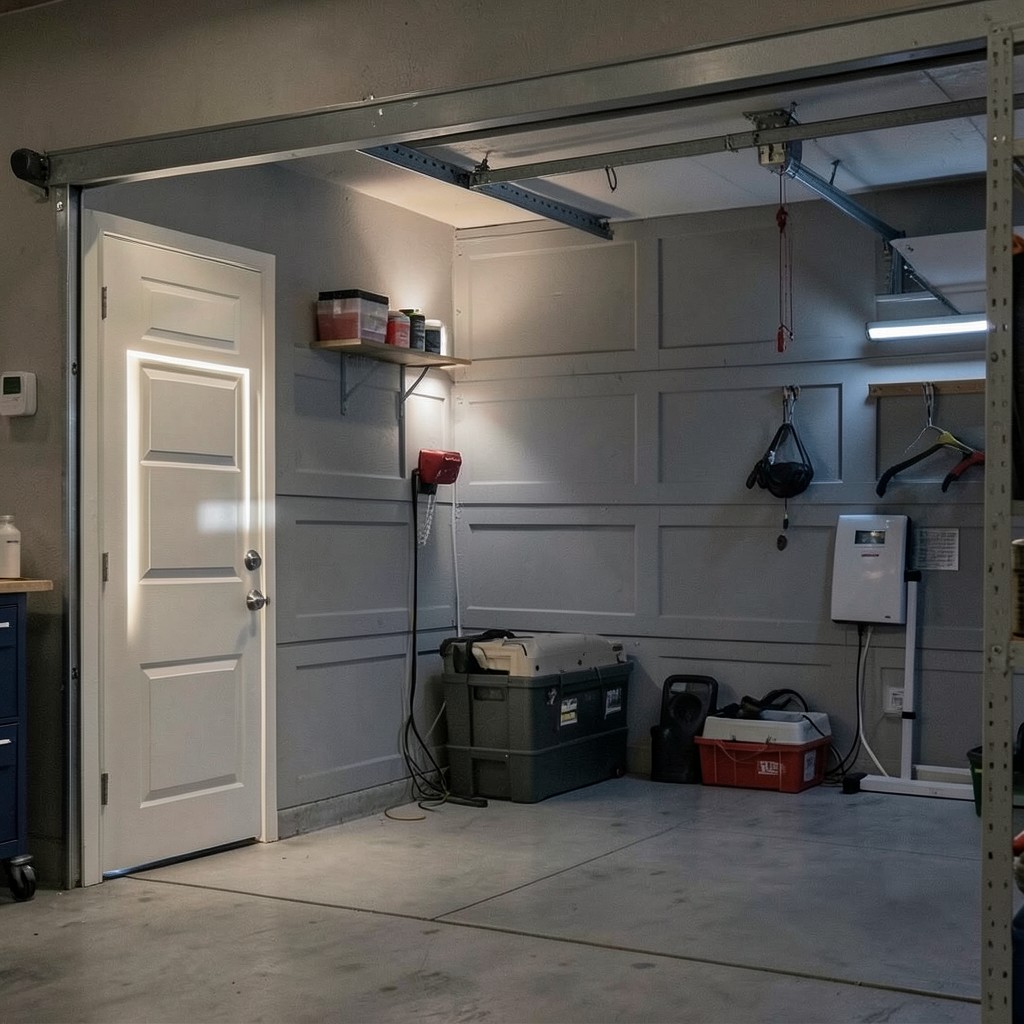
The smart garage applies residential automation technology to the working space with a practical focus rather than a novelty one — each automated feature is worth implementing because it solves a specific daily friction point more effectively than the manual alternative, and the cumulative effect of a garage that responds intelligently to the household’s patterns is a space that requires less active management and more autonomous functioning. The smart garage is not about showing off technology. It is about designing a system that works without being told to.
A smart garage door opener — connected to the home’s network, operable from a smartphone app, and capable of notifying the household when the door has been left open — solves the most common garage operational failure: the door left open accidentally when leaving or overnight. The notification function is the most practically valuable feature for most households, because the number of households that have discovered a wide-open garage door after a night or a weekend away is statistically significant and universally regretted. Integration with the home’s broader smart system allows the garage door’s status to be confirmed from the same app interface that controls the home’s lighting, thermostat, and security, reducing the app-switching friction that multi-app smart home management creates.
Smart lighting in the garage — motion-activated fixtures that illuminate the working areas when presence is detected and switch off after a set inactivity period — eliminates the light-switch habit that garages, more than any other room in the house, consistently challenges. The hands-full arrival from the car, the arms-loaded departure with equipment, and the dark entry from the internal door all benefit from the motion-activation that removes the switch-finding step from every garage entry. A connected garage thermostat or climate control system — particularly in a garage converted to a workshop, gym, or studio — maintains the working temperature automatically through seasonal changes, preventing the summer heat and winter cold that make uncontrolled garages hostile to human occupation and sensitive equipment storage.
18. A Garage With a Luxury Finished Interior and High-End

Materials
The luxury garage applies the material standards of high-end residential interior design to a space that most people concede to functionality alone, and the result consistently surprises people who have never experienced one. The luxury garage is not defined by how much money is spent. It is defined by the same qualities that define luxury in any interior room: material precision, design coherence, the absence of compromise between aesthetic and function, and the quality of the daily experience the space provides. Those qualities are achievable in a garage, and the households who achieve them there find the result more rewarding than they expected before attempting it.
Floor-to-ceiling custom cabinetry in a matched gloss or semi-gloss painted finish — coordinated with the epoxy or polished concrete floor and the overhead lighting’s reflected quality — creates the enclosed, resolved appearance of a luxury storage room rather than a garage with cabinets in it. The cabinetry’s hardware — in a brushed satin nickel, a matte black, or an aged brass depending on the palette — creates the consistency between garage storage and the home’s interior hardware quality that luxury home interior design standards demand. The cabinetry’s interior organization — drawer dividers, adjustable shelving, pull-out tool drawers, and dedicated compartments for automotive supplies — achieves the function that every garage needs while the exterior quality achieves the aesthetic that luxury deserves.
Accent lighting within the cabinetry — LED strips on the underside of each shelf that illuminate the stored contents from above — creates the display case quality in the tool and supply storage that transforms organized garage storage from a functional achievement into a visual one. The ceiling in a luxury garage receives the same attention as the floor and walls — a painted or paneled finish that responds to the overall palette, recessed LED lighting in a grid pattern that provides even illumination across the full floor area, and pendant fixtures above the workbench or vehicle position that provide directed task light at the points where focused illumination is most needed. Chic home decor principles applied here — material consistency, controlled palette, quality fixtures throughout — create a garage whose design register matches the home it belongs to.
19. A Garage With a Tropical and Bamboo-Inspired Storage System

The tropical garage applies bamboo home interiors principles to the working space with a directness and organic warmth that industrial and modern garage aesthetics cannot approach from the same material direction. Bamboo is among the strongest natural structural materials available, its hardness exceeding many conventional hardwoods, and its distinctly organic grain and warm golden tone create a storage and working environment of genuine material beauty that suits tropical home design and jungle-inspired home decor settings where the interior’s connection to the natural world is a deliberate design value rather than an incidental quality.
Strand-woven bamboo shelving units — in a natural or carbonized finish, with shelf structures thick enough to carry the garage’s storage loads without deflection — create the tropical garage’s primary storage infrastructure in a material that reads as warm and natural in the way that steel and painted MDF cannot. The bamboo’s linear grain provides the surface character that the garage’s shelving becomes the backdrop for, and the warm golden or dark caramelized tone of the carbonized bamboo suits the tropical palette’s earthen, organic warmth. Pairing bamboo shelving with natural rattan storage baskets, woven seagrass bins, and natural fiber rope hooks creates the complete tropical material palette in the garage’s organizational system.
A bamboo workbench surface — strand-woven bamboo in a thick-cut format, edge-glued to a continuous slab — provides the working platform in a material of genuine physical quality and aesthetic warmth. The bamboo surface’s hardness handles the impacts and abrasions of garage workshop use effectively, and its natural oil finish can be renewed with a single application of penetrating bamboo oil when the surface dulls from heavy use. The tropical garage’s sensory environment — the organic material quality, the warm lighting through natural fiber shades, and the few potted tropical plants placed at the garage’s natural light points — creates a working space that feels connected to the outdoor garden rather than isolated from it in a sealed concrete box.
20. A Garage With a Desert-Inspired Earthy Palette
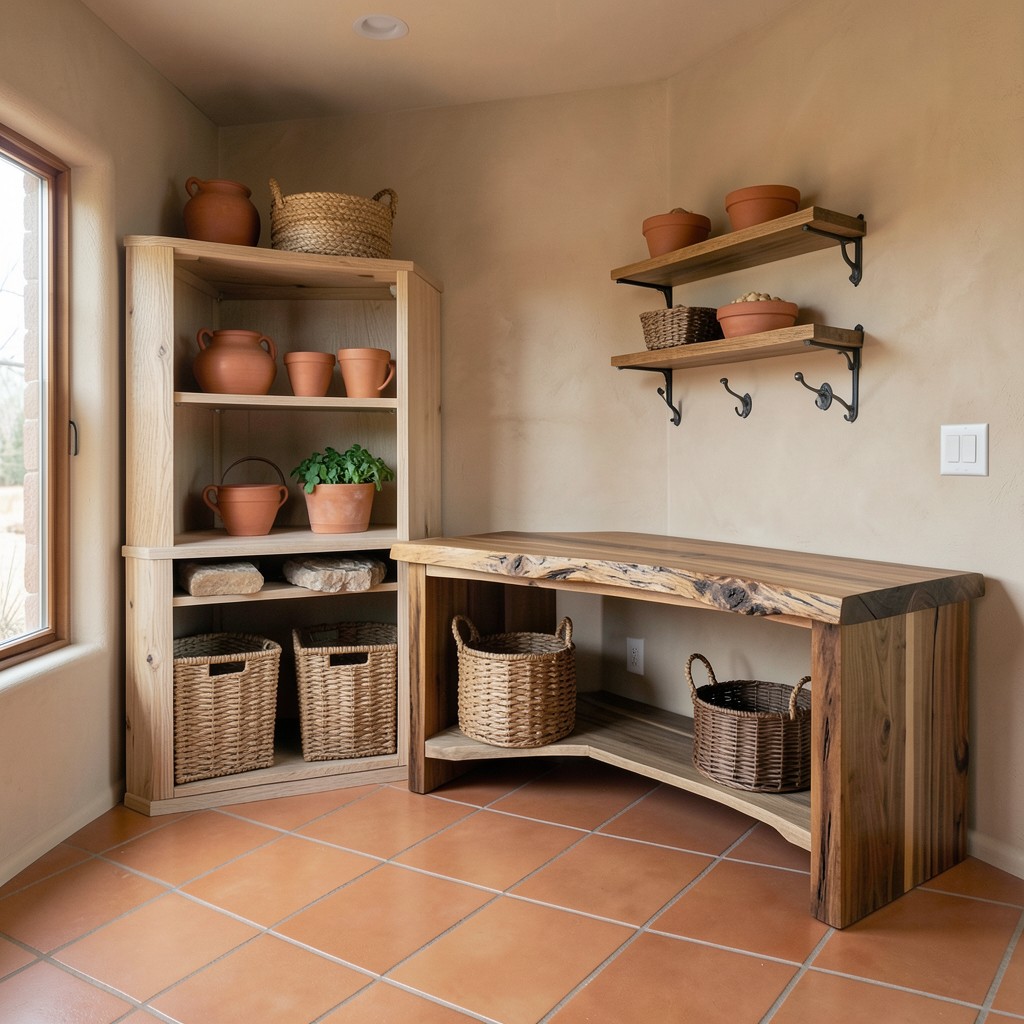
The desert-inspired garage applies earthy home design and desert home styling principles to the working space with a material warmth and tonal consistency that suits households whose interior design direction draws from the warm, sun-bleached, mineral-rich palette of desert landscapes. The desert garage is not a themed space with cacti painted on the walls. It is a space whose material choices — the warm terracotta of its floor treatment, the sandy adobe tone of its wall finish, and the natural stone and wood elements of its storage and work surfaces — create an environment of organic warmth that connects to the same design vocabulary applied throughout the home.
A terracotta-tinted concrete floor treatment — either a terracotta-toned epoxy color or a large-format terracotta tile on the garage floor — creates the warm desert ground plane that anchors the space in its palette. The terracotta tone reads naturally in a garage context because it shares the earthy warmth of the mineral materials — sandstone, adobe, fired clay — that the desert palette consistently employs, and its slightly reddish, orange-warm tone suits the warm, sandy mid-tones of the wall finishes above it. A warm sandy beige or natural plaster tone on the garage walls — in a matte finish that absorbs rather than reflects the overhead light — creates the adobe quality that stone and wood home design contexts apply to their wall surfaces in the desert vernacular.
Storage in the desert-inspired garage should continue the earthy palette through material selection — natural wood shelving in a sun-bleached or light oak tone, terracotta pottery for small supply storage, woven natural fiber baskets for equipment and accessory categories, and wrought iron hooks and brackets in a dark, slightly rough finish that suits the rustic home decor quality of the desert material palette. A workbench in a thick-cut mesquite or live-edge cedar slab creates the working surface whose organic natural edge suits the desert aesthetic’s celebration of material imperfection and natural form over manufactured precision.
21. A Garage With a Dedicated Kids’ Activity and Play Zone

A dedicated children’s activity zone in the garage gives the household’s kids a space where mess, noise, and physical exuberance are structurally anticipated and organizationally accommodated rather than constantly managed and redirected. The garage provides the one quality that no interior room consistently delivers for active children: genuine space tolerant of genuine mess. A zone within the garage designed for children’s art, building, physical play, and messy activities keeps the creative chaos in a room built to handle it while protecting the interior rooms whose surfaces are not.
The children’s zone floor surface should be the garage’s most resilient and most forgiving — interlocking rubber foam tiles in bright colors or neutrals create a surface that cushions falls, resists the paint and marker stains that children’s activities create, and can be mopped, hosed, or replaced section by section when wear or damage accumulates. Bohemian kids room decor principles applied here — bright colors, playful storage systems, wall-mounted chalkboard or whiteboard panels, and open storage that makes toys visible and accessible to the children themselves — create an activity space whose design direction celebrates the energy and creativity of the children who use it rather than imposing the organizational standards of an adult workspace.
Storage in the children’s zone should be designed specifically for children’s independent access — open bins at floor or low-shelf height for art supplies and building materials, hooks at child height for bags and aprons, and labeled containers with picture labels as well as text labels for pre-reading children. The height range of the storage — low enough that children can access and return items independently — is the design standard that distinguishes a children’s zone that supports independent use from one that requires adult assistance for every retrieval and return. The zone that a child can use alone, return items to their correct locations in, and maintain at a basic organizational level is the zone that reduces the parenting burden the space was designed to address.
22. A Garage With a Rustic Stone and Wood Feature Wall

A feature wall in a garage finished in natural stone cladding or a combination of reclaimed wood planking and rough stone creates the design anchor that elevates the garage from a functional utility room to a space with genuine architectural character. The feature wall is the single investment with the highest visual return per square foot in a garage renovation — one wall treated with a material of genuine quality and visual interest creates the design presence that makes the entire space feel considered, regardless of the other surfaces’ finish level.
Rough-cut sandstone or limestone cladding panels on the garage’s end wall — the wall visible from the house’s internal door entry or the wall facing the vehicle parking position — creates the stone and wood home design quality that suits mountain cabin decor, rustic home decor, and earthy home design garage contexts. The stone’s irregular surface and natural color variation create a visual interest that no paint color or smooth material can achieve, and its permanence and material depth communicate a quality of investment in the space that paint costs nothing but cannot convey. A reclaimed wood plank accent section alongside the stone cladding — planks in a weathered grey or a warm brown tone, applied horizontally in a pattern that responds to the stone’s vertical joints — creates the material dialogue between organic elements that stone and wood home design applies as its defining characteristic.
The feature wall’s lighting makes or breaks its visual impact — a stone wall seen under a flat, even overhead light reads as an unremarkable textured surface, while a stone wall lit with directed wash lighting from below or from side-mounted sconces reads as dramatically three-dimensional, its surface relief casting shadows that amplify the texture’s depth. A row of low-voltage LED uplights at the wall’s base — positioned to cast light upward across the stone’s face at a grazing angle — creates the most dramatic texture expression available and transforms the feature wall from a daytime design element into a nighttime atmospheric feature.
23. A Garage With Overhead Track Lighting and Proper Illumination
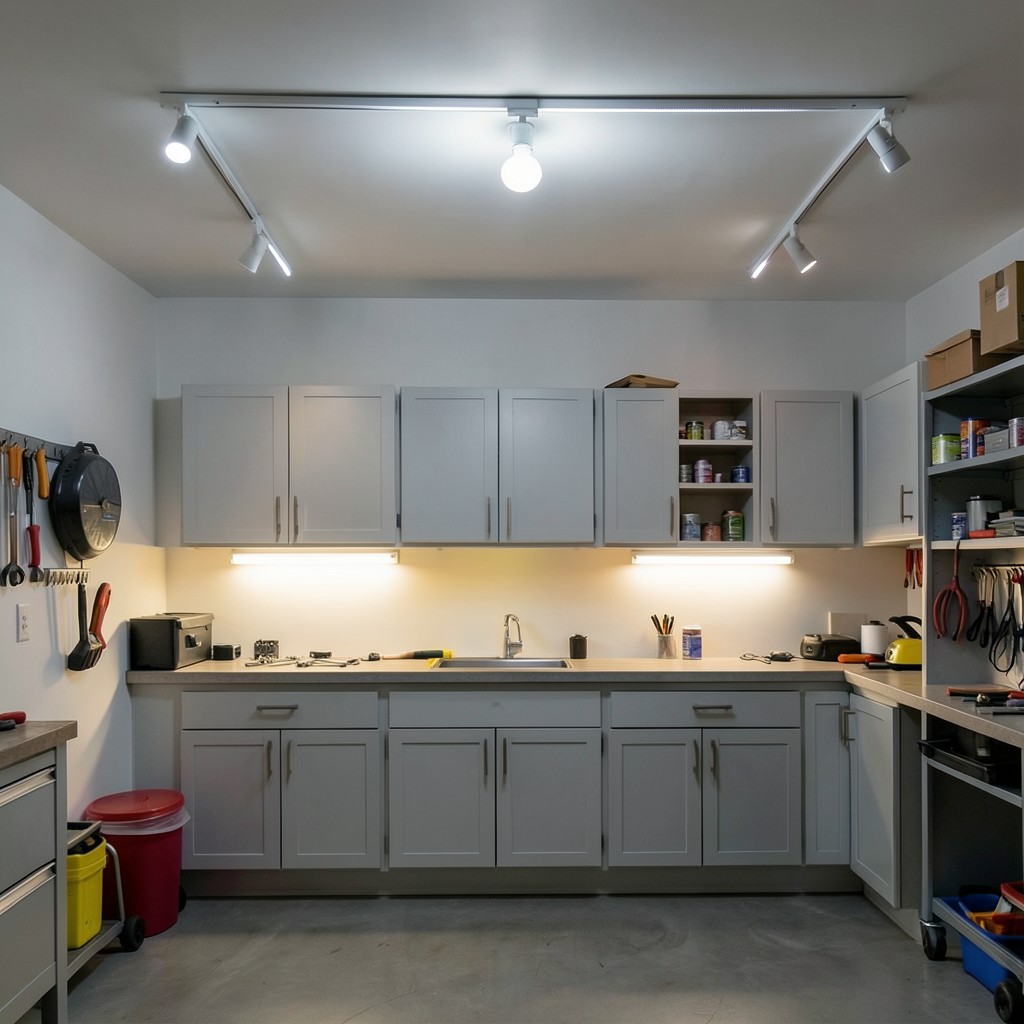
Lighting in the average garage is addressed with a single fluorescent tube or a naked bulb on the ceiling centerline, and that approach — adequate for finding the car but inadequate for working, organizing, or any activity that requires seeing clearly at close range — is the garage’s most pervasive and most correctable design failure. A properly illuminated garage has no dark corners, no shadows under the workbench, no color-temperature guessing about what shade of paint is in the can, and no eyestrain during the extended tasks that working in the garage imposes. Lighting quality in the garage is a safety issue and a comfort issue simultaneously.
Overhead track lighting on a grid of ceiling-mounted tracks — LED track heads aimed at the specific work zones below them — provides the most flexible and most targeted illumination system for the multi-function garage. The track system allows lights to be aimed at the workbench, the vehicle parking position, the storage wall, and the general circulation zone independently, creating the layered illumination that makes every activity zone visible at the level that activity requires. LED track heads in a 4000K color temperature — a neutral white that renders colors accurately without the yellow cast of warm white or the harsh blue-green of cool white — provide the color accuracy that automotive work, tool selection, and general garage tasks benefit from most directly.
Supplementary task lighting at the workbench — a fluorescent or LED strip mounted under the upper cabinet’s base and directed at the work surface — eliminates the bench shadow that overhead lighting creates when the user’s body blocks the light from above. The bench area requires approximately five times the illumination intensity of the general ambient level for precision work, and the strip’s directed, close-range light provides that intensity without requiring the entire garage to be lit at the workbench’s required level. A warm-white LED strip below the overhead cabinet adds the quality of illumination that transforms the bench from a functional but shadowed surface to a properly lit working station.
24. A Garage With a Classic Black and White Design Palette

The black and white garage is the design choice that achieves visual sophistication in a working space through the most disciplined means available — two colors, applied with precision, create a palette of graphic clarity that makes the garage read as designed without the complexity of a multi-tone scheme or the material investment of premium surface treatments. Black and white is not a safe choice in the garage. It is a confident one, and it requires the same precision of execution that any high-contrast palette demands.
White walls and ceiling with a black-toned epoxy floor creates the primary black and white division — the light above, the dark below — that makes the garage’s volume feel taller and its floor feel grounded simultaneously. Black powder-coated steel storage cabinets against the white walls create the secondary contrast layer, their dark mass providing the visual anchor that the white background requires and the horizontal grid of cabinet faces creating the organized, architectural quality that the industrial home design aesthetic brings to its storage systems. White drawer and door faces with black hardware — or black cabinet faces with white interior shelving visible when doors are open — creates the composed contrast that makes the palette feel deliberate rather than default.
A graphic geometric element on one wall — a painted black and white checkerboard pattern at the floor border, a chevron stripe across the back wall, or an oversized black automotive graphic applied as a vinyl wall decal — gives the palette a personality that pure black and white applied uniformly cannot provide. The graphic element is the one place where the palette’s discipline relaxes into expression, and getting its scale and placement right is what prevents the black and white garage from reading as a paint test rather than a designed space.
25. A Garage With a Dedicated Art and Craft Supply Storage

Art and craft supply storage in the garage requires a different organizational logic than the tool storage, automotive supply storage, and sporting equipment categories that standard garage systems address — craft supplies span an enormous range of sizes, from individual paint tubes and pencils through to large canvas stretchers and bolt fabric, and the organizational challenge is creating a system that houses every scale of supply in a format appropriate to that scale while keeping related items visually grouped and functionally accessible together.
A dedicated craft storage wall — combining open cubbies for large supply categories with drawer systems for small supplies, hanging solutions for long and flat items, and clearly labeled bin storage for the mid-size categories that neither hang nor fit neatly in standard shelving — creates the craft organization infrastructure that the bedroom or living room craft corner can never fully provide. The garage’s generous wall space allows the craft storage to occupy a full wall section without displacing other functions, and the additional workspace — a long, smooth table at standing or seated height beside the storage wall — gives the craft practice the physical environment it needs for the scale of work the garage makes possible.
Natural light on the craft wall is the organizational and practical advantage that the garage provides over interior room craft storage — a garage window above the craft table, or a skylight above the craft zone, provides the color-accurate natural illumination that craft and art practice values above any artificial lighting source. During spring home refresh season when craft projects and creative household activities typically increase, a properly organized and well-lit garage craft zone gives the creative practice the space and light that the longer days and renewed energy of the season invite.
26. A Garage With a Luxury Car Lift Installation

A car lift in a residential garage solves the space problem that two or more vehicles and a full workshop tool inventory present in the footprint of a standard two-car garage — by stacking one vehicle vertically above another, the lift doubles the garage’s effective vehicle capacity without adding a single square foot to its floor area, and the space recovered below the elevated vehicle becomes the workshop, storage, and activity space that the garage’s other functions require. The car lift is the engineering solution to the residential garage’s fundamental constraint.
The lift’s operational ceiling height requirement — the elevated vehicle’s roof plus the lift mechanism’s overhead clearance — typically demands a minimum ceiling height of eleven to twelve feet, which standard eight-foot garages cannot accommodate. A garage with a raised roof section, a high-bay construction, or a full second-story ceiling height above the parking bay is the structural prerequisite that makes the car lift viable, and this requirement should be confirmed against the garage’s actual dimensions before any lift purchase is made. The lift’s installation requires concrete anchoring bolts set into the floor slab at the column base positions, and the slab’s thickness and reinforcement must be verified by a structural engineer before the anchoring is performed — a car lift on an inadequately supported floor slab is not a design problem. It is a safety emergency.
The space recovered below the elevated vehicle during the lift’s raised position creates the workshop area that the garage previously lacked floor space to accommodate. A rolling tool chest positioned in the cleared space, a portable work table that stores flat against the wall when the lift is lowered, and overhead lighting aimed at the elevated vehicle’s undercarriage create the functional workshop infrastructure that turns the lift’s space recovery into a productive working environment. Luxury home interior garages apply the car lift not merely for its space recovery but for the premium working experience it enables — the ability to stand upright beneath a raised vehicle on a level, well-lit surface is the automotive maintenance experience that makes the home garage superior to any commercial bay for the owner who knows their vehicle and prefers to work on it personally.
27. A Garage With a Dedicated Bicycle Workshop

A bicycle workshop integrated into the garage takes the cycling household’s equipment and maintenance needs seriously enough to give them a designated, equipped space rather than the ad hoc arrangement of a bike leaned against the wall and a tool kit on the nearest available shelf. Serious cyclists — and the household with two or three active riders constitutes a serious cycling household regardless of the individual’s racing ambitions — benefit from a dedicated service stand, an organized component storage system, and a clean surface for the precise adjustments that bicycle maintenance requires. The bicycle workshop treats the bike as the precision equipment it is.
A professional bicycle repair stand — a floor-standing or wall-mounted clamp system that holds the bike at working height by the frame or the seatpost, rotating it to any angle for access — is the workshop’s most important tool, because the quality of every mechanical adjustment performed on a bike depends on the stability and accessibility that a proper stand provides. Trying to true a wheel or adjust a derailleur on a bike propped against a wall, or upturned on its handlebars and saddle, produces results proportional to the platform’s instability. The repair stand is the foundation upon which every other workshop tool’s effectiveness depends.
Wall-mounted parts storage for tubes, tires, cables, housings, lubricants, and the small mechanical components that cycling maintenance requires — organized in clearly labeled bins on a French cleat or pegboard system — keeps every consumable and replacement part in a specific, findable location. A bike-specific tool roll or a dedicated hook system for cycling tools — torque wrenches, cone spanners, cable cutters, and the specific sizing tools that bicycle mechanics use — keeps the specialist tool set together and accessible without mixing it into the general garage tool inventory where bicycle-specific items become unfindable. The dedicated bike workshop is the cycling household’s most quality-of-life-improving garage addition, full stop.
28. A Garage With a Rolling Tool Chest System

The rolling tool chest is the garage workshop’s organizational spine — a mobile storage system that follows the work rather than requiring the work to approach a fixed location, and whose drawer and cabinet organization can hold an entire serious tool inventory in a format that makes every tool findable, protected from damage, and returned to its correct location with minimal effort. A quality rolling chest is an investment that outlasts every other tool in the garage, and the difference between a quality chest and a budget one is felt every single time a drawer is opened across decades of use.
A two-unit rolling chest system — a lower roller cabinet on locking casters with eight to twelve drawers of varied depths, and an upper tool box that sits on top with six to eight shallower drawers for smaller tools — creates the organizational capacity for a full professional-grade hand tool inventory in a single mobile unit. The drawer’s internal organization — foam inserts cut to the profile of each tool’s specific shape, creating a fitted location for every item — provides the shadow-board accountability function at the drawer level: an empty foam cutout at a specific location is the immediate visual indicator that the tool belonging there has been removed and needs to be returned. This accountability function is what keeps a large tool inventory organized across the daily use of multiple family members who may use the same tools for different tasks.
The rolling chest’s mobility — the ability to position it at the specific location where the current job is being performed, then return it to its storage position when the job is complete — is the workshop organization quality that a fixed cabinet system cannot provide. A rolling chest that moves to the car during oil change day, to the workbench during fabrication work, and to the electrical panel during home maintenance tasks is three specialized mobile workshops in a single unit. The chest’s lockable drawers protect the tool investment from the casual borrowing that erodes organized tool inventories over time, and the locks are not a statement of distrust — they are a maintenance of the organizational system whose integrity depends on every tool being in its assigned drawer when the chest is accessed.
29. A Garage With a Green Wall or Vertical Garden Feature

A living wall or vertical garden feature in the garage creates the organic, biophilic design element that connects the working space to the natural world in a way that no painting, no poster, and no printed graphic can approach in the same sensory and atmospheric register. The green wall introduces living material into the garage environment — moisture, oxygen exchange, the subtle movement of leaf response to air currents, and the organic visual complexity of living plants — creating the garden-inspired interiors quality in a space where most people would never think to place a plant, let alone a full living wall installation.
A modular felt pocket wall panel system — felt panels mounted to a waterproof backing sheet on the garage wall, each pocket planted with a hardy, low-maintenance plant species — creates the green wall in a format that installs over a weekend and requires no specialist horticultural knowledge to maintain. Hardy species that suit the garage environment’s variable light and temperature conditions include pothos, spider plants, and selected ferns, all of which tolerate the lower light levels and the temperature fluctuations that non-climate-controlled garages experience. A drip irrigation system integrated into the panel backing — a thin tube that runs behind the panels and drips water to each pocket at a programmable interval — eliminates the daily watering maintenance that a manually irrigated wall requires.
The green wall’s position in the garage should be at the wall most visible from the primary working and circulation position — the end wall opposite the garage door, the side wall beside the workbench, or the wall facing the internal house entry. The wall’s scale should be proportional to the garage’s volume — a green wall that covers four to six square feet on one wall of a large three-car garage reads as a small detail, while the same installation on a single-car garage end wall reads as a significant design feature. Jungle-inspired home decor and garden-inspired interiors design directions applied to the garage find their most direct expression in the living wall, whose organic material quality and growing presence suit those aesthetics at a fundamental level.
30. A Garage With a Mudroom Entry Connection

The garage-to-house transition point — the door and the immediate zone on either side of it — is the household’s most actively used threshold, traversed more frequently than the front door in most households where the garage is the primary entry and exit point. A mudroom connection integrated at this threshold organizes the daily coming-and-going function — the shoes removed on arriving, the bags set down, the coats hung, the keys placed — in a dedicated space that captures the transition activity without allowing it to migrate into the living areas beyond. The mudroom at the garage entry is the organizational interception point that prevents the garage’s tracked-in material from reaching the interior rooms.
A built-in mudroom storage system beside the internal garage door — a bench for sitting while removing shoes, hooks at coat height for outerwear, cubbies above for bag storage, and a shoe shelf or under-bench shoe drawer at floor level — creates the complete entry organization in a space as narrow as twenty-four inches of depth. The bench surface’s material should withstand daily sitting with outdoor clothing, resist moisture from wet outerwear, and clean easily — a painted wood bench in a semi-gloss finish, a tile-topped bench, or a solid wood bench with a sealed finish all provide the durability the position requires. Farmhouse home decor mudroom applications apply shiplap paneling behind the hook and cubby section, painted hooks in a warm black finish, and a natural fiber runner on the garage floor in front of the bench, creating the aesthetic continuity between the garage entry and the farmhouse interior beyond it.
The garage-side mudroom connection also requires a floor surface that bridges the garage floor’s material and the house’s interior floor cleanly — an epoxy garage floor meeting an interior tile or hardwood directly at the threshold creates a material joint that reads as designed if the threshold detail is precise and reads as neglected if it is not. A tile landing at the garage door’s threshold — matching the interior entry tile rather than the garage floor material — creates the visual and physical bridging material that transitions from the garage’s utilitarian surface to the home’s interior finish with a clarity of material intention that the two-material junction deserves.
31. A Garage With Reclaimed Wood Wall Paneling

Reclaimed wood wall paneling in a garage creates the warmth, history, and material depth that new materials cannot provide — the weathered grain, the nail holes, the color variation, and the occasional checking crack of reclaimed timber tell the story of the material’s previous life while creating a surface of organic beauty that no new wood replicates at any price. The reclaimed wood garage wall is the design investment that improves with age, developing a deeper, richer presence over years of exposure to the garage’s light and temperature cycles rather than degrading as painted or coated surfaces gradually do.
Reclaimed barn wood in wide planks — four to eight inches wide, applied horizontally at random lengths to create the varied end-joint pattern that accentuates the material’s aged character — creates the farmhouse home decor and rustic home decor garage wall of maximum warmth and material authenticity. The wood’s grey-silver weathered surface, its faded red barn paint remnants, and the dark iron nail stains that bleed through from the original fasteners create a surface of complex, organic visual character that suits the warm home decor ideas garage setting where the material’s history and age are design assets rather than imperfections to be covered. A reclaimed wood feature wall on the garage’s end wall, flanked by white-painted walls on the sides, creates the visual focal point whose material presence anchors the entire garage’s design direction.
The reclaimed wood’s installation requires addressing the moisture content difference between the old wood’s outdoor exposure and the garage’s interior humidity — extremely dry reclaimed wood can expand and crack when introduced to a more humid interior environment, and extremely wet wood can shrink and open joints. Allowing the wood to acclimate in the garage space for at least two weeks before installation, and applying a penetrating oil or a natural wax finish to the installed surface, stabilizes the moisture content and the wood’s subsequent movement while preserving the weathered character that makes the material valuable. The installation’s fastening should account for the wood’s future seasonal movement — face nailing at the board ends and face-nailing or blind-nailing through the board’s face in floating sections allows the boards to expand and contract without the buckling that fixed fastening at close intervals creates.
32. A Garage With a Dedicated Outdoor Gear Storage System

Outdoor gear — the camping equipment, the hiking pack collection, the water sports accessories, the climbing hardware, and the overlanding supplies that active outdoor households accumulate over years of adventure — presents the garage’s most variable and most bulky storage challenge. The items range from a small carabiner to a full-size kayak, and each category’s storage needs are entirely specific to its size, its fragility, and its use frequency. A general storage system handles none of these categories well. A gear-specific system handles all of them correctly.
Ceiling-mounted kayak and canoe hoists — similar in mechanism to bicycle ceiling hoists but sized for the heavier and longer boat geometry — store watercraft above the vehicle parking area during their off-season storage period, recovering the floor space their length would otherwise consume permanently. A paddleboard wall rack — vertical slots on a padded wall bracket — stores stand-up paddleboards vertically against the wall in a format that takes eight inches of wall depth and no floor space. These two solutions together store the water sports equipment that would otherwise occupy the majority of the garage floor during the months it is not in active use — a direct connection to the coastal outdoor living space that the equipment serves.
Camping gear organization — a dedicated wall section with hooks for hanging bags and equipment, labeled bins for cookware and consumables, and a flat shelf for sleeping bags and pads stored in their compressed sacks — creates the camping kit’s organized pre-trip staging area. The best camping gear organization systems are designed around the household’s specific camping setup rather than a generic outdoor gear inventory, which means auditing what the household actually owns and uses before specifying the storage solution. The organizational system built around the real gear performs better than one designed around hypothetical gear, and the audit that precedes the design is the step that most households skip and then regret within one disorganized pre-departure morning.
33. A Garage With a Cozy Reading and Relaxation Nook

A reading nook in the garage is the design idea that raises the most eyebrows and, when executed well, creates the most unexpectedly pleasant space in the house. The garage’s separation from the household’s social zones — its door, its distance from the kitchen and the living room’s ambient sound and activity — creates a quiet that interior rooms rarely achieve, and that quiet, combined with a comfortable chair, a good reading light, and a small side table, is sufficient infrastructure for the most productive reading and thinking environment many households have ever occupied.
A window cut into the garage’s side or rear wall — a standard casement window in a position that captures the garden view or the light from the preferred direction — provides the natural light and ventilation that converts a corner of the garage from an environmental afterthought to a genuinely pleasant sitting position. A pair of built-in bookcases flanking the window — in the same painted finish as the garage’s wall storage if the garage is designed as a complete space, or in a warm wood finish if the nook is a distinct zone within a working garage — creates the library quality that suits cozy home design and peaceful home decor principles applied to the garage’s most intimate corner.
The reading nook’s seating — a deep armchair in a fabric that suits the garage’s design direction, flanked by a floor lamp on one side and a small side table on the other — creates the relaxation infrastructure in a zone that costs little in floor space and returns disproportionately in daily quality of life for the household member who needs a place to think away from the household’s activity. A small electric panel heater near the reading position extends the nook’s usability through winter interior design season without requiring the entire garage to be heated, focusing the thermal comfort precisely where it is needed and creating the cozy bedroom design-level warmth in a working garage context.
34. A Garage With a Classic Vintage Aesthetic

The vintage garage applies the design vocabulary of mid-century automotive culture — the enamel signage, the wire wheel display, the period-appropriate tool storage, and the warm incandescent lighting of the service bay — to a residential space with the same affectionate attention to period detail that vintage interior design brings to any other room. The vintage garage is a room that tells a story, and the story it tells is specific: there was a time when garages were places of genuine craft, when the tools were kept with pride, and when the space reflected the personality of the person who worked in it. The vintage garage is that time, made habitable again.
Period enamel advertising signs — in automotive brands, motor oil companies, and service station graphics from the golden era of American driving culture — mounted on the garage walls create the visual narrative of the vintage aesthetic without requiring antique furniture or museum-quality acquisition. Reproduction signs in high-quality print on steel create the period atmosphere at a fraction of the cost of original period pieces, and the garage context — where the signs are seen at close range in variable light rather than under gallery conditions — makes the reproduction’s quality perfectly sufficient. Warm home decor ideas applied here — the amber glow of Edison-style bulb fixtures, the dark wainscoting of an oil-stained wood lower wall section, and the period-chrome of vintage tool displays — create the vintage garage atmosphere that suits mountain cabin decor and rustic home decor design contexts.
A restored vintage workbench — its surface worn to the smooth, dark patina of decades of use and carefully cleaned rather than refinished — is the vintage garage’s organizational and aesthetic centerpiece. The bench’s age communicates the same thing that antique furniture communicates in any interior room: that this space respects its history and that the tools and work it contains are part of a continuing practice rather than a new installation. The vintage aesthetic applied to a garage that is still functionally used — still housing a car, still serving as a workshop, still holding the household’s tools in working order — is the most convincing version of the style, because the functional use gives the period details their context and their meaning.
35. A Garage With a Tropical Outdoor-Indoor Connection

The tropical garage design connects the working space to the outdoor garden and tropical landscape through the same material vocabulary and spatial openness that tropical home design applies to the indoor-outdoor relationships throughout the home. In a tropical or subtropical climate, the garage’s large door opening is an invitation to design the transition between the covered garage space and the outdoor driveway or garden as a genuine indoor-outdoor zone — a space whose boundary is blurred by the design’s material continuity, its plant integration, and its spatial generosity.
A full-width glass and aluminum bifold or sliding door system replacing the standard garage door creates the indoor-outdoor connection that the tropical garage design requires — the door system opens fully to merge the garage space with the outdoor area beyond, creating a covered outdoor room whose depth and shade suit the tropical climate’s outdoor living needs. When open, the garage becomes a covered pavilion; when closed, it returns to a secure, climate-controlled interior. This operational flexibility is the tropical garage’s primary functional advantage, and it creates the type of spatial generosity that beach house interiors and coastal home design apply to every room with an exterior relationship.
Bamboo home interiors elements within the garage — the same bamboo cabinetry, natural fiber storage, and organic material quality applied in the tropical interior rooms — extend the home’s material palette into the garage without the material discontinuity that marks most garages as separate from the home’s design. Tropical planting at the garage’s outdoor edge — large-leaved banana plants, tropical palms, and the dense green wall of jungle-inspired home decor planting framing the garage opening — creates the organic surround that makes the tropical outdoor connection feel natural rather than architectural.
36. A Garage With an Organized Chemical and Hazardous Material Storage

Hazardous material storage in a garage is the organizational category with the greatest safety implications and the most consistently neglected design attention. Automotive fluids, paints, solvents, pesticides, and fertilizers share the average garage’s general shelving in a proximity that violates basic chemical compatibility principles, creates vapor accumulation risks in a confined space, and presents a serious hazard to children and pets who can access the garage. Getting the hazardous material storage right is not a design preference — it is a safety requirement, and the design of the storage system determines whether the garage is safe or silently dangerous.
A dedicated locked steel cabinet rated for flammable material storage — a fire-resistant cabinet with a self-closing door, a sill lip that contains spilled liquids within the cabinet, and a construction that limits the interior temperature rise during an external fire — stores all solvents, fuels, and flammable automotive products in a container specifically designed for their hazard class. The fire-rated cabinet’s position in the garage should be away from the primary heat sources — the water heater, the furnace flue, and the hot surfaces of parked vehicles — and away from the electrical panel where a spark hazard could initiate combustion of flammable vapors. This is the one organizational decision in the garage whose installation position is determined by safety engineering rather than by convenience or design preference.
Pesticides, herbicides, and fertilizers require a separate storage location from the flammable materials — not because they pose a lower hazard but because their chemical incompatibility with petroleum-based solvents creates a combined storage risk worse than either category alone. A locked upper cabinet above the reach of children, clearly labeled, and containing only the garden chemical category creates the specific storage that keeps incompatible materials separated and the entire hazardous inventory organized, accountable, and safely inaccessible to unauthorized users.
37. A Garage With a Bright White Scandinavian Workshop

The white Scandinavian workshop applies the Scandinavian home interior design philosophy to the garage workshop with the same conviction it brings to the living room or the kitchen — the belief that a well-organized, well-lit, pale-toned space is more pleasant to work in, more conducive to clear thinking, and more respectful of the craft being performed than a dark, cluttered, tool-dense environment that most garages accept as the default workshop condition. The Scandinavian workshop is the antithesis of the dark cave workshop, and its cleaner, lighter working environment produces better work from the people who use it.
White painted walls and ceiling — in a flat white that absorbs and diffuses the LED lighting rather than reflecting it with glare — create the workshop’s bright, even illumination quality that suits precise work and extended working periods. White powder-coated tool storage — a combination of pegboard in white powder-coated steel and white-painted MDF shelving — maintains the pale palette across the organizational system rather than introducing the dark industrial tones that conventional tool storage applies. The workshop’s tools, organized against the white background, become the visual content of the space — the hammer, the saw, and the hand plane displayed against white pegboard are as visually precise as objects in a gallery, and the visual precision of their display is both an aesthetic quality and a functional one.
A natural wood workbench surface in an ash or white-oiled oak finish provides the one warm material counterpoint in the pale palette — the bench’s wood warmth connecting the Scandinavian workshop to the organic material quality that the design direction values above synthetic alternatives. The bench’s surface should be maintained at the standard that the pale, precise environment around it suggests — a clean, oil-finished hardwood surface kept free of permanent staining and refinished periodically as the working surface accumulates the evidence of use that any honest workshop surface collects over time.
38. A Garage With a High-Tech Security and Surveillance System

Garage security is the most underaddressed vulnerability in the residential security picture — the garage door is a large, mechanically complex opening that provides direct access to the home’s interior through the connecting door, holds the home’s vehicles and a significant value of tools and equipment, and is typically secured by a single mechanism whose backup security in the event of failure or forced entry is minimal. A properly designed security system addresses the garage’s specific vulnerability pattern rather than treating it as an afterthought to the home’s primary alarm system.
A smart garage door opener with rolling code technology — a new access code generated for every door cycle, preventing the code-capture attacks that older fixed-code openers are vulnerable to — is the first security upgrade for any garage whose opener is more than ten years old. Pairing the opener with a dedicated door sensor — a magnetic contact sensor that reports the door’s open or closed status to the home’s security panel — adds the monitoring function that the opener’s built-in mechanism does not provide, allowing the security system to alert the household when the door is opened unexpectedly outside of normal household patterns. The combination of rolling code technology and active door monitoring addresses the garage door’s two most common security vulnerabilities simultaneously.
Interior surveillance cameras covering the garage’s main vehicle parking area, the storage and tool sections, and the internal door connecting to the house create the documentation record that insurance claims require and that deters the opportunistic theft that unlocked or briefly unattended garages invite. The camera system’s connection to the home’s smart security platform allows the garage’s video feed to be monitored alongside the home’s interior cameras and perimeter sensors, creating the integrated security picture that separate, unconnected systems cannot provide.
39. A Garage With a Mountain Cabin-Inspired Interior

The mountain cabin garage applies the material warmth and organic richness of mountain cabin decor to the working space — the rough-hewn timber elements, the dark stained wood, the warm amber lighting, and the honest, heavy material quality of a working mountain structure create a garage environment of remarkable atmospheric character that suits the households whose property, climate, or design sensibility connects to the alpine and forested environments of mountain residential design.
Heavy timber posts or decorative timber framing elements — not necessarily structural, but applied as surface feature elements on the garage walls and ceiling — create the mountain cabin construction character that flat drywalled surfaces cannot approximate. Stained dark walnut or rich mahogany, the timber elements provide the mass and warmth that the mountain cabin aesthetic depends on to achieve its characteristic sense of shelter and enclosure. Stone and wood home design elements applied to the garage — a rough stone feature wall at the end of the space, heavy timber shelving brackets, and reclaimed oak plank shelving — create the material combination that mountain cabin interiors use consistently to achieve their warm, protected quality.
Warm, amber-toned lighting throughout — pendant lamps with amber-tinted glass or Edison-style exposed filament bulbs in dark-metal housings — creates the evening atmosphere that mountain cabin interiors achieve at their most atmospheric, the warm light source creating the same quality of illumination that a fireplace provides in a mountain lodge interior. A small cast iron wood-burning or pellet stove in the garage corner — providing both supplemental heat during winter home decor season and the aesthetic focal point that the mountain cabin aesthetic requires — creates the warmth and the design centerpiece that completes the mountain cabin garage’s atmospheric design program. The stove’s installation requires proper flue venting through the garage roof and clearance specifications from combustible materials, but its functional contribution to both the heating and the aesthetic of the space justifies the installation’s technical requirements.
40. A Garage With a Dedicated Beer Brewing or Wine-Making Station

A homebrewing or winemaking station in the garage gives the fermentation hobby the dedicated, equipped space that separates a casual interest from a serious practice — the temperature-stable environment that the garage’s insulated walls and climate control provide, the floor drain access that most garages offer, the generous floor space for fermentation vessels, and the accessible utility connections for water and waste create a brewing environment whose practicality exceeds any interior room the house can offer. The garage brewing station is the domestic fermentation setup done properly.
A dedicated brewing area organized around a stainless steel work surface at kettle-height — thirty-four to thirty-six inches, matching kitchen counter height for the same ergonomic reasons that brew days involve the same arm and back muscles as cooking — with a propane burner setup for all-grain brewing or an electric heating element for apartment-style brewing, creates the active brewing station where the process happens. A brew-day water connection — either a permanent plumbing extension from the house’s cold supply or a dedicated garden hose connection — provides the water access that the frequent vessel filling and rinsing that brewing requires. The stainless steel work surface cleans easily between sessions and resists the wort staining and hop residue that brewing deposits with each use.
A temperature-controlled fermentation chamber — either a converted chest freezer with a temperature controller maintaining the fermentation temperature appropriate to the yeast strain in use, or a dedicated fermentation refrigerator — handles the most temperature-sensitive phase of the brewing process in a garage environment where ambient temperature fluctuates seasonally. During summer home design season, uncontrolled garage fermentation temperatures can push yeast into stress range and produce off-flavors that the temperature controller eliminates. The fermentation chamber’s consistency is the brewing station’s most important quality control investment, and its contribution to the finished beer’s quality is immediate and measurable in the first batch brewed with controlled fermentation versus without it.
41. A Garage With a Dedicated Laundry and Utility Area

A laundry area in the garage — housing the washer, dryer, utility sink, and laundry supply storage in the garage’s service zone rather than in an interior room — recovers valuable interior floor space while putting the laundry function in the room best suited to handle its noise, moisture, and plumbing requirements. The garage’s concrete floor tolerates the washing machine’s vibration, water spills, and the drainage requirements of a laundry room without the structural protection and floor finishes that an interior laundry location requires to function safely and cleanly.
A purpose-built laundry alcove within the garage — defined by a partial wall or a cabinetry run that separates the laundry area from the vehicle parking and storage zones — creates the laundry’s dedicated space within the garage’s larger volume without sacrificing the garage’s primary functions. The alcove’s dimensions should accommodate the washer and dryer side by side at their full widths with service access clearances at the back, plus a minimum twenty-four-inch laundry sorting and folding surface either beside the machines or above them on a wall-mounted fold-down shelf. A wall-mounted drying rack that pulls out from the wall surface above the machines provides the air-drying capacity that items not suited to machine drying require without occupying any floor space in the closed position.
The laundry alcove’s utility requirements — a 240-volt circuit for the electric dryer, cold and hot water supply lines, and a floor drain or standpipe drain connection — must be extended from the house’s existing services, which in most garages shares the same wall as the house’s laundry room or utility room and makes the service extension relatively direct. A gas dryer requires a gas supply line extension from the main gas line rather than an electrical circuit, and both options are standard residential utility work that a licensed contractor performs as a straightforward installation. The garage laundry area in a Scandinavian hallway design-influenced interior connection creates the same clean, functional transition zone between outdoors and interior living that Scandinavian domestic design has always prioritized at the home’s entry and utility threshold.
42. A Garage With a Colorful Accent Wall and Statement Decor

A bold accent wall in the garage — a single wall painted in a saturated, confident color that the rest of the garage’s neutral palette sets off — creates the garage’s personality without the commitment of a full color scheme that might tire after a season or conflict with the next vehicle’s color when the car changes. The accent wall is the design decision that costs one weekend’s work and a gallon of paint, and its impact on the garage’s atmosphere relative to its investment is among the highest ratios in all of residential design. One bold wall. Full personality. Completely reversible.
A deep terracotta on the garage’s end wall suits earthy home design and desert home styling garage directions, its warm mineral tone complementing the natural wood and iron of the storage system in front of it. A deep forest green suits farmhouse home decor and garden-inspired interiors garages, its natural reference connecting the working space to the outdoor environment beyond the garage door. A dark charcoal or near-black suits industrial home design and modern home design garages where the dark accent wall creates the graphic backdrop for organized tool displays and precision storage systems. The color choice communicates the garage’s design direction at full volume from the first moment of entry, and the choice should be made with the same conviction applied to the accent wall choice in any other room.
Statement decor on the accent wall — framed automotive photography in a grid arrangement, a large-format vintage map of a meaningful location, a commissioned mural in the home’s preferred style, or a curated collection of objects mounted directly to the colored surface — gives the accent wall its content beyond its color. The wall treatment that simply changes color has an impact; the wall treatment that pairs the color with carefully chosen objects creates a genuine design moment. The garage whose accent wall displays the things its owner cares about — the print of the first car owned, the team logo, the coastal chart of the family’s sailing ground — is a garage that feels personal, and that personal quality is what separates a designed space from a merely renovated one.
43. A Garage With a Professional-Grade Ventilation System

Ventilation in a garage is the environmental quality variable that most garage design projects address with the minimum acceptable solution — a wall-mounted exhaust fan at the code-minimum capacity — while living with the consequence of that minimum: carbon monoxide accumulation from running vehicles, solvent vapors from paint and adhesive work, combustion products from welding and grinding, and the general stale air quality of a sealed space with regular human occupation and equipment use. Proper ventilation is not optional in a working garage. It is the environmental health foundation that every other garage use depends on.
A whole-garage ventilation system sized for the garage’s volume — calculated at a minimum of six to eight air changes per hour for a working garage with vehicle use — requires a powered exhaust fan of sufficient capacity and a balanced passive or powered supply air source to prevent the negative pressure that an exhaust-only system creates. Negative pressure in an exhaust-only garage draws outside air through every gap in the garage envelope — the door seals, the wall penetrations, the overhead door weatherstripping — in an uncontrolled infiltration that the ventilation system’s engineers do not account for. A balanced system — exhaust and supply air in approximately equal volumes — maintains the garage at neutral or slight positive pressure relative to the outdoors, which both improves the air quality management and prevents the carbon monoxide backdrafting that negative pressure can create around attached combustion appliances.
A carbon monoxide detector and a combustible gas detector hardwired to the garage’s electrical system and connected to the home’s alarm panel create the monitoring layer that protects the household from the invisible hazards that improperly ventilated garages accumulate. These detectors are among the lowest-cost and highest-consequence safety installations in any garage that houses vehicles, combustion equipment, or chemical storage, and their installation is the one design decision in this list that is non-negotiable regardless of the budget, the aesthetic direction, or the garage’s primary use.
44. A Garage With a Tiled Feature Floor Section

A tiled section in the garage floor — applied to the entry threshold, the workshop area, or the zone beneath the vehicle parking position — creates a material differentiation within the garage’s floor surface that performs both a functional and an aesthetic role. The tile distinguishes functional zones visually, provides a more comfortable and more easily cleaned surface in the zones where human activity is concentrated, and introduces the material quality of a finished room into the garage’s floor surface without requiring the entire floor to be retiled.
Large-format porcelain tile in a slate-grey or warm charcoal tone — calibrated for exterior or wet area use with a textured surface that prevents slipping when the tile is wet from car washing or weather ingress — creates the workshop and entry zone floor in a material that handles daily foot traffic, chemical exposure, and moisture without the surface degradation that standard interior tile would exhibit in the same conditions. The large format tile’s minimal grout joint reduces the area of the more maintenance-intensive grout relative to smaller tile formats, and the calibrated porcelain’s tight tolerances allow the large tiles to be laid flat without the lippage that uncalibrated stone or inferior tile creates.
A border tile separating the tiled zone from the surrounding epoxy or sealed concrete floor defines the tiled section as a designed element rather than an incomplete floor treatment. The border’s material — a contrasting tile color, a metal strip, or a inset mosaic band — creates the visual frame that communicates intentionality at the boundary between the two floor materials. Chic home decor floor detailing applied at this transition — a metal transition strip in the same finish as the garage’s hardware palette, or a small mosaic border in the tiled zone’s complementary accent color — elevates the floor treatment from a functional zone delineation to a composed design detail.
45. A Garage With a Full Home Theater and Entertainment Setup

A home theater in the garage gives the cinematic experience the acoustic space, the screen scale, and the seated distance that interior rooms cannot consistently provide without significant structural modification. A standard garage offers a wall height sufficient for a ceiling-recessed projector, a throw distance of twelve to eighteen feet for a large-screen projection, and the separation from the home’s other rooms that makes operating a high-volume sound system without household impact genuinely possible. The garage theater is not a compromise on the home theater experience. In the right garage, it is the superior option.
Acoustic treatment is the home theater’s non-negotiable first requirement, and the untreated garage’s concrete, drywall, and glass surfaces create an echo chamber of extraordinary unhelpfulness for dialogue clarity and bass definition. Acoustic panels mounted on the walls at the first and second reflection points — the side walls at the distance equal to the seat-to-screen distance, the rear wall behind the seating, and the ceiling at the midpoint of the listening position — absorb the reflected energy that creates the echo and the frequency peaks that make cinema audio muddy. Heavy curtains at the garage door wall — floor-to-ceiling fabric panels in a dense velvet or blackout fabric — absorb low-frequency energy at the room’s largest surface while providing the light control that projection requires.
Seating in the garage theater — a three or four-seat home theater recliner section on a raised platform behind a front row, creating the tiered sightlines that commercial cinema applies — organizes the viewing positions for clear screen visibility from every seat. The platform’s height — typically eight to twelve inches above the main floor — requires a step at each seat position and a low-voltage LED lighting strip along the platform’s front edge that provides safe-level illumination in the darkened room without spilling light onto the screen. During fall home decorating season and winter interior design season when outdoor activity reduces and indoor entertainment increases, the garage theater is the household’s most appreciated room and its most frequently occupied non-bedroom space on weekend evenings.
46. A Garage With a Sand and Concrete Desert-Modern Design

The desert-modern garage combines the raw material honesty of concrete with the warm, sandy tones of desert home styling in a design direction that suits the high-desert and arid-climate residential settings where architectural concrete and warm earth tones are the dominant material vocabulary of both interior and exterior residential design. The desert-modern garage is not trying to be warm in the conventional residential sense. It is embracing the cool materiality of concrete and the warm materiality of desert earth as complementary rather than opposed.
Burnished concrete walls — the existing concrete block or poured concrete walls treated with a concrete densifier and a penetrating sealer that darkens the surface slightly and creates a smooth, tight finish — create the primary wall surface in a material that suits the desert-modern palette with zero applied treatment. The concrete’s natural grey-beige tone connects to the sandy, mineral quality of the desert landscape’s color palette, and the burnished surface’s smooth sheen creates the precise, controlled material quality that modern home design and minimalist home design apply to concrete in interior contexts. No paint, no cladding, no applied finish — the concrete is the wall, and the wall is the design.
Warm natural wood shelving and workbench surfaces against the burnished concrete walls create the material dialogue that the desert-modern palette requires — the wood’s warmth and organic variability opposing the concrete’s cool precision and industrial consistency. A mesquite slab workbench, a cactus-wood accent shelf, or a live-edge local hardwood storage surface introduces the desert region’s specific natural material into the design vocabulary, connecting the garage’s material choices to the particular landscape it sits within rather than applying a generic design language that could belong to any region. The desert-modern garage is, in this sense, the most site-specific design direction in the collection — its materials and its palette belong to a specific place, and that specificity is its most distinctive quality.
47. A Garage With Maximized Small-Space Storage Solutions
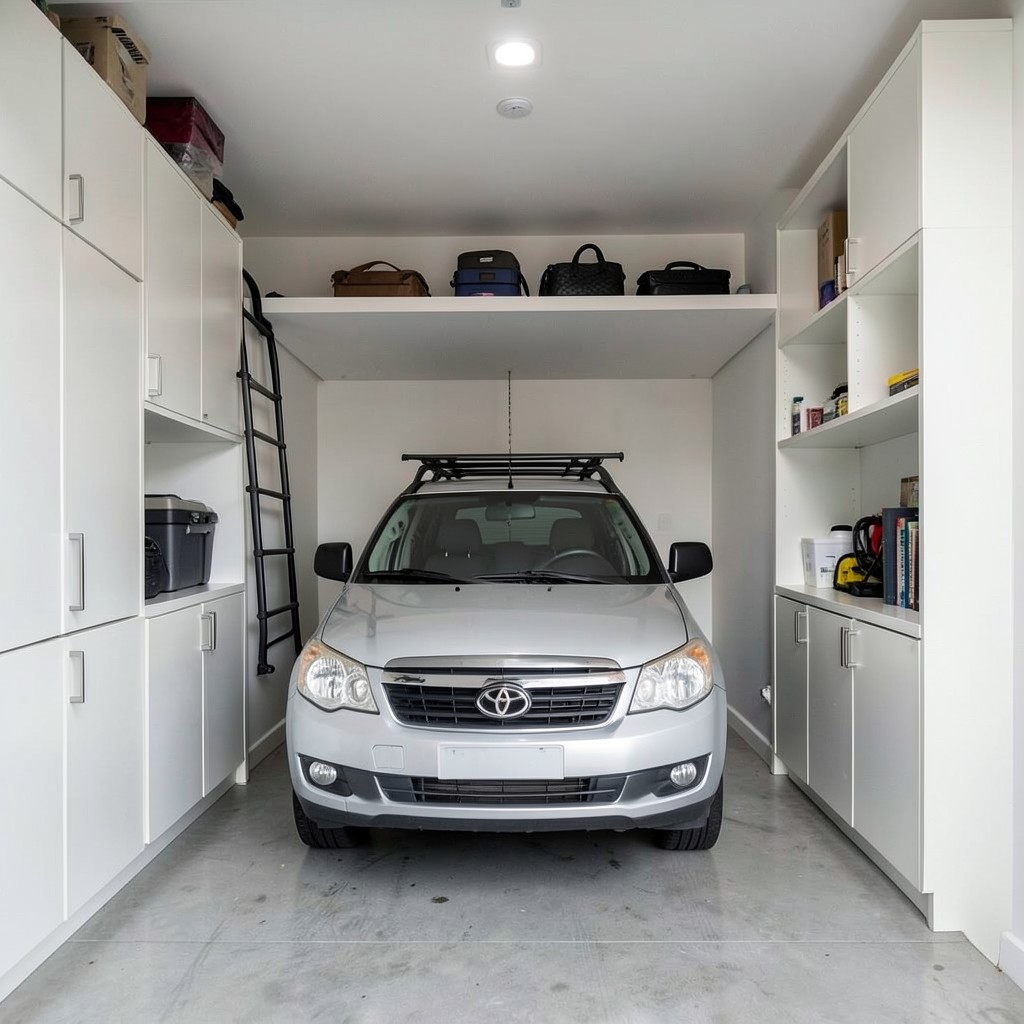
The single-car garage used by the majority of urban and suburban households presents the most demanding storage design challenge in the collection — a floor area of approximately two hundred to two hundred forty square feet must accommodate one vehicle, the tools and equipment to maintain it, the household’s sporting and seasonal storage, and whatever additional function the household assigns to the space, all without sacrificing the vehicle’s primary position. The small garage design problem is entirely a volume management problem, and its solution requires treating every surface — walls, ceiling, and the vertical faces of any built-in storage — as usable storage territory.
A wall-to-wall overhead storage platform spanning the garage’s full width at the front third of the space — the section above the vehicle’s hood when parked — creates a ceiling storage zone that holds the seasonal and infrequent-use storage without impacting the vehicle parking or the working floor area below. The platform’s underside height should clear the vehicle’s highest point — the roof rack, the antenna, or the open trunk lid — by a minimum of eight inches, and the platform itself should be accessible by a fixed wall-mounted ladder at the garage’s side wall. This configuration uses the dead air space above the vehicle to hold the household’s bulkiest storage, recovering equivalent floor space from a zone that was previously contributing nothing to the garage’s organizational capacity.
Floor-to-ceiling wall storage on both side walls — combining wall-mounted cabinets at the upper section with open shelving in the mid-section and floor-level cabinets at the bottom — maximizes every square inch of the side walls from floor to ceiling. The wall cabinets’ depth should not exceed twelve inches on the side walls, to preserve the clearance between the vehicle’s sides and the storage system that allows the car doors to open fully without contact. A twelve-inch-deep cabinet on both side walls leaves a twelve-inch clearance on each side of a standard vehicle — sufficient for door opening and lateral movement — while providing the organizational capacity that a shallow cabinet at full wall height delivers in aggregate.
48. A Garage With a Clean White and Wood Aesthetic

The white and wood garage applies the material partnership most consistently successful in domestic interiors — the combination of white-painted structural surfaces and warm natural wood accents — to the garage with the same visual result that the pairing achieves in the kitchen, the bathroom, and the living room: a space that reads as clean, warm, intentional, and genuinely pleasant to spend time in. The white provides the reflective clarity, the wood provides the domestic warmth, and their combination creates the garage aesthetic that neither industrial hardness nor domestic softness alone achieves.
White powder-coated steel cabinets — or white painted MDF cabinets in a semi-gloss finish that resists the marks and moisture of garage use — create the white element’s primary structural contribution. The cabinet doors’ white face creates the visual background that the wood accents require to register as warm — a white background makes the wood’s color read as intentionally warm rather than simply unpainted. Solid wood workbench top in a natural ash or white oak finish, open wood shelving at the mid-section of the storage wall, and a wood-toned floor in a warm epoxy or a sealed concrete with an amber tint create the wood element’s distribution throughout the space, connecting the white cabinetry’s clean surfaces to the human warmth of natural material at multiple points in the garage’s visual field.
The white and wood palette’s maintenance requirement in a garage context is more demanding than in an interior room — the white surfaces are in direct contact with the dirt, oil, and grime that garage activity generates, and a maintenance schedule that includes periodic wiping of the cabinet faces with a mild cleanser keeps the white fresh without the touch-up painting that a neglected white surface eventually requires. The wood surfaces require the same penetrating oil maintenance as any natural wood in a working environment, applied when the surface begins to look dry rather than on a fixed schedule. These maintenance requirements are the honest conditions of the palette’s use in a working garage, and they are manageable without being onerous.
49. A Garage With Thoughtful Color-Zoning for Multiple Functions

Color zoning in a multi-function garage — applying distinct but harmonious colors to the ceiling and wall sections of different functional zones to delineate the workshop area from the storage area from the vehicle bay from the gym or studio section — creates a visual organizational system that makes the garage’s layout legible from any position within the space. The color zone is the spatial organizational equivalent of a room divider: it creates the psychological boundary between functional areas without the physical barrier that a wall or a partition would impose.
A workshop zone in a warm white with subtle yellow-green undertone — the color that renders work surfaces and tool details most clearly under artificial light — clearly delineates the working area and creates the precise, task-appropriate environment. The vehicle bay in a neutral light grey creates the automotive backdrop that suits vehicle display and maintenance work without the color cast that tinted walls create on the vehicle’s paint. The storage zone in a medium-tone color — a warm sage, a soft clay, or a dusty blue — creates the visual differentiation from the white workshop and the grey vehicle area while providing the calm, neutral backdrop that organizational storage systems read clearly against.
The transitions between the color zones — the corners and ceiling sections where two zone colors meet — should be handled with a clean border stripe or a neutral transition rather than an awkward blending of two color fields that reads as unresolved. A simple painted stripe in the wall’s white baseboard color, or a ceiling border strip in a metallic or contrasting neutral, creates the frame that tells the eye where one zone ends and the next begins. The color zone system is the design approach that makes a complex, multi-function garage readable as an organized whole rather than as a collection of competing activities sharing an uncomfortable floor plan.
50. A Garage Designed as the Home’s Most Functional Room

The garage designed as the home’s most functional room starts from a premise that most residential design ignores: the room in your house that you enter and exit most frequently, that holds the most diverse collection of tools and equipment, that supports the widest range of activities, and that directly enables the quality of every project and hobby the household pursues deserves as much design attention as any room you sit in or sleep in. The garage is not the back room of the house. It is the working heart of it.
Achieving maximum functionality in the garage requires the same design development process applied to the kitchen or the primary bathroom — a program of the activities the space must support, a layout analysis that positions each functional zone for its specific access and clearance requirements, a material selection process that matches surface quality to use intensity, and a lighting design that provides the correct illumination quality at every working position. The kitchen without proper lighting, without counter space calibrated to the cook’s workflow, and without appliance placement that supports the cooking sequence is a bad kitchen regardless of its material quality. The garage without these same design decisions applied to its equivalent functional requirements is a bad garage for the same reasons.
The garage designed as the home’s most functional room is also the home’s most personal room — because the activities it supports are the household’s real activities, the tools it holds are the tools of the household’s real interests, and the space it creates is the space where the household’s real work gets done. A beautiful garage is not a contradiction in terms. It is a room whose design serves its function so completely that the quality of the daily experience it provides is indistinguishable from the quality that any well-designed room in the house delivers. Start with what the garage needs to do, design it to do those things without compromise, and the beautiful garage is the natural result of getting that process right.
Leave a Reply